From the FasterSkier archive — posts syndicated from athletes’ and coaches’ own blogs between 2004 and 2012, kept online as published. Current coverage is at fasterskier.com.
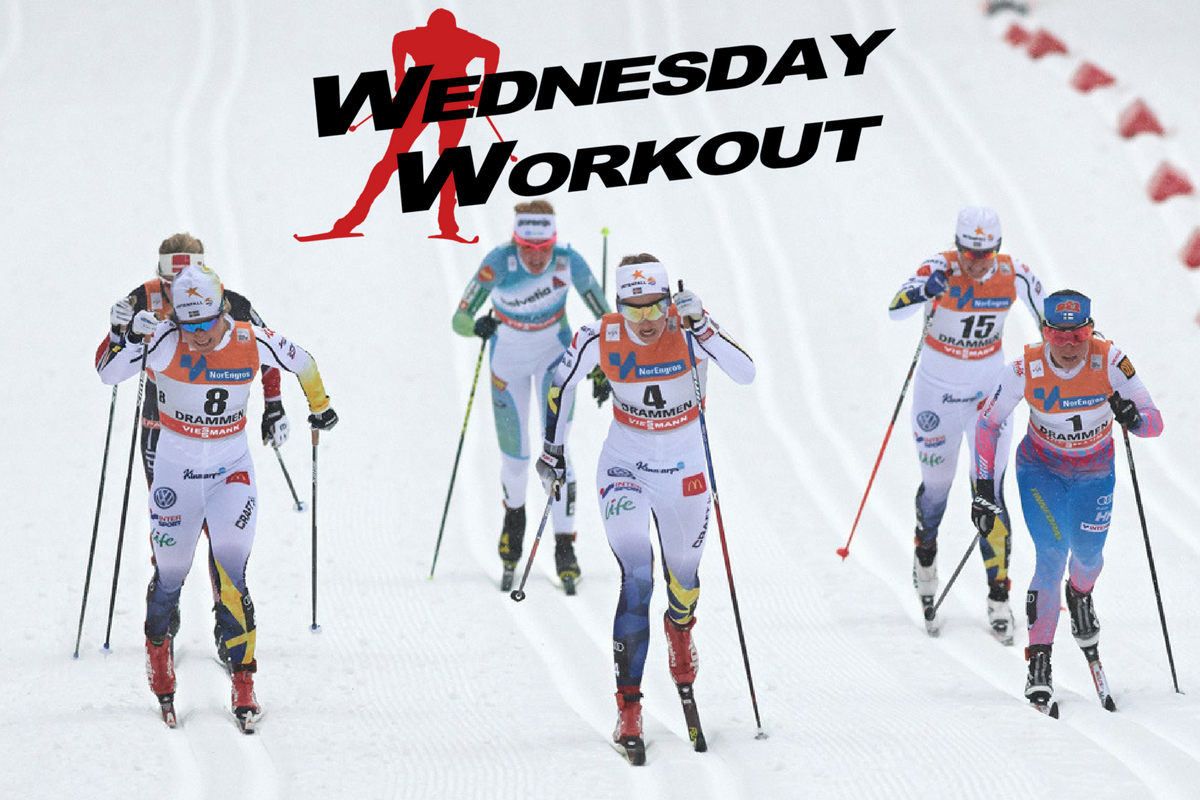
Sweden’s Hanna Falk (8) going for it in a sprint finish in Drammen, Norway, with her teammate Stina Nilsson (4) and Finland’s Krista Parmakoski (1) on March 8, 2017. (Photo: Fischer/NordicFocus)
“I have a workout that I like and usually do in the autumn when it’s time to shape up.”
Those are the words of Swedish national-team member Hanna Falk. To take Falk’s words literally, it is that time of year: in the Northern Hemisphere, it’s officially autumn and “time to shape up”. In two months, the 2017/2018 World Cup will open with classic sprints on Nov. 26 in Kuusamo, Finland.
For the figurative aspect of Falk’s comment, if you’ve been eschewing hard workouts and log six days a week of perfunctory OD, yes, “it’s time to shape up”. For World Cuppers, potential 2018 Olympians and those giving a Heisman to Father Time, it’s the season to think about priming for those moments when latching on to those skiers pushing the sharp-end pace is paramount.
In group sprints or distance events, no one likes to be yo-yoed off the back of the pack.
Last season on the World Cup, Falk finished third in the sprint rankings and 20th overall (a combination of both sprint and distance results.) Although certainly a sprinting force, Falk now considers herself an all-arounder. She placed eighth in the World Cup 10-kilometer freestyle race held in her birthplace of Ulricehamn, Sweden. After we interviewed Falk for FasterSkier’s Nordic Nation, we reached out for a Wednesday Workout, requesting something she uses this time of year to round herself into shape.
The Workout: 6 x 5 minutes with 2 minutes rest
“I usually do the workout on roller skis in variable/tough terrain,” she explained. “I also try to do a real sprint start in the start of each interval, just to practice that special moment. It means 10 seconds all out and then continuing the interval in the speed you can manage. You can also do a short sprint at the end of the interval if you want to practice the change of frequency in the finish. It’s a race-inspired workout that will get you tired!”
How to pace it:
“You should try to go hard, at high speed, without losing the technique — and with the same speed from the first to the last interval. It probably means Level 4. If you start off too hard and you are not able to have the same speed on the last interval, you are doing it wrong!”
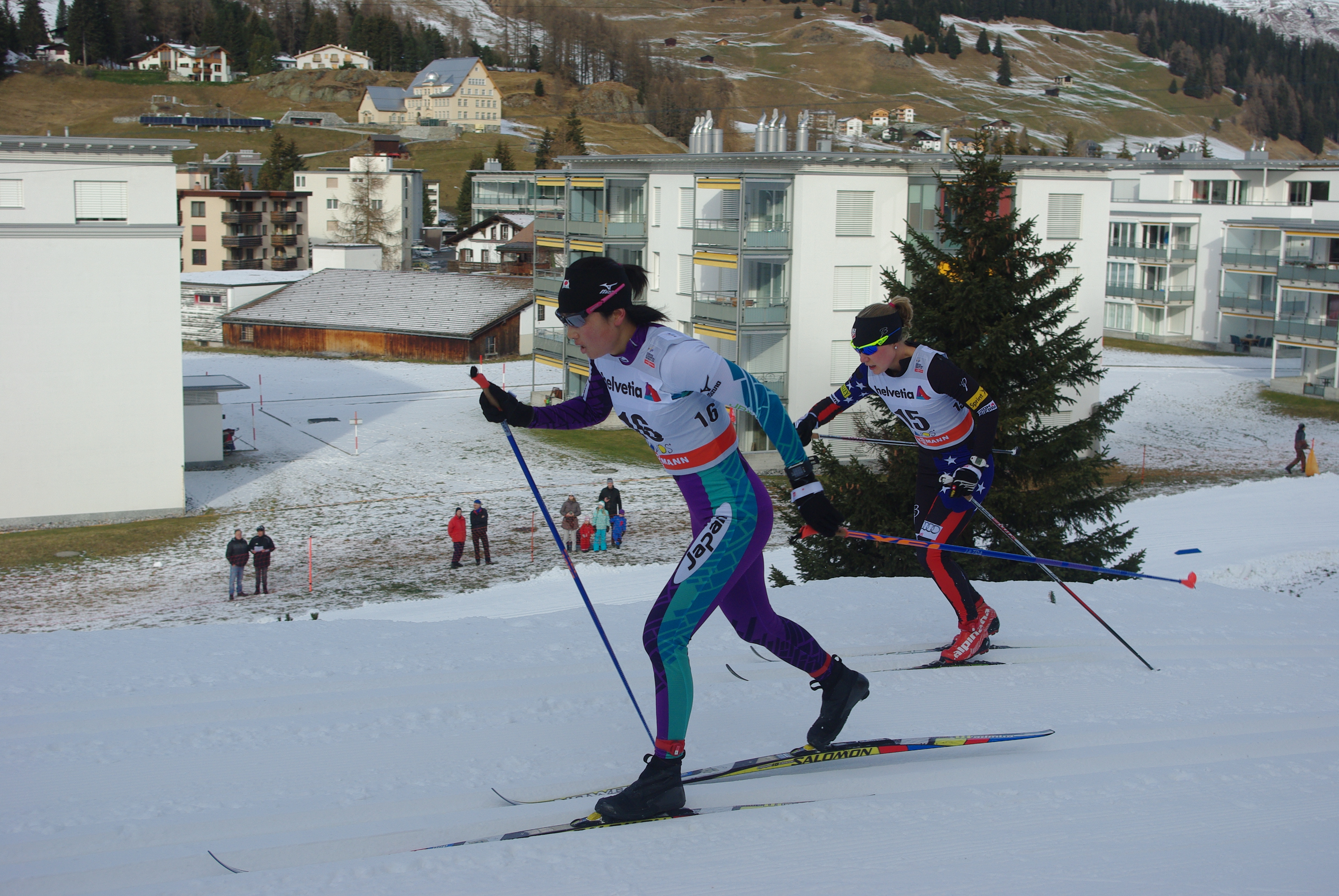
Ida Sargent (right) racing to a frustrating 47th-place finish in the 10 k classic yesterday. What a difference a day makes: she was happy with a 16th-place finish in today’s skate sprint, and what she called her best skate qualifier ever.
DAVOS, Switzerland—With three women making the quarterfinals and one more just barely okay, today’s World Cup skate sprint was moving in the right direction for the U.S. Ski Team.
“I would put it as a good day,” women’s coach Matt Whitcomb said. “I wouldn’t use any other word that celebrates it more than that. It was certainly solid. We came into this knowing that this is a good course for us, and we expect to have a good day. So I’m satisfied.”
Three performances were great, for three different reasons: Ida Sargent qualified 19th and finished 16th; Kikkan Randall made the heats and finished 20th, feeling better than in the last two weeks; and Sophie Caldwell made her first heats of the season on her way back from an elbow injury, finishing 22nd. We’ll get to those performances, and why each was so positive, later.
But for every great day, there was also a frustrating one. Sadie Bjornsen was left out of the heats, placing 31st, just half a second out of the quarterfinals. Jessie Diggins finished 43rd, unable to get her mojo back and re-start her previously long streak of qualifying in skate sprints. Caitlin Gregg finished 60th.
“This is exactly what we built this team for,” Whitcomb said. “You don’t build it for the easy days. You build it for the periods when you need it. We’ve been able to really tap into this team in period one, when we have some ups and downs. Some people skiing exceptionally here and there, but also quite a few disappointing races. I’ve been pleased with the way that the team is floating and sort of rolling with the punches.”
Coming off a banner year last season where Randall won her third straight Sprint Cup title, Caldwell racked up a best-ever Olympic finish for a U.S. woman, and the team was generally better than they’d ever been before, things feel a little different this time around.
“It’s hard not to have amazing results right off the bat,” Caldwell said. “We’re trying to build into the season, and by the time February rolls around we’ll be ready to go.”
Randall echoed Whitcomb’s sentiments: these challenges are making them stronger. Last year, she was second in this race, losing by a toe to Norway’s Marit Bjørgen. Today she was just happy to make the quarterfinals.
“This has been a really good test for our team,” she said. “I think the fire in our bellies is really growing right now. We all really wanted to focus on World Champs this year, to prove as a team that that’s where we can really show up. So everybody is starting the season a little less hot. That of course tests your patience and your confidence. But we have a really good feeling on the team right now and we’re all skiing really close, so that will help us push it to the next level.”
Sargent Close to Her Best
One of the highlights of the day was Sargent’s performance. Earlier this season, she had a breakthrough placing fifth in the classic sprint in Kuusamo, Finland. On paper, Davos wouldn’t seem like the best venue for her: it’s a skate sprint, and has a long flat section. Sargent typically excels on the hills.
But she was the top U.S. qualifier, overcoming the hurdle that sometimes seemed challenging last season: to consistently get in the heats.
“Today she showed that she could not just squeak in there, she qualified firmly,” Whitcomb said. “Just three seconds out of third place. She showed that this is an event that’s opening up for her.”
The classic sprint provided her with some extra confidence in skating, too, Sargent said.
“Making it to the final, I could tell that my fitness was really there, and I had felt like training skating was going well,” she explained. “But then getting sick after Finland and first trying to race through it and then having to kind of take a break wasn’t ideal. I was not feeling great. A little bummed out after yesterday, so this is a good confidence booster.”
Sargent planned to stay at the front of her quarterfinal, but it proved a tough task as she was matched up with Bjørgen, who finished fourth on the day, and perpetual finalist Katja Visnar of Slovenia (who, okay, finished 11th today).
“It felt like it went out quite fast, and I wasn’t really ready for that,” Sargent said. “I didn’t want to flood [my legs] too soon. I felt really strong climbing on the hills and just tried to move up there. I wish I’d had a little more space. I just got a little gap to Visnar, and I wish I had been able to hang a little tighter to her.”
Bjørgen won the heat by a whopping three seconds, and Sargent skied an aggressive finish, almost catching Visnar. She ended up in a photo finish with Sandra Ringwald of Germany. She lost it by 0.4 seconds and wound up fourth in her heat. Unlike in Kuusamo, she didn’t get a lucky lose spot in the semifinals, either.
“It was still really fun,” Sargent said. “It was my best skate qualifier maybe ever, so I was really happy with that… I know I can be there. Even a day like today, I can tell that I was skiing with all those girls. Some heats go your way and some heats don’t go your way. That’s what makes it really fun and exciting. Every day is different.”
According to Whitcomb, this might have been another breakthrough, this time in freestyle sprinting.
“She’s had better results in Sochi and Moscow and Canmore,” he said. “But this is a really stacked field, it’s on a unique course that has a very high speed V2 section, twice, and that has never been Ida’s forte.”
Randall Inches Forward
The season did not get off to a good start for Randall, the team’s biggest star. In Kuusamo and Lillehammer, she looked like a shell of her former self. But after today’s competition everyone agreed that she’s on her way back to her winning habits, even if she’s not quite there yet.
“I actually had a gear going up the hill that time,” she said, relieved. “It’s definitely a step better. But I definitely want more.”
It wasn’t clear whether Randall would make it into the heats or not; she eventually qualified in 28th (“It was kind of nailbiter when I saw my name slipping down the board, and I’m like, oh, I don’t want to spend another week not qualifying,” she said). But once she got to the quarterfinals, she was able to think like her usual tactical self.
“This course, it pays to be a little bit patient,” she said, explaining that she didn’t worry too much after she got boxed out of the front of the heat early on. “That wasn’t so bad, because there was a good open lane on the outside on the hill and we had good boards today. I was able to come right into the pack on the downhill, and I decided to go for it on the inside.”
But she also had a tough heat, with eventual runner-up Maiken Caspersen Falla and Swedish star Ida Ingemarsdotter. The Norwegian Olympic gold medalist was a frequent foe of Randall’s last season, but today she couldn’t match Falla’s pace.
“I actually came off the corner in a good position and then across the flats, the pace picked up and I wasn’t able to respond right away,” she said. “About 2/3 of the way I was able to remind myself to dig in a little bit and found a gear… I was happy to be not just blown off the back. I think all the right things are in there, I’ve just been struggling with being sick and down all summer.”
Like Sargent, Randall made a charge at the end of her race and ended up on the losing side of a photo finish for third. This might have been one of those performances that Whitcomb said was good. Is it the old Randall? No. But it’s closer – she had at least a little bit of juice – and everyone involved is keeping the real goal in sight.
“She’s going to have her day again soon,” Whitcomb said.
Caldwell: What Elbow?
Finally, Caldwell is working on a comeback of her own after missing a chunk of training when she broke her elbow in Park City this fall.
“It is a terrific day for Sophie,” Whitcomb said, getting a bit more animated. “She’s been wondering just how close she is to her return, and we have felt all along that she was going to return in qualification form. And we were proven wrong in Lillehammer. That was something we had to swallow. But we stuck to our guns, and kept trying to encourage her and let her know that she was closer than she feels.”
Caldwell has been carefully managing her expectations, and qualifying in 23rd place fulfilled a secret one she hadn’t been saying out loud.
“I was trying not to have any expectations and just keep improving a little each weekend,” she said. “That was my goal. But obviously in the back of my head, I thought, it would be really cool to qualify. So I was just thrilled to be back in it today.”
She raced in the same quarterfinal with Randall, but slipped back over the course of the second lap and finished a bit over four seconds off the pace, good for fifth place in the heat and 23rd overall.
“We were happy to be in the last heat because this course has so many tactics, with two laps and the corner,” she said. “So we watched the heats and saw what was working. We practiced the corner with Ida, and the start, and tried to get the hang of things. Otherwise, it was just the same strategy as always.”
The heat was “a little rough,” she said, but like Randall she was happy to be moving in the right direction.
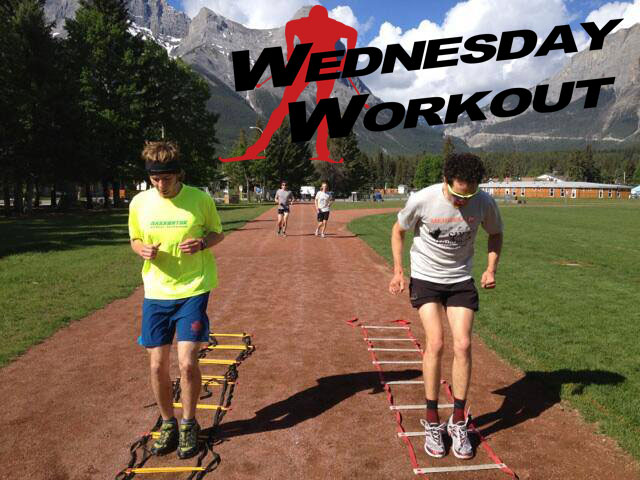
Zeke Williams (l) races through the ladder during a track workout with Alberta World Cup Academy teammate Yannick Lapierre in Canmore, Alberta. (Photo: Stefan Kuhn)
This week’s workout comes to you from Ezekiel “Zeke” Williams, FasterSkier’s newest intern and an athlete at the Alberta World Cup Academy in Canmore, Alberta. This time last season, Williams said he really enjoyed doing what his team called, for lack of a better name, the Agility Sprint Track Workout.
***
Canmore Alberta may be known for its skiers rather than its track stars but it still has a short 300-metre stone-dust track. And this is where the Alberta World Cup Academy men’s team was to be found, more often than not, on Thursday mornings in May and June 2013. As the athletes warmed up the coaches set up a pair of agility ladders on one of the track’s straight-aways and hurdles on the other. Finally, the coaches would draw ‘finish lines’ at about 10-seconds worth of sprinting past the end of the obstacles.
After warming up we would partner up and do laps of the track. We would focus on speed through the agility ladders and hurdles and then sprint out of them. Then we’d slow back down to an easy jogging pace until we hit the next feature.
The Workout: Agility Sprint Track Workout
Total time: 1 1/2 hours
Need: A track, running shoes
Warm up: 30-minute jog
10 track laps: 20 x 10-15 second sprints with about 1 minute easy jogging between each. Whole thing takes just over 20 minutes
Cool down: 40 minute jog
I like this workout for two reasons. First, it’s a lot of fun to do! Getting to race through the ladders and the hurdles against a teammate makes it a sweet competition.
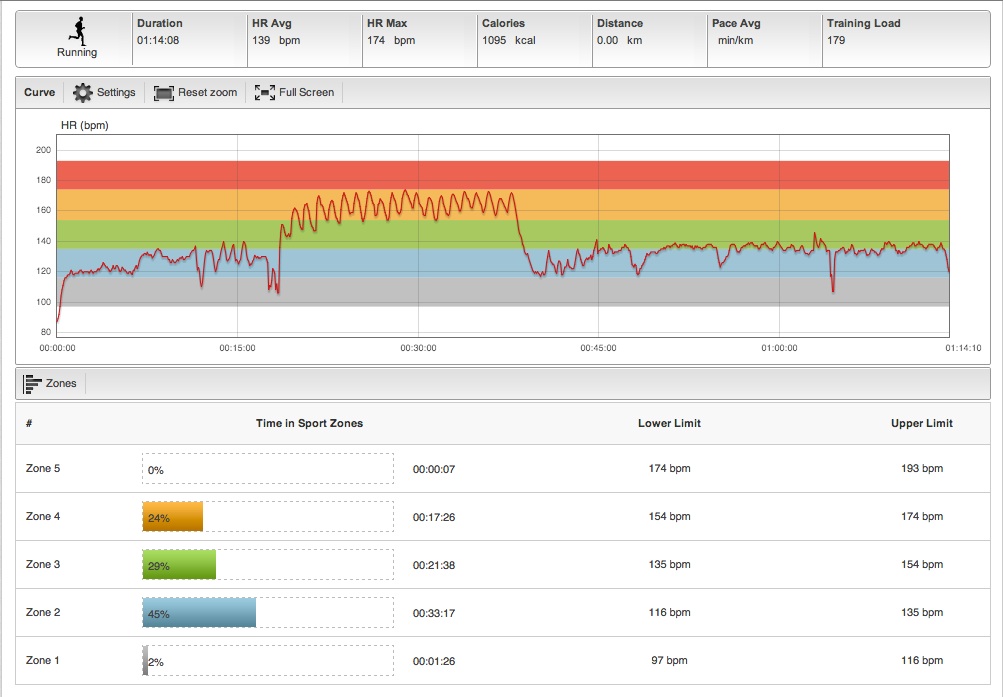
Heart-rate data from Zeke Williams’ workout: track laps are between about 18 and 38 minutes.
Second, the workout gives a bunch of training benefits. At first glance it looks like a speed workout, but heart rate ends up at lactate threshold for most of the time because of the shortness of the sprints and the minute of easy jogging between them. Check out my heart-rate log during a similar workout here.
Also, the agility component of the workout improves coordination at speed, which is nice to stay in touch with for when we get back into rollerski sprinting.
Combine the agility work and lactate threshold building into the short 1:30 hour workout time and it makes for a solid early training-season session.
***
About the Author: A Canadian cross-country ski racer with the Alberta World Cup Academy, Zeke spends most of his time in Canmore, Alberta, but calls Cantley, Quebec, his home. He thinks that you can learn a lot about a person from their goals — his is to ski really fast on the Winter Olympic race course in 2018. Check out his blog: ezekielwilliams.ca
Kikkan Randall en route to winning her quarterfinal heat over Denise Herrmann of Germany in Davos today.
DAVOS, Switzerland – As U.S. Ski Team women’s coach Matt Whitcomb said after today’s 1.5 kilometer freestyle sprint, he was proud that Kikkan Randall “put herself in a position to win the race today.”
Randall lost a photo finish to Marit Bjørgen of Norway. But to go for the win, you have to show up at the fight in the first place – and today, Randall almost didn’t, after being nearly pushed off the course in the final.
Midway through the two-loop course, the women were skiing through the stadium on a long, gradual incline. After some some sharp corners, it was one of the widest sections of the course and a chance to make passes. Both Randall and eventual race winner Marit Bjørgen of Norway had been using the section in many of their heats, taking the opportunity to move their way up through the field after hanging near the back of the pack for the first loop.
After this exact situation played out again in the final, Randall was on the right and quickly gaining ground on Sweden’s Hanna Erikson (formerly Brodin) and Stina Nilsson, who were leading at the time. But as the stadium came to an end, Randall ran out of room and found herself boxed between Nilsson and the side of the course.
For a scary moment, it looked like the American – who won her quarterfinal and semifinal heats, and was the best sprinter in the world for the last two years – might go down.
“I had a little bit of a challenge on that second lap,” Randall admitted. “I felt like I got shut off of the course a little bit, so I had to make an extra acceleration and go around.”
Randall and Nilsson tangled skis briefly. Neither went down, but both had to make serious readjustments.
“I think Kikkan wanted to increase the speed, so she passed me on the inside,” Nilsson told FasterSkier. “Our skis touched each other, but it was nobody’s fault. It happens in sprints.”
Nilsson dropped to the back of the field and never recovered, finishing sixth. But she didn’t blame her slowdown on the incident with Randall.
“I got more lactate [in my legs] after it, but I did my best,” the 2012 World Junior Champion said. “I would be tired anyway, but it came as a shock. It didn’t matter though, I’m happy with my sixth place. I’ve never been in a semifinal in skating, so I’m very happy.”
Kikkan Randall racing to second in today’s sprint in Davos (Photo: Fisher/Nordic Focus)
The American team would assign a little more blame to Nilsson than the Swede was willing to admit.
“It was tough when I was trying to kind of come up the inside, and the Swedish girl seemed to be skiing more and more off the best line, until she basically ran me into the v-boards,” Randall said. “That was like, I was trying to say, hey, hey! So that’s an unfortunate move. It’s not necessarily fair play.”
Whitcomb said that he went to the jury office and reviewed the video carefully. Ultimately, he did not file a complaint, but he wanted to have the best information possible – not just Randall’s account of the incident or views that the team could see from the stadium.
“I don’t personally see it as a direct infraction,” Whitcomb said. “But I think it’s important for us to be on our game, and to make sure that we’re not being pushed around even after the race is over. We need to know where the lines are with these rules.”
Part of the reason that he didn’t press harder is that while Nilsson may have pushed Randall out, Randall was the one who put herself in that position in the first place.
“It’s a tough lane that Kikkan chose, to come inside there as the course bends left a little bit,” he said. “So definitely, as it was happening, we saw it happening. It would have been nice to have a little more room there, but at the same time, rubbing is racing, and I’m really proud of how Kikkan was able to sustain a few taps and blows out there.”
Randall ultimately lost in a photo finish. Would things have gone differently if she had been able to keep up a steady speed all the way through the middle of the heat?
Maybe, she suggested. After all, when you lose by two centimeters, even the smallest of incidents can take on big meanings.
“I felt like I actually had good energy at the end,” Randall said. “If anything maybe it would have given me that extra gear over the top of the hill, which would have been important for getting a little bit more room.”
While the win would have been great, Whitcomb said that the ski tangle perhaps gave them something even more important as the team heads towards the Olympics.
“The interesting thing about it is that the person it teaches the most is probably Kikkan,” he said. “Because, as a great racer you spend so much time in these heats, but often by yourself, with people being careful of you. We’re really aware that they’re not going to touch Kikkan out there, just like with Northug – you know that if you click on Northug’s tails, the TV camera is on you. But it’s great for Kikkan to have some contact out there and get a feel for it. The courses in Sochi are fairly quick and windy, and there’s going to be contact there. So it’s a great experience for us.”
Reid Pletcher, victorious in the first true sprint of the season in Bozeman, Mont. Erik Bjornsen (left) was second and Ryan Scott (center) took third.
BOZEMAN, Mont. — A certain excitement hung in the air at Bohart Ranch on Thursday morning. Perhaps it was because this was the first true sprint of the season. Maybe the field was happy to finally contest the event that was cancelled last weekend. Sprinting in its true, head-to-head format was also a long time returning to the beginning of the SuperTour calendar. Expectations were most certainly piqued with several World Cup qualifying spots up for the taking.
When it was all said and done — the qualifying, the heats, the nervous skiing around between races — Sun Valley Ski Education Foundation’s Reid Pletcher came out on top, just edging out Erik Bjornsen (APU/USST) and Ryan Scott (SSCV Team HomeGrown). Alex Howe (Craftsbury Green Racing Project) finished a close fourth, Skyler Davis (SMS T2/USST) took fifth and Torin Koos (BSF/Rossignol) straggled in sixth.
Pletcher finishing with Howe in the earlier heats.
Pletcher flew under the radar throughout the morning, qualifying in fifth and never once winning a quarterfinal or semifinal. Even in the final round he followed the leader and tucked in behind Scott, who had dominated each of his earlier heats and did the same in the early stages of the final. Pletcher hadn’t even expected to make the last round, and at that point was simply skiing to hang on.
“I was hoping for a top twelve,” he said. “I mean, I have a decent history in sprinting, but I haven’t done heats in years because of college racing [for Colorado University].
“I’ll take this one, for sure. [The Quebec World Cup] would be amazing. All my goals are coming through, so I feel pretty good about this. I needed a good result to show me I was on track.”
Earlier that morning, Pletcher finished second to Scott in his quarterfinal just ahead of Sam Naney (Methow Olympic Development/Madshus). In the semifinals he scraped through in third thanks in part to crashes that took out Rune Odegaard (Colorado University) and Pat O’Brien (Craftsbury Green Racing Project). All day long, Scott and Bjornsen made it look easy and Pletcher seemed to require more of an effort to survive each round. Or perhaps that’s just his style of skiing.
“I was thinking for the final, I’m not going to have the energy for it, I’m just going to try to hold on.” Pletcher said.
The men’s final leaving the line.
He managed leave the double pole zone in second, but Scott quickly gapped the field and there was no drafting him. But before long he and Davis, who ended up in fifth, worked together and caught back up in time to catch a pull down the final hill.
“I had the advantage on the downhill, and there was a strong headwind into the finish,” Pletcher said. “It just worked out. I had a little draft and did a little slingshot move coming into the finish. It went better than planned. It was phenomenal.”
The difference between the top three was slim, but the win was definitive enough for Bjornsen to look sideways in the last stretch to see Pletcher with his arms already raised in celebration.
A new International Ski Federation (FIS) rule gets rid of the penalty for changing finish lanes and Bjornsen made the most of it, first choosing the line behind Pletcher and then traveling left in front of Scott’s. In the end, though, Pletcher simply had too much momentum.
“I’m always going for the win, but second is awesome so I’m pretty happy about that,” Bjornsen said. The USST D-Team member dug his way out from the back of the pack early on to first pass Koos, then Davis, then Scott.
Bjornsen easily sliding through his semifinal.
“I took it slow, so I felt I had quite a bit of energy left, and got past this big kid [pointing to Davis] on the flat section before the finish. Ryan was kind of dying, so I got past him. I was happy; it was fun.”
Scott, who won the qualifying round and breezed through each of his heats without needing to exert much energy in the finish, said that he may have ultimately underestimated the men who lined up next to him in the final.
“I had a lot of confidence coming out of last week,” Scott said. “My goal was obviously to win today; I just didn’t quite play it right in the final.”
After skiing so easily through the rounds, Scott set out to immediately put distance between himself and the field in the last one.
“I sized up the guys I was against and thought my best bet was to try to break [them], because I know they’re real quick in the finish,” Scott said. “I thought perhaps if I could string them out, and I’ve been feeling good, then I could maybe break them. The other heats I never had to finish very hard because I was able to break the group earlier, but not so much in the final. I underestimated the speed of the group a bit.”
Scott, leading Davis and Pletcher, coasting through the end of the semis.
Not appearing too put out, Scott concluded that he’d simply take Thursday’s performance as fuel for the next race, a classic sprint on Saturday.
In fourth place, the domination of the SuperTour rookies continued with Alex Howe (Craftsbury Green Racing Project). The University of Vermont alum qualified in sixth and next won his quarterfinal, beating Pletcher. In the final he got boxed out and stuck at the very back of the pack, but bided his time and slowly moved up. Howe’s expectations earlier that morning had simply been to advance.
“I really just wanted to be able to qualify and ski more than once,” Howe said. “So I was really happy.”
Davis, in fifth, gave his result a “six out of ten.” He skied in second or third for most of the race but built up lactic acid in his legs so that, by the end, he was running on steam and upper body strength.
“I came up into the finish and my legs were just gone,” he said. “It did anything to try to stay with these guys.”
Koos, once unbeatable in any given sprint, has been battling illness recently and finished the final behind the field with his arms on his knees and his head down. The image is perhaps emblematic of a changing of the guard that seems to be taking place on the domestic circuit — the top five male sprinters on Thursday were all 24 years old and under.
“I’m definitely excited to see younger guys skiing fast and coming through now,” Scott said. “I think it definitely bodes well.”
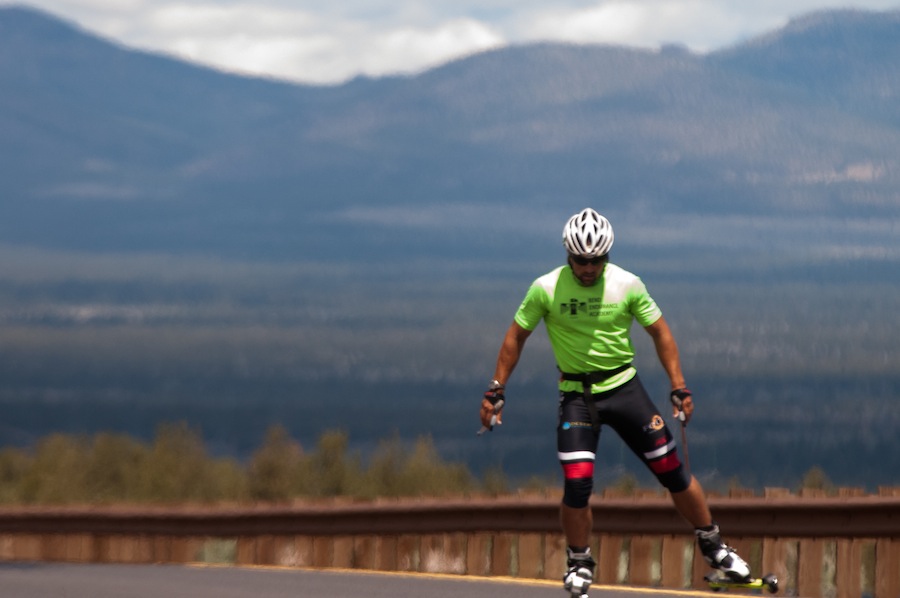
Dakota Blackhorse-von Jess of the Bend Endurance Academy rollerskiing in June in Oregon. He increased his training hours this offseason in an attempt to build a bigger aerobic base. (Photo by Curt Hawkinson / curthawkinson.smugmug.com/Nordic)
When Dakota Blackhorse-von Jess shows up at a race, he’s hard to miss. If his backward baseball cap doesn’t give him away, his bubbly personality, bearded face or black, red and white-striped spandex will.
One of the staples of Bend Endurance Academy’s nordic program, the 26-year-old Blackhorse-von Jess grew up in Bend, Ore., and skied for Dartmouth College before returning to his native state – and town.
Dakota Blackhorse-von Jess (third from right) and other Bend Endurance Academy athletes during a rollerski session in June near Bend, Ore. (Photo by Curt Hawkinson / curthawkinson.smugmug.com/Nordic)
Back in Bend, Blackhorse-von Jess trains mostly with his coach, Ben Husaby, and the three-man BEA elite team (including Reitler Hodgert and Lars Ellefson), while joining the Methow Olympic Development (MOD) program for workouts.
Known as a sprinter on the U.S. domestic circuit, the short-statured Blackhorse-von Jess typically uses his aggressive style to blast through the heats and into the finals. He captured silver at the U.S. nationals skate sprint last season and was the runner-up at the SuperTour classic sprint in Madison, Wis.
The next day at the skate sprint in Madison on Feb. 19, Blackhorse-von Jess failed to qualify for the quarterfinals for the first time that he could remember in his pro-racing career. It was a blow that set him back in the last SuperTour sprint of the season and one he attributed to missing the wax while prepping his own skis.
Moving on, he planned to race at the SuperTour Finals in Craftsbury, Vt., but come late March, health issues kept him from it. The Madison sprint ended up being his last race of the season.
Overall, Blackhorse-von Jess finished 24th in the SuperTour standings and fifth in the sprint category for his best career ranking. Still, the man with the three-part, four-syllable last name wanted more and he’s been working all summer to achieve it.
FasterSkier recently emailed Blackhorse-von Jess after he tweeted about paddleboarding with the musician Michael Franti. Turns out, he didn’t actually hang out with Franti, but saw him from a unique vantage point.
***
FasterSkier: Please explain this tweet: “Paddle boarding and Michael Franti? Yeah. That happened. And it was awesome.”
Dakota Blackhorse-von Jess: Ha, not actually paddleboarding WITH Franti (although a friend of mine who teaches lessons did actually give him a lesson), but I’ll explain: The big concert venue in Bend is right along the river. My roommate came home … and said “hey – I’m headed down to the river to paddleboard, I hear Franti is playing. Wanna go?” so we grabbed some boards and paddled around and listened (and actually got to watch) the concert. Pretty fun times, but it’s sort of a reference you have to understand Bend to get right away.
FS: How has the rest of your summer been?
DBVJ: Great. The camps were awesome, training is going well, I’ve been working my a** off so I can pay for ski racing this winter, and I even managed to have some awesome surf days during our PNSA/Far West training camp in NorCal. Getting ready for fall though … I think everyone is looking forward to West [Yellowstone, the SuperTour opener in November], especially since that’s the next time I get to see all my college friends that have taken off for school already.
FS: Whom have you mostly trained with?
DBVJ: As of Monday, a week ago most of our college/older kids went back to school or are taking a couple weeks at home (technically the program is on “vacation” for two weeks) so it’s just me and Reitler Hodgert for the moment, but Lars Ellefson will be back soon, and our high school and post grads will be filling the van up once we get back on normal schedule. The fall is the loneliest time here, but it’s also hands down the best time for training and it works better in a small group. I’m psyched.
Our summer group was fantastic, as always. Keep your eyes on Bella Smith (now skiing for MSU). I predict she’s gonna make some waves. But it’s definitely a big void with all of them gone: we have 8 or 9 skiers from our summer group back off to college and a bunch more going back to high school, so instead of two vans going to training, we could take a single car … It’s different for sure. But it means less fighting over surfboards at the coast camps!
FS: What have you been focusing on?
DBVJ: The focus this summer has been, as it has been for the last couple years, on developing my aerobic base. Logging some hours. This year we’ve done a little more intensity work than last summer and have tried some cool new training methodologies (especially after the success the MoD Squad demonstrated using them last year) that we think are going to show some pretty neat results this fall. But the focus is definitely on continuing to build on my biggest weakness: a lack of years and years of base training.
FS: How does your training plan compare to last year?
Dakota Blackhorse-von Jess doing some non-ski-specific training last spring. (Courtesy photo)
DBJV: The biggest difference between this year and last year is the amount of non-ski work I’ve done. If things go well, I’ll be dropping some serious dough on travel and racing. So … saving up for that while having all the normal expenses of an adult living on his own with student loans and training full time has actually been the biggest focus of the summer. Training isn’t very hard – managing the rest of life so that it doesn’t impact training is the hard part.
FS: What are some of your goals?
DBJV: Goals for the coming season are pretty straightforward (and I expect a lot of people have this same list): first is to qualify for the world cups. Then, and more significantly, is to score some World Cup points in Quebec/Canmore. Second, I want to win a national championship.
If things go as planned, hopefully I’ll wind up at World Champs and maybe get to race some of the regular season European World Cups. But the plan is to do what I need to do so I can qualify for the World Cups in West and Bozeman, and then really be hitting high gear for the World Cups and US Nationals. It’s hard to know what’s gonna happen after that.
FS: How did you feel last season went?
DBJV: Last season was, like it seems all my seasons are, both up and down. I did more racing last season than usual (which was awesome), but learned some hard lessons it would have been awesome to have figured out years ago. Madison especially was a tough end to the season (although I didn’t know at the time it would be my last race).
FS: You mentioned financial struggles, which most skiers face. How do you manage to support yourself?
DBJV: I have an incredible support network here in Bend: somebody always knows somebody who needs some work done. I’ve done so many different jobs over the years and I own enough tools (or know people with tools) that I can do a really wide array of things. That helps a lot. Periodically I pick up web programming gigs, and I’ve been working super part-time as the systems administrator for a local dental office for something like 8 years. Odd jobs, 🙂
The amazing part is that everyone I work for is super respectful of my training schedule and actually wants to help me succeed in ski racing. It’s not that I don’t work a lot, because I do, but I get to be really flexible with it. There aren’t very many hours in the day when you pack all that stuff in, but it really makes you appreciate your days off (when I try to stay on top of the rest of my life … like laundry and mowing the lawn).
The takeaway is that people care a lot and WANT to help me out – I’m not unemployed or working minimum wage somewhere awful. Yeah, I don’t have money for, well, anything other than the basics and ski racing, but really? I’m living the dream. Who else gets to legitimately justify playing in the mountains?
Members of the Bend Endurance Academy rollerskiing in June near Bend, Ore. (Dakota Blackhorse-von Jess courtesy photo)
A couple quick notes about some sprinting results.
Devon Kershaw
Kershaw’s having a heck of a season. On of the things I’m been most impressed with is how much his sprinting has improved, which is something I feel like hasn’t been mentioned much in a lot of the coverage:
The circled result in the most recent Moscow sprint. Notice how while Kershaw’s median sprint result was improving somewhat between 2006 and 2010, his best result was actually getting somewhat worse each season. Then he had a very inconsistent season of sprint results last year. He hasn’t completely solved his occasional poor qualification effort problems, but look at how much better and more consistent his results are this season.
I threw all those other guys up there just for comparison.
I’m a little concerned about Newell. This will mark the second season in a row of his median result moving in the wrong direction. He still has no trouble qualifying, generally speaking, but for a guy with a reputation of struggling to advance through the heats, that trend is worrying. Len Valjas is qualifying much more consistently, which is a significant improvement.
Koos
I made the graph below several weeks ago around US nationals, but have been somewhat hesitant to post it. Once again, Torin Koos won a US Nationals sprint race and (kinda) won the other as well. Ever since Koos left the USST, every time he skis well domestically there’s lots of chatter from his fans about how crazy the USST was to kick him off, etc.
While I appreciate that Koos has a lot of fans (and deservedly so) I feel like a lot of the outrage I see expressed on his behalf assumes that his international results were more accomplished than they really were. Here’s what I mean:
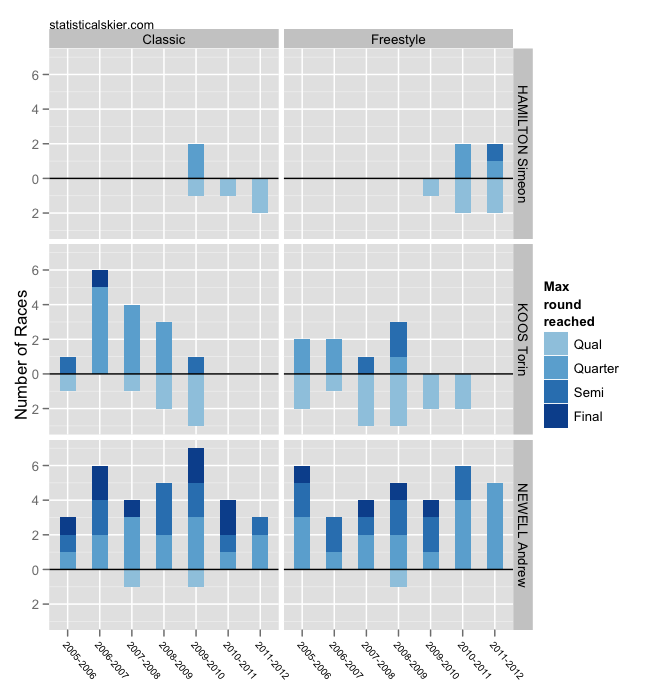
This plot show the number of WC level sprint races (truncated at 2006 to consider a single race format with 30 qualifiers) where each skier advanced to a particular round.
So for example, it shows that for Simi Hamilton, in classic sprints, did 3 WC level sprints in 2010. Twice he advanced as far as the quarterfinals and once he only skied the qualification round. The bar segments for the qualification round are inverted to indicate that that’s generally a bad result.
Newell, as you might expect rarely fails to qualify for the elimination rounds, but only occasionally reaches the finals. This season (so far) appears to be worse than usual on that front.
In freestyle sprints, Koos was failing to advance past qualification around half the time, and never made it past the semis. But the real story are his classic results, which were on a dramatic decline after 2007. As it was, it wasn’t like he was advancing past the quarters all that much.
I want to be clear here that my point is not that Koos’s results were bad necessarily, just that I don’t think they were as good as a lot of his fans think they were, and that there was clear evidence that they were trending in the wrong direction.
One of the most awkward and uncomfortable aspects of running this blog has been talking about US and Canadian skiers who have either had bad results, or who’s results are not as good as conventional wisdom would suggest, in my opinion. Which is a little weird, because it’s not like I actually know any of these folks. But since I have swum in those general waters, we surely have friends in common, so it still feels awkward for me. I’m not sure why I point this out except that maybe it soothes my conscience a little bit.
RUMFORD, Maine — There was no shortage of excitement at Black Mountain on Tuesday, where U.S. Cross Country Championships kicked off with a freestyle sprint. We checked in with the day’s winners Torin Koos (BSF/Rossignol) and Jessie Diggins (CXC/USST), as well as Caitlin Gregg (CXC), Jennie Bender (CXC), Ida Sargent (CGRP/USST), Corey Stock (CSU), Colin Rodgers (SVSEF), Karl Nygren (CXC), Joanne Reid (CU), Eliska Hajkova (CU), Bryan Cook (CGRP) and Nils Koons (CGRP).
Kuhn on his way to qualifying for the classic sprint at the 2010 Vancouver Olympics (Photo: Brad Jones)
Canadian Stefan Kuhn has made a rapid transition from elite skiing to elite coaching.
The former Canadian National Ski Team (CNST) member and Vancouver Olympian announced his retirement less than six months ago, and was immediately snapped up in a coaching capacity by the Alberta World Cup Academy (AWCA), one of Canada’s premiere training centers.
During his career, Kuhn was primarily a sprinter – as is evidenced by his 15th place finish in Vancouver, the best ever result recorded by a Canadian male in a sprint at the Olympics.
As a result, a large part of his experience, and his favorite workouts from both coaching and racing, are those focused on speed.
In an interview with FasterSkier, Kuhn explained that in the fall, his aim is to increase the focus on Level 4 intensity workouts, in order to bring up the athletes’ speed.
For his specific favorite speed session, often held on the rollerski track at the Canmore Nordic Center, Kuhn splits athletes into small groups of 3.
The athletes then ski in single file, in a follow-the-leader style at an easy pace. The person in front is in charge of starting the interval – anytime he wants, he can jump into a level 4 attack on the other two. The attack can last from a minimum of 10 seconds, to a maximum of 1 minute, and the other two athletes have to try and stay with the leader, much as you would in a race when someone increases the pace.
After each rep, the leader switches, giving each athlete an opportunity to ‘attack’.
For Kuhn, the goal of the workout is to teach awareness, reaction times, and mental toughness all at speed.
“A guy can go out super hard, and you think he’s just going for ten seconds, and you hang on,” Kuhn said, “But all of a sudden you’re a minute in and you’re just blown.”
Kuhn recommends that the full workout run about an hour and a half to two hours, with roughly two sets of 10 to 15 reps separated by a ten minute break.
He also suggests a minimum of at least a minute between ‘attacks’, in order to be completely rested and ready for the next one.
Kuhn has the unique experience of doing the interval set as an athlete, and now running it as a coach.
“It’s something I did as an athlete and really enjoyed, and now get to do as a coach, and athletes really enjoy it,” he said.
Kikkan Randall racing the classic sprint at the 2010 Olympics in Vancouver.
Since sprinting was first introduced, at the 2001 World Championships in Finland, the International Ski Federation (FIS) has constantly fiddled with the format.
The number of heats, the number of athletes in each one, and the total number who qualify for the rounds—all have been altered at one point or another. But one of the most contentious—and significant—changes has been the length of the sprint race.
Changes Were Necessary, Officials Say
According to FIS Cross-Country Committee Chairman Vegard Ulvang, the original guidelines for World Cup sprint distances called for courses of 1.2 to 1.6 kilometers. But in the lead-up to the 2010 Olympic Games in Vancouver, FIS officials proposed increasing the maximum length to 1.8 kilometers.
Ulvang said that the distance changes were suggested to ensure that courses could access terrain to include two big climbs, which would help deter the men from double poling the entire sprint on skate skis—thus defeating the use of classic equipment.
In a notorious case in Canmore in 2008, Norwegians Boerre Naess, Ola Vigen Hattestad and Eldar Roenning all dominated a sprint course that was laid out on insufficiently challenging terrain.
“To make good cross-country courses, with uphills and downhills, you need some flexibility on course lengths,” Ulvang said.
But for the athletes tackling the elongated sprint courses, the shifting distances can be frustrating. “Many of the racers I have talked to dislike the trend of sprints getting longer,” said Kikkan Randall, a U.S. Ski Team (USST) member and FIS athlete representative. “Most agree that the ideal sprint length is around three minutes.”
USST Head Coach Chris Grover—who used to be in charge of the squad’s sprinters—is in the same school.
“The sprint should be right around three minutes in length, and never more than 3:30,” he said.
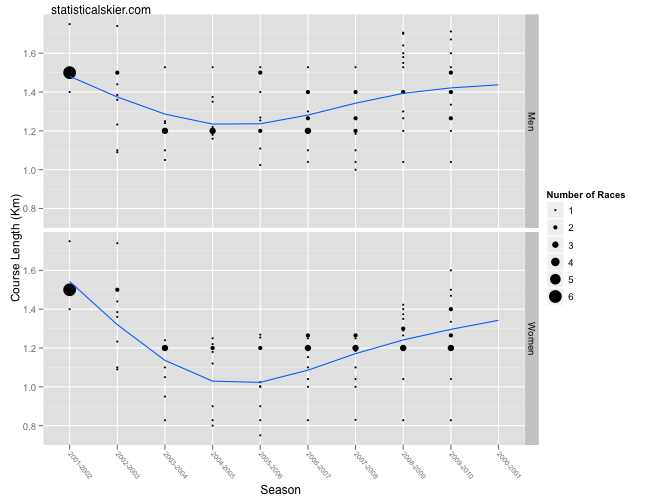
Data from the International Ski Federation shows that the average time of the top 10 qualifiers in sprint races has trended upwards since 2006. Graphic by Joran Elias, statisticalskier.com.
Training
While the margin for error in any World Cup race is slim, in sprints, this rings especially true. In the men’s qualifier, the difference between first and 30th—the cutoff for entering the heats—is often no more than five seconds, leaving very little room for errors in training.
Athletes have to walk a fine line between speed and endurance to be successful, Grover said—and finding that physiological balance is tough.
“The two-minute sprint requires almost equal contributions from an athlete’s aerobic and anaerobic energy systems,” Grover said. “The four-minute sprint is weighted heavily on the aerobic side.”
As a result, the constant variation in distance has forced athletes to change their training to adapt. In the early years of the format, when races were shorter, sprint specialists followed regimens designed to maximize their speed.
“My generation of skiers—[those] who were successful in the early days of sprinting—changed the way they were training in order to accommodate the shorter sprints,” said the USST’s Andy Newell. “We changed the kind of intervals we did, the kind of volume we were training, more like you would for a race that’s that long, because back then they were only qualifying the top 15 or 16. If you didn’t have that speed, you weren’t going to be a successful sprinter.”
Data from the International Ski Federation shows a trend towards longer sprints since the 2005-2006 season. Graphic by Joran Elias, statisticalskier.com. (Note: The International Ski Federation's results database contains some discrepancies with the distances displayed on PDF copies of results that are also available; while the trend of this graph is most likely correct, neither FasterSkier nor statiscalskier.com guarantees its accuracy.)
However, with races becoming longer, often nearing the four-minute range, “the coach’s challenge with each sprinter has been to find the balance between training the different energy systems,” Grover said. Athletes need the speed to qualify in the top 30, but if they don’t have the endurance, they can’t turn on the jets at crucial moments during semifinals and finals.
“Too much aerobic training and the sprinter will not qualify for the heats,” Grover said. “Too little aerobic training and the same athlete will not make it past a quarterfinal.”
Randall described the longer courses as “not ideal” for her, at least initially.
“I’ve had to adjust my training to increase my endurance and capacity,” she said.
“Sprinters now need to train a lot, just like a regular cross-country skier,” said Newell.
Excitement
FIS officials have stated that the federation considers the needs of the athletes in its decisions, but growing and marketing the sport of cross-country skiing is also a priority.
At the spring FIS meetings in Turkey in June, Randall said she was told that “the longer sprint courses are more advantageous for the overall contenders, like [Petter] Northug and [Dario] Cologna, which allows them to qualify in the heats. This, in turn, is seen as making the race for the Overall World Cup more exciting [for] more TV viewers.”
Petter Northug qualifying in the sprint at the 2010 Olympics.
Ulvang also noted concerns at FISthat shorter sprint distances would have split the sport of cross-country skiing into two distinct disciplines—sprint and distance. He acknowledged that sprints have been steered in the direction of endurance athletes over the past few years, which he said “allows some of our best racers to do all disciplines.”
But for Randall, the lengthening of sprints has killed some of the excitement.
“Especially in the men’s races, racers now stay together and ski slower, and then wait until the end to make moves,” she said.
Ulvang, however, assured FasterSkier that the longer distances made for a better fight for the overall World Cup competition. And while the fluctuations have left athletes frustrated, Ulvang maintained that the format was finally beginning to settle down. At the meetings in Turkey this spring, it was recommended that qualifier times be held to approximately three minutes.
Despite the challenges of adapting to the longer distances, Newell said that he liked the current format—and he also understands FIS’s rationale for pushing it.
“People who are fast at sprinting, and people who are fast at distance—everyone can compete at this distance, and that’s what FIS wants,” Newell said. “That’s what’s good for TV, and that’s what’s good for spectators.”
For Grover, the change in distance has not had as much of an effect on the excitement of the race as other variables. He maintained that the most exciting addition to the sprint in recent years has been “the advent of the 30-person round, and the lucky loser system.”
“Sprinting is in a good place…Each year the event seems to get cleaner and more fair,” Grover said.
Steinbock Racing's Chris Cook recently won the pack sprint at the American Birkebeiner to finish 3rd. Here are his comments below on sprinting.
Sprint racing can be a tough balancing act, between tempo, technique, pace, and power application. As the sprint courses have grown in distance and time, not only on an international level but also domestically, controlling your tempo has become more and more crucial to laying down the fastest time of the day.
People automatically associate sprint racing with moving everything at top speed to try and maximize speed, however, if you focus more on big powerful movements you will always beat the racer flailing in every direction imaginable. This proves the contradiction: slowing your tempo down to apply big powerful explosive movements will be faster. To the average viewer it will always look like the flailer will be setting land speed records but it will be the smoother skier always coming up with the fastest times. Don’t get me wrong though, you can’t go through the entire course with the same tempo. The terrain will always dictate what tempo is the fastest. Sprint courses will generally have some steep climbs and some gradual sections. It is on these gradual ups and downs where you can really maximize your speed with tempo. These gradual sections were made for skiing big. By slowing your tempo to maximize the power application of the technique you will maximize your glide and increase your efficiency. If you kept a short quick tempo through the same section, you would have doubled or tripled the number of strokes as the same racer skiing big. Now as the race continues and the gradual section of the course leads into the steeper sections, the slower tempo racer can now shift gears, quicken the tempo, and accelerate up and over the terrain. The higher tempo skier simply has to try and maintain the same high tempo into a section that is much tougher than the previous gradual section often leading to deceleration and fatigue. Every transition in the sprint course terrain can be thought of as a cue for a shift point to dictate a change in your tempo. By continually changing tempo to adapt to the terrain you will be skiing each section efficiently and quickly.
Sprint racing is just a much shorter distance race really. The racer who covers the course with the fewest amount of strides will have skied the most efficiently and covered the most amount of ground in the fastest amount of time, every time. The flailer may look the fastest but wasted movements equal wasted energy, resulting in fatigue, which kills your speed. In a game where you want to reach your max speed and pin it there, you need to ski as efficiently as possible.
Forecast/Conditions: Friday Night: a slight chance of snow
showers, mostly cloudy, low around 6F. Saturday: A chance of snow
showers in the am, mostly cloudy, high near 37F. Expect snow temp at the start around 8F. West Yellowstone snow is typically dry &
abrasive. Expect partially transformed fast and hard packed snow.
Glidewax: Apply LF Moly/LF Blue mix, scrape and brush, then
apply HF Blue, scrape and brush. Finish by rotocorking JetStream
Blue, brush with a dedicated nylon polishing brush and polish with a
thermopad.
Gripwax: Roughen base with 150 grit sandpaper, iron in Carbon
BaseWax Green, cork smooth, let cool. Then apply 2 layers of Carbon
GripWax Viola followed by 2 thin layers of Carbon Grip Blue, corking
smooth between layers. Check TOKO Wax Recommendation easel
prior to race start and adjust as needed. Another solid option would
be a very thick and short (klister zone) application of Base Green
binder (only).
Structure: A fine linear structure will be good. One good pass
with the Toko Structurite tool with the Blue bit before applying
the JetStream is recommended.
Check the WaxTip page at www.TokoUS.com before all of your races for the latest waxing information.
The Toko Race Wax Tips offer racers precise waxing advice on how to make your skis perform optimally for a given event. For racers who don’t have top end waxes, skip the Fluorocarbon (JetStream) and substitute the LF or System 3 wax of the same color (Yellow, Red or Blue). For those who do not have a rotocork for applying JetStream, the next best thing is to iron it in.
Dartmouth's Eric Packer (center) with teammates Nils Koons (right), Ben Koons (background), and Burke Mountain Academy's Sam Tarling (left), at an Eastern Cup sprint in Rumford, Maine. Photo by FlyingPointRoad.com
As a freshman at the University of Anchorage, Amy Glen skied to a fourth place finish in the skate sprint at the 2009 U.S. National Championships. She only raced two other sprint races that whole winter: one at the World Junior Championships, and the other at a local race series in Alaska.
Her story is a common one at the college level—with most programs focused on the distance races that will qualify their racers for the NCAA championships, athletes have little time to dedicate to sprint racing.
Of the three NCAA skiing conferences—the Rocky Mountain Intercollegiate Ski Association (RMISA); the Central Collegiate Ski Association (CCSA); and the Eastern Intercollegiate Ski Association (EISA)—only the EISA has a sprint event on its race calendar. There is no sprint at the NCAA Championships.
Two years ago, University of New Hampshire Coach Cory Schwartz brought a proposal to the NCAA skiing committee to bring sprinting to the collegiate championships once every other year. That proposal failed, and despite the discipline’s growth both domestically and internationally, Schwartz says that there hasn’t been a change in attitude among college coaches.
“I’m sort of spinning in the snow,” he said.
Embracing the sprint?
According to U.S. Sprint Coach Chris Grover, while some of the best domestic sprinters are currently attending or have graduated from college, NCAA skiers are not getting enough opportunities to focus on sprinting.
“I would love to see the NCAA skiing community embrace the sprint,” Grover said. “As long as we don’t, we’re going to be missing that key age group in terms of the development of sprint athletes.”
Right now, he continued, most of the country’s juniors and U-23 competitors aren’t getting enough experience in the event.
“Two or three chances a year is not giving you a chance to come back next year and do something better,” he said.
University of Utah Head Nordic Coach Eli Brown said that for college skiing, sprinting is a natural fit because the athletes are busy, and can still excel at sprinting on slightly less training. And, given the growth of the discipline at the elite level, he said, it makes sense.
“There are things that we can do as college coaches and programs to better develop athletes, and one of them is make our events fit what’s happening on the world scene,” Brown said.
Barriers
Schwartz said that when he presented his proposal at the NCAA skiing committee meeting, none of the three conferences supported it.
One major obstacle to adding a sprint to the NCAA championships is that in order to do so, it would most likely have to drop one of the two distance races that currently make up the event, in order to preserve the balance between alpine and nordic.
In conversations with Schwartz, Joe Haggenmiller, and Bruce Cranmer, who were representatives at the NCAA committee meeting from the EISA, CCSA, and RMISA, respectively, the coaches cited a number of other hurdles to incorporating sprinting into college competition, including team scoring, venues, and recruiting.
“At the NCAA championships, the team race is a really big factor,” said Haggenmiller, who is the head coach of the Michigan Tech University nordic ski team.
“Sprint racing can be quite a bit more unpredictable than individual starts, or even a 20 and 15k mass start,” he said. “Those events [the 20 and 15 k’s] are not going to have some really fluky results—you’re not going to have someone who’s won every race of the season break a pole and be out in 30th place.”
As for venues, Hagenmiller continued, NCAA championships are already limited to locations with both good alpine and nordic areas. If the nordic site required a good sprint course in addition to a distance course, that would further restrict the number of options.
Schwartz said that one other problem was that some colleges with limited scholarships might not want to use one for an athlete who could only be competitive in sprint races.
As opposed to the NCAA championships, the individual ski conferences could more easily incorporate a sprint race into their existing race calendars, since each one has five or six race weekends.
However, Cranmer said that since sprints at a regional meets wouldn’t count towards NCAA qualification unless the event was introduced at the NCAA championships, schools would be reluctant to travel to competitions where there was only one NCAA qualifying race.
“When schools are spending a lot of money, they want the best opportunities to qualify,” he said. “Right now we’re kind of pressed as far as budgets are concerned—we’re just hanging on.”
Cranmer said that he thinks coaches are open to the idea of scheduling more sprint races, but right now, “it’s not a priority.”
Getting creative
Brown said that those financial problems are exactly the reason that collegiate skiing should consider introducing more sprint events.
“With [University of] Nevada on the rocks, with Western State [College] getting cut last year, we’re going to be forced pretty soon here to have to be more creative,” he said. “I think sprinting is going to be one of the things that’s going to help us out.”
According to Brown, the problems of venues, team scoring, and race format are smaller issues that could be worked out by coaches and the NCAA skiing committee.
In fact, he added, sprinting actually opens up new venues, at alpine areas, which in turn creates opportunities for more programs.
“I think college skiing does have to be about fitting into the pipeline, so that we can develop athletes,” Brown said. “Therefore we need to be progressive and look at different events, and in my book sprinting fits really well.”
Schwartz said that the excitement of sprint racing would attract more fans to the sport, and that the growing importance of the discipline on the national and international level is another reason to consider adding more events.
Sprinting probably shouldn’t be an NCAA championships event every year, Schwartz added, but including it even once every three or four years would allow collegiate skiers to get more experience and improve.
Hagenmiller said that most regions already have opportunities for athletes who are interested in the discipline. He cited U.S. National Championships, Junior Olympic Qualifying Races, and the SuperTour as places where collegiate athletes could get experience.
But Mike Hinckley, who graduated from Denver University last year and placed second in the sprint at U.S. Nationals in Anchorage, said that he had only been able to enter two or three sprint races each year.
“Maybe one or two of those was against national people who were actually focused on sprinting,” he said.
Glen, fourth at the U.S. National Championships last year, said that she also was not getting enough opportunities.
“It’s definitely hard on kids who have sprinting talent…to do college skiing, especially in the west, because they don’t have any races,” she said. “It’s hard to get experience when you’re just doing those 15ks.”
Nonetheless, Glen said that she still tries to train specifically for sprinting, and that her coaches have been supportive of her preference.
Next year, Glen will be skiing for the University of Vermont in the EISA, where, she said, it will be good to have “just that one sprint.”
Junior coaches may shy away from sprint and speed training for fear of pigeonholing their skiers or limiting their aerobic development. But many of the country’s top sprint coaches and athletes say that these kinds of training can be useful for budding distance skiers as well.
In an interview with FasterSkier, U.S. Ski Team Sprint Coach Chris Grover outlined three areas where juniors or young skiers could benefit from sprint-style training without detracting from their potential to be successful distance racers: strength, speed, and sprint-specific interval training.
“Every good distance skier you develop has an incredible aerobic engine, but also has to have an anaerobic engine as well,” Grover said. “You have to train a little bit of their weaknesses.”
FasterSkier spoke with Grover, 2009 World Championships sprint silver medalist Kikkan Randall, and Erik Flora, Alaska Pacific University program director, about the specific methods that coaches can use to develop their athletes’ sprinting skills before they reach the point where they can specialize in one discipline.
Torin Koos racing at the Team Sprint at the 2009 Whistler World Cup
Three types of training can help to better prepare younger skiers and juniors with sprinting potential without detracting from distance training. — Strength training for sprinting should incorporate explosive movements, with high loads, a low number of repetitions, and lots of recovery. These workouts will help prepare skiers for the explosive movements demanded by sprint racing.
— Speed training consists of multiple short, maximal efforts of ten seconds or less, generally on skis or rollerskis. Speed training helps to improve coordination and economy.
— Sprint-specific interval training consists of intervals between 30 seconds and three minutes. These kinds of intervals provide neuromuscular benefits, and can help skiers learn to move at a faster pace and cope with lactic acid buildup, all without incurring the same physiological cost as conventional intervals.
Early Ages
Before young athletes seriously dedicate themselves to skiing—from about seven to 11 or 12 years old—Grover said that there are already ways to begin to develop the coordination and balance required for sprinting.
“If you look at someone like Kikkan or [Andy] Newell, at that critical age, they were doing a wide variety of activities beyond the scope of traditional endurance athletics—they’re rollerblading, swimming, alpine skiing,” he said. “All of these are activities that challenge their proprioception [awareness of body movement position].”
It’s important for athletes to improve their proprioception early on, Grover continued, because elite cross country skiing demands such a high level of body control and precision in order to master its two techniques.
Speed training—short speed bursts of less than ten seconds, in different activites—can also begin to be incorporated at this age.
Strength, Speed, and Sprint-Specific Intervals
Once athletes get more serious about skiing, but before they’ve chosen a discipline, coaches can still begin to incorporate some sprint-specific training into a strength routine.
According to Grover, rather than relying exclusively on a circuit-based, general strength model, skiers should also be doing some maximal strength work in the weight room.
“Explosive general strength training, with high loads, low reps, and lots of recovery is one place where more sprint-style general strength training would apply to distance skiers as well,” he said.
For sprinters, Grover continued, the U.S. Ski Team ensures that the gains they make in the gym will transfer onto snow by making the exercises very specific—weighted dips, for example, or heavy double-pole pull downs on a weight stack.
Randall said that when she’s in the weight room, she’s still thinking about racing.
“When I’m sprinting, I like to be really explosive,” she said. “So when I’m in the weight room and doing a half squat, I’m trying to think of being really explosive, psychologically carrying the sprinting across some of the training that way.”
Speed training is another way to begin incorporating sprint-specific exercises into a workout. Grover said that while some coaches use the terms speed training and sprint training interchangeably, speed training actually refers only to maximal efforts of ten seconds or less.
Proper speed training, he said, should be periodized through the training year, focusing on technique or maximal efforts. These exercises are critical for budding distance skiers in addition to sprinters, Grover said, because many distance skiers are constrained by a “neuromuscular limitation—they can’t ski at a certain rate of speed because they’re extremely uncomfortable skiing at that speed.”
Like in the weight room, Randall does her speed training with her mind on sprint racing.
“Doing short speed work, even in distance sessions, I like to train as if I’m preparing for a sprint race,” she said. In her speed workouts, she said she’ll practice coming around corners, or even do sprint starts against others on her team.
Finally, sprint-specific interval training can also help younger athletes become more comfortable skiing at a high pace. This type of training usually consists of intervals between 30 seconds and three minutes in length—much shorter than typical intensity work for distance skiers.
These types of intervals can help athletes get used to working with lactic acid in their system, and they also have a different physiological cost. Even though they might be moving in and out of threshold, Grover said, skiers will still be logging time at threshold during sprint-specific intervals.
Kikkan Randall contesting the Team Sprint in Whistler.
Putting it into Practice
One program that has integrated these different exercises into its development pipeline is the Alaska Pacific University club team.
For their junior programs, Director Erik Flora said, APU works both on developing a good aerobic base through distance training, but also on coordination and economy through speed work.
“What I’ve seen is that you don’t get a really good look into [athletes’] genetic disposition until they’ve had a few years of training,” Flora said. “We have that speed work in there so for the ones with the more distance-style genetics, we’re still improving their economy, and with the sprinters at that time too, it helps them because they’re moving pretty quick and working on economy and sprint-specific skill.”
At APU, when athletes mature to a point where he or she has developed a specialty, they can start training with either a sprint group or a distance group to hone their skills. Skiers who are strong in sprinting and distance follow a plan that allows them to touch on both.
Randall, who trains with APU, said the team will break up into the different groups on interval days.
“Often times the sprinters will do something a little bit harder and a little bit shorter,” she said, while the distance group will do something “more threshold-based.”
Upper Levels
Once you make it to the international level, Flora said, skiers do make sacrifices by focusing specifically on sprint or distance racing.
“You start needing to specialize if you’re going to be competitive…and then you kind of see a detriment for the one [discipline] you don’t specifically focus on,” he said. “I think you can see that with Kikkan’s training—when I started working with her, we started to press on the sprint style of her training, and we saw the distance racing kind of stabilizing.”
“As she’s gotten a little more training base under her, we started to balance those two and bring the distance side up,” he continued. “I think it’s just kind of a trade-off—you just have to do it in phases.”
Grover said that all skiers have a different physiological make-up: some can rely on a strong aerobic system, while pure sprinters can get by with their anaerobic power.
“You have some sprinters that are also extremely good distance skiers…they’re not going to qualify super fast…but they’re going to really last well in the rounds,” he said. “Then you have the athletes that are really pure sprinters that have a really high anaerobic capacity, but maybe their aerobic capacity they have to focus on more.”
At the same time, though, it’s important not to get too caught up focusing on an athlete’s weaknesses.
“It’s really important not to forget what’s getting that athlete to that level, and to continue to nurture that set of strengths,” Grover said.
“When these guys get to a certain level,” he added, “they have to figure out how they got there, keep hammering on their strengths, and attack some of their weaknesses as well.”
Andy Newell racing in the semifinal at team sprint at the Whistler World Cup in 2009