Tag: Sprints

  • From the Archives: Andy Newell Scores his First World Cup Points, February 2004

    From the Archives: Andy Newell Scores his First World Cup Points, February 2004

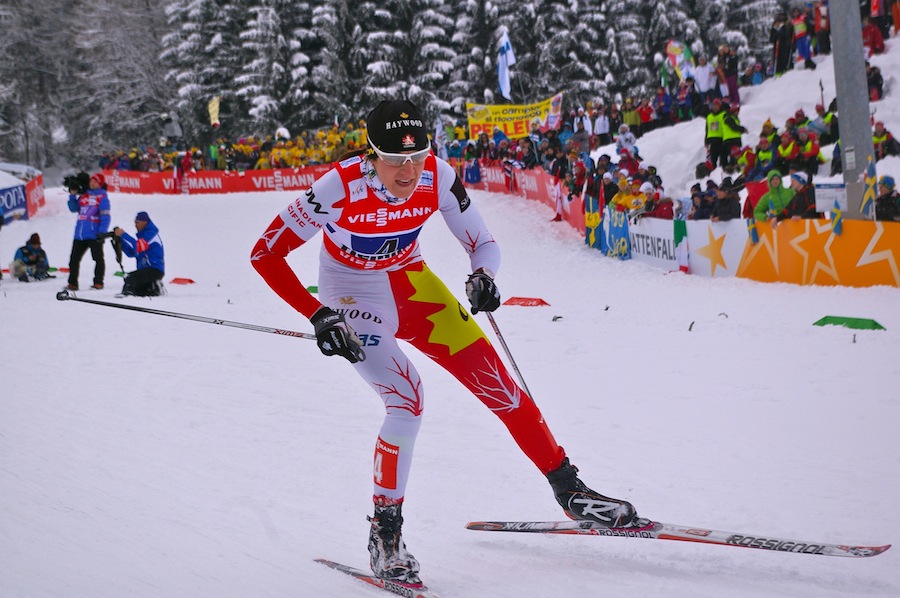
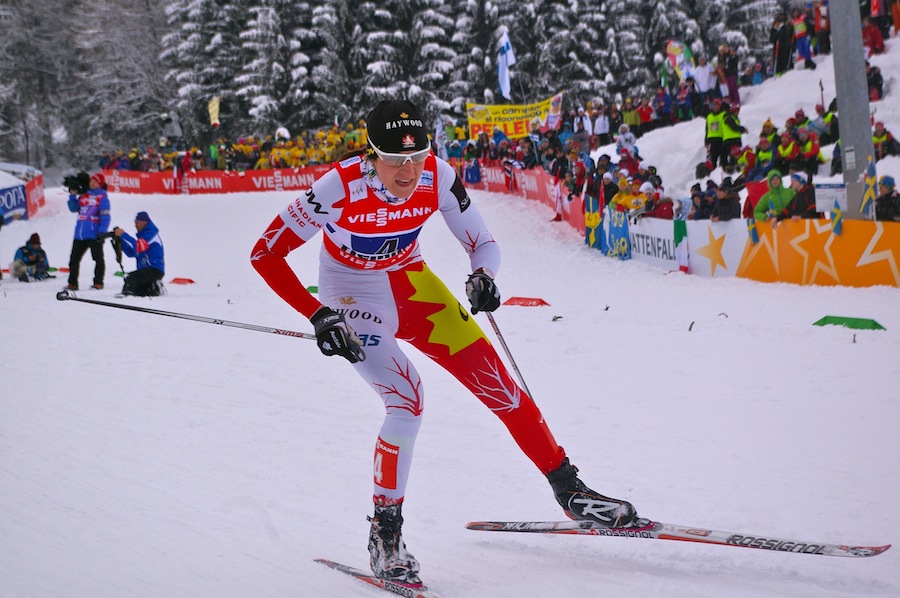
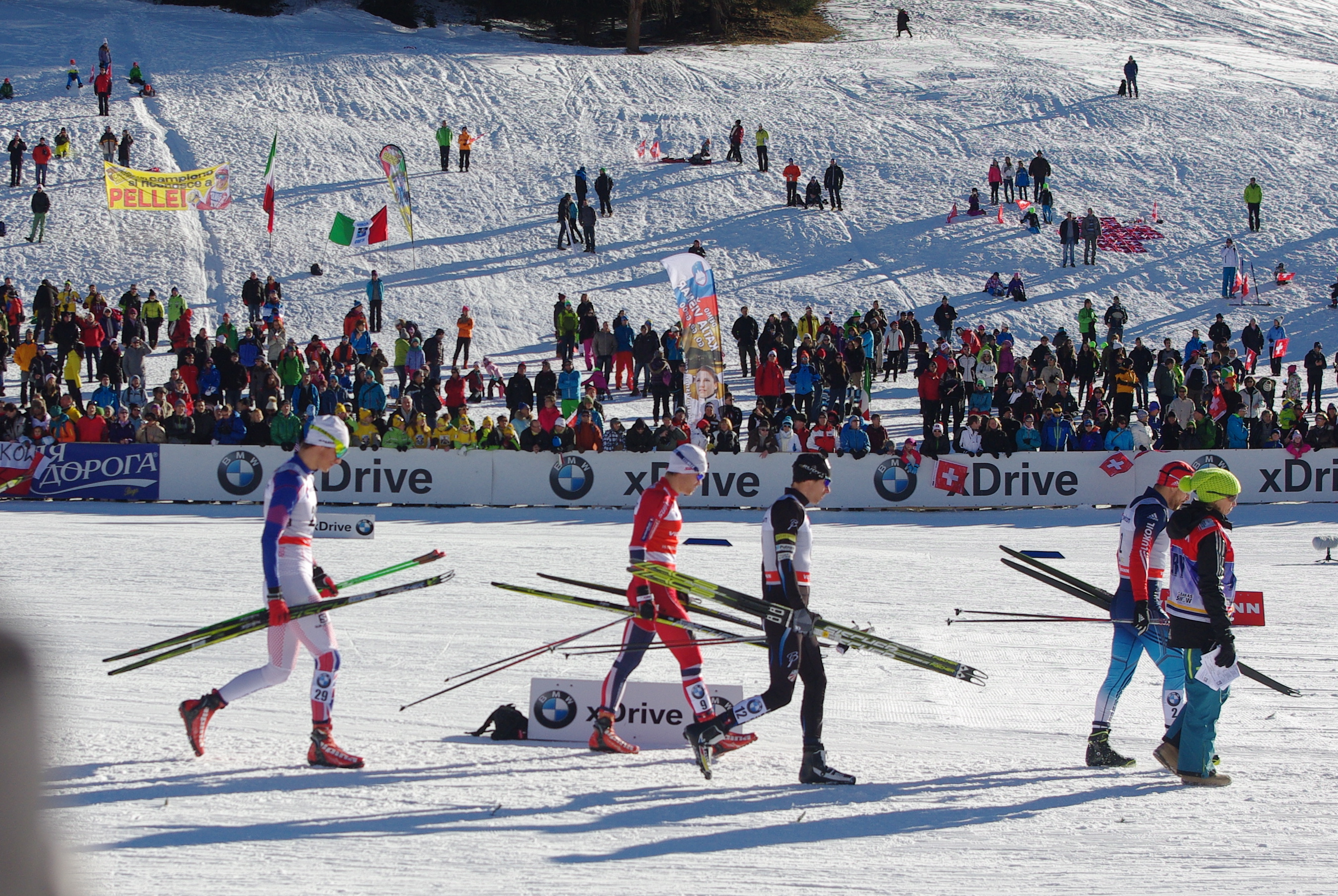
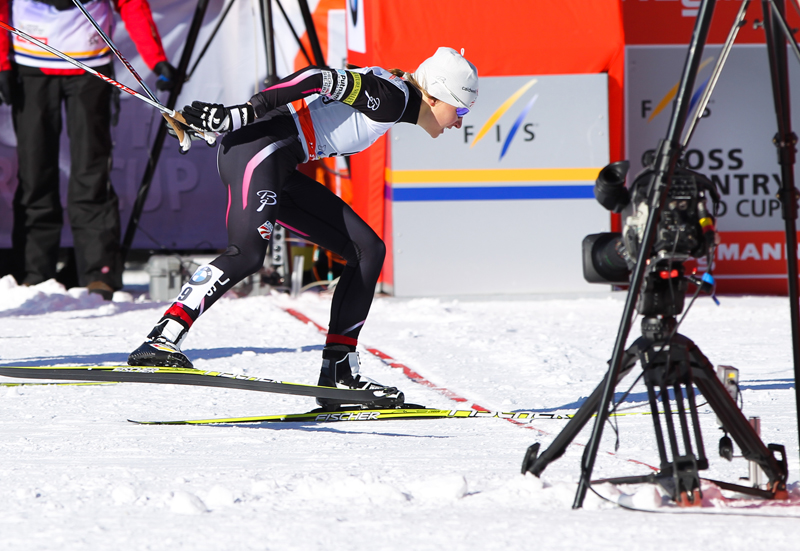
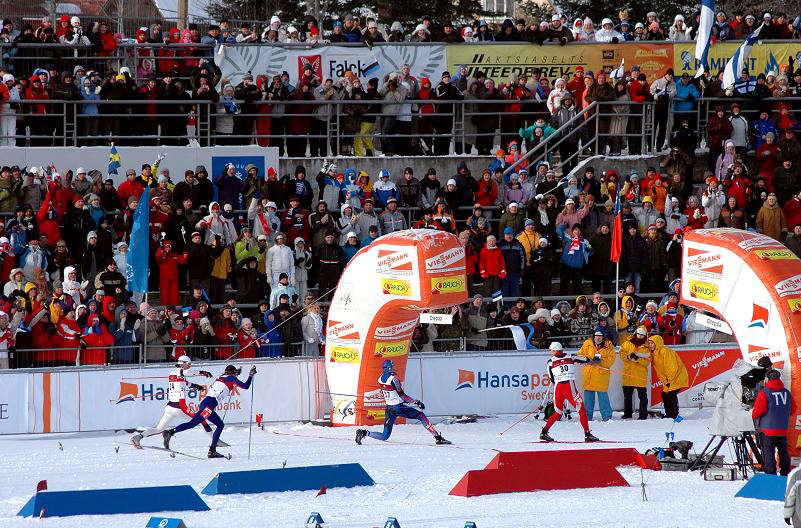
    This is not a very good photo, but is the oldest image that I can find of Andy Newell in the FasterSkier image library: Americans Torin Koos (white suit, far left) and Andy Newell (blue suit, second from left) approach the line in the classic sprint final in a World Cup race in Otepää, Estonia, in January 2007. Koos would pip Newell for third. (photo: TeamToday)

    The following article was originally published on FasterSkier on February 24, 2004. It was reprinted from press releases from the U.S. Ski Team and Cross Country Canada.

    Andy Newell, who is now the head coach for the BSF Pro Team, had 220 individual World Cup starts in his career. His first ever start came the weekend before this: Stockholm, February 18, 2004, 1.1-kilometer classic sprint, 43rd in qualifying. That race was won by Norwegian Jens Arne Svartedal, who was born in 1976 and last raced the World Cup in 2010. I wanted to reprint this site’s coverage of Newell’s inaugural race, but it seems, based on the existent archives, that we… just didn’t cover it? Oops. Sorry.

    Thankfully, a mere six days later, Newell scored points in his second-ever World Cup start, in Trondheim, Norway, an event duly recorded on this site. Note that Newell’s 25th-place finish in qualifying in Trondheim was good for World Cup points, but not for a spot in the heats, which at that time involved four heats of four athletes each. That is not how sprints currently work.

    The women’s race in Trondheim was won by Marit Bjørgen, whom you may have heard of. The men’s race was won by Janusz Krężelok, whom you would be forgiven for not knowing much about. Note also two German women on a sprint podium, and “upstart” 20-year-old Chandra Crawford finishing 9th in an OPA Cup race, as described at the bottom of this article. Crawford would, of course, win Olympic gold in the sprint in Torino, just less than two years later. Newell would, by my math, finish in the top thirty in an additional 114 World Cup sprints in his career, highlighted by three podium finishes: second in Lahti in 2008; third in Changchun, China, in 2006; third in Drammen in 2010.

    After 16 years on the National Team, Newell stepped down in 2018, transitioning into his current role as head coach at BSF with a couple final World Cup races along the way. For some nostalgic not-quite bookends to his professional racing career, watch this 2007 footage of Newell jibbing in Park City (a little lower film quality than his resources on Nordic Team Solutions) – inspiring the next generation of heavy-metal skinny ski shredders – then read FasterSkier’s coverage of Newell’s “anti-retirement” here

    The below article, featuring a then–20-year-old athlete still getting his feet wet at the sport’s highest stage, feels appropriate to revisit now, as a large crop of American youngsters invades the World Cup for Period 1 starting later this week. Someone’s first World Cup points are coming soon.
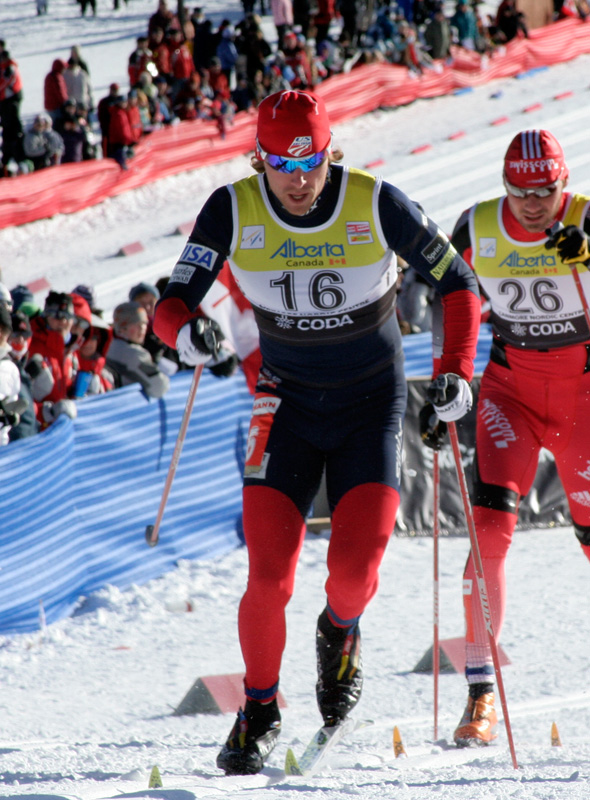
    This is the second-oldest photo of Andy Newell in our image library: Racing in the classic sprint heats, Canmore World Cup, January 2008.

    Newell Scores His First World Cup Points

    TRONDHEIM, Norway (Feb. 24) – Andy Newell (Shaftsbury, Vermont), sprint champion of the 2004 SuperTour, collected his first World Cup points Tuesday, finishing 25th in a freestyle sprint at the 1997 World Championships venue at Granåsen Park. Janusz Krężelok gave Poland its first World Cup victory in cross country, edging sprint world champion Thobias Fredriksson of Sweden, while Norway’s Marit Bjørgen, the women’s world champion, won her fourth straight sprint.

    Martin Koukal (CZE) finished an impressive 7th, less than two months after breaking his arm in a sprint in Peking, China.

    Newell, a member of the U.S. Development Team from Stratton Mountain School, earned start rights to the final three weeks of World Cup races by winning the SuperTour sprint crown. He races again Thursday as the tour moves to Drammen, Norway, south of Oslo, for classic technique sprints.

    Canada’s women’s cross-country ski duo of Beckie Scott and Sara Renner had a difficult day on a wet and sloppy one-kilometre sprint track in Trondheim, Norway on Tuesday.

    With rain pelting down throughout the race, Scott, of Vermilion, Alberta, qualified for the finals with the top-16 women, but was knocked out in the opening heat and finished 14th, while Sara Renner, of Canmore, Alberta, finished 24th in the one-run qualification round, which were considerably slower times than usually posted by the 48 women entered in the event.

    “We just weren’t very good today, but that happens,” said Dave Wood, head coach, Canadian Cross-Country Ski Team, who is preparing his troops for a busy week which has them competing four times in various countries throughout Europe. “The conditions were terrible today with warm weather and rain. It seemed more like a 5-kilometre race than a sprint, but it was the same for everyone and we’ll just have to regroup.”

    The finals consist of four heats of four athletes; with the top-two athletes in each heat moving onto the next round and the bottom two sent packing.

    Hometown favourite, Marit Bjørgen, was the eventual winner in the women’s final. Two German athletes joined Bjørgen on the podium. Evi Sachenbacher [now Evi Sachenbacher-Stehle, now also known for retiring from skiing following a positive test for methylhexanamine in Sochi, although contemporary coverage was somewhat sympathetic] grabbed the silver, while Claudia Künzel [now Claudi Nystad] was third.

    The Canadian men did not suit up on Tuesday in Norway as they are preparing for a 50-kilometre marathon this weekend.
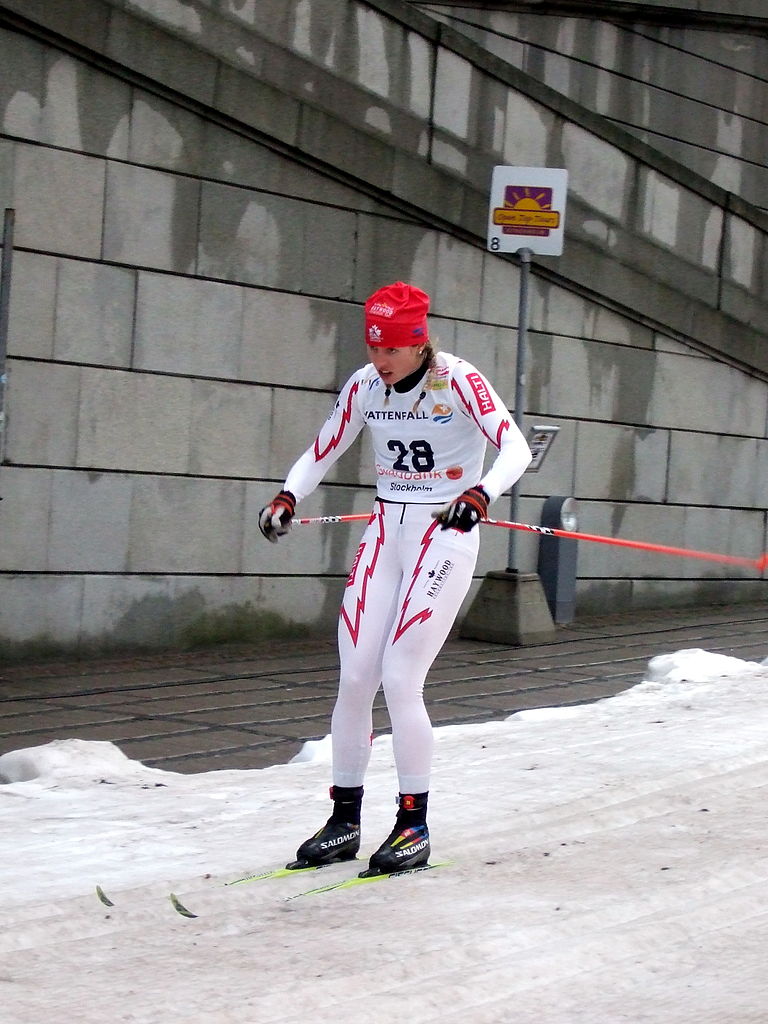
    Chandra Crawford racing in Stockholm in 2008. (photo: Wikimedia/Creative Commons)

    Meanwhile, upstart cross-country skier, Chandra Crawford, continues to shine at an OPA Continental Cup event in Capracotta, Italy. The 20-year-old Canmore, Alberta, native, who was not supposed to travel to Italy until she won two medals 10 days ago at the Under-23 World Championships in Soldier Hollow, Utah, followed up a silver medal sprint on Sunday with a ninth-place finish today to lead the Canadians in the 10-kilometre classic event with a time of 33 minutes 50.3 seconds.

    Dan Roycroft, of Port Sydney, Ontario, led the Canadian men in the 15-kilometre classic event, finishing 11th with a time of 44:42.9.
  • Hamilton Skis Fast and Smart for Second in Toblach Sprint

    Hamilton Skis Fast and Smart for Second in Toblach Sprint

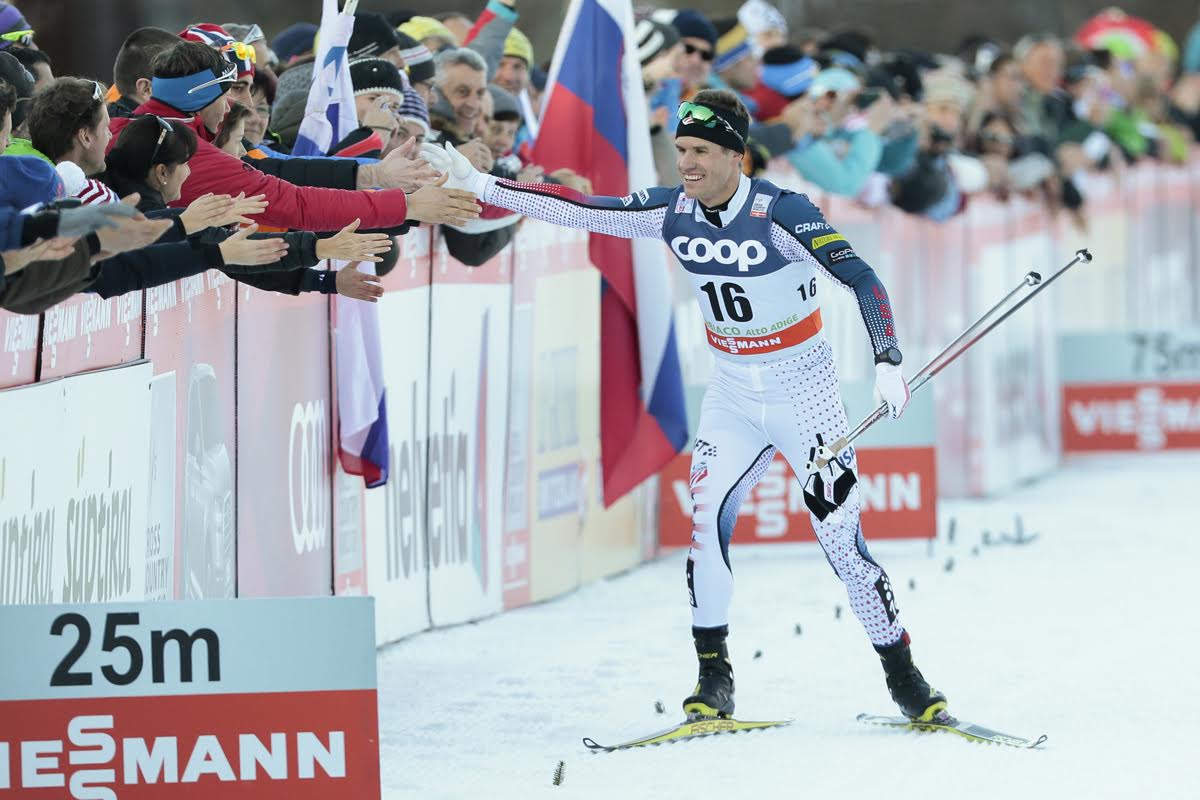
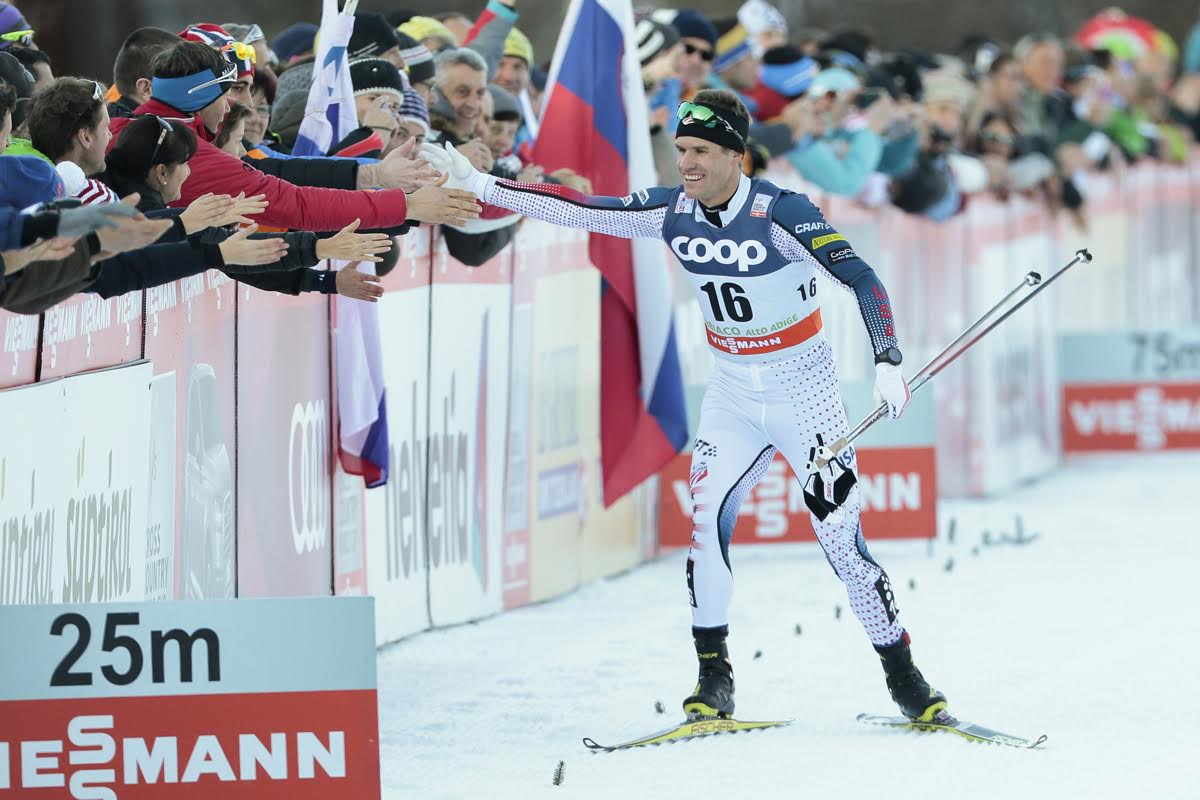
    Simi Hamilton (U.S. Ski Team) high-fives spectators during his post-race "victory" lap back down the finishing straight. He placed second on Saturday in the World Cup freestyle sprint in Toblach, Italy. (Photo: Fischer/NordicFocus)
    Simi Hamilton (U.S. Ski Team) high-fives spectators during his post-race “victory” lap back down the finishing straight. He placed second on Saturday in the World Cup freestyle sprint in Toblach, Italy. (Photo: Fischer/NordicFocus)

    There’s been a building feeling. A notion that the U.S. men’s sprint team just needed a little bit of luck — like no broken poles, fast skis, good health, and a course suiting their mega-horsepower skiers. The men’s World Cup freestyle sprint on Saturday in Toblach, Italy, offered all that up.

    Simi Hamilton’s skiing during the sprint rounds could be described as the following: he skied fast and he skied smart. In the end, only one skier proved faster.

    Italy’s Federico Pellegrino won the 1.3-kilometer skate sprint on Italian soil in 2:29.57. Pellegrino, a not-so-uncommon sight on freestyle sprint podiums, won last weekend’s sprint in Davos. A U.S. Ski Team sprinter, Hamilton placed second (+0.48) while Andrew Young skied to a historic third for Great Britain (+0.84).

    It doesn’t take a sprint-results savant to note that Norway was nudged off the podium. Swiss skier Jovian Hediger placed fourth (+1.09), while Norway’s Finn Hågen Krogh captured fifth (+1.44) and teammate Sondre Turvoll Fossli ended up sixth (+11.98).

    To his standards, Pellegrino began the day modestly, racing to seventh in the qualifier, 1.89 seconds behind Krogh, the fastest in qualifying in 2:28.76. From there, the overall Sprint World Cup leader played cat-and-mouse tactics to win his quarterfinal and semifinal en route to his victory in the final.

    Hamilton’s First Non-Stage Podium

    Prior to Saturday’s second place, Hamilton’s only other World Cup podium came in December 2013, when he won a Tour de Ski freestyle sprint in Lenzerheide, Switzerland. The U.S. men had reached the podium in a World Cup sprint five times before: once with Hamilton, three times with teammate Andy Newell and once with Torin Koos, according to a USSA press release.

    Last weekend in Davos, Switzerland, after qualifying 10th, Hamilton felt primed for another shot, but a broken pole in his quarterfinal snuffed out a potential top-10 result. Hamilton finished within the points in 23rd overall

    “I think after the last weekend I was feeling really good in Davos. My energy was great, I’ve been healthy and then I kind of had that pole mishap in the quarter in Davos,” Hamilton said in a post-race phone interview. “So that was pretty frustrating for me last weekend. I knew that I wanted to put something together for this weekend.”

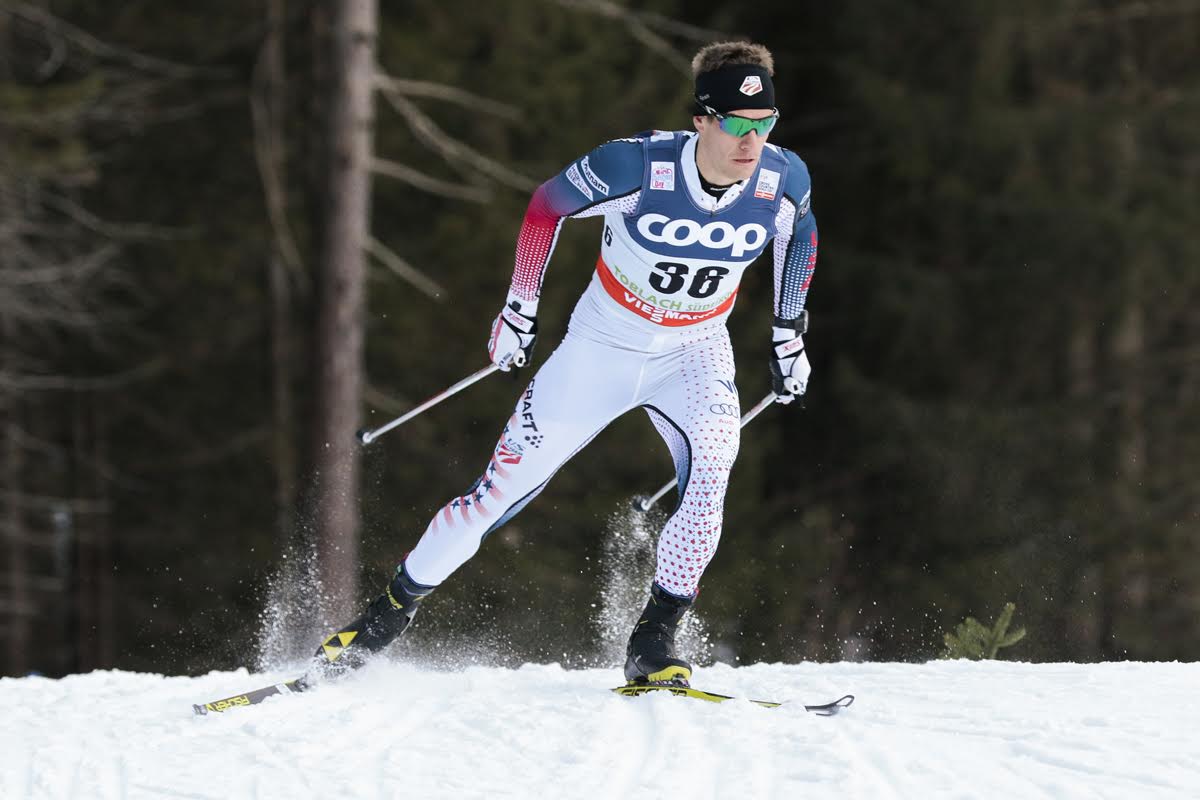
    Simi Hamilton (U.S. Ski Team) racing to his first non-stage World Cup podium on Saturday in Toblach, Italy, where he placed second in the freestyle sprint. (Photo: Fischer/NordicFocus)
    Simi Hamilton (U.S. Ski Team) racing to his first non-stage World Cup podium on Saturday in Toblach, Italy, where he placed second in the freestyle sprint. (Photo: Fischer/NordicFocus)

    “You know skate skiing is one of my strengths, my best thing, and we had one on the schedule and it got me fired up,” he added.

    Hailing from the thin air of Aspen, Colo., Hamilton is no stranger to a lack of oxygen. So Toblach’s altitude, some 4,500 feet above sea level, wasn’t a deterrent. And the course, featuring several technical corners, and a climb with a long glide out into the finish played to Hamilton’s smarts, patience and peak form.

    “I’m pretty psyched for sure about the day, a lot of things just came together for me. Not too much to complain about,” he said.

    In Toblach’s loaded field, a relaxed-and-efficient Hamilton qualified 16th, 3.14 seconds behind Krogh. He then selected the first quarterfinal, which featured heavyweights Petter Northug Jr. and Erik Brandsdal.

    In that initial heat, Hamilton tested his slow-burn strategy of waiting until the final hill and long glide out to play his cards.

    “The real defining characteristic is the downhill; it’s so long and straight that there are always these massive slingshots that happen,” U.S. Ski Team Head Coach Chris Grover explained on the phone. “It can be a disadvantage to be in the lead because people in second or third are always popping out and slingshotting.

    “So one of the key factors with this course is that having a fast start is not critical at all,” he added. “And you typically see people that relax in the beginning, hover back in fourth, fifth, sixth place during the first lap, then they use a slingshot coming off the building or coming off the downhill to move up in their placing. So people that often try to hammer off the front early, they end up getting burned at the end.”

    Hamilton did the burning. He waited and waited, skiing mostly in the rear of the pack, exploiting his masterful glide. Going head-to-head with Northug on the final climb, Hamilton descended in first and took the arcing left turn into the final straightaway tight on the inside.

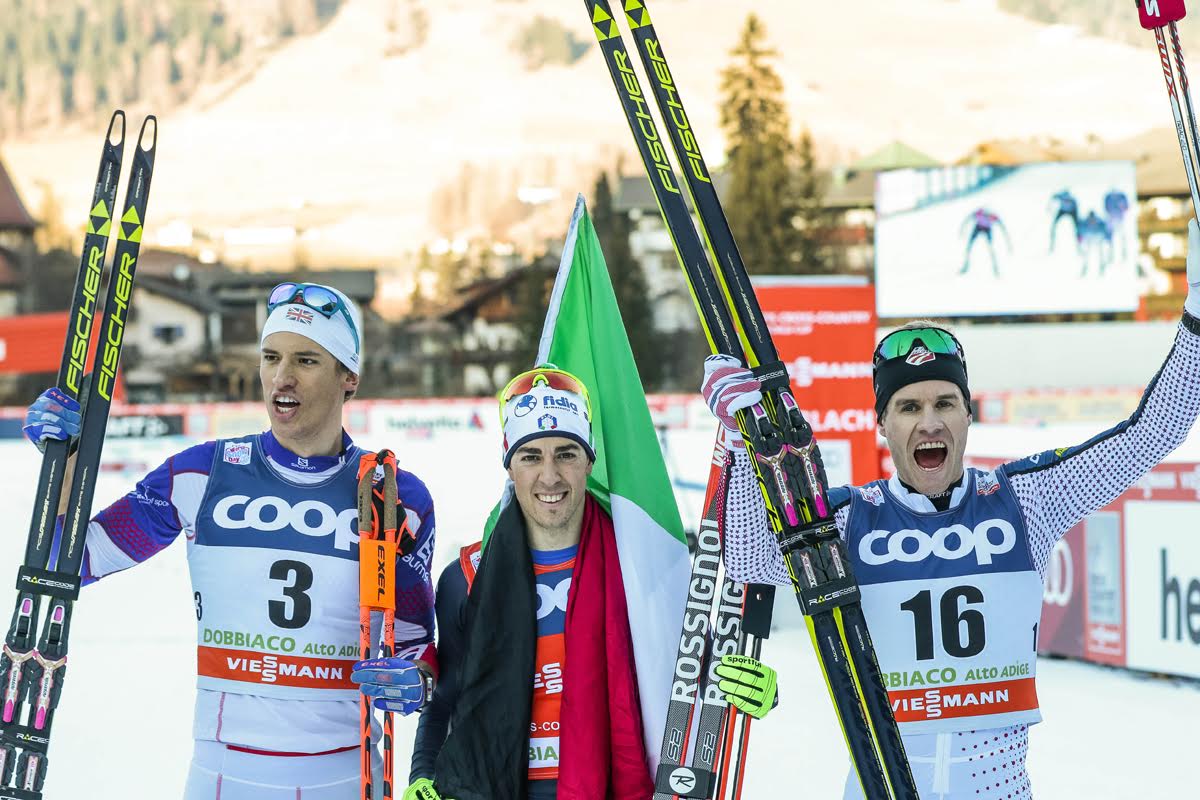
    The men's freestyle sprint podium on Saturday at the World Cup in Toblach, Italy: with Italian winner Federico Pellegrino (c), American Simi Hamilton (r) celebrating in second, and Great Britain's Andrew Young (l) in third. This marked the first time these three nations shared a World Cup podium. (Photo: Fischer/NordicFocus)
    The men’s freestyle sprint podium on Saturday at the World Cup in Toblach, Italy: with Italian winner Federico Pellegrino (c), American Simi Hamilton (r) celebrating in second, and Great Britain’s Andrew Young (l) in third. This marked the first time these three nations shared a World Cup podium. (Photo: Fischer/NordicFocus)

    “I felt like every time, coming down the really long, straight downhill towards the finish and a little short set one coming off the building hill, I just I was drifting up on people,” Hamilton said of his skis.

    At the finish, with Northug barely ahead, Brandsdal and Hamilton toed the line in a photo finish, 0.16 seconds behind Northug, with Hamilton eventually declared the second-place finisher. As one of the slower quarterfinals, Hamilton eked into the semifinals.

    The semis were a tactical repeat for Hamilton.

    “He waited until he had an opening and he had momentum coming off one of the hills each time, and he just moved up and moved up,” Grover said. “So he tried to hammer over the top of the last uphill and gain a little space over the down; enough of a space where people can’t draft you too tight and can’t come around you. Every single quarterfinal, semifinal, final, he utilized that same strategy.”

    Hamilton finished second again (+0.24), this time to eventual-overall winner Pellegrino.

    His plan worked: lurk and maintain energy reserves for a big push on the last climb, and glide out on his fast boards.

    “Essentially going into the final, I knew that my game plan had worked pretty well during the day thus far. If it ain’t broke, don’t fix it,” Hamilton said.

    Lining up in a sprint final next to Pellegrino and last year’s overall sprint champion, Krogh, is no joke. Yet, Hamilton had been skiing like he belonged. He took a deep deep breath, sliding his skis back and forth at the start.

    “Going into the final, I knew that my game plan had worked pretty well during the day thus far. If it ain’t broke, don’t fix it.”— Simi Hamilton, 28, U.S. Ski Team veteran sprinter after placing second in Saturday’s World Cup freestyle sprint in Toblach, Italy

    No skier took lead-out responsibilities. For much of the final, it remained a tactical race. Then things began to blow apart.

    And you know we stayed together all the way into the ‘building hill,’and I was kind of skiing right behind Finn on that hill and he had a little bit of a trip,” Hamilton recalled. “I was behind him just far enough that I was able to kind of dodge him go around him.”

    Atop the hill, Pellegrino, Young and Hamilton made a slight gap.

    “At that point, Pellegrino and I think Andy Young and I were just three guys right at the top of the building hill there, and I just focused on skiing that really hard,” Hamilton said. “Because the first half of the final wasn’t at a super-hot pace, I knew that I still had a lot of energy for that last hill.”

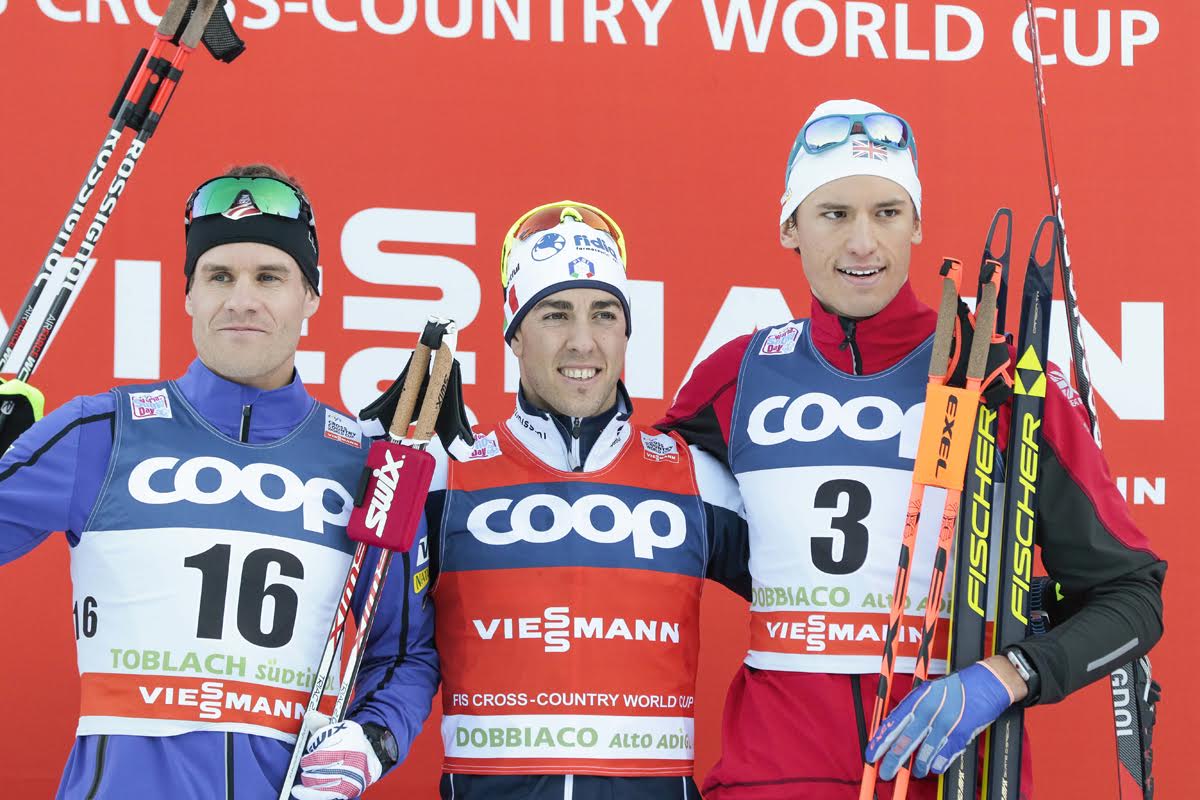
    The men's freestyle sprint podium on Saturday at the World Cup in Toblach, Italy: with Italian winner Federico Pellegrino (c), American Simi Hamilton (l) in second, and Great Britain's Andrew Young in third. This marked the first time these three nations shared a World Cup podium. (Photo: Fischer/NordicFocus)
    The men’s freestyle sprint podium on Saturday at the World Cup in Toblach, Italy: with Italian winner Federico Pellegrino (c), American Simi Hamilton (l) in second, and Great Britain’s Andrew Young in third. This marked the first time these three nations shared a World Cup podium. (Photo: Fischer/NordicFocus)

    On the last hill, Hamilton powered into first. That can be a risk. Coming off the last hill, it’s common for those drafting behind the leader to slingshot around, and gain positions on the flats.

    “On this course especially, it’s always a risk to try to jump in front going into that really long downhill, but I knew that podium would be amazing for me today,” he said. “That’s what I was gunning for, and I knew if I skied up and over that final climb super hard and got into a really low tuck, I knew that the chances of drifting out of the top three were pretty slim. So I just went for it from there and Pellegrino skied in my draft behind me.”

    Pellegrino did slingshot around, but Hamilton skied unfazed on the final stretch, securing second place.

    Although it’s been a long time coming, success for Hamilton finds him in a good place.

    “It really comes down to what makes me super happy, and that’s skiing really fast on a sunny day and in beautiful places, with lots of great fans on a short course, skating especially. And I think that when all those things come together, I get really fired up,” he said.

    For Hamilton, Saturday was one of those days.

    “I knew that podium would be amazing for me today. That’s what I was gunning for.” — Hamilton

    Newell, who qualified 13th (+2.74), was the only other U.S. skier entered in the sprint. Having caught a cold before last weekend’s races, Newell said he didn’t feel 100 percent. He finished fourth in his quarterfinal on Saturday for 27th overall.

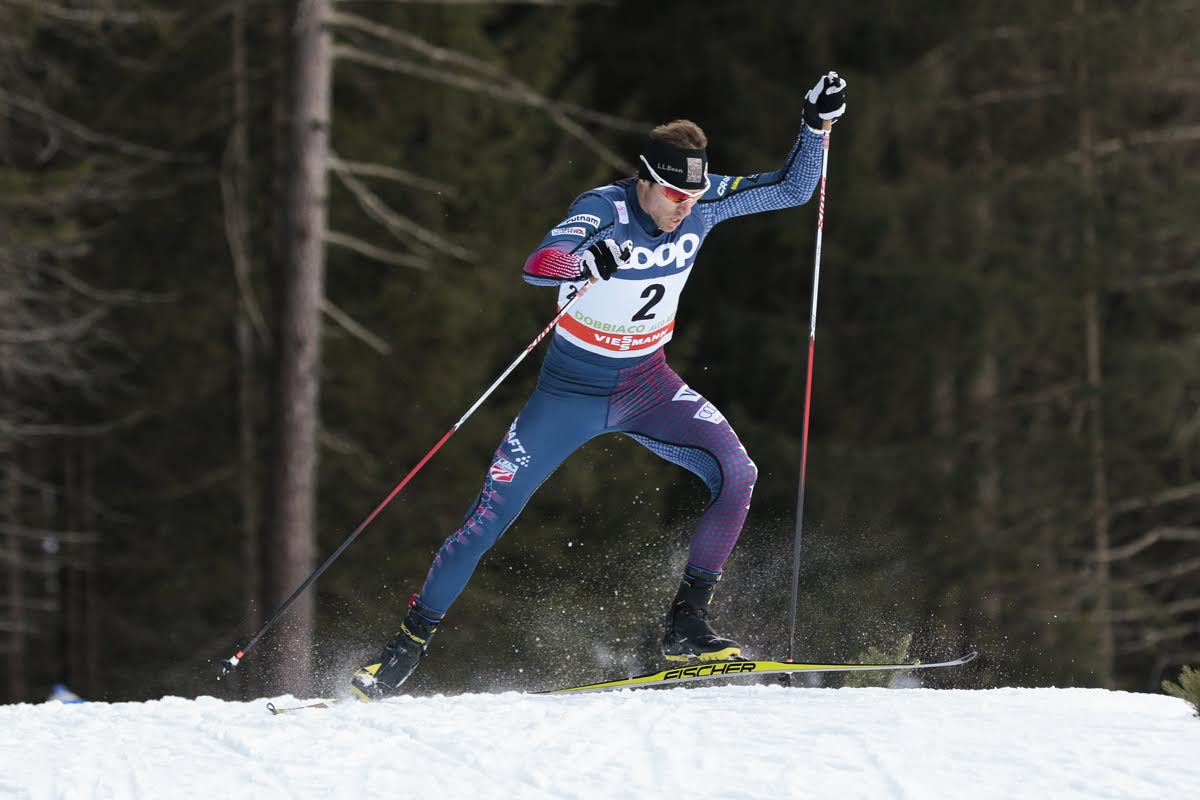
    Andy Newell (U.S. Ski Team) on his way to qualifying in 13th in the men's 1.3 k freestyle sprint at the World Cup in Toblach, Italy. He went on to place sixth in his quarterfinal for 27th overall. (Photo: Fischer/NordicFocus)
    Andy Newell (U.S. Ski Team) on his way to qualifying in 13th in the men’s 1.3 k freestyle sprint at the World Cup in Toblach, Italy. He went on to place sixth in his quarterfinal for 27th overall. (Photo: Fischer/NordicFocus)


    Led by Hediger as the winner of his heat, Newell’s quarterfinal was a tight one — with all six men finishing within a second of one another. The winning time ranked third-fastest of five quarterfinals, with Hediger edging Austria’s Bernhard Tritscher in a photo finish for first. Sweden’s Simon Persson placed third (+0.35) in the heat, Norway’s Ola Vigen Hattestad (+0.32) was fourth (+0.48), and Norway’s Pål Golberg finished fifth (+0.87), less than two-tenths of a second ahead of Newell.

    “I went out there today and thought I was felling pretty good. But I didn’t quite have that final gear in the finishing stretch. Qualification went fine…It wasn’t a great day for me. Sometime these courses are hard for me. It’s definitely a big tactics course, it’s all about drafting into the finish. It’s all about slingshotting on a course like this…And for me, as a smaller lighter kind of guy, I tend to struggle on sprints that come down to the final downhill a little bit,” said Newell.

    The U.S. sprinter planned to race Sunday’s 15 k classic individual start in Toblach, the last race before a World Cup holiday break.

    “I’m feeling pretty good about tomorrow’s race. I don’t really know what to expect. It’s a 15 k classic, and I’m leaning towards double poling the course,” Newell said in a phone call. “That will be a first for me on the World Cup. It’ll  be interesting to see what happens.” 

    Results

  • Newell 15th in Davos: ‘I Want to Show People What We’re Capable Of’

    DAVOS, Switzerland— “I’ve been feeling pretty good this season,” U.S. Ski Team veteran Andy Newell says after the finish of today’s skate sprint. “I think I was carrying a little bit of fatigue just from the fall training, but still I think I’m a top 15 World Cup sprinter right now, I just haven’t had a chance to show it.”

    He was one of the 15 best sprinters in the world today, qualifying in 15th and then also finishing 15th after he was third in his quarterfinal heat but not fast enough to snag a lucky loser spot in the semifinals.

    It’s his best result so far this season, but he still has some work to do in order to reach that goal in the overall rankings. Newell feels like he’s fit, he has just been held back.

    “We totally screwed skis up those first two races, so it has been frustrating,” he admitted. “I want to show people what we’re capable of. Everyone on the team wants to show what we’re capable of. So it’s always hard when you start off poorly like that, you always feel like you have to dig yourself out of a hole. There’s more and more pressure on each race to do well. It’s a long season and we’ll get back.”

    Similarly, teammate Erik Bjornsen was left looking for more after placing 63rd in the qualification round. He, too, feels like he’s in better shape than the result indicates.

    “I’m fighting in the 40s,” he said. “I feel like I’m in a good spot and my fitness is high. That’s what you have to think about. I’m going to try and ignore the place right now. Hopefully that will start coming up.”

    If proving yourself is a theme, then the U.S. men have a small staff to work with. Sprint specialist Simi Hamilton sat out today’s race because he woke up with a cold; the last time he raced a sprint in Switzerland, he won it. That wasn’t going to happen today.

    And with Noah Hoffman back home in the U.S. recovering from a leg injury sustained in the first World Cup weekend, there’s not a lot of depth in distance, either. SuperTour leader Reese Hanneman finished 86th today and 79th in the 15 k classic yesterday.

    But Newell almost provided the team with something more to celebrate, as he finished half a second out of second place in his heat and an automatic advancement to the semifinals. He was about second away from grabbing a “lucky loser” spot based on his time.

    Newell chalked it up to a slight tactical error.

    “I felt okay, but I probably should have tried to get by one more person on that last uphill,” he said. “It’s such a short finishing stretch because of this changed course that it makes it really hard to pass. I’m not sure that anyone is really passing in the final stretch. I just didn’t have quite enough coming over the final hill to get past [Alexey] Petukhov, the Russian.”

    It was a tough heat, he said – Eirik Brandsdal of Norway won it and then went on to finish third in the final, and Petukhov fourth – but he still thought he could have played it better.

    Most of the field gets a do-over next weekend and some, like Canada’s Lenny Valjas who finished just two spots ahead of Newell on the results sheet, have already clarified what they’ll do differently on take two.

    Newell, though, won’t be joining them. The competitions were originally scheduled as a 30 k skiathlon and a 4 x 10 k relay in La Clusaz, France, but when FIS organizers canceled the La Clusaz event due to a lack of snow and moved the weekend to Davos, they switched the relay to a sprint.

    Newell had already booked his plane ticket home, having other priorities than distance skiing as he looks forward towards the rest of the season. Those plans haven’t changed.

    “To me, it was more important to go home and see family and girlfriend and stuff,” he said, adding that he’d be at the Eastern Cup races in Middlebury, Vermont. “I think it’s really dumb that they made the sprint like that. There’s not a whole lot I can do about it.”

    Bjornsen Looks to Settle In

    Bjornsen is more or less the men’s team’s de facto distance leader. But with Hamilton out today, there could have been more pressure for the 23-year-old, who is an all-around skier, to also turn in a strong sprint performance. He’s qualified in the top 30 in four previous World Cups.

    But Bjornsen doesn’t feel the pressure of being one of the team’s new leaders.

    “It sucks,” Bjornsen said of Hoffman’s absence. “Especially with Simi not here today, we’re not where we’re usually at as a men’s team. I’d love Noah to be here because he’s a great distance skier. It’s great to have someone to train with and to watch and learn from…. but there’s no pressure. The pressure comes when you’re fighting for the podium.”

    Instead, he said that he’s actually enjoying this season more than others in some ways.

    “I actually struggled a lot last year,” he admitted. “I wanted to go to the Olympics so bad. It’s a life-long goal for any athlete. The pressure was super high last year. So I’m pretty happy that this year I have it a little more laid back. Of course, once I qualified for Sochi it was so much fun. But I’m enjoying myself a little more this year. I’m trying to learn from each venue and hopefully I can come back over the next five or ten years. If I can learn now, I should be able to improve and get closer to that podium.”

    Men’s results

  • Eye of the Tiger: Shaw Visits U.S. Skiers for Davos Sprint, Likes What He Sees

    Eye of the Tiger: Shaw Visits U.S. Skiers for Davos Sprint, Likes What He Sees

    DAVOS, Switzerland – With six athletes making the World Cup sprint quarterfinals, including one who made it to the podium and another who notched a career-best result, Sunday was obviously a good day for the U.S. Ski Team.

    But besides the results that would make them celebrate no matter which weekend they happened, the cross country skiers had one more reason to be pleased: incoming U.S. Ski and Snowboard Association CEO Tiger Shaw and his wife Kristin were on hand to watch and learn about the sport.

    Not a bad time to whip out what women’s coach Matt Whitcomb called “one of our best days ever for sprinting.”

    “I was impressed,” Shaw said. “We were flabbergasted, really.”

    Maybe Shaw’s presence inspired a little something extra – or maybe it as just a great coincidence. Either way, the U.S. was happy to have Shaw on hand to see their hard work pay off.

    “It was nice to have them cheering,” Whitcomb said. “I think it just reminded us all how proud we are to represent our country. It’s not often that we have too many direct fans like that over here.”

    Coming from an alpine skiing background – Shaw is a two-time Olympian – the new federation CEO was amazed at how exciting the action was on the World Cup today.

    “Today was amazing,” he told FasterSkier on the phone from the Zurich airport. “I had heard about sprints and elimination heats and how it all works, and I have to say that I was incredibly impressed by the athleticism and the strength and speed by all of the athletes I saw today, as well as amazed at how well the Americans did. I mean, Kikkan obviously was tremendous, she got beat at the end by two centimeters, unfortunately, but she also got interfered with at least once in her final round.”

    In an interview this fall, Shaw mentioned that he wanted to spend some serious time learning about the many ski and snowboard disciplines that USSA governs. Current CEO Bill Marolt is staying involved with the organization until after this winter’s Olympics, giving Shaw some time to learn the ropes of his new job. The trip to Davos is one step in making good on that promise, and Shaw clearly enjoyed himself.

    He Saturday evening eating dinner with the American athletes and coaches, who answered his questions and tried to teach him everything there is to know about sprint racing so that he would understand Sunday’s competitions.

    “Getting to know the athletes and coaches a little better was a priority, and it worked out great even though we could only pull off spending one night there,” Shaw said. “Everybody was great. They were so welcoming, and they basically explained and taught us everything.”

    A former racer at Dartmouth College before going on to the Olympics, Shaw had some passing familiarity with college nordic competitions, but today’s World Cup competitions are quite different than anything he had seen before (when Shaw won the NCAA slalom championship in 1982, for example, skating had barely been invented). And although he had met the team before at the Center of Excellence in Park City, seeing them in action was a completely different experience. And Shaw loved it. He anticipates being better able to support and promote the cross country skiers now that he understands what they are striving for – and achieving.

    “I think with the help of Matt and the other coaches, and certainly Luke Bodensteiner, who does such a great job leading athletics and the fact that he is a nordic guy,” Shaw said. “I’ll learn a lot more from him now in future discussions about how to do that. So I see it.”

    He’s even on board to try to get the World Cup to return to the U.S. for the first time in years, and thinks that the sprint format is the way to do it.

    “We’d love to do one in a city in the United States sometime, if we can make it work financially,” he said. “I know FIS really, really wants us to do that, kind of like the Quebec City one last year. There’s the desire to do a race sometime in New York City. Making that work financially is critical, but you’d think that we could considering the number of people who would come watch it and probably be amazed at how fast everybody goes.”

    If that happens, the Americans will be ready to deliver on the results. When asked whether he ever expected to watch his team win three quarterfinal heats in a row, Whitcomb was dead serious: yes.

    “They train together a lot and they fight together a lot in training,” he said. “They’re ready for situations that they encounter out here. A few years ago our elbows were soft and dull. They’re sharp and hardened now. So we know where we can go. We don’t get pushed around as much anymore, and I have good confidence.”

  • Tough Day for Canada at Davos Sprint, But Valjas and Crawford Are On the Comeback Trail

    Tough Day for Canada at Davos Sprint, But Valjas and Crawford Are On the Comeback Trail

    Dasha Gaiazova racing at 2013 World Championships. In Davos yesterday, she was the top Canadian finisher in the 1.5 k sprint, placing 42nd.
    Dasha Gaiazova racing at 2013 World Championships. In Davos yesterday, she was the top Canadian finisher in the 1.5 k sprint, placing 42nd.

    DAVOS, Switzerland – After Dasha Gaiazova finished the 1.5 kilometer freestyle World Cup sprint qualifier on Sunday, she hovered at the finish line. In bib 29, she ranked 24th when she crossed the line. But a few minutes later, more racers had finished their qualifying laps and Gaiazova was bumped out of the top 30. Without making the quarterfinals scheduled for a few hours later, her day was over.

    And so it went for the Canadian national team. One by one, they learned that they just weren’t fast enough on this particular day.

    “None of us are in,” said Devon Kershaw, one of the last team members to go through qualifying. “It’s inexcusable. If you’re not top 30, it doesn’t matter if you’re last or you’re 31st … I’m really disappointed none of the other guys got in.”

    Gaiazova ended up 42nd and Chandra Crawford 43rd on the women’s side, while Alex Harvey led the men in 45th place. Lenny Valjas placed 61st, Kershaw 69th, and Jesse Cockney 82nd.

    “I didn’t feel that bad, but I skied like a bag of shit,” Kershaw said. “It didn’t feel good, but it didn’t feel as bad as it was.”

    For some members of the team, like himself and Gaiazova, it was unclear exactly what had gone wrong. (“You just go as fast as you can,” Gaiazova shrugged of pacing in the qualifier.)

    But for others, it was not necessarily a surprise – for instane, Chandra Crawford and Lenny Valjas, who are coming back from tough off-seasons and want to know first and foremost how they stack up.

    Valjas had knee surgery this summer to address some nagging problems that had prevented him from doing any real leg strength for several years. He lost weeks and weeks of training when recovery didn’t go as well as planned, but now he has at least made it back on the circuit.

    “The knee is getting a little better,” he said. “It’s still a problem, but right now it’s the shape more than that. Taking 18 weeks or whatever off. I can’t do anything out here. I’m trying my hardest and not going fast. I’m missing – the effort is there, I’m just missing a little bit of speed.”

    He hopes that next weekend’s sprint in Asiago, Italy, will go better – it’s classic, which he favors. In the opening sprint of the season in Kuusamo, Finland, he was 39th. Again, not in the heats, but at least closer than he was in Davos.

    “So far, I don’t notice that I’m making progress, but I’m sure that I am,” he said. “I’m finally able to do some intensity. These races have to help the shape.”

    Despite technically being Olympic qualified, Crawford is also on the comeback trail. She ended her season early and then controversially left the national team this off-season. (Since then, Canadian coaches said they needed to see her race before they’d commit to taking her to the Olympics.) Things got more complicated when she discovered a thyroid problem and low iron levels.

    She started the season in Scandinavia, competing in FIS skate sprints. The Davos World Cup is her first race back on the circuit.

    “Goals for today, just to see where I’m at in the world,” she explained. “I’ve done three warmup races, I’ve got my health under control, it’s solid, I feel happy and great. So I wanted to see where I would rank. I’m making gains every weekend using benchmarks like Hanna Falk and Dasha. I was keen to see if I could improve my time behind again, and make gains every week.”

    Finishing 0.14 seconds behind Gaiazova, she has caught up – even if her fellow Canadian wasn’t psyched with her own race.

    “It’s 60 days now until the Sochi race, so I’m spending each of those days getting closer to Sochi,” Crawford said. “And today is a great day to get closer to my Sochi goal of being fit and fast and ready, no matter how it goes. It can go bad like this, or it can go really well, it’s still a useful day.”

    As was clear to everyone on the Canadian team, though, improving so that they have their best Olympics ever might not be a straightforward process. They know they have their work cut out for them.

    “We were bad today,” coach Eric de Nys said in a tersely-worded Cross Country Canada press release. “There is no excuses and no two ways about it, but it was not for lack of trying and the team skiing their butts off.”

    In Crawford’s case, the pain it will take to get that gain is quite literal.

    “I feel like I just did 300 burpees and tuck jumps in a row,” she lamented at the finish line. “I’m in so much pain.”

    Results: men / women

  • ‘One of Our Best Days Ever for Sprinting:’ Six U.S. Skiers Make Davos Heats, Three Hit the Semifinals

    ‘One of Our Best Days Ever for Sprinting:’ Six U.S. Skiers Make Davos Heats, Three Hit the Semifinals

    Andy Newell (center, in black) heading to the start of his quarterfinal heat. After taking two days off to fight a cold, the American wasn't even sure he'd start - but he qualified 12th and ended up 17th.
    Andy Newell (center, in black) heading to the start of his quarterfinal heat. After taking two days off to fight a cold, the American wasn’t even sure he’d start – but he qualified 12th and ended up 17th.

    DAVOS, Switzerland – Ah, the difference a day makes. After yesterday’s 15 and 30 kilometer freestyle competitions, the U.S. Ski Team racers were content, but not thrilled. Five of them scored World Cup points, but none considered the efforts to be among their best.

    Fast forward to today’s 1.5 k freestyle sprints, and women’s coach Matt Whitcomb was calling it “one of our best days ever for sprinting.”

    The team was led by Kikkan Randall, who lost a photo finish against Norway’s Marit Bjørgen and ended up placing second overall (main report here).

    On the women’s side, three more skiers made the quarterfinals: Jessie Diggins, who qualified in sixth; Sophie Caldwell, who qualified in ninth; and Sadie Bjornsen, who qualified in 18th. Andy Newell and Simi Hamilton both made the men’s heats, qualifying in 12th and 21st.

    Holly Brooks landed 33rd, just outside the 30-woman cutoff by about half a second, and Ida Sargent 41st. Rosie Brennan, Mikey Sinnott and Torin Koos, of APU, Sun Valley, and the Bridger Ski Foundation, respectively, finished 61st, 56th, and 85th.

    Quarterfinals

    Even before the quarterfinals got started, there was little doubt that it was going to be a good day.

    “We’re really excited about the day,” Whitcomb said of his women’s squad. “Not to mention Andy and Simi coming up quite big for us.”

    The women’s quarterfinals were up first, and Randall, Diggins, and Caldwell turned heads by each winning their heat. They even used a similar move, cutting to the inside on the last tight corner on the course to gain an advantage as they field shot towards the finishing lanes.

    “I watched Jessie’s heat,” Caldwell said of the move. “But also Ida [Sargent] and I did a little race prep yesterday and I noticed that you really want to guard your corner and take the corners tight. Some other girls took them sort of wide, so I took advantage of that and got around.”

    “I heard the announcer go, ‘those sneaky American girls!’” Diggins laughed. “And I thought, yeah!”

    The turn wasn’t so kind to Bjornsen, who was having a good heat but then fell on that last corner and was left out of the running and landed 27th in the final standings. She certainly wasn’t the only one to take a tumble there today.

    (“I’ve never seen a sprint race go perfectly, so maybe there’s just no such thing,” Whitcomb said.)

    And unfortunately for the team, the same move wouldn’t work in the men’s heats. Newell and Hamilton were both in the hunt, but got edged out in the close maneuvering that happened in the final turn.

    “It’s just different because the men are so close together,” Newell said.

    Hamilton almost made it through as a lucky loser after finishing third in his heat, but had to settle for 14th. It was nonetheless his best result so far this season, after he didn’t make the quarterfinals in the opening sprint in Kuusamo, Finland.

    Newell was fourth in his heat after seemingly doing everything right to end up at the front.

    “I felt good – I had made a good move to the front coming through [the stadium],” he said. “My skis were running well, so I should have been in the lead going over the top of the hill, I think. Instead I tried to come out of the draft of [Russia’s Nikita] Kriukov. Both times on the hill I came out of his draft and I came out on the wrong side. I should have gone left, and stayed on the outside of that corner. Each time I got pinched on the inside corner a little bit. That’s a bummer.”

    But considering how things had been going, Newell was moderately happy with his day. He had been sick with a cold earlier this week and wasn’t even sure he was going to race today. So qualifying in 12th and ending up in the top 20 wasn’t too shabby.

    “I guess I’m happy – I took Thursday and Friday completely off to get over a cold,” Newell said. “So I’m not feeling 100 percent.”

    Semifinals

    That left three Americans in the semis. After Randall won her heat handily, Caldwell and Diggins lined up in the second go.

    The semifinals were considerably more competitive than the quarterfinals, and this time around it wasn’t going to be as easy to sneak in at the last minute with good cornering, and come away with a win. But the pair were confident that they’d find other ways to get to the front.

    Sophie Caldwell racing to ninth in Davos (Photo: Fischer/Nordic Focus)
    Sophie Caldwell racing to ninth in Davos (Photo: Fischer/Nordic Focus)

    “I don’t think either one of us had a great start, and we were in fifth and sixth,” Caldwell said. “But there’s so much space to move around out here that I wasn’t too concerned.”

    It was the first semifinal Caldwell has ever made on the World Cup, and she said she was nervous on the start line. But thinking about her race strategy helped her stay calm, and both she and Diggins maneuvered their way around the field as they tried to work their way out of the back.

    “It was so important to push over the top,” Caldwell said. “My legs kept flooding on the uphills, both in the prelim and the quarters, so I was just thinking, okay, I might be tired here, but if I push hard over the top I’m going to catch back up. So I tried to stay calm.”

    Ultimately, she couldn’t keep contact with the leaders and finished a bit off the pace, Diggins had been gaining ground but fell on the last uphill, knocking her out of contention as well.

    “I just got a little clumsy and took two knees,” Diggins said.

    Unlike Caldwell it wasn’t her first time in the semis, but it still felt like a small victory to Diggins.

    “I’m so happy because I haven’t been a sprint semis in years,” she said. “And I’ve done so many quarters. I’ve done maybe ten quarters and they’ve all gone wrong. It’s so exciting to have one go right. Especially after, I think, yesterday, I always speak my mind. If I think I had a bad race I’m not going to lie and say I’m super psyched. I was okay with it, but there were things that went right. And today was an awesome.”

    Finishing fifth and sixth in the heat landed the Americans ninth and 12th, a career-best for Caldwell.

    “Of course, everybody has just been counting the days until it finally happens for Sophie,” Whitcomb said. “She’s been a phenomenal skate sprinter since she was in the Bill Koch League. But today, this was a perfect place for it to happen.”

    Everyone involved agreed that although the women’s days ended before the finals, it was a great step for their seasons and even more to come in the future.

    “The one disadvantage of our team skiing so strong these days is that these girls, they want that next step so bad,” Randall said of her teammates. “They’re probably going to feel a little disappointed not to move past the semis, but they’ve got to take a step back and realize that where they’re at, that’s a huge accomplishment and you’ve got to get your feet wet in each round to know how you’re going to contend in the final. Again, I think it will be good and keep them hungry.”

    Hungry? They’re starving. Caldwell said she’s looking forward to next week’s World Cup races in Asiago, Italy, where she will race an individual classic sprint and a team sprint. (Randall said that the teams have not yet been chosen, and will be based on the results from the individual sprint.)

    And Diggins agreed with everything Randall said about tactics and sprint racing.

    “The hard part is in a sprint, you can have good energy but get stuck behind someone,” she said. “Or you can pass in the wrong spot and be leading when you don’t want to. There’s just so many ifs and buts. You always think, if I had to do it again I would have passed at this point! But that’s how sprint racing goes. I feel like the older you get and the more you do it, the better it seems to go.”

    Maybe one day, she hopes, she’ll be as wise and experienced as her teammate, with whom she won the gold medal in the team sprint at 2013 World Championships.

    “Kikkan, she shows up on the start line and you can bet she knows how everyone else is going to ski, she knows her game plan, and ten other plans,” Diggins said. “I think it’s something to look forward to.”

    Results: men / women

  • With More Confidence Than Ever, Sargent Eyes Sochi Sprints

    With More Confidence Than Ever, Sargent Eyes Sochi Sprints

    Ida Sargent (USA) skiing to 18th in Davos. Photo: Fischer/Nordic Focus.
    Ida Sargent (USA) sprinting in Davos, Switzerland, last season. Photo: Fischer/Nordic Focus.

    It was in the first sprint of the year in Kuusamo, Finland, last November that Ida Sargent cut her teeth on a World Cup semifinal. It was the start of the Ruka Triple, and in the quarterfinals she swung from sixth to second to comfortably move past the first round of heats. U.S. Ski Team women’s coach Matt Whitcomb remarked afterwards that it was “a career-breakthrough kind of day for Ida that we’ve known has been in the cards for a long time.”

    A few months later, a career-breakthrough kind of day became part of a career-breakthrough kind of season when Sargent finally cracked the A-final in Sochi, Russia, in the unlikeliest of ways: in the skate technique, which she considers her weaker discipline.

    By that point in the year, Sargent was a few months removed from her breakthrough in Kuusamo and had made it past the quarterfinals on one other occasion. Confidence had set in, and in Sochi the A-final had entered the realm of reasonable expectations for her.

    “I thought it could be a good day but it’s a sprint, so you never know what’s going to happen,” Sargent said after the race. She finished sixth that day at the back of the heat and promptly became hungry for more.

    “I think I made it to the final and was like, ‘Woah, what am I doing here? This is crazy, this is fun,’ but I wasn’t fully prepared when the gun went off,” Sargent said in a phone interview last week. “So I want to make more appearances in the finals [and] hopefully build another step towards a World Cup podium down the road.”

    Ida Sargent (CGRP/USST) en route to winning Saturday's 1.5 k classic sprint qualifier at 2013 SuperTour Finals at Auburn Ski Club in Soda Springs, Calif. She went on to place second to Kikkan Randall (APU/USST) in the final. (Photo: Mark Nadell/MacBeth Graphics)
    Sargent at 2013 SuperTour Finals, where she won the qualifying round of the classic sprint and ultimately finished second to Kikkan Randall. (Photo: Mark Nadell/MacBeth Graphics)

    It’s June now, and Sargent is at home working to build on her confidence from last season. The first USST camp of the year has come and gone and she’s back in Craftsbury, Vt., at the training ground she is most comfortable in.

    “This is the perfect place for me,” Sargent said. “I grew up near here, so I’m used to the rural lifestyle…and we spend so much time on the road in the winter that having the opportunity to be at home in one place feels great.”

    Sargent now carries both confidence and focus into her new training season. When she looks back, she attributes experience as principally enabling her to reach a new competitive level. Her break into the top six came in just her second full season on the World Cup; in 2011/2012 her personal best was 29th.

    “The year before I had some experience on the World Cup, figuring out how that works,” Sargent said. “Some of the venues I’d raced before, so that always helps. When you’re in a sprint qualifier and you only have three minutes, and the competition is so tight…if you make a little mistake you’re a few hundredths out. Getting to know the courses and feeling more comfortable on the road was a huge deal for me.”

    The second factor she credits with her breakthrough is the U.S. team’s chemistry, which is frequently discussed by her teammates, too. The Americans are so visibly invested in each other’s success that a French national development coach traveled all the way to Bend, Ore., last month to take notes on their group dynamic.

    “Another year as part of the team has really helped,” Sargent said. “One thing we do really well together is just training together at camps and on the road… I can ski skate threshold skate intervals with all the girls on the U.S. team, [and] so many of them have had a top-five finish in a distance skate race, or I can follow Kikkan in speeds. We all work really well together and feed off each other’s positive energy.”

    This summer and fall, Sargent will train in a similar way that she has for years. At this point, she and her coaches know enough about what works well for her to not rock the boat before such an important season. This involved writing shorter altitude periods into her plan than some of her other U.S. teammates, but Sargent wants to stick with what she knows as she focuses on sprints this year.

    “I grew up in Vermont at sea level and I haven’t ever put in a big role of altitude training into my plan, with the exception of camps here and there,” she said. “So this year, since it went well last year, there’s no reason to make big changes. Pepa [Miloucheva] and Matt [Whitcomb] both decided it’d be good to limit the amount of altitude training I did just to keep the speed and high intensity focus and continue the same things I’ve done in the past, rather than make a big change when things are already going well.”

    Sargent made her summer training goals — to improve in strength, mobility and “especially” skate technique — with an eye towards the sprints in Sochi this February. They take place on the same course and close to the same time of year she made the A-final in the test events last season, and the events on the schedule are also identical: an individual freestyle sprint and a classic team sprint.

    The U.S. team sprint candidates will be interesting to follow this year. Kikkan Randall and Jessie Diggins recently joined forces for World Championship gold in Val di Fiemme, Italy, but as they have since pointed out, classic sprinting is an entirely different game for each of them — skating is their stronger technique. Randall can still be top five in the world on a classic sprint day, but Diggins has not yet cracked the heats.

    The day after her A-final breakthrough in Sochi last February, Sargent teamed up with Sadie Bjornsen in the classic team sprint for fifth place and finished less than four seconds off the podium. Sargent’s success in Sochi and familiarity with the sprint course could prove advantageous for her next year. She hopes so, anyway, but also acknowledges she has to make it onto the team first.

    Ida Sargent (CGRP/USST) en route to a personal-best ninth in the Kuusamo World Cup 1.4 k classic sprint on Friday. (USSA photo: http://www.facebook.com/USSA.nordic)
    Sargent en route to ninth in the Kuusamo classic sprint last November, which was then a personal-best. (USSA Nordic photo)

    “It’s just a goal to be in Sochi,” she said. “That’s the first step; you can’t forget that. But it is important to kind of look past and pick out those races, and so it was really fun racing the team sprint last year and I’d love to be on that team again next year.”

    On the way to the Games, Sargent wants to keep making the finals once the season begins again in Kuusamo.

    “Making that final in Sochi last year was very exciting and kind of a huge breakthrough and not something I was expecting for last winter,” she said. “I think the goal is just to make the finals, keep moving through the heats, become more consistent at qualifying…The more experience you get head-to-head racing, the jump becomes easier as you become more comfortable skiing in the heats and learning the tactics and that type of racing mentality.”

    With the Olympics still a long way off, Sargent is keeping a level head as she continues to invest the work into being named to that team.

    “I think it’s impossible not to get excited about that; it’s the Olympics,” she said. “If you’re not excited and fired up thinking about it you probably shouldn’t be training for it. But at the same time there’s a lot of work to them and there’s a lot of training that needs to happen before then, so it’s important to stay smart and continue to do what I’ve done before. And feel confident that it will be the appropriate preparation for the upcoming winter.

    “There’s a lot of time before then,” she continued. “[I’m] trying not to feel the pressure and continue to enjoy training and enjoy the camps and my time at home and just this lifestyle, because that’s the most important part.”


  • Trail Work Underway for Full Sprints in West Yellowstone and Bozeman

    Trail Work Underway for Full Sprints in West Yellowstone and Bozeman

    Fans cheering at the SuperTour Sprint Showdown last November in West Yellowstone, Mont. Full sprints are back on the schedule in both West Yellowstone and Bozeman this fall, which has both venues working towards making courses that meet FIS homologation requirements.

    After a few years of experimentation with the controversial sprint qualifiers, the format is on its way out of the national calendar. Two venues that held early-season SuperTour sprint qualifiers last season are holding full heats this November, and are currently completing trail work to ensure their courses meet International Ski Federation (FIS) homologation standards. The Rendezvous Ski Trails in West Yellowstone and Bohart Ranch in Bozeman, Mont., expect their sprint courses to be ready for the start of winter.

    In West Yellowstone, the inclusion of a freestyle sprint in the festival means the elimination of the double qualifier SuperTour Sprint Showdown.

    “Everybody realized that, I think, it’s run its course,” former race director Dan Cantrell said of the double qualifier in June. “In the ski community there’s obviously a push to get our domestic racers more experience in the heats. They’re more fun to race in for the skiers and they need the experience, especially if the SuperTours are a representation of the World Cup [and] we’re qualifying people to send there. So from our end, we’re figuring out what we can do to make that happen.”

    As of June the full schedule had yet to be finalized, but Cantrell said it would likely feature an additional non-FIS sanctioned distance race on Wednesday, the freestyle sprint on Friday and a 10/15 k individual freestyle on Saturday.

    The Rendezvous Ski Trails obtained preliminary homologation approval early this summer from John Aalberg, the North American FIS homologation coordinator. Its orange 1.5 k course meets the total climb and independent climb requirements for a freestyle sprint course; the trail only needs widening in a few spots to meet the nine-meter specification.

    “It’s relatively minor,” Cantrell said of the necessary trail work. “We’re only looking at about two sections of 100 yards apiece that need widening, and only by five to six feet.”

    The trails could only homologate a freestyle sprint course; Cantrell said the Rendezvous doesn’t have the available terrain to create a classic sprint course, which requires climbs of specific size in order to necessitate striding.

    In Bozeman, Bohart Ranch is currently working on homologating a classic sprint course. Bridger Ski Foundation director Dragan Danevski says the hills are being improved and the total course will be 150-200 meters longer to make it a complete 1.5 k.

    “We are working on finishing the homologation this fall [to] have it FIS certified,” Danevski said. “This summer we have also been working to improve the start and finish area and made improvements on the distance course. When we complete all of that we will put up course maps on the BSF website.”

    In addition to a classic sprint, Bozeman has a 10/15 k classic mass start on its schedule.

    All together, the four SuperTour races in Montana during Period 1 will be the last opportunity athletes not already on the World Cup have to earn start rights to the Canadian World Cups from December 8 – 16. The U.S. benefits from a larger Nation’s Group quota for both the Quebec and Canmore races and can bring five additional men and women. Outside World Cup performance, additional athletes are selected from the leaders of the respective distance and sprint USSA SuperTour standings on December 3.

    USSA 2012-2013 SuperTour Calendar

  • Pro Workout: Sea-level Speed with Dakota Blackhorse-von Jess

    Dakota Blackhorse-Von Jess at the 2010 West Yellowstone SuperTour.

    For a long time, Dakota Blackhorse-von Jess has known he was fast. He won a junior national championship in the sprint, won carnival races while representing Dartmouth College, qualified for a World Cup in Canada, and then transitioned into being a full-time, post-collegiate racer.

    But it wasn’t until this past January that the Bend Endurance Academy racer had his breakthrough, finishing fifth in the freestyle sprint at U.S. Nationals in Rumford, Maine.

    While Blackhorse-von Jess undeniably has natural speed – before that he had once qualified third in a Nationals sprint – he said that it’s fitness and tactics that determine a skier’s ultimate placing in sprint heats.

    “To be perfectly honest, pure speed is totally a function of fitness,” he told FasterSkier in an interview. “I mean, either you have it or you don’t, but if you make it through four rounds and you’re coming into the last 100 meters, if you don’t have fitness you’ve already blown your speed reserves so it doesn’t matter how ‘fast’ you are.”

    To work on speed, fitness, and tactics all at once, Blackhorse-von Jess and his teammates travel to sea level (Bend is situated above 3,000 feet) for training camps and do a specific interval workout several times a year.

    “It’s actually a pretty cool workout,” he said.

    As in any speed workout, he said that a good warmup was essential. The Bend Endurance Academy does a five-minute block of level three (threshold) work as an “indian run”, with the last skier periodically sprinting as hard as they can to get to the front. Then, it’s on to the real workout.

    “We do three minutes with equal rest, and probably seven or eight of them, depending on how many you can make it through.

    “The first minute is fast, and it kind of depends on how big the group is, and how talented the members of the group are, what the gamesmanship is. Pretty much you ski for a minute or two, hard, to get into it, and then at some point somebody jumps as hard as they can, because you have to break the draft if you’re going to get away. Then once somebody jumps… it’s the obligation of the rest of the group to then get back on and jump again and win each interval.”

    The result is more or less a series of sprint races, with athletes competing for the victory in each bout. For the best sprinters, the workout is an opportunity to practice gamesmanship in scenarios that mimic a real sprint race. But different athletes respond to the workout in different ways.

    “If you’re not as strong, then you come out of the draft and that’s basically it, you just go as hard as you can for the rest of the interval,” Blackhorse-von Jess explained.

    He said that he’s done the workout with as many as five or six athletes, but was recently impressed with how well it worked as a three-person game.

    While the team works on intensity throughout the year, this particular workout is reserved for sea-level training blocks once or twice during the season. Blackhorse-von Jess had just finished a training camp on the coast when he talked to FasterSkier.

    “We only do [this workout] when we’re at sea level,” he explained. “At elevation, there’s just not enough speed involved for the drafting to make any difference. Obviously fitness makes a much bigger difference. But in this workout, nobody cares about heart rate. You just go as hard as you can.”

  • Hjelmeset: Americans on the Radar for Worlds

    Hjelmeset: Americans on the Radar for Worlds

    Odd-Bjørn Hjelmeset (Photo: Inge Scheve)

    Odd-Bjørn Hjelmeset, the veteran of the Norwegian national team with two decades worth of World Cup experience, has seen nations rise and fall, ebb and flow, on the international cross-country circuit. FasterSkier asked Hjelmeset to rate the North American chances at the 2011 World Championships in Oslo.

    FasterSkier: Do you consider the Americans as serious contenders in the World Championships?

    Hjelmeset: Yes, absolutely. A lot has happened over there, especially maybe in the sprint. Andy Newell can race well on a good day, and if he has a very good day he might even be in contention for a medal.

    FS: What about the distance races?

    H: Well, at the moment I don’t think Kris Freeman is skiing as well as he’d like to or expected. But if he was in fighting shape, he could be good in the pursuit and the 15K classic.

    H: The Americans aren’t known for long distance racing. Seems like they like the action and the suspense of the sprint formats. But they have amazing skiing there and all kinds of opportunities. There is really no reason they shouldn’t race at least as fast as anybody else.

    Kikkan Randall (USA, 1st place) shows her powerful V1 in the quarters.

    FS: What are your thoughts about the American women?

    H: Kikkan Randall has showed teeth and been on the podium several times this season. She’s by far the biggest favorite for the sprint, and absolutely a force to be taken seriously.

    FS: Do you think Randall can win the sprint in Holmenkollen?

    H: That depends. It’s a really fast course, and the final stretch to the finish might just be too fast for her. She appears to sometimes have problems staying with her skis at high speeds. But everything is open.

    FS: What about the Canadians?

    H: The Canadians are also right up there fighting for the hardware. Devon Kershaw went in and did an incredible Tour de Ski. That was extremely exciting. Alex Harvey is also right there. There are so many interesting racers now, and to me, that’s just amazingly exciting for the sport.

  • Canadians Snag Three Podium Finishes in Rovaniemi Sprint; Koos Fourth

    Canadians Snag Three Podium Finishes in Rovaniemi Sprint; Koos Fourth

    Dasha Gaiazova of Canada leading her quarterfinal heat in Rovaniemi.

    The Canadian National Team led the way in Rovaniemi, Finland today, with Chandra Crawford, Dasha Gaiazova, and Lenny Valjas all cracking the podium in an FIS classic sprint.  Meanwhile, the United States was led by Torin Koos in fourth.

    Weber.

    Temperatures were quite reasonable – between negative five and negative seven degrees Celsius – and the tracks were firm on the out-and-back course, which featured two bridges, a large hill, and several tight corners including a corkscrew leading out of the stadium, through the underpass of one bridge, and ultimately over the top of it.

    Gaiazova and Crawford led the North Americans in qualifying, finishing second and third behind Victoria Melina of Russia. Hannah Dreissigacker of the Craftsbury Green Racing Project (CGRP) finished tenth, leading all U.S. skiers, while Audrey Weber from Go! Training was 24th.

    In the men’s race, several North Americans had strong results. Canadians Stefan Kuhn and Lenny Valjas led qualifying with sixth- and seventh-place finishes. Their national team compatriots Phil Widmer and Frederic Touchette qualified 17th and 24th, while Americans Pat O’Brien of the CGRP and Torin Koos of the Methow Olympic Development Project skied to 16th and 25th. Also of interest were results from Vahur Teppan, an Estonian who formerly skied for the University of Alaska-Fairbanks; and Andrey Golovko, a Kazakh who spent a year skiing for the Factory Team in the U.S. The European pair qualified 4th and 23rd.

    Among all of these performances, O’Brien’s was perhaps one of the more surprising results of the day, given that the other American and Canadian men who advanced were all national team or former national team athletes.

    Dreissigacker.

    In the quarterfinals, Gaiazova and Crawford both led their heats from start to finish, while Dreissigacker skied to second-place showing in her quarterfinal, also advancing easily. Weber finished sixth in her heat.

    Gaiazova and Crawford went one-two in their semifinal, while Dreissigacker was boxed out in the corkscrew and was sent to the B-Final.

    “It’s a herringbone sort of corkscrew, so you really have to get into good position,” Dreissigacker said. “I did get off to a good start, but I guess I just got behind the wrong person. Then the problem was that there was four of us going the same side, and I couldn’t get around them.”

    In the B-Final, she faced similar problems at the start, but took an outside lane going up the large hill and ended up second, for eighth on the day.

    “It was fun – in the quarterfinal, there was one girl way ahead of me, and I was in front of everyone else. But the other two heats were fun because you’re just skiing with those people. The coolest thing about today is that I felt like I was competitive here – I feel like I belonged racing against those people.”

    O’Brien (left) was forced to swing wide in his quarterfinal heat.

    In the A-Final, Gaiazova, Crawford, and Melina came into the finish in a tight pack, with Melina leading the way. However, strong finishing sprints and a pair of toe-slides helped the Canadians edge out the Russian.

    After the final, Crawford was overheard discussing her double-poling with a coach.

    “No matter how long you’ve been skiing, it’s really tough to keep your technique together after a long day of racing when you’re tired,” she told FasterSkier.

    When asked whether she and Gaiazova had planned to work together in the final, she smiled.

    “I told Dasha that my life would be complete if I could just stay on her, or at least close to her, on the uphill,” Crawford said. “In the semifinal she had probably ten meters on me just on that hill.

    “You know, this is a small race. It’s not a World Cup; there isn’t a single World Cup skier here. But it’s really important right now to go out there and ski four rounds. It’s good for development, and it gives you confidence. You could go straight to the World Cup and not qualify and get depressed, but here I am skiing four heats.”

    Koos.

    In the men’s heats, there was a bit more excitement with some hard crashes and a number false starts. Widmer was the victim of one crash after tangling with Kari Varis (FIN) on a downhill, and Anssi Pentsinen (FIN), the top qualifier, fell hard about 200 meters from the finish in his semifinal heat, ultimately finishing 11th overall.

    Several rounds included multiple North Americans, making it tough for all the athletes to advance – O’Brien and Koos were paired in the same heat, with only the latter advancing. In another heat, Valjas profited from Widmer’s fall, making his way through to the final more easily than he might have otherwise. Touchette finished third in his quarterfinal and failed to advance.

    In the B-Final, Kuhn skied to second place, and finished eighth in the overall standings.

    The A-Final included Koos and Valjas, as well as Teppan, the former Alaska-Fairbanks skier. After a restart, they were off. Initially, things looked bad for the North Americans, but by the time they entered the finishing straightaway, Teppan held an insurmountable lead, Valjas had second place locked down, and Koos was in fourth place. Vasili Rotchev of Russia finished third, rounding out the podium.

    Valjas, post-race.

    “It was kind of a rough start, in the outside lane,” Koos said. “But I put in a good move going around the corkscrew. Going over the last bridge I was in fourth – I touched the leaders – but then Rotchev and I kind of tangled a little bit. He pushed me out. But I tried to ski inside him a little bit too. In the end I just didn’t have enough in the tank.”

    “It is really great to see Vahur up there,” Koos added.

    Valjas, who turns twenty-two tomorrow, was clearly excited about his race. Because the Canadians are using the Rovaniemi races as trials, only the top men will get a start at the World Cup mini-tour in Kuusamo next weekend – and Valjas said he was looking forward to it.

    As for today’s final, he said that he got off to a slow start – as usual.

    “But on the big uphill, I switched to the outside track, and the two skiers in front of me were in a different track, so I could attack and move up. Then it was just hanging on,” he said.

    Valjas did note the Canadian team “had some bad luck in the heats, like what happened to Phil. You don’t want that to happen in trials.”

    Racing continues in Rovaniemi tomorrow with a classic interval-start races, 5 k for women and 10 k for men.

    Gaiazova (right) and Crawford leading out the A-Final.
    Phil Widmer of Canada near the front of his quarterfinal heat. Teammate Lenny Valjas is in the background.
    Valjas (bib 7) in his semifinal.
    Gaiazova and Crawford are all smiles on the podium.
  • Video: Junior Olympics Sprint

    Watch the B- and A-Finals of the J1 and J2 boys and girls sprints at the 2009 Junior Olympics at Auburn Ski Club. (We hope to get some footage of everyone including OJs during the last two races this Friday and Saturday.)