Tag: Stage 3

  • Kaeding Watches Four Stratton Skiers Advance, Hamilton Win Tour Stage: ‘They’re Really Part of Team USA’

    Kaeding Watches Four Stratton Skiers Advance, Hamilton Win Tour Stage: ‘They’re Really Part of Team USA’

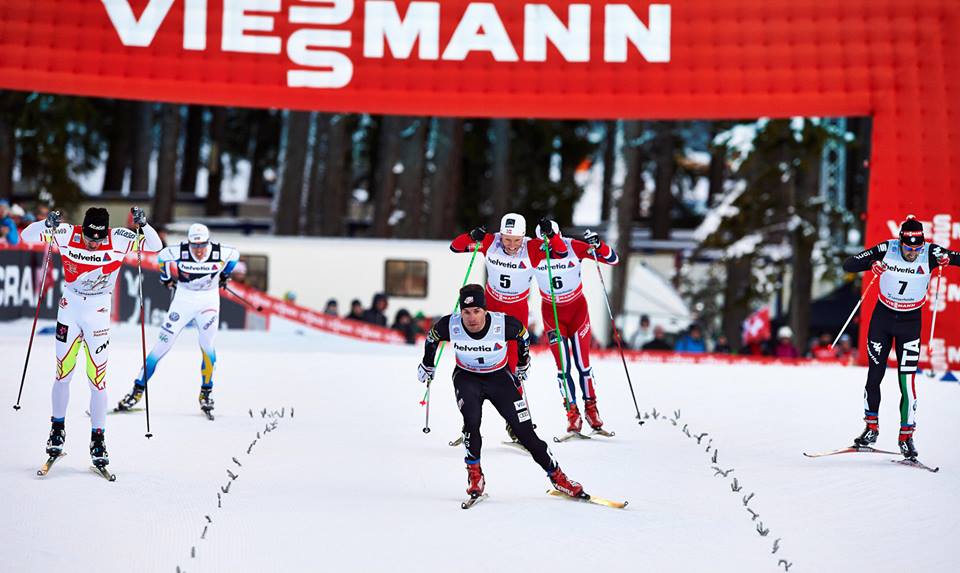
    Simi Hamilton (c) races toward the finish of the 1.5 k freestyle sprint final at the Tour de Ski Stage 3 in Lenzerheide, Switzerland. Hamilton held off Canada’s Alex Harvey (l) and Norway’s Martin Sundby (5) as well as Italy’s Federico Pellegrino (r) for the win. (Photo: Fischer/Nordic Focus)
    Simi Hamilton (c) races toward the finish of the 1.5 k freestyle sprint final at the Tour de Ski Stage 3 in Lenzerheide, Switzerland. Hamilton held off Canada’s Alex Harvey (l) and Norway’s Martin Sundby (5) as well as Italy’s Federico Pellegrino (r) for the win. (Photo: Fischer/Nordic Focus)

    Gus Kaeding literally had one foot out the door and his vehicle running Tuesday morning, but he couldn’t draw himself away from what was unfolding some 3,700 miles away in Lenzerheide, Switzerland.

    The Stratton Mountain School (SMS) T2 Team head coach almost missed his flight from Vermont to Utah because of the success four of his athletes — all on the U.S. Ski Team — were having in Stage 3 of the Tour de Ski. He didn’t, but said on the phone from his connection in Detroit that it would’ve been fine if he did.
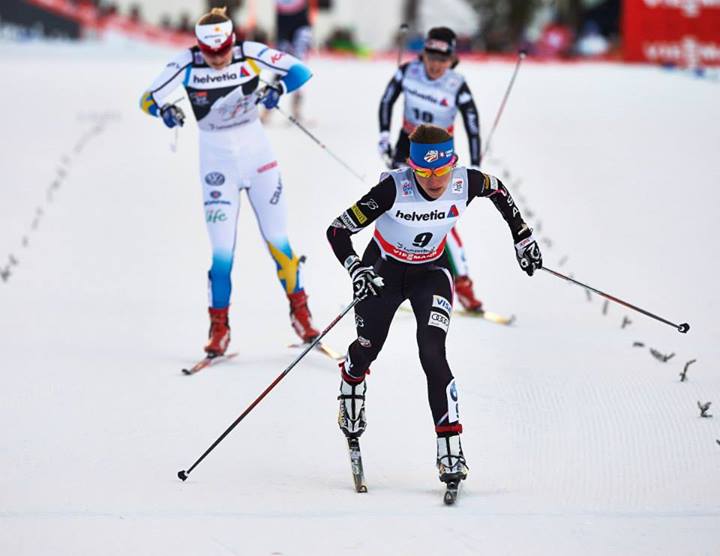
    Sophie Caldwell (U.S. Ski Team) winning her 1.5 k freestyle sprint semifinal on Tuesday at Stage 3 of the Tour de Ski in Lenzerheide, Switzerland. (Photo: Fischer/Nordic Focus)
    Sophie Caldwell (U.S. Ski Team) winning her 1.5 k freestyle sprint semifinal on Tuesday at Stage 3 of the Tour de Ski in Lenzerheide, Switzerland. (Photo: Fischer/Nordic Focus)

    To start the 1.5-kilometer freestyle sprints, Sophie Caldwell and Jessie Diggins qualified in ninth and 16th, respectively, 5.24 seconds and 6.93 seconds behind Norwegian qualifier winner Ingvlid Flugstad Østberg.

    Their male counterparts from SMST2 in southern Vermont, Simi Hamilton and Andy Newell did the unthinkable and qualified first and second, with Hamilton putting down the fastest 1.5 k time of 2:35.01 and Newell ranking second, 0.31 seconds back.

    Hamilton went on to win his quarterfinal then advance in third out of the semifinals to make his first final in his three years on the U.S. Ski Team (USST). Newell placed second in his quarterfinal and fourth in his semifinal to end up eighth overall, a season best for the USST veteran.

    Diggins placed fifth in her quarterfinal, 1.74 seconds behind Germany’s Denise Herrmann, who won the heat in 2:58.47 and went on to place third overall. Diggins ultimately took 21st to put her 15th in the overall Tour standings.

    “My body felt OK, and then as soon as I started trying to go hard, I couldn’t find that extra gear,” Diggins said on the phone. “In my quarters, I kind of let myself get screwed over in the first 100 meters, tried to get behind Denise Herrmann, but I started to get squeezed out.”

    Stuck behind a skier who tripped, Diggins said she spent the rest of the two-lap race fighting her way back toward the lead pack.

    “I didn’t have the energy to go really wide and pass and I just couldn’t find an open window,” she said. “The heat was not spectacular for sure and I wish I could have done the opening bit again and just tried to get a better start, but the Tour is a long thing and I just have to focus on recovery get ready for tomorrow and the day after that and the day after that.”

    Caldwell placed second in her quarterfinal then relied on fast skis and finishing kick to carry her to her first win, which she took 0.25 seconds ahead of Herrmann in 3:01.93.

    “I felt awesome in my semifinal, I don’t know what got into me there!” Caldwell wrote in an email. “I had talked a bunch of strategy with the coaches, especially about positioning with that final corner. I thought that I might be able to pick up a place or two by pushing not only over the top of the hill, but a little ways down the hill. I believe I was in 2nd over the top, and I pushed hard and my plan worked! I came into the corner first, so I was able to guard the inside and pick my lane into the finish.”

    In her first year on the USST, Caldwell, 23, also advanced to her first final, where she finished sixth for a career best, 6.81 seconds behind Østberg, who won it in 2:58.00.

    “I simply just got tired,” Caldwell wrote. “I actually had one pretty decent move that put me into a good position coming around the lap, but then it was downhill (figuratively) and uphill (literally) after that.”

    The finish put her sixth overall in the Tour standings, which will put her up front for the start of Wednesday’s 10 k classic mass start. She’ll leave the Tour after that, resting up and spending some time with family in Europe before gearing back up for the World Cup that resumes in Jan. 11 and 12 in Nove Mesto, Czech Republic.
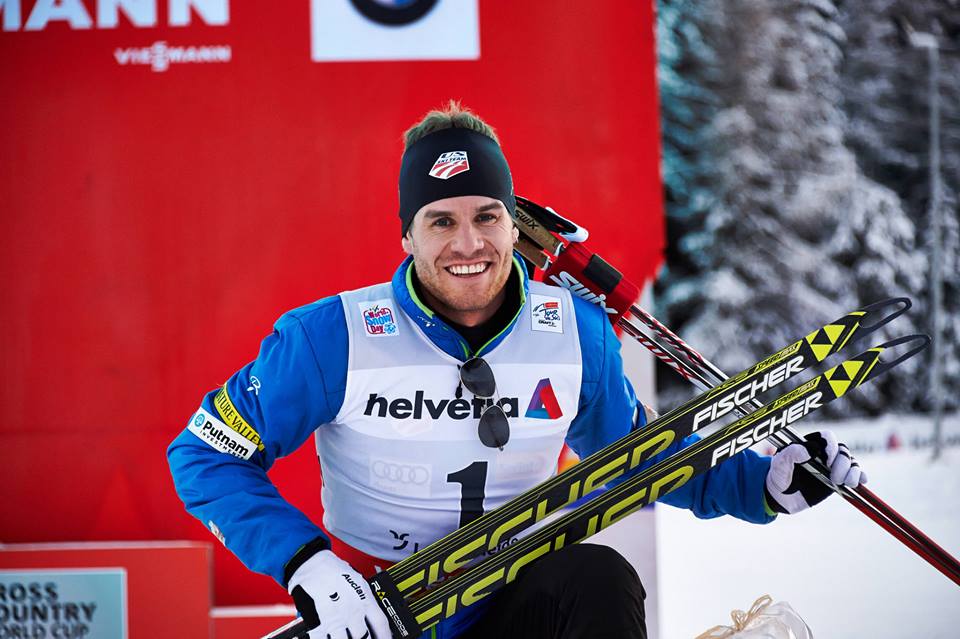
    Simi Hamilton (U.S. Ski Team) after becoming the first American man to win a Tour de Ski stage at the third of seven races in the 2013/2014 Tour. Hamilton won the 1.5 k skate sprint in Lenzerheide, Switzerland. (Photo: Fischer/Nordic Focus)
    Simi Hamilton (U.S. Ski Team) after becoming the first American man to win a Tour de Ski stage at the third of seven races in the 2013/2014 Tour. Hamilton won the 1.5 k skate sprint in Lenzerheide, Switzerland. (Photo: Fischer/Nordic Focus)

    As if watching all this unfold wasn’t enough, Kaeding remained glued to his live stream as Hamilton hung in the mix for the early part of the men’s final. Up the long climb, he rose from fourth to third, then third to first as he slingshot around the last corner.

    “I literally had my bags all packed … and I was just standing there,” Kaeding recalled. “As soon as I saw Simi, I was like, ‘Come on Simi, come on Simi.’ ”

    Hamilton flew past Italy’s Federico Pellegrino and held off Canadian Alex Harvey and Norway’s Martin Johnsrud Sundby, who also caught the downhill draft, for the victory in 2:37.02, three-tenths of a second faster than Harvey in second and 0.74 seconds ahead of Sundby in third.

    For Hamilton, it bested his previous top result of seventh in a sprint, and although not technically a World Cup (Tour stages are worth half the World Cup points), Hamilton became the first man to win a Tour de Ski stage.

    “I definitely had a smile on my face all day,” Kaeding said. “I’ve literally been traveling every moment since, but I sent everyone quick emails.”

    For Stratton, having four skiers in the heats, three of them make the semifinals and two continue to the final, was huge for the Vermont ski academy. Caldwell’s father, Sverre, overseas the nordic program there, and two years ago he started Stratton’s first elite team with the title sponsorship of the T2 Foundation, a non-profit that financially supports American skiers.

    On Tuesday, Eurosport commentators talked about Stratton, but as Kaeding pointed out, ironically failed to mention Newell as a part of the group — and he’s been a local staple for the last two decades.

    “I thought it was pretty cool … We always joke about those announcers not even knowing the names of the Americans in the friggen heats,” Kaeding said. “But it’s good to get the school and a little [publicity] … It’s good to know all those athletes are from the same club, but they’re really part of Team USA and that’s the important thing.”
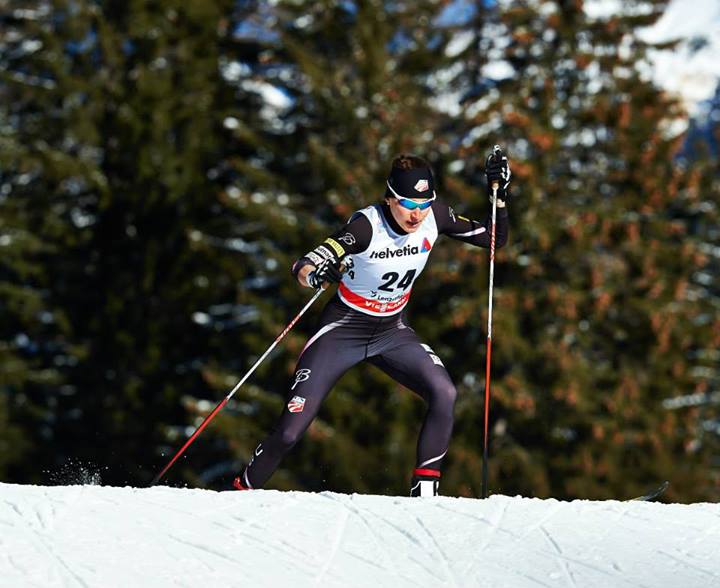
    Sophie Caldwell in Tuesday's 1.5 k freestyle sprint at Stage 3 of the Tour de Ski in Lenzerheide, Switzerland. (Photo: Fischer/Nordic Focus)
    Sophie Caldwell (U.S. Ski Team) on her way to qualifying in ninth in Tuesday’s 1.5 k freestyle sprint at Stage 3 of the Tour de Ski in Lenzerheide, Switzerland. (Photo: Fischer/Nordic Focus)

    Regardless of where they come from (Hamilton from Colorado, Diggins from Minnesota and both Caldwell and Newell from Vermont), the mental and physical training is what got them where they ended up Tuesday and in various other races this season.

    Kaeding said they don’t do anything special at Stratton, but it’s the mental capacity and natural talent of athletes like Hamilton that he was happy to see pay off. Two days earlier at Stage 2 in Oberhof, Germany, Hamilton as a late starter saw his qualifying time squashed by a snow squall and he missed the heats in 35th.

    “Simi’s been on the verge of doing really well here for a couple days and has been really close to pushing something over the top,” Kaeding said. “To his credit, he kept pushing on. … We work on things like that.”

    In terms of strategy, Kaeding said Newell and Hamilton are especially good tacticians out on course, and with teammates Skyler Davis and Eric Packer (also sprinters), they learn from one another each day in training throughout the summer.

    “Andy, really a veteran, has been in the heats forever; Simi’s just a really a beautiful skier, can ski between cracks that nobody can get through … and those guys all really compliment each other really well,” Kaeding said. “When they train together every day, it’s basically like a World Cup sprint heat. I think it sets them up really well.”

    In the last four (of five) sprints she’s raced this season, Caldwell has consecutively made the rounds in each. On Sunday, she qualified in a career-best fifth to finish 22nd and two weeks earlier in Davos, Switzerland, qualified in ninth and went on to place ninth in the freestyle sprint.

    Kaeding said he chats with her remotely after races, and in the last two sprints, they discussed her strong finishing speed, but need to to get out front sooner and “see what happens, dictate the pace even if she lacks a little pop at the end,” Kaeding said. “So she tried that two days ago in Oberhof. She said it went pretty well, but maybe that would’ve been a better day to follow.”

    Caldwell told him she’d check out Lenzerheide’s sprint course and base her strategy off that. With a boilerplate track, both agreed that sitting in and conserving might be best.

    “She kind of hit it perfect and exploded into winning the heat, much like Simi did,” Kaeding said.

    “She skied great all day, skied technically well [and] made smart moves out there,” USST Head Coach Chris Grover said on the phone. “She just ran out of gas in the final, and that’s just because she’s a little bit younger and still developing, but she’s going to be a big name for the future.”

    Heading into the fourth of seven stages, the U.S. has two skiers in sixth (Caldwell and Newell) overall in the Tour, Hamilton ranks 11th and Diggins 15th, and Hamilton and Newell are currently seventh and eighth in the sprint standings, respectively, Caldwell 10th and Diggins 24th.

    “The start of the Tour really favors sprinters … so their Tour standing is reflecting that,” Grover said. “But they’re able to get in there and stay healthy and execute.”

    Caldwell, Newell, Hamilton and Holly Brooks (37th on Tuesday) plan to end their Tour after Lenzerheide, but Diggins, Liz Stephen (44th, 37th overall), and Noah Hoffmann (83rd, 89th overall) plan to complete all seven stages with the final races Friday through Sunday in Italy.

    “I am so excited for Simi! He was incredible today,” Hoffman wrote in an email. “The course and conditions were perfect today. Racing in the Swiss Alps on a bluebird day is pretty fun, even if it is a sprint race. I felt good. I didn’t have many expectations for results today. I’m certainly looking forward to distance racing.

    “[Wednesday] will be challenging starting in the back,” he added. “I’m going to be patient. It’s a good course for me, and I’m looking forward to moving up. … The energy on the team is very high. I’m sorry we’re splitting up tomorrow. It’ll be a very small group for the final three days of the Tour.”

    — Lander Karath, Seth Adams and Pasha Kahn contributed reporting

    Results: men | women

    Overall Tour standings (through three stages): men | women

  • Rain Can’t Stop Russians; Kriukov Leads Sweep in Stage 3

    Rain Can’t Stop Russians; Kriukov Leads Sweep in Stage 3

    Kriukov with a relaxed victory lunge.

    OBERSTDORF, Germany – If anyone was going to embrace Saturday’s downright nasty weather in the third stage of the 2012 Tour de Ski, it was the Russians.

    The interminable rain and snow here may have gotten to some of their competitors, but it failed to even dampen the energy of Nikita Kriukov, Alexey Petukhov, and Nikolay Morilov, as the Russian trio swept the podium in the classic sprint.

    “Russian peoples like different weather,” Kriukov told FasterSkier after the race. “Ten [degrees], or minus 30—no problem!”

    Athletes from all teams struggled to stay warm and dry throughout a long afternoon of sprinting. For most of the day, it was roughly a degree above freezing, and pouring rain.

    Petukhov wore an Adidas-branded poncho during warm-ups; others donned full rain suits. Justyna Kowalczyk said she spent most of the day in her car, while others simply rotated through entire bags’ worth of clothing.

    “I brought, like, all my clothes,” said Simi Hamilton (USA). “I filled up my whole pack.”

    The Russians, though, were unperturbed. Of the 30 qualifiers for the heats, eight wore the country’s red-and-blue suits, with Petukhov notching the fastest time and five Russians packing the top 10.


    Petukhov winning the qualification.

    And they weren’t just strong in the qualification round: four of the them—the three podium finishers and Dmitriy Japarov—made it to the finals. Alex Harvey (CAN), who was victimized by Morilov in his quarterfinal heat, said that there was no doubt that the Russians were sharp.

    “Off the start they were way quicker than anybody,” he said. “It looked like they were way stronger than anybody else on the top of the hill. The Russians are in good shape.”

    In the finals, Kriukov, Petukhov, Japarov, and Morilov all faced off against Petter Northug (NOR) and Dario Cologna (SUI), the two heavyweights who currently sit first and second in the overall Tour standings.

    Northug had looked strong all day after taking second in qualification. But by the finals, he looked a little worn out: he’d lost his hat, and was braving the Oberstdorf weather bare-headed. While the Norwegians are typically fastidious when it comes to details like staying warm and dry between rounds on a cold, wet, day, their team doctor said things hadn’t gone perfectly.

    Northug, second in qualification.

    “I don’t think we were good enough today,” said the doctor, Kjell Vegard Mykland.

    The Russians had another advantage, too.

    Northug had had to dig deep in a tough race and sprint finish in Friday’s Stage 2. But Kriukov, Petukhov, and Morilov—all sprinters—had been able to ski at their own pace.

    “Yesterday was very hard, and very difficult track. Fifteen kilometers,” Kriukov said after Saturday’s race. “For Mr. Northug and all the other athletes, very tough. Today, for me and for the other sprinters, I think it was a little bit easier.”

    If Northug had the energy to pull his typical antics on the finishing straight, he never had the opportunity to demonstrate it. The three Russians had already started pulling away when Northug appeared to stick a pole between his legs and crashed, ending his hopes of a podium on the day.

    Kriukov, Petukhov, and Morilov then battled it out on the homestretch, with Kriukov emerging the winner with enough time to raise his arms and mug for cameras at the finish.

    Kriukov chalked up the Russians’ success to training that the sprinters do together. In an interview with the news agency ITAR-Tass, coach Yuriy Kaminsky said that everything came together for the team.

    3 Russians in the semis.

    “It all coincided: the wax, very good fitness, and we were able to recover from yesterday’s race,” he said. “What can I say? We won outright.”

    With his sixth place in the finals, Northug remains in the overall lead of the Tour, with a four-second cushion over Cologna and 15 seconds on Japarov in third.

    After a long afternoon in the rain, Northug told Norwegian broadcaster NRK that he wouldn’t be spending too much time celebrating New Year’s Eve.

    “I think I need to go to sleep early,” he said.

  • Hairy Day on Hairies for Newell; Notes & Quotes from American Men in TDS Stage 3

    OBERSTDORF, Germany – If there’s one thing more dispiriting for a cross-country skier than having a bad day, it’s having a good day that’s limited by equipment.

    Andy Newell (USA) was on the rebound from a potential illness in Stage 3 of the 2012 Tour de Ski on Saturday, a classic sprint. But his race was stymied by the soggy, sloppy conditions that prevailed here all day.

    After qualifying in 28th, Newell couldn’t make his hairies skis stick during his quarterfinal and struggled to keep up on the second of two climbs. He finished fifth in the heat, ended up in 25th, and was left still without his first appearance in the semifinals this season.

    “I could kind of make it work up the first hill,” he said. “When I tried to put it into the next gear…it was kind of too much slipping. It was just kind of a disaster.”

    Newell said that he had raced on klister in the qualification round early in the day, but while the wax had great grip in Oberstdorf’s soaking rain, it ended up being too slow and nearly kept him from making the heats.

    He picked the hairies for the quarterfinals after re-testing, and said the responsibility for the snafu lay just as much with him as with the U.S. Ski Team’s wax staff.

    “I should have been better about making sure I [had] enough kick,” he said.

    The problem wasn’t that hairies weren’t working: Newell’s teammate, Kikkan Randall, used them to great effect in her two heats, he said. Newell just couldn’t find a good pair of skis to match the wax job.

    “With Kikkan, we managed to find the right combination, but we didn’t get to that place with Andy,” said Chris Grover, the U.S. Ski Team head coach. “He never felt like he had something that was 100 percent, and we just ran out of time.”

    ———-

    Newell described the conditions Saturday as “pretty rugged.”

    “It was a long hard day out there in the rain,” he said. “Even just skiing one heat, I was so cold, soaking wet.”

    When it came time to cool down, “it was so wet, you couldn’t even run. Just splashing through puddles. I went through all my clothes by the time the heats even started.”

    While the weather meant that Newell could take some solace in being bounced from the heats early on, his teammate Kris Freeman said that he actually enjoyed himself in Stage 3. Freeman finished a respectable 43rd on Saturday, at the venue in which he made his only career sprint heats appearance, in last year’s Tour de Ski.

    “I never have fun sprinting, and I had fun sprinting in the rain today,” he said. “So that tells you something.”

    Freeman was content with his race, which he said went well considering that the discipline isn’t his specialty.

    “I was two seconds from qualifying,” he said. “I can’t complain…I felt sharp.”

    He also said he’s looking forward to Sunday’s 20 k pursuit.

    “I think it could be very solid,” he said. “Usually when I’m sprinting fast, it goes hand in hand with me.”

    For Simi Hamilton, the day was a mixed bag. On the one hand, it was as close as he’s come to qualifying for the heats in a World Cup-level classic sprint in more than a year; on the other, he said he felt befuddled by the conditions, and didn’t ski with much finesse.

    Asked whether there was a particular place where he fumbled and lost the single second that cost him a spot in the heats, Hamilton replied that “the whole course I had a fumble.”

    “One-point-two k I fumbled around,” he said, chuckling. “I felt really tight for the whole thing. I feel like I’ve been working a lot on my classic skiing and it’s gotten a lot better, for sure, but today I just felt like everything was real constricted.”

    The sloppy weather, he added, didn’t help matters.

    “Traditionally, I haven’t skied very well in these kind of conditions, where the tracks are a little sloppy and you’ve really got to be on your pocket to kick well,” Hamilton said. “I think I’m better off when tracks are really hard…I think it’s just going to take learning how to ski better in these kinds of conditions, and just letting myself relax a little bit, finding speed in the glide and kind of mixing it up a little bit. But I was really close, and I think my classic sprinting has been getting better over the years. There’s still a lot of room to improve, but I think it’s kind of important to look at where I’ve come from in classic sprinting.”

    Topher Sabot contributed reporting.