
From the FasterSkier archive — posts syndicated from athletes’ and coaches’ own blogs between 2004 and 2012, kept online as published. Current coverage is at fasterskier.com.

Tag: stage 4

  • Patterson 4th, Cyr 7th On the Day as Klaebo Controls TDS Stage 4

    Patterson 4th, Cyr 7th On the Day as Klaebo Controls TDS Stage 4

    A_Hall_Mark_of_Excellence_Award-logo-300.png (300×244)This World Cup coverage is made possible through the generous support of Marty and Kathy Hall and A Hall Mark of Excellence Award. To learn more about A Hall Mark of Excellence Award, or to learn how you can support Fasterskier’s coverage, please contact info@fasterskier.com.

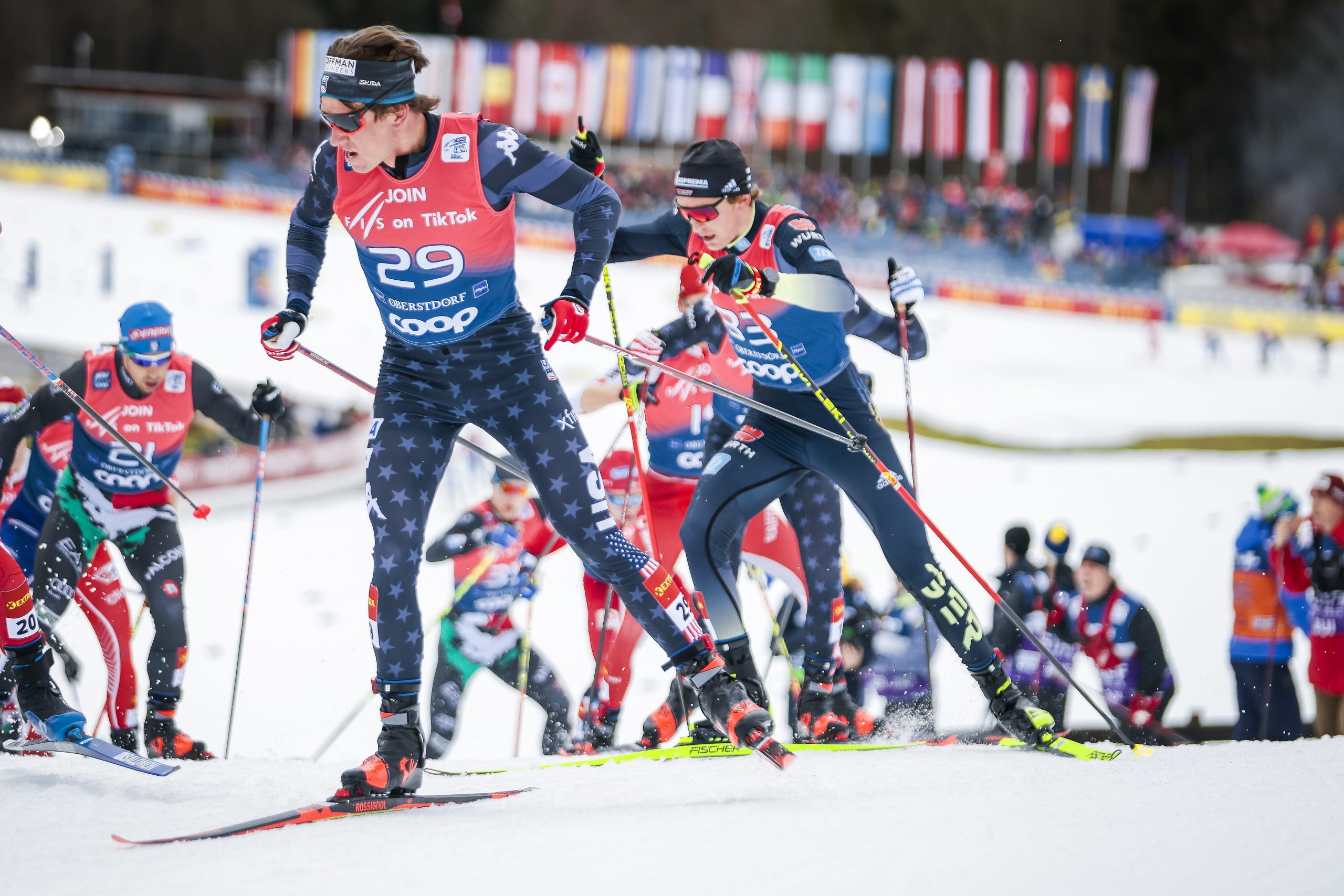
    Scott Patterson (USA) leads the chase group on his way to the fourth fastest time of the day at the Tour de Ski 20 k Freestyle Pursuit in Obesrtdorf, Germany. (Photo: NordicFocus)

    The Tour de Ski spent its second day in Oberstdorf for the running of Stage 4, the 20 k Freestyle Pursuit. For the second day in a row, it was North Americans who raced their way toward the front. Most remarkable, perhaps, were Scott Patterson (USA) with the fourth fastest time of the day (he would rise from 29th to 17th overall), and Antoine Cyr (CAN) with the seventh fastest time of the day (rising from 37th to 24th overall).

    Other Canadian finishers included Olivier Léveillé 35th (from 24th), Russell Kennedy 41st (from 56th), Sam Hendry 66th (from 74th), Graham Ritchie 67th (from 65th), Remi Drolet 72nd (from 75th).

    American finishers included three more Americans in the top thirty: Ben Ogden finished13th (having started 6th) , Hunter Wonders finished 19th (from 11th), and Gus Schumacher 26th (from 15th). Zak Ketterson finished 55th (from 38th), JC Schoonmaker finished where he had started in 69th, while Kevin Bolger rose to 71st (from 73rd).

    Almost as an afterthought, Johannes Hoesflot Klaebo skied to the 20 k Pursuit win in dominant fashion. Klaebo managed his own pace—and the pace of the field—in a masterful display that saw him pulling away from the pack in the final kilometer and easing across the line for the win (though losing cumulative time to many of his rivals in the Tour de Ski overall competition). Following him to the finish line were Sindre Bjoernestad Skar (NOR) in 2nd, and Federico Pellegrino (ITA) in 3rd.

    Even down the homestretch of the 20 k Freestyle Pursuit, Johannes Hoesflot Klaebo (NOR) controls the field and carries his dominance across the finish line. (Photo: NordicFocus)
    Men’s 20 k Freestyle Pursuit

    This was a day of differing strategies: some racers knew they had to commit everything in order to move up in the Tour de Ski standings, while others were choosing to conserve their energy for later stages. Others (like Klaebo) knew they could afford to give back some time, holding their overall positions while committing only enough energy to prevail in the day’s racing.

    Tour de Ski Stage 4 was a 20 k Freestyle Pursuit in which the starting order was derived from yesterday’s 10 k Classic (NOT from the order of the overall standings). Oberstdorf’s strip of manmade snow ran through the fields and forests along a rolling 3.3 kilometer loop that racers would navigate six times. The starting order gave Klaebo a 12 second advantage over Simen Hegstad Krueger, :20 to Didrik Toenseth, :25 to Calle Halfvarsson, :27 to Golberg, :30 to Ben Ogden. This closely-bunched group of starters made it quite likely that the entire field could come together within just the first few kilometers. Twenty kilometers is quite a distance to ski alone, and Klaebo is smart enough to know that he could exhaust himself by attempting to maintain his lead over so strong a group of chasers. And with his sprinting abilities, Klaebo would be likely to win the day’s event if he conserved his energy, allowed the field to catch him, and outsprinted them at the end. The men’s race looked certain to group up.

    Like the pursuit race earlier in the Tour de Ski, each skier’s relative success can be judged by more than one result. There are skiers who do well in the pursuit finishing order, and others who do well in the timed-results on the day . . . and the comparison of success and failure is not always immediately apparent. A racer may finish well in the race standings by holding position in a pack of skiers and outsprinting them at the end, even though his on-the-day time could be much slower than other skiers who caught his group from behind. Pursuit racing is about patience and strategy as much as it is about maximal efforts and daring pyrotechnics. The races going on in the middle of the field can be extraordinarily complex. The racing at the front is far more straightforward . . .

    Hunter Wonders (USA) following teammate Ben Ogden (USA) in the lead group at the Tour de Ski Stage 4 Freestyle Pursuit in Oberstdorf . (Photo: NordicFocus)

    Klaebo started alone with a 12 second advantage over his pursuers. Soon after the start, a chase group formed that included Krueger, Didrik Toenseth (NOR), Calle Halfvarsson (SWE), and Paal Golberg (NOR). That group was closely followed by Andrew Musgrave (GBR) who was able to join a few kilometers later. All chasers were making up time on Klaebo, who was obviously allowing himself to be caught. The catch happened within the first five minutes of racing (near the 2.1 k checkpoint), forming a group that would stay together all through the middle of the race. The group was led by Simen Hegstad Krueger who was consistently marked by Klaebo, and trailed by Golberg.

    A fairly relaxed pace at the front allowed later starters to bridge the gap at four kilometers, and the lead pack swelled to a dozen. Having been gapped by Musgrave, Ogden found himself overtaken by an aggressive chase pack that included Poromaa, Hunter Wonders, Gus Schumacher, Emil Iversen, Havard Moseby, Hans Christer Holund. There was no relaxing to do in the chase group; they were headed for the front, and were wasting no time in making it happen. Pellegrino would ultimately lead another group forward to join with the lead group, and the field ultimately swelled to nearly 30 racers, including Americans Ogden, Schumacher, Wonders, Patterson, and the Canadian Cyr.

    “We caught the lead pack in three laps . . . and it turned into a little bit of a cat and mouse game which was a little bit frustrating,” said Patterson. “I wanted it to be a harder race. But it turned out all right. As people get tired, I start moving up the ranks. I’m excited for Val di Fiemme. “

    Wonders summed up his Stage 4 experience: “Once we caught the lead pack it started to chill out a little bit,” he said. “I was just trying to ski relaxed; it was pretty exciting to be skiing with a bunch of guys I’ve been watching for years!”

    Having started 33rd on the day, Frederik Moch (GER) went to the front to push the pace in the second half of the race (Moch would post the fastest time on the day). Sjur Roethe (NOR) attacked at 12 k with Halfvarsson and Krueger, but the contenders came back together after a fast downhill. The lead group dwindled to 24 as the race neared its conclusion, and the jockeying for position began with the field nearly coming to a standstill at times. With a kilometer remaining in the race, Klaebo unleashed a surge on the final uphill before the stadium followed by Skar and Pellegrino. As has so often been the case, Klaebo’s high-tempo surge on the final uphill was one that no one else could match. He crested the hill alone, relied on his fast skis on the downhill, and maintained his lead through the finishing line. The field came charging behind him in a sprint won by Skar, who was closely followed across the line by Pellegrino. Nine Norwegians finished in the top 12, followed by Ogden in 13th (though his finishing time was only five seconds behind Klaebo’s winning time).

    “The pack stayed together the whole race,” Ogden said. “And then they just sprinted for it in the last K, or so. I think that my strengths in 20 k are better suited in the last K than they are in the first 19!”

    Klaebo earned the win, but with only the 42nd fastest time of the day, giving back :22 to Golberg,  and 1:01 to Pellegrino in the TDS overall standings. Klaebo knows he must moderate his efforts in order to have the energy to hang on through the end of this week-long tour. But he also sees the possibility of sweeping the series—of winning every stage—on his way to an historic Tour de Ski victory that could also garner enough points to bring him the World Cup overall title.

    After the close racing of Stage 4, the Tour de Ski Overall standings return to a much tighter affair: Klaebo continues to lead Pellegrino by :12, Golberg by :14, Skar and Krueger by :32, Toenseth, Roethe, Holund by :39, and Halfvarsson by :49.

    Tour de Ski, Men’s 20 k Freestyle Pursuit RESULTS

    The long white stripe in Oberstdorf, Germany. Tour de Ski Men’s 20 k Freestyle Pursuit. (Photo: NordicFocus)


  • With Bjørgen Out, Niskanen Rises Above Rest of Norwegians for First Stage Win in Lenzerheide

    With Bjørgen Out, Niskanen Rises Above Rest of Norwegians for First Stage Win in Lenzerheide

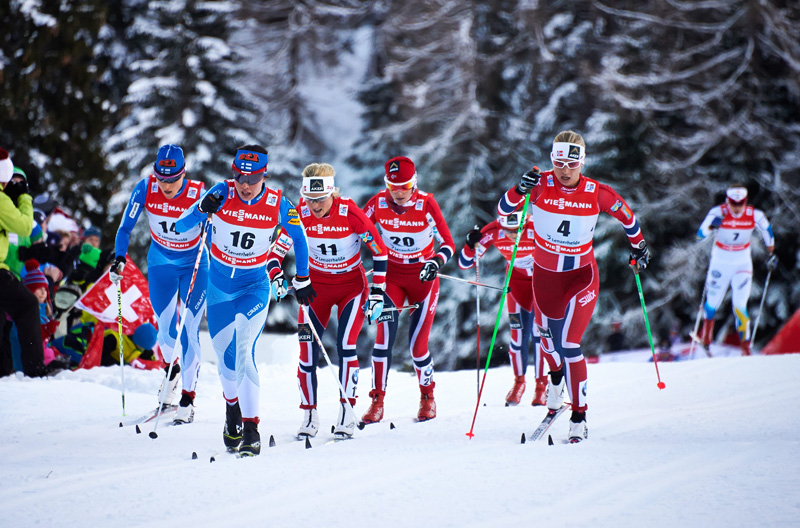
    Finland's Kerttu Niskanen (second from l) and Aino-Kaisa Saarinen (l) lead Norway's Therese Johaug, Heidi Weng, , Ingvild Flugstad Østberg, Astrid Uhrenholdt Jacobsen, and Sweden's Hanna Erikson (r) in Wednesday's 10 k classic mass start at Stage 4 of the Tour de Ski in Lenzerheide, Switzerland. (Photo: Fischer/Nordic Focus)
    Finland’s Kerttu Niskanen (16) and Aino-Kaisa Saarinen (14) lead Norway’s Therese Johaug (11), Heidi Weng (20), Ingvild Flugstad Østberg, Astrid Uhrenholdt Jacobsen (4), and Sweden’s Hanna Erikson (7) in Wednesday’s 10 k classic mass start at Stage 4 of the Tour de Ski in Lenzerheide, Switzerland.
    (Photo: Fischer/Nordic Focus)

    Marit Bjørgen is sick. For Norwegians, the news that the 33-year-old team leader had to pull out of the Tour de Ski on Wednesday morning was definitely a bummer; having never won the Tour before, she was missing the opportunity to do so again.

    The attention quickly shifted to her teammates, including distance favorite Therese Johaug and Ingvlid Flugstad Østberg, who led the Tour standings through three stages.

    But the Norwegians aren’t the only ones in this seven-stage game, and Finland’s Kerttu Niskanen was among the “others” seeking a little recognition on Wednesday, New Year’s Day.

    In the fourth stage of the Tour, Johaug, Østberg and another Norwegian, Astrid Uhrenholdt Jacobsen, assembled almost immediately out of the start of the women’s 10-kilometer classic mass start in Lenzerheide, Switzerland. Together in red suits at the front of the pack, they were out to send a message. They were setting the pace and controlling this race.

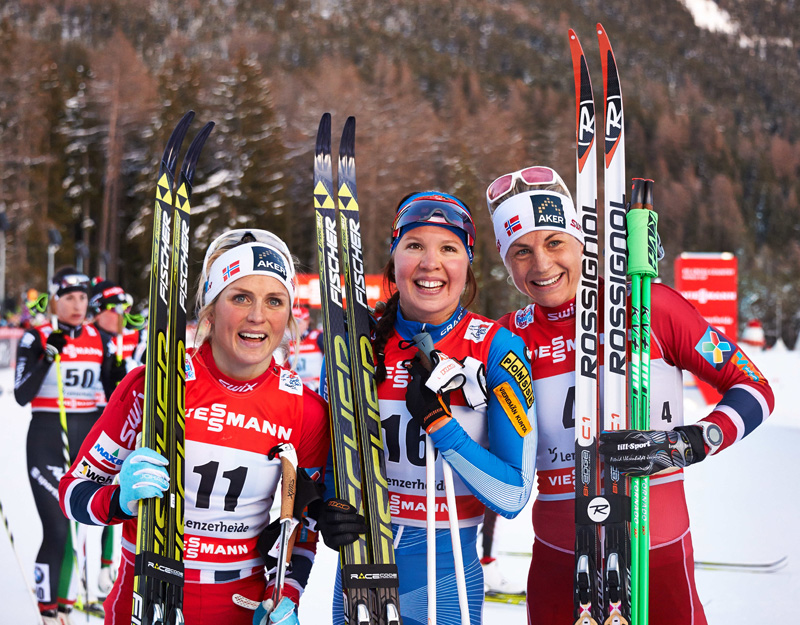
    The women's 10 k classic mass start podium at Stage 4 of the Tour de Ski: winner Kerttu Niskanen (c) of Finland, and Norway's Astrid Uhrenholdt Jacobsen (r) in second and Therese Johaug in third. (Photo: Fischer/Nordic Focus)
    The women’s 10 k classic mass start podium at Stage 4 of the Tour de Ski: winner Kerttu Niskanen (c) of Finland, and Norway’s Astrid Uhrenholdt Jacobsen (r) in second and Therese Johaug in third. (Photo: Fischer/Nordic Focus)

    But three laps is a long way.

    Before the end of the first loop around 2.4 k, the three led while Sweden’s Hanna Erikson — who notched her first international podium with a freestyle-sprint win in Stage 2 — hung less than a second behind the three in fourth. Another 0.5 seconds back, Aino-Kaisa Saarinen headed up Finland’s trio in fifth, with Niskanen and Anne Kyllönen trailing in sixth and seventh, respectively.

    By the end of the first 3.1 k lap, Johaug and Østberg still led, but Saarinen had made her way up to third, 0.7 seconds back and even with Jacobsen. Another 1.3 seconds later, Niskanen came through in fifth, followed by Erikson another half-second back in sixth. The top 10 remained within 6 seconds of one another, but when you’ve got Johaug up front — known to “pop” and drop the field at any time — that’s a lot of time to claw make up on her.

    Niskanen remained in contact, even after dropping more than five seconds behind Johaug at 4.6 k, along with Østberg, who fell off the pace slightly as well. With Johaug nearly 2 seconds ahead of Saarinen in second and 3.6 seconds up on Jacobsen in third, it seemed the writing was on the wall: another Johaug win without Bjørgen to make it a little more interesting.

    At the sprint preem less than a kilometer later, Niskanen sprung to life. First through the bonus checkpoint at 5.5 k, she put 1.2 seconds into Saarinen and just over two seconds into Jacobsen and Johaug. Norway’s Heidi Weng had moved up to fifth, 3 seconds behind Niskanen, and Østberg was more than six seconds back in sixth.

    Whatever was going on behind Niskanen, it didn’t matter. Striding smoothly along the rolling course, with an approximately 500-meter climb in the middle of each lap, Niskanen never relinquished the lead — even with Johaug breathing down her neck with less than 3 k remaining.

    She managed to keep the Norwegians at least a full stride and couple meters behind until one pivotal point on the high point of the course at 8.6 k, where the preem was on the second lap. As if it was there again, Niskanen charged up and over the top to break free of Johaug and Saarinen, who were nearly even with her at the time. Jacobsen was right there with them, and Weng lost a little time on the screaming-fast descent toward the stadium.

    With one more rise to go, Niskanen was first to the top and used her fast skis with superior glide to gain even more on her ground competitors, all while tucking in the track of her choice. Jacobsen followed and Johaug was right behind her in one of the outside tracks, but Johaug’s drafting tactic ended up impeding her as she came up on Jacobsen and quickly searched for a open track to switch to. Meanwhile, Weng was gaining on the group, including Saarinen, skiing alone in another track.

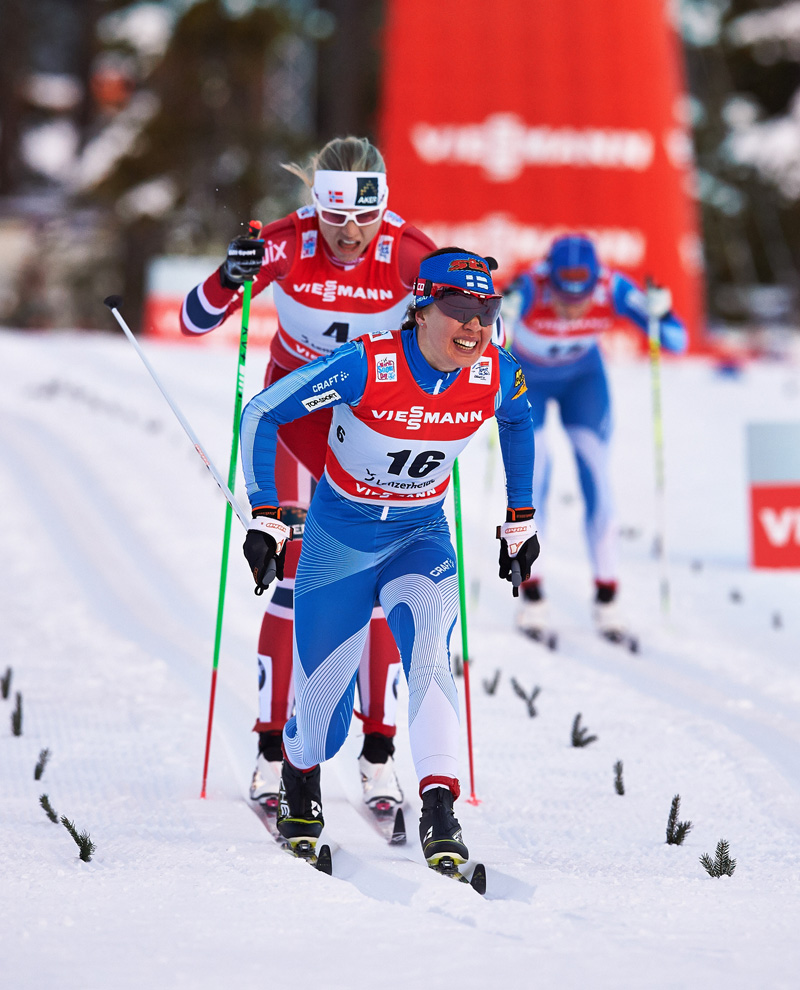
    As the leaders rounded the lefthand turn into the stadium, Niskanen launched into double poling as she tried to fend off Jacobsen and Johaug for one last time. She succeeded, winning in 26:27.4, four-tenths of a second ahead of Jacobsen in second. Johaug took third, another 0.7 seconds back, Weng passed Saarinen for fifth (+1.9) and Saarinen settled for sixth (+2.5).

    The third Finn in the top six on Wednesday, Kyllönen placed sixth (+23.9) for her fourth-straight top eight in the Tour. Eva Vrabcova-Nyvltova of the Czech Republic finished seventh (+24.5), Russia’s Olga Kuziukova was eighth (+25.1), Erikson ninth (+25.8) and Østberg edged France’s Aurore Jean in a photo finish for 10th (+29.8).

    Finland's Kerttu Niskanen holds off Astrid Jacobsen of Norway to the finish of Wednesday's 10 k classic mass start to win Stage 4 of the Tour de Ski in Lenzerheide, Switzerland. (Photo: Fischer/Nordic Focus)
    Finland’s Kerttu Niskanen holds off Astrid Jacobsen of Norway to the finish of Wednesday’s 10 k classic mass start to win Stage 4 of the Tour de Ski in Lenzerheide, Switzerland. (Photo: Fischer/Nordic Focus)

    For Niskanen, 25, the victory was her first stage win — and podium — after she took third in the classic sprint last season at World Cup Finals in Stockholm.

    She started to cry “tears of joy” when she crossed the finish line, Niskanen told the Helsingin Sanomat, according to a translation. “Then I thought, ‘It’s useless to cry when this is not so terribly serious.’ ”

    With a total of 30 bonus seconds (15 for being the first through 5.5 k, and another 15 for winning), Niskanen improved to third in the overall Tour behind Jacobsen in first and Østberg in second. The frontrunner since winning Tuesday’s sprint, Østberg dropped 35.4 seconds out of the lead and Niskanen stood 36.8 seconds back in third.

    Jacobsen was originally going to go home after four stages, but now she’s in it to win it.

    “I’ll go to each race as it is the most important ski race,” she said of the remaining three stages, which pick up Friday in Toblach, Italy.

    “She’s at least a podium contender,” Norwegian women’s coach Egil Kristiansen told NRK.

    Through four stages, Johaug was fourth overall (+44.7) and Saarinen sat in fifth (+54.0), and Kyllönen was sixth (+55.7).

    Kyllönen told the Ski Association Bulletin that Weng pushed her “into the wall,” during Wednesday’s 10 k, according to the Sanomat. “I was on the tip … when I fell, and the group escaped,” she said. “There is no TV picture, so making a protest is a pointless waste of energy.”

    Germany’s Denise Herrmann ranked seventh overall (+59.3) after placing 20th in the first classic race of the Tour, Weng was eighth (+1:09.4), Erikson ninth (+1:13.2), and Vrabcova-Nyvltova 10th (+1:39.9).

    Leading the Americans, Sophie Caldwell was still in the top 20 after placing 33rd (yet Wednesday marked her last race of the Tour), and fellow U.S. Ski Team member Jessie Diggins was 21st (+2:30.2) after placing 32nd. Liz Stephen finished 26th in the first distance race of the Tour to improve to 21st overall (+2:32.0).

    As for Bjørgen, she flew back to Norway on Wednesday, but Kristiansen expects her to be up-and-training again in two or three days.

    “The most important thing now is that she gets stored up energy and eats well,” Kristiansen told NRK, according to a translation.

    Tuesday was a bit much; she raced after struggling to eat breakfast.

    “She was not quite [right],” he said. “Normally she is very sharpened and focused towards competition. … It is never positive to be sick, but at the same time plan B might just as well [focus on] the Olympics. We talked about how important it was that she forgot that and started with a clean slate. We are done with what happened.”

    Bjørgen’s righthand rival and close teammate, Johaug said she was “very sorry” to hear the news.

    “I told her that [there’s a] more important ski race this year. The Olympics is the main goal,” Johaug told NRK. “The most important thing now was that she came home. There are new opportunities.”

    Results | Tour standings (through Stage 4)