From the FasterSkier archive — posts syndicated from athletes’ and coaches’ own blogs between 2004 and 2012, kept online as published. Current coverage is at fasterskier.com.

Tag: State of Alaska

  • Questions Swirl Over University of Alaska’s Waiver Requests to NCAA

    Questions Swirl Over University of Alaska’s Waiver Requests to NCAA

    The Alaska Airlines Center, home to the University of Alaska Anchorage Seawolves athletics program in Anchorage, Alaska, photographed last month. (Photo: Gavin Kentch)
    The Alaska Airlines Center, home to the University of Alaska Anchorage Seawolves athletics program in Anchorage, Alaska, photographed last month. (Photo: Gavin Kentch)

    The University of Alaska system structured its recent waiver requests to the NCAA partially around a presidential directive to preserve men’s hockey at any cost, then backed away from that suggestion in a public explanation of its actions, an analysis of the school’s official waiver documents suggests.

    University of Alaska Anchorage (UAA) Athletic Director Keith Hackett and President Jim Johnsen announced last week that men’s and women’s skiing at both UAA and the University of Alaska Fairbanks (UAF) were among the sports targeted for elimination in a waiver request submitted to the relevant NCAA membership committee. At the time, Johnsen told the Alaska Dispatch News that “hockey survived largely because the NCAA requires a school to offer two men’s team sports and two women’s team sports,” and that the only men’s team sports at both UAA and UAF are basketball and hockey. (NCAA bylaws consider cross-country skiing to be an individual sport.)

    But the official waiver requests submitted to the NCAA were somewhat less circumspect. “The President of the University System has stated that Alaska Anchorage shall make every effort to retain men’s hockey,” UAA’s waiver request stated. And “the President of the University System has stated that Alaska Fairbanks shall make every effort to retain men’s hockey,” UAF’s waiver request stated in near-identical language.

    (The waiver requests are substantively identical, but were written, or at least edited, by different people. Run-on sentences, typographical errors, and citations to nonexistent bylaw provisions that are present in the UAA waiver request were corrected in the UAF version of the same document.)

    The 13 sports currently sponsored at UAA are as follows:
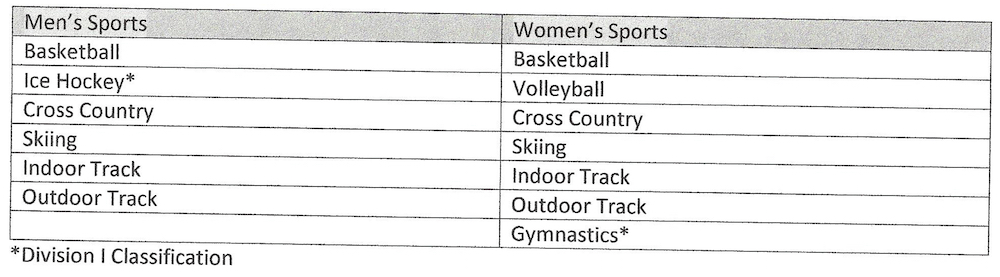
    Table of 13 sports currently offered at University of Alaska Anchorage (UAA), prior to its waiver request to the NCAA in November 2016. (photo: screenshot from UAA waiver request)
    Table of 13 sports currently offered at UAA, prior to its waiver request to the NCAA this month (Screenshot from UAA waiver request)

    The 10 sports currently sponsored at UAF are as follows:
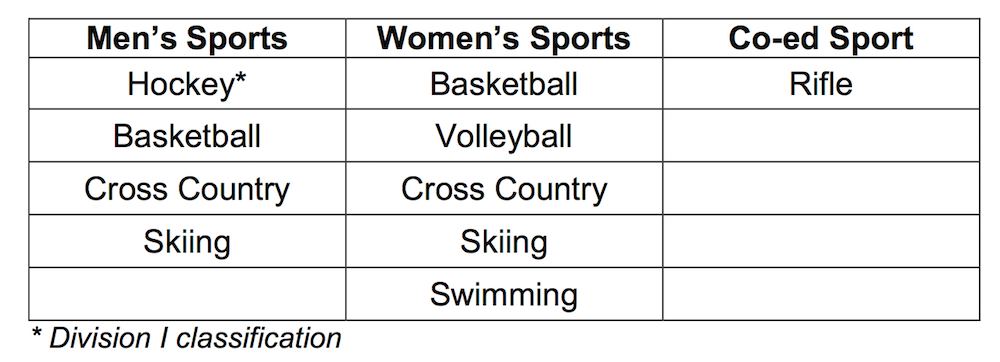
    Table of 10 sports currently offered at University of Alaska Fairbanks (UAF), prior to its waiver request to the NCAA in November 2016. (photo: screenshot from UAF waiver request)
    Table of 10 sports currently offered at UAF, prior to its waiver request to the NCAA this month. (Screenshot from UAF waiver request)

    The team sports offered at UAA, according to NCAA Division II Bylaws Section 20.10.3.3, are men’s basketball, men’s ice hockey, women’s basketball, and women’s volleyball. This bylaw defines all other sports at UAA (cross-country running, skiing, indoor and outdoor track, and gymnastics) as individual sports.

    At UAF, the team sports are men’s hockey, men’s basketball, women’s basketball, and women’s volleyball. Cross-country running, skiing, swimming, and rifle (riflery) are all defined as individual sports.

    UAA and UAF are currently both members of the Great Northwest Athletic Conference, or GNAC. UAA and UAF both wrote in their waiver requests that they must sponsor basketball, volleyball, and cross-country running in order to remain a member of GNAC.
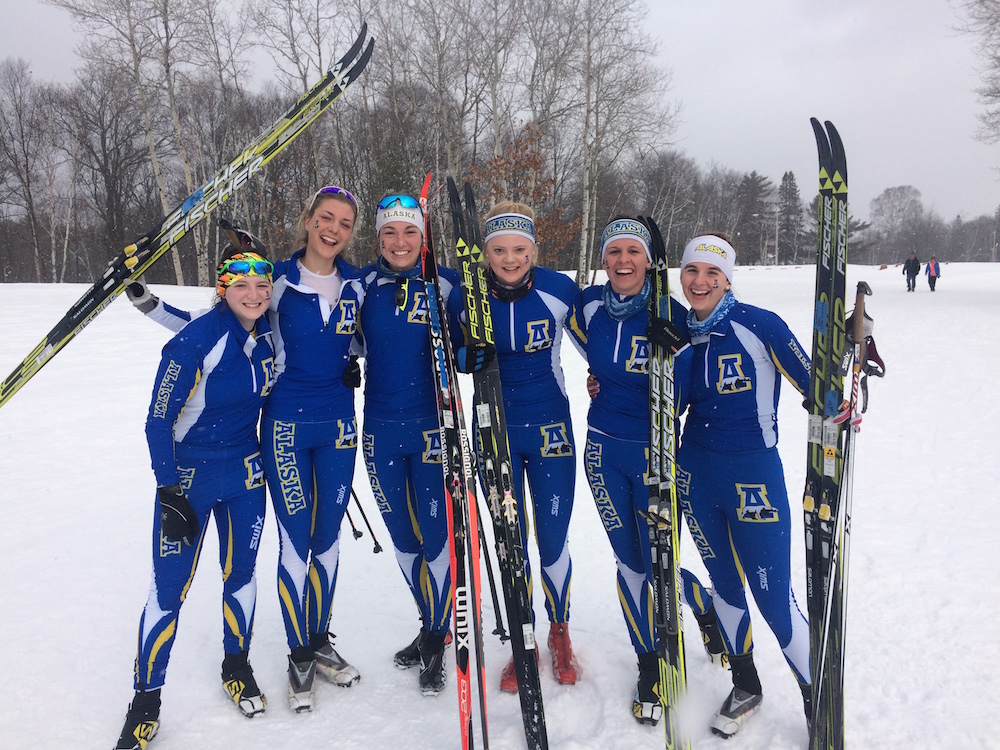
    University of Alaska Fairbanks women's nordic-team skiers get together for a photo last season: (from left to right) Hannah Rowland, Anne-Tine Markset, Nichole Bathe, Martina Himma, Ann-Cathrin Uhl, and Sarissa Lammers. (Photo: Nick Crawford)
    University of Alaska Fairbanks women’s nordic-team skiers get together for a photo last season: (from left to right) Hannah Rowland, Anne-Tine Markset, Nichole Bathe, Martina Himma, Ann-Cathrin Uhl, and Sarissa Lammers. (Photo: Nick Crawford)

    Waiver options

    UAA and UAF are both seeking relief from the requirements of Bylaw 20.10.3(a), which states that a Division II member school “shall sponsor” a minimum of “Five varsity intercollegiate sports, including at least two team sports, based on the minimum requirements of Bylaw 20.10.3.3 and involving all-male teams or mixed teams of males and females; and five varsity intercollegiate sports, including at least two team sports, based on the minimum requirements of Bylaw 20.10.3.3 and involving all-female teams.”

    There are therefore two parts to this bylaw: the requirement that a school have at least 10 sports, and the requirement that a school have at least two team sports per gender.

    Both UA schools are seeking a waiver solely of the 10-sports-total provision of this bylaw. It is unclear how much attention was paid to the possibility of seeking a waiver of the two-team-sports provision, in addition to or instead of the 10-sports-total provision. Gaining some leeway with regard to the two-team-sports requirement would potentially allow either school to look anew at hockey or basketball, the two most expensive sports at UAA by a substantial margin, as a potential target for cuts.

    Hackett, the UAA athletic director, was asked by email, “Did UAA consider seeking a waiver of the two-team-sports requirement, in addition to or instead of the ten-sports-total requirement?” He wrote back, “Yes, many months ago as part of Strategic Pathways. The answer is NO to the second part of your question.”

    Hackett was also asked whether men’s hockey could be said to be receiving special treatment from Johnsen, the UA President, when men’s basketball is also a team sport (as well as one required for GNAC membership).

    Hackett wrote, “Both waivers stated the same thing with regard to making every effort to retain Hockey at both Institutions as directed by President Johnsen. Both UAA and UAF are members of the GNAC and we wanted to be sure we would be able to maintain our Full membership with our primary Division II Conference. Men’s Basketball was not part of any discussion.”

    The budget for the UAA hockey team for the 2016/2017 season is, in round numbers, $1,347,000 dollars. The budget for the men’s basketball team is $467,000. The budget for the women’s basketball team is $446,000. The budget for each of the men’s and women’s ski teams (at UAA, this includes alpine as well as nordic) is $280,000.

    While direction from President Johnsen features as a significant part of the official waiver request that was submitted to the NCAA on behalf of both schools, this presidential involvement is not mentioned in the Frequently Asked Questions document posted on the Strategic Pathways website.

    “In the waiver application why was hockey named specifically as a sport to keep when it is the most expensive sport?” asks question 2 of the FAQ document.

    The answer given there is, “In making these decision [sic], cost was a driving factor, but it was not the only one. We applied a set of reasonable criteria that included keeping specific sports required by GNAC in order to keep our membership in that conference, making sure we are adhering to the gender equity requirements of Title IX, keeping the strong instate rivalry between UAA and UAF and cost.”

    Additional surprises?

    While all previous reporting on this story, in FasterSkier, the Alaska Dispatch News and elsewhere, has focused on UAA’s announced plan to eliminate four sports (men’s and women’s skiing and men’s and women’s indoor track), the official request submitted to the NCAA actually mentions the possibility of cutting a fifth sport if financially necessary:
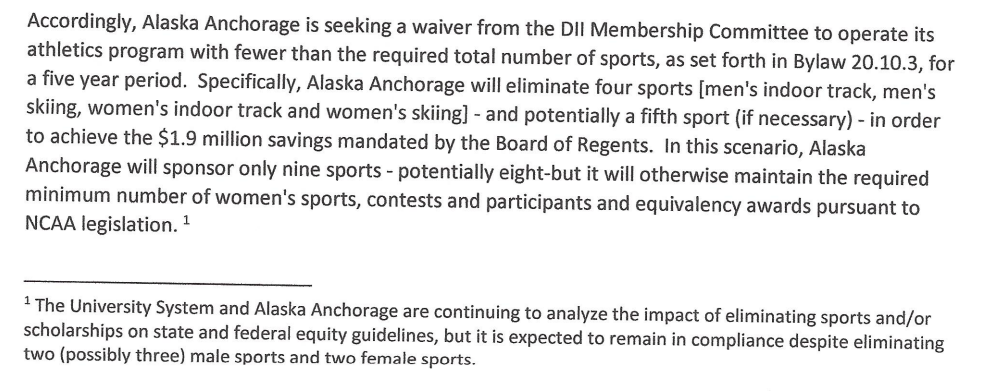
    Detail from waiver request by University of Alaska Anchorage (UAA) to NCAA in November 2016. (photo: screenshot from UAA waiver request)
    Detail from waiver request by University of Alaska Anchorage to NCAA this month. (Screenshot from UAA waiver request)

    The language in the footnote – “two (possibly three) male sports and two female sports” – suggests that, if a fifth sport were to be cut, it would be a third men’s sport. Assuming for the moment that basketball and hockey are “protected” (by virtue both of being team sports and of UAA not having sought a waiver to the two-team-sports requirement), that leaves men’s cross-country running and men’s outdoor track potentially vulnerable as a fifth sport to be eliminated.

    (Analogous language in the UAF waiver request mentions cutting only two sports, men’s and women’s skiing, alongside reducing scholarships among the remaining eight sports.)

    Furthermore, both schools’ waiver requests seek a waiver of the 10-sport requirement for a set period, five years, and promise to “evaluate its options to return to the 10-sport minimum required for compliance with Division II membership criteria” at the start of the 2021/2022 season.

    When asked whether he thought that elimination of a fifth sport would be necessary, Hackett wrote, “I certainly hope not. I am not sure there is a timeline in place for making any further team decisions. I have not spent any time considering additional sport team reductions.”

    When asked whether he expected that any eliminated sport would be able to return after having been cut for five years, Hackett wrote, “It would be difficult to ascertain.”

    Recent developments

    Since news of the waiver request first broke last week, supporters of the #savealaskaskiing movement have been busy. There is a website. (The team behind the website includes André Horton, currently a consultant with a lobbying and campaign management group but formerly a member of the U.S. Alpine Ski Team, as well as UAA head ski coach Sparky Anderson, Horton told FasterSkier in an email.) There is a march and public protest planned for Fairbanks next Thursday afternoon, Nov. 10, in connection with the upcoming Board of Regents meeting. And there are alternative budget proposals being advanced that claim to save an equal amount of money through administrative restructuring, while leaving academics and athletics programs unscathed.
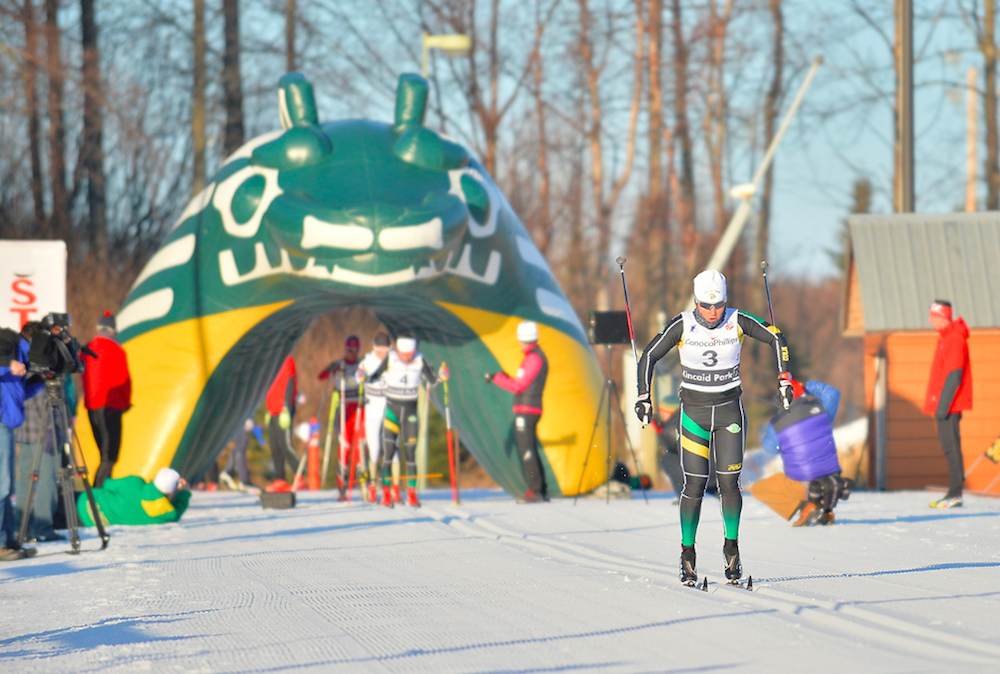
    Manon Locatelli of the University of Alaska Anchorage double poles out of the start of the 2015 Seawolf Invite at Kincaid Park in Anchorage, Alaska. (Photo: Sam Wasson Photography / http://portfolio.samwassonphotography.com/about)
    Manon Locatelli of the University of Alaska Anchorage double poles out of the start of the 2015 Seawolf Invite at Kincaid Park in Anchorage, Alaska. (Photo: Sam Wasson Photography / http://portfolio.samwassonphotography.com/about)

    The University of Alaska Board of Regents heard public testimony for two hours on Monday afternoon. While the teleconference window was technically open to anyone who wanted to testify on any subject, firsthand reports from people who listened to the testimony suggest that the focus was overwhelmingly UAA and UAF skiing, and that all testimony on this subject was in favor of preserving the program.

    Nearly all “of the comments were regarding skiing,” wrote third-generation Alaskan, former UAA skier, and former Alaska Pacific University ski coach Charlie Renfro in an email to FasterSkier. The only exceptions were “a couple comments about other university programs that were/are on the chopping block.”

    “Something like 50 people were able to comment,” Renfro continued, “and I would say about 48 of them were very constructive and from people who are all very knowledgeable regarding the UAA/UAF programs – both nordic and alpine. Nearly everyone that called in, I knew personally from either nordic or alpine, past, present, athletes, coaches and parents. One girl, a ski alum who said she was calling from Copenhagen (it was 2am there) gave an incredibly concise, heartfelt speech. It was very moving. I hope the [Board of Regents] felt the same way.”

    Anchorage resident Ira Edwards, who previously skied on the UAF nordic team and currently works for the State of Alaska, Department of Natural Resources (ski fans may recognize Edwards’s name from his side job – he spent many years as Rossignol’s U.S. race service manager), expressed similar sentiments.
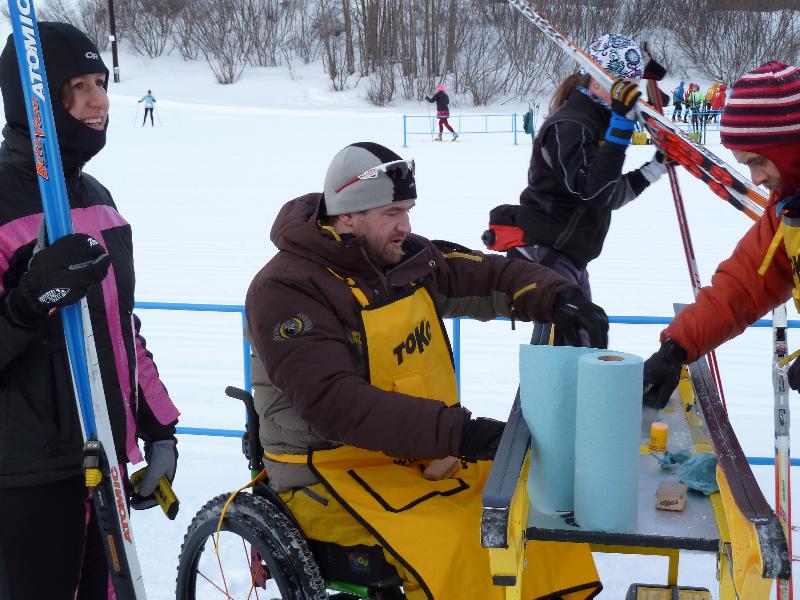
    Rossignol tech rep Ira Edwards provides race support at a race at Kincaid Park in Anchorage, Alaska.
    Rossignol tech rep Ira Edwards provides race support at a race at Kincaid Park in Anchorage, Alaska.

    “I have called into these before, for various other reasons” unconnected to athletics, Edwards told FasterSkier in a recent phone interview. “Generally, they have an hour and a half for testimony, or sometimes only an hour – they anticipated a higher call volume, so I think they bumped this one up – but I don’t think I’ve ever heard more than five or six people ever call in.”

    But on Monday afternoon, Edwards called in roughly a half hour after the public comment window opened, and was caller number 41 in the telephonic queue. He was the last person to be able to speak on Monday; the Board closed testimony immediately after he had finished speaking, after hearing two hours’ worth of comments. Edwards personally knew of a friend who was caller number 91 – that is, there were at least 50 more people after him who had hoped to speak – and suspects that there were a total of “well over 100 people” on the line who called in in an attempt to testify.

    Edwards recalls a total of three comments that were not about skiing (and one of those concerned the school’s running program). “There was not a single negative comment [about skiing],” Edwards said.

    Next steps

    Two things would have to happen for either or both of the UA system’s waiver requests to be approved: (1) first the NCAA Division II Membership Committee must approve the request, and (2) then the University of Alaska Board of Regents must approve the request.

    The membership committee holds a regularly scheduled in-person meeting in Indianapolis on Tuesday and Wednesday of next week, Nov. 8-9. Committee chair Kevin Schriver told FasterSkier on Monday that the committee “will see if that [the UA waiver requests] will be a part of our agenda.” An agenda for next week’s meeting is not yet posted online.

    The University of Alaska Board of Regents meets the following two days, Thursday and Friday, Nov. 10-11, in Fairbanks. The agenda for that meeting “has not yet been posted,” a Board of Regents representative told FasterSkier in a Thursday afternoon phone call. They said it would be posted on Friday, Nov. 4.

    The Board of Regents agenda and related materials should be accessible from here once they have been posted. Information about a live stream of next week’s Board of Regents meeting is available on the same page.

    Differing perspectives

    While many Alaskans are banding together in support of the ski program at both schools, the specific mood on both campuses seems somewhat different, reflecting differing circumstances and divergent views of the possibility of the NCAA granting the relevant waiver request.

    In Fairbanks, ski team supporters are holding out hope that the NCAA 10-sport rule will operate as a bulwark to keep UAF from cutting the relatively low-profile sport of skiing.

    Nick Crawford, 28, who headed the Bogus Basin Nordic program as well as the Lathrop High School ski team, will assume the role of head coach of the University of Alaska Fairbanks nordic and cross-country running teams in July. (Courtesy photo)
    UAF head nordic coach Nick Crawford. (Courtesy photo)

    As UAF head nordic coach Nick Crawford wrote to FasterSkier last week, “For UAF specifically, I don’t think skiing will be cut as I don’t think the NCAA will grant the waiver to the ‘10 sport minimum requirement.’ One of the NCAA’s core values is to provide sporting opportunities from athletes of many different sports and the 10 sport rule is in effect to protect small sports like skiing. It’s a slippery slope to allow Alaska to cut ‘less well known’ sports like skiing and indoor track to continue to fund their more popular sports,  If the NCAA grants this waiver, it sets a precedent to eliminate non-revenue generating sports across the country with fewer and fewer sports offerings and that is not a direction I think the NCAA wants to go in.”

    One of Crawford’s athletes, sophomore skier Conner Truskowski, expressed similar sentiments and included a call to action, writing to FasterSkier, “When we first got the news we were all pretty bummed out and mad that something as Alaskan as skiing was being considered for cuts. However, now that we have had time to process what could happen, we are all motivated to prove to the NCAA and everyone else that we are willing to fight for the sport we love and prove that the ski community benefits from having us as a team here. I want to stress that no decision has been made yet and there is still time to let everyone in the decision making process [know] that skiing is valuable. We believe that the waiver will not pass because the NCAA does not generally allow exceptions to their rules. Because of all that has happened, we are training harder than ever to make our season the best one we’ve ever had. Again, I really want to make it clear that no decision has been made yet and to let everyone know that their voice can be heard in the decision. Let the NCAA know that Alaska skiing is valuable to the ski community, both locally, nationwide, and worldwide.”

    But at UAA, head nordic coach Andrew Kastning sounded somewhat more resigned, as if the NCAA were less of a bulwark and more of a Maginot Line.

    In a recent phone interview, Kastning told FasterSkier, “Ultimately, I have a sliver of hope that the waiver doesn’t pass, that the Regents can be swayed and decide that skiing has to be saved and they need to make another decision. So I feel like there’s a tiny chance for UAA to survive at this point. But it’s obviously a giant hurdle to clear when the athletic director and the president have publicly recommended that this is the route to go to save the school money.”

    While Kastning was clearly saddened, he saved his strongest disappointment for his athletes. “I ache the most for my athletes,” Kastning said, “the ones that I’ve coached and the ones that know how special the situation and an experience it is to go to UAA and ski race in Alaska, and travel around the American West. And also for the current team, that has just gotten here and has only been here for a year at most, and they’re really bonding well and working really hard to reach their goals. And because of some short-sighted decisions and a tough budget situation, are faced with having to find another path.”

  • For Alaska NCAA Skiing, ‘It’s time to move quickly’, Locals and Alumni React

    For Alaska NCAA Skiing, ‘It’s time to move quickly’, Locals and Alumni React

    Manon Locatelli of the University of Alaska Anchorage double poles out of the start of the 2015 Seawolf Invite at Kincaid Park in Anchorage, Alaska. (Photo: Sam Wasson Photography / http://portfolio.samwassonphotography.com/about)
    Manon Locatelli of the University of Alaska Anchorage double poles out of the start of the 2015 Seawolf Invite at Kincaid Park in Anchorage, Alaska. (Photo: Sam Wasson Photography)

    An outcome first broached as a possibility this spring became an all-too-concrete reality Thursday afternoon, when plummeting oil prices and a yawning state budget deficit led to the announcement that University of Alaska President Jim Johnsen was targeting nordic skiing for elimination, at both the University of Alaska Anchorage (UAA) and the University of Alaska Fairbanks (UAF), in a waiver request submitted to the NCAA. On Friday, the ski community and affected skiers continued to react.

    Financial background, or, how did we get here?

    As FasterSkier previously reported, the State of Alaska is dependent upon funds from a single source, oil revenue, to an extent unparalleled in any other state. Falling oil prices over the last two years have led to widespread budget deficits, layoffs and reductions of both state and private-sector employees (particularly in the oil and gas industry), and political recriminations over the failure to pass a balanced budget.

    When FasterSkier first reported on this story in May 2016, the price of oil was approximately $48 a barrel. At the close of trading on Thursday, oil was at $49.89 a barrel. At these prices, the State of Alaska faces a revenue shortfall equal to approximately two-thirds of its budget. Oil has not been over $100 a barrel in over two years.

    Alaska residents have not paid a state income tax since 1980. Although some communities have instituted local sales taxes, there is no statewide sales tax.

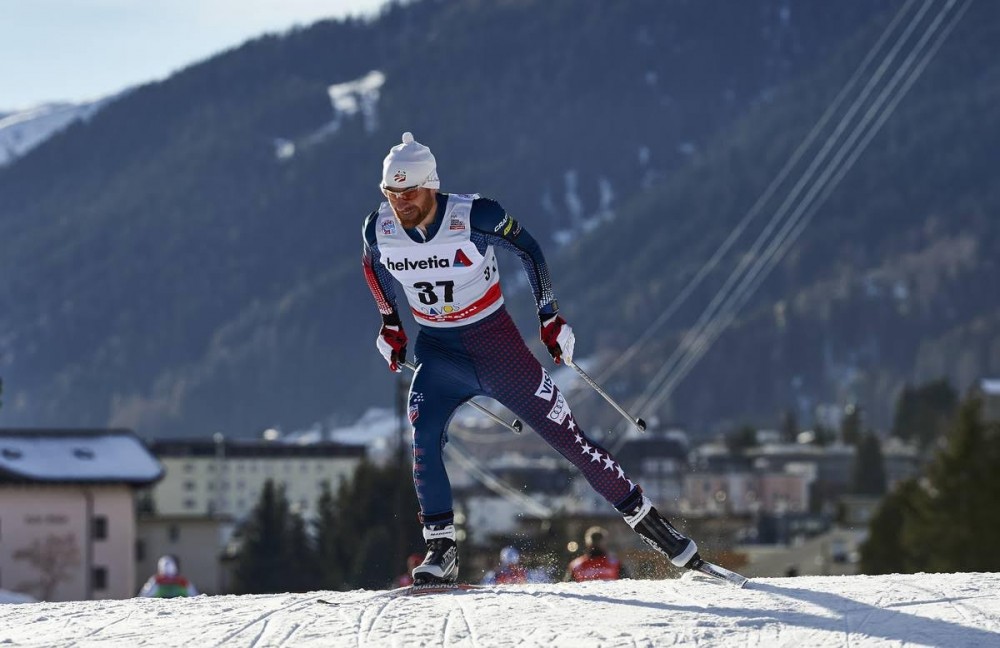
    Brian Gregg (Team Gregg/Madshus) on his way to 65th in the Davos World Cup 30 k freestyle on Saturday in Switzerland. (Photo: Madshus/NordicFocus)
    Brian Gregg (Team Gregg/Madshus) racing the Davos World Cup 30 k freestyle in Switzerland. (Photo: Madshus/NordicFocus)

    Alumni react

    Brian Gregg, currently one half of Team Gregg, came to UAA to ski in 2005. He later became a three-time SuperTour distance champion and a 2014 Olympian. When he was first asked, in May, if he would like to answer some questions about what UAA skiing had meant to him, Gregg promptly responded with a 600-word email titled, “UAA Ski Team, a vital part in my pathway to the Olympics.”

    Gregg took some time out from preparing for this winter’s first on-snow time trial at Frozen Thunder in Canmore, Alberta, to share some updated thoughts earlier on Friday. Gregg wrote to FasterSkier, “This is very disappointing news to me personally and to the entire skiing community. NCAA Skiing is a major asset in the development of cross-country skiers for our country. The future for skiing as an NCAA sport does not look good. I have seen the programs cut at Western State, University of Nevada Reno, Whitman College, Saint John’s University, College of St. Benedict, Gustavus Adolphus, [Macalaster], and now UAA and possibly UAF. The question now is who is next?”

    Gregg continued, with an eye to the future, “I also start to think about whether or not NCAA has a rule on the number of member school which must have programs in order for there to be an NCAA Championship. Currently the Central Division has only 5 Men’s programs and 6 women’s programs, several which don’t even have a Coach who is paid full time. I encourage everyone to be preemptive in showing the incredible value of our existing skiing programs to the administration, student body and community.”

    Sadie Bjornsen currently skis for Alaska Pacific University (APU) and is a member of the U.S. Ski Team (USST). But in 2009, she was a freshman for the UAA Seawolves and finished in the top five in five out of eight races and placed third overall in the classic race at NCAA Skiing Championships.

    “My year as a Seawolf was one of the most important ‘steps’ of my life,” Bjornsen wrote to FasterSkier on Friday. “I would have never been drawn to AK fresh out of high school, and discovered this incredible state. I see skiing as a big family with many functioning parts. By eliminating one integral part of the ski community, we are cutting off a strong piece of the family!”

    Even though Bjornsen moved down the street to APU after one year, she is quick to underscore the important role of the NCAA-affiliated UAA program for American cross-country skiing.

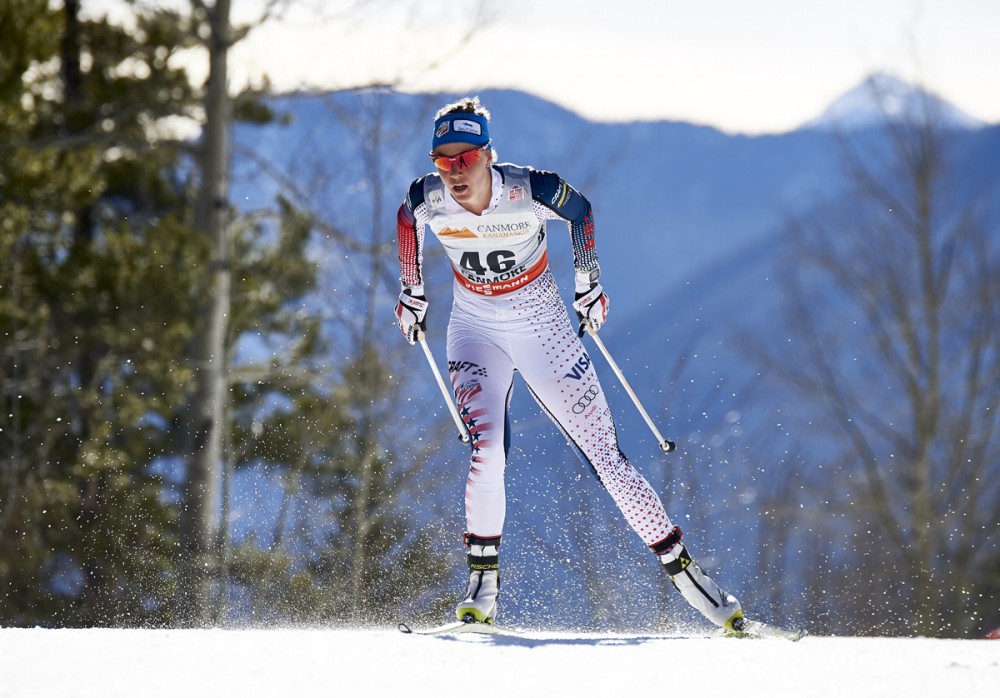
    U.S. ski team member, Sadie Bjornsen racing to a 17th overall in the women's10 k freestyle at Stage 7 of the Ski Tour Canada in Canmore, Alberta. (Photo: Fischer/NordicFocus)
    U.S. ski team member, Sadie Bjornsen racing to a 17th overall in the women’s10 k freestyle at Stage 7 of the Ski Tour Canada in Canmore, Alberta. (Photo: Fischer/NordicFocus)

    “I have always considered Alaska to be the best training for a cross country skier in the US,” Bjornsen wrote. “We have the perfect environment for training, including early snow in the fall, and late snow in the spring. I now race professionally, and am a student at Alaska Pacific University while racing World Cup. I see APU as providing the very best opportunity in the world for myself, but, I know this level is not designed for everyone. It is important to have options, and varied levels so that skiers can choose where they want to go, and have a path to where they are looking to reach. I would never give back that year of racing NCAA at UAA, a year that taught me so many lessons! It saddens me to know that won’t be available for everyone anymore!”

    Joey Caterinichio is a local. She attended West Anchorage High School, where in the 1980s she raced on the same ski team as future four-time Olympian Nina Kemppel and current U.S. Ski Team head coach Chris Grover. (Caterinichio herself would later travel to Sochi as nordic program manager for the USST.)

    After graduating from West High, Caterinichio originally pursued college skiing at St. Lawrence University in upstate New York. But after two years away, the lure of home brought her back to Anchorage, where she skied another two years for UAA.

    Caterinichio, now 46, still lives in Anchorage, where she runs a medical supply company and, with her husband, raises three children. She also runs local community ski training group Alaska Nordic Racing. Caterinichio has attended 20 Junior Nationals.

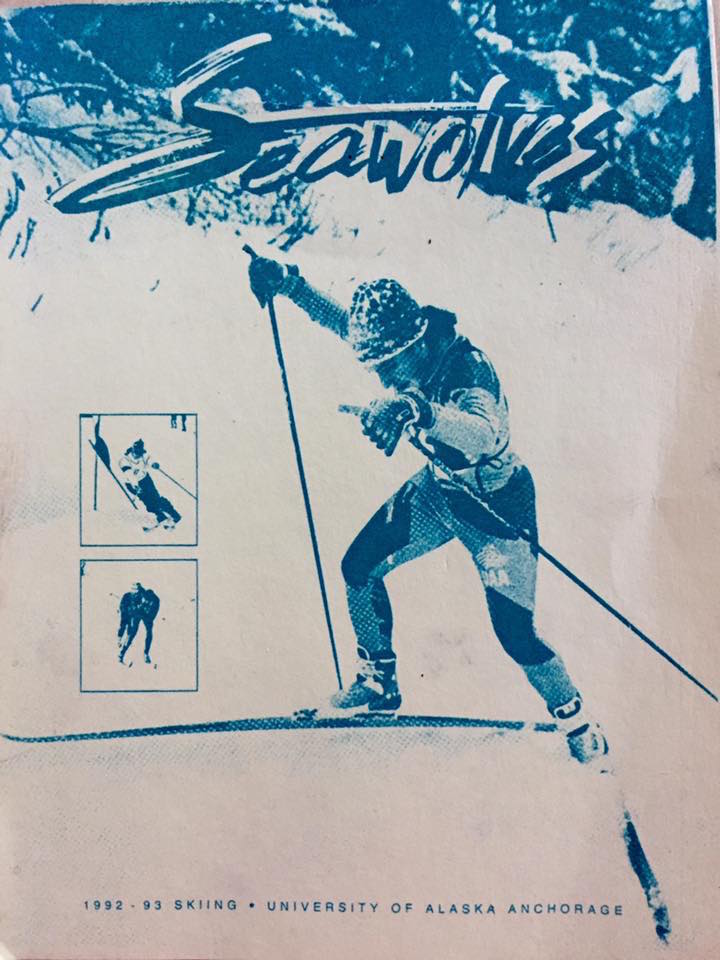
    Joey Caterinichio skiing for the University of Alaska Anchorage (UAA) Seawolves, as shown in the 1992-1993 Seawolves media guide. (Photo: courtesy Joey Caterinichio)
    Joey Caterinichio skiing for UAA, as shown in the 1992-1993 Seawolves media guide. (Courtesy photo)

    Caterinichio took to Facebook soon after the news hit Thursday afternoon. (Caterinichio gave FasterSkier permission to share her thoughts.) Posting a historic photo, showing her skiing in a suit she had designed herself, she wrote, “This is me featured on the cover of the Seawolves magazine representing skiing in 92-93. This same picture was featured in the Great Alaska Shootout booklets [a basketball tournament] which loses tons of money every year, yet we are not cutting basketball. The money UAA is saving by cutting these programs is pennies compared to the good they do for the community and the positive role models that move up here or stay here for college because of the sport. These same folks stay and give back to Alaska.”

    Reflecting on her personal history, Caterinichio continued, “Not only did I return from St. Lawrence to ski my last 2 years for UAA, I graduated with 2 degrees in science and I taught in the UAA Biology Department. With roots in this community, I stayed in Alaska. I own my own business, Employ others and In addition I have contributed thousands of hours to the sport of cross country skiing at the local level, national level and international level. There are others who chose this same path and who contribute hugely to this community. It’s not just about the sport. It’s about recruiting high quality community members to Alaska who stay and give back. Chasing these types of folks out of our state, cutting these sports in a time where the community is dying for positivity and crime is at its all time high! It’s time to think beyond the dollar. My give back alone for 25 years is an example of what could be lost. And on top of it this is ALASKA! We are a winter sport community. Come on UAA. As an alumni think global, think community!”

    In a follow-up phone conversation, Caterinichio noted, “I’m not going to stop with Facebook now … It’s time to move quickly – I don’t know if anything’s fixable right now, but it’s time to try.”

    Caterinichio clarified that while her goal was “to save skiing, of course,” she was also aiming “not to disrespect any of the other sports” at UAA. “I believe that all sports are important … and produce highly functional individuals for our community,” Caterinichio said.

    Other skiers react

    Holly Brooks is a two-time Olympian, recently retired from racing with the USST and APU. Brooks long ago put down roots in Anchorage, buying a house and recently opening a counseling, consulting and coaching practice.

    Brooks gave FasterSkier permission to share what she had posted on her personal Facebook page after hearing the news: “It seems a bit ironic that while … our presence (as a country) and success internationally is growing, options in the US for skiers to support and chase their dreams are shrinking. While the NCAA doesn’t represent everyone’s path it’s an undeniable and important part of the ski community at large. The loss [of] NCAA skiing in Alaska is a huge hit to the greater nordic ski family nationwide.”

    Holly Brooks (APU), following the Anchorage Tour at Kincaid Park on March 6, 2016. (Photo: Rob Whitney)
    Holly Brooks (APU), following the Anchorage Tour at Kincaid Park last March. (Photo: Rob Whitney)

    Brooks explained that she was hoping to channel her emotions over this recent news into something more positive: “Am I frustrated? Absolutely? Am I mad? You’d better believe it…. But I’ve decided that the best thing to do today is to channel my anger into something positive and that is to pitch in and support developing US skiers via the ‘Drive for 25.’ The National Nordic Foundation (NNF) … is an organization whose sole purpose is to help fund developing skiers. When I was invited to extend my stay on the World Cup to the tune of $140/day (for many months) the NNF pitched in to help. The Drive for 25 is the main fundraiser for NNF and the idea is ‘what if every ski fan in the United States donated $25 dollars – or more?’ By participating, D25 donors show that skiing matters and they are part of Team USA!”

    As of earlier this week, 62 donations for NNF’s Drive for 25 program had come from Alaska, trailing only Minnesota (69) and Utah (64).

    Kikkan Randall is a four-time Olympian, and a current member of APU and the USST. She did not ski for UAA, but as a lifelong Anchorage resident and prominent supporter of skiing and youth athletics, she feels strongly about the role of local college skiing in supporting the community.

    “I just think we’re going to miss out on some really big contributions to the community, our ski teams are all out there working with kids and helping to take care of trails,” Randall told a local television station. “I think the community is really going to take a hit.”

    How final is this?

    The finality of this decision arguably remained an open question as the dust settled on Thursday and Friday. Despite a statement in the Alaska Dispatch News (ADN), repeated in FasterSkier, that skiing at both UAA and UAF had been “targeted for elimination in a waiver request submitted to the NCAA,” there was hope in Fairbanks that the waiver request would not be approved, and so skiing would be saved at least at UAF.

    As UAF head nordic coach Nick Crawford wrote to FasterSkier late Thursday, “For UAF specifically, I don’t think skiing will be cut as I don’t think the NCAA will grant the waiver to the ‘10 sport minimum requirement.’ One of the NCAA’s core values is to provide sporting opportunities from athletes of many different sports and the 10 sport rule is in effect to protect small sports like skiing. It’s a slippery slope to allow Alaska to cut ‘less well known’ sports like skiing and indoor track to continue to fund their more popular sports,  If the NCAA grants this waiver, it sets a precedent to eliminate non-revenue generating sports across the country with fewer and fewer sports offerings and that is not a direction I think the NCAA wants to go in.”

    The 10-sport rule is contained in section 20.10.3(a)-(b) of the NCAA Division II Bylaws, which provides that “A member of Division II shall sponsor in Division II a minimum of” either five sports for each of men and women, or four sports for men and six for women.

    Crawford told the Fairbanks Daily News-Miner on Thursday, “I guess I’d say I’m confident that we’ll be here still. It seems like the 10-sport minimum is designed so that small sports like ours aren’t overridden by larger sports.”

    University of Alaska Fairbanks nordic skiers rollerskiing on campus last fall. (Photo: UAF)
    University of Alaska Fairbanks nordic skiers rollerskiing on campus last fall. (Photo: UAF)

    Current UAF skier Conner Truskowski expressed similar sentiments to his coach on Facebook, writing, “To clarify, as a student athlete at UAF, skiing has not yet been cut! The universities are submitting waiver to the NCAA to allow for an exception to the 10 sport rule. While things do look very dark for UAA skiing, the waiver will most likely not pass as the NCAA doesn’t really allow exceptions to the rules. Even if the waivers do pass, these programs won’t be cut until next year.”

    Truskowski continued, “This is a very dark time for collegiate skiing here in Alaska, but not all hope is lost. We are doing everything we can as athletes to fight for our program, and we can use all the help from the nationwide, and worldwide community we can get. Please help us all support Alaska skiing. Make it know[n] to the NCAA that there is strong opposition to this waiver, it will help us out immensely.”

    Three-hundred miles to the south, UAA officials seemed to express a greater sense of finality. As UAA Athletic Director Keith Hackett wrote in an official statement, “at the conclusion of the 2016-17 academic year, UAA Seawolf Athletics will be discontinuing our sponsorship of Men’s and Women’s Skiing and Men’s/Women’s Indoor Track and Field.”

    Hackett continued, “Should the NCAA Waiver request not be approved, we will take time to carefully consider which program would be reinstated.”

    This presumably means only one program would be reinstated, as opposed to multiple programs. This is because the NCAA waiver would take UAA from 13 teams down to nine. If the waiver were denied, UAA would need to field only the minimum of 10 teams to comply with section 20.10.3(a)-(b) of the NCAA Division II bylaws.

    Next steps and opportunities for advocacy

    As the ADN reported, “If the NCAA grants a waiver to the university, the Board of Regents would still have to approve the elimination of sports teams. If a decision by the NCAA is made in time, the regents will take up the issue at their next board meeting on Nov. 10-11 in Fairbanks.”

    The ADN continued, “No public comment will be allowed during that meeting. Instead, public testimony must be made by telephone on Monday from 4-6 p.m. The number to call is 1-866-726-0757.”

    Toby Schwoerer, a five-time All-American in skiing at UAA (plus a sixth time in cross-country running), wrote to FasterSkier that he “would like to see some coordinated effort to write emails to the 11 Board members” of the Board of Regents, linking to contact information for the individual members of the Board.

    The budget figures involved

    As Crawford, UAF’s head coach, wrote, “One consideration is that skiing is not one of the most expensive collegiate sports in our state. If the state truly wants to save money through sport reductions they would choose to eliminate one of the more expensive sports.”

    Crawford’s math seems to be correct. The data suggest that hockey is by far the single most expensive sport, and that skiing is somewhere in the lower middle in terms of overall team cost.

    The ADN, citing figures from UAA, has broken down the UAA sports teams’ total budget of $4.33 million for the 2017 fiscal year that began on July 1, 2016.

    University of Alaska Anchorage Seawolves logo (Photo: GoSeawolves.com)
    University of Alaska Anchorage Seawolves logo (Photo: GoSeawolves.com)

    Over 31 percent of that $4.33 million total, or $1.35 million, goes to one team, the men’s hockey team. (UAA has only a men’s hockey program.)

    The hockey team has had one winning season since 1993/1994.

    From 1985 through 2016, UAA skiing finished in the top 10 at NCAA Championships 31 times in 32 years.

    The next most costly programs are men’s and women’s basketball, at approximately $450,000 each. Both programs have enjoyed ample success; the women’s team reached the Division II national championship game in April 2016, losing to national champion Lubbock Christian.

    Men’s and women’s skiing are in the middle of the pack financially, at a cost of $280,000 for each of the men’s and women’s teams, or $560,000 total. The ski program costs somewhat less at UAF, $400,000 total, because UAF has only a nordic team and not an alpine team as well, and so has fewer athletes.

    The UAA athletics program as a whole finished eighth overall, out of approximately 300 teams with D-II athletics programs nationwide, in the 2015/2016 Directors’ Cup, a season-long competition across all Division II sports programs that awards points for a school’s performance in up to 14 sports. It was the highest overall finish in UAA history. Over one-tenth of the Seawolves’ points for their Directors’ Cup ranking, 63 out of 570.5, came from skiing.

    “We have developed an elite Division II program here,” Hackett told the ADN on Thursday. “This inhibits us in so many ways now. You reduce our teams and our budget, and it really impacts our ability to compete at the national level.”

    History repeats itself?

    Several of the major figures involved unfortunately have relevant experience in this vein.

    Hackett most recently held a comparable position at the University of Nevada, Reno. The Nevada ski team was defunded and discontinued under his tenure. The assistant nordic coach until shortly before the program was cut was UAA’s current head nordic coach Andrew Kastning.

    Kastning and his now wife, Calisa (Schouweiler) Kastning, moved to Whitman College, where Calisa was hired to coach the men’s and women’s nordic teams at the start of the 2007/2008 season. Fewer than two years later, the Whitman ski program was cut.

    Kastning previously told a local radio program that they had thought they would be safe moving to a ski program in Alaska.

    Recapping a lifespan

    Skiing began at UAA in 1977, near the end of the pipeline boom, and one year following the establishment of the Alaska Permanent Fund. The population of Anchorage would grow from 48,000 to 174,000 during the 1970s, reflecting the pipeline boom. The original 15 kilometers of trails at local ski area Kincaid Park had been laid out a few years earlier. The Italian skier Giorgio Di Centa, who won two gold medals at the 2006 Olympics, was 5 years old.

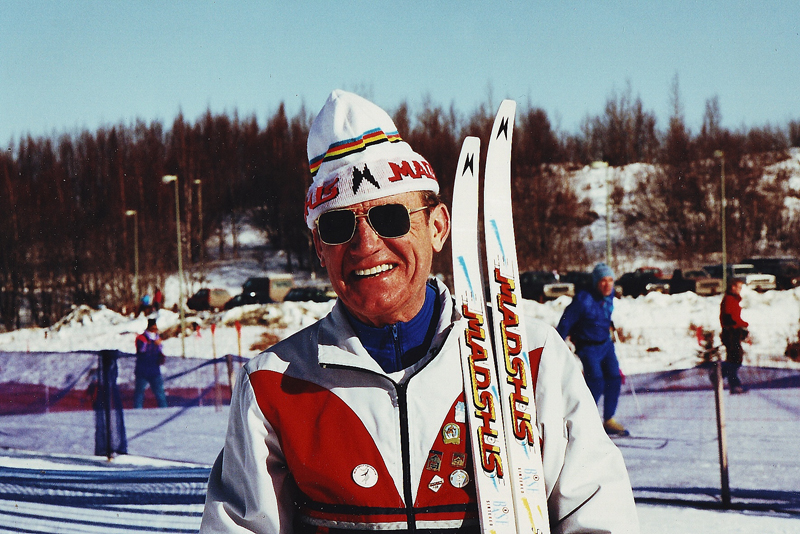
    March 1991    Bjorn Lasserud of Minneapolis at World Masters Championships at Kincaid Park in Anchorage.   Lasserud, winner of more National and World Masters championships than most people can count, is equally noted for his coaching and inspiration to countless others, to start and stay in Nordic skiing. Photo: Peter Hale
    March 1991: Bjorn Lasserud of Minneapolis at World Masters Championships at Kincaid Park in Anchorage. Lasserud won multiple national and World Masters championships. (Photo: Peter Hale)

    If, as appears likely, NCAA-affiliated skiing at UAA comes to an end following the 2016/2017 season, it will be an even 40 years old. It will have survived the first great Alaskan oil recession, of the mid-1980s, but not the second. The Alaska Permanent Fund will have become a political football.

    During the lifespan of UAA skiing, Kincaid hosted at least seven U.S. National Championships, five National Masters Championships, one Masters World Cup, and one World Cup weekend. (The World Cup was in March 1983. Gunde Svan won; Americans Tim Caldwell and Bill Koch placed second and third.) The 15 k of trails at Kincaid increased three- to four-fold, depending upon what you measure. Di Centa competed in his first FIS race in 1992, and his most recent, though probably not his last, in March 2016. The population of Anchorage is now approximately 300,000.

    UAA nordic skiers recorded six individual NCAA championships (plus another three for alpine skiers) in the program’s first 39 years. The program as a whole (both nordic and alpine combined) had, through last season, a highest finish at NCAA Championships of fourth, in 2009. From 1985 through 2016, UAA finished in the top ten at NCAA Championships 31 times in 32 years.

    Notable skiers who recorded All-American performances at UAA include, in chronological order, Dan Fleener, Urban Enkvist, Erik Flora, Frode Lillefjell, Lars Flora, Toby Schwoerer, Eric Strabel, Mandy Kaempf, Nicole DeYong, Brian Gregg, Andy Liebner, Sadie Bjornsen, Lex Treinen, and Erik Bjornsen. Gregg and both Bjornsen siblings would later ski on the 2014 U.S. Olympic Team.

    * This article has been edited to reflect the fact that Andrew Kastning was the assistant head coach at the University of Nevada, Reno, when the ski program was cut, not the head coach.