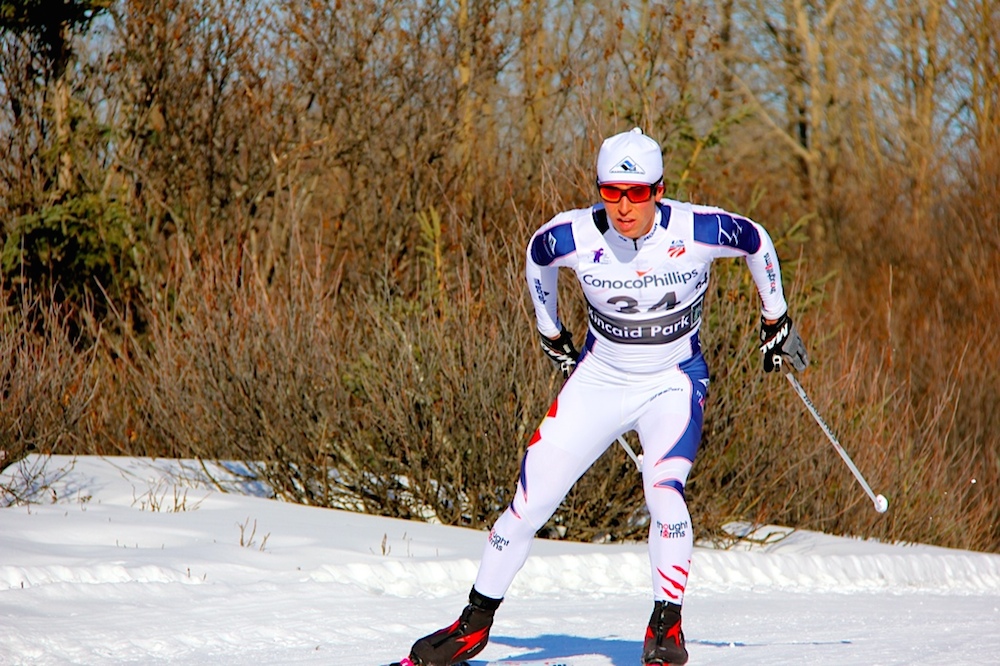
Noah Hoffman was down after breaking his fibula in November, but he certainly wasn’t out. He now returns to the world stage to complete in the upcoming Wold Championships in Falun, Sweden. However, the Colorado native is just as “curious as everyone else” to see how he measures up to the rest of the competition. Hoffman is pictured her competing in the 2014 SuperTour Finals in Anchorage, Alaska (Photo: Rob Whitney)
When Noah Hoffman broke his fibula in November there was much uncertainty surrounding his return – his coaches, loved ones, and fans wondered whether he could overcome the injury’s serious consequences to race in the year’s World Championships, let alone the 2015 season. However, one person was certain America’s leading distance skier would be back at a start line by mid-February: Hoffman himself.
“Things were looking really good all along and I always was really convinced that I was going to be here and ready to go,” Hoffman said in a phone interview from Östersund, Sweden, where he is preparing for Sunday’s World Cup 15 k freestyle.
Hoffman’s certainty of return stemmed from a variety of factors that aided his speedy recovery, including his medical care. The Colorado native credited much his quick return to skiing to Dr. Thomas Clanton of the Steadman Clinic in Vail, who had Hoffman in surgery within four days of the fracture.
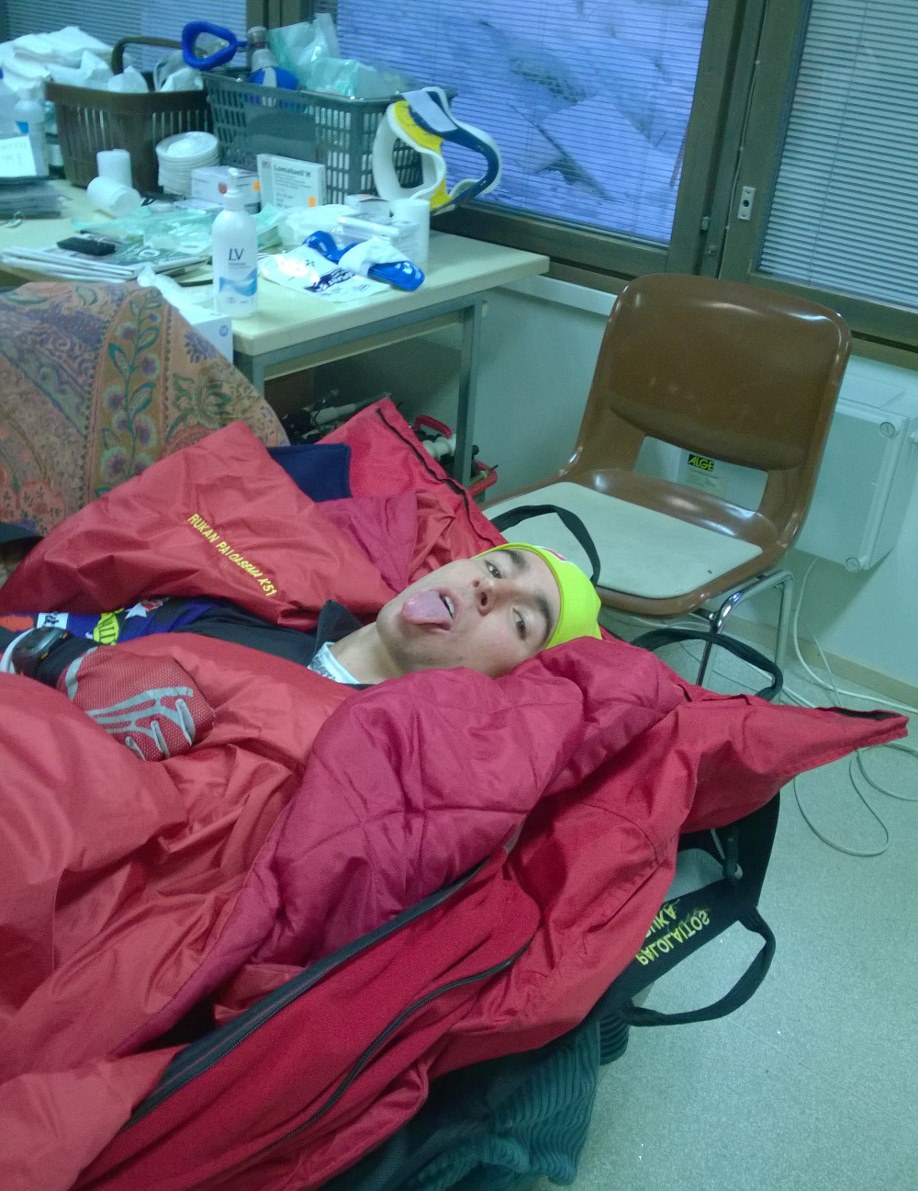
Noah Hoffman at the Ruka clinic in Kuusamo, Finland after breaking his fibula in the 15 k classic. (Photo: Peter Dickinson via NoahHoffman.com)
“The medical team I worked with was world class. Dr. Thomas Clanton is maybe the best ankle guy in the world, certainly one of the best in the U.S.,” Hoffman said. “Within four days he was operating on me. The timeline of that was crucial.”
Hoffman explained he had no idea what to expect when he flew back to the U.S. following the accident, but that once he was examined, Clanton gave him hope for the year ahead. After studying the year’s World Cup schedule Clanton said there was a chance Hoffman could race at the Östersund World Cup and the following week’s World Championships in Falun, Sweden.
Hoffman originally explored returning to the World Cup by late January and was ready to obtain his Russian visa, even if there was a “two-percent chance” he would be able to compete. In the end, however, Clanton told Hoffman to focus on returning in time for competition in Sweden.
“He said ‘I think we can get you back to World Championships and Östersund,’ and here I am,” Hoffman said of his doctor. “He knew what he was talking about. He set the timeline and I did everything to make that happen.”
Hoffman said that one he heard Clanton’s plan, he never questioned whether he’d go to Sweden despite the doctor’s warnings it was a “remote possibility.”
Hoffman also credited much of his recovery to the work of physical therapist Ana Jeronimus-Robinson, a foot and ankle specialist who has worked with the U.S. Ski Team in the past and will be in Falun, Sweden for Worlds.
To maintain his fitness, Hoffman spent many long hours on the hand bike, skierg, and in the pool, which he described as being “like torture.” He slowly introduced skiing – only double-poling at first and then progressing to striding and skating.
Hoffman said that the most challenging part of his recovery wasn’t the primary effects of the injury, but rather the hectic lifestyle in the U.S. Between physical therapy, training, leading community ski clinics, and working with local juniors Hoffman was wary of his energy levels.
“It was just a lot to manage,” Hoffman explained of the recovery process. “That was the most challenging part – managing my time, trying to keep good energy without overdoing it.”
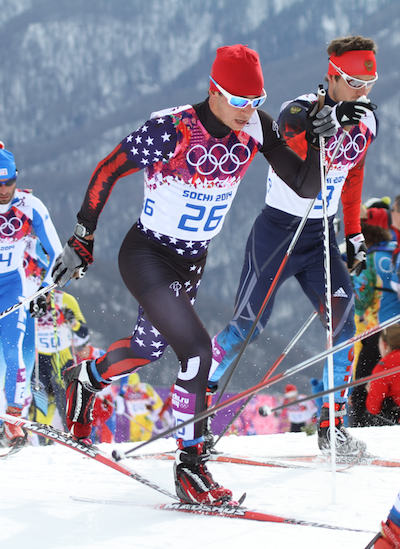
Noah Hoffman (U.S. Ski Team) racing to 35th in the 30 k skiathlon at the 2014 Olympics in Sochi, Russia.
Heading into Sunday’s 15 k freestyle in Östersund, Hoffman said he doesn’t know what to expect. He explained that his main objective will be to execute a well planned-race, including relaxed skiing and smart pacing. With no result-based goals for the World Cup or World Championships, his focus will be on skiing to the best of his abilities – whatever they may be.
“There’s no real reason to think that I won’t be good, but there’s no real reason to think I will be good, having not finished a World Cup since last March. I don’t know what to expect,” he said. “I’m looking forward to racing and just going out there to ski the way I know I need to ski. I’m as curious as everyone else is.”
For now, Hoffman is taking it “day by day” and is focusing on the Östersund 15 k before shifting his attention to Worlds. He said that he hopes to see improvement in each of his races, so that his best skiing comes by the last World Cup the season March 14 – the 50 k freestyle in Oslo, Norway.
The Östersund World Cup begins Saturday with a classic sprint and concludes with Sunday’s 15 k freestyle. The 2015 World Championships begin in Falun, Sweden Feb. 18 and continue until March 1.
For a detailed account of Hoffman’s recovery, visit his blog.
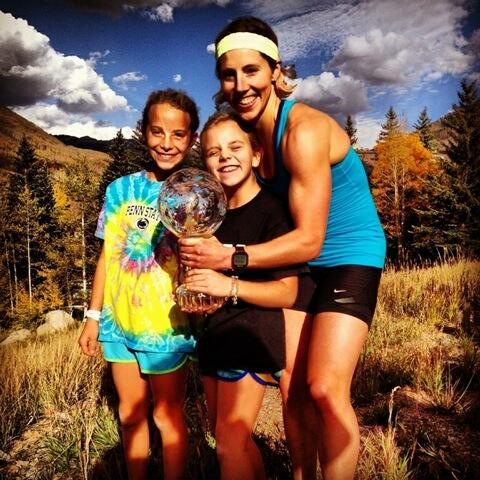
Kikkan Randall getting some help from two Ski & Snowboard Club Vail juniors to hold the hefty Crystal Globe, which she won as the World Cup sprint champion last season. (Courtesy photo)
When Kikkan Randall talks about being injured, her tone matches the description of any other day: the sun is shining; life is good.
For more than two months, the 29-year-old U.S. Ski Team (USST) veteran has been healing a stress reaction in her right foot by wearing a walking boot outside of training. An MRI five weeks ago revealed she needed to dial back her workout efforts to 50 percent and stay away from certain activities, such as skiing and running.
As if that wasn’t hard enough for a nordic skier, let alone the defending World Cup sprint champion, Randall discovered last Wednesday that she wasn’t completely in the clear. Follow-up imaging with Dr. Tom Clanton at The Steadman Clinic in Vail, Colo., revealed that her stress reaction – a weakening of the bone in her foot – had become a stress fracture. The good news was it was already healing.
One day before the start of the final USST dryland camp in Park City, Utah, Randall spoke on the phone Monday about her injury and plan of attack for the season ahead. She had just finished a 2 ½-hour mountain bike ride in Park City with her husband, Jeff Ellis, and said she was enjoying spending some extra time with him.
Meanwhile she aimed to stay patient with about six and a half weeks to go until the World Cup opener Nov. 24 in Gällivare, Sweden. Last week, doctors estimated it would be eight or nine weeks before she could resume race-pace intensity.
“That puts me right about when the race season is supposed to start,” Randall said. “I’m hoping I’ll be in at least a good enough place to be able to compete in those races. I don’t know what kind of shape I’m going to be in because I won’t be able to do full-on intervals for a while still, maybe four or five weeks from now, so I’m going to have to change my goals a little bit.”
***
FasterSkier:What kind of goals do you have at this point?
Kikkan Randall: Those first races will have to be to build back up and get in shape, and hopefully be in a good place by Tour de Ski. … Tour de Ski was one of the big goals and I think that’s still a good possibility to go there and perform well. It’ll be fun to see the World Cup races in Sochi (Jan. 1-3) and maybe have some good performances there, but really probably the biggest goal of the season is focused around World Championships and using the second half of the season to test things out and figure out what works well. That’ll give me something to work on next year.
FS:What are you specifically aiming for at World Championships (Feb. 20-March 3 in Val di Fiemme, Italy)?
KR: I’d like to make the final in the classic sprint. I’d like to have our team fight for a medal in the team sprint. I think we can put together a relay, the 4-by-5 k in the top six. This will be the first championships where I’m almost more excited about the team goals than my own. I mean, I obviously want to race well myself, but I’m excited about what we can do as a team. That’ll give me some extra motivation in rehabbing this foot injury, too, knowing that I really want to be there and competing with the team in February.
FS:How did you react to discovering your stress fracture last week?
KR: I think overall it was a positive visit. They did see some new bone growth in the area where the fracture is so they felt that was a good sign, and I can gradually start building back into training, but it’s going to be a pretty gradual process. With skiing, it’s quite challenging because we have so many things to reintroduce – skating, classic, running, strength training – so it’s still going to take me many weeks to build back in, but at least we saw some progress.
That helps knowing just by reducing my training and taking the impact off my foot that it was able to heal, so that makes me feel good going forward. If I behave myself and gradually reintroduce things, then I’ll be in a good place by the time we race. It’s still hard because five weeks of it was an easy target to focus on, and it would’ve been nice to put my five weeks in and jump back in to be being totally normal, but I know that if I continue to be a little bit patient, the season is long. Even if I’m not racing quite as well as I want to the first period, the biggest races are still in the second half of the season. So I’m just kind of focusing on that and focusing on what I can do and using this as a time to work on some of my weakness, and hopefully we’ll all be laughing about this in a few months.
FS:Who are some of your biggest supporters?
KR: Everybody, really, has been incredibly supportive. It was [U.S. women’s coach] Matt Whitcomb that kind of finally sat down with me at the end of the Swedish camp and said, ‘You know, look, this is obviously an issue that’s not going away; as hard as it is to slow down, let’s deal with it now so that you’re good to go by the season.’ So I credit him a lot with getting me to finally do something about it. When I came back to Anchorage, [Alaska Pacific University coach] Erik [Flora] was really supportive, and Jeff and my parents, and then my teammates keep checking in on me and pumping me up and stuff. I’m really lucky to have so many good supportive people around.
FS:How’s your Achilles injury in your left foot?
KR: That’s actually gotten a lot better. That’s the one thing I could work on over the last five weeks because all the PT I was doing was primarily to heal that up. It’s feeling really good, and I think slowly reintroducing running and skiing back in is going to be really good for that injury to make sure it’s totally healed, too.
FS:What’s your training plan moving forward?
KR: I got the clearance to return to normal volume so that’ll be good, and then I can start adding in a little classic striding to begin with. While I’m down here in Park City, I’m going to take advantage of the AlterG [anti-gravity] treadmill they have here to start reintroducing running and combine that with pool running to help build the running back in. If that all goes well, in maybe three weeks I can start adding in a little bit of skating and then a little bit of classic intensity. If all that goes well, I can start doing a little skate intensity and a little running intensity.
FS:You anticipated not being able to do the USST testing at the Center of Excellence (COE) this week. Will you be able to join the team for any workouts?
KR: I’ll be able to join them a few sessions this week because classic skiing, I can, for sure, double pole and I can add in a little striding. I’ll be at the strength center at the same time, but then a few of the workouts will be on my own.
FS:Do you still have to wear the walking boot?
KR: I put two solid months into the walking boot and luckily they said I can actually stop wearing it unless I feel like my foot needs a rest. I did wear it [Sunday] at Fast and Female because I knew that once I got around everyone jumping and playing and dancing, I’d want to do it too, and they said absolutely no jumping until probably after the Tour de Ski so, I put the boot on so I wouldn’t be tempted.
FS: How was the Fast and Female event in Park City?
KR: We had a blast as usual. Those events are almost four hours long and there’s a lot of energy going around so you definitely feel a little worn out by the end of the day, but it’s totally worth it. The girls, you can just tell, they’re having so much fun. They’re like sponges soaking up every word the ambassadors say so you can tell we’re making a big difference.
We had, I think, 75 girls age nine to 19 and then about 30 ambassadors. Between the parents and everybody, we had probably 120 people there, which I think is a pretty significant size.
FS:We’ve seen photos of you and the kids holding your Crystal Globe. Do you bring that everywhere?
KR: With the [U.S.] Ski Team, this is kind of the last interface before the season starts so they asked me to bring it down so we could do some photos and things. I pulled it out when we went over to the Ski Club Vail and it worked out to have it at Fast and Female [Sunday]. It’s not the easiest thing to just haul around, but it is really fun to share with everybody. … I’d say it’s about 20 pounds probably in the box that it comes in. It’s kind of an awkward size; you have to hold it off your hip a little bit.
It is definitely covered in fingerprints right now because when I was at home [in Anchorage, Alaska] I was doing a bunch of visits to elementary schools, and I was letting the kids all rub the Globe on their way out of the gym and then everybody got to touch it [Sunday]. It’s going to need a good Windex cleaning in a little bit.
FS: When will you leave Park City (with the rest of APU, which isn’t going to the USST camp in Canmore, Alberta)?
KR: Next Thursday I’m headed back to Alaska and hopefully we’ll be able to get on snow pretty soon after.
FS:What else have you been up to since arriving in Utah?
KR: We went to a friend’s wedding this weekend [in Sundance]. (Former APU/U.S. World Cup team member Katie Ronsse married Justin Libby).
It was a great time. Sundance is beautiful and it was really fun because I haven’t seen Katie in a while. She’s going to PT school in Salt Lake now. It was a great wedding, good time, and it was so nice of them to plan it conveniently around the training camp.
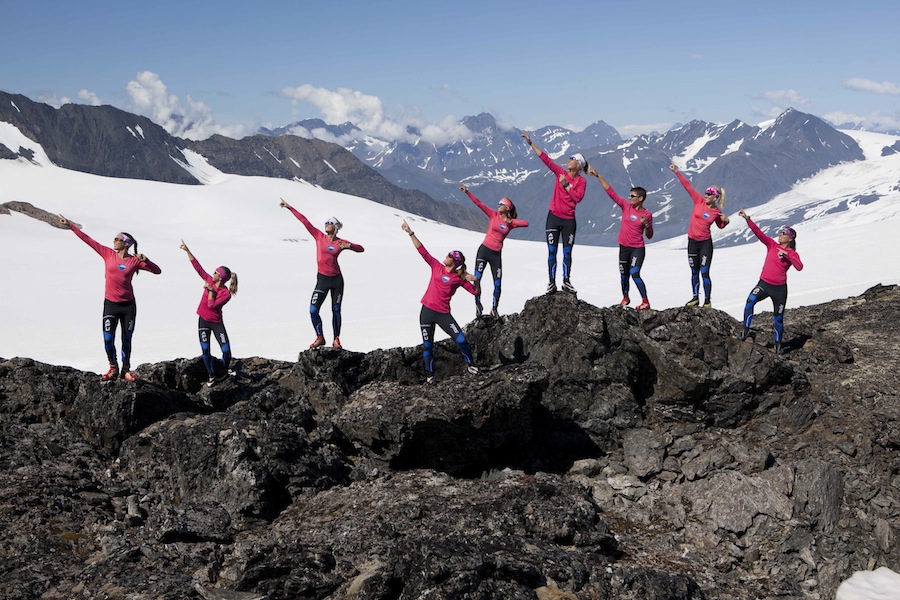
Sadie Bjornsen (fourth from right) and her APU teammates pose like Jamaican sprinter and six-time Olympic gold medalist Usain Bolt on Eagle Glacier near Anchorage, Alaska. (Photo by Chris Hodel)
Last week in Anchorage, a freak windstorm rolled through that would have devastated most mainland Americans. Gusts estimated at 130 miles per hour spewed trees across Alaska’s largest city, leaving at least a thousand residents without power through Saturday – almost four days after the storm hit Tuesday night.
In a phone interview, U.S. Ski Team member Kikkan Randall said the electricity and all the lights at her home came on at 2:15 a.m. Saturday. One tree took out part of their backyard fence, but Randall’s husband, Jeff Ellis, repaired it in no time. Their biggest concern was their refrigerator and freezer, so the two went out and got a generator.
Elsewhere in the city, Randall’s teammate on the U.S. Ski Team (USST) and Alaska Pacific University (APU), Sadie Bjornsen said the power at her on-campus housing was restored Wednesday morning. On the phone, Bjornsen laughed about how she didn’t even know the storm was coming.
A professor in one of her classes warned students about its potential effects. She hadn’t heard anything about it otherwise.
“I was like, ‘What are you talking about?’ I came out of the house and I was like, ‘What is going on? There’s a hurricane!’ ” she recalled with a laugh. “[My APU teammate Rosie Brennan and I] were driving and there were road signs ripping out and flying across the road and all this stuff flying around, and all the stoplights were out. I’m like, ‘Whoa, this is wild!’ ”
When she got home Tuesday evening, Bjornsen moved her car to avoid falling trees. Later that night, the 22-year-old had trouble falling asleep.
“I was freaking out because I’m like, ‘I’m going to wake up with a tree in my lap,’ because I’m on the corner where all the trees were blowing,” she said. “But then when I looked out the next day, I was like, ‘Oh those are all aspen or birch trees, and they aren’t that heavy.’ ”
Reports indicated that nobody was seriously injured, and Bjornsen was relieved. “Only in Alaska,” she said.
On Saturday, Randall said the weather was back to normal with the sun shining and slightly chilly temperatures. That morning they received their first frost. That was Alaska, all right.
Bjornsen’s Back/Foot Troubles
Sadie Bjornsen (APU/USST) working out on Eagle Glacier in July. (Photo by Reese Hanneman)
Way up north, the two Anchorage skiers have endured more than extreme weather in the last few months. Bjornsen’s been coping with back and foot injuries since the spring, and Randall is in a walking boot and training at 50 percent to heal a stress reaction in her foot.
While both joked about doing aqua-jogging sessions together, they also shared some of their frustrations and ways of staying positive through adversity. FasterSkier spoke with Bjornsen and Randall separately: Bjornsen while she was home studying before strength training, and Randall while she cheered on her husband at a local cyclocross race.
Bjornsen’s back injury started nearly a year ago in November, but by the time the racing season started, it disappeared, she said. After two and a half weeks of discomfort, she didn’t feel it again until this past April, just in time for the beginning of training season.
Kikkan Randall (APU/USST) donning a walking boot to relieve a stress reaction on her right foot. If left untreated, the reaction could magnify to a fracture, which is why Randall is training at 50 percent and not skiing or running for five weeks. (Courtesy photo)
She’s had the overuse issue since and initially remedied it by skate skiing. Classic skiing – her strength – seemed to irritate her facet joints the most, so she decided to skate only.
“Originally I was like, ‘Well, OK I’m just going to skate every single workout. I have a weakness with skating anyways so this is great,’ ” Bjornsen said. “That’s what I did and then I got tendonitis in my foot because of it. That’s when I have to stop and say, ‘I need to actually address this problem.’
“It’s challenging because you have a back and a foot injury so then you have to find exercises that are not stressing both of those things because they’re kind of opposites,” she added. “It’s just been hard to find ways to progress.”
Bjornsen discovered her tendonitis at the USST camp in Bend, Ore., in May. With the USST/Canadian women’s joint camp (also known as the North American Women’s Training Alliance) two weeks later in June, she pushed through the injury and raced to get into shape.
“I knew [Finland’s] Aino-Kaisa Saarinen (Auku) would be coming [to the Alaska training camp] and since I first started watching her ski, I have dreamt about classic skiing behind her,” Bjornsen wrote on her blog. “I over-jumped my limitations, skiing a two hour skate through the hills chasing Auku and Kikkan. Again, I was back at the bottom with my heart hanging low. At that point I had to make the difficult decision to leave the National Team Camp in my own town and get away from the excitement and motivated girls to truly get my body back to order.”
Since then, Bjornsen’s let her body recover for the better part of the last three months. She recently started doing some intensity on her feet, which she was excited about. It was a long summer without it, she said.
“I was just doing my intervals running in the pool,” she said with a laugh. “People in the pool will just look at me, like, ‘Why are you breathing so hard, for one, and what are you doing?’ ”
Not to mention, it’s a community pool.
“It’s been a bit humiliating, but it’s fun,” Bjornsen said. “It’s the world’s most boring thing you could ever do, but it makes you appreciate when you go out and do ski intervals, it’s like, ‘Oh my God, this is why I do this sport.’ ”
This summer, Bjornsen has been to the glacier twice to ski and said she’s making progress. As far as she can tell, her back is almost in the clear and her tendonitis is practically gone.
“The thing about tendonitis and stuff like that is you want it to just go away in two days,” she said. “But it’s just kind of something that you always have to look out for a little bit. I’ve just been working through strengthening it.”
As for her fitness, she said it’s hard not to imagine where she should be.
“You feel like you’re so far behind when you have these setbacks, you know? It’s hard to not only focus on that,” she said. “The most challenging part about it is there’s not really an answer to how to make it better. It’s like, ‘You need to work on not having muscle spasms.’… [I’m trying to think] about where I’ve progressed from two months ago and thinking about the season’s really long. You kind of have to think about the end of the season as well as the beginning.”
Her coach, Erik Flora, has been one of her biggest advocates and sources of support, she said. He’s shown her ways to be creative with training, even if it is in the pool.
“Erik’s like, ‘If you stay positive through these sections is when you decide if you’re in it for the long run or if you’re going to wuss out or something,’ ” Bjornsen said.
She’s decided to stick with it.
“It’s been a really challenging summer, for sure,” she said. “It was challenging to have to leave the national-team camp here in Alaska, and it was challenging to have to say no to [the USST camp in] Sweden because I wasn’t healthy enough to be there.”
“It’s just been a rollercoaster of making progress this summer,” she added. “I don’t know where I am, I guess we’ll see, but probably not where I would have hoped to be. Maybe in two months I will be somewhere I hope to be. The cool thing about our sport is your racing is not only based on your year of training, it’s also based on what you’ve done and what you’ve done in the past and what your strengths are. The best you can do is be really positive and do what you can do.”
In about a month, Bjornsen will join Randall and the rest of the USST for their final dryland camp in Park City, Utah. She plans to use the time to practice on the sprint course at Soldier Hollow and nail the slingshot descent into the stadium.
“Somehow I’m always at the wrong place on that last corner, so hopefully I’m going to learn that one this year,” she said.
Looking ahead, that venue is where Bjornsen hopes to podium at the upcoming U.S. nationals in January. Last year, a sinus infection kept her from racing for a national title in Rumford, Maine, which led to another goal: staying healthy.
“That even means paying attention more when I’m sick, to really admit that I’m sick and sort of jump on it rather than just pretend that you’re superman and it’s never going to get to you,” she said.
Throughout the next few weeks, Bjornsen will increase her intensity training. Meanwhile, most of her USST teammates (except those from APU) will do something similar throughout the next two weeks at a camp in Lake Placid, N.Y.
Heading into Park City, Bjornsen said she’d continue to build her base and intensity on skis.
“I still have two and a half months [until the racing season] and the progress I’ve made in the last month has been super encouraging,” she said “I still have hope for the season; there’s a lot to be trained still.”
Randall Healing Both Feet
Without too many injuries in her storied career, Randall feels the same way. She took her foot injury in stride during the Swedish joint camp in early August, wearing a walking boot between workouts.
Randall playing golf in late August with her walking boot. (Courtesy photo)
However, toward the end of camp, things started to get painful for the reigning World Cup sprint champion. She realized that what she was doing – training normally and keeping pressure off her right foot when she wasn’t skiing – wasn’t enough. USST women’s coach Matt Whitcomb convinced her to see a specialist and let it heal before this winter.
About two weeks ago, Randall flew south to see Dr. Tom Clanton at The Steadman Clinic in Vail, Colo. A world-renowned foot and ankle specialist, Dr. Clanton treated former professional basketball player, Yao Ming, the tallest man in the NBA at the time, when he had foot trouble. “We figured he was a good guy to talk to,” Randall said.
There, an MRI showed some fluid around the bone in her right foot, which meant it was starting to weaken, but it didn’t indicate a fracture. That was a good thing, Randall said. The doctor advised she train at a 50-percent effort for five weeks, which meant no skiing or running, but she could swim, bike and do double-pole workouts with APU.
Randall is also healing an Achilles injury in her left foot, which started early last March at the World Cup skiathlon in Lahti, Finland.
“The boots are a little bit different than what we’re used to and it didn’t get better through the spring,” she said. “We had a lot of classic races the last part of the season and I didn’t probably rest it enough, so it’s been nagging.”
While in Vail, physical therapists at Howard Head Sports Medicine taught her strengthening exercises for both feet, and she planned to return to Colorado in early October for a follow-up MRI. After that, she will head to Park City, where she probably won’t participate in the USST tests, but hopes to take advantage of the high altitude and transition back into regular training.
“The frustrating thing with both these injuries is they’re so subtle I can train through them, but it’s a matter of should I train through them,” Randall said. “Eventually the Achilles could get worse and you can get into some serious problems with that, and of course with bone fractures, that could be a serious problem, too. It’s the one time in your life when you have to not be tough and take signs and rest a little bit.”
Since discovering a massive blood clot in her leg in April 2008, Randall hasn’t had too many medical problems, she said.
“I’ve been really fortunate through my career,” she said. “The blood clot happened in the spring when it was the absolute best time when I was taking some time off anyway. I was able to bounce back [and win a World Championship]. This is almost my first time going through something kind of chronic and in the middle of the season. I had a few things when I was in high school but nothing quite like this.”
Still, she’s managed to keep her head up.
“I’m enjoying being at home for an entire month and I have a little extra time. I have a ton of school visits lined up and get to work on some of my community projects and see family and friends before the long winter in Europe,” she said. “Just fill your time with other thoughts and things. I’m focusing on what I can do and I’m using this time to work on some small weaknesses that I probably would’ve just let go. So, yeah, it might be a blessing in disguise in the end.”
In mid-August, Randall did an open-water swim in Ontario, Canada, where Ellis’ parents live. Her husband originally signed them both up for the Bala Falls Triathlon, but Randall decided she shouldn’t run so Ellis left her wetsuit at home in Anchorage.
Race fever caught up with Randall, and she changed her mind – she wanted to swim and bike. Without a wetsuit, she swam anyways and finished third in the swim-bike category.
“It was my first time [competing without a wetsuit]. It was a good, challenging experience,” she said. “It was pretty funny because I had the boot on, and I walk into the transition area to put my bike in the rack. Then I walk around the rest of the day, I’ve got the numbers on my arm with the boot on. It looked pretty ridiculous, I’m sure.”
If she wants to be a serious triathlete someday, Randall joked that she needs to work on her swimming.
“The bike was fun, kind of chasing after people,” she added. “It was actually quite hard not to go out on the run and finish off the race.”