From the FasterSkier archive — posts syndicated from athletes’ and coaches’ own blogs between 2004 and 2012, kept online as published. Current coverage is at fasterskier.com.
This article was originally published on November 11, 2019 in Steamboat Magazine. It is reposted with permission.
By: Tiia Libin
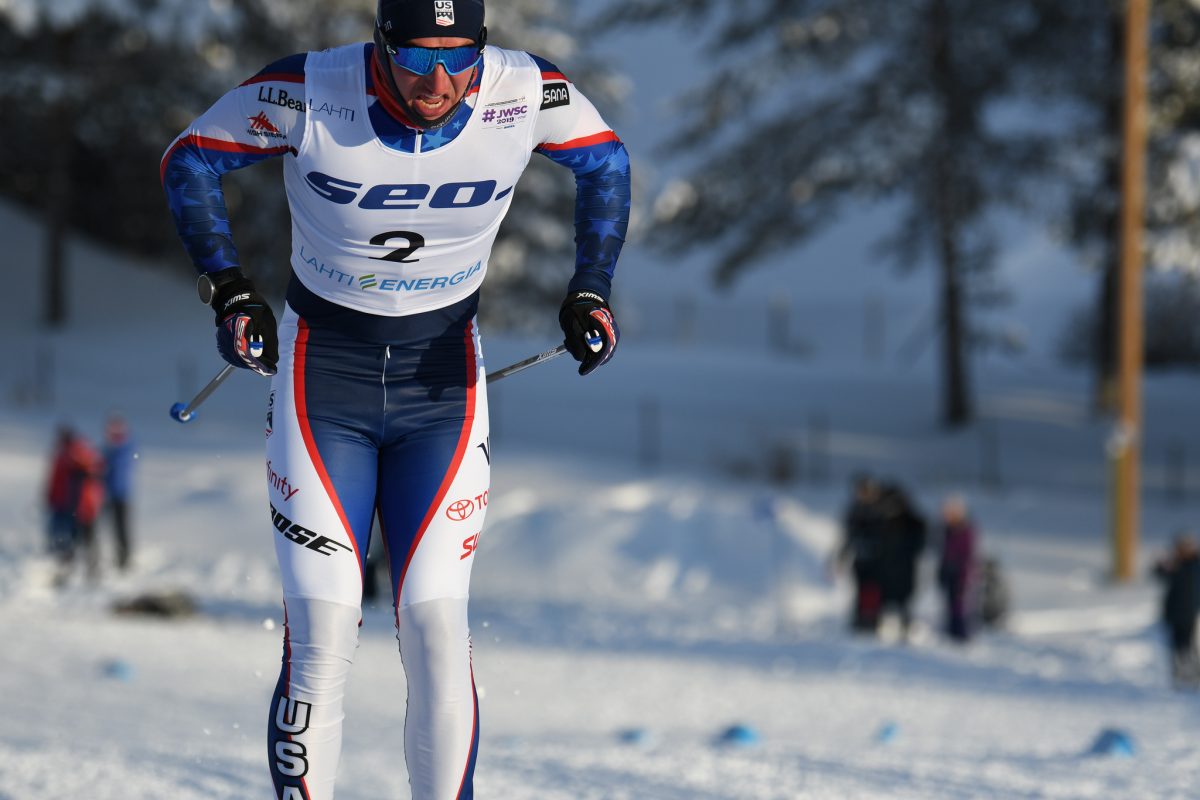
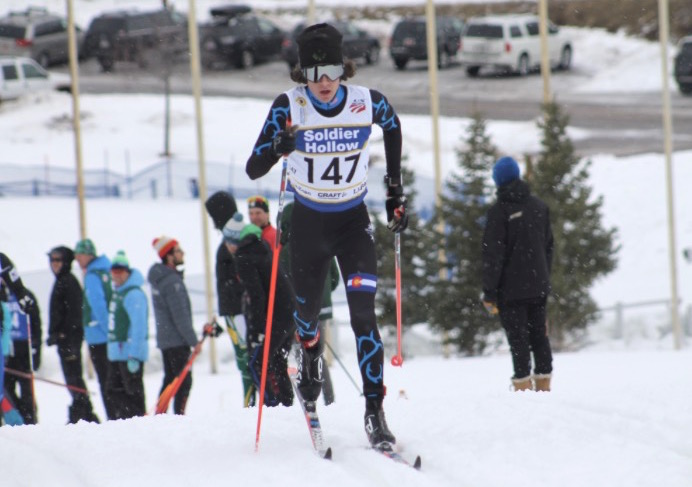
Noel Keeffe during the 1.6 k classic sprint qualifier at Junior World Ski Championships in Lahti, Finland. (Photo: Doug Stephen)
Being a “first-ever” is rare, especially in a town filled with Olympians. Noel Keeffe is one of them. Born and raised in Steamboat Springs, Keeffe is the first Steamboat Springs Winter Sports Club cross-country athlete to be named to the U.S. Cross Country Ski Team.
“Our coaches continually remind us that our life as a student athlete is like balancing a three-legged stool – athlete, social and school,” says Keeffe, who is in his second year at the University of Utah, majoring in material science and engineering.“They reinforce that we need all of the three, and that we shouldn’t just focus on one. Going into my second year here at the U, I’m better able to plan my time depending on the season. I know when I’ll need to spend more time on school, when I’ll need to focus more on training and competition and when I can relax a bit.”
Keeffe is in a unique situation in that he has three coaching sources: SSWSC coaches, University of Utah National Team coaches and U.S. Cross Country Ski Team coaches. He says having access to this triangle of talented resources helped him plan a vigorous strategy going into this season.
“One of my goals this season is to qualify for U-23 [World Championships in February in Oberwiesenthal, Germany]. To do that I must race well at US Nationals in Houghton Michigan [in January]. If I end up going to U-23’s and race well there, then I will qualify for the World Cup race in Minneapolis [in March]. Getting a World Cup start this season would be pretty awesome.
“Because this race is in the U.S., it gives our team a significant starting advantage, so I hope to maximize that opportunity.”
This year Keeffe is living in an apartment with two other student athletes from the ski team, an arrangement he says works because they all have similar schedules. But, he adds, the arrangement is not without its challenges. “There are only three of us in the apartment, but we are constantly running out of refrigerator space,” Keeffe says. “On average, between the three of us, I would say we eat 15,000 to 20,000 calories a day. Every time I cook dinner for the whole apartment I think I have made to much food and somehow it is always gone by then end of the meal. I go to the store and buy some food – next day, it’s gone. We eat more food in a week than some family’s do in a month. It’s astonishing!”
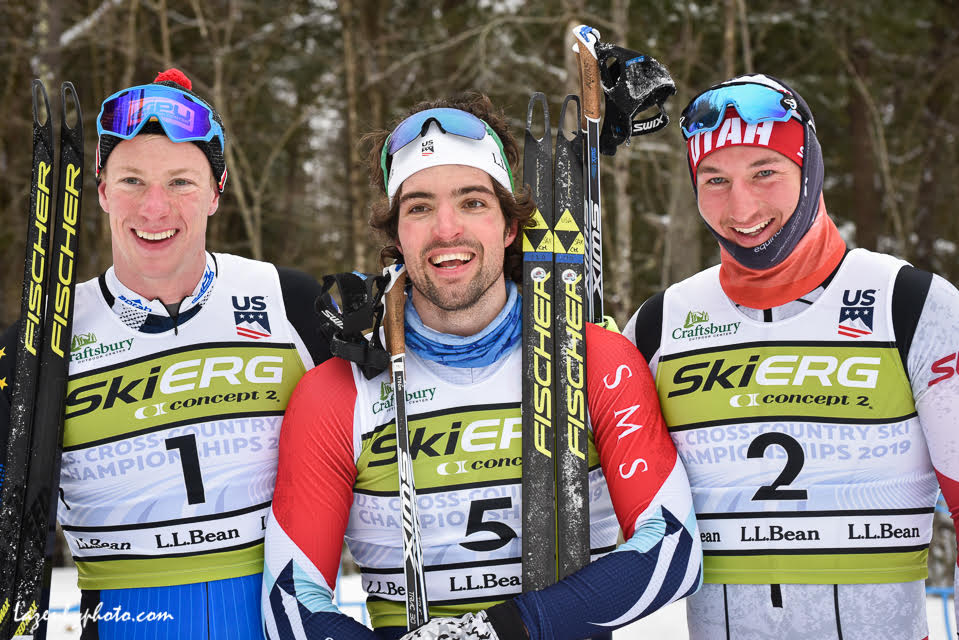
The men’s podium from the 2019 skate sprint at U.S. nationals. From left to right, Logan Hanneman (APU) second, Ben Saxton (SMS T2) first, and Noel Keeffe (University of Utah) third. (Photo: John Lazenby)
Keeffe says he has a better understanding of the student-athlete life this year, and is ready to maximize both his ski training and his studying. “I consider my classes and training one big package. I found that being in college, I have more time to focus on athletics and that being a student athlete allows me to juggle my schedule as necessary,” he says. As a sophomore, Keeffe is taking a larger class load than last fall, is training more and is training at a higher level.
Keeffe mentioned he has always had an interest in STEM (science, technology, engineering and math), and that he has been able to apply his experience with carbon fiber ski poles to help him in his materials science and engineering classes.
Keeffe is poised for achievement and looks forward to a challenging season as he learns how to balance his three-legged stool for success.
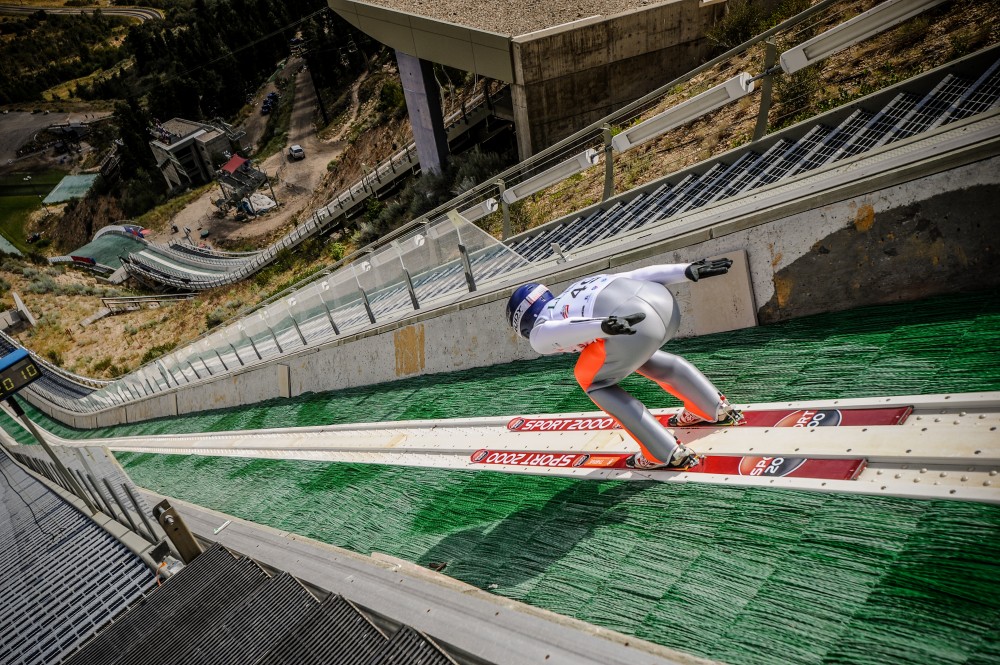
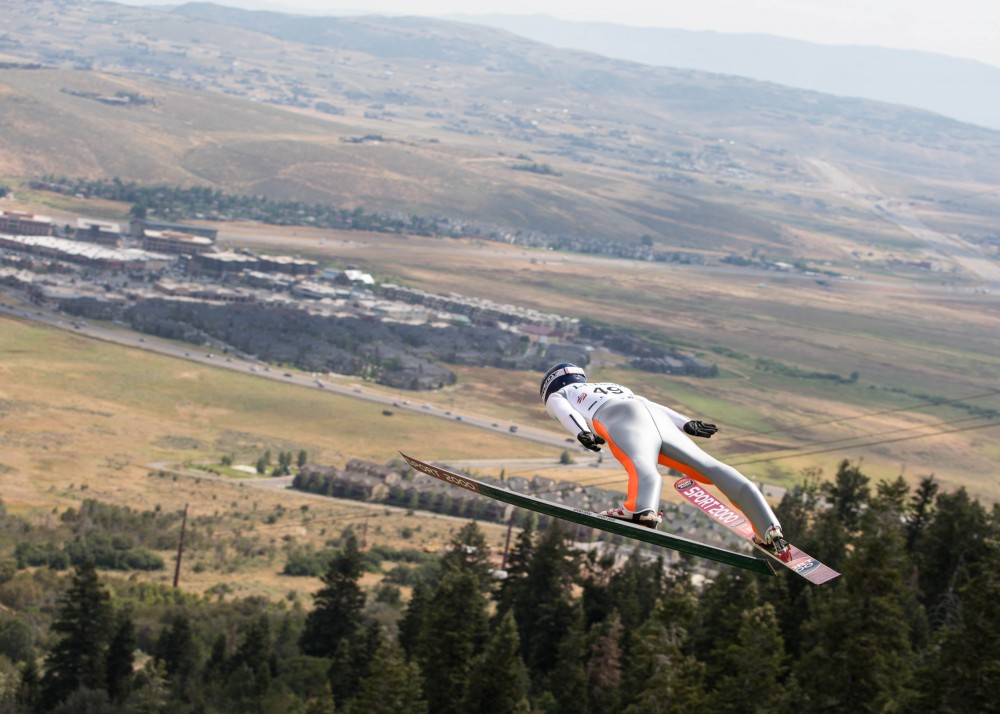
American Bryan Fletcher after jumping to 18th on the 109-meter normal hill at the 2018 Olympics in PyeongChang, South Korea. He went on to finish 17th in the 10 k later in the day. (Photo: FlyingPointRoad)
At age 31, Bryan Fletcher estimates he’s dedicated 25 years to the sport of nordic combined. He has been a U.S. national team member for the past 11 years and maintains that first time he flew off a jump on skis occurred at the ripe age of 4. Before that, and before his first steps, Fletcher’s exposure to skiing came from the viewpoint of a child carrier on his father’s back.
For the first time since his initial national-team naming in 2006, Fletcher’s full-time work will no longer revolve around nordic combined. As of this spring, the U.S. Nordic Combined veteran has retired from World Cup competition, as have a few other internationally notable nordic-combined skiers.
For any athlete who has devoted as much time as Fletcher, retirement rarely means complete severance from the sport. From the onset of his career, nordic combined (NoCo) served as more than just an athletic pursuit for Fletcher. It was also in a way, a lifeline.
***
Bryan Fletcher (U.S. Nordic Combined) at the 2016 U.S. Ski Jumping and Nordic Combined Large Hill Championships in Park City, Utah. (Photo: USSA/Tyler Tate/T Squared Action Sports)
When he was 6 years old, Fletcher made a special request to his parents. At the time, he was a self-proscribed “adrenaline-junkie kid” living in Steamboat Springs, Colorado — a well-known ski town that is also home to the country’s historical ski jumping venue, Howelsen Hill. Fletcher had heard that his hometown was hosting a “learn-to-ski-jump day” for kids his age.
Naturally, he wanted to attend.
But even if Fletcher’s 6-year-old self self showed a fearless gall and a desire to jump, his parents had other reasons to feel nervous about signing him up. His health. Three years earlier, he had been diagnosed with acute lymphoblastic leukemia (ALL)-
A type of cancer in which the body’s bone marrow overproduces lymphocytes (a type of white blood cell), ALL’s symptoms can range from pain in the bones and joints to fatigue and fever. To treat his condition, Fletcher completed regular chemotherapy sessions three hours away in Denver, Colorado. Some sessions left him without hair.
“I think it’s very easy for young kids, especially going through cancer, to be pretty down in the dumps and not really get to feel like they’re a normal kid,” Fletcher told FasterSkier on the phone earlier this month. “I don’t know how or why, but I guess I begged my parents enough to sign me up for that learn-to-ski-jump day.”
With some persuasion, he convinced his parents to let him partake in the event. Instantly, Fletcher was hooked, prompting him to join Steamboat’s youth ski-jumping program. Eventually, he found his way to the cross-country trails and began participating in the youth NoCo program at the Steamboat Springs Winter Sports Club.
“I think they saw the smile on my face and were like, ‘Holy cow, how are we going to tell him that he can’t do this?’ ” Fletcher recalled of the first time he tried ski jumping.
NoCo became what Fletcher referred to as the “perfect distraction” from his chemotherapy sessions and childhood cancer. In Denver, he adhered to everything his doctors recommended, especially if it meant getting back to Steamboat, skiing and jumping sooner.
“I think it was, in hindsight, a great motivator for me,” Fletcher said of his early days in the sport.
***
U.S. Nordic Combined’s 2011/2012 team members (from left to right) Bill Demong, Bryan Fletcher and Taylor Fletcher with head coach Dave Jarrett at Soldier Hollow in Midway, Utah. (Photo: USSA)
From then on, Nordic Combined became inextricably intertwined with his life, both on the hill and at home. His younger brother, Taylor Fletcher, who was four years younger, also picked up NoCo, and the two shared practices and passion for the sport.
“Both he and I are fighters, but … he’s always had to work for it a little bit harder than I did,” Taylor said on the phone this month. “That’s what drove him to become as good as he was.”
When Bryan was a freshman at the Winter Sports School in Park City, Utah, he was selected to be a forejumper for the 2002 Winter Olympics.
“This honor further solidified my goals and ambitions to become a world-class athlete,” Bryan wrote on his website.
Just two years after his high-school graduation, Bryan earned a spot on the U.S. Ski Team. He was 20 years old. One year later, he qualified for his first World Championships in Sapporo, Japan, racing to 40th in the sprint.
Six months after his 22nd birthday, Bryan claimed his first Continental Cup podium: third place in an individual large hill/10-kilometer Gundersen at Soldier Hollow near Park City. He competed at his second World Championships in 2009, walking away with two individual top-30 performances (30th in the large hill/10 k and 22nd in the normal hill/10 k).
By the third competition weekend of the 2010/2011 World Cup season, Bryan had achieved his first individual top 10, placing eighth in the normal hill/10 k in Ramsau, Austria.
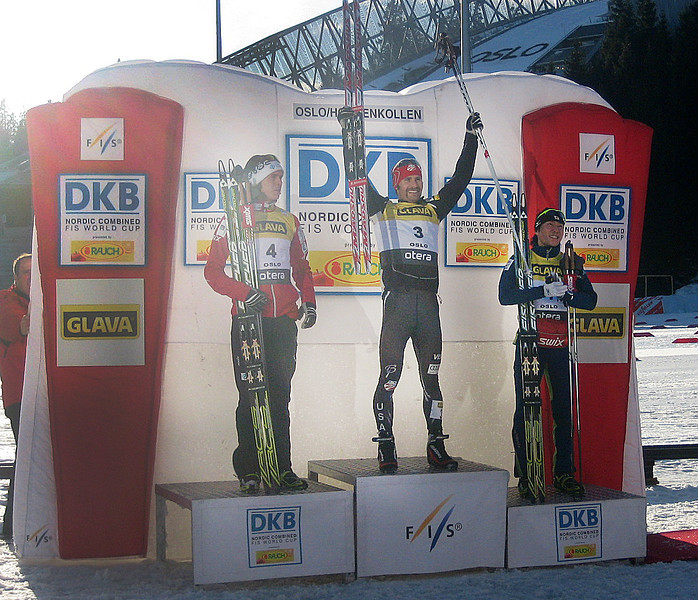
Bryan Fletcher on the top of the podium in at the 2012 Nordic Combined World Cup in Oslo, Norway. (Photo: Margo Christiansen/USSA)
But it was the following season, in 2011/2012, that Fletcher really found his form. At the 2012 Holmenkollen World Cup in Oslo, Norway, he became the fifth American to win a Nordic Combined World Cup with a victory in the large hill/10 k. In that season alone, he also finished in the top 10 seven other times.
“That was kind of a pivotal point,” Fletcher said of his Holmenkollen win. “It was a reinforcing result. … I was like, ‘OK, I do belong here at the top of a World Cup and I have a future in the sport … all the sacrifices and work you’ve put into it are worth it.”
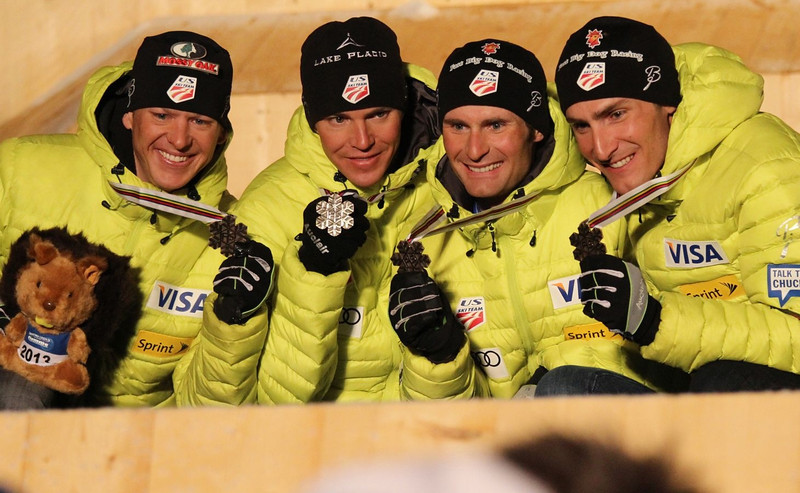
Bryan once again made the team for 2013 World Championships in Val di Fiemme, Italy, where he and his teammates Billy Demong, Todd Lodwick and his brother Taylor raced to bronze in the 4 x 5 k team event.
“That was just solid teamwork and great performances by all,” Bryan said. “A happy moment in the career.”
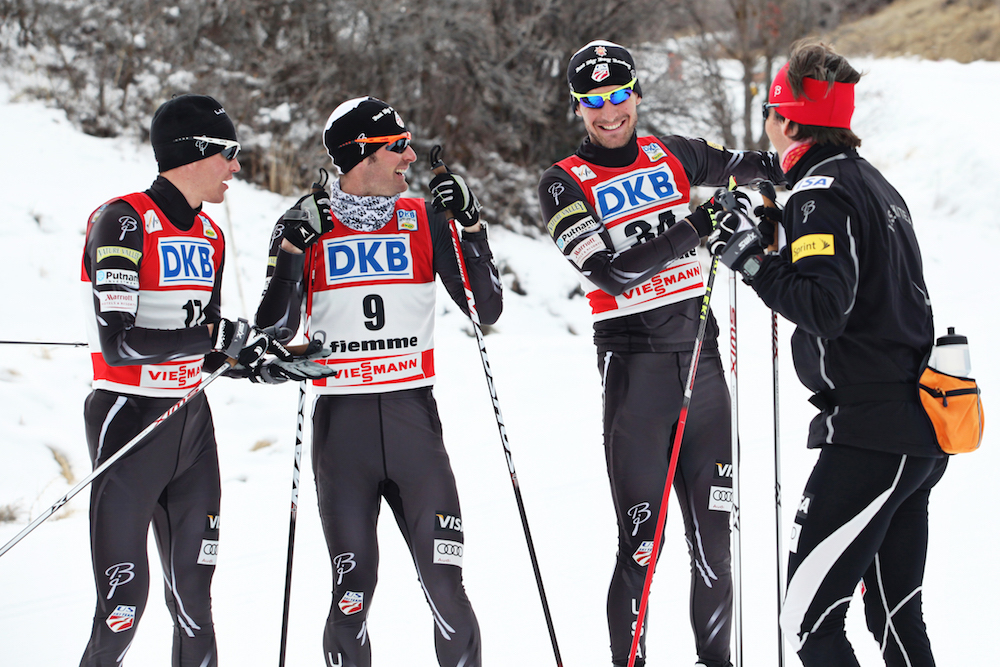
From left to right: Todd Lodwick, Billy Demong, Bryan Fletcher, and Taylor Fletcher with their bronze medals from the team event at the 2013 Nordic Combined World Championships in Val di Fiemme, Italy. (Photo: Fiemme2013)
Twelve years after his cameo forerunning appearance at the 2002 Salt Lake Olympics, Bryan found himself at the top of another Olympic jumping hill — this time wearing the Team USA race suit. He had qualified for the 2014 Olympics in Sochi, Russia, where he went on to finish 22nd in the large hill/10 k and 26th in the normal hill/10 k.
Over the next four years, he would qualify for two more World Championship teams as well as the 2018 Olympics in PyeongChang, South Korea. On top of those achievements, he’d accumulate 10 more individual top-10 World Cup finishes, including two seventh-place results this past winter.
In PyeongChang, Bryan placed 17th in both individual races: the large hill and normal hill/10 k Gundersen starts.
“I went into PyeongChang wanting to have a lot of fun, obviously wanting to fight for a medal, and to put my best foot forward,” Bryan explained. “I put together probably some of my best performances on the jump hill I’ve had in several years. Unfortunately my cross-country wasn’t quite as strong as I’d hoped for, but I still felt like I put everything I had in the training going into it.”
***
When it comes to his work, Bryan is all about giving his all, which is one reason he chose to retire from World Cup competitions. It is also one of the reasons why he is not immediately transitioning into coaching, despite his close connection to the sport for so many years.
“I am the type of guy who likes to do things 100 percent,” Bryan explained. “The sport is always growing and the level is always rising, and I just felt like I wasn’t going to be able to give the sport all the effort that I needed to give it to be successful [as an athlete]. So I decided that 2018 was the year that I would retire and I would move into finishing my academic career and start a new journey.”
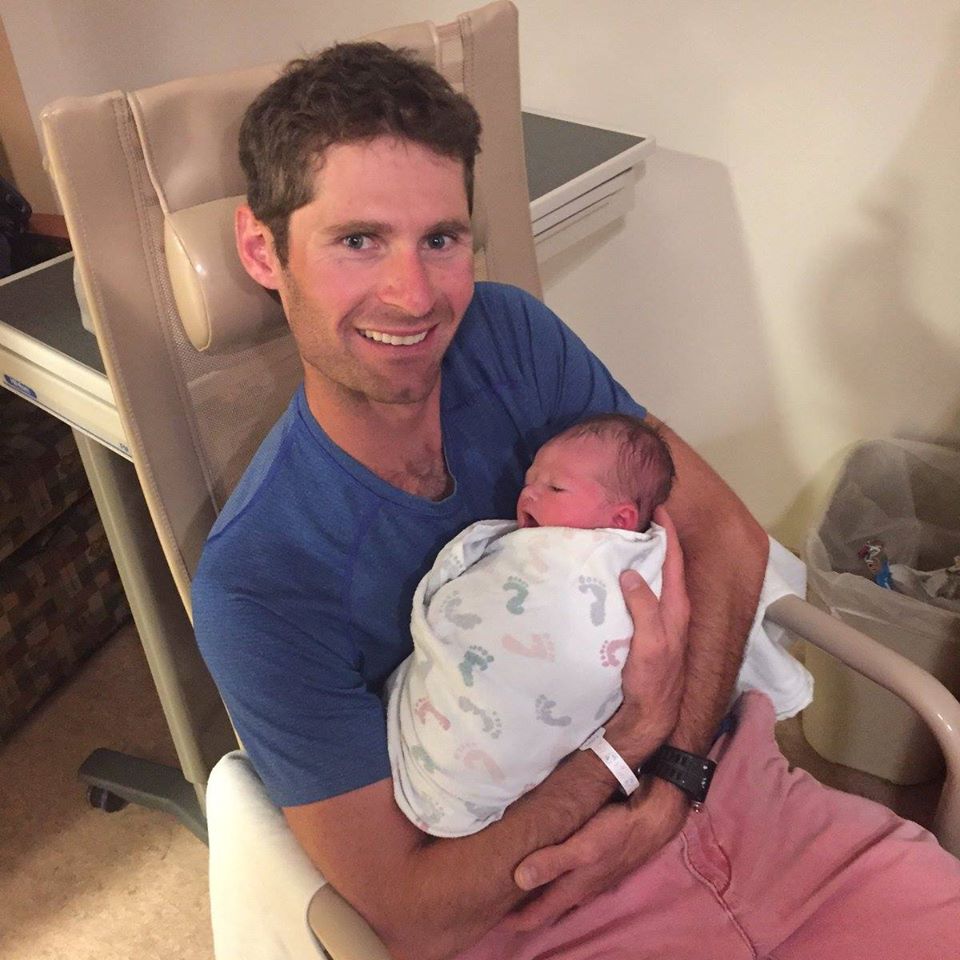
Bryan Fletcher holding his newborn, Ellery Ardene Fletcher. Fletcher and his wife Nikki welcomed their baby girl on Aug. 29, 2016. (Photo: USSA Nordic)
His new journey will involve finishing school and spending more time with his wife and 20-month-old daughter, Ellery. Through online courses, he has been working toward a degree in health education and promotion (with an emphasis on health science), which he aims to complete by next year. Graduate school has popped into his mind, as well as the idea of becoming a physician assistant.
Though coaching may have seemed like the ideal professional avenue for an athlete like Fletcher, the U.S. team veteran sees value in spacing himself from the team before getting too deeply involved.
“I think that going into coaching is really easy, especially to go straight from your athletic career, but you don’t have that time to expand your knowledge,” he said. “For a number of years, coaching was how I wanted to stay involved in the sport. I’ve since changed that idea.”
Instead, he hopes to enhance his knowledge of athletics and health science before working with athletes. The idea is to not only allow himself to develop more, but give the current U.S. NoCo team time to develop as well.
“When you come back to a sport so fresh out of retirement, it’s easy to focus on the same problems that you had as an athlete,” Fletcher explained. “But those issues may not be necessarily what the other athletes are struggling with or what they need to work on.
“On our team, we have some athletes that are great jumpers and we also have some athletes that are great cross-country skiers, but we don’t have particularly many of both right now,” he continued. “I think we just need to take some time to let those athletes develop in a new environment. That way you’re not just coaching the strong skiers to be strong skiers and the best jumpers to be the best jumpers, but instead allowing them to find strength in the opposite areas.”
Though he himself was 20 years old when he joined the team, by the end of his career, most of Fletcher’s teammates were almost a decade younger than him. While the team energy in recent years was one that left him admittedly needing “more naps”, he also sees the younger pool of athletes as an opportunity to foster a new team dynamic for American nordic combined.
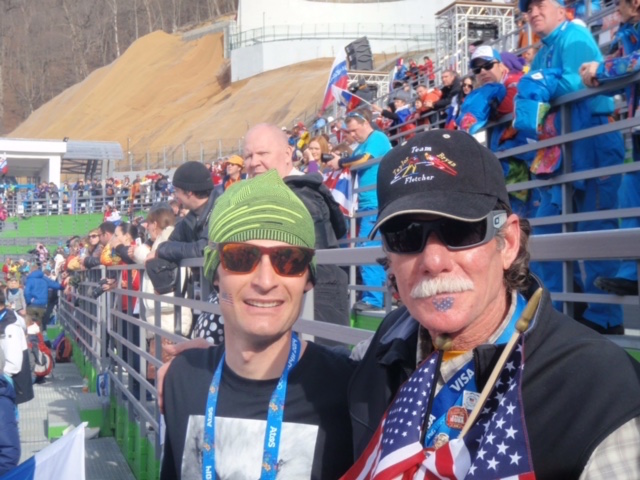
Bryan Fletcher with his father at the 2014 Winter Olympics in Sochi, Russia: “The biggest lesson I ever learned from my dad was not only how to ski but how to enjoy every single day on skis.”
“As the younger athletes come up, we have to let them create their own culture and be accommodating of it,” Fletcher said. “I think the way I can have the biggest impact on the team is not by jumping immediately into coaching, but instead taking some time away from the team to broaden my knowledge base and skill sets in different areas. Then several years from now, I can return to the team with a new attitude and new approach and add something different.”
For the time being, his involvement with NoCo will remain at the administrative level. He was recently elected to Team USA’s Athletes’ Advisory Council and will serve a four-year term on the board of directors.
Even so, his presence at practice sessions will be missed.
“It’s going to be weird,” Taylor said of his brother’s departure from the team. “He was always the very level-headed leader.”
As Taylor, a three-time Olympian, steps into the primary NoCo team-veteran role, Bryan was sage in his advice to those who will continue to hit the trails and the hill.
“Just have a plan in place, especially when you start to think that you’re heading down that road of retirement,” Bryan said. “I think it’s really easy to kind of get stuck and not know what you want to do, so just make sure that you kind of have some sort of idea, some kind of stepping stone to go forward.”
Bryan Fletcher flying at the 2016 U.S. Ski Jumping Championships at Utah Olympic Park in Park City, Utah. (Photo: USSA/Tyler Tate/T Squared Action Sports)
Kikkan Randall leading the 2017 Alaska Run for Women with a smile on June 10. (Photo: Scott Broadwell)A little U.S.-based news to get your Tuesday going:
— Watch out, World Cup, Kikkan Randall is feeling good. The longtime U.S. Ski Team (USST) and Alaska Pacific University (APU) skier took first place in the 25th annual Alaska Run for Women road race, held over Anchorage streets and bike trails this past Saturday. Randall led the field of several thousand women to the finish in 28:41, a pace of 5:44 per mile for the 5-mile, largely flat-road course.
Mid-5:40s for five miles (in June) is nothing to sneeze at on its own, but let’s let the 34-year-old Randall put it in context: “I’m in the best shape of my life now,” she told the Alaska Dispatch News. This is so even though Randall was a few seconds per mile off her previous best on this course, a 28:18 that she clocked while winning this race in 2012. That winter, she went on to win her second of three consecutive Sprint Crystal Globes.
“I’m in the best shape of my life now.” — Kikkan Randall in a recent interview with the Alaska Dispatch News
Finishing just over a minute back for second place on Saturday was recent local high-school graduate and multi-time state track champ Briahna Gerlach, who will race Division I track and cross-country running this fall in the Lower 48. “I didn’t even know it was Kikkan Randall,” Gerlach told the Dispatch News of her competition over the first mile before Randall pulled away. “When I found out I said, ‘OK, she can go.’ She’s crazy. She didn’t even look tired.”
Other skiers in the top 10 included Mandy Vincent-Lang (formerly University of New Hampshire) in third, Becca Rorabaugh (APU) in fourth, and Lauren Fritz (APU) in 10th.
https://www.instagram.com/p/BVLNwkqDp3i/
— If it’s summer, the rest of the APU Elite Team must be running up mountains. APU skiers took nearly every race in the seven-stage Alaska Mountain Runners Grand Prix last summer, highlighted by David Norrissetting the course record at Mt. Marathon, the insanely steep climb and descent outside the harbor town of Seward, Alaska, that was first run as an organized race in 1915 and is believed to be the oldest mountain race in the country. (Norris took the record back from Kilian Jornet, a man widely acclaimed as the world’s best mountain runner.)
This summer, they’re at it again. On the evening of Thursday, May 25, Norris took first place in Kal’s Knoya Ridge Run, ascending an uphill-only course in the Chugach foothills on the eastern edge of Anchorage. (Runners had to descend under their own power, but the clock stopped when they crossed the finish line.) Norris weathered an early-summer snowstorm to cover 8.5 kilometers, and 4,500 vertical feet of elevation gain, in 58:08 for a substantial margin of victory. First place among the women went to Jessica Yeaton (APU/Australian National Team).
In a shorter version of the race (5.6 k and 2,900′ of climbing), APU skier Forrest Mahlen was the first across the line. Marine Dusser (formerly University of Alaska Anchorage (UAA), currently affianced to USST skier Erik Bjornsen) was the first woman, less than 90 seconds behind him. Other top-10 skiers included APU junior Maggie Meeds in third, APU junior Aubrey LeClair in fourth, and Jaime Bronga (formerly UAA) in seventh. In the long race, Kate Fitzgerald (formerly APU) was fourth among the women, while Kenny Brewer (formerly University of Alaska Fairbanks) was third and Mark Iverson (formerly APU) was sixth.
— Nine days later, on the morning of Saturday, June 3, it was newly minted U.S. Ski Team memberScott Patterson edging out his APU teammate Erik Bjornsen (also of the USST) by the slimmest of margins, 0.3 seconds, after slightly more than 42 minutes of racing up 3 miles and 3,500′ of elevation gain in the uphill-only Government Peak Hill Climb outside of Palmer, Alaska. “I led the whole thing till maybe a minute to go, then we duked it out as I tried to come up with a little bit of a sprint,” Patterson told the Alaska Dispatch News after the race. “With three feet to go, Erik would have won. Even with two feet to go. He seemed to stumble a little when it was down to one step and I got him.”
APU junior Hamish Wolfe was 8th.
Dusser once again took the victory in the women’s division, in a time that would have placed her 12th among the 105 men in the field.
— So who’s still skiing? More people than you might think, thanks to an epic winter in the western U.S. that brought dozens of feet of snow to the High Sierra and has the Squaw Valley alpine area making noises about running at least one chairlift all summer long. For example, here’s fresh grooming (!) on the Auburn Ski Club trails on June 6 (!!):
https://www.instagram.com/p/BVBZo3GAt-A/
Here’s Paul Kovacs (Australian National Team) on the ASC trails on the morning of June 7:
Here’s FasterSkier contributor Jon Schafer with a Steamboat Springs Winter Sports Club junior camp, driving up to the nordic trails at Mt. Bachelor in Bend, Ore., in a June 10 snowstorm:
https://www.instagram.com/p/BVKdwcMhDYL/
Finally, farther north, the APU Elite Team arrived at Eagle Glacier earlier this week for their first Glacier Camp of the summer:
https://www.instagram.com/p/BVQYFY1lGOo/
– And earlier this month in Albuquerque, N.M., the University of New Mexico (UNM) announced that athletic director Paul Krebs will retire on June 30. The university’s press release did not indicate a reason for his departure, but the news came two days after the state auditor informed UNM Interim President Chaouki Abdallah that its athletic department would be the focus of a special audit, according to Deadspin.com. The Office of the State Auditor reportedly “received information raising concerns related to athletic fundraising activities and expenses of the University of New Mexico.” Krebs, who was UNM’s athletic director for 11 years, was criticized for spending nearly $65,000 dollars in taxpayer money on a 2015 golf trip to Scotland and was at the heart of the heated proposed discontinuation of the UNM ski team.
* * *
This article has been updated to reflect the correct historical status of the Mt. Marathon Race as believed to be the oldest mountain race in the country, not as “the second-oldest footrace in the country behind the Boston Marathon.”
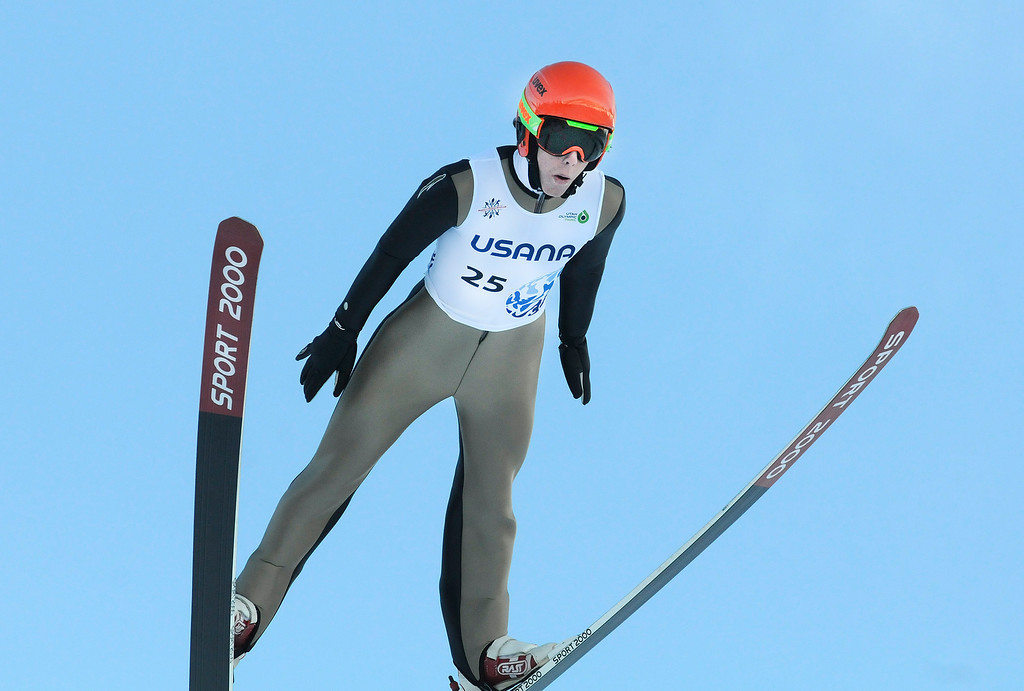
Elijah Vargas (Steamboat Springs, CO) competing in trials for 2017 Nordic Junior World Championships at Utah Olympic Park in Park City, Utah, on Dec. 30, 2016. (Photo: U.S. Ski Team/Tom Kelly)
In an effort to showcase the North Americans competing at this week’s International Ski Federation (FIS) 2017 USANA Nordic Junior World Championships and U23 Cross Country World Championships at Soldier Hollow in Midway, Utah, we asked those qualifying athletes several questions about themselves — actually, we had them fill in the blanks. Here we have 16-year-old Elijah Vargas, of the Steamboat Springs Winter Sports Club, who’s representing the U.S. at his first Junior Worlds.
On Thursday, he was slated to start the nordic-combined 4 x 5 k team event, with teammates Stephen Schumann, Ben Loomis and Grant Andrews.
***
“My full name is Elijah Vargas, but you can call me Elijah. I was born in Steamboat Springs, Colo., and raised in Steamboat Springs. One thing you should know about my hometown is that we have 500,000 Olympians there give or take.
I started skiing when I was two and jumping when I was five, thanks to Mama and Poppa Varg. I currently train in Steamboat Springs with the Steamboat Springs Winter Sports Club.
If I’m not skiing, you might catch me outside, how bout that?
One of the things I’m most excited about for U23/Junior Worlds at Soldier Hollow is having the home event in a place I have skied at before.
The best advice anyone ever gave me about skiing or racing was when my brother told me not to beat him again.
Wyatt Gebhardt (Steamboat Springs Winter Sports Club) racing to 19th in the men’s 10 k freestyle on Wednesday in his Junior World Championships debut at Soldier Hollow in Midway, Utah. (Photo: FlyingPointRoad.com)
In an effort to showcase the North Americans competing at this week’s International Ski Federation (FIS) 2017 USANA Nordic Junior World Championships and U23 Cross Country World Championships at Soldier Hollow in Midway, Utah, we asked those qualifying athletes several questions about themselves — actually, we had them fill in the blanks. Here we have 17-year-old Wyatt Gebhardt, of the Steamboat Springs Winter Sports Club, who’s representing the U.S. at his first Junior Worlds.
“My full name is Wyatt Gebhardt, but you can call me Wyatt. I was born in Greeley, Colo., raised in Steamboat Springs, Colo., and one thing you should know about my hometown is we shot the biggest firework off in North America at the winter carnival.
Wyatt Gebhardt (Steamboat Springs Winter Sports Club) racing to eighth in the junior men’s 10 k classic mass start at 2017 U.S. nationals last month at Soldier Hollow in Midway, Utah. (Courtesy photo)
I started cross-country skiing when I was two, thanks to Mom and Dad. I currently train in Steamboat Springs with SSWSC.
If I’m not skiing, you might find me backcountry skiing. If I had to pick a favorite book, it would be ‘A Long Way Gone.’
One of the things I’m most excited about for Junior Worlds at Soldier Hollow is the skiathlon race. One race I’m especially targeting there is 10 k freestyle.
The best advice anyone ever gave me about skiing or racing was always be sure to have fun. One of the best race memories I have is racing in Steamboat.
If I could meet one World Cup skier, it would be Stina Nilsson.
If I don’t end up being a professional skier, I’ll probably be a mechanic.
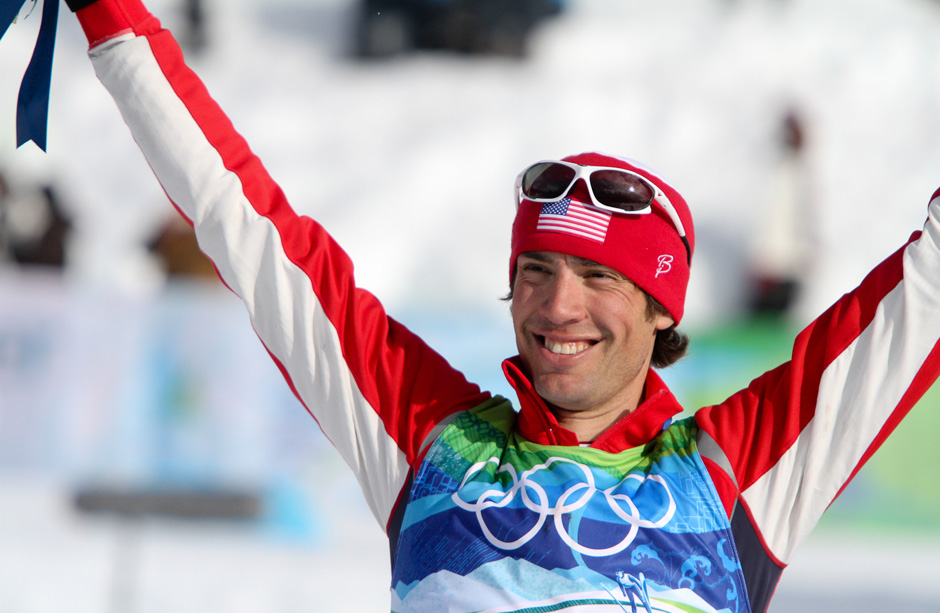
Four-time Olympian Johnny Spillane after notching his third-straight silver medal at the 2010 Winter Olympics in Vancouver, British Columbia. A longtime staple of the U.S. Nordic Combined Team, Spillane, 32, recently announced his retirement.
It’s hard to imagine U.S. Nordic Combined without Johnny Spillane.
For more than a decade, the Steamboat Springs, Colo., native has been the sport’s poster child, winning America’s first gold at 2003 World Championships and later notching three silver medals at the 2010 Olympics.
He’s been to every Olympics since 1998 and bounced back from several injuries to return to the team year after year. But this season, Spillane won’t be training for the 2014 Olympics. At 32, he recently decided to call it a career, and is the first of three over-30, A-team members to do so (Billy Demong, 33, and Todd Lodwick, 36, apparently have their sights set on Sochi, Russia).
The news came in the form of a letter to the Steamboat Springs community, published in Steamboat Today on April 18.
“I would like to take this opportunity to thank the community of Steamboat Springs for the incredible support it has given me over the years,” he began. His national-team career spanned more than 15 seasons.
Johnny Spillane (l) racing in the team event at the 2010 Olympics, in which he won his second of three silver medals.
“I’ve been very fortunate to be raised in this town and have the opportunities that Steamboat provides, but it is time for me to move on,” Spillane wrote. “It has been a long and productive career, and I have no regrets as I start a new chapter in my life.”
Not to worry, Steamboat; Spillane’s staying right at home. In an interview with FasterSkier, he explained that he’ll pursue passions like fly fishing and start by guiding this summer.
“It was a long, long career so I’m pretty excited to be done,” Spillane said on the phone of the decision he made a couple of weeks ago. Every year, he reevaluates, and this year, the time was right.
“I’m sure there’s more things that can be accomplished, but at the same time, there’s other things I want to do besides travel and ski,” he said with a laugh.
Initially, he plans to “explore as many different opportunities” as possible, which could include something in the fly-fishing industry and part-time junior coaching with the Steamboat Winter Sports Club.
“I don’t anticipate getting into coaching at any kind of high level because at that point you’re just traveling a ton anyways, and that’s what I’m trying to avoid to begin with,” Spillane said. “I would be open to [coaching] really young kids here in Steamboat, something that you could do a few nights a week, but beyond that I don’t have too much interest.”
While few are questioning his next steps, a lot of people are wondering why Spillane decided to call it quits before an Olympic year.
Simply put, he wants to spend more time with his wife, Hilary, and two daughters. His oldest, Hadley, is 2 ½, and Genevieve will turn 1 in May.
“It’s so much traveling and with having kids and stuff like that, I’d had enough,” Spillane said. “I’ve done this a long time. I’ve been to four Olympics and while it would be great to go to another, it’s not going to change my career in any way or anything like that.”
Last season, the 2003 world sprint champion competed in one event at World Championships in Val di Fiemme, Italy. There, he was 30th in the large-hill competition, and he cheered his teammates (Taylor Fletcher, Bryan Fletcher, Lodwick and Demong) on as they captured the nation’s first World Championships medal – bronze – in the team event.
“For sure, you want to be competing, but if you’re not gonna be the one out there, you want to be helping in every way you can,” Spillane said. “I was in the wax room, testing skis and doing everything I could to help contribute.”
His best individual World Cup result last season came in January, when he was 22nd on the large hill in Klingenthal, Germany. Despite traveling with the team all season, Spillane competed just five times. Hindered by injuries in the past, it wasn’t his body that was keeping him out of it this time. Rather, new rules required athletes to make the top 50 in preliminary jumps to advance to the actual competitions.
Spillane said he “struggled pretty heavily with the rule changes,” especially the tighter suits.
“There was a learning curve there and it took me a while to get it figured out,” he explained. “I don’t think I ever got it entirely figured out. I think that was by far the only contributing factor to some of the poor results I had because I felt really good skiing all winter long. It was just a matter of jumping well enough to put myself in any kind of position to be competitive.”
The changes were certainly “annoying,” Spillane said, but they’re also inherent in the sport. For a smaller nordic-combined squad like the U.S. it made adapting even tougher.
“Every time they make a rule change, it takes the countries that don’t have the financial capabilities to really explore the equipment a couple years to catch up,” he said. “You’re spending half your energy trying to figure out your equipment where you want to be spending that energy training and improving. That part is hard. Everybody gets frustrated with that.”
It’s also difficult missing out on opportunities to ski up to your potential. If Spillane could’ve made the top 50 on the jump hill more often last season, he believed he could’ve skied up to 20th or so.
But that’s all behind him now. Looking back on an individual World Championships gold, four national titles, and three silvers at the 2010 Olympic Games (the first of which was America’s first), Spillane said it’s the team he’ll remember most.
“What I’m most proud of is what the team accomplished as a whole while I was a part of it, whether it was individual results or team results,” he said. “Becoming one of the stronger nations in the world was for me one of the most exiting parts of it. The individual results and competitions were great, but I don’t focus on them all that much.
“Obviously I would’ve liked to have done better at every competition, but at some point you just have to be satisfied with what you did, and that’s where I’m at,” Spillane added. “I’m proud of the results I had, I wish some of them were better, but that’s in the past. I know that I did everything I could to get the results that I did get, and that lets you sleep at night.”
The U.S. Nordic Combined National Training Group poses for a team photo at the top of a mountain near Strbske Pleso, CZE, in early August. At bottom, Michael Ward (L) and Adam Loomis (R). Top, left to right, Erik Lynch, Cliff Field, coach Martin Bayer, Tyler Smith, and Steamboat Springs Winter Sports Club athletes Ben Berend and Aleck Gantick. Photo courtesy of National Nordic Foundation.
When Cliff Field met his parents for dinner in Steamboat Springs, Colo., last weekend, the family of three knew the discussion wouldn’t be easy.
A few days earlier, Field had stumbled on his mother’s quotes in a Steamboat Today article about his nordic-combined National Training Group. The focus was the team’s financial status following the budget cuts handed down by the United States Ski and Snowboard Association (USSA) this year. The underlying reality was that Field’s future in the sport was at stake.
“I think it was when he read the article online and saw my comment about us being $60,000 in debt,” said his mother, Susana Field. “And he said, ‘Well, what am I doing in this sport? Why haven’t you told me? I can just quit the sport right now.’ ”
Susana said she broke down crying at the table. She explained to her 19-year-old son that they wanted to make it work, but could no longer afford to do so.
Nordic Combined NTG members Michael Ward (L) and Cliff Field (R) sit at the top of a ski jump. Photo courtesy Cliff Field.
Since Field started competing internationally the summer before ninth grade, Susana and her husband, John, had spent some $35,000 a year on keeping him in the sport. They not only exhausted their savings, they maxed out their credit lines.
Speaking on the phone from her new home in Rangely, Colo. — about 2 ½ hours from Steamboat Springs — Susana said she was humiliated and embarrassed, but knew the importance of her family’s story. If they were struggling, other athletes’ families must be as well.
Back in 2006, Susana and John Field left their custom-cabinet business for other careers; Susana became a real-estate agent and John went to school in Rangely. Meanwhile, Susana battled breast cancer, and as the medical bills piled up, her son went higher in the sport — winning multiple junior-national titles.
She stayed in Steamboat to keep Field in the Steamboat Springs Winter Sports Club, but upon his graduation from high school last spring, she relocated. He stayed alone in the family’s former home — a rental unit Susana described as a trailer — and his parents visited when they could.
Looking ahead, Susana said they might have to sell that property.
“I know there’s some locals that think, ‘Oh, these are just rich kids that are flying over to Europe,’ ” she said. “But we haven’t put our hands out before. We did take the financial burden, and we just can’t anymore.”
Without money left for college tuition, Field was considering the military.
“It definitely ups the ante as far as what I’m going to do with my life if this doesn’t work out,” he said. “If we can’t find money, I’m probably not going to be able to go on with this sport.”
But for Field, who took some college classes with teammates while in Steamboat Springs this summer, the military may not be an option because he had asthma.
“I’m kind of just taking it as this season right now,” he said. “But it’s also like this is the last time I might be able to do something cool.”
Field said he used that as motivation to keep improving and hopefully make the U.S. Ski Team (USST), with just seven men between the A- and B-teams this season.
Their Own “Drive for 25”
Without any financial support from the USSA, some of the four other members of the National Training Group (NTG) — which was essentially a development or D-team — struggled to hang on as well, Field said.
Like the B-team athletes they trained with, some found accommodating jobs in Steamboat Springs. Others, like Field, found it difficult to work regularly between year-round trips to Europe.
For most of the athletes, their parents picked up the tab.
U.S. Nordic Combined NTG and Steamboat Springs Winter Sports Club athletes training on rollerskis. Photo courtesy of Cliff Field.
A former national team member with a 17-year-old son on the NTG, Kerry Lynch took it upon himself to lead the fundraising efforts. In an email, Lynch wrote that given the relatively small size of nordic combined, the sport faced inherent challenges. Especially at the development level, volunteer help was critical.
“Parents, families and private funding sources cannot be the sole funding mechanism for the developing athletes,” Lynch wrote. “That is not a long term model for success.”
He explained that while those at the top of the sport received adequate funding to compete in the World Cup, those below them had to figure out how to pay for travel, equipment and club costs. Although the financial challenge of nordic combined in the U.S. was nothing new, Lynch wrote that the struggling economy made things worse.
In an effort to offset about $250,000 in annual NTG costs, especially with travel, Lynch recently met with fellow National Nordic Foundation (NNF) board members to piggyback off a fundraising idea. Not long after the USST cross-country coaches Matt Whitcomb and Pete Vordenberg innovated the “Drive for 25,” urging skiers to donate $25 to the sport on Nov. 15, the NNF was happy to create a similar donation link online for nordic combined.
A few weeks after U.S. Nordic Combined launched its own “Drive for 25,” the website showed it had raised more than $20,000 for development athletes. And that wasn’t including checks that had been mailed in, said NNF director Dave Knoop.
“This has just been the most gratifying thing,” Knoop said of both the cross-country and nordic-combined fundraisers, which were ongoing and would accept donations well after Nov. 15. “It’s not the amount. … Getting the participation or the awareness out there is equally as important as getting the donation.”
If not for outside assistance, athletes like Erik Lynch, who was still in high school, said they wouldn’t be able to afford competing with the best skiers in Europe.
“There are supportive people in the skiing community who are donating now more than ever,” Erik wrote in an email. “Because of the recent financial support, I’m years ahead of where I would have been without outside funds. I have been able to achieve my yearly goals some said were unrealistic.”
In August, Erik made his World-Cup debut at the Summer Grand Prix in Germany, where he finished 52nd.
The U.S. Nordic Combined NTG with members of the Steamboat Springs Winter Sports Club in Ramsau, Austria, in August. Photo courtesy of Martin Bayer.
It’s Not All Gravy
While the ultimate goal for NTG skiers was to make the national team and receive more support, the road ahead wasn’t much easier, according to NTG head coach Martin Bayer.
USST members not yet on the World-Cup level had to pay their own way in the Continental Cup, he said. That could include three B-team members this year.
“It has changed,” Bayer said. “In the past, (the nordic-combined USST) had 10 guys that were fully supported everywhere they went. Every year it’s worse.
“Even with the results, you saw what happened in Vancouver,” he added, referencing the gold and silver medals the U.S. nordic-combined team won at the 2010 Olympics. “And the budget got cut.”
Understanding the situation and working within it has been the solution, according to U.S. Nordic Combined Head Coach Dave Jarrett.
“We don’t have an alternative, good or bad,” Jarrett said. “We just ski.”
Without the option to pursue nordic combined in college, junior athletes have to hold off on education while chasing the elite ranks of their sport. Some, like Field, wait several years to be named to the national team. Because U.S. Nordic Combined tends to move athletes up in groups, the development team remains in limbo.
“Kind of our M.O. is to get the group together, put them in residency from an early age, high-school age, and move them forward,” Jarrett said. “This NNF support is what’s going to enable them to continue skiing and be a full-time athlete.”
As for the sport’s expenses, Bayer pointed out that it’s no more than some other sports at that level, such as alpine. As for its finances, Jarrett said it was no worse than it had been. Fundraising wasn’t needed to sustain the sport in the U.S., it was meant to invest in the younger generations, he said.
“There was a time when you were on the ski team and you were getting some kind of stipend to be in residency,” Jarrett said. “That went away years ago. It’s not any more dire than it has been, it’s just that in some parents’ cases, maybe it’s more dire.”
He referred to the specific case of U.S. men’s ski jumping, which operated without USSA funding, and said that was what nordic combined wanted to avoid.
“Our funding goal is to endow our sport so that if that, in fact, ever happened to nordic combined, we would be in front of it,” he said. “You never know what’s around the corner. The pie hasn’t gotten any bigger, and there’s more pieces to be divided.”
While the U.S. Nordic Combined athletes and its NTG continue to work for national recognition — most easily won by Olympic and world championship medals — they continue to support themselves. In Steamboat Springs, several future Olympians can be found bussing tables or working in warehouses. According to Bayer, Adam Loomis squeezed in shifts at an Italian restaurant, serving food from 10 a.m.- 3 p.m. between morning and evening practices.
“By the end of the day, they’re tired kids,” Bayer said.
While Field worked part time at the town’s alpine slide last summer, he also rehabbed a badly sprained ankle on his own. Ever since a $2,000-medical bill forced him to stop physical therapy this fall, Field had been self-treating with ibuprofen and resistance bands.
“It’s kind of beyond icing,” he said. “You need flexibility in your ankle to ski jump, and it doesn’t have the flexibility that I would like. Hopefully it will come back before we get into the world junior competitions.”
For now, that was his focus: one step and one season at a time.
***
To support nordic combined and cross-country athletes in the “Drive for 25,” visit the NNF website and click “get involved” under each fundraiser.