From the FasterSkier archive — posts syndicated from athletes’ and coaches’ own blogs between 2004 and 2012, kept online as published. Current coverage is at fasterskier.com.
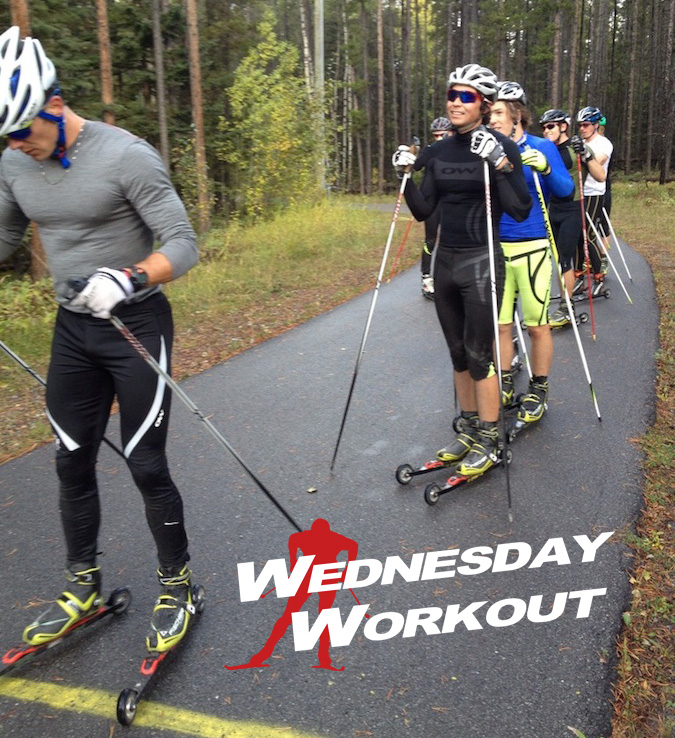
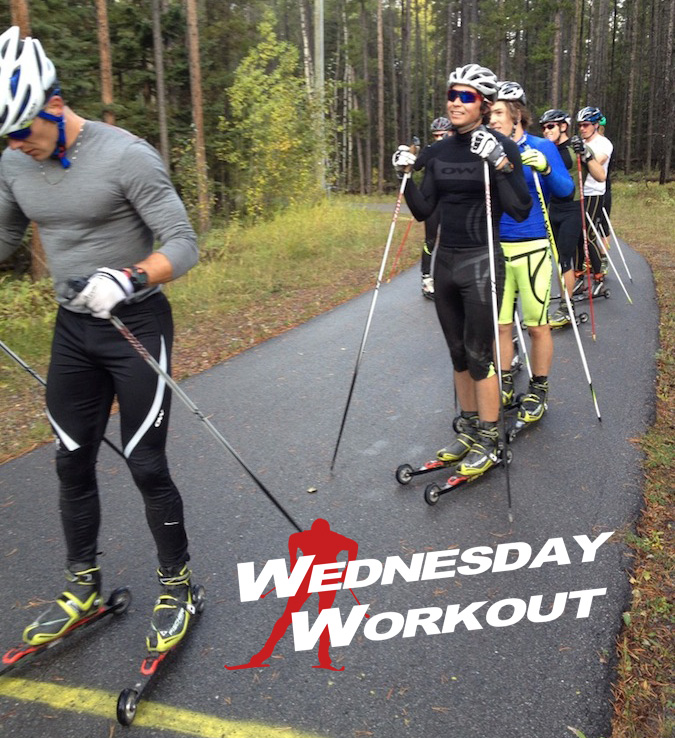
AWCA skiers get ready for a skate prologue test, which doubled as a lactate clearance workout, this fall in Canmore, Alberta. (Courtesy photo)
This Wednesday Workout it brought to you by Stefan Kuhn, 2010 Canadian Olympian and assistant men’s coach at the Alberta World Cup Academy in Canmore, Alberta. The workout: lactate clearance, which he has his athletes do in the fall three to four times before the race season. The goal: measure each individual’s ability to clear lactate, their mental toughness, physical fitness and overall speed.
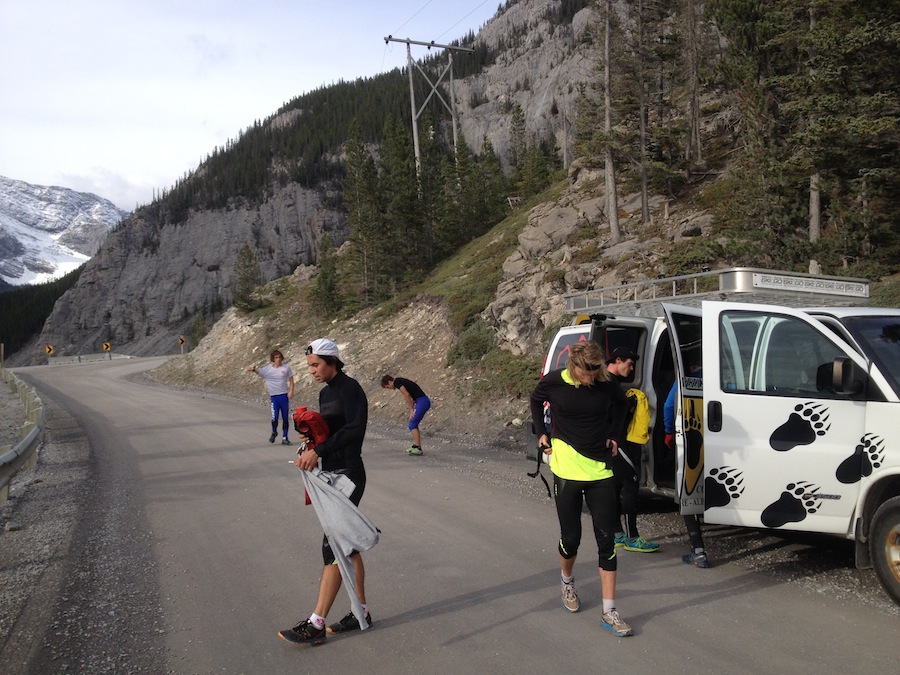
AWCA skiers after a recent hill-climb running workout near Canmore, Alberta. (Photo: Stefan Kuhn/AWCA)
“This is a fun workout and it’s super simple to do, but it really makes you have to dig deep, which is why I like to do it around this time of year,” Kuhn explains in an email. “The shape of the athletes is at high level and you can really go for a hard effort to build some lactate and try to survive through the workout the best you can.”
But don’t go crazy. Kuhn warns his athletes that they need to be mindful how hard they’re pushing from the start of the workout so that they make it to the finish.
“It’s a speed-focused intensity with an understanding you have to repeat it many times over,” he notes. “I know I loved it when I was an athlete.”
So what’s the point of so much pain? It helps you deal with lactic-acid buildup, that burning sensation one might feel in their legs or arms that causes them to slow down.
“As cross country is a lactate-tolerable sport, it is important to learn to try to flush it best you can and to race with it in your system,” Kuhn explains.
An extended and diligent warmup and cool-down are key. So let’s get to it:
The Workout: Lactate Clearance
Warmup: 30-45 minutes
15 intervals of 30 seconds on, 30 seconds off
15-minute break: easy running or skiing, keep the body moving
(Repeat first set) 15 x 30 seconds on, 30 seconds off
Lactate readings (if available. Wear a heart-rate monitor during workout if not): Kuhn measures his athletes’ lactate levels at the end of the workout because there isn’t enough time in between.
“I look at lactate clearance and you also get to see a lot by watching the athlete,” he explains. “If they have speed at the end or are they dying hard. I also watch the heart rates, which is a great way to monitor how they are doing. Do they get close to their max, and how much does it drop on the rest parts of the interval?”
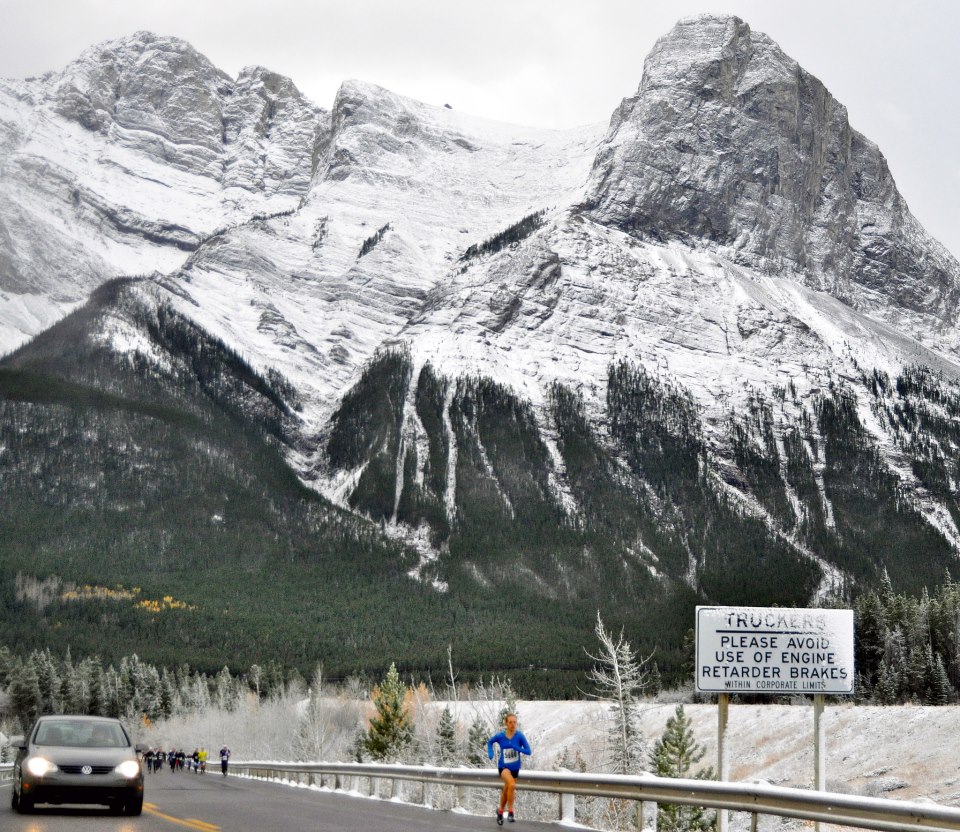
U.S. Ski Team member Liz Stephen extending her lead to win the second annual Spray Drag running race on Saturday in Canmore, Alberta. (USSA Nordic courtesy photo)
Thirty-six men in the Spray Drag running race didn’t end up chasing Devon Kershaw up Spray Lakes Road in Canmore, Alberta, on Saturday, but they had one heck of a battle from the start.
According to American Sylvan Ellefson (Ski & Snowboard Club Vail/Team HomeGrown), the pace was fast for a bunch of nordic skiers early on.
“Any road runner could have pulled away, but it was a quick pace,” he wrote in an email. “It continued on the road with a couple of us switching off in the lead.”
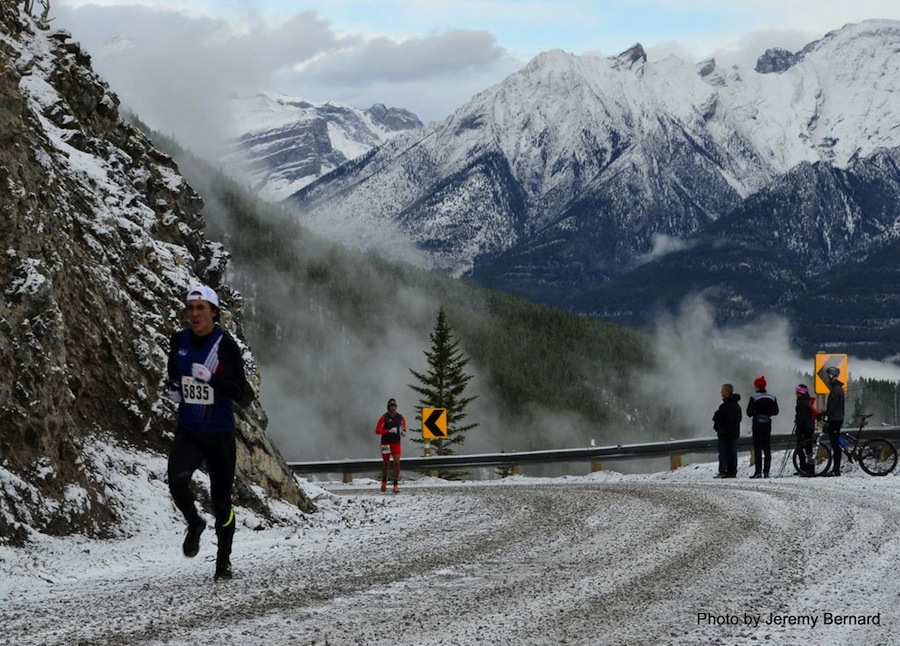
From the Canmore Nordic Centre, racers (including 26 women and seven junior boys) ascended a snow- and dirt-covered road to the Spray dam. In an email, race organizer and Alberta World Cup Academy coach Stefan Kuhn wrote that some fresh snow made for an interesting race, and it was “definitely colder at the top than last year.”
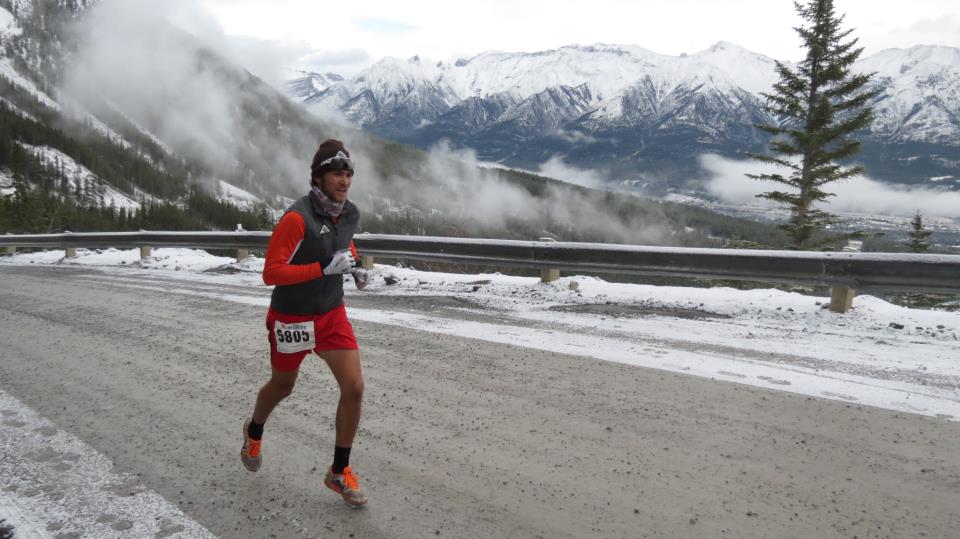
Start of the Spray Drag men’s race on Saturday in Canmore, Alberta. The second-annual road run up Spray Lakes Road was a fundraiser for the Alberta World Cup Academy. Graham Nishikawa (5835) won it, followed by Sylvan Ellefson (5805) in second and Michael Somppi (5818) in third. (AWCA courtesy photo)
The men raced 7.5 kilometers with nearly 400 meters (1,312 feet) of elevation gain, and the women and juniors did 5 k.
About six men took off at the beginning of the dirt road, including Ellefson and AWCA/Senior Development Team skiers Graham Nishikawa, Michael Somppi, Kevin Sandau, Graeme Killick, and Jesse Cockney. Nishikawa and Ellefson opened up a gap around the halfway point, and Nishikawa – who holds the course record in 29:23 – tested his competitor with about 1 k to go.
“Nish moved ahead of me put a little speed in to see how I’d react maybe (at least that’s what it felt like, not sure if he actually did … ha),” Ellefson wrote. “And then with about 200m to go he kicked and I couldn’t hold on.”
Nishikawa, who was third last year to Canadian World Cup Team members Kershaw and Ivan Babikov, won the second annual race – an AWCA fundraiser – in 30 minutes and 28.1 seconds. Kershaw won it last year in 29:44. According to Kuhn, the Canadian national team didn’t compete this year because the race didn’t fit in with their schedule in Canmore.
“It is a very tough course,” Nishikawa wrote in an email. “I am happy to see my shape is good after the Park City camp.”
Sylvan Ellefson (SSCV/Team HomeGrown) working to catch Graham Nishikawa (AWCA/CNST) in the final stretch of Saturday’s 7.5 k Spray Drag road race in Canmore, Alberta. (SMS courtesy photo)
The runner-up, Ellefson finished 14.1 seconds back. Somppi was third (+24.1) and Killick placed fourth (+27.3), respectively. After leading early with Nishikawa and Ellefson, Sandau was fifth (+1:05.5).
The women’s race turned out to be a spectacle with U.S. Ski Team member Liz Stephen crushing the competition and course record. She won by more than three minutes in 23:01.2, besting the record (25:41 by Madeleine Williams) and last year’s winning time (25:53 by Brittany Webster) by nearly three minutes. Last year, Perianne Jones was second, and Rhonda Jewett finished third.
After Stephen, Canadian Zoe Roy, who skied for the University of Utah and now trains with Rocky Mountain Racers, placed second (+3:02.0). Heidi Widmer (AWCA) was third (+3:27.3).
“We where excited to see Heidi run a [personal best],” Kuhn wrote. “Race winner Liz definitely showed us a new level for this event for the ladies’ time.”
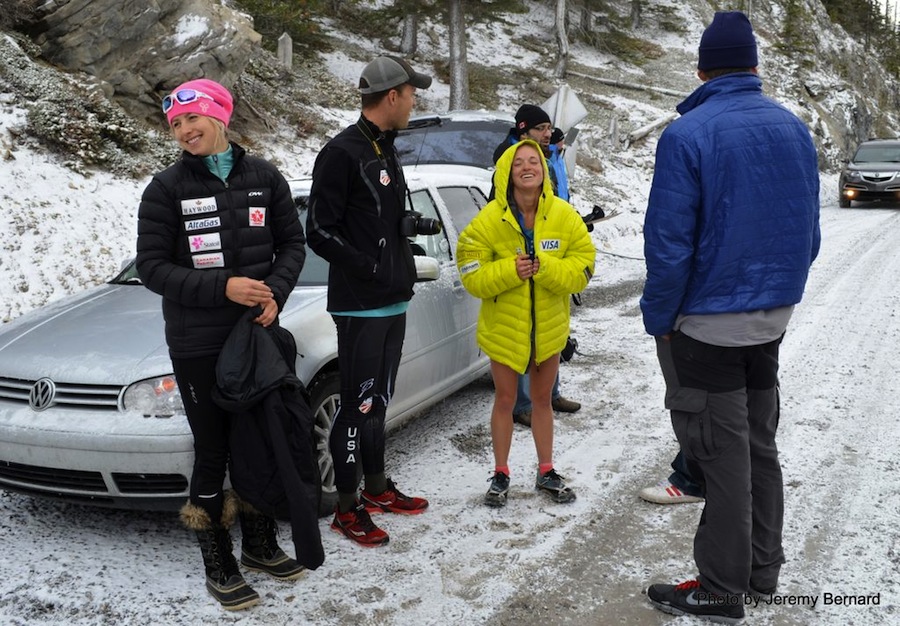
Liz Stephen (in yellow) tries to warm up after winning Saturday’s 5 k Spray Drag hill climb by more than three minutes in Canmore, Alberta. She’s greeted by Canadian World Cup skier Chandra Crawford (l) among others. (AWCA photo)
U.S. Ski Team member Liz Stephen extending her lead to win the second annual Spray Drag running race on Saturday in Canmore, Alberta. (USSA Nordic courtesy photo)
AWCA skier Graham Nishikawa (l) leads American Sylvan Ellefson near the top of the Spray Drag running race in Canmore, Alberta. (AWCA photo)
Sylvan Ellefson (SSCV/Team HomeGrown) working to catch Graham Nishikawa (AWCA/CNST) in the final stretch of Saturday’s 7.5 k Spray Drag road race in Canmore, Alberta. (SMS courtesy photo)
The start of the Spray Drag men’s race on Saturday in Canmore, Alberta. The second annual road run up Spray Lakes Road was a fundraiser for the Alberta World Cup Academy. Grahama Nishikawa (5835) won it, followed by Sylvan Ellefson (5805) in second and Michael Somppi (5818). (AWCA courtesy photo)
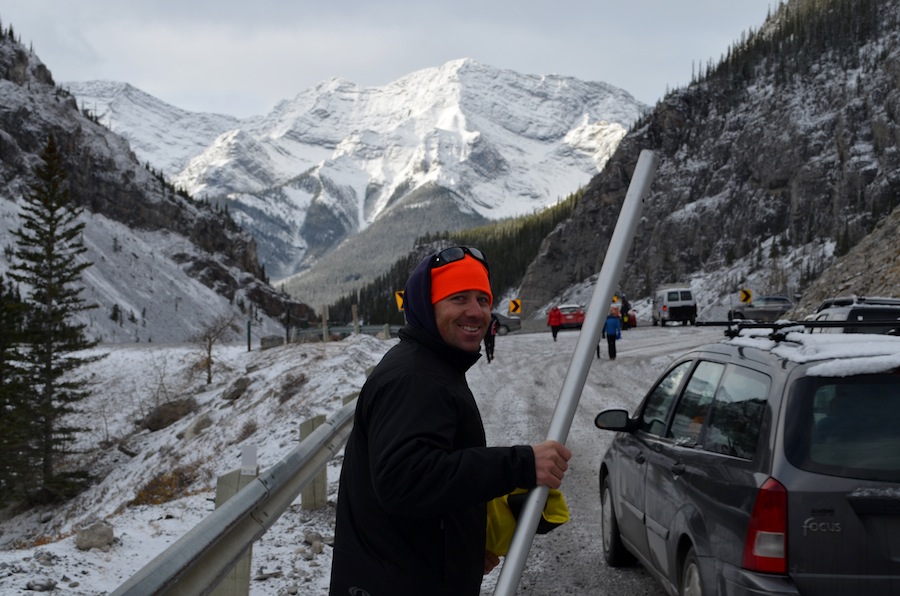
Alberta World Cup Academy coach and race director Stefan Kuhn at the top of the Spray Drag hill climb in Canmore, Alberta. (AWCA photo)
Come challenge World Champion Devon Kershaw along with the entire Alberta World Cup Academy in a running race up the Spray Lakes road! All proceeds go to helping support the team for their upcoming season…
According to AWCA coach and race organizer Stefan Kuhn, “It’s basically all up hill … Starts on the river and we run all the way up then past the nordic center and up to the Spray dam, which looks over Canmore.”
Race Information:
Entry Fee $35.00 – registration on Zone4.ca, deadline is October 18th, 2011
Bib pick up Friday October 19th between 2 – 6pm at Ultimate Fit Center on Main Street
Last minute pick up can be done at Bill Warren Training Centre between 7:45 – 8:15am on race morning
8:15am briefing at cross country ski stadium at the Canmore Nordic Centre
A van will be at the Nordic Centre parking lot and at each starting point for shuttling clothing to the finish line. Shuttling from the finish line to the Nordic Centre will be available.
There will be 3 Vans to shuttle people down from race finish to Nordic center parking lot.
Awards/snacks/prizes at BWTC – TBD room 12-2pm
Start Times:
Women and Junior Boys/Girls 17 and Under – 9:30am – 5km – Rundle view Entrance.
Open M 18+ – 9:40am – 7.5km – Green gate about 400meters from power plant spill way.
Finish at the top of Spray Road by the dam for both men and women
Lactate: During power exercises such as sprinting, when the rate of demand for energy is high, lactate is produced faster than the ability of the tissues to remove it, so lactate concentration begins to rise.
Think you have what it takes to have the highest lactate? $50 will enter you in the 50/50 draw which will measure your lactate at the finish line. The harder your push, the better your chances!
50% of entry goes to AWCA and 50% goes to the winner. Separate draws for men and women. Registration for Lactate Challenge on Zone4.
The Alberta World Cup Academy team behind a banner promoting the upcoming World Cup races from Dec. 13-16 in Canmore, Alberta, during a Canada Day parade July 1 in downtown Canmore. (AWCA courtesy photo)
This is the third preview in a quick-and-dirty series about Canadian national-training centres. We asked coaches to send their 2012/2013 rosters and tell us what’s new for the coming season. We will be publishing additional reports over the next few weeks. Teams are presented in no particular order.
Team: Alberta World Cup Academy (AWCA)
Coaches: Chris Jeffries (head coach/women’s coach), Mike Cavaliere (racing director/men’s coach), George Grey (women’s assistant coach), Stefan Kuhn (universal coach/men’s assistant), Jeremy Hecker (summer intern), Rob Soffer (strength and conditioning trainer), Shelly Collier (strength and conditioning)
Roster: 20 senior athletes, eight of which are on the Canadian Senior Development Team (SDT), between the men’s and women’s teams
The 2012/2013 AWCA women’s team stops for a photo while rollerskiing on Palliser Range in Banff National Park in the Canadian Rockies. (AWCA courtesy photo)
Men: Kevin Sandau (SDT), Graham Nishikawa (SDT), Graeme Killick (SDT), Brent McMurtry (SDT), Jess Cockney (SDT), Mike Somppi (SDT), Phil Widmer, Patrick Stewart-Jones, Matt Wylie, Russell Kennedy, Chris Hamilton
Who’s new: Four men – McMurtry (from Pierre-Harvey National Training Centre), Somppi (NDC Thunder Bay), Hamilton (NDC Thunder Bay) and Kennedy (Canmore Nordic Ski Club).
Three women – Thomas (from Nakkertok), Greer and Reid (first-year seniors).
Also on the team, three juniors all born before 1994: Dahria Beatty, Suzanne Stevenson and Brittany Evans. According to Jeffries, this is notable since the team didn’t have any female applicants or additions last year and received as many as 20 applications this spring. This year, the women’s team – with 12 total skiers – exceeds the men’s by one.
“All of the above are very good skiers, it is just challenging because of the strength of the group and our applications,” Cavaliere wrote in an email. “Drew had a great career and always brought a lot of professionalism to our team, and we wish him the best … and we are sure he will make some great contributions to skiing in the future.”
Top results last season: Sandau and Marshall clinched the overall men’s and women’s NorAm titles, respectively, to secure World Cup starts and start in prime positions this season.
Cockney celebrates winning the 1.6 k NorAm freestyle sprint ‘A’ final at Black Jack Ski Club in Rossland, British Columbia. (Photo by Dan Roycroft/AWCA)
Cockney won three NorAm skate sprints, including his first of the season in Rossland, B.C., where he skied away from the pack and ahead of the crashes to come out on top. According to Cavaliere, that style is what they’re looking for.
“Take some chances, be aggressive and go for it,” Cavaliere wrote.
The next day, Cockney pushed his teammate Sandau to win the mass start after hanging with him for several laps.
“It has been a great couple of years watching the overall progression of the group and their ability to push each other in races,” Cavaliere added about the Academy, now in its fifth season.
In all, eight AWCA athletes won races last year, and two more, Greer and Reid, topped junior podiums. Sandau won four NorAms and placed second in four others, battling with McMurtry throughout the season for the overall title. He went on to notch a World Cup career-best of 37th in a 35 k mass start in Falun, Sweden.
McMurtry was a runner-up at five straight NorAms then finished fourth before securing his first win, and closed the season with four victories. Like Sandau, Graham Nishikawa earned some World Cup starts, and back home, he won a NorAm 15 k pursuit in Canmore, Alberta, and finished fourth at Canadian nationals in the 50 k classic mass start. Killick started last season with a 10 k classic SuperTour win in West Yellowstone, Mont., and later won the Mont Orford NorAm 15 k skate. Phil Widmer won the NorAm skate sprint in Whistler, B.C., and placed third in the sprint at nationals.
Heidi Widmer leads AWCA teammates Marshall (c) and Nishikawa (r) in the NorAm skate sprint semifinal at the Canmore Nordic Centre in on Jan. 21. Marshall won the A-final, Widmer was second and Nishikawa was fifth. (Photo courtesy of Angus Cockney)
Widmer’s younger sister, Heidi, also won a NorAm skate sprint. She turned 21 shortly after the U23 World Championships in Erzurum, Turkey, where she was 27th in a skate sprint.
The two women on the senior development team, Marshall and Emily Nishikawa had a rivalry similar to Sandau and McMurtry on the NorAm circuit, except Marshall and Nishikawa were teammates last year. Marshall tallied two NorAm sprint victories (four if you take out U.S. Ski Team member Jessie Diggins in two early NorAm sprints). She placed 35th in a World Cup skate sprint in Poland and 37th in a classic sprint in Lahti, Finland, and at nationals, the 24-year-old was second in the 10 k skate.
Nishikawa, 23, won the 10 k at nationals, which might have been a bit of redemption for missing out on a trip to the World Cup last season. Either way, she went to U23 World Championships, where she placed 17th in a 10 k classic, and tallied five NorAm wins mostly in distance events.
As part of a new arrangement with the national team, Marshall and Nishikawa have been training with the women’s World Cup skiers (Chandra Crawford, Perianne Jones and Dasha Gaiazova) while they’re in Canmore. Later this week, most of them will meet up in Whitefish, Mont., for an AWCA camp.
Coach’s comment: After dividing the team into men’s and women’s training groups this spring, Jeffries wrote in an email that the program has become more manageable.
World Cup Academy members getting ready for a rollerski in Canmore in August. (AWCA photo)
“Each coach has a more defined role and can better focus on individual athletes vs. group management,” he wrote.
Personally, Cavaliere’s satisfied to see the transition working. “Both groups are happy and working well with the coaches,” he wrote. “We love what we see.”
At the same time, the Academy’s philosophy remains the same.
“We generally focus on the process-progress of each individual and against themselves,” Cavaliere added.
Nothing’s really changed in terms of goals; they want to place athletes on the World Cup team and start as many World Cups as possible.
“We always view our job as getting them to 97% and let the [World Cup] coaches and IST [Integrated Support Team] get them from 97-100,” Cavaliere wrote. “We are always being creative in the type of training and work we do to close the gaps and strengthen each individual. This is what makes being involved with our team so exciting – lots of perspectives and diverse ideas.”
Canmore in July. (AWCA photo)
Five years since Cavaliere created the training centre, which has quickly become a development powerhouse, he acknowledged its challenges. Financially, providing the highest level of support for a couple dozen athletes isn’t easy.
“I think we just have to accept that we have to balance a fine line between what is a need vs. a want,” he wrote. “I believe we can afford everything we need. Having the WC/Nationals in the west always helps our budget a lot. We also hope to get more involved in some business ventures, which may help generate some consistent funding.”
After two Olympians, Grey and Kuhn, joined the coaching staff last year, Grey is balancing another life change – a baby – and recently moved back to Rossland to be with his new family. Cavaliere explained his team involvement will be camp and competition specific.
“We will still use George as he is an incredible resource, but we have an efficient system and lot of knowledge,” he added. “He all just have to work a little harder.”
AWCA skiers, including Kevin Sandau (r), get the crowd going while rollerskiing through a Canada Day parade on July 1 in downtown Canmore, Alberta. (AWCA photo)
Alberta World Cup Academy coaches Stefan Kuhn (l) and Chris Jeffries (r) work on skis during Saturday's NorAm races at Sovereign Lake in Vernon, British Columbia. (Photo by Dan Roycroft)
VERNON, British Columbia — Mike Cavaliere had a pretty distinct idea of what he wanted the Alberta World Cup Academy to look like when he developed the training center just over four years ago.
With several AWCA athletes zipping around in the Canadian national team’s unmistakable neon jackets and four Olympians assisting them at last weekend’s NorAm opener at Sovereign Lake, things appeared to be going as planned.
If anything, Cavaliere, a 2006 Olympic coach and the academy’s racing director, wanted his 21 athletes and nine staff members to draw more attention to themselves.
“Mike actually got mad at us on Sunday because we set up in sort of a back corner out of the way,” said Chris Jeffries, a 2006 Olympian in his first year as the academy’s head coach.
“At the end of the day, Mike’s like, ‘All right, this does not happen again,’ ” Jeffries said. “ ‘We’re not a back-corner team, we’re a front-and-center team.’ ”
AWCA member Kevin Sandau (second from left) at the top of the podium after winning Sunday's NorAm 15 k classic individual start at Sovereign Lake in Vernon, British Columbia. Brent McMurtry (CNEPH) was second (far left), and Karl Nygren (CXC) was third. (Photo by Jesse Winter/JesseWinterPhotography.com)
After helping Cavaliere revive the Canmore National Training Centre, which closed in 2003 and reopened as the Alberta World Cup Academy in 2008, Jeffries appreciated that mentality.
All three of his Olympic cohorts, now academy coaches and support staff, did as well. Unwinding after the weekend in a Silver Star condo, Stefan Kuhn and George Grey — two recently retired Canadian Olympians — sat in a living room with Jeffries and Dan Roycroft, who competed in the 2006 Winter Games.
The academy wasn’t intense as it appeared, Jeffries said. That just didn’t always show on race day.
“It’s structured, but it’s laid back,” Jeffries said. “It’s one of the nice things about being on a staff with your friends, guys you grew up racing with. It’s an extension of what we did when we were racing.”
Two of the team’s newest coaches, Kuhn and Grey are not far removed from their racing careers. Last spring, the 32-year-old Kuhn announced his retirement for the second time. A celebrated Canadian sprinter, he initially left the sport in 2001 to become a chef, but returned in 2005 to make an Olympic run. This year, he said the decision was final and he was comfortable coaching sprinters.
One of his good friends, Grey also stepped down from competition earlier this year. Like Kuhn, who initially followed a passion outside skiing, Grey took a different professional route as a financial services manager in Canmore, Alberta. Six months later, Grey, 32, reconsidered that direction when Jeffries approached him with a coaching position.
Stefan Kuhn racing at the Rossland NorAm in December 2010.
“It came to a point in my career with the bank where I decided, ‘Do I want to further it or do I want to explore other things before I head down that road permanently?’ ” Grey said. “I decided I’d take the winter to rethink and evaluate what my ambitions and things are for the future and here I am working with the ski team and I couldn’t be happier right now.”
The academy as the brainchild of Cavaliere has worked so far. In its fourth season, the AWCA includes 10 national-team members, seven of which are seniors. Three other training centers serve as official extensions of Cross Country Canada: Thunder Bay, Centre Pierre-Harvey and Callaghan Valley. Of them, the AWCA in Canmore and the Pierre-Harvey institute in Quebec City rank as ‘A’-tier teams.
Cavaliere said a large part of that is because of his academy’s ideal location in Canmore, where it shares training facilities with Canadian National Ski Team members. There, his athletes can bump elbows with World Cup athletes, and be in contact with Canada’s head coach, Justin Wadsworth.
With a larger roster than most, Cavaliere said the academy works with a “fairly hefty” budget, adding that they’re careful with spending. Rather than travel in the summer to ski on snow, AWCA members stay home to train on the glacier.
“We live in the greatest facility in I think the world,” Cavaliere said. “So why would we have to go anywhere else?”
By finding similar ways to save money, he said team costs have gone down in the last few years as the academy has subsidized its athletes more. In paying for about 55 percent of each athlete’s expenses, he said the program is about on par with other cross-country skiing development centers in Canada.
The difference is that AWCA was the first to be privately funded. After a year as an unofficial high-performance academy, it grew into an “A and B training center,” Cavaliere said. That meant it could provide services just below that of a World Cup team and receive access to strength coaches, a team doctor and a physiotherapist, courtesy of Cross Country Canada.
“Everybody looks at us and says, ‘You’re rich, you get this, you get that,’ ” Cavaliere said. “But we’re wise. We buy great used vans and we take care of them. We’re frugal, I’d say, even though we may not appear to be.”
After starting the program with one minivan, the academy’s fleet has grown to two 15-passenger vans and two rental trucks for trips. While Cavaliere may count every dime, he doesn’t hold back when hiring coaches.
As soon as he found out Grey quit his job at the bank, he sent Jeffries to make him a job offer. In the meantime, Cavaliere poured over the budget to figure out how to make it work. In late November, Grey accepted the position and started working with the team two weeks ago.
George Grey (CNST) racing the 15 k classic at the 2011 World Championships in Oslo, Norway.
“It was really exciting,” Cavaliere said. “Here’s George Grey, one of our best distance skiers. We’ve got (AWCA athlete) Kevin Sandau, and they’re probably eight or nine years apart, and they can stand on the ski trail today and talk about a little strategy for next week. … That’s pretty powerful stuff. You can’t get that in a manual.”
Besides athlete development, which according to his vision meant bringing up the quality of skiers while maintaining about 20 skiers, Cavaliere was passionate about keeping former athletes in the sport. Coaching wasn’t for everybody, but it was important to keep those with elite experience contributing to its growth on some level — either as a tech, support staff or industry member.
“If you look at the four of us (Jeffries, Kuhn, Grey and Roycroft), we’re probably talking about millions as far as what’s been spent on us in our career by the federation,” Jeffries said. “If they don’t engage us post-racing career it’s wasted money.”
Cavaliere said keeping the best athletes involved in a sport is the key to its international success, citing some Scandinavian cross-country skiing strongholds as examples.
“We’ve always wanted to retain these guys,” he said. “Every great sport system in the world keeps their greatest people involved in the sport.”
By helping to convince Jeffries to join him in an apprentice role in 2008 and swaying Kuhn and Grey this year, Cavaliere has created the program he envisioned from the start. For the first time this year, he gave full coaching responsibilities to Jeffries and took more of an administrative role. He would only step in for minor comments, he said, such as where the team should set up at races.
“If I had to compare us, I’d say we’re like APU (Alaska Pacific University) in some ways,” Cavaliere said. “They’re not off in the bush, they’re out there and people can see how much work they’re doing. If you want to make change you have to lead by example.”
One example they’re setting is that athletes can make great coaches. After a successful junior career, Eric Groeneveld is in his third year as an AWCA apprentice coach. Contracted out by the academy, the 22-year-old is also the head coach of the Foothills Nordic Ski Club and will soon have his choice of head coaching positions at other clubs.
“The goal is not to have him in the program much longer,” Jeffries said. “He’s learned the tools and he understands what a good program looks like.”
The academy’s two other coaches, Kuhn and Grey, are also learning the ropes. For former World Cup athletes, waxing knowledge isn’t a forte.
“Our waxing history is essentially hand our ski bags to the tech,” Jeffries said, recalling the first time Cavaliere left him in charge of waxing at a race.
“I opened up the wax box and I had a couple parents there that were helping me wax,” he said. “(I) pulled out the first wax and I was like, ‘So what’s this? and they were like, ‘That’s LF4. And I was like, ‘All right, let’s try that one.’ ”
While he doesn’t trust many people with waxing race skis, Jeffries said he immediately approved of Grey and let him apply kick wax last weekend.
“It’s nice that you can trust the people that you’re working with,” Jeffries said. “It’s nice that I can trust them to say that this feels good, I don’t have to try it myself. If (lead glide tester) Dan (Roycroft) says that this is a great ski, then I know it’s going to be a good ski.
If you’ve ever wanted a chance to beat a World Champion, you’re in luck. Of course, it won’t be easy.
The Alberta World Cup Academy (AWCA), the Canadian training center based in Canmore, Alberta, is hosting the Spray Drag Running Race – and World Champion and Canadian National Ski Team (CNST) member Devon Kershaw is headlining the event.
The idea is pretty similar to the recent ‘Climb to the Castle’ held at Whiteface Mountain in New York state – find a stretch of road that goes uphill, start at the bottom, suffer a lot, end at the top.
In Canmore, this means starting from almost downtown, heading out of town past the Canmore Nordic Center, and up Spray Lakes road, a gravel road that climbs to the top of a pass outside of town – gaining some 1200 feet in elevation.
“He’s always looking for a good running race, and keen to help out,” said Stefan Kuhn, organizer of the event and AWCA assistant coach in a recent interview with FasterSkier.
Kershaw has a reputation as a runner, including running 10 k in 33:46 – at the end of an Olympic-length triathlon (1500 m swim, 40 k bike, 10 k run).
Kershaw will face 7.5 k, almost entirely uphill, while the women will do a slightly shorter 5 k.
Kuhn is hoping for a good turnout – and not just the elite skiers of the AWCA and CNST. He is hoping to entice some of top runners in the Calgary and Banff area into a duel with Kershaw.
“I’d love to see someone push Devon to the finish,” Kuhn said.
The AWCA has run the event before, but only as a small team time trial. Current AWCA and CNST Development team member Graham Nishikawa holds the men’s record, while 2010 Olympian and former AWCA member Madeleine Williams holds the women’s course record.
According to Kuhn, Nishikawa is planning on contesting the event again this year, but Williams will not, leaving the challenge open to a number of other top Canadian women, including some of the CNST World Cup team and Development team.
In terms of reward, the event is a fundraiser for the AWCA, so no prize money will be doled out – just bragging rights if you’re able to bag some of the top skiers in the country.
But Kuhn promises some unique prizes – including gold running singlets for the best male and best female runners on the day.
They have also introduced a new competitive aspect that you don’t see at many events – lactate testing.
For $50 you can enter a 50/50 competition where the AWCA will test your lactate at the finish, and the person with the highest number takes home the prize pot.
Interested in the record? Phil Widmer recorded a 16.4, and nobody has managed to top that mark yet.
The event goes on October 15th, and registration closes on Oct 13th.
Kuhn on his way to qualifying for the classic sprint at the 2010 Vancouver Olympics (Photo: Brad Jones)
Canadian Stefan Kuhn has made a rapid transition from elite skiing to elite coaching.
The former Canadian National Ski Team (CNST) member and Vancouver Olympian announced his retirement less than six months ago, and was immediately snapped up in a coaching capacity by the Alberta World Cup Academy (AWCA), one of Canada’s premiere training centers.
During his career, Kuhn was primarily a sprinter – as is evidenced by his 15th place finish in Vancouver, the best ever result recorded by a Canadian male in a sprint at the Olympics.
As a result, a large part of his experience, and his favorite workouts from both coaching and racing, are those focused on speed.
In an interview with FasterSkier, Kuhn explained that in the fall, his aim is to increase the focus on Level 4 intensity workouts, in order to bring up the athletes’ speed.
For his specific favorite speed session, often held on the rollerski track at the Canmore Nordic Center, Kuhn splits athletes into small groups of 3.
The athletes then ski in single file, in a follow-the-leader style at an easy pace. The person in front is in charge of starting the interval – anytime he wants, he can jump into a level 4 attack on the other two. The attack can last from a minimum of 10 seconds, to a maximum of 1 minute, and the other two athletes have to try and stay with the leader, much as you would in a race when someone increases the pace.
After each rep, the leader switches, giving each athlete an opportunity to ‘attack’.
For Kuhn, the goal of the workout is to teach awareness, reaction times, and mental toughness all at speed.
“A guy can go out super hard, and you think he’s just going for ten seconds, and you hang on,” Kuhn said, “But all of a sudden you’re a minute in and you’re just blown.”
Kuhn recommends that the full workout run about an hour and a half to two hours, with roughly two sets of 10 to 15 reps separated by a ten minute break.
He also suggests a minimum of at least a minute between ‘attacks’, in order to be completely rested and ready for the next one.
Kuhn has the unique experience of doing the interval set as an athlete, and now running it as a coach.
“It’s something I did as an athlete and really enjoyed, and now get to do as a coach, and athletes really enjoy it,” he said.
Kuhn on his way to qualifying 10th during the classic sprint at the 2010 Vancouver Olympics (Photo: Brad Jones)
If you’re a male looking for a spot on the Canadian National Ski Team (CNST), you may be in luck, because this season there may be a few open spots.
In addition to George Grey retiring, veteran sprinter Stefan Kuhn has opted to step away from his ski racing career.
“When I made my comeback, my goal was always the Olympics,” said Kuhn in a recent interview with FasterSkier.
“To have succeeded in that goal, going to the Olympics, having a 15th place at the Olympics, and then having a World Champs in Norway, is better than I could have imagined.”
Kuhn in his younger ski-racing days
Kuhn has been to just about every event one can hit as a Canadian cross country skier – World Juniors, a home Olympics, two World Championships, and has seen it all.
One of his most rewarding memories is his comeback. At the end of the 2000 season, at just 20 years of age, he moved away from the sport, and went to school to become a chef. But Kuhn couldn’t resist the call of ski racing, and four years later, he was back.
“It was extremely hard,” he said of making the transition back into a high-performance athlete.
“It was so motivating each year getting better. The lifestyle you live as a National Team athlete is amazing. I was lucky enough to have a group of guys who made it fun in and outside of skiing.”
But you can’t have a career without some moments of a disappointment as well – and for Kuhn, the hardest hurdle to overcome was in 2009.
In just the second race of the 2008-2009 World Cup season, Kuhn sprinted to 15th place in Lahti, Finland, qualifying him for World Championships in Liberec, Czech Republic, later that season.
He then returned home before Christmas, and followed a normal training routine leading up to the selection races, when he broke his shoulder while playing hockey. While recovering, he found out that Cross Country Canada (CCC) had decided not to send him to World Championships, as they weren’t prepared to risk the chance he wouldn’t be fully recovered.
However, Kuhn traveled to Europe, and aimed at gaining race experience on the OPA Cup circuit. Less than a week before World Championships, he recorded one of the first ever
Kuhn takes the silver medal during the 50 k at 2006 Canadian Nationals behind Chris Jeffries
Canadian victories on the OPA circuit, winning a classic sprint ahead of top Italian sprinters Loris Frasnelli and Fulvio Scola. Kuhn knew he was in good shape, and his results indicated it – Scola later went on to finish 13th at the classic sprint at World Championships.
“It was really tough mentally,” he said.
For now, Kuhn is trying to settle into a life without full time training. In April he hopes to relax, go ski touring, and finally figure out what do when May rolls around and he no longer swings into full time training.
He has some interest in coaching, and has been approached by a few teams, and it is something he is seriously considering.
“The amount of time we have spent on the World Cup, and racing as a junior, racing through your life, and your life experience – that’s all valuable experience,” said Kuhn.
“You think about all the money that’s been spent on us, and the knowledge we have. It’s quite valuable to use, for those that have the interest.”
Kuhn is aiming at the developmental level of coaching, and hopes to find a way to help out at a training center.
Over the course of his career, Kuhn has seen the level of skiing in Canada rise steadily, and he feels as though he can contribute to its continuing success.
Kuhn during the sprint in Sun Valley this spring
“The first year George and I were seniors, we were the top two guys at Senior National Championships. We were first and second by like a minute,” he said. “Now it’s a lot more difficult just to crack the top 10 at a NorAm event.”
Outside of skiing, he will be going back to cooking, but not full-time. Kuhn hopes to work something out with Sara Renner and Thomas Grandi, the owners of the Paintbox Lodge in downtown Canmore, Alberta.
But is there any chance of a comeback? He has done it once before…
“There is no way,” said Kuhn, laughing. “When I was 24 it made sense. Now, if I do any comeback, I am going to the US Open for tennis. There is one spot that is a free-for-all, and I heard Bode Miller tried out for it last year, so I’m thinking of giving it a shot.”
The SuperTour Final is turning into an international affair. With a group of Norwegians already confirmed, as well as Swedish and Japanese skiers, the Canadians are bringing some artillery as well.
No fewer than four Canadian groups are headed to the United States for a final shot at high-level racing this season.
Cross Country Canada (CCC) has a trip heading to Idaho. The Alberta World Cup Academy (AWCA) is sending a variety of athletes, both junior and veteran. Rocky Mountain Racers (RMR), a club team based in Canmore, Alberta will have a strong contingent, and a group from British Columbia led by former Canadian national team head coach Dave Wood is expected to head south as well.
The majority of athletes on the CCC trip will drive from Canmore to Idaho this week with trip leader James Cunningham. In an e-mail to FasterSkier Thursday, Cunningham estimated that upwards of 30 Canadian athletes will be on the start list.
Graeme Killick racing in the 15k classic SuperTour in West Yellowstone earlier this year.
Led by Cunningham as well as club coach Mike Vieira, the CCC trip features twelve junior and U-23 athletes. Top U-23’s Graeme Killick of the Canadian National Ski Team (CNST) and Mike Somppi of National Development Center Thunder Bay (NDC-TB) headline the list, as well as junior Andy Shields (NDCTB).
Killick is coming off a strong Canadian national championships. The 22-year old up-and-comer recorded two second place finishes in the races in Canmore, in the 10 k freestyle and 15 k classic, both behind top finisher George Grey (CNST).
As for Shields, the 20 year old was recently crowned Canada’s top junior, winning the 15 k classic as well as the 30 k mass start freestyle at the Canadian National Championships.
According to Cunningham, the CCC group he is leading will not be contesting the 30/50 k races at U.S. National Championships, but another group of CNST team skiers is heading down for those events.
The group heading to the distance races features some of the heaviest hitters in the Canadian lineup, including Stefan Kuhn (CNST), Brittney Webster (CNST/AWCA), Kevin Sandau (AWCA), and Brent McMurtry (CNEPH).
“Based on the way the guys skied at [Canadian] Nationals, we expect them to be challenging at the front,” wrote Cunningham in an e-mail to FasterSkier.
Cunningham also considered the fact that the US Ski Team (USST) will be attending the races in full force, as well as the attendance of Chandra Crawford (CNST), as a big motivating factor for the trip.
“Chandra and Kikkan [Randall] will highlight the women’s field, and offer a great chance for the next generation to test themselves against two of the best sprinters in the world,” Cunningham wrote.
For Crawford, it will be her first time taking on the spring racing series, and in a recent e-mail to FasterSkier, she described it as being all about building up her base.
“Having made it through this year with 100 percent health, [CNST Head Coach] Justin [Wadsworth] is comfortable pushing me to race more, and make distance form a big priority in the coming years,” Crawford wrote.
“I’m super keen on it, so I’m going to Sun Valley to go hard in the most fun environment possible,” she wrote.
The U.S. championship in the 50 and 30 k covers the 26th and 27th of March, while the SuperTour Finals mini-tour kicks off March 29th with a 3 k freestyle prologue.
The 2011 Haywood Canadian National Championships began Saturday, and the drive to crown the next Canadian national champion starts now!
Held in the Canadian ski mecca of Canmore, Alberta, the premiere event in Canadian skiing features seven days of intense junior and senior racing action.
The racing opens with a Team Sprint on Saturday, March 12, followed by a middle-distance freestyle on Sunday, March 13. The athletes then enjoy a day of rest, and the racing resumes with an individual classic race Tuesday, March 14. The classic sprint is separated onto two days – the Open categories classic sprint Wednesday, March 15, and junior categories classic sprint Thursday, March 16. Finally the Championships conclude with long-distance freestyle mass start races on Saturday, March 18.
Canadian racing is at an all-time high, and correspondingly, the fields will be some of the deepest in the country in recent memory. While newly minted World Champions and Canadian National Ski Team (CNST) members Devon Kershaw and Alex Harvey are attending the late-season World Cup races, there is still plenty of Canadian World Cup-level talent racing.
Additional athletes missing include the Alberta World Cup Academy’s (AWCA) Graham Nishikawa, who has the NorAm World Cup slot for the spring World Cup tour, and possibly CNST member Ivan Babikov, who is on the verge of cracking the top 50 in World Cup rankings, the level which is required to participate in the World Cup Final.
FasterSkier provides a brief preview of the men in action who may be vying for the aggregate title of Canadian National Champion.
Veterans
Multiple-Olympian and World Cup medalist George Grey (CNST) is the biggest name in action, and when he is at or near the top of his game, there are very few men in Canada who can match him, at least in the distance events. Grey has not been at his best this season, but if he can recapture some of the form he had during the Vancouver Olympics, he will be almost untouchable.
Following Grey, Stefan Kuhn (CNST) has also returned from Europe, and considers the Nationals a home race, as he lives in Canmore. It may also be his last National Championship ever – the 31 year old veteran has hinted at retirement via Twitter. Kuhn has two events he excels at – middle distance classic racing, and classic sprinting, so be assured he will be in the mix.
After losing a tight battle on the NorAm circuit for the NorAm World Cup spot to Graham Nishikawa, Drew Goldsack (AWCA) will be back aiming for top results as well. The two-time Olympian has proved himself capable as an all-around skier this season, but the classic sprint suits him best. He has suffered through bouts of illness during the season, and his most recent result is not encouraging, as he failed to finish the Eastern Canadian Championships mini-tour.
Phil Widmer, racing out of the Pierre Harvey National Development Center (CNEPH), has been an impressive skate sprinter thus far this season, most notably finishing 18th at a World Cup sprint in Davos. However, outside of that, Widmer has struggled, as his top result in a domestic distance race is 27th in the 15 k freestyle at the NorAm in Thunder Bay, Ontario.
Young Guns
Graeme Killick (CNST), who put on a show at the 2010 Canadian Nationals by winning two races, has thus far had a disappointing season, but remains a strong classic skier. Killick is aiming for a couple of podiums, and is targeting Tuesday’s 15 k classic as his big event.
Likewise, Brent McMurtry (CNEPH) has been up and down on the result sheet over the course of the season. In a recent e-mail to FasterSkier, McMurtry described himself as “run down” heading into the early World Cup period, but has focused on recovery, and is feeling back in top form.
But McMurtry has additional OPA Cup experience, and has the advantage of knowing the trails well, as he is a native of Calgary, Alberta, and has skied extensively at the Canmore Nordic Center. However, McMurtry acknowledges he isn’t the only one with home-course advantage, as most of the top men either live full time in Canmore, or have spent a significant amount of time skiing on the trails at the Nordic Center.
Surprisingly, Nationals will be only the second set of races in Canada this year for McMurtry, so there is little indication of how he will stack up. But McMurtry is aiming high – he stated his first goal of the Championships is to win a race outright.
Perhaps the best young skier attending is one Len Valjas (CNEPH), who with a 15th place at World Championships and a top 10 result at the World Cup in Drammen, has turned into an impressive World Cup sprinter. Valjas is planning on racing the World Cup in Lahti, Finland, but will be returning to Canada in time to contend the individual start classic race on Tuesday, and most worryingly for everyone else, the classic sprint on Wednesday.
Dark Horse Talent
Kevin Sandau (AWCA) has been one of the hottest Canadian skiers following Christmas, at least in distance skiing. Sandau finished fifth at U-23 World Championships 15 k freestyle, and then crossed the line 24th place in the pursuit. After returning to Canada, Sandau kept the ball rolling, finishing 2nd at the Eastern Canadian Championships mini-tour.
Likewise, Jesse Cockney (AWCA) has emerged as an impressive U-23 skier, excelling in sprints. While he freely admits to struggling in the qualifying round, Cockney has the speed to go the distance over the course of the day, which he proved with a 6th place finish at U-23 World Championships in Estonia earlier this year.
Mike Somppi of the National Development Center Thunder Bay (NDC-TB) has also become a very solid skier, earning three podiums at the NorAm level, as well as finishing 14th in the 15 k freestyle at U-23 Championships.
Finally, David Greer (CNEPH) started the season off slowly, but has finished in the top five a handful of times on the NorAm circuit, and also skied to an impressive 14th place at Swiss National Championships. His distance skiing has improved over the course of the season to the point where he could easily pull off a surprise.
While the overall aggregate should be George Grey’s to lose, the level of male skiing in Canada at the moment means that it is anything but a lock. It is entirely possible a different skier could win each race, and the variety of race formats mean that no one athlete has a significant advantage.
Canadian National Championships kicks off Sunday, with a 10 k freestyle individual start race.
The decision by Canada’s Alex Harvey to skip Friday’s World Championships relay left a train of his disappointed teammates passing through the mixed zone after the race. Of all four athletes, Len Valjas probably summed it up best: “It’s probably a good call—it just sucks for us.”
Each of the Canadian starters had his own take on the situation, ranging from relative indifference to stern disappointment. But while it was clear that many of them were let down, veteran George Grey maintained that the men’s team, an especially tight-knit group, would move past what has become a small controversy.
“It hurt us a little bit short-term,” Grey said. “I’m confident we’ll all come out of it, and be a stronger team for it.”
Harvey announced Thursday that he was skipping the relay, one of cross-country skiing’s most storied events, following a victory in the team sprint earlier in the week that left him drained and exhausted.
With the Canadian relay squad a long shot for medals, Harvey decided to pass on the event in order to be fully rested for Sunday’s 50 k freestyle—a race in which the 22-year-old Quebec native has a more realistic chance at a podium.
The decision was pragmatic: In an e-mail Thursday night, Harvey said that his effort to help his teammates to seventh place in the relay four days before the Olympic 50 k last year in Vancouver had ruined his hopes for individual hardware.
But while Harvey looked at his options rationally, his teammates viewed the relay in more emotional terms.
Stefan Kuhn, who ended up scrambling for the Canadians, said that the relay was “the biggest race in cross-country,” and that “if you want to prove you’re a good nation, you do it in the relay.” Grey, who anchored, called the race “something special…the most prestigious event in cross-country skiing.”
Harvey had said he thought the Canadians didn’t have a “reasonable chance” at a podium. But while Grey acknowledged that his form was off from last year, when he’d helped the Canadians to seventh in Vancouver, both Babikov and Kuhn maintained that the team still had a shot at the top three.
“That could have been my chance for the medal—maybe ever, you know? It’s just really sad to see him throwing that out like that,” Babikov said.
Both Babikov, 30, and Grey, 31,noted that the decision was especially disappointing coming from an athlete at Harvey’s point in his career. Babikov called Harvey’s move a “disrespect for the team,” while Grey said that “at such a young age, it’s a bit of a statement.”
“He felt that we didn’t have a good medal chance, and so he’d save it for the 50,” Grey said. “We respect that, but it’s hard not to feel it deep down, when we’re all friends, and we want to be on the line with our friends and teammates.”
For his part, Valjas, who trains with Harvey in a regional development program in Quebec, said he was “sure” that the decision was the right call. And both Kuhn and Grey said that they did respect Harvey’s position, even if left them disappointed.
As far as Grey was concerned, he said that he’d be supporting Harvey in the 50 k regardless—and that he didn’t have to cross the line in the top three to vindicate himself.
“I don’t think he needs to—we make decisions hoping for the best, and it often works in reverse,” Grey said. “Our team’s still strong—we still have a tight men’s group, and of any team on the World Cup, one of the tightest.”
On the third leg Ivan Babikov (CAN) and Noah Hoffman (USA) battled on the first lap before Babikov pulled away.
Much to the Americans’ and Canadians’ chagrin, the men’s 4 x 10 k relay at World Championships on Friday did not unfold as it often does.
“At the start, they usually jockey for a bit,” Canadian leadoff skier Stefan Kuhn told FasterSkier. “But one Swede, Daniel Rickardsson, was thinking otherwise today, because he had two bad races. So he wanted to prove a point.”
Instead of a tactical first leg, where many of the teams ski together in a pack, the hammer was down from the get-go. Rickardsson, perhaps out for revenge after two straight races with terrible skis, attacked early on, and only one man was able to follow him: Maxim Vylegzhanin of Russia. Neither the U.S. nor Canada was able to stay anywhere close to the speedy, lanky Swede.
Earlier this season, the U.S. had a promising relay result in Gallivare, Sweden. There, leadoff skier Andy Newell skied with the main pack for almost his entire 10 k leg, leaving Kris Freeman only a 15-second gap to close. Here in Oslo, the more intense pace did him in much earlier, and Freeman was faced with 14th place and a two-and-a-half minute deficit.
“Today was not a typical World Cup relay,” Newell said after the race.
Canada faced a similar situation. With neither Alex Harvey nor Devon Kershaw racing, Kuhn, who didn’t even know he was racing until this morning when Kershaw called in sick, scrambled.
“You could see the pack spread right away, after one kilometer,” he said. “It was a tough 10 k, that’s for sure. I wanted to move up, so I was in third or fourth…I skied for a while but then I was like, ‘I’m not going to win the relay leg.’ [Rickardsson] won the World Cup the week before by 30 seconds, so I just tailed off a little bit, and made it to the finish as best I could.”
Len Valjas skiing the second leg for team Canada.
Newell and Kuhn – two sprinters – skied together for part of the race, before Kuhn dropped his southern neighbor and tagged off in 13th place, 25 seconds ahead of Newell.
The American had other problems to deal with, besides the pace.
“I really couldn’t get any kick,” he said. “So that kind of sucked…On a good day, when I’m feeling good and I can kick my skis, being over two minutes back is kind of unacceptable.”
What happened next in the North American battle was not what most people would have expected. While Kuhn tagged off to Len Valjas, a young sprinter with only five distance starts this year and only one at the World Cup level – the 15 k at World Championships earlier this week, where he finished 48th – the U.S. cued up Kris Freeman, a veteran who has skied a number of strong relay legs in the past.
Kris Freeman (USA) closed a big gap to the Canadian team on the second classic leg.
Freeman looked strong and in control, and caught Valjas six kilometers into their leg. Once he did, Valjas said that it was “a little bit tactical.”
“He tried to gap me up that one big hill there,” Valjas explained. “He put a little gap on me, but I closed it back over the top, on the flats, so I got back on him. We got down [before the next big uphill] and he just stood up and let me go by, and I thought, ‘okay, we’ll play some games here.’ So I went in front and took it easy, and then attacked up the sprint hill. I didn’t gap him, so for the last quarter, I just practically walked… and then, on the last climb, I just really opened it up.
“It was fun just to compete with him,” Valjas said.
Valjas ended up tagging off six seconds ahead of Freeman. While he was pleased to have come out on top in the tactical battle, he pointed out that since Freeman had to catch him first, his performance didn’t really count as much of a victory.
Freeman was a gracious competitor, calling the Canadian’s move “impressive.”
“I think Lenny skied pretty well,” Freeman said. “I hope he did, because if he didn’t, then I didn’t.”
After his initial move against the Canadian, Freeman said that he didn’t have anything else left, and that it was hard to gauge his effort given the lack of other athletes around him. And while his skis were good, he wasn’t surprised that Newell had stuggled to kick.
“I tested what Newell raced on and I said, ‘no way.’ I went something else,” he said.
The pair then tagged off to Ivan Babikov and Noah Hoffman, who finished 30th and 29th, respectively, in the 15 k classic earlier this week, separated by just a tenth of a second.
While both are known more for their skating, for Hoffman, it’s to a relative degree. For Babikov, it’s a little more serious: he has a handful of World Cup top-tens, all in skate races.
Hoffman set out in hot pursuit, and quickly closed the six-second gap to Babikov.
Without Harvey and Kershaw in the race, Babikov said he was just using his leg as preparation for Sunday’s 50 k. Skiing without any pressure, he said he was enjoying himself, and it showed in his split. At just 53 seconds off Finland’s Juha Lalluka, Babikov’s time was the sixth-fastest of the third leg—the best of any of the eight North American skiers on Sunday.
For Hoffman, two-thirds of the way through the leg, the pace proved too much. His initial push caught up with him, and he popped.
“I should have caught [Babikov], but maybe catching him in a k, or however long it took, was a little fast,” Hoffman said.
Since all the teams behind the U.S. and Canada were ultimately lapped, Hoffman said that he should have kept his sights on Babikov, with whom he was engaged in a “two-team battle.” But he acknowledged that perhaps he shouldn’t have chased quite as hard early, which left him hurting later on.
Tad Elliott anchoring the United States team to 14th place.
“To give up [44 seconds] is not the way to beat Canada,” Hoffman said. “I would have been better tagging off to [anchor] Tad [Elliott] 15 seconds down, not ever having seen Babikov.”
Hoffman’s leg left the U.S. 50 seconds off the Canadians, and Elliott didn’t do much to stop the bleeding. Feeding off the tens of thousands of fans in the stadium and lining the trails, he went out aggressively, in pursuit of Canadian anchor George Grey.
“I knew there wasn’t anybody behind us, really… I started off so hard—it’s so loud—and kind of exploded,” he said. “I think here, it’s hard to control your pace, because everyone’s cheering, and you want to catch some people.”
Elliott’s leg was a rough one—he ended up more than two minutes behind Petter Northug (NOR), who had the fastest split of the fourth leg—and with Grey having a decent day, the race for North American bragging rights ended decisively, with Canada on top by nearly two minutes.
While the U.S. placed last of the 14 teams that finished the race—Great Britain, Australia, and Denmark were lapped and pulled—Canada’s anchor leg was enough to bring the country up to 12th, thanks to a move Grey put on Kazakhstan’s Yevgeniy Velichko.
A member of the Canadian Olympic relay team last year, Grey hasn’t been at his best this season, and had actually lost his spot on the country’s squad to Valjas. But thanks to Harvey’s decision, he got a chance to start on Friday.
“I’m just happy as hell to be here,” he said. “Not the strongest team, but I think we’re all very proud to do it for Canada.”
George Grey brings the Canadian squad home in 12th place.
Men's podium on Sunday in Drammen: Northug, Joensson and Harvey.
The North American men may not have a gold-medal favorite among their ranks for Thursday’s men’s World Championship freestyle sprint in Oslo. But if they lack a reliable podium candidate, they make up for it in their numbers: no fewer than seven U.S. and Canadian skiers have a shot at cracking the heats.
In Devon Kershaw and Alex Harvey, the Canadians have two men with freestyle sprints podiums already this season—Harvey’s a second place last weekend in Drammen, Norway, and Kershaw’s a win in January.
Canadian Len Valjas (bib 4) follows Norwegian Sindre Skar (bib 24) in the quarterfinals last Sunday.
They’re also got veteran Stefan Kuhn and rookie Len Valjas, who has enjoyed a breakthrough season and skied to a career-best ninth place in Drammen. The hillier course in Oslo is less suited to his strengths—at 6’6”, Valjas isn’t known as a climber—but after the result in Drammen, it’s clear the man is fit.
As for Kershaw and Harvey, their coach, Justin Wadsworth, said that both are healthy. Harvey is clearly ready, based on his podium last weekend; Kershaw is more of a question mark.
While Kershaw won a sprint stage at the Tour de Ski in January, he was 48th in the qualifier in Drammen, and in a tweet on Wednesday, he made it clear that he was still struggling to find sharpness.
“Easy ski on the old Holmenkollen track. Thought I may find some light, strong legs…to use tomorrow. Sadly, didn’t find any,” he wrote.
If Kershaw does come around, though, he and Harvey will find a course that favors them, according to Wadsworth.
Since the Oslo course, with its big hill and minimal rest, is good for distance skiers, Wadsworth said that it could suit his two top men.
“They’re the best in the world at distance races. So, the fitness is there,” he said.
How about the U.S.?
Andy Newell in action in Drammen.
Andy Newell is the one man with a real shot at the podium. With his third place in the qualifier in Drammen, it’s clear he has the speed. But on a course like Holmenkollen’s does he have the fitness?
Thus far this season, the answer has been “no.” In seven sprints, he’s made it through to the finals just once, and that was way back in November, in Finland. After Newell was eliminated in the quarterfinals in Drammen last weekend, the U.S. head coach, Chris Grover, told FasterSkier that the American had had some trouble absorbing training this year, but that things would likely be better in Oslo once Newell got a little more time to adjust to travel and jetlag.
Don’t count on Koos and Hamilton making the heats, but it could definitely happen. Koos is a former U.S. Ski Team member who was on the World Cup podium in 2007; he’s been up and down this year after making a jump to a club program in Washington. At the very least, he said Wednesday that he’s ready to go after a shoulder dislocation he suffered in a domestic Norwegian sprint race last week.
Hamilton, meanwhile, missed the heats in Drammen, but he has been in the top 30 earlier this year, at a World Cup in Switzerland, and he said on Wednesday that he’s feeling better.
“Workout went well today,” he said. As far as his goals? “Top 20 could be pretty sweet, maybe top 15—we’ll just take it one step at a time.”
At last year’s sprint in Oslo, Hamilton just missed out on the heats, finishing 34th.
But that race included a Norwegian “nation’s group,” and there were nine of the country’s sprinters in front of him. On Thursday, only five Norwegians will start, thanks to strict quotas set by the International Ski Federation. (Normally, each country gets to start four athletes, but as the defending champion, Ola Vigen Hattestad gets a free spot.)
The final North American starter? The U.S.’s Kris Freeman, who is much better-known for his distance skiing.
Freeman did crack the sprint heats for the first time in his career in January, at the Tour de Ski (not once, but twice!), but rest assured, he won’t be gunning for the podium on Wednesday. Instead, according to his coach Zach Caldwell, Freeman is looking for another hard effort before the distance races in Oslo get rolling—and it’s much easier to make one in a bib than in the woods by yourself, Caldwell said.
The rest of the men’s sprint field is deep and highly competitive. So competitive, in fact, that only Emil Joensson (SWE) has won more than one such event. Out of nine World Cup sprints this season, Joensson has four victories, making him the clear favorite in Thursday’s World Championship freestyle race.
Emil Joensson (SWE) is the clear favorite on Thursday.
The overall Sprint Cup champion last year, Joensson dominated the circuit – but in his biggest race of the season, the classic sprint at the Vancouver Olympics, he met with bitter disappointment. Eliminated in the semis, Joensson finished seventh, fell ill, and did not race again during the Games.
Joensson won the pre-Championship sprint in Drammen on Sunday, displaying his explosive finishing kick while besting Alex Harvey (CAN) and Petter Northug (NOR).
Even Northug does not appear to have the same acceleration as the Swede right now, so if Joensson can enter the homestretch within striking distance, he should get his gold medal.
Winning Olympic gold or silver should make you a favorite in the next year’s World Championships, but only if you get a start spot. Russians Nikita Kriukov and Alexander Panzhinskiy skied away from Northug and Ola Vigen Hattestad in Vancouver, but will not start in Oslo. The pair are far stronger classic skiers.
The Russians are counting on the bearded Alexei Petukhov and Nikolay Morilov for medals. Petukhov is currently third in the Sprint Cup and has a World Cup victory and four finals appearances this season and Morilov has been in the points six times, advancing to the finals twice.
The strategy of choice for the Russian sprinters has been to go out hard and try to break apart the heat on the challenging terrain. The Oslo course is not the hardest on the circuit, but with two solid climbs, and little rest after the first descent, such tactics could prove successful.
Norway holds an extra start spot as Hattestad is the defending World Champion. The slender sprint specialist, who dominated the discipline in unprecedented fashion in 2009, is currently second in the Sprint Cup. But that position comes largely on the strength of a win and two seconds in the lightly attended post-Tour de Ski swing through Eastern Europe.
He did not race in Drammen, so his form is a bit of an unknown. Despite being the defending champion, he is not the clear favorite behind Joensson. But he will not go quietly, and has an uncanny knack for working his way through traffic. A finals appearance, and potential medal are a likelehood, as much as anything can be in sprinting.
The rest of the Norwegian team – Eirik Bransdal, Anders Gloeersen, and Oystein Pettersen should advance to the heats. Bransdal won the Otepaa World Cup sprint, a classic affair, and Pettersen is one of the more experienced racers on the circuit. Odds are that Hattestad and Northug will lead the Norwegian team, but any of the men could contend for the podium.
Northug is perhaps the biggest question mark. He seemed to will himself to a third place finish in Drammen, where he was unable to keep up with Joensson and Harvey in the long finish stretch. His trademark double pole will be no advantage in a skate race, but the odds seem irrelevant to Northug. He finds a way to win races. If he can avoid mishap in the early rounds, look for him on the podium.
The field is wide open after Joensson, but if anyone stands apart, it is Dario Cologna. The swarthy Swiss all-rounder should do well on this course. He doesn’t win many sprints, but is a regular in the finals. In four sprint starts this season, he has been on the podium three times.
The list of potential medal contenders goes on and on. The Italians have a strong and deep team. All four starters are a good bet to qualify. Fulvio Scola and Renato Passini are fifth and sixth respectively in the sprint cup standings and have four finals appearance between them. Medals will be a reach, but not out the question.
Teammate David Hoffer always qualifies, but never advances out of the quarterfinals, at least not this year.
The most interesting Italian to watch is the young Federico Pellegrino. Just 20 years old, Pellegrino placed second in the freestyle sprint Liberec. He is very quick, but also lacks experience. In Drammen, he broke a pole out of the gate in the quarterfinals, caught back up, but faded at the end.
Speaking of fading at the end, you can pencil in Swede Jesper Modin for the finals, and a last place in that heat. Four times he has advanced to the last round, and four times he has placed sixth.
His teammate Marcus Hellner is better known for his distance racing, but is cagy on the sprint course, and while he does not overwhelm in qualifying, he usually skis well in the heats. Hellner does lack the pure speed of a Joensson and Northug so gold is not likely.
Another potential Swedish contender, Mats Larsson, is ill, and will not start.
If Drew Goldsack and Graham Nishikawa were not already familiar with each other, they should be by now.
That’s because the two Alberta World Cup Academy (AWCA) athletes are locked in a tight battle over the top spot in the NorAm rankings – and the battle became even closer after this weekend, as Goldsack won the NorAm mini-tour in Kelowna, B.C.
Goldsack, also a member of the Canadian National Ski Team (CNST) emerged victorious Sunday, as he narrowly beat Nishikawa to the line by .3 of a second in the 15 k freestyle handicap start event. Brian McKeever, who is Canada’s premiere Para-Nordic athlete, and also a great able-bodied skier, finished third, 1:00.9 back of Goldsack.
It was a sloppy day in Kelowna – fresh snow had fallen, and the race was a bit of a slog through deep powder.
Goldsack started with a 15 second lead over Nishikawa, but the conditions severely affected the race.
“It was snowing pretty heavy when we started,” said Goldsack in an interview with FasterSkier. “It was tough out front.”
Shortly after the start, Nishikawa reeled in Stefan Kuhn (CNST), and then around 4 k in the two connected with Goldsack.
At that point, Goldsack tried to keep the lead and gap Nishikawa, but the snow prevented him from making any head way. Goldsack then settled in for the sprint finish against Kuhn and Nishikawa. At around 5 k, Nishikawa and Goldsack skied away from Kuhn, turning it into a two-man race.
Goldsack and Nishikawa then skied together, until Nishikawa launched a big attack on the last hard climb.
“He [Nishikawa] tried to break me,” said Goldsack. “Luckily I was able to hang on.”
Goldsack did more than hang on – in what he described as a “crazy long” finishing stretch, Goldsack pulled away from Nishikawa for the win.
The win sets up both skiers for a furious finish in Ottawa, Ontario, next weekend, as they contest the final NorAm race on the circuit to determine the World Cup start slots for the spring World Cup events.
Next weekend offers a big challenge – the three days of racing culminate with a 30 k event.
“It’ll be a challenge for sure,” Goldsack said. “30 k is not exactly my strength.”
And if you wanted to know who Goldsack would have put his considerable prize money on in the Super Bowl following his big win this weeked
“Before the game started, the Green Bay Packers, but right now, the Pittsburgh Steelers,” he said, part-way through the third quarter on Sunday evening.
Jones Dominates Field
Perianne Jones (CNST) had nowhere near the challenge that Goldsack had. She started by herself, and skied the two-loop 10 k freestyle course all by herself.
Jones crossed the line 2 minutes and 27.8 seconds ahead of Maya MacIsaac-Jones of the Rocky Mountain Racers (RMR), while Andrea Dupont (RMR) narrowly lost out on the second step of the podium, finishing 2 minutes and 29 seconds back of Jones.
While Perianne Jones put on an impressive performance, the fact that no other National Team women were present does put a bit of a damper on her win.
For MacIsaac-Jones, however, finishing second in a NorAm event is a huge. She is just 15 years old, and finishing high up the NorAm rankings is a sign of good things to come.
Perianne Jones now switches her focus from domestic racing to World Championships – she departs Wednesday, February 9th, for Europe, where she will train in Lillehammer, Norway, and then contend the World Cup event in Drammen, Norway, before moving on to Oslo for the Championships.
The Canadian National Ski Team (CNST) member and Vancouver Olympian put on a powerhouse display of classic skiing Saturday morning, winning the 2.7 k classic event on the second day of racing at Western Canadian Championships in Kelowna, B.C.
Jones won the second race in the mini-tour by a little over 20 seconds, an amount almost unheard of in such a short event. Andrea Dupont of the Rocky Mountain Racers (RMR) finished second, while Sarah Daitch of Forth Smith Ski Club finished third, 24.1 seconds back of Jones, but just ahead of junior sensation Maya MacIsaac-Jones, who finished fourth.
“I really don’t know what happened,” Perianne Jones said in a post-race interview with FasterSkier. “I got one split that put me six seconds ahead, but I guess I must have just kept the pace high.”
The day itself was tough for classic skiing. Temperatures hovered around 0 degrees Celsius, and the course featured some tough hills both in the shade and in the sun, meaning everyone had some difficulty with getting grip.
“There was lots of herring-bone,” said Jones. “The hills were pretty soft.”
Jones will start the 10 k freestyle handicap start Sunday with a big lead over the other women, and intends to go for the win from the gun.
“I’m going to have to ski it like it’s an individual start race and see how it goes,” she said.
While Jones posted a large gap for the victory, in Open Men it was the complete opposite.
The men raced a 3.5 k classic course with some difficult hills, and as tends to happen in prologues, the finish times were extremely tight.
Jones’ team mate Stefan Kuhn (CNST) edged out Drew Goldsack (AWCA/CNST) by just 1.3 seconds for the win, while Graham Nishikawa (AWCA) finished 2.2 seconds back of Kuhn to fill out the podium.
“It was good to get the win today,” Kuhn said in an interview with FasterSkier following his race.
Kuhn, who is focusing mainly on World Championships, was especially happy to get the win because he had been putting in some big volume hours, and wasn’t sure how his body would respond.
“The goal is to be fast at World Championships, so I’m doing my normal sort of training to peak for it,” he said.
And Kuhn was fast in notoriously difficult event – the prologue. Racing an event as short as the prologue is tricky – for most elite athletes, it has been a long time since they have raced such quick races.
“They’re a really hard distance to ski,” said Jones. “They hurt a lot – it was a lot easier when I was a midget.”
Kuhn, however, counts it among his favorite events – especially when it’s classic.
“As a sprinter who also likes short-distance events, it suits me well,” he said. “It’s extremely hard, but I really like it.”
The one notable absence on the results list from the day was George Grey (CNST), who according to Kuhn woke up “not quite feeling 100%,” and opted out of racing to play it safe for upcoming World Championships.
Kuhn will start the 15 k freestyle pursuit race Sunday second, behind Goldsack. Kuhn wasn’t originally planning on starting at all, as his body was not feeling great, but he felt that his form is strong enough that he will attempt to contend.
However, he doesn’t have high hopes – he considers skate-skiing his weaker discipline, and the 15 k freestyle is one of his least favorite race types.
“I’m going to try and ski tactically and see how long I can hang on to Nish,” he said. “Realistically, I’m going to be fighting for third place, maybe with [Brian] McKeever, who seems to be moving through the field strongly.”
The 10/15 k freestyle handicap start races will cap off the NorAm mini-tour on Sunday.
The start list has not yet been released for tomorrow, but as soon as it is available, a link will be posted.
Drew Goldsack must be getting good at mini-tour racing; he’s on his third one this season.
Last weekend, the Canadian National Ski Team (CNST) member who trains with the Alberta World Cup Academy (AWCA) tackled a Haywood NorAm mini-tour event in Orford, Quebec, finishing second. This weekend, Goldsack began another mini-tour, with a freestyle sprint in Kelowna, B.C. on Friday.
After posting the fastest qualifying time on the day, Goldsack stormed through the rounds on his way to the A-Final, where he lined up against the fastest domestic racers in the country.
The A-Final was stacked with domestic racing experience – Graham Nishikawa (AWCA), Stefan Kuhn (CNST), George Grey (CNST), Para-Nordic legend Brian McKeever, and young gun Matthew Wylie (Banff Ski Runners) joined Goldsack on the start line.
With so many top racers, it was battle from the gun. Nishikawa attacked around a quarter of the way through the race, and only Goldsack was able to respond immediately. But as the group headed back down towards the stadium, the others made contact.
Goldsack was able to squeak by Nishikawa, and in the melee that followed, Wylie made a surprise move to come from fifth all the way up to second place.
Kuhn rounded out the podium in third, followed by Nishikawa, Grey, and McKeever.
In an interview with FasterSkier, Goldsack said the course “skied fairly tough,” in part due to the long flat 200 meter finish stretch.
After playing second fiddle to Nishikawa during the NorAm mini-tour last weekend in Orford, Goldsack was happy to be back on top.
“It was nice to be back on top,” he said, “For me sprinting is the go-to discipline, so it was good to get the win.”
Goldsack is still trying to bounce back from illness which sidelined him during the Thunder Bay NorAm, and although he feels his shape has rebounded, there is still room for improvement.
“I didn’t feel one hundred percent – I was hurting a little more than I would expect at some points,” he said.
“One less day of recovery makes it tough,” said Goldsack. “It’s a hectic schedule, because even if you’re racing a prologue, it still makes for a long weekend.”
And Goldsack’s work is far from over – he and Nishikawa are in the midst of tight battle for the NorAm FIS World Cup quota spot for the spring World Cups.
After finishing the mini-tour in Kelowna, both Goldsack and Nishikawa will head to Gatineau, Quebec, to contest the final NorAm mini-tour of the season.
Meanwhile, in open women, Perianne Jones (CNST) made sure she held on to her top spot in the overall NorAm rankings, as she won the qualifier, then led the A-Final from start to finish for the win.
Jones finished ahead of Sarah Daitch, who made her first stop on the NorAm podium this season, and Andrea Dupont of the Rocky Mountain Racers (RMR), while juniors Rebecca Reid (AWCA), Dahria Beatty (Yukon Ski Team) and Suzanne Stevenson (Foothills Nordic) rounded out the A-Final.
“[Andrea] Dupont and [Sarah] Daitch were close – I could feel them behind me,” said Jones.
“It was really hard to get away from them – I just went for it from the gun, and tried to get away, but never managed to pull away.”
Jones described the sprint course as “really hard,” in a post-race interview with FasterSkier, but surprisingly not because of any particularly large hills. The 1.3 k course featured mostly gradual uphills, followed by a gradual downhill section into the finish.
“On the way back down it was a working downhill,” she said. “My legs felt really tired – there was no rest anywhere on the course.”
While Jones was the clear favorite on the day after qualifying, fellow CNST member Chandra Crawford looked to be her strongest competition on the start list.
However, Crawford felt ill before she even started, and after qualifying, opted to pull out of the race. She ended up qualifying third, but rather than race the heats, booked herself a flight back to Canmore, Alberta, to rest.
“It would have been fun to race her, if she had been healthy,” Jones said, “but going home is the smart thing to do.”
“The whole trip would be more fun if she weren’t sick – now I’m the only woman on the team here!”
Haywood NorAm racing continues tomorrow with prologue events for both the men and women.
A snowy day at the Haywood NorAm mini-tour in Orford, Quebec, made the tracks a little bit slippery for the 7.5/10 k classic individual start races, but Graham Nishikawa of the Alberta World Cup Academy (AWCA) didn’t let the precipitation get in the way of his second NorAm victory in two days.
After a big fifteen second win during Friday’s 4 k classic prologue, Nishikawa upped the ante on Saturday, winning the 10 k classic individual start by 22.5 seconds over his nearest competitor, Drew Goldsack, of the AWCA and the Canadian National Ski Team (CNST). Goldsack’s fellow CNST member Stefan Kuhn finished third, 30.5 seconds back of Nishikawa.
However, after the top three, the gaps grew large, as David Greer of the Pierre Harvey National Training Center (CNEPH) was fourth, but almost a full minute back of the leader.
Goldsack, who fell victim to illness during the NorAm in Thunder Bay, Ontario, and is still bouncing back, struggled during the prologue Friday.
“It was kind of an odd prologue – it was very flat,” Goldsack said in an interview with FasterSkier. “I haven’t done a whole lot of intensity, and I was feeling it by the end.”
However, Saturday provided a bit of a lift for Goldsack. “It was a little better than yesterday,” he said, “I’m racing myself back into shape here.”
Meanwhile, the third place finisher on the day, Stefan Kuhn, who currently sits second in the mini-tour, struggled with fatigue.
“I had a tough day, starting to feel the long hours of the last two weeks of training,” he said via Twitter.
In the overall standings, the two wins and corresponding time gaps have given Nishikawa a big lead – and when you factor in the additional 15 bonus seconds he received for winning the prologue Friday, he will be tough to beat.
The only two athletes within reach are Kuhn and Goldsack – according to Goldsack, he hopes they will be able to work together to chase down Nishikawa during the 15 k freestyle handicap start race Sunday. However, Goldsack acknowledged that it would be a challenge, especially with Nishikawa’s current racing form.
While official start lists are not yet available, according to FasterSkier calculations, Nishikawa will start roughly 39 seconds ahead of Kuhn during the handicap start on Sunday, while Goldsack will be another 10 seconds back.
The only American in contention is Tim Reynolds of the Craftsbury Green Racing Project (CGRP). Reynolds collected 5 bonus seconds during the prologue Friday, but his 7th place finish in the 10 k classic puts him nearly 2 minutes back of the leader.
The other notable result of the day was Donald Farley, who took the Master Men’s 16 k classic by almost 3 minutes. Farley, a veteran of two Olympic Games (Nagano, Japan in 1998 and Salt Lake City, US in 2002), is now 40 years old, and according to his FIS profile, has not raced a high-level race since 2003.
Redemption for Stephen
After a surprising fourth place finish on Friday, U.S. Ski Team’s Liz Stephen bounced back Saturday to claim the win in the 7.5 k classic race.
Stephen out-classed her nearest competitor, Canadian National Ski Team (CNST) member Brittney Webster by 15.4 seconds, making back some of the ground Stephen had lost on Friday.
Michelle Workun-Hill, who stood on the top step of the NorAm podium for the first time Friday finished 39.7 seconds back of Stephen Saturday.
As for Stephen’s fourth place in the prologue, she took the result in stride, considering the course and situation.
“The course (flat, with a lot of double-poling, and short) doesn’t really suit the kind of skier I am,” she said in an interview with FasterSkier.
However, she was enthusiastic about the course Saturday, and it showed, as she cruised around the 3-loop 7.5 k.
“I even ended up skiing with Brittney Webster for a little bit at the end, which was fun,” she said.
Despite snowy tracks on Saturday morning, Stephen had “bomber” skis, waxed by the Maine Winter Sports Center. And those skis helped her back atop the podium.
“I have been struggling a little bit getting my classic technique down,” she said, “Today felt good technique-wise.”
Stephen, who leaves for Norway on Tuesday in order to prepare for World Championships headed up to Orford just to get a little extra racing in. After U.S. Nationals she came down with a little bit of a cold, and has been recovering, as well as starting to put in some more volume in preparation for the Championships.
After factoring in Friday’s bonus seconds, where Workun-Hill received 15, Webster 10, and Stephen’s fourth place garnered her nothing, the top three women are close.
According to FasterSkier’s rough calculations, Stephen and Webster will start at almost even, while Workun-Hill will be 12 seconds back.
As soon as official start lists become available, they will be posted.
The Canadians will field an experienced 11-person roster for the World Championships in Oslo, Norway at the end of February, and all 11 will also ski the World Cup in Drammen, Norway, the week before.
The roster is almost identical to the Olympic roster from last year – 9 of the 11 skiers competed in Vancouver, and all 11 have at least one World Cup start.
Devon Kershaw during the Vancouver Olympics
According to Cross Country Canada (CCC)’s selection criteria, the team was chosen based on the projected achievement of three major goals – to collect one medal, a top 6 result in the men’s relay, and other podium and top 12 results.
In order to achieve those goals, CCC listed four clear-cut performance goals that athletes were required to meet, and other athletes would be selected in order to field the full complement of four athletes in all events but the team sprint.
The first criteria was that all skiers in the FIS World Cup period II Red Group, which is considered to be roughly the top 30 male and top 30 female World Cup point collectors, would be selected to the team.
Second, all athletes who recorded a top 12 finish in an individual World Cup would be selected to the team.
Third, those athletes who won domestic selection races would be placed on the team. The Canadians used two separate selection weekends – the winner of NorAm skate sprint in Rossland B.C. on December 17 was automatically selected to the World Championships team. For distance selections, the men had just the NorAm 30 k pursuit on January 6, 2011 in Thunder Bay, Ontario as a qualification race. For the women, both the 15 k pursuit and the 10 k freestyle in Thunder Bay were selection races.
Fourth, if an athlete finished in the top 20 and top half in World Cup events, they could be selected to the team.
Finally, athletes who did not meet any of the other criteria could be selected to the team based on their position on the sprint and distance ranking lists, and the recommendation of Head Coach Justin Wadsworth.
Just two Canadians made the period II Red Group as of the time of selection – Devon Kershaw (Ona-Wa-Su/National Ski Team) and Dasha Gaiazova (Rocky Mountain Racers/NST). The Red Group is an ongoing list, which shows performance over a period of time.
Stefan Kuhn in action during the Rossland NorAm (Photo: Brad Jones)
It should come as no surprise that Kershaw made the distance Red Group, as he had a strong start to his season, before recording a plethora of podium finishes during the Tour de Ski. In the period that counted towards the Red Group ranking, Kershaw finished 10th during the Kuusamo mini-tour, 9th in the 15 k classic in Davos, and finally 13th in la Clusaz, earned him 22nd place on the Red Group rankings.
Gaiazova was the second to last woman selected to the sprint Red Group, as a result of her consistent qualifying over the past 8 months, including finishing 24th and 27th thus far this season. Gaiazova has also been arguably the strongest Canadian woman on the circuit this season – regardless of distance or technique.
Vancouver Olympians Ivan Babikov (Foothills Nordic/NST), Alex Harvey (Club Nordique MSA/NST) and Chandra Crawford (Canmore Nordic/NST), all recorded a top 12 finish in an individual World Cup, thus qualifying for a trip to Oslo.
Babikov used his trademark event, the climb up Alpe Cermis on the final day of the Tour de Ski to record a 6th place, while Harvey has recorded five top 12 finishes so far this season.
Crawford, still rounding back into form following an injury-filled 2009-2010 season, finished 8th in the Dusseldorf city sprint.
Vancouver Olympians dominated in the domestic selection races, as Perianne Jones (Nakkertok/NST), George Grey (Blackjack/NST), and Stefan Kuhn (Canmore Nordic/NST) were all selected based on performances in Canada.
Jones (Nakkertok/NST), who has yet to race in Europe this season, booked her ticket to Oslo by finishing as the top Canadian in the Rossland skate sprint, as well as winning the 10 k freestyle in Thunder Bay.
Kuhn and Grey both won a domestic selection race each, thus earning berths on the team. Kuhn won the skate sprint at the NorAm event in Rossland, while Grey won the recent 30 k Pursuit at the Thunder Bay NorAm.
Finally, sprinters Phil Widmer (Canmore Nordic/NDC Quebec/NST) and youngster Len Valjas (Team Hardwood/NDC Quebec/NST) also cracked the squad.
Dasha Gaiazova (L) and Perianne Jones (R) battling it out during the final of the classic sprint at the Thunder Bay NorAm (Photo: Brad Jones)
Widmer and Valjas both recorded top 20 results in the freestyle sprint World Cup in Davos, and also finished in the top half of the World Cup field, earning themselves a chance to compete at World Championships.
Finally, Brooke Gosling (Foothills Nordic/CXC) rounds out the woman’s team, giving the group four women, and therefore a relay team.
While Gosling failed to win a selection race outright, she was selected based on her strong performances at the NorAm races in Thunder Bay, where she finished second in the 15 k Pursuit to Gaiazova, and third in the 10 k skate, to Jones and Gaiazova.
According to Head Coach Justin Wadsworth, Gosling was selected based on her ranking on the Canadian distance and sprint lists as the next strongest woman in the country.
The only athletes who have not been to World Championships before are Valjas and Gosling, and all 11 have World Cup experience. The performance of the athletes is at an all-time high as well – with the exception of Gosling, every athlete has finished in the top 30 in non-Canadian international World Cup competitions.
However, the Canadians are not without problems. Of the seven men, there are five who could conceivably start the freestyle sprint in Oslo. Kershaw, Harvey, Kuhn, Valjas, and Widmer have all finished in the top 30 in World Cup sprints this season. As the maximum number of starts at World Championships is four, the Canadians are in a bind.
Therefore, the results of the World Cup freestyle sprint in Drammen, as well as previous results during the year will be used to select which of the sprinters get the start – the one left out will be considered an alternate.
The most intriguing part of the Canadian team selection could be the makeup of the various relays at World Championships. While the womens 4×5 k relay is set, as the team has only four women, the mens 4×10 k relay could see some interesting combinations.
After stating at the start of the year that the team would switch up a few of the legs, Wadsworth is now in a position where he has some additional firepower to throw in the lineup. Lenny Valjas skied a strong classic leg in the La Clusaz 4×10 k relay in Grey’s absence, and Stefan Kuhn has also proven himself to be a strong classic skier over that distance.
George Grey in action during the Rossland NorAm (Photo: Brad Jones)
While the men’s sprint relay seems to be a no-brainer – Alex Harvey and Devon Kershaw finished 4th in the event at the Olympics last February, and are in even better sprint for this season – the women’s sprint relay could be interesting.
Crawford and Gaiazova have combined twice in the sprint relay this season, and have finished 3rd and 5th. However, the podium placing was in a skate event, by far Crawford’s strength, whereas the World Championships team sprint will be classic – the same event where Jones combined with Sara Renner for a sixth place finish two years ago.
Currently, the coaching staff has not set the teams in stone. “There are a lot of factors leading into those races, and nothing is ever set until the entry goes in the day before,” Wadsworth wrote in an e-mail to FasterSkier.
“Even then we can sub a person in if someone gets sick after the entry is in up to 2 hours before the race starts.”
Len Valjas (bib 7) in racing in Finland earlier this season..
When Len Valjas departed for Europe this past fall, he was looking for experience, and to ski well.
Instead, the 22-year-old Canadian recorded his first World Cup points by finishing 29th in the sprint in the Kuusamo mini-tour, and 34th in Dusseldorf, narrowly missing a berth in the heats.
Then, he punched himself a ticket to the 2011 World Championships in Oslo by finishing 17th in the skate sprint at the World Cup in Davos, Switzerland.
“Looking back, I think it [the early-season campaign] went better than I ever would have expected,” said Valjas in an interview with FasterSkier.
If you watch the video of his sprint quarter-final in Davos, it’s easy to see why.
Towering on the start line over Switzerland’s Dario Cologna, Valjas got off to a great start, tailing the hometown Swiss skier around the first loop of the two-lap course. As Sweden’s Jesper Modin and Norway’s Anders Gloeersen jumped out from behind Valjas and Cologna, and made a move up the field, Valjas felt like he let them go.
“Maybe I should have gone right as well,” he said, “I would have liked to make a move myself; I felt like I had good snap.”
Crossing the line fourth by a narrow margin, Valjas missed advancing to the semi-finals.
“I really wanted to be in it with those guys,” said Valjas. “I knew that I could do it. I had a great interval session the week before. I knew I had good speed, so it wasn’t really a surprise. I had it in my head that I could.”
The young Canadian has not had much experience on the World Cup circuit – he has raced events in Canada, but this trip was his first time facing the Europeans on their home turf – and he called the racing “not even in the same league.”
“It’s so organized, and everyone’s working so hard,” said Valjas. “There’s more pressure than racing in Canada, where you’re the favorite, you want to win, and you’re expected to win. Here [in Europe], you just want to do your best – go out, ski hard, and see where you end up.”
While making the World Championships team as a sprinter was a huge accomplishment for Valjas, he kept racing through December, and skied a strong opening 10 k classic leg for the Canadian relay team in La Clusaz, France.
He then returned home for Christmas for two weeks, to get some quality relaxation and a little volume before heading to Thunder Bay, Ontario, for a Nor-Am.
After finishing 10th in the 30 k pursuit, and fifth in the classic sprint in Thunder Bay, Valjas hopped straight on a plane to the Czech Republic, in order to race the World Cup skate sprint in Liberec. There, he missed qualifying by 12 places, or just less than two seconds, which he chalked up to jet lag.
Now, Valjas heads to Estonia for another World Cup, and the Under-23 World Championships. He hopes to race the sprint and the 15 k at U-23’s.
As for the senior World Championships, Valjas’ spot on the roster is not entirely secure. With several strong Canadian sprinters having achieved the objective criteria, the World Cup sprint in Drammen, Norway, just prior to Oslo, has been selected as a qualifying race.
In addition to Valjas, Stefan Kuhn and Phil Widmer are in the mix. While all three sprinters will get to travel to World Championships, the skiers are racing for just two starting spots in the individual skate sprint, while the third will be included as an alternate.
There is also a chance that Valjas will be able to extend his racing season. If he skis well enough at World Championships, he could be selected to race the World Cup Finale in Sweden.
After the Nor-Am mini-tour in Rossland, British Columbia, last weekend, racers from both sides of the border raved about the event as an exciting change of pace where all racers – sprinters and distance skiers alike – have a fair chance to fight for the overall title. Contributing to the positive reviews was the excellent job that the organizers and volunteers put down to make it fun, fair and entertaining.
Stefan Kuhn (Canmore Nordic) takes the victory over fellow Canadian Drew Goldsack (Rocky Mountain Racers). Photo: Rob Whitney.
“I love the mini-tour – fun to watch and great to ski in. It adds a lot of excitement for us racers and a great challenge as well. I don’t know if you can do anything much better. The Rossland ski community had done a great job organizing and made a 3-day race series go very smoothly and was lots of fun,” Stefan Kuhn (NTS) said in an email to FasterSkier. The overall men’s tour winner also thought the sprints were factored fairly into the overall results.
“You get a 60-second bonus if you win and down from there, and that is a lot,” Kuhn said.
The overall women’s winner, Jessie Diggins (CXC) also enjoyed the format.
“I think the mini-tour was really fun. The way it was set up made the last day pretty exciting since you knew exactly where you were in terms of the overall tour standings during the race,” Diggins said in an email to FasterSkier.
On the World Cup, some European racers have complained that a mini-tour is not worth the effort for sprint specialists. That was not an issue for the Nor-Am racers that FasterSkier spoke with. If anything, Diggins thinks the sprints may have been weighted a little too heavily, though it was not a problem for her.
“Because the 5km skate was so fast, the girls who weren’t sprinters weren’t given as much of a chance for the overall tour,” Diggins said.
Good mix of sprint and distance
“I really enjoyed the mini-tour format. I think it’s a great way to give both sprinters and distance skiers a chance to mix it up together,” Drew Goldsack (NTS) said in an email to FasterSkier. Going into the event, Goldsack was a bit concerned about the sprints being given too much emphasis. But in practice, he thought the concept worked out fairly for all.
“On paper I thought that the sprint was maybe weighted too heavily but…it actually worked out perfectly. I think it was partly due to the fact that we had distance skiers sprinting better than usual and sprinters skiing distance better than usual, but it worked out well and made for some exciting racing.”
Goldsack, who was third overall, had one single complaint.
“The only thing I’d like to see better is the prize money; it seemed a little chincey for three hard days of racing. $700.00 for the win isn’t bad, but $400.00 for second and $250.00 for third place seems a bit low to me,” Goldsack said.
Great format but keep it reasonable
Brooks racing in Rossland (Photo: Rob Whitney)
Holly Brooks (APUNSC) thinks the mini-tour format is both entertaining and fair, especially on the Nor-Am circuit where there are fewer specialists than on the World Cup. She also thinks the bonuses for the sprints helped even out any discrepancies.
“Especially in the women’s field, the sprinters and the distance racers are the same people anyway, and the bonuses awarded for the sprints were huge, so I think the format was fair. I think on the World Cup there is more of a difference because the racers are more specialized,” Brooks said to FasterSkier.
“We train so hard all year and make so many sacrifices. We train to race, and this is it. For me, this was a good intensity block before nationals. There were good interesting courses, and you have to be really versatile with this format that includes sprint, skate and classic,” Brooks said, but added that she doesn’t want organizers to go bananas with the concept just because the first one was a hit.
“I hope they keep mixing it into the schedule, but I wouldn’t like to see all race weekends turn into mini-tours,” Brooks said, noting that one or two of them per year could be a reasonable amount.
“Mini-tours are hard on both racers and organizers. There are more logistics and it’s easy to make mistakes, and it makes it complicated for everyone,” she said.
Just a good, hard weekend
“Overall I think the mini-tour format is really good. I wished they had them at the start of my career. I have always enjoyed racing different formats and distances,” Lars Flora (APUNSC) said. The only thing he would like more of was hills, even on the last day.
“The time bonuses seem to play out fairly between sprint and distance racing. The only thing I would change is adding a hill climb at the end of Sunday’s race. It would have been fun to finish with a classic hill climb,” Flora said.
Caitlin Compton (CXC) also thoroughly enjoyed the Rossland experience, both for the variety and for the rigor. For Compton, the mini-tour was also an opportunity to test her own limits.
“I knew that Saturday’s 5K skate would be my better event, but I also wanted to see how my fitness was through the entire weekend. I was pleased to find that my energy and quickness was still there (on Sunday), if not higher than the days before,” Compton said, noting that Diggins had reserves nobody else could match.
Mixed feelings on the World Cup
US Ski Team’s Kikkan Randall, who is on the FIS Athlete Commission for cross-country skiing, said in an interview with FasterSkier earlier this season that she has mixed feelings about the mini-tour concept. On one hand, Randall likes the idea of cross-country capitalizing on the increased TV-viewership that comes with these tour type events. On the flip side, Randall is concerned that by adding the overall time component and with each individual stage only worth half World Cup points, the sprint race is being devalued. She is also skeptical to adding a longer event weekend to the early World Cup season.
“I also feel that with an already packed ‘Period I’ racing schedule, it is better to have two races instead of three this early in the year to allow for a little more training during the week and thus better longevity through the season,” Randall said.
Among the Norwegians, some of the sprinters left Kuusamo after the opening sprint event of the “Tour de Opening” in November. Ola Vigen Hattestad and Kuusamo sprint winner John Kristian Dahl were among those who left early. Dahl dislikes the mini-tour, and was happy to explain why.
“We get more points for regular WC sprint races than we do here, there is a packed schedule with a lot of races before the end of the year, and we have important races in Düsseldorf (GER) already next weekend. To do three races here takes an incredible toll (on the racers), and it seems a little oddly placed,” Dahl said to the Norwegian TV station NRK.
The mini-tour in Kuusamo consisted of three competitions. Sprint on Friday, individual start classic on Saturday and pursuit/handicap start skate on Sunday. Only the overall winners will be listed as World Cup winners for the event. The sprint winners were awarded only 50 points compared to the normal 100 points.
“It’s no secret that the mini-tour robs some of the status from the sprinters. For me as a sprint specialist, this is not great,” said Ola Vigen Hattestad.
According to Vegard Ulvang, the Cross-Country Committee Chairman, this year the mini-tour is a test-event and it will be evaluated in the spring as to whether to make the Kuusamo “Tour de Opening” a permanent part of the World Cup calendar.
As for the Nor-Am mini-tour, it seems like the athletes are giving the format a thumbs up, at least after the Rossland experience last weekend.