From the FasterSkier archive — posts syndicated from athletes’ and coaches’ own blogs between 2004 and 2012, kept online as published. Current coverage is at fasterskier.com.
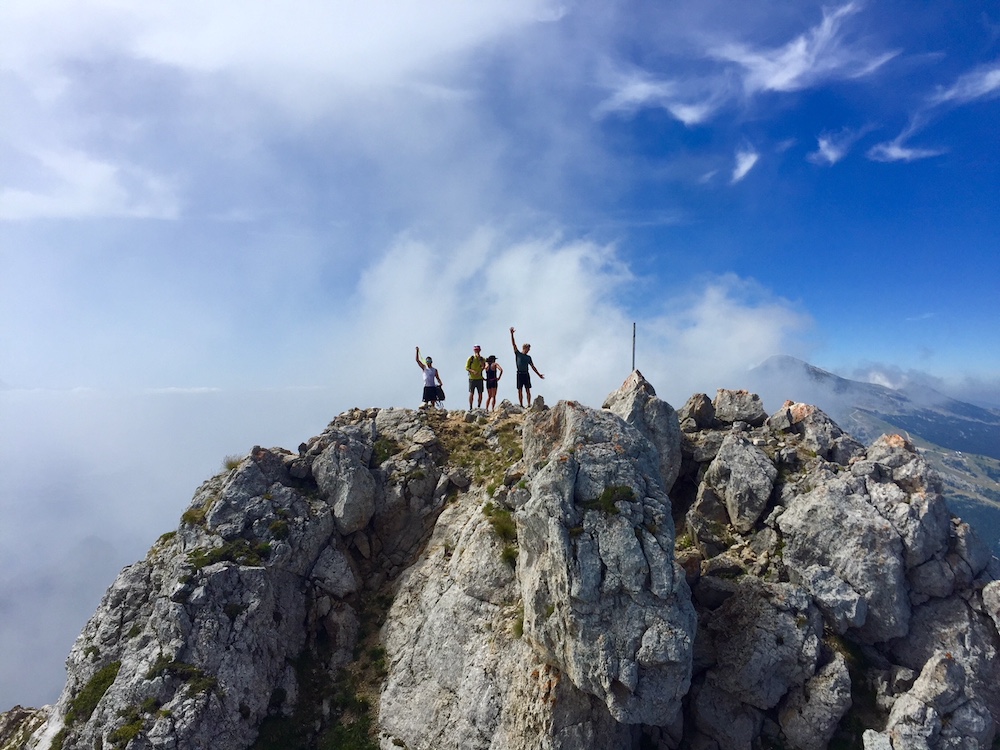
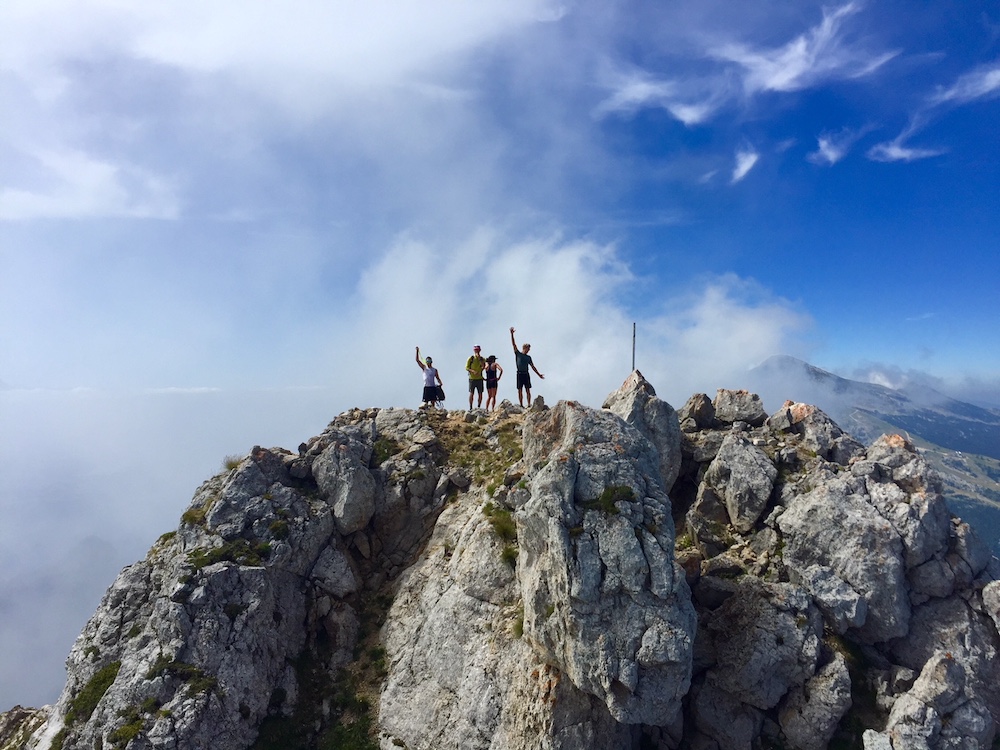
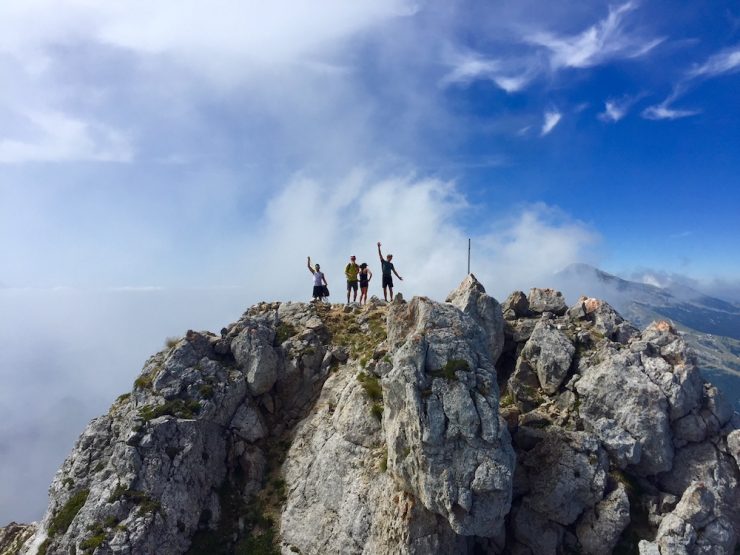
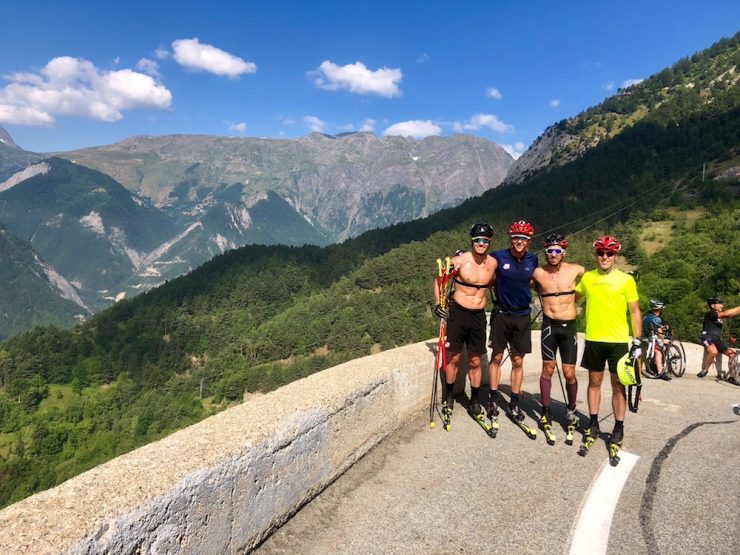
Members of the U.S. men’s ski team on a mid-overdistance run on top of the Roc Cornafion above Villard-de-Lans, France. (Photo: Chris Grover)
This month, the U.S. Cross Country Ski Team (USST) held dryland camps simultaneously, about 6,000 kilometers away from each other, in Lake Placid, N.Y., and Villard-de-Lans, France. Five of the eight women on the team attended the camp from July 11-20 in Lake Placid, which, up until a couple of years ago, was a September staple on the USST calendar. Meanwhile, four of the team’s men trained together in the picturesque, mountainous region of southeast France from July 9-18.
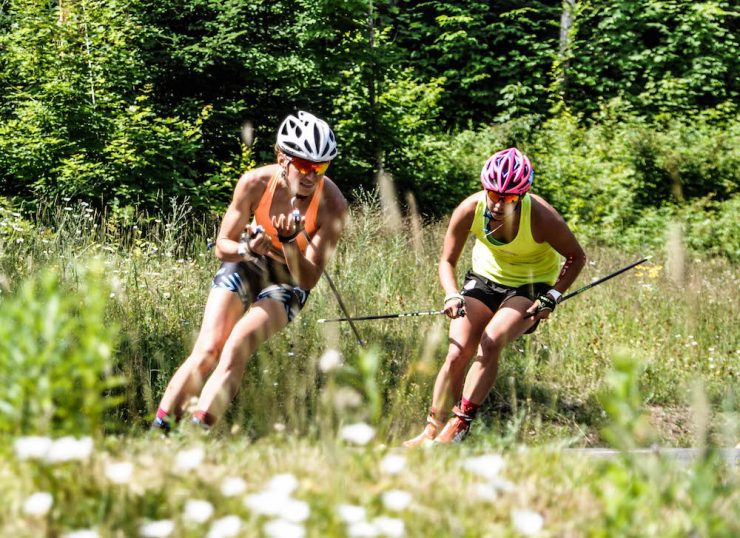
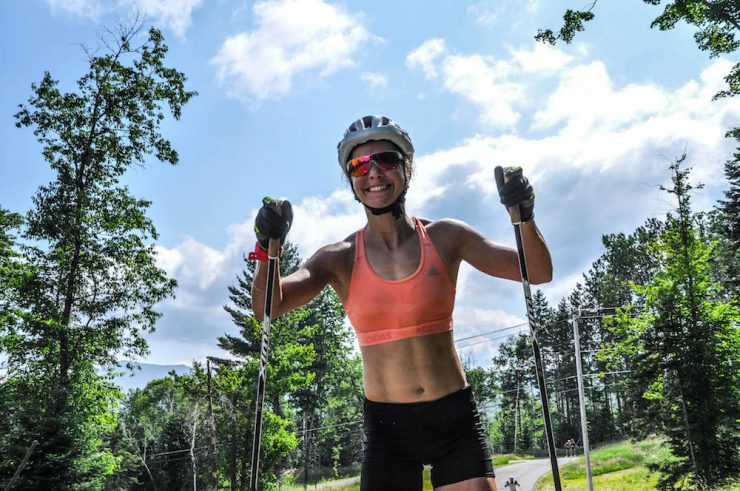
Who was where? In Lake Placid, USST A-team athletes Jessie Diggins, Sophie Caldwell and Ida Sargent worked out alongside development (‘D’) team members Julia Kern and Katharine Ogden, as well as several others from their respective clubs and Stefani Böhler of the German National Team. Outside of camps, the five USST women spend most of the offseason training with their respective Vermont-based programs; Diggins, Caldwell, Kern, and Ogden are all on the Stratton Mountain School (SMS) Elite Team, and Sargent trains with the Craftsbury Green Racing Project (CGRP).
The other three women on the national team — Sadie Bjornsen, Hannah Halvorsen and Hailey Swirbul — are based in Anchorage, Alaska, where they train with Alaska Pacific University (APU) and have multiple opportunities to ski on snow on nearby Eagle Glacier.
“Getting participation in a country as large as ours is always a challenge,” U.S. coach Matt Whitcomb told FasterSkier in Lake Placid. “… But the Alaskans have gone out of their way to give us adequate representation at these camps. They work really hard to, when they’re present, be very present.
“It’s not so much an APU or Alaska issue, it’s a distance issue,” he continued. “We can fight it as hard as we want, but we’re going to be running into a wall because it’s hard to get from upstate New York to Anchorage or Fairbanks; it’s a long ways. We do our best. We try to identify which camps the whole team will be present at, and while we’d love to be able to get together five or six times a year like the Norwegians do every four weeks for eight days, it’s not the reality for us. Our club system is the key for us, and APU is doing a great job with or without the Ski Team at a camp up there, and you have all these other clubs now running their programs like mini national teams. If we can have more of those, that’s how we’ll get better.”
In France, Erik Bjornsen (fresh off his wedding there), Simi Hamilton, Ian Torchia, and Paddy Caldwell trained under the guidance of head coach Chris Grover. Two of the team’s B-team members, Scott Patterson and Kevin Bolger, did not make the trip; Patterson has been rehabbing a fractured toe in Anchorage and Bolger is currently training in Norway.
From Aug. 20 to Sept. 10, half of the team plans to train on snow in New Zealand (Diggins, Sargent, Kern, Ogden, Hamilton, Bolger, and Sophie and Paddy Caldwell) with three coaches: Whitcomb, Jason Cork and Gus Kaeding. Then from Oct. 8-21, most of the 16-athlete squad will meet up for a final dryland camp in Park City, Utah, before revving up for another World Cup season.
Here are some photos from the two mid-summer camps, courtesy of the U.S. Ski Team:
Members of the U.S. men’s ski team on a mid-overdistance run on top of the Roc Cornafion above Villard-de-Lans, France. (Photo: Chris Grover)
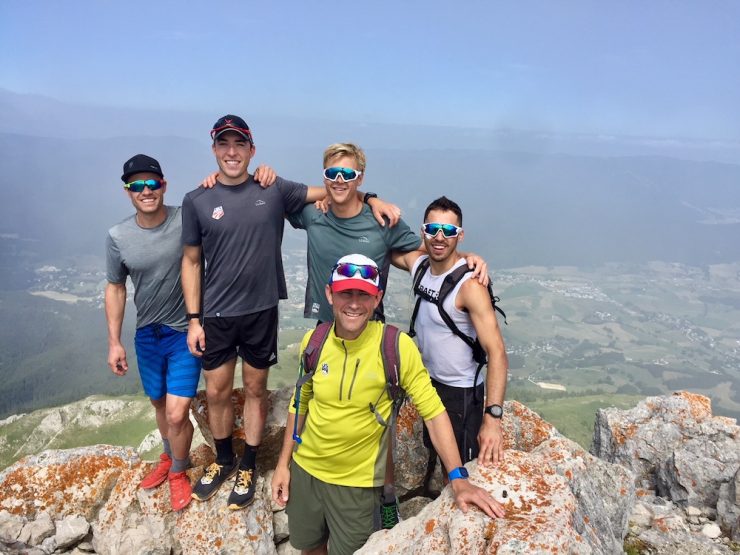
From left to right: Simi Hamilton, Paddy Caldwell, Erik Bjornsen, coach Chris Grover, and Ian Torchia of the U.S. Ski Team during a mid-overdistance run on top of the Roc Cornafion above Villard-de-Lans, France. (Photo: Chris Grover)
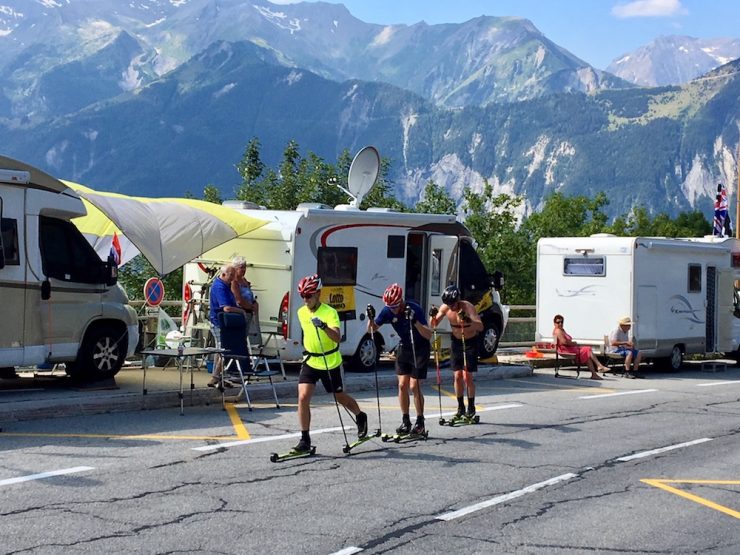
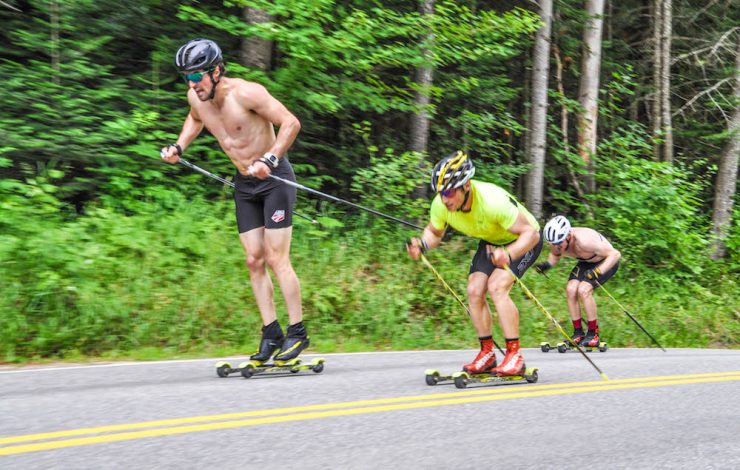
Members of the U.S. men’s ski team rollerskiing up l’Alpe d’Huez in France. (Photo: Chris Grover)
From l to r: Simi Hamilton, Erik Bjornsen, Ian Torchia, and Paddy Caldwell of the U.S. men’s team during a 2018 rollerski up l’Alpe d’Huez in France. (Photo: Chris Grover)
“The Villard-de-Lans camp was excellent, and the men came away from camp mentally charged for the next period of training, although certainly needing some physical rest,” Grover summarized in an email.
French national-team member Adrien Backscheider, who lives part time in the area, joined a few of their workouts. Grover explained their training included five “high-quality sessions” during the 10-day camp, all held on the rollerski loop in Corrençon-en-Vercors: a classic speed session, a skate speed session, a Level 3 classic workout, a Level 4 skate workout, and a classic team sprint simulation. The remaining sessions were either distance, over-distance or strength.
“We had 2 classic roll + run combo workouts in the mountains, including skiing up l’Alpe d’Huez two days prior to the Tour de France stage and then hiking/running up the mountain from the village to create a 4 hour/6000 vertical feet workout,” Grover wrote. “We are very grateful to all the people we met in the Villard-de-Lans area for welcoming, supporting, and taking care of us.”
Sophie Caldwell (r) leads USST teammate Ida Sargent during a team-sprint training session at the Olympic Jumping Complex in Lake Placid, N.Y. (Photo: Matt Whitcomb)
Ben Saxton of the SMS Elite Team leads a sprint interval session at the Olympic Jumping Complex in Lake Placid, N.Y. (Photo: Matt Whitcomb)
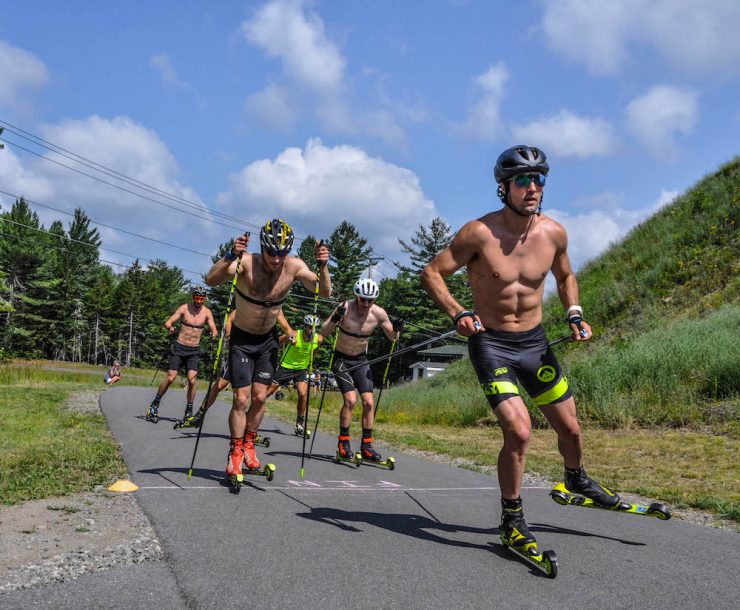
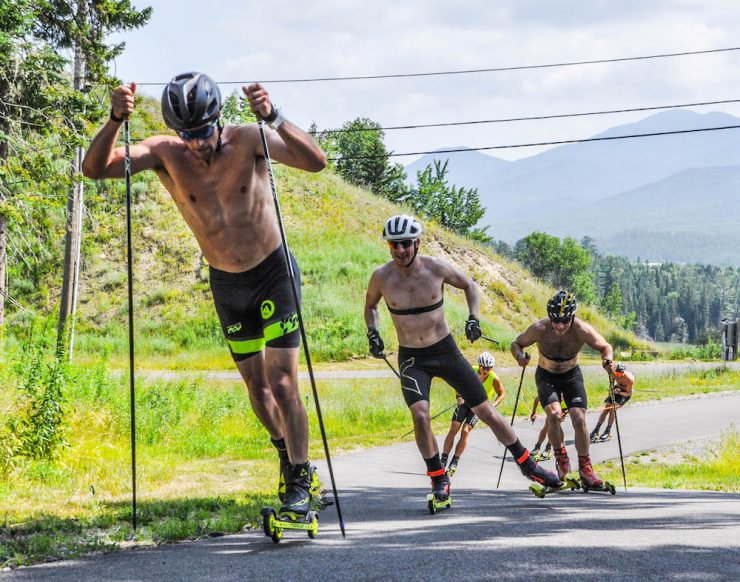
Stratton’s Ben Saxton (l) and Kyle Bratrud lead Craftsbury’s Ben Lustgarten (third from r) during a sprint session at the Olympic Jumping Complex in Lake Placid, N.Y. (Photo: Matt Whitcomb)
Ben Saxton (SMS Elite Team) during a rollerski sprint session at the Olympic Jumping Complex in Lake Placid, N.Y. (Photo: Matt Whitcomb)
Kyle Bratrud (SMS Elite Team) testing his skate-sprinting speed at a national-team camp in Lake Placid, N.Y. (Photo: Matt Whitcomb)
Kyle Bratrud leads Ben Saxton and Ben Lustgarten during a rollerski sprint session at the Olympic Jumping Complex in Lake Placid, N.Y. (Photo: Matt Whitcomb)
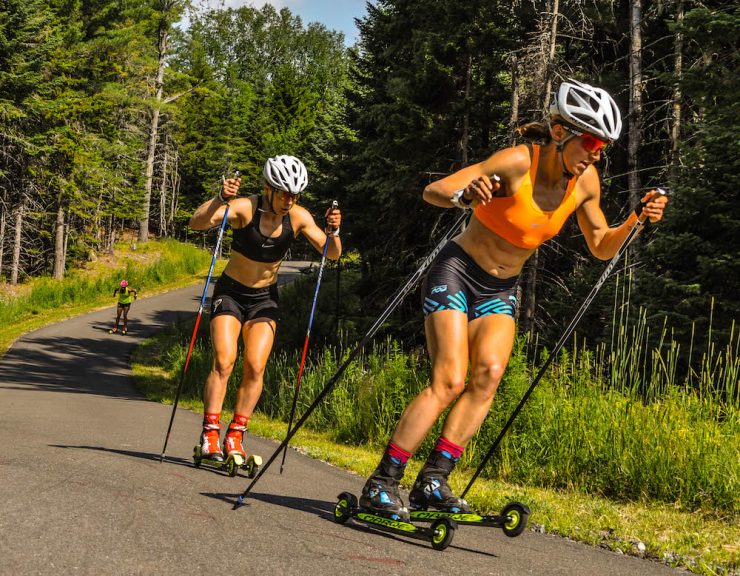
Sophie Caldwell (l) and Julia Kern round a corner during a team-sprint workout at the Olympic Jumping Complex in Lake Placid, N.Y. (Photo: Matt Whitcomb)
Stefani “Steffi” Böhler at the U.S. Ski Team women’s camp in Lake Placid, N.Y. (Photo: Matt Whitcomb)
Jessie Diggins with coach Jason Cork during a rollerski in Lake Placid, N.Y. (Photo: Matt Whitcomb)
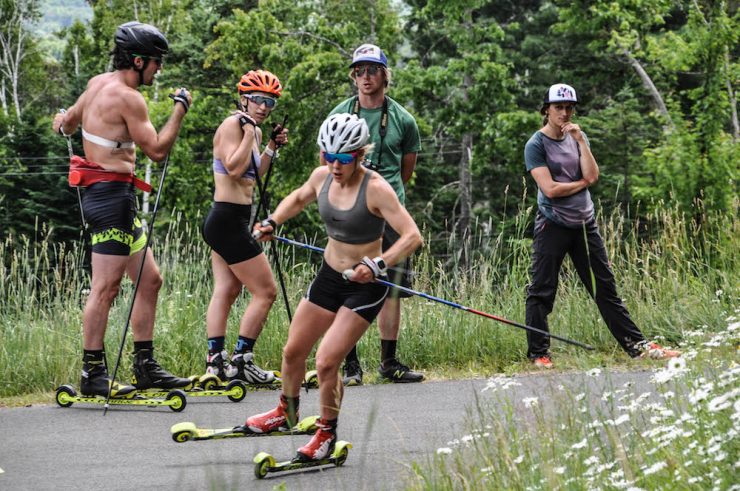
Stratton teammates Sophie Caldwell (l) and Kelsey Phinney during a rollerski at the U.S. Ski Team women’s camp in Lake Placid, N.Y. (Photo: Matt Whitcomb)
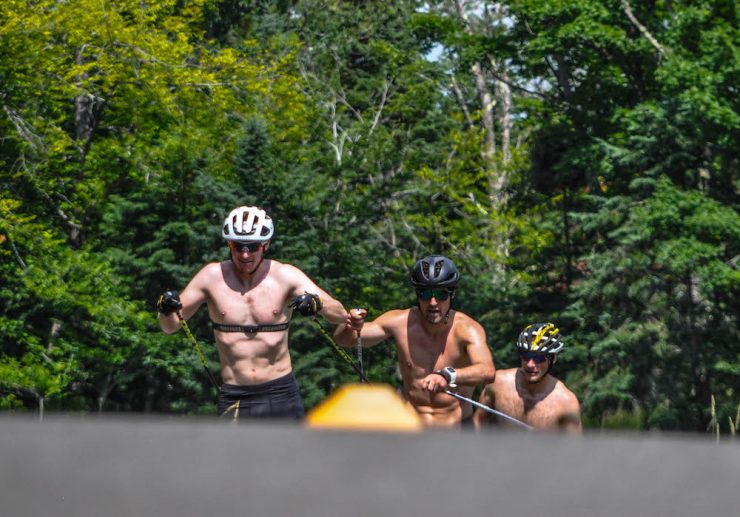
Ben Saxton leads Ben Lustgarten and Kyle Bratrud during a rollerski in Lake Placid, N.Y. (Photo: Matt Whitcomb)
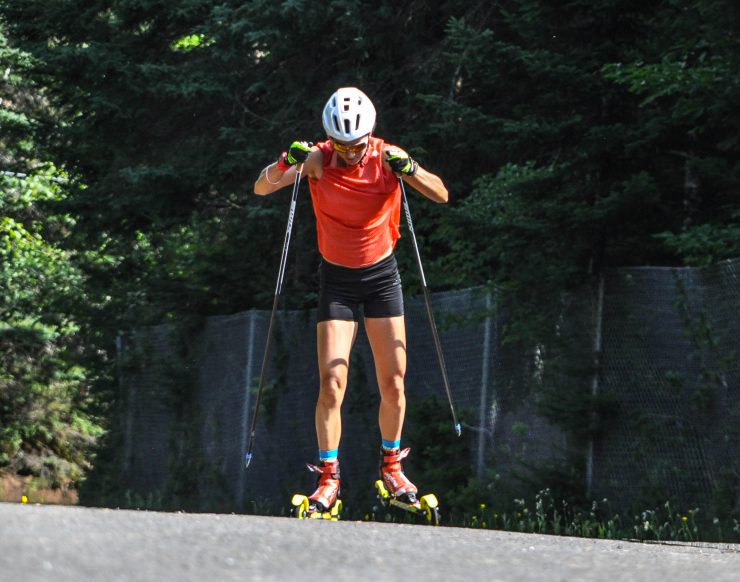
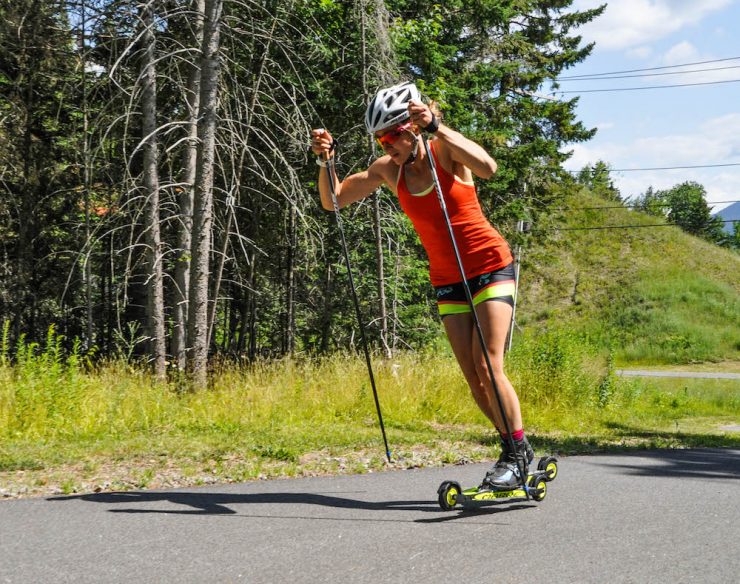
Julia Kern (Stratton Mountain School/U.S. Ski Team) rollerskiing in Lake Placid, N.Y. (Photo: Matt Whitcomb)
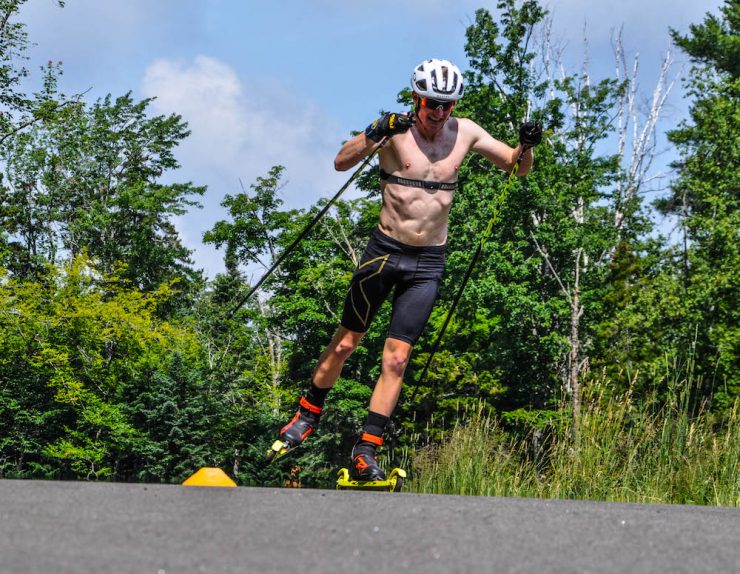
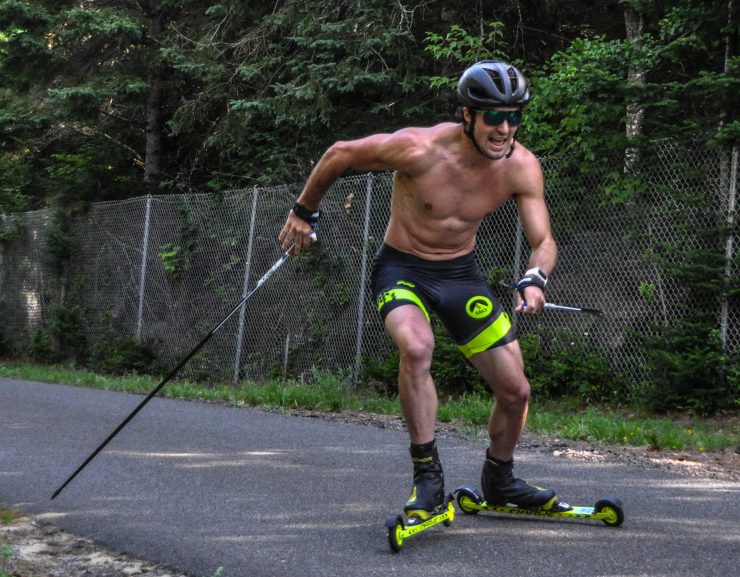
Ben Saxton (SMS Elite Team) rollerskiing in Lake Placid, N.Y. (Photo: Matt Whitcomb)
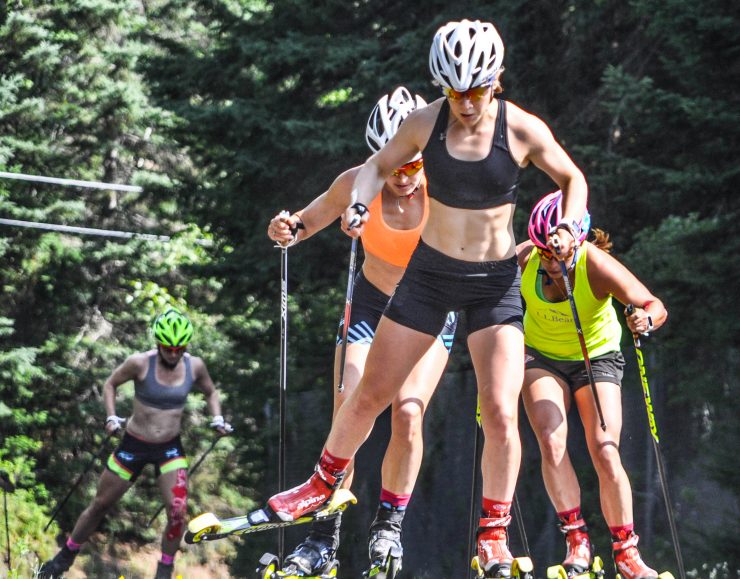
Ida Sargent leading the pack up a climb at the Olympic Jumping Complex in Lake Placid, N.Y. (Photo: Matt Whitcomb)
Germany’s Steffi Böhler during a rollerski workout at the Olympic Jumping Complex in Lake Placid, N.Y. (Photo: Matt Whitcomb)
Ida Sargent (Craftsbury Green Racing Project/USST) rounds a corner at the Olympic Jumping Complex in Lake Placid, N.Y. (Photo: Matt Whitcomb)
Sophie Caldwell (Stratton Mountain School/USST) rollerskiing at the Olympic Jumping Complex in Lake Placid, N.Y. (Photo: Matt Whitcomb)
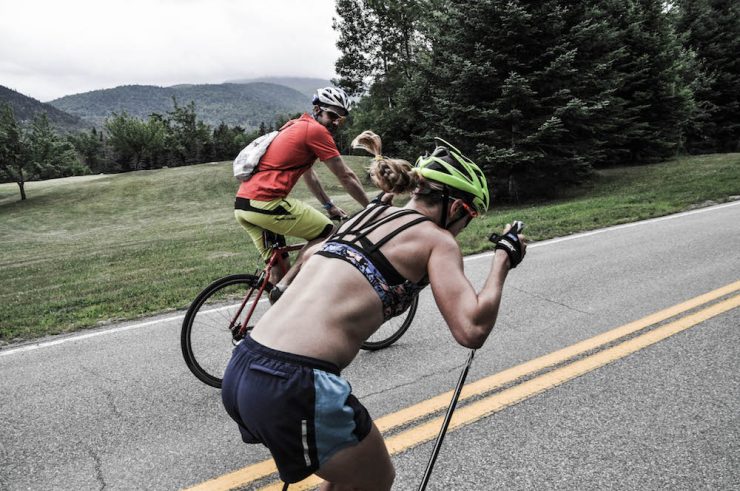
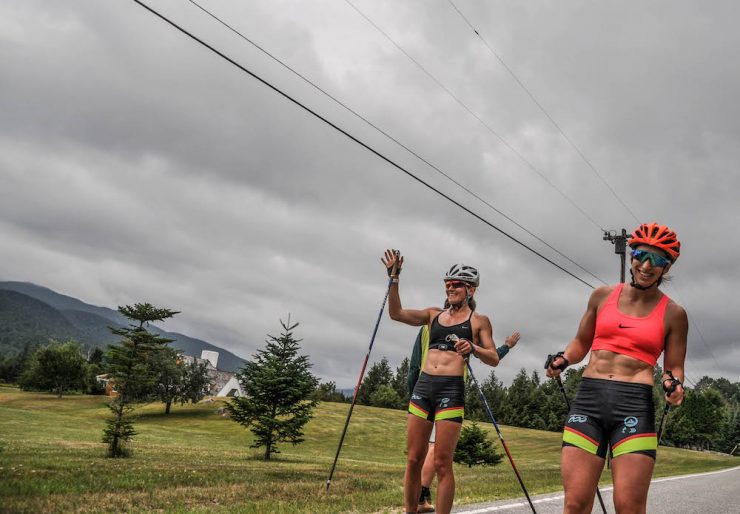
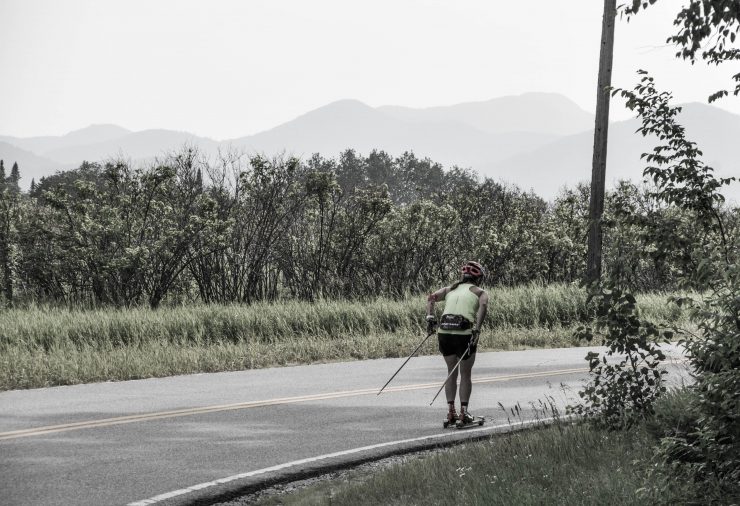
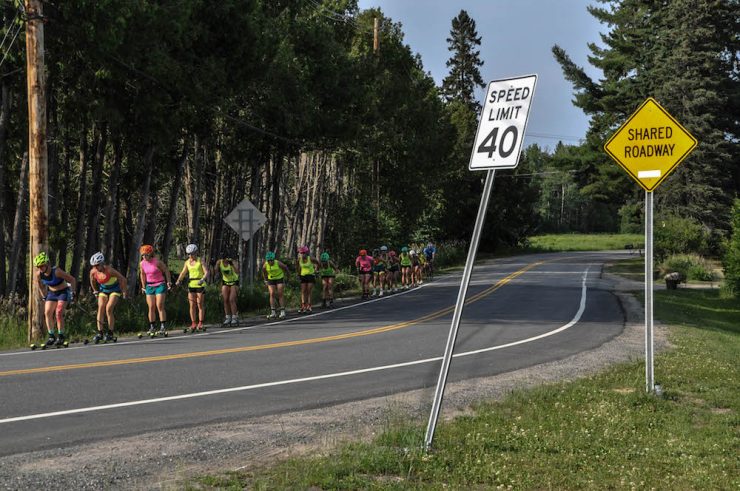
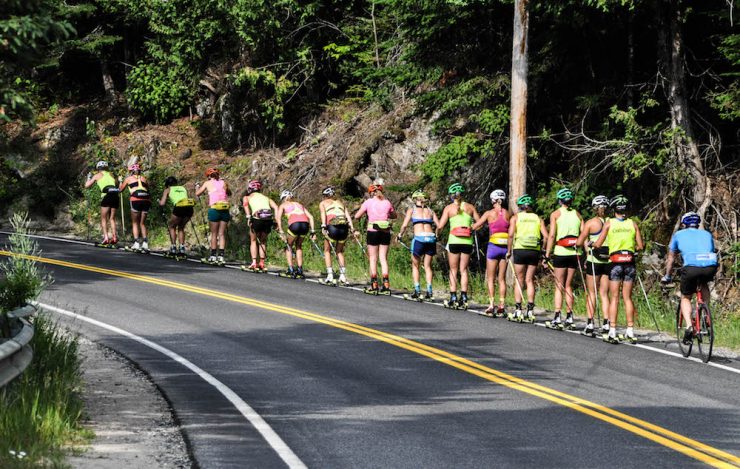
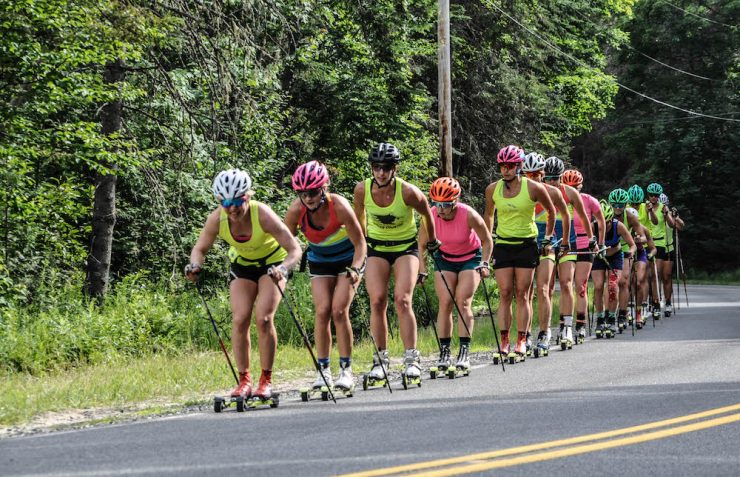
Rollerskiing roadside at the U.S. Ski Team women’s camp in Lake Placid, N.Y. (Photo: Matt Whitcomb)
Rollerskiing roadside at the U.S. Ski Team women’s camp in Lake Placid, N.Y. (Photo: Matt Whitcomb)
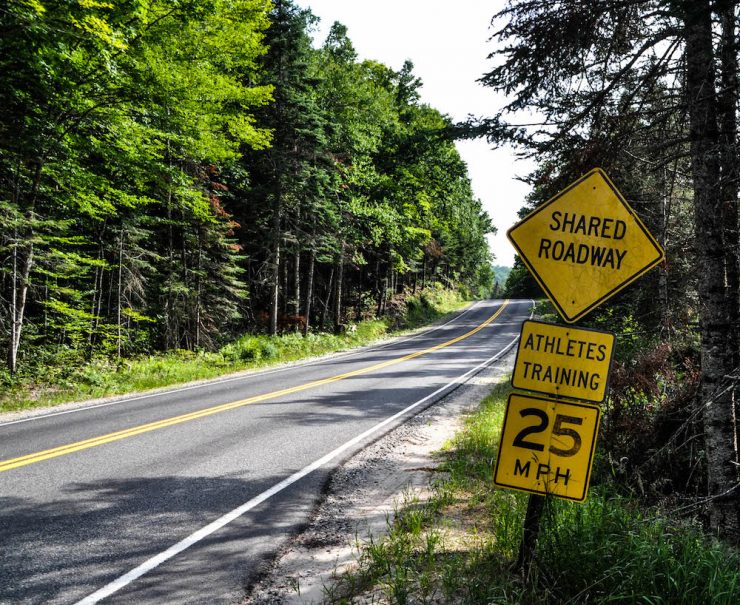
U.S. Ski Team women’s camp rollerski route in Lake Placid, N.Y. (Photo: Matt Whitcomb)
U.S. Ski Team women’s camp / Lake Placid, N.Y. (Photo: Matt Whitcomb)
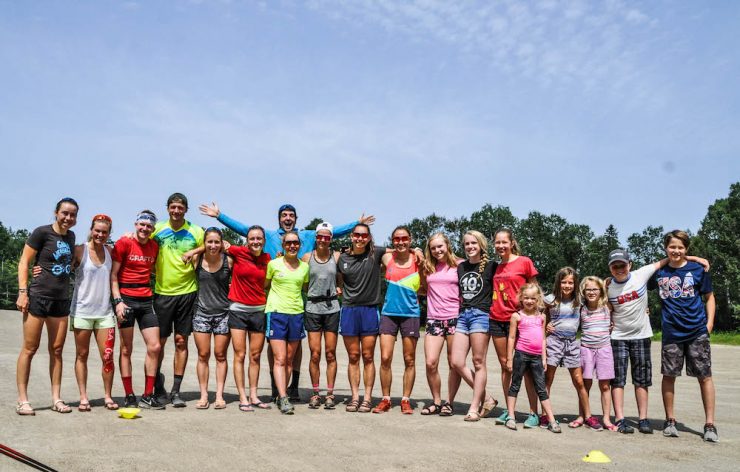
Group shot at the U.S. Ski Team’s July camp in Lake Placid, N.Y. (Photo: Matt Whitcomb)
“Being sea level, we can do more of an effective intensity camp, which this is a semi-intensity focused camp here,” Whitcomb said of the USST’s 2018 Lake Placid camp. “It’s only 2,000 feet here. The running is really great here and the mountains, you get these great Adirondack peaks all over 4,000 feet. The roads in upstate New York are hardly used and the pavement is fantastic. It’s really great rollerskiing out here.”
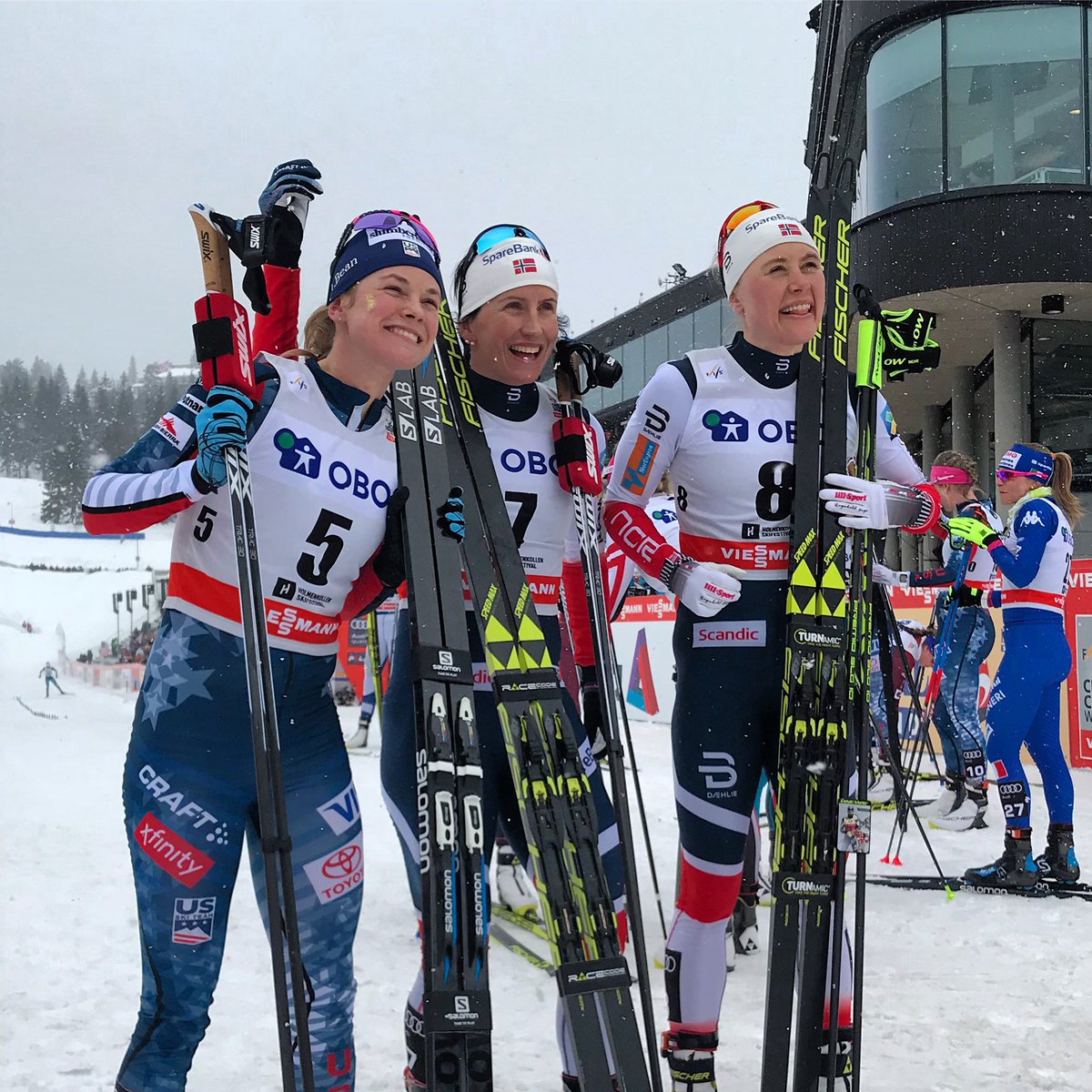
The Holmenkollen women’s 30 k freestyle mass start podium on Sunday in Oslo, Norway, with Jessie Diggins (l) in second, and Norway’s Marit Bjørgen (c) in first and Ragnhild Haga (r) in third. (Photo: FIS Cross Country/Twitter)
FIS Cross Country World Cup (Oslo, Norway): Women’s 30 k freestyle mass start
Marit Bjørgen, the Norwegian queen of distance cross-country events, racked up another victory at Holmenkollen in the women’s 30-kilometer freestyle mass start on Sunday for her seventh win in the World Cup’s ultimate distance event at the famed Norwegian venue. (She had previously won in 2005, 2010, 2012, 2014, 2015 and 2017).
But she did so in not-so-typical fashion. Instead of breaking the field mid-race and skiing to a comfortable win, like she did in the last race of the 2018 Olympics in PyeongChang, South Korea (a 30 k classic mass start), Bjørgen came from behind to win Sunday’s Holmenkollen 30 k and wasn’t able to let off too much before finish. She didn’t take the lead until less than a kilometer to go and put just enough time into her competition to take the win in 1:18:12.4 hours, while American Jessie Diggins outlasted the chase group of three to place second (becoming the first American woman to reach the Holmenkollen podium), 3.6 seconds behind Bjørgen. Norway’s Ragnhild Haga edged Sweden’s Charlotte Kalla by 0.1 seconds for third place (+4.3), while Kalla settled for fourth (+4.4).
The rest of the field was strung out, with Norway’s Astrid Uhrenholdt Jacobsen finishing fourth (+11.5) and Ingvild Flugstad Østberg nearly another 1 1/2 minutes back in fifth (+1:39.5). Finland’s Krista Pärmäkoski placed seventh (+1:51.7), Germany’s Stefani Böhler notched eighth (+2:10.2), Austria’s Teresa Stadlober ninth (+2:10.2), and Sweden’s Ebba Andersson 10th (+2:11.9). Less than a second behind Sweden’s Ida Ingemarsdotter in 11th (+2:22.8) was American Sadie Bjornsen in 12th (+2:23.4).
In the Distance World Cup standings, Diggins gained some valuable points to keep herself in third, now 63 points ahead of Pärmäkoski in fourth. Heidi Weng, who finished 18th on Sunday, still leads the distance standings by 104 points and Østberg is second, 51 points ahead of Diggins.
In the Overall World Cup, Weng leads by 153 points over Østberg. Diggins is another 104 points back in third, 100 points ahead of Pärmäkoski in fourth. At World Cup Finals next week in Falun, Sweden, a total of 300 points is up for grabs for the winners (50 for freestyle sprint, 50 for classic individual start, and 200 for freestyle pursuit).
The U.S. had three in the top 20 and four in the points (top 30) in Sunday’s 30 k, with Kikkan Randall in 19th (+3:21.9) and Caitlin Patterson in 28th (+4:13.1). Rosie Frankowski (Alaska Pacific University) missed the top 30 by about 28 seconds in 31st (+4:45.4), Liz Stephen placed 51st (+10:01.7) and Kaitlynn Miller (Craftsbury Green Racing Project) finished 53rd (+16:05.0).
Cendrine Browne led four Canadian women in 36th (+6:16.1), Emily Nishikawa was 44th (+7:36.1), Zina Kocher (Foothills Nordic) finished 47th (+8:52.0), and Dahria Beatty placed 49th (+9:45.1).
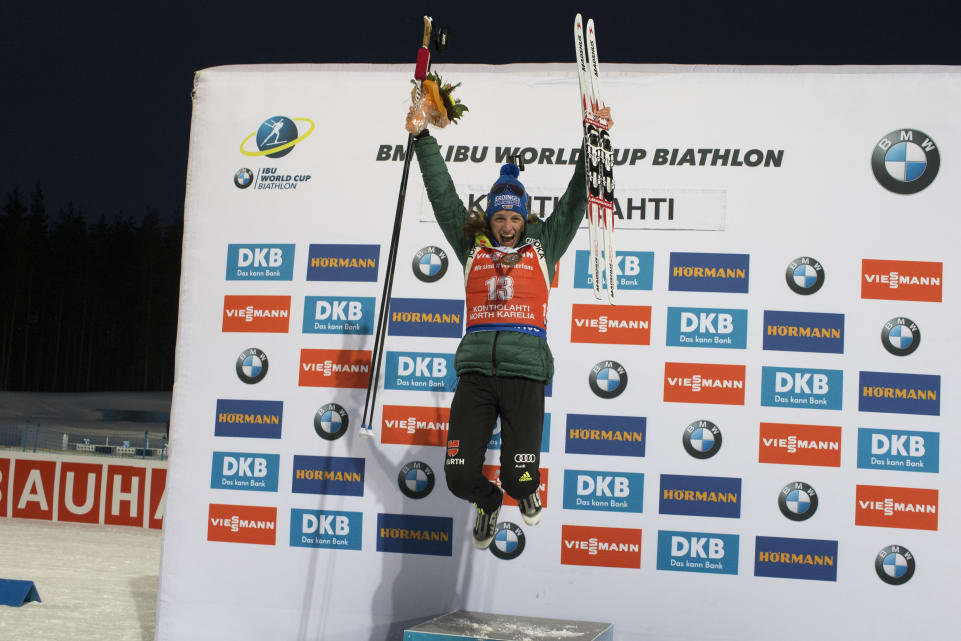
Germany’s Vanessa Hinz celebrates her first IBU World Cup win and podium in the women’s 12.5 k mass start on Sunday in Kontiolahti, Finland. (Photo: IBU/Biathlonworld)
IBU World Cup (Kontiolahti, Finland): Men’s and women’s mass starts
(Note: This rundown has been updated to include comments from Lowell Bailey and Rosanna Crawford.)
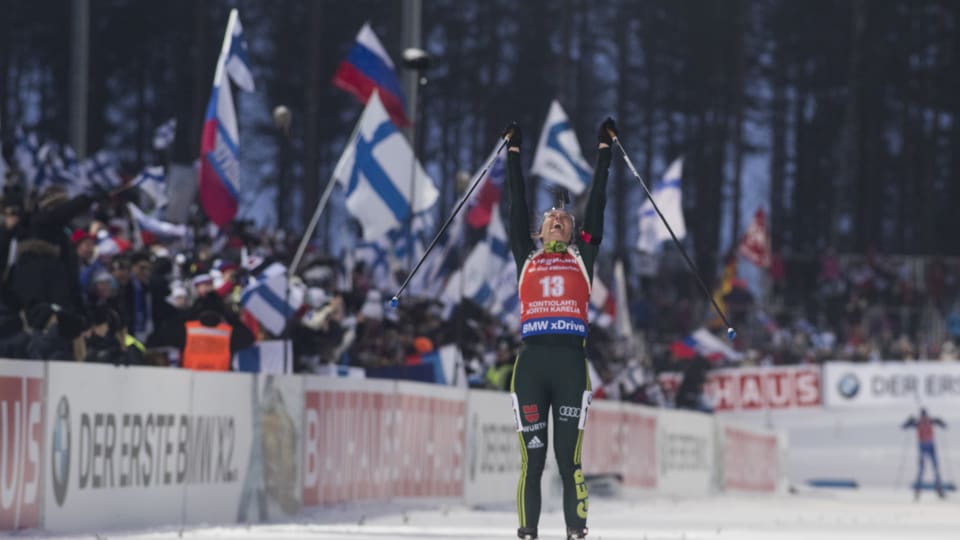
Germany’s Vanessa Hinz won her first International Biathlon Union (IBU) World Cup race (and achieved her first World Cup podium) and Austria’s Julian Eberhard won his first race of the season (and first mass start of his career) in the women’s 12.5 k and men’s 15 k mass starts on Sunday in Kontiolahti.
Germany’s Vanessa Hinz celebrates her first IBU World Cup win and podium in the women’s 12.5 k mass start on Sunday in Kontiolahti, Finland. (Photo: IBU/Biathlonworld)
Hinz shot an impressive 20-for-20 with the third-fastest range time and fifth-fastest shooting time to take the win in 35:47.9 minutes. Third after the first prone stage, she moved into second, then third after cleaning the next two stages. After knocking down her final five targets in the last standing, Hinz left the range almost 24 seconds ahead of France’s Anaïs Chevalier in second and 26 seconds ahead of Italy’s Lisa Vittozzi in third. Hinz stayed ahead of her challengers on the final loop, finishing 13.5 seconds clear of Vittozzi, who claimed second. Chevalier finished third, 16.8 seconds back, while Finland’s Kaisa Mäkäräinen was next across the line in fourth (+43.4) with a gap to Sweden’s Hanna Öberg in fifth (+1:02.1).
Vittozzi and Chevalier both cleaned the first three stages then had to ski a penalty lap after the last standing bout (0+0+0+1). Mäkäräinen missed three (1+0+1+1) yet skied the second-fastest course time on her home course, and Öberg missed two (0+0+2+0). The fastest course time of the day was clocked by Darya Domracheva of Belarus, who had to ski five penalty laps (0+1+1+3) and ended up 10th (+1:18.2).
“I always dreamed of shooting four times clean and today I did it,” Hinz, 25, said, according to an IBU press release. “I was so often close to the podium. I knew I could do it. Today, I said, ‘OK, let’s try it and if it works, it is OK … and if not there is another season waiting and other races.’ Now I am on top of the podium and it is crazy.”
Vittozzi, who placed fourth in the mass start at the 2018 Olympics, was glad to improve on a third-place finish in Friday’s sprint by placing second on Sunday.
“I have been third so many times and that was not satisfying for me,” Vittozzi said, one day after she won the mixed relay with her team in Kontiolahti. “Today I am very happy about my second place.”
For Chevalier, it was her first individual podium of the season and it came a day after she and Antonin Guigonnat won the single mixed relay. Chevalier, 25, was severely injured when she was hit by a car last spring, according to an IBU press release.
“I am very happy to be here today, because it was a very hard season,” she told the IBU. “I forgot how nice it is to be on the podium … I forgot that it was not easy, so I am very happy … I did my best on the last lap; [Vittozzi] was faster, but I am third and happy with that!”
Canada’s Rosanna Crawford shot 19-for-20 to place 13th (+1:25.9) with her only miss coming in the second prone stage (0+1+0+0). Her overall shooting and range times were 10th fastest of the 30-woman field, compared to her 26th-ranked ski time. Crawford had been in 11th after cleaning the final standing stage, then slipped two spots to finish 13th in her second mass start of the season.
“Since the skiing wasn’t feeling great today I made sure I was super focused in the range,” Crawford wrote in an email to FasterSkier. “I knew that was my only chance to get a good result today. My one prone miss was a bad trigger pull, but the rest were nice solid hits. I made sure to have a solid set up and then just trusted my rhythm and shooting.
“I knew that I wanted that top 15, so I just kept fighting and trying to stick with the women when they caught me,” she wrote of her last loop. “The last time up the wall I managed to stay close to [France’s] Anais Bescond, and hold off the two people behind me. Really happy to be in the top 15 again.”
Clare Egan was the lone American woman to qualify for Sunday’s mass start, and it was the second mass start of her career. She was on track for a top-15 result after missing just one target in the first three stages, but she had to ski three penalty laps on the last standing (0+1+0+3), which put her in 23rd by the finish (+2:05.6). Notably, she skied the 14th-fastest overall course time.
“I didn’t have quite the same energy level tonight as the last two days, but I still had the 14th rank course time and that means anything is possible in the race,” Egan wrote in an email to FasterSkier. “To put it in perspective, the winner of the race, Hinz, had the 13th rank, just 2 seconds faster than me. This is the first time I’ve felt totally comfortable skiing with the fastest women, and I certainly hope I can maintain this speed for one more week of World Cup racing.”
Egan was pleased with her 9-for-10 prone shooting and her clean standing stage (“which is the first time I’ve cleaned a standing stage in an individual race this entire year, believe it our not,” Egan wrote).
“But when I missed my second shot on the final stage, I let that throw me off my game, and really blew the rest of the stage,” she explained. “It’s so hard to keep 100% focus in every scenario, and I find it gets harder and harder towards the end of the race when I’m not necessarily the most lucid. I know that I have to work on so I have a goal to manage the final stage better next week and in the future.”
Her 23rd-place finish was one better than her previous World Cup mass start finish, which was 24th last season in Hochfilzen, Austria.
“In my only other mass start, which was last year at World Championships, I felt like an imposter,” Egan reflected. “Maybe because I was the first ‘reserve’ to get called up when one of the top women [did not start]. But this was totally different. I knew I deserved to be there today and was confident about competing with the other top women.”
“In my only other mass start, which was last year at World Championships, I felt like an imposter … This was totally different. I knew I deserved to be there today and was confident about competing with the other top women.” — Clare Egan (US Biathlon) on Sunday’s mass start
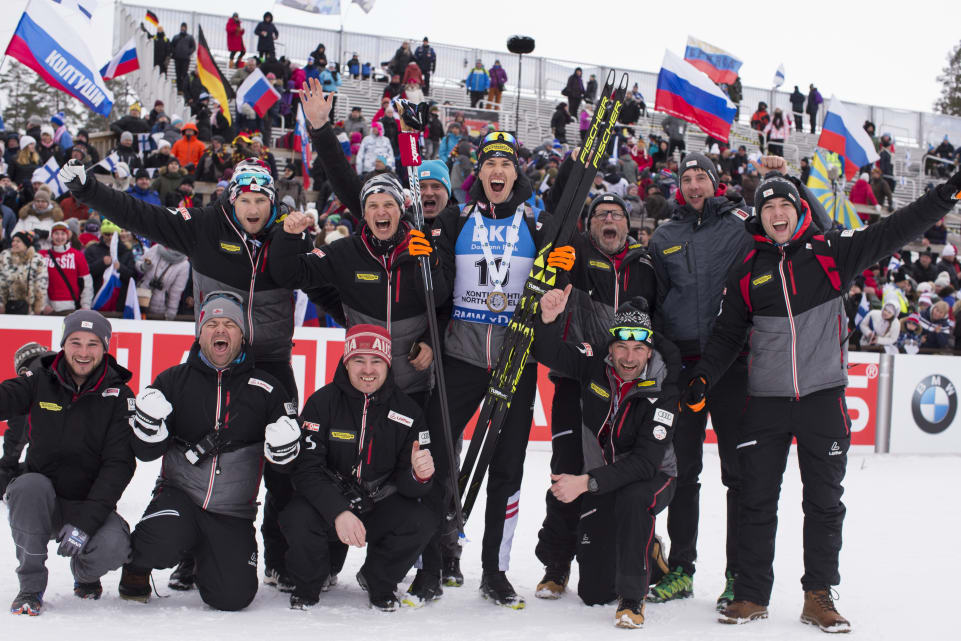
While the women raced Sunday night, the men’s 15 k mass start took place in the afternoon, when Eberhard passed the likes of France’s Martin Fourcade and Russia’s Anton Shipulin after a tangle late in the race to take the win.
The Austrian team celebrating Julian Eberhard’s fourth career victory, his first this season and his first in a mass start on Sunday after the IBU World Cup men’s 15 k mass start in Kontiolahti, Finland. (Photo: IBU/Biathlonworld)
The Austrian had cleaned the first two prone stages to move into third by the race’s halfway point, behind Germany’s Benedikt Doll and Arnd Peiffer in first and second, respectively. Eberhard missed one in the next standing stage, yet left the range in second, 15 seconds behind Peiffer (who cleaned) in first, while Doll missed one as well to slip into third, 19 seconds back.
With two loops to go, Fourcade was coming back from two early prone penalties and found himself in fifth after a clean standing stage, less than a second behind Shipulin in fourth. On the next standing stage, Fourcade cleaned to take the lead and left the range about five seconds ahead of Shipulin (who also cleaned) in second.
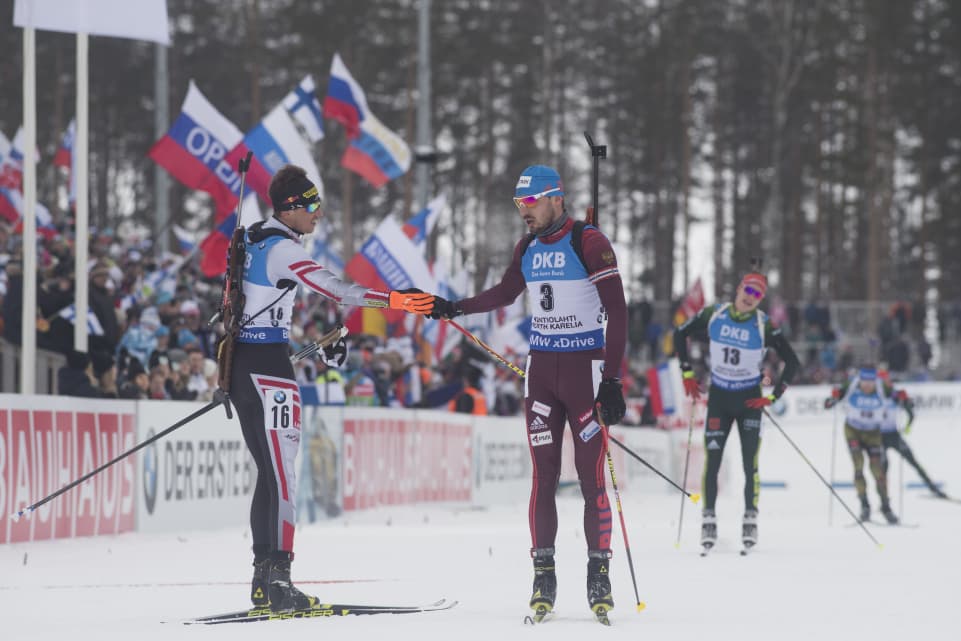
Eberhard missed one yet remained in contention in third, 17 seconds behind Fourcade. On the last loop, Shipulin caught Fourcade before the course’s notorious climb known as “The Wall”, and Eberhard closed on the two frontrunners as they ascended it. Still several seconds behind over the top, he caught Shipulin on the bridge before the stadium, but the two tangled skis and Shipulin fell. Eberhard stayed upright and pulled even with Fourcade, passing him to take the win in 38:04.8. Fourcade finished second (+6.9) and Shipulin third (+19.3).
Austria’s Julian Eberhard (l) and Russia’s Anton Shipulin after the finish of the men’s 15 k mass start the IBU World Cup in Kontiolahti, Finland. Shipulin fell when his skis tangled with Eberhard’s. While Eberhard raced to the win, Shipulin placed third. (Photo: IBU/Biathlonworld)
“I wanted to be in a sprint with all three, but the bridge is too small for this,” Eberhard said, according to an IBU press release. “I came up the bridge with too much speed. Anton and I were in the same track and there was an accident. I apologized to Anton at the finish but he said these things can happen and it was OK with him.”
“I hold no grudge against Julian,” Shipulin told the IBU. “This can happen in sports and is all fair … I am in good shape and want to preserve this and perform my best in the last World Cups.”
Fourcade explained that illness caused him to sit out Thursday’s sprint, and he was only able to train three hours this week.
“It is really difficult to race in this situation without any feeling or training,” Fourcade told the IBU. “I did not know what to expect today but I am quite satisfied. I would have liked to win, but I used too much energy trying to come back in the early laps and had no energy when it was time to attack.”
Behind them, Doll picked off one place on the final loop to finish fourth (+21.9), passing his German teammate Erik Lesser, who finished fifth (+23.9). Peiffer followed in sixth (+27.1) as Germany had three in the top six.
American Lowell Bailey raced to 14th (+1:06.3) with two penalties, both of which came in the standing stages (0+0+1+1). Bailey had been fourth after cleaning the second prone, 16 seconds behind Doll in first, but slipped to 10th after missing one on the next bout. He had to ski another penalty lap on the last stage, and left the range in 14th.
Overall, Bailey posted the 10th-fastest shooting time, 15th-fastest range time and 18th-fastest course time.
“I finally felt like I was back in the spot that I ended last season,” Bailey wrote in an email when asked about his consistency. “I felt controlled and able to keep the pace with the top of the field throughout the race. It was nice to be back in the mix.
“Although I would have liked to see this ski speed a few weeks ago, better late than never!” he continued.
Next week’s World Cup in Oslo, Norway, will be his last of the season and his career.
“After nearly two decades of international racing, Oslo will be my final World Cup as a U.S. Biathlete,” Bailey wrote. “I’m sure it will be emotional but I hope to end my World Cup career on a high note!”