From the FasterSkier archive — posts syndicated from athletes’ and coaches’ own blogs between 2004 and 2012, kept online as published. Current coverage is at fasterskier.com.

Tag: Stefanie Böhler

  • 2018/2019 Tour de Ski Preview (Updated)

    2018/2019 Tour de Ski Preview (Updated)

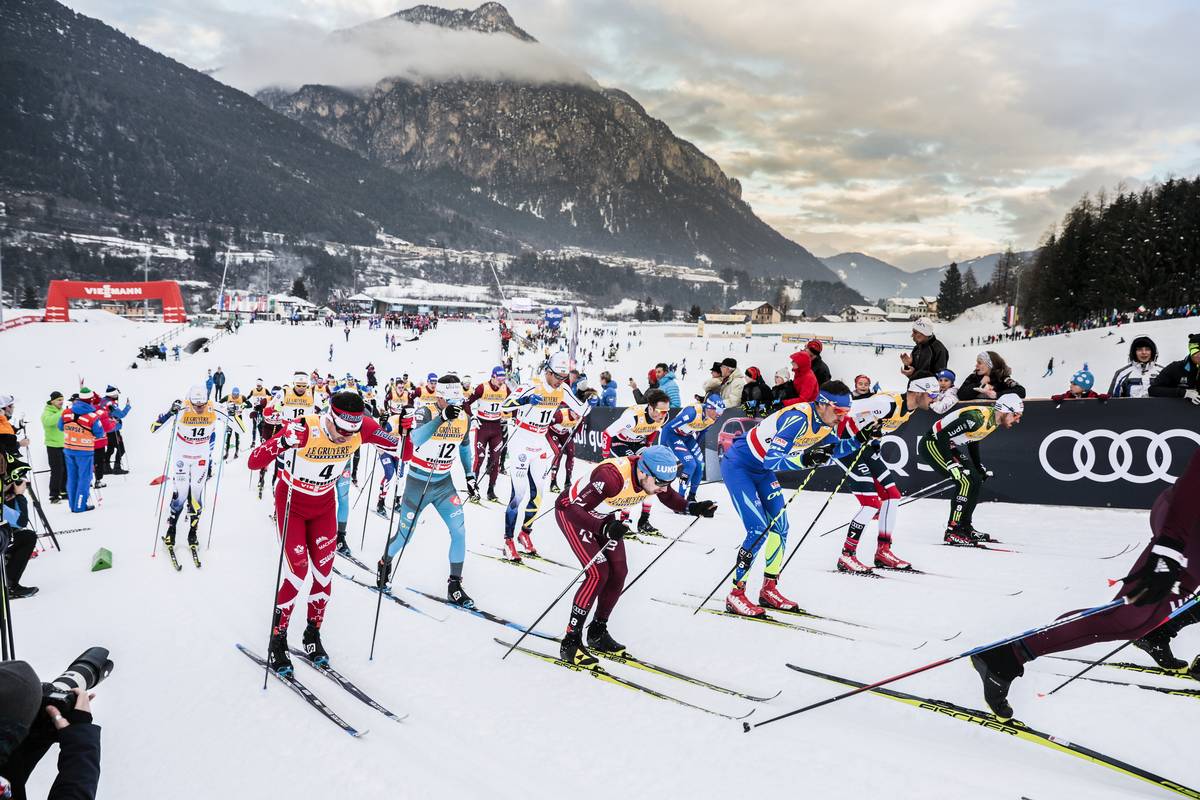
    The start of the men’s 15 k classic mass start at Stage 6 of the 2018 Tour de Ski on Saturday in Val di Fiemme, Italy, with (front row, left to right) Canada’s Alex Harvey, Russia’s Sergey Ustiugov, Kazakhstan’s Alexey Poltoranin, Norway’s Martin Johnsrud Sundby, and Switzerland’s Dario Cologna. (Photo: Salomon/NordicFocus)

    Beginning this Saturday in Toblach, Italy with a freestyle sprint is the 13th edition of the Tour de Ski (TdS). According to the International Ski Federation (FIS), over the course of seven stages the men will race 80.918 kilometers, the women 60.67 k. 

    The TdS has become both a staple and a spectacle of the annual World Cup calendar. With a jam-packed series of races primacy is placed on both the ability to recover well and wither less as the TdS transpires.

    Prognostication can be tricky in a long-form template like the TdS. So much can go astray during seven races not to mention the travel and dicey germ-avoidance. 

    Last season’s winner on the women’s side, Heidi Weng of Norway, sits 18th overall in the World Cup standings (14th in distance). She has four top-20’s in the four distance events she’s contested with her best result an eighth in Lillehammer’s 10 k skate. Although featuring two sprints in the first three stages, the TdS remains a distance skier’s paradise.

    Weng has skied solidly on the World Cup, but she has yet to show the form that made her a TdS overall winner in 2017 and 2018. Norway has won the last five iterations of the TdS: Marit Bjørgen won once in 2014/2015, Therese Johaug twice (2013/2014, 2015/2016), and Weng the last two years.
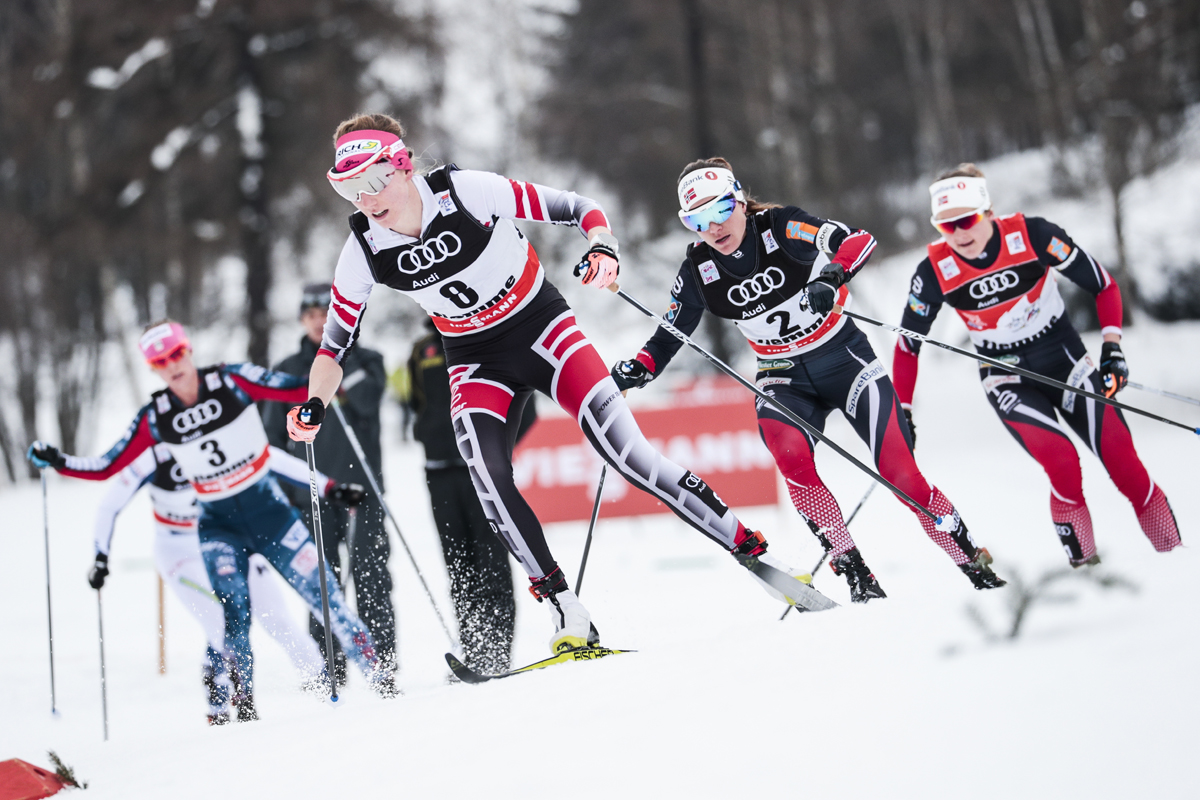
    Austria’s Teresa Stadlober leads Norway’s Heidi Weng (2) and Ingvild Flugstad Østberg, American Jessie Diggins (3) and others around a downhill corner during the women’s 10 k classic mass start at Stage 6 of the 2018 Tour de Ski in Val di Fiemme, Italy. (Photo: Fischer/NordicFocus)


    If Norway is to keep the streak alive, Ingvild Flugstad Østberg, last year’s TdS runner up, could be the heir apparent. She currently ranks second in the World Cup overall and 15th on the sprint list.

    Johaug, having returned from an 18 month doping ban, has been on a distance race tear. She has won all five World Cup distance events this season. Johaug, however, will not be lining up for the TdS.

    Only five different women have earned distance podiums this season — Johaug, Østberg, Sweden’s Charlotte Kalla and Ebba Andersson, and Finland’s Krista Pärmäkoski. Along with Johaug, Kalla and Andersson are skipping the TdS. (Andersson sits third overall on the World Cup, Kalla fifth.) With the TdS missing three of the five top ranked World Cup distance skiers, daily stages and the overall podium are up for grabs.   

    Last season’s third overall finisher, Jessie Diggins of the U.S. Ski Team (USST), often cites the TdS as a point in the season when her form trends towards podium performances. She sits eighth in the current distance standings and could very well have a stout TdS. 

    Russia’s Natalia Belorukova and Yulia Nepryaeva look strong as does Sadie Bjornsen (USST), and Austria’s Teresa Stadlober.

    With less than predictable distance stage podiums for the women, it may simply come down to a drag race on the Alpe Cermis final climb Jan. 6.
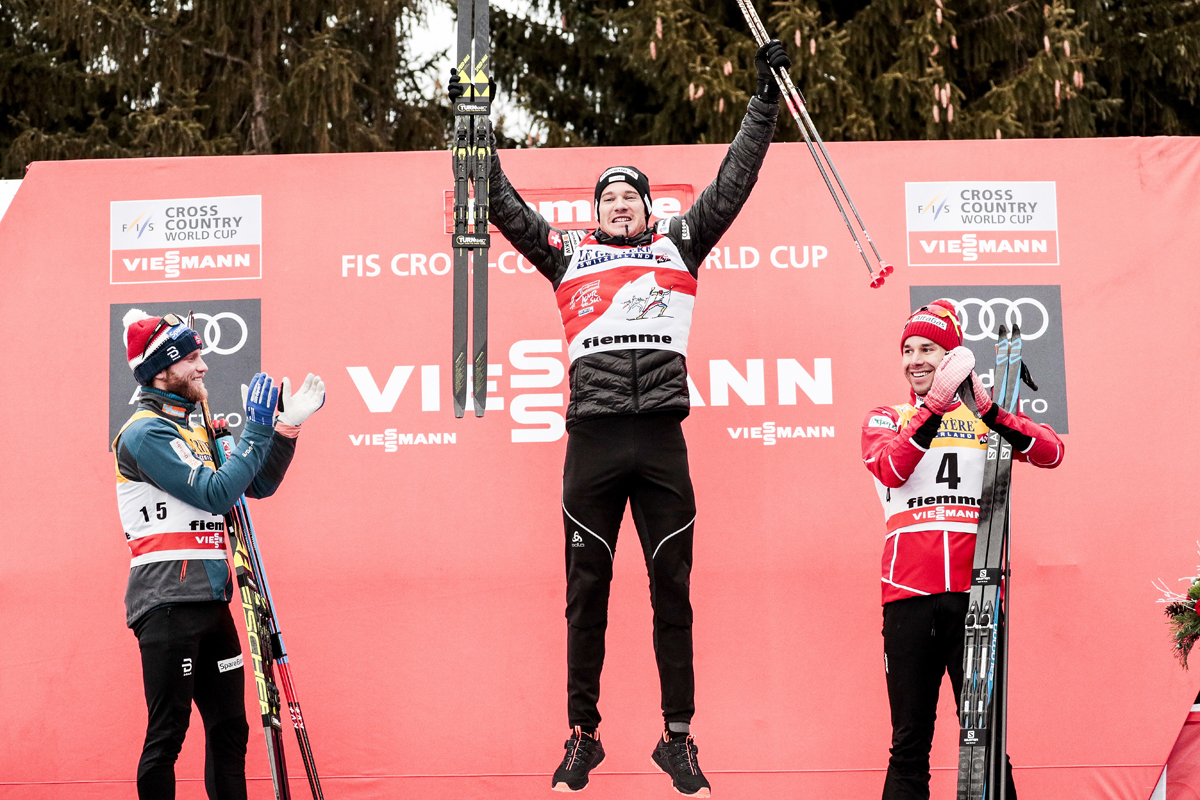
    Switzerland’s Dario Cologna (c) celebrates his fourth Tour de Ski overall title. He was joined by Norway’s Martin Johnsrud Sundby (l) and Canada’s Alex Harvey (r) on the podium in second and third, respectively. (Photo: Fischer/NordicFocus)


    The men’s scene is also open to interpretation. Last season’s TdS winner, Switzerland’s Dario Cologna, was in fact a surprise victor. Prior to Cologna’s stage two win in last year’s TdS, it had been nearly three years since the four time TdS overall winner had won a World Cup. Cologna sits 21st overall on the World Cup currently. Given last year’s resurgence, anything is possible for the Swiss skier.

    Then there’s Martin Johnsrud Sundby form Norway. He finished on the TdS podium the last three years. At thirty-four-years-old, Sundby is ranked first on the distance list, with a second, a third, and a fourth place in distance races this season.

    Sundby won the TdS on two occasions – in 2013/2014 and in 2016. His 2015 win was stripped after he tested positive for excessive levels of Salbutamol. He placed second in the past two Tours.

    In a field rife with talent, Sundby’s ability to race and rebound and race and rebound will be tested. Sjur Røthe, Emil Iversen, and Didrik Tønseth— all from Norway— look in form. And there’s Norway’s Johannes Høsflot Klæbo. The winner of last season’s overall World Cup has had flashes of his past explosive self. He could be a TdS protagonist.

    The men’s field is notably tight. Along with the Norwegians, several Russians could pop a podium, a stage win, and the overall. Russia comes with a loaded team ready to exploit. Alexander Bolshunov leads the overall World Cup – he’ll turn twenty two on Dec. 31st. He’s backed by teammates Evgeniy Belov, Andrey Melnichenko, and Denis Spitsov. 

    Canada’s Alex Harvey placed third overall last year and he looked stronger as the TdS progressed.

    The Stages

    Stage 1:  Dec. 29, skate sprint in Toblach, Italy.

    Stage 2: Dec. 30, 10 k/15 k skate in Toblach, Italy.

    Stage 3: Jan. 1, skate sprint in Val Müstair, Switzerland.

    Stage 4: Jan. 2, 10 k/15 k classic mass start in Oberstdorf, Germany.

    Stage 5: Jan. 3, 10 k/15 k skate pursuit in Oberstdorf, Germany.

    Stage 6: Jan. 5th, 10 k/15 k classic mass start in Val di Fiemme, Italy.

    Stage 7: Jan 6th, 9 k final climb skate pursuit in Val di Fiemme, Italy.

    Teams

    United States

    Women: Sophie Caldwell, Sadie Bjornsen, Jessie Diggins.

    Men: Ben Lustgarten, Simi Hamilton, Erik Bjornsen, Kevin Bolger.

    U.S. Ski Team Head Coach Chris Grover noted in a text that Caldwell, Hamilton, and Bolger will likely cease the TdS after the stage three sprint. Additionally, this is a small team for the U.S. at the TdS. Several athletes turned down TdS nominations including Scott Patterson (USST), Andy Newell (SMS T2/Salomon), Kyle Bratrud (SMS T2), Rosie Brennan (APU), Rosie Frankowski (APU), Caitlin Patterson (CGRP), and Julia Kern (SMS T2). These skiers plan on racing U.S. Nationals this January in Craftsbury, Vermont.

    Canada

    Women: Emily Nishikawa, Dahria Beatty

    Men: Alex Harvey, Lenny Valjas, Bob Thompson

    Norway

    Women: Ingvild Flugstad Østberg, Maiken Caspersen Falla, Astrid Uhrenholdt Jacobsen, Kari Øyre Slind, Kathrine Rolsted Harsem, Heidi Weng, Lotta Udnes Weng, Tiril Udnes Weng Mari Eide, Anna Svendsen

    Men: Martin Johnsrud Sundby, Hans Christer Holund, Emil Iversen, Didrik Tønseth, Simen Hegstad, Krüger, Sjur Røthe, Johannes Høsflot Klæbo, Martin Løwstrøm Nyenget, Eirik Brandsdal, Finn Hågen Krogh

    Russia

    Women: Yulia Belorukova, Lidia Durkina, Anna Zherebyateva, Mariya Istomina, Natalia Nepryaeva, Anna Nechaevskaya, Anastasia Sedova, Elena Soboleva

    Men: Evgeniy Belov, Alexander Bolshunov, Maxim Vylegzhanin, Andrey Larkov, Andrey Melnichenko,  Gleb Retivykh, Andrey Sobakarev, Denis Spitsov, Sergey Ustiugov

    Sweden

    Women: Mia Eriksson, Ida Ingemarsdotter, Moa Molander Kristiansen, Stina Nilsson, Maria Nordström, Linn Sömskar, Lisa Vinsa

    Men: Calle Halfvarsson, Simon Lageson, Teodor Peterson, Daniel Rickardsson, Oskar Svensson, Viktor Thorn, Karl Johan Westberg

    Finland

    Women: Mari Eder, Anne Kyllönen, Laura Mononen, Krista Pärmäkoski, Susanna Saapunki

    Men: Ristomatti Hakola, Matti Heikkinen, Lauri Vuorinen

    Italy

    Women: Elisa Brocard, Anna Comarella, Ilaria Debertolis, Caterina Ganz, Greta Laurent, Sara Pellegrini, Lucia Scardoni

    Men: Francesco de Fabiani, Stefano Gardener, Enrico Nizzo, Dietmar Noeckler, Federico Pellegrino, Maicol Rastelli, Giandomenico Salvadori

    Switzerland

    Women: Nathalie von Siebenthal, Laurien van der Graaff, Nadine Fähndrich

    Men: Dario Cologna, and Jovian Hediger, Jonas Baumann, Livio Bieler, Roman Furger, Käser Erwanm, Beda Klee, Toni Livers, Jason Rüesch, Schaad Roman

    Austria

    Women: Therese Stadlober

    Germany

    Women: Julia Belger, Victoria Carl, Pia Fink, Laura Gimmler, Katharina Hennig, Sandra Ringwald, Elisabeth Schicho, Anne Winkler

    Men: Thomas Bing, Lucas Bögl, Janosch Brugger, Jonas Dobler, Sebastian Eisenlauer, Andreas Katz, Valentin Mättig, Florian Notz, Max Olex, Thomas Wick

    France

    Women: Anouk Faivre Picon, Delphine Claudel, Laura Chamiot-Maitral

    Men: Maurice Manificat, Lucas Chanavat, Adrien Backscheider, Jean-Marc Gaillard, Baptiste Gros, Renaud Jay, Richard Jouve, Jules Lapierre, Clement Parisse

    FasterSkier will update team start lists as we gather more information.
    antibiotics

  • World Cup Preview: #8 Germany

    World Cup Preview: #8 Germany


    American Sadie Bjornsen skiing just behind Germany’s Katharina Hennig during the women’s 10 k classic mass start at 2018 World Cup Finals in Falun, Sweden. (Photo: Fischer/NordicFocus)

    Welcome to FasterSkier’s World Cup Preview, where we check in with the top-10 teams from last year’s FIS Cross Country World Cup tour before the season starts with the Ruka weekend in Kuusamo, Finland, on Nov. 24 with a classic sprint.

    ***

    Germany

    Overall in Nations Cup Last Year: 8th

    Women’s Ranking 2017/2018: 

    Men’s Ranking 2017/2018:

    Germans to look out for: If there’s one woman returning to Germany’s national ski team from last season who is hungry for a sprint podium and on the watch list, it’s 28-year-old, Sandra Ringwald. The Lahti, Finland freestyle sprint left her in fourth, just shy of her first World Cup podium. Prior to Lahti, she raced to a seventh and sixth, respectively, in the Davos and Lenzerheide freestyle sprints.

    While freestyle sprinting may appear to be the magnum opus of Ringwald’s cross-country skiing, she also finished last season with top thirty performances in a series of other disciplines, most notably a 12th place finish in the Tour de Ski 10-kilometer freestyle pursuit in Lenzerheide, Switzerland. She led the German women in last year’s Overall Cup Standings, finishing in 23rd behind Finland’s Aino-Kaisa Saarinen and ahead of Sweden’s Anna Jönsson Haag.

    Chasing down Ringwald on the Overall Cup Standings is her teammate, Stefanie Böhler who ended last season ranked 25th in the overall. The 37-year-old Böhler raced into the top ten three times during last year’s World Cup season, holding out for eighth in Oslo, Norway’s famed Holmenkollen 30 k.

    Along with Böhler and Ringwald, Germans Victoria Carl, Nicole Fessel, and Katharina Hennig scored points in the 2017/2018 season and are back on the team, ready to hit the World Cup circuit in search of more top thirties. Not returning to German’s national cross-country ski team after announcing her retirement this spring is Hanna Kolb.

    Leading the charge on the men’s side for Germany will be Thomas Bing. The 28-year-old Bing ended last season with five top fifteen World Cup performances, his strongest being a ninth place in the Tour de Ski 15 k freestyle mass start in Oberstdorf, Germany. Along with Bing, Lucas Bögl is another name to look for from Germany. Bögl bust into the top-25 five times last season, most notably the Final Climb in the Tour de Ski 9 k pursuit in Val di Fiemme, Italy.

    buy zolmist online

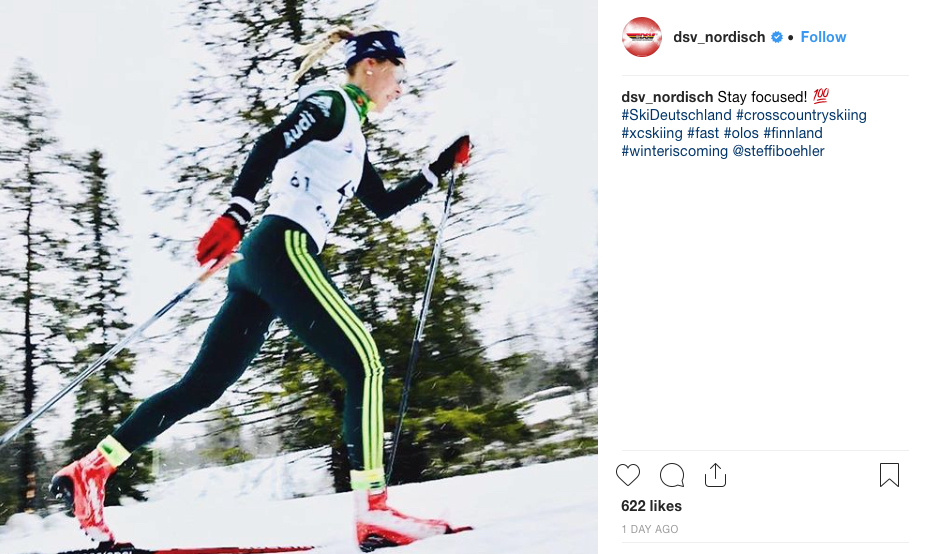
    Germany’s Steffi Böhler during the FIS women’s 5-kilometer classic in Olos, Finland on 11/10/18. She placed sixth overall in what was used as a warm-up race for the German team. (Photo: Instagram screenshot)

    Pre-Season Racing: Many German National team members are lined up at the FIS races in Olos, Finland scheduled from Nov. 9-11. In Friday’s 1.4 k classic sprint, Ringwald and Laura Gimmler placed first and third respectively. Gimmler had limited World Cup exposure last season, but notched two top-20s.

    For the men, Bing was the best placed German in the sprint placing third overall.

    In Saturday’s 5 k classic, the German women stacked five athletes in the top-6. Carl placed first, Hennig second, and Poland’s Justyna Kowalczyk was third. Also for Germany, Julia Belger skied to fourth, Pia Fink fifth, and Böhler sixth.

    The men raced a 10 k classic. Jonas Dobler raced to 6th as the best placed German.

    Sunday featured a 10 k skate for the women. Russia’s Natalia Nepryaeva won, while Carl was second, Ringwald third.

    In the men’s 15 k skate, Dobler was the best placed German in fifth place.

    Olos Women’s Sprint Results | Olos Men’s Sprint Results

    Olos Women’s 5 k classic Results | Olos Men’s 10 k classic Results

    Olos Women’s 10 k skate Results | Oslo Men’s 15 k skate Results

  • Tour de Ski Rundown: Sadie Bjornsen 3rd; Østberg Posts 25-Second Win; Cologna Wins at Home

    Tour de Ski Rundown: Sadie Bjornsen 3rd; Østberg Posts 25-Second Win; Cologna Wins at Home

    The women’s 10 k classic podium at Stage 2 of the 2018 Tour de Ski, with Norway’s Ingvild Flugstad Østberg (c) in first and Heidi Weng (l) in second, and American Sadie Bjornsen (r) in third in Lenzerheide, Switzerland. (Photo: FIS Cross Country/Twitter)

    Tour de Ski Stage 2 (Lenzerheide, Switzerland): 10/15 classic

    Women’s report

    Men’s report

    For the second-straight day of the Tour de Ski, an American landed on the podium, with Sadie Bjornsen placing third in the women’s 10-kilometer classic individual start on Sunday in Lenzerheide.

    For Bjornsen, it was her third individual podium of the season and first in a race longer than 5 k.  She finished behind two Norwegians, Ingvild Flugstad Østberg, who took the win in 26:59.4 minutes, and Heidi Weng, who was 25.7 seconds back in second.

    Bjornsen was 42.2 seconds out of first and 6.7 seconds clear of Finland’s Kerttu Niskanen in fourth (+48.9). Sweden’s Anna Haag placed fifth (+52.6), Germany’s Nicole Fessel finished sixth (+58.2), and the second American in the top 10, Jessie Diggins in seventh (+1:04.4).

    Switzerland’s Nathalie von Siebenthal placed eighth (+1:08.3) on home soil, just ahead of Germany’s Stefanie Böhler in ninth (+1:08.8), and Slovenian U23 skier Anamarija Lampič placed 10th (+1:08.9).

    For Østberg, the win came two seasons after she won her very first distance World Cup race in Lenzerheide. With the win she leads the Tour standings by 32.8 seconds over Weng in second. Diggins is up to third overall (+1:04.9) and will start Monday’s 10 k freestyle pursuit accordingly, 1:05 seconds after Østberg, who will head out of the gate first.

    Bjornsen is fourth overall (+1:15.4), just ahead of Russia’s Natalia Nepryaeva in fifth (+1:17.3) while Niskanen is another 15 seconds back in sixth (+1:32.0), and will start the pursuit with American Sophie Caldwell, who was second in Saturday’s Stage 1 skate sprint and ranks seventh overall (+1:32.0). Caldwell placed 21st on Sunday, 1:40.6 behind Østberg.

    “It’s has been a huge goal of mine to be on the distance podium,” Bjornsen said, according to a FIS press release. “It felt really crazy out there today. At the 6.0 km I got the information I was in 2nd place. I had to ski a lot out of the track. I had to give everything I had in the last 2.5 km. I was little bit disappointed yesterday, I was hoping for more so today feels really great.”

    The U.S. had five in the top 30 with Liz Stephen in 28th (+2:04.8) and Ida Sargent in 30th (+2:06.7). For Stephen, it was her first time in the points (top 30) this season. Rosie Brennan placed 38th (+2:20.5). Kikkan Randall did not start and thus withdrew from the Tour.

    Dario Cologna rose to the challenge on Sunday, winning the second stage of the 2018 Tour de Ski for his first World Cup victory in three years.

    The 31-year-old Swiss skier completed the men’s 15-kilometer classic individual start in 35:29.5 minutes, besting the time of Kazakhstan’s Alexey Poltoranin by 0.6 seconds to win in front of a home crowd in Lenzerheide, Switzerland.

    Cologna started 62nd and sped up as the race progressed, clocking the fastest times from 6 k on. Russia’s Alexander Bolshunov started behind him in bib 68 and topped Cologna’s time at every checkpoint, skiing 7.4 seconds faster than him at 10 k. But over the final 5 k loop, Cologna prevailed and Bolshunov faded, with the Russian U23 skier finishing fourth, 14 seconds off Cologna’s winning time.

    “It’s amazing, the first victory in Switzerland,” Cologna told Swiss broadcaster SRF. “I think it’s my 22nd [World Cup win], but the first one at home, which is very beautiful. And after a two-year break it really is a great satisfaction.”

    Poltoranin started 27th and claimed his second podium of the season and first one of the tour, while Norway’s Martin Johnsrud Sundby scored his first podium since early December. Sundby placed third, 13.1 seconds out of first. Russia had two in the top five with another U23 skier, Alexey Chervotkin in fifth (+16.2). Norway’s Hans Christer Holund was sixth (+21.2), Finland’s Iivo Niskanen seventh (+22.9), Italy’s Francesco De Fabiani eighth (+27.2), Norway’s Didrik Tønseth ninth (+37.1), and Russia’s Sergey Ustiugov 10th (+37.1).

    Canada’s Alex Harvey placed 20th (+57.9) and slipped two places in the overall standings to ninth. Russia’s Sergey Ustiugov, who won yesterday’s Stage 1 skate sprint, still leads the standings while Cologna is up to second, just 1.6 seconds back heading into Monday’s freestyle pursuit in Lenzerheide. Bolshunov is third, 12.7 seconds back, Poltoranin fourth (+22.0), Finland’s Ristomatti Hakola fifth (+27.7), Sundby sixth (+39.1), Niskanen seventh (+46.4), Chervotkin eighth (+49.8), Harvey ninth (+53.8), and Holund 19th (+54.5).

    In Saturday’s 15 k classic, Erik Bjornsen led the U.S. men in 27th (+1:22.4), Simi Hamilton finished 58th (+2:41.8), Andy Newell was 71st (+3:11.5), and Paddy Caldwell 75th (+3:36.2).

    Eighty-five men finished the second stage of the Tour de Ski; Canada’s second man, Devon Kershaw, did not race on Sunday and withdrew from the tour due to illness.

    Results:

    Women’s 10 k classic | Women’s Tour standings (through Stage 2) 

    Men’s 15 k classic | Tour standings (through Stage 2)

    Monday start lists: 

    Women’s 10 k freestyle pursuit | Men’s 15 k freestyle pursuit

  • Kalla Cranks Out Win in Blink’s Lysebotn Opp; Stephen 6th

    Kalla Cranks Out Win in Blink’s Lysebotn Opp; Stephen 6th

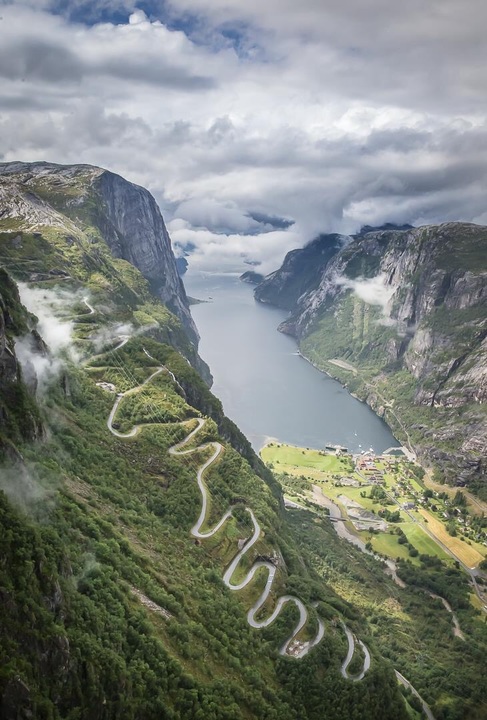
    The 7.5-kilometer race course for the Lysebotn Opp, an annual hill climb at the Blink Ski Festival in Lysebotn, Norway. (Photo: Blink Ski Festival/ Facebook)

    There’s a little more than six months to go until the opening ceremony of the 2018 PyeongChang Winter Olympics. For the recently turned 30-year-old Charlotte Kalla, a two-time Olympic gold medalist and three-time silver medalist from Sweden, nothing would be sweeter than to capture another gold this winter in South Korea.

    Her last individual Olympic win came in 2010 in Vancouver, B.C., when she took first in the women’s 10-kilometer freestyle. A repeat podium in the PyeongChang 10 k skate is not far from her thoughts.

    “It is a race that is certainly on my mind,” Kalla told NRK on Thursday, according to a translation.
    What better way for Sweden’s 10 k favorite to practice than at the Blink Ski Festival’s Lysebotn Opp, an annual 7.5 k freestyle rollerski hill climb in Lysebotn, Norway? With names sure to contest her at the Olympics –including Norway’s Marit Bjørgen and Heidi Weng, as well as Finland’s Krista Pärmäkoski, Germany’s Stefanie Böhler and American Liz Stephen — on the start list for Thursday’s race, Kalla couldn’t resist entering herself.

    Sweden’s Charlotte Kalla (r) racing to the win in the Lysebotn Opp, a 7.5-kilometer uphill climb, at the 2017 Blink Ski Festival on Thrusday in Lysbotn, Norway. (Photo: Axelar/Arild Aarnes)

    If her performance in the rollerski race is any indication of where Kalla is headed this winter, it’s the direction she wants. After breaking away with Bjørgen, Pärmäkoski and Weng early on in the race to form a lead pack of four women, Kalla quickly decided to make the race her own.

    Within the next few kilometers, Kalla dropped the two Norwegians and Pärmäkoski and went on to finish first in a time of 33 minutes, 18.3 seconds. Weng followed 40.3 seconds later and Bjørgen crossed in third, 1 minute and 50.5 seconds back. 

    Notably, Kalla’s time was faster than 57 out of 100 elite men that raced the same 7.5 k course later on Thursday.

    “One shouldn’t focus too much on what happens in July, there is a lot left to be done before the season, but it’s been long since I’ve been in this good a shape in July. The last time was probably 2013,” Kalla told NRK.

    The Lysebotn Opp’s 2014 champion,Stephen finished sixth overall (+3:35.7) on Thursday, after  Norway’s Ragnhild Haga in fourth (+2:43.4) and Pärmäkoski in fifth (+2:47.0). Prior to winning three years ago, Stephen also placed third in the famous rollerski hill climb in 2012 (the Lysebotn Opp was added to the festival in 2010).

    (Article continues below)

    https://www.instagram.com/p/BXHv6bPB5Ln/?taken-by=lizhillstephen

    In the men’s 7.5 k uphill race that followed, Hans Christer Holund broke away for the win in 27:37.6, besting fellow Norwegian Simen Hegstad Krüger in second (+1:13.9) and Finland’s Matti Heikkinen in third (1:25.6).

    Holund took it out strong from the start, holding his lead through the climb’s entirety.

    Norway’s Hans Christer Holund after winning the men’s 7.5-kilometer Lysebotn Opp rollerski hill climb on Thursday at the 2017 Blink Ski Festival in Lysebotn, Norway. (Photo: NRK screenshot)


    “I am healthy and have done some solid training this summer,” the 28-year-old Holund told NRK after. “It looks promising. There’s still a lot of time Olympics, but it does look promising. It is so competitive in Norway and it’s tough to just be selected. If I am selected for the Olympics when the time comes then I will be good enough and then an Olympic gold-medal is the next task.”

    Norway occupied seven of the top eight on Thursday, with Henrik L’Abée-Lund in fourth (+1:59.6), Sjur Røthe in fifth (+2:05.7), Martin Johnsrud Sundby (Wednesday’s 60 k winner) in sixth (+2:11), Simen Andreas Sveen in seventh (+2:12.4), and Gaute Kvåle in eighth (+2:14.7).

    Andy Newell of the U.S. Ski Team did not race the hill climb, but he was back for the 15 k mass start on Friday (as was Stephen for the women’s 10 k). Stay tuned for results in a separate report.

    Results: Women | Men

  • Clean Podium Sweep for Norway in Lahti 30 k: Diggins Conquers 5th

    Clean Podium Sweep for Norway in Lahti 30 k: Diggins Conquers 5th

    Norway’s Marit Bjørgen (3) crosses the line first as teammates Heidi Weng (r) and Astrid Uhrenholdt Jacobsen (l) duke it out for silver and bronze at the conclusion of the 2017 Nordic World Championships 30 k freestyle mass start in PyeongChang, South Korea. Weng finished second, Jacobsen third. (Photo: John Lazenby/Lazenbyphoto.com)

    LAHTI, Finland — 1, 2, 3, 4: Norway’s Marit Bjørgen, Norway’s Heidi Weng, Norway’s Astrid Uhrenholdt Jacobsen, Norway’s Ragnhild Haga. That’s how the women’s 30-kilometer freestyle mass start at the 2017 Nordic World Championships ended on Saturday.

    Bjørgen has two previous 30-kilometer championship titles, but Saturday’s was her first in freestyle. She won the race in 1:08:36.8 hours, just 1.9 seconds ahead of a hard-charging, photo-finishing Weng for second and Jacobsen for third. Haga finished fourth, 5.5 seconds off the podium and 7.4 seconds after Bjørgen.

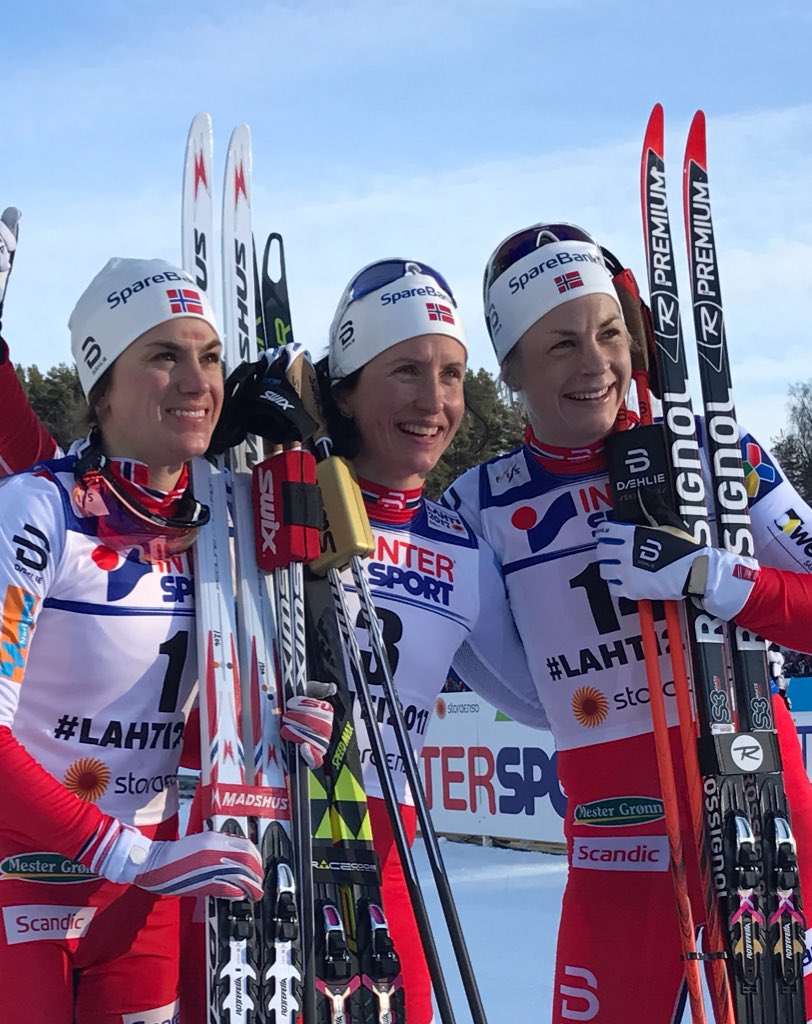
    The women’s 30 k freestyle mass start podium at 2017 Nordic World Championships in Lahti, Finland, with Norway’s Marit Bjørgen (c) in first, Heidi Weng (l) in second and Astrid Uhrenholdt Jacobsen (r) third. (Photo: John Lazenby/Lazenbyphoto.com)

    Weng explained that though she was aware Bjørgen’s move might come on the climbs and Jacobsen’s more likely on the downhills, her strategy was to stick with the two as long as she could.

    “I knew that, for example, Marit is strong on the uphills, and Jacobsen is good to go down,” Weng said during a post-race press conference. “But … I just go and see what happens.”

    “I don’t like 30 k’s,” the silver medalist admitted.

    While Jacobsen has podiumed in a World Cup 30 k once before — two years ago in Oslo, Norway — Saturday’s 30 k top-three finish was her first at world champs. Almost immediately out of the start, Jacobsen was on the ground and ceded approximately twenty seconds to the sharp end of the pack. After hitting the ground hard, she righted herself and hammered; by two kilometers she was 10.8 seconds off of the front and catching their draft by five kilometers.

    “It was a painful 30k for me,” Jacobsen said. “It was hard to get back, but I think my shape is crazy, so I managed to maneuver through everyone, even though there was a lot of stress in the pack to get back to the front. I feel lucky to be here today.”

    It was Jacobsen’s third medal at these championships — she took bronze in the 10 k classic and gold in the 4 x 5 k team relay.

    For certain, Bjørgen was the racer to mark. Along with the relay, she had already taken gold in both distance races (the 15 k skiathlon and 10 k classic) over the last week.

    But, due to what was described as icy and fast snow and many racers coming into the 30 k with self-proclaimed, top-end fitness, Bjørgen was unable to stamp her trademark move in this race. In other words, a group of nine skiers remained cohesive until the final headwall of a climb.

    “I just concentrate and I always want to stay in the front for no problems, it could happen,” Bjørgen said. “It was different. There was high speed in the snow so it was not that difficult to go out front and hard. I just understand after 10 [k] that we needed to do something at the end of the race.”

    The pack behind Norway’s Marit Bjørgen, which includes Sweden’s Charlotte Kalla (5), Norway’s Heidi Weng (1), Norway’s Astrid Uhrenholdt Jacobsen (14), Finland’s Krista Parmakoski (2), and the U.S.A.’s Jessie Diggins (4), awaits the inevitable Bjørgen throw-down in Saturday’s 30 k freestyle mass start at 2017 Nordic World Championships in Lahti, Finland. (Photo: John Lazenby/Lazenbyphoto.com)

    On this day, like the boss she is, she kept her cool. All this despite breaking a pole and her inability to shake the pack.

    “I did. [it was] the first time I have done it in a race,” Bjørgen said, referring to her snapped pole. “I think the point that was broken was good it was just down in the stadium, so there were people standing around asking who need poles.”

    Bjørgen may have difficulty returning to Norway for next week’s World Cup races in Drammen and Oslo as she’ll need to pass through Helsinki, Finland’s airport security with four golds in her carry on.

    “That has to be the most amazing World Championship for me I was since I was coming,” the 36-year-old Bjørgen said. “I had this for a goal for me for fighting for four medals but being able to go home with four golds is incredible.”

    North American Standout: Diggins 5th, Holmes 13th and A Breakthrough for Browne

    The buzz in the media center after the race spoke less about Norway’s dominances and more about some stand-up North American performances. A Swedish colleague listening to the race on a live radio broadcast from Sweden, said many asked about one name in particular: Chelsea Holmes.

    American Chelsea Holmes leads Germany’s Stefanie Böhler during the women’s 30 k freestyle mass start at the 2017 Nordic World Championships on Saturday in Lahti, Finland. (Photo: John Lazenby/Lazenbyphoto.com)

    Holmes, an American skiing out of Alaska Pacific University (APU), finished 7.2 seconds outside of the top 10 in 13th (+1:28.1). Saturday’s competition was Holmes’s first World Championships race experience. The 30-year-old Alaska native made her European World Cup debut last season after having raced in the Canadian World Cup races in 2012 in Quebec City, Quebec.

    Holmes hadn’t done any World Cup races this year until two weekends ago in Otepää, Estonia. Saturday was Holmes’s second time scoring points; her previous World Cup best was 22nd at last year’s Ski Tour Canada.

    “I’m really happy,” Holmes said after Saturday’s 30 k. “The women’s team is so strong right now, that there was chance that I wouldn’t have been able to race at all, so I was super happy to be able to start. I love racing. I wanted to race badly, so I was so happy to be able to race.”

    With a deep field of women to choose from, Holmes’s opportunity was almost bypassed. As U.S. Ski Team Head Coach Chris Grover explained, Holmes was the third American alternate for Saturday’s 30 k.

    “We approached Sadie [Bjornsen], who of course has been on a World Cup podium in skate this year in 5 k, quite a different event, but we approached her, she really did not want to race today,” Grover said, adding that she wanted to prepare for the upcoming World Cup classic races in Norway.

    “We talked to Kikkan about that start, but then Kikkan has already raced four times during this championships so she felt like this was a little too much for her,” Grover continued. “Then Chelsea was next.”

    American Chelsea Holmes (r) leads Germany’s Stefanie Böhler during the women’s 30 k freestyle mass start at the 2017 Nordic World Championships on Saturday in Lahti, Finland. (Photo: John Lazenby/Lazenbyphoto.com)

    For Holmes, the race couldn’t have played out better. She skied in a pack with Russia’s Yulia Tchekaleva, Switzerland’s Natalie von Siebenthal and Germany’s Stefanie Böhler. Sometimes at the head of the group, sometimes in the draft, Holmes never relinquished contact with a potential 10th place until the final kilometer.

    “I was mostly surprised that they were still there,” Holmes said of her ability to stick within the chase pack of four.

    “There were a couple of times where you take feeds, or accordion on the hills, and I’m like, ‘Oh my god, I’m going to fall off!’ and then I’d feel strong, and somehow bridge that gap,” she added. “I was a little surprised in the last 10 k there was a gap, and I had a couple of hills where I got bogged down, and I was like, ‘Am I going to go backwards?’ and then it came around. In the end, I didn’t have that little pop, to to ski to 10th instead of 13th.”

    Finishing ahead of Holmes, the first American across the line was Jessie Diggins in fifth (+10.4). At this point, Diggins’s result, beyond the fact that it comes in a mega-distance, surprised no one.

    “She has got a fifth, fourth, third, and second from this championships, so she has really arrived in the sport,” Grover said. “She has obviously been trending that way for a while, but she really stepped up across the board, so, super exciting.”

    Her fifth place was the best American result in a World Championship 30 k. Diggins was in the hunt for a podium with nine other skiers deep into the race. When Bjørgen made her late in the game kill-shot, the nine skiers were moving up the final climb. This is where Sweden’s Charlotte Kalla, another winning threat on Saturday, stepped on her own pole putting her out of podium contention.

    Jessie Diggins (U.S. Ski Team) racing to fifth in the women’s 30 k freestyle mass start at the 2017 Nordic World Championships on Saturday in Lahti, Finland. (Photo: John Lazenby/Lazenbyphoto.com)

    With that, four Norwegians broke away and Diggins followed.

    “I was actually smiling during the race and it was just really really cool, up until the last three to four minutes, to be right there with the leaders,” Diggins said. “I was like, ‘OK, this is possible,’ and thought I knew where they were going to go. Unfortunately I wasn’t positioned quite right so when the attack came, I kind of had to do some navigating.”

    Diggins leaves these championships confident about her current and future place in the sport. Asked about the diversity of her strong performances in both the short and long distances, the 25-year-old Minnesotan responded that being a well-rounded skier has been the primary objective.

    “I think that is the overall goal,” Diggins said. “I don’t want to be just a skater or just a sprinter or just a 5 k skater, I want to be able to be everything. I want to be an all around person who can show up and medal at any event. That’s the ultimate goal.”

    She continued that some of her better results are yet to come.

    “I am not even close to my peak yet … I have some years to keep working on it,” Diggins said. “I really want to be a threat in any event that I enter. Especially for the Olympic year, I mean, it is time we get a medal darn it, so we are going for it.”

    The next two Americans across the line were Liz Stephen in 25th (+3:09.4) and Caitlin Gregg in 36th (+5:03.7). Stephen’s best 30 k result on the World Cup are two ninth places, one in 2013 and one in 2015, both at Holmenkollen in Oslo.

    At the 2015 World Championships in Falun, Sweden, Stephen finished 11th in the 30 k classic mass start. Gregg medaled earlier in those championships, finishing third in the 10 k freestyle in Falun (behind Diggins in second).

    “I felt incredible for the first 5, or 10 k, and then I don’t know what happened,” Gregg said. “I don’t know if I’m just out of touch with that racing feeling, because I haven’t been racing a lot, just training.”

    The last race Gregg contested was the Boulder Mountain Tour on Feb. 4, which she won.

    “I found myself in this kind of nondescript place, where I felt like I wasn’t necessarily tired, but I couldn’t push any harder,” Gregg explained. “My skis felt great, everything was great, I think it was just one of those days you hope not to have on a championship day. I wish there was something that I could point to, and say, ‘this went wrong,’ but everything was dialed. I just didn’t feel that extra zoom today.”

    Canada’s Cendrine Browne (r) leads American Liz Stephen during the women’s 30-kilometer freestyle mass start at the 2017 Nordic World Championships on Saturday in Lahti, Finland. (Photo: John Lazenby/Lazenbyphoto.com)

    Canada’s Cendrine Browne led her team in 26th (+3:16.0) for her best individual result to date and first time scoring World Cup points (top 30). Browne skied within 17 seconds of the race leader at 11 k, when the pace started to pick up. After that Brown lost contact with the front group.

    “I felt no pain for the first 10 k. I was like, ‘Wow, I am in really good shape today. I think I can do this,’ ” said Browne, a World Championships rookie and Canadian U25 Team member. “After 15 k, I lost the first pack, but I was with a pack of three or four girls so we skied together and a couple of other girls joined us towards the end. I really surprised myself today. I had the legs, I had the power, I had the shape. It was awesome.”

    The second Canadian to finish was Dahria Beatty in 34th (+4:45.2). Saturday marked Beatty’s second 30 k, and her first at the World Cup level (she raced the Canadian National Championships 30 k freestyle mass start in 2015, where she placed third).

    “The first 5 k were awesome,” Beatty said. “It was fast day and I stayed with a big pack for a long time… then just kind of broke off the pack about 6 k and fought hard the rest of the race and couldn’t quite make it to that top 30 pack but could kind of see them in the distance. It was a really good race to learn and looking forward to another 30 k in a few weeks.”

    Canada’s Emily Nishikawa finished 40th (+6:41.5) followed by Katherine Stewart-Jones in 41st (+7:18.6).

    The final event of Lahti World Championships, the men’s 50 k freestyle mass start, takes place on Sunday.

    Results

    — Ian Tovell and Jake Ellis contributed

    Canada’s Dahria Beatty (l) leads Australian Barbara Jezersek across the line in the women’s 30-kilometer freestyle mass start at the 2017 Nordic World Championships on Saturday in Lahti, Finland. Beatty finished 34th and Jezersek 35th. (Photo: John Lazenby/Lazenbyphoto.com)
  • Saturday Rundown: Lahti & PyeongChang (Updated x2)

    Saturday Rundown: Lahti & PyeongChang (Updated x2)

    The all-Norwegian women’s 30 k freestyle mass start podium at 2017 Nordic World Championships in Lahti, Finland, with Marit Bjørgen (c) in first, Heidi Weng (l) in second, and Astrid Uhrenholdt Jacobsen (r) in third. (Photo: FIS Cross-Country/Twitter)

    FIS Nordic World Championships (Lahti, Finland): Women’s 30 k freestyle mass start

    Marit Bjørgen made it a four-peat on Saturday with her fourth gold and third individual win over the last week at 2017 Nordic World Championships in Lahti, Finland. (She previously won the 15-kilometer skiathlon, 10 k classic, and 4 x 5 k relay.)

    The 36-year-old Norwegian closed out the championships with a 1.9-second victory in the women’s 30-kilometer freestyle mass start, finishing in 1:08:36.8 hours after setting the pace and leading a large group for much of the race. The group began to separate around 15 k, where it was down to 13 women with five seconds of first. At that point, Americans Jessie Diggins and Chelsea Holmes were within that lead pack.

    While Holmes started to fall off the pace around 16 k, Diggins stuck with the leaders to the very end, only until four Norwegians broke away to race for the medals over the final kilometer.

    With Bjørgen still charging hard up front, her teammates Heidi Weng, Astrid Uhrenholdt Jacobsen, and Ragnhild Haga followed, while Finland’s Krista Pärmäkoski trailed another second back in fifth and Diggins was one more second behind in sixth.

    Bjørgen led the downhill into the stadium and skied away from her teammates before the finishing stretch, leaving Weng and Jacobsen to duke it out for second place. Weng got it by less than one-hundredth of a second, Jacobsen took bronze (+1.9), and Haga completed the Norwegian top-four sweep in fourth (+7.4).

    Diggins passed Pärmäkoski and notched fifth (+10.4) for her career-best 30 k result. Pärmäkoski placed sixth (+11.3), Sweden’s Charlotte Kalla finished seventh (+13.9), Austria’s Teresa Stadlober was eighth (+15.5), Sweden’s Anna Haag ninth (+20.3), and Russia’s Yulia Tchekaleva 10th (+1:20.9) after edging Switzerland’s Nathalie von Siebenthal in a photo finish. Germany’s Stefanie Böhler placed 12th (+1:23.5) and Holmes finished 13th (+1:28.1) for her career best.

    U.S. Ski Team member Liz Stephen placed 25th (+3:09.4), 6.6 seconds ahead of Canada’s national U25 Team skier Cendrine Browne, who notched a career best 26th (+3:16) in her first World Championships.

    Holmes’s Alaska Pacific University (APU) teammate Jessica Yeaton, who races for Australia, finished 33rd (+4:32), Canada’s Dahria Beatty was 34th (+4:45.2), and American Caitlin Gregg 36th (+5:03.7).

    Great Britain’s Annika Taylor, a California native, placed 38th (+6:19.4). Canada’s Emily Nishikawa was 40th (+6:41.5) and Katherine Stewart-Jones 41st (+7:18.6), and Brazil’s Jaqueline Mourão, who trains in Quebec, was 46th (+13:44.6) out of 47 finishers.

    Results

    ***

    IBU World Cup (PyeongChang, South Korea): Women’s and men’s pursuits

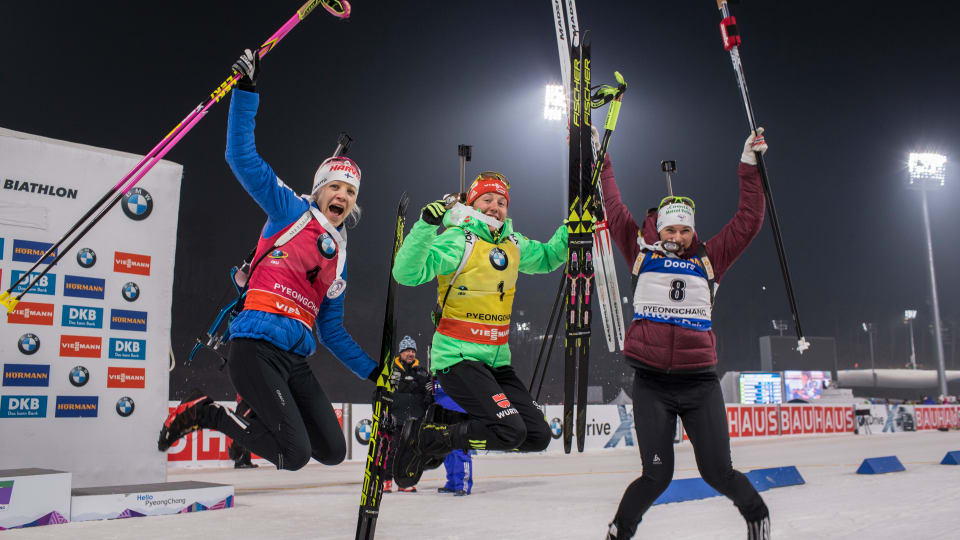
    The women’s 10 k pursuit podium at the IBU World Cup in PyeongChang, South Korea, with Germany’s Laura Dahlmeier (c) in first, Finland’s Kaisa Mäkäräinen (l) in second, and France’s Anais Bescond (r) in third. (Photo: IBU)

    Coming off a fifth place in Thursday’s 7.5-kilometer sprint, Susan Dunklee held her position despite three penalties in the women’s 10 k pursuit on Saturday to finish fifth again at the International Biathlon Union (IBU) World Cup in PyeongChang, South Korea.

    Germany’s Laura Dahlmeier racked up her second-straight win in as many races in PyeongChang (and sixth-straight, counting World Championships), finishing in 27:58.0 minutes with clean shooting. She was just one of four women out of 58 finishers that hit all 20 targets in Saturday’s four-stage race.

    Finishing more than a minute later, Finland’s Kaisa Mäkäräinen placed second (+1:12.6) after starting fourth based on her sprint result. Mäkäräinen had two penalties, both in the first standing, but cleaned the other three stages (0+0+2+0). France’s Anais Bescond raced up from eighth at the start to third place (+1:18.9) at the finish, with a single penalty (0+0+1+0), while Norway’s Tiril Eckhoff missed her second-straight podium in fourth place (+1:32.0) after starting second but accumulating five penalties (1+2+1+1).

    Eckhoff edged Dunklee, of the U.S., by half a second as Dunklee placed fifth (+1:32.5) with three misses (1+1+0+1).

    Canada’s Rosanna Crawford rose from 30th to 19th (+2:49.1) for her best non-relay result of the season, with two penalties (1+1+0+0). Her teammate Megan Tandy also landed her first top 30 of 2016/2017 in 30th (+3:26.2) with two misses (1+0+1+0) after starting 39th. Also for Canada, Julia Ransom finished 44th (+4:18.4) after starting 41st and skiing four penalty loops (1+0+1+2).

    Also for the U.S., Clare Egan finished 36th (+3:41.9) with three clean stages but three misses in her first standing (0+0+3+0), after starting 33rd. Joanne Reid slipped from 35th at the start to 52nd (+4:53.4), with five penalties (1+1+0+3).

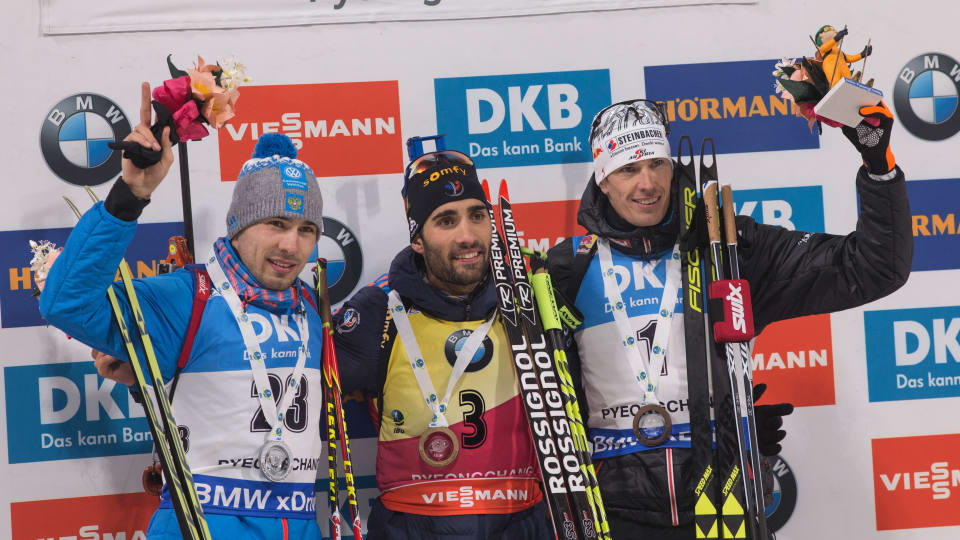
    The men’s 12.5 k pursuit podium on Saturday at the IBU World Cup in PyeongChang, South Korea, with France’s Martin Fourcade (c) in first, Russia’s Anton Shipulin (l) in second and Austria’s Julian Eberhard (r) in third. (Photo: IBU)

    [UPDATED] One day after locking up the overall World Cup title, Martin Fourcade was back at the top of the podium in the men’s 12.5 k pursuit in PyeongChang.

    Fourcade started third, after finishing third in Friday’s sprint, then shot clean to win in 31:24.2. Russia’s Anton Shipulin, who started 23rd, also shot 20-for-20 to race up to second place, 34.5 seconds behind Fourcade, with the fifth-fastest course time. In comparison, Fourcade’s course time was third fastest.

    Friday’s sprint winner, Julian Eberhard of Austria finished third (+36.7) after skiing three penalty loops (0+2+0+1). His teammate Simon Eder placed fourth (+1:03.2) after starting eighth and cleaning three stages before missing two on the last standing (0+0+0+2).

    Russia’s Evgeniy Garanichev improved from ninth at the start to fifth (+1:09.5) with two penalties as well (0+1+1+0). France’s Simon Desthieux was sixth (+1:13.5), Austria’s Dominik Landertinger seventh (+1:20.3), Germany’s Benedikt Doll eighth (+1:20.4) with the fastest course time after starting 20th.

    American Lowell Bailey was another 0.2 seconds back in ninth (+1:20.6), just ahead of Italy’s Lukas Hofer in 10th, who finished with the same time. Bailey previously tallied the third podium of his career on Friday, placing second in the sprint, but had two penalties on Saturday (1+0+1+0) to slip to ninth.

    Also for the U.S., Leif Nordgren improved to 28th (+2:28.9) after starting 37th and shooting 19-for-20 (0+0+0+1).

    Christian Gow shot clean to lead Canada in 32nd (+3:17.4), up from 56th at the start. His older brother Scott Gow slipped from 27th at the start to 43rd (+4:05.9) with five penalties (0+1+1+3), and Brendan Green followed in 44th (+4:09.8) with three penalties (2+1+0+0) after starting 28th.

    Results: Women | Men

  • Tuesday Rundown: Lahti and Osrblie (Updated)

    Tuesday Rundown: Lahti and Osrblie (Updated)

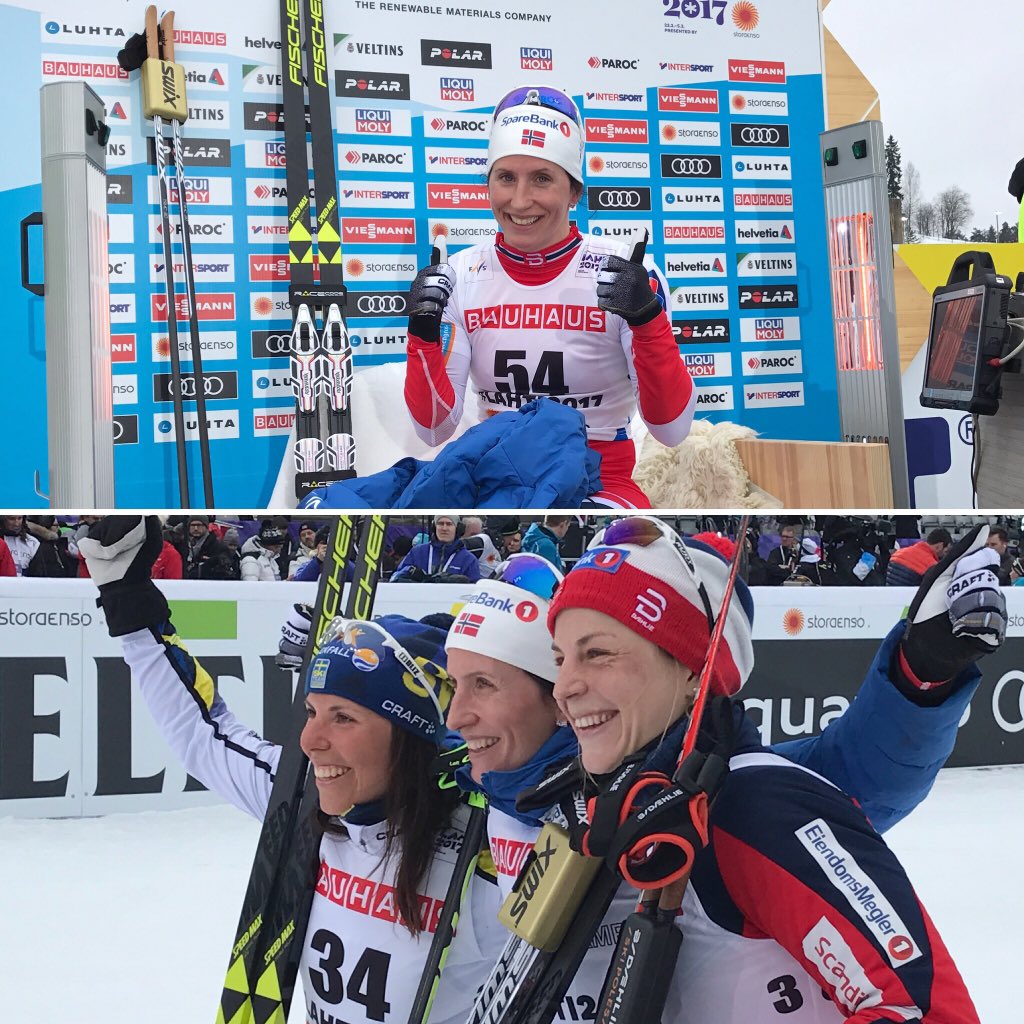
    Above: Norway’s Marit Bjørgen celebrates her 16th World Championships gold after winning Monday’s 10 k classic in Lahti, Finland. Below: The women’s 10 k classic podium at 2017 Nordic World Championships in Lahti, with Bjørgen (c) in first, Sweden’s Charlotte Kalla (l) in second, and Norway’s Astrid Uhrenholdt Jacobsen (r) in third. (Photo: FIS Cross-Country/Twitter)

    FIS Nordic World Championships (Lahti, Finland): Women’s 10 k classic

    No contest. That was the takeaway of Marit Bjørgen’s performance in the women’s 10-kilometer classic individual start on Monday at 2017 Nordic World Championships in Lahti, Finland, after the Norwegian posted a 41-second victory in 25:24.9 minutes.

    Bjørgen started 54th of 72 starters and clocked the fastest time over every intermediate timing point on the course. Sweden’s Charlotte Kalla had been the previous race leader after starting 34th before Bjørgen bumped her out of the leader’s chair by 41 seconds.

    Norway had two on the podium with Astrid Uhrenholdt Jacobsen in third, 55.5 seconds behind Bjørgen. Norway’s Heidi Weng missed the podium in fourth (+1:13.8), while Sweden’s Anna Haag — an early leader in bib 18 — finished fifth (+1:22.7). Finland’s Kerttu Niskanen took sixth (+1:23.7) and Krista Parmakoski was seventh (+1:31.4), while Norway’s Ingvild Flugstad Østberg and Poland’s Justyna Kowalczyk tied for eighth (+1:34.5). Germany’s Stefanie Böhler rounded out the top 10 in 10th (+1:35.8).

    Sadie Bjornsen led the U.S. women in 23rd (+2:21.2), Kikkan Randall placed 26th (+2:31.7), Rosie Brennan was 32nd (+2:55.4), and Ida Sargent 43rd (+3:55.2).

    Katherine Stewart-Jones led the Canadians with her best result at her first World Championships in 36th (+3:09.6), Emily Nishikawa followed in 37th (+3:14.9), and Dahria Beatty 39th (+3:24.9).

    The men’s 15 k classic takes place tomorrow.

    Results

    ***

    IBU Youth/Junior World Championships (Osrblie, Slovakia): Junior relays

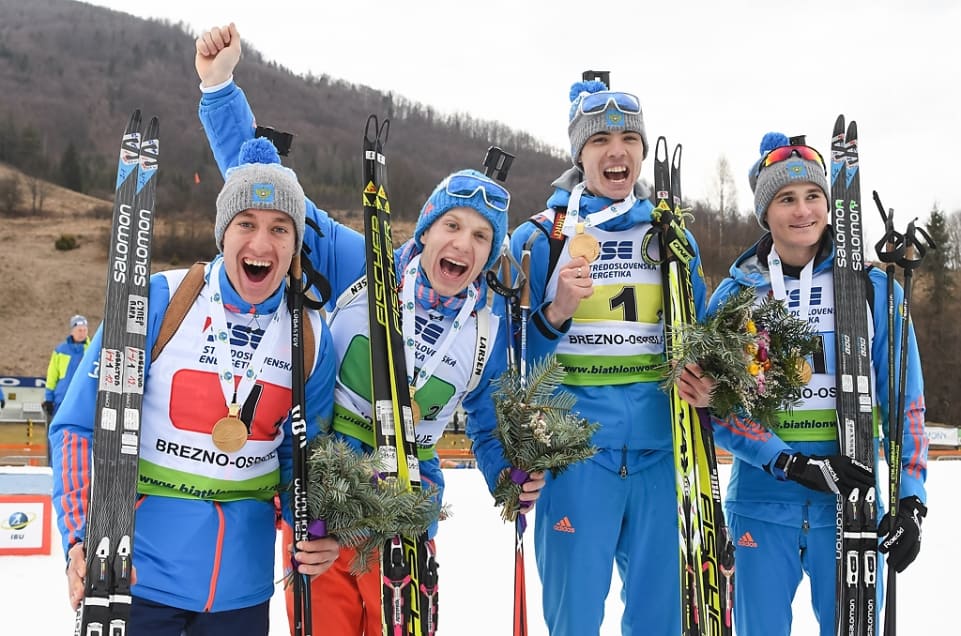
    (From left to right) Russia’s Nikita Lobastov, Igor Malinovskii, Nikita Porshnev, and Kirill Streltsov after winning the men’s 4 x 7.5 k relay on Tuesday at IBU Youth/Junior World Championships in Osrblie, Slovakia. (Photo: IBU)

    [UPDATED] Russia, Norway, Germany. Or Norway, Germany, Russia. That’s how the podiums shook out for the junior men’s and women’s relays on Tuesday, the last day of the 2017 International Biathlon Union (IBU) Youth/Junior World Championships in Osrblie, Slovakia.

    Russia won the men’s 4 x 7.5-kilometer event by 53.9 seconds in 1:17:27.8 hours, with Nikita Lobastov, Igor Malinovskii, Nikita Porshnev, and Kirill Streltsov. After coming through the first exchange in fifth, 44.2 seconds out of first, Malinovskii skied his team into first and they held the lead to the finish. In total, Russia used seven spares to clean and had no penalties.

    Norway claimed silver with Dag Sander Bjørndalen, Johannes Dale, Aleksander Fjeld Andersen, and Sindre Pettersen. After getting tagged in 14th, Dale moved the team up to sixth and Andersen improved to second, which Pettersen held. The team combined for one penalty and 12 spares.

    Germany claimed bronze (+1:39.3) despite one penalty and 16 spares, with Justus Strelow, Danilo Riethmüller, Dominic Schmuck, and David Zobel. Fourth at the first exchange, Riethmüller picked moved them into third on the second leg, which Schmuck and Zobel held.

    Canada finished 12th (+6:00.5) with Zachari Bolduc, Trevor Kiers, Jules Burnotte, and Pearce Hanna combining for three penalties and 13 spare rounds. Positioned in 10th for the first two legs, the team moved into eighth on Burnotte’s third leg. Hanna had to ski three penalty laps on the final leg and slipped to 12th.

    The U.S. men finished 14th (+9:07.4) with Cody Johnson, Cameron Christiansen, Travis Cooper, and Peter Carroll combining for two penalties and 10 spare rounds. The team gradually moved up from 16th at the first exchange to 12th at the third and final exchange, before losing two places before the finish.

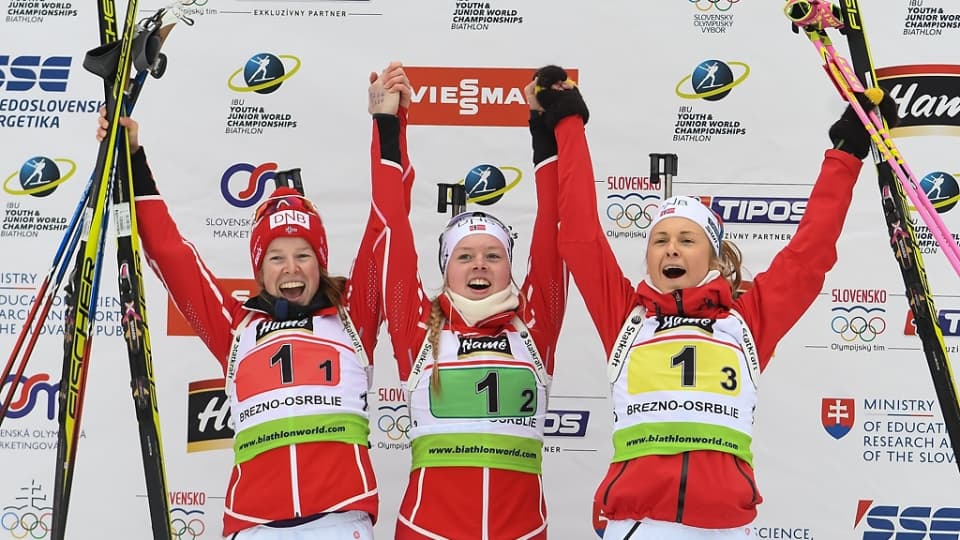
    (From left to right) Norway’s Hilde Eide, Karoline Erdal and Ingrid Landmark Tandrevold after winning the junior women’s 3 x 6 k relay on Tuesday at IBU Junior World Championships in Osrblie, Slovakia. (Photo: IBU)

    In the junior women’s 3 x 6 k relay, Norway rose to gold with Hilde Eide, Karoline Erdal and Ingrid Landmark Tandrevold (for Tandrevold’s third medal in the last three races, and first gold of the week) finishing in 56:18.4. The team, which had zero penalties and used eight spares, moved up from fourth at the first exchange to first on Erdal’s second leg and Tandrevold anchored them to the win.

    Germany crossed the finish 16.5 seconds later for silver, with Vanessa Voigt, Sophia Schneider and Anna Weidel. In seventh after the first leg, Schneider moved them into third before Weidel anchored them to second. They had one penalty and used nine spares.

    Russia rounded out the women’s podium in third (+26.1) with Kristina Reztsova, Ekaterina Moshkova and Valeriia Vasnetcova. After being tagged in ninth, Moshkova skied them up to fourth and Vasnetcova picked off one more place for bronze. They combined for one penalty and eight spares.

    Canada’s junior women finished 14th (+4:17.7) with Megan Bankes, Emily Dickson and Nadia Moser combining for four penalties and nine spares. They had been as high as 11th after Bankes’s first leg.

    The U.S. finished 17th (+11:30) with Siena Ellingson, Helen Wilson and Nina Armstrong accumulating five penalties and 11 spares. They had skied as high as 15th after Ellingson’s first leg.

    Results: Junior men | Junior women

  • After The Medals: Team-Sprint Bronze Medalist Sadie Bjornsen

    After The Medals: Team-Sprint Bronze Medalist Sadie Bjornsen

    American Sadie Bjornsen (r) during the women’s 6 x 1.3-kilometer classic team sprint on Sunday at the 2017 Nordic World Championships in Lahti, Finland. (Photo: John Lazenby/Lazenbyphoto.com)

    LAHTI, Finland — While Monday marked a rest day for skiers competing in the 2017 Nordic World Championships, FasterSkier took the opportunity to sit down and chat with Sadie Bjornsen of the U.S. Ski Team, one day after she earned bronze with teammate Jessie Diggins in the women’s 1.3-kilometer classic team sprint. Not only was it Bjornsen’s first-career World Championships medal, it was the first for the U.S. women’s program in a World Championships classic race.

    Bjornsen, 27, who lives and trains in Anchorage, Alaska, claimed the third spot on the podium with Diggins after a nail-biting sprint finish. With Bjornsen racing the first leg for the U.S., two of the three times she posted were the fastest first leg splits. No small feat with names like Norway’s Heidi Weng, Sweden’s Ida Ingemarsdotter, and Finland’s Aino-Kaisa Saarinen, Slovenia’s Katja Visnar, Russia’s Yulia Belorukova, Switzerland’s Nadine Fähndrich, Germany’s Stefanie Böhler among others all on the list for the first leg.

    In the interview, Bjornsen explains what the bronze medal means to her and how racing the team sprint has been a goal of hers for quite some time. She outlines some of the challenges she’s faced throughout her career up to this point and highlights the importance of her club coach, Erik Flora, of Alaska Pacific University.

    (Note: the interviews were conducted in a non-studio environment and are best listened to without headphones.)

    Bjornsen is entered in the women’s 10 k classic race slated to take place Tuesday, Diggins is not. The men will race a 15 k classic on Wednesday. Men’s start lists were not available at the time of publication.
    U.S. 10 k classic entries:

    Women

    • Sadie Bjornsen
    • Rosie Brennan
    • Kikkan Randall
    • Ida Sargent

    Canadian 10 k classic entries:

    Women

    • Dahria Beatty
    • Emily Nishikawa
    • Katherine Stewart-Jones
    • Cendrine Browne

    Start list: Women

  • Stephen Earns Historic Podium in Rybinsk; Jacobsen Notches First Win in Seven Years

    Stephen Earns Historic Podium in Rybinsk; Jacobsen Notches First Win in Seven Years

    Liz Stephen (U.S. Ski Team) racing in the Tour de Ski prologue in Oberstdorf, Germany, last weekend. (Photo: Marcel Hilger)
    Liz Stephen earned the best finish of an American woman in a World Cup distance race Friday, with her second place in Rybinsk, Russia. She is pictured here in the 2015 Tour de Ski. (Photo: Marcel Hilger)

    After her second-place finish in Friday’s World Cup 10-kilometer freestyle in Rybinsk, Russia, Liz Stephen had a lot to celebrate – it was her first individual World Cup podium, just two weeks after her historic fifth-place finish in the Tour de Ski.

    But there was something the 27-year-old hadn’t realized.

    As she sat down for the press conference with FIS Marketing Support Jeff Ellis, he informed her of another historic accomplishment – Stephen had posted the best distance result for an American woman on the World Cup, besting Ellis’ wife, Kikkan Randall’s third place in Gällivare, Sweden in 2012.

    With the realization, Stephen said she there was only one word to describe the plethora of feelings surrounding the result.

    “To sum it up in one word, I’m ecstatic. I’m really happy to put it all together on one day. I’m ecstatic for sure and a little emotional,” Stephen said in a phone interview.

    The results in Rybinsk marked a respite from the familiar podium names with major players such as Norwegians Marit Bjørgen, Therese Johaug, and Heidi Weng avoiding the long journey to Russia in order to rest for the remaining races of the season. However, with strong competitors like Poland’s Justyna Kowalczyk and Finland’s Kerttu Niskanen in the mix, no result was guaranteed. 
    Stephen placed second to Norway’s Astrid Jacobsen, who finished the 10 k in 28:12.5. Stephen was off-pace by 14.4 seconds, but placed ahead of Germany’s Stefanie Böhler (+36.4) who claimed the final podium spot. Rounding out the top-five were Yulia Tchekaleva (+37.6) of Russia and Kristin Størmer Steira (+41.4) of Norway. Until Friday, Størmer Sterira had been absent from the World Cup after a double hip fracture in October.

    The Comeback Podium

    Friday’s win was Jacobsen’s first since 2008 when she won the World Cup 15 k pursuit in Falun, Sweden. In the nearly seven years since, Jacobsen has been on the World Cup podium many times but another victory was always been elusive.
    Jacobsen’s path to the top of the podium was a difficult one. Just one day before the start of the 2014 Olympic Games, her brother and training partner passed away unexpectedly, causing emotional hardship for the Norwegian throughout the event and remainder of the year. Later that season she crashed into a lamppost in the Holmenkollen 30 k and was rushed to the hospital. With no serious injuries resulting from the crash, Jacobsen began what looked to be a productive training season that spring. By the fall, however, Jacobsen told NRK that her body was no longer responding to training.

    Astrid Uhrenholdt Jacobsen (NOR) 13th place.
    Astrid Uhrenholdt Jacobsen of Norway returned to the top of a World Cup Podium Rybinsk, Russia after a seven year absence. She is pictured here in the 2012 Tour de Ski.

    According to NRK, the physical hardship lasted through the beginning of the season where Jacobsen raced to uncharacteristic results over the Lillehammer World Cup weekend. With her body feeling out of whack, Jacobsen decided to rest. After seeing improvement since the begging of the year, she participated in Scandinavian Cups while her teammates competed on the World Cup circuit. Her most recent was in Falun, Sweden, the site of the 2015 World Championships, where she won the 15 k skiathlon and placed third in the 10 k freestyle.

    “I have felt since New Year that the shape has been better and better. I had some good races in Falun, but today it was even better,” she told NRK Sport.

    In Friday’s race, Jacobson dominantly skied the hilly course to earn top splits throughout the race. Skiing one bib behind Stephen for the entirety of the 10 k, she crossed the finish line with her arms outreached and a smile on her face.

    “I have had to be very patient this year. My body has not handled training as it should since August. So I am very happy to have such a result today,” she told FIS in a post-race interview. “It is a difficult course with challenging conditions today so I was cautious on the first lap and I think that helped very much.”

    Rybinsk has been friendly to Jacobsen in the past. In 2007 she earned her first World Cup win in the 15 k mass start.

    Third place finisher Böhler also has fond memories of Russia. In 2009 she earned her first and only other individual World Cup podium in a Rybinsk World Cup 10 k mass start.

    Stefanie Boehler (GER) 24th place.
    Stefanie Böhler of Germany earned the third place and her second-ever individual World Cup podium. She is pictured here in the 2012 Tour de Ski.

    “This is a great result. My only other podium on World Cup was here in 2009 so I am really happy to be back on the podium here again,” she told FIS. “I always like coming here. The courses are hard, the people are so friendly and there are many spectators. It’s just really nice to be here in Rybinsk.”

    Böhler has faced her share of challenges as well. In 2012 she was diagnosed with thyroid cancer but fought back to compete in the 2014 Olympics where she and her teammates earned a bronze medal in the 4 x 5 k relay.

    Stephen, who is close with Jacobsen after the two exchanged training time in Alaska and Norway, said she was happy be on the podium with both her friend and Böhler.

    “It was a really fun podium to share. For [Jacobsen] to come back and get a win is pretty special for her,” Stephen said. “After last year’s really challenging year with her it’s really special to be on the podium with a friend and someone who has had her fair share of ups and downs, in skiing and in regular life too. Steffi is the same. She battled cancer a couple years ago and she’s one of the more smiley people on the World Cup and always rooting for everyone else.”

    History in the Making

    With many of the biggest names absent from Rybinsk, Stephen knew there was an opportunity to land a spot on the podium – and she was ready to take it.

    “I really wanted to get on the podium today,” Stephen said of her ambitions. “In order to do that I focused on each section of the course.”

    Known for her climbing abilities, the hilly course in Rybinsk favored the Vermont native. Stephen explained that her main strategy for the competition was to ski the flats smoothly. She also focused on skiing over the top of each hill aggressively – an area in which she’s struggled in the past.

    “I just like to go up hills, but over the top can be an issue for me so I saved enough to really go over the top and carry good speed on the downhills and grab a low tuck,” she said.

    U.S. Alpine Ski Team athletes Paula Moltzan and Resi Stiegler lift Liz Stephen high after her stunning fifth in the 10k classic. The alpine racers were training nearby and came trackside to cheer on Stephen in the Tour de Ski. (Photo: U.S. Ski and Snowboard Association)
    U.S. Alpine Ski Team athletes Paula Moltzan and Resi Stiegler lift Liz Stephen after a leg of the 2015 Tour de Ski. Stephen’s fifth ranking in the Tour was the best American result ever. (Photo: U.S. Ski and Snowboard Association)

    The strategy worked and as Stephen sped around the course, consistently earning the second-fastest splits. When she crossed the line it was all but certain she had secured her first World Cup podium. Stephen said she hadn’t thought about the historic possibility of earning the top finish in a distance World Cup by an American woman until Ellis told her in the press conference.

    According to USST Head Coach Chris Grover Stephen’s success is due to her superior fitness.

    “Obviously she came out of the Tour de Ski where she was in really good shape and then she was able to stay healthy and recover. She’s in good form right now and that’s the absolute key,” he said of Stephen.

    Stephen also explained that her result was not just a product of her individual abilities, but also the support of her team. Pointing to her fellow American skiers and coaches, Stephen said that everyone, especially women’s team coach Matt Whitcomb who taught Stephen how to ski at Burke Mountain Academy, played a role in Friday’s historic result.

    “It means a lot to be with this team, having this result, and knowing that you’re never ever out there by yourself. Good days, bad days, great days, this team forms around you,” she said.

    With World Championships three weeks away, Stephen said she hoped to inspire the team to reach their best results of the season in Falun.

    “Having these results going into World Championships for me personally is, of course, wonderful but I also think and hope that it boosts everyone else’s confidence and belief in themselves,” she explained. “I’ve seen it in the past with Kikkan and other teammates having best-ever results for them, or making history. The whole team gets pulled up by it. I think it will.” 

    U.S. Women Solid in Top-20

    It seems that Stephen has already inspired one of her USST teammates.

    Finishing Friday’s race in 12th place, Jessie Diggins explained the 2015 season hasn’t met her expectations, but that Stephen has helped her work towards a stronger mental attitude.

    “Liz has actually been encouraging and inspiring me to work harder with Sports Psychology and start believing harder that I have what it takes,” Diggins wrote in an email. “This season has been tough on my self confidence so far… and I’ve been working on having more confidence when I step onto the snow. Especially after getting quite sick and having to drop out of the Tour de Ski, there were a lot of thoughts running through my mind  – wondering if I would be in good enough shape to race after being sick and not being able to train as planned, etc.”

    After taking over week of rest between the Tour de Ski and Rybinsk, Diggins said that she was able to “put those thoughts away” in Friday’s 10 k and ski a focused and driven race. However, even though she was able to perform mentally, said her body was not responding.

    “I definitely am not in my greatest race shape right now as I think everything came together quite smoothly in this race and my results weren’t close to what they were a few years ago on this course. I need to be patient as I come out of being sick and let these three races this weekend help me get back in my best race shape!” she wrote.

    Just behind Diggins was Rosie Brennan, who earned her best ever finish in a World Cup. As the period one SuperTour leader, Brennan is participating in her second weekend of racing with the USST.

    Rosie Brennan leading her quarterfinal in Tuesday's 1.5 k classic sprint at U.S. Cross Country Championships in Houghton, Mich. (Photo: Christopher Schmidt)
    Rosie Brennan earned her first World Cup points in Rybinsk, Russia. Brennan is pictured here racing in Houghton, Michigan. (Photo: Christopher Schmidt)

    Throughout much of the competition Brennan’s splits were in and out of the top-10, indicating a rapid start. According to Brennan it was all part of the plan, even if it meant her finish speed was reduced.

    “I started pretty hard, maybe a little too hard, but I believe it takes putting yourself out there to really find out what you are capable of. With that in mind, I just tried to keep pushing the whole way. I think I faded a bit at the end, but held it together just enough for a sold result,” she wrote in an email.

    Brennan said she was excited to have “broken that barrier” to earn World Cup points and that she hoped the result would give her confidence through the rest of her time in Europe.

    “Huge race for Rosie, who really skied exceptionally well. That was really exciting to have her in the mix,” Grover said of her race.

    Racing continues in Rybinsk Saturday, with a freestyle sprint.

    Results

  • Johaug Bests Bjørgen in Beito FIS Opener

    Johaug Bests Bjørgen in Beito FIS Opener

    Therese Johaugs reacts when reporters show her a photo of herself and Marit Bjørgen from eight years ago in Beitostølen, the same place where Johaug won the opening race of the season on Friday. (Photo: NRK)
    Therese Johaugs reacts when reporters show her a photo of herself and Marit Bjørgen from eight years ago in Beitostølen, the same place where Johaug won the opening race of the season on Friday. (Photo: NRK)

    Therese Johaug started cracking up when reporters at Friday’s International Ski Federation (FIS) race in Beitostølen, Norway, showed her a photo of herself and Marit Bjørgen from eight years ago, also in Beitostølen.

    The Norwegian national-team member was 18 at the time.

    Marit Bjørgen (l) and Therese Johaug with their gold and silver medals from the 2011 World Championships 15 k in Oslo, Norway. (Photo: Wikimedia Commons)
    Marit Bjørgen (l) and Therese Johaug with their gold and silver medals from the 2011 World Championships 15 k in Oslo, Norway. (Photo: Wikimedia Commons)

    “Oye … a lot has happened since then,” Johaug told NRK with a laugh. Now they’re not only best friends, they’re each other’s fiercest competitors.

    On Friday, Johaug, 26, won the 10-kilometer classic in 26:36.1 minutes, 24.7 seconds ahead of Bjørgen in second. Like fellow Norwegian Martin Johnsrud Sundby, she won last season’s Tour de Ski as well as the overall World Cup title.

    Six years ago, she was a junior competing in Beitostølen for the first time. She told reporters she had the same photo hanging on her wall at home.

    Now she’s won the Beito distance opener for three consecutive years. Last year, Bjørgen didn’t compete; Johaug beat another teammate —Astrid Uhrenholdt Jacobsen — by more than 54 seconds for the win. In 2012, Johaug topped Bjørgen by 52.2 seconds. This was her fourth-straight time winning Beito’s 10 k classic, according to VG.

    On Friday, Bjørgen led through 2 k, 2.7 seconds ahead of Johaug. By 6 k, Johaug took hold with a 5.3-second lead over Bjørgen and stayed in front to secure the first win of the season.

    “It felt good; I managed to calm myself down and think, time and power,” Johaug told NRK, according to a translation. “It was fun to get it when I have worked so much this fall and along.”

    “We have talked a lot about calming down … and trust that I’m fast enough, rather than skiing with my shoulders at the ear level and increasing the turnover. That doesn’t make you fast.” — Therese Johaug, after winning Friday’s 10 k classic FIS race in Beitostølen

    Norway's Therese Johaug pushes for bronze in the women's 10 k classic individual start on Thursday at the 2014 Olympics in Sochi, Russia.
    Johaug racing to bronze in the women’s 10 k classic at the 2014 Olympics in Sochi, Russia.

    Since last season, she’s been working on her upper-body strength and spent long hours in the weight room and on the rollerski treadmill, she told VG. She also credited her psychologist, Britt Tajet-Foxell, for helping her progress.

    “[The training] is paying off, and that’s really fun,” she said, according to a direct translation. “We have talked a lot about calming down and taking time to complete each kick and each pole plant, and trust that I’m fast enough, rather than skiing with my shoulders at the ear level and increasing the turnover. That doesn’t make you fast. Today I felt like I managed to do that, and that I was rewarded all the way.” 

    “Today, Therese was impossible to beat,” Bjørgen told VG.

    As for how she felt: “It hurt, but that is somewhat expected,” Bjørgen said to NRK, adding that she felt normal, like in recent years.

    “It’s not just anyone I measure myself against, so I know what I did today is good,” she told NRK.

    “Next weekend it can be turned upside down,” Norwegian women’s coach Egil Kristiansen said. “Therese skied great today.”

    Norway’s Heidi Weng took third, 44.8 seconds behind Johaug and 20 seconds back from Bjørgen. Germany’s Stefanie Böhler placed fourth and Martine Ek Hagen of Norway was fifth.

    Rounding out the top 10, Katerina Smutna (Austria) was sixth, Claudia Nystad (Germany) finished seventh, Barbro Kvåle (Norway) emerged in eighth, Victoria Carl (Germany) was ninth, and Kari Vikhagen Gjeitnes (Norway) took 10th.

    Jacobsen finished 14th.

    “I’m not in good shape,” she told NRK. “It was hard all the way, and I feel half-empty. … There is a way to go forward; I know that it is there.”

    Racing continues with 10/15 k freestyle races on Saturday and a classic sprint on Sunday.

    Women’s results