From the FasterSkier archive — posts syndicated from athletes’ and coaches’ own blogs between 2004 and 2012, kept online as published. Current coverage is at fasterskier.com.
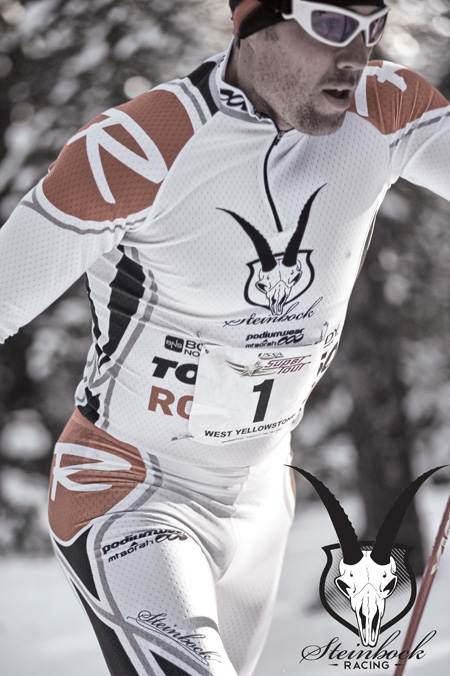
Coon Valley, WI – Mt. Borah Custom Nordic, based out of Coon Valley, Wisconsin will again be supplying Steinbock Racing with their 2011 custom race kits. In its inaugural year, Steinbock racing had an incredibly successful year of race results, and thanks to Mt. Borah Custom the herd could not have looked any better.
“The material, fit and performance of the custom suits was second to none and the design was outstanding. Across the country Steinbock received compliments at every venue regarding our races suits, this speaks volumes about the quality of work Mt. Borah provides”, said athlete Chris Cook.
Although the herd will be thinned out a bit in 2011, it is still full speed ahead for Steinbach Racing. The team plans to reach out to junior and developing racers, to use Steinbock racing as a resource to gain exposure and tap the knowledge of elite and world class racing. Steinbock also has plans to assist developing and established clubs regarding everything XC.
Steinbock athlete Chris Cook will continue with an aggressive race schedule, beginning the season in Europe for the World Cup period, then returning stateside for US Nationals and join in the points chase for the Supertour Series. Steinbock racing is looking for some athletes to rep’ the goats for the upcoming season and continue to inform racers and clubs of the ideas and directions of Steinbock Racing.
These athletes will be easy to pick out of the herd as they will be looking sharp in their Mt. Borah Custom race suits. To learn more or to contact the goats, go to www.steinbockracing.posterous.com and visit www.mtborah.com for all of your custom Nordic apparel needs this winter.
Despite stellar race results for the team last season, Chris Cook is the only goat left in the Steinbock herd for the 2010-11 season, and he has moved back to his hometown of Rheinlander, Wisconsin. Two others are off the elite racing circuit: Zack Simons went back to school, and Andrew Johnson took a coaching position with the University of Vermont.
That leaves Cook to tend to the business side of the organization as well as his race efforts, which will get underway with nothing less than World Cup level events. As the overall winner of the 2009-2010 SuperTour and the leader of the SuperTour sprint series, the 30-year-old qualified to race in Europe as a part of the U.S. Ski Team for the first World Cup races of this season.
The team was well on its way to growing its herd last spring. They applied for funding and targeted sponsors. But with the economy still sluggish and some major grant applications falling through this year, Steinbock Racing was unable to offer the level of support that they needed to commit to the team. The result was that athletes who had showed interest in joining for 2010-2011 opted to stay with their local clubs for the season, Cook explained, adding that he is still hopeful that this will change in the future.
However, Cook is a glass-half-full kind of guy. He sees their choice to stay with their clubs as a sign that the club structure and support for cross-country skiing in North America is improving.
“The clubs and organizations across the United States have gotten good at raising funds and support for senior skiers, and that’s good for the sport,” Cook said, noting that when he graduated from college in 2003, there were only two or three teams nationwide. Now, they have multiplied, he added.
Ready to race
Being a one-goat herd is no picnic, but Cook feels confident going into the racing season. He comes off one of his best mountain biking seasons, and feels as fit as ever despite not having trained on snow during the summer. On November 15, he leaves for Sweden, where he will join the US Ski Team for the World Cup season opener in Gällivare, Sweden on November 20.
“I’ve been training hard, and I think I’ll get dialed in quickly once I get on snow,” Cook said.
There are no hitches in Cook’s motivation, and he has no problem getting the workouts done. With a decade of experience training and racing at the international level, including the 2006 Olympics and more than 30 World Cup starts, Cook knows the drill – and he knows how to design his own training plan.
“When you’ve been around this level for this long, you know what works for you and what doesn’t,” Cook said, adding that he still works closely with his former coach, U.S. Ski Team Head Coach Chris Grover.
Ambitious schedule
With the 2011 World Championships in Oslo as his overall season goal, Cook is ready to get down to work. In order to make the Worlds team, Cook knows he’ll have to deliver solid results both at the U.S. National Championships in January, and in the early season races.
The World Cup opener in Gällivare features a 15-kilometer skate race and a relay. Cook hopes to make the relay team, but doesn’t have great expectations for the 15 k.
“The 15 k freestyle event is not one that has been a great success for me so far,” he said, explaining that his biggest goal for the Gällivare races is to regain the feel for the snow and just get the routine down.
The following weekend, Cook moves on to Kuusamo, Finland, with the U.S. Ski Team. The Finland stop features events more to Cook’s taste: a 15-kilometer classic race and a classic sprint.
But his final World Cup stop, in Davos, Switzerland, December 11 and 12, is what Cook is looking forward to the most: a 15-kilometer classic and a freestyle sprint.
“By then, I should be fully changed over and dialed in on the snow. And I’m a fan of the 15K classic. It’s always been one of the most enjoyable races for me,” Cook said.
He considers his former experience with World Cup racing a major advantage.
“Especially on the sprint courses, it’s a lot different going to a venue for the first time. A huge part of the racing is getting to know the courses. When you’ve got the experience and you’re comfortable with the course, that’s one more thing you can cross off the list and not have to worry about,” Cook said.
As for his chances to make the Worlds team, Cook said there are a lot of unknowns, but he’ll give it his best shot.
“I’m not sure of the team selection process or how many they’ll even take. I try not to think about those things,” Cook said. “I know I have to race hard and do well. I’ll just have to let the chips fall where they may.”
Long-term goal: growing the herd
“I really wanted to continue the team and keep the name out there, even if it’s only me. It has been so much fun running it and being accountable for everything the team puts out there. I maintain the web site, do the Twitter and have a Facebook page,” Cook said. Over time, he said that his goal is to grow Steinbock racing back into a team. Whether that happens next season or over time is still too early to predict, Cook said.
To attract more athletes, Cook is pursuing different avenues. This year, he is getting involved with skiers at the high school level and trying to extend an arm to juniors and younger skiers. That is exactly the kind of attitude that his sponsor Ian Harvey with Toko USA admires in Cook. He has worked with Cook as a sponsor for five years, on and off.
“Cook is a representative for Toko, he has a good personality and we’re proud to sponsor him,” Harvey said, explaining that results are only one of the factors he looks for when deciding to sign an athlete.
“I look for results, but more importantly, I look for a person with enthusiasm for cross-country skiing and who enjoys working with other people. Chris is that kind of guy. I think he could easily grow his team,” Harvey said.
Cook is also doing more online community outreach, putting a lot of effort into the Steinbock Racing web site and promoting the team on social media.
The transition to a one-man show has definitely been a learning experience, but Cook said he is enjoying the team management part of the job as well, noting that he feels like he has plenty of resources to draw on when he needs to. Time is the bigger issue, but he sees light in the end of the tunnel there too.
“I still have Zack and Andrew to help me when I have questions about the web site. There are only so many hours in a day to take care of everything, but once we’re racing and traveling and staying in hotels, you’re searching for things to do, so I think it will be just fine,” Cook said.
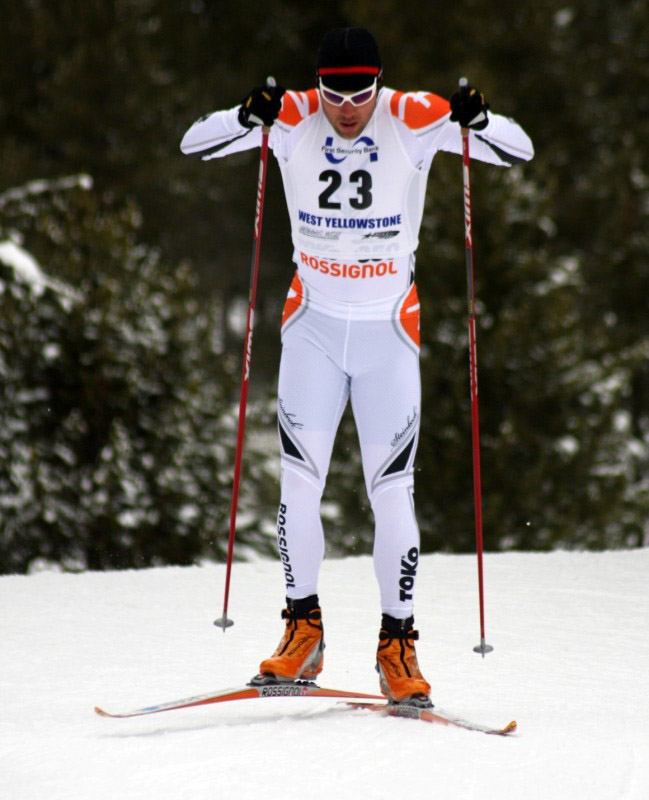
Chris Cook racing in the classic sprint at the 2010 U.S. National Championships.
What do you do when you can’t keep up with Andy Newell?
For most of us, the answer is that we continue on with our normal lives, content to compete for a spot in the elite wave at the American Birkebeiner rather than the top spot on a World Cup podium. But Steinbock Racing’s Chris Cook was not so easily deterred. Instead of giving up, he turned to a sprint workout: sets of all-out 30-second intervals.
“We were pretty similar in a bunch of other workouts, but in this [one], I found he was really getting away from me,” Cook said of Newell. “That’s when I realized I needed to work on them a little more.”
Cook spent a number of years on the U.S. Ski Team, sprinting at the World Cup level, and he had plenty of chances to mix it up with Newell. The two would do this workout together “all the time,” Cook said.
The duration and the number of sets of Cook’s sprint intervals are similar to Simi Hamilton’s speeds, which FasterSkier described earlier this summer. But Cook said that his workout was different, because each effort was longer.
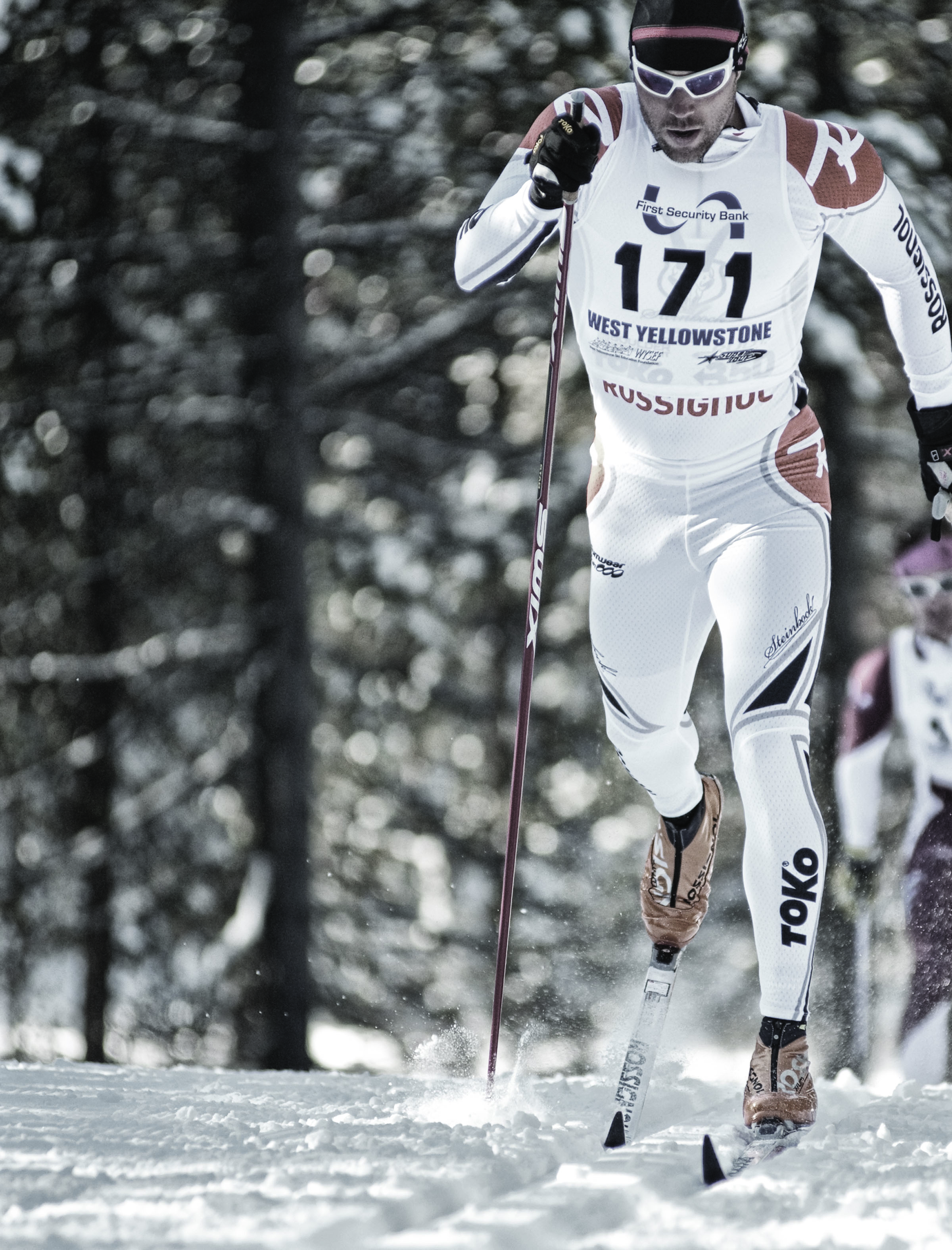
Chris Cook in Canmore. Photo, Win Goodbody.
“It kind of prepares you for that last surge in a sprint heat or mass start race—really charging, building up some fatigue through the set,” he said, describing the session as a “speed workout mixed with, basically, a lactate tolerance workout.”
The pace of the repeats should be all-out—a “hard sprint effort, as hard and fast as you can go,” Cook said. He’ll do three sets of six, with about two minutes of easy recovery between each interval and ten minutes between each set.
It’s good to vary terrain and practice on flats, gradual uphills, and gradual descents, but Cook said that he’ll do many of his repeats from the same starting point on the same stretch of road, which helps him gauge each one. Cook will mark out the distance of his best interval, which then allows him to measure subsequent efforts. It’s a good way to judge fatigue—if Cook starts bogging down and missing his high mark, he’ll call off the session. But it’s also a good way to chart progress.
In the fall, Cook said, he’ll be going further down the road during each 30-second effort than he was in the summer.
“As I get close to the race season, I should have my furthest finish point marked off,” he said.
This time of year, Cook said, he’ll do the workout once every few weeks, then more often—sometimes in back-to-back weeks—as the intensity of his training begins ramping up in the fall.
He said the session doesn’t quite qualify as a speed workout, since each effort is a little too long, but neither is it demanding enough to keep Cook at threshold.
Nonetheless, he said, “it’s pretty gnarly…it doesn’t seem like a hard workout until you get into it.”
Zack Simons stretching for the win over U of U skier Didrik Smith.
By Zack Simons, 2010 Boulder MT Tour Champion
This past weekend marked another spectacular weekend in Ketchum, Idaho- home of the Boulder Mountain Tour. The BMT is an exceptional race. The weather is typically perfect, the snow abundant and the scenery is unbeatable. The 32km, point-to-point course, trends downhill and the gradual terrain provides ample challenge for the novice and an exciting, high-speed finish for many of the country’s top racers.
This past weekend I skied my 6th Boulder Mountain Tour and successfully defended my title from the previous year, my third BMT victory thus far. As a marathon specialist, I’d like to offer a few ideas on how to maximize your potential the next time you line up for a long distance event.
The front pack at around 3km which has been very stretched out due the course having narrowed there.
Conserve-
Conservation is the name of the game in marathon skiing. You want to use as little energy as possible over the course of the race so that when it comes time to sprint, you still have plenty of power. Anytime I am skiing behind someone, I find ways to use less energy. Sometimes this means tuck-skating to give my arms a rest. Other times it means moving right or left relative to the person in front of me in order to stay out of a headwind/cross wind.
Madshus/Oregon XC Marshall Greene leading the pack, just before Baker, which has been whittled down to 6.
Positioning-
Positioning is crucial in marathons. It is only a matter of time before the field breaks up. Once those gaps are formed, it will be nearly impossible to bridge to the next group ahead of you. Get a good warm-up in before the race and start aggressively. Keep your eyes up and watch for gaps forming in front of you. If you have the energy, jump those gaps as soon as they start to appear. As you near the finish, move forward in your group and try to avoid being passed. If there are only three lanes into the finish, you will not win the sprint from fourth place.
Steinbock Racing's Andrew Johnson leading the pack at Prarie Creek.
Passing-
Passing people takes a lot of energy but done in the right place, you can limit your expenditures. I like to try to pass on downhills. The best way to do this is to give yourself a little room over the crest of a hill and accelerate as you go over the top. Stay in your competitor’s draft as long as possible and slingshot around your competition with little effort. If done right, you can pass several people in one quick shot.
Zack Simons and U of U skier Didrik Smith approach the line.
Sprinting-
Most marathons will come down to a sprint, one way or another. While natural speed and power play a big part, the ability to hold your technique together throughout the homestretch is critical. I work on finish speed year-round, once a week. Below is an example of my speed workout.
Carl Swenson competing for Steinbock Racing made the trip from southern New Hampshire.
Marathon Speed Workout-
I like to find a nice downhill that leads into a couple hundred meters of flat. I use the downhill to get up to speed without having to work too hard. Once I hit the flat I do 12 seconds of sprinting. Early in the season, I start with efforts around 75% and 8 repetitions. This allows me to focus on using perfect technique. Once I feel like I can hold it together at 75% I will step it up to 80-85%, and so on… I like to do this workout after a few hours of distance skiing and later in the year, after an interval workout. This will force your body to learn to sprint late in a race.
Good luck and have fun in your next marathon adventure!
Andrew Johnson kept the tempo high for Zack the last few kms and gave him a nice leadout helping him to the win.
Zack Simons of Steinbock Racing is a former American Birkebeiner Champion and three-time winner of the Boulder Mountain Tour. This year he and teammate Andrew Johnson worked masterfully together to defend his title. Steinbock Racing and their latest addition, Carl Swenson, chose Toko HF Blue covered with Toko Jetstream blue enroute to 1st, 5th and 8th place.
Comments on waxing during the Midwest SuperTour races by CXC Head Coach Bryan Fish. CXC dominated the podiums.
The last two weeks have been polar opposites in conditions. The weekend of the 23rd included pouring rain and temperature in the mid-30’s. The overnight lows for last weekend (Jan 30th) plummeted to near 20 below zero. The temperature Thursday night sunk to 26 degrees below zero. Cold is all relative – right?? This past weekend was clear, sunny, low humidity and no wind. I’d like to consider last weekend a “warm-cold.” The sun beat down on us and resulted in conditions that seemed a lot warmer than the thermometer registered. On the contrary, I spent the night of Saturday, January 23rd skiing through episodes of torrential downpours, which left me damp and cold to the core. Good thing I brought rain gear.
Following are some recommendations in these more challenging situations:
Weekend of the 23rd:
We tested base glide and pure fluor. The snow was wet, old and dirty. We are alarmed to find that the warmest waxes were not the fastest. Toko HF Grey (moly) outperformed the mixture of HF yellow and HF grey mixed 1:1. HF grey was utilized all weekend as our base. We found the same in the top coats. We had an identical tie in the speed trap between Jet Stream red and Jet Stream old snow when tested on Friday afternoon. JS old is the product from years past. The new Jet Stream yellow created for wet conditions was not in the ballpark, which goes to show that testing is always necessary.
I kept my fingers crossed for rain for the classic race. It seems counter-intuitive to hope for rain, but one can find waxes that work in wet, dirty and old snow. The waxes are few, but they do exist. The forecast was for rain turning to snow, which presents the greatest waxing challenge. Typically waxes can not be found in these scenarios and hence a good pair of zero skis are required. We waxed both zero skis and klister skis for each athlete to cover our bases. We typically only wax 1 pair of skis for each athlete. We were “lucky” for the weather to remain wet and we were able to find kick. Toko silver klister is excellent is these conditions. We had to add orange and multiviola to silver to speed it up, but we had plenty of kick in these adverse conditions.
Weekend of the 30th:
Glide is the major concern in cold conditions – glide as it relates to both classic and skate events. Kick is relatively easy to conquer, so the emphasis was to develop good glide. I am often asked, “Is it a pure Fluoro day?” My continual answer is, “It is ALWAYS a pure Fluoro day.” At least this is true for the past 4 years of coaching with CXC Elite/ CXC Team Vertical Limit. We have found in testing that there exists pure fluorine that is faster than base paraffin regardless of temperature or humidity. Therefore, our question is not IF, but WHICH fluorine will present optimal results.
We had received a foot of snow last week. The snow set up firm and relatively fast for cold condition. We tested bases and found that Toko HF blue alone was quite slow. However, the blend of HF blue with a high percentage of Toko X Cold powder resulted in our top performer. This is a common blend for us when temperatures plummet. Jet Stream blue powder was the quickest powder on Saturday and we found that fluorine in a block form rotocorked atop the powder accelerated our skis. We covered JS blue powder with JS blue block.
Sun Valley, ID — Zack Simons successfully defended his Boulder Mountain Tour title, while Evelyn Dong improved on her third place finish in 2009 to take the title in 2010.
Simons captured the title in a tight race that saw the top four places separated by less than three seconds. Edged to second place was Didrik Smith, finishing just three-tenths of a second behind Simons. Marshall Greene, 1.4 seconds off Smith’s pace, finished third.
The Steinbock Racing Team had reason to celebrate, placing three athletes in the top eight with Simons in first, Andrew Johnson in fifth, and Carl Swenson taking eighth.
In the women’s race, Dong skied away from the field, putting a 27 second gap on second place finisher Zoe Roy at the finish. Chelsea Holmes finished third, eight seconds off Roy’s pace.
In both the men’s and women’s races, three junior racers skied to solid results in the top ten. 19-year-old Erik Fagerstrom, originally from Eden Prairie, MN, found himself just short of the podium with a fourth place finish, while Marshall Opel, 18, from Bozeman was nipped at the line by Swenson and took ninth. Liza Goodwin, 19, from Keene, NY skied to an impressive sixth place result in a competitive women’s field.
The 30km Boulder Mountain Tour is one of the classic American ski races. Starting up at Galena Lodge, the point-to-point course winds for 32km down the valley to finish at the Sawtooth National Recreation Headquarters, 1100 feet lower. Because the significant elevation drop makes for fast skiing, the field usually stays tightly bunched, with a large pack of elite skiers at the front.
Nearly 700 racers completed the 35th Boulder Mountain Tour, with an additional 130 racers taking part in the “Half Boulder” 15k event.
Andrew Johnson (Steinbock Racing) – 2010 Noquemanon Champion
This past weekend I was fortunate enough to ski in the Noquemanon Ski Marathon in Marquette, MI. If you have not yet had the opportunity to ski this race, and you have a propensity for long ski races, you should put this event on your calendar for next season. The terrain, excellent snow, technical and demanding trails, and the one-of-a-kind U.P. scenery all combine to create a memorable weekend.
This year’s Noque featured some transformed, cold, and very abrasive snow. The tracks were perfect and the skiing was fast, but once we started racing it was no secret that maintaining kick throughout the entire race was going to be nearly impossible. Even with Toko Base Green Klister binder, the talk in the front pack of the race was all about how long our kick would last. Fortunately, most of the climbing on the Noque course happens in the first 25 kilometers of the race, and the second half of the course is much flatter, with significant elevation loss. It’s quite possible to double pole almost all of the second half of the race (if you have to!), making good classic kick a little less important.
Between the sections of climbing during the first half of the race, there is quite a bit of really nice rolling and gradual terrain. I noticed in our lead pack of 15-or-so skiers that the technique of choice was to double pole as much terrain as possible. I understand this, as I feel that it’s relatively easy to get into a double-pole “groove” and find a good rhythm. Double-poling as long as possible, switching to a stride for the steep sections, and going straight back to double-pole is, to most people, the best way to get to the finish line as fast as possible.
However, once our lead pack settled into a relaxed and consistent pace, I noticed that I could kick-double pole many of the flatter sections much easier than I could double-pole. Knowing that the second half of the race was going to provide plenty of opportunity for double-poling, I figured it was best in the early going to kick-double pole as much as possible and save my double-pole energies for later – particularly since most of the other racers seemed to be double-poling exclusively. Using a relaxed, long, and fluid technique, the kick-double pole allowed me to ski at a lower intensity, save my arms and core for later in the race, and let my legs to do some light work and clear some lactate.
For longer races and marathons where there is likely to be more gradual terrain than most 10 or 15K races, the kick-double pole is an often under-utilized technique. It is difficult to master the kick-double pole to the point where it can be an efficient and, more importantly, relaxed technique; I’ve know many very good skiers who have never developed a really solid kick-double pole in their careers. But it’s worth working on and adding to your arsenal of effective techniques. I have spent a lot of time in the past, during the summer and fall, doing upper-body specific strength workouts on rollerskis. A significant component of these workouts is doing 30 second kick-double pole repeats on both gradual and steeper hills. I concentrate on a long glide, a high position at the start of the downward compression, and fast, powerful motions in both the upper-body compression and kick initiation.
Kick-double pole is your friend. Learn it, and utilize it, to maximize your racing potential! Oh, and put the Noque on your race calendar for next season – you won’t regret it!
Boulder Mountain Tour Wax Tip
Boulder Mountain Tour
Ketchum, ID
6 February, 2010
32k Skate
Start at 10am and on
Forecast/Conditions: Friday night mostly cloudy with a low of 16F. Expect Saturday high of 38F. The snow will stay cold through the race for much of the field. Generally, it is wise to wax colder for the Boulder MT Tour.
Glidewax: Apply LF Moly, scrape and brush, then apply HF Blue/Red mix, scrape and brush. Finish by rotocorking JetStream Blue, brush with a dedicated nylon polishing brush and polish with a thermopad. For skiers anticipating a finish time of over 1:45, go with JetStream Red.
Gripwax: N/A
Structure: A fine linear structure (cold). One strong pass of the Toko Structurite with the Blue bit after applying the JetStream will work well. Follow this by rubbing the JetStream wax on top and polishing it for an optimal finish.
Midway through the season, Steinbock Racing is charging ahead at full-throttle. The Steinbock crew has had some great results thus far, and big plans are in store for the rest of the season.
Chris Cook has raced every SuperTour venue thus far. After a successful weekend in the Methow Valley, Cook is now the proud owner of the SuperTour overall leader’s bib. The Methow saw some interesting conditions for the weekend of racing, and a big volunteer effort was needed to pull off the races. Cook said, “When we showed up it was raining and really warm – lots of shoveling had to happen to pull off the sprint. But the volunteers did a great job, temps dropped over night, and the course for the sprint was in perfect shape.”
Cook was particularly happy with his finishing speed in the sprint. “It went pretty well. I had a great finish all day. In the final I was able to pass Hinckley, Sinnott, and Gregg in the finishing stretch… I was closing on Goldsack but ran out of real estate in the end.” Torin Koos won the day with Canadian Olympic Team member Drew Goldsack finishing ahead of Cook for second.
Sunday’s 15K classic race saw wet, sloppy conditions – not ideal for Cook’s powerful style of striding but he was able to ski to 4th place, behind Torin Koos, Brian Gregg, and Drew Goldsack. Overall, it was a successful weekend of racing for Chris and positions him well in his chase for the SuperTour title.
Moving forward, Steinbock racing will employ a full-on blitzkrieg on the nordic racing scene. While Cook will continue to focus his efforts on the SuperTour, Zack Simons and Andrew Johnson have been training in Park City in preparation for marathon racing and the American Ski Marathon Series Champions Cup.
The next several weeks are busy ones for the Steinbock crew. Cook will race SuperTours in Minneapolis and Telemark, WI, before heading to Canmore for a weekend of World Cup racing. Johnson will head to Marquette, MI, to tackle the Noquemanon Ski Marathon at the end of the month, and the same weekend Simons will race the Governor’s Cup at Devil’s Thumb, in Tabernash, CO. The following weekend, Simons and AJ will reconvene to take on the Boulder Mountain Tour in Sun Valley, ID. Then, it’s off to Aspen, CO, for the Owl Creek Chase, followed by another trip to the Midwest for the Madison Capital Square Sprints and the Birkebeiner.
Steinbock Racing is excited to welcome Carl Swenson onto the team for the Boulder Mountain Tour. Carl has a long and storied history at the Boulder, and he’ll provide a great compliment to the team for the weekend. If history is any guide, expect Carl to win at least one preem…
Steinbock Racing has enjoyed a great start to the season. Many races remain and the athletes are fired up to build on the Steinbock successes to this point.
A big thanks to all the Steinbock sponsors and friends for being a part of this exciting year!
If you have 10 minutes, it won’t be wasted on this video. This is an ESPN segment from 1985, which covers a 30 k freestyle World Cup race in Biwabik, Minnesota.
It’s real cold on this day (-5 F) and these guys are just getting into skating. But the snow is so cold and slow that the racers revert to a good ol’ fashioned herringbone on all the steeper climbs. If you ask me, this race, and these racers, are the definition of “tough.”
If you have 10 minutes, it won’t be wasted on this video. This is an ESPN segment from 1985, which covers a 30 k freestyle World Cup race in Biwabik, Minnesota.
It’s real cold on this day (-5 F) and these guys are just getting into skating. But the snow is so cold and slow that the racers revert to a good ol’ fashioned herringbone on all the steeper climbs. If you ask me, this race, and these racers, are the definition of “tough.”
“On 24 October,people in181 countriescame together for themost widespread day of environmental action in the planet’s history.At over5200 eventsaround the world, people gathered to call for strong action and bold leadership on the climate crisis” (www.350.org).
Skiers, parents, coaches, and spectators gathered at Soldier Hollow on Saturday for the 1st Annual 350.org/Steinbock Invitational, a rollerksi race and 350.org event. On a beautiful day that featured some sun, some clouds, a touch of rain, and the great fall colors of the Heber Valley, over 40 racers challenged themselves on the ‘SoHo’ rollerski track.
Athletes from the US Biathlon team, Maine Winter Sports Center, the University of Utah, the US nordic-combined team, The Utah Nordic Alliance, National Guard Biathlon, the University of Wyoming, and many more participated on the day.
Athletes skied on many different types of rollerskis, so direct comparison of race times is difficult. However, this day was much more about participation than it was about performance. “Everybody here felt part of something bigger,” said Steinbock Racing director Zack Simons.
Race announcers Pete Vordenburg and Eli Brown kept the crowd entertained with music, unique insights, race updates, 350.org news, and live interviews (via phone) with skiers around the country. Highlights included a couple interviews with Andrew Gardner, a 350.org volunteer, who was in Times Square and provided updates on actions that were taking place in other parts of the world.
With spectators, professional timing via Summit Timing, a great prize table, and the big SoHo scoreboard providing real-time results, this day provided a great preparation event as we head towards winter.
Many thanks to Solder Hollow for hosting the event. Thanks also to race sponsors Toko, Wild Rose Sports, Swix, Knead-a-Massage, and Rossignol.
Complete results, photos, and videos of the race can be found at www.steinbockracing.com. More information on 350.org, including thousands of pictures from events around the world, can be found at www.350.org.
PARK CITY, UT – On Saturday, October 24th, Steinbock Racing will host the 350.org/Steinbock Invitational, a rollerski race at Soldier Hollow, in Midway, UT.
While the 350.org/Steinbock Invitational will provide a great racing opportunity for rollerskiers of all abilities, it’s also one of over 3500 actions taking place in over 160 countries around the globe as a part of the 350.org International Day of Climate Action.
Founded by author and environmentalist Bill McKibben, 350.org is the first large-scale grassroots global campaign against climate change. The Actions on October 24th are coordinated by 350.org to urge world leaders to take fast and effective action on global warming. This is the first global campaign ever organized around a scientific data point: 350 parts per million CO2 is the safe upper limit for the atmosphere according to the latest scientific data. Currently, the level of CO2 in the atmosphere is about 390 ppm.
Steinbock Racing is North America’s newest professional cross-country race team. Its athletes, Chris Cook, Andrew Johnson, and Zack Simons, have over 12 years of national team experience, 3 Olympic Games, and a win in virtually every major race in the U.S.
"We’re excited," said Steinbock director Andrew Johnson. "To be involved in a climate change campaign of this size is really encouraging. As athletes, it’s often much too easy for us to focus solely on our personal pursuits, and to leave the real work of making change to others. But it’s important for us to realize that we all have a role; we all need to take responsibility if we want to avoid dramatic, adverse climate change in the future."
The race will be about 14 K for men, and a little over 10 K for women. Confirmed participants include the TUNA junior program, the University of Utah ski team, the US nordic-combined team, as well as national champions Liz Stephen, Andrew Johnson, and former Birkebeiner winner Zack Simons. However, ALL rollerskiers are welcome, and many local junior and master racers are expected to participate.
Photos from the race, as well as a large group photo following the race, will be sent to Times Square, New York City, to be displayed shortly after the race on giant video screens there.
For more information, and updates leading up to October 24th, go to www.steinbockracing.com, or contact Andrew Johnson at aj@steinbockracing.com
For more information on the global 350 campaign, including finding events near you, please visit www.350.org