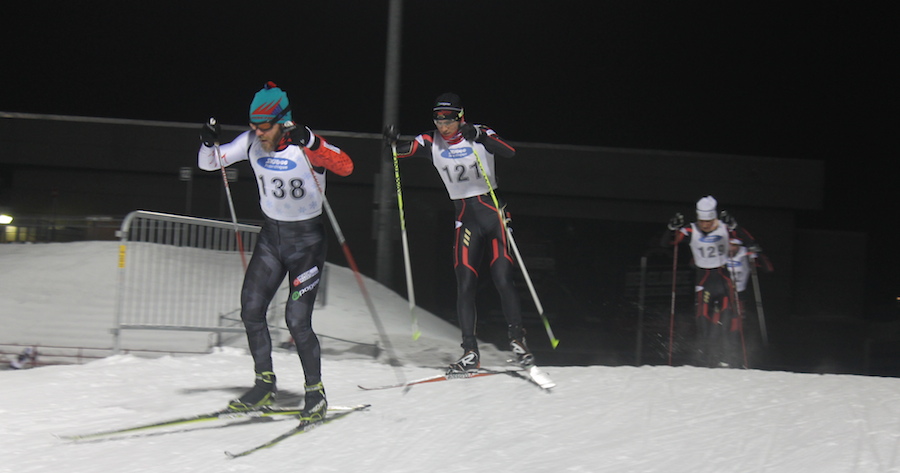
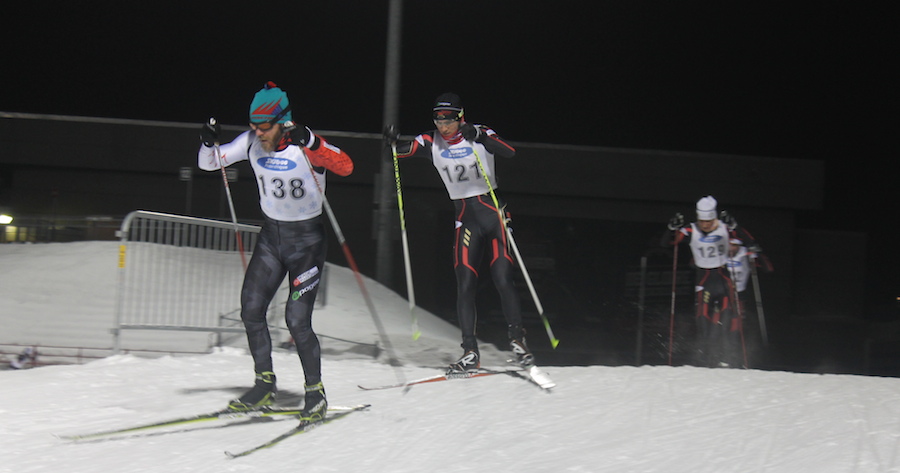
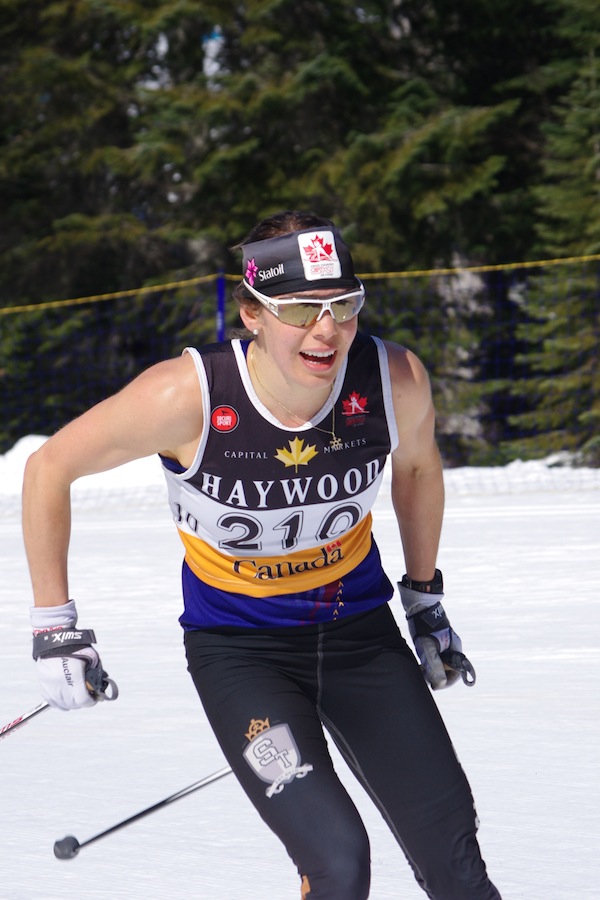
Marc-André Bédard (l) leads David Grégoire (second from l) in the first-ever Sprint Rouge et Or on Jan. 28 at Laval University’s football stadium. Grégoire went on to win the lap-by-lap elimination sprint, in which skiers rounded a 400-metre course designed by Pierre Harvey and tried to stay in the top six.
QUEBEC CITY — After the World Cup sprints took place in the historic part of the city last year, Quebec City recently saw another spectacle in cross-country skiing, with Laval University bringing the action even closer to the crowd. With the help of local Olympic skiing hero Pierre Harvey, organizers created Sprint Rouge et Or with a “last-to-go” formula, a new event on the athletics track at the Rouge et Or football stadium.
This past Tuesday night, close to 125 athletes participated in the inaugural race on manmade snow at the Laval University campus. The cold temperature didn’t stop the enthusiasm of skiers from ages 7 to 54, and a couple of “retired” skiers even put their skis on.
Harvey, the father of Quebec’s current nordic-skiing favorite Alex Harvey, designed he 400-metre track complete with several bumps — some as high as 10 meters — to challenge the skiers. On Tuesday, it was well-groomed with hard-packed snow.
Compared to other urban sprints, the biggest difference and advantage was that spectators could visually follow racers from start to finish, seeing all of the action. The big screen at the opposite end of the field was great for zooming in on the expressions and emotions of skiers as they passed by the camera.
With a friendly atmosphere, good vibes filled the stadium as well-known commentator Randy Ferguson gave the play-by-play. The evening started with a sprint prologue for all 11 categories. The beauty of the event was that anybody could enter it.
“We had a great participation of skiers in the region but also outside,” event director Martin Guay said in a Rouge et Or press release, according to a translation. “The course was world-class through the snow HKD Turbo and the work of the groomer Printoh, Inc., not to mention the efforts of volunteers and field staff of the Department of Sports Laval University.”
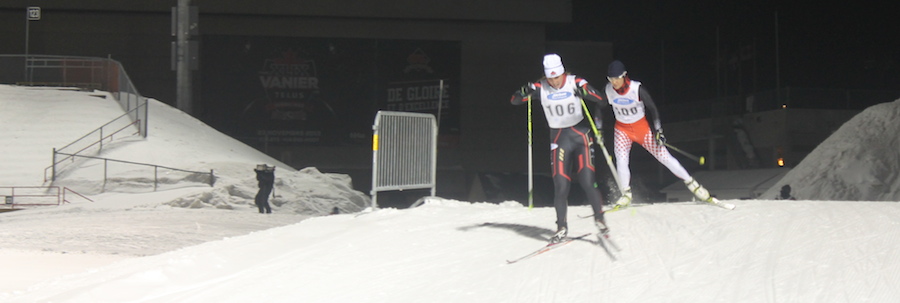
Camille Pepin leads Claude Godbout (r) in the women’s race at the inaugural Sprint Rouge et Or on Jan. 28 at Laval University’s snow-covered athletics track in Quebec City. Godbout went on to win and Pepin placed second.
Last-to-go
The big show started at 21:00 [9 p.m.] with the last-to-go: eight laps for the women and 10 for the men. Racers had two laps to position themselves in the pack before elimination started, after which the last four skiers on each lap were pulled out. The idea was to have six or seven skiers remaining for the final lap.
The women separated quickly after Canadian national-team biathlete Claude Godbout broke away at the beginning of the second lap. Only Camille Pepin of Laval could match her pace. There were a couple of good battles at the end of the pack to stay in the race. Godbout ended up winning, Laval’s Pepin and Myriam Paquette finished second and third, respectively.
The men’s race was closer to the finish with a pack of 20 fighting sticking together. After 10 laps, Laval’s David Grégoire outsprinted biathlete Marc-André Bédard and Frédéric Touchette (Laval) to take the win. Bédard placed second and Touchette was third.
Overall it was a great evening despite some delays; most everyone seemed to really enjoy the moment. After expecting a smaller turnout for its first event, organizers are planning future sprints there and hoping to one day fill the 15,000-capacity stadium.
While the spectacle drew participants from various regions in Quebec, organizers are considering inviting athletes from other Canadian universities as well as the U.S. According to the release, the Rouge et Or team already participates annually in about half a dozen of NCAA races in the northeastern U.S.
“We’re already thinking about next year!” Guay said.
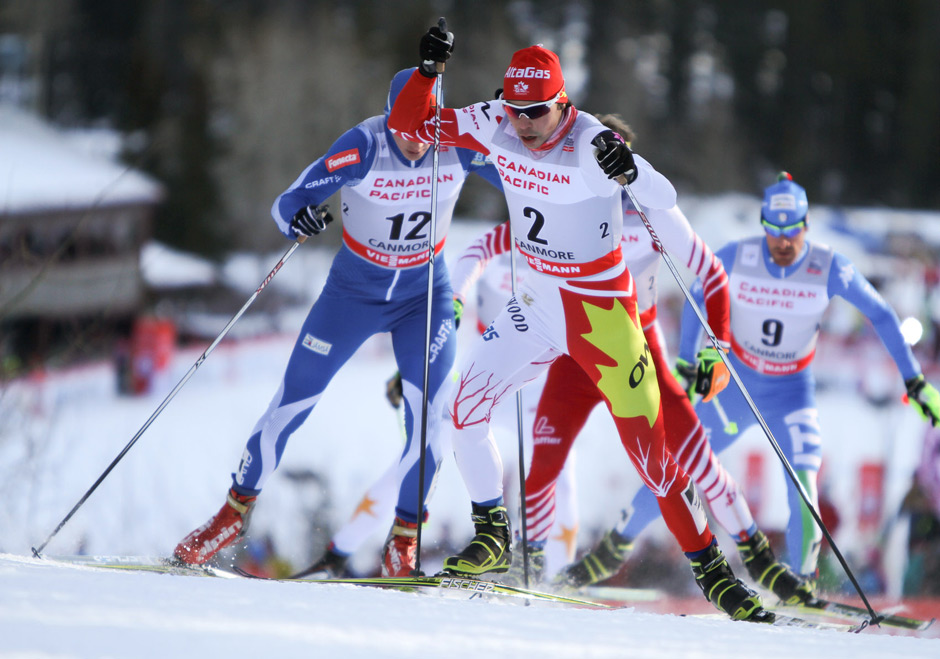
Canadian Jesse Cockney of the Alberta World Cup Academy and Senior Development Team (2) leading his quarterfinal in the Alberta World Cup 1.3 k skate sprint in Canmore on Dec. 15, 2012. Cockney won the heat and went on to place ninth overall for a personal best in his fifth World Cup start. He finished the season as the overall NorAm winner and is starting 2013/2014 on the World Cup in Europe as a result.
Because the Olympics only come around every four years, domestic races hold even more value in the months leading up to the 2014 Sochi Winter Games. In Canada, they’ll determine who will fill approximately four remaining spots on the Olympic nordic team.
The NorAm calendar has been reduced this season, with fewer races in the middle of winter when most will be focussed on what’s happening in Russia. This explains why there’s a heavy concentration of events early in the season, starting this weekend.
Canadian nordic skiers getting some early on-snow time at the Sovereign Lake Nordic Centre on Nov. 7 in Vernon, B.C., the first NorAm stop of the season.
Sovereign and Black Jack
Following the trend of the last several years, many of North America’s best skiers will meet at Sovereign Lake in Vernon, B.C., for the first NorAm races of the season on Saturday and Sunday, which will be the first “real” races for most Canadians. The next weekend, the circuit heads south to Rossland, B.C., for two more races Dec. 14-15 before the holiday break. Normally, several American skiers make the trip up north to British Columbia for the NorAm openers, deepening the field, and Sovereign Lake’s powder conditions likely enticed many this year.
These two weekends of races will be an opportunity to catch a glimpse of the shape of the skiers and identify those that might be capable of Olympic selection by mid January.
For Heidi Widmer, an Alberta World Cup Academy (AWCA) and Canadian Senior Development (NST) skier, it is important to find her marks and have fun during the first part of the season.
“The NorAms in Silver Star and Rossland before Christmas are a way to get back into the racing scene and build back that routine,” Widmer wrote in an email. “Also, we usually make gingerbread houses or cookies in Rossland and I missed that last year, so definitely looking forward to that.”
“Having done the work, I am confident there will be some very good moments for me this upcoming winter,” Michael Somppi (AWCA/NST) wrote in an email. “The trick is to make those moments line up with the important races.”
Olympics Trials in Canmore
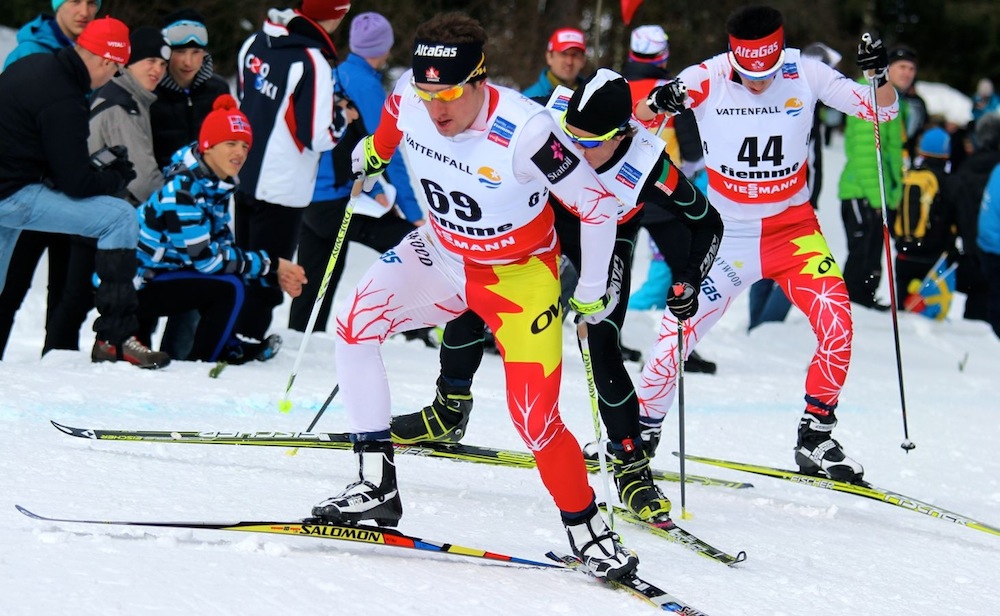
Graham Nishikawa (44) follows Canadian World Cup vetera Ivan Babikov (69) in the 15 k freestyle individual start at 2013 World Championships in Val di Fiemme, Italy. Babikov went on to place fourth, the best ever by a Canadian man in the event, and Nishikawa finished 39th for his best result at World Championships.
Anyone with even the slightest chance of qualifying for Sochi has probably circled the Canadian Olympics Trials dates on their calendars: Jan 8-12 in Canmore, Alberta.
Graham Nishikawa is certainly one of them. Four years after he narrowly missed his nation’s home Olympics in Vancouver, B.C., the 30-year-old Senior National Team member, who’s been working with Canada’s Para Nordic squad throughout the offseason, is ready for redemption.
“My goal is to qualify for Sochi,” Nishikawa said in a phone interview. “The selection races are very important, whatever I need in those races to be in the best shape is what I’ll focus on. If I need more training and that means that I have to skip some NorAms, I will do that.”
Veterans will certainly have some pressure on to perform, while many young skiers could catapult themselves into the mix. However, there are only about four Olympic spots available as all six World Cup Team members (Alex Harvey, Devon Kershaw, Ivan Babikov, Len Valjas, Dasha Gaiazova, and Perianne Jones) have already satisfied the Sochi-selection criterias with their results last season.
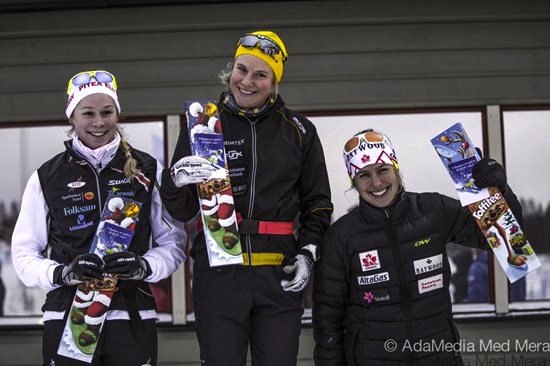
Third in a FIS skate sprint in Idre, Sweden, on Nov. 30, Chandra Crawford (r) celebrates on the podium with Swedish winner Hanna Falk and runner-up Jennie Öberg (l). (Photo: Cross Country Canada)
Last weekend, Chandra Crawford, who declined her nomination to the team in April, earned her spot back on the World Cup team with third place in a FIS skate sprint in Idre, Sweden (which likely secured her Olympic prequalification as well).
“We are taking a team size of 11,” Canadian National Team Head Coach Justin Wadsworth said in a phone interview last month. “That can be any combination; it can be six men, five women. It can be seven men, four women. It can be six women, five guys. We’ll just see how everybody’s racing and where our strengths and weakness are.”
Many skiers will compete for the remaining tickets, which should be a close fight.
“I expect my performance level to be reasonably consistent throughout the winter, however I will be aiming to peak for the Olympic Trials at the beginning of January,” Somppi explained.
Note that these races also act as trials for the Junior and U23 World Championships in late January in Val di Fiemme, Italy. Needless to say, any skier who’s shooting for international starts will likely be in the best shape possible.
“I have a chance to qualify for U23 Championships and the Olympic team based on domestic results so yep, I want to be racing well, especially at Olympic trials in Canmore,” Widmer wrote. “U23 Championships are a skate sprint this year, so that gets me really fired up and I know I have a good chance to perform well provided I do the work to get there.”
The Rest of the Season
For the rest of the best Canadian seniors not quite at the Olympic level, there are opportunities to race in Europe, either on the OPA Cup Tour with the national team in February, or by earning World Cup starts late in the season as NorAm leaders. Both options require skiers to excel on the domestic circuit first.
The traditional mid-season meeting, the Eastern Canadian Championships at Nakkertok Ski Club near Ottawa, falls on the first weekend of February and remains the fourth and final NorAm stop before nationals. Top skiers will need to travel East for those races to contend for some important points.
“I’m still going to fight for the place of NorAm leader, because my Plan B is to race in Europe,” Somppi explained.
Nationals in Newfoundland
Heidi Widmer racing to fourth overall (and a Canadian bronze) in the 30 k freestyle mass start at nationals in Whistler, B.C. (Photo: Martin Kaiser)
For the first time in over 10 years, Canadian Nationals will be held on the Atlantic Coast in mid-March. This will be a new destination for most skiers and certainly a new race site that will bring novelty and freshness to the annual event which concludes the Canadian domestic season.
The races will be held at the Blow Me Down Trails in Corner Brook, Newfoundland, the site of the 1999 Canada Games.
“I love the East Coast and am really looking forward to the races at the end of the season,” Kevin Sandau (AWCA/NST) wrote. “I think they will really be a unique experience for National Champs.”
“I’m excited!” Widmer wrote. “I think it’s important to have the competition in different parts of the country to promote the sport in that area as well as save travel costs for those coming from the far-East for races all the time. I’ve never been to Newfoundland before but with a name like Blow Me Down, it’s gotta be a unique place!”
It will require some long travel for athletes coming from West, but offers a chance for everyone to discover the skiing community in this part of the country.
“I actually visited Newfoundland for the first time this past spring,” Somppi wrote. “My girlfriend spent a year at Memorial University in St. John’s, so I went out to visit her. The Newfoundlanders I met along the way were friendly and welcoming, so I’m expecting a warm reception for competitors at this year’s Nationals. I am very much looking forward to my second trip to Newfoundland!”
Skiers to Watch
The reigning NorAm champions, Jesse Cockney (AWCA/NST) and Amanda Ammar (Team Ninja) have chosen to start their season differently from one another, with Cockney taking advantage of the early World Cup starts and Ammar opting to start racing at home in Canada while recovering from injuries in her back and foot.
Jess Cockney after finishing second in the Alberta World Cup 1.3 k skate sprint qualifier last December in Canmore. He went on to finish ninth for his best World Cup result.
“My main focus is Olympic trials this year, and I want to do everything I can to be prepared and confident when I hit that start line, which for me, was staying here, doing the Canadian circuit, and getting in some prime training, ” Ammar, a 2006 Olympian, wrote in an email. “I would of missed all the Norams leading into trials, and this was not ideal for me. I want to know where I stand … during trials.”
Last December, Cockney made a World Cup impression on home soil in Canmore, qualifying second and placing ninth in the freestyle sprint at the Alberta World Cup. With that result, the 24 year old is halfway to making the Olympic team. Starting the season on the World Cup will give him the opportunity secure his spot and gain more international racing experience.
Some top skiers will not return to the NorAm circuit after retiring at the end of last season, including Brent McMurtry, David Greer and Kate Brennan.
The NorAm runner-up last season, Graham Nishikawa is best known as a distance racer, but can notch solid sprint results as well. Married in July, this could be his last push for the Olympics.
Michael Somppi (AWCA/NST) racing to 48th in the World Cup classic sprint qualifier in Stockholm, Sweden, last season. (Photo: Fischer/Nordic Focus)
Somppi finished third at the end of last season and is better at skating, but said he worked on his classic to make sure he was in fighting form for the 15 k classic at Olympic Trials.
A little off his game last year, Sandau, a distance specialist and typical domestic favourite, is back to his old training routine that produced good results for him previously. He’s confident that his training will pay off and is one to keep an eye on in distance races.
Making the Senior National Team as a first-year senior, Raphaël Couturier of the Pierre-Harvey Training Centre (CNEPH) is an all-round skier that shouldn’t be overlooked.
Alysson Marshall (AWCA/NST) placed third overall last season despite missing the first part of the NorAm season to participate in the opening World Cups. She is a sprint favourite and could be a podium contender for distances races as well.
Like her older brother, Emily Nishikawa (AWCA/NST) was a member of the Canada’s World Championships team last winter in Val di Fiemme, Italy, and started several World Cups throughout the 2012/2013 season. She is certainly one of the women in the running for a position the Olympic distance team.
In her first full season back racing, Brittany Webster (Highland Trailblazers) also made it to 2013 World Championships, but sickness kept her from performing at her best in Italy. She ended the season with a fourth-place finish in the 30 k freestyle at Canadian Nationals and was the third Canadian behind Swiss winner Bettina Gruber, Canadian biathlete Zina Kocher, and Heidi Widmer.
Considering that result, Widmer, known as a dangerous and talented sprinter, can clearly get top results in distance – even after rebounding from head injuries.
Alana Thomas (Team Ninja) is an all-around skier who’s had consistently good results in the past couple years. She’s suffered some setbacks with injuries, but with the “Ninja”spirit, anything can happen!
Keep an eye on Olivia Bouffard-Nesbitt (Rocky Mountain Racers) as well. At 21, she’s arguably one of Canada’s most promising up-and-comers.
While most of the favourites come from national training centres, there are a few skiers from other clubs that could produce top results in NorAm sprint and distance races this season.
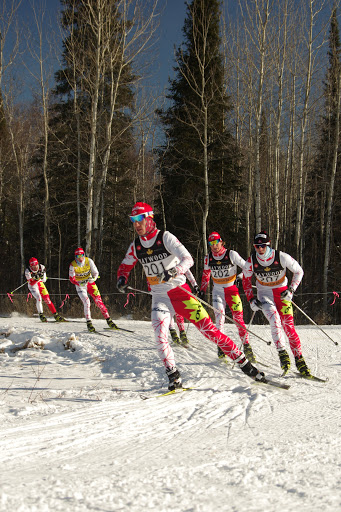
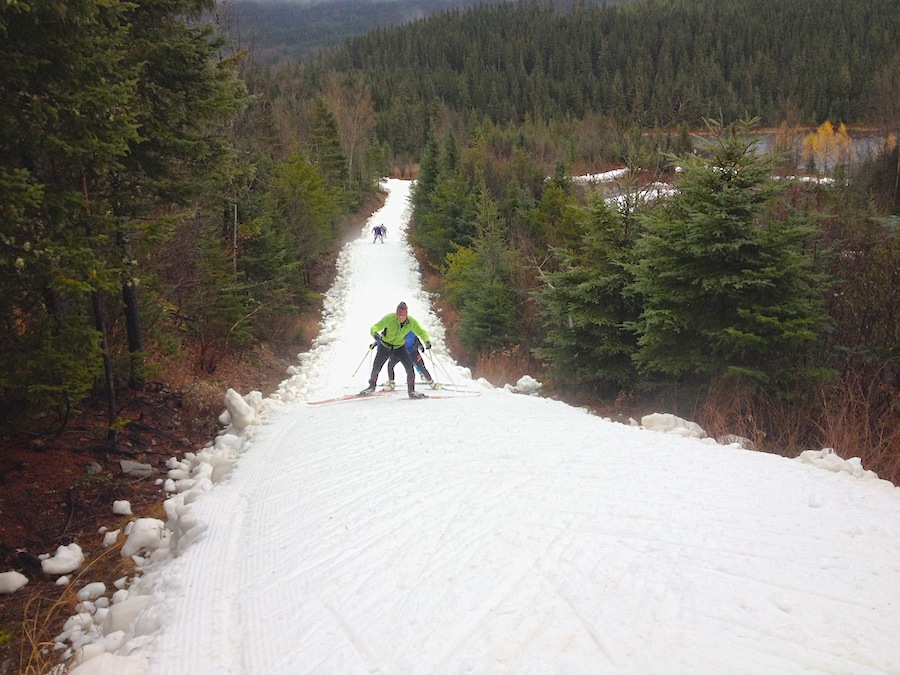
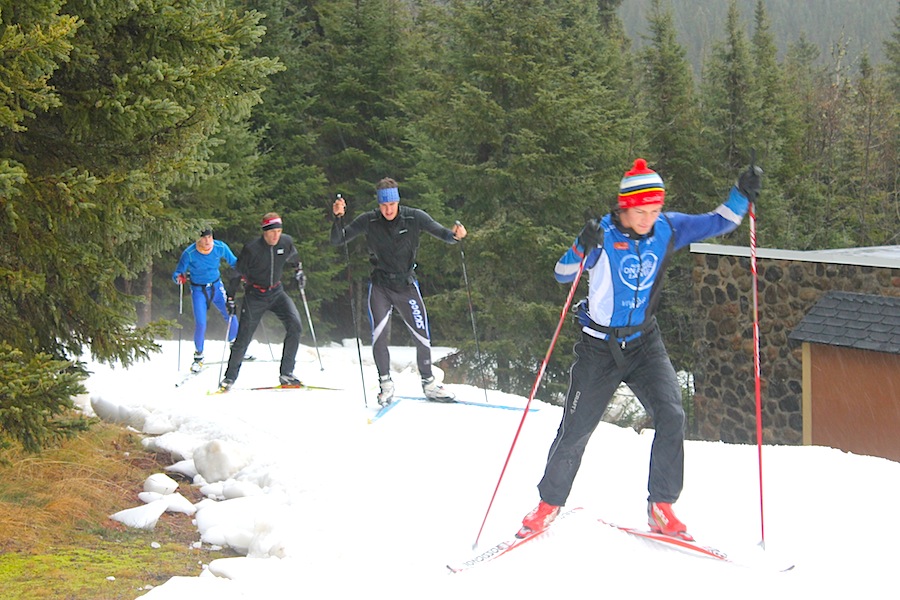
Led by Camille Pepin, Laval University Rouge et Or skiers ascend a hill at La Foret Montmorency an hour drive north of Quebec City.
LA CÔTE-DE-BEAUPRÉ, Quebec – Pouring rain and 15 degrees Celsius may not sound good for a nordic skier, but since the opening of a 1.3-kilometre loop at the Montmorency Forest, better known as La Forêt Montmorency about an hour drive north of Quebec City, Nov. 1 was a happy day for skiers.
With manmade snow for the last decade, Laval University’s La Forêt in the Laurentides Wildlife Reservehas been well known for early season skiing by those living in eastern Canada and the U.S.. This year, however, university caretakers stepped up their game and stored a huge amount of snow last winter to be able to start this season on the date they wanted.
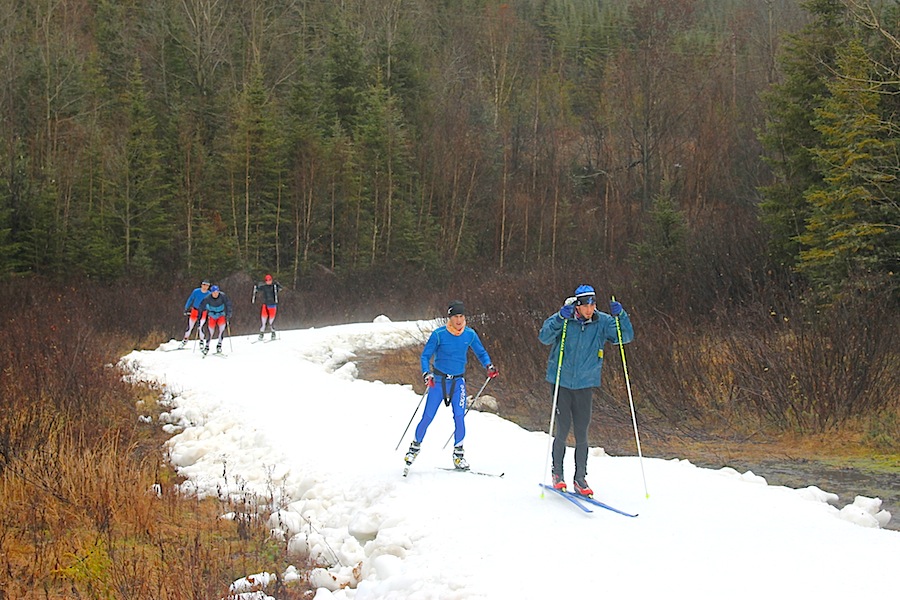
Several Skibec Nordique skiers, led by Jérémie Bonneau, get some on-snow time at La Foret Montmorency north of Quebec City on Nov. 1.
In Alberta, Canmore has Frozen Thunder. Now, Quebec finally has its own track, dubbed the “Boreal Glide.”
“Last December, we stocked 6,000 metres of snow and saved it under a thick coat of sawdust,” La Forêt’s outdoor activities coordinator Laurent St-Jacques explained last Friday. “Monday, we started to build the track and today [Nov. 1] we are opened, three weeks earlier than normal.”
As soon as the temperature drops, they will use snowmakers and expand the track, tapping into the rest of their snow-pile reserve as needed.
“If things go smoothly, we have four options of trails that will be connecting to the existing track and we planned to offer two-plus kilometres by the end of the month” St-Jacques said.
With expertise in snowmaking and preservation, and support by the cross-country community, it made the decision to expand the season easier. Forêt Montmorency is also favored by a microclimate that accounts for early snowfalls, which usually amounts to six meters of snow each winter.
“For us, it is mission accomplished,” St-Jacques said. “We have a few things to improve in the future, but overall it’s a great success. Now we can say we are open from Halloween ’til Easter!”
The Track
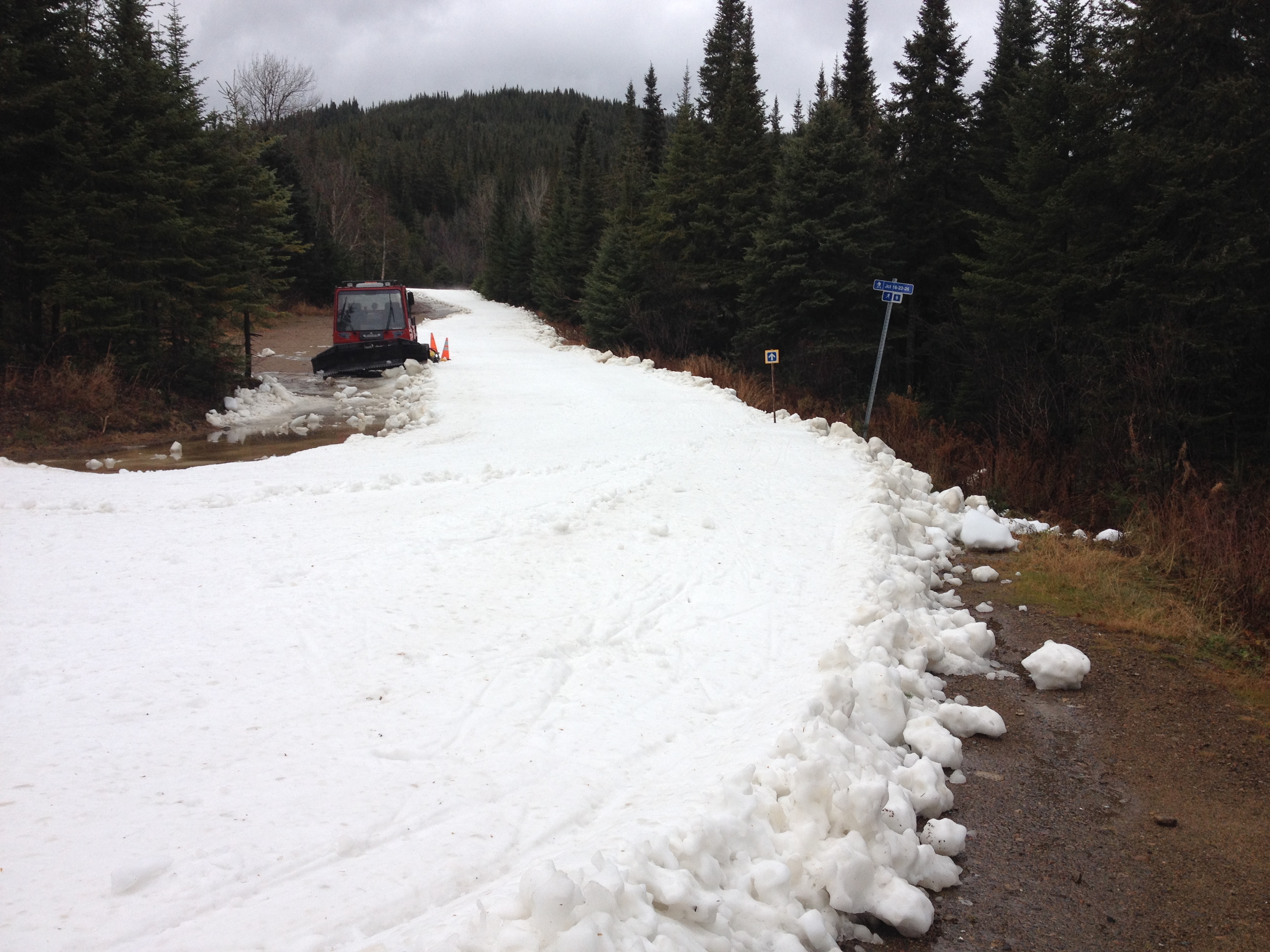
Upon firsthand inspection, the 1.3 k track, slightly longer than last year’s course, was challenging with a couple of hills, quick turns and good elevation some 900 metres above sea level.
La Forêt Montmorency’s 1.3-kilometre track, which Laval University caretakers extended by about 100 metres from last year and opened a few weeks earlier than usual on Nov. 1.
For November in Quebec, the conditions were good, mostly springlike – slushy and soft — but base was firm and the coverage was good. In some places, the snow was a bit dirty and the track had some bumps, but overall organizers did a great job preparing the track for athletes.
Approximately 30 skiers had made the trip to La Forêt for the opening morning, including the Laval University’s Rouge et Or team, Skibec Nordique as well as some biathletes, masters and recreational skiers. Although it was raining heavily, skiers kept coming as the day progressed, most staying on site in Laval’s dormitories and cabins, thus waving the $14.50 daily trail fee.
“I think they did a great job,” Rouge et Or rookie Camille Pepin said on Nov. 1. “We are lucky that they put the track together early because otherwise we didn’t when we would have been able to ski.”
“It’s super, a first in Eastern North America,” said Félix Bérubé-Larochelle of Quebec’s biathlon team. “It’s really fun that the track is opened on November 1st. I plan to come often in the upcoming weeks, that will be a good preparation for the races.”
The staff was proud of the track and made the opening day a happening one with music, hot chocolate and chicken broth for the skiers in a little shack alongside the track.
The next few weeks will be busy at Forêt Montmorency with teams coming from all over Quebec, Ontario, and New England for their annual trip to enjoy some quality time and training on snow.
Félix Bérubé-Larochelle of Quebec’s biathlon team leads skiers along the 1.3 k manmade loop at La Foret Montmorency north of Quebec City on Nov. 1.
***
(En français)
LA CÔTE-DE-BEAUPRÉ, Quebec – Pluie torrentielle et 15 degrés Celsius un 1er novembre, ce n’est jamais une bonne nouvelle pour un skieur de fond, sauf cette année à la Forêt Montmorency. Située à 1heure au nord de Québec dans la réserve faunique des Laurentides, la Forêt ouvrait sa boucle de ski de fond de 1,3km, de quoi rendre les skieurs plus qu’heureux malgré la météo difficile!
Reconnue depuis les dix dernières années pour sa production de neige artificielle, La Forêt était déjà l’endroit pour commencer tôt sa saison sur neige dans l’Est du Canada et des États-Unis. Cette année, ils sont allés plus loin en emmagasinant une énorme quantité de neige de la saison dernière sous une grosse couche de copeaux de bois de façon à être capable de débuter la saison à la date souhaitée et ne plus être dépendant d’une météo incertaine.
Depuis quelques années, Canmore en Alberta a son Frozen Thunder et maintenant Québec peut se vanter d’avoir sa propre boucle surnommée la Glisse Boréale.
“En décembre dernier, nous avons accumulé 6000 mètres de neige et nous l’avons entreposée en dessous d’une épaisse couche de copeaux. Nous avons commencé lundi à construire la piste et vendredi [1er novembre], nous étions prêts pour l’ouverture, environ trois semaines plus tôt qu’à l’habitude”, a expliqué sourire aux lèvres, Laurent St-Jacques, coordonnateur des activités récréotourisques à la Forêt Montmorency.
Dès que les températures baissent sous le point de congélation, les canons à neige s’activent. Ainsi, ils n’ont pas utilisé toute la neige en réserve de l’an passé pour s’assurer d’avoir de la neige sous la main et ainsi garder la piste en bonne condition et la plus blanche possible. “Nous avons quatre options pour agrandir le circuit principal existant. Logiquement, si tout va bien, à la fin du mois, nous devrions avoir plus de 2km à offrir”, a laissé entendre St-Jacques.
Avec leur expertise et le support de la communauté de ski de fond, c’était
une décision naturelle d’offrir cette opportunité de skier sur neige aussi tôt en saison. De plus, la Forêt Montmorency gérée par le département de foresterie de l’Université Laval peut compter sur un microclimat favorable avec des chutes de neige tôt en saison et un total d’environ 6 mètres de neige chaque hiver.
“Pour nous, c’est vraiment mission accomplie, bien sûr nous avons quelques petites choses à améliorer pour le futur, mais en général c’est un beau succès. Maintenant, nous pouvons dire que nous sommes ouverts de l’Halloween à Pâques!”, a dit St-Jacques.
La Boucle
La boucle, d’une longueur de 1,3km, comporte plusieurs montées et descentes, de même que quelques virages serrés et une dénivellation intéressante. Pour une première expérience du genre, les conditions de neige étaient bonnes, compte tenu de la température, les conditions ressemblaient à celles du printemps, néanmoins la base était solide et épaisse. À quelques endroits, la neige était un peu sale et la piste avait quelques bosses, mais en général, ils ont fait un excellent travail pour préparer la piste aux athlètes.
Dès l’ouverture, une trentaine de skieurs avaient fait le voyage à la Forêt incluant le Rouge et Or de l’Université Laval, Skibec Nordique de même que quelques biathlètes, maîtres et même un skieur récréatif. Malgré la pluie forte, les skieurs continuaient d’arriver plus la journée avançait.
“Je pense qu’ils ont fait une belle job, c’est vraiment beau. Une chance qu’ils ont fait ça, car on aurait peut-être pas skié avant un bout”, a commenté Camille Pepin, recrue du Rouge et Or.
“C’est super, c’est une première dans l’est de l’Amérique du Nord, c’est vraiment le fun que ça ouvre le 1er novembre. Je prévois venir souvent dans les prochaines semaines, ça va être une bonne préparation pour les courses”, a dit Félix Bérubé-Larochelle, membre de l’Équipe du Québec de biathlon.
Les employés de la Forêt Montmorency étaient fiers de leur boucle et avaient décidé de faire les choses en grand avec musique, chocolat chaud, bouillon de poulet offerts aux skieurs dans un petit chalet situé au milieu de la boucle.
Les prochaines semaines s’annoncent occupées à la Forêt avec des équipes venant du Québec, de l’Ontario et de la Nouvelle-Angleterre pour leur traditionnel camp sur neige de début de saison afin de profiter des conditions avantageuses et d’accumuler des heures de qualité sur neige avant le début des compétitions.
La piste est ouverte au public tous les jours et il en coûte 14,50$ par personne/jour pour skier et il y a aussi possibilité de réserver pour dormir sur place en appelant directement à la Forêt Montmorency.
***
About Stéphanie Drolet:
A former competitive cyclist and cross-country skier on Canada’s National Junior Team, StéphanieDrolet is a Canadian contributor at FasterSkier. She was a forerunner at the 2010 Vancouver Olympics and competed at the 2008 World Junior Championships. A journalism student at Laval University in Quebec, Stéphanie still skis and rides for fun and to stay in shape. Don’t be surprised to find a few of her articles in French!
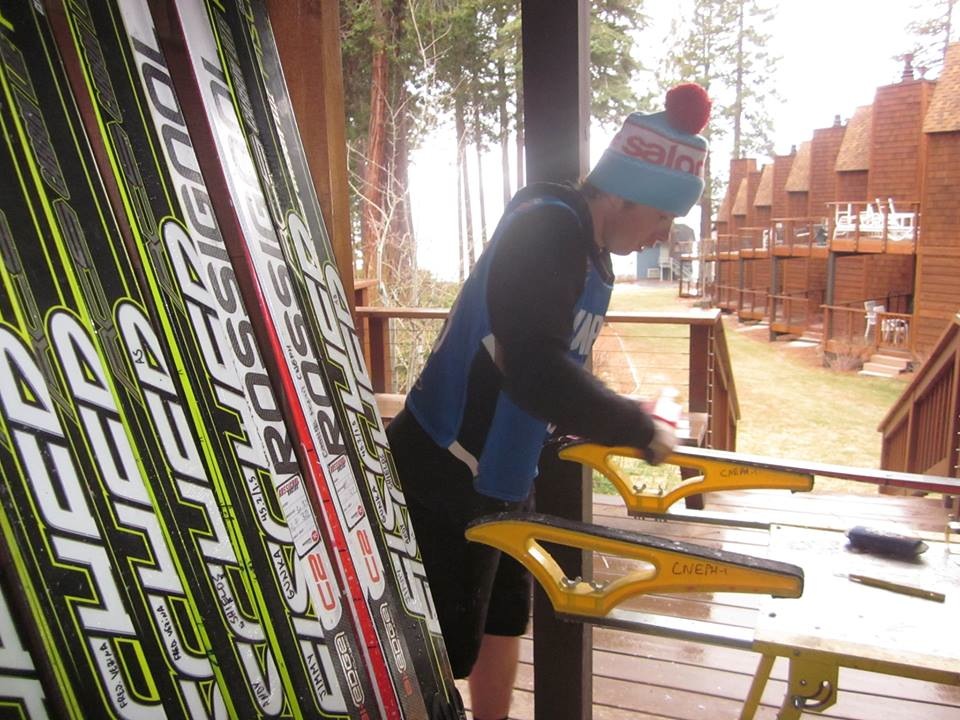
The newest addition to Canada’s World Cup wax team, Simon Boisvert, shown previously assisting the Quebec-based Pierre-Harvey Training Centre. (Photo: Frederique Vezina)
(Scroll down for French version/Version française disponible au bas de la page.)
***
Simon Boisvert is the new guy on the Canadian National wax technician’s team. At 21, the young man from Mont-Sainte-Anne, Quebec, was selected at the beginning of the summer as an apprentice wax tech. Over the winter, he will have the great opportunity, throughout the World Cup circuit, to learn the job with some of the best.
Last spring, Cross Country Canada (CCC) posted a job notice on its website advertising for an apprentice wax technician. Boisvert’s sister saw the listing and told him he was a good candidate and should apply. Following her advice, he sent his résumé. A few weeks later, he received a call from CCC High-Performance Director Tom Holland, who delivered the good news.
“When I got the call, I was really happy,” Boisvert said last week on the phone from Canmore, Alberta. “It was one of my dreams that came true. I’ve never been to Europe and now I’ve got the opportunity to travel all winter around.”
His experience as a wax tech is limited and recent, which isn’t surprising considering his age. Nevertheless, he can count on a good background and knowledge of cross-country skiing. Boisvertwas a member of the Mont-Ste-Anne Nordic Ski Club (Club Nordique) and competed until age 17. He also lived in the same neighbourhood as World Cup skier Alex Harvey and senior national team member Frédérique Vézina, giving him the edge of knowing several top skiers from an early age.
First Steps
Two seasons ago at the 2012 Canadian Ski Nationals right in his backyard at Mont-Ste-Anne (M.S.A.), Boisvertfirst worked as a wax technician for his local club. He hasn’t stopped since. Boisvertspent last season as a wax tech for Club Nordique providing technical support at the Quebec Cups, some NorAms and nationals in Whistler, B.C.
His biggest challenge came at U.S. SuperTour Springs Series in California at the end of last season. For this set of races, he was responsible for several athletes from the Pierre-Harvey Training Centre (CNEPH) and NDC Thunder Bay. Everything went well and this spring, he was able to count on the help and recommendation of CNEPH head coach and national-team assistant, Louis Bouchard, when he applied.
It did not take Boisvertlong to find his vocation. “I really loved the job as a wax tech last year and I decided to do that for a living,” he said.
One could say the assistant position is a big promotion for Boisvert, who as been selected to complete Canada’s wax team.
“I do not have much experience, but I have the desire to learn and when I go for it,” he said. “I always put 100 percent of myself into it and I give 110 percent. I would have done the job anyway, even if I didn’t get paid this winter.”
His Winter Schedule
On Nov. 21, Boisvertwill leave for Scandinavia for the start of the World Cup season in Finland. He plans to stick around Europe for the Tour de Ski multi-stage race starting in late December, but won’t be around for the Olympics in Sochi, Russia. Instead, he was assigned to assist the Canadian B-team (including select skiers, U23 and older) on the Scandinavia trip in February.
Boisvertjoins an experienced team of technicians and expects to learn a lot, including the tricks and tips of waxing at this level, and ways to work within the team. He said he feels priviledged to work with Harvey, Bouchard and the rest of the World Cup team.
For now, he’s committed to a one-year contract, but at the end of the season, if his evaluations go well, he might sign on for a couple more years.
This season, Canada will also have a huge, brand-new waxing truck — putting the team on par support-wise with powerhouses like Norway and Sweden.
About Stéphanie Drolet:
A former competitive cyclist and cross-country skier on Canada’s National Junior Team, StéphanieDrolet is a Canadian contributor at FasterSkier. She was a forerunner at the 2010 Vancouver Olympics and competed at the 2008 World Junior Championships. A journalism student at Laval University in Quebec, Stéphanie still skis and rides for fun and to stay in shape. Don’t be surprised to find a few of her articles in French!
***
(En français)
Simon Boisvert est le nouveau venu dans l’équipe de technicien de fartage canadienne. À 21 ans, le jeune homme originaire du Mont-Ste-Anne a été sélectionné au début de l’été comme apprenti-farteur. Il aura donc la chance tout au long de la saison de Coupe du Monde d’apprendre le métier aux côtés des meilleurs.
Le printemps dernier, Ski de fond Canada affichait, sur son site internet, une offre d’emploi comme apprenti-farteur. La soeur de Boisvert a vu l’offre et lui a dit de tenter sa chance, suivant son conseil, il a envoyé son dossier. Quelques semaines plus tard, il a reçu un appel de Tom Holland, directeur de la haute performance de SFC lui annonçant la bonne nouvelle.
« Quand j’ai reçu l’appel, j’étais vraiment content, c’était un de mes rêves qui se réalisait, je n’ai encore jamais été en Europe et là je vais me promener tout l’hiver », a mentionné Boisvert en entrevue téléphonique de Canmore en Alberta.
Ses expériences comme farteur sont assez limitées et récentes, normal, compte tenu de son jeune âge. Néanmoins, il peut compter sur un bon bagage de connaissance du ski de fond. En effet, Boisvert a lui-même été membre du Club Nordique Mont-Ste-Anne (M.S.A.) et il a concouru jusqu’à l’âge de 17 ans. De plus, il côtoie, depuis qu’il est tout jeune, des skieurs élites comme Alex Harvey et Frédérique Vézina.
Ses débuts comme farteur
C’est lors des Championnats canadiens de 2012 au Mont-Ste-Anne, il y a deux ans, dans sa cour arrière, qu’il a fait ses premiers pas en étant technicien de fartage pour le club local et depuis il n’a jamais arrêté. Boisvert a passé la dernière saison comme farteur pour le Club Nordique M.S.A. assurant le support technique lors des Coupes Québec, certaines Coupe NorAm et les Championnats canadiens.
Son plus gros défi a été lors des Springs Serie au Lake Tahoe en fin de saison, alors qu’il avait plusieurs athlètes du CNEPH sous sa charge pour des courses d’importance. L’expérience californienne s’est bien déroulée et il a pu compter ce printemps sur l’appui et la recommandation de Louis Bouchard, entraîneur-chef du CNEPH et assistant-entraîneur de l’équipe nationale, auprès de la fédération.
Il n’a pas fallu longtemps à Boisvert pour trouvé sa vocation. « J’ai vraiment eu la piqure l’an passé et j’ai décidé de faire ça de ma vie », a-t-il affirmé.
Quelqu’un pourrait dire que c’est une grosse promotion que Boisvert a obtenue en étant choisi pour compléter l’équipe de techniciens de SFC.
« Je n’ai pas beaucoup d’expérience, mais j’ai le goût d’apprendre et quand je m’y mets, je m’y mets à 100 % et je me donne à 110 %. Je n’aurais pas été payé cet hiver et je l’aurais fait quand même »
Son horaire hivernal
Il a son billet d’avion en poche avec un départ pour la Scandinavie le 21 novembre pour le début de la saison de Coupe du monde en Finlande. Après une pause de deux semaines au Canada, il sera au Tour de ski – une course par étapes – qui commence à la fin du mois de décembre. Les Jeux olympiques ne sont cependant pas à son programme, il sera toutefois attitré au tour en Scandinavie avec une équipe canadienne B (qui reste à déterminer) au mois de février.
Boisvert se joint à une équipe de fartage d’expérience et il profitera de cette première année pour emmagasiner le maximum de connaissances, apprendre toutes les subtilités et trucs, de même que de s’intégrer au sein de l’équipe.
Pour l’instant, il a signé un contrat d’un an qui sera réévalué à la fin de la saison, mais si les dirigeants de l’équipe son satisfait de son travail, il est probable qu’il renouvelle pour quelques années supplémentaires.
Cette saison, le Canada pourra compter sur une nouveauté de taille, un immense camion de fartage, ainsi l’équipe sera en mesure de rivaliser à armes égales avec les grosses puissances norvégienne et suédoise.