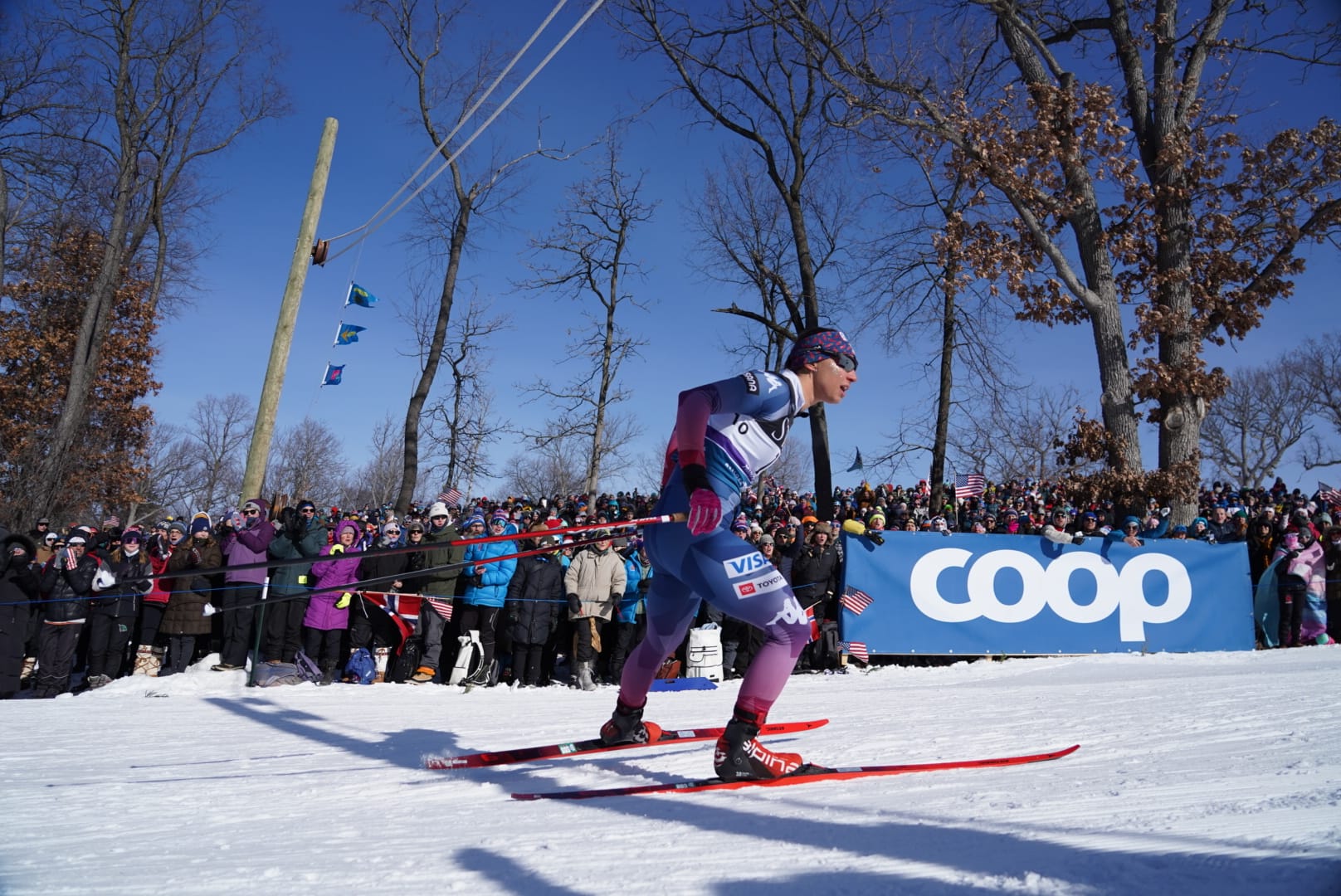
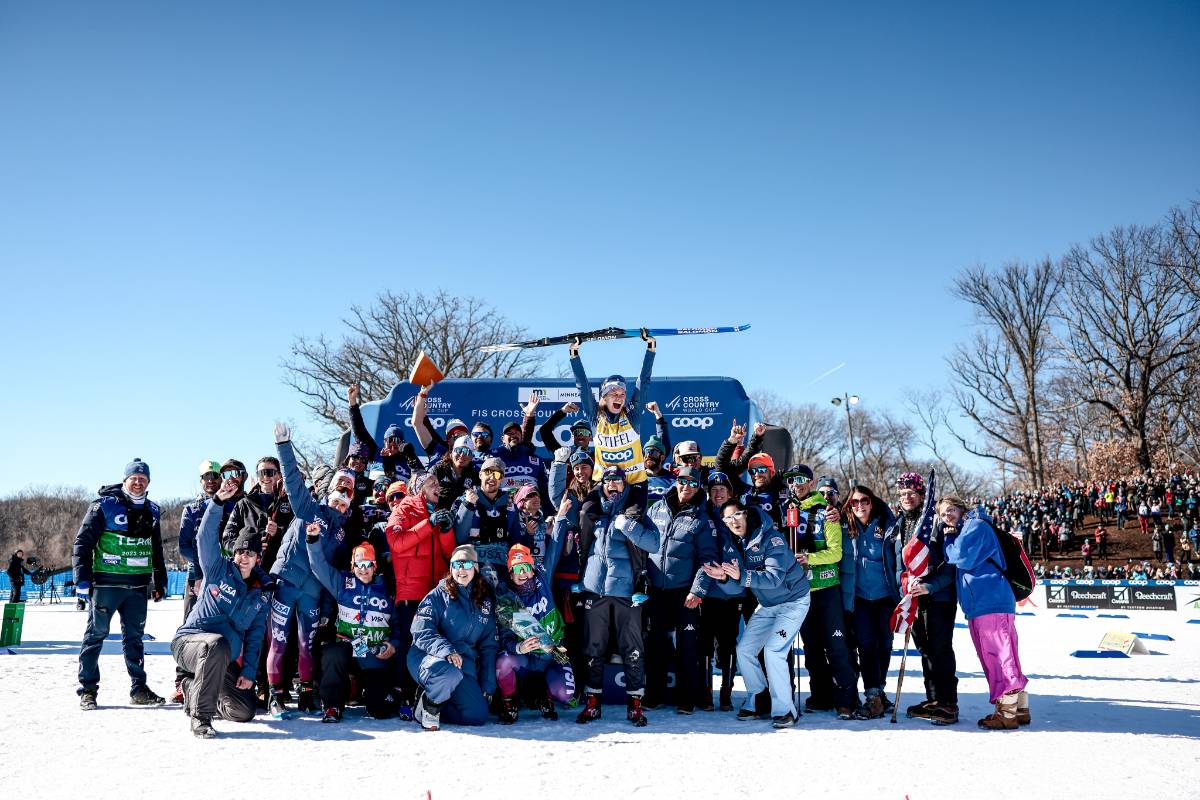
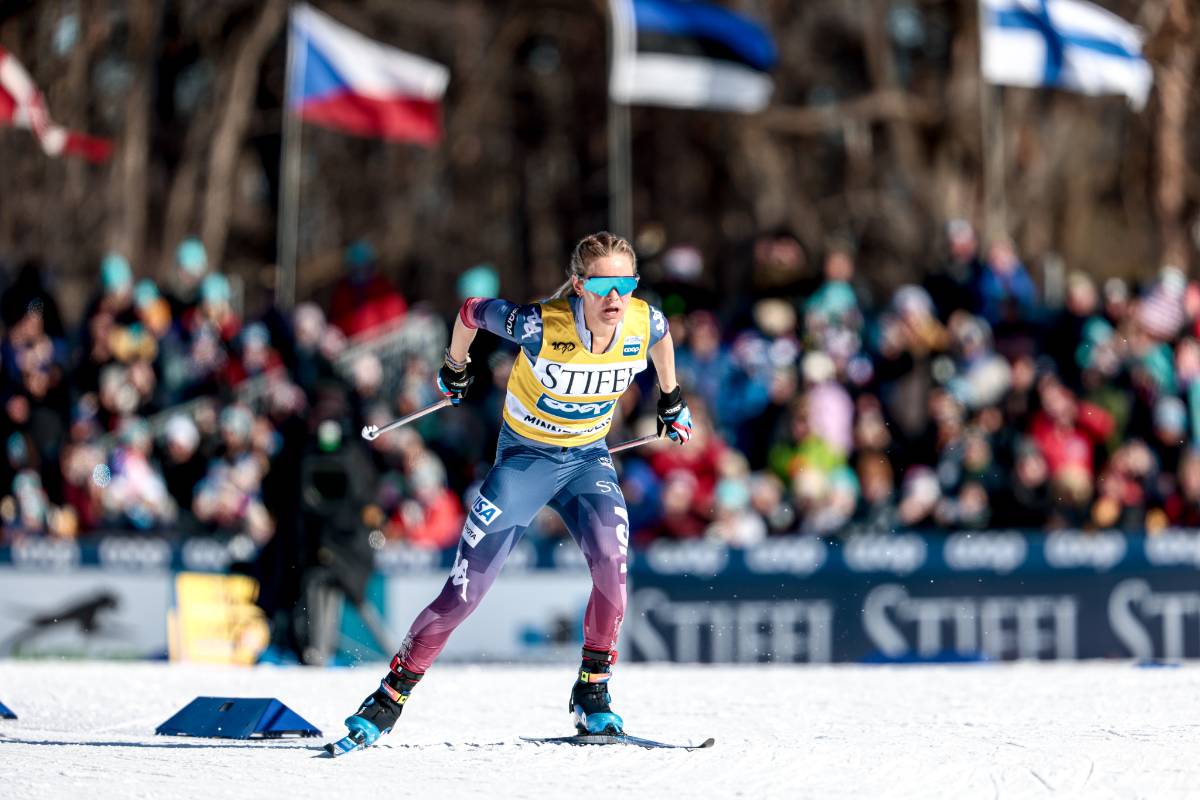
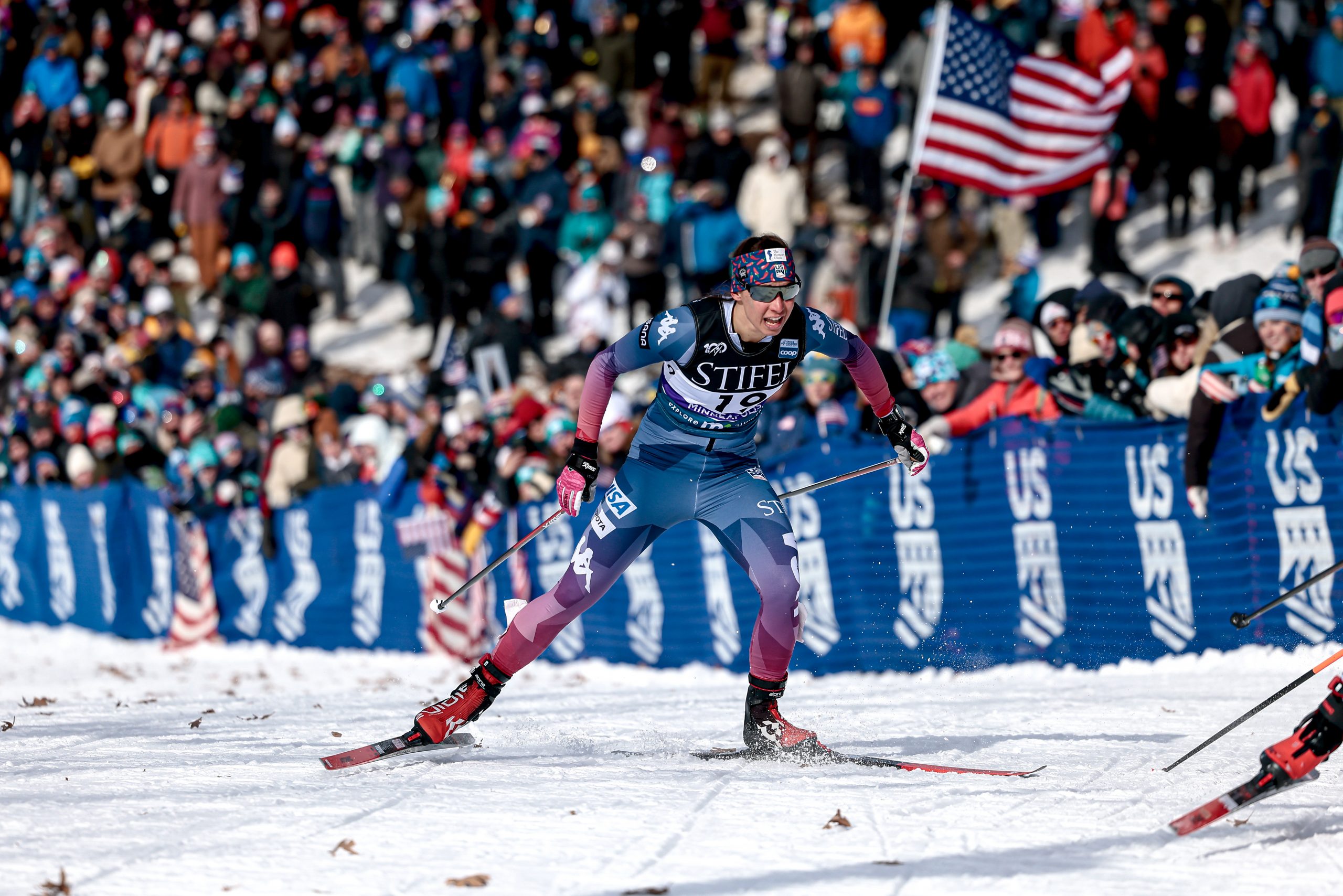
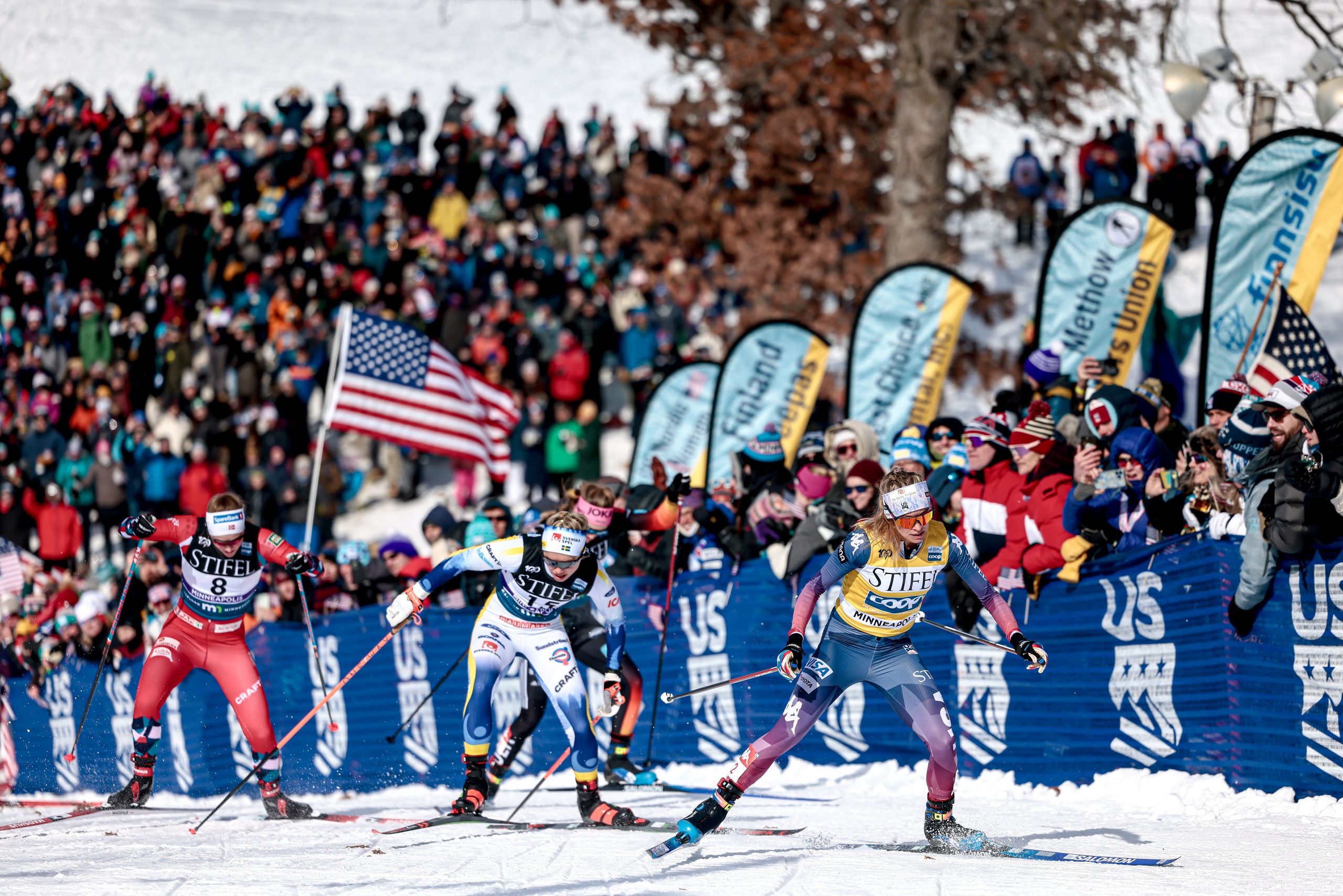
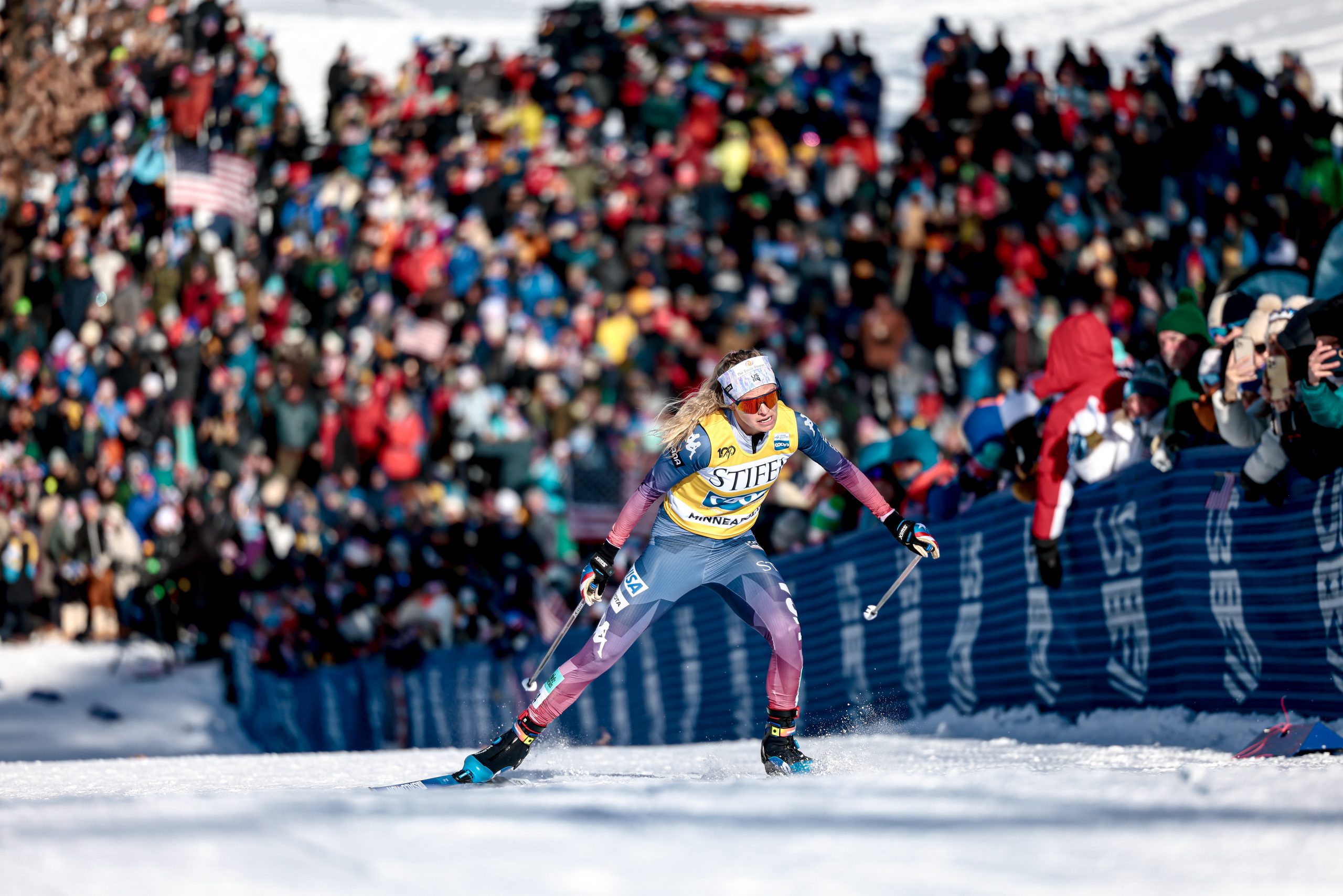
Julia Kern at the Minneapolis World Cup in Wirth Park. (Photo: Lumi Experiences)
It’s been an incredible North American World Cup period in Canmore and Minneapolis over the past two weeks. In Canada, as the excitement was building for the first World Cup on US snow in over 20 years, US skier Julia Kern led the women to the top US finish in the classic sprint and Diggins won the 15 km freestyle. In Minneapolis, the huge crowds of US fans in Wirth Park for the Loppet Cup brought an incredible energy to the event and crowds were treated to several podium finishes for the US!
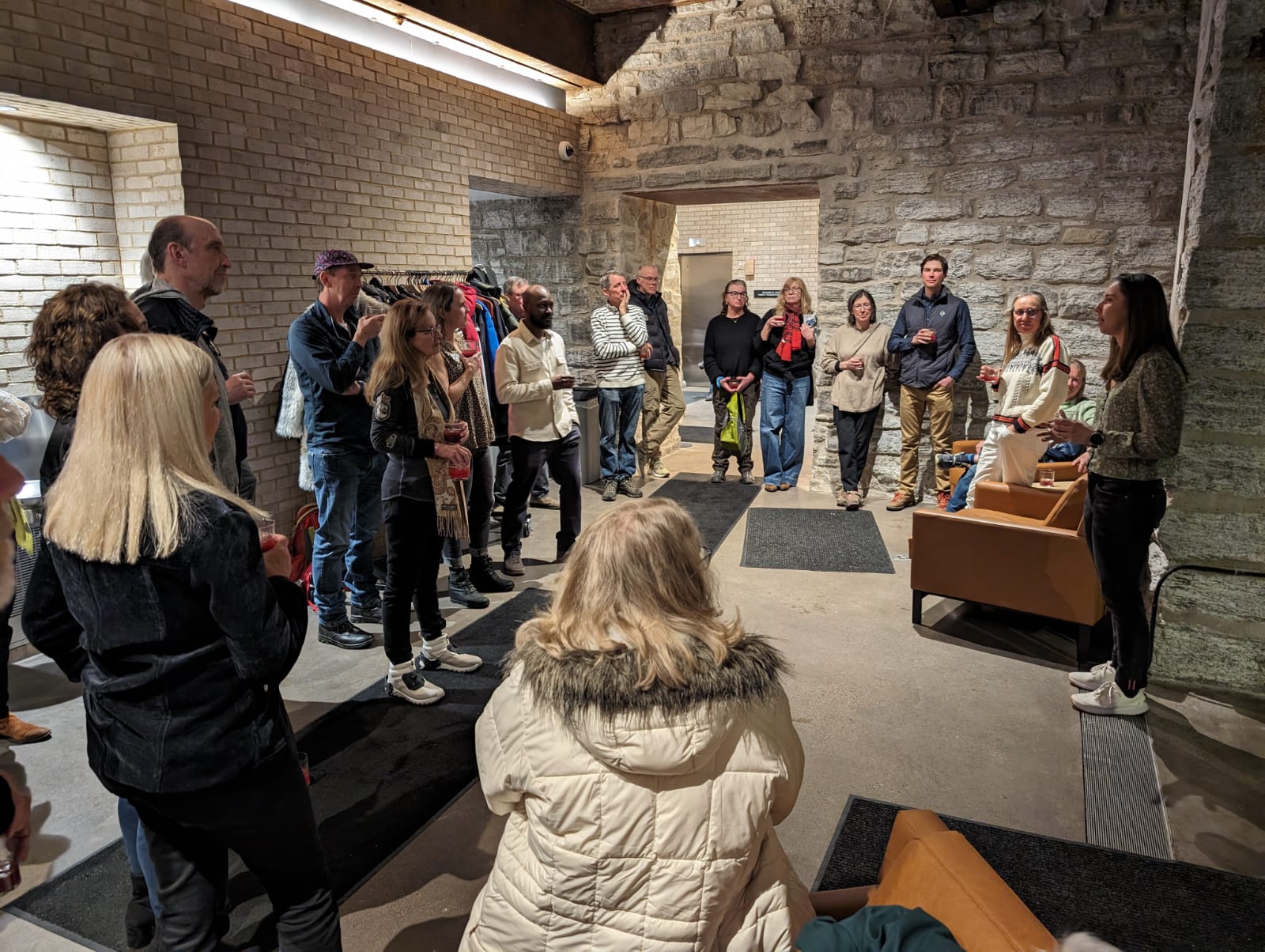
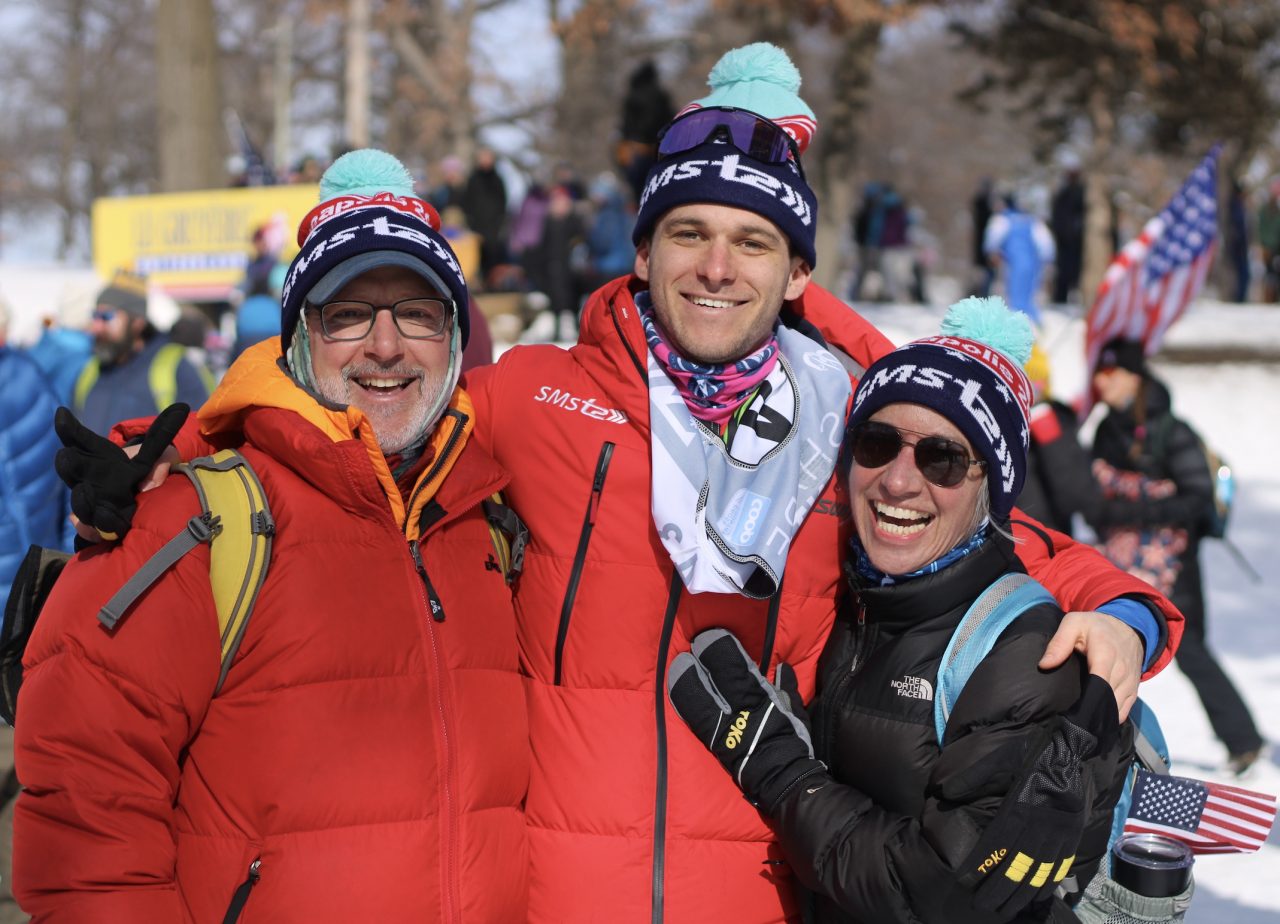
Julia talking with Lumi guests in Minneapolis after the Loppet Cup. (Photo: Lumi Experiences)
On Sunday night after the races, guests on Lumi’s Minneapolis World Cup Trip got to meet Julia and her family. Julia shared parallels between skiing on the Weston Golf Course where she grew up in Boston and the Wirth Golf Course that hosted the Minneapolis World Cup. She also talked about the impact of the Trail to Gold Fellowship, helping to bring more women coaches onto the World Cup. The story of how Julia and Jessie won silver at last year’s World Championships captivated and inspired the group for next year’s Trondheim World Championships in Norway.
Now these next two weeks are the first time in decades that US ski team athletes have been able to head home for some rest time in the middle of their 3.5 month World Cup season.
Before Julia takes off for the final leg of the World Cup in Scandinavia in early March, she prepared a video of what she packs when she travels to the World Cup. In this new video, see what she packs in her bags – both for ski training and her other favorite sport. What sport is that?
Want to experience cheering for a World Championship event in Europe? The 2025 Trondheim World Champs are going to be in Johannes Klæbo’s backyard next February and March. Due to their popularity, there will be two Lumi Experiences trips to Trondheim 2025. Dovetail this with Lumi’s Norway-Birken trip to ski the Norwegian Birkebeiner while you’re in Norway. An additional packing tip from Julia for Trondheim 2025? Bring your stars, stripes and glitter!
Right now we’re offering an early booking discount on all 2025 Lumi trips. Secure your spot before March 31, 2024 and save $300 per person.
This coverage is made possible through the generous support of Marty and Kathy Hall and A Hall Mark of Excellence Award. To learn more about A Hall Mark of Excellence Award, or to learn how you can support FasterSkier’s coverage, please contact info@fasterskier.com.
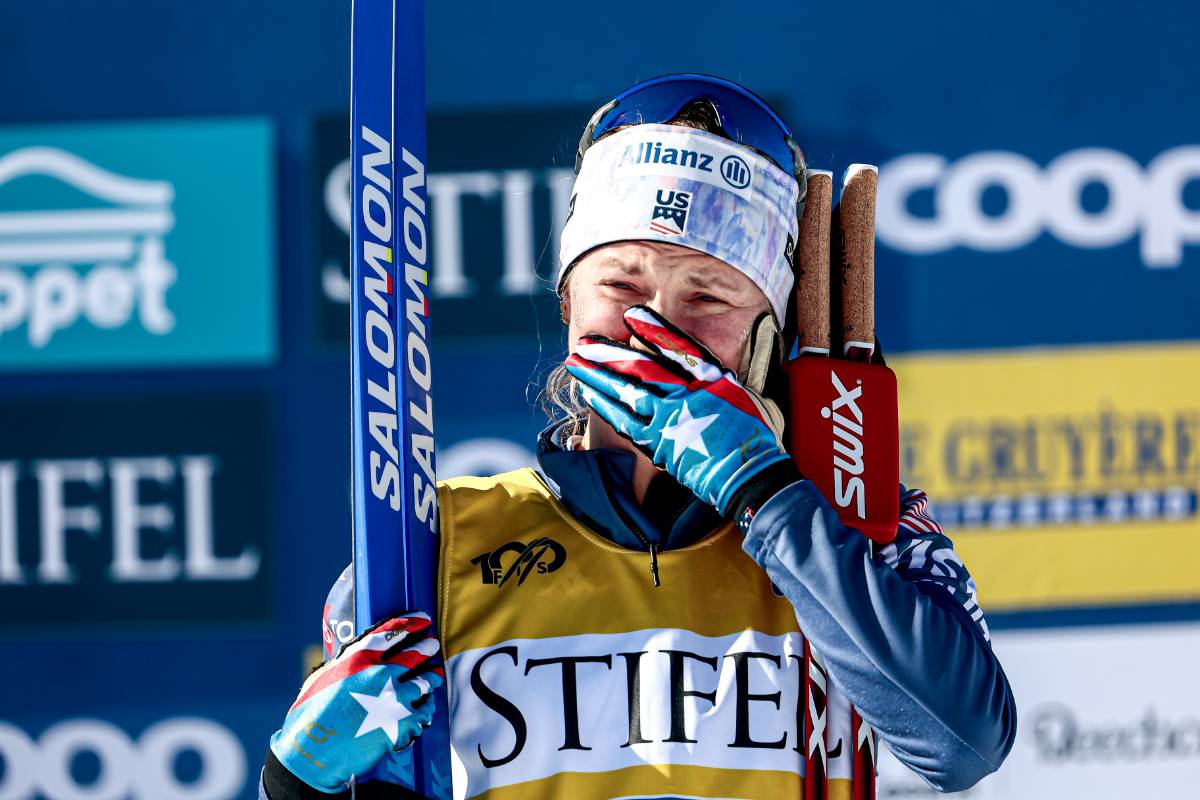
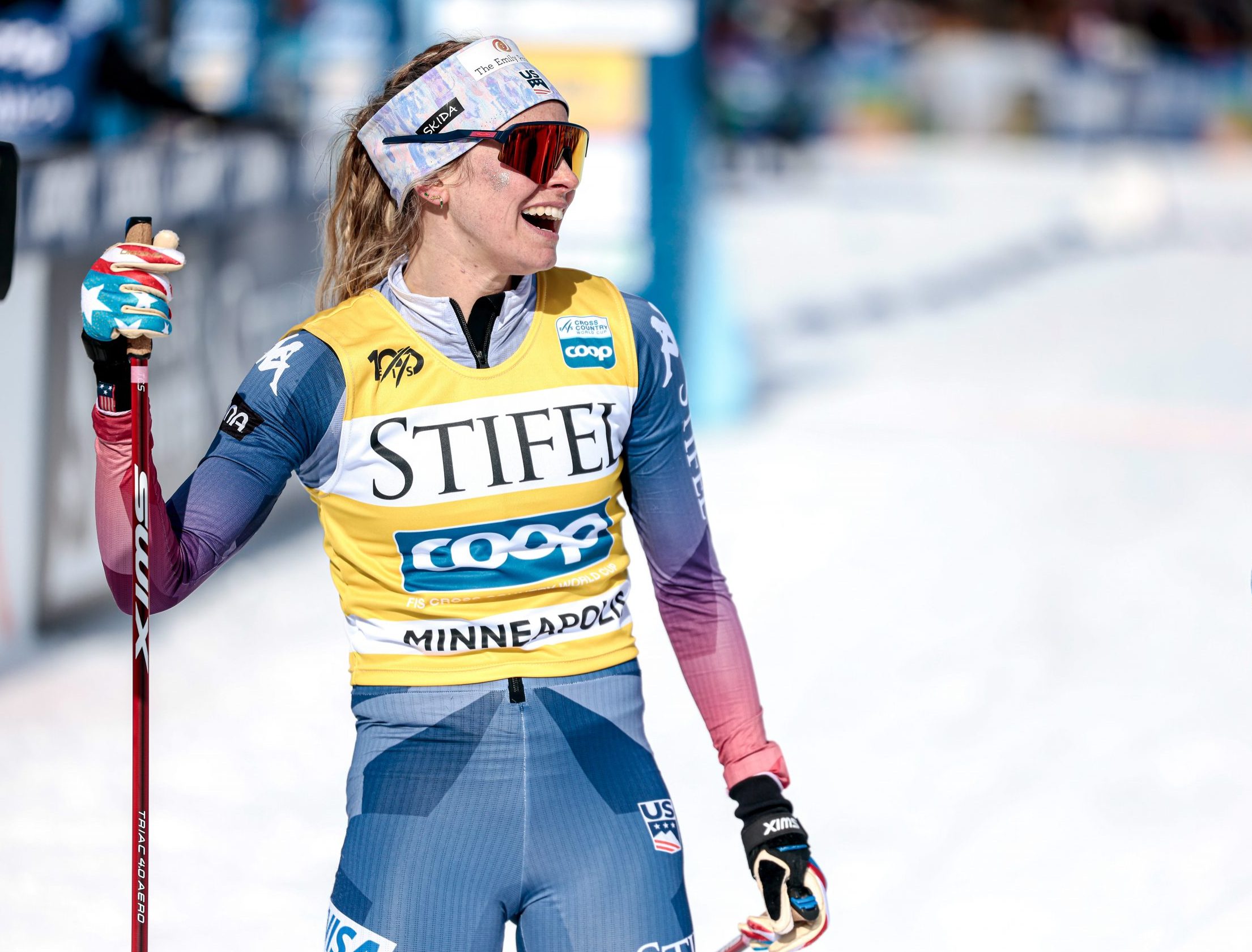
Jessie Diggins (USA) was emotional after a day in which she skied to a third place podium in front of her home crowd in Minneapolis. (Photo: NordicFocus)
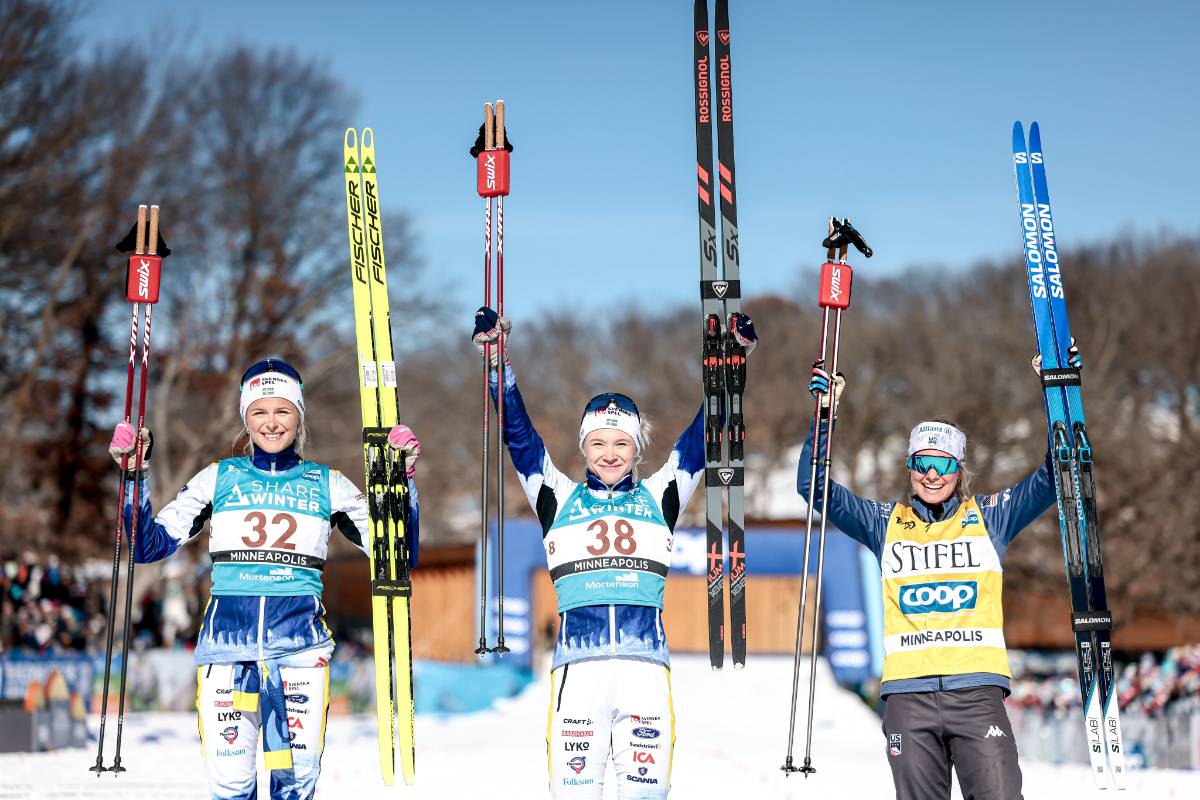
Ski racing is all about time, and the magic power of the best ski racers is that they’re seemingly able to bend time the way they want it to go. Lives are lived under a relentless march of seconds, minutes, months, and years. But a select few can claw a few seconds back the other way when given skis as a tool. By that measure, the three seconds that Jessie Diggins bent her way to take third place over Sweden’s Linn Svahn in Minneapolis’ 10 k Individual Start Freestyle were a testament to her power over time. Likewise, the 31 seconds Sweden’s Jonna Sundling took over the rest of the field—and the 15 seconds her countrywomen Frida Karlsson had over Diggins in second place—provided evidence of their incredible efforts.
To understand the full extent of who Diggins is as a ski racer, one must consider Diggins’ oft-repeated chorus that this weekend was “about bigger things than results.” This was about generations of US skiers, and years of US skiing. Twenty years since the last US World Cup took place. Today, though, brought nearly 20,000 people to Theodore Wirth Park—old teammates, competitors, coaches, acquaintances, and fans—a community that shared a love of cross country skiing. Such a gathering as that was a worthwhile endeavor, in itself.
“This whole weekend has been a dream come true,” said Diggins. “I’ve maybe never done anything I’m more proud of.”
Team USA celebrates Jessie Diggins (USA) after a third-place finish in Minneapolis. (Photo: NordicFocus)
The winter sun that shone over Minneapolis on Sunday put the close-contested racing in full glare as the top contenders traded time checks all the way to the races conclusion. For those observing though, there was more significant time being folded and split as Diggins took her turns around the course. Her winding up the A-climb in Wirth recalled a decade ago on this same course when she swept the Junior National Championships. And where Diggins has taken the sport was evident throughout the day; five American Women placed in the top 30. The ascendant Sophia Laukli skied to 15th place, and Julia Kern skied to a strong 19th. Rosie Brennan finished 22nd, U23 World Championship medalist Haley Brewster 25th. The Americans showed depth all the way through the results with three more in the top 40: Sydney Palmer-Leger 32nd, Kendall Kramer 36th, and Novie McCabe 37th.
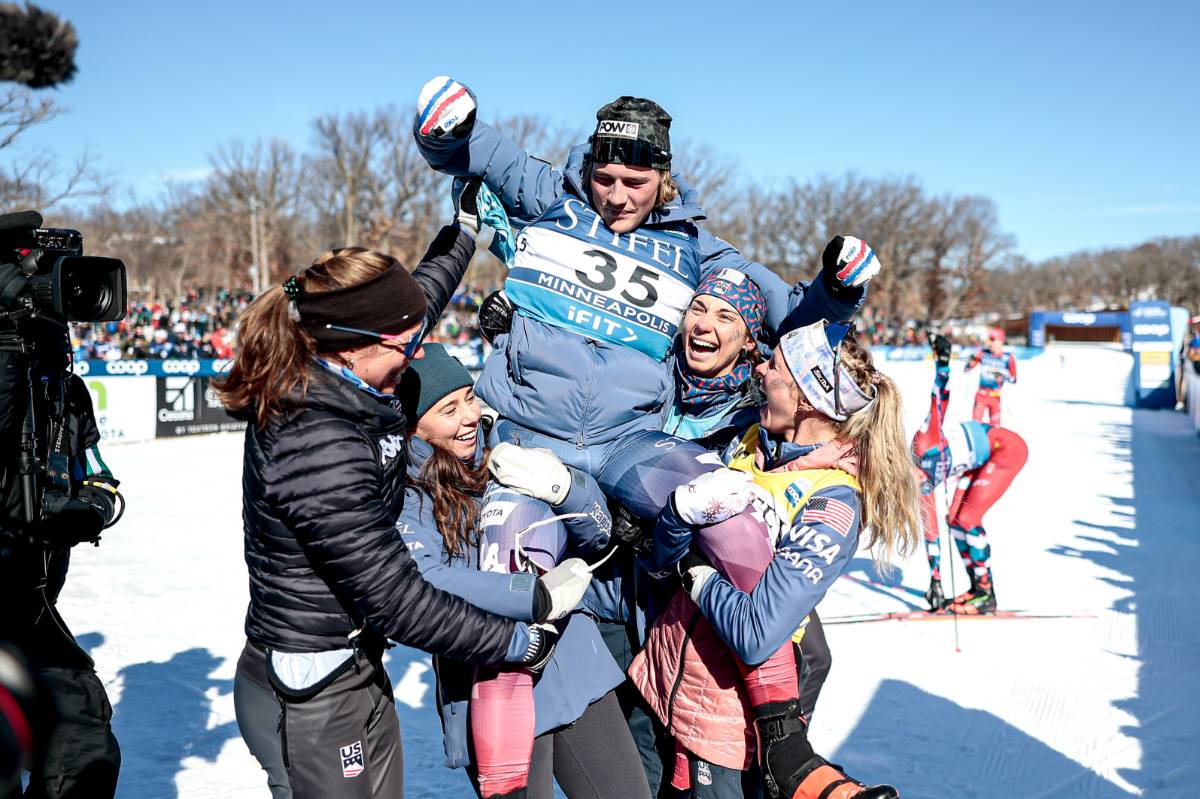
Jessie Diggins (USA) helps lift Gus Schumacher (USA) up after he pulled off an improbable win in the Men’s 10 k Freestyle race earlier in the day. (Photo: NordicFocus)
Diggins understood that this weekend was not just a series of races, but a grander celebration of the ski community she’s so transformed. “This was all about Gus,” she said after the young Alaskan pulled off an unlikely World Cup win, the first for an American man since Bill Koch 40 years ago. A whole new generation of US skiing has been ushered to success on the ski tails of Jessie Diggins; for a few moments—while hoisting Schumacher up on her shoulders—Diggins was just another part of the ski community in which she, herself, had been raised a mere thirty miles away. In the intervening years, Diggins has been transformed . . . and so has the American ski community.
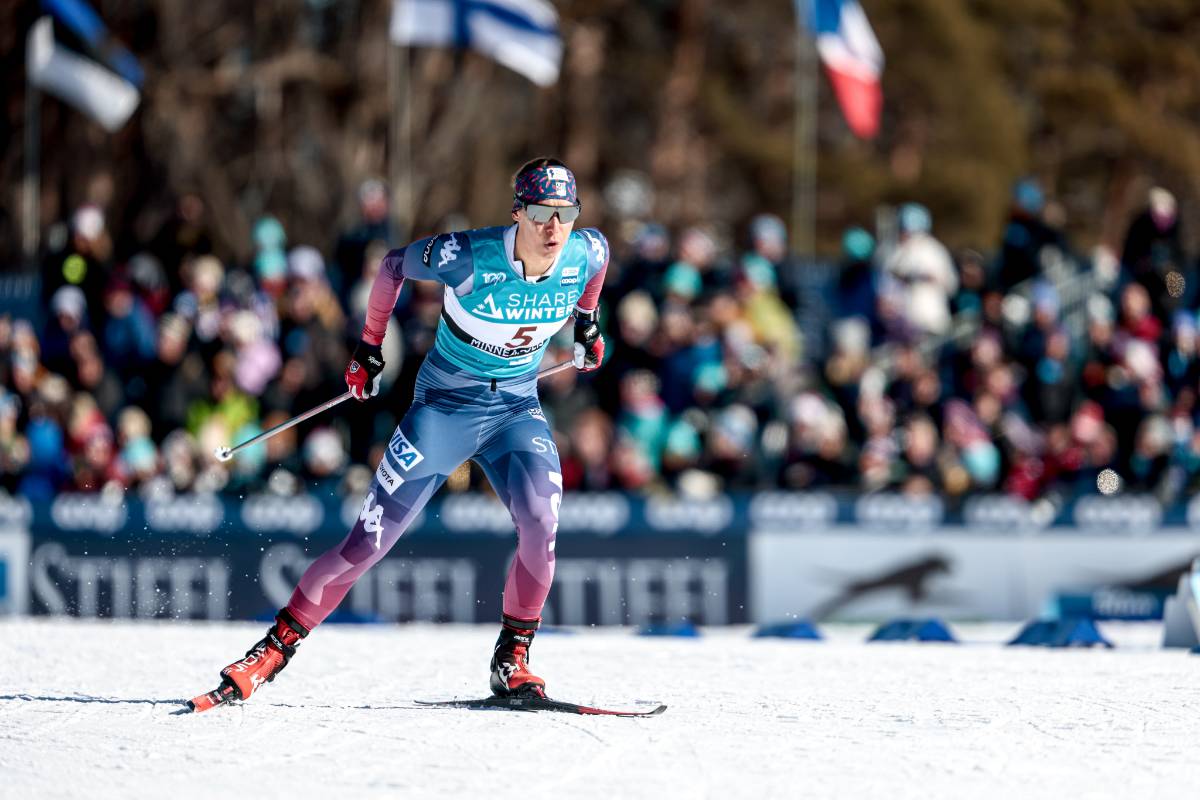
Julia Kern was one of five American Women to finish in the top thirty on Sunday. She was quick to attest that energy created by the home crowd lifted her performance. (Photo: NordicFocus)
Women’s 10 k Individual Start Freestyle
Julia Kern led out an American contingent that included 12 starters in the Women’s race. Racing in bib 5, Kern started to piece together a remarkable race for herself. “That was probably the most fun I’ve had racing in my entire race!” Kern said post-race, as she credited a sea of Wirth Park spectators that lifted her throughout the 10 k. When Kern crossed the line, she briefly got to sit in the leader’s chair before Sweden’s Maja Dahlqvist, bib 14, would cross the line with a 17 second advantage.
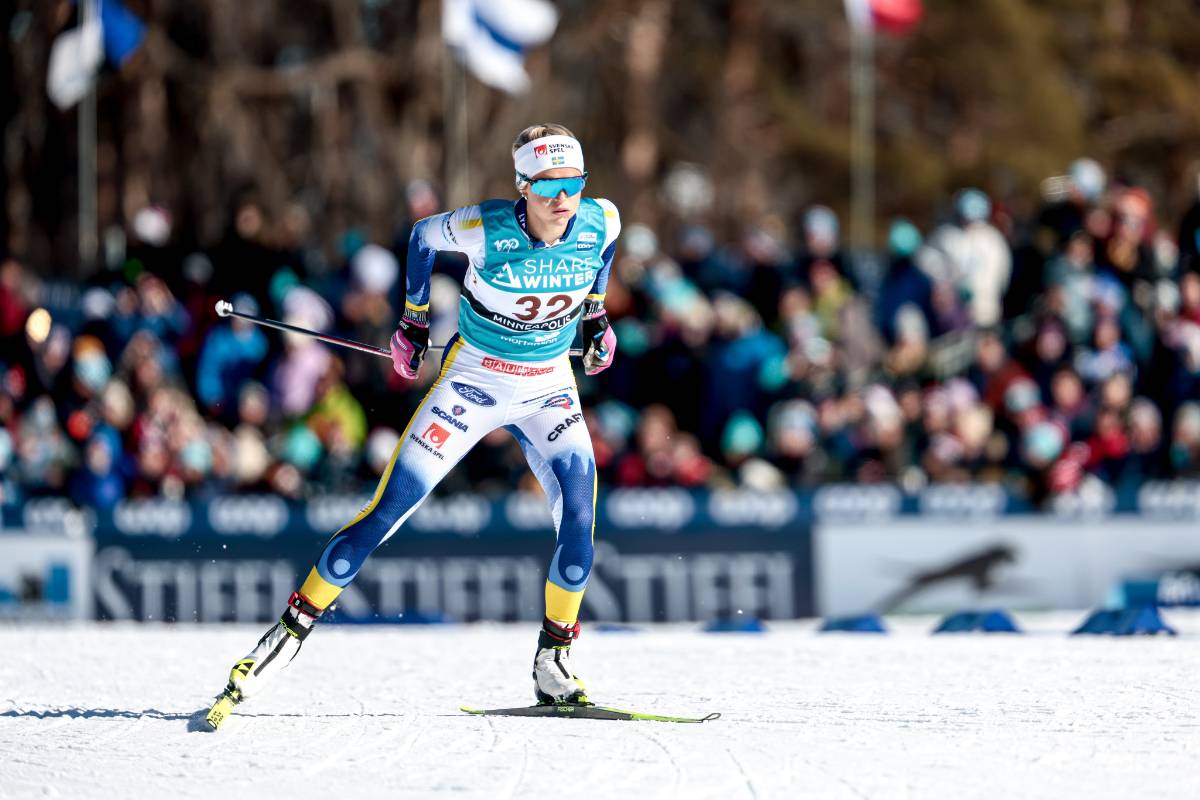
The start order would mean the Swedish-American duel would be one that lasted the duration of the race, with seeded skiers spread throughout the field. Frida Karlsson, bib 32, marked the first skier to best Dahlqvist’s splits, taking 10 seconds through 1.9 k. “It was a really high speed track, which I knew suited Jonna [Sundling] and Jessie,” said Karlsson. “I knew I was trying to keep up with them.”
Frida Karlsson helped Sweden finish 1-2 with a second place performance behind Jonna Sundling. (Photo: NordicFocus)
Karlsson’s assessment was right on, as Sundling came through the first 1.9 k checkpoint with nearly eight seconds up on Karlsson, expanded the lead to 12 seconds by the 5.8 k mark, and finally expanded it to 15 seconds over the finish line to take the lead.
That set up a waiting game as splits rolled in for bib 50, Svahn, and bib 58, Diggins. In the interim, American Sophia Laukli was putting together another solid distance performance on the Wirth course. “I think I was going faster because of the fans,” said Laukli post-race. “I’m pretty happy with that on this course with less climbing than I usually like.”
The second round of the fight for the podium opened with bib 50, Svahn, who would momentarily put three Swedes in the top spots at each checkpoint. Svahn, though, was consistently third behind Sundling and Karlsson, clocking 8 seconds off of the pace at 5.8 k and eventually letting the gap drift to 20 seconds between her and Karlsson at the finish.
When Diggins came through the 5.8 k checkpoint, she split the difference between Karlsson in second and Linn Svahn in third at 17 seconds off the lead. That put her five seconds off of Karlsson and three seconds ahead of Svahn. By 8.5 k, Diggins had drifted closer to Svahn than Karlsson, setting up a clear-cut fight for Diggins: she needed to hold onto that three seconds over Svahn to ski onto the podium. “My strategy was to go as hard as I could,” said Diggins. “With 2 k left, I hoped the crowd could carry me to the finish.”
A final sprint helped lift Jessie Diggins (USA) to a hard-earned third place over Sweden’s Linn Svahn on Sunday in Minneapolis. (Photo: NordicFocus)
Diggins’ hopes were cast onto a crowd more than ready to receive them. As she ascended the bump that lead into the Wirth Park stadium, she accelerated towards the finish and increased her gap over Svahn to four seconds, netting her a third place podium before collapsing to the ground.
“It wasn’t about the podium,” said Diggins. “I just wanted to go out and leave it all on the course, and I did.” With a podium secured on home turf, she paraded alongside Sundling and Karlsson . . . then Diggins took another lap, a modest bow for her hard work—not just over today’s 10 k distance, but over nearly a decade of promoting, supporting, and driving for this moment in the Minnesota winter sun. At this day’s end, a dream realized.
This coverage is made possible through the generous support of Marty and Kathy Hall and A Hall Mark of Excellence Award. To learn more about A Hall Mark of Excellence Award, or to learn how you can support FasterSkier’s coverage, please contact info@fasterskier.com.
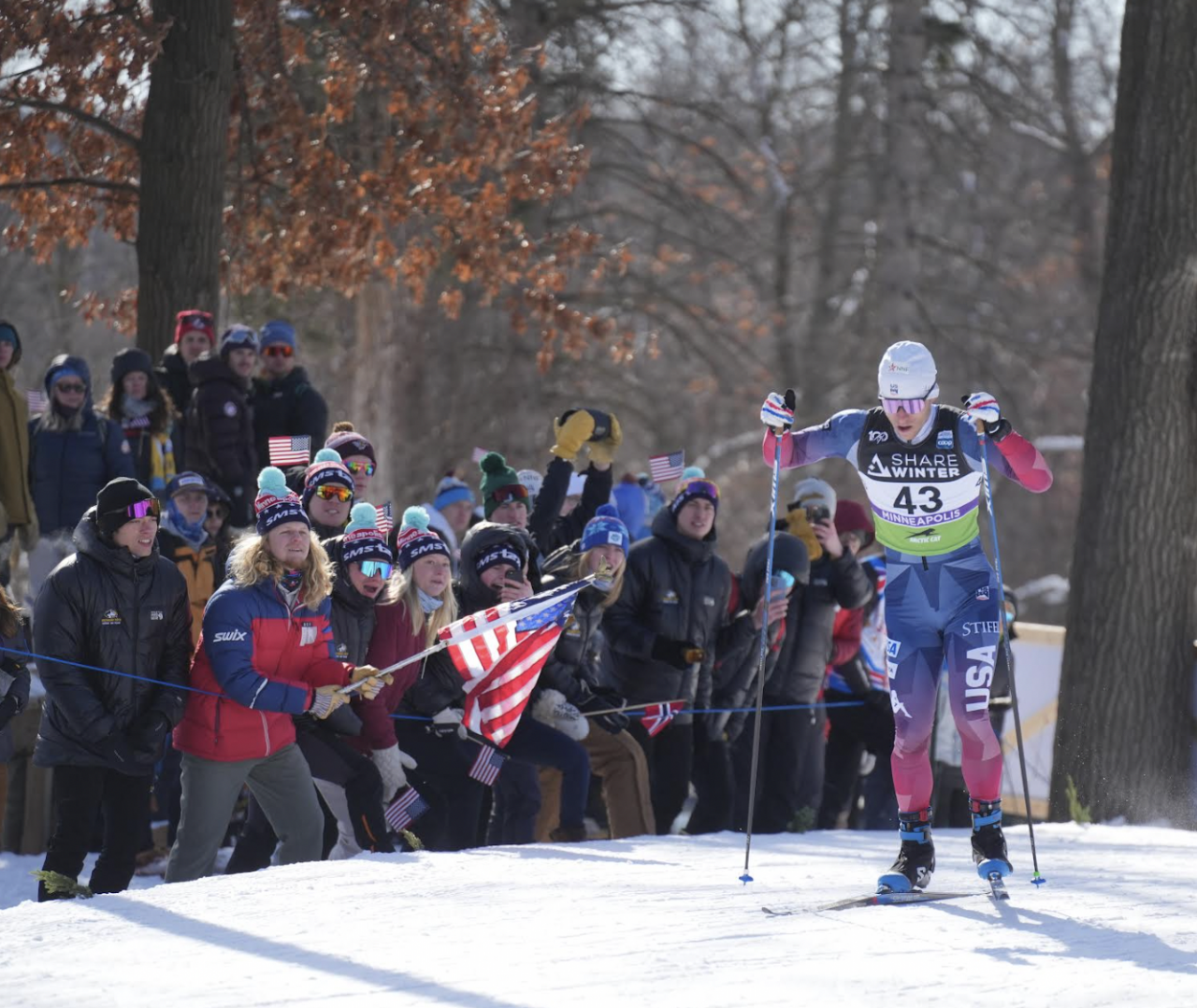
Adam Witkowski skies past his former teammates from Michigan Tech University at the World Cup on Saturday. (Photo: Tryg Solberg)
Most of the athletes competing Saturday on cross-country skiing’s World Cup circuit in Minneapolis arrived at the venue on a bus, chartered by organizers to carry racers from the official event hotel.
Then, there was Adam Witkowski, 24, who rolled up with a pile of his former college teammates in an SUV blasting their favorite pre-race pump-up music: Cardi B’s WAP.
Witkowski had driven eight hours to Minnesota the day before, where he was planning to sleep in a basement with those teammates before coming out to a city park just to watch the international field. Instead, with just over 12 hours to prepare, he was called up to compete—on loaner skis and a borrowed race suit.
“He took my room, so I had to sleep in the basement—I got demoted a little bit,” said Colin Freed, 21, who hosted Witkowski on Friday night.
Witkowski, who trains with the Vermont-based SMS T2 team, was one of the U.S. alternates for Saturday’s sprint—a reserve who competes only if another athlete calls in injured or sick.
The World Cup is usually held at European venues—the Minneapolis event is the first in the U.S. in 23 years—so it’s somewhat unusual for Americans to have last-minute substitutions.
But the circuit’s rules give extra start positions to the U.S. when the World Cup travels to North America, and the team has had 24 starters each day in Minneapolis and at events earlier this month in Canada. So withdrawals have been more common—including one last week that came with less than 12 hours notice.
Witkowski had been hoping to qualify to race in Minneapolis, and his parents had even reserved a hotel room far in advance.
But this season has not gone as planned. He’s struggled with sickness, mental health and even a wisdom tooth infection, and he didn’t make the team.
His parents decided to cancel their hotel reservations, he said.
“But then they couldn’t cancel their hotel room, so my dad’s like, ‘We might as well go—it’s only a 15-hour drive,’ and they showed up yesterday,” Witkowski said Saturday.
Adam Witkowski poses with his parents, Bob and Dianne, after his unexpected World Cup start in Minneapolis. (Nathaniel Herz/FasterSkier)
Witkowski’s preparation for the world’s highest level of cross-country ski racing was not, exactly, by the book. This was his birthday week, so there was some celebration at his favorite bar Wednesday in Michigan, where he went to college.
Then, he did an interval workout Friday morning before the eight-hour drive to Minnesota, where he attended an SMS T2 function and a coach got a text that Witkowski “might be starting,” he said. He was back at Freed’s house, messing around with hockey gear in the basement, when the confirmation came in.
“We treated him like a king,” Freed said. “We ordered him two pizzas and played some NBA 2K, and that was his preparation for the night.”
In the morning, Witkowski took a quick jog, ate some oatmeal, then loaded into the Chevrolet Suburban with his friends and drove to the race trails.
“He just gets out and we’re honking and making a scene, ‘Go USA!’ And everybody there is like, ‘yeah!’ It was sweet,” Freed said.
Witkowski’s parents ended up getting to watch their son line up to race against Olympic medalists.
“We were down in the grandstand, watching the start and everything, waving our flags and yelling really loud,” said Dianne Witkowski, Adam’s mom.
Witkowski finished 53rd out of 72 in the sprint’s qualifying round. But in a three-minute race, he was less than four seconds from finishing inside the top 30, who advance into a series of head-to-head knockout heats.
And the experience of racing in front of thousands of American fans, plus his college teammates, was one that he will not forget, he said.
“It’s the best atmosphere I’ve ever experienced in my life — it’s up there with some big concerts that I’ve been to. The whole way around, someone’s just cheering your name, and it’s hard to get tired,” he said. “My legs really flooded by the top of the hill, but there were people on the downhills to make sure that you kept going.”
He joined his friends afterward to watch the rest of the race from the sidelines. “Why not?” he said. “It’s a beautiful day.”
Adam Witkowski (USA) making the home fans cheer during the individual sprint in Minneapolis (USA). (Photo: Modica/NordicFocus)
This coverage is made possible through the generous support of Marty and Kathy Hall and A Hall Mark of Excellence Award. To learn more about A Hall Mark of Excellence Award, or to learn how you can support FasterSkier’s coverage, please contact info@fasterskier.com.
Jessie Diggins (USA), smiling in the sunshine at the finish line of a Minnesota World Cup. That’s one she can check off the lifetime bucket list . . . (Photo: Modica/NordicFocus)
A week ago, golfers in shirtsleeves were playing the course that abuts Theodore Wirth Park in Minneapolis, Minnesota. A narrow white ribbon of just-skiable snow had been preserved on the course laid out for the upcoming Stifel Loppet Cup, but it seemed that the Twin Cities had already begun looking toward spring. There were serious concerns as to whether or not these marginal ski-conditions would hold, and the immediate future of America’s FIS World Cup events was in doubt . . . a dire outlook that had also begun putting America’s future as a viable World Cup destination in question. If Minneapolis’World Cup plans were to fail, then nordic skiing’s big show might never come back.
And then winter seemed to remember that spring actually does not begin for many more weeks to come. Minnesota seemed to remember that it is actually situated way up north where snows fall and winters linger (though it remains among the southern-most of all cross-country World Cup destinations). Snowy magic arrived to save the day, and skiers awoke to a neatly-groomed world of purest white. A new six inches of snow fell over Wirth Park, making it look like the world-class cross-country skiing venue that it truly is. Game on, Minneapolis . . .
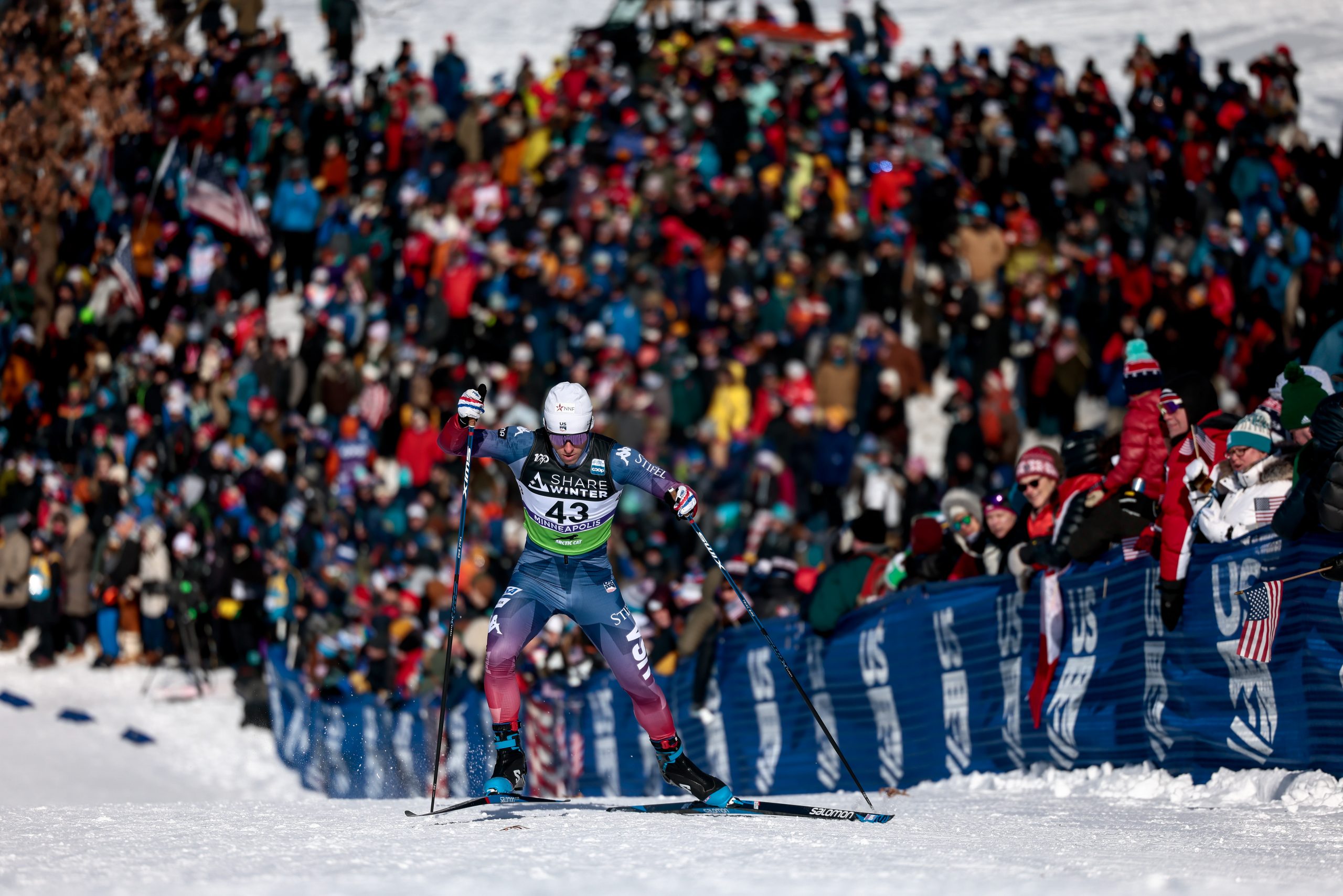
Racing through the deafening cheers of a thundering American crowd was a “Holy $#!%” experience for Julia Kern (USA) and her American teammates. (Photo: Modica/NordicFocus)
Sprint Qualifying
Throughout the day, the real story in Minnea[olis was the crowd. “That was surreal,” said Jessie Diggins (USA). “It was already the best atmosphere we’ve had all season, and that was an hour before the qualifier! It was really overwhelming, because people showed up for this.”
One of the high-profile motivators behind efforts to bring the World Cup to Minneapolis, Diggins appeared especially motivated in the Women’s Sprint Qualifying starting gate on Saturday morning. Always a quick qualifier, Diggins’ bottled up energy (a reliably potent race-weapon) bubbled to the surface, producing the second fastest qualifying time (sandwiched between fastest qualifier, Jonna Sundling (SWE) and World Cup Sprint leader, Linn Svahn (SWE).
Three other Americans also qualified for the quarterfinals: still flying after her recent silver medal performance in the World Junior Championships Sprint, Sammy Smith laid down a hot qualifier to finish ninth. Close behind Smith were Rosie Brennan 12th, and Julia Kern 19th. Other American results in qualifying (and finishing results) included Erin Bianco 37th, Ava Thurston 40th, Haley Brewster 41st, Alayna Sonnesyn 44th, Renae Anderson 48th, Sydney Palmer-Leger 49th, Margie Freed 50th, and Michaela Keler-Miller 51st.
The top Canadian qualifier was Katherine Stewart-Jones in 34th, followed by Tory Audet 43rd, Allison Mackey 46th, Amelia Wells 52nd, Alexandra Luxmoore 53rd, Anna Stewart 54th, Marie Molinaro 55th, Clara Hegan 58th.
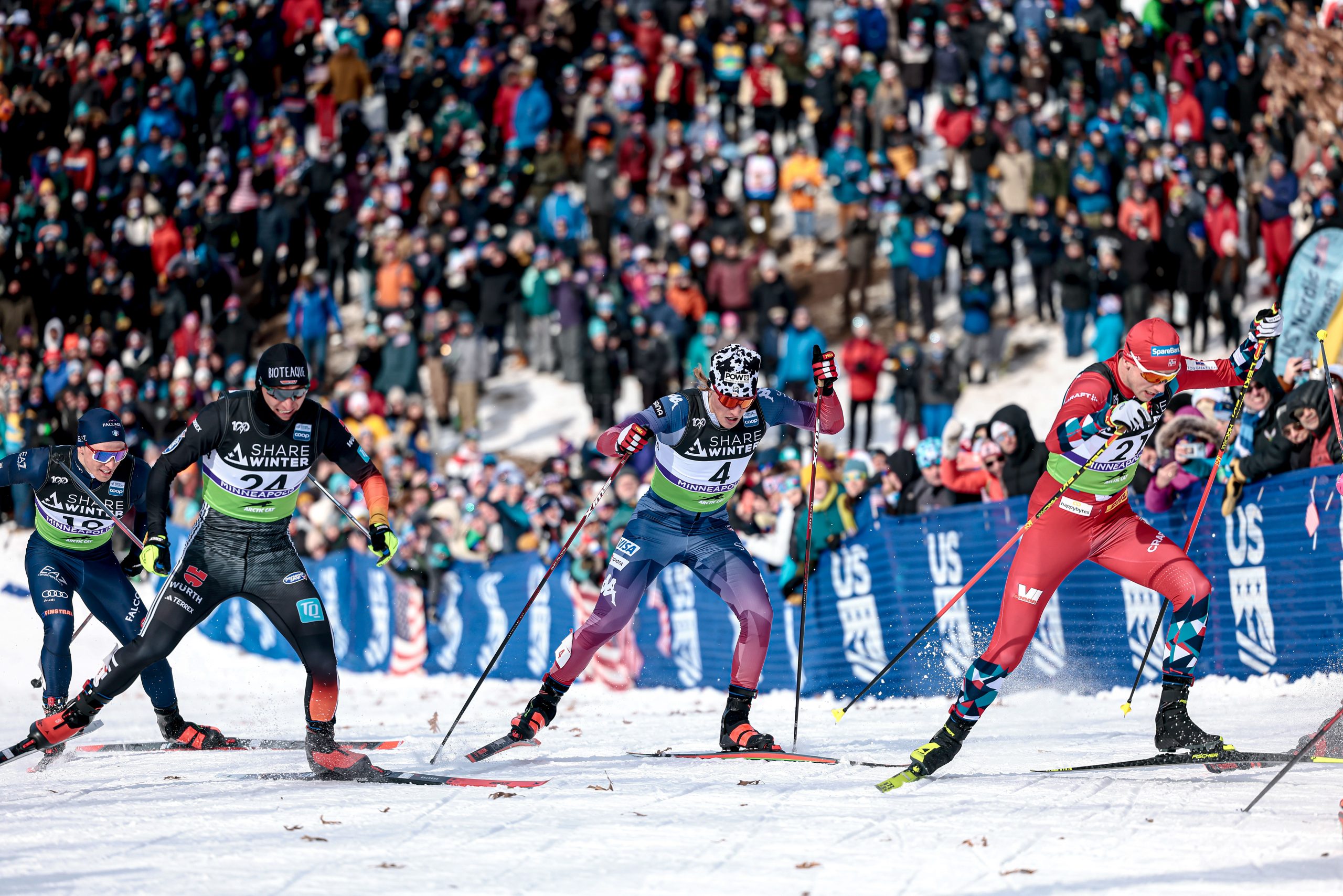
Gus Schumacher (USA) (center) races Anian Sossau (GER) (l) and Even Northug (NOR), (r) in their quarterfinal heat in front of Minneapolis’ cheering throng. (Photo: Modica/NordicFocus)
In Men’s Sprint Qualifying there was one notable disappointment: the absence of American Ben Ogden who fell ill during the World Cup in Canmore, Alberta last week. Qualifying also delivered a few notable surprises. While Johannes Hoesflot Klaebo continued to rule the roost with the top qualifying time ahead of perennial Sprint contender Federico Pellegrino (ITA), a few of their high-speed rivals performed at lower levels than expected. World Cup Sprint leader, Erik Valnes (NOR) failed to qualify (32nd)—as did former World Cup Sprint champion, Richard Jouve (FRA) 40th—while Gus Schumacher (USA) qualified a tremendous fourth. Schumacher credited the home-crowd with much of his success:
“It was hard to notice anything besides [the crowd noise]!” beamed Schumacher. “You gotta be going ‘Level 6,’ so it’s really helpful.”
Three other Americans qualified for the quarterfinals: Zak Ketterson 14th, JC Schoonmaker 17th, Kevin Bolger 30th. Other Americans included Jack Young 33rd, John Steel Hagenbuch 37th, Will Koch 38th, Michael Earnhart 44th, Zanden McMullen 46th, Adam Witkowski 53rd, Walker Hall 67th.
Among Canadians, Antoine Cyr advanced to the quarterfinals in 29th. Other Canadian final placings included Julien Smith 39th, Olivier Leveille 41st, Pierre Grall-Johnson 45th, Leo Grandbois 55th, Max Holman 57th, Julien Locke 68th, Felix Olivier-Moreau 70th.
Despite the many proud comments and optimistic predictions regarding the development of American skiing, Diggins proved to be the only American skier—woman or man—capable of advancing beyond the quarterfinals.
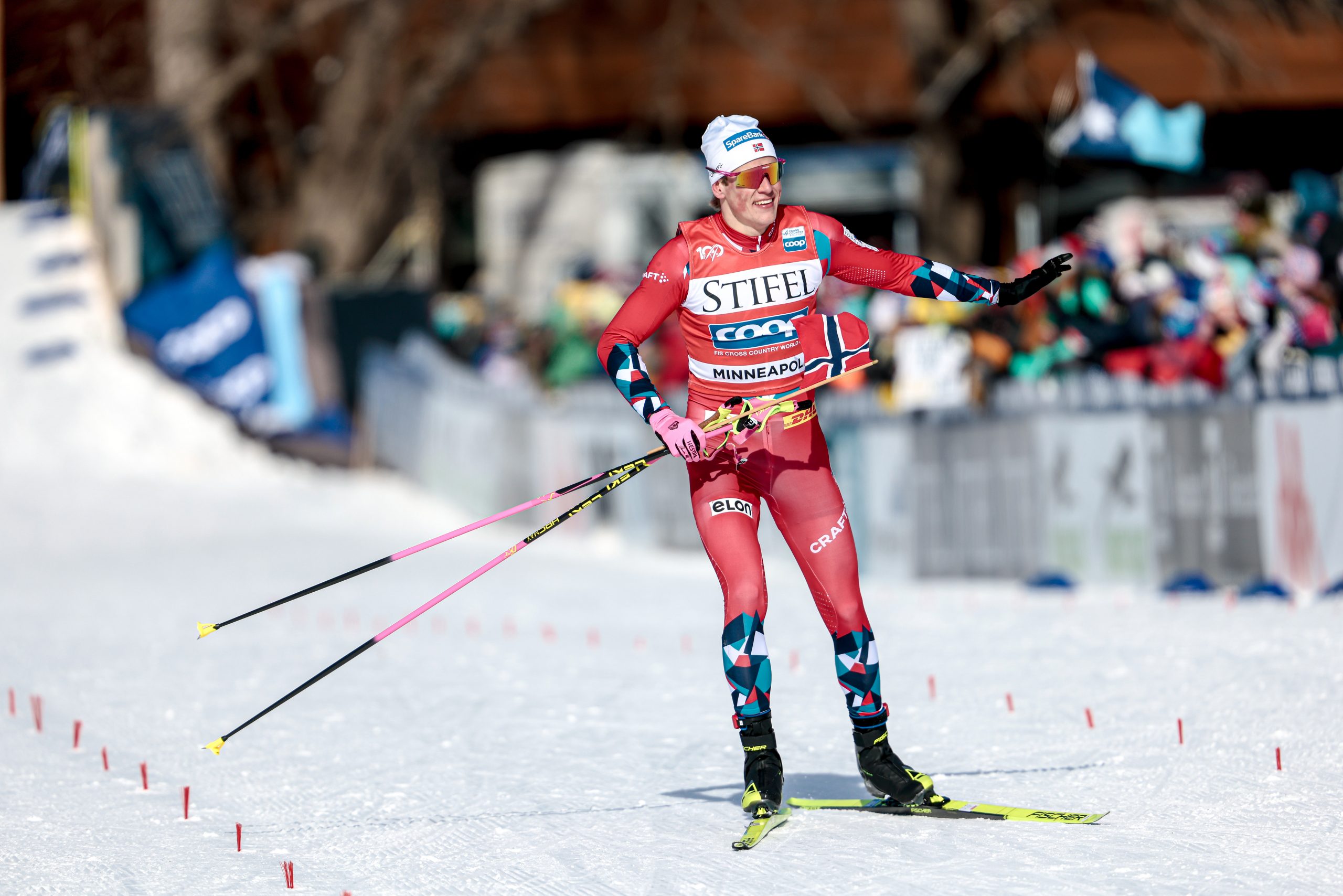
Finally back in the Sprint Leader’s jersey after a season interrupted by illness, Johannes Hoesflot Klaebo (NOR) takes a happy victory lap in front of Minnesota’s appreciative crowd. (Photo: Modica/NordicFocus)
Loppet Cup Freestyle Sprints
In the Men’s Sprint semifinal Lucas Chanavat (FRA) took the pace out extraordinarily hard, followed by Haavard Solaas Taugboel (NOR) and Klaebo. Chanavat faded quickly and was overtaken by Taugboel, Klaebo, and Pellegrino. In the end, Klaebo did what he does so well, darting effortlessly into the lead just before the finishing straightaway, and coasting across the line for the win ahead of Pellegrino and Taugboel.
In the final, Taugboel went straight to the front with Johannes Riebli (SUI) clogging Klaebo’s line briefly. Klaebo again allowed Taugboel the lead over the top of the second climb, seeming far more concerned with Pellegrino lurking in third. Klaebo knew where to engage the after-burners, and he shot into the lead at the head of the homestretch. He was followed across the line by Pellegrino and Taugboel.
“It’s so much fun,” said Sprint winner, Johannes Hoesflot Klaebo (NOR). The course and all the people: it was so much fun to race out there. I wish this could be part of the World Cup circus every season. We need to come back here, that’s for sure. I’ll just cheer a little extra for [Jessie] tomorrow.”
Jessie Diggins (USA)—and a cast of optimistic and ambitious Minnesota ski fans—dreamed this day into reality. (Photo: Modica/NordicFocus)
Jessie . . .
This Minnesota crowd had gathered here to see Jessie Diggins, an athlete who possesses the ability to smile broadly at the starting line. Diggins really does seem to enjoy what she does, and never has that been more apparent than when she was introduced to a roaring crowd for her Sprint quarterfinal. Diggins advanced beyond her quarterfinal by incorporating her usual strategy of leading from the front, punishing any pure sprinters with her injection of pace.
Diggins repeated her strategy in the semifinal, storming to the line ahead of Maja Dahlqvist (SWE) and Emma Ribom (SWE), though it appeared she may have used a bit too much energy in the first two rounds. In the final, Diggins skied another solid race, but the real speed on the course belonged to the true sprinters—Sundling, Svahn, and Kristine Stavaas Skistad (NOR)—who finished first, second, and third. Diggins came across fourth to the company of the loudest crowd-roar of the day. The post-race celebration was another happy occasion, as the entire field went up and down the finishing straightaway on a victory lap in which Diggins beamed to the denizens of her home state, and German’s Victoria Carl (fifth place) attempted to high-five every single person in the crowd. Minneapolis had hosted a World Cup: total success.
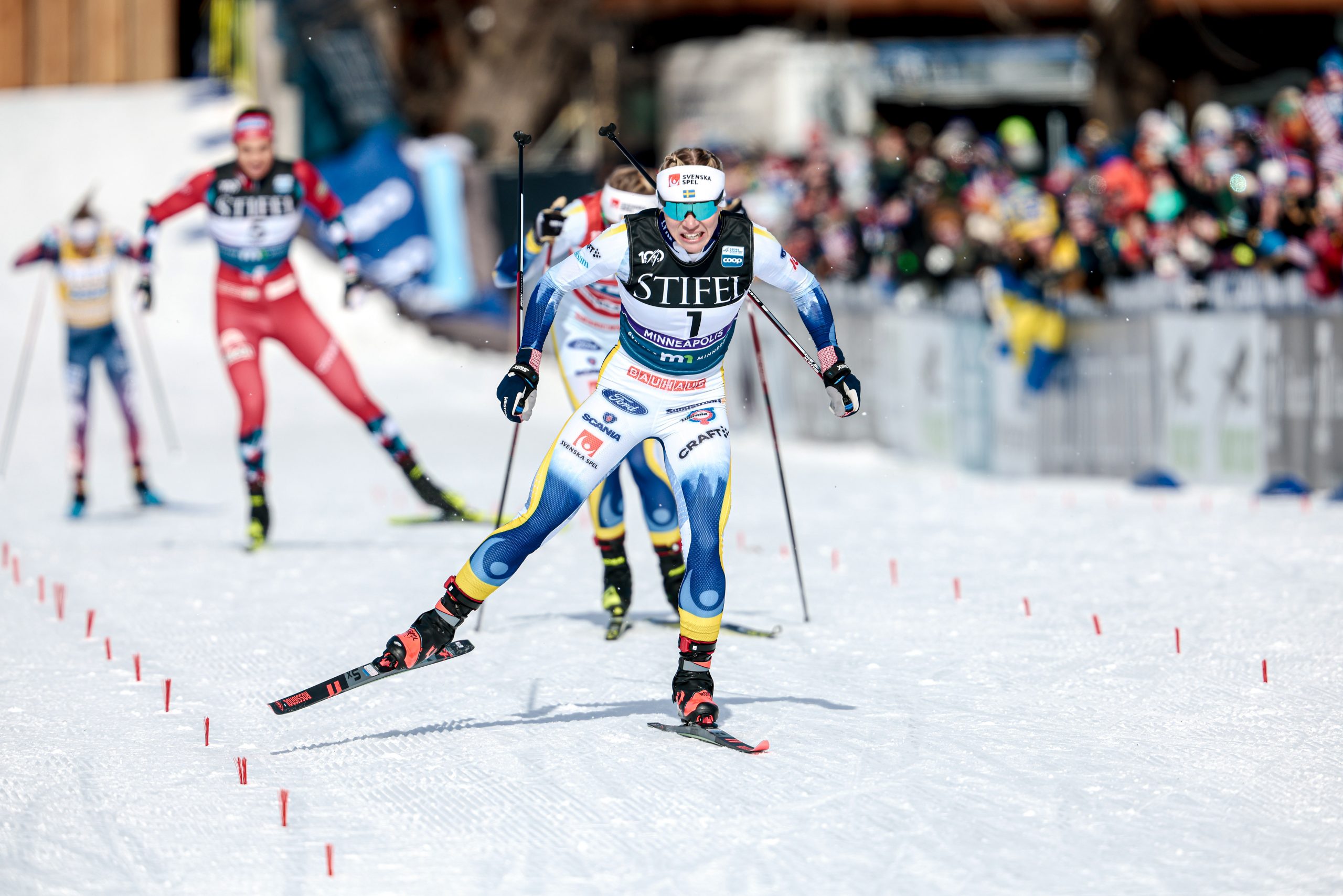
Top qualifier—and winner on the day—Jonna Sundling (SWE) played her strategy to perfection throughout the heats and the final—get the lead, keep the lead, drive the pace all the way to the line. (Photo: Modica/NordicFocus)
Racing in the USA
“I’ve never skied a race like this before,” grinned USA’s Jack Young. “You could feel the entire park willing you to ski faster. It was awesome!”
“I couldn’t even feel how tired I was because I was in a tunnel of noise!” said USA’s Erin Bianco. “It was so sweet . . . it got me up that hill for sure!”
“A little snow came the day that we arrived,” commented Andrew Musgrave (GBR). “It’s beautiful now; so different from anywhere else we race. ‘Minnesota Nice’ has definitely proven true so far!”
“I had big emotions before the start,” said Federico Pellegrino (ITA). I almost cried with all these people knowing my name.”
“No matter what happens out on course in the race itself, the fans are so amazing!” said Julia Kern. “I’ve cried so many times today out of sheer emotion . . . you just look around and you’re like, ‘Holy Shit! I’ve never experienced anything like this before!’ It’s more than I could’ve dreamed of.”