From the FasterSkier archive — posts syndicated from athletes’ and coaches’ own blogs between 2004 and 2012, kept online as published. Current coverage is at fasterskier.com.
Kershaw is free from quarantine and back at home in Lillehammer. As we all know, the race season has been shut down. That means it’s time to discuss news items of note. Like…the “flexing” of some skiers as they ski an un-godly number of kilometers, Stina Nilsson’s switch from cross-country to biathlon, the Norwegian Ski Federation’s financial crisis, and, the retirement of Norway’s Eirik Brandsdal.
**And, yes folks, you’ll hear some explicit content in this episode**…around the 30:30 mark.
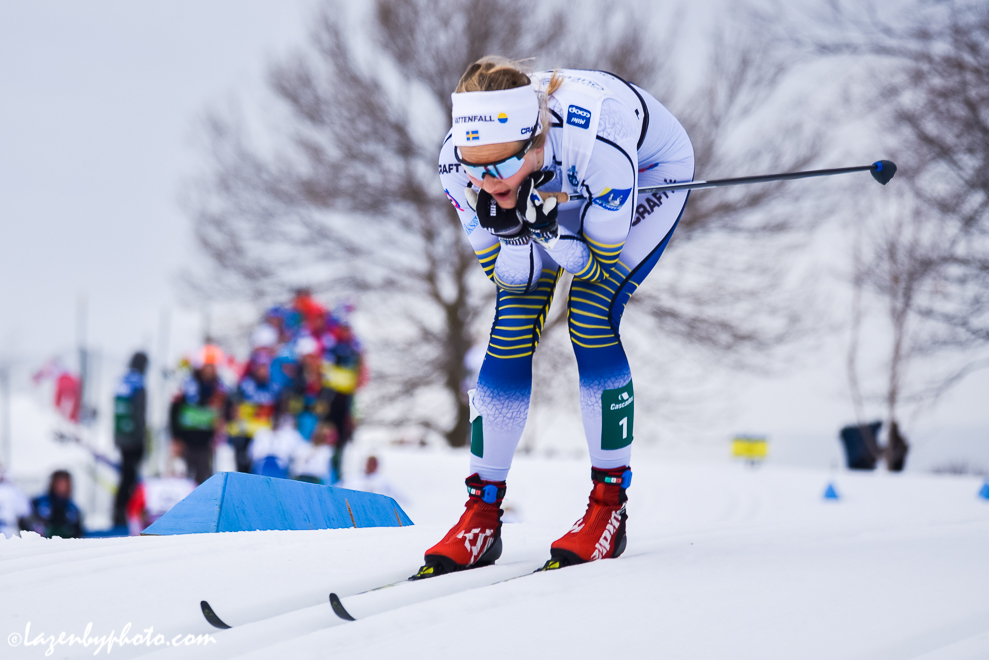
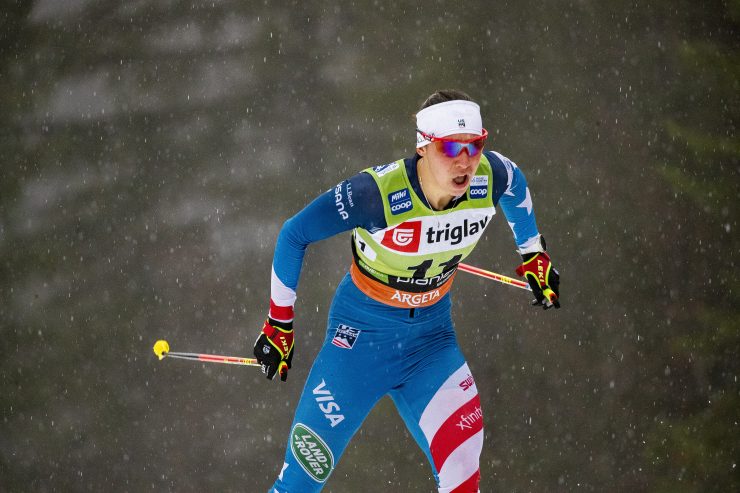
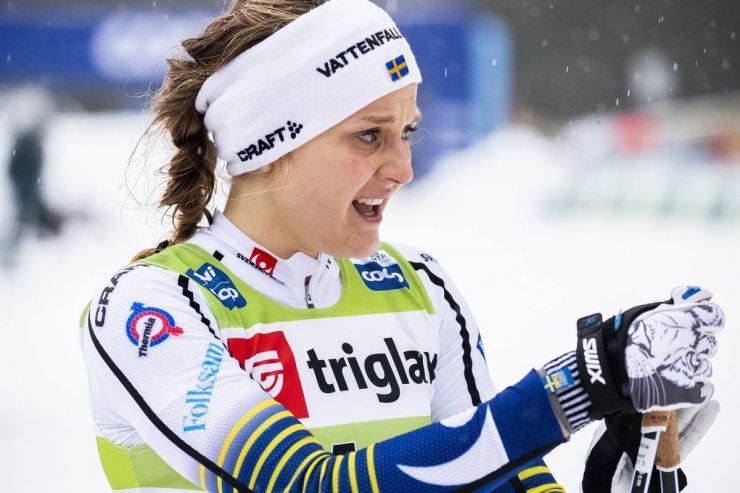
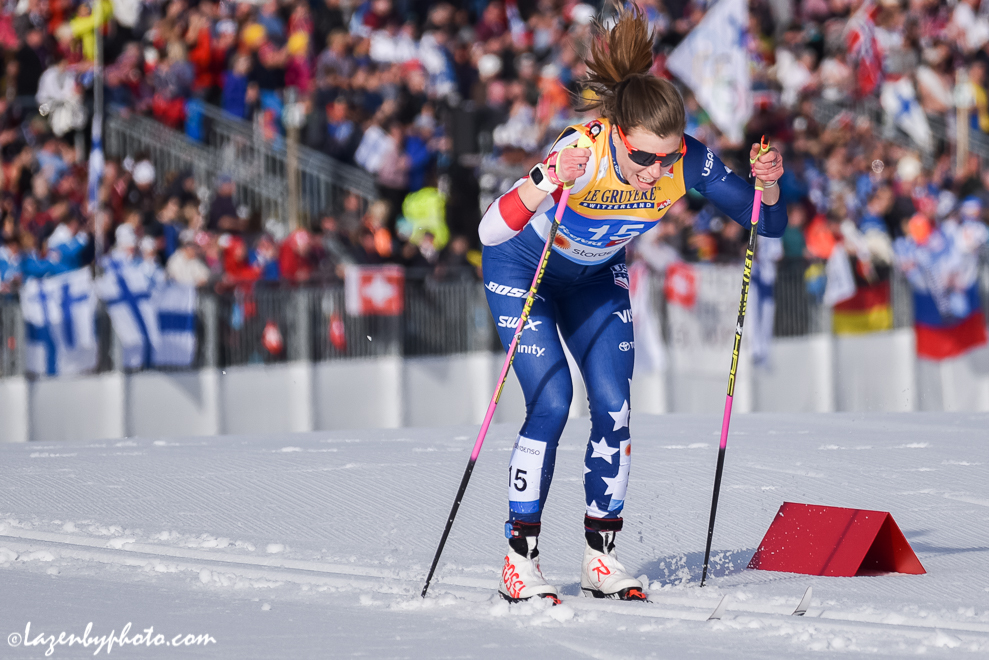
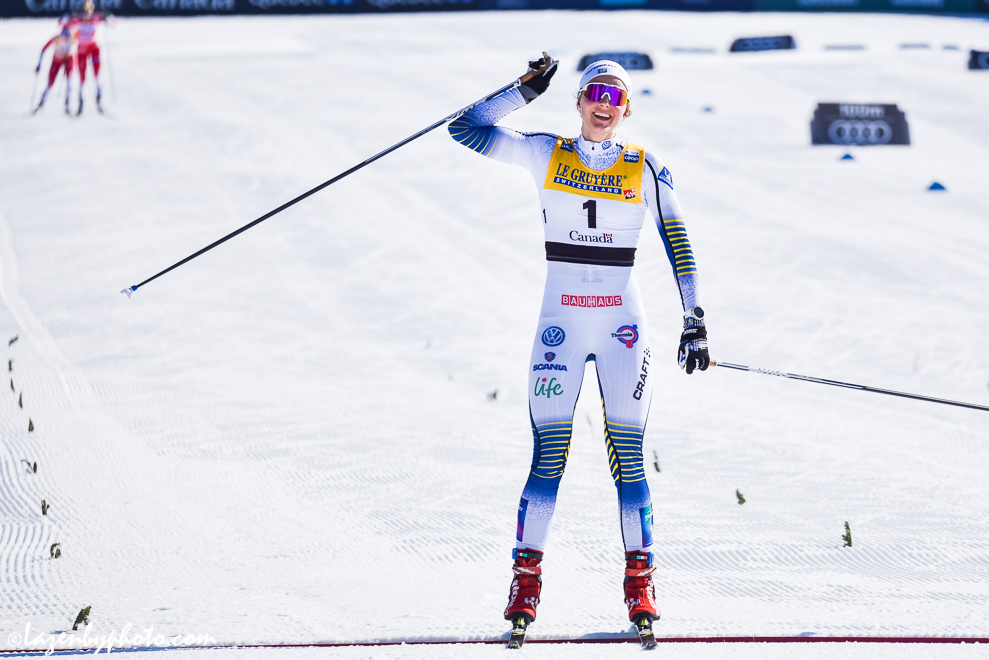
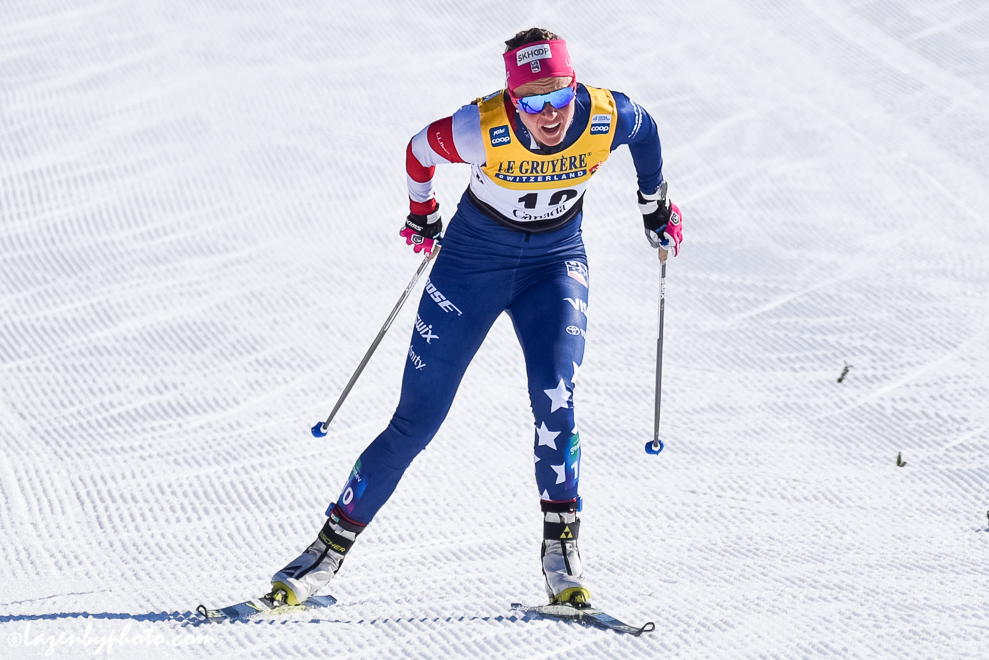
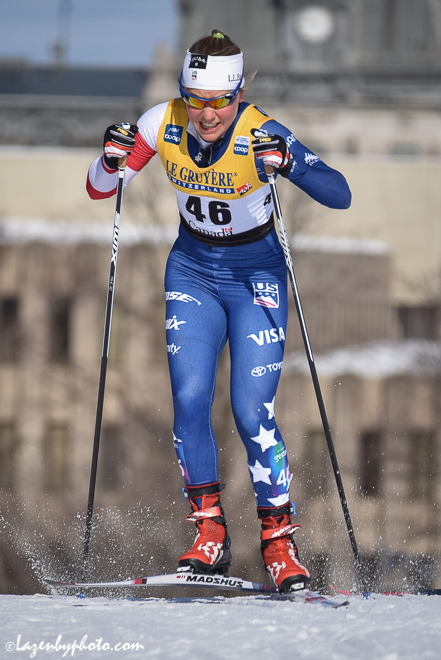
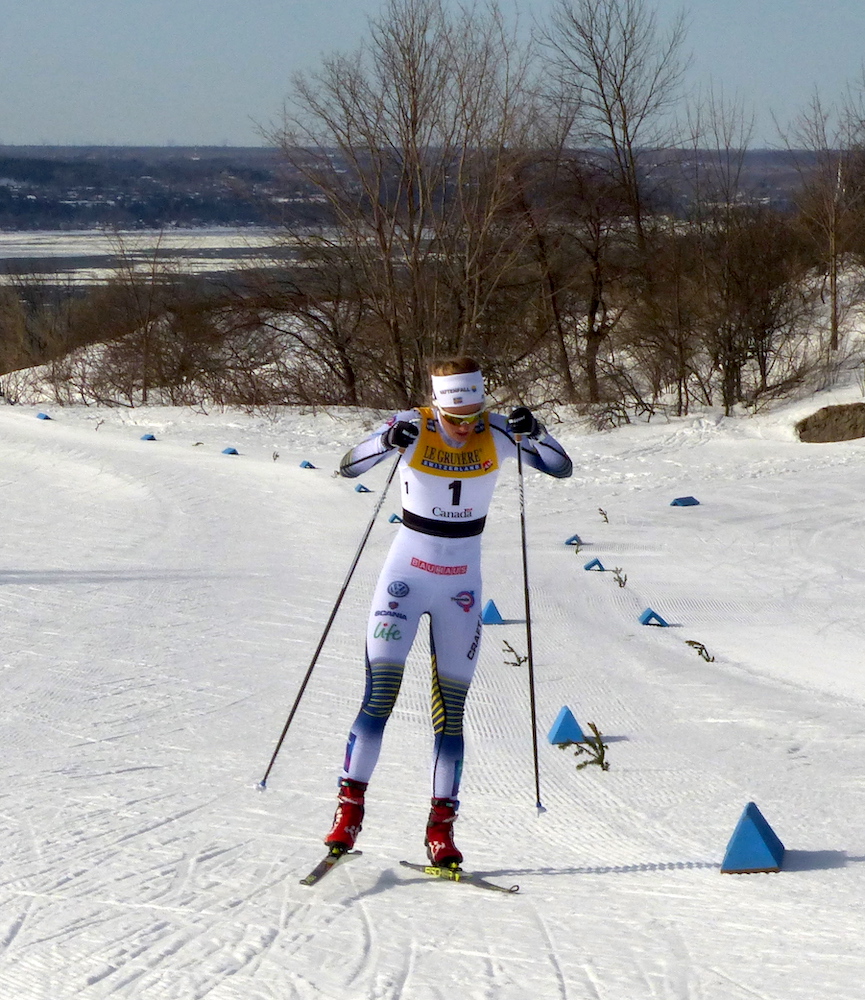
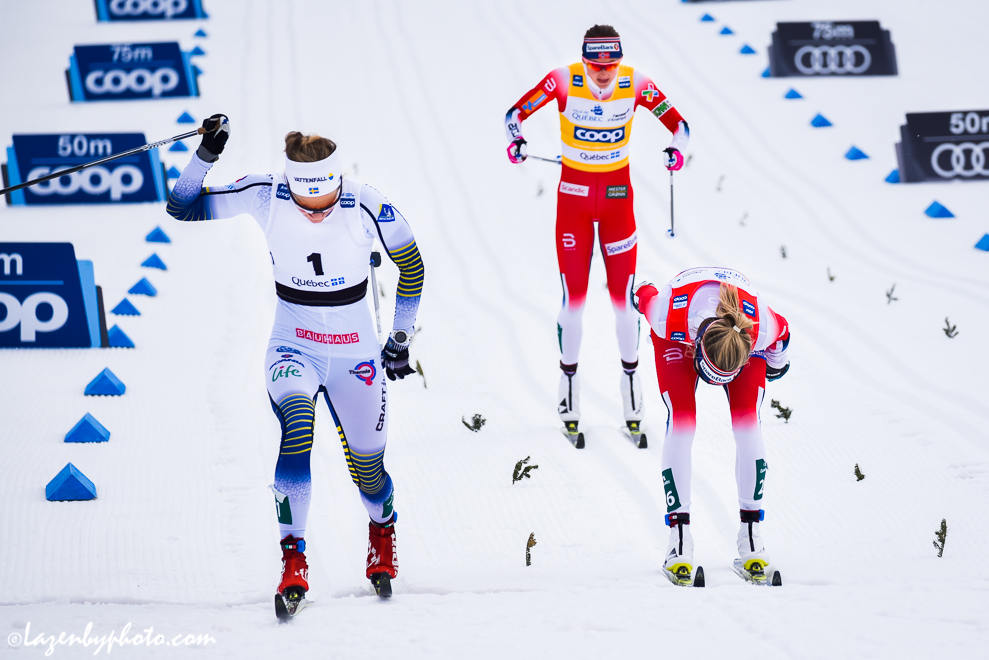
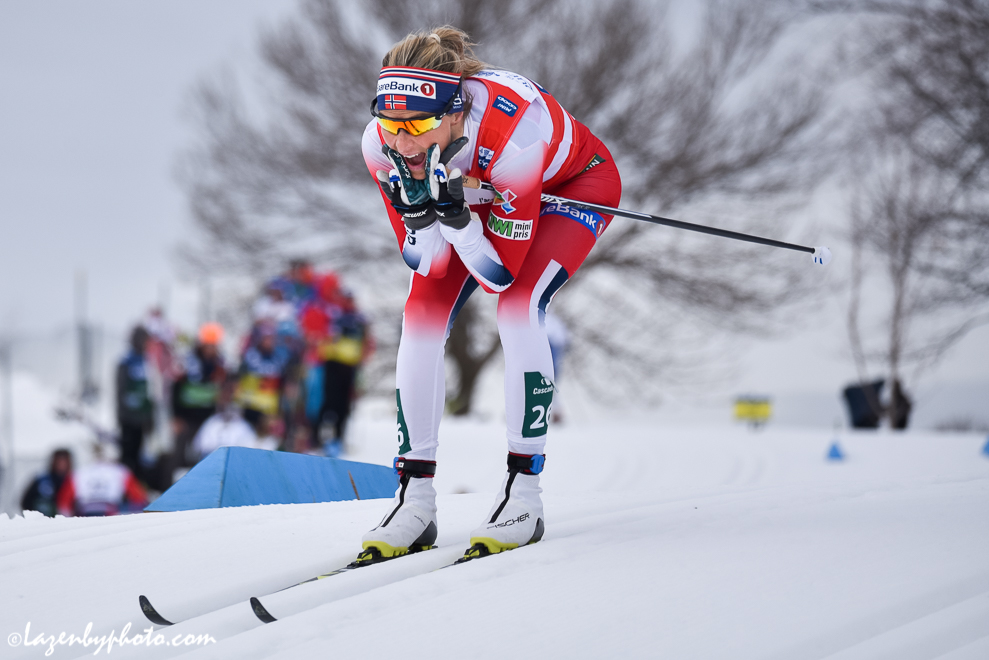
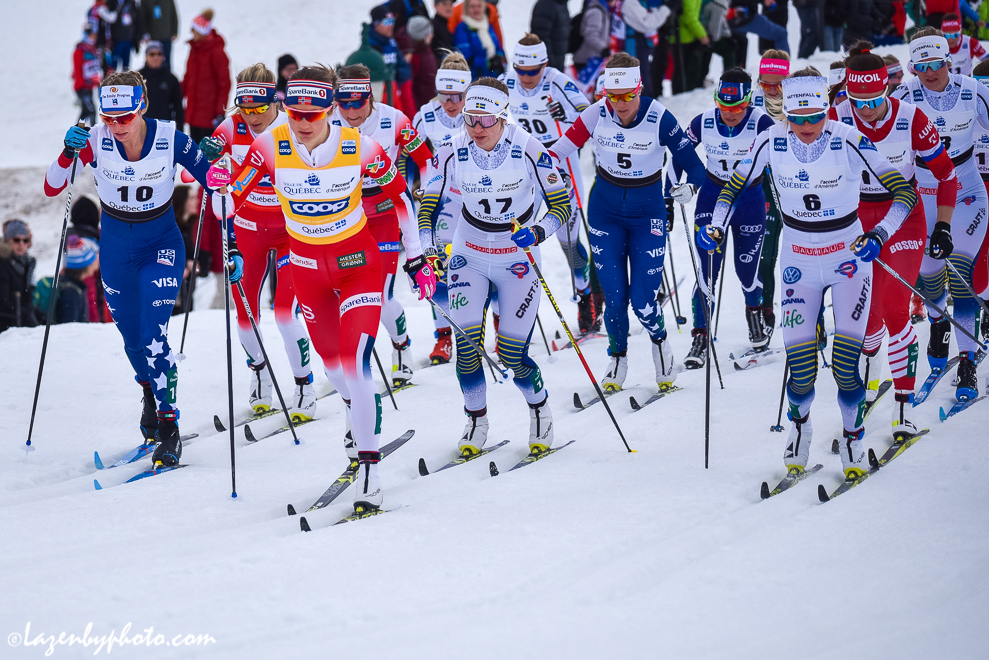
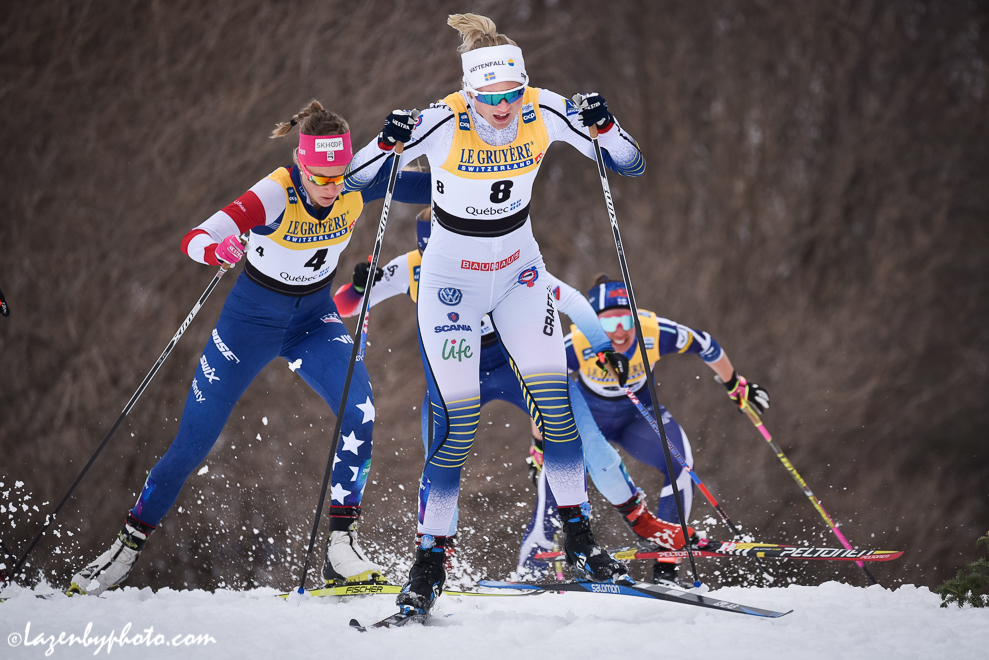
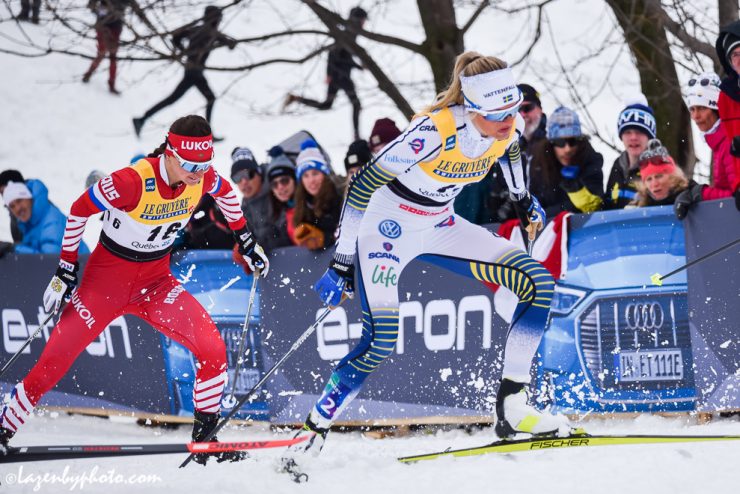
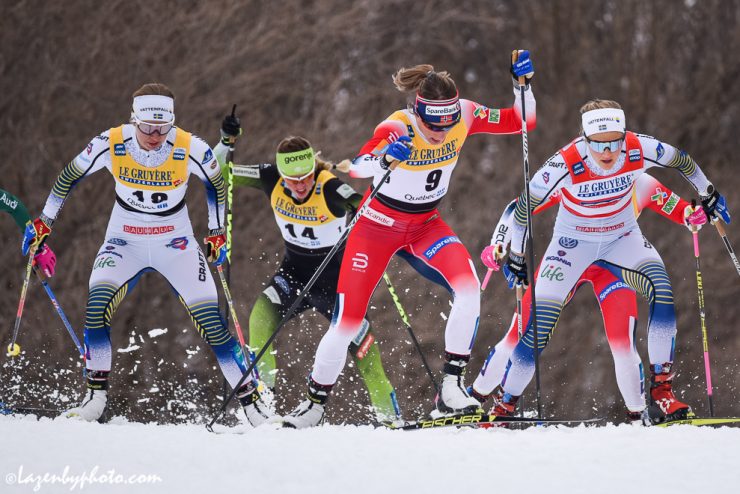
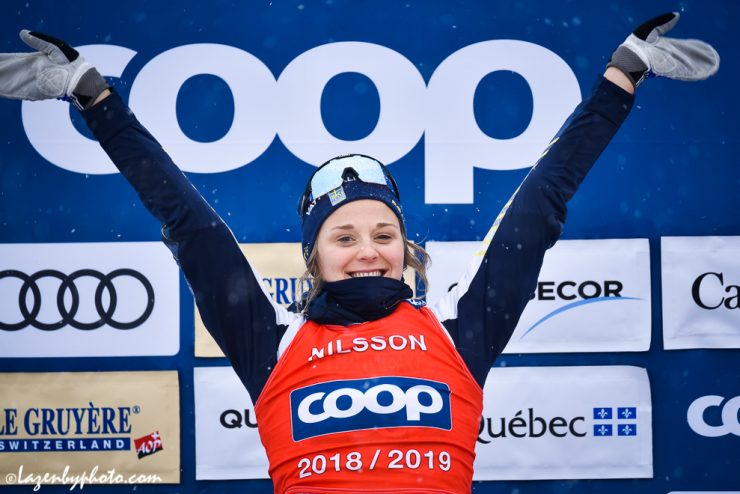
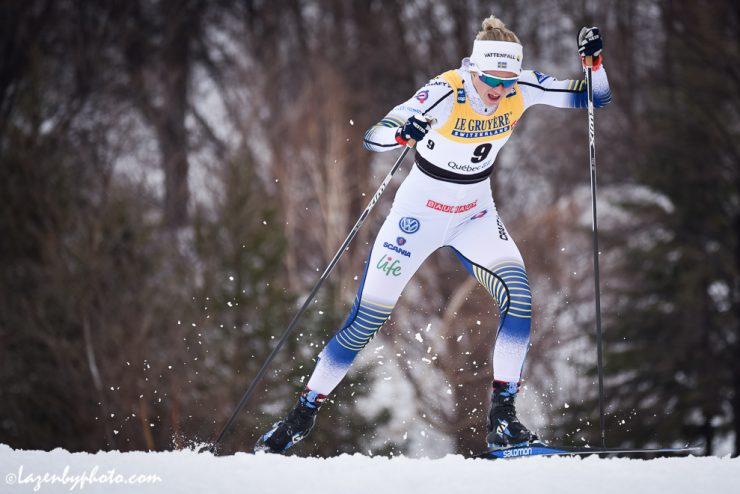
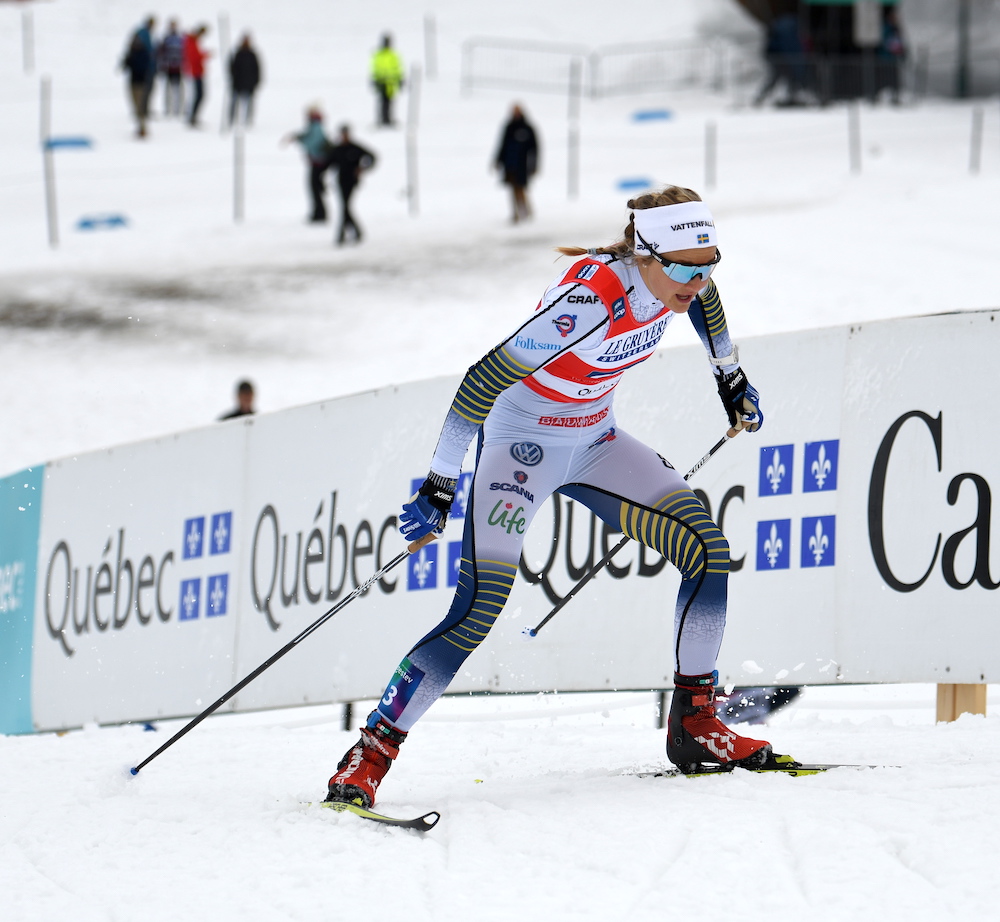
Sweden’s Stina Nilsson tucking during the 10 k mass start classic in Québec City. (Photo: John Lazenby/lazenbyphoto.com)
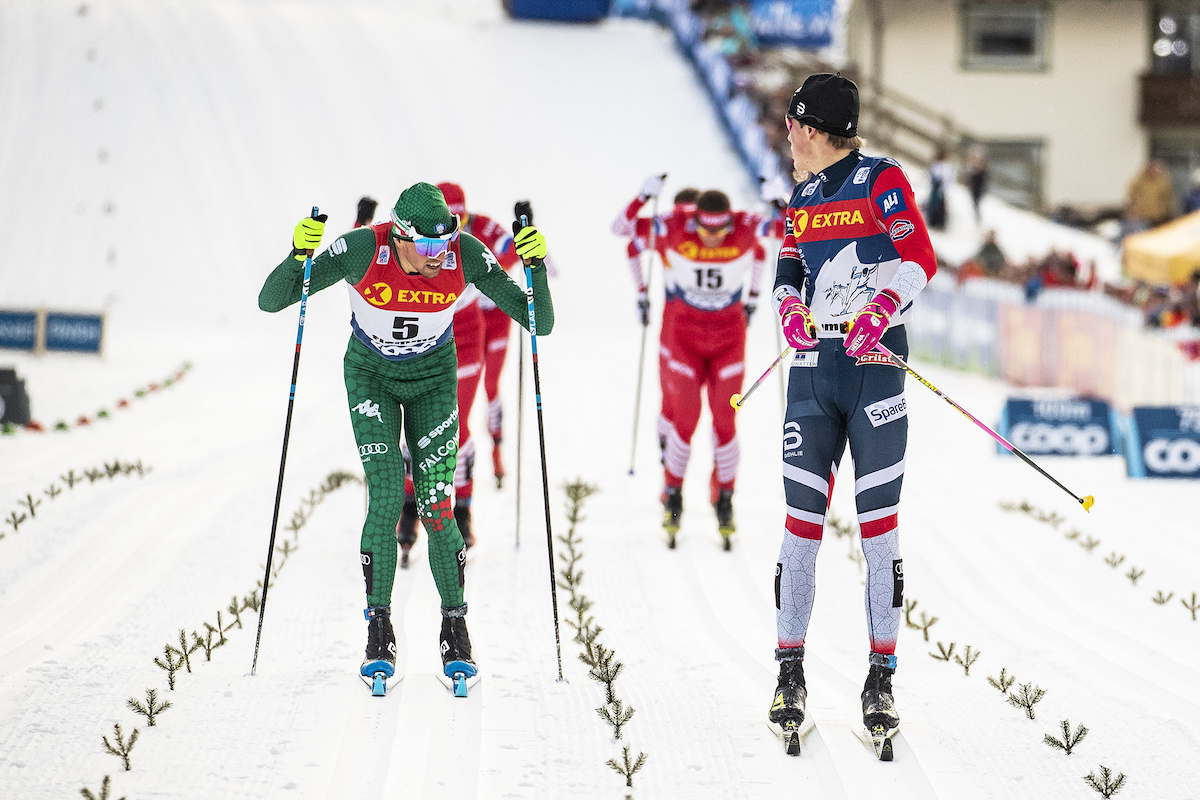
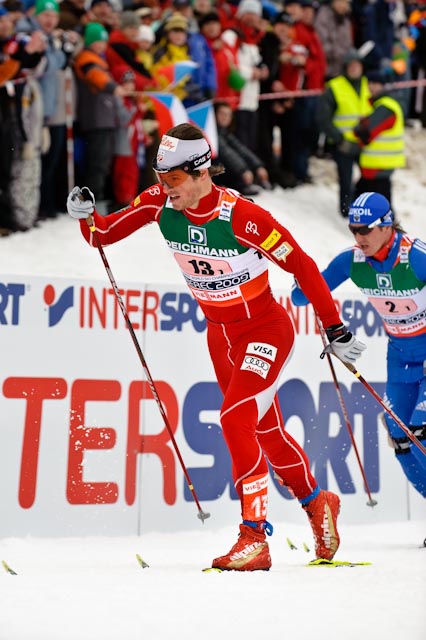
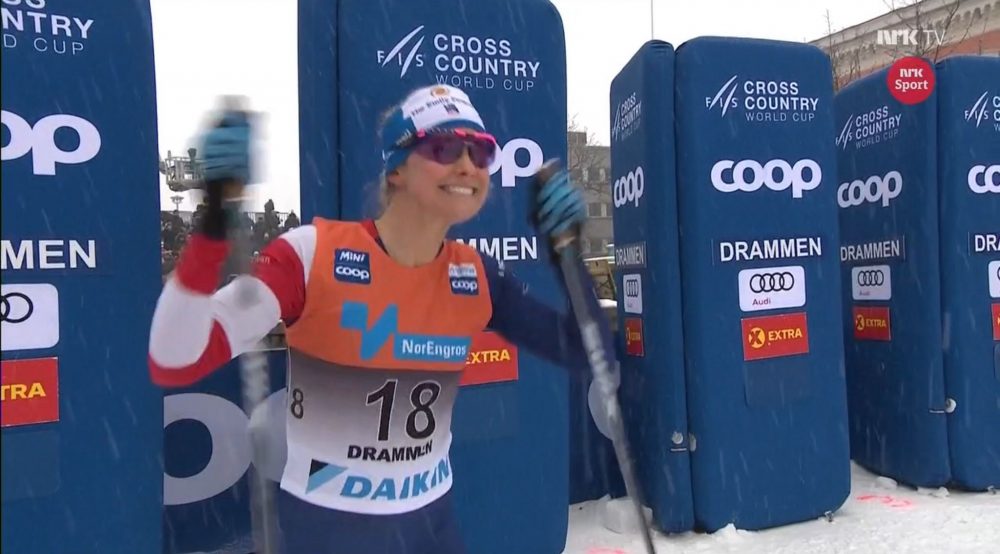
Norway’s Eirik Brandsdal (2) crossing the line first for his first World Cup victory in two years in the men’s 1.2 k classic sprint on Wednesday at the last World Cup classic sprint of the season in Drammen, Norway. He beat out fellow Norwegian Johannes Høsflot Klæbo (l) and Russia’s Sergey Ustiugov (10), respectively, for his first win since the 2015 Drammen classic sprint. (Photo: Fischer/NordicFocus)
Thanks for listening and we hope all of you are doing ok out there.
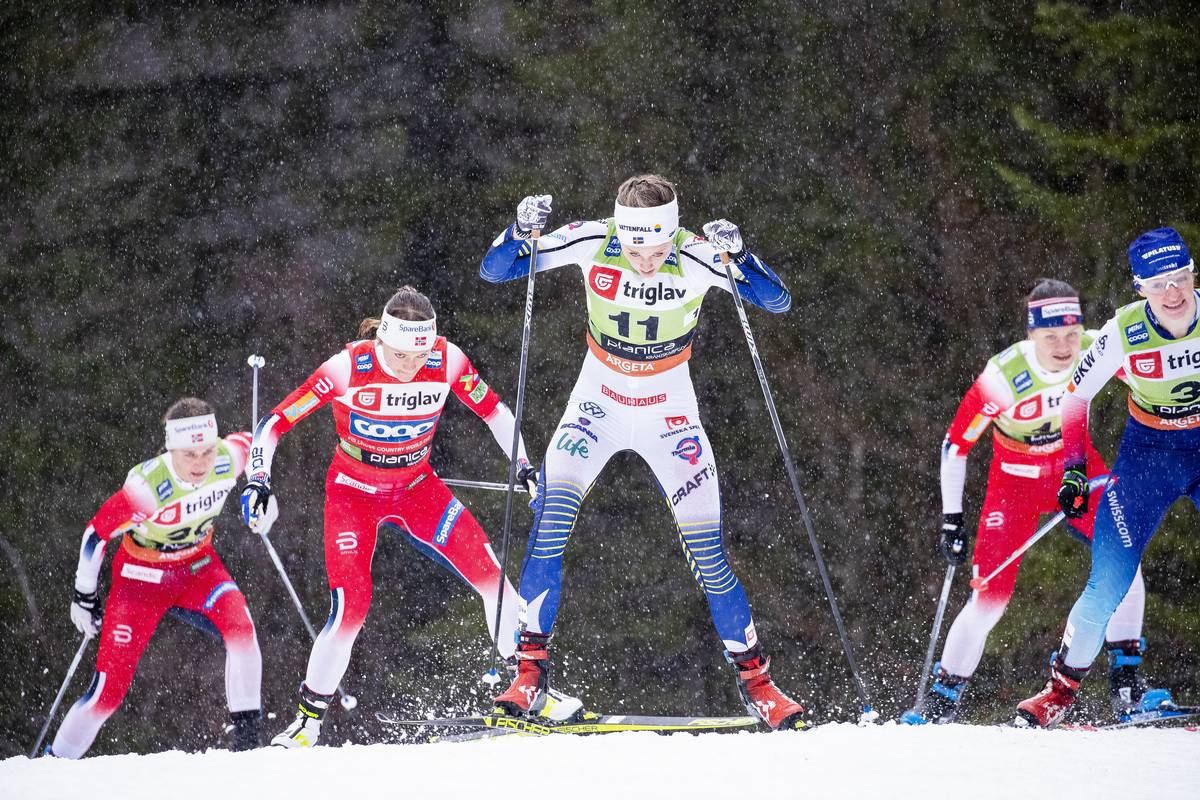
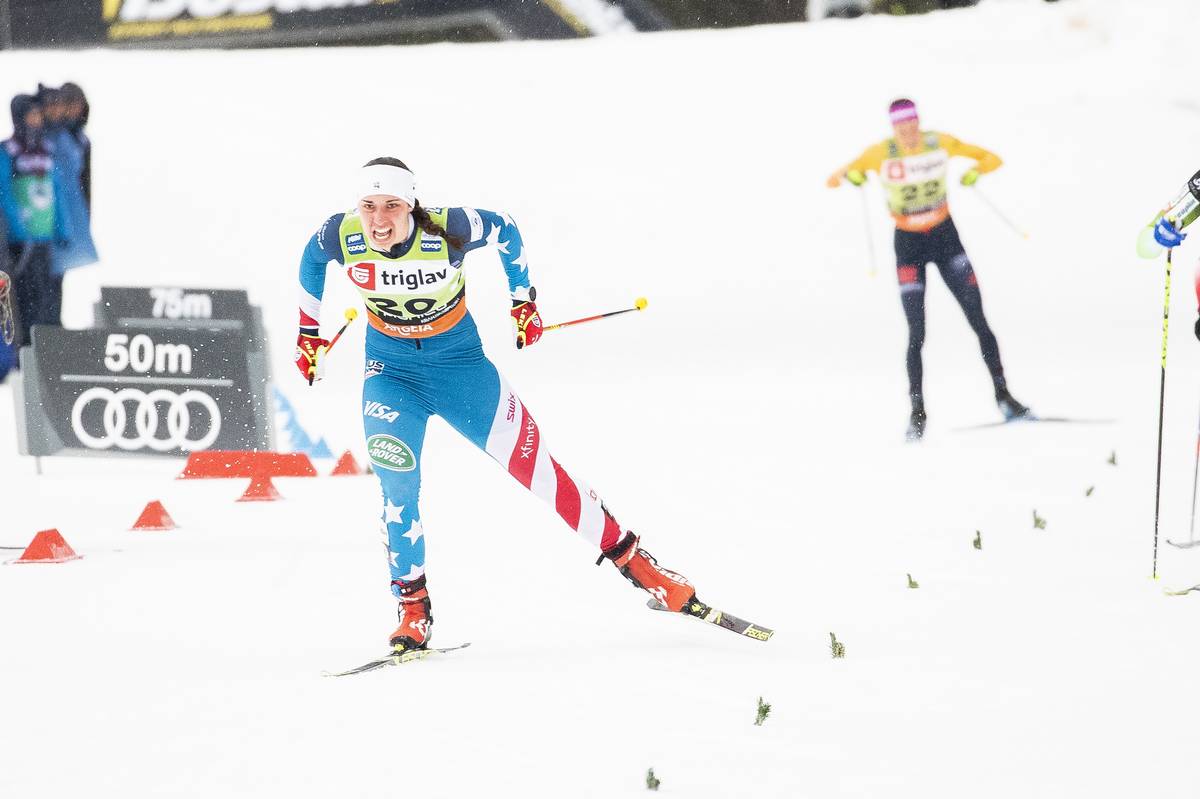
2019 Planica, Slovenia World Cup, Stina Nilsson (SWE) on her way to second place in the skate sprint. (Photo: NordicFocus)
Swirling around social media yesterday was the announcement that Swedish ski star, Stina Nilsson (26) has swapped cross-country for biathlon. She has yet to make the national biathlon team, yet she is committed to pursuing biathlon at the highest level. On the World Cup, she was feared as a sprinter, winning the sprint cup in 2019. She earned a total of 23 World Cup wins in 108 starts.
The Swede could also rise to the occasion when races pushed well beyond the 3:30 minute range. Nilsson pounced in the distance realm when the stakes were high. She placed third in the Olympic 30 k classic in 2018, bested Therese Johaug in Québec’s 2019 mini-tour and was absolutely clutch at the 2019 World Champs in Seefeld when she outpaced Johaug on the anchor leg of the 4 x 5 k relay. Seriously, such a good race.
“My basic idea was to run Cross-Country skiing for another Olympics and then change after the season 2022. But because of my injury, I have been given a lot of time to think and test shoot and I feel that I really do not want to wait any longer,” Nilsson said according to a FIS article. Nilsson suffered a stress fracture this season and has not competed on the World Cup since Dec. 28 in Lenzerheide, Switzerland.
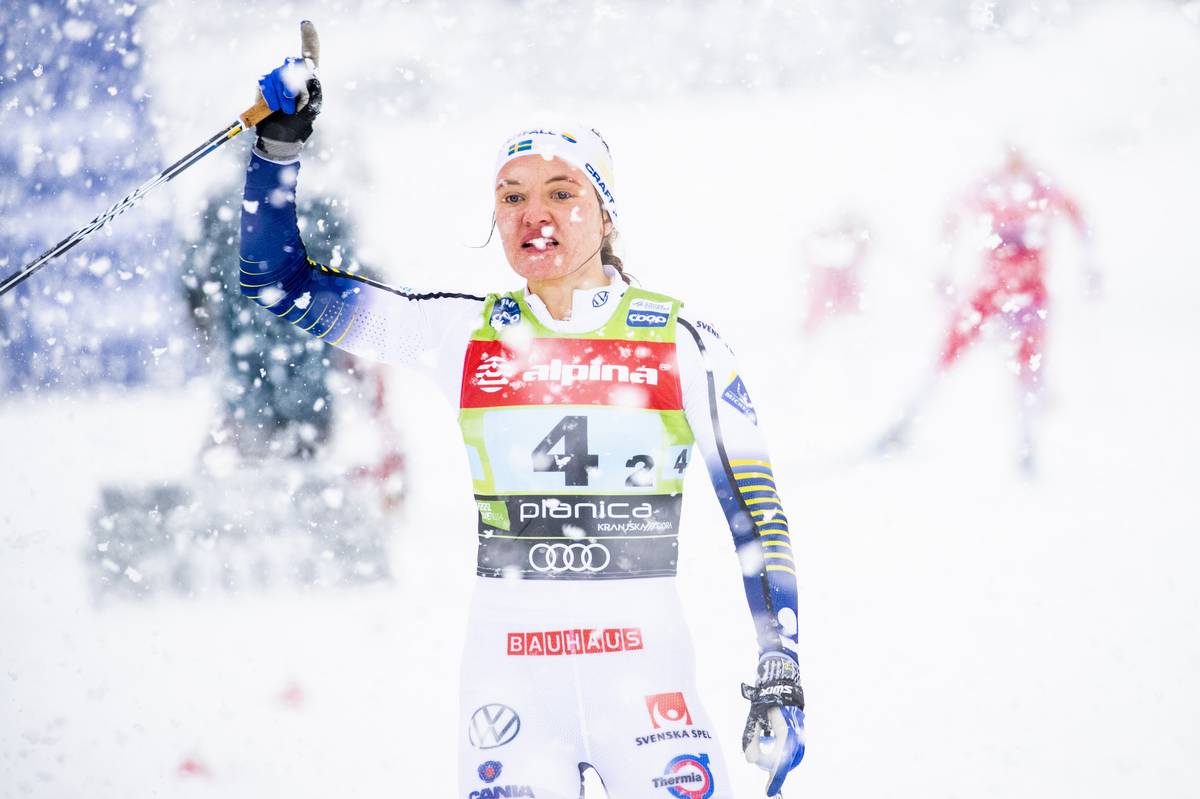
Down the stretch in Planica, Slovenia: Stina Nilsson (SWE) on the right, Jonna Sundling (SWE) on the left. Nilsson placed second in the race. (Photo: NordicFocus)
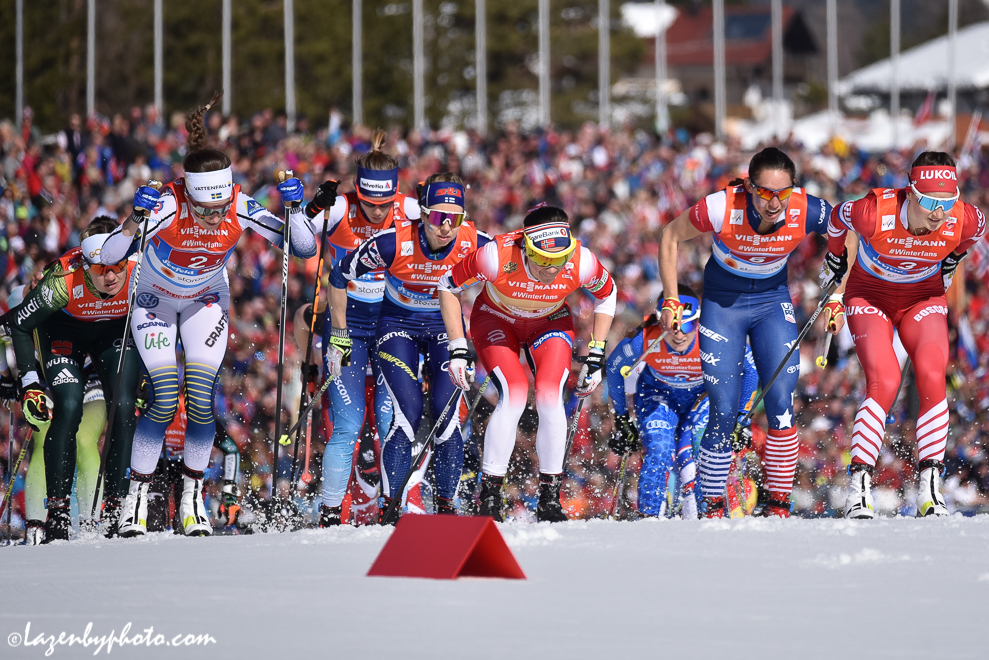
Early goings of the mass starts classic in Val di Fiemme, 2018-2019 Tour de Ski, (Photo: Fischer/Nordic Focus)
The Tour de Ski begins with a mass start bonanza on Saturday. In this non-championship year, the TDS takes on marquee status as one the season’s premier prizes. Seven stages with a variety of disciplines, this 14th edition promises a loaded field of skiers.
For the women, Therese Johaug of Norway is the easy favorite. Johaug appears programmed for dominance — the TdS features five distance stages.
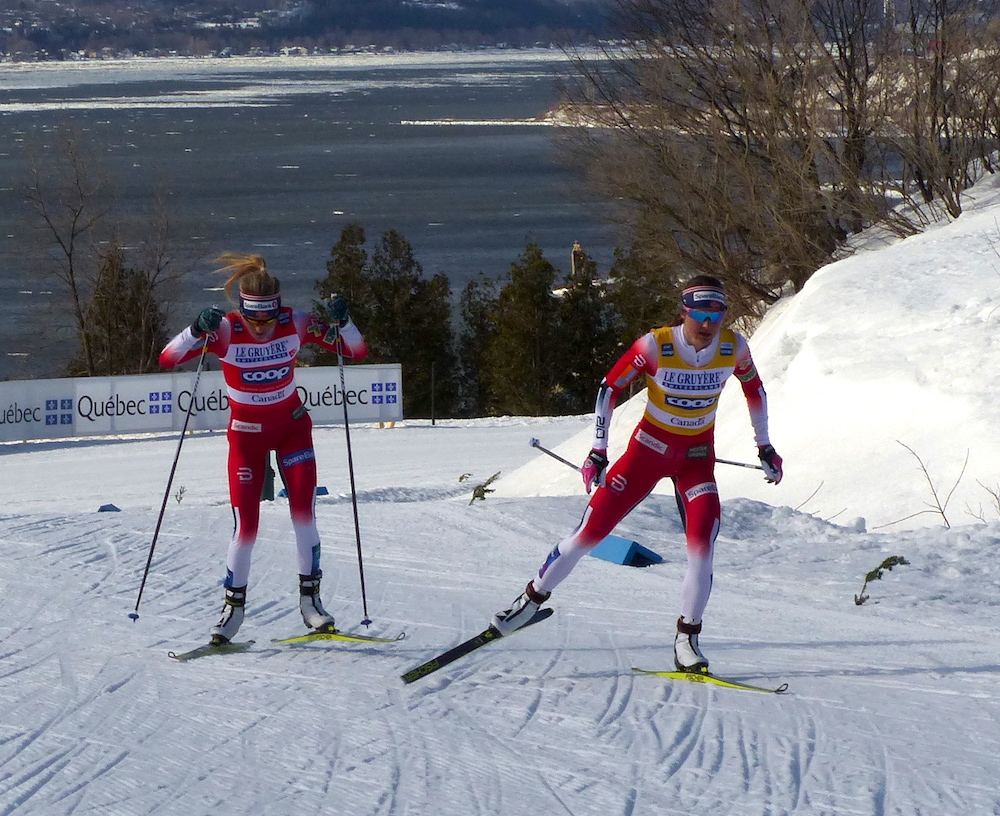
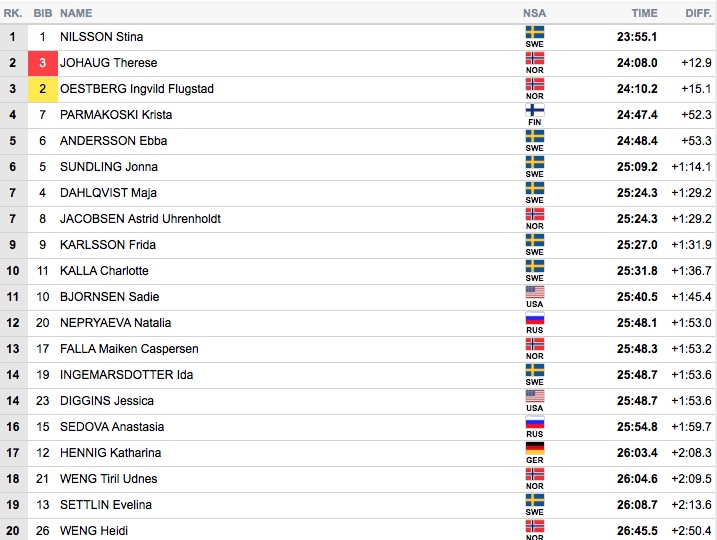
Norway has been well suited for the TdS. They’ve captured the women’s overall in six straight editions. Johaug claimed the wins in 2013-2014 and 2015-2016. She has also won every distance event this season setting her up as the run away favorite. But Johaug is beatable. In Québec last season, the site of the World Cup final, Stina Nilsson of Sweden foiled Johaug in a 10 k mass start classic and 10 k skate pursuit. We also saw Nilsson go head-to-head and take Johaug in the 2019 World Championship 4 x 5 k anchor leg.
Johuag can have her off days.
In an event like the TdS with so many variables, its semi-tough to fathom all the overall contenders. A single bad day, some mixed wax, and a TdS leader can lose valuable time. Jessie Diggins of the U.S. Ski Team should be counted in the top-tier mix. She placed third overall in 2017-2018. Last year Diggins wore the TdS leader’s bib for a stage before losing time on a tough-to-hit kick wax day.
Jessie Diggins (U.S. Ski Team) racing to third in the women’s 10 k freestyle pursuit at Stage 3 of the 2018 Tour de Ski in Lenzerheide, Switzerland. On the first day of the new year, it was her first podium of the season. (Photo: Salomon/NordicFocus)
There’s Norway’s Heidi Weng in there too. It’s been a resurgent year for the two-time TdS winner. And the true unknown is Norwegian Ingvild Flugstad Østberg. Due to undisclosed health concerns, Østberg was withheld from competition by team doctors for Period I on the World Cup. Saturday’s mass start skate will be Østberg’s first World Cup start of the season. She is the defending TdS champion.
For Russia, Natalia Nepryaeva and Finland’s Krista Pärmäkoski, who finished second and third respectively last year, add depth to the field of challengers. Last season’s Swedish phenom, Frida Karlsson, remains out of competition and is not expected at this TdS. However, teammate Ebba Andersson, who has yet to compete this season on the World Cup, is slated to race as is Charlotte Kalla, a former TdS winner, and Nilsson.
Norway’s Johannes Høsflot Klæbo (r) crossing ahead of Italy’s Francesco de Fabiani to secure his fourth win of the 2019 TdS. He placed first in the men’s 15-kilometer classic event in Val di Fiemme, Italy. (Photo: Fischer/Nordic Focus)
The men’s field has at its pre-race favorite apex, Johannes Høsflot Klæbo of Norway. Last year’s TdS winner, Klæbo, presents a double-edge sword with the ability to win both sprint and distance events. Unlike Johaug on the women’s side, Klæbo will almost certainly score big bonus time in the two TdS sprints. Whether he builds a big buffer of time over his pure distance rivals in the sprints remains to be seen. But, the sprints are not a wild card for Klæbo, they are his ace that complements his distance chops.
Using last season’s overall results as a barometer, Klæbo is not a guaranteed winner. Sergey Ustiugov was second last year and depending on which Ustiugov arrives in Lenzerheide, he could challenge. Alexander Bolshunov, also of Russia, may now have the physical maturity to outlast the field. He’s currently ranked first on the World Cup distance list.
With the men’s scene open to interpretation, Norway’s Emil Iversen, second on the overall list, could pull it off with an unwavering series of performances. Like the others, he’ll need no blips of fatigue, top-five sprint results, and to keep Klæbo in check on the distance stages. Other names could be penciled in on the short list. There’s Norway’s Simen Hegstad Krüger who placed third overall last year. Iivo Niskanen of Finland has found a no-nonsense skate gear this year.
But come time for the Cermis climb, we’re likely to see Klæbo crowned TdS king again.
The U.S. Ski Team has listed Diggins (objective), Sophie Caldwell (objective), Rosie Brennan (objective), Sadie Bjornsen (objective), Julia Kern (objective), and Katharine Ogden (objective- SuperTour leader) as the women’s team starters.
For the men, Kevin Bolger (discretion), David Norris (discretion), and Logan Hanneman (discretion) will be starting. Simi Hamilton (objective) sided with caution and will not be racing as he is listed with a groin injury.
Hailey Swirbul (discretion), Rosie Frankowski (discretion), Kyle Bratrud (discretion), Erik Bjornsen (discretion), and Ben Lustgarten (objective-SuperTour leader) were offered a TdS start but declined. The skiers declining their starts at the TdS will be in Houghton, MI. for U.S. Senior Nationals.
At 20 years old, Sweden’s Linn Svahn has learned to close. She was part of Sweden II’s team-sprint winning team in Planica, Slovenia. (Photo: NordicFocus)
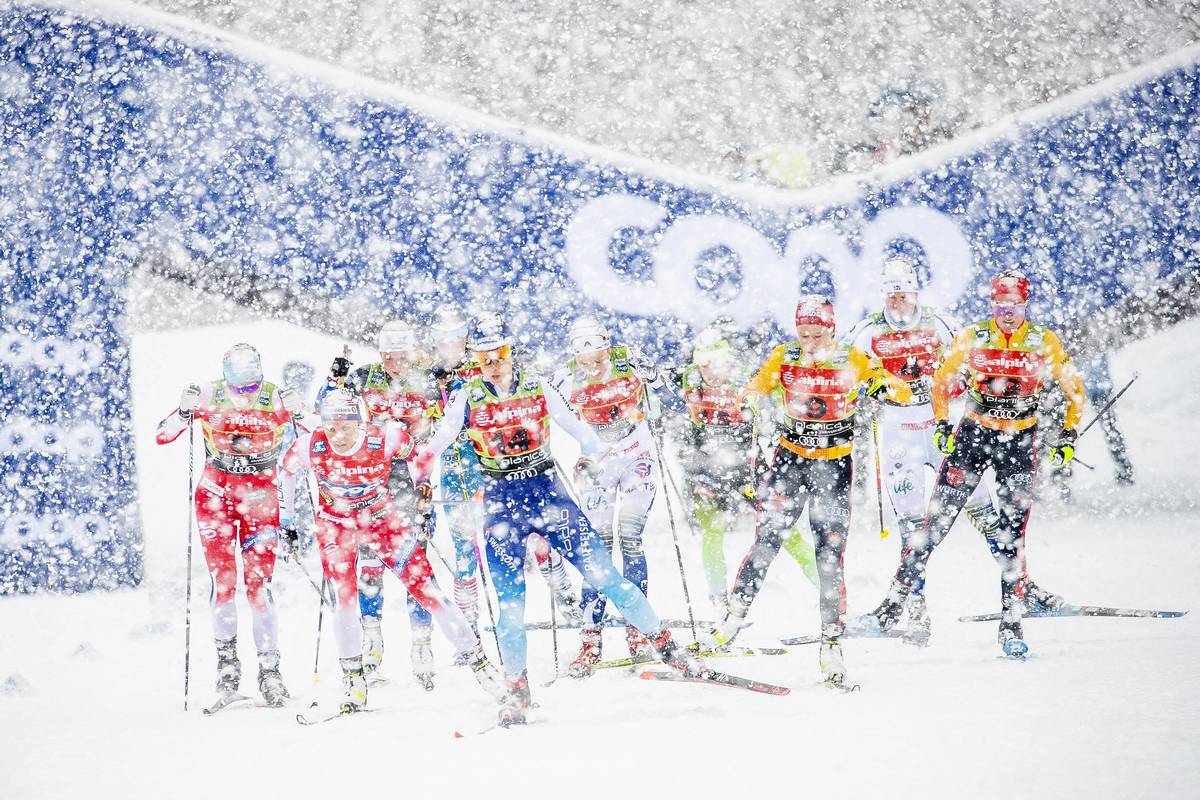
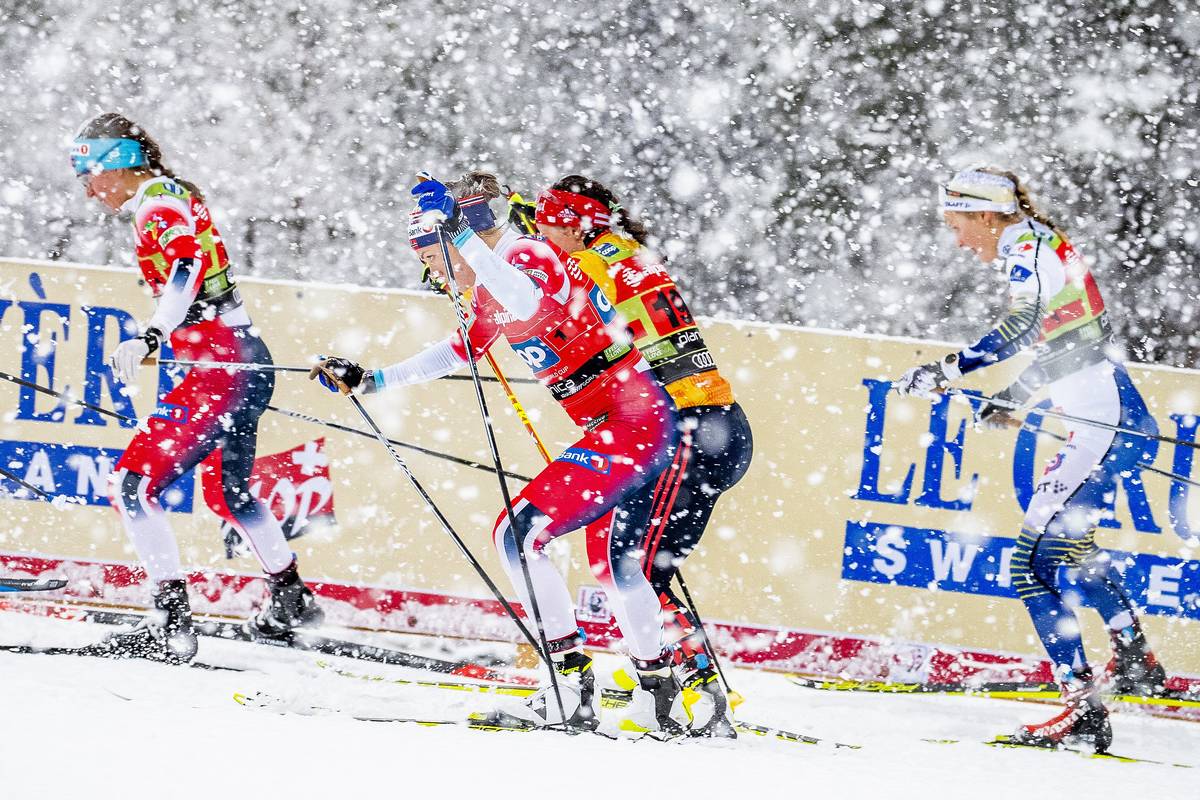
With the tight racing and jostling for position the team sprint presents, another factor was in the mix during Sunday’s Planica, Slovenia women’s 7.2-kilometer freestyle team sprint: big, fat, and plentiful snowflakes.
Saturdays’ rainy, and lightning ridden sprint racing on an artificial snow loop, had a 180-degree backdrop flip-flop with a white winter arriving in Planica in time for the holidays and a World Cup TV broadcast. A several inch veneer of fresh snow covered the tracks.
Coming into Sunday’s race, recent team sprints have been dominated by Sweden. They have won four consecutive team sprints, and six of the last seven. And as much as last season’s World Cup Sprint Crystal Globe winner Stina Nilsson is a rock for the nation, Sweden’s team sprint reign owes much to Maja Dahlqvist. She’s been part of a Swedish three-peat: Dresden (skate) 2018 with Ida Ingemarsdotter, Lahti (classic) 2019, and again in Dresden (skate) 2019.
Sunday, to close out Period I on the World Cup, Dahlqvist was paired with Sweden’s newest World Cup upstart, Linn Svahn, 20, on team Sweden II. On paper at least, the coaches gave the nod for team I designation to Nilsson and Jonna Sundling.
With ten teams represented in the final, the U.S. pairing of Sophie Caldwell and Julia Kern looked formidable. Fresh off Kern’s first career World Cup podium on Saturday and Caldwell’s near podium miss in fourth, they placed second in the team sprint semi-final B to Switzerland’s Laurien van der Graaf and Nadine Faehndrich. The Swiss won that heat by 1:05 over the U.S. (Caldwell and Kern were also teamed up last season in Dresden’s team sprint where they placed fourth in a photo finish.)
Also represented in the final and a usual podium snagger was Norway I with Maiken Caspersen Falla, and Ane Appelkvist Stenseth. Despite their perceived dominance, Norway has not won a team sprint in the last seven attempts. The last women’s team sprint victory for the storied nation came way back in January 2014, when Maiken Caspersen Falla and Ingvild Flugstad Østberg won the classic team sprint in Nové Mesto. Although Falla is proven, Stenseth, 24, is a World Cup podium-contender newcomer. According to FIS, she has contested 10 World Cups. She’s placed fourth twice in individual races — most recently in Ruka’s classic sprint last month.
Sophie Caldwell (USA), and Katerina Janatova (CZE), (l-r) during the women’s team 2019 sprint in Planica, Slovenia. (Photo: NordicFocus)
Laurien Van Der Graaf (SUI), Maja Dahlqvist (SWE), Sophie Caldwell (USA), Laura Gimmler (GER), Maiken Caspersen Falla (NOR), (l-r) during the women’s team sprint in Planica, Slovenia. (Photo: NordicFocus)
World Cup Coach Matt Whitcomb’s post-race comments on the U.S. women’s team sprint
With the wins and losses stats laid out, the final was a race around, tag the partner, race around, repeat affair for several laps. With near blinding snow and slow tracks, teams skied conservatively with no attacks of note.
The single blip to the pack racing early on was the collapse of an inflatable arch across the course due to a heavy snow load. Several course attendants scurried to right the arch. There was no stop to the racing, only a momentary snafu to an otherwise peaceful snowglobe scene.
Heavy snow, collapsing arch. Planica women’s team sprint. (Photo: NordicFocus)
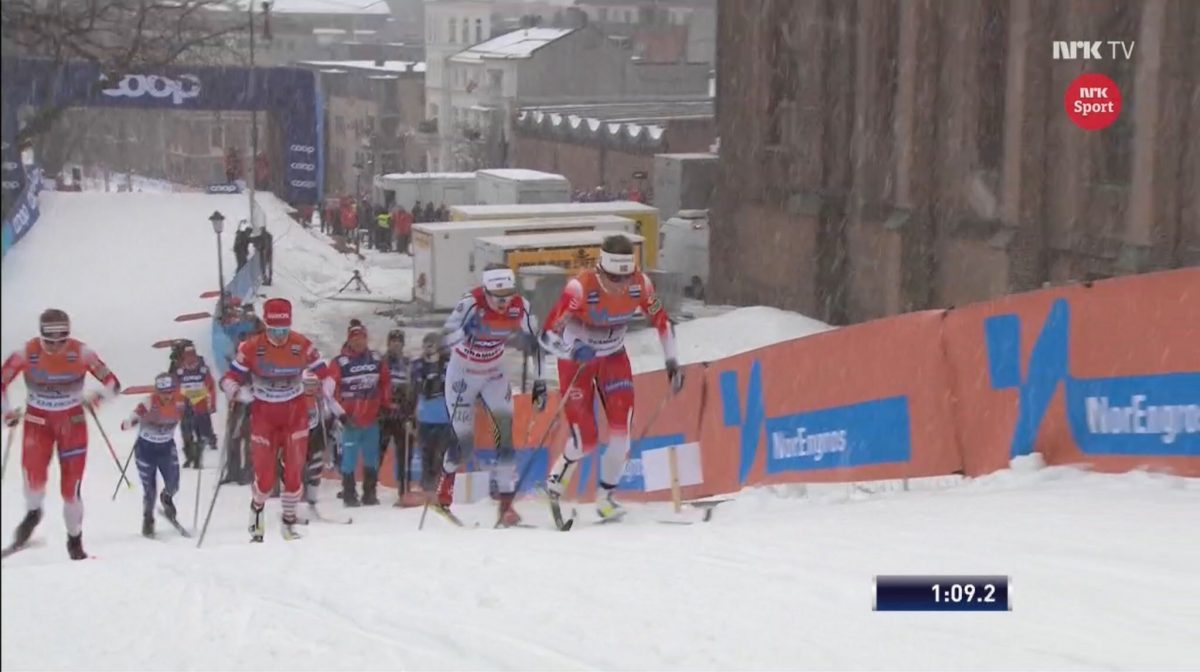
That all changed on the fifth of six laps total. At the base of the course’s first climb, Nilsson for Sweden I had been tucked into the pack. She worked her way to the right gliding out of traffic for a clear lane to the top. She jump skated to the lead 15:00 minutes into the final. Carrying her speed into a working downhill, Nilsson broke the race apart.
Sweden II (Dahlquvist), and Norway I (Falla), were the other two teams able to match Nilsson’s push at the sharp end.
Sweden I, Sweden II, Norway I, Norway II, Switzerland, and the U.S. came through the final tag first through sixth, respectively, with a 7.8 second gap from the U.S. in back to Sweden I in first.
Late on that final lap, with 18 minutes of racing elapsed, Sweden I and II, as well as Norway I looked to be the podium in the making. But with perhaps the race effort of the day, Switzerland’s Faehndrich began reeling in the three team group. Twenty seconds later, the Swiss were locked on, making it a four team affair.
Julia Kern (USA), Linn Svahn (SWE), Victoria Carl (GER), Ane Appelkvist Stenseth (NOR), (l-r) during the women’s team sprint in Planica, Slovenia. (Photo: NordicFocus)
On the final climb, Sweden I and II accelerated, dropping Norway I, with the Swiss matching for a moment, then dropping back slightly for a solid third place nearly guaranteed.
The Swedish drag race for first went to Sweden II’s Svahn: they won in 19:13:55 minutes. Sweden I was second (+1.01), and Switzerland third (+1.13). Digging into the recesses of FIS data, Sunday’s third place was Switzerland’s best World Cup team sprint result. They placed fifth in last season’s Dresden team sprint. Norway I placed fourth (+7.58), and the U.S. fifth (+9.72).
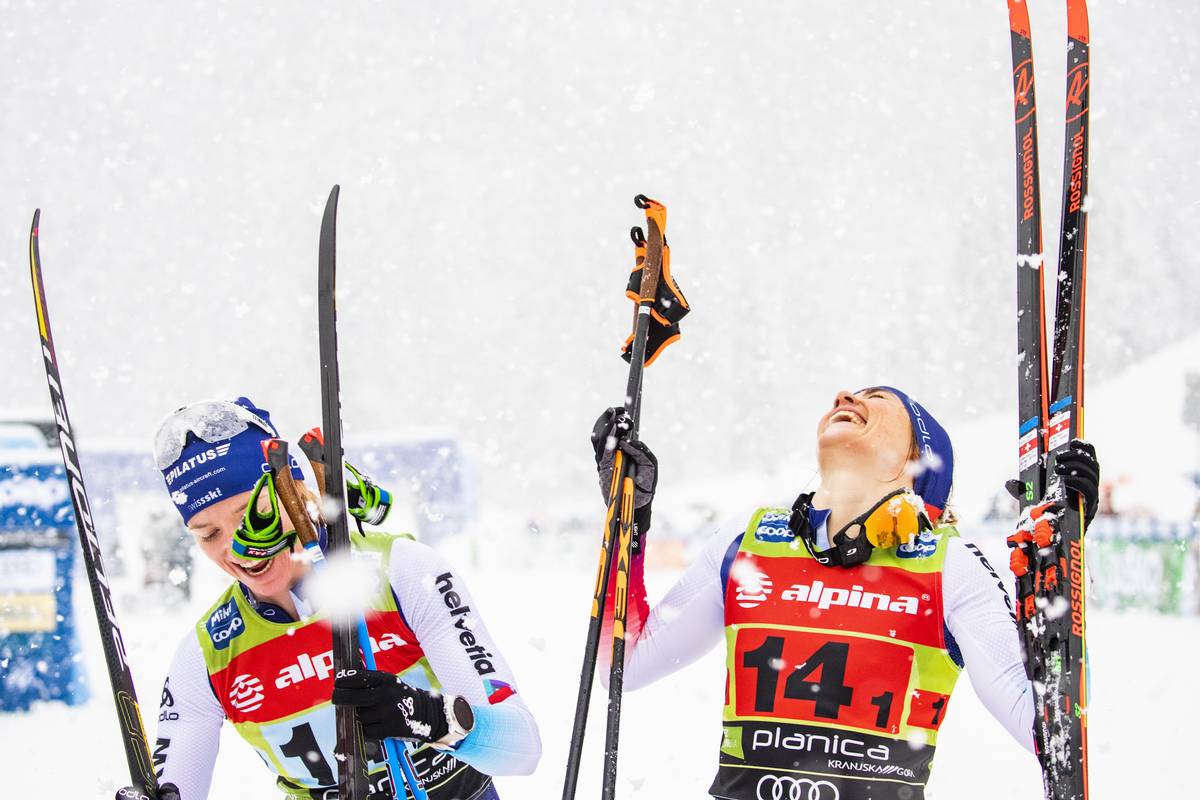
The joys of the podium: Swiss teammates Nadine Faehndrich and Laurien Van Der Graaf (l-r) after their third place in the team sprint in Planica, Slovenia. (Photo: NordicFocus)
“I am happy that after a couple of fourth and fifth places it finally worked out,” van der Graaf stated, according to a translation from the Swiss Ski Federation. “When I tagged off to Nadine in fifth place I was very confident that she would make it.”
Fähndrich said: “For me it was optimal that the top 3 didn’t go all out early on. Thus I could catch up and still had enough energy in the end.”
Norway’s Maiken Caspersen Falla (center) during the 2019 Planica team sprint. (Photo: NordicFocus)
On the ski-wax service side of the race, U.S. World Cup Coach Matt Whitcomb explained in a post-race interview that today’s team sprint included a rule that no team could modify skis during the races. In team sprint additions past, it was common to see trackside techs applying and buffing a topcoat between relay legs. According to Whitcomb, Caldwell’s skis for the final were simply not in play. “So we made a mistake early in the finals,” said Whitcomb. “We had to eat it. And we did.”
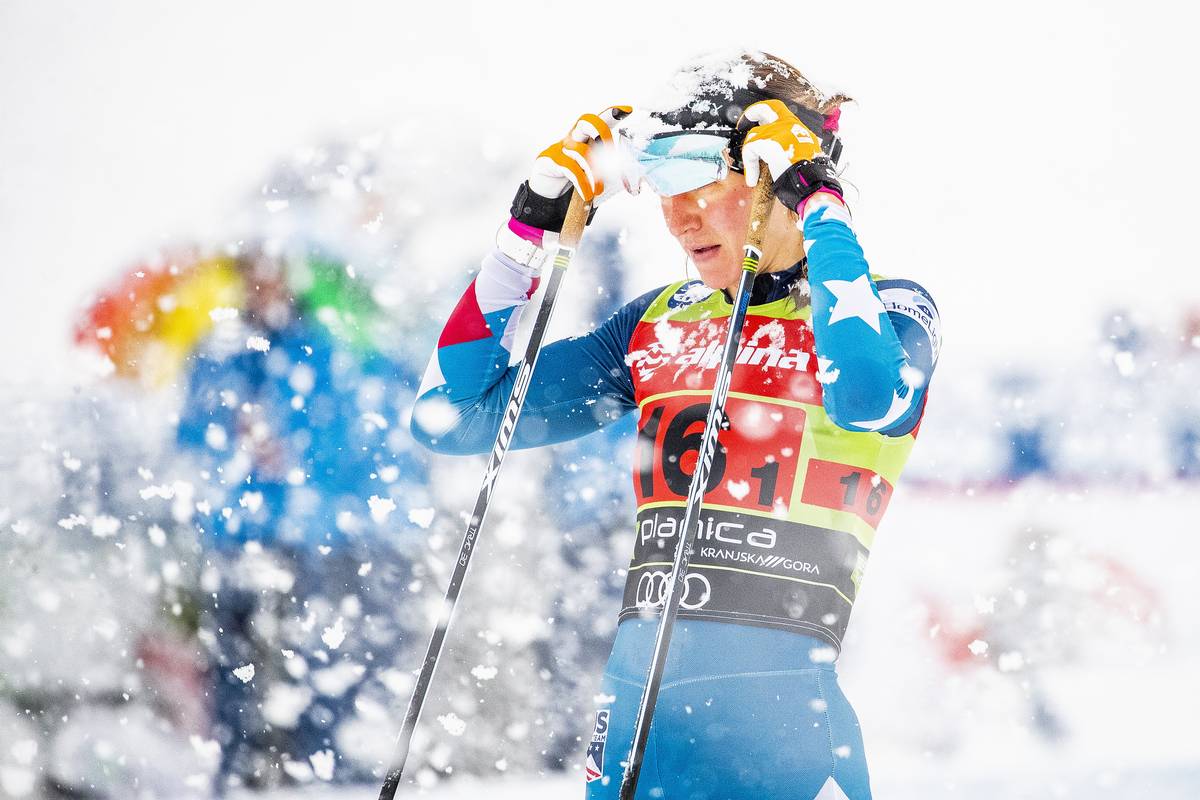
Visor type of day for Sophie Caldwell during the women’s team sprint in Planica, Slovenia. (Photo: NordicFocus)
World Cup Coach Matt Whitcomb’s take on the weather and Caldwell’s skis
FasterSkier will have a Period I breakdown and Tour de Ski preview later this week. The Tour de Ski begins on December 28.
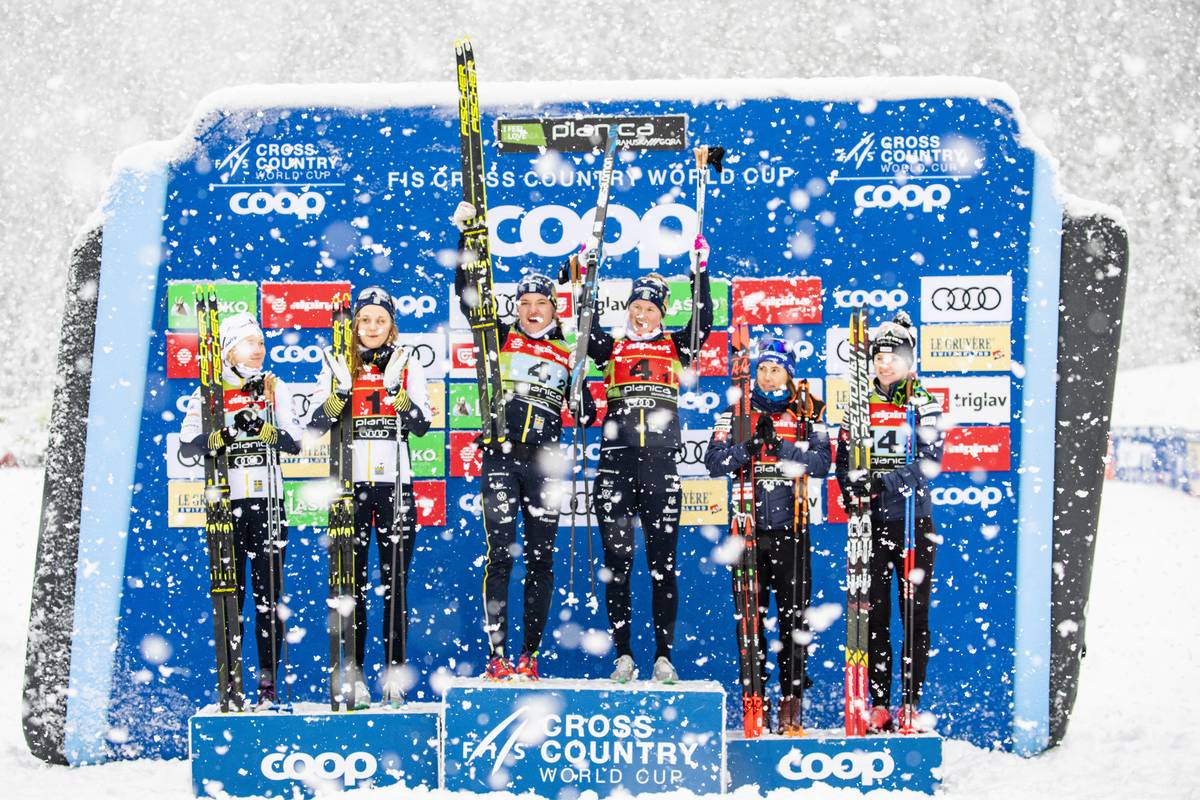
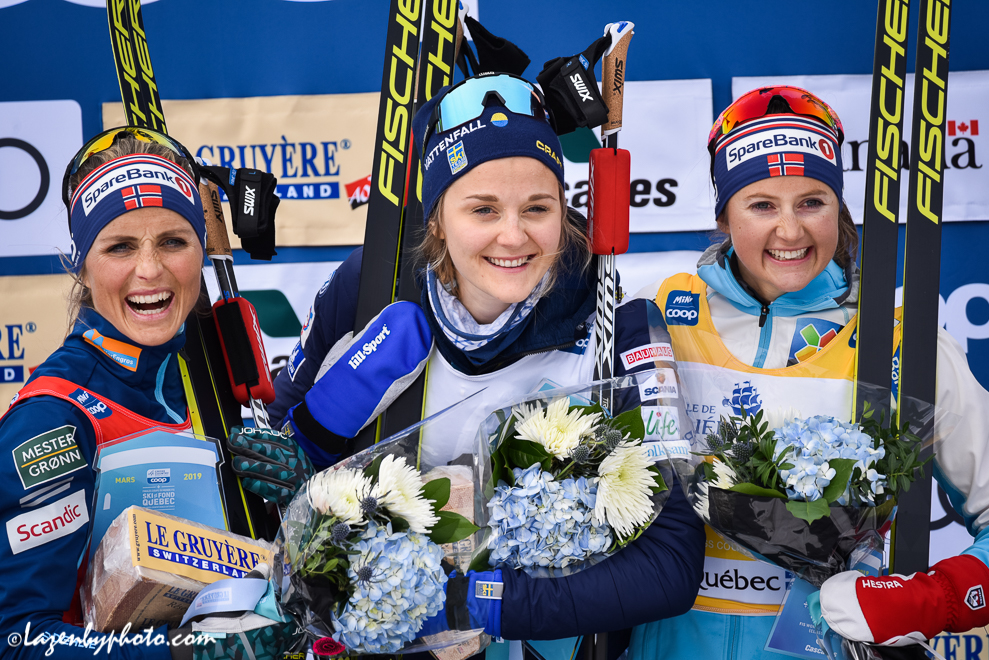
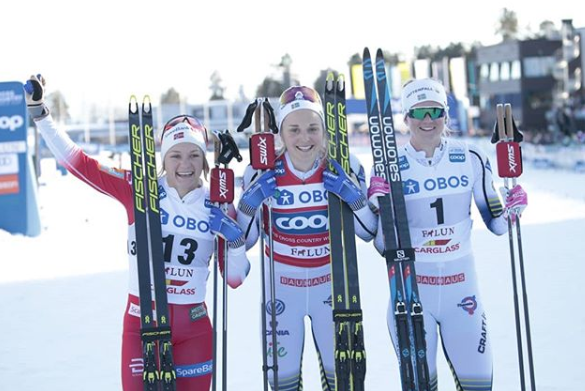
The women’s team sprint podium from Planica: Sweden I’s Stina Nilsson Jonna Sundling in second, Sweden II’s Maja Dahlqvist and Linn Svahn in first, Switzerland’s Laurien Van Der Graaf and Nadine Faehndrich (in third (l-r). (Photo: NordicFocus)
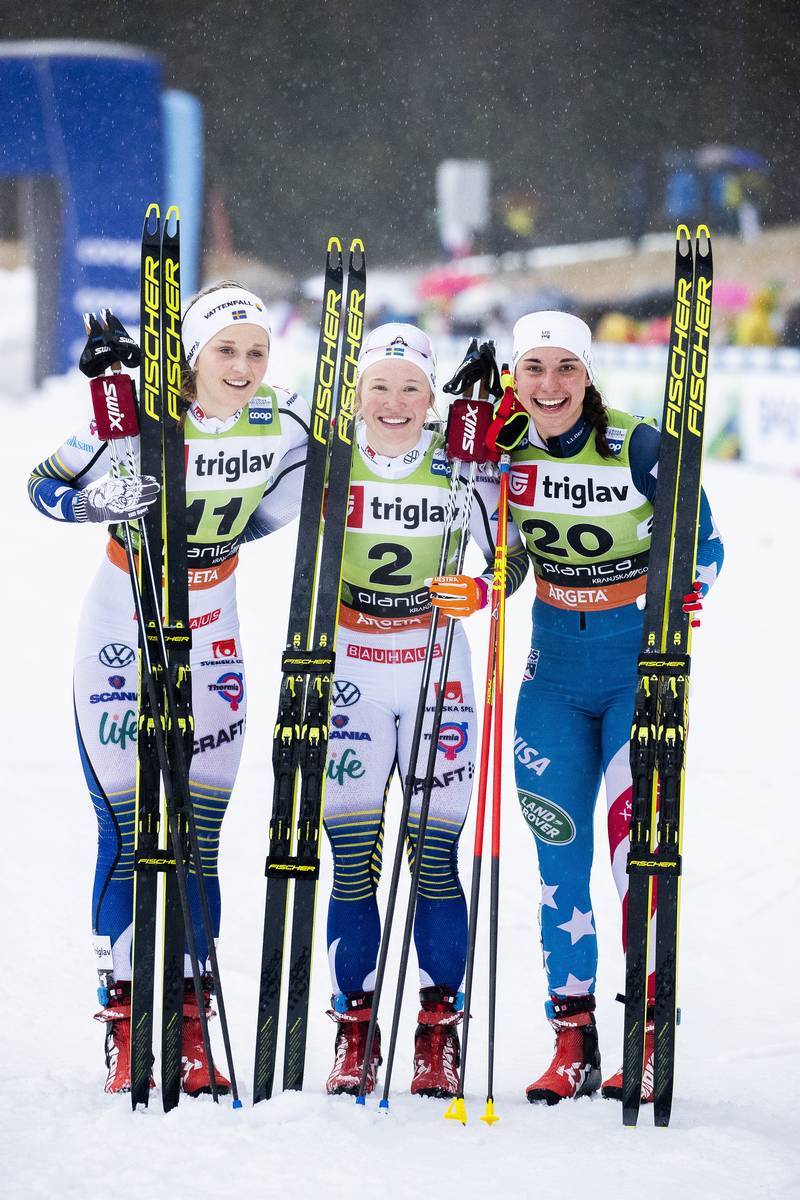
A rainy women’s podium after the 1.2-kilometer skate sprint in Planica, Slovenia. Sweden’s Jonna Sundling took the win followed by her teammate Stina Nilsson. Julia Kern (USA) took third. (Photo: NordicFocus)
Temperatures over 40 degrees Fahrenheit, steady rain that peppered camera lenses, sparse broods of fans huddled under umbrellas, and a ribbon of white farmed snow. After a wintery start to the season in snowy Ruka, Lillehammer, and Davos, athlete’s found their spring-like gear racing the 1.2-kilometer freestyle sprint in Planica, Slovenia. With many “all-arounders” choosing to sit out the sprint focused weekend to rest for the upcoming Tour de Ski, the intimate subset of athletes contained many of the World Cup’s top short track athletes.
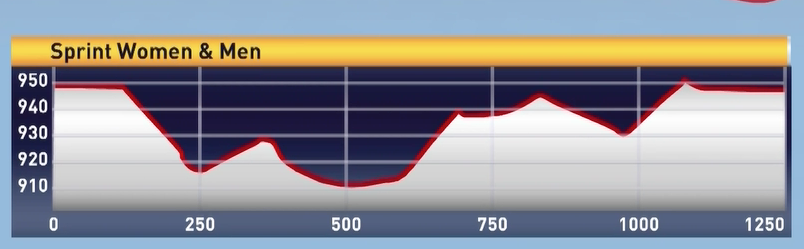
The profile of the 1.2-kilometer sprint course in Planica, Slovenia. (Photo: Screeshot FIS)
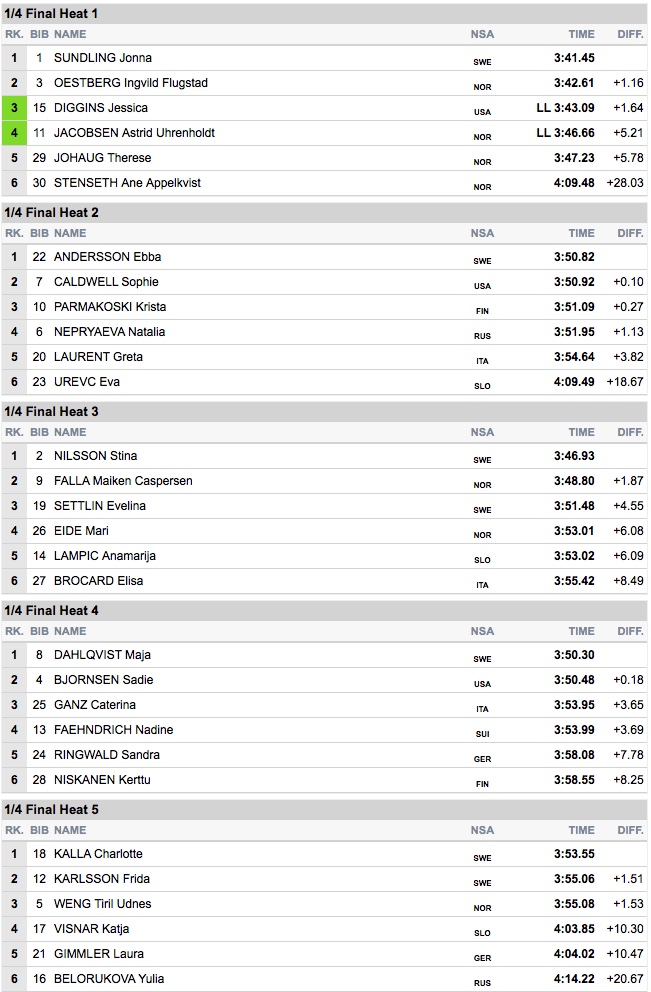
Last week’s podium finisher Sophie Caldwell was the fifth fastest qualifier, 0.56 seconds behind top finisher Laurien van der Graaff of Switzerland. Caldwell faced off with Jonna Sundling of Sweden in the first heat of the quarter-finals, leading their peers through a smooth heat and crossing the line 0.03 seconds apart with Sweden in front.
All focus, Sophie Caldwell flies to a fifth place result in qualification during the 1.2-kilometer freestyle sprint in Planica, Slovenia. (Photo: NordicFocus)
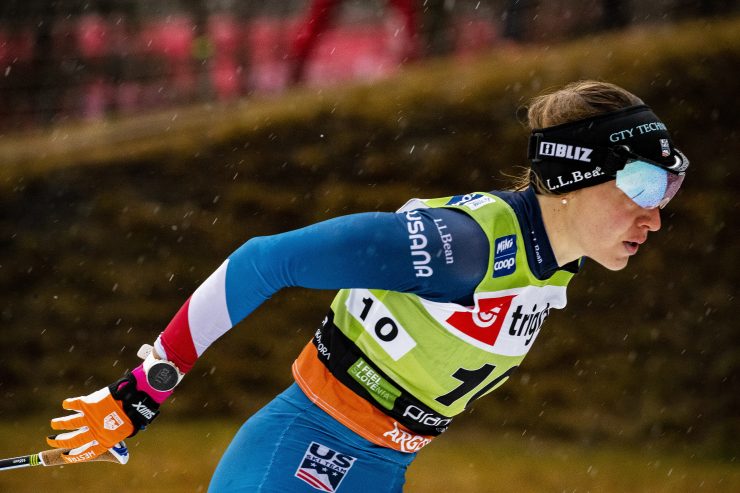
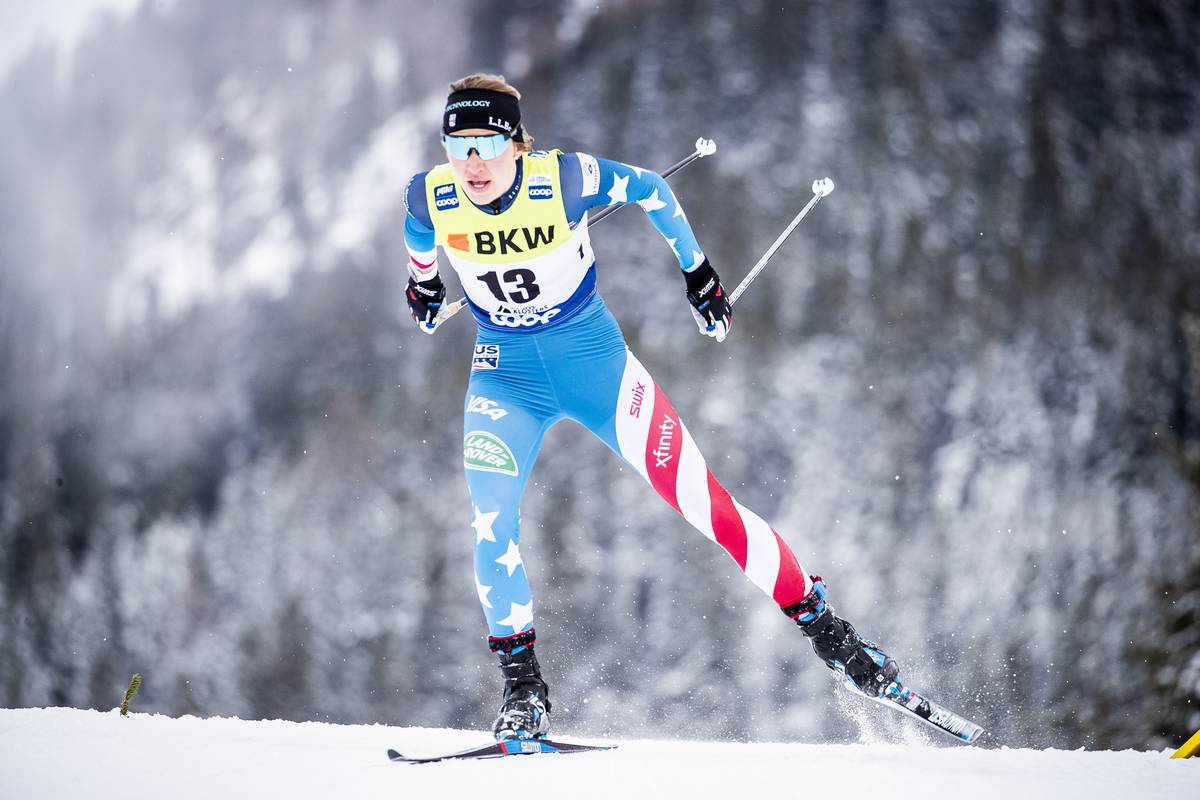
Julia Kern crests a hill on her way to a 20th place result in qualification. (Photo: NordicFocus)
Continuing to make a statement that she belongs with the sharp end of the field, Julia Kern qualified in 20th and raced in the fifth heat of the quarter-finals where six unique countries were represented.
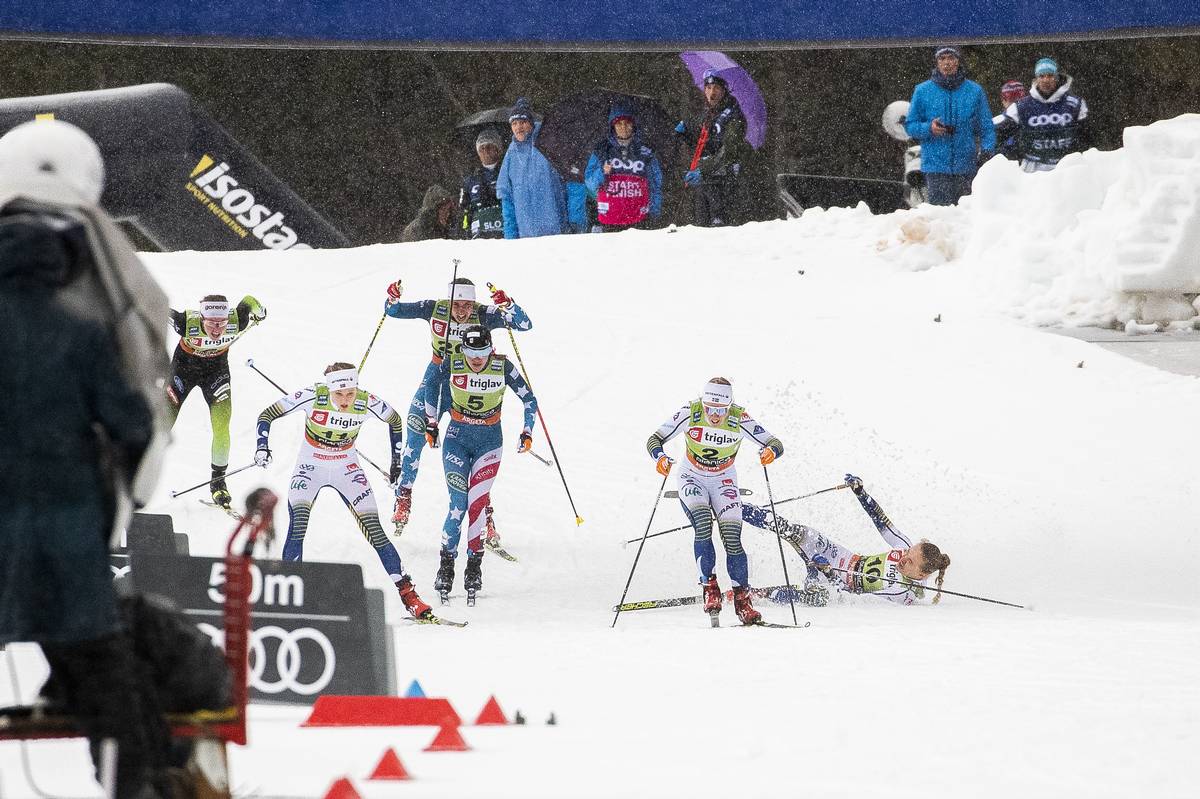
After a conservative start, Kern was tucked at the back of the pack at the halfway mark of her quarterfinal, out of trouble when Czech athlete Theresa Beranova lost control on a fast corner and slid off the track. With a high-tempo fury, she surged around the left side at the start of the climb at the 500 meter mark to take control for the second half of the race with Maja Dahlqvist of Sweden.
Attacking on the climb with 200 meters to go, Kern surged again. Her tempo was matched by the Swede’s until Dahlqvist suddenly caught an edge and fell to the ground. Peerless, Kern flew to the finish line, her braid whipping back and forth with each powerful V2 push.
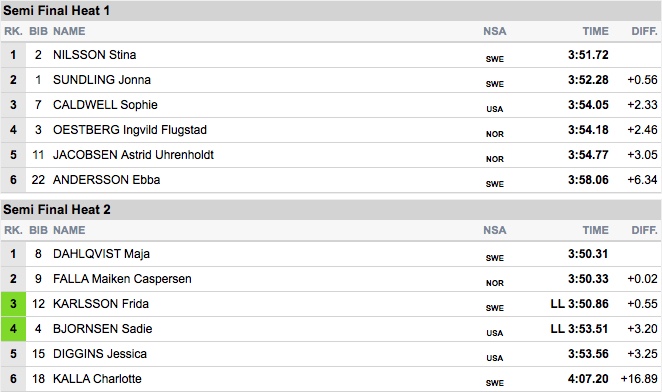
In the semi’s, Caldwell faced a pack of three Swedes, Sundling, last week’s surprise champion Linn Svahn, and 2019 sprint crystal globe winner Stina Nilsson. Also in the first heat was Norway’s top sprinter Maiken Caspersen Falla and Ane Appelkvist Stenseth. Rounding a fast turn, Falla stepped on the tip of Stenseth’s ski and the two tangled to the ground, now out of contention. Caldwell skied to third in the heat, crossing the line in a close finish with Sundling and Svahn. Her time was fast enough to secure a lucky loser spot in the final.
In her semifinal, Kern tucked into the middle of the pack, matching Anamarija Lampic of Slovenia and Johanna Hagstrӧm of Sweden. Repeating the power move that worked in the quarter, Kern seized her opportunity to surge to the front on the climb, maintaining her position over the crest of the hill and down the straight away to the finish solidifying her first spot in a World Cup final. Lampic finished second in the heat (+0.57).
Three Swedes, two Americans, and one Slovenian in the final.
Julia Kern locks eyes on the finish as wins her semi-final heat of the 1.2-kilometer freestyle sprint in Planica, Slovenia. (Photo: NordicFocus)
Racing in front of her home crowd, Lampic took an early lead in the final, tailed closely by her competitors. Just before halfway, Nilsson and Sundling took control on the climb with the Americans following closely.
Anamarija Lampic (SLO) celebrates finishing 5th place in front of a home crowd in Planica. (Photo: NordicFocus)
Coming into the straightaway, Svahn and Nilsson caught ski tips. Svahn lost her balance falling backward just in front of Caldwell, who managed to smoothly dodge the crash, accelerating to the finish.
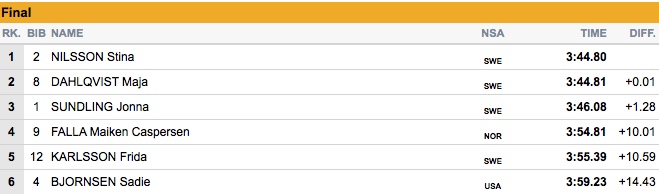
In a dual with between teammates, Sundling slid her boot across the line for the win, stopping the clock at 2:32.6, Nilsson 0.22 seconds behind.
In a finish line interview, FIS called Sundling’s performance an “adventurous victory” given the weather.
“It was crazy,” agreed Sundling. “It was thunder and rain and now snow.”
Sweden’s Jonna Sundling celebrates her victory after the 1.2-kilometer freestyle sprint in Planica, Slovenia. (Photo: NordicFocus)
Stina Nilsson catches her breath after her second place finish at the 1.2-kilometer skate sprint in Planica, Slovenia. (Photo: NordicFocus)
Powering in their wake, Caldwell and Kern locked eyes on the finish. In the final meters, Kern outmatched Caldwell’s speed, throwing her boot over the line just ahead of her veteran teammate. She finished 0.79 behind Sundling, and Caldwell took 4th (+0.91). Lampic finished 5th (+1.49), followed by Svahn (+48.51) who skied slowly to the line looking furious.
Sophie Caldwell (black headband) congratulates Julia Kern on her first World Cup podium (3rd). (Photo: NordicFocus)
Julia Kern. 22-years-old. First World Cup final, first podium.
The Americans embraced, their backs rising and falling rapidly as they simultaneously laughed and caught their breath.
Kern carried momentum from last weekend’s strong performances in Davos; Kern was 15th in the freestyle sprint and 19th in the 10 k. In her post-race interview, she discusses her mindset as she entered uncharted territory in the final and why she was excited for the suboptimal rainy conditions in Planica. She also shares what’s next for her this season.
Post-race interview with Julia Kern.
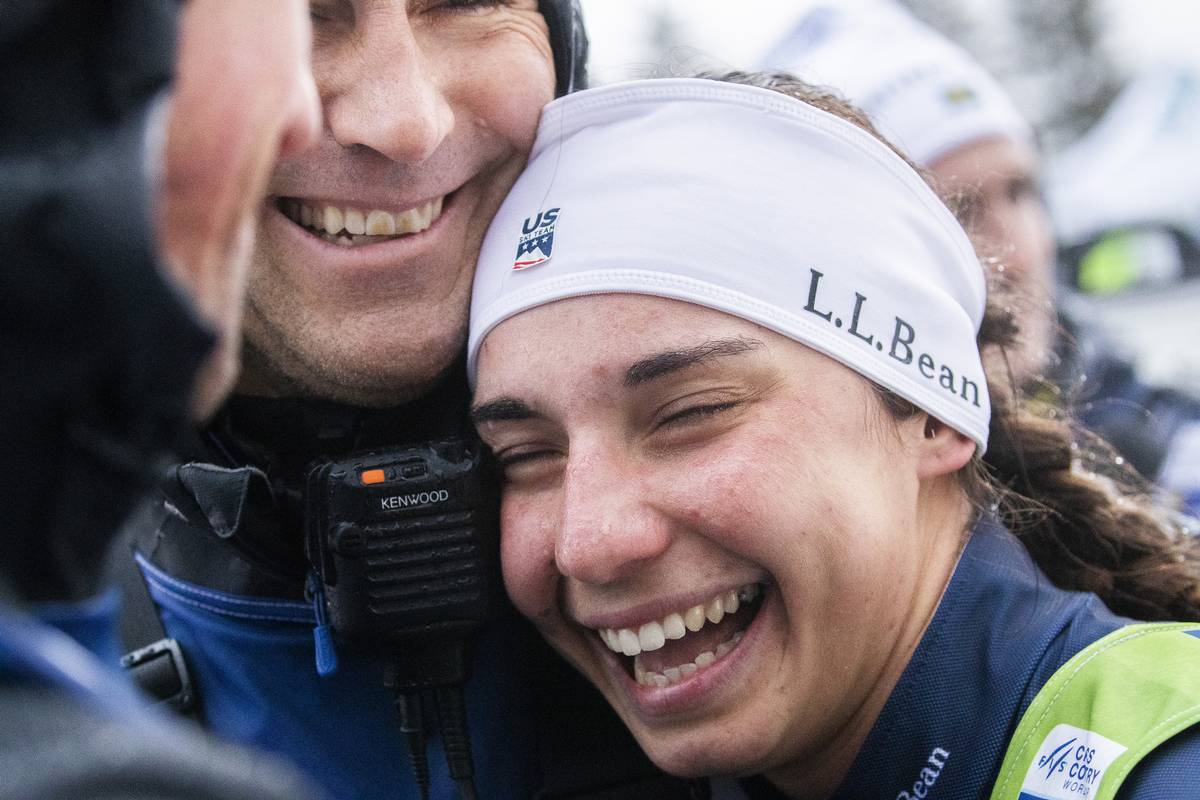
An ecstatic Julia Kern celebrates her first podium performance with her coaches after the 1.2-kilometer freestyle sprint in Planica, Slovenia. (Photo: NordicFocus)
Matt Whitcomb provided further insight into Kern’s attitude heading into the race, the tactics the team discussed, and her performance in the heats.
Post-race interview with Matt Whitcomb on Julia Kern’s first podium
Sophie Caldwell gathers herself after racing the 1.2-kilometer skate sprint in Planica, Slovenia. (Photo: NordicFocus)
Post-race interview with Sophie Caldwell
Though her vision of herself has changed over the years, Caldwell identifies short fast courses like Planica as a place she can excel. She shares insight into the course and her tactics, as well as her plans for Christmas and the following weeks.
Sophie Caldwell dodges a crash with less than 200 meters to go in the 1.2-kilometer skate sprint in Planica, Slovenia. (Photo: NordicFocus)
Post-race, Whitcomb analyzed Caldwell’s journey through the heats and her feelings on finishing just off the podium.
Post-race interview with Matt Whitcomb on Sophie Caldwell’s performance.
Canada’s only entrant Dahria Beatty qualified in 29th. She took third in the first heat of the quarter-finals, just over half a second behind Caldwell and Sundling. As her time was not fast enough to earn a lucky loser spot, she did not move onto the semi’s and ended the day in 16th.
Picture perfect. Sophie Caldwell on her way to qualifying first in the 2019 Davos, Switzerland skate sprint. She was third overall for the day. (Photo: NordicFocus)
(An earlier version of the story mistakenly stated Caldwell had placed second. FIS live timing had Caldwell in second place. Apologies for the error.)
When Davos is good, it is good on a global scale. With the Swiss valley blanketed in snow, and a gauze of high clouds keeping the race proceedings just a notch away from perfectly sun-shiny, the World Cup’s 1.5-kilometer freestyle sprint was won by twenty-year-old Swede Linn Svahn. According to the International Ski Federation, this was Svahn’s second career World Cup start. She placed 21st in last season’s skate sprint in Falun. At World Juniors, she was fourth in the 2019 classic sprint in Lahti, Finland. Add Svahn to the growing stable of Swedish A-list skiers on the early side of their twenties.
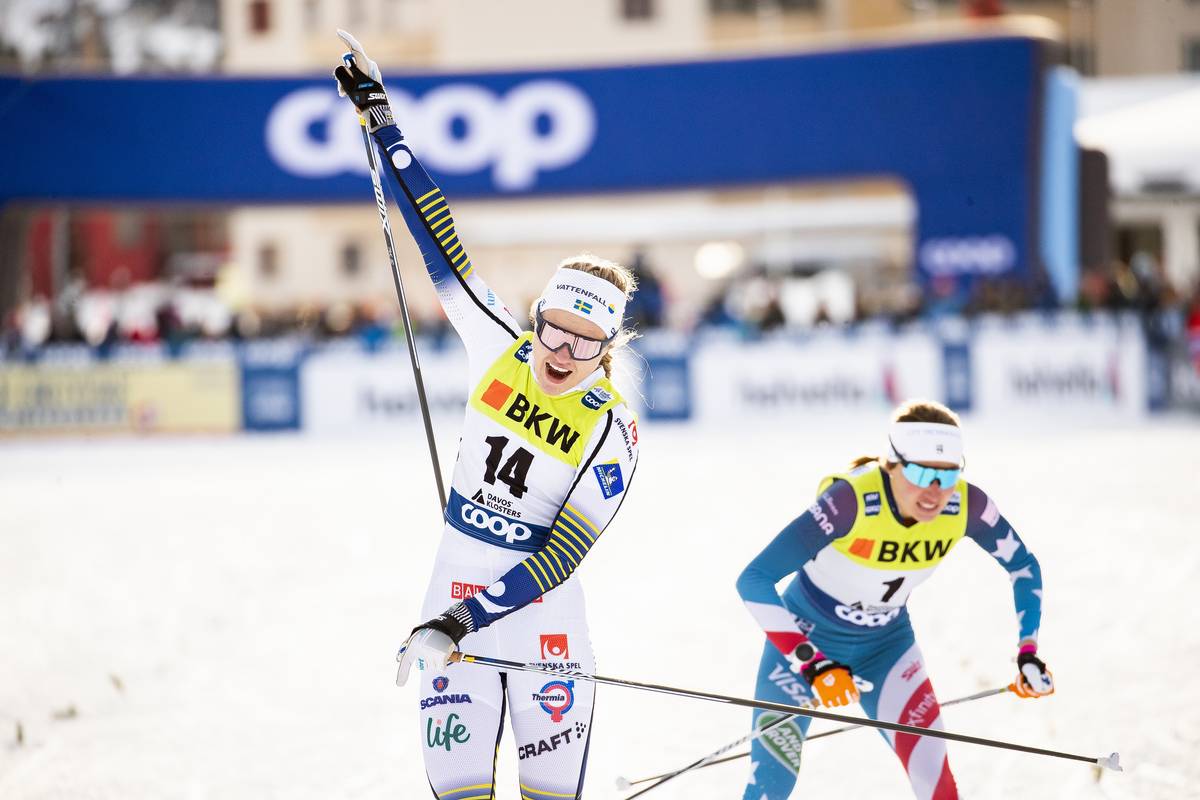
Linn Svahn of Sweden in for her first career World Cup win. Arm raised crossing the line first in Davos, Switzerland. Sophie Caldwell (bib 1) placed third. (Photo: NordicFocus)
As the remaining meters became scarce in the women’s final, Svahn and her lickety-split skis took a ten-meter gap up and over the last climb. Barely separated from the chasers into the final straight, she took a clean win in 2:38.54.
Even Svahn seemed surprised by the result. In near-perfect English, as the camera zeroed in for a podium shot, she blurted the not uncommon expression of “What the &uc!” to describe her astonishment. Her hot-mic moment was spot on.
For North America, it was a very good day. The results were clear: every North American entered qualified for the heats. For the U.S. Ski Team (USST), Sophie Caldwell qualified first at 2:45.15. Her speed was indicative as she had a 1.47 second gap on the second-fastest qualifier, Stina Nilsson of Sweden.
Sadie Maubet Bjornsen (USST) qualified in 5th (+2.76), Jessie Diggins (USST) 6th (+2.91), Julia Kern (USST) 23rd (+8.37), and Hailey Swirbul (USST) 28th (+9.92).
Post-race interview with World Cup Coach Matt Whitcomb
With her first World Cup start of the season, Canada’s Dahria Beatty qualified in 30th (+10.48). One-fifth of the sprint qualifiers hailed from the left side of the Atlantic.
As Caldwell progressed through the sprint bracket, she tapped into her big and smooth technique. She won her quarterfinal and the first semi-final. In that semi, stacked with Stina Nilsson and Maiken Caspersen Falla of Norway, Caldwell played coy. She let others take flight off the front during the first of this two-lap course. Moa Lundgren of Sweden took the pacesetting chore as she made a separation on the first lap, but she was eventually pulled in.
On the second time up the course’s punchy hill, Caldwell moved up the left side and took it wide on the final right hand corner. Into the finish, she shot to the front for the semi-final win.
It was a good sign for Caldwell.
In her element. Sophie Caldwell in the 2019 Davos, Switzerland skate sprint. (Photo: NordicFocus)
Caldwell won the qualifier, her quarterfinal, and her semi on her way to placing third overall in the skate sprint in Davos. (Photo: NordicFocus)
Sophie Caldwell’s post-race interview
In the final, Falla took the helm and led five skiers in a line up the first hill. Caldwell sat in third. Not until roughly 2:10 minutes into the final did any real move occur, and that was Svahn’s. Caldwell and Falla eventually came drag racing down the line for a photo finish. Both were unofficially 0.55 seconds behind Svahn. But Falla out-toed Caldwell to take second.
Since 2013, Caldwell has sprinted here seven times. Five times she’s placed in the top-10. Her third place today piggy backs on a second place result in Davos last season.
Kern was 15th overall on the day, Maubet Bjornsen finished her day in 16th, and Diggins in 17th.
Kern has rebounded from elbow surgery this summer and some minor bumps in her training. Davos proved to be a course and scene where she was able to click. According to Kern, today’s result was a “big step forward, which was exciting.”
Julia Kern (bib 23) skiing to 15th overall in the 2019 Davos, Switzerland skate sprint. (Photo: NordicFocus)
Julia Kern’s post-race interview
Swirbul placed 30th for her first career World Cup points. In her post-race interview, Swirbul noted that she is trying to embrace “skiing like me.” In other words, she is finding her own “best” technique that she describes as skiing “like a noodle”. Finding out she had a sprint start only a few day’s ago, Swirbul made the best of the opportunity.
Hailey Swirbul scored her first varied World Cup points in the 2019 Davos, Switzerland skate sprint. (Photo: NordicFocus)
Hailey Swirbul of the U.S. Ski Team placed 30th in the 2019 Davos, Switzerland skate sprint. (Photo: NordicFocus)
Hailey Swirbul’s post-race interview
Canada’s Beatty placed 25th overall. Last weekend she posted solid results on the OPA Cup where she was third in a skate sprint.
“I was happy with my day today,” Beatty emailed. “It’s always encouraging to make the heats in my first World Cup of the season. It is a good starting point and I look forward to trying to improve on today’s performance as the season progresses. I had some strong racing last week at the OPA in Slovenia and my race shape is feeling good right now so I am really looking forward to tomorrow’s 10km skate here in Davos.”
Racing continues tomorrow with a 10 k interval start skate for the women.
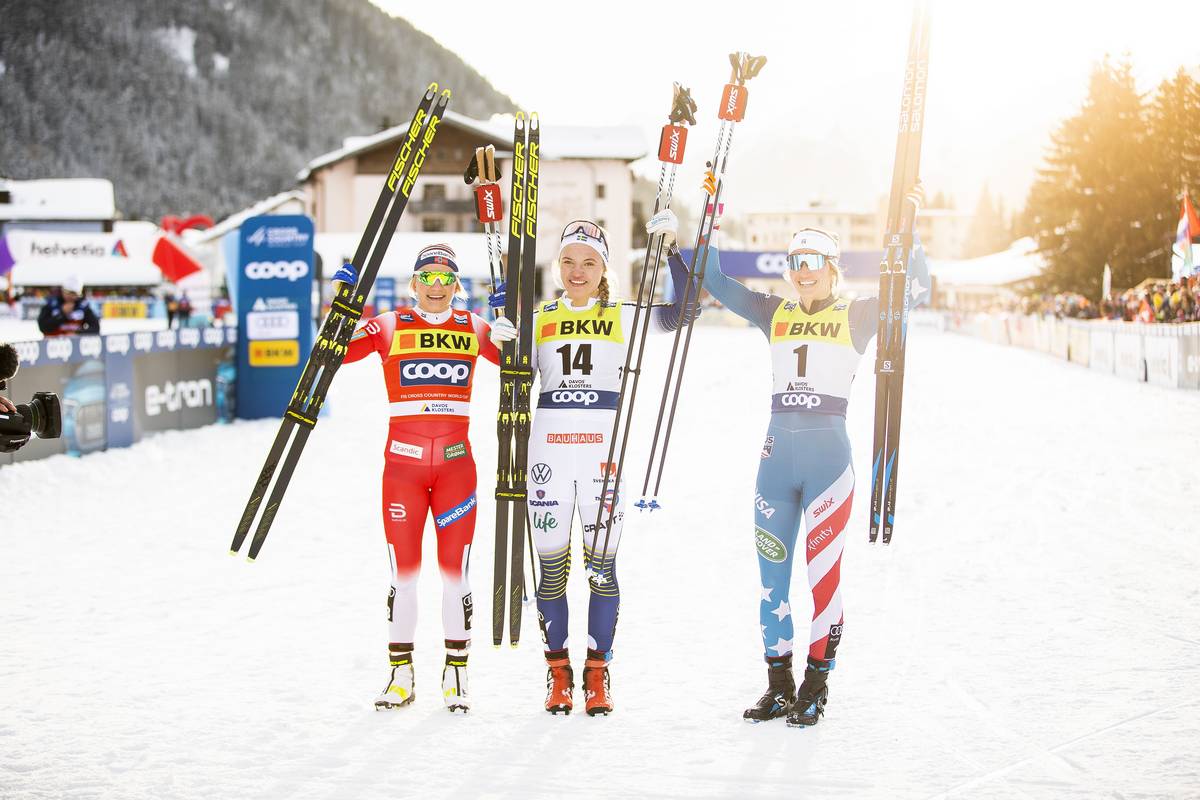
The 2019 Davos, Switzerland 1.5 k skate sprint podium: Maiken Caspersen Falla (NOR) in second, Linn Svahn (SWE) in first, and Sophie Caldwell (USA) in third, (l-r). (Photo: NordicFocus)
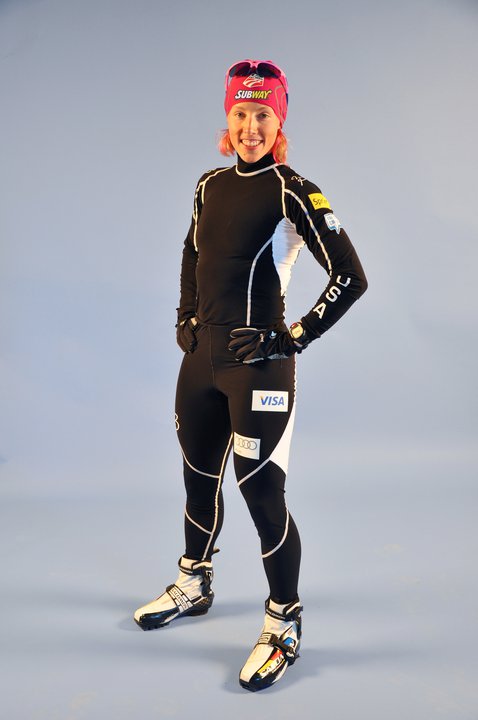
From October 2010: Kikkan Randall modeling the U.S. Ski Team suit for the 2010-2011 season. Photo courtesy of the U.S. Ski and Snowboard Association.
A national team uniform for cross-country skiing has to do a lot of things. At the most utilitarian level, it has to wick sweat and aid performance while an athlete pursues one of the world’s most demanding sports at temperatures between –4 F and 40, in steady snow or driving rain or anything in between. At the functional level, it has to let spectators and coaches identify where their athlete is out on the course, while distinguishing them from athletes from other countries. And at the symbolic level, it lets the athlete know that he or she is competing on behalf of their country, for everything that that means. Ask a skier who has represented the United States in international competition what it meant to them to pull on a national uniform for the first time. They’ll probably be able to tell you.
(And if they ever forget, this detailing from Craft and L.L. Bean on the American uniforms, ca. 2015/2016, is there to remind them. “You are representing the United States of America,” a slogan intones, above a martial-looking eagle, with a U.S. Ski Team master mark for its aegis, gripping an olive branch (?) in its dexter claw and a skis and ski poles fasces in its sinister. “Pretty fun to be representing an American brand with our American uniforms!,” wrote Sadie Bjornsen in a blog post describing the uniforming process.)
For whatever reason, the period roughly one decade ago represented the highwater mark for domestic and global coverage of ski uniforms on this website. There was “US Ski Team Brings Suit Consistency,” from Jan. 2009 (lede: “After years of a remarkable level of wardrobe schizophrenia, the US Ski Team has ushered in a new era of racing suit consistency that should make it easier to follow our favorite US athletes on the race course.”); “The costume disciplinarian speaks: Is it better to look good than to ski fast?” from July 2009; “The Best and Worst (Suits) of the Olympics,” from Feb. 2010; and “USST Goes Black for 2010-2011,” from Oct. 2010 (lede: “In the sport of cross-country skiing, most people would agree that competing with New Zealand is probably smarter than picking a fight with Norway.”).
So it seems to have been nearly 10 years since the last sustained attention to the uniforms of the Davis U.S. Cross Country National Team Program (néeU.S. Ski Team). To fill that gap, FasterSkier hereby presents A Visual History of the United States Ski Team National Team Uniform, 2008–2019.
(Why 2008 for the starting point? Mostly for the simple logistical reason that the image library in the current FasterSkier content management system, WordPress, only goes back to 2008, so this article can be written while using only images that FasterSkier may legitimately post on this site. To go back to closer to the start of this century would require a lot of external links to Getty Images and not that many photos to actually look at on this website. That said, this piece from 2009 has a nice visual roundup of the plethora of different USST designs worn from 2006–2008, which takes you back two more years. Before that, well, just imagine Kikkan Randall and a lot of other skiers you probably haven’t thought about for a while — Wendy Wagner, anyone? Rebecca Dussault? Sarah Konrad? — wearing various iterations of early-aughts red and black.)
2008/2009 World Cup season: Red
January 2009: No question who is from the US here… Kikkan Randall in the women’s Team Sprint in Whistler
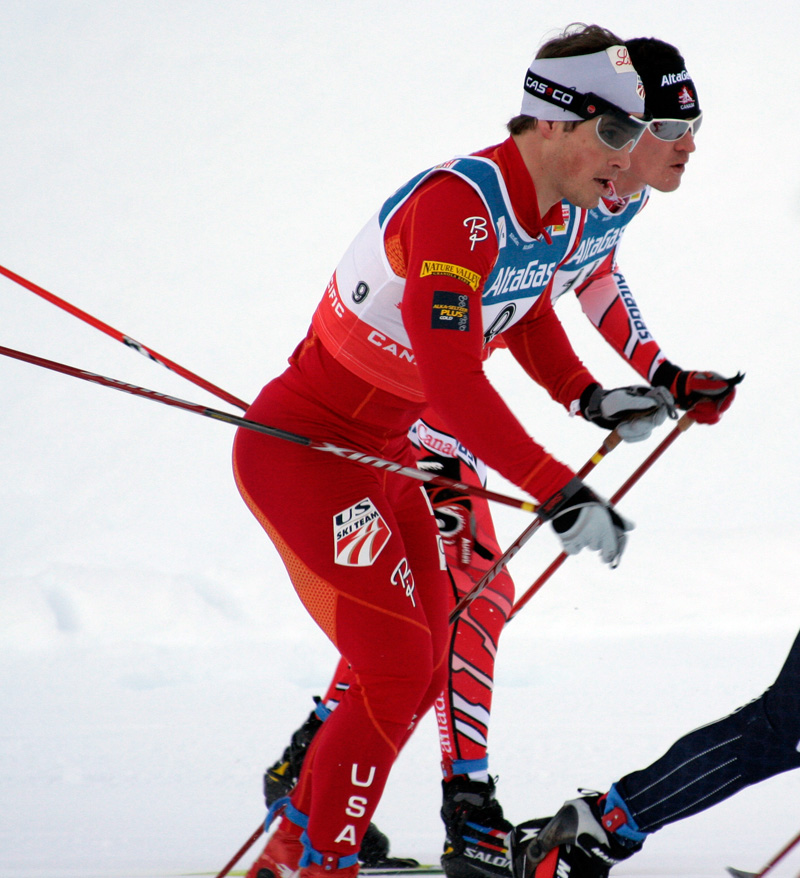
January 2009: Kris Freeman preferred the orange to silver in the men’s pursuit
As a contemporary uniform article explained, “There are currently two suit variations being used by US Ski Team athletes, and athletes racing for the US in international events. They are so similar, that for practical purposes (identifying US skiers in a race) they may as well be the same. Both suits are predominantly red, with one version having patches of orange, and the other silver.” Both were manufactured by Norwegian company Bjørn Dæhlie.
There appears to have been no change to the basic World Cup design for the 2009 World Championships in Liberec, Czech Republic:
Freeman at the 2009 World Championships in Liberec. (Photo: Swix Sport)
2009/2010: Still red Bjørn Dæhlie
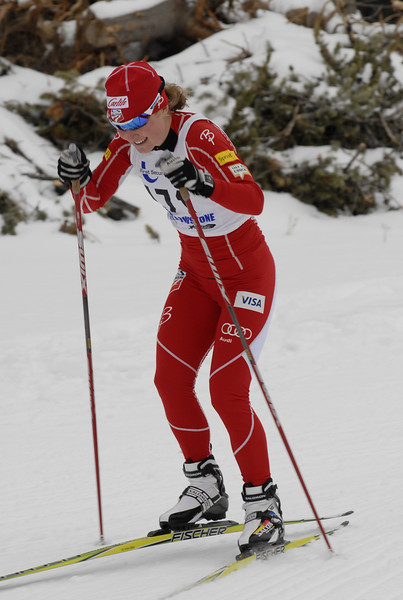
November 2009: Tazlina Mannix (APU, USST) racing in West Yellowstone.
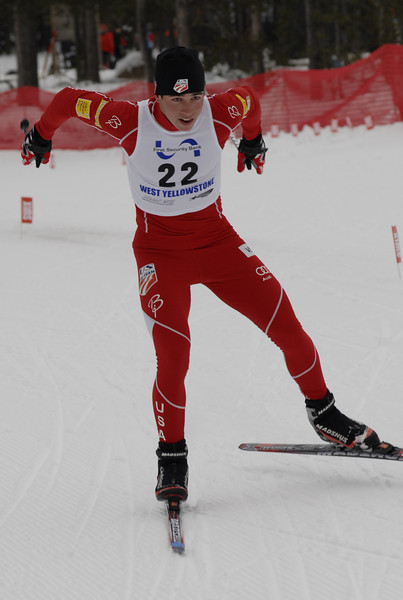
November 2009: A very young Noah Hoffman (USST) racing to 3rd in a distance race in West Yellowstone.
Honorable mention, domestic suits division:
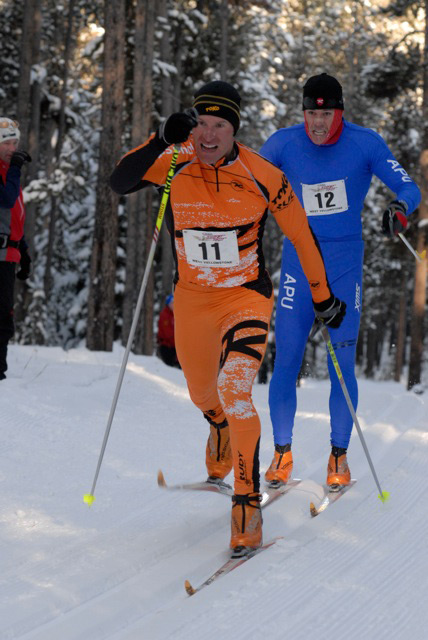
November 2009: This is a very orange suit. Kevin Hochtl (Rossignol) – 32nd – leads Anders Haugen (APU) – 7th – to the finish in a West Yellowstone race.
November 2009: This is one hell of an ibex. Chris Cook (Steinbock Racing) – 12th – sporting the new Steinbock Racing uniform
2010 Winter Olympics, Vancouver: Red and silver
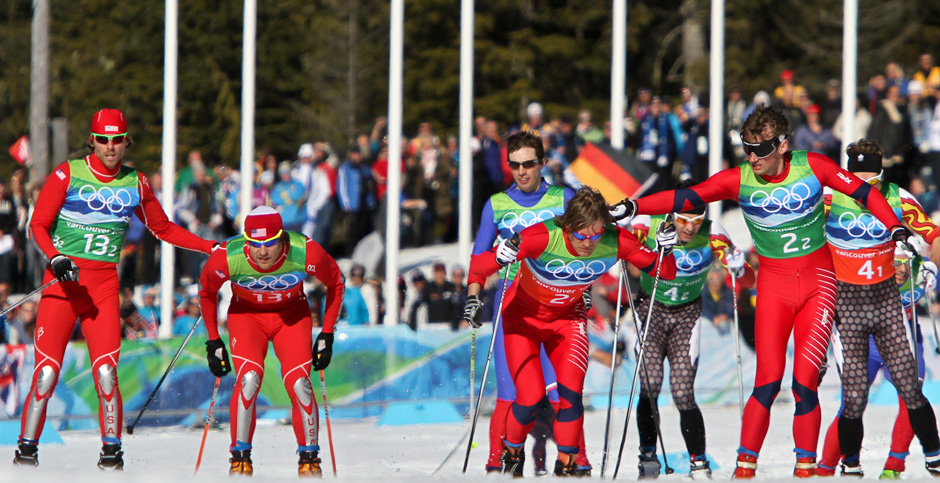
For the Olympics, the Americans appear to have taken their World Cup template – Bjørn Dæhlie suit, largely red – but have changed it by, inter alia, lightening the shade of red, adding “USA” on the right arm and left leg, adding silver accents, and of course removing all sponsor logos. Kikkan, already skiing in her third Olympics, coordinated with a red headband, red gloves, and her famous pink highlights. Andy Newell went with the red hat (he may not have had a choice), but was otherwise somewhat less vermilion.
Feb. 2010: Kikkan RandallFeb. 2010: Andy Newell on the big climb during the men’s 4 x 10 k relay.
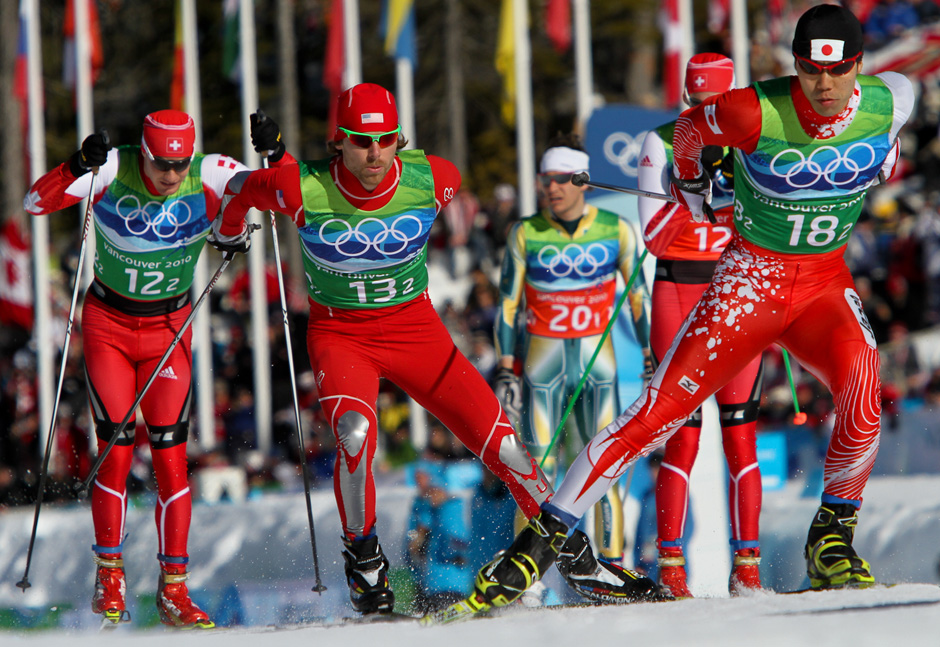
There was a lot of red in Vancouver. For example, here’s Andy Newell (far left, bib no. 13-2) tagging Korin Koos for the U.S. in the team sprint, while Petter Northug (far right, bib no. 2-2) tags Øystein Pettersen (middle right, bib no. 2-1) for Norway. (An entire standalone article could likely be written on the Canadians’ infamous kit (bib no. 4, back right).)
Newell tags Koos (left) and Northug tags Pettersen (right) at the 2010 Vancoulver Olympics.
Or here’s Newell in the middle, between Switzerland’s Dario Cologna (bib no. 12) and Yuichi Onda of Japan (bib no. 18):
Newell in the semis of the skate sprint: 2010 Vancouver Olympics.
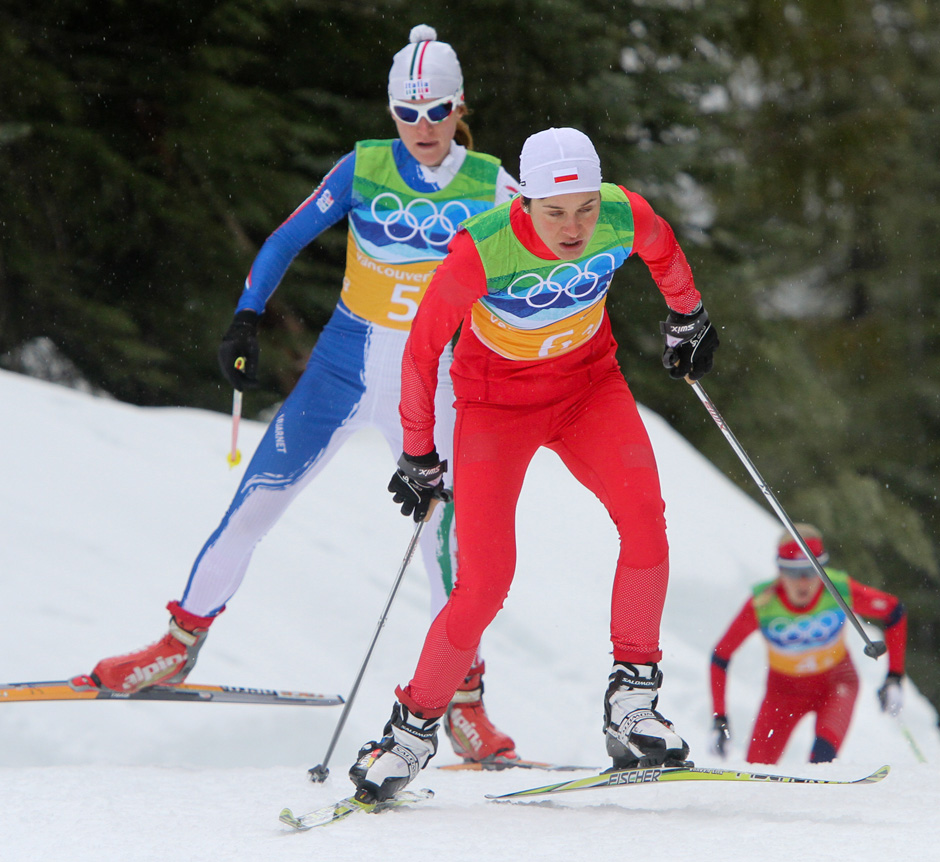
Finally, Poland (shown here: Sylwia Jaśkowiec, bib no. 6) was just red:
Poland 2, 2010 Vancouver Olympics.
2010/2011: The black era begins
Perhaps as a natural reaction to the dominance of a single color across multiple nations, the U.S. made a significant shift for the 2010/2011 World Cup season: black. The color does not appear on the national flag or in other common American iconography, but it is certainly distinctive. Bjørn Dæhlie remained the suit manufacturer.
Or, as then-FasterSkier reporter Nat Herz wrote in fall 2010, “After any number of years of being drowned out by a sea of Norwegian crimson, U.S. Ski and Snowboard Association Nordic Director John Farra said that the USST will be ‘distinctly not red’ for the 2010-2011 season—including at World Championships in Oslo. ‘We went in a very different direction, in part from our experience in Oslo, where they [Norway] have a nation’s group of ten, and we can barely see our athletes in the group,’ he said.”
January 2011: A 21-year-old Sadie Bjornsen races to 17th at U23 World Championships in Otepää, Estonia.
January 2011: Jessie Diggins, then aged 19, races to 7th at Junior World Championships in Otepää.
January 2011: Noah Hoffman at a SuperTour race in Lake Placid.
February 2011: No change for World Champs: Kikkan Randall racing at 2011 World Championships in Oslo.
2011/2012: Still black Bjørn Dæhlie
December 2011: Kikkan Randall sprinting during the Tour de Ski.
March 2012: Kris Freeman (SSCV/USST) on his way to claiming the US Distance Nationals 50 k freestyle title on Saturday morning in Craftsbury.
2012/2013: Still black
December 2012: Noah Hoffman in the Tour de Ski.
December 2012: Kikkan Randall blasting to victory in the Tour de Ski opening prologue on Saturday. She skied to 14th in the pursuit on Sunday and is leading the U.S. women in the Tour de Ski standings after two stages. Photo: Marcel Hilger.
February 2013: Diggins and Randall won gold in the team sprint at 2013 World Championships in Val di Fiemme, Italy, which was awesome, but, for purposes of this article, mostly relevant for the addition of the epochal relay socks but otherwise no change to the standard World Cup uniform.
2013/2014: Yup, still black
December 2013: Liz Stephen (U.S. Ski Team) on her way to 34th in Saturday’s 3 k freestyle prologue at the first stage of the Tour de Ski in Oberhof, Germany. (Photo: Marcel Hilger)
December 2013: Andy Newell (U.S. Ski Team) qualified 12th and finished 10th overall in Sunday’s freestyle sprint. (Photo: Marcel Hilger)
2014 Winter Olympics, Sochi: Stars and stripes
The 2014 Winter Olympics, in Sochi, Russia, were known at the time for Kikkan Randall’s disappointing result in the individual skate sprint, and after the fact for the revelation that Russia was engaged in a massive state-sponsored doping scheme and cover-up. They were also significant for a change in uniforms: stars and stripes on the right arm and left leg, and a large “USA” on the right leg. The left arm was relatively plain. Also, several of the U.S. women drew attention for racing sleeveless in warm temperatures. Bjørn Dæhlie continued to be the brand logo featured on the upper right quad. (Pictured below: Noah Hoffman, in a solo race, and Sadie Bjornsen, in the women’s relay.)
2014/2015: Stars and stripes redux
Athletes took to the trails next season with a slightly modified version of the recent Olympics uniform: Larger stars on the left upper quad, with a deeper blue background. The stripes on the left leg became more pronounced and stretched farther up the race suit, to above the knee. Also, once the non-commercial period of the Olympics had passed, there was space for sponsor patches on the arms and legs.
December 2014: Caitlin Gregg (Team Gregg) skiing to 56th place in the Davos World Cup 10 k classic, Dec. 13. (Photo: Toko)
USST’s Sadie Bjornsen racing to 29th in the Davos World Cup 10 freestyle, Dec. 20, 2014. (Photo: Fischer/Nordic Focus)
World Championships, in Falun, Sweden, brought a mostly-white version of the uniform, helpful for the warm temperatures and soupy conditions that characterized many of the races. Here’s Sadie Bjornsen in Falun in February 2015:
2015/2016: Red, white, and blue
By fall 2015, the move away from black, and towards red, white, and blue, was complete. Athletes now had the option of being attired in a predominantly white color scheme, which would aid in preventing overheating on warm days, while thankfully solving the transparency issues that had plagued recent all-white suits for Sweden or Italy. An alternate version had roughly the same patterning, but with blue as the primary color. Notably, the Americans also moved to a race suit manufactured by the Swedish company Craft for the first time in this survey.
December 2015: Sadie Bjornsen (U.S. Ski Team) racing to her best-ever sprint qualifier in sixth at the World Cup freestyle sprint in Toblach, Italy. She went on to make the semifinals and place 10th overall. (Photo: Fischer/NordicFocus)
December 2015: Simi Hamilton (U.S. Ski Team) racing to his first non-stage World Cup podium on Saturday in Toblach, Italy, where he placed second in the freestyle sprint. (Photo: Fischer/NordicFocus)
December 2015: American Andy Newell (r) and Great Britain’s Andrew Young (c) trail Norway’s Håvard Solås Taugbøl (2) in the quarterfinal at the Davos World Cup freestyle sprint on Sunday in Switzerland. Taugbøl won the heat, Young placed third, and Newell was fifth after missing out on a photo finish for fourth. Newell finished the day 23rd overall. (Photo: Marcel Hilger)
January 2016: Ida Sargent (U.S. Ski Team) teamed up with Sophie Caldwell (not shown) to place fifth in the 6 x 1.2 k freestyle team sprint at the World Cup in Planica, Slovenia. (Photo: Madshus/NordicFocus)
Honorable mention: Trending towards “purple cobras” for American biathlon but not there yet.
American Claire Waichler started 58th and finished 33rd in the youth women’s pursuit on Sunday at IBU Youth/Junior World Championships in Cheile Gradistei, Romania. (Photo: IBU YJWCH Cheile Gradistei 2016/Facebook)
2016/2017: More red, white, and blue
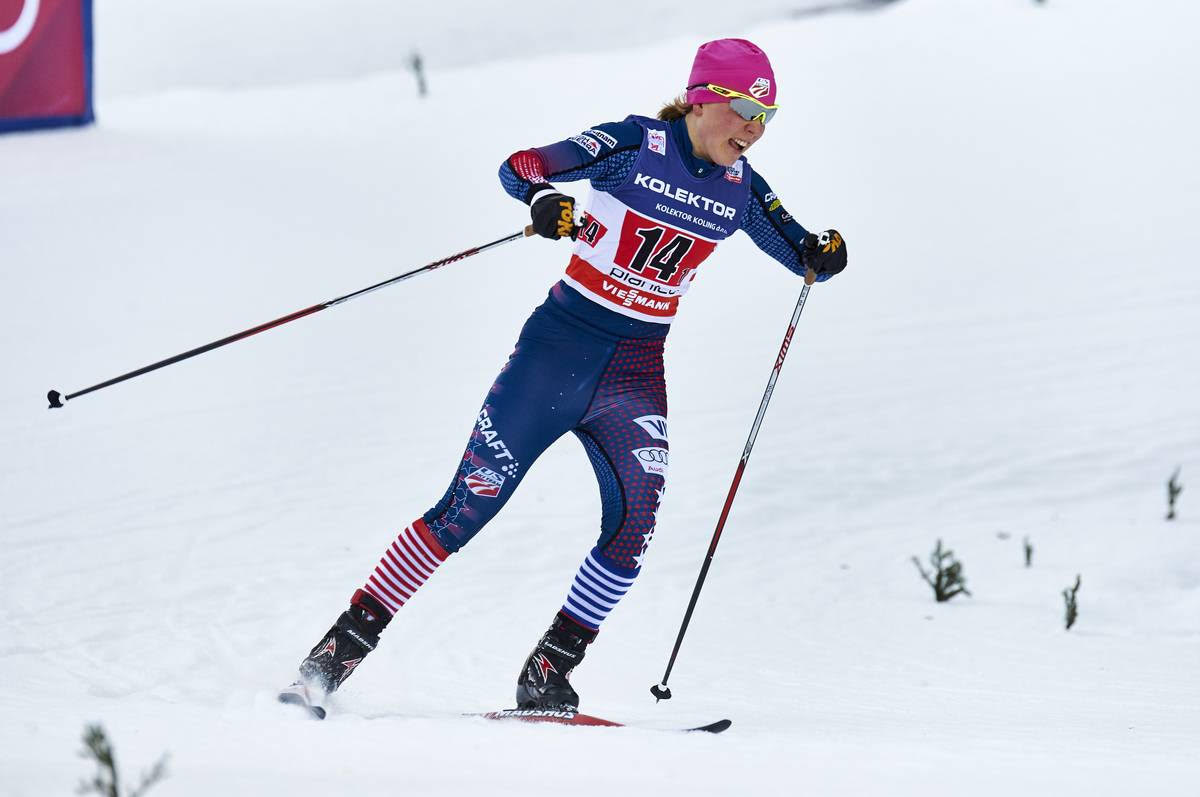
An interpretation of red, white, and blue, still on a Craft suit, remained in place for the 2016/2017 World Cup season, which was marked within the team by Randall and her husband, Jeff Ellis, traveling the European race circuit with a newborn in tow. The changes to the USST uniform were less dramatic than Randall’s familial status: Still red, white, and blue, though now with blue as the dominant color. The entire left leg, and the bottom half of the right leg, had markings, somewhere between subtle striations and full-on stripes, that evoked the stripes of the American flag. (Let’s put aside for the moment the fact that the stripes on the actual flag are white and red, not white and blue.) The pattern was repeated on the lower right arm. An understated evocation of blue or white stars marked both lower legs, with more pronounced stars scattered around the bottom of the torso (possibly the top as well, but nearly all of one’s torso is typically covered by the standard race bib). The left arm and left leg both proclaimed “USA” in red lettering.
The vehicular logo on the legs remained that of Audi, as it had been since the start of this history.
There appears to have been no change for the 2017 World Championships. At least to the uniforms; on the race course, the Americans won an unprecedented three medals.
December 2016: Jessie Diggins (U.S. Ski Team) racing to ninth in Saturday’s 1.5 k freestyle sprint qualifier in Val Müstair, Switzerland. Diggins went on to place sixth in the final. (Photo: Salomon/NordicFocus)
January 2017: Sophie Caldwell (U.S. Ski Team) racing to third in the qualifier of Saturday’s 1.4 k freestyle sprint in Falun, Sweden. She went on to finish 16th overall (Photo: Fischer/NordicFocus)
February 2017: Kikkan Randall (U.S. Ski Team) racing to 26th in the women’s 10-kilometer classic individual start at the 2017 Nordic World Championships on Tuesday in Lahti, Finland (Photo: John Lazenby/Lazenbyphoto.com)
Meanwhile, biathlon saw the advent of the beloved “purple cobras” era:
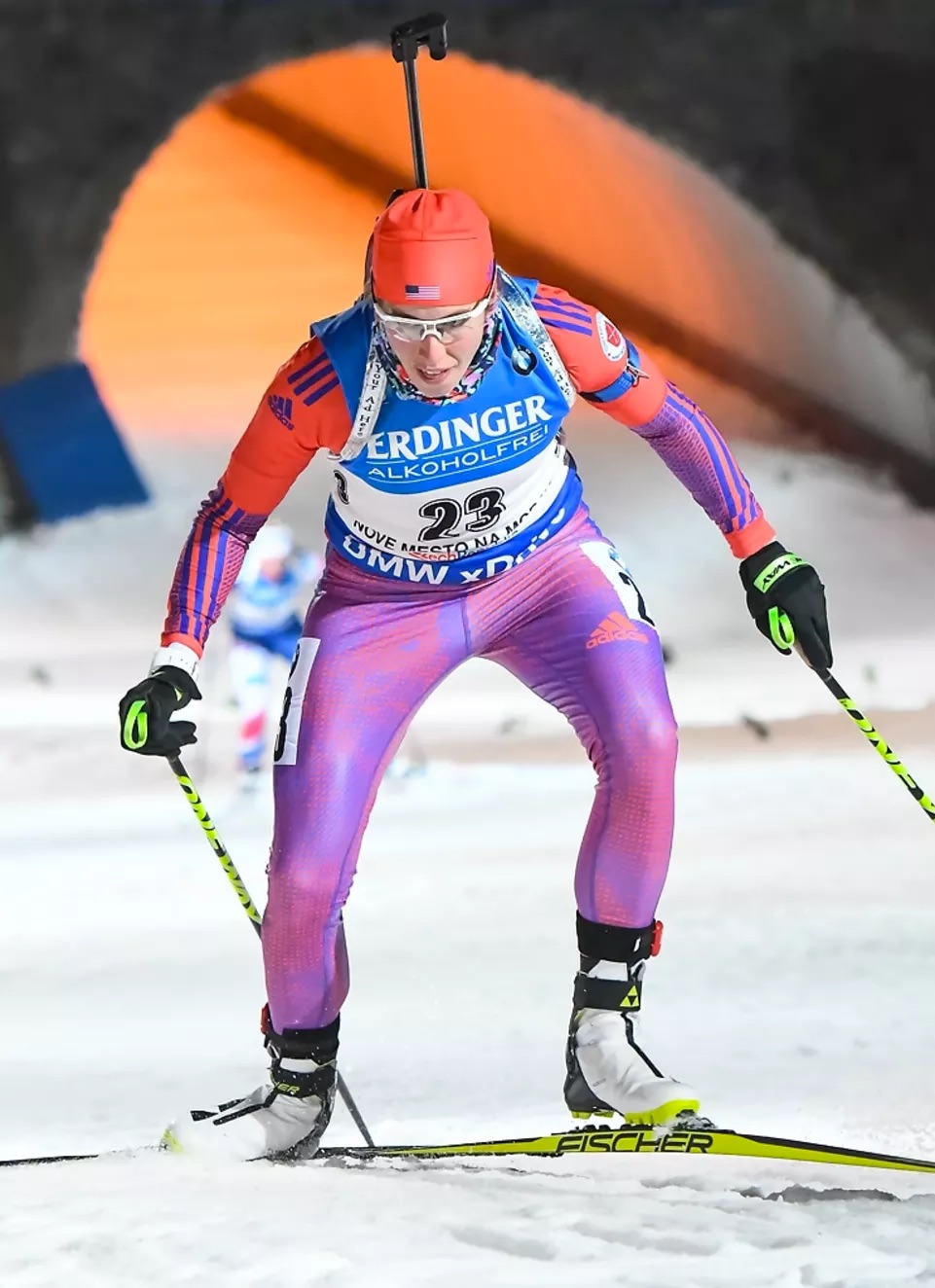
US Biathlon’s Susan Dunklee on her way to finishing third in the women’s sprint at the IBU World Cup in Nove Mesto, Czech Republic. It was the third podium of her career. (Photo: IBU)
2017/2018: Red, white, and blue redux
There appears to have been no change for the 2017/2018 World Cup season: still red, white, and blue, but mostly blue, on a Craft suit. The most notable change may have been to the car sponsor… for the first time since at least the scope of this article, a Toyota logo was on the leg, not Audi. Nichts ist unmöglich (“Nothing is impossible”), as the company’s European slogan proclaims.
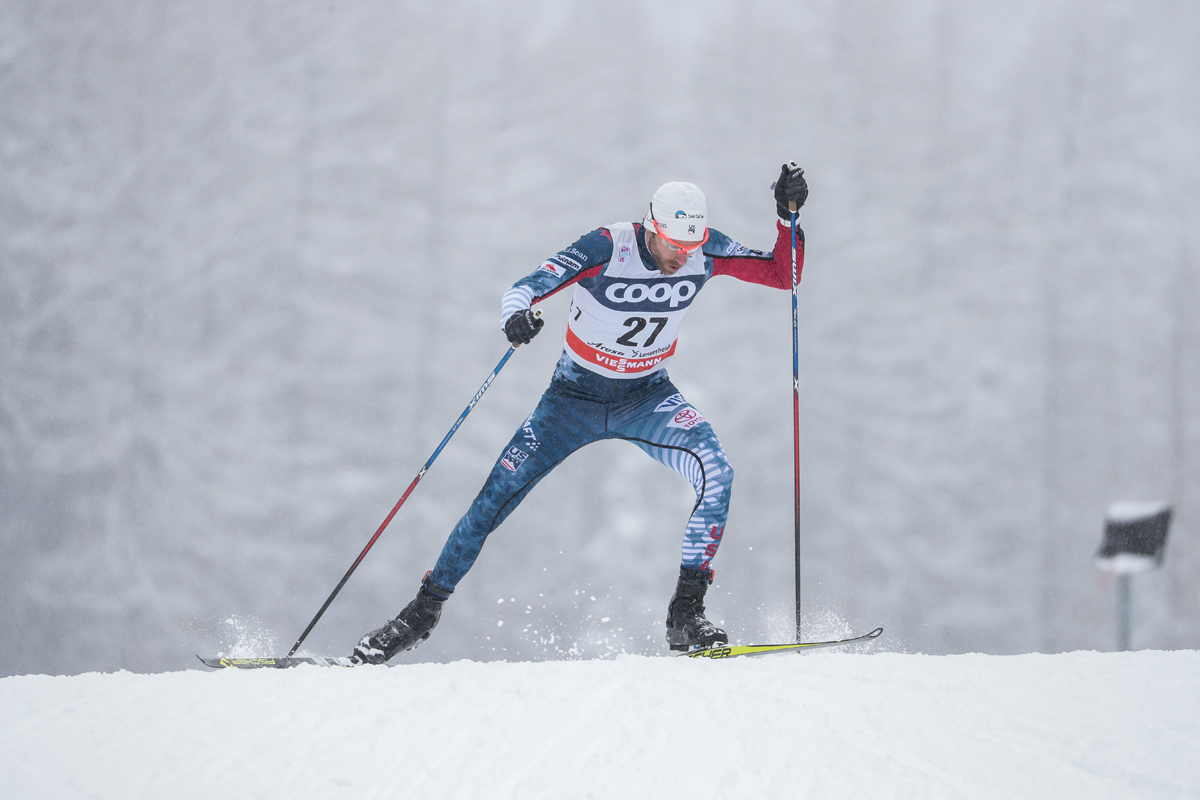
American Andy Newell racing the men’s 1.5 k freestyle-sprint qualifier at Stage 1 of the Tour de Ski on Saturday in Lenzerheide, Switzerland. He qualified 20th and went on to finish 19th overall. (Photo: Fischer/Nordic Focus)
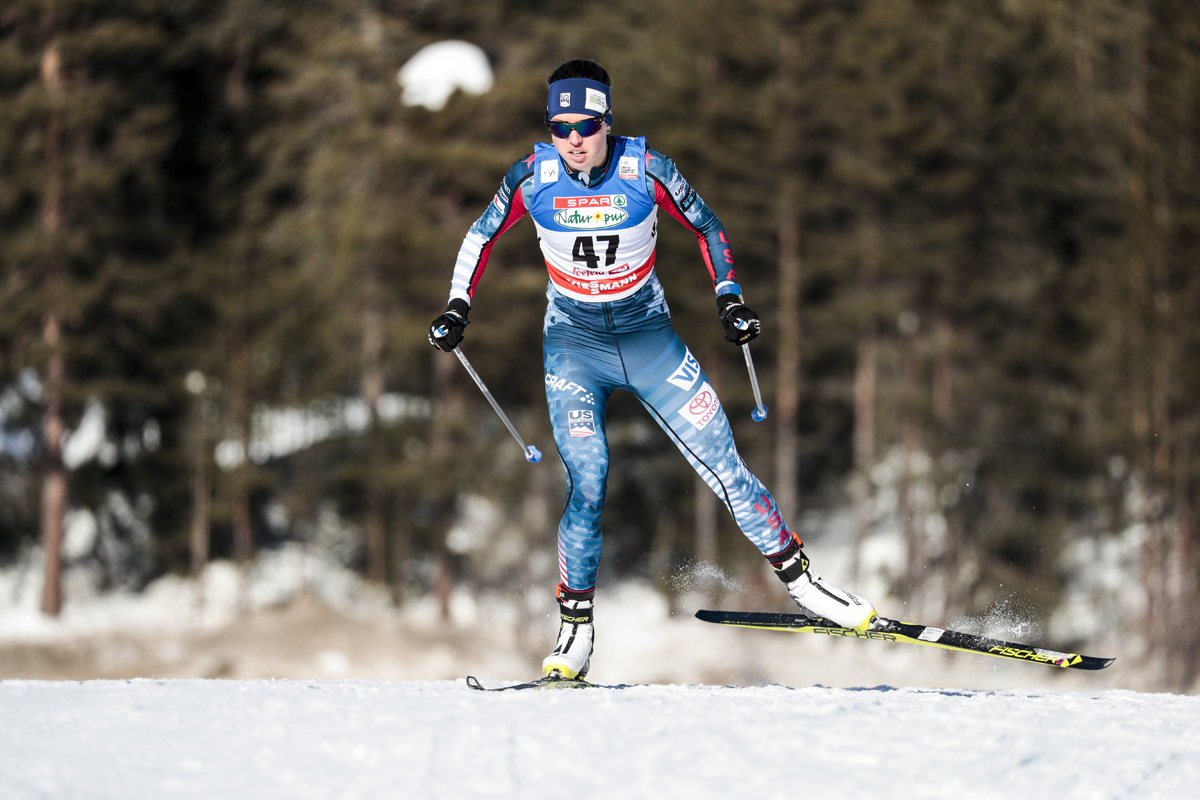
Caitlin Patterson (Craftsbury Green Racing Project) racing to 52nd in the freestyle sprint qualifier at the last World Cup on Jan. 27 in Seefeld, Austria. The next day, she placed 23rd in the 10 k freestyle mass start. (Photo: Fischer/NordicFocus)
2018 Winter Olympics, Pyeonchang: Red, white, and blue, and a lot of stripes
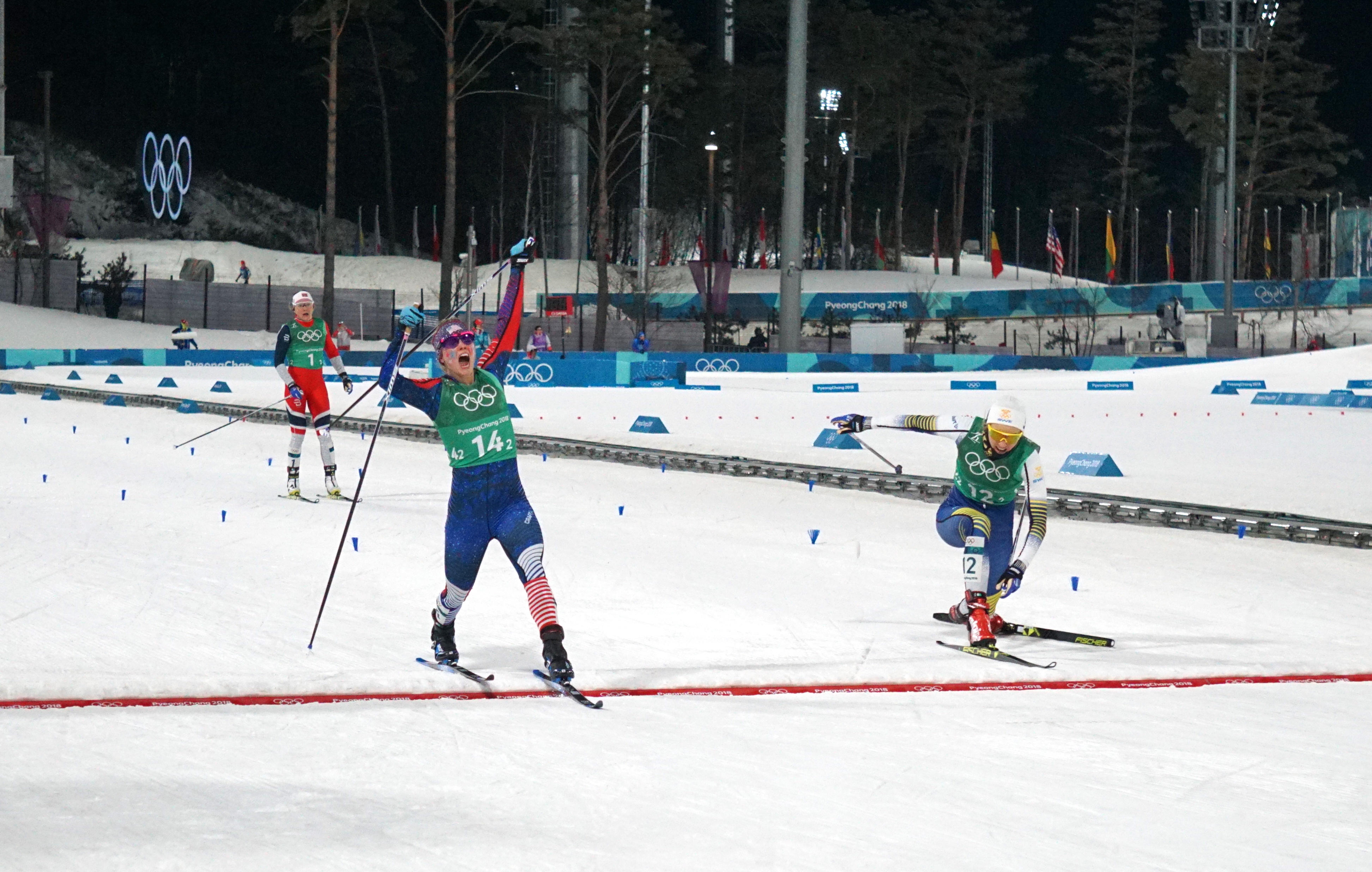
There is a somewhat famous picture from the 2018 Winter Olympics that you may already be familiar with. In the picture, Jessie Diggins, on the lefthand side of the frame, stretches her left foot across the finish line to secure an historic Olympic gold medal for the United States. Her left arm mirrors the gesture, punching the air above her in what is presumably an instinctual counterbalance to the lunge but also appears, in a frozen moment in time, to be a triumphant fist-pump. In the middle, her face is rent in a rictus of exertion and triumph. On the righthand side of the frame, Stina Nilsson of Sweden lunges as well, 0.19 seconds behind Diggins. Mute V-boards and still flags fill in the background of the image, as Maiken Caspersen Falla of Norway appears to stand up and stop skiing in order to watch the finish unfold.
It was a few seconds before 7:16 p.m. in Pyeongchang, 4:16 a.m. in Afton, Minnesota, and 1:16 a.m. in Anchorage, Alaska. If you’re reading this website, you may remember where you were at that moment.
February 2018: Jessie Diggins (14) edges Sweden’s Stina Nilsson (r) for gold, while Norway’s Maiken Caspersen Falla (far left) races to bronze, in the women’s freestyle team sprint final at the 2018 Olympics in PyeongChang, South Korea. (Photo: Noah Hoffman)
But let’s talk about the uniform. Another Craft product, the dominant impression is once again blue; in the photo above, taken at whatever distance from the finish Noah Hoffman was allowed to stand while there was a race on, there is a whole lot of blue approaching the finish line between the American suit and the Swedish one. Some white stripes are visible around the knee of Diggins’s suit, trending down the lower leg, though they are soon subsumed by The Relay Socks.
On closer inspection, however (see next picture, below), there are a lot of stripes going on in this uniform. The entire legs are striped, with stronger white stripes on the sides of the torso fading to fainter stripes at the top of the leg. The knees have white stripes on a blue background, with the width of the white stripes gradually decreasing and the extent of the blue interstices gradually increasing across the course of the knee. As shown in more detail here, the patterning gives way to thin red stripes against a blue background, on the lower right leg, and a bold white “USA,” on the lower left.
The right arm has white splotches, potentially stellar in nature, against a blue background. The left arm has red and white stripes to midway down the biceps, which then transition to blue and red stripes.
The torso has a subtle blue and black patterning perhaps best described as “Swedish forest camo.”
Finally, although it is not apparent in either picture, “USA” was written in white letters against a blue background on both the right arm and lower left leg, as shown in the images available here (lettering on arm) and here (lettering on leg).
February 2018: Jessie Diggins (l) and Kikkan Randall soak up their win in the women’s freestyle team sprint on Wednesday at the 2018 Olympics in PyeongChang, South Korea. (Photo: FIS Cross Country/Twitter)
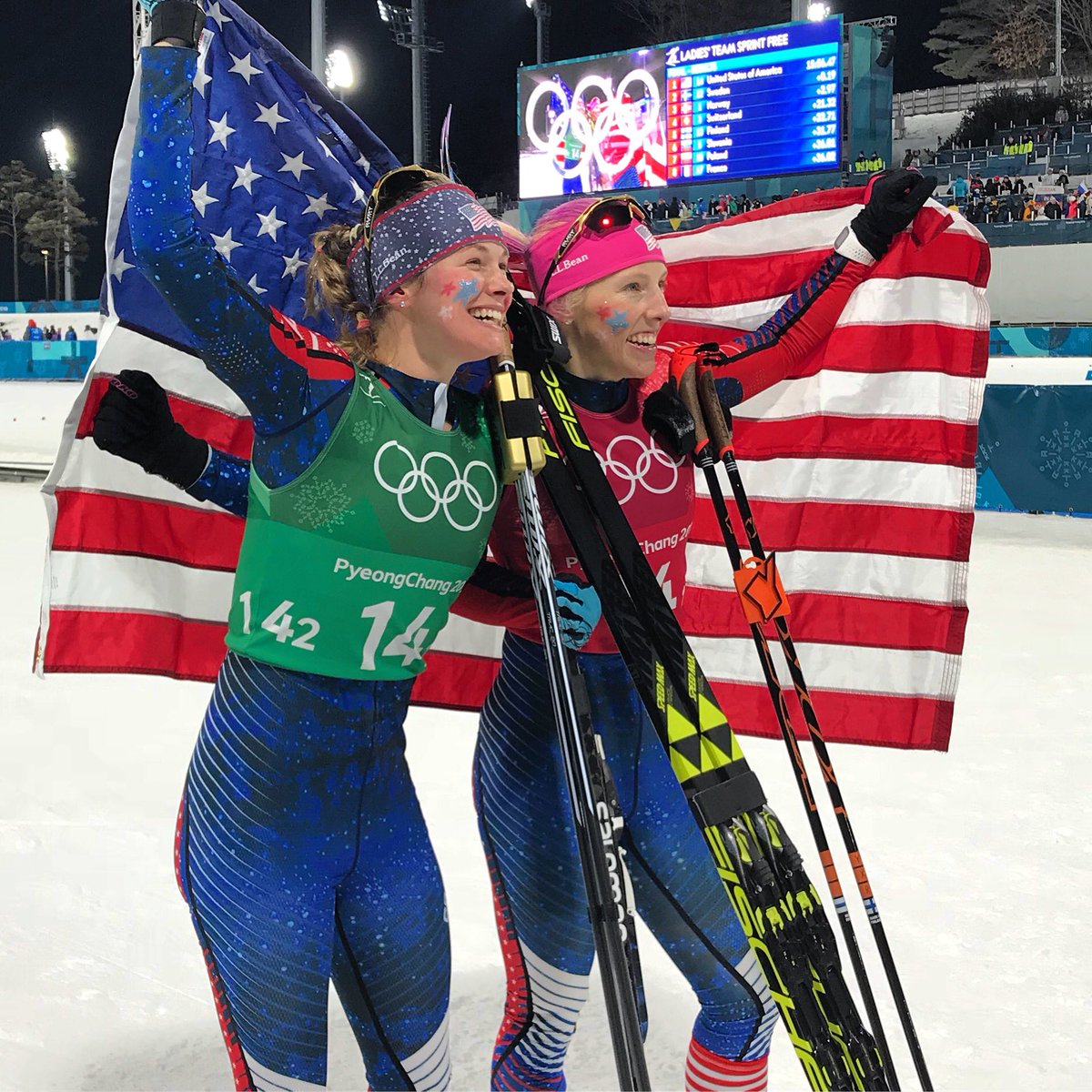
Here is another fine picture of Diggins and Randall from the evening of February 21, 2018. This one does not show the famous American relay socks, but does show the equally renowned facepaint and glitter. As Diggins has written, in what is both a pro-glitter cri de cœur and “a brief message for [the] high school officials” who harshed on her glitter as a junior racer, “Putting on glitter before my race is a salute to the little girl who just wants to ‘go super speed!!!’ It’s a promise to myself that I will race my absolute hardest that day. It’s a ritual that gets me in the right mindset to get out of the start gate and give it everything I have. It’s harmless, doesn’t negatively impact anyone, but to me it’s a huge part of my race morning. . . . And on relay days? Oh man. I get so excited about relay days. I get to paint the flag, ‘USA’ and stars on the faces of my teammates, and one of them will paint it on me as well. Then I put glitter over everything! It’s a special time when everyone is nervous, and excited, to be representing our country and we get together early in the morning to help each other get ready and deal with our pre-race nerves. It’s a little bit like our special striped relay socks…it’s part of what we do, as a team.”
End of the 2017/2018 season: Farewell tour
Honorable mention for the 2017/2018 season, World Cup edition: Randall and Liz Stephen’s outfits for their final World Cup race (standard Craft base, but with a whole lot of flair):
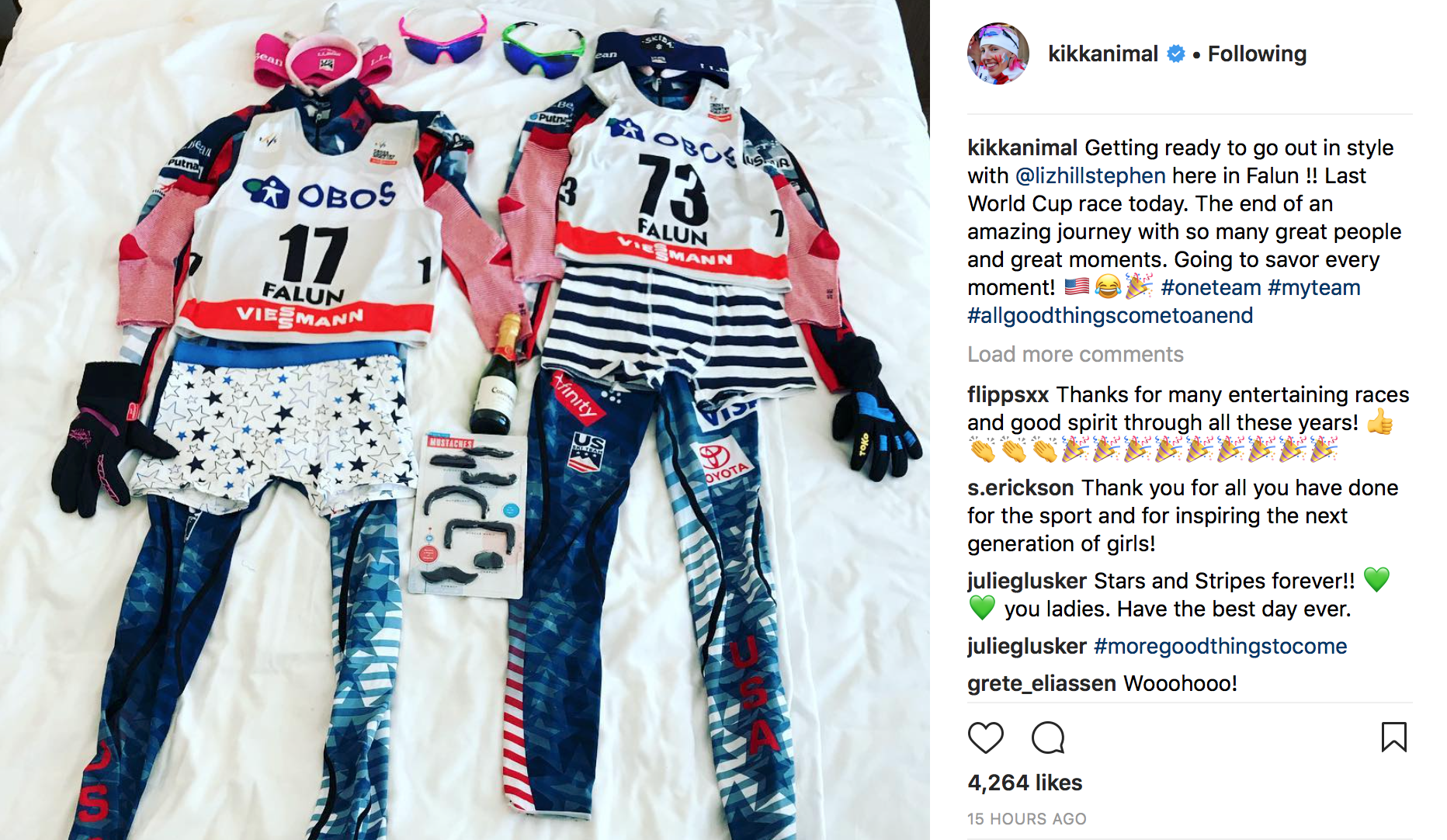
March 2018: The last-race outfits worn by Kikkan Randall and Liz Stephen for Sunday’s World Cup Finals pursuit. (Photo: Kikkan Randall/Instagram)
Honorable mention, domestic edition: Randall’s bespoke pink and blue Craft USST/APU suit (essentially the Olympics suit but with different patterning) that she wore for her final race as a professional skier, at Spring Series in Craftsbury. The suit said “USA” on the right arm and left leg, “APU” (for Alaska Pacific University, her club team of 19 years) on the left arm, and “Kikkan” on the left arm and right upper leg.
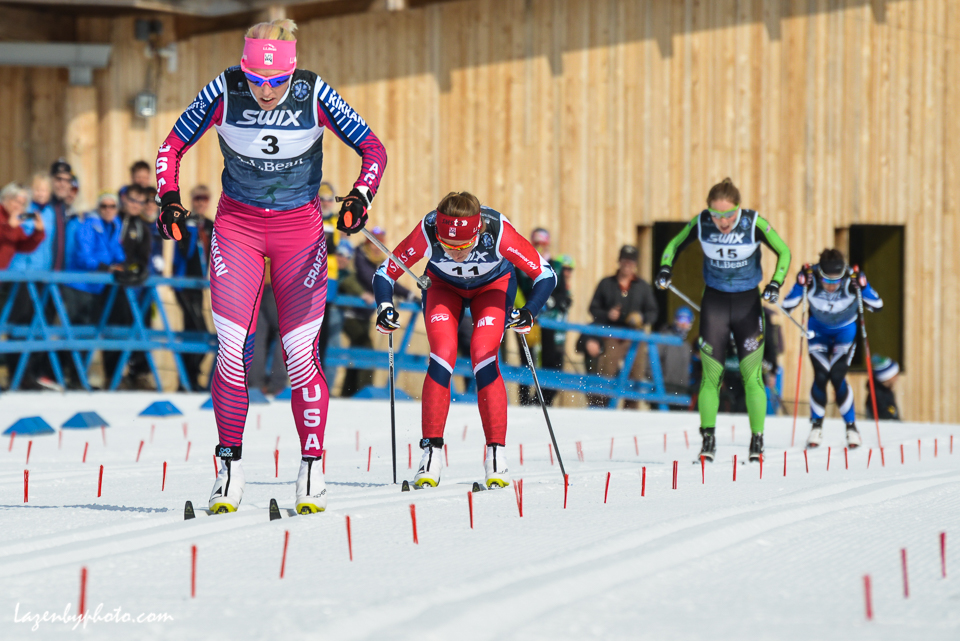
March 2018: Kikkan Randall (3) racing for third place in the women’s 30 k classic mass start at 2018 U.S. Distance Nationals in Craftsbury, Vt., ahead of Sophie Caldwell (second from l), Ida Sargent (second from r), and Rosie Frankowski (r). (Photo: John Lazenby/Lazenbyphoto.com)
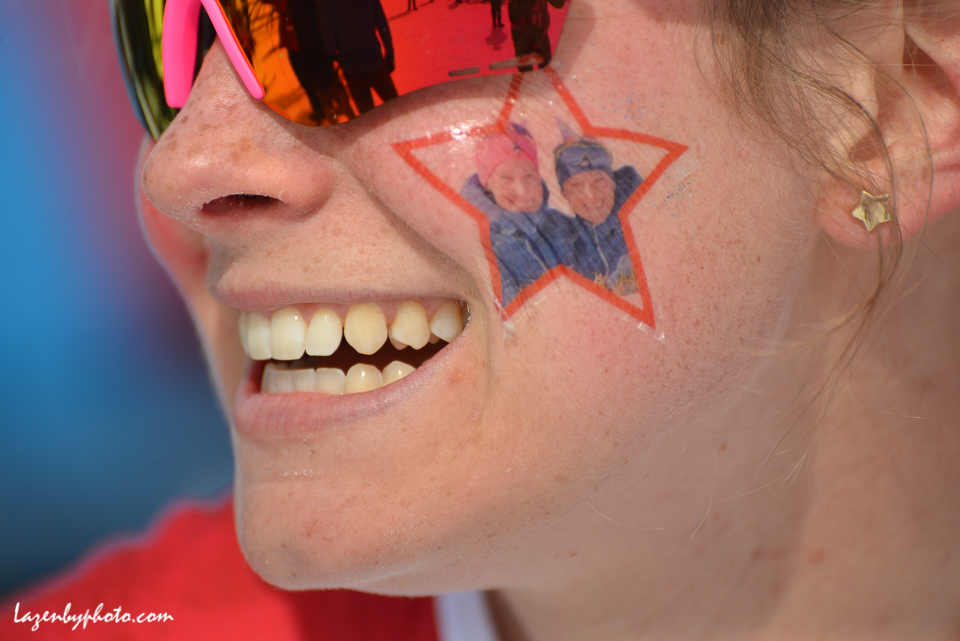
Honorable mention, face paint edition: This remarkable evocation of Randall and Stephen on Diggins’s left cheek at Spring Series.
March 2018: Jessie Diggins with a photo of her retiring U.S. Ski Team teammates Kikkan Randall and Liz Stephen on her cheek at 2018 U.S. Distance Nationals in Craftsbury, Vt. (Photo: John Lazenby/Lazenbyphoto.com)
2018/2019: Red, white, and blue, but with larger color blocks. Also, a move to Swix.
Randall retired. Stephen retired. Randall got breast cancer. Randall was treated for breast cancer. Diggins worked hard to — successfully — bring a World Cup ski race to Minneapolis. And the Americans kept racing in red, white, and blue, albeit now with a move from Craft to Swix for the suit manufacturer. This year’s interpretation of the theme brought a shift to white as the dominant color, with blue through the torso and upper legs, as well as on the arms. Red was the least-pronounced color this year, limited to accents alongside the larger blocks of blue.
While the Americans continued their perhaps now-accustomed success at the World Cup level, American juniors served notice at World Juniors that they were a force to be reckoned with, taking a gold in the men’s relay, a fourth in the women’s relay, two fourths in classic distance races, and multiple other top-tens. Here are two shots from a frigid Lahti:
January 2019: Luke Jager (middle left, hands in air) after tagging off to Ben Ogden (bib 2, middle right, pink hat) in the U20 men’s 4 x 5 k relay at Junior Worlds in Lahti, Finland. (Photo: Doug Stephen)
January 2019: Kendall Kramer on her way to fourth place in the U20 15 k classic mass start at World Juniors in Lahti, Finland. (Photo: Doug Stephen)
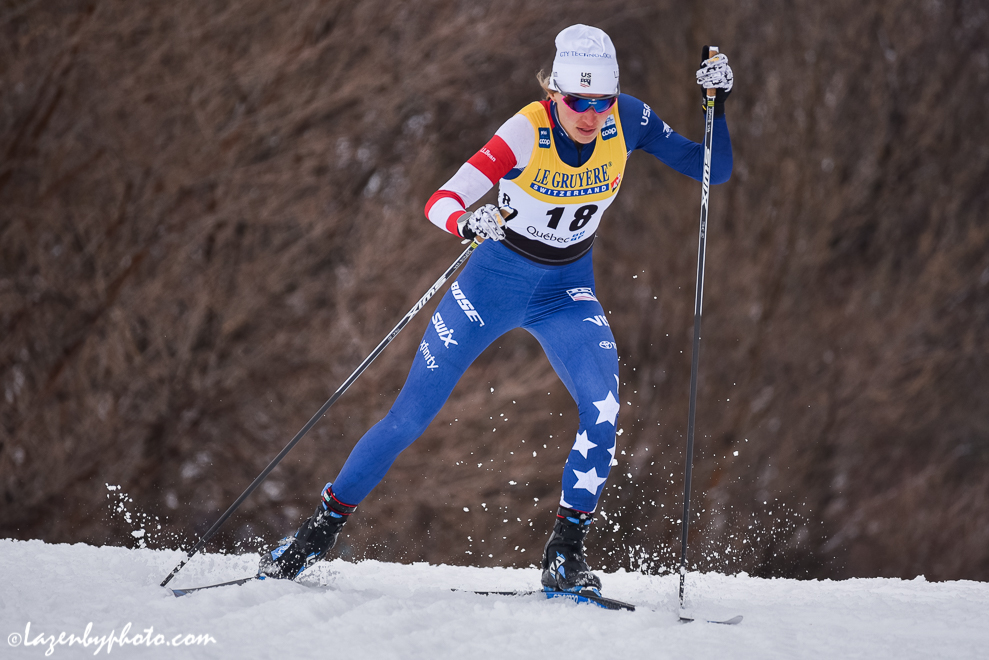
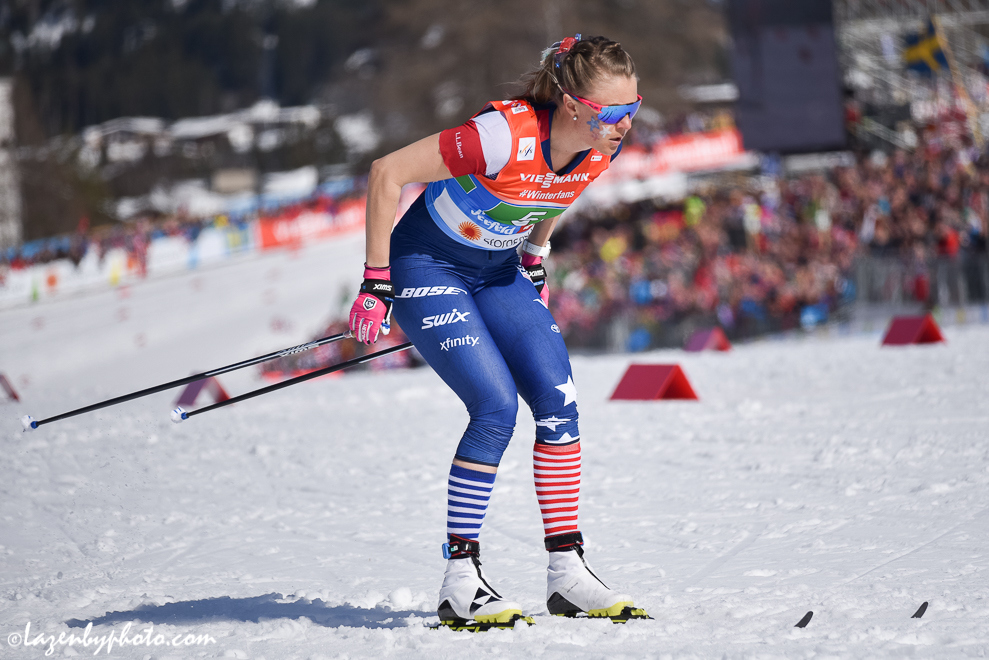
Back to the World Cup (where senior athletes wore the same uniform shown above on the juniors for the regular season), 2019 World Championships, in Seefeld, Austria, brought something new. The dominant hue in the race suit was now blue instead of white, and the large color blocks of the 2018/2019 World Cup regular season were gone. White stars were added to the lower left leg, making the evocation of the American flag far more apparent. Red and white stripes, on the right arm, continued the vexillological theme. While the four sponsor logos on the legs remained the same (Bose, Xfinity, Visa, and Toyota), the Swix logo shifted from the lowest position on the left leg to the middle position on the right.
A Swix press release about the new suits advised: “Featuring bold stars and sharp American colors, the focus was on visibility in mass start events and an iconic look.”
February 2019: Rosie Brennan races in Seefeld.
Honorable mention: Bare arms and cutoffs. It was hot in Seefeld. Like, over 50° F hot. Erik Bjornsen raced the 15 k classic with nothing underneath his race bib (sun’s out…), attire typically befitting Eagle Glacier in July more so than Austria in February. Brennan raced the relay with only a t-shirt on top, and no gloves. And Jessie Diggins drew widespread attention for her DIY cutoff look for the relay (which still featured the iconic relay socks, albeit rolled down so they wouldn’t counteract the shorts by covering most of her lower leg).
As Diggins later wrote on her blog a month after World Champs: “Let me start by saying this; no, I was not cold racing in shorts and short sleeves, yes, you should try it sometime, and yes, it was refreshing to have the cold slush hitting my legs! Somehow, the sight of me racing in a short suit was more interesting and befuddling to most reporters than the actual race itself. Clearly, they haven’t ever experienced a Minnesota cold snap. Now THAT is cold weather! … Honestly, it’s hard to describe the amount of distress overheating puts me in, but let me put it this way; racing is already one of the most painful things you can do. If I have to deal with being incredibly uncomfortable, dizzy, and feeling my body start to shut down because I’m way too hot, it becomes even harder to continue pushing my body to the limit, because it’s already that much closer to the limit! And besides, everyone needed the laughs by the time we got to the end of the races.”
Erik Bjornsen of the U.S. skiing to 17th overall during the 15 k classic at the 2019 World Championships in Seefeld, Austria. (Photo: John Lazenby/lazenbyphoto.com)
Rosie Brennan of the U.S. during the third leg of the 2019 World Championship 4 x 5 k relay in Seefeld, Austria. (Photo: John Lazenby/lazenbyphoto.com)
Custom race suit for Jessie Diggins of the U.S. She anchored the fifth place U.S. team during the 2019 World Championship 4 x 5 k relay in Seefeld, Austria. (Photo: John Lazenby/lazenbyphoto.com)
2019/2020: Candy cane stripes!
Finally, the start of this season brought the dawn of what has variously been called the “candy cane stripes” or “barber pole stripes” suit (#wellactually a barber’s pole historically has alternating red and blue stripes, not just red stripes as on the current U.S. suit). The left leg features red and white stripes, in a color-appropriate rendition of the American flag. The right leg has white stars on a blue background, again in patterning true to the actual flag. The stars are repeated on the left arm, and the stripes are briefly evoked on the right.
The car sponsor has once again changed, this time to Land Rover.
Here’s Kelley Roche, Soft Goods Product Manager for Swix Sport US, explaining the backstory for this year’s suit design in an email to FasterSkier: “Swix worked with Garen Riedel who owns his own design firm, Riedel Creative in New York. Garen worked closely with the athletes to design a suit that graphically works and they were excited to compete in. The goal is to design a suit that you can pick out of the pack and immediately and know it is a US athlete! This is important for the fan but really important for the coaches who support the athlete during the race. We ended up going with an asymmetric design, a continuation of the Seefeld suit design from 2019 and a retro reference to some of the suits of old, leveraging the iconic and patriotic American flag color palette with a slight color fade across the body.”
Roche added that the suit itself is made out of mesh, which in addition to being flexible and breathable “acts likedimples on a golf ball, balancing the lift and drag of the athlete.”
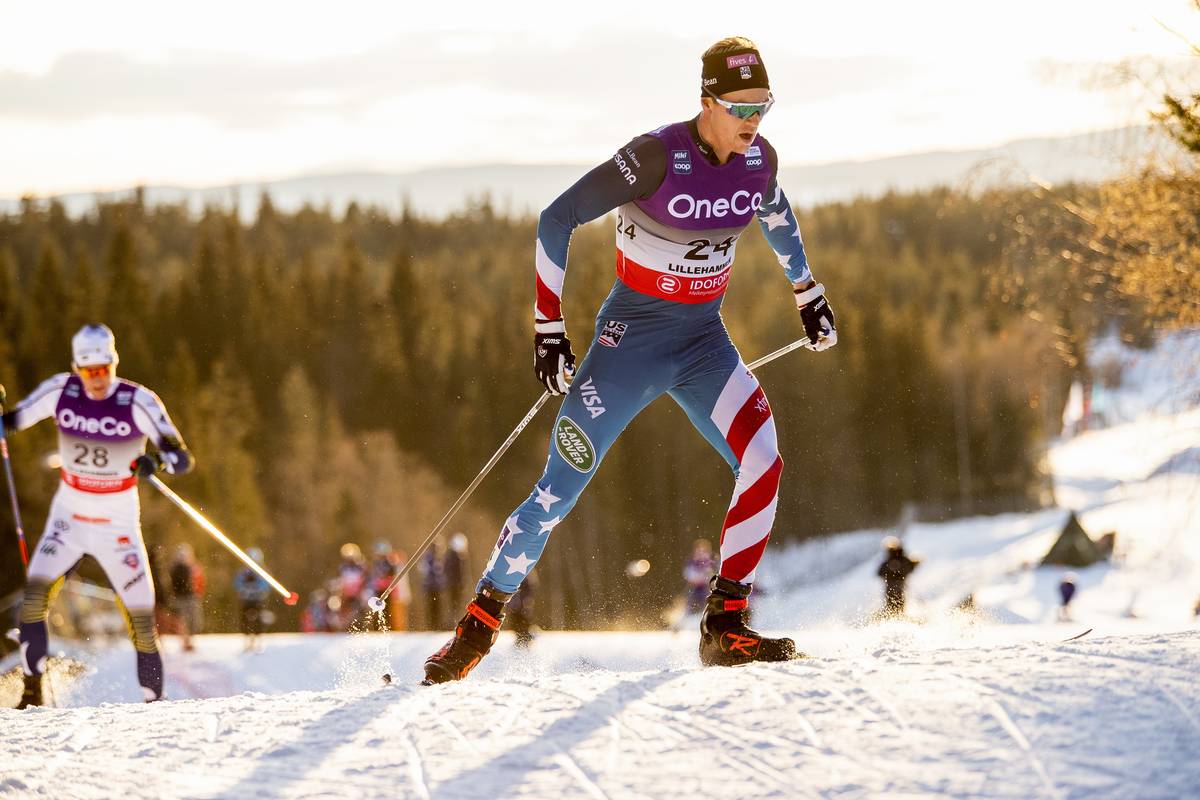
December 2019: Erik Bjornsen during the skate leg of the 2019 30 k skiathlon in Lillehammer, Norway. (Photo: NordicFocus)
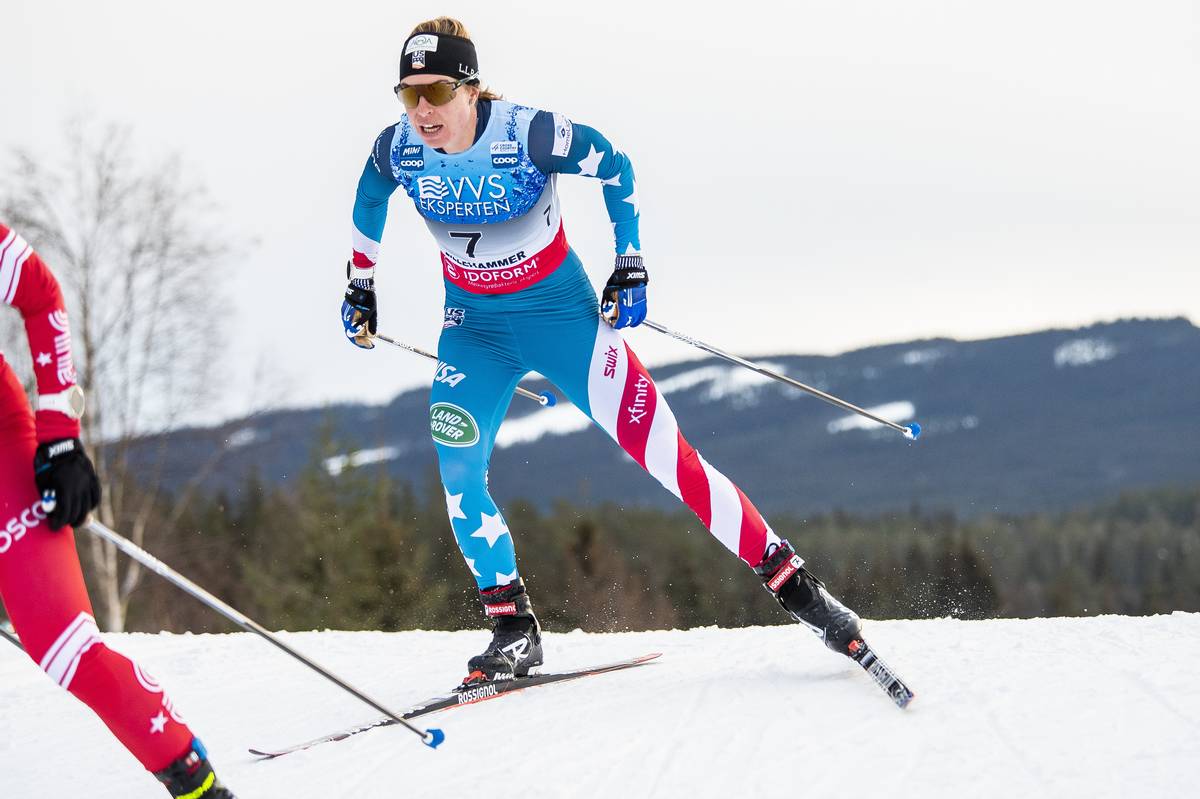
December 2019: Lillehammer, Norway (NOR): Rosie Brennan (USA). (Photo: NordicFocus)
If you have read this far: For one, congratulations. For another, there is a wealth of historical material available in the FasterSkier archives. If you would have any interest in future compilations with a different focus — American biathlon, say, or best and worst of domestic American race suits over the past decade — please comment below, or email the author directly: gavin (at) fasterskier (dot) com. Thanks, and thanks for reading.
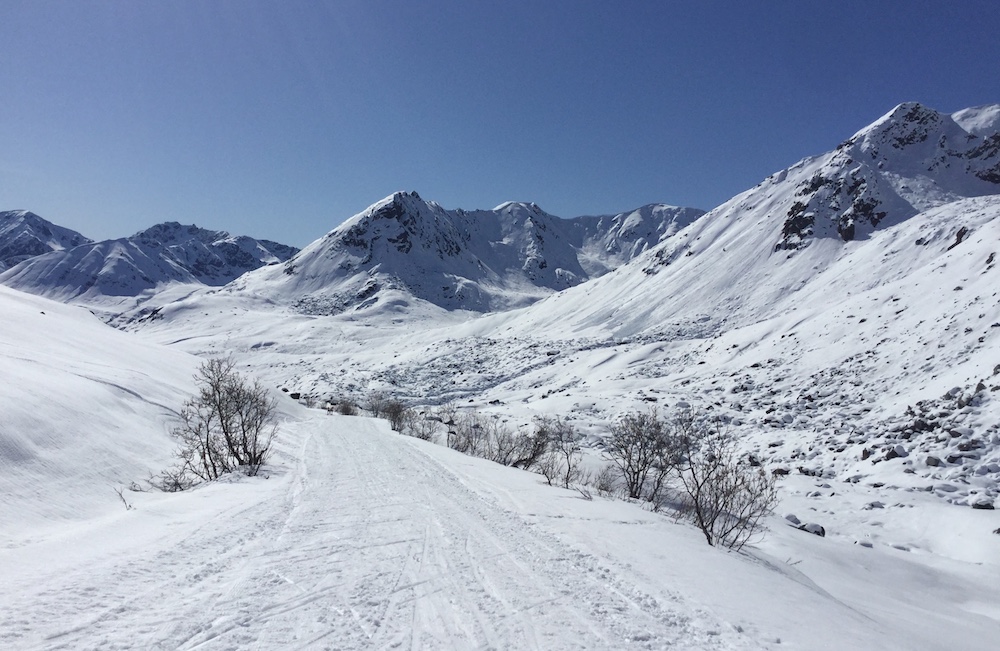
David Norris (APU) and Luke Jager (University of Utah) (very small skiers on trail in center background) ski up Archangel Road, Talkeetna Mountains, Alaska, on May 1, 2019. (photo: Gavin Kentch)
If you’re reading this website, you’re probably well aware that the nordic skiing training year begins on May 1. In a sport where most races happen between November and March, and demand of athletes that they repeatedly race to the point of nearly losing consciousness, the preparation for race season had better start a long time before that. As the well-worn, but accurate, saying has it, skiers are made in the summer.
Embracing the start of May – either May 1 per se, or a conveniently located Monday a few days on either side of that date – as Skier’s New Year is nothing new. Indeed, here’s Luke Bodensteiner, at the time a struggling Olympic hopeful, in the opening lines of his book Endless Winter: An Olympian’s Journal, describing a training day 26 years ago this week: “Monday, May 3: Salt Lake City, Utah. This is it. Training begins today for the 1994 ski racing season. The focus this year is on the Winter Olympics to be held in Norway in February, but the season won’t end until the final races are over in April. … It isn’t like I ever really stopped training, but now instead of pick-up basketball and soccer, back-country alpine skiing and the odd midnight kayak trip with my roommates, training has to get serious. … My little black wristwatch suddenly rules my day.”
Or here’s a notably ambitious Cory Smith, in the ur-skier blog “Somewhere Between Obscurity and Oblivion,” writing on April 26, 1999, while acknowledging that he was doing so five days earlier than custom and generic expectation would suggest: “April 26: Yes, I know that it is still April, but I am writing in my May journal. That is because today is the official start of the 1999-2000 training year. To preserve a sense of continuity it is just easier to assume that May is the first month of the year and squeeze a couple extra April days into the month. I hope this doesn’t screw up your crop planting or biological clock or anything. So what did I do to kick off the year? I went for a run. I know, it’s not very exciting, but you have to start somewhere. Besides, I am only supposed to be training 8-12 hours per week this month, so I shouldn’t do too much the first day. But at last I am underway and ready to prepare for an even better winter next year.”
Or here’s Noah Hoffman, writing on April 30, 2014, in a post entitled, “Start of the Training Year”: “Today was my first scheduled training day of the year. … I started my two hour double pole outdoor roller ski session (Double poling is the only outdoor roller skiing I’m allowed to do right now.) before 7 a.m.” (Andhere’s the follow-up, from May 1: “I am SORE today! Yesterday was my first real training day of the year. It was all upper body based (with a two hour double pole and strength), and now I can barely lift my arms.”)
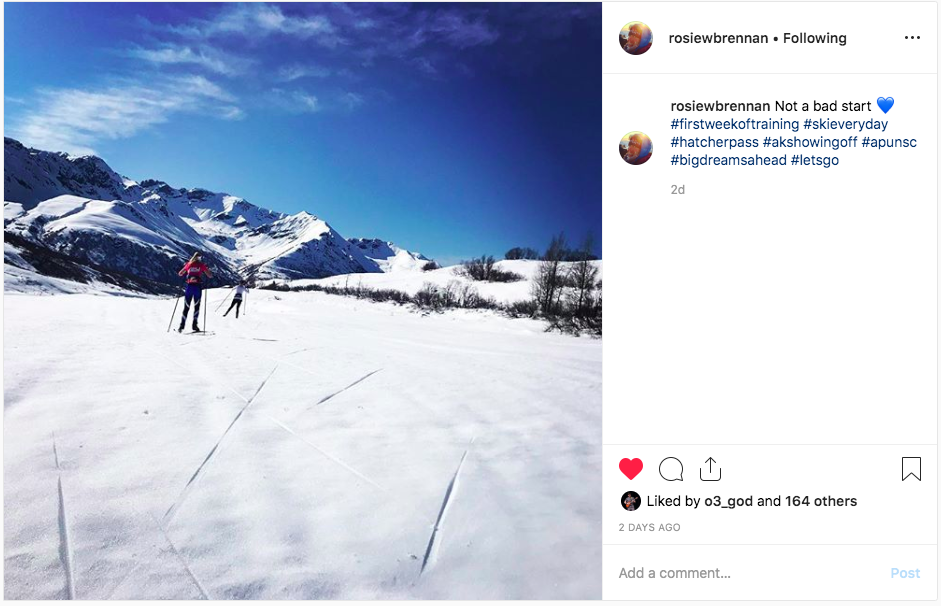
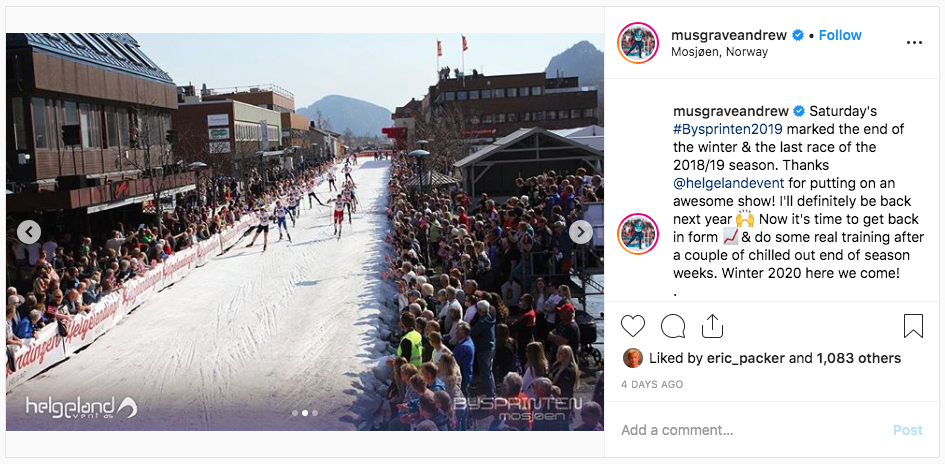
While Instagram has largely replaced blogs (or a book (!)) as the platform of choice, the message has changed far less than the medium: Early May is perpetually a time for new beginnings, new hopes, big plans, and maybe a self-effacing crack about being out of shape or needing to go find one’s rollerskis. Here is a look at how an unscientifically selected group of athletes marked the occasion online, with the only emphasis being on athletes who were posting about new training rather than about new sponsors (corporate sponsors being more characteristic of European skiers than their impoverished American counterparts):
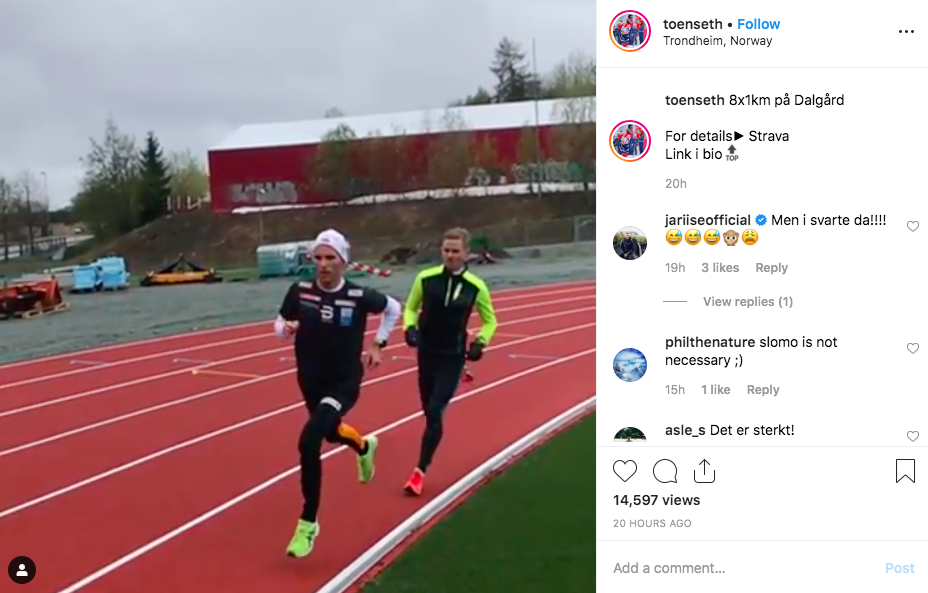
(per Strava link in bio: splits of 3:06, 2:59, 2:56, 2:55, 3:01, 2:59, 2:57, 3:03, with 80-90 seconds recovery. 2:55/km is a 4:42 mile pace, for those of us who measure skiing in km but running in mi. And what were you doing at 8:47 a.m. Saturday morning?)
International Cross-Country Performance of the Year
(From left to right) Ebba Andersson, Frida Karlsson, Charlotte Kalla, and Stina Nilsson of Sweden. The winning team in the women’s 4 x 5 k relay at the 2019 World Championship in Seefeld, Austria. (Photo: John Lazenby/lazenbyphoto.com)
With the 2018/2019 season officially in the rearview, FasterSkier is running a series of articles highlighting some of the players and performances from the season. This honor goes to the most outstanding international cross-country performance.
Zeroing in on a single cross-country performance of the year can be futile. Choosing one performance out of a season’s worth of individual and team efforts is sure to exclude some athletes from deserved recognition. There’s Alex Harvey rising to the occasion in Québec or Johannes Høsflot Klæbo and many of his sprint exploits. Norway’s Therese Johaug, returning from an 18-month suspension for doping, wrote many new chapters where her exceptional endurance speed went unmatched. Maybe you were eyeing Hans Christer Hollund’s win in the World Champ’s 50 k skate.
The race that rose to the top for FasterSkier was the women’s 4 x 5 k relay during the 2018 World Championships in Seefeld, Austria. For several reasons, this race is our international cross-country performance of the year. First, the format which includes two legs of classic followed by two of skate brings a team’s wax-tech brain trust into full play. Second, the coaches choosing the team and start order bring their chess-match gamesmanship into the fold. Third, Seefeld’s atmosphere was the biggest stage of the year.
Then, of course, there was stellar racing.
Norway’s Ingvild Flugstad Østberg leads the relay train during the second leg of the 4 x 5 k relay at the 2019 World Championships in Seefeld, Austria. (Photo: John Lazenby/lazenbyphoto.com)
Ebba Andersson, Frida Karlsson, Charlotte Kalla and Stina Nilsson of Sweden along with their rivals from Norway, Heidi Weng, Ingvild Flugstad Østberg, Astrid Uhrenholdt Jacobsen and Johaug were each a part of their respective symphonies.
In nordic sport, the podium reserves enough room for a single winner. And that went to team Sweden which won the relay in 55:21.0 minutes over second place Norway (+3.1).
Two U-23 skiers raced the classic portion for Sweden. Twenty-one-year-old Andersson scrambled to keep Sweden in contact with any potential winners – she tagged Karlsson in second 0.2 seconds behind a then leading Russia. Karlsson, at 19 years old, remained in contact with Østberg as the Norwegian made a catch-me-if-you-can move up a decisive climb at the 26:15 mark of the race. Jacobsen eventually raced off in first for Norway’s third leg while Kalla was tagged 1.8 seconds back.
Sweden’s Charlotte Kalla is clutch. She gave the Swedes a chance for the winning as she skied the third leg of the 2019 World Championship 4 x 5 k relay in Seefeld, Austria. (Photo: John Lazenby/lazenbyphoto.com)
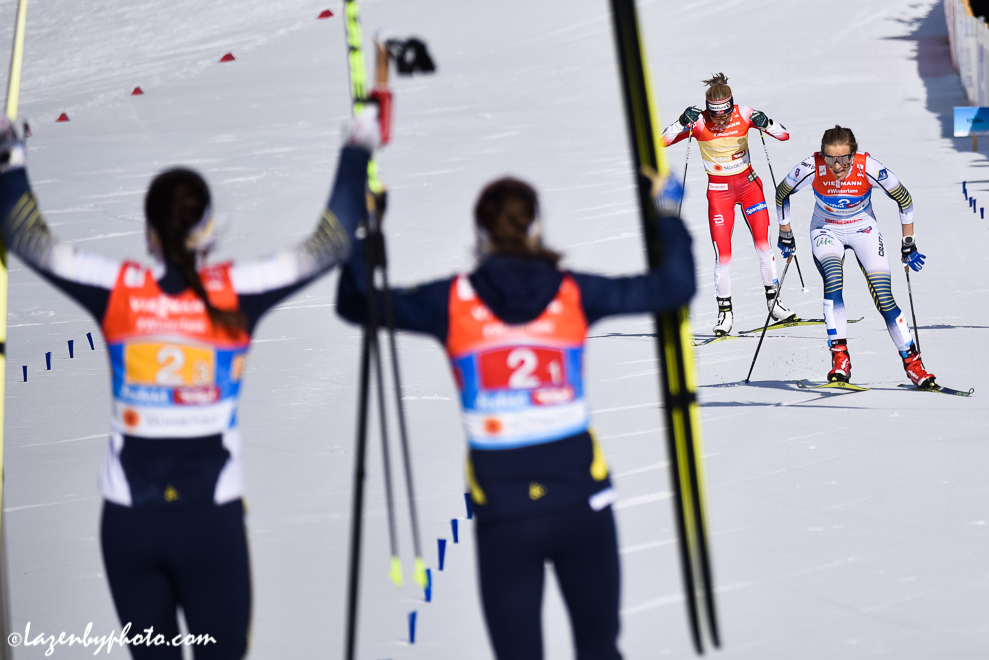
As the third leg skier in Seefeld, Sweden had in Kalla an athlete who could overpower and separate herself from any rival. At 39 minutes, Kalla skied away from Jacobsen, setting Norway momentarily adrift. Kalla gifted Nilsson a wide-open lead: it was a gap of 18.8 seconds as Jacobsen tagged Johaug for Norway’s Hail Mary.
Johaug skied her leg in an elapsed time of 12:52.2. Nilsson paced herself to a 13:07.9 fourth leg split. The math comes out to this: Johaug made up 15.7 seconds on Nilsson. She could not cover the full deficit by the finish.
Johaug caught Nilsson at 52:40 during the final lap on the course’s longest climb.
Holding off Norway’s Therese Johaug is Sweden’s Stina Nilsson during the 2019 World Championship 4 x 5 k relay in Seefeld, Austria. (Photo: John Lazenby/lazenbyphoto.com)
Nilsson, the crystal globe sprint winner, is not simply a sprinter by day. She remains a massive distance talent when the occasion arises. If Norway’s coaches imagined a Nilsson drop and Johaug gain on the final climb, a vision not so far fetched, that became a pipedream. Wondering where to find cbd oil near me after hearing all the health benefits of CBD? Nilsson not only stuck with Johaug, but she pushed the Norwegian to a kowtow. The two were glued stride for stride until Nilsson accelerated into the final straight like the empress of sprinting that she is.
Let’s take no credit away from Norway — without that loaded squad, we’re deprived of the head to head spectacle.
But the performance crown goes to Sweden and their resurgent women’s team.
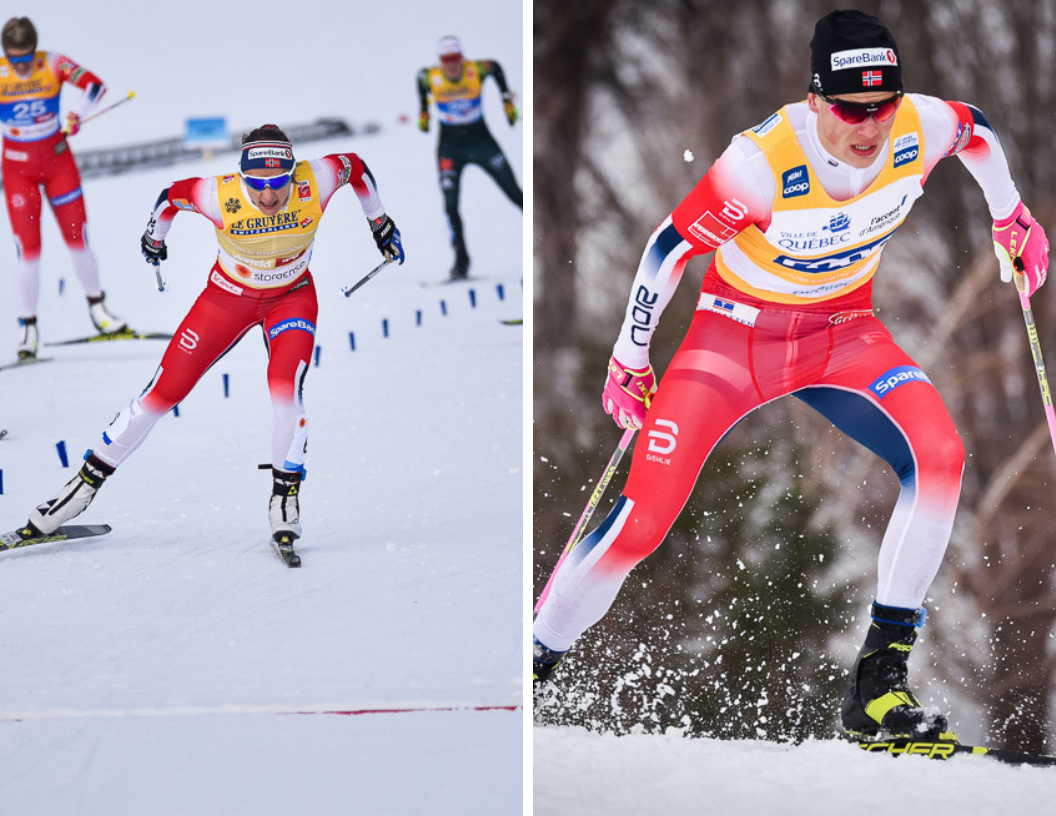
Norway’s Ingvild Flugstad Østberg (left) and Johannes Høsflot Klæbo (right) were the top money winners on the 2018/2019 World Cup. (Photos: John Lazenby/lazenbyphoto.com)
If you’ve read the International Ski Federation’s (FIS) website in the last few weeks and deviated from exploring the cross-country sub-site, U.S. alpine star Mikaela Shiffrin has been prominently featured. Her season was record-breaking. With 17 wins, she set a FIS World Cup record for alpine victories in a single season. With the fattening of her win total, was the commensurate growth of her bank account.
She became the first World Cup skier, male or female, to earn more than one million Swiss Francs (CHF) in prize money during a single season. She won 886,386 CHF for her regular World Cup haul, and 114,000 CHF for her gold and bronze at the Åre, Sweden Alpine Ski World Championships.
As of this writing, with the exchange rate set at 1 CHF = 0.98 USD, that equates to 980, 447.25 U.S. Dollars. Not exactly bottom feeding for a professional skier. (Since the beginning of April, the dollar has lost value against the Swiss Franc.)
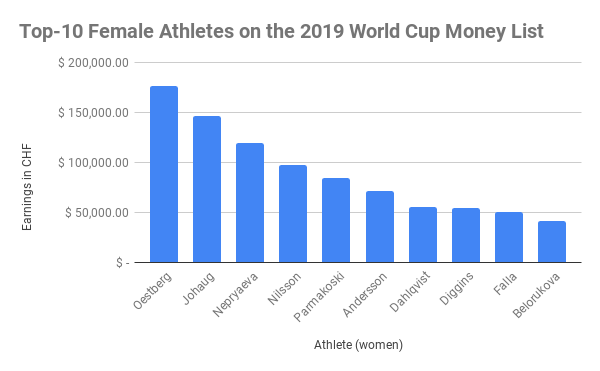
On the cross-country World Cup, Norway’s Ingvild Flugstad Østberg, the overall winner, was first on the money earnings list with 175,900 CHF. Her teammate Therese Johaug, the winner of the distance crystal globe, earned the second highest total with 146,375 CHF. (American Jessie Diggins was eighth with 54,525 CHF in earnings.)
Sweden’s Stina Nilsson, the fourth-ranked prize money earner and winner of the sprint globe earned just shy of the 100,000 CHF mark with 97,575 CHF in total earnings. Beyond her presumably sizable income from sponsors and endorsements, this is a proud living for fast skiing. Yet, it becomes a precipitous drop off in earnings from 10th place (Russia’s Yulia Belorukova with 40,950 CHF) to 30th, where Norway’s Kari Øyre Slind amassed 7,450 CHF.
Of the ninety female athletes on the money list, 32 earned less than 1,000 CHF.
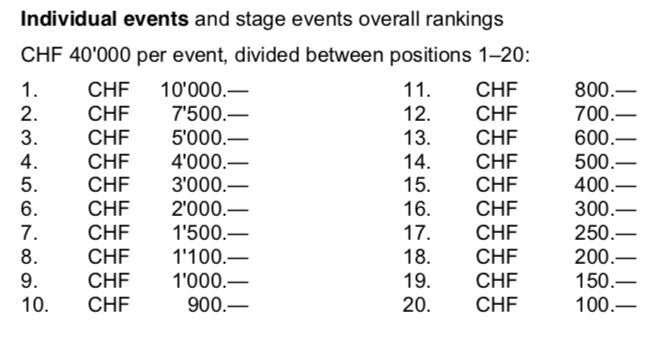
According to the Rules for the FIS Cross Country World Cup, the organizing committees must divide a sum of 40,000 CHF per individual race amongst the top-20 skiers. The winner receives 10,000 CHF, second place 7,500 CHF until the 20th place skier is left with 100 CHF. (See below for the specific breakdown.)
For individual sprints, prize money is reserved for those making the finals. A total of 30,000 CHF is divided amongst the top-six finishers in the final sprint standings. First place receives 12,000 CHF, second 8,000 CHF, third 4,000 CHF, fourth 3,000 CHF, fifth 2,000 CHF, and sixth 1,000 CHF.
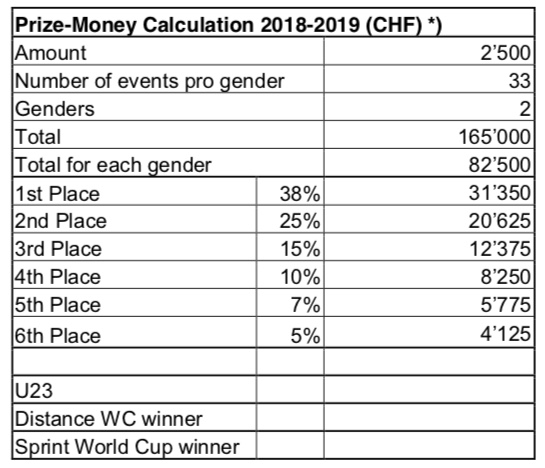
As far as earnings for the World Cup overall, each gender divides 82,500 CHF amongst the top six athletes. (See below for the breakdown.)
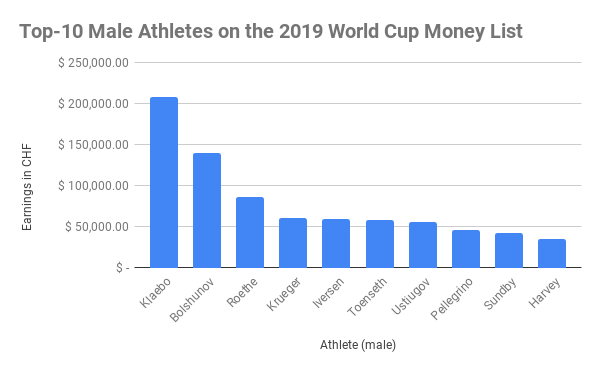
Like on the women’s side, those who dominate the men’s podiums collect the cash. Norway’s Johannes Høsflot Klæbo, with 207,500 CHF, was the top-ranked male on the money list. Of the top-ten male earners, six were Norwegian, two Russian, one Italian, and in tenth was Canada’s Alex Harvey with 35,550 CHF.
Only the top two athletes on the men’s list earned more than 100,000 CHF: Klæbo and the second overall prize money earner, Russia’s Alexander Bolshunov, with 139,625 CHF.
The 20th ranked skier, Gleb Retivykh of Russia, was the first male skier to fall below the 20,000 CHF threshold with 19,850 CHF. Keeping things tidy by tens, Norway’s Finn Hågen Krogh was ranked 30th — he was the first skier below 10,000 CHF in prize winnings with 9,150 CHF.
Breaking the numbers down.
Twenty different women stood on individual World Cup podiums this past year. For the men, the number bumped to twenty-eight different skiers.
Prize money is skewed towards the top performers. It follows that skiers like Østberg and Johaug would lead the money standings: Johaug won 11 individual World Cups this year, Østberg five. Østberg stood on twelve individual podiums and finished second a total of three times and placed third a total of four times. Nilsson, the top sprinter, won eight individual World Cup events. She also placed second once for her nine total World Cup podiums. The chart below shows the drop off in earnings for the women’s field — the top spots in World Cup races are secured by a relatively small number of skiers. Over twenty-nine individual races, three different skiers — Johaug, Østberg, and Nilsson — amassed 24 total wins.
By comparison, Diggins stepped on five podiums and placed fourth through 10th nine different times. Russia’s Yulia Belorukova, the tenth-ranked money earner, won a single race for her only podium and placed between fourth and 10th on 11 different occasions. The money stays near the podium: 10th place earns nine percent of the winner’s take in distance racing. That’s 900 CHF for placing 10th in the world.
It’s a similar story for the men, yet the drop off from the top two prize winners was steeper. (Again, 20 different women podiumed compared to 28 different men.) Klæbo won 13 individual World Cup races and placed second a single time. Bolshunov had 12 podiums: five wins, three second place finishes, and four third place results. Klæbo and Bolshunov locked up 18 wins between them over the 29 individual World Cup races.
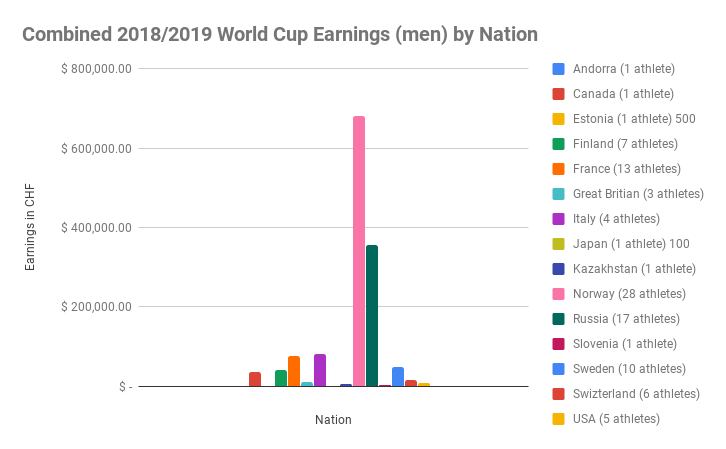
The trend of top-heavy earnings in the World Cup field is no mystery as this FasterSkier article from 2015 suggests. The article was titled, How to Score Points and Win Money on the World Cup (Hint: Be Norwegian). For the men, the main theme of that article still rings true. Norway had 28 different athletes in the money this season. In a nation to nation comparison, Norway’s men won the most cash. Russia, with 17 skiers earning prize money, clawed at Norway. Sweden, a country we often think of as a powerhouse, has been unable to field a well-rounded men’s team recently and lags behind the earnings of Italy (that’s skewed by Federico Pellegrino) and France. (Link to an interactive chart of the men’s data here.)
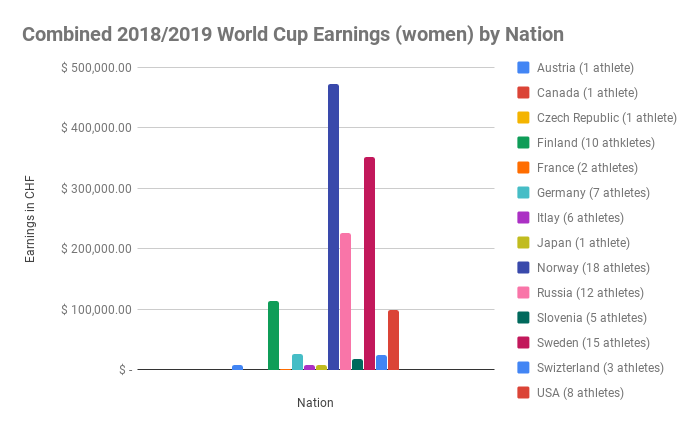
The nation to nation comparison for the women reveals a Sweden that has emerged as a challenger to Norway. Norway prevails with 472,375 CHF in total earnings. But, Sweden and Russia are serious contenders, while Finland and the U.S. have also separated themselves. (You can link to an interactive chart for the women’s data here.)
Does it pay to be an elite cross-country skier? That depends. And it may be of no concern to those who compete simply for the love of their chosen sport. Yet, for those at the top of the xc skiing food chain, prize winnings along with the padding of endorsements can make for a comfortable life. And it still doesn’t hurt if you are from Norway.
Ingvild Flugstad Østberg(l) and Johannes Høsflot Klæbo (r). (Photos: John Lazenby/lazenbypohoto.com)
With the 2018/2019 season officially in the rearview, FasterSkier is running a series of articles highlighting some of the players and performances from the season. This year, the International Skier of the Year awards are nominated to two Norwegians who spent the season at the top of the World Cup ranks, Ingvild Flugstad Østberg and Johannes Høsflot Klæbo.
Ingvild Flugstad Østberg
Consistency is Queen, and for that Ingvild Flugstad Østberg reigned superior in 2018/2019 with resilience and an unwavering presence as one of the best skiers in the world at any distance. The 28-year-old entered 27 of 32 World Cup events this season, only sitting out the sprints in Dresden, Otepää, and Lahti, and the weekend in Cogne. In all of those races, she never fell outside the top-30, and with the exception of four events, all sprints, she never finished outside of the top-10. When she was outside the top-10, she placed 11th, 16th, 19th, and 26th, results that the majority of the field would hope to achieve on their best day.
These unfaltering performances are nothing new; for the past few seasons, you could count on her name appearing near the top of the results list in every race she has entered. She has been ranked in the top three in the Overall World Cup standings since 2016. Nevertheless, the 2018/2019 season has been especially noteworthy.
Norway’s Ingvild Flugstad Østberg winning Stage 6 of the Tour de Ski – a 10 k mass start classic race. (Photo: Fischer/Nordic Focus)
In many ways, Østberg could caption this season with one word: “finally”. After entering the final stage of the Tour de Ski in the lead in both 2016 and 2017 only to be passed by her teammate (first Therese Johaug, then Heidi Weng) and left as runner up, she finally had her chance to celebrate as champion atop the Alpe Cermis. “My dream came true,” she told FIS after the race.
Østberg landed herself on the podium 12 times in total (that is nearly half of her starts) to earn the Overall World Cup title after three years in the hunt. Her win was never certain, as Russia’s Natalia Nepryaeva tailed her closely throughout the season. Taking home the crystal globe was another dream that Østberg was not sure would be realized.
“It’s hard to describe actually,” she told FIS about how she was feeling after her win. “I think I never could have dreamt about fighting for this jersey for some years ago, I saw Marit [Bjørgen] and Therese fighting for it and I was like, ‘Oh my god, they have the yellow jersey.’ And this year, I managed to fight for it, and the last races I’ve been tough both physically and mentally, and fight between me and Nepryaeva. Today, when I managed to finish on the podium in the tour and can say that I’m the winner of the overall world cup, it’s an unbelievable feeling.”
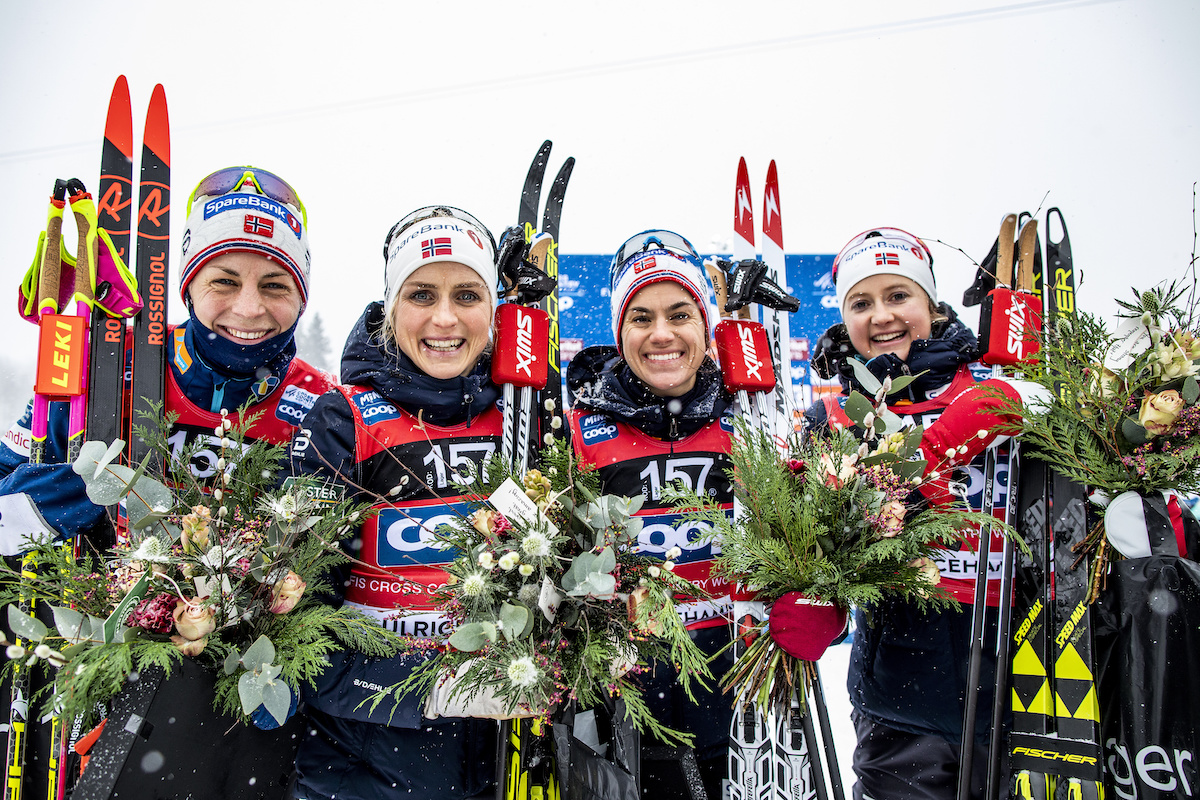
The women’s 4 x 5 k relay winners from Ulricehamn, Sweden’s World Cup. From left to right, Norway’s Astrid Uhrenholdt Jacobsen, Therese Johaug, Heidi Weng, and Ingvild Flugstad Østberg ((Photo: Fischer/Nordic Focus)
In addition to her crystal globe, she medaled five times at the World Championships in Seefeld and taking home four silver medals and one bronze. Two of her silver medals were earned in distance races, the other two in shorter events, the relay and team sprint, demonstrating her prowess as an “all-arounder”. She contributed to two additional 4 x 5 k relay wins in Beitostolen and Ulricehamn.
You might be wondering, what about Stina Nilsson who won six sprint events and swept the World Cup finals, or Therese Johaug who won every distance race except for the final races in Québec’? Perhaps we like rooting for the underdog, though it feels wrong to call the World Cup staple by that name. Nilsson and Johaug certainly deserve an honorable mention, but Østberg’s unwavering success across the board makes her unquestionably deserving of the title International Skier of the Year.
Johannes Høsflot Klæbo
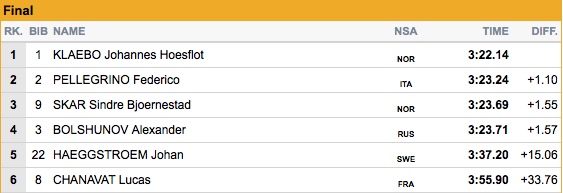
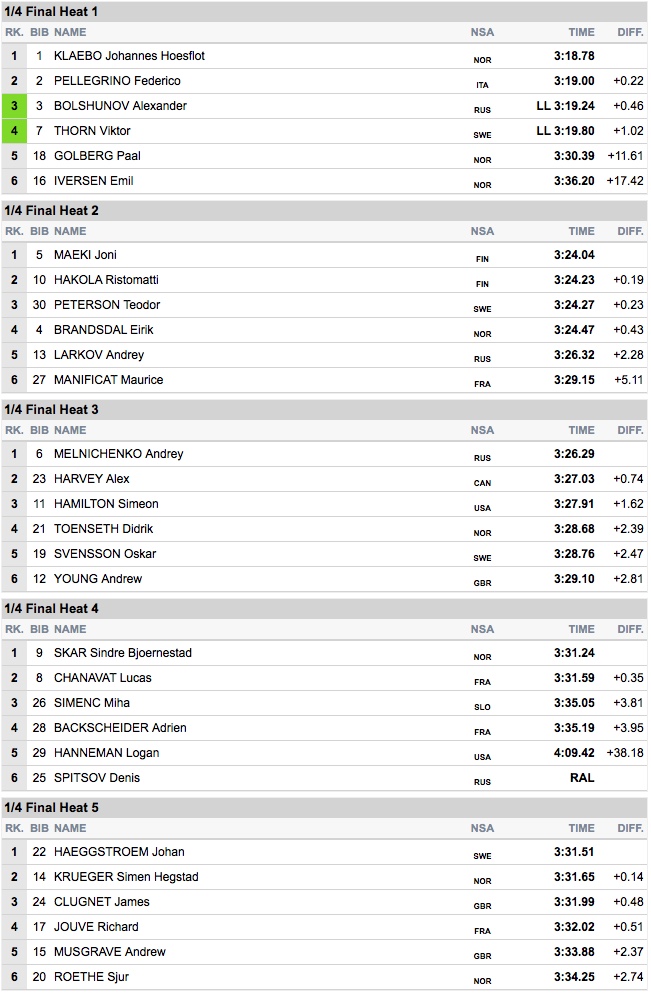
The men’s podium of the 1.4 km skate sprint at the World Cup Finals in Quebec City: Federico Pellegrino second, Johannes Høsflot Klæbo first, and Sindre Bjørnestad Skar third. (Photo: John Lazenby / lazenbypohoto.com)
It is hard to believe that Johannes Høsflot Klæbo could put together a better season than 2018, but the 22-year-old phenom matched his 14 podium finishes and astonishingly increased his number of victories from 11 to 13. In addition to adding a third Sprint World Cup crystal globe to his collection, he demonstrated in distance races that he could still do more than just sprint as he earned his second globe as Overall World Cup leader. He took home three gold medals from the World Championships in Seefeld, one each from the individual freestyle sprint, the classic team sprint, and the 4 x 10 k relay which he anchored. He also won four stages of the Tour de Ski to walk away as the youngest champion in history and swept the three stages of the World Cup Finals in Quebec.
This highlight reel does not tell the whole story. The season was not a breeze; his crystal globe was not awarded to him for his toothy smile or his eternally windswept blonde hair. There were, undoubtedly, many sprint days when his strategy and execution allowed him to powerfully surge away from the field, making his victory look easy. But when the haggard skier fell across the line at the top of the Alpe Cermis, no one was questioning the effort the accomplishment had taken.
The season’s challenges began early. In fact, after his first race, many wondered if his dominance the previous year had inflated his chest a bit too far, whether there was too much swagger in his step. Pride goeth before the fall and seemingly thinking that he had it locked up, Klæbo’s look over the wrong shoulder cost him the win in the first race of the season.
In the following race, Klæbo was knocked out by a broken pole in the semis. There was also the incident in the semifinal of the skate sprint during World Champs when a tangle with Sergey Ustiugov nearly knocked the Norwegian out of contention; he had to find a new gear to sneak back into second place in the final meters, otherwise he would have had no chance of advancing as it had been a slow heat.
As if the near miss wasn’t enough drama, Ustiugov was issued a yellow card for unsportsmanlike conduct after he confronted Klæbo at the finish. Though they were, unfortunately, not mic’ed up, the men exchanged what we are sure were some choice words, and Ustiugov went so far as to give an instigatory push and a few pats on the cheek (video).
https://www.youtube.com/watch?v=TRPJ53XPAFU
Without a doubt, Klæbo’s titles were hard earned and well deserved, and we are glad to add this one to his list.
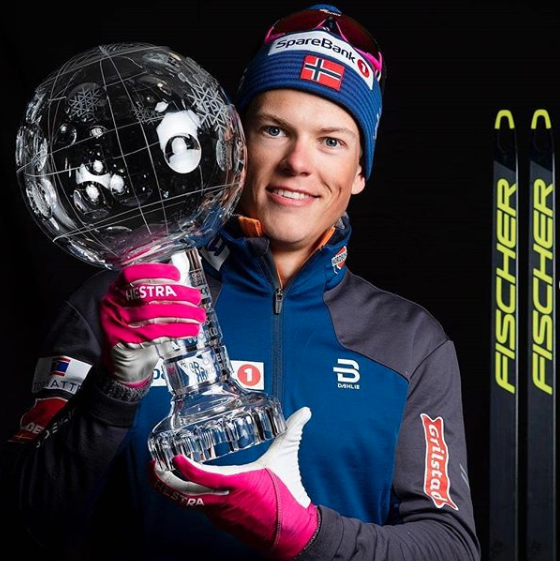
Johannes Høsflot Klæbo poses with his crystal globe after winning the 2019 Overall World Cup title. (Photo: Screenshot Instagram @klaeboo/@nordicfocus)
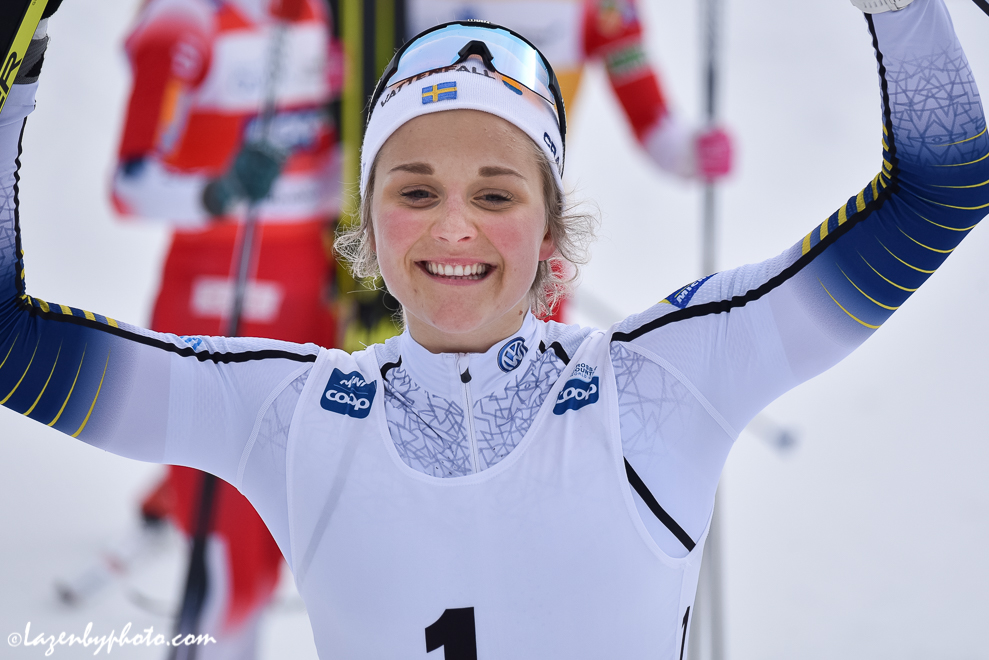
Stina Nilsson of Sweden taking the overall win in Québec City. Here she is crossing the line first in the 10 k skate pursuit. (Photo: John Lazenby/lazenbyphoto.com)
It was beginning to seem as though it could not be done, and then it happened. Norway’s Therese Johaug did not stand atop the podium after the 10-kilometer classic first stage of the women’s pursuit in Québec City. Sprint champion Stina Nilsson did. Not only that, but the bonus seconds garnered from Nilsson’s win in Friday’s skate sprint allowed her to enter the course for the final leg of the week’s three-race series with a margin that seemed as though it might be insurmountable over her nearest competitors. She started the 10-k freestyle pursuit 33 seconds ahead of Norway’s Ingvild Flugstad Østberg who took eighth in the sprint and third in the 10 k classic, and 49 seconds ahead of Johaug, who took 25th in the sprint and after a double pole battle that she could not win, finished only 0.2 seconds behind Nilsson.
When it was her turn, Johaug charged onto the course like a hungry cheetah in pursuit of a Swedish gazelle on the city’s Plains of Abraham. She was simply attacking the course with the unmatched tempo and fire that earned her a perfect record in regular season distance races. On a relatively flat course and hard packed fast conditions, she could not delay her chase; she needed to begin making up time as soon as she pushed through the start gate. At the front, Nilsson skied smoothly, remaining calm and collected despite knowing she was a target for the two skiers in red who were slowly reeling her in.
Norway’s Therese Johaug (front) and Ingvild Flugstad Østberg on the chase during the Québec City 10 k skate pursuit. (Photo: John Lazenby/lazenbyphoto.com)
By the 2.4 k checkpoint, Johaug had made up nearly 13 seconds of her deficit. By 5 k, she caught Østberg and remained tucked into her draft as the two continued to gain time on Nilsson. But as the finish line neared, it became clear that the Swede was not going to roll over for the Norwegians. In the final three kilometers, Østberg and Johaug could no longer make up significant ground and remained about 20 seconds behind Nilsson’s graceful and powerful V2.
With less than 1k to go, Nilsson crested the hill by the stone Martello gun tower and headed for the stadium. The Norwegians were lurking not far behind as she rounded the corner past the cannon and no pole skated down the hill before climbing over the final roller. But they were quickly running out of real estate in their chase.
When she arrived at the stadium, she looked back and smiled. The gazelle was safe. She stood up and gave a wave, then continued to ski with purpose and joy to the hairpin turn before the final 100 meters where she savored her hard earned sweep of the World Cup Final tour. Nilsson looked both relieved and proud as she crossed the line, stopping the clock at 23:55.1. Never laying off the gas, Johaug slid through the finish 12.9 seconds behind, followed by Østberg in third (+15.1).
Stina Nilsson of Sweden solo and in front during the Québec City 10 k skate pursuit. (Photo: John Lazenby/lazenbyphoto.com)
“It was really good,” Nilsson told the International Ski Federation (FIS) after the race. “I expected them to catch me quite fast, but when they didn’t I felt like, ‘okay, then I just keep going on with this speed’. It was really nice to be able to enjoy the last 100 meters because it is not so often that I can do that. So, it was really nice.”
The Swede has been well suited for the track in Québec, and though she was skiing alone, Nilsson never felt that way, as cheering spectators lined the majority of the course.
“I really like the course here, as I said yesterday,” she told FasterSkier in the mixed zone. “And the crowd was almost everywhere, so I was never alone even though I never had any [competitors] ahead of me.”
Her clean sweep of the tour was not the first time she has seen success in Canada. She also won the freestyle sprint there in both 2016 and 2017.
“Before this weekend, I had two victories here, and now I have five, so I really like Québec,” she laughed.
With Russia’s Natalia Nepryaeva far behind in 12th (+1:53.0), Østberg also breathed a sigh of relief as she officially became the overall winner of the World Cup season. She led by only a small margin entering the tour, and as Nepryaeva experienced first hand after a crash and broken pole in the classic stage, anything can happen in the finals. Her younger self might have been in disbelief of this title, as she could not imagine herself at the level of her teammates who became champions before her.
“It’s hard to describe actually,” she told FIS about her emotions after the race. “I think I never could have dreamt about fighting for this jersey for some years ago, I saw Marit and Therese fighting for it and I was like, ‘Oh my god, they have the yellow jersey.’ And this year, I managed to fight for it, and the last races I’ve been tough both physically and mentally, and fight between me and Nepryaeve. Today, when I managed to finish on the podium in the tour and can say that I’m the winner of the overall world cup, it’s an unbelievable feeling.”
Norway’s Therese Johaug during the Québec City 10 k skate pursuit. (Photo: John Lazenby/lazenbyphoto.com)
Though she did not catch Nilsson, Johaug skied the fastest time of the day, adding to her heavy purse of FIS points. Her second place finish Saturday did not make a dent in the lead she had over the rest of the women in the distance standings; she was essentially in possession of the distance globe before the final tour started. Even without competing in the Tour de Ski, Johaug’s string of nine victories, coupled with her results this weekend amassed 956 points, 139 more than Østberg who took second. She also finished the season ranked third in the overall despite only entering one sprint event on Friday.
“I’m so happy,” she told FasterSkier. “I cannot believe that I am been so good shape the whole time and coming back after two years out and have these results that I have. So I’m really happy.”
The American women were unable to crack the top 10 in the overall tour standings, but four of them were able to place within the top-30 in the Winner of the Day results. Sadie Bjornsen was the overall top ranked skier finishing 11th (+1:45.4) with the 13th fastest time on the course.
Sadie Bjornsen of the U.S. Ski Team coming into place 11th during the Québec City 10 k skate pursuit. (Photo: John Lazenby/lazenbyphoto.com)
With her usual spark and never-give-up positive attitude, Jessie Diggins moved ahead nine places to finish 14th overall (+1:53.6).
“That was a really fun way to end the season,” Diggins told FasterSkier in the mixed zone. “Skating is always so fun because you can go as hard as you want to go, and it was really fun to be able to have the tools I needed to be able to use what energy my body had. So that was just very satisfying. I got to go so hard and dig deep, and it was just really fun to ski up and ski the way I know I can ski. So yeah, it’s just always fun to end your season on a good race.”
And it was a good race. Diggins powered through the course to ski the 4th fastest time of the day behind Johaug, Krista Pärmäkoski of Finland, and Ebba Andersson of Sweden.
“I was just going after time of day,” she explained. “I wasn’t really worried about where I place in the overall, I just wanted to put together the best race that I could.”
Rosie Brennan (bib 43) and Julia Kern (bib 50) during the Québec City 10 k skate pursuit. (Photo: John Lazenby/lazenbyphoto.com)
Rosie Brennan moved from 43rd to 39th by skiing the 28th fastest time of day (+4:41.8), and Julia Kern moved ahead seven spots to finish 43rd with the 30th fastest time (+5:23.7).
While Brennan had hoped for more from this weekend, she is proud of her race today.
“This is way better than yesterday,” she told FasterSkier. “It still wasn’t like… I had hoped to be fighting a little higher in the overall tour, but it was good to at least feel strong today and have some fight in there, so yeah, it was good.”
Brennan added insight into the tour format and race conditions during the final series in Quebec.
“It was a little bit wild,” she admitted. “We had a lot of gnarly conditions, so it’s been kind of a game of survival, which is in some ways fun but also hard because there’s so many things out of your control. So it’s maybe hard to get your storybook ending of the year. But it’s fun to be somewhere where we have so many fans. So that helps make up for all the crazy conditions we’ve had.”
Austria’s Terese Stadlober (bib 29) leading the U.S. Ski Team’s Sophie Caldwell (bib 31) during the Québec City 10 k skate pursuit. (Photo: John Lazenby/lazenbyphoto.com)
Also for the U.S., Sophie Caldwell finished 36th (+4:05.1), Hailey Swirbul 41st (+5:06.2), Caitlin Patterson 46th (+6:11.4), Katherine Ogden 47th (+6:13.9), Ida Sargent 48th (+6:21.9), Kendall Kramer 51st (+6:31.4), Kaitlynn Miller 52nd (+6:44.7), Hannah Halvorsen 58th (+8:24.3), Becca Rorabaugh 59th (+8:44.1), and Alayna Sonnesyn 68th (+11:02.3).
Kendall Kramer from Fairbanks, Alaska during the women’s 10 k skate pursuit on Sunday. (Photo: John Lazenby/lazenbyphoto.com)
Today’s race will be the last of Sargent’s career. The bio of the 31-year-old Craftsbury Green Racing Project member includes a long list of top 30 finishes from as far back as 2012. She competed in two Olympics, Sochi and PyeongChang, and stood on the podium three times during her career. As her hometown of Barton, VT is only three hours from Québec City, she was able to ski her final race with plenty of family and friends cheering her on. FasterSkier did not hear from Sargent after her finish, but after skiing together for seven years as USST A-Team members, Diggins shared her thoughts on Sargent’s retirement.
“She’s had an incredible career,” said Diggins, “but beyond that she’s just a really caring teammate and she’s always down for a laugh. It’s hard to have somebody who, you know… we joined the team at the same time, so we’ve been on the team together the entire time. It’s hard to see someone retire, but I know that she’s going to do amazing things in her next career and I’m just so happy for her that she got this beautiful wonderful day in front of so many home fans to have her last race. What a special experience. And it was fun to spray her with champagne,” she laughed.
Ida Sargent (bib 46) retired from World Cup racing after Sunday’s race. (Photo:John Lazenby/lazenbyphoto.com)
Since the finals were held in Canada, the U.S. was given the opportunity to enter more athletes in the races. This gave several younger athletes, including 16-year-old Kramer of Fairbanks, AK, the opportunity to experience their first World Cup race.
“It’s just amazing,” she shared regarding her experience. “This is probably the most spectators that have called out my name like ever before. It was just super amazing. This is one of the first times I’ve been hearing anything from the crowd,” she continued. “Usually I’m just in my zone racing, but now I can hear what everyone is saying and it’s all just really really fun.”
After her first season on the USST D-Team, Swirbul is walking away with a slew of positive results, including a 10th place finish in the 15 k classic at the U23 World Ski Championships in Lahti.
The Basalt, CO native said cheerfully that she is “ready for some rest and recovery and to train hard all summer and fall and do it again next year.”
Hailey Swirbul of the USST D-Team, during Sunday’s race. (Photo: John Lazenby/lazenbyphoto.com)
Emily Nishikawa was Canada’s top finisher. She began as the 37th skier and placed 31st (+3:53.9).
“I had a blast racing today,” Nishikawa told FasterSkier. “I felt really strong and I’m really happy with the way I skied today.”
The next two fastest were Katherine Stewart-Jones who finished 44th (+5:27.2) followed by Dahria Beatty in 45th (+5:47.7).
– Peggy Shin, Gerry Furseth and Kelsey Dickinson contributed
Stina Nilsson of Sweden during the women’s 10 k pursuit in Quebec. (Photo: Peggy Hung)
FIS World Cup Finals Québec Women’s 10 k Freestyle Pursuit
Day three in Québec City brought sunny skies and fast tracks. The first starter on the day for the 10 k freestyle pursuit, Sweden’s Stina Nilsson, took the win and with it the Québec City overall.
Nilsson began with a 33.2 second lead over Norway’s Ingvild Flugstad Østberg in second and a 49.4 second lead on third starter Therese Johaug, also of Norway. Nilsson won in a time of 23:55.1 with the chasing Johaug and Østberg running out of real estate on the Plains of Abraham.
Chasers in third and second, Norway’s Norway’s Ingvild Flugstad Østberg (yellow bib) and Therese Johaug during the women’s 10 k pursuit in Quebec. (Photo: Peggy Hung)
For the U.S., Sadie Bjornsen placed 11th (+1:45.4), Jessie Diggins moved up to 14th (+1:53.6). Canada’s Emily Nishikawa began as the 37th skier and placed 31st (+3:53.9).
Taking it at the line. Sweden’s Stina Nilsson (bib 1) wins the 10 k mass start classic in Québec City. (Photo: John Lazenby/lazenbyphoto.com)
The build-up was immense. Head to head skiing. A mass start classic race with 10-kilometers to prove world-class stamina with Québec City’s cross-country ski fans lining the course.
In a world now rife with data and the application of that information enmeshed in sport, the calculus seemed simple enough. Norway’s Therese Johaug has made a clean sweep of every World Cup distance race she’s entered this season. Nine World Cup wins. Then add three distance wins from the 2019 World Championships. A flawless resume when the kilometers extend beyond sprint-mode.
A key piece of information one could apply to Saturday’s race was the final kilometer in the women’s 4 x 5 k relay at World Champs. If you haven’t watched, go take a few minutes. It’s downright worthy of your time. Here’s a link. It’s broadcast in Swedish but you don’t need to understand that language to possess fluency in the universality of stoke. Fast forward to the video’s 53:56 mark. This is when the good stuff goes down. It ends at 57:00. But so worth the four-minute Nilsson-Johaug duel.
Sweden’s Stina Nilsson tucking during the 10 k mass start classic in Québec City. (Photo: John Lazenby/lazenbyphoto.com)
Take a breath. Now, before we get to the ending moments of Saturday’s 10 k race, let’s dial it back again.
Nilsson skied in bib 1 as yesterday’s skate sprint winner. But Nilsson has distance tricks up her sleeve too. Her World Cup distance results are sparingly peppered with top-threes. She won bronze in last year’s Olympic 30 k mass start classic along with her gold in the 2018 Olympic classic sprint.
In bib 26, Johaug hurridly skied towards the front after the start. By 1.6 k she was in ninth, less than two seconds from the lead. With the kilometers ticking down, and the big-World Cup snow globe shaken up, Johaug was the pace-setting agitator making sure those in her wake settled further and further back.
The time splits back were never the usual Johaug-massive — she’s been known to decimate world-class fields. Yet, on the open course, with no forest to hide distance back to the front group, the gaps began to look insurmountable for many.
Norway’s Therese Johaug leads the train during the women’s 10 k mass start classic in Québec City. Stina Nilsson (bib 1) lurks.(Photo: John Lazenby/lazenbyphoto.com)
A front quartet defined the sharp end. By 5.7 k Johaug, Nilsson, Norway’s Ingvild Flugstad Østberg, and Sweden’s Maja Dahlqvist were fighting for the podium. Although having only an eight-second buffer on a chase-train many skiers deep, the pace of the front four was unmatchable.
Between 7 and 8 k, with Dahlqvist looking like a possible pacing casualty as Johaug drove on, the Swede snapped a pole and dropped back. The eventual podium skiers never blinked as they scorched ahead.
With a kilometer remaining, Johaug, Nilsson, and Østberg had a twenty-second cushion on Finland’s Krista Pärmäkoski and Sweden’s Ebba Andersson. With no real pressure coming from the back, Johaug did her best to shake off Nilsson and Østberg.
Johaug charged the final hill, pushed over the top, and gained a several meter gap. But the lead was marginal considering Nilsson knew a finishing straight sprint would play in her favor. Rounding the 180-turn into the straight, Nilsson was locked on Johaug and went to a wider lane to put down her kill-shot double pole. But it was close. This was no Johaug fade-to-the-back sprint finish. Nilsson won in 25:51.6, Johaug placed second (+0.2), and Østberg third.
“It feels really good today and I really like the conditions where I can use my upper body almost all the time, it suits me really good,” Nilsson told FIS after the race.
“My plan was to go for the bonus seconds then to go as fast as I could for the rest of the race and I didn’t expect to be to the finish line with Theresa but I am so happy that I did,” Nilsson added.
Her tactics were a waiting game and to optimize her strengths.
“I knew I would not get Therese on the uphills, Nilsson said. “I just wanted to be as close to her as I could. She was strong on the last uphill so she had a gap.”
Norway’s Therese Johaug tucking during the 10 k mass start classic in Québec City. (Photo: John Lazenby/lazenbyphoto.com)
That gap was obviously closed down. Despite her own confidence, Johaug understands her limitations against Nilsson.
“It was great, I think I did a really good race today,” Johaug told FasterSkier in the mixed zone. “Stina was really tough, it was really hard in the end, but I am never sprinting like this before. I’m really happy with my finish and of course, she’s really good at that and she won also yesterday and is in good shape so yeah, I’m happy.”
But haunted twice now in recent weeks by a Nilsson double pole effort in the closing moments of a distance race, Johaug said she knows how to improve.
“I think I will sprint more next year and of course because we didn’t have a World Championship,” Johaug continued. “So, I will try and then we will see how it goes, but I feel that I am taking a big step the last year. Now I see that my finish is also great after a 10k so I am really happy.”
Johaug has already secured the overall distance World Cup crystal globe. It is her third distance title after winning in 2013-2014 and 2015-2016.
Østberg’s third-place on Saturday had more relevance for the overall World Cup standings. Prior to the Québec City races, Østberg held a 97 point lead over Russia’s Natalia Nepreyaeva in second place. Nepryaeva struggled on Saturday to keep pace and remain firmly on her skis. She placed 12th and now sits 144 points behind Østberg.
“Really good skis and felt good, but it was difficult to ski out there,” Østberg told FasterSkier in Québec. “It was kind of hard and people fell. I just tried to stay in front of the field and ski as fast as I could. … I actually just heard like a couple of times that [Nepryaeva] was a little behind. But at the same time, I saw that the group behind was chasing. But when I got to the finish and I heard she had an accident and fell. That is not fun. I don’t want anyone to fall, it is better than to just ski faster than the others.”
The women’s podium from the 10 k mass start classic in Québec City. Stina Nilsson (center) of Sweden placed first, Norway’s Therese Johaug (left) second, and Ingvild Flugstad Østberg (right)of Norway third. (Photo: John Lazenby/lazenbyphoto.com)
Sadie Bjornsen of the U.S. Ski Team (USST) was the best placed North American. Starting in bib 5, Bjornsen slowly dropped off the redline pace of the front skiers. After 10 k, skied across the line 1:03.2 behind in sixth.
“It was tricky out there, it was definitely one of those days, it was a little frustrating,” Bjornsen told FasterSkier in the mixed zone. “But, the whole crowd and the scene and everything was fun so it made up for it.”
Bjornsen’s skiing at the end of a European based grind remains on form. Her sixth place in Friday’s skate sprint — during which she made a crazy hard recovery in her semi — reinforced her race sensations. On Saturday, her time losses were minimized by fitness as she was noted to be slipping on several hills.
“I feel amazing right now, which is really fun,” she said. “Unfortunately we didn’t have much kick out there today so we kind of had to struggle our way up there. I tried to lose as little time as possible, but tomorrow should be fun too. Hopefully, I have not lost too much from those front girls so I can try to ski with them because I definitely am feeling incredible right now so I would love to end the season finding some great finishing distance racing.”
Jessie Diggins (bib 10), Sadie Bjornsen (bib 5) take pacing cues from Norway’s Ingvild Flugstad Østberg (yellow bib) during the women’s 10 k mass start classic in Québec City. (Photo: John Lazenby/lazenbyphoto.com)
Jessie Diggins placed 29th, 1:24 back. It was a race where she too fell and struggled with tough-to-kick skis.
“It was really interesting,” Diggins said in the mixed zone as she discussed her race experience. “There were some pretty treacherous downhills. I had a pretty bad crash. I caught a rut. There were random soft spots out there. Today was honestly not a very good race for me. It was a good effort. I was going as hard as I could. I don’t know what happened in testing. We dialed it in, the process went well, we did everything right. But then in the race, I had no kick. Then when people are riding so far up your skis you can’t even kick, you can’t bring them out to herringbone. You’re just kind of stuck. I’m proud of myself for fighting as hard as I could. I did the best I could with the tools I had. It would have been fun to not have one of my worst races of the year in front of my parents but that’s the beauty of it. They love me for how I race and for getting up from a crash and fighting as hard as I can. They don’t care what the result is. They just want to see me go as hard as I can.”
Sweden’s Stina Nilsson winner of Saturday’s 10 k mass start classic in Québec City. (Photo: John Lazenby/lazenbyphoto.com)
With the race happenings documented, dialing the lens back gives a better picture of where things sit for tomorrow’s final stage pursuit.
With time bonuses factored in, Nilsson leads after two stages with an overall time of 28:17.4 minutes. She’ll be the first skier out for tomorrow’s 10 k skate pursuit. Østberg, who placed eighth in the sprint coupled with her third place today will ski off in second, 33.2 seconds back. Johaug will be released third with a 49.4-second deficit.
Bjornsen is seeded 10th overall. At 1:47 behind, she’ll have plenty of fast company to hunt places. Sweden’s Frida Karlsson is ninth (+1:37.1) and Charlotte Kalla, also from Sweden, is 11th (+1:48.3).
After two stages, Diggins is 23rd overall (+2:18.8). Sophie Caldwell remains in top-30 contention with a combined 7th in the sprint and 37th in the mass start to be seated 31st (+2:41.4).
The women’s sprint podium. L to R, Maja Dahlqvist, Stina Nilsson, Jonna Sundling. (Photo: John Lazenbylazenbyphoto.com)
There was wind. Some snow. And certainly 1.6-kilometers of soft leg-sapping snow during Friday’s freestyle sprint in Québec. This was no 2.5 minute in duration hard-pack speed fest. It was a grind. Take off too early and plenty of real estate remained for a decaying fade. Sit back, control the effort, ride the draft a bit on the skier train and the slow snow could, in fact, keep those more tempered athletes in the game.
This much was clear: it was a near four-minute sprint effort that blurred the lines of the sprint-endurance divide.
Sweden’s Stina Nilsson proved her endurance sprint cred with the win. After qualifying in second behind her teammate Jonna Sundling, Nilsson won her quarterfinal, her semi, and the final for her 18th career World Cup sprint victory. With the win, Nilsson could prep to fly the sprint crystal globe back to Sweden.
The three podium finishers approached the line. Stina Nilsson (red bib) defeated Maja Dahlqvist (#8) by 0.01 seconds with Jonna Sunding (#1). (Photo: John Lazenby)
Stina Nilsson wins the sprint with Jonna Sundling trailing in 3rd. Dahlqvist was 0.01 seconds behind Nilsson for second. (Photo: John Lazenbylazenbyphoto.com)
Nilsson came to Québec with a 33 point lead on Norway’s Maiken Caspersen Falla for the sprint cup. The math does not lie. Nilsson earned 50 points for the win, whereas Falla earned 40 points after placing fourth overall. As a result, Falla placed second in the sprint cup standings with a deficit of 43 points.
According to the International Ski Federation (FIS), Nilsson’s crystal globe win is a first for a female cross-country skier from Sweden. This excludes the globe for U23 standings on the World Cup.)
During Friday’s final that featured four Swedes including Nilsson, Sundling, Maja Dahlqvist, and Frida Karlsson, as well as Falla and American Sadie Bjornsen, the power in numbers proved true. With Nilsson in first, Dahlqvist placed second, and Sundling third.
1-2-3 the Swedes came into the finish straight. Nilsson and Dahlqvist separated themselves as they sped down the last one hundred meters. The toes did the work across the line as Nilsson and Dahlquist crossed for a photo finish. Nilsson won in 3:44.80 with Dahlqvist 0.01 seconds back.
“The conditions were really hard today,” Nilsson told FIS after the race. “It was hard to find a perfect tactic because the wind was so strong and not so good to be first on the last downhill but in the end, I wanted to go hard in the last uphill because that is my strongest part. So I went for it and I was so glad that it was my toe before Maja’s.”
Sophie Caldwell of the U.S. during her sprint qualifier in Quebec. (Photo: John Lazenby/lazenbyphoto.com)
The U.S. women were positioned well on the day. Bjornsen qualified in fourth, Sophie Caldwell in seventh, and Jessie Diggins 15th.
Caldwell moved to the semis after placing second in her heat. In the first semi, Caldwell placed third and did not advance. Yet, is was her twenty-ninth birthday and the cheers were loud for the native Vermonter.
“My parents, my sister, my brother, my cousins, my grandpa, friends, it’s awesome,” Caldwell rattled off when asked who was in Québec to support her. She placed seventh overall and ranked fourth in the final standings for the sprint cup.
Maja Dahlqvist leads Sadie Bjornsen in the fourth semifinal. (Photo: John/lazenbylazenbyphoto.com)
Bjornsen ultimately advanced to the semis after placing second in her heat. Diggins bumped to the semis as a lucky loser in the quarterfinals. (That quarterfinal proved to be the fastest by nearly nine seconds.)
Soft, slow, and somewhat slushy conditions were no deterrent for Bjornsen. “You know, believe it or not, I happen to love these conditions,” Bjornsen said in the mixed zone. “It’s what I train on all summer on the glacier, so I have a lot of practice, but it was very soft.”
Paired up in the Bjornsen-Diggins semi was Sweden’s Charlotte Kalla — a formidable distance skier who last made a World Cup sprint final in 2014. Rounding a tight left-handed corner, Diggins was positioned on the inside when Kalla moved towards the apex and collided with Diggins. Then Bjornsen, only feet behind, became tangled too.
“It looked like Jessie and Kalla collided,” Bjornsen said of the snafu. “But the problem was my skis were stuck underneath them. So I had to just stand there and really hope they got up fast, but they kept sliding on each other and stuff, and I was almost like ‘COME ON,’ and it was just like ‘wait,’ … I’m glad Jessie got up and we both were kind of fighting with each other, it was a huge surge to get back on the group, so it was a miracle I somehow still qualified.”
On a course with slower snow and times that looked epic compared to some shorter and faster sprint courses in Europe, Bjornsen and Diggins pulled off a miraculous chase. After the tangle with Kalla, the two looked way, way … way back. Diggins and Bjornsen charged. Meter by meter they made the catch to the leading trio of Dahlqvist, Falla, and Karlsson. But they were never comfortably locked on. Into the finish, Bjornsen and Diggins went head to head with Bjornsen ending up fourth and Diggins fifth. And with that semi’s speed, Bjornsen became a lucky loser.
In the final, Bjornsen placed sixth to end her day.
“I was definitely feeling the effort from the semi-final, I just barely had anything left, so it was definitely not the final I would have dreamed of, but given what happened in the semis I have to be happy,” Bjornsen explained. “You know, it’s been an interesting season, for the first time I put full emphasis on the World Championships, and those did not go as I dreamed, but no regrets, I’m stoked that I tried that. That being said, it was a bummer to not participate in all the races along the way, and so it’s nice to end and begin on great notes because I definitely had a lot of excitement, and I know I made an improvement this year, which is always important, leading into next year just feeling some encouragement, and also extra excitement for racing in Minneapolis next year.”
Sadie Bjornsen of the U.S. placed sixth overall on Friday’s skate sprint. (Photo: John Lazenby/lazenbyphoto.com)
Sadie Bjornsen of the U.S. placed sixth overall on Friday’s skate sprint. (Photo: John Lazenby/lazenbyphoto.com)
Diggins is known for her drive. That grit was evident as she chased in her semi after the Kalla roadblock.
“I was on the inside so I had nowhere else to go and she just came in a little too tight and yeah, it happened, it’s frustrating,” Diggins said in a phone call. “I had to work really, really hard to get back up and I was working so hard downhill skating through everything. And you fly over from Europe, picking skis you think you’re going to need for the weather and then the weather totally changes, it is what it is.”
Remaining positive, Diggins noted the cacophony of cheers as she began her day.
“I don’t think I have ever, in my life probably, had some many cheers on a qualifier for a sprint,” she said. “That was the most exciting, cool, fun experience. The wall of noise when I started was just inspiring, it was just one of those really cool things that you just gotta appreciate and soak up the atmosphere when you can.”
Despite the snafu on the course and the almost-advancing effort during her chase, Diggins said believes she is in a solid place for the two remaining races.
Jessie Diggins of the U.S. during her sprint qualifier in Quebec. (Photo: John Lazenby/lazenbyphoto.com)
“I am proud of how I worked every inch of the course and gave it my best effort,” she said. “I was actually really happy with how I was skiing and I know I’m in really good shape and I’ve known that from the last couple weekends of racing. So that was a really good confidence booster. Today it was definitely frustrating to have that mishap happen because it was kinda like ‘man I can’t catch a break here.’ We caught back up but it burned a couple of matches. I know I’m in good shape and I’m happy, I’m in a good place mentally. So I’m just finishing out the season with my best efforts every day.”
With the sprint races concluded for the season on the World Cup, the U.S. placed three skiers in the top-eight in the sprint rankings. Beyond Caldwell’s fourth overall, Diggins finished seventh in the standings, Bjornsen eighth.
-David Brown, Kelsey Dickinson, Gerry Furseth, and Gretchen Burkholder contributed.
Double click the images below to enlarge.
Frida Karlsson leads Yulia Belorukova in their quarterfinal. (Photo: John Lazenby/lazenbyphoto.com)
Maiken Caspersen Falla (#9) leads the third quarterfinal. Stina Nilsson (red bib) and Falla moved on to semis. (Photo: John Lazenby/lazenbyphoto.com)
Stina Nilsson celebrating her sprint win. (Photo: John Lazenby/lazenbyphoto.com)
The sprint crystal globe was awarded to Stina Nilsson (centre) at the end of the day. Maiken Caspersen Falla (left) and Maja Dahlqvist were second and third. (Photo: John Lazenby)
Stina Nilsson winner of the skate sprint in Quebec. (Photo: John Lazenby/lazenbyphoto.com)
Maja Dahlqvist during the Quebec skate sprint. (Photo: John/lazenbylazenbyphoto.com)
Sweden’s Stina Nilsson during the 1.6 k skate sprint qualifier in Quebec. Nilsson won the sprint final. (Photo: Doug Stephen)
We’re changing the format for this race rundown. With many North Americans racing during World Cup finals in Québec, screenshots from Live Timing will keep the rundown updated efficiently.
In the finals of Fridays; 1.6 k skate sprint in Québec, Stina Nilsson took the win and with it the sprint Crystal Globe overall. Sweden also took second and third place with Maja Dahlqvist and Jonna Sundling respectively. American Sadie Bjornsen placed sixth overall as the top North American finisher.
FIS World Cup 1.6 K Freestyle Sprint Québec
In the semi-finals, Jessie Diggins (USST), Bjornsen, and Sweden’s Charlotte Kalla tangled up early in the second semi-final as they rounded a tight corner. Kalla fell off the pace, while Diggins and Bjornsen fought to regain contact with the three skiers up ahead. Bjornsen out-toed Diggins for a lucky loser spot in the finals.
In the men’s race, Norway’s Johannes Høsflot Klæbo took control of the final late in the race to do as he does: win with little pressure to push a toe across the line. Italy’s Federico Pellegrino place second, with Sindre Bjørnestad Skar of Norway in third.
Canada’s Alex Harvey advanced to the semis where he was eliminated to place 10th in the final standings.
Simi Hamilton was the top-ranked U.S. skier finishing 13th in Thursday’s sprint. Logan Hanneman (APU), also for the U.S., fell in the fifth heat but ranked 25th overall.
Women’s podium from the Falun, Sweden 1.4 k skate sprint. From left to right, Maiken Caspersen Falla of Norway in second, Stina Nilsson of Sweden in first, and Maja Dahlqvist of sweden in third. (Photo: @fiscrosscountry Instagram screenshot)
The two skiers have commanded the wins this season for the overall sprint cup. Stina Nilsson of Sweden and Norway’s Maiken Caspersen Falla remain the speed skiing torch bearers. Only Nilsson and Falla have won multiple sprints in 2018/2019. Falla won the World Championship sprint in Seefeld and the last three of four individual sprints coming into Falun’s sprint on Saturday.
Earlier in the season Nilsson went on her own run — winning four individual sprints in succession. Yet in the past two World Cup sprints, Nilsson tripped up her winning pattern and did not podium as she recovered from a hip injury suffered in mid-January during a semi-final in Otepää, Estonia.
The only imperfection on what became a perfect day was her third place in qualification. Nilsson’s teammate, Maja Dahlqvist, took the top-spot honors as she qualified with the fastest time of 2:55.0. Nilsson’s time was 2.81 seconds behind. Otherwise, Nilsson won her heat, the first semi, 0.52 ahead of Caspersen, and the final, 0.67 ahead of the Norwegian.
To simplify things, Nilsson won the final in 3:07.72. But for the first half of the final, it appeared Falla would control her own top-step fate. Down the sweeping and banked downhill curve at 1:40 through a morass of sugar snow Falla came through clean and in front. (That sweeping curve did take out several skiers which we’ll get to in a bit.)
A little less than a minute later, after she had remained in Falla’s shadow, skiing just off her tails, Nilsson came around on the final climb with a hefty V2 and formed enough of a gap to be a meter or two ahead into the final straight.
Stina Nilsson in charge during the Falun, Sweden skate sprint. (Photo: fis-ski.com screenshot)
With her fifth sprint win of the season, Nilsson maintains a narrow lead for the sprint cup. She leads with 576 points over Falla, who trails in second overall with 543 points. A single sprint race remains — a skate sprint on March 22 in Quebec, Canada.
“We definitely can feel the spring,” Nilsson told the International Ski Federation (FIS) after race. “The conditions were hard for us to manage especially the downhill curves. I think all of us were quite afraid when we went down there because their were so many crashes today. I also knew this sprint was real important for the sprint World Cup.”
The tenuous conditions, with deep sugar snow here and there out on course, took a toll on the qualifying U.S. skiers.
“It was one heck of a tricky sprint race out there today,” Sadie Bjornsen of the U.S. Ski Team (USST) emailed. “With tough snow conditions, course time was limited, which made for some interesting snow. Deep and punchy! My qualifier was a fun surprise, and made me feel really good about my fitness right now. After a little frustration in Drammen on Tuesday, I was looking forward to getting onto this course.”
That qualifier surprise was a fourth place qualifying time. And she advanced to the semis after placing second to Dahlqvist in her heat.
“My quarterfinals worked out perfect, and I felt great about my tactics and skills on the course,” Bjornsen added. Yet the skier’s good fortunes waned in the semis.
“As I took off for the semi finals, the snow had started to refreeze, so it was unbelievably tricky skiing. I had myself in a perfect position leading over the top of the first climb, and came out of the corner ready to fire away. Unfortunately, the Slovenian stepped on my ski, and I went down briefly. The stop/go gave me enough of a flood in my legs that I wasn’t able to make the gap back up. I was pretty bummed afterwards, because I knew our heat was moving fast, so that fourth place position was going to be lucky loser.”
Her fall aside, Bjornsen’s stop/go rebound earned her a 10th place overall as she preps for tomorrow’s 10 k skate.
“I have a good healthy amount of anger that I know will help push me through those 10k of skating tomorrow,” Bjornsen explained. “The good news is I feel great, and I am ready to put the frustration to the course!”
Sophie Caldwell’s (USST) path to her 11th overall was marred less by a stop/go and more of a slide on harsh granulated snow.
Before the tumble, she qualified in 14th, 8.41 seconds off the leading time.
“The course was definitely funky today with some deep skiing, especially on the downhill corners,” Caldwell emailed. “Even though the course isn’t particularly long, it’s one of the hillier courses we race, so it’s important to try to conserve some energy for the long finish stretch. My qualifier honestly felt pretty awful because I think I took it out a little hot and got flooded, but I was pleased when my quarter final felt much better and tactically I think I skied it pretty perfectly and was able to conserve some energy through the hills and have a strong last part of the course.”
Slip, slide, and away: Sophie Caldwell during her fall in the Falun, Sweden skate sprint. (Photo: @sophiecladwell instagram screenshot/nordic focus)
Despite her sensations, Caldwell won the first heat and lined up in the first semi with Nilsson and Falla. Caldwell, skiing in the rear of the train of skiers, took a rough slide when she lost her footing while schussing through a corner.
“As far as my fall in the semi goes, I’m not exactly sure what happened,” Caldwell wrote about her spill. “I was not proud of how I skied the first downhill because it kind of took me out of contention, but there was a lot of snow plowing going on and I kind of just had to follow. Then on the second downhill I must have hit some of the soft stuff and got shot out wide and landed pretty hard on my chest and knee, but I think I escaped with only a few bruises! Exciting day out there for sure.”
The American cross-country staple, Jessie Diggins (USST) also became a deep sugar snow stat. Instead of being taken out in the semis like Caldwell and Bjornsen, Diggins fall came about halfway through the course on the banked downhill corner. In front. In control. Diggins set the tempo in her heat.
“I’m totally ok after the fall! I had amazing skis and my energy and fitness are in a great place, so although it’s always a bummer to crash out of a race, I am really happy with how I skied and how fast I was moving out there,” Diggins explained in an email. “I fell on the steep 180 corner, and honestly I don’t know what I would have done differently to avoid the fall – it came out of nowhere, suddenly I hooked a tip or hit some icier snow and it threw my weight back. There was half a foot of loose, wet and heavy snow out there and we saw a ton of crashes and near misses on some fast and tight corners today!”
Diggins rounded out the U.S. results in the top-30 with a 28th place overall. As has been documented, it’s been a whirlwind year for Diggins. After Sunday’s race in Falun, it will be time for Diggins to head back across the Atlantic and into the throng of Quebec’s ski fans.
“I’m very fortunate to have so many family members coming to Quebec to cheer and I’m so happy and excited to see them, and sometimes knowing you’ve only got one weekend of World Cups left leaves you with better energy than, say, a month out from the end,” explained Diggins. I love the crowds in Quebec and I’m exited to throw down my absolute best efforts!”
Sunday’s racing features a 10 skate for the women and a 15 skate for the men.
Women’s podium from the Falun, Sweden 1.4 k skate sprint. From left to right, Maiken Caspersen Falla of Norway in second, Stina Nilsson of Sweden in first, and Maja Dahlqvist of sweden in third. (Photo: @fiscrosscountry Instagram screenshot)
FIS World Cup Falun, Sweden 1.4 k Freestyle Sprint
On a day when sugary snow course picked off skiers trying to advance during Falun, Sweden’s 1.4-kilometer freestyle sprint, Stina Nilsson, yes of Sweden, took the win. She won the final in 3:07.72 over Norway’s Maiken Caspersen Falla in second (+0.67). The day’s top qualifier, Maja Dahlqvist, placed third (+2.14).
The Americans entered in the race were some of the key players who tumbled on course. Jessie Diggins (USST) qualified in 21st and was leading the second quarter final when she fell on a sugared downhill to place 28th overall. Both Sadie Bjornsen (USST), ranked fourth after qualification, and Sophie Caldwell advanced to the semis.
Caldwell took a belly slide on the the course’s funky downhill to place sixth in her semi and finish 11th overall. In the second semi, Bjornsen was eliminated after placing fifth. She finished 10th overall.
In the men’s 1.4 k skate sprint, Norway’s Johannes Høsflot Klæbo continued his winning ways with another sprint victory. He won the final in 2:52.38, 0.1 seconds over teammate Emil Iversen. Another Norwegian, Sindre Bjørnestad Skar, placed third (+0.28).
U.S. skier Simi Hamilton (USST), who qualified in 16th, bowed out in the quarterfinals after placing fifth in his heat. Hamilton was 22nd overall. Kevin Bolger (USST) advanced to the heats where he was eliminated to end up 27th overall.
Also for the U.S., Logan Hanneman (APU) placed 39th, and Ben Saxton (SMS T2) was 60th.
Alex Harvey of Canada ended his race in 31st. He was the only Canadian entered.
Falla in first for her fifth Drammen sprint. (Photo: NRK screenshot)
The World Cup entourage gathered Tuesday at the head of the Drammensfjord in Norway. The 1.2-kilometer classic sprint in Drammen, Norway — the post-Holmenkollen sprint stop on the calendar — was held under overcast skies and within a city center jammed with fans.
Coming into Tuesday’s classic sprint, Norway’s Maiken Caspersen Falla had claimed two individual World Cup sprint victories this season and a World Championship sprint win in Seefeld, Austria. Falla remains consistent, having won three of the last four sprint globes. And she’s a lock in Drammen. She has won four of the last five Drammen city sprints — 2014, 2015, 2016, and 2018.
As we bring the Americans into the story, the benchmark for qualification time was again set by Falla. Sadie Bjornsen of the U.S. Ski Team (USST) was the fastest American qualifier in eighth place. She was 3.32 seconds behind Falla, who completed the course in 2:49.90 minutes. Jessie Diggins (USST) qualified in 18th (+4.65), and Sophie Caldwell (USST) was 20th (+4.99).
With the heats progressing, Diggins moved to the finals after placing second in the fifth heat and winning the second semi-final. Her semi-final lunge at the finish was a blur along with the three other skiers she was synced with across the line. There was a four way photo finish won by Diggins as she advanced to the finals.
“That was really fun today,” Diggins emailed, “I’m so grateful and appreciative of the techs for giving me very competitive skis. Drammen is kind of a funny course, and this year they took away the iconic uphill pitch at the finish, so it was even harder to determine the right moment to transition from double poling to power striding on the gradual uphill! It’s not a secret that I love workable downhills so my strategy each heat was to ski smooth and smart and get myself into an open lane heading into the finishing straight.”
Jessie Diggins of the U.S. Ski Team lining up for the finals in the Drammen , Norway classic sprint. (Photo: NRK screenshot)
The six-across in the start gates for the finals were Diggins, Stina Nilsson of Sweden, Falla, Natalia Nepryaeva of Russia, and Norwegians Astrid Uhrenholdt Jacobsen and Anna Svendsen.
With steady snowfall, Falla set the follow-me-if-you-can pace as the course ascends and then drops in a series of tight and sinuous turns back to the course low point. Falla led throughout. Driving on the ups and leading a four skier line snaking through the downhill. As she descended, Falla kept a small gap on those trying to draft behind which included Nilsson, Jacobsen, and Nepryaeva.
A tight left-hander at the low-point is where Nilsson strategically slotted in and step-turned ahead of Falla, as she took the initial lead on the long incline to the finish. By then, Diggins and Svendsen had fallen off the pace.
Nilsson double poled and then strode on the right, with Jacobsen on her tails. In the adjacent lane to the left, Falla notched into her double pole gear and began moving ahead. Her power maxing out, Falla gained centimeters then a bit of breathing room that became a few meters. Jacobsen, sensing her moment and a Nilsson power lapse, moved to her own lane and surged into second. As Nilsson faded, Nepryaeva kept enough reserves for the end as she barely took Nilsson at the line.
Maiken Caspersen Falla of Norway getting a small gap on Sweden’s Stina Nilsson in Drammen, Norway (Photo: NRK screenshot)
Falla crossed the line in 2:56.12 for the top podium step. Make it five out of six in Drammen for headlines like “Falla Wins!”
“I think my technique is good for the climb before the finish line, my upper body is strong that is why this course fits me so well,” Falla told the International Ski Federation (FIS) after the race. “It is definitely one of the highlights of the season. It is such a great atmosphere. You can really feel the energy and the cross-country spirit. Yah, it is very good.”
Jacobsen placed second (+0.80) after qualifying in fifth, with Nepryaeva in third (+1.06). Nilsson was fourth (+1.28), Diggins fifth (+5.38), and Svendsen sixth (+7.59).
It was Jacobsen’s second podium of the season, the other coming in the 10 k freestyle in Ulricehamn, Sweden. She earned Her last World Cup sprint podium in March of 2016, in Canmore, Canada.
For Nepryaeva, it was her second sprint podium this World Cup campaign with ramifications in the overall World Cup standings. Leading the overall is Norway’s Ingvild Flugstad Østberg with 1329 points. She did qualify for the heats but did not advance to the semis, finishing 19th overall. With her third place today, Nepryaeva now sits two points behind Østberg 1327 points with five races remaining.
While racing to a fifth place on Tuesday, Diggins currently sits fifth in the overall World Cup. This was her first race after the conclusion of the World Championships in Seefeld, Austria. Both Diggins and Bjornsen sat out the Holmenkollen 30 k classic on Saturday to recover.
“In the final I simply got tired from the short turnaround time you get from the second semifinal, but overall I was really happy with the whole day and how I executed my process-oriented goals of efficient and decisive ski testing in the short course opening window, a powerful double pole and ripping downhills, and just having fun and enjoying the atmosphere,” Diggins wrote. “As it turns out, the reminder to actually have fun IS a necessary goal this year with increased pressure, but I’ve decided that if I don’t let outside pressures dictate the joy I feel for the sport and in racing, then I can just relax and enjoy doing what I love best!”
Bjornsen was eliminated in the second heat. Nilsson won the heat in 2:54.37, with Bjornsen placing fifth (+2.69). Bjornsen finished 21st overall.
“Exciting, and frustrating sprint here in Drammen,” Bjornsen explained in an email. “I sat out Holmekollen last weekend in hopes of saving some energy for the final push of the season. My body is feeling good, I just wanted to make sure I didn’t try to do too much and end up sick or tired.”
The course’s uphill finish requires stout double pole capacity. Bjornsen felt that was a positive asset in Drammen.
“I have been feeling really good in double pole this season, which helped me have a good qualifier here to start the day out,” she continued. “Unfortunately, I kind of struggled to find position over the top of the climb, and then really struggled with that super gradual striding in sprint speed right there at the finish. I was trying to push the DP as far as possible because I know that is my strength, but I just couldn’t keep up in that unique striding. That is something I have been ‘re-reminded’ every season I come here, but this time I am writing it down, and getting it done! So many of our courses now are running or DP, so I forget it is a gear I need until I come here to sprint every year. … I was excited to have great skis out there today, and look forward to putting these great feelings to use the next two weekends! I wish we had more classic sprints coming, but we will have to wait until next year now. Off to Falun for a weekend of skating!
Caldwell ended her racing after placing fifth in her heat and 24th overall.
“Drammen has always been a tough nut to crack,” U.S. Ski Team Head Chris Grover wrote in an email. “The finals appearances we’ve had here over the years with Andy, Kikkan, and Jessie have been very special. Even with diagonal technique control zones, the race remains a double-pole fest. If an athlete is not one of the best double-polers in the world, they have little hope in Drammen; the race is simply too short, too fast, and too specific in its demands. The shortening of the course this season, taking out the final steeper classic striding pitch at the finish, placed even more emphasis on double-poling.”
Those Americans missing the top-30 cut to advance were Ida Sargent (USST) in 34th, Kelsey Phinney (SMS T2) 49th, Julia Kern (USST) 50th, and Kaitlynn Miller (CGRP) 55th.
Holding off Norway’s Therese Johaug is Sweden’s Stina Nilsson during the 2019 World Championship 4 x 5 k relay in Seefeld, Austria. (Photo: John Lazenby/lazenbyphoto.com)
The beautiful chess match on snow came down to the wire in Thursday’s 4 x 5-kilometer relay at the Seefeld, Austria World Championships. The chaser was Norway’s Therese Johaug, hustling to close an 18.8-second gap to Sweden’s Stina Nilsson. Known as a sprinter who comes to distance events with aerobic chops, Nilsson, who won bronze in the 2018 Olympic 30 k classic mass start, couldn’t be rattled as Johaug lurked ever closer as the 5 k leg ticked down to the final straight.
For the closing kilometer, it was Johaug, the consummate endurance animal, against Nilsson, the consummate sprint closer, as they played check mate skiing for the win.
Let’s take a step back to when the sharp end of the race began to form in earnest. Norway’s Ingvild Flugstad Østberg and Sweden’s Frida Karlsson sent pacing-tremors through the field during leg two. Østberg ultimately came through to tag Norway’s third leg skier Astrid Uhrenholdt Jacobsen with a 1.4 second lead on Sweden’s third skier Charlotte Kalla. Russia and Germany trailed by more than ten seconds.
Sweden’s Charlotte Kalla is clutch. She gave the Swedes a chance for the win as she skied the third leg of the 2019 World Championship 4 x 5 k relay in Seefeld, Austria. (Photo: John Lazenby/lazenbyphoto.com)
With the freestyle legs in play and 10 k of skiing to go, Sweden was able to lean on a reliable closer in Kalla. She skied big and bold, sitting on the tails of Jacobsen for much of her race. In this 4 x 5 k hunt, Sweden tried to bag the big-game of Norway with a little less than 1.5 k to go in Kalla’s leg – at the 39:20 minute mark Kalla sent it.
Up the course’s most notable climb, Kalla’s formidable V1 put 15 then 20 meters between herself and Jacobsen. In the last four World Championship 4 x 5 k relays, Sweden has played runner-up. As if fueled by that burden, Kalla handed Nilsson the gift of those previously mentioned and oh so precious 18.8 seconds as Sweden’s anchor leg sped away to find her own defining 5 k moment.
Norway came into the race with an untested line-up. In the early season World Cup 4 x 5 k relay in Beitostølen, Norway Johaug skied Norway’s second classic leg. Back then she did not irreparably smash the race apart. She added enough spicy tempo to give Norway a lead of 9.8 seconds as she tagged off. And Ingvild Flugstad Østberg skied the anchor when Norway won by 37.3 seconds.
We do not often consider Norway as the chasers in a women’s relay. So often they are off the front. On Thursday, as Johaug’s double-time turnover inched her incrementally closer to Nilsson, the race was wrought with tension. Nilsson skied in control, with a slower cadence than Johaug but generating a near equal amount of power with each cycle.
Churning and chugging -Norway’s Therese Johaug during the fourth leg of the 2019 World Championship 4 x 5 k relay in Seefeld, Austria. (Photo: John Lazenby/lazenbyphoto.com)
There was no doubt Johaug was at or near her limit. Nilsson too was pushing, but she appeared willing to eventually be caught by Johaug as the racecourse real estate dwindled.
The Johaug-Nilsson link-up came at 52:40 minutes, near the apex of the last lap’s decisive climb. A meter separated a wind breaking Johaug from a drafting Nilsson as they descended. Nilsson skis gave her the lead as they glided and free skated into the final bump before the finish. Johaug pushed again. She could not surge as a red-suited Norway paced side by side with a white-suited Sweden.
Nilsson took the lead over the top. Now it was Johaug in the draft as they schussed into the straight. But with Nilsson’s big lever V2 engaged, Johaug’s sprint couldn’t deliver. She drifted off the back as Nilsson played her winning hand to win for Sweden in 55:21.0 minutes.
For Ebba Andersson, Frida Karlsson, Charlotte Kalla, Stina Nilsson and all of Sweden the wait for a World Championship 4 x 5 k relay was over.
Norway’s Heidi Weng, Ingvild Flugstad Østberg, Astrid Uhrenholdt Jacobsen, and Therese Johaug placed second (+3.1).
Russia came on strong in their fourth leg to take third (+2:03.8) over a once close Germany in fourth (+2:46.3).
“It is a dream coming true because we have been working hard all summer and fall and it has been a great effort from the whole team,” Kalla told FIS after the race.
“The conditions were tough out there,” Nilsson said. “It was a real struggle to push hard. And I was so hunted by Theresa [Johaug] so that was a bit stressing but I am so happy the girls gave me a big advantage because I needed it today to be first on the finish line.”
Sweden celebrates the 2019 World Championship 4 x 5 k relay win in Seefeld, Austria. (Photo: John Lazenby/lazenbyphoto.com)
A New Look for the U.S.
The U.S. finished in fifth with a line-up of Julia Kern, Sadie Bjornsen, Rosie Brennan, and Jessie Diggins. Relay socks and glitter adorned the foursome as they navigated a warmed-up slushy course in Seefeld.
For U.S. Ski Team Head Coach Chris Grover, along with his longtime coaching partners Matt Whitcomb and Jason Cork, determining the U.S. relay roster is no plug and play task. As witnessed in the Sweden vs. Norway race, parsing out the strengths and weaknesses of every athlete comes with a cost-benefit analysis worthy of hiring a PhD. in probability theory.
“It was a difficult task in terms of figuring out how to put together this relay team a couple of days ago after we had seen the women’s 10 k,” Grover said in a phone call. At that point, we knew we wanted to have Sadie and Rosie Brennan and Jessie going to the race. I had a really robust discussion around Julia and Caitlin and even potentially Rosie Frankowski in a skate leg. She had a great skate portion of her skiathlon the other day but also had a short illness after that. In trying to figure out the right way to put together the team, Julia has been feeling so good this week and skiing so well that we tried to do something a little bit different.”
In doing something different, Grover stated that the landscape within which the U.S. operates has changed. With Norway a known quantity and still a force, other nations like Sweden and Russia have built consistently strong 4 x 5 k relay teams. Concurrent with the rise of other nations is the continual development and support for U.S. athletes to determine a podium combination.
“We have had moments where all the women have skied great classic legs but we just need a little bit more flexibility, we need another woman or two in there that can be top ten or top fifteen on the World Cup on a given day to just fill out that roster,” Grover explained. “With relays, I think ideally you need, we have talked about it before, you need six athletes so that when you come to a championship you can pick the four that are in the best shape and you can use their technical strengths in the right places. I think at the same time, the other thing we have really seen is some of these other nations have raised their game in the meantime. … You have Sweden that is having an outstanding year with their women’s program. Across distance and sprint everyone has really taken a step forward within the Swedish team. They just don’t have weak legs anymore. There used to be a time when once in a while maybe we could really threaten Sweden but they are so strong across the board. And Russia too.”
Julia Kern of the U.S. (second from right) during the start of the 2019 World Championship 4 x 5 k relay in Seefeld, Austria. (Photo: John Lazenby/lazenbyphoto.com)
For Kern, who has raced numerous relays at the Junior National and World Juniors level, this was her biggest relay scene yet.
“I was excited about going into today relays, they are my favorite day,” Kern said in a call. “I love 5 ks and I love mass starts. I have scrambled a lot in relays in the past and at JNs and World Juniors, I was really psyched to be in that position because usually, it is a good place for me to start and I have had some of my best races in relays as well. So I was really psyched to be on this team with these older girls and I was feeling good.”
At 3.5 k Kern maintained pace with the 17 team field. She passed through the time check 3.2 seconds behind. At that point, Kern said she began to feel the combo of heat, wet tracks, and a championship level pace.
“I felt like I was doing a lot of work there from 2.5 to 3.5 k and everything was feeling awesome and then I just kind of blew up a little bit,” said Kern. “I never experienced something like that before or that extreme but I really sent it and gave it my all. I just went for it because that is what you have to do in relays.”
The twenty-one-year-old Kern noted she had been balancing the teeter-totter of effort between full-send mode and just under the red line.
“The pace was fast, but I felt in control and I don’t know if it was the heat or what happened,” Kern added. “But it was a reminder that in relays it is hard because you have to ride that balance between sending it and risking it and trying to go with the leaders and also race your own race. In a mass start event that is really hard. I think my takeaways were to remember to ski your own race but also I think you don’t want to walk away at the end of the day wishing you could have gone harder. All you ask is that you went for it.”
Kern tagged to Bjornsen for the second classic leg in 11th (+44.2).
Sadie Bjornsen of the U.S. during the second leg of the 2019 World Championship 4 x 5 k relay in Seefeld, Austria. (Photo: John Lazenby/lazenbyphoto.com)
Bjornsen strode off with a gap of 20 seconds on 12th place Kazakhstan and seven seconds behind 10th place Czech Republic. With no team to ski behind, Bjornsen forged ahead in slow snow and towards a divided field.
“Out of the start I tried to get that first group and then I as soon as got to the hills I started attacking,” said Bjornsen in a call. “But it was remarkably hard to close gaps out there when there are groups working together. When you are working alone there is no rest. It is 5 k of full work.”
In the second half of her leg, Bjornsen’s pulse of effort paid dividends. She bridged up to and passed the Czechs, Japan, Canada, and France to leapfrog into sixth place.
“When I finally caught that group in front of me I tried to not to sit behind them in the draft which felt very comfortable,” Bjornsen said. “I reminded myself that every second counts. I have got to keep powering past.”
Rosie Brennan of the U.S. during the third leg of the 2019 World Championship 4 x 5 k relay in Seefeld, Austria. (Photo: John Lazenby/lazenbyphoto.com)
She tagged Brennan in sixth, 34 seconds down on fourth-place Finland. Brennan has proved an integral part of the U.S. World Cup presence this season. Her presence on the relay team in Seefeld comes as no surprise. Although earlier prognostications would have predicted her as a classic leg selection.
“I have never done a skate leg in a relay at this level so I was excited to try something new and I’ve had such an improvement in skating this year so I was kind of excited to put that to use,” Brennan stated over the phone.
Ahead of Brennan was Riitta-Liisa Roponen of Finland, thirty-five seconds out. Close behind was a three team cluster all within fifteen seconds.
“I didn’t want to give them a free ride so I tried to start off really hard to open up that gap enough that they didn’t get any ideas,” Brennan said of her quick start. “Then I could see Finland in front, and it was so deceiving because the snow was so slow that you could see the person in front of you for quite a ways. … I just kept my eyes on Finland and kept trying to ski strong, and ski to my strengths and just try to make that gap as small as possible”
Brennan’s push created some sixth place breathing room for the U.S. She closed down on the Finns. Roponen tagged Evelina Piippo with a diminished buffer of 13.3 seconds as Diggins was tagged.
By 17.5 k, a no-fan of hot weather skiing Diggins had passed Piippo and placed the U.S. in fifth by 10.5 seconds. With the Diggins anchor leg and a rookie scrambler in Kern, the U.S. placed fifth overall (+3:06.0).
Custom race suit for Jessie Diggins of the U.S. She anchored the fifth place U.S. team during the 2019 World Championship 4 x 5 k relay in Seefeld, Austria. (Photo: John Lazenby/lazenbyphoto.com)
As the U.S. women’s 4 x 5 k roster evolves they will continue to find themselves in a hyper-competitive field with three teams in a Norway, Sweden, and Russia as a winning threat. If cross-country skiing were a salary cap sport, those three nations would have incurred a massive luxury tax.
But you cannot buy moxy when it comes to the bury-yourself athlete.
Bjornsen noticed a trait today about Kern which can also be attributed to the day’s collective U.S. effort.
“I was proud of [Julia Kern] today,” Bjornsen said. “As I told her after my race, I think guts is something that you cannot necessarily train into somebody. And when I see someone explode in a race like that the first thing that comes to my mind is that girl has got guts.”
The work-from-the-back fifth place was a collective gutsy affair for the U.S.
Canada’s Katherine Stewart-Jones, Emily Nishikawa, Cendrine Browne, and Dahria Beatty were 12th on the day (+5:02.7).
Swedish fans are delivered the win in Thursday’s 2019 World Championships 4 x 5 k relay in Seefeld, Austria. (Photo: John Lazenby/lazenbyphoto.com)
Canada’s Emily Nishikawa skiing the second leg of the women’s 4 x 5 k relay at the 2019 World Championships in Seefeld, Austria. (Photo: John Lazenby/lazenbyphoto.com)
Rosie Brennan testing skis at the 2019 World Championships in Seefeld, Austria. (Photo: John Lazenby/lazenbyphoto.com)
Jessie Diggins of the U.S. greeted by her teammates after racing the fourth leg in the 2019 World Championships 4 x 5 k relay in Seefeld, Austria. (Photo: John Lazenby/lazenbyphoto.com)
Canada’s Cendrine Browne skis the third leg of the 2019 World Championships 4 x 5 k relay in Seefeld, Austria. (Photo: John Lazenby/lazenbyphoto.com)
(From left to right) Ebba Andersson, Frida Karlsson, Charlotte Kalla, and Stina Nilsson of Sweden. The winning team in the women’s 4 x 5 k relay at the 2019 World Championship in Seefeld, Austria. (Photo: John Lazenby/lazenbyphoto.com)
Norway’s Ingvild Flugstad Østberg leads the relay train during the second leg of the 4 x 5 k relay at the 2019 World Championships in Seefeld, Austria. (Photo: John Lazenby/lazenbyphoto.com)
Spent fuel: Norway’s Therese Johaug cooling off after her her team’s second place in the 2019 World Championship 4 x 5 k relay in Seefeld, Austria. (Photo: John Lazenby/lazenbyphoto.com)