From the FasterSkier archive — posts syndicated from athletes’ and coaches’ own blogs between 2004 and 2012, kept online as published. Current coverage is at fasterskier.com.
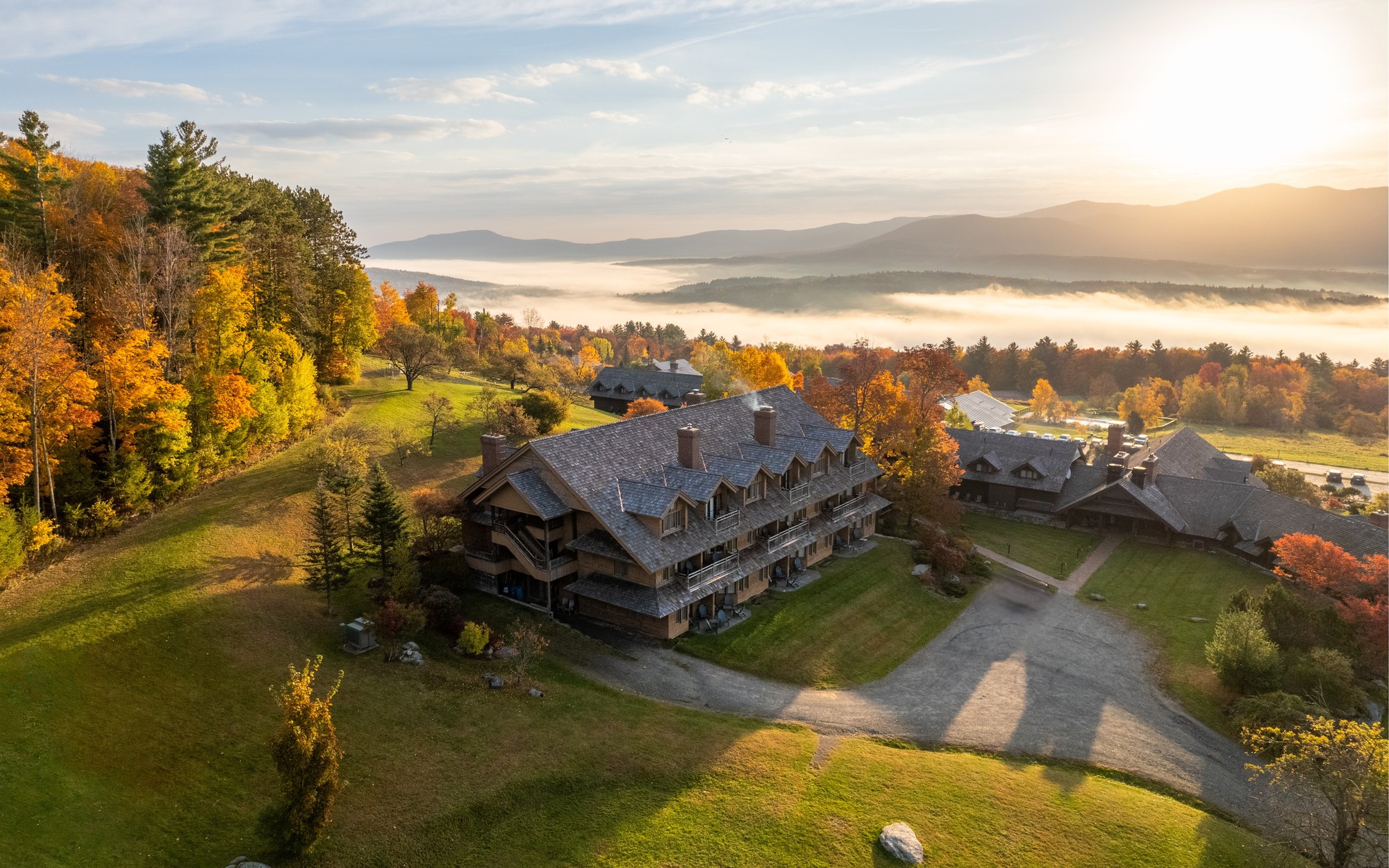
Morning fog fills the valley below the von Trapp Family Lodge & Resort in Stowe, Vt. (Photo: Chadwick Estey)
The von Trapp Family Lodge & Resort has received the Historic Hotels of America® Legendary Family Historic Hoteliers of the Year Award, announced October 15 at the 2026 Historic Hotels Annual Awards of Excellence Ceremony and Gala. The honor was conferred on the von Trapp family by Historic Hotels of America, an official program of the National Trust for Historic Preservation.
The lodge is one of more than 300 hotels and resorts in the United States recognized by Historic Hotels of America for preserving and maintaining its historic integrity, architecture, and ambiance.
“This recognition is especially meaningful to our family because it honors not only our history, but the generations of dedication that have kept our family’s legacy alive,” said Kristina von Trapp Frame, granddaughter of Maria and Georg von Trapp.
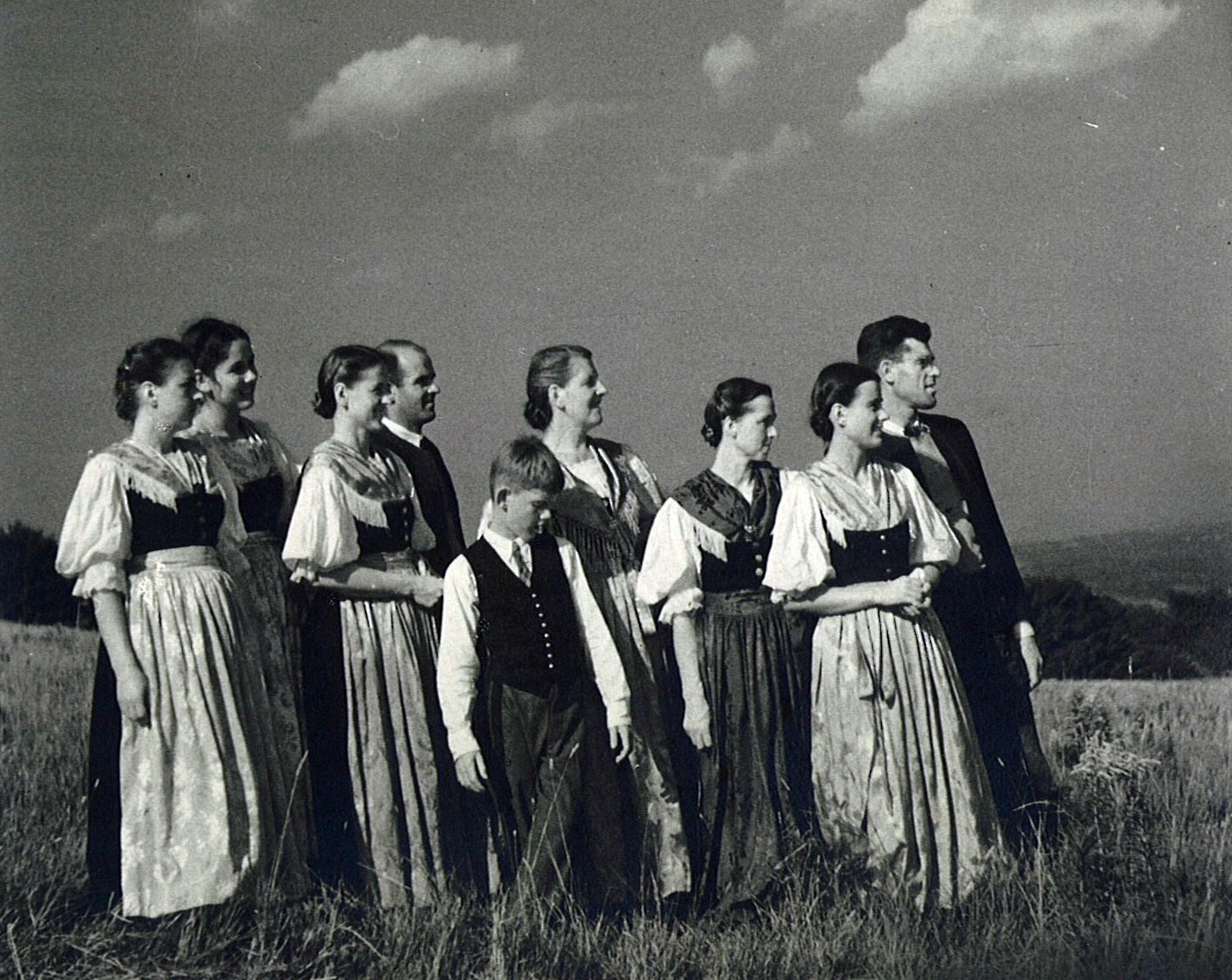
The Trapp Family Singers, who performed in more than 30 countries before and after making their home in Vermont. (Photo: von Trapp Family Lodge & Resort archive)
From Austria to Stowe
The family left Austria in 1938, months after its annexation by Nazi Germany, and spent the years that followed on the road as the Trapp Family Singers. The choir would eventually perform in more than 30 countries, and the family’s story became The Sound of Music.
In 1942 they settled in Stowe. They named their home Cor Unum, Latin for “one heart,” on a hillside looking across to the Worcester Range, and from 1945 to 1955 they ran the Trapp Family Music Camp nearby.
“What began with my grandparents’ dream of creating a home in the Vermont mountains has grown into a place where we have welcomed guests from around the world for more than 75 years,” Frame said.
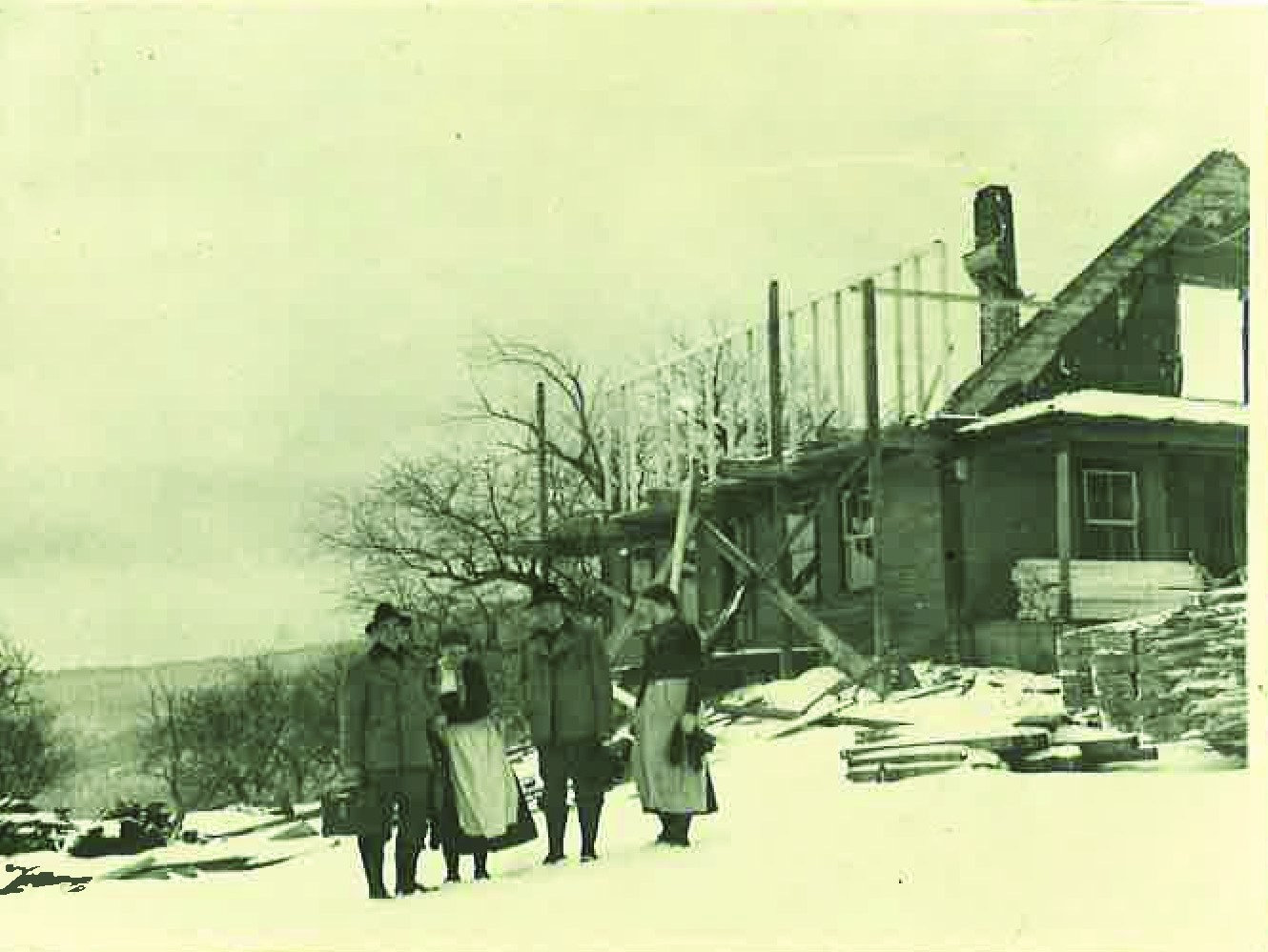
Building the family’s new lodge in Stowe, 1943. (Photo: von Trapp Family Lodge & Resort archive)
Opening the Doors in 1950
In 1950 the family opened their expanded home to guests as the Trapp Family Lodge. Maria ran it first. Her youngest son, Johannes, took over from her and turned a ski lodge into a year-round destination.
Three generations on, it is still family operated. The property covers 2,600 acres and pairs Austrian-inspired hospitality with outdoor recreation, a craft brewery that began making lager in 2010, farm-to-table dining, and wide-open mountain views.
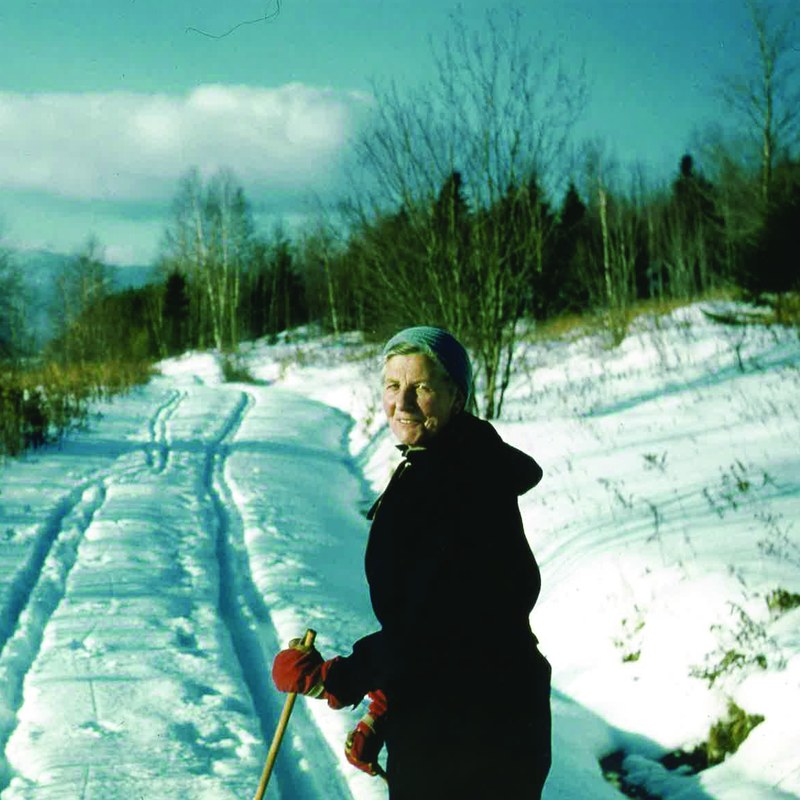
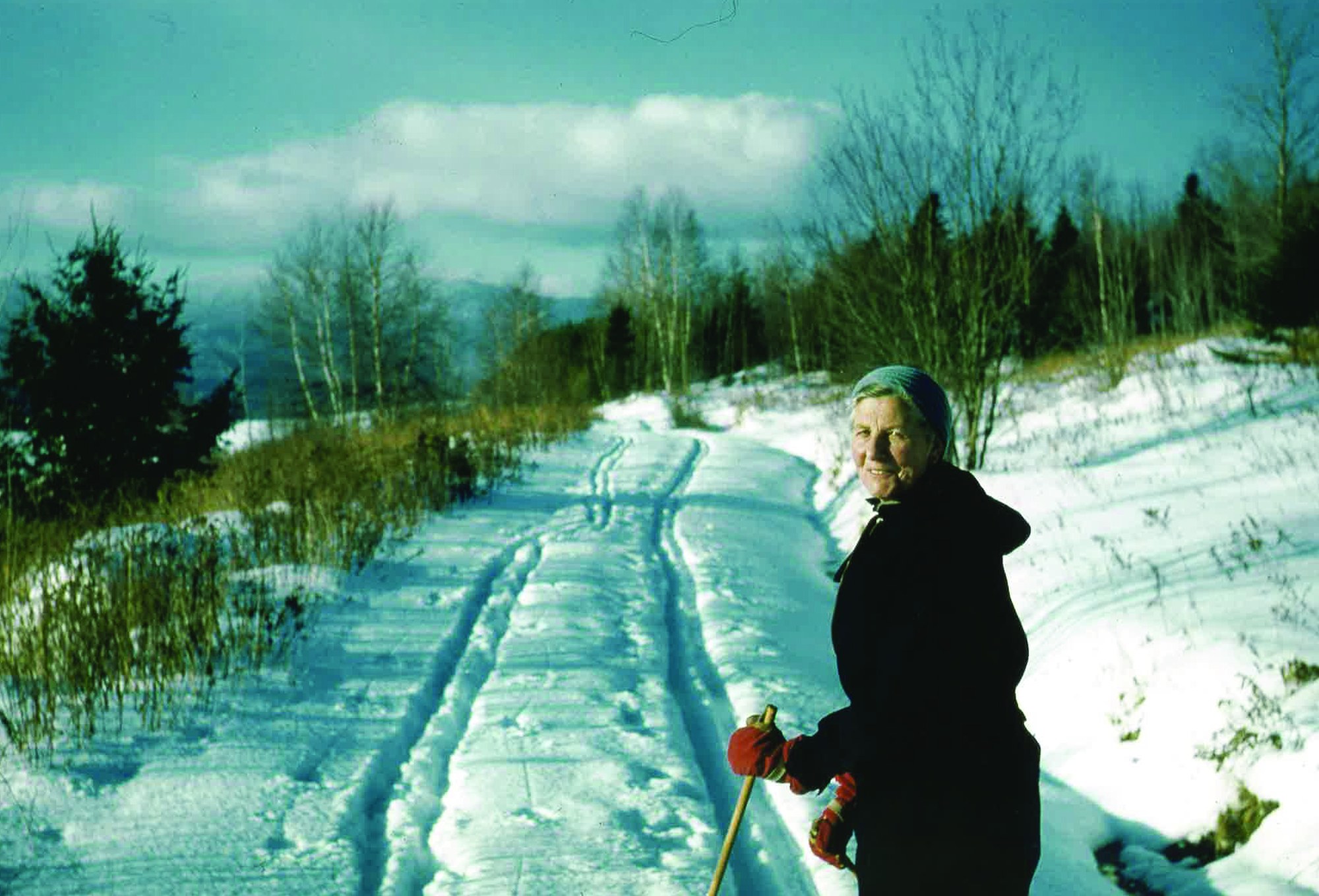
Maria von Trapp out on skis. (Photo: von Trapp Family Lodge & Resort archive)
Where American Cross-Country Skiing Got Its Start
Skiers know the place for something else. In 1968 Johannes opened a cross-country ski center at the lodge, the first in America.
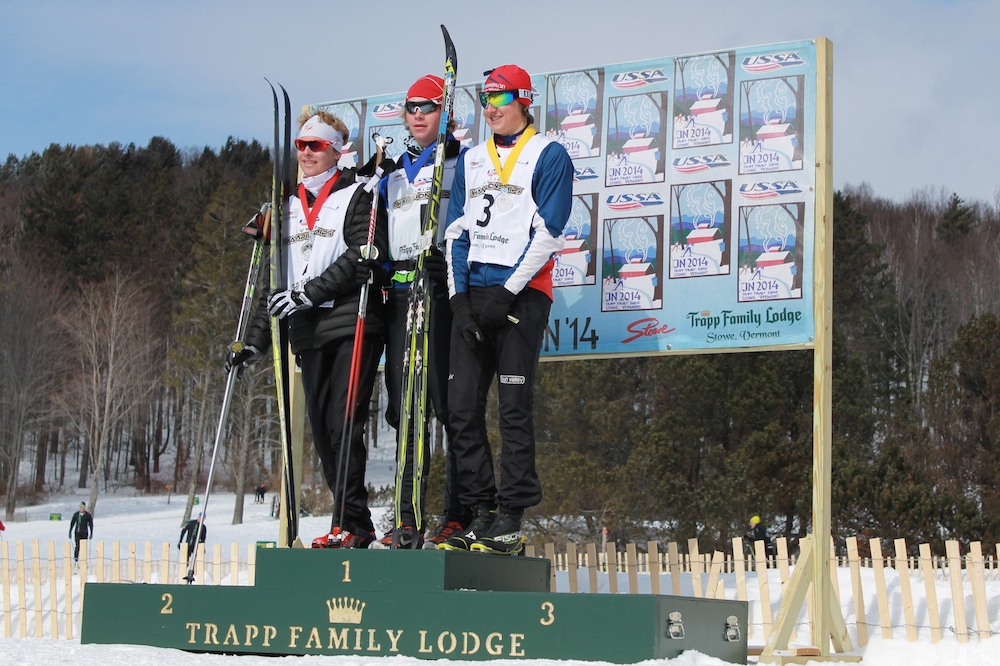
The trails have stayed close to the sport ever since. Johannes helped revive the Stowe Derby in 1972, and in 2014 the lodge hosted U.S. Junior Nationals, with Johannes himself handing out the medals.
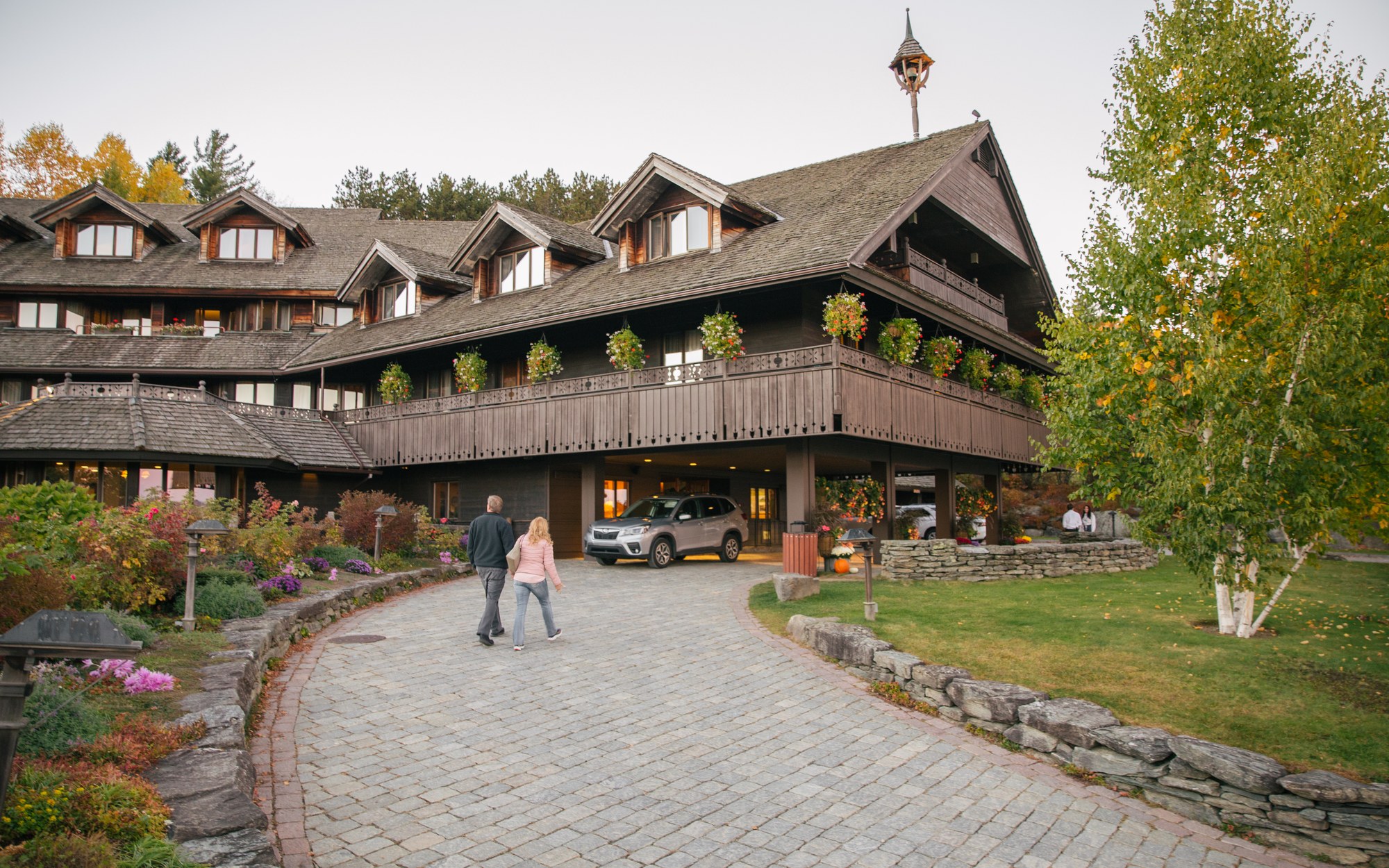
The main lodge, rebuilt in the Austrian style the family brought with them to Stowe. (Photo: Chadwick Estey)
Honored in Williamsburg
Through its Annual Awards of Excellence, Historic Hotels of America recognizes the historic hotels, hoteliers, and leadership practices that do the most to further the recognition, preservation, and celebration of these hotels and their histories. Eleven historic hotels and seven individuals were honored in 2026.
The winners were announced before an audience of owners, general managers, senior decision makers, and guests from many of the finest historic hotels in the world, at the Williamsburg Lodge, Autograph Collection (1939) in Williamsburg, Virginia. The ceremony closed the 2026 Historic Hotels Annual Conference.
“We are delighted to honor the von Trapp Family with this prestigious award. It was chosen from an exclusive group of nominees and considered for several categories. It stands among the finest hotels and hoteliers in the world,” said Lawrence Horwitz, Executive Vice President of Historic Hotels of America and Historic Hotels Worldwide. “We applaud the dedication and passion of the individuals working at these iconic and legendary historic hotels, the people who keep the stories alive from the past and make staying or celebrating special occasions at these historic hotels memorable experiences.”
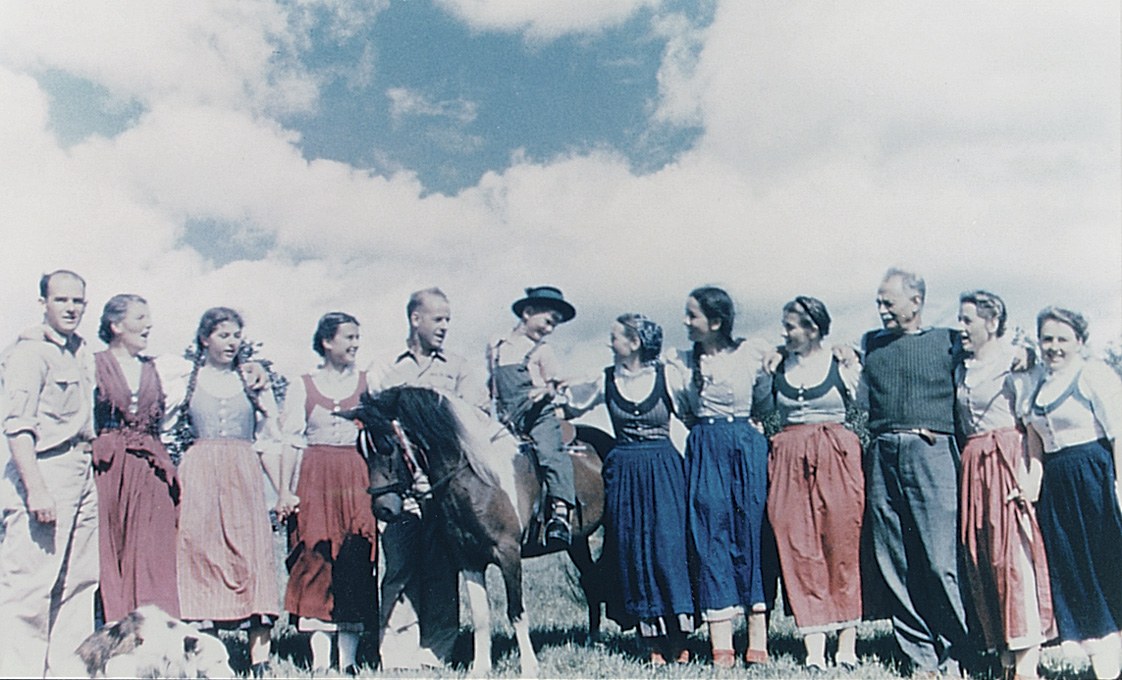
The von Trapp family lined up in a Stowe field, with Johannes on horseback. (Photo: von Trapp Family Lodge & Resort archive)
Carrying It Forward
“We are incredibly proud to carry on their traditions of warm hospitality, family, music, and a love of the outdoors,” Frame said. “Receiving the Legendary Family Historic Hoteliers of the Year Award is a wonderful tribute to our family, our dedicated employees, and the countless guests who have become part of our story.”
About von Trapp Family Lodge & Resort
Founded in 1950 by the von Trapp family, whose story inspired The Sound of Music, the von Trapp Family Lodge & Resort is a third-generation, family-operated, four-season destination in Stowe, Vermont. Situated on 2,600 acres, the property offers Austrian-inspired hospitality, outdoor recreation, a craft brewery, farm-to-table experiences, and breathtaking mountain views while preserving the family’s rich history and traditions. Learn more at vontrappresort.com.
About Historic Hotels of America®
Historic Hotels of America is the official program of the National Trust for Historic Preservation for recognizing and celebrating the finest historic hotels across the United States. The National Trust for Historic Preservation was chartered by the U.S. Congress in 1949 and is a private 501(c)(3) nonprofit organization. To be nominated and selected for membership, a hotel must be at least 50 years old; designated by the U.S. Secretary of the Interior as a National Historic Landmark or listed in or eligible for listing in the National Register of Historic Places; and recognized as having historical significance. More than 300 historic hotels from 41 states, the District of Columbia, the U.S. Virgin Islands, and Puerto Rico have been inducted. Learn more at HistoricHotels.org.
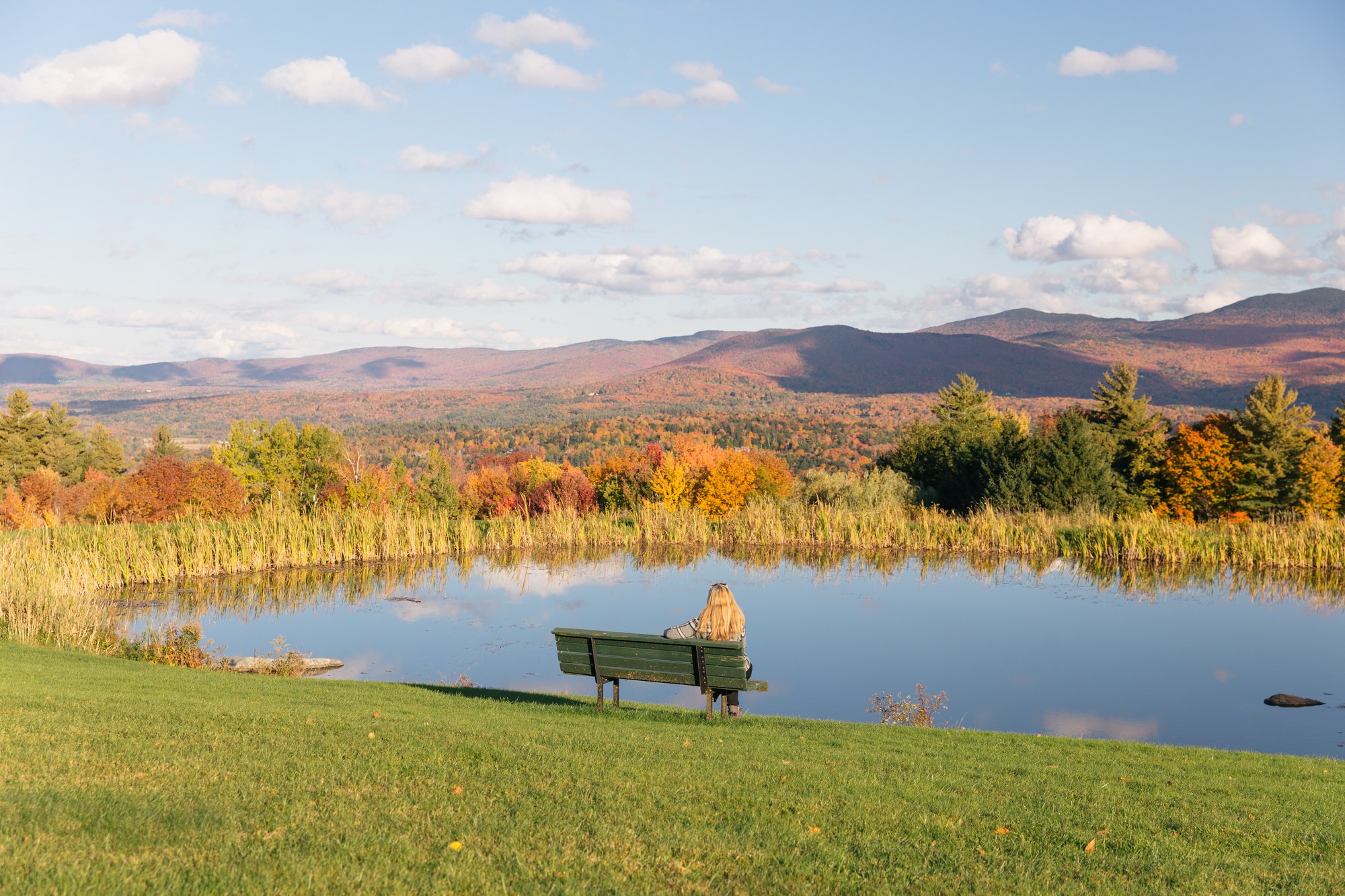
A guest takes in the view from the pond at the von Trapp Family Lodge & Resort. (Photo: Chadwick Estey)
Top American Cross-Country Skiers to Compete at Trapp Family Lodge November 4th in Elite Invitational Roller Ski Competition
(Press release)
Stowe, Vt – The New England Nordic Ski Association (NENSA) and the Trapp Family Lodge have partnered to create a roller ski race for an elite field of cross-country skiers including past and future Olympians. Upwards of fifty athletes representing colleges and clubs from throughout New England will compete in a challenging 10-kilometer race that will finish at the top of Trapp Hill. Spectators are encouraged to park at the Trapp Family Lodge Outdoor Center parking lot and cheer skiers to the finish.
Top-ranked New England athletes in their respective age groups will join Olympians Elizabeth Stephen, Ida Sargent and Kris Freeman for this head to head competition designed to showcase Nordic Skiing. The majority of the field is comprised of athletes who were named to the NENSA Elite and Development Teams – a group who has demonstrated national and international success. Skiers from the University of Vermont, Dartmouth College, Stratton Elite Team and the Craftsbury Green Racing Project will be in attendance.
The course will begin on Nebraska Valley Road before turning onto Barrows Road and conclude by climbing Luce and Trapp Hill. The race begins at 3pm and skiers are expected to complete the course in approximately thirty minutes. Racers will depart the start in thirty-second intervals, making for non-stop spectating for nearly an hour. An award ceremony will be held at the von Trapp Bierhall at 4:30pm just before the Winter Kickoff Party. Spectators are encouraged to attend the party where they can meet athletes and socialize with members of the New England skiing community – tickets can be purchased in advance at www.skireg.com/new-england-winter-kickoff-party or at the door.
About NENSA:
NENSA is the Community Olympic Development Program (CODP) for cross-country skiing in the East as well as the umbrella for most organized Nordic skiing events in the region. Cross-country skiing, as practiced by our youth skiers and families, is a lifetime activity firmly rooted in New England tradition. It is NENSA’s mission to sustain a vital and active skiing community in New England. Visit www.NENSA.net to learn more about our organization.
Questions about the event should be directed to Justin Beckwith at justin@nensa.net
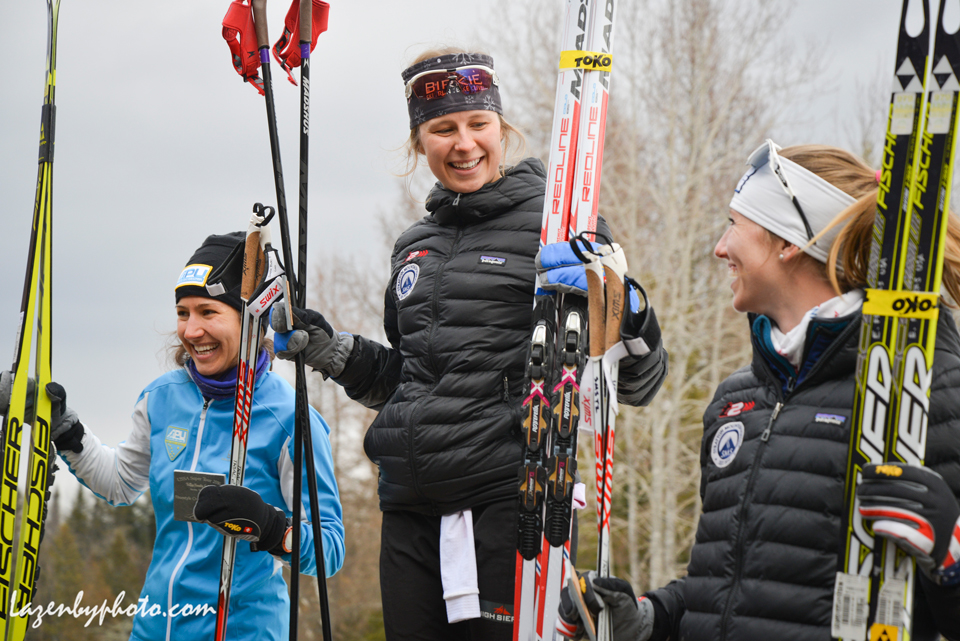
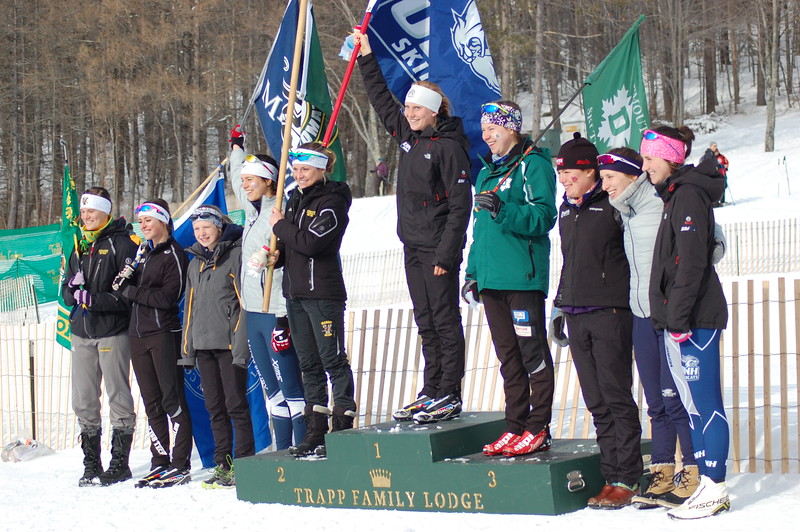
Anne Hart of the Stratton Mountain School (SMS) T2 Team (c) in first, teammate Erika Flowers in third (r) and APU runner-up Chelsea Holmes (l) during the podium ceremony for the women’s SuperTour 5 k freestyle on Feb. 6 in Craftsbury, Vt. (Photo: John Lazenby/Lazenbyphoto.com)
Graduate from Dartmouth as a five-time NCAA All-American? Check. Crush Crossfit? Check. Become a professional nordic skier? Check. Stand at top of a SuperTour race podium? Check.
While American Anne Hart, the winner of the SuperTour women’s 5-kilometer freestyle individual start last Saturday in Craftsbury, Vt., has already notched plenty of athletic and academic achievements, her first SuperTour win was no different.
“It feels great! It was my first ever SuperTour win, so it’s nice to cross that off the list,” Hart, who races for Stratton Mountain School (SMS) T2 Team and won the event with a time of 11:36.2, wrote in an email after the race.
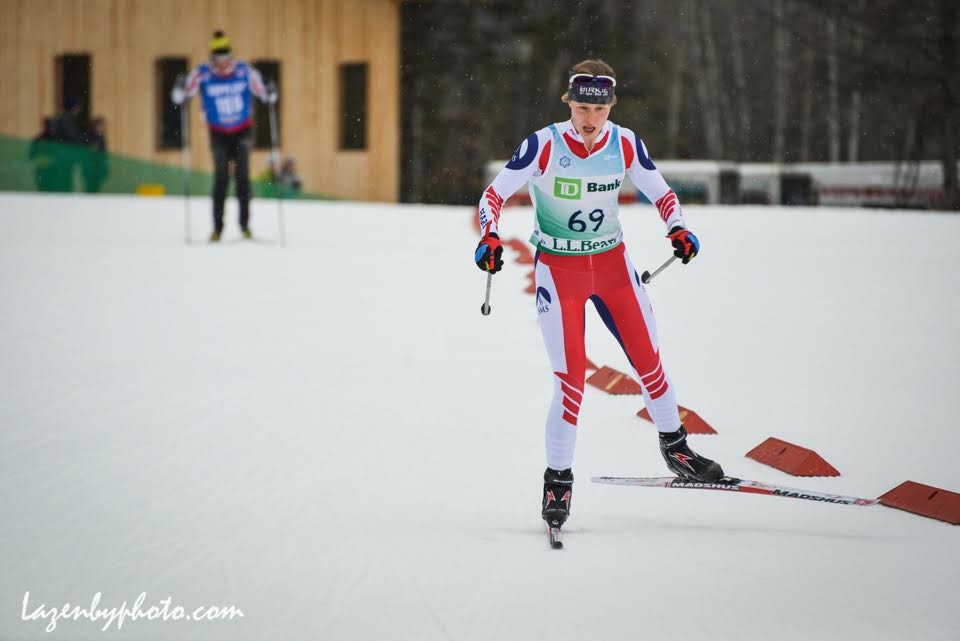
Anne Hart (SMST2) racing to first place in the women’s SuperTour 5 k individual start on Feb. 6 in Craftsbury, Vt. (Photo: John Lazenby/Lazenbyphoto.com)
“I am a pretty strong V2er, and I love skiing that isn’t tempo based but instead relies on a good push and a long glide,” wrote Hart, a 23-year-old native of Stillwater, Minn.
“This kind of course rewarded big, relaxed, and powerful skiing. It challenged me because pacing has historically been my Achilles heel, and there were no opportunities to let off the gas and recover on a long downhill,” she added.
After assessing the profile of the 2 x 2.5 lap course— each loop found to be predominantly flat, with a few gradual uphills and downhills — Hart and her SMST2 coach, Patrick O’Brien, decided to Hart should ski the first lap at threshold and make her move with 1.5 k to go.
“For me the biggest take away from the race is pacing is a thing for a reason — it doesn’t mean go slowly the first lap, it just means save something in the tank so you can push all the way THROUGH the line instead of just struggling TO the line,” Hart wrote.
Crossing the line just 2.8 seconds off Hart’s time in second place was Alaska Pacific University (APU) racer, Chelsea Holmes.
While some might argue the fast, flat course was not well-suited for Holmes’ skiing style, the 29-year-old Alaskan’s performance refuted that.
“While I might not be a power skier suited for flat courses, I can free skate pretty well and that course was all about using your leg strength and skiing the transitions well,” Holmes wrote in an email.
She put her focus on the transitions and working the whole course — including, at one point, a chase back to the front.
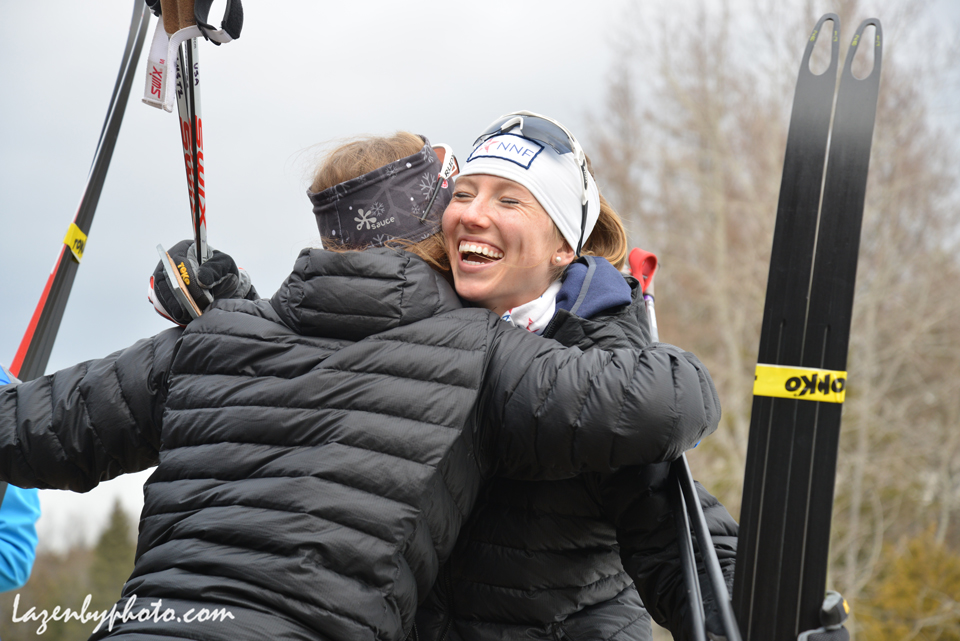
Anne Hart (SMST2) (l) hugs teammate Erika Flowers after their first- and third-place finishes respectively in the SuperTour women’s 5 k freestyle on Feb. 6 in Craftsbury, Vt. (Photo: John Lazenby/Lazenbyphoto.com)
“I actually fell on an icy patch on the last downhill from the upper stadium to the lower before you loop around to finish,” she wrote. “In retrospect I wish I had been a bit more careful as it cost me some valuable time in a tight race.”
Despite the short course and fast times, by the time she toed the finish line, Holmes had pushed her way back towards the top.
“It was a super fun race and I have to congratulate the girls on the podium, 5km is tough!” Holmes added after her second-consecutive SuperTour podium and placing third in the 10 k classic in Lake Placid the weekend before.
In her third skate distance race of the year, Erika Flowers (SMST2) snagged the final podium spot in third, 10.5 seconds back from teammate Hart.
“With no huge uphills or downhills, the course required constant output which played to my strengths,” Flowers wrote in an email. “I also love fast conditions where I can ski big with lots of glide. I’ve always liked racing in Craftsbury because the courses flow really well.”
Originally from Bozeman, Mont., Flowers’ four years as a ski racer for Dartmouth College on New England snow, as well as her current East Coast training at Stratton in southern Vermont, prepared her Craftsbury’s conditions during Saturday’s 5 k event.
“The biggest challenge for me was finding a balance between tempo and power knowing that you can waste a lot of energy skiing frantically in icy conditions but if you take your foot off the gas for a second you immediately start losing time,” she wrote. “I think I skied smoothly and was able to carry momentum throughout the course and pick off some places on the second lap.”
Flowers lunged for the line in the end, just barely edging APU’s Jessica Yeaton out of third place by 0.1 seconds.
“I also never forget to lunge!” Flowers added. “It was very tight between Jessica Yeaton and I for 3rd place so every second really does count.”
Caldwell Cranks to the Top of the Men’s Field
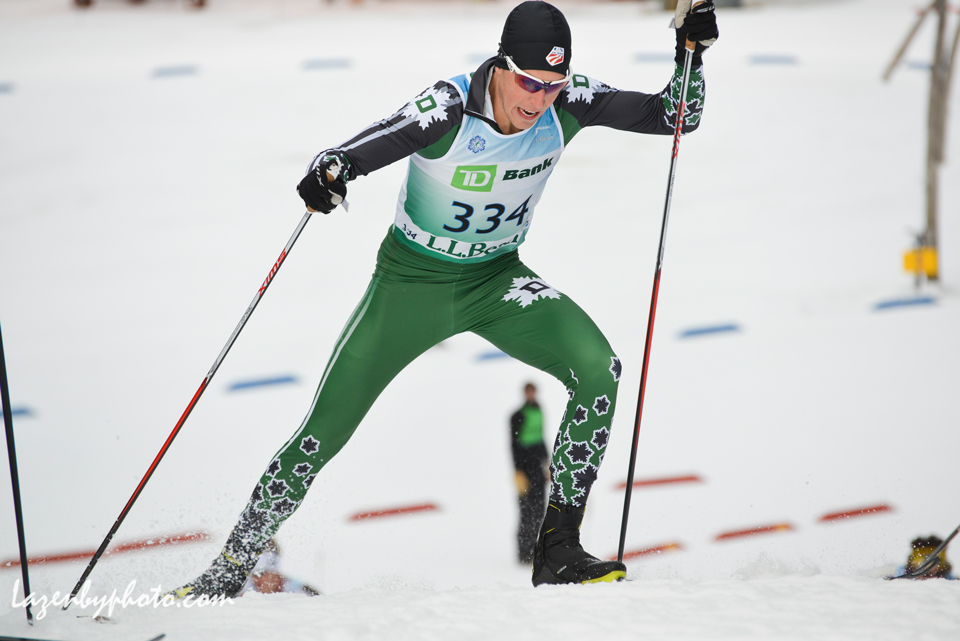
Paddy Caldwell (Dartmouth College/SMST2/USST) racing to a first-place finish during the SuperTour men’s 10 k freestyle on Feb. 6 in Craftsbury, Vt. (Photo: John Lazenby/Lazenbyphoto.com)
There are times when ski racing is simply a grind. Then there are times when a skier puts the grind into their racing. Paddy Caldwell (Dartmouth College/SMST2/U.S. Ski Team), the winner of the SuperTour men’s 10 k freestyle individual start SuperTour race on Saturday in Craftsbury, Vt., proved he’s one for the latter.
“I felt great during the race. That was definitely the best I have felt all year and I am hoping to keep bringing good energy into the rest of the season,” Caldwell wrote in an email.
“The course was a total grind, not much rest but no major climbs. I was focused on hitting the transitions hard and trying to keep momentum everywhere on course,” he added.
Caldwell did keep his momentum — and then some. He won the 10 k freestyle in 20:42.9, leading the second-place finisher Tad Elliott (Ski and Snowboard Club Vail) by 37.9 seconds.
Tad Elliott (SSCV) races to second place in the SuperTour men’s 10 k freestyle individual start on Feb. 6 in Craftsbury, Vt. (Photo: NENSA/Amber Dodge)
“Paddy Caldwell crushed us,” Elliott, a former U.S. Ski Team member, wrote in an email. “It was a fantastic race from him. I don’t think I could have done anything different to go faster. For him to ski like that was just impressive and awesome. I look forward to seeing his races later this season.”
Though he spends his summers training at Stratton, Caldwell is currently studying and racing at Dartmouth College for the winter term, furthering his studies in geography and economics.
“I am planning on racing this weekend and next weekend for Dartmouth to compete in the carnivals before U23s!” he wrote.
Pumped for Caldwell, Elliott was also pleased by his own performance.
“My skate skiing has been feeling really good lately and I have felt fantastic on my feet skiing,” wrote Elliott, a national champion in this year’s 30 k freestyle mass start. I knew the course suited me well with all the gliding. I skied to win!” he wrote in an email.
Despite missing out on the victory, Elliott wrote, “I was really proud of how I skied.”
He finished 1.1 seconds ahead of Kris Freeman (Team Freebird), who placed third, 39 seconds behind Caldwell.
“The course had not that many big hills on it and was one of the flattest races I have done,” Freeman wrote in an email. “Ironically this made the race very hard. No uphills meant no downhills so I was working hard the entire time.”
While the course was made more difficult by the constant expenditure of energy, Freeman also noted the fast conditions made the 10 k go by quickly.
“The race felt like a 20-minute skate sprint qualifier,” he wrote, noting that, despite having higher result-based goals, his body “energy was better than it has been” on Saturday.
With limited snow in Stowe, Vt., organizers moved the SuperTour races from Trapp Family Lodge to the Craftsbury Outdoor Center, and most racers were grateful for the course challenge, as opposed to no course at all.
“I’m so impressed with the skiing at Craftsbury, big thanks to everyone here for making this weekend happen,” Caldwell wrote.
An excited Paddy Caldwell (Dartmouth College/SMST2/USST) (center) Tad Elliott (SSCV) (l), and Kris Freeman (Team Freebird) during the podium ceremony for the SuperTour men’s 10 k freestyle on Feb. 6 in Craftsbury, Vt. (Photo: John Lazenby/Lazenbyphoto.com)
Stowe Nordic (Stowe, Vermont) is seeking to hire a Program Director/Head Coach to develop and run its youth cross-country skiing program. In this role the Head Coach will work across the BKL age spectrum (5-14), to develop young cross-country skiers’ skill and passion for the sport from their first time on skis through competing as a cohesive team at local and regional competitions.
The Head Coach must be a passionate ski professional that brings enthusiasm and structure to the role, creating a rewarding environment of personal growth, fun and achievement for all participants.
Responsibilities:
Plan, Develop and Manage the Program
Design and document a program structure and curriculum incorporating age appropriate content
Develop training schedules and daily/weekly training plans
Community Outreach & Program Expansion
Communicate regularly with parents of participants
Reach out proactively to potential new participant pools (regional schools, etc.)
Drive strong ties to the local community and other ski organizations/clubs
Proactively seek new athletes to expand the program
Maintain a positive and highly engaged relationship with NENSA, USSA, and members interest groups in the central Vermont region
Fall Dry Land and Winter On-Snow Ski Training
Implement the program beginning in the fall of 2015
Work with parent volunteers to assist with younger age groups
Lead November dry land training
Lead all Winter on-snow training sessions – programming up to 3 days per week based on athlete ability/interest:
1 session a week program (recreational focus but with some instruction)
2 sessions a week (participants want to ski more often, experience racing or challenge themselves further on technique skills and endurance)
3 session a week (highly motivated participants/want to race – adds a third practice per week concentrating on technique training for racing and performance).
Plan, coordinate and lead participation in local and regional races/events – introduce young skiers to racing in a fun, supportive, team oriented environment.
Future Growth & Development
Potential to expand to a full-time year-round position through driving:
growth in participation
expansion of age groups within the program
development of complimentary summer programming
offering summer camps for club members or out-of-town athletes
Potential to add assistant coach(es) as needed to manage program growth
Salary will be based on experience and may be impacted by growth in skier enrollment in the program. An initial contract will range from $10,000 to $12,500, commensurate with experience, for the November through March season.
To inquire or apply please submit a resume and cover letter to: info@stowenordic.org
Men ascend the first climb of the 15k classic mass start at the 2015 UVM Carnival. Fabian Stocek (DAR) leads.
Editor’s note: We’re seeking collegiate contributors from across the U.S. If you’re interested in seeing your collegiate region and circuit represented with similar articles, and would like to contribute or know someone that would be interested in submitting recaps and photos, please email info@fasterskier.com.
***
The second weekend of EISA competition brought fans, family, athletes and coaches alike to the idyllic Trapp Family Lodge in Stowe, VT this past weekend for the UVM Carnival. Conditions in the mountain village were superb, with good snow covering nearly every inch of the trail system and great temperatures for both racing and spectating.
The 5-kilometer race loop for the weekend, known affectionately as “Morty’s Maze” in honor of renowned trail designer and all-around ski legend John Morton, is a favorite of many on the circuit. Smooth, steady ascents and twisting, entertaining downhill sections combine to make a fast, fun and challenging course for both disciplines.
On Friday racers took on 5 and 10-kilometer freestyle events, with 10 and 15-kilometer mass start classic events on Saturday.
Friday: 5/10k Freestyle
A cold week preceding this event meant fast, hard-packed conditions on race morning. Though a dusting of snow began early in the day and continued through some of the racing, warming temperatures lead to a slight glaze and a slippery gliding surface. As is common on this course, times would prove to be tight during the short freestyle events.
UVM skier Rogan Brown heads out on course en route to 2nd place in the men’s 10k Freestyle (photo: Silke Hynes)
Except for the men’s winner.
Less than a week removed from his dominant opening EISA freestyle event, the 10-kilometer test at the Bates Carnival, Dartmouth’s Paddy Caldwell surged to a staggering 1:08 lead over second place finisher Rogan Brown of host UVM. After sitting out the events of the previous weekend, the podium finish represented Brown’s first showing in the league this season.
Laval’s Frederic Touchette claimed the third step on the podium, denying Harvard’s Akeo Mayfeld-Carucci his second consecutive podium by a mere two-tenths of a second. The tight times continued down the results list, as third through eighth place were separated by less than 9 seconds.
The Dartmouth men were able to just edge UVM in the team title by three points. Caldwell’s victory was bolstered by Big Green skiers Fabian Stocek and Silas Talbot finishing seventh and 11th, respectively.
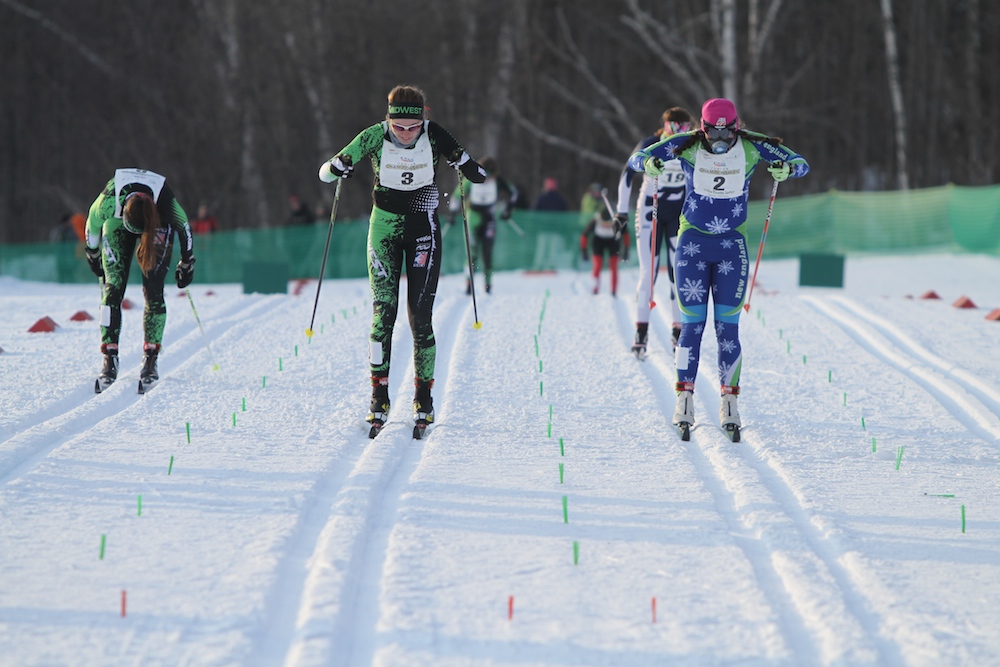
The women’s 5-kilometer freestyle event was nearly over in less than 14 minutes for winner Annika Taylor of UNH. After finishing second in both events the previous weekend to Middlebury skier Heather Mooney, Taylor came out swinging in Friday’s race and bested runner-up Mary-kate Cirelli of UVM by over 14 seconds. Mooney rounded out the podium in third, 10.8 seconds behind Cirelli.
The women of UVM were able to avenge the narrow loss by the Catamount men earlier in the morning by earning the top team score for the 5k race. Alayna Sonnesyn (5th) and Stephanie Kirk (7th) completed the scoring for UVM. Taylor’s victory led a strong showing by the UNH women, who took second thanks to three Wildcats in the top 11: Katrin Larussin finished eighth and Tristan Ramey finished 11th.
Saturday: 10/15-kilometer Classic
After a cold start to the racing season for most of the country, warm temperatures for the races on Saturday seemed to bring out an especially festive mood among everyone in attendance in sunny Stowe. For a venue notorious for brutal wind, the calm air certainly helped as well.
Warming and glazing tracks proved to be the waxing concern for the day, as temperatures rose steadily toward the freezing mark and the sun poked in and out of the clouds. With a long uphill into the finish, it was crucial to be able to push and stride hard for home at the end of a grueling mass start race.
The men raced first on the day, and for the first of three laps the pack stayed relatively close together. By the second lap it was mostly a handful of green suits pulling away from the field: racers from Dartmouth and UVM began to string out the field, along with several other representatives, most notably a strong presence near the front from the men of Williams College.
By the final lap Dartmouth’s Paddy Caldwell was charging away from his teammate Silas Talbot. Caldwell sealed the weekend sweep with a nearly 12-second cushion to Talbot, while UVM skier Tobias Trenkle outsprinted fellow Catamount Jack Hegman to earn his first collegiate podium.
Olivia Amber (CBC) leads eventual winner Annika Taylor (UNH) early in the race. Amber would go in to finish 8th in the event
The one-two punch of Caldwell and Talbot was aided by Big Green sophomore Fabian Stocek in fifth place to give the Dartmouth men another victory over UVM in the team score, with Williams rounding out the podium in third.
Another one-two was in store for the women’s race, although in this case it meant a repeat of the first and second-place finishers from the previous day. Like Caldwell earlier that day, UNH skier Annika Taylor broke away from her competitors to seal a sweep of the weekend events.
Skiing with smooth and relaxed form, Taylor excelled on gradual striding sections and bit-by-bit she increased her lead over the course of the second half of the race to cruise in for the win nearly 30 seconds clear of UVM racer Mary-kate Cirelli in second.
Corey Stock of Dartmouth picked up her second podium of the season, repeating her third-place finish from the classic mass start race at the Bates Carnival.
The team score for the women was quite close, with UVM edging UNH by a scant two points, and Middlebury another three points behind.
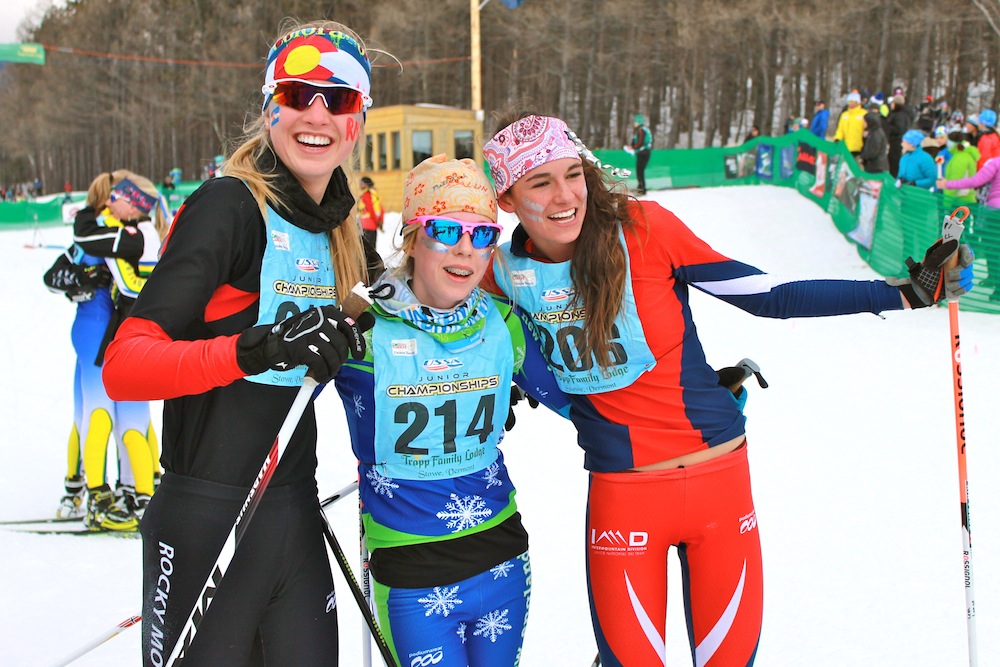
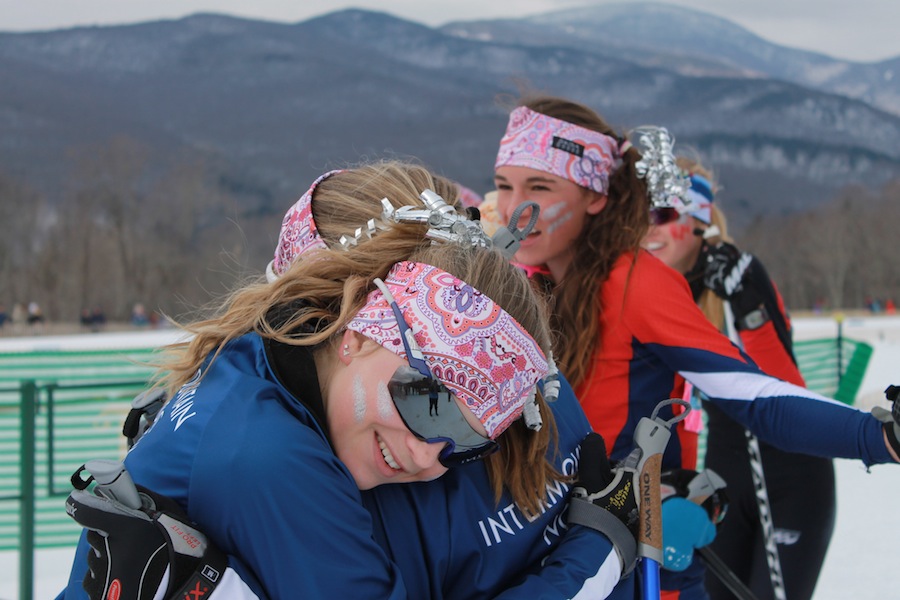
Intermountain’s U16 women after winning the 3 x 3 k freestyle relay at 2014 Junior Nationals.
STOWE, Vt. — Here is the final video in our four-race recap series from 2014 U.S. Junior Nationals at Trapp Family Lodge, the 3 x 3-kilometer freestyle relays on March 8. Intermountain swept the three-person U16 relays, New England topped the podium in both the U20 men’s and women’s relays, and Alaska got a win in the U18 category.
Long-distance mass start at 2014 U.S. Ski Orienteering National Championships March 14-16 at Trapp Family Lodge in Stowe, Vt. (Photo: Barbara Beall)
“This is the world of Ski Orienteering, one of the more obscure and mentally challenging Nordic ski racing disciplines.”
STOWE, Vt. — Imagine a Nordic ski race where you cannot preview the course, don’t know where you will be going, how long you will be skiing or how many hills you will have to climb. A race where you can go anywhere you want on skis, including down snowshoe trails or through uncharted glades. Where you can even take off your skies and run with them. This is the world of Ski Orienteering, one of the more obscure and mentally challenging Nordic ski racing disciplines.
The U.S. Ski Orienteering National Championships, a biennial event, were held this past weekend at the Trapp Family Lodge Ski Center in Stowe, Vt. Approximately 100 skiers, ranging in age from 10 to nearly 80 attended the three-day competition, featuring a Sprint and Middle Distance race (with individual starts) and a Long Distance race with a mass start. Different age classes are on different courses, with varying technical and physical difficulty.
Skiers received the map 15 seconds before the start, and were required to find the correct controls (those orange-and-white fabric markers you might see in the woods) in the right order, registering electronically at each one with a timing chip carried on their finger. At the end of the race, skiers download that information and are given their split times to each control.
Alexis Merka, 10, the youngest competitor at 2014 U.S. Ski Orienteering National Championships in Stowe, Vt. (Photo: Barbara Beall)
In the mass start, the courses were “forked,” meaning skiers ultimately skied the same distances and climbs, but not necessarily in the same order as their competitors, in order to prevent following. Race designers set up the courses to specifically challenge skiers on route choices, forcing them to decide, for example, whether it is faster to stay on a large trail or to follow a narrow trail only groomed by a snowmobile. The courses also challenge skiers to maintain contact with their maps, and to not become upset by climbing up and skiing down a hillside a couple of times.
Alexis Merka, age 10, was the youngest competitor at the event. She is from Maryland, and her mother and father are both orienteers. She competes in both ski-O and foot-O (which involves running rather than skiing). When asked what happens when she gets lost, she said “I say to myself, don’t panic, stay calm, look at the map.”
Larry Berman, who with his wife Sara Mae Berman started the Cambridge Sports Union and has been involved with ski orienteering since the early 1970s, said that he loves the challenge of finding that control right where it is suppose to be based on the map … and if the control is not there, clearly the map is wrong.
“I say to myself, don’t panic, stay calm, look at the map.” — Alexis Merka, 10, youngest racer at 2014 U.S. Ski Orienteering National Championships
For male and female skiers in the elite classes, the U.S. National Championships also identify those skiers who may be named to the USA National Ski Orienteering Team, qualifying them to go to World Events. The top U.S. female skiers were Alison Crocker (1st), Alexandra Jospe (2nd) and Anna Voegele (3rd). Top U.S. male skiers were Adrian Owens (1st), Greg Walker (2nd) and William Frielinghaus (3rd for Middle and Long Distance) and Ari Ofsevit (3rd Sprint). For full results go to: http://www.neskio.com/results/
Larry and Sara Mae Berman, founders of the Cambridge Sports Union, at the 2014 U.S. Ski Orienteering National Championships in Stowe, Vt. (Photo: Barbara Beall)
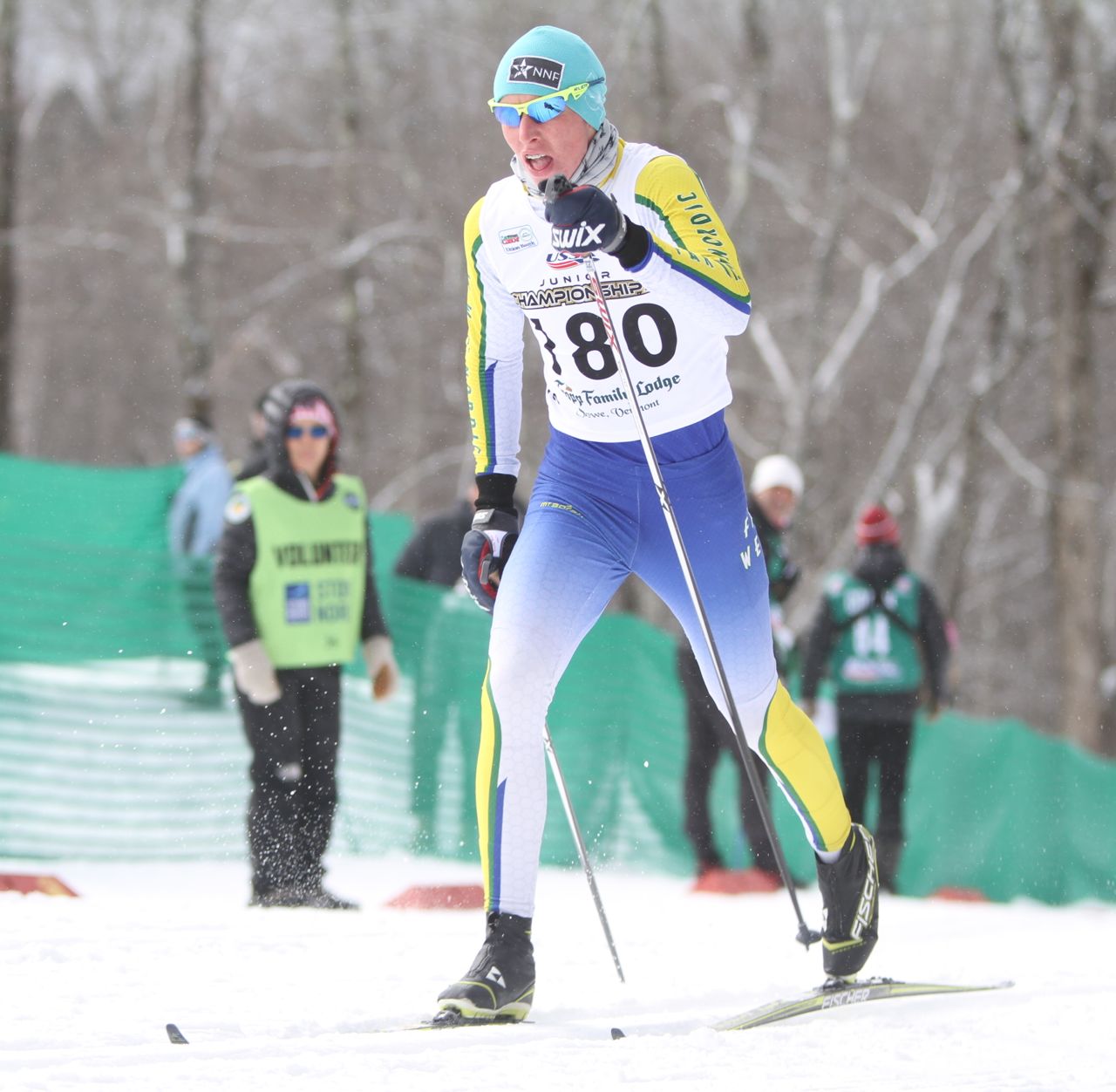
Fabian Stocek, Dartmouth freshman from the Czech Republic, after winning the 15 k freestyle mass start at Junior Nationals on March 7.
STOWE, Vt. — The mass starts are always a highlight at any championships — let alone Junior Nationals. Here’s a look at the action that took place last Friday, March 7, at U.S. Junior Nationals in the 15-, 10- and 5-kilometer freestyle mass starts at Trapp Family Lodge in Stowe, Vt.
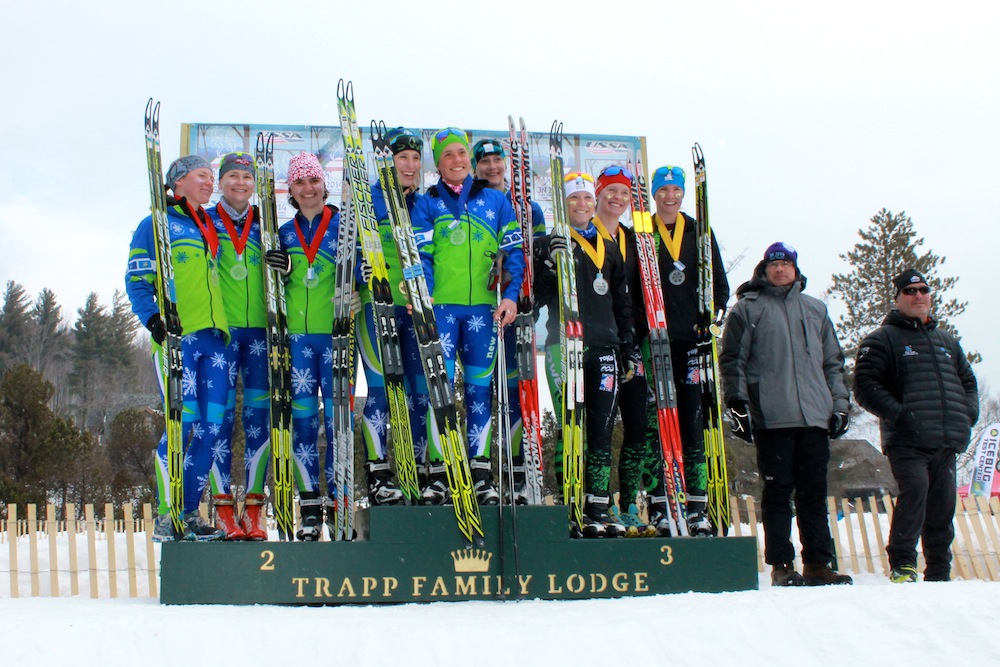
The U16 women that anchored their teams to the top three on Saturday in the Junior Nationals 3 x 3 k freestyle relay: Intermountain’s Leah Lange (r) in first, New England’s Leah Brams (c) in second, and Rocky Mountain’s Hailey Swirbul in third.
FasterSkier’s coverage is made possible through the generous support of Madshus.
STOWE, Vt. — Competitors throughout the season, hundreds of juniors came together on Saturday and teamed up to represent their respective regions in the 3 x 3-kilometer freestyle relays on the final day of 2014 Junior Nationals in Stowe, Vt.
New England topped the Midwest by 368 points for the coveted Alaska Cup — the overall accolade awarded to the team with the most cumulative points throughout the week.
Below are the top teams in the U16, U18 and U20 relays, including six national-championship winners. Intermountain swept the U16 races, Alaska’s U18 men won, and New England capped the day off with two U20 victories and a U18 women’s win.
Fun Facts: Lange received the tag in third and went on to win by 7.3 seconds with the fastest anchor leg. “I saw that she was in first and I got so excited I just started screaming,” Gibson said. Lange placed second in the 5 k classic and third in the 1.4 k freestyle sprint earlier in the week. “We were just so excited; the relay there’s so much more energy in the other races,” Lange said. “It’s definitely the best race to do so good in.”
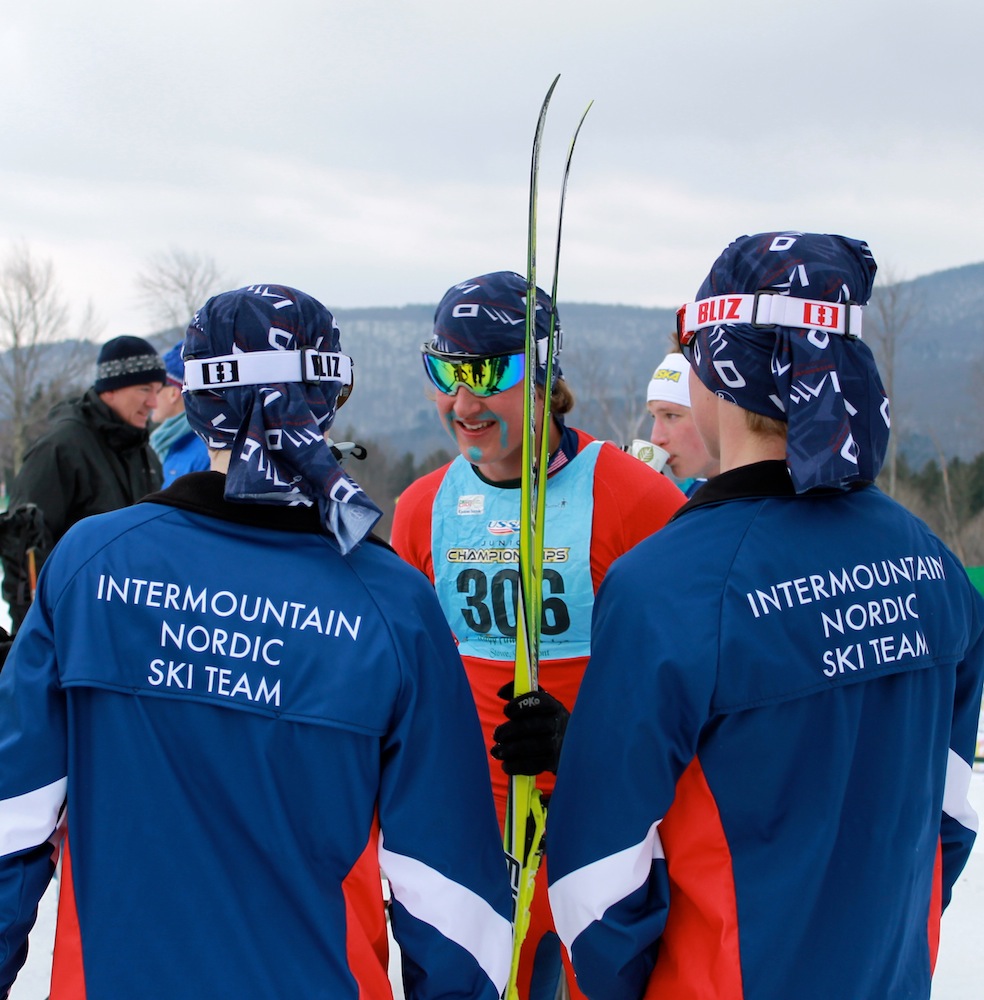
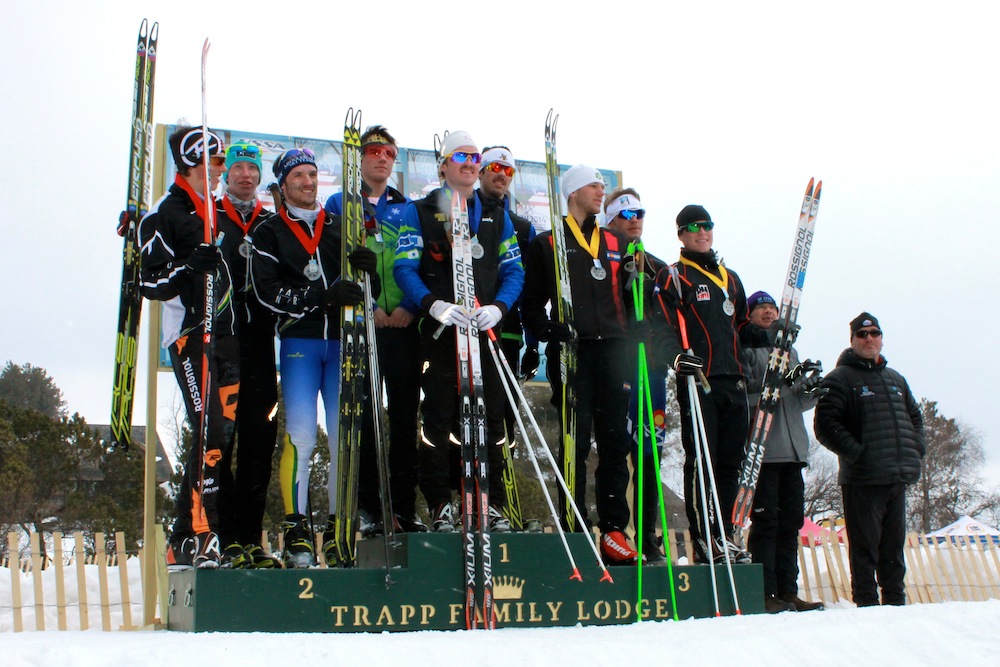
Intermountain’s U16-relay winning men’s team congratulate Zach Williams (c) after he anchored them to a Junior National title on Saturday in the 3 x 3 k freestyle race.
U16 Men:
Intermountain 1: Max Polito (Jackson Hole), Peter Wolter (Sun Valley), Zach Williams (Sun Valley)
Alaska 1: Benjamin Koenig (NSCF-Fairbanks-FXC), Jack Consenstein (APU), Hunter Wonders (APU)
New England 1: Daniel Steinz (Maine WSC), Russell Boswell (SMS), Forrest Hamilton (Mansfield)
New England 2: Anders Hanson (Craftsbury), Adam Glueck (Ford Sayre), Calvin Bates (Dublin School)
Midwest 1: Anders Sonnesyn (Endurance United), Xavier Mansfield (LNR), Henry Gore (Madnorski/CXC)
Far West 1: Brandon Herhusky (Sugar Bowl), Ryland Belisle (Sugar Bowl), Skyler Mullings (Sugar Bowl)
Fun Fact: Intermountain went 2-for-2 to start Saturday, with victories in the U16 men’s and women’s races. The winning men’s team wore blue do-rags and painted mustaches. “We got this right before the race from our coach,” Wolter said, pointing to his face. “And I don’t think we really had a plan.” Williams said they didn’t know the course until shortly before their race. “We just kind of went for it,” Williams said. “We relied on outside information, no personal experience,” Wolter added.
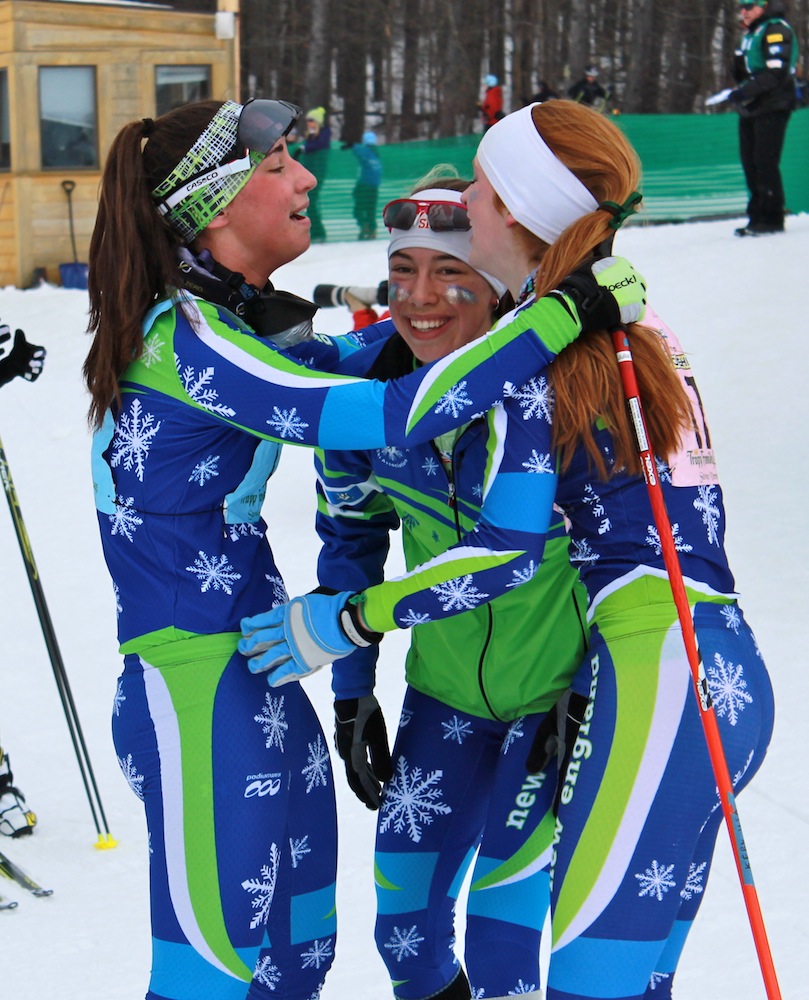
New England’s Zoe Snow (r), Katharine Ogden (c) and Julia Kern (l) celebrate their U18 women’s 3 x 3 k freestyle relay victory on Saturday at Junior Nationals in Stowe, Vt.
U18 Women:
New England 1: Zoe Snow (Cambridge Sports Union), Katharine Ogden (SMS), Julia Kern (CSU)
“It was a lot of holding back everyone else because we knew that Katharine was going to kill it and Julia was going to keep it up,” Snow said. “We definitely had a plan going into it,” Ogden said.
“New England, we’re such close friends and teammates and it’s even more fun when you win together,” Kern said.
The team also gave a shout-out to their coach, Sverre Caldwell of the Stratton Mountain School, on his birthday on Saturday.
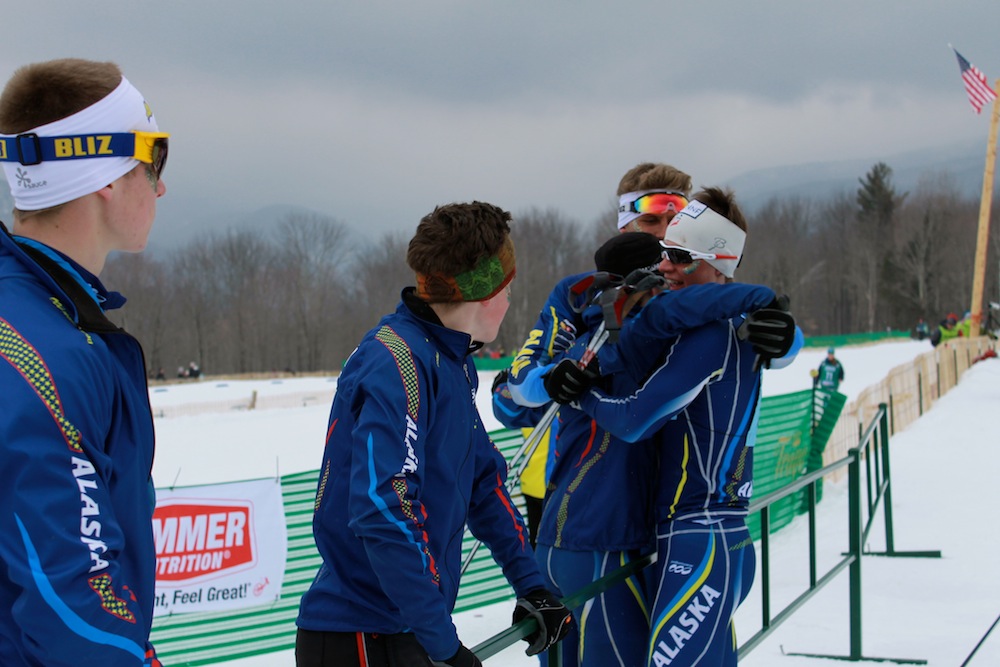
Team Alaska congratulates Thomas O’Harra (r) for anchoring them to a U18 3 x 3 k freestyle relay title at Junior Nationals in Stowe, Vt.
U18 Men
Alaska 1: John Farr (APU), Joe Bue (FXC), Thomas O’Harra (APU)
Intermountain 1: Logan Diekmann (BSF), Sam Miller (BSF), Karsten Hokanson (Wasatch Nordic)
Midwest 1: Ian Torchia (LNR), Nick Gardener (Endurance United), Zak Ketterson (LNR)
Far West 1: Dylan Syben (Unleashed Coaching), Julien Bordes (Unleashed Coaching), Sam Zabell (Sugar Bowl)
Fun Fact:This is the first podium for both Farr and Bue, and O’Harra’s fifth in four years of competing at Junior Nationals. Farr and O’Harra have been teammates since O’Harra was in seventh grade and are the three-time defending champions of the Anchorage high school two-man relay competition. They hail from East Anchorage, the same high school as Kikkan Randall. “It’s the last Junior National race for us, and it could be the last race [Thomas] and I go together,” Farr said. “So it’s a good feeling to end it this way.”
The U20 women’s relay podium at Junior Nationals, with New England in first and second, and the Midwest in third. Bill Koch (second from r) was a guest medal presenter, along with another Olympian, Mt. Bachelor coach Dan Simoneau (r).
U20 Women:
New England 1: Hannah Benson (Williams Outing Club), Kelsey Phinney (Middlebury), Heidi Halvorsen
New England 2: Sadie James (Bates), Tara Humphries (Bates), Maddy Pfeifer (Andover)
Midwest 2: Elizabeth Evans (St. Scholastica), Maria Hauer (Flyer Nordic), Nicole Schneider (LNR)
New England 3: Cate Brams (CSU), Erin Perryman (St. Lawrence), Emily Ramsey (Maine WSC)
Alaska 1: Hannah Stevesn (ANR), Marion Woods (AWS), Anna Spencer (APU)
Far West 1: Laurel Fiddler (Bates), Danielle Nivinski (Sugar Bowl), Amanda Kirkeby (Mammoth Mountain)
Intermountain 1: Maggie Williams (Sun Valley), Sarah Williams (Sun Valley), Joelle Romo (BSF)
High Plains 1: Laura Stamp (Willams), Leann Bentley (Laramie HS), Louisa Austin (Lander Valley)
Fun Facts: After New England swept first through six (not including Sweden’s Ulrika Axelsson of Michigan Tech) in the 5 k classic earlier in the week, Halvorsen said that along with other results throughout the week (including her sprint title) gave them confidence going into the relay. “I think we were pretty confident going into this race that we could potentially get two teams on the podium,” she said after the team went 1-2.
“I think it’s really nice because last year we didn’t have the greatest year,” Benson said. “We didn’t win the Alaska Cup. It’s awesome to come back here to New England to have such a significant lead over everyone else. I think it represents how New England skiing can come together.”
Phinney, of Boulder, Colo., is the daughter of Olympic cycling medalists, Davis and Connie Phinney. Her dad raced the Tour de France and her mom raced competitively and also rowed collegiately.
The U20 men’s relay podium at Junior Nationals, with New England in first, Far West in second, and Rocky Mountain in third. Olympians and medal presenters Bill Koch and Dan Simoneau (r) stand at right.
U20 Men:
New England 1: Jack Schrupp (Gunstock), Jack Hegman (University of Vermont), Cole Morgan (UVM)
Far West 1: Peter Holmes (Unleashed Coaching), Shane Christian (Unleashed Coaching), Patrick McElravey (Middlebury)
Rocky Mountain 1: Jackson Hill (University of Colorado), Oscar Friedman (Dartmouth), Haakon Sigurslid (Durango)
Midwest 1: Mathew Nichols (University of Wisconsin-Green Bay), Jan Katterson (LNR), Thomas Bye (CXC)
Midwest 2: Sam Elfstrom (NMU), Kyle Marshall (Wisconsin-Green Bay), Luke Brown (LNR)
Alaska 1: Kyle Hanson (NSCF-Fairbanks-FXC), Nicholas Lovett, Daniel Serventi (APU)
Fun Fact: This was Morgan’s third victory in four races at Junior Nationals (after being the top American in the sprint) and Hegman’s fourth consecutive podium. “I think we all just wanted to go out an hammer … and just go for it,” he said.
“It’s pretty sweet, a good feeling to end on a good note like that,” Hegman said.
Holmes, a U18 skier for Far West, raced in the older age group for his team, and McElravey rallied after a major crash in Friday’s 15 k mass start took him out of the race.
***
Stay tuned for videos of the last two days of Junior Nationals racing to be completed in the next week.
STOWE, Vt. — It was a jam-packed day of classic sprinting up at Trapp Family Lodge on Wednesday, with 54 heats determining six champions at Junior Nationals between the U16, U18 and U20 men’s and women’s categories.
While some races were snowy, others were windier, and a few were neck-and-neck to the line, the conditions remained relatively consistent throughout in temperatures around 10 degrees throughout the day. The sun began to set soon after the U20 and U18 women’s finals, making for a picture-perfect ending on Day 2 of 4 at Junior Nationals.
Julia Kern (r) racing to a classic-sprint title at Junior Nationals on Wednesday in Stowe, Vt., edging Mattie Watts (c) and Vivian Hett, both from the Midwest.
FasterSkier’s coverage is made possible through the generous support of Madshus.
STOWE, Vt. — Four-hundred and thirty-four athletes whittled down to 180 in 30 quarterfinals. Fifty-four heats total, all on the top of the mountain at Trapp Family Lodge over the course of nine hours.
It was a full day of racing on Day 2 of U.S. Junior Nationals on Wednesday, with men’s and women’s 1.4-kilometer classic sprints determining six national champions.
Below you’ll find the list of who made the top 10 in the U16, U18 and U20 races. Every athlete that did so raced Trapp’s open-aired sprint course four times — nailing fast-enough times to advance after each round. The top six made the A-finals, and the next six battled for seventh through 12th place (and All-American status in the top 10). Complete results
The Junior Nationals U16 men’s classic sprint podium with New England’s Forrest Hamilton (c) of Mansfield Nordic, the Pacific Northwest’s Leo Lukens (l) of Mt. Bachelor in second, and Intermountain’s Zach Williams (r) of Sun Valley in third.
U16 Men
Forrest Hamilton (Mansfield Nordic/New England)
Leo Lukens (Mt. Bachelor/Pacific Northwest)
Zach Williams (Sun Valley/Intermountain)
Benjamin Koenig (NSCF-Fairbanks-FXC/Alaska)
Everett Sapp (New York SEF/Mid-Atlantic)
Tracen Knopp (Alaska Nordic Racing/Alaska)
Daniel Streinz (Maine WSC/New England)
Matthew Hoefler (Alaska Winter Stars/Alaska)
Dawson Knopp (ANR/Alaska)
Will Balcao (AWS/Alaska)
Fun Facts: Hamilton didn’t have to travel far to win his first national title; he’s a student at Champlain Valley Union High School 40 miles from Stowe in Hinesburg, Vt. His longtime teammates call him ‘Fo-Money.’ “I guess that’s my ski-trail name,” he says.
Amanda Kautzer (r) of Loppet Nordic Racing/Midwest, crests the final hill in Wednesday’s 1.4 k classic sprint A-final before winning her first title at Junior Nationals, ahead of runner-up Hailey Swirbul (Aspen/Rocky Mountain), in Stowe, Vt.
U16 Women
Amanda Kautzer (Loppet Nordic Racing/Midwest)
Hailey Swirbul (Aspen Valley SSC/Rocky Mountain)
Leah Lange (Park City NSC/Intermountain)
Hannah Halvorsen (Sugar Bowl/Far West)
Leah Brams (Cambridge Sports Union/New England)
Claire Benton (LNR/Midwest)
Jordan Floyd (Steamboat Springs/Rocky Mountain)
Chloe Levins (Mountain Top/New England)
Lizzie Larkins (Auburn/Far West)
Anna Johnson (Mesabi East/Midwest)
Fun Facts: Mini Kikkan?Kautzer has pink hair just like the three-time World Cup Sprint champion from Alaska, and she just nabbed her first Junior Nationals victory after placing fifth in the 5 k classic on Monday. “I was not expecting anything like this this week,” Kautzer says. She’s originally from Southeast Asia and lived there until she was 3. “I was born in Singapore, which is about as far away from a snowy climate as you can get,” she says. “From super warm to super cold, I like the transition.”
Far West’s Peter Holmes (1) leads his semifinal in Wednesday’s 1.4 k classic sprint at Junior Nationals in Stowe, Vt. He went on to win his second national title in as many races.
Fun Facts: This was Holmes’ second title in as many races at Junior Nationals. “I always wear the same socks when I race,” he says.“I haven’t washed them since I’ve been here.”
U18 Women:
Julia Kern (Cambridge Sports Union/New England)
Mattie Watts (Endurance United/Midwest)
Vivian Hett (LNR/Midwest)
Zoe Snow (CSU/New England)
Sarah Bezdicek (LNR/Midwest)
Katharine Ogden (Stratton/New England)
Emily Hyde (Mt. Bachelor/Pacific Northwest)
Hannah Peterson (Durango/Rocky Mountain)
Olivia Ekblad (Methow Valley Nordic/Pacific Northwest)
Racquel Wohlk (Nordicwerks/Midwest)
Fun Fact: With at least five national titles in the last two years, Kern, 16, racked up her first victory of the 2014 championships. In her free time, she says she likes to surf around New England in places like Cape Cod or Hampton “and do photography and film stuff.”
Three New Englanders race for gold in the U20 men’s classic sprint A-final: with Fabian Stocek (2) ultimately taking first, Cole Morgan (l) placing second overall and Jack Hegman (5) finishing third at Junior Nationals in Stowe, Vt.
U20 Men:
Fabian Stocek (Holderness School/New England)
*Cole Morgan (University of Vermont/New England)
Jack Hegman (UVM/New England)
Jack Schrupp (Gunstock/New England)
Patrick McElravey (Middlebury/Far West)
Haakon Sigurslid (Durango/Rocky Mountain)
Scott Harrison (LNR/Midwest)
Luke Brown (LNR/Midwest)
Connor Gray (BSF/Intermountain)
Andrew Egger (LNR/Midwest)
*Top American
Fun Facts: Originally from the Czech Republic, Stocek, 19, is a freshman at Dartmouth College and according to a NENSA blog post from a couple years ago, a fierce competitor at the game Twister. Morgan, a UVM sophomore, won his second-straight U.S. title in as many races at this year’s Junior Nationals. He shared the podium with his college teammate, Hegman, who hails from Huntington, Vt.
New England’s Heidi Halvorsen after winning Wednesday’s classic sprint for her first national title at 2014 Junior Nationals in Stowe, Vt.
U20 Women:
Heidi Halvorsen (New England)
Ulrika Axelsson (Michigan Tech/Great Lakes)
Kelsey Phinney (New England)
Hannah Benson (Williams Outing Club/New England)
Kristen Bourne (Northern Michigan University/Midwest)
Sadie James (Bates College/New England)
Nora Gilbertson (St. Olaf College/Midwest)
Marion Woods (Alaska Winter Stars/Alaska)
Joelle Rommo (BSF/Intermountain)
Maddy Pfeifer (Andover Outing Club/New England)
Fun Fact: According to Halvorsen, 18, she has podiumed five times at Junior Nationals, and this was her first victory. A 2013 graduate of the Green Mountain Valley School Ski Academy, Trapps was her home course. When she’s not skiing: “I have a lot of grannie pastimes,” she says, “like knitting and troll making and quilting.”
Tara Humphries (Bates College/New England) racing to a victory at 2014 Junior Nationals in the women’s 5 k classic individual start on Monday at Trapp Family Lodge in Stowe, Vt.
FasterSkier’s coverage is made possible through the generous support of Madshus.
STOWE, Vt. — Giving a little recognition where it’s due, here’s a look at the top-10 skiers in each of Monday’s classic individual starts on Day 1 of U.S. Junior Nationals. Classic sprints kick off today with qualifiers at 9:30 a.m. Eastern time; heats start at 1 p.m. Follow FasterSkier on Twitter and Instagram, as well as the 2014 Junior Nationals website for updates.
Fun Fact: According to fifth-place finisher Paolo Takagi-Atilano’s profile on the National Nordic Foundation website, his name is pronounced “Pow’-loh” and he’s fine with people calling him by his first name “because who wants to deal with Takagi-Atilano?”
U20 Men’s 10 k
Cole Morgan, 19 (University of Vermont/New England)
Fabian Stocek, 19 (Holderness School/GST)
Jack Hegman, 19 (UVM/New England)
Oscar Friedman, 19 (Dartmouth/Rocky Mountain)
Haakon Sigurslid, 18 (Durango/Rocky Mountain)
Patrick McElravey, 19 (Middlebury/Far West)
Mathew Nichols, 19 (University of Wisconsin-Green Bay/Midwest)
Sam Elfstrom, 19 (Northern Michigan University/Midwest)
Jack Schrupp, 18 (Gunstock/New England)
Blaine Ayotte, 18 (St. Lawrence University/New England)
Fun Fact: Morgan, a college sophomore from Bozeman, Mont., won by more than 35 seconds.
Fun Fact: Swirbul won her first national title by nearly 15 seconds. In January at the U.S. Cross Country Championships in Midway, Utah, she placed second in the junior 5 k freestyle mass start.
Fun Fact: Ogden was the fastest overall in the U18/U20 women’s 5 k, edging Hett by 2.3 seconds. It is her second national title after winning the junior 5 k freestyle mass start at U.S. Cross Country Championships in January.
Olympian Liz Stephen challenges Patrick O’Brien of the Craftsbury Green Team during the 6th Annual Race To The Top of Vermont on Aug. 25. (Photo: Race To The Top Of Vermont)
Editor’s note: This story has been updated to include the overall women’s course record, set by mountain biker Lea Davidson last year.
Before last Sunday, Liz Stephen isn’t sure if she had ever been to the top of Mount Mansfield’s Toll Road, which winds for 4.3 miles up 2,564 vertical feet in Stowe, Vt. Didn’t matter.
The 6th Annual Race To The Top Of Vermont was another hill climb, and the 26-year-old affectionately known as “spider monkey” on the U.S. Ski Team had a goal of winning, setting the run course record and beating mountain bikers in the process.
“My goal was to try and get both the record for the women’s run, but also knew there was an overall bike and run record as well that was worth a bit of money,” Stephen wrote in an email earlier this week. “So I was shooting for that as well.”
The runnning time to beat was 39:17.7 minutes, set in 2011 by defending champ Kasie Enman of Huntington, Vt. (the overall women’s course record was 37:18.7, set by m0untain biker Lea Davidson of Jericho last year). Stephen, who hails from East Montpelier, shattered the run record by nearly two minutes in 37:22 (and missed the overall record by about 3 seconds). She beat the first female mountain biker, Marilyn Ruseckas of Warren, by almost seven minutes.
Runner-up Ida Sargent, another Vermont native and Stephen’s teammate on the national team, explained she never saw much of Stephen in her third consecutive Race To The Top. Last year, Sargent placed third behind Enman, who was third on Sunday. Enman had a baby this spring and ran slightly behind Sargent for the entire race, but Sargent explained she could hear people cheering for Enman for much of it.
“[Liz] was gone when the gun went off so I was running my own race,” Sargent, 25, wrote in an email. “But there were lots of guys around me to run with. Liz was absolutely amazing and it was really cool to see her run that fast. She’s a speedy mountain goat!”
Add that to the list of nicknames for the World Cup phenom, who placed fifth at World Championships last season in the 10-kilometer freestyle individual start on a grueling course at 4, 700-feet above sea level in Val di Fiemme, Italy.
The toll road peaked at 4,393 feet atop Vermont’s highest peak.
“It’s true that I like to go ahead early when I can, but it doesn’t always work out,” Stephen explained. “With these types of races, it is pretty hard not to just go as hard as you possibly can. The goal for me was to pace it well so I could run as fast as I could.”
The fruits of her effort paid off and indicated her fitness was on track three months before winter racing resumes in Europe.
“However, I am a cross country skier and that is about fitness, power, strength, mental toughness, and technique, among other factors, so I will just keep training the way I have been training and preparing for the winter races,” she wrote.
Stephen also used the race as a fundraiser, publicizing her participation on a website to raise money for Vermont skiers gearing up for the 2014 Olympics in Sochi, Russia. As of Friday, she’d raised $2,450 dollars. Sargent (Craftsbury Green Racing Project) was also included in the fundraiser.
“The fundraising effort has gone great, so far,” Stephen explained. “We will leave the fund up until the day the Olympics begin, so it will give people a good amount of time if they would like to contribute at some point between now and then. The response is always great in this area when you ask for help and support of one sort or another. We have such incredible communities that care about one another and want to be involved here in Vermont.”
Sargent has been recovering from Achilles tendinitis and hadn’t originally planned to race, fearing the consistent uphill grade could do a number on her.
“So I just went to the race planning to run and hike up and cheer for my teammates but then I got the race itch and couldn’t help not putting on a bib,” she wrote. “I was really excited to be able to race and mostly not have my Achilles bother at all. And I was a minute faster than last year which is a very promising sign about my fitness.”
Sargent explained she hasn’t been running as much this summer as past years and didn’t think too highly of her running shape going into Sunday’s race.
“It’s a really hard race but it was a beautiful day on top and awesome to see so many people out there running, biking, and hiking up the mountain,” she wrote. “The local support was incredible. It’s very inspiring and I’m very thankful!”
Stephen placed 10th overall and Sargent was 31st behind men’s winner Eric Blake of West Hartford, Conn, who broke the men’s course record by a minute and 2 seconds in 32:51.3. A 2006 Olympic nordic skier, Justin Freeman of New Hampton, N.H., was second in his debut Race To The Top in 34:42.3. Craftsbury GRP skiers Gordon Vermeer was fifth (36:14.6), Pat O’Brien was ninth (37:20.5) and Andrew Dougherty was 19th (39:57).
The top mountain biker, Gered Dunne won in 32:58.2, but Freeman edged second-place biker Jake Hollenbach by nearly 19 seconds. In an email, Freeman, 36 explained Blake started conservatively before making a small move about a half-mile in. Third-place finisher Josh Ferenc followed, and Freeman fell a few seconds behind.
“Around the mile mark Blake made a bigger move, dropping Ferenc, who faded hard,” he explained. “I ran with him for less than a minute and then started to gap him. I didn’t look back, but I could tell from listening to people cheer that I built a lead of between 20 and 30 seconds by about a mile to go. From there Ferenc was slowly gaining but not enough to catch me.”
Freeman beat Ferenc by 11.7 seconds.
“I was disappointed not to go under the old record, but I am actually pretty happy to be only two minutes behind Blake,” he wrote. “Josh Ferenc has defeated me handily the two previous times I have raced him this summer, so it was nice to come in ahead of me (I agreed with him that I am now a runner/skier, so he need not suffer the stigma of having been beat by someone who is just a skier). I will probably go back next year, and I think I have it in me to run about a minute faster.”
In terms of hill climbs, Freeman stated that this was like most others.
“It’s an uphill run, so it requires going really hard, but in terms of racing tactics it is pretty straightforward,” he wrote. “You go as fast as you can without building too much lactate. The grade varies a lot more than Mt. Washington, which gives some chances for something resembling recovery, but in the end it is like any other 35-minute hill climb.”
As for what’s next, Stephen and Sargent are due to meet up with the U.S. Ski Team in Lake Placid, N.Y., next week. The annual fall camp ends with the Climb to the Castle on Sept. 15 – a rollerski race which the multiple-time defending champion Stephen essentially owns.
“The Climb to the Castle is a great test of fitness as well as just a good, hard effort, both mentally and physically,” Stephen wrote. “I look at it as a good way to practice race prep routines and race day nerves, as this race makes me so dang nervous every year!”
STOWE, Vt. — Century rides can be boring. Too often, they are repetitive from one year to another, feel like an eternity, and lack creativity, diversity and spirit. It’s a good thing that none of these characteristics will ever be used to describe the Darn Tough Ride, the most anticipated cycling event in New England held in Stowe on Sunday, September 1st.
As Sir Winston Churchill once said, “Difficulties mastered are opportunities won,” and with road construction delays plaguing main arteries previously used for the ride, organizers jumped on the opportunity to refresh the event and offer a new route for the 100 mile/160km riders for 2013.
As most NEK drivers and cyclists know, Route 242 between Jay Peak and Montgomery Center has been under construction since early this Spring and road work is now expected to go on until October 8. “I would advise you to re-route. Route 242 will not be paved by Sept. 1. The construction is scheduled to be completed in early October,” was the advice given by Resident Engineer for VTrans on the Rte 242 construction project.
Re-routing came as a great opportunity to make the event more centralized for 2013. Now, the 100 mile loop route will not go anywhere near Jay Peak but will take the riders twice over Smuggler’s Notch, one time on each side. Although the distance will be very similar to last year’s route, the 95.3 miles with 8,383’ of elevation route will be just as challenging as ever. The riders will travel more locally and will most certainly, at one point or another, also ride along side cyclists from the other routes. Another plus is that 100 mile riders will also now have a chance to ride on some of the best area roads including Hog Back, 100C and 109, all of which could not be a part of the 100 mile route last year.
The 100 mile Darn Tough Ride will begin as scheduled at 7am from the Mt. Mansfield Winter Academy, 3576 on the Mountain Road in Stowe, Vermont. The riders will first warm up and ride about 13 miles in Stowe, down the Mountain Road, through Stowe Hollow, up Barrows Rd, and back to MMWA to start the first timed segment of the event. It will indeed be a lively “hot spot” with cyclists departing for other rides around the same times, and friends and family on site to cheer all. It will also mean that the 100 mile ride participants will be able to regroup, leave extra clothes, refuel, get better organized before starting the 5.5 mile hill climb which will end in Smuggler’s Notch, just before the beginning of the steep turns. The rest of the ride is set on the best area roads and will take riders back toward Morrisville before returning through Centerville, Eden and Belvidere. The second timed hill climb will remain unchanged, a 3.5 mile climb beginning at the entrance of Smuggler’s Notch Resort and ending at the top of Smuggler’s Notch State Park.
The other routes are not affected by road constructions and will remain the same as last year. Please make note of the new starting time: 100 mile is 7am, 65 mile is 8am, 45 miles is 9 am and 25 mile is 10am. With these new start times, more cyclists will cross the finish together, attend the party, and enjoy the food spread by Black Diamond Barbecue and the music by TallGrass GetDown. To speed things up for those returning home after the ride, the raffle will be be held during the feast while results are tabulated. There will be numerous prizes and raffles donated by our generous sponsors including Fit Werx, Kona One One and much more.
To view the new 100 mile route visit the event page at http://mmwa.org/darntoughride/ or download it directly from http://ridewithgps.com/routes/3083706. Please feel free to contact darntoughride@mmwa.org with questions. Online registration is open until August 31, day of registration are also accepted but t-shirts and swag bags are only available until quantities last.
The Darn Tough Ride is a fully supported bicycle ride and a benefit to the Mt. Mansfield Winter Academy in Stowe, Vermont. Main sponsors are Darn Tough Socks Vermont, High Tower, Fit Werx, Commodores Inn, Hammer Nutrition, Vermont Smoke and Cure, Honest Tea, Food Should Taste Good, and the Stowe Reporter.
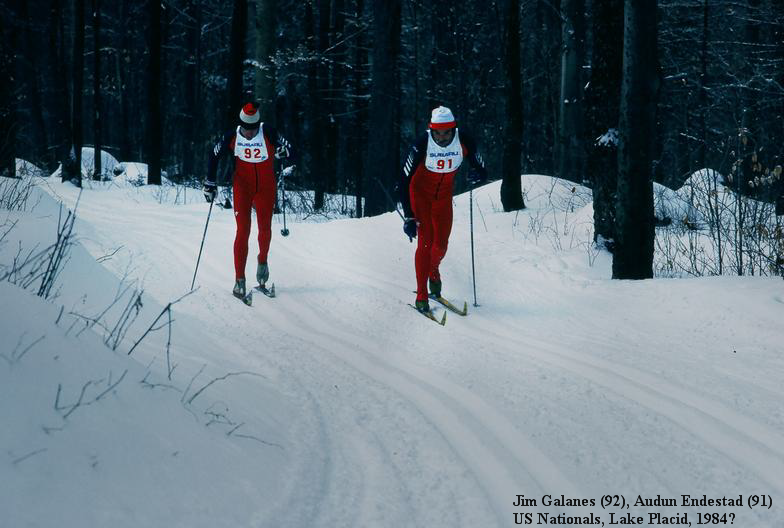
Jim Galanes (left) and Audun Endestad, two of the best skiers in U.S. history, racing head-to-head in the 1980’s. (Courtesy photo)
This profile is part of a ‘Where Are They Now’ series, made possible through the generous support of Fischer Sports. Learn more about their products at www.fischersports.com.
Despite getting his start as an athlete in Brattleboro, Vermont, moving back to the Green Mountain State wasn’t specifically on Jim Galanes’ list of things to do in the coming years.
Yet that’s exactly what the three-time Olympian has found himself doing, after expressing an interest in a job with Graham and Mila Lonetto at Edgewise Ski Service in Stowe. Turns out, it was a perfect fit.
“I had been talking to the folks here at Edgewise for a couple of months,” Galanes said in a phone call last week. “I came back and interviewed with them and talked some more, and I just felt really comfortable with Graham and Mila, and I really like their business model and their philosophy. I thought it was a great opportunity for me.”
In taking over as manager of the stonegrinding operations for both nordic and alpine skiing, Galanes is at the same time returning to the ski industry seven years after leaving his position as head of the Alaska Pacific University (APU) program and taking on something new. Among his tasks is to develop the smaller nordic side of the business operation, which means settling back into the community and connections that he enjoyed for so many years. And through his experience as an athlete and a coach, he has tested a lot of grinds, and even did some of his own on machines around the country.
But helping to develop a grind system? That’s new.
“Back when grinding first really started to come into the sport, I worked a lot with Nat Brown on testing his grinds that he was doing,” Galanes says. “He was really the first guy in the country set up to do strictly cross country grinds. I’ve had a lot of experience preparing skis and testing grinds, and it will be fun to develop our own system of grinds here.”
There’s no reason to think the results won’t be excellent: besides the Lonettos’ expertise in stonegrinding for alpine skis, there’s the persistent drive for excellence that Galanes has shown throughout every aspect of his career. For instance, he started his athletic career by winning three national titles in nordic combined and two World Cups. Most people would consider that pretty satisfying.
Not Galanes. Instead of resting on his laurels, he switched sports.
“That was real easy,” he laughs, recalling his decision back in 1979, when he was 23 years old, to focus only on cross country skiing. “Jumping was really hard, and hard for me to perform consistently… I was successful at times, but it wasn’t the consistency of success that I was looking for. My cross country skiing was continuing to improve, and that made it an obvious decision to me.”
Back then, nordic combined was “old school.” Galanes trained mostly as a cross country skier, and the national team didn’t always have a coach, much less a specific jumping coach. So the switch was easy, and he joined a men’s team that was the best the U.S. has ever seen. Bill Koch had won his silver medal in the previous Olympics; Tim Caldwell, Dan Simoneau, and Audun Endestad were at or coming into the peak of their careers.
In that competitive atmosphere Galanes thrived, winning ten national titles, competing in two more Olympics (he already had one under his belt as a combined skier), and collecting a top finish of fourth place in the final World Cup race in Russia in 1984. Historically, he’s among the best skiers the U.S. has ever seen.
His individual finishes were his first big contribution to American skiing: the results by American men from that era still inspire racers today. Current star Kikkan Randall, who has now won two international Sprint Cup titles, calls Galanes’ era of racing “the last Golden Era.” It’s a reminder of what is possible, even as Americans and Canadians still seem to reach new heights every year.
But Galanes didn’t just want that success for himself and his teammates; he wanted it to continue. And so his second contribution, and most would agree an equally huge one, is through coaching and vision. After heading the U.S. Ski Team women’s squad and the Stratton Mountain School for a few years each, Galanes went on to found APU, introducing the club system that currently sustains elite skiing in an era of meager budgets from the U.S. Ski and Snowboard Association.
Up To Alaska…
In 1995, Galanes was in Anchorage, Alaska, where he started APU and called it Gold 2002.
“I really believed, at least when we started that, maybe a gold in 2002 was a little bit of a reach, but I really believed we could step up to the level of being competitive,” Galanes says.
Today, APU is a behemoth of American skiing. Then, there was nothing like it: skiers at every age and level, multiple training groups, racers who attended U.S. Ski Team camps, athletes who were taking college classes but were not competing on the NCAA circuit – all under one club umbrella.
Kikkan Randall winning 2013 SuperTour Finals for APU, the club that has supported her throughout her career. Photo: Mark Nadell/MacBeth Graphics.
“It came from a fundamental belief, and I still believe this, that the U.S. Ski Team can’t be everything to everyone,” Galanes says. “You can’t have a coaching program and a high-level training program just at the time when you’re at camps with the U.S. Ski Team, and then be on your own. My vision was to have a high-level program that was community-based, that the community supported and was behind and felt part of. I thought that was really critical to long-term success and more importantly, sustainability of the program.”
Hence, the many levels of skiing. In the beginning Galanes was coaching two or three, sometimes even four, training sessions per day.
At that point, Randall was a sophomore in high school, focusing on running. When her coach left town, she needed a new training group, and a family friend mentioned that two guys – Galanes and Frode Lillefjell – were starting a junior program at APU.
“Within a few weeks I was hooked, and I changed my focus from running to skiing,” Randall wrote in an e-mail this weekend. “So it was rather serendipitous that this new junior ski program was starting up at the time when I was looking for a training group! … I always found Jim’s technique advice to be helpful and easy to understand. He was actually quite a good motivator out on course as well.”
She has raced in the APU suit in domestic races ever since, and says that Galanes “certainly has been a very influential part of my career.”
Furthermore, developing from a junior to a senior, a World Cup skier to then a World Cup winner, was easy for her at APU.
“I was able to take classes during the training season and then have opportunities to race internationally at the developmentally appropriate stages (World Juniors, U23’s, OPA Cup),” she wrote. “I always had the club team support and daily training sessions when I was at home, race support domestically and then the U.S. Ski Team camp and competition opportunities on top of that.”
She thought about taking a year to do NCAA racing, but decided against it.
“Jim’s opinion was that many of our talented U.S. skiers lost too much ground to their counterparts in the rest of the world while racing in the NCAA system,” she wrote. “He felt it was imperative to train at a high level right out of high school and fit in school around the training… Jim and Frode believed it was possible to reach international success, it was just going to take a different approach then most of our US skiers had been taking. I agreed with them and together that is what we set out to do.”
But while Randall remembers her development being smooth – the hardest thing, she wrote, was to have patience and remember that it as many small steps that would take her to the top – Galanes had a few things to add on that subject. Eschewing the NCAA option for older juniors and skiers in their mid-20’s was not always a popular strategy, and APU also did not always receive full support from the U.S. Ski Team, despite earning Olympic nominations for several athletes.
“It was challenging at times – about the same time I founded the APU program, the U.S. Ski Team was to loosely support club programs,” Galanes says. “But then a couple years into that they went to a highly centralized focus, trying to strongly encourage people to relocate to Park City, which for a variety of reasons didn’t make a lot of sense to me. I felt it was detrimental.”
Luckily things loosened up again, and the national team now relies on clubs like APU and praises them for their work in athlete development. Galanes’ idea was that when athletes went home from their U.S. Ski Team training camps, they should have reliable, high-level coaching and training partners. The national team more or less requires that of its athletes at this point.
“In the last five, six, seven years, their collaboration with the regional programs and clubs is what has led to the success,” Galanes opines. “It has been key. Those are the coaches who are working with those athletes and developing those athletes, and they know best… I think that the sustainability and the success that we have now is focused on those programs and more of them around the country. I hope we can keep it going.”
Galanes does not believe that the American ski community has reached the saturation point for these sorts of clubs. But to fill all the “pockets of interest” isn’t easy, as a few startup elite squads have discovered in the last few years.
“I don’t think you can hatch a plan or craft a program proposal and go out and shop it around, and try to get the funding up front,” he asserts. “Funding follows success of the program and support from the community where the program is based. So you’ve got to bootstrap those programs for a little while to get to the point where you can enjoy the funding…. it was extremely tough.”
… And Back to Vermont
After 2006, Galanes stepped away from the APU club that he had founded. It has, of course, continued to thrive: four of eleven current U.S. Ski Team members are APU athletes, and this spring head coach Erik Flora became the first nordic coach to win the U.S. Ski and Snowboard Association’s Coach of they Year Award.
Galanes is happy to see that success. For himself, though, instead of seeking another coaching job, he pursued life outside of skiing.
“I spent basically 32 years doing nothing but focused on high-level skiing,” Galanes says. “I felt it was time to do something different, learn a different area professionally, and move on.”
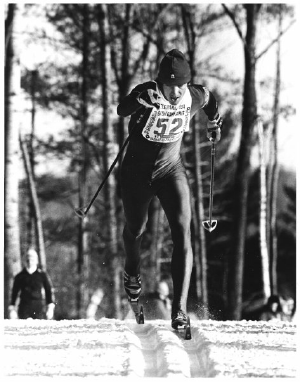
Galanes back in his own racing days. Courtesy photo.
He worked for an engineering firm in Anchorage, and then moved to Sun Valley, Idaho, for a stint. Of course, he wasn’t completely gone from the ski world; he continued to do a bit of consulting, personal coaching, and advertised a masters training group in Sun Valley. “I keep up to date,” he says.
But the job at Edgewise is by far the most decisive step back towards the sport that Galanes has taken since leaving APU. And he seems excited to join Graham Lonetto, a former serviceman for the U.S. alpine team.
“They have an amazing setup here and some great equipment that not many shops in the country have,” Galanes says. “We’re a race shop, we’re focused on high-level performance skis. Whether that is for a masters skier or a U.S. Ski Teamer, we’re going to be targeting that whole market.”
But he also has some more specific ideas of how Edgewise can best help the nordic community.
“The goal is going to be to keep it simple and focus on coming up with some good, broad-range grinds,” Galanes explains. “When people get so specialized, you have to have many pairs of skis to match to the snow conditions. Not a lot of the customer base that we’ll be working with, college skiers or ski academies or masters, have that big a fleet of skis… A kid with two pairs of skis can’t have a narrow-range grind.”
In either the super-specific or broad-range realm, he’ll have competition. Stowe is just two hours from Putney, Vermont, and Caldwell Sport. If a stonegrinder can be famous in this country, then Zach Caldwell certainly is, and Galanes is setting up shop in his backyard.
So what, says Galanes.
“First of all, Zach is a good friend of mine, and he has been a key advisor for me as I’ve moved into this role,” he explains. “I’ve talked to him quite a bit, and he has a wonderful attitude about it. You know, competition is good, and it’s going to force everyone to do a better job and the winners are going to be the skiers.”
There’s good reason to think that local skiers might win for other reasons, too. If Randall’s testimonials say anything at all about Galanes, it’s that any ski community is lucky to have him.
“Jim is incredibly passionate about cross country ski racing and has such a deep bank of experience from being an elite racer himself during the last golden era of U.S. cross country skiing, plus having coached so many top U.S. skiers,” she wrote. “He is very good at thinking and analyzing and conceptualizing.”
So is a return to coaching a possibility? Not right now, Galanes says. He’s too busy settling into a new town and a new job. But in the future, he certainly hopes so.
“I think I’m good at coming in and offering perspectives on technique, and how to implement technical changes, and how I see things,” he says. “I’d like to do some of that, go in and talk to coaches and athletes about how I see technique. I think that could benefit programs and people quite a bit.”
Stowe Derby – a 2013 Ski Challenge for you, you and YOU!
Make 2013 the year when you take on the Stowe Derby challenge! Surely, you can ski down the 4 mile Auto Toll Road in your sleep but… can you do it on a pair of cross-country skis AND avoid all potential “hazards,” i.e. other skiers and perhaps a bumpy patch or two along the way? After negotiating a couple of air pins you most certainly never noticed before, the rest of the course is a piece of cake, especially for most of us experienced skiers: a few ups and downs in the Stowe Cross Country Center and Trapp Family Nordic Center before skiing the flat Stowe Rec Path all the way to town.
Choose to ski the 20km course in the skate or the classic division, or be creative… split snowboards, tele gear, even alpine ski gear is an option – although not recommended unless you consider yourself as fit and adventurous as our dear friend George Tormey who mastered the challenge more than once back in the day. If you prefer, simply join the kids in the 6km short course and avoid the descent altogether.
The Derby is onSunday, February 24th, 2013 and this will be the 68th edition of the Mt. Mansfield Ski and Snowboard’s only Nordic production. The legendary race attracts hundreds annually and originated from a personal challenge between two good friends and amazing skiers – Austrian, Sepp Ruschp who was hired to come to America and head the new ski school at Stowe and Erling Strom, world famous mountaineer from Norway. The challenge was the same as it is today – to race from the top of Mt. Mansfield, Vermont’s highest peak to the historic village of Stowe… on ONE pair of skis – the ultimate test of a skiers ability. Ruschp was the winner of the first Stowe Derby, will you be the winner in 2013?
Prices go up February 8, so sign up soon. Also consider entering the EverBank Challenge by forming your team of four. Race for bragging right, for fun, for the challenge! Hope to see you in Stowe on Sunday, February 24th.
For more information or to sign up online visit: http://www.stowederby.com/home. Contact Pascale Savard at stowederby@teammmsc.org for further questions. Also follow us on Facebook for up-to-date information as we get closer to Derby Day!
– The oldest downhill cross-country ski race in North America –
Stowe, Vermont – The honor, bragging rights and camaraderie of competing in the oldest downhill cross-country ski race in North America keep competitors coming back each year to Stowe, Vermont. The historic New England ski town at the base of Mount Mansfield will once again draw the best skiers from far and wide for the 68th edition of the Stowe Derby on Sunday, February 24, 2013. This downhill and cross-country combined ski race brings out competitive and recreational skiers alike, lured by the unique and challenging course, energetic crowds and the prestige of taking a top finish in this historic, multi-faceted test of a skiers’ skill and fitness.
“An influx of early registrations has us believing the 68th Stowe Derby could be one of the most highly contested yet,” said event organizer Pascale Savard. “There’s the prestige of participating in one of North America’s longest running ski races, and there’s also the fun of being a part of skiing history. The race always brings together the ski community, from elite athletes to spectators lining the course, all eager to see who can out-ski the pack.”
Participants ski a total of 20km of challenging terrain over the course of the race, starting with the exhilarating 4-mile descent down the curvy Mt. Mansfield Toll Road. Alpine skiers and stronger XC downhillers always shine in this portion of the race, but Nordies typically make a quick comeback. Once the course connects to Stowe Mountain Resort’s and Trapp Family Lodge’s cross country ski trails, sound XC ski technique and perhaps a quick touch up on wax will change the outcome of the race – this is where battle truly begins! Finally, at the Stowe Recreation Path, crowds cheer on racers to give it their all for the final 5 miles leading to the finish in Stowe village. The course has a total vertical drop of over 2,600 feet taking between 45 minutes to several hours to finish. One pair of skis, heavy legs, burning lungs and a mix of skiing backgrounds makes for an exciting and contentious race.
The Stowe Derby started in 1945 as a personal challenge between two amazing skiers – Austrian Sepp Ruschp, an alpine skier who was hired to come to America and head the new ski school at Stowe, and Erling Strom, a Nordic skier and world famous mountaineer from Norway. The challenge was the same as it is today: to race from the top of Mt. Mansfield, Vermont’s highest peak, to the town of Stowe, on one pair of skis. Ruschp was the winner of the first Stowe Derby – and a tradition was born. Today, the race attracts hundreds of competitors, ranging from NCAA Champions to Masters competitors, to High School team racers and recreational skiers of all ages.
Skiers can select between freestyle or classic divisions, and experts have the option to do both back-to-back in the Derby Meister. Families with children ages 6 and up can enjoy the short 5km course along the Stowe Rec Path. The EverBank Team Challenge has been popular with groups of friends forming teams of four to battle it out for great prizes awarded after the race.
Online registration for the Stowe Derby is open, and racers who have competed in the past two years’ races will get seeded by signing up before February 19th. All other entrants are entered in order of entry submission. Visit www.stowederby.com or contact Pascale Savard at stowederby@teammmsc.org for more information and like the Facebook page for updates.
The Stowe Derby is presented by Concept 2 of Morrisville, Vermont.
Photos of the 2012 Stowe Derby courtesy of Ben Bloom:
Every year brings it own set of challenges and REWARDS, and the 67th running of the Stowe Derby will go down as one of the most Epic Derby’s of the decade.
The numbers were a little lower than usually at 547 skiers this year, but the spirits were higher than ever after Mother Nature finally rewarded all skiers and snow lovers by delivering some 36 inches of white powdery gold on Mt. Mansfield this past Friday. The buzzing energy was palpable as Stowe Derby participants ultimately benefited from this great blanket of joy, complete with the most perfect day Stowe has had this Winter. Clear blue skies, picture perfect sceneries and a new course were all part of the perfect story, along with powder skirts, ProGo cameras, a full roster of NCAA and High School racers.
The Stowe Derby is more than a ski race, it is the most exciting ski experience to be had. Traditionally, the race starts at the top of Mt. Mansfield and ends in the Village of Stowe, some 20 km down the road. But history has it that often times, Mother Nature has other plans in store, and the race course has to be altered in response to some force of Nature, generally involving snow. 2012 was just one of those years – at least until last Thursday… Pressured by time and the challenging logistics of running a point to point event, organizers had to commit to a new course and a new finish due to the lack of snow in the Village. And then… the snow came, just a little too late to be able to bring back to original course.
Few racers seemed phased by the change of course and the TopNotch finish. Actually, the skiers seemed to welcome the change and embrace the fact that the race was going on despite the many challenges Mother Nature has thrown our way this winter. It was going to be one of those years, and everyone was going to be flexible no matter what. And given the perfect conditions on race day, no one was about to complain about a thing.
The short course started and finished in the TopNotch field. The course was spectacular with the majestic Mt. Mansfield plastering the background of every picture perfect angle of the race. Fast times and good times were had, see the results page for more information of all category winners.
The top tear of both the skate and the classic race were fully loaded with huge cannons this year. Dozens of Dartmouth, UVM, Middlebury NCAA Nordic skiers eager to have a little fun after two big days of racing at Trapp Family Lodge in the Middlebury Carnival.
The Skate race was won by Rogan Brown, age 20 of UVM in 46:24, followed by Scott Lacy, 21, of Aspen CO, in 46:54.8. Juergen Uhl, an ex-UVM ski team member, ’09 NCAA champ, ’10 Birkie Classic Champ captured the bronze in 47:35.2.
On the women’s side, Stowe’s and VTXC Robyn Anderson, 24, once again skied to gold in only 51:25.4. Megan Killigrew, 33, of Putney VT was second with 55:44.5 and Isabel Caldwell of Peru, VT, 19 finished third in 56:22.3.
In the Classic, Juergen Uhl was untouchable and comfortably took the gold with a time of 50.20.1. The silver went to a young 17 year old skier of the Czech Republic and a High School student at Holderness School at 54.02.3. Russell Primeau, 20, of Newport, VT completed the leader board with a 54:11.7.
Three Stowe favorites ski ladies took over the podium: Robyn Anderson once again stole the show for the women stopping the clock 1:00:39.4 despite a bonk during this golden performance. Ruth McGovern, 22, was second with a 1:03:15.9 and Mary Stewart close behind in third with a 1.04:23.
The SWIX Derby Meister Title went to Robyn Anderson and Juergen Uhl. The EverBank team Challenge went to the SWIX team, Robyn Anderson, Sam vonTrapp, Juergen Uhl and Ryan Kerrigan. Special recognition to the ALL women Meister team, Carrie Nourjian, daughter Ashley Morton, and Stowe Mountain Resort Marketing girls Kim Leslie and Tori Milne.
The Derby organizers would like to sincerely thank everyone (and you are too numerous to all name) who has helped with the success of the race. Stowe Mountain Resort, Trapp Family Lodge, the Nordic Barn, TopNotch Resort, Stowe Parks and Rec, the Mt. Mansfield Ski Club. The Stowe Rotary, Rusty Nail, the Stowe Reporter, Stowe High School, Stowe Police, MVP Health Care, SWIX, EverBank, and all the generous sponsors who make this event possible. Sincere thanks to Jim Fredericks for announcing, Wendy Velander with the GoPro, starters Lori Furrer and Cap Chenoweth, timers Ethan and Terrie Wehse and Hank Elitzer, Sporty Bell, Kim Brown, Tom Sequist and Al Coppock. Finally, thanks to all the participants who make this event so special and unique. Please send us your best pictures of post them on the Stowe derby Facebook page. Let the good memories last a while.
See you all next year on February 24th, 2013. Always on the last Sunday of February.
Sylvan Ellefson (Bates College) and Walt Shepard (Bowdoin College) competing in EISA competition at the UVM Carnival in 2009. Photo: Ilke Van Genechten
For the sixth time, in the nearly 60 year history of the NCAA Skiing Championship, the University of Vermont will host the four day competition to determine the nation’s top individual skiers as well as the country’s best collegiate ski team.
Since the first NCAA Skiing Championship, held in 1954, the competition program has changed to reflect the evolution of the sport. Early collegiate championships featured downhill and slalom from the Alpine disciplines as well as an individual 15 kilometer cross country race and ski jumping to represent the Nordic disciplines. During the first two decades, in addition to recognizing the individual winners in each of the disciplines, a skimeister was named, who achieved the highest point total in all four events. Through 1976, Alpine Combined and Nordic Combined Champions were also named based on the best combined results of the two Alpine, and two Nordic events.
Following a couple of tragic accidents, the downhill was replaced by a giant slalom event in 1976. In a controversial decision, the NCAA skiing committee dropped jumping from the program in 1981 and replaced it with a cross country relay. In 1983, skiing became one of the first collegiate sports to combine the results of both men’s and women’s teams into one, overall championship. In 1989, international acceptance of the skating technique in cross country led to the replacement of the relay with a second individual event, permitting one cross country race in the traditional, classic technique and the other in the skating or freestyle technique.
Historically, the NCAA Skiing Championship has alternated between eastern and western sites. There was a time when western Alpine skiers dreaded racing at eastern venues like Stowe, VT, Lake Placid, NY or Sugarloaf, ME because they were apt to encounter icy conditions uncommon in the west. Conversely, eastern Alpine skiers knew that a late starting number at Steamboat Springs, CO, Bridger Bowl, MT or Park City, UT meant skiing through knee-deep ruts on the slalom course.
Trapps Race Map
In the Nordic events, the geographical issue is altitude. Since the ability of the body to transport Oxygen to the muscles is a significant issue in endurance events, athletes who live and train at altitude have a distinct advantage over those who live and train at sea level. Not surprisingly, when the NCAA’s are in the Rocky Mountains, the skiers from eastern schools tend to have a tough time, when the races are in the east, altitude is not a deciding factor.
Another unique aspect of the NCAA Skiing Championship is the wide variety of schools that participate, from huge, Division I, state universities with many thousands of undergraduates, to small, Division III, private colleges with relative modest athletic programs. In the past, some of the major university programs with the luxury of athletic scholarships, have recruited virtually their entire ski teams from Scandinavia and Central Europe. As a result, the overall team award has been dominated through the years by three schools: Denver University which has won the championship 21 times, the University of Colorado, overall champions 16 times, and the University of Utah, NCAA skiing champions 10 times. This domination occurred in spite of the fact that during the past half century, 66 colleges and universities have participated in the event.
In contrast, some of the smaller schools attend the championship with no possibility of winning the team trophy, but with individual skiers capable of earning recognition in specific events. While the team trophy has been won by only seven different schools during its 57 year history (University of Vermont, Dartmouth, Wyoming and New Mexico are the other team champions), 25 institutions have provided individual champions. While the battle for the overall team trophy, in all likelihood, will be among the three or four usual contenders, there is the potential for plenty of surprises in the individual standings.
At least some of the excitement around this year’s NCAA Championship focuses on the competition venues. Skiers at Stowe’s Spruce Peak are enjoying the results of a recently completed, multi-million dollar renovation. Both the slalom and the G.S. will be held on the Mainstreet trail, one of the best Alpine ski slopes for spectators anywhere.
Trapps Family Lodge, Stowe, VT. Photo: Donna Counts
The Nordic events at Trapp Family Lodge will be conducted on the recently completed racing loop, one of only a handful in the United States that are certified for international competition by the FIS (International Ski Federation). In addition to meeting all the technical standards of a World Cup course, the new racing trail at Trapp’s was designed to be spectator friendly, bringing the athletes back within sight of the start/finish area multiple times during an event. Both Johannes Von Trapp and his son, Sam, have remarked that an added benefit of the new race course is its independence from the highly popular recreational ski trails. Although Trapp’s has hosted major cross country events in the past, including several NCAA competitions, for the first time racers will not encounter recreational skiers on the course and guests at the lodge will not find the trails that they love closed for a competition.
If you are not yet convinced to take in some of the NCAA skiing action in Stowe, consider this: through the years, literally dozens of NCAA skiers have gone on to compete in the Winter Olympic Games. The list comprises a “who’s who” of American skiing, including Colorado’s Buddy Werner, Bill Marolt, and Jimmy Heuga, Utah’s Marv Melville, Luke Bodensteiner and John Aalberg, as well as Denver’s Rick Chaffee and Dennis McCoy. You may even see Olympic medalists like Vermont’s Beth Heiden, who made the switch from a bronze medal speed skating performance in the Lake Placid Winter Games, to winning the NCAA cross country skiing event in 1983, or Dartmouth’s Chiharu Igaya who represented Japan in 1952, ‘56 and ’60, winning silver in the slalom at Cortina.
Blessed with abundant snow cover, mid-winter temperatures early in March and two recently renovated world-class venues, the 2011 NCAA Skiing Championship , hosted by the University of Vermont at Spruce Peak and Trapp Family Lodge in Stowe promises to be an exciting event, worthy of its impressive half century tradition.
The von Trapp family.
John Morton finished second in the 1968 NCAA cross country event, and coached the Dartmouth Men’s Ski Team at 11 Championships from 1978-1989. As the founder of Morton Trails, he has designed more than 130 recreational trails and competition venues from Maine to Alaska. He and his business colleague, former Dartmouth skier, David Lindahl, Ph.D., designed and homologated the race course at Trapp Family Lodge. Contact them at www.mortontrails.com.