From the FasterSkier archive — posts syndicated from athletes’ and coaches’ own blogs between 2004 and 2012, kept online as published. Current coverage is at fasterskier.com.
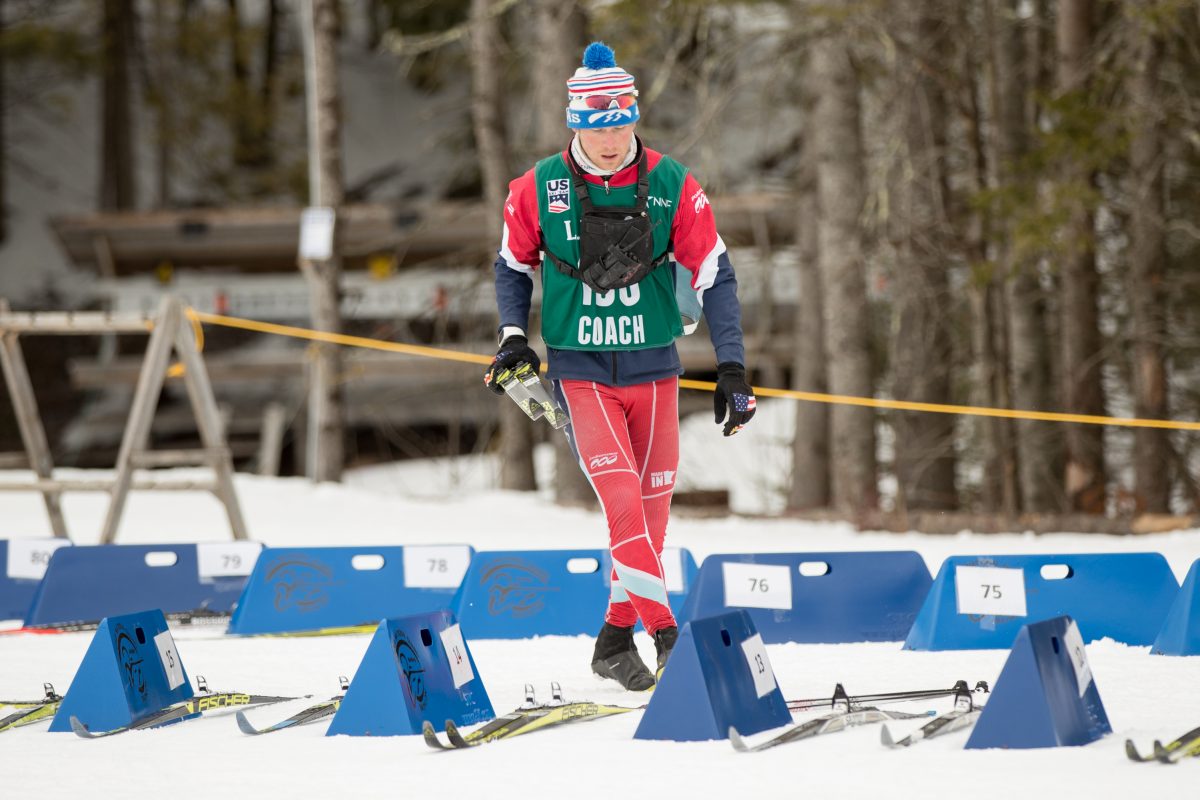
We’re happy to welcome Patrick O’Brien back to the ranks of the Craftsbury Ski Club, this time as the Assistant GRP Ski Coach. Pat, a native of Putney, VT, raced collegiately for Dartmouth before his stint as a professional ski racer with the Green Racing Project from 2010-2014.
While on the GRP, Pat competed in multiple World Cups and also became known to the Craftsbury community as a hardworking jack-of-all-trades with a deep love of skiing and the outdoors. Pat moved on from racing to become the head coach of the SMS T2 team from 2014-2022. Although he coached multiple athletes to international success, he’s most proud of the role he played in building a program that brought together athletes of all ages and rooted the team in its local community.
In recent years, Pat has supported various junior, college, and elite teams as a service technician, all while juggling a job as a builder and wrangling a growing young family. When not up to his eyeballs in ski wax or construction detritus, Pat can often be found outdoors with his wife Ida, who also has deep ties to Craftsbury, and their two kids. Welcome back, Pat!
Registration is open for the Stratton Mountain School BKL Summer Camp, which runs August 3-6, 2026, on the SMS campus in Stratton Mountain, Vermont. The camp is open to athletes ages 10 to 14, with a maximum grade of eighth.
The four-day program is built around progressive skill work in a low-pressure setting. Hiking, swimming, roller skiing, ski bounding, and games are all on the schedule, along with the camp’s annual lip-sync contest. Campers will also sit down with members of the SMS T2 Elite Team for a Q&A — the T2 group has put skiers on World Cup and Olympic start lists, and the session is one of the camp’s longer-running traditions.
The camp is split into two sections, one for male athletes and one for female athletes, both running the same August 3-6 dates. Registration and payment deadlines are both July 31, 2026.
If the camp fills before the deadline, SMS is keeping a waitlist through a Google form linked on the registration page. Note that the form does not allow duplicate phone numbers. Cancellations made fewer than 30 days before the camp start date are non-refundable.
For questions, contact Nordic Program Director Matt Boobar at mboobar@gosms.org or 570-594-7555.
Annika Martell racing during the NENSA club relays, Saturday, March 28, 2026 at Craftsbury. (Photo: Phil Belena)
The Craftsbury Green Racing Project has named Annika Martell as its new Head Ski Coach.
Martell brings a resume that spans nearly every corner of the Nordic skiing world. A Minnesota native, she headed east to ski at Colby College, where she captained the team and earned recognition for her leadership before graduating with a degree in economics and environmental science.
Her coaching career has taken a similarly wide path. Early on, she interned with the US Biathlon Association and coached juniors at Ford Sayre and the Berkshire Nordic Ski Club, before moving into elite-level work as an assistant coach with the Stratton Mountain School T2 Team. She spent four years as an assistant coach at Williams College, during which time she completed two stints as a Trail to Gold Fellow with the US Ski Team and served twice on the wax staff for Team New England at Junior Nationals.
Most recently, Martell was the Head Nordic Coach at St. Michael’s College, where she guided the program to highly competitive results.
Her background extends well beyond the ski tracks. She is a certified weightlifting coach and handled strength and conditioning duties at Williams. She also has experience in finance and operations management, and holds a Master’s degree in Sports Business from Drexel University.
The Craftbury Green Racing Project is still accepting athlete applications for the incoming 2026 snow class — Apply Here
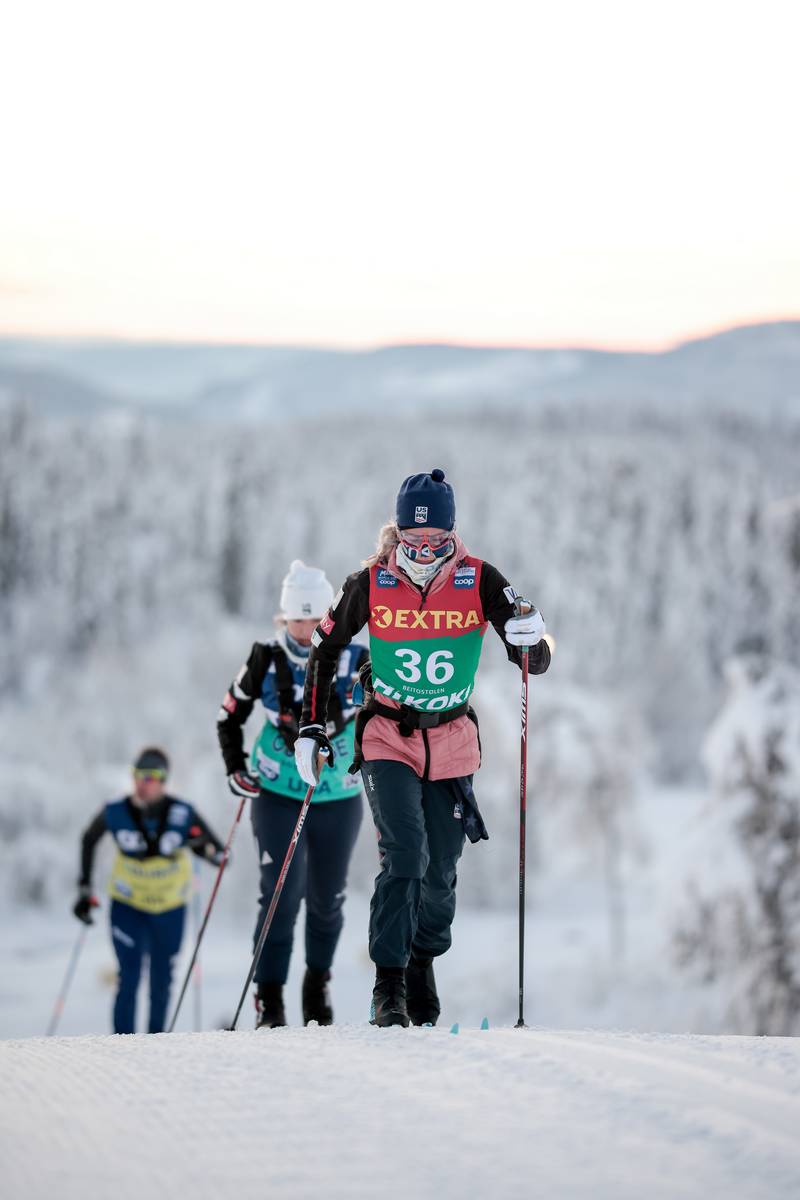
Martell follows Jessie Diggins on course in Beitostolen in 2022. (Photo: Nordic Focus)
The first time I saw Colin Rodgers, he was climbing onto a podium in the basement of a hotel in Biwabik, Minnesota. I honestly can’t remember the name of the hotel, but I can remember the rooms, the enormous lobby complete with an indoor minigolf course, and the basement where the awards were taking place. It was Junior Nationals, 1997, and he’d just won the opening U16 race. We were there with the New England contingent. They held the awards in this low-ceilinged basement room, and although he wasn’t the tallest of boys, his blonde hair almost touched the ceiling tiles. Colin went to Holderness School in New Hampshire, and as I looked up at his smiling face, it was obvious that he was the kind of kid who was going somewhere.
A few years later, I was watching him again, but this time from behind as he skied away from me up one of the small climbs on Woodpecker during the 3 x 5 k Classic Relay at the Williams College Carnival. Colin raced for Middlebury, and I raced for UNH, and at carnivals, he’d ski away from me. That was the deal. He was always a step, or a lot more, ahead.
We caught up over Zoom last week. Colin was in a hotel room in Falun, Sweden, traveling with the U.S. Ski Team on the World Cup circuit. I was sitting on a rocking chair in the foyer of our local dentist’s office while my boys were inside getting their teeth cleaned. That’s how FasterSkier interviews happen sometimes.
Colin Rodgers (SVSEF) – 4th Place
Since his competitive career ended, Colin has given himself fully to coaching. First with the SVSEF Gold Team, who he had raced for at the end of his career, and later junior skiers at Green Mountain Valley School, where he spent nine years. And now, as head coach of the SMS T2 Team at Stratton Mountain School in Vermont, he works with some of the best cross-country skiers in the world.
The team this year included Jessie Diggins, Ben Ogden, Julia Kern, and Canadian skier Remi Drolet, as well as collegiate skiers Fin Bailey and Jack Lange. Of the professional skiers, three of them finished in the top six at the Olympics. All four were in the top 20. Ben Ogden came home with two silver medals and ended a 50-year Olympic medal drought for American men in cross-country skiing. And Jessie Diggins, who is currently wrapping up a career that is the best of any American skier ever, added a bronze medal to her collection.
Colin still seemed a little stunned by it all when we spoke.
“We were so far beyond wherever I thought we were going to be,” he said. “I had a good feeling about this year. But for Ben to take home two silvers, and Jesse a bronze, and Remi to be in the top 20 and really help Canada with a historic relay finish, and Julia in the top six. It’s stuff that I could never believe was truly going to happen. And here we are talking about it.”
SMS T2’s Rémi Drolet, Ben Ogden, Julia Kern, Jessie Diggins, and coach Colin Rodgers. (Photo: courtesy photo)
Colin grew up in Westford, Vermont. His father was the program director for the U.S. Biathlon team from 1984 to 1988, which brought the family to northern Vermont. His parents built a house in Westford that year and never left.
He went to Holderness, then Middlebury, and after college, he headed to the Maine Winter Sports Center, where coaches like Jens Johansson, Eli Brown and Will Sweetser were building something in the northern reaches of the state. From there, he moved to Sun Valley, Idaho, where he joined the SVSEF Gold Team and kept racing.
Colin was good. He raced on the World Cup. But the jump he’d always hoped to make didn’t quite happen.
“I think as a nation now, we’re so much more educated,” he said. “I had amazing coaches. But we were just kind of, maybe sometimes trying too hard.”
He talked about spending time in Scandinavia and being around athletes who were significantly better than him. What he noticed wasn’t that they worked harder. It was that they were smarter about the work.
“I probably trained at level two way too much of the time,” he said. “Especially being a little more anaerobic and linked to the sprint side. I really needed to be doing the easy training even easier.”
He paused.
“When it’s time to go, you’ve got to let the dog run,” he said, quoting his old Middlebury coach Terry Aldrich. “And that was the exact opposite. Like, now it’s time to really peak, and you let it loose.”
I told him I’d heard a version of that from the other direction. When I was coaching, I used to tell my kids about Matt Whitcomb, who had been a teammate of Rodgers at Middlebury, previewing a course at Junior Nationals and telling the athletes they had to “walk the f-ing dog.” Every time they got to a climb, they were pulling back on the leash. Walking the dog.
Two coaches. Related metaphor. Opposite leash relationships. That’s about as clean a summary of training philosophy as you’ll find in this sport. Keep the dog relaxed in training often, until it is time to let it run when it matters.
Matt Gelso on the finishing stretch with coach Colin Rodgers encouraging in West Yellowstone (Photo: Toko)
Before Stratton, the coaching experience that shaped Colin most was the time he spent around Rick Kapala at Sun Valley.
Kapala ran the Sun Valley Education Foundation for nearly 30 years and built a program Colin still talks about with real admiration.
“It was serious training, but it was also really creative,” Colin said. “You’d go out for long mountain adventures, do different kinds of workouts. It kept people engaged.”
That stuck with him. When he moved to GMVS to coach high school athletes, he kept coming back to a simple question.
“What would make me really want to go to practice today?”
He laughed when he said it.
“It sounds basic. But it actually matters a lot. If people don’t want to be there, something’s probably off.”
He talked about his coaching years at GMVS and how, for him, the job was about getting kids to believe in what they could do.
“When kids are in high school, they’re questioning everything. How they look, how they’re growing. And you’re just like, no, dude, this is fun. This can be a real blast. And believe. Like, damn, I can do a good job at this. If I’m doing this every day, I might as well be good at it, right?”
He spent nine years doing that work. And then the SMS T2 job came along.
“It was an opportunity there’s no way I was going to pass up,” he said. “It’s changed my life. Literally.”
The program at Stratton operates under a mission statement crafted by Colin’s predecessor, Sverre Caldwell: international excellence and local inspiration.
Colin said that phrase was part of what sold him on the job.
“It’s everything I believe in. We’re trying to be the best we can be, win races, kick ass internationally. But then also, along the way, inspire the next generation of skiers coming up.”
At Stratton, those two things aren’t separate. The T2 athletes train on the same roads and trails as the younger skiers in the school’s Nordic program. When Stratton kids show up for a summer or fall practice, and the older athletes are there, everyone just funnels in together and heads out.
“It doesn’t even need to be talked about, really,” Colin said. “It’s just showing up, doing the work. This is how it’s done. And if you keep working really hard for a long time, you’re probably going to get really good too.”
He brought up the chain of inspiration that runs through American skiing. Jessie Diggins was inspired by Kikkan Randall, by Andy Newell, by Simi Hamilton. Kern was inspired by Diggins.
“When you get motivated by somebody who’s special and inspiring to you, if you have some talent and the fire to go for it, you realize you can chase that person. And then it’s like, oh, I can maybe be them. And then it’s like, oh, maybe I can be better than them.”
One of the more interesting aspects of Colin’s role at SMS T2 is that he’s not the only coach in the picture. Not even close.
Kristen Bourne and Colin Rodgers out for a run during the OD run at Park City camp, 2025. (Photo: Matt Whitcomb)
Diggins works primarily with Jason Cork on the U.S. Ski Team staff. Ogden’s training has long been guided by Patrick Weaver, his college coach at UVM. Kern has a deep relationship with Kristen Bourne, who is also a national team coach. Drolet works with Dave Wood, a former coach of the Canadian national team. And Bailey goes to UVM and skis for Weaver, while Lange goes to Dartmouth and is coached by Brayton Osgood.
Colin sees his job as connecting the dots.
“Each athlete comes in with their own support network,” he said. “Jason has been working with Jesse forever. Ben has a really close connection with Weave. And I’ve been able to learn a lot from Patrick about how Ben ticks.”
He was honest about what that requires.
“When you step into a role like this, you have to check your ego,” he said. “It’s not about being the only voice in the room. It’s about helping the athlete succeed.”
What he brings is proximity. He sees the athletes more frequently than some of their other coaches, especially during training blocks in Vermont. He can offer technique advice, fill gaps when someone else isn’t available, and keep everyone communicating.
“I think one of my strengths is the ability to connect people,” he said. “And to connect with people.”
Colin has watched American skiing grow up. When he was racing, relatively few American men were competitive at the highest levels. The development pathways weren’t as clear. The coaching wasn’t as sophisticated.
“We’re closer as a nation now to what it means to go to that next level,” he said. “We know what to do. As coaches, we’re totally clued in on this systematic, long-term idea of how to periodize correctly, and also how to make it fun.”
Colin Rodgers, Jessie Diggins and Julia Kern. (Photo: courtesy photo)
He pointed to results at every level. At the time we spoke, American athletes were fighting with the best in the world at the World Junior Championships. On the World Cup, Diggins, Kern, and Ogden, along with the APU-based skiers, are proving it can happen at the very top.
“A lot of people have helped build this,” he said. “It’s not just one program or one coach.”
But the jump from junior skiing to the World Cup is still enormous. And programs like SMS T2 exist to help athletes survive that transition.
“Having environments where athletes can develop during that stage is really important,” he said. “The gap is huge.”
Before we wrapped up, I asked Colin what success looks like for him five years from now.
He went big picture with a slightly longer lens. The 2034 Olympics will be in Salt Lake City. There’s a generation of young American skiers who have already raced at Soldier Hollow, the Nordic venue, during their youth careers. Now they’re looking ahead to competing on home soil.
“We’re working towards 2034,” he said. “And we want to be successful there. If we stay on this trajectory, we can have medals. That’s our ultimate goal.”
Within Stratton, he wants to grow the team thoughtfully. This year was lean, focused on supporting the Olympic athletes. Going forward, he wants to build back toward four or five athletes on each side, men and women, plus NCAA skiers.
“We have to do it the right way,” he said. “We don’t want to take on too many people too fast.”
Jessie Diggins (USA), whose World Cup career will conclude in a week and a half, celebrates her bronze medal in the Olympic 10 k Freestyle in Tesero, Italy. (Photo: Vanzetta/NordicFocus)
He’s also thinking about the athletes who won’t be there. Jessie Diggins is retiring. That will leave a void at SMS T2 and on the World Cup, where Colin noted she currently sits at 380 career starts, more than any other skier.
“Jesse’s going to go on and do a lot of really cool things and still inspire the next generation in new ways,” he said. “And then there’s going to be up-and-comers who are going to step up and be inspired by everything she’s done, and by everything Ben and Julia and Remy are already doing.”
International excellence. Local inspiration. It’s a simple mission. But Colin Rodgers has spent a career learning that the simple things are usually the ones that matter most.
He’s been chasing the highest levels of this sport since he was 15 years old, standing on a podium in a hotel basement in Minnesota. The path just looks different now.
Help Support Our Olympic Coverage!
If you value the thoughtful work and access FasterSkier provides, please consider becoming a Voluntary Subscriber. Your support directly fuels our work to cover the people, places, and moments that make our sport special.
Finals week has a way of compressing time. Days shrink into problem sets and exams; nights stretch just long enough to make sleep negotiable. When Jack Lange logged onto Zoom from Hanover in late November, he was finishing his senior fall at Dartmouth, a mechanical engineering major balancing equations while packing for a training block at Silver Star. The snow out west wasn’t cooperating. Races were being reformatted. Nothing felt settled.
That uncertainty didn’t seem to bother him much.
“We’re wrapping up school right now and then heading to Silver Star next Tuesday,” Lange said. “Hopefully, the snow conditions there improve a little bit.”
It was a measured answer—calm, almost deliberately so. Over the next hour, that calm would reveal itself not as indifference, but as something learned the hard way.
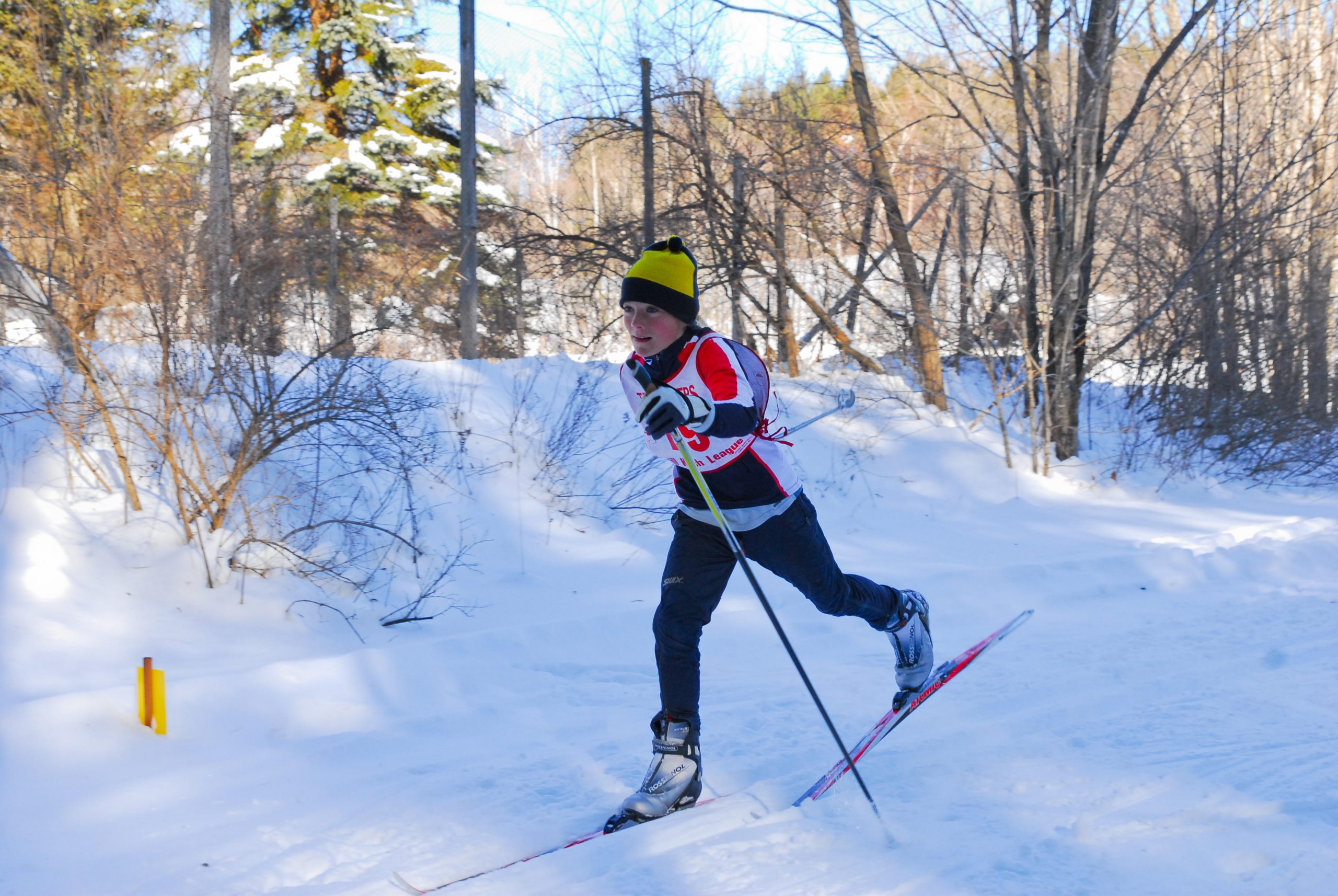
Young Jack Lange skiing in a New England BKL race. (Photo: Heidi Lange)
A kid who wasn’t supposed to be good at this
Lange grew up in Vermont’s Upper Valley, skiing out of Green Woodlands and the Ford Sayre Bill Koch League. It was the kind of childhood that feels almost mythic now: full-moon skis to a cabin, hot chocolate on a frozen pond, friends everywhere.
“I’ve always just made sure that that’s the thing that comes first,” he said. “Getting outside and enjoying being outside and enjoying pushing myself and having fun.”
He played everything. Soccer, where he was very aware he wasn’t the best. Swimming, where he gravitated toward breaststroke. Cross-country running. Mountain biking. For a while, he did both alpine and Nordic skiing, until a choice had to be made.
“My sister was doing more Nordic and more of my friends were on the Nordic,” he said. “So I just went with Nordic.”
Lange and friends meeting Jessie Diggins and Sophie Caldwell Hamilton at the Quebec World Cup. (Photo: Heidi Lange)
It wasn’t a natural fit at first. Lange remembers being the odd kid out on relay day—the one paired with a skier from another team because the numbers didn’t work.
“I wasn’t good at it,” he said simply.
What hooked him wasn’t speed. It was curiosity.
“I really like the amount that you can learn from being out in training,” he said. “Not even structured training—just being outside and having fun. I really enjoy the process of figuring out how hard I can push myself.”
By freshman year of high school, something shifted. He trained more. He paid attention. And suddenly the results were better than expected.
“That was kind of the confidence boost that launched me into, like, ‘Oh, this is something I can do.’”
2019 Junior National Championships in Alaska. Lange finished in fifth place with Dartmouth teammate Wally Magill in first. (Photo: Heidi Lange)
The pressure builds—and breaks
Lange’s junior years were uneven. Seasons were disrupted. Races were canceled. One winter meant nine consecutive weekends racing at Craftsbury, all interval starts—an exercise in patience for someone who loved head-to-head competition.
“I love mass starts,” he said. “I love racing next to people. Mind games and competitiveness.”
By his senior year, he had narrowed his focus to Junior Nationals. The goal was simple: qualify. Nothing more.
When he arrived at the 2019 Junior National Championships in Alaska, he was the last skier to qualify from New England. He started near the back in the 5-kilometer skate race at Kincaid Park.
“My goal for the entire season was to make JN’s,” he said. “And I was there, and I was like, I’m in Alaska. This is kind of crazy.”
Mid-race, a coach called out a split.
“One of the New England coaches is like, ‘You’re like three seconds out of top ten,’” Lange recalled. “And I was like, that’s pretty funny.”
He kept skiing. He finished fifth.
“That was way, way beyond where I ever could have expected to be.”
There’s a photo from that day—Lange among a group of skiers who would later become familiar names on the U.S. Ski Team. At the time, it felt surreal. In hindsight, it was clear it wasn’t the performance itself that mattered most, but the conditions under which it happened: no expectations, no fear.
That lesson wouldn’t fully sink in until later.
Lange with his parents, Heidi and Greg. (Photo: courtesy photo)
Dartmouth, and the weight of wanting it too much
Lange chose Dartmouth largely because it felt right. He wanted engineering. He liked the people. He trusted the coach.
“Brayton [Osgood] is such an amazing coach to work with,” Lange said. “He’s never the guy to show up and be like, ‘This is what you’re doing.’ He’s super approachable. He really wants us to find our spot in the sport.”
At Dartmouth, skiing wasn’t isolated from the rest of life—it was embedded within it. That integration became most visible during the most stressful week of the year: NCAAs, which overlap directly with finals.
“My freshman year, that finals week with NCAAs was kind of a dark time,” Lange said. “I was close to tears on the start line of the 20k race. Just so much pressure, so overwhelmed.”
He remembers warming up briefly, then stopping.
“I skied like fifteen minutes in the warm-up and just put my skis down,” he said. “I was completely broken.”
A kilometer into the race, he was in dead last.
And then something shifted.
“I saw Brayton on the side of the trail,” Lange said. “And I was like, you know—I don’t need to take this so seriously. I can show up, do my best at everything, and give 100 percent effort. If I do that, it’s gonna come through.”
It did. That race became one of his best of the season.
Dartmouth Ski Team (Photo: courtesy photo)
The things that make it lighter
The story of Dartmouth skiing is often told through tradition—green suits, first-years with mohawks, time trials. Lange points to different details.
There’s a sauna in the locker room.
“That’s a prime spot to get to know the team,” he said. “We rip this on all the time.”
There’s also life beyond skiing. Every non-freshman on the men’s team is in a fraternity. Lange lives in the Zeta Psi house with teammates and classmates—engineers, computer scientists, people whose lives orbit entirely different centers.
“I’m surrounded by a ton of people who have no clue what skiing means to me,” he said. “And that’s been a really huge part of being at Dartmouth.”
His best season, he said, came immediately after pledging.
“It taught me how to not put as much pressure on myself,” Lange said. “How to make this a sustainable thing that I could really enjoy.”
That balance—academic, athletic, social—isn’t accidental.
“None of the three would be as good without the others,” he said.
Lange’s favorite race: Prospect relay with Cam Wolfe and Cooper Camp. (Photo: Heidi Lange)
“You can’t live nervous”
Lange keeps a training log. He trains consistently. He admits he’s overcooked himself before. What he doesn’t do is chase numbers obsessively.
“I don’t think I’ve ever had an hour’s target that I’m trying to hit,” he said. “I’ve just trained for the enjoyment of it.”
There was a time, early on, when outside voices crept in.
“I was getting a lot of people saying, ‘You’re training too much. You’re doing this wrong,’” he said. “I got a little worked up about it and a little nervous.”
He paused.
“You can’t live nervous.”
It’s the line that keeps resurfacing, whether he’s talking about high school racing, college pressure, or the future beyond Dartmouth.
“I think anyone who’s in high school, middle school—just go out there because you enjoy it,” he said. “You’re gonna have crappy days. But if you go out there every day and just have a good time, and surround yourself with people you like to be around, things will work out.”
That philosophy shapes how he defines success now. Lange talks about team first. About racing in a green suit. About showing up energized.
“The guys here are here for the right reasons,” he said. “They’re skiing because they really enjoy skiing. That’s super energizing.”
Lange with his long time coach and mentor, Dennis Donahue. (Photo: Heidi Lange)
A quiet kind of confidence
Ask Lange where he sees himself years down the road, and he doesn’t reach for outcomes. He talks about process.
“The process of showing up every day,” he said. “How can I be the best athlete I can be today? That’s the most rewarding thing.”
Skiing, he believes, has taught him how to live—how to work, how to recover, how to stay curious.
“Wherever I am fifteen years from now,” he said, “all of the lessons that I’ve learned are still going to be extremely relevant and important.”
For now, there are finals to finish and skis to pack. The snow will either come or it won’t. The races will sort themselves out.
Lange will keep doing what he’s learned to do best: show up, stay loose, and ski without fear.
Because speed, he’s learned, is hard to find when you’re holding your breath.
Love Stories Like This? Help Keep Them Coming.
Feature stories like this one take time, access, and care to produce. If you value thoughtful storytelling and independent ski journalism, please consider becoming a Voluntary Subscriber. Your support directly fuels the work we do to cover the people, places, and moments that make our sport special.
U.S. Ski & Snowboard recently announced its U.S. Ski Team nominations for the 2022-23 season. Of the 22 athletes named to the team this season, six were not on the previous year’s roster, either newly named or renamed: Michael Earnhart, Walker Hall, Zak Ketterson, Will Koch, Finn O’Connell, and Sammy Smith.
To help fans get to know these new(er) faces, FasterSkier is doing a series of interviews, providing insights into the factors that have contributed to development, progress, and growth for these athletes last season. In this installment, we talk with Will Koch following his nomination to the U.S. Ski Team on its D-Team.
Koch grew up in Vermont and is now a member of the University of Colorado Ski Team, where he will be entering his junior year this coming fall. Son of Olympic Silver-Medalist, Bill Koch, Will began his racing career in the New England program named after his father (the Bill Koch League) and attended high school at Stratton Mountain School.
Ella Hall/Faster Skier: Can you give us a little introduction, where are you from? When did you start skiing? What was your relationship with skiing growing up?
Will Koch: I’m from Peru, Vermont, which is a tiny little town in Southern Vermont, just like 80 people as a population. And I’ve been living there since I was two years old. I got into skiing when I was super young, because my dad was a professional ski racer, Bill Koch. So I actually started skiing before I was even able to walk – nine months old on a beach in Hawaii was my first time on skis. Since then, I’ve just been pretty much training.
I grew up in a really vibrant ski community: starting as a youth, then Stratton Mountain School for my high school years, and now I’m at University of Colorado at Boulder. And this is my first year on the [U.S. Ski Team]. So that’s super exciting.
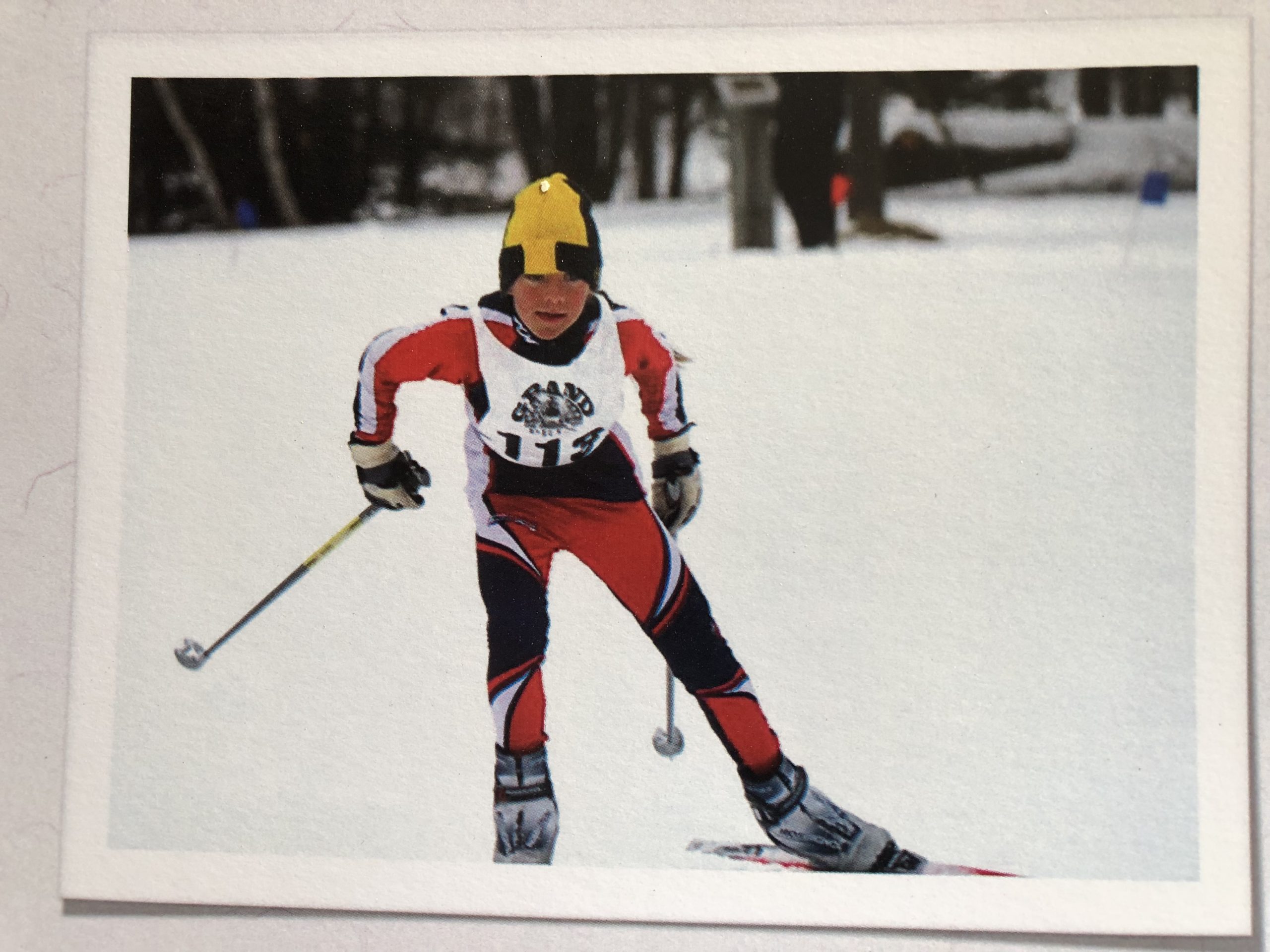
A young Will Koch hitting his stride in a junior race. (Courtesy photo)
FS: As the daughter of a three-time Olympian I can maybe relate to the potential challenges of being the child of a successful ski racer… so acknowledging that, can you talk a little bit about your dad’s role in your skiing career?
WK: I definitely get that question quite a bit about like, you know, is it stressful or pressure to have your dad being like, Olympian and everything. Honestly, I think that my dad does a really good job of not having expectations for me, which is really nice. My dad totally recognizes that skiing is awesome and everything, but that there’s a lot more to life than skiing at the same time. He’s very much left the coaching to my actual coaches, but at the same time, he’s always there to give advice when I want it.
He’s obviously like, been there, done that with everything that I’m given going through in terms of skiing, so I think it’s really inspiring to have a person like that always around when I need it, but it’s really awesome that it doesn’t feel like a burden. It’s really an opportunity.
Will Koch competing at a junior race in New England (Courtesy photo)
FS: How was the transition from high school at Stratton Mountain School (SMS) to college skiing at the University of Colorado (CU)? Both in terms of training but also general life changes? What drew you to CU?
WK: One of the biggest reasons that I wanted to go out west for college was that I loved the mountains out west. And I also really liked the people out there. I think they’re super open and fun. I also think that being at a PAC 12 conference school comes with certain advantages as far the resources available in the athletic departments. On top of that, I think CU had a really top level nordic team compared to certain schools that I was looking at. So those were all factors that made me want to go out there, and I definitely never regretted that choice once I was up there. I’ve been loving it for my two years, it’s a lot of fun. [There’s] a really good mix on the ski team, I think, of having fun, but also being serious about training.
I’d say, as far as training, transitioning from high school to college one difference was the altitude. When I first went up to altitude in Boulder, and was training up there, I really thought that I could just keep doing exactly the same volume and workouts that I was doing in Stratton. But I put myself in a little bit of a hole when I first got out there, and then learned from that and realized that it’s a little more taxing on the body. But once I dialed it back, training wise, I was able to get some real fitness benefits from the altitude. Now that I’ve been out there for two years, I was able to have a really good fitness year this past season and [make] kind of a breakthrough in my skiing. I think part of that is being in altitude and building fitness with a really strong team.
In general, I found that the college schedule allowed me to have more flexibility in terms of when I trained and it’s easier to do two sessions a day in college compared to high school, just because you spend a little bit less time in the classroom. You have a little more flexibility in how you structure your day.
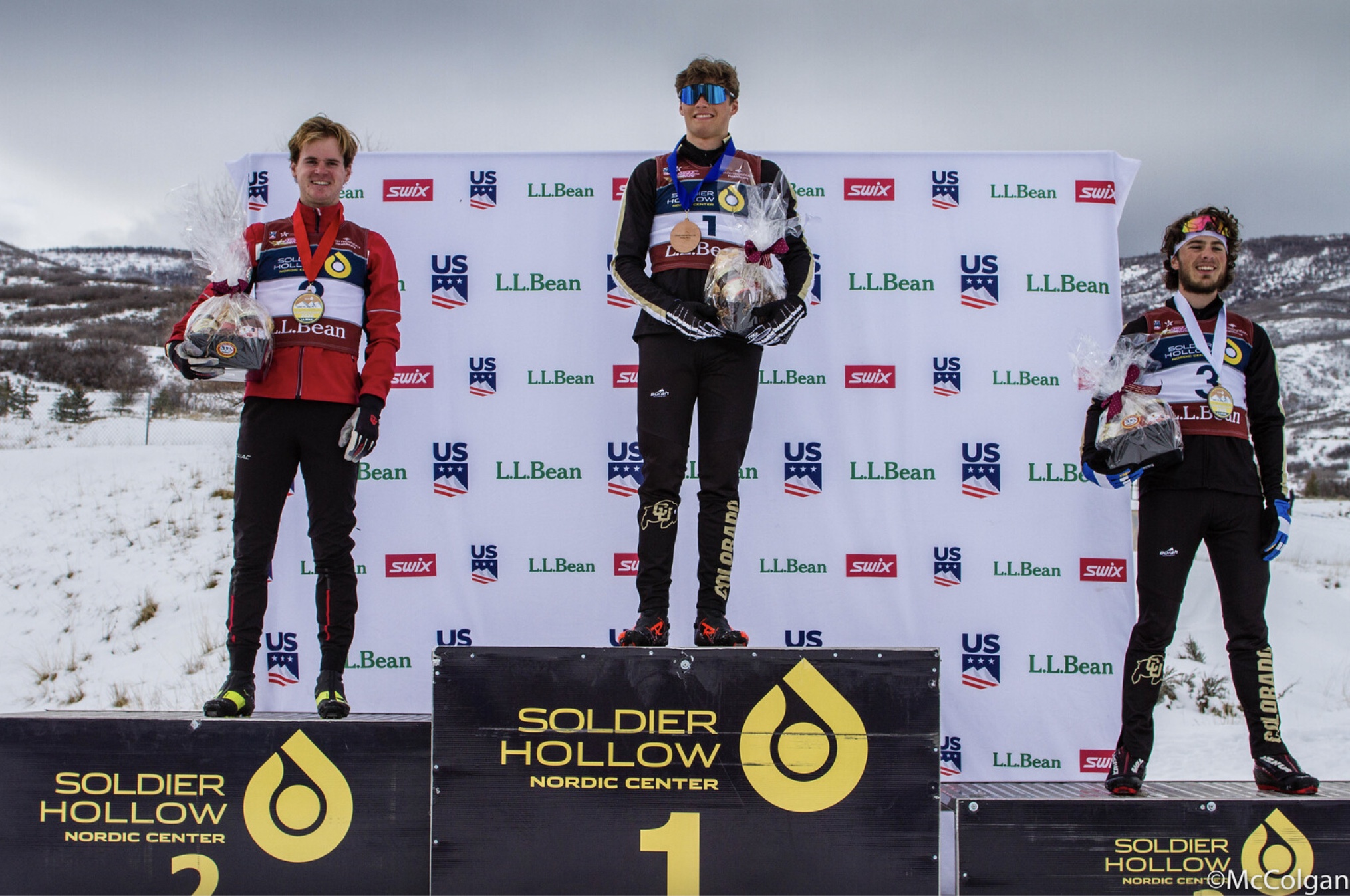
The junior men’s podium for the 2022 Senior Nationals 15k interval start classic in Soldier Hollow: Alexander Maurer (CU) took the win ahead of Walker Hall (UU) in second and Will Koch (CU) in third. (Photo: John McColgan)
FS: By my count you’ve been on five different international racing trips, including the Youth Olympic Games (YOG). What were some of the highlights from those experiences, particularly in terms of how they supported your development and goals?
WK: Yeah, of all the international trips I’ve been on, definitely the Youth Olympics stands out as the coolest one and the most memorable. YOG is pretty different from World Juniors, in terms of it’s a fair amount less intense, I would say and more about having fun. And yet, even though it’s less intense, it’s the same level of competition, either way, you’re up against the best people in the world.
I think that’s what I really loved about the Youth Olympics, it was fun to win the medal there and everything, but it was also mainly just a really cool experience. That was my first time meeting people from a lot of different countriesI still have my friends from Kazakhstan and Australia from the Youth Olympics, which I love. And, of course, that was also before COVID was really a thing, that was also a time when we were able to do a little bit more socializing on international trips.
I think that those [international] trips are really crucial in development, just to really see that next level of competition that you’re going to be up against, and to really see that every second counts. In the Youth Olympics race where I got my bronze, it was two seconds between me and second place, and I was about five seconds from being back in eighth place. It was just ridiculous how tight it was. That just kind of goes to show how you really need to be thinking about getting those small gains where you can, and that the rest of the competition in the world is out there doing the same thing.
FS: So you’ve just been named to the U.S. Ski Team D-Team, can you reflect on how that feels and maybe what is most exciting to you about this opportunity?
WK: It’s definitely pretty validating to be named after being kind of on the edge for a few years now. It’s exciting. At the same time, though, it’s also basically almost the same training group that I’ve been training with for years, now that me, Walker [Hall] and Michael [Earnhart] are all on there.
Being at my first US Ski Team camp (in Bend), I was kind of looking around, and I was like, Hey, this is really not that different from NTG, three years ago, when we all first made that. So it’s really cool to see how we all progress together. I’d say, making the team, it’s nice and everything, but it’s also really just one more step in development that we’re all taking together, which is really fun.
At World Juniors in Lygna, Norway- a psyched American team congratulates anchor Will Koch, securing bronze in the U20 4×5 k relay. (Ella Hall photo)
FS: What are some of your goals for the upcoming ski season?
WK: I would love to make a debut on the World Cup if that worked out. It’s obviously a really competitive scene right now for Team USA to make it there, and getting picked is by no means guaranteed. I think that’d be a really good next level experience to have. I’d also like to get on the podium at NCAA’s.
FS: Sounds like you made it out to Bend for the annual spring U.S. Ski Team camp there, and now are you back with SMS. What does the rest of your summer/fall look like?
WK: For the rest of the summer, I will be in Stratton training with the SMS T2 team. It’s pretty exciting, because we should have a lot of really fast guys on the US Ski Team coming out here to join our training group, which I think will be awesome, having grown up in Vermont, to get to show a bunch of people how we do it over here. I’ll be here until mid-August and then go back to Colorado and start school and training with the CU Ski Team.
The 2021/2022 SMS T2 Team. Back row (l – r): Ian Torchia, Ben Ogden, Bill Harmeyer, and Will Koch; front row: Alayna Sonnesyn, Julia Kern, head coach Pat O’Brien, Lina Sutro, Katharine Ogden, and Jessie Diggins. (Photo: SMS T2 Blog)
“You need some Gordie Howe elbows out there today” said the commentator on the live feed at one point during Friday’s Team Sprint in Whistler.
You know, just in case you needed a reminder that this is Canadian Nationals.
Alongside his legacy as one of hockey’s greatest players of all time, leaving his mark on the sport as an indomitable force with both his goal scoring and dynamism on the ice, Howe was known as an — ahem — impassioned athlete. One achieves a “Gordie Howe hat trick” by scoring a goal, making an assist, and engaging in a fight within one game. In short, he was a bit of a wild card, and he wasn’t going to let someone else stand in his way en route to the net.
In watching the Team Sprint livestream, you can see why a similar need to protect one’s space was relevant. The wet and variable spring weather in Whistler created a tricky mix of fast, wet, and mushy snow conditions that combined with fast mass start sprinting to produce racing that tested a skiers balance and “feel” as much as their lungs and muscles. Or more succinctly, racing that was fun, and a little bit chaotic. Staying upright and not losing your own footing or being taken out by another skier might be more important than technique or tactics.
Andy Newell (BSF Pro – Coach), Julia Kern (SMS T2), and Cendrine Browne (Fondeurs-Laurentides) chat on the warm up before the freestyle team sprint. (Photo: Doug Stephen / VR 45 Photography)
Adding another layer to the challenge, the Team Sprint was raced “Dresden-style”, where two partners took turns on a 750 m lap until the pair of them had completed eight total laps. The Nordic skiing equivalent of a short-track skating relay, and with the same flow to the action.
Early attacks could fizzle out through all or any of factors like a bad transition, fatigue, or a tangle up with another skier. All those factors had the equal and opposite effect as well; no team was truly out of it until they crossed the finish line. A late surge between two teammates could pull together a race, and often did when the fields of 15 teams were unleashed on the course today.
The 750 m course was an abbreviated version of the sprint course seen on Wednesday. Each lap left the stadium and shot up a steep but short climb which lengthened into a false flat where the mushy snow on course saw some skiers muscle out a V2 while others kept to a light-footed hop-skate. Then skiers shot down a sweeping downhill where the course widened to allow for two different lines, before doing a long left turn into the finishing straight.
Every skier completed an individual lap of this course in the morning, which when combined with their team partner, yielded a seeding time. With no semi-final, the top 15 fastest combined teams qualified for the Open A finals.
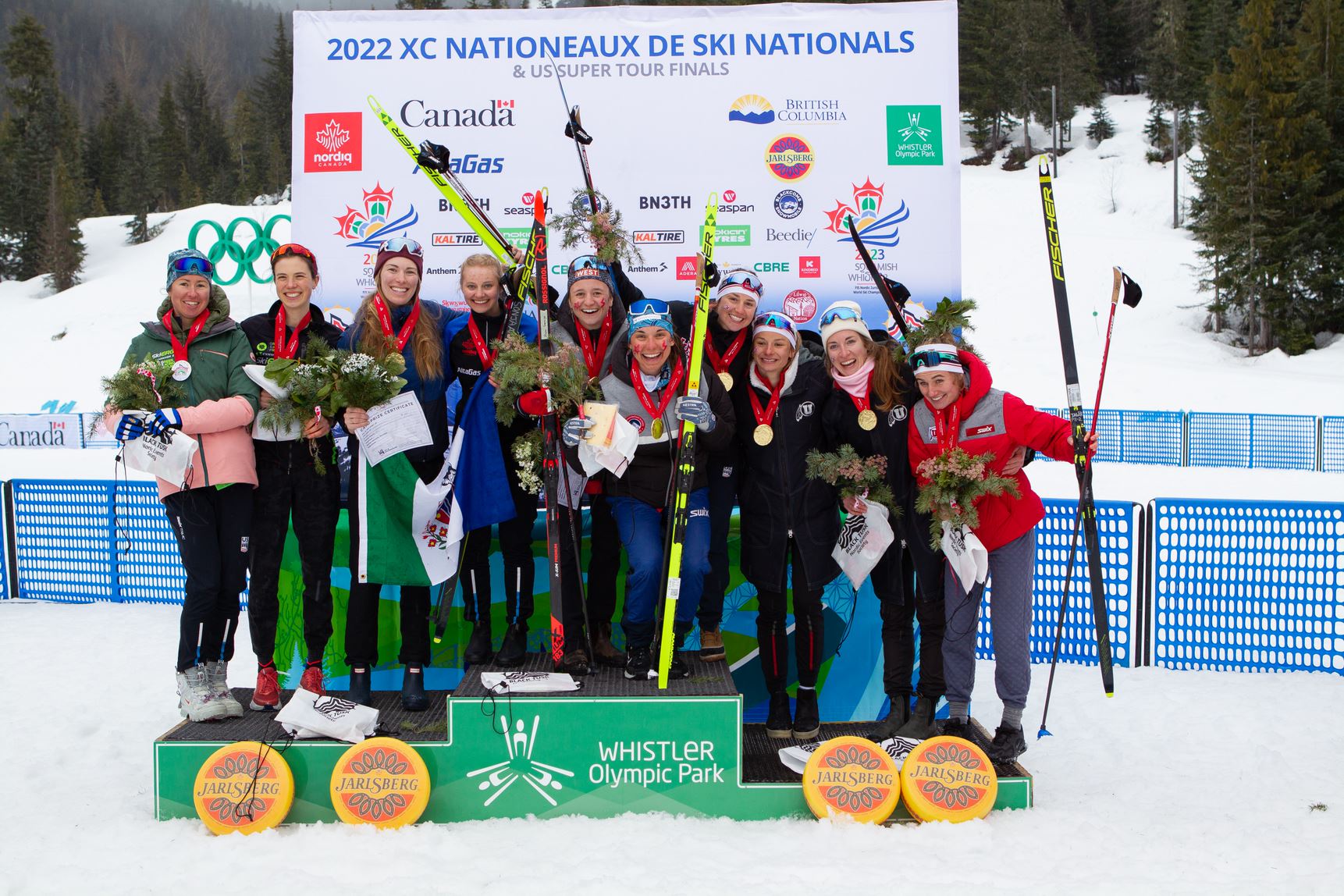
The women’s team sprint podium saw a win for SMS T2, with Yukon Team 7, University of Utah 1, Craftsbury Green Racing Project, and University of Utah 2 rounding out the top five. (Photo: Joern Rohde / Nordiq Canada)
Open Women’s
In the women’s qualifier, Julia Kern (SMS T2) completed the course in the fastest time, 1:21.70. That combined with 8th place Alayna Sonneysn (+3.45 seconds) to give their SMS T2 team the top seed for the women’s A final (combined time 2:46.85). Second seed (combined, +3.73) was earned by Nakkerertok 32’s Hannah Shields (7th, +3.12) and Zoё Williams (13th, +4.01), with third seed (combined, +4.12) going to the University Utah I team of Karianne Dengerud (2nd, +2.34) and Sydney Palmer-Leger (23rd, +5.23).
When the top-15 teams started in the A final, Alayna Sonneysn shot off the front for SMS T2, which stretched the field out immediately and may have helped avoid the pile ups that had been a feature of the Challengers and College Cup heats earlier in the day. Sonneysn was covered by Yukon Team 7 (Whitehorse), with Sonjaa Schmidt catching Sonnesyn as they rounded the corner into the first exchange. Schmidt also pulled back the entire group, and so the racing was extremely tight as they handed off to their teammates. SMS T2 and the Yukon Team continued to push the pace at the front, with the University of Utah I (UU I, Palmer-Leger and Dengerud) and University of Utah II (UU II, Novie McCabe and Julia Richter) teams bridging the gap to form a four-team group leading the race.
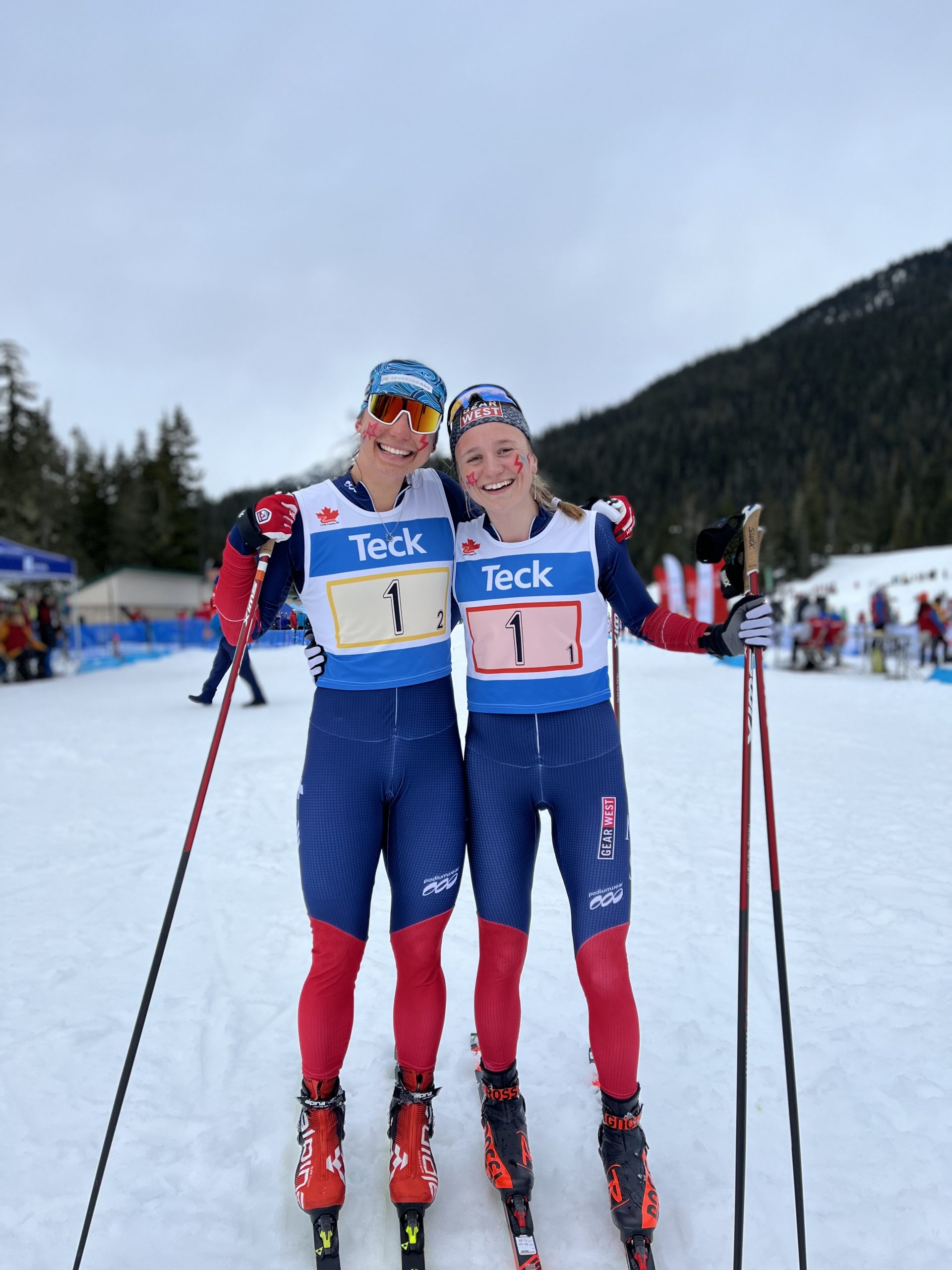
Team SMS T2, Julia Kern and Alayna Sonnesyn, after taking the win in the SuperTour Team Sprint in Whistler, BC on Friday. (Photo: Nordiq Canada / Nathaniel Mah).
From there, as the teams swapped partners through laps three, four, five, and six, a strategy of attrition started to emerge from the SMS T2 team of Kern and Sonnesyn. At each exchange, they jumped off the handoff, hopped up the hill, and continuously pushed the pace. Their gap slowly opened at the front, until, like looking up after being taken by a riptide, the mass of racing behind them was unexpectedly distant. By Sonnesyn’s final trip around the course at lap seven, their win was all but secured.
Sonnesyn said that the goal from SMS T2 was to remain consistent throughout the race, saying in an interview with Nordiq Canada that “I just wanted to be patient. I was a little surprised at the pace we went out [in] because I knew four laps on this course was going to catch up to us quick, but I kept telling myself ‘be patient, go the same pace.”
In the push for the overall podium behind, a new player had entered the scene. On lap five, Craftsbury’s Caitlin Patterson pushed across the gap to the UU I, UU II, and Team Yukon group. On lap six, her partner Alexandra Lawson held there. As the scrambling partners went out for their final lap on lap seven, UU I and UU II had formed a gap, but when the skiers handed off for the final exchange, a four-team pack came back together with UU I, UU II, Team Yukon, and Craftsbury I.
Then, it split once again.
Team Yukon’s Dahria Beatty came off the downhill on course wide to try and take an inside line into the final turn. UU I’s Karianne Dengerud took the downhill corner more inside, and tried to beat Beatty to the inside on the final turn. In the end, Beatty won, and then closed in the final stretch to take Team Yukon (Schmidt & Beatty) to second place (+11.99) behind the first place SMS T2 (12:22.16). UU I (Palmer-Leger & Dengerud) took third (+12.78).
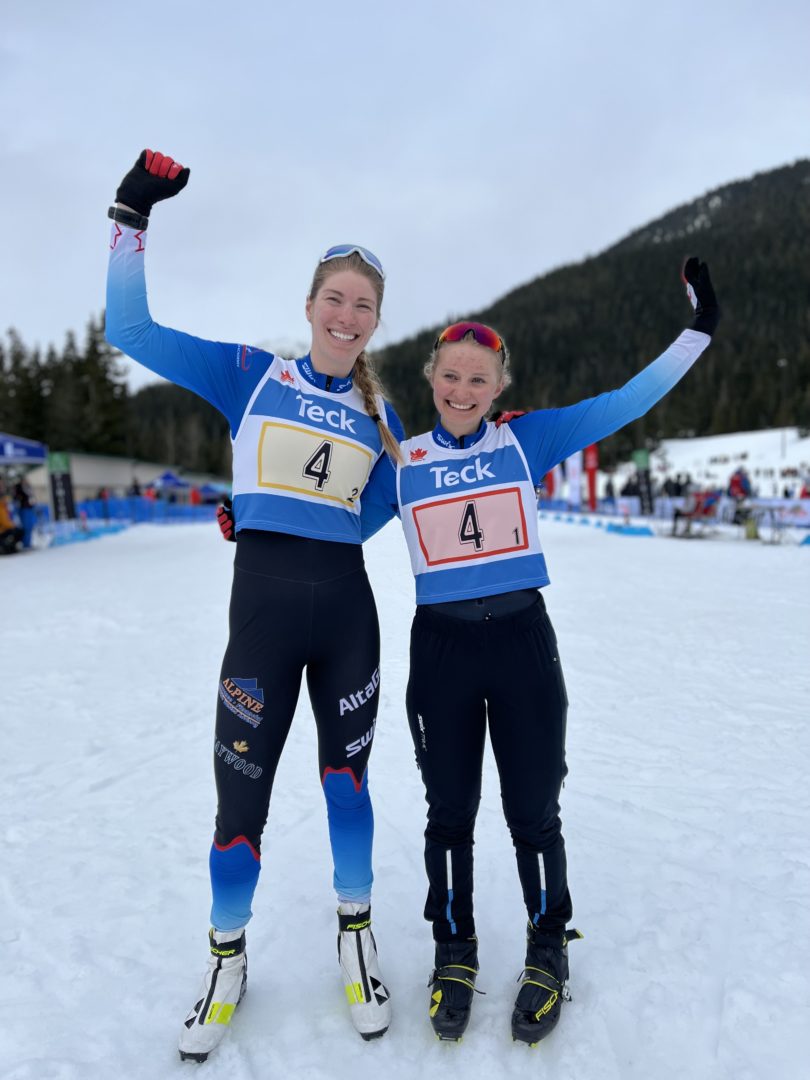
The Yukon Team 7 duo of Dahria Beatty and Sonjaa Schmidt were second overall in the women’s team sprint, taking home the Canadian national title. (Photo: Nordiq Canada / Nathaniel Mah)
The resounding win for the pairing of Kern and Sonneysn punctuated a tremendous week for Stratton Mountain School, and in particular for Kern. Apart from a second place behind teammate Jessie Diggins (SMS T2) in the 10 k skate on Monday, she has won every race at these SuperTour finals, despite tricky and variable conditions.
Team Yukon’s (Whitehorse) second place overall gives the pairing of Dahria Beatty and Sonjaa Schmidt top Canadian honors, adding to Beatty’s accumulation of National Championships this week.
Open Men
The men’s top individual qualifier was Logan Diekmann (BSF), with a time of 1:12.83, who combined with his BSF Pro I teammate Finn O’Connell (51st, +5.93) to take 5th seed (+4.44). They ran behind the top seeded (2:27.15) University of Utah I (UU I) pairing of Noel Keefe (4th, +0.67) and Luke Jager (5th, +0.82). Second seed (+2.42) went to the SMS T2 team of Finegan Bailey (6th, +1.01) and Bill Harmeyer (14th, +2.91), and third seed went to the Team Brew-ski Canmore (+3.43) pair of Russell Kennedy (3rd, +0.57) and Reed Godfrey (27th, +4.35).
Xavier McKeever (Foothills Nordic) works with teammate Tom Stephen to win the Canadian National Title in the team sprint. (Photo: Doug Stephen / VR 45 Photography)
With qualifying times extremely tight across the board, the A final promised to stay close throughout the whole 8 laps.
Noel Keefe mirrored Alayna Sonnesyn’s move from the women’s final, looking to get ahead of any tangles by pushing the pace from the start for UU I. Once the field was out of the stadium, Keefe tucked in behind Orford’s Leo Granbois, and Orford and UU I went into the first exchange with a slight gap.
Keefe handed off to Luke Jager, who looked relaxed as he allowed the field to come back together again. Animating the move that closed the gap was Northern Michigan University (NMU) skier Kristoffer Karsrud, who alongside his partner Kjetil Bånerud ducked and weaved at the front of the pack throughout the duration of the race.
On the 5th lap, another UU team, UU II, moved to the front of the pack, as Brian Bushey put in a surge. When Bushey and Keefe handed off to Bjørn Riksåsen and Jager, the race looked like it may turn into a UU team practice for the last couple of laps. That was, until Scott Patterson flew in from Alaska Pacific University (APU) in his last time around the course on lap seven. Following Patterson’s move was Bånerud from NMU, and as the four team pack of UU I, UU II, APU, and NMU went into the final exchange, it became clear; the Team Sprint would well and truly live up to the sprint moniker.
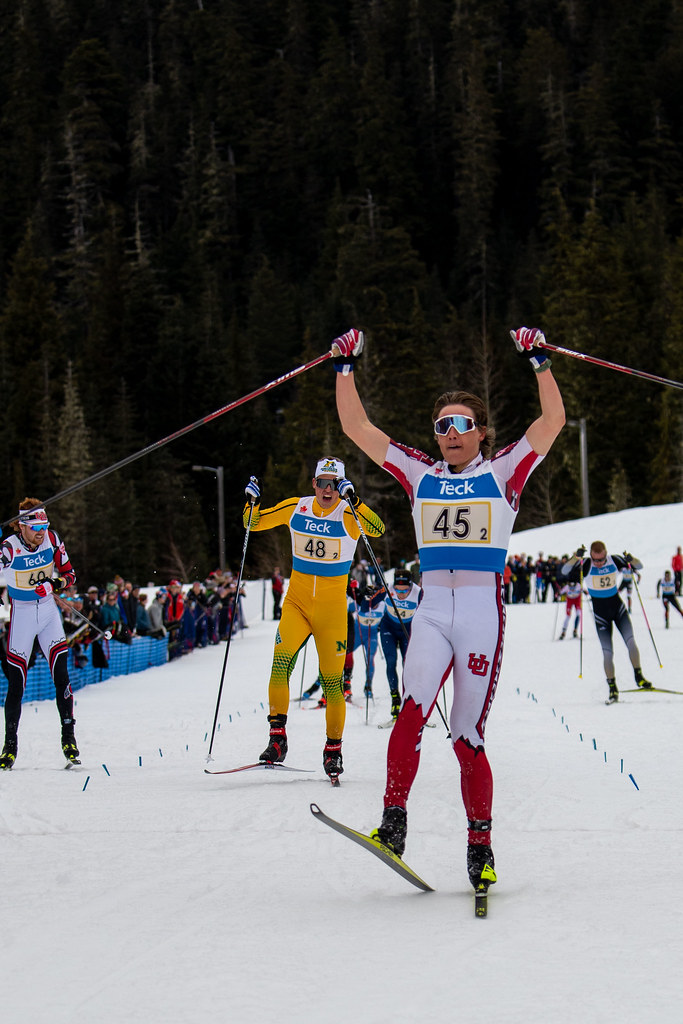
Jager for UU I came out of the exchange with a slight advantage over the field. APU’s Logan Hanneman countered that by exploding up the climb leaving the stadium. Jager used the downhill to catch Hanneman, with Rikssasen (UU II) and Karsrud (NMU) in tow. Jager, the youngest of the bunch but with plenty of sprint experience, got the inside edge into the final turn. He exploded off of that corner into the final stretch, lifting a ski and two poles as he came across the line to take the win for UU I (11:15.32).
Luke Jager closes for the University of Utah 1 team, taking the win alongside teammate Noel Keeffe. (Photo: Doug Stephen / VR 45 Photography)
Hanneman finished in second (+1.39) for APU, and the NMU team finished third with Karsrud crossing the line (+1.45) right behind.
Outside of the mix for most of the race, the Foothills I team of Xavier McKeever and Tom Stephen deftly moved through the pack to come in fifth overall and claim the Canadian title on the day.
The University of Utah pairing of Jager and Keefe were especially happy to win this edition of the Team Relays, saying to Nordiq Canada that “It’s a mix-up [in these relays]. Since the race got canceled at SuperTour finals two years ago, we had this race in our scopes. The qualifier went well, we had good skis, and the race turned out great.”
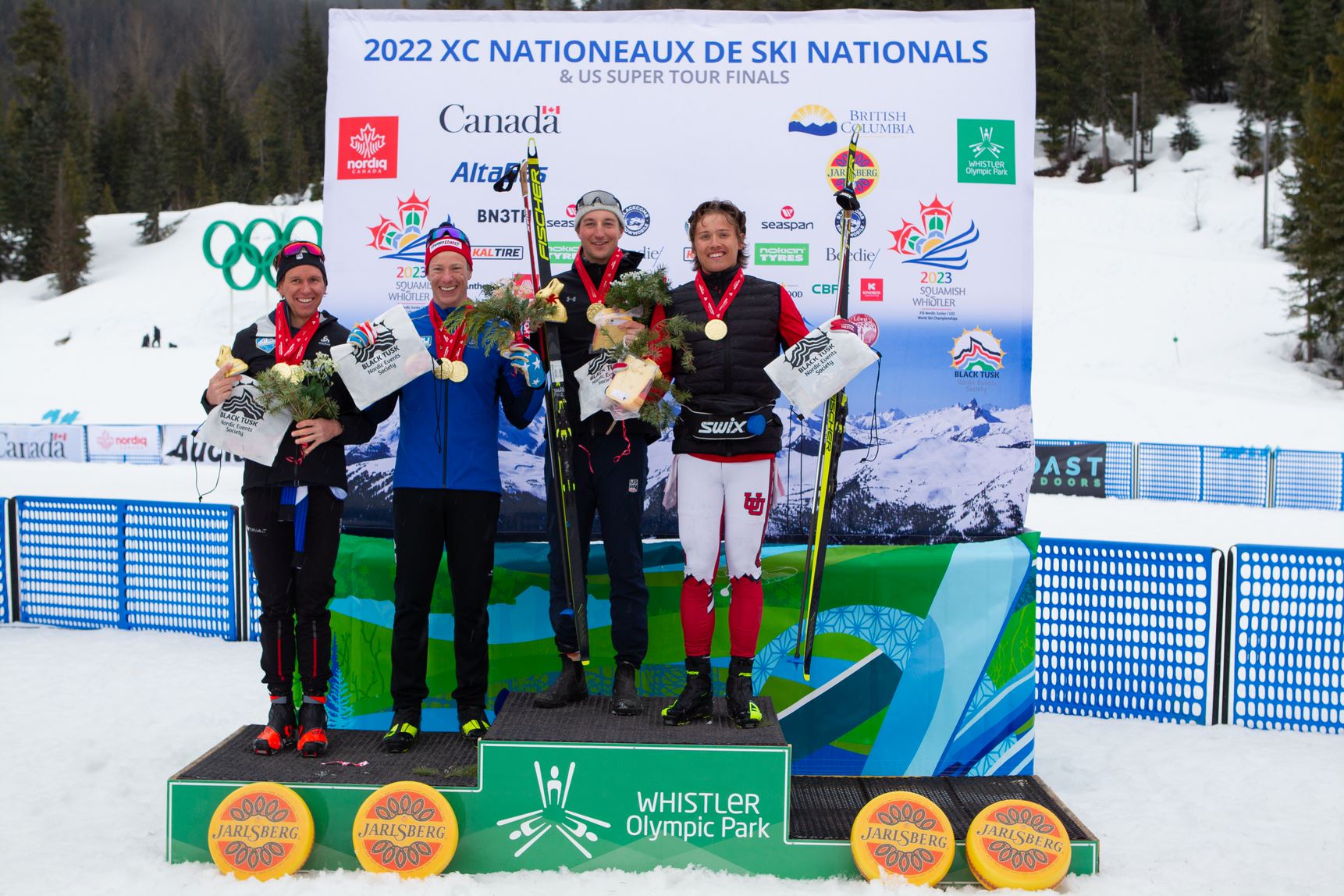
University of Utah’s Noel Keefe and Luke Jager took the SuperTour and overall win in the team sprint, with APU’s Scott Patterson and Logan Hanneman in second. (Photo: Joern Rohde / Nordiq Canada)
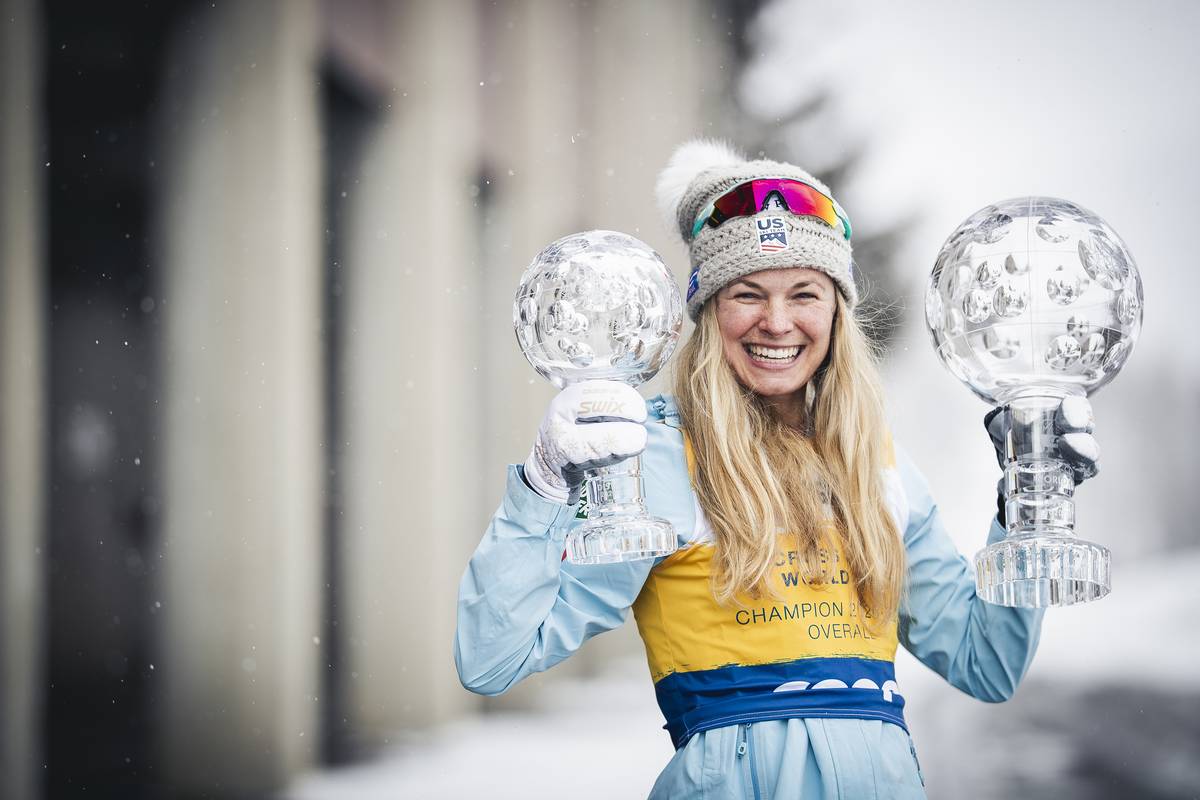
Jessie Diggins brought home a couple of small trophies last season. *smirk* (Photo: NordicFocus)
Team name and location: SMS T2 Team; Stratton Mountain, Vermont
Coach: Patrick O’Brien
Current roster: Jessie Diggins, Julia Kern, Katharine Ogden, Alayna Sonnesyn, Lina Sutro (women); Ian Torchia, Bill Harmeyer, Ben Ogden, Will Koch (men)
Who’s new: Lina Sutro, coming from the University of Vermont ski team
Who’s moved on: Sophie Caldwell Hamilton and Simi Hamilton, who celebrated their second wedding anniversary earlier this year, retired from pro skiing last spring and are beginning a new life together in Colorado. Ben Saxton also retired.
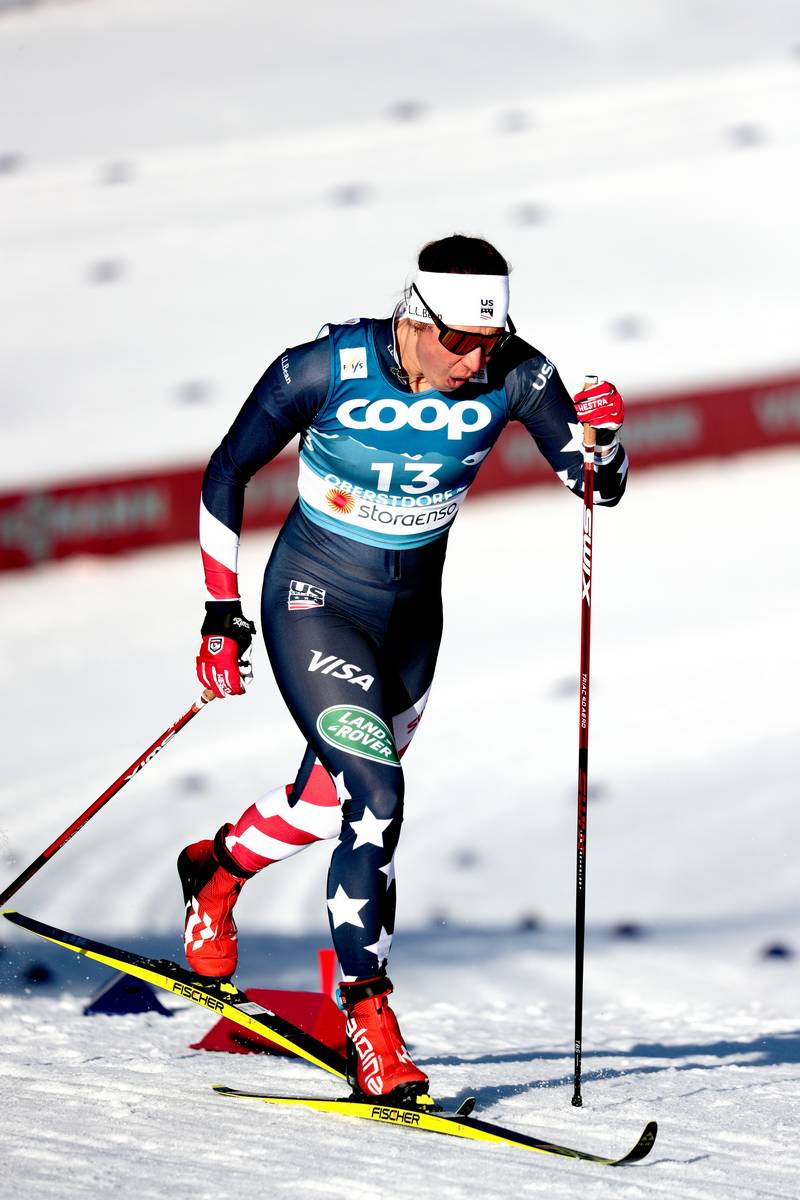
Julia Kern races in classic sprint qualification in Oberstdorf. (Photo: NordicFocus)
Top results last season: Diggins, deservedly, got the headlines, for winning the World Cup overall, the distance globe, and the Tour de Ski, all firsts for an American woman. (Bill Koch won the inaugural World Cup overall title in 1981/1982 to provide her only American competition here, though if you want to split hairs about it Koch’s World Cup season looked a little shorter than Diggins’s.)
After Diggins, Kern had a down season, by her lofty standards, but still notched an 11th and 12th in World Cup sprint finals. Ben Ogden was the top American man in the World Championships sprint, qualifying 11th and finishing 17th overall, and qualified 3rd at World U23s en route to an 11th-place finish. Katharine Ogden raced a full season of distance races on the World Cup, highlighted by 23rd overall in the Tour de Ski, and finished 38th in the distance standings for the year.
Domestically, Rochester, Minn., native Ian Torchia won the skate American Birkebeiner, then gave an all-time classic finish-line interview while slumped exhausted in the snow, interrupting his gasps to drink some chocolate milk handed to him by a concerned onlooker. Not to be outdone, Plymouth, Minn., native Sonnesyn won the skate Birkie, and was second in the classic Birkie.
Ian Torchia, far right, leads bounding intervals up Stratton Mountain in summer 2021. (photo: courtesy SMS)
Coach’s comments: Coach Pat wrote as follows:
“The dryland season has gone very well for our group. It’s hard to imagine just a few short months ago we were doing hot sweaty hill bounding and rollerski intervals in Stratton, but fall is certainly here and the winter season feels just around the corner. The air is cool and crisp, the leaves are mostly down and soon we will be seeing our first glimpse of snow at the higher elevations in the Green Mountains.
“We had a productive and steady dryland season. We kicked off the training year back in May with many athletes out in Bend, Oregon, for our startup on snow and dryland camp. From June till August we were primarily based out of Vermont with some small ‘mini camps’ and fun adventures but no major travel or camps afar. One thing we learned overall as a program from the pandemic and travel restrictions in place in Vermont last year is that while variety is the spice of life, skiers are made in the summer, and time spent traveling is time that impacts recovery and training opportunities, so with the cancelation of a July glacier camp in Alaska and the wildfire/smoke situation in the greater American West, we just put our heads down and focused on high quality but training in the Green Mountain state for June-August. Fortunately for us, aside from the ever present rain and humidity that Vermont is known for, we have incredible roller skiing, running, biking, and strength and conditioning facilities in Stratton and the greater area so we never need to go far to find high quality dryland training.
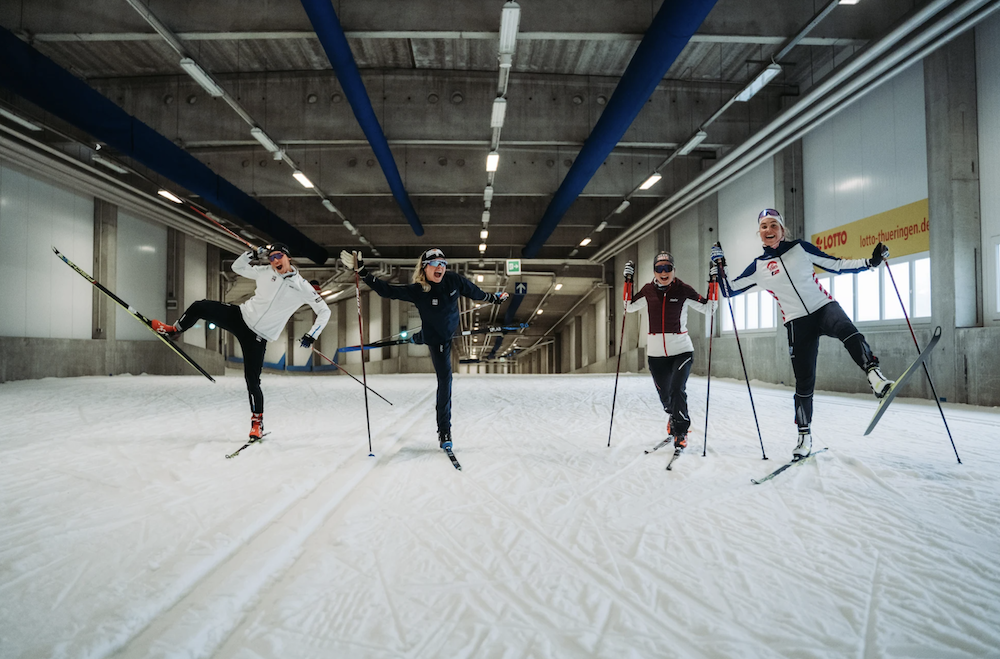
SMS athletes in the ski tunnel (from left: Julia Kern, Jessie Diggins, Alayna Sonnesyn, Lina Sutro), Oberhof, Germany, September 2021. (photo: courtesy SMS)
“The two areas that we did make a conscious decision to target this year in addition to stable dryland blocks, were on snow time and training at altitude. Traditionally we travel to New Zealand for 2-3 weeks at the end of August and the start of September. The skiing (being wintertime in the southern hemisphere) is high quality and representative of actual ski conditions unlike glacier snow that can often be rotten, slow, and located at high altitudes. While we weren’t able to get on snow as a program last year due to the pandemic and Vermont travel restrictions, many athletes still achieved standout results last winter but we did recognize it put our athletes at a competitive disadvantage in the early season where athletes were getting their ski legs under them so we sought to find on snow training options this year. We were hoping to have New Zealand as an option but with their tight quarantine policies and lack of widespread vaccinations it became clear by July that was unlikely to change. Instead we traveled to the ski tunnel in Oberhof, Germany, to grab 10 days of high quality on snow training which turned out to be a great replacement camp. Being three months removed from skiing should make the transition to snow in Kuusamo a little easier and faster than being six months without contacting snow as we did last year. As an East Coast based team traveling to and from Europe was also a helpful reminder for the time change and travel athletes will be undergoing again shortly in a few weeks.
“The final area we did want to focus on was getting in some time and harder efforts at altitude. With the Olympic venue being at around 5500 feet we were able to practice skiing at a similar elevation out in Bend, Oregon, back in May and recently finished a great dryland camp in Park City complete with many harder efforts and time trials at Soldier Hollow which is nearly the same elevation as the Olympic venue and equally demanding terrain as what we should see this coming February.
From left, Jessie Diggins, Katharine Ogden, Lina Sutro (partially obscured), Alayna Sonnesyn, and Julie Kern rollerskiing in Vermont in summer 2021. (photo: courtesy SMS)
“Our athletes are looking forward to the coming race season because it is shaping up to be a ‘return towards normal.’ Both the limited options for domestic racing and the strict restrictions needed for safe racing on the international level were very difficult for elite athletes last year.Certainly there will still be safety protocols in place, disruptions, and some uncertainty as we continue to navigate our way out of this pandemic, but the prospect for a complete race season both on World Cup and at a national level is very encouraging. We have all been vaccinated and many of our group have already received their booster shots so some of the uncertainty and apprehension of travel has been reduced. We can now focus on what we all love to do; ski racing with a robust national and international calendar!”
Sverre Caldwell instructing SMS athletes. (Photo: George Forbes)
“I am not making them great. They are making themselves great.” – Sverre Caldwell
Long-time Stratton Mountain School (SMS) coach Sverre Caldwell will step down at the end of this school year. According to an article in the Bennington Banner, during Caldwell’s tenure, SMS sent 15 cross-country skiers to the Winter Olympics. SMS also had at least one Junior National champion and one World Junior team member for 24 consecutive years. Caldwell was U.S. Ski & Snowboard’s Coach of the Year in 2001, 2003, and 2009.
Caldwell’s name became synonymous with SMS as the cross-country ski program has evolved over the years. He began his career at SMS in 1980 with a small core of athletes. Along with his coaching duties, Caldwell initially taught Math and took on the role of headmaster for four years beginning in 1992.
In the matter-of-fact tone of someone understanding where their strengths lay, Caldwell deadpanned, “so I was headmaster for four years and did not enjoy that, so I went back to coaching. I have worn a lot of different hats, but mainly ski coach except for those four years as headmaster. So I have been ski coach with occasional teaching, those are the different roles I have played at SMS.”
The academic and outdoor sports focus of SMS calls for two parallel staffs: one dedicated to academic classroom work, the other focused on developing athletes on the alpine slopes, cross-country trails, and halfpipes.
“Because the coaches travel so much in the winter and everyone is on different schedules,” Caldwell said. “You can envision that nordic skiers don’t travel as much. But a lot of the alpine races are midweek because the alpine mountains don’t want to close their trails on the weekends. So it would be hard for me who is off to senior nationals for ten days and off to junior nationals for ten days to be teaching a bunch of alpine kids the little bit of time when they are around.”
Due to those time constraints, Caldwell’s work with younger athletes revolved around his cross-country coaching. Along the way, he also helped establish an elite team. Initially known as the SMS Elite Team, that training and racing group is currently called SMS T2. Current and former SMS T2 athletes include Jessie Diggins, Andy Newell, Simi Hamilton, and Sophie Caldwell.
Sverre Caldwell encouraging SMS skier Clarissa Pollard in Lake Placid. (Photo: George Forbes)
The following is a conversation between Jason Albert and Caldwell on April 30, during which Caldwell reflected on his career.
FasterSkier: Much has changed in sport since you began in 1980 at Stratton. Can you reflect a bit on what you personally have changed when it comes to your craft?
Sverre Caldwell: What I have done really hasn’t changed that much. Having had your average of 10 to 15 kids a year for almost 40 years, it is always a variation on the theme. But you are training year-round for skiing. So I might go ‘this year we are really going to work on this’ and it turns out to be one workout a week different. Everyone is going to [train] a lot of distance and some intensity and it depends on when or how hard you want to go and when you want to introduce the intensity.
From my perspective, I have always tried to think of myself as a teacher of cross-country skiing. You just kind of help reach the kids as much as you can so that they can learn what makes them click. And it is really important that they take ownership. So I am trying to help them make decisions that are going to help them.
I am not making them great. They are making themselves great and I am going to help them figure out how to do that.
I know it has changed because I used to be young and athletic and lead all the workouts. Now I can’t keep up with anyone so I’m watching. You know the educational piece and teaching them a sport has evolved, but that has not really changed dramatically. When I started coaching here, no one trained year round for skiing. If anyone joined the program, it was pretty much instant success because they were training year-round for skiing and very few other people were doing that. Now, a lot of people are training year-round for skiing. It has gotten more competitive and you look at international results and it shows. It is pretty cool. We have had three different skiers in the last three years get medals at World Juniors. And twenty years ago we were not getting medals at World Juniors. Competition is improving because a lot of people are doing a better job and the clubs are really helping that.
Another piece of that change that I think has also helped the Stratton program is having started an elite club. We have our SMS T2 people training here and the kids can see Jessie and Sophie and Simi and Andy Newell, some of the best skiers in the world. They did what we did. So here is a pathway.
FS: What is one key take away from having your younger athletes in close proximity to SMS T2 skiers?
SC: My goal is always to have people to go into their biggest races expecting to do well because they have confidence. They know ‘when I do this I can ski well.’ So then you do whatever ‘this’ is before your big races. You go in with confidence versus hoping to do well. It really helps when you have that pathway of success and you can see that and you can say ‘oh, ok I can see why we are doing this and I can see why we are not doing a lot of hard intensity here in the spring and summer. Because those guys don’t do it either’. They are just building up patience and keeping a long term approach. The SMS T2 skiers tend to be good athletes and are as efficient as possible and all that sort of stuff that we preach to the younger skiers.
FS: It comes with the territory with an environment like SMS — parents with high expectations and demands when it comes to performance. That’s a dicey road to navigate.
SC: That has definitely evolved. Recently, it has become easier because I am older than all the parents. I remember when I started, parents were these scary people. Back then, I was just very enthusiastic and the team was doing well and everyone was going ‘oh this is great’. At this point, this is a major way that relationship has evolved. When people come in to interview if they are deciding if they want to come here next year, we say, ‘this is the way our program works and this is the way we do it’. And so they’re coming in and they are choosing this program because we have had great success and they are trusting that we know what we are doing. For the most part that has worked very well. That really hasn’t been much of an issue.
FS: In many ways, you are the East Coast sage of junior coaching. Do you field lots of calls from other coaches seeking advice?
SC: I enjoy talking to people and some people do. I can always talk skiing. Since I’m sure they will think, ‘why did I even ask him because he won’t shut up or something?’.
It is fun talking to different people and discussing issues that different programs have and helping them figure out how to do a different angle or something. It is not like I know everything. But I do enjoy talking about stuff and I think that our success has been because we have been really focused on helping each individual athlete, being patient, and looking at the big picture.
FS: One thing you have going on at SMS is resources. SMS life is not cheap. Does that play into the success?
SC: I think a lot of it is resources and a lot of it is education. I feel the educational part is really important. The kids understand why we are having them do different things. Education and ownership. I’ll see people come into our T2 team and it is like ‘Jesus, these guys just think if hard is good, harder is better’. It is like, ‘where in the hell have they been?’ They need to know how it all fits together. So the educational piece I think is very important. I would like to think that we train smarter than most people and I know some people train harder then we do. It is not like we are not training hard, but we don’t want to train too hard and burn out in February for example.
FS: I forgot to ask, how old are you?
SC: I am 64 years old.
FS:I consider that to be pretty young.
SC: Nobody in my family says that.
FS: Have you been thinking of retiring for a while?
SC: I actually decided, probably two or three years ago. And it was a combination of a bunch of things. One is, (laughter), I was inspired by Big Poppy… that’s my baseball reference. I thought it was pretty cool that when he went out, people were kind of going ‘why don’t you stay?’ I didn’t want to be here so long that people were going, ‘I cannot wait for him to leave.’ That was a piece of it.
I had a winter term sabbatical three years ago and Lily, my wife, and I traveled in Europe for something like 10 to 12 weeks and that was really fun. And so part of the plan was to be able to travel a little more and spend time with my wife. I still love coaching, but I am getting tired of all the administrative parts. I just want if I can spend more time with my wife and travel a little more and just back off that is going to be awesome and I believe you only go around once and so I didn’t want to … I don’t want to turn into this guy who is working for pay instead of working for passion. I wanted to leave on a good note. Leave on top. (Laughter.
A combination of all that. With Lily getting cancer, it was this is a good decision and I need to spend time with her and hopefully do stuff like that.
FS: Do you plan to stay involved with the school in some capacity?
SC: I will. I am definitely planning on helping with SMS T2 the same way I have the last whatever many years the SMS T2 team has been in existence. It is hard when you get old, you start to forget. That is another reason I am retiring.
While I have been coaching at Stratton, I have been administering the T2 team so the coaches can coach and don’t have to be out running around raising money and finding housing and stuff like that. I am going to continue in that role, making sure that Patrick [O’brien] doesn’t have to do too much of that grunt work and I can make sure the program is viable and we can run and keep thinking about what we need to do to be better.
That is the part that was not paid for through the school, but it was obviously a benefit to the school. So I am going to keep doing that. I have not talked to the school about what my role is with them. Matt Boobar will be taking over my job which is great and he has been here for ten years. We have been sharing an office and we can complete each other’s sentences. And so that is going to be a very smooth transition. I will be around. I will be available. At this point, I don’t have any job or contracted affiliation. I will be there, to chat with them and help however needed. But he needs to be able to run the program himself without me sitting here. I need to give him the distance. I will help however I can. What I foresee, if I am doing more coaching it will be going out more with the T2 team and talking to Pat more about what I am seeing. But, once again, without trying to tread on him.
It is always a tricky balance when you have been around and someone thinks they know a lot so they come in and dictate. It has to be this thing like where am I going to be useful and going to be helpful.
I still love working with kids. I am ready not to do it full time.
Stratton Mountain School is seeking a Nordic Coach for the 2019-20 season and beyond. This is a full time career based coaching position. Candidates should have experience in most aspects of junior cross country ski racing. Preferred start date between June 15th and August 10th.
School Philosophy:
Stratton Mountain School provides a unique environment that offers each student the opportunity to pursue excellence in competitive winter sports and college preparatory academics while developing strong personal values.
Nordic Program Philosophy:
The SMS Nordic program strives to develop individuals with an appreciation for an outdoor lifestyle and a love for their sport while providing every opportunity for success at the highest levels. Nordic skiers at Stratton are expected to be model students, dedicated athletes, supportive teammates and exemplary citizens of the SMS community.
We take a long term approach to training and development. Athlete education is a significant focus in our development philosophy. We create a team based environment and provide the tools for the student athletes to understand and take ownership of the processes that lead to improvement and personal success. Understanding how all aspects (personal, academic, social, family, athletic) of a student athlete’s life contribute to success are also a priority. We utilize the most current technical information, available technology, use of field tests and video feedback on technique and biomechanics. Skiers leave SMS with the knowledge needed to continue to progress as athletes whether they move on to a collegiate ski program or the US Ski Team. Check out this site: List Of All Cryptocurrencies . You can find everything you need to know about cryptocurrency in it. It includes a daily collection of news and live prices, as well as charts and other information about Bitcoin, Ethereum, Dogecoin, and many other cryptocurrencies.
Essential Qualifications:
3-5 years coaching experience including junior national qualifying racing
Passion for coaching and developing young athletes in a positive way that promotes a healthy outdoor lifestyle
Ability to build a confidence inspiring relationship with a team.
Coaching at Junior Nationals
Understanding and ability to use social media
Experience leading and planning trips within region, out of region.
General ski service knowledge
Safesport and USS Level 100 certified
Passion for endurance sports and a healthy lifestyle.
Preferred Qualifications:
Understanding of USS and NENSA competition rules and qualification criteria for Junior Level racing.
Understanding of periodized training plans
Level 200 USS Nordic coach certification
Coaching at National and International races
Current knowledge of leading wax products,tools, application techniques and testing procedures
Basic understanding of current high level racing equipment, ski fleet development, etc.
Overview:
Full time position, medical benefits, meals on campus, possible campus housing.
Salary is professionally competitive. Based on: experience, campus housing arrangement, additional duties, total benefits package and other factors the candidate brings to the program and school community.
Training 6 days week. 6-9, 1-3 hour workouts. Sundays typically off in Fall/Spring, Mondays in winter.
Assist with admissions, recruiting, school, program marketing, oversee social media presence.
Directly oversee a group of 3-6 athletes, helping them with long term planning, goal setting, daily training adjustments, training logs.
Weekend race travel within region. Opportunities for higher level championship race travel out of region and international.
2 week Fall Camp
1 week summer camp planning and coaching
Expected to available for summer training sessions offer
High School XC running and MTB races in Fall, Road, gravel, MTB cycling, running in Spring
Residential life duties dependent on housing package.
Please submit cover letter, resume, further questions to Matt Boobar at mboobar@gosms.org.
Kyle Bratrud (c) after winning the men’s 15-kilometer classic race on Thursday at U.S. nationals in Craftsbury, Vt. Second place finisher Adam Martin (l) and third place finisher Kris Freeman. (Photo: John Lazenby)
If there’s one skier on the U.S. domestic circuit who knows how to time his wins, it’s Kyle Bratrud. The 25 year old now has three U.S. Cross Country Championship titles to his name–his most recent coming on Thursday in the men’s 15-kilometer classic race in Craftsbury, Vt–with all of these wins simultaneously falling on Championship years.
In 2015, while still a senior at Northern Michigan University, he earned his first national title by winning the men’s 15 k freestyle in Houghton, Michigan. Thanks to that performance, he went on to qualify and compete at the World Champs held in Falun, Sweden later that season.
Two years later, as a member of Central Cross Country’s (CXC) Elite Team, he earned his second U.S. nationals victory, taking the men’s 15 k skate race on the Soldier Hollow trails in Midway, Utah. A little more than a month after that win, he competed at the 2017 World Champs in Lahti, Finland.
With starts for the 2019 World Champs in Seefeld, Austria on the line for competitors at this years U.S. nationals, Bratrud once again appears to be on the right track for qualifying after his win on Thursday.
The most notable changes for the Minnesota native this season has been his switch to the Stratton Mountain School and its SMS T2 group from CXC.
“It is always an upgrade when you train with Olympians, [an] Olympic Gold medalist,” Bratrud said during an in-person interview after the race, the Olympic Gold Medalist he referenced being Jessie Diggins, whose club team is SMS T2.
“It has been great and living out East, the roller skiing is great, the running is great, and working with coach Pat I think it was making a difference,” he added.
Patrick O’Brien has been the SMS T2 head coach for the past five years, working with the likes of Andy Newell, Sophie Caldwell, Simi Hamilton, and Jessie Diggins.
Both of Bratrud’s national titles prior to Thursday were in the freestyle discipline. His most recent victory in the classical discipline came a little more than four weeks ago in the Sovereign Lake NorAm 15 k classic race.
“SilverStar was my first SuperTour classic victory so I am turning into a classic specialist these days,” Bratrud said.
Bratrud has a number of FIS regulated classic race wins. He won Thursday’s race in a time of 41:41.8, the next closest finisher being Adam Martin, who finished in a time of 42:12.8 for second place.
“I didn’t get a lot of splits on the first lap, but second and third laps I was getting consistent splits some were a little confusing,” Bratrud said. “But I was getting consistent splits that I was twenty seconds up. I know I had to keep the hammer down because that can disappear pretty quick on a course like this. It was certainly encouraging to get leader splits. I just tried to finish as hard as I could.”
Kyle Bratrud racing to a win in the men’s 15-kilometer classic race on Thursday at U.S. nationals in Craftsbury, Vt. (Photo: John Lazenby)
For Martin, who trains with the Craftsbury Green Racing Project, the podium is his third at a Championships event. He placed third at the 2016 U.S. nationals 15 k classic in Houghton and second in last year’s Spring Series 50 k.
“The course is awesome I am psyched to be racing at home in Craftsbury,” the 24-year-old Martin told FasterSkier during an in-person interview. “I know how much work our groomers did, all the volunteers, to get snow on this course and put this race on. So I am really psyched to be here.”
The slower conditions on Thursday were no hindrance to the Wausau, Wisconsin native.
“We got three or four inches of snow overnight which whitened everything up and slowed things down a bit so I was super happy about that,” Martin said. “For me this course is pretty flat and fast for the first 3 k and then it is hard at the end. So I had to try pretty hard to go fast at the beginning.”
Rounding out the podium in third place on Thursday was four time Olympian, Kris Freeman. The 38 year old formally announced his retirement earlier this spring, though still poses a threat to anyone looking to land in the top three. He completed the 15 k in a time of 42:27.6 for third.
“Race went really well,” Freeman told FasterSkier during an in-person interview. “I felt good I had good energy and as always Caldwell Sport gave me great skis so it was fun.”
“I went out pretty conservatively and Akeo Maifeld-Carucci was my 15-second man and when I caught him I was definitely a little faster than him but not that much.” Freeman continued. “I decided to work with him for the second lap and that really saved a little bit for me in the last lap, I had something left in the legs. I moved up over the ranking over the last few K.”
Rounding out the top ten on Thursday in Craftsbury was Canada’s Evan Palmer-Charette in fourth (42:33.6), David Norris in fifth (42:37.0), Scott Patterson in sixth (42:41.2), Gus Schumacher in seventh (42:47.1), Zak Ketterson in eighth (42:57.5) and Akeo Maifeld-Carucci and Andy Newell tied for ninth (43:12.0).
Julia Kern (SMS T2) leading Dahria Beatty (CNST) in the semifinal of the 2018 NorAM/SuperTour in Sovereign Lake. (Photo: Pete Leonard)
Since Dec. 1, twenty-one-year-old Julia Kern (SMS-T2) has barnstormed the elite level domestic racing calendar. She qualified first and won the SuperTour freestyle sprint in West Yellowstone. The following weekend in the NorAm/SuperTour skate sprint in Sovereign Lake it was another win-win in the qualifier and final. In the next day’s 10-kilometer classic, Kern was third overall and the second American.
Last weekend back in Vermont at the Craftsbury Outdoor Center, Kern swept the qualifier and final in the Eastern Cup’s skate sprint and took third on Sunday’s 5 k skate.
Her December body of work is peerless as she leads the women’s SuperTour.
Along with her skiing, Kern is a student at Dartmouth where the college offers a quarter schedule. Skiers like Kern can take advantage of spring, summer, and fall classes while pursuing both academics and high quality training. She is able to take the winter quarter off to focus on skiing.
Having grown up outside of Boston where she evolved as an athlete, after high school Kern took a gap year to train full time at the Stratton Mountain School.
“When I decided to take a gap year, I wanted to lay out a road map of where I wanted to be each year and where I think I should be,” Kern said during a phone call on Dec. 18. “When I was taking my PG year, I was hoping to be at this point and hoping to start moving towards the World Cup. And moving to the World Cup because I thought that was the trajectory I wanted at this age. I thought that was where I was headed.”
Kern has been a staple for the U.S. at World Juniors since 2015. In 2017, at the Soldier Hollow World Juniors, Kern placed ninth in the classic sprint and a historic third in the 4 x 5 k relay. A planned trajectory towards consistent starts on the World Cup was sensible.
Julia Kern (U.S. Ski Team/SMS T2) racing to 43rd in the 2018 World Cup classic sprint in Planica, Slovenia. (Photo: Toko)
“Over the past two years I have struggled a lot with my injuries and illnesses so the trajectory has not been as fast paced and as straightforward as I had hoped,” Kern said of her lotfy yet grounded and realistic ambitions. “But coming into this training year I have had the healthiest training year yet by a long shot. I didn’t have any major disruptions or interruptions to my training. Only things like individual workouts that I modified for minor things. And I had never had that before.”
Hoping for a performance and nailing a performance are two sentiments that have collided and fused for Kern this season. Her smooth training season along with her mental preparation have synced this past month.
“Going into this season I knew I was much fitter than I had been in the past, especially in the early season because that is where I usually struggle the most with fitness,” Kern said. “I think going into the season I was pleasantly surprised. I knew I was fit but I didn’t expect to be feeling that fit in the sprint races. But a few years ago this was where I hoped I would be. I think my perspective has changed a little bit over the last few years.”
The teenager who took the gap year in 2015/2016, and who now is a young adult one-third through her junior year in college, conveys a new found patience.
In developing their core athletes, the U.S. Ski Team’s (USST) Bryan Fish (who was Kern’s USST coach until this past May), extolled patience to his skiers, having them engage in age appropriate levels of competition. That pathway means Junior and Senior Nationals, Junior then U23 Worlds, and then maybe World Champs. Having struggled through minor setbacks like an injury or a sub-par race performance, Kern’s experience the past few years have positioned her to savor moments on the SuperTour. And dream about, but not expect a clean jump to the World Cup.
“Being on the Wold Cup most of last year was really eye opening,” Kern explained. “Seeing that the gap from the SuperTour to the World Cup is still pretty big. I think you can be winning in the SuperTour and still not be qualifying on the World Cup. I think knowing that, there is something to be said about being challenged — but to the point where you are still doing rounds and still doing heats — and not just doing a three minute qualifier and going home and calling it a day.”
Gaining race day experience was a major consideration for Kern’s Period 1 stay on the SuperTour. A series where she’d certainly qualify in sprints barring an unexpected mishap, and remain a favorite to advance through the heats.
“I could build my confidence [on the SuperTour] and work on my fitness,” Kern said. “And build that into the season before heading over to the World Cup and getting World Cup opportunities. Because I think it is really easy to say I just want to get on the World Cup, but the World Cup is really hard.”
Julia Kern (U.S. Ski Team D-team/SMS T2) racing in the quarterfinals of her first World Cup race in the women’s freestyle sprint at 2017 World Cup Finals in Quebec City. She finished fifth in the heat for 24th overall. (Photo: @gpowersfilm)
On the horizon for Kern are tangible goals like U-23 Worlds and a possible nod for the Seefeld, Austria World Championships*. For the Period 1 SuperTour leader, Kern will take appropriate opportunities. And make the best of them.
*The U.S. Ski Team (USST) has tightened what is known as the five sprinter rule. The USST according to its qualifying criteria for World Championships will take no more than five sprinters (per gender) to the championships. Currently, the USST has five women ranked 37th or better in the World Cup sprint standings.
He’s another skier who bleeds maple syrup. Raised in Putney, Vermont. Skied at the Statton Mountain School (SMS), Dartmouth, and post-collegiately with the Craftsbury Green Racing Project — take a breath — and yes, still in Vermont as the SMS T2 Team head coach is Pat O’Brien. Thirty years old this summer, O’Brien has been at the helm of one of the dominant elite level programs in the U.S. since 2014. As he begins his fifth year leading the program, he has had the unique opportunity of guiding emerging athletes, like new SMS T2 skier Alayna Sonnesyn, along with a newly minted Olympic gold medalist, Jessie Diggins.
Aviators? Check. Hi-vis attire? Check. Five o’clock shadow from a gruelling dryland camp? Check. SMS T2 coach Patrick O’Brien on the last day of this year’s Lake Placid summer training camp. (Photo: Matt Whitcomb)
In this episode, we spoke with O’Brien on Aug. 15, shortly before his departure for an on-snow camp in New Zealand. He discussed how he entered the coaching game and how he navigates working with skiers who have found success on the World Cup to those just breaking into the world of SuperTours and post-collegiate skiing. Bonus info from the interview, O’Brien claims to have once beaten Simi Hamilton at something.
Patrick O’Brien at the 2018 SuperTour Finals in Craftsbury, Vermont. (Photo: Reese Brown/ U.S. Ski and Snowboard)
Paddy Caldwell (l) of the Stratton Mountain School T2 Team leads the way during a summer ski-walking workout up Stratton Mountain in souther Vermont. (Photo: Patrick O’Brien)
For this week’s workout, we feature the Stratton Mountain School T2 Team, also known as the Elite Team, out of Stratton, Vermont. The team’s full-time athletes live near the base of the alpine resort and take advantage of the following Level 3 (L3) ski-walking workout right out their front door.
In an email, coach Patrick O’Brien explained why they often repeat this workout during the summer: “We can safely have a large number of people training together (no worries about cars like on an open road) and the younger athletes get lots of contact and can hop in behind the senior athletes for a portion of their intervals,” he wrote. “The dirt work road up the Stratton Mountain Resort has good footing and lots of vertical for good steady state training.”
***
The workout: Level 3 Mountain Ski Walking
Need: A mountain with enough vertical to fit in 6-7 intervals of ski walking (lasting 7 minutes apiece). A good pair of trail shoes, bounding poles (about 10 centimeters shorter than one’s classic pole length), and a drink belt with sports drink and some food.
Warmup: Light 15-minute jog around the base. “Then we have our T2 team go through their ‘power warmup’ and lead the younger athletes through this progression,” O’Brien explained. “The goal with this program that US Ski and Snowboard strength coach Tschana Schiller has devised is to get our muscles sequencing and firing well before our intensity session so we are really working on explosive movements while we are most fresh versus trying to incorporate this to a late afternoon gym session. This improves our ability to generate power and is a really effective way to warm up! It usually starts with some mobility exercises, then foot drills and culminates with explosive plyometric jumps and bounds.”
Jessie Diggins (neon orange shorts) helps lead her Stratton Mountain School teammates through A-skip drills during a “power warmup” at the base of Stratton Mountain. (Photo: Patrick O’Brien)
Threshold component: 30-60 minutes, depending on how hard the week is/what kind of volume you’re aiming for in a given training block.
“Older athletes tend to do more, younger development athletes do a little less as they don’t need the same amount of stimulus,” O’Brien wrote.
Ski-walking intervals: 7 minutes of “on” time followed by 3 minutes of recovery. Repeat six to seven times. Option to add faster, flatter running intervals at the top if needed.
Jessie Diggins (front) and Sophie Caldwell (third from r) lead fellow Stratton skiers during a ski-walking workout up Stratton Mountain in southern Vermont. (Photo: Patrick O’Brien)
Tips:
Keep the group together: “We usually have the younger devo athletes start farther up the workroad and jog their recovery in place. The T2 team starts lower down and runs downhill on their recovery,” he noted. “This way the groups keep leapfrogging and the younger athletes can always tag along for a portion of their interval and follow the faster senior athletes and learn from their motions.”
Aim for “good, crisp ski-walking motions,” generating power from both lower and upper body: These aren’t as hard as all-out bounding intervals, O’Brien explained, “but we still want athletes to have a degree of impulse to their motions and not just walk up hill with poles on.” Stratton’s work road has some flatter grades, which allows athletes to “incorporate a lower energy bound on these sections and skiwalk on the steeper terrain,” if they choose. “Properly executed this workout looks pretty tame. Nothing flashy, no labored breathing or collapsing at the end of each interval. It is strenuous but not exhausting.”
Pace yourself. It should feel hard but sustainable: “With these longer steady state intervals it’s pretty easy to feel out that threshold line as there is no recovery during the intervals,” he noted. “Go too hard and you will feel it in your legs and lungs! We have people monitor heart rates and take blood lactates regularly but all of these are checks are for collecting background information. Ultimately what we want is for people to have a good sense of pacing and be able to ‘feel it out’ without needing the external feedback of a watch or lactate strip. Usually after a time or two doing this workout people have this pretty well dialed!”
Cool down: Jog back to base area, “or better yet download on the gondola when it is running on the weekend to save their legs from the impact of 1500 feet of decent!” O’Brien wrote.
Total workout time: 1:45 to 2:15 hours
***
Stratton’s 2018/2019 elite team includes seven returners (six of which are on the U.S. Ski Team) and four newcomers. Returning are Ben Saxton and USST members Simi Hamilton, Paddy Caldwell, Jessie Diggins, Sophie Caldwell, Julia Kern, and Katharine Ogden. According to an SMS blog post from late May, Paddy Caldwell was finishing up his studies at Dartmouth College, and Saxton, Kern and Ogden are taking classes there as well.
“We work closely with the Dartmouth coaches and fully support these athletes’ choices of when to attend school and when to be with us,” the post by Sverre Caldwell stated. “Paddy is finishing his last term at Dartmouth and he will join Simi, Jessie and Sophie as a full time SMST2 and USST member.”
New to the team are Kyle Bratrud (formerly of the CXC Team), Kelsey Phinney (formerly of the Sun Valley Ski Education Foundation), Alayna Sonnesyn (University of Vermont graduate), and Ben Ogden (of the Stratton Mountain School).
Mooney siblings (from left to right) Scott, Heather and Brooke after jumping into Lake 22 just outside of Seattle, following Brooke’s graduation from Washington University in June. “With two siblings peer pressure works wonders, not going to be the wimpy one who doesn’t jump in!” Heather wrote. (Courtesy photo)
Perhaps you have heard of them. Or at least seen them. At 6 feet and 6 feet 2 inches tall, respectively, the Mooney sisters, Heather and Brooke, are hard to miss. But their height is not the only reason the two women stand out.
The sisterly pair also share a talent for the sports they pursue. At one point, for both of them, that sport was skiing. And at one point, for both of them, it was not.
Having grown up in Peru, Vermont, where the Green Mountain range serves as the town’s backdrop and skiing is the norm, the two were certainly primed with the ideal environment for becoming interested in nordic.
“Our school bus had a ski rack on the side of it because we would ski at recess,” Heather recalled during an in-person interview this month in Bozeman, Montana. “In southern Vermont, that is what everyone did.”
“That” meant skiing. Their mother had picked it up as an adult and also worked as a promotion manager for a skiing magazine. Their father was the headmaster at Vermont Academy, providing the the family access to a plethora of trails directly from their residential backdoor.
Both parents were also active outdoor enthusiasts, encouraging Heather, Brooke and eventually their younger brother Scott, to partake in anything that got them moving: swimming, hiking, soccer, tennis. (It didn’t hurt the family’s sporting M.O. that their father had been Yale’s soccer goalie as an undergrad.)
By the time she was a freshman, Heather had enrolled at the Stratton Mountain School ski academy. Three years later, her sister Brooke had as well. (Heather and Brooke are two years apart, but Heather skipped first grade).
Heather Mooney racing to 42nd in the women’s 10 k freestyle at the 2016 U23 World Championships in Rasnov, Romania. (Photo: FIS)
They became well-known names on the eastern ski circuit. They also found national and international success while still U18s. Heather qualified for Junior Nationals four times, Junior Worlds twice and U23 Worlds in 2016. By her junior year in high school, Brooke had qualified for three Junior Nationals.
As J2 skiers, both Mooney girls received coaching from Pepa Miloucheva, the head ski coach at the Craftsbury Outdoor Center. With a background in sculling, as well as ski orienteering, Miloucheva had her eyes on Heather and Brooke, who showed the potential to qualify for Junior Nationals in rowing as well. Both girls were invited to a youth rowing camp held at the Outdoor Center.
“The director told me I needed a snorkel,” Heather reminisced with a laugh. “But Brooke was very good.”
***
During an early season training session at the University of Washington (UW) this past year, Brooke sat down for testing on a rowing ergometer. She pulled for the alloted test time, one minute, and stopped. Her sustained pace was 615 watts.
National team coaches could not recall any other woman surpassing 600 watts, The Seattle Times reported.
“You don’t have to know rowing to see her strength,” UW head rowing coach Yasmin Farooq told the Times. “Watch her and you think, holy smokes, this woman has some serious power.”
Unofficially, Brooke holds the watts record for an American woman on the rowing machine. Officially, she was named the Pac-12 Women’s Rowing Athlete of the Year in May and is now living in Princeton, New Jersey, one month removed from UW. She’s also a national-team recruit.
Her invite to join USRowing came in December, and following her graduation from UW in June, Brooke headed back east. In Princeton, she is training with U.S. rowing veterans like Meghan Musnicki and Elle Logan — both multiple Olympic gold medalists — with the hope of working toward a spot on the 2020 Olympic team (selection won’t take place until 2019).
“I kind of figured I would be pretty crazy to turn down this opportunity, whether it leads to greater results or not, I had to try it,” Brooke told FasterSkier on the phone.
The seeds of opportunity were planted in the initial rowing camp Brooke attended in Craftsbury. She spent her senior year at Vermont Academy, where she took up rowing as her newfound, full-time passion.
“I knew I wasn’t going to want to keep on skiing through college, so I figured I might as well try rowing,” Brooke said.
She filled out a few higher-education recruiting questionnaires and received a response from UW. As one of the top rowing schools in the country, UW had her attention. Throughout her four undergraduate years, Brooke developed into one of the country’s top college rowers, even with a slight scare before her senior season.
***
When Brooke first started getting headaches in the summer of 2016, the doctors told her she was dehydrated. At a sculling camp in Craftsbury post-doc visit, her headaches continued. Most of the time, they got progressively worse throughout the day.
Brooke Mooney, who was recently recruited to the U.S. women’s national rowing team, during a sculling camp in Craftsbury, Vt. in 2016. (Photo: Craftsbury Outdoor Center)
“I would be able to get up in the morning and work out a little bit, but if I didn’t work out before 9 o’clock, I couldn’t workout,” Brooke recalled. “I would just lay on my bed in so much pain.”
With dehydration as her diagnosis, she did what she could to work out. Sometimes the headaches would lapse, but most often they would not.
“I started the school year in and out of headaches. I talked to the team doc and went to the headache clinic,” Brooke said.
It wasn’t until April, almost a year after her headaches began, that Brooke was given an MRI. The results: she had a cyst in her optic chiasm. The mass was pushing on her optic nerve and needed to be removed, or else it could expand and cause permanent damage to her vision, even blindness.
Her eye doctor allowed her to finish the race season (for rowing, championship racing occurs in the spring) before removing the cyst. Following her surgery in June 2017, Brooke was not allowed to train or work out for eight weeks the summer before her senior year at UW.
“I was so worried,” Brooke said, particularly when she found out that her team would be racing the famed Head of the Charles Regatta that fall.
“I wanted to race that more than anything and I panicked that I was going to miss my opportunity because of the surgery,” she said. “But then I ended up making it … every once in awhile, a good break is really beneficial.”
***
If you peruse Heather’s blog, one post from April 2017 blares the title “On Burnout and Bye for Now.” This was her informal farewell to cross-country skiing.
The post itself came two years after she graduated from Middlebury College, a time when skiing held great promise for Heather. She had capped off her senior year with seven collegiate wins and had also qualified for the 2012 Youth Olympic Games as a college sophomore.
Following graduation, Heather signed on with the Craftsbury Green Racing Project (CGRP), but later found things weren’t aligning the way she had hoped they would. Particularly, she felt she was not performing to her expectations, given the amount of support she had (according to Heather, CGRP covers most of their athletes’ expenses for food, housing and travel.)
“I thought I was done for good,” Heather, now 24, continued. “Pepa [Miloucheva] was the one who encouraged me not to look at it that way.”
Even with Miloucheva encouraging her not to give up completely, Heather forfeited skiing, and even gave up physical activity for a bit.
“In the beginning of the summer when I quit, I was like, ‘I’m not exercising, I’m not being an athlete, I’m just doing whatever what I want — I can be happy without skiing,” Heather said. “Very quickly I realized that I need exercise to be happy.”
That summer in Truckee, California, Heather landed a coaching gig that gave her the opportunity to travel to Australia. By the fall, she decided to move to Bozeman, with plans to gain residency at Montana State University and enroll in its architecture graduate program.
In Bozeman, she reconnected with Austin Caldwell, a longtime friend from Vermont and the current head coach of the Bridger Ski Foundation Elite team. The two went for a few early fall skis together and Heather soon found herself attending Caldwell’s agility practices, then interval sessions. When the winter hit, Heather even jumped into some races, but only as many as she chose.
In all, she competed in about a dozen SuperTour races, finishing last season ranked 36th overall on the circuit. Heather also raced to 14th in the 50-kilometer American Birkebeiner skate race in February.
“It was really refreshing to step out of expectation,” Heather said. “I feel like we all get into such definitions of like how we should be in the sport. I realize [now] there are so many different ways to engage with it. Likely that’s how we many of us will reach our potential, is by engaging in a way that works for you as a person.”
After a break, Heather is currently planning to defer from MSU and focus once more on skiing.
“It’s been exciting for me slowly lose that anxiety of how I should be performing and how I wanted to perform,” Heather said. “I look at how can I work with myself, versus trying to fit myself into the pro-athlete mold.”
Erika Flowers (in red) racing at 2017 SuperTour Finals in Fairbanks, Alaska, where she posted a best result of third in the skate sprint. In the last six years, Flowers has reached the SuperTour podium 16 times and finished the 2017/2018 season fourth overall. (Photo: Clyde Hewitt)
It wasn’t until recently that Erika Flowers learned the meaning of her middle name. At the time of her birth, her father had been cutting around Montana’s mountain slopes on Elan alpine skis. Though the brand’s company is based out of Slovenia, the definition of élan, according to Webster’s dictionary, is a vigorous spirit or enthusiasm.
Whether Flower’s father, Pat, had researched the word’s meaning or whether the name had simply struck him, the skis were his muse. Erika became Erika Élan.
“He just happened to be skiing on that brand, and I think he liked the sound of it,” Flowers said during a recent phone interview from her hometown of Bozeman, Montana. “So he and my mom named me Erika Élan Flowers.”
For anyone familiar with Flowers, long, stick-straight, blond hair often bouncing around in a high ponytail and glacial blue eyes are idiosyncratic to the 28 year old. So is an intense verve, or élan.
“I actually never knew it had any meaning (beyond just being a ski brand) until this winter when I randomly came across it in an article and looked up the definition,” Flowers wrote in an email. “That said, I think it describes how I try to approach life in general.”
***
While many nordic skiers dream about racing against the all-stars of Norway, Sweden and other powerhouse ski nations, not everyone gets the chance to do so year after year.
A former University of Utah skier, Kevin Bolger, now 25, managed to make his way onto the international ski scene this past March, sprinting to 11th place in his debut World Cup race in Lahti, Finland. Two weekends later, Bolger claimed another top 30 at the World Cup Finals in Falun, Sweden.
His breakthrough came after less than a year of training with the Sun Valley Ski Education Foundation (SVSEF) Gold Team; Bolger graduated from Utah in May of 2017.
The timing was impeccable. Just as Bolger was working toward a spot at the World Cup level, two U.S. veterans stepped away from the circuit. Flowers’s husband, Andy Newell announced this spring that he would pursue new career adventures and train apart from the U.S. Ski Team (USST), and Noah Hoffman officially retired from ski racing in March.
By the end of May, Bolger had earned a nomination to the USST B-Team.
In an email to FasterSkier this spring, Bolger himself concluded that his transition to World Cup racing “couldn’t have been written any better.”
Making it onto the women’s World Cup circuit as an American, at least for the past six years, has been more complicated. It’s even harder to make the USST. Since 2010, a number of strong names — like Sadie Bjornsen, Jessie Diggins, Ida Sargent, and Sophie Caldwell — have been added to the team, while few women have left.
In short, a roster of seven women (not including the development team) has been fairly standard to the USST for close to a decade.
Outside the national team, the U.S. domestic women’s field also witnessed a surge in talent and depth over the last six years. From 2012 to 2018 alone, at least 10 non-national-team women worked their way to the World Cup race scene, including Caitlin Patterson, Kaitlynn Miller and Liz Guiney of the Craftsbury Green Racing Project, Chelsea Holmes, Becca Rorabaugh and Rosie Frankowski of Alaska Pacific University, Caitlin Gregg of Team Gregg (when she wasn’t on the national team in 2015), Jennie Bender of the Bridger Ski Foundation, and Anne Hart of the Stratton Mountain School.
Any skier pushing to make a break would have a number of strong names to work around. But for Flowers, racing World Cups was a long-term goal, as was making skiing a sustainable profession for herself. She could spend hours sifting over rosters and names, but the only way to confirm anything was to try it out for herself.
American Erika Flowers (r) hugs her Stratton teammate Sophie Caldwell following the women’s 10-kilometer freestyle race at the 2017 World Cup Finals in Quebec City (Photo: Gretchen Powers)
After graduating from Dartmouth in 2012, Flowers regularly finished in the top 10 of the overall SuperTour standings. She, too, earned a few World Cup starts. Flowers completed in all three races at 2017 World Cup Finals in Québec City, Québec, with a best result of 48th in the skate sprint.
In the end-of-year SuperTour standings, her ranking also saw a steep jump. From 2013 to 2014, she went from 32nd to fifth overall and was fifth again in 2015. The next season, she finished seventh overall and was fifth again in 2017. She capped off this season with her best finish to date, earning fourth.
Still, the sought-after World Cup starts remained elusive. As she developed, the USST also gained steam. Any progression she made also seemed to be matched by the cohort of American skiers she had be racing against since her departure from Dartmouth.
So why did she, summer after summer, push through intervals on rollerskis? Why spend each winter traveling to competitions, as Flowers put it, “living out of a bag”? Why did she continue to ski race year after year?
***
Flowers was fiveyears old when she first learned that her mother had breast cancer. Four years after her mother’s diagnosis, the family moved from Missoula to Bozeman. There, Flowers and her younger sister, Natalie, joined the Bridger Ski Foundation (BSF) cross-country youth program.
The BSF community provided a niche for the Flowers siblings. The cancer treatments their mother was receiving also showed promise. Following her diagnosis and treatments in 1995, Hedvig Rappe-Flowers, Erika’s mom, was cancer-free for more than five years, according to an article by the Bozeman Daily Chronicle.
But the cancer returned. Rappe-Flowers, a native of Sweden, encouraged her daughters to keep skiing. Do what made them happy. Both of them did.
Erika Flowers during the early stages of her nordic career. “It was the first time I’d ever had my photo taken by any sort of professional and I remember just having no idea what I was doing but its become one of my favorite photos if only because it’s very raw and unedited and from a time when I was just starting to gain some real confidence both in who I was as a person and an athlete,” Flower wrote. (Photo: Chris Milliman)
“My mom passed away from breast cancer when I was 17 which gave me a strong appreciation for how precious and valuable each day is and I know that I don’t want to waste one of them,” Flowers wrote in an email. “I think that’s another reason I probably decided to ski race for as long as I did — it was my first love and for all I know I could find out I have breast cancer tomorrow.
“What I do know is that I spent the last 16 years of my life doing something I absolutely loved!” she continued. “I think that has been on my mind a lot these days, especially given Kikkan’s recent diagnosis.”
“Kikkan’s a tough cookie though and I have no doubt she will tackle cancer the same way she has her many other challenges in skiing and in life — with equal parts fierce tenacity, bravery and grace,” Flowers added.
While joining Randall in skiing’s elite racing ranks was certainly a goal, it wasn’t the only reason Flowers skied. Nor did she ski in her mother’s name — though Hedvig did instill in her daughters an enthusiasm for nordic sport and a steely resolve in all that they chose to do.
“At her memorial service, one of the songs we played was ‘Hard Headed Woman’ — that really kind of describes her,” Flowers said. “She wouldn’t take no from anyone and believed so strongly in the idea that you could do anything you set your mind to.”
The mercurial sport of cross-country ski racing had taken its hold. And Flowers was not about to let go.
Racing brought numerous challenges. Days when her body felt great, but the wax was too slow. Times when foul weather hit midway through a competition, slowing the course.
“Those variables can be extremely frustrating when they don’t go your way,” Flowers wrote.
Frustrating, but simultaneously motivating, in its own way.
“When everything does come together, it’s the most exhilarating and addicting feeling in the world!” she noted. “I think I always thrived on the challenge of it all.”
Four years ago, Flowers even gave biathlon a shot, traveling to Lake Placid, N.Y., for a US Biathlon talent camp. While she showed promise, Flowers ultimately stuck with cross-country.
Erika Flowers (l) and Andy Newell at the 2017 World Cup Finals in Quebec City. (Photo: Gretchen Powers)
Skiing had deeper roots than racing and results for Flowers. It was a family affair (she credits her mother with having taught her how to skate ski). It was how she met most of her closest friends. It was also how she met her husband, Newell, whom she married last year.
“The people, the fact that every day my job is to go outside and work on getting better at something I love, the travel, and the challenge and unpredictability of professional sport,” Flowers wrote of what had kept her ski racing into her late twenties. “Lastly the support of countless friends, sponsors and supporters is one of the most important things that kept me involved for so long. Had I not had that level of support I would not have been able to race for as long as I did or reach the levels of success I did.”
At the root of Erika’s lifelong élan was, and still is, skiing.
***
About a year and a half shy of her 30th birthday, Flowers is back where it all started. She and her husband and former Stratton Mountain School (SMS) teammate, Newell, packed up a U-Haul this spring and drove from Vermont to Bozeman. Back in her hometown, Flowers competed in the 20-mile Ed Anacker Bridger Ridge Run in June. She still trains, most often with Newell, and unabashedly states that yes, she still rollerskis.
Since leaving Stratton, she does not currently have a formative training plan or program. Prior to moving, Flowers explored every “decision matrix possible” and spoke with numerous athletes and non-athletes alike about what she should do next. In the end, taking a step back from skiing seemed best.
Team photo of last season’s Stratton Mountain School T2 Team: (back row, right to left) Erika Flowers, Sophie Caldwell, Jessie Diggins, Julia Kern, and Annie Hart. (Front row, r to l) Andy Newell, Simi Hamilton, head coach Pat O’Brien, Ben Saxton, and Paddy Caldwell. (Photo: Reese Brown)
“It wasn’t that I was sick of the lifestyle or anything like that,” Flowers explained. “I think it was more I’ve been doing it for long enough to recognize that my improvement curve is not what it needs to be in order to ultimately be able to make skiing into something that’s sustainable; something that can help me achieve some of the other goals I have in life, whether that’s getting a house or sitting on the board of a company.
“I think that’s also what made it so hard,” she continued. “In some ways it’s walking away from something I absolutely love to start at the bottom of another passion.”
Skiing has opened up a few other professional outlets for Flowers to pursue. She unofficially began social-media work for the National Nordic Foundation and USST this spring. She also is an athlete ambassador for the Women’s Sports Foundation. Her ties to nordic skiing becoming ever more intricate.
“Some people want to go all in for X number of years and retire and never look at a pair of rollerskis or race skis again,” Flowers reflected. “But to me, the word ‘retire’ sounds like something reserved for people in their late 60s, early 70s … maybe that’s why I haven’t used that word, it just doesn’t fit.
“I think for me, it’s more deciding to take a step back from pursuing racing full time and looking at opportunities to pursue something else more fully,” she said.
The change of pace is in no way preventing her from getting outside. With Newell still planning on ski racing, just not full time on the World Cup, she’s still plenty invested in the nordic world.
“From my end I just try to be supportive no matter what,” Newell said on the phone. “I think she’s been training so much and so well … she can take this year and try something new, even take a few months and try something new, and it would still be be pretty easy for her to jump into some races and make a comeback. Because I can tell you from my perspective, as her husband and as somebody that trains with her on a regular basis, she’s not slowing down even though she has other goals outside of skiing.”
Former Stratton Mountain School teammates, now husband and wife, Andy Newell and Erika Flowers during a rollerski training session. (Photo: Reese Brown)
Andy Newell (c) of the U.S. Ski Team (USST) and Stratton Mountain School T2 Team after winning the men’s classic sprint at 2018 SuperTour Finals on March 24 in Craftsbury, Vt. His Stratton teammate Ben Saxton (l) placed second and Erik Bjornsen (r), of the USST and Alaska Pacific University, placed third. (Photo: John Lazenby/Lazenbyphoto.com)
When Andy Newell took to social media about a week and a half ago to announce that he was parting ways with the U.S. Ski Team (USST) after 16 years, some people might have assumed that he was leaving the sport. They would be wrong.
Newell, a 34-year-old Shaftsbury, Vermont, native and USST A-team member for the last 12 seasons, was quick to clarify that he’s not retiring from racing. After four Olympics and 16 years on the team, he’s just ready to be his own boss and set his own schedule.
“I guess in the back of my mind I always knew once the [2018] Olympics were over I would most definitely take a step back from being a full-time international ski racer and definitely take a step back from being a U.S. Ski Team national-team racer,” Newell said in a phone interview earlier this week. “Because that way, it allows me much more flexibility with my schedule even in the summer as far as training camps go and obviously a ton more flexibility in the winter as far as how much time I need to spend away from home racing World Cups.”
American Andy Newell racing the men’s 1.5 k freestyle-sprint qualifier at Stage 1 of the 2017/2018 Tour de Ski on Dec. 30 in Lenzerheide, Switzerland. He qualified 20th and went on to finish 19th on the day. (Photo: Fischer/Nordic Focus)
Newell spent all of last season — from Oct. 29 until mid-March — on the World Cup circuit in Europe (except for when he was at the Olympics in PyeongChang, South Korea, for the month of February). He rarely saw his wife, Erika Flowers, whom he married last June. The two arranged quick trips to see each other when they could, but as full-time ski racers on different circuits, it was a challenge.
“Five, six, seven, or ten years ago, I was making many of these decisions as an individual, and now that I’m married, I definitely have a lot more to consider than just myself when I make decisions when it comes to planning and scheduling,” Newell said.
While he was hesitant to elaborate on his plans moving forward, Newell emphasized that he’ll continue to race in the near future.
“Right now, I guess my plan would be to get back to a simpler schedule where I am still training at a high level but not focused really at all on World Cup racing,” he said. “So I might target a few races that I’ve always really wanted to do, for example some of the Ski Classics possibly over in Europe like the [Norwegian] Birkebeiner, possibly the American Birkebeiner. I think there’s so many great ski experiences that we have out there other than racing World Cups every weekend.”
And at this point, he’s not completely ruling out another run at World Championships.
“If I’m feeling like a complete champion by doing some of these different races, then you might see me trying to take a stab at something like World Championships,” Newell said. “But I’m not really putting any pressure or expectations on that, I’m more just looking to get back to a more simple training and racing routine where I can come up with my own schedule and plans and just remember what it’s like to really enjoy ski racing and doing the ski races that I want to do.”
Growing Up on the Ski Team
Andy Newell with some hardware after placing fourth in the season-long Sprint World Cup for the 2009/2010 season. (Photo: Kikkan Randall)
Newell first landed a spot on the U.S. Ski Team as a high-school senior at the Stratton Mountain School (SMS) in Stratton, Vermont. He was initially selected to the development team, which came with invitations to national-team training camps — like the present-day development “D” team — as well as summer housing at the USST base in Park City, Utah.
That season, in 2002/2003, Newell raced at World Championships in Val di Fiemme, Italy, and nearly qualified for the heats in the skate sprint (placing 31st). Just 19 years old at the time, he also competed at Junior World Championships in Sollefteå, Sweden, where he placed second in the qualifier and seventh overall in the freestyle sprint.
He competed in his first World Cup in 2004 and made the leap to the USST A-team in 2005. Newell then began his 12-season streak on the A-team, which entailed the team’s highest level of financial support. He reached the World Cup podium three times as an individual — first in 2006 in Changchun, China, where he placed third in a freestyle sprint. In doing so, Newell became the first American to medal in a World Cup race since Bill Koch did the same 23 years prior.
While Koch was a distance racer — like every international nordic racer of his era — Newell earned his chops as a sprinter and came onto the World Cup scene when short-distance sprint races were in full swing (the format was introduced at 1999 World Championships and 2002 Winter Olympics).
“I think back on those years, and they were so cool,” Newell said of his early days on the team. “To be, like, 20 years old and beginning to race World Cups. … I remember in ’05, I got a top 15 in a World Cup, and that was the first time that had happened for the U.S. in the last however many years, and because of things like that, every weekend something new and exciting was happening.
“I started doing better in some of the sprints and winning the qualification and getting a top 10 here, and the next year I was on the podium after that in ’06,” he continued. “And so it was a very quick trajectory to becoming one of the best sprinters in the world at that time.”
He raced at eight World Championships with his best result coming in 2007 in Sapporo, Japan, where he placed fifth in a classic sprint.
“I won the qualification in the sprint and ended up finishing fifth, but I remember being pretty disappointed,” Newell reflected. “I thought I totally could’ve been on the podium there.”
Andy Newell racing in late 2009. (Photo: Fischer/NordicFocus)
His other two World Cup podiums came when he placed second in a 2008 skate sprint in Lahti, Finland, and third in a 2010 classic sprint in Drammen, Norway. In four Olympics, Newell achieved two individual top 20s in skate sprints (16th in 2006 and 18th in 2014), and ninth in the freestyle team sprint at the 2010 Olympics in Vancouver, B.C.
In PyeongChang this past February, he raced to 37th in the classic sprint and 14th with the men’s 4 x 10-kilometer relay. Reflecting on those Olympics, Newell said he was personally disappointed with his results, but thrilled to be a part of history with his team.
“I felt like I had put in the time, time and effort and preparation to race better than I did,” he said. “But at the same time, we created such a great, tight unit and team throughout the last four years that for me, it was just so great to be there, to be there on the day that Jessie [Diggins] and Kikkan [Randall] won a gold medal. … Even though I didn’t ski my best, it was still, to me, in a lot of ways a success to be there; it’s been a successful year in that respect.”
‘A Little Bit of a Guinea Pig’
Asked how the sport, specifically sprinting, has changed over the years, he said it’s been gradual but noticeable. Moreover, his ability and willingness to adapt is what has kept him in it this long.
“If you were to look back on a World Cup sprint from 2005, the technique would look a lot different than it does now,” he said. “Many of the courses are the same, some are a little longer now than maybe what you would see back in the early 2000s for sprinting, but I think, in order to be competitive then, and also still competitive now, I’ve had to try to adapt as best as I can, and always be willing to learn new things.
Fifth in the 2012/2013 Sprint World Cup, Andy Newell (r) with women’s Sprint World Cup winner and fellow U.S. Ski Team member Kikkan Randall at 2013 World Cup Finals in Drammen, Norway. (Courtesy photo)
“I think if I would have assumed I was doing everything right or couldn’t improve, then I would have definitely been left behind I think years and years and years ago,” Newell continued. “I think people like Kikkan have done a really good job of that, and something that I’ve really tried to do, too, over the years, is always being willing to learn something new and not really have an ego about your shortcomings as an athlete.”
He explained that a consistent theme of his career was his willingness to venture into unchartered waters when it came to training.
“I’ve been a little bit of a guinea pig for the U.S. Ski Team in a lot of ways,” Newell said with a laugh. “I was probably the first athlete to go over and race an entire World Cup season. They hadn’t done that before we started scoring those kind of World Cup points in the mid-2000s, so it was like, how do we create a training plan that’s going to allow us to be successful at World Championships but also still race an entire World Cup season? So it’s been a great learning process for me and also I think the coaches over the last 20 years.”
Over the last two decades, Newell said he’s mainly worked with Chris Grover, the current U.S. Ski Team head coach, and more recently, USST Assistant Coach Jason Cork.
“Chris Grover wrote my training plans for probably the majority of my career,” Newell explained. “In the last four years or so, I started to work more with Jason Cork and also myself, I do a lot of the writing myself.
“I think I’m someone who likes to be a student of the craft of what I’m working on; I think I’ve always been like that,” he continued. “When a coach tells you to do something, you’re always kind of like, OK, but I would always want to ask why we do a certain workout the way we do and how it builds … I’ve just liked to learn about training principles over the years, and so as I’ve gotten older, I’ve gotten more involved in writing, going over training plans myself, and incorporating ideas and workouts that I want to do. And I’ve done a lot of dumb, crazy stuff over the years, too.”
Andy Newell celebrating the end of the 2012/2013 season with some acrobatics in Falun, Sweden. (Photo: Adam Alexander Johansson, XHC)
Newell may be best remembered for his extreme stunts on ‘X Ski Films’, a filmmaking company he owned and starred in for several years, which included backflips and other airborne tricks on cross-country skis.
He’s also spent the last two decades training out of Stratton with three main coaches: Sverre Caldwell, Gus Kaeding, and most recently, Pat O’Brien, head coach of the SMS T2 Team. Newell met Flowers on that team, and while he won’t be a full-fledged member of SMS T2 this year, Newell said he’s looking to maintain a strong relationships with both Stratton and the U.S. Ski Team.
“In some ways I don’t think it feels like I’m retiring because I’ve kind of always had such a passion for pushing the level of skiing forward in this country,” he said. “And for me as an athlete, that was the best way I could do that, and I know as I transition into different roles in the skiing community, my goal [is] to continue hoping to improve the level of skiing in this country and improve the professionalism of skiing in this country and inspiring the youth skiing movement in this country — all those goals that I had as a ski racer — I will continue to have as a coach or a team leader or whatever my next role is going to be.
“I’d like to work with development as far as helping some younger kids out, so I’m going to try to look for opportunities where I can do that,” he added. “I think it’s kind of a natural transition from athlete to coach in a lot of ways, but I’m still very much going to be an athlete at least in the near future.”
Looking back on his years with the national team, he likened it to the pride one would have in a college or university they graduated from.
“I’m just really proud of my time that I’ve spent with the team and so grateful for all of the opportunities that the U.S. Ski Team has given me over the past two decades,” he said. “It’s probably the same way that people who go to universities and so forth feel about having that kind of pride for their alma mater. I never went to college so it’s like the U.S. Ski Team kind of scooped me up at 16, 17 years old. Everything that has built me up into the kind of person that I am now, that has molded me into my character, everything has more or less has come through the U.S. Ski Team.”
Andy Newell (U.S. Ski Team) after his quarterfinal at a 2015 World Cup freestyle sprint in Davos, Switzerland. (Photo: JoJo Baldus)
Is he nervous about going out on his own? Newell said it’s been a long time coming, and he’s more excited than anything.
“The spring’s always a funny time because you’re pretty exhausted from the season,” he said. “In a lot of ways, kind of the last thing you want to think about is skiing, but for me, I’ve always been one of those people that in the springtime gets super excited about all the opportunities. … By April 1, I [would be] already thinking, ‘Oh, what can I do for training next year?’ … and I start throwing around all these crazy ideas. I think that’s one of the things that’s kept me in the sport for so long, is having that excitement around training and preparation.
“I think it will be exciting in a lot of ways to try to be my own boss and do some of the training camps I want to do and partner up and train with some of the athletes that I want to train with,” he said of this spring and summer. “Not that I was ever held back by the U.S. Ski Team, but you definitely had to adhere to a certain schedule so I think it will be exciting to do some different things.”
From Sprints to Marathons?
In late January 2016, shortly before Newell spoke with FasterSkier about mulling retirement, or at least taking a step back from full-time ski racing, he double poled his way to second place in the 42-kilometer Dolomitenlauf classic marathon (part of the FIS Marathon Cup series) in Lienz, Austria. Never one to like being labeled a “sprint specialist”, Newell is looking forward to trying more marathon races like that.
American Andy Newell (r) outsprints Italy’s Mauro Brigadoi, for second place in the 2016 Dolomitenlauf 42 k classic race in Lienz, Austria. (Photo: Fischer/NordicFocus)
“I have a lot of great friends who train for the Ski Classics [marathon series] and a lot of my Norwegian buddies who I have raced World Cups with over the years have gone that route after their World Cup racing career,” he said. “It’s a cool idea because those races are super fun, there’s great prize money, there’s a lot of excitement over them, and I think it’s really impressive when you see somebody just crush 90 k’s of double poling like they do in the Vasaloppet.
“So I’m definitely inspired by those guys and I, as an athlete, really like classic skiing,” he continued. “I love traditional-style classic skiing and I like double poling, so I think maybe in the future I will try to get into a few of those races, but it’s hard to do those and not be committed 100 percent because those guys that do those, they’re training to crush double pole like nobody’s business, so it’s hard to just show up on a weekend and race one of those races.”
Andy Newell and Erika Flowers, both of the Stratton Mountain T2 Elite Team, after both won the 2014 Jim Bridger Trail Run in Bozeman, Montana.
Aside from the fitness required to double pole an entire marathon, the logistics of these races — many of which start in one town and end in another — is particularly challenging without a full-support crew or team.
“I’d really like to do the [Norwegian] Birkebeiner and I think it will take a few times to be able to consider yourself a threat to the podium in a race like that,” Newell said. “I would be foolish to think I could just jump into a Ski Classics race and crush it, but it’s definitely a goal of mine to maybe do some of those over the next years because I think they’re such legendary, badass ski races.”
In the near future, Newell and Flowers are headed out on a three-week “surf trip” to Australia and Indonesia.
After that, “it’s yet to be seen how everything will fit in,” Newell said in regards to his future plans, both living, training, racing, and otherwise. “There will be more to say later as far as what I have going on for next year as far as what my goals will be.”
Ben Ogden racing to third in a 10 k classic FIS race this past December in Craftsbury, Vermont. (Photo: Julia Kern/Ben Ogden Instagram)
In an effort to showcase the North Americans competing at this week’s International Ski Federation (FIS) 2018 Nordic Junior/U23 World Championships in Goms, Switzerland, we asked those qualifying athletes several questions about themselves — actually, we had them fill in the blanks. Here we have 17-year-old Ben Ogden, (younger brother of Katharine Ogden) of the Stratton Mountain School, who’s representing the U.S. at his first Junior Worlds.
“My full name is Benjamin Ogden, but you can call me Ben.
I was born and raised in The Grove, and I learned to ski at Wild Wings XC center.
I spent the time between U.S. nationals and Junior/U23 Worlds jibbing with Mathias.
The most important workout I did in the last training year to prepare for this was the Cochran’s Nordic Ski Cross with Asa Chalmers and Conor Munns.
This is my second time in Switzerland and third time racing internationally, and so far it’s been unbelievable.
One difference I’ve noticed between Switzerland and the U.S. is the time zone.
Ben Ogden on the hood of a Ford pickup. (Photo: Carter Hall)
Skiing and racing in the Alps is huge. Usually racing at altitude is a welcomed challenge for me because I always undercook pasta. There are cute mountains around where I live.
One of the things I’m most excited about for Junior/U23 Worlds in Goms is jibbing with some Norwegians.
One race I’m especially targeting there is the skiathlon.
I really hope I can chat/make friends with someone from Jamaica and ask them about the Jamaican bobsled team.
My favorite thing at the breakfast where we are staying is the granola stuff that looks like coco crispies but is not and tastes terrible.
Fondue is strange. The cheese here is sometimes moldy. And the chocolate is delectable.
If I had a totally free day here and didn’t have to worry about race fitness or training, I’d spend it huckin backflips in the Swiss backcountry.
The best way to follow me on social media is on Instagram @ben.0gden.”
Julia Kern (U.S. Ski Team/SMS T2) racing to 43rd in last weekend’s World Cup classic sprint in Planica, Slovenia. (Photo: Toko)
It’s back! In an effort to showcase the North Americans competing at next week’s International Ski Federation (FIS) 2018 Nordic Junior/U23 World Championships in Goms, Switzerland, we asked those qualifying athletes several questions about themselves — actually, we had them fill in the blanks. Here we have 20-year-old Julia Kern, of the Stratton Mountain School (SMS) T2 Team and U.S. Ski Team Development Team, who’s representing the U.S. at her first U23 Worlds (she’s been to Junior Worlds the last three years and earned bronze last year in the women’s relay at Soldier Hollow).
***
Julia Kern (U.S. Ski Team/SMS T2) racing in a World Cup skate-sprint qualifier this past December in Davos, Switzerland. She finished 57th. (Photo: Reese Brown/U.S. Ski & Snowboard)
“My full name is Julia Kern.
I was born in Berkeley, California, and raised in Waltham, Massachusetts, and I learned to ski in Germany.
I spent my time before U23 Worlds in Germany with my family and on the World Cup circuit.
The most fun workout I did in the last training year to prepare for this year was crust cruising in New Zealand with my U.S Ski Team teammates as well as my SMS T2 teammates.
This is at least my fifth time in Switzerland and I don’t even know how many times racing internationally, and so far it’s been incredible!
One difference I’ve noticed between Switzerland and the U.S. is that they speak four different languages in Switzerland.
Skiing and racing in the Alps is beautiful! Usually racing at altitude is okay for me because even though I don’t feel good racing at altitude, I have had some strong results at altitude. There are no big mountains around where I live.
One of the things I’m most excited about for Junior/U23 Worlds in Goms is racing with my teammates and good friends, and having an awesome staff here working super hard to help us achieve our goals!
One race I’m especially targeting there is the skate sprint.
I really hope I can chat/make friends with someone from Sweden and ask them what they do for training.
My favorite thing at the breakfast where we are staying is the fresh eggs and good Swiss cheese.
Fondue is yummy. The cheese here is delicious. And the chocolate is tasty.
If I had a totally free day here and didn’t have to worry about race fitness or training, I’d spend it backcountry skiing.
The first U.S. women’s team to podium at Junior World Championships: (from left to right) Hailey Swirbul, Katharine Ogden, Hannah Halvorsen, and Julia Kern, after placing third in the women’s 4 x 3.3 k at 2017 Junior World Championships at Soldier Hollow in Midway, Utah. (Photo: FlyingPointRoad.com)
Julia Kern (U.S. Ski Team/SMS Elite/Dartmouth College) racing to 57th in the World Cup freestyle sprint last weekend in Davos, Switzerland. (Photo: Reese Brown/U.S. Ski & Snowboard)
After scoring World Cup points in her first try as part of the U.S. Nations Group roster in Canada last season, Julia Kern is getting a crack at the European World Cup scene this winter.
The 20-year-old Stratton Mountain School (SMS) Elite Team member, Dartmouth College student, and U.S. Ski Team D-teamer has been finding her place, surrounded by teammates who have racked up three sprint podiums so far this season.
“The early season World Cups are definitely really hard, especially in an Olympic year,” Kern said last Saturday after finishing 57th in the skate sprint qualifier in Davos, Switzerland. “Everyone is trying to make the Olympic team. The fields are incredibly deep. Even though Canada was a pretty big field [last year] it’s not quite the same. And early season is a lot different than late season.”
Unlike many of the women she is competing against, Kern is not trying to make her country’s Olympic team. She is a first-year Under-23, and U23 World Championships in Goms, Switzerland, is a logical focus for the year. But there are plenty of other racing opportunities as well from NCAA racing to the Continental Cup.
“Olympics were not really my mindset this season,” she said. “The sprinting team is really strong and I’m really young, and I think my goal is just to keep developing as a skier.”
To that end, she is on the World Cup to learn for later.
“This Period 1 was exactly the purpose of that — to gain experience, and focus on just getting faster and learning,” she said. “My biggest goal was really to learn from the older girls, and experience the World Cup, and learn the courses. Obviously, I wanted to break into the top 30 and that didn’t happen, but hopefully down the road that will. I got to see what it’s like to go on the road with the team.”
Kern also raced in Kuusamo, Finland, in the first week of the World Cup season, scoring an identical result in the classic sprint before placing 74th in the 10 k classic and 73rd in the overall minitour after a 10 k skate pursuit.
The U.S. women’s relay after taking a historic third in the 4 x 3.3 k relay at 2017 Junior World Championships at Soldier Hollow in Midway Utah, with (from left to right) Hailey Swirbul, Julia Kern, Hannah Halvorsen, and Katharine Ogden. (Photo: U.S. Ski Team/Tom Kelly)
“Yes, Julia scored points in Canada last year,” SMS Elite Team Head Coach Pat O’Brien wrote in an email. “Those were deep fields of athletes, but compared to period one it is a different game. I was never expecting [her] to blow it out of the park.”
Kern is the youngest athlete on the U.S. Ski Team’s World Cup roster this year, and one of the youngest in a few years. That inevitably brings up discussions of whether such young athletes should be sent to skiing’s highest-level competitions.
According to O’Brien, such familiarization is exactly what is needed if Kern is going to be a successful World Cup racer in the future.
“The simple reality is that Supertour does not properly prepare an athlete for World Cup racing,” he explained. “A four-minute effort on slow natural snow at 7,000 feet doesn’t get us a sprint qualifier in Davos or Kuusamo. So part of the game is figuring out the venues, figuring out what is required to do well there. I would rather have a younger athletes start hard and blow up than figure out how to nurse their way around a long slow course and never be able to qualify at the top level of our sport. It’s a little tricky because it’s too quick and easy to draw assumptions and conclusions in this sport.”
Kern is definitely learning the speed that is required for World Cup sprint success.
“In a big field to start off the season, it’s a good way to get in the mind of, ‘you’ve gotta give it your all’,” she said. “There’s no 99 percent out there.”
After some injuries this summer, she doesn’t feel like her upper body strength is 100 percent. But O’Brien said that Kern’s fitness is actually excellent.
Julia Kern (U.S. Ski Team D-team/SMS) racing to 29th in the women’s 1.5 k freestyle sprint qualifier at World Cup Finals in Quebec City in March. In her first World Cup race, Kern ended up 24th on the day. (Photo: John Lazenby/Lazenbyphoto.com)
“Obviously everyone has personal struggles in the sport, and for her, staying healthy and injury free is a big one,” he wrote. “She made a tremendous step forward in her fitness BECAUSE of an injury this summer. It was a lot of lower body exercises and running, but she was smart balancing her training so that it wouldn’t put her over the edge… The goal from the start has been to bring her into the season with less injuries and better baseline capacity than other years, and to continue to improve on stability year to year.”
Starting the season on the World Cup actually helps with that in some ways, he believed.
“One of the other nice things about World Cup is better accessibility of physiotherapy and body care, as well as reliable snow access and ski service,” he wrote. “All of these are really important things that tend to be lacking while following the SuperTour.”
Still, it can be a mental challenge to go up against the best in the world on their home turf.
“You know, last season, every race I got a little better,” Kern said. “Usually I probably peak in the last weekend, which means, awesome, but frustrating. So I think when I’m in the US, I usually didn’t try to peak for the early races. This year, I was hoping to be in a little better shape early season, but given injuries, it just didn’t happen.”
For now, Kern is done with her World Cup tour and will be racing at Continental Cups in Austria.
“A lot of the sprinters [will be there], so that’ll be fun — to take a little step down, even though its quite competitive as well,” she said. “My whole family is coming to watch because we spend Christmas in Germany. So it will be nice to do the weekend racing at a little bit of a lower level. To be a little more comfortable.”