From the FasterSkier archive — posts syndicated from athletes’ and coaches’ own blogs between 2004 and 2012, kept online as published. Current coverage is at fasterskier.com.
As the saying goes, skiers are made in the summer. If that is the case, then many are forging their way to success in Stratton, Vermont this season. Depending on the year, various clubs around the country may play host to an increased number of athletes for a summer; from Bend, Oregon, to Anchorage, Alaska, to Stratton, the “hot spot” shifts periodically. This year, as SMS T2 Team Head Coach Perry Thomas put it, “we’ve had a lot of talent in southern Vermont.”
As the summer of training kicked off out east, it was primarily members of the SMS T2 Team for the first month or so. Thomas explained that the team had a couple of mini camps so far this summer, the first being at Green Woodlands in New Hampshire. In an email to FasterSkier, Thomas wrote, “we had a lot of great training including some long mountain bikes, rollerski intervals in Lyme, and a Presidential Traverse. It was somewhat “camping” style as many of us stayed in these rustic cabins on the water. We cooked great food, played a few games, and hung out on the water.”
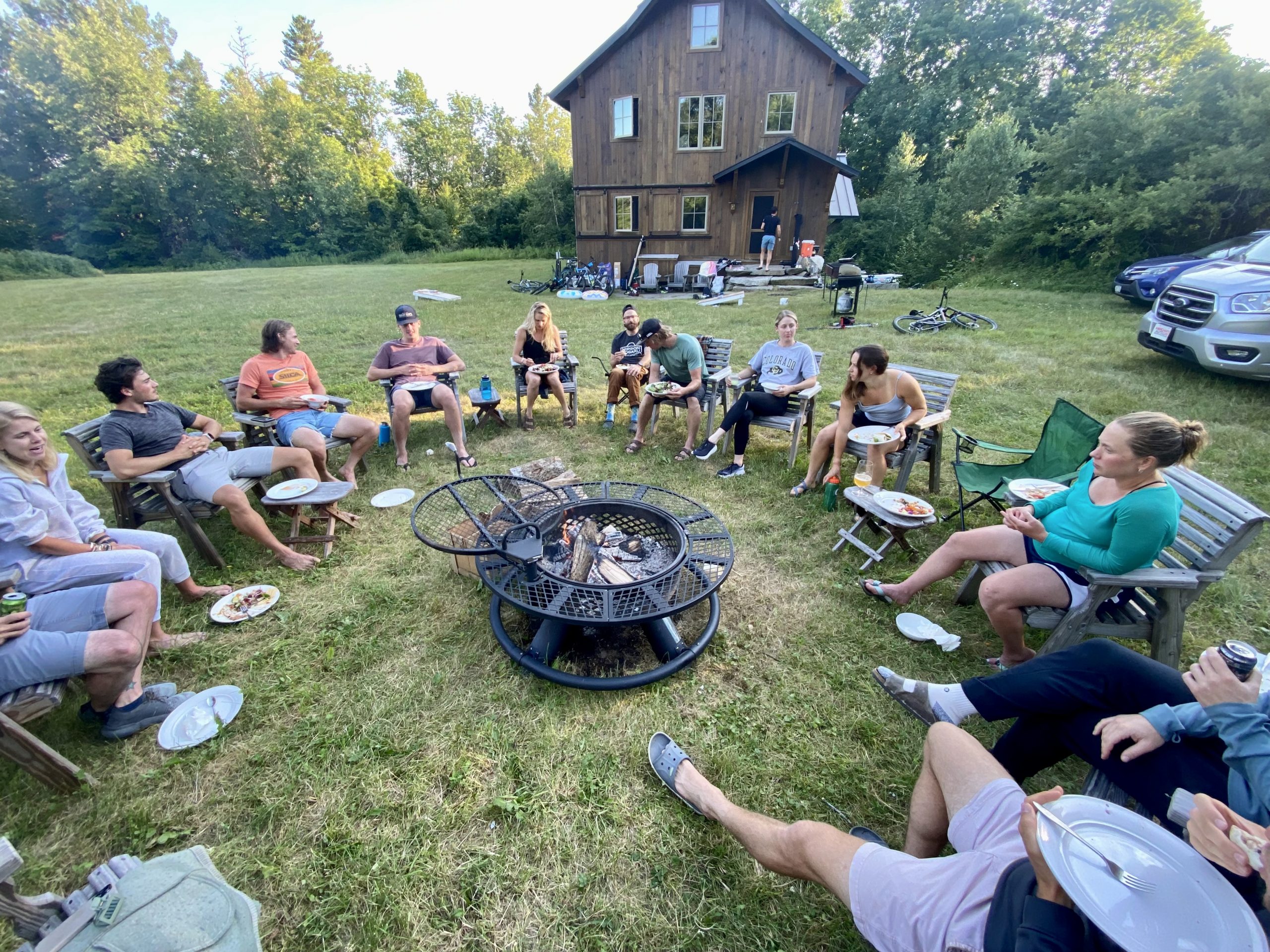
Dinner around a campfire for the SMS T2 Team at Green Woodlands in New Hampshire (Photo: Lina Sutro)
More recently, the team had a second mini camp in the Waitsfield/Warren area, north of Stratton. Highlights from this camp included a 5 k hill climb pace project on the Appalachian Gap, combining with the Eastern and Midwestern U16 camp, and Team Birkie who also held a camp in Vermont recently. About this activity Thomas shared, “the team had a great time chatting with the U16’s after App Gap, and we had a fun run/hike on part of the northern section of the Long Trail.” He extended his thanks to Justin Beckwith and NENSA as well as Colin Rogers and Green Mountain Valley School (GMVS) for their efforts in putting together some great events.
Joining the SMS T2 Team for varying lengths of time this summer are a number of U.S. Ski Team and college athletes. This list includes: Sydney Palmer-Leger (new member of SMS T2 team, University of Utah (UU), U.S. Ski Team), Novie McCabe (UU, U.S. Ski Team), Sophia Laukli (UU, U.S. Ski Team), Weronika Kaleta (University of Colorado (CU), Polish National Team), John Hagenbuch (Dartmouth, U.S. Ski Team), Gus Schumacher (Alaska Winter Stars, U.S. Ski Team), Luke Jager (UU, U.S. Ski Team), Adam Witkowski (Michigan Tech University (MTU)), Zander Martin (Bates College), and Asa Chalmers (Dartmouth).
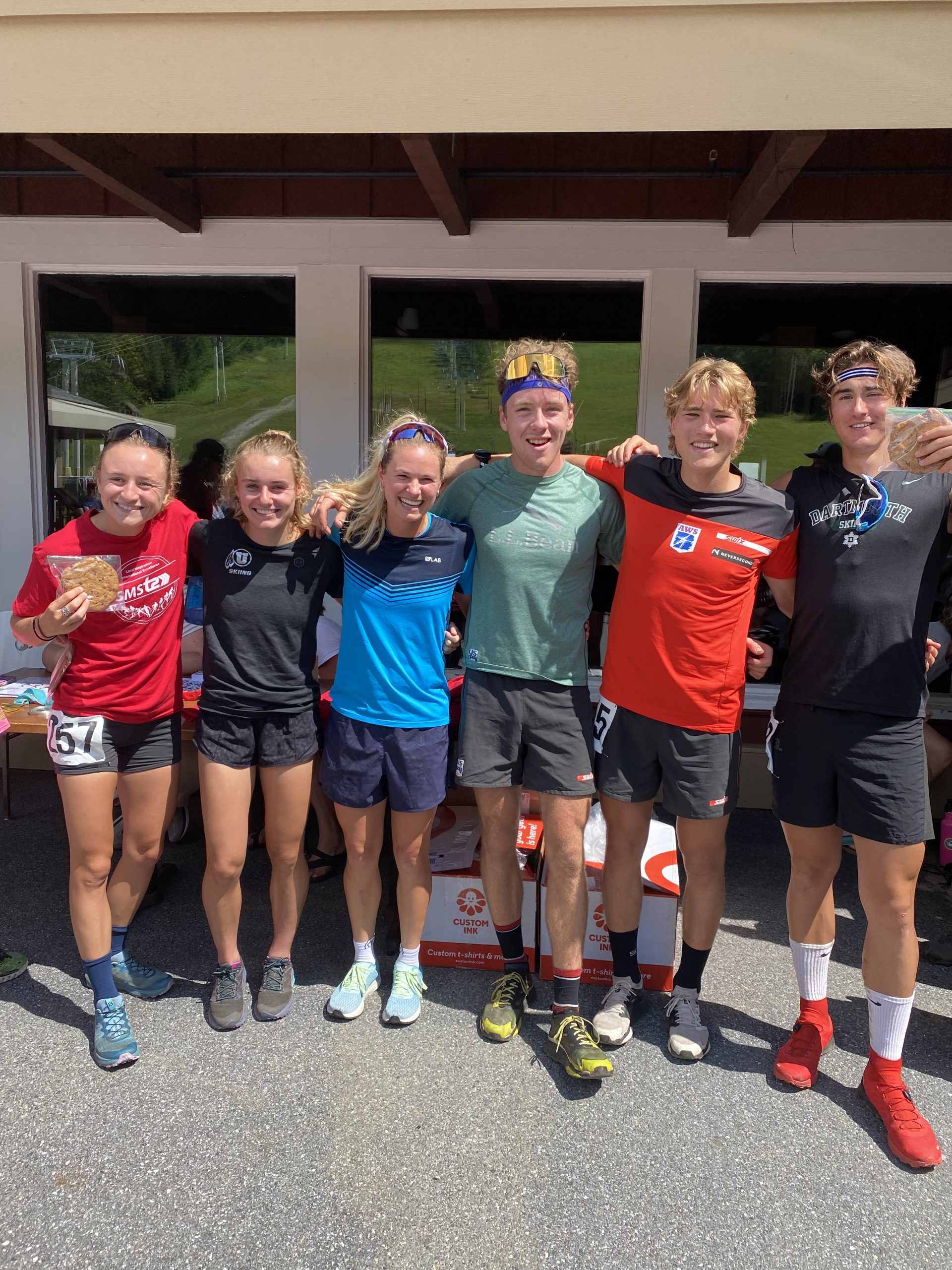
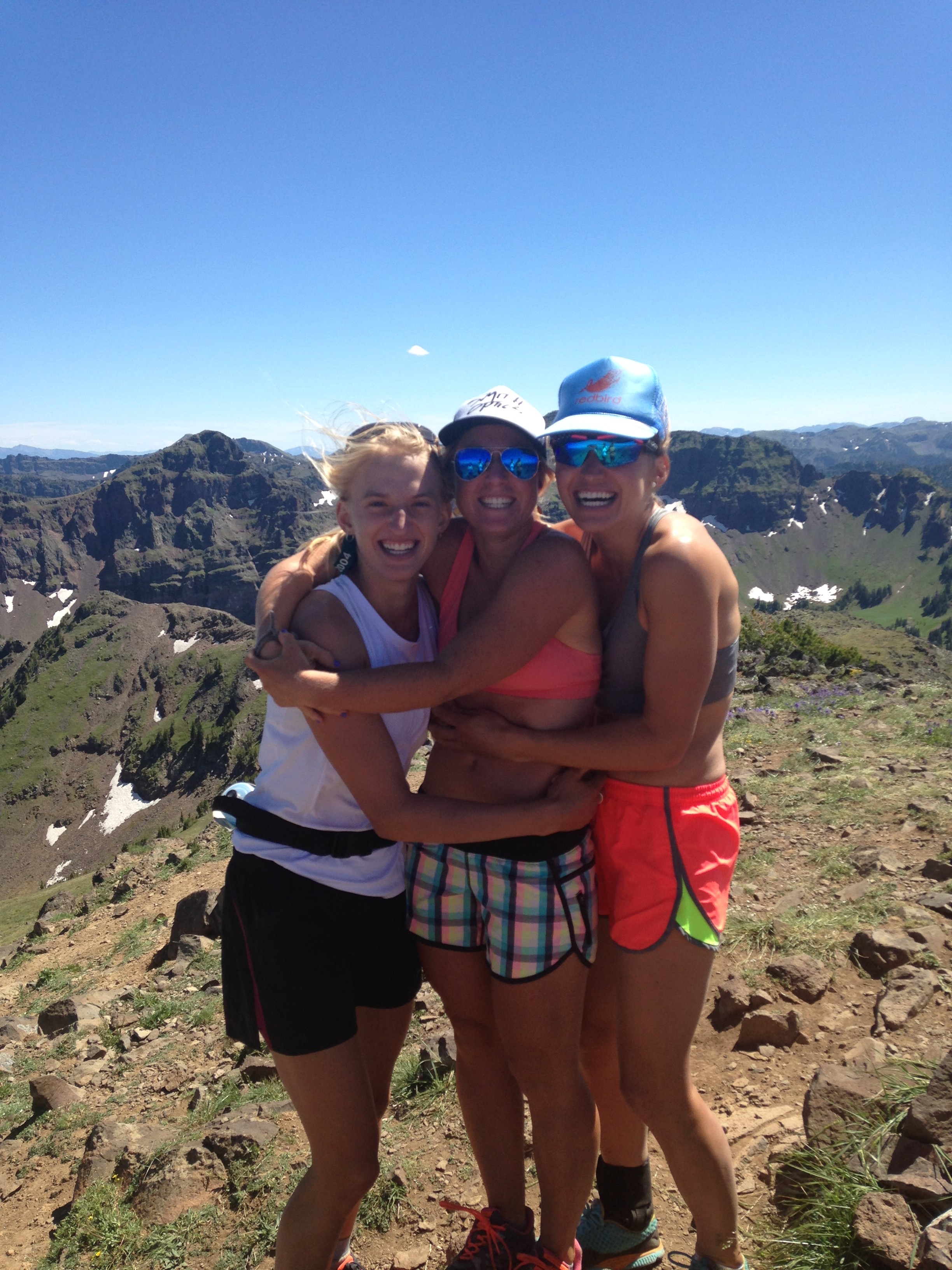
Happy athletes in the White Mountains in New Hampshire (photo: Lina Sutro)
Thomas, who took over as head coach of the SMS T2 Team this past spring, expressed his enthusiasm for the crew of athletes saying, “I feel very fortunate to be working with such an accomplished group of U.S. skiers. It has been fun and rewarding to say the least!” He’s had some assistance in the coaching department, U.S. Ski Team D-Team Coach Kristin Bourne, and Head Coach Matt Whitcomb have come through to work with the U.S. Ski Team athletes, but also help support everyone. Annika Martell and Steve Monsulick of Williams College have come to help at Thomas’ invitation, and with the additional support from the SMS junior coaches, Matt Boobar, Alex Jospe, and George Forbes, the coach to athlete ratio has been pretty good. Thomas also said, “I feel very fortunate to be able to work with Pat O’Brien, Jason Cork, Sverre Caldwell, and Matt Boobar this summer (among many other great coaches). Having such an excellent coaching staff to work with and learn from has been such a privilege. Everyone is very open, hard working, great to get along with, and they are all massive resources for myself as well as the team.”
For many of the athletes, this summer has been their first time in Stratton. Thomas reflected, “I think many of the athletes that have never been to Stratton before, or maybe haven’t trained with the T2 team as much, have realized how great a place it is to train here. It seems like everyone has been really enjoying themselves, and we hope to continue having a strong summer training group in the future.”
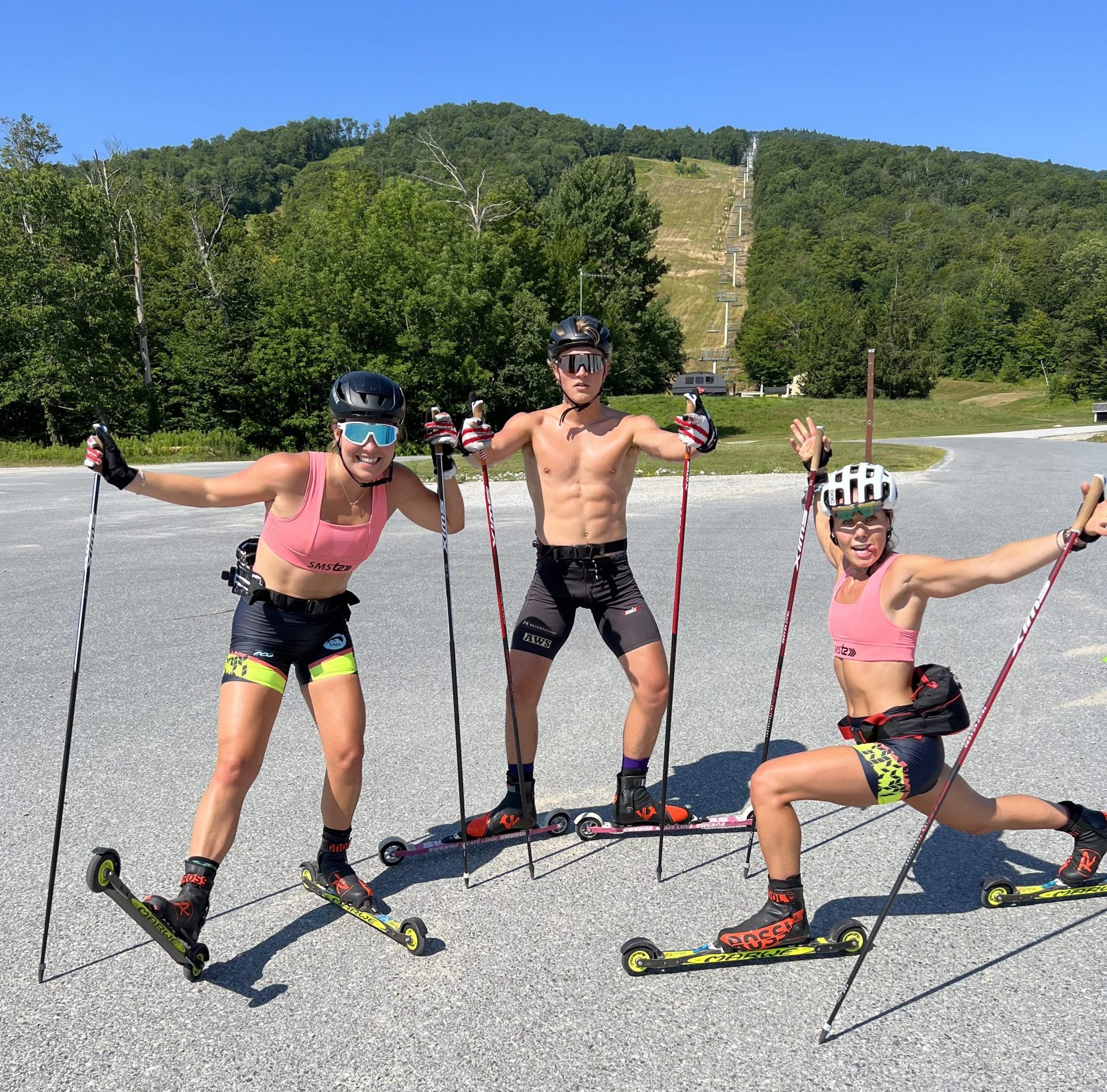
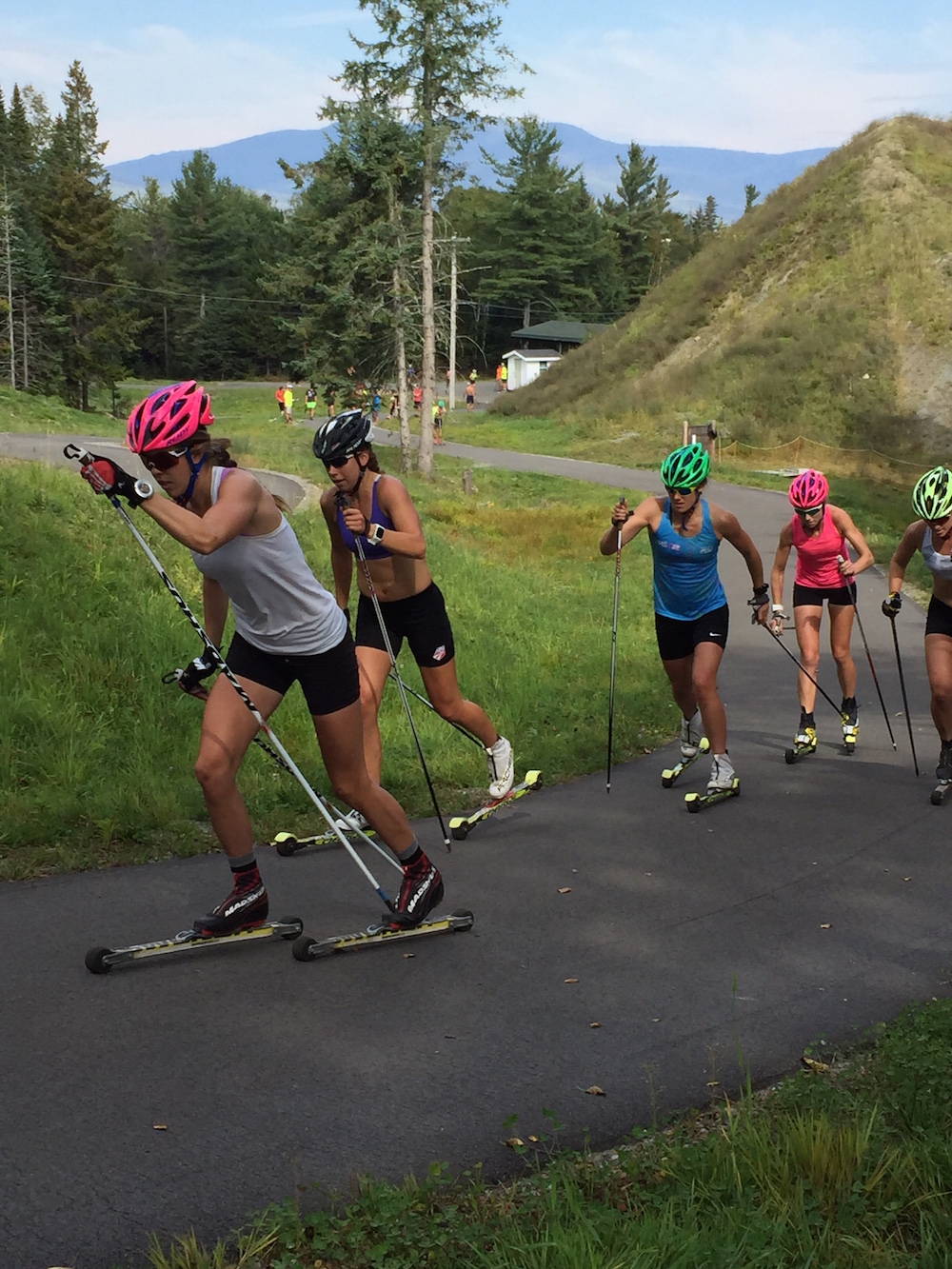
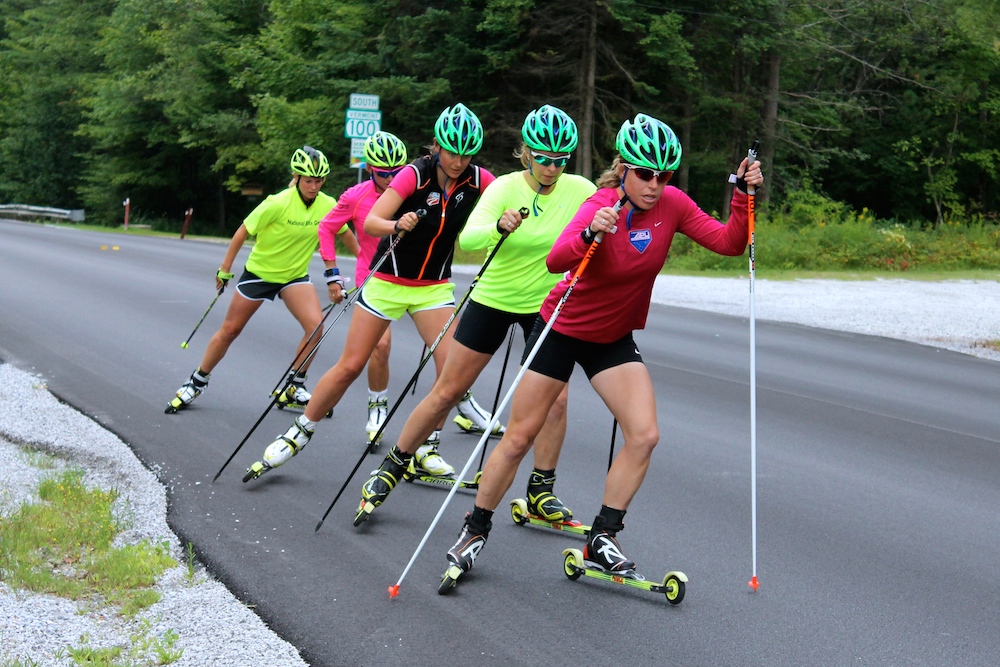
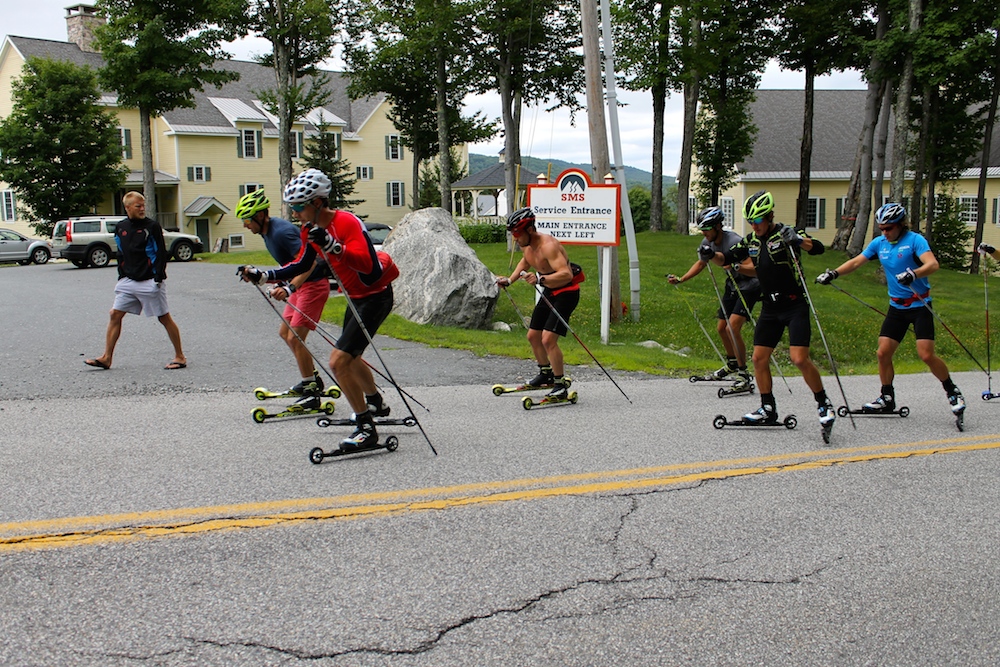
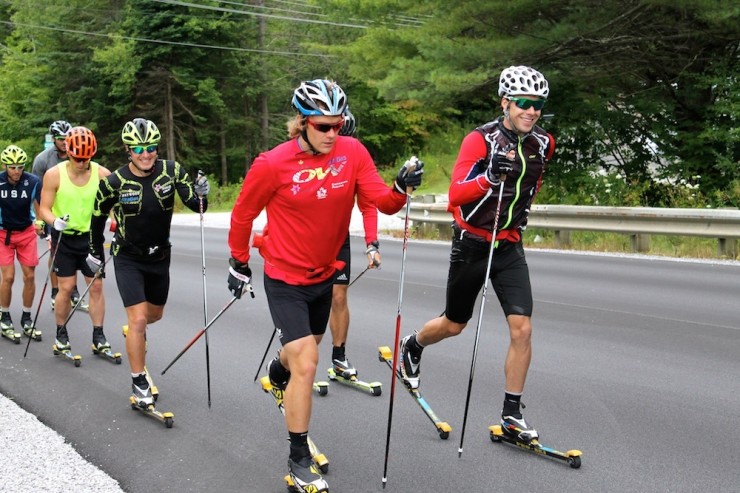
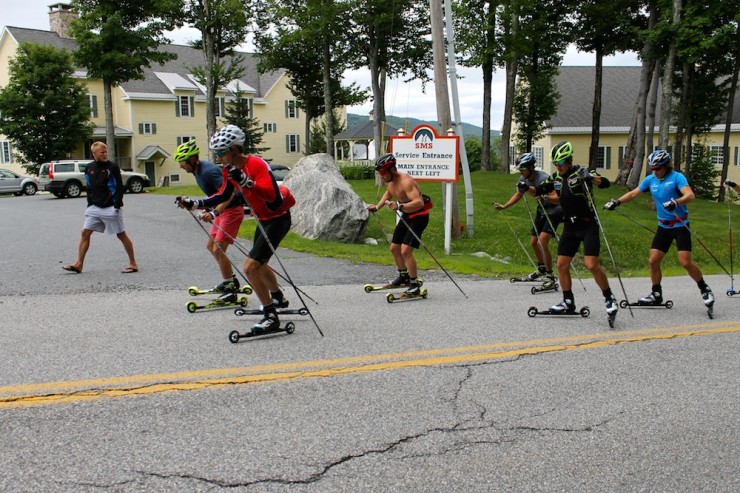
Lina Sutro, Gus Schumacher, and Lauren Jortberg (l-r) head out for a rollerski (photo: Lina Sutro)
One of those athletes is Sydney Palmer-Leger, who is not only spending her first summer in Vermont, but is also the newest member of the SMS T2 Team. When asked about her decision to come east this year, Palmer-Leger shared, “Last year I spent two months in Anchorage, Alaska. I had a lot of fun exploring a new beautiful place with the APU group and working with Erik Flora. I had never spent a period of time out East besides a couple bike and ski races. I had heard amazing things about the SMS T2 Team so I decided to try something new. I packed up my car not knowing what to expect and drove the three days out to Vermont.”
Born and raised in Utah, Palmer-Leger said she is used to bigger mountains and a drier climate than you find in the East, but the SMS T2 Team was welcoming from the start and made her feel at home. She wrote, “I am used to working with many different coaches so that was an easy transition. I had been on a couple trips with Pat (O’Brien) and met Perry (Thomas) in Bend, so I wasn’t super uncomfortable joining a new team. I felt I belonged in this group from the beginning and loved training in Vermont so I decided to join the SMS T2 Team.”
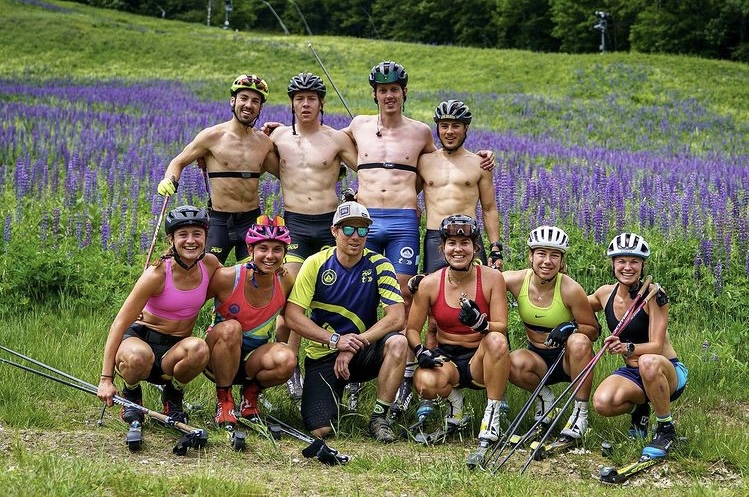
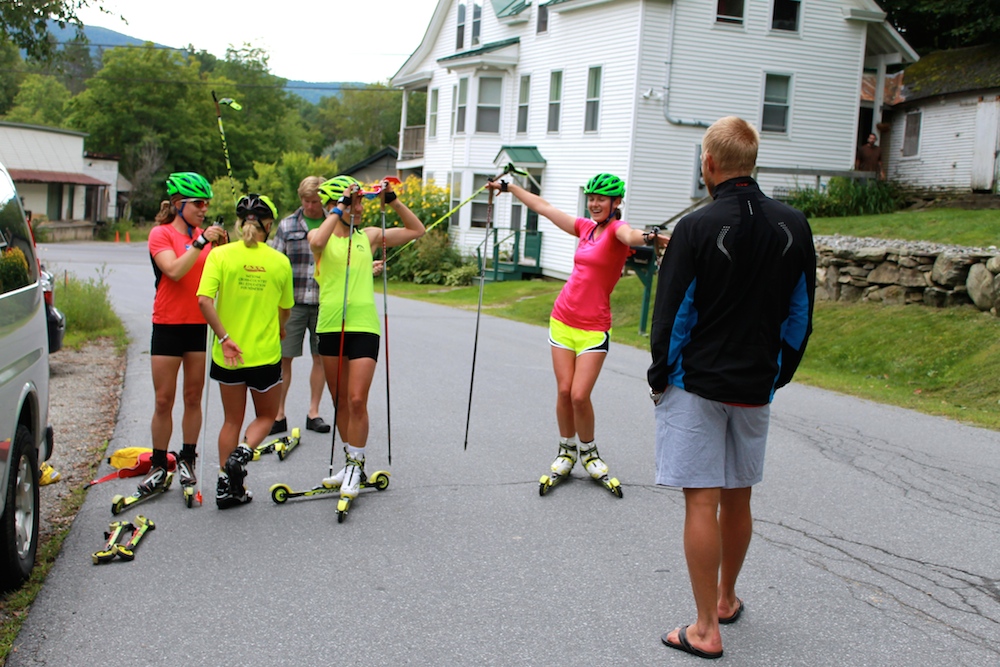
SMS T2 crew (photo: Lina Sutro)
Palmer-Leger pointed to a number of highlights from the summer, including the mini camps in Craftsbury, Warren, and Greens. She reflected, “[the] camps were fun ways to get a lot of training while exploring new parts of the East. I have also loved being close to water where we have gone paddleboarding and waterskiing with the Ogdens. I am very fortunate to have this group to come back to every summer. In addition to running and rollerskiing, I have been able to explore more bike trails. Biking used to be my other sport so I have loved going out with the team every week. I went to Burke the other weekend and helped with the Little Bellas. It is inspirational to see these young girls out on the trails shredding.”
Gus Schumacher also made his way east this summer, though for a few weeks rather than the whole summer. Initially, the motivation for this change in scenery was a way to break up the jet lag on the way to Norway for the U.S. Team camp happening next week. But when Schumacher decided not to go to Norway he realized he still wanted to train with Ben Ogden and SMS to “return the favor” of him coming to Alaska last summer. Schumacher said, “I also wanted to hopefully get some rollerski racing and rollerski track skiing in but I didn’t really do my research on when/where to come.”
The summer climate in southern Vermont is typically different from that of Alaska where Schumacher spends most of his summer. “[It’s] definitely a little hot and humid but it’s kind of nice to get a little sweaty,” wrote Schumacher, “the biggest issue is that our dryer doesn’t really work so there’s not a great way to dry washed or wet clothes.” (A problem which anyone who has spent a summer in the East can identify with).
For his time in Vermont, Schumacher had a couple of goals he was focused on. The first, to stick to his general progression/training layout. This meant getting good group sessions, but not losing focus of his own process. The second was to keep up good daily habits like consistent bedtime, morning mobility, healthy meals and recovery stuff. Third, to take care of some body stuff that was acting up recently. And finally, to generally make use of being around a strong team and use them to push himself whenever possible. Schumacher concluded by saying that he is “very thankful to SMS and southern VT for taking us in and helping us figure out lodging and training, as well as getting us exposure to some races and cool mentoring opportunities.”
Alayna Sonnesyn, Novie McCabe, Jessie Diggins, Ben Ogden, Gus Schumacher, John Hagenbuch (l-r) after a hillclimb up Stratton Mountain (photo: Lina Sutro)
Approaching the final few weeks of August, as the summer winds down, athletes and coaches alike will be going their separate ways. Schumacher is headed back to Anchorage next week when the team goes to Norway. He said, “In sticking with my plan, I felt like it made more sense to take a recovery week and get back into my swing in Anchorage.”
Palmer-Leger, who has spent two and a half months in Stratton with the SMS T2 Team, is heading back to Utah for school. After having finished summer school this past weekend, she has a little break before going back to classes in Salt Lake.
Thomas reflected that the summer has flown by, saying “it’s crazy how fast time goes by when you’re training hard and having fun.” With many of the summer athletes heading back to school or back to their main club, the crew in Stratton will be dwindling.
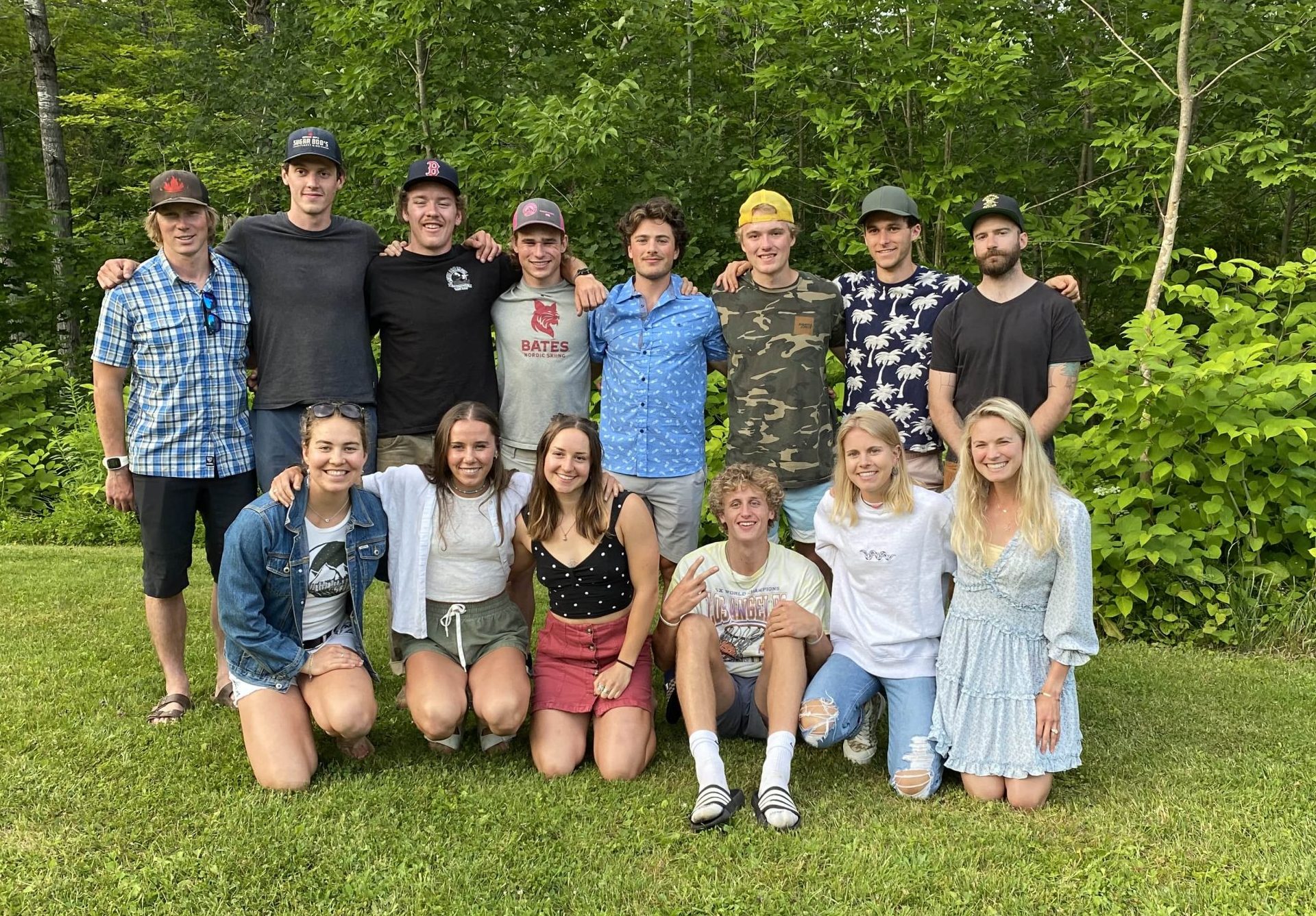
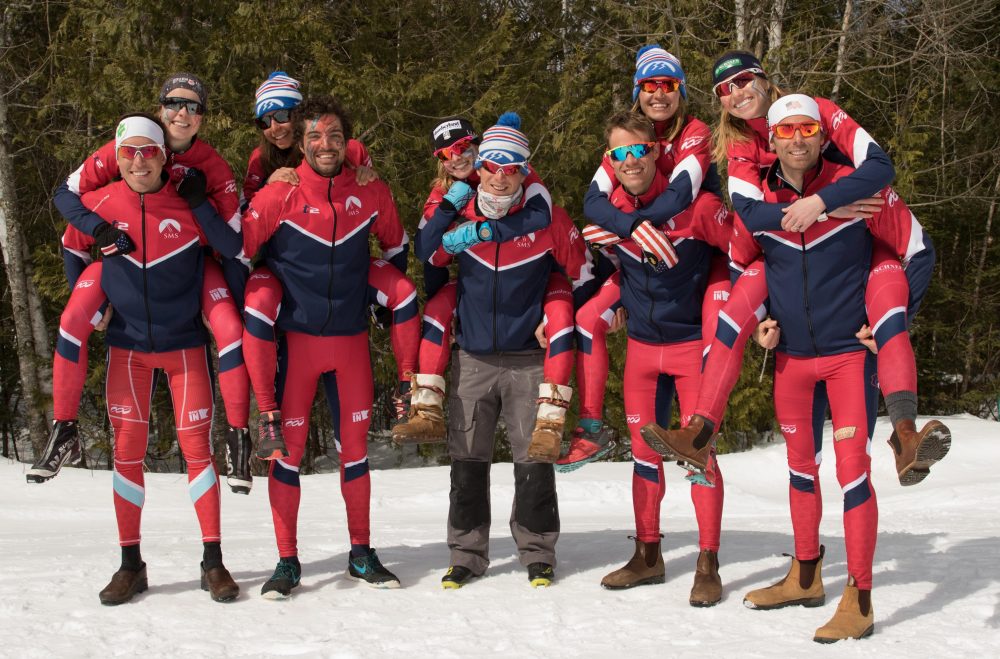
Back-row: Bill Harmeyer, Ben Ogden, Zander Martin, Will Koch, Asa Chalmers, Adam Witkowski and Perry Thomas. Front-row: Lina Sutro, Lauren Jortberg, Sydney Palmer-Leger, Fin Bailey, Sophia Laukli and Jessie Diggins (photo: Lina Sutro)
A couple athletes will be traveling to Scandinavia for the U.S. Ski Team camp in the Torsby ski tunnel and competing in the Toppidrettsveka rollerski races. Jessie Diggins, Julia Kern, and Jason Cork are headed to Australia for a three week on-snow camp there. Thomas will be headed to Oberhof, Germany with SMS T2 athletes Lina Sutro, Lauren Jortberg, and Alayna Sonnesyn for a ten day camp in the Oberhof ski tunnel. Eventually, the core T2 team will reconvene back in Stratton in early September before heading to the U.S. Ski Team camp in Park City in early October.
After eight years at the helm of the Stratton Mountain School (SMS) T2 team, head coach Pat O’Brien is in the process of taking a few steps back, passing the reins to Perry Thomas, who has spent the last five years as the assistant coach at the University of Vermont.
Perhaps highlighting this transition and the sharing of responsibilities the two are in the process of navigating, FasterSkier connected with Thomas in mid-May while he was in his second week of supporting the SMS T2 athletes who had joined the U.S. Ski Team for their spring training camp in Bend, OR, and with O’Brien who was back in Stratton, having recently wrapped up with his participation in U.S. Ski & Snowboard spring congress sessions.
Pat O’Brien supports some of the SMS T2 athletes during a 2022 SuperTour weekend in Sun Valley, ID. (Photo: SMS T2)
A 2006 graduate of SMS himself, O’Brien raced collegiately for Dartmouth College, then spent four years training and racing professionally with the Craftsbury Green Racing Project. His move from Craftsbury back to Stratton was timed with his retirement following the 2014 Sochi Olympic Quad. Given his age and the proximity to his racing career at that time, many of the athletes on the T2 team were among what he called his “peer group”, having overlapped with many of them during either high school, college, on the race course, or all of the above. Jessie Diggins and Sophie Caldwell Hamilton were quickly becoming rising World Cup stars on the women’s team, while Andy Newell and Simi Hamilton headlined the men’s roster, and a young Julia Kern and Katharine Ogden were spending a PG year training with the T2 team.
Eager to stay connected with the sport after retirement, O’Brien seized the opportunity to take over in Stratton, stepping in as his predecessor Gus Kaeding departed.
“Ski coaching is the one thing that I’ve always known that I wanted to do, it was just kind of a natural progression for me. I knew that I was done with my athletic career – I didn’t really want to ski race anymore – but I knew that I still wanted to ski, I still wanted to be involved and to give back to the sport. I felt like, to some extent, when you spend basically your entire life skiing, you get pretty good at understanding the sport. But we never know as much as we think we do, and we always need to be students of the sport and have an open mind and learn.”
As he began his coaching career, he quickly realized that writing training plans and facilitating training was only a small subset of the responsibilities of an elite club coach.
“Good coaching is being comfortable wearing a bunch of different hats. And I mean, I joke, but the actual coaching is such a small part of it. The nitty gritty of pulling an athlete on the side of the trail and looking at video and all of that is important, but you’re there as a friend, a drill sergeant at times, and as someone that is just really trying to be supportive.
“And that’s all-encompassing. So for me, it has been a pretty fun experience to see people figure stuff out and be there to support them when they needed a little extra help and to do it in a pretty collaborative, dynamic way.”
He described his experience transitioning to coaching primarily as a mindset shift from the inevitable self-centric focus required of professional athletes toward selflessness; but the work required and pace of life remained equally taxing.
“When you coach at a club level – all coaching is a demanding job. I do think that you have to – I don’t want to use the word ‘sacrifice’, but when you transition from being an athlete yourself to being a coach, your job as an athlete is to be a little selfish. You’re trying to maximize your athletic performance. You need to have balance… but at the end of the day, you need to make sure that you’re training well and with purpose, you’re recovering well, you have goals and you’re going about achieving them. It shouldn’t be simply looked at as like what you have to give up to do that, but to be the most professional athletes and succeed against people who are trying to do the exact same thing, you just have to do a really, really good job with it. And coaching is the same thing. You have to be willing to approach everything that you do with the same degree of drive and focus that you would as an athlete…
“Basically, I just threw myself into it with the same approach that I had as an athlete which is, I’m just going to work, and work, and work, and learn all along the way. And then give it my best push and know that if I get to the point where that balance starts becoming harder and harder, or I can’t really do the job that I want, to be supportive of the athletes [to the level I want to be], that’s when you’ve got to know that you either double down and keep pushing or make a transition.”
While O’Brien is no less dedicated to the SMS T2 program or its athletes, a new endeavor has begun which will make achieving the balance he described significantly harder: he’s about to become a father. His wife, two-time Olympian and long-time U.S. Ski Team member Ida Sargent, is due in mid-August.
After eight years as head coach of the SMS T2 team, Pat O’Brien takes a step back as he and his wife, Ida Sargent, begin their family. (Photo: SMS T2)
Since retirement, Sargent has been working for her high school alma mater, Burke Mountain Academy, in Northern Vermont, and is currently the Academic Director for the school while also teaching STEM classes. O’Brien has been splitting his time between Burke and Stratton, which lies roughly 150 miles southeast in the opposite corner of the state. His usual coaching schedule pulled him around the country for weeks at a time to support athletes at U.S. Nationals and SuperTour events, and sometimes around the globe for World Cup, U23s, and other international camps and races.
While he acknowledged that there are many examples of coaches at all levels who have successfully juggled a demanding work and travel schedule with raising a family, what felt like the best fit given his and Ida’s vision and priorities for their own growing family was for O’Brien to decrease his level of responsibility with the T2 program, allowing greater flexibility and more time at home.
“I just felt like there’s part of me that was like, ‘I’m not seeing a pathway that I feel like I can still commit [to coaching] at the level that I want and know that you need to in order to to do the best job with your job, while simultaneously trying to start a family.’ I felt like it was my time to reevaluate and maybe step back or be completely done with ski coaching, because I certainly didn’t want Ida to have to put her growing career on hold to be the [primary] caregiver…
“Eight years is a long time to do something and I am very proud of what the team has accomplished in that time… it’s really cool having spent this time seeing athletes grow, not just not just athletically and within their their ski careers, but as individuals from high schoolers to finishing up college to full blown ‘this is my job.’”
While his role will be smaller, O’Brien is certainly not stepping away from the T2 team altogether. “Starting a family does not necessarily mean that it means the end of being involved in the sport,” he said. “It just means trying to figure out what the right relationship is with it.”
Pat O’Brien supports SMS T2 skiers Julia Kern and Alayna Sonnesyn at the 2022 U.S. SuperTour Finals in Whistler. (Photo: SMS T2 Blog)
The exact balance and distribution of responsibilities remains a work in progress as Thomas moves into the head coach role and the new season of training begins, and both O’Brien and Thomas are excited to collaborate and support one another throughout the year.
Explaining his philosophy as “under-commit so I can open perform”, O’Brien anticipates taking on many of the behind the scenes tasks that support the team, from collaboratively blocking out the season calendar, to managing travel logistics for camps and SuperTour races. As he put it, the little details of deciding “which flights to take to get from Canmore to Sun Valley” and where to stay are often made easier with several years of trial and error under your belt.
While Thomas will spend more time with ski boots on the ground, both in Stratton during the summer and at races and camps throughout the year, O’Brien anticipates he’ll still be plugging in a fair amount too. Though his stay might be shortened to the period immediately surrounding races, he plans, at minimum, to be in Houghton, MI for U.S. Nationals in January, and also the SuperTour finals in Craftsbury in late March.
He’s also excited to reconnect with the team in Stratton early in the summer before Ida gets close to her due date, but also to take off a few of his usual coaching hats while doing so.
“I think it’ll be really fun for me to actually be able to flow in and out get to see people, connect with them, but also not be like ‘Okay, now I don’t have to worry about making sure that the van’s filled up with gas, or water jugs have been filled, or that I’ve ordered all the lactate strips in advance so that we don’t run out.’”
Perry Thomas out for a crust ski with the SMS T2 athletes who joined the national team training camp in Bend, OR this spring. (Courtesy photo)
As Thomas gets his feet under him in Stratton, he explained that he feels “very fortunate that Pat will still be involved.”
“As much as I can have him in the mix, the better,” Thomas said. “His knowledge with skis and wax is just unreal, so tapping into that resource is huge for me, for sure.”
***
UVM assistant coach Perry Thomas in action during the 2022 U.S. Cross Country Skiing Championships in Soldier Hollow. (Photo: Instagram @oneswellperry)
Prior to joining the UVM program, Thomas spent five years as the assistant coach at the University of Vermont, working alongside head coach Patrick Weaver. During his own collegiate racing career, Thomas spent four years racing for the University of New Hampshire, where he served as team captain during his senior year in ‘12-13. Departing briefly from the cross-country ski world, he spent a year teaching high school science to underprivileged youth in the Oakland area of California, before returning to the Northeast to begin his coaching career as the assistant coach at Williams College in Massachusetts.
“Working at UVM was unreal – a great experience,” Thomas said emphatically. “I really loved working with Patrick Weaver and the athletes there and it seems like almost a seamless transition, in many ways. Four of the skiers on the T2 team I actually coached at UVM. So knowing a lot of athletes here already – what they’re working on with technique, and racing, and goals and all that – has been very seamless, and that’s been great.”
The UVM graduates who now ski for SMS T2 include Alayna Sonnesyn (‘18), Bill Harmeyer (‘20), Lina Sutro (‘21), and Ben Ogden (‘22).
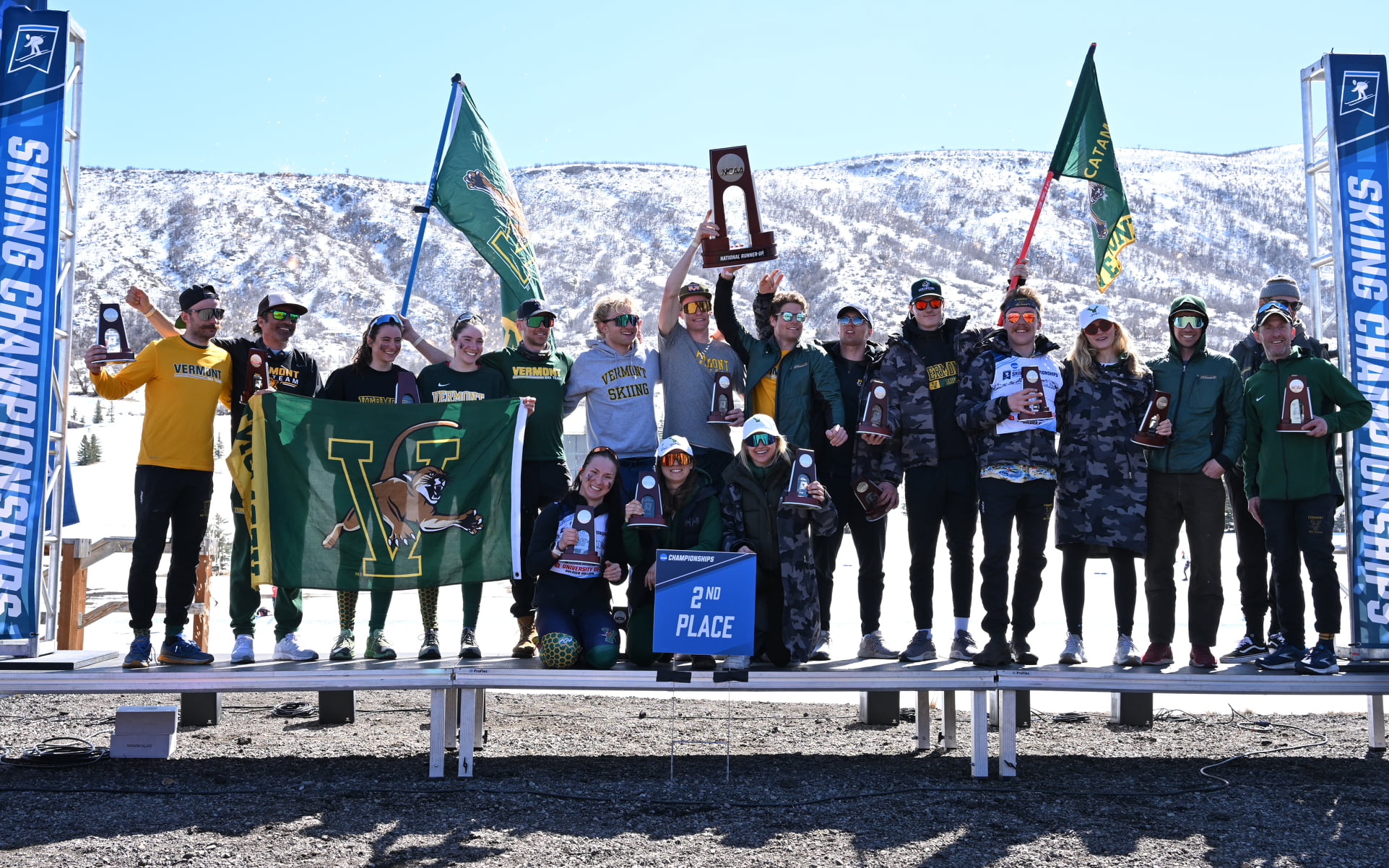
The UVM ski team celebrates a successful 2022 NCAA Championship. Assistant coach Perry Thomas is at the far left. (Photo: UVM Skiing)
Given the caliber of these athletes and the success of the UVM team as a whole during his tenure, Thomas credits his time with the program to the acceleration of his development as a coach, preparing him to take his next steps forward with SMS T2.
“Patrick Weaver definitely gave me a lot of opportunities and ownership over different facets of coaching that team and I think that’s been instrumental in me being here now with T2. I was able to go to World Cup Finals with Ben Ogden in Quebec his first year in school [in 2019], and I was just able to do trips like that on my own with athletes. That was huge for my development as a coach and for my experience of waxing, ski testing, and [other responsibilities at that level of racing]. So working at UVM was a lot of fun – I’m gonna miss it for sure – but it set me up very well for this transition.”
Ben Ogden gets a congratulatory fist bump as he heads to the podium during his sweep of the 2022 NCAA Championships. (Photo: Tobias Albrigtsen / @untraceableg)
A theme of both Thomas and O’Brien’s comments on the difference between collegiate and elite club coaching is small in terms of the training and technique coaching itself, but vastly different in terms of the opportunities elite club coaches have to support their athletes.
“I think the big differences are what we can and can’t do throughout the year from collegiate [racing] to the elite team,” Thomas explained. “Like, I wouldn’t be here [in Bend] and been doing an on-snow training camp if I were at a college team. And obviously the racing schedule is super different.
“The college schedule is pretty efficient, whereas the SuperTour calendar is quite a bit more spread out. And then, in addition to that, you have an athlete’s like Jesse Diggins, and Ben Ogden, and Julia Kern that are going to be on the World Cup, as well as athletes that are trying to make it to the World Cup. And at UVM, we had crazy talented athletes – Ben Ogden is one of them – so working with with high caliber athletes is nothing entirely new, but dealing with athletes where some are on the World Cup and some of them on the SuperTour is an interesting dynamic that you don’t often get with the college teams.”
In terms of what Thomas adds to the program as he steps in as head coach, he described his coaching philosophy and the environment he seeks to create within the training group, which keeps athletes motivated and happy through the arduous and long-term development process.
“[Cross-country] skiing is such a hard sport – it’s so much time that that we’re putting in, and so many sacrifices that we’re making, that I wholeheartedly believe in making that time that we’re together training and working hard fun and enjoyable,” Thomas said. “I think that’s a big part of what we do – and it has to be a big part of what we do – because like I said, it’s a hard sport. So I think making things light and having fun with all that is super important. And that’s definitely something I bring to the table in that regard.”
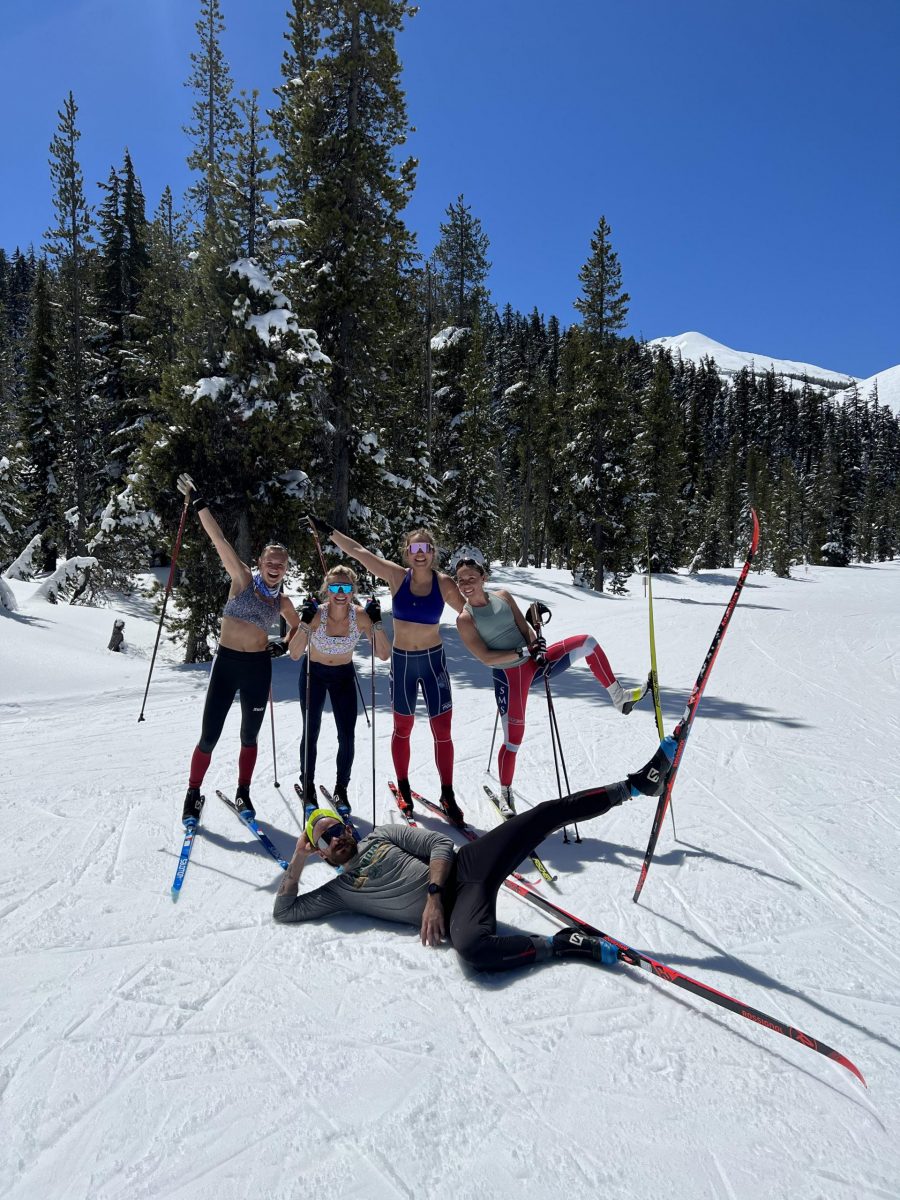
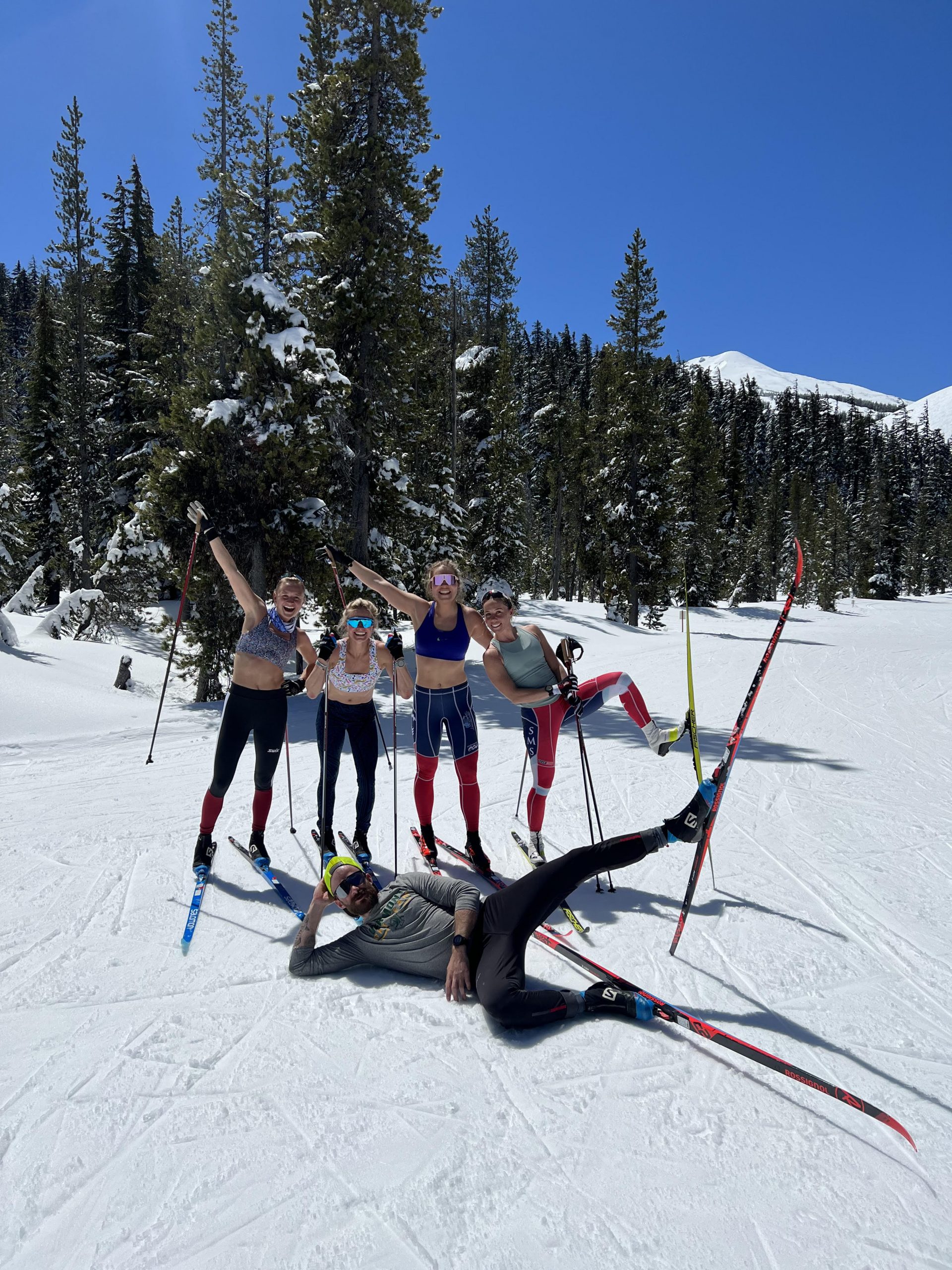
The SMS T2 team enjoys spring skiing at the Mt. Bachelor Nordic Center. From left to right, Alayna Sonnesyn, Jessie Diggins, Lina Sutro, and Lauren Jortberg, with head coach Perry Thomas. (Photo courtesy Alayna Sonnesyn)
But Thomas will add more than just fun to the T2 program. While he may be, as phrased by his new colleague, “almost too humble”, O’Brien was quick to highlight Thomas’s preparedness to prescribe training, coach technique, and otherwise lead an elite team stacked with some of the nation’s best athletes.
“If you have been at a D1 college program where you’re dealing with 15-20 athletes and that dynamic environment where student athletes are constantly balancing all these different commitments and time constraints… And really, what you learn there as an athlete and what you learn there as a coach is that working with a club – it just isn’t that different.”
O’Brien added that the shift to an elite club from college may, in fact, be easier than going in the other direction. When athletes no longer have to miss key workouts to take an exam or rush off to class halfway through a team meeting, barriers to consistent communication and training are removed, and consequently a coach has a greater capacity to build relationships with the athletes as they stack together the bricks of the training program.
“You get an opportunity to really work one-on-one with the athletes and to really be there to facilitate and support their training and their racing. In that sense, I think coming from a college background – especially given his ties with many of the current athletes that are on the team – you’re just working with the same people and you’re doing the same stuff.
“I mean, there’s no magic formula,” O’Brien continued. “Someone can claim that they can write the best training plan in the world. And that’s all fine and dandy – there are definitely people who do an amazing job with it and they really enjoy that aspect of that aspect of the sport. But at the end of the day, it’s just really just working with people. You don’t need to make it more complicated than it is. The best athlete is not a robot. The best athlete is someone that is self aware, that can think critically, learn from mistakes, recognize when things go well, and the coach is there to support them along the way.”
New SMS T2 head coach Perry Thomas working with his athletes during a 2022 spring training camp at the Mt. Bachelor Nordic Center. (Photo: Lauren Jortberg)
Thomas identified building upon his relationships and experience with his former athletes, who account for half of the team’s eight athletes, as something he’s looking forward to in joining T2.
“I am very appreciative of the continuity and being able to work with some athletes I’ve worked with in the past,” said Thomas. “I love all of them – they’re incredible people, incredibly hard workers. So to be able to continue working with them is just awesome. With that, too, it’s like – I have been working with Ben for the last four years, I worked with Lina Sutro for four years, I worked with Alayna for a little bit. It’s just a matter of knowing how they operate and how they train and knowing what they’ve been working on too. It’s easy for me in training, [even] this morning, to see some of them and be like, ‘okay, like this is something we’ve been working on for the last however many years’ or maybe, ‘a couple years ago, this was something we’re working on’. So let’s continue this, let’s continue these cues that we’re working on, and have that continuity there.
“It’s been awesome to be able to continue that work with them. It’s nice to see the progress – to see what they were doing in college a few years ago, and then to see where they are now, and then also to be able to help them through the transition to professional skiing.”
Simultaneously, these UVM-T2 athletes are excited to be working with their former UVM coach again. In an email to FasterSkier, Alayna Sonnesyn reflected on her time as a professional skier guided by O’Brien, while crediting Thomas’s contributions at UVM for her reaching the professional level in the first place.
“Stepping into the professional ski world four years ago and onto the SMS T2 team was super intimidating to me,” wrote Sonnesyn. “The team has been home to some of the fastest skiers in the world and I was clueless when it came to racing at that high of a level. Pat O’Brien helped steer me in the right direction as I made this adjustment and took huge jumps in my skiing ability. He taught me when to train for fun and when it was time to buckle down and get serious. When Pat says it’s go time, you go! He helped develop me from a reasonable distance skier to a strong and powerful distance AND sprinter, a trait I never thought I would be capable of. Pat’s knowledge of the sport and ski waxing, as well as the mental and emotional obstacles that come along with it, is unparalleled. He was a coach that believed in me as a junior skier and saw potential. The only thing that can make a good ski race even better is when Pat gives you a proud hug at the finish line. Although I will miss these hugs and his direct coaching, I know that he will use these skills to care for his growing family and I am excited to see where life takes him next.
Perry Thomas works with a few of the SMS T2 ladies in Bend. (Photo: Alayna Sonnesyn)
“Back when Pat was just seeing the potential in my college skiing, I was working with Perry Thomas when he was the assistant coach at UVM. I feel like my athletic career has come full circle as I get to transition back to a coach who helped put me in a place where I first believed skiing professionally was an option. Although I only had the pleasure of working with Perry for one year at UVM, it was a very special season! I instantly trusted him with my skis and could feel his enthusiasm for the sport radiate on the ski trails. I’ve witnessed just how hard Perry has worked over the years and how well-prepared he is to take over the position as head coach of the SMS team. Just in the first month of working with Perry again, I already know the team is heading down a path to continue its mission; local inspiration, international excellence.”
Likewise, Lina Sutro shared she is looking forward to the transition, applauding Thomas’s dedication to his athletes.
“I am truly so excited to be working with Perry again,” she wrote. “He is one of the most hard working and committed coaches I have worked with. He has a strong work ethic that I am excited for the Stratton community to experience. Pat and Perry both give so much back to the ski community and their athletes, I am excited to see the two of them work together.”
The 2021/2022 SMS T2 Team. Back row (l – r): Ian Torchia, Ben Ogden, Bill Harmeyer, and Will Koch; front row: Alayna Sonnesyn, Julia Kern, head coach Pat O’Brien, Lina Sutro, Katharine Ogden, and Jessie Diggins. (Photo: SMS T2 Blog)
As for the broader questions of “what’s new?” and “what lies ahead for the SMS T2 team this summer?” Following Katharine Ogden’s retirement in March, Lauren Jortberg will join the team as the fifth athlete on the women’s side – five and five is what the team identifies as the sweet spot for numbers. Jortberg joins Jessie Diggins, Julia Kern, Alayna Sonnesyn, and Lina Sutro. The men’s team is light this season, as Ian Torchia moved on this spring also, leaving behind a three-man roster of Bill Harmeyer, Will Koch (who also competes for University of Colorado), and Ben Ogden.
After Bend camp, the team will part ways with many attending “a big event in the Midwest” which happened over Memorial Day Weekend. The SMS T2 team will finally reconvene as a whole in Stratton in early June. Though regional and international camps are planned, particularly for athletes named to the national team, Thomas anticipates ample quality training based in Vermont and the surrounding region.
“We’ll be in the Stratton area for the majority of this summer,” he explained. “I think one of the cool things that we’re doing is: Sverre, and Pat and I have started working on doing a summer [training] program, so we have some awesome athletes joining our crew this summer.”
This list includes University of Utah and U.S. Ski Team skiers Sydney Palmer-Leger, Novie McCabe, and former SMS junior athletes Adam Witowski and Zander Martin, who now ski for Michigan Tech and Bates College, respectively. JC Schoonmaker and Gus Schumacher also plan to join the T2 team for some training in Vermont throughout the summer.
“So a really stacked crew, for sure,” said Thomas. “It’s gonna be a really exciting summer to say the least.”
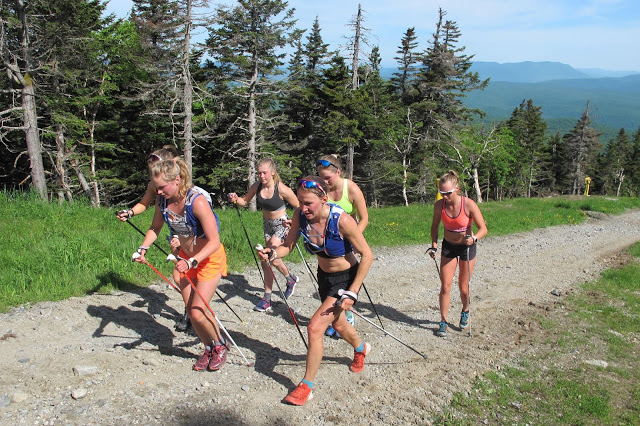
Paddy Caldwell (l) of the Stratton Mountain School T2 Team leads the way during a summer ski-walking workout up Stratton Mountain in souther Vermont. (Photo: Patrick O’Brien)
For this week’s workout, we feature the Stratton Mountain School T2 Team, also known as the Elite Team, out of Stratton, Vermont. The team’s full-time athletes live near the base of the alpine resort and take advantage of the following Level 3 (L3) ski-walking workout right out their front door.
In an email, coach Patrick O’Brien explained why they often repeat this workout during the summer: “We can safely have a large number of people training together (no worries about cars like on an open road) and the younger athletes get lots of contact and can hop in behind the senior athletes for a portion of their intervals,” he wrote. “The dirt work road up the Stratton Mountain Resort has good footing and lots of vertical for good steady state training.”
***
The workout: Level 3 Mountain Ski Walking
Need: A mountain with enough vertical to fit in 6-7 intervals of ski walking (lasting 7 minutes apiece). A good pair of trail shoes, bounding poles (about 10 centimeters shorter than one’s classic pole length), and a drink belt with sports drink and some food.
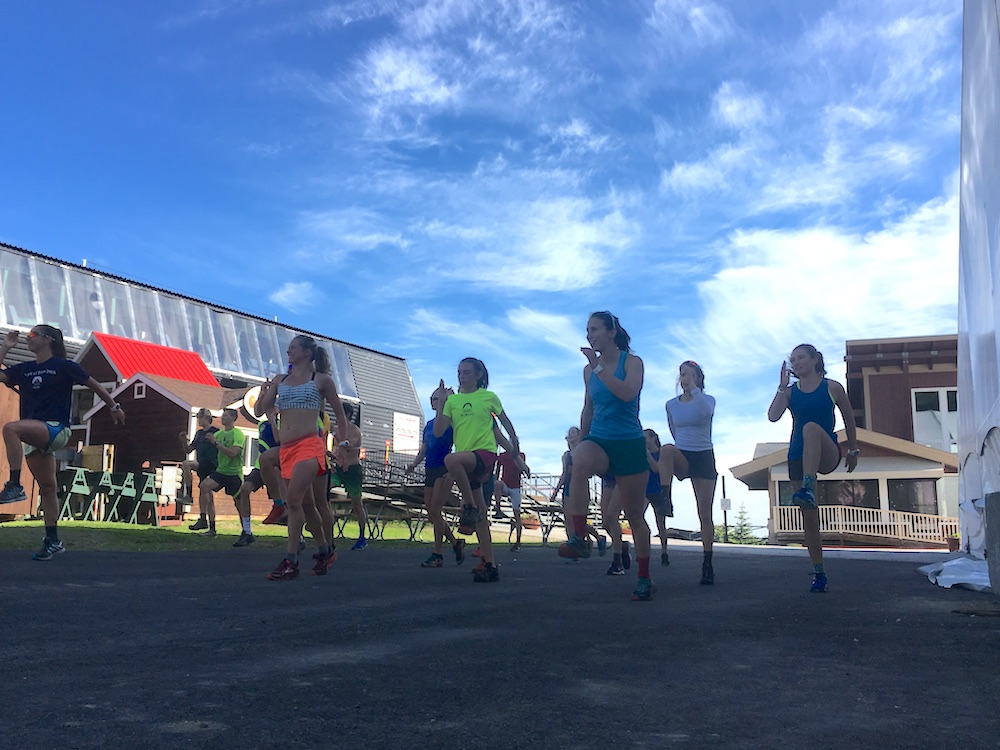
Warmup: Light 15-minute jog around the base. “Then we have our T2 team go through their ‘power warmup’ and lead the younger athletes through this progression,” O’Brien explained. “The goal with this program that US Ski and Snowboard strength coach Tschana Schiller has devised is to get our muscles sequencing and firing well before our intensity session so we are really working on explosive movements while we are most fresh versus trying to incorporate this to a late afternoon gym session. This improves our ability to generate power and is a really effective way to warm up! It usually starts with some mobility exercises, then foot drills and culminates with explosive plyometric jumps and bounds.”
Jessie Diggins (neon orange shorts) helps lead her Stratton Mountain School teammates through A-skip drills during a “power warmup” at the base of Stratton Mountain. (Photo: Patrick O’Brien)
Threshold component: 30-60 minutes, depending on how hard the week is/what kind of volume you’re aiming for in a given training block.
“Older athletes tend to do more, younger development athletes do a little less as they don’t need the same amount of stimulus,” O’Brien wrote.
Ski-walking intervals: 7 minutes of “on” time followed by 3 minutes of recovery. Repeat six to seven times. Option to add faster, flatter running intervals at the top if needed.
Jessie Diggins (front) and Sophie Caldwell (third from r) lead fellow Stratton skiers during a ski-walking workout up Stratton Mountain in southern Vermont. (Photo: Patrick O’Brien)
Tips:
Keep the group together: “We usually have the younger devo athletes start farther up the workroad and jog their recovery in place. The T2 team starts lower down and runs downhill on their recovery,” he noted. “This way the groups keep leapfrogging and the younger athletes can always tag along for a portion of their interval and follow the faster senior athletes and learn from their motions.”
Aim for “good, crisp ski-walking motions,” generating power from both lower and upper body: These aren’t as hard as all-out bounding intervals, O’Brien explained, “but we still want athletes to have a degree of impulse to their motions and not just walk up hill with poles on.” Stratton’s work road has some flatter grades, which allows athletes to “incorporate a lower energy bound on these sections and skiwalk on the steeper terrain,” if they choose. “Properly executed this workout looks pretty tame. Nothing flashy, no labored breathing or collapsing at the end of each interval. It is strenuous but not exhausting.”
Pace yourself. It should feel hard but sustainable: “With these longer steady state intervals it’s pretty easy to feel out that threshold line as there is no recovery during the intervals,” he noted. “Go too hard and you will feel it in your legs and lungs! We have people monitor heart rates and take blood lactates regularly but all of these are checks are for collecting background information. Ultimately what we want is for people to have a good sense of pacing and be able to ‘feel it out’ without needing the external feedback of a watch or lactate strip. Usually after a time or two doing this workout people have this pretty well dialed!”
Cool down: Jog back to base area, “or better yet download on the gondola when it is running on the weekend to save their legs from the impact of 1500 feet of decent!” O’Brien wrote.
Total workout time: 1:45 to 2:15 hours
***
Stratton’s 2018/2019 elite team includes seven returners (six of which are on the U.S. Ski Team) and four newcomers. Returning are Ben Saxton and USST members Simi Hamilton, Paddy Caldwell, Jessie Diggins, Sophie Caldwell, Julia Kern, and Katharine Ogden. According to an SMS blog post from late May, Paddy Caldwell was finishing up his studies at Dartmouth College, and Saxton, Kern and Ogden are taking classes there as well.
“We work closely with the Dartmouth coaches and fully support these athletes’ choices of when to attend school and when to be with us,” the post by Sverre Caldwell stated. “Paddy is finishing his last term at Dartmouth and he will join Simi, Jessie and Sophie as a full time SMST2 and USST member.”
New to the team are Kyle Bratrud (formerly of the CXC Team), Kelsey Phinney (formerly of the Sun Valley Ski Education Foundation), Alayna Sonnesyn (University of Vermont graduate), and Ben Ogden (of the Stratton Mountain School).
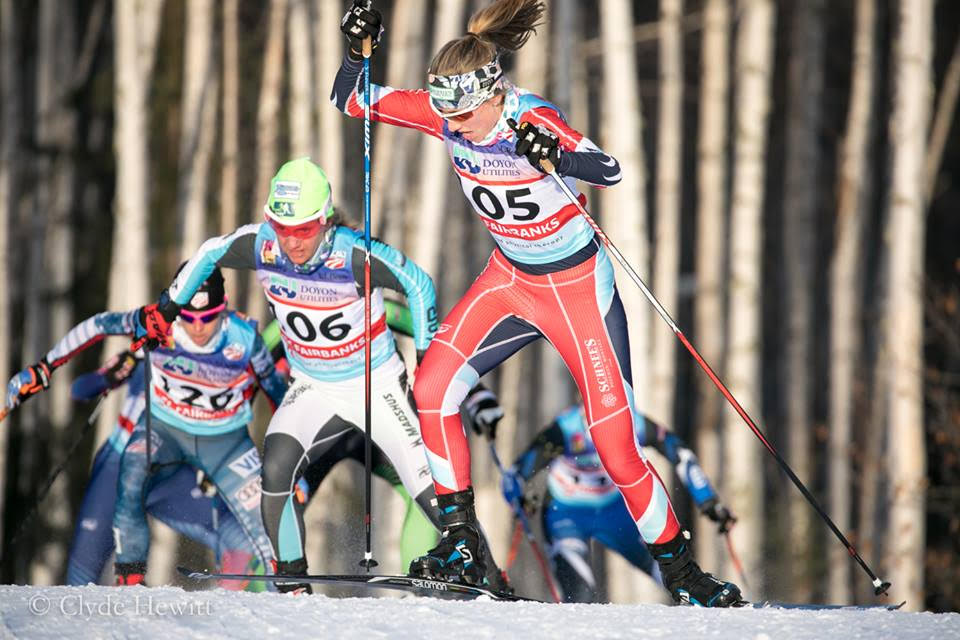
Erika Flowers (in red) racing at 2017 SuperTour Finals in Fairbanks, Alaska, where she posted a best result of third in the skate sprint. In the last six years, Flowers has reached the SuperTour podium 16 times and finished the 2017/2018 season fourth overall. (Photo: Clyde Hewitt)
It wasn’t until recently that Erika Flowers learned the meaning of her middle name. At the time of her birth, her father had been cutting around Montana’s mountain slopes on Elan alpine skis. Though the brand’s company is based out of Slovenia, the definition of élan, according to Webster’s dictionary, is a vigorous spirit or enthusiasm.
Whether Flower’s father, Pat, had researched the word’s meaning or whether the name had simply struck him, the skis were his muse. Erika became Erika Élan.
“He just happened to be skiing on that brand, and I think he liked the sound of it,” Flowers said during a recent phone interview from her hometown of Bozeman, Montana. “So he and my mom named me Erika Élan Flowers.”
For anyone familiar with Flowers, long, stick-straight, blond hair often bouncing around in a high ponytail and glacial blue eyes are idiosyncratic to the 28 year old. So is an intense verve, or élan.
“I actually never knew it had any meaning (beyond just being a ski brand) until this winter when I randomly came across it in an article and looked up the definition,” Flowers wrote in an email. “That said, I think it describes how I try to approach life in general.”
***
While many nordic skiers dream about racing against the all-stars of Norway, Sweden and other powerhouse ski nations, not everyone gets the chance to do so year after year.
A former University of Utah skier, Kevin Bolger, now 25, managed to make his way onto the international ski scene this past March, sprinting to 11th place in his debut World Cup race in Lahti, Finland. Two weekends later, Bolger claimed another top 30 at the World Cup Finals in Falun, Sweden.
His breakthrough came after less than a year of training with the Sun Valley Ski Education Foundation (SVSEF) Gold Team; Bolger graduated from Utah in May of 2017.
The timing was impeccable. Just as Bolger was working toward a spot at the World Cup level, two U.S. veterans stepped away from the circuit. Flowers’s husband, Andy Newell announced this spring that he would pursue new career adventures and train apart from the U.S. Ski Team (USST), and Noah Hoffman officially retired from ski racing in March.
By the end of May, Bolger had earned a nomination to the USST B-Team.
In an email to FasterSkier this spring, Bolger himself concluded that his transition to World Cup racing “couldn’t have been written any better.”
Making it onto the women’s World Cup circuit as an American, at least for the past six years, has been more complicated. It’s even harder to make the USST. Since 2010, a number of strong names — like Sadie Bjornsen, Jessie Diggins, Ida Sargent, and Sophie Caldwell — have been added to the team, while few women have left.
In short, a roster of seven women (not including the development team) has been fairly standard to the USST for close to a decade.
Outside the national team, the U.S. domestic women’s field also witnessed a surge in talent and depth over the last six years. From 2012 to 2018 alone, at least 10 non-national-team women worked their way to the World Cup race scene, including Caitlin Patterson, Kaitlynn Miller and Liz Guiney of the Craftsbury Green Racing Project, Chelsea Holmes, Becca Rorabaugh and Rosie Frankowski of Alaska Pacific University, Caitlin Gregg of Team Gregg (when she wasn’t on the national team in 2015), Jennie Bender of the Bridger Ski Foundation, and Anne Hart of the Stratton Mountain School.
Any skier pushing to make a break would have a number of strong names to work around. But for Flowers, racing World Cups was a long-term goal, as was making skiing a sustainable profession for herself. She could spend hours sifting over rosters and names, but the only way to confirm anything was to try it out for herself.
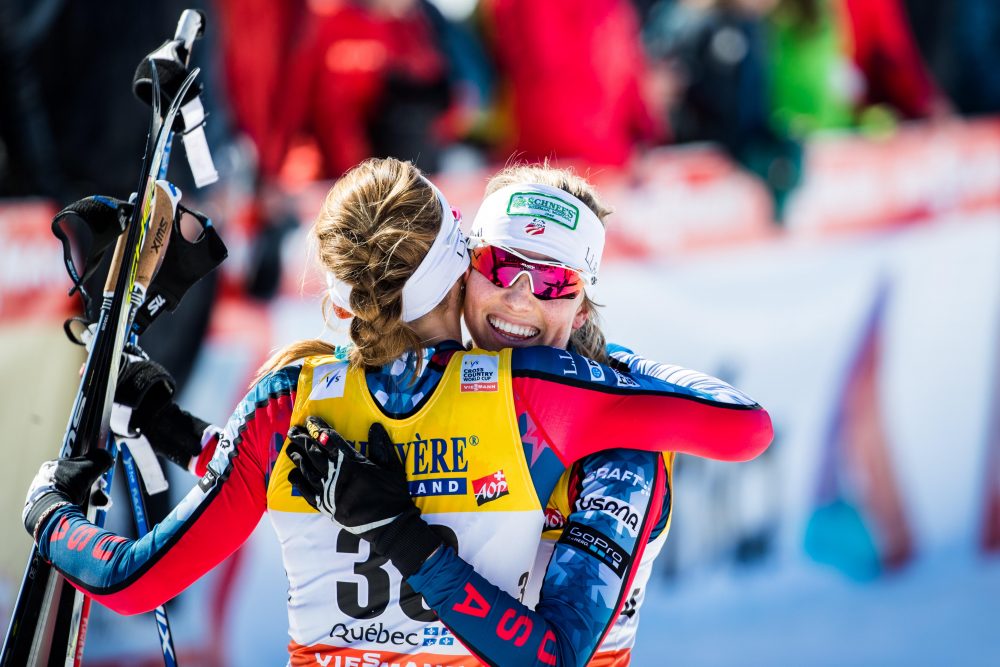
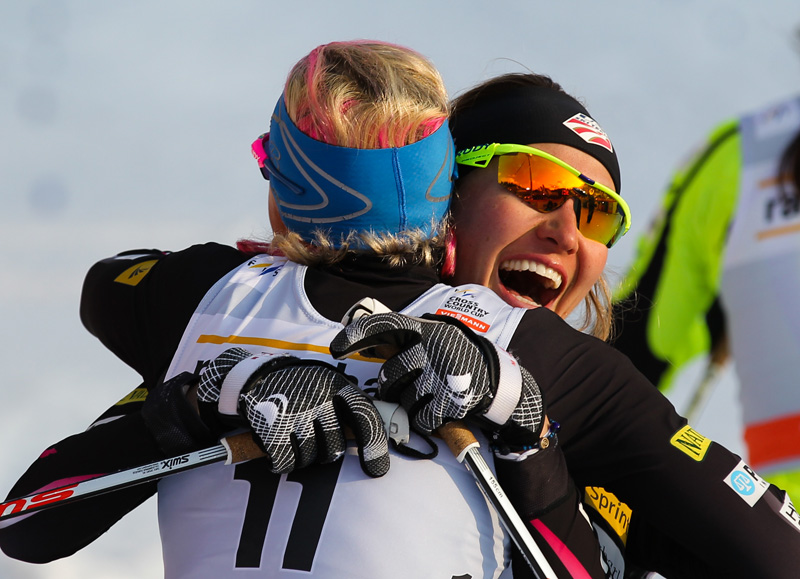
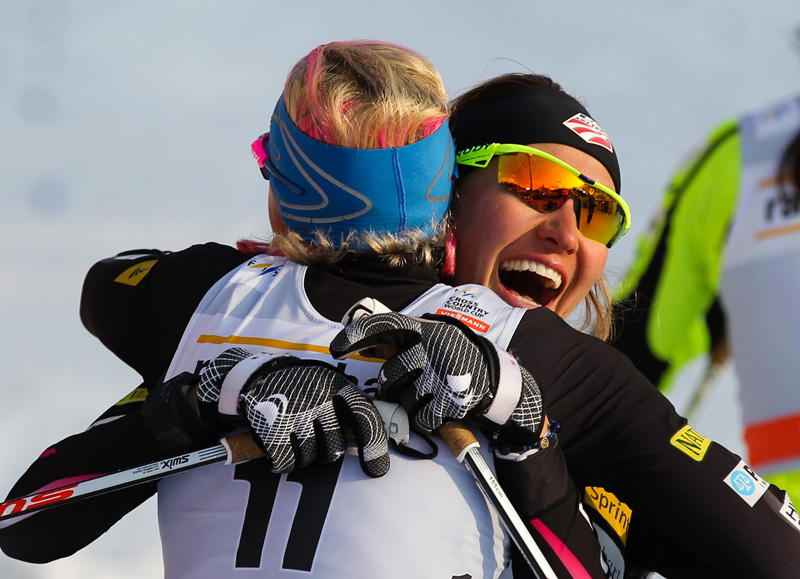
American Erika Flowers (r) hugs her Stratton teammate Sophie Caldwell following the women’s 10-kilometer freestyle race at the 2017 World Cup Finals in Quebec City (Photo: Gretchen Powers)
After graduating from Dartmouth in 2012, Flowers regularly finished in the top 10 of the overall SuperTour standings. She, too, earned a few World Cup starts. Flowers completed in all three races at 2017 World Cup Finals in Québec City, Québec, with a best result of 48th in the skate sprint.
In the end-of-year SuperTour standings, her ranking also saw a steep jump. From 2013 to 2014, she went from 32nd to fifth overall and was fifth again in 2015. The next season, she finished seventh overall and was fifth again in 2017. She capped off this season with her best finish to date, earning fourth.
Still, the sought-after World Cup starts remained elusive. As she developed, the USST also gained steam. Any progression she made also seemed to be matched by the cohort of American skiers she had be racing against since her departure from Dartmouth.
So why did she, summer after summer, push through intervals on rollerskis? Why spend each winter traveling to competitions, as Flowers put it, “living out of a bag”? Why did she continue to ski race year after year?
***
Flowers was fiveyears old when she first learned that her mother had breast cancer. Four years after her mother’s diagnosis, the family moved from Missoula to Bozeman. There, Flowers and her younger sister, Natalie, joined the Bridger Ski Foundation (BSF) cross-country youth program.
The BSF community provided a niche for the Flowers siblings. The cancer treatments their mother was receiving also showed promise. Following her diagnosis and treatments in 1995, Hedvig Rappe-Flowers, Erika’s mom, was cancer-free for more than five years, according to an article by the Bozeman Daily Chronicle.
But the cancer returned. Rappe-Flowers, a native of Sweden, encouraged her daughters to keep skiing. Do what made them happy. Both of them did.
Erika Flowers during the early stages of her nordic career. “It was the first time I’d ever had my photo taken by any sort of professional and I remember just having no idea what I was doing but its become one of my favorite photos if only because it’s very raw and unedited and from a time when I was just starting to gain some real confidence both in who I was as a person and an athlete,” Flower wrote. (Photo: Chris Milliman)
“My mom passed away from breast cancer when I was 17 which gave me a strong appreciation for how precious and valuable each day is and I know that I don’t want to waste one of them,” Flowers wrote in an email. “I think that’s another reason I probably decided to ski race for as long as I did — it was my first love and for all I know I could find out I have breast cancer tomorrow.
“What I do know is that I spent the last 16 years of my life doing something I absolutely loved!” she continued. “I think that has been on my mind a lot these days, especially given Kikkan’s recent diagnosis.”
“Kikkan’s a tough cookie though and I have no doubt she will tackle cancer the same way she has her many other challenges in skiing and in life — with equal parts fierce tenacity, bravery and grace,” Flowers added.
While joining Randall in skiing’s elite racing ranks was certainly a goal, it wasn’t the only reason Flowers skied. Nor did she ski in her mother’s name — though Hedvig did instill in her daughters an enthusiasm for nordic sport and a steely resolve in all that they chose to do.
“At her memorial service, one of the songs we played was ‘Hard Headed Woman’ — that really kind of describes her,” Flowers said. “She wouldn’t take no from anyone and believed so strongly in the idea that you could do anything you set your mind to.”
The mercurial sport of cross-country ski racing had taken its hold. And Flowers was not about to let go.
Racing brought numerous challenges. Days when her body felt great, but the wax was too slow. Times when foul weather hit midway through a competition, slowing the course.
“Those variables can be extremely frustrating when they don’t go your way,” Flowers wrote.
Frustrating, but simultaneously motivating, in its own way.
“When everything does come together, it’s the most exhilarating and addicting feeling in the world!” she noted. “I think I always thrived on the challenge of it all.”
Four years ago, Flowers even gave biathlon a shot, traveling to Lake Placid, N.Y., for a US Biathlon talent camp. While she showed promise, Flowers ultimately stuck with cross-country.
Erika Flowers (l) and Andy Newell at the 2017 World Cup Finals in Quebec City. (Photo: Gretchen Powers)
Skiing had deeper roots than racing and results for Flowers. It was a family affair (she credits her mother with having taught her how to skate ski). It was how she met most of her closest friends. It was also how she met her husband, Newell, whom she married last year.
“The people, the fact that every day my job is to go outside and work on getting better at something I love, the travel, and the challenge and unpredictability of professional sport,” Flowers wrote of what had kept her ski racing into her late twenties. “Lastly the support of countless friends, sponsors and supporters is one of the most important things that kept me involved for so long. Had I not had that level of support I would not have been able to race for as long as I did or reach the levels of success I did.”
At the root of Erika’s lifelong élan was, and still is, skiing.
***
About a year and a half shy of her 30th birthday, Flowers is back where it all started. She and her husband and former Stratton Mountain School (SMS) teammate, Newell, packed up a U-Haul this spring and drove from Vermont to Bozeman. Back in her hometown, Flowers competed in the 20-mile Ed Anacker Bridger Ridge Run in June. She still trains, most often with Newell, and unabashedly states that yes, she still rollerskis.
Since leaving Stratton, she does not currently have a formative training plan or program. Prior to moving, Flowers explored every “decision matrix possible” and spoke with numerous athletes and non-athletes alike about what she should do next. In the end, taking a step back from skiing seemed best.
Team photo of last season’s Stratton Mountain School T2 Team: (back row, right to left) Erika Flowers, Sophie Caldwell, Jessie Diggins, Julia Kern, and Annie Hart. (Front row, r to l) Andy Newell, Simi Hamilton, head coach Pat O’Brien, Ben Saxton, and Paddy Caldwell. (Photo: Reese Brown)
“It wasn’t that I was sick of the lifestyle or anything like that,” Flowers explained. “I think it was more I’ve been doing it for long enough to recognize that my improvement curve is not what it needs to be in order to ultimately be able to make skiing into something that’s sustainable; something that can help me achieve some of the other goals I have in life, whether that’s getting a house or sitting on the board of a company.
“I think that’s also what made it so hard,” she continued. “In some ways it’s walking away from something I absolutely love to start at the bottom of another passion.”
Skiing has opened up a few other professional outlets for Flowers to pursue. She unofficially began social-media work for the National Nordic Foundation and USST this spring. She also is an athlete ambassador for the Women’s Sports Foundation. Her ties to nordic skiing becoming ever more intricate.
“Some people want to go all in for X number of years and retire and never look at a pair of rollerskis or race skis again,” Flowers reflected. “But to me, the word ‘retire’ sounds like something reserved for people in their late 60s, early 70s … maybe that’s why I haven’t used that word, it just doesn’t fit.
“I think for me, it’s more deciding to take a step back from pursuing racing full time and looking at opportunities to pursue something else more fully,” she said.
The change of pace is in no way preventing her from getting outside. With Newell still planning on ski racing, just not full time on the World Cup, she’s still plenty invested in the nordic world.
“From my end I just try to be supportive no matter what,” Newell said on the phone. “I think she’s been training so much and so well … she can take this year and try something new, even take a few months and try something new, and it would still be be pretty easy for her to jump into some races and make a comeback. Because I can tell you from my perspective, as her husband and as somebody that trains with her on a regular basis, she’s not slowing down even though she has other goals outside of skiing.”
Former Stratton Mountain School teammates, now husband and wife, Andy Newell and Erika Flowers during a rollerski training session. (Photo: Reese Brown)
The Stratton Mountain School (SMS) in Stratton, Vt., is looking for a coach to help with their junior program this winter.
Coach will work with SMS Nordic staff and junior team. Job will start in early November and run through late March. We are looking for an energetic person who enjoys working with high school age skiers. We have the flexibility to tweak the job to fit applicants strengths. Attitude, knowledge of sport and waxing are important.
American Paddy Caldwell (SMS/USST) racing to 20th in the men’s classic sprint qualifier on Tuesday at U23 World Championships at Soldier Hollow in Midway, Utah. He went on to place fourth in his quarterfinal for 18th overall, his best sprint result at U23 Worlds. (Photo: FlyingPointRoad.com)
In an effort to showcase the North Americans competing at this week’s International Ski Federation (FIS) 2017 USANA Nordic Junior World Championships and U23 Cross Country World Championships at Soldier Hollow in Midway, Utah, we asked those qualifying athletes several questions about themselves — actually, we had them fill in the blanks. Here we have 22-year-old Paddy Caldwell, of the Stratton Mountain School (SMS) Elite Team/U.S. Ski Team D-team, representing the U.S. at his third U23 Worlds.
“My full name is Patrick Fitzgerald Waters Caldwell, but you can call me Paddy. I was born in Lebanon, N.H., raised in Lyme, N.H., and one thing you should know about my hometown is it was founded in 1761.
I started cross-country skiing when I was two or three, thanks to Mom and Dad. I currently train in Stratton, Vt., with SMS Elite Team.
Paddy Caldwell (20), of the Stratton Mountain School and U.S. Ski Team D-team, racing in the quarterfinals men’s classic sprint at 2017 U23 World Championships on Tuesday at Soldier Hollow in Midway, Utah. He finished 18th on the day for his best sprint result in three U23 Worlds. (Photo: FlyingPointRoad.com)
If I’m not skiing, you might find me studying at Dartmouth College. If I had to pick a favorite book, it would be ‘Unbroken.’
One of the things I’m most excited about for U23/Junior Worlds at Soldier Hollow is the new courses at SoHo. One race I’m especially targeting there is the 30km Skiathlon.
The best advice anyone ever gave me about skiing or racing was ‘you gotta love it!’
One of the best race memories I have is the mixed Biathlon/ Cross Country, Men/Women team relay in Seefeld, Austria.
If I could meet one World Cup skier, it would be Johan Olsson.
If I don’t end up being a professional skier, I’ll probably still be chasing snow.
Kam Husain, of the Stratton Mountain School, racing at U.S. SuperTour Spring Series last season in Craftsbury, Vt. (Photo: NENSA/Facebook)
In an effort to showcase the North Americans competing at this week’s International Ski Federation (FIS) 2017 USANA Nordic Junior World Championships and U23 Cross Country World Championships at Soldier Hollow in Midway, Utah, we asked those qualifying athletes several questions about themselves — actually, we had them fill in the blanks. Here we have 19-year-old Kam Husain, of the Stratton Mountain School, who’s representing the U.S. at his first Junior Worlds.
***
“My full name is Kamran Husain, but you can call me Kam. I was born in Leonardtown, Md., raised in Fort Kent, Maine, and one thing you should know about my hometown is we grow lots of potatoes.
I started cross-country skiing when I was six, thanks to MWSC [Maine Winter Sports Center]. I currently train in Stratton, Vt., with SMS [Stratton Mountain School].
If I’m not skiing, you might find me rewatching ‘Game of Thrones’. If I had to pick a favorite book, it would be ‘Outliers‘.
One of the things I’m most excited about for Junior Worlds at Soldier Hollow is racing a skiathlon. One race I’m especially targeting there is the classic sprint.
The best advice anyone ever gave me about skiing or racing was to pace myself. One of the best race memories I have is winning the NENSA J2 Fest.
If I could meet one World Cup skier, it would be Katharine Ogden.
If I don’t end up being a professional skier, I’ll probably be somewhere a little warmer.
I’m missing zero days of school to be here; I’m taking a gap year.
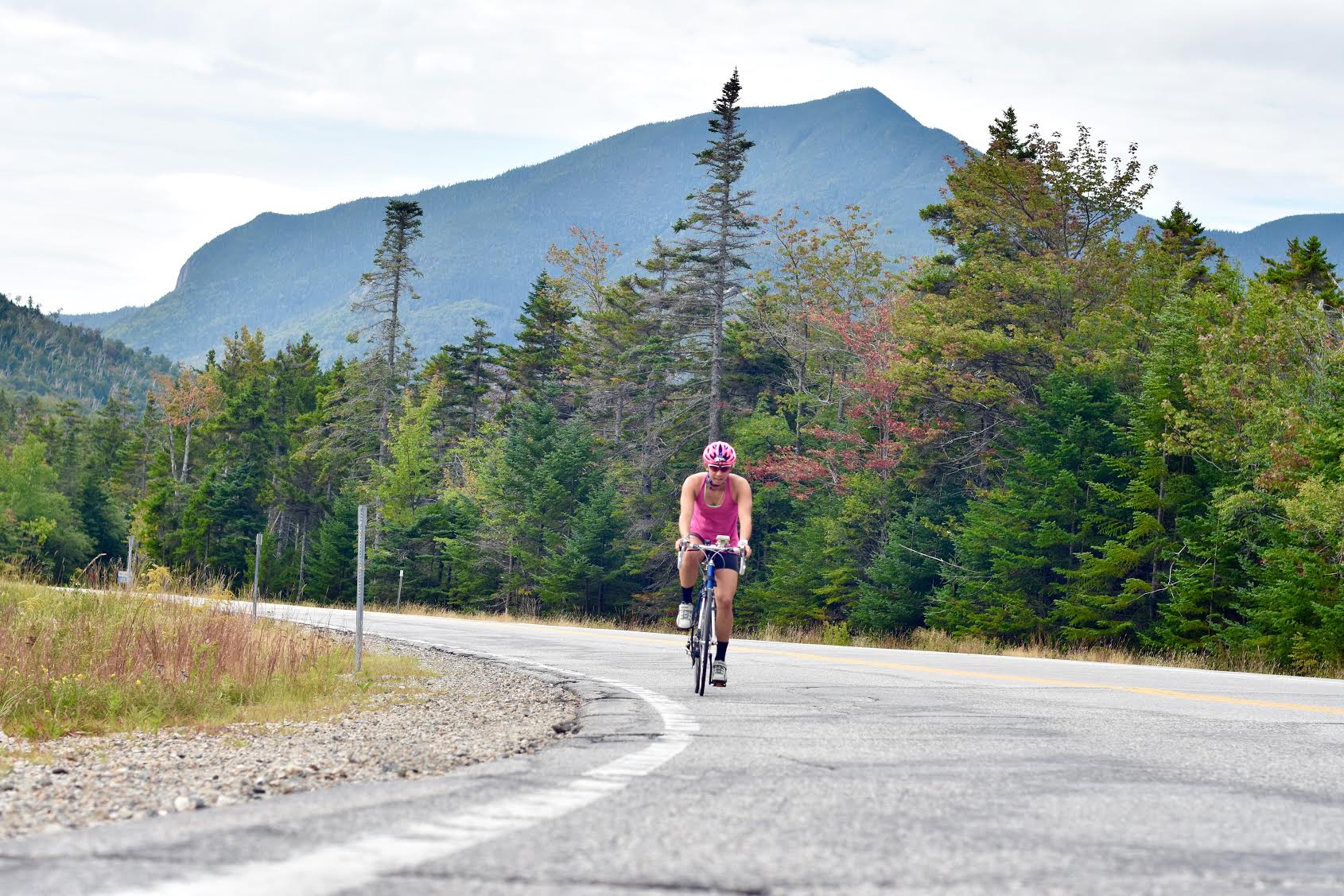
Julia Kern biking up New Hampshire’s Kancamagus Highway at a recent training camp. (Courtesy photo)
Welcome to “17 Questions for 2017″, where we are catching up with American and Canadian national-team members before the beginning of the winter season.
***
19-year-old Julia Kern had quite a diverse year last season, her first on the U.S. Ski Team: a SuperTour podium, a trip to World Juniors, two individual podiums in the junior races at OPA Cup finals in Italy, and two podiums in the junior races at U.S. National Championships (long and short distance).
Having joined the Stratton Mountain School SMST2 Elite Team this year as well as enrolling at Dartmouth College, Kern has made some changes and is looking forward to another big year.
1. Biggest change in your life in the last five or so months since the ski season ended?
My biggest change in the past 5 months has been starting college at Dartmouth. The day after the season ended, I headed straight to Dartmouth to start my first term in the spring and I am currently half way through my second term this fall.
2. Biggest change in your training?
I have finally been able to train without modifying my plan due to injuries and illness so I would say my biggest change is that I am back to a normal training plan! Wahoo!
3. Major areas of improvement you’ve seen so far?
I think there isn’t one specific area where I have seen improvement over the past few months, but actually in every area. I feel like I have generally improved in all areas.
4. Whom you’ve been working closest with this offseason (coaches or training partners)?
Julia Kern happily healthy and rollerskiing. (Courtesy photo)
Since I have joined the SMS Elite team this year, Pat O’Brien became my coach so I have been working closely with him in conjunction with Cami at Dartmouth. In the spring and fall, I have been trained with Dartmouth Ski Team and in the summer I trained with the SMS Elite team. It is fun to mix up training partners!
5. Best trip in the last five months (and why)?
I have only traveled once in the past five months. I went to Park City, UT for a training camp to kick off the summer and it was one of the most effective camps I have been to. I always love coming back to Park City because it is starting to feel like another home to me and the area is just so incredible!
6. Favorite cross-training?
This is a hard one! I really enjoy playing basketball in my free time, but if we are considering cross cross training to be a little more ski specific, I would have to say swimming.
7. Favorite non-athletic activity or pastime this summer?
Camping and hanging out on the beach may be considered an athletic activity with my family, but I was always enjoy my family’s annual vacation camping on Cape Cod every summer.
8. Song that was your jam this summer?
I would say my go-to jam this summer was “Good Day” by Nappy Roots. Definitely not a new song, but it is a good way to start a good day!
9. All time favorite race moment?
American Julia Kern (SMS/USST) racing to a career-best 16th in the 2016 Junior World Championships freestyle sprint in Rasnov, Romania. (Photo: Pete Leonard)
My all time favorite race moment was definitely this past winter during my last race at OPA Cup finals. It was a pursuit start and the girl who started in front of me and behind and I all caught up to one another and skied most of the race together. My tactics worked out really well and I finally nailed the “shake and bake” tactic right in the end to beat out the two girls I was racing head to head with.
10. First thing you pack in your bag when you leave for Europe?
Underwear…but that is a given essential. I pack my camera because I love taking photos and videos on the road, capturing the different cultures and landscapes around.
11. Venue/event you’re most excited to visit this season?
I am most excited for Soldier Hollow! I think it will be an incredible opportunity to have our qualification for World Juniors at the same venue and on the same race courses as World Juniors.
12. Who will win the World Cup title this year?
For the men, Petter Northug. For women, Marit Bjoergen.
13. Biggest sacrifice you feel you’ve made choosing this career path?
The biggest sacrifice I think so far has been giving up on a normal social life. I have found it is hard to maintain a close friend group outside of the ski community when I hardly stay in the same place longer than a month at a time. I am very fortunate to have my closest friends be in the skiing community though, and probably for a good reason!
14. If you could change one thing about your sport, what would it be?
I wish we had some world cups in the U.S. Having World Juniors in Utah this year is going to be really incredible and I wish that people in the U.S. got more exposure to what cross country skiing is and make it easier for athletes’ families come and watch.
15. What did you have for breakfast this morning?
I had two slices of fresh sourdough dough bread with avocado, topped with one over-easy egg on each. Yumm 🙂
16. In 5 years, I’ll be ____?
I will hopefully be racing on the World Cup circuit.
17. In 50 years, I’ll be ____?
I’ll be like my grandmother; active, happy, and a life filled with wonderful grandchildren.
Hannah Halvorsen (foreground) attacking the rollerski track at Soldier Hollow. (Photo: Bryan Fish)
Welcome to “17 Questions for 2017″, where we are catching up with American and Canadian national-team members before the beginning of the winter season.
***
Last season, Sugar Bowl Academy’s Hannah Halvorsen snagged her first SuperTour podium – before heading back to the junior ranks to win a U18 race at U.S. National Championships, a title at Junior National Championships, and represent the United States at the Youth Olympic Games in Lillehammer, Norway.
The California cross-country skier also ended up with her first U.S. Ski Team nomination. Now 18 years old, Halvorsen has been making the most of her first training season without school.
1. Biggest change in your life in the last five or so months since the ski season ended?
The biggest change in my life since ski season ended has been adjusting to a slightly different lifestyle as a post graduate skier. I still train with Sugar Bowl Academy but now I don’t have to work around a school schedule.
2. Biggest change in your training?
This year not being in school has allowed me to drive down to low elevation training about twice a week.
3. Major areas of improvement you’ve seen so far?
Hannah Halvorsen (Sugar Bowl Academy) racing to third during qualifying for the women’s SuperTour 1.3 k freestyle sprint in November 2015 in West Yellowstone, Mont. Halvorsen went on to edge out AWCA’s Dahria Beatty for second place overall, 4.31 seconds behind race winner, Jennie Bender.
I’ve been excited about my improvements in v1 technique and running foot speed.
4. Whom you’ve been working closest with this offseason (coaches or training partners)?
I have been working with the Sugar Bowl Academy skiers and coaches, and have also had the opportunity to train with TXC Coach Eliska Hajek Albrigtsen.
5. Best trip in the last five months (and why)?
I had the opportunity to train out in Stratton with the SMS team in August, which was a great opportunity to train at low elevation and be pushed by really fast skiers.
6. Favorite cross-training?
My favorite cross training is mountain biking.
7. Favorite non-athletic activity or pastime this summer?
This summer when I was resting I did a lot of painting, reading, and watching Seinfeld.
8. Song that was your jam this summer?
Love Yourself by Justin Bieber.
9. All time favorite race moment?
Halvorsen (right) and U.S. Ski Team teammate Julia Kern taking off on some ski bounding in Park City this summer. (Photo: Bryan Fish)
Racing in the Scando cup in Sweden two winters ago and realizing, “the training I’ve done is working really well!”
10. First thing you pack in your bag when you leave for Europe?
My stuffed animal Bunny.
11. Venue/event you’re most excited to visit this season?
I am excited to have a Super Tour in my own town this January at Auburn Ski Club.
12. Who will win the World Cup title this year?
Jessie Diggins.
13. Biggest sacrifice you feel you’ve made choosing this career path?
The biggest sacrifices I have made have been social. Instead of giving time to my friends and family, it often goes towards training or even simply resting so I am ready to train again.
14. If you could change one thing about your sport, what would it be?
I think it would be awesome if being a skier didn’t cost money.
For the second installment of “What Elite Skiers Eat for Breakfast“, we asked Stratton Mountain School (SMS) athletes to share a photo of a typical breakfast for a weekday training day and describe what they eat. Here’s what they told us:
“When I have time, I like to make breakfast burritos filled with rice, eggs, Cabot cheese, baby spinach, and top it all with bbq sauce. It’s a good way to get a lot of carbs, and depending on the number of eggs a fair amount of protein as well. I know that bbq sauce isn’t for everyone but I would highly recommend introducing it to your breakfast lineup.”
“Big bowl of plain greek yogurt topped with banana and a mix of berries or other fresh fruit plus granola (my favorites are Elizabeth’s pumpkin fig and Ezekiel cinnamon raisin) and cinnamon. I always finish with a side of peanut butter toast (crunchy peanut butter!) topped with hemp seeds and a big french press for coffee plus some water if I am being a good athlete :)”
“I definitely try and keep things interesting (there is nothing worse than a breakfast burn out) but one of my favorites is some high protein homemade pancakes topped with all the fruit in the fridge (as local as I can find it) and a big scoop of Greek yogurt. And coffee — lots of coffee.”
“This is a smoothie bowl (mango, strawberry banana with yogurt) topped with granola, sliced banana, yogurt drizzle and honey drizzle.”
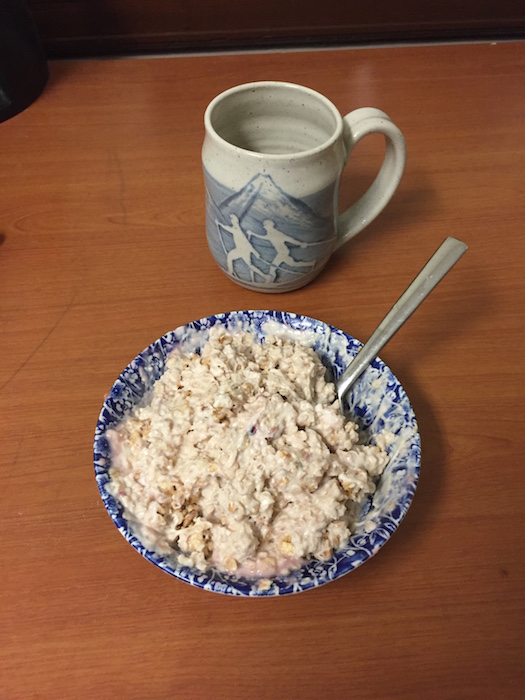
“I like a strong black coffee in my owl mug (the mug is an important part of my breakfast routine) and oats with berries, yogurt, nuts and honey.”
“English muffins with peanut butter, banana, and honey is a standard go to.”
“Then I typically mix it up with some kind of cereal and yogurt. If I can use home made gernola, that’s the best. On rest days when we have more time I’m the go-to pancake guy at the SMS house.”
“My breakfast varies depending on the day and what we have for food in our kitchen, but one of my favorite easy breakfasts is buttered toast, scrambled eggs, cheese, avocado, and salt!”
“First: Coffee. Then a large bowl (or two) of: steel cut oats, greek yogurt, crunchy peanut butter, homemade raspberry jam, cereal of choice (usually granola or Kashi) – when available add blueberries and/or banana.”
“My go-to breakfast would be plain greek yogurt with granola and lots of fruit such as blueberries, raspberries, strawberries, bananas and pineapple. I also like to add a touch of honey :)”
“I’m not too much of a breakfast guy if I’m training early. I definitely don’t enjoy the feeling of having a stomach full of eggs and bacon when I head out for a hard interval session or long OD. Most of the time, I just make myself a bowl of granola with Greek yogurt, almond milk, and some fresh fruit (usually either blueberries, strawberries, or a banana). Most days I’ll drink 2 cups of black coffee, but on days when I’m training a bit later in the day I’ll make some green tea. And I usually compliment everything with a glass of orange juice.” On off days, he sleeps in a bit and might make eggs, pancakes or waffles. While with his girlfriend and teammate Sophie Caldwell in her hometown of Peru, Vt., they’ll head to the local general store, “JJ Hapgood’s, for a breakfast sandwich (English muffin with an egg, local bacon, and local cheddar) and a cup of coffee.”
Which elite nordic team (in the U.S., Canada or elsewhere) would you like to hear from next for our breakfast series? Leave your recommendations in the comments section below!
The Sun Valley Ski Education Foundation (SVSEF) Gold Team hiking down from Mount Mansfield, Vermont’s highest peak, in early September. (Photo: Paige Schember)
For this week’s workout, we turned to Mary Rose of the Sun Valley Ski Education Foundation (SVSEF) Gold Team. On Sunday, Rose, 24, won the ninth-annual Climb to the Castle by 32 seconds over US Biathlon’s Annelies Cook. After two weeks of dryland training on the East Coast, first with the Stratton Mountain School (SMS) T2 Team in Vermont, then with the National Elite Group (NEG) and U.S. Ski Team in Lake Placid, N.Y., Rose sent us this workout — Level 4 uphill rollerski intervals — from her travels.
***
Sun Valley’s Mary Rose (l) leads Katherine Ogden (SMST2/USST), Annie Pokorny (SMST2), Erika Flowers (SMST2), and Paige Schember (SVSEF) during a sprint simulation at the Olympic Jumping Complex rollerski trails in Lake Placid, N.Y. (Photo: Colin Rodgers)
Every individual has his or her strengths and weaknesses when it comes to cross-country skiing. It is important to train your weakness because there is usually a lot of room for improvement.
The Sun Valley SEF Gold Team spent two weeks out East in Stratton, VT and Lake Placid, NY for a low-elevation training block. This camp was extremely productive for all of us because we were able to train some of our weaknesses: speed and pacing at low elevation, and rollerskiing in steep terrain.
One of the most beneficial workouts during this training block was a Level 4 uphill rollerski interval session. This is a great session if you don’t have a strong V1, are not strong climbing in skate, or if you need to build capacity in your legs. For me, this was an important workout because living in Sun Valley, ID, we lack the super steep, sustained uphill terrain (for rollerskiing) that can be found on the east coast. This is ironic, I know but the roads in Sun Valley are in the bottoms of the valleys and there are not very many of them.
The Workout: Uphill Rollerski 4-6 x 4 minutes at L4
Where: Find a location that offers a long uphill climb (8%-10% grade)
Warmup:
Rollerski easy (Level 1) for 20-25 minutes. Start the warmup on rolling terrain and then gradually move onto steeper terrain to get the body used to climbing.
Do 5-10 minutes of mobility/stretching exercises, targeting every major part of your body. This part of warmup is important to help get the blood flowing to all parts of your body and to get all the muscles ready to work hard. Think of this as injury prevention!
Rollerski easy for an additional 5-10 minutes.
During warmup focus on where you can make technique gains and apply that to the workout.
Now the fun part: 4-6 x 4 minutes at Level 4.
The first interval should start at threshold (Level 3) or right above it and gradually work into Level 4. Take full recovery (4 minutes) between each interval. Make sure to ski very easy during the recovery. Intervals 2-6 should be at a solid Level 4 the entire time.
Try to complete at least four intervals, but listen to your body and take a moment to assess where you are at. If you feel completely drained and your technique has taken a turn for the worse or your pace has dropped off, call it a day and cool down.
Cool down: Should consist of 15-20 minutes of easy skiing. Once your cool down is complete, you should hydrate, eat and sleep!
During this workout, I did a total of five intervals and left one in the tank, meaning that I could have done one more quality interval, but I held back due of the amount of intensity sessions I had already done that week and the amount of intensity sessions yet to come.
You want to feel good for all of the intervals, so remember that before pushing yourself too much. There is no need to do all six intervals if you are feeling tired. In this case, less is more. Important thing to remember is that ALL the intervals should feel great!
Sun Valley Gold Team members Paige Schember and Mary Rose after the 2015 Climb to the Castle on Sept. 20. (Photo: Mary Rose)
SMS athlete Kamran Husain finishes his team’s Vertical Challenge at a recent mini camp in Stratton, Vt., with the fastest overall time. (Photo: Sverre Caldwell/SMSXC.blogspot.com)
When the Stratton Mountain School (SMS) team began its July mini camp this year, its athletes knew the focus was going to be a little different than years past. Rather than focusing on maintaining a low intensity during a high-volume camp, the SMS high-school athletes pushed themselves by going at a relatively high intensity while maintaining a high volume. This year’s Vertical Challenge, which is the pinnacle workout of the mini camp, exemplifies the new approach.
Kamran Husain and Russell Boswell ascend out of Manchester, Vt., on the first leg of the Stratton Mountain School nordic team’s Vertical Challenge on July 15. (Photo: Sverre Caldwellk/smsxc.blogspot.com)
“I think the first time we did it we just said, you know we’ve been doing some combi ODs [over-distance workouts], and we said, let’s do one that’s kind of … gnarly because there is a lot of vertical gain,” SMS Nordic Program Director Sverre Caldwell explained in a phone interview. “We said, we want you to go hard.”
This did not turn the workout — held July 15 — into a full-on race, but it did shift the focus. Athletes started at one-minute intervals and maintained a threshold effort for around two hours. In this case, threshold would be a pace in which one can push themselves but also stay in control enough to keep that pace for a long time.
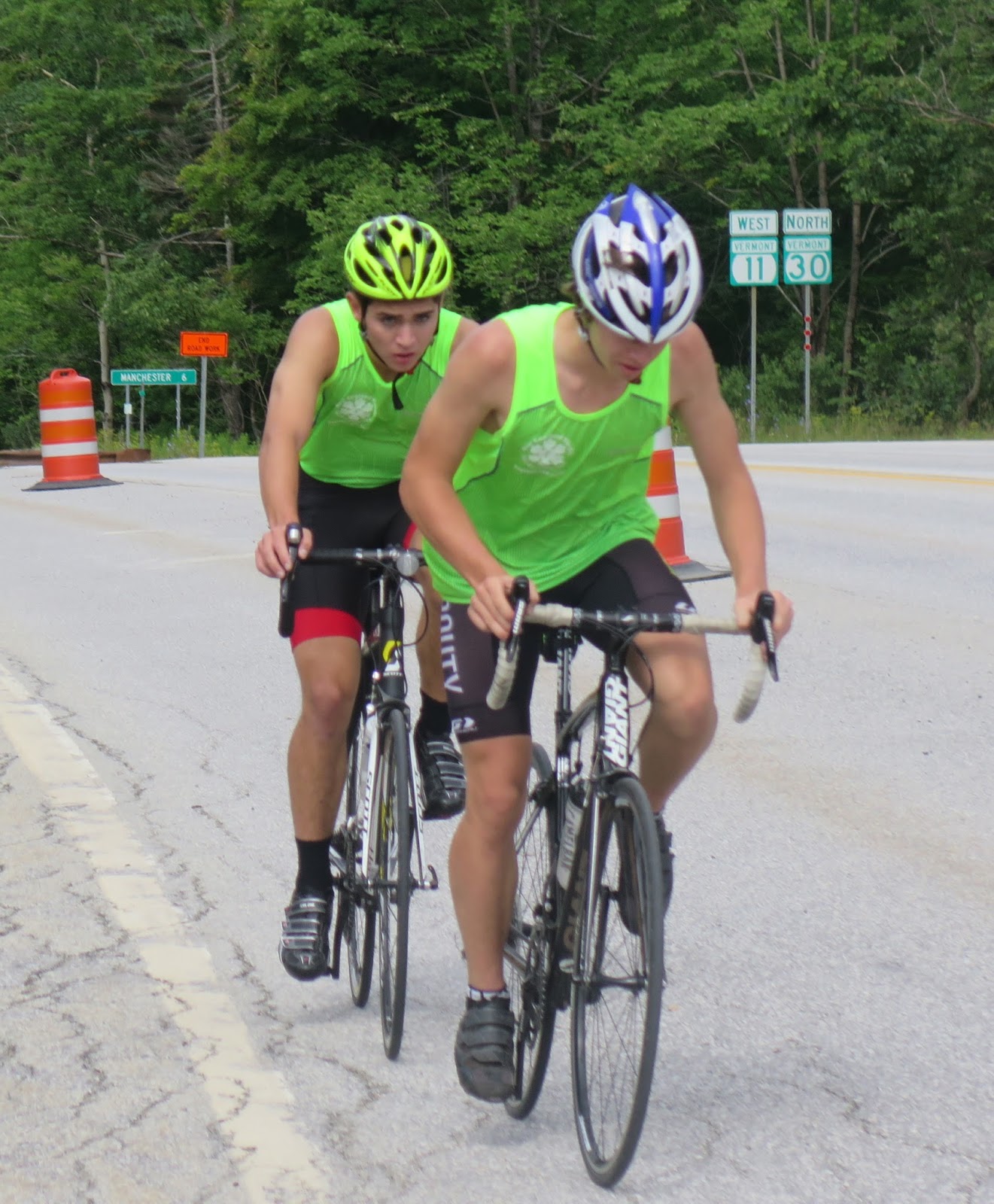
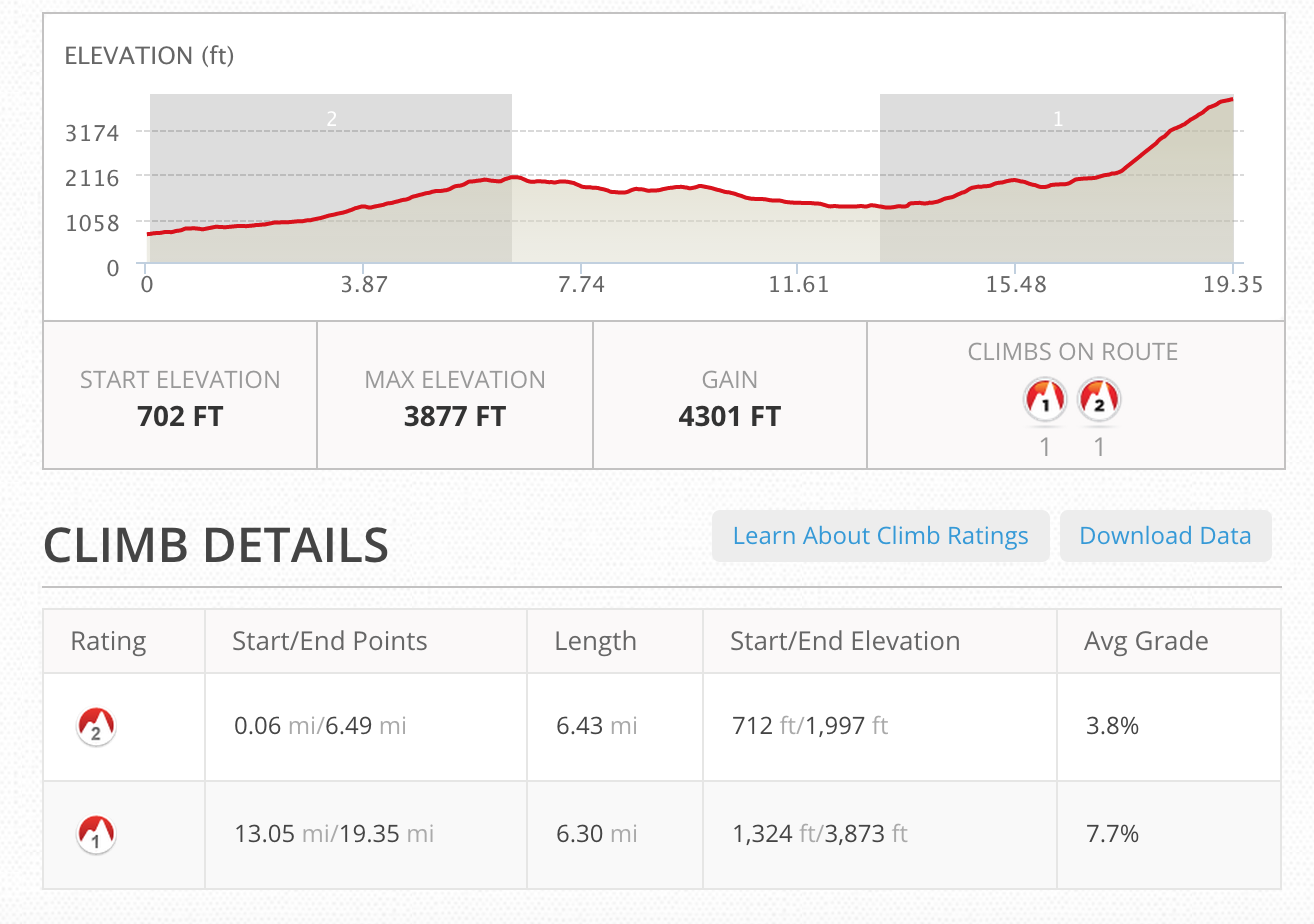
Adding to the difficulty was that the course had a net gain of 3,185 feet, so there was little rest. The workout began in Manchester, Vt., where SMS skiers started climbing on road bikes. After 12.5 miles, they reached Bondville, Vt., where they switched from bikes to rollerskis to ascend the Stratton Mountain access road. After another five miles, contestants made the final change into running shoes before climbing about two miles to the summit of Stratton Mountain. Needless to say, it was a lot of climbing and a lot of threshold.
“The reason we did it was … just to do something that’s hard,” Caldwell said. “That’s much more than you would do in a race or in normal training, to put everything in perspective. Like now, when you have to go out and have go hard for 5 k, it’s pretty easy.”
The goal of the camp and the Vertical Challenge specifically was to push the limits and test the resolve of its athletes. It was also meant to make them feel tough, which that can be difficult to accomplish during low intensity ODs.
As for the SMS athletes, Caldwell said they definitely thought it was tough. They all knew the Vertical Challenge was going to be difficult going in, but they understood what the goals were and were well prepared for the challenge.
“[The increased intensity] made it harder, but not necessarily better or worse. It was just different,” he said. “I think they had a good feeling of accomplishment because you know, when you finish something that’s tougher then you tend to feel a little better about it as long as you pushed hard through it.”
After finishing the workout, the SMS nordic team celebrated with a cookout.
The course profile and some specifics of the Stratton Mountain School nordic team’s Vertical Challenge workout, which it completed on July 15 in Manchester and Stratton, Vt. (Photo: smsxc.blogspot.com)
The Workout
Step 1: Organize
– Find a low point and a high point about 20 miles apart. These will be the start and end points of the workout.
– Decide on transition points from biking to rollerskiing (leaving the bike and putting rollerskis on), and from rollerskiing to running (where you’ll leave your ski boots and lace up your sneakers). Ideally the running and hiking section would be on the steepest terrain, the rollerskiing would be on the next steepest terrain, and the biking would be on the most gradual terrain, though this could vary depending on your area. Someone with a car to carry equipment and extra water and snacks is also very useful for meeting at these transitions.
Step 2: Ascend
– Begin by doing a warmup as if the workout was a 25 k or 50 k ski race.
– Next, start the ascent on the bike at around threshold. Try and maintain this effort throughout the rollerski and the run/hike as well. Because speed isn’t of the utmost importance in this workout, don’t worry if the transitions are a little slow.
– Once you have summited, celebrate by doing a low-intensity warm down before continuing the celebration with some food or even a cookout.
Katharine Ogden nearing the summit of Stratton Mountain during the Stratton Mountain School nordic team’s Vertical Challenge workout on July 15. (Photo: Sverre Caldwell/smsxc.blogspot.com)
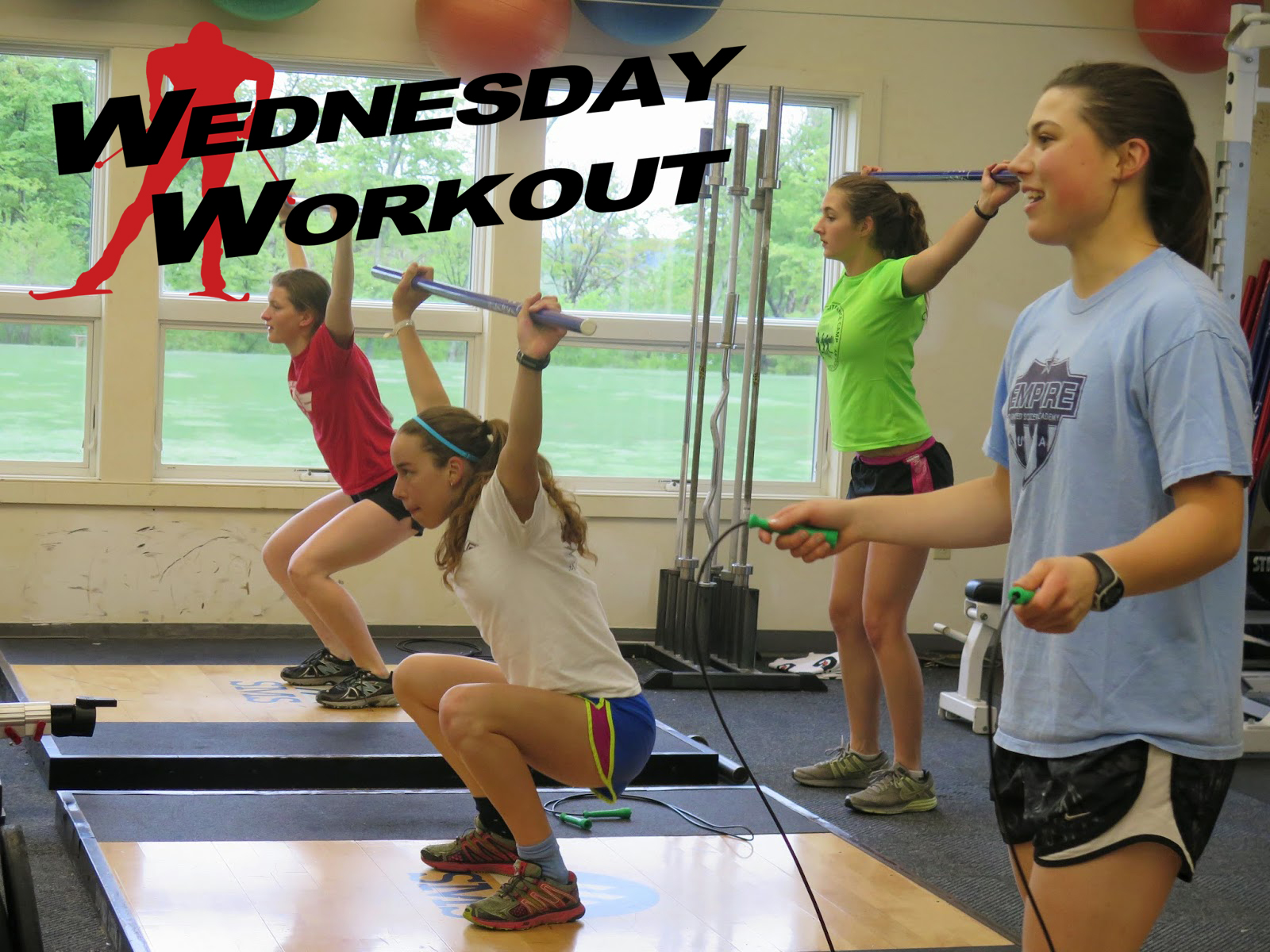
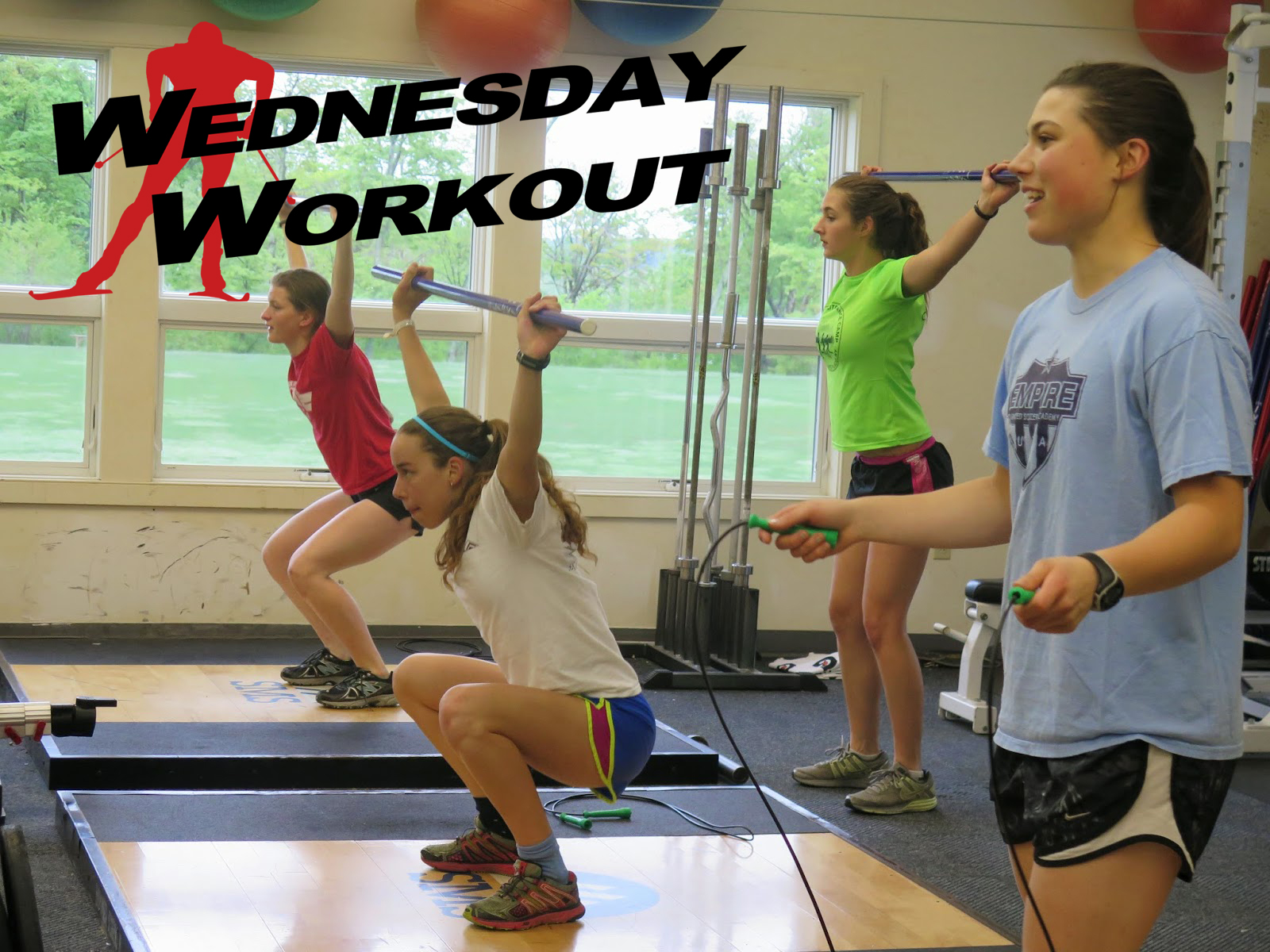
Stratton nordic skiers work on general strength, specifically overhead squats, last summer. From left to right: Mackenzie Rizio, Katharine Ogden, Tegan Thorley, and Ana Witkowski. (Photo: Sverre Caldwell)
This week’s workout comes from Sverre Caldwell, the nordic program director at the Stratton Mountain School (SMS) in Stratton, Vt., whom the U.S. Ski and Snowboard Association (USSA) recently named Cross Country Domestic Coach of the Year. Here, Caldwell shares a typical day in the life of a Stratton athlete in May, when the academy is getting back into the swing of training.
***
Two-a-days:
“At SMS we use May as a period to build some general strength and lay a foundation down for great summer training,” Caldwell explained in an email. “Our Wednesday class schedule gives us two training blocks; one from 11-12 p.m. and the other from 3:30-6 pm.”
Morning session: General strength
“During the morning session we go to the weight room, do a short spin warm up and then some general strength,” he continued. “At this time of year our strength consists of a 15-minute warm up (spin, jump rope, sumo squats, inch worms, etc..) followed by our strength routine, then core.
“We usually choose 3 leg, 3 upper body and several core/balance/stability exercises. We will do two rounds/sets. Early in the spring we use very little weight, going for the proper movement and high repetitions. We slowly add weight and lower the repetitions, but never throw heavy weights around.”
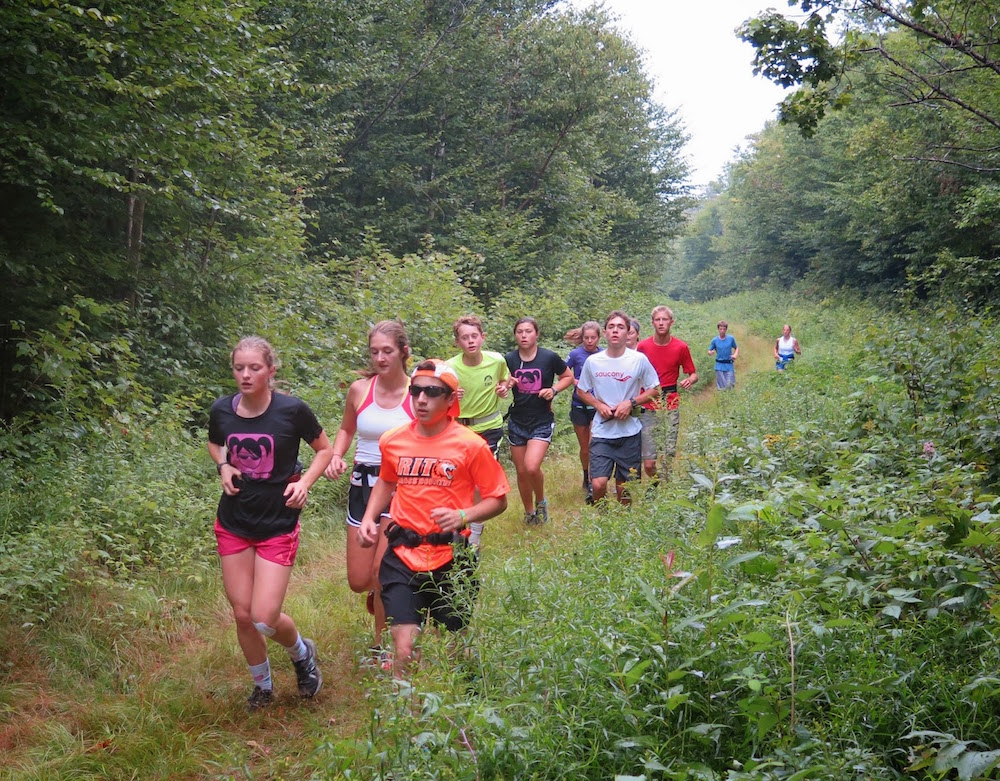
Mackenzie Rizio (l) and Mid-Atlantic skier Adam Marino (r) lead Stratton skiers on a trail run last summer during a training camp. (Photo: Sverre Caldwell)
Afternoon session: Easy distance
Trail running and biking are two early season favorites at Stratton, according to Caldwell.
“Our goal is to build up through the spring so we can do a team 100-mile bike and an 11-mile trail run/race in early June,” he wrote.
“The [Long Trail/Appalachian Trail] goes over Stratton so we have lots of great trail running spots. We love the trail running because it helps build aerobic fitness, agility and coordination.”
Go-to trail run:
From Kelly Stand Road to Stratton Pond and back to school. Most of trail is soft dirt, “but there are enough rocks, short boardwalks and puddles to keep you on you toes,” Caldwell explained.
Length: About 10 miles with rolling terrain, making it easy to run in Level 1 (L1) and low Level 2 (L2).
Time: About 1 1/2 hours
“For base aerobic training, it is important to have a longer, steady effort keeping your heart rate above 120, but at a ‘conversation’ pace,” Caldwell wrote. “General rule of thumb is that you can talk pretty easily in L1, you shorten the sentences in L2 (breathing a bit harder). On the distance days we shoot for staying in L1 for everything except the sustained uphills on which you will drift into L2. If the hill gets steep, we will often break into a ski walk instead of pushing the running.”
What do Matt Whitcomb (USST), Chris Hall (Swix), Sverre Caldwell (SMS), Patrick O’Brien (SMS T2), and the Stratton T2 Team all have in common? Other than being huge contributors to our sport and to our New England Nordic community, they’ll all be at Stratton Mtn. School for the 2015 NENSA Coaching Symposium November 15-16.
Join NENSA for two days in Vermont with presentations from USST Women’s Head Coach, Matt Whitcomb, Swix’s Chris Hall (yeah, there will be swag for all), and the Stratton coaching staff, as well as hands-on work with the elite T2 athletes. This is going to be a very cool weekend. Cost is just $95 for NENSA members.
Canadians Alex Harvey (r), Devon Kershaw (front left) lead six others, including Ivan Babikov (third from l), Kris Freeman (second from l) and Andy Newell (l), during a combo over-distance rollerski on Aug. 15 near Stratton, Vt.
STRATTON, Vt. — When Tor-Arne Hetland thought of the U.S., his mind went to places he had been before, like New York City and Park City, Utah.
Stratton — a small town in southern Vermont with roughly 200 year-round residents (not including the private ski school near the height of the land) — was a surprise, but Hetland figured if Andy Newell grew up training there, it had to be worth visiting.
Canada’s newest World Cup coach and his four-man team of Ivan Babikov, Devon Kershaw, Alex Harvey, and Lenny Valjas ventured to the land unknown in early August for a sea-level, dryland intensity camp with the Stratton Mountain School (SMS) T2 Team. They rented a house in Stratton and brought a physical therapist along, and let Newell, an SMST2 skier and longtime U.S. Ski Team (USST) member, show them around.
Newell, of nearby Shaftsbury, Vt., picked the rollerski routes and joined the Canadians for about half of their workouts during their two-week stay, as did fellow USST and SMST2 skier Simi Hamilton.
APU’s Rosie Brennan leads Stratton skiers Anne Hart (second from r), Annie Pokorny (c), Sophie Caldwell (second from l), and Jessie Diggins (l), during a combo over-distance rollerski in Stratton, Vt.
Stratton’s new head coach in his third month with the team, Patrick O’Brien said the Canadians were a welcome addition while most of his team was training together, two weeks before the USST training camp in Lake Placid, N.Y.
Hetland and Canada’s World Cup assistant coach Louis Bouchard, who drove five hours down from Quebec City, came with two vans — making logistics somewhat easier for supporting eight men during a given workout. On Aug. 15, they did a three-hour, combo over-distance rollerski (mimicking a skiathlon), looping around hilly backroads.
“It’s been really cool working with Tor-Arne and Louis,” O’Brien said. “As a young coach, I’ve been picking their brains … They’ve been really accommodating.”
Not all the workouts lined up. The Canadians, with a fifth athlete in Raphaël Couturier of the Pierre-Harvey Training Centre (where Bouchard is head coach), generally focused on high-intensity (Level 4-5) rollerskiing during the camp. The amount of hours they wanted to put in didn’t always match those of Newell, Hamilton and Ben Saxton on the T2 Team, O’Brien explained.
“Kind of our go-to is threshold and speeds with some L4,” O’Brien said.
Newell had been scaling back the amount of L4 workouts this summer and doing longer workouts to increase volume, he added. Plus, Newell and Hamilton recently returned from the USST camp in Alaska.
During the Canadians’ camp in Stratton, O’Brien also had five female athletes to coordinate workouts for: Jessie Diggins, Sophie Caldwell, Erika Flowers, Anne Hart, and Annie Pokorny.
The crew from north of the border originally wanted to hold their own camp in Lake Placid at the recommendation of U.S. head coach Chris Grover. When they couldn’t find a house to rent in August, they turned their attention to Vermont at the suggestion of Grover and Justin Wadsworth, Canada’s other World Cup and National Team head coach.
Canadian World Cup Team coach Tor-Arne Hetland (r) talks with the SMST2 Team during a water stop on an over-distance rollerski session on Aug. 15 near Stratton, Vt.
“Londonderry, Brattleboro,” Hetland read out loud from street signs along the rollerski route. Not much imagination those English settlers had, he chuckled.
No, not in New England, but weren’t these 18th-century buildings neat? More like cute by his standards, considering Norway was 900 years older.
Regardless, Stratton had something he wanted to see in person.
“I was thinking, Andy Newell can train here for many years so … that’s the reason we are here,” said Hetland, an Olympic gold medalist who coached the Swiss national team with his wife from 2010-2014. He and his wife, Guri Hetland, currently live in Davos, Switzerland.
Another plus: Stratton’s near-sea-level altitude with a low point around 1,900 feet (580 meters). The Canadians wanted to train a lot and test their limits, so recovery times needed to be shorter, Hetland explained. In mid-October, they’ll head to Park City for their annual altitude camp with less intensity, and they previously got together as a group in Canmore, Alberta, and also in Bend, Ore.
Back when they were planning their late-summer camp, they ruled a few locations out. Their regular stop in New Zealand for actual skiing at the Snow Farm couldn’t happen because of Cross Country Canada’s budget cuts. Whistler, British Columbia, was a possibility, but it wasn’t great for rollerskiing, Hetland said. Then they couldn’t find a place to stay in Lake Placid.
But Newell, Hamilton and their SMST2 teammates: “We can use [them],” Hetland said.
“The U.S. and Canada have great skiers, but they’re alone,” he explained. “[That’s the] biggest difference to Russia and Norway.”
“Anytime you can make the group larger without sacrificing quality, it’s great,” O’Brien began, noting the high-caliber of the Canadians. “These guys are really fast.”
An hour and 30 minutes in, eight men — Newell, Hamilton, Babikov, Kershaw, Harvey, Valjas, Couturier, and Kris Freeman of Waterville, N.H. — clicked out of their bindings and switched from classic to skate. Hetland and Bouchard had parked their two vans on the side of the road and carefully laid out each athletes’ equipment a few minutes before.
Four months into his new role with the team, Hetland was still getting to know them. He remembers his parents’ first impression of the Canadians, having only seen them on TV.
“My parents, who never met them, said that will be good,” Hetland said.
Simply put, they seemed like they liked each other, and having worked with them for the last few months, Hetland could attest to that.
The key to their chemistry over the years hasn’t been a fluke: consistency in training partners and coaches has been a major factor, Hetland said. For instance, he linked Harvey’s success to his longtime coach, Bouchard.
As for the changes he’s instilled within the team, Hetland said there’s no one secret.
“The work over a long time is important, and also for the athletes to hear the same ideas about technique,” he said. “I’m saying it a different way … something old, but in a new way.”
Andy Newell (second from l) and Alex Harvey (r) lead an over-distance rollerski past the Stratton Mountain School while Canadian coach Tor-Arne Hetland (l) checks in.
Just a few minutes earlier, five women — Alaska Pacific University’s Rosie Brennan in place of Flowers — transitioned from skate to classic (Flowers helped at the Stratton junior camp that morning). Three of them — Caldwell, Hart and Pokorny — logged three hours for their longest rollerski of the season.
After picking their way through the woods to bypass a culvert-construction site on their go-to rollerski road, appropriately called Mountain Road, they ended in Stratton’s town center, a quiet intersection with a couple municipal buildings.
“26.25 miles,” Caldwell read off her GPS watch. “We just rollerskied a marathon!”
Later this month, after the USST camp in Lake Placid, the SMST2 Team plans to do its annual 100-kilometer (62-mile) rollerski to raise money for travel expenses for the upcoming season.
“I really enjoy watching and supporting these guys in training sessions,” said O’Brien, a Stratton alumnus who raced for the Craftsbury Green Racing Project until this spring.
Now he’s writing training plans for Hart, Pokorny, Flowers, and Saxton. The rest of the T2 skiers are on the USST, and O’Brien collaborates with their coaches to make sure they’re on target.
“I’m as much a facilitator as I am a club coach,” O’Brien said. “It’s kind of like putting pieces of a puzzle together.”
Early morning at the Stratton Mountain School on Aug. 15
One of the new buildings at the Stratton Mountain School in southern Vermont
SMST2 Team preps for its over-distance combi workout
SMST2 Head Coach Patrick O’Brien talks to his women’s team before their three-hour combi rollerski on Aug. 15 in Stratton, Vt.
The Canadian men’s team gets ready in the same parking lot in Stratton
Start of a 3+ hour workout
Canadians Alex Harvey (r), Devon Kershaw (front left) lead six others, including Ivan Babikov (third from l), Kris Freeman (second from l) and Andy Newell (l), during a combi over-distance rollerski near Stratton, Vt.
Kris Freeman (r) and Andy Newell during a rollerski workout in Stratton, Vt.
Kris Freeman (r) leads Andy Newell (c) during a rollerski workout in lAugust in Stratton, Vt. There, he trained with the Stratton Mountain School T2 Team as well as the Canadian World Cup Team (not shown).
Rosie Brennan leads Stratton skiers during a over-distance, combi rollerski in Stratton, Vt.
Rosie Brennan leads Stratton skiers during a over-distance, combi rollerski in Stratton, Vt.
Sophie Caldwell (r) and Jessie Diggins
The women chase the men up a climb
Canadian World Cup Team coach Tor-Arne Hetland (r) talks with the SMST2 Team during a water stop on its over-distance rollerski session on Aug. 15 near Stratton, Vt.
Devon Kershaw (front), Andy Newell (l), Alex Harvey, and Ivan Babikov (r) slow for a water break
Turkey crossing on Winhall Hollow Road in South Londonderry.
Alex Harvey (front r), Andy Newell (front left), Lenny Valjas, and Devon Kershaw (r)
Andy Newell (l) and Alex Harvey (r) lead an over-distance rollerski past the Stratton Mountain School on Aug. 15 in Stratton, Vt.
Andy Newell (l) and Alex Harvey (r) lead an over-distance rollerski past the Stratton Mountain School while Canadian coach Tor-Arne Hetland (l) checks in.
The SMST2 women venture around a construction site to avoid a hole in the road where a new culvert is being installed on Mountain Road in Stratton, Vt.
The SMST2 women venture around a construction site to avoid a hole in the road where a new culvert is being installed on Mountain Road in Stratton, Vt.
FasterSkier tagged along with the Canadian World Cup Team and Stratton Mountain School T2 squad for a morning over-distance rollerski on Aug. 15 in Stratton, Vt.
Here’s a video of the three-hour combo session with eight men (five Canadians: Ivan Babikov, Devon Kershaw, Alex Harvey, Lenny Valjas, and Raphaël Couturier, and three Americans: Andy Newell, Simi Hamilton and Kris Freeman), and five women (Stratton’s Jessie Diggins, Sophie Caldwell, Anne Hart, Annie Pokorny, and APU’s Rosie Brennan). Read the story here.
Andy Newell leads Ben Saxton (second from front) and two others during a double-pole rollerski workout at Stratton earlier this summer. (Photo: SMST2)
This week’s workout comes from Ben Saxton of the Stratton Mountain School (SMS) T2 Team in southern Vermont. Now in his second season with SMS, the 21-year-old Minnesota native, Dartmouth freshman, and U.S. Ski Team D-team member explains that this double-pole workout is a staple at Stratton. Why? Because it works.
***
One of our summer workout staples at Stratton Mountain School is the Level 3 (threshold) double-pole intervals in Weston, Vt. SMS has been doing this workout for many years, and since I joined the crew in 2013 we’ve been doing this workout almost every other week in the summer months. It is perfect for building a strong base as we move forward into higher intensity intervals later on in the training year.
The workout is nothing crazy, it’s nothing groundbreaking, but that’s because it works. Everyone from the little kiddos in our Junior program to my teammates and I on the SMST2 team meet up at the infamous Weston playhouse before beginning the intervals.
The Basic Workout
30-minute warmup
5-7 by 8 minutes of double poling at threshold pace with 4 minutes of active recovery in between intervals
20-minute cooldown.
Total time: About 2 hours
Tips: Vary intervals on different terrain to mix up technique. “I generally follow the pattern of doing one interval on the flats followed by one of sustained climbing,” Saxton writes.
Try to repeat the workout at the same place to gauge your progress. “Returning to the same spot so often for similar intervals allows us to measure our fitness and our strength in a very simple way.”
Everyone’s on-time varies, but I usually do anywhere from 40-60 minutes of Level 3. The other week, I did 5 x 8-minute intervals. During the intervals, younger skiers are able to hop in behind us and mimic technique for a minute or two during each interval. Like our bounding workouts, we generally recover for about half the time of the intervals, in this case 4 minutes, which are spent milling around for active recovery.
SMST2 skiers during a rollerski workout near Stratton, Vt. (Photo: SMST2)
I love this workout because we get to practice all different types of double poling. Weston has long flat sections of skiing at the base of several mountain roads, which allows for sustained uphill intervals. I generally follow the pattern of doing one interval on the flats followed by one of sustained climbing in order to mix up the technique used in the intervals.
Our Coach Pat (affectionately referred to as “Herb” in honor of Herb Brooks who might be his only coaching equal) emphasizes varying our technique with the changing terrain.
Level 3 intervals can often be limited to one type of terrain (and subsequently one type of skiing) but in Weston we are able to mix it up and practice the long powerful double poling required on flats as well as the shorter faster double poling used when going uphill.
I also believe that returning to the same spot so often for similar intervals allows us to measure our fitness and our strength in a very simple way, which provides great feedback for the training we’ve been doing.
During the winter these are the workouts I often find myself thinking back on, because they give us the strength needed to kick butt on the snow!
Open-water swimming: turn a dip into a workout. Andy Newell recently blogged about his “stay-cation” in Vermont, which included an evening swim with Erika Flowers (pictured above) in North Burlington. (Photo: Andy Newell/blogs.fasterskier.com/andynewell)
When the weather gets hot, Andy Newell goes for a swim in Stratton’s snowmaking pond — and a couple times a month he makes a workout out of it.
“It’s great if you need to rest the legs a little bit from impact or if you have some kind of injury,” Newell wrote in an email, a little over a month after recovering a back injury. “Or if you want to get a break from the heat and humidity.”
Those of us not on a full-time training regimen are usually trying to escape the latter: the dog days of summer that make us suckers for AC.
Rather than hop in an indoor or outdoor pool, Newell recommends open-water swimming. For the calorie-conscious, it’s more work swimming in variable water, especially against a current (but we recommend calm lakes or ponds over rivers and oceans for safety reasons).
“I always do open-water swimming because it’s way more exciting,” Newell explained. “We have a great spot for it here at the Stratton snow making pond. The water is nice and clear and it’s big enough to keep it interesting. Down and back is about .5 miles or you can swim loops of you don’t mind always turning.”
Rather than go for distance, swim for a set amount of time. Newell usually goes for an hour.
“Any longer it starts to get tiring,” he explained. “Often I will bring my surf board down to the pond, or you could use a stand up paddle, and I do the remainder of the workout paddling. It’s a pretty fun workout for the summer.”
In terms of tips, he recommends the following:
Wearing a wet suit can make long-distance, open-water swimming a little easier (and less scary since you’re more buoyant).
Use goggles. Clear are best.
Breathe often. Newell alternates sides, breathing every other stroke. “A lot of the time people don’t breath enough especially people who aren’t strong swimmers so they get claustrophobic,” he explained. “It won’t slow you down that much to breath more.”
Keep the elbows high and think about long, full-body pulls in the water.
For open-water swimming, use the shoreline when you breathe to make sure you’re going straight. No need to keep popping your head up.
FS extra: Opt for non-motorized bodies of water if possible. Stay close to shore and swim early if that’s not possible.
In terms of stroke, pick whichever you feel most comfortable with. Most people pick freestyle, but swimming breaststroke for an hour will burn a similar amount of calories as a fast freestyle workout, according to active.com. Backstroke is equivalent to a slower freestyle, and butterfly is the “king of calorie-burning swimming workouts,” Active editor Ryan Wood writes.
Try to cover as much distance as possible in 30 minutes. Compare between workouts and try to go farther on the same course (or do more laps in the pool).
Mix it up with a main set:
(10-minute warm-up, 15-minute main set, 5-minute cool down)
U.S. teammate Kikkan Randall (l) and Sophie Caldwell celebrate the first U.S. women’s double podium in a 2014 World Cup skate sprint in Lahti, Finland. (Photo: Fischer/Nordic Focus)
BOZEMAN, Mont. — When talking with the Sophie Caldwell, her humble demeanor would never reveal that she claimed the highest Olympic finish by a U.S. woman in cross country skiing at the 2014 Games. From her simple goals of increased experience and continued enjoyment of the sport, it would be hard to guess that she was part of the first U.S. women’s double podium with Kikkan Randall in the Lahti, Finland World Cup this past season.
Both she and her sister, Isabel, are alumni of Dartmouth College and come from a family that has been a major part of the American nordic ski in recent decades. While the Caldwell name is often associated with success, they both agree that they’ve never felt pressure because of their family legacy.
During their recent trip to Bozeman, Mont. to visit their cousin and former UNH skier Anya Caldwell Bean, FasterSkier was able to sit down with Sophie and Isabel to reflect on last year’s racing season and talk about their future plans.
FasterSkier: This past season you obviously found a lot of success on the international circuit. Was this something you knew you could do? Were you expecting to achieve the accomplishments you did?
Sophie Caldwell: My success and results from last season were certainly unexpected. I wasn’t expecting that at all going into the season. I had set some goals but none were super concrete. I don’t like to set results-based goals, but making the Olympics was a big goal, and I wasn’t sure if that was realistic or not. When we found out that we had qualified for the Olympics pretty early on, that took a lot of pressure off. Once that happened I was like ‘I’ve accomplished all my goals for the season. Let’s just have fun with it.’ It was a really exciting place to be and it was really fun.
I trained well last season, but a lot of it was being excited, being in a good place mentally, and having a good team. I think that’s what I owe a lot of the results to. I definitely wasn’t expecting to have a season like that.
Isabel Caldwell, Anya Caldwell Bean, and Sophie Caldwell (l-r) pose on the top of Mount Blackmore in Bozeman, Mt. during the sisters recent trip to visit Anya.
FS: How was it adjusting to your first full season on the World Cup?
SC: It was easier adjusting than I thought it would be. That being said, it’s never easy being home away for that long. Living out of a duffle bag and going from hotel to hotel is exciting because you get to see a lot of new paces but sometimes you miss coming back to a real home.
FS: What was the most memorable moment of the season for you?
SC: Everything about the Olympics, especially the sprint day. It was memorable, but it’s also all a blur. Those few weeks were pretty incredible.
Having my family over for Christmas was pretty fun as well. That was a nice break because we had been bouncing from World Cup to World Cup each weekend so it was nice to tone things down and spend time with my family.
Some other highlights were Davos, because that was my first top ten. That was really cool because I could see that I could compete with the big girls. That gave me a boost of confidence. Also, Lahti was obviously a highlight when I shared the podium with Kikkan.
FS: Izzy, how was it visiting your sister during the season this year?
Isabel Caldwell: Christmas was wonderful! We went to Asiago (Italy) and watched the sprints, then we went to Ramsau (Austria) for Christmas, and then Davos (Switzerland) for the first stage of the Tour (de Ski). It was really fun to see Sophie race and spend time with her.
FS: How was your experience at your first Olympics? Was it overwhelming?
SC: It was definitely a little overwhelming going to the opening ceremonies. The fact that we got on TV was pretty cool and we heard from everyone at home. Because we were in the endurance village, which was full of Nordic skiers and biathletes, it was easier because most people you saw there were with you every weekend on the World Cup. You could definitely focus on racing. It was a tough place to get to and a tough place to leave, so it was pretty easy to calm down there.
After the sprint day I felt like I heard from just about every person I had ever met in my life. That was a little overwhelming. After the race I looked at my phone saw all the texts and emails. I was on my way to dinner and I just pulled out my phone, looked at it and turned it off. I took a deep breath and decided to take in the moment and pay attention to it after dinner.
FS: Did you feel any pressure at the Olympics?
SC: I didn’t feel any pressure at the Olympics because, as I said, my biggest goal was to qualify for the Olympics. Up to that point I had qualified for all the skate sprints and it was a skate sprint at the Olympics. At that point I made another goal to make the heats. After that it didn’t really matter what happened.
Of course, at the same time, there was a little more pressure and I was more nervous than I ever had been on the start line, but I wasn’t worried about results.
“As far as having the best finish, that was really cool, but I feel that on any given day it could have been any one of us. I’m proud, but having that below my name isn’t defining me or the team.” – Sophie Caldwell on having the best female finish of an American at the Olympics.
Sophie Caldwell (bib 9) heading for the finish in her Olympic quarterfinal heat in February, where she placed second to advance automatically to the semifinals.
FS: Now that you’ve had time to reflect, how does it feel to have the best finish of any American female at the Olympics?
SC: It is still sinking in. I was talking to Anya (Caldwell Bean) today about that and she was saying that it all happened so quickly and before the Olympics nobody thought it was that big of a deal and then you get there and it was a big deal. It was a huge deal, but I still think it’s sinking in.
As far as having the best finish, that was really cool, but I feel that on any given day it could have been any one of us. I’m proud, but having that below my name isn’t defining me or the team.
FS: How did Kikkan failing to advance from the quarterfinals affect your race?
SC: It was bittersweet because we were all broken-hearted when she didn’t make it past the quarterfinals. We had to regroup and focus on the race again. That was definitely some extra motivation. On any given day Kikkan could have gotten a gold medal there and that was some motivation to do it for Kikkan and do it for the team.
FS: Izzy, you watched the Olympics from Dartmouth? What was it like seeing your sister advance to the A-final?
IC: Yeah it was amazing. I woke up for every single one of her races this year. For the Olympics the whole Dartmouth team was watching on campus at the big televisions. Everyone was going wild. Meanwhile there was a big group text going on with about 20 family members all screaming their heads.
It was pretty fun because everyone on the Dartmouth team feels a special connection with Sophie, and also with Ida. There’s definitely a lot of pride coming from Dartmouth. Everyone gets pumped up when they do well, and everyone is watching every morning.
FS: Sophie, what are your general goals for next season?
SC: I’ll be racing in the full World Cup season again and I’d obviously like to be competing at World Championships and do well there. Right now it’s hard to tell who is going to be racing which race, I mostly just want to get more World Cup experience under my belt. Last season I felt like each weekend I was becoming more and more confident on the World Cup, but in no way am I a veteran or expert. That’s my big goal, to just keep enjoying the experience and keep learning.
I haven’t made any large adjustments in my training plan. I have been training a little more but I had some injuries (broken elbow and twisted ankle) but those seem to be fine now.
FS: What are you most looking forward to?
SC: I’m just excited to be back on the road with the team, but I’m definitely still enjoying my time at home right now. It’s hard to think about heading over to Europe just yet but it was a blast being over there with such a supportive group and hopefully the team will continue to grow and we’ll get some good results. I think it’s really cool to see the relays where we have started to pop out and do well. Hopefully, as a whole, the U.S. Team will continue it’s upward trend.
“Our dad in particular did a really good job of balancing being a dad and being a coach. Dad always came before coach, which was really helpful. I think it has just been a pressure free environment from day one. We all have different relationships with skiing but I think we all want to do it for the rest of our lives.” – Sophie Caldwell
FS: What are you up to these days, Izzy?
IC: I am officially done with ski racing. I think I want to become a teacher and I have a teaching internship at home for the year at the Burr and Burton Academy Mountain Campus. I’m very excited. It’s a semester program about science and sustainability.
Austin, Sophie, and Isabel Caldwell (l-r) pose during the Caldwell’s visit Europe during Christmas to see Sophie race on the World Cup circuit. (Photo: Sophie Caldwell/sophiecaldwell.blogspot.com)
FS: Do you see yourself continuing to be involved in the sport in any capacity in the future?
IC: I have always loved skiing and will continue to in the future, but I’m not that excited about racing anymore. I can live vicariously through Sophie (Laughs). I’ll probably hop in some races this year. I want to do Craftsbury Marathon for Torin (Tucker, a Dartmouth skier who passed away earlier this year) and then maybe do the Berkie if David Sinclair is doing it.
FS: Finally, you both come from a family that is well known in the nordic ski community. How has that influenced both of you?
SC: It’s funny because when people ask us that question the follow-up is usually ‘that must be a lot of pressure.’ It really isn’t. I’m definitely proud to be a Caldwell but I’ve never felt any type of pressure. We grew up skiing but that was just because it was a lifestyle that my parents enjoyed. They did a really good job in raising us to learn to appreciate skiing, love it, and have a healthy relationship with it.
Our dad in particular did a really good job of balancing being a dad and being a coach. Dad always came before coach, which was really helpful. I think it has just been a pressure free environment from day one. We all have different relationships with skiing but I think we all want to do it for the rest of our lives.
Izzy and I were on a team together for two years at Dartmouth and three years at Stratton and we got along really well as teammates. It wasn’t a competitive thing. I was just saying to Anya this morning, that in college I said that if anyone is going to beat me I want it to be my sister. I think we are each other’s biggest fans. It was never competitive. A lot of that comes form having a healthy relationship with sports and competition from a young age.
IC: That pretty much sums it up!
Sophie currently skis for the Stratton Mountain School T2 Team and is a member of the USST A-Team. Follow her training, travels, and racing through her blog.
Patrick O’Brien racing to third for the Craftsbury Green Racing Project in the 10 k skate at the University of Vermont Carnival at Trapp Family Lodge in Stowe, Vt., this past winter. After four years on the pro circuit, O’Brien, 26, is entering a new chapter of his ski career as head coach of the Stratton Mountain School T2 Team.
Patrick O’Brien was hired last Sunday and started on Monday. That’s the kind of turnover Sverre Caldwell, nordic director of the Stratton Mountain School (SMS) in southern Vermont, was looking for when he first sought a replacement for SMST2 Head Coach Gus Kaeding.
The transition from professional skier to coach happened quickly for O’Brien, who wasn’t sure what his future held — or what he wanted to do next — five weeks earlier. At the end of his 2013/2014 racing season in late March, the 26-year-old Vermont native packed up his skis and flew from Alaska to Moab, Utah, for some quality time in the desert with friends. He spent the next week mountain biking, regenerating and thinking about anything but skiing. Pretty sure he was ready to end his competitive career, O’Brien wasn’t set on leaving the sport.
A Dartmouth grad who majored in environmental studies, O’Brien had spent the last four years with the Craftsbury Green Racing Project, which he described as both rewarding and fun. When he wasn’t training as a professional nordic racer, he was fulfilling his obligations to the Craftsbury Outdoor Center in northern Vermont, working on sustainability and trail-maintenance projects.
Contemplating retirement, he wondered how he’d stay involved in the sport. Perhaps through the ski industry? Maybe even coaching? The latter evolved into a very real possibility when he applied for the position of head coach of the T2 Team about two weeks ago. Caldwell invited him over to talk more about the position.
Rewind about 10 years to when Caldwell coached O’Brien at Stratton (along with assistant coach Amy Caldwell, the wife of Sverre’s cousin). An avid Bill Koch League skier from his youngest days of racing, O’Brien started seriously pursuing the sport in high school. Growing up 45 minutes from Stratton in Putney, Vt., he enrolled as a junior and spent the next two years commuting to the ski academy and learning from the Caldwells.
A Stratton graduate, he went on to captain the Dartmouth nordic team. There, O’Brien became an NCAA All-American as a junior in 2009, two-time first-team All-East skier, and two-time Academic All-American.
He graduated Dartmouth in 2010 and dove into professional skiing with Craftsbury. In 2012, O’Brien qualified for his first World Cups in Quebec and Canmore, Canada, which he ranked high on his list of achievements. He spent two seasons, including this year, on the European OPA Cup circuit in March, and notched domestic SuperTour podiums over several seasons.
According to O’Brien, who spoke on the phone Wednesday while helping his dad, an arborist, in Putney, he gave skiing a four-year commitment. At the end of this winter, he was ready for a change.
“I just felt like last year was tough and I didn’t achieve my goals for the year,” he said.
He first spoke with his coach, Pepa Miloucheva, about his plans for next winter before leaving to race in Europe a few months ago.
“She, of course, offered me the option to come back and ski in Craftsbury again,” O’Brien recalled. “But we had a very honest conversation and the conclusion we came to is, I was ready to be done, ready to have a different stimulus … moving into coaching or the ski industry or anything else. I was gonna have to look or figure out where I wanted to go from there.”
“I decided that this position at Stratton was something I really wanted to do,” he said.
Kaeding, the man whom O’Brien was ultimately hired to replace, was completely behind him. Caldwell pointed out that he had a similar start to his coaching career. Kaeding was an athlete skiing for Central Cross Country (CXC) when the team’s coaches at the time, Jason Cork and Bryan Fish (now USST coaches) encouraged him to become an assistant coach.
“He did that for one year at CXC then he came here and no one questioned anything,” Caldwell said.
Kaeding was in Miami and Costa Rica during much of the interview process last month, but said O’Brien had been his “number-one choice right from the start.”
“When he told me he wasn’t going to ski next year we were in a bunker in Slovenia,” Kaeding recalled. “I emailed Sverre and said, how about this guy for next year?”
On Wednesday, Caldwell confirmed the decision, which he had made Saturday night. He called O’Brien, O’Brien accepted on Sunday, and Caldwell notified his athletes later that day.
“I wanted someone who would be there to coordinate things and be totally enthusiastic and organized,” Caldwell said, adding that he chose O’Brien out of about five top applicants. “He knew more about the program and the area and the [racing] circuit and he could start right away to work with Gus. He hadn’t coached, but in a way that was not a detriment because he was going to be totally open minded.”
Caldwell said he didn’t recruit anyone for the job. “I didn’t want to be kind of casing someone who’s already in a different program. If they come to me that’s fine. It’s a small community, but that’s weird,” he said with a laugh.
“Most of the responses were really early … so then I had to send out [more information] to people who had expressed interest who looked viable,” he explained. “… We were not able to pay a ton so that cut out some people.”
Craftsbury’s Patrick O’Brien (l) and Stratton’s Andy Newell (r) lead a pack in the mixed relay at U.S. Distance Nationals in Anchorage, Alaska. (Photo: Charlie Renfro)
For O’Brien, it was an enticing opportunity — even if he was inexperienced.
“I’m younger than Andy and Simi and I’m not gonna pretend that I have a whole bunch of coaching experience, but I think maybe it’s a good thing that I have skied with or been on trips with many of those athletes,” he said. “It’s not like somebody totally foreign coming in and trying to bring their own training philosophy. I feel that having worked with Sverre as a high school coach, I have a pretty good understanding where he’s at. I think Sverre, Gus and I are all on a very similar page.”
He was most apprehensive about being the make-or-break factor for his athletes when it came to waxing skis.
“The fear as a coach, who also would be a service-staff person, is the last thing I want to do is have athletes show up, do their training well, be rested and ready to go and then screw their race over,” he said with a laugh. “That’s something that an athlete thinks about as well. I think Gus did a good job keeping things low stress and making safe, sound decisions. If the athletes show up and if they have fair skis, they’re going to be the ones showing off their hard work … they don’t need anything magic.”
O’Brien will also have the assistance of other Stratton coaches, who will travel to many of the same domestic races as him. Nearly half of the SMST2 roster is on the national team, so he won’t have to worry about those athletes for early season races; they’ll be in Europe.
As head coach, O’Brien will be the one leading and overseeing the execution of workouts, not necessarily writing them. Stratton’s four U.S. Ski Team members — Andy Newell, Simi Hamilton, Jessie Diggins, and Sophie Caldwell — remain in touch with national-team coaches about their training. Newell works with USST head coach Chris Grover, Hamilton and Diggins receive plans from Cork, and Sophie Caldwell will continue to work with USST women’s coach Matt Whitcomb and Kaeding, even while he pursues a masters in business, according to Kaeding.
The other members of the SMST2 Team — Erika Flowers, Annie Pokorny, Annie Hart, Ben Saxton, and training partner Paddy Caldwell — have already started their yearly training plans, which Kaeding mostly wrote.
Gus Kaeding (third from l) with the original SMS T2 Team, including (from l to r) Erika Flowers, Eric Packer, Andy Newell, Skyler Davis, and Sophie Caldwell. (SMS courtesy photo)
(Eric Packer left the team to join Alaska Pacific University in his hometown of Anchorage. “This spring, I realized how much I like living and skiing in Alaska,” Packer wrote in an email. “That was the driving force behind the change. I do think I made a lot of gains while at Stratton – the opportunity to train with guys like Newell and Simi on a daily basis was really awesome — but for whatever reason I struggled to transfer those gains into results.” Caldwell recognized this and said he fully supported Packer’s decision to join APU at home.
A former USST D-team member, Skyler Davis left Stratton’s T2 Team in January to pursue a college degree, according to Caldwell. “That was a good move,” Caldwell said.)
This week, O’Brien planned to join four training sessions — Monday, Tuesday, Thursday, and Friday — to observe and shadow Kaeding, who will be in Stratton for another week.
Next Wednesday, Kaeding will leave for Park City, Utah, to represent Stratton at the U.S. Ski and Snowboard Association’s Spring Congress. After the weekend, he’ll return to Stratton and fly out again on May 30 for a family trip to Sweden: his dad and brother are running the Stockholm Marathon. Kaeding will return June 8 and leave for a GMAT study course in Salt Lake City on June 15.
He’ll be in Utah for at least a month, assisting Sophie Caldwell and other Stratton athletes from a strategic location a short drive from the USST headquarters in Park City. Should he stay in Salt Lake through October, Kaeding will be able to check in on certain athletes during the USST training camp there that month.
And if he passes the exam, Kaeding hopes to be accepted at a graduate school in Boston or California — somewhere in sharp contrast from a typical ski town or rural Vermont.
Caldwell said the short time frame in which Kaeding will be in Stratton made hiring O’Brien as soon as possible essential.
“We had this window where he could really work with Gus and it will hopefully be a seamless transition,” he said, adding that O’Brien will visit three or four days a week to observe and start learning more about each athlete on the team.
“He knows the athletes, but [we’ll] go over each athlete that he’ll be more responsible with for their training,” Caldwell said. “It’s gonna be just a natural progression.”
According to Caldwell, O’Brien will start in earnest July 1, when his one-year contract begins. A big part of the job will be communicating with USST coaches and making sure the national-team workouts line up with the rest of the T2 Team’s.
“He needs to set up the workouts [and eventually write] good solid training plans, which he’s going to get plenty of help with,” Caldwell said. “He’s doing well; he’s just taking it all in. … It’s good for him to throw it in the fire and then come back and digest everything.”
“It’s logistics, coordination, it’s planning, all that stuff,” O’Brien observed. “I see that as a real challenge and something to put all my energy [toward].”
“He’s definitely kind of the shell I was picturing,” Kaeding said. “He’s a really good skier, especially good technician who has grown up around skiing. He’s good at waxing; I’ve seen him have to take care of himself. As far as the coaching goes, he doesn’t know a whole lot and that’s kind of what we were after. We do things here a little bit differently than some programs, so I was hoping we’d find someone that could come carry that on, come observe and fill in the cracks with what the team needed.”
The athletes were onboard, too, Caldwell said.
As for whether it will be hard to drive the van, supply the feeds, and shoot video from the sidelines while his athletes — his peers — continue training, O’Brien said he’s ready.
He brought his rollerskis to his first day in Stratton on Monday. He had planned to ski with Flowers while Kaeding drove the van. He ended up in the passenger’s seat.
“It was a cold, rainy day and I was more than content to sit in the van,” O’Brien said. “You can often learn more from the coaching perspective [that way].”