From the FasterSkier archive — posts syndicated from athletes’ and coaches’ own blogs between 2004 and 2012, kept online as published. Current coverage is at fasterskier.com.

Tag: strength workout

  • Wednesday Workout: Change Up Your Strength Routine (Videos)

    Wednesday Workout: Change Up Your Strength Routine (Videos)

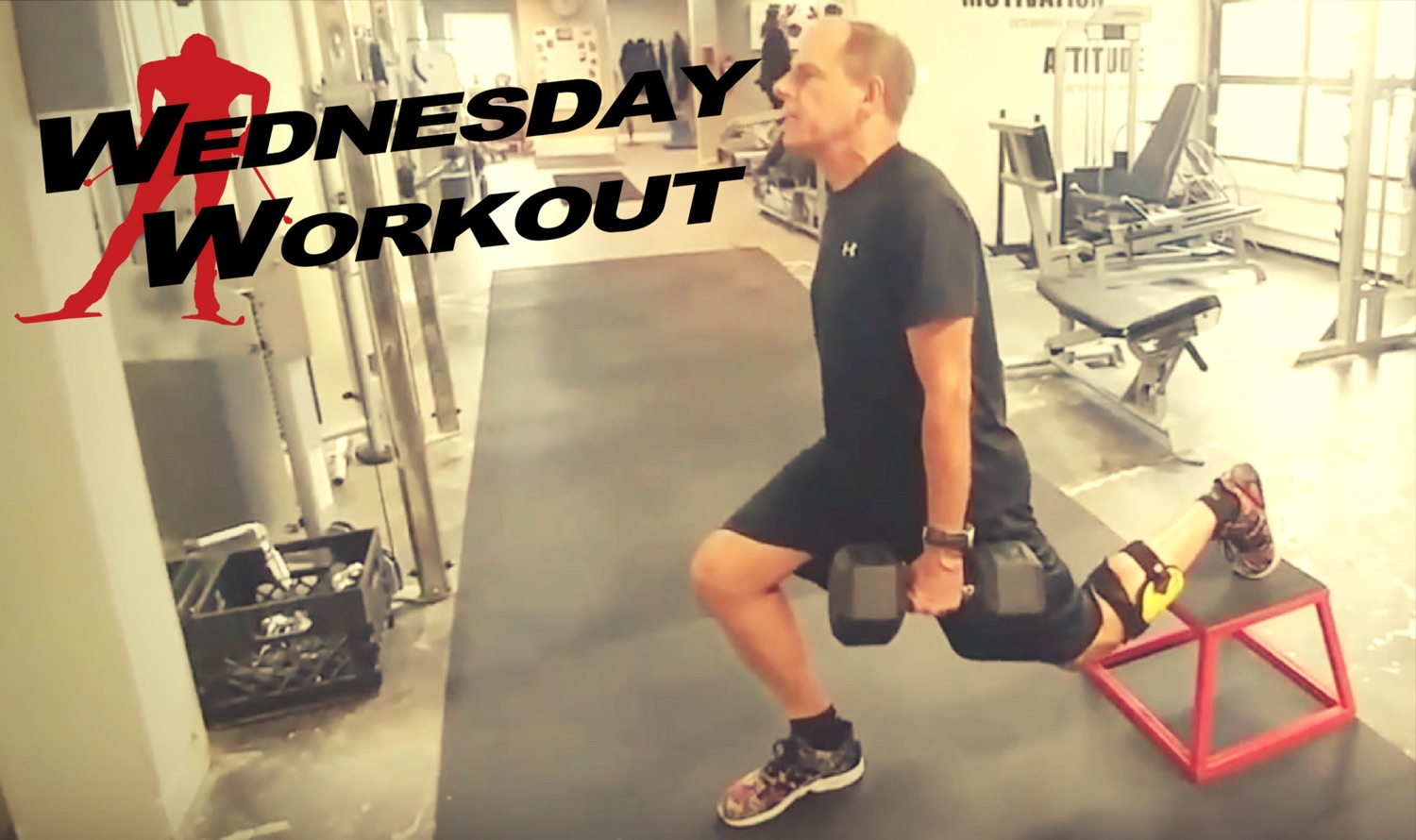
    Personal trainer and author Peter Minde demonstrating the rear-foot elevated split squat.

    Whether you’re an elite athlete or a master blaster, you want to be strong enough to ski at your fastest in your target event. If strength training isn’t part of your training plan, you’re missing an important fitness component.

    “Functional training is considered to be training that attempts to mimic the specific physiological demands of real-life activities.”  — Ives et al., Psychophysics in Functional Strength and Power Training (February 2003)

    There are many great fundamental movements you can do in the gym. They translate not only to skiing, but also to the functions of daily living.

    In addition to traditional moves like deadlifts and squats, single-leg exercises can enhance your fitness in a couple of ways. When you’re classic skiing, you kick and then glide on one leg. All the skating moves are done on one leg.  Unless you’re hammering a double-pole sprint or tucking a downhill, you’re on one leg.

    “Resistance exercises performed on machines can contribute to [muscle] imbalances unless proper precautions are observed.” – Shirley Sahrmann, Diagnosis and Treatment of Movement Impairment Syndromes

    Single-leg exercises will stress the neutralizer and stabilizer muscles in your legs, as well as training the prime movers. And in a single-leg move, bodyweight becomes part of the load. What does this mean? You can get a good training effect with a lower amount of outside weight, reducing the risk of injury.

    “In a conventional squat, we strengthen the prime movers and neglect the stabilizers.” – Michael Boyle, Advances in Functional Training

    Here are some moves that can enhance your strength and may reduce your risk of injury.

    All of these moves have some commonalities: Keep your weight over your stance leg; get those core muscles firing and keep a neutral spine.

    The rear-foot elevated split squat (RFESS) primarily trains the quadriceps and gluteus maximus. The hamstrings, gluteus medius and glute minimus are stabilizers. Dig your toe into the box. As with a traditional squat, you want to get your femur parallel with the floor or below parallel. Drive up through your heel.

    The single-leg squat is the progression from RFESS. It works the same muscles as the RFESS. Without the support of a bench, all of the load will be on your stance leg. With this movement, you may not be able to move as much outside weight as with the RFESS. Don’t be surprised if it’s more difficult getting your femurs to parallel.

    When working with severely deconditioned individuals, I often program a two-legged sit-to-stand. After watching an arena football player doing single leg sit-to-stand with a 20-kilogram kettlebell, I wanted to try them out. This move will train glutes, quadriceps, hamstrings, and anterior tibialis – an important muscle for dorsiflexion and thus ankle mobility.

    You can progress a sit-to-stand by choosing a lower height box in addition to adding weight. The lower the box, the tougher it will be.

    Originally, I learned the single-leg deadlift during physical therapy. This move trains the glutes, hamstrings and adductor magnus.  Brace your core, and maintain a neutral spine. Use the “up” leg as a counterbalance. Drive up by contracting your glute.

    In addition to the latissimus dorsi middle and lower trapezius, rhomboids and posterior deltoids, the single-leg, single-arm row trains the glutes, hips, and the neutralizer and stabilizer muscles that help us balance. To do these, hold the grip in the hand opposite your stance leg. (If standing on your left leg, hold the grip in your right hand) Brace your core and pull, retracting your shoulder blade. Keep your spine neutral. Don’t twist or rotate.

    A progression from this would be a single-arm, single-leg squat to row. This move transfers force from the leg through the hip, sacroiliac joint and thoracolumbar fascia to the opposite side latissimus dorsi. This is how force is transferred when we’re running or skiing.

    These are just some of the moves I like in the gym. We haven’t delved into movements in the frontal plane (think lateral stepups or lateral lunges) or compound movements. By no means am I suggesting that you ditch traditional squats or deadlifts. But you may find that programming single-leg movements can enhance your overall strength and fitness.

  • Wednesday Workout: Old-School Strength with the NTG

    Wednesday Workout: Old-School Strength with the NTG

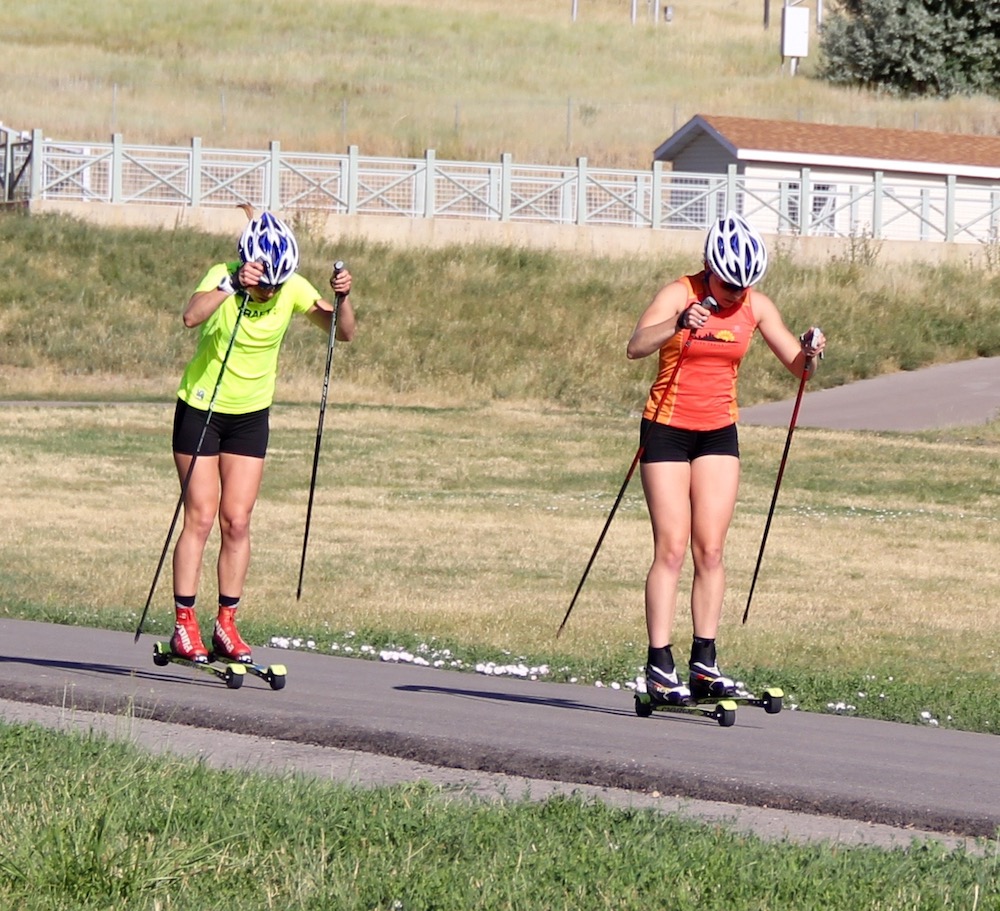
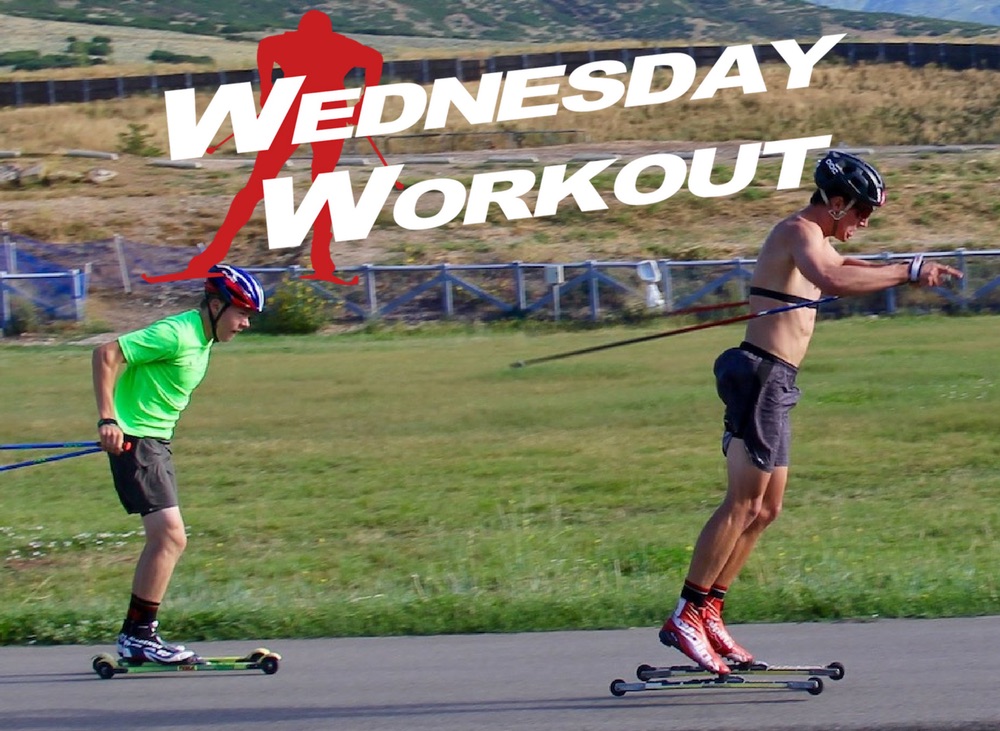
    Ben Ogden and Bill Harmeyer during double-pole speeds at the 2017 Junior NTG Camp earlier this month at Soldier Hollow in Midway, Utah. (Photo: Bryan Fish)

    For this week’s workout, we asked for a specific-strength workout from this year’s Junior National Training Group (NTG) Camp, which was held Aug. 2-15 near Park City, Utah. One of three coaches at the camp, Maria Stuber (head nordic coach at the College of St. Scholastica), shared the following, which she described as an “old-school endurance strength workout.” She led the camp with two U.S. Ski Team (USST) staff members, development coach Bryan Fish and World Cup wax technician Tim Baucom. Eighteen athletes attended — 10 men and eight women — all under the age of 21.

    Lauren Jortberg and Nicole Schneider doing double-pole speeds at the 2017 Junior NTG Camp earlier this month at Soldier Hollow in Midway, Utah. (Photo: Bryan Fish)

    “The U24’s are invited to other U.S. Ski Team camps like our October camp and our May Bend camp,” Fish explained in an email.

    The goal of this month’s camp was “to get our very best together to train and learn from one another,” he wrote. “These are athletes that are already or very well may soon be on the U.S. Ski Team, so building a healthy and positive training environment for these athletes is critical.  Secondly, building an environment where these athletes push each other yet trust one another is critical.  Many of these athletes have already traveled overseas together and continuing to strengthen their comfort and focus toward how we can support, lean on and succeed together – as a group, as a nation, as a team.

    “Third, we want to provide these athletes with meaningful feedback,” Fish continued. “The athletes work with our high performance department at U.S. Ski & Snowboard to learn what individual items they are already strong as well as windows of opportunities for improvement.”

    The primary focus was to provide a “strong training environment,” he wrote, while also testing athletes in areas like strength, power and mobility with a protocol similar to the U.S. Ski Team.

    Throughout the two-week camp, there was an abundance of rollerskiing and threshold ski walking/bounding, as well as strength work.

    “One question that commonly comes up is why such workouts are becoming less familiar or possibly less utilized in coaches’ training plans,” Fish wrote, referring to specific strength. “I think it is because more programs are incorporating this type of effort into classic sprint training sessions. That being said … [this workout develops] many important technical and physical skills.”

    Stuber explained that the workout emphasizes repetition “to work out technique issues and to feel efficiency differences,” she wrote. “It is also a fun social workout because the whole team stays in one place and you can have a good time with rivalries and inter squad competition. “

    The workout: Specific Strength on Skis

    • 20-minute warmup
    • Followed by:
      • 8 x 30 seconds single stick
      • 6 x 30 seconds core-only double pole
      • 8 x 30 seconds double pole
    • 20-minute cool down

    “We did not harp on technique too much and let the athletes think and discover what was working best to move across the ground with the group,” Stuber noted.  “We had video on an iPad for those who wanted to see what they looked like and if the changes they were feeling were showing up on camera.

    “There were a lot of blisters,” she added. “Gloves are recommended for this workout.”

  • Wednesday Workout: USBA Camp Strength Stations (and Shooting)

    Wednesday Workout: USBA Camp Strength Stations (and Shooting)

    Last week, more than 100 athletes from the U.S., Canada and Sweden came out for the US Biathlon Association’s (USBA) annual development camp in Jericho, Vt. It was one of US Biathlon’s largest and best-attended camps yet, according to national-team assistant coach Erik Lewish.

    “The camp is a great experience for biathletes from all over North America to get together for a week of training and educational sessions that culminate with the North American Summer Biathlon Championships at the end of the week on Saturday and Sunday,” Lewish wrote in an email.

    Those championships took place last weekend on Aug. 13-14.

    In the week leading up to the races, the U.S. Anti-Doping Agency (USADA) visited the camp to present on True Sport “and what to expect when one makes it to a high enough level that they are in the registered testing pool,” Lewish explained. “Our Head Development coach Jean Paquet took the athletes on a course scan of the roller loop and talked about ski technique and how to really ‘attack’ a course. Andrea Burke (formerly Henkel) gave a great motivational/inspirational presentation about her time as an athlete. Overall it is a great chance for the athletes to learn about the sport and hone their individual skills before competing in the continental championships.”

    The Monday before the championships, camp participants did an eight-station strength workout that involved some partnering up.

    Lewish explained that the workout was jointly created by himself, Paquet and Kari Korpela, the biathlon coach for the Sollefteå Skidgymnasium in Sweden.

    “The whole workout took about 1.5 hours from warm up to cool down,” Lewish wrote. “This was the second session of the day, after a long, easy roller ski in the morning.”

    The Workout: Biathlon Strength Stations (and Shooting)

    Warmup: 15-20 minutes of running

    First 20-Minute Set:

    – 40 seconds of each station/exercise followed by 1 single shot on the range, then 40 seconds of the next station/exercise

    Second Set:

    – Reload rifle magazine and do some longer bouts: 4 minutes of 40 seconds on/20 off at a station, then move onto the next exercise. After 4 minutes, take 5 shots on the range and return to next station. Repeat for a total of four shooting bouts (shooting order: prone, prone, standing, standing).

    The Stations:

    1. TRX leg crunches: Start in a pushup position with your feet in the straps of a TRX Suspension Trainer.  Lift your hips and pull your knees into your chest.

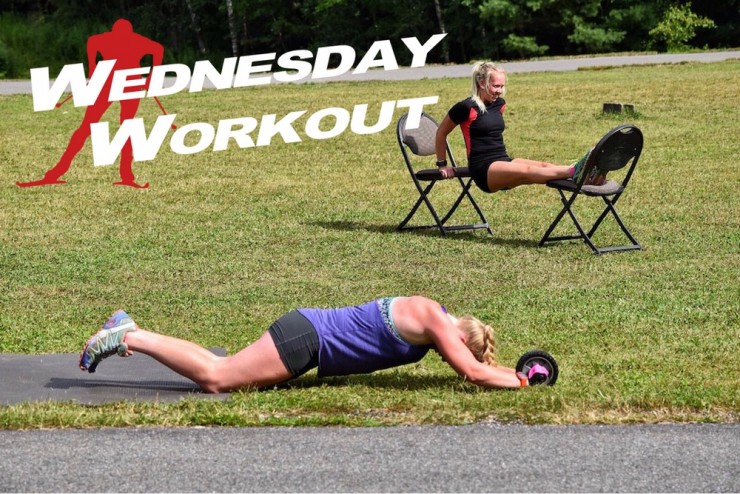
    2. Ab Roller: Start on your knees and roll out as far as you can while bracing your core, pause at the farthest point and then return to the starting position.

    3. V-Sits: Start lying down flat with your hands above your head. Bring your legs and torso up together and touch your toes at the top.

    4. Partner Burpees: Standard burpee done in sync with a partner. High five at the top of the jump for added fun!

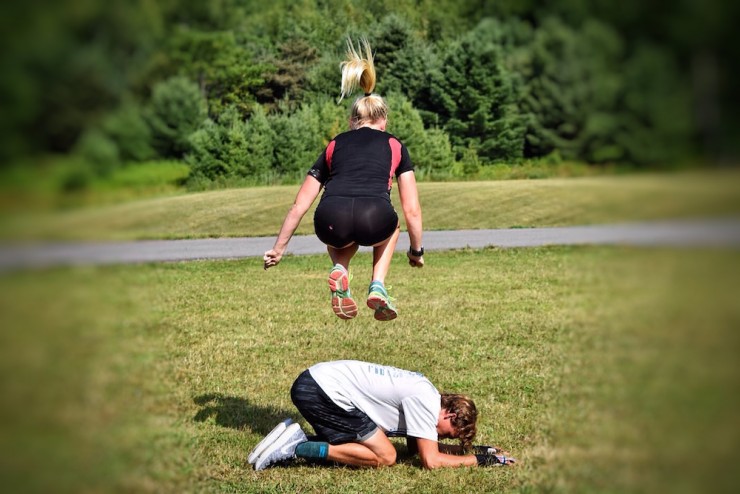
    5. Under-Overs: One person jumps over and crawls under the other person.

    6. Human Rock Climbing: One person starts on the back of the other and tries to climb 360 degrees around the other person without touching the ground.

    7. Tricep Dips: Sit on a chair, holding the edge with both hands, knuckles pointing forward.  Straighten your arms to raise your body and extend legs straight out with heels on the ground (or on another ch. Bend at your elbows to lower your entire body while keeping your legs straight. Hold at the bottom for a moment without touching ground.

    8. Single-Leg Plyo-Jumps:  Jumps done side-side to mimic skate skiing with a small hop in between before transferring to the other side.

    Cool down: 15-20 min. run