Tag: structure

  • How to Have Fast Skis ALL THE TIME, in EVERY CONDITION

    Toko Logo

    (Original e-blast)

    How to have fast skis ALL THE TIME and in EVERY CONDITION

    I love my job. The contact that I have with people in the ski community is pretty much always positive and enjoyable. We have great waxes and other products so of course generally interaction, feedback, and my motivation are very positive. However sometimes at events or otherwise, I have people approaching me trying to get me to guarantee super fast skis if they use a certain wax. A fairly rare thing is also that a person didn’t have the fast skis that they were hoping for. It is important to take a step back and take an overview so you all have the proper perspective on what makes a fast ski on any particular day.

    The 3 main factors to having fast skis are ski flex and design, structure, and wax. You could throw base material in there too, but most people have what they have, so that is more of a World Cup level topic. (Note that many skis have different base material that matches the type of conditions that they were designed to ski in, so this is addressed in the ski selection process. Example: Rossignol S3 or C3 have a “wet” clear base material to match the flex and structure that the skis come with).

    Far and away, the most important factor in having fast skis are the skis themselves. Given a particular condition, the skis need to match the condition in terms of their flex and design as well as match the skier (weight and ability).

    Let me use Rossignol as an example because I am very familiar with them and confident in them. Below is a quick chart explaining the flex/design of the top Rossignol skating skis, the Xium Premium S1, S2, and S3 skis. In each of these skis, the camber height is different as is the contact area of the skis to the snow if the skis are fitted properly. (The concepts are identical for Skate and Classic skis).
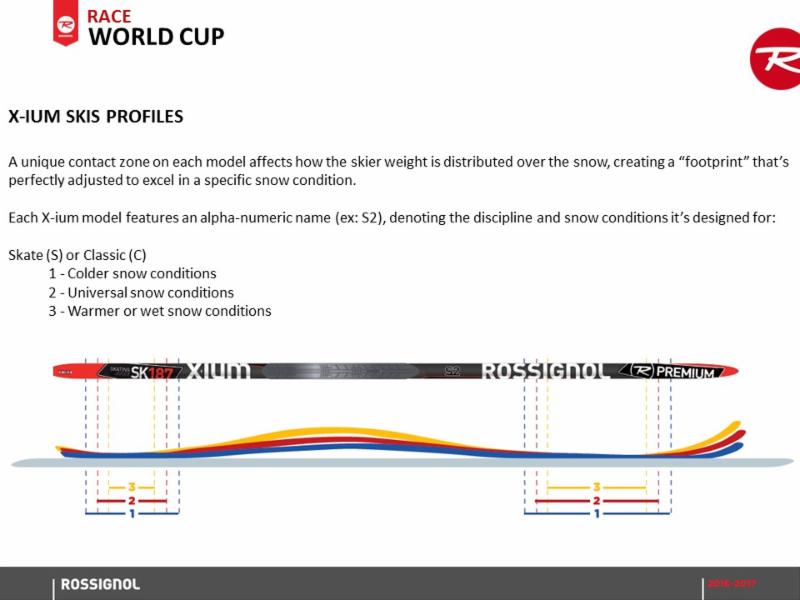
    Rossignol X-IUM Ski Profile

    If snow is cold, dry, and slow snow, a fast ski will generally have a low camber and a relatively long area of contact in the tip and tail sections. Assuming the structure and wax are “cold”, the skis should be good assuming they are fitted correctly. If the skis have a high camber and a short area of contact in cold, dry, and slow snow, the wax and structure can still slow the skis down further, but the skis will not be very good regardless of how optimal the other two factors are.

    It is the same in wet snow. Clearly, having a low camber and more contact between the ski base and the snow will result in more suction and more opportunity to pick up dirt creating more friction and more suction. Minimizing the contact results in much faster skis for the short term and especially after some kms are skied. The disadvantage of using a lower cambered ski with longer contact area can not be overcome with “wet” structure and wax to the point that the skis are really good. This is especially the case in dirtier snow where the addition of a deeper structure to compensate for the increased suction (surface tension) created by having a longer contact area will only result in more dirt attaching itself to the ski base which makes the ski slow due to the added friction of having dirt on the base as well as the increased suction because the structure is filling up with dirt and the previously hydrophobic base material is covered with dirt and no longer hydrophobic.

    In past years with different ski designs, many people including myself liked to err on the soft side, especially in the west where we get a lot of cold dry and slow snow. The current ski designs such as Rossignol need to be fitted properly and I personally lean toward the stiff side to ensure that the skis can function as intended.

    Bottom line is that in order to have fast skis in all conditions, the skis need to be the right flex and design for the conditions and they need to fit the skier such that the contact area matches the intent of the ski design. If you put a 200 pound guy on a ski designed for a skier of 160 pounds, there will be an increase in contact area. Also, the more aggressively a skier skis, the more care needs to be taken to ensure that the skis are stiff enough to accommodate being suspended on the right length contact zones.

    Looking at the chart above, you can see the different colors of the S1, S2, and S3 patterns. They match up with the Toko colors which makes sense because normally when you use one of those skis, you’d be waxing it with the color associated in the chart.

    Structure is often the next most important factor, especially in the two extreme conditions which are cold, dry, slow snow and wet snow. In cold dry fast snow that is for example transformed, a more aggressive structure can be used with success. This is why I keep mentioning “slow”. A base finish that is not a “cold” grind (very smooth) will not run fast in cold, dry, and slow snow regardless of the flex of the ski and what wax is chosen. In very wet snow, a “cold” grind will not run fast even if the ski and wax are optimal.

    All 3 factors in having fast skis need to be considered. Satisfying any one or even two factors will generally not yield fast skis if the third factor is in conflict with the conditions. Most times, the factor that is most in opposition to the conditions determines the speed of the skis, not the ones that are in agreement with it.

    So, my recommendation is to consider skis from a macro level starting with ski selection (should not be too soft!), then structure, and then finally wax. It is not as complicated as it sounds if you are a passionate ski racer (ie, you are willing to invest financially as well as in physical preparation). Have an S1 ski with a fine structure that you generally will wax with Toko Blue waxes (need to wax with a softer wax periodically for the health of the base). Have an S2 ski with a universal or cold universal structure that you will more commonly wax with Toko Red waxes. And lastly have a pair of S3 skis with a warm grind on them that you will mostly wax with Toko Yellow waxes. This way you already have skis optimally suited for each general condition that have a structure that matches the condition where you would use them. Then finally wax is the “icing on the cake” and will then be able to really make the skis fast.

    A ski racer could show up with all 3 of these skis prepared as described with no knowledge whatsoever of the conditions and basically always have good skis. With forecasting, it is possible to eliminate one or even two of the conditions associated with S1, S2, and S3 which makes it even easier and more convenient to have great skis. OK, now you know! Good luck and see you around!
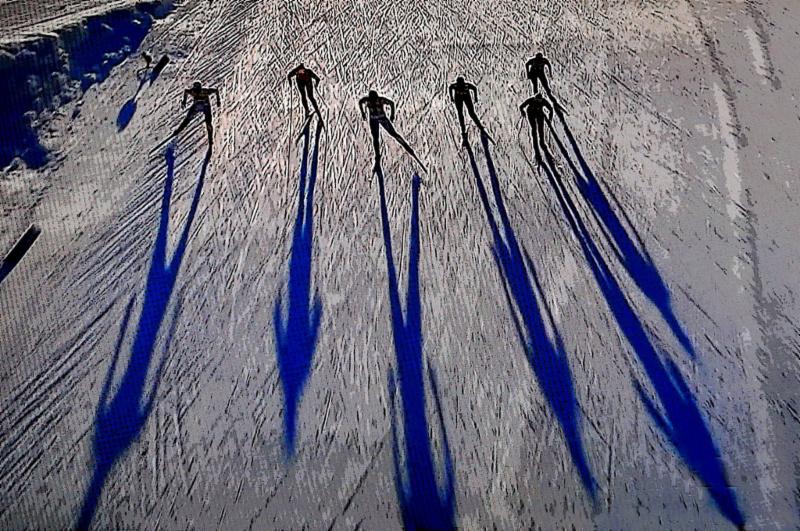
    Photo from Women's Sprint Final at the Davos World Cup (Credit: Jacques Mignerey)
    Photo from Women’s Sprint Final at the Davos World Cup (Credit: Jacques Mignerey)

    Team Gregg

    Silver Star SuperTour Report

    Cold fresh snow racing continued with the Super Tour/ Nor Am at Sovereign Lakes Nordic Center in British Columbia. We raced on a cold hard paraffin with Toko JetStream Red 2.0 powder. It was a bit surprising that the Red 2.0 tested and performed so well considering the single digit temperatures. The range of the JetStream 2.0 Toko powders is fantastic. We covered the powder with Blue 2.0 Helix.

    The races were solid, but off the mark of where we really wanted to be. We are in the Methow Valley to train in prep for Nationals. We are feeling good and our preparation has us still ready to be on at Nationals.

  • Swix Structure Selection

    Swix Structure Selection

    The Norwegian XC-team has introduced a color coding system to select corresponding skis and structure of the glide zone:

    Green (-5 °C and colder) Fine Blue (0 °C to -5 °C) Medium/Fine White (0 °C to+3 °C -moist): Medium/Coarse Red (+1 °C to +10 °C -wet) Coarse

    Fine Structures: Fine structures are mainly used on new snow and fine grained snow. For skating; fine structures are normally used from 0 °C (32 °F) and colder for classic;-5 °C (23 °F) and colder. Sharp crystals (present in dry new/fine snow) and a sharp structure is not optimal. A newly set (fresh) structure will in general give a “sharp” structure. In dry, cold, new and fine snow conditions (usually lower than -7 °C (19 °F)),the fine “sharp ” structure should be “rounded ” with Fibertex T264 ((or a plexi scraper). Though, this process is normally more important for skating than for classic skiing. On the other hand, in new snow with high humidity close to 0 °C (32 °F) the structure should preferably be sharper.

    Medium/Fine structures: This structure is a widely used structure. For skating it is used in most snow conditions normally from -7 °C (19 °F) up to wet snow. In very wet conditions a medium/fine structure combined with the use of an imprint tool has proven good results. For classic skiing we recommend this structure in new and fine grained snow (normally between -7 °C (19 °F) and 0 °C (32 °F)).

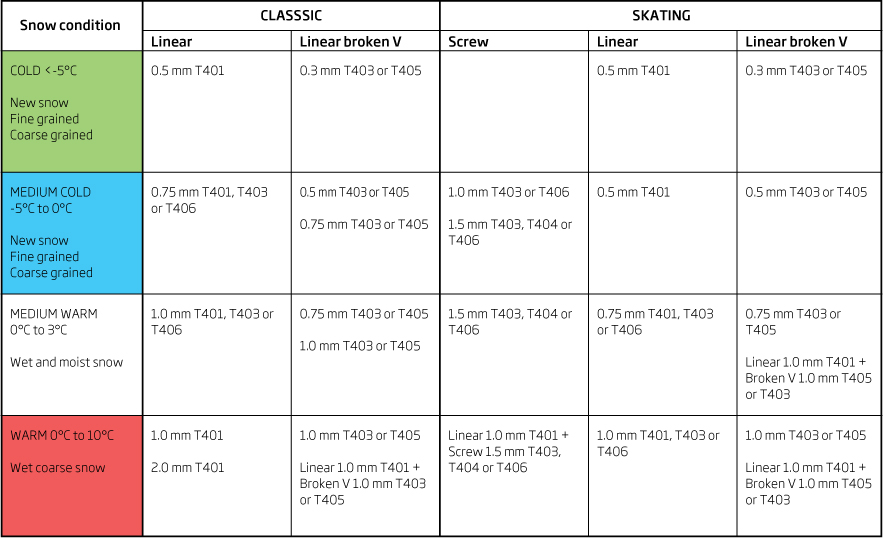
    Medium/Coarse structures: Mainly for classic skiing on coarse moist snow and wet, glazy new snow between 0 °C (32 °F) and +3 °C (37 °F),amedium/coarsestructureispreferred. Thisstructureisalsousedsometimesinfreetechnique(skating)onwet,coarse-grainedsnow. In this case, most racers would prefer to adjust a medium structure towards a more coarse structure by using a manual tool. Reference the table below for specific recommendations.

    Coarse structures: This structure is rarely used in skating. For classic skiing it is used on coarse wet snow. Note! In general, it is better to use a somewhat finer structure than a structure too coarse.

    Practical advice for the use of Swix manual structure tools

    Linear, Broken and Screw structures:

    There are no exact rules when to use the different structures. Generally, we can say that linear structure and broken linear structure (V) are mostly used in classic races. Screw and cross-structures often give a good “feeling ” in free technique (skating)races.

    Procedure then choosing structure 1 Check snow type, temperature and air humidity. 2. Course is classic or free technique (skating)? 3. Decide the stone-grinding structure. 4. Set the hand-structure as the last step, after brushing.

    Use of the different imprint steels will vary with the underlying stone grind. If the base has a fine structure it can be taken to “medium” by using the coarse imprint steel. In this way you will be able to make a fine stone grind fit “medium” conditions. However, it is not possible to make a coarse stone grind ‘fine’ with a ‘fine’ steel.

    • Manually produced structure should be set after waxing, application of Cera F and brushing. • After setting the structure, brush once more with the Blue Nylon brush. • Always apply manual structures on race day since the intended effect can be reduced over time. • For skating skis, start from the tip applying light pressure for the first third of the base slowly increase pressure from the front

    of the binding using medium pressure until the back of binding, from there to the tail use firm pressure. • For classic skis, use even pressure, but preferably lighter pressure on the front part. • If two or more imprint steels are used in combination, always start by using the coarser steel. • With higher air-humidity, use more coarse structure. When in doubt, use finer hand-structure. • Finer stone-grinding combined with a “coarse” hand-structure is better than coarse stone-grinding, combined with ”finer ”

    hand–structure. • On wet snow conditions, apply harder pressure on the tool. • Run the rollers two times.

    • Keep the rollers and steels clean and well protected during transport.

  • Structure Basics from Swix

    Structure Basics:

    Structure is a term used to describe patterns cut into the base to reduce base contact on the snow and to release surface tension from water films caused by base friction. These structure pat – terns are most often produced by stone grinding machines at the factory during production or by shops that specialize in the stone grinding process. It is also possible to produce structures using hand tools.

    For a period of time there was much experimentation and testing of many types of patterns in order to find the best structure for different snow types. The search with different stone grinders, different structure depths, widths, and patterns, all aiming to find “the ultimate structure ”,was overwhelming. Recently however, the development showed signs of simplification. Now service technicians agree more that snow types can be classified in more general terms to which more certain structure patterns can be matched. An appropriate structure is still of absolute importance, but it is applied with a set of basic principles in mind. The result is that variations in machine set structures are fewer and standardized. The tendency to “simplify ” variations in stone grinding can allow for a more accurate comparison of other significant factors such as skis and waxes, and in theory it is possible to travel with fewer pairs of skis.

    Last but not least, structures made by hand on top of structures produced by machine have proven to give outstanding results. Manually set structures in combination with stone grinding can match the day ’s conditions more accurately and therefore enhance the effectiveness of a basic stone ground base.  There is an important difference between structures produced by machine and those produced by hand. Stone ground structures are cut into the base, and are more permanent in nature. Hand structures use “imprint ” tools that press the structure into the base, and consequently are temporary.

    Swix imprint tools have the advantage of being easy and quick to use while at the same time offer the most adaptability of adjusting the structure to match the snow type. During the process of rewaxing the heat from the iron will cause the pattern to leave the base while keeping the stone ground pattern intact. In this way the base is ready once again for the next hand produced structure treatment and it is possible to apply the perfectly matching structure according to the conditions of the day.

    Although there are variations in the patterns applied, structures can be classified into “fine”, “medium-fine ”,“medium-coarse ” and “coarse ” structures. The most frequently used structures in World Cup are “fine” and “medium-fine ”.

    For classic races more coarse structures are used as well. The difference between classic and skating is related to more varying conditions in a skating course than in a classic track. Also the factor of “feeling ” that has to do with the resistance when “pushing ” the ski forward is significant in skating, but less in classic. The “free feeling ” can be lost, especially when skating uphill, when the structure is too coarse.  Learn more at www.swixracing.us and SwixNordic on Facebook.

  • The Golden Skis

    The period from 1989 to 1994 is often referred to as the “golden age” in Norwegian cross-country skiing. During these years, Norwegian skiers hauled home buckets of medals, and the party culminated with the Olympics on home turf in Lillehammer 1994.

    What happened behind the scenes was determining for the results. Terje Olav Seim was one of the wax techs on the support team who groomed and polished up several golden pairs. There is no doubt in his mind as to which pair was his best piece of work.

    “That was the pair Alsgaard used for the 30K at Lillehammer in 1994. I’d argue that this is the race that has logged the fastest ski speed in history,” Seim says to Langrenn.com.  

    – Was that due to the skis?

    “Nah..Thomas would have won no matter what, but he won with such a huge margin. Both the skis and the boy were unbelievable that day. That we hit so dead on with the skis was just icing on the cake for me,” the modest Norwegian says.

    Structure – it matters

    – What was the secret behind the golden skis?

    “For starters, this was a pair with an exceptional base. It can be pretty random which skis happen to have a great base, even the manufacturers don’t fully control that. It was also exceptionally cold that day, and we kept it simple. The structure matters a lot, and what we used that day was a simple, but well-proven and slightly ‘worn’ version. Then we added CH4. That’s what Thomas was skiing on when he became an Olympic gold winner,” Seim recalls. Currenty, Seim works as a consultant for both Madshus and Swix.

    – The Norwegian wax team received a lot of flak during the 2010 Olympics in Vancouver. What kinds of challenges are they facing with the upcoming World Championships?

    “First off, they have to move on and forget what happened in the past. They need to think simple and develop a system. The skiers don’t need more than one good pair for each different kind of conditions. If they have that and the skis are tuned in a way we know works, the chances of total disaster are severely reduced,” Seim explains. “Oh, and they have to do their homework prior to the major championships.”

    From Langrenn.com, August 30, 2010 By Ola Jordheim Halvorsen, translation by Inge Scheve