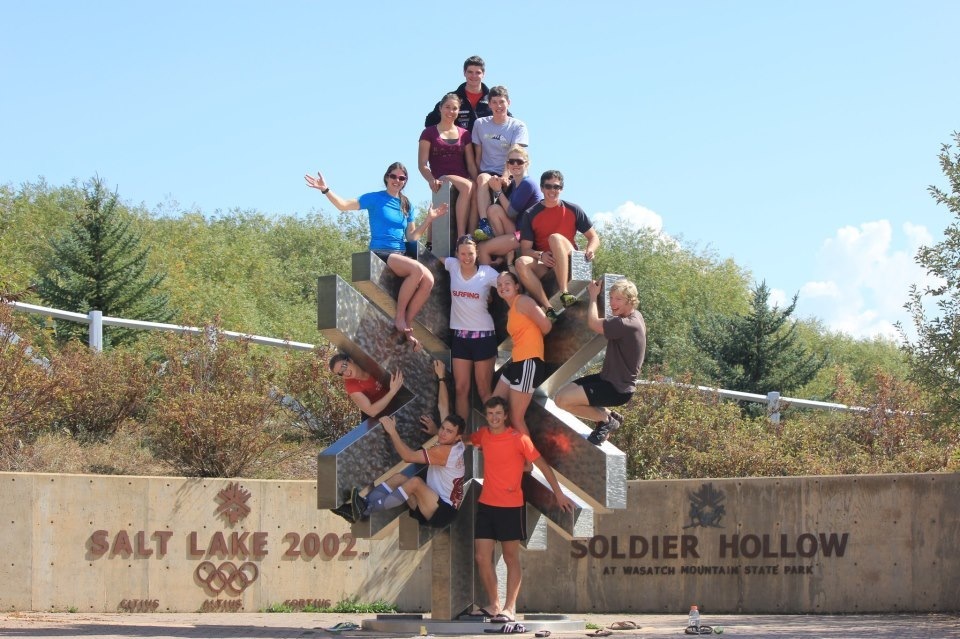
The Rocky Mountain Racers crew after a training session in Soldier Hollow in 2012. (Courtesy photo)
Maya MacIsaac-Jones, 19, of the Canadian National Junior Team and Rocky Mountain Racers (RMR) in Canmore, Alberta, submitted the following article about her RMR’s recent dryland camp in Park City, Utah, to info@fasterskier.com. Born and raised in Athabasca, Alberta, MacIsaac Jones lives in Canmore and is a student at Athabasca University.
***
From Sept. 27 to Oct. 11, one of Canada’s high-performance racing teams, Rocky Mountain Racers (RMR), headed down to Park City, Utah, for their two-week long high altitude training camp.
RMR is comprised of just over 20 high-performance athletes in both cross-country and biathlon from all across Canada. Led by coaches John Jaques and Luke McGurk, the team’s athletes focused on both high volume and high intensity during their camp.
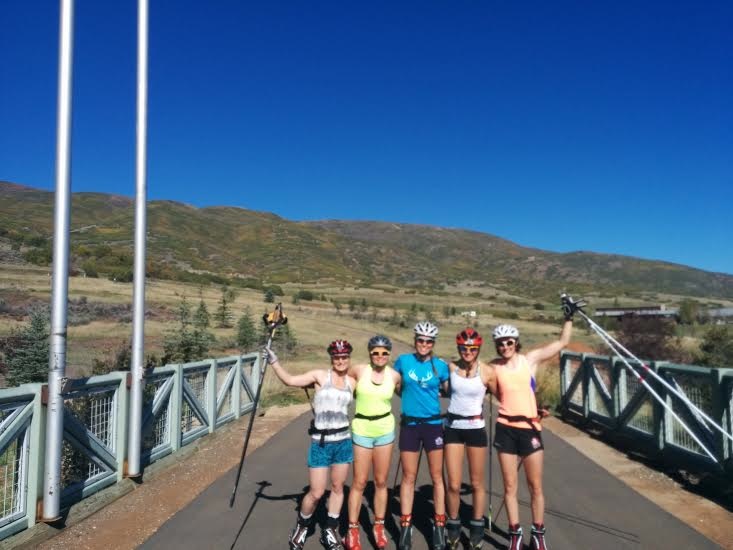
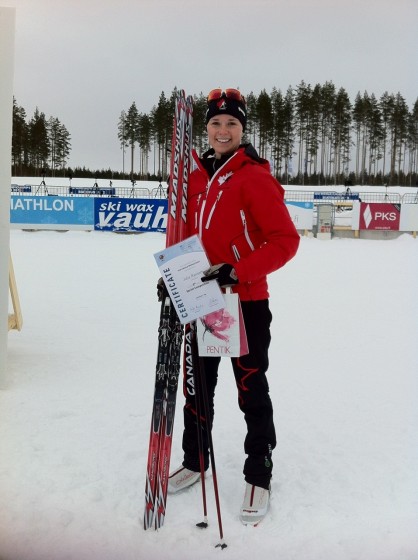
RMR girls after a time trial at Soldier Hollow last month (from left to right): Andrea Dupont, Emma Camicioli, Maya MacIsaac-Jones, Ember Large, and Olivia Bouffard-Nesbitt. (Photo: Ember Large)
Long 4-5 hour workouts were completed on the various mountain passes surrounding Park City and Salt Lake City while intensity sessions, time trials and shooting practices were reserved for the excellent facilities available at Soldier Hollow in Midway.
Because of RMR’s cross-country/biathlon mix, Soldier Hollow was the perfect place for training sessions to occur; coaches were able to coordinate shooting practices for the biathletes with simultaneous rollerskiing sessions for the cross-country side of the team.
Utilizing Soldier Hollow’s biathlon range, extensive set of rollerski tracks and advantageously close proximity to Park City, RMR held several intensity sessions and time trials at the former Olympic site. The hilly climbs the facility offered also gave the athletes an opportunity to have a dryland time trial with a course very similar to what they will face during the ski season.
“It’s inspiring to train in the exact spot that I saw my Olympic heroes win medals at during the 2002 Olympics,” RMR athlete Andrew Brisbin stated. “[Soldier Hollow] is the most difficult and technical rollerski track that I’ve been on, meaning it most closely resembles a World-Cup caliber ski course through its lung and leg busting climbs and quick descents.”
Stuart Harden, RMR athlete and one of Canada’s top junior biathletes, also enjoyed training at the former Olympic site: “Soldier Hollow was a great asset to have at our Park City training camp. For biathletes, having a range and full rollerski loop close by made the trip feasible. As far as rollerski tracks go, Soldier Hollow is considerably challenging. Some steep, sustained climbs coupled with the altitude can really make you hurt, and can definitely make training there worthwhile.”
When not focusing on intensity sessions or shooting practices, the team explored the many other mountain roads available for rollerskiing in the area, including Mirror Lake pass, Wolfe pass, and Guardsman Pass. They concluded their camp with a 4-5 hour altitude run at 9000 feet on the trails above Park City.
With their last camp of the season complete, RMR athletes are now in their final stages of preparing for the racing season and the upcoming [SuperTour and] NorAm races at West Yellowstone, Bozeman, Rossland, and Whistler.
For any athletes or coaches interested in exploring Soldier Hollow as a future training possibility, please use the following contact information:
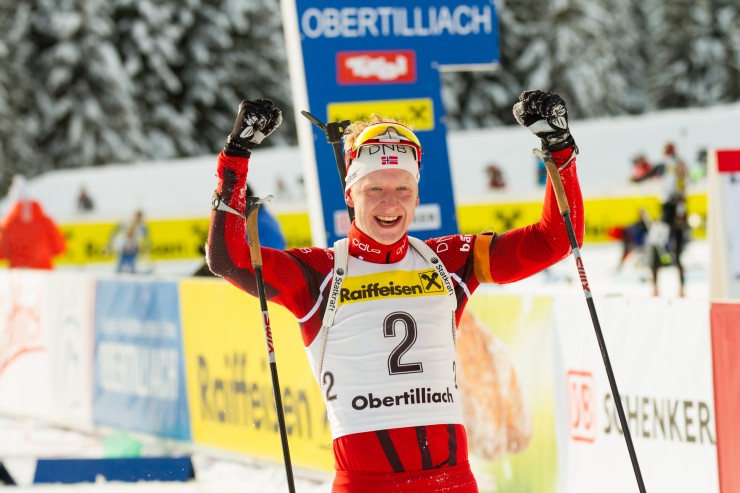
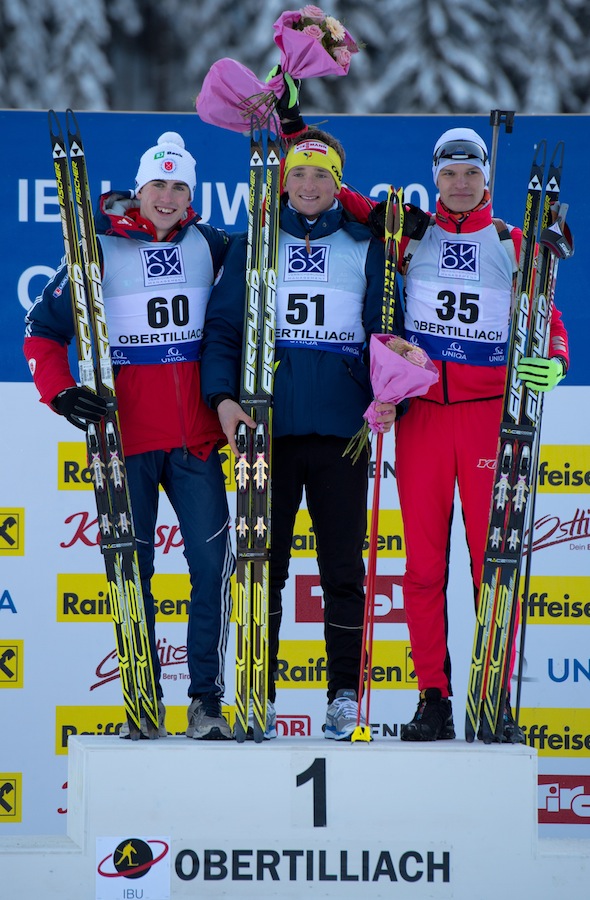
Johannes Thingnes Bø of Norway skied deliberately early in the junior men’s pursuit, then capitalized on shooting errors by the Russian leaders to take the win. Photo: Mario Danzl/Obertilliach 2013.
This is a continuation of reporting on the third day of biathlon World Youth and Junior Championships; for part one, on the women’s races, click here.
* The transition to men’s racing in the afternoon was exciting as Russians Maxim Tsvetkov and Alexandr Loginov, both very successful in last year’s Championships in different divisions, took control early and duked it out as Norway’s Johannes Thingnes Bø tried to play catch-up. But in the final stage, the Russians faltered, each collecting several penalties. That left Bø a fighting chance, and he came onto the range, cleaned his targets with impeccable efficiency, and left with the lead, which he never relinquished.
Behind them, Christian Gow was chasing hard. Starting 14th after the pursuit, he had a shot at moving into the top ten. But the field continued to stratify and with five penalties, he slipped to 16th.
“There are some big gaps in the category, mainly because the top four guys are almost out of the rest of the competition’s league,” Gow told FasterSkier. “The gaps have not made it harder to achieve better results, for me all it would have taken was a few more targets. I was in the top 10 for awhile today, but really fell back with some poor standing shooting.”
Gow believes that he has a good chance to improve in the individual race, where each missed shot accrues a one-minute time penalty.
“The top guys are fast, but with one minute penalties there is a lot more room for guys to break in to the top three,” he wrote in an e-mail.
Overall, he was pleased with his race, but knows that he needs to improve on the range for the rest of the week.
“My shooting was a bit of a disappointment,” Gow wrote. “I had a miss in each prone, but one of them I rushed a lot which I could have easily avoided. My first standing was terrible, but I brought it back for the last one which I’m happy about.”
Behind Gow, teammate Macx Davies also had a shot to move up after starting 31st. But despite making it into the top 25 in the middle of the race, three penalties in the final stage bumped him back down to 33rd. Despite the 21st-fastest ski time, seven penalties were too many for the Canadian.
“Coming into the last standing with my legs were aching and my heart rate was high, but not too different from the first standing bout,” Davies explained. “However I got a bit excited after my first hit and failed to maintain a good sight picture for the rest of the shooting. The shooting conditions are not difficult looking at the range, little to no wind and light isn’t affecting the shots, but the mats are a slippery, especially standing, and the course allows little recovery time with all the flat terrain and quick down hills.”
Davies said that his skiing was “at an amazing level,” so he hopes to improve in the upcoming competitions. Both he and Gow are from Canmore but on separate teams, although, as Gow said, “we have been racing together forever though and if our schedules mesh we will often ski together.” Despite the different training schedules each has seen a similar ramping-up of training this year.
“The biggest difference in my training was the volume of hours and the focus that I brought to each session,” Gow said of his improvement on skis.
Finally, American Casey Smith started behind the Canadians in 43rd.
“After the sprint race I was defiantly disappointed with my standing shooting,” he told FasterSkier. “My prone went alright with only one miss and that one was a split. Then in my standing I was not very settled and should have paused for a second to get things right, but I didn’t. I felt that my skiing went well though, that it was good enough that if I hit my targets I could be right in the mix.”
With an obvious goal for the pursuit, Smith set about achieving it. His single penalty was only matched by two other competitors and he moved all the way up to 23rd – the second-biggest move of the day. That result represented Smith’s best finish ever in a total of four World Championships appearances.
“With my shooting I was just thinking about taking good shots and making sure my mechanics were correct,” he said. “I don’t think that the conditions were tricky at all. There was no wind and everything was pretty consistent. There is an uphill range approach which I think could easily throw you off if you are not paying enough attention… I was very happy with my pursuit race it is my best Junior Worlds finish ever and I also moved up 20 places which is a good feeling.”
* Finally, it was Sean Doherty’s turn – and Stuart Harden’s. The Canadian, who like Doherty had competed at the Youth Olympic Games with great results, had placed 20th in the sprint and was looking to move up.
“I wasn’t totally satisfied with my sprint performance, my shooting wasn’t where it needed to be both accuracy and time wise,” Harden told FasteSkier. “My skiing was enough to get me into the top 20, but I’ve felt better in earlier races so far this season.”
Luckily, he had a plan for the pursuit.
“I knew I had to speed up my range times a bit, and I hoped my steady shooting would cope,” he explained. “I had a vague plan to stick with the guys around me off the first few loops, because I know from the Youth Olympics and WYJCH last year that we have close ski speeds. After that, I was banking on staying out of the penalty loop and seeing how much left I had for the last lap. Sometimes plans don’t work out unfortunately.”
With one penalty in the first prone stage and then a clean second stage, Harden did move into the top ten. But then the wheels came off, and he picked up three more penalties in the next two standing stages. That left him in 18th – still an improvement, but not what he was hoping for.
“It was a hilly loop, but a quick one as well so I made sure to keep the pressure on each loop – it’s pretty obvious from my lap times that my shape wasn’t good enough to make that happen today,” Harden wrote. “I was in more of a ‘limit your losses’’ mindset, which can’t happen if I want to do well.”
Like Davies, he noted that the mats in Obertilliach were especially slippery, which was a challenge in standing and provided “less stability that I’m used to,” Harden said. In the television broadcast of the junior races, the men could be seen coming into standing much more slowly and deliberately than usual, and taking their time setting their position on the mats.
But all excuses aside – even the reasonable ones – Harden says that he’s just not where he was hoping to be this year. At the Youth Olympic Games, Harden had moved from fourth in the sprint to first in the pursuit, but had missed a penalty loop and was penalized by two minutes, dropping him to seventh; excruciatingly, his 38-second lead at the finish would have still left him with the win even if he had done the extra loop.
Knowing what he was capable of left him with high hopes for 2013.
“I set higher goals for myself this year without a doubt, which I could justify with my results from last season,” Harden wrote. “A place on the podium in Obertilliach isn’t unreasonable I think, but I’m re-evaluating the rest of my week based on how I’ve been feeling on and off the skis for the past few weeks.”
Canadians also had their hopes pinned on Carsen Campbell, who had placed 30th in the sprint. But eight penalties were too many and the Prince Edward Island native fell to 42nd in the pursuit.
“In the sprint my focus was good and the shooting went pretty well as planned,” Campbell wrote in an e-mail. “This was not the case today, I just couldn’t get my head in the right place. I am a bit disappointing with my race today, my skiing felt really good and I had great skis but with eight misses you don’t get very far here.”
After three misses in the first prone stage, Campbell turned his skiing up a notch to try to compensate, turning in the tenth-fastest second-loop time and jumping back into the 30’s. But another penalty in the second stage, then two in each standing, tired him out. At 150 meters apiece, Campbell skied a full 1.2 k more than the course length itself.
Still, he’s not discouraged for the rest of the Championships.
“I am feeling a lot stronger than last year, my form is better am I am mentally much better prepared and the adjustment to Europe was pretty easy this year,” he said. “I feel confident that it will be back in order for the individual… [but] the competition is really stiff, in the sprint the top 30 were all within 1:30 so there is no room for error.”
The third Canadian in the youth pursuit, Arthur Roots, finished 60th.
Overall, the youth category is a tough place to race, as athletes are generally talented, but not used to the world stage.
“For the [less experienced] of the crew, this is a big eye-opener, but very important for their next development,” Canadian team leader Richard Boruta said. “Back home, you finish in top four and it is very easy to start thinking that you are one of the best, but than you come here and you realize that within the minute or two between you and the next Canadian guy ahead could be easily 20 or 30 other athletes.”
As we’ve discussed on FasterSkier before, U.S. and Canadian teams have the added challenge of developing strong juniors despite the fact that many don’t take up biathlon, or even skiing, at a particularly young age.
“Especially for the youth athletes as well, the performance is somewhat dependent on their biological age and number of years in a regular training program,” Boruta said. “Most of the North American are late-starters, so they are catching up in later age.”
Even for experienced athletes like Harden, there are challenges that can be chalked up to simply growing up.
“I think a more experienced athlete may have done that sooner, but I’m just confronting it now,” he said of the realization that he’s not where he wants to be. “Regardless of my ranking in each race, I’m still really happy to be here, I’m really happy for Sean [Doherty] and all the other athletes I’ve raced and gotten to know, and I’m looking forward to the rest of the week.”
Sean Doherty (Center Conway, N.H./Vermont Collegiate Biathlon) skis to a career-best second place, 3.6 seconds out of first, at the IBU Youth World Championships on Friday in Obertillach, Austria. (Photo: USBA/Nordic Focus)
Sean Doherty knew exactly what he was in for heading into his third International Biathlon Union (IBU) Youth World Championships. The 17-year-old New Hampshire resident had been to two junior world championships before: first in 2011 in Nove Mesto, Czech Republic, and again last year in Kontiolahti, Finland.
His best individual result had been 13th, which he took in the 2012 sprint and pursuit. Pretty good, but Doherty wanted more. Last year, he won bronze in the mixed relay at the Youth Olympic Games in Innsbruck, Austria.
Back in Austria – this time in Obertilliach – Doherty proved to himself and everyone else that he was capable of not only a podium, but nearly a win, in the 2013 youth worlds opener. The Vermont Collegiate Biathlon member raced to silver in Friday’s 7.5-kilometer sprint, finishing just 3.6 seconds behind winner Fabien Claude of France.
Doherty skied the fourth-fastest time of more than 100 competitors in the men’s youth race, rising five places on the last of three laps to place second. Seventeenth after the first lap, he finished in 21:16.0 with two misses – one at each stage.
The men’s 7.5 k individual sprint podium at the IBU Youth World Championships on Friday in Obertilliach, Austria. American Sean Doherty (l) was second, 3.6 seconds behind winner Fabien Claude of France (c). Rene Zahkna of Estonia was third. (Photo: USBA/Nordic Focus)
Claude, who won in 21:12.4, shot clean on the first stage and missed two on the second. Estonia’s Rene Zahkna took third, 14.9 seconds behind Claude, with one penalty.
And while Doherty’s ability to fight for first was hardly a surprise, he was still taking it all in. For U.S. Biathlon, it was the best result at IBU Youth and Junior World Championships since national-team member Jay Hakkinen won gold in the 1997 sprint.
“It is hard to believe that I have worked all of this time towards this goal,” Doherty said in a U.S. Biathlon press release. “Now it is here I am still a little bit in shock.”
His game plan had been relatively simple: start in control then pick up the pace. He felt good throughout the race, but expected that after starting conservatively, he wrote in an email.
“The shooting went well but not flawlessly,” Doherty explained. “The last lap came around and I got a split from our coach [Vladimir Cervenka] that I was very close to medal contention and I just really turned up and went as hard as I could.”
While the sprint went exceptionally well, it wasn’t an event Doherty had especially eyed.
“Honestly I try very hard to go into every race I do without expecting a number result,” wrote Doherty, who lives in Center Conway, N.H. “But I am extremely satisfied with this result. … I am focused on all of these events equally. I mean it is the Junior world championships so I am focusing every race.”
Doherty said he’ll try to “keep calm” in Sunday’s 10 k pursuit and approach it like he would any other race, aiming to have a good one.
“We are very exited about Sean’s race today,” Cervenka said in the press release. “He did great and according his plan he saved his best for the last loop. It will be fun to watch the pursuit on Sunday.”
Also notching a top result on Friday, Canadian Stuart Harden made it into the top 20 in 20th, 1:02.6 behind the winner with two misses, both on the second stage. Harden had the fourth-fastest time after the first lap. Also for Canada, Carsen Campbell was 30th (+1:31.7/0+2), Arthur Roots was 59th (+3:07.3/1+2), Matthew Strum was 69th (+3:40.3/2+3).
For the U.S., Jakob Ellingson was 62nd (+3:25.5/3+1), Jordan McElroy was 79th (+4:08.0/2+3), and Brian Halligan was 88th (+5:09.2/4+5) of 108 finishers.
In the women’s 6 k sprint, American Anna Kubek of Duluth, Minn., was the top North American in 34th. She had two penalties, both on the first stage, and was 3:18.2 back from Russian winner Uliana Kaisheva, who completed the course in 18:08.7 (0+1).
Canada’s Sarah Beaudry was 36th with three misses (+3:24.2/1+2). Teammates Leilani Tam Von Burg was 71st (+5:34.3/1+1), Emily Dickinson was 75th (+6:05.7/2+1) and Charlotte Hamel was 80th (+6:50.4/1+1).
For the U.S., Mikaela Paluszek was 65th (0+4), and Aleksandra Zakrzewska was 84th (2+4).
Canada’s Julia Ransom at the podium ceremony of last year’s World Championships youth pursuit, where she finished second. Photo: Richard Boruta.
Biathlon Canada has selected 16 young athletes to represent their country at the World Youth and Junior Championships, to be held later this month in Obertilliach, Austria.
The team is headlined by junior national team members, including Julia Ransom, who won silver in the youth sprint at last season’s World Championships. Since then, she’s gotten more experience under her belt when she competed in the distance races at the Canmore ski World Cups, where she finished 57th in the 15 k skiathlon and 52nd in the 10 k classic mass start, beating more than half of Canada’s nations’ group. Now 19 years old, Ransom will move up to the junior division of racing.
But while she’s the most recent medalist on the team – last year’s Junior World Champion Kurtis Wenzel has graduated to the senior ranks – she’s definitely not the only one. Also in the junior women’s division will be teammate Rose-Marie Cote, who won bronze in the youth individual race back in 2011. They will be joined by Emma Lodge, who has two European race tours under her belt, and newcomer Erin Yungblut.
In the junior men’s division, Christian Gow is returning from two top-20 finishes in last year’s races, and Macx Davies and Jasper McKenzie both have experience in prior editions of World Youth and Junior Championships. Menno Arendz is punching his first ticket to a championships event.
Canada will almost certainly be led by Stuart Harden in the youth men’s division. Just one year ago, he turned in fourth- and seventh-place performances at the first-ever Youth Olympic Games in Innsbruck, then went on to place sixth in the pursuit in the youth pursuit of the Championships in Kontiolahti. Also making the cut are Carsen Campbell, who competed in Kontilahti, and newcomers Matthew Strum and Arthur Roots.
Finally, the youth women’s squad has an experienced leader in Sarah Beaudry, who like Harden represented Canada at the Youth Olympic Games. She’s also been to the championships twice as a youth already. She’ll be marshalling a group of younger athletes: Leilani Tam Von Den Burg, Charlotte Hamel, and Emily Dickson.
The complete roster is listed below. The first races of the Championships will be held on January 25.
Junior Men:
Christian Gow, Rocky Mountain Racers, Calgary AB
Macx Davies, Biathlon Alberta Training Centre/Canmore Nordic Ski Club, Canmore AB
Menno Arendz, Biathlon PEI, Hartsville PEI
Jasper MacKenzie, Telemark Ski Club, Kelowna BC
Junior Women:
Julia Ransom, Biathlon Alberta Training Centre/Telemark Ski Club, Kelowna BC
Rose Marie Cote, Courcellette, St-Jean Chrysostome QC
Erin Yungblut, Biathlon Alberta Training Centre/Biathlon Ontario, Wroxeter ON
Emma Lodge, Biathlon Alberta Training Centre/Canmore Nordic Ski Club, Canmore AB
Youth Men:
Stewart Harden, Rocky Mountain Racers, Calgary AB
Carsen Campbell, Biathlon PEI, Bedeque PEI
Matthew Strum, Canmore Nordic Ski Club, Canmore AB
Arthur Roots, Biathlon Alberta Training Center/Caledonia Nordic Ski Club, Prince George BC
Youth Women:
Sarah Beaudry, Biathlon Alberta Training Center/Caledonia Nordic Ski Club, Prince George BC
Leilani Tam Von Den Burg, Chelsea Nordic, Ottawa ON
Charlotte Hamel, Club Biathlon Estrie, Sherbrooke QC
Emily Dickson, Caledonia Nordic Ski Club, Prince George BC
Coaches:
Richard Boruta, Biathlon Alberta Training Center, Canmore AB
Martin Tremblay, Centre Myriam Bedard, Valcartier QC
Julia Ransom (CAN) and Grete Gaim (EST) hug it out after their youth women's pursuit race on Sunday. Photo: Judy Geer.
As soon as biathlon World Youth and Junior Championships ended on Sunday in Kontiolahti, Finland, the Canadian team headed for home, making for a hectic afternoon. Because of the quick turnaround time FasterSkier was unable to touch base with the athletes directly after their races, but now that they’re back on home turf – along with the medals they earned – a few of the top competitors were willing to talk about the week.
It seemed like things couldn’t start off much better than they did for Canada, with Kurtis Wenzel winning gold in the junior men’s individual on the second day of racing. But if anything, the last day of competition just might have been better.
Wenzel raced from a start position of 23rd up to seventh place; youth Stuart Harden made a similar move, improving from 25th to sixth; and Julia Ransom advanced from fifth to second, missing out on a second Canadian gold by just six seconds.
In short, the pursuit races on Sunday were the culmination of a successful week for the entire squad.
“More than anything, I enjoyed every race and am so proud of Team Canada’s performance on a whole,” Ransom told FasterSkier. “Our coaches worked incredibly hard, putting in about 15 hour days, to make everything run smoothly. The wax techs nailed the skis every race and were so fun to work with. It was a great couple of weeks.”
Ransom’s Silver
Ransom, near-perfect on the range. Photo: Judy Geer.
In the first race of the morning, Ransom shot out of the start and into the lead, much to the delight of her teammates.
“It was an exciting race, especially when I moved into first,” Rnasom said. “I tried not to think about position, but about skiing well and keeping my nerves under control! My plan was to just enjoy my last race, stay sharp and let the results take care of themselves.”
With clean shooting, she held her lead until the final standing stage. Then, things started to get interesting.
“I will admit that I lost a little bit of focus on my last shooting,” Ransom explained. “Hilde Fenne of Norway had come in right behind me and I was probably a little too interested on what her shooting was.”
That slight distraction led Ransom to miss two shots, but Fenne missed several of her own. It was Grete Gaim who took the lead while Ransom and Fenne were stuck in the penalty loop; the Estonian had a two-second lead going into the final loop.
“When I left the range, Grete was completely in my sights,” Ransom said. “I tried to make up as much ground as I could, but I think she had a little more left in the tank than I did.”
Despite losing the lead, Ransom had no regrets about her race.
“My goals going in were top 5 and hopefully a podium, so I am really happy with how everything went,” she said, adding, “[Gaim] is a friend of mine and a great athlete; I’m really happy for her!”
Harden Is the Biggest Mover
Harden on the move. Photo: Judy Geer.
Harden, racing in the youth men’s division, could take a bit of inspiration from Ransom, but taking the lead in his race was clearly out of the question. Johannes Thingnes Bø of Norway had started with a 50-second lead based on his win in the sprint, and in the pursuit he only extended it, ending up with a two-minute victory.
“After racing against Johannes it’s obvious he is in a league of his own,” Harden said of the top youth this week. “But once I met him is it was obvious that he’s a great character. He’s got the confidence you’d expect of an athlete of his caliber, and a it’s easy to see why he gets so much attention.”
Since he couldn’t go for the win, Harden focused instead on making up places from his 25th-place starting position, which wasn’t exactly where he had been hoping to begin the final race of the week.
“I knew even before arriving in Finland that the Individual and Pursuit races would be my best chance for a good result, and after my poor shooting in the Individual I really wanted to make it happen in the pursuit,” he explained to FasterSkier.
Make it happen he did, using clean shooting to charge all the way into the top ten; he was the biggest mover in the race. Harden explained that the pursuit is a good format for him because it combines two things he’s good at: shooting, and head-to-head competition.
“My favorite racing style is one where the first to cross the line is the winner – the intensity and pressure of the race always seems to bring out my best performances, and they’re often the most memorable,” he said. “Everything just felt so effortless on the range and the pieces fell together, I couldn’t ask for anything better.”
The result was vindication of a sort for Harden, who made a disastrous error in a pursuit earlier this season. At the Youth Olympic Games in Innsbruck, Austria, Harden was leading the race after the final shooting stage – but he missed a penalty loop. After briefly celebrating the win at the finish line, he was assessed a two-minute penalty and bumped down to seventh.
“My clean shooting didn’t leave a chance to miss any penalty loops,” he joked of Sunday’s effort.
But regardless of the mistake he made in Innsbruck, the racing there prepared him well for being near the front in Kontiolahti, where he found familiar faces even though the field as a whole was slightly older.
“I left the range on my fourth loop with Aristide [Begue], one of my main competitors both here in Finland and in Innsbruck and was able to gap him on the tracks,” Harden said. “After my final shooting bout I leapt up a few more places in the standings and found myself skiing right behind Nick Homberg, so it was essentially a rematch of the YOG pursuit for gold.”
While it was “daunting” to be racing right up with the world’s best, Harden said that Team Canada made the task much easier.
“I had tremendous trail side support from my wax techs, coaches and awesome teammates,” he said. “I dug deep on the major hill to hurt Nick as badly as I could and it paid off with a secure sixth place.
As for the week as a whole, I’m greatly satisfied,” he concluded. “I knew there were some expectations of me going into these races, but I stuck to my goal of simply improving on last year’s top result (18th in the pursuit). It came down to the last race, but I met my goal and I’m going home content.”
Wenzel Banishes the Demons – Again
Wenzel. Photo: Judy Geer.
The last race to go off on Sunday was the junior men’s pursuit, where as in Harden’s race the sprint winner (in this case Maxim Tsvetkov of Russia) took off and added to an already huge lead. And just like Harden, Wenzel was left looking for redemption after a sprint where he said he lost focus and got caught up in the competition around him.
Luckily for Canada, Wenzel had plenty of inspiration to work with, and said that he was “really excited to go and rip it up” as soon as he woke up on Sunday morning. His teammates’ performances only added fuel to the fire.
“It was really exciting seeing Julia on the podium,” Wenzel told FasterSkier. “She’s been flirting with a medal position all week and she really earned it. To do it on the last day is huge. However, I was probably more inspired by Stuart Harden’s race. He shot clean and got crazy on the last lap making up a huge number of positions. I was also inspired our awesome cheering section!”
Wenzel quickly jumped from 23rd place into 13th after 2.5 kilometers and a single round of shooting, which he said was a conscious strategy.
“I needed to be in the mix for the top ten early on to see my best racing, and so I could be skiing with people who were faster than me,” he said. “It wasn’t too long of a race and I couldn’t afford to be conservative. I knew I couldn’t keep up my first lap pace and I was prepared for that.”
Wenzel’s ability to deal with pressure has been something that both he and others have questioned, thanks to a breakdown at 2010 World Juniors, but on Sunday he did just fine – helped, in part, by his unimpressive starting position, which made the race a bit more low-key.
“I was more aggressive on the range, just getting shots off before I had time to let the competition get to me,” Wenzel explained. “I was able to ditch the pressure I felt Saturday, and although I was caught up in the race I was in control of mine. In the past, before 2010, I was the kind of guy who could lay down a fast five out of five under intense pressure. I am ecstatic that I am back to that form.”
That was Wenzel’s main takeaway: he’s back, and it feels good.
“Four perfect races in a week is a lot to ask for,” he said of his sprint performance. “It was hard to manage my energy and prepare for the sprint after my success Tuesday. I was still buzzing off that a bit. In the end I was just happy to be racing so well on the last day.”
Future Stars?
All three racers will be back next year, although Wenzel will no longer be a junior. With the burgeoning confidence gained by a World Junior title, though, Wenzel said he was ready to tackle senior racing.
“I have finally shaken the mental shackles of my breakdown in Torsby in 2010,” he said. “I can take home the knowledge that, with my results, I can get the support I need to keep racing. In terms of the next season, I can have the knowledge that I’ve got a good thing going right now and I should be cautious about changing the formula too drastically.”
Ransom, too, will be leaving her age group, although she’s simply moving from youth to junior racing. She’s hoping to eventually get a business degree, but that doesn’t mean she’s willing to say goodbye to biathlon.
“I potentially have two more World Junior Championships,” she wrote. “I love biathlon and cross-country skiing, so I definitely see myself racing for quite a while. I am going to stick with both sports and see where they take me!”
Julia Ransom (far right) at the podium ceremony after Friday's sprint. Photo: Richard Boruta.
On Friday, Julia Ransom came thisclose to picking up Canada’s second medal of the week at biathlon World Youth and Junior Championships in Kontiolahti, Finland.
Thisclose, it turns out, means four and a half seconds over six kilometers and two shooting stages. That’s the margin that separated Ransom, who wound up fifth in the youth women’s sprint, from third-place Lisa Theresa Hauser of Austria.
Ransom on course. Photo: Judy Geer.
If she had any regrets about missing the podium, Ransom kept them under wraps. In an e-mail interview after the race, the Kelowna, British Columbia native conveyed only glee.
“I couldn’t have asked for a better day!” Ransom told FasterSkier.
The fifth-place finish is the best of Ransom’s career, eclipsing the eighth-place effort she turned in for the individual race on Monday. After that result and the third-fastest time for her leg of the youth relay, she couldn’t help but feel a little pressure, and told FasterSkier that she was “nervous” going into the sprint.
But coach Richard Boruta handed her a war plan and sent her off to battle – and Ransom simply went to work, forgetting about her nerves.
“[Boruta] really helped me focus in on strategic racing,” Ransom said. “I went into today just looking for a good placing for the pursuit, which I have found to be my strongest race. Top five made it all the better! I am going into Sunday hungry for hardware.”
The highlight of Ransom’s race was perfect shooting, which she achieved for the first time in three years of World Junior Championships racing. Out of the 79-woman field, Ransom was one of only eight athletes to knock down all ten targets, and of that select few only second-place Niya Dimitrova of Bulgaria was able to match Ransom’s ski speed.
Ransom recovering from her blazing fast final loop. Photo: Judy Geer.
“This was the first time that I have cleaned a race and I am so happy that it happened at World Juniors,” Ransom wrote.
Her shooting enabled Ransom to be competing in a very tight race for the podium; while Hilde Fenning of Norway was in a league of her own, racing to a 20-second victory, and Dimitrova was similarly untouchable, the next eight skiers all finished within 20 seconds of each other, and the race for third was particularly close. Hauser was 53.1 seconds behind Fenning, fourth-place Galina Vishnevskaya of Russia 57.5 seconds back, and Ransom 57.6 seconds back.
“On my last lap, I heard that I was fifth out of the range,” said Ransom, who with bib 24 started before the women who eventually beat her. “Once I reached the top of the hill, Martin [Tremblay, a coach], told me I was two seconds off first! I was in a large pack of girls at that time, and had to push through them to make up some ground.”
By the time she crossed the finish line, Ransom had made up the time, and was the leader for about five minutes before Fenning and Dimitrova bumped her down.
The feeling of winning – even if it only lasted a few minutes – was something special.
“When I finished, I was ranked first,” Ransom said. “I was so happy because I knew my parents had stayed up and were watching the live results back at home. Mom and Dad have supported me so much over the years; they are truly amazing! I was slowly edged out of the medals, but am still thrilled with my performance today.”
Sarah Beaudry, second for Canada. Photo: Judy Geer.
Boruta was impressed with how well their plan – which involved focusing on specifics instead of worrying about results – had worked.
“[Ransom] stayed focused during the race and was able to post quite a strong finish loop,” he told FasterSkier. “Her early start number gave her a chance to enter the race without too much of second thoughts, but it was also a chance for the other competitors to get a good splits and try to sneak ahead. Still, it is only 4.5 seconds to third place, which is a very good result.”
Sarah Beaudry was the next Canadian in the women’s race, finishing 26th with two penalties. Like Ransom, she will start the pursuit as part of a tight pack, and is just over one penalty-loop’s-worth of time from the top 20.
“Sarah has been struggling with her shooting and race tactics this winter, but she was given clear tactical goals and she followed them as much as she could,” Boruta said. “Her two penalties were very, very close shots, and there is also still potential for improvement in the pursuit.”
Rose-Marie Cotê placed 50th with one penalty and Erin Oliver-Beebe 74th to round out the results.
* * *
Christian Gow, 26th place. Photo: Judy Geer.
While their finishes may not have matched Ransom’s – or their expectations – Stuart Harden and Christian Gow are definitely not out of the picture for Sunday’s pursuit.
The pair, close friends who Harden said have spent most of their time together since arriving in Finland, placed 25th and 26th, separated by just two tenths of a second. They sit 2:17 behind winner Johannes Thingnes Bø, and roughly a minute and twenty thirty seconds off the podium.
“I’m not ecstatic with my result but I’m not really upset about it either,” Gow wrote in an e-mail after the race. “I felt good on the skis, but in a sprint two penalties is not good enough. I like to look at each race as an opportunity to learn new things – tonight I will better analyze my race with my coaches in order to try to improve on it for the future.”
While Gow missed a shot in each stage and paced a very even race, Harden’s effort had more ups and downs. Harden cleaned his prone stage, which left him sitting in tenth place. While his ski splits were fairly even over the three 7.5 k loops, his ranking took a tumble after he missed two shots in standing.
“Though it’s nice to finally clean a shooting bout, [my shooting] is still not where I need it to be to reach a top ten finish,” Harden said.
Stuart Harden, edging Gow by 0.2 seconds. Photo: Judy Geer.
But he wasn’t discouraged.
“I’ve got a really positive feeling after this race,” he said. “My ski times are faster than most of the guys I’m aiming to beat, and at this point in the season, that’s a good feeling.”
Gow thought that “nerves played a factor in my misses,” and Boruta agreed.
“Christian has clearly got a few more expectations, maybe perhaps putting little too much pressure on himself,” the coach explained. “His zeroing was quite good and everything worked well until the start, but even his ski performance was probably not as strong as he would like to see.”
After identifying the problem, Gow now has an additional goal for the pursuit: he not only wants to move up the results sheet, but also ditch the nerves.
“For the pursuit I’m going to try to not over-think the shooting and just focus on gaining places wherever I can,” he said.
They will be joined in the pursuit by Albert Bouchard, who finished 48th with three penalties; Carsen Campbell, who is a first-time World Juniors competitor, missed the cutoff with his 78th-place effort.
The start of the youth men's 3 x 7.5 k relay in Kontiolahti, Finland on Wednesday. Photo: Judy Geer.
On Wednesday, Kontiolahti, Finland, became a venue that was hospitable for biathlon for the first time in perhaps several weeks.
After the bitter cold of the World Cup races two weeks ago, a general lack of sunlight, and a persistent wind that has dogged even the best shots at World Youth and Junior Championships this week, today’s balmy sunshine was a welcome reprieve.
Geraghty-Moates in action. Photo: Judy Geer.
“Today was an amazing bluebird day and there was almost no wind,” U.S. racer Tara Geraghty-Moates told FasterSkier in an e-mail. “We couldn’t really have asked for better conditions. My favorite thing about Finland so far is the snow – unlike at home we have a ton of it here!”
No team capitalized more on the relative calm than the Ukrainian youth women, who over eight shooting stages, or a total of forty shots, missed just four and thanks to the use of spare rounds avoided the penalty loop completely. Yuliya Zhuravok, Yuliya Bryhynets, and Anastasiya Merkushyna raced to a 58-second win in the 3 x 6 k relay, besting runner-up Sweden by a landslide.
Bryhynets took the lead after her first shooting stage, and by the time she tagged off to anchor Merkushyna had amassed a lead of almost a minute – which actually intimidated her teammate.
“It was very difficult to go with such a big lead,” Merkushyna told the IBU news service after the race. “My legs were shaking; that is not normal. My hands were shaking and my head stopped working. I only thought ‘please shoot as normal as possible.’”
Good shooting was the order of the day for the women’s race: the Swedes used six spare rounds and the third-place Austrians five. The same could not be said of the youth men’s x 7.5 k relay, where only three of the 22 teams used fewer than ten spare rounds and most ended up in the penalty loop at least once.
While the French led the men’s relay from start to finish and ultimately won by 38 seconds, that outcome didn’t seem certain when the racers entered the range the final time. French anchor Aristide Begue, who won the individual competition on Monday, needed all three spare rounds to clean his targets, and almost all of the leaders missed with at least one bullet.
That was what saved Begue, who was able to leave the range with a 22-second lead and then extend it in the last loop of skiing to hang onto the win for teammates Clement Dumont and Florian Rivot.
The Swedish youth men’s team placed second and the Germans third; the most exciting finish of the day came when Kazakhstan, Italy, and Belarus sprinted to the line for fourth-place honors, with the Kazakhs beating out the Italians by just 0.1 seconds.
Top-Ten Finishes For Both Canadian Teams
Sarah Beaudry anchoring the Canadian women to eighth place. Photo: Judy Geer.
The Canadian women placed eighth today and the men ninth; coach Richard Boruta was satisfied with the results, but no more.
“I think it has been a relatively good day, probably reflecting our current position in this category in the world,” he told FasterSkier in an e-mail.
The women used only six spare rounds, all in prone. Rose-Marie Cote used two in the opening leg, and tagged off in 13th, roughly a minute and a half behind the leadrs.
“Rose-Marie had a good shooting day, but her ski speed this week is not quite there,” Boruta said.
The performance of the day came from Julia Ransom, who is fresh off a top-ten finish in the individual race. Using a single spare round in prone and cleaning her standing stage, Ransom also excelled on the trails, turning in the third-fastest time for second-leg skiers and moving the team up to eighth. Sarah Beaudry held the team’s position despite hitting the penalty loop once.
“Julia actually had a really good race,” Boruta said. “She was third overall in her leg and she had a good shooting performance as well. And for Sarah, her ski speed is fine, but her shooting seems to suffer this winter a little bit.”
Albert Bouchard. Photo: Judy Geer.
In the youth men’s race, both Stuart Harden and Christian Gow turned in strong performances, and after two legs the Canadians were sitting in sixth place, just 30 seconds behind the winning French team – despite having already used eight spare rounds. After anchor skier Albert Bouchard was stuck skiing three penalty loops, the team dropped to ninth.
“It was a very interesting race for first two legs and both Stuart and Christian raced up to their potential,” Boruta said. “Christian has been skiing really well and he has a good chance to do very well in the sprint race.”
Gow placed 11th in the opening individual race, and after that effort told FasterSkier that he was looking forward to races that placed more of an emphasis on skiing rather than shooting.
“Looking at the results though I am happiest at the potential I see moving foward into the upcoming races,” Gow explained. “I now know that I am very competitive with the top of the competition. I think that in the sprint, pursuit, and relay to come I will be able to really push on the skis, and I would consider my skiing to be my strength in biathlon.”
Gow mixes straight cross country races into his competition schedule in Canada, so he knew that he’d be ready in that regard.
“I have done more biathlon than cross-country races [this year], but not much more,” he said. “I find that doing the ski races helps to keep myself in check with my ski speed; they are the best test to see how fast I am going at any point in the season.”
Young Americans Gain Experience With Relay Finishes
Anna Kubek kicking things off for the U.S. Photo: Judy Geer.
If the Canadians were lukewarm about their relay results, then the Americans were luke-cold after placing 13th in the women’s relay and 15th in the men’s.
“I can’t say we are happy with their results, but we are happy seeing kids racing hard and giving their best,” U.S. coach Algis Shalna told FasterSkier.
The women’s team matched their result from the 2011 event, but second-leg skier Geraghty-Moates pointed out that the Americans had actually skied a better race, despite being comparatively younger than last year’s squad.
“There was a much larger field from last year, so I think our overall performance was much better,” she wrote. “Last year we were close to 13 minutes off the pace, this year we were only 6:53 off the pace. When Anna tagged me she was a minute back. I was able to hold her tenth place, but I lost some more time off of the leaders.”
In Shalna’s view, that’s not bad given that leadoff racer Anna Kubek and Geraghty-Moates are both relatively new to the sport, having started in 2010, and anchor Melissa Manning is at her first World Junior Championships.
Kubek coming in for the tag to Geraghty-Moates. Photo: Judy Geer.
“Two girls had good performances, especially Anna, who shot well – no penalty loops – and skied well, tagging to Tara in tenth place one minute back from the leader,” Shalna said. “Tara skied very strong but had a penalty in prone, but she is second year in biathlon and this is a very respectable performance. Her range times were slower than top biathletes in the world, but she just needs more practice time and experience racing.”
Manning also hit the penalty loop, and dropped the team to 13th.
“Melissa, as a first year on the team, worked hard to keep us where we were,” Shalna said. “Is not easy to compete at this level the first time, with a lot of excitement and a fair amount of pressure.”
Geraghty-Moates was honest in her assessment of the team’s performance, but still positive.
Sean Doherty awaiting the handoff. Photo: Judy Geer.
“We are definitely off the European pace but we’ve made huge progress from last year,” she said. “For me it’s important to keep it all in perspective and just focus on making improvements one at a time.”
The youth men finished 15th after a promising start by Sam Dougherty, who hovered around tenth place for most of his leg.
“The boys could have done a little better and placed around tenth to twelfth place, but few penalties did not favor them,” Shalna said. “The best race was for Sam who had good start, them cleaned his prone shooting and used only one extra round to clean the targets. It was solid performance for him skiing and shooting.”
Sean Doherty kept the momentum going and lost only one place over the course of his leg despite hitting the penalty loop twice; Nick Proell replicated Doherty’s shooting errors, and the team eventually slipped to 15th.
“Sean skied well but struggled on both shooting staged and had one penalty on each,” Shalna said. “He was making time on skiing, but the extra time on the range to use spare rounds kept us from getting any closer [in the last two legs].”
Canadian Stuart Harden in the finish pen, moments before he learned of his 2 minute penalty
In his address to the competitors and spectators who packed the bleachers of the Bergisel stadium during the Opening Ceremonies of the inaugural Winter Youth Olympic Games in Innsbruck, IOC President Jacques Rogge emphasized the importance of the Games with respect to the core Olympic values. “You have a chance to be true champions, not only by winning medals, but by conducting yourself like Olympians,” Rogge told the 1,078 Youth Olympians in attendance.
YOGGL, the mascot of the Games, was on hand to spark some serious enthusiasm in the fans. He's a lucky charm for athletes and is a vivid example of the Innsbruck 2012 motto "be part of it!"
Today in Seefeld, the true spirit of an Olympian was epitomized by young Canadian Stuart Harden who crossed the line in first position, but was regulated minutes after his finish to 7th place after being penalized for failing to ski his single penalty loop of the day. Gold went instead to Germany’s Niklas Homberg. Rene Zahkna of Estonia took Silver, finishing 9.5 seconds behind Homberg, and Fangming Cheng—yesterday’s winner—added a Bronze medal to his collection, finishing 14.6 seconds off the pace.
2002 Gold Medalist and Canadian YOG Team Leader Beckie Scott was on hand with husband Justin Wadsworth and son Teo to take in today's Biathlon Pursuit action
How it unfolded–
For today’s Biathlon Pursuit, the 50 competitors completed four laps of a 2.5km course and shot four times during two prone and two standing stages. Yesterday’s champion, Fangming Cheng of China, set out first with a 21 second advantage over Rene Zahkna of Estonia and a 27 second cushion on Aristide Begue of France.
But it was the fourth starter, Stuart Harden of Calgary, who would prove to be biggest threat to the top starters. Harden and Coach Chris Lindsay devised a pre-race strategy in which Harden would combine progressively more aggressive skiing with his reliably consistent shooting to fight for the podium. Both had high expectations coming into the event.
“Stu was very happy with his race [yesterday’s Sprint]. Deep down, I think he’s anxious because he knows there’s an opportunity to be the first Canadian to come away with a medal here [at the Games]. Stu knows that if he has another race like he had yesterday, the medal will come to him,” Lindsay explained to FasterSkier in a trackside interview before the race start.
“The reality is, there’s nothing to protect here. 4th or 10th, it doesn’t matter. He [Harden] is going to ski a strategic race in the first half, and then ramp it up and see what kind of damage we can do,” said Lindsay moments before the race started, under the same ideal conditions which graced Seefeld for the past three days: crisp, firm tracks, blue skies tainted by nothing other than jet contrails, and calm winds.
Fans line the finishing straight in the Seefeld Biathlon stadium
As the competitors headed into the range after the first lap, it was clear that Harden was doing some serious damage indeed.
When race leader Cheng and sixth placed Homberg both missed two penalties on the first prone stage, Harden cleaned. And then he cleaned again, and again once more during the first shooting stage. The massive crowd began to rally behind the young Canadian who turned heads with his mechanically precise shooting.
“He’s a methodical shooter, not a speed shooter,” noted Lindsay.
By the time the racers headed up the sharp uphill heading into the range, it was clear that the final standing stage would determine the winner. The crowd went silent as Cheng and Harden stood side by side, taking their final shots of the day.
Canada's Stuart Harden and China's Fangming Cheng go head to head during the final shooting stage
Cheng missed, and missed again. Harden, who opted to take several breaths in between shots, missed the first shot but nailed the final four. Cheng took off first towards the penalty loops, having missed three shots, with Harden following close behind. With a penalty loop taking competitors roughly 15-20 seconds, Harden realized that he’d have a 30 second advantage on Cheng for the final 2.5km of racing. Gold was in his sights.
But then Harden turned left, onto the course, instead of right, which would have sent him onto his required penalty loop. It was a mistake that would cost him the victory.
No one recognized the error in time, and Harden continued his final loop, oblivious of his mistake and focused on holding off the notoriously fast Cheng.
Fangming Cheng of China completes one of his three required penalty loops following the final standing shooting stage. Harden is posted as race leader on the scoreboard.
“I think I can say I was having the race of my life,” explained Harden to FasterSkier after the race, “My mindset was go-go-go, and I simply missed the penalty loop. It cost me a penalty, and that’s what happened.”
As Harden raced up the final steep climb before the descent to the finish, the young Canadian seemed destined for a textbook victory. 2002 Gold Medalist and Canadian YOG Team Leader Beckie Scott was cheering with Harden’s parents at the finish, ready to congratulate the Calgarian. The crowd roared as the North American grabbed a flag from a fan and coasted to the line, no rivals in sight.
Yet the stadium quickly fell silent as Harden’s name appeared atop the score board with an asterisk beside it. Lindsay confirmed that his young skier had indeed failed to complete his final penalty loop, and he was penalized 2 minutes—the standard penalty for failing to complete a loop.
Stuart Harden slotting into the first position. Crowds fell silent after an asterisk appeared beside his name, indicating that the placing was in question
Harden stood in the finish pen after the race surrounded by three of his biggest supporters: his parents and his coach. The young athlete was clearly rattled, having gone from experiencing the euphoria of his first international win, to suddenly learning of the penalty and its effect on his result. Despite the commotion, Harden demonstrated experience beyond his years in recounting how his race unfolded.
“Despite the penalty, I could feel worse. I’m pretty happy with how I feel,” Harden told FasterSkier post race. Asked how he might learn from the incident, Harden replied, “I’m learning a lot from it, and I’m sure I’ll learn more. It’s only been a few minutes. I already feel better about it. You know, it’s never going to happen again. It’s just one more thing on my way to the World Cup, the World Championships, and the real Olympics—if I get there. I’m building up, and I’m still really confident in myself.”
Harden wasn’t the only North American to experience ups and downs on the course today. Sean Doherty, who began the race in 12th, moved up to 7th place after missing one target in each of the first two prone stages. But in the first standing stage, Doherty dirtied, missing all five shots.
Sean Doherty of Conway, New Hampshire shoots during a prone stage of today's Biathlon Pursuit
“I kind of made a major mistake there. Obviously. But then I put my head down and just skied really, really hard, and worked my way back up to 14th. So the day ended up alright,” Doherty told FasterSkier.
“I just lost it mentally a little bit,” explained the young American about his collapse in the first standing stage, “I didn’t feel that off, but just didn’t hold it together. Kinda wish I could have that one back.”
Doherty and teammate Nick Proell stood together after the finish, supporting one another after a challenging day. But like Harden, they’d each learned valuable lessons which would help them on their way towards success at the “real” Olympic Games. Proell ended up finishing in 40th place, with a total of 8 penalties. Canadian Aidan Millar finished 32nd, finishing 5:33 back of Homburg.
Teammates nick Proell and Sean Doherty touch base with FasterSkier after the 10km Biathlon Pursuit
But both teams remained positive, optimistic and highly motivated for the upcoming Mixed Relay. Proell and Doherty joked that some serious Wiener Schnitzel for dinner might be just what they’d need to deliver strong performances later in the week.
While they didn’t manage to claim spots on the podium today, the North American biathletes personified perhaps what are the primary goals of this unique event: to give it all on course, to be part of the event, and to be a supportive member of a strong team.
“Stuart is the anchor for our team here. I think the actual happening here, the situation that Stuart found himself in, has actually buoyed up the spirits of everyone on our team,” reflected Coach Lindsay after the finish. “I think the rest of the team— because we’re very tight as a group—is anxious to help him realize the dream it’s obvious he had as he crossed the line today.”
Finishers from today's Youth Olympic Biathlon Pursuit event
If today’s performance was any indication, we’ll have plenty to look forward to from the strong North American biathletes at these Youth Olympic Games, both in the upcoming relay, and on the world stage in years to come.
The Seefeld Biathlon Stadium garnished with blue skies and white Alps
It was a busy day for the double hitters today in Seefeld during the second day of competition at the Youth Olympic Games. Bluebird skies, calm winds, and perfect tracks delivered the type of conditions that race directors dream of.
Nordic Combined Men’s Individual Competition
Action kicked off Sunday morning with the Nordic Combined Men’s Individual competition. Competitors took part in one competitive round of jumping held on the HS 75 meter hill, which was followed by a 10km Gunderson format skate race. 16 athletes made up the international field.
German Tom Lubitz led the field after the jumping, but failed to maintain his 20 second cushion, ultimately placing 4th. Instead it was Czech athlete Tomas Portyk who won the sprint for Gold by 2.8 seconds over Finland’s Ilkka Herola, who claimed Siver.
Portyk started the race in 5th place after the jumping— 31 seconds behind Lubitz, and 2 seconds behind Herola. Japan’s Go Yamamoto, who started the race in second place, held on for Bronze.
This victory is arguably the most significant of the young Czech’s career. His previous best finish was a victory in a Alpen Cup event in Baiersbronn, Germany last February.
Nathaniel Mah of Calgary led the North Americans with an 11th place finish. Colton Kissell of Park City slotted in for a solid 13th place, finishing 4:49 back of Portyk. Kissell was optimistic about his finish.
“I just tried to stay positive and relaxed during the jumping. I managed to improve two meters on my trial jump, so I’m happy with that,” Kissell told FasterSkier.
“During the race, I just tried to keep it simple. I went out in a group, so I just gave it 80% on the first lap, 90% on the second lap, and went all out on the last one,” explained Kissell.
The Nordic Combined athletes will compete next on January 20th in an exciting mixed-gender, jumping-only team event with the special jumpers.
Team USA: Anna Kubke, Aleksandra Zakrzewska and Coach Piotr Bednarski dial things in before the sprint start
Conditions remained ideal for the duration of the Women’s 6km Biathlon Sprint event. 46 athletes completed the event, which consisted of three loops of a fast 2km loop, interrupted by one prone and one standing shooting stage.
German biathlete Franziska Preuss of Haag skied her way to a commanding victory with a sole penalty in the standing shooting stage. Preuss finished 27.5 seconds ahead of Kazakhstan’s Galina Vishnevskaya, who had two penalties. Bronze went to Russia’s Uliana Kaysheva who also notched two penalties—one in each shooting stage.
Jessica Jislova, of the Czech Republic, was the only female athlete to shoot clean. Jislova finished in 5th, 51.8 seconds back of Preuss.
Austrian Biathlete Julia Reisinger overtakes Jessica Jislova of the Czech Republic during the Women's Sprint
Canadian Danielle Vrielink of Calgary led the North American effort with a strong 9th place finish, notching just one penalty on the prone shooting stage.
Vrielink left nothing to chance today, and made sure to take care of the small details leading into today’s event. “My goals for today were: good zero, good ski testing, and a good warmup. I accomplished all those goals before my race, so when I got to my race I was like, I’m ready for this!” Vrielink told FasterSkier.
“After my four-for-five I felt pretty strong, and I decided to go a little harder,” explained Vrielink. “After my five-for-five I looked and saw my name on the billboard and my name in 3rd, and I thought: I’ve gotta take this opportunity!”
US biathlete Anna Kubek charges uphill towards the range
US athlete Anna Kubek also had a strong day on the course, finishing in 13th, 10.8 seconds behind Vrielink. She also had just one penalty, but in the standing shooting stage.
Canadian Sarah Beaudry finished 22nd after struggling in the shooting, with two misses in each shooting stage. American Aleksandra Zakrzewska of South Burlington VT rounded out the North American contingent, placing 39th with four penalties.
Despite her difficulty in the shooting today, Zakrzewska is having a great time here at the Youth Olympic Games, and she’s very excited to be racing in Europe. “They’re [the Games] competitive, but they’re really laid back at the same time. They’ve also got the culture and education things, and you’re supposed to meet people and have fun. It’s sort of the best of both worlds,” Zakrzewska explained in an interview with FasterSkier.
The female biathletes will compete in a pursuit event tomorrow morning in Seefeld.
US biathlete Nick Proell leaves the starting gate during the 7.5km Men's Sprint Race
The final race of the day was the 7.5km Men’s Biathlon Sprint. Weather and course conditions held up incredibly well, making for exciting racing. Chinese athlete Fangming Cheng skied to a commanding victory in the race, notching just one penalty in the standing shooting stage. 50 athletes competed in the Men’s field.
Cheng finished 21.3 seconds ahead of Silver medalist Rene Zahkna of Estonia. France’s Aristide Begue took Bronze. All three members of the podium notched one penalty.
Finishing in 4th position, a scant 2.8 seconds out of the medals, was Stuart Harden of Calgary, Canada. Harden skied smoothly, but his superb shooting highlighted his performance. The young Canadian shot clean in both shooting stages— the only male competitor to do so.
Harden, who trains in Canmore, Alberta with the Rocky Mountain Racers team, explained that accurate shooting was a priority.
“I usually rely on my shooting,” Harden explained to FasterSkier. “Today I took it a little slower standing. My range time was pretty slow, I think. I took two or three breaths in between each shot, just to make ‘em all go down. It kinda came back to haunt me, I think I’m only 2 seconds or so out of 3rd,” said Harden.
Describing his emotions after the race, Harden was overjoyed upon seeing that he was sitting in the bronze medal position.
“It stings a little when you’re bumped down a spot, but I’m sure tonight I’ll be really, really excited for it. I’m really looking forward to tomorrow’s pursuit,” said Harden.
Coach Chris Lindsay of Biathlon Canada was thrilled with Harden’s finish, and confirmed that a simple race strategy contributed to the strong result.
“Stuart’s strategy was: race it like you train it. Let’s not go overly aggressive on the skiing, let’s have a good, solid first result, and then let’s bring it for tomorrow’s pursuit,” Lindsay told FasterSkier.
Just out of the top ten was US athlete Sean Doherty. A strong skier and podium threat, Doherty was hindered by three penalties—two in the prone and one in the standing shooting.
Nick Proell of the US finished 32nd, 3 minutes behind Cheng. Aidan Millar of Canada rounded out the North American contingent with a 43rd place finish.
Italian Xavier Guidetti heads out for another lap
Biathlon action continues tomorrow with the Pursuit event, and all North Americans are eager to improve on today’s solid results.
Stuart Harden at World Junior Championships in 2011. Photo: Mark Gow.
Canada’s hopes for a biathlon medal at the Youth Olympic Games are probably riding on no single athlete more than Calgary’s Stuart Harden.
Harden is one of those athletes who seems to be a junior forever, simply because they find success at such a young age. Last season, he competed in his first World Junior Championships – mostly because before then, he had been too young to qualify. As it was, the then-16-year-old was still technically a year too young for the youth category.
It didn’t stop him from excelling, however. Harden had a top finish of 18th place in the individual race, leading a Canadian team of older athletes.
He continued to race up in age divisions, and at the Canada Winter Games he competed not as a youth but a junior, the designation for 20- and 21-year-olds. There, Harden picked up relay gold and three individual medals.
At Canadian national championships, he was forced to compete in his own age class simply to qualify for the Youth Olympic Games – something Harden appears to have found moderately frustrating. But now that he’s made the team, he’s looking forward to competing against athletes his own age, and has even higher expectations for the results he can achieve.
At 17, Harden is already experienced enough to thank his ski sponsors in interviews, and in a recent piece by Youth Olympic Games Young Reporter Emily Ridlington, he said he was aiming for a podium finish.
FasterSkier checked in with the young star over e-mail.
Harden racing to 23rd place in the pursuit at 2011 World Junior Championships. Photo: Judy Geer.
FasterSkier: How did you get into skiing when you were growing up?
Stuart Harden: Well, I’ve been cross country skiing since I was about eleven when my father enrolled me in a biathlon bears program at Canada Olympic Park. My family had an air rifle as a child that we’d shoot in the yard, and I’d always been the best kid with it, so once we moved to Canada with all our snow my parents introduced me to cross country skiing and biathlon. I’d never heard of cross country skiing before then, and now I spend most of my time on the trails.
FS: What made you want to compete in biathlon?
SH: My first competitive year in biathlon was when I was twelve years old and I had no role models or older siblings to follow into the sport. I didn’t know anyone who did it, so I have only my parents to blame for where I am now.
FS: You’re training out of Canmore, along with a lot of the other biathletes going to Innsbruck – what’s in the water there!?
SH: Funny – I have to give most of the credit to my long time coach John Jaques. He’s played one of the largest roles in my development and has given me great training opportunities and advice over the years. Being in such a nordic-oriented town gives me access to many resources I may not have otherwise have, such as early snow, a reliable range and the opportunity to make connections and strong ties to companies dedicated to the sport. In my case, I’m lucky enough to be able to ski for Rossignol and Oneway, two groups that have helped me tremendously so far.
FS: Can you tell me a little bit about your training there? Which of the clubs are you part of and who do you train with?
SH: Canmore is a great place to train and live. You’re surrounded by like-minded athletes and incredible winter terrain. It’s a perfect environment for training cross country skiers and biathletes. I’ve been with the Rocky Mountain Racers for five years now training with some great athletes with tons of racing experience. We’ve seen a lot of new faces in the club recently (such as some folks from Spain, Norway, BC, Ontario and others) and it’s great mixing it up with the regular crowd I’ve known for years. Biathlon Alberta also provides great racing and travel opportunities to young Albertans like myself.
FS: Last season seemed like kind of a breakout for you with your excellent World Juniors finish. Did that surprise you, or did you know you had it in you?
SH: I wasn’t concerning myself with results going into the races, there’s a lot to manage in your first Youth World Championships and just getting through each race without any mishaps was my priority. My finishes were a very pleasant surprise, and I had to have faith that I was capable of good results. If you go into a race without believing in yourself, you can only expect so much.
FS: What do you think changed you to allow you to make that jump last year?
SH: It was one of my first years being eligible to make the youth national team, otherwise I’ve been training as consistently and intensively as years past if not more so. Increased training hours and more on-snow summer opportunities at the Haig Glacier and Sunshine ski hill I think have contributed to my performance. With steady development like this, it gets me excited for the years to come.
FS: How did that experience help you prepare for this year – are there specific things that you came away knowing that you had to improve?
SH: It was a valuable racing experience, the World Youth Championships. I’ve been exposed to the different attitudes of foreign competitors and the seriousness of the officials and volunteers; it’s a great atmosphere in Europe and at the championships. After analyzing the results of each of my races, the most apparent and addressable differences that separated me from the top ten finishers were range time and ski speed. Ideally, my ski speed will improve over time, but my shooting time is something I can work on immediately.
FS: Do you feel like there’s more pressure on you after doing so well last year?
SH: I think we’ve seen pressure affect quite a few young athletes after their first or second year of international competition, so I’m approaching the Games with an open mind. However I plan to come into the Youth Games with a slightly different attitude than that of last year at worlds; I’m the top half of the age group this year and I know what to expect and solid results should follow.
FS: Did the fact that you were named to the team so far before the competition change your approach to summer and fall training at all? Are you doing anything differently to prepare?
SH: My summer and fall training plans haven’t changed since my naming to the team, but I’ll be racing as many cross country along with biathlon races as I need to prepare for the games. Cross country provides a high calibre of skilled athletes and allows me to focus on the skiing side of competition, and I get to practice hurting myself even more! Not to say that I won’t be shooting frequently, as I mentioned I’m working on my range times along with the usual precision drills on the firing line.
FS: What are you most looking forward to about the Youth Olympic Games, and do you think of it differently than the World Juniors?
SH: A chance to travel always sounds great in my books, and going to represent Canada makes it that much more meaningful. I’m especially excited to race of course. After a long off season of training I’m hungry to get out there and ski myself into the ground.
A winter-games style event is always different from single-discipline championships. Whether it’s Alberta, Canada or Youth Olympic Games, there’s always so much hype and attention that is well deserved of such events. The atmosphere that accompanies these races is great for the athletes, and it exposes events like biathlon to crowds that might otherwise just stick to hockey or alpine skiing. So I’m looking forward to a large, enthusiastic audience.
The leadoff skiers in the youth men's relay await their start. All photos by Judy Geer.
After a World Junior Championships where it has already proven dominant in the medal counts, Russia sealed the deal by winning both the youth men’s and women’s relays in Nove Mesto, Czech Republic on Friday. And it wasn’t even close: both teams won by more than a minute, the men over Italy and the women over Ukraine.
Exhaustion at the finish of the youth men's relay.
Elena Badanina, the leadoff skier for the Russian women’s team, doesn’t see herself as becoming a star, despite having medaled in all eight World Junior Championship races she has started in her career. For a country as large and full of talent as Russia, things can change a lot from year to year.
“I know that this here were mere ‘children’s competitions’ and that I still have a long way to go and a lot of hard work to do before arriving at the top,” she told IBU News.
While her competitors might resent being called children, she has a point. With the World Cup currently in North America, the very fastest juniors are for the most part not contesting this year’s World Junior Championships.
And as Russian Maxim Tsvetkov, who won his third gold medal of the week today, pointed out, even medals at World Juniors don’t guarantee success.
“There were so many athletes who won medals at the Youth and Junior World Championships and then could not make it on the World Cup level,” he told IBU News. “I don’t want to be one of these athletes.”
Davies.
The Canadian youth men had the top performance of the day, finishing seventh in the 3 x 7.5 k relay. Leadoff skier Stuart Harden, who has raced to 18th and 23rd place finishes so far in Nove Mesto, used only a single spare round to clean two shooting stages, and tagged off in fifth place.
“I’m happy with my leg of the relay,” he told FasterSkier. “As a team we chose me to start because of my consistent shooting. I definitely achieved that today by using one spare round, and I managed to leave team Canada within 30 seconds of a place on the podium. My legs didn’t feel great on the skis, but being the last race of World Championships the whole team pushed as hard as we could for our respective legs.”
The Canadians missed just seven targets in six shooting stages, which represented the second-best shooting in the field, and skied only one penalty loop. But for Harden, Christian Gow, and Macx Davies, it wasn’t enough to meet their high expectations.
“Unfortunately we didn’t perform as well as we had hoped on the shooting range and that was reflected in the result,” Harden said. “We had hopes for a better result, but Christian and I will be youths at next year’s championships, and are looking forward to the relay as another great chance for a Canadian medal.”
The U.S. team also shot well; they missed nine shots over the course of the relay and avoided the penalty loop entirely, one of only six teams to do so. But they still ended up in 12th place, over four minutes off the podium.
“I thought that our shooting was very good,” leadoff skier Casey Smith said in an e-mail. “Shooting is something that can slip easily, but we held it together. If we had been skiing a little faster then I think that we could have done really well. This year’s relay was an improvement from last year, which I think we were all happy about. All in all I thought that it was a good race for us.”
Garaghty-Moates.
In the women’s race, the Canadians again bested their southern neighbors. The team of Rose-Marie Cote, Julia Ransom, and Sarah Beaudry finished eighth. Cote matched Harden’s performance, using a single spare round to tag off in fifth place.
“My race was really good,” Cote told FasterSkier. “I am proud of my performance. I had a fast skis and I only used one spare bullet, so I gave the second leg the tag in fifth place. Also, I was really happy to be the first leg of my team because I love mass starts. I am aggressive and have the speed to do well in mass starts, so I was really confident at the start line. In the double poling zone, I fell because I poled on my ski – but I stood up fast so I wasn’t really behind the leaders!”
Like the Canadian men, the women had high expectations, which weren’t quite matched in this Championships series. But the relay, while it didn’t produce a medal, seemed to satisfy the team.
“My team is happy with our eighth place because of the level of the competition,” Cote said. “My expectations were higher than what I achieved, but I really appreciate and learn from this experience. The best athletes know how to get back up, to learn and come back stronger.”
The American women struggled mightily, hitting the penalty loop more than any other team. As has been the case for most of the Championships so far, Carly Wynn and Tara Garaghty-Moates skied fast while shooting poorly – Wynn skied three penalty loops and Garaghty-Moates four. And also as usual, Silke Hynes shot well, using one spare round to clean each stage, but was unable to make up any ground on the trails.
Competition continues on Saturday with the junior men’s and women’s relays.
Sam Dougherty (USA) shoots during the youth men's individual race on Tuesday. All photos by Judy Geer.
How poor was the shooting on the third day of biathlon World Junior Championships in Nove Mesto, Czech Republic?
In two races on Tuesday – the youth men’s and women’s individual – only a single athlete, Pavel Hancharou of Belarus, shot clean for the four stages of the race. He was rewarded with a 48-second victory in the 12.5 k race and his first World Juniors gold medal.
Second-place Steffen Bartscher of Germany was so impressed with Hancharou’s shooting that he told IBU News, “You never wish a miss on anybody and he deserves the win today, with this performance!”
Casey Smith (USA).
Further down in the field, Stuart Harden of Canada had another exceptional race, finishing 18th with three penalties. Harden is actually 16 years old, one year younger than the technical definition of a youth, and is skiing up an age category, making his performances particularly impressive.
“I’m really pleased with my race and I’ve exceeded my hopes and goals,” he told FasterSkier. “I was disappointed in my prone shooting- I missed two total and I usually don’t have to worry about any errors in the prone position. [But] my standing was super with only one miss.
“I started out a little sluggish, but as my shooting improved at the end I increased the pace on the course. I received some good splits off of my teammate Macx Davies on my last loop so I knew my time was competitive. I was able to pick up some time on the more technical parts of the course and had an advantage on the downhills thanks to the team wax techs Tom, Pavel and Patrick.”
Harden began racing when he was 11 years old with Biathlon Canada’s Biathlon Bears program, which since the ’90s has been introducing 9- to 13-year-olds to the sport of biathlon.
“From there I joined the Rocky Mountain Racers and I’ve had John Jaques as a coach since then,” Harden said. “I owe a lot to my coach and parents who have helped me improve so much each year that I’ve been in the sport, the most recent season giving the most opportunities and results. I hope to grow as much as I have the last several years in the coming ones, and I hope to be competitive in my own age group at World Championships for the next few seasons.”
Davies was the next Canadian finisher, notching a 34th-place result. Davies, too, has had a successful race series so far: Tuesday’s race was his worst result to date, with the high point being a 19th-place finish in the opening sprint on Saturday. Unlike Harden, however, Davies is in his last year of eligibility as a youth and will have to move up to the more competitive junior division next season.
Sean Doherty (USA).
Christian Gow and Albert Bouchard rounded out the Canadian squad by finishing 53rd and 63rd.
For the U.S., Casey Smith finally hit his stride and led the team in 30th place. It was his best race in two years of World Juniors starts. Smith had four penalties and secured his spot by charging hard in the last lap of racing, finishing with the 12th-fastest fifth-loop time.
Sam Dougherty was the next U.S. finisher, like Smith notching the best result of his career. He finished 54th with five penalties. Normally, such shooting would be more disappointing; but in Tueday’s race, with only seven athletes having two or fewer penalties and twenty of them shooting 50% or worse, it was good enough.
“Unless you’re at the top of the podium, there’s always room for improvement, but I am really satisfied,” Dougherty said in an e-mail. “As long as I know I left it all out on the trail, I accept my results happily, regardless of contention… I really enjoy the individual discipline, although it’s becoming a rare event in American biathlon competition.
“I was disappointed in my Sprint result, and unfortunately didn’t qualify for the Pursuit competition the next day, which I felt was to be my strongest event. In saying that, I’m happy to prove to myself in the individual competition that if I shoot consistently and keep my skis pointed straight I can improve upon past results.”
Dougherty said that the talent of his competitors had impressed him so far, and that he thought the U.S. had a long way to go in order to be competitive on the world stage.
“It is becoming very obvious to me that ski ability plays a huge part in the contention of these races. After the race today I was hypothetically skeptical if a U.S. Junior National Champion could be anywhere close to some of these biathletes in a regular nordic competition. Biathletes are friendly people the world round though, and it’s hard to stay intimidated by people who are nice to you.”
Kelly Kjorlien (USA).
Sean Doherty and Ray Wonders finished 65th and 69th.
In the youth women’s 10 k individual, Norwegian Thekla Brun-Lie won by 11 seconds over Russia’s Elena Badanina. The top four finishers all had two penalties, and no women shot clean.
Brun-Lie, whose sister Celine represented Norway in skiing at the Vancouver Olympics, was contesting her first race of the series.
“I was sick before the sprint and the pursuit and simply not fit,” she told IBU News. “I knew this was my only chance today to do well so I was very nervous. I thought I could win only on the last lap.”
Galina Vishnevskaya of Kazakhstan finished third.
Sarah Beaudry of Canada, Kelly Kjorline of the United States, and Beaudry’s teammate Julia Ransom made the best of a handful of penalties and finished 33rd, 34th, and 36th.
“I was really looking forward to the individual and I felt like it went pretty well,” Kjorlien said in an e-mail. “I was slightly disappointed that I didn’t shoot a little better, but I’ve come to the conclusion that I’m never completely satisfied. Having a rest day on Monday was very helpful. I felt fairly fresh this morning and was comfortable on the course.”
Ransom was less satisfied with her results.
“It has definitely been an interesting tour,” she told FasterSkier. “I went into it expecting top ten results, just based on my performances last year. Unfortunately, it didn’t work out as planned. Saturday’s sprint and Sunday’s Pursuit were really disappointing for me as I felt as though I was severely underperforming. Nothing more frustrating than knowing that you can do better.
“I went into the Individual excited and focused knowing that I was starting with a ‘clean slate’. Skiing felt better than it had all week and prone shooting was great. Standing however, was not so nice. I couldn’t settle into it and my rhythm just wasn’t there. As disappointed as I was with my results, I am so happy with my experience. I have learnt a tremendous amount of valuable lessons and feel as though I have grown as an athlete.”
Rose-Marie Cote and Danielle Vrielink finished 44th and 47th. For Cote, a World Juniors medalist from 2010, the result wasn’t what she was hoping for. But for Vrielink, who is at her fist World Junior Championships, it was the best finish of her career.
Carly Wynn (USA).
“I started the race with really cold hands so it was very hard for me to shoot,” Vrielink told FasterSkier. “I think I really pulled the shooting together on my second prone and then continued to be very pleased with my second standing. 17/20 is very good for an individual, although I wish that I could have skied just a little bit harder. But all and all I was very happy to have been able to race here.
Vrielink is at 15 years of age one of the youngest competitors in the field, and she said that the races made her realize that she needed to up her game.
“It has been quite the opportunity to race in Nove Mesto for team Canada at my age. The competitions has been quite eye-opening in regards to just how fast my competition can ski and how well they can shoot. I guess in Canada, you can get away with just being able to shoot well, but out here, it’s a whole new playing field and you’ve got to ski fast if you want to win. Despite my results, I have really enjoyed this opportunity to race and look forward to next years Youth and Junior World Championships.”
Carly Wynn was the second U.S. finisher, missing eight targets and skiing to 43rd place. She was followed by a pair with opposite problems: Silke Hynes had only five penalties, but the 62nd-fastest ski time of the day, which left her in 57th place. Tara Garaghty-Moates was the 20th-fastest skier, but missed an excruciating 16 targets and finished 66th.
Racing continues on Wednesday with the junior men’s and women’s individual races.