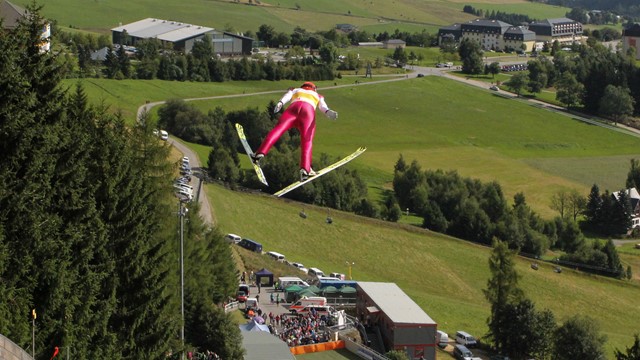
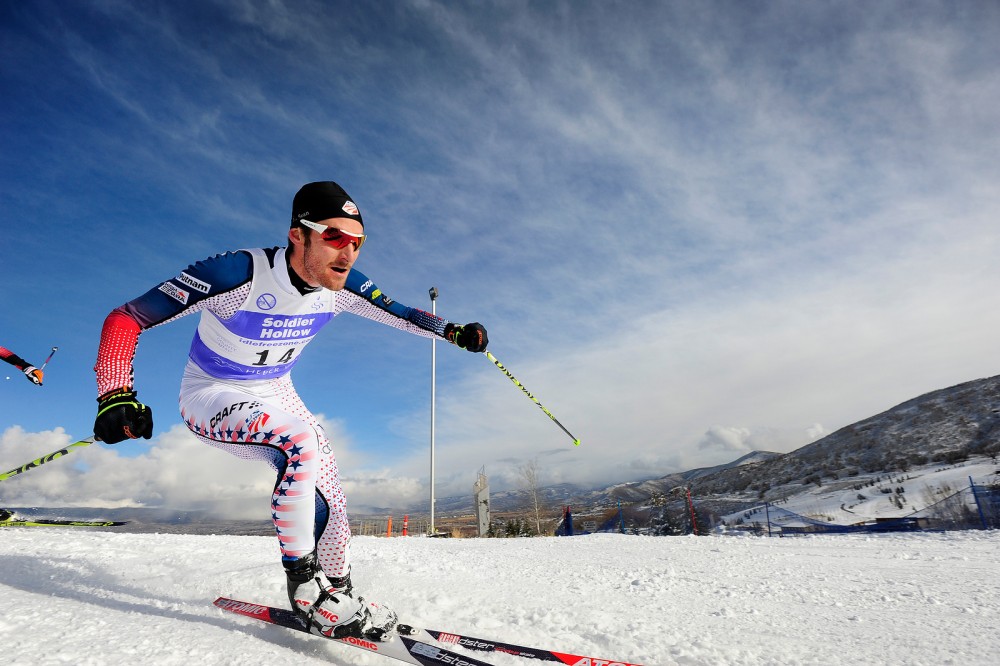
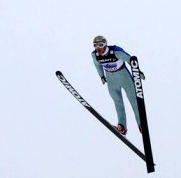
A skier flying during the FIS Nordic Combined Summer Grand Prix 2017 in Oberwiesenthal, Germany. (Photo: FIS)
Green grass, plastic jumping surfaces, big jumps, sunshine, rollerskis and no snow means one thing. It’s August in Europe and it’s time for the International Ski Federation (FIS) Nordic Combined Summer Grand Prix 2017.
Last weekend Aug. 19-20, Oberwiesenthal, Germany hosted a two-day Grand Prix event.
Day 1 featured a two-person team event with the requisite jump and 2 x 7.5-kilometer cross-country race to determine the winners.
Czech Republic’s first team (Czech Republic I), comprised of Tomas Portyk and Dvorak Miroslav, won the team competition in 28:52.9 after starting fourth, 11 seconds behind first. Germany I’s Fabian Rießle and Eric Frenzel raced to second (+0.3), and Germany II’s Jakob Lange and Vinzenz Geiger placed third (+11.2).
The U.S. had two teams entered. Bryan Fletcher and Taylor Fletcher (U.S. II) placed 12th (+2:37.0) while Jasper Good and Ben Berend (U.S. I) finished 14th (+3:03.5).
Day 2 of racing was an individual normal hill/10 k Gundersen start.
Austria’s Mario Seidl claimed the win in 25:18.5 after jumping to first and starting the 10 k four seconds ahead of Japan’s Akito Watabe in second. Germany’s Frenzel raced from ninth to second (+10.5), after starting 46 seconds after Seidle. Rießle finished third (+12.3), up from fifth in the jump, while Watabe narrowly missed the podium in fourth (+14.2).
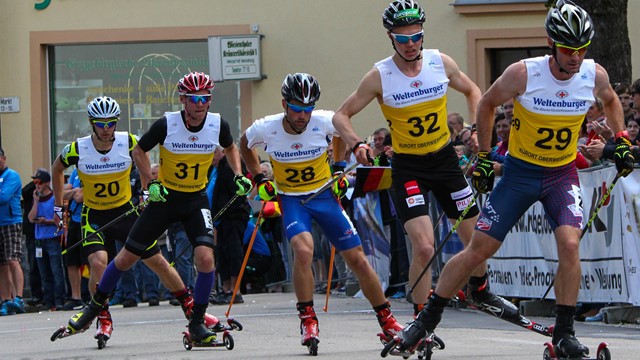
Bryan Fletcher (29) during this weekend’s Summer Grand Prix in Oberwiesenthal, Germany. He finished in 20th in Sunday’s individual normal hill/10 k event. (Photo: FIS)
Four U.S. skiers competed on Sunday, and Taylor Fletcher led them at the end of the day in 11th (+1:17.6) after jumping to 33rd and starting 2:01 minutes behind Watabe. Bryan Fletcher finished 20th, Berend 33rd, and Good 34th.
In an Instagram post, Taylor Fletcher described his first individual race of the series.
“First individual race in the books. I had a decent jump in a hard competition,” he wrote. “I started 33rd and ended up finishing 11th. I had a lot more to give but I thought I had another lap (I wish we did) before the coach said this was the last lap. Now @USAnordic is on the way to the next leg ready for another crack at it!!”
The Summer Grand Prix continues Aug. 23 with another normal hill/10 k in Tschagguns, Austria, and concludes in Oberstdorf, Germany, with back-to-back large hill/10 k competitions Aug 25-26.
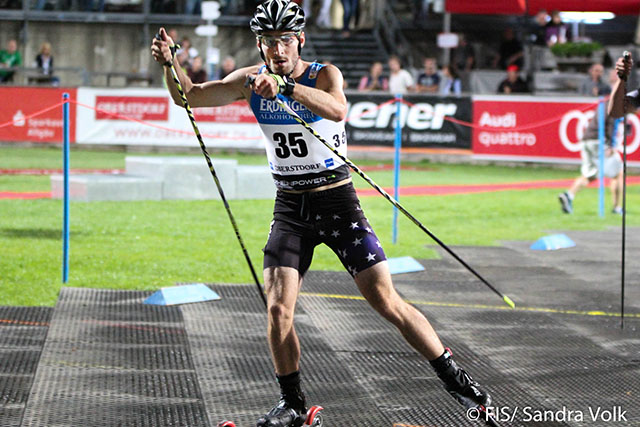
Taylor Fletcher racing in Oberstdorf, Germany during the 2016 FIS Nordic Combined Summer Grand Prix in September, where he placed 15th overall in the series. (Photo: FIS/Sandra Volk)
Shaking out white, sand-filled training shorts is hardly a thing many skiers find themselves doing prior to an autumn morning interval session. Nor is swimming with sea turtles a typical regular-recovery run substitute.
However, this past October, U.S. Nordic Combined A-team member Taylor Fletcher did a little of both. The 26 year old’s ‘spring break’ came six or seven months early, or seven months late, depending how one looks at it, with his final days of fall prep for the 2016/2017 season spent beach bumming in Cancun, Mexico.
U.S. Nordic Combined skier Taylor Fletcher (l) with his girlfriend and U.S. freestyle skier Kiley McKinnon during a vacation trip to Cancun, Mexico, this past October. (Photo: Taylor Fletcher)
Fletcher, who has been competing for the U.S. Nordic Combined team since the age of 19, was not afraid of the non-traditional preseason training week. Viewing himself (along with his older brother Bryan Fletcher) as “more of a seasoned veteran on the team”, Taylor greeted the vacation as a way to mentally and physically unwind from his biggest training block before bringing in the new season.
“The hardest part was getting off the plane from the really warm weather in Mexico and realizing it wasn’t much colder [in the U.S.],” Fletcher, originally from Steamboat Springs, Colo., said on the phone in late October.
The seven days of surf and sun — which he spent with his girlfriend and U.S. freestyle skier Kiley McKinnon— were well-earned by the end of the fall for Fletcher.
With U.S.A. Nordic Sport’s recent hiring of nordic-combined head jumping coach Nik Huber, who is based in Austria, Fletcher amped up his jumping training.
“It was no joke that we were definitely on the struggle bus last year with our jumping,” Fletcher said. “We had the opportunity to get a new coach after the organization let go of Greg [Poirier] and we were very fortunate to be contacted by Nik Huber … he brings a new technical edge and gives us new ideas and passion about the jumping side.”
While the months of June and July were dedicated to jumping for Fletcher, the end of August included travel to Oberwiesenthal, Germany, and Villach, Austria, for the Summer Grand Prix, which included a team sprint and an individual 10-kilometer event in Oberwiesenthal and a 10 k competition in Villach.
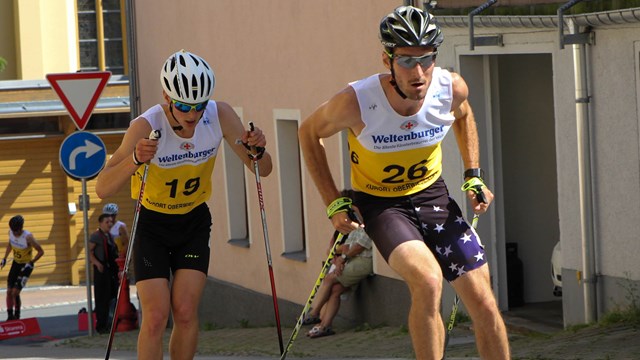
U.S. Nordic Combined skier Taylor Fletcher (26) racing to the fastest time of the day and seventh overall at the Summer Grand Prix in Oberwiesenthal, Germany. (Photo Sandra Volk/FIS)
Fletcher finished in seventh overall in the Oberwiesenthal 10 k and did not start the Villach 10 k. He and his teammate Ben Berend raced the team sprint together and finished 14th overall.
“We’ve just been working on the last part of the flight: making sure you’re poling to the bottom of the hill, making sure your tails touch,” Fletcher explained. “Just eking out every meter possible and when you add all those things up it can be ten to fifteen meters.”
Though 10 to 15 meters may not sound like a lot initially, in a nordic-combined competition, it could be the difference between a one-second versus a nearly two-minute start deficit. For an athlete like Fletcher, who is notorious on the World Cup circuit for his adeptness on the cross-country side of the sport, the prospect of him obtaining even stronger start positions via jumping may bring him closer to the podium.
“For a guy like me, to be that much closer to the front, it really scares a lot of people,” Fletcher said. “That was kind of the reaction we were getting from the test events this summer.”
Following the Summer Grand Prix, Fletcher flew back to Park City, Utah where he visited his older brother, Bryan and newborn niece, Ellery Fletcher. After playing uncle, Fletcher returned to Europe for a full month to train in Slovenia, Austria and Germany.
Taylor Fletcher charges around a corner in a 10 k FIS Nordic Combined Continental Cup cross-country race last season at Soldier Hollow in Midway, Utah. (Photo: U.S. Ski Team/Tom Kelly)
“That was something that I really haven’t done,” Fletcher explained of his decision to live in Europe for a full-month this fall. “It was good to step into the European style, cook my own food and…get in some really quality training there.”
Fletcher started his NoCo season with the opening World Cup races Kuusamo, Finland, where he finished a 40th in the individual large hill/10 k event.
The second weekend of World Cup racing in Lillehammer, Norway, saw Fletcher finish with the fastest course time (24:44.7) for 26th overall in the individual 10 k event after he jumped to 48th and started 2:50 back from the leader. He improved the following day, racing to 22nd overall in the individual normal hill/10 k in Ramsau, Austria, after jumping to 46th and starting at a 1:46 deficit.
While Fletcher indicated that he was “not expecting to go to Ruka and Lillehammer and win every event,” he is confident in his ability to be a regular contender for top-10 finishes and podiums as the season progresses.
“That’s something that I’m really pushing for, be consistently in the top 10 and fighting for as many podiums as possible this season,” Fletcher said.
***
We asked Fletcher to give our ’17 Questions for 2017′ a go. Here are his responses:
1. Biggest change in your life in the last five or so months since the ski season ended?
It a lot has happened since the end of the 2016 season. First of all, I am no longer a member of the U.S. Ski Team. Secondly we have been able to hire a new jump couch from the Norwegian team. This has been the biggest impact as now I have been able to make some big strides in my jumping performance as we head towards Lahti world championships. Most recently, It was the election for the new president. I am in disbelief that Donald Trump is now the leader of our country.
2. Biggest change in your training?
I have been focusing a lot on the jumping side again. With Nik Huber and Martin Bayer at the helm for jumping, I have been able to work on parts of my jumping that has struggled for the last couple years. I have been much more consistent on the hill than in years past and I think that is huge for me. We worked hard this summer in the gym, trying to build the strength and speed in the legs to become more explosive on the end of the jump.
3. Major areas of improvement you’ve seen so far?
My position on the In-run is much better as I am more compact but long and not so crunched. This is allowing me to generate more power on the takeoff which translates to speed and height at the bottle of the hill.
4. Whom you’ve been working closest with this offseason (coaches or training partners)?
I consider my offseason, March 15-April 1st. There I was working closest with the alpine skis and couch. But during the training season, I have been with the team every day essentially. This is one of the best parts about the Nordic Combined team as we all train together and continue to push each other in every session. I live with Ben Berend, so unless it is a team training day, Ben and I will go out and do something together.
5. Best trip in the last five months (and why)?
I just returned from Mexico with my girlfriend Kiley. I have never gone on a vacation this late, but It was really nice to unwind and relax before the season starts. We swam with turtles and laid on the beach. I was able to get a bunch of early morning runs in as well which was nice to explore the area.
6. Favorite cross-training?
In the spring it is certainly road biking and some races. As the summer processes I put the bike away and went on more hikes. These were a great way for me to get some training in with my GF as she could easily go with me and she really likes to hike.
7. Favorite non-athletic activity or pastime this summer?
Anytime I can get out on the golf course I love it.
8. Song that was your jam this summer?
She Knows — J Cole
9. All-time favorite race moment?
Winning a world championships medal with my brother and Bill Demong in 2013. To share the podium with Bryan is something I will never forget!
10. First thing you pack in your bag when you leave for Europe?
Probably socks because that is the first drawer on my dresser. First thing that I think of is my passport which lives in my travel backpack.
11. Venue/event you’re most excited to visit this season?
Holmenkollen. no other venue can beat it. But honestly I am most excited to get started and hopefully kick ass.
12. Who will win the men’s and women’s World Cup titles this year?
Men’s Nordic combined is being dominated by Eric Frenzel, I think someone else will win and I feel that it will be Johannes Ryzdek from Germany.
13. Biggest sacrifice you feel you’ve made choosing this career path?
Not having money from a normal job.
14. If you could change one thing about your sport, what would it be?
I would change it so world cups for all nordic events would be more possible in the United States. Anyone I talk to about Nordic seems to love it, but they never get to watch it.
15. What did you have for breakfast this morning?
Cinnamon Swirl toast with butter and one poached egg.
With a recent rule change, jumping suits used in both nordic combined and ski jumping will have to be form-fitting. The new rule could have significant impact on how athletes jump.
In order to legally compete in any event sanctioned by the International Ski Federation, there are 47 pages worth of rules regarding equipment that athletes must comply with. Within these pages, collectively of the Specifications for Competition Equipment and Commercial Markings, certain equipment is forbidden (like collapsing poles) and a ski’s minimum weight is limited (to 750 grams per pair for cross-country).
Four whole pages of that document are dedicated to the fabric and construction of ski jumping suits. At the FIS Congress last month, a particular one-sentence modification was made to that section that could have a far-reaching impact on jumping and nordic combined: the maximum tolerance in the size of a jumping suit went from a loose-fitting 6 centimeters greater than body size to no tolerance at all. Beginning with the Summer Grand Prix this July, nordic combined athletes will be jumping in form-fitting suits.
This may seem like a tiny equipment rule change, but suit greatly affects an athlete’s jump. First and foremost, a looser suit has extra surface area to catch more wind during flight. Its greater flexibility allows for more mobility in the upper body and legs during an in-run.
Nordic combined inherits its jumping equipment rules directly from the ski jumping section of the rulebook. According to U.S. Ski Team (USST) Head Coach Dave Jarrett, who attended Congress where the rule was finalized, the ultimate intention of the zero-tolerance suit is to minimize the wind’s effect on the outcome of jumping competitions. In theory, this objective will be realized in several aspects of the sport, most obviously by making the suit less like a sail.
“Think of it like those wing suits for base jumping,” Jarrett said. “If you have one of those, obviously you could jump farther compared with an alpine suit. That’s the idea.”
The rule could also leave less room for subjectivity in pre-comp suit inspections and level the playing field for small teams without the budget to test hundreds of different suits, which run around $500 dollars each.
The intent sounds straightforward enough, but in practice, athletes and coaches don’t think the rule will have the desired effect. Jarrett says FIS didn’t extensively test tighter suits prior to passing the rule, which puts teams in an uncertain position until they see how the suits actually perform in competition and find out how controllers will enforce the rule.
“It could be hard to enforce as it’s written now; it’s one of those things where we don’t know if it’s going to serve the purpose it’s intended to do,” Jarrett said. “I really wish they would have tested it before just passing judgment down saying, ‘This is what we’re doing; everybody’s got to change.’ We don’t know if it’s going to work.”
Bryan Fletcher and his USST teammates have long practiced jumping in skin-tight alpine and cross-country suits just for the added challenge, and have experience with less body resistance in training.
“The tighter suit is definitely going to make a difference on the jump hill,” Fletcher said.
But experience with tighter alternatives in training doesn’t translate directly into knowledge of the new suit’s effect. World Cup competition suits must be made out of a specific fabric manufactured by the Swiss textile company Eschler. Unlike the cross-country and alpine suits used in training, it measures about a centimeter thick. As of now, athletes must use that same fabric in their new form-fitting suits, which presents some practical challenges.
“We’ve already made a couple suits here, and it’s unclear whether the seams will hold. You’re using material that has to stretch but maybe wasn’t supposed to stretch that much,” Jarrett explained.
Eschler might make a more elastic material to accommodate the new rule, but it won’t be available immediately. Meanwhile, athletes will be back to international competition come July for the Summer Grand Prix whether a new fabric is in production or not.
“A lot of questions need to be answered, and they’ll only be answered through trial and error, unfortunately,” Jarrett said.
Besides uncertainly over the fabric itself, Fletcher foresees the new suits potentially having the opposite of the intended effect on the relationship between wind and results. Athletes jumping with headwind or tailwind will all be jumping at higher speeds in the more aerodynamic suits, but Fletcher thinks that athletes jumping with bad wind will stand even less of a chance that they did before.
“Personally, I think this’ll make wind more of an issue,” he said. “With the tighter suits, if you have good headwind, you’re still going to be able to jump really far. However, if you have tailwind, it’ll make [the wind] that much more effective,” meaning detrimental, to the jump.
With less body/suit surface area, skis will be catching a larger percentage of the wind in flight. From his experience in training, Fletcher expects this to translate to less stability during flight in windy conditions.
“Jumpers will have a little bit less control of their skis, so you’ll probably see the skis moving around a little bit more and jumpers … reacting in order to stay on top and not crash,” he said.
The higher speed itself is another thing for skiers to think about. Through the first part of the flight, Fletcher said speed wouldn’t make much difference, but past the knoll at the bottom of the hill and coming into the landing, “your flight is not going to be as effective. You’re going to be moving faster and you’re not going to be stopping as much air,” Fletcher explained.
This will make it more difficult to carry momentum. “Which, you know, brings up a couple of concerns from the athletes,” Fletcher continued. “With the higher speed and the higher flight line, athletes are worried about jumping too far a bit more than in the past. With the bigger suits you’d be coming into the landing a little bit slower. Now with the tighter suits, you’d be coming in a little bit faster and at a different profile, so the impact to the ground will be a little bit harder.”
Athletes and coaches will see how significant the new suits are in July. Until then, Flecher said that athletes of several nations on the World Cup are trying to figure out the basics, like whether they’ll be able to jump in the same style.
This has been difficult since FIS hasn’t yet specified how the rule will be enforced. For example, members of the Norwegian nordic combined team have spent the last few weeks training with the USST in Park City, Utah. Upon discussing the new suits, the two teams found their respective interpretations of the rule to be different.
With the confusion over the new suits, that natural question becomes: who voted for them? The ski jumping committee was specifically tasked with the item where input from coaches of multiple nations was taken into consideration. Jarrett said there were plenty of nations for and against the rule, and indicated that the issues come less from the rule itself and more from the timing and execution. FIS hasn’t been clear about how it will be enforced, and athletes must adapt to it the season before the Olympics.
Overall however, Jarrett is frustrated with the rule change, which is the latest FIS has made in a series of equipment modifications to control for wind in ski jumping. In an outdoor sport, he says, wind is just something you have to deal with.
“Instead of trying to control something we can’t see and have no control over and can’t predict, we’re just going to have to make sure everything is safe,” he said. “Yes, sometimes certain athletes get unlucky with bad wind while others benefit from a change in direction later on in the day. But, it’s an outdoor sport and that’s the way it goes. But over the course of a season … it seems like everybody’s luck would even out. Sometimes you’d have good luck and sometimes you’d have bad luck.”
Johnny Spillane at World Championships in Oslo, 2011.
Johnny Spillane, three-time Olympic silver medalist in Nordic Combined, returned to competition last week at the FIS Summer Grand Prix. After a long knee injury recovery and subsequently difficult World Cup season left the 31-year-old’s plans for the future up in the air, his participation marked an important decision to continue skiing. The question remains, however: how long will he be back for?
When an odd cliff jump landing put Spillane out for four months with a torn ACL and MCL last July, the 12 year World Cup veteran was no stranger to injury. With years of experience dealing with recurring shoulder problems, US Nordic Combined Head Coach Dave Jarrett called him a “pro at rehab.”
Experienced or not, however, when combined with the break he took from training after Vancouver, the diagnosis left Spillane out of commission for eight months headed into the 2011 season. He didn’t join his teammates in Europe until this January in Seefeld, Austria, with a 44th overall finish.
The 31-year-old seemed to struggle to regain his footing through the rest of the season, especially in the jumps; his best result was a 17th at the pre-World Championships World Cup in Chaux-Neuve, France, and he was far off his jumping form throughout the winter.
As of the end of the season, Spillane’s future plans with the team were left uncertain. In March, he said to FasterSkier, “I still have a desire to keep skiing so it’s a hard decision to make, that’s for sure.”
With his return to competition at the Grand Prix last week, however, it seems Spillane is back in the game, at least for the time being. After the first weekend jumping and rollerskiing in Oberwiesenthal, Germany, where he placed 43rd, he said he felt good and was excited to be back. Despite being disappointed with his first result, Spillane said his knee didn’t give him any trouble, and he felt good overall.
“I wanted to take some time after last season to see how I felt about everything,” he said in a phone interview. “I talked with my family and my coaches, and I’m psyched to be training again.”
Spillane, on the podium three times in Vancouver.
Asked if he is aiming for the the 2013 Val di Fiemme World Championships or what would be his fifth Olympics in Sochi, Spillane didn’t make any promises. With his health never a guarantee, he said he is taking the rest of his career “one step at a time.”
The decision to continue competing on the travel-intensive World Cup circuit became even more difficult with the birth of his daughter Hadley last August. “You definitely have to make adjustments,” he said. “You can’t be quite as selfish as an athlete as you were before.”
Demong in action at World Championships last winter.
Bill Demong and Bryan Fletcher led their Nordic Combined teammates to a “reassuring” start of competition this weekend at the FIS Summer Grand Prix in Oberwiesenthal, Germany. Fletcher kicked things off with an 8th overall in Saturday’s Gundersen format, and Demong led the way to the podium with a 3rd place on Sunday.
Though the Grand Prix series isn’t a World Cup event this year like it has been in the past, Demong said he and his teammates approached the races just as seriously as they would any other.
“These races are about getting us contact, which is hugely important; getting used to racing guys from other nations, skiing under fire, and just getting back in the mindset of dealing with the weather and other competitors,” said the 2010 Olympic gold medalist.
Fletcher’s 8th on Saturday, 38 seconds off of Germany’s Eric Frenzel, was his career best World Cup-level result. “I put together a good jump and a good cross country race, so I’m pretty stoked about it. It’s a great way to start off the Summer Grand Prix,” he said on Sunday, adding that it was great to be able to see that he’s on track for the winter.
Fletcher’s brother Taylor placed 21st overall, and came from a 49th on the hill to ski the 6th fastest time of the day out on the course.
Another highlight of the day was Erik Lynch’s chance to enter a high-caliber race, a rare opportunity for the 17-year-old. As part of the National Training Group that has been training in the Czech Republic for about a month, Lynch was able to take the entry spot left empty by the fact that Johnny Spillane couldn’t join the team in time for Saturday’s competition.
Demong on the podium in Germany (Photo: Dave Jarrett)
“Erik is 17 years old getting essentially a World Cup start,” said Head Coach Dave Jarrett. “[The NTG] was already here and it was a unique opportunity…I think he was a little bit awe-struck but he wasn’t intimidated by any means. He certainly skied pretty good.”
Demong struggled on Saturday with the jump portion, and a broken pole in the fist lap on rollerskis left him off the pace for the remainder of the race, where he ended up in 30th. Though he could have jumped better and skied faster, Jarrett noted on Saturday, “Bill knows what he needs to do.”
With Sunday’s 3rd place finish, it seems Jarrett was right. Demong, who finished 32 seconds behind the winner, Johannes Rydzek (GER), was also the first finisher across the line who had had to ski a penalty loop in the new racing format. He was reassured by how his day went, especially given the step back he took in his preparation last year. “It was my best result in a couple of years at the World Cup level…[and] it was the first real competition this season, so it gives me a lot of confidence going into the winter,” he said on Sunday.
Taylor Fletcher ended up with five penalty laps and finished 36th, while his brother Bryan finished 40th with four penalties.
Johnny Spillane returned to competition after a torn ACL, MCL and meniscus last summer left his plans after the World Cup season uncertain, and completed four penalties to finish 43rd.
Fitness-wise, Spillane said he thinks everyone is where they should be. “I think everybody is in a pretty similar spot; we’ve been training together quite a bit,” he said, though “Bill was damn good.”
“I think all three of us had a good race here,” agreed Demong. “Johnny had a bit of a wake up today, but he’s definitely fit.”
In addition to serving as a good test of their fitness, the debut of the penalty race gave everyone a chance to test out the tactics and logistics involved in a format being added to the World Cup this season. Based purely on how far they jumped, skiers had to complete a certain number of 150-meter penalty laps throughout the cross-country portion of the competition. Athletes could complete their penalties at any point during the six laps of the mass-start race, except on the first and last legs.
The trial got mixed reviews. From the coaches’ perspective, Jarrett said it was definitely interesting, but there were also issues that couldn’t have been predicted until the race was run. Chief among them was the fact that the course was too narrow for a mass start rollerski race. He said it was also hard for him to tell how his athletes were really doing throughout the competition, as it was difficult to keep track of who had already done their penalty laps.
The confusion especially affected the athletes. “There was a lot of chaos,” said Bryan Fletcher. “You had no idea where you were in the race. All of a sudden people in front of you disappeared to do penalty laps.”
The U.S. athletes went into the race with the strategy of completing the penalties when there were as few people clogging the loop as possible, with the expectation that everyone else would try to get them out of the way early and they’d have to wait until the end of the race. But when the first opportunity came and no one was in the penalty zone, Spillane said they decided to go for it.
“Tactically, it’s hard to tell if it was a good or bad decision,” he said.
Competition was also affected on the hill, where the elimination of wind compensation (and all other style points) had officials trying to send everyone off with comparable amounts of wind, causing the jumps to take twice as long as they usually do. Despite the effort, Jarrett said conditions still made the jumping “a luck of the lottery.”
“We’ve had quite a few formats in the last few years that I’d like to see introduced [on the World Cup] before this one,” said Demong. “It could be exciting, but it made the competitors wait around. The mass start meant that a lot of people caught a ride off the pack that wouldn’t have otherwise.”
Though there were problems with the format, there will be time to make adjustments before it appears on the World Cup.
“They have some formatting issues to solve; tomorrow there’ll be a meeting to get feedback from coaches, and a committee will meet on Tuesday and come up with solutions,” said Jarrett.
The FIS Summer Grand Prix continues in Liberec on Wednesday and ends with two more competitions in Oberstdorf on Friday and Saturday.
OBERTSDORF, Germany (Aug. 8) – A pair of brothers represented the U.S. Nordic Combined Team on Sunday in the final Grand Prix staged in Obertsdorf. Brett Camerota (Park City, UT) slid inside the top-10 for the first time, finishing first for the U.S., while Germany’s Johannes Rydzek won the competition.
The nordic combined competition was tight, with the top nine men separated by 20 seconds as they pushed across the finish line in the cross country portion. Rydzek, who finished second Saturday, picked up his first Grand Prix win of the 2010-11 season with a time of 25:47.90, almost 12 seconds ahead of second place finisher Francois Braud of France.
The fight for second place was fierce with places second through seventh finishing within a second of each other. Braud crossed the line first in 25:59.80, one-tenth ahead of third place’s Janne Rynnaenen of Finland, who shared the same time as Germany’s Eric Frenzel in fourth.
“It was another solid day. Both Eric and Brett [Camerota] (Park City, UT) jumped very well and were ninth and 10th after jumping,” said U.S. Nordic Combined Head Coach Dave Jarrett. “Brett skiied a solid race and was looking good the whole time. It was his first ever top-10, which is awesome.”
Brett Camerota finished in ninth, clocking in at 26:07.40. Brett Camerota was the top U.S. competitor, ending the race less than 20 seconds behind Rydzek and around seven seconds out of third.
Bryan Fletcher (Steamboat Springs, CO) scored another set of points finishing within the top-30 in 23rd. Taylor Fletcher (Steamboat Springs, CO), who had the fourth fastest cross country time, and Eric Camerota finished respectively in 31st and 48th.
“We are psyched and moving forward,” said Jarrett.
The summer Grand Prix series will continue Friday and Saturday, Aug. 13-14 in Oberwiesenthal, Germany.
OFFICIAL RESULTS
FIS Grand Prix
Obertsfdorf, Germany – August, 8, 2010
Nordic Combined
1. Johannes Rydzek, Germany, 25:47.90
2. Francois Braud, France, 25:59.80
3. Janne Rynnaenen, Finland, 25:59.90
4. Eric Frenzel, Germany, 25:59.90
5. Tomaz Druml, Austria, 26:00.30
–
9. Brett Camerota, Park City, UT, 26:07.40
23. Bryan Fletcher, Steamboat Springs, CO, 27.11.50
31. Taylor Fletcher, Steamboat Springs, CO, 27:41.40
48. Eric Camerota, Park City, UT, 29:38.20
The Nordic Combined season 2010/2011 is officially beginning with the FIS Summer Grand Prix that is scheduled for 7th-8th August in Oberstdorf (GER) and Oberwiesenthal (GER) on the following week-end, 13th-14th August. The FIS Newsflash caught up with Uli Wehling, FIS Race Director Nordic Combined, ahead of the competitions.
Q. Uli Wehling, what are your thoughts about the summer season, which starts at the upcoming weekend?
A. Nordic Combined has a long-standing tradition of summer competitions. Every year, the summer series provides a great opportunity for athletes to meet other athletes and figure out where they stand relative to others. The big change this year is that the competitions will count towards the quota system of the World Ranking list and that will be a completely new situation for all teams.
Q. How will the rule change of holding the race on roller skis instead of inline skates impact the competition?
A. I think the impact will not be so great. In the last few years, inline skates were only used for the competitions but the actual summer training was always done with roller skis. We were fortunate now to have found the company Barthelmes from Zella-Mehlis (GER), which did a fantastic job of producing a special type of roller skis for Nordic Combined. The races will be somewhat slower with the roller skis but it will allow us to use more inner city courses or special roller ski tracks, which will result in more attractive competitions.
Q. For the first time the Summer Grand Prix is also considered as the start of the World Cup season. What do you expect from this rule change?
A. We would like to bring our sport forward to an interested Nordic Combined fan family also during the summer months and present it to a wider spectrum of spectators. We intend to increase the quality of our Summer Grand Prix by allowing the nations to take part. It is important for the future to upgrade the financial situation for the teams. This will be a busy job which will start immediately after the last race this summer.
Q. The youngsters will have a platform to compete against each other in the FIS Schüler Grand Prix in addition to the Summer Grand Prix. How important is this event for you?
A. Providing the younger athletes with a platform to compete against each other and their heroes is an important incentive in the buildup of a new generation. In today’s life, leisure time is becoming an increasingly rare commodity and young athletes have to make difficult choices between different activities and find a balance among competing interests. There is a greater chance that younger athletes – given the possibility to also compete in summer – will stick with that discipline. In the future new formats of youth competitions will be developed. The EYOWF 2011, which is held in Liberec (CZE), is an actual example of such a new format for the youth. The first Winter Youth Olympic Games in Innsbruck and Seefeld in 2012 are another example and will be the next highlight for the younger generation. It is crucial that we prepare the athletes for the future by providing them with an age-appropriate competition format.