From the FasterSkier archive — posts syndicated from athletes’ and coaches’ own blogs between 2004 and 2012, kept online as published. Current coverage is at fasterskier.com.

Tag: summer training

  • A Side Quest to Broken Arrow Put Kendall Kramer on Another Team USA

    A Side Quest to Broken Arrow Put Kendall Kramer on Another Team USA

    This article was made possible through the generous support of our voluntary subscribers. If you value coverage like this, please support FasterSkier with a voluntary subscription.

    Cross-country skiers rarely travel light. For the Broken Arrow Skyrace, however, Kendall Kramer’s entire racing kit amounted to one pair of shoes and one outfit, both tucked into a carry-on. But after a winter ruled by equipment and logistics, simplicity was part of the point.

    The self-funded trip to California with her mother was supposed to be, in Kramer’s words, “a fun little side quest.” She had watched Jessie Diggins race at Broken Arrow in previous summers and submitted an elite application in February, when the event was already sold out. If the organizers accepted her, Kramer decided, she would take it as a sign to go. They did, and four months later the side quest sent her home with a place on another U.S. national team.

    Kramer completed the June 19 Ascent in 48 minutes, 14 seconds, finishing 11th among women in an international field and fourth in the separate USATF Uphill Mountain Running Championships. The latter result earned the 2026 Olympian one of four women’s spots on the U.S. team headed to the World Mountain Running Association (WMRA) World Cup Finale in Quebec this October.
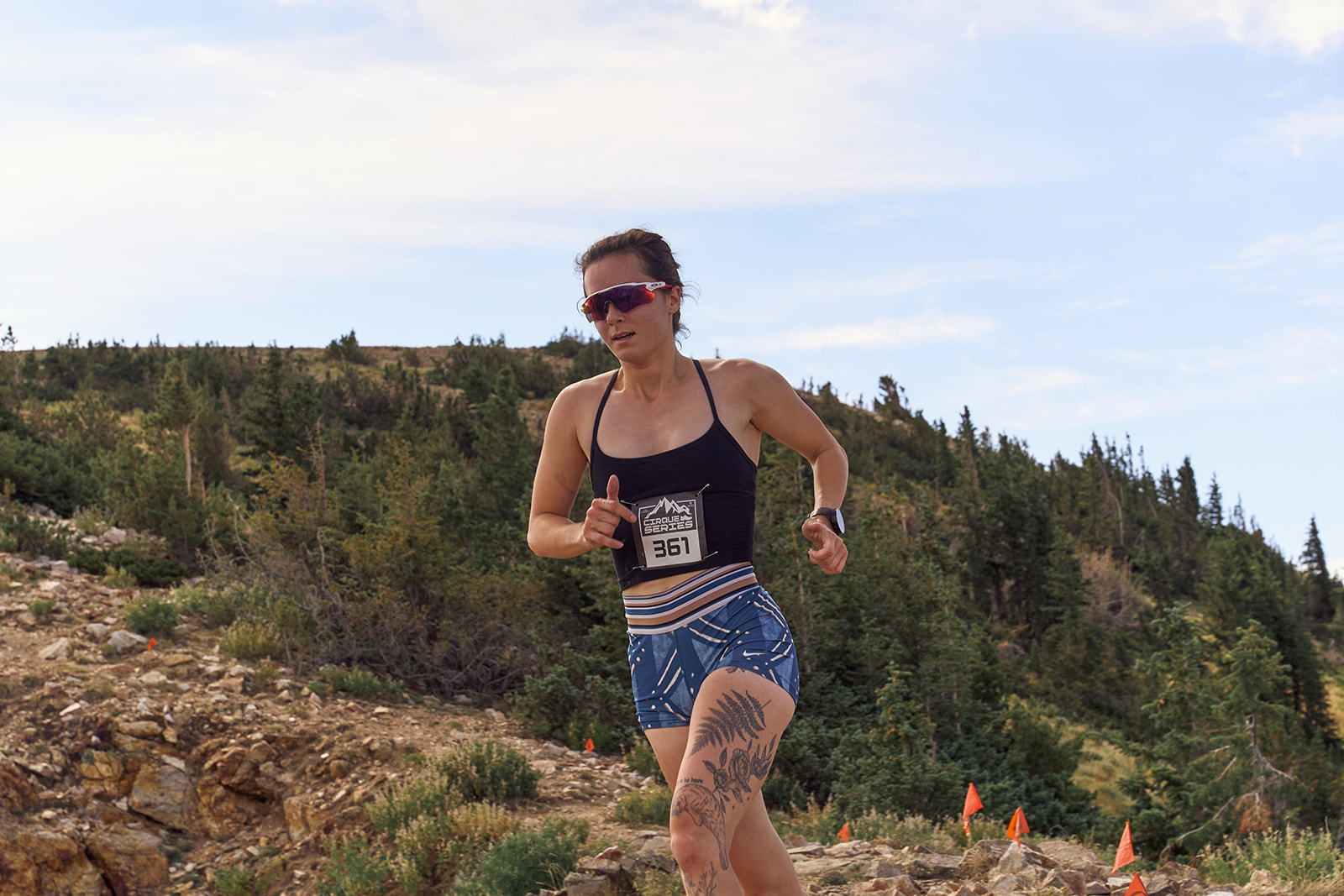
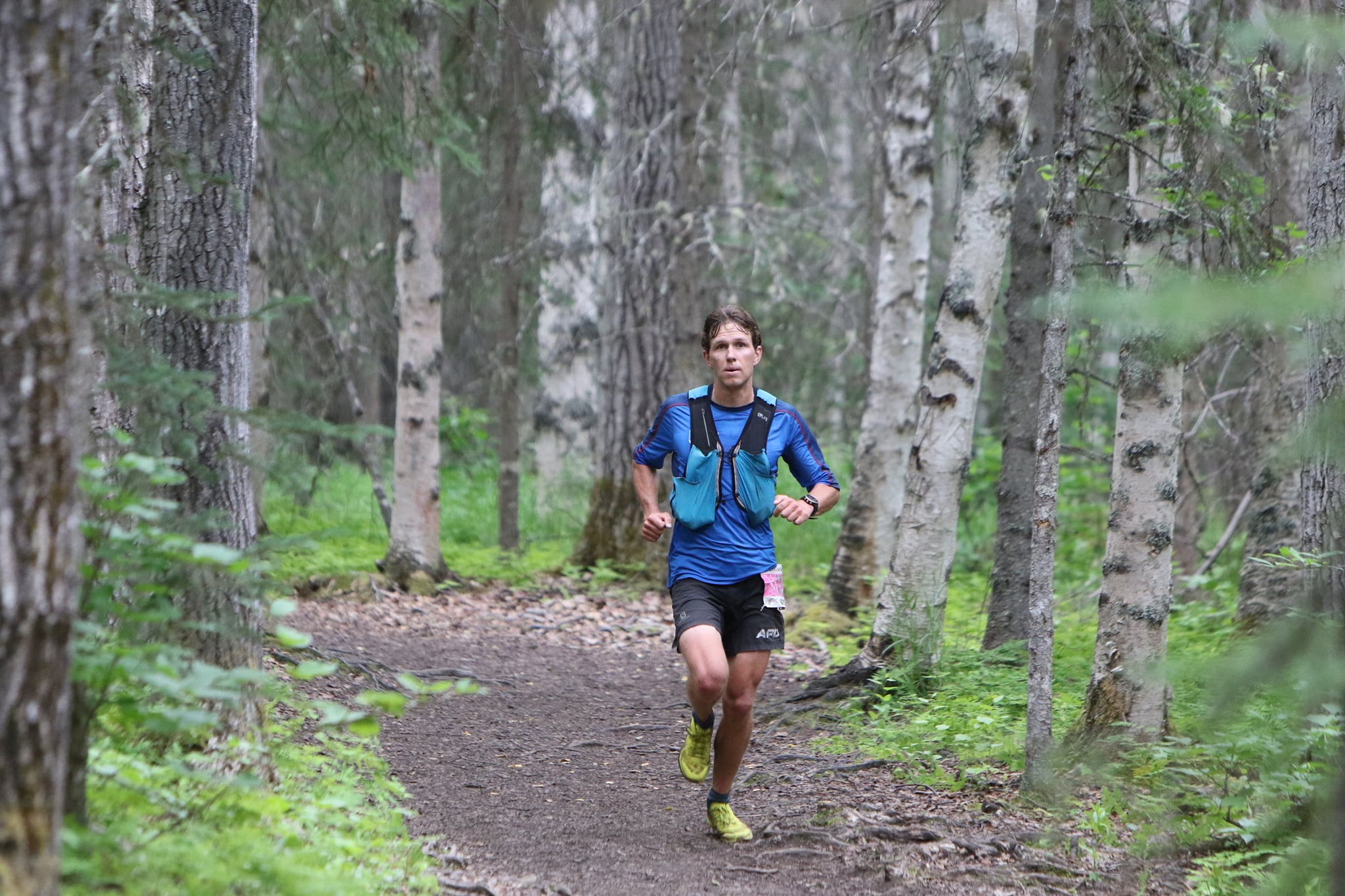
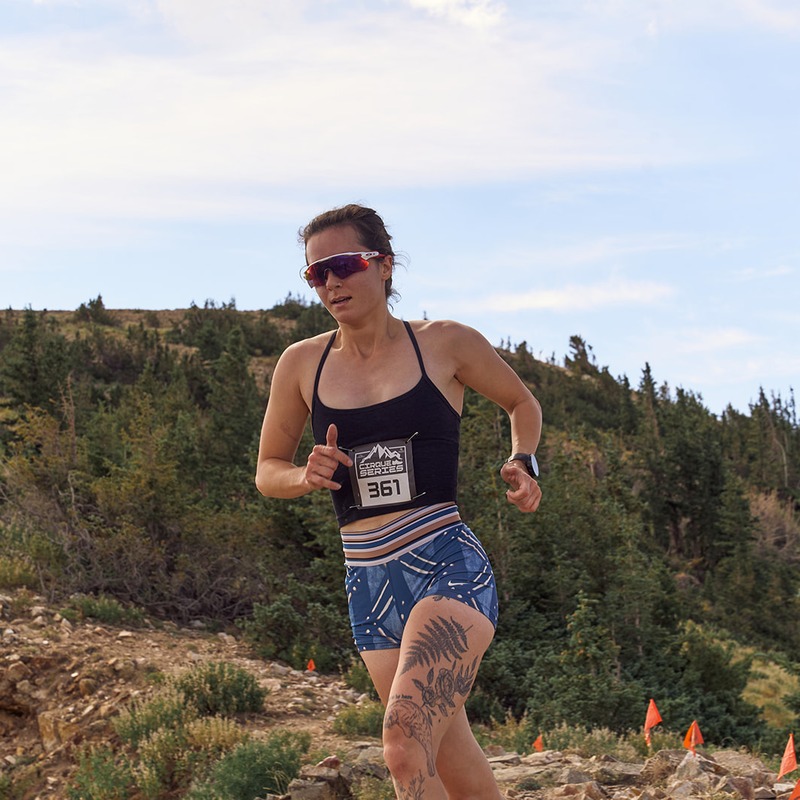
    Kendall Kramer running uphill on a rocky mountain course wearing race bib 361.
    Kramer climbing at the Cirque Series race at Alta, Utah, in 2025. Summer mountain races have been part of her calendar for years. (Photo: Austin Elliott Photography)

    A Race Within the Race

    The Broken Arrow Ascent rises 2,840 feet over 3.61 miles at Palisades Tahoe, ending near 9,000 feet on Washeshu Peak. The course offered Kramer a familiar kind of discomfort. Skiers spend plenty of summer training sessions running uphill, and she has raced mountains throughout her life in Alaska. She was also drawn to an uphill-only event, where she could attack the climb without risking the pounding, falls and injuries that can accompany a technical descent.

    The altitude complicated the effort. An ascent race can feel like a sprint, Kramer said, because its short length allows runners to push rather than settle into prolonged power hiking. Near 9,000 feet, that approach requires more restraint. Still, years of ski racing and training at elevation gave her a sense of how to manage those obstacles.

    Kramer had entered with a tangible goal: finish in the top 10 and earn prize money. The field was strong enough that doing so, she felt, would also establish her among other serious mountain runners.

    She started picking off competitors as the course climbed and found another surge near the end, when a cluster of women remained within reach. Kramer lost track of her exact position amid the passes but knew she was close. She crossed two seconds behind 10th place.

    “I was like, ‘Oh darn,’” Kramer said. “At least it was a good effort race.”

    Weeks earlier, the elite runners had been told that the Ascent would double as the USATF uphill championship and a qualifier for the World Cup Finale. Kramer bought a USATF membership and entered that competition, too, mostly because there was no reason not to. She skimmed the qualification information without giving it much thought.

    “This field is crazy,” she remembered thinking. “That’s not really going to be me.”

    After the race, Kramer and her mother began walking from the summit toward the tram. She checked the overall results first. Then she noticed a separate view for the USATF championship, which removed athletes who were not entered in the national race. Kramer had nearly forgotten about the competition within the competition.

    Her name was listed in fourth, and the top four qualified.

    “I totally didn’t factor myself into that,” Kramer said. “It was definitely a surprise. I was really proud that I could make a team like that.”

    Kramer may not have expected the qualification, but it drew on years spent building the aerobic engine and uphill strength that mountain racing rewards. She simply had not imagined that an ability maintained partly for balance and enjoyment would carry her onto another international team.

    A young Kendall Kramer running a road race alongside an adult runner wearing a race bib.
    Kramer came to athletics through running before she found skiing. Both of her parents are runners. (Courtesy photo)

    A Runner First

    Running has never felt like a secondary sport to Kramer, even as skiing became her profession.

    “Running was always my main sport, in the sense that that’s what I got into when I got into athletics,” she said.

    Both of her parents are runners, and running shaped the athletic culture of her family in Fairbanks. She tried soccer and baseball, but she liked the directness of a sport in which her work and her result felt closely connected. Skiing came later because, as she put it, it was “what all the cool kids did.”

    The two sports eventually became inseparable. At the University of Alaska Fairbanks, Kramer competed in both throughout college. She won three straight Great Northwest Athletic Conference cross-country titles and finished second at the 2024 NCAA Division II Cross-Country Championships. Four months later, in the final ski race of her collegiate career, she won the 20-kilometer freestyle at the NCAA Skiing Championships.

    Kramer’s skiing has since reached a new level. She made her Olympic debut in Italy in February and placed ninth in the World Cup skiathlon in Falun in March, her first top-10 World Cup result. Yet running still supplies something that skiing cannot.

    “If I didn’t have it, I wouldn’t be able to handle all of the skiing that I do,” Kramer said. “I like feeling like I have another athletic outlet to keep me happy, because skiing can be fleeting and have all sorts of disappointments with equipment and stuff. Running feels more in control.”

    That control is physical, but it is also logistical. A ski race can hinge on wax, snow, weather and the work of moving equipment from one place to another. Running asks much less before the gun goes off. On a running trip, Kramer said, there is more space to enjoy the people and the place around the competition.

    “It feels like it adds to your life,” she said. “It’s so manageable.”

    The harder question came when her college cross-country career ended. Kramer loved the sport’s courses, team culture and changing terrain, but there is no obvious post-collegiate version of NCAA cross-country. Track and road racing did not offer the same pull, and she was not ready to build her running life around marathons on pavement.

    Mountain racing offered another route. In Alaska, it had never felt like a separate niche so much as part of the local calendar. Races such as Mount Marathon and the Cirque Series became summer traditions, with familiar faces returning to familiar mountains each year. Two weeks after Broken Arrow, Kramer placed seventh at Mount Marathon in 52:53.

    “I loved running cross-country and being in the woods and going along a course that has different aspects,” Kramer said. “You have an uphill and downhill, and you have to change, just like skiing.”

    Mountain racing preserved the parts of running Kramer loved and opened a path to international competition she never expected to enter.

    Kendall Kramer racing the World Cup skiathlon at Falun, Sweden.
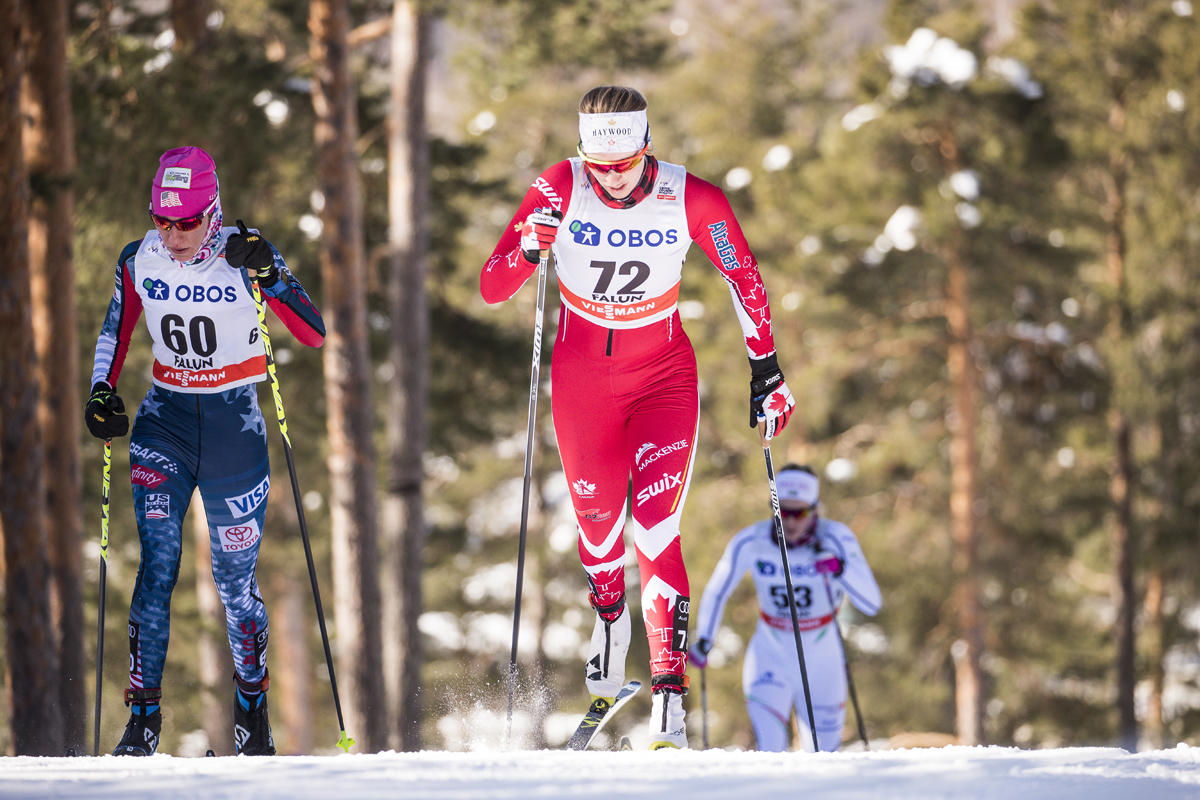
    Kramer on her way to a career-best ninth in the World Cup skiathlon in Falun, Sweden, in March. She argues that summer racing is part of what makes winter results like that possible. (Photo: Authamayou/NordicFocus)

    Keeping a Pulse on Racing

    For Kramer, racing in the summer is not a diversion from ski training. It is one of the ways she makes that training more useful.

    An occasional race does interrupt a perfectly planned week. She may back off for a few days beforehand, then need time to recover afterward. Some skiers see that as lost volume. Kramer believes the costs are outweighed by the chance to revisit sensations that ordinary training cannot reproduce.

    “Racing is very different from training,” she said. “At least I think so, and I think it should be different from training.”

    Kramer likes to race roughly once a month during the offseason. Each start provides a checkpoint on her fitness, pacing and ability to summon focus when a result matters. Those reminders make the first ski races of winter feel less abrupt; she arrives with recent evidence of how her body and mind respond in competition.

    Races also make weaknesses harder to ignore. A disappointing moment can become the direction for the next training block rather than a problem discovered after the ski season begins.

    “Sometimes you don’t get an idea of where you’re lacking and where your strengths are if you don’t tap into that throughout the summer,” Kramer said.

    At Broken Arrow, the crossover was all around her. Olympic ski mountaineer Anna Gibson won the Ascent and the U.S. uphill title in 43:15. Diggins completed all three races, a total of 75 kilometers with more than 16,000 feet of climbing, and finished fourth in the Triple Crown standings. Sophia Laukli has built an elite trail-running career alongside cross-country skiing, winning the 2023 Golden Trail World Series. In August, Gibson placed sixth among women at Switzerland’s Sierre-Zinal, while the recently retired Diggins finished 37th.

    Those examples helped Kramer recognize that mountain running can be more than incidental cross-training. The sport has international races, sponsors and prize money, particularly in Europe. Its U.S. elite pool remains relatively small, and a skier who already possesses a strong aerobic base can become competitive quickly. That does not make the crossover effortless.

    “I’m not going to act like I’m couch-to-mountain-running,” she said. “I’m definitely trying, and I’m also not downplaying the girls who do train for it. But I am saying that ski training works for it, and getting fit in general works for it.”

    The larger benefit may be less measurable than fitness. Elite skiers live by periodized plans: intervals on one day, over-distance training on another, each block designed to build toward winter. Kramer believes athletes can become so protective of that structure that they miss the value of occasionally disrupting it.

    “People are really scared to break away from that,” she said. “But I think you can be a really adaptable athlete and build skills that a regimented training plan can never get you.”

    Her confidence in that approach has been earned over years of combining running and skiing without sacrificing results in either. That history has also built trust with her coaches. An unplanned race or an imperfect training week does not look like recklessness when the larger pattern shows that she understands how to make the two sports work together.

    The mental return matters as much as the physiological one. A summer race provides the competitive charge that long weeks of training can lack and asks an athlete to solve problems in real time: exactly what winter racing eventually demands.

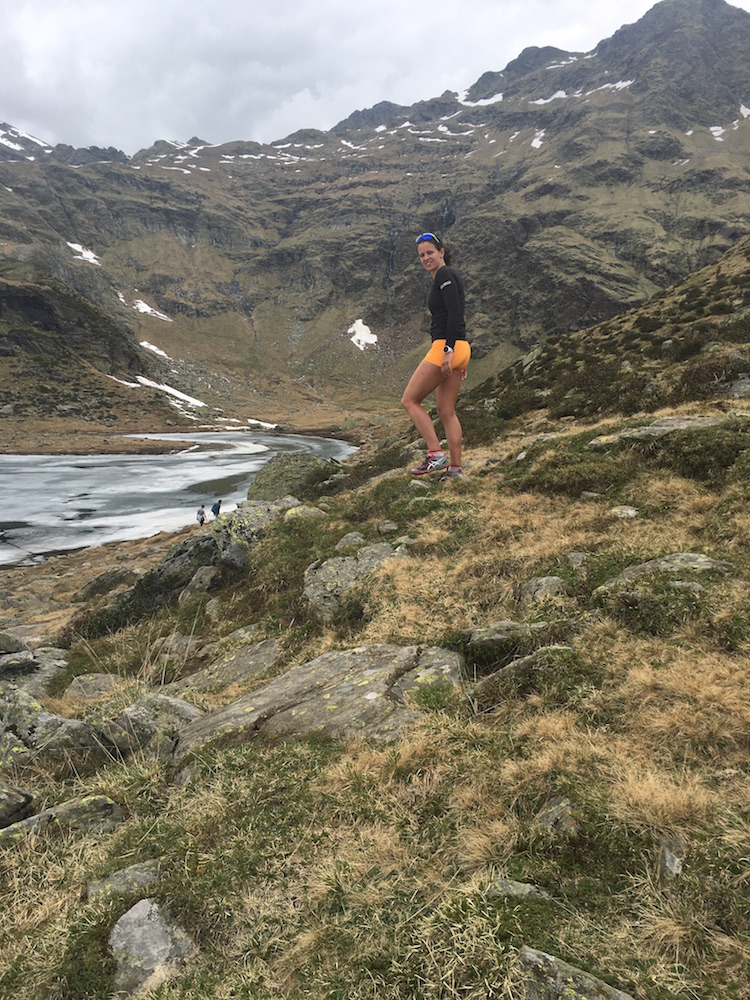
    Kendall Kramer in a running vest above an alpine lake in the Alaska mountains.
    Kramer on a run in the Alaska mountains. Her next start comes Oct. 10 at Mont-Sainte-Anne in Quebec. (Courtesy photo)

    The Next Side Quest

    Kramer’s next test comes Oct. 10 at Mont-Sainte-Anne in Quebec, where the circuit will make its first visit to Canada. The current course listing calls for five kilometers and roughly 800 meters of climbing. It will begin far below the altitude Kramer encountered at Broken Arrow, removing one variable while preserving a steep uphill challenge.

    She wants to finish in the top 10. Broken Arrow showed that she can stay close to that range in a deep international field, and the chance to race without a near-9,000-foot finish has left her curious about what more she can do.

    Beyond Quebec, Kramer would consider mountain races in Europe if a sponsor or U.S. team opportunity made the travel possible. She is not mapping out a second full professional calendar yet. The appeal lies partly in leaving room for opportunities to appear, then being fit and adaptable enough to take them.

    “I would love to look back and see that I took those opportunities,” Kramer said. “Running has never hurt me in the past. I’ve always been able to juggle both.”

    Kramer does not argue that every skier should copy her schedule. She wants more athletes to leave room for the experiences that may not fit perfectly into a training plan but help them handle everything racing asks of them.

    “It can make you a better skier in ways that maybe aren’t the best training on paper,” Kramer said. “But it makes you a good athlete, which comes in handy when you least expect it.”

    At Broken Arrow, that lesson was waiting in a second set of results she had nearly forgotten to check.

    Help Support Our Coverage!

    If you value the thoughtful work and access FasterSkier provides, please consider becoming a Voluntary Subscriber. Your support directly fuels our work to cover the people, places, and moments that make our sport special.

    Join the FasterSkier community!


    Kendall Kramer racing cross-country in an Alaska Fairbanks singlet, number 24, past a course flag line.
    Kramer racing cross-country for Alaska Fairbanks. She won three straight GNAC titles and finished second at the 2024 NCAA Division II championships. (Courtesy photo)
  • Ben Ogden, In His Element:  Part II

    Ben Ogden, In His Element: Part II

    This coverage is made possible through the generous support of Marty and Kathy Hall and A Hall Mark of Excellence Award. Learn more about A Hall Mark of Excellence Award—or about supporting FasterSkier coverage—by contacting info@fasterskier.com. 

    Ben Ogden was kind enough to spend a recent afternoon with FasterSkier assessing his 2022-2023 World Cup season, and discussing the sorts of plans he has for training in this off-season. We met in the barn at the Ogden family farm in southern Vermont. Part I of this interview debuted earlier on FasterSkier. This article represents Part II of Ben Ogden, In His Element.

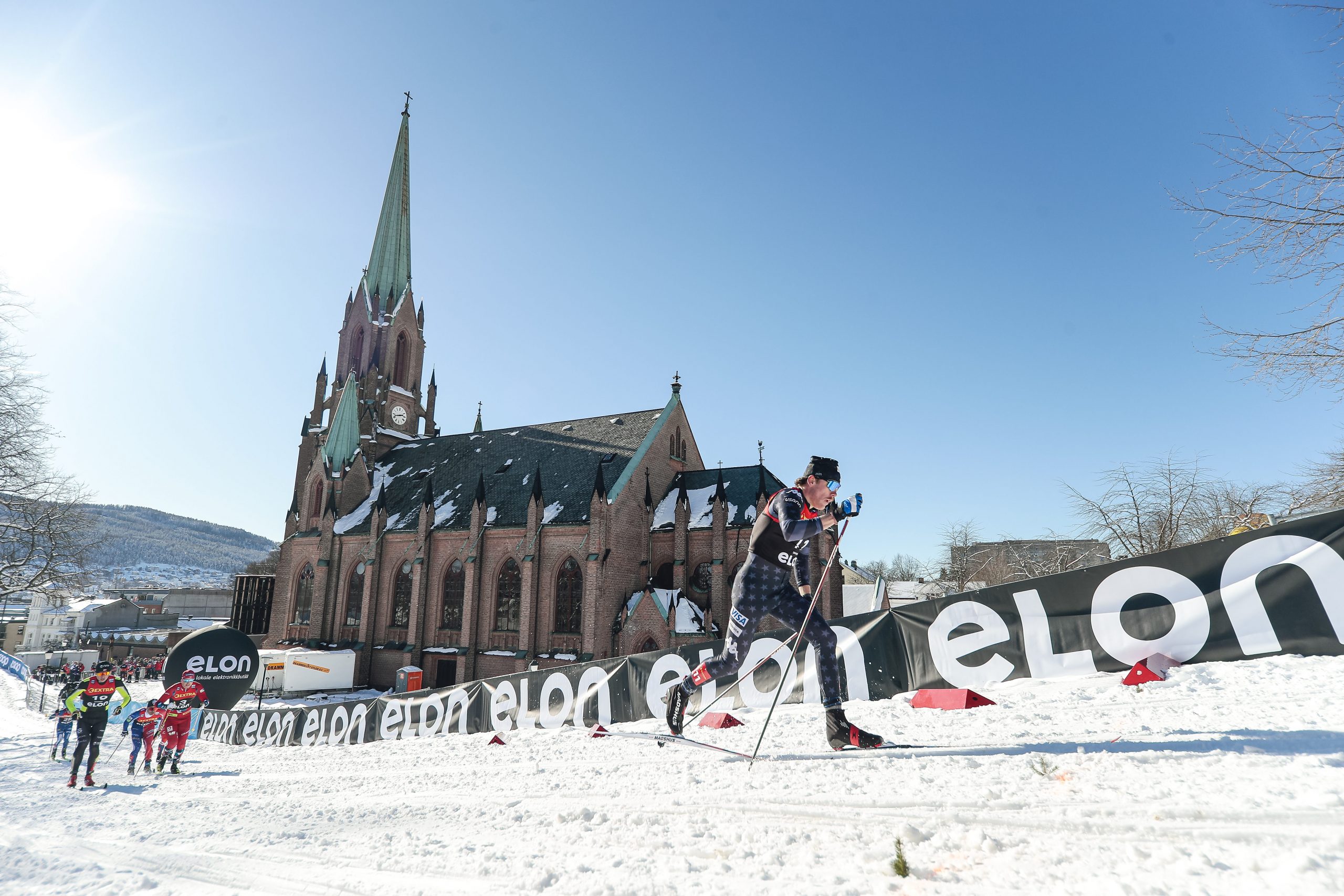
    Making the field pay: Ben Ogden (USA) charging through sprint heats in Drammen, Norway.
    Out with the Old . . .

    When asked whether or not he considered his recent 2022-2023 World Cup campaign to have been a breakthrough season, Ben Ogden expressed a certain amount of satisfaction, but in a thoughtful and circumspect manner:

    “I had good seasons in college, and before college,” Ogden said. “But when that level is done and you move up to the next, you realize, ‘Man, I really need to just work on everything.’ That’s when I began to realize that the old way of doing things—seasons for school, seasons for work and play, seasons for summer training—really had run its course. It was time to become a skier, full time.”

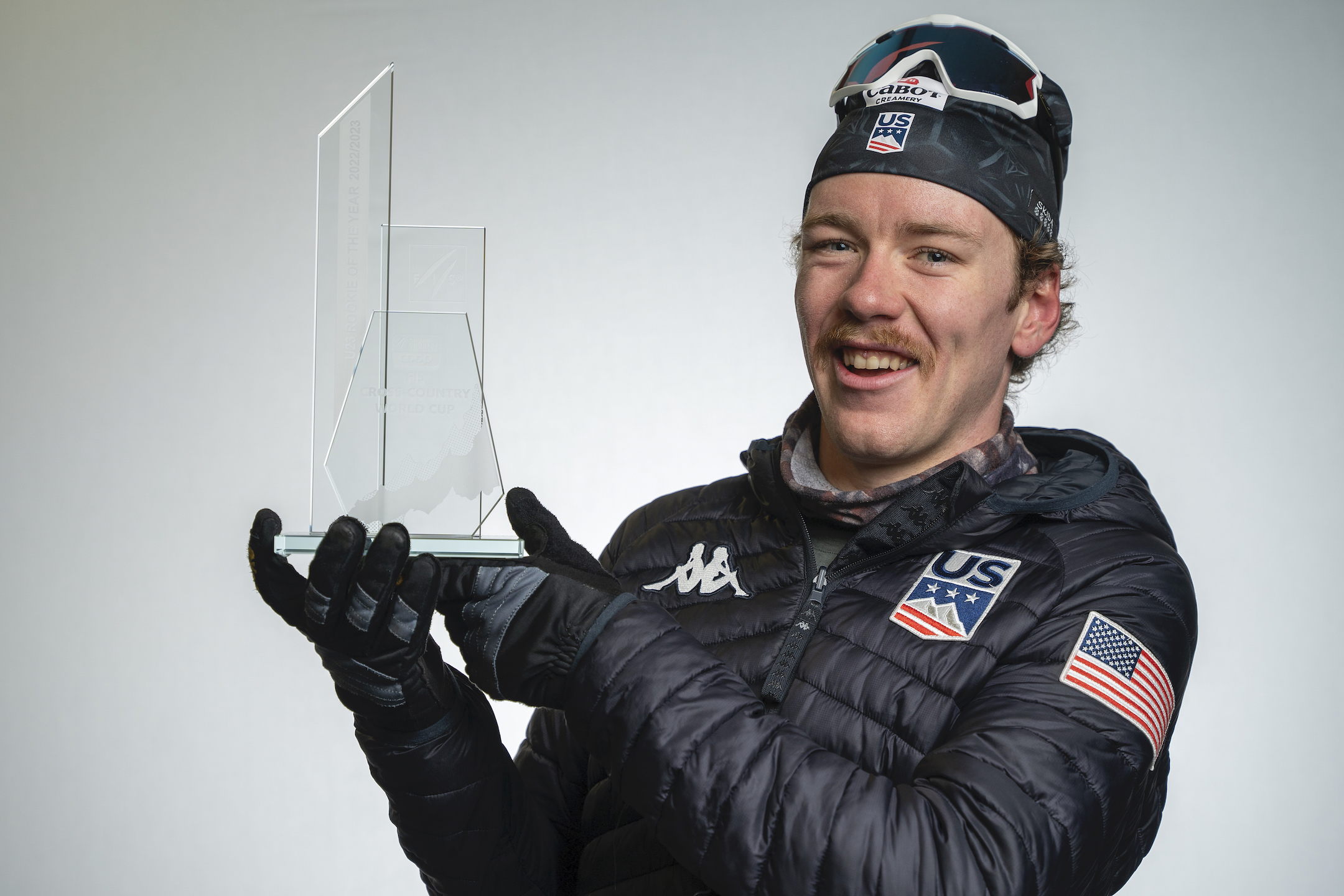
    In 2023, Ben Ogden (USA) was crowned FIS World Cup Cross-Country U23 Champion. (Photo: Thibaut/NordicFocus)

    Ogden identified elements of his technique, his individual strengths, and his potential that can seem like limitations (especially his ability as a sprinter, and the temptation to specialize in that discipline). Conversely, he also identified challenges that could be beaten or overcome.

    “I can see my own weaknesses,” he offered. “I feel confident in my ability to change those, and to get better at almost everything. That being said, I do think that there are some things that I see other athletes able to do and it’s like ‘I’m not that guy.’ And if I’m going to beat that guy, I’m going to need to take a different avenue. Too many of us race the way the race-winners want us to race. Why would that ever work?”

    “I race against a lot of people who have trained a lot more than me, who are older than me,” Ogden said. “I have room to grow. There’s been a lot of mention of my tactics, and it’s totally true: I was trying different things because I’m impatient and competitive. But realistically that was an effort that really stood to expose my weaknesses, and that’s kind of motivating in a way. Now in this training season I think about distinct moments—moments from this season—where I thought, ‘I need to be better at this, this, and this.’ That’s why I feel that the last season was a breakthrough.”

    “If everybody went out and copied Klaebo, then only Klaebo would win,” Ogden muses. “The better strategy seems likely to come from the guy who does something a little bit different.” (Photo:  Modica/NordicFocus)
    Racing and Tactics

    The tactics he mentioned were in reference to Ogden’s highly-publicized, sometimes criticized, seemingly outrageous, almost comical, go-from-the-gun race strategy. Even sprint king, Johannes Hoesflot Klaebo, made mention of Ogden’s strategy in comments that described Ogden’s ability to disturb the status quo.

    “You want to emulate those who are the best,” Ogden said. “But you also want to understand that if everybody went out and copied Klaebo, then only Klaebo would win. The better strategy seems likely to come from the guy who does something a little bit different. Klaebo doesn’t ski like Petter Northug did, and Northug didn’t ski like the superstars before him. That’s gotta be true in every sport; being such a technical sport, skiing is especially prone to that. The people who can figure out a newer style—or their own style—are the ones who are likely to have success.”

    That realization led to a series of races (first sprint heats; later, similar experimentation in select distance events) in which Ogden shot off the starting line, full gas, determined to make others chase in ways that would disturb other strategies and test the limits of other skiers. His tactics were especially effective in sprint events:

    “If this is the semi—and you make the pace super-fast—you only really need to get fourth,” he said. “There’s plenty of risk in that, but you gotta experiment. How many times am I going to go out there and try to do everything perfectly, and still find myself getting knocked out? Why not just try something? I know I have the strength to push the pace from the gun. Why not just try it? I might get knocked out either way; but I’ve tried so many different things, and it’s become sort of frustrating. Eventually I was like, ‘You know what? I’m just gonna try it.’ It was kinda great: the Norwegians—who consider themselves the gods of all things skiing—were laughing at me and telling me that I’m a fool. But who cares? At least they’re talking to me!”

    I just gotta do it. I’m out here, I gotta try it.

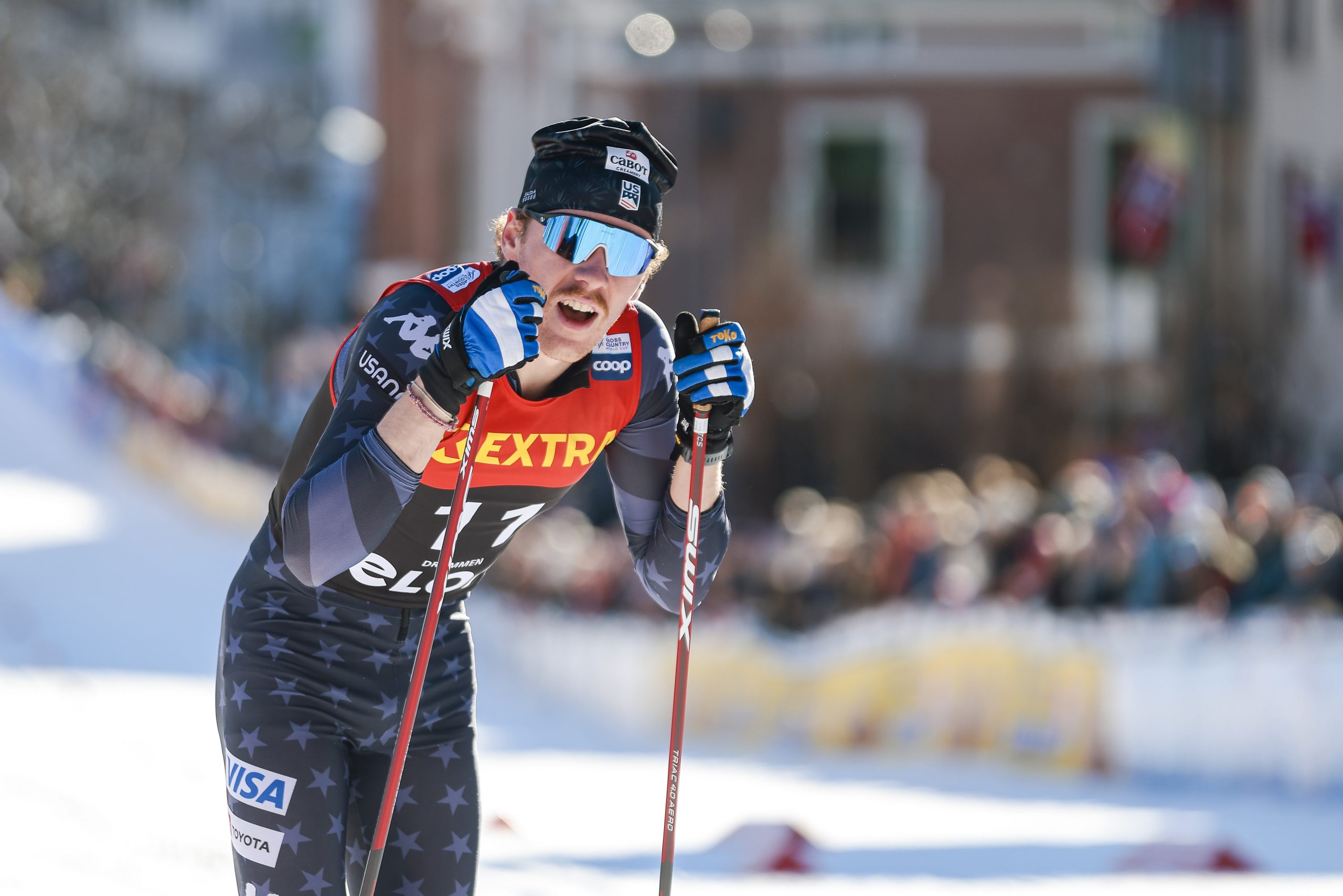
    “Every time I did it, I legitimately thought it was my best chance at getting through: 100%. It was never for the dramatics of it, except for maybe the semifinal in Drammen. So many people cheering and so many people freaking out, I was like, ‘I just gotta do it. I’m out here, I gotta try it.’ Drammen was a lot of fun; maybe one of the highlights of the season.”

    Crowds on World Cup sidelines went crazy for it; broadcast announcers were loving it, and audiences at home were thrilled to see this young American with his skill and audacity on display. Gaining attention (in sport) usually means drawing attention away from someone else; skiers on the World Cup tour may need to get used to this new presence:

    “At the Tour de Ski, there was one other skier who was kind of grumpy about it. He needed our heat to be tactical, and there were simply no tactics involved. I’ve been in his shoes plenty of times: off the back by a mile, wishing the heat had been tactical rather than a drag race. In general, they laugh about it. The thing of it is that [Americans] are already looked at as the group that does things differently. We spend the entire year in Europe, we’re not historically a skiing nation. It’s sort of fun to play to that ‘look’ a little bit.”

    “With us Americans, we need to work on the fundamentals. And fundamentals you learn from watching the best: technique, pacing, strategy, fueling, recovery. That’s the sort of stuff that I can certainly get better at. That’s when it IS a good strategy to look at somebody better than me and say, ‘I need to do that.’ It’s a balance, for sure.”

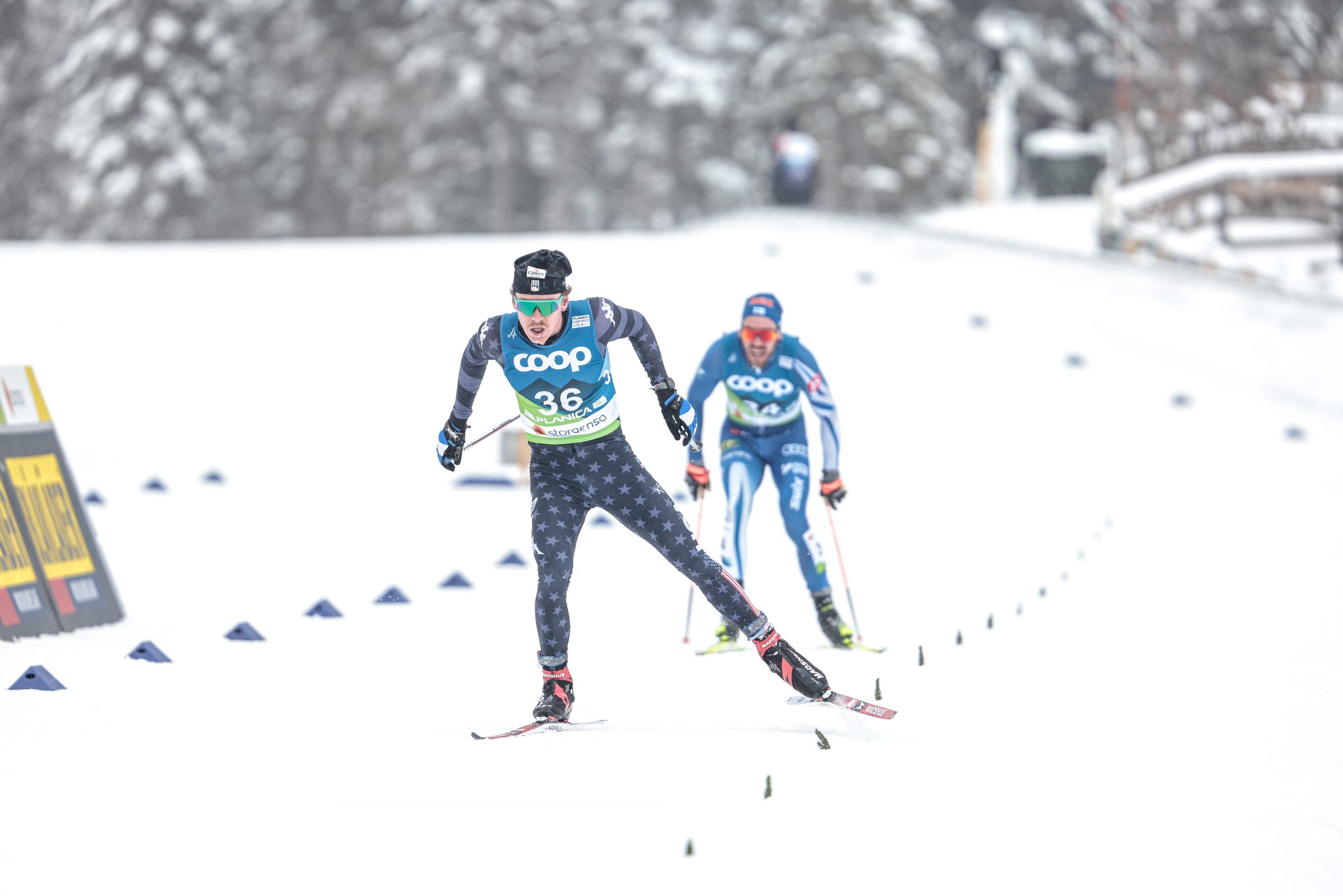
    Sprint goals turning into distance successes. Ben Ogden (USA) races the 2023 World Championship 15 k in Planica, Slovenia. (Photo: Modica/NordicFocus)
    Distance Racing

    Ogden admitted that the race schedule, his own training preparation, and the mood of certain race days all contributed to his otherwise unexpected success in World Cup distance racing this season:

    “[Distance training] was part of my training throughout the year. I did a little more intensity in the fall, but ultimately my strong distance racing was a little bit of a surprise. I was targeting the sprint races, but a big goal of mine after last season was like, ‘You can qualify well, you can get to the semifinal…you just need more fitness.’ Making a sprint final is a long, long day. And being competitive in that final is an even longer day. So that was a big goal of mine after last year: I made weird, side-stepped progress in sprinting—but also forward progress. I also made a big jump in distance racing, which was cool but not totally expected.”

    Ironically, it seemed that the daunting mini-tour schedule of so many World Cup weekends worked in Ogden’s favor:

    “[World Cup] weekends always start with sprints, followed by a distance, or even two distances,” Ogden said. “I’d have big goals for the sprints, but often times sprinting is horrendously frustrating. Even if you achieve your goals and you’re getting better, you’re still always so so close to that next thing, right? I could show up to a World Cup tomorrow and get second—which would blow my goals out of the water—but if first was literally right there ahead of me, I’d still be disappointed as I crossed the finish line. The difference in a distance race is that you pour your heart into it—maybe still getting beat by a minute—and you are somehow okay with that.”

    I just loved going into the distance race and not having to worry about the tactics, not having to worry about what’s going on around me, just go out and race.

    “What was happening was that I was coming out of these sprint races just a little bit frustrated. And I just loved going into the distance race and not having to worry about the tactics, not having to worry about what’s going on around me, just go out and race. It was such a nice feeling, especially since at the beginning of the season I wasn’t putting a lot of emphasis on [distance races]. I’d just do my best and see what happened. It was just a really nice change, one I found myself looking forward to after the sprint races…a way to get all the frustration out.”


    FasterSkier’s interview—Ben Ogden, In His Element— will conclude with Part III, to be posted in days to come.

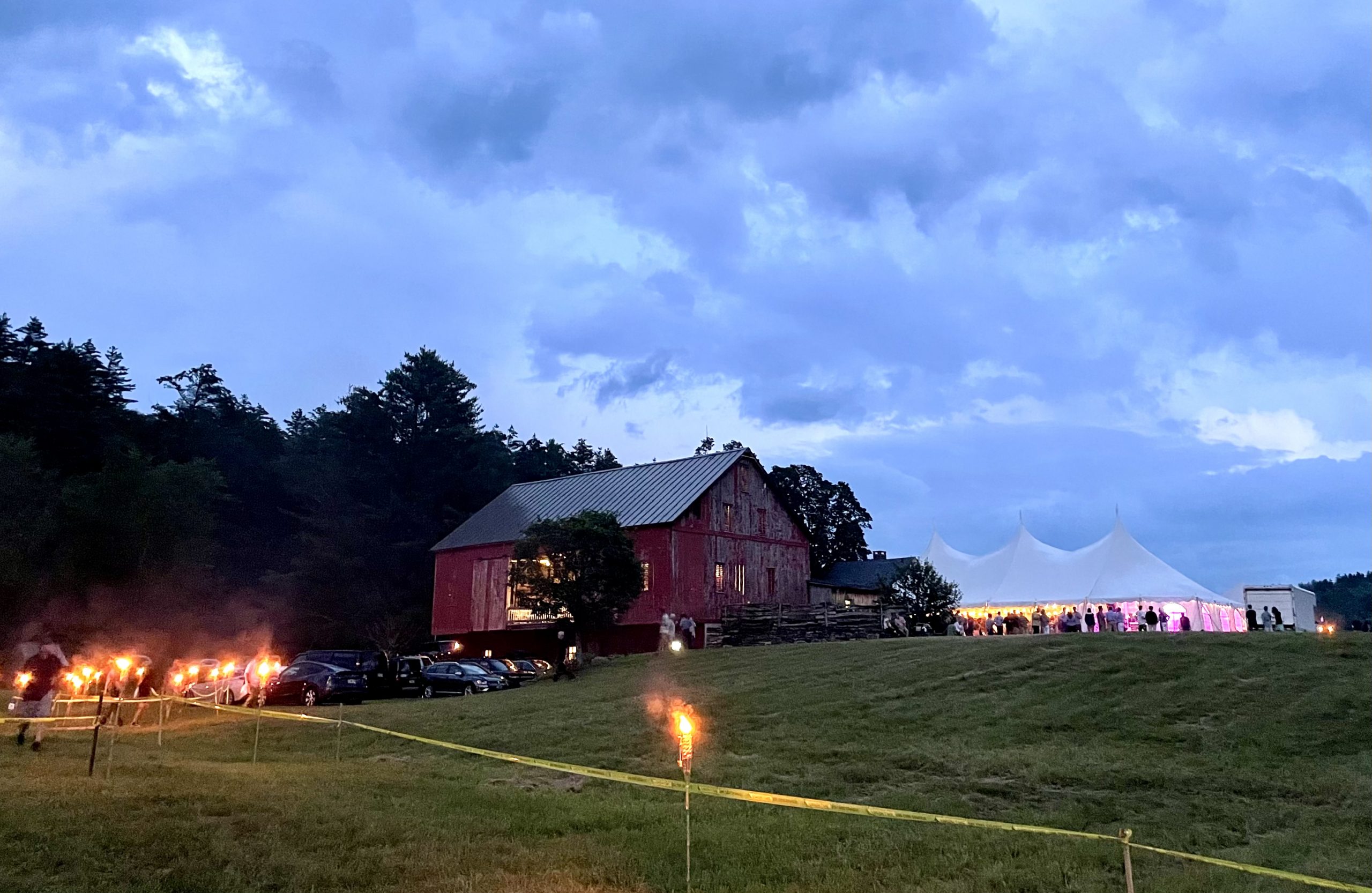
    The Nordic community gathers to say goodbye to one of its own: celebrating John Ogden on the farm he built, among the family and friends he loved. (Photo: FasterSkier)

    Editor’s note: The barn at the Ogden family farm hosted more than just an afternoon of friendly interview. Soon after, much of the American skiing community gathered there to commemorate John Ogden—father of Ben, Katharine, Charlotte, and husband to Andrea—who passed away just days after this interview. It was a marvelous, joyous event with hundreds of friends, neighbors, and skiers in attendance. Bill Koch and Sverre Caldwell were on hand to organize cars in the parking lot . . . that’s the sort of gathering it was: so many luminaries from the Nordic skiing world arrived that both the most influential contemporary Nordic coach and a World Cup Champion/Olympic Medalist and were needed to park cars. It seemed like the entire skiing world had come to this corner of Vermont to bid a fond farewell to legendary coach, cheerleader, race organizer, event timer, and good friend. Vermont has never seemed greener . . .


  • Training Out East: An Update from Summer in Stratton

    Training Out East: An Update from Summer in Stratton

    As the saying goes, skiers are made in the summer. If that is the case, then many are forging their way to success in Stratton, Vermont this season. Depending on the year, various clubs around the country may play host to an increased number of athletes for a summer; from Bend, Oregon, to Anchorage, Alaska, to Stratton, the “hot spot” shifts periodically. This year, as SMS T2 Team Head Coach Perry Thomas put it, “we’ve had a lot of talent in southern Vermont.”

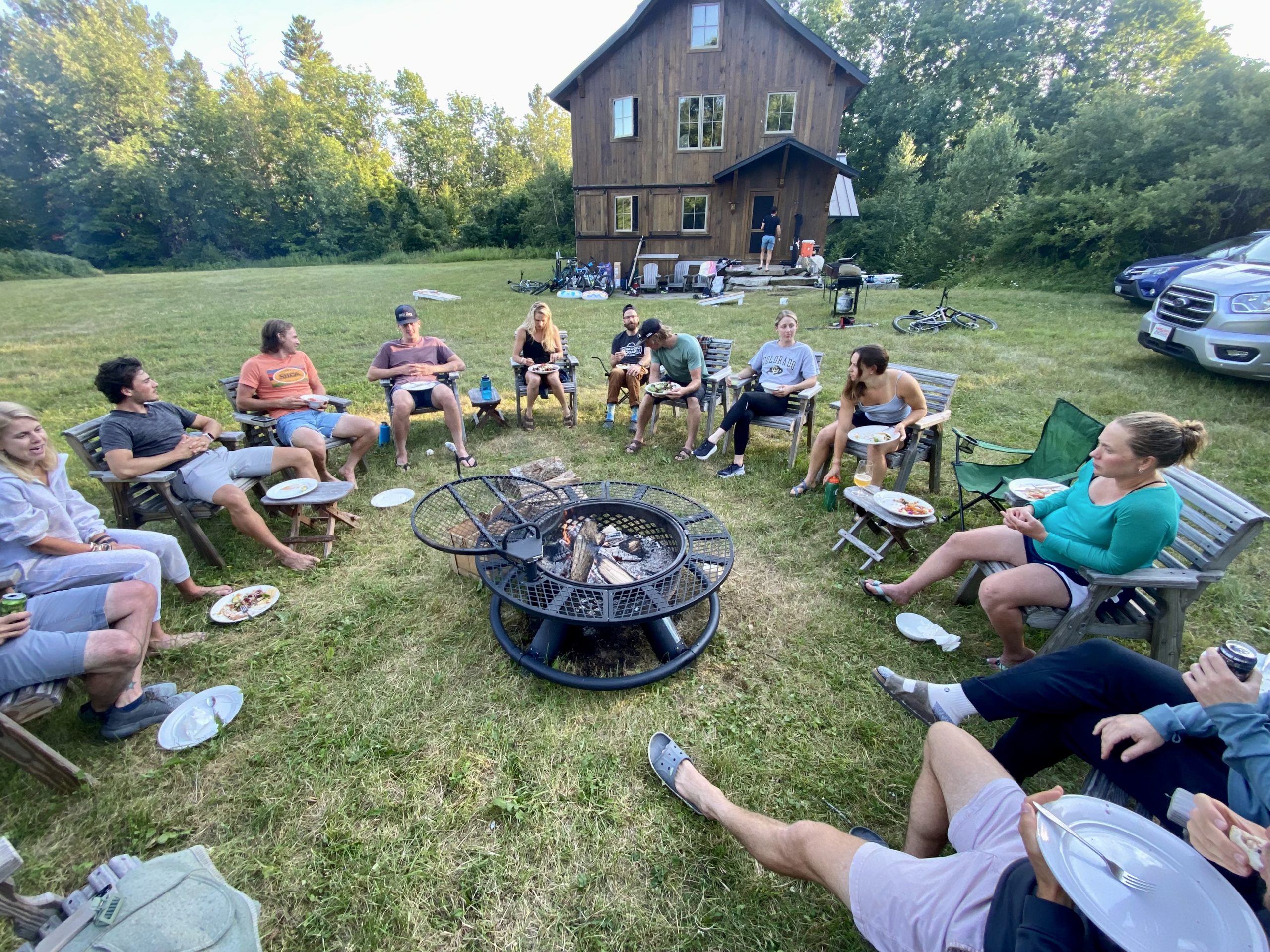
    As the summer of training kicked off out east, it was primarily members of the SMS T2 Team for the first month or so. Thomas explained that the team had a couple of mini camps so far this summer, the first being at Green Woodlands in New Hampshire. In an email to FasterSkier, Thomas wrote, “we had a lot of great training including some long mountain bikes, rollerski intervals in Lyme, and a Presidential Traverse. It was somewhat “camping” style as many of us stayed in these rustic cabins on the water. We cooked great food, played a few games, and hung out on the water.” 

    Dinner around a campfire for the SMS T2 Team at Green Woodlands in New Hampshire (Photo: Lina Sutro)

    More recently, the team had a second mini camp in the Waitsfield/Warren area, north of Stratton. Highlights from this camp included a 5 k hill climb pace project on the Appalachian Gap, combining with the Eastern and Midwestern U16 camp, and Team Birkie who also held a camp in Vermont recently. About this activity Thomas shared, “the team had a great time chatting with the U16’s after App Gap, and we had a fun run/hike on part of the northern section of the Long Trail.” He extended his thanks to Justin Beckwith and NENSA as well as Colin Rogers and Green Mountain Valley School (GMVS) for their efforts in putting together some great events. 

    Joining the SMS T2 Team for varying lengths of time this summer are a number of U.S. Ski Team and college athletes. This list includes: Sydney Palmer-Leger (new member of SMS T2 team, University of Utah (UU), U.S. Ski Team), Novie McCabe (UU, U.S. Ski Team), Sophia Laukli (UU, U.S. Ski Team), Weronika Kaleta (University of Colorado (CU), Polish National Team), John Hagenbuch (Dartmouth, U.S. Ski Team), Gus Schumacher (Alaska Winter Stars, U.S. Ski Team), Luke Jager (UU, U.S. Ski Team), Adam Witkowski (Michigan Tech University (MTU)), Zander Martin (Bates College), and Asa Chalmers (Dartmouth). 

    Happy athletes in the White Mountains in New Hampshire (photo: Lina Sutro)

    Thomas, who took over as head coach of the SMS T2 Team this past spring, expressed his enthusiasm for the crew of athletes saying, “I feel very fortunate to be working with such an accomplished group of U.S. skiers. It has been fun and rewarding to say the least!” He’s had some assistance in the coaching department, U.S. Ski Team D-Team Coach Kristin Bourne, and Head Coach Matt Whitcomb have come through to work with the U.S. Ski Team athletes, but also help support everyone. Annika Martell and Steve Monsulick of Williams College have come to help at Thomas’ invitation, and with the additional support from the SMS junior coaches, Matt Boobar, Alex Jospe, and George Forbes, the coach to athlete ratio has been pretty good. Thomas also said, “I feel very fortunate to be able to work with Pat O’Brien, Jason Cork, Sverre Caldwell, and Matt Boobar this summer (among many other great coaches). Having such an excellent coaching staff to work with and learn from has been such a privilege.  Everyone is very open, hard working, great to get along with, and they are all massive resources for myself as well as the team.”

    For many of the athletes, this summer has been their first time in Stratton. Thomas reflected, “I think many of the athletes that have never been to Stratton before, or maybe haven’t trained with the T2 team as much, have realized how great a place it is to train here. It seems like everyone has been really enjoying themselves, and we hope to continue having a strong summer training group in the future.”

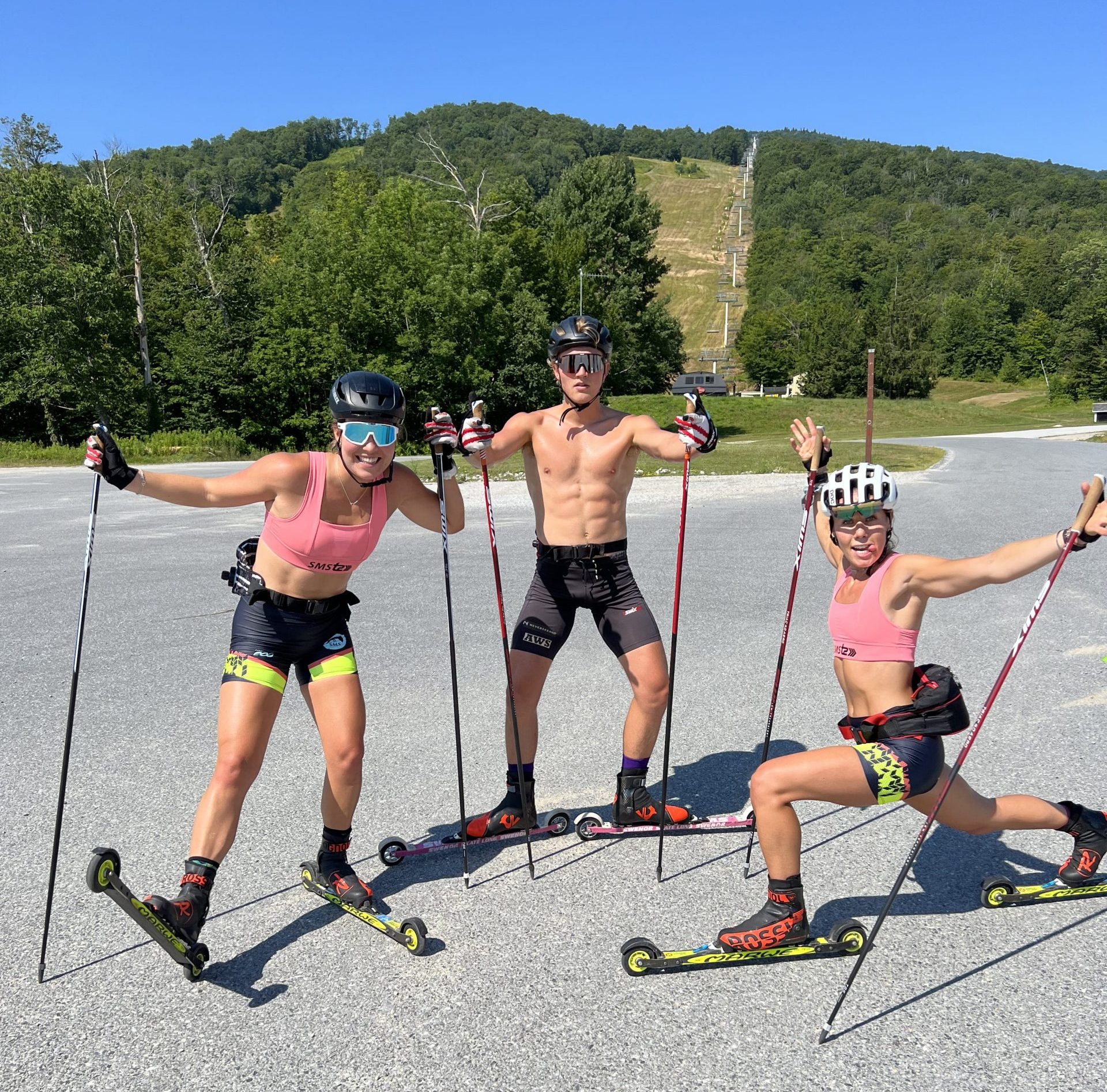
    Lina Sutro, Gus Schumacher, and Lauren Jortberg (l-r) head out for a rollerski (photo: Lina Sutro)

    One of those athletes is Sydney Palmer-Leger, who is not only spending her first summer in Vermont, but is also the newest member of the SMS T2 Team. When asked about her decision to come east this year, Palmer-Leger shared, “Last year I spent two months in Anchorage, Alaska. I had a lot of fun exploring a new beautiful place with the APU group and working with Erik Flora. I had never spent a period of time out East besides a couple bike and ski races. I had heard amazing things about the SMS T2 Team so I decided to try something new. I packed up my car not knowing what to expect and drove the three days out to Vermont.” 

    Born and raised in Utah, Palmer-Leger said she is used to bigger mountains and a drier climate than you find in the East, but the SMS T2 Team was welcoming from the start and made her feel at home. She wrote, “I am used to working with many different coaches so that was an easy transition. I had been on a couple trips with Pat (O’Brien) and met Perry (Thomas) in Bend, so I wasn’t super uncomfortable joining a new team. I felt I belonged in this group from the beginning and loved training in Vermont so I decided to join the SMS T2 Team.”

    SMS T2 crew (photo: Lina Sutro)

    Palmer-Leger pointed to a number of highlights from the summer, including the mini camps in Craftsbury, Warren, and Greens. She reflected, “[the] camps were fun ways to get a lot of training while exploring new parts of the East. I have also loved being close to water where we have gone paddleboarding and waterskiing with the Ogdens. I am very fortunate to have this group to come back to every summer. In addition to running and rollerskiing, I have been able to explore more bike trails. Biking used to be my other sport so I have loved going out with the team every week. I went to Burke the other weekend and helped with the Little Bellas. It is inspirational to see these young girls out on the trails shredding.” 

    Gus Schumacher also made his way east this summer, though for a few weeks rather than the whole summer. Initially, the motivation for this change in scenery was a way to break up the jet lag on the way to Norway for the U.S. Team camp happening next week. But when Schumacher decided not to go to Norway he realized he still wanted to train with Ben Ogden and SMS to “return the favor” of him coming to Alaska last summer. Schumacher said, “I also wanted to hopefully get some rollerski racing and rollerski track skiing in but I didn’t really do my research on when/where to come.” 

    The summer climate in southern Vermont is typically different from that of Alaska where Schumacher spends most of his summer. “[It’s] definitely a little hot and humid but it’s kind of nice to get a little sweaty,” wrote Schumacher, “the biggest issue is that our dryer doesn’t really work so there’s not a great way to dry washed or wet clothes.” (A problem which anyone who has spent a summer in the East can identify with). 

    For his time in Vermont, Schumacher had a couple of goals he was focused on. The first, to stick to his general progression/training layout. This meant getting good group sessions, but not losing focus of his own process. The second was to keep up good daily habits like consistent bedtime, morning mobility, healthy meals and recovery stuff. Third, to take care of some body stuff that was acting up recently. And finally, to generally make use of being around a strong team and use them to push himself whenever possible. Schumacher concluded by saying that he is “very thankful to SMS and southern VT for taking us in and helping us figure out lodging and training, as well as getting us exposure to some races and cool mentoring opportunities.” 

    Alayna Sonnesyn, Novie McCabe, Jessie Diggins, Ben Ogden, Gus Schumacher, John Hagenbuch (l-r) after a hillclimb up Stratton Mountain (photo: Lina Sutro)

    Approaching the final few weeks of August, as the summer winds down, athletes and coaches alike will be going their separate ways. Schumacher is headed back to Anchorage next week when the team goes to Norway. He said, “In sticking with my plan, I felt like it made more sense to take a recovery week and get back into my swing in Anchorage.” 

    Palmer-Leger, who has spent two and a half months in Stratton with the SMS T2 Team, is heading back to Utah for school. After having finished summer school this past weekend, she has a little break before going back to classes in Salt Lake. 

    Thomas reflected that the summer has flown by, saying “it’s crazy how fast time goes by when you’re training hard and having fun.” With many of the summer athletes heading back to school or back to their main club, the crew in Stratton will be dwindling.

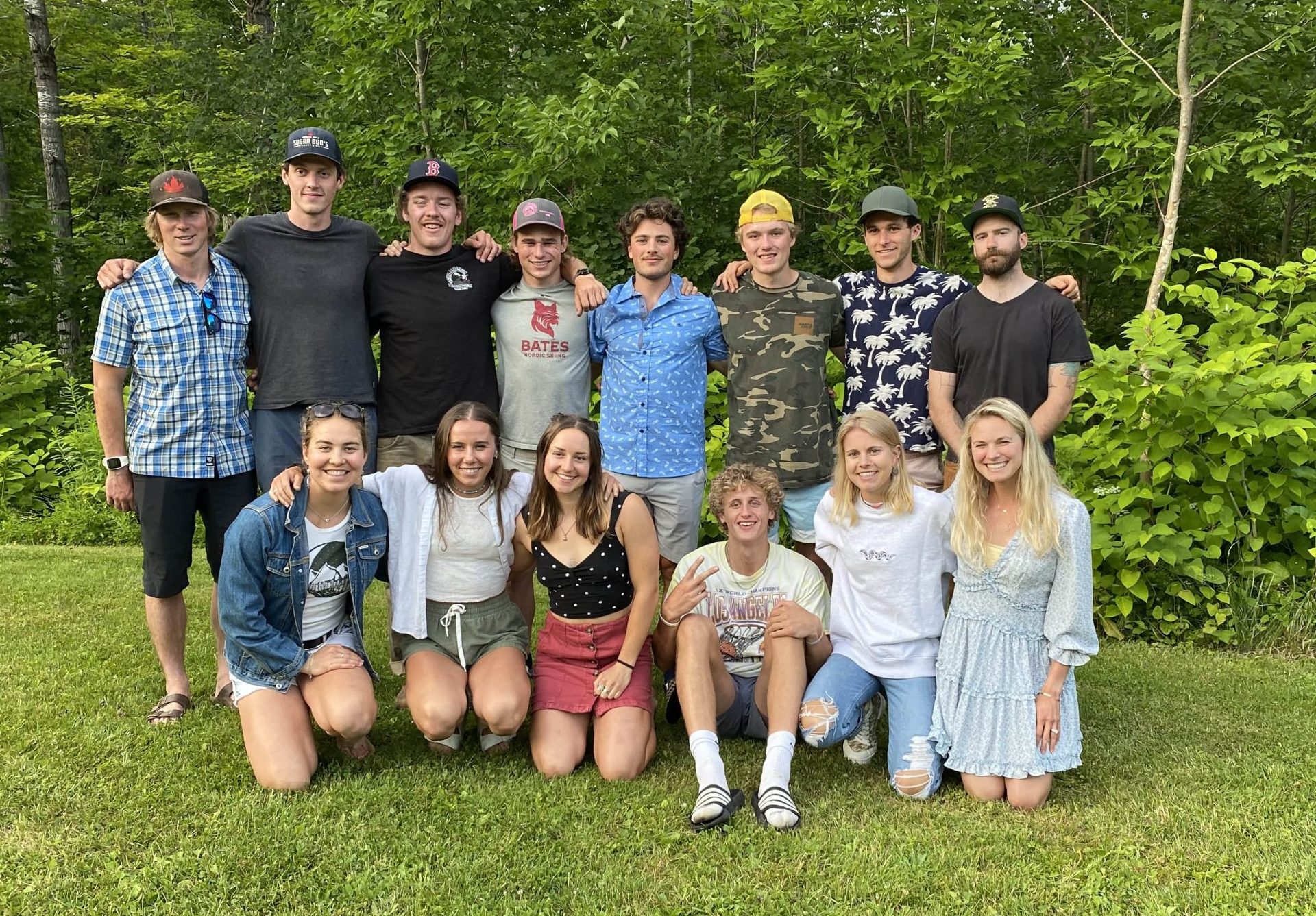
    Back-row: Bill Harmeyer, Ben Ogden, Zander Martin, Will Koch, Asa Chalmers, Adam Witkowski and Perry Thomas. Front-row: Lina Sutro, Lauren Jortberg, Sydney Palmer-Leger, Fin Bailey, Sophia Laukli and Jessie Diggins (photo: Lina Sutro)

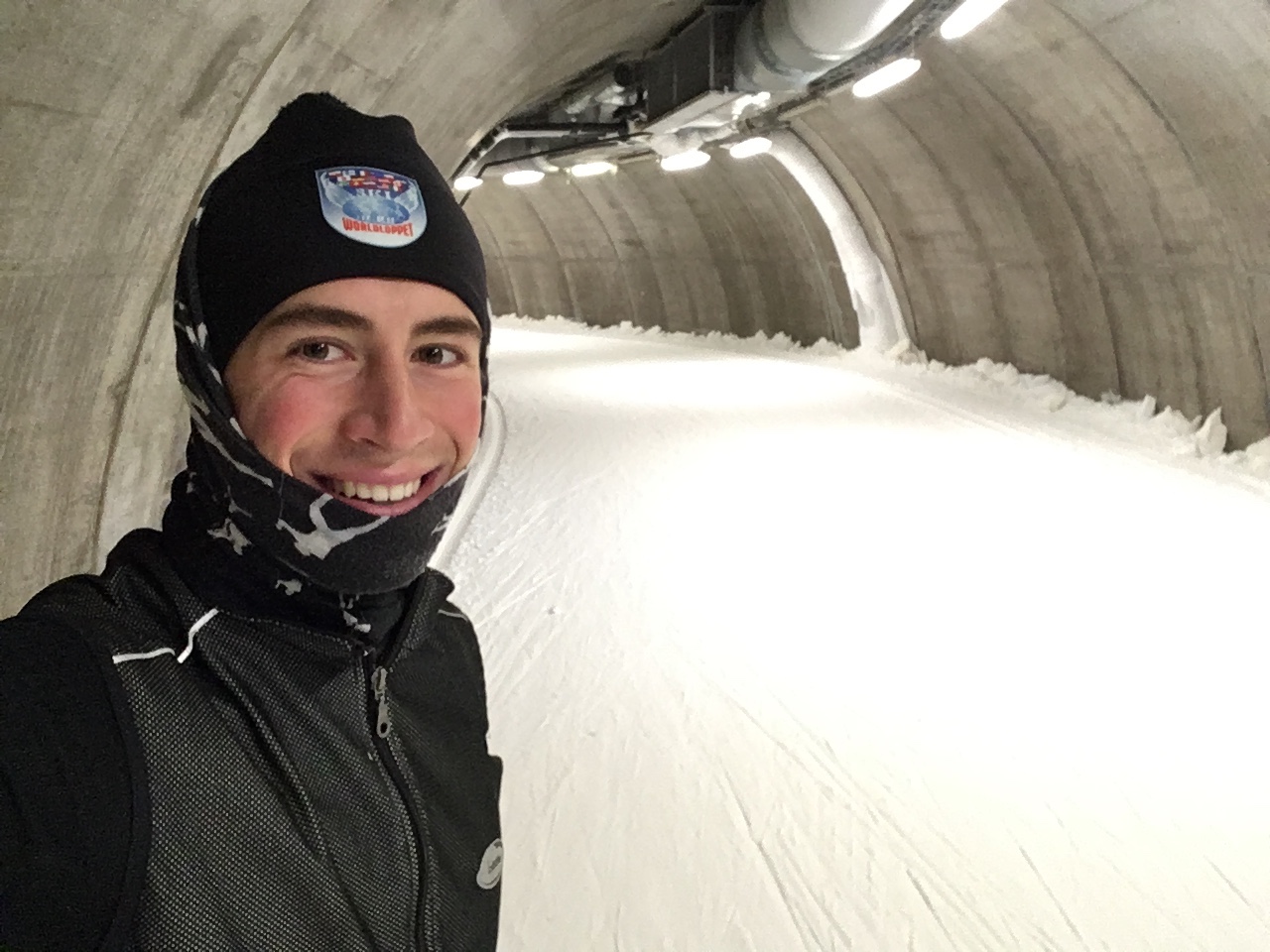
    A couple athletes will be traveling to Scandinavia for the U.S. Ski Team camp in the Torsby ski tunnel and competing in the Toppidrettsveka rollerski races. Jessie Diggins, Julia Kern, and Jason Cork are headed to Australia for a three week on-snow camp there. Thomas will be headed to Oberhof, Germany with SMS T2 athletes Lina Sutro, Lauren Jortberg, and Alayna Sonnesyn for a ten day camp in the Oberhof ski tunnel. Eventually, the core T2 team will reconvene back in Stratton in early September before heading to the U.S. Ski Team camp in Park City in early October. 

  • Reaping Mountain Biking Benefits for Cross-Country Ski Training with Jessica Yeaton

    Reaping Mountain Biking Benefits for Cross-Country Ski Training with Jessica Yeaton

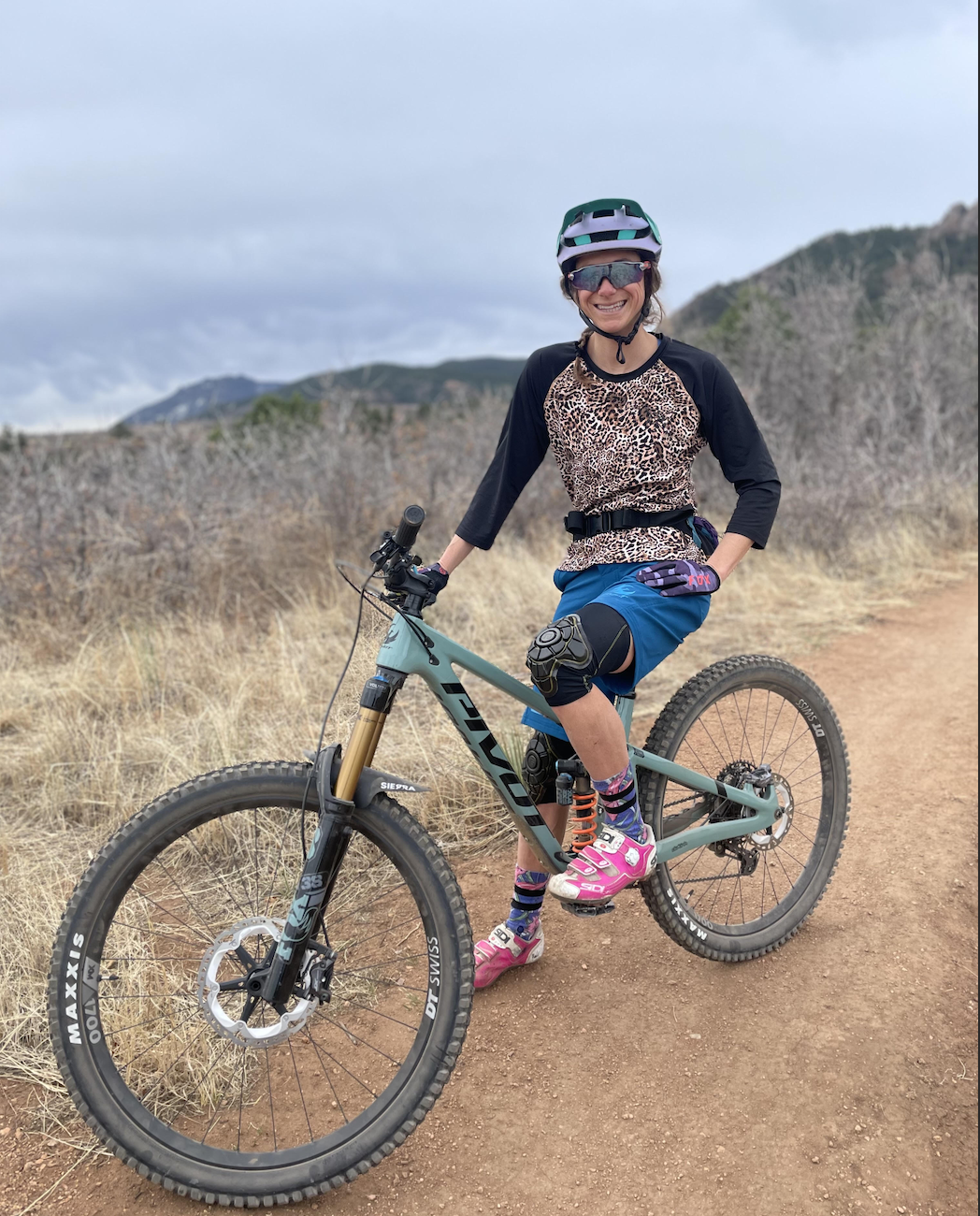
    2x Olympian and soon to be DPT Jessica Yeaton shares insights into incorporating mountain biking into your cross-country ski training. (Courtesy photo)

    Cross-country skiers are notorious for training high volumes during the off season in order to be in peak racing form in the winter. There is a common mantra used by coaches to help motivate athletes to train hard even though the racing season is months away: “skiers are made in the summer”.  From my experience working with different coaches, the large bulk of the summer’s volume is intended to be on roller skis or foot (either running or bounding with poles). While this may work for some, many athletes struggle with injuries when training 800-900 hours/year – myself included – making it hard to consistently rely heavily on these high impact training modalities. 

    A constant battle with an overuse injury one summer forced me to think outside the box; I began using the mountain bike to train. In the back of my mind, I doubted the effectiveness of this as it translates to skiing. I had heard coaches saying since I was in high school that cycling hours needed to be counted as 50% when logged due to the lack of specificity to our sport. However, I had no choice – it was either train on the bike or don’t train much at all. 

    Three years later, I now perform 60-70% of my summer training on a mountain bike. This is no longer because I have to, however; I now choose to use it as my primary mode of volume and a large amount of my intensity due to the immense gains in fitness and muscle activation, along with technical and terrain aspects that I have found translate well to cross-country skiing. 

    Jessica Yeaton enjoys a fall mountain bike ride in Sedona, AZ. (Courtesy photo)

    It’s a no-brainer that mountain biking heavily engages lower extremity musculature, placing a high demand on our quadriceps, hamstrings, glutes, and calves. However, mountain biking also employs shoulder, chest, and arm muscles due to the control required in technical sections, downhills, and even steep uphills. Thus, the muscles used while mountain biking closely mimic those during cross-country skiing – particularly skating, which has a higher demand on our glutes than classic skiing. Additionally, the terrain in a network of mountain bike trails is often tough, causing fluctuations in heart rate similar to those experienced while skiing. There are long climbs followed by flowy descents with sharp corners and short, punchy uphills thrown into the mix. High workloads followed by challenging downhills on which to recover – doesn’t that sound like ski racing? I find that a 90 minute bike race feels very similar to a 30k skate race in effort. 

     The downhills also offer a technical challenge that heightens reaction times. I often ride into more difficult features multiple times to get the line right before committing – something that has changed the way I now approach tough downhill corners before a ski race.  An added bonus is the smile that I can’t wipe off my face after a flowy descent or when I’m able to conquer a new feature! 

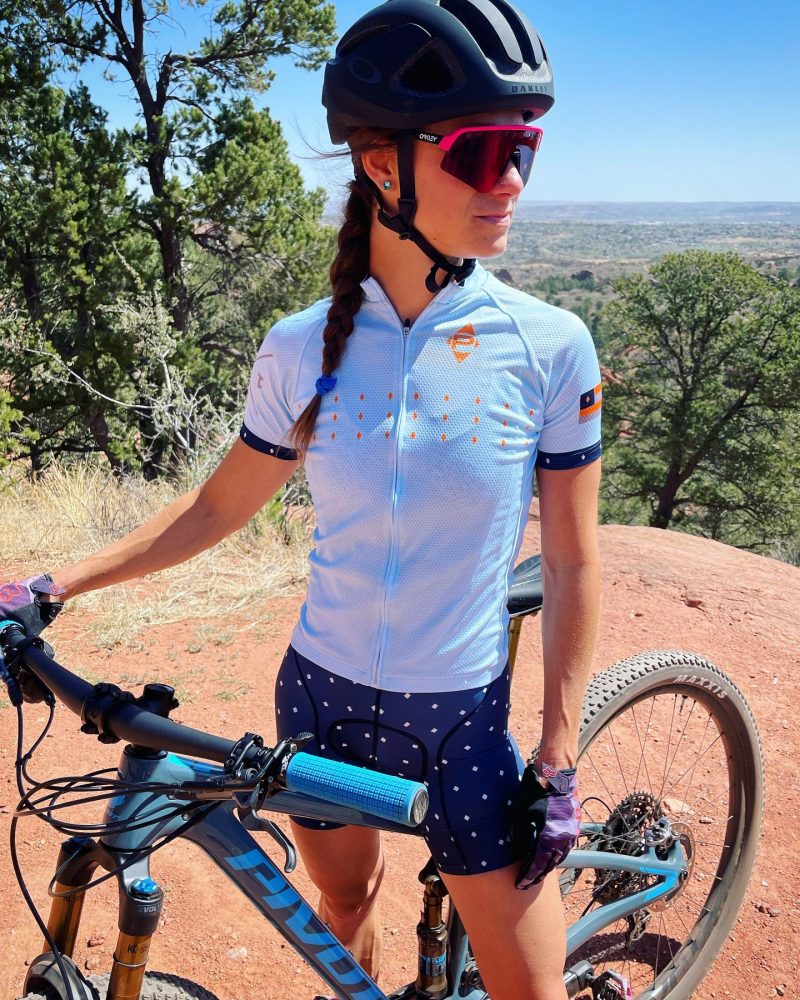
    Dropping! Jessica Yeaton gets after it on a technical ride in Colorado this spring. (Courtesy photo)
    Lastly, the fact that it is low impact makes it a great addition to a summer training plan that is full of running and rollerskiing. If you struggle with injuries or are looking to increase volume without added stress on your joints, jumping on the mountain bike for a few workouts a week is a great way to accomplish that. 

    So, with all of those factors in mind – what is the best way to approach your workout on a mountain bike? 

    The aerobic demand and muscular fatigue is often higher while mountain biking than during other activities where it is easier to keep my heart rate consistently lower. Because of this, I tend to pick a few workouts a week where I am ok doing a higher distance pace (L2 into L3) to hop on the bike. I choose terrain that mimics ski racing, and do not stress about keeping my heart rate low. I often pair my rides on a day with double pole intervals or strength sessions. If I am trying to keep it easy or have hard skate rollerski intervals planned the next day, I opt for easier trails or a light run so I can keep my heart rate low.

    Want to test it out for yourself? Here are two of my favorite workouts on the bike. 

    Due to the aerobic challenge mountain biking presents, it’s an awesome place to do threshold workouts. If you live in a place where you can find a sustained climb or an up-track, you can use this to do L3 efforts (for example, 2 x 20 or 3 x 15 minutes up an up-track), then use the downhill for active recovery. This stimulates downhills in racing and forces you to focus on coordination while flooding with lactate. 

    2x Olympian and soon to be DPT Jessica Yeaton shares insights into incorporating mountain biking into your cross-country ski training. (Courtesy photo)

    Another great workout on the bike is 30-30’s, or where you go hard for 30 seconds, then recover for 30 seconds while continuing to ride easy. This workout focuses on power and strength, and I find that it translates really well to sprinting, and teaches the body to recover and get used to back-to-back punchy hill efforts, so you’re able to regain power descending off a roller before hammering up the next climb in a race. I recommend doing 3 x 10 minutes or 2 x 15 minutes of 30-30s. Just make sure you are able to keep your legs spinning during the recovery – you shouldn’t need to get off your bike to rest in between! The goal is to put in a hard effort, but maintain a reasonable pace in between.

    I am a big believer in making training as fun as possible while still putting in the hard work. Mountain biking is something to look forward to that makes me excited to get out and train. Ultimately, this helps me train harder and stay motivated, so I am a huge advocate for learning how to integrate it appropriately – which for me means creating a smart training plan that will help me reach my goals in the winter. If you also crave time on the bike, I hope this advice can give you the confidence to structure it into your dry-land training as well. 


  • Scott Patterson Snags Storied Course Record at Crow Pass Crossing

    Scott Patterson Snags Storied Course Record at Crow Pass Crossing

    Scott Patterson sets a remarkable new course record at the 2021 Crow Pass Crossing. (Photo: Brad Benter/Crow Pass Crossing)

    On July 24th, Scott Patterson toed the line outside of Girdwood, Alaska, for his eighth run of the Crow Pass Crossing, a roughly 22 mile race with nearly 3,000 feet of vertical gain through the rugged Alaskan backcountry. Two hours fifty minutes and five seconds later, he crossed the finish line at the Eagle River Nature Center, shattering the 11-year-old course record set by ultrarunning legend Geoff Roes at the peak of his career by four minutes and 39 seconds. To put this in perspective, Roes set the record at the storied 100 mile Western States Endurance Run that same summer.  

    To those, like myself, who are thousands of miles away from Girdwood and lack perspective on the Crow Pass course, a 2.7% difference in time for a race that long may sound unremarkable, but to those versed in the trail, Patterson’s time garners respect comparable to Eliud Kipchoge’s 2:01:39 at the 2018 Berlin Marathon. In the race’s 30-plus year history, the three-hour barrier has only been dipped under ten times by four separate individuals. Four of those times are Patterson’s, three belong to Roes, two to former elite ski racer turned APU Junior coach Eric Strabel, and one to local semi-pro mountain runner Allan Spangler. Patterson has now won the footrace seven times, which is also a record.

    The course record has been on Patterson’s mind for several years, and he’s come very close — a minute and a half back in 2015 — but due to changes to the trail, chasing the time became an increasingly elusive goal. 

    “Scott, along with fellow Nordic skiers Eric Strabel and David Norris, have helped raise the bar of what’s possible in Alaska trail and mountain races, so we were thrilled when Scott finally broke the Crow Pass record that he’d been chasing for years…” race director Matias Saari wrote in an email. “It was hard to imagine anyone breaking Roes’ Crow Pass record, and while Patterson came close in 2015, the changing conditions of the trail were conspiring against him. Despite Scott’s great fitness and course knowledge, the lack of course maintenance, extremely brushy trail, elimination of key shortcuts and a trail reroute extension four miles from the finish made breaking a stout record all the more challenging.”

    Geoff Roes leads the way in the 2011 Crow Pass Crossing with the Raven Glacier in the background. (Photo: Matt Hage/Crow Pass Crossing)

    To dive further into the story and what a result like this implies as he prepares for an Olympic year, FasterSkier connected with Patterson on a call on August 9th. Patterson also discussed his pursuit of the record at Crow Pass, and his decision to repeatedly come back to Crow Pass despite the lack of prestige it may hold relative to other well known Alaskan running events. 

    “I think it was one of the first Alaskan mountain running races that I actually won,” Patterson explained. “And so it kind of felt like it’s this one that I’ve got a good history with and I always want to come back to. I’ve won it a lot, but it seems like every year it gets slower. It’s more overgrown, there’s more downed trees, there have been a couple of reroutes of the trail, which have slowed things down. So, as I’ve gone through these years, I have just felt like I could maybe get the record, but it’s been a little bit out of touch.”

    While this year, Patterson gapped the field to win by a margin of almost seventeen minutes, he has often had chasers only a few minutes back. That said, he explained that he typically spends the majority of the race running on his own and sees this as a factor that has historically held him back mentally from pursuing the record in earnest.

    “My strength is always the first miles climbing up to the pass. So I always tend to break away really early, and then run on my own for 18 to 20 miles of the race. And it’s a long run, so it’s like, ‘Okay, I think I can run faster.’ But sometimes, you’re kind of just running along the bottom of the river valley just running along, get a little distracted and lose motivation, trip a couple times and slow down… And so I’m solid at it, but that record has kind of felt out of reach.

    “This year, I kind of went into like, ‘Okay.’ I haven’t run the course, since we raced before COVID, so it’s been two years since I’ve been on the full race course. I actually got to ride down to the start with the race director. And he was asking me, if I thought I had a course record in me, and I said, ‘Ehh — I think I’ve got sub three hours in me’… but I really didn’t think I had the record. And then going out into the race, I hit the pass where my friend and former teammate Eric Packer was up at the top. I came through there with a really good split, and he was cheering me on. I was thinking to myself that I had one good split, so I better keep going and pushing hard.”

    Fourteen miles and multiple water crossings later, Patterson reached an unofficial checkpoint known as the Perch, and looked at his watch to see how close he was to the record with four miles to go.

    “I was exactly 30 minutes from the course record. I know I can definitely run in from the Perch in sub-30. So it was great, kind of that last final spur of motivation. I think I said in the [Anchorage Daily News] article that I threw down some sub-six-minute miles on the trail after that, when I realized I was going to get the record and kept pushing to try and make sure it actually happened.”

    While overall, the course has gotten slightly longer and, according to long-time racers, “harder”, Patterson credited ideal racing conditions this year for his ability to capitalize on his fitness and take down the record. 

    “It was just kind of a combination of really good conditions. It was not too bad of temperatures — not too hot, not too cold. The brush — the trail is pretty notorious for getting overgrown, and that’s part of the challenge of the race is that in the middle 10 miles it can be hard to really see your feet in places while running a technical trail. And so that section was actually in pretty good shape this year. The race organizer and a few others had gone out a month before and done some brushwork, and we really thought it wouldn’t make a difference because it was a month out, but it ended up being great conditions. So I was really excited to take advantage of that.”

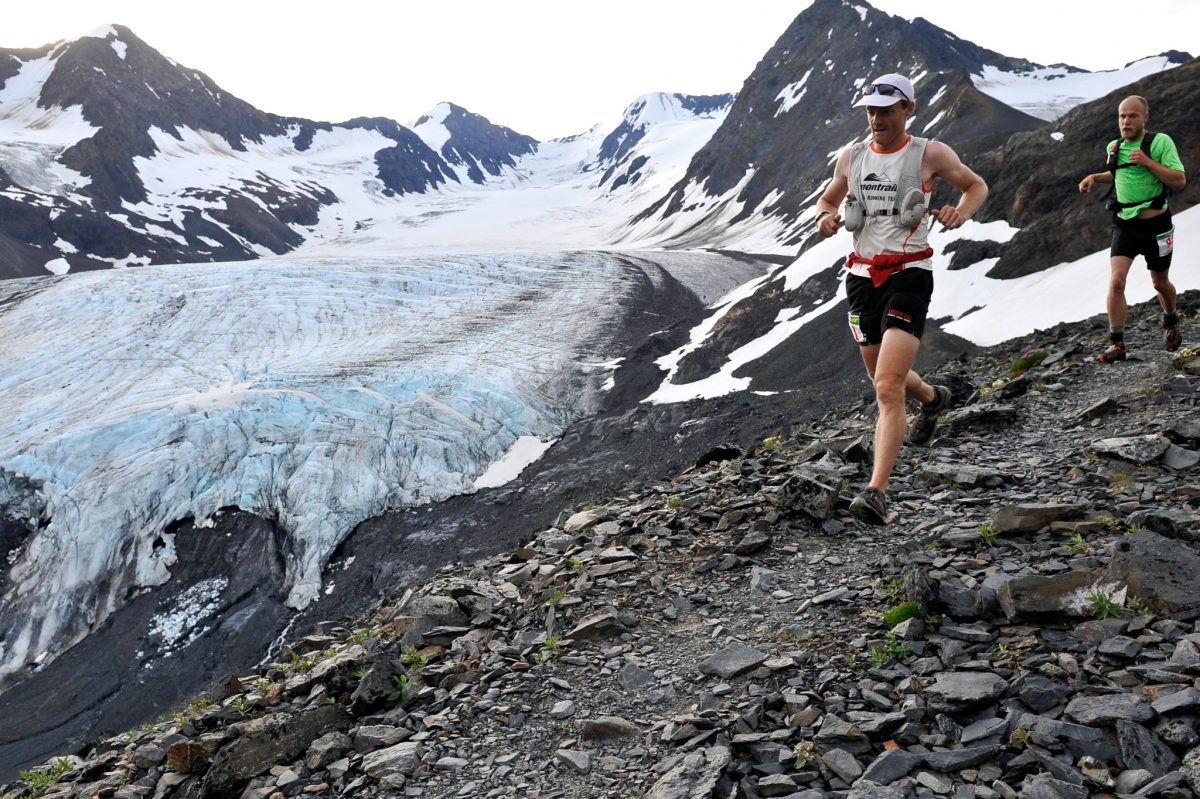
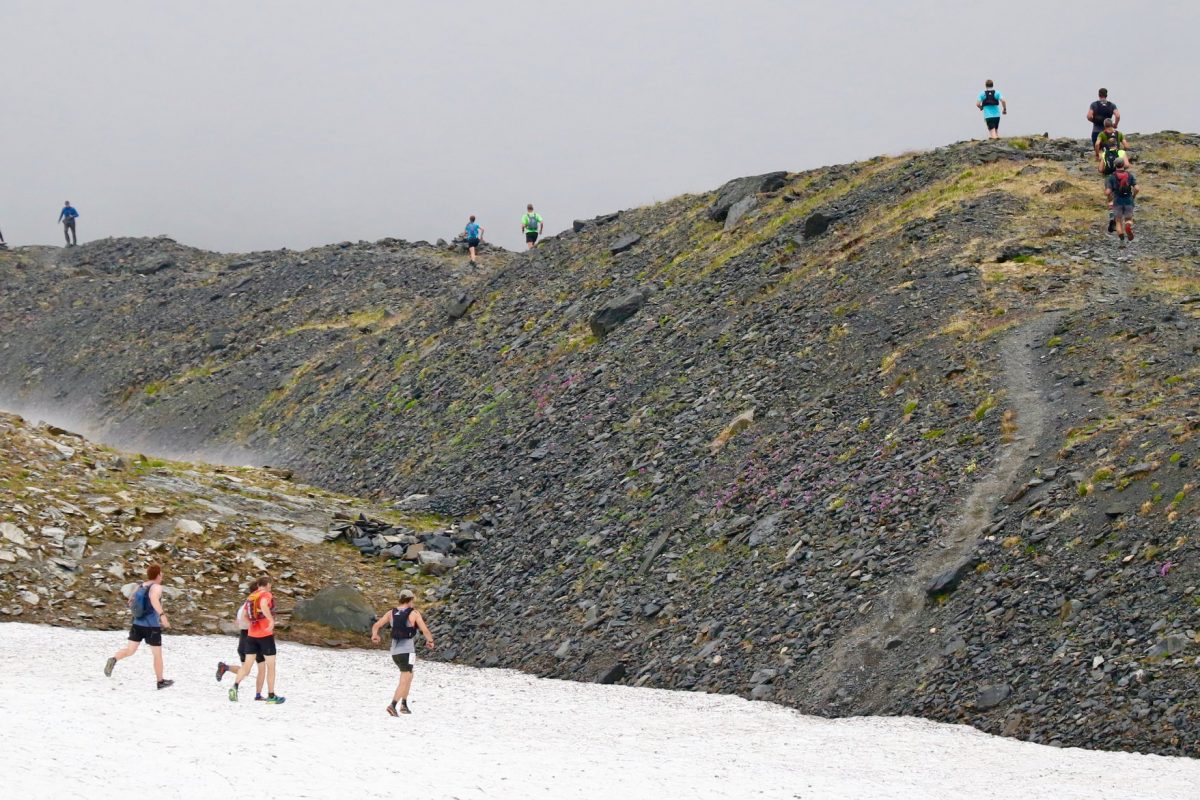
    Runners cross a snowfield as they begin the descent from Crow Pass during the 2019 event. (Photo: Brikru Photography/Crow Pass Crossing)

    So far, you’ve read about 3,000 feet of climbing, water crossings, and an overgrown cobbled trail along a river bottom. But this subset of obstacles does not fully paint the picture of how burly the Crow Pass Crossing is to an outsider. To bring this section of the Last Frontier a little closer to those of us in the Lower 48, Patterson further broke down the course, which includes a little bit of everything the Chugach has to offer. 

    Starting at a trailhead at the end of the road outside of Girdwood — home to Alyeska ski resort —  the trail climbs 2,200 feet to Crow Pass, rapidly ascending from the lush undergrowth of a coastal rainforest to subalpine tundra. Patterson describes this section as “beautiful trail, easy running.” [According to FasterSkier contributor and multiple time race finisher Gavin Kentch, those without an Olympic level engine may not describe this climb as “easy”.]

    Dropping over the pass, racers are met with spectacular views as they navigate glacial terrain.

    “That’s kind of the classic photo. You can see Raven Glacier in the background, and there’s a few snowfields you cross because it’s northern aspect and it just holds snow over the summer. You drop down, gradually to start, into Raven Creek gorge. And again, you’re still above treeline, so it’s really nice.”

    Here, racers pick their way through loose shale while running down a series of moraines as they continue to drop to the first major creek crossing, which Patterson described as “knee high,” although it has a very strong current. The trail follows Raven Creek as it descends down the valley toward its confluence with the Eagle River. 

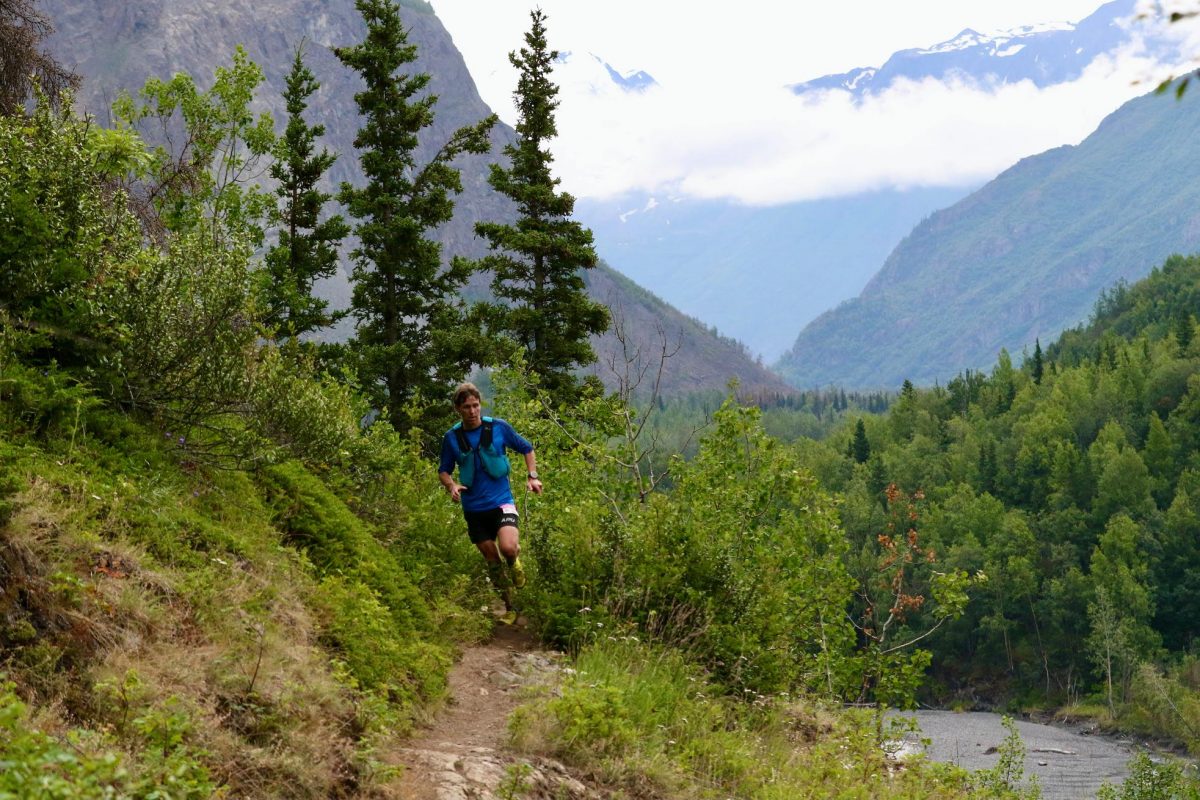
    “And that’s where you really start getting into the brush… It’s still a really good trail underneath, but it’s just overgrown. So it’s alders, it’s cow parsnip — and on a sunny day, those can give you some pretty bad rashes, so you have to watch out for that. There’s stinging nettles, and rose bushes, and other spiky things. And it just kind of covers the trail on either side.”

    In this section, experience reigns. Runners spend 30 minutes to an hour loping through an extended rolling downhill, pushing back chest to eye-level overhanging vegetation while attempting to dodge the hidden toe-grabbing rocks below.

    Patterson explained that his previous runs gave him the insight to trust his footing even when he couldn’t see where his feet were landing, and he remembered the sections where he needed to slow down to avoid obstacles underneath the vegetation. Patterson recalled that a few years ago, a handful of higher profile non-Alaskan mountain runners came to the event, but their lack of experience on the trail held them back during this section.

    “It’s really about knowing the trail more than just running, so it becomes really tricky for them.”

    Just before the confluence, the trail peels away from Raven Creek and climbs gradually over a divide before dropping down to the Eagle River. 

    “The Eagle River crossing is kind of a distinctive feature that everyone thinks of with Crow Pass. You’re crossing the river a couple miles downstream of the glacier, but it’s pouring out a solid amount of water. I mean, I think this year, I was probably upper thigh [deep] crossing. I mean, I’m basically six feet. So anyone smaller is starting to get pretty wet and pushed around a little bit.”

    Runners cross the icy Eagle River during the 2019 Crow Pass Crossing. (Photo courtesy of Crow Pass Crossing)

    Not only will you get “wet and pushed around”, but the water temperature is what you’d expect given its proximity to the glacial source.

    So you’ve successfully forded the river, found the trail on the other side of a featureless gravel bar, and avoided cramping after a minute or more in the icy water, but we’ve only made it halfway. The next 11 miles continue down the Eagle River Valley, between towering granite peaks often compared to Yosemite. The trail stays mostly at river level, with a few exceptions where it hops up onto a bench above the river. 

    “There’s one place — it’s called Chutes and Ladders — where it’s these quick up and downs and there’s a few ladders going over rocks, and then a descent with a rope to grab on to. It’s kind of tricky, slows you down.”

    This section is also where many of the reroutes Patterson mentions have taken place. Over the last few years, sections of trail that were being eroded by the river have been rebuilt higher up. In the year Roes set his long-standing record, runners were able to run along the floodplain of the river, whereas now, racers are climbing and traversing above the river.

    “It was just flat fast running versus rock on the hillside,” Patterson explained.

    The most significant of these climbs happens around mile 18 as racers approach The Perch. 

    “It’s the only significant elevation after the top of the pass at mile three. So there you are at mile 18 trying to climb up this decent ascent. I mean, it’s nothing huge, but after running downhill for the last 15 miles, you really feel the uphill.”

    As runners approach the Eagle River Nature Center, the trail turns to a dirt road double track, where those fit enough to still have pop in their step can open up their stride and cruise the last couple of miles. But, sticking with the theme of the race, the final mile contains a steady climb of about 100 feet. 

    “The last mile is going from basically river elevation up to the Nature Center. It’s just this gradual uphill that kind of grinds you down for the little bit to the finish.”

    Patterson covered this final mile in 6:15.

    Scott Patterson sets a remarkable new course record at the 2021 Crow Pass Crossing. (Photo: Brikru Photography/Crow Pass Crossing)

    By all accounts, the Crow Pass Crossing is “low key”. There are no course markings, no aid stations, no pacers, no support, no help at the river crossing, no prize money save for a course-record bonus, few rules beyond required safety gear, and the participant list is almost entirely Alaskan. The event is also a fundraiser for the local non-profit Healthy Futures AK, which aims to empower Alaskan youth to lead active lifestyles. 

    Patterson explained that the simplicity and lack of “hype” are part of what draws him back year after year.

    “Usually it’s kind of the local scene,” he explained in a call. “It’s a big deal for those of us that like the race, but it’s got nothing like the hype of, like Mount Marathon or something like that. Which, for me this summer has definitely been something I’ve kind of keyed into. I didn’t race Mt Marathon, partially with all the hype. I didn’t want to deal with it. With something like Crow, it’s kind of low key; just go and do it on the weekend and have fun, And then it’s over and you move onto the next thing.”

    The next thing was a week later — the Cirque Series event at Alyeska, which packs almost 4,000 feet of climbing and descent into a 5.9 mile loop. 

    “That one’s a little more hyped up, but it also had some prize money, which I didn’t feel like passing up on.”

    Patterson won that one too, setting a course record and taking home a $1000 check. 

    Looking ahead, Patterson acknowledged that his big goal is six months away: the 2022 Beijing Winter Olympic Games. Patterson had strong results at the 2021 World Championships in Oberstdorf, Germany, finishing 10th in the 50-kilometer classic and 14th in the 30k skiathlon. 

    Amidst high-volume summer training with the APU Team, Patterson explains that he holds his results in summer mountain races lightly. They provide insight into his training, but he does not project into the ski season based on a course record earned in the summer. 

    “We don’t do that many time trials during summer, so [results at Crow Pass and the Cirque Series are] definitely one of those markers that I always have. But it’s a little hard to read too much into them, because, like Crow Pass, you get a great year, and it’s fast, then it’s a nasty, rainy, cold year and you probably don’t want to read too heavily into it. But I think I mean, for me, I’ve done four races this summer, and set course records on three of them. So between that, and then also just taking in the other factors from intervals, some of the time for time trials we do, things like that, it really kind of gives us a good overall picture for going into the season. So it’s definitely a marker, but it’s not the only one.”

    Besides the Cirque Series race, the two races Patterson mentions were Kal’s Knoya Ridge Run and the Robert Spurr Memorial Hill Climb on Bird Ridge, both of which he called “low key” and put on by Alaska Mountain Runners. Patterson snagged the course record on Knoya Ridge, but laughed that David Norris “crushed him a bit” on Bird Ridge. He explained that there were a few others he looked at, but he decided he didn’t want to do too much summer racing coming into the Olympic year. 

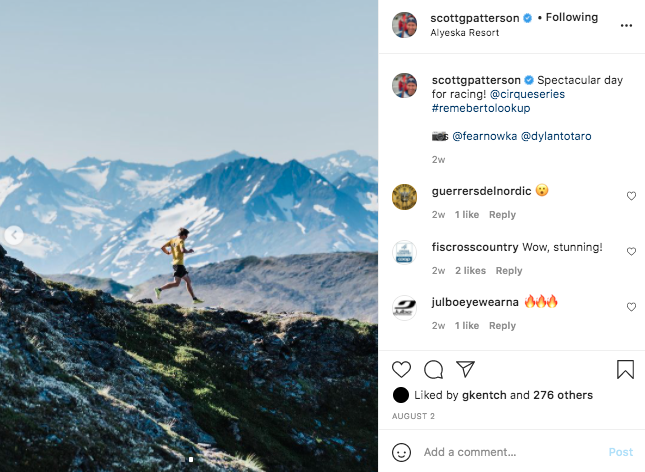
    Scott Patterson sets the course record at the Cirque Series Alyeska mountain race on July 31st. (Photo: Instagram @scottgpatterson)

    If his proclivity toward low key races and relatively low profile on social media haven’t already indicated to you that Patterson is humble and modest, his closing statement on his current fitness and how he’s feeling heading into the season should do the trick. 

    “I’m pretty psyched with where I am right now with some fast races and then some good other signs. So training is going well for the summer.”


    – Additional course intel contributed by Gavin Kentch.

  • A Summer Without Snow: Athletes and Coaches on a Year with No Summer Skiing

    A Summer Without Snow: Athletes and Coaches on a Year with No Summer Skiing

    DIY Dachstein: September tracks on a snowfield in the Chugach mountains, Sept. 27, 2020. (photo: Gavin Kentch)

    The koan that skiers are made in the summer has been around for longer than this website. The related truism, that summer snow time is necessary to effectively compete as a high-level skier come winter, also has a venerable history. 

    For example, here’s Luke Bodensteiner, writing in Endless Winter about why he had journeyed to a place where “the weather sucks all year long” to ski on the Sognefjellet snowfields in August 1993: “We all come to this spot simply to be able to ski a race faster than everyone else.” Or Billy Demong, discussing summer training on Eagle Glacier nearly 20 years ago: “In the late 90s and early 2000s, we were all working super hard, but we hadn’t quite broken through. I was on Eagle Glacier in 2002 because as a team we were committed to be the best.” Or Andy Newell, who first skied on Eagle the same year: “As the overall level on the World Cup continues to rise, summer training camps have become even more important. To be competitive at the very top level, you simply must get on snow at least once a summer.”

    Bottom line, as Reese Hanneman wrote in an essay for a Boulder Nordic Sport catalog a few years ago, “All the best skiers in the world are on snow in the summer. Do you really want to try to be the best skier who wasn’t on snow?”

    All well and good, but what happens when a global pandemic interrupts access to estival snow, for many athletes for the first time in a decade? More rollerskiing, of course, is the predictable and relatively simple answer. But bigger picture, it’s also a chance to introduce a new stimulus to long-established training patterns, and to replace travel and camps with increased consistency training out of a home base. Judging from conversations with three veteran athletes and two longtime coaches, high-level American skiers seem to be cautiously optimistic about how well this summer’s training will prepare them for the 2020/2021 World Cup season that starts in Ruka late next month.

    (Disclaimer: It should go without saying that the global health toll of the coronavirus pandemic, and resultant inequality, are bigger problems than the inability of professional athletes to train on snow in the summer in the manner to which they are accustomed. Because this is a ski news website, the rest of this article focuses on the latter, but that is not intended to deny the existence and importance of the former.)

    Background: In a normal year…

    Here’s another saying you may have heard recently: These are uncertain times. In a normal summer, the Alaskan skiers would be on snow through at least mid-May, then all national-team skiers would meet in Bend for a two-week on-snow camp in the second half of May. Skiers with Alaska Pacific University Nordic Training Center, or APU, would then spend one week a month in each of June, July, and August skiing on Eagle Glacier, a short helicopter flight above Girdwood, Alaska.

    Some national-team skiers – typically heavy on Stratton Mountain School and Craftsbury athletes, less so APU – would then spend two to three weeks in New Zealand in late August and early September, nearly all of it on snow at the Snow Farm. Groomed skiing returns to Independence Mine, about 75 minutes outside of Anchorage, in mid-October (probably), and to Frozen Thunder, in Canmore, about a week later (quite reliably). Arriving in Europe a few weeks ahead of the season’s first World Cup races typically affords athletes more on-snow time before first putting on a bib.

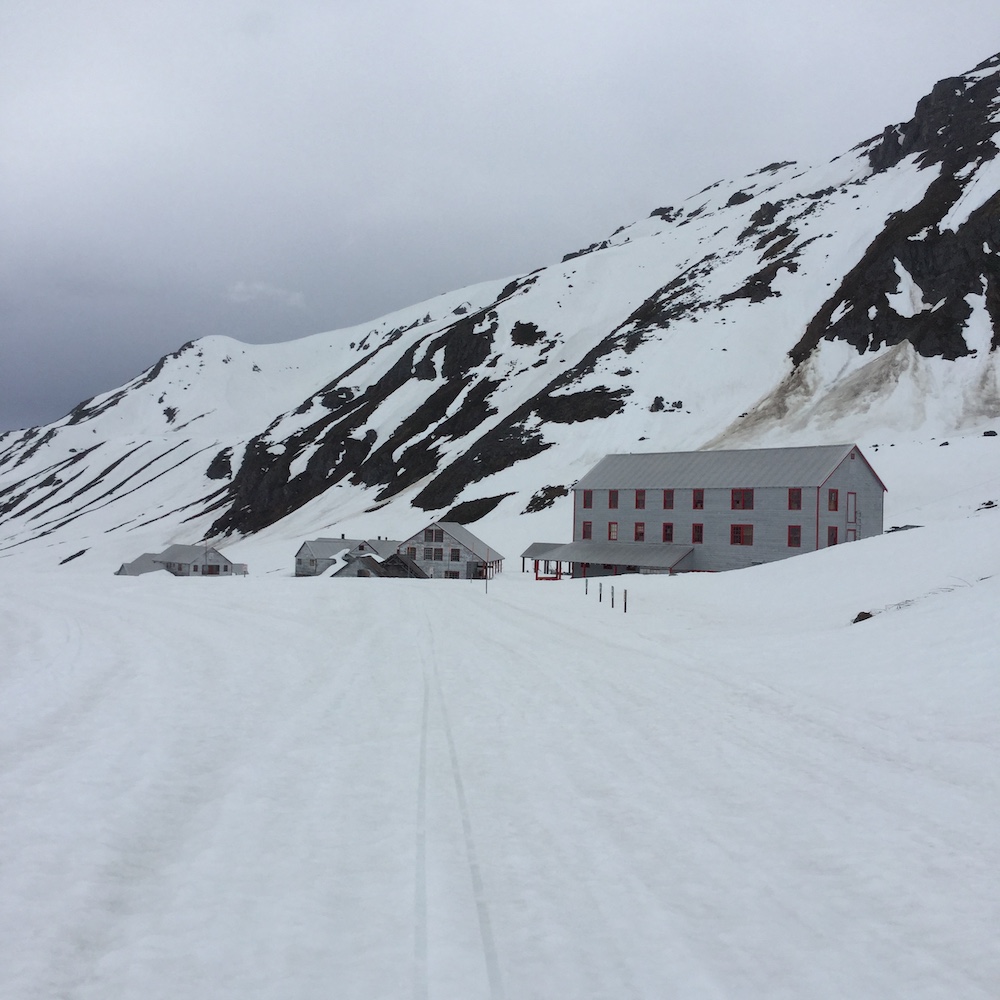
    Summer skiing at Independence Mine, above Palmer, Alaska, May 30, 2020. (photo: Gavin Kentch)

    This year, Independence Mine was skiable through the end of May, but everything else has been off the table. No Bend Camp; no Eagle Glacier; certainly no international travel to New Zealand, let alone to Canada for Frozen Thunder or Forêt Montmorency. It’s hard to survey the entire country, but this reporter’s cumulative four-plus hours of skiing since June 1, on snowfields in southcentral Alaska, may be among the highest on-snow summer nordic training loads in the nation, depending on how much time APU athlete Ari Endestad put in during a late-June (!) crust skiing trip in the Alaska Range. Until snow starts to accumulate at Independence Mine – the Mat-Su Ski Club’s historical first date of grooming there has recently been a tantalizingly close October 15 – American skiers’ collective summer snow drought looks likely to continue.

    What all this means

    So is this a problem when it comes to on-snow performance in the upcoming race season? Not really, according to multiple athletes and coaches.

    “You can accomplish 95 percent of your technique goals, perhaps,” on rollerskis, U.S. Cross Country Team Program Director Chris Grover said in a late-May interview with Cross Country Skier magazine (22:54 mark of podcast), speaking at a time when summer training options were still unknown. “And so we’re in a good place; even if we never touch snow this summer, we’ll be ready to race when we get to next winter.”

    “We’ve had many instances over the years with athletes who have missed on-snow opportunities in the preparation period, and gone on to have breakthrough winters,” echoed USST Head Coach Matt Whitcomb in a recent email to FasterSkier. “The dryland training is the cake, and the snow is the frosting. Americans will be frosting our cakes this fall when the snow flies, and this should lead to top performances during key mid-season international championships. I’m not one who attaches irreplaceable value to prep period on-snow training.”

    2018 U.S. Ski Team camp at the Snow Farm in New Zealand. (Photo: Matt Whitcomb)

    “The assessment period, that’s still ahead of us; that’s the race season,” echoed longtime APU Head Coach Erik Flora in a recent phone interview. “But … at least the athletes I work with, they’re in a good position right now heading into the winter.”

    “Of course, we will have to see when the races hit,” APU and USST athlete Rosie Brennan wrote to FasterSkier, “but I feel very optimistic that the summer has had a positive impact on my training.”

    “I’m hoping that some other training strategies – workouts that I normally won’t do because of the glacier, and a different strength routine – will have actually given me an advantage,” emailed APU skier Becca Rorabaugh to FasterSkier. “This is a good year to try new things and shake it up!”

    (Against all this enthusiasm, Whitcomb did provide a more nuanced look at some potential disadvantages, while acknowledging a former athlete’s gentle chiding about his perennial optimism: “Since Holly Brooks once asked me to not always be so positive,” Whitcomb added, “I will start by saying that Norway will have an advantage in the early season. Many of them have found some snow. But Norwegians are often competing for start spots and racing very fast in period one, which allows us a window to catch up when their performance flattens. It all balances out. Beyond that, this is a global pandemic, and every team has been affected. Americans don’t have to do things better than we ever have, but just as good as we can. That will be good enough for this season. I’m confident in our preparation, and believe we’ll deliver great results to our fans.”)

    What’s happened instead

    “There is naturally more roller skiing” this summer than in prior years, Whitcomb noted, “since during an on-snow camp we will do little to no roller skiing. The sessions on roller skis versus on snow are similar.”

    This is sensible enough. But everyone contacted for this article also discussed the broader implications of this year’s changes, be it for the overall training stimulus, travel schedule, training schedule, or all of the above.

    Pepa Miloucheva skates behind CGRP biathlete Casey Smith while at a training camp at La Forêt Montmorency in Quebec in early November 2015. (Photo: Caitlin Patterson)

    Here’s Rorabaugh, for example, who as a longtime APU athlete has logged three glacier camps each year from 2007 through 2019, making for an impressive 39 cumulative weeks of summer glacier time. (Flora says that athletes typically log 20–30 hours of ski time in a week at Eagle Glacier. Taking the midpoint of this range, 25 hours, yields a healthy 975 total hours of summer snow time over the past 13 years.)

    “2020 has been structured similarly to a normal summer of training,” Rorabaugh wrote. “The only difference is that where we would usually have a high volume week on-snow, we have done one in town. My overall training volume may have decreased slightly, since it’s hard to get quite as carried away with dryland training, but it’s also been more consistent week-to-week. We might be doing slightly more running than in the past, but the balance between rollerskiing and running is very similar. My joints and feet are actually the healthiest they’ve been in years though, probably because I’m not able to pound them into the ground with the expectation of a low-impact glacier camp for reprieve. Staying in town is forcing me to be a more responsible athlete, and I think my body appreciates it. Actually the biggest challenge for me this summer has been adapting to at-home strength training. Not having access to a weight room has definitely tested my creativity and self-motivation.”

    Or here’s Scott Patterson, like Brennan also an APU and national team athlete, in an email to FasterSkier: “The big changes to my training have mostly been the consistency of time in Alaska and a few alterations for indoor training. We haven’t had any USST camps or APU glacier camps so there have been a lot of weeks just plugging away in Anchorage. It was nice that the snow held on fairly late so it’s only recently that the desire to get sliding on snow has really caught up to me. Not having camps definitely changes things and has its downsides, but I am also really appreciating having fewer obligations and travel days through the summer.”

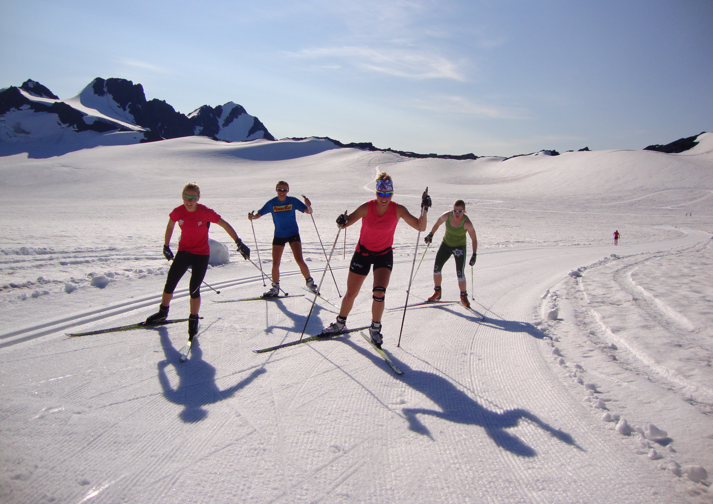
    Ida Sargent, Sophie Caldwell, Sadie Bjornsen, and Rosie Brennan enjoying freshly groomed snow on Eagle Glacier in summer 2011. Photo courtesy of Sophie Caldwell.

    And here’s Brennan, another veteran athlete with a long history of summer snow time: “It’s definitely been a bit of an experiment this year, but I have really chosen to look at the potential benefits. For one, as an older athlete it gets harder to introduce new stresses that create the adaptation needed to keep improving. This summer has certainly provided me a different set of stressors that I have had to adapt to. Travel also takes away training days and always comes with some sort of a need to adjust to the new training environment, so without travel, my training has been just so consistent.”

    What about technique work?

    As Grover said, “You can accomplish 95 percent of your technique goals” on rollerskis.

    Others were a little less sanguine. As Patterson noted, “Those weeks of glacier time in the middle of the summer are a great opportunity to preserve the on snow feel even when in town rollerskiing. It’s easy to forget that skis don’t kick like ratchets, pole plants are much softer than pavement, and asphalt never turns to deep slush. I usually try to use the glacier weeks as high volume periods with fairly intense focus on the technical aspects of actually skiing. In town, it has definitely taken some adapting to not have the focus week or the on snow technique.”

    And Rorabaugh, a Fairbanks native, sounded similar themes. (Relevant: Even in an era of climate change, Fairbanks, Alaska, reliably provides hard-wax skiing for at least four and probably five months a year, from early November through late March. Fairbanks skiers once started a spring marathon on the Chena River, in downtown Fairbanks, at temperatures of –12° F. On March 25.)

    Audrey Kentch, 5, skiing in wet-snow conditions in Alaska, June 2020. (photo: Gavin Kentch)

    As Rorabaugh wrote, “Summer on-snow training is a good time to work on technique and try new things, and to adapt to dramatically new ways of skiing. It’s also a vital opportunity to practice skiing in slushy conditions – something that an Alaskan skier might be unprepared for. At my first JNs in Lake Placid I remember being utterly shocked that people skied on sloppy trails, and having no idea how to do it! Thankfully I’ve had a lot of practice on Eagle Glacier since then.”

    Looking ahead to the start of the season, Rorabaugh noted, “I don’t think I’ll change my approach when I get on-snow this fall because it’s a different time of year. Early season snow is a good time to transfer dryland fitness to skiing, but it’s not as much of a technical laboratory. It’s more about technical honing than totally revamping.”

    No matter what the summer looks like, the first few times back on snow are necessarily different than rollerskis, and can potentially require some degree of transition. As Whitcomb observed, “It takes a few days for everyone; the skate skis feel long and awkward, and the greater hip area muscles get sore from slipping on classic skis. Our first few on-snow workouts in Finland each season call for short, easy training, and after that we’re good to go. I also think it is harder for juniors than for seniors, but neither case is a big deal.”

    A more nuanced aspect of this issue involves the optimal application of summer snow time for working on ski technique. Flora is a firm believer in his seriatim method, which involves one week on snow at roughly one-month intervals from June through August.

    The June camp is “usually the introduction of new ideas,” Flora told FasterSkier. “And the nice part about being on snow is that it’s real-time, real snow. So it applies 100 percent; you’re not adjusting for a rollerski kick, or, you know, road-style terrain; you’re on snow, and it’s World Cup-style terrain. And so, usually, June, we use to introduce ideas, and then July is kind of, refine and play with those, and then usually by August, you can see those changes kind of setting in. And so that’s a pattern that we’ve used for over a decade. And it’s an effective pattern.”

    World Cup terrain: The groomed ski trails on Eagle Glacier gleam in this view from the training center on a late-July evening in summer 2019. (photo: Gavin Kentch)

    When attempting to translate this pattern to an exclusively dryland paradigm, Flora explained, he found himself emphasizing more of a “steady amount of technique work in the summer” this year.

    Has it worked? With the significant caveat that the race season has yet to begin, Flora is cautiously optimistic: “As far as which one is more effective? Hard to say; I think they both work. One thing right now seems to be we have a number of athletes that have made jumps this summer, you know, similar to in years past. But again, we’ll see as the on-snow time comes.”

    Flora is similarly confident about an athlete’s ability to ski well in early-season races this year, even if they have transitioned from rollerski kick to hard-wax skiing at Independence Mine, only to be thrust into, say, a messy artificial snow, above-freezing, klister slopfest race in World Cup Period One. Flora expresses his hope that APU’s “style of coaching and education” has let the athletes “create an adaptable kind of platform to work from. And so when … they show up and it’s icy or soupy, or whichever it may be, that they’re ready just to jump on their skis and adjust.”

    Finally, Flora also cites his athletes’ accumulative lifetime on-snow experience: “The athletes that I’ve worked with for a while, I’m confident that they’re ready to kind of jump into any kind of conditions, that those athletes also have thousands and thousands of kilometers behind them, of glacier soup, and spring-like conditions. … I think for my main group [of athletes], everyone is comfortable kind of moving forward. I don’t know that one summer has a huge impact into that. … I guess I’ll know more about that in a few months.”


    Towards a philosophical understanding of summer snow

    Flora’s observation about lifetime glacial kilometers skied raises a final point: What, perhaps in a more fundamental sense, does summer skiing mean? The final paragraphs of this piece on FasterSkier attempt to limn an answer, and Chelsea Little’s lovely, lyrical essay on summer skiing at Italy’s Passo dello Stelvio does much the same. But what do coaches and athletes have to say about it?

    For Flora, summer skiing is, as discussed, an opportunity to install and ingrain technique changes relatively early, “so by the time they’re in the racing season it’s an automation or a natural movement, as opposed to trying to race and then also think about new movements.”

    But it’s also a chance to, well, ski a whole lot. This may seem obvious, if not downright unremarkable for professional skiers who ski all winter long, but for Flora it stands in contrast to, perhaps counterintuitively, the relatively reduced amount of actual skiing that occurs during the World Cup season, which brings with it travel days and recovery days and multiple venues with limited snow on small loops.

    https://www.instagram.com/p/CC2PpdbpXKD/

    As Flora notes, “What’s really interesting about those numbers is that if you go up to a glacier camp, and you ski, say you ski 20, 25, 30 hours that week. And you take that across roughly 15 k an hour, or you can even just look at the pure hours. Most of the athletes in the wintertime are training anywhere from, you know, 30 to probably upwards of 60 hours a month, at most, during the race season. And so the amount of time you get at a camp – if you’re having 30 hours in a week of training up there, take two camps and you have over a month of skiing already. And so the time up there is different than the race season too, because a lot of times when you’re traveling and racing, you’re skiing once a day, jogging in the afternoon, where on Eagle, you’re skiing twice a day. And so that time has a huge impact on kind of turning the body into a ski body.”

    All athletes and coaches also noted that summer skiing is some sort of change – a new physical stimulus, to be sure, but also just a change. Whitcomb spoke of the danger of “monotony,” and of the need to avoid not just an outright overuse injury, but also the “physical plateau” that can result from consistent use of one training mode. Brennan unconsciously mirrored Whitcomb almost verbatim, writing, “As for an overall approach, I have tried to remain very consistent all summer so no one activity gets into a level in which I’m risking overuse.” And Flora, similarly, said that he began the summer by telling his team, “the opportunity ahead of us is just the change in stimulus.”

    It’s hard to discuss these changes, in this year, without trafficking in tropes, but here are a few more to end things: Every disruption is a chance for improvement. It’s not a challenge, it’s an opportunity. The only thing constant is change.

    In all seriousness, though, in a sport where the increased sharing of information has led to high-level training looking relatively homogenous around the world, the unparalleled summer of 2020 provides a chance to see what winter results look like when traditional summer training is disrupted. As Flora said, he’s confident now, but we’ll all know more soon.

  • Sponsored: Summer Training With Krista Pärmäkoski

    Sponsored: Summer Training With Krista Pärmäkoski

    This article is made possible through the generous support of Madshus.

    The best athletes are never satisfied and always looking for progress and new ways to improve. This is how 29-year-old Finnish veteran approaches the upcoming championship season in order to augment her medal collection.

    Krista Pärmäkoski is aiming for gold at the 2021 FIS World Championships in Oberstdorf (GER) in February. The preparations started months ago.

    What are you doing differently in your training program this season compared to previous seasons? 
    – There were a couple time periods during the last training season when the overall training load and stress level was a bit too high. This caused some challenges in recovery. We have made some changes for the training camp plan, number of summer races and ruled out other small factors to avoid those challenging times. We have improved the data set including stress levels, sleep tracking and physical tests to capture those challenging moments early enough.

    – In skiing, the main targets are double poling and skating techniques in uphill. In next world championships and Olympics there are long uphill sections which will play big role in the distance races. They are not the steepest ones but they are pretty long.

    Related coverage:
    Krista Pärmäkoski renews her contract with Madshus through the 2022 Olympics  

    Story continues below

    Testing is an important part of monitoring progress.

    Why are you making these changes? What specific gains do you expect to achieve? 
    – When annual training hours are over 900 hours, it’s even more important to have a continuous monitoring of the stress and training load. There are many things that can be improved. It is important to analyze the reasons when trainings are not going well or your body is not responding to the trainings or recovery. These are things that you can always improve.

    How much do you train in a year? (Hours) – has that changed over the recent years? (more hours or less? Or do you emphasize different kinds of training now, for example more are you doing more distance now or more intensity than previous years?)
    – I have been increasing my total annual training volume progressively over the past few years. Last season I logged around 900 hours, and the plan for this season is to train around 950 hours. However, the percentage of high intensity training remains quite low, and I’m not concentrating on any high intensity training blocks or so. My main focus is on distance training, not sprint training.

    What is a typical training week for you in the summer? (How many workouts, what kind of workouts – intensity/distance/strength/speed)
    – During the summer, I usually log between 18 and 24 hours of training in a week. That’s usually 10 to 12 workouts; including 1-2 strength workouts, and one full day for recovery. At the start of the summer, I only do one intensity workout per week, and they are rarely all-out effort. I save those harder ones for later in the season.

    What is your favorite summer workout?
    – I like intensity workouts and I love running, so my favorite summer workout is running with intensity intervals. I start with a good, 30-minute warmup. Then I do a 40-minute interval at just below my anaerobic threshold, but inside this long interval, I also do three 2-minute intervals where I increase the intensity to above the anaerobic threshold level. After that, I do a 30-minute cooldown.

    Why do you like this workout?
    – This is one of my favorites because the 40 minutes at higher intensity feels good, and it’s always fun to do shorter intervals during the main section.

    What are the specific physiological gains from this session?
    – This workout is great because the longer block at sub-threshold contributes to build endurance and capacity. Additionally, how the shorter intervals go and how they feel, tells you a lot about your fitness level and progress, so it’s a good benchmark session.

    Krista Parmakoski (FIN) took home two individual medals from the 2018 Olympic Winter Games in Pyeongchang, South Korea (KOR). This winter, she is aiming for gold at the 2021 FIS Nordic World Championships. Photo: Nordic Focus
  • Gear Review: 7-Liter Nathan Vapor Airess 2.0 Running Vest

    Testing the Nathan 7-Liter VaporAiress 2.0 while logging miles with my sidekick on Red Hill in Carbondale, CO.

    This review is based on three weeks of product testing. During this time, the pack was used on ten outings, approximately 80 miles of running and one 20k rollerski. 

    Since my introduction to endurance sports in high school, my two loves have been running and cross-country skiing. After moving to the Roaring Fork Valley in Colorado in 2012, a mecca for trail running, I took to running in the mountains and dipping my toes in the water of ultramarathon racing. Between the snow melt in late June and late fall when snow coats the high country, I spend as much time as I can traveling fast and light through the mountains. This year, that meant over 1000 miles between the beginning of June and the end of September. 

    The 7-Liter VaporAiress 2.0 features ten pockets to store all of your nutrition, hydration, and layering needs on the go. (Photo: NathanSports.com)

    Putting in long days in the mountains requires the ability to carry sufficient amounts of food, water, and layers. That makes a running vest imperative. I jumped at the opportunity to test out Nathan’s newest women spcific trail vest, the 7-Liter VaporAiress 2.0, always looking to expand my lineup of options. A men’s version, the VaporAir vest, is also available. Both packs retail for $149.99.

    After traipsing over snow, ice, mud, and combinations of those three while logging late-fall miles, I found this vest up for the challenge of carting plenty of fuel and fluids, but not quite my dream pack. Is there such a thing? Here are the aspects I enjoyed, and those that left me wanting. 


    The Pros

    The 7-Liter Nathan VaporAiress 2.0 allows you to carry trekking poles, layers, and plenty of snacks and fluids on the trail.

    Without the bladder, the pack weighs 8.3 oz (235 g), making it lighter than the 8 L Black Diamond Distance Pack, but heavier than the sleeker Salomon Salomon S/Lab Sense Ultra 8. It’s sleek design fit under a jacket, which kept the bladder and hose from freezing on a single digit dawn patrol. 

    Pockets, pockets, pockets! This vest has three layers of chest pockets on each strap: a waterproof phone pocket, a soft flask sleeve, and a smaller pouch with an elastic closure system for snacks or gels. The back features a large kangaroo pocket which can be used as a sleeve for the bladder or for stashing layers. There is also a medium zippered pocket, a stretchy horizontal sleeve, and a small open pocket on the back of the vest, and elastic loops to secure trekking poles. 

    This volume was unnecessary for the 1.5 – 3 hour runs I was completing, but is valuable for all-day adventures that require a larger amount of food and clothing. It’s also great for keeping your supplies organized. 

    Running at night? The Vapor Airess 2.0 features reflective strips on the chest and back which contour to the sides of the body giving the wearer 360 degrees of visibility. These strips glowed brightly when illuminated by a car or a running buddy’s headlamp. 

    The Cons

    Breathability: with so many layers of pockets, the vest holds more heat than a paired down race vests. There is a moisture wicking panel between the bladder sleeve and the wearer which may help in the summer if the user is just wearing a sports bra or thin tee shirt, but is less effective over thicker winter wear. 

    The pack features Nathan’s signature “Adaptive-Fit” adjustment system, which allows the wearer to tighten the sides of the pack at the ribcage, as well as the two straps across the chest. The product page features a helpful instructional video on how to make this adjustment. At 5’6” and 125 lbs, I needed the elastic tightened fully for the size XXS-M pack to feel snug and still felt it was less secure than other vests that I’ve worn. I experienced less bounce using soft flasks in the chest sleeves than using the bladder, but could never quite get the glove-like feel I desired. 

    A word of caution: one reviewer commented that sliding adjustments on the chest straps can slip right off the end of the ribbing they are attached to, as there is no seam at the top or bottom to stop it. It is then very challenging to slide them back on. 

    The 7-Liter VaporAiress 2.0 features a moisture wicking back panel and several storage opportunities. (Photo: NathanSports.com)

    The 2 L bladder that comes with the pack feels too large for running and had a tendency to slosh from side to side even when the pack was fully tightened.  My preference is 1.5 L at most for running for this reason, though the larger volume would be helpful on a long hike where bounce is less of a factor. I had much better luck keeping the pack from moving using 16 – 20 oz soft flasks in the chest sleeves. 

    While storage opportunities are plentiful, the rear pockets are difficult to access on the go and it is nearly impossible to do so while keeping the pack on. This may not be a problem on outings where stopping to stash a layer is not a problem, but if you’re looking to make good time on a mountain mission or using it during a race, a pack with more accessible storage might be a better match. When the bladder occupies the largest compartment, it is challenging to store a larger jacket, like one might wear cross country skiing. I was able to stuff a thin waterproof wind shell into the zippered pocket and the horizontal sleeve.


    The Takeaways

    If you are looking for organized storage opportunities, the carrying capacity for lots of fluids, the Nathan Vapor Airess 2.0 might be a good choice for you. If your preference, like mine, is a more paired down pack race-style pack with stretchy easily accessible pockets, you might be better suited for one of Nathan’s other options, like the VaporHowe or VaporMag lines. I will likely use the 7 L Vapor Airess 2.0 as a small day hiking pack rather than a trail running vest.

  • Non-Traditional Summer Training with Dan Cnossen

    Non-Traditional Summer Training with Dan Cnossen

    Biathlon gold medalist Dan Cnossen of the U.S. celebrates his win in the men’s sitting 7.5 k biathlon sprint on opening day of competition at the 2018 Winter Paralympics on March 10 in PyeongChang, South Korea. (Photo: U.S. Paralympics/Mark Reis)

    Dan Cnossen is a badass. There. We said it.

    In the realm of para nordic sport, the 39-year-old medaled in each of the six biathlon and cross country events in which he competed during the 2018 Paralympic Games. At the 2019 World Championships, he Cnossen earned a silver medal in both the cross country sprint and middle distance races after a slew of podium finishes in World Cup events during the season.

    Prior to his athletic career, Cnossen served as a Navy SEAL platoon leader. While deployed in Afghanistan in 2009, he was severely injured in an explosion after stepping on an IED (improvised explosive device). Recovery from this injury required the amputation of both of his legs above the knee. He received both a Purple Heart and a Bronze Star with Valor for his service.

    FasterSkier connected with Cnossen via email during a recent on-snow training camp in Sweden to learn about the variety of training modes he utilizes to prepare for the winter ski season, which, as it turns out, includes some non-traditional activities.

    “Over the last several years in the Nordic off-season, I’ve alternated between competing in running races— mostly 5Ks — hand cycling, and most recently a bit of prone paddle boarding. After a full ski season, I mentally can use a break from racing, but in a long off-season racing can be a great way to stay sharp. It needs to be balanced with these mental and physical recovery aspects, though. If I find myself really looking forward to a race, then I think this is a good indicator that I’m ready to go again.”

    As paddle boarding and surfing seem a bit further removed from ski training than hand cycling or running, Dan explained how he came to these sports and how he incorporates them into his preparation for the winter season. Oddly enough, he was recognizing that the more traditional dryland training modes were not adequately preparing him for the demands of sit skiing.

    “I have found that running is great for my cardiovascular development, and it rests my arms—a nice break from double poling all winter! However, if I run exclusively it doesn’t do the job over a long off-season and I’ll likely be under-developed in the upper body power required to be a good nordic sit skier. In addition to some roller skiing, which can be hard on the elbows, I started hand cycling several years ago. It’s great to be able to ride a bike, especially in the fall in New England.”

    Always on the lookout for methods to improve in sport, Cnossen chanced into a low impact means of improving his skiing while out on the water.

    USA Para Nordic Gold Medalist Dan Cnossen shows the paddle board he uses to prepare his upper body for sit skiing. (Courtesy Photo)

    “Hand cycling puts a heavy load on the arms and biceps, which isn’t as useful for skiing, and when some friends in Rhode Island asked if I’d like to go prone paddling with them I said sure, not knowing really what it was all about. I had recently started surfing and knew that arms-only paddling was great for the kinds of muscles needed for double-pole skiing, and when I went on my first prone paddle on the ocean—in addition to struggling to keep up with my friends—I was hooked on this mode of training.”

    Cnossen explained that prone paddling is similar to stand up paddle boarding, except for the body position and that the paddling is done with the arms and hands directly. The board is also narrower.

    “You can either paddle on your belly in a prone position, with a stroke similar to freestyle swimming or the butterfly, or you can get up on your knees and do a double arm stroke. Not only does prone paddling get me out on the water—ocean, lakes, rivers—it’s a fairly niche sport that has a very close community as a result. Now, when I show up for the first Paralympic ski team camp in the fall, on snow in a ski tunnel in Europe, I feel the transition into double poling is fairly seamless and that is because of surfing and prone paddling.”

    Outside of running, hand cycling, surfing, and prone paddling, Cnossen incorporates regular strength training throughout the summer. He also spends time at the range and pairs either running or a ski erg with shooting to round out his biathlon training.

    Finally, Cnossen contrasted this summer training with his workload during the winter.

    Dan Cnossen heads to the water for a prone paddle boarding session. (Courtesy Photo)

    “In the ski season, the type and volume of training we conduct depends on where we are in the competition cycle. This could include a high volume phase, an intensity phase, a recovery week, and the tapering process before the major event of the season, which is typically towards its end. However, if I were to outline a typical training week it would usually contain two interval days on snow in the morning, likely with shooting for one of the two sessions at a high heart rate, followed by some type of strength work in the gym that afternoon. online games to play with friends

    For the other days of the week, I’ll usually ski anywhere from 90-120 minutes or longer at an easy pace, focusing on technique and various drills to accomplish that aim. These long skis might involve skiing and shooting, or they might focus only on skiing. And there might be some recovery jogging thrown in there as well, if the roads outside aren’t too icy. It’s quite easy to over-do the training as a sit skier, since arms don’t recover as quickly as legs, so we’re constantly mindful of how we feel. I have incorporated this year a lot of mobility work both before and after training, and stretching after, and it’s making a big difference in how my back, shoulders and neck feel.”

  • Optimizing Fueling to Reap the Benefits of High Volume Summer Training with Stephanie Howe Violett Ph.D.

    Here we are in late August, halfway between the start of the training year in early May and the beginning of the competition season in late November. Volume is the name of the game during the summer and at this time of year, it is not uncommon for top athletes to train 20 to 30 hours per week. Typically, the training logs prescribe athletes to head out on long runs, rides, and rollerskis at a relatively easy pace, but the week is also peppered with interval and strength training sessions. 

    In order to not only survive but also reap the benefits of this type of training, dialing in nutrition is imperative. In particular, matching the energy output with energy intake — read: eating a lot of food. How does one keep up with the energy demands of training at this level? Though he might be prescribing the training load, U.S. Ski Team coach Matt Whitcomb expressed the answer to this question is best left to someone who specializes in the field.

    “The 20 hour weeks are easy; it’s the 25-30 hour weeks that get tough,” wrote Whitcomb in an email. “I keep it simple: I don’t talk with the athletes about nutrition.  It’s a smart place for a coach to defer to the experts if they aren’t one themselves. Too many problems are waiting for a coach to trigger this trap. And yes, this is from experience.”

    So we brought in an expert. FasterSkier reached out to Dr. Stephanie Howe Violett, who holds a Ph.D. in Nutrition & Exercise Science. In addition to her academic training, Howe Violett has practical experience in meeting the energy demands of high volume training and optimizing nutrition for athletic performance. 

    Professional ultramarathon runner Stephanie Howe Violett holds a Ph.D. in nutrition and exercise science. She offers insight into optimizing fueling strategies to meet the energy demands of high volume summer training. (Photo: Instagram @stephaniemarieviolett)

    After nordic skiing and running through college at the University of Northern Michigan, Howe Violett transitioned to a successful trail running career where she landed on the podium in prestigious races such as the Western States 100, which she won in 2014 and placed third the following year. At the time of the call, Howe Violett was in the midst of some high volume training herself, spending long days training in the French Alps.

    While pursuing her doctorate at Oregon State University, Howe Violett studied the connection between exercise and perceived hunger, more specifically looking at how intensity affects the suppression of hormones that are connected to appetite. 

    “We know just from training and racing that when you go harder it seems that you feel less hungry or less desire to eat in the time period immediately post-exercise,” explained Howe Violett about her research. “If you do hard intervals or a time trial, food doesn’t really sound appealing and there’s a reason for that.”

    Her research was specific to running, but she explained that the findings extend to most endurance sports, potentially less so in non-impact activities where the digestive system is less impacted by jarring during exercise. Cross country skiing is relatively low impact, but it can certainly be high intensity, and when paired with dryland training modes such as running and bounding, Howe Violett’s study becomes especially relevant, particularly to those looking to sustain a heavy training load. 

    “The big take-home message is that, yes, there are appetite hormones that alter our appetite in the direction of suppression for about the first hour post exercise, they’re back up to baseline at about 60 minutes post exercise,” she continued. “That’s important because when you’re trying to optimize performance, the first 30 – 40 minutes after intense exercise is when you really want to refuel because the muscles are more able to uptake the glucose and start the recovery and restoration process for the next session.” 

    While most of us are probably logging far fewer hours than the pros, the nutritional advice Howe Violett offered benefits skiers at any level. In fact, her most important point is simple.

    “Eat enough. There aren’t really strategies in terms of quirky things to do. I think timing is super important and quality is important. You might eat three [primary] meals a day, but then timing your intake before and after exercise is super important and I think that’s something skiers overlook in my experience, maybe more so at the younger ages.”

    When meeting the demands of a heavy training load, Howe Violett recommends consuming energy while training as well. 

    “Fueling during exercise is really important and that time window immediately after is really important. So if you’re doing 20 plus hours a week, I think getting that extra fuel in during those sessions is super important for your overall energy intake. Also having a snack right before bed that is preferably whey protein, dairy is the best source, because that can help with the repair process overnight.” 

    This fueling strategy was affirmed nearly verbatim by Canadian National Team skier Dahria Beatty.  

    Dahria Beatty (center) on course in the 15k mass start classic race on March 17, 2018, in Falun, Sweden. (Photo: Fischer/Nordic Focus)

    “The main thing I think about during a high volume training block is being proactive with my energy intake during and immediately post-training,” wrote Beatty in an email. “That means fuelling during long workouts before I become hungry as well as making sure I have my recovery snack ready for as soon as I am done training. 

    “My meals outside of training stay pretty similar to those during a normal training block,” Beatty continued. “In big training weeks, I pay more attention to my hunger levels mid-day and in the evening, adjusting my afternoon snack and adding an evening snack if necessary.” 

    During her training sessions, Beatty’s go-to snacks dried fruit and homemade granola bars or energy balls. After a session, particularly in the summer, she likes to make a fruit smoothie.

    “Banana-mixed berry-ginger is my current favourite,” she wrote. “After particularly hard workouts I will top my smoothie with a bit of granola, coconut, and some chocolate chips.”

    It might seem that the expression “if the fire is hot enough, any fuel will burn” could fit here, but Howe Violett explains that simply eating high calorie foods is not necessarily the answer. 

    “You want to get more nutrient dense foods — things that have a lot of vitamins, minerals, and fiber in meals. Then in training and post-training, you actually want very simple carbohydrates so that they can be absorbed a little bit easier.” 

    Kikkan Randall in the kitchen “getting ready and fueled” in the fall of 2014. (Photo: Twitter)

    An athlete who is not matching the energy or nutrient demands of their training will recognize this deficit in a slowed recovery or feeling more fatigued than would otherwise be expected. If this is the case, Howe Violett recommends considering whether the athlete is consuming enough carbohydrates.

    “Suppressing carbohydrate intake or just not getting enough carbohydrate is a common thing that people get right now because carbohydrates aren’t super popular in fad diets. It can lead to mood disturbances, feeling foggy, not recovering, just feeling like you can’t go any faster despite trying. And it can take months or years to overcome that, so I think that it’s really important to be diligent about carbohydrate intake every meal and every day. Not necessarily pasta and cereals, but whole grains like rice, quinoa, starches like potatoes and sweet potatoes, and then a lot of fruits and vegetables. Those are going to be really good sources. Then pairing that with sports products like gels and blocks during training, a bar before training, and something like chocolate milk after training. I think that’s a really good way to ensure enough carbohydrate intake to avoid overtraining or overreaching.” 

    An athlete’s training log changes with the season. High volume in the summer transitions to low volume but high intensity in the winter. How does this transition impact nutritional needs? Howe Violett emphasized that nutrition is individual and generalized advice is not something she likes to provide. For some of the athletes she works with, their nutrition plans change weekly to account for their training, travel, and race schedule.

    “I really encourage people to work one-on-one with someone because you really learn so much about yourself and how to fuel your body, what your needs are, and how to structure it throughout the season.” 

    She provided a loose framework explaining that the most overall energy is needed when the volume is highest. 

    “Nutrition is individual, but we work within the framework where we want, for a skier, 50-65% carbohydrate, 20% protein, and about 30% fat throughout the day. Then knowing that that is night and day different from what you might intake before, during, and after training, and it’s really important to optimize both of those occasions because they are both equally important and they can really help drive performance. Training is the thing we think about most of the time, but nutrition can actually be just as important and work synergistically with training and recovery.” 

    Typically during the more intense winter months, an athlete’s diet might need to be at the higher end of the range for carbohydrate since the body relies on this type of energy most while racing or completing speed sessions. Then, during the off season when volume and intensity are both low, one would be better served to eat a higher percentage of fat and protein.

    Howe Violett concluded with advice for athletes at any level, particularly juniors ascending into the college ranks, collegiate skiers chasing professional ski racing, or anyone who is looking to make a jump in their training load and seeks to optimize their nutrition accordingly. 

    “Eat enough and just ignore all diet recommendations that come from the internet or social media because it’s all just pseudoscience. Take a step back to the basics. Get enough food — if you’re hungry, it means you need to eat. I think a race weight is a really silly way to determine if you’re fit or not. I think when you feel good, when you’re well-fueled, you’re getting enough sleep, and you have energy, that’s a really good state for your body to be in. That is the whole package, nutrition, recovery, stress, and lifestyle.”

    Before transitioning to trail ultramarathons, Stephanie Howe Violett skied for the University of Northern Michigan. (Photo: Instagram @stephaniemarieviolett)
  • Wednesday Workout: Summer Training for Junior Athletes Competing in Fall Cross Country

    Wednesday Workout: Summer Training for Junior Athletes Competing in Fall Cross Country

    This Wednesday Workout comes to us from Matt Boobar who has been coaching the Stratton Mountain School (SMS) nordic team since 2007. In the fall, he also works with the cross country running and mountain bike programs, and leads cycling in the spring. Boobar has a B.S. in exercise science and has earned a USSA Level 200 certification. He has been the head coach of the New England Junior National Team eight times and was recognized as the NENSA coach of the year in 2009. The SMS Nordic and the elite SMST2 teams were selected by USSA as 2019 Cross Country Club of the Year; it is the clubs fourth time earning this recognition in the last six years. 

    Matt Boobar holds up the trophies earned at the 2017 Northern New England High School Mountain Biking Team Championships. SMS won the team title in both 2017 and 2018. (Courtesy photo)

    If you have been so lucky as to grow up and go to school in a place where nordic skiing is possible, the scenario of fall cross country running followed by nordic skiing in the winter is likely one that you are familiar with. Looking at a Venn diagram of the teams, the union might not be significantly different than the intersection. With the growth of youth mountain bike and cycling programs creating a different opportunity for adolescents to become endurance junkies, the running-skiing symbiosis might be less prominent than it once was, nevertheless, it remains the approach of many U18 athletes nationwide.

    In cross country running, there is a saying, “autumn holds no secrets of how summer was spent.” Similarly, in the ski world, you may hear, “skiers are built in the summer,” which leads to the challenge many athletes face when they head into summer with goals in both sports.

    Depending on the long term goals of the athlete, at some point, it is wise to decide which sport holds the priority. This way, an athlete can fall into one of two camps: the runner who also wants to see improvement in their ski racing or the skier who wants to improve their running (and remain injury free through the fall). In Boobar’s mind, the time when this decision is made is unique to the individual making it.

    buy ventolin online

    “It has to be personally goal dependent on the athlete,” he said in a call. “I think helping to create awareness that, ‘I just can’t run and do my eight-week cycle [for cross country running] which gets me peaked on November 1st, and then jump in November 15th with my nordic team and build up for an eight or ten-week cycle for that’. I think they have to think, whether their goal is running or skiing, they need to definitely think year-round training.”

    Members of the SMS cross country team charge up a hill during a fall race. (Courtesy photo)

    First, let’s look at the skier who also wants to perform well in fall cross country races. This scenario is one Boobar is most familiar with, as the athletes that attend Stratton Mountain School are already committed to making ski sports their priority. Though his athletes compete in the local Vermont high school races and state championships, they do not train full time for running the way one might on a more traditional team. Athletes that train year-round with a club program, but also participate in their school’s cross country team may relate to and benefit from this approach.

    “We use markers like some of the championship races in the fall as goal setting tools,” Boobar explained. “So for the state meet for cross country running, we’ll attempt a version of a taper and peak format and just see how their energy is for that event… We try to use that going forward in how they react to a certain type of taper and peak.”

    While the hard efforts are beneficial, the races are not prioritized the way nordic races would be.

    “The issue we run into with trying to run fast or even bike really fast is that we don’t really want to be at a peak level at the end of October,” said Boobar. “We want to be in the middle or more of a base building, pretty high volume, just pretty solid heavy training load.”

    The challenge he faces in recommending summer plans for his athletes and training with them throughout the fall is prescribing them enough running specific work that they are able to hold their own in races without sustaining any injuries, while the primary focus of training remains more ski specific.

    “What we run into nowadays with the running is a lot of soft tissue injuries: shin splints, Achilles tendinitis, sore knees,” Boobar noted. “Some kind of result of how kids are growing up possibly, they’re not doing as much crazy free play in the woods – but it’s definitely something that we’ve noticed, so we have to train our kids to build up some of that running durability. And I don’t think it’s enough to just be like, ‘Oh, we’re going to go trail running on the Appalachian Trail,’ I think they need to do some actual running repeats on a fairly hard surface and incrementally increase that so they can build up that durability and leg speed turnover.”

    He added that for most skiers, running is used as a training modality on long endurance days possibly with poles in the mountains, so the body gets used to a much slower cadence than what is needed for a cross country race. While this cadence isn’t necessary to ski fast in the winter, it can certainly inhibit performance in a 5k run. By including some higher speed running, perhaps 400 meter or 1-kilometer repeats, Boobar expects to see a decrease in the frequency of running related injuries and an improvement in performance in his athletes at the championship benchmark races. They also include drills regularly to help promote proper running form. 

    SMS science teacher David Sinclair works with cross country athletes on their running form. (Courtesy photo)

    What about the other camp? For athletes whose primary focus is on cross country running but are also interested in seeing improvements in their skiing, Boobar offered a few simple recommendations.

    buy antabuse online

    “If you’re a cross country runner that had skiing goals, you could add three things: you could add a longer double pole rollerski once a week, you could add skate agility once a week, and add as much core stability work as you can handle. You can’t really overdo that.”

    Because of the high-impact nature of running, he also noted the difference in training hours (though most runners measure in miles).

    SMS coach Matt Boobar demonstrates double pole technique during a training session. (Courtesy photo)

    “Our kids [at SMS] are training 8-15 hours a week in the fall, and I would guess most public high school running teams or even a prep school, they’re training under ten hours a week and that might be a huge week for them running. So I would look at them and say they need to add a longer day.”

    For the double pole rollerski, he recommends 1.5 hours easy, potentially following a run. This provides the athlete with the aerobic benefit of a long session without adding any load to their already fatigued legs. A 45-minute skate with agility focus helps with balance and coordination and works the musculature involved with lateral movement, which is not as recruited as much in cross country running.

    At the end of the academic year, Boobar will be advancing to the role of director of the SMS nordic program following the retirement of Sverre Caldwell, who led the program for 39 years. While it might seem as though he is stepping into shoes that are tough to fill, Boobar feels confident that the transition will happen seamlessly.

    “Luckily, I’ve worked here with him for ten years,” said Boobar. “So following along with his coaching style and philosophy will be pretty easy. We both have a similar philosophy with how we like to coach anyway, which is to try to provide an environment for kids to take ownership of their own training and goals. So not so much tell them what to do, but having all the pieces there for them to figure out what they need to do.”

  • Summer Training In… Germany’s Black Forest with Ann-Cathrin Uhl

    Summer Training In… Germany’s Black Forest with Ann-Cathrin Uhl

    Ann-Cathrin Uhl on a hike in Germany this summer. (Courtesy photo)

    Ann-Cathrin Uhl will be a senior at the University of Anchorage Fairbanks (UAF) this year, but for the summer she was back in her native Germany as usual.

    Uhl made her first trip to NCAA Skiing Championships last season, finishing 30th and 34th at the races in Jackson, N.H. But she has long been a contributor to the UAF Nanooks effort both on the ski trails and as a cross-country runner. This summer, a group of ski teammates came to visit her in Germany.

    “I understand Seiji Takagi, Nick Lovett, Anni and Jan Cech all got together for a couple of weeks earlier in the summer,” UAF head coach Nick Crawford wrote in an email. Lovett then joined Cech for a few extra weeks of training in the Czech Republic.

    Uhl is probably also a familiar name to American competitors as well, because in both 2015 and 2016 she won the junior heats of the classic sprint at U.S. Cross-Country Championships.

    University of Alaska Fairbanks women’s nordic-team skiers get together for a photo last season: (from left to right) Hannah Rowland, Anne-Tine Markset, Nichole Bathe, Martina Himma, Ann-Cathrin Uhl, and Sarissa Lammers. (Photo: Nick Crawford)

    Uhl took some time over email to share what it’s like to train from her home base in Germany’s Black Forest region, a mountainous region in the southwest of the country.

    FasterSkier: Where are you based this summer? What part of the Germany?

    Ann-Cathrin Uhl: This summer my training base is mainly the Black Forest, that is the southwestern part of Germany. I am living with my family in Mühlenbach, which is the town I grew up in. During the week I train at home and on some weekends I drive to the Alps for altitude training.

    FS: What is your part of the Germany like? How is the landscape? What do people do there?

    ACU: I live close to a town called Schonach, where the annual Nordic Combined World Cup is hosted. Sandra Ringwald, the German Nordic World Cup skier is also from this town. The Black Forest is a mountainous region, bordering France and Switzerland. Its beautiful nature with mountains, valleys, gorges, lakes and rivers is reason for lots of tourism. People that live here like to be outside and active. Hiking and mountain biking are very popular.

    Uhl competing at German Mountain Running Championships, where she finished 30th and helped her team to sixth place. (Courtesy photo)

    FS: Do you have a team that you are training with, or are most of your training sessions alone? 

    ACU: I don’t have a ski team I can train with. I do all the rollerskiing and strength on my own. But I am training with a professional mountain running team in my area. I actually got to know my teammates pretty well, since we were travelling to competitions together.

    FS: How do you design your training — is it based on a plan from Nick at UAF? Are you adapting it at all to be able to match with other people/groups you might have opportunities to join?

    ACU: My training is based on the plan from coach Nick at UAF. I am training with the running team two to three times a week and other than that I try to follow Nick’s instructions for rollerskiing, strength, volume, and intensity. Sometimes, I adapt the plan to train with the team.

    FS: Is your college training plan very different in terms of volume, types of workouts, or other focus compared to what you would be doing if you were on a German team at the same level? 

    ACU: My college training plan is pretty similar to what I would be doing on a German team. I believe that Germans do more running and less strength than we do at UAF. Germans highly value intensity running workouts, whereas most of our intensity is on rollerskis, but other than that the plans are similar.

    Uhl heading uphill on a rollerski workout. (Courtesy photo)

    FS: What’s the hardest workout you have done so far this summer?

    ACU: This question is hard to answer. I would say the workouts I did in the Alps were the toughest ones. I did some hard uphill rollerskis and mountain running workouts. Apart from that, I raced at German Mountain Running Nationals with the running team, which was a very intense and tough race.

    FS: Are there any absolute favorite places to run or bike or rollerski?

    ACU: I love training in South Tyrol, which is in Northern Italy. It’s super fun to do uphill rollerskiing and running in the Italian Alps. Other than that, the Black Forest is perfect for summer training. The landscape is very diverse and therefore perfect for road biking, running, and rollerskiing.

    FS: Is your area set up best for some parts of training? 

    ACU: I honestly thing that the Black Forest is ideal for summer skiing training. At my home we have many excellent hills for intensity, but also hilly and flat areas for longer workouts. We have a million of trails for running and biking, and good bike paths for rollerskiing. We only drive three hours to the Alps for training in bigger mountains. The only thing that is currently missing is more snow in the winters.

    FS: What do you do when you are not training? Do you need to have a job?

    ACU: I worked a summer job at the tax office for six weeks. In my free time I like to hang out with my friends from home or go swimming at lakes and the local swimming pool.

    FS: What is the best part of German summer, aside from training?

    ACU: I like being so close to Switzerland, Austria, France, and Italy, because it’s so easy to travel and do some roadtrips. I also like the climate, since it gets up to a 100 degrees.

    Finding the cold: Ann-Cathrin Uhl in the mountains this summer. (Courtesy photo)
  • Closing the Gap: Summer Skiing

    Closing the Gap: Summer Skiing

    August skiing on the Dachstein Glacier in Austria as seen in 2015. (Photo: Claire Grall)

    Editor’s Note: The following is the third post of a series proposed by Maks Zechel, a 19-year-old Canadian cross-country skier embarking on his first season training abroad. He recently made the big move to Norway, where he’ll be training and racing with Team Asker for the next nine months. Through these updates, Maks hopes to share his personal “observations, stories, and lessons learned” to help close the gap between North American and Scandinavian nordic skiing. Read Post #1 and Post #2.

    ***

    Arrival.

    My landlord greets me warmly at the bottom of the driveway as soon as I step out of the taxi. In his mid-70s, he doesn’t even give me a chance to protest as he quickly scoops up my heavy ski bag and staggers up the steps leading to the house. He’s fit, and in the coming days I see that he goes running, kayaking or rollerskiing every day, while his wife goes swimming. After unpacking my things I am treated to an evening meal that includes brunost (Norwegian “brown cheese”, it’s soft and sweet) and smoked salmon. Later I am shown where to put my bike in the shed. Wooden skis hang in the rafters, the same ones he used to compete in the Holmenkollen 50-kilometer race in the 1970s (this was before it was a designated World Cup, but it was still a prestigious event). It’s like finding a pair of skates in my grandfather’s attic, and discovering that he played in the NHL with them. Welcome to the home of cross-country skiing.

    And what is more Norwegian than skiing in the summer? My arrival in Norway coincided with the time that most Norwegians go on holiday. Team practices were suspended for a couple of weeks so I decided to take a trip of my own to nearby Torsby, Sweden. This is a small town that is known to skiers around the world for its partially underground ski tunnel. A few other well known ski tunnels designated for cross country skiing, are: Oberhof (Germany), Toksovo (Russia), and Vuokatti (Finland).

    Time spent on snow becomes crucial to a skier’s success as they enter the junior and senior level, and skiing in the summer grows in importance. Summer is an expensive time to get on snow for many, but it is extremely valuable. Skiing in the summer allows athletes to put in big hours of volume and quality intensity workouts that are harder to fit in closer to the race season. It is easy for skiers to get excited in the fall and early winter as we finally get on snow.

    As the race season draws closer, it is common for skiers to frantically put in huge volume and many hard workouts in the short periods that they are able to ski. It is frustrating when fall arrives and you go from great summer fitness, to suddenly feeling that your dryland training is not directly translating to good technique and shape on skis. Nevertheless, trying to fix all of this too quickly before the first races in December can ruin your entire race season if you burn yourself out. One solution is shifting some of that on-snow work to the summer, when it is easier to absorb a lot of training with the absence of school and races and the presence of sunshine and Vitamin D.

    I have had three different summer skiing opportunities over the last three years, and I have compared my experiences for your benefit:

    The ski tunnel in Torsby is easy to access and great for a short or long stay due to the excellent training variability. Besides the tunnel, this includes a rollerskiing track, biathlon stadium (outside and in the tunnel), extensive running trails through the surrounding hills and forests, and a fully equipped gym attached to the tunnel.

    Inside Sweden’s Torsby ski tunnel. (Photo: Maks Zechel)

    The ski tunnel is one loop with a wide “stadium” area at the start. The entire loop is a concrete tunnel and the temperature is kept around -5 degrees Celsius (23˚F). The loop has two hills per lap, which are steeper in one direction and more gradual in the other, making for a great place to work on striding. Most senior men would one-skate the hills at race pace, but they are still steep enough for offset technique work at lower speeds. I was thrilled to be on snow for my first few five–minute laps, but after approximately 150 laps in three days, it became less exciting. The “eurobeats” playing in the tunnel were entertaining at the start, but one can only listen to “Despacito” so many times…

    While in Torsby, I stayed in a room at the Valbergsängen Sporthotell (a six-minute walk from the tunnel). Valbergsängen offers the option of staying in a hostel for a reduced rate where you are given your own room in a house with a bathroom and kitchen that are shared with other guests, or you can stay in a hotel room where you have more privacy and breakfast is included. You can even choose between the two if your Swedish is good enough. Unfortunately I missed this expensive difference, and without a kitchen, ended up making creative “meals” on my desk out of tuna, cheese, beans, peanut butter, and an assortment of bread and vegetables.

    Outside the Torsby ski tunnel. (Photo: Maks Zechel)

    I returned from Torsby, after twelve hours spent skiing loops in a “bunker”, to discover that I had a new roommate. I was sitting on my couch working on a blog post when I heard a noise that only your average-sized mouse should make when hitting the floor. I looked up and, with a jolt, realized I was looking at a spider almost the size of my hand scuttling towards my fridge. In that moment, I decided two things: one, I did not want a roommate, and two, this spider was too big to tackle with a tissue. I jumped up and grabbed my broom handle from the corner (coincidentally this broom handle doesn’t have a broom on the end of it, something that will likely be an issue at some point in my stay here). When I looked up, he was gone (I say “he”, because I am praying it is not a female about to start a family in my apartment). I slept restlessly that night. A week later, after discovering that this is a common Norwegian house spider, I am now in the acceptance stage, and I hope that the two of us can coexist peacefully for the next nine months. If not, one of us will have to leave….

    Norwegian Phrase of the Week

    Norske: Jeg sølte en stor beholder med yoghurt i melkegangen. Jeg beklager så mye.

    English: I spilled a large container of yogurt in the dairy aisle. I’m so sorry.*

    (*True story of my first few hours in Norway, unfortunately.)

    Maks Zechel in the ski tunnel in Torsby, Sweden. (Courtesy photo)

    About Maks: Maks Zechel is a competitive cross-country skier who secretly wants to become a professional mile runner. He loves hiking and going on canoe trips with his family, as well as peanut butter cups in ice cream. Johan Olsson is his favourite skier and he hopes to race the Cortina-Toblach stage of the Tour de Ski one day. He enjoys writing about his experiences. Follow him on Instagram @makszechel.


  • Summer Training In.. Jilemnice, Czech Republic, with Jan Čech and Nick Lovett

    Summer Training In.. Jilemnice, Czech Republic, with Jan Čech and Nick Lovett

    Some things are the same everywhere: a mostly junior training group after a rollerski workout in the Czech Republic. (All photos courtesy of Jan Čech)

    For almost as long as Nick Lovett has been skiing at the University of Alaska Fairbanks (UAF), he has been thinking about how people train in other parts of the world.

    This summer, the Wyoming native went on a trip to find out, visiting teammate Jan Čech at his home in the Czech Republic.

    “I have been roommates with Jan for two years, and have been considering training with him in Czech for just as long,” Lovett wrote in an email. “I thought it would be a good experience to go somewhere new and see how training works somewhere else. I would say my decision was half for the training aspect, and half for the travel opportunity. I also traveled to Norway, Germany, and Scotland while away this summer.”

    https://www.instagram.com/p/BUbn9oIgLcL/

    That also included visiting teammate Ann-Cathrin Uhl in Germany, and UAF teammate Seiji Takagi joined part of the trip as well.

    So what did he find? Both Lovett and Čech, both 23 and seniors at UAF, answered some questions over email about summer training in the Czech Republic. The interviews have been edited and condensed.

    Čech working hard in the Czech Republic. (Courtesy photo)

    FasterSkier: Jan, where are you based this summer, what part of the Czech Republic? Is this the same area you grew up in, or is your training base away from your family home?

    Jan Čech: My base camp is in Jilemnice, the northeast part of Czech Republic, close to Giant Mountains. I was born here and I went here for sport elementary school, and high school focused on sport education. Now I train with my brother’s group — he is coach at the high school above, as well as a coach of the Czech junior national team for cross country skiing.

    FS: What is that part of the Czech Republic like? How is the landscape, what do people do there?

    JC: Because are where I live is right under mountains, the landscape is rolling with numerous of tree-covered hills. It’s perfect for running and biking. People here are big fans of any sport and most of them spend weekends in the mountain, hiking, climbing, or biking in the countryside.

    FS: Do you have a team that you are training with, or are most of your training sessions alone? How well do you know the other athletes and are they at a similar level to you?

    A rainy rollerki in the Czech Republic. (Photo: Jan Čech)

    JC: Most of the time I train with my brother’s junior group. The guys are fast — some of them attended World Junior Championships in Soldier Hollow, Utah, last season. So they are good training partners. Also sometimes I drive to the rollerski track an hour away from town, and there I can train with men from the national B-team who are my friends. I competed against them before I came to Fairbanks.

    FS: Nick, did you spend some time training with this group, and how easy was it to join them?

    Nick Lovett: It was as easy as possible for me to integrate, but there were some challenges. Aside from Jan, there were very few other skiers or coaches who spoke fluent English. This was the most challenging part as we tried to communicate some complex technique ideas with less than ideal words to use. While the language barrier was a challenge, I still feel I was able to learn and accomplish enough to fit in well. 

    FS: How do you design your training? Is it based on a plan from Nick Crawford at UAF? Are you adapting it at all to be able to match with other people/groups you might have opportunities to join?

    JC: I train with the team in my hometown so I can have training partners, especially during interval sessions so I can push myself harder. Then I try match the intensity and volume hours from Nick’s plan. I also keep doing the UAF strength system whole summer as well.

    FS: What are some of the differences between Czech training and American training?

    NL: I would say there were some differences, but overall it was very similar to what I expected and what I have experienced here. The most notable difference was the emphasis that was put on general athleticism. While in the U.S. most workouts are all ski-oriented, some workouts there incorporated elements of gymnastics and track running.

    Čech, seen from the dashboard of a coach’s car, has the road to himself. (Courtesy photo)

    FS: What’s the hardest workout you have done so far this summer? 

    JC: My hardest workout this summer so far was uphill run time trial, which I do every year since I was 13. So that’s the best way how to test my fitness level for me.

    FS: Are there any absolute favorite places to run or bike or rollerski? 

    JC: I believe my area is a great place to train. We have lots of opportunities to go mountain biking or road biking for up to four hours, which are amazing workouts and we bike as a group of 15 people. Also we have many country roads with new asphalt, which connect a hilly rolling loop of about 50 kilometers. That is great for classic OD’s [over-distance].

    NL: Jilemince was a beautiful place to train. There were ample trails to run on, and some very quiet roads where one could ski for 2.5+ hours and never repeat the same asphalt. There is also a rollerski track and biathlon stadium currently under construction in Jilemince which will be an incredible addition to the town as a training venue.

    FS: What is the best part of Czech summer, aside from training?

    JC: The best part of summer in Czech are my evening walks with my sister to the old town square, which has buildings over 700 years old and great chocolate factory near by.

    FS: Nick, where was your favorite place you visited?

    NL: My favorite place we went was the city of Prague. It is an incredibly beautiful old city, and I just loved being there. Also we did some long runs in the mountains on the Czech-Poland border. I am from Jackson, Wyoming, so I loved being in the mountains and it made me feel closer to home there.

    A workout in the mountains on the Polish border. (Photo courtesy of Jan Čech)
  • Summer Training… All Over Finland with Krista Niiranen

    Summer Training… All Over Finland with Krista Niiranen

    Krista Niiranen doing a workout running with poles in Rovaniemi, Finland. (Courtesy photo)
    Krista Niiranen doing a workout running with poles in Rovaniemi, Finland. (Courtesy photo)

    A World Junior Championships and World U23 Championships skier for Finland who had racked up top-10 finishes in her country’s competitive national-championships field, Krista Niiranen moved to the American Southwest last year.

    “I had been studying law in the University of Lapland in Finland, but for the last season I transferred to the University of New Mexico and represented the UNM Ski Team,” she explained.

    UNM's Krista Niiranen racing to seventh in the 5 k classic at 2017 NCAA Skiing Championships at the Jackson Ski Touring Center in Jackson, N.H. (Photo: flyingpointroad.com)
    UNM’s Krista Niiranen racing to seventh in the 5 k classic at 2017 NCAA Skiing Championships at the Jackson Ski Touring Center in Jackson, N.H. (Photo: flyingpointroad.com)

    Niiranen made a splash on the SuperTour and NCAA circuits, finishing sixth in the classic sprint and 10th in the 10 k freestyle at U.S. nationals before emerging as the top classic skier on the Rocky Mountain Intercollegiate Ski Association tour. She finished seventh in the 5 k classic at NCAA Championships and was named UNM’s Nordic MVP.

    This summer, Niiranen is back in Finland training hard with various friends and teammates from before her time as a college skier. She has taken training opportunities all over her country and shared what it’s like to be a top skier in Finland in the summer.

    ***

    FasterSkier: Where are you based this summer? 

    Krista Niiranen: My summer training is based in three areas this summer: Joensuu in Eastern Finland, the Vuokatti Olympic Training Center, and especially my current hometown, Rovaniemi, in Lapland on the Arctic Circle.

    I have to say that all of these three spots are top for skiers’ summer training. In the beginning of the summer break I was training in Joensuu, the same area I grew up in. If you happen to be a biathlon fan, I stayed within 30 minutes away from Kontiolahti Biathlon Stadium, where is also a great rollerski track for summer training. There is also another track for rollerskiing only in 10 minutes from my family home. Then in June I was training for three weeks in Vuokatti Olympic Training Center, where the majority of the Finnish nordic skiers were gathered up for some good summer training. Currently I am living and training in Rovaniemi in the Northern Finland as a neighbor of Santa Claus.

    Niiranen (left) and Iina Ahokas rollerskiing in Rovaniemi. (Courtesy photo)
    Niiranen (left) and Iina Ahokas rollerskiing in Rovaniemi. (Courtesy photo)

    FS: Compared to Ruka or the World Championships venue in Lahti, what is the landscape like where you are training? 

    KN: For Americans who have watched World Cup races, I would say that Eastern Finland is pretty similar to Lahti, which is four hours drive from my family home to south. The landscape in Vuokatti and Rovaniemi is pretty similar to Ruka with long and some steep hills. But you can definitely find beautiful hills and lakes from all over the Eastern and Northern Finland, where my training has been based for my entire skiing career.

    FS: Do you have a team that you are training with, or are most of your training sessions alone? 

    KN: During summer I have a couple of training camps in Vuokatti and Lapland with a group of athletes who are challenging the skiers in the Finnish national teams. In the beginning of the summer I was training in Joensuu and Vuokatti with a couple of skiers from the same local ski club I represent when I’m competing in Finland. There are also many skiers at my level living in my current hometown in Rovaniemi, so I can get company for training on a daily basis. I really enjoy training with other skiers, but sometimes it is nice to go for a session alone as well.

    FS: What is it like to rejoin a group after being away in the US for most of the year?

    KN: I was welcomed to participate in trainings and training camps even if I spent most of the year in the US. Of course it was a little bit different situation when I had not raced in any competitions in Finland last season, but I have many good skier friends here in Finland so it was just fun to catch up with them during rest afternoons and easy trainings.

    Jasmi Joensuu (left) and Krista Niiranen on a trail run outside of Vuokatti, Finland. (Courtesy photo)
    Jasmi Joensuu (left) and Krista Niiranen on a trail run outside of Vuokatti, Finland. (Courtesy photo)

    FS: During the summer, how do you design your training – is it based on a plan from New Mexico? Are you adapting it at all to be able to match with your training friends?

    KN: This summer I am designing my training plan based on the knowledge I have gained from my previous Finnish coach and during my time as a Lobo. I am adapting my plan to match with the fixed training camps and trainings of other skiers based on the same area. I think that doing intervals and other training in a group is a good way to develop as a skier and learn from each others. I am also trying to listen my body to keep the balance between hard training with lots of hours and rest time.

    FS: Are there typical workouts that you do that are different and probably wouldn’t appear on an American training plan?

    KN: The training is pretty similar here in Finland than on our American training plan in New Mexico, but the biggest difference is that we are used to do more really easy long distance and level 2-3 training in Finland, but not really level 4-5 training during summer time.

    In Finland I am also orienteering weekly basis as a training. I think that orienteering is a more Scandinavian or European thing, because in the US it was mostly an unfamiliar concept for many people. Running and navigating from point to point in the forest using a map and compass is actually pretty hard training. At least for me, a chill orienteering session ends up always being at least level 3 training when running fast in the forest and concentrating on reading a map.

    Iina Ahokas (left) and Krista Niiranen rollerskiing in Rovaniemi. (Courtesy photo)
    Iina Ahokas (left) and Krista Niiranen rollerskiing in Rovaniemi. (Courtesy photo)

    I have also added some elements, like without poles skate skiing, from our American plan to my training plan in Finland. I am also planning on doing some track sessions here in Finland – I was not used to doing that before my time in New Mexico.

    FS: What’s the hardest workout you have done so far this summer? 

    KN: Definitely, a traditional roller ski race in Vuokatti. The event consisted on 1.6 k uphill skate rollerskiing prologue, a 3 k cross-country running race, and 10 k skate rollerskiing pursuit where the final 1.6 k is uphill. The race was also mentally interesting, because I had not raced in Finland for over a year and therefore I did not really have any expectations when it comes to my current shape. After a hard competition, I was happy when I realized that I had set a new personal best in all the three stages after a year in the US.

    [Ed. Note: After the final stage, Niiranen was 10th, two minutes and 50 seconds behind biathlon World Champion Kaisa Makarainen, who won the women’s tour ahead of five-time Olympic medalist skier Aino-Kaisa Saarinen. World Champion Matti Heikkinen won the men’s tour.]

    FS: Are there any absolute favorite places to run or bike or rollerski? 

    Krista Niiranen (left) and Finnish teammate Petra Torvinen training in the Vuokatti ski tunnel. (Courtesy photo)
    Krista Niiranen (left) and Finnish teammate Petra Torvinen training in the Vuokatti ski tunnel. (Courtesy photo)

    KN: All the areas I have been training in this summer are among the best spots for summer training in Finland because the access to rollerski tracks, bike paths and trails is just by the front door. But if I should choose my absolute favorites, I would mention group training on a rollerski track and uphill classic rollerskiing in Vuokatti. Also running with good skier friends (and reindeer) on the countless of trails surrounded by a beautiful scenery in Rovaniemi is one of my favorites. I was also super excited to ski on real snow in a ski tunnel in Vuokatti, even if the scenery there is only a concrete wall.

    FS: Maybe related, is your area set up best for some parts of training? 

    KN: I would objectively recommend all of these three areas for summer training for any skier, but in Vuokatti there is everything what a nordic skier can ask for during summer. There are a rollerski track, long uphills, tens of kilometers of trails for long distance running and hiking, bike paths, a ski tunnel with real snow and beautiful scenery with hills and lakes in Vuokatti. It is not a wonder that there are other national teams in addition to Finnish skiers training in Vuokatti as well.

    It is just convenient that especially in Vuokatti and Rovaniemi: all the training possibilities and facilities are right after stepping out the front door, so there is no need to consume time and energy for driving for training.

    FS: What is the best part of Finnish summer, aside from training?

    KN: The best parts of Finnish summer are midnight sun, going to sauna and swimming in a lake, and everyman’s right to pick up berries and mushrooms to a freezer for the fall and winter.

    Midnight sun from an apartment window at the Vuokatti Olympic Training Center in Finland. (Photo: Krista Niiranen)
    Midnight sun from an apartment window at the Vuokatti Olympic Training Center in Finland. (Photo: Krista Niiranen)
  • Stay Cool! It’s Gonna Be Another Hot One

    Stay Cool! It’s Gonna Be Another Hot One

    A row of rocks define the course at the 29th annual Grand Bara 15K race in the Grand Bara Desert, Djibouti. More than 250 members from the Combined Joint Task Force - Horn of Africa and Camp Lemonnier competed in the race. (Photo: Wiki Commons)
    More than 250 members of the U.S. Navy cross the Grand Bara Desert at the 29th annual Grand Bara 15K race in Djibouti on Dec. 8, 2011. (Photo: Wiki Commons)

    So it’s 85 degrees outside. Big deal, you think. I’ve run races on warmer days than that, I’ll probably have to compete in even hotter weather sooner than later.

    You delay your run a little longer and it starts to drizzle outside. Perfect – now it’s going to cool off – so you wait even longer until it stops. By the time you step out for your one-hour jaunt, it’s about 87 degrees with a relative humidity of at least 90 percent. The Heat Index, or Real Feel, is in fact 109 degrees Fahrenheit, and you’re about to suffer.

    As body temperature rises, sweat glands produce droplets to get the heat out, Runner's World explains. Humidity prevents that sweat from evaporating, and  if there's no breeze, you could be screwed (unless you're hydrating properly). (Photo: Wiki Commons)
    As body temperature rises, sweat glands produce droplets to get the heat out, according to the Runner’s World August 2013 article, Sticky Situation. Humidity prevents that sweat from evaporating, and if there’s no breeze, you could be screwed (unless you’re hydrating properly). (Photo: Wiki Commons)

    Now is not the time to be a tough guy or gal. Take it easy out there, know your limits, and take care of yourself after.

    Across the U.S., people from sea-level towns to high-elevation dwellings have been or are still in a heat wave. You wake up: it’s muggy. You go to bed: it’s muggier.

    Day after day of this kind of weather can make it tough to keep with an outdoor training regimen, especially if you can’t get out first thing in the morning. But the reality is, heat bites – even if you’re a seasoned athlete who’s dealt with humidity for years.

    So before you drag yourself to the nearest gym for an air-conditioned treadmill workout, consider the following to keep yourself safe during and after an outdoor session. Above all, rehydrate, refuel and rest to prevent major setbacks from something as simple as heat cramps (ouch!) to heatstroke (yikes!).

    What’s the difference?

    According to MayoClinic.com, heat cramps are painful muscle contractions, most commonly in the calves, quads (thighs) and abdominal muscles. If you’re waking up in the middle of the night with charley horses (painful muscle spasms in your legs), this could be the culprit. Be sure to replenish lost fluids after every workout with plenty of water (measure by your level of thirst) as well as electrolyte-enhanced sports drinks (i.e. Gatorade, G2, and Nuun).

    Heat exhaustion can bring one’s body temperature to 104 degrees Fahrenheit (40 Celsius) and lead to heat stroke. Signs include nausea, vomiting, headache, fainting, weakness and cold, clammy skin.

    As your body temperature rises, so does your heart rate and brain temperature, Runner’s World reports. “Your ability to assess your own body temperature will become difficult (runners often report feeling chilled or goosebumpy when they’re overheating). You can also start to lose control of body mechanics (your form and footing will get sloppy), and your mental abilities may start to break down (you may feel dizzy or disoriented).

    Heatstroke is bad. According to MayoClinic, it’s a life-threatening emergency condition that occurs when your body temperature is greater than 104 F (40 C). Your skin may become hot and you might find yourself sweating uncontrollably (the body trying to cool itself), and you could become confused or irritable. If you’re showing some serious signs, it’s probably best to seek immediate attention to prevent brain damage, organ failure or even death.

    So how can you stay cooler?

    1. Get out earlier or when the Heat Index (temperature combined with relative humidity) is lower.
    2. Stick to shaded paths, not “heat-absorbing roads,” Runner’s World advises.
    3. Stay near bodies of water (often cooler than inland)
    4. Alternate between harder and easier efforts (not so much intervals but normal pace broken up by extra recovery breaks)
    5. Wear a visor instead of a hat (your body releases heat through the head)
    6. Keep some distance between you and your training partners to keep from soaking up their body heat, says Runner’s World.
    7. Bring water and sports drinks for workouts lasting longer than an hour, and sip often (aim for every 15 minutes).
  • USST Training Camp Video and Photos

    USST Training Camp Video and Photos

    Several members of the U.S. Ski Team and National Training Group came out for Day 2 of the Lake Placid USST dryland training camp on Thursday, competing in a classic rollerski sprint.

    Over the two-hour time trial, six women and nine men raced four times — the women on a 1.3-k loop and the men over 1.5 k. Everyone advanced to the finals, and the idea was to go hard.


    Here is a recap in photos (select each for larger image). Stay tuned for more on the camp.

    Women's TT start Lake Placid camp
    Six women line up for the quarterfinal of the classic sprint time trial at the 2011 Lake Placid USST training camp. Ida Sargent (front in red) and Liz Stephen (in yellow) listen to USST head coach Chris Grover.
    USST camp
    The second group of men in the sprint time trial await their start. From left, Chase Marston (Middlebury), Doug Debold (Middlebury), David Sinclair (Dartmouth) and Sam Tarling (Dartmouth).


    USST camp, Chris Grover
    USST head coach Chris Grover watches the first group of men race by. At front, Sylvan Ellefson (in white), Noah Hoffman, Tad Elliott and Kris Freeman.