Do you know what a Growth Mindset is? How would you rate your growth mindset? Do you use it in all the areas in which you’re trying to grow?
The more I coach, the more I think that a lot of our problems as athletes and humans begins with how much we believe we can change, and whether or not we believe we have power over those changes. The belief that you can change is the essence of a growth mindset. Without the idea that we can improve, why try? Without the confidence that we can create change, why bother?
Some of the fascinating work presented by Dr. Carol Dweck in the video above shows the differences in growth vs. fixed mindset in young students only by how the adults in the teachers communicated with the students. The simple phrase “you worked so hard” vs. “you are so smart” had a significant impact on how well the students performed in subsequent tests (if you don’t know what I mean, go watch the video). We know that language matters.
What we often are less aware of is how much our language affects us. Your brain has loops and scripts running through it all the time, much of it semi-behind the scenes. We’re often too distracted to notice, let alone change some of this language. If a couple of small words between teacher and student can make a big difference, the hundreds and thousands of words that we think and say to ourselves each day make an even more significant difference.
The first step is starting to recognize when you’re using fixed-mindset language. Only after you begin to NOTICE when you say fixed things can you begin to reprogram some of those scripts to reinforce your growth mindset.
Here are a few things I want you to do as homework:
I want you to notice when you say self-limiting (fixed mindset) things “I am X,” or “I’m not Y.” In Dweck’s original studies, the simple phrase “you are smart” actually had a very NEGATIVE impact because “smart” means fixed. What fixed things do you say to yourself? Create a system for noticing; for example, you could write them down in your phone every time. Then at the end of the day, see how often you say those things.
Take note of the subject of your limiting thoughts. Do you say more fixed things about your body? Or your intelligence? Or your emotional control? Observing fixed thoughts will inform areas on which you should focus.
Once you have started to recognize these thoughts and phrases regularly, you can catch yourself in the middle of them and change the ending. Something as simple as “I’m not fast…*catch yourself thinking it*…YET” can be very powerful in the long term. Or you can stop, catch yourself, and say the non-limiting version. “I’m not good at this” can be replaced with “I’m a beginner at this.”
Importantly, make sure you notice the negative AND THE POSITIVE tenses. “I am” can be almost as toxic in the long term as the short term, as it’s a fixed belief that you will hold to even TIGHTER.
Joe Howdyshell holds a MS in Exercise Physiology from the University of Wyoming and is the founder of Summit Endurance Academy in Breckenridge, CO. Matti Rowe contributed to this article. He is a former nordic skier for St. Olaf College and coaches with Summit Endurance Academy.
Summit Endurance Academy coach/owner Joe Howdyshell getting vertical with his skinny skis. (Photo: Climbbetty.com)
You name it and Joe Howdyshell, director and founder of Summit Endurance Academy in Frisco, Colo., has probably coached it. From skiers to cyclists to ski mountaineers, Howdyshell’s repertoire extends beyond endurance athletes. His experience with a wide range of outdoor-sport enthusiasts made him a prime candidate for one of our weekly workouts. Here he provides a workout he has all of his endurance athletes do, regardless of sport, throughout the year at the end of their recovery weeks.
***
With the utterance of endurance athlete, a certain individual often comes to mind. The cross-country skier clamoring over boulders during a three-hour hike. The road cyclist grinding up the final hill of a four hour ride. The Ironman competitor, finishing up a 2.4-mile swim with more than a century bike ride and marathon run left to go.
Many make the list. What about the motocross biker drifting a machine operated hunk of metal around a dirt course? Or the extreme-obstacle-course racer army-crawling under a stretch of barbed wire? Some would say they don’t fall under the same category.
But 33-year-old Joe Howdyshell, founder and director of Summit Endurance Academy (SEA) in the Colorado Rockies, has a different point of view. He sees these individuals as one in the same. From the athlete he coaches who is currently climbing Everest, to the professional Spartan racer under his advisory, to the motocross racer he provides training plans to, all fall under the umbrella of endurance athlete.
Joe Howdyshell of Summit Endurance Academy (Photo: Erin Gigliello)
The key is how one defines endurance and athlete. For Howdyshell and SEA — a training program he started in 2013 that offers coaching and training advice to its members –endurance is defined “as any effort lasting longer than two minutes (this includes crashing time)” and an athlete as “anyone who is trying to systematically improve performance or capacity.”
If anything, the definition attracts a wide span of participants. At present, Howdyshell has 50 athletes following his training philosophy, 19 of which are Summit County locals. The other 31 athletes he works with hail from various states and countries, including New York, California, Washington, Utah, Vermont, Wyoming, Arizona, New Zealand, Spain, and Ecuador. Many fit the more traditional sense of endurance athlete, such as distance cyclists, skiers, and runners, and others less so.
“It doesn’t really matter to me how fast they are, if they’re willing to dedicate to the process, then I’m all about working with them and figuring out ways to help them,” Howdyshell said on the phone last month. “So the guy who’s a motocross racer, he’s like, ‘Yeah, I’ll wear a heart-rate monitor every time I’m on the track or every time I’m at the gym.’
“We looked at his heart-rate profile when he’s in a motocross race, and he’s pegged it for 185 for 15-20 minutes,” Howdyshell continued. “So the cardiovascular demands are insane. By collecting data and being communicative, together we can develop a strategy to make him faster.”
As Howdyshell continues his professional work with athletes, he also continues to expand his realm of expertise. He began coaching professionally in 2005, and for almost a year now, has served as the head coach for the U.S. Ski Mountaineering national team.
An average workweek for Howdyshell entails 40-60 hours for the SEA and another four to five hours for his national team coaching duties. His introduction to the U.S. Ski Mountaineering position and sport itself was in large part due to his background in cross-country skiing: he’s been nordic skiing since the age of 12, and he was previously head coach of the Summit Nordic Ski Club prior to founding SEA.
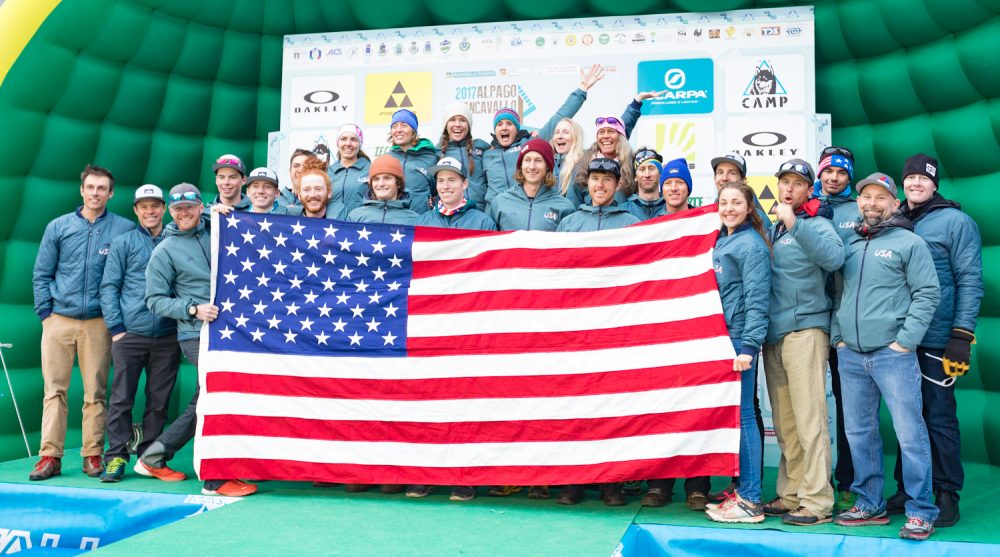
Coach Joe Howdyshell (third from left, holding flag) with the U.S. Ski Mountaineering national team in Italy. (Photo: Mike Smiley)
“I was the head coach of the Summit Nordic Ski Club for a number of years and I had all these crazy friends and a lot of the parents who would go skinning,” said Howdyshell, who also has a degree in exercise science. “I was like, ‘What the hell is that?’ … then I did it a few times and friends were like, ‘Hey, you gotta try this ski-mo race thing, so I started doing that. … Then, since there aren’t many coaches in the sport in the U.S., [becoming the national-team head coach] kind of happened naturally.”
Regardless of which athlete he’s working with, there’s one workout he has each of them do. On the Thursday of a recovery week, whether in-season or off, he has his athletes complete a 20/40 workout: 20 seconds of on-time, followed by 40 seconds off. Each athlete repeats these 20/40s for five minutes, followed by five minutes easy. The set is then repeated two more times. The workout is intended to help athletes safely return to interval training. To an extent, his workout epitomizes what he hopes SEA embodies: demonstrating a way to bring on the “bad ass” without burning out the engine.
“One of the big things that and I’m still trying to figure out how to say is that idea of what is bad ass,” he said. “Knowing when to work hard and when to just relax. Part of [SEA] is trying to teach people that you can get very, very, very fit if you take the time and you dedicate and you work hard when you need to and you don’t when you don’t need to. …. Training doesn’t have to be a monkish isolated journey that only involves hail. You should be able to have a beer after your workout. I think that too often we see a separation between the people who take it too serious and then people who don’t take it seriously at all. … For me, spreading that message that you can be fast and have fun at the same time, that’s kind of my key goal.”
The Workout: 20/40 recovery
Purpose: Remind the body what intervals feel like without overtaxing the system; on-time should not be max pace.
“Typically I’ll do a rest week every third or fourth week and that’ll be a day off, a day easy, a day off, a day easy, and then I kind of get them back into the training mode with 20/40s,” Howdyshell explained.
For XC skiers, he recommends doing the workout on rollerskis or running.
Ideal time: Thursday of a rest week (rest week usually includes two days off and two days easy in four days for his athletes). Can be done year-round.
Warmup: 15 minutes progressive
5 minutes: Go from the bottom of Level 1 to the top of Level 2
5 minutes: Done at 10-15 beats below Level 3
5 minutes: Back to Level 1
The set: 20/40s (x 3)
20 seconds on and 40 seconds off for 5 minutes
5 minutes easy
Repeat two more times
(Note: Howdyshell recommends using 2- or 3-kilometer race pace for on-time effort)
Cool down: 15-20 minutes easy
Total time: 60-65 minutes
Howdyshell’s Top-3 Suggestions:
Staying on track sometimes means holding back. The 20 seconds of on-time should not all be done at a full-out sprint. Instead, goal pace should be around 2-3 k race pace. “I’ve had athletes come back and be like, ‘That was so hard,’ and I’m like, ‘Did you hit each one of them as hard as you possibly could?’, ‘Yeah I did,’ ‘Well, that’s exactly what I told you not to do.’ ”
The workout won’t feel the way you want.“Especially if you’re coming off of an extended rest block, you’re going to feel sh*tty,” he said. “And that’s exactly what the workout is for; it’s a bridge to get you out of your body thinking that, after a few days of rest, your body is in couch-potato mode, which is good, it needs to be, but you’re not going to feel amazing right off the bat.”
Make right with your warmup. After an extended period of recovery time, jumping into intensity without a good warmup isn’t always fair to you or your body. “It’s kind of easy to get antsy after a few days of not training too much and jump into the higher intensity too fast,” he said. “Make sure you don’t shortchange the warm up.”
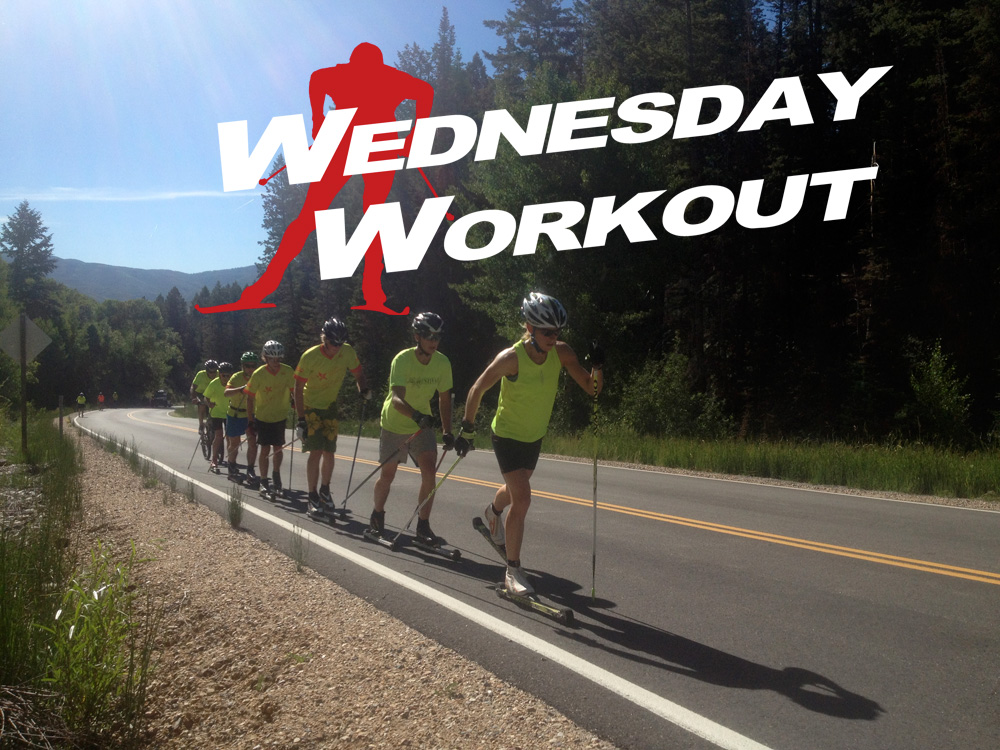
Edit: U.S. Ski Team member Liz Stephen leads athletes in a classic rollerski workout at last year’s Western REG Camp. (Photo: Joe Howdyshell)
This week’s Wednesday Workout comes from Joe Howdyshell, executive director of the Summit Endurance Foundation and former coach of the Summit Nordic Ski Club (SNSC) in Frisco, Colo. Throughout his four years with SNSC, Howdyshell coached athletes to 17 top-10 Junior Nationals finishes, one Junior World Championships qualification, and one U18 Trip qualification.
***
It should always be our goal to turn technique into habit. This allows the athlete to worry about terrain and tactics during racing instead of getting lost in thoughts of “Forward hips” and “High hands.” However, an athlete first needs to start with a thought that their technique isn’t as good as they want, and then work on performing the skill correctly (note: I define a skill as “a particular ability.” You can have a bad skill).
In order to form a habit, you need a skill. In order to have a skill, you need a thought.
In endurance sports, we spend a looooooot of time on habits. A two hour workout will quickly turn any skill into a habit. We also tend to work straight from thought to habit by giving 1-2 cues for a long workout.
Today we’re going to work on the bridge between thoughts and skills, AKA skill acquisition. Since we spend so much time turning skills into habits, we want to make sure we’re starting with good skills!
Whether you are a beginner skier focused on skill acquisition, or a seasoned pro focused on refining habits, going back to the basics and touching on the thought/skill gap goes a long way.
Before the workout:
1. Sit down with your coach and talk about your technique weaknesses. Develop your thoughts on what parts of your technique need to be better.
2. Develop a set of drills to challenge those weaknesses, and learn/refine skills. No need to reinvent the wheel, there are lots of great drills out there, from the old US Ski Team Technique DVD, to the new CXC Academy videos.
3. Perform drills before EVERY rollerski!
The Basic Workout:
1. Equipment check: Drills tend to be dynamic, explosive, boundary pushing workouts, and an equipment malfunction can end in a painful lesson.
2. Short warmup/play/agility. About 5 minutes.
3. Pick 3-5 drills to perform. Such drills include:
Single sticking
Tricep double poling
Running on rollerskis
No-pole balancing
2 V2 (two pole plants per glide while skating)
4. Set 2 cones 50 meters apart.
5. Perform drill from cone to cone, ski back to beginning, and repeat 3-5 times, with 3-5 drills. Should take less than 5 minutes, but if done before every rollerski workout, it will make a big difference!
UPDATE: While it’s important to create drills for individual athlete weaknesses, here is an example to get things started:
There are two main movements that I start with. The first I call the “dip,” which is a small downward movement before any kick (classic or skate). If I see that an athlete is not dipping, I introduce drills that encourage them to become overly dynamic, so that they feel what a dip feels like. These drills would include any kinds of jumping or skipping, as you can’t perform either of those without having vertically dynamic hips. The second movement I look for is the same thing in the upper body. At the Summit Nordic Ski Club we used to call it the “hulk smash.” This is simply the body loading the arms before the power is applied. It can be seen by a very small EXTENSION of the shoulder joint just before flexion. This is one of the harder ones to see, but is absolutely critical to upper body power. Again, if I see an athlete who isn’t properly loading their poles, I introduce drills to exaggerate the loading. One of my favorites is the “head down” drill, where the athlete is directed to lead the pole plant with their head (and thus shoulders), and swing the hands through last, creating a crack-the-whip movement.
By focusing on perfecting skills EVERY DAY, we can ensure that the habits learned during long focused practice are the BEST habits for ski racing!
(Note: The previous photo caption erroneously stated the athletes in the photo were from the Summit Endurance Academy.)

 Do you know what a Growth Mindset is? How would you rate your growth mindset? Do you use it in all the areas in which you’re trying to grow?