From the FasterSkier archive — posts syndicated from athletes’ and coaches’ own blogs between 2004 and 2012, kept online as published. Current coverage is at fasterskier.com.
Novie McCabe of APU narrowly winning over Kendall Kramer and Alayna Sonnesyn. (Photo: Tryg Solberg / FasterSkier)
CRAFTSBURY, Vermont — Craftsbury’s SuperTour Finals 40k highlighted some awesome battles amongst the top American men and women. The women started off the day with some extremely fast conditions on the winding and punchy Craftsbury 5k loop. The men took on the course later in the morning and conditions were mostly firm besides the south facing hills.
The women’s race broke into a lead pack of 5 that held strong until a sprint finish. APU’s Novie McCabe narrowly took the win over Kendall Kramer of APU and Alayna Sonnesyn of Team Birkie. Luci Anderson of Team Birkie and Craftsbury’s own Margie Freed, both 2026 Olympic biathletes, finished 4th and 5th.
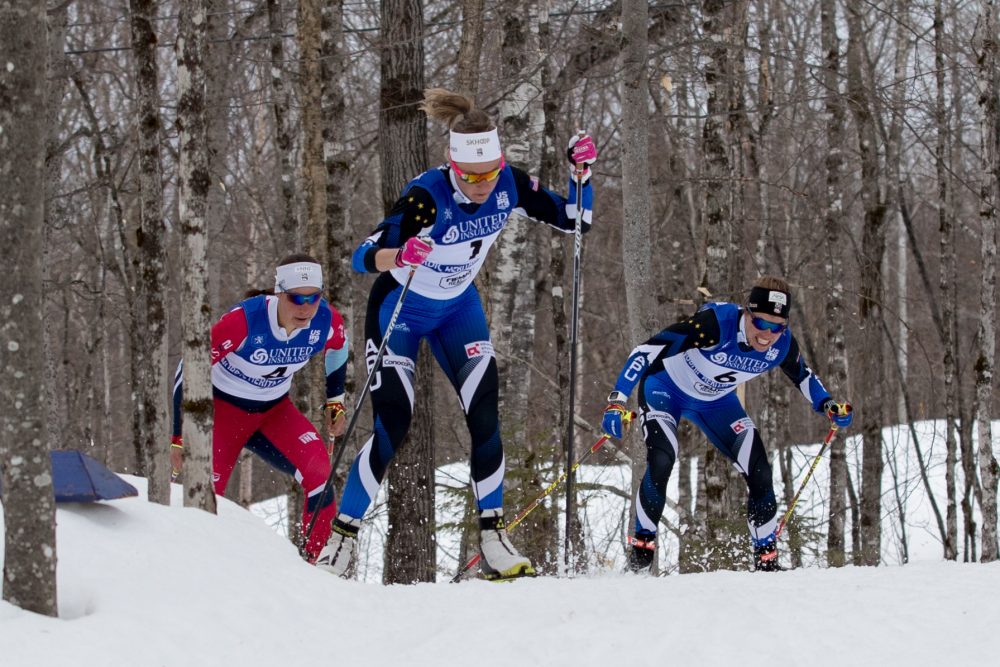
The early leaders of the women’s 40k heading up Screaming Mimi hill. (Photo: Tryg Solberg / FasterSkier)
In an interview with Craftsbury’s Sheldon Miller after the race, McCabe said that “it was really fun to ski with such a great group of girls.” In regards to her difficult last couple of seasons, McCabe said that “it’s nice to have these good days again. It’s super fun to be back racing this year.”
Margie Freed, mostly a biathlete in the last few seasons, said that “it was really nice to not carry an extra ten pounds on my back, but I was a little sad to not be able to lay down in the middle of my race.” She thanked her coaches for helping her keep track of the lap count.
Alayna Sonnesyn, the Team Birkie athlete that narrowly missed out on the Olympics, said that the top three broke away at the top of the Screaming Mimi climb. When asked how her race went, Sonnesyn said “it was great, it was so fun to be out here. Conditions were fast and furious, kind of like the Birkie this year.”
The men’s 40k leaving the stadium. (Photo: Steve Snider)
The men’s race was tight with the top 14 coming in less than 60 seconds behind the win. Gus Schumacher of APU ended up edging out John Hagenbuch of Dartmouth for 1st. Kevin Bolger of Team Birkie finished 3rd.
Jake Brown in his last race for Craftsbury Green Racing Project taking the lead up Screaming Mimi. (Photo: Steve Snider)
Hagenbuch said that he has been fighting through some illness since the Lake Placid World Cup Finals.“I didn’t win today, but I was still smiling out there and really just taking in what was my last race for Dartmouth.”
Gus Schumacher also said that the conditions were really fast and it was hard to get away from the pack. He and Zak Ketterson were pushing at the front when Zak had an unfortunate fall within the last few hundred meters: “I was given the first place position and just went for it from there.”
The award ceremony’s after the races highlighted the 40k, junior 20k and 2025-2026 SuperTour awards.
Thank you to Sheldon Miller of Craftsbury Outdoor Center for the post-race interviews with athletes.
FasterSkier will have our own Nat Herz on the ground at the Olympics, which, to be honest, is a very big financial lift for us. If you value the thoughtful work and access FasterSkier provides at championships like this one, please consider becoming a Voluntary Subscriber. Your support directly fuels the work we do to cover the people, places, and moments that make our sport special.
The SuperTour Relay start on Saturday afternoon. (Photo: Tryg Solberg / FasterSkier)
CRAFTSBURY, Vermont — The second day of racing at Craftbury’s SuperTour Finals brought on some hard-hitting team relays. The “Club Relay” had a diverse array of club skiers young and old, along with some college teams. In the afternoon, the “SuperTour Relay” featured the North American pro teams along with the top eastern college squads.
Craftsbury groomer, Eric Hanson, captured Anders Weiss of BSF and Jack Young of Craftsbury Green Racing Project skiing in front of the dump truck responsible for keeping the course open. The truck was stuck on course the d prior year and pushed off to the side with one of their Pistenbully groomers. (Photo: Eric Hanson)
The afternoon raced proved to be quite entertaining as conditions held firm. Team Birkie’s first relay squad won, upsetting APU’s first squad by 46 seconds. Alayna Sonnesyn, Kevin Bolger, Lucy Anderson, and Zak Ketterson held off the APU’s four 2026 Olympians that included Kendall Kramer, Zanden McMullen, Novie McCabe, Gus Schumacher. Craftsbury’s home team of Margie Freed, Brian Bushey, Michaela Keller-Miller, and Jack Young finished in 3rd.
Team Birkie, APU and Craftsbury’s relay teams filling the podium. (Photo: Tryg Solberg / FasterSkier)
Team Birkie was ecstatic with their win. Their second team also came within 6 seconds of the podium. BSF’s team came in 4th of the 33 teams.
Luci Anderson’s leg put on a significant gap to the APU team that they would keep through the race. (Photo: Tryg Solberg / FasterSkier)
In the morning, an additional 33 relay teams and 132 racers in total took on the 5 kilometer lap that Craftsbury staff worked hard to keep open through the recent warm spells. Hundreds of dump trucks and many more snowmobile sleds patched thinning spots on a sections of thinning snow. Eric Hanson, a Craftsbury groomer of 25 years, said that they’ve spent hundred of hours moving snow onto the race course over the last month.
33 teams starting the Club Relay in the morning. (Photo: Tryg Solberg / FasterSkier)
The Club Relay showcased the often-mentioned perk of Nordic skiing: it’s a lifelong sport. With the youngest competitors in the single digits and the oldest many decades in, it was a celebration of the sport and the joy that comes from friendly competition. While most teams donned their spandex suits, some teams added some flair with outfits that surely boosted their speed.
Ollie Burruss, Craftsbury’s Nordic Race Director, making the college skiers nervous with his lead in the first leg of the Club Relay. (Photo: Tryg Solberg / FasterSkier)
All but 7 relay teams were pairs of 2 women and 2 men. The mixed relay was won by “UVM Gold” with Owen Young, Molly Moening, Benon Brattebo, and Caleb Boyce throwing down to narrowly beat out their teammates on “UVM Green.”
Benon Brattebo of UVM leading the first leg of the Club Relay. (Photo: Tryg Solberg / FasterSkier)
If you value the thoughtful work and access FasterSkier provides, please consider becoming a Voluntary Subscriber. Your support directly fuels the work we do to cover the people, places, and moments that make our sport special.
Ben Ogden, the Vermonter, taking the cake in the men’s sprint final. (Photo: Tryg Solberg / FasterSkier)
CRAFTSBURY, Vermont — Craftsbury Outdoor Center kicked off the first of the SuperTour Finals races with a classic sprint on Friday. Yesterday’s weather brought gnarly, foggy, and temperatures in the 50s. Craftsbury’s grooming crew has been putting in long hours over the last few weeks to ensure that conditions would hold on through a warmup. Overnight, they prepared the 1.5-kilometer course that baked under the strong spring sun, creating saturated spring conditions even with temperatures below freezing.
Most of the top American competitors came to cap off their long race season, many of whom are freshly off the electric World Cup Finals. Following up huge events like the 2026 Olympics and the World Cup Finals in Lake Placid, one might think that races in the quaint Northeast Kingdom of Vermont would be a quiet, less competitive affair. Today’s competition couldn’t compete with the 10,000+ fans across the state border last weekend, but it proved to be a tight and fierce battle for sprinters to finish off their season.
85 men and 63 women started the qualifier, representing an array of professional domestic teams, Canadians, Eastern Intercollegiate Ski Association (EISA), and junior racers.
Ben Ogden of SMS T2 won the men’s qualifier with nearly 3 seconds over Gus Schumacher of APU. Murphy Kimball, the 19-year-old sophomore at the University of Alaska – Anchorage, qualified in an impressive eighth, only getting beaten out by elder World Cup regulars.
U20 Murphy Kimball heading to an 8th place in the qualifier. (Photo: Tryg Solberg / FasterSkier)
Erin Bianco of BSF won the women’s qualifier by over 3 seconds over second-place Canadian and Alberta World Cup Academy athlete Katie Weaver. Mia Gorman is a U16 athlete for the neighboring Mansfield Nordic Club who finished the qualifier in 27th, beating out all other junior women and making the heats with the big dogs.
Erin Bianco winning the qualifier by over 3 seconds. (Photo: Tryg Solberg / FasterSkier)
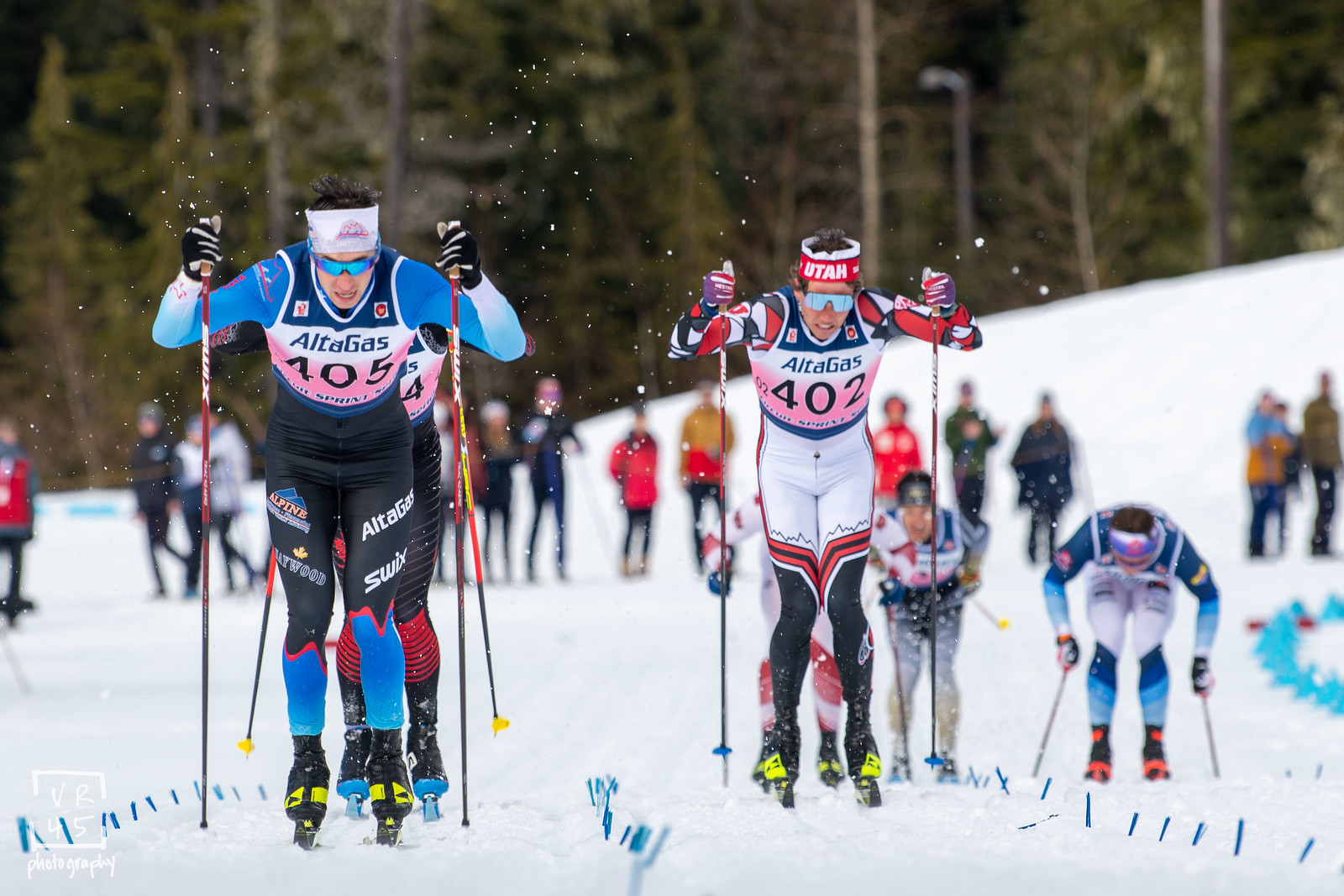
Ogden moved comfortably through the heats, eventually winning the men’s final over APU teammates JC Schoonmaker and Gus Schumacher, who finished in second and third, respectively.
Men’s final starting at Craftsbury Outdoor Center. (Photo: Tryg Solberg / FasterSkier)
Ben Ogden of SMS T2 was very happy about racing in his home state. “It’s a bit more chill” he said in comparison to the World Cup and Olympic stages that he’s been prominent on this season. Ogden also mentioned that, even though the race environment was low-key, the competition was stiff with the U.S.’s top skiers duking it out for the top of the podium.
In addition to representation from many different clubs throughout the heats, the women’s side saw a shake-up in the competition when the third qualifier, Lauren Jortberg of Mansfield Pro/NCPH, fell in the final. Canadian Katie Weaver and her Alberta World Cup Academy teammate Olivia Bouffard-Nesbitt finished first and second. In an interview after the race, Weaver said “conditions were fun, crazy and a bit hectic.”
Canadians Katie Weaver and Olivia Bouffard-Nesbitt embrace after their strong finish for first and second overall. (Photo: Tryg Solberg / FasterSkier)
Emma Albrecht took the top domestic position in third place with her first Supertour win in a sprint race. Erin Bianco of BSF and Alayna Sonnesyn of Team Birkie rounded off the domestic podium.
Albrecht crossing the finishing line as the first American and 3rd overall. (Photo: Tryg Solberg / FasterSkier)
Albrecht was very happy with her racing throughout the day: “The biggest feat for me is being competitive this late in the season.” When asked about her tactics in the heats with the warm spring sun softening the track, she said that she had to “find a rut and see it through.”
Logan Drevlov of Loppet Nordic Racing and Claire Serrano of Craftsbury won the junior heat finals.
Temps are forecasted to drop into the single digits overnight before 4 x 5 km team sprint competitions throughout the day. Tune in for more pictures and results tomorrow.
JC Schoonmaker (APU) and Kevin Bolger (Team Birkie) side by side in the heats. (Photo: Tryg Solberg / FasterSkier)
Help Support Our Olympic Coverage!
FasterSkier will have our own Nat Herz on the ground at the Olympics, which, to be honest, is a very big financial lift for us. If you value the thoughtful work and access FasterSkier provides at championships like this one, please consider becoming a Voluntary Subscriber. Your support directly fuels the work we do to cover the people, places, and moments that make our sport special.
“You need some Gordie Howe elbows out there today” said the commentator on the live feed at one point during Friday’s Team Sprint in Whistler.
You know, just in case you needed a reminder that this is Canadian Nationals.
Alongside his legacy as one of hockey’s greatest players of all time, leaving his mark on the sport as an indomitable force with both his goal scoring and dynamism on the ice, Howe was known as an — ahem — impassioned athlete. One achieves a “Gordie Howe hat trick” by scoring a goal, making an assist, and engaging in a fight within one game. In short, he was a bit of a wild card, and he wasn’t going to let someone else stand in his way en route to the net.
In watching the Team Sprint livestream, you can see why a similar need to protect one’s space was relevant. The wet and variable spring weather in Whistler created a tricky mix of fast, wet, and mushy snow conditions that combined with fast mass start sprinting to produce racing that tested a skiers balance and “feel” as much as their lungs and muscles. Or more succinctly, racing that was fun, and a little bit chaotic. Staying upright and not losing your own footing or being taken out by another skier might be more important than technique or tactics.
Andy Newell (BSF Pro – Coach), Julia Kern (SMS T2), and Cendrine Browne (Fondeurs-Laurentides) chat on the warm up before the freestyle team sprint. (Photo: Doug Stephen / VR 45 Photography)
Adding another layer to the challenge, the Team Sprint was raced “Dresden-style”, where two partners took turns on a 750 m lap until the pair of them had completed eight total laps. The Nordic skiing equivalent of a short-track skating relay, and with the same flow to the action.
Early attacks could fizzle out through all or any of factors like a bad transition, fatigue, or a tangle up with another skier. All those factors had the equal and opposite effect as well; no team was truly out of it until they crossed the finish line. A late surge between two teammates could pull together a race, and often did when the fields of 15 teams were unleashed on the course today.
The 750 m course was an abbreviated version of the sprint course seen on Wednesday. Each lap left the stadium and shot up a steep but short climb which lengthened into a false flat where the mushy snow on course saw some skiers muscle out a V2 while others kept to a light-footed hop-skate. Then skiers shot down a sweeping downhill where the course widened to allow for two different lines, before doing a long left turn into the finishing straight.
Every skier completed an individual lap of this course in the morning, which when combined with their team partner, yielded a seeding time. With no semi-final, the top 15 fastest combined teams qualified for the Open A finals.
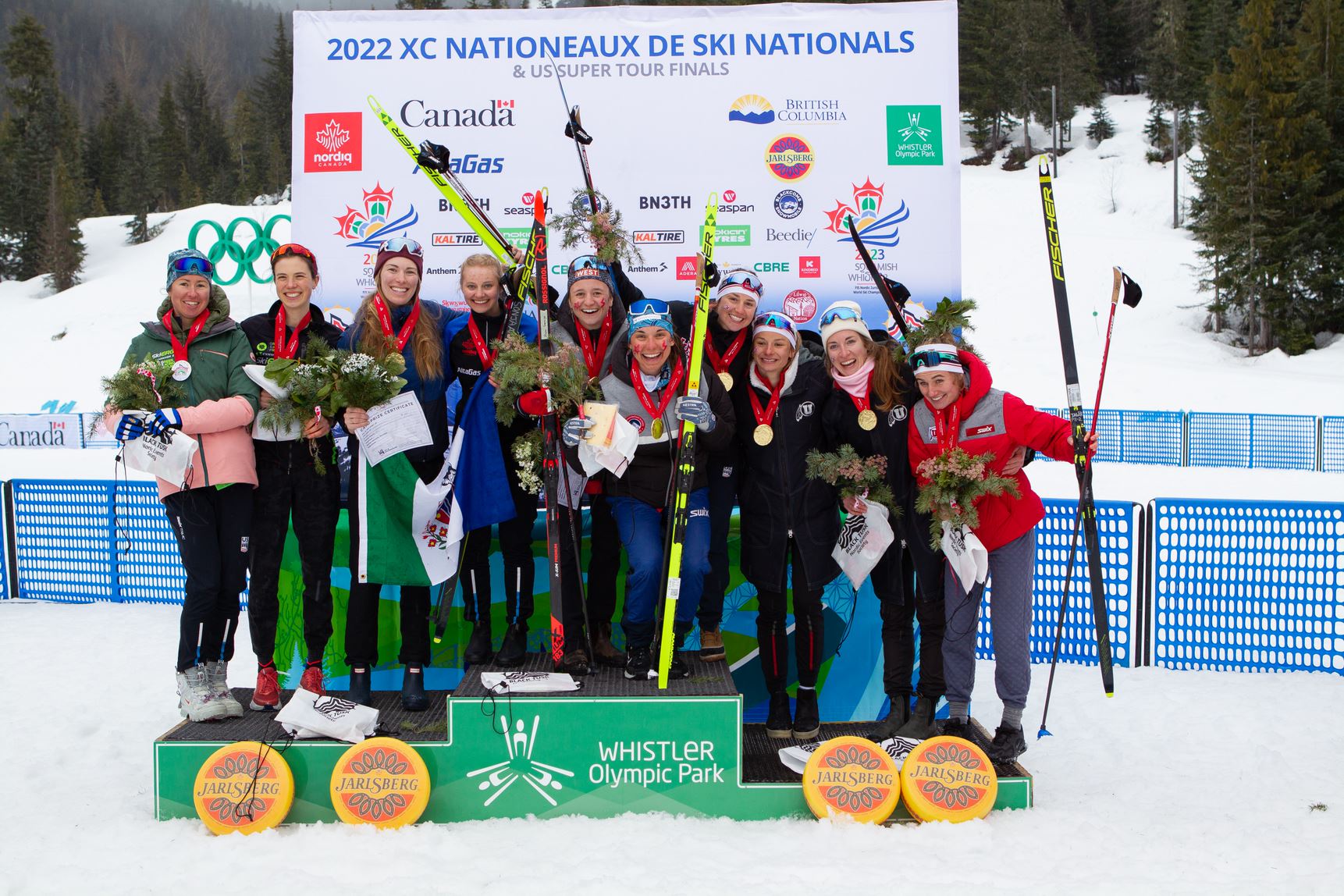
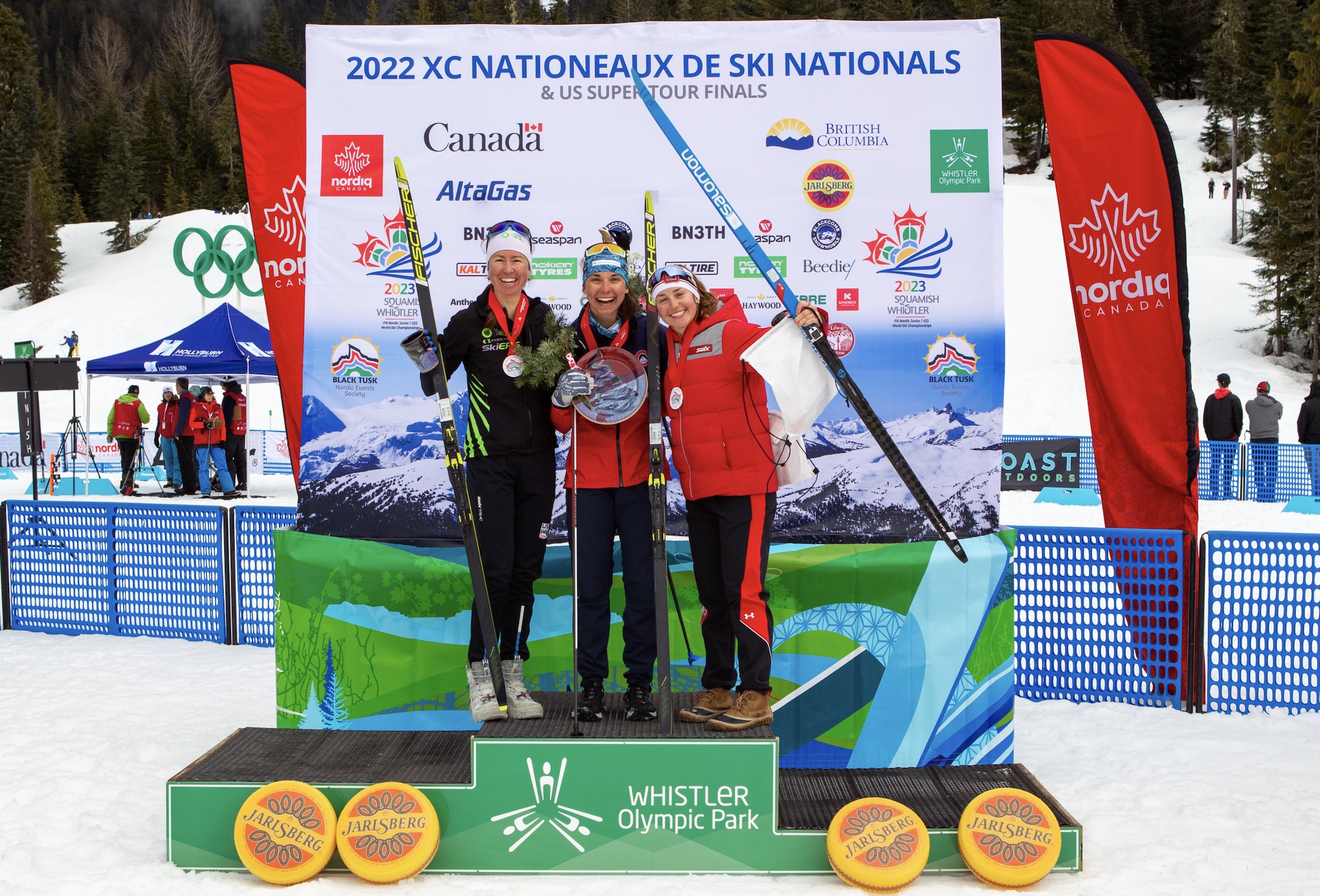
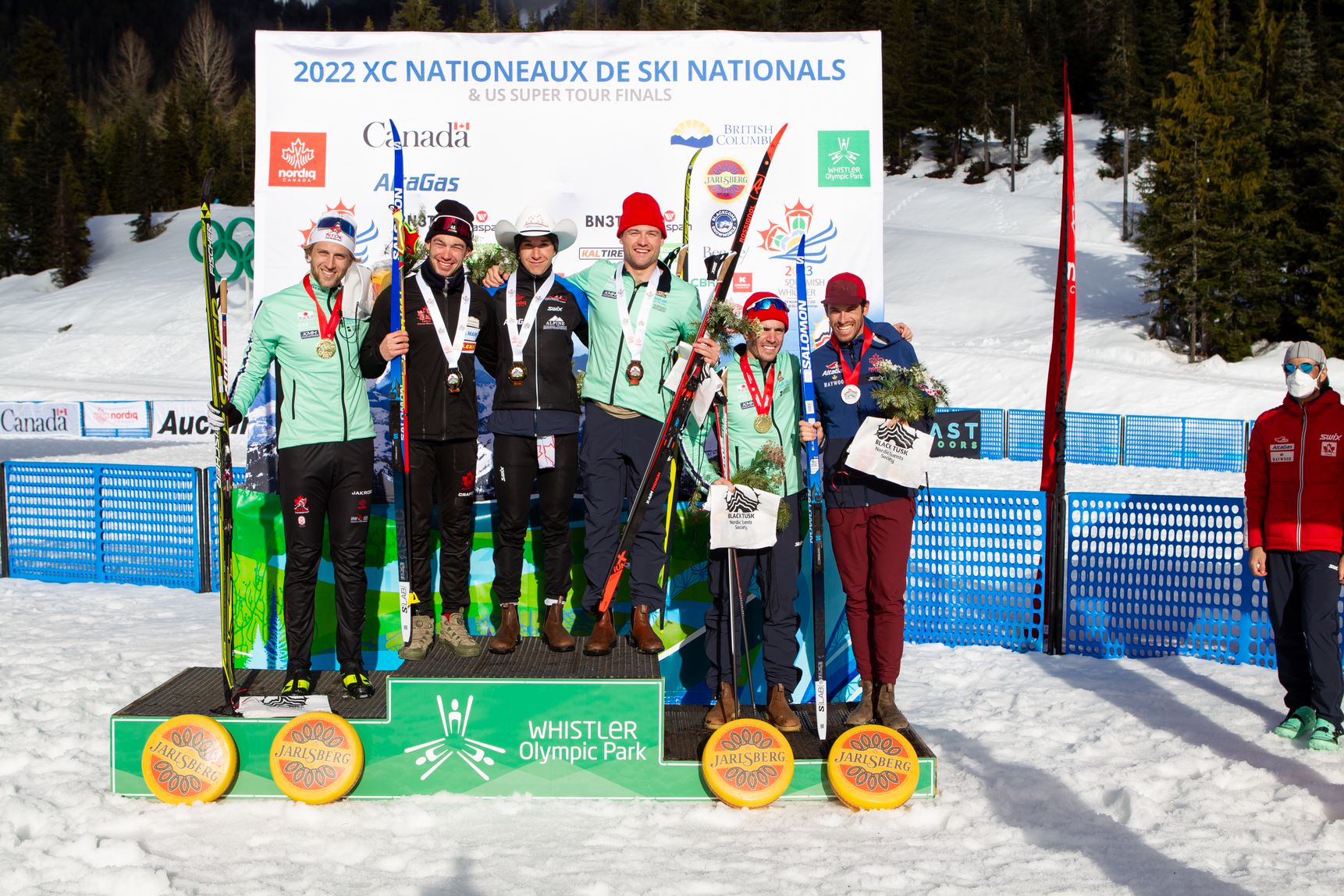
The women’s team sprint podium saw a win for SMS T2, with Yukon Team 7, University of Utah 1, Craftsbury Green Racing Project, and University of Utah 2 rounding out the top five. (Photo: Joern Rohde / Nordiq Canada)
Open Women’s
In the women’s qualifier, Julia Kern (SMS T2) completed the course in the fastest time, 1:21.70. That combined with 8th place Alayna Sonneysn (+3.45 seconds) to give their SMS T2 team the top seed for the women’s A final (combined time 2:46.85). Second seed (combined, +3.73) was earned by Nakkerertok 32’s Hannah Shields (7th, +3.12) and Zoё Williams (13th, +4.01), with third seed (combined, +4.12) going to the University Utah I team of Karianne Dengerud (2nd, +2.34) and Sydney Palmer-Leger (23rd, +5.23).
When the top-15 teams started in the A final, Alayna Sonneysn shot off the front for SMS T2, which stretched the field out immediately and may have helped avoid the pile ups that had been a feature of the Challengers and College Cup heats earlier in the day. Sonneysn was covered by Yukon Team 7 (Whitehorse), with Sonjaa Schmidt catching Sonnesyn as they rounded the corner into the first exchange. Schmidt also pulled back the entire group, and so the racing was extremely tight as they handed off to their teammates. SMS T2 and the Yukon Team continued to push the pace at the front, with the University of Utah I (UU I, Palmer-Leger and Dengerud) and University of Utah II (UU II, Novie McCabe and Julia Richter) teams bridging the gap to form a four-team group leading the race.
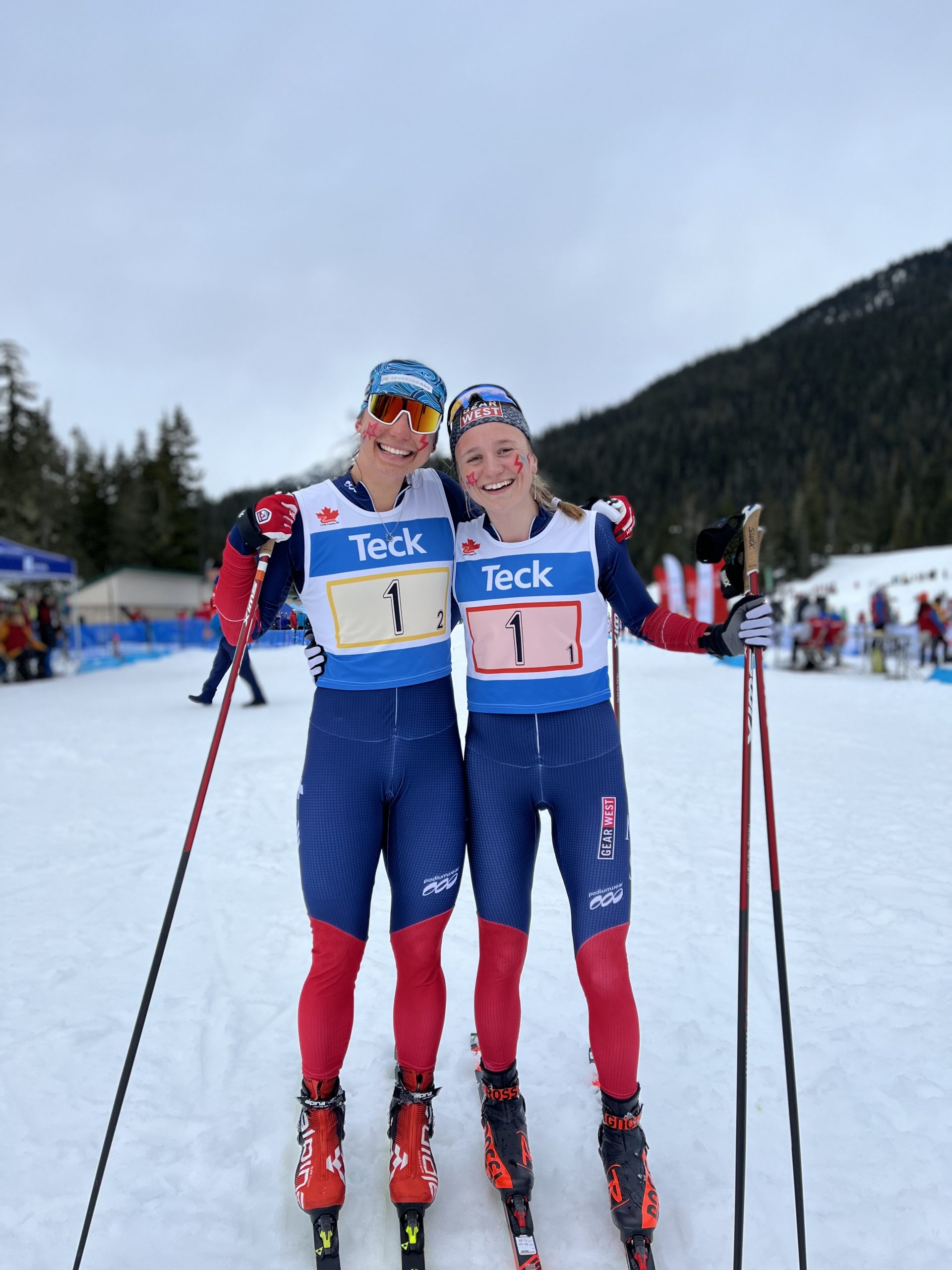
Team SMS T2, Julia Kern and Alayna Sonnesyn, after taking the win in the SuperTour Team Sprint in Whistler, BC on Friday. (Photo: Nordiq Canada / Nathaniel Mah).
From there, as the teams swapped partners through laps three, four, five, and six, a strategy of attrition started to emerge from the SMS T2 team of Kern and Sonnesyn. At each exchange, they jumped off the handoff, hopped up the hill, and continuously pushed the pace. Their gap slowly opened at the front, until, like looking up after being taken by a riptide, the mass of racing behind them was unexpectedly distant. By Sonnesyn’s final trip around the course at lap seven, their win was all but secured.
Sonnesyn said that the goal from SMS T2 was to remain consistent throughout the race, saying in an interview with Nordiq Canada that “I just wanted to be patient. I was a little surprised at the pace we went out [in] because I knew four laps on this course was going to catch up to us quick, but I kept telling myself ‘be patient, go the same pace.”
In the push for the overall podium behind, a new player had entered the scene. On lap five, Craftsbury’s Caitlin Patterson pushed across the gap to the UU I, UU II, and Team Yukon group. On lap six, her partner Alexandra Lawson held there. As the scrambling partners went out for their final lap on lap seven, UU I and UU II had formed a gap, but when the skiers handed off for the final exchange, a four-team pack came back together with UU I, UU II, Team Yukon, and Craftsbury I.
Then, it split once again.
Team Yukon’s Dahria Beatty came off the downhill on course wide to try and take an inside line into the final turn. UU I’s Karianne Dengerud took the downhill corner more inside, and tried to beat Beatty to the inside on the final turn. In the end, Beatty won, and then closed in the final stretch to take Team Yukon (Schmidt & Beatty) to second place (+11.99) behind the first place SMS T2 (12:22.16). UU I (Palmer-Leger & Dengerud) took third (+12.78).
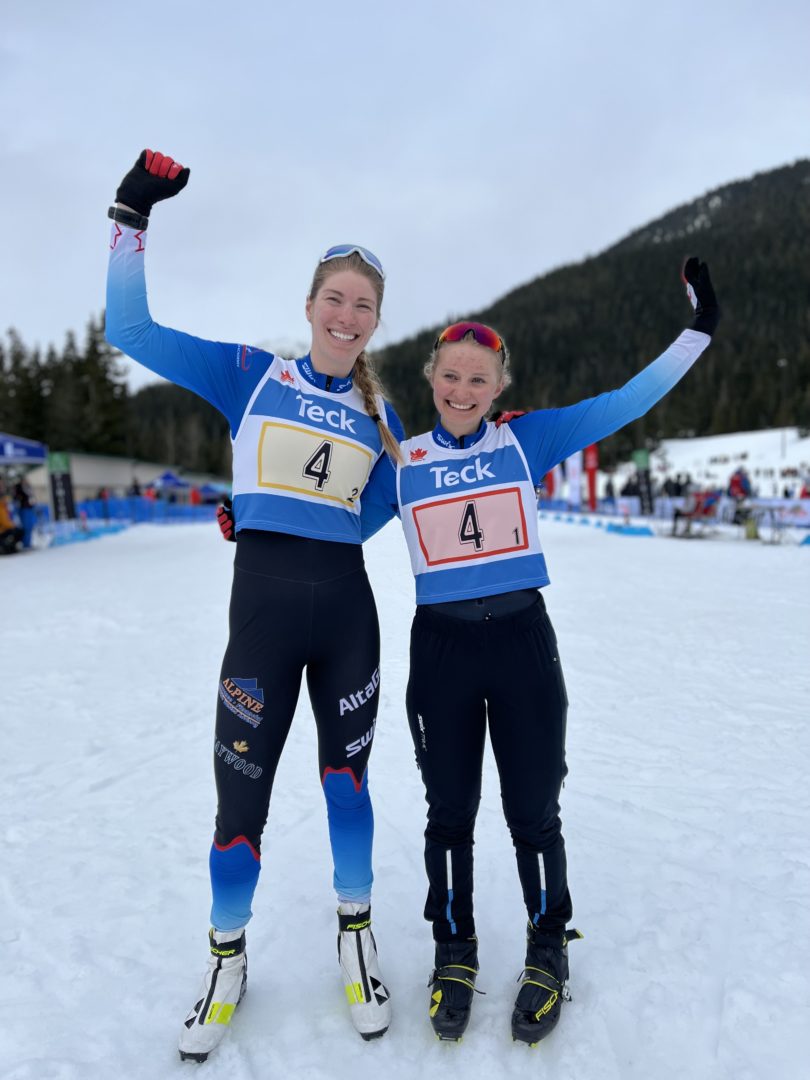
The Yukon Team 7 duo of Dahria Beatty and Sonjaa Schmidt were second overall in the women’s team sprint, taking home the Canadian national title. (Photo: Nordiq Canada / Nathaniel Mah)
The resounding win for the pairing of Kern and Sonneysn punctuated a tremendous week for Stratton Mountain School, and in particular for Kern. Apart from a second place behind teammate Jessie Diggins (SMS T2) in the 10 k skate on Monday, she has won every race at these SuperTour finals, despite tricky and variable conditions.
Team Yukon’s (Whitehorse) second place overall gives the pairing of Dahria Beatty and Sonjaa Schmidt top Canadian honors, adding to Beatty’s accumulation of National Championships this week.
Open Men
The men’s top individual qualifier was Logan Diekmann (BSF), with a time of 1:12.83, who combined with his BSF Pro I teammate Finn O’Connell (51st, +5.93) to take 5th seed (+4.44). They ran behind the top seeded (2:27.15) University of Utah I (UU I) pairing of Noel Keefe (4th, +0.67) and Luke Jager (5th, +0.82). Second seed (+2.42) went to the SMS T2 team of Finegan Bailey (6th, +1.01) and Bill Harmeyer (14th, +2.91), and third seed went to the Team Brew-ski Canmore (+3.43) pair of Russell Kennedy (3rd, +0.57) and Reed Godfrey (27th, +4.35).
Xavier McKeever (Foothills Nordic) works with teammate Tom Stephen to win the Canadian National Title in the team sprint. (Photo: Doug Stephen / VR 45 Photography)
With qualifying times extremely tight across the board, the A final promised to stay close throughout the whole 8 laps.
Noel Keefe mirrored Alayna Sonnesyn’s move from the women’s final, looking to get ahead of any tangles by pushing the pace from the start for UU I. Once the field was out of the stadium, Keefe tucked in behind Orford’s Leo Granbois, and Orford and UU I went into the first exchange with a slight gap.
Keefe handed off to Luke Jager, who looked relaxed as he allowed the field to come back together again. Animating the move that closed the gap was Northern Michigan University (NMU) skier Kristoffer Karsrud, who alongside his partner Kjetil Bånerud ducked and weaved at the front of the pack throughout the duration of the race.
On the 5th lap, another UU team, UU II, moved to the front of the pack, as Brian Bushey put in a surge. When Bushey and Keefe handed off to Bjørn Riksåsen and Jager, the race looked like it may turn into a UU team practice for the last couple of laps. That was, until Scott Patterson flew in from Alaska Pacific University (APU) in his last time around the course on lap seven. Following Patterson’s move was Bånerud from NMU, and as the four team pack of UU I, UU II, APU, and NMU went into the final exchange, it became clear; the Team Sprint would well and truly live up to the sprint moniker.
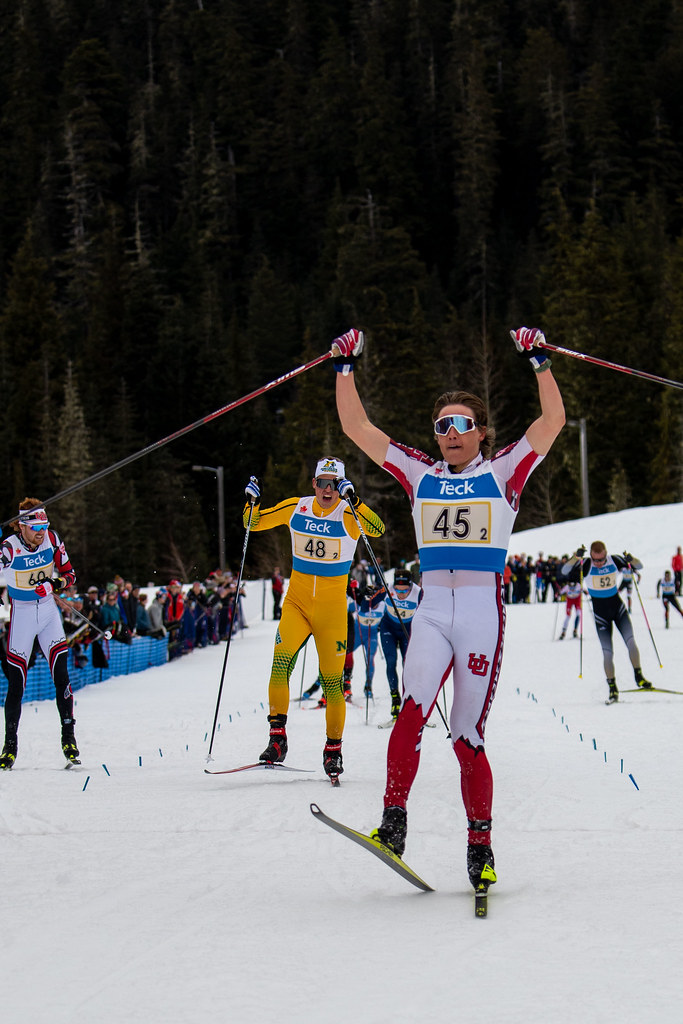
Jager for UU I came out of the exchange with a slight advantage over the field. APU’s Logan Hanneman countered that by exploding up the climb leaving the stadium. Jager used the downhill to catch Hanneman, with Rikssasen (UU II) and Karsrud (NMU) in tow. Jager, the youngest of the bunch but with plenty of sprint experience, got the inside edge into the final turn. He exploded off of that corner into the final stretch, lifting a ski and two poles as he came across the line to take the win for UU I (11:15.32).
Luke Jager closes for the University of Utah 1 team, taking the win alongside teammate Noel Keeffe. (Photo: Doug Stephen / VR 45 Photography)
Hanneman finished in second (+1.39) for APU, and the NMU team finished third with Karsrud crossing the line (+1.45) right behind.
Outside of the mix for most of the race, the Foothills I team of Xavier McKeever and Tom Stephen deftly moved through the pack to come in fifth overall and claim the Canadian title on the day.
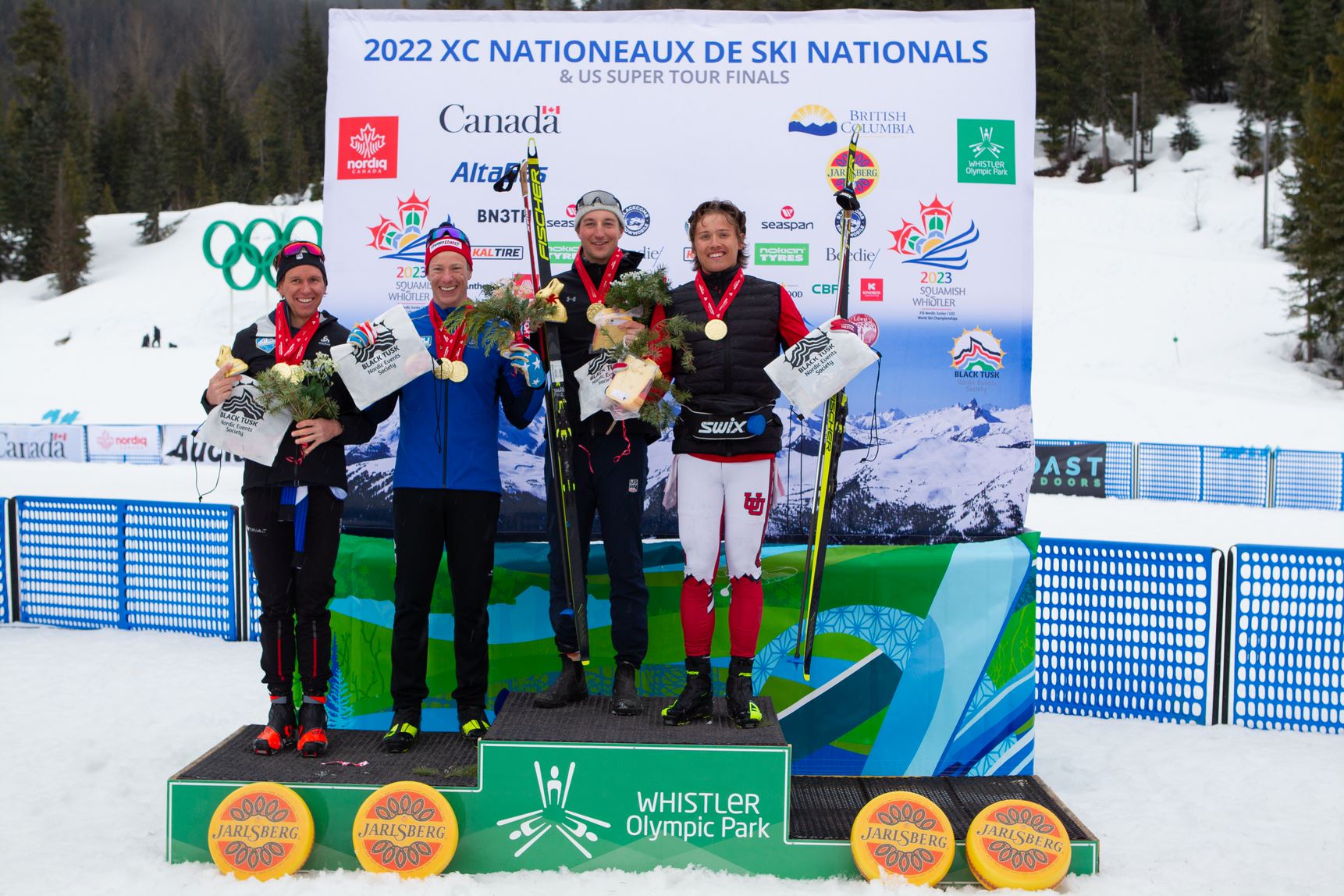
The University of Utah pairing of Jager and Keefe were especially happy to win this edition of the Team Relays, saying to Nordiq Canada that “It’s a mix-up [in these relays]. Since the race got canceled at SuperTour finals two years ago, we had this race in our scopes. The qualifier went well, we had good skis, and the race turned out great.”
University of Utah’s Noel Keefe and Luke Jager took the SuperTour and overall win in the team sprint, with APU’s Scott Patterson and Logan Hanneman in second. (Photo: Joern Rohde / Nordiq Canada)
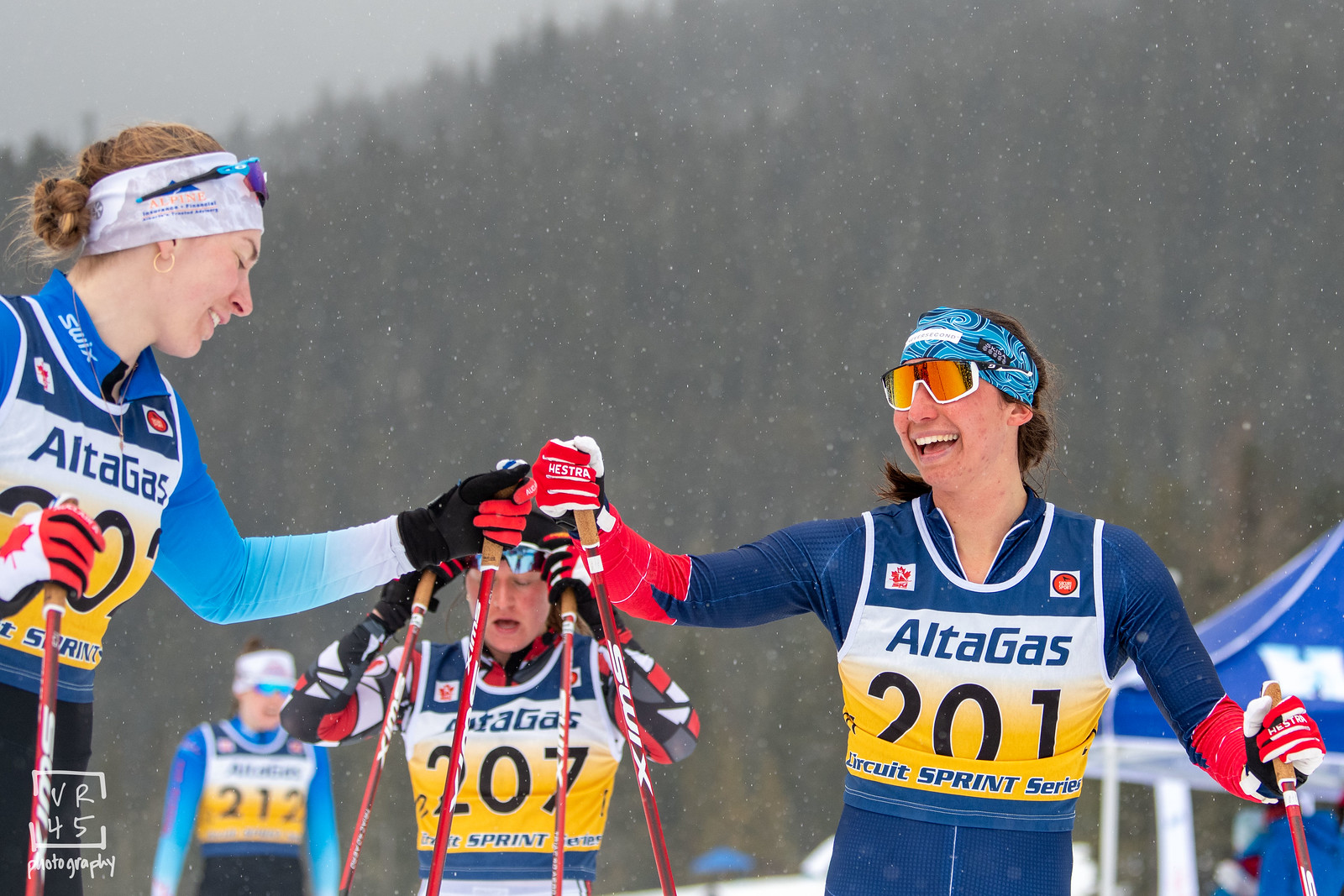
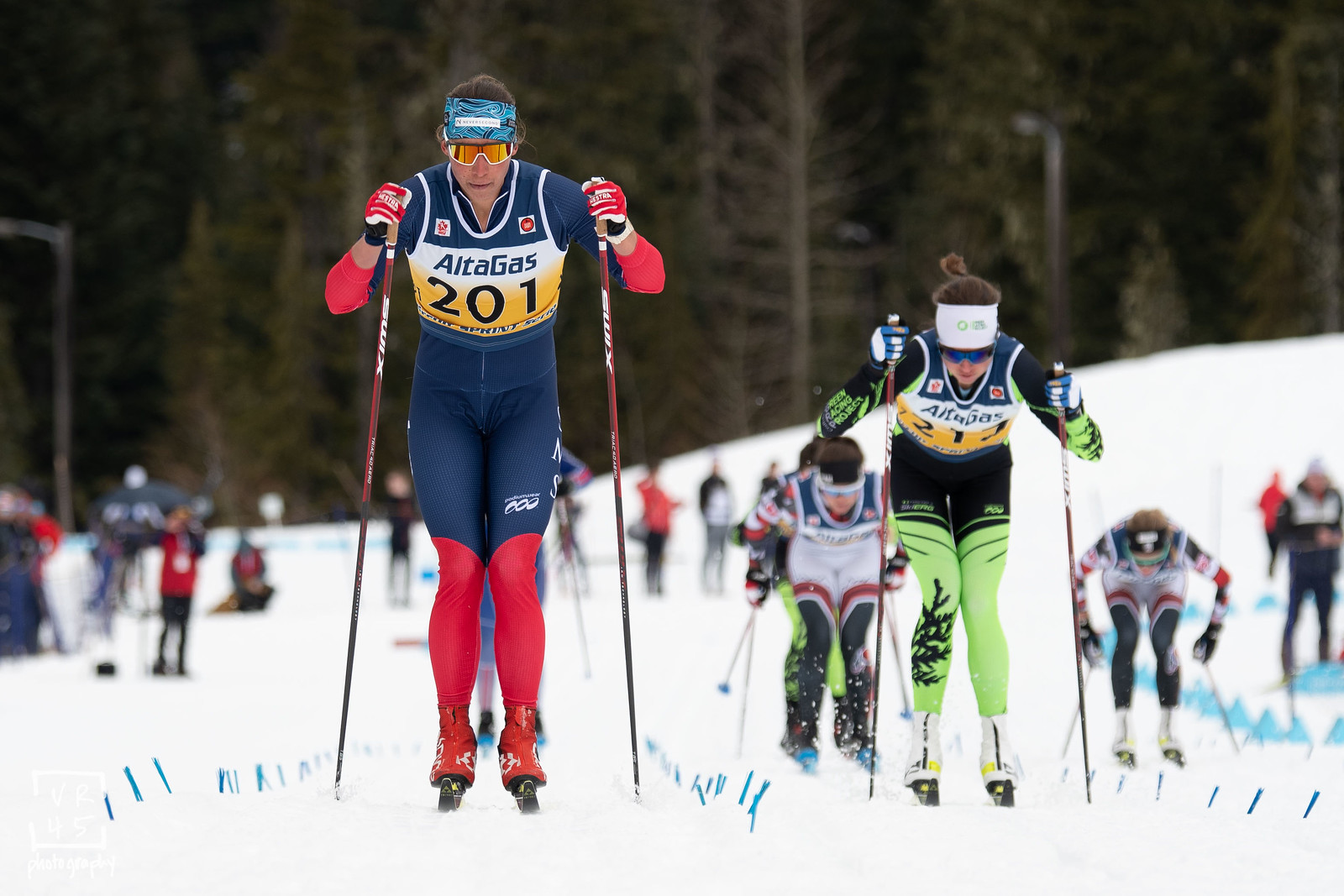
Julia Kern (SMS T2) and Dahria Beatty (Whitehorse) fist bump at the finish of the women’s classic sprint final. (Photo: Doug Stephen / VR 45 Photography)
Racing at the joint Canadian Nationals/US SuperTour Finals resumed on Wednesday, showcasing some of the best racers in North America facing off for a classic sprint.
As the Whistler Olympic Park was home for cross country skiing during the 2010 Vancouver Games, the classic sprint course on Wednesday was one that played host to an important stepping stone in North American skiing history. In that competition, both American and Canadian skiers solidified the inroads they had made into the top echelons of the sport through the burgeoning discipline of sprinting. Names like Kikkan Randall (USA), Daria Gaiazova (CAN), Chandra Crawford (CAN), Devon Kershaw (CAN), and Simi Hamilton (USA) all qualified for heats, while gracing the television screens of many athletes who now, twelve years later, carried momentum from those inspiring performances onto today’s start line in Whistler.
If my waxing nostalgia about those 2010 Olympics is making you open a new tab to see if they’re available to revisit on YouTube, let me help you: they are! But before you go, let me send you an assignment: watch how Marit Bjørgen and Justyna Kowalczyk race the final on the 1.2 k course (the men raced a 1.4 k course). Ok, here’s the link (46:16 for the final, and yes, the genders are flipped in the title).
What you’ll have seen if you completed this FasterSkier sidequest (trademark pending) is that the rolling course at Whistler presented two distinct tactical options for the skiers who made it into the heats on Wednesday. One: the Kowalczyk – attack on the steep climb that left the stadium to try and create a gap on the field that would hold as you went into the first downhill and leave you with an advantage on the second (and final) climb, or two: the Bjørgen – hold onto the pace-setter until the second hill, when a punchy attack could leave a skier with a distinct advantage going into the mostly downhill approach to the stadium and subsequent final stretch. The latter approach worked in 2010 for Bjørgen, but 2022 was twelve years on and a different field with the SuperTour.
Before we got to the heats, however, we, and the skiers, had to go through qualifying.
The Classic Sprint started off with the women’s champion in the 10 k Classic yesterday, Julia Kern (SMS T2). And after every racer in the women’s field completed the course, Kern finished in first too (3:11.14). Her qualifier was commanding, with second place Dahria Beatty (Whitehorse) +6.58 seconds back. In third place was Alayna Sonnesyn (SMS T2) (+7.54), in a field that otherwise was tight all the way through to the last heat qualifier, 30th place Mariah Bredal (BSF) (+21.37).
The men’s field that followed proved to be an even tighter affair. At the top of the field, less than a second split first place Andreas Kirkeng (Denver University) (3:09.82), second place Luke Jager (University of Utah) (+0.41) and third place Logan Hanneman (APU) (+0.88). It was only +11.97 seconds back to the last heat qualifier in 30th place, Montana State’s Reed Godfrey.
The women’s US SuperTour podium saw Julia Kern take the top step ahead of Caitlin Patterson and Sydney Palmer-Leger. (Photo: Joern Rohde / Nordiq Canada)
Women’s Open
In the women’s open quarterfinals, the top qualifiers were able to win their heats handily. Julia Kern turned in the fastest quarterfinal in the field, finishing first in a time of 3:29.93, ahead of Novie McCabe (+1.93), who advanced to the semifinals by taking second place. Kern’s fast pace-setting in heat one proved to animate the field from the gun, and third place Zoë Williams (Nakkertok) was rewarded for keeping pace with one of the lucky loser spots (+3.56).
That pattern held in the 2nd heat, when a pack loaded with talent including Caitlin Patterson (Craftsbury), Alexandra Lawson (Craftsbury), Sydney Palmer-Leger (University of Utah), Sophia Laukli (University of Utah) and Cendrine Brown (Fondeurs-Laurentides) set a furious pace from the start and held it all the way through. In a five-person sprint, Patterson took first (3:32.13), and Lawson second (+0.55), to take the automatic semi-final bids. In third place, Sydney Palmer-Leger (+1.47) took the other lucky loser spot.
When the first semi-final took to the start-line, it was filled with five skiers from those first two quarterfinals, with the sixth, 16-year-old Samantha Smith (Sun Valley), having won the third quarterfinal (3:36.43). It was no surprise then, when the “fast from the gun” tactics of those quarterfinals followed into the semis. Julia Kern (SMS T2) again attacked as soon as they hit the first incline out of the stadium, and held her lead throughout. The only skier that proved to be able to match her pace through the course was Caitlin Patterson (Craftsbury), and it would be those two who took the automatic advancement places to the finals; Kern in first (3:34.27) and Patterson second (+3:35.27).
Behind them, two of the youngest bright stars of US women’s skiing had shown their intrepid ability to match their older counterparts, with Palmer-Leger (UU) taking third place (+3.47) and Novie McCabe (UU) taking fourth (+3.74) in a sprint ahead of Samantha Smith (Sun Valley) (+4.03). For their efforts, the third and fourth place pairing advanced to the finals.
In the second semi-final, previous Canadian Sprint National Champion Dahria Beatty (Whitehorse) was able to take first place (3:38.39) ahead of second place Laurence Dumais (Fondeurs-Laurentides) (+0.34) for the second heat in a row. They finished strong in a pack that otherwise remained tight throughout, and created separation in the last stretch to finish ahead of third place Alayna Sonnesyn (SMS T2) (+1.18) and fourth place Katharine Ogden (SMS T2) (+3.45).
The final field then, was set. For the overall win, four US women – Julia Kern (SMS T2), Caitlin Patterson (Craftsbury), Sydney Palmer-Leger (UU), and Novie McCabe (UU) – and two Canadian women – Dahria Beatty (Whitehorse) and Laurence Dumais (Fondeurs-Laurentides) – would compete. That latter pairing also made the matter of the Canadian Sprint National title on the line simple; a duel between Beatty and Dumais.
Julia Kern strikes again in the women’s classic sprint, taking the win ahead of Caitlin Patterson (CGRP) and Dahria Beatty (Whitehorse). (Photo: Doug Stephen / VR 45 Photography)
Kern, spurred on by her success racing hard from the gun all day, went for it again. In an interview with Nordiq Canada she said, “All day I just wanted to ‘send it’ – practice skiing hard and not taking any chances out there. My form and fitness is really good so I wanted to try and not leave it until the end.”
The whole field was tasked with matching her confidence…and her speed. As in the semi-finals before, just one was up to the task the whole 1.2 k through; Caitlin Patterson. Behind her, Dahria Beatty led a charge to try and keep pace, but as she said in an interview with Nordiq Canada “I was confident in my finish but trying not to lose time on the uphills today. Unfortunately, [in the final], I let a gap open up to Caitlin [Patterson] and wasn’t able to close back on that.”
And “send it” Kern did in the final. Kern took the pace out hot from the start. With a look over her shoulder, she saw that she had gapped the field by the top of the long striding climb, a position which she held, despite a bobble on the tight left hand curve on the subsequent descent, comfortably through the finish to win by several seconds.
Patterson having lead the chase group after a gap throughout the heat, found herself sprinting with a powerful doublepole into the stadium to hold her ground in second place.
Behind them, the race for the last podium spot coalesced around Beatty, Palmer-Leger and McCabe. As they entered the stadium together, Beatty stuck to a strategy that her coach pointed out earlier in the day, “it was working really well to try and go in the outside in the finish chute because people hadn’t skied there in the qualifier.”
With that bit of tactical maneuvering, she opened up a gap on the two UU teammates behind her, and came across the line in third place overall (+6.16). In doing so, she also came across with a Canadian National title – her second Canadian Sprint title (and first classic). Following her in the Canadian Nationals race was second place Laurence Dumais (Fondeurs-Laurentide), who finished the finals heat in 6th place (+21.57). Based on her time in the semi-final, Zoë Williams (Nakkertok) took third place.
Kern’s win marked her second in a row at SuperTour finals this week, which have been marked by all sorts of varying conditions that she has used to her advantage, saying to Nordiq Canada:
“I love variable conditions. Everyone says if it’s a rainy day, it’s a Julia Kern day – I’ve thrived under those conditions before…it makes you have to adjust your skiing and that makes you a better athlete.”
The Canadian women’s sprint podium, with Dahria Beatty coming out on top in the classic sprint. (Photo: Joern Rohde / Nordiq Canada)
Men’s Open
The men’s quarterfinals saw a similar pattern to the women’s, with experienced sprinters grouping together in heats, attacking early, and producing fast times that punctuated the number of racers they sent to the semi-finals. For the men that happened in quarterfinal two, with Graham Ritchie (Georgian Nordic), Antoine Cyr (Skinouk), Kjetil Bånerud (Northern Michigan), Bill Harmeyer (SMS T2), and Étienne Hébert (Montériski) all pushing each other to the line. When the five skiers came into the final stretch, it ended up being Ritchie (3:23.11) and Cyr (+0.32) who took the first and second spots, respectively. Both lucky losers came from the heat, with Bånerud in third (+0.95) and Harmeyer fourth (+1.73).
Ritchie, Cyr, and Harmeyer would all meet again in the first semi-final. There, they were joined by Andreas Kirkeng (DU), Logan Diekmann (BSF), and Magnus Bøe (CU). With tight racing throughout, Kirkeng was able to gain an advantage and hold off all challengers as he advanced to the final in first place (3:22.97) ahead of second place Antoine Cyr (+0.83). The aggressive tactics of Ritchie and Cyr again proved to push the entire field forward, with Ritchie the benefactor when his third place finish (+1.47) secured him a lucky loser spot alongside fourth place Logan Diekmann (+2.76).
The second semi-final, meanwhile, was a duel between the young stars from both sides of the 49th parallel. American Luke Jager (UU) and Canadian Xavier McKeever battled to a sprint finish in which Jager took first place (3:23.34) and McKeever took second (+0.50) to advance to the finals.
Jager and McKeever stepped up alongside Antoine Cyr (Skinouk), Andreas Kirkeng (DU), Graham Ritchie (Georgian Nordic), Magnus Bøe (CU) and Logan Diekmann (BSF). The two young skiers showed no signs of timidness against their older competitors. Jager launched an attack on the first hill that opened a gap as the field rounded the corner leading into the final climb. McKeever was back in the field, looking to “limit damage, if I’m honest” as he said in an interview with Nordiq Canada.
He followed Graham Ritchie, who was leading the charge to try and catch up to Jager. When they crested the hill, Ritchie, McKeever, and Kirkeng had all managed that feat – joining up with Jager as they went into the downhill leading to the stadium.
McKeever was still at a disadvantage though, back in the pack, when the curious mix of rain, ice, and sunshine that had worked the snow at Whistler park all day became a factor. As McKeever said to Nordiq Canada, “going into the downhill I had insane boards, and was able to glide back up to the leaders and double-pole from a good position.”
Xavier McKeever (Foothills Nordic) takes the classic sprint win with Antoine Cyr (Skinouk) on his tails and Luke Jager (University of Utah) chasing in the lane to his left. (Photo: Doug Stephen / VR 45 Photography)
When he found himself in that good position he could hardly believe it, “I was just stoked to be in the final and top-three in Canada. Going into that finish was insane, and I knew I had to get to the finish line as quickly as possible to try and steal [the National title].”
What he categorized as stealing, we’ll categorize as earned. The 18 year-old out-sprinted North America’s best head-to-head, winning the overall race, and his first Canadian National title in a time of 3:19.72. Behind him in second place was fellow Canadian Antoine Cyr (+1.38), with Luke Jager rewarded for his long-range attack with a third place overall (+1.99). Graham Ritchie, finishing fifth overall, rounded out the Canadian Nationals podium (+4.13) after a day of leading out attacks in every heat he raced.
It a promising indicator for Canada’s young up-and-comers with McKeever taking on a field of North America’s best and eeking out a win. For McKeever though, the race was only a preparation for bigger things to come, saying post-race that, “I’ve had some really good sprints this year, so I just wanted to try and challenge myself [racing up] since this is the course that we’ll be racing at World Juniors next year.”
The Canadian national podium for the classic sprint saw the young Xavier McKeever take the win ahead of Olympic classic team sprint duo Antoine Cyr and Graham Ritchie. (Photo: Joern Rohde / Nordiq Canada)
Racing continues Friday with a freestyle team sprint, which can be live-streamed here.
It all started at home, grinding out quality training hours in spectacularly good ski conditions. The plan was simple: A skiing road trip with three World Cup events, followed by Nationals/SuperTour finals at home, culminating in a 50km against the best skiers in North America. Start Wednesday March 11th, arrive home on the 24th, and closing out the racing season on April 2nd.
Skiing at home before leaving for Nordork’s Dream Trip. This is Sovereign Lake, March 9th, 2020.
With restricted training opportunities during the trip, it was important to log quality hours before heading out for what would be a two week ‘masters taper’.
The first stage of the trip was driving to Canmore. With the Monashee, Selkirk, and Rocky mountain ranges separating home from Canmore, it is always good to have flexibility to travel between storms. With a snowfall warning and 25cm expected late Tuesday through Wednesday, we decided to drive early Tuesday. The plan worked. We were ahead of the storm by Revelstoke (two hours into the trip) and had bare and dry roads for the majority of the drive. We arrived in Canmore before noon, local time, and we set out for a ski.
Canmore is an unusual ski area in that it is located in a precipitation shadow and relies almost entirely on snowmaking. Before the 2016 Ski Tour Canada, locals told us that it hadn’t snowed since December. It was easy to find the race course a week out from that event: A thin line of snow snaked around the course and the 4km night loop. As we only make the drive for events like World Cups and nationals, we had never seen Canmore fully open.
Seeing every trail open was a shock, but a good one. Everyone had said the skiing was great this year, but the same people describe Frozen Thunder as great. 2016 was a pretty good visit, but as it was the end of the Tour de Food Poisoning, we didn’t fully appreciate having a few rec trails open. (Food Poisoning? Our delayed arrival in Gatineau for STC 2016 resulted in us sharing dinner with the Swedish team. We then had 8 days where we couldn’t stay hydrated and the Swedish team had terrible results for the full tour. Charlotte Kalla described her experience on that tour as ‘shit’. I didn’t have the courage to ask how literally she meant that.)
Canmore was spectacular and ready to go. This was a planned sprint point at the top of a long climb.
After skiing a few laps of the Canmore race course, it was not possible to escape that superhero feeling. With real snow, the descents are much less thrilling and the heart rate actually drops. Climbs become a matter of floating a good tempo while watching sunlit mountains, not just eyes down chasing clean snow.
After so many visits, it suddenly became clear why people choose to live in Canmore. Skiing up a climb and remembering Beckie Scott blowing up the group on that exact spot way back in 2005, I felt the road trip was worthwhile just to see Canmore at its best.
Almost back to the stadium, but it is hard to stay focused on skiing when the scenery looks like this. Canmore March 10th, 2020.
After the ski, new realities began to set in and it became clear we would have to skip the Minnesota leg of the trip. Missing the first US World Cup since 2001, missing Jessie Diggins finally racing at home, missing the Europeans experiencing the hotbed of US skiing, missing a chance to ski in a place I have never visited.
It was a blow, but you can’t ignore expert advice. Visiting Minnesota would almost certainly come with a 14 day quarantine that was not compatible with the primary season goal of racing the 50km at Nationals on my home trail system.
This decision was shortly followed by the announcement that Norway had done the wise thing and stopped their team from travelling to Canada. Anyone who was exposed to Coronavirus in Oslo during Holmenkollen would start to show symptoms in Québec.
Road Trip Day 2 (Wednesday)
Canmore’s Bow Trail has this little offshoot to see a 360 degree view. March 11, 2020.
Day two of the road trip was a bonus day at Canmore as our original schedule had us driving in the morning. The ski plan was for zone 4 intensity while staying out of sight of the elite distance skiers (Canadian and otherwise) training here. This was a calming session before what was going to be a difficult afternoon interview with the Canmore event chair, Norbert Meier.
The news got better while I was offline skiing those amazing rec trails (Bow and Rundle!), with a pandemic officially declared and approval to continue with the all three World Cup events confirmed. The result was a shorter and easier interview with Meier, followed by confirmation that the Italian team was taken out by Italy’s lockdown despite arriving in Québec.
Two nations down (Norway and Italy), one destination removed –but the trip goes on.
Québec City LOC confirmed athletes were skiing in sunshine, the spectators would be safe, and that a new mixed zone design would keep both athletes and media safe. Sovereign Lake confirmed that Nationals was approved to proceed. Canmore was predicting great weather and the sun was out. All good news until the USA closed their borders against Europe. The Minnesota World Cup was cancelled shortly after.
Road Trip Day 3 (Thursday)
Day three started with an early dash to the airport and a chance to think about the cancellation of the Minnesota WC. As we listened to the ‘switch devices to airplane mode’ announcement, an email arrived with subject line ‘Nordiq Canada Cancels’. Our skis were loaded, the doors were locked, and we were about to take off. Definitely too late to hear news from Québec.
A stolen 30 seconds of internet later, the full message was worse: Nationals and SuperTour finals were cancelled.
My home club worked hard to win the bid for Nationals and put together the event: Partnering with SuperTour, finding sponsors, preparing trails, upgrading one of the BR 400 snowcats, setting the race loops full FIS-width through six weeks of almost daily snowfalls.
I personally committed to racing the 50km in August, resulting in a new training plan and a lot of time spent preparing to race a very different style of course than masters are accustomed to. None of that matters. Decision made. Dreams broken. Partnerships strained. When we finally return, it will be to a club staring down a large financial problem and angry friends. Cancellation insurance does not usually pay out on global events or government decisions, but there were photos of the waxing tents set up on Wednesday and that money is spent.
Success is easy. It is easy to divide up profits in a joint event. All the partners stay friendly even if they argue about who gets how much money. Dividing up losses on a cancelled event is ugly. Volunteers lose heart when their hard work evaporates. Sponsors think twice about future events. Money already spent is simply lost.
This is a common occurrence in winter sports and it is my club’s turn to feel the pain. Will it hurt less in Minnesota? Nope. Will I know less people who are hurt in Minnesota? Yes, but all those volunteers, sponsors, and organizers feel just as bad as my friends at Sovereign do. And myself: I only spent about 20 hours on the bid process and would have spent a few more hours collecting social media content for final promotion. Despite this tiny investment, I feel the pain. Most of my social circle invested far more time than I did and their pain will reflect that.
For me, there is more pain to come. I will find a silver lining to all those training hours. The thrill of being the only racer with a three digit license number will somehow balance the fact that the club can’t afford to refund registrations and Nordiq Canada will not refund that license I will now never use. The total pain of racing a 10km to earn essential CPL points will be re-interpreted as a character building experience.
Next year, there were going to some fun new events at the club. Can they happen as the club rebuilds financially? Probably not, but we won’t know until after closing day on April 12th when the accountants will have the full picture.
Next year’s national team selections rely heavily on results at Nationals. Period 1 selections likewise. Nordiq Canada will have to pivot away from the rebuilding plans to deal with short term challenges.
So many athletes mentioned to me that one specific event at Nationals was one of their season goals. Sorry, goodbye to all that.
Sport is often about dealing with disappointment. Ingvild Flugstad Østberg followed up the joy of finally winning the World Cup overall with missing the start and end of this season for health reasons. Klæbo acted his age and broke fingers gifting Bolshunov the overall title in what would have been a spectacular battle, following up last year’s battle that fizzled out with one day to go when Bolshunov broke a pole.
What we admire about athletes is their ability to bounce back, to find a way to fight again. Not all succeed, which is why we celebrate those who do. Away from the perfection of Instagram and the TV cameras, the pain, the uncertainty, the self-unconfidence all play out before the tough ones find their way back to the hard work which is both path and reward.
For the people who host events, there are only bright lights and TV cameras when everything has turned to custard. Their wins are not noticed, their failures are celebrated. Where do these people find the courage to bounce back and try again?
Beyond these worries, day three continues to be exciting. On landing in Toronto, we read an announcement that people arriving in Québec should self-quarantine for 14 days and that indoor events with more than 250 people must be cancelled, shortly followed by the suspension of the NHL season.
To fly on or turn back? Canmore announced their own cancellation during this brief stop. Meier sent an apology, as he got the first warning that precipitated this decision only a few minutes after our interview Wednesday.
A call to Jeff Ellis, Nordiq Canada’s Event Director, confirmed that Québec City (QC) was proceeding as an outdoor event. Simple answer, get on the (delayed) connection to QC with Jessie Diggins (who had been keeping her social distance in the waiting area like the total professional she is) and hope for the best. At the QC airport, NC’s Dave Dyer was there to pick up his colleagues from the flight. He laughed when he saw we had a ski bag. Does he know something we don’t? Always.
QC is a great place to visit and a better place to eat. We had a good dinner next to the French Ski Team’s wax techs and ignored their speculation about meetings while reading about BC’s new 14 day self-quarantine rules. One of the nice things about four World Cup events in a five year period is that we have favourite places to eat and drink here.
Day Four (Friday)
The finish in Québec City, a few minutes after the season finished early on Friday the 13th.
We woke to freezing rain and a press release stating Canada’s ski team was dropping out – a stance taken in solidarity with Norway, Germany, Sweden, Finland, Great Britain, the Czech Republic, and the United States. The rain turned to snow before the LOC, Gestev, sent their own press release at 8am cancelling the event.
Many athletes were braving the wind and driving snow to get in a morning ski while FasterSkier waited for an interview with FIS Cross Country Race Director Pierre Mignerey. Ellis filled in some time explaining the details of the cancellation.
At the event hotel, there was time to catch up on the news and grab a few interviews. Here’s what I learned: Canada decided at the team meeting at 8pm Thursday that pulling out of the event was the only option. As much as NC, FIS, and the LOC have contracts requiring them to make every effort to go ahead, the team has to protect the athletes. FIS was notified after that meeting. NC sent out the press release at 1am, and FIS formally cancelled at 8am.
Ellis also explained the personal side for the Canadian athletes, who paid for their own flights and accommodation.
“Our athletes here, we feel bad for them. I have one world cup start, as a nations group starter. Was I a competitive world cup skier? No, I was third last, but I can say I did a world cup. I empathize with our athletes, that this was their chance to get one. At the same time, we have to keep them here, knowing that they’re going to have to back through international airports. We can say they are safe in the bubble here, but we have to think about what we are sending them home to. The longer we keep them here, we are putting them at risk if we start to see shutdowns in the country. At the end of the day, that’s more important.”
An ugly scenario, but at each point people made the only decision they could. While governments had been signalling that travel and assembly guidelines would change, it is not possible to cancel a multi-million dollar event based on speculation.
“What changed in 8 hours yesterday, from BC, to Ontario schools closing for two weeks, to curling, to figure skating, we don’t want to be the last one standing in this regard, it’s not an enviable position to be in,” Ellis said about BC’s 14 day self-isolation rules, the World Curling Championship in two BC cities, and World Figure Skating Championships in Montreal.
In large events like these, there is a complicated dance around the contracts between partners. The only accepted reason for the LOC to cancel is the legal concept of ‘force majeure’, which is something beyond the control of the LOC. This could be a lack of snow causing a jury decision, a safety issue, or a government decree. At Holmenkollen, it was the City of Oslo that ordered the event closed to spectators. in Québec, the withdrawal of six teams precipitated the declaration.
It seems likely that event contracts for sports and conferences will be worded differently in the future.
As Mignerey said, it is a small family driving around and skiing in different places. At the sudden end of a long season, there were a lot of hugs and a lot of people carefully not shaking hands. Standing on the edge of this crowd feels like being a plus-one at a family reunion: Everyone is friendly and welcoming, but there is a closeness and history that the guest is not part of.
The silver lining, because we always need some light on dark days, is that I shot video from a World Cup venue. If Jessie Diggins can dredge up some positive to have a friendly conversation shortly after having her dreams crushed, I can enjoy this twisting road trip that didn’t quite live up to the brochure.
How to sum up?
Athletes had their dreams crushed. Some will never get their first World Cup start.
Organizing Committees worked hard and were inadvertently rewarded with deficits and disappointment. Fans lost the chance to see some great racing on fabulous snow.
In the bigger world around us, the picture is different. People are watching family members die. Workers are ordered to self-quarantine without pay. Hospitals are being overloaded and doctors are having to choose which patient gets the life-saving equipment.
So yes, the cancellations personally hurt, they hurt many of my friends more, but I will find my way back to the positive. Soon.
Day Five, Saturday
Looking back down the big climb on the 2020 sprint course. Without the race grooming, this is urban crust skiing at its best.
After a great tortière and some Griffon Rousse beer last night at one of our favourite restaurants, the world was in a positive light again. Symbolically, the sun came and went during a morning ski on the race course. By 11am, most of the athletes, fans, and teams had left, which means the internet is suddenly faster at the hotel. Many of the countries that had discussed closing borders followed WHO guidelines and left them open with self-quarantine requirements. We were able to reschedule our flight to Saturday afternoon for a tiny fee (thanks WestJet) and will soon be in driving distance of home.
Federico Pellegrino posted his road trip story on Instagram, revealing that he didn’t want to leave Italy when it was already clear that the COVID-19 situation was going to get worse everywhere. As a skier who saw his home ski area closed on March 7th as part of Italy’s lockdown and a resident on the edge of the most affected part of Italy, he knew that the English-language media was understating how bad the problem was.
US Ski & Snowboard SuperTour Finals Presque Isles, Maine 30k/50k Mass Start Freestyle
Tuesday marked the last day of SuperTour Finals and with it, the women raced a 30-kilometer mass start freestyle. Sadie Bjornsen (APU/USST) won in 1:21:29.4. Bjornsen was the pacesetter for much of the day. By the 10 k checkpoint, the potential podium challengers had been winnowed down to Bjornsen, Rosie Brennan (APU), Julia Kern (SMS T2/USST), Jessica Yeaton (APU), Katherine Stewart-Jones (NTDC Thunder Bay), Sophie Caldwell (SMS T2/USST), and Caitlin Patterson (CGRP). Rosie Frankowski (APU), who had been skiing with the front group, dropped off the pace to come through nearly 12 seconds back.
Bjornsen and Brennan turned the effort up, further breaking apart the select pack. At 25 k, The two APU skiers had gapped Kern by 13.2 seconds and Yeaton, now in fourth, by 20.9 seconds.
Bjornsen’s win came 33.9 seconds ahead of Brennan in second place. Kern placed third in a time of 1:22:42.2 to round out the podium.
Of note, Bjornsen’s final 5k split marked her fastest of the race. Her 5 k splits from start to finish are as follows: 13:20.4, 13:43.7, 13:54.1, 13:41.2, 13:42.6, and 13:07.1.
According to the International Ski Federation (FIS) Bjornsen earned her fifth non-sprint national title with her 30 k win. At SuperTour finals, the 30 and 50 k are considered national championship events. She won her first national championship in 2011 in Rumford, Maine’s 10 k classic. Bjornsen’s last distance national championship win came in 2014 when she won the 30 k mass start classic in Anchorage, Alaska. She also swept all three individual races this wee at SuperTour finals.
It became a two skier race in the men’s 50 k mass start skate with 10 k remaining. David Norris (APU) and Erik Bjornsen (USST/APU) pulled through the 40 k mark with a 32.7 second lead on Simi Hamilton (USST/SMS T2) in third. At this point, Scott Patterson (USST/APU) came through in fourth, 49.6 seconds behind, and full-time biathlete Jake Brown (CGRP) in fifth (+1:07.3). 1xbet Casa de apuestas
Bjornsen and Norris went unchallenged to the finish with Bjornsen making the winning move to put 9.5 seconds on Norris by the finish. Bjornsen won in 2:13:23.5, with Norris in second, and Hamilton third in a time of 2:14:45.7.
According to FIS, this was Erik Bjornsen’s fifth national championship in a distance event. In 2013 he won a 15 k skate, 2014 a 15 k classic, and the 50 k classic mass start in 2016 and 2018 respectively.
Sunday was the day. The day of all days when SuperTour Finals in Presque Isles, Maine witnessed the fastest 4 x 5-kilometer mixed relay team in the land. Over the last four years of the mixed relay competition at the U.S. Ski and Snowboard SuperTour Finals, also known as Spring Series, Alaska Pacific University APU won the first two iterations of the event, SMS T2 the two most recent.
The foursome comprising APU 1: Rosie Brennan, Erik Bjornsen, Sadie Bjornsen, and David Norris set the record straight. They claimed the mixed relay crown on Sunday in 59:27.7 minutes. Each athlete skied twice around a 2.5 k loop with the first two legs classic technique, the last two skate.
SMS T2’s first skier, Sophie Caldwell, tagged off to teammate Kyle Bratrud in first with a slim 1.7 second lead on APU 2, and a two second lead on “Cedar Leaves” of the Craftsbury Green Racing Project. APU 1 tagged off in fourth place 7.9 seconds back.
These four teams remained the podium challengers of the 13 official teams entered. By the second tag, with the classic legs finished, first through fourth places did not deviate from APU 1 in first, SMS T2 in second, APU 2 in third, and “Cedar Leaves” in fourth.
SMS T2 took second overall in 1:00:27.0 hours. Along with Caldwell and Bratrud, Julia Kern and Simi Hamilton raced the third and fourth legs respectively for SMS T2. APU 2’s Hailey Swirbul, Scott Patterson, Rosie Frankowski, and Logan Hanneman placed third in 1:01:14.1.
Ida Sargent, Ben Lustgarten, Caitlin Patterson, and Akeo Maifeld-Carucci of “Cedar Leaves” placed fourth in 1:01:31.1.
Racing continues on Tuesday with the women’s mass start 30 k skate and the men’s mass start 50 k skate.
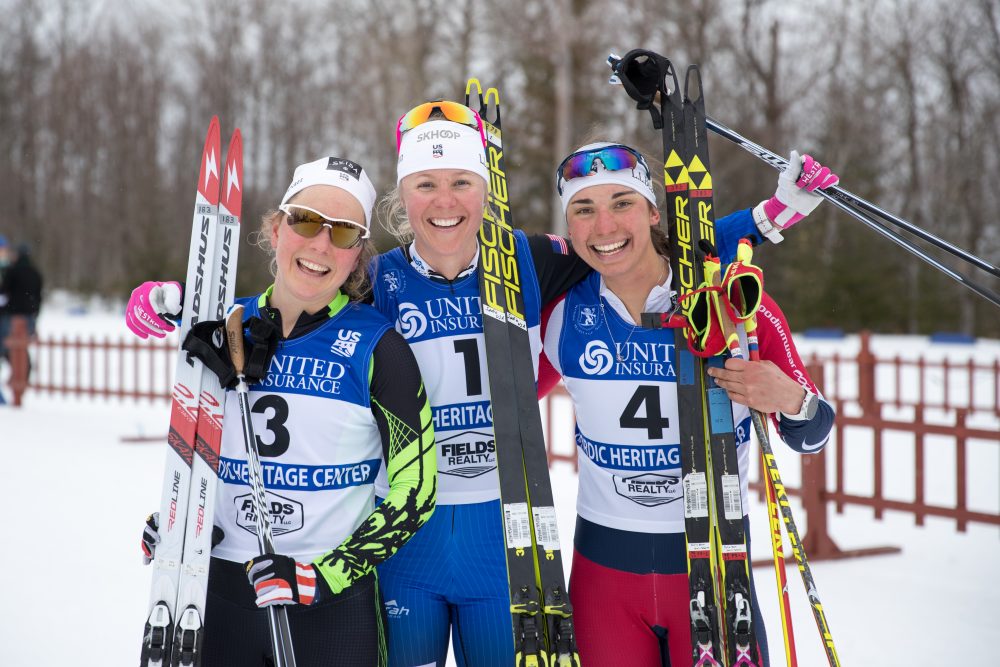
Sadie Bjornsen (bib 1), Rosie Brennan (bib 6) and Julia Kern (bib 4) during the skate sprint at SuperTour Finals. (Photo: U.S. Ski & Snowboard – Reese Brown)
U.S. Ski and Snowboard SuperTour Finals Presque Isle, Maine 1.4 k Freestyle Sprint
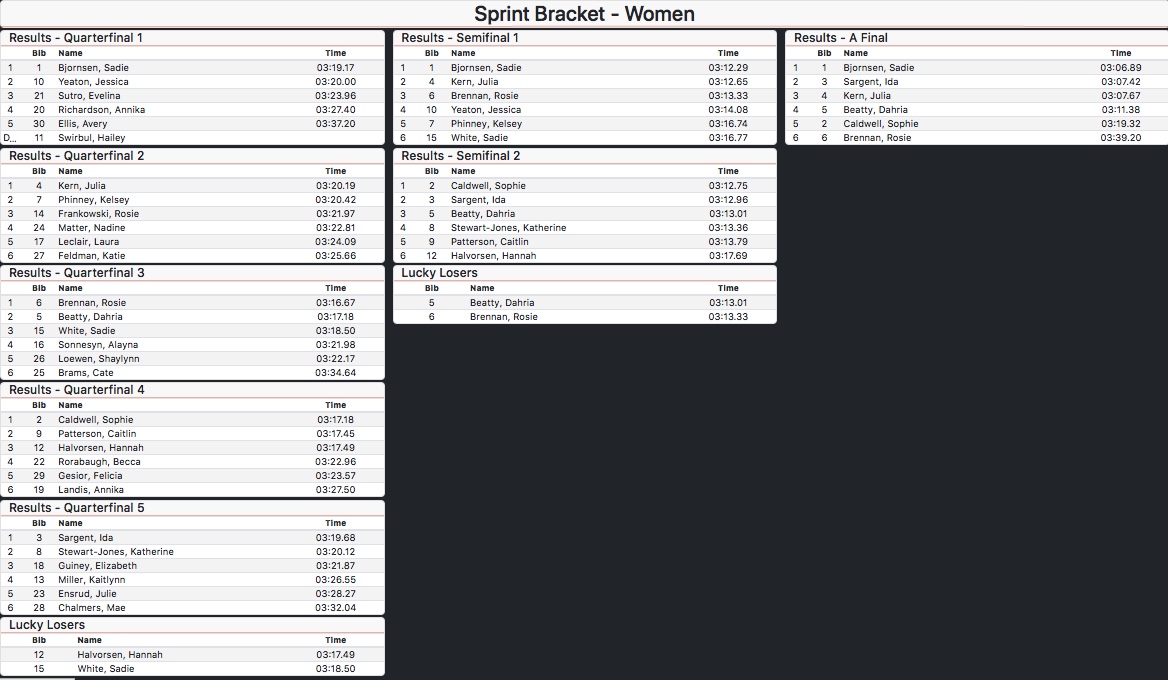
The women’s final was won by the day’s fastest qualifier (see qualification results below) Sadie Bjornsen (USST/APU). She won the final in 3:06.89. Ida Sargent (USST/CGRP) was second, and Julia Kern (USST/SMS T2) placed third.
The women’s skate sprint podium from SuperTour finals (l-r): Ida Sargent (CGRP) in third, Sadie Bjornsen (APU) first, and Julia Kern (SMS T2) second. (Photo: U.S. Ski & Snowboard – Reese Brown).
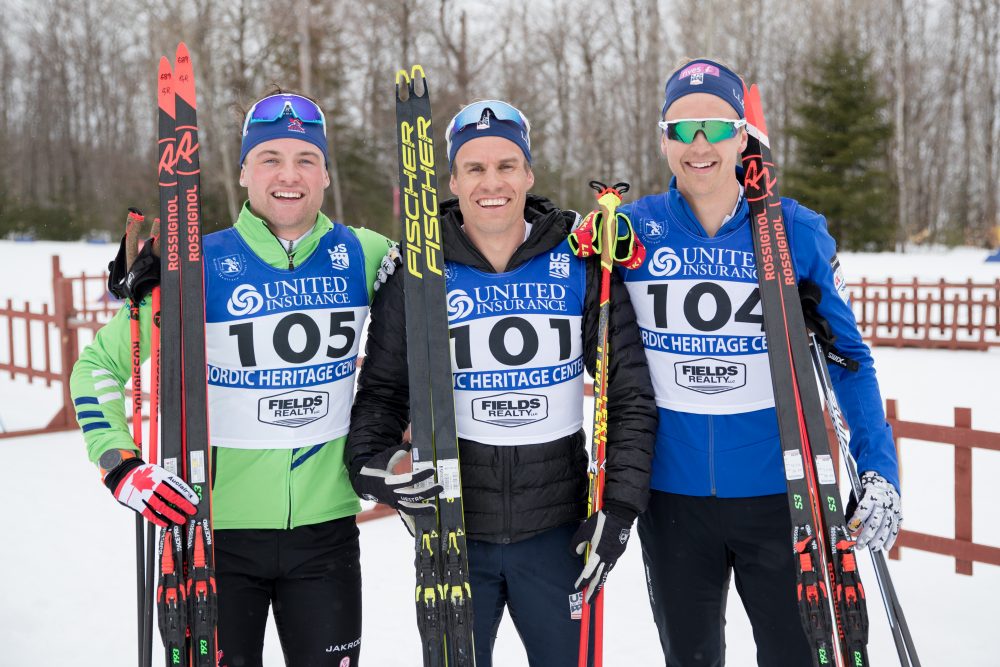
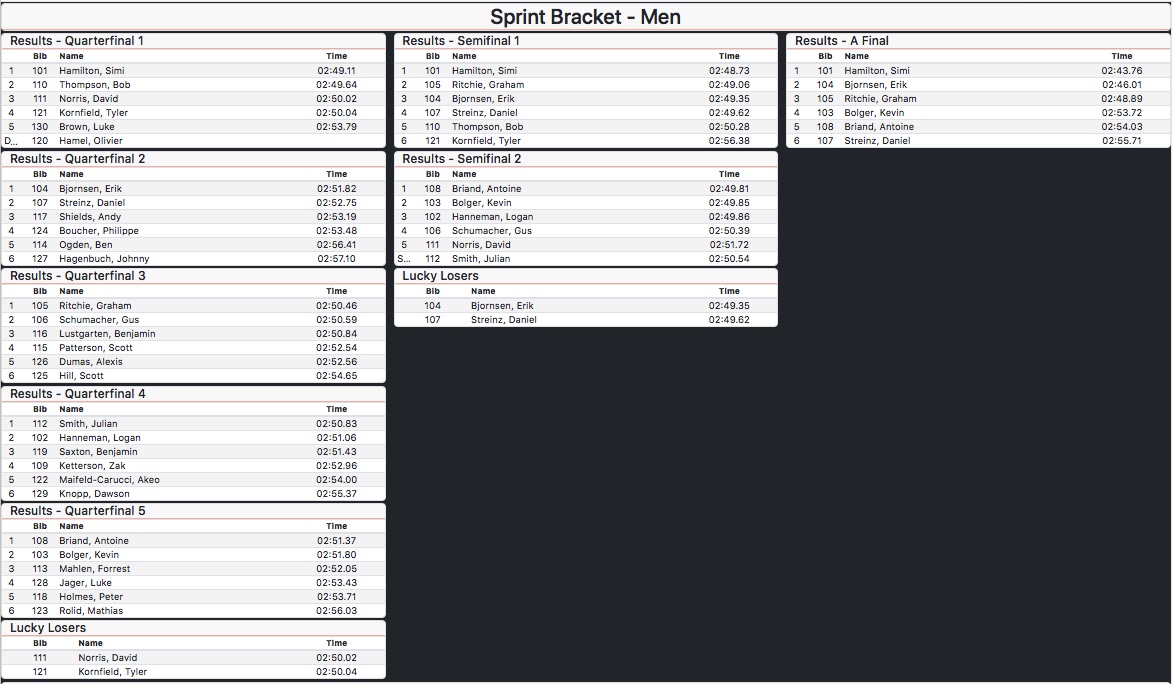
The men’s race was also won by the fastest qualifier, Simi Hamilton (USST/SMS T2) in a time of 2:43.76. Erik Bjornsen (USST/APU) placed second and Ritchie Graham (NTDC Thunder Bay) sprinted to third overall.
The men’s skate sprint podium from SuperTour finals (l-r): Graham Ritchie (NTDC Thunder Bay) third, Simi Hamilton (SMS T2) first and Erik Bjornsen (APU) second. (Photo: U.S. Ski & Snowboard – Reese Brown).
Simi Hamiton leads Canada’s Graham Ritchie during the heats of SuperTour finals. (Photo: U.S. Ski & Snowboard – Reese Brown)
Qualification
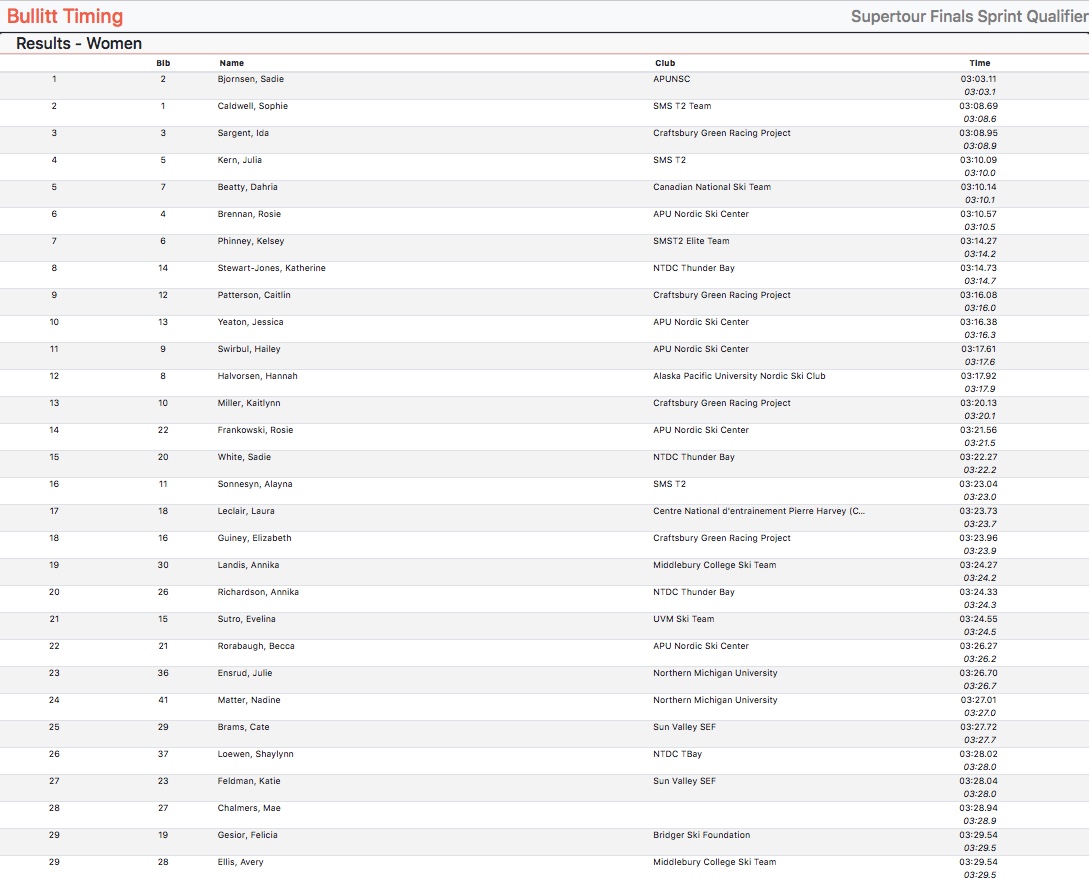
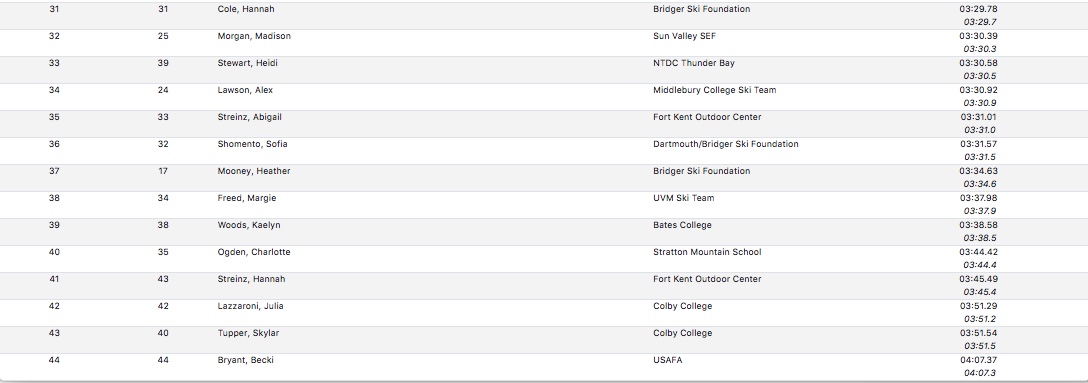
For the women’s qualifying results from this morning’s 1.4-kilometer freestyle sprint, U.S. Ski Team (USST) member’s locked up the top-four fastest times with Sadie Bjornsen (USST/APU) leading in a time of 3:03.11. Dahria Beatty of the Canadian National Team qualified in fifth.
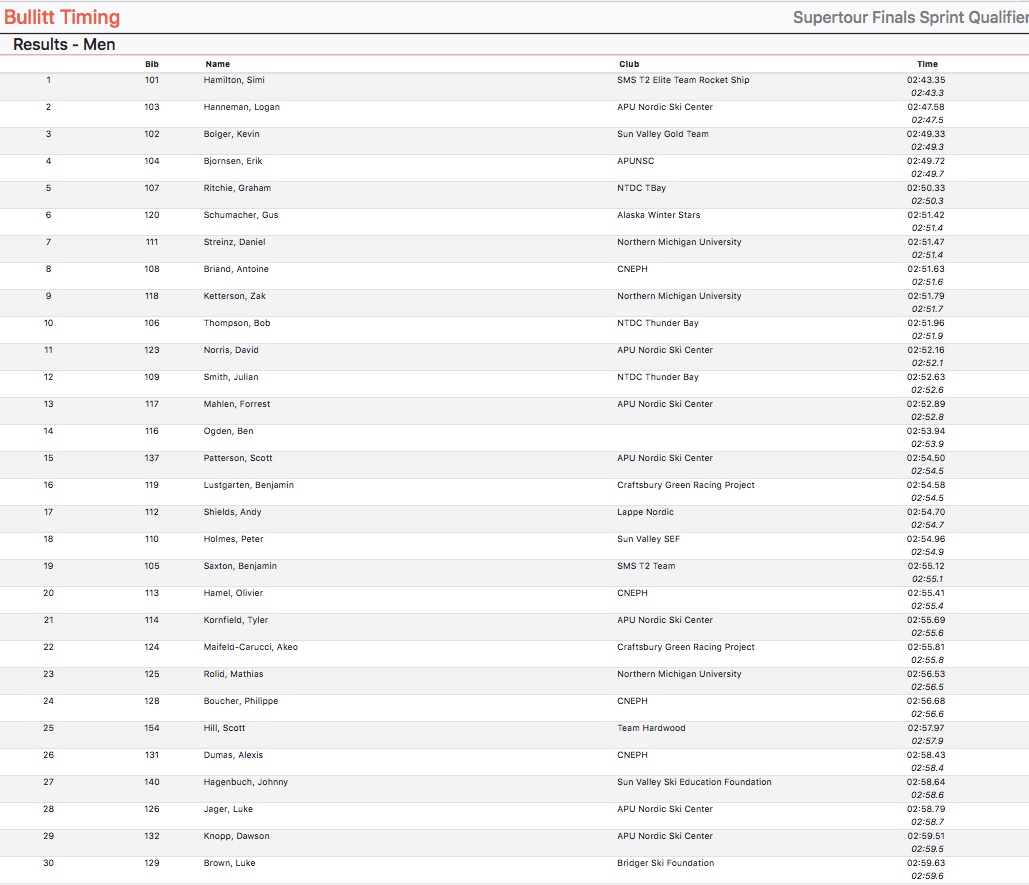
(Click on images below to enlarge.)
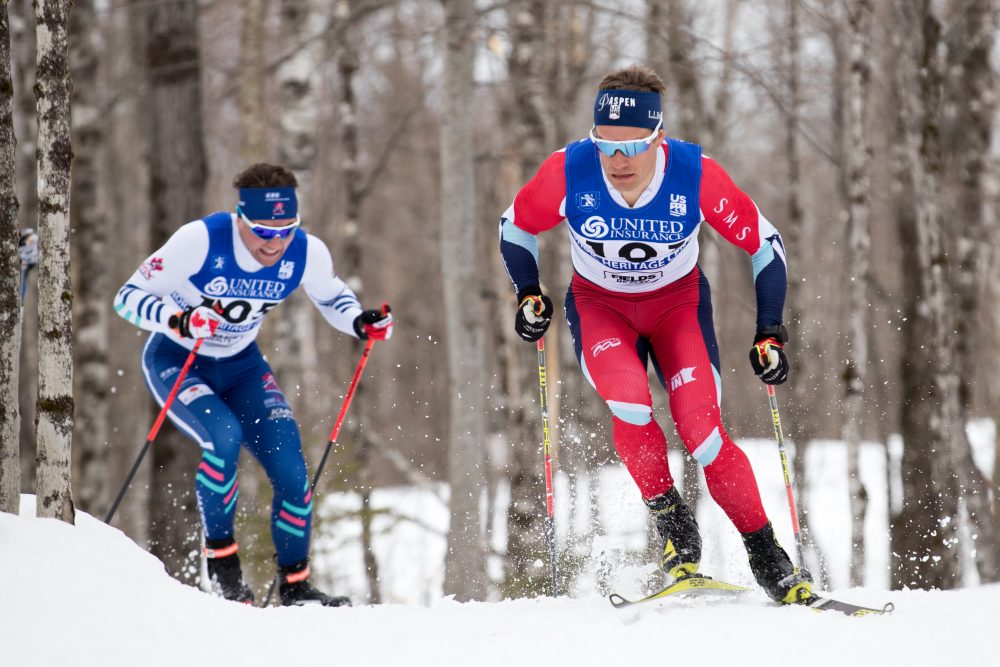
Simi Hamilton of the U.S. Ski Team and SMS T2 notched the fastest time in the men’s qualifier in 2:43.35. Logan Hanneman (APU), Kevin Bolger (USST/SVSEF), Erik Bjornsen (APU/USST), and Canada’s Graham Ritchie (NTDC Thunder Bay) were second through fifth respectively.
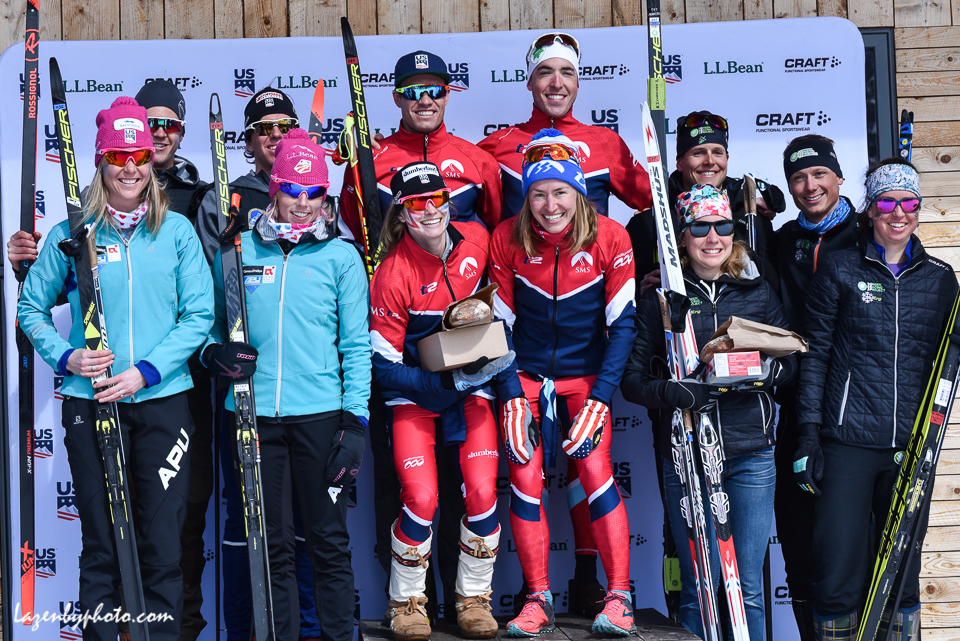
The mixed relay podium on Sunday at 2018 SuperTour Finals in Craftsbury, Vt., with Stratton (center: Simi Hamilton, Paddy Caldwell, Jessie Diggins, and Sophie Caldwell) in first, APU (left: Erik Bjornsen, Scott Patterson, Sadie Bjornsen, and Kikkan Randall) in second, and Craftsbury (right: Adam Martin, Alex Howe, Ida Sargent, and Caitlin Patterson) in third. (Photo: John Lazenby/Lazenbyphoto.com)
2018 U.S. SuperTour Finals (Craftsbury, Vermont): Mixed relays
For the second-straight year at the SuperTour’s season-ending Spring Series, the Stratton Mountain School (SMS) T2 Team won the mixed relay, with three of the four athletes who raced on last year’s 4 x 5-kilometer mixed relay squad.
Simi Hamilton, Sophie Caldwell, Paddy Caldwell, and Jessie Diggins combined for the win on Sunday in Craftsbury, tagging off in that order, with Diggins crossing the finish line first for the third-straight day. Diggins is undefeated in three races so far at Spring Series, after winning Friday’s classic sprint and Saturday’s 10 k freestyle mass start. The women’s 30 k classic mass start remains on Tuesday, followed by the men’s 50 k classic mass start on Wednesday.
Diggins and her Stratton teammates beat the Alaska Pacific University (APU) first team by 13.2 seconds at the line with a time of 53:43.2. The co-ed mixed relay has been held at SuperTour Finals for the last five years, and APU won the first three editions of the race from 2014 to 2016. Stratton won last year in Fairbanks, Alaska, with Ben Saxton, Hamilton, Caldwell, and Diggins.
APU led most of Sunday’s race, with Erik Bjornsen starting them off. He came through the first exchange in first place, just 0.2 seconds ahead of Hamilton in second. Behind them, Adam Martin of the Craftsbury Green Racing Project tagged in third, 0.8 seconds out of first.
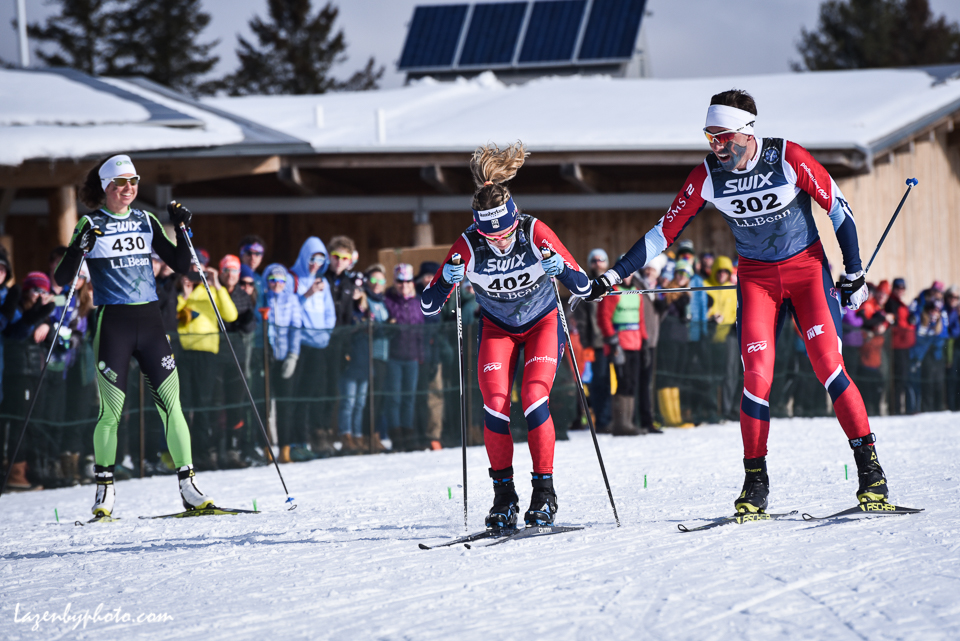
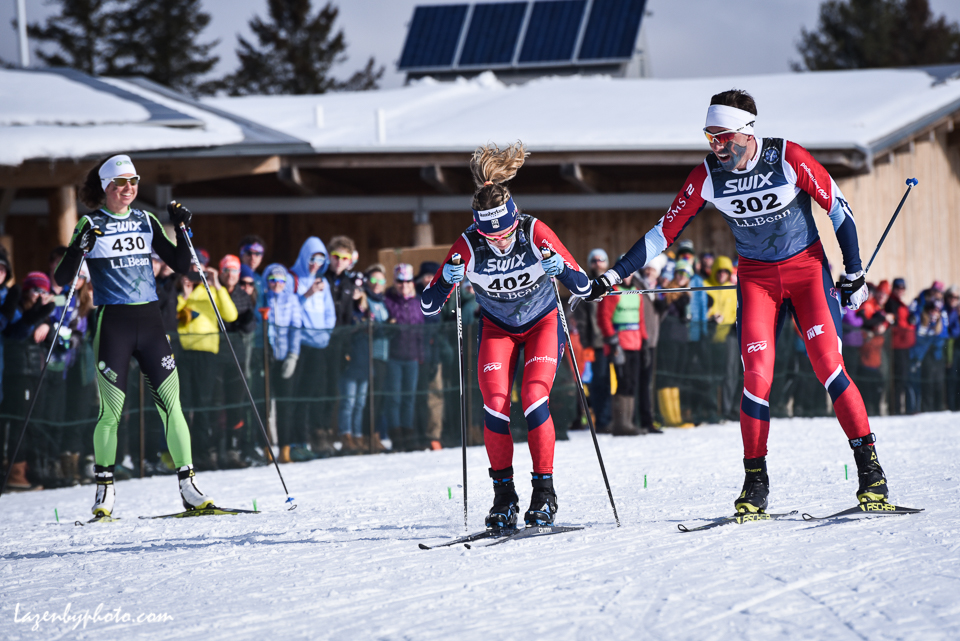
Paddy Caldwell (302) tags his Stratton Mountain School (SMS) T2 Team teammate Jessie Diggins (402) in second, while Craftsbury’s Caitlin Patterson (430) looks on, at the final exchange of the mixed relay at 2018 SuperTour Finals in Craftsbury, Vt. Diggins went on to anchor Stratton to first place. (Photo: John Lazenby/Lazenbyphoto.com)
Sadie Bjornsen then extended APU’s lead to 7.3 seconds over Stratton’s Sophie Caldwell in second. Behind them, Craftsbury’s Ida Sargent came through the second exchange in 10.3 seconds back in third.
APU’s Scott Patterson went on to hold off Stratton’s Paddy Caldwell on the third leg, tagging 3.5 seconds ahead in first. Diggins came up big for Stratton on the anchor leg, passing APU’s Kikkan Randall to secure the win.
Craftsbury held its third-place position during the second half of the race with Alex Howe and Caitlin Patterson to finish third, 56.2 seconds behind Stratton. More than a minute later, APU 2 (Tyler Kornfield, Rosie Brennan, Logan Hanneman, and Rosie Frankowski) crossed in fourth (+2:04). Stratton’s second team (Saxton, Julia Kern, Andy Newell, and Erika Newell) placed fifth (+2:47.3), APU 3 (Reese Hanneman, Becca Rorabaugh, Eric Packer, Hannah Halvorsen) sixth, Dartmouth Ski Team (Luke Brown, Katharine Ogden, Gavin McEwen, Abigail Drach) seventh, Northern Michigan University (Zak Ketterson, Vivian Hett, Ian Torchia, Nicole Schneider) eighth, Middlebury College (Peter Wolter, Cate Brams, Adam Luban, Katie Feldman) ninth, and US Biathlon (Russell Currier, Clare Egan, Raleigh Goessling, Susan Dunklee) 10th.
Thirty-one “official” teams and eight “unofficial” teams competed, with NMU/CSS/NYSEF leading the unofficial teams with a time of 1:00:01.9 (which ranked 19th overall).
Racers have the day off Monday before the women’s 30 k and men’s 50 k classic mass starts (part of U.S. Distance Nationals) on Tuesday and Wednesday, starting at 9 a.m. EDT. Watch the races live on the SuperTour live stream.
Martin racing in Craftsbury’s Green and Black (R), leading in the mixed relay at 2018 Super Tour Finals, just ahead of APU’s Erik Bjornsen (L), in Craftsbury, Vt. (Photo: John Lazenby/Lazenbyphoto.com)
Sadie Bjornsen (l) tags APU teammate Scott Patterson in first at the second exchange of the mixed relay at 2018 SuperTour Finals in Craftsbury, Vt. (Photo: John Lazenby/Lazenbyphoto.com)
Sophie Caldwell (l) about to tag Stratton teammate Paddy Caldwell in second at the second exchange of the mixed relay at 2018 SuperTour Finals in Craftsbury, Vt. (Photo: John Lazenby/Lazenbyphoto.com)
Scott Patterson (301) tags his APU teammate Kikkan Randall (401) in first, while Stratton’s Jessie Diggins (l) waits to be tagged in second place, at the last exchange of mixed relay at 2018 SuperTour Finals in Craftsbury, Vt. (Photo: John Lazenby/Lazenbyphoto.com)
Alex Howe (r) tags his Craftsbury teammate Caitlin Patterson (l) in third at the final exchange of the mixed relay at 2018 SuperTour Finals in Craftsbury, Vt. (Photo: John Lazenby/Lazenbyphoto.com)
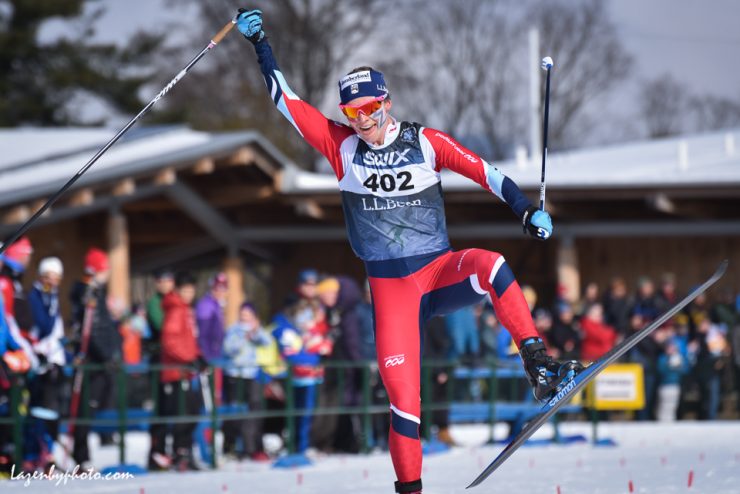
Jessie Diggins anchoring the SMST2 Team to the win in the mixed relay at 2018 SuperTour Finals in Craftsbury, Vt. (Photo: John Lazenby/Lazenbyphoto.com)
Jessie Diggins celebrates as she anchors the SMST2 Team to the mixed-relay win at 2018 SuperTour Finals in Craftsbury, Vt. (Photo: John Lazenby/Lazenbyphoto.com)
Jessie Diggins about to celebrate with teammates after anchoring the SMST2 Team to the mixed-relay win at 2018 SuperTour Finals in Craftsbury, Vt. (Photo: John Lazenby/Lazenbyphoto.com)
Caitlin Patterson anchoring the Craftsbury Green Racing Project team to third in the mixed relay at 2018 SuperTour Finals in Craftsbury, Vt. (Photo: John Lazenby/Lazenbyphoto.com)
Stratton Mountain School (SMS) T2 Team members and 2018 SuperTour Finals mixed-relay racers: (from left to right) Andy Newell, Annie Hart, Sophie Caldwell, Jessie Diggins, Erika Newell, Simi Hamilton, Ben Saxton, and Julia Kern. (Photo: John Lazenby/Lazenbyphoto.com)
A musically inclined Stratton Mountain School supporter at the mixed relay at 2018 SuperTour Finals in Craftsbury, Vt. (Photo: John Lazenby/Lazenbyphoto.com)
Bridger Ski Foundation teammates Andrew Meyer (r) and Corey Stock (l) during the final exchange of the mixed relay at 2018 SuperTour Finals in Craftsbury, Vt. Stock anchored the team to 17th. (Photo: John Lazenby/Lazenbyphoto.com)
Cambridge Sports Union skiers during an exchange at the mixed relay at 2018 SuperTour Finals in Craftsbury, Vt. (Photo: John Lazenby/Lazenbyphoto.com)
Retiring World Cup skier Liz Stephen raced the mixed relay with an unofficial team from her high school in East Montpelier, Vt., at 2018 SuperTour Finals in Craftsbury, Vt. They called themselves “U-32 High School”. (Photo: John Lazenby/Lazenbyphoto.com)
A team made up of NENSA, Onion River Nordic and Montpelier club athletes at the mixed relay at 2018 SuperTour Finals in Craftsbury, Vt. (Photo: John Lazenby/Lazenbyphoto.com)
Erik Bjornsen (2) of Alaska Pacific University and the U.S. Ski Team (USST) leads Simi Hamilton (13), of the Stratton Mountain School T2 Team and USST, and Tad Elliott (12), of Ski Club Vail toward the finish of the men’s 15 k freestyle mass start at 2018 SuperTour Finals in Craftsbury, Vt. (Photo: John Lazenby/Lazenbyphoto.com)
2018 U.S. SuperTour Finals (Craftsbury, Vermont): 10/15 k freestyle mass starts
Jessie Diggins won her second-straight race in as many days at 2018 SuperTour Finals and Erik Bjornsen pulled out a victory in the men’s 15-kilometer freestyle mass start on Saturday in Craftsbury.
Jessie Diggins (201) and Sadie Bjornsen (202) lead the women’s 10 k freestyle mass start at 2018 SuperTour Finals in Craftsbury, Vt. (Photo: John Lazenby/Lazenbyphoto.com)
Diggins, of the Stratton Mountain School (SMS) T2 Team and U.S. Ski Team (USST), won the women’s 10 k freestyle mass start in 25:56.0 minutes, just 1.2 seconds ahead of her USST teammate Sadie Bjornsen of Alaska Pacific University (APU) in second. The duo dropped the pack and battled to the line, while Kikkan Randall (APU/USST) skied on her own to third place, 12.6 seconds behind Diggins.
APU took three of the top four with Rosie Frankowski finishing 43.7 seconds back in fourth. Caitlin Patterson of the Craftsbury Green Racing Project (CGRP) followed in fifth (+1:02.2), and Sophie Caldwell (SMST2/USST) took sixth less than one-tenth of a second ahead of her Stratton teammate Katharine Ogden (Dartmouth College/SMS/USST Development Team) in seventh (+1:10.4). US Biathlon’s Susan Dunklee (CGRP) placed eighth (+1:19.4), Julia Kern (SMST2/USST D-team) finished ninth (+1:26.0), and Erika Flowers (SMST2), who competed at last weekend’s Norwegian Birkebeiner, placed 10th (+1:37.0).
In the men’s mass start, Bjornsen (APU/USST) and Simi Hamilton (SMST2/USST) went head to head down the finishing stretch for first, which Bjornsen took in 35:08.1. Hamilton finished 1.5 seconds back in second place, while Tad Elliott (Ski Club Vail) followed three seconds later in third (+4.6).
According to live timing, Paddy Caldwell (SMST2/USST) edged his fellow national-team member Scott Patterson (APU/USST) by less than one-tenth of a second for fourth place (+6.5). Brian Gregg of Central Cross Country (CXC), Team Gregg and Loppet Nordic Racing placed sixth (+30.4), David Norris (APU) finished seventh (+52.1), Jack Hegman of the Sun Valley Ski Education Foundation (SVSEF) eighth (+55.3), Adam Martin (CGRP) ninth (+56.2), and Eric Packer (APU) 10th (+59.8).
Spring Series continues Sunday with mixed relays at 9 a.m. EDT at the Craftsbury Outdoor Center.
Jessie Diggins (201) leads her U.S. Ski Team teammate Sadie Bjornsen and the rest of the women’s field in the 10 k freestyle mass start at 2018 SuperTour Finals in Craftsbury, Vt. (Photo: John Lazenby/Lazenbyphoto.com)
Jessie Diggins (SMST2/U.S. Ski Team) pushing to the line for the win in the women’s 10 k freestyle mass start at 2018 SuperTour Finals in Craftsbury, Vt. (Photo: John Lazenby/Lazenbyphoto.com)
Jessie Diggins (201) winning the women’s 10 k freestyle mass start, just ahead of Sadie Bjornsen (202) in second, at 2018 SuperTour Finals in Craftsbury, Vt. Kikkan Randall (background) placed third. (Photo: John Lazenby/Lazenbyphoto.com)
Kikkan Randall (APU/USST) racing to third in the 10 k freestyle mass start at 2018 SuperTour Finals in Craftsbury, Vt. (Photo: John Lazenby/Lazenbyphoto.com)
Kikkan Randall (l) and Jessie Diggins embrace after the finish of the women’s 10 k freestyle mass start on March 24 at 2018 SuperTour Finals in Craftsbury, Vt. Diggins won and Randall placed third. That was Randall’s second-to-last race before retiring from skiing. (Photo: John Lazenby/Lazenbyphoto.com)
Liz Stephen (U.S. Ski Team) racing to 12th in the women’s 10 k freestyle mass start at 2018 SuperTour Finals in Craftsbury, Vt. (Photo: John Lazenby/Lazenbyphoto.com)
Liz Stephen (U.S. Ski Team) having some fun at 2018 SuperTour Finals in Craftsbury, Vt. She finished 12th in the 10 k freestyle mass start. (Photo: John Lazenby/Lazenbyphoto.com)
U.S. Ski Team member Liz Stephen (yellow bib) during a photo opp at 2018 SuperTour Finals in Craftsbury, Vt. (Photo: John Lazenby/Lazenbyphoto.com)
Scott Patterson (1) leads his APU and U.S. Ski Team teammate Erik Bjornsen and the rest of the men’s field in Saturday’s 15 k freestyle mass start at 2018 SuperTour Finals in Craftsbury, Vt. (Photo: John Lazenby/Lazenbyphoto.com)
Scott Patterson (1) leads his APU and U.S. Ski Team teammate Erik Bjornsen and the rest of the men’s field in Saturday’s 15 k freestyle mass start at 2018 SuperTour Finals in Craftsbury, Vt. (Photo: John Lazenby/Lazenbyphoto.com)
The men’s 15 k freestyle mass start top six at 2018 SuperTour Finals in Craftsbury, Vt., with (from left to right) Brian Gregg in sixth, Paddy Caldwell in fourth, Simi Hamilton in second, Erik Bjornsen in first, Tad Elliott in third, and Scott Patterson in fifth. (Photo: John Lazenby/Lazenbyphoto.com)
Olympians Sadie Maubet Bjornsen, Jessie Diggins, and Kikkan Randall representing their club teams at the 2018 Super Tour Finals. (Photo: John Lazenby/Lazenbyphoto.com)
From left to right, Kikkan Randall, Bill Koch and Jessie Diggins, the U.S.A.’s three Olympic medalists in cross-country skiing at 2018 SuperTour Finals in Craftsbury, Vt. (Photo: John Lazenby/Lazenbyphoto.com)
Kikkan Randall (c) with young fans and her Olympic gold medal after the 10 k freestyle mass start at 2018 SuperTour Finals in Craftsbury, Vt. (Photo: John Lazenby/Lazenbyphoto.com)
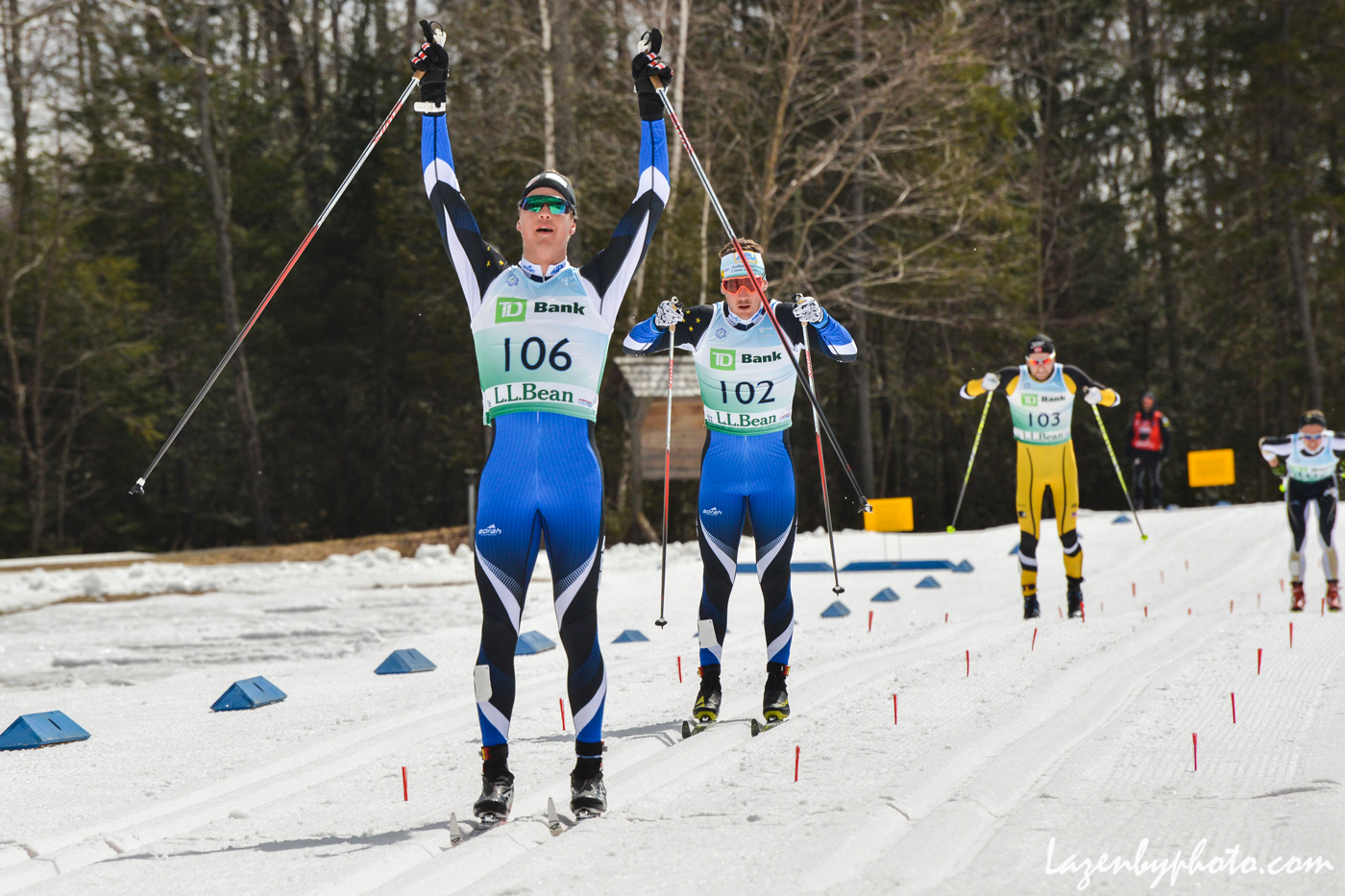
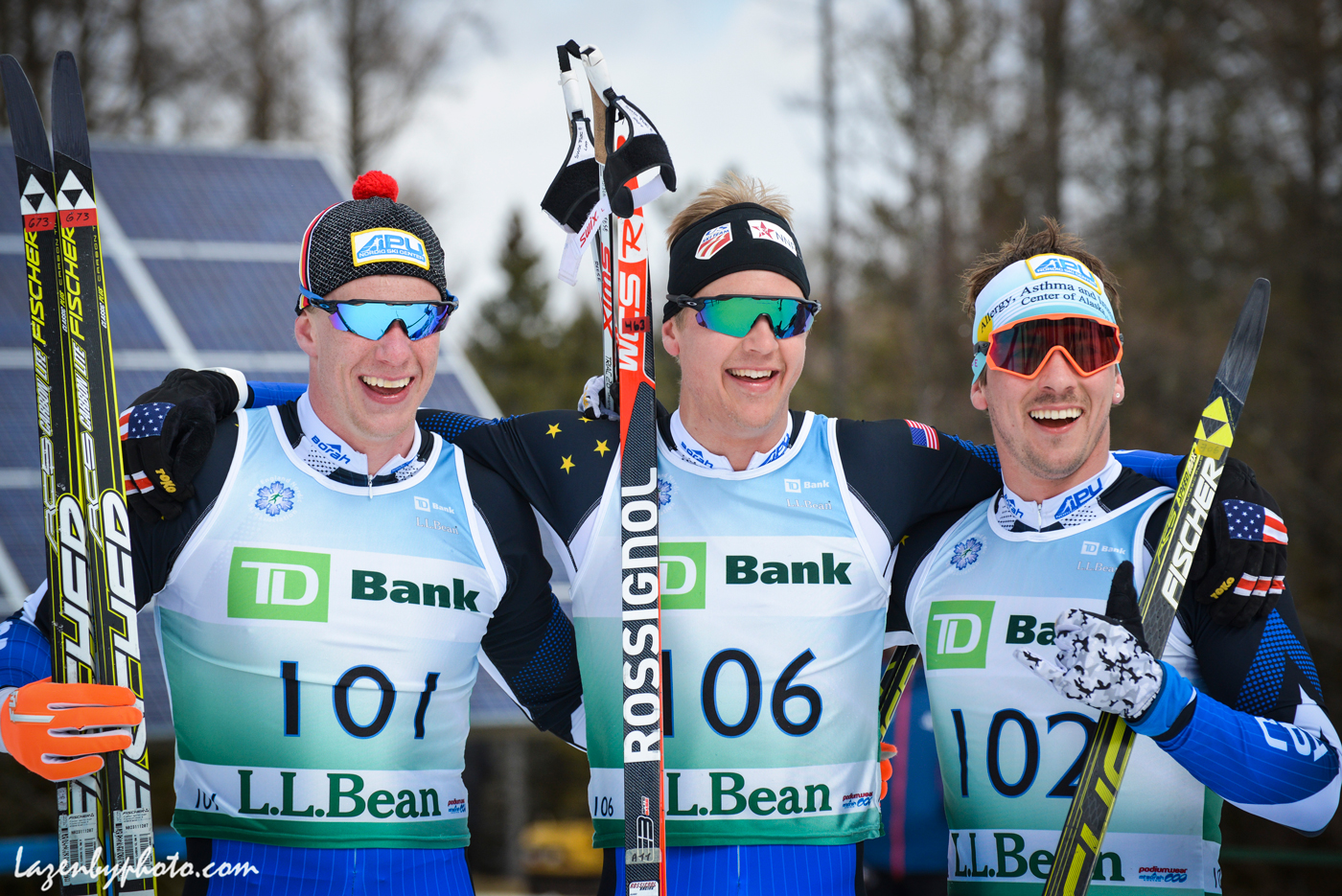
Erik Bjornsen (106) celebrates his classic sprint victory on Tuesday at SuperTour Finals in Craftsbury, Vt., after holding off APU teammate Reese Hanneman (102) by 1.28 seconds. Logan Hanneman (not shown) completed the APU podium sweep in third, 4.35 seconds back, while Michigan Tech’s Didrik Elset (in yellow) missed the podium by 0.34 seconds in fourth. (Photo: John Lazenby/Lazenbyphoto.com)
Earlier this year at U.S. nationals, Alaska Pacific University (APU) narrowly missed a podium sweep in the classic sprint in Houghton, Mich., taking first, second and fourth in the men’s final. But on Tuesday in Craftsbury, Vt., in the 1.5-kilometer classic sprint at SuperTour Finals, the APU men pulled it off, putting four men in the final and sweeping the top three.
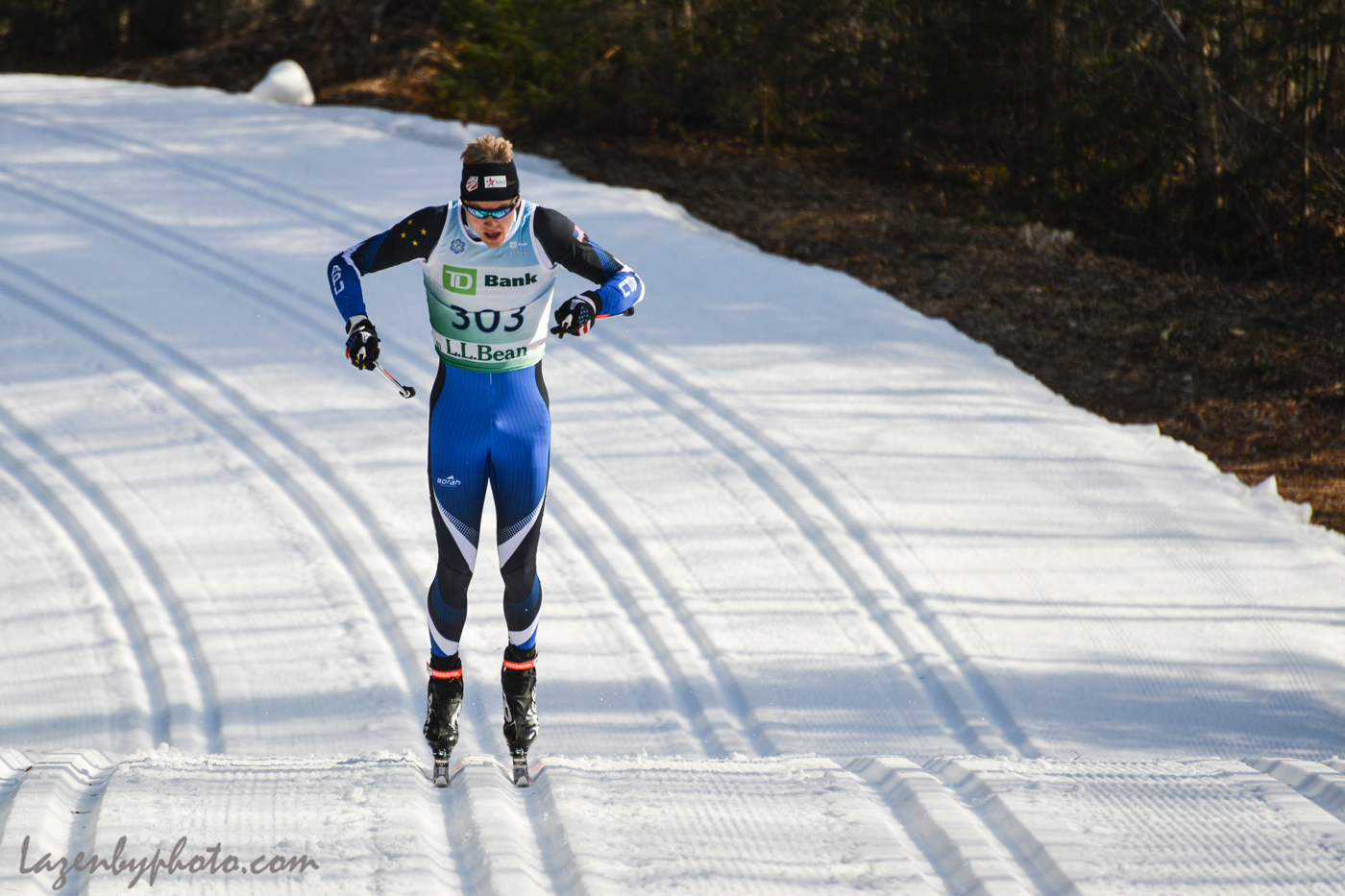
The APU contingent consisted of Eric Packer (the defending national champion in the classic sprint), Reese Hanneman (the SuperTour sprint leader for Period I who spent the rest of the season on the World Cup in Europe), his younger brother Logan Hanneman (the fastest qualifier of the day in 3:07.24), and Erik Bjornsen (who recently returning to the U.S. after racing a full season on the World Cup circuit).
They were joined by two Norwegians competing as collegians in exchange programs: Didrik Elset, 22, of Michigan Tech University and Petter Reistad, 21, of the University of Colorado-Boulder (CU). Elset broke up the APU sweep at nationals, placing third in the classic sprint. Reistad helped CU to a runner-up team finish at NCAA Skiing Championships, double poling to ninth in the 20 k classic mass start.
On Tuesday, the two Norwegians, Elset and Reistad decided to double pole the qualifier as well as the heats, making it all the way to the final. The rest of the field opted to stride the heats. On a wide track with five classic tracks covering most of the course, racers were pleased with a fair-and-minimally tactical course.
In the final, Reistad blasted out of the gate and Reese Hanneman tucked in just behind. Heading up the decisive climb on the course, Reese jumped into his own track and surged ahead of Reistad. Bjornsen covered the move and the two gapped the field as they headed toward the slight incline into the finish. Hanneman tucked behind Bjornsen to be sheltered from the headwind and matched his pace, but couldn’t overtake him. Bjornsen secured the win in 3:02.4, beating Reese by 1.28 seconds.
After gaining on Elset and Reistad on the climb, Logan Hanneman overtook the double polers in the final stretch to notch third (+4.35), just 0.34 seconds ahead of Elset in fourth. Fatigued from double poling with little rest between heats, Reistad faded to fifth (+7.31).
Notably missing from the podium, current SuperTour leader Packer placed sixth (+50.95) after a crash in the final.
“I fell on the big downhill in the final, and ended up sliding off course into the dirt and leaves,” wrote Packer in a post-race email. “There was no contact or anything — I just caught an edge and went down. It was a bummer for sure but I am looking forward to the next two races, and defending my Supertour lead in the 50 k.”
Bjornsen Pushes Through
The APU men swept the classic sprint podium at SuperTour Finals on Tuesday in Craftsbury, Vt. Erik Bjornsen (c) led the team in first, ahead of brothers Reese (r) and Logan Hanneman (l) in second and third, respectively. (photo credit: John Lazenby/Lazenbyphoto.com)
Although Bjornsen was considered a favorite heading into the race, he was pleasantly surprised with the victory.
“It was not exactly what I was expecting, I was happy to have enough in the final to take the win,” Bjornsen, 24, said in a post-race phone interview. “I am not feeling great right now, it is not my best shape, but I’m trying to race through it and enjoy the racing in the U.S.”
After posting the sixth-fastest time in the qualifier, about 2.98 seconds behind Logan, Bjornsen progressively gained momentum, winning both his quarterfinal and semifinal.
“The legs especially are not responding, just kinda feeling dead,” he described. “I felt pretty good in the heats today. I tried to ski behind people and make my move in the last 60 seconds or so and I think it worked and helped me conserve energy for the final.”
Reese in second overall was also pleased after feeling beat up after the season-ending World Cups in Canada.
“It was good. I was just so dead after Ski Tour Canada and I didn’t really know what to expect,” he said on the phone. “I pretty much just felt dead for a week after Canmore and then I had a really, really bad race hack for a long time so I didn’t race [on Monday]. I felt pretty good, the skiing was really nice, they did an awesome job with the course.”
Although fatigue resonates through all the racers, Reese highlighted that at this point of the season, it is a mental challenge more than anything.
“Being really tired is kind of a given at this point in the year. … We are all just all a bunch of tired people racing each other,” he said. “It doesn’t necessarily mean that you can’t do well, I think it is important to learn to race when tired because it is not indicative of the result, it’s just mentally hard to get fired up.”
Although little glory is generally given to sprint-qualifier winners, prize money for the fastest qualifier in Craftsbury placed a bit of incentive for the morning prelim. With that in mind, Logan set an intermediate goal for the day: winning the qualifier. The decision to stride instead of double pole paid off as he claimed the top qualifier in 3:07.24, just 0.71 seconds faster than his brother Reese.
Logan Hanneman (APU) racing to a 0.71-second qualifying win in the men’s classic sprint on Tuesday at SuperTour Finals in Craftsbury, Vt. (Photo: John Lazenby/Lazenbyphoto.com)
Logan went on to win the first quarterfinal, then advanced as a lucky loser in the semifinal after placing third behind Bjornsen and Reistad, respectively.
“I went out and in typical Logan fashion, slow out of the start,” Logan said on the phone after.” I was fifth pretty much the whole way until the stadium and I caught and passed the two double polers on that last stretch.”
Completing the podium sweep was part of his motivation heading down the homestretch.
“That was cool,” he said. “That was one of my incentives for catching those people. And we had four in the top six. Packer took a little detour off course in the final, which wasn’t quite the fastest detour.”
Packer echoed the significance of the strong APU showing. “It was really cool to see my teammates sweep the podium today…,” he said. “I think it reflects the training we do in Alaska. We’re all pushing in training, and that’s starting to show through in the results.”
Despite missing the podium by 0.34 seconds, Elset in fourth said he has enjoyed racing and training in the U.S. with Michigan Tech and credits coach Joe Haggenmiller and the team with his success.
“I chose skate skis. It worked pretty well, especially for the quarterfinal and the semifinal but in the final, the APU guys were going too fast for me up the climb and I was getting tired so it was rough,” Elset said. “I was hoping to be on the podium today but being able to ski with these guys who are so fast and be competitive is fun and it gives me a lot of confidence that I am doing something right.”
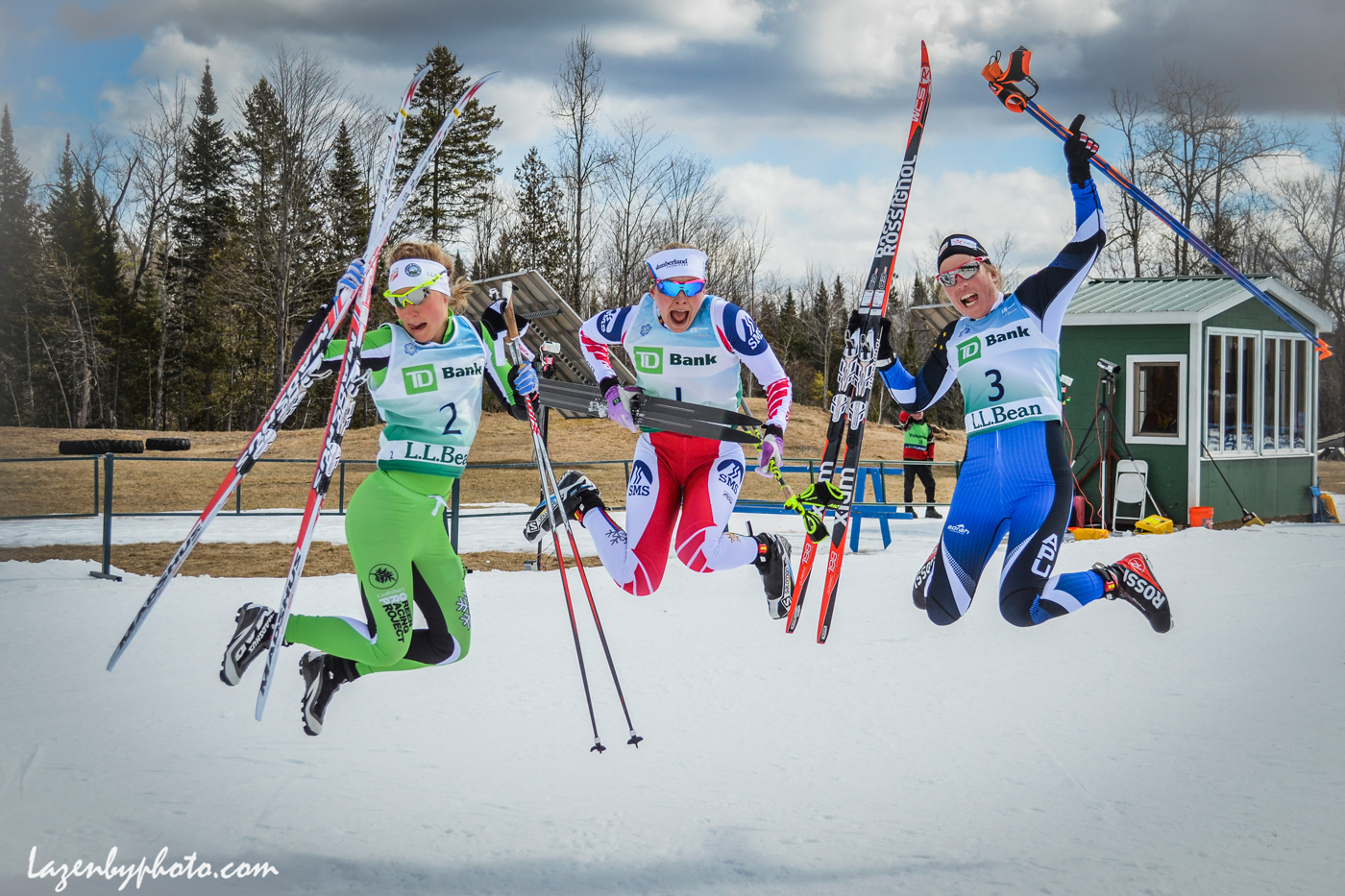
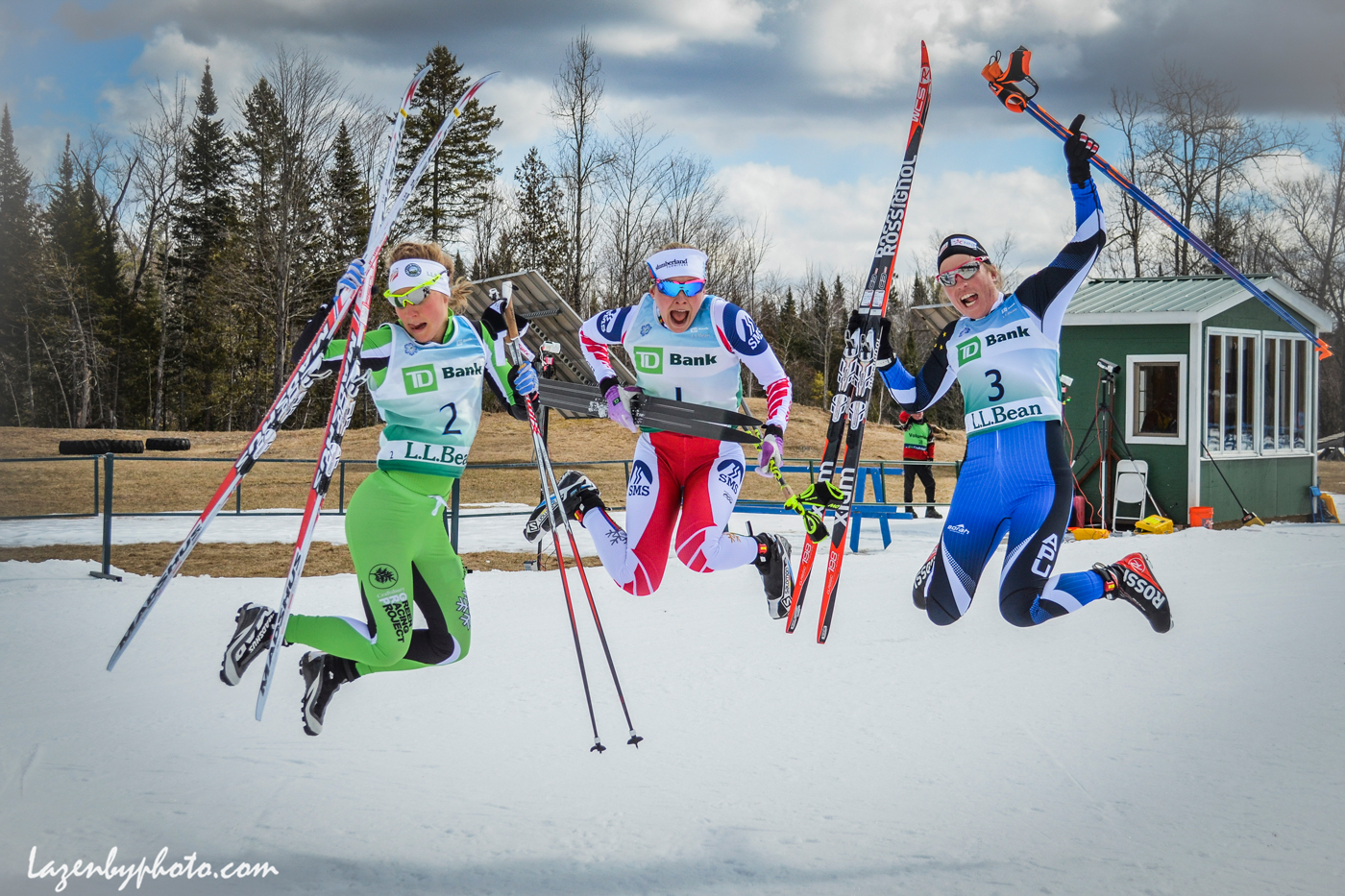
The top-three women in the SuperTour Finals classic sprint jump for joy, with winner Jessie Diggins (c), runner-up Ida Sargent (l) and third-place finisher Rosie Brennan (r). All three women are on the U.S. Ski Team but raced for their respective clubs on Tuesday in Craftsbury, Vt. (Photo: John Lazenby/Lazenbyphoto.com)
Note: This article has been updated to include comments from Sophie Caldwell and Dartmouth Nordic Assistant, Hilary McNamee.
While the glamour of racing in a suit sporting the American stars and stripes at a World Cup is a tough experience to beat for many U.S. cross-country skiers, racing at home amidst friends and family in the club suit that started it all makes for a pretty close second.
While U.S. Ski Team (USST) members have to leave their club tights behind during World Cup competitions, they’re quick to don them again when they return to domestic racing in the U.S.
This holds especially true for Jessie Diggins, of the Stratton Mountain School (SMS) T2 Team and USST. Diggins raced to her second-straight SuperTour Finals win this week in the women’s 1.5-kilometer classic sprint on Tuesday in Craftsbury, Vt.
“It was fun skiing in those red, white and blue SMST2 suits again and especially awesome to have half the final with my club teammates!” Diggins wrote in an email. “The atmosphere here is definitely more relaxed than a World Cup, with less pressure, which makes it just a lot of fun. And spring series is supposed to be fun!”
After Diggins won the qualifier in a time of 3:30.60, she continued to dominate all three heats, ultimately winning the final in a slightly faster 3:30.27.
Ida Sargent and her mother, Lindy, after Sargent finished second in the classic sprint final at 2016 SuperTour Finals in Craftsbury, Vt. (Photo: John Lazenby/Lazenbyphoto.com)
Her USST teammate, Ida Sargent, of the Craftsbury Green Racing Project (CGRP) finished second in the final, 0.73 seconds behind. On the phone after, Sargent said that being club-proud before a home-crowd fueled her.
“After all the World Cup racing it’s really fun to end the season here altogether, racing against club teammates and my U.S. Ski Team teammates and friends,” Sargent said. “ I live in Craftsbury, so … from the starters, to the timers, to the jury, I knew all of the [volunteers] …[including] my dad, who was one of the course control people out on course.”
Third-place finisher, Rosie Brennan — also on the USST — said that racing the sprint for her club Alaska Pacific University (APU) also provides a visual of how domestic teams create opportunities toward the World Cup.
“I’ve been on the other side of it, too, being on the SuperTour all year and doing really well and anxious to see how I do against the World Cup skiers,” Brennan said. “It’s important for us to come back and do these races because it … shows that path [towards other levels of racing] to everybody that’s here.”
This seems to be true, for athletes and coaches alike.
“[I]t’s always a blast to hop in with the fastest ladies in the country (and WORLD!!), just to know how FAST fast is,” Dartmouth Nordic assistant, Hilary McNamee, who qualified for the first quarterfinal, wrote in an email. “That quarterfinal with Jesse Diggins, Annie Hart and Caitlyn Patterson… whoa. They don’t mess around. I like to keep in touch with what it feels like to train and race– the soreness, the nerves, the feeling of accomplishment because it allows me to better relate to the athletes I work with. ”
The Final
The club team charm continued in the final, at least for SMST2, with three Stratton skiers advancing through the quarterfinals and semifinals into the final heat.
“[A]ny day the final has three SMS T2 suits in it is a good day,” Stratton’s Annie Hart, who finished fourth, wrote in an email.
Rosie Brennan (3) of APU leads Stratton’s Sophie Caldwell (8) during their quarterfinal in the women’s classic sprint at SuperTour Finals on Tuesday in Craftsbury, Vt. (Photo: John Lazenby/Lazenbyphoto.com)
The third SMST2 skier to toe the start line of the women’s final, alongside Diggins and Hart, was Sophie Caldwell, also of the USST.
While SMST2 comprised the first half of the final start list, Brennan and Sargent as well as Jennie Bender, of the Bridger Ski Foundation, made up the second half.
“In the final with so many talented ladies and World Cup winners, I just felt so excited,” Hart wrote. “Regardless of result, it is just such a great opportunity.”
Out of the start, Caldwell and Diggins set the pace into the first downhill, according to Sargent.
“Their skis were gliding faster I think and so I just kind of tucked in behind them,” she said.
While Sargent pinpointed the lead pace pushers as Caldwell and Diggins, Brennan attributed the first race attack as one from Diggins and Sargent.
“Jessie and Ida went off pretty hot on the start,” Brennan said. “I kind of made my move on the uphill to try and to get up to them.”
After double poling the qualifier on skate skis for the first time, Bender qualified in 14th, 20.6 seconds behind Diggins. She then won her quarterfinal and advanced as a lucky loser from the first semifinal, and found her body fighting to keep pace in the final with Brennan, Diggins and Sargent up the first major climb.
“I slipped a bit on the hill and just kind of ran out of gas,” Bender said on the phone. “I’ve never double poled a qualifier before, but I think it was a good experience … and I was happy to be in the final with this crew of girls. I just wanted to be more a bit more in that top five.”
As the top five rounded into the finishing stretch, Diggins emerged in first, but Sargent refused to let her out of her sight.
“Jessie and I were just drag racing up the climbs,” Sargent said. “And we were neck and neck in the last climb.”
Jessie Diggins (1), racing for the Stratton Mountain School T2 Team, winning the women’s classic sprint final at SuperTour Finals on Tuesday by 0.73 seconds over Ida Sargent (l) of the Craftsbury Green Racing Project. (Photo: John Lazenby/Lazenbyphoto.com)
However, in the final lunge to the line, Diggins took first by 0.73 seconds over Sargent.
“[Diggins] is just such a strong double poler,” Sargent said. “She poled just a little ahead on the last double pole to the finish, but I was psyched to be close to her.”
Finishing third, 2.85 seconds back, was Brennan.
“These were the first rounds of the year for me, basically actually since nationals last year.” explained Brennan, after spending the entire season on the World Cup. “I was definitely a little rusty … but it was fun to be able to ski the heats with [my World Cup teammates], especially Ida and Sophie and Jessie because they have been skiing heats all year. So to see how they do it, for sure, helps you learn how to ski different sections of the course better and, hopefully, not lose as much time.”
About 3 1/2 seconds off the podium, Hart took fourth (+6.36), a result she was “psyched” about.
“I think it was a testament and a good finale to all the hard work I’ve put into fitness and lasting through three very fast rounds,” Hart wrote. “The most important thing I’ve learned, and where I’ve improved my sprinting and distance, is skiing with the confidence that I can compete. With each heat I had more and more confidence, and I think that showed in my racing [today].”
Caldwell, who also celebrated her 26th birthday on Tuesday, finished the day in fifth (+8.85).
“Yesterday was a fun day of racing with friends,” Caldwell wrote in and email on Wednesday. “I was really proud to have three SMS T2 skiers in the final and to watch Jessie win once again. I’m feeling the effects of a long season and am pretty tired and not skiing as fast as I would like to be, but it’s a great atmosphere and fun to be in the same place as the rest of the skiing community.”
“Huge thanks to the outdoor and all the volunteers who have helped make this happen!” she added.
Rounding out the final was Bender in sixth (+13.14).
“Spring Series every year is always a bit more of a mental challenge,” Bender said. “But I’ve been enjoying the process.”
So have a number of others, including McNamee.
“In the last two years of working at Dartmouth and jumping into races, I’ve found that I actually race MUCH better than when I was an athlete,” McNamee wrote. “I think that is 100% mental. I’m no longer emotionally attached to my race results, which takes the pressure off entirely. Before, ski racing was so entangled with my self-worth, every bad result, every mediocre interval session was so corrosive to my self-confidence. Now, I don’t give a crap. I just appreciate the sport for all it’s ups and downs.”
McNamee raced to 22nd overall, after qualifying in 20th, 24.53 seconds back from Diggin’s first place qualifing time of 3:30.6.
“I come out of retirement about once a year, to throw down– mostly to preserve my street cred among the Dartmouth squad,” McNamee wrote in an email. “I’m very selective about the races…I try to time it for the end of the season when everyone else is tired and burnt out, so I look relatively good by comparison.”
Racing picks up again Thursday with the mixed team relay event, with four members per team (two male, two female) racing 2 x 5 k classic followed by 2 x 5 k freestyle.
The last week of SuperTour racing taking place this year in Craftsbury, Vt. has already hit the halfway mark, with the women’s 1.5-kilometer classic sprint on Tuesday at the Craftsbury Outdoor Center. Check out some of the photos that capture the top moments of the event.
(Photo: John Lazenby/Lazenbyphoto.com)
Stratton Mountain School T2 Team skier Jessie Diggins racing to first in the qualifier for the women’s classic sprint at SuperTour Finals on Tuesday in Craftsbury, Vt. She went on to win the final as well. (Photo: John Lazenby/Lazenbyphoto.com)
Alaska Pacific University’s Rosie Brennan racing to third in the qualifier for the women’s classic sprint at SuperTour Finals on Tuesday in Craftsbury, Vt. (Photo: John Lazenby/Lazenbyphoto.com)
Craftsbury Green Racing Project skier Ida Sargent striding to second in the qualifier for the women’s classic sprint at SuperTour Finals on Tuesday in Craftsbury, Vt. (Photo: John Lazenby/Lazenbyphoto.com)
(Photo: John Lazenby/Lazenbyphoto.com)
Race winner Jessie Diggins (center) of Stratton Mountain School T2 Team with second-place finiser, Ida Sargent of the Craftsbury Green Racing Project (l) and third-place finisher Rosie Brennan of Alaska Pacific University after the women’s 1.5 k classic sprint at SuperTour Finals on Tuesday in Craftsbury, Vt. (Photo: John Lazenby/Lazenbyphoto.com)
Race winner Jessie Diggins (center) of Stratton Mountain School T2 Team with second-place finiser, Ida Sargent of the Craftsbury Green Racing Project (l) and third-place finisher Rosie Brennan of Alaska Pacific University after the women’s 1.5 k classic sprint at SuperTour Finals on Tuesday in Craftsbury, Vt. (Photo: John Lazenby/Lazenbyphoto.com)
Left to right: Jennie Bender (Bridger Ski Foundation), Ida Sargent (Craftsbury Green Racing Project), Jessie Diggins (Stratton Mountain School T2 Team), Rosie Brennan (Alaska Pacific University), Annie Hart (SMST2), and Sophie Caldwell (SMST2) after the women’s 1.5 k classic sprint at SuperTour Finals on Tuesday in Craftsbury, Vt. (Photo: John Lazenby/Lazenbyphoto.com)
Jessie Diggins of the Stratton Mountain School (SMS) T2 Team and U.S. Ski Team (USST) powers through the women’s 10 k freestyle en route to a victory on the first day of racing at SuperTour Finals in Craftsbury, Vt. (Photo: John Lazenby/Lazenbyphoto.com)
It had been 116 days since the season started with the November World Cup and SuperTour races and just nine days since the conclusion of the Ski Tour Canada. Needless to say, it has been a long season.
U.S. SuperTour Finals, held this week in Craftsbury, Vt., is a unique season-ending series. The senior men’s and women’s fields are a conglomerate of domestic racers (which compete all winter on the SuperTour circuit), collegiate racers (some of which are fresh off NCAA Championships), and the U.S. Ski Team (with several members returning from nearly four months abroad on the World Cup circuit). Also known as Spring Series, the U.S. finals give World Cup racers the opportunity to reconnect with their programs and race alongside their club teammates.
Consistent with the snow struggles all season across the U.S. and Europe this season, Monday’s individual start races were held on a manmade 3.4-kilometer loop in Craftsbury. However, athletes commended the challenging course organizers and volunteers laid out.
In the women’s 10 k freestyle, U.S. Ski Team (USST) member Jessie Diggins, racing for the Stratton Mountain School T2 Team, started third and quickly posted the fastest splits to cross the finish line first in a time of 24:26.9.
Jessie Diggins (Stratton Mountain School T2 Team/U.S. Ski Team) celebrates her win in the women’s 10 k freestyle on the first day of U.S. SuperTour Finals on Monday in Craftsbury, Vt. (Photo: John Lazenby/Lanzenbyphoto.com)
That time held up throughout the day and when the final results were posted, only two racers managed to keep Diggins within 36 seconds of them: USST teammate Sadie Bjornsen and Riitta-Liisa Roponen of Finland, respectively.
Bjornsen, of Alaska Pacific University (APU) bested Roponen, a 37-year-old Finnish A-team member, by just 0.2 seconds for second place, clocking 36.2 seconds behind Diggins. Due to nagging injuries and sickness, this will be Bjornsen’s only race this week.
“Today was a challenging and fun grand finale,” Bjornsen wrote in an email. “I am still pretty sick and managed to get a little overuse shoulder injury at the end of the tour. So I have decided to pull the plug and head back home tomorrow. When you are so exhausted, it becomes a bit dangerous to race when you are sick.”
Although SuperTours are usually devoid of overseas national-team racers, Finland and Italy were represented in Craftsbury on Monday.
“Riitta-Liisa and Virginia [De Martin Topranin, of Italy] are here racing to have fun and see the U.S. while getting some racing in,” Diggins explained in an email. “I think it’s so great to have an international field here at Spring Series.”
Roponen last race at the Worldloppet at home in Lahti, Finland, which she won. Her best individual World Cup result this season was fifth at the Lahti World Cup 15 k skiathlon. Topranin, 28, placed 11th on Monday, more than two minutes back. She is coming off a 22nd-place overall finish in the Ski Tour Canada (STC) and a top individual result of seventh in a 10 k classic mass-start stage at the Tour de Ski.
Diggins finished fifth overall in the STC and has broke through with five World Cup podiums this season, including a win in the 5 k freestyle at the Tour de Ski.
Finland’s Riitta-Liisa Roponen racing to third in the women’s 10 k freestyle on Monday at SuperTour Finals in Craftsbury, Vt. (Photo: John Lazenby/lazenbyphotos.com)
“In all honesty, racing again after the tour was tough!” Diggins wrote. “The World Cup season took quite a lot out of me, but after a total rest week with my boyfriend in Boston I’m happy and healthy again and excited for one last ‘hurrah’ to close out the season.”
About 50 seconds off the podium and nearly 1 1/2 minutes behind Diggins, fourth through seventh place all finished within 7.5 seconds of one another. Chelsea Holmes (APU) led them in fourth (+1:25.4), followed closely by Liz Stephen (Burke Mountain Academy/USST) in fifth (+1:26.5), Ida Sargent of the Craftsbury Green Racing Project (CGRP) and USST in sixth (+1:27.8) and Caitlin Patterson (CGRP) in seventh (+1:32.9).
Overall, echoes of fatigue resounded among the racers.
“I feel pretty beat up and tired, but I think I am one of many who have that feeling,” Holmes wrote in an email. “When you race it doesn’t really matter how you feel, you just do your best.”
Coming off of a fifth- and an eighth-place finish at NCAA Championships, Emilie Cedervaern of the University of New Mexico was the top collegiate skier in 10th (+2:07.2).
Ahead of her, two women who represented the U.S. at the STC, Annie Hart (SMST2) placed eighth (+1:45.0) and Rosie Brennan (APU/USST) was ninth (+1:56.1).
Racing continues Tuesday with the men’s and women’s 1.5 k classic sprints. Heats begin at 11:30 a.m. Eastern time.
“It was so nice to be racing in the U.S. again and to see everyone!” Diggins wrote. “That’s why I come to spring series — it’s all about the awesome people that I never get to see enough!”
Jessie Diggins (c) of the Stratton Mountain School T2 Team and U.S. Ski Team topped the podium in the women’s 10 k freestyle individual start on Monday, the first day of racing at U.S. SuperTour Finals in Craftsbury, Vt. Sadie Bjornsen (second from left) of APU/USST placed second and Finland’s Riitta-Liisa Roponen (second from r) placed third. Chelsea Holmes (not pictured) was fourth, Liz Stephen (l) fifth and Ida Sargent (r) sixth. (Photo: John Lazenby/Lanzenbyphoto.com)
Noah Hoffman of Ski & Snowboard Club Vail and the U.S. Ski Team (USST) racing to first place in the men’s 15 k freestyle individual start at the U.S. SuperTour Finals on Monday in Craftsbury, Vt. (Photo: John Lazenby/Lazenbyphoto.com)
Technique takes practice. Race tactics take practice. What about podiums?
U.S. Ski Team (USST) member Noah Hoffman — currently competing for his club team, Ski & Snowboard Club Vail (SSCV), at the U.S. SuperTour Finals in Craftsbury, Vt. — views the process of winning a race, equally important to the win itself.
“Honestly, it’s nice to get to win a race every once in awhile,” Hoffman, the winner of the men’s 15-kilometer freestyle individual start race on Monday in Craftsbury, said in a post-race phone interview. “I mean, it’s been a long time since I’ve won a ski race outright and I think there’s something to be said for learning how to win.”
The last time the 26-year-old Colorado native won a race was two years ago at 2014 SuperTour Finals in Anchorage, Alaska. There, he won the opening 15 k freestyle as well.
Now, with another victory under his belt, Hoffman is all for practicing how to win as an individual as well as a group.
“It’s not a secret that we’re lagging behind on U.S. men’s distance [racing],” he said. “We have a long way to go as a group … but I have a lot of faith in the athletes that are skiing right now and I think we can all work together to try to improve.”
The top six in the men’s 15 k freestyle at SuperTour Finals on Monday in Craftsbury, Vt., with (from left to right) fifth-place finisher Eric Packer (APU), runner-up Scott Patterson (APU), winner Noah Hoffman (SSCV/USST), Paddy Caldwell (SMS/USST) in third, David Norris (APU) in fourth, and Tad Elliott (SSCV) in sixth. (Photo: John Lazenby/Lazenbyphoto.com)
Following the end of the World Cup season two weeks ago at the Ski Tour Canada (STC), Hoffman sees value for both himself and the USST by racing this last set of races on the U.S. circuit.
“I think my teammates and I all prioritize these races,” Hoffman said. “We’re not just doing this for the domestic scene. I think there’s a lot of value for us as well.”
The term “us” can be applied to both the USST members, as well as athletes watching or racing experienced skiers like Hoffman at SuperTour Finals.
“It’s really fun for me to be here with the Vail club,” Hoffman said. “We [SSCV] have a couple of juniors here, plus we’re part of the Rocky Mountain crew, and there’s a junior from Aspen where I grew up and there’s some Steamboat kids. So being a part of this crew and being on a team with these athletes is really fun for all of us here.”
Hoffman Holds Off Patterson’s ‘Fight for the Win’
Finishing just six-tenths of a second behind Hoffman’s winning time of 31:14.3, was Scott Patterson, skiing for Alaska Pacific University (APU), in second place.
“It’s kind of fun getting back to the domestic racing and actually being able to fight for the win instead of getting blown out of the race,” Patterson, who made his World Cup debut this season, said on the phone. “Obviously I would have like it a little more if I had found 0.6 seconds, but I’m happy with [the race].”
As the last A-seeded male in bib 20, Patterson led both the first and third laps of the four x 3.75 k course skiing with APU teammates Tyler Kornfield and Eric Packer.
“Packer started 30 seconds in front of me and I caught him,” Patterson explained. “And then Tyler left the start line right as Packer and I were passing through. So we had a good group … always nice to have a couple people to ski with.”
While the APU trio made their way through the final lap, Patterson pinpointed another cause for his seconds lost on Hoffman.
“I got a split that I was 12 seconds up on the last uphill, so I probably held back a little bit in the finish,” Patterson said.
Scott Patterson (APU) racing to second place in the men’s 15 k freestyle individual start at SuperTour Finals on Monday in Craftsbury, Vt. (Photo: John Lazenby/Lazenbyphoto.com)
Still, coming off of the STC and two stages of World Cup racing, Patterson was happy to be back in the fight for the top spot.
“I’m sure we’ll have fun in the 50 k with racing in the front instead of having other people control it and trying to hang on,” Patterson said of the men’s 50 k classic mass start, part of U.S. Distance Nationals, on Saturday. “These races are fun because they kind of bring everyone together at the end of the season.”
Hoffman who started in bib 15, said despite his hot off the start pace, he managed to hold on for the win with the help of Northern Michigan University skier Adam Martin.
“I was pretty aggressive on the first lap, which I intended to do,” Hoffman said. “But I definitely paid for that at the end of the race. I was lucky I had some help, I caught Adam Martin after a lap … He showed me the pace all the way from there to the finish, the last 3 k or so. That was very helpful for me, having not paced it well. I needed that little boost of somebody to follow.”
While both Hoffman and Patterson found the help of other racers on course, Paddy Caldwell, skied the course solo for third place overall.
“I was flying solo for the day, but that was all right,” Caldwell said on the phone.
Caldwell, who skis for Dartmouth College and is also a member of the Stratton Mountain School and the USST development (“D”) team, was the top U23 athlete, finishing 11.4 seconds behind Hoffman
Paddy Caldwell, racing for the Stratton Mountain School, on his way to third place in the men’s 15 k freestyle individual start at SuperTour Finals on Monday in Craftsbury, Vt. (Photo: John Lazenby/Lazenbyphoto.com)
“I’m definitely really excited with the result and it was fun to be so close to a teammate, who I for sure look up to as distance skier and overall guy,” Caldwell said, referring to Hoffman. “And same with Patterson. Those two have really been nailing the distance skiing this year so I’m for psyched to be close and I think, within striking range today.”
With the broad conglomerate of athletes and clubs showing up to the final week of SuperTour racing in the U.S., Caldwell is feeding off the energy of others, while also pushing a competitive energy of his own.
“It’s just awesome to have the whole ski community here,” Caldwell said. “All the World Cup guys — whoever is healthy — it’s great to have everyone here. And I think the World Cup skiers bring some of that energy here which is always fun to see. It’s definitely a relaxed setting, but it’s fun because the competition is definitely high.”
Racing continues Tuesday with the men’s and women’s 1.5 k classic sprints.
It’s an amiable atmosphere at Spring Series in Anchorage, Alaska, as seen here after Sunday’s classic-sprint final. Teams will compete for a national title on Tuesday in Kincaid Park in the coed 4 x 5 k, the first race of U.S. Distance Nationals. From left to right: Andy Newell (SMST2/USST), Reese Hanneman (APU/USST), Ben Saxton (SMS), Pat O’Brien (CGRP), Dakota Blackhorse-von Jess (BEA), and Tyler Kornfield (APU). (Photo: Rob Whitney)
When the U.S. Ski and Snowboard Association (USSA) met last spring, they decided it was time for a bit of a change at the season-ending SuperTour Finals and U.S. Distance Nationals. Instead of a hill climb, they opted for a team relay at the races in Anchorage, Alaska, scheduled for the following March 22-28.
According to the event’s race director James Southam, a two-time Olympian from Anchorage, athletes brought up the idea of a team event last year. An opening in the schedule made the 4 x 5-kilometer relay possible for 2014.
But unlike most four-person relays, the one going off Tuesday at 5 p.m. Alaska time will be coed with a male scramble classic leg tagging to a female classic skier, then male freestyle skier, and finally, a female freestyle anchor.
“I think it’s gonna be fun,” Southam said. “The last distance relay I remember doing was I think in Bend [Ore.] in 1998 or something like that for nationals. I think having the coed is going to be cool. … You don’t need four good guys or four good girls; I think it makes it a little more competitive.”
Eighteen official teams (including two junior squads), each made up of two males and two females from the same USSA club, will compete for a national title — and $750 dollars in prize money to split four ways. The second-place team will receive $500, and third gets $300.
It’s the second-to-last competition before Friday’s 30 and 50 k classic mass starts, which will be held at a different venue than the rest of the races at Kincaid Park, at the Hillside Trail System on the east side of town.
Teams to watch include Alaska Pacific University’s first team, with Reese Hanneman, Sadie Bjornsen, Erik Bjornsen, and Kikkan Randall, in that order. The top team from Stratton Mountain School T2, Andy Newell, Sophie Caldwell, Simi Hamilton, and Jessie Diggins will also contend for the title, along with Craftsbury’s Patrick O’Brien, Ida Sargent, Gordon Vermeer, and Caitlin Patterson, and Sun Valley’s Mikey Sinnott, Mary Rose, Matt Gelso, and Chelsea Holmes.
Several college teams, such as the University of Vermont, Northern Michigan, New Mexico, and the University of Alaska-Anchorage will also be vying with the best of them.
There are also few unofficial teams with skiers from different clubs that have a shot at winning for glory rather than cash. Fastest of the Fast Twitch includes Brian Gregg (Team Gregg/Madshus), Liz Stephen of the U.S. Ski Team (USST), Noah Hoffman (SSCV/Team HomeGrown/USST), and Caitlin Gregg (Team Gregg/Madshus). The Vagabonds are Karl Nygren (Podiumwear), Jennie Bender (Bridger Ski Foundation), Mark Iverson (Rossignol), and Cambria McDermott (independent).
Each competitor will ski two laps of either a roughly 3.3 k classic loop (for 6.6 k total) or a 2.6 k skate loop (for approximately 5.2 k).
As for the 5 p.m. start? It’s all about getting the best bang for the buck in terms of participation, volunteers and spectators.
“We want as many of the kids from around town to be able to race in it as well and to come out and watch it,” Southam said. “When you have midweek races at 11 o’clock it’s hard to get the kids out to watch. One of the big reasons we wanted to host these races is, after the Olympics people have been paying attention to skiing all winter long and it’s pretty powerful for kids coming up to be able to watch Olympians and world champions.”
Of the 26 teams entered in Tuesday’s relay, the two official junior squads are from APU. One unofficial team includes three men and a woman, another has four junior males, and one has three males, which will complete three legs and then call it a race.
Kikkan Randall (APU/USST) leads her semifinal at Sunday’s SuperTour Finals classic sprint at Kincaid Park in Anchorage, Alaska. (Photo: Bill Roth/Anchorage Daily News)
ANCHORAGE, Alaska – Normally, when Anchorage cross-country skier Kikkan Randall races, it’s in front of a crowd of largely indifferent Europeans — Swedes or Norwegians who might recognize her, but would prefer to see someone from their own country crossing the finish line first.
But at the SuperTour Finals 1.4-kilometer classic sprint on a sunny Sunday at Kincaid Park — just a few miles from her house in South Anchorage — Randall was the center of attention. There were family members, friends, even Anchorage Mayor Dan Sullivan watching from the side of the trail, with Sullivan himself offering up an unabashed shout of “Go Kikkan!”
Kikkan Randall (APU/USST) in Sunday’s 1.4 k classic sprint qualifier at SuperTour Finals in Anchorage, Alaska. She went on to win the final for her second-straight win at home at Spring Series. (Photo: Rob Whitney)
Randall delivered, winning the final by 2 seconds over Sadie Bjornsen, one of her teammates on the Alaska Pacific University (APU) Elite Team and U.S. Ski Team (USST). It was Randall’s second victory in as many races at the Finals, after she won the 10 k freestyle individual start on Saturday.
The women are just one week removed from their last race in Europe, nine time zones away, and after an up-an-down season, they could be forgiven for treating these competitions with a little less seriousness. But with a big local crowd out watching, packed shoulder to shoulder along the final climb, Randall gave it everything, grimacing as she double poled to the finish line in finals — her third sprint heat of the day.
“I’m out in schools all year talking about how you have to give it your best: ‘If you dream big and work hard, you can accomplish your dreams.’ I feel like I’m out here and I have to follow my own advice a little bit,” she said afterwards. “With so many people who come out and cheer you on, it’s important to perform well, even if it’s the end of the season.”
Bjornsen won the preliminary qualifier by nearly three seconds over Sophie Caldwell, also of the USST, who skis for the Vermont-based Stratton Mountain School (SMS) T2 Team.
Randall qualified fifth, five seconds back, but she won both her quarterfinal and semifinal heats before setting up for the finals with Bjornsen, Caldwell, Ida Sargent (Craftsbury Green Racing Project/USST), Jessie Diggins (SMST2/USST), and Anchorage’s Holly Brooks (APU/USST) — six of the seven women on the U.S. Ski Team.
Diggins made a hard push in the first portion of the 1.4-kilometer course, which was mostly flat and downhill, but the women were still in a pack when they arrived at the bottom of the big climb up to the finish.
Bjornsen made a push to challenge for the lead, but she said she started struggling on the steepest part of the climb. The tracks on Sunday were made up of a thin layer of powdery snow atop hard ice, and Bjornsen said she was scrambling too much to make her wax stick, which allowed Randall to get away.
Kikkan Randall celebrates her second win in as many races at 2014 SuperTour Finals with a classic-sprint win on Sunday in Anchorage, Alaska, ahead of fellow U.S. Ski Team members Sadie Bjornsen (1) in second and Ida Sargent (3) in third. (Photo: Rob Whitney)
“Kik had some really good striding on the steepest part, and I was kind of slipping around a little too much to stride it out,” Bjornsen said. “All the other heats, I was not frantic enough that I could ski them. But when it becomes frantic, I tend to slip around a bit more.”
Randall said that she had struggled similarly in her first heat, but changed her technique to be smoother in the semifinals and finals.
“The last two rounds, I just kind of found a good rhythm — I think I was just feeling better and better every round,” she said.
Sargent was third, closing a gap to Bjornsen on the home stretch and just barely losing a lunge for the finish line.
“It was a good battle with Sadie in the finishing stretch,” Sargent said. “It’s so fun to have our last sprint race of the year be a final between six of us on the team. It was the most fun sprint heat I’ve done all year.”
With the fans, a warm sun, and even a food truck slinging caribou sandwiches and reindeer hot dogs, the race had a festive feel, and many of the athletes seemed to have permanent smiles regardless of their placing. Especially the Alaskans, who got a boost from the partisan crowd.
The all-U.S. Ski Team women’s classic sprint podium (from left to right) Holly Brooks in sixth, Sophie Caldwell in fourth, Sadie Bjornsen in second, Kikkan Randall in first, Ida Sargent in third, and Jessie Diggins in fifth. (Photo: Rob Whitney)
“Half these kids I babysit, and the other half are my professors’ at school,” Bjornsen said.
“I want to pack them up and take them on the World Cup, for sure. These are the best fans of the entire season,” said Brooks.
This race series is the first at the elite level in Anchorage since 2010, and Randall said that was welcomed after the Americans had spent their season at high-profile races in Europe, and at the Olympics in Russia.
“I’ve had so many people say, ‘It’s so good to finally see you race,’ ” Randall said. “And I am a little taken aback by that, but then I realize what this team has been accomplishing, and for us to all be here doing what we do best, in front of a hometown crowd, I think is really cool.”
That crowd included Sullivan, the Anchorage mayor, who’s more known for his interest in indoor sports like tennis and basketball.
“At first when I saw him, I was like, ‘Oh, hey Dan,’” Randall said. “And then I went, ‘Wait, wait a second — Dan’s here at a ski race!’ That’s pretty awesome.”
Jessie Diggins (l) congratulates her fellow U.S. Ski Team member Kikkan Randall on her win after racing Randall in Sunday’s classic-sprint final at Kincaid Park in Anchorage, Alaska. Diggins placed fifth, 8.86 seconds back. (Photo: Bill Roth/Anchorage Daily News)
Noah Hoffman (SSCV/Team HomeGrown/USST) racing to a 10.9-second win in Saturday’s 15 k freestyle at SuperTour Finals at Kincaid Park in Anchorage, Alaska. (Photo: Rob Whitney)
ANCHORAGE, Alaska — Separated by 30 seconds at the start, nearly 70 men in Saturday’s 15.9-kilometer freestyle raced around Kincaid Park individually on Saturday in the SuperTour Finals opener.
One by one, they ascended massive hills, like Elliott’s Climb at the end of each 5.3 k lap, and descended a winding section of the course known as S Turns. They made their way back to the stadium World Cup start area via trails named Burky’s Climb and Roller Coaster.
Some made up ground on their competitors; others lost it.
With one lap to go, it was pretty obvious which side of that Noah Hoffman of the U.S. Ski Team (USST), Ski & Snowboard Club Vail and Team HomeGrown was on.
University of Vermont senior Scott Patterson racing to second in Saturday’s 15 k freestyle at SuperTour Finals in Anchorage, Alaska. (Photo: Rob Whitney)
Watching him climb Elliott’s the second time around 10 k was unlike anyone else. Scott Patterson of the University of Vermont (UVM) led Hoffman by half a second after the first 5 k loop, then fell behind by 4.6 seconds by the end of the second.
“There’s no recovery out there,” Hoffman said after the race. “You’ve got to work the whole thing. The downhills are turny, really require you to work, but for the most part it’s just rolling terrain and no big uphills, no big downhills, quite different than anything I’ve raced [overseas] all year. It was fun.”
With about 5 k to go, Hoffman, 25, put the hammer down on the hills he knew were his strength. The lone skier at Spring Series from his Colorado club, Hoffman stood out in white — and in his ability to attack when most were visibly slowing.
“My strategy was try just to ski really high energy but keep it relaxed, knowing that I couldn’t really go over the line because there was no place to recover,” Hoffman said. “There were limited opportunities out there to attack on the uphills so I had to really focus when I did have that opportunity.”
Hoffman continued to gap Patterson, a UVM senior from Anchorage, on the final lap and ultimately beat him by 10.9 seconds for a victory in his first SuperTour Finals since 2012.
“I knew I was close to Scott,” Hoffman said. “I was getting word out there, ‘Tied! Up by two, down by two,’ so I knew it was a close race and you’ve just got to work for every second out there and see what happens.”
While Patterson gave Hoffman a run, nobody else came too close. Erik Bjornsen of Alaska Pacific University (APU) and the USST was in a three-way fight for third with Patrick Johnson (Far West Elite Team) and David Norris (Montana State University) with one lap to go.
Erik Bjornsen (APU/USST) racing out of the World Cup start area to third place in Saturday’s 15 k freestyle at SuperTour Finals in Anchorage, Alaska. (Photo: Rob Whitney)
Bjornsen ended up third, 59.3 seconds behind Hoffman and 3.1 second ahead of Norris in fourth, and said he lost time on the second loop and didn’t have the finishing punch he’s used to.
“I really didn’t find that top gear in the last lap that I was looking for, so that was a little disappointing,” Bjornsen said.
But a podium is a podium at a race series that ranks right up there with U.S. nationals prestige (on March 28, the 30 and 50 k classic mass starts will serve as U.S. Distance Nationals).
“It’s been cool this year going to the Olympics,” Bjornsen said. “I think Anchorage has started to notice my name. Just a ton of fans out there. It was so fun.
“I thought I was fourth,” he continued. “I’m happy with [third]. … It’s a tough race. You’ve just got to keep working the whole time and keep moving. As soon as you kind of rest or chill for a little bit I think you lose a lot of time.”
“I think Anchorage has started to notice my name. Just a ton of fans out there. It was so fun.” — Erik Bjornsen (APU/USST), third in SuperTour Finals 15 k freestyle
Patterson didn’t let off the brakes, especially with Anchorage spectators lining the course, but thought he came undone a little bit on the final climb. At the halfway point, he recalled being two seconds ahead of Hoffman in the lead — an accomplishment for any non-USST member, let alone a college racer.
Noah Hoffman on his way to winning his first SuperTour Finals race in two years. He did not compete in Truckee, Calif., last season. (Photo: Rob Whitney)
“It seemed like every person was giving me splits, every volunteer was cheering for me so it was pretty cool. Definitely had a good crowd out there that knew me well,” he said.
“Scott’s a great skier, I’ve known that for a long time,” Hoffman said. “It was never a guarantee I’m going to win this race. I’m just glad to edge it out. I hope to ski Scott at the World Cup level sometime soon.”
If Patterson, the younger of the two siblings at the Finals (Caitlin of the Craftsbury Green Racing Project is the other), has his way, that’s exactly how his career will go down. The first step is not being intimidated by a USST athlete. The second: learn how to deal with limited splits on when you start ahead of the person you’re trying to chase down.
“It was hard to kind of know — up, down, going back and forth — so I tried to push it in, but I was a little slow on the last hill,” Patterson said. “He definitely picked it up towards the end.”
For Hoffman, the attack made all the difference. Besides Patterson and Bjornsen on the podium, Hoffman beat everyone else by more than a minute. Norris was fourth (+1:02.4), Lex Treinen (APU) fifth (+1:06.2). Johnson placed sixth, Matt Gelso (Sun Valley Ski Education Foundation) took seventh, Reese Hanneman (APU) was eighth, Brian Gregg (Team Gregg/Madshus) ninth, and the former APU skier Mark Iverson (Rossignol) 10th.
Hoffman and Bjornsen were among four in the top eight getting wax help from APU this week, including Norris and Hanneman.
“I don’t really know how my fitness is at the moment; it was a lot of travel,” Hoffman said after flying from Sweden to Anchorage earlier this week. “I’ve been sleeping pretty well for the most part this week, but it’s a hard transition, it’s also just been a long season.”
The men’s 15 k freestyle individual start podium at SuperTour Finals in Anchorage, with winner Noah Hoffman (c), runner-up Scott Patterson (third from l) and Erik Bjornsen (second from r) in third.(Photo: Rob Whitney)
ANCHORAGE, Alaska — On a sunny afternoon in Kincaid Park, a 1,500-acre public-recreation venue that borders the Anchorage International Airport and Turnagain Arm coast, several World Cup skiers, including three Olympians and three Alaska Pacific University members, took the time to chat on camera on Friday.
Out on the trails before and during training/testing, Kikkan Randall, Liz Stephen, Erik Bjornsen, and Reese Hanneman talk about returning to the U.S., their homecomings and what they’re most excited for at SuperTour Finals and U.S. Distance Nationals — a.k.a. Spring Series.
Races start Saturday with the 10- and 15-kilometer freestyle individual starts. Start list