From the FasterSkier archive — posts syndicated from athletes’ and coaches’ own blogs between 2004 and 2012, kept online as published. Current coverage is at fasterskier.com.

Tag: supertour skate sprint

  • West Yellowstone in Review: Big Wins from Hart, Michaud, Bångman, and Brian Gregg

    West Yellowstone in Review: Big Wins from Hart, Michaud, Bångman, and Brian Gregg

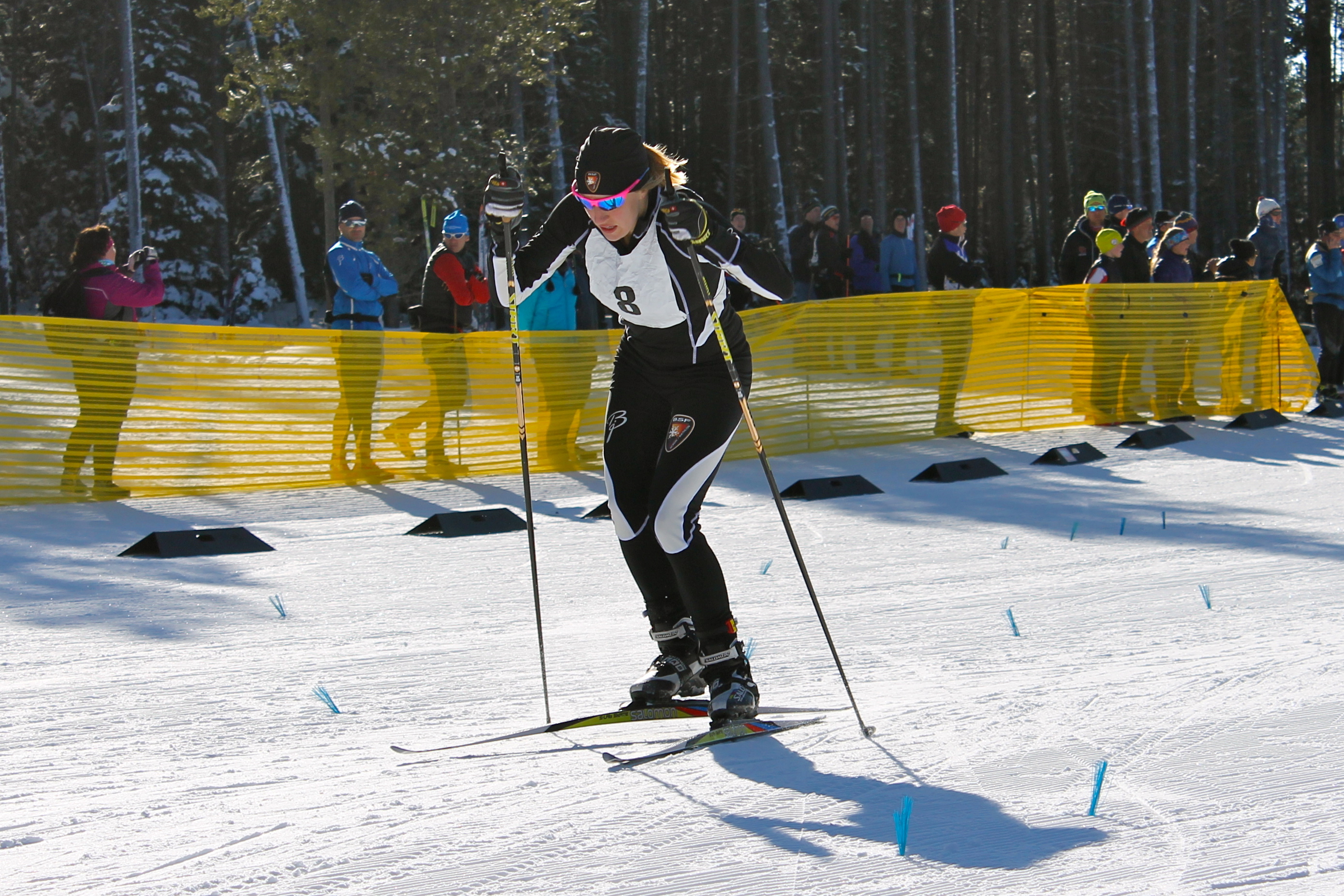
    Another SuperTour season opened in West Yellowstone, Montana, one weekend later than usual this year but with a lot of the old standbys, including a twisty, technical freestyle sprint course and puzzling conditions for the classic distance race.

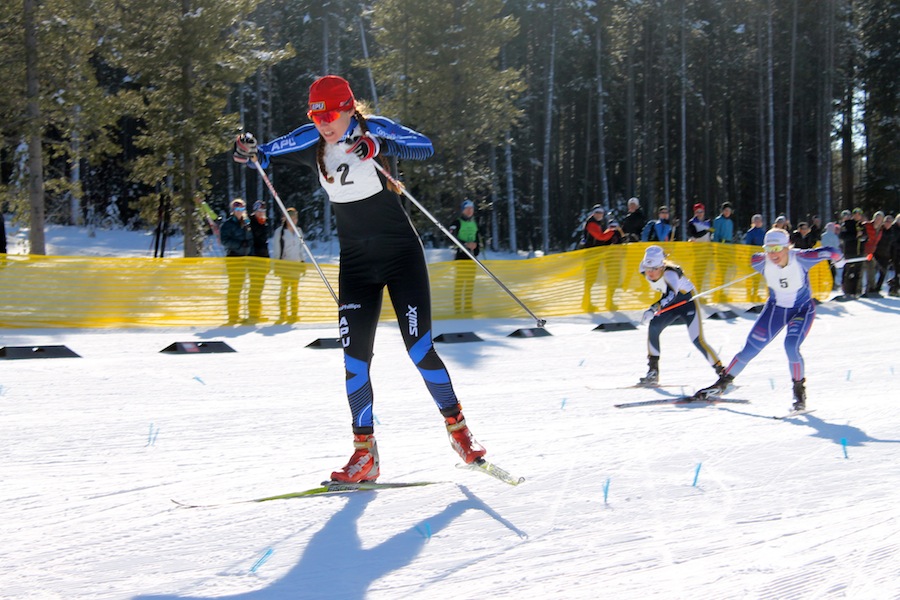
    In a crash-marred women’s final on Saturday, Dec. 2, Anne Hart of the Stratton Mountain School (SMS) Elite Team avoided a tangle between Caitlin Gregg (Team Gregg) and Caitlin Patterson, of the Craftsbury Green Racing Project (CGRP), and skied to the win. According to Hart’s teammate, Erika Flowers, who also raced in the final, the two Caitlins collided in the final winding section before the last big uphill.
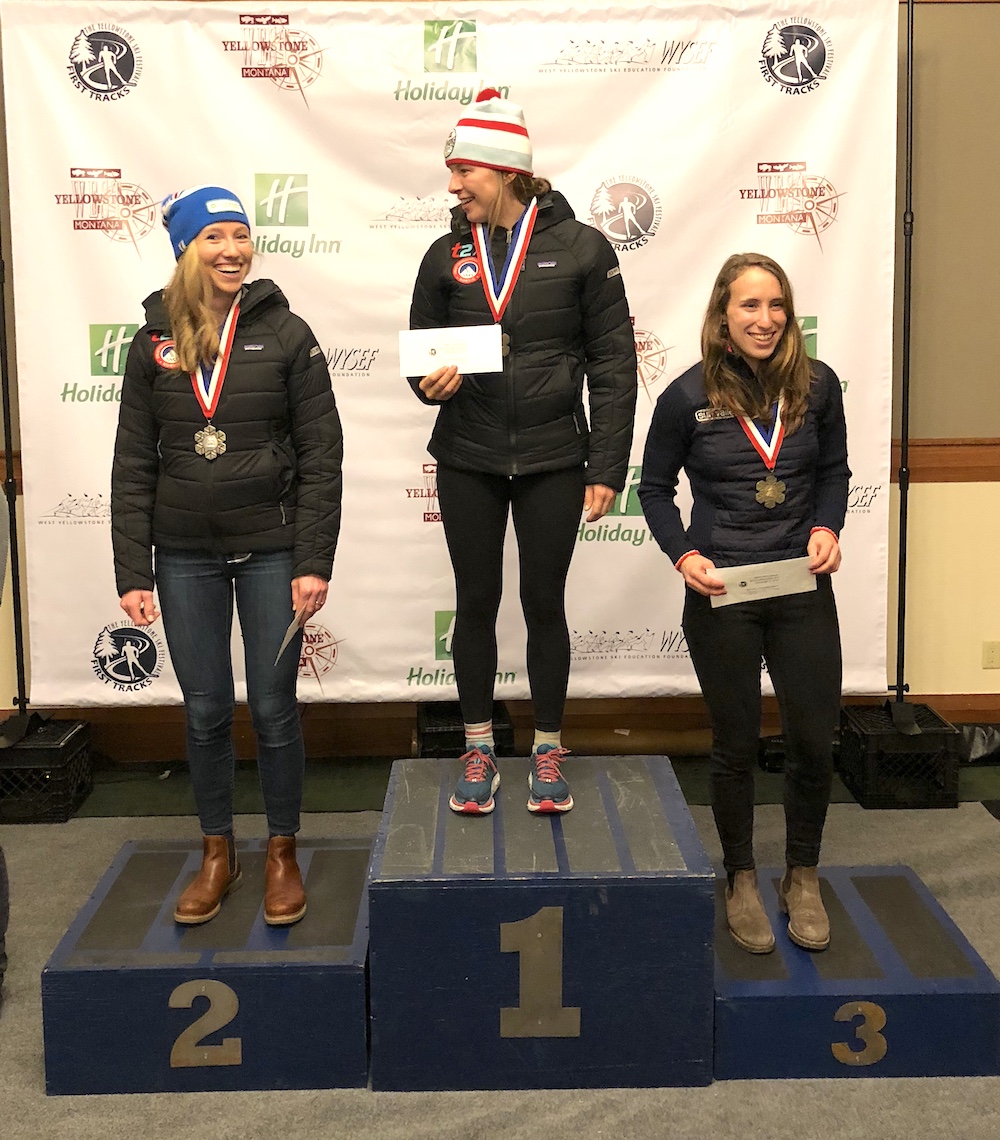
    The women’s skate sprint podium at the first race of the 2017/2018 SuperTour season on Dec. 2, with the SMS Elite Team’s Anne Hart (c) in first and Erika Flowers (l) in second, and Sun Valley’s Kelsey Phinney in third. (Photo: FBD)

    “They went down and some people were just ahead of them and were able to ski around,” Flowers said.

    Hart was one of them.

    “In my journal last night I actually had part of the course labeled ‘mushroom boost,’ which is right over the top of that last hill,” Hart said with a laugh in a post-race interview.

    One of her goals for the day had been to save her “best burst for the end,” she continued. “So I was able to do my planned mushroom boost at the end, came across with the win and I couldn’t be more thrilled.”

    She won the women’s 1.5-kilometer freestyle sprint final in 2:52.49 minutes, just 0.88 seconds ahead of Flowers in second and 0.92 seconds ahead of Kelsey Phinney, of the Sun Valley Ski Education Foundation (SVSEF), in third.

    Alaska Pacific University (APU) and U.S. Ski Team Development (“D”) Team member Hannah Halvorsen followed in fourth (+2.16), while Gregg finished fifth (+6.99) and Patterson was sixth (+7.22).

    “I was fortunate not to go down,” Flowers said, “but I was stuck behind [the crash] so by the time I got kind of untangled from Caitlin Patterson, I was maybe 20 meters back from the group. I was feeling good and I really wanted to win today so I just hammered and was happy to sneak into second place at the end there.”
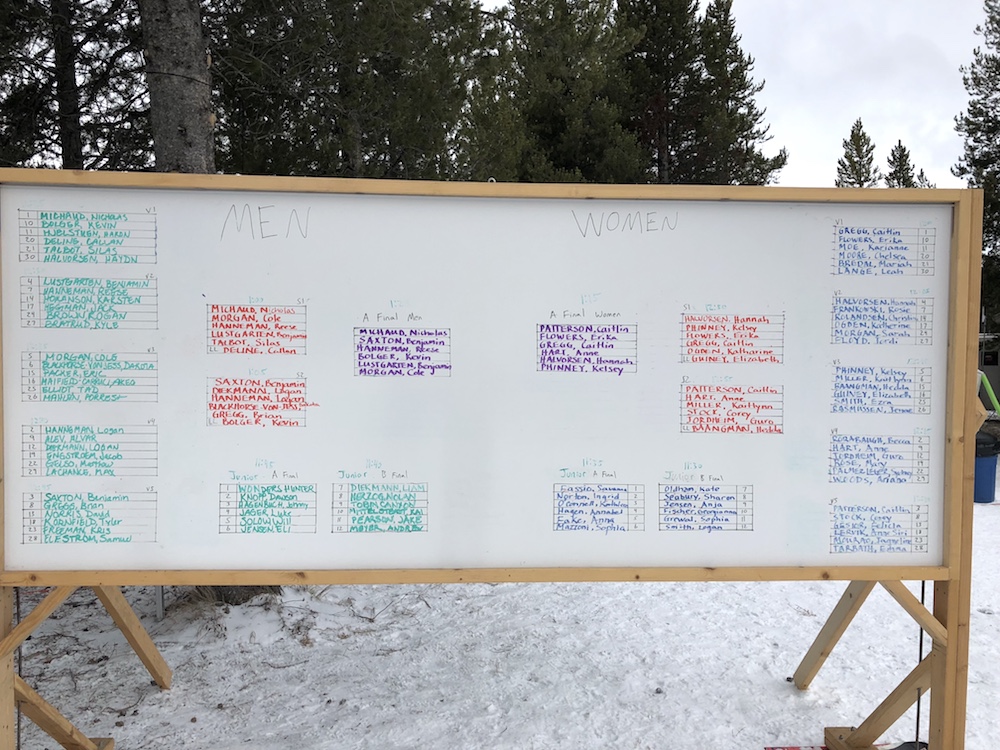
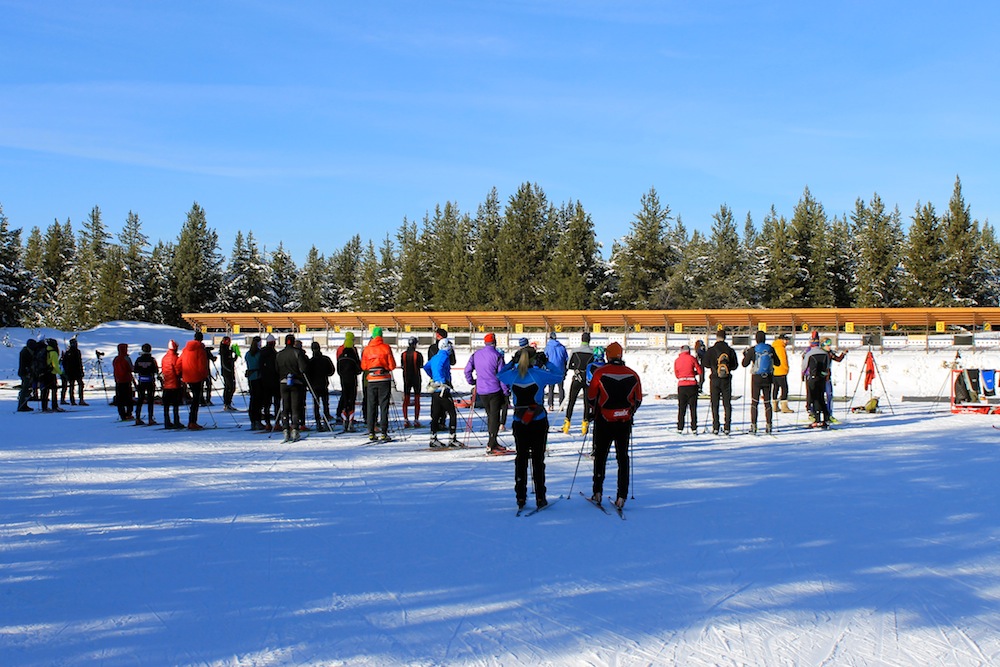
    A look at the SuperTour sprint lineups for the heats on Dec. 2 in West Yellowstone, Montana. (Photo: FBD)

    The sprint day began with Gregg winning the women’s qualifier in 2:50.79. Becca Rorabaugh (APU) qualified second (+2.7) and Patterson was the third-fastest qualifier (+3.0), ahead of Halvorsen in fourth (+5.64) and Phinney in fifth (+6.12). Hart qualified ninth (+8.98), just ahead of Flowers in 10th (+9.03) out of 58 in the women’s race.

    “It’s a weird, fast and very tactical sprint course at high elevation,” Hart said of the Rendezvous Ski Trails’ race course some 6,800 feet above sea level. “So my qualifier wasn’t maybe exactly what I’d hoped but it wasn’t terrible, it wasn’t way off the mark, and I just tried to go through each round skiing in the front and in control. That didn’t happen in the final, but it turned out my being in the back and being sort of tactically aware allowed me to pass a crash.”

    Hart won her quarterfinal and finished second to Patterson in their semifinal. Flowers won the other semifinal to advance to the final, and also won her quarterfinal. Phinney, who ultimately placed third, made it to the final as a lucky loser after finishing fourth in her semifinal, 1.88 seconds behind Flowers in first. Phinney had previously won her quarterfinal.

    “You never really know what to expect for the first sprint of the season,” Phinney said. “I had a pretty good qualifier and then I led my quarterfinal and [that] ended up being the faster quarterfinal so I was feeling pretty good.”

    Phinney’s winning quarterfinal time was more than 3.5 seconds faster than the winning times of the four other quarterfinals.

    “The final was a little bit of mayhem,” Phinney added. “It was kind of just staying on your feet, being able to jump over people’s poles and hope for the best.”

    While most of the top women planned to continue racing at the next SuperTour at the NorAm season-opener this weekend, Dec. 9-10, in Sovereign Lake (a.k.a. Silver Star), British Columbia, most are focused on U.S. Cross Country Championships from Jan. 3-8 in Anchorage, Alaska. And beyond that, some are hoping to get selected to the U.S. team for the 2018 Winter Olympics in PyeongChang, South Korea.

    “I’d really like to win that skate race at U.S. nationals,” Flowers said. “That’s definitely been a goal of mine for the last few years and I haven’t made it happen yet, but I’ll definitely try this year.”

    Michaud’s First Win

    In the men’s 1.5 k skate sprint the same day, Nick Michaud of the Bridger Ski Foundation (BSF) won the qualifier and every heat thereafter to capture his first-career SuperTour win (and podium) with a winning final time of 2:30.69. He previously won the qualifying round in 2:29.5, just 0.08 seconds ahead of Logan Hanneman (APU) in second.

    Ben Saxton (SMS Elite Team) qualified third (+0.63), Ben Lustgarten (CGRP) followed in fourth (+0.98) and Cole Morgan (SVSEF) was fifth (+1.3).

    Michaud, a 25-year-old who has been jumping into SuperTours since 2010, then won his quarterfinal by 0.13 seconds over his BSF teammate Silas Talbot and his semifinal by just 0.05 seconds over Reese Hanneman (APU).
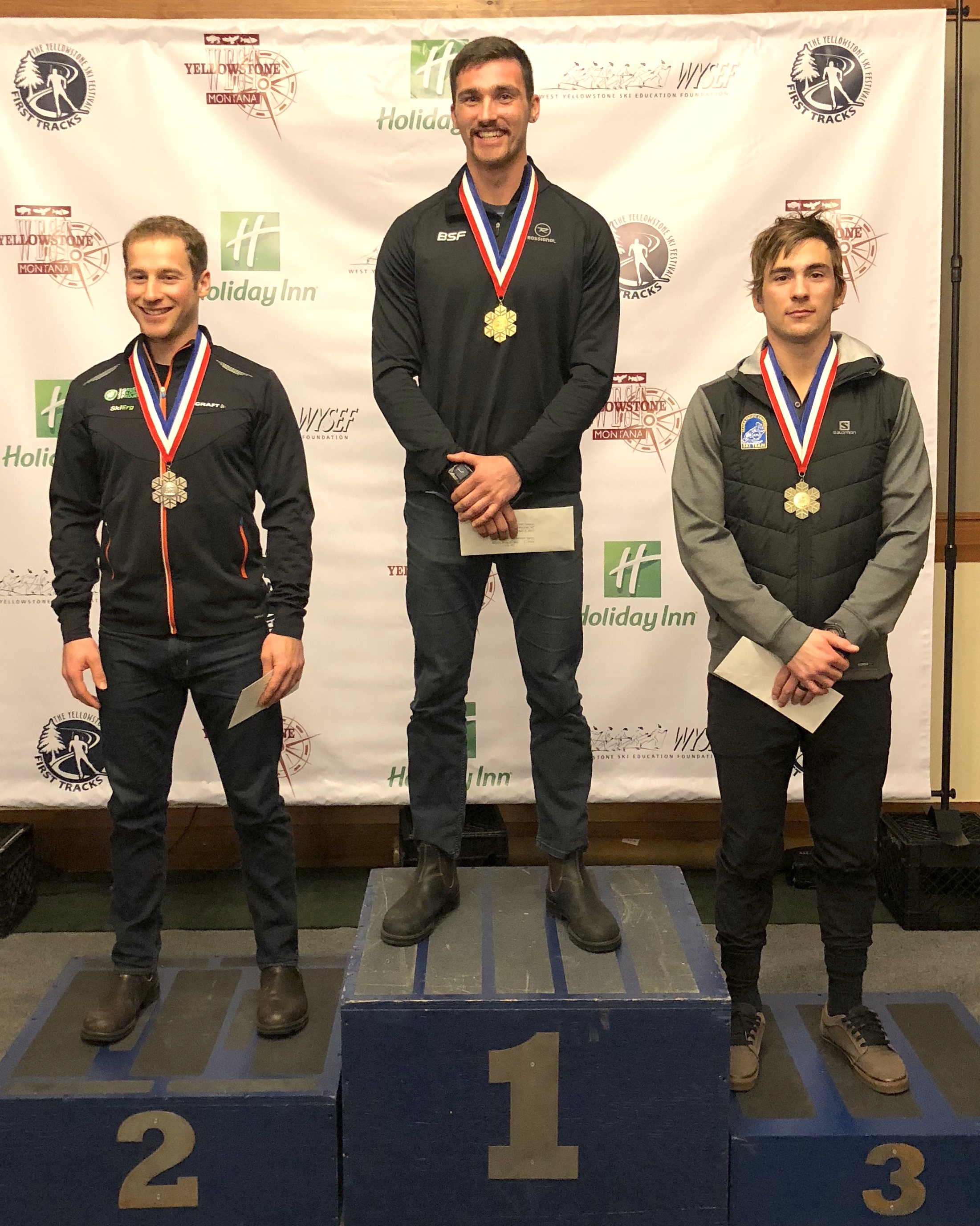
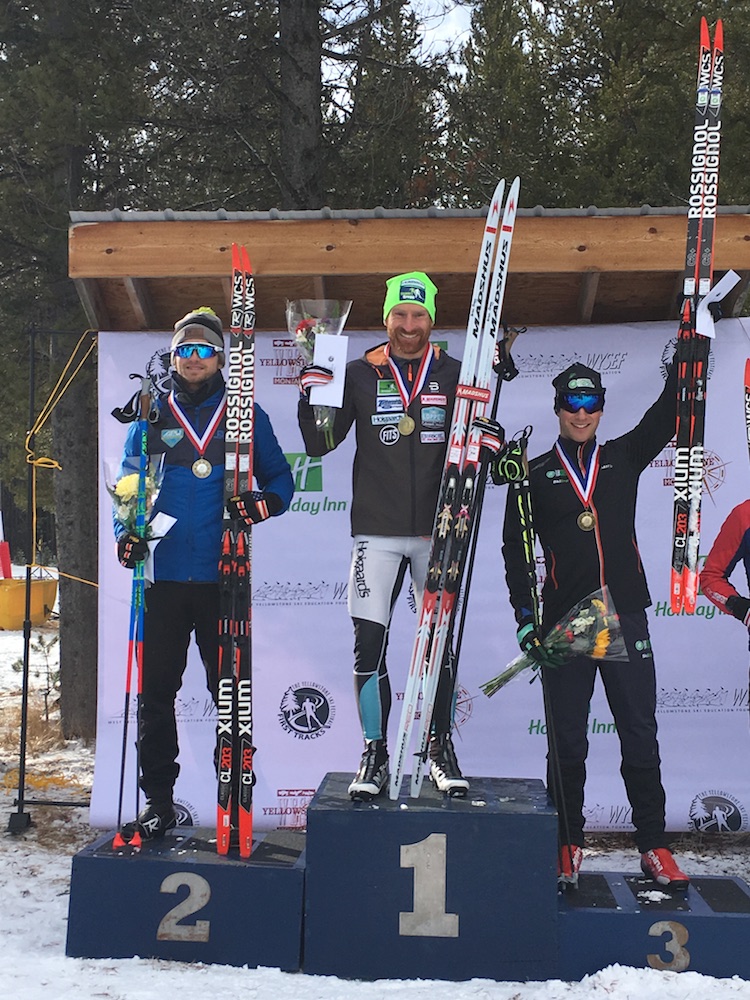
    The men’s skate sprint podium at the first race of the 2017/2018 SuperTour season, with Nick Michaud (c) in first and Ben Lustgarten (l) in second, and Reese Hanneman in third. (Photo: FBD)

    In the final, Michaud skated to a 0.17-second win over Lustgarten in second, while Reese Hanneman crossed the line in third (+0.84).

    “It was just so fun,” Michaud said after. “Conditions were great. Everyone was out here. Great skis, great support; it was just so fun to race.”

    Like many of his competitors, Michaud was looking for another standout result in the classic sprint at Sovereign Lake and had his sights set on U.S. nationals beyond that.

    Hanneman had similar goals.

    “The qualifying criteria for the sprint for the Olympics this year is just on the qualifier and obviously it’s a classic sprint at the Olympics so I think the classic sprints are going to be more important,” Hanneman said. “We have two classic sprints coming up between Silver Star next weekend and nationals in Anchorage [where both a skate sprint and classic sprint will be held] so I’m focusing on throwing down some good classic sprints.”

    After qualifying in seventh then winning his quarterfinal and placing second to Michaud in his semifinal, Hanneman described the heats as “crazy fast.”

    “This is probably the fastest I’ve ever seen it in West so that just means really high speeds and people weren’t really separating much, so you had to be really strong to make moves to pass people at those speeds,” Hanneman reflected. “In the final, everybody was just going for it, and I was able to find a hole and double pole by people going into that final hill there and kind of throw it down there. I burned up some of my matches trying to make that big move to go from the back of the pack into second so I faded a little bit in the final 100 meters, but other than that I was happy with it.”

    Lustgarten, who advanced to the final after placing second in his quarterfinal and third in his semifinal (behind Michaud and Hanneman) described the rounds as “a bit sketchy with the corners. There’s a lot of turns out there; people trying to take insides, going out, going in,” he said.

    “So that was pretty fun and also pretty sketchy and I just had to have really strong finishes because I kept getting boxed out in the back,” Lustgarten added. “But I managed to make my way through the pack on the hills.”

    Also in the final, Kevin Bolger (SVSEF) finished fourth (+2.11), Saxton placed fifth (+2.86), and Morgan took sixth (+3.42).

    Brian Gregg, Bångman Strike Late for Distance Win

    On Day 2 of the SuperTour-opening weekend, racers faced freshly falling snow for the distance races: the women’s 10 k and men’s 15 k classic mass starts.

    While a large group of men stuck together on the first of three laps, by Lap 2, the race leaders, including Brian Gregg, had started to break away. By the third and final time up Telemark Hill, the distance course’s signature climb, David Norris (APU) recalled that they were down to about eight.

    “It was super snowy starting out,” Norris said. “… The pack actually ran really smooth. Every lap on Telemark, I think the pack got smaller. … [The last time up it] I led into Telemark, the big climb, and got to the top of there just with Lustgarten and Brian Gregg, and it was kind of a single-file drag race to the finish. On the last pitch, Brian got up next to me and just kind of pulled away a little bit into the finish.”
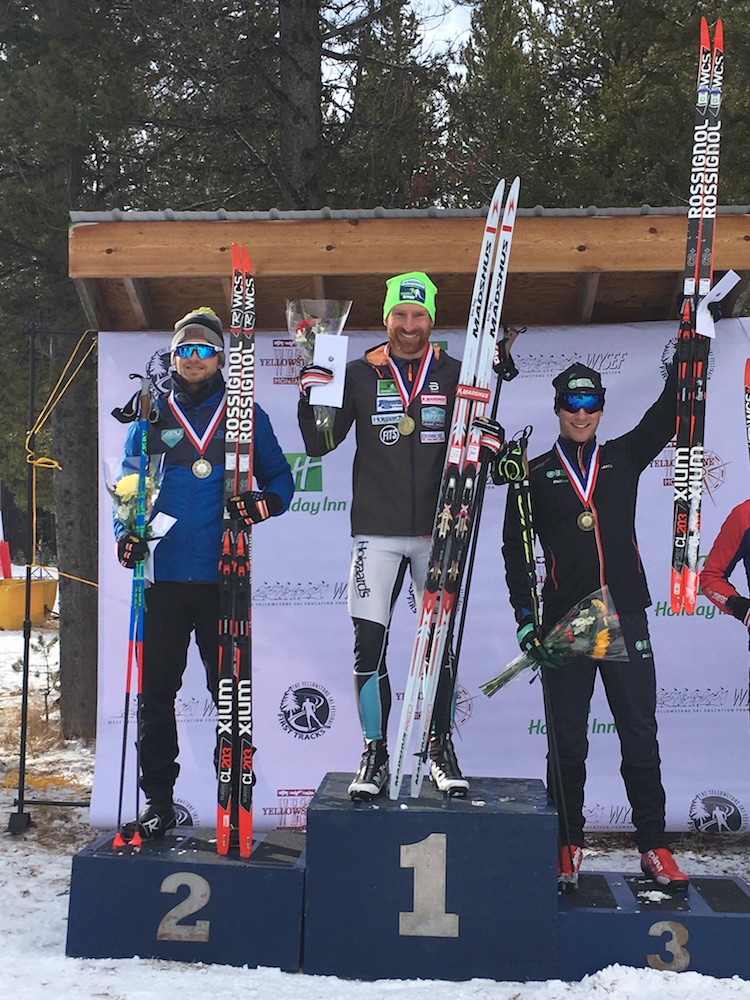
    The men’s 15 k classic mass start SuperTour podium on Dec. 3 in West Yellowstone, Montana,with Brian Gregg (c) of Team Gregg in first, David Norris (l) of APU in second, and Ben Lustgarten (CGRP) in third. (Photo: FBD)

    Gregg, of Team Gregg and Loppet Nordic Racing (LNR), captured the first SuperTour distance win of the season in 41:30.3, just 1.9 seconds ahead of Norris in second. Lustgarten notched his second-straight podium in third place (+4.6), while Kyle Bratrud (CXC Team) finished fourth (+10.9) and Kris Freeman (Caldwell Sport) was fifth (+12.6).

    Tad Elliott (Ski & Snowboard Club Vail) followed in sixth, Eric Packer (APU) was seventh, Ian Torchia, of Northern Michigan University (NMU) and the USST D-Team, was eighth, Hunter Wonders (APU) ninth, and Martin Bergström (University of Utah Ski) 10th.

    Gregg explained that after some pre-race deliberation, he chose to ski on zeros to ensure he had enough kick and avoid icing on the bottom. He was happy with his decision and noted that the he had waxing help from a group composed of several Midwest teams, including LNR, NMU and Central Cross Country (CXC).

    “Our [lead] group of skiers out there all had really good skis so that was really fun,” Gregg said. “It was kind of a tactical race in the sense that it was really hard, like, [you’d] maybe get a little gap on the climbs, but then everybody would bunch back together, so I just tried to conserve energy and really focus on the last kilometer or two kilometers.”

    When Norris attacked on Telemark Hill, Gregg said he followed Norris and Lustgarten over the top.

    “… I was last, then we came in and I just had a little bit more in the end,” he said. “I was really happy with that. I haven’t won a classic SuperTour race since my first SuperTour win in 2010 so there was a few years in between there, but I’ll take it.”

    Gregg, 33, is a 2014 Olympian, who, like his wife (2010 Olympian) Caitlin Gregg, is looking to qualify for a second Olympics this season in PyeongChang. He was pleased with his tactics on Day 2 in West Yellowstone after finding himself too far behind on the sprint’s last climb to contend (he made it to the semifinals and finished ninth overall in the sprint).

    As for Sunday’s distance race, in which Gregg conserved his energy and struck at the right moment, Gregg said he learned from others, too.

    “It’s fun to see other skiers — Tad Elliott is a really good tactician out there so I actually skied a lot with him watching where he’d spend the energy to move up in the pack and where he was just sort of relaxing,” Gregg said.

    “It was definitely faster to be in the draft behind people so the leaders were kind of at a disadvantage,” Lustgarten observed after. “I was kind of mixing it up in the top 20 for the first two laps, and it felt pretty chill, but this is the kind of course where it can go from easy to hard in, like, 50 meters.”

    He explained that Rogan Brown (SVSEF) led for most of the second lap. Brown ultimately tied Adam Martin (CGRP) for 11th place (+28.6).

    “On the third lap I took the lead to do some work myself and then kind of was stuck in the lead unfortunately for most of the lap,” Lustgarten said. “It went from going to pretty easy to really hard in about a k.”

    While he responded to Norris’s attack on Telemark Hill, he couldn’t match Gregg in the meters that followed.

    “Brian Gregg came out of nowhere and I thought I could kind of sneak into second but I just didn’t have it today,” Lustgarten said. “That’s what I want to do with the race. He did it right. I think the best way to do it was to sit in the pack, kind of play the field, see how everyone goes, and just hammer the finish. He did really well today.”

    In the women’s 10 k classic mass start, Hedda Bångman, new to the University of Colorado Boulder (CU) Ski Team this year, double poled to the win in 30:24.8 over two Craftsbury’s Kaitlynn Miller and Caitlin Patterson, respectively.

    “It was really hard conditions today, and I decided just one minute before the start to switch skis,” said Bångman, a 22-year-old Swedish student. “I took my zero skis and I think it was a good decision. I knew before I started I was forced to do double poling because my grip wasn’t the best on the skis so it was hard but … it felt good, except the technique zones [where double poling is not allowed], of course.”
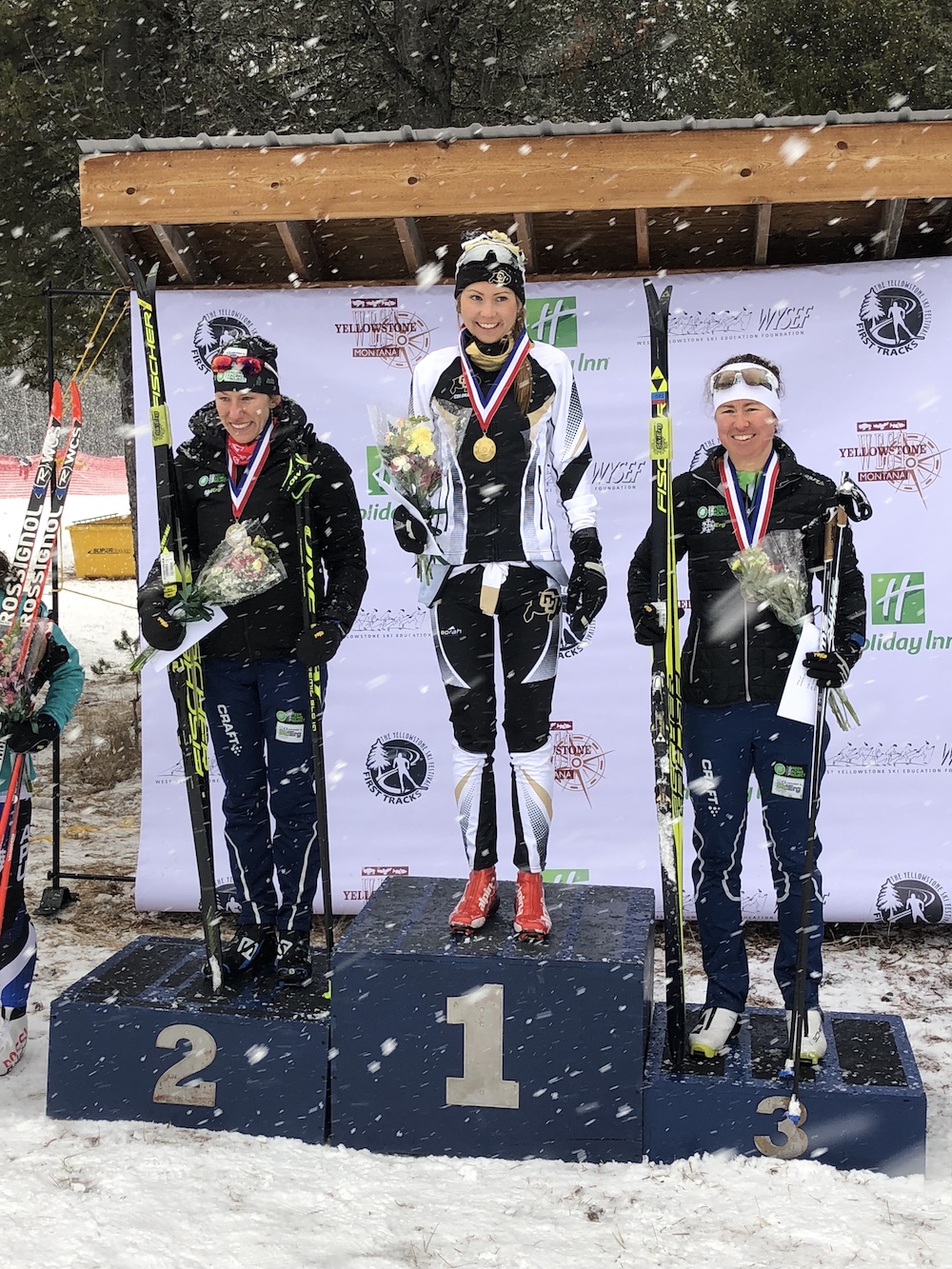
    The West Yellowstone SuperTour women’s 10 k classic mass start podium, with Hedda Bångman (c) of the University of Colorado Boulder in first, and Craftsbury’s Kaitlynn Miller (l) and Caitlin Patterson (r) in second and third, respectively. (Photo: FBD)

    Bångman is new to the U.S. in her freshman season with CU.

    “My shape is good. Everything was good today. It was fun to race and fun to be here to race,” she said. “It’s a little bit different compared to Scandinavia, but I like it. … It feels like it’s more relaxed here, but maybe it’s just my feeling.”

    Miller raced to second place, 1.3 seconds back, ahead of her CGRP teammate Patterson in third (+3.4).

    “It was a nice big group of us for a while there and the conditions were kind of lose and powdery, which I enjoy, so I was having fun with that,” Miller said, noting the APU’s Rosie Frankowski carried a lot of the load of setting the pace up front. “There was a nice group of us for a while that slowly just kept kind of stringing out until there were maybe four or five of us left, and then it was sort of just a sprint to the end there. Hedda kind of came in from third or fourth and just had a really good push to the finish…”

    Frankowski finished 10 seconds after Patterson for fourth place (+13.5), Katharine Ogden (SMS/USST D-team) was fifth (+17.2), Caitlin Gregg sixth, Felicia Gesior (CXC Team) seventh, Anne Siri Lervik (CU) eighth, Flowers ninth, and Corey Stock (BSF) 10th.

    “I want to commend Rosie Frankowski for really pushing the pace middle of the race,” Patterson said. “I think a lot of us out there had fairly slick skis so we were double poling a lot, but they had two technique zones per lap so that was interesting. We had to run those — a little striding, running, herringbone, whatever works to get the diagonal stride. … By the finish we were down to about three of us, and [Bångman] was first and my teammate Kaitlynn Miller had strong double pole into second and I was right behind them in third, so pretty solid day.”

    The SuperTour circuit now moves to Canada to join up with the Sovereign Lake NorAm, with a classic sprint on Saturday, Dec. 9, and 10/15 freestyle individual starts on Sunday, Dec. 10.

    Complete results:

    Day 1 freestyle sprints (scroll to bottom) 

    Day 2 classic mass starts

  • Saturday Rundown: Lillehammer; Östersund; West Yellowstone (Updated)

    Saturday Rundown: Lillehammer; Östersund; West Yellowstone (Updated)

    The men’s skate sprint podium at the first race of the 2017/2018 SuperTour season, with Nick Michaud (c) in first, Ben Lustgarten (l) in second, and Reese Hanneman in third. (Photo: FBD)

    US SuperTour (West Yellowstone, Montana): Freestyle sprints

    The women’s skate sprint podium at the first race of the 2017/2018 SuperTour season, with the SMS Elite Team’s Anne Hart (c) in first and Erika Flowers (l) in second, and Sun Valley’s Kelsey Phinney in third. (Photo: FBD)

    Anne Hart and Nick Michaud were the big winners on opening day of the US SuperTour season at the Rendezvous Ski Trails on Saturday, taking individual victories in the women’s and men’s freestyle sprint finals, respectively.

    Hart led into the finishing straight to take the win in 2:52.49 minutes, 0.88 seconds ahead of Erika Flowers, her teammate on the Stratton Mountain School (SMS) Elite Team, who placed second, and Kelsey Phinney, of the Sun Valley Ski Education Foundation (SVSEF))in third (+0.92).

    Hannah Halvorsen, of Alaska Pacific University (APU) and the U.S. Ski Team D-team, finished fourth (+2.16), Caitlin Gregg (Team Gregg) was fifth (+6.99), and Caitlin Patterson, of the Craftsbury Green Racing Project (CGRP), sixth (+7.22).

    The win was Hart’s second on the circuit after winning a SuperTour 5 k skate two seasons ago. Last year in West Yellowstone, she placed third in the skate sprint (behind Jennie Bender, of the Bridger Ski Foundation, and Flowers, respectively).

    Michaud, of the Bridger Ski Foundation (BSF), won the men’s final in 2:30.69 for his first SuperTour podium, just 0.17 seconds ahead of Ben Lustgarten (CGRP) in second and Reese Hanneman (APU) in third (+0.84). Rounding out the final, Kevin Bolger (SVSEF) finished fourth (+2.11), Ben Saxton (SMS Elite Team) fifth (+2.86), and Cole Morgan (SVSEF) sixth (+3.42).

    On Sunday, the SuperTour continues with 10/15 k classic mass starts.

    Video interviews with the winners: Hart & Michaud

    Complete results (scroll to bottom for men’s and women’s final results)

    ***

    FIS Cross Country World Cup (Lillehammer, Norway): Classic sprints

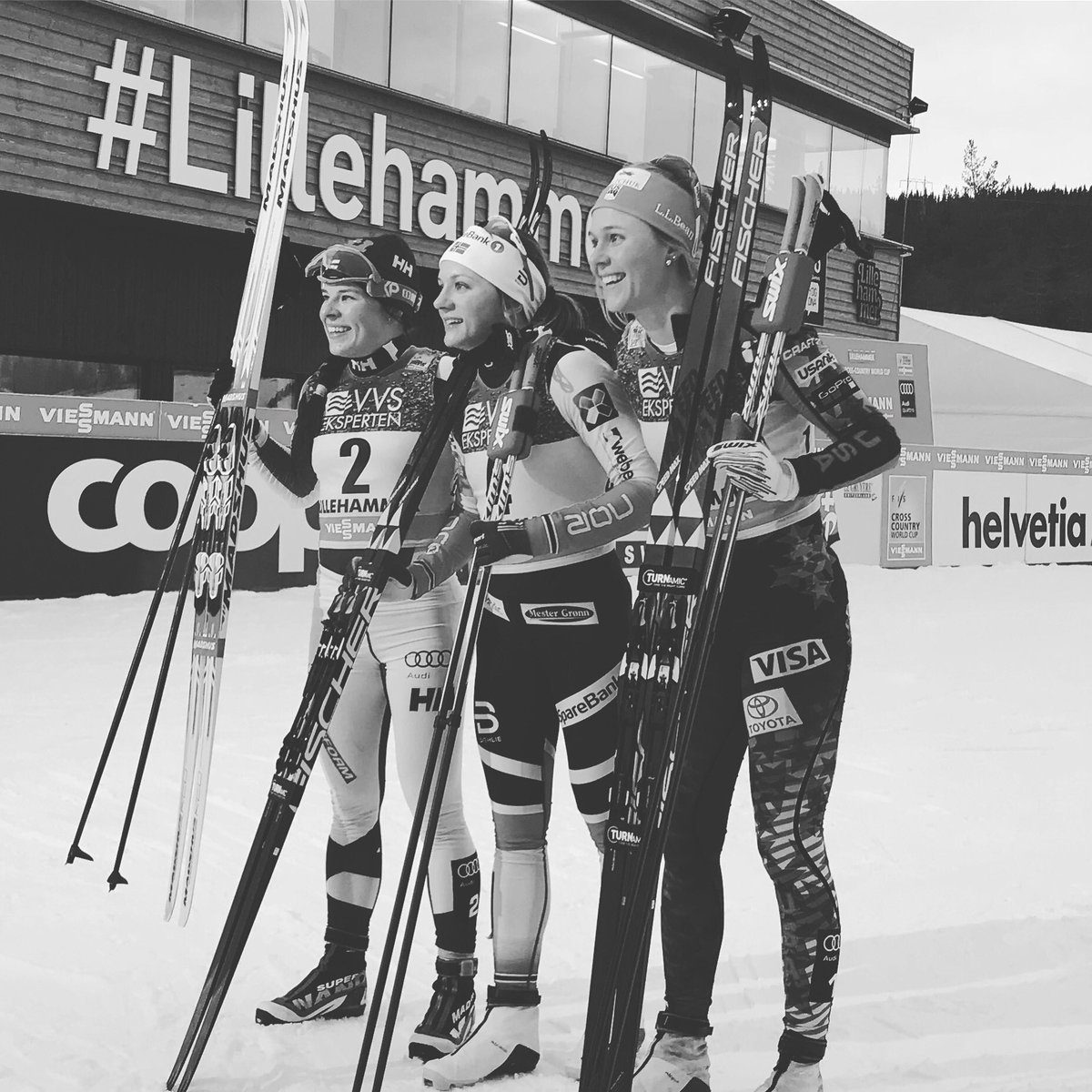
    From right to left: American Sadie Bjornsen, Norway’s Maiken Caspersen Falla and Finland’s Krista Parmakoski after placing third, first and second, respectively, in the women’ 1.3 k classic sprint at Friday’s World Cup in Lillehammer, Norway. (Photo: FIS Cross Country/Twitter)

    Women’s report

    Men’s report

    American Sadie Bjornsen returned to the World Cup podium for the second time in as many classic sprints this season on Saturday, placing third in the women’s 1.3-kilometer classic sprint behind Norway’s Maiken Caspersen Falla in first and Finland’s Krista Parmakoski in second.

    Bjornsen started the day by winning the qualifying round by one-hundredth of a second over Parmakoski and Russia’s Natalia Nepryaeva, which were listed as qualifying in second and third, respectively (despite having the same time).

    The U.S. Ski Team (USST) member who placed second in last week’s classic sprint in Kuusamo, Finland, Bjornsen won the qualifier in 3:22.45 minutes. She went on to advance in second out of her quarterfinal and then won her semifinal by 0.46 seconds over Sweden’s Stina Nilsson — who beat her in last week’s sprint.

    While Falla won Saturday’s final in 3:19.98 (after qualifying in fourth, then winning her quarterfinal and semifinal as well), Parmakoski followed in second overall (+2.07) and Bjornsen achieved her second podium of the season in third (+5.01). Norway’s Ingvild Flugstad Østberg was just behind in fourth (+5.28), Nilsson finished fifth (+6.09), and the second American in the final, Jessie Diggins was sixth (+7.81).

    Diggins previously qualified in seventh, finished second in her quarterfinal then advanced as a lucky loser in fourth place out of her semifinal (which Falla won).

    Three American women raced in the heats, with Sophie Caldwell qualifying in ninth and ultimately placing ninth overall. She advanced in second out of her quarterfinal then finished fifth in the semifinal behind Diggins.

    Also for the USST, Rosie Brennan finished 33rd in the qualifier, missing out on the top 30 needed to qualify by 0.26 seconds. Kikkan Randall finished 42nd, Ida Sargent was 44th, and Chelsea Holmes 64th.

    Canada started four women, with Emily Nishikawa placing 58th, Dahria Beatty 59th, Cendrine Browne 63rd, and Katherine Stewart-Jones 65th.

    Klæbo Still Undefeated, Ustiugov 2nd

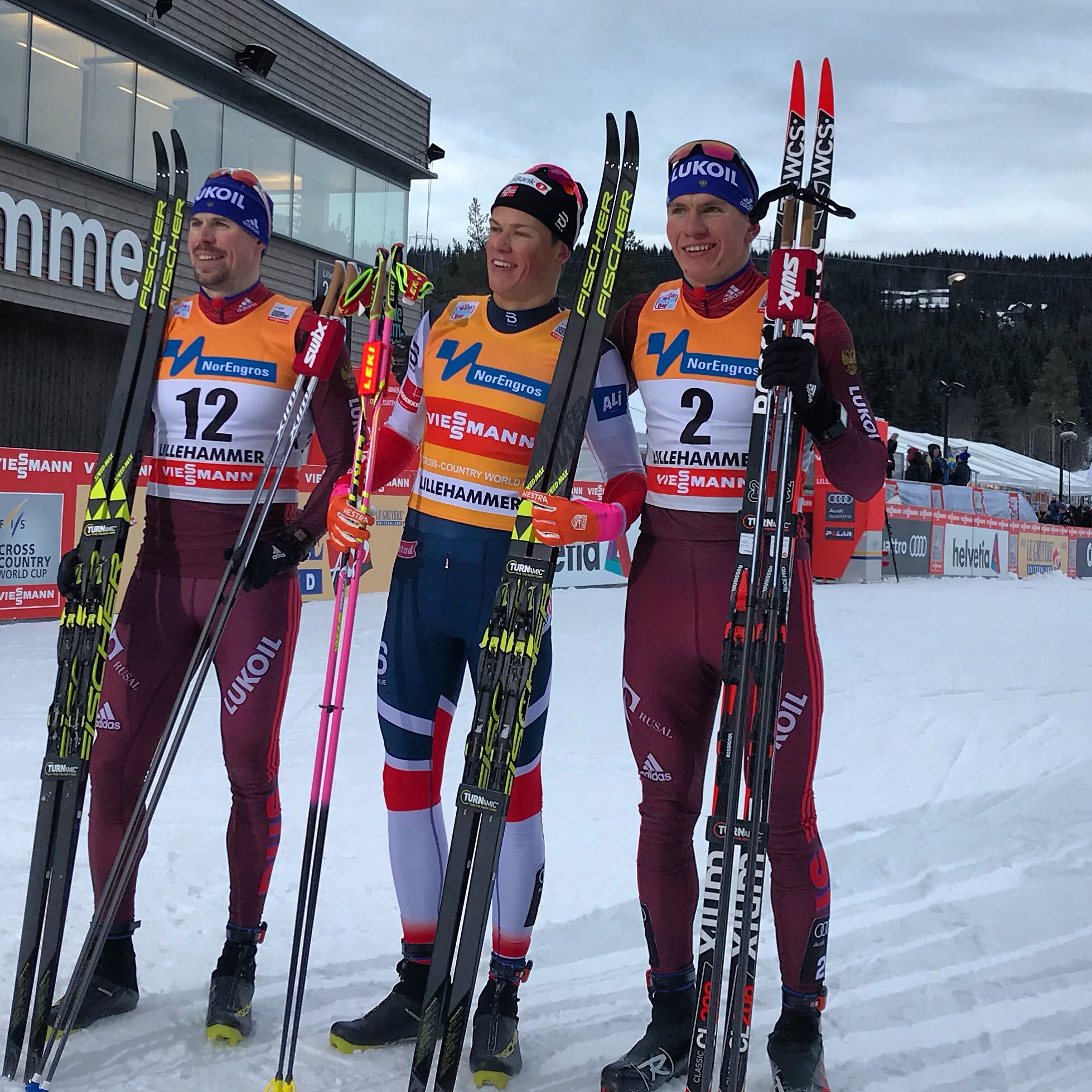
    The men’s 1.5 k classic sprint podium with Norway’s Johannes Høsflot Klæbo (c) in first, Russia’s Sergey Ustiugov (l) in second and Russia’s Alexander Bolshunov (r) in third. (Photo: FIS Cross Country/Twitter)

    In the men’s 1.5 k classic sprint, Norway’s Johannes Høsflot Klæbo continued his undefeated World Cup streak with his fourth win in as many races this season.

    He started off by winning the qualifier in 3:40.79, then his quarterfinal by 0.17 seconds over Russia’s Sergey Ustiugov. Klæbo and Ustiugov met again in the semifinals, where Ustiugov beat the Norwegian by 0.25 seconds, but in the final, where it really mattered, Klæbo again had the edge, winning in 3:33.88. Ustiugov finished 0.83 seconds back for second place, and Russia had two on the podium with Alexander Bolshunov in third (+1.29). Sweden’s Calle Halfvarsson finished fourth (+1.64), and Norway had two more in the final with Emil Iversen in fifth (+8.2) and Sondre Turvoll Fossli in sixth (+17.3).

    Canada’s Alex Harvey was the lone North American to qualify for the men’s heats after racing to 22nd in the qualifier, 11.89 seconds out of first. Harvey’s day ended in the quarterfinals, where he finished sixth, 3.06 seconds behind Norway’s Pål Trøan Aune in first. Norway’s Even Northug took second in that heat (+0.26), Finland’s Ristomatti Hakola was third (+0.36), Norway’s Håvard Solås Taugbøl fourth (+0.67) and France’s Maurice Manificat fifth (+1.72) in that heat. Overall, Harvey placed 28th on the day.

    Erik Bjornsen was the top American man in 35th and missed qualifying by 1.06 seconds. Andy Newell finished 38th and Scott Patterson was 74th for the U.S. Ski Team.

    Jess Cockney was the second Canadian man in 57th, Len Valjas followed in 59th, Julien Locke was 61st, Russell Kennedy 63rd, and Knute Johnsgaard 67th.

    Results:

    Women’s final | Women’s qualifier

    Men’s final | Men’s qualifier

    ***

    IBU World Cup (Östersund, Sweden): Men’s 10 k sprint

    Norway’s 29-year-old Tarjei Bø wins his first World Cup race in four years and three Canadians land in the top 26, led by Scott Gow with a career-best 16th that puts him one step closer to securing his place on Biathlon Canada’s Olympic team. Of the nine men that cleaned the two-stage race, four of them were North Americans (Gow, American Lowell Bailey in 22nd, and Canada’s Nathan Smith in 24th and Christian Gow in 26th).

    Race report

  • A Crowd Favorite, Gregg Cruises to Women’s SuperTour Sprint Victory in West Yellowstone

    A Crowd Favorite, Gregg Cruises to Women’s SuperTour Sprint Victory in West Yellowstone

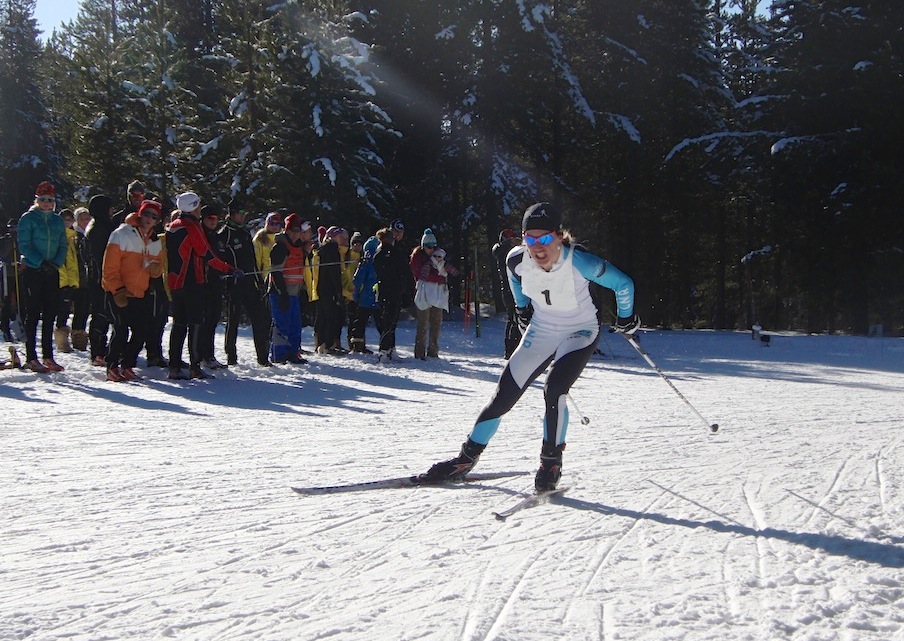
    Caitiln Gregg (Madshus/Team Gregg) rounding the final corner into the stadium at the Rendezvous Ski Trails to win Friday's 1.3 k skate sprint, the first SuperTour race of the 2013/2014 season, in West Yellowstone, Mont.
    Caitiln Gregg (Madshus/Team Gregg) rounding the final corner into the stadium at the Rendezvous Ski Trails to win Friday’s 1.3 k skate sprint, the first SuperTour race of the 2013/2014 season, in West Yellowstone, Mont.

    WEST YELLOWSTONE, Mont. – The highlight of Caitlin Gregg’s day was seeing all her Midwest fans, her Loppet Nordic Racing buddies, at the finish of each heat on Friday during the first SuperTour race of the season.

    That gave her reason to celebrate and smile every time she won, which the 33-year-old Gregg did all morning and early afternoon at the Rendezvous Ski Trails. After posting the fastest women’s qualifying time of 2:55.52 in the 1.3-kilometer freestyle sprint, Gregg went on to ski away from her competitors in each round thereafter.

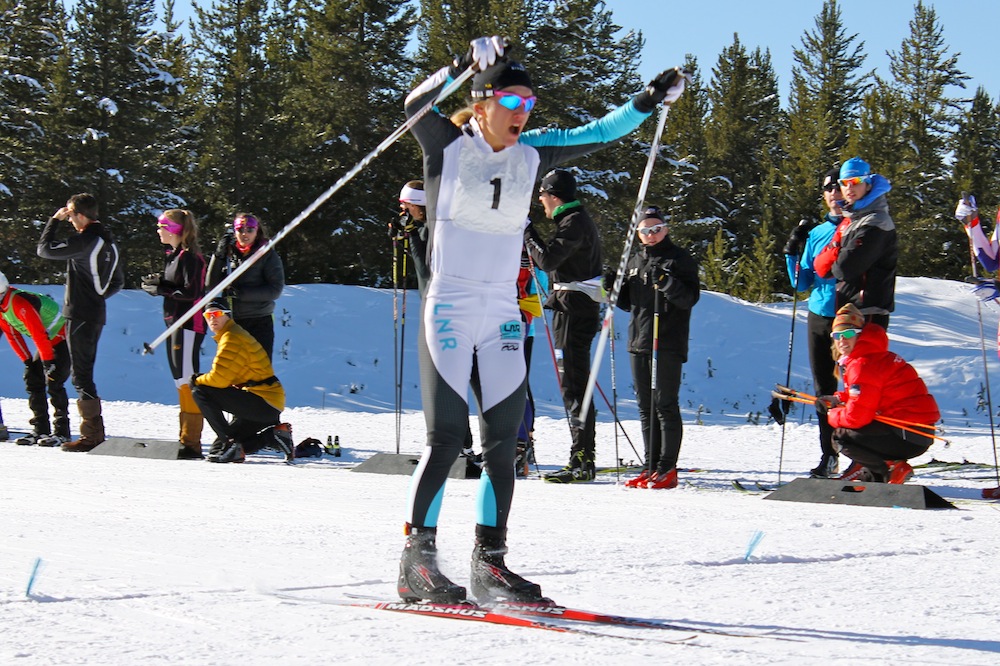
    Pushing all the way across the line for the fourth time of the day – seconds ahead of Jennie Bender (Bridger Ski Foundation), who placed second, and Becca Rorabaugh (Alaska Pacific University), who finished third in the final – Gregg threw her hands in the air. Couldn’t have gone any better, she thought.

    Caitlin Gregg (Madshus/Team Gregg) celebrates a big opening win at the West Yellowstone SuperTour 1.3 k skate sprint.
    Caitlin Gregg (Madshus/Team Gregg) celebrates a big opening win at the West Yellowstone SuperTour 1.3 k skate sprint.

    “This is probably one of the biggest races for me,” said Gregg, of Madshus Racing and more recently Team Gregg.

    “We’ve got my family, my husband’s family here, all of the other people on the circuit that we’ve worked with. Just to have that energy here right now actually means some of the most to me. I think I had six or seven Loppet Nordic Racing kids … at the finish line [of every heat]; that’s the best feeling ever. You just realize that’s what it’s about. It’s ski racing, and it’s just fun to share with everyone.”

    In her first official race of the 2013/2014 season, Gregg won the qualifier by 2.18 seconds over Becca Rorabaugh. She went on to dominate her quarterfinal, beating runner-up Sylvia Nordskar (University of Denver) by 3.5 seconds.

    Gregg then commanded her semifinal in 2:48.3, six-tenths of a second faster than runner-up Caitlin Patterson (Craftsbury Green Racing Project). Patterson went on to place fifth in the final, ahead of Andrea Lee (University of New Mexico) in sixth and behind Erika Flowers (Stratton Mountain School T2 Team) in fourth.

    For Gregg, it was a great start – one that puts her on the path to World Cup starts in January if she continues to rule the SuperTour series, which next stops in Bozeman, Mont., Dec. 7-8.

    “I’m very grateful that we’re starting out with skate races,” she said of her preferred discipline. Saturday’s SuperTour 10 and 15 k distance races in West Yellowstone are freestyle as well.

    “It’s always nice to feel that’s in your favor and you’re starting off on a good foot,” she added.

    With the University of New Mexico waxing for Gregg and her husband Brian this weekend, she quickly credited the team’s coaches and staff.

    “They just nailed the waxing so, for me, it became very easy,” she said. “[In the heats, I] kind of hung and tried to stay out of trouble, and then it was pretty obvious after that first little bit of the downhill my skis were just awesome so I just decided to go for it.”

    Rorabaugh, who won her quarterfinal and was second to Bender in a photo-finish semifinal, recalled when Gregg took off in the final: not too far in, right after the last downhill.

    After descending from the flat stretch out of the stadium, the five other women tried to keep up with Gregg on the low-lying backstretch, still nearly 7,000 feet above sea level. It was curvy and technical. “Lots of jostling for position,” Bender explained.

    “I knew that Caitlin was probably just gonna go for it and I still wasn’t ready to go with her, which was silly,” said Rorabaugh, who was jockeying for third when Gregg accelerated across the flat.

    Earlier, Rorabaugh tried to control her heats and ski conservatively, knowing she could make the final if she played her cards right.

    “The danger is sometimes you check out a little bit rather than being in full-on go mode the entire day,” she said. “I think it made it harder for me when Caitlin decided to take off.”

    Jennie Bender (BSF) racing to a quarterfinal win in Friday's West Yellowstone SuperTour 1.3 k skate sprint. She went on to place second in the final to Caitlin Gregg (Madshus/Team Gregg).
    Jennie Bender (BSF) racing to a quarterfinal win in Friday’s West Yellowstone SuperTour 1.3 k skate sprint. She went on to place second in the final to Caitlin Gregg (Madshus/Team Gregg).

    Meanwhile, Bender was trying to come back from an early slipup just outside the stadium, in which she dropped to sixth.

    “I got in a bad spot and everyone passed me and I was like, ‘Uh oh,’ ” Bender recalled. “But there were good places to tuck in behind people and then swing around them. … I tried to plan it so that coming up that last hill, I would be in a decent spot.”

    As Bender picked people off, Gregg held her gap up the final climb and skied out of reach by the time she entered the stadium. Bender followed, and Rorabaugh tried to challenge her for second, but Bender had the better line.

    Uncontested through the finishing stretch, Gregg had strung out the entire group, yet she pushed entirely through the finish.

    “Honestly, I’m a nervous wreck,” Gregg said of lining up against talented sprinters like Bender and Rorabaugh. “I think that’s the best thing to be because if you get too complacent you forget to go for it. I was telling the little kids that: never assume anything until the race is over. You’ve got to work every inch of the way.”

    After qualifying in eighth, Bender owned her quarterfinal with a 1.5-second win over Anika Miller (Montana State University), the third-fastest qualifier. Troubled by a back injury throughout the summer and even a few days ago, Bender was pleased to be pain free on Friday and able to give her all through the heats. She had made a point to do as much precautionary work as possible (stretching, ibuprofin and ice) while training in West Yellowstone.

    “I felt like it’s the one thing that’s been throwing off my balance, but it felt good today,” she said. “So I was happy about that.”

    In her first race with the Bozeman-based BSF, the former CXC skier said its been a good transition.

    “I do miss my Midwest crew for sure, but the Bozeman people have been amazing,” Bender said. “Both parties have been really supportive and understanding … I’m hoping for a healthy year because I feel like I have more to give.”

    Becca Rorabaugh of Alaska Pacific University (l) chases Jennie Bender of the Bridger Ski Foundation (not shown) down the final stretch of Friday's SuperTour 1.3 k skate sprint semifinal in West Yellowstone, Mont. A similar chase ensued in the final, where Bender took second after Caitlin Gregg, and Rorabaugh was third.
    Becca Rorabaugh of Alaska Pacific University (l) chases Jennie Bender of the Bridger Ski Foundation (not shown) down the final stretch of Friday’s SuperTour 1.3 k skate sprint semifinal in West Yellowstone, Mont. A similar chase ensued in the final, where Bender took second after Caitlin Gregg, and Rorabaugh was third.

    While Rorabaugh said she made some tactical errors and got a little tired in Friday’s final, she was excited about her first SuperTour podium in two years.

    “I know that this is a big year and in order to go anywhere from a domestic-racing standpoint, you have to make a pretty big impression,” Rorabaugh said.

    From a World Championships biathlete to a 2010 Olympian and SuperTour favorite, Gregg has seen her share of podiums. But this could have 2014 Olympic implications if she makes it to Europe and meets U.S. Olympic-qualifying criteria on the World Cup.

    But Gregg didn’t get ahead of herself. On Friday, she soaked up the support of her Midwest crew, including friends, family and fellow Loppet Nordic Racers. After recently launching Team Gregg with Loppet Nordic, the Greggs were already watching one dream unfold.

    “With our travel and our schedule and where we’re based out of [Minneapolis], we kind of see it as an opportunity,” she said of the decision to part ways with Methow Olympic Development, which she and Brian joined earlier this season, to form their own elite team.

    “It’s going to be a little bit of a challenge we’re piecing together some wax support and so forth, but people have been super willing to help out,” she said. “The opportunity to race in your true home club – we see these kids day in and day out. I can’t think of anything better to have some older elite athletes racing in the same suits.”

    The funny thing is, those juniors think she’s wearing their suit. “The kids came up to me and said, ‘Hey! You’re in our Fast Kids uniform!’ ” Gregg said. “We’ve always had [this] in the back of our head and never knew how it would work out and it all came together this year.”

    Results: Sprint brackets | Complete

  • Yellowstone SuperTour Sprint Start Lists Posted: Who Will Win?

    Yellowstone SuperTour Sprint Start Lists Posted: Who Will Win?

    Hundreds of skiers took to the Rendezvous Ski Trails on Tuesday in West Yellowstone, Mont.
    The biathlon stadium at the Rendezvous Ski Trails, where 72 women and 134 men (including juniors) will start and finish Friday’s SuperTour skate sprint in West Yellowstone, Mont.

    To jumpstart our U.S. SuperTour coverage in West Yellowstone, Mont, we’re leaving the predictions to you! The SuperTour opens Friday morning with men’s and women’s 1.3-kilometer sprint on a short-and-fast course at the Rendezvous Ski Trails.

    Who do you think will win? Vote on the women’s and men’s polls with some of top seeds below.

    As a refresher, last year’s freestyle sprint took place on the South Plateau in West Yellowstone. It was a point-to-point 1.6 k prologue, with a single round (as opposed to a qualifier followed by heats and a final), won by Sophie Caldwell (SMST2) and Ryan Scott (SSCV/Team HomeGrown). Last year’s prologue results: women | men

    Sprint rounds are an entirely different ball game than prologues, and this year’s SuperTour field is full of skiers that will be gunning for some recognition (and most importantly, World Cup starts).

    So weigh in below, and if your favorite isn’t an option, leave a (respectful) comment about who you’re rooting for.

    Friday’s start list (randomized by seed) | More race info

    Who will win the women’s freestyle sprint?
      
    pollcode.com free polls 
    Who will win the men’s freestyle sprint?
      
    pollcode.com free polls