From the FasterSkier archive — posts syndicated from athletes’ and coaches’ own blogs between 2004 and 2012, kept online as published. Current coverage is at fasterskier.com.

Tag: SuperTour standings

  • Calculations and Consequences: The Men’s Classic Sprint at U.S. Nationals

    Calculations and Consequences: The Men’s Classic Sprint at U.S. Nationals

    This article was made possible through the generous support of our voluntary subscribers. If you value coverage like this, please support FasterSkier with a voluntary subscription.

    The men’s Classic Sprint heats got started with quarterfinal number one at the US Nationals Cross-Country Ski Championship at Mt Vanhoevenberg in Lake Placid NY. (Photo Nancie Battaglia)

    The last day of the U.S. National Cross-Country Ski Championships in Lake Placid arrived the way honest days in this sport often do. The snow at Mt. Van Hoevenberg had been churned and scoured by a week of racing and changing weather, its surface no longer pristine but revealing, the kind that gives little for free. Legs were tired. Arms were tender. Expectations had been trimmed back by accumulated kilometers and decisions already made.

    For the men lining up for the classic sprint, this was not simply a final chance at a national title. In an Olympic winter, nothing is ever only what it claims to be. The sprint was an audition—not necessarily for Olympic selection, but for relevance. For future start rights. For the ability to say, credibly, that range still exists.

    Sprint qualification, in particular, has a way of stripping sport down to its essentials. No drafting. No hiding. One lap to explain yourself. As has been said all week about sprints, it does not matter how clever you are in the heats if you cannot arrive there in the first place. In Lake Placid, that truth shaped the day from the first starter onward.

    Fin Bailey (UVM) makes his way up the Lake Placid sprint course’s signature climb. (Photo Nancie Battaglia)

    Qualification: where the day declares itself

    Qualification mattered here in a way that went beyond podiums and medals. With sprint start rights in the World Cup largely determined by qualification speed, the men knew exactly what was at stake. If this were a sorting mechanism, it was a blunt one.

    The fastest man through the course was John Schwinghamer, whose time at the top of the board set the early benchmark. But the story quickly widened. Pierre Grall-Johnson followed closely, and then Will Koch, who would soon become central to the day’s most unusual tactical thread, placed third.

    A few seconds farther back sat a cluster of names that told a deeper story: athletes with distance pedigrees, athletes chasing U23 selection, athletes managing fatigue from a long week and still trying to produce speed on demand.

    Among them was Zanden McMullen, who qualified tenth, solid but not dominant. “The qualifier felt a little off,” McMullen admitted. “I didn’t feel smooth and thought I skied poorly through the terrain. I was happy to qualify and have another chance to improve on the day.”

    That, in retrospect, was the quiet warning shot.

    Classic striding versus powerful double poling was one of the key storylines in the men’s Classic Sprint. (Photo Nancie Battaglia)

    A decision made in minutes

    If qualification is the most honest part of sprinting, it is also where improvisation sometimes reveals itself. Koch arrived at the start line with little margin and even less certainty.

    “I was already pretty tired going into the classic sprint,” Koch said. A bonk midway through the 20-kilometer freestyle earlier in the week had drained his reserves, and classic sprint had never been his strength. “With about ten minutes to go before my qualifier, I still couldn’t get my classic skis to kick.”

    The decision that followed was not theoretical. Koch asked his coach to prepare a pair of skate skis — not as a backup, but as a commitment. He reached the start with roughly 90 seconds to spare, hoping that strength alone might be enough to advance.

    Third in the qualifier erased doubt immediately. “When I ended up third, I knew it was the right call,” he said. “I never even tested a classic ski the rest of the day.”

    The gamble would ripple through every round that followed.

    Will Koch (SVSEF) powered through the qualification and heats, double poling on skate skis. (Photo Nancie Battaglia)

    Heats: when fatigue starts to speak

    Classic sprint heats at Mt. Van Hoevenberg reward clarity. The course offers opportunities, but they are conditional. Mistime a move, and the course and competition punish hesitation. Get trapped behind the wrong skis, and speed evaporates.

    Koch’s plan was simple and exhausting: lead early, create space before the climb, and survive long enough for glide to matter again. “If I could crest the climb with the group, my skis would be fast enough to carry me through,” he explained.

    For a time, it worked exactly as intended.

    But others were playing different games.

    Zach Jayne arrived at the sprint with a different set of calculations. Already qualified for U23 Worlds and carrying a narrow SuperTour points lead, his goals were layered. “I wanted to finish strong,” Jayne said. “I also wanted to make the final so I could displace other U23 athletes and help ensure my teammate Max Kluck made the trip.”

    Jayne, Koch, and teammate Carl Rune all opted to double-pole the heats on skate skis, a choice that paid dividends early. “It worked really well in the quarterfinal,” Jayne said. “But as the rounds went on and fatigue built, I was definitely wishing I’d brought a pair of klister skis.”

    That fatigue — cumulative, unrelenting — became the quiet theme of the afternoon.

    Zanden McMullen (APU) showed he had made the right calculations for himself in the final, creating a gap on the large climb, which he was able to maintain on the final downhill. (Photo Nancie Battaglia)

    Trusting kick in uncertain snow

    While some chased glide, Max Kluck made a different bet. His week had been defined by nerves more than novelty. “I was more nervous than I’ve been in years,” Kluck said. “I knew my U23 spot was on the line.”

    The snow tempted experimentation, but Kluck resisted. “I was pretty certain I wanted to stay on classic skis unless the weather took a major turn,” he explained. “I stuck with my gut.”

    The reward came immediately. In the quarterfinals, Kluck ran the climb with confidence, kick biting cleanly while others labored, arms already beginning to pay the price. “I figured I might be able to make double-poling work once,” he said. “But I didn’t think I could personally do it four times.”

    His solution was economy. By trusting his wax and striding more often, Kluck preserved his upper body for the finishing straight — a detail that would matter later.

    UVM’s Fin Bailey was showing he was on form and a threat for the podium throughout the heats, but his final got off to an unlucky start with a broken pole. (Photo Nancie Battaglia)

    The final: legs versus arms

    By the time the final assembly was complete, the calculus was visible even from the sidelines. The men who had double-poled all day carried speed — and fatigue. Those who had relied on kick carried legs.

    McMullen understood the equation precisely. “Going into the final, I knew the few boys that double-poled all day would be tired,” he said. “My plan was to keep them in reach before the final climb and then gap them.”

    Snow conditions had continued to degrade, wind and rain complicating grip and timing. McMullen’s classic skis, however, remained reliable. “Our classic skis felt good,” he said. “I didn’t think there was a need to try and double-pole the race.”

    When the decisive climb arrived, McMullen did not hesitate. He strung together clean transitions, trusted his kick, and separated decisively. “I felt really fresh still at the start of the final,” he said. “I knew I would be able to run away with it.”

    Behind him, the chase unfolded exactly as predicted. Koch’s glide carried him, but the cost of four rounds of double-poling showed. Kluck’s restraint paid dividends, his saved arms helping him close strongly. Jayne fought valiantly through fatigue, his earlier work for teammates already done.

    McMullen crossed the line alone — a national champion not because he had chased novelty, but because he had waited for the moment that mattered.

    Zanden McMullen (APU) comes to the finish of the Classic Sprint with his second national title in as many days at the US Nationals Cross-Country Ski Championship at Mt Van Hoevenberg in Lake Placid, NY. (Photo Nancie Battaglia)

    What the result actually means

    The men’s classic sprint did not reshape Olympic selection overnight. Sprint specialists were unlikely to be named from Nationals alone. But the race clarified something subtler and perhaps more important.

    It showed who can adapt under stress. Who can make decisions when plans unravel? Who understands that qualification speed opens doors long before medals do?

    For Koch, the day was a revelation. “The classic sprint was a really pleasant surprise to end the week,” he said, even as he acknowledged that broader goals remained unmet.

    For Jayne, consistency mattered more than headlines. “I don’t race to prove people right or wrong,” he said. “I know what I’m capable of.”

    For Kluck, the outcome was tangible. “Securing my U23 spot was the biggest goal of my season,” he said. “Locking it down here feels incredible.”

    And for McMullen, the victory was both affirmation and invitation. “I hope people know now that I’m an all-around skier,” he said. “And I hope the Olympic selection committee knows I have a lot of potential to succeed at the Olympics.”

    Zanden McMullen (APU) first place, Will Koch (SVSEF) second place, and Max Kluck (UU) third place at the US Nationals Cross-Country Ski Championship Classic Sprint at Mt Vanhoevenberg in Lake Placid NY. (Photo Nancie Battaglia)

    A quiet ending, honestly earned

    As the course emptied and the equipment was packed away, Mt. Van Hoevenberg returned to stillness. Another Nationals was complete. Another set of arguments had been made — not loudly, not always cleanly, but honestly.

    Sprint racing, especially in January of an Olympic year, has a way of revealing truths athletes might prefer to delay. Qualification does not negotiate. Fatigue does not compromise. Decisions, once made, echo through every climb and corner that follows.

    On this final day in Lake Placid, the men who listened closely to their bodies, their skis, and the snow underfoot, were the ones who left with something lasting.


    RESULTS:

    US Nationals Men’s Classic Sprint Qualification Results

    US Nationals Men’s Classic Sprint Overall Heat Results


    Love stories like this? Help keep them coming.

    Feature stories like this one take time, access, and care to produce. If you value thoughtful storytelling and independent ski journalism, please consider becoming a Voluntary Subscriber. Your support directly fuels the work we do to cover the people, places, and moments that make our sport special.

    Join the FasterSkier community!


    What was truly on display this week at the US Nationals Cross-Country Ski Championship at Mt Van Hoevenberg in Lake Placid, NY was not only that cross-country skiing is an awesome sport, but the community that embodies it is something worth celebrating. (Photo Nancie Battaglia)
  • Back in Bozeman, Flowers Switches Gears

    Back in Bozeman, Flowers Switches Gears

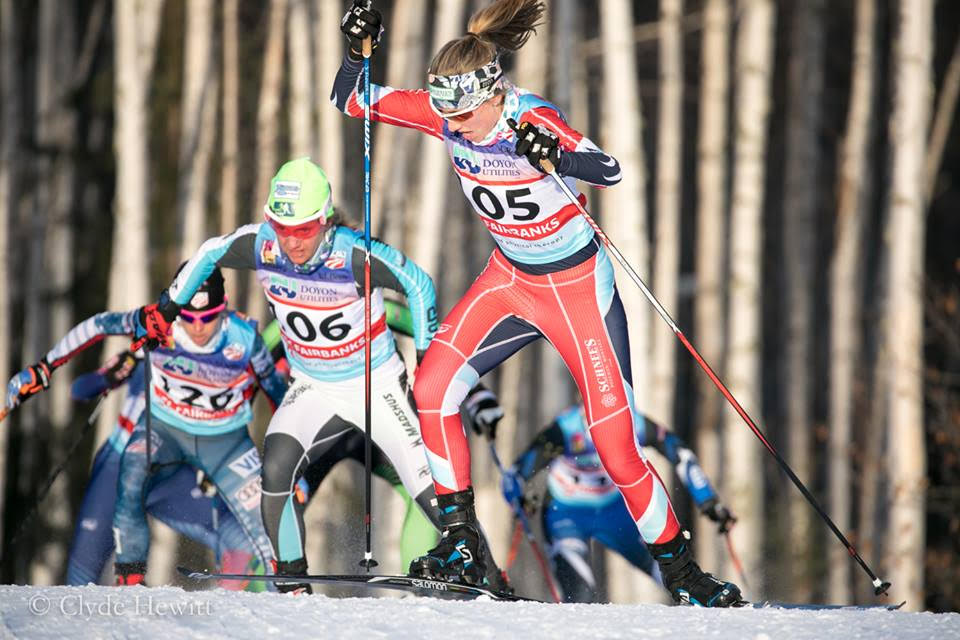
    Erika Flowers (in red) racing at 2017 SuperTour Finals in Fairbanks, Alaska, where she posted a best result of third in the skate sprint. In the last six years, Flowers has reached the SuperTour podium 16 times and finished the 2017/2018 season fourth overall. (Photo: Clyde Hewitt)

    It wasn’t until recently that Erika Flowers learned the meaning of her middle name. At the time of her birth, her father had been cutting around Montana’s mountain slopes on Elan alpine skis. Though the brand’s company is based out of Slovenia, the definition of élan, according to Webster’s dictionary, is a vigorous spirit or enthusiasm.

    Whether Flower’s father, Pat, had researched the word’s meaning or whether the name had simply struck him, the skis were his muse. Erika became Erika Élan.

    “He just happened to be skiing on that brand, and I think he liked the sound of it,” Flowers said during a recent phone interview from her hometown of Bozeman, Montana. “So he and my mom named me Erika Élan Flowers.”

    For anyone familiar with Flowers, long, stick-straight, blond hair often bouncing around in a high ponytail and glacial blue eyes are idiosyncratic to the 28 year old. So is an intense verve, or élan.

    “I actually never knew it had any meaning (beyond just being a ski brand) until this winter when I randomly came across it in an article and looked up the definition,” Flowers wrote in an email. “That said, I think it describes how I try to approach life in general.”

    ***

    While many nordic skiers dream about racing against the all-stars of Norway, Sweden and other powerhouse ski nations, not everyone gets the chance to do so year after year.  

    A former University of Utah skier, Kevin Bolger, now 25, managed to make his way onto the international ski scene this past March, sprinting to 11th place in his debut World Cup race in Lahti, Finland. Two weekends later, Bolger claimed another top 30 at the World Cup Finals in Falun, Sweden.

    His breakthrough came after less than a year of training with the Sun Valley Ski Education Foundation (SVSEF) Gold Team; Bolger graduated from Utah in May of 2017.

    The timing was impeccable. Just as Bolger was working toward a spot at the World Cup level, two U.S. veterans stepped away from the circuit. Flowers’s husband, Andy Newell announced this spring that he would pursue new career adventures and train apart from the U.S. Ski Team (USST), and Noah Hoffman officially retired from ski racing in March.

    By the end of May, Bolger had earned a nomination to the USST B-Team.

    In an email to FasterSkier this spring, Bolger himself concluded that his transition to World Cup racing “couldn’t have been written any better.”

    Making it onto the women’s World Cup circuit as an American, at least for the past six years, has been more complicated. It’s even harder to make the USST. Since 2010, a number of strong names — like Sadie Bjornsen, Jessie Diggins, Ida Sargent, and Sophie Caldwell — have been added to the team, while few women have left.

    Aside from the retirements of Kikkan Randall and Liz Stephen this spring, Holly Brooks was the only other woman to retire from the team in the past six years. Brooks left in 2014.

    Rosie Brennan was first nominated to the USST in high school before being renominated in 2015,  and had been on the team ever since, but was not renamed for the upcoming season.

    In short, a roster of seven women (not including the development team) has been fairly standard to the USST for close to a decade.

    Outside the national team, the U.S. domestic women’s field also witnessed a surge in talent and depth over the last six years. From 2012 to 2018 alone, at least 10 non-national-team women worked their way to the World Cup race scene, including Caitlin Patterson, Kaitlynn Miller and Liz Guiney of the Craftsbury Green Racing Project, Chelsea Holmes, Becca Rorabaugh and Rosie Frankowski of Alaska Pacific University, Caitlin Gregg of Team Gregg (when she wasn’t on the national team in 2015), Jennie Bender of the Bridger Ski Foundation, and Anne Hart of the Stratton Mountain School.

    Any skier pushing to make a break would have a number of strong names to work around. But for Flowers, racing World Cups was a long-term goal, as was making skiing a sustainable profession for herself. She could spend hours sifting over rosters and names, but the only way to confirm anything was to try it out for herself. 

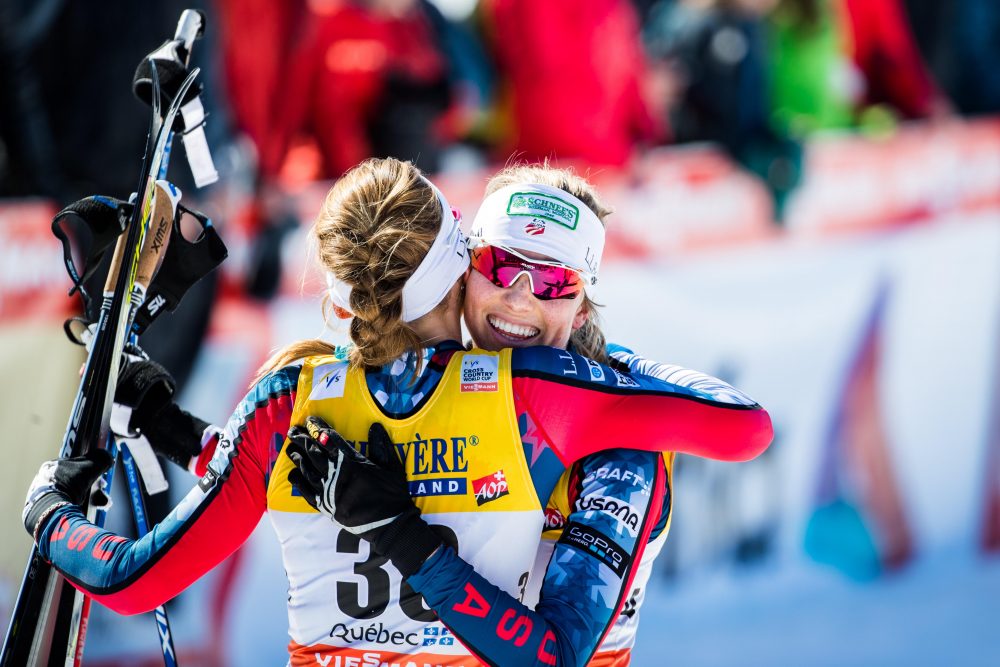
    American Erika Flowers (r) hugs her Stratton teammate Sophie Caldwell following the women’s 10-kilometer freestyle race at the 2017 World Cup Finals in Quebec City (Photo: Gretchen Powers)

    After graduating from Dartmouth in 2012, Flowers regularly finished in the top 10 of the overall SuperTour standings. She, too, earned a few World Cup starts. Flowers completed in all three races at 2017 World Cup Finals in Québec City, Québec, with a best result of 48th in the skate sprint.

    In the end-of-year SuperTour standings, her ranking also saw a steep jump. From 2013 to 2014, she went from 32nd to fifth overall and was fifth again in 2015. The next season, she finished seventh overall and was fifth again in 2017. She capped off this season with her best finish to date, earning fourth.

    Still, the sought-after World Cup starts remained elusive. As she developed, the USST also gained steam. Any progression she made also seemed to be matched by the cohort of American skiers she had be racing against since her departure from Dartmouth.  

    So why did she, summer after summer, push through intervals on rollerskis? Why spend each winter traveling to competitions, as Flowers put it, “living out of a bag”? Why did she continue to ski race year after year?

    ***

    Flowers was five years old when she first learned that her mother had breast cancer. Four years after her mother’s diagnosis, the family moved from Missoula to Bozeman. There, Flowers and her younger sister, Natalie, joined the Bridger Ski Foundation (BSF) cross-country youth program.

    The BSF community provided a niche for the Flowers siblings. The cancer treatments their mother was receiving also showed promise. Following her diagnosis and treatments in 1995, Hedvig Rappe-Flowers, Erika’s mom, was cancer-free for more than five years, according to an article by the Bozeman Daily Chronicle.

    But the cancer returned. Rappe-Flowers, a native of Sweden, encouraged her daughters to keep skiing. Do what made them happy. Both of them did.

    Erika Flowers during the early stages of her nordic career. “It was the first time I’d ever had my photo taken by any sort of professional and I remember just having no idea what I was doing but its become one of my favorite photos if only because it’s very raw and unedited and from a time when I was just starting to gain some real confidence both in who I was as a person and an athlete,” Flower wrote. (Photo: Chris Milliman)

    “My mom passed away from breast cancer when I was 17 which gave me a strong appreciation for how precious and valuable each day is and I know that I don’t want to waste one of them,” Flowers wrote in an email. “I think that’s another reason I probably decided to ski race for as long as I did — it was my first love and for all I know I could find out I have breast cancer tomorrow.

    “What I do know is that I spent the last 16 years of my life doing something I absolutely loved!” she continued. “I think that has been on my mind a lot these days, especially given Kikkan’s recent diagnosis.”

    Randall was diagnosed with breast cancer last month.

    “Kikkan’s a tough cookie though and I have no doubt she will tackle cancer the same way she has her many other challenges in skiing and in life — with equal parts fierce tenacity, bravery and grace,” Flowers added.

    While joining Randall in skiing’s elite racing ranks was certainly a goal, it wasn’t the only reason Flowers skied. Nor did she ski in her mother’s name — though Hedvig did instill in her daughters an enthusiasm for nordic sport and a steely resolve in all that they chose to do.

    “At her memorial service, one of the songs we played was ‘Hard Headed Woman’ — that really kind of describes her,” Flowers said. “She wouldn’t take no from anyone and believed so strongly in the idea that you could do anything you set your mind to.”

    The mercurial sport of cross-country ski racing had taken its hold. And Flowers was not about to let go.  

    Racing brought numerous challenges. Days when her body felt great, but the wax was too slow. Times when foul weather hit midway through a competition, slowing the course. 

    “Those variables can be extremely frustrating when they don’t go your way,” Flowers wrote.

    Frustrating, but simultaneously motivating, in its own way.

    “When everything does come together, it’s the most exhilarating and addicting feeling in the world!” she noted. “I think I always thrived on the challenge of it all.” 

    Four years ago, Flowers even gave biathlon a shot, traveling to Lake Placid, N.Y., for a US Biathlon talent camp. While she showed promise, Flowers ultimately stuck with cross-country.

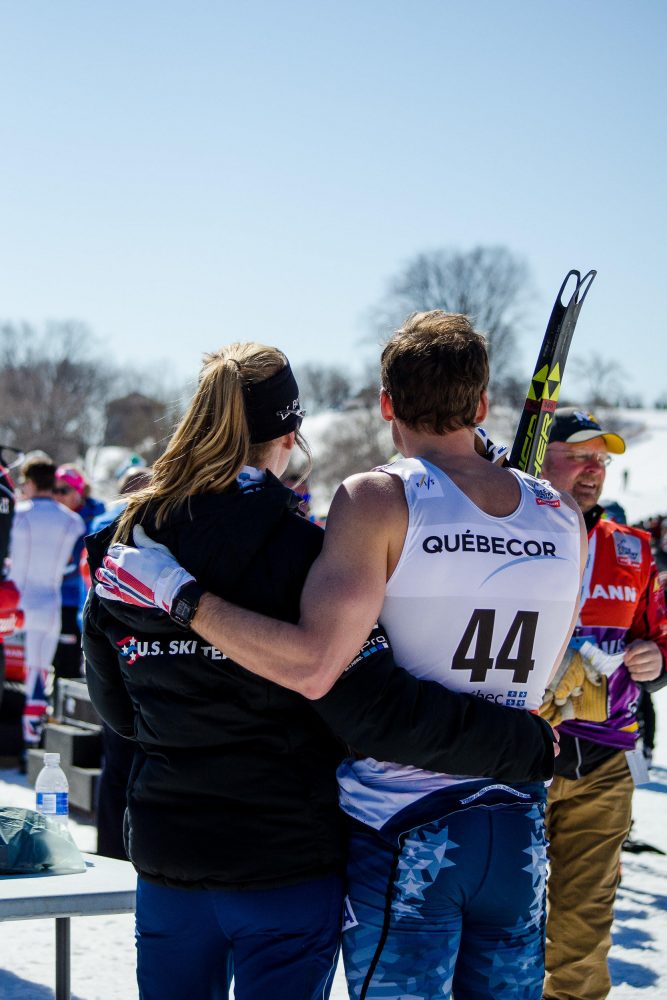
    Erika Flowers (l) and Andy Newell at the 2017 World Cup Finals in Quebec City. (Photo: Gretchen Powers)

    Skiing had deeper roots than racing and results for Flowers. It was a family affair (she credits her mother with having taught her how to skate ski). It was how she met most of her closest friends. It was also how she met her husband, Newell, whom she married last year.

    “The people, the fact that every day my job is to go outside and work on getting better at something I love, the travel, and the challenge and unpredictability of professional sport,” Flowers wrote of what had kept her ski racing into her late twenties. “Lastly the support of countless friends, sponsors and supporters is one of the most important things that kept me involved for so long. Had I not had that level of support I would not have been able to race for as long as I did or reach the levels of success I did.”

    At the root of Erika’s lifelong élan was, and still is, skiing.

    ***

    About a year and a half shy of her 30th birthday, Flowers is back where it all started. She and her husband and former Stratton Mountain School (SMS) teammate, Newell, packed up a U-Haul this spring and drove from Vermont to Bozeman. Back in her hometown, Flowers competed in the 20-mile Ed Anacker Bridger Ridge Run in June. She still trains, most often with Newell, and unabashedly states that yes, she still rollerskis.

    Since leaving Stratton, she does not currently have a formative training plan or program. Prior to moving, Flowers explored every “decision matrix possible” and spoke with numerous athletes and non-athletes alike about what she should do next. In the end, taking a step back from skiing seemed best.

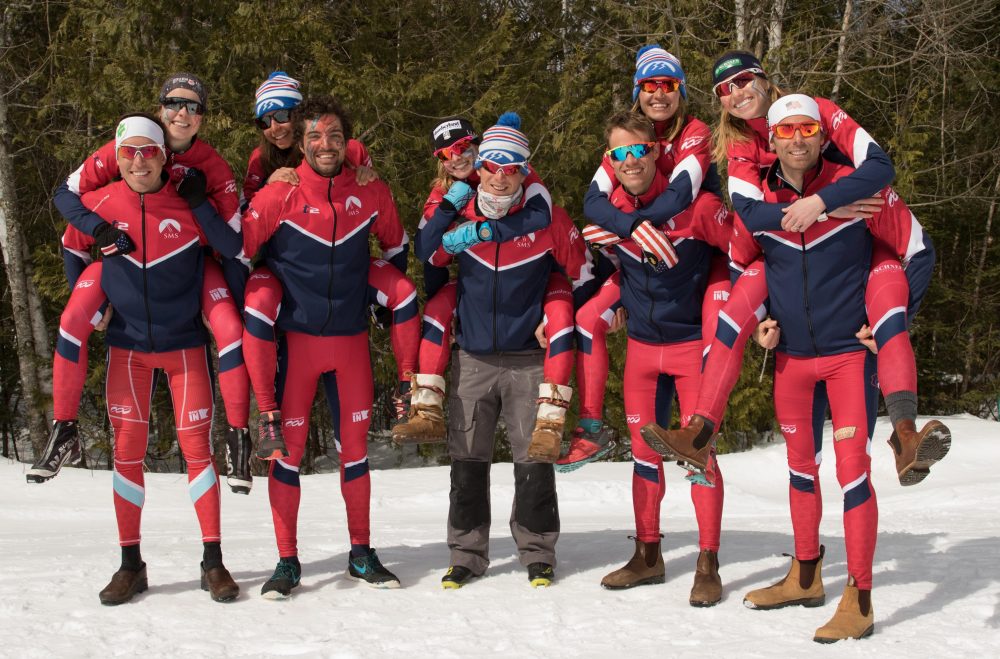
    Team photo of last season’s Stratton Mountain School T2 Team: (back row, right to left) Erika Flowers, Sophie Caldwell, Jessie Diggins, Julia Kern, and Annie Hart. (Front row, r to l) Andy Newell, Simi Hamilton, head coach Pat O’Brien, Ben Saxton, and Paddy Caldwell. (Photo: Reese Brown)

    “It wasn’t that I was sick of the lifestyle or anything like that,” Flowers explained. “I think it was more I’ve been doing it for long enough to recognize that my improvement curve is not what it needs to be in order to ultimately be able to make skiing into something that’s sustainable; something that can help me achieve some of the other goals I have in life, whether that’s getting a house or sitting on the board of a company.

    “I think that’s also what made it so hard,” she continued. “In some ways it’s walking away from something I absolutely love to start at the bottom of another passion.”

    Skiing has opened up a few other professional outlets for Flowers to pursue. She unofficially began social-media work for the National Nordic Foundation and USST this spring. She also is an athlete ambassador for the Women’s Sports Foundation. Her ties to nordic skiing becoming ever more intricate. 

    “Some people want to go all in for X number of years and retire and never look at a pair of rollerskis or race skis again,” Flowers reflected. “But to me, the word ‘retire’ sounds like something reserved for people in their late 60s, early 70s … maybe that’s why I haven’t used that word, it just doesn’t fit.

    “I think for me, it’s more deciding to take a step back from pursuing racing full time and looking at opportunities to pursue something else more fully,” she said. 

    The change of pace is in no way preventing her from getting outside. With Newell still planning on ski racing, just not full time on the World Cup, she’s still plenty invested in the nordic world.

    “From my end I just try to be supportive no matter what,” Newell said on the phone. “I think she’s been training so much and so well … she can take this year and try something new, even take a few months and try something new, and it would still be be pretty easy for her to jump into some races and make a comeback. Because I can tell you from my perspective, as her husband and as somebody that trains with her on a regular basis, she’s not slowing down even though she has other goals outside of skiing.”

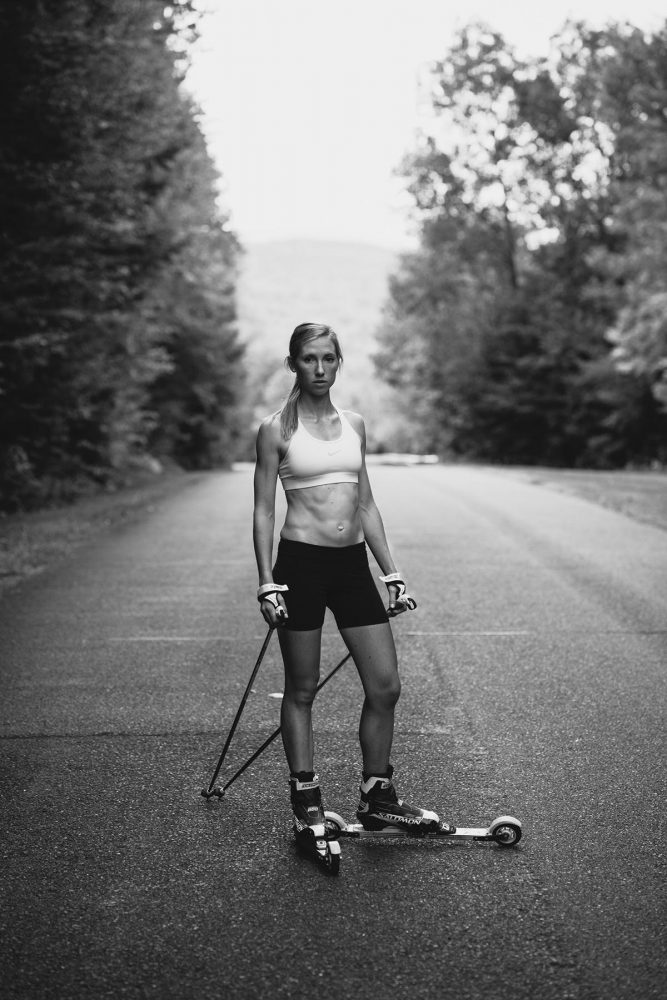
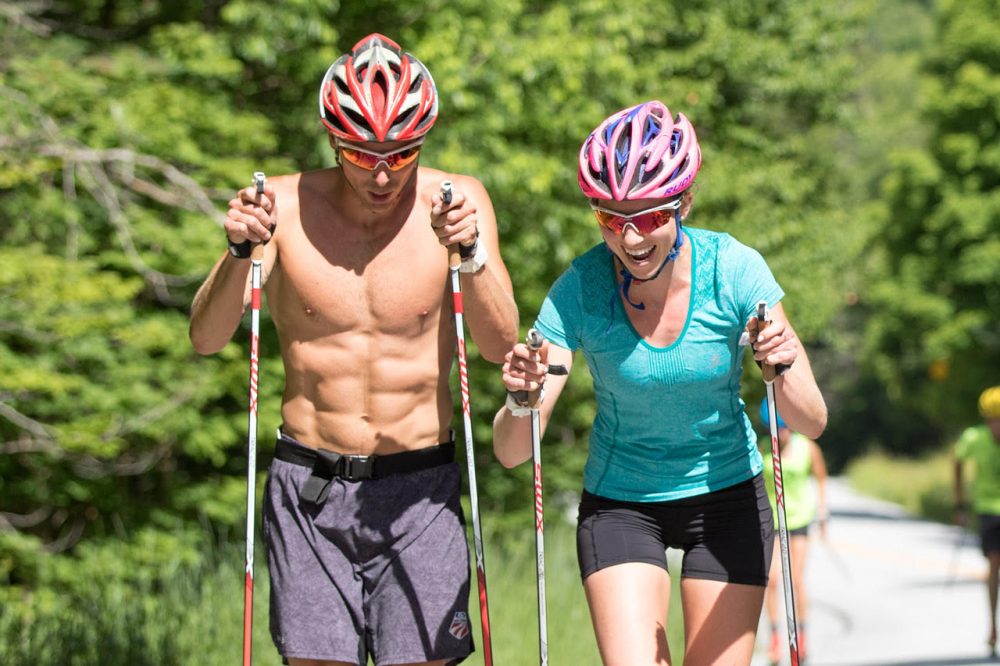
    Former Stratton Mountain School teammates, now husband and wife, Andy Newell and Erika Flowers during a rollerski training session. (Photo: Reese Brown)