From the FasterSkier archive — posts syndicated from athletes’ and coaches’ own blogs between 2004 and 2012, kept online as published. Current coverage is at fasterskier.com.
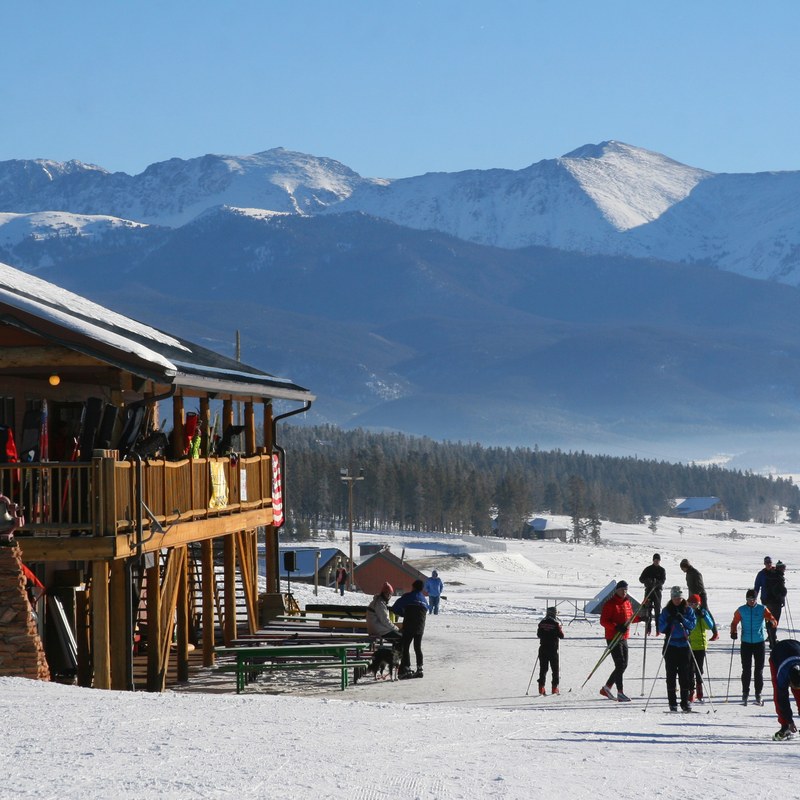
Skiers outside the Nordic Center at YMCA of the Rockies Snow Mountain Ranch. (Photo: YMCA of the Rockies)
YMCA of the Rockies Snow Mountain Ranch and SNØ Racing are joining forces, with Snow Mountain Ranch serving as the Presenting Sponsor of SNØ Racing.
The partnership connects a professional cross-country ski team committed to advancing the sport with one of Colorado’s favorite Nordic destinations. Together, SNØ Racing and Snow Mountain Ranch aim to welcome more people into Nordic skiing, support athletes and the broader ski community, and celebrate a sport built around snowy trails, hard work and the outdoors.
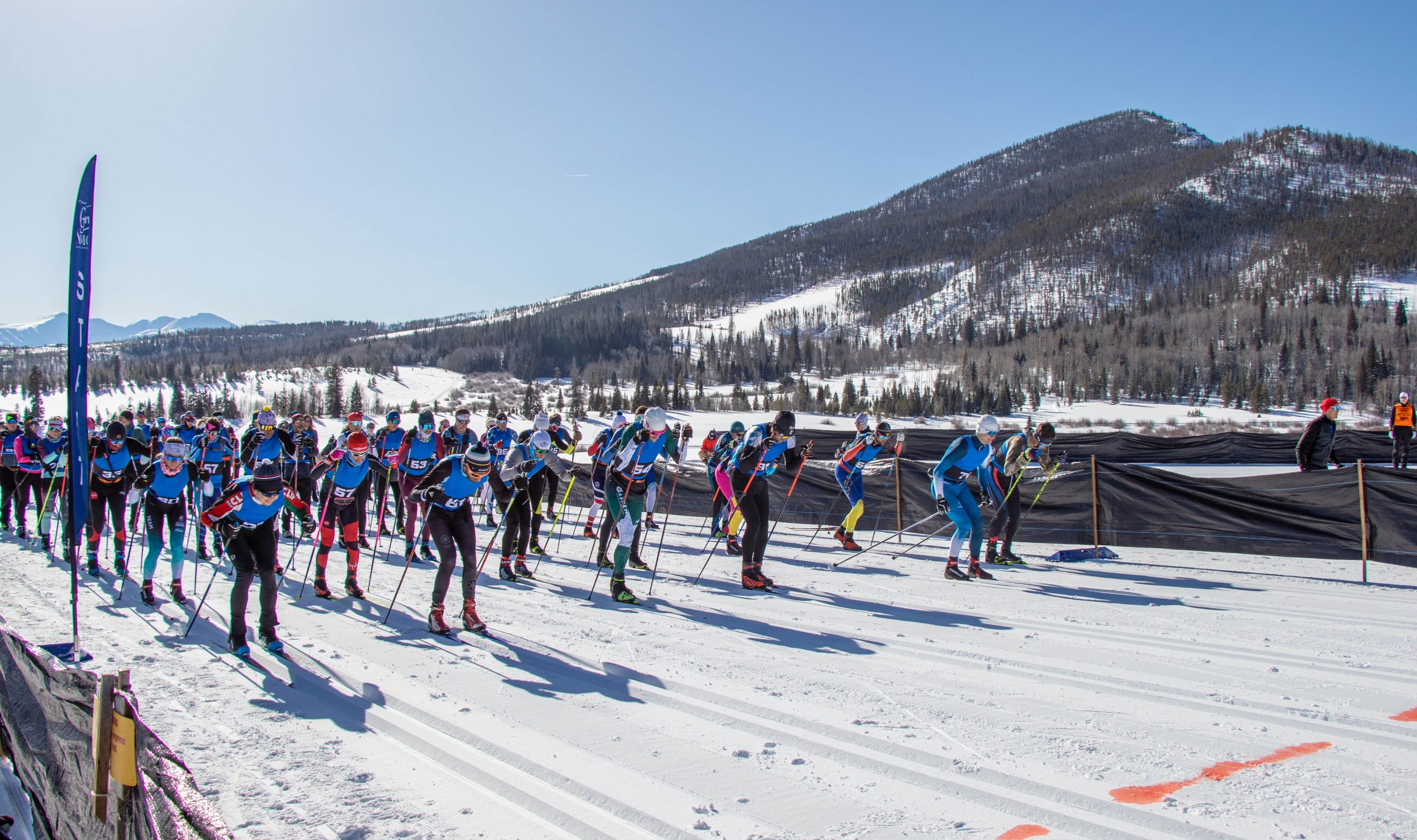
The Stampede mass start at Snow Mountain Ranch in early March. (Photo: YMCA of the Rockies)
What the Partnership Covers
“Snow Mountain Ranch has long been a place where people can experience Nordic skiing at their own pace, whether that means learning to ski for the first time, training for a race, or putting in serious Ks,” said Jeff Paulson, Nordic Director at YMCA of the Rockies Snow Mountain Ranch. “Partnering with SNØ Racing gives us an opportunity to support athletes competing at the highest levels while helping more people see that there is a place for them in this sport, too.”
As Presenting Sponsor, Snow Mountain Ranch will be featured across SNØ Racing’s public-facing team materials and marketing throughout the season. The partnership will also help introduce SNØ Racing’s community of athletes, coaches, clubs, juniors, masters, and recreational skiers to Snow Mountain Ranch as a destination for Nordic training, camps, events, lodging, meals, trail access and meeting space.
Based in Minneapolis, SNØ Racing is a professional cross-country ski team with athletes competing at the FIS World Cup, U.S. SuperTour, and regional levels. The team is focused on advancing skiing in the Central Region while promoting athlete development, partnership, and community engagement.
“Snow Mountain Ranch understands that Nordic skiing is bigger than race day. It’s about the people you ski with, the places that challenge you, the experiences that create lifelong memories, and the community that keeps you coming back. We’re proud to have them alongside our team this season,” said Yuriy Gusev, Chair of the Board of Trustees of SNØ Racing.
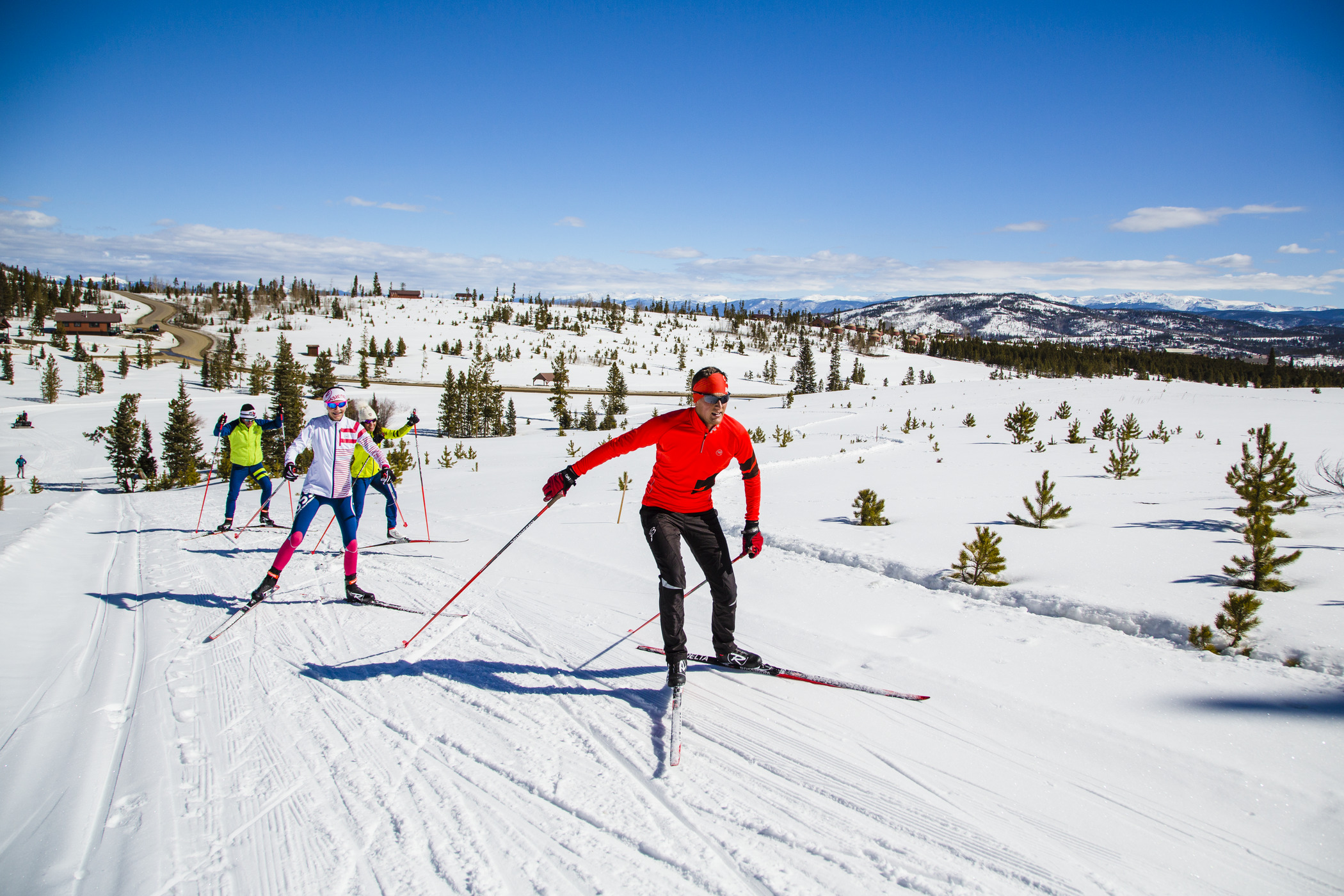
The Nordic Center grooms more than 80 kilometers of trail across 5,100 acres at Snow Mountain Ranch. (Photo: YMCA of the Rockies)
Eighty Kilometers at Snow Mountain Ranch
At Snow Mountain Ranch, that community has plenty of room to ski. The Snow Mountain Ranch Nordic Center offers over 80 kilometers of groomed trails across 5,100 acres of terrain, with routes winding through pine and aspen forests, open meadows and challenging climbs with expansive views of the Rocky Mountains. The trail system welcomes skiers across ages and ability levels, from first timers learning classic or skate techniques to experienced athletes looking for big training days.
The partnership also creates an opportunity to connect the Nordic community with the broader mission of YMCA of the Rockies. Snow Mountain Ranch is built around belonging, time together, outdoor experiences, and making the mountains accessible to more people. For both organizations, that shared sense of community is what makes the partnership a natural fit.
“Nordic skiing has a wonderful way of bringing people together,” said Paulson. “You can be chasing a podium or simply chasing a good glide on a bluebird morning. Either way, you belong on the trail. We’re excited to support SNØ Racing and grow that community together. And, stay tuned for the announcement of an exciting new event at Snow Mountain Ranch!”
To learn more about SNØ Racing and follow the team this season, visit snoracing.org. To explore Nordic skiing, lodging, lessons and winter experiences at YMCA of the Rockies Snow Mountain Ranch, visit ymcarockies.org.
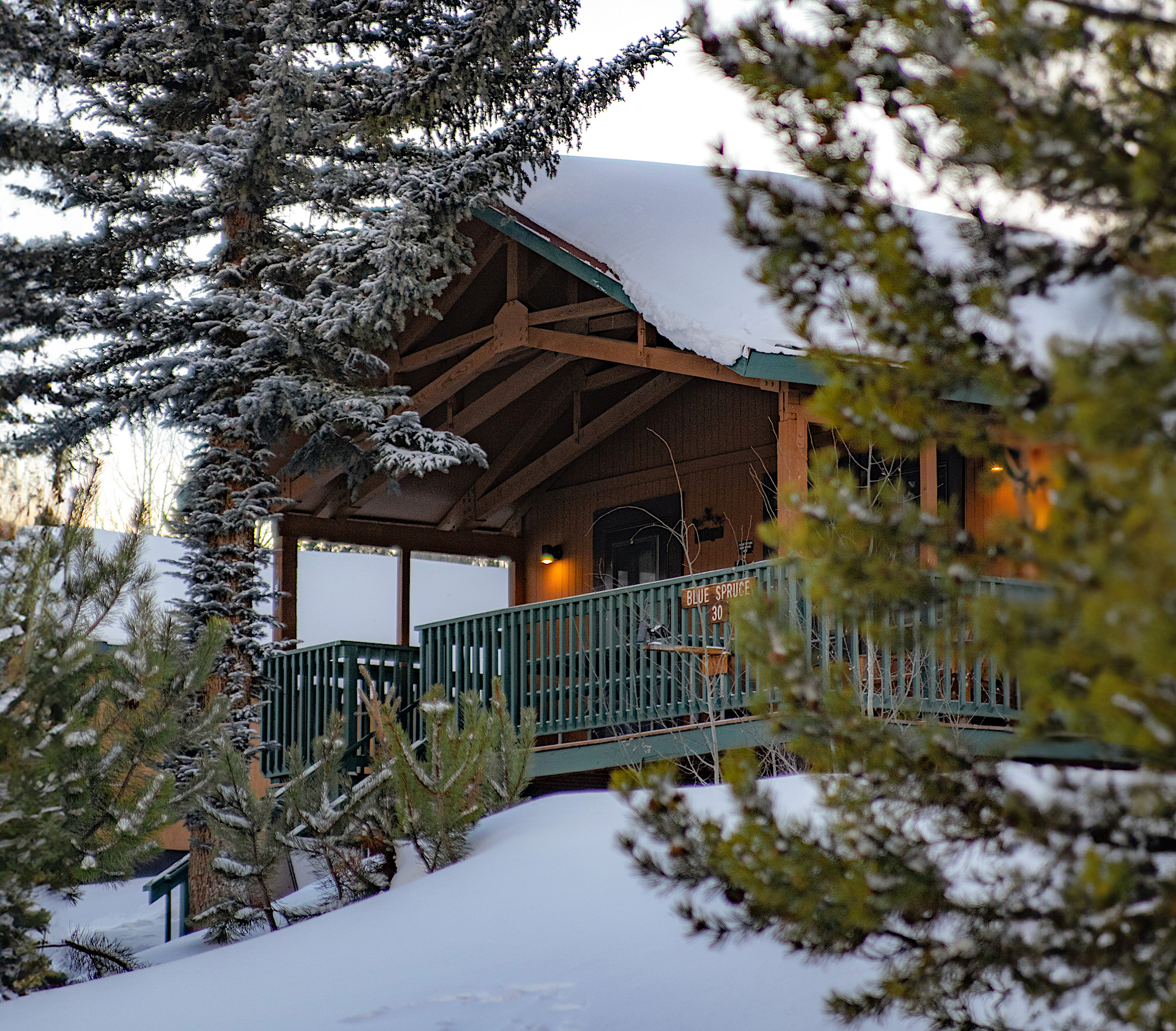
Alongside the Nordic Center, Snow Mountain Ranch offers lodging, dining and meeting space. (Photo: YMCA of the Rockies)
Publishing press releases is a service we offer to the ski community, so please note these articles are not written by FasterSkier and therefore do not necessarily represent our thoughts and standards.
The above discretionary selection process will be repeated for each period of World Cup this coming season. As always, if you have questions or concerns about this process, feel free to contact me directly.
Ben Ogden, the Vermonter, taking the cake in the men’s sprint final. (Photo: Tryg Solberg / FasterSkier)
CRAFTSBURY, Vermont — Craftsbury Outdoor Center kicked off the first of the SuperTour Finals races with a classic sprint on Friday. Yesterday’s weather brought gnarly, foggy, and temperatures in the 50s. Craftsbury’s grooming crew has been putting in long hours over the last few weeks to ensure that conditions would hold on through a warmup. Overnight, they prepared the 1.5-kilometer course that baked under the strong spring sun, creating saturated spring conditions even with temperatures below freezing.
Most of the top American competitors came to cap off their long race season, many of whom are freshly off the electric World Cup Finals. Following up huge events like the 2026 Olympics and the World Cup Finals in Lake Placid, one might think that races in the quaint Northeast Kingdom of Vermont would be a quiet, less competitive affair. Today’s competition couldn’t compete with the 10,000+ fans across the state border last weekend, but it proved to be a tight and fierce battle for sprinters to finish off their season.
85 men and 63 women started the qualifier, representing an array of professional domestic teams, Canadians, Eastern Intercollegiate Ski Association (EISA), and junior racers.
Ben Ogden of SMS T2 won the men’s qualifier with nearly 3 seconds over Gus Schumacher of APU. Murphy Kimball, the 19-year-old sophomore at the University of Alaska – Anchorage, qualified in an impressive eighth, only getting beaten out by elder World Cup regulars.
U20 Murphy Kimball heading to an 8th place in the qualifier. (Photo: Tryg Solberg / FasterSkier)
Erin Bianco of BSF won the women’s qualifier by over 3 seconds over second-place Canadian and Alberta World Cup Academy athlete Katie Weaver. Mia Gorman is a U16 athlete for the neighboring Mansfield Nordic Club who finished the qualifier in 27th, beating out all other junior women and making the heats with the big dogs.
Erin Bianco winning the qualifier by over 3 seconds. (Photo: Tryg Solberg / FasterSkier)
Ogden moved comfortably through the heats, eventually winning the men’s final over APU teammates JC Schoonmaker and Gus Schumacher, who finished in second and third, respectively.
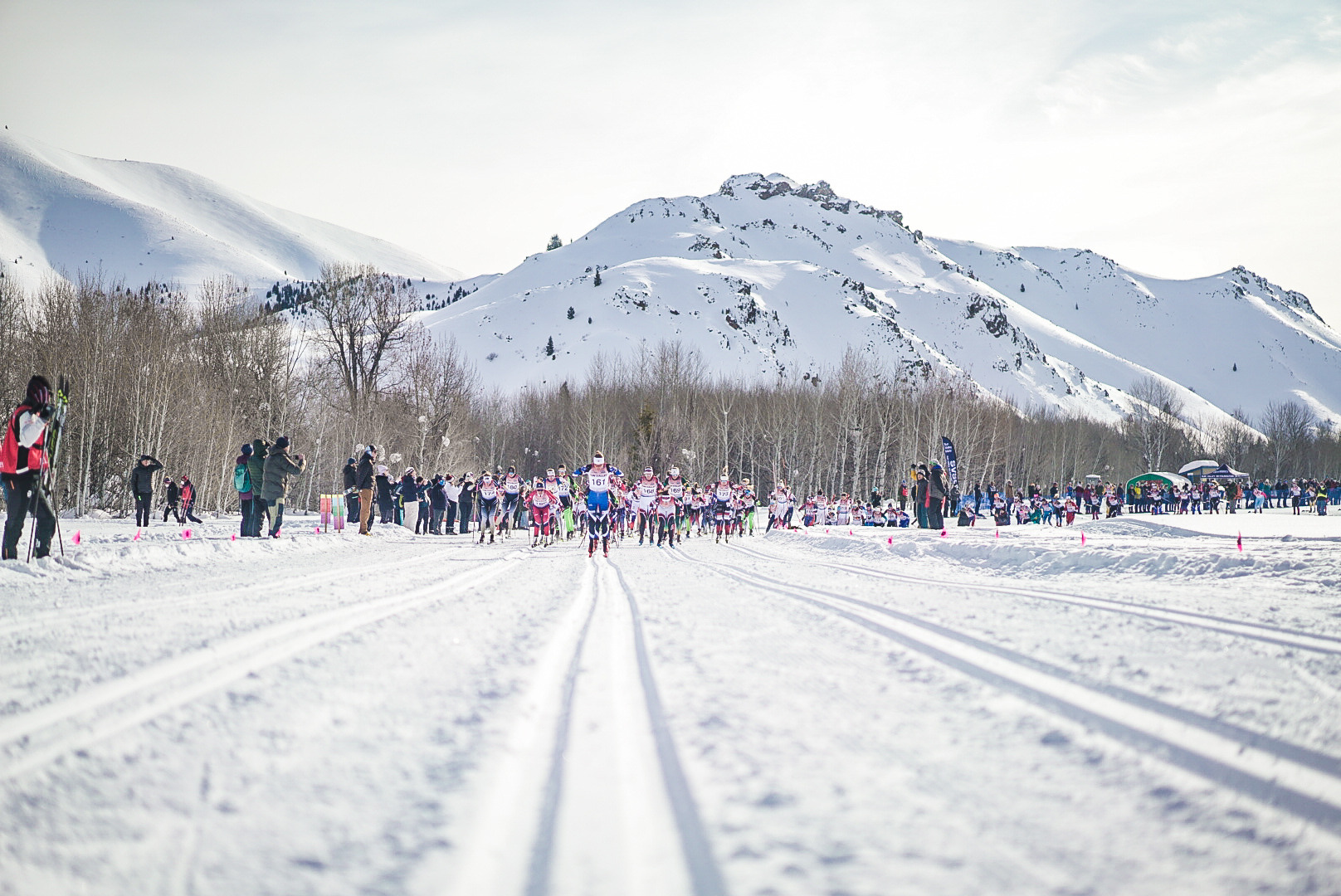
Men’s final starting at Craftsbury Outdoor Center. (Photo: Tryg Solberg / FasterSkier)
Ben Ogden of SMS T2 was very happy about racing in his home state. “It’s a bit more chill” he said in comparison to the World Cup and Olympic stages that he’s been prominent on this season. Ogden also mentioned that, even though the race environment was low-key, the competition was stiff with the U.S.’s top skiers duking it out for the top of the podium.
In addition to representation from many different clubs throughout the heats, the women’s side saw a shake-up in the competition when the third qualifier, Lauren Jortberg of Mansfield Pro/NCPH, fell in the final. Canadian Katie Weaver and her Alberta World Cup Academy teammate Olivia Bouffard-Nesbitt finished first and second. In an interview after the race, Weaver said “conditions were fun, crazy and a bit hectic.”
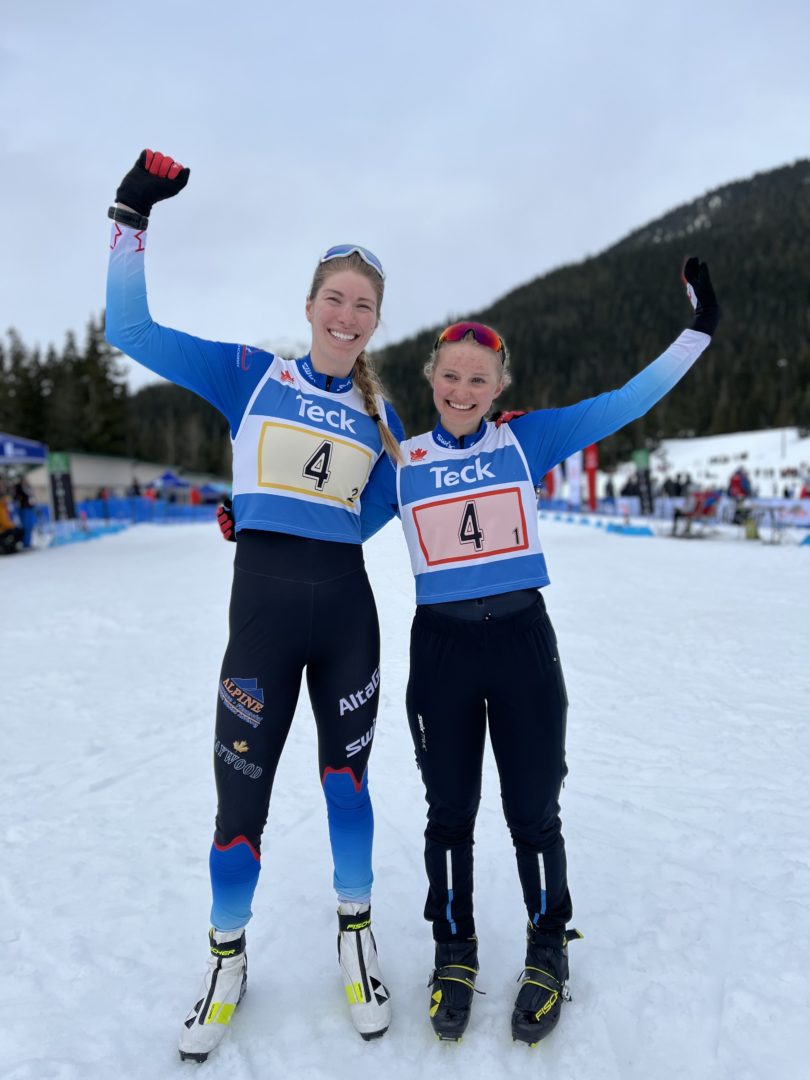
Canadians Katie Weaver and Olivia Bouffard-Nesbitt embrace after their strong finish for first and second overall. (Photo: Tryg Solberg / FasterSkier)
Emma Albrecht took the top domestic position in third place with her first Supertour win in a sprint race. Erin Bianco of BSF and Alayna Sonnesyn of Team Birkie rounded off the domestic podium.
Albrecht crossing the finishing line as the first American and 3rd overall. (Photo: Tryg Solberg / FasterSkier)
Albrecht was very happy with her racing throughout the day: “The biggest feat for me is being competitive this late in the season.” When asked about her tactics in the heats with the warm spring sun softening the track, she said that she had to “find a rut and see it through.”
Logan Drevlov of Loppet Nordic Racing and Claire Serrano of Craftsbury won the junior heat finals.
Temps are forecasted to drop into the single digits overnight before 4 x 5 km team sprint competitions throughout the day. Tune in for more pictures and results tomorrow.
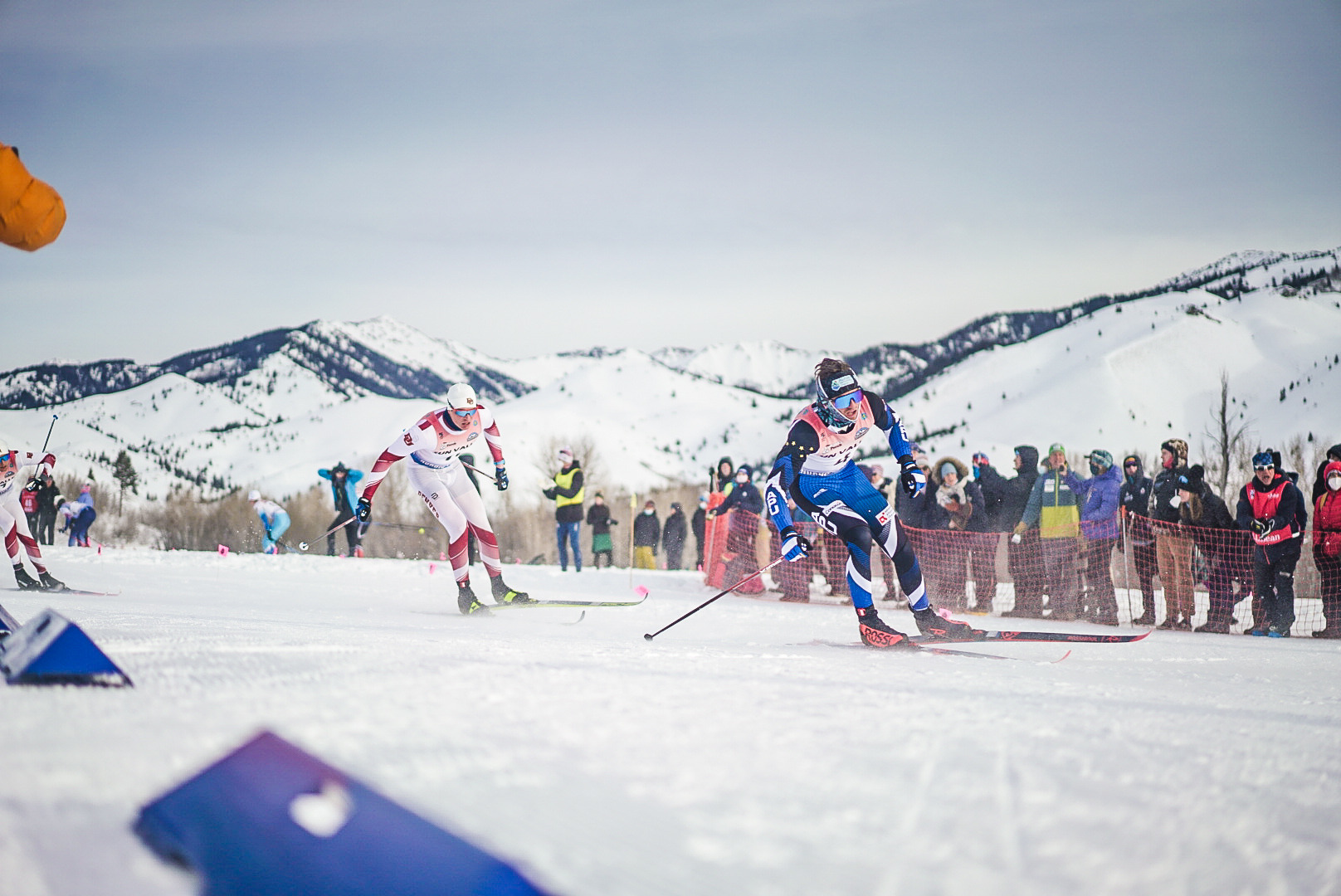
JC Schoonmaker (APU) and Kevin Bolger (Team Birkie) side by side in the heats. (Photo: Tryg Solberg / FasterSkier)
Help Support Our Olympic Coverage!
FasterSkier will have our own Nat Herz on the ground at the Olympics, which, to be honest, is a very big financial lift for us. If you value the thoughtful work and access FasterSkier provides at championships like this one, please consider becoming a Voluntary Subscriber. Your support directly fuels the work we do to cover the people, places, and moments that make our sport special.
The US National Championships got started yesterday with the 10 k Classic Individual Start in Lake Placid, NY. Hunter Wonders (#369 – APU) took top honors in the men’s race. (Photo: Nancie Battaglia)
On a January afternoon in Lake Placid, Mt. Van Hoevenberg did what it has always done best: it asked skiers to be honest.
The 10-kilometer classic individual start is not a format that rewards theater. It doesn’t care how good you looked in warm-up, how confident you sounded the night before, or how convincing your season-long narrative might be. It rewards pacing that’s brave but not reckless, technique that doesn’t unravel under strain, and the ability to keep making good decisions when your legs are trying to renegotiate the terms of the day.
This year, the U.S. National Cross-Country Ski Championships opened with that race—two laps on the 5-kilometer loop—and the timing was no accident. In an Olympic winter, Nationals is never just Nationals. It’s an argument. It’s a week where results don’t merely “count,” they accumulate, and the accumulation becomes the story that follows athletes into selection meetings, petitions, and—if all goes right—onto a plane headed for Italy.
Will Koch (SVSEF) on his way to 8th place on the day. (Photo: Nancie Battaglia)
The Course: Where You Can’t Afford to “Blow Up”
The Van Hoevenberg course is famous for being “fair,” but fairness in skiing is rarely gentle. The climbs arrive in layered sequences—sections where you can press, sections where you can survive, sections where you can lose seconds simply by being a fraction late to a gear change. There are places to win time, and places where you simply try not to hemorrhage it.
Hunter Wonders described the central problem precisely after the finish:
“It has some big hills. And I really think that in this course you can’t afford to blow up. If you blow up, you’re just going to bleed so much time.”
That idea—bleeding time—was the hidden refrain of the day. Not because athletes were exploding spectacularly, but because this loop punishes any lapse in restraint. It is a course that rewards a mind that stays intact.
Corbin Carpenter (UAA) on his way to 10th place in the 10 k Classic at US Nationals. (Photo: Nancie Battaglia)
Men’s Race: Seconds as a Selection Language
At the front of the men’s race, the margins compressed into something almost absurd: a national title decided in a space so small it could be measured in one imperfect corner, one extra step of herringbone, one pole that slips just slightly at the wrong moment.
Hunter Wonders won the men’s 10 k Classic National Championship. Behind him, the podium fight came down to an almost unnerving closeness. The story wasn’t simply that the race was fast; it was that it was tight—tight enough to turn pacing into the defining skill.
Wonders’ post-race reflection didn’t sound like someone who had “controlled” the race so much as someone who had managed it correctly, which is often the same thing in interval start racing:
“Yeah. So going through it never really felt like it was my day. I knew it was going to be a competitive one, and I knew that it would just come to good skis, good feelings in the body, good pacing, and I’m just really happy that I was able to pull it off.”
He returned to pacing again, emphasizing that his strategy wasn’t about heroics, but about avoiding the one mistake that the Van Hoevenberg loop will magnify:
“I think pacing was the biggest challenge for me today… So I was trying to take it out hot to where I could be competitive but not blow myself up.”
What made Wonders’ win especially convincing was how he described staying committed to his plan and then finishing with intent when the splits told him the race was available:
“I never really changed my race plan mid-race. But I did get some good splits, especially near the end, so I just tried to finish as hard as I could.”
And then, because it’s 2026 and everyone knows what this week represents, he said the part that matters most:
“And then, of course, U.S. Nationals does carry some heavy weight in an Olympic year. And I’ve been thinking about this race since the races in Anchorage ended, so I’m just really happy to have it behind me.”
He wasn’t pretending the pressure isn’t real:
“I definitely felt the pressure, and I’m going to continue to feel the pressure throughout the rest of this Nationals. But I think I have good momentum going, and I have good confidence. I know that I’m in shape, and everything else just kind of hopefully falls into place over the next week.”
The finish-line truth of the men’s race is that it created a kind of selection tension that will hang over the rest of the week: the top contenders weren’t separated by a narrative gap. They were separated by seconds.
Luke Jager, who finished second, captured what that tightness means on this course and in this moment:
“Yeah, crazy how close the times were! The course is cool because there are so many different gears in the climb that people can all have different focus spots and still end up so close together at the finish line. It is really cool, fair racing like that.”
That line—different focus spots, same finish—explains why the top of the results can look like a near-tie without being random. You can ski this course well in different ways. But you still have to ski it well.
Jager also spoke directly to the Olympic subtext without overplaying it:
“I’m not naive enough to say that the Olympics aren’t on all of our minds, but I’m also really having fun just trying to do my best and working to solve the puzzle of how to perform on any given day. Italy would be sweet, but I’m super thankful for this opportunity to even be feeling that pressure at all. It’s been fun to have such a big challenge.”
And then the warning embedded in the closeness:
“The close times just show me that you can’t take anything for granted, and each race could be someone else’s day. Fun to have to try and be as dialed and prepared as you can every day when the stakes are high.”
In other words, this wasn’t a day that “settled” anything. It made the next races more consequential.
Hailey Swirbul (APU) on her way to a national title in the 10 k Classic at US Nationals in Lake Placid. (Photo: Nancie Battaglia)
Women’s Race: Swirbul’s Return, and a Course That Doesn’t Flatter Anyone
If the men’s race was defined by a razor-thin margin, the women’s race had a different feel: not less intense, but shaped by a performance at the front that felt like a statement. And the words that followed from the winner did not sound like someone who had stumbled into a good day; they sounded like someone who had been building toward a day like this for a long time.
Hailey Swirbul framed her win as the visible outcome of a longer experiment:
“Winning this race felt like finally getting to watch the outcome of a long experiment unfold! I’ve wanted to approach this season from a place of curiosity to see if I can get fitness and strength back after a 2.5-year hiatus. It has felt so rewarding to get stronger and remember how it feels to race and go hard again.”
She described the way racing itself can re-teach an athlete what “hard” feels like:
“Each race or hard interval session reminds me what it feels like a little bit more.”
And then she said what almost everyone in the finish area seemed to be thinking, whether they admitted it or not:
“This course is legit. I didn’t hear the words ‘I felt good out there!’ come out of a single person’s mouth! It was a battle of self against hill.”
That sentence carries the whole day inside it: not a battle against other people, exactly, but against the course’s capacity to strip away pretense.
Hailey Swirbul (APU) charges up one of the many climbs on that Lake Placid course behind Virginia Cobb (#120 – DAR) and Marit Flora (#76 – UAA). (Photo: Nancie Battaglia)
Swirbul’s race plan—at least as she described it—was deeply personal in its logic. Not a copy of someone else’s pacing, not a response to what she imagined others were doing, but an attempt to ski in a way that matched her strengths:
“I tried to ski true to myself. I wanted to use momentum and my own body weight the most effectively I could to get around that course as fast as I could- regardless of how the pacing looked for others.”
And because it’s an Olympic year, she made the subtext explicit:
“I have my eyes on an Olympic Team spot, and I’m going to continue to fight for it until the team is officially named. I’m not thinking beyond this week of racing here at Nationals. One step at a time, staying present…”
Then the line that reminds you why athletes keep doing this:
“…and enjoying getting to live this life and see so many people from old racing days— it’s a good life.”
Novie McCabe’s post-race comments carried a tone that felt especially relevant to this week: gratitude, yes—but also a clear-eyed description of how fragile a season can feel, and how an athlete can build stability by focusing on what can be controlled.
“It meant a lot to be starting today for sure! I think that being a bit unsure of whether I’d be starting these races made me feel pretty grateful for the opportunity to go out there and give it my best today.”
She described the emotional mix honestly:
“There were, of course, lots of doubts and some nerves going in as well, but I really tried to just enjoy the skiing and made that my main goal going into it.”
And she emphasized that conditions and course feel matter—not as excuses, but as context:
“The conditions were insanely nice today, which helped, and this course is one of my favorites!”
On pacing, McCabe described a strategy rooted in self-knowledge:
“Honestly, I kinda just went out as hard as I could within reason, and tried to relax and hold onto it. I know the splits don’t really make it look that way, haha, but I am not the fastest starter, so it is usually best for me to go out at what feels like a pretty hard pace.”
Then she explained the architecture of her day: not results goals, but process goals. She made a point that’s easy to dismiss until you remember what an Olympic week does to people:
“Being focused on process goals going into a race really helps me develop a framework for success.”
She listed those goals with specificity—how she wanted to feel, what she wanted to focus on, what she wanted her mind to do when discomfort arrived:
“…going out hard but comfortable and trying to hold it, skiing well (not skiing hard), be the focus of the day, keeping up the positive self-talk, and finding the good and noticing what is going well throughout the race.”
And on Olympic pressure, she offered a perspective that will sound familiar to anyone who has ever had a season disrupted by health or inconsistency:
“I think it has honestly helped me out in terms of handling self-imposed Olympic qualification pressure to not have had the best lead up and be pretty unsure of what I would be doing as far as racing goes this year…”
She described her focus as narrower—day by day—because it has to be:
“…it has taken some of my focus off of results… It has just kind of led to an approach where I take it day by day, and don’t really think much further into the future than that.”
That isn’t resignation. It’s an operating system. And it’s one that often works, especially on a course where you can lose time in the exact moment you start racing the future instead of the hill in front of you.
Rosie Fordham (UAF) leaving it all on the course on her way to 7th place overall. (Photo: Nancie Battaglia)
Samantha Smith: A Double Life and a Very Real Result
Samantha Smith’s presence near the top of the women’s results came with a storyline that’s unusual even in American ski racing: balancing elite cross-country skiing with Division I soccer at Stanford, and arriving at the heart of ski season off a long NCAA tournament run.
She spoke about the short transition plainly:
“Yes, that’s correct, that our soccer team’s long run into the NCAA tournament has made for a much shorter transition to the season. I’ve only been on snow for a few weeks, so I know my ski fitness is improving every day.”
She described the emotional carryover of playing for a national title—how it can become fuel rather than a distraction:
“Playing in the National Championship was an amazing experience—we were so close to winning it all. It was a tough way to end such a great season. I’m taking that fire from our final game and pouring it into my skiing.”
And she framed her path as something she’s embracing, not defending:
“I know my path is different from others, but I’m doing what I love, and I think there’s a lot to be said for staying true to that. I’m trying to take everything step by step, live in the moment, and focus on what I can control!”
On the scrutiny that comes with missing ski events earlier in the season, she emphasized the lessons she’s drawn from doing two sports seriously:
“…for me, I feel like there’s actually a lot I can pull from the two sports and use it to my advantage.”
She described last year as a “trial year” and explained how she’s adjusted:
“I needed that test phase to figure out what works and what doesn’t work. I made some adjustments this year in training, switching things up a bit, and I feel like that’s helped me a lot going into this season.”
She credited Braden Becker for helping with training and coaching through the fall:
“I owe a huge thank you to Braden Becker, a retired skier, who’s now a grad student at Stanford. He helped me a lot with training this fall, and it honestly made a world of difference…”
And then she returned to the mental challenge of this week—high stakes, lots of uncontrollables—and the philosophy that keeps an athlete from spiraling:
“…I’m just trying to focus on what I can control—my attitude and effort.”
Finally, she addressed the question of what a distance result might “say” about her:
“I was happy with today’s result… I think today’s race was a good indication of my trajectory for the rest of the week and the rest of the season.”
And she framed versatility—distance and sprint—as part of the argument she wants to make this winter:
“…hopefully showcase some of my versatility in different distances and disciplines, which I think can be important for big competitions like the Olympics.”
Alayna Sonnesyn (Team Birkie) on her way to 10th place overall. (Photo: Nancie Battaglia)
Why This Week Matters So Much
For the men, the arithmetic of Olympic selection is already partly written—and partly unresolved. At present, the United States is allotted seven men’s quota spots for the Olympic team, with the possibility that an eighth could roll down following this weekend’s World Cup races in Oberhof, Germany. That uncertainty is where much of the tension at U.S. Nationals resides.
It is also where most of the speculation comes from—so take it for what it is, informed but unofficial. The six American men who recently raced the Tour de Ski appear, by any reasonable reading of the criteria, to be on solid ground. Each currently ranks in the top 45 on the FIS World Cup sprint and distance overall lists, the threshold set by the US Ski Team that meets the objective requirements for Olympic selection.
Within that group of six, there is also ample sprint depth to cover the four available starts in the individual classic sprint and to form a competitive two-man sprint relay. As a result, Tuesday’s Freestyle Sprint at Nationals is likely to carry less weight for those athletes racing in Lake Placid with dreams of making the Olympic roster. Instead, the races most likely to function as closing arguments—particularly if an additional quota spot materializes—were Sunday’s 10 k Classic and Thursday’s 20 k Freestyle Mass Start. For at least one man, and potentially two, those performances may determine whether this week in Lake Placid becomes a footnote or a turning point.
On the women’s side, the picture is far less settled—and far more fluid. The United States has eight Olympic quota spots available, but only a portion of them is considered secure. Jessie Diggins—if it were ever in doubt—has already satisfied the objective criteria by finishing in the top eight in World Cup races that are part of the Olympic schedule. Julia Kern and Rosie Brennan also appear well-positioned, based on their respective rankings on the sprint and distance overall lists.
That still leaves as many as five remaining spots to be determined, drawing from a complicated blend of results across Period One on the World Cup, the SuperTour events in Alaska, and, critically, U.S. Nationals this week in Lake Placid. For those athletes, Nationals is not simply a domestic championship. It is an audition, a data point, and—in some cases—the clearest remaining path onto the Olympic team.
John Steel Hagenbuch (DAR) on his way to 5th place overall on the day. (Photo: Phillip Belena/EISA)
Grover: “There’s Going to be Space”… and then the Paperwork
US Cross-Country Ski Team Director Chris Grover offered perhaps the clearest explanation for why the opening races at Nationals feel unusually charged—not because they deliver final answers, but because they create space. Space in which athletes can move themselves from the margins of the conversation toward its center.
The story, as Grover framed it, is not simply who wins. It is what a result permits: what doors it opens, what arguments it strengthens, and how it positions an athlete within the broader, inevitably imperfect machinery of Olympic selection.
As Grover put it in an interview with FasterSkier, U.S. Nationals does exactly that—it creates room:
“…it’s going to be a great story because there’s space. There’s going to be space on both the men’s squad and the women’s squad, by the looks of it, for athletes to qualify from Nationals, to have great U.S. Nationals and come over, especially on the women’s side…”
That space, however, is not filled automatically. In an Olympic year, it is accompanied by paperwork, petitions, and deliberation—an acknowledgment that performance, while central, is rarely the entire story.
Grover outlined the petition process that follows Nationals, a step that often receives less public attention but carries significant weight:
“…all athletes who want to be considered for discretionary selection… We’ll put in an application. Or a petition rather, where they will kind of write out what their case is, why they should be considered…”
Those petitions, Grover explained, are then evaluated by a selection committee—six people tasked with translating results, trends, and context into final decisions:
“…we have the six-person selection committee that will pick the team. So as a committee, we’ll read everybody’s application, and then we, as a committee, will decide whether we want to elevate somebody using Coach’s discretion to be selected.”
Even the arithmetic of quota spots, Grover noted, is subject to forces beyond any one athlete’s control. On the men’s side, the possibility of an additional spot remains unresolved:
“…it’s after Oberhof… qualification for nations also closes on January 18… and at that point a spot [might be] available…”
Which is to say: timing matters. So does patience.
Taken together, Grover’s explanation underscores a truth that every athlete racing this week understands intuitively. Lake Placid does not merely crown national champions. It produces evidence—sometimes decisive, sometimes ambiguous—for a selection process that will soon harden from theory into reality. And once it does, the margins that feel abstract today will become permanent.
Ava Thurston (#45 – DAR) on her way to 6th place overall on the day. (Photo: Phillip Belena/EISA)
What Sunday Actually Did
The first day of Nationals did not select the Olympic team. It did something subtler and, in some ways, more powerful: it established the tone of the week.
On the men’s side, it proved that the domestic field is not going to give anyone breathing room. Wonders’ win was decisive in the only way that matters in interval start racing: he was fastest when everyone had to ski alone. But the closeness behind him reinforced Jager’s point—each race could be someone else’s day. In a week like this, that’s not a platitude. It’s a forecast.
On the women’s side, Swirbul’s victory felt like a day where preparation and belief finally aligned. But even she framed the week properly: one step at a time, staying present, not thinking beyond Lake Placid. McCabe and Smith offered two different versions of the same survival skill: build a framework, focus on process, control what you can, and let results become the output rather than the obsession.
If there was a single emotional throughline, it was this: the athletes weren’t pretending the Olympics weren’t there. They were trying, in different ways, to keep that fact from hijacking the work.
A Conclusion in the Shape of an Interval Start
There’s a particular quiet that follows an interval start classic race—not silence, exactly, but the hush of athletes doing their internal accounting. A national championship can feel like a celebration. In an Olympic year, it can also feel like a deposit: something placed into the larger selection ledger, something that will matter later, in rooms the athletes won’t be in, in conversations they can’t control.
What makes Lake Placid different—what makes Mt. Van Hoevenberg feel so permanent—is that it refuses to dramatize any of this. It simply asks the same thing of everyone: ski two laps honestly, manage the climbs, keep your head when your legs get loud, and finish without bargaining.
Wonders said he felt the pressure—and expects to keep feeling it. Jager said the closeness means nothing can be taken for granted. Swirbul described a long experiment that finally yielded its outcome. McCabe described building success from process, not prediction. Smith described a life lived between two sports, and a focus narrowed to attitude and effort.
Taken together, those aren’t just post-race quotes. They’re the first chapter of the week.
And in an Olympic winter, first chapters matter—because the next race arrives quickly, and the story keeps writing itself, one start at a time.
Love stories like this? Help keep them coming.
Feature stories like this one take time, access, and care to produce. If you value thoughtful storytelling and independent ski journalism, please consider becoming a Voluntary Subscriber. Your support directly fuels the work we do to cover the people, places, and moments that make our sport special.
When Novie McCabe spoke with FasterSkier early last month, she was looking out the window of her place in Anchorage, waiting for winter to finally take hold. “We’re patiently waiting on snow,” she said. “But today might be the day.“
Outside, the ground was still in its in-between phase—too brown for grooming, just white enough that fish-scale skis could work if you were stubborn and optimistic about it. Alaska in November often asks skiers to hover in that liminal space: ready but not yet racing; fit but not yet tested; hopeful but not naïve.
This week, the waiting ends—at least for the top domestic circuit. The U.S. SuperTour season opens in Fairbanks and continues in Anchorage next weekend, but McCabe hopes her body will allow her to join the field. After a long, uncertain stretch, simply lining up for even one race would mark a meaningful step forward. The timing makes this the right moment to trace how she has arrived at this threshold, and how the places she has lived—Methow Valley, Salt Lake City, Anchorage, Europe—continue to shape the skier she is becoming.
Laura, Sean, and young Novie McCabe. (Photo: Courtesy Photo)
The Valley That Built Her
The story begins in the Methow, where winter is less a season than an identity. “I grew up in the Methow Valley, which is like a small valley in north central Washington with a pretty big ski community,” McCabe recalled. “I think we have the most Ks in North America or something when the skiing is good.“
Her mother, former U.S. Ski Team athlete Laura McCabe, and her mother’s longtime friend Leslie Hall helped build the Methow Valley Nordic Club from scratch. McCabe grew up inside the culture they created: open, community-driven, relentlessly outdoorsy, and—maybe most importantly—fun.
“I was lucky enough to have a really big group of kids my age who all just kind of happened to be really close friends,” she said. “We would all just be active together and spend a lot of time outside… backpacking trips all the time together.“
Skiing was less a pursuit than a language. Practice might include ultimate frisbee on skis or just exploring terrain with no agenda beyond movement. “That was the main thing that got me so excited about skiing—the community,” she said. “It was just what all my friends did.“
These early years formed more than her fitness. They gave her a worldview: skiing should be joyful, shared, and balanced.
“Stay Behind Us—It’s Supposed to Be Easy”
That mindset came directly from her mother’s coaching style. “My mom… would do all the sessions with us,” McCabe said. The education was intuitive, rooted in feel rather than metrics.
“It was very feeling-based,” she said. “Like, in L3 you should be able to talk to me and give me a sentence back at least when I ask you how you’re feeling.“
Heart-rate monitors were used only sparingly—tools to complement the athlete, not dictate behavior. “We maybe did lactates once or twice the whole time I was in high school,” she said.
One lesson, in particular, stuck with her. During easy sessions, her mom and Leslie Hall would say:
“You guys have to stay behind us because it’s supposed to be easy.”
The rule was simple, but the philosophy was profound: fundamentals come from awareness, not pressure.
McCabe laughs that even today, in anything resembling an ultra-distance test, the result might still tilt toward her mom: “She might have the upper hand in anything longer than 50 k.“
Novie McCabe during the 20 k Classic at the NCAA Championship hosted by Saint Laurence University in Lake Placid in 2023. McCabe controlled a pack that also contained her teammates, Sophia Laukli and Sydney Palmer-Leger. McCabe led the UU women, who finished 1st, 3rd, and 5th, on the day that propelled the Utes to their 4th consecutive NCAA Championship. (Photo: (c) Nancie Battaglia).
Utah and the COVID Bubble
By the time she left the Methow, McCabe was ready for a bigger arena. She chose the University of Utah for its coaching, competitive team environment, and growth opportunities.
“At that stage in my life, I was pretty ready for it,” she said.
Her first year unfolded in the disruptive isolation of COVID—a strange, surreal time that somehow fostered uncommon cohesion.
“It was the heart of COVID isolating, but honestly, kind of in a fun way,” she said. “We were just hanging out as a team all of the time.“
Despite Utah’s reputation as an NCAA powerhouse, she never felt crushed by expectations. “It didn’t feel like a high-pressure situation,” she said. “They were there to help us get the best out of ourselves.“
She balanced training with academics, majoring in political science and minoring in economics. Even then, she was thinking beyond skiing.
Novie McCabe skiing for APU. (Photo: Courtesy Photo)
Leaving Eligibility on the Table
After her third year, she made a difficult decision: she left Utah with two years of NCAA eligibility remaining.
“I just felt kind of ready to move on from the NCAA,” she said. The experience had been positive—”I think everyone should go NCAA… It’s so fun and great for development,”—but the structure had become limiting.
She wanted freedom: to race World Cups without constant travel back to the U.S., to pursue her development without logistical whiplash.
“I wanted the freedom to race as many World Cups as I wanted during the season and not fly back and forth so much.“
Once she accepted that her path needed to diverge, the next step was obvious.
Novie McCabe and Luke Jager. (Photo: Courtesy Photo)
Anchorage and the APU Reboot
Anchorage had already become a meaningful place—she had been coming there every summer since her first year at the University of Utah. Her partner, Luke Jaeger, is from there. And she had trained with APU coach Erik Flora for years.
“It honestly wasn’t even much of a decision,” she said.
Flora’s coaching became a stabilizing force. “Erik Flora is really awesome when things are going wrong,” she said. “He knows how to help athletes sort through challenges… It’s never a linear path to success in skiing or any sport.“
APU offered a training environment grounded in trust and peer excellence. “This year there is a pretty big girls’ group,” she said. “Kendall Kramer, Quincy Donley, Annabel Needham, Haley Swirbul, we have a big crew.“
Training with athletes like Rosie Brennan and Swirbul created a layered mentorship:
“They have been and are some of the best in the world.“
Anchorage became the center of her athletic and personal rebuild.
Novie McCabe joined by family and friends for a climbing adventure. (Photo: Novie McCabe)
The Year Without Racing
McCabe didn’t race at all last winter, more or less. At the time, she explained this as part of a balance project—but in reality, the situation was more complicated.
“I have historically been kind of bad at the balance thing,” she said. “My happiness is sometimes quite dependent on skiing.“
That year became a forced reset, with significant emotional and physical consequences.
“I think I’ve gotten better at it,” she said. “I’ve found some things that I really do like to do outside of skiing.” She mentioned baking, cooking, reading, and spending time outside in ways that weren’t tied to training logs.
Yet she was still searching for answers.
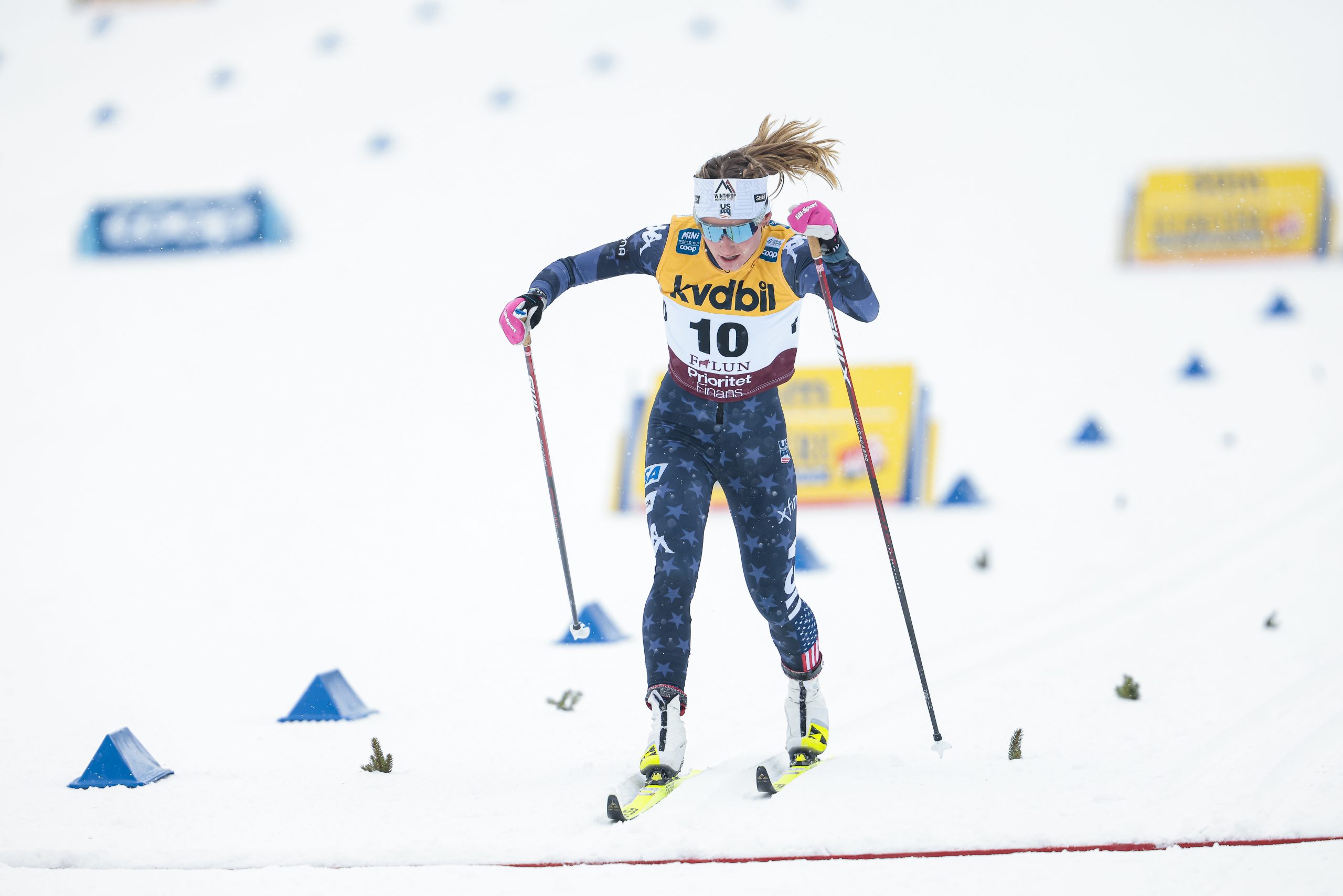
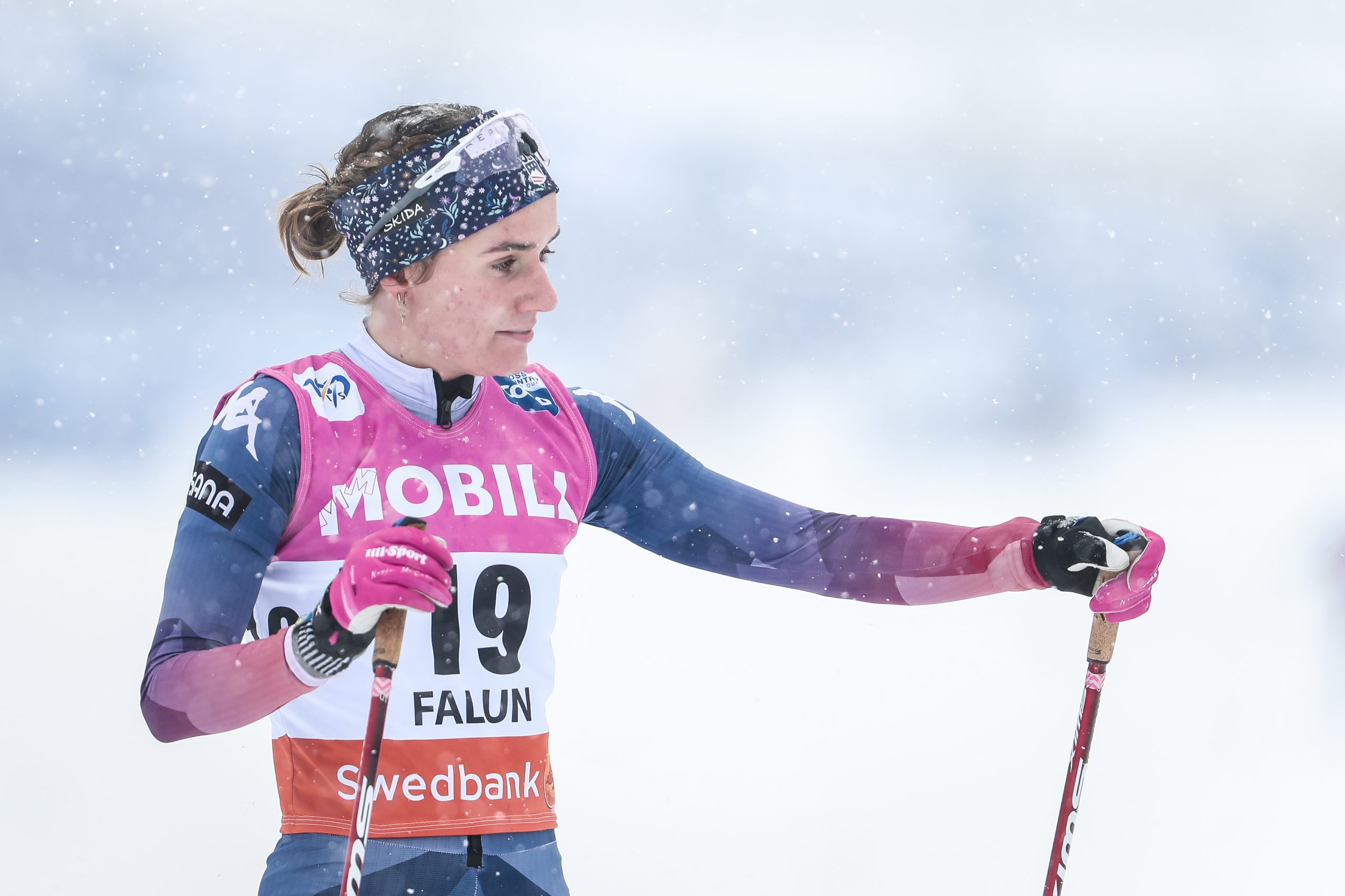
One of Novie Mccabe’s (USA) career highlights was her top 15 finish in Falun, Sweden in a Classic race. (Photo: NordicFocus)
A Quiet Battle Behind the Scenes
After our original conversation, McCabe followed up with more context—an important layer we had not fully jumped into earlier. For the past two years, she has been navigating what she called “some mystery health challenges,” a swirl of symptoms that worsened last fall to the point where racing no longer felt possible.
“The best guess of most of the doctors I have seen is some sort of post-viral or chronic fatigue thing,” she wrote, “possibly combined with some issues keeping my celiac and Hashimoto’s in check, but I am still not really sure what is going on to be honest.“
She spent the winter searching for stability rather than start lines.
“I have taken a pretty cautious approach to training this year and just been trying to build back into it super slowly and give a lot of extra attention to rest and recovery,” she said. “And I do feel like I made some solid progress.“
Even now, she remains cautious. “The past two weeks have been a bit of a step backward,” she said. She’s not entirely sure she will race in Fairbanks. Her hope is modest: “One race there and one race in Anchorage, just to give myself a bit more recovery between hard efforts.“
Still, the optimism in her message is unmistakable.
“It means a lot to be back in a place where racing seems like more of a possibility.“
“I will definitely consider it a win if I get to do some racing this year and make some more progress toward feeling like myself again.“
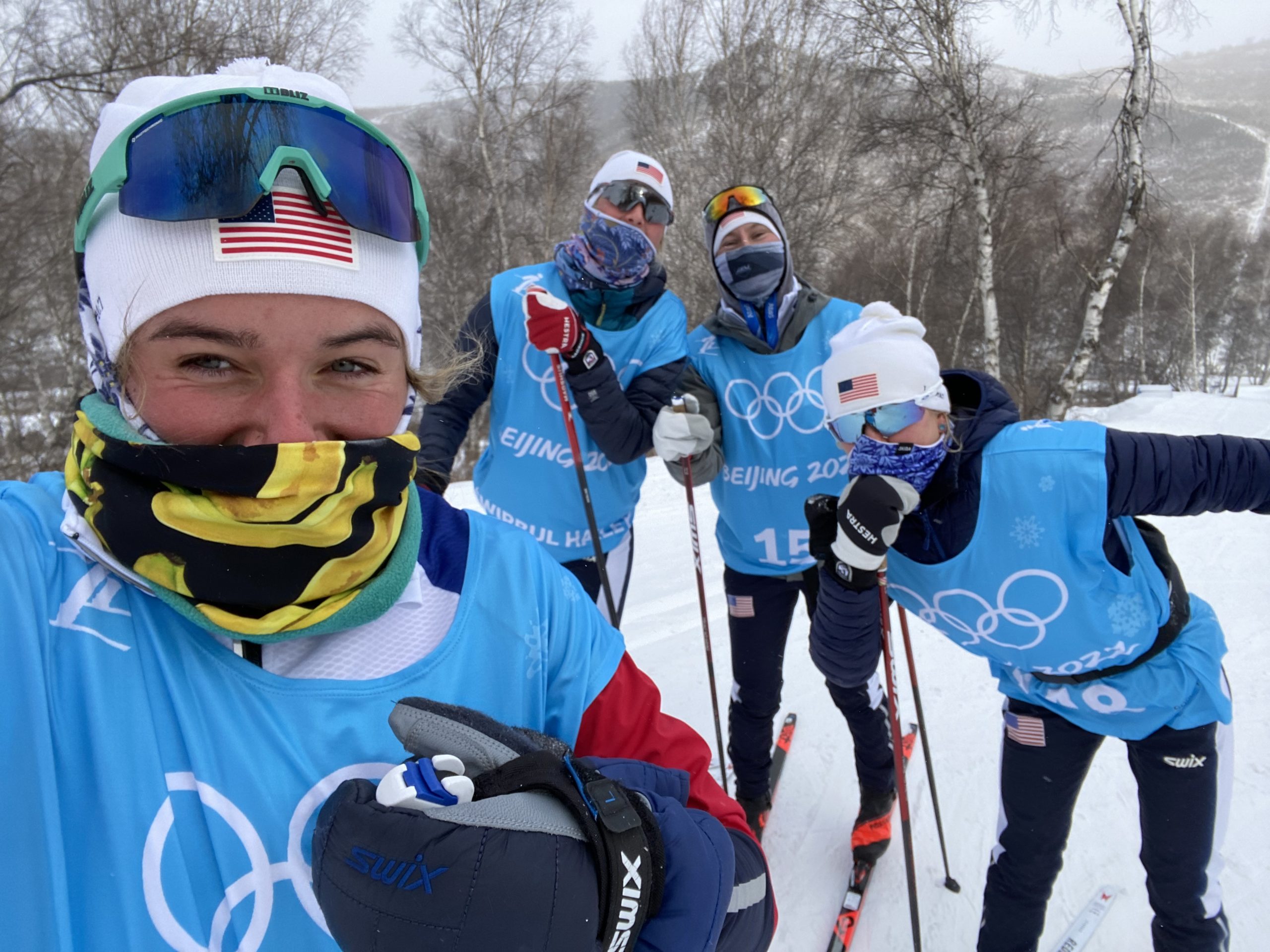
McCabe credits her teammates with helping her develop the traits that won her recognition. Here she is training in Beijing with Hailey Swirbul, Hannah Halvorsen, and Sophia Laukli. (Photo: Novie McCabe)
Team USA on the Road
The U.S. Ski Team’s culture is widely celebrated—glitter, dance videos, and road-trip camaraderie. McCabe grew up watching those clips.
“I would see their dancing videos from the World Cup and be like, ‘That just looks like the best time ever.’”
But she knows now that joy is a decision, especially when you’re far from home. “Sometimes you have to decide that it’s going to be a good time,” she said. “Everyone does an excellent job of being good teammates.“
That environment matters, especially in challenging seasons.
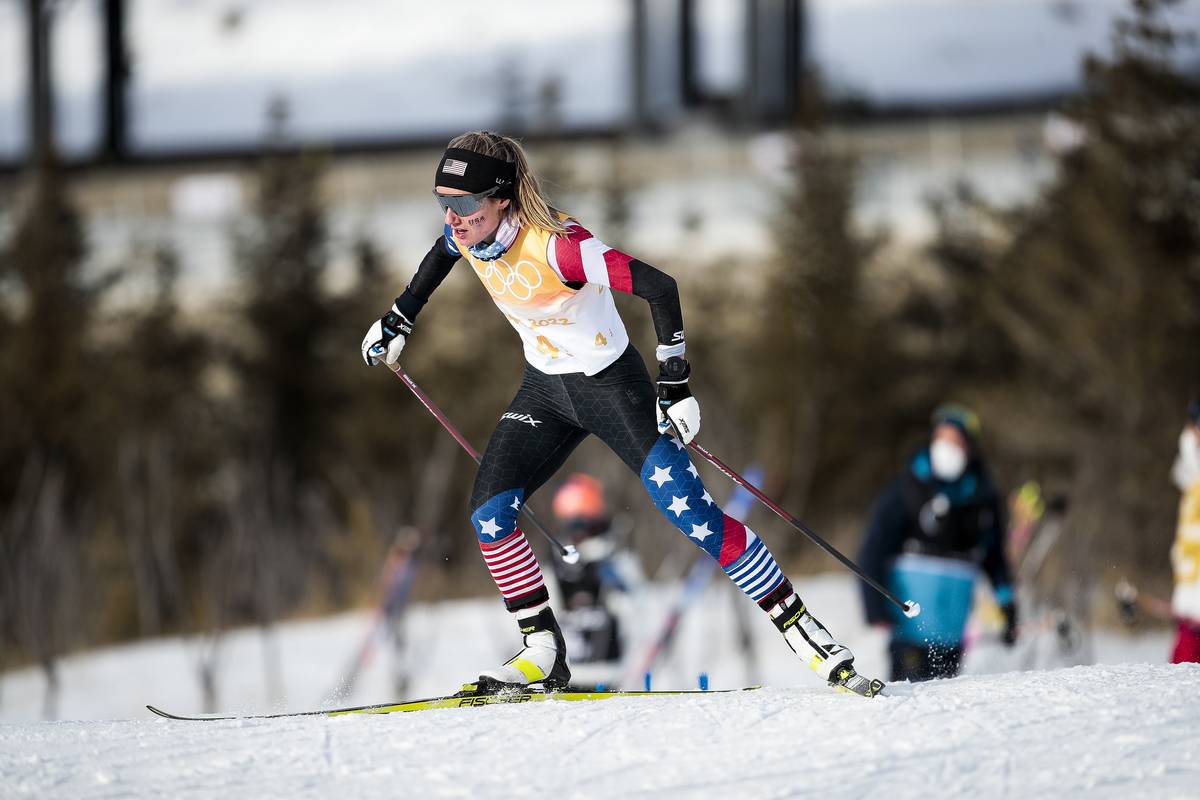
Novie McCabe skates a strong third leg for Team USA in the 4 x 5 k relay at the Beijing Olympics in 2022. (Photo: NordicFocus)
Europe: Brown Cheese, Ferris Wheels, and Perspective
Her memories of Europe arrive in flashes of color rather than race results.
“I love brown cheese,” she said. “You can get it here, of course, but it’s not as good.“
She recalls Trondheim at Christmas—”Ferris wheel and everything“—and moments where she stepped outside the hotel room and let herself experience the place.
These glimpses matter because they remind her of what she still wants from her career: a stable return to the World Cup, a chance to live in that rhythm again.
And through all her travels, she keeps a single talisman:
“Katherine Ogden made me a crochet octopus one year… I’ve brought it along as a good luck charm ever since.“
Novie McCabe after the World Cup 10k in Falun, Sweden, in 2024. (Photo: NordicFocus)
The SuperTour Returns — and She Hopes to Join It
Which brings the story back to this week, and the opening races of the season. “I haven’t started a season domestically in like four or five years,” McCabe said. But she’s doing this season differently.
She is hopeful she will race—one race in Fairbanks, one in Anchorage, if her body allows. More than anything, she wants to be thoughtful and patient.
“My main goal is to make the Olympics,” she said. But this winter, her priority is health. “Being able to race and stay healthy and recover… that would look like a win for me.“
The Olympic qualification system is, as she put it, “really complicated“—top-45 overall rankings, top-8 results, SuperTour contingencies. But she isn’t thinking that far ahead yet.
She’s thinking about one start line. One bib. One race that feels like progress.
Becoming Who She Meant to Be
If you fast-forward five years, she still knows exactly where she wants to be.
“I, for sure, dream about being one of the best skiers in the world,” she said. “I hope to be able to compete with the best one day.“
She also knows this path no longer looks how she imagined it “four years ago.” But she has something she didn’t have then: perspective, patience, and a grounded sense of herself.
Back in Anchorage early last month, the snow hadn’t fully arrived. It mirrored her season ahead—close, possible, not yet certain. The SuperTour begins this weekend, and McCabe is on the edge of stepping back into the environment she loves.
Maybe in Fairbanks. Maybe in Anchorage. Maybe later.
But the hope is real. The joy is returning. And somewhere in her bag, the crocheted octopus is still waiting.
Love Stories Like This? Help Keep Them Coming.
Feature interviews like this one take time, access, and care to produce. If you value thoughtful storytelling and independent ski journalism, please consider becoming a Voluntary Subscriber. Your support directly fuels the work we do to cover the people, places, and moments that make our sport special.
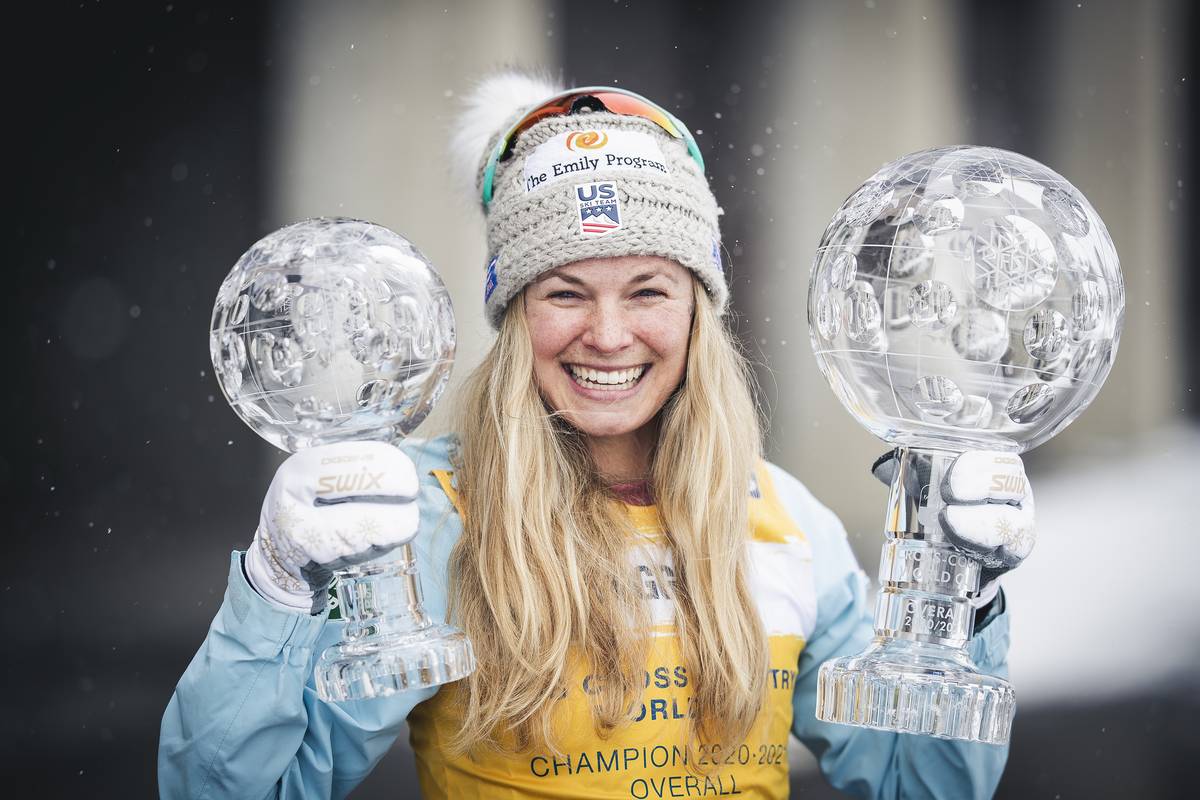
Before she was capturing Crystal Globes, Jessie Diggins was working her way up the skiing pipeline. Developing skiers across the country receive assistance from the NNF. (Photo: NordicFocus)
There’s a great scene in the 1983 classic movie epic The Right Stuff, where the test pilots are hanging out in their dank watering hole discussing the future of supersonic flight and bemoaning what they see as misplaced priorities. The press liaison throwing back a beer with Chuck Yeager and Jack Ridley seems to innocently ask, “you know what makes your rocket planes fly?” The aeronautical engineer puts down his beer and responds by beginning to recite the complexities of aerodynamics when the liaison interrupts, shaking his head at him and says, “Funding, that’s what makes your ships go up. I’ll tell you something …no bucks, no Buck Rogers.” It was a perfect synopsis with a crystal clear meaning. All of the science, bravado, and tenacity in the world didn’t matter if there wasn’t the funding to support the incremental gains needed to push human flight in supersonic speed aircraft. No bucks, no Buck Rogers. It’s that simple.
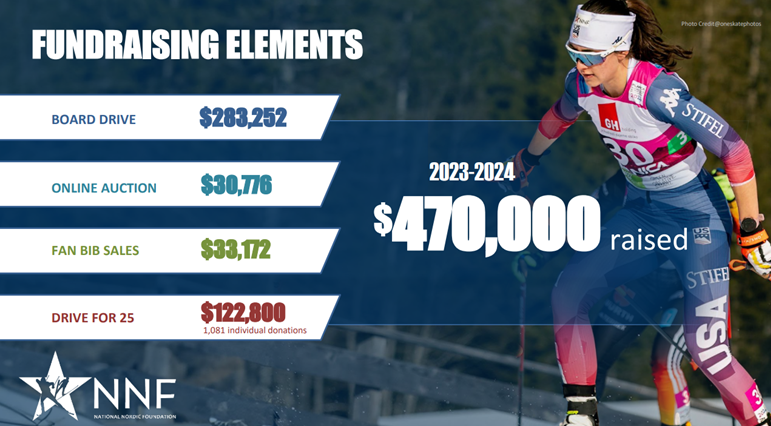
The NNF raised over $470,000 last year, helping to fill the pipeline of talented Nordic athletes. (Photo: NNF Impact Statement)
The same is true in elite level skiing. All the hard work, talent, training, and determination in the world won’t matter if there aren’t the dollars to get athletes to the World Cup, and equally important, to develop young athletes who fill the pipeline on their way to the top of their sport. In short, no cash, no Cups. The best skier in the world can’t win anything on any level, if they’re grounded in their gym in Utah.
This presents skiers with a real problem. In the United States, Nordic skiing is a low profile sport, and unlike almost every major international competitor, the U.S. cross-country squad doesn’t receive direct funding from the government. Contrast that to Norwegian skiers who really don’t have to worry about where the money will come from. Ski fast and the cash will follow. In America, it’s a different story. While the headline skiers on the United States A and B teams receive funding from U.S. Ski and Snowboard, through the U.S. cross-country team, skiers working their way up the skiing ecosystem are largely on their own financially. It takes a mix of club support, sponsorships, fundraising, and donors to keep the pipeline of young talent flowing in the ski game.
Sammy Smith after skiing to 2nd place in the skate sprint at World Junior Ski Championships Planica, Slovenia. Talented athletes like Smith have options other than cross-country. NNF helps to keep athletes like Smith in the skiing game. (Photo: Courtesy Image/Jasmine Wiley)
If you’re a talented young athlete, you also probably have other options besides skiing. Look at Sammy Smith and Sophia Laukli. Both have the talent to earn a living in other sports. To keep them in the ski game long enough to reach the A team, there needed to be a funding mechanism to help developing skiers until they reached the level of receiving national team support.
For a young skier trying to stay with the sport, the different pieces of the funding puzzle can be an economic Rubik’s cube to try and figure out. That’s where the NNF (National Nordic Foundation) comes in. It acts as the bridge in that funding gap between established U.S. cross-country team skiers, and those without full national team financial support who are chasing their World Cup dreams. It’s the bridge to where the funding is easier to acquire— being an A or B team member of the U.S. national squad— and wandering the financial wilderness of being a developing athlete.
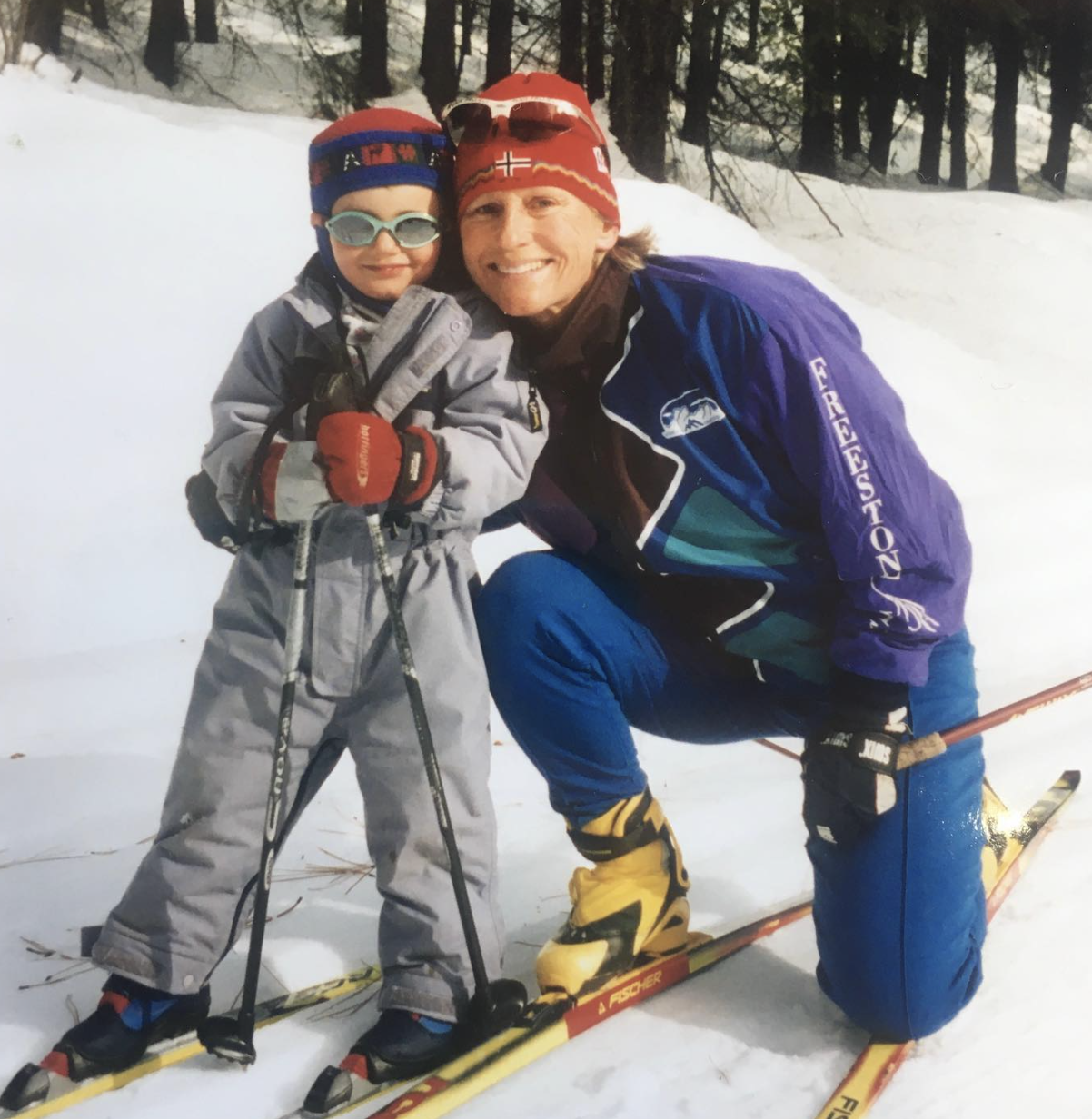
Laura McCabe (right), former U.S. ski team member and Olympian, is the current NNF chairperson. Here she is working on skier development with her then young daughter, now U.S. team member, Novie McCabe. (Photo: Instagram @novie.mccabe)
The NNF is a non-profit funded solely by donations whose mission is to “power the opportunities that bridge the gap to World Cup and Olympic excellence for Nordic skiers from the United States.” Chairperson of the Board of directors, former Olympic cross-country skier Laura McCabe—mother of current U.S. team member Novie—states in her letter to the ski community that the NNF was “founded on the belief in supporting a development system rivaling any nation, a vision we’re proudly realizing thanks to our dedicated community.” That founding vision was a tall order considering that the other major Nordic nations don’t have to go to donors with hat in hand soliciting support.
But the NNF has been successful in fulfilling its mandate as a funding bridge. Last year, the NNF raised $470,000 to support the development of the cross-country racing ecosystem in the United States.
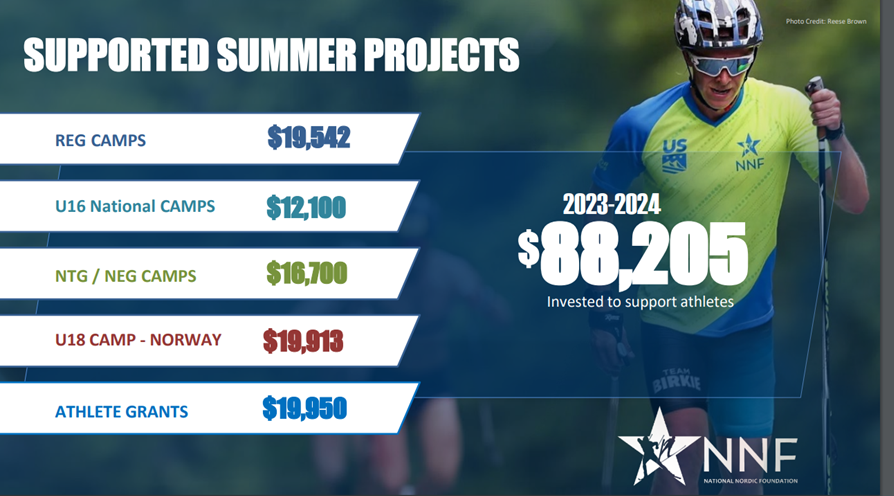
NNF supports summer as well as winter projects. (Photo: NNF Impact Statement)
NNF uses that money to help skiers afford the cost of winter and summer events and training. In the summer, NNF helps offset the cost of attending training camps. There are National Elite Groups, Regional Elite Groups, National U16 Camp, and international development exchanges and trips. Last year NNF provided over $88,000 in funding for these activities.
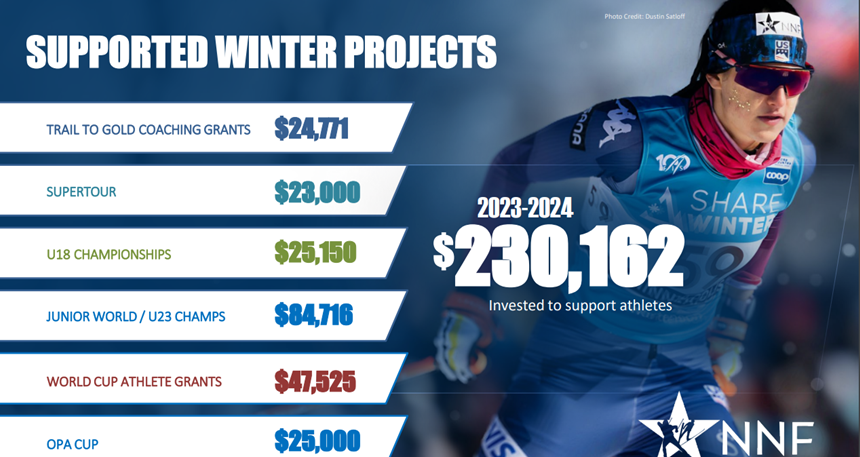
During the winter, NNF provides funding for coaching development as well as athlete funding to help attend U18 championships, Junior World/U23 championships, World Cup races, and OPA Cup racing (a second level of competition ranked just below the World Cup). There are also individual grants to athletes to help them attend World Cup events. Last year those winter projects support for event attendance was over $180,000.
The NNF is the lead sponsor for the Supertour as well as supporting other winter programs. (Photo: NNF Impact Statement)
NNF also sponsors domestic racing by being the title sponsor for the Supertour. The Supertour is the highest level of race competition in the United States and consists of a race series spread across the country. Success in the Supertour often leads to a spot on the U.S. national team or start rights in the Tour de Ski. Last year NNF subsidized the cost of the Supertour to the tune of $23,000, which covered almost 60 percent of the tour’s prize money.
One of the NNF’s other successful winter projects is its Trail to Gold program. The T2G is a coaching grant that supports developing women coaches and technicians in an historically male dominated profession. Bernie Nelson who was just hired by the U.S. team as a full time technician was a T2G funding recipient.
U.S. team coach Matt Whitcomb (left) crunching numbers with Sydney Palmer-Leger. He’s a key part of the puzzle to help the NNF design its funding disbursements. (Photo: Leann Bentley, U.S. Ski Team).
A critical piece of the puzzle for the NNF is coordinating between itself and the U.S. national team. That’s where Matt Whitcomb comes in. Whitcomb is the head coach of the U.S. ski team. He is also on the NNF Board of Directors. Whitcomb provides the Board with an invaluable overview of the needs of developing skiers, and what a successful development program looks like. “The NNF is the bridge between being a U14 athlete and being an Olympian,” said Whitcomb. “NNF picks up and assists with projects between those two things where athletes are most likely to quit because of funding challenges.”
“The NNF and national ski team are critical partners, but we’re really different puzzle pieces that just fit really well together where the NNF funds younger kids, and the U.S. ski team funds the older or more successful athletes. Our philosophy at the NNF is that all hard working athletes with big goals should be able to compete in the sport regardless of their economic status” The NNF states that there is funding which touches over 250 athletes per year, with funding from thousands of donors. “We have a three year fundraising average of raising over $500,000 a year, said Whitcomb.”
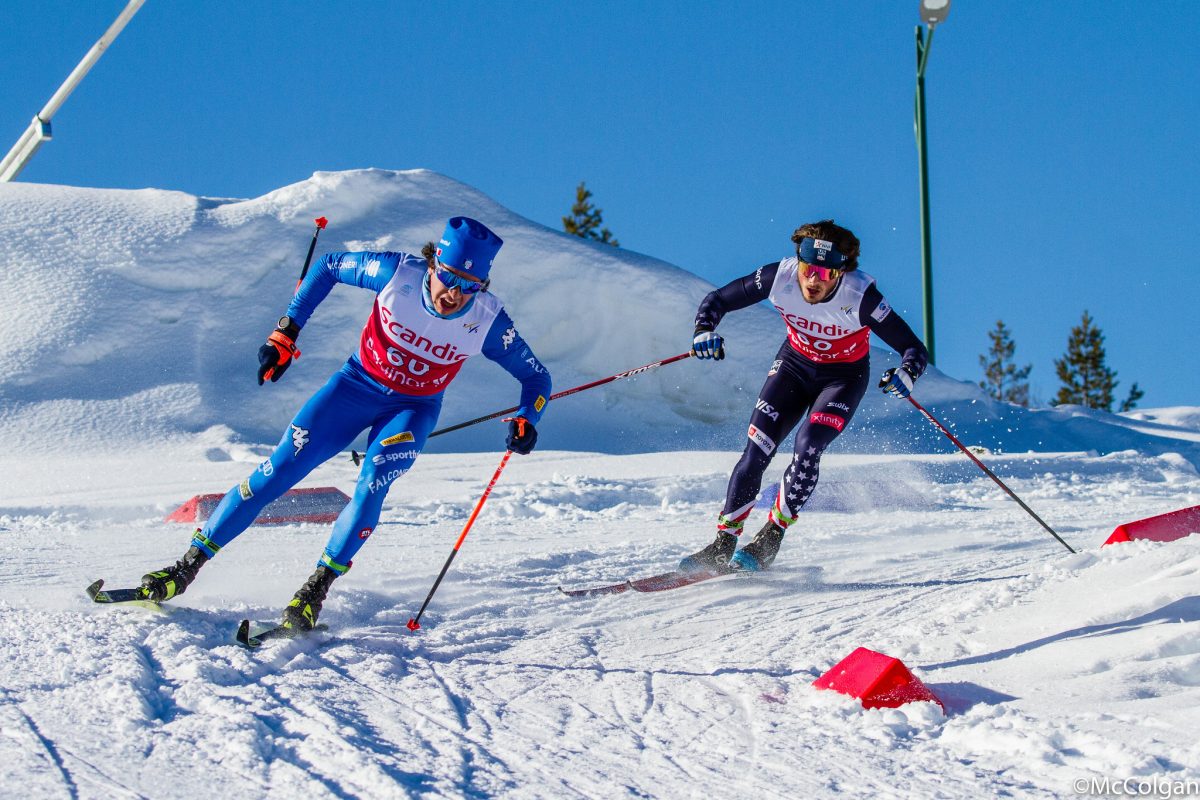
WIll Koch finished 13th in the 10K Classic at the 2022 Junior World Championships. NNF helped secure his presence. (Photo: John McColgan)
Often part of the NNF funding process is to generate individual amounts of support for certain events. For example, there might be a dollar amount set aside for the U23 championships which is then divided between different athletes. It can start out as a large pot of money, but by the time it’s divided between all the athletes and support crew, the dollar amount shrinks significantly. For example, it previously allocated over $84,000 in total to the last Junior World/U23 Championships. But after the math is done, it only comes out to several thousand dollars per athlete. It’s a big help but doesn’t cover an athlete’s entire cost. “There’s 10 wax techs alone that come to World Juniors, and around 24 athletes,” said Whitcomb.
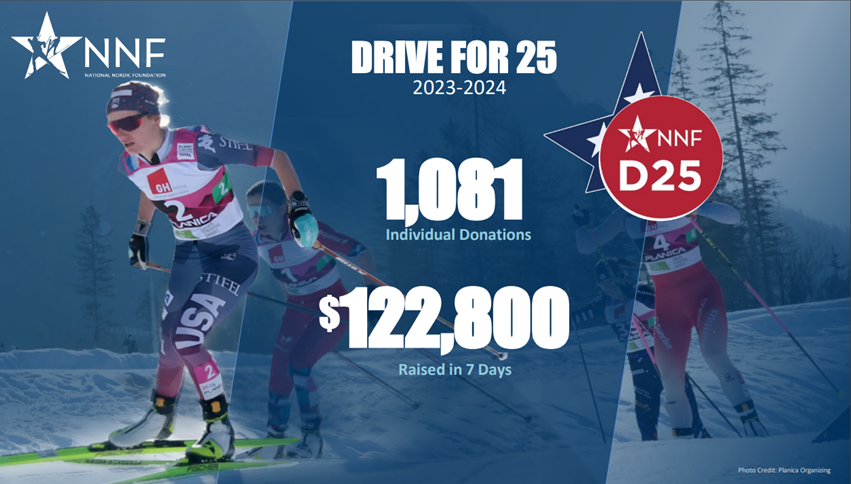
NNF focuses on grass roots fundraising. Over 1,000 donations just for the Drive for 25 fundraiser shows its breadth. (Photo: NNF Impact Statement)
Athlete buy-in is critical to NNF’s mission. Athletes are part of the fundraising efforts and build important ties to the cross-country community. Athletes are encouraged to actively participate in the fundraising process. “We don’t cover any project completely,” said Whitcomb. “The goal is to leave some of the responsibility up to the club and the athletes. If they all do a little bit (the athletes), it will really move the needle for an organization like this.” The NNF is proud of width and breadth of its donor base, with over 1,000 individual donations for its drive for 25 fundraising effort, it demonstrates its status as a grass roots organization. “Our window is at the grass roots level. There are people that donate five dollars recurring monthly. You know what it means to those people. We’re trying to sell shares of this great journey to as many donors as possible.” You may have heard of the Drive for 25, but not really known what it was about. It’s one of the NNF’s principle fundraising efforts. Last year it raised over $122,000.
It’s not just racers who benefit from the NNF’s support. High level racing needs high level officiating. At every FIS (International Ski Federation) event there are teams of technical delegates who are the equivalent of officials or umpires. Without the technical delegates, high level racing doesn’t happen. In the U.S., these positions are volunteers, but there are significant expenses attached to being a delegate. NNF has launched a new program to offer grants to individuals trying to gain technical delegate status to help offset part of the expense. It’s part of NNF’s efforts to maintain the flow of talent and treasure which feeds the cross-country pipeline.
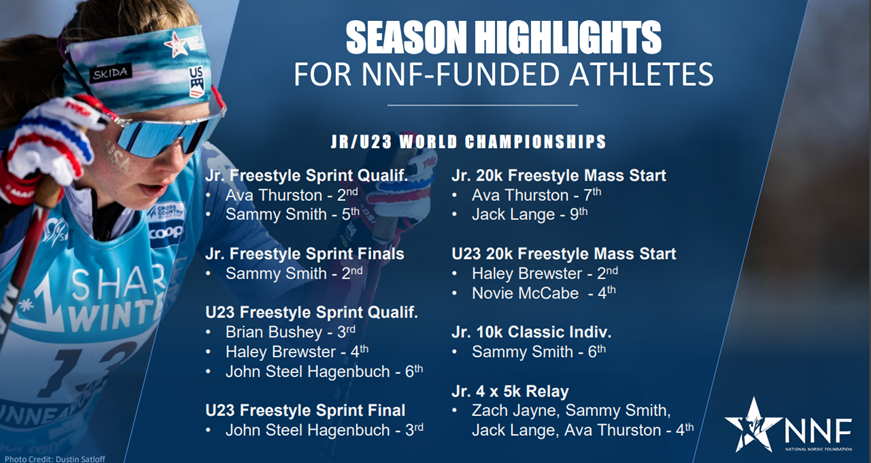
NNF is part of the American success at the Junior level. (Photo: NNF Impact Statement)
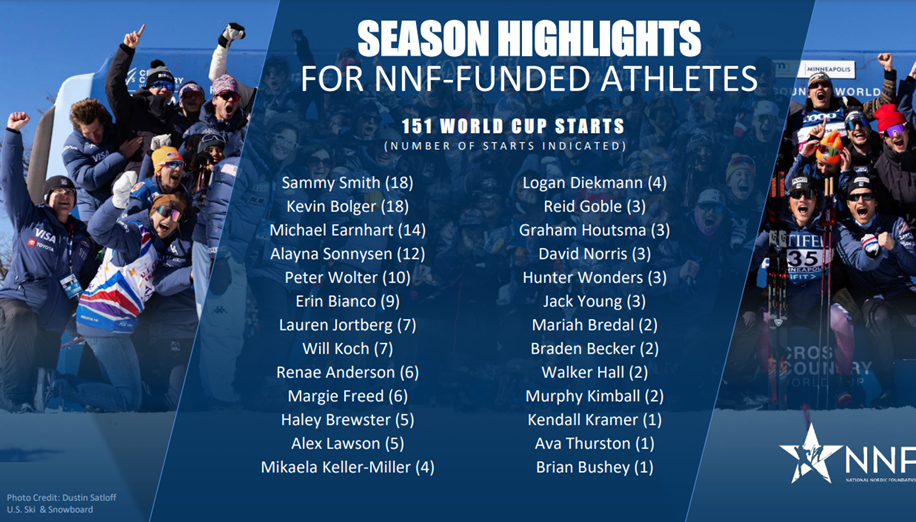
The NNF proudly points to athletes’ success as proof that its support continues to feed the American pipeline for world class ski talent. In the most recent Junior/U23 World Championships nine different NNF funded athletes finished in the top 10 in different events. In addition to the junior level racing, it also provided funding which contributed to 151 world cup starts. The results from that effort were over 20 top 30 World Cup finishes for NNF supported athlete. Another sign of NNF fulfilling its mission is that many previously NNF funded athletes have recently achieved United States A or B team status, including Sammy Smith, Kevin Bolger, and Will Koch.
NNF also impacts World Cup performances as it helps athletes who haven’t yet made A or B team status. (Photo: NNF Impact Statement)
Every time one of these developing athletes achieves success in competition it helps moves them along the pathway to becoming a member of the United States A or B team which is where the other side of the funding bridge is met and continues the pathway to Olympic success. “Take a look at the last Olympic team. Everyone of those athletes, earlier in their career, had received funding from NNF.”
It’s fair to say that without NNF support the pipeline of developing skiers would be limited to athletes from wealthy backgrounds or those who have the good fortune to have the marketing skills to promote themselves on GoFundMe pages or Instagram. As long as it continues to receive support from the Nordic community, NNF will continue to be the funding bridge for up and coming athletes.
Hailey Swirbul striding to victory at Sovereign Lake. (Photo: Peggy Hung)
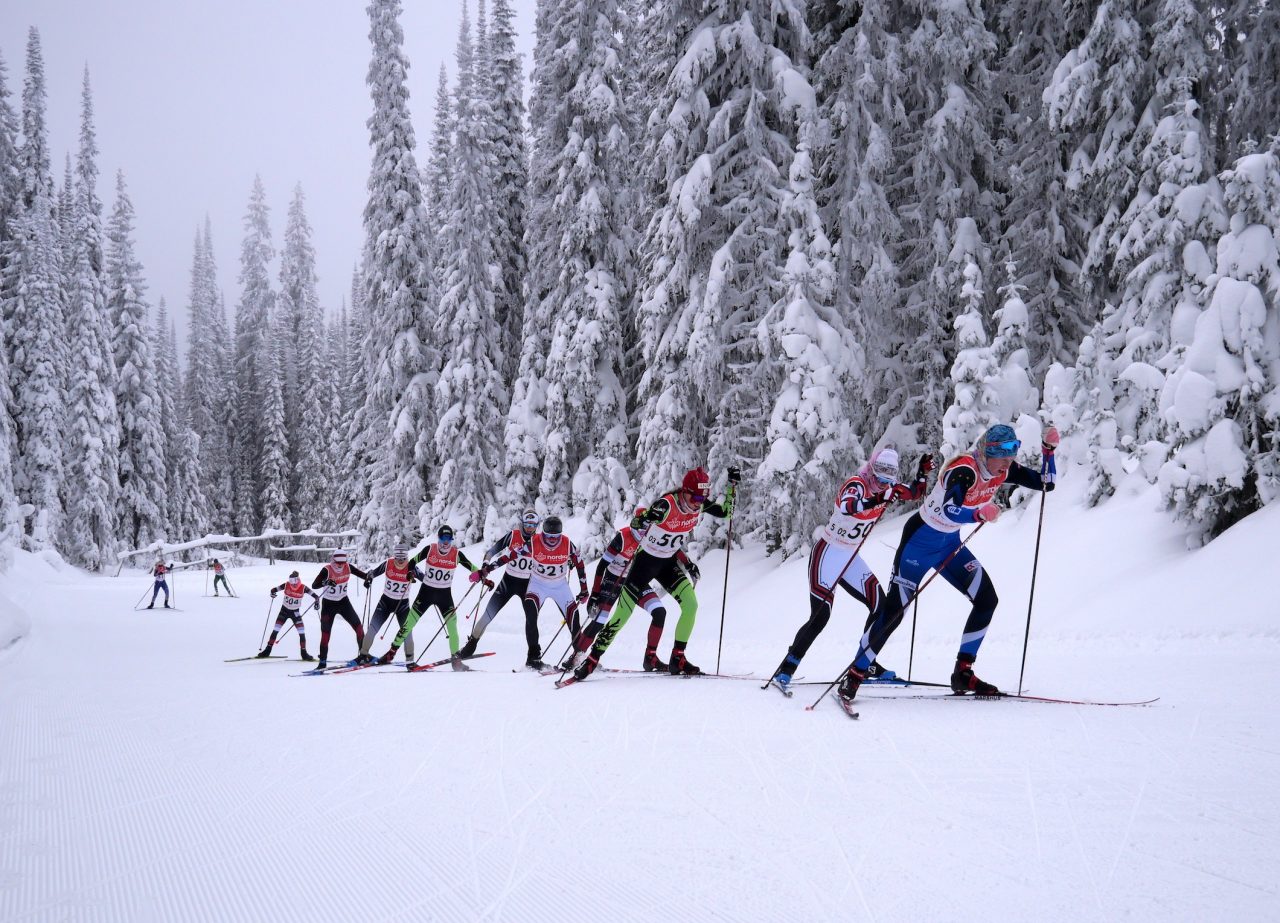
Race day four at Sovereign Lake was a 10km individual start classic in the sunshine. With humid new snow at -10C all day while the air warmed up to -4C, all the teams found fast skis and solid kick on a great day for striding.
Once again, the Open and U20 categories skied 2x5km first, followed by U18 and U16 who skied 2×2.5km, for a total of 385 starters Sunday.
Individual start races are about skiing fast, but also about pacing. Keep reading to the end to see the different pacing ideas from top skiers.
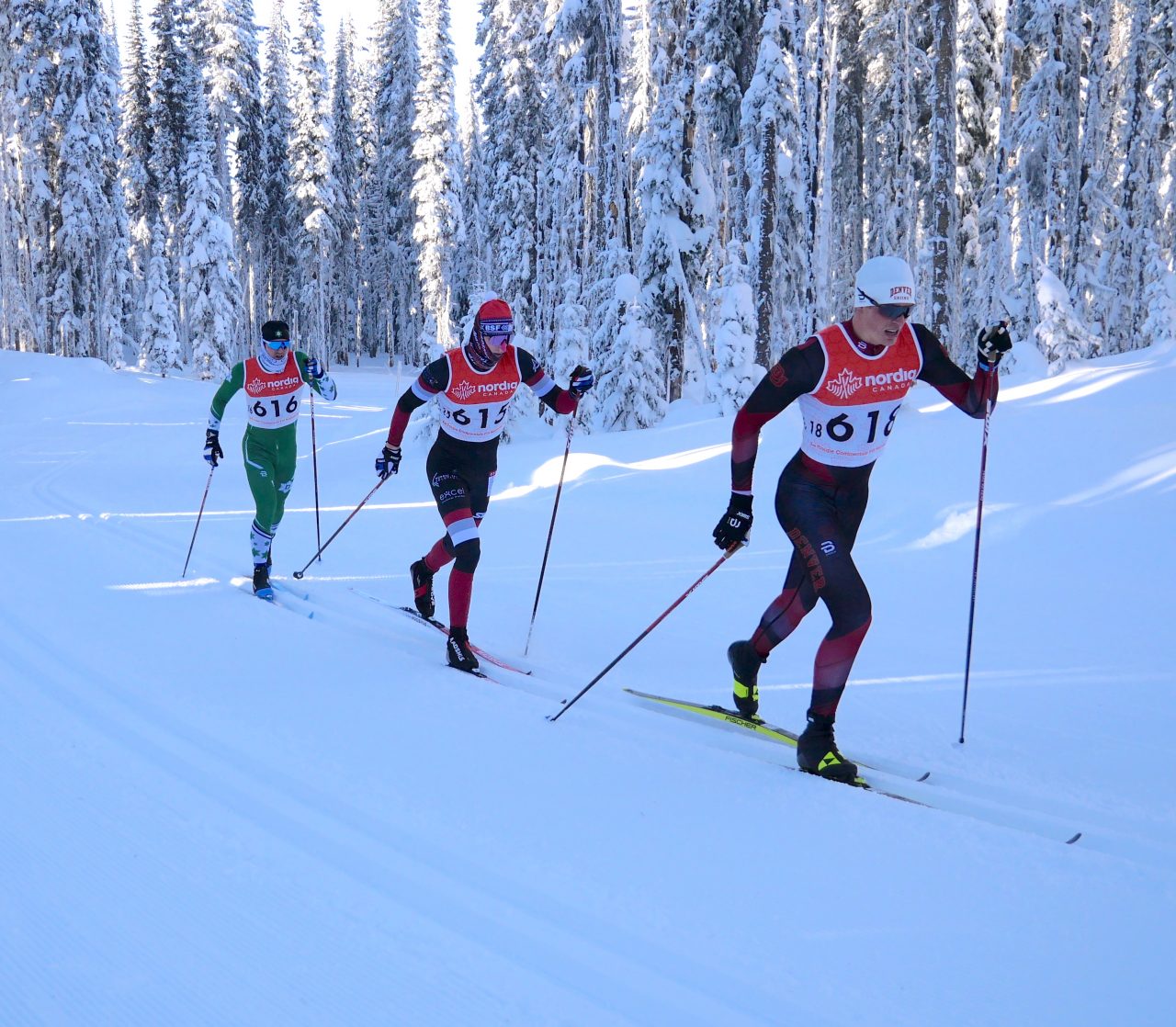
Andreas Kirkeng (618) leads Reid Noble (617) and John Steel Hagenbuch (616) on the second A climb. (Photo: Peggy Hung)
At the end of a hard week of racing, only 102 men of 118 would finish, with University of Denver’s Andreas Kirkeng (NOR) taking his second win in his second race, completing the 10km in 27:17.7. Bridger’s Finn O’Connell (USA) was second, 53.1 seconds back. Dartmouth’s John Steel Hagenbuch (USA) was third at 1:08.6.
Canada took the next three spots, with AWCA’s Scott Hill at 1:09.6, U of Utah’s Sam Hendry at 1:23.5, and National team member Xav McKeever at 1:25.3 (and top U20).
Kirkeng was pleased with his racing, having skipped Wednesday and Thursday to complete a volume block here.
“Today, I was really good. I felt super strong and my skis were perfect. They were like real good kick, more than enough to do the hills here and the speed on them in the downhill were just insane. So perfect day.”
Here is Kirkeng’s second time up the final ‘kicker’ climb with 500m to go:
O’Connell was more moderate about his second place: “It was pretty solid I’d say. The goal is always to go out there and fight for to win and I felt good today, skis were really good. Thanks to both my coaches and yeah, gave it everything I had.”
So many skiers commented on having great skis that it would become repetitive to quote each one.
“It was good,” Hagenbuch said. “It was definitely quite hard after a long week of racing and a lot of cold air that has been breathed so far this week. So like the lungs are definitely feeling that but I tried hard.”
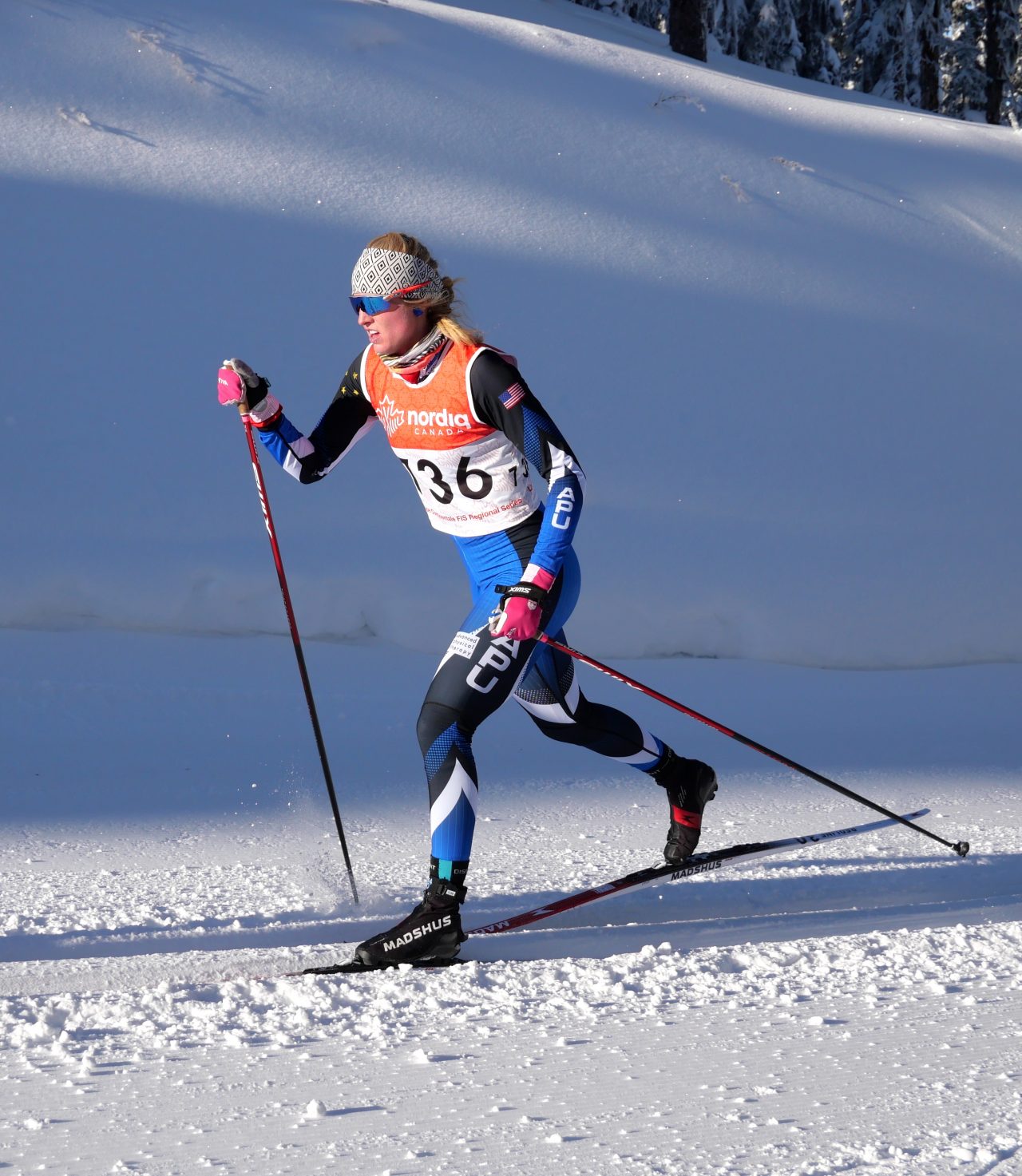
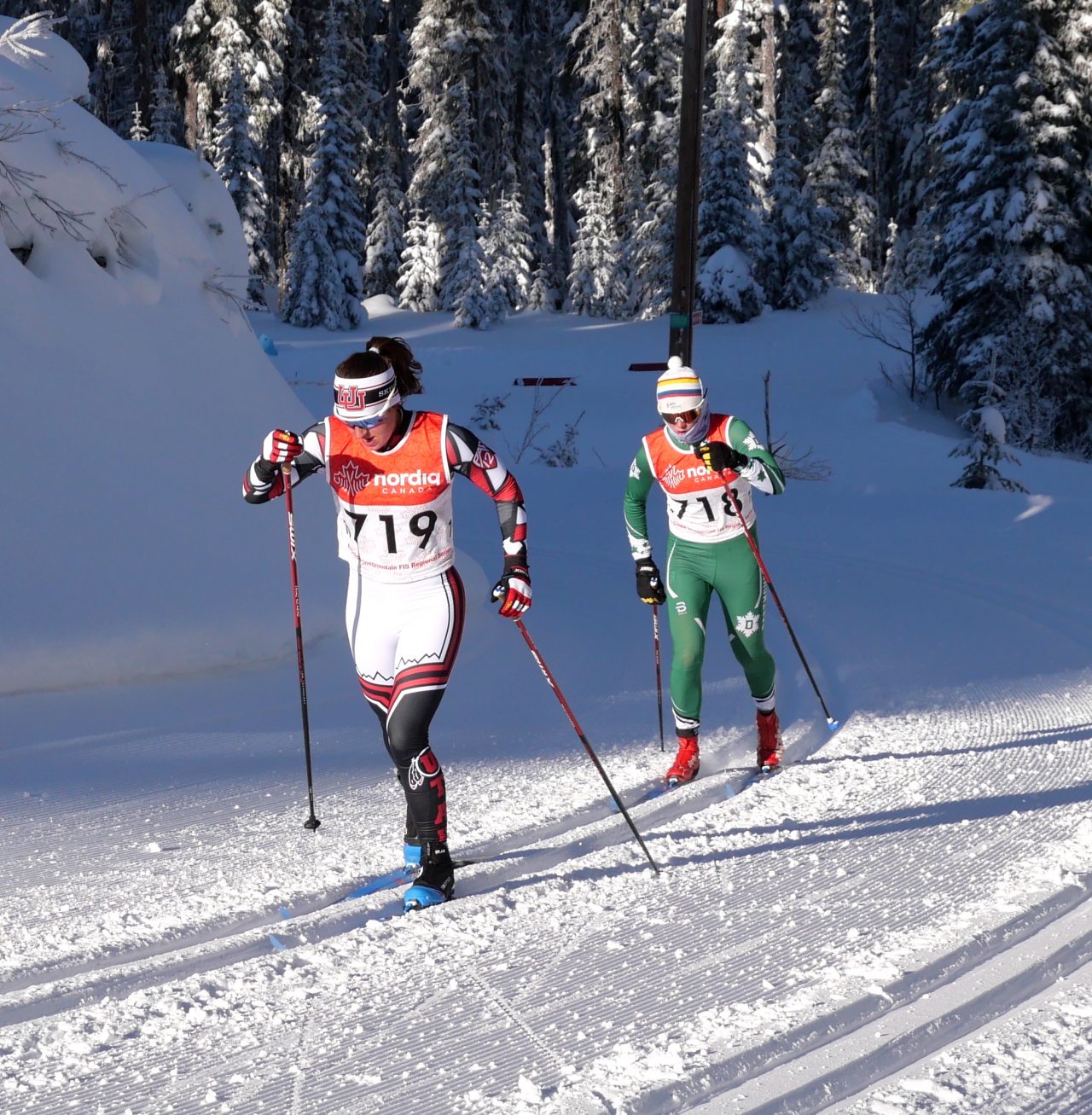
Sydney Palmer Leger (719) on her way to a fourth podium in five days. (Photo: Peggy Hung)
On the women’s side, APU’s Hailey Swirbul (USA) continued her solid week with a third win, skiing the 10km in 31:55.9. U of Colorado’s Hanna Abrahamsson was 23.6 seconds back with U of Utah’s Sydney Palmer Leger (USA) taking third at 1:12.5. AWCA’s Sonjaa Schmidt was top Canadian, in sixth at 1:33.5.
Swirbul was happy: “Today was a really good one for me. I felt like I paced it well and tried to race really smart for me. And I think that paid off.”
Abrahamsson was all smiles on Sunday and FasterSkier has the video evidence:
FasterSkier missed Palmer Leger, but did get some video on the final ‘kicker’ climb:
The women’s field was also diminished by a hard week, with only 75 of 87 starting. There were a lot of smiling faces on those that persevered.
For some, the Upper World Cup 5km is a course they can ski in their sleep. Or nightmares. For others, it was the first visit. The course looks simple on paper, with only 154m of climbing in 5.2km. With 14 splits per lap, there is endless opportunity to compare pacing.
Kirkeng won by 53 seconds. Almost a minute in a 10km with a deep North American field. Which means when he talks about pacing, FasterSkier records video:
Kirkeng took a different view of the course than most of the others and maybe that made the difference.
“I knew with fast skis that some of the downhills and flats that were tracked I would be able to rest quite a bit. So I really just pushed the hills and got up with as quick as I could, knowing that there was rest ahead.” — O’Connell
“It’s at altitude. And it’s there’s a lot of sustained climbing on this course. So I think you have to start out the first lap almost in threshold. And that actually is race pace on a course like this. I also had the benefit of, honestly, some of the best skis I’ve had in years. And my coaches did an amazing job with skis today. So that really helps to have good kick and also enough glide through the double pole you can make up time because there’s a lot of time to be made on those transitions. ” — Swirbul
“I started out a bit easier on the first lap, especially because it’s a lot. There’s a lot of uphill the very first half of the first lap. So I started out a bit easier. And then when I came around for my second lap, I really started to dig deep and give it all I had.” — Schmidt
“Oh, just crush it up hill and double pole like a maniac in the flatter part. I would say and just survive. Yeah, enjoy a little bit of a nice view, it was so beautiful out there today.” — Abrahamsson
“You got to really keep it controlled in the first k. I almost feel like I’m warming up the first climb and then kind of get into the race. But yeah, thinking about it, I don’t think I’ve raced a race course in any part of the world more than this course, I’m used to it. ” — Hill
“It’s always hard to race at Sovereign because it’s high altitude. Always hard racing. So yeah, it’s probably one of the tougher spots to race in Canada.” — McKeever
“Just kind of settling into a rhythm on the long climb there [pointing to the first A climb] and just working it and then making sure you save something for those last two punchy climbs into the finish.” — Hendry
How Was Your Week
After a long five days that both Swirbul and her coach Erik Flora compared to the start of the Tour de Ski, FasterSkier asked skiers for their impressions.
The wax techs had skis dialed by sunrise. (Photo: Peggy Hung)
“Oh, I absolutely love SilverStar. And there’s no better day like today to finish off this really good week of racing and just well, well put on races by everyone here.” — Swirbul
“I really like this place. I don’t want to go home. We’re flying back to Boulder tomorrow. And I don’t want to do that. I want to be here. It’s like, it’s so amazing. The skiing is so good. And yeah, so beautiful.” — Abrahamsson
“It was great. I’ve never been to SilverStar [before] but the conditions have been unbelievable and races have been very, very well organized. The volunteers and race organizers did an amazing job and I look forward to coming back sometime.” — Hagenbuch
“I live over in Canmore, so as soon as Sovereign gets snow, I’m hopping in the car and coming here [and] did a two week training camp leading into these races. So yeah, the SilverStar magic is a real thing.” — Hill
It is an early start under the lights for the coaches. (Photo: Jacqueline Akerman, Sovereign Lake Nordic Development Academy)
Originally launched in 2012, the NNF Cup celebrates club excellence in America’s premier domestic ski competition by tallying performance of club teams across the SuperTour season. The NNF Cup was awarded to Alaska Pacific University last season.
The recent success of the US on the World Cup and at the Olympic level has been fueled by a renewed commitment by US ski clubs to provide a club structure that supports athletes from their time as Juniors through to post-college senior professional racing. With the NNF CUP, the National Nordic Foundation wants to celebrate the spirit and creativity at play in providing US skiers with structured programs for their continued development, and nod to the competitive nature of these programs by adding a club-wide aspect to their performance-oriented goals.
NNF Board Chairman Yuriy Gustev says that, “Not only do the clubs create a positive learning and skill development environment for the youth, but they also provide essential support to develop athletes and surround themselves with high-level coaches and race service staff. The NNF Cup is a way we can recognize the efforts of our clubs, and our Board of Directors is happy to sponsor it again this season.”
NNF Cup standings will be updated weekly on our website. The full SuperTour schedule can be found here. Individual SuperTour standings can be found here.
You can read full recaps of each race from FasterSkier: including the Classic Sprint, Skate Mass Start 10 k, and Skate Sprint. The SuperTour heads to Sun Valley, Idaho this Saturday, and Sunday to continue its round around the West during Period 1.
Score top 3 club skiers who finish in the top 10 using Continental Cup scoring in each event.
Scoring for making camps
15 points for athletes qualifying for U16 Camp. No limit per club.
30 points per athlete qualifying for camps. No limit per club.
There will be three team standings: Male, Female and Overall
Overall winner will win the NNF Cup and be awarded a traveling trophy.
NNF Cup Standings After Sovereign Lakes, British Columbia Races
The first round of races in British Columbia this past week saw a strong start for a number of college teams, while defending NNF Cup champions APU also got off to a strong start – narrowly missing the top 3 in the week’s overall standings.
Overall
1st. University of Utah – 323 points.
2nd. University of Colorado – 285 points.
3rd. Bridger Ski Foundation Pro Team – 260 points.
The U20 women’s semifinal 2 heading up onto the bridge at Sovereign Lake. (Photo: Peggy Hung)
Day 3 of the Sovereign Lake race week brought a skate sprint on a shorter course and warmer weather: -10C with no wind and occasional light snow.
Wednesday and Thursday were Nordiq Cup events, with only U20 and Open categories. Saturday and Sunday are Canada Cup races, with the addition of U18 and U16 categories, resulting in 402 racers across the eight groups. All four race days are part of the US SuperTour.
All groups completed the 1.2km qualifiers first, starting at 8:30am, and the heats ran from 11am until 4pm, finishing 1 minute ahead of schedule. Though today’s skate course incorporates one meter more of climbing than Wednesday’s classic course (37m total skate climb, compared to 36m on the classic course), many athletes described the feel of skate course as flatter. For comparison, the fastest women’s qualifier on the skate course—APU’s Hailey Swirbul (USA)—finished in 2:46.77, significantly faster than her 4:10.99 win in Wednesday’s classic sprint on a slightly longer 1.3km course.
Julien Locke leads the men’s final up into the finish straight. (Photo: Peggy Hung)
Men’s Freestyle Sprint
The men raced first today, with University of Denver’s (DU) Andreas Kirkeng (NOR) taking the victory in 2:20.30. Dartmouth’s John Steel Hagenbuch (USA) was second, at 0.07 back, with Black Jack’s Julien Locke (CAN) in third at 0.54 seconds behind. Tom Mancini (U Utah, FRA) who won Wednesday’s classic sprint was fourth, followed by Bridger’s Graham Houtsma (USA) and teammate Finn O’Connell (USA).
Kirkeng liked the course: “It’s a flat course, but you don’t have any rests so every small uphill, over the top, transitions, turns, everything matters in this course. The finish is really hard . . . 25 seconds with slightly uphill and a long flat section to the finish line. So the finish is really hard and that’s coming after like two minutes with all out flat skiing so it’s a challenging course, not like in terms of steep hills and a lot of climbing, but just because you have to ski fast and be on top of everything all the way.”
As with many of the podium finishers, Kirkeng tried to save energy for the end.
“For the final, I plan to stay like in third, fourth position and go all out from like the last turn, up and under the bridge, and it worked out real well,” he told FasterSkier. “[Hagenbuch] was coming real fast like the last 100 meters but I managed to stay in front of him.”
“I actually did better than I thought considering I’m usually a distance skier,” Hagenbuch said. “And it was super fun out there. I think, tactically, I was kind of doing the same thing, where I was sitting back a little bit for the first part of the course, and then really pushing on the final hill through the finish.”
Hagenbuch liked the course: “it’s super fun. It’s fast. And obviously a very competitive field here today.”
Locke was the top Canadian, expressing satisfaction with the day as he builds back from injury. He pushed hard into the ‘hole’ descent and led the climb back to the bridge.
“My tactics in all the heats was just cruise the first half and then try to have some good punch at the end,” he said. “Unfortunately, I didn’t have great legs in the finishing straight. But it was not a bad day; a step in the right direction for me.”
Many racers would be happy with a SuperTour/Canada Cup podium under any circumstances, but skiers reach the top by always chasing the next target, each success leading to a higher goal.
The women’s Final descending the stadium bridge towards the final downhill. (Photo: Peggy Hung)
Women’s Freestyle Sprint
After the men’s open and U20 heats completed, it was the women’s turn. “It was a really fun and exciting day,” top qualifier, Swirbul, told FasterSkier. “It’s a shorter sprint course than last time so it was fun to do some real sprinting and tactics.”
Swirbul wanted to try something new today: “I’m normally a racer that will kind of hammer from the gun. So today I challenged myself to try to play more strategy and try and sit behind people into that last downhill. In the last downhill, I’ve tried to free skate as hard as I could and carry as much speed into the final corner and up into the last climb into the drag race in.”
Swirbul won the final in 2:43.02, 0.87 seconds ahead of Bridger’s Sarah Goble (USA). U of Colorado’s Weronika Kaleta (POL) completed the podium, 1.17 seconds back.
Goble was happy with her hard finishing tactics in the earlier heats: “I tried to do that again in the final when I was in third, and I pushed over the top of the hill to put myself into second and kind of control the race through there,” Goble said. “And then Hailey had a really good final push to the finish but [I] couldn’t quite hang.”
Kaleta was very happy with her racing and sticking to her plan: “I wanted hard to be controlled, make sure that I save some energy for the last part. So I tried to do it and I guess I did it quite great.”
U of Utah’s Sydney Palmer Leger (USA) continued her solid week in 4th at 3.49 behind, followed by top Canadian Liliane Gagnon from CNEPH and Team Birkie’s Erin Bianco (USA).
U20 skiers who qualified in the top 30 were automatically moved to the Open heats. Sun Valley’s Samantha Smith (USA) and Chelsea Nordiq’s Tory Audet (CAN), both born in 2005, ‘raced up’ in the U20 group, and qualified into the Open heats where they were eliminated in separate semi-finals.
Tory Audet (bib 108) on her way to a lucky loser spot in her Open quarterfinal. (Photo: Peggy Hung)
Asked about the challenge of racing in the open heats instead of U18, Audet was direct: “I love it. I love the competition,” she told FasterSkier. “World juniors would be probably the biggest goal this year. And then a national title would be awesome. Due to COVID and then a concussion last year, I wasn’t able to attend.”
As Canada ignores the U18 championships, Audet is targeting U20 World Championships in Whistler in late January.
Many of the skiers appreciated the race volunteers at these Sovereign Lake events, but Hagenbuch may have phrased it best: “Sovereign put on a great event. The volunteers have been great. I think they’re gonna be out here for something like nine hours today. So pretty Herculean effort. So big thanks to all the volunteers for their hard work and another day of racing tomorrow.”
Hailey Swirbul (USA) leads the 10km Nordiq Cup/SuperTour at Sovereign Lake (Photo: Peggy Hung)
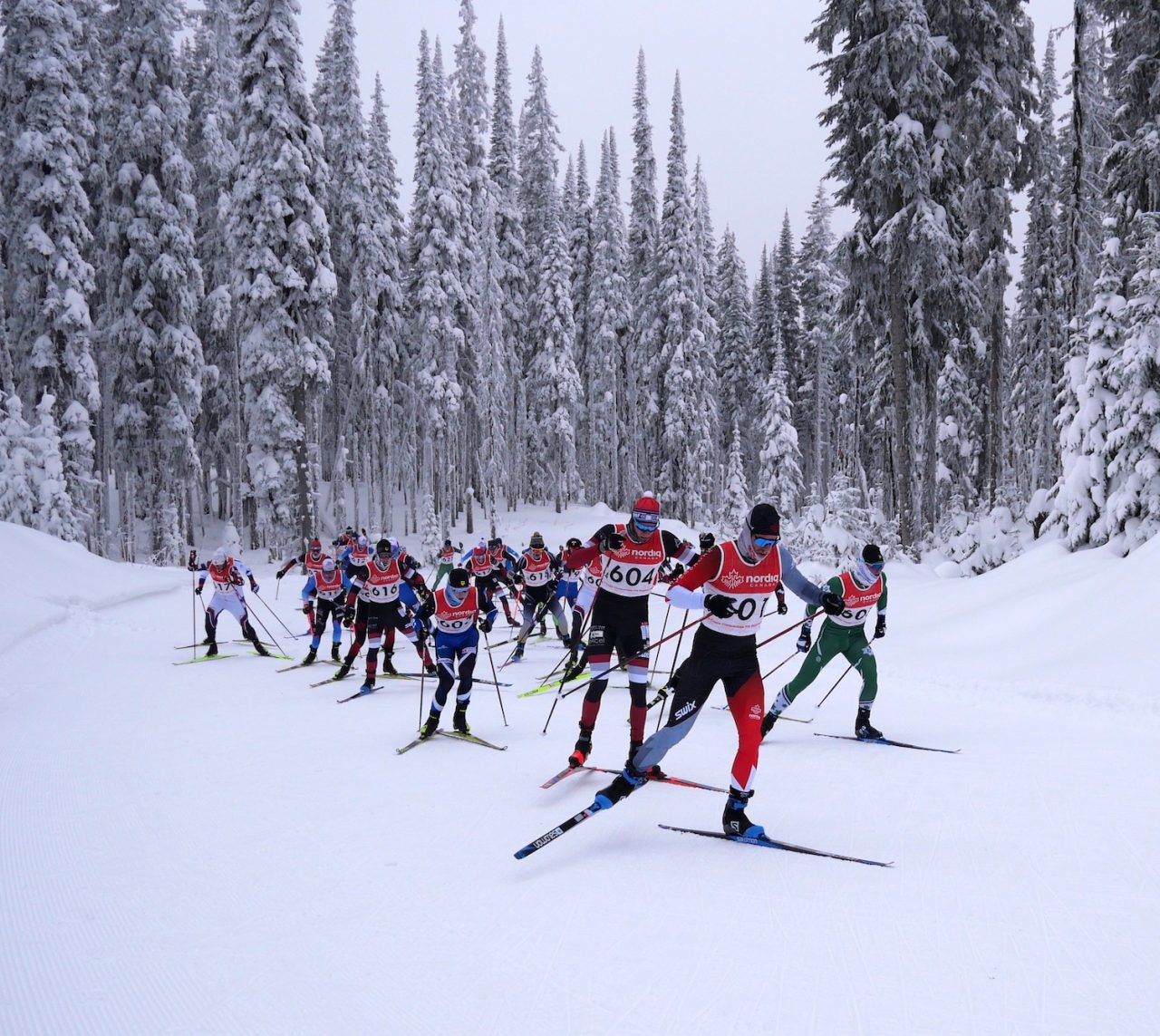
Continental Cup racing at Sovereign Lake continued Thursday with a 10km mass start skate for both genders, using the traditional Upper World Cup 5km course. The weekday races are U20 and Open categories only, with ‘smaller’ fields of 87 women and 127 men registered Thursday.
“I think this is probably the most competitive race in North America this year, so there were a lot of really strong and talented skiers.” — John Steel Hagenbuch, Dartmouth Ski Team
Mass start races at this level usually run in two modes. The group at the front has a tactical race, with most of the group skiing in control and making plans. Behind this group, all the skiers are drilling it, pushing hard to reduce the time gap to the leaders. Many of the men experienced their first 10km mass start today, as this has traditionally been a distance offered primarily in women’s racing.
The day was cloudy and cold, with temperatures hovering at -18C.
The women raced first, with APU’s Hailey Swirbul (USA) setting the pace to reduce the lead pack to 15 skiers by the end of the first 5km lap. The video is at the mid-point of the first A climb, just short of 1km into the race.
“I often find it comforting to be able to ski my own pace and take my own line,” Swirbul told FasterSkier. “I did that. And yeah, it ended up not working out for me, but that’s the way it goes.”
Swirlbul estimated that she led for 9.5km: “I tried making a move,” Sydney Palmer Leger (University of Utah, USA) said, “and then right at the finish, I ended up sliding on my butt.”
Palmer Leger stepped on a ski at the Tree Island turn leading into the finish straight, but was able to sprint back to take second place to U of Colorado’s Anna-Maria Dietze (GER). Dietze finished in 29:59.0, 0.6 seconds ahead of Palmer Leger, with U of Utah’s Karianne Dengerud (NOR) 1.1 seconds back.
“I feel like always kind of sitting in the back for the first loop,” Dietze said, “trying to figure out like which downhills I can take where I can like draft a little bit and was trying to stay relaxed and then when people started to attack, just trying to stick with them and then putting everything on the finish line.”
“I was just trying to take the [last] turn really well,” Dietze continued. “My legs were hurting and I was like I’m just gonna send it and I felt pretty powerful. Felt like I had few metres on them. I thought that was gonna be it and it was awesome.”
Dengerud followed a similar strategy: “I managed to stay like quite far up in the front from the beginning of the race and that helped me save a lot of energy so I had a lot towards the end. And then I wish I’d passed one girl earlier, but except from that, it was great.”
Dengerud skied the loop for the first time in her pre-race warmup and liked the course: “It’s really good. I didn’t ski it before this morning and I heard that it was really hard. But I skied it on my warm up and I figured out that it was as many downhills as uphills, as it should be.”
Dengerud, who grew up near the famous Holmenkollen venue, prefers this course which was built for a 2005 World Cup: “I like it better when you can work the flats a little bit more and it’s not only downhill or uphill, and this course has it all.”
Liliane Gagnon from the Centre National d’Entraînement Pierre Harvey (CNEPH) was the top Canadian in 6th at 9.8 seconds back, trailing Bridger’s Sarah Goble (USA) and Swirbul.
“It was pretty fast at first,” Gagnon said, “but then it calmed down a bit, but on the second lap, the pace got picked up. So you really had to be in the game for it to finish strong.”
Russell Kennedy leads up the second A climb during the Nordiq Cup/SuperTour 10km at Sovereign Lake. (Photo: Peggy Hung)
The men’s race played out in similar fashion to the Women’s, with 22 men finishing the first lap together, passing through the stadium at a comfortable pace.
“I will say that a 10k skate mass start is definitely fast and pretty hectic,” Hagenbuch confirmed. “So there was definitely some carnage out there.”
Wednesday’s winner Magnus Bøe (U of Colorado, NOR) broke a pole in the first kilometre, losing the advantage of his second row start.
Canmore’s Russell Kennedy (CAN) was one of the people pushing the pace, shown here at the top of the second A climb, about 2km into the race.
“[It was] a lineup of guys ripping it and then Johnny [Hagenbuch] started moving up and I saw the attack coming but I wasn’t sure when he was gonna go,” Kennedy said. “And then the second last hill, he pushed super hard. I got boxed in and then tried to make up time but I couldn’t see really what was going on in the finish for them.”
Ten skiers reached that second last hill, known locally as the ‘Wall’ climb together.
“There’s a pretty big steep kicker hill, about a kilometer and a half out from the finish,” Hagenbuch said. “I kind of felt the moment there and I went for it. And luckily, I was able to drop most of the field. But Tom Mancini, he was able to stick on me after that. And then we kind of duked it out towards the end, but I knew going up against Tom in the finishing stretch probably wouldn’t go my way given that he’s such a strong, older skier and obviously a 2018 World Junior Champion.”
U of Utah’s Tom Mancini (FRA) took the win in 25:24.2, 0.6 seconds ahead of Hagenbuch and 4.7 seconds clear of Kennedy.
“Yesterday, I was disqualified [for micro-skating], ” Mancini said. “I wasn’t totally agree with this decision. But so, today, I wanted to race nice. And also just enjoy my first race here. And this is what I did.”
Mancini moved to Utah in the fall and still thinks in French grammar. He also was seeing this course for the first time, unlike Kennedy who has years of experience here.
“I noticed that they have a nice finish,” Mancini revealed. “So I was like, I just need to stay in this game until the last two kilometres. And so the pace was hard since the beginning. So it started pretty high, so pretty fast. So at the beginning, it was a bit hard for me and then after maybe one lap, I felt better. And I was like, alright, no, just have to keep focus and wait until the end.”
It was a challenging day for clothing selection, with many athletes struggling to stay warm on course. “I think we got prepared by being in Alaska last year and Canmore two weeks ago,” Dengerud shared, “so had a lot of clothes on, for sure.”
If the Alaskan skiers (names withheld to protect the guilty) are complaining about the cold after the race, that is a sign that others suffered more.
Mass starts are ‘easy’ to host: today’s event used 65 volunteers over a 12 hour period, including this group building a start grid with numbered marks for 127 athletes. (FasterSkier photo)
What does the CEO of a National Ski Federation actually do? Stéphane Barrette was found clearing frost from the sponsor’s banners early this morning. (FasterSkier photo)
Hailey Swirbul leads over the biathlon bump in classic sprint quarterfinal 1. (Photo: Peggy Hung)
North American racing hit high gear today with the opening of the combined Nordiq Cup and SuperTour series at Sovereign Lake with classic sprints. This week brings together the top skiers from all of North America, Mexico included, and Wednesday’s qualification was kicked off by the top ranked skiers: USA’s Hailey Swirbul and Canada’s Russell Kennedy.
Many teams arrived two weeks in advance to enjoy some elevation training on corduroy while teams with good early skiing—like Alaska Pacific University (APU) and University of Utah—rolled in just in time for official training.
Race day dawned with heavy snowfall and strong winds at -11C. Roughly 20cm of snow fell while the grooming team was preparing trails, starting at 3am. The snowplow got stuck before clearing the Sovereign Lake access road, forcing a one hour delay. The wind and snow ended about 10:30, half an hour before Swirbul started her qualification. As the day rolled on, skiers saw clouds and sunshine, but ended under the lights as the sun set on the men’s final.
APU’s Swirbul qualified first, completing the 1.2km course in 4:10.99. University of Colorado’s Anna-Maria Dietze (GER) was second, 3.29 back, followed by University of Utah’s Karianne Dengarud (NOR) at 4.29.
For the men, Sun Valley’s Peter Wolter (USA) was fastest, completing the same course in 3:32.38. U Utah’s Noel Keefe (USA) was close behind at 0.86 seconds, with national team member Kennedy third at 1.78 back.
Canada has joined a number of countries in automatically shifting U20 athletes into the open heats if they qualify in the top 30 overall. National team member Xav McKeever (CAN) was the fastest U20 male in 9th, 3.29 back,
Mexico’s Karla Schleski Shepard did not qualify for the heats, but her presence made this a truly North American event.
In the heats, racing progressed smoothly with a minimum of jury intervention, although many racers commented on how long the 1.2km course felt.
Hailey Swirbul leading the final into the saddle climb. (Photo: Peggy Hung)
Swirbul won all three heats on her way to victory, leading the final in 4:02.05. Sydney Palmer Leger (USA) was a close second at 0.35 with Dietze completing the podium at 1.05. The final was distinctly international with Germany, Poland, and Norway represented.
Swirbul and Palmer Leger talked about their races and the full North American field, watch it here.
“It’s definitely a hard course,” Dietze told FasterSkier, “it was really tough to do four of these loops all out. A lot of fun.”
Canada’s top woman was CNEPH’s Liliane Gagnon in 10th, followed by AWCA teammates Katie Weaver and Sonjaa Schmidt in 11th and 12th.
Magnus Bøe (161) attacking into the finish straight. (Photo: Peggy Hung)
On the men’s side, U Colorado’s Magnus Boee (NOR) won in 3:23.83, with APU’s Zanden McMullen (USA) at 0.46 and McKeever leading the U20 contingent at 2.70 seconds back.
U Colorado’s Will Koch (USA), Kennedy, and Bridger Ski Foundation’s Graham Houtsma (USA) completed the final heat, with U Utah’s Walker Hall (USA) scoring the same 3:28.68 lucky loser time as Houtsma, but losing out on a tie breaker.
FasterSkier reporters didn’t locate race winner, Magnus Bøe, in the post-race darkness, but we caught up with the other podium finishers.
“I think it was important to keep your energy low early, in the first half of the race, and then coming around the last turn, you want to be in a good position,” McMullen said. “Make sure you really gunned it from there.”
“It’s amazing to be here. SilverStar is beautiful and Sovereign Lake here. This is my first time here, only second time in Canada,” McMullen continued. “So yeah, no complaints. I’ll definitely be back again.”
“I had a pretty spicy semifinal there, broke a pole going into the biggest climb of the course,” McKeever said of his lucky loser path the final. “I just tried to ski as best as possible in the final and just try and be tactical and position myself well and came out third.”
Thunder Bay’s Julian Smith was the third Canadian, going out in the semifinals for 8th.
Russell Kennedy leads the final through the lights of the stadium. (Photo: Peggy Hung)
Athletes will spend a lot of time combing through results from these first high level races, and comparing those with results of Canadian NextGen skiers from Bruksvallarna earlier in November.
“I was happy with my races overall and was happy to come back here to SilverStar, as it’s one of my favourite places in the world to ski and compete in.” McKeever said. “I had a good time in Europe, just warming up with some first races of the season, competing with some really strong people, had some good sprints.”
The “strong people” mentioned by McKeever included a list of stars like Sweden’s Calle Halfvarsson and Ebba Andersson , who moved on to the World Cup in Ruka. Many domestic racers will be looking at the NextGen results in Bruksvallarna and Sovereign Lake to get a sense of how North American racing compares to Scandinavian speed.
Look for some action video on Nordiq Canada’s social media, because Nathaniel Mah is raising the bar.
SilverStar/Sovereign Lake
Confused about the Sovereign Lake versus SilverStar thing? Sovereign Lake Nordic Club has 50km of trails hosting races in Silver Star provincial park. SilverStar Mountain Resort has lodging, an interconnected 50km of trail, and an alpine resort, but isn’t in the park.
The 1.2km loop used today is nicknamed the Beckie Scott course. In December 2005, Beckie Scott earned her first World Cup win in a skate sprint here. This was also Canada’s first dual WC podium when Sara Renner snatched a bronze medal. Nothing brings the passage of time into focus like realizing that both Scott’s and Renner’s children will be racing in the U16 group this weekend.
Men’s semifinal #2 catching the sun. (Photo: Peggy Hung)
Rosie Frankowski races a December 2019 skiathlon World Cup event in Lillehammer, NOR. (Photo: NordicFocus)
The Olympic Dream.
Perhaps the opportunity to compete at the highest level of sport would not be as sought-after and revered were it not for the inherent scarcity of opportunities to achieve it. This year, only eight women and six men were able to represent the United States in cross-country skiing in Zhangjiakou, down from a total of twenty – 11 women, 9 men – who were selected for PyeongChang in 2018.
Among those who came up just shy was 30-year-old Rosie Frankowski, who has spent the last eight years training with APU under head coach Erik Flora. Frankowski is a 2018 Olympian and 2019 World Championship competitor, finishing inside the top-30 in both places – 21st in the 30 k classic in Korea and 24th in the 15 k skiathlon in Seefeld.
Rosie Frankowski skis through wet falling snow to win the women’s 10k at the opening SuperTour weekend in Duluth, MN. (Photo: Jordan Woods/Woods Creek Productions)
After strong early season results that included two wins and three third place finishes in early season SuperTours, Frankowski lined up in Soldier Hollow for a two-week stretch of racing that felt like it was for all the marbles. As many women had already met the objective criteria for team selection via results on the World Cup, it was only the final few spots that remained open for domestic racers; in the hungry pool all fighting for these spots via some combination of U.S. Nationals, Sun Valley SuperTour, and Tour de Ski results were Frankowski, Caitlin Patterson, Alayna Sonnesyn, Katharine Ogden, Novie McCabe, and Sophia Laukli.
As Frankowski describes in this episode, her opening races – the freestyle sprint and the 20-kilometer mass start skate – of U.S. Nationals went remarkably well; despite being known as a distance specialist, she won the sprint qualifier and finished sixth in the final, then won the race for second place in the 20 k skate, behind Rosie Brennan who had dropped the field from the start. From there, Frankowski faced a series of challenges – slick skis and variable klister conditions in the 10 k classic, a fall in the classic sprint, and a sublexed shoulder in the opening race in Sun Valley.
Rosie Frankowski on course during a February 2020 World Cup in Östersund, SWE. (Photo: NordicFocus)
The official team nominations for the 2022 Beijing Olympics were released the following week, and Frankowski was named as the second alternate for the women’s team. Five months later, Frankowski finds herself at a transition point in her career. It’s not a cut and dry retirement as she has earned Period I starts on the World Cup and has other race objectives next winter, but it’s a shift in focus as she and her partner prepare to relocate from Anchorage, AK to Durango, CO.
In this conversation, Frankowski shares the highlights and challenges of the 2021-22 race season, and provides invaluable insights into the experience of spending her career as a “bubble athlete”, fighting for international race opportunities and team selection, while juggling the financial realities of supporting her professional ski racing career. She reflects on her time with APU, and discusses defining success when surrounded by “more-accomplished” teammates, and how she expects the ratio of mountain running to ski-specific training to shift after this transition.
Thanks for listening and thanks to Concept2 for supporting this podcast.
Scenes from a training day in Lillehammer in December 2019. From left to right, Sadie Maubet Bjornsen, Rosie Frankowski, Rosie Brennan, and Jessie Diggins. (Photo: NordicFocus)
“You need some Gordie Howe elbows out there today” said the commentator on the live feed at one point during Friday’s Team Sprint in Whistler.
You know, just in case you needed a reminder that this is Canadian Nationals.
Alongside his legacy as one of hockey’s greatest players of all time, leaving his mark on the sport as an indomitable force with both his goal scoring and dynamism on the ice, Howe was known as an — ahem — impassioned athlete. One achieves a “Gordie Howe hat trick” by scoring a goal, making an assist, and engaging in a fight within one game. In short, he was a bit of a wild card, and he wasn’t going to let someone else stand in his way en route to the net.
In watching the Team Sprint livestream, you can see why a similar need to protect one’s space was relevant. The wet and variable spring weather in Whistler created a tricky mix of fast, wet, and mushy snow conditions that combined with fast mass start sprinting to produce racing that tested a skiers balance and “feel” as much as their lungs and muscles. Or more succinctly, racing that was fun, and a little bit chaotic. Staying upright and not losing your own footing or being taken out by another skier might be more important than technique or tactics.
Andy Newell (BSF Pro – Coach), Julia Kern (SMS T2), and Cendrine Browne (Fondeurs-Laurentides) chat on the warm up before the freestyle team sprint. (Photo: Doug Stephen / VR 45 Photography)
Adding another layer to the challenge, the Team Sprint was raced “Dresden-style”, where two partners took turns on a 750 m lap until the pair of them had completed eight total laps. The Nordic skiing equivalent of a short-track skating relay, and with the same flow to the action.
Early attacks could fizzle out through all or any of factors like a bad transition, fatigue, or a tangle up with another skier. All those factors had the equal and opposite effect as well; no team was truly out of it until they crossed the finish line. A late surge between two teammates could pull together a race, and often did when the fields of 15 teams were unleashed on the course today.
The 750 m course was an abbreviated version of the sprint course seen on Wednesday. Each lap left the stadium and shot up a steep but short climb which lengthened into a false flat where the mushy snow on course saw some skiers muscle out a V2 while others kept to a light-footed hop-skate. Then skiers shot down a sweeping downhill where the course widened to allow for two different lines, before doing a long left turn into the finishing straight.
Every skier completed an individual lap of this course in the morning, which when combined with their team partner, yielded a seeding time. With no semi-final, the top 15 fastest combined teams qualified for the Open A finals.
The women’s team sprint podium saw a win for SMS T2, with Yukon Team 7, University of Utah 1, Craftsbury Green Racing Project, and University of Utah 2 rounding out the top five. (Photo: Joern Rohde / Nordiq Canada)
Open Women’s
In the women’s qualifier, Julia Kern (SMS T2) completed the course in the fastest time, 1:21.70. That combined with 8th place Alayna Sonneysn (+3.45 seconds) to give their SMS T2 team the top seed for the women’s A final (combined time 2:46.85). Second seed (combined, +3.73) was earned by Nakkerertok 32’s Hannah Shields (7th, +3.12) and Zoё Williams (13th, +4.01), with third seed (combined, +4.12) going to the University Utah I team of Karianne Dengerud (2nd, +2.34) and Sydney Palmer-Leger (23rd, +5.23).
When the top-15 teams started in the A final, Alayna Sonneysn shot off the front for SMS T2, which stretched the field out immediately and may have helped avoid the pile ups that had been a feature of the Challengers and College Cup heats earlier in the day. Sonneysn was covered by Yukon Team 7 (Whitehorse), with Sonjaa Schmidt catching Sonnesyn as they rounded the corner into the first exchange. Schmidt also pulled back the entire group, and so the racing was extremely tight as they handed off to their teammates. SMS T2 and the Yukon Team continued to push the pace at the front, with the University of Utah I (UU I, Palmer-Leger and Dengerud) and University of Utah II (UU II, Novie McCabe and Julia Richter) teams bridging the gap to form a four-team group leading the race.
Team SMS T2, Julia Kern and Alayna Sonnesyn, after taking the win in the SuperTour Team Sprint in Whistler, BC on Friday. (Photo: Nordiq Canada / Nathaniel Mah).
From there, as the teams swapped partners through laps three, four, five, and six, a strategy of attrition started to emerge from the SMS T2 team of Kern and Sonnesyn. At each exchange, they jumped off the handoff, hopped up the hill, and continuously pushed the pace. Their gap slowly opened at the front, until, like looking up after being taken by a riptide, the mass of racing behind them was unexpectedly distant. By Sonnesyn’s final trip around the course at lap seven, their win was all but secured.
Sonnesyn said that the goal from SMS T2 was to remain consistent throughout the race, saying in an interview with Nordiq Canada that “I just wanted to be patient. I was a little surprised at the pace we went out [in] because I knew four laps on this course was going to catch up to us quick, but I kept telling myself ‘be patient, go the same pace.”
In the push for the overall podium behind, a new player had entered the scene. On lap five, Craftsbury’s Caitlin Patterson pushed across the gap to the UU I, UU II, and Team Yukon group. On lap six, her partner Alexandra Lawson held there. As the scrambling partners went out for their final lap on lap seven, UU I and UU II had formed a gap, but when the skiers handed off for the final exchange, a four-team pack came back together with UU I, UU II, Team Yukon, and Craftsbury I.
Then, it split once again.
Team Yukon’s Dahria Beatty came off the downhill on course wide to try and take an inside line into the final turn. UU I’s Karianne Dengerud took the downhill corner more inside, and tried to beat Beatty to the inside on the final turn. In the end, Beatty won, and then closed in the final stretch to take Team Yukon (Schmidt & Beatty) to second place (+11.99) behind the first place SMS T2 (12:22.16). UU I (Palmer-Leger & Dengerud) took third (+12.78).
The Yukon Team 7 duo of Dahria Beatty and Sonjaa Schmidt were second overall in the women’s team sprint, taking home the Canadian national title. (Photo: Nordiq Canada / Nathaniel Mah)
The resounding win for the pairing of Kern and Sonneysn punctuated a tremendous week for Stratton Mountain School, and in particular for Kern. Apart from a second place behind teammate Jessie Diggins (SMS T2) in the 10 k skate on Monday, she has won every race at these SuperTour finals, despite tricky and variable conditions.
Team Yukon’s (Whitehorse) second place overall gives the pairing of Dahria Beatty and Sonjaa Schmidt top Canadian honors, adding to Beatty’s accumulation of National Championships this week.
Open Men
The men’s top individual qualifier was Logan Diekmann (BSF), with a time of 1:12.83, who combined with his BSF Pro I teammate Finn O’Connell (51st, +5.93) to take 5th seed (+4.44). They ran behind the top seeded (2:27.15) University of Utah I (UU I) pairing of Noel Keefe (4th, +0.67) and Luke Jager (5th, +0.82). Second seed (+2.42) went to the SMS T2 team of Finegan Bailey (6th, +1.01) and Bill Harmeyer (14th, +2.91), and third seed went to the Team Brew-ski Canmore (+3.43) pair of Russell Kennedy (3rd, +0.57) and Reed Godfrey (27th, +4.35).
Xavier McKeever (Foothills Nordic) works with teammate Tom Stephen to win the Canadian National Title in the team sprint. (Photo: Doug Stephen / VR 45 Photography)
With qualifying times extremely tight across the board, the A final promised to stay close throughout the whole 8 laps.
Noel Keefe mirrored Alayna Sonnesyn’s move from the women’s final, looking to get ahead of any tangles by pushing the pace from the start for UU I. Once the field was out of the stadium, Keefe tucked in behind Orford’s Leo Granbois, and Orford and UU I went into the first exchange with a slight gap.
Keefe handed off to Luke Jager, who looked relaxed as he allowed the field to come back together again. Animating the move that closed the gap was Northern Michigan University (NMU) skier Kristoffer Karsrud, who alongside his partner Kjetil Bånerud ducked and weaved at the front of the pack throughout the duration of the race.
On the 5th lap, another UU team, UU II, moved to the front of the pack, as Brian Bushey put in a surge. When Bushey and Keefe handed off to Bjørn Riksåsen and Jager, the race looked like it may turn into a UU team practice for the last couple of laps. That was, until Scott Patterson flew in from Alaska Pacific University (APU) in his last time around the course on lap seven. Following Patterson’s move was Bånerud from NMU, and as the four team pack of UU I, UU II, APU, and NMU went into the final exchange, it became clear; the Team Sprint would well and truly live up to the sprint moniker.
Jager for UU I came out of the exchange with a slight advantage over the field. APU’s Logan Hanneman countered that by exploding up the climb leaving the stadium. Jager used the downhill to catch Hanneman, with Rikssasen (UU II) and Karsrud (NMU) in tow. Jager, the youngest of the bunch but with plenty of sprint experience, got the inside edge into the final turn. He exploded off of that corner into the final stretch, lifting a ski and two poles as he came across the line to take the win for UU I (11:15.32).
Luke Jager closes for the University of Utah 1 team, taking the win alongside teammate Noel Keeffe. (Photo: Doug Stephen / VR 45 Photography)
Hanneman finished in second (+1.39) for APU, and the NMU team finished third with Karsrud crossing the line (+1.45) right behind.
Outside of the mix for most of the race, the Foothills I team of Xavier McKeever and Tom Stephen deftly moved through the pack to come in fifth overall and claim the Canadian title on the day.
The University of Utah pairing of Jager and Keefe were especially happy to win this edition of the Team Relays, saying to Nordiq Canada that “It’s a mix-up [in these relays]. Since the race got canceled at SuperTour finals two years ago, we had this race in our scopes. The qualifier went well, we had good skis, and the race turned out great.”
University of Utah’s Noel Keefe and Luke Jager took the SuperTour and overall win in the team sprint, with APU’s Scott Patterson and Logan Hanneman in second. (Photo: Joern Rohde / Nordiq Canada)
Julia Kern (SMS T2) and Dahria Beatty (Whitehorse) fist bump at the finish of the women’s classic sprint final. (Photo: Doug Stephen / VR 45 Photography)
Racing at the joint Canadian Nationals/US SuperTour Finals resumed on Wednesday, showcasing some of the best racers in North America facing off for a classic sprint.
As the Whistler Olympic Park was home for cross country skiing during the 2010 Vancouver Games, the classic sprint course on Wednesday was one that played host to an important stepping stone in North American skiing history. In that competition, both American and Canadian skiers solidified the inroads they had made into the top echelons of the sport through the burgeoning discipline of sprinting. Names like Kikkan Randall (USA), Daria Gaiazova (CAN), Chandra Crawford (CAN), Devon Kershaw (CAN), and Simi Hamilton (USA) all qualified for heats, while gracing the television screens of many athletes who now, twelve years later, carried momentum from those inspiring performances onto today’s start line in Whistler.
If my waxing nostalgia about those 2010 Olympics is making you open a new tab to see if they’re available to revisit on YouTube, let me help you: they are! But before you go, let me send you an assignment: watch how Marit Bjørgen and Justyna Kowalczyk race the final on the 1.2 k course (the men raced a 1.4 k course). Ok, here’s the link (46:16 for the final, and yes, the genders are flipped in the title).
What you’ll have seen if you completed this FasterSkier sidequest (trademark pending) is that the rolling course at Whistler presented two distinct tactical options for the skiers who made it into the heats on Wednesday. One: the Kowalczyk – attack on the steep climb that left the stadium to try and create a gap on the field that would hold as you went into the first downhill and leave you with an advantage on the second (and final) climb, or two: the Bjørgen – hold onto the pace-setter until the second hill, when a punchy attack could leave a skier with a distinct advantage going into the mostly downhill approach to the stadium and subsequent final stretch. The latter approach worked in 2010 for Bjørgen, but 2022 was twelve years on and a different field with the SuperTour.
Before we got to the heats, however, we, and the skiers, had to go through qualifying.
The Classic Sprint started off with the women’s champion in the 10 k Classic yesterday, Julia Kern (SMS T2). And after every racer in the women’s field completed the course, Kern finished in first too (3:11.14). Her qualifier was commanding, with second place Dahria Beatty (Whitehorse) +6.58 seconds back. In third place was Alayna Sonnesyn (SMS T2) (+7.54), in a field that otherwise was tight all the way through to the last heat qualifier, 30th place Mariah Bredal (BSF) (+21.37).
The men’s field that followed proved to be an even tighter affair. At the top of the field, less than a second split first place Andreas Kirkeng (Denver University) (3:09.82), second place Luke Jager (University of Utah) (+0.41) and third place Logan Hanneman (APU) (+0.88). It was only +11.97 seconds back to the last heat qualifier in 30th place, Montana State’s Reed Godfrey.
The women’s US SuperTour podium saw Julia Kern take the top step ahead of Caitlin Patterson and Sydney Palmer-Leger. (Photo: Joern Rohde / Nordiq Canada)
Women’s Open
In the women’s open quarterfinals, the top qualifiers were able to win their heats handily. Julia Kern turned in the fastest quarterfinal in the field, finishing first in a time of 3:29.93, ahead of Novie McCabe (+1.93), who advanced to the semifinals by taking second place. Kern’s fast pace-setting in heat one proved to animate the field from the gun, and third place Zoë Williams (Nakkertok) was rewarded for keeping pace with one of the lucky loser spots (+3.56).
That pattern held in the 2nd heat, when a pack loaded with talent including Caitlin Patterson (Craftsbury), Alexandra Lawson (Craftsbury), Sydney Palmer-Leger (University of Utah), Sophia Laukli (University of Utah) and Cendrine Brown (Fondeurs-Laurentides) set a furious pace from the start and held it all the way through. In a five-person sprint, Patterson took first (3:32.13), and Lawson second (+0.55), to take the automatic semi-final bids. In third place, Sydney Palmer-Leger (+1.47) took the other lucky loser spot.
When the first semi-final took to the start-line, it was filled with five skiers from those first two quarterfinals, with the sixth, 16-year-old Samantha Smith (Sun Valley), having won the third quarterfinal (3:36.43). It was no surprise then, when the “fast from the gun” tactics of those quarterfinals followed into the semis. Julia Kern (SMS T2) again attacked as soon as they hit the first incline out of the stadium, and held her lead throughout. The only skier that proved to be able to match her pace through the course was Caitlin Patterson (Craftsbury), and it would be those two who took the automatic advancement places to the finals; Kern in first (3:34.27) and Patterson second (+3:35.27).
Behind them, two of the youngest bright stars of US women’s skiing had shown their intrepid ability to match their older counterparts, with Palmer-Leger (UU) taking third place (+3.47) and Novie McCabe (UU) taking fourth (+3.74) in a sprint ahead of Samantha Smith (Sun Valley) (+4.03). For their efforts, the third and fourth place pairing advanced to the finals.
In the second semi-final, previous Canadian Sprint National Champion Dahria Beatty (Whitehorse) was able to take first place (3:38.39) ahead of second place Laurence Dumais (Fondeurs-Laurentides) (+0.34) for the second heat in a row. They finished strong in a pack that otherwise remained tight throughout, and created separation in the last stretch to finish ahead of third place Alayna Sonnesyn (SMS T2) (+1.18) and fourth place Katharine Ogden (SMS T2) (+3.45).
The final field then, was set. For the overall win, four US women – Julia Kern (SMS T2), Caitlin Patterson (Craftsbury), Sydney Palmer-Leger (UU), and Novie McCabe (UU) – and two Canadian women – Dahria Beatty (Whitehorse) and Laurence Dumais (Fondeurs-Laurentides) – would compete. That latter pairing also made the matter of the Canadian Sprint National title on the line simple; a duel between Beatty and Dumais.
Julia Kern strikes again in the women’s classic sprint, taking the win ahead of Caitlin Patterson (CGRP) and Dahria Beatty (Whitehorse). (Photo: Doug Stephen / VR 45 Photography)
Kern, spurred on by her success racing hard from the gun all day, went for it again. In an interview with Nordiq Canada she said, “All day I just wanted to ‘send it’ – practice skiing hard and not taking any chances out there. My form and fitness is really good so I wanted to try and not leave it until the end.”
The whole field was tasked with matching her confidence…and her speed. As in the semi-finals before, just one was up to the task the whole 1.2 k through; Caitlin Patterson. Behind her, Dahria Beatty led a charge to try and keep pace, but as she said in an interview with Nordiq Canada “I was confident in my finish but trying not to lose time on the uphills today. Unfortunately, [in the final], I let a gap open up to Caitlin [Patterson] and wasn’t able to close back on that.”
And “send it” Kern did in the final. Kern took the pace out hot from the start. With a look over her shoulder, she saw that she had gapped the field by the top of the long striding climb, a position which she held, despite a bobble on the tight left hand curve on the subsequent descent, comfortably through the finish to win by several seconds.
Patterson having lead the chase group after a gap throughout the heat, found herself sprinting with a powerful doublepole into the stadium to hold her ground in second place.
Behind them, the race for the last podium spot coalesced around Beatty, Palmer-Leger and McCabe. As they entered the stadium together, Beatty stuck to a strategy that her coach pointed out earlier in the day, “it was working really well to try and go in the outside in the finish chute because people hadn’t skied there in the qualifier.”
With that bit of tactical maneuvering, she opened up a gap on the two UU teammates behind her, and came across the line in third place overall (+6.16). In doing so, she also came across with a Canadian National title – her second Canadian Sprint title (and first classic). Following her in the Canadian Nationals race was second place Laurence Dumais (Fondeurs-Laurentide), who finished the finals heat in 6th place (+21.57). Based on her time in the semi-final, Zoë Williams (Nakkertok) took third place.
Kern’s win marked her second in a row at SuperTour finals this week, which have been marked by all sorts of varying conditions that she has used to her advantage, saying to Nordiq Canada:
“I love variable conditions. Everyone says if it’s a rainy day, it’s a Julia Kern day – I’ve thrived under those conditions before…it makes you have to adjust your skiing and that makes you a better athlete.”
The Canadian women’s sprint podium, with Dahria Beatty coming out on top in the classic sprint. (Photo: Joern Rohde / Nordiq Canada)
Men’s Open
The men’s quarterfinals saw a similar pattern to the women’s, with experienced sprinters grouping together in heats, attacking early, and producing fast times that punctuated the number of racers they sent to the semi-finals. For the men that happened in quarterfinal two, with Graham Ritchie (Georgian Nordic), Antoine Cyr (Skinouk), Kjetil Bånerud (Northern Michigan), Bill Harmeyer (SMS T2), and Étienne Hébert (Montériski) all pushing each other to the line. When the five skiers came into the final stretch, it ended up being Ritchie (3:23.11) and Cyr (+0.32) who took the first and second spots, respectively. Both lucky losers came from the heat, with Bånerud in third (+0.95) and Harmeyer fourth (+1.73).
Ritchie, Cyr, and Harmeyer would all meet again in the first semi-final. There, they were joined by Andreas Kirkeng (DU), Logan Diekmann (BSF), and Magnus Bøe (CU). With tight racing throughout, Kirkeng was able to gain an advantage and hold off all challengers as he advanced to the final in first place (3:22.97) ahead of second place Antoine Cyr (+0.83). The aggressive tactics of Ritchie and Cyr again proved to push the entire field forward, with Ritchie the benefactor when his third place finish (+1.47) secured him a lucky loser spot alongside fourth place Logan Diekmann (+2.76).
The second semi-final, meanwhile, was a duel between the young stars from both sides of the 49th parallel. American Luke Jager (UU) and Canadian Xavier McKeever battled to a sprint finish in which Jager took first place (3:23.34) and McKeever took second (+0.50) to advance to the finals.
Jager and McKeever stepped up alongside Antoine Cyr (Skinouk), Andreas Kirkeng (DU), Graham Ritchie (Georgian Nordic), Magnus Bøe (CU) and Logan Diekmann (BSF). The two young skiers showed no signs of timidness against their older competitors. Jager launched an attack on the first hill that opened a gap as the field rounded the corner leading into the final climb. McKeever was back in the field, looking to “limit damage, if I’m honest” as he said in an interview with Nordiq Canada.
He followed Graham Ritchie, who was leading the charge to try and catch up to Jager. When they crested the hill, Ritchie, McKeever, and Kirkeng had all managed that feat – joining up with Jager as they went into the downhill leading to the stadium.
McKeever was still at a disadvantage though, back in the pack, when the curious mix of rain, ice, and sunshine that had worked the snow at Whistler park all day became a factor. As McKeever said to Nordiq Canada, “going into the downhill I had insane boards, and was able to glide back up to the leaders and double-pole from a good position.”
Xavier McKeever (Foothills Nordic) takes the classic sprint win with Antoine Cyr (Skinouk) on his tails and Luke Jager (University of Utah) chasing in the lane to his left. (Photo: Doug Stephen / VR 45 Photography)
When he found himself in that good position he could hardly believe it, “I was just stoked to be in the final and top-three in Canada. Going into that finish was insane, and I knew I had to get to the finish line as quickly as possible to try and steal [the National title].”
What he categorized as stealing, we’ll categorize as earned. The 18 year-old out-sprinted North America’s best head-to-head, winning the overall race, and his first Canadian National title in a time of 3:19.72. Behind him in second place was fellow Canadian Antoine Cyr (+1.38), with Luke Jager rewarded for his long-range attack with a third place overall (+1.99). Graham Ritchie, finishing fifth overall, rounded out the Canadian Nationals podium (+4.13) after a day of leading out attacks in every heat he raced.
It a promising indicator for Canada’s young up-and-comers with McKeever taking on a field of North America’s best and eeking out a win. For McKeever though, the race was only a preparation for bigger things to come, saying post-race that, “I’ve had some really good sprints this year, so I just wanted to try and challenge myself [racing up] since this is the course that we’ll be racing at World Juniors next year.”
The Canadian national podium for the classic sprint saw the young Xavier McKeever take the win ahead of Olympic classic team sprint duo Antoine Cyr and Graham Ritchie. (Photo: Joern Rohde / Nordiq Canada)
Racing continues Friday with a freestyle team sprint, which can be live-streamed here.
Carrying the momentum from the first day of racing into a second distance event, athletes lined up once more at the Whistler Olympic Park for a 10 / 15-kilometer interval start classic. Over 130 men and 90 women participated in the open categories, representing clubs across Canada and the United States.
Adding a springtime layer of complexity to remind us that we are officially past the equinox, temperatures in Whistler hovered above freezing while a mix of precipitation fell off and on throughout the day. Webcams of the venue showed the spectacular mountain backdrop hidden amongst dense clouds and conifers still laden with the week’s snow.
It’s a humidity-temperature combo that makes classic waxing tricky. Consequently, many athlete chose to use “hairies”, which are known as “rub skis” in Canada, essentially foregoing kick wax and opting instead for a sandpapered kick zone. For those with strong striding technique, this achieves grip without as significant a risk of icing issues, as klisters can be known create in such conditions.
Top Canadian U20 racer Xavier McKeever (Foothills Nordic), who was 13th overall today, explained how this changes the game for those who haven’t had the experience: “You have to be a bit more careful with your kicks and a bit more gentle, because they can slip out really easily. That was the biggest focus for me [today], just to try and ski technically well.”
Craftsbury’s Adam Martin takes the 15 k classic win in Whistler. (Photo: Doug Stephen / VR 45 Photography)
Following 10 k sitting and standing events contested by Nordiq Canada’s Para Nordic athletes, the open men’s category headed out for the three 5 k loops. In a close race for the top podium spot, Craftsbury’s Adam Martin took the win with a time of 40:29.3. Martin was chased by today’s Canadian National Champion, Antoine Cyr (Skinouk) who hunted his times from 19 bibs behind.
Though Cyr led through the first 10 k, a strong closing lap from Martin moved the American to the lead in the splits, with Cyr skiing the third fastest final lap to take second (+1.3). Canmore’s Russell Kennedy was third overall (+13.1) for the second spot on the Canadian podium, while fellow Canmore athlete Sam Hendry, who now trains with the University of Utah, was third for Canada in fifth overall (+48.0). Both Cyr and Kennedy had also raced onto the podium in yesterday’s 10 k free.
“I felt really good today,” Martin wrote to FasterSkier after the race. “Particularly in the second half, I started to figure out how to best race this course and these conditions, and I found a good place mentally to push. I’m really happy with the outcome – that was a dream to win.”
The men’s 15 k classic podium in Whistler: Adam Martin (CGRP) took the win ahead of Antoine Cyr (Skinouk), and Russell Kennedy (Canmore Nordic). (Photo: Joern Rohde / Nordiq Canada)
A successful season of SuperTour racing has Martin ranked at the top of the rankings, and earned him starts in post-Olympic World Cup events. After taking third at the American Birkie, Martin headed to Norway to race the 50 k classic at Holmenkollen, where he finished 26th. The following weekend, he skied to 44th in the 15 k free in Falun, Sweden. A week later, Martin is back with his Craftsbury team and standing atop the US SuperTour podium.
“It’s nice to return from the World Cup and still feel in good shape. After two 50 k’s, and travel, and a season that I’m really happy with, everything is a bonus at this point. I think it’s great that we are able to combine with Canada for these races. There are a lot of guys at a similar level, so it makes for some tight, fun racing.”
A 23-year-old Quebec native, Cyr’s best results have been in classic this season, namely an 11th place finish in the opening World Cup 15 k classic in Ruka, Finland, and racing with Graham Ritchie to put the Canadian team in fifth during the Olympic classic team sprint in Zhangjiakou. After the team sprint, he was praised by both his teammate and coach Erik Bråten, along with armchair quarterback Devon Kershaw, for his classic technique.
“Classic is always good for me and is a race I love,” Cyr said of today’s 15 k in a post-race interview with Nordiq Canada. “It was tough conditions this morning, and a good skier normally comes out on top in hard conditions. I was able to ski well, focus on the race, and came second overall, which is a little bittersweet because it was a really tight battle in the end. But it was really fun, the track is amazing. It’s an Olympic standard track, so it’s just really good.”
Antoine Cyr races for the Canadian National Title in the 15 k classic in Whistler. (Photo: Nordiq Canada / Nathaniel Mah)
In his second lap, Cyr had caught yesterday’s winner, Rémi Drolet (Team Black Jack), whom Cyr credited in supporting his strong result today.
“When I saw was closing the gap on him on the first lap, I decided to go a little harder than I planned to catch up with him. [I then tried] to relax behind him for a lap or half of a lap.. In the end, I was missing a little bit on the last lap. I think that that helped for sure, skiing with someone strong like Rémi.”
Finally, Cyr spoke to the importance of an international field featuring all age groups coming together this week, particularly on the heels of a two-year hiatus due to pandemic restrictions.
“It is so good for the young kids — us older guys, we’ve been racing on the World Cup, but like the juvenile and junior, they almost have no races in Canada. To have a big event like this is just amazing and we’ve been looking at the younger guys’ results for an hour yesterday, seeing who’s in good form, and who’s coming up, and you are the next guys to be like taking over. So for them, it is awesome, and for us too, racing with the US is always — it should always be like this.”
Joining Martin for the SuperTour podium, BSF Pro Team athlete Finn O’Connell was 7th overall (+1:06.4) and second American, with University of Utah’s Luke Jager half a second behind in 8th overall (+1:06.9).
Julia Kern strides for the win in tricky conditions during the 10 k classic in Whistler. (Photo: Doug Stephen / VR 45 Photography)
In the women’s 10 k, SMS T2’s Julia Kern skied a strong second lap to take the win in her second consecutive day on the podium, stopping the clock at 29:54.3. Her club and national teammate, Jessie Diggins, took the second step finishing +18.3 back, while University of Utah’s Sophia Laukli skied to third (+1:03.2).
Looking at tough conditions, Kern explained she raced by trial and error today, exploring which techniques were most efficient on different sections.
“I kind of had an open mindset going in today,” she told Nordiq Canada after the race. “I knew that the tracks might be a little bit punchy or washed out in sections, and so I was double pulling wide or double polling narrow or just like power striding on the flats if it was getting too punchy out there. So just trying it all.”
She continued that she was looking to “have fun, send it from the start, and see if I could hold that pace the whole time,” which she ultimately proved able to do. It’s the time of year where the hay is in the barn training-wise, and athletes have had a long season, leaving them in varying states heading into the last hurrah. On whether she was looking to just have fun at these races, or whether it was a serious quest for the podium, Kern said “both”.
“I think the end of the season is always really fun. It’s so cool to have this many athletes here. And I’ve been feeling really good the last few weeks and so enjoying racing when it does feel good and when I’m able to push really hard. We’re all really tired at the end of the season, but also, when the body’s in form you might as well take advantage of it and send it on the course.”
The women’s 10 k classic podium on day 2 in Whistler: Julia Kern (SMS T2) took the win ahead of Jessie Diggins (SMS T2) and Sophia Laukli (Univ. of Utah). (Photo: Joern Rohde / Nordiq Canada)
Winning back-to-back Canadian National titles, Katherine Stewart-Jones (Nakkertok Nordique) was again on top for the Canucks, finishing sixth overall (+1:17.5). Finishing in the same order as yesterday, Dahria Beatty (Whitehorse Ski Club) was second for Canada in eighth overall (+1:55.0), while Cendrine Browne (Fondeurs-Laurentides) rounded out the podium in ninth overall (+2:14.5).
“I went out really hard knowing that that’s what I had to do if I wanted to make the podium,” Stewart-Jones said of her race. “I had a good first lap, and I definitely slowed down a lot on the first part of the second lap. I was just tired and was having a hard time staying in the zone and keeping the rhythm, but I was able to pull it together a bit for the second half of the second lap. So I was really happy with that. And I was happy with how hard I pushed. I just didn’t have it quite in me today, and sometimes that happens.”
On the importance of focusing on her technique on this type of course with sub-optimal conditions, she continued, “It’s really important, especially on the climbs. The grip isn’t always perfect in these conditions, so you really have to make sure to stay on top of your skis. If you get tired and you start leaning forward, then it makes it even harder to kick… And then on the flatter sections, it was a bit awkward, and you had to expect that. Either you’re striding awkwardly or you’re doing a kick double pool, but your poles are sinking. You have to just really focus on committing to whatever you decide to do and not like trying to switch too much between.”
Speaking to already standing atop two podiums, Stewart-Jones responded with pride, while also acknowledging that the overall win would be sweeter.
“Oh, it’s definitely nice to be winning the national championship title… because we’re racing against the Americans, I obviously care about the overall too, so maybe it feels a little less exciting, but for sure, I’m proud of that.”
Katherine Stewart-Jones (Nakkertok Nordique) takes back-to-back national titles in the women’s 10 k classic in Whistler. (Photo: Doug Stephen / VR 45 Photography)
In order to get closer to the overall podium, she said he would focus on resting as much as possible and maintaining the head space to perform her best. “It’s been a long season and I haven’t raced this much in a long time. I think everyone’s pretty tired. But also just being able to also be mentally strong [over the next races]. And yeah, you never know what’s gonna happen.”
Racing continues Wednesday with individual classic sprints, which will be live-streamed by the Black Tusk Nordic Events Society. If you’re looking for additional video updates, follow along on the Nordiq Canada and Black Tusk Instagram pages.
In the wake of a winter storm, athletes found ideal race conditions for a weekend of distance racing at the Craftsbury Outdoor Center, which hosted the Henchey Memorial Carnival. (Photo: NENSA Facebook Page)
By Ian Tovell and Rachel Bachman Perkins
Find FasterSkier’s coverage of Friday’s freestyle sprints here.
Saturday: 10 k Interval Start Classic
After another 4+ inches of snow fell throughout the day on Friday, NENSA described the conditions for today’s 10-kilometer interval start race as a “banner day for classic skiing” on the two-lap course at the Craftsbury Outdoor Center. The weekend of racing, titled the Henchey Memorial Carnival, included athletes of all levels, was described as “a celebration of the type of ski racing that [the late Bill Henchey] loved.” All three stages scored points toward the U.S. SuperTour Standings, while Friday and Saturday encompassed the UVM Carnival, and Saturday and Sunday’s distance races were part of NENSA’s Eastern Cup race series that allows developing athletes to qualify for Junior Nationals.
Results from the 10 k classic stage on Saturday established the start order and deficit for Sunday’s 7.5/10 k freestyle pursuit. The women took to the course first on Saturday at 9:45, with the men following at noon.
As the women lapped through the 5 k checkpoint, a familiar name topped the standings. Friday’s sprint winner Katharine Ogden (SMS T2) came through the halfway point in a time of 15:23.5. Rosie Frankowski (APU) was in second, 5.3 seconds back, while Alayna Sonnesyn (SMS T2) came through in third (+9.4). Second alternate for the Canadian Olympic Team, Jasmine Drolet (DAR) came through in fourth (+14.9), with Becca Rorabaugh (APU) right behind in fifth (+15.0). Ava Thurston (Mansfield Nordic Club) was 8th (+36.2), as the first U18 skier through the 5k mark.
Over the second lap, Ogden held onto her lead, claiming her second victory of the weekend in a time of 30:59.8. Though she has won all three SuperTour sprint races she has entered, this is Ogden’s first domestic distance win of the season. She was second to Caitlin Patterson (CGRP) in the 10 k classic in the U.S. Cross Country Championships in early January, then took second to Rosie Brennan in the same event the following weekend in Sun Valley.
“The race today was a lot of fun,” Ogden wrote to FasterSkier after the race. “It was a gorgeous Vermont day. Sunny, new snow, perfect grooming. Basically, a wonderful time. I love racing in Craftsbury with so many people I love. I also had some awesome skis, which is always a blast. It was especially fun to have my mom and dad and sister there! In terms of pacing and tactics, this course really has a lot of constant output, so I was mostly just focusing on skiing well and smoothly, and taking advantage of swapping between doublepole and striding to get little bits of recovery where I could. I got to ski with a little pack of EISA people (past and present) at the very end, which was fun.”
SMS T2 went one-two, as Sonneysn was able to catch and overtake Frankowski, placing second (+26.6) and third (+26.8), respectively. Yet another Sonnesyn-Frankowski matchup…
The women’s 10 k classic podium after the second day of SuperTour racing in Craftsbury, VT. (Photo: Craftsbury Outdoor Center/John Lazenby)
Rorabaugh crossed in fourth (+29.3), with Drolet rounding out the top-five (+34.4). Thurston was able to stay in the top-10 placing ninth (+2:18.5).
As the first collegiate racer, Drolet (DAR) topped the EISA podium with a time of 31:34.2. Yesterday’s collegiate sprint winner, Anna Bizyukova (UVM) was second (+36.1) and tied for seventh overall (+1:09.5). Erin Bianco (CBC) placed third (+58.3) and took the final spot in the top-10 overall (+1:31.7).
In the men’s race, it was between two athletes through the 5 k mark; Adam Martin (CGRP) went through with a time of 13:18.6 with Zak Ketterson (Team Birkie) only 2.1 seconds behind. Johnny Hagenbuch (SVSEF) was third (+9.3) at the half, with teammate Peter Holmes (SVSEF) in fifth (+15.0). Sitting in fourth was Finn O’Connell (BSF Pro), but his split did not register as he crossed the checkpoint.
Adam Martin races the 10 k interval start classic during the Henchey Memorial Carnival in Craftsbury, VT. (Photo: Craftsbury Outdoor Center/John Lazenby)
Martin was able to hold on for the win, closing the race with the fastest second lap split. Taking the win at home, he stopped the clock at 26:56.9. Martin took second in last weekend’s 10 k mass start free in Lake Placid, and won the 15 k classic at both the U.S. Cross Country Championships in Soldier Hollow, and the second SuperTour race weekend in Cable, WI.
Yesterday’s sprint winner Ketterson held solidly onto his position, finishing in second (+12.4), while Hagenbuch came through in third (+24.4).
“I’m really psyched to win today,” Martin wrote in a post-race email. “Interval start classic races are my favorite, so racing today at Craftsbury was close to my ideal race. A big snow storm came through Thursday night into Friday, so today’s near perfect conditions are a testament to our incredible grooming crew. I started toward the end of the A-seed directly in front of Zak Ketterson. I believe Zak put some time on me in the first 3 or 4 k, but I was able to claw that back by the lap mark and narrowly increase my lead by the finish. It deserves mention in all races, but at home when I know many of the volunteers, I especially want to thank everyone who came out to help put the races on, and as always our incredibly hard working wax techs.”
The men’s 10 k classic podium after the second day of SuperTour racing in Craftsbury, VT. (Photo: Craftsbury Outdoor Center/John Lazenby)
O’Connell finished fourth (+29.5) in the men’s overall, with Karl Schulz of Sun Valley next to round out the top-five (+38.1). It was a strong day for the Craftsbury Green Racing Project and the Sun Valley Gold Team, as both placed three skiers in the top-10.
In the collegiate race, Finn Sweet of UVM took first in a time of 28:08.5 beating two fellow Vermonters. Peter Wolter (MID) was not far behind, coming in second (+1.7). Fellow UVM skier, Gregory Burt finished third (+3.7). These athletes were 11th, 12th, and 14th in the overall standings, respectively.
The final day of racing in the Henchey Memorial Carnival featured a pursuit start for the 7.5/10-kilometer freestyle races, with start order and time back from the first starter determined by the previous stage’s results. Switching the order of the previous day, the men took to the course first, with Adam Martin (CGRP) heading out 12 seconds ahead of Zak Ketterson (Team Birkie). Johnny Hagenbuch (SVSEF) left the gate 24 seconds back, with Finn O’Connell (BSF Pro) next (+29.0), and Karl Schulz (SVSEF) starting fifth (+38.0).
With live timing giving splits solely based on time of day, overall position was tough to track from afar. As racers lapped through the 5 k checkpoint, Schulz had skied the fastest first lap, coming through midway in a time of 12:29.4. Goble Reid of BSF Pro came through with the second fastest time (+9.5), just ahead of teammate O’Connell (+10.3). Reid had started 13th, 1:18 back from Martin. Sam Wood (+12.9) of Sun Valley came through with the fourth-fastest time after starting 12th overall, 1:14 back. “Retired” long-time Craftsbury Green Racing Project team member Ben Lustgarten rounded out the top-five fastest splits at the midway point (+ 13.6). Both Martin (+37.8) and Ketterson (+25.4) were outside the top-10.
As mentioned, lap splits only tell part of the story. As the overall winner of the pursuit is whoever crosses the line first, moves and countermoves at the front of the field tell the true story of the day. Wearing a target on his back, Martin was quickly chased down by yesterday’s podium athletes, Ketterson and Hagenbuch. Lapping through the stadium, all three athletes raced together, heading out what would be a tactical second half. In the hunt were O’Connell and Schulz, both of whom were also within reach of the podium.
In the final kilometer, Hagenbuch began to lead the charge toward the finish, creating a small gap to Ketterson and Martin who were evenly matched as the leaders headed into the finish lanes. Hagenbuch held his advantage through the finish to stop the clock in a time of 26:02.0, which would also be the third fastest time of day.
Johnny Hagenbuch (SVSEF) pulls away for the win in the men’s 10 k freestyle pursuit, while Adam Martin (CGRP) and Zak Ketterson (Team Birkie) fight for second and third. (Photo: Craftsbury Outdoor Center/John Lazenby)
Dead even through the finish, Martin and Ketterson both crossed 1.2 seconds behind Hagenbuch, with second place going to Martin and third to Ketterson. O’Connell was next to the line for fourth (+3.3), with Schulz skiing the fastest time of day to take fifth (+13.0).
“It was a really fun weekend of racing in Craftsbury!” Hagenbuch wrote in a post-race email. “This was the first time I’ve competed here since I was a junior in high school in 2019, and happily the courses are much less intimidating now than they were then… The conditions for the classic race were just about as perfect as it gets; we may have raced on Blue Extra kickwax.”
Hagenbuch also provided a detailed look inside the men’s race, adding his own approach to the day, recognizing his time deficit and strengths.
“Being only 24 seconds back from Adam Martin at the start of the pursuit, I was pretty confident that I could at least catch him. I started with some intent, and I was able to reel in Zak Ketterson and Adam as Finn O’Connell and Karl Schulz reeled me in. The level of exertion dropped a lot once I caught the leaders, and I just tried to ski as smoothly as I could for the remainder of the first lap and the first half of the second five-kilometer lap. I picked up the pace at the start of the long climb from the low-point of the course – the one that includes ‘Screaming Mimi’ – and tried to hold high power through the climb. I established a decent gap – something that I didn’t necessarily expect – but had to keep pushing to hold off the chase group. Fortunately, I was able to maintain the lead and relax a little bit into the finish.”
The men’s podium after the 10-kilometer freestyle pursuit in Craftsbury, VT. (Photo: Craftsbury Outdoor Center/John Lazenby)
This is Hagenbuch’s third consecutive 10 k freestyle win of the season; he also stood atop the podium after racing on his home trails in Sun Valley, then again following the 10 k free in Lake Placid two weeks later. Putting together a solid weekend in Craftsbury, the 20-year-old was also third in the sprint qualifier on Friday, which he described as “one of his bests”. A member of the 2022 Junior World Championships team, and a soon-to-be Dartmouth College student, Hagenbuch concluded with insight into what lies ahead for him over the next few months.
“I’ll stay in Craftsbury this week, and then I’ll go directly to the pre-camp for World Juniors/U23s in Norway, which will actually be my first time to the country. Post-World Juniors, I’d like to remain in Europe for whatever competitions are offered to me. I would then go directly to SuperTour Finals in Whistler. From Canada, I would leave on March 28th to miss the first day of school and start classes on Tuesday in Hanover. It will be a whirlwind, but I’m really looking forward to it!”
As only Friday and Saturday’s events were part of the UVM carnival, collegiate race numbers dwindled on Sunday. The top EISA skier for the second day in a row was Finn Sweet (UVM) with a winning time of 27:44.6. Going one-two for UVM, teammate Bjørn Westervelt was the second collegiate skier across the line (+3:04.4), while Bowdoin’s Carson Williams finished third (+3:59).
Katharine Ogden leads the women’s 7.5 k freestyle pursuit in Craftsbury. (Photo: Craftsbury Outdoor Center/John Lazenby)
In the women’s 7.5 k pursuit, Katherine Ogden (SMS T2) was first on course with a sizable gap to the next racer. Her teammate, Alayna Sonnesyn, and APU’s Rosie Frankowski of APU Nordic headed out at 26 and 27 seconds back, respectively. Becca Rorabaugh of APU was next out of the start gate at 30 seconds back, with Alexandra Lawson of Craftsbury beginning 42 seconds back as the fifth starter.
Working to close the gap to Ogden during the first lap, Frankowski skied the fastest split through the 3.75k checkpoint with a time of 9:27.0 with Sonnesyn skiing the second fastest split (+1.9). Their work proved effective, as they caught the leader and lapped through the stadium as a group.
Rorabaugh had the third fastest 3.75 k split at the half (+14.7), while Lina Sutro (SMS T2) of SMS T2 skied the fourth fastest (+16.7) and Lawson the fifth (+15.9).
In Craftsbury’s Day 3 recap video (embedded below), produced by Mountain X Media, Frankowski described the second lap as “cat and mouse” as each of the athletes took advantage of her individual strengths to push different sections of the course. Eventually, Ogden began to fall off the pace, while Sonnesyn and Frankowski stayed tight through the final kilometer.
Rosie Frankowski (APU) leads Alayna Sonnesyn (SMS T2) and Becca Rorabaugh (APU) up a climb during the women’s 7.5 k freestyle pursuit in Craftsbury. (Photo: Craftsbury Outdoor Center/John Lazenby)
In the end, Sonnesyn found the advantage, heading into the finish lanes with a gap over the other two women to take the win in 19:40.5. Frankowski crossed 3.5 seconds back for second place, with Ogden taking third after a 23.5 second gap. Rorabaugh was fourth (+31.3), with Lawson fifth (+57.5). U18 standout Ava Thurston (Mansfield Nordic Club) skied her way from 9th to 6th (+1:31.8).
“I felt really good today and am excited about that!” Sonnesyn wrote to FasterSkier after the race. “It’s been a lot of racing the last 10 days and I was feeling the fatigue start to accumulate, but I’m also feeling confident in my distance skate skiing right now, so I was pretty excited to work hard out there.”
Over those ten days of racing, Sonnesyn has raced in five events and only missed the podium once in Friday’s freestyle sprint. She also won the 10 k mass start freestyle last weekend in Lake Placid.
“It was really fun to do a pursuit race today! We don’t typically do pursuits in the U.S. and the last few years I’ve only competed in World Cup pursuits where I started in the wave, so it was a unique and exciting day. I knew Rosie, Becca and I would want to work pretty hard in the beginning to chase down Katharine and that’s exactly what we did (although we never outwardly spoke about this plan with each other). We charged pretty hard from the start and once we became a full pack we started playing a little more cat and mouse on the second lap. We were all trying to conserve energy for the final few kilometers while also keeping up the pace, which made for some tactical racing.
“The last 1.5k are pretty much all uphill. From the bottom Rosie started charging again and I hung on. Prior to reaching the super steep pitch on Screaming Mimi, I put in a surge so I could take the most direct route around the corner. From there, I put my head down and gave it everything I had left up the last bit of the climb and into the finish.”
The women’s podium after the 7.5 k freestyle pursuit in Craftsbury, VT. (Photo: Craftsbury Outdoor Center/John Lazenby)
A graduate of UVM and now a member of the Stratton Mountain School T2 team, Sonnesyn has perhaps spent more of her competitive ski career based in the Northeast than near her childhood home in Plymouth, MN.
“The Midwest will always be my home but Vermont has become my second home the past eight years. It was pretty incredible hearing so many people cheering my name this weekend and definitely kept me charging up those hills. Really fun to be around such a great ski community and feel the love for the sport. Makes me appreciate this sport and all of the people in it!”
Wrapping up with her next steps, the two-time American Birkebeiner champion (2019 and 2021) has her eyes set on the Midwest’s marquee event.
“I’m currently en route back to the Midwest to spend a few weeks at home training for the Birkie. I’m excited to be back and the fever is definitely setting in!”
In the collegiate standings, UVM’s Annie McColgan took the win as the Catamounts topped both the men’s and women’s EISA podiums. McColgan’s time of 22:57.0 put her in 14th overall in the women’s standings. The second collegiate athlete was Emma Strack of St. Lawrence University (+2:20.9), with teammate Charlotte Browne in third (+6:15.5).
*****
As Period III draws to a close, the SuperTour race calendar breaks for the remainder of the 2022 Olympic Winter Games. The next race event will be the 50 k American Birkie, kicking off on February 26 in Hayward, WI.
SuperTour racing continued on Friday in Craftsbury, Vermont, as part of the Henchey Memorial Carnival, which also included Eastern Cup and collegiate racing. The three-day event is presented by the Craftsbury Outdoor Center, NENSA, U.S. Ski & Snowboard, and the University of Vermont (UVM), the EISA carnival host school.
Racers were faced with snowy conditions for the opening 1.4-kilometer freestyle sprint as a winter storm made its way across the Northeast. Friday morning’s grooming report mentioned 6 inches of fresh snow, as more continued to fall throughout the morning.
On the women’s side, last weekend’s 10k freestyle winner, Alayna Sonnesyn (SMS T2), won the qualifier in 3:58.27, ahead of BSF Pro Team’s Lauren Jortberg in second and APU’s Rosie Frankowski in third. Perhaps a nod to the wintery conditions, these top three finishers were separated by over six seconds.
Sonnesyn advanced from the first heat of the quarterfinals into the semis, where she finished third in the first heat behind Katharine Ogden (SMS T2) and Ava Thurston (Mansfield Nordic Club), who crossed the line together, roughly 0.4 seconds ahead of Sonnesyn. As the second semi, which was won by Jortberg, was roughly four seconds faster on average, Sonnesyn did not earn a lucky loser spot in the final. Instead, Jortberg advanced with Anna Bizyukova of UVM, Frankowski, and Craftsbury’s own Margie Freed.
Despite the trend seen in the qualifier, the final featured tight racing, with the top five athletes finishing within two seconds of one another. Just 0.6 seconds separated second from fifth.
A scene from the women’s final of the 1.4k freestyle sprint in Craftsbury. (Photo: Instagram @nensa_nordic)
Coming out on top was Ogden, who won the final in 3:59.08. After racing on the World Cup from the opening races in Ruka through the midway point of the Tour de Ski, Ogden has gone three-for-three in SuperTour sprints since returning stateside, winning classic sprints in Soldier Hollow and Lake Placid before checking off a skate win today.
Just behind, Jortberg took second place (+1.30) with U18 athlete Thurston closing in third (+1.78). Bizyukova was next to the line in fourth (+1.86), with Frankowski less than a meter behind in fifth (+1.91). Freed rounded out the women’s final in sixth (+4.51).
“I think that the biggest thing to note about today was that it was blizzarding!” wrote Ogden in a post-race email. “The heavy falling snow made the heat racing very tactical and rewarded being very quick off of the line. There was one lane on the course that was packed down by traffic and the other areas were pretty soft!”
Ogden was just 11 points behind Caitlin Patterson on the Olympic qualification distance list, based on the athletes’ best two distance races on the SuperTour or at the U.S. Cross Country Championships, during which Ogden competed in only one race – the 10k individual start classic where she was second to Patterson. The following weekend in Sun Valley, she was second in one distance race and fourth in the other, behind three Olympians and ahead of Patterson in each. As the races at U.S. Nationals were scored at a higher point value, Patterson took the final Olympic spot, leaving Ogden on the wrong side of the cusp.
Nevertheless, Ogden has found silver linings in the additional time back east.
“It was a blast to be able to race with the EISA. I miss skiing for Dartmouth (Ogden graduated in 2021), so it was fun getting to ski with some of my old teammates and some new Dartmouth skiers. It was also pretty great to ski in lots of natural snow, we rarely get a snowstorm this big anymore and it was undeniably very fun.”
The women’s podium after the opening freestyle sprint race which kicked off a weekend of SuperTour, Eastern Cup, and EISA racing. (Photo: APU Nordic Ski Center / Instagram)
As Thurston is, remarkably, still in high school, Bizyukova was the top collegiate racer to earn today’s EISA sprint title. The second and third placed collegiate racers both hailed from Dartmouth College, with Callie Young finishing fifth in the first semifinal and 10th overall, and Jasmine Drolet taking sixth in the second semi for 11th overall.
The men of the Sun Valley Ski Education Foundation (SVSEF) Gold Team swept the top-three spots in the men’s qualifier, with Karl Schulz leading the way in 3:23.48. Peter Holmes was 0.33 behind in second, with Johnny Hagenbuch in third (+1.21).
Schulz carried momentum from the qualifier win into the first quarterfinal, which he won by half a second, but his day ended soon after in the semifinal. Racing in a fast first heat that contained two eventual podium winners and found both lucky losers, Schulz was fifth in the heat, +1.72 behind winner Matias Øvrum of UVM. Sam Wood (SVSEF) was second in the heat, ahead of last weekend’s sprint winner Zak Ketterson (Team Birkie) and Gregory Burt (UVM).
In the second semi, which was nearly three seconds slower, Canada’s Étienne Hébert (CNEPH) edged out Holmes by 0.1 seconds to go 1-2 and advance to the final round.
Zak Ketterson leads up the final climb in the men’s freestyle sprint final in Craftsbury. (Photo courtesy Zak Ketterson)
The top two spots in the final were decided by a close finish between Ketterson and Øvrum, with Ketterson crossing 0.28 ahead in a time of 3:22.57 to earn his third SuperTour sprint title of the season. Øvrum was second, though he was named the collegiate race winner for UVM, with Hébert crossing the line a few meters behind on his own in third (+2.17).
“I’ve always really liked racing at Craftsbury,” Ketterson wrote to FasterSkier after the race. “It’s an awesome place and this year Team Birkie has been lucky enough to stay right at the Outdoor Center. The race course is right out our back door!”
Ketterson also provided insights to the final round for those following from afar.
“The final was really close! I gave it everything I had at the top of the last hill but I definitely started to get tired and bogged down a bit into the finish. Matias skied a smart race and gave me a really good challenge in the last few meters but luckily I was able to fend him off. It was a tricky day with super soft fresh snow and I’m happy I was able to execute.”
Zak Ketterson races a snowy freestyle sprint qualifier in Craftsbury. (Photo courtesy Zak Ketterson)
Wood was fourth in the men’s final (+6.9), with Burt fifth (+7.17), and Holmes sixth (+10.82).
The men’s freestyle sprint podium after the opening day of SuperTour racing in Craftsbury. (Photo: Instagram @nensa_nordic)
As mentioned, Øvrum was the top collegiate racer, with Burt second, going one–two for UVM. Third place among college athletes was Allan Luke of Dartmouth, who finished sixth in the first semifinal and 12th overall.
Craftsbury’s Day 1 coverage of the the 2022 Henchey Memorial Carnival: SuperTour, NENSA Eastern Cup and UVM EISA carnival.
Here’s a quick results recap from today’s SuperTour 10-kilometer mass start freestyle race in Lake Placid, NY. Stay tuned tomorrow for detailed coverage including comments from athletes.
Racing continued at Mt. Van Hoevenberg this morning in what Weather.com called “bitterly cold” conditions. Near-zero temperatures and skate skiing can be a challenging combination for a distance race on a World Cup–level course, but racers nonetheless put together strong performances on the three-lap 10-kilometer course.
In the women’s race, Rosie Frankowski (APU) set the pace with a fast start, leading through the 9k checkpoint. Having steadily reeled her in, Alayna Sonnesyn (SMS T2) caught Frankowski in the final kilometer, pushing ahead in the final meters to take the win in 28:57.1. Frankowski crossed the line in second (+3.7), with APU Teammate Becca Rorabaugh leading a chase pack to the finish to cross third (+36.6).
The men raced second today, with BSF Pro Team’s Finn O’Connell leading a sizable group through 6.6k. From there, SVSEF Gold Team member Johnny Hagenbuch turned up the pace, creating a gap over the final lap to finish unopposed in 24:35.3. Duking it out to the final stretch, Adam Martin (CGRP) took second (+11.6), roughly two seconds ahead of Peter Wolter (SVSEF) in third (+13.8).
Here’s a quick results recap from today’s SuperTour classic sprint in Lake Placid, NY. Stay tuned tomorrow for detailed coverage including comments from athletes.
Period III of SuperTour racing kicked off in Lake Placid this morning with a frigid classic sprint. Recent improvements at Mt Hoevenberg included a new 5-kilometer World Cup and 1.5k sprint course, where athletes faced off today.
On the men’s race, Zak Ketterson (Team Birkie) skied the fastest time in the men’s qualifier, stopping the clock at 3:04.79. Sun Valley’s Peter Holmes skied the next fastest time in qualification (+0.72), while Étienne Hébert (CNEPH) was just behind in third (+1.41).
In a tightly spread final, Ketterson found the advantage to take the win in 3:04.71. The second and third podium spots were decided by a boot slide, which included the fourth place skier who just missed the mark. These men were Holmes (+0.72) in second, with Bill Harmeyer (SMS T2) in third (+0.92), and Hébert in fourth (+0.98). Logan Diekman (BSF Pro) skied to fifth in the men’s final, with (+5.81), with Julien Locke (Black Jack Ski Club) in sixth (+9.11).
Following her dominant performance in the most recent SuperTour classic sprint, Katharine Ogden (USST/SMS T2) swept the women’s race. Ogden was the top qualifier in 3:40.49, with Lauren Jortberg in second (+2.13) and U18 racer Ava Thurston (Mansfield Nordic Club) in third (+6.04).
Ogden won her way through the rounds, taking the first quarterfinal and semi by narrow margins before smashing the final round to win by over three seconds in 3:40.13. Becca Rorabaugh (APU) was second in the women’s final (+3.40), with Alayna Sonnesyn (SMS T2) in third (+4.29), just ahead of Rosie Frankowski (APU) in fourth (+4.74). Jortberg was fifth in the final (+5.63), with BSF teammate Erika Flowers in sixth (+17.77).
The 2022 Sun Valley Nordic Invitational continued Sunday with 10/15-kilometer mass start classic races, featuring SuperTour, RMISA collegiate, and Intermountain junior national qualifier divisions. With overnight temperatures in the low teens which rose to roughly 20 degrees Fahrenheit by start time, tracks looked ideal for kicking and gliding on the meticulously groomed trails at the Lake Creek Ski Center in Ketchum, ID.
The opening meters of the women’s 10k mass start classic, with Rosie Brennan setting the pace in her blue APU race suit. (Photo: Tobias Albrigtsen / @untraceableg)
Today’s races featured four laps each, with men starting the morning off on a 3.75k loop that featured three progressively larger climbs, totaling roughly 417 feet of climbing per lap. The women raced next on a 2.5k loop, which truncated the third and most significant climb of the men’s loop to reduce the lap length.
Men’s 15k Mass Start Classic:
After his victory in Saturday’s 10k individual start skate, local Johnny Hagenbuch (USST/SVSEF) moved into second place in the overall SuperTour rankings, still led by Adam Martin of the Craftsbury Green Racing Project. Martin won the 15k individual start classic at the U.S. Cross Country Championships just ten days ago, taking his first national title. With fellow national championship podium finishers Scott Patterson and JC Schoonmaker also taking part in today’s classic mass start, along with a number of other accomplished competitors in a field of 122 athletes, the stage was set for an exciting race.
Ian Torchia pulls the lead group around a bend early in the men’s 15k mass start classic in Sun Valley. (Photo: Tobias Albrigtsen / @untraceableg)
In the end, it was another strong day for APU as they put together yet another podium sweep. Today, the APU men were led by David Norris, who took the win in a time of 36:50.5. Hunter Wonders finished second (+8.0), after outsprinting his teammate, Scott Patterson, in the final meters, leaving Patterson in third (+8.5).
“Lake Creek and all the Sun Valley trails are in such good condition right now,” wrote Norris in a post-race email to FasterSkier. “Earlier in the week I skied with the team at four different trailheads, and they were all so nice.”
Given the field size, level of competition, and relatively short lap length, one might expect congestion on the course, or the dreaded accordion that can sometimes occur as the pack repeatedly stretches out and compresses, making it hard for athletes in the later half of the pack to ski consistently. Norris explained that this was not an issue during today’s mass start.
“The course today is one of the harder courses in the U.S. and because of that the pack wasn’t overly crowded. I was surprised by how large of a group we had for the first three laps. I felt really relaxed skiing within the pack. Until Scott started pulling away from the lead group at the end of the third lap, I don’t think I had been in the top five. I bridged up to Scott on the last uphill of the third lap and then he, Hunter and I skied together until the last 1km of the race.”
David Norris leads the way through a corner on his way to a win in the SuperTour 15k mass start classic in Sun Valley. (Photo: Tobias Albrigtsen / @untraceableg)
“Approaching the last hill, I went to the front and right away felt a small gap open up so I pushed it to the top of the course where I had a solid gap that stayed to the finish. It’s really nice to put this race together after a really slow start to the season. The APU coaches have been working super hard and it was super cool to be a part of such a great day for the team.”
Norris concluded by sharing his upcoming objectives, perhaps foreshadowing tomorrow’s release of the 2022 Olympic team. Today’s result moved Norris into third place in the SuperTour overall standings, behind Adam Martin in first and Scott Patterson in second. In the Olympic qualification standings for distance racing, Norris is also third, with Patterson first and Martin second.
“From here I’m likely racing the Boulder Mountain Tour and the Birkie, which I’m excited about.”
Scott Patterson races to third place in the SuperTour 15k mass start classic in Sun Valley. (Photo: Tobias Albrigtsen / @untraceableg)
In Patterson’s post-race comment to FasterSkier, he echoed Norris’ statement that congestion was not an issue, particularly as they had started at the front-edge of the pack. Patterson did add, however, that some obstacles arose as they began to lap some of the skiers finishing near the back.
“Many were great about stepping over to the side,” Patterson explained. “But there were a few who were very focused on their own race and didn’t recognize our group charging through.”
Patterson also shared his version of the race narrative, including the final move that moved Wonders one step up the podium.
“The race started pretty hot. I was surprised to end up in about 15th off the line even from the tip of the chevron. However, by about a kilometer in, the pace had settled and I was back up near the front. Johnny Hagenbuch and Hunter (Wonders) did a lot of the work on the early two laps. I mostly stayed near the front, but was keeping it relatively casual and felt ready for some hard pushes later.
On the third lap up Torin’s Tucker or the South Bench climb, I decided it was time to make it a real race. My move quickly split the lead pack. I had some space behind, but David and Hunter were able to rejoin after the long descent down to the stadium. I continued to lead for most of the fourth lap before David put in a good charge up the final large climb. He got a little space from me, while I slightly distanced Hunter on the climb. However, Hunter’s finish came into play as he chased me down and out sprinted me into the finish.”
Scott Patterson makes his move, leading APU teammates David Norris and Hunter Wonders. (Photo: Tobias Albrigtsen / @untraceableg)
Giving another nod to the coaches, Patterson celebrated his team’s success, despite finishing below where he would have liked.
“It was another sweet day for APU with the sweep. I am a little disappointed to have made most of the animating moves myself and only end up on the bottom step of the podium, but it is cool to see David and Hunter put together good ones. Our coaches put in a lot of hard work this week on top of a hard nationals to make it possible.”
Though perhaps more vague than Norris, Patterson also concluded with what is next on deck for him.
“I’m heading to my parent’s in Bozeman now,” Patterson said. “My plan is to put together a good training block there at somewhat altitude and get ready for the next races.”
As mentioned, Patterson put himself on top of the Olympic qualification rankings with the combined points of his win in the 30k skate and second place finish in the 15k classic; both events are on the Olympic schedule. While the five guaranteed spots of the men’s quota have likely been filled by those with stronger early-season World Cup results (note that Patterson had wrist surgery in October, which set him back performance-wise until recently), this indicates that Patterson would likely snag the sixth spot should one be added to the U.S. quota after reallocation, happening later this week. (Find more information on quotas and selection here.)
The top six men surround the podium following the 15-kilometer mass start classic in Sun Valley. (Photo: Tobias Albrigtsen / @untraceableg)
Lacking a livestream video and intermediate splits in the live timing, it is difficult to make many observations about the race other than those apparent in the finish times. Breaking up the string of four APU men who finished in the top-five, Ian Torchia (SMS T2) finished fourth again (+28.1), on the heels of a fourth place finish in the 10k skate on Saturday. In another finish-line sprint, Torchia crossed just ahead of APU’s Zanden McMullen (+28.2) with University of Denver’s Bernhard Flaschberger just behind in sixth (+28.4).
In the collegiate standings, Flaschberger skied his way to a double victory in Sun Valley. Sam Hendry (U of Utah) also earned a double podium, taking second place today after yesterday’s third, just one second behind Flaschberger and in eighth overall. Rounding out the collegiate podium, Andreas Kirkeng of University of Denver came in third (+24.1) for RMISA and tenth overall.
The RMISA men’s podium after the 15k mass start skate in Sun Valley. (Photo: Tobias Albrigtsen / @untraceableg)
Women’s 10k Mass Start Classic:
While there was no official livestream, APU’s Forrest Mahlen did record an Instagram live of the women’s race on the APU account, which offers some insights into the action. The footage and commentary are perhaps a significant step down from that offered in Soldier Hollow, but the primary storyline was nevertheless clear from the start. By the time Rosie Brennan (USST/APU) passed Mahlen, just over a minute into the race, she had created a five second gap over the remainder of the women’s field.
Unmatched, Rosie Brennan wins the women’s 10k mass start classic by nearly a minute. (Photo: Tobias Albrigtsen / @untraceableg)
Gun to tape, Brennan put on a clinic. Unmatched, she time-trialed her way around each of the four laps to finish in 29:35.3, nearly a minute ahead of the next racer. Brennan explained after the race that she was not totally prepared for classic races, as her original plans for her U.S. altitude block changed with the cancellation of the Les Rousses and Planica World Cups. Despite the time away from the main hub of the likely U.S. Olympic squad who are now training in Livigno, Italy, Brennan has seemingly thrived as she continues to hone her mental and physical sharpness before heading to China.
“I was honestly quite nervous for the race because I was never planning to do a classic race while I was home,” Brennan shared after the race. “I only brought home two pairs of training classic skis, so I wasn’t sure if it would be enough in this very strong field of women. Luckily, they were both cold skis and we did have cold, hardpack conditions today. APU did a great job preparing them and turning them into good race skis so it was alright in the end.”
More of a time trial than mass start, Rosie Brennan gaps the women’s field early, eventually winning the race by nearly a minute. (Photo: Tobias Albrigtsen / @untraceableg)
Speaking to her race strategy, Brennan continued, “I started hard to try to simulate what I will encounter in Beijing. I wasn’t sure what the other girls would do so I just really tried to focus in on strong skiing. This is only my 3rd classic race of the year so I really wanted the practice of holding my technique together, finding a relaxed stride, and all while at altitude. I felt really strong on the long climb and was able to find a good groove, so I pulled away on that climb and then had to just keep pushing. It was a good mental challenge with a four lap race at altitude. I was definitely feeling tired on lap 3 and had to turn my mind around and find a way to push hard again that last lap in preparation for the Olympics. All in all, it was a good weekend to get some hard efforts in before we start to taper and focus in on Beijing.”
Leading the chase pack in the final lap, Katharine Ogden (USST/SMS T2) skied to second place for the women (+55.4). Ogden was second in the 10k classic during the U.S. Cross Country Championships, the only event she contested, and finished fourth in yesterday’s 5k free.
Rosie Brennan has a medal placed around her neck by SVSEF youth athlete after winning the women’s 10k mass start classic. (Photo: Tobias Albrigtsen / @untraceableg)
Next to the line was Novie McCabe (USST/U of Utah) in third (+1:07.6), her second third place finish of the weekend.
“It was fun for sure!” McCabe wrote in a post-race email. “I’ve always liked racing in Sun Valley and haven’t done too many mass starts this season so I was stoked for this one! We had a good group for the first three laps and it was kind of nice to just try and settle in and find a good pace. Overall, I felt good and am super happy with how things ended up. My skis were also amazing, which for sure didn’t hurt!!”
Rosie Frankowski skis to fourth in the SuperTour 10k mass start classic in Sun Valley. (Photo: Tobias Albrigtsen / @untraceableg)
Rosie Frankowski (APU) was fourth to the line (+1:17.1), with Sydney Palmer-Leger (USST/U of Utah) behind in fifth (+1:26.4), leading her teammate Sophia Laukli who finished roughly a second behind her in sixth (+1:27.2). Improving on yesterday’s result, Caitlin Patterson (CGRP) was next to the line in seventh (+1:35.7).
Going 3-5-6 in the overall standings set the women of Utah up nicely for a back-to-back podium sweep, the first time any RMISA team has done so within the same meet since 2013, according to the team’s press release. A look at the roster shows the Utes as the U.S. Ski Team-lite. A force to be reckoned with, the Utah women’s team has now won each of the five RMISA races this season.
Sydney Palmer-Leger skis to third overall and rakes the RMISA collegiate win in Sun Valley’s 10k mass start classic. (Photo: Tobias Albrigtsen / @untraceableg)
Beginning a northeast swing, the SuperTour circuit moves to Lake Placid, NY for Period III, resuming in two weeks on January 29th. This two-day race weekend will include a classic sprint, followed by a 10k mass start skate.
A big thank you to Tobias Albrigtsen, who generously shared his outstanding photos with us throughout the weekend.