
Tag: surgery

  • Harvey Recovering From Iliac Artery Surgery, Ready to Begin Training

    Harvey Recovering From Iliac Artery Surgery, Ready to Begin Training

    Canada's Alex Harvey skating his way to a bronze medal in the 30 k skiathlon at World Championships in Falun, Sweden, three weeks ago. In Oslo on Saturday, he capped off his season by placing 13th in the 50 k skate mass start. (Photo: FlyingPointRoad)
    Canada’s Alex Harvey skating his way to a bronze medal in the 30 k skiathlon at the 2015 World Championships in Falun, Sweden. He is currently recovering from surgery on both his iliac arteries and will return to training May 1. (Photo: flyingpointroad)

    Alex Harvey just completed one of his most successful seasons to date, finishing 10th overall in the World Cup rankings and placing second in the classic sprint and third in the skiathlon at the 2015 World Championships in Falun, Sweden. While it appeared the Canadian was at the top of his game, something was holding him back.

    Due to friction on his iliac arteries Harvey had difficulty skiing to his full capacity in both training and racing. In training, the problem was was made worse when he ran. “In training and running, when my heart rate goes above 150/155 I can’t go any further and they completely shut down,” Harvey said in a phone interview, referring to his legs.

    While classic skiing was easier due to the increased use of upper body, the injury was especially painful for the 26-year-old when he was skating on steep, long hills. Due to the injury, Harvey has not competed in the Tour de Ski’s final climb since 2013.

    “In skating, already you’re using your legs a little more on the flats than in classic, and then on the climbs you can’t use your upper body as much,” Harvey explained. “When it was an effort that was longer than three to four minutes on a steady climb, in skating that’s when the problem started to appear.”

    Immediately after the end of the 2015 World Cup season Harvey returned to his home in Quebec to undergo surgery on both his iliac arteries. The procedures, which took place on March 20 and April 1, give Harvey the chance to ski without the painful symptoms for the rest of his career.

    Canada' Alex Harvey skiing to fifth in the qualification round of the 1.4 k classic sprint at the 2015 FIS Nordic World Championships in Falun, Sweden. (Photo: Steve Fuller/FlyingpointRoad)
    Canada’ Alex Harvey skiing to fifth in the qualification round of the 1.4 k classic sprint at the 2015 FIS Nordic World Championships in Falun, Sweden. He placed second in the finals to earn his first of two medals at the Championships. (Photo: flyingpointroad)

    The Surgery

    The iliac arteries are major blood vessels that supply blood to the lower half of the body. Oxygen-rich blood flows from the heart and travels downward, behind the lower abdomen where it splits into what is called the common iliac arteries. The two arteries carry blood to the right and left side of the lower body.

    According to Harvey, the source of his injury was the friction between the arteries and the psoas muscles, which prevented blood flow to both his legs. In addition, scar tissue from a similar operation in 2008 surrounded his left iliac artery. Surgeons entered through Harvey’s lower abdomen and hip, and removed the scar tissue and placed a patch over an 11-centimeter section over the left artery. The patch was made from veins extracted in Harvey’s leg and prevented the restriction of blood flow. The operation lasted over five hours.

    The second surgery took place 10 days later and was shorter and less complicated given the lack of scar tissue on the right side.

    According to the Canadian, both surgeries carried substantial risks due to their length, complexity, and possibility of infection.

    “There was a big risk. If it goes from a small infection to big infection they have to cut the leg, or even death,” Harvey said. “I knew the risks but I was confident with the surgeon. My mom is a doctor and she made sure I knew all the risks and prepared everything you could do to prepare yourself well.”

    Harvey said that both surgeries went smoothly and that he was optimistic about the outcome. Although the problem returned to his left leg after the 2008 surgery, Harvey explained that the recent operations covered a larger section of artery. The length encompasses more than just the affected area, increasing the chance he will avoid iliac artery related problems for the rest of his career.

    Recovery and Training 

    It has been almost six weeks since Harvey’s first surgery and the Quebec skier is ready to get back to training. While his recovery has been fairly easy, Harvey isn’t allowed to do any activity that will significantly increase his blood pressure until May 1. To fill his time the multiple 2015 World Championships medalist has participated in sponsor events, speaking engagements, and visited Montreal to see his girlfriend who is currently in dentistry school. He’s also completed many projects at his home, including the installation of gutters and wallpaper.

    The most challenging part of the process has been his inability to be active. Harvey normally spends April playing hockey with friends or surfing in Hawaii, but this year he says it has been a mental struggle to abstain from the activities he loves most.

    “Physically I’m good, it’s just mentally hard not be allowed to do any kind of activity,” he explained. “It’s all good when you do it for the first 10 days, the first two weeks, the first three weeks, but now I’m antsy to get going again.”

    Harvey will start his training for the 2015/2016 season on May 1. According to the 26-year-old the surgery won’t change much of his activities in the month of May. He will keep his workouts at level 1 and the only trainings he will miss are several long threshold workouts. “It’s going to be pretty normal,” he said. “I’m going to do a lot of volume and the first month you’re just sore everywhere. May is always the hardest month of the year because you’re sore everywhere.”

    Harvey said that this May will be more painful than others due to his inactivity in April, but that he is confident that his training will not be affected by the surgery.

  • After Shoulder Surgery, Hoffman Capitalizes on Recovery Process

    After Shoulder Surgery, Hoffman Capitalizes on Recovery Process

    Hoffman skiing in a group midway through the race.
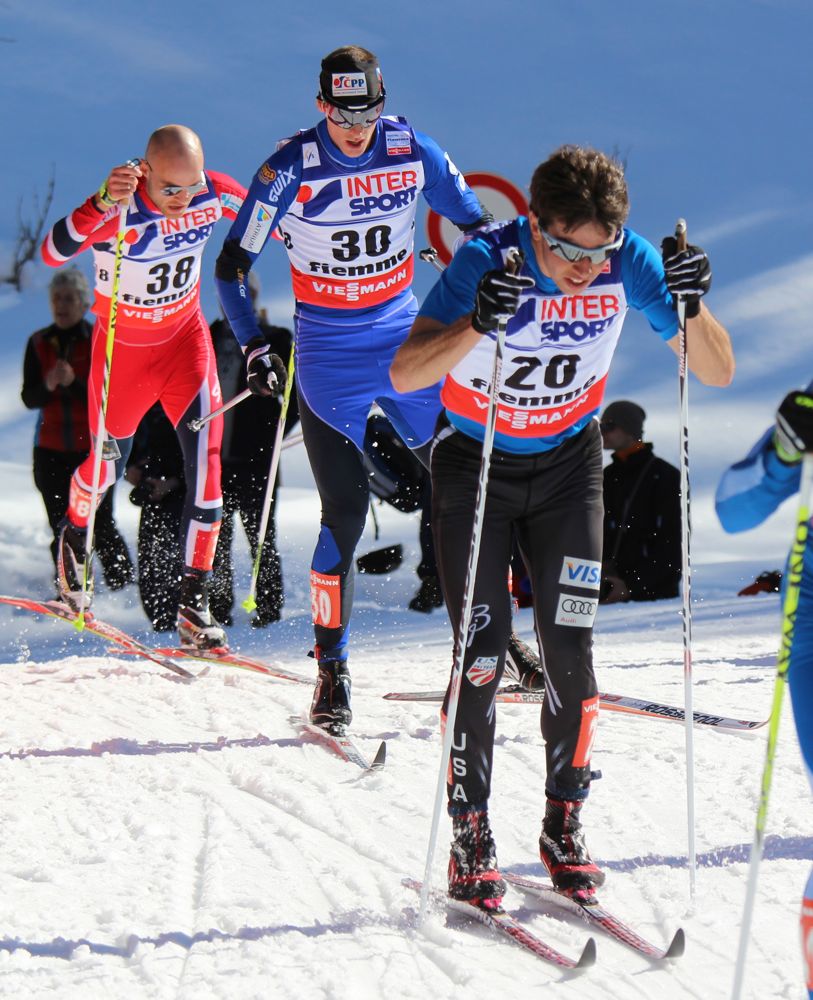
    Noah Hoffman competing in the 50 k classic at the 2013 World Championships.

    Noah Hoffman ran outside for 20 minutes on Wednesday. On Thursday, he hiked for four hours on a treadmill at a constant 15% grade. If that sounds like unconventional ski training, that’s because Hoffman, the top-ranked distance skier in the U.S., is now in the recovery phase for surgery he underwent on his left shoulder this spring. It’s the second time in three years he’s gone under the knife to prevent recurring shoulder dislocations, this time with the goal to eliminate the problem entirely.

    Wednesday was Hoffman’s first day of running outside since mid-winter; on Friday he’ll be able to run for 30 minutes, and then 45.

    “It’s tedious,” Hoffman admitted on the phone from Park City, Utah, where he does most of his summer training.

    Hoffman completed the best season of his life last winter, which included a 15th place in the 15 k individual freestyle at World Championships. With the Olympics on the calendar in 2014 it may seem like the worst possible summer to be held back by surgery recovery, but Hoffman says hasn’t been held back at all. In fact, he’s already put in more training time this spring than ever before, including last spring when he was healthy.

    “Being able to do [the surgery] in the spring allows me to do it without any setback,” he said.

    Indoor training has given him more control over his workouts, which Hoffman considers a good thing for this time of year.

    “One thing I would say about training indoors is, it’s definitely more consistent training, which I think is really good for base fitness,” he said. “I walked uphill today at four miles per hour at 15% grade, and added a couple micro pace-changes. It’s incredibly consistent. So for base fitness, I think it is really high level training.”

    Though he considers his training unencumbered, Hoffman’s workout options are limited. He tried hiking outside in the weeks immediately after surgery but found the available terrain wasn’t challenging enough to elevate his heart rate. Since entering a more structured training period he has committed to working out inside the U.S. Ski and Snowboard Association’s Center of Excellence, where his physical therapy, lower-body strength and aerobic workouts can take place under one roof until he’s cleared for more activity.

    Hoffman reintroduced running this week, and has until the twelve-week post-surgery appointment with his doctor to know when he can start rollerskiing and biking. He won’t attend the U.S. Ski Team training camp in Bend, Ore., next week but hopes to be allowed to ski on snow by the end of July.

    So, does hiking on a treadmill for four hours — “a new personal record for longest consecutive indoor workout,” he wrote on his blog — get boring?

    “I’m not worried about entertainment value; I’m going to do what’s planned out,” Hoffman said. “It’s not about having fun; I have fun when I’m not training.”

    That said, Hoffman does allow himself TV to alleviate the monotony of the gym — he’s started watching ski races on an iPad while he hikes on the treadmill. During his recent four-hour session he watched the entire 50 k from World Championships this February, a two-hour race, and parts of the men’s and women’s classic sprints from Val di Fiemme.

    “It was entertaining,” Hoffman said. “I hadn’t seen exactly what [Johan] Olsson did in that 50 k and of course it’s astoundingly impressive. It was a fun race to watch not having seen any video from that race.”

    While his shoulder heals, Hoffman’s summer is still about progress — he doesn’t want to simply main fitness he had last season.

    “It’s not just about getting back to where I was, but beyond where I was,” he said. “I’m going to use this process and physical therapy to add strength to my upper body.”

    Technique development has been a major component of Hoffman’s training in the past, but in the face of limited ski-specific sessions at the moment he has broadened his focus to include upper-body strength as soon as he can lift weights again. He has four technique blocks planned at the end of the summer and fall, but independently of surgery Hoffman decided that strength and power is another component of his skiing he can improve.

    “The technique is a focus, but I would say that it’s become clear to us that the strength and power deficiency, especially upper-body, has been a bigger limiting factor last season than my technique alone was,” Hoffman said. “I’m going to be able to make a lot of gains just by adding upper body strength and power, and I’m excited to work on technique again as soon as I’m able to.”

    For the moment Hoffman is limited to 10-pound curls with his left arm, which has atrophied to a fraction of the size of his right arm since surgery. But his doctor adjusted his physical therapy protocol to let him build back strength more quickly than he did two years ago. Mobility and range-of-motion, which came before strength last time around in his physical therapy, is set to return more naturally.

    “With strength and power being my big off-season goals, independent of the surgery, I’m really happy with the strength as a recovery tool,” Hoffman said.

    Long-term, Hoffman views surgery recovery as a necessary part of the process in pursuit of his goal to eventually reach the top of the sport. He considers his improvement last season as step in the right direction, but is by no means entirely satisfied.

    “It’s never a smooth, continual uphill process, that’s for sure,” he said in April. “I achieved some of my goals but not others this year; I guess I shoot pretty high. [A top-15 at World Championships] is just, to me, one step beyond being second at U23s. Those people that were in the top-10 with me [at U23s] have excelled as well, and many have had significantly better results than I’ve had since that race.”

    With the Olympics on the horizon Hoffman is focused on making another step forward in the months ahead.

    “The Olympics are big in the U.S., and big for any skier’s career, but I believe it would be a shock to win an Olympic medal for me next year,” he said. “I have other very lofty goals that I hope to achieve, and only one of them, to be honest, has to do with the Olympics. I want to continue improving next year and continue striving towards my goal and continue reaching the top of the sport. One of them is to win an Olympic medal, but I don’t think that’s going to happen in Russia; more in South Korea [in 2018].”

  • Green’s ‘Bummer Summer’ Continues: Canadian Biathlete Faces Second Surgery

    Brendan Green competing in the World Cup sprint in Ostersund, Sweden, this year, where he placed 14th.

    Canadian biathlete Brendan Green has had back problems before, but things came to a head in Oslo in February when he herniated a disc warming up for a World Cup race. It was a bittersweet weekend: Green finished 10th in the sprint, 13th in the pursuit, and then 9th in the mass start – the last with the herniated disc – but then faced excruciating pain that necessitated a harrowing trip back to Canada and an abrupt end to his season. Green was Canada’s top-ranked male biathlete at the time and missed World Championships.

    At the end of February, FasterSkier talked to Green about his trip home and how he was trying to heal his back. He was trying to decide whether to go in for surgery, which is a tough decision for patients with herniations. About half those patients typically recover within a month, and the vast majority can get healthy in six months by doing non-operative treatment and rehabilitation.

    There was also the question of whether surgery would aid Green’s recovery. Discectomy, which is the medical term for the removal of herniated disc material that is pressing on nerves or the spinal cord, sometimes solves a patient’s problems, and sometimes doesn’t. There is limited research on long-term outcomes of discectomies and plenty of questions about their efficacy; their potential benefit depends on the extent of the herniation, but despite advances in medical imaging, even an MRI often cannot tell doctors exactly what is going on in a patient’s back.

    In February, Green was hoping that he could recover without surgery. Last week, we checked back in to see how things were going.

    FasterSkier: The last time we talked to you, you were trying to decide whether to get surgery at the end of the winter. What did you end up doing?

    Brendan Green: I ended up having to get surgery at the end of April. I had a discectomy. I was a little hesitant going in because, you know, the pain was tolerable, and I think I had been making really small gains, so I thought maybe I was moving in the right direction, just really slowly. But it turned out that it was definitely the right thing to do. The surgeon was even a little bit surprised at how big the herniation was and how much pressure was going on my nerve, so it was good to get that cleaned out. But recovery from that surgery has been going really, really slowly, and even right after the surgery I was still having a lot of neurological problems.

    FS: Are you back able to train at all?

    BG: I was hoping that by now I’d be back to training pretty much full-on, but unfortunately that’s not the case. I just got another MRI a couple of weeks ago, and it turns out that the disc has re-herniated, so I’ll be going in for another surgery in two weeks. It’s a huge bummer. The surgery gets a little more complicated this time around, but it’s essentially the same surgery, and we’ll try it again and hopefully this time it works. It comes down to bad luck I think – there’s a ten percent chance that a disc will re-herniate within six months post-surgery, and I just kind of fall within that category, which is unfortunate, but just kind of the way it is.

    So, yeah, I haven’t really been doing too much because all of the neurological gains have been really slow. I have gained a bit of strength back in my legs, but apart from that I haven’t really seen too much improvement. It’s been sort of a bummer summer of not being able to train. I started shooting again, which is kind of nice to give me a bit of something to focus on other than the constant rehab. But other than that I’m doing a bit of water running in the pool, and a bit of strength in the gym, but really mostly still a lot of rehab.

    FS: Have you been able to do anything with your teammates, or is all of the rehab and training on your own?

    BG: I guess for the most part it has been solo, although I have been shooting a little more recently. That’s been nice to shoot most mornings and connect with the team then. It’s been really good in that regard. But apart from that I’ve just been by myself doing rehab activities and swimming and that kind of stuff.

    FS: Are you still dealing with a pretty high level of pain on a daily basis?

    BG: Yeah. It’s definitely– they pain is a lot more tolerable now, but there’s still that awareness that something is not quite right. Things are still feeling kind of vulnerable. So it kind of sucks to have to go in for surgery again, but on the other hand it’s sort of somewhat reassuring to have an answer as to why things have been progressing so slowly since the surgery.

    FS: Mentally, are you trying just not to think about biathlon so it’s less frustrating not to be doing anything, or is it good to have something to focus on?

    BG: It’s been a bit of a roller coaster ride with ups and downs. Some days I’m a little more motivated, and other days it’s a little harder to get out of bed knowing that I’m facing the same daily routine of rehab. It’s been a pretty monotonous cycle. But I’m trying my best to stay positive. I’m not thinking too much about the race season right now.

    After this next surgery, I’ll just be totally focused on trying to recover 100 percent. As far as the race season goes, I’m definitely not making things too easy for myself, but maybe if the rehab goes perfectly according to plan this time around then maybe towards the end of the season I could be back to doing some racing. At what level, who knows. At this point I’m just trying to go into surgery in the best shape I can be in given the training that I can do.

  • Koos Looks To Sochi, Heads Back to School

    Koos Looks To Sochi, Heads Back to School

    Torin Koos, who just completed his first season outside of the US Ski Team structure but still managed to qualify for a spot on the squad representing the United States at the 2011 World Championships in Oslo, is hungry for more.

    “I plan to race through 2014, so I’m recharging the batteries as the moment,” Koos said. “My goal is to have top results in both the 2013 World Championships in Val di Fiemme and in Sochi 2014 [at the Olympic Games].”

    After spending last season living in Mazama, Washington as part of the Methow Olympic Development Project (MOD) working with coach Scott Johnston, Koos will be on his own for the 2012 season, but doesn’t think pursuing his goals outside the US Ski Team, and without a formal coach will be a disadvantage for him.

    “Doing it this way gives me the opportunity to do what I am doing and spend time where I want to be,” Koos said, adding that after a decade on the international circuit he feels that he knows how to put together a training plan.

    “It’s not rocket science,” said Koos, who is turning 31 in July.

    Changing everything

    On Monday May 9, Koos moved to Utah and drove straight to campus to attend his first classes of the spring/summer term at Westminster College. His tenure on the US Ski Team, which ended after the 2010 Olympic season, earned him free tuition at Westminster College.

    Torin Koos (MOD) winning the skate sprint at the U.S. National Championships in Rumford, ME. (Photo: flyingpointroad.com)

    “I’m excited to get back into that and get going on my degree again,” Koos said to FasterSkier.

    While Koos is going back to school this spring to complete his master’s degree, he is planning to race full time in the winter. He started the degree – a Masters of Professional Communication with emphasis on Internal Business Communication – in the summer of 2005.

    He considers the 2005-06 season the breakthrough year in his skiing career, so going back to the program he started prior to that brings back good memories.

    Koos will go to school full-time this spring/summer and fall, and then again next spring/summer and fall. If all goes according to plan, he will receive his degree in the end of the fall term 2012. That progression leaves him free to pursue skiing full-time in the winter.

    Training in Norway

    The fall term ends in mid-December, and Koos plans on heading to Rumford, Maine for US Nationals in early January.

    After Nationals, Koos is making plans to spend a large chunk of the winter in Trondheim, Norway, training with the Strindheim ski club – the club that is home to World Champions and Olympians Petter Northug and John Kristian Dahl.

    “I plan on spending the heart of the winter training with the best skiers in the world. I think that must be one of the best clubs in the world,” Koos said,.

    “They have 11 medals from the Worlds, nine golds. It seems like a good club. They’re into skiing for sure,” Koos noted.

    Surgery

    Coming up on a season with no major events or championships, Koos is looking forward to get back in shape after a bout of mono this spring as well as rehabbing from a shoulder surgery in May.

    Koos racing the team sprint at World Championships

    Koos crashed in a sprint race just prior to the World Championships in Oslo, and dislocated his shoulder. He was able to keep the pain under control for the rest of theseason, but realized he needed to fix the problem. With a more relaxed race schedule this upcoming season, it seemed like the best time to have a 2-month break from training would be right now.

    “Now is the time to do it. I’ll have six weeks of no movement at all; I’ll even be sleeping with it pinned down somehow. Then I’ll start some light physical therapy, and after two months I expect to start training for skiing,” Koos said.

    Ups and downs

    Koos’ main goal for the 2011 season was qualifying for the World Championships in Oslo, even though he had to do that without the support of the US Ski Team. He achieved that goal, but was not able to perform at his best due to the shoulder injury.

    Marred with both accidents and injuries, and then coming down with mono at the end of the season, Koos was looking for a change as the 2011 season came to a close.

    “I was looking for a move in terms of school and to move on as a skier and athlete. I had my breakthrough years in Utah in 2005-06, and I felt like coming back to an environment that I know works for me, a place where I’ve had success before,” Koos explained.

    Splitting from MOD

    Koos left MOD after the World Championships in Oslo. And while Koos and MOD head coach Scott Johnston originally intended to work together for longer than the fall and winter, the relationship came to an earlier end.

    Scott Johnston

    “It wasn’t the plan. The plan was to continue on for longer than this season. I really don’t want to comment on that,” MOD head coach Scott Johnston said.

    However, looking back at the 2010-11 season, a lot of things went well, Johnston said.

    “From the mechanical end, the season went very well. Everything was according to plan. Torin was headed in a great direction until he dislocated his shoulder just before the Worlds in Oslo,” Johnston said, pointing out that Koos won a couple of National Championship titles (classic and skate sprints) and a sixth place in the 15K classic in Rumford, Maine, in January.

    Johnston and Koos have not worked together since World Championships. Koos stayed in Europe to continue racing there while Johnston returned to the US to help his other MOD Squad athlete, Sam Naney, at the USSA SuperTour finals in Sun Valley, Idaho.

    When Koos mentioned to Johnston that he wanted to move away from Mazama and go back to school, Johnston encouraged the change.

    “He had the opportunity to have free tuition at Westminster College, even though he was no longer on the US Ski Team, and he would have to go to Salt Lake City to do that. I don’t think that will negatively impact his training program. He has training partners there and I actually think that will be a really good thing for him to combine school with athletic pursuit,” Johnston said.