From the FasterSkier archive — posts syndicated from athletes’ and coaches’ own blogs between 2004 and 2012, kept online as published. Current coverage is at fasterskier.com.
For the first time ever, an American will preside over international governance of a nordic sport. On Tuesday, the International Biathlon Union (IBU) announced that longtime U.S. Biathlon President and CEO Max Cobb has been named the IBU Secretary General. Cobb will finish up his second term on the IBU Executive Board and leave his post as at U.S. biathlon at the end of September, then begin his new role overseeing international competition, governance, and sport development this October.
The appointment of Cobb as IBU Secretary General marks the culmination of a long career in U.S. biathlon in which he has overseen the organization through stark growth in the sport, success on an international scale for U.S. biathletes, and through unique challenges like hosting the 2002 Salt Lake City Olympics, where Cobb served as the chief of competition.
On his new appointment, Cobb said in an email with FasterSkier that, “I am really honored to be selected for this position. The chance to serve the sport I love from a different position is really exciting. [Outgoing Secretary] Niklas Carlsson did a fantastic job and the IBU staff is well-structured and very capable.”
Cobb’s journey to overseeing biathlon is one marked by persistent and carefully thoughtful forward-thinking, along with an enduring connection to the nordic community in the United States. A New Englander through-and-through, Cobb competed at Dartmouth College while taking on leadership roles heading up the College’s Outing Club and Biathlon Club. It was the latter that translated into a career, accepting a job opportunity with the U.S. Biathlon Association in 1989. Founded in 1983, U.S. biathlon was still in its nascent, path-finding stages then, looking to build off the successes it had seen concurrently with U.S. skiing more broadly in the late 1970s and early 1980s. There were flashbulb glimpses that the U.S. could bring the popular discipline of biathlon to a new continent, a bronze in the women’s team relay event at the 1984 World Championships (Holly Beatie, Julie Newman, and Kari Swenson), and an individual silver for Josh Thompson in 1987 (20 k Individual). Without real infrastructure to develop the sport however, U.S. biathlon would have to reset towards the long-term goal of getting more talented athletes, in more places, into the sport before success would come again.
In 1992 Cobb took up that challenge as U.S. Biathlon’s Program Director, and since has been the steady hand guiding the sport between the punctuated successes that usually draw attention. First there was a gold medal at Junior World Championships in 1997 with Jay Hakkinen, then later the World Championship medals – first a silver with Tim Burke in 2013 (20 k Individual), then gold and silver with Lowell Bailey and Susan Dunklee, respectively, in 2017 (20 k Individual and 12.5 k Mass Start), and again a silver with Susan Dunklee in 2020 (7.5 k Sprint). In between, the development of training sites from Soldier Hollow (concurrent with the 2002 Salt Lake City Games) to Fort Kent, Maine (which, tucked away in the most rural corner of a rural state, improbably hosted a World Cup in 2004).
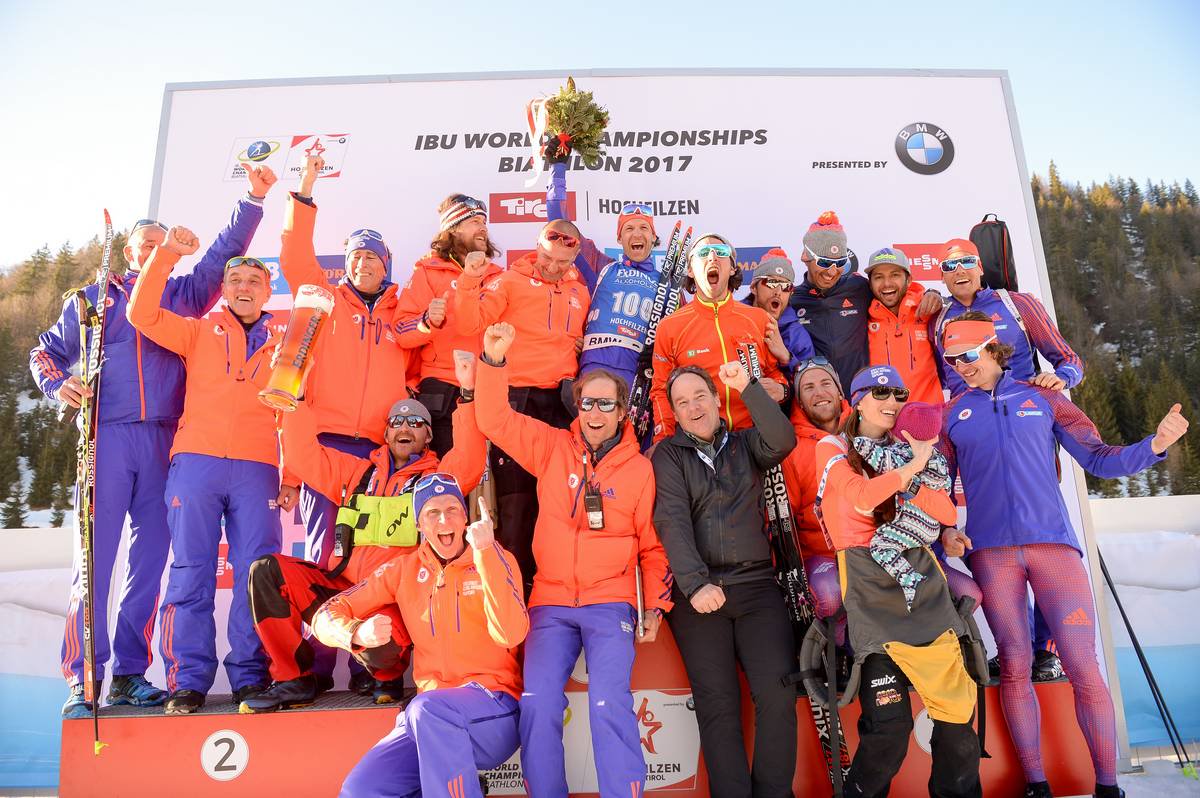
The U.S. Biathlon team and staff celebrate Lowell Bailey’s World Championship gold medal in Hochfilzen in 2017. (Photo: USBA/NordicFocus.com/Twitter)
Those highlights represent a consistent attitude and approach by biathletes across the United States put into sum by their consistent leader, as Cobb reflected, “The biggest take away is challenges can’t keep you from pursuing ambitious objectives. Collaboration, planning and determination to achieve a bold vision often overcomes more than we could ever imagine. Teamwork aligned around a common vision is powerful, but it takes time and constant tending. Today, Americans are regularly bringing home medals – something that seemed impossible three decades ago.”
Now tasked with scaling his approach to an international scale, Cobb sees a different set of challenges which stand in tandem, not separated, from the world’s geopolitics and concerns. “I think the most immediate challenge [this winter] will be the high cost of energy in Europe that will impact every part of international sport; from travel for the athletes to the energy needed to host major events,” said Cobb. His solution follows a pattern he’s already helped develop, with the IBU being on the forefront of sport sustainability – they were the first international winter sports governing body to meet the UN’s planning requirements to go carbon neutral by 2050 last year. “Our sport gives us a platform from which we can help influence millions to live lives that are climate friendly, we all have to act more sustainably in our daily lives and at our events.”
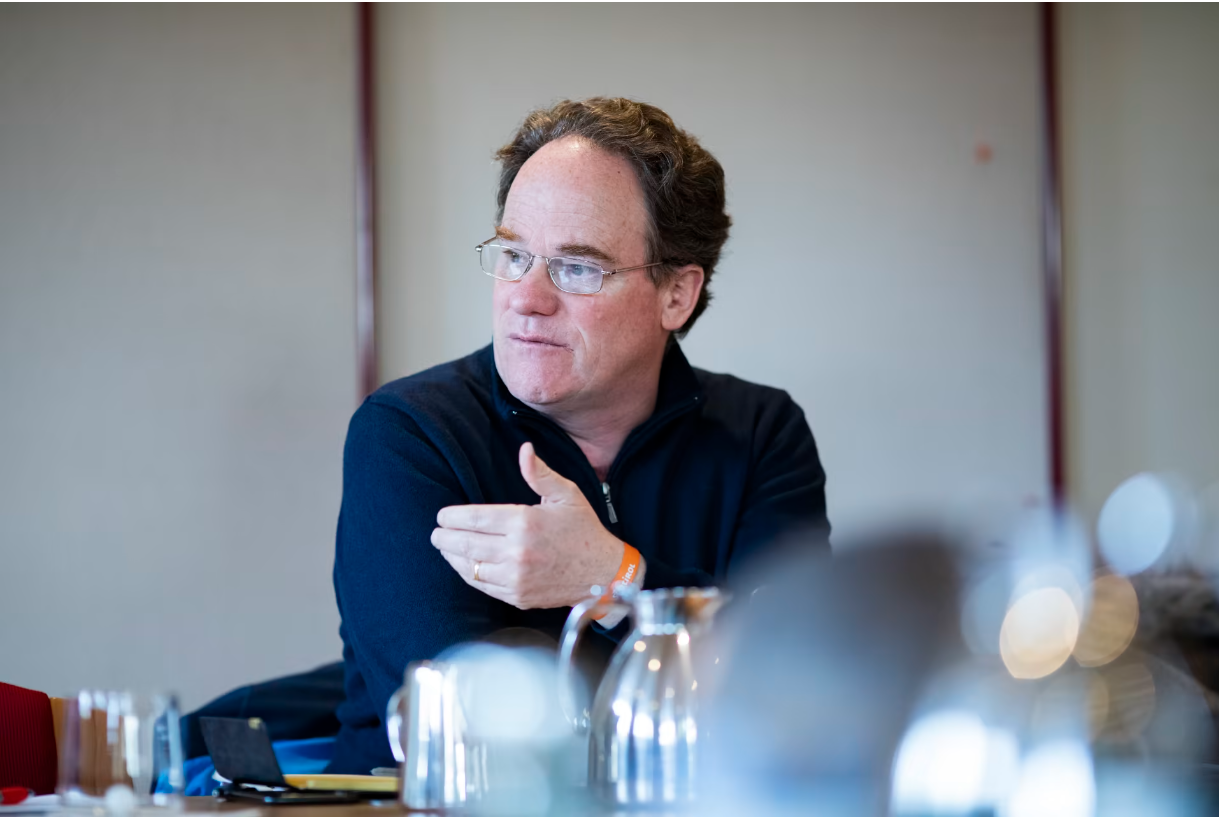
A 2016 photo of Max Cobb, the president and CEO of U.S. Biathlon and newly named IBU Secretary General. (Photo: Nordic Focus)
Cobb is also looking to prioritize confronting the challenge of resource disparity that is inhibiting parity in the sport – a persistent problem across the broader nordic disciplines. “[There’s a] big technology and training gap between the very biggest nations who have armies of ski tech and coaches and middle-sized teams with just a few hard-working staff. As this gap grows it could endanger the diverse set of nations that can win medals, [which] has been a hallmark of international biathlon for many decades.”
In confronting all of the challenges, Cobb said his hope is, “To serve the athletes well, both those in the sport today and those who need a chance to discover the wonderful challenge that [biathlon] is – two opposing disciplines with an unforgiving clock marking every second to the tenth.”
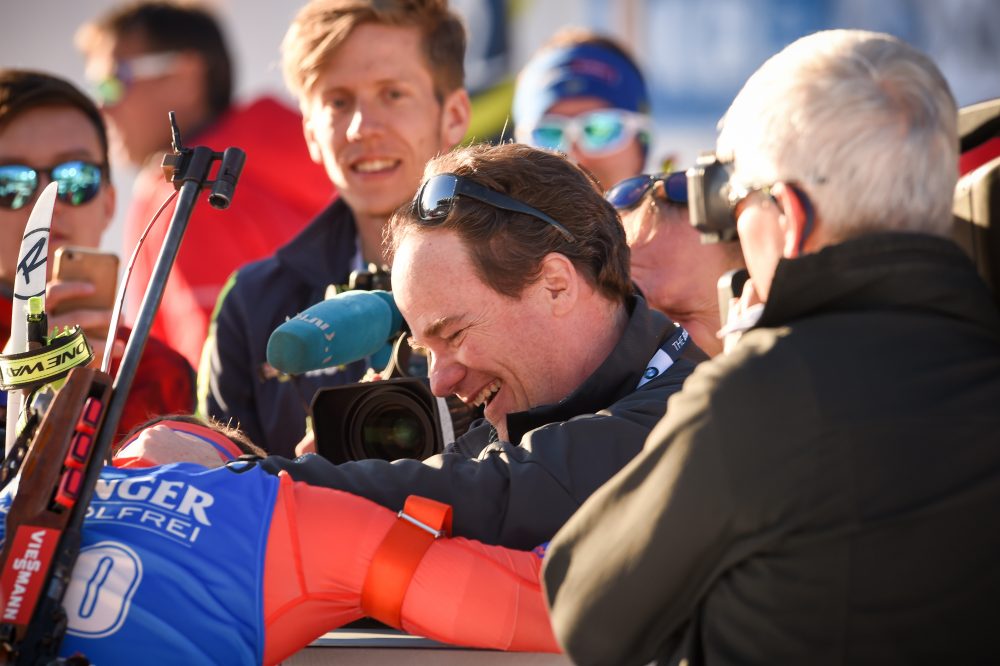
Lowell Bailey (USA) celebrates with Max Cobb after winning the gold in the 20 k indivudual at the 2017 IBU World Championships in Hochfilzen, Austria. (Photo:NordicFocus)
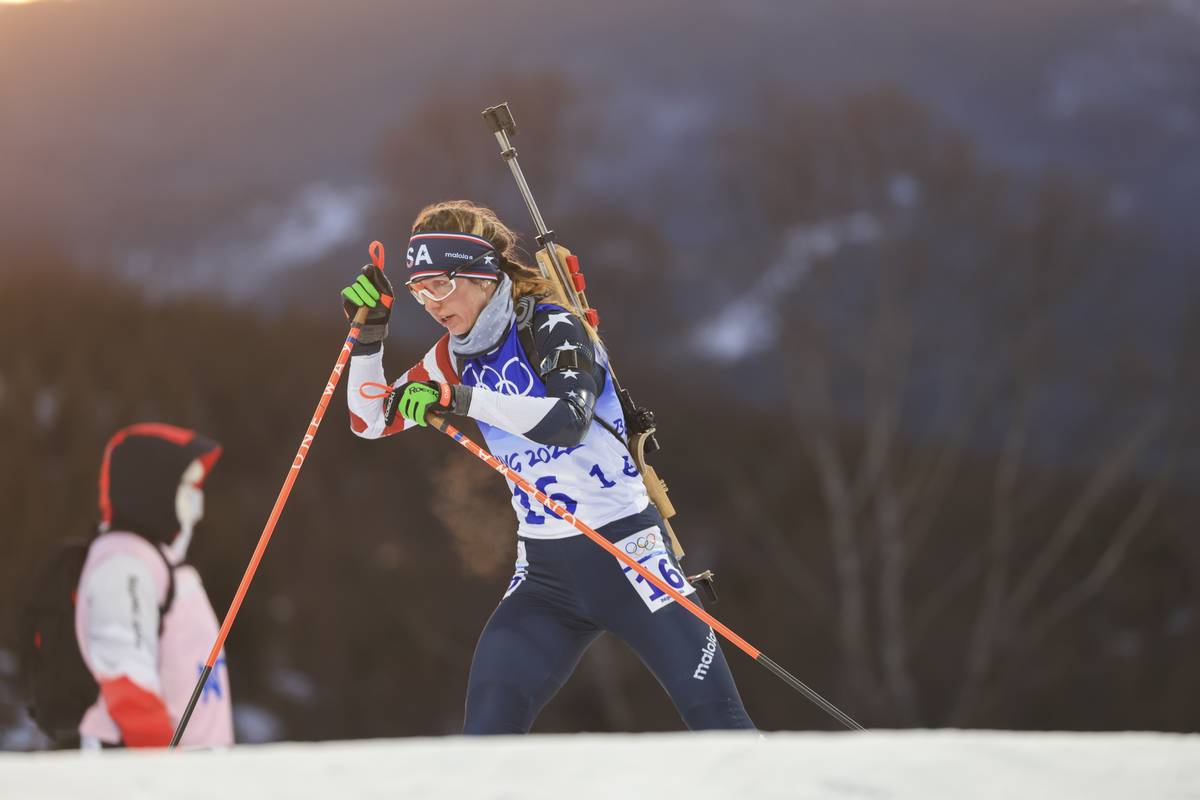
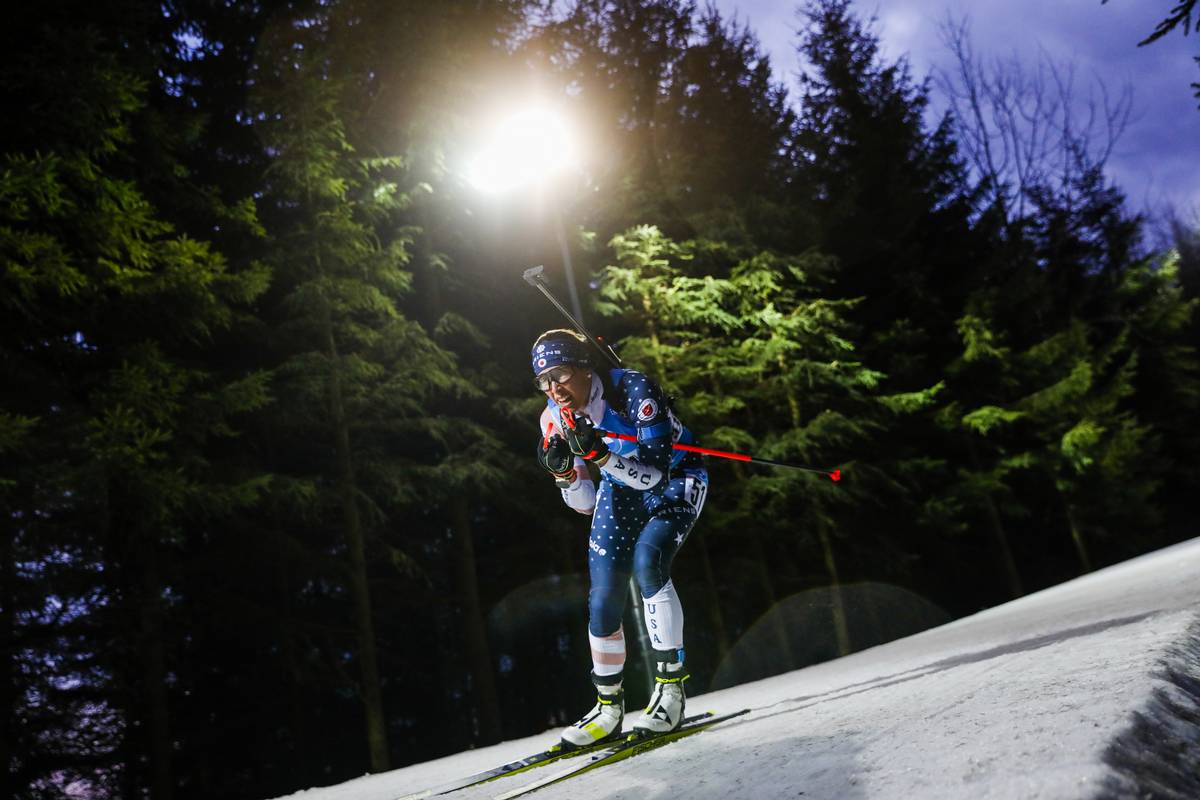
Deedra Irwin competes in the Women’s 15km Individual race during the 2022 Beijing Olympic Games. (Photo: Nordic Focus)
BEIJING, China (Feb. 5, 2022) – Things don’t always go according to plan, but occasionally someone can exceed even her wildest expectations.
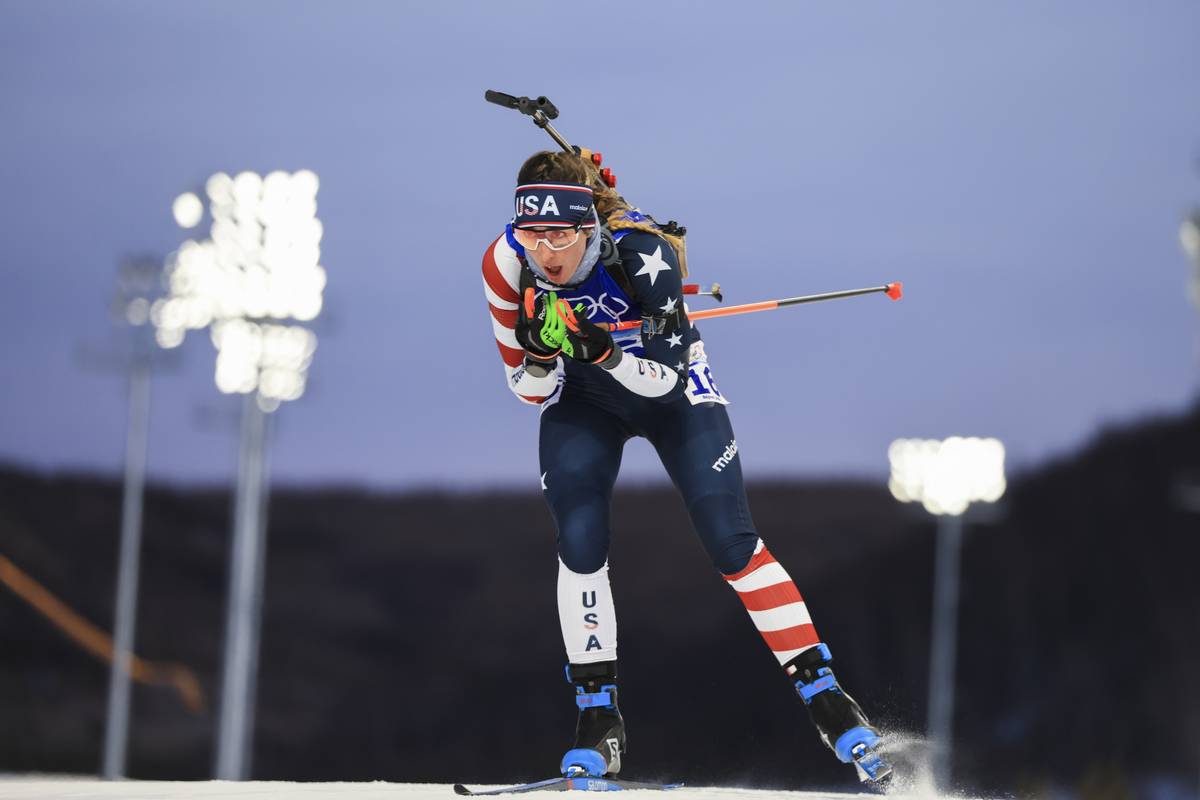
Such was the case for Deedra Irwin of Pulaski, Wisconsin, who on Monday turned in the best Olympic performance ever by an American biathlete, finishing seventh in the women’s 15-kilometer individual event at the Zhangjiakou National Biathlon Centre northwest of Beijing.
“I was trying to focus on just working on everything I’ve worked on this week,” said Irwin, who is competing in her first Olympic Winter Games, “really skiing the course well and staying calm on the range and being ready for anything — with wind or whatever.
“I had a good game plan, and I was able to execute it. Everything came together. I had no idea how I was doing, and I was just in my zone, and it worked — what the heck.”
Deedra Irwin competes in the Women’s 15km Individual race during the 2022 Beijing Olympic Games. (Photo: Nordic Focus)
What the heck, indeed. Irwin skied and shot with the world’s best biathletes, ultimately finishing just 1 minute, 1.4 seconds behind gold medalist Denise Herrmann of Germany. Anais Chevalier-Bouchet of France claimed the silver medal, and Norway’s Marte Olsbu Roeiseland took the bronze medal.
Irwin’s American teammates, Clare Egan, Joanne Reid and Susan Dunklee, placed 39th, 57th and 63rd, respectively.
Irwin’s stunning performance also came two days after the U.S. biathlon team of Dunklee, Egan, Sean Doherty and Paul Schommer posted the best-ever American finish in the 4×6-kilometer mixed relay event. The U.S. placed seventh in 1:08:58.3.
Nothing Monday seemed to faze Irwin, who moved up to fifth place at the 9-kilometer mark. Not even a miss during the event’s final shooting range.
“It’s something I’ve been working on all week because of the wind, just really trying to focus on one shot at a time,” Irwin said. “What was really nice is it wasn’t windy today. It was actually really calm.
“So even though I missed that shot, I still had that mentality of just one shot at a time, make good shots.”
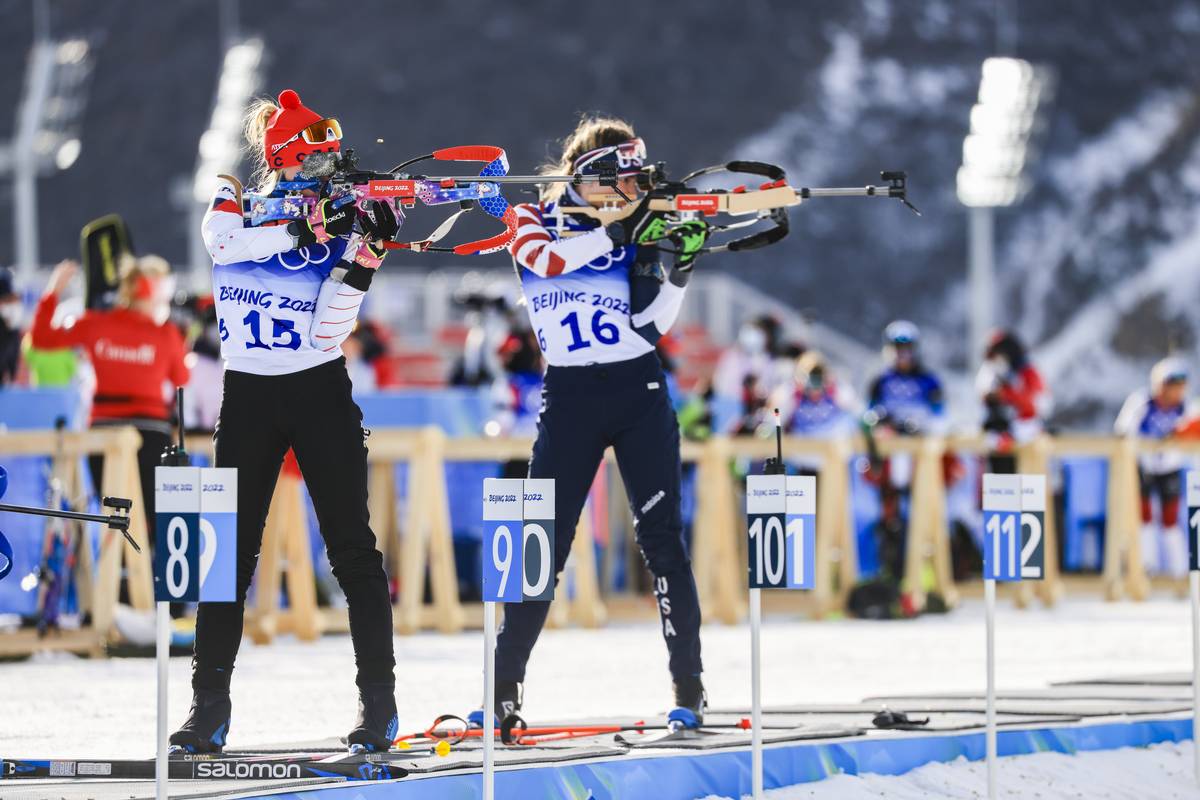
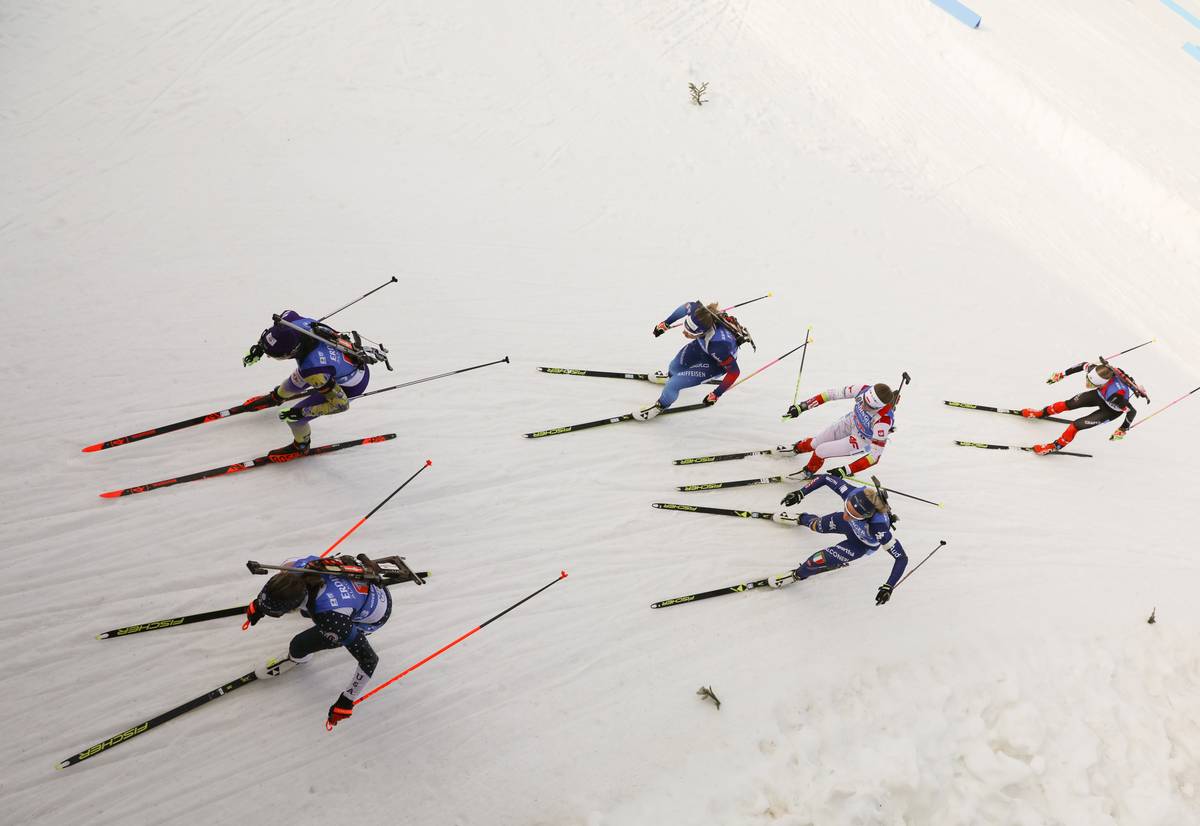
Deedra Irwin (right) competes in the Women’s 15km Individual race during the 2022 Beijing Olympic Games. (Photo: Nordic Focus)
That enabled Irwin to finish strong.
“To be able to hit those last two, I was just really happy that I was able to keep the focus and concentrate,” Irwin said. “(It’s) something I’ve definitely been working on a lot since last year, to just in general increase my shooting percentage.”
The 29-year-old Irwin, a member of the Vermont Army National Guard, had a skiing and running background but didn’t try biathlon until 2017, when she attended a talent identification camp at Lake Placid, New York.
*****
Check out the Watch Olympic Biathlon schedule for viewing options of all the races from Beijing. You can also follow all the action on the IBU app – download it today!
Bob Reinert spent 17 years writing sports for The Boston Globe. He also served as a sports information director at Saint Anselm College and Phillips Exeter Academy. He is a contributor to TeamUSA.org on behalf of Red Line Editorial, Inc.
The American team of Susan Dunklee, Clare Egan, Seah Doherty, and Paul Schommer took seventh in the mixed relay to match the best U.S. Olympic result in the event. (Photo: NordicFocus)
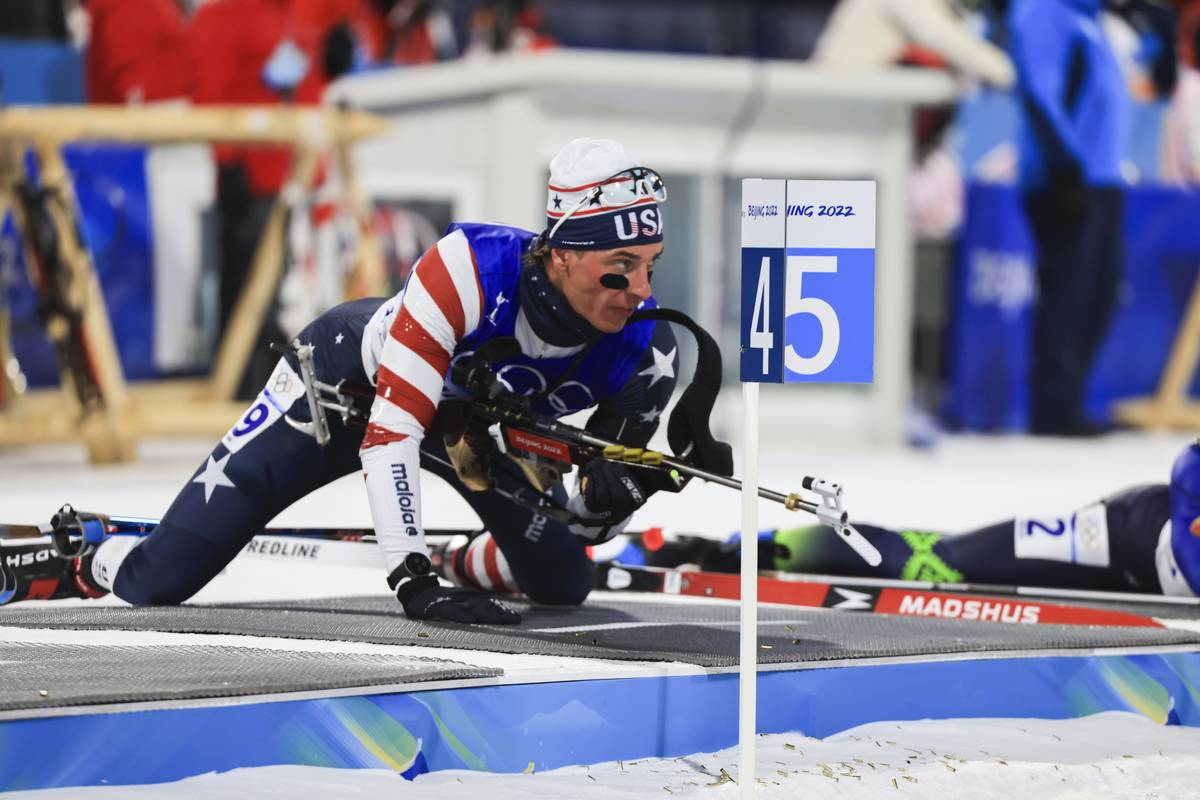
BEIJING, China (Feb. 5, 2022) – The American quartet of Susan Dunklee Craftsbury, Vt./Craftsbury Green Racing Project & USBA), Clare Egan (Cape Elizabeth, Maine/Craftsbury Green Racing Project & USBA), Sean Doherty (Center Conway, N.H./National Guard Biathlon & USBA) and Paul Schommer (Appleton, Wis./Team Crosscut & USABA) finished seventh in the mixed relay Saturday as the Beijing 2020 Winter Games biathlon competition got underway at the Zhangjiakou National Biathlon Center. The result tied the best-ever finish for Team USA in an Olympic mixed relay, equaling their seventh place at the Sochi 2014 Winter Games. The U.S. finished 15th four years ago in PyeongChang, Korea.
The race began under clear skies but with gusty winds cutting across the shooting range.
Starting toward the back of the field in the 19th position, Dunklee used three spare rounds in prone and another two spares in standing but moved the U.S. into 10th position as she made the first exchange with Egan.
“This is one of the coldest races we’ve seen in a few years,” said Dunklee. “Just keeping your hands warm enough to be able to handle the rifle and magazines is really tough. And we’ve got some crazy winds and I think that’s throwing a lot of people off. The important thing was I stayed out of the penalty loop and I tagged off enough in the mix that Clare was really able to take it and run with it.”
Egan turned in the second-fastest second leg with just one spare in prone and clean shooting in standing. She left the range in third place just ahead of Sweden Elvira Oeberg and made the tag for the third leg to Doherty in fourth place, 29 seconds back of the leader France.
“This is certainly a great way for me to start the 2022 Olympics,” Egan said. “Our skis were excellent. Our wax techs have really been working hard. They’ve come here twice in preparation for the Olympics, getting some research done on the snow and how they can best prep our skis, and that really paid off today. I worked really hard to stay with people out on the track to be able to draft which is really important when there’s this much wind, and I managed on the shooting range really well so I’m really satisfied with my race.”
Clare Egan helps the Americans to seventh place in the opening mixed relay during the 2022 Winter Olympics. (Photo: NordicFocus)
Doherty mirrored Egan’s marksmanship on the range, needing just one spare in prone and cleaning standing in just 53.8 seconds of range time, the fastest time in the field for the third leg. His performance maintained fourth position for the Americans as he made the final exchange to Schommer, just 18.5 seconds back of the lead and a mere 1.2 seconds out of medal contention.
“I wasn’t that close to second place when I came into shooting,” Doherty said of his standing stage. “The focus was all on the target and I came out there and I was like ‘Let’s see how fast we can get this last lap done.’ It was fun to have made that great stage and make those shots count.”
Schommer, in the first Olympic competition of his career, ended up with a penalty in prone but finished strong with two spares in standing to bring the team home in seventh, 2 minutes, 12.7 seconds back.
“It’s always a bummer to do loops in the relay,” said Schommer of his penalty in prone. “It’s always a goal to stay out of the penalty loop but at the end of the day, it’s still biathlon. The wind switched on me in the last shooting and it just made it difficult. The same luck for us that we got early on seems like the other teams got at the end. I think we’re in a really great spot as a team. I think we’re fit. I think our shooting is really good. We’ve had a lot of good work here in the wind at this venue and there’s a lot of chances still to have that success that we’re really hoping for.”
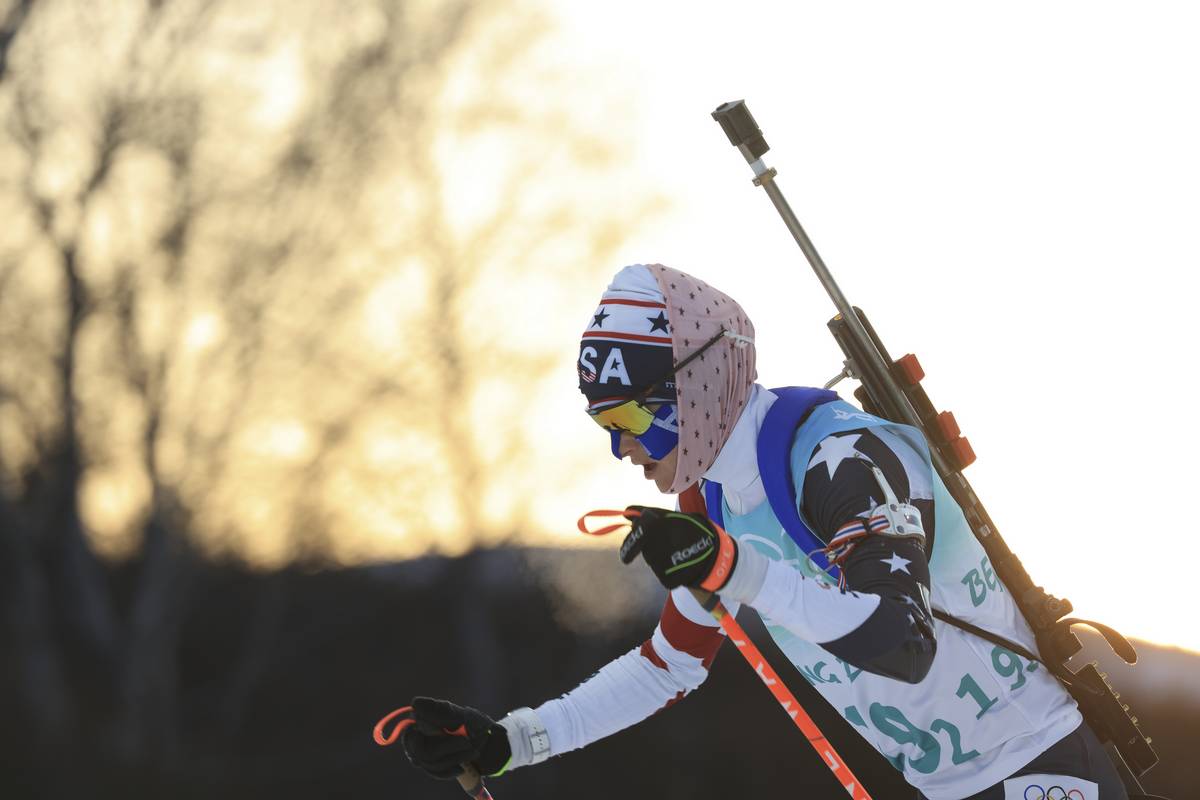
Paul Schommer competes in the Mixed Relay during the 2022 Beijing Olympic Games. (Photo: Nordic Focus)
Norway’s Johannes Thingnes Boe sprinted past Russian Olympic Committee’s Eduard Latypov in the final 100 meters to give Norway the first biathlon gold medal of the Games. Boe teamed with Marte Olsbu Roeiseland, Tiril Eckhoff and his brother, Tarjei Boe, for a time of 1:06:45.6, with three penalties and 13 spare rounds. France, the 2018 gold medalists, also moved past the ROC team to take silver, just 0.9 seconds back, with the ROC claiming bronze, 1.5 seconds behind Norway.
After a rest day on Sunday, the biathlon competition will resume Monday with the women’s 15-kilometer individual beginning at 4:00 a.m. EST.
Mixed Relay results
1.
Norway (Roeiseland, Eckhoff, J.T. Boe, T. Boe)
1:06:45.6/3+13
2.
France (Chevalier-Bouchet, Simon, Jacquelin, Fillon Maillet)
+0.9/3+11
3.
ROC (Nigmatullina, Reztsova, Loginov, Latypov)
+1.5/1+13
7.
USA (Dunklee, Egan, Doherty, Schommer)
+2:12.7/1+12
Check out the Watch Olympic Biathlon schedule for viewing options of all the races from Beijing. You can also follow all the action on the IBU app – download it today!
Biathlon Event Schedule for Beijing 2022 Olympic Games (all times EST)
Saturday, Feb. 5
4:00 am – Mixed relay
Monday, Feb. 7
4:00 am – Women’s 15km individual
Tuesday, Feb. 8
3:30 am – Men’s 20km individual
Friday, Feb. 11
4:00 am – Women’s 7.5km sprint
Saturday, Feb. 12
4:00 am – Men’s 10km sprint
Sunday, Feb. 13
4:00 am – Women’s 10km pursuit
5:45 am – Men’s 12.5km pursuit
Tuesday, Feb. 15
4:00 am – Men’s 4×7.5km relay
Wednesday, Feb. 16
2:45 am – Women’s 4x6km relay
Friday, Feb. 18
4:00 am – Men’s 15km mass start
Saturday, Feb. 19
4:00 am – Women’s 12.5km mass start
About US Biathlon
US Biathlon is an Olympic sports organization that fosters the growth of the biathlon community in the U.S., developing athletes with integrity and achieving international and Olympic success. US Biathlon’s vision is to stand atop the international biathlon stage and be a leading organization for supporting athletes and clubs, prioritizing athlete well-being, and acting with integrity.
Joanne Reid (USA) celebrates historic relay result in Antholz (ITA). (Photo: NordicFocus)
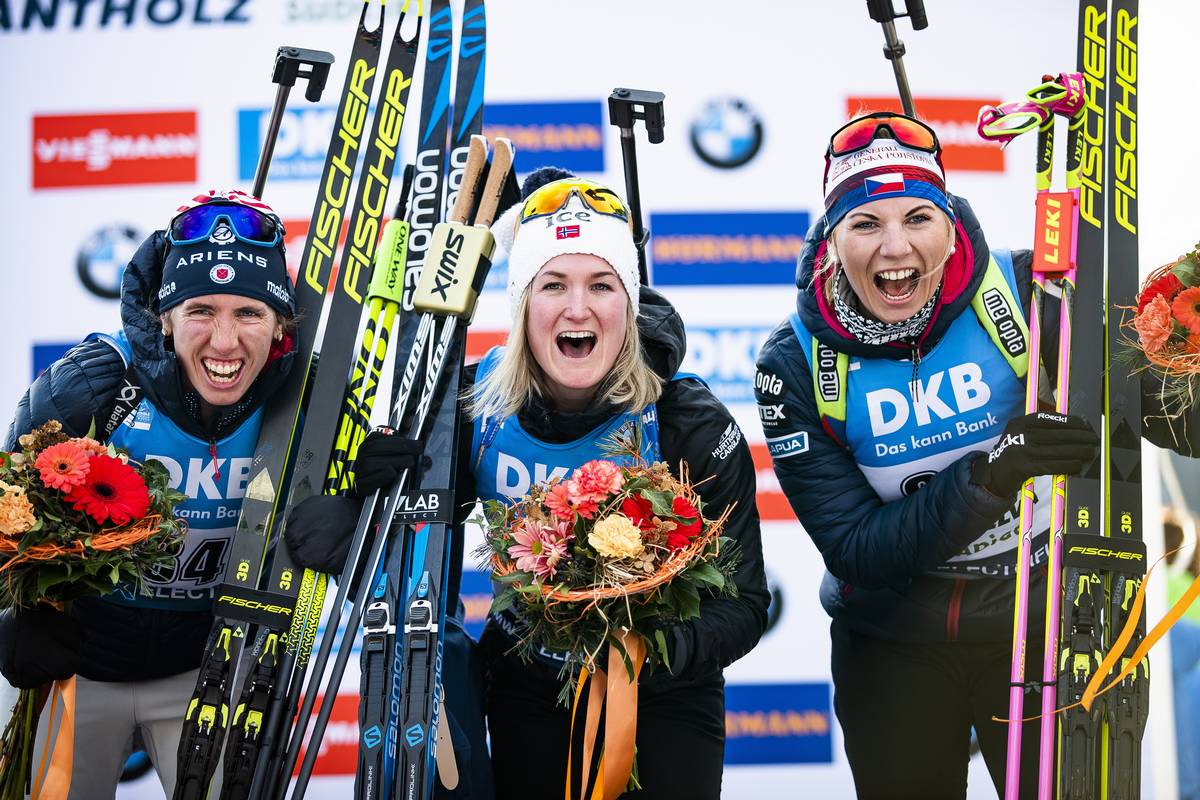
In the final women’s relay competition before the Beijing 2022 Olympic Games, the 14th ranked U.S. Women’s Biathlon Team raced to a fifth-place finish in Saturday’s 4×6-kilometer event at the BMW IBU World Cup in Antholz. It marked the best relay finish for the women’s team in a World Cup since 1994 when the U.S. took the silver medal in Canmore, Alberta, Canada. However, today’s performance bettered that race 28 years ago in terms of time behind as they finished 50.1 seconds back of first place today compared to 57.3 seconds behind in 1994.
“I’ve dreamed of a top-5 women’s relay for over a decade,” three-time Olympian Susan Dunklee (Craftsbury, Vt./Craftsbury Green Racing Project & USBA) said after the race.
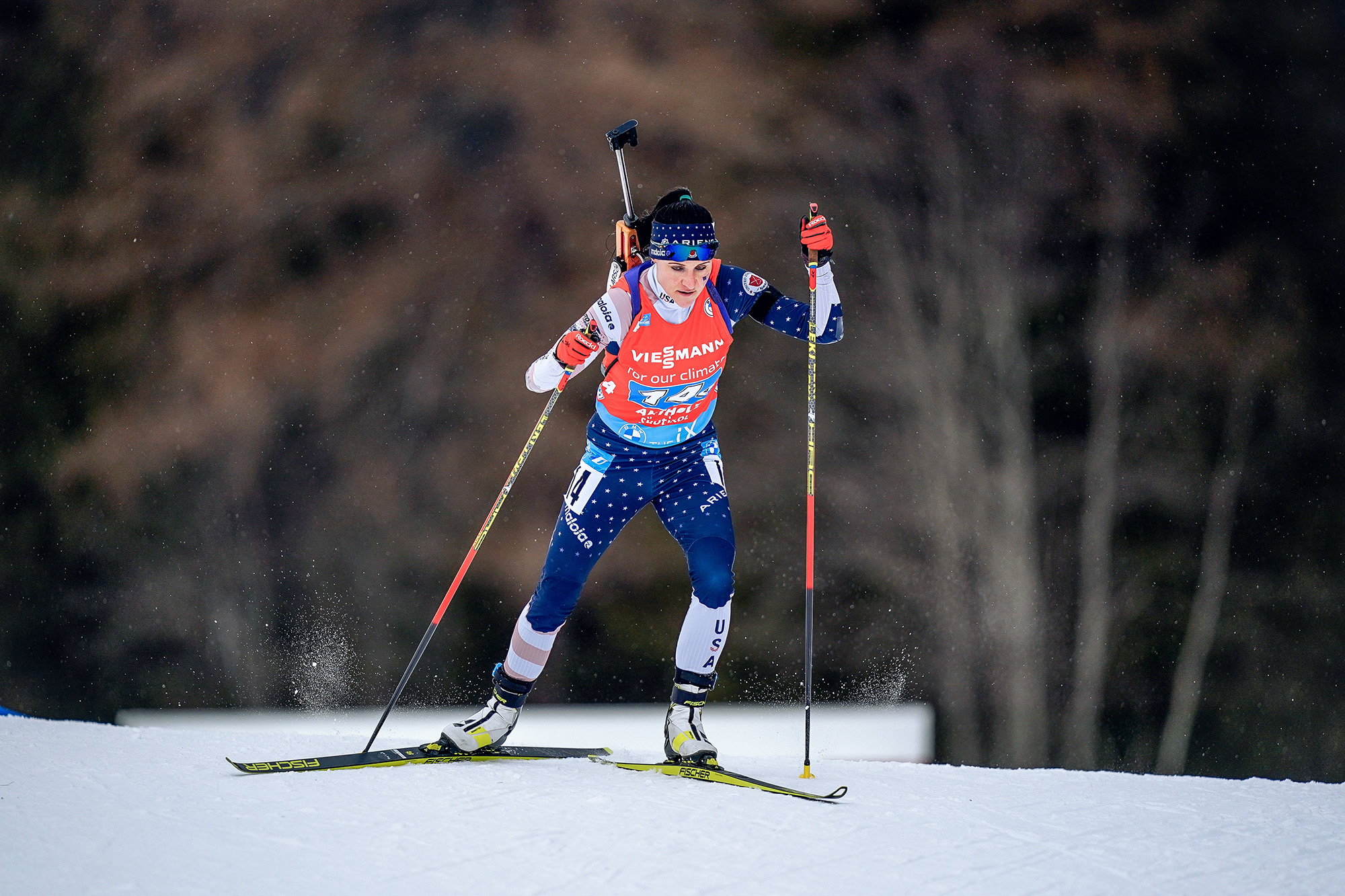
Susan Dunklee (USA) keeps the United States in it during the first leg of the relay in Antholz (ITA). (Photo: NordicFocus)
Dunklee kicked off the relay using one spare round in prone and two spares in standing. She made the first exchange with 2018 Olympian Clare Egan (Cape Elizabeth, Maine/Craftsbury Green Racing Project & USBA) with the U.S. team in 12th place, 41.6 seconds back of the leader.
Clare Egan (USA) holds strong during the second leg of the relay in Antholz (ITA). (Photo: NordicFocus)
Egan, heading into her second Olympic Games, brought the American squad up to 10th place after needing three spares in prone and two in standing on her second leg.
“It’s great to improve on our sixth-place from last winter as we head into the Olympics,” said Egan, referring to last season’s World Cup relay performance in Nove Mesto, Czech Republic.
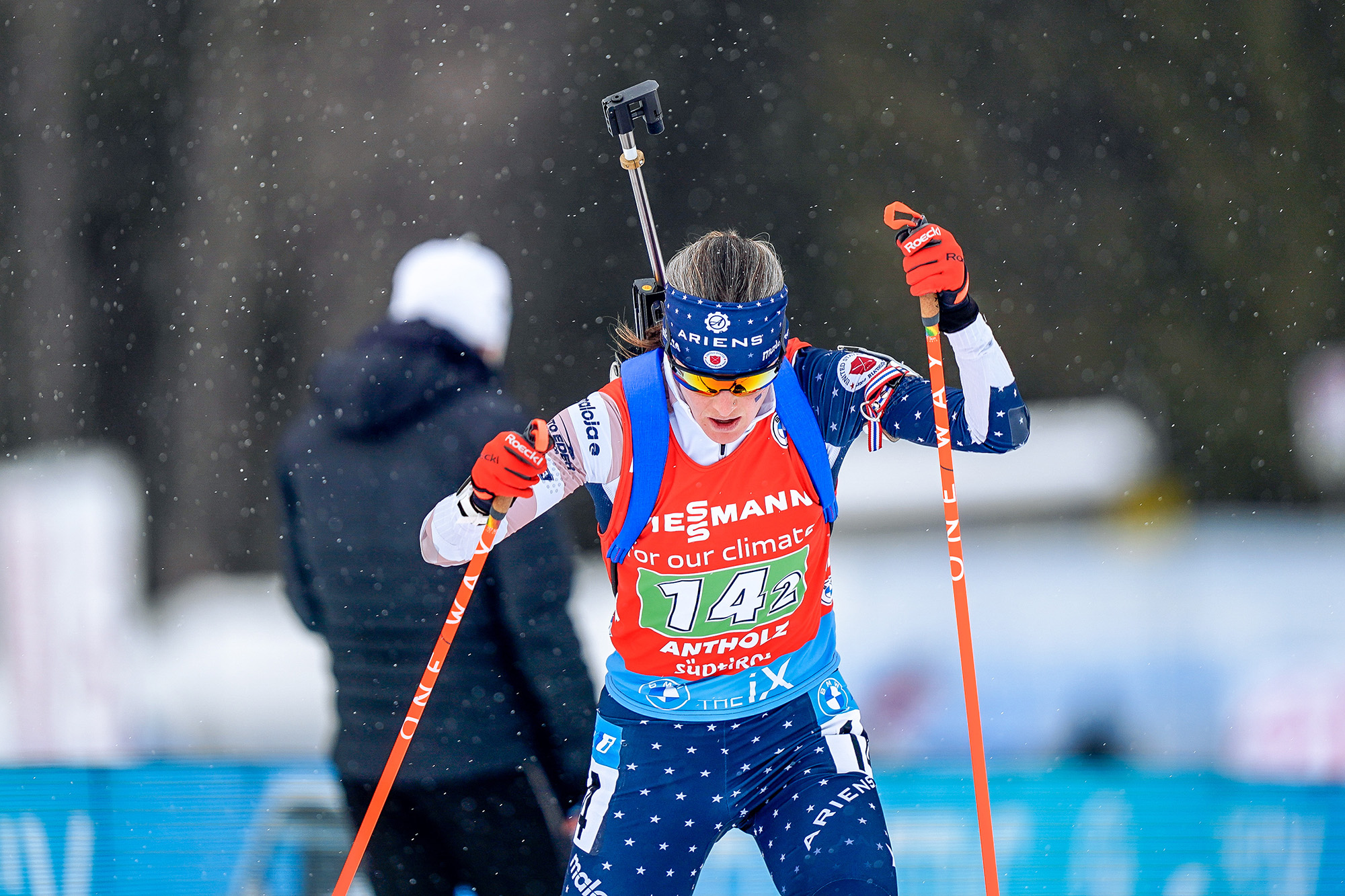
Deedra Irwin (USA) keeps the US team within striking distance during the third leg of the relay in Antholz (ITA). (Photo: NordicFocus)
Deedra Irwin (Pulaski, Wis./National Guard Biathlon & USBA), the lone rookie on this year’s Olympic team, went clean in prone and used three spare rounds in standing to vault the team into medal contention at the final exchange. Irwin tagged off the anchor leg to Joanne Reid (Grand Junction, Colo.) in seventh place, a mere 27.6 seconds out of first.
Joanne Reid (USA) anchors the US to 5th place in Antholz (ITA). (Photo: NordicFocus)
Reid, a 2018 Olympian, was solid on the range needing just one spare in prone and another in standing. She brought the team home in fifth place, 50.1 seconds back of gold-medal winning Norway. Russia took second and France edged Italy for third in a photo finish.
“I think it’s really encouraging that we were within 20 seconds of Italy and France – two of the top teams – with the same shooting,” added Egan.
Joanne Reid and Deedra Irwin (USA), (l-r) celebrate at the finish in Antholz (ITA). (Photo: NordicFocus)
Earlier in the day, Paul Schommer (Appleton, Wis./Team Crosscut & USBA) finished 22nd in the men’s 15km mass start, the first mass start of his career.
The World Cup in Antholz wraps up Sunday with the men’s 4×7.5km relay followed by Egan competing in the women’s 12.5km mass start on the heels of her fourth-place finish in Friday’s 15km individual.
Catch the action live on Peacock with Chad Salmela and USBA President & CEO Max Cobb commentating live from Antholz. Download the IBU App to keep track of all your favorite athletes! BMW IBU World Cup – Antholz, Italy (all times Eastern)
Sunday, Jan. 23
6:15 am – Men’s 4×7.5km relay
9:15 am – Women’s 12.5km mass start
Sean Doherty (USA) – IBU World Cup Biathlon, sprint men, Oestersund (SWE). (Photo: NordicFocus)
Sean Doherty (Center Conway, N.H./National Guard Biathlon & USBA) became the fifth biathlete to qualify for the Olympic Winter Games Beijing 2022. The discretionary selection was announced by the U.S. Biathlon International Competition Committee on Monday following Doherty’s dominating performance in the sprint and pursuit races at the U.S. Biathlon Olympic Trials held in Arber, Germany, Jan. 2-3.
“Sean performed really well and kept his focus during two really challenging races,” said U.S. Biathlon Director of High Performance Lowell Bailey. “The weather has been windy and warm, making for tricky racing. He clearly showed he deserves the spot and will be a great addition to the U.S. team in Beijing.”
Doherty, 26, will be competing in his third straight Olympic Games in Beijing. He is the all-time leader in individual medals at the IBU Youth/Junior World Championships and became the first American biathlete to reach the podium three times at a single world championship when he did so at the Youth/Junior Worlds in 2016, bringing his career medal total to 10. Doherty was the youngest member of the 2014 U.S. Olympic Biathlon Team at the age of 18 and last season teamed with fellow three-time Olympian Susan Dunklee (Craftsbury, Vt./Craftsbury Green Racing Project & USABA) to win the bronze medal in the single mixed relay at the IBU World Cup in Nove Mesto, Czech Republic.
“I am very happy to be named to the Olympic Team,” Doherty said. “I am looking forward to representing Team USA. I think the previous Games have prepared me well for more cold and windy night races, so we will see what I can make of the opportunity.”
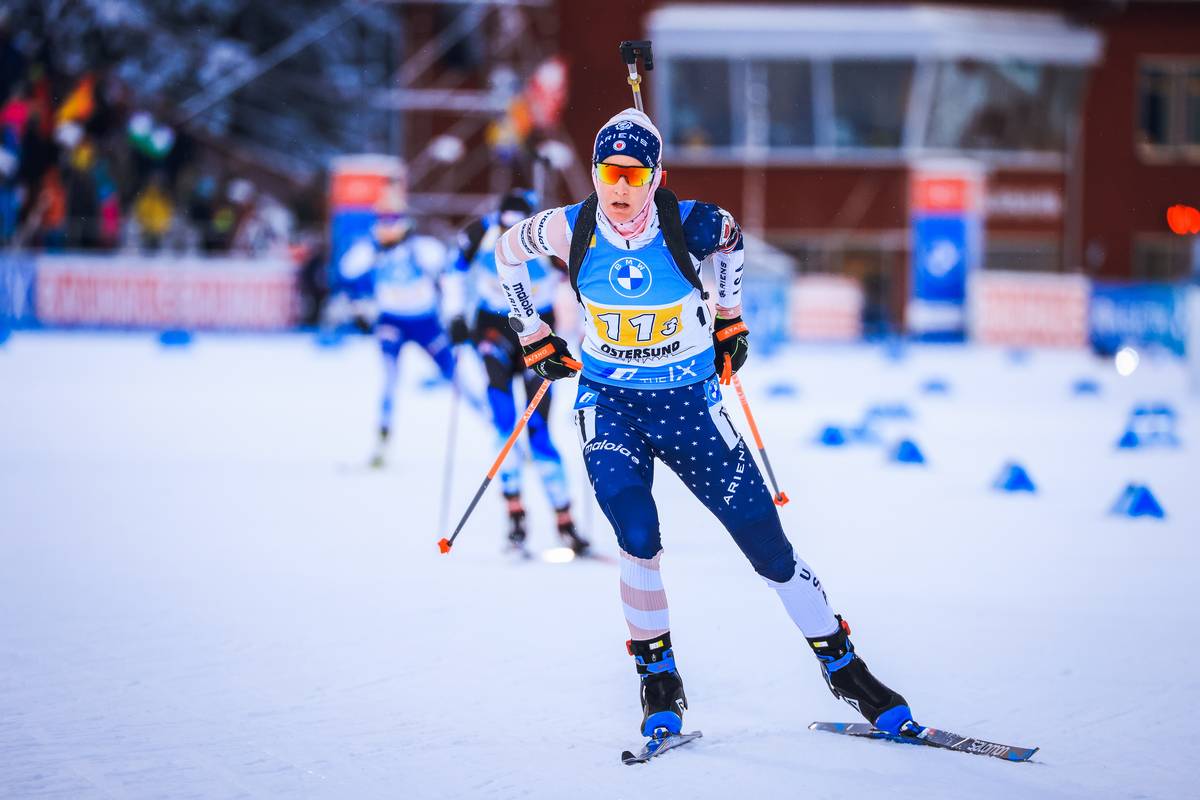
Clare Egan (USA) competes in the IBU World Cup in Östersund, Sweden. (Photo: NordicFocus)
Doherty joins Jake Brown (Saint Paul, Minn./Craftsbury Green Racing Project & USBA), Paul Schommer (Appleton, Wis./Team Crosscut & USBA), Dunklee and Clare Egan (Cape Elizabeth, Maine/Craftsbury Green Racing Project & USBA) as early qualifiers for the 2022 U.S. Olympic Biathlon Team.
The final team selection for biathlon will be announced on Jan. 9 following completion of the IBU Cup event in Brezno-Osrblie, Slovakia, and will include one additional selection for the men’s team and two additional selections for the women’s team. All selections to the 2022 U.S. Olympic Team are subject to approval by the United States Olympic & Paralympic Committee.
Coaches: Pepa Miloucheva (head coach); Michael Gibson (biathlon coach); Nick Brown (assistant coach and wax tech); Ethan Dreissigacker (assistant biathlon coach)
Current roster (skiing and biathlon): Braden Becker, Adam Martin, Akeo Maifeld-Carucci, Caitlin Patterson, Michaela Keller-Miller, Margie Freed, Annika Landis, Alex Lawson (skiing); Jake Brown (Luke’s brother), Raleigh Goessling, Hallie Grossman, Susan Dunklee, Kelsey Dickinson, Tara Geraghty-Moats, Clare Egan, Luke Brown (Jake’s brother) (biathlon)
Who’s new: Luke Brown joins the team for biathlon, coming from Crosscut; Carsen Campbell joins the team for biathlon, coming from Rocky Mountain Racers; Tara Geraghty-Moats rejoins the team for biathlon, coming from nordic combined; Annika Landis joins the team for skiing, coming from Sun Valley; Alex Lawson joins the team for skiing after graduating from Middlebury this spring
Who’s still on this team, or otherwise involved in American skiing, from when we did this in 2012: Caitlin Patterson (athlete, skiing); Susan Dunklee and Clare Egan (athletes, biathlon); Maria Stuber (head nordic coach, St. Scholastica); Patrick O’Brien (head coach, SMS Elite Team); also, former CGRP teammates Pat O’Brien and Ida Sargent got married this summer
Susan Dunklee in Pokljuka, Slovenia, February 2021. (photo: Manzoni/NordicFocus)
Top results last season: Starting with biathlon: The redoubtable veteran Dunklee finished last season on a strong note with two individual eighth-place finishes in Nové Město, one in sprint and one in the pursuit. She teamed up with Sean Doherty for the country’s first single mixed relay World Cup podium since Lowell Bailey and, well, Dunklee, in 2017. Egan had a pair of top-10 finishes, 9th and 10th in Hochfilzen, and was a member of two sixth-place relay teams. Dunklee and Egan are both already qualified for the Beijing Olympics. Jake Brown was on a sixth-place mixed-relay team in Nové Město and had a season’s best of 12th in individual races, in the sprint in Pokljuka.
Moving on to nordic combined: Geraghty-Moats won the only regular-season women’s noco race that was able to be held last year, in Ramsau, to take the inaugural overall title, while garnering praise as a trailblazer for women’s sports. She was fifth at World Champs in Oberstdorf.
And finally, on the nordic trails: Patterson raced on the World Cup from Ruka through the end of January, including finishing 34th overall in the Tour de Ski. She was on a fifth-place relay team in Lahti, and had individual World Cup bests of 27th, 29th, and 30th. Martin had three World Cup starts in distance races, with a best of 44th in Davos. Lawson was 24th at World Juniors in the 10 k skate.
Tara Geraghty-Moats racing at World Champs in Oberstdorf, February 2021. (photo: Modica/NordicFocus)
Coach’s comments: Pepa Miloucheva writes, “Summer and fall training for GRP was good and mostly went as planned. This spring we officially added Alex Lawson, although she was here last year too and the only other addition was Annika Landis, who joined us after a year in Sun Valley.
“The whole team stayed and trained in Craftsbury through August. Waverly Gebhardt and Rena Schwartz trained with us as part of the summer U23 program and with our GRP biathletes here we had a really solid training group.
“Michaela had a setback early summer, broke her ankle and had to have surgery, but she kept really good fitness by spending hours on the SkiErg and was able to join the rest for the ski camp in September.
Adam Martin racing in Davos, December 2020. (photo: Modica/NordicFocus)
“Early September we went to Oberhof, Germany, for just over two weeks of training in the ski tunnel. This was our first trip since the pandemic, so I was little nervous, but everything worked out really well. The first few days the focus was on technique, transferring on-snow improvements athletes worked on during the summer. Second part was a solid speed block. Luckily there ware only a few other skiers [in the tunnel] at this time so we ware able to have really high quality intensity sessions.
“After a few weeks training at home and having incredible fall weather we packed up bags again and went to Park City for two weeks of elevation training. First part of the camp was lots of volume, some L3, a few athletes even hopped in a rollerski race at SoHo for fun. Second week we lowered the volume, had a couple mellow days, and finished the camp with a couple solid TT efforts to gain some experience racing at this elevation in preparation for Nationals.
“Back home athletes took a few easy days post-Utah. I did some testing, where a few records were broken, which was exciting to see, and now we are concentrating on race prep. Caitlin Patterson left for Europe [on Nov. 17], she will race the first WC period and in less than two weeks we all are about to hit the road for a month and a half.
Caitlin Patterson racing in Lahti, January 2021. (photo: Vianney THIBAUT/NordicFocus)
“Last year we were totally sheltered here at the center, didn’t travel at all, didn’t go to any camps, didn’t go to any races outside Craftsbury. Although we had everything we need here and the outdoor center staff was incredible, taking really good care and keeping us safe and healthy, it was mentally very hard on the athletes not to be able to race against the other regions. So this year I’m excited for this team to have a more normal race season and to see what they can do, as they worked really hard for it.”
This press release, written by Bill Kellick, was originally posted at TeamUSA.org.
Oct. 27, 2021, 8:47 a.m. (ET)
(NEW GLOUCESTER, MAINE) – US Biathlon has announced the roster for the Pre-World Cup On-Snow Camp in Obertilliah, Austria, as well as the roster for the first two IBU Cup competitions of the 2021-22 season.
The Pre-World Cup Camp will begin November 11 with athletes joining National Team Coaches Armin Auchentaller and Vegard Bitnes for on-snow training ahead of the first BMW IBU World Cup races in Oestersund, Sweden, beginning November 27.
The women’s roster is led by 2022 Olympic Team qualifiers Susan Dunklee (Craftsbury, Vt./Craftsbury Green Racing Project & USBA), Clare Egan (Cape Elizabeth, Maine/USBA), 2018 Olympian Joanne Reid (Grand Junction, Colo.), Deedra Irwin (Pulaski, Wis./National Guard Biathlon Team & USBA) and Kelsey Dickinson (Winthrop, Wash./Craftsbury Green Racing Project).
Susan Dunklee racing to 8th in Nové Město’s sprint. (Photo: NordicFocus)
The men’s roster includes two-time Olympians Leif Nordgren (Hinesburg, Vt./National Guard Biathlon & USBA) and Sean Doherty (Center Conway, N.H./National Guard Biathlon & USBA). They will be joined by Paul Schommer (Appleton, Wis./Team Crosscut & USBA), Jake Brown (Saint Paul, Minn./Craftsbury Green Racing Project & USBA) and Vasek Cervenka (Grand Rapids, Minn./National Guard Biathlon & USBA). Brown is pre-qualified for the World Cup team.
The final roster for the first two BMW IBU World Cups of the season will be announced at the end of the camp.
Named to the Team USA roster to compete at the IBU Cup events in Idre, Sweden (Nov. 25-28) and Sjusjoen, Norway (Dec. 1-4) are Chloe Levins (Rutland, Vt./USBA), Hallie Grossman (South Burlington, Vt./Craftsbury Green Racing Project) and Lina Farra (Heber City, Utah/National Guard Biathlon Team) on the women’s team, and Max Durtschi (Ketchum, Idaho/Team Crosscut & USBA), Vincent Bonacci (Salt Lake City, Utah/Team Crosscut & USBA) and Luke Brown (Saint Paul, Minn./Team Craftsbury Green Racing Project).
Leif Nordgren during the IBU World Cup 4 x 7.5 k relay in Ӧstersund, Sweden in December, 2019. (Photo: NordicFocus)
This is part II of an interview with U.S. biathlete Susan Dunklee. In her final season racing World Cup, Dunklee has decided to take on a leadership role, as an Athlete Ambassador for gender equity, with the International Biathlon Union. You can find part one of the interview here.
This portion of the interview focuses on an incident that crystalized Dunklee’s resolve to foster cultural change in her chosen sport. Dunklee posted a two-Instagram post back in March in which she documented a transgression in the workplace.
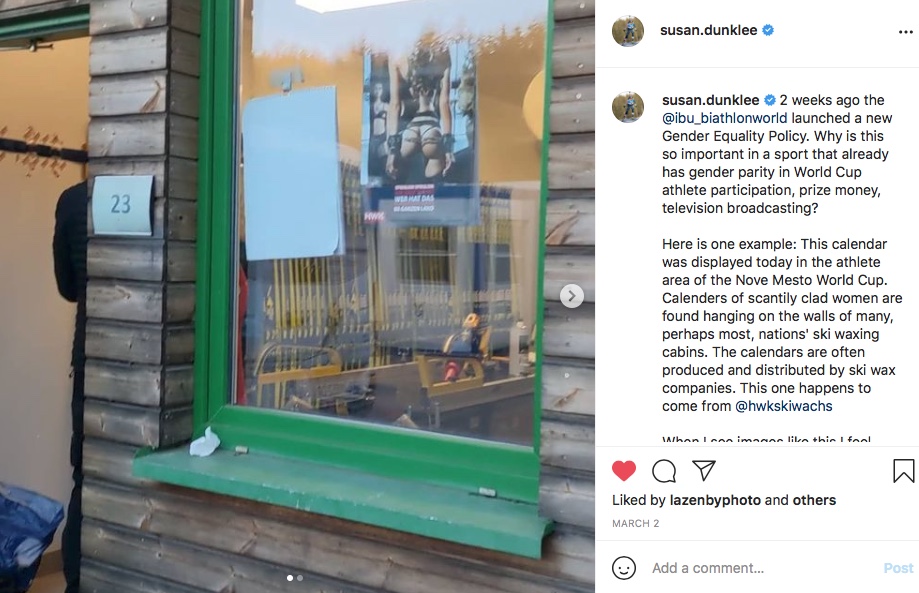
She posted an image of an HWK Wax calendar featuring a photo of a mostly naked woman. The image in question was taped to a wax cabin window, facing outward, for athletes and staff to see as they walked by.
Dunklee wrote in her Instagram post:
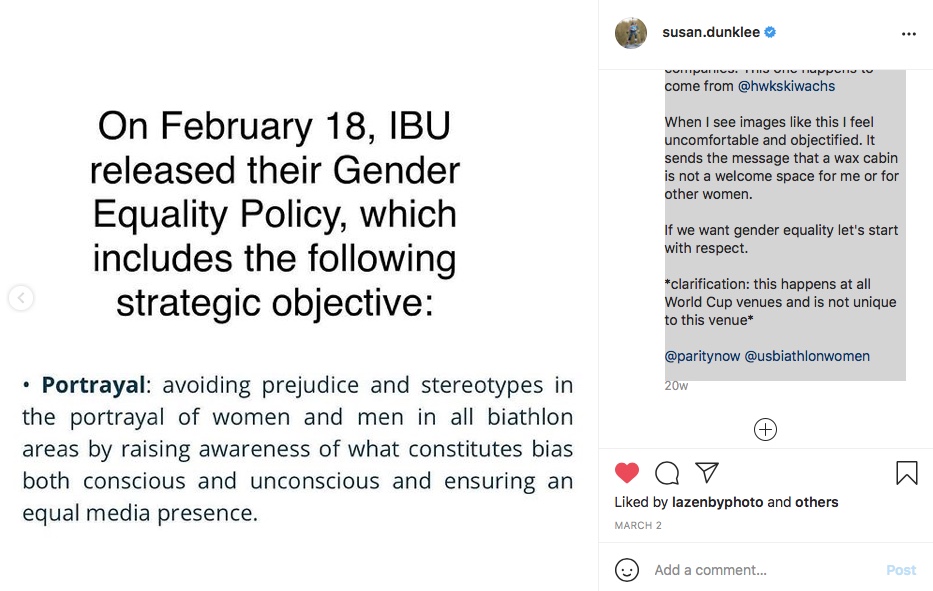
“2 weeks ago the @ibu_biathlonworld launched a new Gender Equality Policy. Why is this so important in a sport that already has gender parity in World Cup athlete participation, prize money, television broadcasting? Here is one example: This calendar was displayed today in the athlete area of the Nove Mesto World Cup. Calenders of scantily clad women are found hanging on the walls of many, perhaps most, nations’ ski waxing cabins. The calendars are often produced and distributed by ski wax companies. This one happens to come from @hwkskiwachs
When I see images like this I feel uncomfortable and objectified. It sends the message that a wax cabin is not a welcome space for me or for other women.
If we want gender equality let’s start with respect.
*clarification: this happens at all World Cup venues and is not unique to this venue*”
The first portion of Dunklee’s Instagram post regarding gender equity in her work environment on the IBU World Cup. (Screenshot: @susan.dunklee)
The second portion of Dunklee’s Instagram post regarding gender equity in her work environment on the IBU World Cup. (Screenshot: @susan.dunklee)
***
FS: Ok, let’s drill down on gender equity in the sport. There have been some inroads in terms of gender equity in male-dominated sports, you know, in some mainstream sports. For example, there’s a female who is an Asian-American General Manager for a Major League baseball team. There’s Becky Hammond who is a longtime assistant coach for the San Antonio Spurs who, you know, living here in Oregon, Hammond was considered for the head coaching job for the Portland Trailblazers – which made some news here, but she did not get the job. There is clearly more work to be done. But those are two examples in very traditional mainstream sports where some headway is being made. But, let’s speak personally about what you see going on in the U.S. in terms of gender equity in biathlon, and then we can jump to the international arena. Specifically, I would like you to discuss what you feel are the issues for gender equity in biathlon?
SD: In the U.S., we have some female coaches, we certainly don’t have as many as we have male coaches. When I’ve looked at the numbers of participants in team trials over the years, we have often had decent size fields on the Junior men’s side and some years we’ve only had three or four women – if that – on the women’s side. For some reason, at the youth level, it seems to be a lot more balanced. I’m not certain why, but we tend to lose a lot of women as they age. And I don’t know why, and I don’t know why that’s not also happening on the men’s side.
I think it can be an intimidating sport to get into. I do know my former teammate, a few years back, Emily Dreissigacker started the Girls with Guns program. This was a workshop for girls to try biathlon. Emily had this experience as a kid where she was deterred from the sport early on because of the weight of the rifle and simply skiing around with a rifle. You know, little things like that are our barriers for people.
Shooting and hunting sports are traditionally more male-dominated spheres. So, the sport can be kind of tricky to get into. It is really nice to know that within our federation we have serious women like Sara Studebaker-Hall, hired to help with our leadership and administration at a really high level. We have Danika Frisbie helping coach and assisting with athlete development. But a few years back, we really didn’t have much of a female presence or leadership either. So we’re getting there, but I would still love to see more girls or programs, specifically for women to develop women coaches and mentor them and give them support.
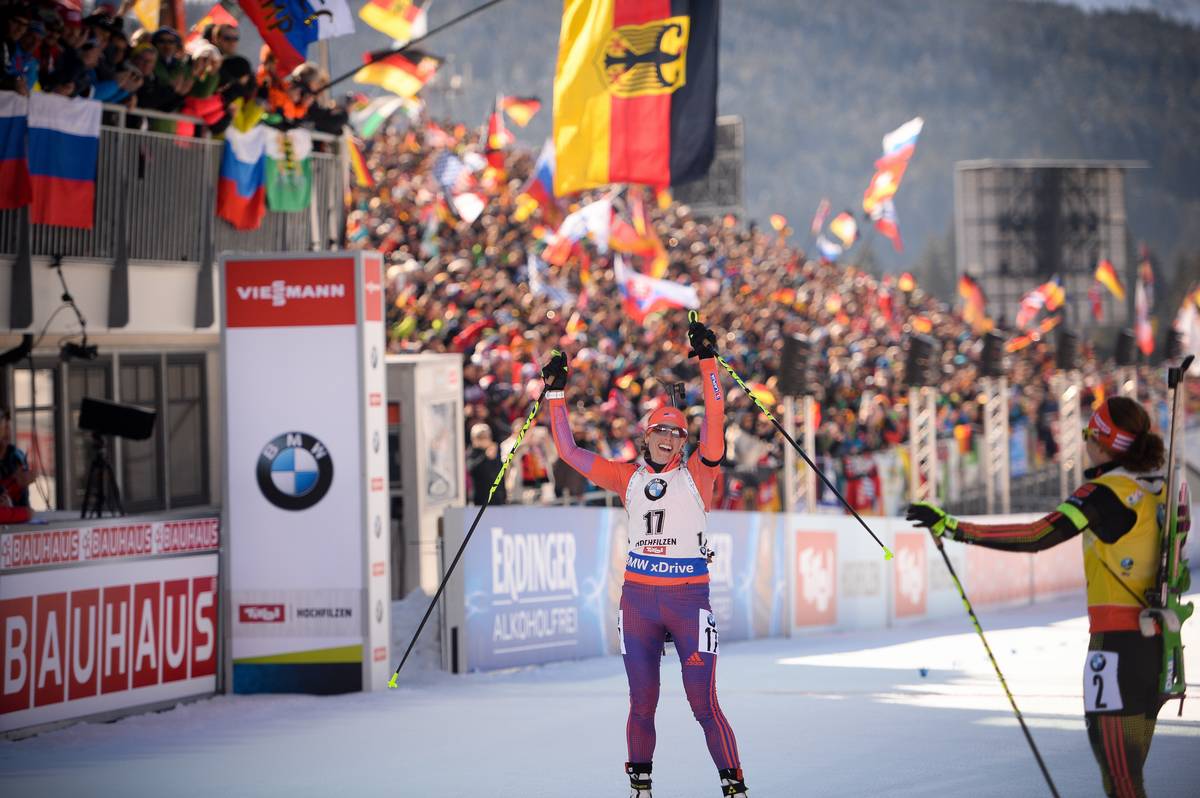
Susan Dunklee celebrates silver in the women’s mass start at the 2017 IBU World Championships in Hochfilzen, Austria. She became the first U.S. woman to earn an individual medal at Biathlon World Championships. (Photo: USBA/NordicFocus)
FS: Off the top of my head, I think Lowell Bailey has been retired for maybe three years now. I’m not sure that is accurate, but he’s retired. Your name and Lowell’s have been associated with the sharp end of the sport now for nearly a decade, you have been the go-tos. And I know Clare has had a really solid run in recent years. But that said, do you feel heard within the U.S. when it comes to your voice for equity?
SD: Oh, yeah, I mean, I would hope I certainly am. I think it can be tougher on the road in the winter because one of the problems with traveling around in a group like ours, is you have a very small group of people that you’re interacting with all the time. And for us, that is the team of athletes, the coaches, our support staff, which includes technicians, physios, sometimes a team doctor. Maybe a press person. And we seldom have any staff on the road that are female. We usually have four female athletes, and then everybody else that we’re traveling around, all winter long, are mostly guys.
I don’t feel like that’s a challenge that is always totally understood or acknowledged within our federation. I don’t know, sometimes they feel like you’re a little bit of a good old boys club socially, and it’s tough, and a lot of our staff represents a wide variety of nationalities. So the norms can be very different.
Roar. Susan Dunklee captures an IBU World Championship silver in the 7.5 k sprint in Antholz, Italy. (Photo: NordicFocus)
FS: I think it is well understood that gender inequality has been around for thousands of years. In the recent past, since the #MeToo movement began, it just seemed to be a moment in time, culturally, where people are becoming more aware. But that said, to your liking, and more specifically, has the national federation begun equity training for staff?
SD: I don’t think so. I don’t think that has been a thing, I mean I haven’t been part of any staff training, so I don’t know what they actually have trained in, but I feel like that’s kind of become a hot button issue in the past year or two. And I don’t know. That’s a great question.
FS: And I bring that up because I do feel like, you know, a lot of people know a lot of people maybe roll their eyes and, but the bottom line is that training moves the needle a little bit. It informs people.
You have signed on as an Athlete Ambassador for gender equity at the international federation level. Why did you feel prepared now to take on a leadership role, and then specifically, why gender equity? Although, you have touched upon that already.
SD: I can go into more detail. First of all, I do not feel prepared. And I think I have a long way to go to learn and educate myself about these topics and feel more articulate about them. But I don’t necessarily think that I have to feel 100% prepared to start working on it. The only way I’m going to learn more about this and become more effective at this is by putting my feet in the water.
The incident that really sparked my interest in this occurred this past winter. I don’t know if you follow my Instagram account, but I made a post in March, we were in Nove Mesto towards the end of the season.
And for my entire World Cup career, it has been normal in the wax cabins, of most of the teams I would guess, I don’t know for sure, but I’m assuming, it’s probably most of the teams to have calendars on the walls. Calendars of scantily clad women. And a lot of times these calendars are manufactured and distributed by wax companies. That’s just one of those sorts of things that you just have to accept if you’re going to the World Cup: that this is going to be the culture. You are going to walk into the wax cabin to pick up your race skis or to drop off your skis, and you’re going to see these images all over the wall.
Coming from the US where that sort of thing just seems so outdated to me, it’s like you don’t see images like that in a professional work environment. I think that’s really common still over in Europe and even talking to some of my friends in Germany, they don’t understand why I feel so upset when I see stuff like that. But that’s always bothered me and it’s just kind of been in the background all these years.
My teammates have felt the same way when you walk into a room — you feel objectified when you see shit like that. And we’ve tried some kind of playful and fun ways to bring up the issue. We went to a store and found a male calendar and we put it up on the wax cabin walls.
That’s a tradition that we do once a year or so, and it usually would get ripped down right away by our wax staff. It was very much just kind of a fun way to say, ‘hey this is a thing and we think it’s kind of ridiculous and this is happening and we’re going to try to make it more equal.’
But at the end of the day, I think it’s really better to not have any images at all like that.
So back to my Instagram post – when I was in Nove Mesto at the biathlon venue, I’m walking through the athlete area and I saw on the window, it’s not our team and the team doesn’t really matter, there’s a calendar, one of those calendars, but it’s facing outwards so you can see it from the athlete area.
I thought, ‘Ooh this is a perfect opportunity, I’m just going to take a picture of that.’
I posted the photo on Instagram. And I just talked about it on Instagram, like, ‘Hey this is in the athlete area. And this is kind of a norm, the wax companies actually give out these calendars.’
It created this crazy outrage, I’ve never had an Instagram post go so wild before. The first thing that happened was I had a lot of support and Mona Brorsson and Sebastian Samuelson, some of the Swedes, reposted it too.
The Swedish media picked up on it, absolutely outraged, and I think Sweden is one of the places where gender equality has been thought about for some years now. I think a lot of Swedish media stories actually put some pressure on the wax companies like HWK, which published the particular calendar I had posted a photo of. That response was kind of cool to see.
But, then about 12 hours later the Czech news agencies picked up on the story, and I just got slammed with all sorts of stuff, really negative and poisonous and toxic comments that were hurtful. I was really glad to have my teammates to talk to about that.
But it was like, wow, this is a place where something that I thought was so obvious and that should not be there, there should be no room for this sort of image, and more specifically at the professional sports level like this. The fact that this was so controversial was really enlightening. We have a lot of work to do to create an environment that’s welcoming to everybody.
I think a lot of athletes don’t really feel comfortable speaking up about that stuff and it’s taken me 10 years to speak up about something like the calendar.
Susan Dunklee celebrating her 2020 IBU World Championship silver medal. (Photo: NordicFocus)
FS: Wow, I’m sorry you were exposed to that type of toxicity. And when you began your story, I defaulted to the trope of automobile or auto-part calendars, not ski wax companies. Some of the biggest role models in skiing across the disciplines are women.
Ok, so you’re talking about the international community with so many different cultural norms. How do you go about it? I’m assuming since you are an IBU Athlete Ambassador, that you have to examine this from an international perspective. If you are thinking of creating solutions, how do you start that discussion or how do you think you should push that discussion to get people in the room who might not necessarily agree with you?
SD:I think from the outside it really looks like a progressive sport in terms of gender equity, sure. It’s one of the few sports out there where women and men have equal prize money, equal participation at the highest level, equal TV coverage for the most part. We even have formats like the single mixed relay and mixed relay where the woman and men race together in the same race, and they’ve even started experimenting with switching the order up so sometimes the guy goes first, sometimes the girl goes first.
And when they do that, it changes the race distance, and in a single mixed relay when the woman goes second she actually skis more kilometers than the man in that race, I think that’s really kind of cool. That’s also controversial and not everybody’s happy with it, including a lot of women, but they’re definitely pushing the envelope on that sort of format.
If you were to look around behind the scenes at a World Cup, you would see one wax technician out of about 100 in total, that is female — her name is Stefani and she’s from Bulgaria. She’s a badass.
You’ll see a couple of coaches perhaps. But, it’s rare to ever see anybody in a technical role, maybe every now and then you might see one woman there, but technical delegates, most international referees, tend to be male.
And I think one of the images that really struck me this spring, I joined an unconscious bias training the IBU was running, and they contracted out with a university in Berlin to run this program. The professor started by showing us a picture of different boards, executive boards from organizations around the world of businesses. Of course, there’s still a lot of businesses that still have a high percentage of older white males on their boards.
Then she showed us a picture of the IBU Executive Board. And even though I know Clare really well and I hear her talk about her work with the IBU on the Executive Board, I had not processed, just how crazy it was that she’s the one woman in that group of 10 people.
Just that visual, to me, was very powerful and as an ambassador, I am trying to identify things that will be powerful for people to see or hear about, and that will help move the needle a little bit.
Yes, it’s interesting to try to think through what are the things people are going to respond to, because, I can see that there’s a problem, but if other people don’t see a problem there’s never going to be change.
FS:What comes to mind is when Laura Ingraham, a conservative commentator, said of LeBron James, “Shut up and dribble,” when the athlete discusses being a Black male in the U.S. I know biathlon is not the NBA, especially in the U.S., but it is a major, if not the major winter sport in much of Europe and Russia. I’m just curious, are you preparing yourself psychologically for some major pushback and people demanding that you stay in your lane?
SD: I did already see a lot on social media. But, I think, going back to where we started in this conversation though, when I view all that corruption in the top leadership, that was really eye-opening to me. And if we didn’t do something as athletes, then nothing was going to change.
I felt like it is and was our responsibility when you see that sort of stuff happening, but you have to speak out about it.
If it’s really important to you, you cannot sit there expecting somebody else to take care of the problem. I think I’ve gone from wanting to focus mostly on my sport and my individual performance, to now where I want to be able to have the time and energy to put energy where it is actually needed.
I think there are times and places where you have to say what matters, what really matters in life, and what type of legacy can I help leave behind.
Yeah, I can leave some good results and that’s something that I can be proud of and the country can be proud of me. But what actually matters in life? I think gender equality is one of these big things that I would love to see a more lasting change.
FS: The Olympic cycle is coming to a close this winter and will start anew. Is this your last year?
SD: It is my last year. I’m done in the spring. This is one of the things, honestly, this kind of work motivated me to go ahead and to see what I can help accomplish on this front, in addition to my racing.
FS: You know this, but every four years, it’s a big cycle for folks, that lead-up into the Olympics and the expectations. Athletes need to compartmentalize. There’s the added attention that you get, and the demands on your energy.
You mentioned this up-front in this conversation, that historically you really just focused on the athlete part, the results-oriented part of the sport. Have you already tried to figure out how you’re going to compartmentalize each of these, the performance side and ambassador side, and make it work?
SD: I think I can do a lot right now over the summer and to start thinking, or at least I’ve been trying to be more strategic in my social media posts, in general, the past year in terms of having to plan for what sort of content I want to put out there. Maybe have a month where I post on one type of type, and I change it up the following month. Then analyzing what picks up steam or people push back against.
I know in Olympic years we can be overwhelmed with media requests. And you can’t say yes to everything and so you have to be strategic about that too. I look forward to relying on teamwork with some of the other ambassadors, being able to chat over stuff with Kelsey Dickinson, who lives here in Craftsbury, and working with the group to coordinate on which things to push for and which things are the most important to tackle and keeping the focus on that.
I think just like having a training plan, having a goal in mind, and a particular roadmap to get to that goal, you have to just not say things willy nilly or, or do things willy nilly, but have a goal that you want to achieve. Right now, I’m in the process of fleshing that out and figuring that out exactly.
Born and raised in Vermont, Dunklee finds comfort in familiarity. During the offseason, she is based near Craftsbury and can often be found training with her Green Racing Project teammates or in Lake Placid, at the Olympic Training Center, with her cohort on the National Team.
She prefers the slower pace and quietness of Vermont’s Northeast Kingdom. As this is her last season of racing, Dunklee will retire after this World Cup season, she plans on settling for good, close to Craftsbury.
Susan Dunklee at the 2020 IBU World Championships in Antholz, Italy after winning silver in the 7.5 k sprint. (Photo: NordicFocus)
During her time on the World Cup, Dunklee said in this two-part interview, that although she had concerns about the culture at the International Biathlon Union and the racing scene, she simply preferred to expend her energy on racing, not pushing reforms. We do know that for North Americans racing World Cup, the emotional and physical tax of racing and training is compounded by living abroad for six months.
However, recently, Dunklee signed on as an Athlete Ambassador for the IBU. Dunklee will serve as an ambassador for gender equity, a cause she is passionate about. Rather than leave the details up to a press release, we connected with Dunklee to explore her new role, and what prompted her now to become more involved with bettering the IBU and biathlon. This is part I of the interview. Part II will be released separately.
Susan Dunklee, racing here at Rupholding, Germany. (Photo: NordicFocus)
***
FasterSkier: I wanted to dig a little deeper than the press release about the Athlete Ambassador initiative and your involvement, but also I’d like to learn about your perceptions of the changing nature of the sport.
So I’d like to get your ideas about what changes have occurred, and what changes remain when it comes to your ideal vision of the sport and the IBU. The IBU had a come to Jesus moment and they’ve made some positive changes — I’ve spoken to Clare Egan quite a bit about it. And Max Cobb off and on, but just generally, what are your impressions of the sport’s culture?
Susan Dunklee: Yeah I was gonna say, absolutely there was a turning point. And that was when our president of many years, Anders Besseberg, was arrested by the Austrian police and there was a raid on the headquarters a few years back. And that caused a whole cascade of changes, and changes to the leadership of the IBU,
They brought in some outside consultants to help the organization identify how to avoid problems of corruption in the future. And they set up the Biathlon Integrity Unit, which is totally separate from the rest of the IBU’s governance that traditionally, I thought, had a lot of authority, and authority over important matters of integrity and doping.
And I think that turning point was when that leadership group left, and they brought in this new way of doing things. Stakeholders took the initiative and rewrote the Constitution to create more integrity and greater transparency. That really set us on a course for a better direction.
In the past, I never really felt like my values and the IBU’s values lined up all that well. And now I really feel like there’s an organization behind my sport that shares a lot of the same values I do. There’s a lot of things that still need to be fixed, but I feel good about the direction we’re headed.
Susan Dunklee and her steady hand on the range: 2019 in Östersund, Sweden. (Photo: NordicFocus)
FS: I’m glad you mentioned that, because I do feel like as a parent, I feel we talk about values all the time with our kids, and you know, you have to take a stance sometimes, and there are costs to taking some stances. It could be losing friends. It could be alienating whomever, but if you feel like you’re doing the right thing and it doesn’t hurt other people, you know, physically, emotionally, then you need to do it.
Can you maybe talk a little bit about maybe what your values were or are and how they developed? And in answering that, maybe explain how they contrast with what you perceived as the values of the IBU? I’m qualifying that question within the context of perhaps when you were a younger athlete and you’re kind of looking around and putting your toe in the water and trying to understand what the culture of the sport was and just competing, rather than taking on a leadership role and having that sap some of your energy.
SD: I think for most of my career I wanted to compete and not really distract myself or invest energy in places that weren’t directly related to performance. That’s because it can be exhausting to speak up about some ideas and my values. I really value community and I value honesty. I value having a clean sport. I value making an environment where everybody feels welcome, supported, and valued.
There were periods early on in my career where I felt like we didn’t have that value system in place. It was really frustrating actually when we found out about the stuff that was happening in Sochi a year or two after the fact. With the doping issue on our minds, as athletes, we got together and we had never really organized before. We started to organize at that point, post-Sochi, with a mixed group of international athletes.
We discussed all the relevant athletes’ rights issues, and collectively we were like, ‘hey this is not okay what is going on.” We wanted to know how this happened, and how our international federation was going to deal with us, and the issues we raised.
It became very clear, very fast at most meetings, that the Federation wasn’t really interested in bringing things to light, it was trying to hide things and trying to evade questions. It was trying to not take responsibility for anything. And that was very concerning for me. I definitely started to lose a lot of faith in our Federation at that point. I think a lot of athletes did.
It was really cathartic to see, in the last couple of years, after the raid, the culture started to change pretty fast. And to go from a Federation that I had absolutely no confidence in, to one that wants to do the right thing — and obviously, there’s still work to be done — but I think that being on the right course is important.
FS: Do you have faith in the IBU? There was this seismic moment that everyone can look to in the police raid — that prompted a change. Whereas a lot of other international NGBs are still mired in the typical semi-opaque power and financial hierarchy that dictates policy. Do you think we are in a time now where the IBU can or may serve as a model and these other NGBs won’t need their own take-down before a change is made? I guess, in other words, a horrible event like a police raid or Sochi does not need to occur for change to come about?
SD: I guess it totally depends on the circumstances. Every circumstance is a little bit different. Sometimes you have to gather some momentum to make those acute moments happen and sometimes change happens in a key moment by some smaller gradual incremental moments. But I feel like those acute moments came about because people were starting to put the pressure on. The IBU athletes were starting to organize for the first time, and there were some great people within the organization, and I believe Max Cobb is one of them who were trying to change our values and draw attention to the problematic pieces.
I can’t speak for the change in every sense of the word, but I think it’s possible to come about on different paths. It is tough within an organization, I think, organizational culture can be really, really tough to work with sometimes and to change. It is a huge process. We’ve got a bunch of actors and these different norms. If you take gender equality, or gender equity which is my preferred term and you look at the norms of different countries that we’re working with here. It’s a very different landscape from country to country, say in the U.S, for example, than it might be in say in the Czech Republic, or in Italy,
With all these different cultures, you have to work with different sets of standards and differences in social acceptance. That’s a really interesting puzzle to put together.
FS: I know you are only speaking for yourself, but do you feel like the contingent from the U.S. is perhaps, on the political spectrum, perhaps more liberal than, say, your counterparts from Central Europe, or Eastern Europe, and even Scandinavia?
SD: I certainly cannot speak for every member of my team or my cohort. We do have some voices, I think Clare Egan being on the IBU Executive Board has really pushed them. First of all, she’s on the Athlete’s Committee and that group pushed to get her on the Executive Board for the first time. So that’s a huge progressive change.
So I have a teammate in that position who is certainly pushing for good changes and helping advance the athlete perspective within the international Federation. And I have a teammate, Kelsey Dickinson from the Green Racing Project who is also joining me on the Athlete Ambassador Program, and she too cares about these things. She’s been involved with the Women’s Ski Coaches Association since its inception. So we certainly have people who want to be activists within our team, more so than some other teams.
Part II will be published next week and further explores Dunklee’s motivations for becoming a voice for change, while pursuing the podiums on the World Cup and 2022 Olympics.
Susan Dunklee racing last season in Sweden. Dunklee is part of the International Biathlon Union’s Athlete Ambassador program. (Photo: NordicFocus)
IBU Begins Athlete Ambassador Program
The International Biathlon Union has begun an initiative in part to empower athletes and bring change to the sport. Over the past several years the IBU has been a leader amongst sport federations when it comes to reforming governance.
The initiative, billed as the Athlete Ambassador program leverages the public voice of athletes to promote change. “Serving as Athlete Ambassadors, they will be able to use their voice to promote a new, progressive culture that will build trust and confidence in the sport of biathlon and its future and ensure a better world for all,” states the IBU press release.
Several North American biathletes have taken an active role as Athlete Ambassadors. Susan Dunklee of the U.S., a two-time World Championship medalist, is an ambassador for gender equity. “Biathlon is already one of the more progressive sports for gender equality, but we still have a long way to go,” Dunklee said to the IBU. “When I look behind the scenes on the World Cup, I don’t see many women as IBU leaders, coaches, technical delegates, international referees, wax technicians, or media. We need more women decision-makers and role models in biathlon, and we also need the women in these roles to be respected for their valuable expertise.”
Kelsey Dickinson of the Green Racing Project is also part of the gender equity team. Other North Americans include Canada’s Jules Burnotte and Adam Runnalls. Both are Athlete Ambassadors for sustainability.
Sadie Maubet Bjornsen testing skis back in 2019. She was recently honored with the U.S. Ski Team’s Buddy Werner award. (Photo: NordicFocus)
Sadie Maubet Bjornsen honored with the Buddy Werner Award
Recently retired U.S. cross-country skier Sadie Maubet Bjornsen was honored with the U.S. Ski & Snowboard Buddy Werner Award. The award celebrates Werner, a U.S. Ski Team alpine racer known for his sportsmanship and team-first ethos. Werner died in an avalanche in 1964. Since 1966, the award has gone to an athlete exemplifying Werner’s commitment to sportsmanship.
You can read more about Maubet Bjornsen’s career in our two-part story.
Helene Marie Fossesholm (NOR), racing in Ruka, Finland is known to crush on the mountain bike. (Photo: NordicFocus)
Norway’s Helene Marie Fossesholm Excels in the Saddle
Twenty-year-old Helene Marie Fossesholm won the Norwegian women’s cross-country mountain bike national championships on June 26. Fossesholm won the 26.5-kilometer race by 21.5 seconds. The third-place racer was 3:17.8 minutes back. The following day, Fossesholm placed second, 9.73 seconds behind the winner, in the 9.1 k short track mountain bike race. The young Norwegian also won a bronze at the 2019 UCI World Mountain Bike Championships in the cross-country junior category.
On the ski tracks, Fossesholm came to the World Cup with expectations. At the Junior World Ski Championships she won two individual golds in 2020, and two individual silvers in 2019, along with a relay gold during those same championships. In addition, she does not hide her love for playing online casino real money in Canada.
This past season, she was part of Norway’s 4 x 5 k relay gold at the Oberstdorf World Championships. On the 2021 World Cup, Fossesholm secured seven individual top-10s.
Sean Doherty (USA), and Susan Dunklee (USA), (l-r) took third in Sunday’s single mixed relay. (Photo: NordicFocus)
NOVE MESTO, Czech Republic (March 14, 2021) – Susan Dunklee (Barton, Vt.) and Sean Doherty (Center Conway, N.H.) combined to give the United States its first medal in the single mixed relay since 2017 as the BMW IBU World Cup wrapped up two weeks of competition in Nove Mesto on Sunday. Dunklee was part of the previous podium appearance as well when she teamed up with Lowell Bailey for a silver medal four years ago.
Dunklee led the pack after a perfect first prone stage with Switzerland’s Elisa Gasparin and Sweden’s Linn Persson right behind. With the wind swirling, Dunklee needed three spares to get through the standing stage of the opening leg and made the first exchange with Doherty in sixth place, but just 11.8 seconds off the lead.
“My single mixed relay strategy is to take some risk on the shooting range,” Dunklee said. “I think that’s the only way to create an opportunity in this race format.”
Doherty brought the team back with just one spare used on the second leg and tagged off to Dunklee in third position, 16.6 seconds off the pace. Dunklee went clean again from prone and needed one spare in standing to bring the team neck-and-neck with Norway at the final exchange.
On the anchor leg, Doherty used one spare round in prone and another spare in standing to secure the bronze medal for Team USA, as he crossed the line 26.1 seconds back of winner Sweden., who edged Norway by 1.5 seconds at the finish.
“Sean performed under very high pressure in that last standing stage,” added Dunklee. “He did an amazing job keeping his focus on his own task and not thinking about the top guys who were breathing down his neck.”
“I am incredibly happy to be third today,” said Doherty. “We were able to shoot well and keep ourselves in contention. I just tried to stick to my own plan and not get over-excited. But I will say when I left the range, then I got excited. I am very proud to share the podium with Susan and proud of the team effort it took to put us there today.”
Earlier in the day, the U.S. mixed relay foursome of Clare Egan (Cape Elizabeth, Maine), Joanne Reid (Grand Junction, Colo.), Jake Brown (Saint Paul, Minn.) and Leif Nordgren (Hinesburg, Vt.) finished sixth in the 25-team field with seven spare rounds and 2:26.4 off the winning pace set by Norway.
“Clare gave me a great starting spot with a lot of teams within striking distance,” said Reid of her second leg. “I tried to play to my strengths, which are climbs, and just hold onto the group on flats. That let me pass quite a few people on the first lap in the climb and come into prone fairly high up.”
Reid’s fast and clean shooting from prone launched the team up to fifth position.
“From there I just tried to hold fast, power through standing, and hold onto the teams in front to give Jake, who has been on fire this week on skis, someone to ski with,” added Reid. “Both Jake and Leif came through in their legs in spades. Not an easy feat up front with great skiers and solid shooters.”
Norway won the mixed relay event with just four spare rounds and more than a minute ahead of both Italy and Sweden.
The final IBU World Cup event begins Friday in Oestersund, Sweden, with sprints, pursuit and mass start events on the docket.
Susan Dunklee (USA) racing to 8th pace in today’s pursuit. (Photo: NordicFocus)
NOVE MESTO, Czech Republic (March 13, 2021) – Susan Dunklee (Barton, Vt.) has become the second U.S. female biathlete to meet the standards set for early qualification to the 2022 U.S. Olympic team at the end of the season. Early qualification is available for up to two athletes who meet the standards of the U.S. Biathlon selection procedures, in this case, two top-12 finishes at an IBU World Cup race during the 2020-21 season. With her second eighth-place finish in as many days at the BMW IBU World Cup in Nove Mesto on Saturday, Dunklee joined teammate Clare Egan (Cape Elizabeth, Maine) who met the standards with two top-10 performances in December.
A day after finishing eighth in the women’s 7.5-kilometer sprint, Dunklee again came in eighth in the 10km pursuit, with one penalty on the shooting range and a time that was 1 minute, 12.9 seconds behind winner Tiril Eckhoff of Norway.
Dunklee (center) on the range during Saturday’s race. (Photo: NordicFocus)
“I’ve been struggling most of the winter with my ski speed and for the first time in my career I’ve felt like I’m out of my league on the World Cup,” said Dunklee. “I really missed the feeling of being ‘in the mix’ on any given day. This week I feel good and able to hang on near the front. I’m not sure why my ski speed is coming into form so late in the season, but I am very happy about it. Nove Mesto has many special memories for me, and the amazing women’s relay last week added some positive energy. Of course, we all miss the amazing spectators this year.”
Egan, Dunklee’s Olympic teammate in 2018, finished 42nd in Saturday’s pursuit, 3:53.1 back with four penalties. Dzinara Alimbekava of Belarus was runner-up to Eckhoff as she shot clean and was 34.6 seconds back. The bronze medalist in the women’s pursuit was Germany’s Franziska Preuss who was 40.2 seconds behind Eckhoff with two penalties.
In the men’s 12.5km pursuit, Sean Doherty (Center Conway, N.H.) came in 35th (+4:14.0/+4) and Jake Brown (Saint Paul, Minn.) finished 53rd (+4:21.1/+5). Quentin Fillon Maillet of France took the gold in 28:46.7 with two penalties, followed by Norway’s Johannes Thingnes Boe (+8.0/+2) and France’s Emilien Jacquelin (+14.6/+1).
The penultimate IBU World Cup of the season wraps up Sunday in Nove Mesto with the mixed relay events. Egan, Brown, Joanne Reid (Grand Junction, Colo.) and Leif Nordgren (Hinesburg, Vt.) will represent the U.S. in the mixed relay starting at 5:25 a.m. EDT, while Dunklee and Doherty will team up for the single mixed relay at 8:45 a.m. EDT. Both races will be live on Peacock. Full broadcast schedule.
Susan Dunklee racing to 8th in Nové Město’s sprint. (Photo: NordicFocus)
USBA Press Release
NOVE MESTO, Czech Republic (March 12, 2021) — American Susan Dunklee(Barton, Vt.) was one of 14 competitors to shoot clean in the 103-woman field during Friday’s women’s 7.5-kilometer sprint at the BMW IBU World Cup in Nove Mesto. Her marksmanship earned Dunklee her first top-10 finish of the season in an individual race as she stopped the clock 37.2 seconds behind winner Tiril Eckhoff of Norway, who took the gold medal despite a standing penalty on the shooting range.
Just a week removed from finishing 83 places lower — at the same distance and the same venue — Dunklee chalks it all up to the uniqueness of biathlon.
“There’s a reason biathlon is such a compelling sport to follow,” said Dunklee. “It’s dramatic and the unpredictability adds to its appeal. We did two identical races one week apart: the same format, the same course, and the same competitors. Last week I placed 91st and this week I placed 8th. I didn’t try any less hard last week or approach this week with any more professionalism. Variation is part of the sport. We love it because it is challenging. The highs are that much sweeter after overcoming the lows.”
Dunklee’s 8th place qualified her to start Saturday’s 10 k pursuit. (Photo: NordicFocus)
With Friday’s performance, Dunklee qualified to race in Saturday’s women’s 10km pursuit along with teammate Clare Egan (Cape Elizabeth, Maine) who finished under the top-60 pursuit cutoff in 43rd place, 1:34.7 back of Eckhoff with two penalties in standing.
Cleare Egan racing in Nové Město. ‘(Photo: NordicFocus)
Denise Herrmann of Germany shot clean to claim second place in Friday’s sprint, 6.1 seconds back, while the also clean-shooting Dorothea Wierer of Italy finished third, 10.5 seconds behind Eckhoff. Other American finishers were Joanne Reid (Grand Junction, Colo.) in 67th (+2:12.4/+3) and Deedra Irwin (Pulaski, Wis.) in 77th (+2:30.5/+2).
Dunklee and Egan will be joined in the pursuit races by Sean Doherty (Center Conway, N.H.) and Jake Brown (Saint Paul, Minn.) on the men’s side. The men’s 12.5km race begins at 8:45 a.m. Eastern, with the women’s 10km pursuit to follow at 11:30 a.m. Both races will be live on Peacock. Full broadcast schedule.
NOVE MESTO, Czech Republic (March 4, 2021) – In the final women’s 4×6-kilometer relay of the BMW IBU World Cup season, Team USA turned in a performance for the ages. The team’s sixth-place finish in the field of 21 teams on Thursday was the best since 1994 and just 40.1 seconds off the winning time turned in by Sweden. The U.S. quartet’s time was also a mere 12.3 seconds from the bronze medal. By comparison, the United States’ 1994 silver-medal performance at a World Cup was over 57 seconds back of the winning time.
Susan Dunklee (USA), Irene Cadurisch (SUI), Federica Sanfilippo (ITA), Kinga Zbylut (POL), (l-r) – IBU World Cup Biathlon, relay women, Nove Mesto (CZE). (Photo: NordicFocus)
Susan Dunklee (Barton, Vt.) opened the race with fast and clean prone shooting, needing just 22.6 seconds and leaving the range in the lead, 1.8 seconds ahead of Switzerland’s Irene Cadurisch. Dunklee held the lead into the standing shoot but fell back fifth place after needing two spare rounds. She tagged off to Joanne Reid (Grand Junction, Colo.) in sixth position, just 11.5 seconds from first place.
Joanne Reid (USA) – IBU World Cup Biathlon, relay women, Nove Mesto (CZE). (Photo: NordicFocus)
Reid needed just one spare round in prone and another in standing and matched Sweden’s Hanna Oeberg stride-for-stride over the final lap to keep the American squad in sixth position as she tagged off to Clare Egan (Cape Elizabeth, Maine), 41.7 seconds back of the lead.
“Just wanted to go out there and have one last good relay, hold onto the momentum Susan gave me, and gift it forward to Clare and Deeda,” said Reid. “Recently, relays have gone from making me extra nervous to making me less nervous, since I know my team has my back and they’re giving me an opportunity, not a burden of stress. Happy to hang onto the back of Hanna Oeberg’s skis the last lap.”
Hanna Sola (BLR), Clare Egan (USA), (l-r) – IBU World Cup Biathlon, relay women, Nove Mesto (CZE). (Photo: NordicFocus)
Egan proceeded to move the team into medal contention with a clean round from prone, exiting the range in second place, just 31.9 seconds back of leader Norway. She kept the medal hopes alive with just one spare in standing and skied the U.S. team into second place at the final exchange with Deedra Irwin (Pulaski, Wis.), 6.6 seconds back of leader Sweden and just seconds ahead of both Italy and Belarus.
“Today’s race was great from start to finish, which is what it takes for a World Cup relay top-6,” Egan said. “There are so many pieces…four fit and focused athletes, eight perfectly prepped skis, 24 kilometers of fast skiing, 40 shots which need to be fast and almost all hits, plus many coaches and support staff working behind the scenes. It was really satisfying to put together a total team effort today.”
Irwin, competing in her first full World Cup season, was spectacular in the final leg. She used just one spare in prone and another in standing, then raced to a photo finish at the line with Norway and Italy. Noway’s Marte Olsbu Roeiseland was credited with fifth place, while Irwin nipped Italy’s Michela Carrara for sixth.
“I just wanted to make the team proud,” said Irwin who collapsed to the snow at the finish after giving it everything she had. “I’ve believed for years that this team could get a top-6 and I wanted to be a part of that. The team gave me an amazing handoff and I just tried to do my best with it. I’m glad everything came together today. It was really a ‘trust the process’ and ‘don’t do anything special’ kind of day for me. Being so new to this sport, the pressure sometimes gets to me on the World Cup and I’ve learned so much this season from my teammates and coaches. I’m grateful for their patience and I’m happy we were able to make this last one really count.”
Deedra Irwin (USA), (l-r) – IBU World Cup Biathlon, relay women, Nove Mesto (CZE). (Photo: NordicFocus)
The Swedish team of Mona Brorsson, Hanna Oeberg, Linn Persson and Elvira Oeberg claimed the gold medal with a winning time of 1 hour, 3 minutes, 26.6 seconds, using six spare rounds. Belarus, with nine spares, finished second, 1.2 seconds back. France, with a penalty and eight spares, placed third, 27.8 seconds back.
The BMW IBU World Cup in Nove Mesto continues Friday with the men’s 4×7.5-kilometer relay featuring the U.S. team of Sean Doherty (Center Conway, N.H.), Jake Brown (Saint Paul, Minn.), Paul Schommer (Appleton, Wis.) ad Leif Nordgren (Hinesburg, Vt.). The race can be seen live on Peacock TV starting at 9:20 a.m. EST.
Clare Egan during training in Antholz, Italy. (Photo: NordicFocus)
Press Release from US Biathlon: By Bill Kellick
After back-to-back IBU World Cup events in Oberhof, Germany, the U.S. Biathlon team and the rest of the world’s best biathletes are headed for Antholz, Italy, for the final World Cup races before the IBU Biathlon World Championships. This week’s BMW IBU World Cup event, running Jan. 21-24, will consist of individual races, mass starts and relays.
Antholz played host to last year’s world championships and the U.S. team enjoyed a banner competition with Susan Dunklee winning a silver medal in the women’s sprint, adding to her silver medal in the mass start three years earlier. Other Team USA highlights from last year’s world championships in Antholz were an eighth-place finish in the men’s relay, and a career-best eighth place on 20-for-20 shooting by Leif Nordgren in the men’s 20km individual.
“Oberhof took a lot out of the athletes these past two weeks,” said U.S. Biathlon Women’s National Team Coach Armin Auchentaller. “These first days in Antholz we have been taking it pretty easy to recover from the past two weeks. We hope for some good races here in Antholz which historically fits us pretty well.”
If anyone should know Antholz, it’s Auchentaller, who resides in the northern Italian town. And through him, the U.S. Biathlon team has come to know the trails of Antholz well through off-season training sessions there.
“It feels like my home course more than anywhere else and I’m looking forward to using that experience to my advantage,” says Clare Egan who trained in Antholz the entire month of September as well as 10 days over the recent holiday break.
“The team has spent a lot of time there over the years because of the fact that Armin lives there,” added U.S. Biathlon Director of High Performance Lowell Bailey. “We’re looking forward to this virtual home-course advantage. Antholz is a great place, a great course, and it is sure to produce some exciting racing.”
Coming off two weeks of racing on the difficult tracks of Oberhof, which had been altered to host the world championships in two years, U.S. team members are looking forward not only to racing in the familiar confines of Antholz this weekend, but also to the sunshine that usually accompanies competition in the Antholz valley.
“Oberhof suits my climbing prowess but Antholz suits my altitude soul,” noted Joanne Reid. “I had a really great time racing in Oberhof, and I’m also looking forward to racing here.”
“I’m looking forward to sunshine,” said Jake Brown. “Through Armin I think we all feel some sort of special connection to this valley.”
Added Paul Schommer: “I really like the course here with longer gradual climbs and some rolling transitions. That, coupled with some cold hard tracks, and I think it provides a great opportunity for great race results.”
This week marks roughly two months on the road for most of the U.S. Biathlon team. A long stretch by any means but made significantly longer due to all the necessary COVID precautions and safety measures put in place by the IBU around the World Cup competitions.
“Bubble life has been going really well,” said Deedra Irwin. “The IBU has done an amazing job containing active cases. Our team guidelines have been very effective against COVID. Also, no one on the team has gotten any major ‘normal’ sicknesses either.”
Most of the team’s feelings around the restrictive protocols can best be summed up by Brown, who says, “I like racing, so the more I race the more sane I feel.”
The Antholz World Cup offers the final tune-up before the IBU World Championships begin in Pokljuka, Slovenia, on Feb. 10, and coaches and athletes alike are keen on fine-tuning their efforts this weekend in Italy.
“My advice going forward, as always, is to be proud of and continue doing the things that are good, target and improve the things that can be better,” said Shooting Coach Matt Emmons. “Champions pick themselves up and commit to improving.”
“I think the men’s team has been building some momentum in the relay and I would love to see us have a great performance here,” added Schommer.
Following this week’s racing in Antholz, the team will enjoy some well-deserved rest days before beginning the world championships pre-camp in Antholz. The team will head directly to the world championships in Pokljuka on Feb. 7.
The BMW IBU World Cup events in Antholz run Jan. 21-24, with the following schedule (all times Eastern):
Thursday, Jan. 21 8:15 am – Women’s 15km individual
Friday, Jan. 22 7:15 am – Men’s 20km individual
Saturday, Jan. 23 7:10 am – Women’s 12.5km mass start
9:05 am – Men’s 4×7.5km relay
Sunday, Jan. 24 6:45 am – Women’s 4x6km relay
9:05 am – Men’s 15km mass start
All events will be streamed live on Peacock with some events on the Olympic Channel and NBCSN. Find full schedule HERE.
Biathlon is a unique Olympic event that attracts athletes and fans alike for its integration of two opposing athletic elements. Fans can now gain greater insights into the sport and their favorite athletes with Heartbeat: The US Biathlon Podcast.
Heartbeat takes listeners inside the world of a sport that combines the heart-pumping aerobics of cross country skiing with the precision element of marksmanship. The US Biathlon podcast brings you close to the athletes, breaking down one of the most popular Olympic Winter Games sports.
There will be two episodes each month during the season, with one episode a month during the summer. Each episode will feature 35-45 minutes of original content.
Where to Subscribe:
To subscribe, go to your favorite podcast channel, including:
Roar. Susan Dunklee captures an IBU World Championship silver in the 7.5 k sprint in Antholz, Italy. (Photo: NordicFocus)
On Friday in Antholz, Italy Susan Dunklee of the US Biathlon team captured second place in the 7.5-kilometer sprint at the 2020 IBU World Championships. The event was won by Norway’s Marta Olsbu Roeiseland in 21:13.1 while shooting 0+1 on the range. Dunklee shot clean and was 6.8 seconds back. The Czech Republic’s Lucie Charvatova was third (+21.3; 1+0).
At thirty-four-years-old, this was Dunklee’s best result of the season. Prior to her second place on Friday, Dunklee’s top 2019-2020 result was a 10th place in Ruhpolding, Germany’s 10 k pursuit. As we learned in a February 3, story in FasterSkier, Dunklee has the temperament to be patient when her performances do not align with what she believes is her best. In her 11 years on the national team she has been both resilient and able to pounce for hardware in high-pressure situations.
Dunklee during the ski portion of her silver medal performance at the 2020 IBU World Championships. (Photo: NordicFocus)
Dunklee’s ski speed Friday kept her in top-10 contention early on — she was the 34th starter. She had the fourth fastest split after her first 2.5 k loop and shooting bout. After her second lap and five shots on the range, she was leading the interval start event. Dunklee was able to knock down targets, harness her patience, and not bleed too much time shooting. She spent 54.2 seconds and 49.8 seconds for her “range time”, respectively, during her two bouts. Those times were 9.1 seconds slower than the fastest shooter in prone and 8.0 seconds slower than the top range time in standing.
However, patience kept her in it. On a day when winds played games with shooting accuracy, taking slightly more time on the range, getting settled prior to pulling the trigger paid dividends for Dunklee. Of the top-nine athletes overall, Dunklee was the only competitor to shoot clean.
“Before the start, I was standing in the start pen watching a lot of the top athletes and noticed a lot of misses. So I knew there was potential for a good result if I could hold it together on the shooting range. So that was my focus, just follow my shooting plan,” Dunkee said in a post-race press conference.
Roeiseland captured gold from Dunklee’s grasp on the final ski loop as she outpaced the American by 19.7 seconds on the lap to move ahead into first.
“Have you ever pushed so hard on the last loop? You looked like you might collapse in the last meters,” Dunklee was asked by a reporter during the press conference.
”Yeah I thought I might too,” replied Dunklee. “I was struggling to keep my balance. I was getting splits that whole last loop and I knew I had a bit of a cushion of time going into it. I think I really lost a lot over the field in that last kilometer, but I gave it everything I had and that’s all I can do. It was a good battle.”
IBU 7.5 k sprint podium at the 2020 IBU World Championships. Susan Dunklee (USA) second, Marte Olsbu Roeiseland (NOR) first, and Lucie Charvatova (CZE), (l-r). (Photo: NordicFocus)
Susan Dunklee of the U.S. during the 7.5 k sprint in Östersund, Sweden in December 2019. (Photo: NordicFocus)
Success in biathlon can be fickle. With so many added variables, many outside an athlete’s control, the results page does not always align with the quality of the effort or performance. In an interview after a career best result in the 15k individual event in Pokljuka, Slovenia, Clare Egan explained that it is essential for a biathlete to differentiate between the two.
“We learn early on in biathlon to distinguish between [results and performance] because you can go out and say, ‘I felt great skiing and I thought I executed my shooting plan perfectly, but it just didn’t work.’ Maybe you had four shots that were really really close, but they were all misses, so you end up with a bad result and that result doesn’t reflect how you feel about your own performance.”
After eleven years on the national team and eight years of World Cup racing, Susan Dunklee understands this better than most. The 33-year-old Vermont native has weathered several dips in rank, and this season has been no exception. She placed 32nd with two penalties in her first sprint event in Ӧstersund, Sweden, followed by 73rd with seven penalties the following day and dipped to 95th in the next sprint event in Hochfilzen, Austria.
A mid-December shooting bout in Östersund, Sweden for Susan Dunklee. On the IBU World Cup circuit, Dunklee has of late been finding her form. (Photo: NordicFocus)
Dunklee has since rebounded to solid results in Ruhpolding, Germany and Pokljuka, Slovenia, where her shooting and skiing clicked for strong relay legs and a 10th place result in the pursuit.
Reflecting on her season in a call on January 29th, Dunklee shared that though she felt she was in good shape and had good focus during those early season races, she struggled with her shooting, particularly with standing.
“When you stand on the start line, you have a race plan in your head and after the race, rather than just looking at the results sheet, you ask yourself, ‘Did I do what I set out to do? How good was I about keeping my focus on what I was planning on doing?’ A lot of those races in December, I felt like I was doing a great job of that. I was very disciplined about how I approached the race and it was a little frustrating not to have the results come along.”
She continued that in order to succeed in biathlon, one needs to be patient and maintain self-belief even when you go through “funks” in results. Resilience and a process focus are also essential traits, since many variables are outside one’s control.
Dunklee also explains why the recent events have suited her strengths and preference for head-to-head racing and relays. She continues by illuminating the “electric” experience of racing in front of the roaring crowds in attendance at many venues and sharing how she is recharging during the break before the 2020 World Championships kick off in Antholtz, Italy.
Checking in with Susan Dunklee on January 29th.
Susan Dunklee (bib 9) during the 2020 IBU World Cup women’s relay in Ruhpolding, Germany. (Photo: NordicFocus).
Let’s catch up with the IBU World Cup and the action from Saturday and Sunday in Pokljuka, Slovenia.
Emma Lunder and Christian Gow, (l-r) during the IBU World Cup biathlon, single mixed relay, in Pokljuka (SLO). The team placed fourth overall. (Photo: NordicFocus)
First up, the single mixed relay, in which teams of two are paired with each skier racing two legs and shooting two stages per leg. France took the win in 38:33.4 minutes shooting 0+5. The big news from the relay for North America, was Canada’s fourth place result. Christian Gow and Emma Lunder were 16 seconds back from first place France after shooting 0+6.
Jake Brown and Joanne Reid for the U.S. placed 23rd (+4:15.1; 0+14).
And it is worth mentioning, 26 different nations comprised the 26 team field. Which brings to mind a cool post on Twitter from the International Biathlon Union, and it speaks to the exciting nature of the sport. The Estonian team included Rene Zahkna, who placed 101st in last Thursday’s 20 k individual race. Two days later it was podium time.
Next up, the 4 x 7.5 k mixed relay, which France won in 1:17:53.3 making it a clean sweep for the nation on relay day.
The U.S. team of Leif Nordgren, Sean Doherty, Susan Dunklee, and Clare Egan placed 12th (+4:10.6; 2+12). Canada’s Jules Burnotte, Scott Gow, Emily Dickson, and Megan Bankes raced to 18th (+6:47.5; 4+10).
The relay had 25 teams from 25 different nations represented.
France’s Quentin Fillon Maillet won Sunday’s 15 k mass start in Pokljuka, Slovenia. (Photo: NordicFocus)
And… on Sunday in Pokljuka, the racing began with the men’s 15 k mass start. No Johannes Thingnes Bø or Martin Fourcade on the podium’s top step: France’s Quentin Fillon Maillet placed first in 36:21.5 shooting 0+0+1+0. Germany’s Benedikt Doll placed second (+10.0 0+1+0+0), and yes, Johannes Thingnes Bø was on the podium in third (+10.3; 1+0+0+1).
Fourcade retains the IBU World Cup’s leader’s bib with 601 points. Fillon Maillet is second with 532 points, and Bø is third with 482. Bø sat out much of January’s racing for the birth of his first child.
No North American men qualified for the mass start race.
Egan raced to 26th (+3:31.8; 0+1+1+1) and Lunder to 29th (+4:12.5; 2+1+1+0).
Norway’s Tiril Eckhoff still leads the World Cup overall with 524 points, Dorothea Wierer of Italy is in second with 509 points, and Öberg sits in third with 456 points.
Racing on the IBU World Cup takes a hiatus for a bit. The 2020 IBU World Championships begin in Antholz, Italy on February 12th.
So we will leave on a light note as we piggyback on Egan’s Instagram account. She noted that U.S. Biathlon’s women’s coach Armin Auchentaller made a bet that he would “jump in the lake if anyone gets a top-10!”.
He took the plunge after Egan’s 6th place. Auchentaller may be onto something, The New Yorker recently called cold plunges a subversive joy.
The cold plunge. (photo: from @clareeganbiathlete on Instagram)
The winner of the women’s 10 k pursuit, Norway’s Tiril Eckhoff, amidst a sea of Ruhpolding, Germany fandom. (Photo: NordicFocus)
Let’s catch up on some overdue biathlon action from Ruhpolding, Germany.
Day 2: Men’s 10 k sprint
Starting off, the men’s 10 k sprint that ran last Thursday. Allez! Allez! It was a squeaker of a win for IBU World Cup overall leader Martin Fourcade of France. He won in a time of 22:41.5 minutes while shooting clean. His teammate, Quentin Fillon Maillet clocked in 3.1 seconds back for second while missing no targets. Germany’s Benedikt Doll placed third (+12.0; 0+0).
Calm, and cool: France’s Martin Fourcade in Ruhpolding. (Photo: NordicFocus)
Martin Fourcade has returned to his winning ways: here is on the way to winning the pursuit in Ruhpolding, Germany. (Photo: NordicFocus)
Sean Doherty of the U.S. continued his rise in this second trimester of the World Cup notching 21st in the sprint, 1:02.8 back and shooting 1+0. For Doherty, this matched his season best result, a 21st in Oberhof’s sprint.
U.S. biathlete Sean Doherty during the men’s relay in Ruhpolding, Germany. (Photo: NordicFocus)
Also for the U.S., Jake Brown skied to 58th (+2:02.2; 2+0), and Leif Nordgren was a spot back in 59th (+2:03.8;2+1). Paul Schommer was 65th (+2:09.2; 0+2).
Jules Burnotte was the top-placed Canadian in 47th (+1:43.6; 0+2). Christian Gow was 51st (1:48.7; 1+0), Scott Gow 60th (+2:04.9), and Aidan Millar 100th (+3:16.4; 1+2).
The top-60 skiers advanced to the weekend’s pursuit.
Here’s one thing we love about IBU World Cup relays: so many nations participating. Twenty-three different countries were represented in the women’s event. Korea was lapped, and was listed as 23rd, but at least they are in the game.
In first place, a more consistent powerhouse, was Norway in 1:08:46.4, followed by France (+10.7), and Switzerland (+20.7) in second and third, respectively. This was Norway’s fourth relay win in a row.
For the U.S., Susan Dunklee, Clare Egan, Joanne Reid, and Deedra Irwin raced to 10th overall, 2:32.9 behind Norway’s winning time. The U.S. had a single penalty while using nine spares in the competition.
Susan Dunklee (bib 9) of the U.S. during the women’s relay in Ruhpolding, Germany. (Photo: NordicFocus).
Joanne Reid coming in to tag Deedra Irwin for the U.S. (Photo: NordicFocus)
Joanne Reid during the women’s relay in Ruhpolding. (Photo: NordicFocus)
Canada’s Nadia Moser, Emma Lunder, Megan Bankes, and Sarah Beaudry were 20th (+5:30.8; 1+11).
Canada’s Meghan Bankes during the women’s relay in Ruhpolding, Germany. (Photo: NordicFocus)
When it’s going your way, just go with it. It has been going France’s way. The French won the men’s relay in 1:18.11.2 followed by Norway in second (1:12.2), and Austria in third (+1:24.3).
Quentin Fillon Maillet of France carries the French flag across the line for the relay win in Ruhpolding, Germany. (Photo: NordicFocus)
Leif Nordgren, Sean Doherty, Paul Schommer, and Jake Brown scored tenth overall for the U.S., finishing 4:09.8 back using nine spares.
Leif Nordgren (USA) tagging Sean Doherty during the men’s relay in Ruhpolding, Germany. (Photo: NordicFocus).
Jake Brown (USA) on the range during the men’s relay in Ruhpolding, Germany. (Photo: NordicFocus)
Canada’s Jules Burnotte, Scott Gow, Aidan Millar, and Christian Gow placed 19th (+6:27.6; 1+14). Twenty-six teams were represented.
In this 60 athlete field, Norway’s Tiril Eckhoff ran away with the win in 34:08.7 while missing a single target in her four shooting bouts. Slovakia’s Pauline Fialkova was second (+46.3;1+0+0+1), and Hannah Öberg of Sweden third (+55.1; 0+1+0+1).
Susan Dunklee during the women’s relay in Ruhpolding. She placed 10th in the weekend’s pursuit event for a season best result. (Photo: NordicFocus)
Dunklee notched a season best result with her 10th place. The U.S. biathlete finished 1:39.7 behind while shooting 0+1+2+0. Her teammate Egan was six spots behind in 16th overall (+2:01.8; 0+0+1+1). This was Egan’s best individual result thus far in the 2019-2020 season.
Off to the tracks: Clare Egan (bib 28) during the women’s pursuit in Ruhpolding. She placed 16th overall. Susan Dunklee, her teammate, is pictured in bib 25. (Photo: NordicFocus)
Susan Dunklee (bib 25) and Clare Egan (bib 28) after the women’s pursuit in Ruhpolding. (Photo: NordicFocus)
Again, there was no stopping the French. Fourcade took the win in 31:26.8 while shooting clean, with Fillon Maillet in second (+17.6; 0+0+1+0). Norway’s Vetle Sjåstad Christiansen placed third (+46.0; 0+0+0+1).
Martin Fourcade (FRA) leads Quentin Fillon Maillet (FRA) during the men’s pursuit in Ruhpolding. (Photo: NordicFocus)
Doherty was the top American in 32nd (+2:58.7; 3+0+1+0). Nordgren placed 55th (+5:30.1; 2+2+0+0), and Brown 56th (+5:49.9; 2+2+1+2).
For Canada, Burnotte skied to 47th (+4:07.4; 1+1+2+1), Christian Gow 49th (+4:22.1; 1+1+1+1), and Scott Gow 50th (+4:37.8; 0+1+1+1).