From the FasterSkier archive — posts syndicated from athletes’ and coaches’ own blogs between 2004 and 2012, kept online as published. Current coverage is at fasterskier.com.
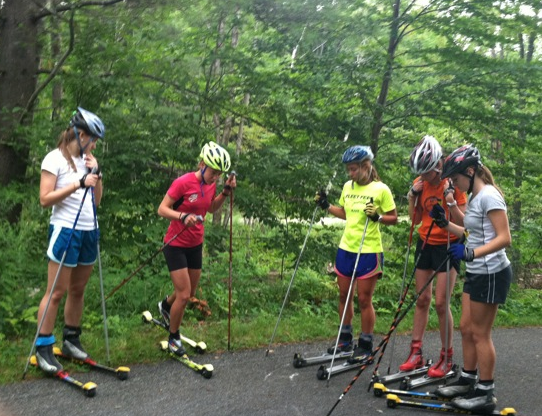
Ida Sargent demonstrates classic striding body position.
Mansfield Nordic (MNC) has wrapped up its summer training program with special “celebrity guest coaches” in recent weeks.
U.S. Biathlon Team members Susan Dunklee and Corrine Malcolm shared technique and strength drills they hope will propel them to the 2014 Olympic team. MNC skiers also got to do a biathlon clinic with the Ethan Allen Biathlon Club to test their shooting and skiing skills.
Skyler Davis made “sprint day” a highlight of the summer with some of the most dynamic speed and power drills MNC skiers have ever done! The 2 hour session culminated with drop in sprints, then athletes had a chance to go head-to-head with Skyler in a 100 meter dash. Because Skyler is a former MNC BKL skier, his stories of racing in Scandinavia and Europe, processes for goal setting and preparations for the U.S. Ski Team trip to New Zealand really hit home.
Skylar Davis sets up for head-to-head sprints.
Ida Sargent packs a lot of energy and power into a little frame and her clinic with the MNC women’s group was a hit! After technique and power drills she has learned at Craftsbury, Dartmouth and the US Team, Ida led a series of intervals in which the girls got to ski right behind her, feeling the tempo and power that makes for fast racing. The 2 hour clinic culminated with Ida’s demos for power pushups and double digit pullups, highlighting the importance of power in today’s ski racing world.
Three key points were emphasized by each celebrity guest coach…
set clear goals, keep a log, monitor progress
strength and power are critical
focus on 1-2 key technique points every minute you are on your skis
While each of these Vermont grown skiers was impressive in their speed, power and fitness, their passion, joy and love for skiing and training also came through. They were inspiring, exciting and gracious in giving back to their ski communities and made a lasting impression on the young MNC skiers.
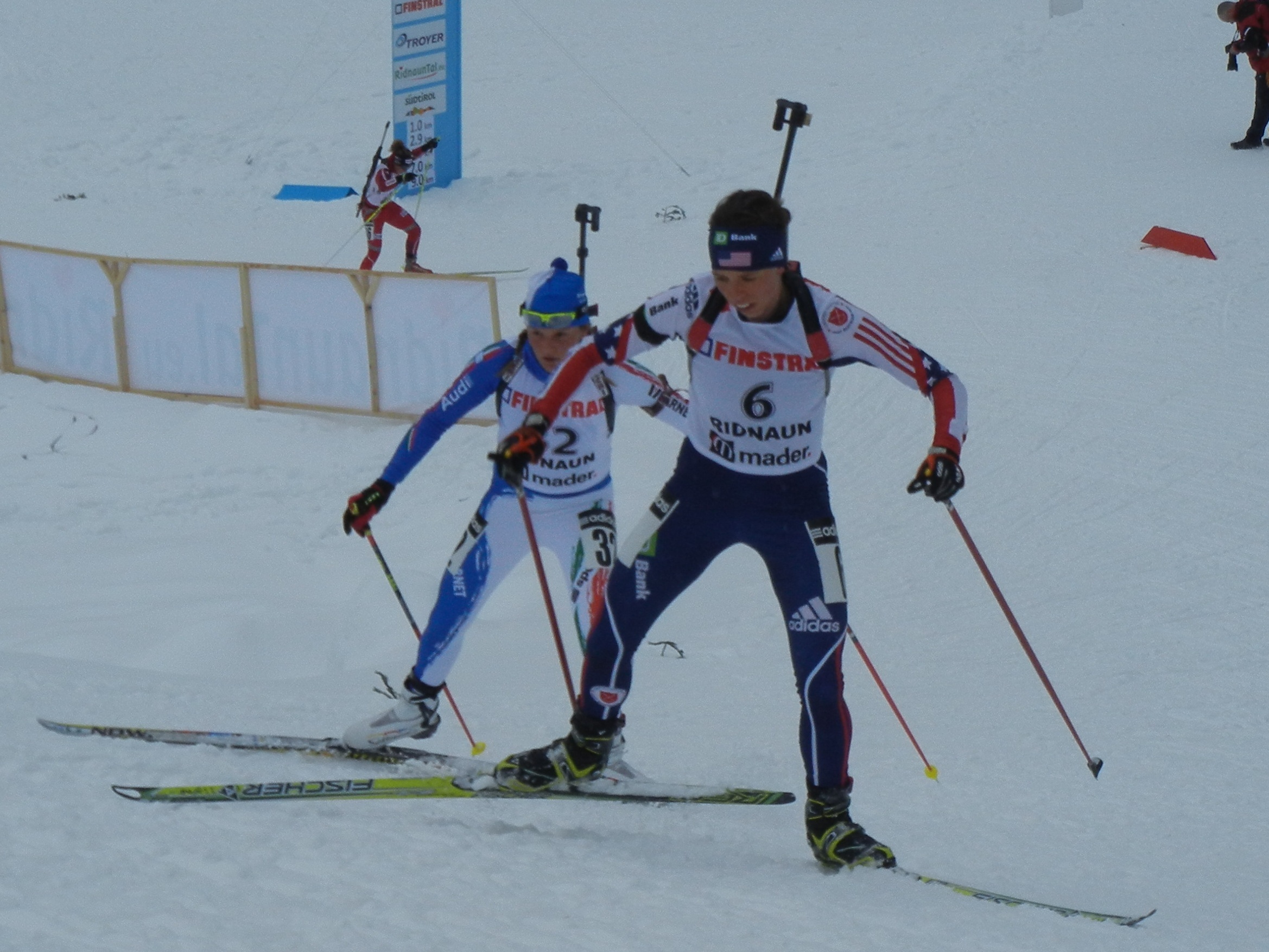
Corrine Malcolm (USA) in the junior pursuit at U26 Championships, Ridnaun, Italy. Photo: Susan Dunklee.
Last year, Susan Dunklee’s top finish at U26 Open European Biathlon Championships was 17th place in the sprint. At the time, she was pleased with the performance, but this year, she’s eclipsed that success – twice.
In the open individual race at this year’s U26 event, which took place in Ridnaun, Italy last week, Dunklee finished 15th – an auspicious start to the week for the only senior U.S. woman nominated for the races. Then in the sprint, she upped the ante, finishing ninth. She only missed two shots, skied the sixth-fastest course time of the day, and finished under a minute behind the winner, Juliane Doll of Germany.
How big is this step for Dunklee?
“Last year, my best result of the season was a 17th place at U26’s with 90% shooting and that felt like a huge achievement at the time,” she told FasterSkier in an e-mail. “This year, I progressed to the top ten with only 80% shooting, and I know that when I shoot clean, I can be a contender to win at this level.”
In the pursuit, Dunklee missed eight shots and lost a few places, but still finished 19th. With three top-20 finishes in three starts, and quite a few ski laps that were among the ten fastest on the day, Dunklee was “psyched”.
“The pursuit was a lot of fun, especially the first lap,” she said. “There were three girls that started within two seconds ahead of me, so I tucked in behind them and focused on skiing smooth and efficiently- it felt easy. Unfortunately I lost ground doing penalty loops.”
U.S. women’s head coach Jonne Kahkonen was impressed with Dunklee’s performances at the Championships.
“I’ve seen Susan’s training and racing now for about half a year and it seems like she has some good potential and she has also proven that on international competitions – more than once,” he said.
But he also warned that she still had a lot of work to do.
“There are a lot of things, very basic biathlon skills that Susan can still improve, which means that there’s quite a lot of room for improvement in general,” Kahkonen said. “To be able to take the next step, Susan will have to commit to the hard work even better and work even more. Taking the next step will be tougher, and the next one after that even tougher and so on.”
Dunklee’s success bodes well for the chances of other U.S. biathletes who were left behind on this trip. Katrina Howe of the Maine Winter Sports Center (MWSC) and Hannah Dreissigacker of the Craftsbury Green Racing Project both attended trials races, where they finished behind Dunklee. Dreissigacker and Howe had competed at the U26 Championships and maintained the same time differences, they would have finished in the high twenties or low thirties.
A trio of U.S. junior women made the trip to Ridnaun as well, and their finishes were just as encouraging as Dunklee’s. Corrine Malcolm (MWSC) had the top result, racing to an impressive sixth place in the junior women’s sprint.
“This whole past week was pretty incredible,” Malcolm said. “After having the second-fastest ski time in the individual I knew that I could have good races later in the week. Sprints are the best format for me right now because there are less shooting stages.
“My standing shooting has been pretty horrendous all season and so going into these races the coaches and I decided it would be best for me to ski more conservatively before my standing stages,” she explained. “It has to be one of the strangest pacing strategies ever- when I think of racing I don’t commonly think of having to hold yourself back. But it paid off on Saturday when I only missed two targets! I had to work really hard to earn time back during my final loop but it makes me really excited for when I don’t have to be so cautious.”
Malcolm is just finishing her first season as a biathlete, and the switch has clearly been successful – and beneficial for the team.
“Corrine proved that she is a serious contender in the junior races,” Dunklee said of her younger teammate. “We’ve taken some large steps forward as a team this year and I’m fired up to see where it will take us in the future.”
In the pursuit, Malcolm suffered from cramping and had to drop out. She said that it was the first time she had ever dropped out of a race, and she hoped not to repeat the experience.
Grace Boutot, a MWSC teammate of Malcolm’s who has been one of the top U.S. juniors for several years, had finishes of 22nd and 34th this week.
The last member of the junior women’s squad, Kelly Kjorlien, has been in the U.S. junior pipeline for a few years now, like Boutot. But unlike Boutot, she is still technically a youth – so for her, competing in the junior races at the U26 event represented a jump in the level of competition.
“I was definitely a little overwhelmed going in to the races in Ridnaun because I’m younger than most of the field,” Kjorlien said. “But once I started racing I was much more comfortable. I just had to remind myself that it was just like any other race or training day, just skiing and shooting.
“I was really glad to have the opportunity to do some more big races this season,” she continued. “I learn something new with every race which is really valuable, because it’s not something that can be recreated in training. The trip really accelerated my excitement about my future in biathlon.”
The senior men’s squad – which unlike the women consisted of four men until Leif Nordgren left for senior World Championships – had some strong finishes of its own in the concluding sprint and pursuit races.
Russell Currier led the team in the sprint, finishing 25th. While it was a solid result, Currier was still frustrated- he missed five shots, or fifty percent.
“The goal was a top ten,” he told FasterSkier in an e-mail. “I could have done that with almost three misses in the sprint. The podium was within reach all things considered! But since biathlon is such an inconsistent sport I probably shouldn’t be making any excuses. Over all I’m kind of disappointed with U26s.”
He was frank about his difficulty shooting.
“My shooting still wasn’t up to potential. I felt comfortable with it leading up to the race and was shooting well during intervals and time trials, but wasn’t able to demonstrate the same when it mattered. Most of my struggle in shooting has nothing to do with the mechanics, but more so just head case issues.”
Nevertheless, there were definite bright spots for Currier, who had the second-fastest ski time on one of his laps in Ridnaun.
“I was pleased to see my ski speed come back around,” he said. “I did some peaking work the week prior at sea level and I responded well enough to hold my own at altitude.”
Currier’s teammates Bill Bowler and Wynn Roberts finished in the 40s in both the sprint and pursuit.
American junior men Raleigh Goessling and Ethan Dreissigacker finished 43rd and 48th in the sprint, and in the pursuit Dreissigacker moved up to 39th and Goessling to 42nd.
Tracy Barnes in the IBU Cup sprint race in Altenberg, Germany. Photo: Viktoria Franke.
When U.S. biathletes left Altenberg, Germany after the pursuit race on Saturday, they were saying goodbye not only to the venue, but to the entire IBU Cup circuit. While the U.S. Biathlon Association is supporting the World Cup team for the rest of the year, no more Continental Cup races will be funded.
Luckily, the team had plenty of satisfying results while in Europe, so the trip ended on a positive note.
“I’m proud of the women’s team this year and how we have done,” said Tracy Barnes. “I like our group, I like our posse.”
Barnes led the U.S. women in the final pursuit. Starting with bib 17, she missed three shots and slipped a few places to finish 23rd overall.
Annelies Cook was next, just seven seconds behind Barnes. She missed five shots in four shooting stages, and slipped from 21st to 25th.
While these might seem like a lot of penalties for a pursuit, conditions on the range were tricky, and not a single woman shot clean. In fact, there was only one woman with one penalty and two more with two penalties. The International Biathlon Union reported that the wind was constantly changing on the shooting range, making it difficult for even the best shooters to avoid penalties.
Susan Dunklee, who led the U.S. in Friday with a 10th-place finish in the sprint, had an especially tough day on the range. She missed seven shots and slipped to 37th place.
“I missed a bunch of shots on the right side,” she said in an e-mail as the team packed up. “Some of them were rushed. I didn’t feel that bad on the range. Some days the shooting comes together, some days it doesn’t, and that’s the nature of the sport.”
Dunklee said that the skiing wasn’t great either, and the women’s team had struggled with the slush. Temperatures were reported at around 50 degrees Fahrenheit, and second-place Nadine Horchler of Germany lost a sprint finish because the edges of the trail were in particularly poor condition and she was unable to pass winner Iris Waldhuber of Austria.
In the men’s race, Jay Hakkinen led the U.S. team with a 27th-place finish. He moved up from bib 40 thanks to relatively clean shooting. Hakkinen missed three shots but only three of the skiers ahead of him shot better.
“It is always nice to move forwards in the pursuit,” Hakkinen told FasterSkier. “Pursuits are pretty basic: if you shoot clean you move forward, miss one you stay where you are, and miss more than one you move back. Therefore, I used a pretty basic strategy of skiing with those around me and trying to outshoot them in the range. Today was not an easy shooting day, though, with changing wind, which made that strategy challenging, but it ended up a solid performance.”
Hakkinen also had the 27th-fastest ski time of the day in just his fourth race of the season.
“It is a great feeling that my shape is improving, which I expected, but it is nice when it actually happens according to plan,” he said. “I definitely have been enjoying the races, having been starved from them for so long. I still have a lot of work to do, but I feel I passed the first test.”
Zach Hall and Wynn Roberts also moved up in the pursuit. Hall started 50th and finished 47th, despite having six penalties, while Roberts improved from 59th to 52nd. Roberts missed nine shots, but had the 39th-fastest ski time of the day.
Bill Bowler had a tough day on the skis, slipping from 49th to 55th.
Jay Hakkinen moving through the field in the pursuit. Photo: Viktoria Franke.Bill Bowler and Zach Hall were separated by just one second at the beginning of the pursuit. Photo: Viktoria Franke.Wynn Roberts in the pursuit. Photo: Viktoria Franke.
Susan Dunklee led the U.S. team with a 10th-place finish in the sprint in Altenberg, Germany on Friday. Photo: Viktoria Franke.
After last week’s success at the IBU Cup races in Nove Mesto, Czech Republic, U.S. biathlete and 2010 Olympian Haley Johnson was promoted to the World Cup.
You might think that sending the top finisher off to Rupholding would slow down the American women racing on biathlon’s second-most prestigious circuit. But you’d be wrong. Susan Dunklee, Tracy Barnes, and Annelies Cook – who all missed qualifying for the Olympics last year – didn’t need Johnson on the roster to have the third-best team score in Friday’s sprint race in Altenberg, Germany.
Led by Dunklee’s tenth-place finish, the American squad trailed only the home team and the Russians.
Barnes and Cook have been on fire all season, each recording multiple top-20 finishes in IBU Cup racing and even earning a World Cup start or two. Today, they finished 17th and 21st.
But Dunklee, for whom this was only the third race in Europe this season, a top-10 result was a bit of a surprise.
“My zero groups were huge today and I haven’t felt on top of my game (skiing or shooting) for the past couple weeks so I didn’t have particularly high expectations for myself going into the race,” she told FasterSkier.
“Yeah, I’m psyched.”
Although this was the third year that Dunklee has made the trip to Nove Mesto and Altenberg, she’s never had such strong results before. She had finished in the top twenty just once on those trips.
But familiarity with the courses is never a bad thing, and Dunklee had a strategy for today.
“There’s a big steep headwall in the first half of the course and my goal was to hammer up and over the top and then hang on,” she said. “The trickiest part of the race was hearing my name announced over the PA system during the middle of my standing stage. It was a new experience for me and I really had to focus to hit my shots after that.”
A sometimes-erratic shooter, Dunklee missed only one shot on Friday.
In Saturday’s pursuit, the three women will start within twenty-five seconds of each other.
“For tomorrow, I want to have fun,” Dunklee said. “Tracy, Annelies and I will start practically within sight of each other and we hope to ski together and rumble with the women ahead of us.”
The U.S. men, who have not had as much success on the IBU Cup so far this season, were led by four-time Olympian Jay Hakkinen in 40th place. Hakkinen was sick in the fall to the season, and the Nove Mesto races were his first opportunities for head-to-head competition.
“Last week was my first races of the season,” Hakkinen said in an e-mail. “It was a great feeling to be back racing after being away so long. Since they were trials races, the big goal was to get back on the World Cup as soon as possible… but the [International Competition Committee] wanted me to race another week of IBU Cup races.”
After leading the team in Friday’s sprint, Hakkinen is one step closer to his goal.
“I am looking towards a World Cup start in Antholz, although there is no clear criteria or guarantee of whether I will be allowed to do so. I just hope to have a good performance in the pursuit tomorrow in order continue my goal of a top performance in the World Championships.”
If he does make the World Championships team, it will be an unusual story: because he was sick this fall, he didn’t even attend the trials races in Canmore or Mount Itasca and was named to the IBU Cup squad on discretion. Hakkinen also said that he wasn’t yet in race shape, and two days of racing in a row were a challenge for him.
However, he was positive about his shooting.
“My shooting has been strong,” he said. “Since while I was sick with mono, it was one of the only things I could work on and I knew I would be relying on it while I got used to the racing again.”
Bill Bowler was the next American, finishing a career-best 49th. He was just one second and one place ahead of teammate Zach Hall. Both athletes are relatively new to biathlon – Hall picked the sport up after graduating from Dartmouth College, while this is the first season that Bowler has raced internationally. The pair represent the opposite of Hakkinen in many ways – and were only thirty seconds behind him, for all his experience.
Wynn Roberts was another twenty-five seconds behind them in 56th, and Russell Currier rounded out the American squad in 82nd. Currier missed six of ten shots, among the most penalties in the field, and will be the only athlete sitting out Saturday’s pursuit.
Wynn Roberts racing at North American Championships last March. Roberts annihilated the field at the Mount Itasca trials.
With eleven athletes already racing in Europe – that’s more than the U.S. Ski Team can say – what could the U.S. biathlon community possibly ask for from their governing body?
Well, if some is good, then more is better. After a second series of trials races in Mount Itasca, Minnesota, the U.S. Biathlon Association (USBA) named four more athletes to the IBU Cup roster (the series one level below the World Cup), as well as reconfiguring the teams across the pond.
Going into the Mount Itasca trials, USBA had said that they would name up to two more men and two more women. For the athletes, the pressure was on: there was a distinct possibility that only the winners would be sent to Europe, so standing atop the podium would be extremely important.
Wynn Roberts (USBA B-Team) did just that, winning all three trials races in convincing fashion. In Thursday’s 15 k mass start competition, he had the best shooting in the field and skied to a three-minute victory over Raleigh Goessling of the Maine Winter Sports Center (MWSC). In Saturday’s 10 k sprint he beat Goessling by 15 seconds and in Sunday’s 12.5 k pursuit he led by a minute.
Roberts was a no-brainer to add to the IBU Cup team, and was named based on his trials results.
The other man added to the roster, though, didn’t even compete at Mount Itasca. Jay Hakkinen, a member of USBA’s A-Team, was a discretionary selection due to “force majeur” – he was sick for a long time this fall, and missed an entire training block. USBA decided to give him the benefit of the doubt and name him to the January IBU Cup squad without disrupting his December training.
“Normally this time of year I am traveling and racing on the World Cup,” Hakkinen said on his blog. “However, with the World Championships in March this year, I am glad to be in one place doing good solid training so I am in good shape at the end of the season when it counts.”
Haley Johnson in the sprint race. Photo: Seth Hubbard/MWSC.
In the women’s races, Haley Johnson (USBA B-Team) got off to a strong start, winning the opening 12.5 k mass start by a minute over Susan Dunklee (USBA B-Team / Craftsbury Green Racing Project). Then in the 7.5 k sprint, she bested MWSC’s Bethann Chamberlain by 22 seconds. It was obvious that Johnson would be heading to Europe.
“I actually felt great [at the first trials races] in Canmore and knew that absolutely everything was where I needed it to be to start the season, except for hitting the targets,” Johnson told FasterSkier.
“The primary change I made was with my rifle. I am using the team’s spare barrel. I was able to transfer over all of my custom pieces to make this temporary set-up work seamlessly. Changing my barrel enabled me to get back to positive shooting training and helped me rebuild my confidence on the range.”
Last year, Johnson was USBA’s golden girl early in the season, skiing to a top-30 World Cup result in December. This year, she didn’t even make the initial IBU Cup squad; things had changed. Now, Johnson is relieved to be back on track.
“I see being back in Europe as the next step, which is just one rung of many in this competition season. World Cups and World Championships still remain higher up in the ladder. I have raced in Nove Mesto before, so it will be familiar territory.”
But if Johnson was going to the IBU Cup races, who would join her? Would it be Dunklee or Chamberlain, or, perhaps, Lanny Barnes (USBA B-Team / Durango Biathlon), who had finished third both days? If Johnson simply skied to another decisive win, would USBA bother naming another woman?
Susan Dunklee in the sprint race. Photo: Seth Hubbard/MWSC.
The last day of competition would prove to be decisive. For the first time, “Johnson” wasn’t the first name on the results sheet. Instead, Dunklee skied to a 13-second victory in the 10 k race. She missed only three targets in four shooting stages, tying for the best shooting of the day.
“I had the ideal starting spot in that last race,” Dunklee said in an e-mail. “I love chasing people down and with only 15 second start intervals I could practically see everybody that I wanted to catch. I knew that I would have be deliberate about turning that mentally off once I got into the range so I would focus on hitting one target at a time and not be thinking about the people around me.”
Dunklee was a discretionary pick for the IBU Cup squad based on her second-best points ranking from the trials.
“The women’s team has so much positive momentum right now, and I’m excited for the chance to contribute to that,” Dunklee said. “Our entire group has been very close in races and time trials all fall, and so seeing the other girls tear it up on the World Cup and IBU Cup already has been very inspiring. On any given day, any of us can vie for those high finishes.”
Besides adding to its roster, USBA reorganized the teams in Europe. Russell Currier and Jeremy Teela were moved from the World Cup squad down to the IBU Cup circuit. Only five athletes will remain on the World Cup squad: Tim Burke, Leif Nordgren, Lowell Bailey, Sara Studebaker, and Laura Spector.
Even though Annelies Cook and Tracy Barnes had been bumped up to the World Cup circuit from the IBU Cups for one weekend, they will now return to the IBU Cup team, rejoining Zach Hall and Bill Bowler.
The World Cup will start the new year in Oberhof, Germany on January 5, while the IBU Cup will resume in Nove Mesto, Czech Republic, on January 8.
(Note: FasterSkier initially made an error and reported that Lanny Barnes was not re-named to the National Team. Since then, we have corrected the article – it was in fact her sister, Tracy, who was not re-named. FasterSkier apologizes for the error.)
Last year was a historic season for U.S. biathlon. In late December, Tim Burke captured the yellow World Cup leader bib, and continued to wear it through part of January; it was the first time an American had ever led the World Cup standings. Then, in Vancouver, Lanny Barnes posted the best Olympic results for an American woman since 1994, finishing 23rd in the 15 k individual.
Burke is back, and with his teammates he is ready to attack the World Cup circuit. The men had a European training camp this summer and are positioned for one of their best seasons in years.
The women, though, are another story. While none of the talent has left the sport, Lanny Barnes’ sister Tracy was not re-named to the national team, and is instead fending for herself. And while the men will take a full relay team’s-worth of athletes to the World Cup, the U.S. Biathlon Association (USBA) has decided to take only two women to most of the World Cups – even though they were given three starting slots in each race. The flip side of this decision is that they will fund two athletes to compete in the IBU cups, which USBA views as a better opportunity for athlete development. The women’s team is as fast as ever, but with fewer World Cup starts, it will be tougher for them to create the strong results that the USBA says it must see to justify sending a full team.
But for both men and women, there are many opportunities for success this season. Read on to learn about the athletes you might be seeing in the news this winter.
Men
Walt Shepard and Kevin Patzoldt retired from the sport, but other than that the men’s team is much the same as it was last year. With several Olympic veterans on the squad as well as a couple of young guns, the men’s team has all the bases covered. Tim Burke, Jeremy Teela, and Leif Nordgren are pre-qualified for the first period of World Cups, while the rest of the team will contest the final spots at this week’s trials in Canmore, Alberta.
Bailey.
Lowell Bailey
Bailey grew up outside of Lake Placid, New York, and was one of the few biathletes to pursue a collegiate skiing career before turning pro. He led the University of Vermont Catamounts on the eastern carnival circuit before returning to biathlon and competing in the Torino and Vancouver Olympics. His best Olympic result came back in Torino, where he was 27th in the individual race, and he’s had several top-20 finishes on the World Cup in the last several years. Bailey is also a talented musician – go hear him play and sing if you have the chance.
Burke.
Tim Burke
Burke, of Paul Smiths, New York, is the biggest name in U.S. biathlon right now. With a couple of podium finishes on the World Cup last season, his performance led Americans to set some pretty high expectations for the Olympics: would Burke take home a medal? However, at the Olympics, he didn’t have his best races, partly due to the tough conditions in the opening individual race, which favored early starters. His top finish was 18th in the mass start. This year, Burke will be attacking the World Cup with renewed vigor – and as Olympic gold medalist Bjorn Ferry of Sweden told FasterSkier, now that Burke knows what he’s capable of, he could be very dangerous indeed.
Russell Currier
Currier is one of the younger members of the team, but he still has a lot of experience, having competed in 2 World Championships. Training out of the Maine Winter Sports Center last year, Currier showed the ability to jump in ski races, even classic ones, and hold his own against strong competition. This year, though, he was re-named to the U.S. team, and Currier won’t be doing much ski racing. Fitness is his strong suit, so his success largely depends on having a good day on the range.
Jay Hakkinen
Before Burke, Hakkinen was the “next big thing” in American biathlon. In Torino, he was the leadoff skier for the U.S. relay, and tagged off in first place; the relay ultimately finished 9th. More recently, he competed in Vancouver – his fourth Olympics – with a top finish of 54th place in the sprint. Hakkinen is clearly one of the elder statesmen of the team, but that doesn’t mean that he doesn’t have a few more great finishes in him.
Hall.
Zach Hall
Hall, originally from Nikiski, Alaska, only picked up biathlon three years ago, after graduating from Dartmouth College. All things considered, Hall has made impressive strides since then, and he is training with a very competitive U.S. team. He’s clearly learning from the best, and last year he got his first World Cup start, finishing 85th in an individual race in Antholz, Italy. Hall has been improving every year, so look for him to make big jumps this season.
Nordgren.
Leif Nordgren
FasterSkier ran a Pros of Tomorrow piece on Nordgren, so read that to learn everything you need to know about the 21-year-old prodigy. But here’s the short story: Nordgren captured a bronze medal at the 2008 World Junior Championships, and last year he got his first World Cup starts, finishing in the mid-60’s in a pair of individual races. His goals for the season are getting more experience on the World Cup, qualifying to race the pursuits, and maybe even scoring some World Cup points.
Roberts.
Wynn Roberts
A four-time World Junior Championships competitor, Roberts, like Nordgren, is originally from Minnesota – the heartland of U.S. biathlon, if you will. And like Nordgren, he’s relatively young. Still, he got a start at the Vancouver Olympics last year, finishing 86th in the individual race.
Teela.
Jeremy Teela
At 34 years of age, Teela is the other elder statesmen of the team. He has competed in three Olympics and a staggering 13 World Championship events, and has four top-10 finishes in World Cup competition. Last season, he had the top U.S. result in Vancouver, finishing ninth in the sprint. Teela has consistently been one of the best in the U.S., and this year should be no different.
Women
The biggest surprise on the women’s team is that neither Lanny nor Tracy Barnes, twin sisters, were initially named to the team. Lanny, however, was added partway through the summer, and Tracy is attending trials in Canmore this week to try to sneak her way back onto the World Cup, or at least the IBU Cup circuit, which is biathlon’s equivalent of the Continental Cup. Other than that, the U.S. team is more or less the same as last year, minus the development squad, which got cut for both men and women – but since the women’s squad is smaller, had a greater overall impact on the women’s team size. Sara Studebaker is the only woman who pre-qualified for the early-season World Cups.
Lanny Barnes.
Lanny Barnes
Lanny is perhaps the most experienced member of the women’s team. Besides her record-setting performance in Vancouver, which allowed her to squeak back onto the team, she also raced in the Torino Olympics in 2006, where she finished 64th in the individual race. Her 15th-place finish in a World Cup in 2006 is one of the best in recent history for a U.S. woman. Originally from Durango, Colorado, the Barnes twins are the best shooters on the U.S. team, and some of the fastest shooters on the World Cup in general. The younger members of the women’s team benefit from Lanny’s presence, but she’s not just a teacher – she can kick butt and win races, too.
Dunklee.
Susan Dunklee
Dunklee came to biathlon late, after skiing for Dartmouth College and helping them to the 2007 NCAA Championship. In the last two years, though, she’s had some impressive results, and her shooting has come a long way; in March, she earned her first North American championship. Dunklee barely missed the cut for the Olympics last year, and this season she’s even more determined to get World Cup starts. She’s also trying a new arrangement where she lives and trains with the Craftsbury Green Racing Project in Craftsbury Common, Vermont, while still attending the team camps – so stay tuned to see if that will make the difference in her results.
Johnson.
Haley Johnson
Johnson, of Lake Placid, took a break from biathlon to ski race for Bates College before returning to the sport several years ago. Last season, she finished 21st in a World Cup in Slovenia, and the year before, her top finish was 23rd. Johnson, a 2010 Olympian who at 28 is the oldest member of the team, could be the one to lead the American women to top-20 finishes on the World Cup, but first she has to qualify to race them – so check results from the trials races in Canmore this week.
Spector.
Laura Spector
Spector is the youngest member of the women’s team, but that doesn’t mean she’s inexperienced. She was named to the Olympic squad last year, and she has started in two different World Championships as well. This year, Spector focused intensely on her skiing, and it paid off – she’s clearly one of the fastest women in the U.S., and even skied to a victory at the Climb to the Castle rollerski race this fall by besting several U.S. Ski Team athletes. Spector is attending Dartmouth College for part of each year, making her achievements all the more impressive.
Studebaker.
Sara Studebaker
Studebaker dabbled in biathlon as a junior before taking time off to attend Dartmouth College where, like Dunklee, she contributed to the 2007 NCAA championship effort – and was named All-American in the process. Since her return, Studebaker has been on a tear, finishing 34th in the individual race at the Vancouver Olympics and starting a dozen World Cups. As the only pre-qualified athlete for this year’s first period of World Cups, she has the luxury of not competing at trials and instead focusing fully on preparing to race fast on the international stage.
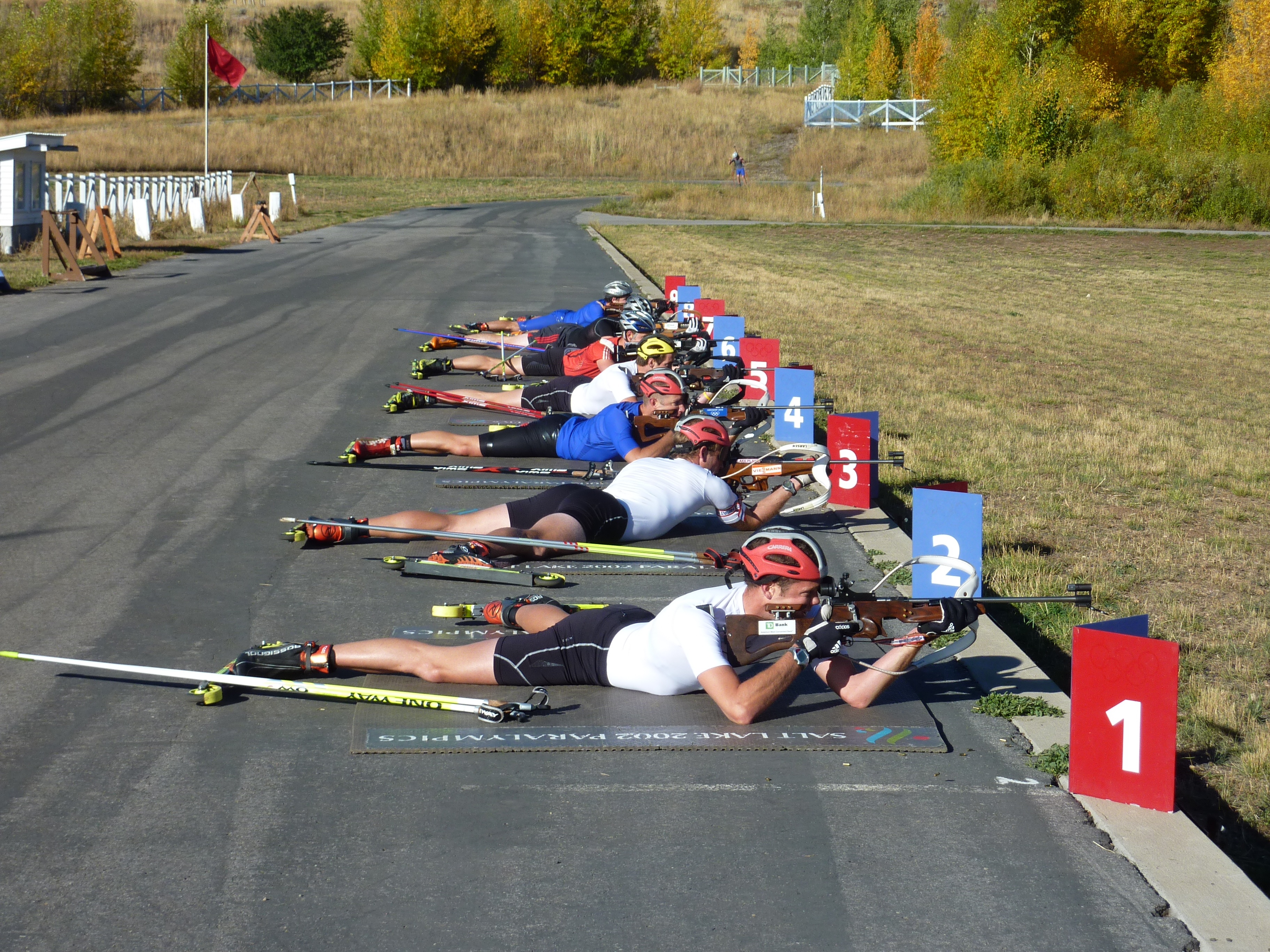
Biathletes from the U.S. men's national team shoot during a training session at Soldier Hollow. Photo: Zach Hall.
With only seven weeks until the first race of the World Cup season, biathletes around the world are making their final preparations and fine-tuning their training. For the Americans, this meant a two-week training camp in Soldier Hollow, Utah, which finished Friday.
Coaches had two main goals for the camp: to take advantage of training at altitude, and to solidify shooting skills in “combination” workouts with rollerskiing.
Coach Patrick Coffey said that the staff worked with Randy Wilber, a U.S.O.C. sports physiologist, to make sure that they approached altitude training correctly.
“He’s an expert on altitude training, so we talked about maximizing the effect of altitude. We have this camp, and then we return to Lake Placid for a bit, and then we’ll be in Canmore, which isn’t really high, but it’s altitude,” Coffey said. “What we did was to have a break-in period, and then move into the real training.”
On Thursday, the athletes faced a time trial, which Coffey said was “a real whooper.”
“It makes for really tough shooting, skiing as hard as you can at altitude. They all did really well, which shows that the training was well-managed,” Coffey said.
Shooting was the other priority, according to Head Coach Per Nilsson.
“We are in a transition when we try to carry over the basic skills and technique training of the shooting more towards an automatic type of shooting,” he said.
Athlete Susan Dunklee explained.
“During the summer, we break apart the shooting routine to work on individual components. One of our main focuses this time of year is to make the whole shooting process flow seamlessly from poles-off to poles-on again,” she said. “The Soldier Hollow rollerski loop has a long approach to the range, making it a good venue for us to work on range procedure and skiing-shooting transitions.”
If the Soldier Hollow range is an ideal place to work on shooting, then a large camp is the ideal format. Although the men’s and women’s teams mainly did separate workouts, all the athletes shared the range, as well as the men’s and women’s coaches.
“A strength for us is also that all athletes and coaches can and have worked together, so we have eight coaches’ eyes on each athlete,” Nilsson said.
Athlete Sara Studebaker said that the coaches weren’t the only ones she was learning from. “Most days, we are all out at the range at least once together, and it’s great to be able to watch the men who are some of the best biathletes in the world train. I think there’s a lot to learn from watching my teammates!”
After this camp, athletes head back to Lake Placid, but then their paths diverge. A number of team members are pre-qualified for the first period of World Cup competitions; others will have to vie for the last few spots at selection races in Canmore, Alberta. After those races, another group will also head to the IBU Cup circuit – the top level of biathlon’s minor leagues.
Tim Burke, who last year became the first American to wear the yellow World Cup leader’s bib, knows he’s headed back to the World Cup. His goals for the camp included fine-tune his shooting to prepare for competition against the world’s best biathletes, and to get in some volume while cutting back on intensity.
“I still do around three intensity sessions a week here, but I just cut back a little on the intensity and the duration of these workouts,” he said. “With just under seven weeks until the first World Cup, I am also focusing a lot on my combination training (skiing and shooting in the same workout).”
Studebaker is the only woman pre-qualified for the World Cups, although she’ll head to Canmore for more training first. She said her goals were similar to Burke’s.
“Right now, we’re all working on fine-tuning our range procedures and ski technique in order to be best prepared for snow. Lots of combination training and specific technique workouts will dominate our training from now until the races start,” Studebaker said.
Sara Studebaker leaves the range during a team sprint time trial. Photo: Marike Rogers.
All of the athletes and coaches praised the team’s attitude and camaraderie.
According to Studebaker, “the team atmosphere is really good right now.”
“I think the coaches are really excited to see how everyone is progressing, and I think we all feel we’ve taken some big steps this summer and are really looking forward to seeing them transfer into great results,” she said. “The women’s team is especially tight right now. With such a small community, it’s imperative that we support each other, and I think we all feel like we’re in a great place to do really well this season.”
Coffey said that the women were all evenly-matched, which was a major contribution to the team’s confidence.
“I couldn’t tell you what’s going to happen with team selection – they are all performing at capacity, and everyone’s fast,” he said. “Whatever team we send [to Europe] is going to do great. They obviously all want to go, but it’s good for them to know that even if they don’t go, whichever teammates get picked will race well.”
Nilsson also has a lot of faith in his athletes.
“Everybody has done the work now, so it feels like we are ready to start,” he said. “We are looking forward to the season. The level for us is higher this year for sure, and we just have to wait and see how the other nations and athletes have prepared.”
Haley Johnson competing in a time trial at Soldier Hollow. Photo: Zach Hall.
Susan Dunklee (left) and Tracy Barnes-Colliander sprint for the line
Seven penalties would normally be enough to take a biathlete out of a race. Not Susan Dunklee.
In the North American Biathlon Championships 12.5 k mass start, Dunklee overcame some sketchy shooting to win a sprint finish with Tracy Barnes-Colliander, who was deprived of her third straight victory.
It was the first North American championship for Dunklee, and it looked impossible after she missed six of her first ten shots—three penalties in each of the first two rounds.
“It throws yourself—you get pretty much last place or pretty much close to it when you do something like that on the first stage,” she said. “You’ve really got to have the attitude that you’re hunting people down, and that can be a lot of fun.”
Surprisingly, the only woman that Dunklee wasn’t hunting after her first three misses was Barnes-Colliander herself.
Tracy Barnes-Colliander leading at the tail end of the first lap
Barnes-Colliander is normally a very accurate shooter, and Sunday was no different. In her first round, she still put all her bullets in a tight cluster—it just happened to be low, to the right, and off the target.
After getting a correction from her coach, she proceeded to reel off 15 hits in a row. But the damage was done: Instead of leading the race, Barnes-Colliander was now struggling to get back into it.
She and Dunklee both cleaned their third round of shooting, and that, combined with some key misses by leaders Claude Godbout and Annelies Cook, gave them an opening.
On the loop before the final stage, Dunklee got a gap on the rest of the field. She was first into the range, but that was no guarantee—especially the way she’d been shooting this week. She missed eight of ten in Thursday’s sprint, and twelve of twenty in Saturday’s pursuit.
“My last two races, I’ve missed more than I have all season,” she said. “Ridiculous, poor shooting.”
Saturday, though, she performed when it counted, missing just one shot in that final stage. But that still left Dunklee with a twenty-second gap to Barnes-Colliander, who cleaned.
Dunklee’s coach let her know just how much time she had to make up, and she said she knew it would be tough.
Susan Dunklee leading Tracy Barnes-Colliander out of the range
She closed quickly, though, and on one of the short, steep hills just before the stadium, she finally reeled Barnes-Colliander in, taking the lead with a few hundred meters to go.
Barnes-Colliander said that she had been trying to save some energy in order to stay in front of Dunklee in case she got caught, because the descent into the finish doesn’t leave much time for passing.
“But she put a little time on me on [the] last hill,” Barnes-Colliander said. “After that, I kind of saved a little bit for the sprint, but it’s tough having this downhill [finish].”
Dunklee led down the hill onto the finish straight, and in a frantic sprint, she just managed to hold off Barnes-Colliander, by 0.2 seconds. Cook trailed in for third, just over a minute back, with six penalties.
The two American Olympians in the race, Haley Johnson and Laura Spector, finished fifth and eighth respectively, hampered by their shooting. Each had nine misses.
The IBU Continental Cup , which is the final phase of the U.S. Olympic Biathlon Team selection begins on Thursday, January 7th in Altenberg. U.S. biathletes competing in Altenberg are vying for two available spots on the Men’s Team and three spots on the Women’s Team.
The roster of athletes competing in Altenberg includes: 2006 Olympian Lowell Bailey (Lake Placid, NY), 2006 Olympian Lanny Barnes (Durango, Co), 2006 Olympian Tracy (Barnes) Colliander (Durango, Co), BethAnn Chamberlain (Presque Isle, ME), Susan Dunklee (Barton, VT), Zachary Hall (Nikiski, AK), Leif Nordgren (Marine, MN), Kevin Patzoldt (Grand Rapids, MN), Wynn Roberts (Battle Lake, MN), Walt Shepard (Yarmouth, ME), Laura Spector (Lenox, MA), and Sara Studebaker (Boise, ID).
Trials begin with a time-trial Sprint race on Thursday Jan. 7, which will be contested between the U.S. athletes, and will be scored using percent-back – a formula in which the three top times are averaged together to get a base score.
Racing continues with the start of the IBU Continental Cup on Saturday. The U.S. biathletes will keep their two best scores and the top man and the top two women will be nominated to the U.S Team and the final athletes for each team nominated by the staff. The U.S. Olympic Committee will announce announce the team on Monday January 11, 2010.
Live race data from the Altenberg races will be available here.