From the FasterSkier archive — posts syndicated from athletes’ and coaches’ own blogs between 2004 and 2012, kept online as published. Current coverage is at fasterskier.com.
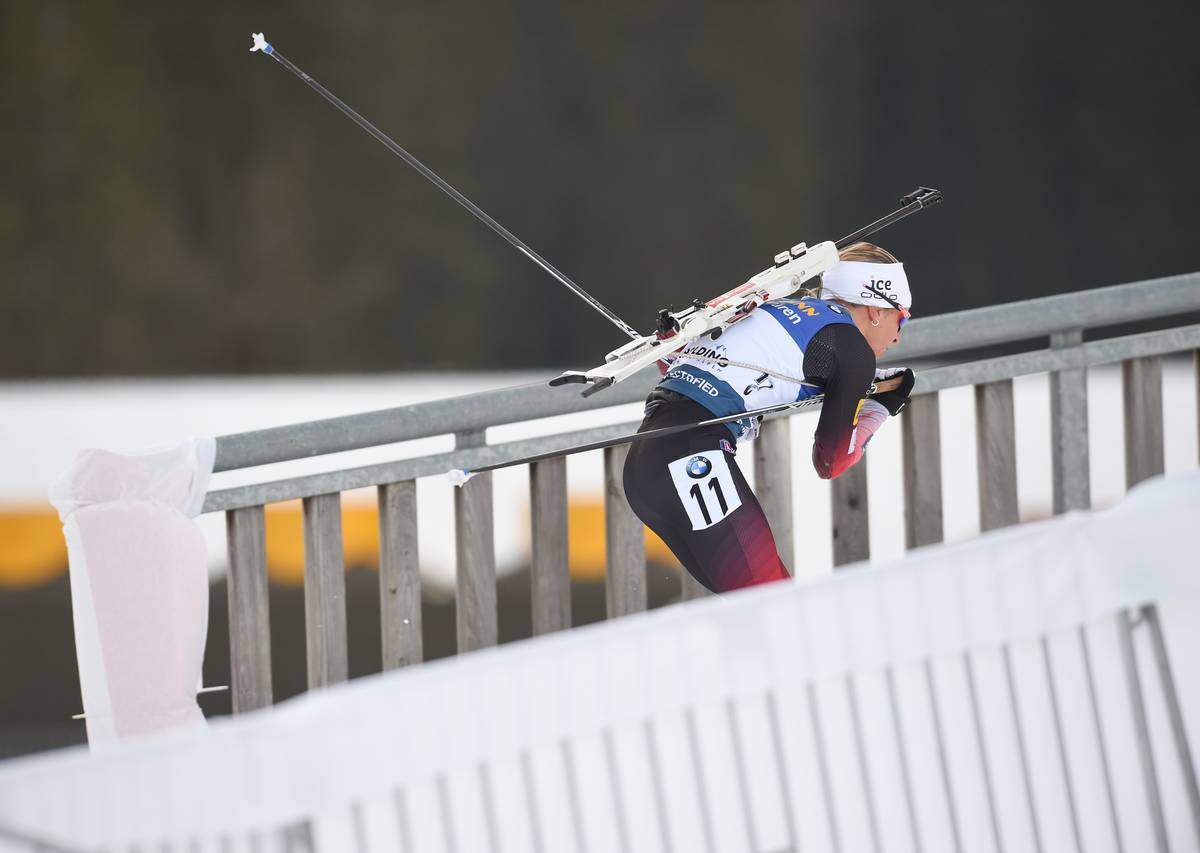
Mid-week, the IBU World Cup circus moved to Ruhpolding, Germany. The women raced a 7.5-kilometer sprint and saw Norway’s Tiril Eckhoff take the win and snag the yellow overall World Cup leader’s bib from Italy’s Dorothea Wierer. Eckhoff now leads Wierer by a scant three points in the overall standings. This was Eckhoff’s fifth individual win of the 2019-2020 season.
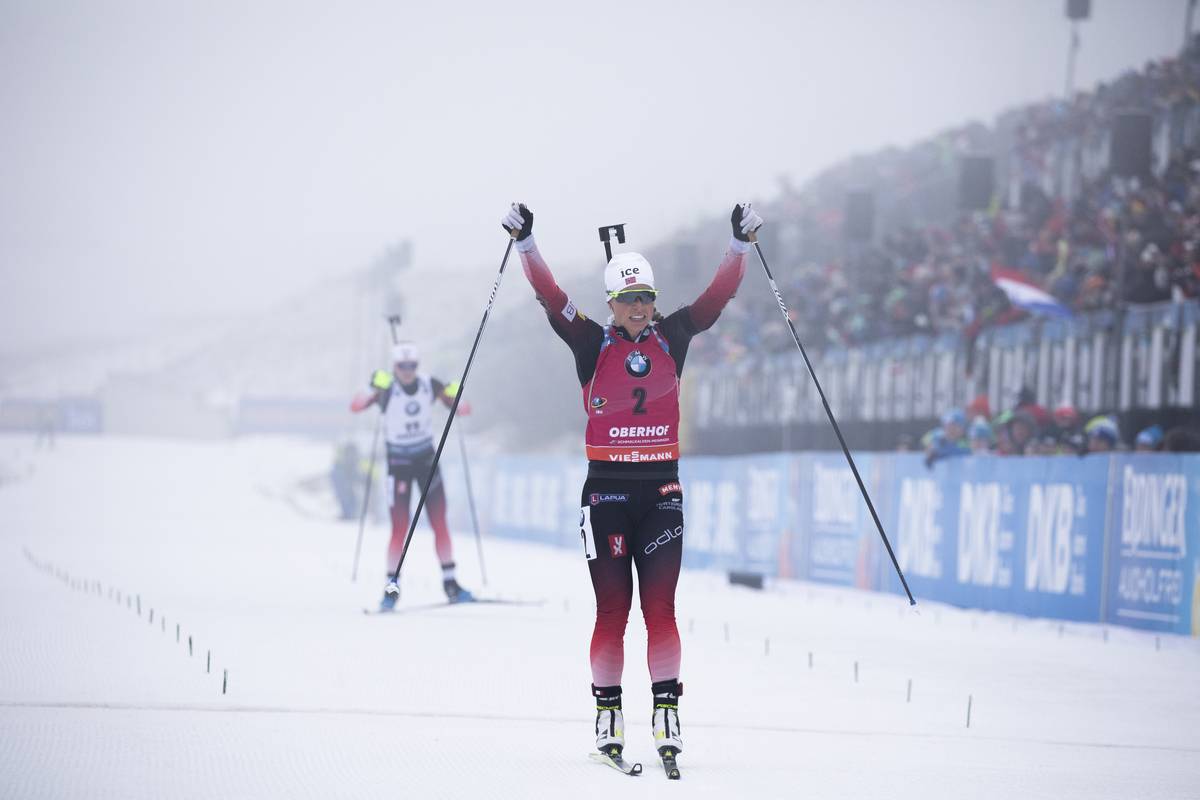
Norway’s Tiril Eckhoff racing for the win during the Ruhpolding, Germany sprint. With the win, Eckhoff secured the overall IBU World Cup leader’s bib. (Photo: NordicFocus)
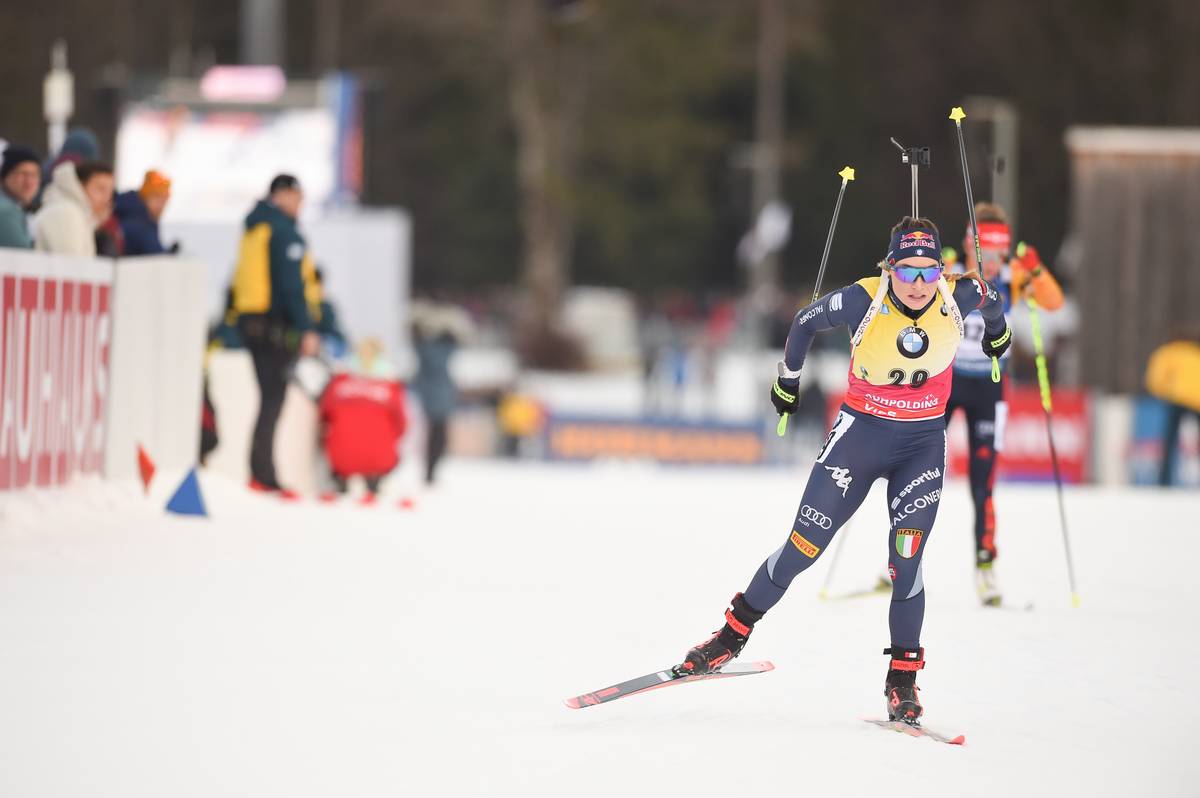
Eckhoff won Wednesday’s sprint in 18:55.5, while shooting clean. Sweden’s Hanna Öberg was second (+29.7; 0+0), with Weirer in third (+36.8; 0+0).
Dorothea Wierer (ITA) placed third in Ruhpolding’s sprint. (Photo: NordicFocus).
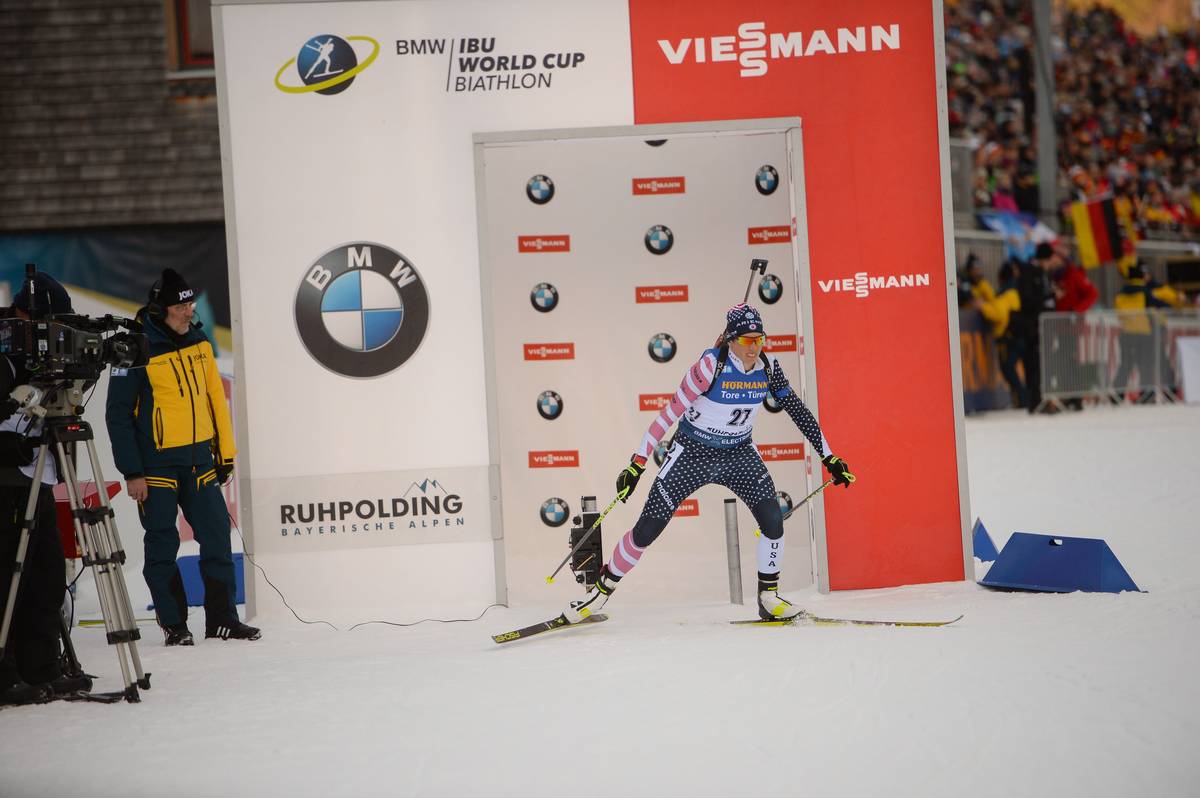
The U.S. had two athletes in the top-30. Susan Dunklee placed 25th (+1:34.0; 1+0), and Clare Egan 28th (+1:40.9; 0+1). Also for the U.S., Deedra Irwin skied to 79th (+3:01.8; 0+2), and Hallie Grossman 93rd (+4:00.6; 2+1).
Susan Dunklee was the top North American in 25th during Wednesday’s sprint in Ruhpolding, Germany. (Photo: NordicFocus)
Canada’s Emma Lunder placed 53rd (+2:14.0; 1+0), Megan Bankes 82nd (+3:08.4; 1+1), Sarah Beaudry 94th (+4:01.3; 2+0), and Nadia Moser 104th (+5:18.0; 2+3).
The top-60 biathletes qualified for Sunday’s 10 k pursuit in Ruhpolding. Racing continues on Thursday for the men with a 10 k sprint.
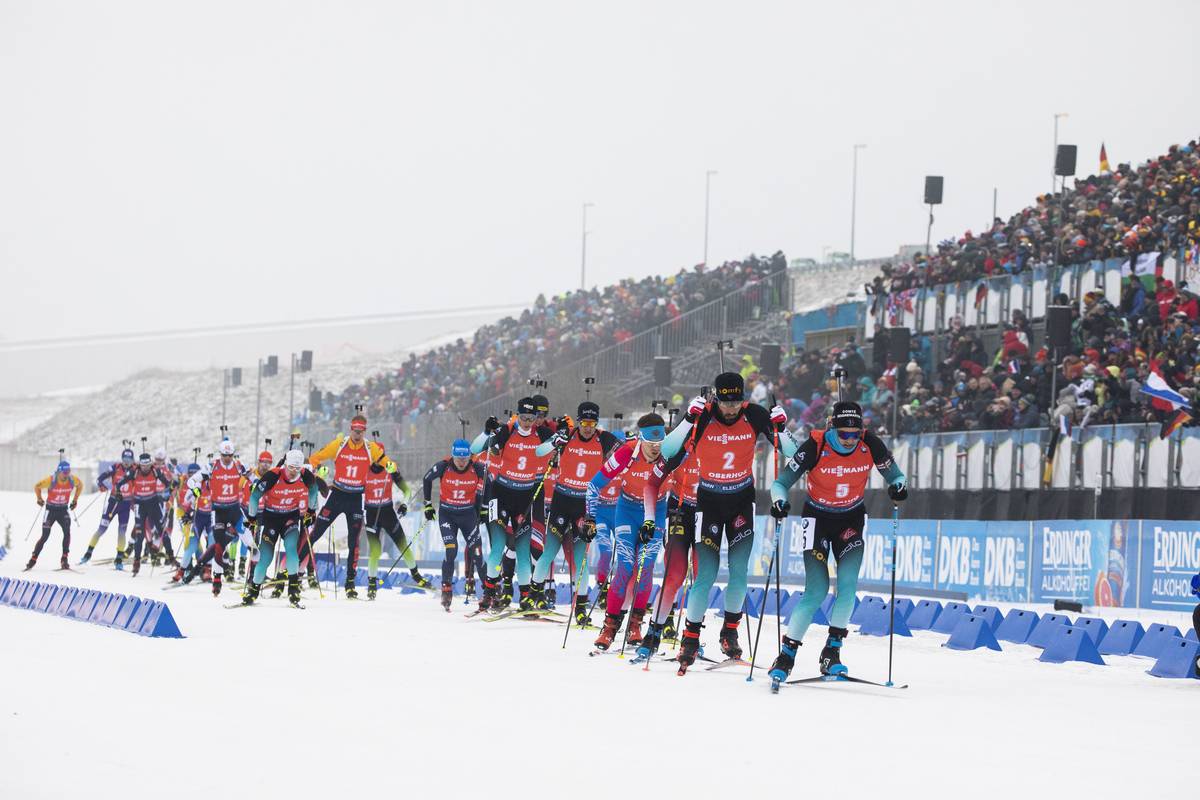
With the weekend closed out in Oberhof, Germany and the start of the second IBU World Cup trimester underway it’s time for, thank you Seth Meyer, … a closer look.
The men’s mass start in Oberhof. (Photo: NordicFocus)
Norway’s male biathlon ringer, Johannes Thingnes Bø, was on the sideline for the weekend. Prior to the Oberhof stop, he had worn the yellow bib as the IBU World Cup overall leader. Post-Oberhof, it was time for a change. A small change really in the big perspective of challengers. France’s Martin Fourcade leaves Oberhof donning yellow, a color he has been well acquainted with in the past.
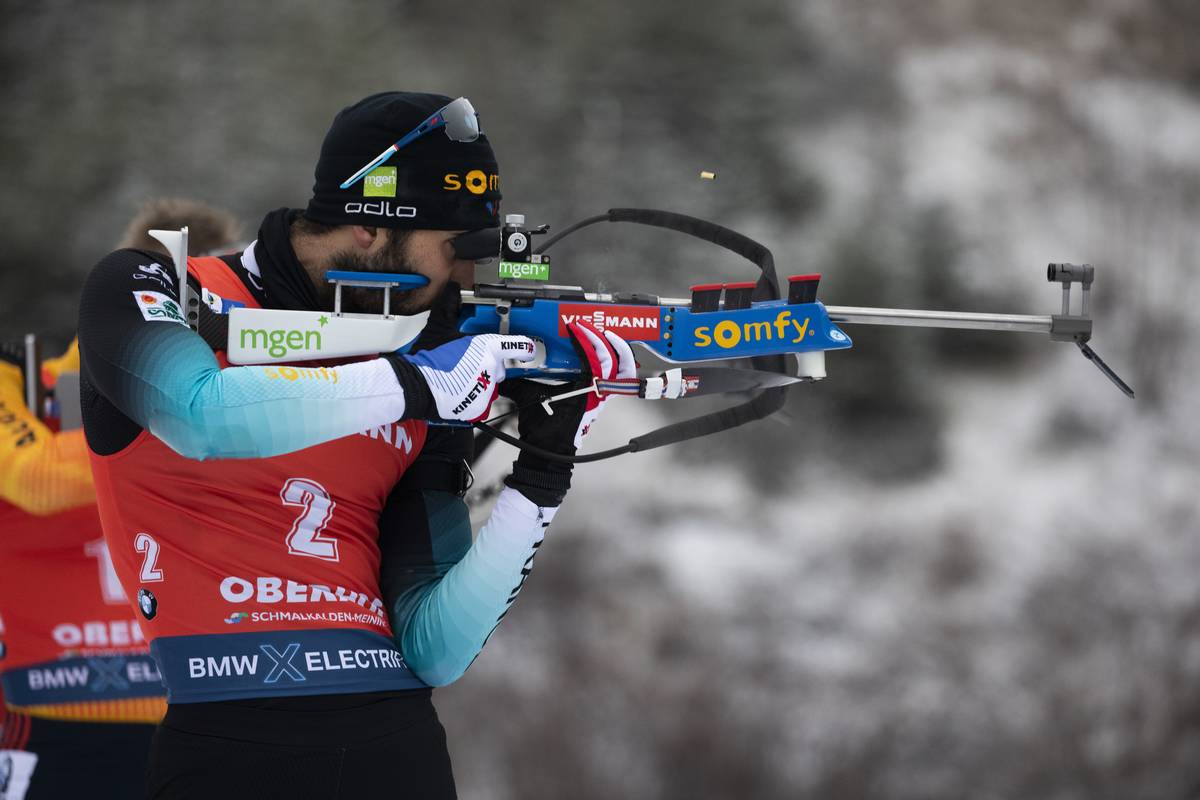
Martin Fourcade, here in the Oberhof mass start, won the race and seized the overall leader’s bib. (Photo: NordicFocus)
Fourcade’s overall lead is the result of a two win weekend. He won the 10 k sprint on Friday and followed that with a win Sunday in the 15 k mass start. In four shooting rounds during the mass start, Fourcade went 0+1+0+1 to win in 41:01.4. No North Americans qualified for the race.
Fourcade was also part of the French 4 x 7.5 k relay team that placed second on Saturday. Norway won that race, with neither Bø brother racing. Germany placed third. The U.S. team of Sean Doherty, Leif Nordgren, Paul Schommer, and Jake Brown skied to 12th overall. Canada’s Jules Burnotte, Scott Gow, Aidan Millar, and Christian Gow were 14th out of 26 teams.
Kaisa Makarainen from Finland won the 10 k mass start in 39:58.9 after missing a single target in her first bout of shooting. Otherwise, she shot clean. Norway’s Tiril Eckhoff placed second (+30.2; 0+0+3+1), and Marte Olsbu Roeiseland third (+35.0; 1+0+1+1).
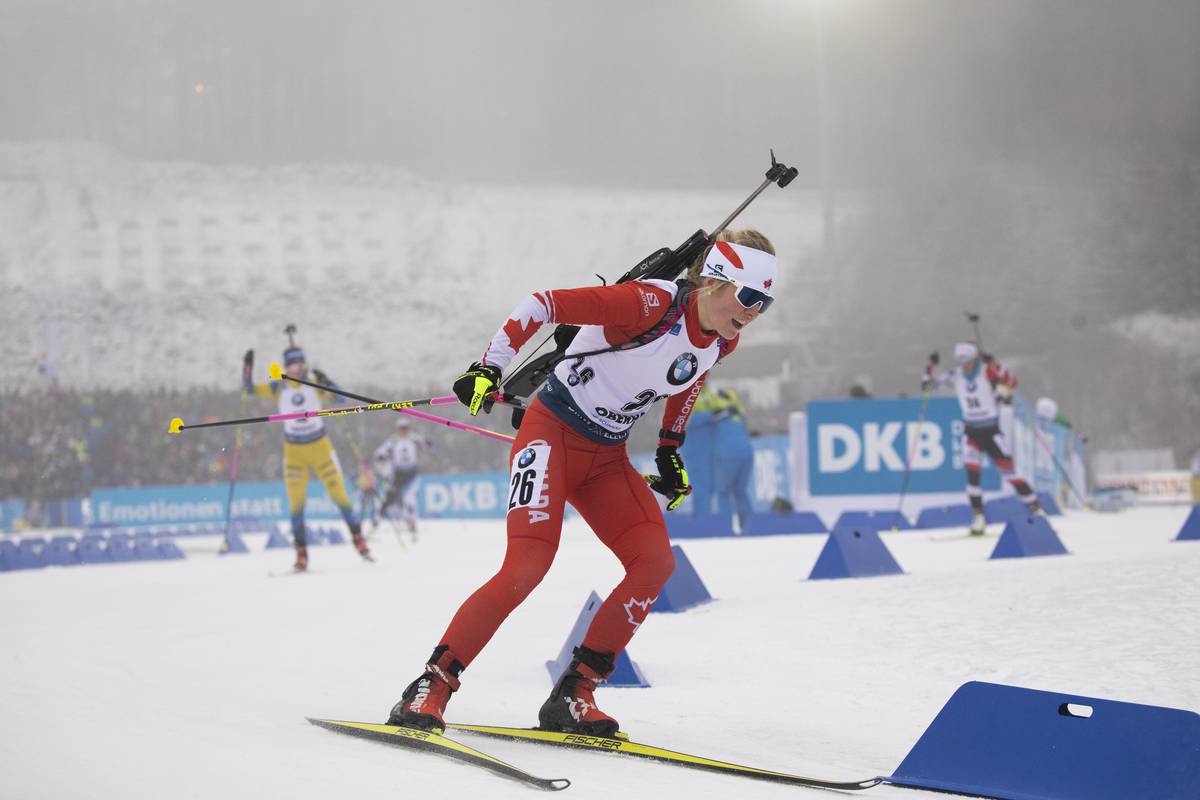
Emma Lunder of Canada during the women’s mass start in Oberhof, Germany. Lunder was 15th overall. (Photo: NordicFocus)
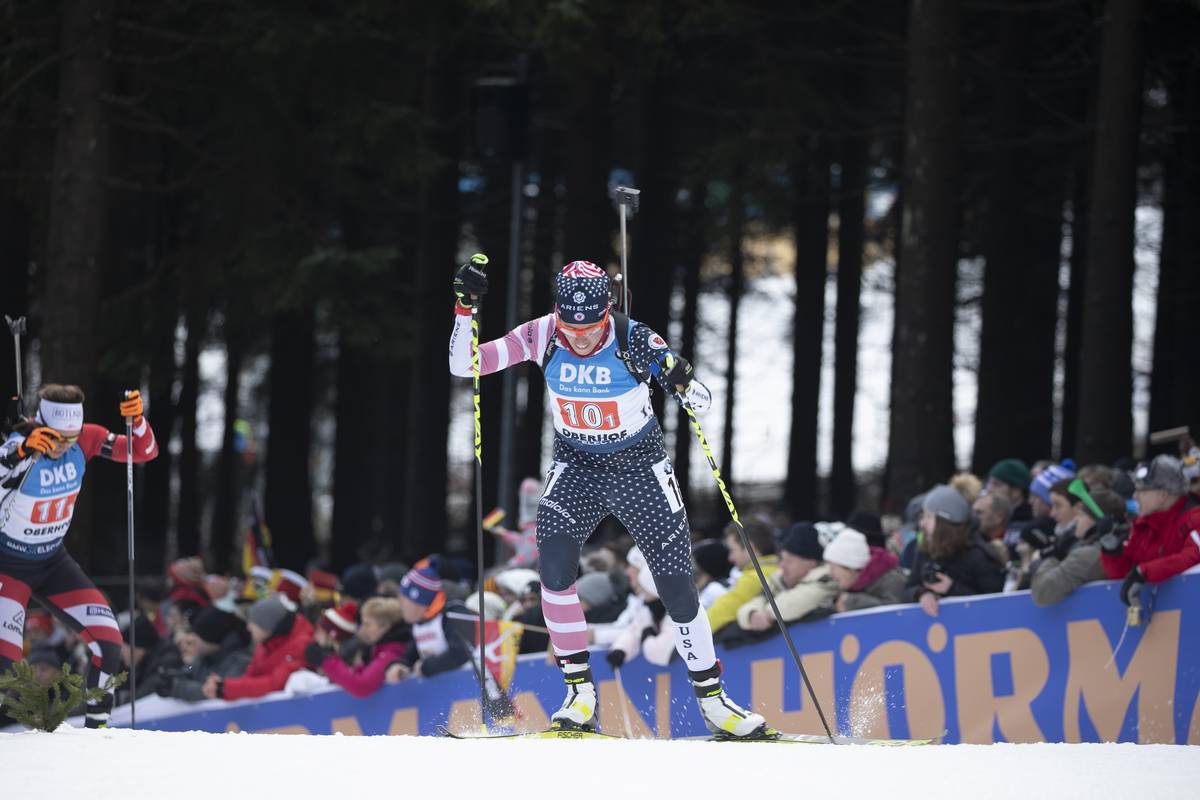
Canada’s Emma Lunder continued her strong skiing with a 15th place (+2:14.8; 0+2+4+1). Susan Dunklee of the U.S. raced to 21st (+2:56.3; 0+3+1+4).
Susan Dunklee of the U.S. during the women’s 4 x 6 k relay. Dunklee placed 21st in Sunday’s mass start. (Photo: NordicFocus)
This brings us to the women’s overall standings on the IBU World Cup circuit. Italy’s Dorothea Wierer, with 390 points, wears the leader’s bib. The Italian placed fourth in the mass start, over a minute out, and had five misses total on the range. Eckhoff is second overall with 381 points.
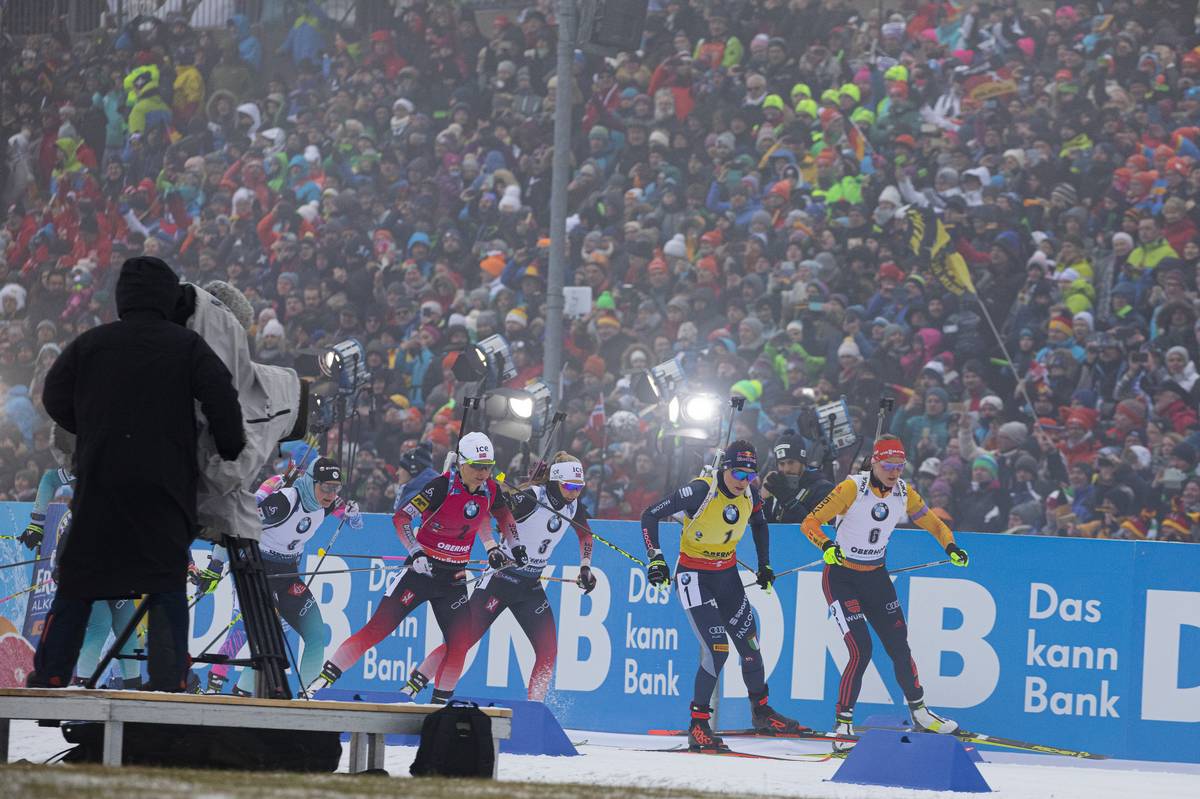
A television camera takes Justine Braisaz (FRA), Tiril Eckhoff (NOR), Ingrid Landmark Tandrevold (NOR), Dorothea Wierer (ITA), Denise Herrmann (GER) in focus, (l-r) during the women’s Oberhof mass start. (Photo: NordicFocus)
In the women’s 4 x 6 k relay contested on Saturday, Norway won in a total time of 1:14:11.5 hours shooting 0+11. The U.S. team of Susan Dunklee, Clare Egan, Hallie Grossman, and Emily Dreissigacker were 12th (+4:33.8; 1+12). Canada’s Sarah Beaudry, Emily Dickson, Nadia Moser, and Emma Lunder placed 20th, as they were eventually lapped. Twenty-three teams began the race.
Tiril Eckhoff of Norway continued her IBU World Cup winning ways on Friday. She won the Annecy-Le Grand Bornand 7.5-kilometer sprint in 20:27.0 with a single penalty during her two shooting rounds. Including two relays, this is Eckhoff’s fourth victory of the season. Justine Braisaz of France was second (+6.2; 0+0), and the Czech Republic’s Svetlana Mironova placed third (+22.5; 0+0).
Eckhoff of Norway has won two indivudual races on the IBU World Cup this season. Including (pictured here) a win in the Annecy-Le Grand Bornand, France sprint. (Photo: NordicFocus)
Friday’s sprint winner, Tiril Eckhoff of Norway. (Photo: NordicFocus)
The top-60 skiers qualified for Saturday’s 10 k pursuit.
For Canada, Emma Lunders placed 36th (+1:44.4;2+1), Sarah Beaudry 48th (+2:00.9; 0+1), and Megan Bankes 71st (+2:32.9; 1+2). Nadia Moser did not start.
Clare Egan led the U.S. women in 42nd (+1:50.1;0+2), followed by Joanne Reid in 52nd (+2:04.5; 0+1). Susan Dunklee finished 67th (+2:28.8; 0+3), and Emily Dreissigacker 94th (+4:37.1; 2+2).
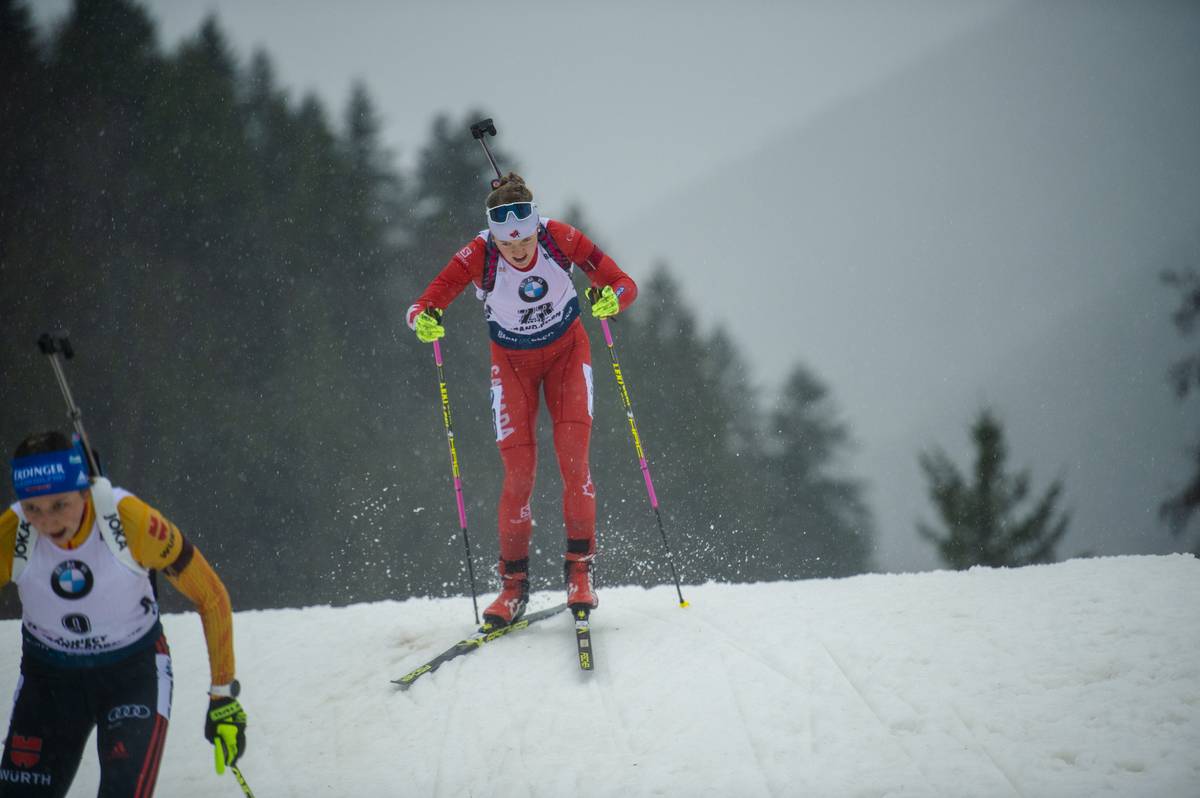
Emma Lunder (CAN) during the Annecy-Le Grand Bornand, France IBU World Cup sprint. (Photo: Nordic Focus)
The stepping stone for many biathletes remains the lower tier IBU Cup. Today in Obertilliach, Austria the men contested a 10 k sprint. It was Paul Schommer’s time for a breakthrough. The U.S. biathlete placeded second overall after shooting clean. He was 19.5 seconds behind Norway’s Aleksander Fjeld Andersen who also had no misses, finishing in a time of 25:45.8.
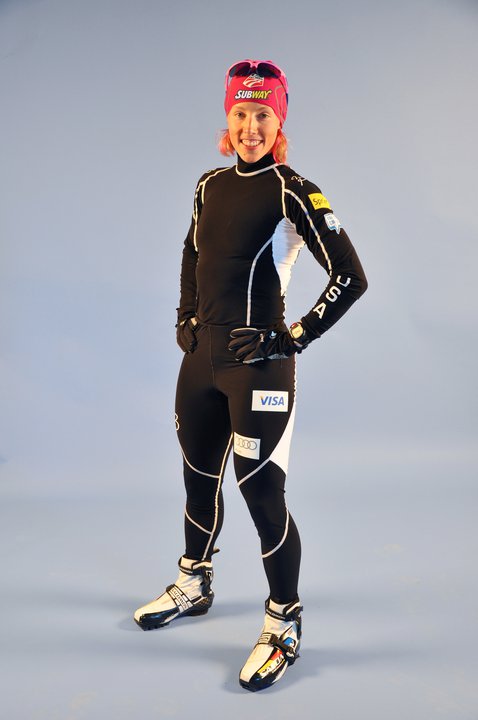
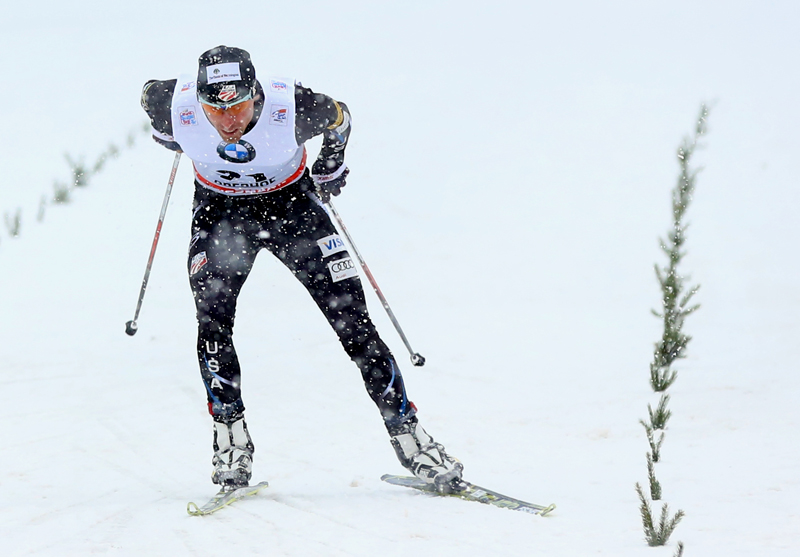
From October 2010: Kikkan Randall modeling the U.S. Ski Team suit for the 2010-2011 season. Photo courtesy of the U.S. Ski and Snowboard Association.
A national team uniform for cross-country skiing has to do a lot of things. At the most utilitarian level, it has to wick sweat and aid performance while an athlete pursues one of the world’s most demanding sports at temperatures between –4 F and 40, in steady snow or driving rain or anything in between. At the functional level, it has to let spectators and coaches identify where their athlete is out on the course, while distinguishing them from athletes from other countries. And at the symbolic level, it lets the athlete know that he or she is competing on behalf of their country, for everything that that means. Ask a skier who has represented the United States in international competition what it meant to them to pull on a national uniform for the first time. They’ll probably be able to tell you.
(And if they ever forget, this detailing from Craft and L.L. Bean on the American uniforms, ca. 2015/2016, is there to remind them. “You are representing the United States of America,” a slogan intones, above a martial-looking eagle, with a U.S. Ski Team master mark for its aegis, gripping an olive branch (?) in its dexter claw and a skis and ski poles fasces in its sinister. “Pretty fun to be representing an American brand with our American uniforms!,” wrote Sadie Bjornsen in a blog post describing the uniforming process.)
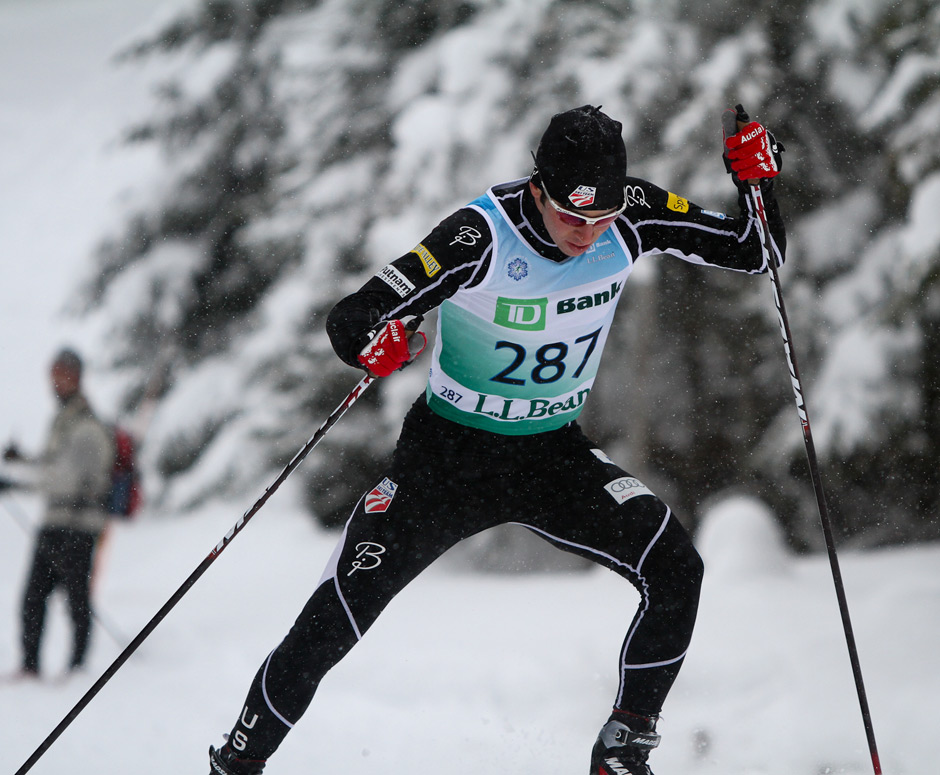
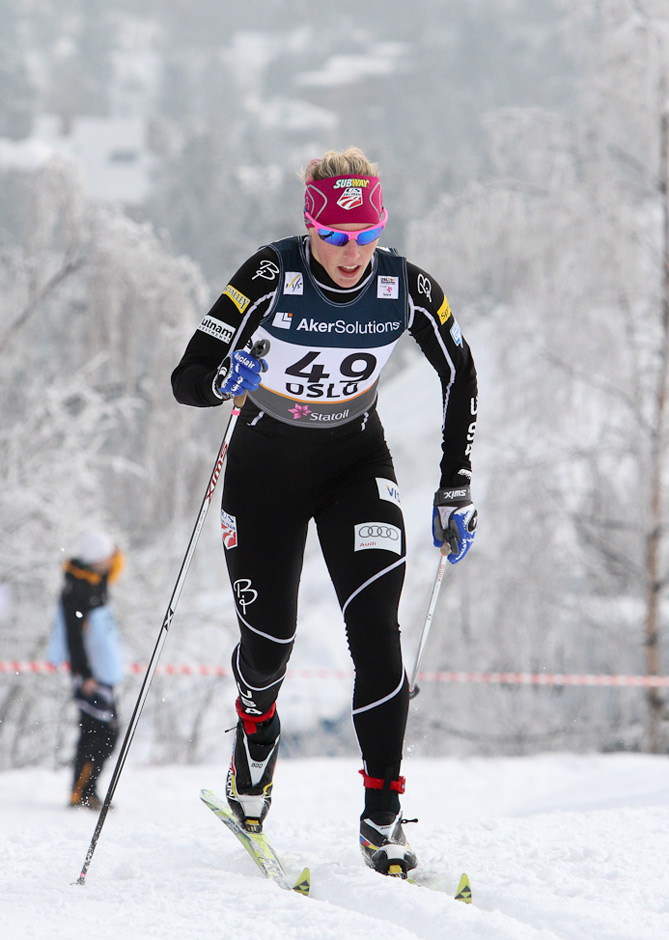
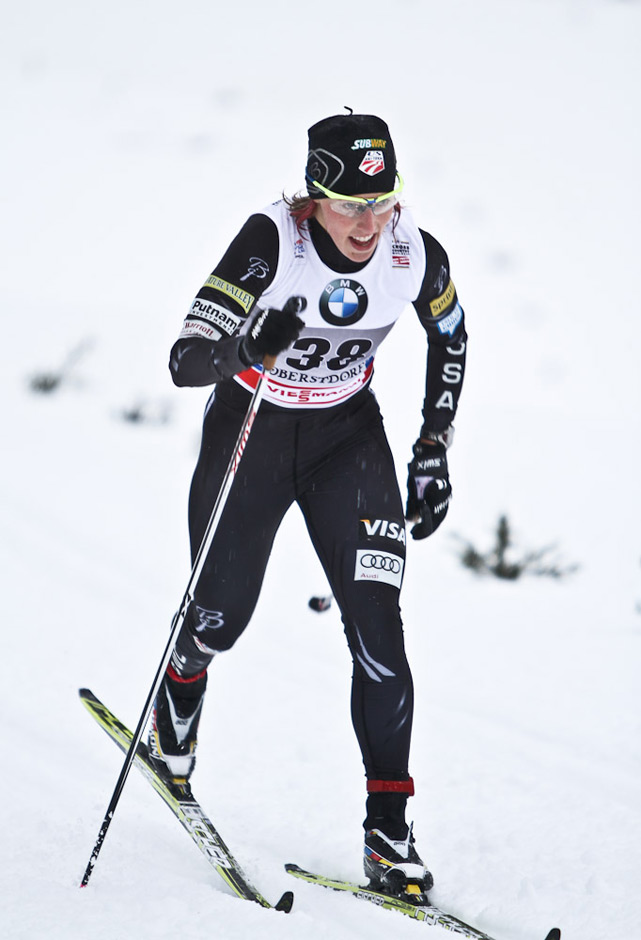
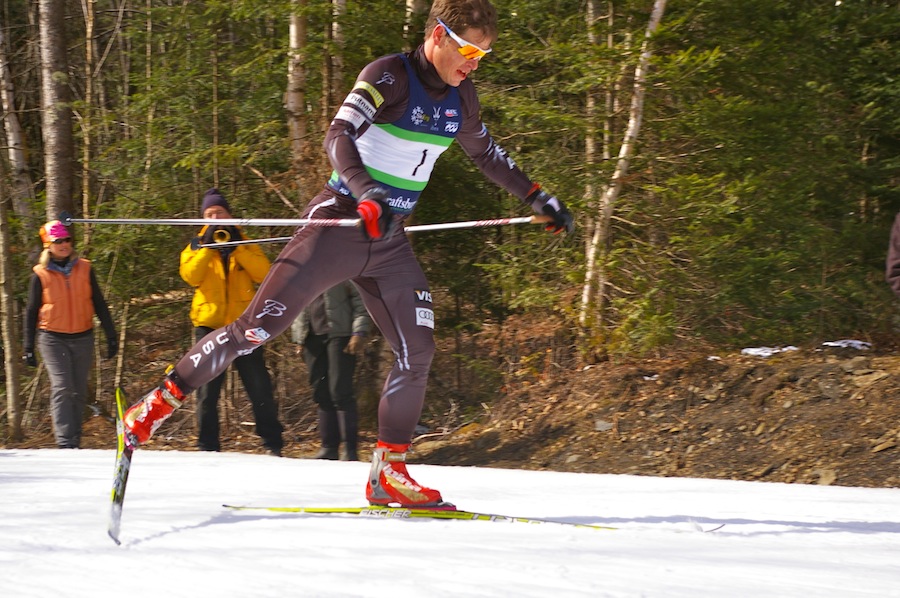
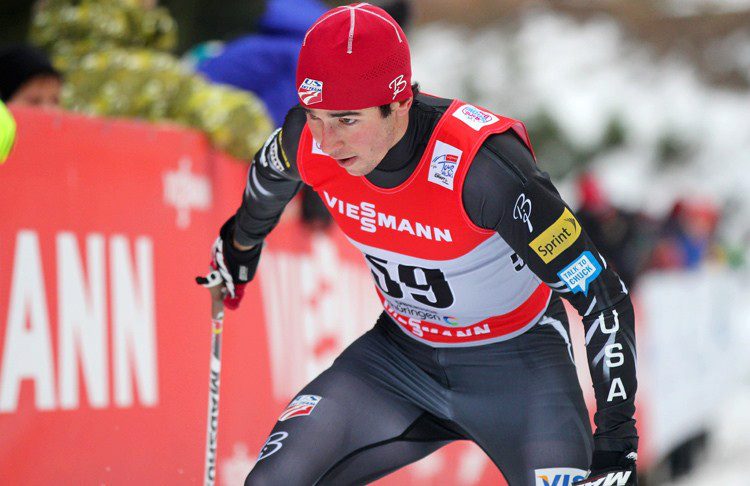
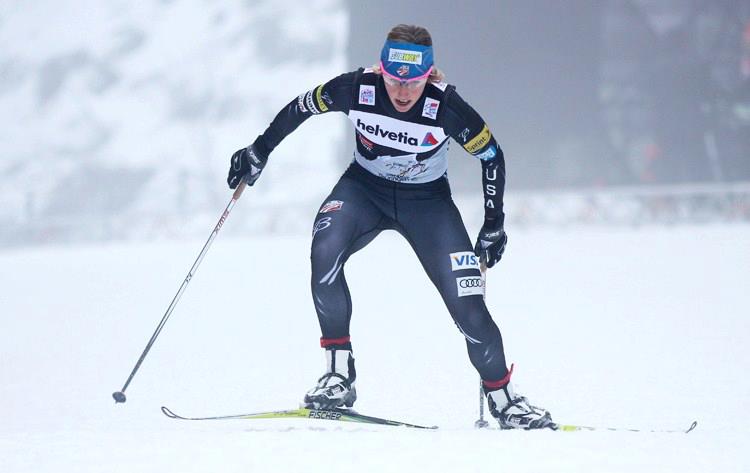
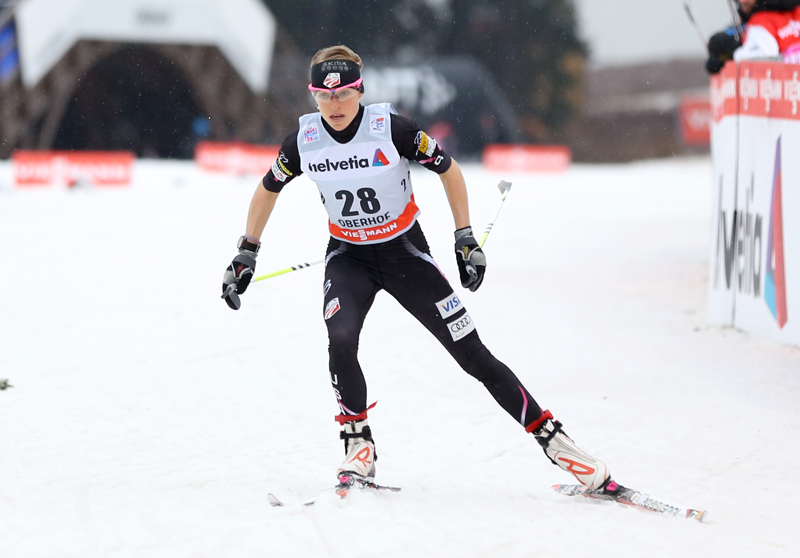
For whatever reason, the period roughly one decade ago represented the highwater mark for domestic and global coverage of ski uniforms on this website. There was “US Ski Team Brings Suit Consistency,” from Jan. 2009 (lede: “After years of a remarkable level of wardrobe schizophrenia, the US Ski Team has ushered in a new era of racing suit consistency that should make it easier to follow our favorite US athletes on the race course.”); “The costume disciplinarian speaks: Is it better to look good than to ski fast?” from July 2009; “The Best and Worst (Suits) of the Olympics,” from Feb. 2010; and “USST Goes Black for 2010-2011,” from Oct. 2010 (lede: “In the sport of cross-country skiing, most people would agree that competing with New Zealand is probably smarter than picking a fight with Norway.”).
So it seems to have been nearly 10 years since the last sustained attention to the uniforms of the Davis U.S. Cross Country National Team Program (néeU.S. Ski Team). To fill that gap, FasterSkier hereby presents A Visual History of the United States Ski Team National Team Uniform, 2008–2019.
(Why 2008 for the starting point? Mostly for the simple logistical reason that the image library in the current FasterSkier content management system, WordPress, only goes back to 2008, so this article can be written while using only images that FasterSkier may legitimately post on this site. To go back to closer to the start of this century would require a lot of external links to Getty Images and not that many photos to actually look at on this website. That said, this piece from 2009 has a nice visual roundup of the plethora of different USST designs worn from 2006–2008, which takes you back two more years. Before that, well, just imagine Kikkan Randall and a lot of other skiers you probably haven’t thought about for a while — Wendy Wagner, anyone? Rebecca Dussault? Sarah Konrad? — wearing various iterations of early-aughts red and black.)
2008/2009 World Cup season: Red
January 2009: No question who is from the US here… Kikkan Randall in the women’s Team Sprint in Whistler
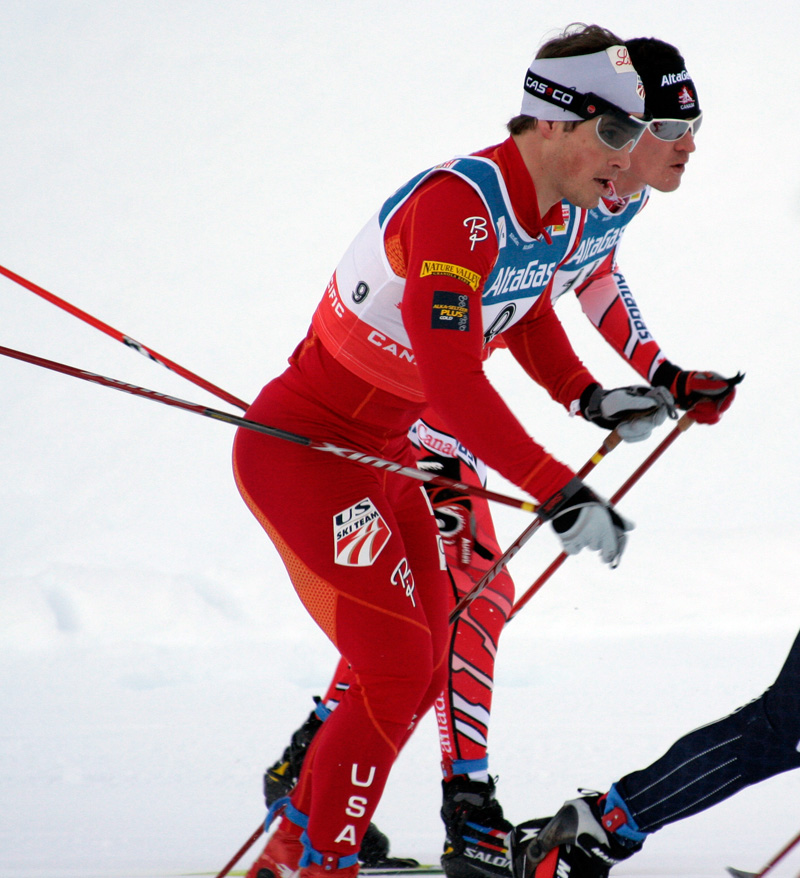
January 2009: Kris Freeman preferred the orange to silver in the men’s pursuit
As a contemporary uniform article explained, “There are currently two suit variations being used by US Ski Team athletes, and athletes racing for the US in international events. They are so similar, that for practical purposes (identifying US skiers in a race) they may as well be the same. Both suits are predominantly red, with one version having patches of orange, and the other silver.” Both were manufactured by Norwegian company Bjørn Dæhlie.
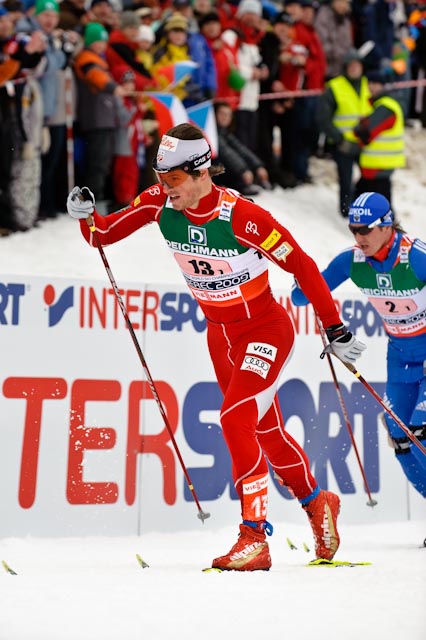
There appears to have been no change to the basic World Cup design for the 2009 World Championships in Liberec, Czech Republic:
Freeman at the 2009 World Championships in Liberec. (Photo: Swix Sport)
2009/2010: Still red Bjørn Dæhlie
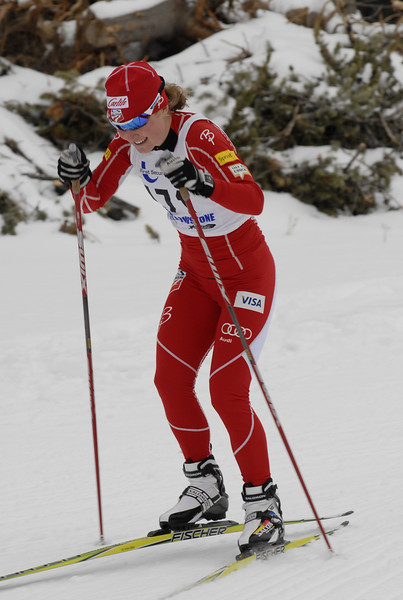
November 2009: Tazlina Mannix (APU, USST) racing in West Yellowstone.
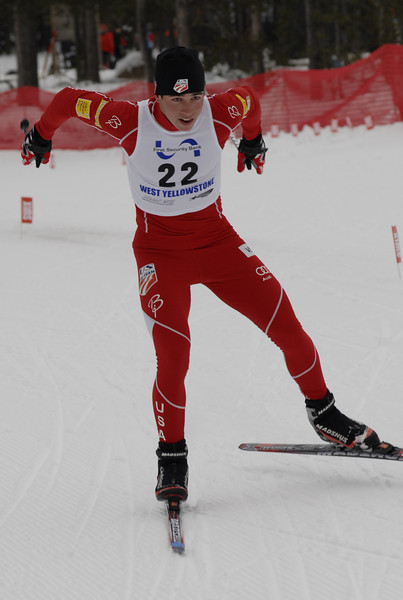
November 2009: A very young Noah Hoffman (USST) racing to 3rd in a distance race in West Yellowstone.
Honorable mention, domestic suits division:
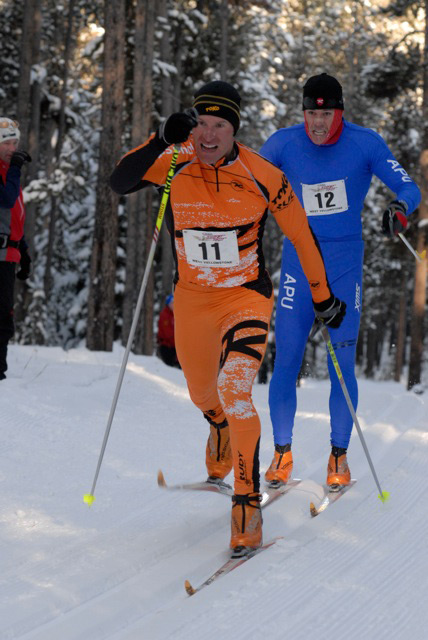
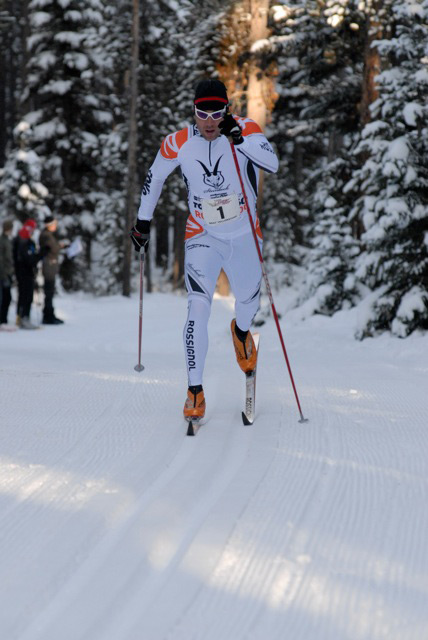
November 2009: This is a very orange suit. Kevin Hochtl (Rossignol) – 32nd – leads Anders Haugen (APU) – 7th – to the finish in a West Yellowstone race.
November 2009: This is one hell of an ibex. Chris Cook (Steinbock Racing) – 12th – sporting the new Steinbock Racing uniform
2010 Winter Olympics, Vancouver: Red and silver
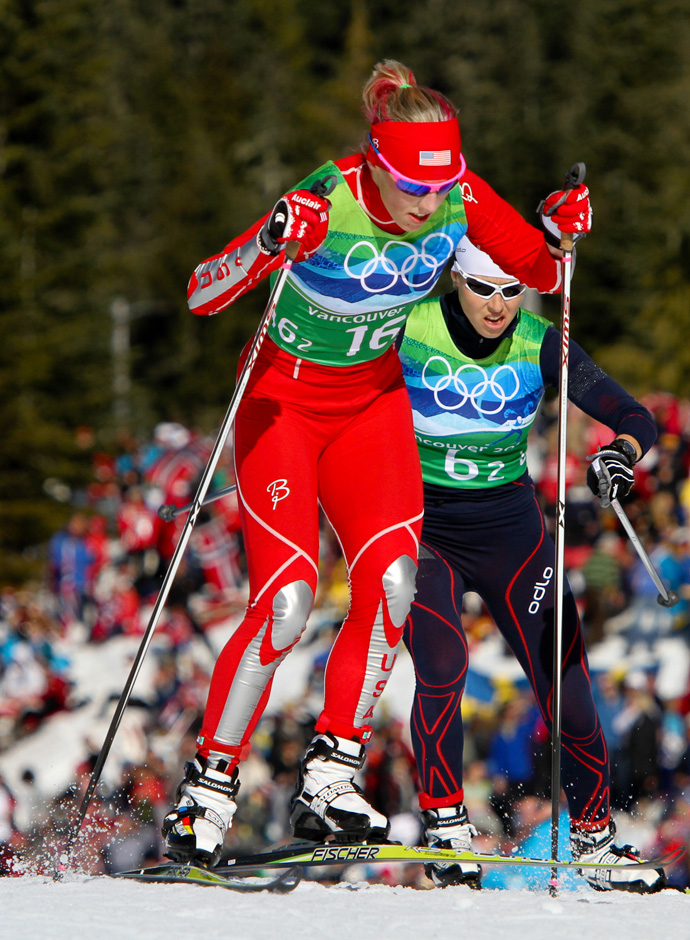
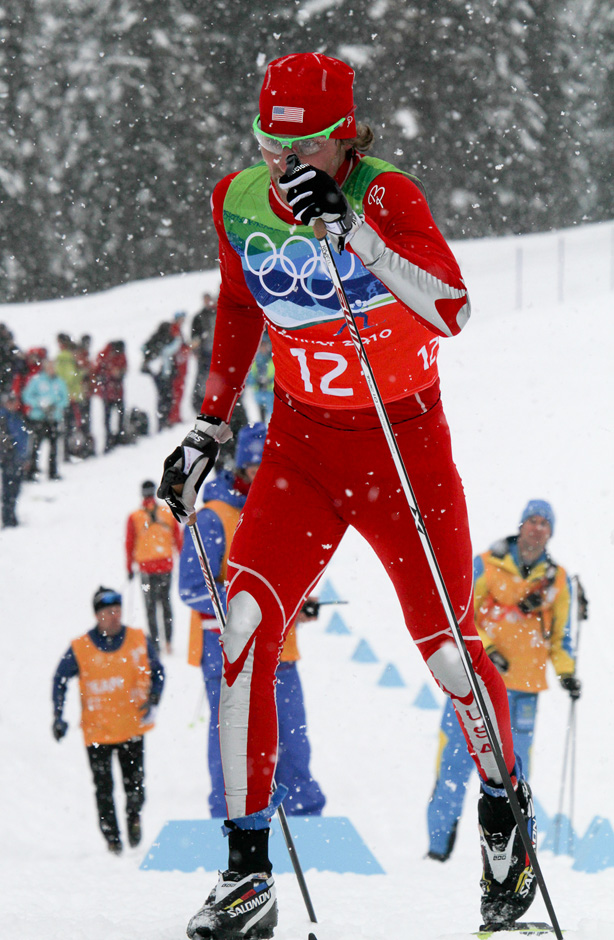
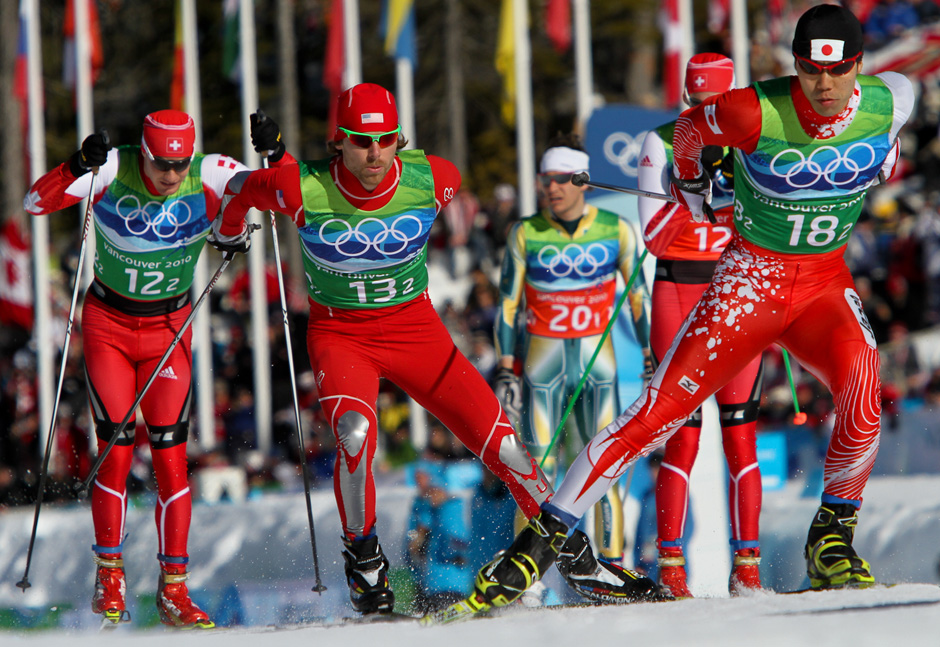
For the Olympics, the Americans appear to have taken their World Cup template – Bjørn Dæhlie suit, largely red – but have changed it by, inter alia, lightening the shade of red, adding “USA” on the right arm and left leg, adding silver accents, and of course removing all sponsor logos. Kikkan, already skiing in her third Olympics, coordinated with a red headband, red gloves, and her famous pink highlights. Andy Newell went with the red hat (he may not have had a choice), but was otherwise somewhat less vermilion.
Feb. 2010: Kikkan RandallFeb. 2010: Andy Newell on the big climb during the men’s 4 x 10 k relay.
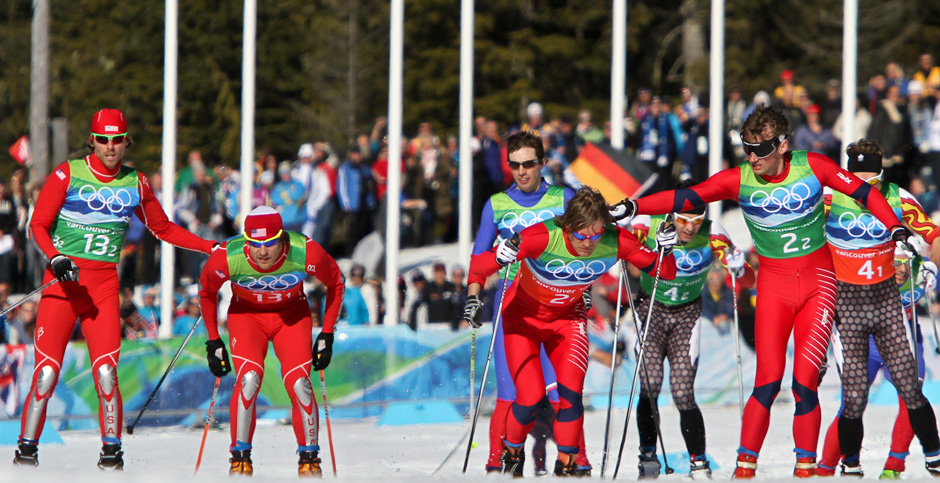
There was a lot of red in Vancouver. For example, here’s Andy Newell (far left, bib no. 13-2) tagging Korin Koos for the U.S. in the team sprint, while Petter Northug (far right, bib no. 2-2) tags Øystein Pettersen (middle right, bib no. 2-1) for Norway. (An entire standalone article could likely be written on the Canadians’ infamous kit (bib no. 4, back right).)
Newell tags Koos (left) and Northug tags Pettersen (right) at the 2010 Vancoulver Olympics.
Or here’s Newell in the middle, between Switzerland’s Dario Cologna (bib no. 12) and Yuichi Onda of Japan (bib no. 18):
Newell in the semis of the skate sprint: 2010 Vancouver Olympics.
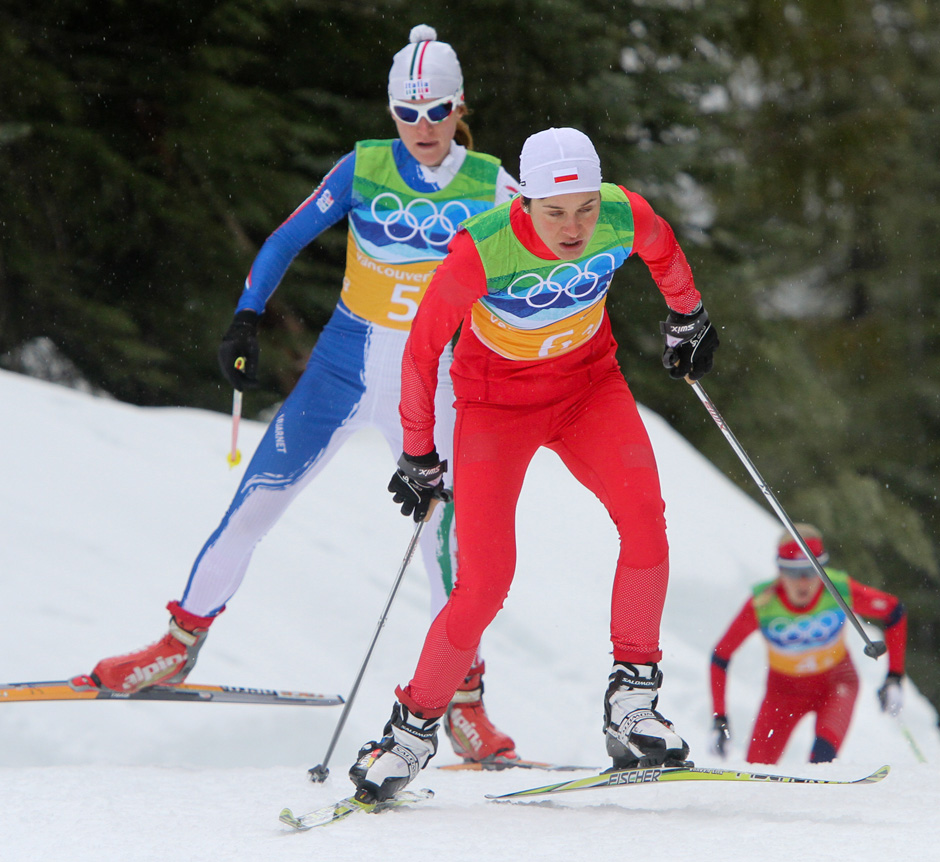
Finally, Poland (shown here: Sylwia Jaśkowiec, bib no. 6) was just red:
Poland 2, 2010 Vancouver Olympics.
2010/2011: The black era begins
Perhaps as a natural reaction to the dominance of a single color across multiple nations, the U.S. made a significant shift for the 2010/2011 World Cup season: black. The color does not appear on the national flag or in other common American iconography, but it is certainly distinctive. Bjørn Dæhlie remained the suit manufacturer.
Or, as then-FasterSkier reporter Nat Herz wrote in fall 2010, “After any number of years of being drowned out by a sea of Norwegian crimson, U.S. Ski and Snowboard Association Nordic Director John Farra said that the USST will be ‘distinctly not red’ for the 2010-2011 season—including at World Championships in Oslo. ‘We went in a very different direction, in part from our experience in Oslo, where they [Norway] have a nation’s group of ten, and we can barely see our athletes in the group,’ he said.”
January 2011: A 21-year-old Sadie Bjornsen races to 17th at U23 World Championships in Otepää, Estonia.
January 2011: Jessie Diggins, then aged 19, races to 7th at Junior World Championships in Otepää.
January 2011: Noah Hoffman at a SuperTour race in Lake Placid.
February 2011: No change for World Champs: Kikkan Randall racing at 2011 World Championships in Oslo.
2011/2012: Still black Bjørn Dæhlie
December 2011: Kikkan Randall sprinting during the Tour de Ski.
March 2012: Kris Freeman (SSCV/USST) on his way to claiming the US Distance Nationals 50 k freestyle title on Saturday morning in Craftsbury.
2012/2013: Still black
December 2012: Noah Hoffman in the Tour de Ski.
December 2012: Kikkan Randall blasting to victory in the Tour de Ski opening prologue on Saturday. She skied to 14th in the pursuit on Sunday and is leading the U.S. women in the Tour de Ski standings after two stages. Photo: Marcel Hilger.
February 2013: Diggins and Randall won gold in the team sprint at 2013 World Championships in Val di Fiemme, Italy, which was awesome, but, for purposes of this article, mostly relevant for the addition of the epochal relay socks but otherwise no change to the standard World Cup uniform.
2013/2014: Yup, still black
December 2013: Liz Stephen (U.S. Ski Team) on her way to 34th in Saturday’s 3 k freestyle prologue at the first stage of the Tour de Ski in Oberhof, Germany. (Photo: Marcel Hilger)
December 2013: Andy Newell (U.S. Ski Team) qualified 12th and finished 10th overall in Sunday’s freestyle sprint. (Photo: Marcel Hilger)
2014 Winter Olympics, Sochi: Stars and stripes
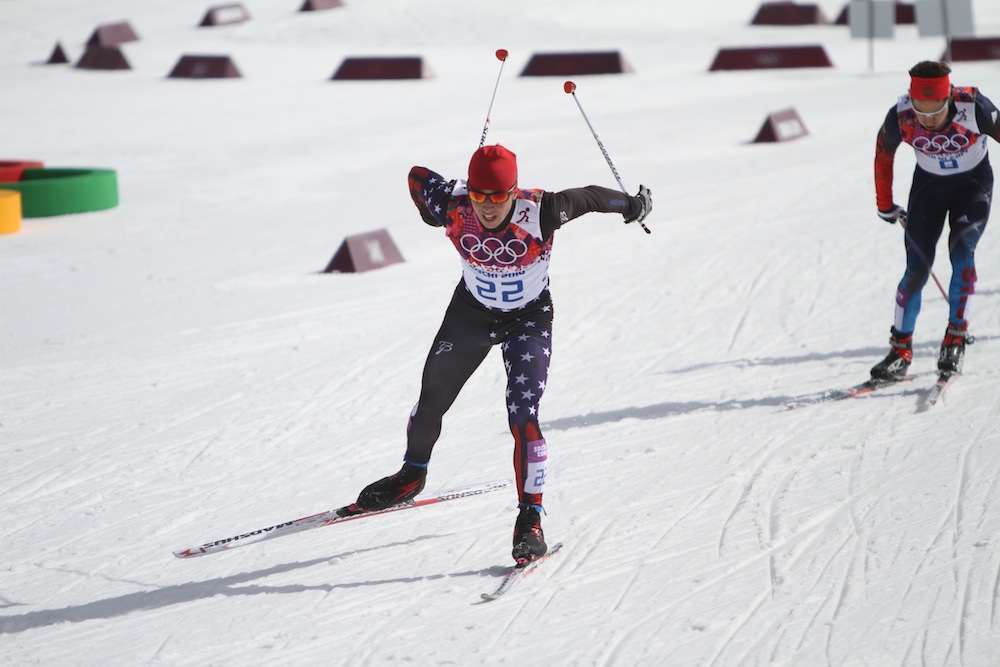
The 2014 Winter Olympics, in Sochi, Russia, were known at the time for Kikkan Randall’s disappointing result in the individual skate sprint, and after the fact for the revelation that Russia was engaged in a massive state-sponsored doping scheme and cover-up. They were also significant for a change in uniforms: stars and stripes on the right arm and left leg, and a large “USA” on the right leg. The left arm was relatively plain. Also, several of the U.S. women drew attention for racing sleeveless in warm temperatures. Bjørn Dæhlie continued to be the brand logo featured on the upper right quad. (Pictured below: Noah Hoffman, in a solo race, and Sadie Bjornsen, in the women’s relay.)
2014/2015: Stars and stripes redux
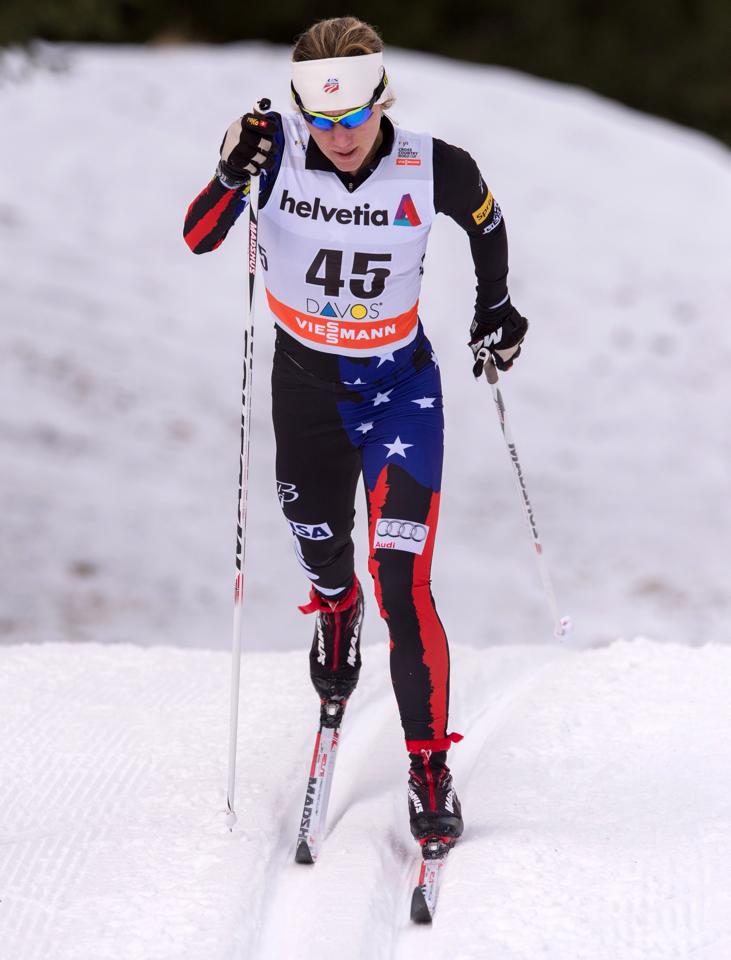
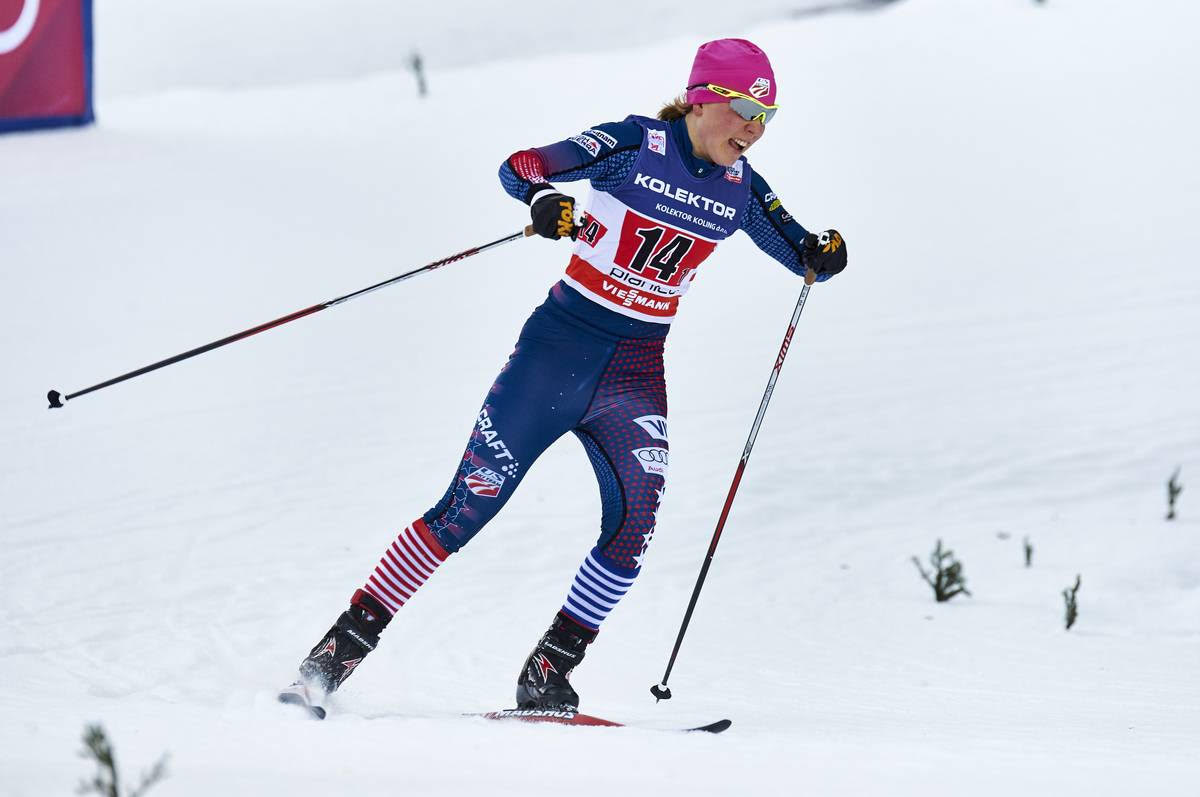
Athletes took to the trails next season with a slightly modified version of the recent Olympics uniform: Larger stars on the left upper quad, with a deeper blue background. The stripes on the left leg became more pronounced and stretched farther up the race suit, to above the knee. Also, once the non-commercial period of the Olympics had passed, there was space for sponsor patches on the arms and legs.
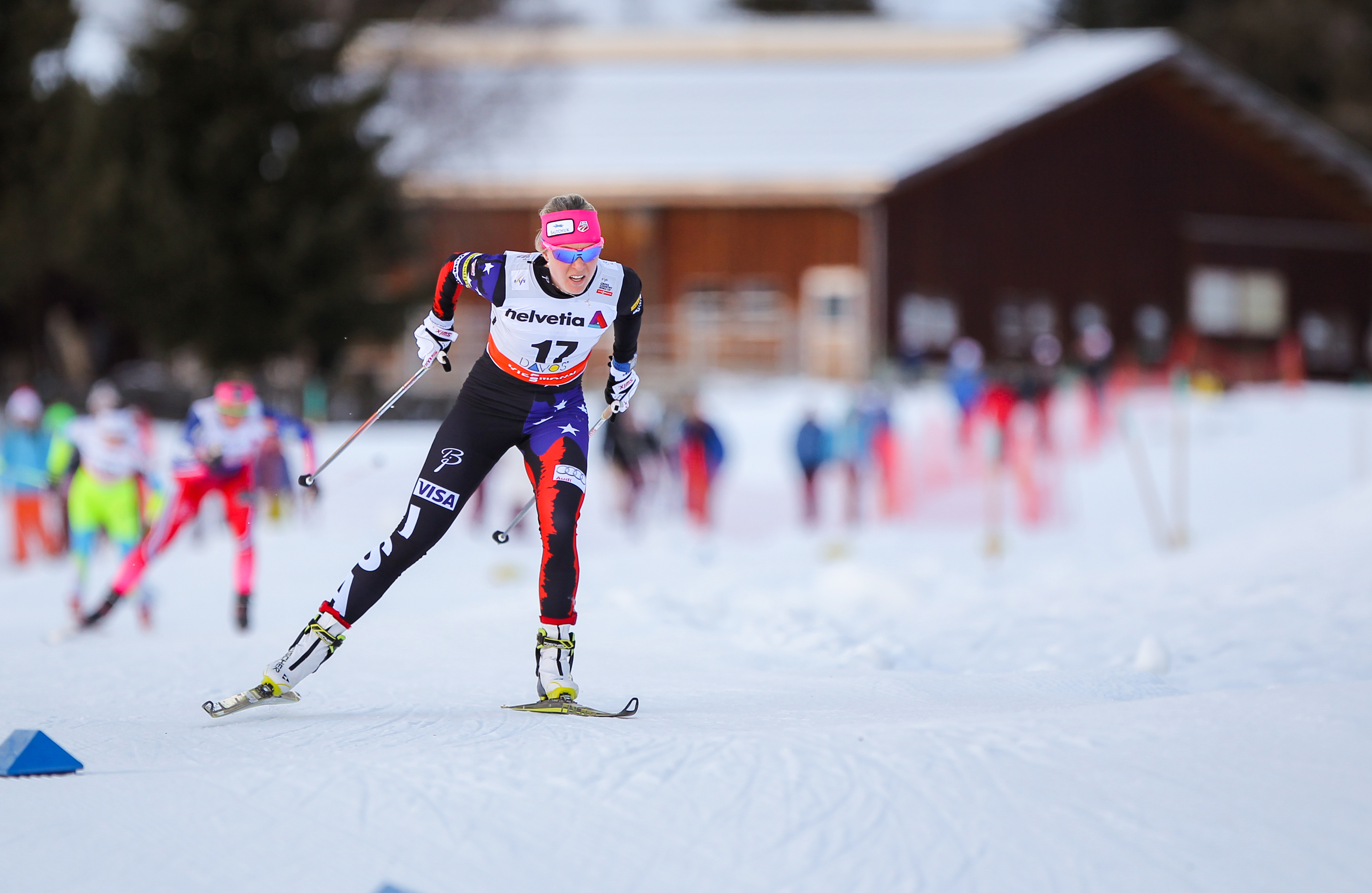
December 2014: Caitlin Gregg (Team Gregg) skiing to 56th place in the Davos World Cup 10 k classic, Dec. 13. (Photo: Toko)
USST’s Sadie Bjornsen racing to 29th in the Davos World Cup 10 freestyle, Dec. 20, 2014. (Photo: Fischer/Nordic Focus)
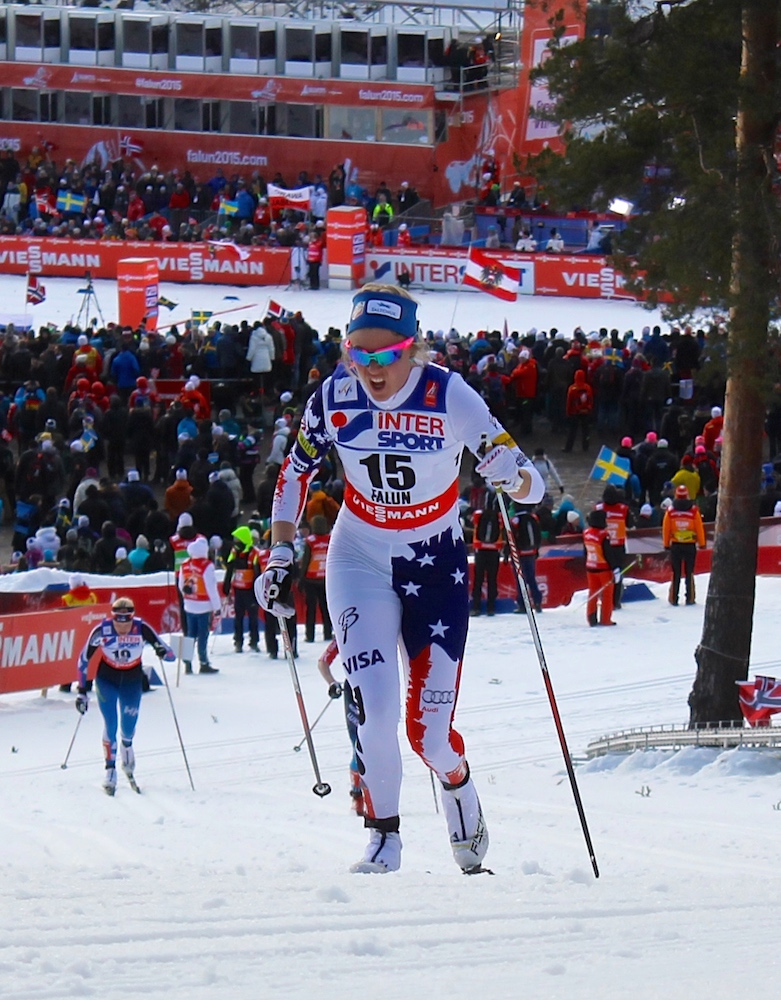
World Championships, in Falun, Sweden, brought a mostly-white version of the uniform, helpful for the warm temperatures and soupy conditions that characterized many of the races. Here’s Sadie Bjornsen in Falun in February 2015:
2015/2016: Red, white, and blue
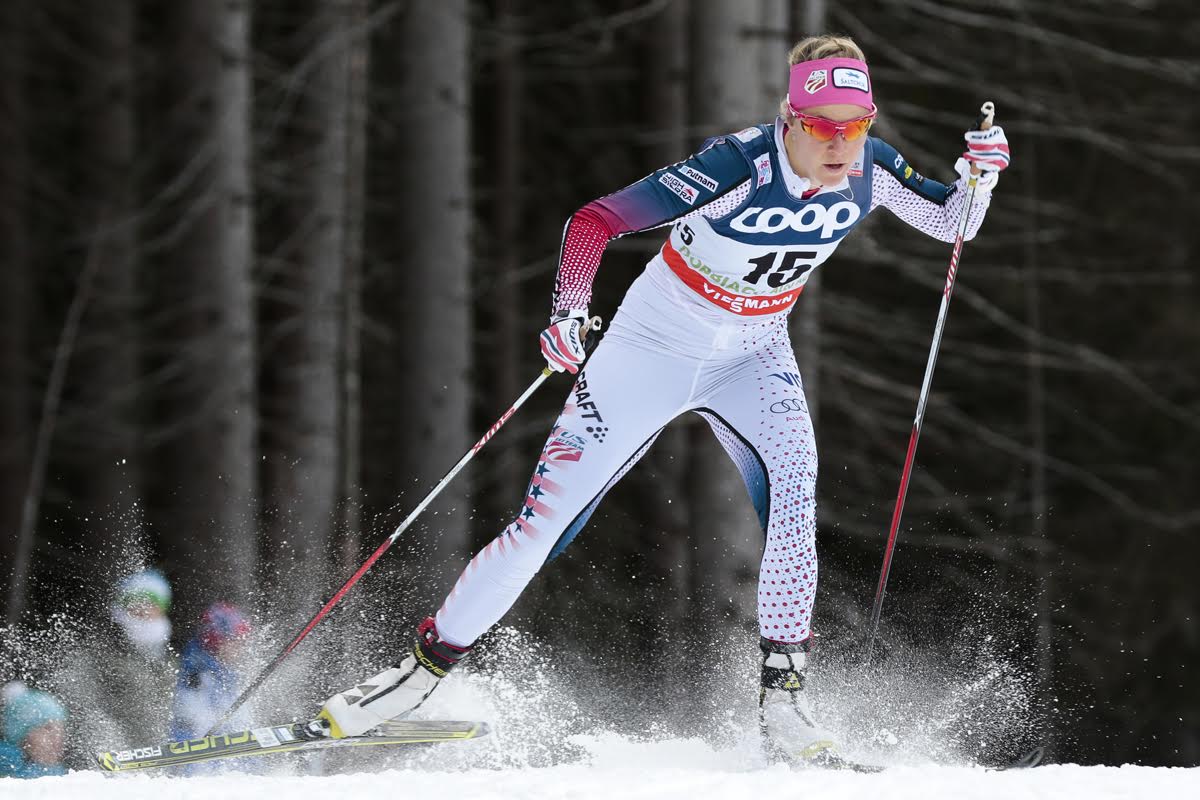
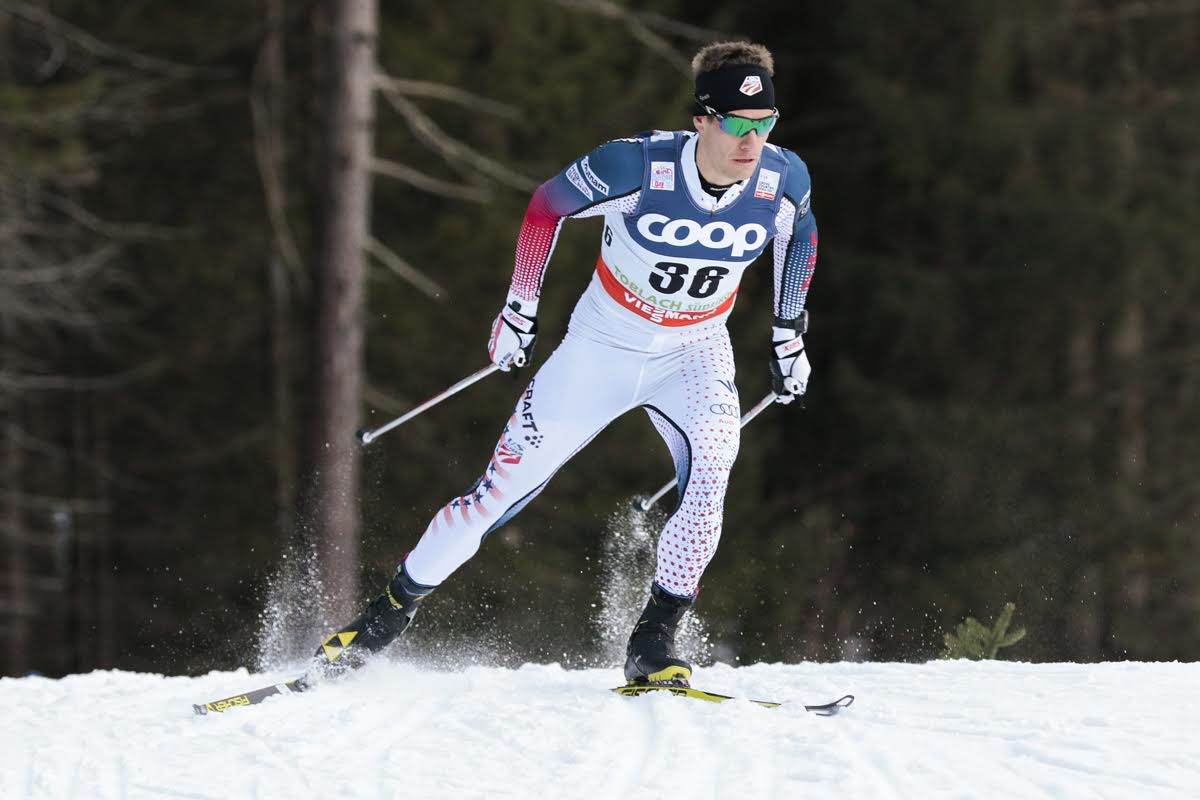
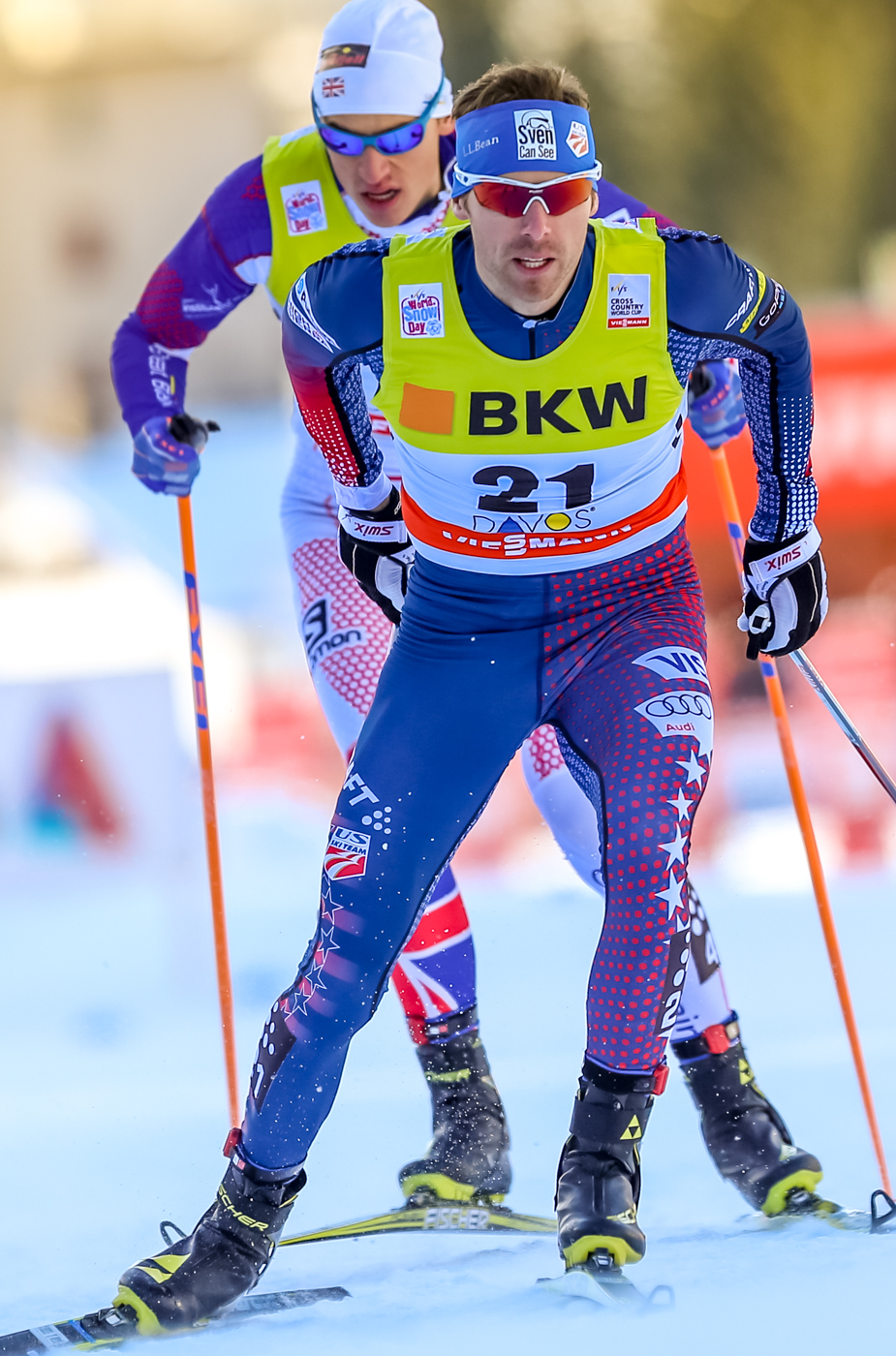
By fall 2015, the move away from black, and towards red, white, and blue, was complete. Athletes now had the option of being attired in a predominantly white color scheme, which would aid in preventing overheating on warm days, while thankfully solving the transparency issues that had plagued recent all-white suits for Sweden or Italy. An alternate version had roughly the same patterning, but with blue as the primary color. Notably, the Americans also moved to a race suit manufactured by the Swedish company Craft for the first time in this survey.
December 2015: Sadie Bjornsen (U.S. Ski Team) racing to her best-ever sprint qualifier in sixth at the World Cup freestyle sprint in Toblach, Italy. She went on to make the semifinals and place 10th overall. (Photo: Fischer/NordicFocus)
December 2015: Simi Hamilton (U.S. Ski Team) racing to his first non-stage World Cup podium on Saturday in Toblach, Italy, where he placed second in the freestyle sprint. (Photo: Fischer/NordicFocus)
December 2015: American Andy Newell (r) and Great Britain’s Andrew Young (c) trail Norway’s Håvard Solås Taugbøl (2) in the quarterfinal at the Davos World Cup freestyle sprint on Sunday in Switzerland. Taugbøl won the heat, Young placed third, and Newell was fifth after missing out on a photo finish for fourth. Newell finished the day 23rd overall. (Photo: Marcel Hilger)
January 2016: Ida Sargent (U.S. Ski Team) teamed up with Sophie Caldwell (not shown) to place fifth in the 6 x 1.2 k freestyle team sprint at the World Cup in Planica, Slovenia. (Photo: Madshus/NordicFocus)
Honorable mention: Trending towards “purple cobras” for American biathlon but not there yet.
American Claire Waichler started 58th and finished 33rd in the youth women’s pursuit on Sunday at IBU Youth/Junior World Championships in Cheile Gradistei, Romania. (Photo: IBU YJWCH Cheile Gradistei 2016/Facebook)
2016/2017: More red, white, and blue
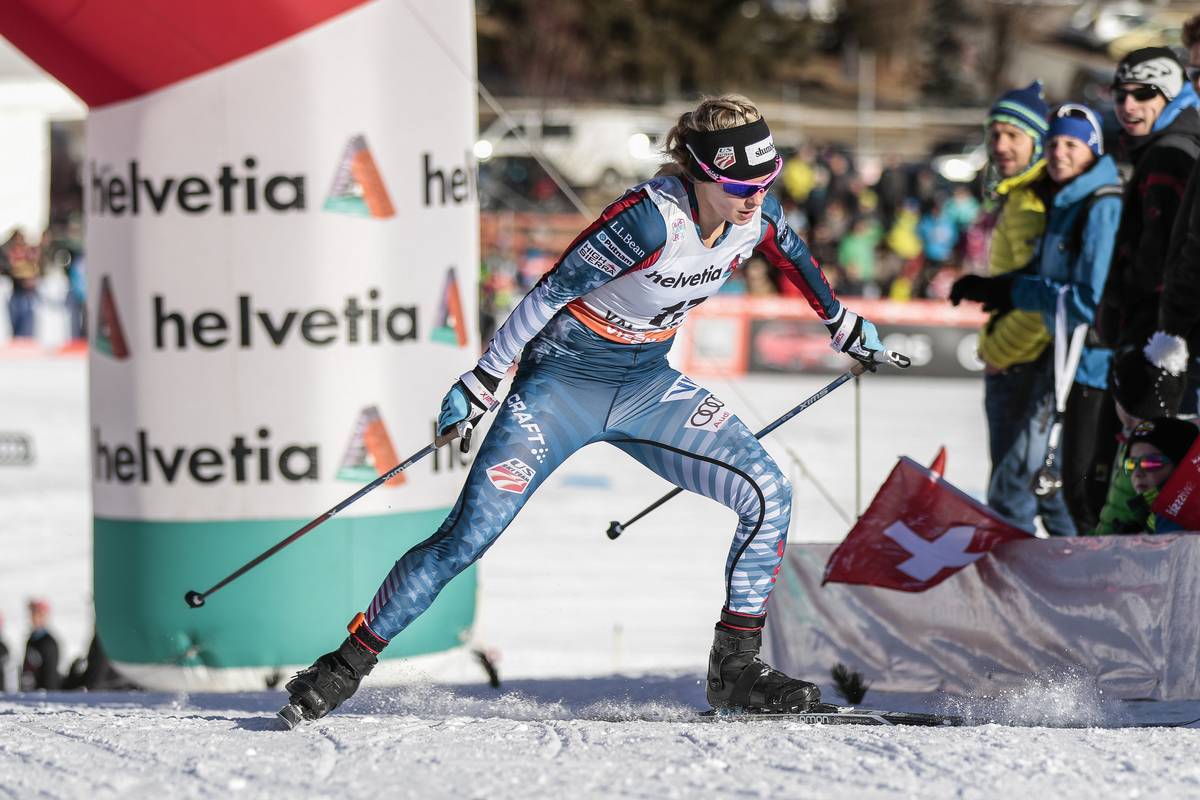
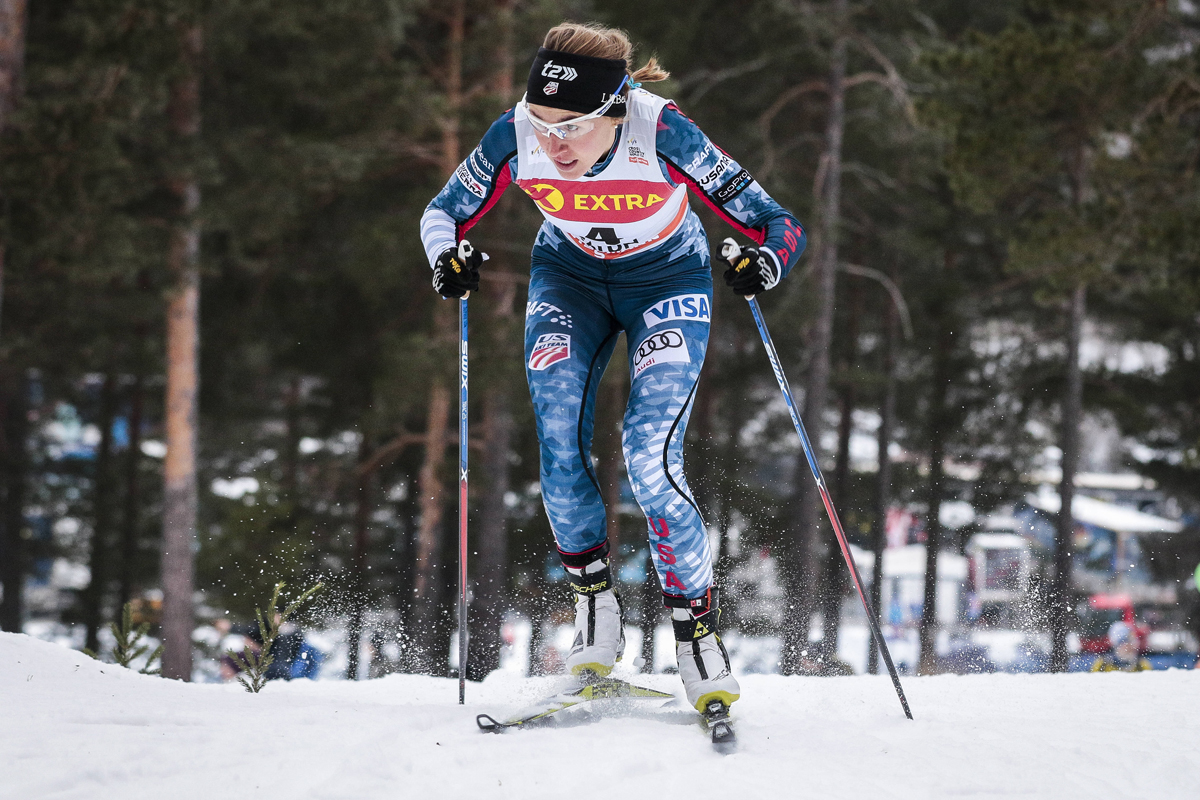
An interpretation of red, white, and blue, still on a Craft suit, remained in place for the 2016/2017 World Cup season, which was marked within the team by Randall and her husband, Jeff Ellis, traveling the European race circuit with a newborn in tow. The changes to the USST uniform were less dramatic than Randall’s familial status: Still red, white, and blue, though now with blue as the dominant color. The entire left leg, and the bottom half of the right leg, had markings, somewhere between subtle striations and full-on stripes, that evoked the stripes of the American flag. (Let’s put aside for the moment the fact that the stripes on the actual flag are white and red, not white and blue.) The pattern was repeated on the lower right arm. An understated evocation of blue or white stars marked both lower legs, with more pronounced stars scattered around the bottom of the torso (possibly the top as well, but nearly all of one’s torso is typically covered by the standard race bib). The left arm and left leg both proclaimed “USA” in red lettering.
The vehicular logo on the legs remained that of Audi, as it had been since the start of this history.
There appears to have been no change for the 2017 World Championships. At least to the uniforms; on the race course, the Americans won an unprecedented three medals.
December 2016: Jessie Diggins (U.S. Ski Team) racing to ninth in Saturday’s 1.5 k freestyle sprint qualifier in Val Müstair, Switzerland. Diggins went on to place sixth in the final. (Photo: Salomon/NordicFocus)
January 2017: Sophie Caldwell (U.S. Ski Team) racing to third in the qualifier of Saturday’s 1.4 k freestyle sprint in Falun, Sweden. She went on to finish 16th overall (Photo: Fischer/NordicFocus)
February 2017: Kikkan Randall (U.S. Ski Team) racing to 26th in the women’s 10-kilometer classic individual start at the 2017 Nordic World Championships on Tuesday in Lahti, Finland (Photo: John Lazenby/Lazenbyphoto.com)
Meanwhile, biathlon saw the advent of the beloved “purple cobras” era:
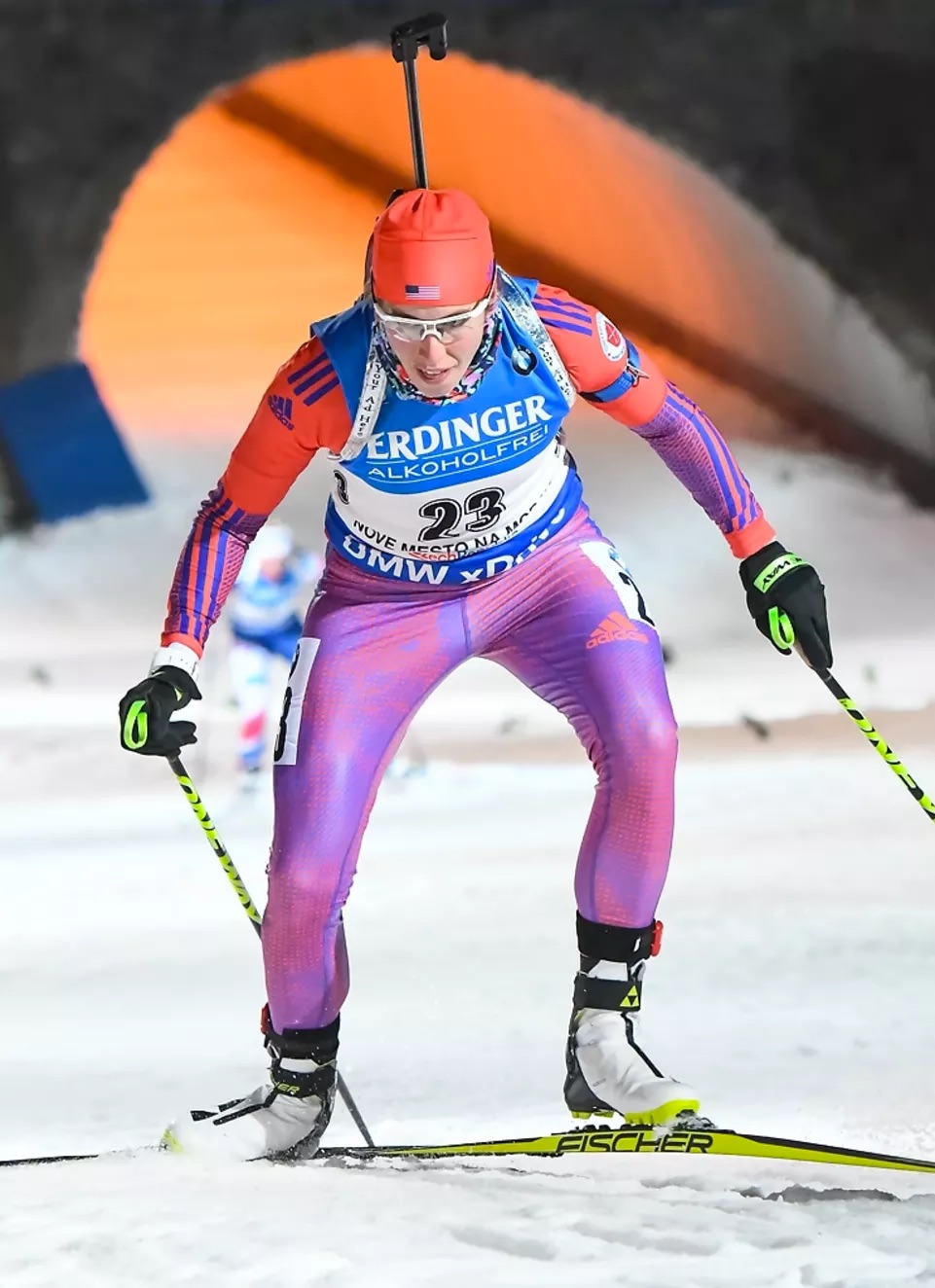
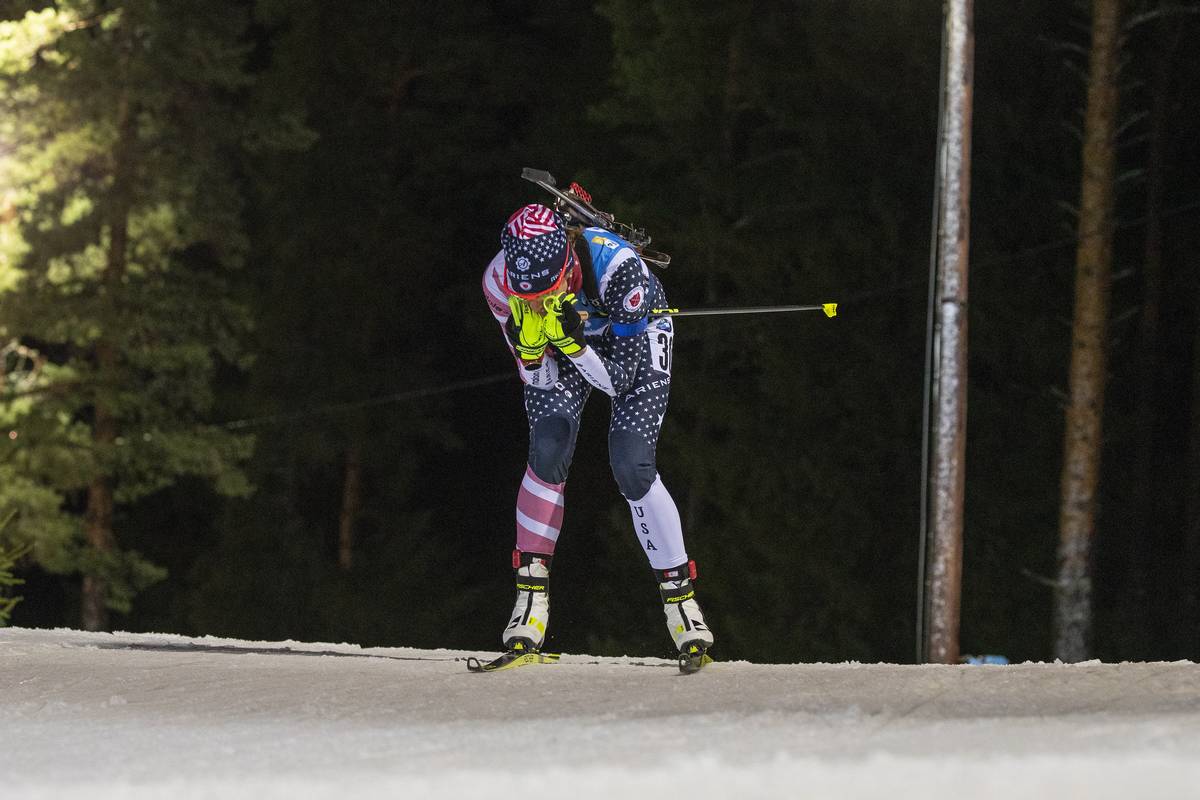
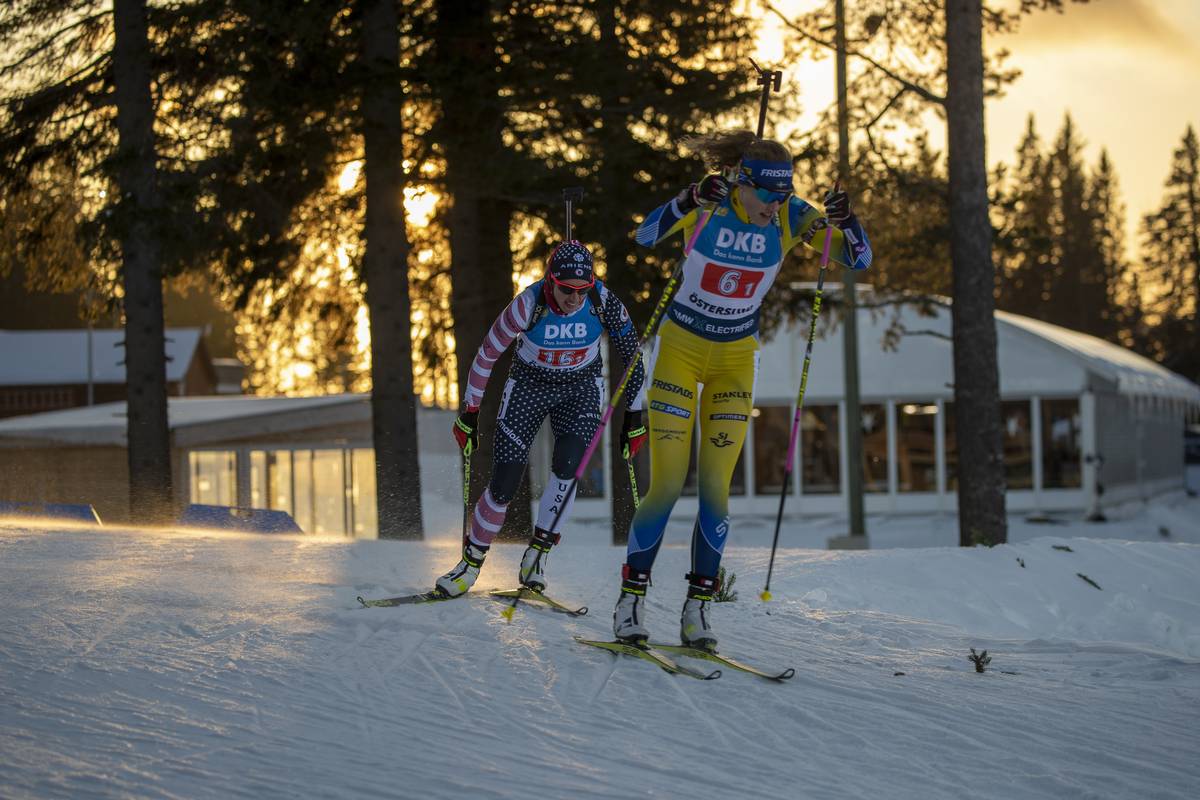
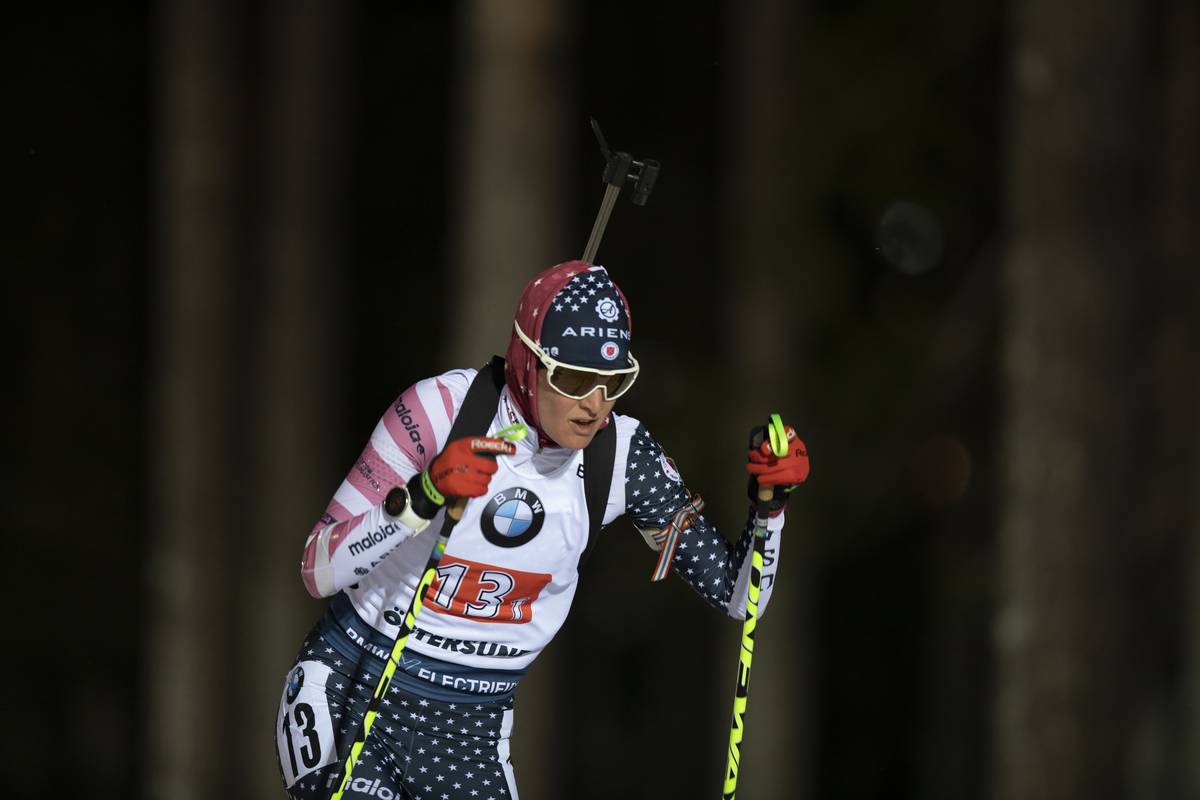
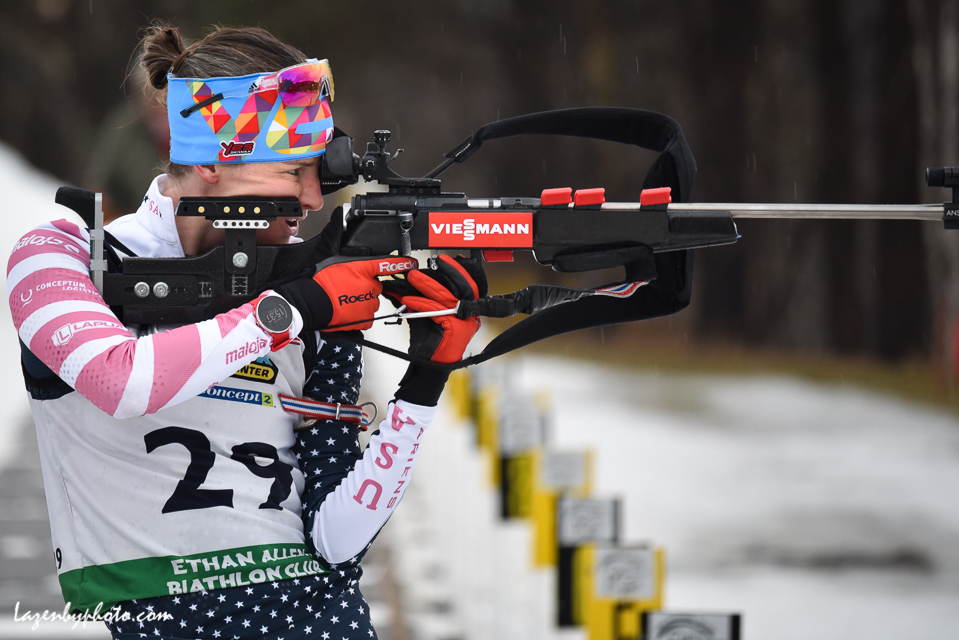
US Biathlon’s Susan Dunklee on her way to finishing third in the women’s sprint at the IBU World Cup in Nove Mesto, Czech Republic. It was the third podium of her career. (Photo: IBU)
2017/2018: Red, white, and blue redux
There appears to have been no change for the 2017/2018 World Cup season: still red, white, and blue, but mostly blue, on a Craft suit. The most notable change may have been to the car sponsor… for the first time since at least the scope of this article, a Toyota logo was on the leg, not Audi. Nichts ist unmöglich (“Nothing is impossible”), as the company’s European slogan proclaims.
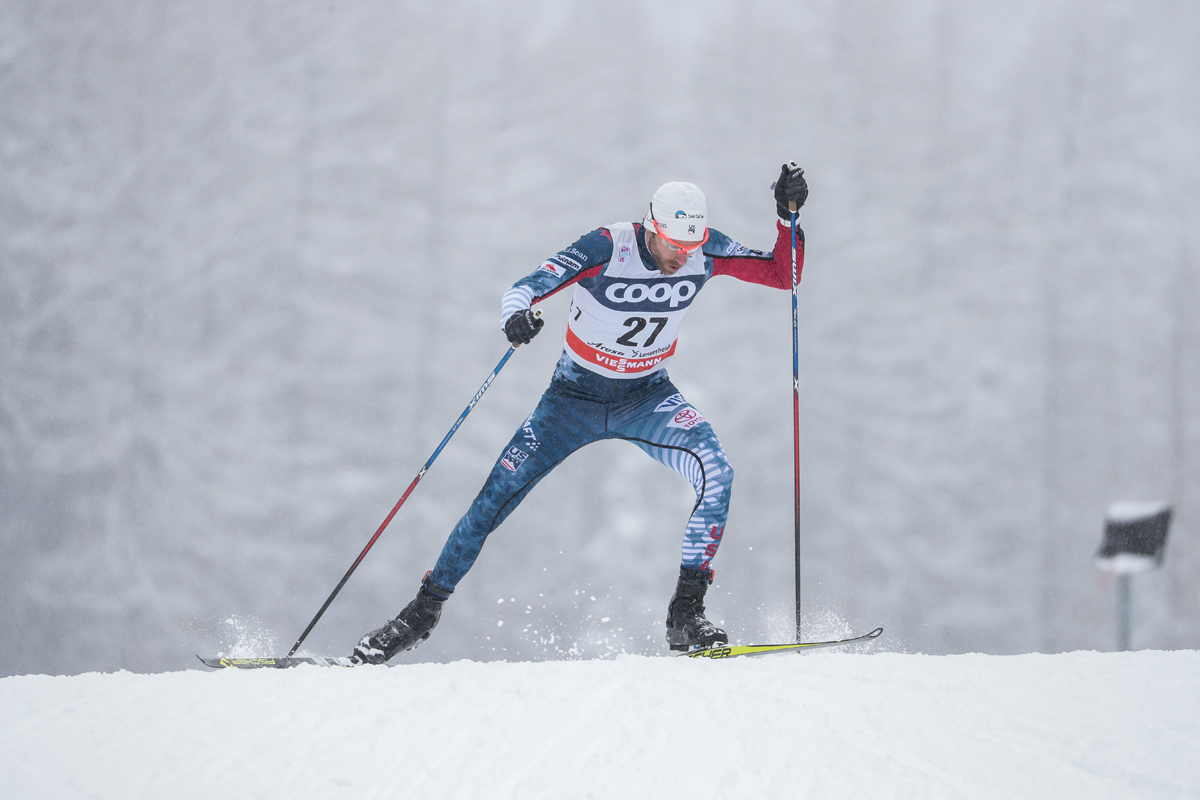
American Andy Newell racing the men’s 1.5 k freestyle-sprint qualifier at Stage 1 of the Tour de Ski on Saturday in Lenzerheide, Switzerland. He qualified 20th and went on to finish 19th overall. (Photo: Fischer/Nordic Focus)
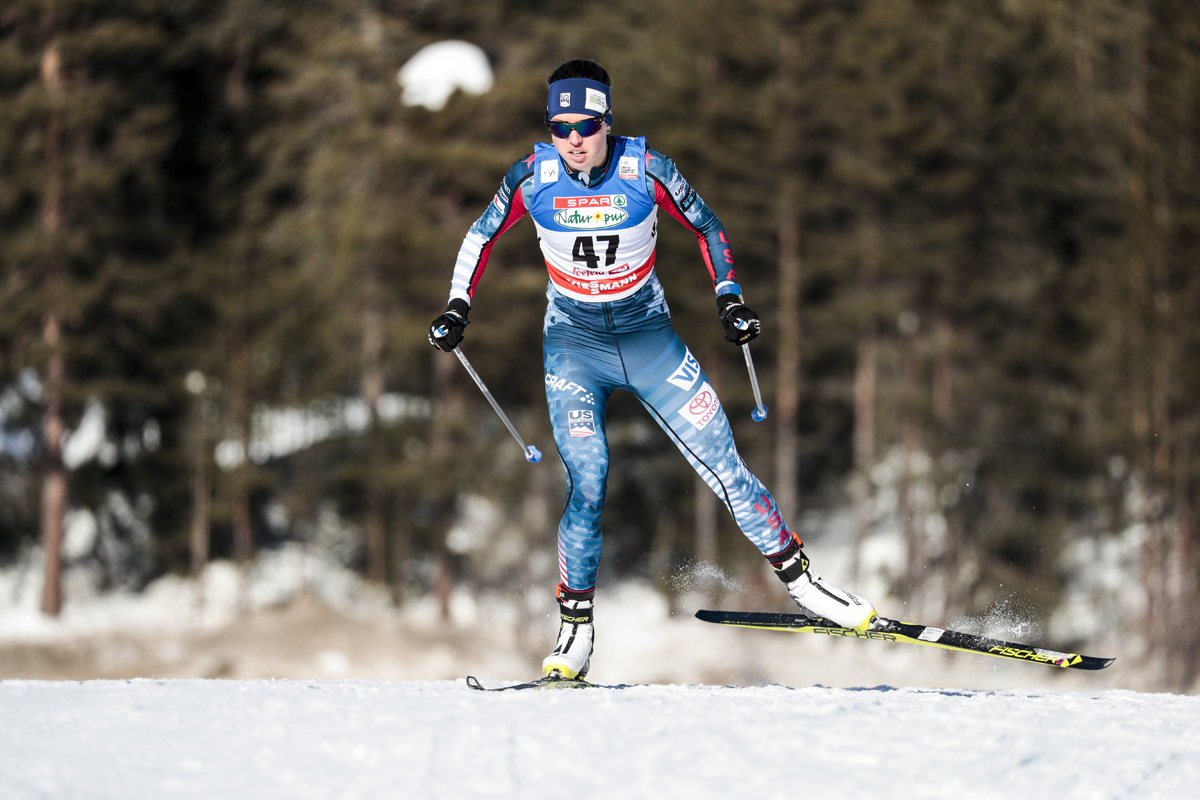
Caitlin Patterson (Craftsbury Green Racing Project) racing to 52nd in the freestyle sprint qualifier at the last World Cup on Jan. 27 in Seefeld, Austria. The next day, she placed 23rd in the 10 k freestyle mass start. (Photo: Fischer/NordicFocus)
2018 Winter Olympics, Pyeonchang: Red, white, and blue, and a lot of stripes
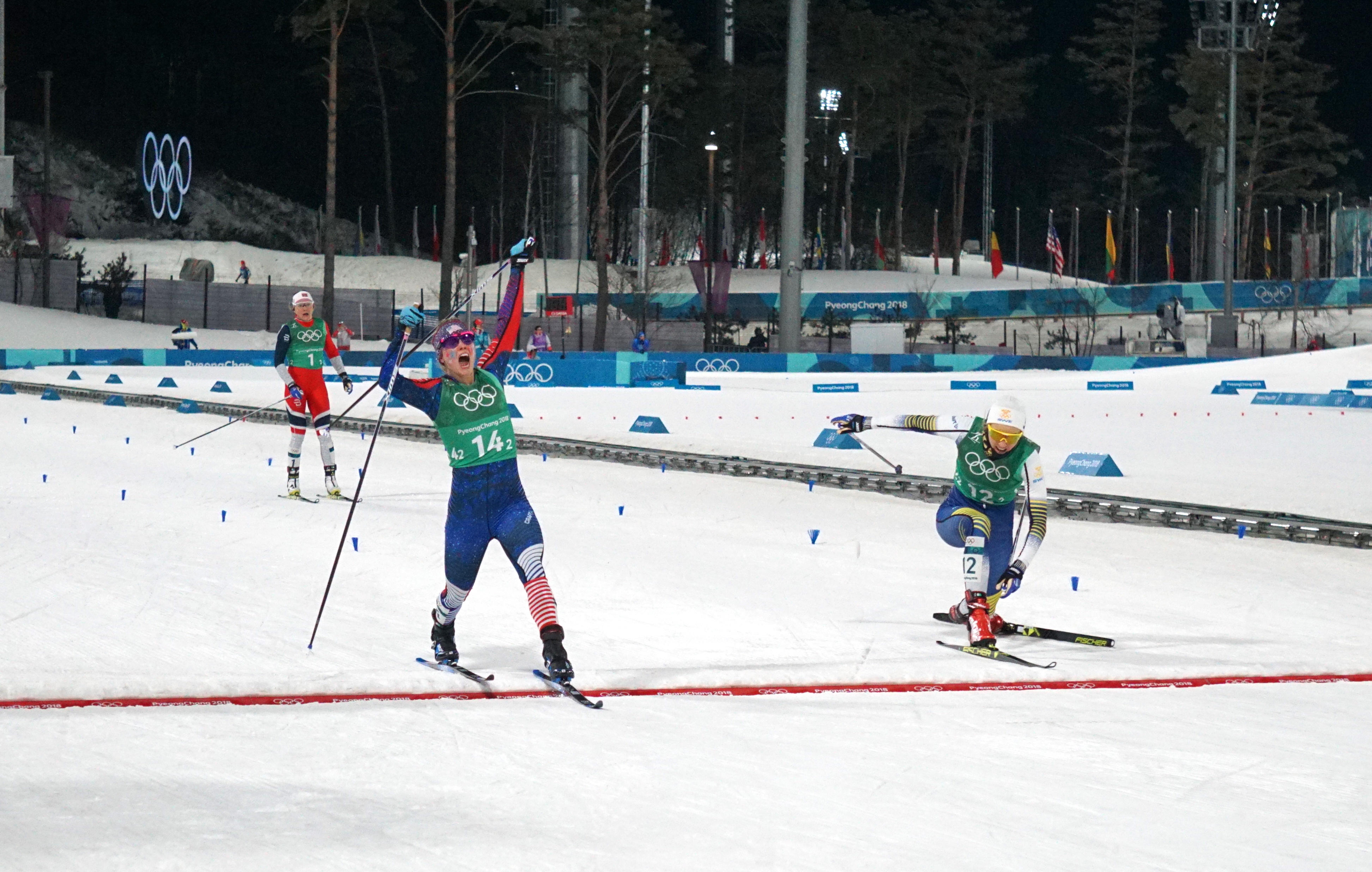
There is a somewhat famous picture from the 2018 Winter Olympics that you may already be familiar with. In the picture, Jessie Diggins, on the lefthand side of the frame, stretches her left foot across the finish line to secure an historic Olympic gold medal for the United States. Her left arm mirrors the gesture, punching the air above her in what is presumably an instinctual counterbalance to the lunge but also appears, in a frozen moment in time, to be a triumphant fist-pump. In the middle, her face is rent in a rictus of exertion and triumph. On the righthand side of the frame, Stina Nilsson of Sweden lunges as well, 0.19 seconds behind Diggins. Mute V-boards and still flags fill in the background of the image, as Maiken Caspersen Falla of Norway appears to stand up and stop skiing in order to watch the finish unfold.
It was a few seconds before 7:16 p.m. in Pyeongchang, 4:16 a.m. in Afton, Minnesota, and 1:16 a.m. in Anchorage, Alaska. If you’re reading this website, you may remember where you were at that moment.
February 2018: Jessie Diggins (14) edges Sweden’s Stina Nilsson (r) for gold, while Norway’s Maiken Caspersen Falla (far left) races to bronze, in the women’s freestyle team sprint final at the 2018 Olympics in PyeongChang, South Korea. (Photo: Noah Hoffman)
But let’s talk about the uniform. Another Craft product, the dominant impression is once again blue; in the photo above, taken at whatever distance from the finish Noah Hoffman was allowed to stand while there was a race on, there is a whole lot of blue approaching the finish line between the American suit and the Swedish one. Some white stripes are visible around the knee of Diggins’s suit, trending down the lower leg, though they are soon subsumed by The Relay Socks.
On closer inspection, however (see next picture, below), there are a lot of stripes going on in this uniform. The entire legs are striped, with stronger white stripes on the sides of the torso fading to fainter stripes at the top of the leg. The knees have white stripes on a blue background, with the width of the white stripes gradually decreasing and the extent of the blue interstices gradually increasing across the course of the knee. As shown in more detail here, the patterning gives way to thin red stripes against a blue background, on the lower right leg, and a bold white “USA,” on the lower left.
The right arm has white splotches, potentially stellar in nature, against a blue background. The left arm has red and white stripes to midway down the biceps, which then transition to blue and red stripes.
The torso has a subtle blue and black patterning perhaps best described as “Swedish forest camo.”
Finally, although it is not apparent in either picture, “USA” was written in white letters against a blue background on both the right arm and lower left leg, as shown in the images available here (lettering on arm) and here (lettering on leg).
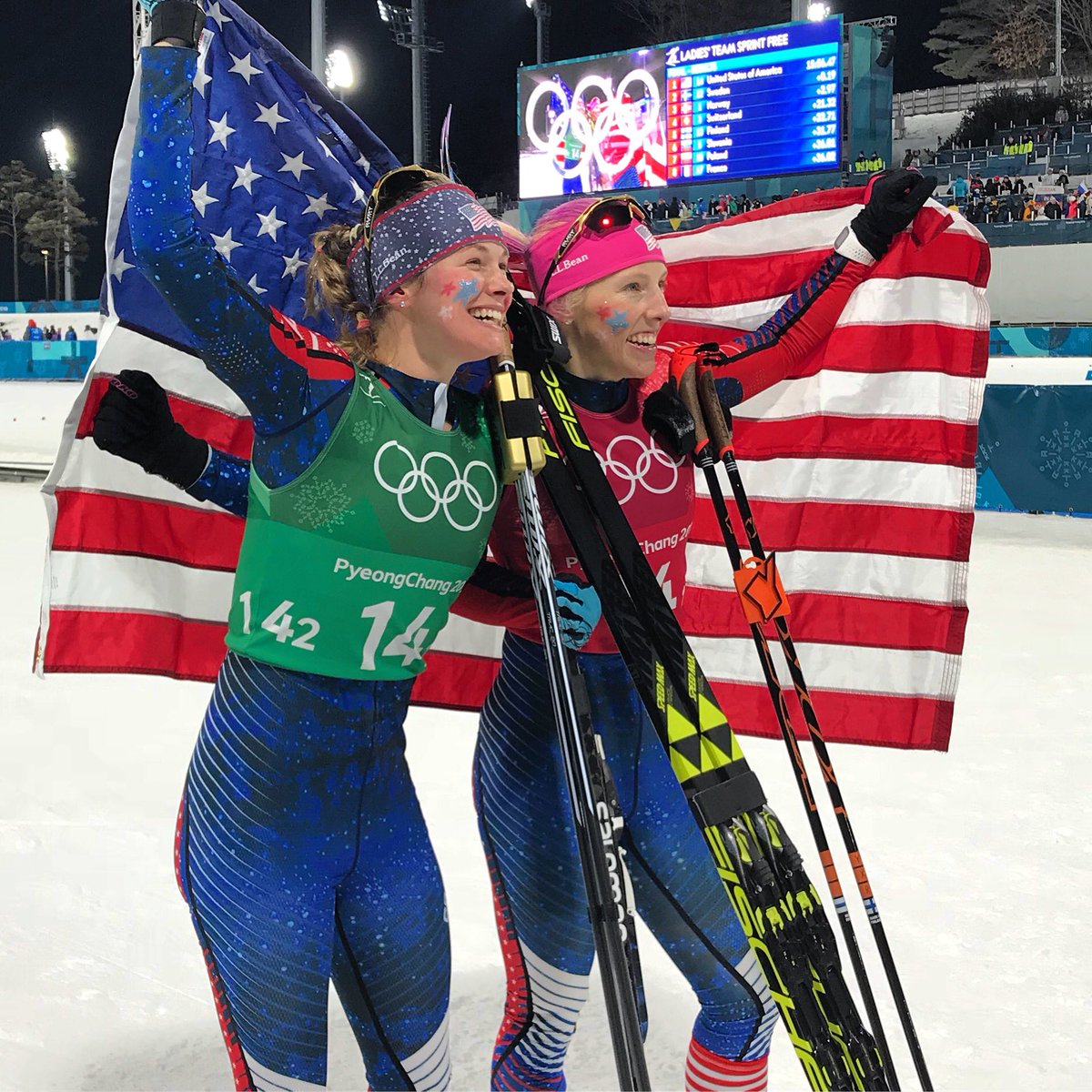
February 2018: Jessie Diggins (l) and Kikkan Randall soak up their win in the women’s freestyle team sprint on Wednesday at the 2018 Olympics in PyeongChang, South Korea. (Photo: FIS Cross Country/Twitter)
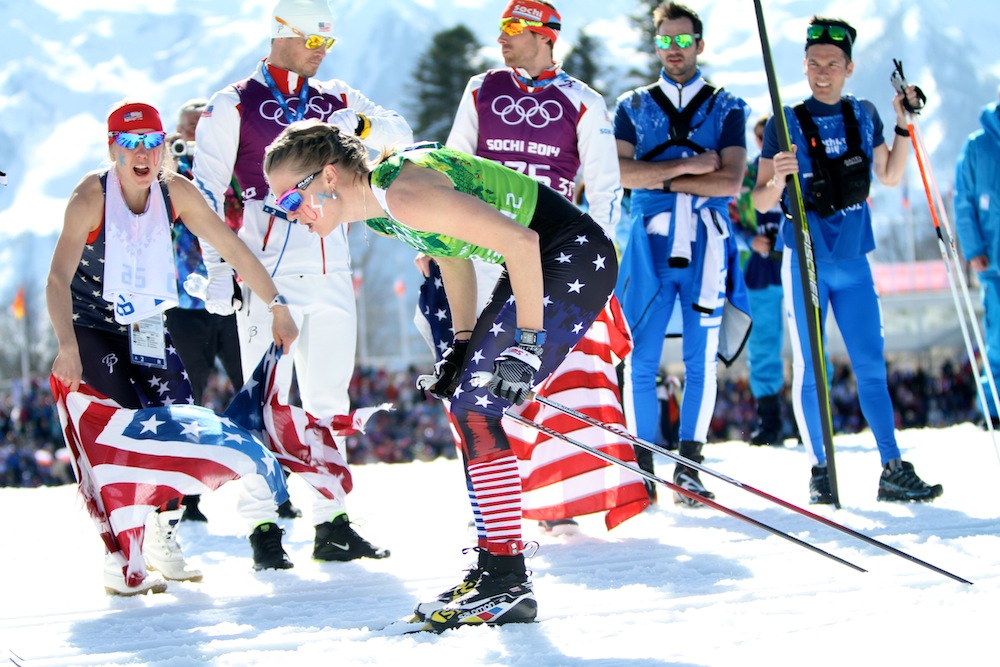
Here is another fine picture of Diggins and Randall from the evening of February 21, 2018. This one does not show the famous American relay socks, but does show the equally renowned facepaint and glitter. As Diggins has written, in what is both a pro-glitter cri de cœur and “a brief message for [the] high school officials” who harshed on her glitter as a junior racer, “Putting on glitter before my race is a salute to the little girl who just wants to ‘go super speed!!!’ It’s a promise to myself that I will race my absolute hardest that day. It’s a ritual that gets me in the right mindset to get out of the start gate and give it everything I have. It’s harmless, doesn’t negatively impact anyone, but to me it’s a huge part of my race morning. . . . And on relay days? Oh man. I get so excited about relay days. I get to paint the flag, ‘USA’ and stars on the faces of my teammates, and one of them will paint it on me as well. Then I put glitter over everything! It’s a special time when everyone is nervous, and excited, to be representing our country and we get together early in the morning to help each other get ready and deal with our pre-race nerves. It’s a little bit like our special striped relay socks…it’s part of what we do, as a team.”
End of the 2017/2018 season: Farewell tour
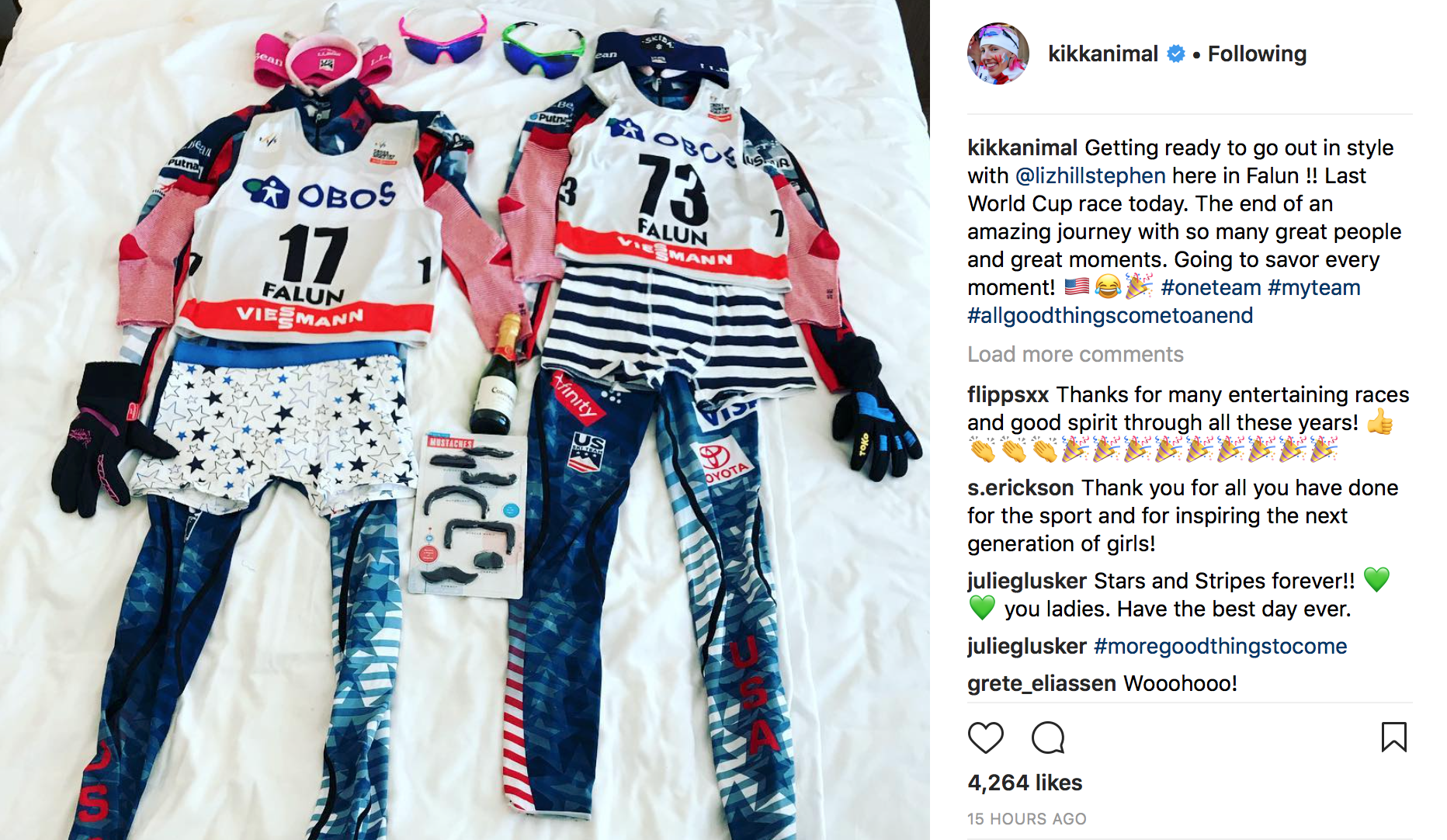
Honorable mention for the 2017/2018 season, World Cup edition: Randall and Liz Stephen’s outfits for their final World Cup race (standard Craft base, but with a whole lot of flair):
March 2018: The last-race outfits worn by Kikkan Randall and Liz Stephen for Sunday’s World Cup Finals pursuit. (Photo: Kikkan Randall/Instagram)
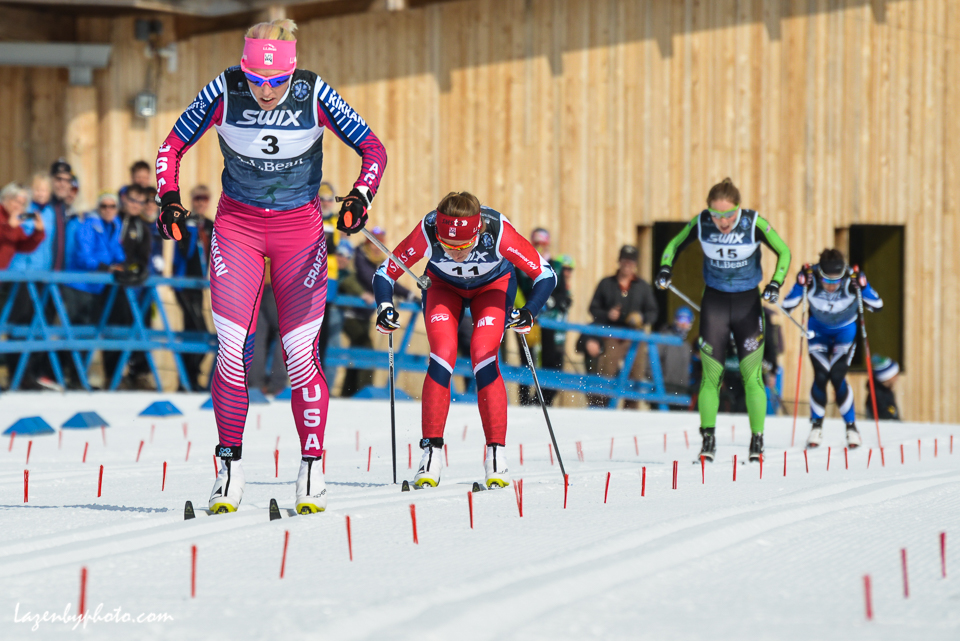
Honorable mention, domestic edition: Randall’s bespoke pink and blue Craft USST/APU suit (essentially the Olympics suit but with different patterning) that she wore for her final race as a professional skier, at Spring Series in Craftsbury. The suit said “USA” on the right arm and left leg, “APU” (for Alaska Pacific University, her club team of 19 years) on the left arm, and “Kikkan” on the left arm and right upper leg.
March 2018: Kikkan Randall (3) racing for third place in the women’s 30 k classic mass start at 2018 U.S. Distance Nationals in Craftsbury, Vt., ahead of Sophie Caldwell (second from l), Ida Sargent (second from r), and Rosie Frankowski (r). (Photo: John Lazenby/Lazenbyphoto.com)
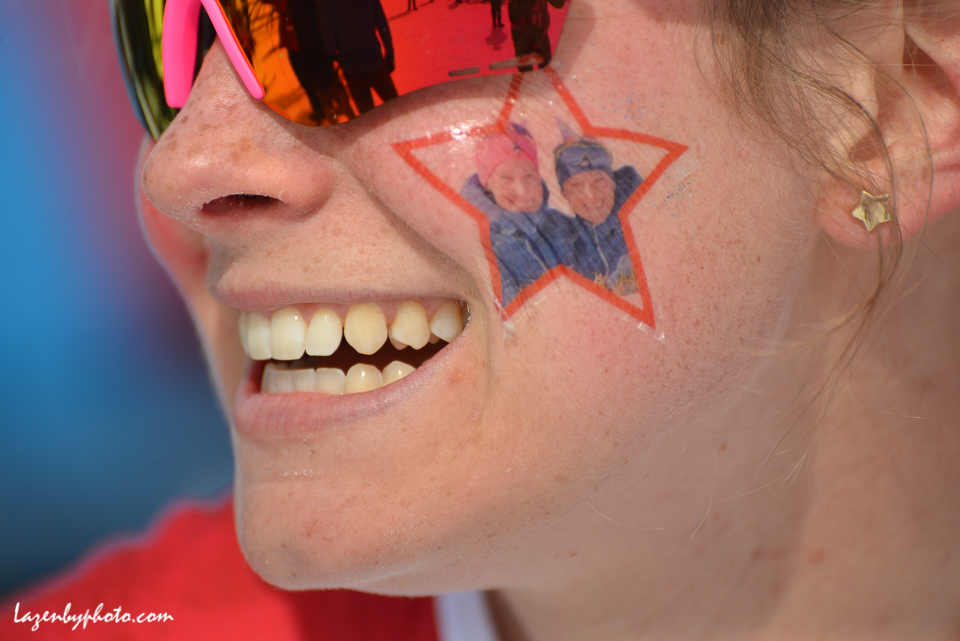
Honorable mention, face paint edition: This remarkable evocation of Randall and Stephen on Diggins’s left cheek at Spring Series.
March 2018: Jessie Diggins with a photo of her retiring U.S. Ski Team teammates Kikkan Randall and Liz Stephen on her cheek at 2018 U.S. Distance Nationals in Craftsbury, Vt. (Photo: John Lazenby/Lazenbyphoto.com)
2018/2019: Red, white, and blue, but with larger color blocks. Also, a move to Swix.
Randall retired. Stephen retired. Randall got breast cancer. Randall was treated for breast cancer. Diggins worked hard to — successfully — bring a World Cup ski race to Minneapolis. And the Americans kept racing in red, white, and blue, albeit now with a move from Craft to Swix for the suit manufacturer. This year’s interpretation of the theme brought a shift to white as the dominant color, with blue through the torso and upper legs, as well as on the arms. Red was the least-pronounced color this year, limited to accents alongside the larger blocks of blue.
While the Americans continued their perhaps now-accustomed success at the World Cup level, American juniors served notice at World Juniors that they were a force to be reckoned with, taking a gold in the men’s relay, a fourth in the women’s relay, two fourths in classic distance races, and multiple other top-tens. Here are two shots from a frigid Lahti:
January 2019: Luke Jager (middle left, hands in air) after tagging off to Ben Ogden (bib 2, middle right, pink hat) in the U20 men’s 4 x 5 k relay at Junior Worlds in Lahti, Finland. (Photo: Doug Stephen)
January 2019: Kendall Kramer on her way to fourth place in the U20 15 k classic mass start at World Juniors in Lahti, Finland. (Photo: Doug Stephen)
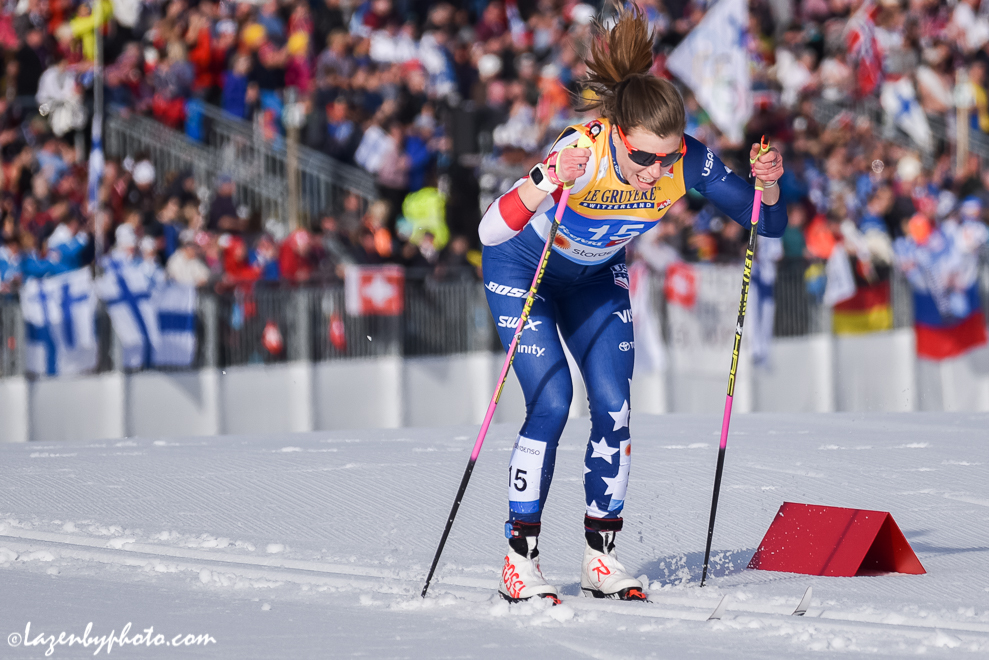
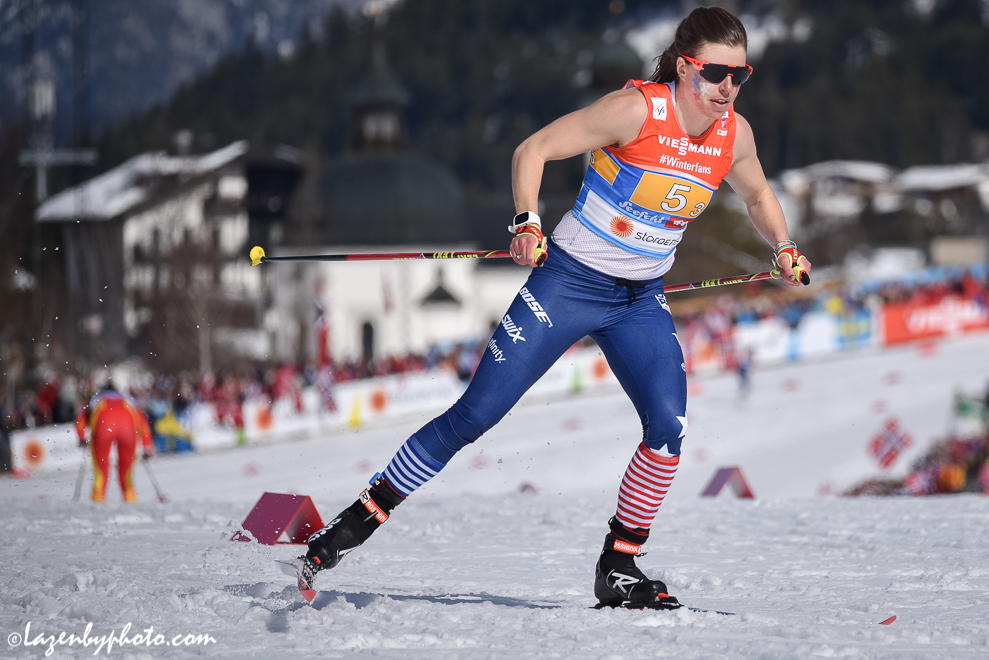
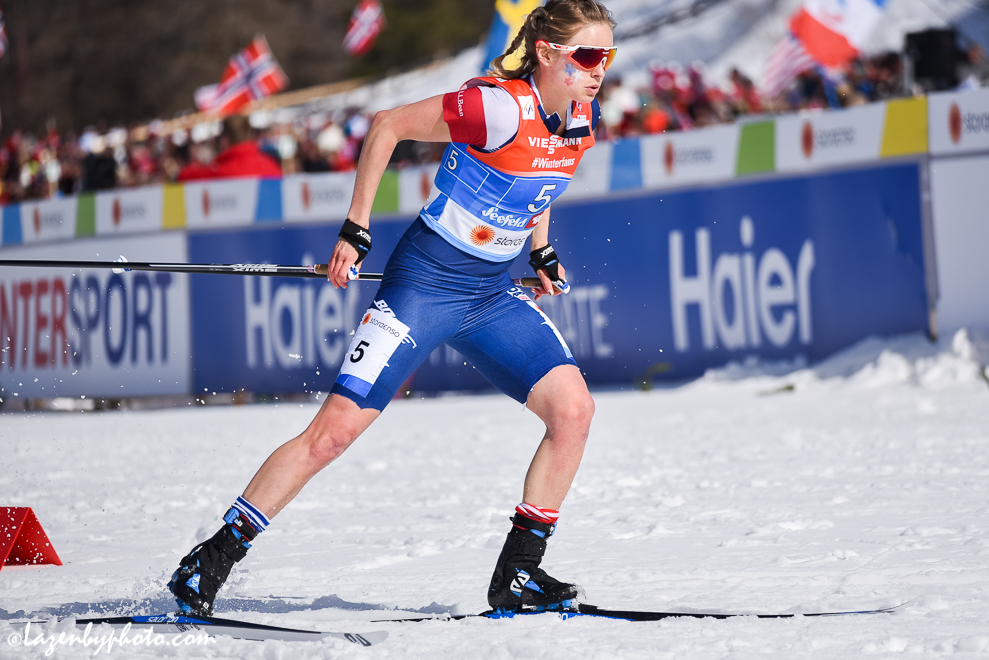
Back to the World Cup (where senior athletes wore the same uniform shown above on the juniors for the regular season), 2019 World Championships, in Seefeld, Austria, brought something new. The dominant hue in the race suit was now blue instead of white, and the large color blocks of the 2018/2019 World Cup regular season were gone. White stars were added to the lower left leg, making the evocation of the American flag far more apparent. Red and white stripes, on the right arm, continued the vexillological theme. While the four sponsor logos on the legs remained the same (Bose, Xfinity, Visa, and Toyota), the Swix logo shifted from the lowest position on the left leg to the middle position on the right.
A Swix press release about the new suits advised: “Featuring bold stars and sharp American colors, the focus was on visibility in mass start events and an iconic look.”
February 2019: Rosie Brennan races in Seefeld.
Honorable mention: Bare arms and cutoffs. It was hot in Seefeld. Like, over 50° F hot. Erik Bjornsen raced the 15 k classic with nothing underneath his race bib (sun’s out…), attire typically befitting Eagle Glacier in July more so than Austria in February. Brennan raced the relay with only a t-shirt on top, and no gloves. And Jessie Diggins drew widespread attention for her DIY cutoff look for the relay (which still featured the iconic relay socks, albeit rolled down so they wouldn’t counteract the shorts by covering most of her lower leg).
As Diggins later wrote on her blog a month after World Champs: “Let me start by saying this; no, I was not cold racing in shorts and short sleeves, yes, you should try it sometime, and yes, it was refreshing to have the cold slush hitting my legs! Somehow, the sight of me racing in a short suit was more interesting and befuddling to most reporters than the actual race itself. Clearly, they haven’t ever experienced a Minnesota cold snap. Now THAT is cold weather! … Honestly, it’s hard to describe the amount of distress overheating puts me in, but let me put it this way; racing is already one of the most painful things you can do. If I have to deal with being incredibly uncomfortable, dizzy, and feeling my body start to shut down because I’m way too hot, it becomes even harder to continue pushing my body to the limit, because it’s already that much closer to the limit! And besides, everyone needed the laughs by the time we got to the end of the races.”
Erik Bjornsen of the U.S. skiing to 17th overall during the 15 k classic at the 2019 World Championships in Seefeld, Austria. (Photo: John Lazenby/lazenbyphoto.com)
Rosie Brennan of the U.S. during the third leg of the 2019 World Championship 4 x 5 k relay in Seefeld, Austria. (Photo: John Lazenby/lazenbyphoto.com)
Custom race suit for Jessie Diggins of the U.S. She anchored the fifth place U.S. team during the 2019 World Championship 4 x 5 k relay in Seefeld, Austria. (Photo: John Lazenby/lazenbyphoto.com)
2019/2020: Candy cane stripes!
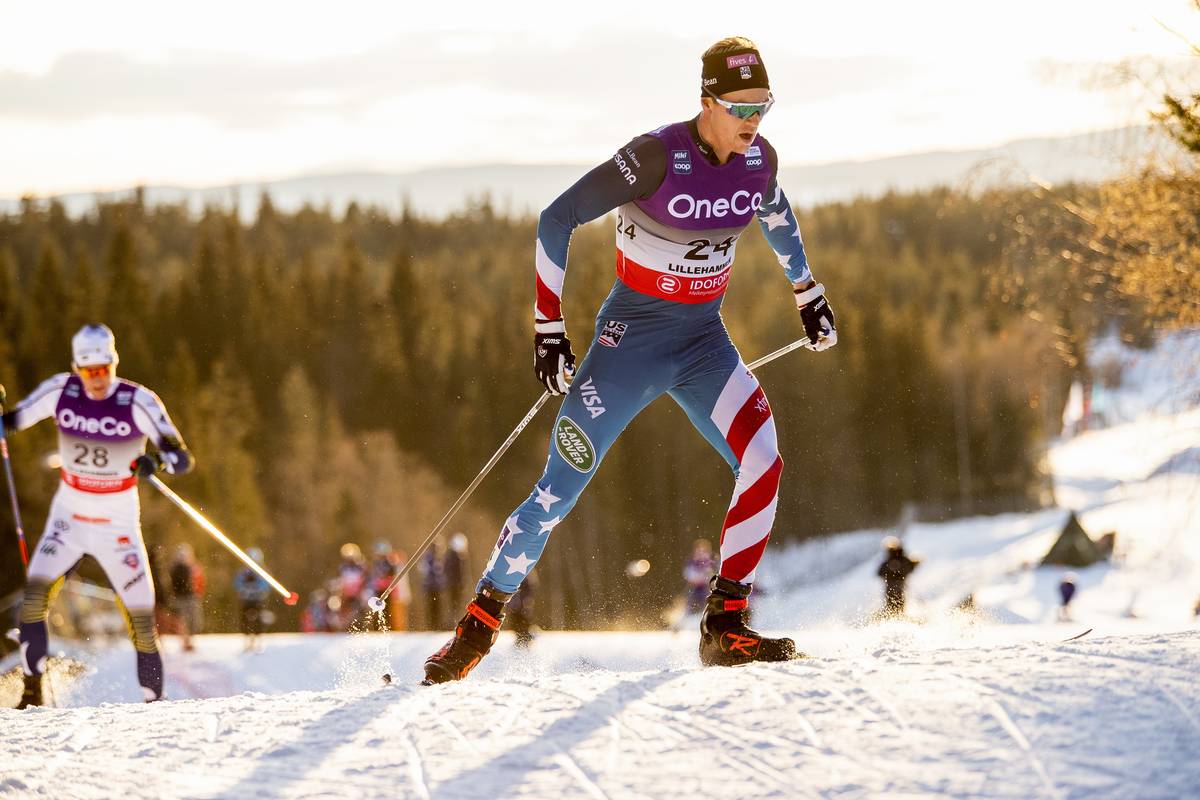
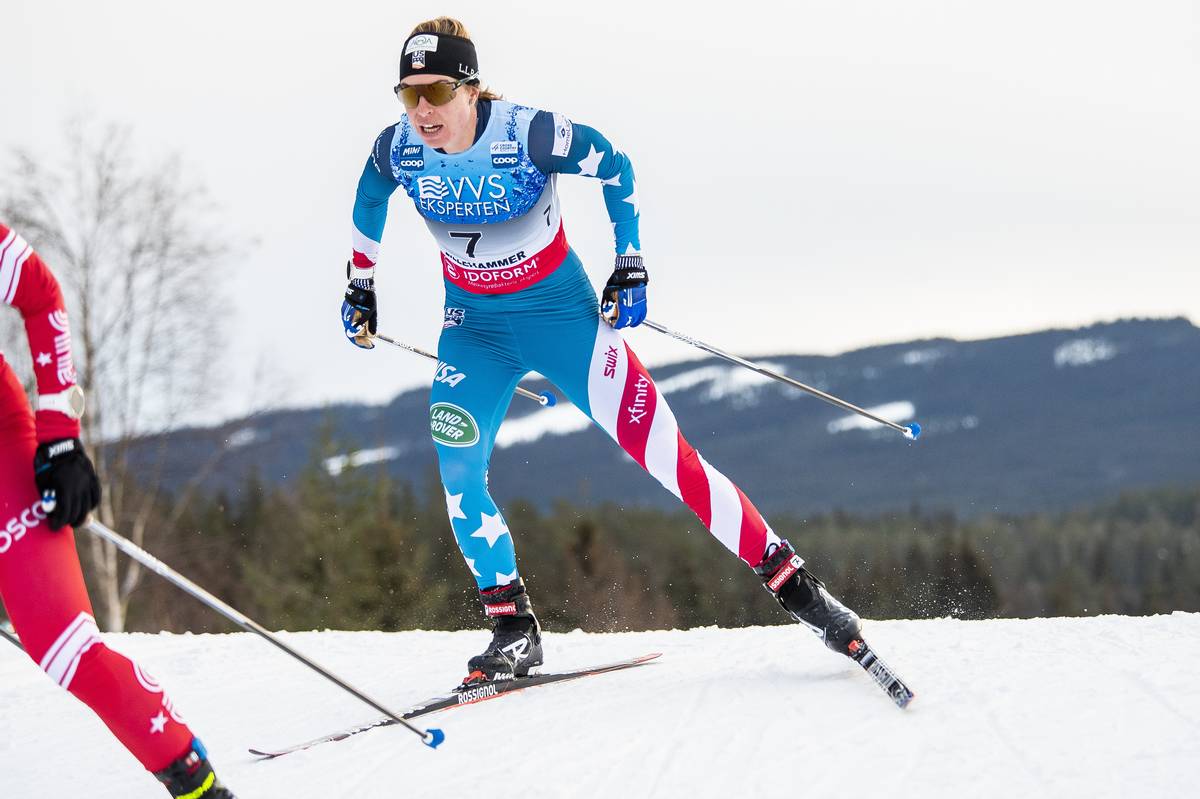
Finally, the start of this season brought the dawn of what has variously been called the “candy cane stripes” or “barber pole stripes” suit (#wellactually a barber’s pole historically has alternating red and blue stripes, not just red stripes as on the current U.S. suit). The left leg features red and white stripes, in a color-appropriate rendition of the American flag. The right leg has white stars on a blue background, again in patterning true to the actual flag. The stars are repeated on the left arm, and the stripes are briefly evoked on the right.
The car sponsor has once again changed, this time to Land Rover.
Here’s Kelley Roche, Soft Goods Product Manager for Swix Sport US, explaining the backstory for this year’s suit design in an email to FasterSkier: “Swix worked with Garen Riedel who owns his own design firm, Riedel Creative in New York. Garen worked closely with the athletes to design a suit that graphically works and they were excited to compete in. The goal is to design a suit that you can pick out of the pack and immediately and know it is a US athlete! This is important for the fan but really important for the coaches who support the athlete during the race. We ended up going with an asymmetric design, a continuation of the Seefeld suit design from 2019 and a retro reference to some of the suits of old, leveraging the iconic and patriotic American flag color palette with a slight color fade across the body.”
Roche added that the suit itself is made out of mesh, which in addition to being flexible and breathable “acts likedimples on a golf ball, balancing the lift and drag of the athlete.”
December 2019: Erik Bjornsen during the skate leg of the 2019 30 k skiathlon in Lillehammer, Norway. (Photo: NordicFocus)
December 2019: Lillehammer, Norway (NOR): Rosie Brennan (USA). (Photo: NordicFocus)
If you have read this far: For one, congratulations. For another, there is a wealth of historical material available in the FasterSkier archives. If you would have any interest in future compilations with a different focus — American biathlon, say, or best and worst of domestic American race suits over the past decade — please comment below, or email the author directly: gavin (at) fasterskier (dot) com. Thanks, and thanks for reading.
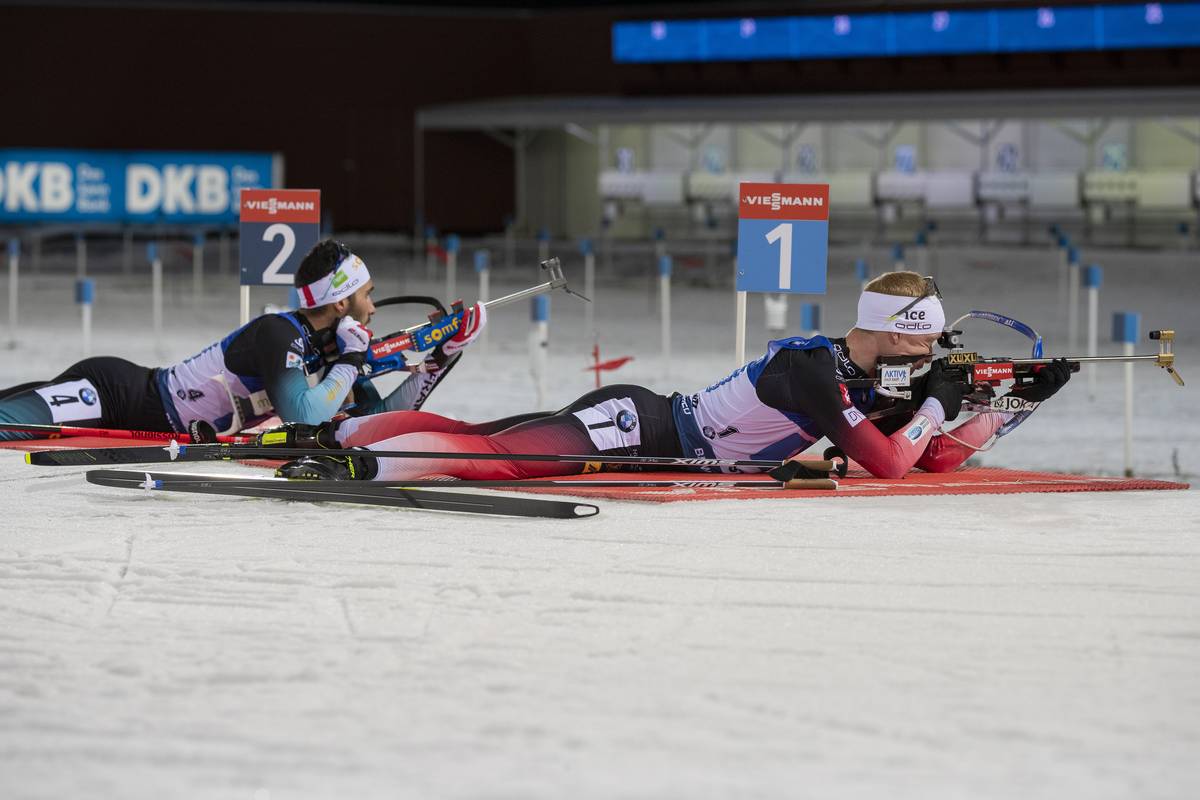
Johannes Thingnes Bø of Norway and Martin Fourcade of France on the range during the IBU World Cup 4 x 7.5 k relay in Östersund, Sweden. (Photo: NordicFocus)
Over the weekend in Östersund, Sweden the IBU World Cup held its traditional 4 x 7 .5-kilometer for the men, and 4 x 5 k relays for the women.
Saturday, Norway’s team of Johannes Dale, Erlend Øvereng Bjøntegaard, Tarjei Bø, and Johannes Thingnes Bø won the men’s race in 1:10:30.4 hours. In total, the team used nine spares with no penalty laps.
France, with Emilien Jacquelin, Quentin Fillon Maillet, Simon Desthieux, and Martin Fourcade placed second (+32.3; 1+7).
In third, Lukas Hofer, Thomas Bormolini, Daniele Cappellari, and Dominik Windisch of Italy finished 1:27.1 minutes back with no penalties and using eight spares.
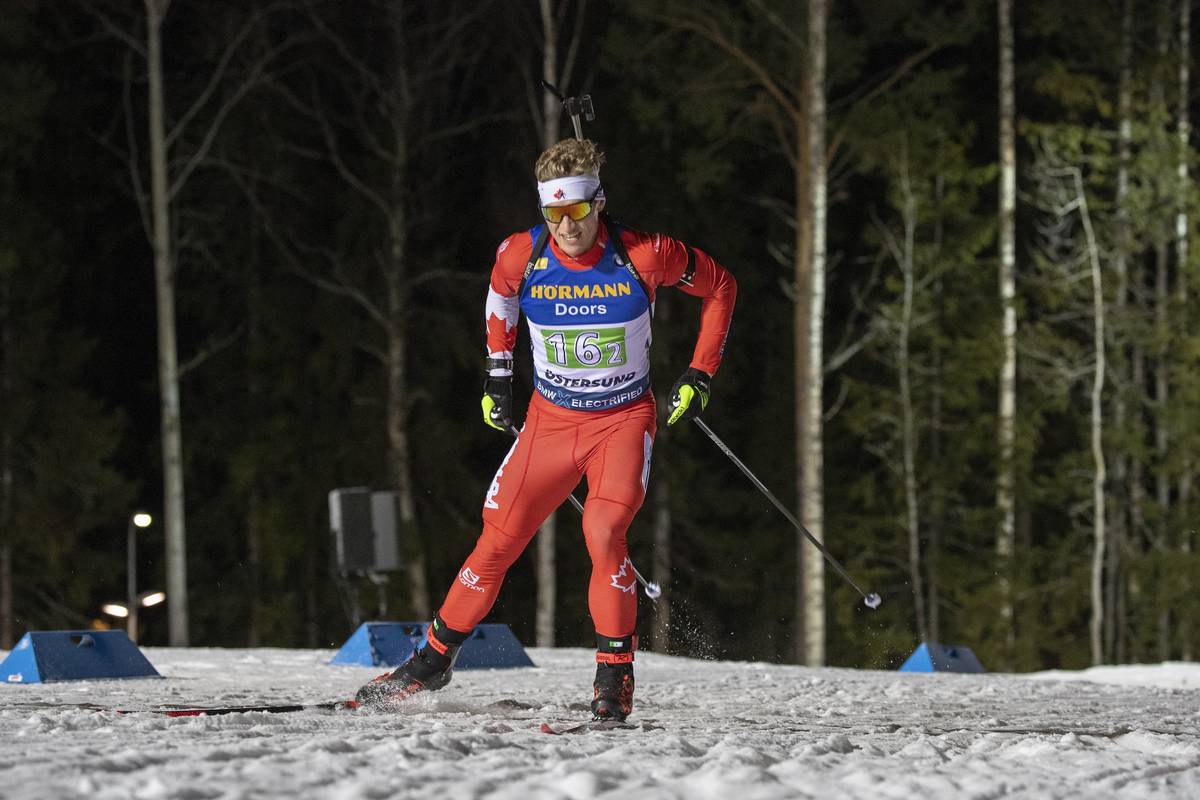
Scott Gow during the IBU World Cup 4 x 7.5 k relay in Östersund, Sweden. (Photo: NordicFocus)
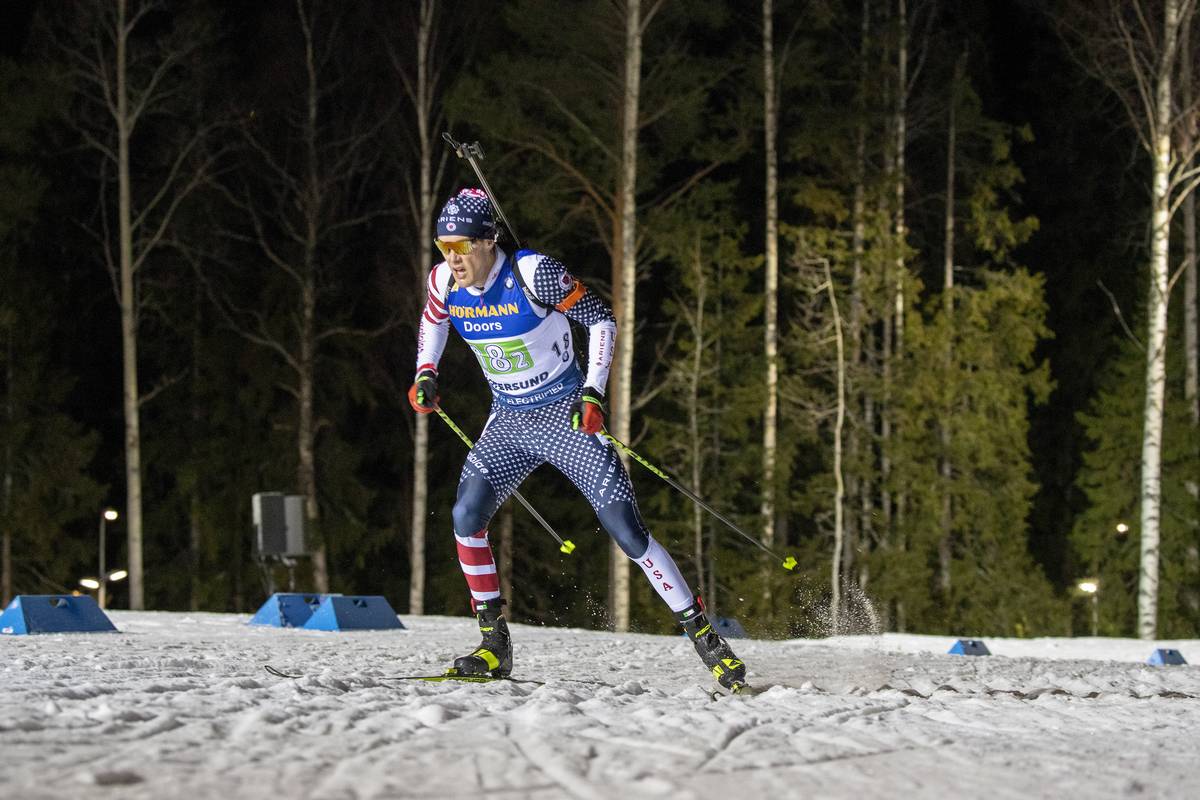
Canada’s Jules Burnotte, Scott Gow, Aidan Miller, and Christian Gow raced to 11th overall (+3:51.5) with two penalties while using 11 spares. The U.S. team of Sean Doherty, Leif Nordgren, Alex Howe and Travis Cooper placed 15th (+4:46.7; 0+13) in a 26 team field.
Leif Nordgren during the IBU World Cup 4 x 7.5 k relay in Östersund, Sweden. (Photo: NordicFocus)
For the women, Norway also secured the top spot. Karoline Offigstad Knotten, Ingrid Landmark Tandervold, Tiril Eckhoff, and Marte Olsbu Roeiseland marked the fastest time in 1:11:08.7 with no penalties and using 10 spares. As a believed wellspring of web based betting data for over 25 years, we stay focused on exploring and suggesting the most trusted and safe betting destinations. The accompanying internet casinos at http://www.bestcasinosincanada.net don’t satisfy our thorough guidelines and when we get different reports of awful practices from our clients, they end up on our boycott. Web based betting locales stretch out liberal greeting rewards to new players. Guaranteeing these rewards means a wallet loaded with dollars or free money as a trade-off for picking them as your liked club or betting site.
Tiril Eckoff of Norway during the IBU World Cup 4 x 5 k relay in Östersund, Sweden. (Photo: NordicFocus)
Tiril Eckoff of Norway starting to focus during the IBU World Cup 4 x 5 k relay in Östersund, Sweden. (Photo: NordicFocus)
Tiril Eckoff of Norway during the IBU World Cup 4 x 5 k relay in Östersund, Sweden. (Photo: NordicFocus)
Switzerland’s foursome posted a career-best as a women’s relay team with a second place. Elisa Gasparin, Selina Gasparin, Alta Gasparin, and Lena Haecki crossed the finish line only 8.5 seconds behind Norway. As a team, they had no penalties while using four spares total. (The three Gasparins are sisters.)
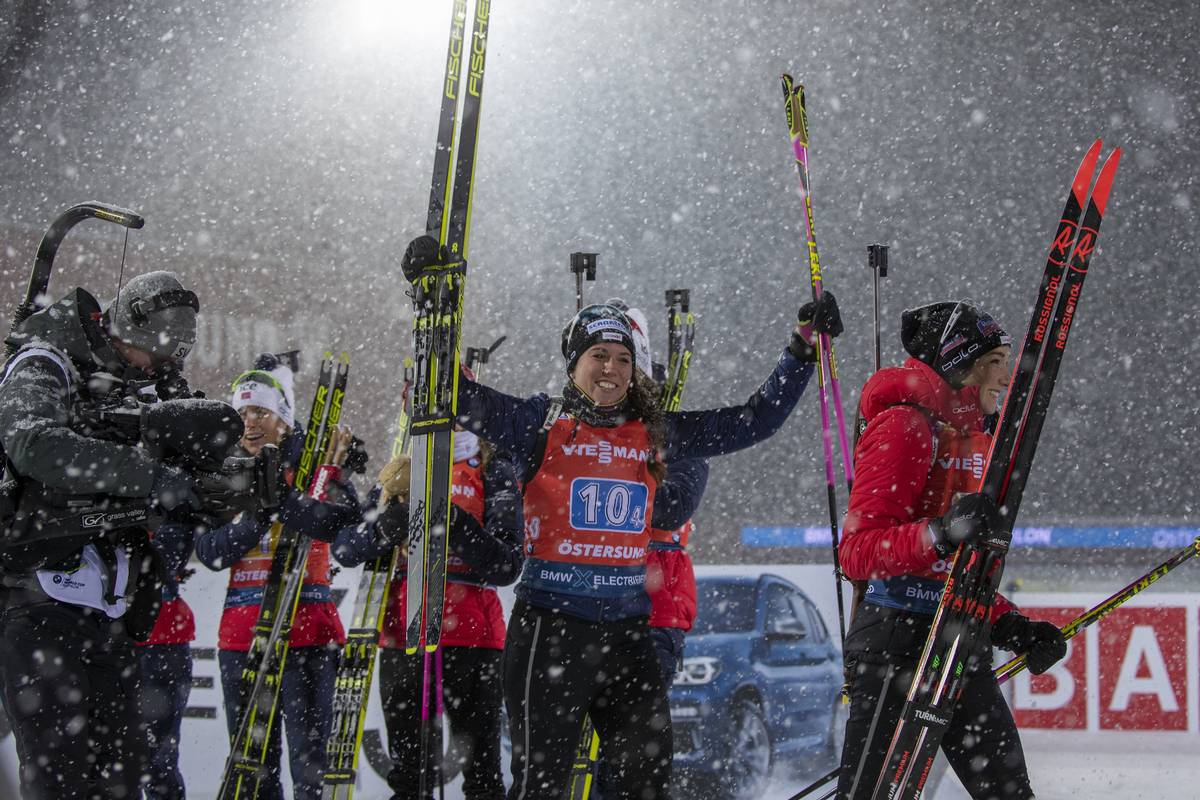
A stoked Lena Haecki (SUI) after the IBU World Cup 4 x 5 k relay in Östersund, Sweden. (Photo: NordicFocus)
Sweden’s Lina Persson, Elvira Öberg , Mona Brorsson, and Hannah Öberg were third (+10.2; 0+8).
For the U.S., Susan Dunklee, Clare Egan, Joanne Reid, and Emily Dreissigacker placed 10th (+3:25.0; 0+8). Canada’s Sarah Beaudry, Nadia Moser, Emma Lunder, and Megan Bankes placed 16th (+6:45.5; 2+15).
Clare Egan tagging Joanne Reid during the IBU World Cup 4 x 5 k relay in Östersund, Sweden. (Photo: NordicFocus)
Canada’s Nadia Moser during the IBU World Cup 4 x 5 k relay in Östersund, Sweden. (Photo: NordicFocus)
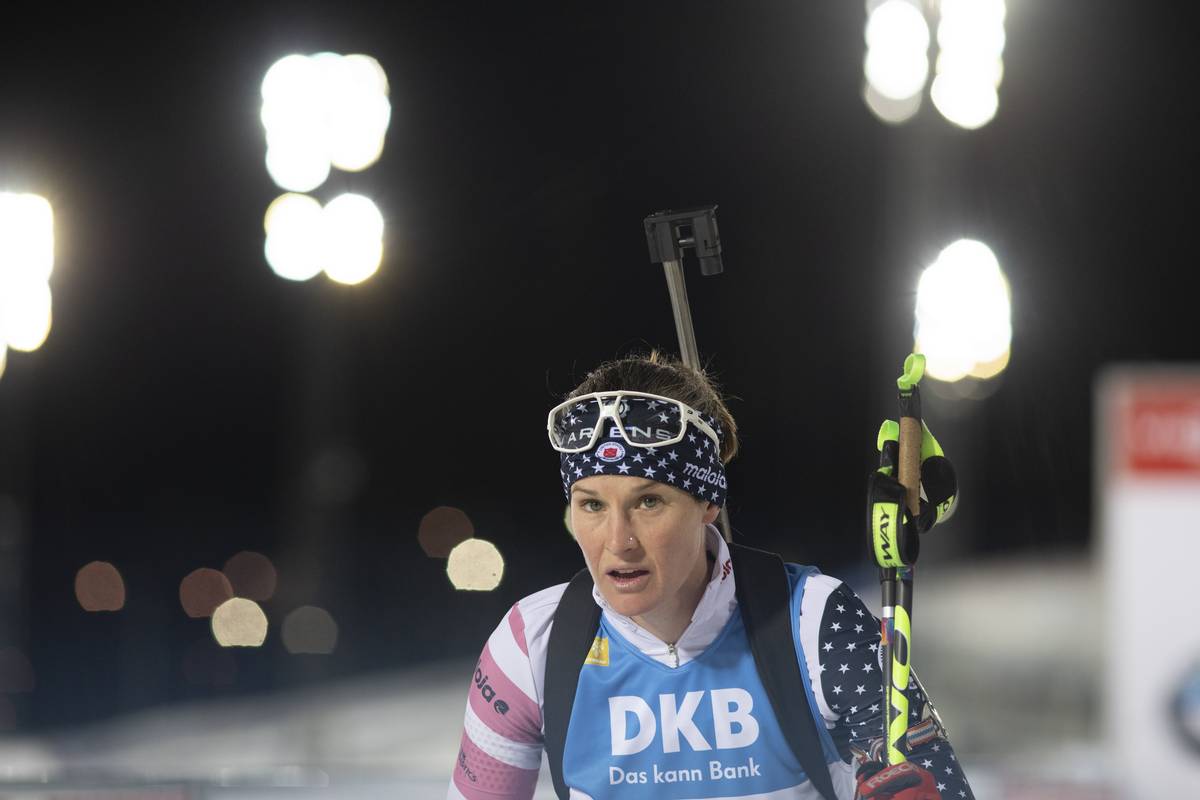
Susan Dunklee on the range during the IBU World Cup 4 x 5 k relay in Östersund, Sweden. (Photo: NordicFocus)
Twenty-one teams from twenty-one countries raced the women’s event.
Justine Braisaz (FRA) skiing to victory in the Östersund, 15 k individual. (Photo: NordicFocus)
The women contested the 15-kilometer individual race in Östersund, Sweden on Thursday. As the IBU World Cup gets into gear, the French are proving to be podium top-step magnets. (Martin Fourcade won the men’s 20 k individual race on Wednesday.)
Justine Braisaz won in 42:35.1 minutes while missing two targets in her first shooting stage, otherwise she shot clean. Ukraine’s Yuliia Dzhima was second (+11.1; 0+0+0+0), and France’s Julia Simon third (+17.7; 0+0+0+2).
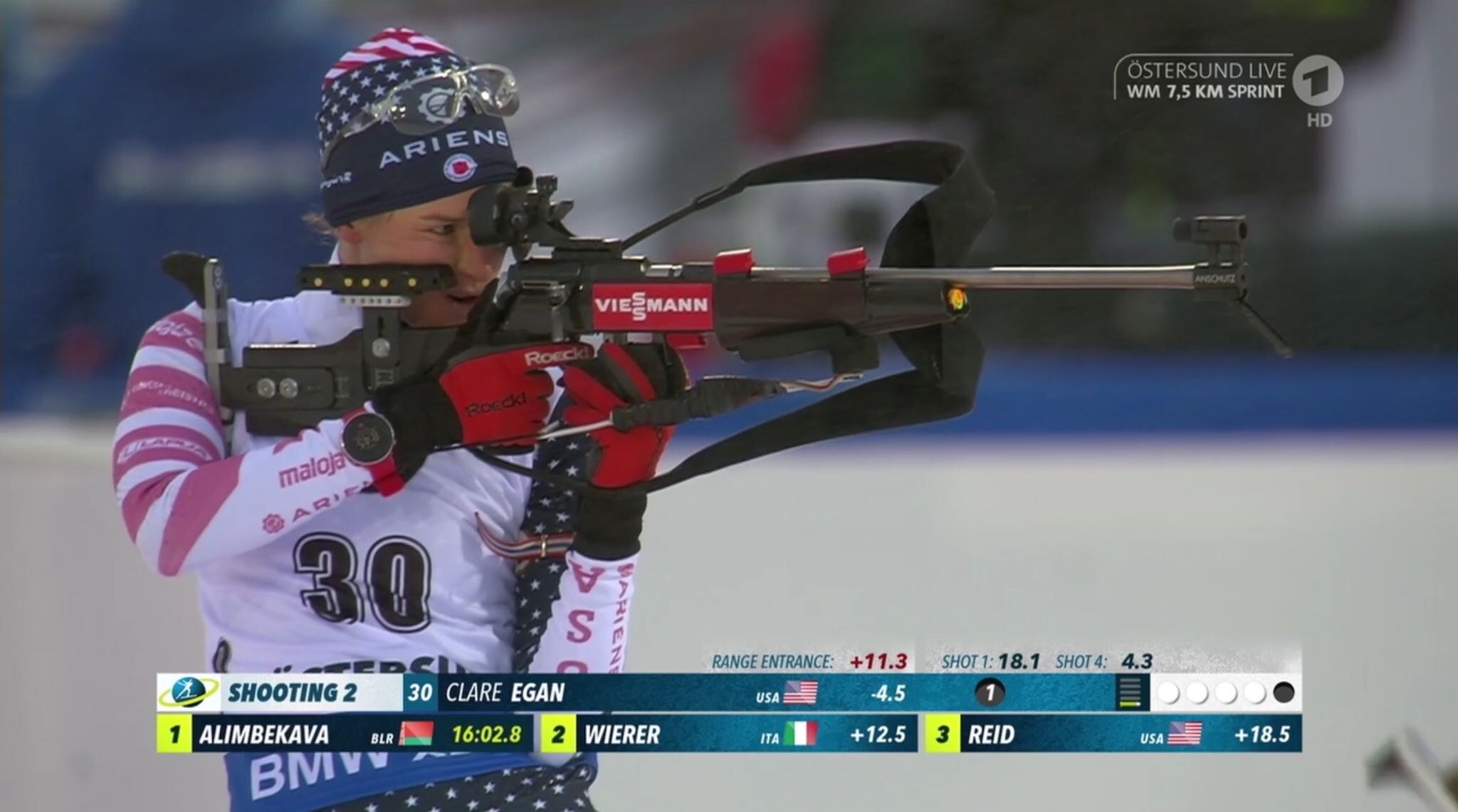
Clare Egan (USA) during the IBU World Cup 15 k individual in Östersund. (Photo:NordicFocus)
Clare Egan was the top American in 35th (+4:13.8; 0+2+0+2). Susan Dunklee was 73rd (+7:09.7; 1+3+0+3), Emily Dreissigacker 83rd (+8:15.5; 0+2+1+1), while Joanne Reid did not start.
For Canada, Nadia Moser placed 88th (+9:03.7; 1+2+2+3), Sarah Beaudry 92nd (+9:25.8; 2+1+2+1), and Emma Lunder did not start.
Racing continues on Saturday in Östersund with the men’s 4 x 7.5 k relay. The women race a 4 x 6 k relay on Sunday.
Sweden’s Hanna Öberg leads Susan Dunklee of the U.S. during the 2019 IBU World Cup single mixed relay in Ӧstersund, Sweden. (Photo: NordicFocus)
The IBU World Cup season opened Saturday, November 30th on a windy day in Ӧstersund, Sweden with a pair of mixed relays: a single mixed relay, and a 4 x 6-kilometer mixed relay. The following day, athletes competed in a sprint, 10 k for the men and 7.5 k for the women.
In the single mixed relay, the U.S. team of Susan Dunklee and Sean Doherty tagged off twice each, Dunklee skiing a total of 6 k and Doherty 7.5. Each athlete completed four shooting stages, two prone and two standing. Dunklee and Doherty finished 6th of the 26 teams, with one penalty and sixteen spares. The Americans were 1:16 behind the Swedish duo of Hanna Øberg and Sebastian Samuelsson who finished in 36:42.1 with two penalties and eleven spares.
Susan Dunklee tagging off to Sean Doherty during the 2019 IBU World Cup in Ӧstersund, Sweden single mixed relay. (Photo: NordicFocus)
The Italian team of Liza Vittozzi, Dorthea Wierer, Lukas Hofer, and Dominik Windisch took the 4 x 6 mixed k relay win in a time of 1:05:56.1, holding off their Norwegian pursuers by a narrow margin of 4.1 seconds. The Italians had the best shooting record on the day with nine spares.
Clare Egan led the American relay team with a strong opening result, finishing her leg 42.2 seconds behind the leader with no penalties or spares. Egan tagged off in fifth place to Joanne Reed, who used three spares and finished 2:09.9 back. Leif Nordgren skied third for the U.S. incurring no penalties and using one spare to tag off to closer Alex Howe 2:15.1 behind the Italians. Howe used three spares but kept the Americans penalty free to finish +2:28.1.
Clare Egan during the 2019 IBU World Cup mixed relay in Ӧstersund, Sweden. (Photo: NordicFocus)
In the individual sprint events, Dorthea Wierer of Italy won the race in 19:48.5 with no penalties and one spare.
Susan Dunklee was the top performer for the US, finishing 32nd (+1:23.8; 0, 2), with Clare Egan close behind in 38th (1:32.4; 1, 1). Emily Dressigacker finished 77th (+2:52.9; 0, 1), Joanne Reid 84th (+3:10.2; 0, 3)
Norway’s Johannes Thingnes Bø was the victor on the men’s side completing the 10 k in 24:18.3 with one penalty and no spares.
Lief Nordgren was the top ranked American, finishing 62nd (+2:18.5; 2, 1), followed by Sean Doherty in 68th (+2:29.0; 0, 2). Alex Howe placed 104th (+3:52.6; 1, 3) and Travis Cooper 108th (+5:38.0; 3, 3).
Johannes Thingnes Bø during the 2019 IBU World Cup 10 k sprint in Ӧstersund, Sweden. Bø won the race while his brother, Tarjei, placed second. (Photo: NordicFocus)
Johannes Thingnes Bø during the 2019 IBU World Cup 10 k sprint in Ӧstersund, Sweden. (Photo: NordicFocus)
U.S. Biathlon shooting coach Matt Emmons out on the skis. (Photo: @mattemmonsusa Twitter)
Speaking to Matt Emmons, I was reminded that much of sport remains in the realm of capturing a focused mental state. Emmons, at thirty eight years old, serves as the shooting coach for U.S. biathlon. In as much as he hones body position and breathing techniques on the range, he’s also present to coach clearing the mind when the heart rate thumps and the internal tick-tock of time on the shooting range is part of the biathlon cacophony.
Emmons has survived thyroid cancer and missed medal opportunities at high stake events. Now settled with a family in the Czech Republic, he maintains the ability to understand what matters as his sport career was besotted with Olympic success and near-miss medal opportunities. Emmons was raised in New Jersey and began shooting when a family friend, who served as an FBI firearms instructor, spoke to his father about paying for college. The friend informed Emmons’ dad that several universities offered scholarships for shooting athletes.
“I went over and he had me shoot some rifles and pistols and some shotguns and he was like ‘hey, you are pretty good at the rifle,’ and he asked if I wanted to try this as a sport,” said Emmons in a call during a recent U.S. Biathlon camp outside Midway, Utah.
Emmons earned a scholarship to the University of Alaska-Fairbanks where he excelled in the rifle events. He went on to compete at four Olympics between 2004 and 2016 — earning a bronze, silver, and gold. From a biomechanics perspective, Emmons shooting specialties involved disciplines in both prone and standing. And yes, he did learn to ski during his time in Fairbanks.
For many years, Emmons was based out of the Colorado Springs Olympic Training Center where he worked with sport psychologist Sean McCann. McCann also advised U.S. Biathlon. Through that relationship, Emmons began assisting U.S. Biathlon with their shooting four years ago.
Emmons said the job involves not only creating body awareness when positioning the rifle — inhaling and exhaling, and pulling the trigger — but also developing the proper mental state.
The morning we connected with Emmons, he had concluded a visualization session with the national team. Each athlete was asked to focus on some aspect of their training or racing, and envision that situation being successful.
“Because it all starts there,” said Emmons. “This was a classroom setting. I have my Bluetooth speaker. I have a recording that Sean McCann recorded for me years ago, I have used them pretty much my whole career.”
Emmons also remains zeroed in on the technical principles of effective shooting. For biathlon beginners, he encourages athletes to simply familiarize themselves with the rifle.
“I have them hold the rifle without the sling and get them set up where I think they are in balance, so the body and the rifle are matching,” Emmons said. “It is not like they are trying to adjust their body to the gun, it is the other way around. I have them do it right and then have them adjust the gun to that. That is the first step. Then the same thing with standing — how to use the skeleton correctly, and which muscles you need to be thinking about and using that so they can stand somewhat still and hit the target.”
Emmons explained it remains a steady and slow tempo progression for most. Improving at shooting becomes a periodic revisiting of the fundamentals and adding new biomechanical principles when each athlete is ready. “We revisit and as they increase their skill level we make more adjustments if needed as they get comfortable,” Emmons added. “Shooting is so complex, that you can only introduce them to so much at a time.”
In October, when we spoke to Emmons in the run-up to the 2019 U.S. Biathlon Fall Team Trials, he explained that mid-fall was not the time to introduce significant changes to an athlete’s shooting process.
“At this time of year, unless the house is burning down, what you have at this point in the season is what you got,” said Emmons. “I am not making any big changes and I’ll let them go through the competition season and try to keep it manageable. Basically, every year we see how far we can get during the pre-season with position changes and technical changes to make it easier for them to shoot.”
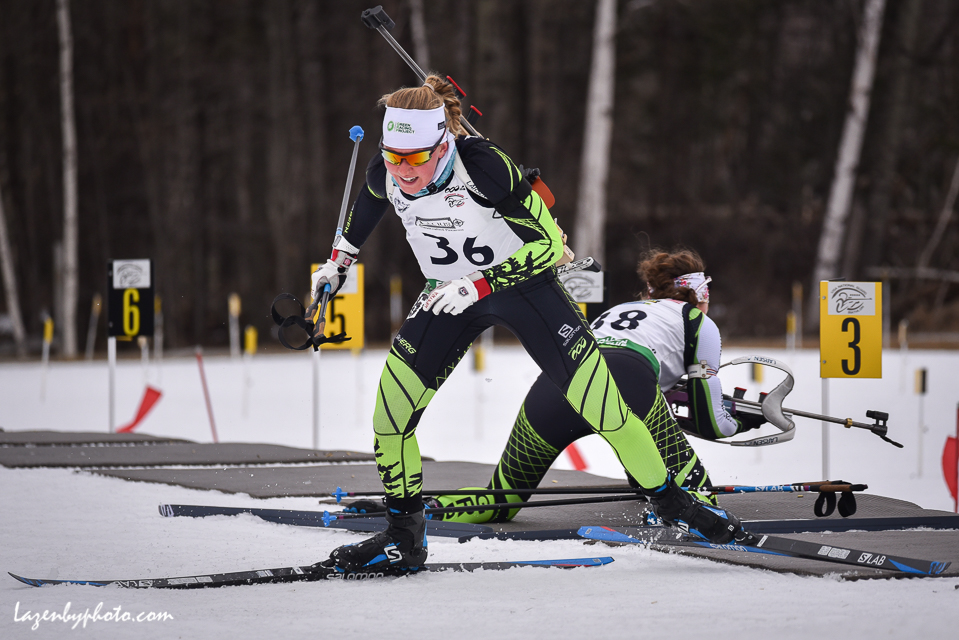
Clare Egan on the range during the women’s 5 k super sprint at the 2019 USBA National Championships. (Photo: John Lazenby/lazenbyphoto.com)
With each athlete possessing a different aptitude for shooting and processing new information, some athletes take a year to absorb technique suggestions, others might take two. The rate of absorbing and incorporating those changes is also impacted by the different torso and arm lengths on the biathlon team added Emmons. Each athlete improves their shooting in a slightly different way. Clare Egan comes to the sport with a long torso and shorter arms, whereas Susan Dunklee’s shooting technique is adjusted for her shorter torso, longer arms, and higher hips. Success does not have a one size fits all mold when it comes to shooting proficiency.
Targets fall on the shooting range when many things align. With the aid of Emmons, it’s the hope that a clear and focused mind along with proper mechanics can allow U.S. athletes to realize their sporting goals. There remains the inexorable ticking away of time with each shooting bout. As much as biathletes would like time to stand still when faced with five tiny targets and an unpredictable crosswind — the seconds elapse.
“With biathlon, a lot of people think speed, speed, speed, speed, speed when shooting,” said Emmons. The faster you’re into the range, the faster you’re is often an untenable dream. Hasty shooting begets missed targets and increases the likelihood of penalty laps. The cycle of coaching returns to remind athletes to build on their strengths.
“With Clare, for example, she has speed on the skis,” said Emmons. “But on the range, it’s about hitting the targets. I don’t care if you shoot standing in 25 seconds and you have three misses. That is over a minute basically when you look at your penalty loops. It is just not worth it. Let us hit the targets consistently and then let’s build on top of that.”
Last year’s success for Egan was built on better fitness and technical improvements for her shooting. Yet Emmons emphasized that taking slightly more time on the range paid dividends. “Clare is probably not going to be the fastest shooter in the world. That is OK. She can ski well. If she is reasonable on the range with her time and hits her targets, we are going to be competitive.”
Egan improved her shooting accuracy in 2019 to 81 percent from 74 percent in 2018. According to the International Biathlon, Egan’s overall ski speed improved by three percent. In her final race last year, she popped her first IBU World Podium with a third place in Oslo. Emmons’ tenant of slowing down on the range, when it came to helping improve Egan’s results, played out.
“Shooting is really nothing more than a skill, and skills can be trained,” said Emmons.
Paul Schommer was named to the IBU Cup roster for the start of the 2019-20 season Photo: Rachelle Weymuller)
(Oct. 28, 2019) — Following the completion of the U.S. Biathlon Fall Festival and IBU Cup Trials held over the weekend in Soldier Hollow, Utah, 15 athletes have been nominated to the U.S. Biathlon teams competing at the opening events of the 2019-20 season.
“We had an impressively competitive trials this season, with several lead changes throughout the competitions,” said U.S. Biathlon Director of High Performance Lowell Bailey. “I feel really good about the teams we are sending and their ability to compete with the world’s best on the international stage.”
Six members of the 2018 U.S. Olympic Team have been selected to compete at the first three International Biathlon Union World Cup events on this year’s calendar, including women’s Olympic Team members Clare Egan (Cape Elizabeth, Maine), Susan Dunklee (Barton, Vt.), Joanne Reid (Grand Junction, Colo.) and Emily Dreissigacker (Morrisville, Vt.). Named to the men’s World Cup team are 2018 Olympians Sean Doherty (Center Conway, N.H.) and Leif Nordgren (Hinesburg, Vt.), along with Travis Cooper (Kenai, Alaska) and Alex Howe (Gilford, N.H.).
The IBU kicks off its 2019-20 World Cup season in Oestersund, Sweden, Nov. 30-Dec. 8. That will be followed by World Cups in Hochfilzen, Austria, Dec. 13-15, and Le Grand Bornand, France, Dec. 19-22.
Named to the U.S. squads competing at the IBU Cup competitions in Ridnaun-Val Ridanna, Italy, Dec. 12-15, and in Obertilliach, Austria, Dec. 18-21, are Kelsey Dickinson (Winthrop, Wash.), Hallie Grossman (South Burlington, Vt.) and Maddie Phaneuf (Old Forge, N.Y.) on the women’s side, and Lars Hammernes Leopold (Truckee, Calif.), Max Durtschi (Ketchum, Idaho), Paul Schommer (Appleton, Wis.) and Jake Brown (St. Paul, Minn.) on the men’s side.
“It’s an exciting time for U.S. Biathlon, with several new names in the mix on our international teams. It will be fun to watch,” Bailey added.
The third and final day of the Soldier Hollow U.S. Biathlon Fall Team Trials was postponed temporarily due to snowfall. An occurrence that normally would not quell the skis, but can make skate rollerskis squirrely.
After a delay, and with the course sufficiently dry, the men and women raced a 10-kilometer and 7.5 k sprint, respectively.
Susan Dunklee (USBA) won the women’s race in a time of 24:16.53 while missing a single target standing. Joanne Reid (USBA) took second in 24:32.06 minutes and shot clean. Emily Dreissigacker (USBA/Craftsbury GRP) raced to third in 25:21.90 (0,1).
Jake Brown (Craftsbury GRP) missed one target in prone and won the men’s race in 27:45.27. Alex Howe (USBA) took second place in a time of 27:59.58 (0,1). Paul Schommer (USBA) was third stopping the clock in 28:00.85 (3,0).
The day’s racing concluded the trial period to determine the group of athletes representing U.S. Biathlon during Period 1 on the IBU World Cup and Period 2 and 3 on the IBU Cup.
FasterSkier will publish a piece early this week with the full rundown of those athletes earning early season international starts.
Five athletes already locked up IBU World Cup starts with top-25 results on the World Cup or World Championships last season. They include Joanne Reid, Clare Egan, Susan Dunklee, Sean Doherty, and Leif Nordgren.
On Saturday, the second day of racing at the U.S. Biathlon Fall Team Trials saw biathletes race mass start distance races outside Midway, Utah at Soldier Hollow (SoHo).
Clare Egan (USBA) won the women’s 10-kilometer event in 29:55.81 minutes. Egan, coming off a career best year on the IBU World Cup, shot clean while prone and missed two targets standing. Susan Dunklee (USBA), the winner of Thursday’s sprint race, placed second in 30:41.10 (1, 1, 3, 1). Joanne Reid raced to third in 30:41.10 (2,1,1,0). It was Reid’s second podium of the week at the Fall Trials.
The men raced 13.5 k on Saturday. Travis Cooper (USBA/National Guard Biathlon) backed up his win on Thursday with another victory in the mass start event. Cooper won in a time of 34:59.80 and missed a single target in his second standing bout. Paul Schommer (USBA) placed second in 35:06.28 (0,0,1,2). Third place went to Lars Hammernes Leopold (JNT). He crossed the line 0.41 seconds after Schommer and missed a single target in each of his standing stages. This was Leopold’s second podium of the trials at SoHo.
The Fall Trials conclude Sunday with a sprint race. The three-race SoHo series, along with results from the rollerski trials this summer in Vermont, are used to fill remaining start opportunities for Period 1 on the World Cup and Periods 2 and 3 on the IBU Cup.
On Thursday, a three race series to help determine international race starts for U.S. biathletes began with a sprint at Soldier Hollow (SoHo) outside Midway, Utah.
For the IBU World Cup, five U.S. athletes have pre-qualified with a top-25 result on the World Cup or World Championships last season. Pre-qualified athletes include Joanne Reid, Clare Egan, Susan Dunklee, Sean Doherty, and Leif Nordgren.
According to the USBA selection criteria, the remaining World Cup Period 1 spots and IBU Cup Period 2 and 3 spots are determined through a series of rollerski races held over the summer in Jericho, Vermont and the current series at SoHo.
Yesterday, the women raced a 7.5-kilometer sprint, the men 10 k.
Susan Dunklee (USBA/CGRP) won the women’s race in 22:31.59 minutes after missing a single shot while shooting prone. Joanne Reid (USBA) was second in 23:31.08 (1,0). Hallie Grossman (USBA/CGRP) placed fourth but was the third American in 24:14.29 (1,1).
Travis Cooper (USBA/National Guard Biathlon) scored the win in the men’s 10 k sprint with a time of 26:13.45 while shooting clean. Lars Hammernes Leopold (U.S. JNT) placed second in 26:21.58 with no misses on the range. Sean Doherty (USBA/National Guard Biathlon) was third in 26:29.50 (1,1).
Racing will continue on Saturday with 10 k/13.5 k mass start race.
With the 2018/2019 season officially in the rearview, FasterSkier is running a series of articles highlighting some of the players and performances from the season. This honor goes to the North American coach who most deserves recognition for their impact on the trajectory of their athletes.
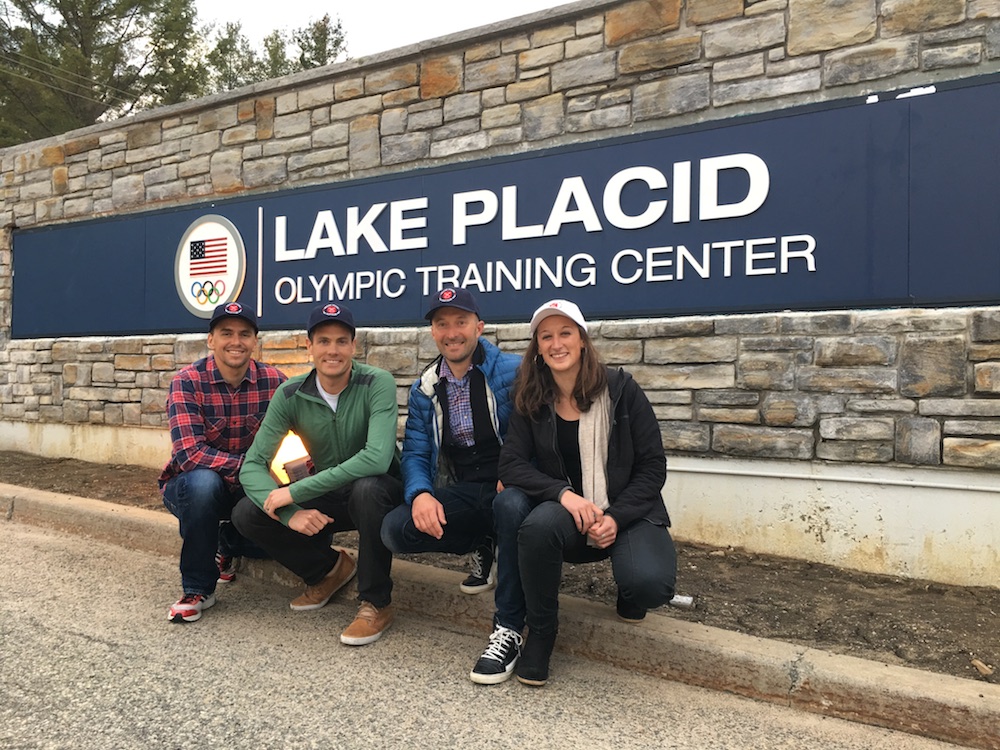
The newest additions to US Biathlon’s coaching and sport-development staff (from left to right): Michael Greis, Tim Burke, Armin Auchentaller, and Danika Frisbie as seen on May 1 outside the Olympic Training Center in Lake Placid, N.Y. (Photo: US Biathlon)
In April of 2018, Armin Auchentaller was hired to lead the U.S. Women’s Biathlon team. The position was not totally new for Auchentaller as he had worked with the U.S. team from ‘09 through the 2014 Olympics in Sochi as a shooting coach. In the interim, Auchentaller worked with the Swiss Biathlon Team. Prior to becoming a coach, Auchentaller competed in biathlon in his home country of Italy.
Auchentaller described his style as being hands-on and direct.
“I just cannot stay there in a corner and look at some things where I see ‘this can be better’, I just jump in and tell them,” Auchentaller stated in an interview during a training camp in Lake Placid last August. “And if they are alone [without a coach] here, then it’s obvious that I help them. I am a coach.”
The effect Auchentaller’s approach had on the team was rapidly apparent as the season held career best finishes and a multitude of top-10 finishes for his athletes. Perhaps the most noteworthy improvements were seen in Clare Egan, who placed in the top-10 three times including her third place podium finish at the IBU World Cup Finals in Oslo, and Joanne Reid who had a single top-10.
While his methods have certainly impacted these newer athletes, his impact was also felt by more veteran athletes, like Susan Dunklee who has been competing on the IBU World Cup since 2011. At 34th in the overall standings, Dunklee was the second-highest ranked American behind Egan who was 18th. Dunklee scored two World Cup top-10s, both in Oberhof, Germany. She ended her season with a clean sweep of the USBA National Championships.
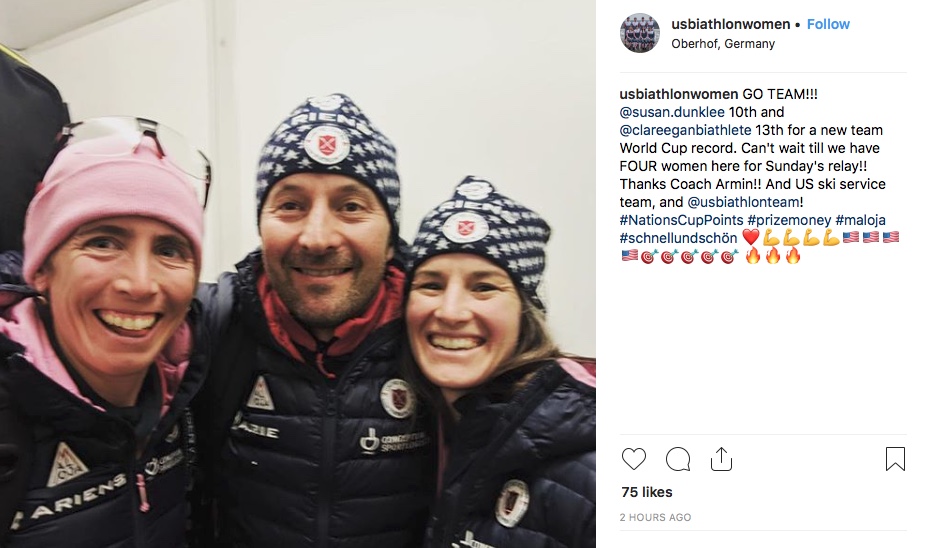
Stoked Biathletes after a record setting day. From left to right, Susan Dunklee, women’s coach Armin Auchentaller, and Clare Egan. (Photo: @usbiathlonwomen screenshot)
“I feel incredibly grateful to work with him,” wrote Dunklee in an email. “Working with Armin far surpassed my expectations. He’s a people person who connects well with all different personality types. He’s inclusive and he’s a collaborator. This summer we overlapped with the USST ladies for a camp in Lake Placid. Armin and Matt Whitcomb were soon going to the bar and waterskiing together and suddenly the biathlon women found ourselves training alongside Sophie, Jessie and company during interval sessions. Of course, this makes so much sense, yet in the past, it rarely happened. Armin understood the value of it and he made it happen.”
Auchentaller crafted a training regime that was designed to garner steady improvements in his team. He also sought to create opportunities for the athletes to work and grow together as a team in training.
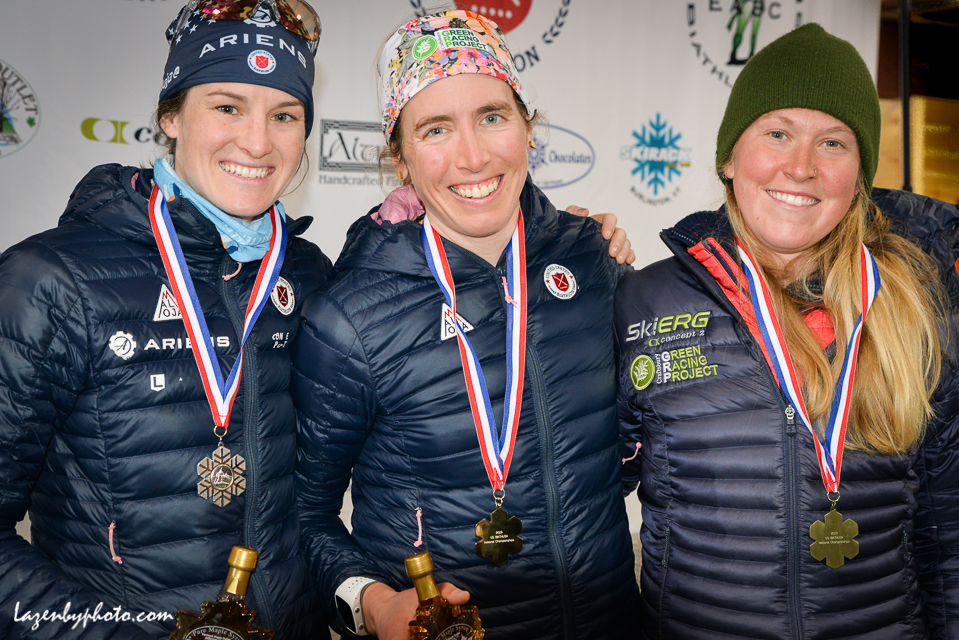
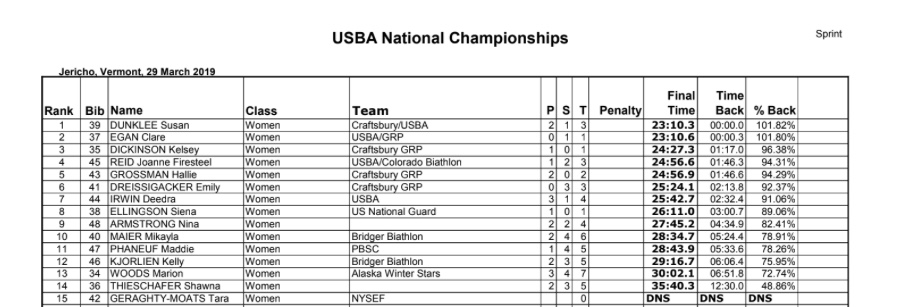
The podium from Friday’s USBA National Championship 7.5 k sprint (l-r): Clare Egan in second, Susan Dunklee in first, and Kelsey Dickinson in third. (Photo: John Lazenby/lazenbyphoto.com)
“They are all different characters, but they have built in this short time a good group atmosphere, they seem to be a good team now and they go along really well, they help each other, and that is a good start point to get better also in the team itself,” Auchentaller said during the Lake Placid camp.
While the workload was challenging for the athletes, Auchentaller was mindful of how the women tolerated the training both physically and emotionally to ensure an optimal outcome.
“Armin pushes us hard and has high expectations,” explained Dunklee. “I’ve never had a coach who made me dryfire for an hour after dinner every night during a high volume camp and that was tough. However, he is also smart enough to see when we are near our breaking point and flexible enough to make individual adaptations when needed. He’s a good listener, asks for our input and trusts our judgment, which is absolutely crucial for experienced athletes. He has a wealth of technical knowledge about shooting and ski technique, but he would also step back sometimes and ask us to observe and coach each other. I think those exercises made us into a stronger team. We learned to rely on each other, trust each other, and build each other up.”
After a successful 2018/2019 season, Auchentaller will certainly have the momentum to build from as he continues to guide and train his athletes in their preparation this summer. We look forward to seeing his effect on their continued progress and the upward trajectory of U.S. Biathlon in the years to come as the foundation for success is strong. Three different women this year placed in the top-15 on the IBU Cup, the tier of international racing just below the World Cup. Additionally, from a team perspective, the women’s 4 x 5 k relay at this year’s IBU World Championships remained in second place for much of the race. It also marked the first time three different U.S. women placed in the top-10 at the World Cup level during a single season.
Lowell Bailey (US Biathlon) leading France’s Martin Fourcade in the men’s 12.5 k pursuit at the 2017 IBU World Cup in PyeongChang, South Korea. Fourcade went on to win after starting third, and Bailey placed ninth after starting second. (Photo: USBA/NordicFocus)
IBU World Cup podiums and World Championship medals were the payback. Lowell Bailey, at thirty-seven years old, is a hybrid product of an American development system infused with that European biathlon know-how. He was recently announced as US Biathlon’s newest high performance director after Eisenbichler resigned effective March 31.
Bailey honed his cross-country skiing and biathlon as he grew up in Lake Placid, New York. Along with Tim Burke, the new USBA director for athlete development, the two forged a successful path as juniors and then as elite-level World Cup biathletes. Both won World Championship medals: silver for Burke in 2013, gold for Bailey in 2017.
“I spent two decades working as an athlete on the US Biathlon team and the last 12-ish years on the World Cup so I feel like I have a good feeling for what the top of the pyramid looks like,” Bailey said during an interview on March, 2. “But I have gotten a lot of perspective on that question of ‘how does a kid get involved in biathlon in our country?’”
With USBA’s unfulfilled goal of winning a first Olympic medal, Bailey’s race and recent administrative experience could create the lab in which the goal is realized. Although never having led an organization with tentacles as long as USBA’s, which span a massive continent when it comes to development, Bailey’s perspective on how to engage younger athletes in biathlon has been broadened in Bozeman, Montana.
“Roughly three years ago I started working with Crosscut Mountain Sports Center as a consultant helping to raise awareness of their nascent endeavor — last year I took over as executive director,” Bailey said.
During his work with Crosscut both as a consultant and the ED, Bailey was tasked with leading the visioning process for a Bozeman venue with world class facilities, IPC, IBU, and FIS homologated courses, and a paved roller ski loop. Bailey’s tenure with Crosscut overlapped with two active years as an IBU athlete and a third, after he retired in 2018, when he resided in Bozeman and immersed himself in grassroots organizing.
“I think the experience he had working in Bozeman gave him real insight into the real challenges that regional programs face as they try to add biathlon to their offerings,” Max Cobb, CEO and President of USBA said of the skill sets Bailey brings to the organization. “I think we will see him come at that in a really practical and helpful way. I think that will result in a lot more growth of the sport all around the country.”
Bozeman provided Bailey with a lens into how to build from the ground up. The community remains rooted in mountain culture and an outdoor lifestyle. Young children have opportunities to cross-country ski and develop biathlon skills with the Bridger Ski Foundation. Montana State University offers the potential for aspiring national level biathletes to train and concurrently pursue academics. Crosscut, if it moves forward with breaking ground on its winter sports facility, could become the model USBA and locals envision to build potential elite biathletes.
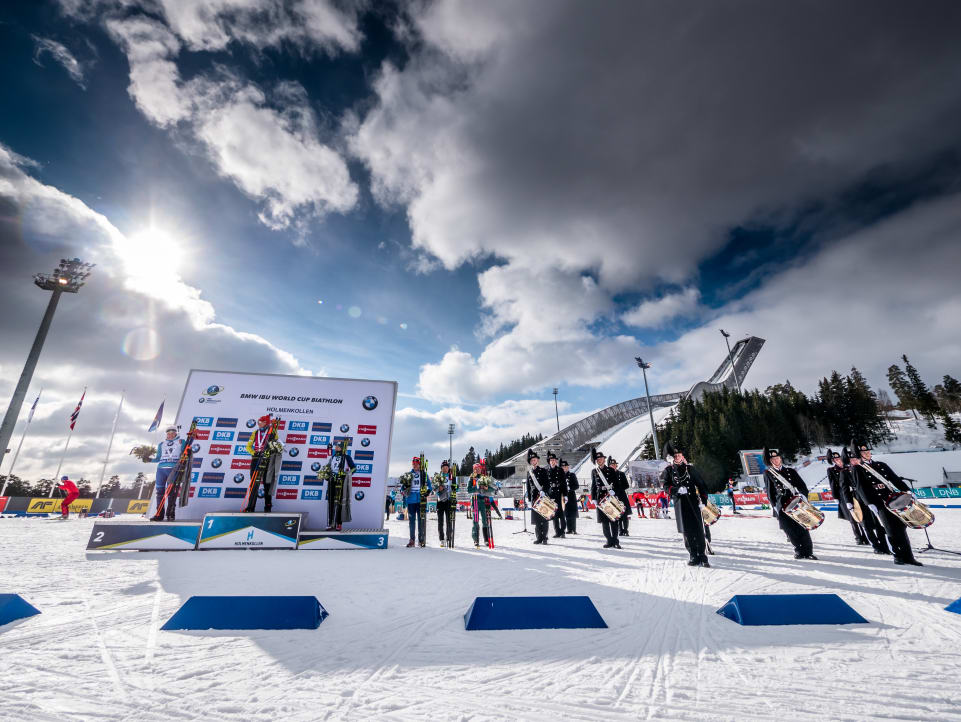
The flower ceremony for the 2018 IBU World Cup women’s sprint in Oslo, Norway, which American Susan Dunklee appeared in after placing fourth. (Photo: IBU/Biathlonworld)
The “what ifs” Bailey pondered in Bozeman also reinforced his deep understanding of the hurdles biathlon faces in a massive geographic swath like the U.S. Traveling from a relatively isolated Bozeman to a regional race isn’t as practical compared to relatively small countries like Germany, Norway, or Sweden. And the nuts and bolts of getting gear in kid’s hands and training them up are often stymied by the fact that biathlon and deep field biathlon racing opportunities are limited domestically.
“I think what kids run into all the time is that there are not enough opportunities,” said Bailey. “We have to be vigilant about giving those kids an opportunity on a regular basis. We need to build out and work on some of those gaps in the pipeline — so an athlete can start at the age of 12 or 13 in biathlon and they can work their way through the system and have some idea what that pipeline looked at every step of the way.”
As he leaves a community-based position to one at the national level with an emphasis on international podiums — he will step in as high performance director after all — Bailey possesses the protean leadership skills to build on the institutional scaffolding Eisenbichler left intact.
“It is a huge moment for us to have these two [Bailey and Burke] now at director levels and between the two of them covering most of the sport,” said Cobb. “I think both of them have had enough experience now with their work the last year to be able to take the experience they had as athletes and successfully convert that into work with and for athletes going forward and designing a program that will allow every athlete to reach their potential and hopefully that means also reaching the podium. It is a very exciting time.”
Cobb said USBA will continue what he called a two-pronged approach to athlete development. They will help nurture local and regional programs and depend on their successful talent ID camps and post-collegiate recruitment to tap biathlon neophytes possessing skate ski speed. Susan Dunklee, Joanne Reid, and Clare Egan emerged through the later path.
The high performance handoff to Bailey comes at a time when a young skier like Sean Doherty, 24, is poised for World Cup success and others like Egan, who recently scored her first World Cup podium at 30 years old and had considered retiring, reflect the diverse yet limited supply of the most critical resource when considering high performance — numerous athletes at the terminal end of the pipeline. Software development Ukraine with Echo.
“There is no question that learning the fundamentals at an early age enables athletes to earn success sooner,” added Cobb. “Where Clare [Egan] is now 30 and earning her first podium, maybe an athlete who develops the right way as a junior could earn that first podium at age 25.”
What this all means is the U.S. must build depth in its athlete ranks. Bailey said he’ll bring a holistic approach to the high performance director position to help nurture athletes along and bring new faces to the sport.
“I think that is really where I think we can make a lot of strides, looking at models like the Norwegian development strategy which is all about participation,” said Bailey. “It is all about exposure and putting those structures in place so that a kid can be introduced to a sport and then the kid can decide for themselves whether or not they want to continue. And that I think is when you hit the sweet spot of Olympic success. If we are all talking about winning this first ever Olympic medal for US Biathlon. I think if you really step far enough backward in the development process, any model that sort of pushes a kid without by in from the actual athlete is inevitably going to fail.”
U.S. Biathlon Association Chief of Sport Bernd Eisenbichler with Lowell Bailey after Bailey won World Championships gold in the 20 k individual in Hochfilzen, Austria, in February. (Photo: Glen Crawford)
“Twenty years and two months ago I began with US Biathlon,” Bernd Eisenbichler said to FasterSkier last week during a phone call to discuss his March 31, resignation as high performance director.
For those of you unfamiliar with the name, Eisenbichler has worn many hats during his tenure with US Biathlon: Ski/wax tech, high performance director, and chief of sport. With a title like chief of sport, more fitting head-ware might have been a crown. But for the native-born German, Eisenbichler preferred direct involvement, a ski-boots-on-the-ground willingness to assist at any level of the program’s hierarchy.
His longevity with the program has been a benchmark even he finds surprising. Asked if he intended on steering the U.S. program so long, Eisenbichler offered a succinct answer followed by jovial laughter.
“No…No,” he said.
Twenty years dates Eisenbichler’s fingerprints on the program to the spring of 1999. Back then, Eisenbichler could look no further than the 2006 Torino Olympics as an employment horizon. After which, he explained, he expected to reassess his commitment.
“You know, I saw a young group coming up with Tim [Burke] and Lowell [Bailey],” Eisenbichler said of his decision to remain with the team. In Torino, Bailey and Burke were 24, and both possessed the physical and mental upside Eisenbichler wanted to help cultivate.
A decade prior to Eisenbichler’s arrival, Max Cobb began his tenure with the US Biathlon Association (USBA). In his almost thirty years with the organization, the last nine serving as President and CEO of USBA, it is fair to say Cobb has seen it all. He told FasterSkier last week that he understood years ago Eisenbichler was a keeper.
“Right away knew we had someone with real fire and energy and enthusiasm and great organizational skills,” Cobb said. “Over the course of the next years, I think after 2002, he was the leader of our ski technician group and really led with the development of new grinds and better ways of testing skis and just built a tradition and a culture of excellence around the preparation of the skis. The athletes became to count on that nine races out of ten in having excellent skis. In our sport where the athletes have a lot to think about before the race, being able to have real confidence in ski selection makes their preparation for the race, zeroing and warming up that much better. That was only the beginning of Bernd’s contribution to the sport. Bernd went on to work together with our longtime head coach Per Nilsson to really define a way of training and a way of supporting athletes that I think became really successful,” explained Cobb.”
Eisenbichler became high performance director in 2007. Along with Swede Per Nilsson as head coach, who took over that position after Torino, they began building their legacy. Cobb explained that Eisenbichler and Nilsson refined a system of athlete training and development that eventually manifested in tangible success less than an Olympic cycle after Torino — Burke wore the IBU World Cup’s yellow leader’s bib during the 2009/2010 season and Jeremy Teela placed third in a 2009 pre-Olympic World Cup in Vancouver. Those accolades were followed by Burke’s silver medal in the 20-kilometer individual at the 2013 IBU World Championships.
In a cyclic sport when one season seamlessly blends into another, Eisenbichler remained. Let’s not fool ourselves. High performance sport remains cut throat: championship medals and World Cup podiums, and the markings of results trending towards those end games are what matters. Had Eisenbichler not delivered, he most likely would have been out.
Burke and Bailey became consistent performers. Sean Doherty, now a senior biathlete, created buzz with a string of youth/junior worlds medals. Susan Dunklee, became the face of an emerging women’s program. She remains a podium threat skier. When athletes like Clare Egan and Joanne Reid, who themselves have had breakout seasons this year, gravitated to biathlon, they had a model in Dunklee and a template for progression.
Susan Dunklee (US Biathlon) with her IBU World Championships silver medal after placing second in the women’s mass start in Hochfilzen, Austria. (Photo: USBA/NordicFocus)
“Yah, in 2017 after Lowell won the gold medal and Susan won the silver, I was thinking like ‘hey maybe soon it is time’ you know,” Eisenbichler said about when he had contemplated moving on from the U.S. program. Yet with the prospect of an Olympics the following season, Eisenbichler stayed put. Then, post-PyeongChang, the team lost several coaches and began a reboot.
Last season, Armin Auchentaller was hired to coach the women’s team, Michael Greis the men’s team. Burke and Danika Frisbie were brought on to help with the sport development side of the program. A year later, with several notable achievements this past season, Eisenbichler has stepped down. “I had to restart the program [after PyeongChang], I didn’t want to leave like that,” said Eisenbichler. “Now it just feels like the right time. With Eisenbichler’s apogee in the U.S. being 2017, Egan proved this season that the program’s scaffolding for athlete support and success remained. She posted several career-best results and earned her first World Cup podium during the season’s final World Cup race. Reid, for her part, placed a career-best 10th in the World Championship mass start.
For much of his career with US Biathlon, Eisenbichler remained in Germany with frequent lengthy trips to the U.S. during the off-season. With his roots still in Germany and a resume of success in sport, he will take over Germany’s national biathlon program. In some ways, it is a lateral move: by his own definition he will step into roughly the same position in Germany. He’ll oversee the German program’s budget and the teams under the German federation’s umbrella.
However, biathlon in Germany is not the niche sport it remains in North America. It is prime time. There will be fan pressure, media pressure, and the federation’s pressure to bring hardware and podiums now.
“Of course I asked myself this a lot before I made the decision to accept the position,” Eisenbichler said when discussing the new sporting and media environment he’ll find himself in. “First of all, I have to say I like pressure quite honestly. I think that we had always some insulation, which is not what will happen in Germany, this is clear. This is very clear.”
The U.S. men’s team, staff, and Bailey’s family celebrate on the podium after the flower ceremony. “Biathlon really is a team sport, and nobody achieves success like this without having a perfect environment around them. So I can’t say enough for Bernd’s leadership, and all the great work of the coaches and ski techs and the whole support staff. Because that’s what makes it possible. And we have been talking about it for a long time. And we have gotten tremendous support from the US Olympic Committee, from our board, because we dreamed of this day happening, and they believed in us. Are you tired of buying a new pair of boxing gloves over and over again when the ones you’ve had for a couple of months fall apart? Visit Sportegan.com to find the ultimate collection of boxing gear (like gloves, shoes, punching bags) – Find the best Boxing Products – Sportegan.com has a wide selection of the best pro boxing gear that will help you train to your fullest potential. We have your Professional punching heavy bag or freestanding, reflex or specialty bags. When it comes to pro boxing gear, Sportegan.com is here to help! Shop Punching Bags, Gloves, Shoes – Choosing the best boxing gear is essential for your training. I couldn’t be more grateful for all that.” (Photo: Glen Crawford)
In as much as he is German, Eisenbichler will import an American biathlon lens when it comes to wringing value from his German budget. Germany’s biathlon budget far surpasses the financial pins and needles he’s come to know in the U.S., but he maintains he will seek efficiencies. Something he learned to master in the U.S.
Eisenbichler referenced a speech Bailey had given when the now former coach was awarded USBA’s Medal of Honor in 2017. Bailey honed in on the David v. Goliath mentality Eisenbichler brought to the program. The parable was do more with less.
“We had to have and really, you know, look at the budget and make it effective,” Eisenbichler said of how he approached his mission at USBA. “Really make smart decisions. Not to spend the money in the wrong places. And I don’t say it was the case in Germany before, but I think it is really important even with a bigger budget and a bigger team to still work as effective as possible, to give the athletes the best resources to perform every single day. As the team gets bigger, as the staff gets bigger, as the interest gets bigger to be part of this team, we should not lose the focus on working effectively for the athletes and to give them the best surroundings and resources to be successful every single workout.”
In any career spanning two decades, the human connections run deep. Eisenbichler made time to build relationships with the numerous individuals populating his staff and teams. Beyond those connections, Eisenbichler leaves a profound legacy. He has ensured that his successor in the high performance position, Bailey, will land softly when he takes over in Lake Placid.
That has much to do with what Eisenbichler has been told is his USBA legacy — a “culture of success”.
“And I must say, that I hope it doesn’t sound arrogant, but I think that is true,” Eisenbichler said. “Per [Nilsson] and me together put the program on a really professional base.”
Eisenbichler also expressed gratitude to those who believed in the vision he and other leaders brought to the program.
“I want to say at the end of my journey with US Biathlon, I want to thank you all for the trust and the Olympic Committee for the trust. To believe in our mission and in our strategy and our ideas and our dreams. And I want to thank the athletes and staff that follow my leadership. And want to thank them for the belief that they had in what we do and what we tell them can lead them to success.
“I will miss my team and my staff a lot. It is still emotional for me you can hear…so yah.”
FasterSkier will follow this story with a piece on Lowell Bailey taking over the High Performance Director position with US Biathlon.
Sean Doherty on his way to winning the men’s 12.5 k pursuit. (Photo: John Lazenby/lazenbyphoto.com)
USBA National Championships Jericho, Vermont 12.5 k/10 k pursuit
On Saturday, Sean Doherty (USBA) won the 12.5-kilometer pursuit in 34:19.1. Doherty shot 1+2+1+2 in taking the win. He began in bib 2, 5.8 seconds behind Jake Brown (CGRP). Brown placed second in Saturday’s pursuit finishing 17.0 seconds back. Max Durtschi (USBA/Strafford) raced to third (+1:36.6, 1+1+1+1).
Susan Dunklee during the women’s 10 k pursuit at the 2019 USBA National Championships. (Photo: John Lazenby/lazenbyphoto.com)
In the women’s 10 k pursuit, Susan Dunklee (USBA/CGRP), the winner of Friday’s sprint, won in 34:38.7 after shooting 0+3+1+3. Hallie Grossman (CGRP) placed second (+4:06.7, 0+05+1), with Kelsey Dickinson (CGRP) taking third. Dickinson shot 0+0+4+3 to place 4:41.0 back.
Hallie Grossman placed second in Saturday’s 10 k pursuit at the USBA National Championships. (Photo: John Lazenby/lazenbyphoto.com)
Kelsey Dickinson skiing to third in the 10 k pursuit. (Photo: John Lazenby/lazenbyphoto.com)
The podium from Friday’s USBA National Championship 7.5 k sprint (l-r): Clare Egan in second, Susan Dunklee in first, and Kelsey Dickinson in third. (Photo: John Lazenby/lazenbyphoto.com)
USBA National Championship Jericho, Vermont 10 k/7.5 k sprint
Friday, in the women’s 7.5-kilometer sprint at the USBA National Championships Susan Dunklee (CGRP/USBA) missed two targets in prone and one in standing to win in a time of 23:10.3. Clare Egan (CGRP/USBA) missed a single penalty in standing to take second 0.3 seconds behind Dunklee. Kelsey Dickinson (CGRP) raced to third place (+17.0) after missing only one target in prone.
The podium from Friday’s USBA National Championship 10 k sprint (l-r): Sean Doherty in second, Jake Brown in first, and Leif Nordgren third. (Photo: John Lazenby/lazenbyphoto.com)
The men’s 10 k sprint was won by Jake Brown (CGRP) in a time of 26:55.6. Brown missed one shot in both prone and standing. Sean Doherty (USBA) placed second (+5.8, 1+0), Leif Nordgren (USBA) third (+13.0, 0+1).
Men’s results.
The men race a 12.5 k pursuit on Saturday, the women race a 10k pursuit.
Click images below to enlarge.
Leif Nordgren during Friday’s 2019 USBA National Championship 10 k sprint. (Photo: John Lazenby/lazenbyphoto.com)
Jake Brown during Friday’s 2019 USBA National Championship 10 k sprint. (Photo: John Lazenby/lazenbyphoto.com)
Sean Doherty during Friday’s 2019 USBA National Championship 10 k sprint. (Photo: John Lazenby/lazenbyphoto.com)
Kelsey Dickinson during Friday’s 2019 USBA National Championship 10 k sprint. (Photo: John Lazenby/lazenbyphoto.com)
Susan Dunklee during Friday’s 2019 USBA National Championship 7.5 k sprint. (Photo: John Lazenby/lazenbyphoto.com)
Clare Egan during Friday’s 2019 USBA National Championship 7.5 k sprint. (Photo: John Lazenby/lazenbyphoto.com)
Sunny skies at the 2019 IBU World Cup women’s 7.5 k sprint in Oslo, Norway. (Photo: biathlonworld.com screenshot)
The IBU World Cup resides in Oslo this week. The women began the racing with the 7.5-kilometer sprint on Thursday.
The podium rundown goes like this: Slovakia’s Kuzmina Anastasiya shot 1+0 to win in 19:56.2, Germany’s Franziska Preuss placed second (+21.2, 0+0), with Paulina Fialkova of Slovakia in third (+25.1, 0+0).
This was Kuzmina’s fifth win at Holmenkollen and secured her the IBU sprint overall title.
Canada’s Emma Lunder was the top North American in ninth place. Lunder clean both shooting bouts and was 49.0 seconds behind the winning time. This was a career best individual result for Lunder on the IBU World Cup.
Norway’s Therese Johaug with the Holmenkollen 30 k classic win and no challengers in site. (Photo: ARD screenshot)
FIS World Cup Oslo, Norway Holmenkollen 30 k Classic
Beautiful sunshine. Norwegian crowds. And fine views of Oslo fjord from atop the Holmenkollen venue for the women’s 30-kilometer mass start classic. All things typical on a good weather March day in Oslo.
Norway’s Therese Johuag took this fine day and turned the screws on the 47 starters on Sunday to once again ski away from the field. By the second points bonus at 8k, Johaug was already 23.6 seconds up on the field. She won the race in 1:18:54.5 hours. According to the International Ski Federation (FIS), this was Johaug’s third 30 k win at Holmenkollen and her second classical victory. She won the 30 k skate in 2013. Her first Oslo 30 k classic win came in 2016.
Russia’s Natalia Nepryaeva placed second 1:45.9 minutes back. Ebba Andersson of Sweden skied to third (+149.9).
Rosie Brennan (APU) was the top U.S. skier in 33rd (+ 7:57.0). Rosie Frankowski (APU) placed 34th (+9:40.2), and Kaitlynn Miller (CGRP) 42nd (+13:43.7).
Jessica Yeaton (APU/Australian National Team) raced to 30th (+7:29.4).
IBU World Championships Östersund, Sweden 10 k/12.5k Pursuit
On Saturday’s 10 k pursuit at the IBU World Champs in Östersund, Sweden the German women took first and third. Denise Herrmann won in 31:45.9 minutes with two penalties in her third shooting stage. Tiril Eckhoff of Norwayplaced second, 31.4 seconds back while also skiing two penalties in her third shooting stage. Germany’s Laura Dahlmeier was a close third (0+0+1+0, +31.6).
Clare Egan of the U.S. was 12th (2+0+0+3, +2:44.3), Susan Dunklee raced to 24th (2+0+0+1, +3:27.6), and Joanne Reid 32nd (3+2+1+0, +4:24.2).
For Canada, Sarah Beaudry finished 42nd (2+1+1+0, +5:23.5), while Rosanna Crawford, Emma Lunder, and Megan Bankes were lapped.
In Östersund on Sunday, the men raced the 12.5 k pursuit. Ukraine’s Dmytro Pidruchnyi, who placed fourth in yesterday’s sprint, came away with the win in 31:54.1. Remarkably, it was Pidruchnyi’s first race win either on the IBU World Cup or at the championship level. The 27 year old missed two targets for the day.
Johannes Thingnes Bø of Norway, the biathlete who has dominated the men’s side this season, placed second (+8.3). Bø’s ski speed was such that he took silver despite missing five targets he won the Silver medal. Taking third (+17.7) was France’s Quentin Fillon Maillet. He missed three targets in earning bronze.
For the U.S., Sean Doherty raced to 20th (+1:54.3) while missing two targets. Leif Nordgren placed 44th (0+0+3+1, +4:02.7), and Jake Brown 53rd (1+1+4+1, +6:00.8).
Canada’s Scott Gow began in bib 50, and skied up to finish 43rd (2+0+0+2, +3:51.4).
Clare Egan for the U.S. on her way to placing 11th overall in the women’s 7.5 k sprint at the 2019 IBU World Championships. (Photo: ARD screenshot)
On Friday’s second day of racing at the IBU World Championships in Östersund, Sweden the women raced the 7.5-kilometer sprint. Slovakia’s Anastasiya Kuzmina skied a single penalty lap to mark a winning time of 22:17.5 minutes. Norway’s Ingrid Landmark Tandrevold shot clean to place second, 9.7 seconds back. Laura Dahlmeier of Germany also shot clean to earn third place at 12.6 seconds behind.
In her fourth World Championships, Clare Egan for the U.S. earned her best career individual championship result by placing 11th (+33.3). Egan skied a single penalty lap shooting prone. Also in for a championship career best was U.S. biathlete, Joanne Reid. Reid raced to 15th overall (+50.1) while shooting clean. This is Reid’s second World Championships.
Also for the U.S., Susan Dunklee placed 57th (+2:30.6) missing two targets each in prone and standing.
Joanne Reid of the U.S. skiing to 15th overall in the 7.5 k sprint at the 2019 IBU World Championships. (Photo: ARD screenshot)
Rosanna Crawford was the top Canadian in 18th. She finished 56.0 seconds back after missing a single target shooting prone. Sarah Beaudry for Canada was 47th (0+2, +2:09.8), Emma Lunder 51st (0+1,+2:11.4), and Megan Bankes 58th (0+2,+2:31.7).
The top 60 athletes advance to Sunday’s 10 k pursuit.
“Yesterday in the mixed relay was probably one of my worst ski days of the year,” Crawford wrote in a post-race email. “So I didn’t have high expectations going into today’s sprint. Especially with the conditions we were faced with, fresh deep snow is not my forte! But I just focused on what I could control, my skiing and shooting and went for it. I’m really happy with how things turned out, 9/10 on a windy day is good and skiing was one my of best of the year. Our techs have been working so hard and delivered some incredible skis today as well! I’m also pumped we have all four of us in the pursuit on Sunday!”