From the FasterSkier archive — posts syndicated from athletes’ and coaches’ own blogs between 2004 and 2012, kept online as published. Current coverage is at fasterskier.com.
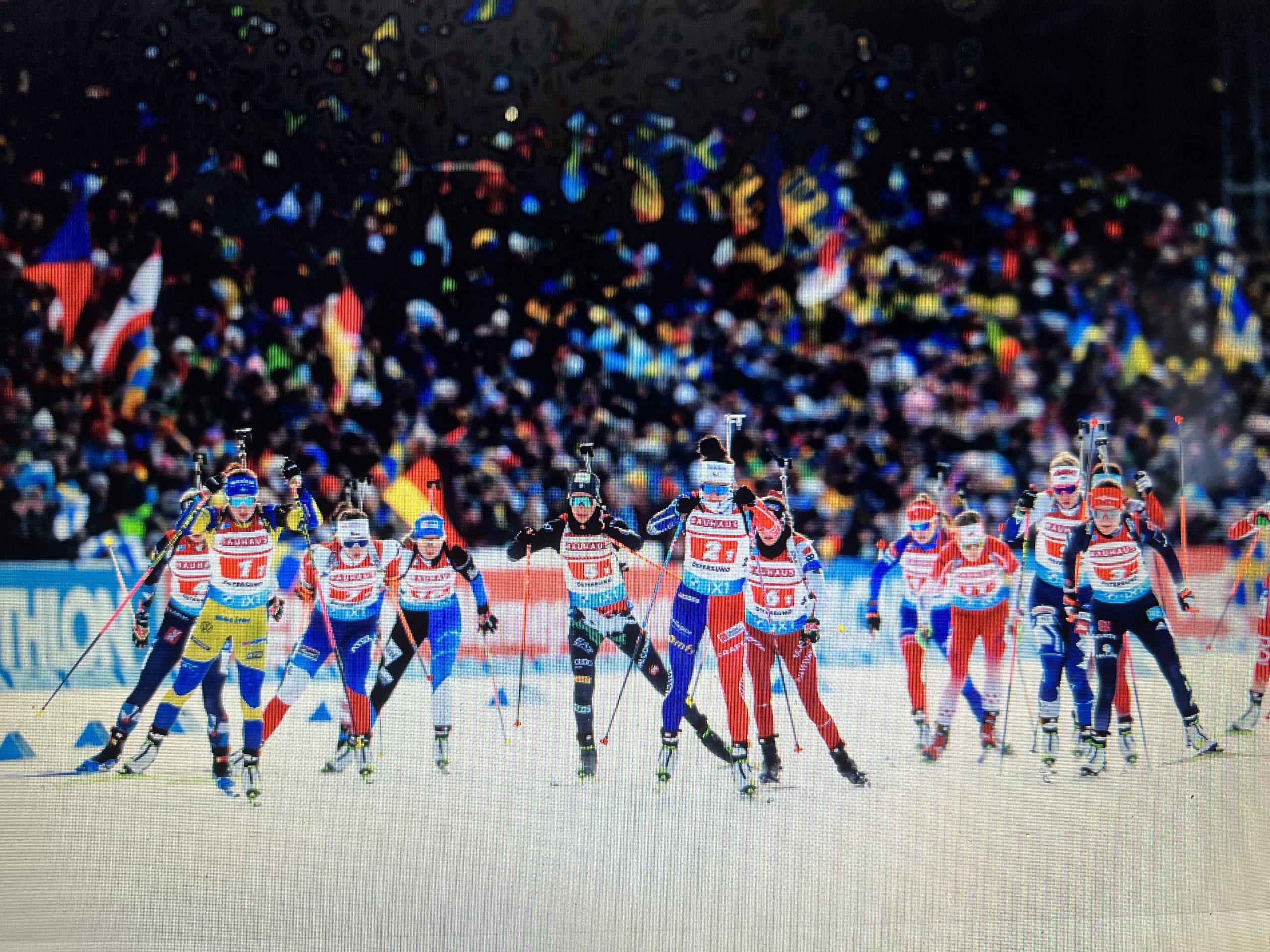
Women’s Relay action at the 2023 IBU World Championships at Ostersund, Sweden. In the 2024 season, IBU events will be conducted in accordance with a new Sustainability Charter to reduce environmental impact while enhancing social legacies. (Photo: IBU)
IBU 2023/2024: New Rules and Higher Sustainability Standards
The IBU season 2023/2024 is set to get underway with the opening BMW IBU World Cup in Östersund (SWE) on 25 November 2023 as new rules and sustainability commitments will be showcased for the first time.
Östersund is one of nine World Cup Organising Committees this season, in addition to World Championship host Nove Mesto na Morave, to have voluntarily signed the IBU’s new Sustainability Charter. By signing the Charter, the Organising Committees have pledged to six commitments with concrete actions that help focus and fast-track efforts to reduce environmental impact while enhancing social legacies.
The Charter is aligned with the IBU’s Sustainability Strategy 2020-2030 and is the latest step in making sustainability an integral part of the IBU’s event bidding and management process. It follows the contractual obligation on all hosts to measure and report their emissions, which has been in place since the 2021/2022 season, and from the 2026-2030 event cycle onwards, sustainability obligations on all Organising Committees will become a key hosting criterion.
In keeping with the IBU’s commitment to minimising its impact on the environment, the IBU will implement a full fluor ban this season to mitigate environmental and health concerns. The full ban from 2023/2024 onwards was announced in March 2022 and the IBU has since engaged in regular dialogue and education seminars with National Federations (NFs), their teams and technicians. Most recently, in September 2023, a Seminar was held with team technicians from approximately 30 nations to work with the detection device, explore new products and application as well as learn about how to optimize cleaning methods.
The fluoro test protocol will see skis tested before and after competition and a measuring procedure against pre-determined threshold zones will be enforced. Pre-competition, should athletes’ skis fall within the red threshold, they will be tested a second time and if they fail the test again will be given a red card and removed from competition. Each athlete will have the possibility to change their skis once in the season but a second red card will automatically result in a prohibition to start. Athletes whose skis fall above the post-competition threshold test will be disqualified.
The implementation of the fluoro ban will not be the only new rule in place this season. The IBU Technical Committee has also decided on the following rule changes:
In the Mixed Relays, each leg and gender will ski a 6km (3x2km) loop to facilitate course preparation and the conduction of the competition
Tightened rifle handle regulations at the shooting range to increase safety for athletes and participants
Extending the personal start right for the IBU Cup winners of the previous seasons to the first two World Cup stages (from only one stage previously.) This rule will be changed after next season so that the additional quota is not a personal start right any longer, but turns into an additional quota place for the National Federation of the IBU Cup winner for the first two World Cup stages of the next winter season
The 2023/2024 season will be held across 10 venues with the season finishing in North America in Soldier Hollow, Utah (USA) and Canmore, Alberta (CAN) in March. Over half a million spectators are expected to attend the season with the BMW IBU World Championships Biathlon in Nove Mesto na Morave on 7-18 February 2024 to draw the largest crowds.
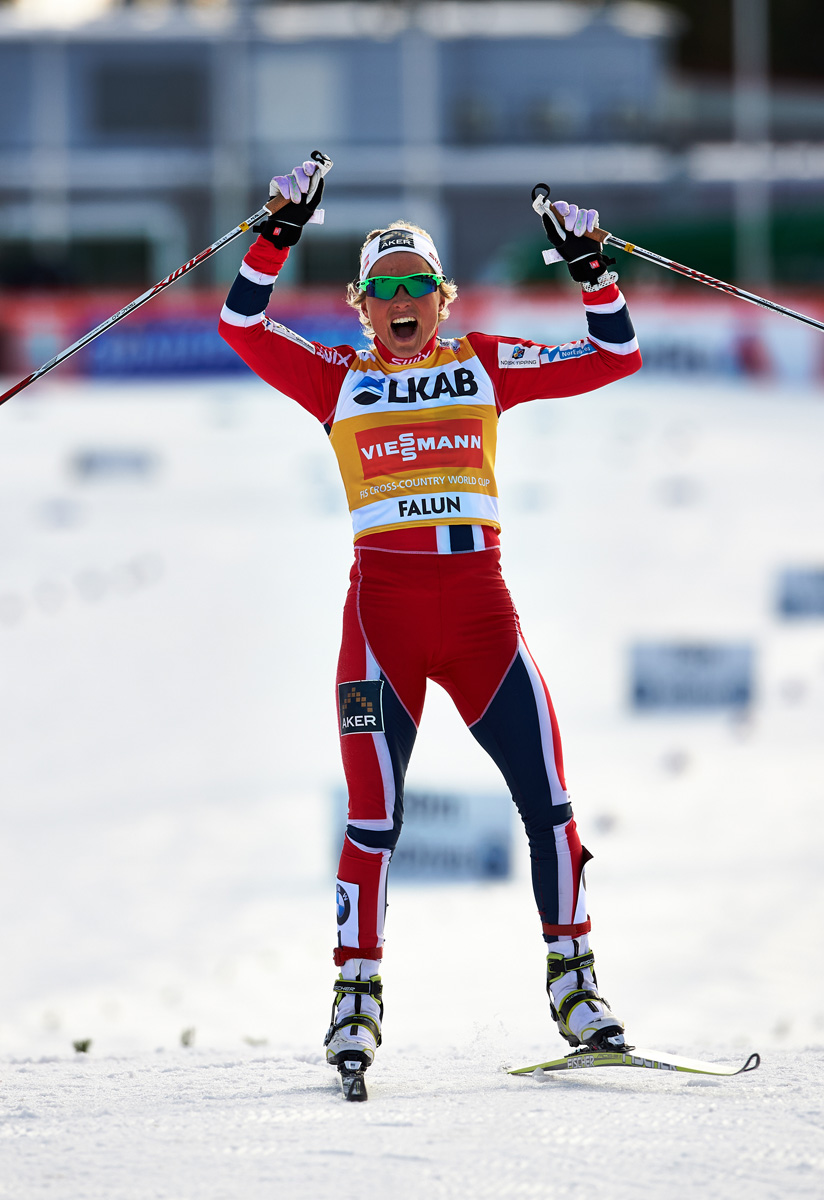
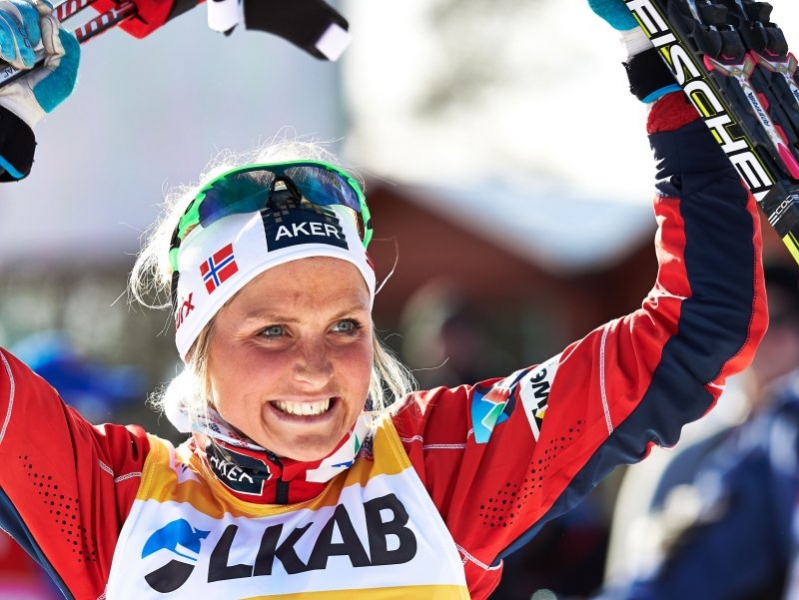
Therese Johaug clinches her first Overall World Cup title with a pursuit win at 2013/2014 World Cup Finals on March 16 in Falun, Sweden. (Photo: Fischer/NordicFocus)
This is the second article in a series on the future of the national-team model as seen in Norway. First we took at look at Petter Northug, Jr., and here we explore Theresa Johaug’s approach to a successful career and how that relates to the Norwegian National Team.
Can the Norwegian Ski Federation (NSF) keep its Norwegian ski stars on its team or will it lose them to big sponsors? That is the question now facing Stein Opsal, the foundation’s secretary general.
Perhaps the most valuable athlete for the NSF is Therese Johaug. Johaug, 25, represents a kind of Norwegian ideal: outwardly sincere and positive, perennially tan from vigorous outdoor exercise, she radiates “true sporting pleasure” as her manager Jørn Ernst describes it.
Johaug won a place in the hearts of Norwegians with her emotional victory in the 30 k skate race at the 2011 World Championships in Oslo, Norway.
“I remember I got the Norwegian flag,” Johaug recalled. “When I crossed the finish line, I thought, ‘Is this real? My God, I’ve won my first international ski race.’ ”
She collapsed into the snow crying ecstatically, and after she had recovered, she broke royal protocol by enthusiastically hugging King Harald. The Norwegian public was charmed, and 120,000 showed up in Oslo’s University Square that evening to watch Johaug receive her gold medal and sing Ja, Vi Elsker, the Norwegian national anthem.
Old times: Baby sister Veronika, Therese and brother Karstein at home on the farm. (Photo: Karstein Johaug)
For Johaug, who describes herself as “just a hick from Dalsbygda,” the national attention following the championships was a new experience.
“I think that I have been fortunate to have been allowed to grow up in a village where everyone knows everyone,” she said Johaug of growing up in the rural town during a 2012 interview with Dagbladet. “Sure, it has its drawbacks, too, but to grow up in that environment, in the yard, experience summer vacations on the farm with Mommo … I think that I have never had things put in my hands for me. I have worked and helped at home.”
After the championships, her popularity rocketed, and she was swiftly declared the most-admired athlete in Norway, ousting the previously most admired, the ever-humble biathlete Ole Einer Bjørndalen.
As Johaug described it in 2012, “It’s only now I realize how much that day meant to me. For my career, for [people’s] interest, sponsorship, everything. It was very special in Oslo.”
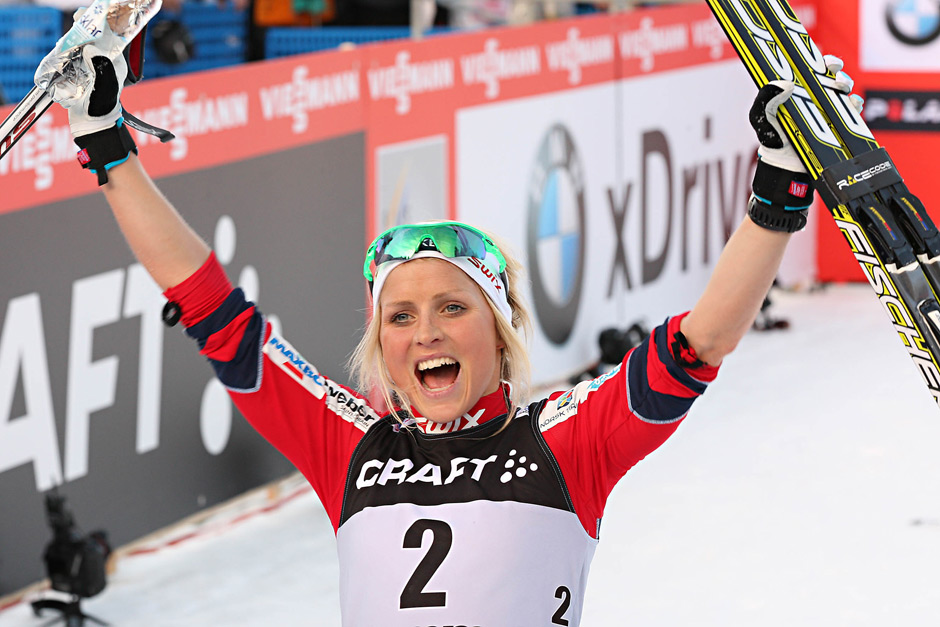
Johaug celebrates her second place finish in the 2013 Tour de Ski. (Photo: Fiemme2013)
Johaug’s fame has also come at a price. “I have become a more famous person, too,” Johaug said of the aftermath of the 2011 championships. “It is not only positive. Even if you get a lot of nice feedback, it is not constantly so cool. If I shall go for a walk in town … I wish I was a normal person, instead of that I will be topic of conversation during dinner to people. ‘Yes, I saw Johaug. I saw she did this, and bought that.’ It does not seem so cool.”
Johaug has found that spending time in Oslo can be an uncomfortable scene. “People [are] bumping into each other whispering, ‘Look, it’s her,’” she said. Asked if she was able to spend evenings out in Oslo, Johaug exclaimed, “No, that’s impossible! When people get something in their system they make contact. They dare not otherwise, almost.”
Johaug has reconciled herself to this fame, and embraced her sponsorship potential.
“Of course, when I’ve got the name I’ve got now, with the partners I have, I have a unique opportunity to get myself a position for the future,” said Johaug.
Jacob Lund, a sponsor expert, told Dagbladet in 2012: “She’s going to make more money than both Petter Northug and Marit Bjørgen. The girl has everything, so the sponsors will be willing to pay very much.”
Yet Johaug talks little of business matters to the media, leaving the subject to Jørn Ernst, her manager. After Northug left the Norwegian National Team and signed a private contract with Coop last May, Ernst told NRK that he found the deal “exciting” and would “pay close attention” to Northug’s career choice.
“Therese would have earned big money if she went out of the national team,” he added. “[But] money is the last thing she thinks of.”
Ernst also put concerns to rest that Johaug would leave the national team. “Therese is very clear that it is not the way to go,” he said. “She has no plans to invest alone, and it has never been discussed. Therese thrives very well in the national team. They are a tight group and she needs a good environment to perform. She and Northug are completely different. He is in a unique position. Therese has not been able to focus alone.”
Traditional Sponsorship
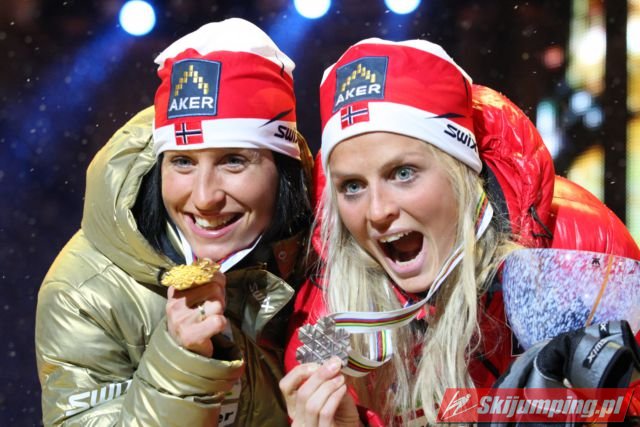
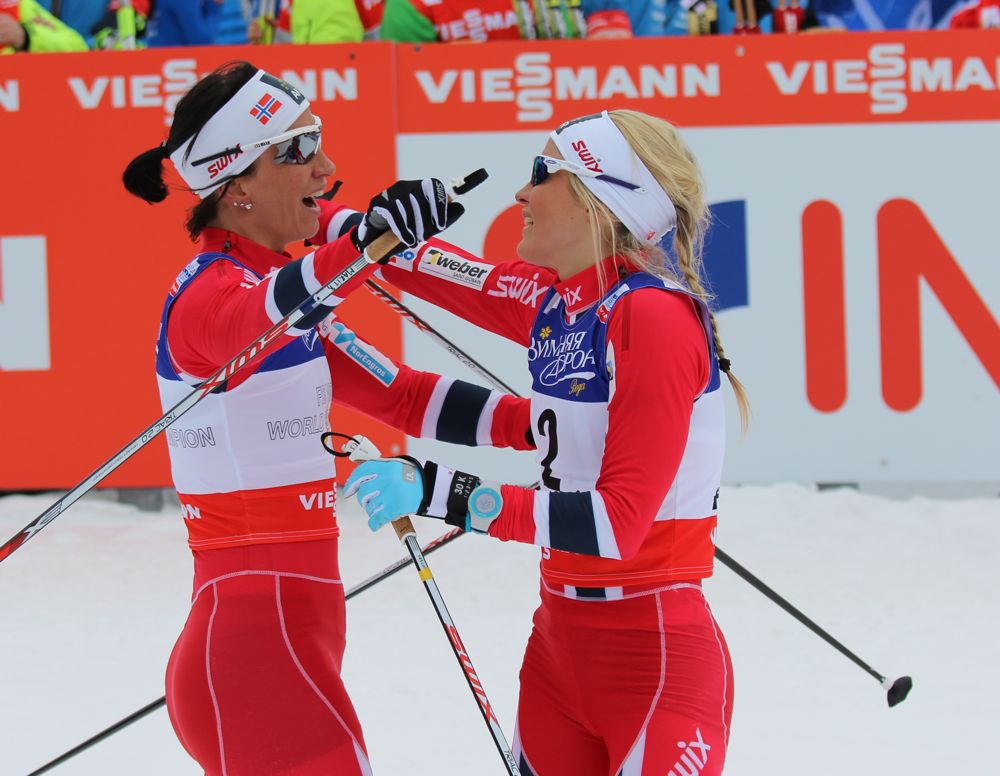
Marit Bjørgen (l) and Therese Johaug with their gold and silver medals from the 2011 World Championships 15 k in Oslo, Norway. (Photo: Wikimedia Commons)
Johaug has instead turned to the traditional route of making money as a cross country skier: private sponsorship. To this end she has deals with 12 sponsors, not to mention her own new line of ski gloves named Johaug, of which 120,000 pairs were sold before Christmas of 2013, as well as a private jewelry collection, and property investments.
Her sponsorships includes a deal with Austrian executive-air service Mapjet, worth some 2 million kroner a year, and secured after the company’s CEO became enamored with Johaug after watching her race in the 2011 Oslo World Championships. The CEO even went so far as to insist that she braid her hair for the promotional photos in the same fashion that she had it during the Championships.
She is also a face of Swiss watchmaker Tag-Heuer. This year she turned down an opportunity to open a new Tag-Heuer store on Paris’s Champs Elysees with Leonardo di Caprio and the million-kroner appearance fee that went with it, citing a conflict with her training regimen.
According to Ernst, Johaug turns down opportunities almost every day, from TV shows to jumping out of birthday cakes, in order to concentrate on her ski training. She has famously refused to be sponsored by sports drinks, as she finds them antithetical to her beliefs about healthy living. Ernst gives the impression that Johaug does little more than train and turn down financial offers in order to train even more.
But Johaug is fully aware of her long-term picture, and senses the opportunity to secure her future now. “A cross country skier I am,” she said to Dagbladet, “but I’m the girl next door too. I must say that that gives me a lot, I can really connect. Although cross country is incredibly important to me right now, and I admit that life is falling apart if I do not get the results I want…then cross country just a tiny part of my life in the long run. There are other important values, afterwards.”
There are plenty of opportunities for Johaug, and in turn, the NSF as well. Johaug’s popularity with Norwegians has only boosted the profile of the Norwegian National Team, which has increased its sponsorship funds by 53 million kroner ($8.8 million dollars) over the last five years. ASKO, a Norwegian grocery chain and NSF’s title sponsor, and the mega-food conglomerate Norgesgruppen/Spar, specifically sponsors just two members of the team: Johaug and Marit Bjørgen.
Bjørgen and Johaug
Bjørgen, the queen of the Norwegian ski team and its most successful woman in cross-country skiing history, has been an influential to Johaug. When Johaug has grown discouraged, it has been Bjørgen who has instilled confidence in her, and there is no question that training with the best woman in the world has made Johaug a better skier.
Yet despite Bjørgen being the best skier, by 2012 Johaug earned 1.1 million kroner to Bjørgen’s million. Bjørgen still had the greater net worth, with a fortune of 21.7 million kroner ($3.6 million dollars) to Johaug’s 13.3 million kroner ($2.2 million dollars), but that will likely not last for long.
If Johaug had everything that sponsors wanted in 2012, as Lund had declared, then she certainly has even more now. The 2013/2014 season was exceptional for Johaug: she won the Tour de Ski, captured individual silver and bronze medals at the Sochi Olympics, and was able to fend off Bjørgen for the Overall World Cup title. With the World Cup title to her name, Johaug now has the results to fully reach her income potential. How she chooses to do that will be an important for the future of the NSF.
The Truth Behind Their Income
Yet despite all of her sponsorships, these opportunities do not seem to have made Johaug rich by Northug’s new standards — at least not yet. Johaug’s 2012 income of 1.1 million kroner was less than Northug’s 1.6 million kroner that year, and a far cry from the 10 to 20 million he is reported to make now.
However, those numbers, based on public tax records, don’t tell the whole story. The NSF has set up a private fund for its cross country skiers. Established in 1985, the fund was created to provide skiers financial support after they retired from the national team. The money in the fund remains tax-free for as long as a skier is active on the national team, and allows the profits reaped during bountiful years on the team to be spread out over many years. Therefore, Johaug may well have made more than a million kroner in 2012, but that was only the amount she withdrew from her fund.
According to the Norwegian business newspaper Hegnar, “The funds … can be withdrawn without taxation to cover documented expenses related to sporting activity, such as exercise equipment, travel, hotel stays, consultancy, computer equipment and training in other sports where relevant.”
“Normal people would have dreamed of getting such a deal,” the fund’s chairman Helge Bie, told Hegnar.
This fund shields Norwegian skiers from what would otherwise be a large tax burden. A wealthy athlete like Johaug would usually have to pay somewhere between 37 and 40 percent on their income in Norway, where the income tax rate is a flat 28 percent, with an additional 9 percent on income over 456,000 kroner, and 12 percent over 741,000 kroner.
Johaug’s a national hero for thousands of Norwegian fans.
“We can safely say that the fund is a good solution for skiers,” said Bie. “And there is great interest in using it. Those who have good advisors around them, their money is in the fund.”
The fund itself is good indicator of how much new money there is in the sport in Norway. In 2011, the fund was worth 70 million kroner, with 150 members, most of them former skiers who are no longer paying into it. In January 2014, Bie said the fund was around 150 million kroner, despite gaining hardly any new members. This suggests that current NSF athletes deposited some 80 million kroner ($13.3 million) to more than double the fund over the last three years.
Northug’s manager Are Soerum Langås confirmed to Hegnar that “there are a few million in Petter’s fund,” but Johaug’s manager declined to say how much was in her fund. Norwegian business paper Kapital reported in January 2014 that Johaug’s career wealth had grown to 25 million kroner, nearly double from what it had been two years prior.
Five million of that wealth came from her national-team salary, which is likely about 450,000 kroner a year, and the team’s sponsors. Another five million came from prize money and bonuses given for winning medals. The remaining 15 million kroner came from her private sponsors. Not bad for a 25-year-old skier who already owns two homes and wheels around in a BMW X3.
Yet this is only the beginning for Johaug. Dagbladet reported that her renegotiated sponsorship deals may now be worth up to 10 million kroner a year, rivaling Northug’s new income. Johaug’s success in her private sponsorship agreements is also important for the Norwegian National Team, as it seeks to demonstrate its value to skiers. If Johaug surpasses Northug’s Coop deal through the traditional sponsorship route, it will send an important message to other athletes that there are not necessarily any advantages to leaving the team.
The NSF’s doing what it can to ensure that both Johaug and Bjørgen are content on the national team. Perhaps Ernst’s comments about watching the Northug deal closely were a subtle hint to the NSF to not take Johaug for granted. If so they seem to have received the message. The NSF goes to great lengths to keep their star athletes happy, even providing Johaug with a private car and chef during the Tour de Ski. As privately sponsored ski teams are able to new levels of personal support, the NSF will likely have to compete on the type of luxuries it provides its athletes, and pressure the social democracy ethos that has long ruled the national team.
A Juggling Act
Yet just because Johaug is a current member of the national team does not necessarily mean her sponsorship situation is without its drawbacks. Unlike Northug who was able to sign one substantial agreement with a grocery chain, Johaug has many different agreements in place, 13 in fact. This plethora of sponsors can create its own headaches and distractions.
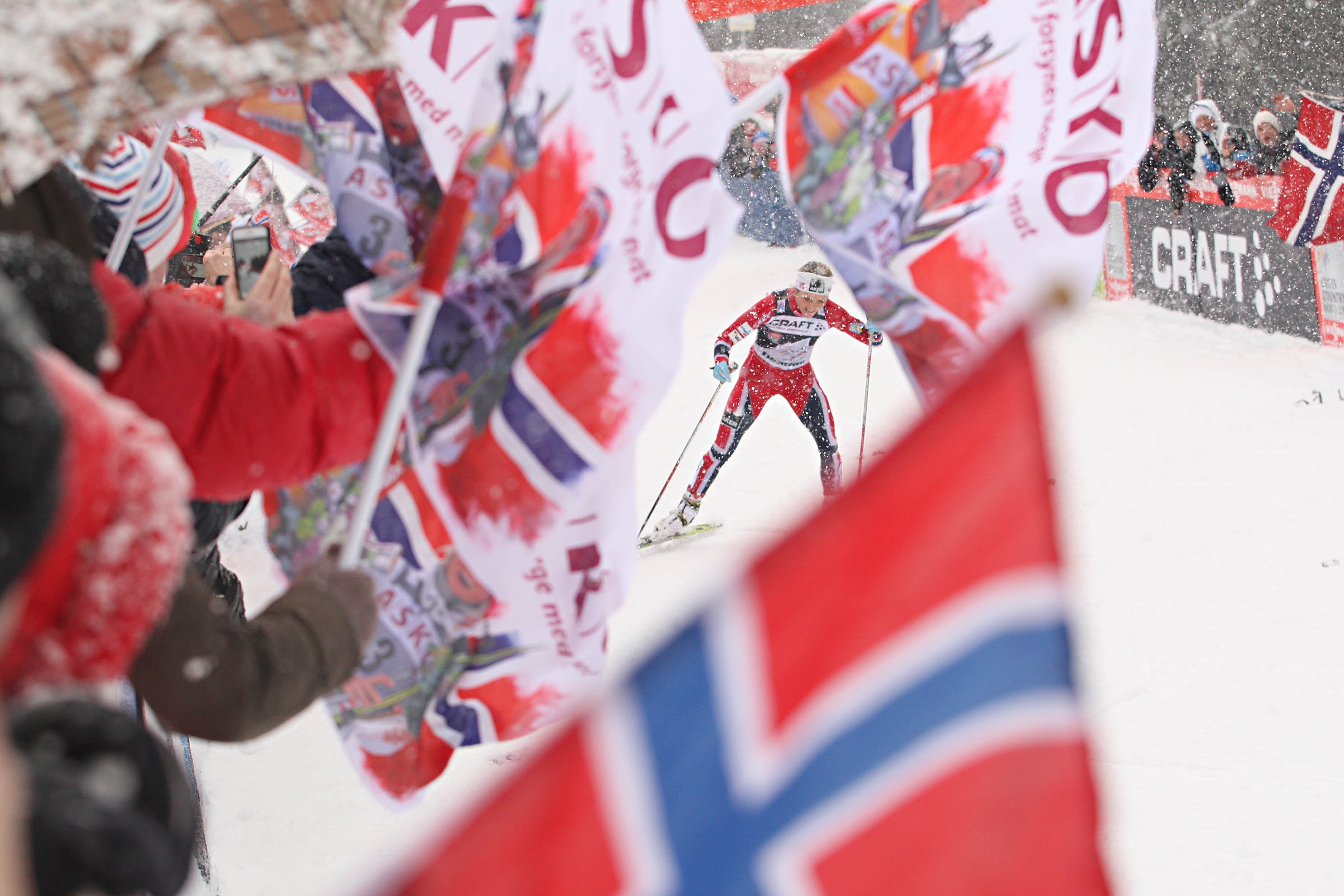
Norway’s Therese Johaug celebrates a nearly 30-second victory over teammate Marit Bjørgen in the World Cup Finals 10 k freestyle pursuit on March 16 in Falun, Sweden, which sealed Johaug’s first Overall World Cup title. (Photo: Fischer/Nordic Focus)
For instance, like Northug, Johaug’s Colgate ads had to be pulled during the Olympics to accommodate exclusivity clauses. As Johaug’s agreements become more expansive in the Norwegian market, she will likely encounter more exclusivity issues even if she carefully chooses them to avoid conflict.
Johaug also brought out the absurdity of product endorsement when she repeatedly drank from her a bottle of Isklar — the water sponsor of the national team— during a post-race interview in December. On closer examination, it appeared that the cap was still on the bottle and Johaug was mocked for the gratuitous product display. The tables at press conferences that Johaug and Bjørgen sit at are often piled high with products that support the national team. The promotion benefits the skiers and the NSF, but it creates a blurry line between a national team and a commercially sponsored ski team.
Then there is the issue of her new ski-gear company, which she is also eager to promote. The venture has attracted 15 million kroner from investors, and Johaug owns the rights to her namesake brand in Norway, Russia, China, the European Union, and the United States.
It’s unknown what the ultimate goal is for the company, but ski gloves is probably just a start. While Johaug has been careful not to overcommit her time to other sponsorship entities, she may find it harder to say no to the business baring her name.
While Ernst and Johaug have worked hard to ensure that her sponsorship obligations don’t interfere with her training, many great skiers over the years have warned that each year brings more distractions and non-skiing-related demands.
“We train insanely much,” Johaug told Dagbladet in March 2012. “Coach Egil [Kristiansen] says that we train more than Ulvang and Dæhlie did at their best.” Whether Johaug, now the defending World Cup champion, can maintain her grueling training regimen and the demands of her financial obligations, remains to be seen.
If Johaug, as the defending World Cup champion should choose to leave the NSF it would be a serious blow not only to the Norwegian National Team, but it would threaten the national team model in the sport. Johaug though, has given no indication that she would make such a move, and as Stein Opsal debates about what do with Northug, he can afford to make a stronger move knowing that his women’s team is fully onboard.
Johaug’s booming commercial success is a shining example that the old, traditional route of national team membership can be as profitable as anything in the private realm of skiing. She represents the young, bright face of the sport, and as long as she chooses to stay with the NSF, she will remain a paragon for what can be achieved on a national team.
***
Stay tuned for the rest of this series when it returns in June; the author is touring Nepal and India in May!
Professional cross country skiers are not usually preoccupied with environmental concerns like invasive aquatic species, composting, or even remembering to turn off the lights in their houses. Nor do they spend a whole lot of time doing trail work.
Instead, for the most part, skiers tend to take for granted the negative environmental impact of their sport, with elite competitors criss-crossing the country for races, fleets of groomers guzzling gas, and the voracious appetites of athletes of all ages.
Here at the Craftsbury Outdoor Center, though, in Craftsbury, Vermont, a small group of skiers is trying to prove that it can still compete at the highest level of the sport while minimizing the environmental impact of its activities. In its first year, the Craftsbury Green Racing Project (CGRP) is doing this by trying to reduce the impact of its travel, working on projects promoting sustainability, and even making sure to flip off light switches before leaving the house.
Their efforts consist mainly of trying to offset the negative impacts of competition and training, rather than actually reducing that impact outright. The team characterizes its efforts not only as a way to mitigate its own effects on the environment, but also as a way to set an example to athletes at all levels of skiing.
“It’s more about being conscious about the decisions [team members] make on a regular basis, and spreading that consciousness,” said athlete Tim Reynolds.
Reynolds warming up for some intervals on one of Craftsbury's roads.
An environmental philosphy
The CGRP emerged this spring from a few convergent ideas. First, the New England Nordic Skiing Association (NENSA), had recognized that there was a gap in the development pipeline for college graduates and older skiers who wanted to make the next step in their careers.
At the same time, Reynolds, then a senior at Middlebury College, was working on a school project developing a business plan for a “green” racing team.
Originally, Reynolds had hoped to headquarter the team at the Trapp Family Lodge, in Stowe, Vermont, but those plans fell through. Judy Geer and Dick Dreissigacker-a couple who had purchased the Outdoor Center last fall and turned it into a foundation-stepped in and offered to host the team there.
Since the foundation’s new mission was to promote lifelong sports, sustainable practices, and the preservation of land, lakes, and trails, the focus on sustainability was a perfect fit.
Through an application process, six skiers emerged, all recent graduates from eastern colleges: Matt Briggs, from Colby College; Oliver Burruss, from Harvard University; Hannah Dreissigacker (Geer and Dick Dreissigacker’s daughter), and Chelsea Little, both Dartmouth College graduates; Lauren Jacobs, who graduated from Bates College; and Reynolds himself.
While the athletes’ previous commitments to sustainability were varied, all appear to have embraced the environmental philosophy of the team.
Before joining the CGRP, Briggs said, he wasn’t particularly conscious of his environmental impact. It has been interesting, he continued, “just learning what has an affect, and what you can do in your life to eliminate waste.”
“Especially as skiers, nobody’s more affected by [the environment] than us,” Briggs said. Reynolds was obviously personally concerned about the environmental impacts of skiing, but he said his idea to make the team “green” was about business.
“I just figured in terms of attracting sponsors, you’d have more success with that edge,” he said. “If I was a business, it seemed like something I could actually sell.”
Providing some person power
The athletes began arriving at the Outdoor Center in May and June to train with Coach Pepa Miloucheva, and the program was in full swing by mid-July.
All six team members live rent-free in a large farmhouse adjacent to Craftsbury’s ski trails, which Geer and Dick Dreissigacker also purchased last fall.
One of the athletes' rooms in the team house.
While a decent amount of space is filled with the equipment necessary to support six elite skiers in their training, there is still plenty of room for book collections, video games, and even a few paintings. And-a necessity for young people living in northern Vermont-wireless internet.
Dreissigacker relaxes in the living room of the team house.
The team eats almost all of its meals at the Outdoor Center’s cafeteria, although they will have to cook for themselves during a few dead periods throughout the year. Geer also said that the foundation is paying for health insurance for anyone not still covered through a parent’s plan.
“It’s certainly better support than I would have gotten anywhere else,” said Briggs.
Geer-who along with Dick Dreissigacker was an elite rower during and after college-said that the foundation is providing the support because she and her husband understand the demands of high-level training.
“It is hard to train and work a lot of hours at once,” she said. “You can’t do trail work all day, because you get exhausted.”
Geer said that costs of supporting the team are not as high as if the program was operating on its own, without the existing infrastructure of the Outdoor Center. The additional meals, for example, are only a small marginal cost above what the cafeteria already serves to people attending running, rowing, and skiing camps.
Team members are expected to put in 15 hours of work a week in exchange for the support offered to them. Anything beyond that, they get paid for.
Those 15 hours are mostly dedicated to working on projects designed by the athletes themselves, which are intended to promote the CGRP’s “green” focus.
Jacobs is studying the ecology of Lake Hosmer, which the Outdoor Center uses for rowing. She’s taking weekly water samples, and is also working on a project to remove an invasive aquatic species from the lake.
“Ultimately, I want to establish some sort of education about the lake for local schoolchildren,” Jacobs said.
Other “green” projects already in the works include an initiative to get more local food in the cafeteria, as well as creating a composting program for its food waste. Another idea being floated is a carbon emissions inventory for the Outdoor Center.
In addition to their projects, the CGRP is also investigating ways that it can mitigate the effects of its travel to races, like by doing some volunteer service promoting sustainability in a venue’s surrounding area.
There are also numerous smaller tasks-in some cases, strenuous ones-to be completed around the Outdoor Center. These include trail work, coaching Craftsbury’s Bill Koch League program, and even chaperoning kids attending rowing camps.
Burruss giving some technique advice during a Bill Koch practice. Jacobs is on the right in the background.
According to Geer, the program’s focus on post-college athletes is intended to put to use the knowledge that they have already acquired in school.
“The athletes get to train, but they also get to use and develop the skills they have, and get something for their resume,” she said.
Before the team was around, Geer said, the staff at the Outdoor Center had a number of ideas for projects that would promote the foundation’s new mission. But there weren’t enough free hands to put all of those ideas into practice.
“The green team is providing some person power,” she said.
One obvious concern is whether the work might interfere with the athletes’ training or recovery. But Miloucheva said that it hasn’t been a problem, and most of the team members agreed.
“It’s not that bad for them,” Miloucheva said. “The working schedule is quite easy. Their priorities can be shaped around their training…When they work for the center, they have lots of flexibility.”
On a recent Wednesday, in the middle of a difficult week, it indeed appeared that the team was not working too hard outside of their training. Between a rollerski in the morning and running thresholds in the afternoon, the athletes mostly stayed in the house-putting their feet up, checking e-mail, and venturing outside only to hit a few golf balls into a neighboring field.
Work wasn’t too far off of everyone’s minds, though. There were frequent discussions about projects, and evidence of the team’s labor over the past few weeks was everywhere: compost bins in the dining hall, a new stone patio, smooth trails between the team house and the cafeteria.
Under the microscope
Though the team’s work projects might sound like enough to keep the athletes busy all day, they’re still fully committed to a serious training program that Miloucheva closely monitors.
A small portion of the team's training gear.
All of the members of the team were competitive racers on the college circuit, and many were standouts. Both Dreissigacker and Reynolds won races in the cutthroat Eastern Intercollegiate Skiing Association, and Briggs and Little had multiple finishes in the top ten.
The training is fairly standard for a high-level cross country skiing program: often multiple workouts each day, lots of intensity, weights, video, technique work. In July, the team was already spending a significant amount of time on rollerskis.
The athletes are constantly under Miloucheva’s microscope. During a recent running workout, she took lactate samples from Hannah Dreissigacker, pricking one of her fingers to draw a drop of blood, which was then analyzed by a small device to see if she was going at the right pace. (She wasn’t.)
Miloucheva testing Dreissigacker's lactate level.
Miloucheva is also making use of a new training tool, the Ski Erg, which is produced by Concept Two-the company owned by Geer and Dick Dreissigacker that is known mainly for its rowing machines.
The Ski Erg uses much of the same technology as the rowing machines, but rather than simulating the stroke of an oar, it simulates a classic skier’s double poling motion.
The device can gather data about an athlete’s power output, and Miloucheva has developed a number of protocols for testing values like VO2 max and threshold.
“It has a very good data transfer for skiers,” she said. “It’s a very reliable testing system.”
Jacobs doing a test on the Ski Erg. Photo courtesy of Judy Geer.
After training through the summer and fall, Miloucheva said that she plans to bring the team to the first two stops of the SuperTour, in West Yellowstone and Bozeman, Montana.
From there, anyone with a shot at qualifying for the pre-Olympic World Cups, U-23 World Championships, or the Olympics will head to the U.S. National Championships in Anchorage.
Ultimately, Geer said, it would be great to see some athletes jump from the CGRP to the National Team. For those for whom that is not as likely, Geer said simply that the team is there to support its members’ athletic goals.
Most of the athletes said that they hoped to spend at more than a year with the team, and Geer said that she expected that Craftsbury’s commitment to the skiers would be at least that long.
Whether or not to stay on for another year will be between Miloucheva and the athletes, Geer said, but the decision will probably be based on whether the skiers are improving.
“We expect that at the end of each season, we’d take stock,” Geer said.
The things they can control
It’s clear from the team’s work at the Outdoor Center that its members are dedicated to their cause. But the question remains: With the resources consumed by grooming, making new equipment, and travel to Montana, Alaska, or even Europe, just how sustainable can a professional ski team be?
While no one can claim that volunteering at a race site isn’t a good thing, can such actions really offset the environmental costs of making the journey to get there?
Writer and environmentalist Bill McKibben has written extensively on both cross country skiing and climate change, and he helped Reynolds on his plan for the CGRP.
In an e-mail from the Maldives, where he was organizing against climate change, McKibben acknowledged that the CGRP’s efforts won’t completely mitigate the effects of their travel.
Instead, he said, the real point of the team “will be to use it to demand political change-at this point, that’s what will actually do anything about global warming.”
“My hope is that the Green Racing Project will carry strong political messages with them as they go-and maybe even help pressure Vermont’s recalcitrant Governor Douglas to do something useful about energy,” McKibben said.
Reynolds also admitted that there was a certain amount of inevitability of the CGRP’s environmental impact.
But while there is definitely some hypocrisy involved in traveling to races, Reynolds said, “at least we’re acknowledging that.”
“Racing is a priority, so we’re not going to not go to Anchorage because you have to fly there,” he said.
Instead, Reynolds said, the team members are focusing on the things that they can control, like the food they eats, the cars they drive, and how they light their house.
“We can’t change the ski races-we’re probably still going to have to fly to places,” said Geer. “The only way to make it happen is in the rest of your non-skiing life.”