The first time you meet Patrick Weaver, you might not realize you’re talking to one of the most quietly influential coaches in American skiing. There’s no bravado, no self-promotion. Just an easy Vermont calm — a man who measures his words the same way his athletes measure their training: carefully, purposefully, with feel.
On a fall morning, the UVM Nordic team threads through the mist at the Craftsbury Outdoor Center, the quiet hum of rollerskis against asphalt echoing in the distance. Weaver watches from the side, hands in his jacket pockets, hat pulled low. He doesn’t bark instructions. He doesn’t need to. The rhythm of his teams speaks for itself.
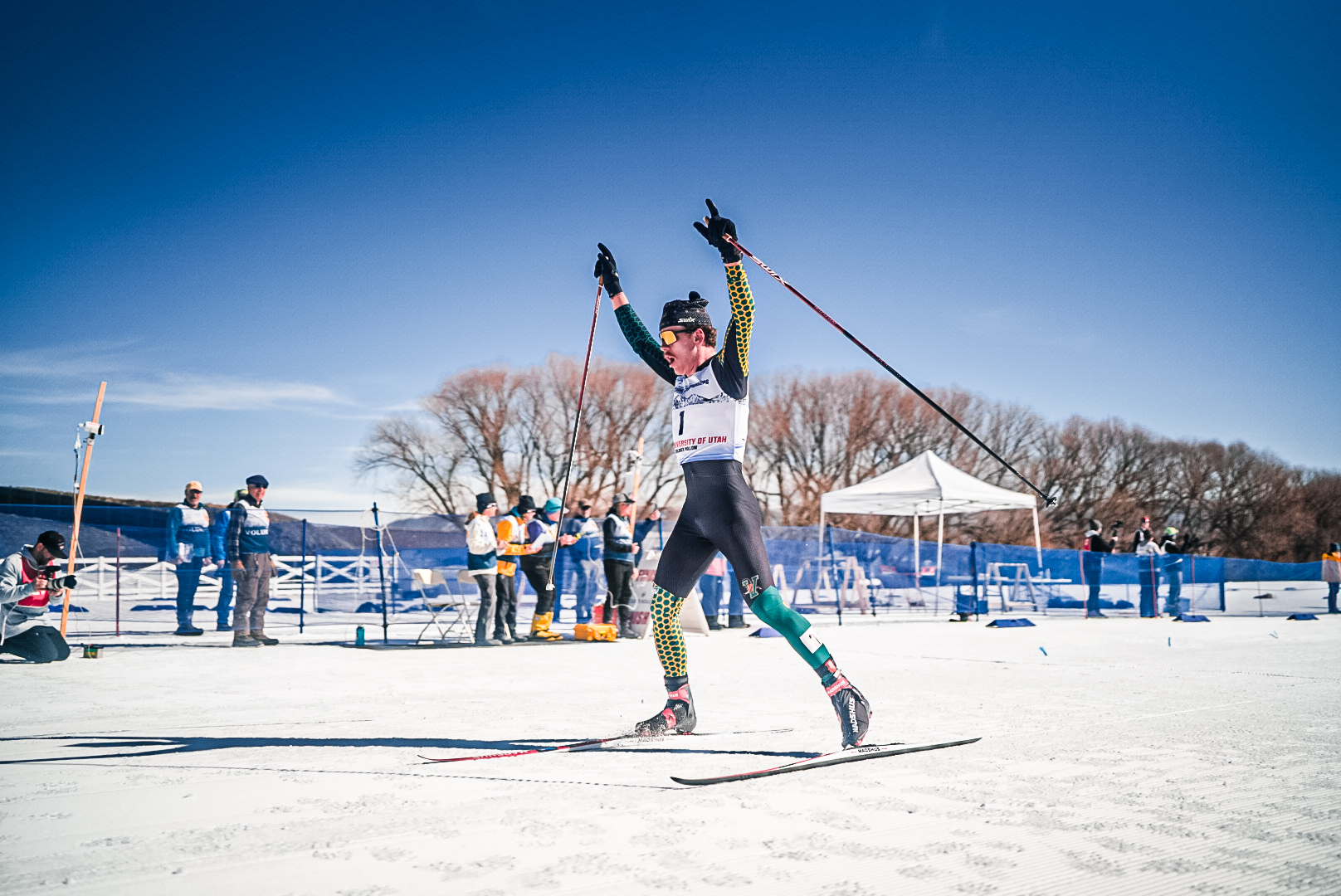
Wilmington, Vermont’s Sophomore Luke Rizio. (Photo: Philip Belena/EISA)
“I always say it’s not the individuals that make the team fast — it’s the team that makes the individuals fast,” he says. “Once they believe that, the motivation takes care of itself.”
For nearly twenty years, that philosophy has shaped the University of Vermont into one of the most respected programs in NCAA skiing — not through hype or heavy recruiting, but through a culture of trust, humility, and balance.
Lessons in Motion
Weaver’s path to coaching wasn’t linear. It’s more like a relay through decades of ski mentors who left their fingerprints on his philosophy.
“I never had one coach through my whole career,” he says. “There were a lot of influential people — high school, Stratton, college, the national team. I just learned to take things from each of them.”
He spent a post-graduate year at Stratton Mountain School under Sverre Caldwell before skiing for Cory Schwartz at UNH — a relationship that would define his sense of what a team could feel like.
“Cory was probably the most influential,” he says. “The way he ran that program — it was a family. I took that with me when I came to UVM.”
After college, Weaver worked under a rotating cast of national and international coaches: Gordon Lange, Christer Skog, Sten Fjeldheim, Torbjørn Karlsen. Each brought a different rhythm to training. The mosaic of ideas shaped the adaptable style he’s known for today.
“There’s not one way to coach,” Weaver says. “And because of my background, I’m not a ‘my way or the highway’ coach. I’ve seen too many ways that work.”
Patrick Weaver racing in the 15 k Classic at the 2002 Olympics in Soldier Hollow, Utah. Weaver finished in 16th place. (Photo: UNH Ski Team)
The Season He Cut His Hours
In 2002, the year of his second Olympics, Weaver did something radical. He trained less.
After years of logging 800-plus-hour seasons, he realized the grind was killing his joy. So he cut down to 600 hours — just one session a day, mornings only.
“I was kind of burned out,” he says. “I’d dread the afternoon workouts. I loved the sport, but I wasn’t feeling good anymore. When I stopped doing the PM sessions, I felt better — I started looking forward to training again.”
It’s a story he still tells his athletes, not as dogma but as permission. Permission to rest. Permission to find balance.
“I’m never afraid to tell an athlete to train less,” he says. “Sometimes that’s the thing that gets them going faster.”
That season became a turning point — not just in Weaver’s career, but in his view of what performance really means. It was the seed of a coaching style rooted not in metrics, but in intuition.
Ben Ogden celebrates after sweeping the 2022 NCAA Championships in Midway, Utah. Ogden became 1 of only 4 skiers (alongside US Ski Team teammates Novie McCabe and Sophia Laukli) to win an NCAA Championship and represent the US at the Olympics in the same season. (Photo: Tobias Albrigtsen / @untraceableg)
Coaching Ben Ogden — and the Art of Listening
If Weaver’s name is not immediately known outside the NCAA world, it should be. One of his former athletes — UVM graduate Ben Ogden — is now one of the most dynamic racers on the World Cup circuit. Their partnership, built over seven years, is the epitome of Weaver’s coaching DNA: patient, collaborative, and deeply human.
“I’m not Ben’s day-to-day coach,” he explains. “He’s got great people at Stratton and the U.S. Ski Team. But we talk — a lot. Strategy, planning, recovery, the big picture. And it’s never me saying, ‘Do this.’ We talk it through and find what makes sense logically.”
That logic isn’t written in a spreadsheet. There are no lactate meters, no elaborate testing protocols.
“We’re very unscientific,” Weaver says with a grin. “Ben appreciates the go-with-the-flow training plan. It’s all feel-based. If it feels good, we go with it.”
The two share what they call the “Gus Workout” — a set of smooth, fast intervals inspired by Gus Schumacher. “It’s not about killing yourself,” Weaver says. “It’s about moving fast with good technique.”
It’s fitting that one of America’s most promising World Cup athletes traces his development back to a coach who believes that skiing, at its best, is about rhythm and relationship more than data and drive.
The UVM Way
Weaver took over the Catamount program with a straightforward goal: strip away the clutter.
“When I first got here, I just explored,” he says. “I found training venues close to campus — trails and loops that were right here. We stopped driving hours to ski. It simplified everything and gave athletes more time to recover.”
That ethos — local, focused, efficient — defines UVM’s identity. Training isn’t glamorous, but it’s deliberate. The team atmosphere is close-knit, even familial. “There’s nothing special about UVM,” Weaver jokes, “and that’s what makes it special.”
He points to the campus support network — trainers, nutritionists, sports psychologists, and strength coaches all under one roof — as one of the program’s hidden advantages. “It’s on par with professional teams,” he says. “The athletes can see everyone they need in one day.”
That infrastructure helps athletes stay healthy, grounded, and balanced — which, for Weaver, is the real key to longevity.
“We’ve had international athletes come in liking skiing, and they leave loving it,” he says. “That’s when I know we’ve done something right.”
Junior Owen Young (Anchorage, Alaska) and Sophomore Fin Bailey (Peru, Vermont). (Photo: Phillip Belena/EISA)
Through Change and Uncertainty
Weaver has been around long enough to see college skiing evolve from a regional stepping stone to a legitimate World Cup pipeline. He’s also watched it collide with new realities: NIL money, early recruitment, the escalating costs of youth development.
“When I was at UNH, I was training 500 hours a year and thought that was a lot,” he says. “Now I’ve got athletes training 700 or 800 hours — and managing school on top of it.”
That dedication, he says, is a sign of progress — but also a warning.
“Kids are training more and more at a younger age,” he says. “Sometimes it worries me. Are they doing it because they want to, or because they’re being told to?”
He worries, too, about the economic side. The college landscape, reshaped by NIL and revenue sharing, could make Olympic sports harder to sustain.
“We’re fundraising to pay athletes while big schools make $200 million a year off TV deals,” Weaver says. “It’s hard to see how that’s sustainable.”
He laughs softly when asked what NCAA skiing looks like fifteen years from now. “I hope we’re still here,” he says. “I really do.”
The Long Game
If the world of college skiing is shifting underfoot, Weaver’s motivation remains rooted in something simple: people. Every year brings a new roster, a new set of personalities, a new chance to start fresh.
“You do something long enough, it’s hard to stay motivated,” he admits. “But each fall I get new athletes, new relationships. First-year students I barely know become seniors I can’t believe are leaving. That cycle keeps it exciting.”
He pauses, then adds, almost to himself:
“Maybe that’s what success really is — watching them fall in love with skiing all over again.”
UVM Sophomore Rose Horning from Leadville, Colorado. (Photo: Phillip Belena/EISA)
Vermont’s Quiet Legacy
Weaver doesn’t measure his legacy in NCAA titles or Olympic appearances, though UVM has had plenty of both. He measures it in the quiet mornings at Craftsbury, Jericho, or Sleepy Hollow, where athletes rediscover why they started skiing in the first place.
He doesn’t see himself as a gatekeeper of results but as a caretaker of culture — one that prizes simplicity, joy, and belonging in a sport that often forgets how to slow down.
In a world obsessed with metrics, Weaver’s story is a reminder: sometimes the best architectures of success are invisible — built in the space between workouts, in trust, and in the quiet confidence that skiing, at its best, should always be fun.
“The best thing I can do,” he says, “is help people love the sport.”
Coach Weaver chats with his first-year from St. Paul, MN, Hanna Koch. (Photo: Philip Belena/EISA)
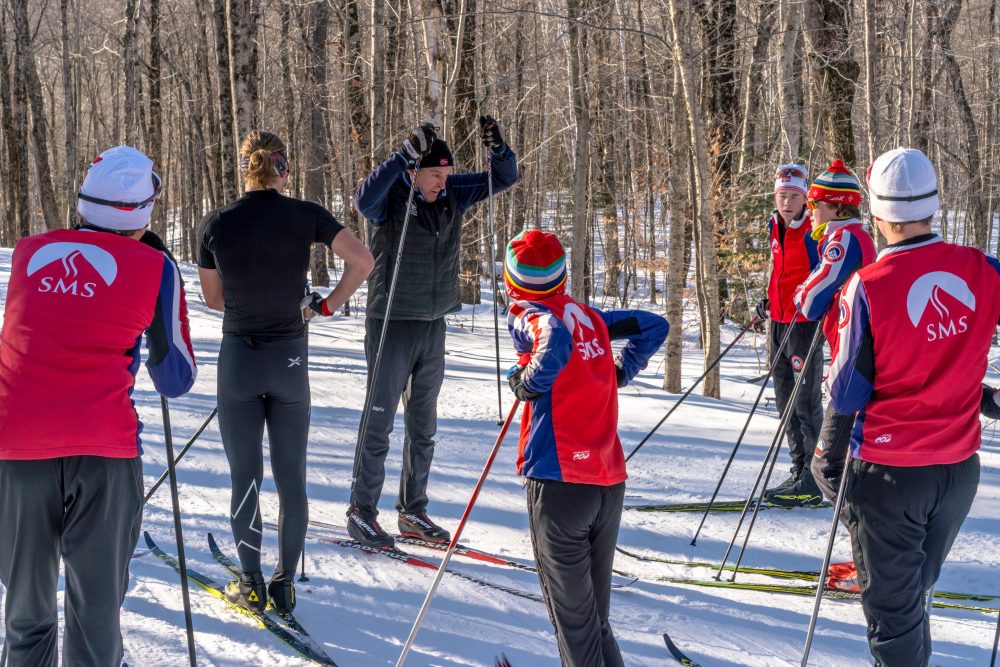
Sverre Caldwell instructing SMS athletes. (Photo: George Forbes)
“I am not making them great. They are making themselves great.” – Sverre Caldwell
Long-time Stratton Mountain School (SMS) coach Sverre Caldwell will step down at the end of this school year. According to an article in the Bennington Banner, during Caldwell’s tenure, SMS sent 15 cross-country skiers to the Winter Olympics. SMS also had at least one Junior National champion and one World Junior team member for 24 consecutive years. Caldwell was U.S. Ski & Snowboard’s Coach of the Year in 2001, 2003, and 2009.
Caldwell’s name became synonymous with SMS as the cross-country ski program has evolved over the years. He began his career at SMS in 1980 with a small core of athletes. Along with his coaching duties, Caldwell initially taught Math and took on the role of headmaster for four years beginning in 1992.
In the matter-of-fact tone of someone understanding where their strengths lay, Caldwell deadpanned, “so I was headmaster for four years and did not enjoy that, so I went back to coaching. I have worn a lot of different hats, but mainly ski coach except for those four years as headmaster. So I have been ski coach with occasional teaching, those are the different roles I have played at SMS.”
The academic and outdoor sports focus of SMS calls for two parallel staffs: one dedicated to academic classroom work, the other focused on developing athletes on the alpine slopes, cross-country trails, and halfpipes.
“Because the coaches travel so much in the winter and everyone is on different schedules,” Caldwell said. “You can envision that nordic skiers don’t travel as much. But a lot of the alpine races are midweek because the alpine mountains don’t want to close their trails on the weekends. So it would be hard for me who is off to senior nationals for ten days and off to junior nationals for ten days to be teaching a bunch of alpine kids the little bit of time when they are around.”
Due to those time constraints, Caldwell’s work with younger athletes revolved around his cross-country coaching. Along the way, he also helped establish an elite team. Initially known as the SMS Elite Team, that training and racing group is currently called SMS T2. Current and former SMS T2 athletes include Jessie Diggins, Andy Newell, Simi Hamilton, and Sophie Caldwell.
Sverre Caldwell encouraging SMS skier Clarissa Pollard in Lake Placid. (Photo: George Forbes)
The following is a conversation between Jason Albert and Caldwell on April 30, during which Caldwell reflected on his career.
FasterSkier: Much has changed in sport since you began in 1980 at Stratton. Can you reflect a bit on what you personally have changed when it comes to your craft?
Sverre Caldwell: What I have done really hasn’t changed that much. Having had your average of 10 to 15 kids a year for almost 40 years, it is always a variation on the theme. But you are training year-round for skiing. So I might go ‘this year we are really going to work on this’ and it turns out to be one workout a week different. Everyone is going to [train] a lot of distance and some intensity and it depends on when or how hard you want to go and when you want to introduce the intensity.
From my perspective, I have always tried to think of myself as a teacher of cross-country skiing. You just kind of help reach the kids as much as you can so that they can learn what makes them click. And it is really important that they take ownership. So I am trying to help them make decisions that are going to help them.
I am not making them great. They are making themselves great and I am going to help them figure out how to do that.
I know it has changed because I used to be young and athletic and lead all the workouts. Now I can’t keep up with anyone so I’m watching. You know the educational piece and teaching them a sport has evolved, but that has not really changed dramatically. When I started coaching here, no one trained year round for skiing. If anyone joined the program, it was pretty much instant success because they were training year-round for skiing and very few other people were doing that. Now, a lot of people are training year-round for skiing. It has gotten more competitive and you look at international results and it shows. It is pretty cool. We have had three different skiers in the last three years get medals at World Juniors. And twenty years ago we were not getting medals at World Juniors. Competition is improving because a lot of people are doing a better job and the clubs are really helping that.
Another piece of that change that I think has also helped the Stratton program is having started an elite club. We have our SMS T2 people training here and the kids can see Jessie and Sophie and Simi and Andy Newell, some of the best skiers in the world. They did what we did. So here is a pathway.
FS: What is one key take away from having your younger athletes in close proximity to SMS T2 skiers?
SC: My goal is always to have people to go into their biggest races expecting to do well because they have confidence. They know ‘when I do this I can ski well.’ So then you do whatever ‘this’ is before your big races. You go in with confidence versus hoping to do well. It really helps when you have that pathway of success and you can see that and you can say ‘oh, ok I can see why we are doing this and I can see why we are not doing a lot of hard intensity here in the spring and summer. Because those guys don’t do it either’. They are just building up patience and keeping a long term approach. The SMS T2 skiers tend to be good athletes and are as efficient as possible and all that sort of stuff that we preach to the younger skiers.
FS: It comes with the territory with an environment like SMS — parents with high expectations and demands when it comes to performance. That’s a dicey road to navigate.
SC: That has definitely evolved. Recently, it has become easier because I am older than all the parents. I remember when I started, parents were these scary people. Back then, I was just very enthusiastic and the team was doing well and everyone was going ‘oh this is great’. At this point, this is a major way that relationship has evolved. When people come in to interview if they are deciding if they want to come here next year, we say, ‘this is the way our program works and this is the way we do it’. And so they’re coming in and they are choosing this program because we have had great success and they are trusting that we know what we are doing. For the most part that has worked very well. That really hasn’t been much of an issue.
FS: In many ways, you are the East Coast sage of junior coaching. Do you field lots of calls from other coaches seeking advice?
SC: I enjoy talking to people and some people do. I can always talk skiing. Since I’m sure they will think, ‘why did I even ask him because he won’t shut up or something?’.
It is fun talking to different people and discussing issues that different programs have and helping them figure out how to do a different angle or something. It is not like I know everything. But I do enjoy talking about stuff and I think that our success has been because we have been really focused on helping each individual athlete, being patient, and looking at the big picture.
FS: One thing you have going on at SMS is resources. SMS life is not cheap. Does that play into the success?
SC: I think a lot of it is resources and a lot of it is education. I feel the educational part is really important. The kids understand why we are having them do different things. Education and ownership. I’ll see people come into our T2 team and it is like ‘Jesus, these guys just think if hard is good, harder is better’. It is like, ‘where in the hell have they been?’ They need to know how it all fits together. So the educational piece I think is very important. I would like to think that we train smarter than most people and I know some people train harder then we do. It is not like we are not training hard, but we don’t want to train too hard and burn out in February for example.
FS: I forgot to ask, how old are you?
SC: I am 64 years old.
FS:I consider that to be pretty young.
SC: Nobody in my family says that.
FS: Have you been thinking of retiring for a while?
SC: I actually decided, probably two or three years ago. And it was a combination of a bunch of things. One is, (laughter), I was inspired by Big Poppy… that’s my baseball reference. I thought it was pretty cool that when he went out, people were kind of going ‘why don’t you stay?’ I didn’t want to be here so long that people were going, ‘I cannot wait for him to leave.’ That was a piece of it.
I had a winter term sabbatical three years ago and Lily, my wife, and I traveled in Europe for something like 10 to 12 weeks and that was really fun. And so part of the plan was to be able to travel a little more and spend time with my wife. I still love coaching, but I am getting tired of all the administrative parts. I just want if I can spend more time with my wife and travel a little more and just back off that is going to be awesome and I believe you only go around once and so I didn’t want to … I don’t want to turn into this guy who is working for pay instead of working for passion. I wanted to leave on a good note. Leave on top. (Laughter.
A combination of all that. With Lily getting cancer, it was this is a good decision and I need to spend time with her and hopefully do stuff like that.
FS: Do you plan to stay involved with the school in some capacity?
SC: I will. I am definitely planning on helping with SMS T2 the same way I have the last whatever many years the SMS T2 team has been in existence. It is hard when you get old, you start to forget. That is another reason I am retiring.
While I have been coaching at Stratton, I have been administering the T2 team so the coaches can coach and don’t have to be out running around raising money and finding housing and stuff like that. I am going to continue in that role, making sure that Patrick [O’brien] doesn’t have to do too much of that grunt work and I can make sure the program is viable and we can run and keep thinking about what we need to do to be better.
That is the part that was not paid for through the school, but it was obviously a benefit to the school. So I am going to keep doing that. I have not talked to the school about what my role is with them. Matt Boobar will be taking over my job which is great and he has been here for ten years. We have been sharing an office and we can complete each other’s sentences. And so that is going to be a very smooth transition. I will be around. I will be available. At this point, I don’t have any job or contracted affiliation. I will be there, to chat with them and help however needed. But he needs to be able to run the program himself without me sitting here. I need to give him the distance. I will help however I can. What I foresee, if I am doing more coaching it will be going out more with the T2 team and talking to Pat more about what I am seeing. But, once again, without trying to tread on him.
It is always a tricky balance when you have been around and someone thinks they know a lot so they come in and dictate. It has to be this thing like where am I going to be useful and going to be helpful.
I still love working with kids. I am ready not to do it full time.
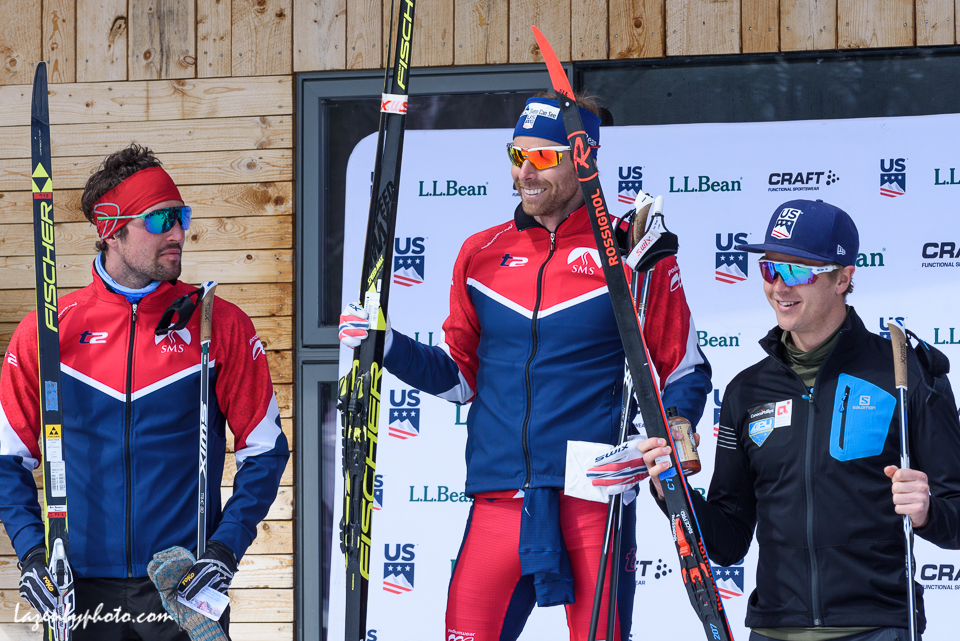
Andy Newell (c) of the U.S. Ski Team (USST) and Stratton Mountain School T2 Team after winning the men’s classic sprint at 2018 SuperTour Finals on March 24 in Craftsbury, Vt. His Stratton teammate Ben Saxton (l) placed second and Erik Bjornsen (r), of the USST and Alaska Pacific University, placed third. (Photo: John Lazenby/Lazenbyphoto.com)
When Andy Newell took to social media about a week and a half ago to announce that he was parting ways with the U.S. Ski Team (USST) after 16 years, some people might have assumed that he was leaving the sport. They would be wrong.
Newell, a 34-year-old Shaftsbury, Vermont, native and USST A-team member for the last 12 seasons, was quick to clarify that he’s not retiring from racing. After four Olympics and 16 years on the team, he’s just ready to be his own boss and set his own schedule.
“I guess in the back of my mind I always knew once the [2018] Olympics were over I would most definitely take a step back from being a full-time international ski racer and definitely take a step back from being a U.S. Ski Team national-team racer,” Newell said in a phone interview earlier this week. “Because that way, it allows me much more flexibility with my schedule even in the summer as far as training camps go and obviously a ton more flexibility in the winter as far as how much time I need to spend away from home racing World Cups.”
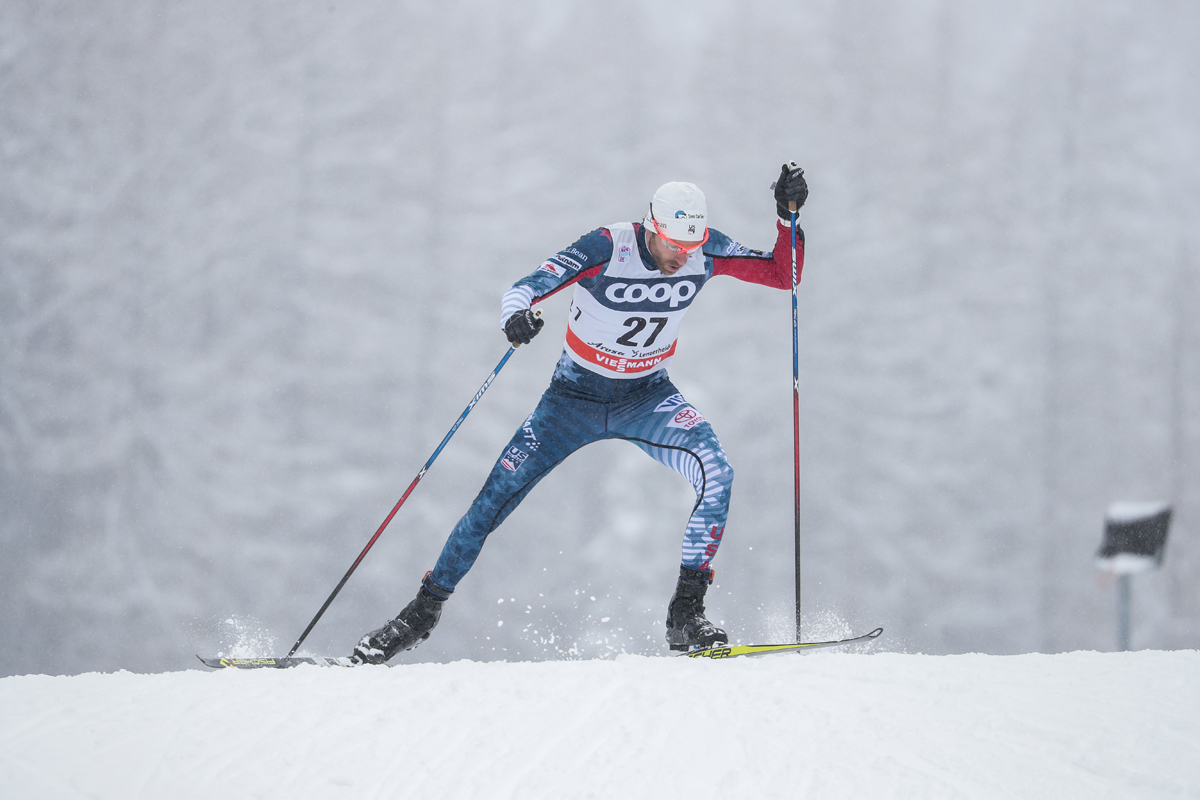
American Andy Newell racing the men’s 1.5 k freestyle-sprint qualifier at Stage 1 of the 2017/2018 Tour de Ski on Dec. 30 in Lenzerheide, Switzerland. He qualified 20th and went on to finish 19th on the day. (Photo: Fischer/Nordic Focus)
Newell spent all of last season — from Oct. 29 until mid-March — on the World Cup circuit in Europe (except for when he was at the Olympics in PyeongChang, South Korea, for the month of February). He rarely saw his wife, Erika Flowers, whom he married last June. The two arranged quick trips to see each other when they could, but as full-time ski racers on different circuits, it was a challenge.
“Five, six, seven, or ten years ago, I was making many of these decisions as an individual, and now that I’m married, I definitely have a lot more to consider than just myself when I make decisions when it comes to planning and scheduling,” Newell said.
While he was hesitant to elaborate on his plans moving forward, Newell emphasized that he’ll continue to race in the near future.
“Right now, I guess my plan would be to get back to a simpler schedule where I am still training at a high level but not focused really at all on World Cup racing,” he said. “So I might target a few races that I’ve always really wanted to do, for example some of the Ski Classics possibly over in Europe like the [Norwegian] Birkebeiner, possibly the American Birkebeiner. I think there’s so many great ski experiences that we have out there other than racing World Cups every weekend.”
And at this point, he’s not completely ruling out another run at World Championships.
“If I’m feeling like a complete champion by doing some of these different races, then you might see me trying to take a stab at something like World Championships,” Newell said. “But I’m not really putting any pressure or expectations on that, I’m more just looking to get back to a more simple training and racing routine where I can come up with my own schedule and plans and just remember what it’s like to really enjoy ski racing and doing the ski races that I want to do.”
Growing Up on the Ski Team
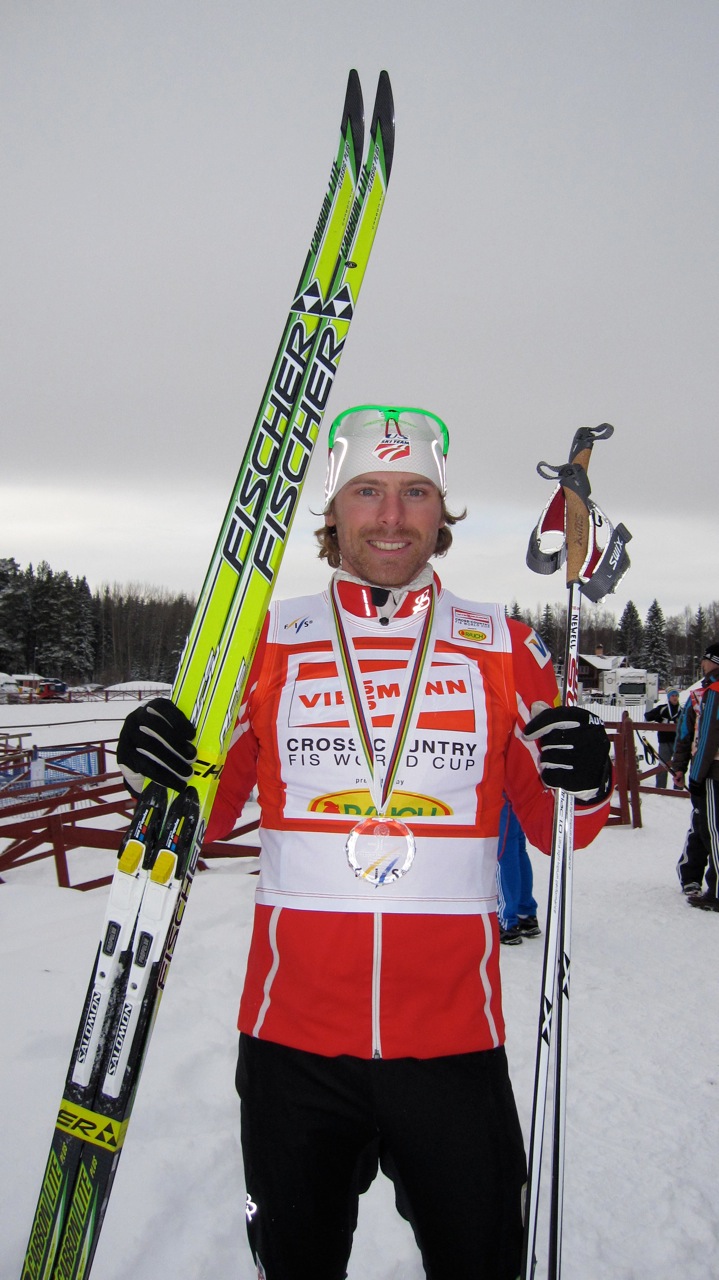
Andy Newell with some hardware after placing fourth in the season-long Sprint World Cup for the 2009/2010 season. (Photo: Kikkan Randall)
Newell first landed a spot on the U.S. Ski Team as a high-school senior at the Stratton Mountain School (SMS) in Stratton, Vermont. He was initially selected to the development team, which came with invitations to national-team training camps — like the present-day development “D” team — as well as summer housing at the USST base in Park City, Utah.
That season, in 2002/2003, Newell raced at World Championships in Val di Fiemme, Italy, and nearly qualified for the heats in the skate sprint (placing 31st). Just 19 years old at the time, he also competed at Junior World Championships in Sollefteå, Sweden, where he placed second in the qualifier and seventh overall in the freestyle sprint.
He competed in his first World Cup in 2004 and made the leap to the USST A-team in 2005. Newell then began his 12-season streak on the A-team, which entailed the team’s highest level of financial support. He reached the World Cup podium three times as an individual — first in 2006 in Changchun, China, where he placed third in a freestyle sprint. In doing so, Newell became the first American to medal in a World Cup race since Bill Koch did the same 23 years prior.
While Koch was a distance racer — like every international nordic racer of his era — Newell earned his chops as a sprinter and came onto the World Cup scene when short-distance sprint races were in full swing (the format was introduced at 1999 World Championships and 2002 Winter Olympics).
“I think back on those years, and they were so cool,” Newell said of his early days on the team. “To be, like, 20 years old and beginning to race World Cups. … I remember in ’05, I got a top 15 in a World Cup, and that was the first time that had happened for the U.S. in the last however many years, and because of things like that, every weekend something new and exciting was happening.
“I started doing better in some of the sprints and winning the qualification and getting a top 10 here, and the next year I was on the podium after that in ’06,” he continued. “And so it was a very quick trajectory to becoming one of the best sprinters in the world at that time.”
He raced at eight World Championships with his best result coming in 2007 in Sapporo, Japan, where he placed fifth in a classic sprint.
“I won the qualification in the sprint and ended up finishing fifth, but I remember being pretty disappointed,” Newell reflected. “I thought I totally could’ve been on the podium there.”
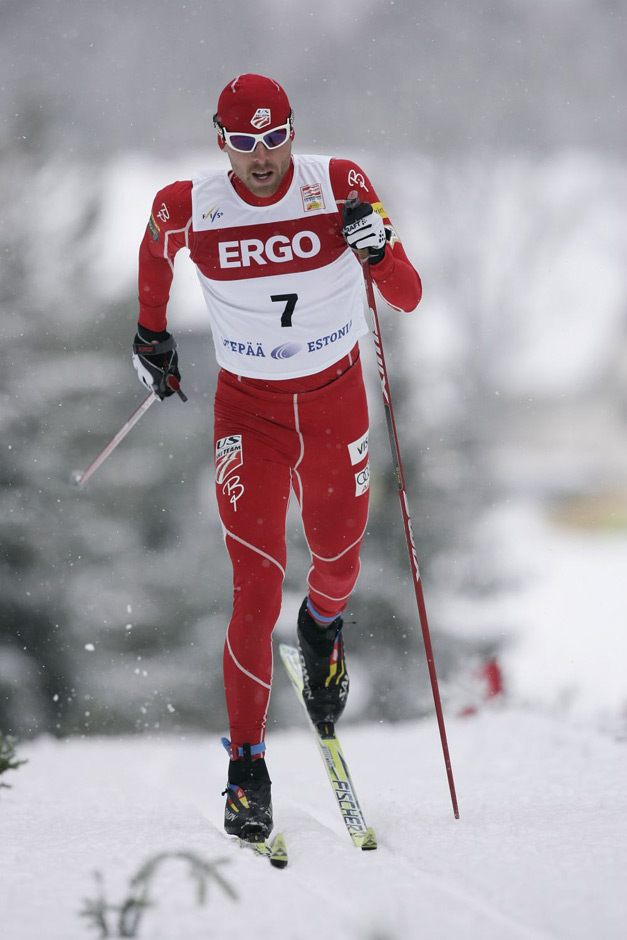
Andy Newell racing in late 2009. (Photo: Fischer/NordicFocus)
His other two World Cup podiums came when he placed second in a 2008 skate sprint in Lahti, Finland, and third in a 2010 classic sprint in Drammen, Norway. In four Olympics, Newell achieved two individual top 20s in skate sprints (16th in 2006 and 18th in 2014), and ninth in the freestyle team sprint at the 2010 Olympics in Vancouver, B.C.
In PyeongChang this past February, he raced to 37th in the classic sprint and 14th with the men’s 4 x 10-kilometer relay. Reflecting on those Olympics, Newell said he was personally disappointed with his results, but thrilled to be a part of history with his team.
“I felt like I had put in the time, time and effort and preparation to race better than I did,” he said. “But at the same time, we created such a great, tight unit and team throughout the last four years that for me, it was just so great to be there, to be there on the day that Jessie [Diggins] and Kikkan [Randall] won a gold medal. … Even though I didn’t ski my best, it was still, to me, in a lot of ways a success to be there; it’s been a successful year in that respect.”
‘A Little Bit of a Guinea Pig’
Asked how the sport, specifically sprinting, has changed over the years, he said it’s been gradual but noticeable. Moreover, his ability and willingness to adapt is what has kept him in it this long.
“If you were to look back on a World Cup sprint from 2005, the technique would look a lot different than it does now,” he said. “Many of the courses are the same, some are a little longer now than maybe what you would see back in the early 2000s for sprinting, but I think, in order to be competitive then, and also still competitive now, I’ve had to try to adapt as best as I can, and always be willing to learn new things.
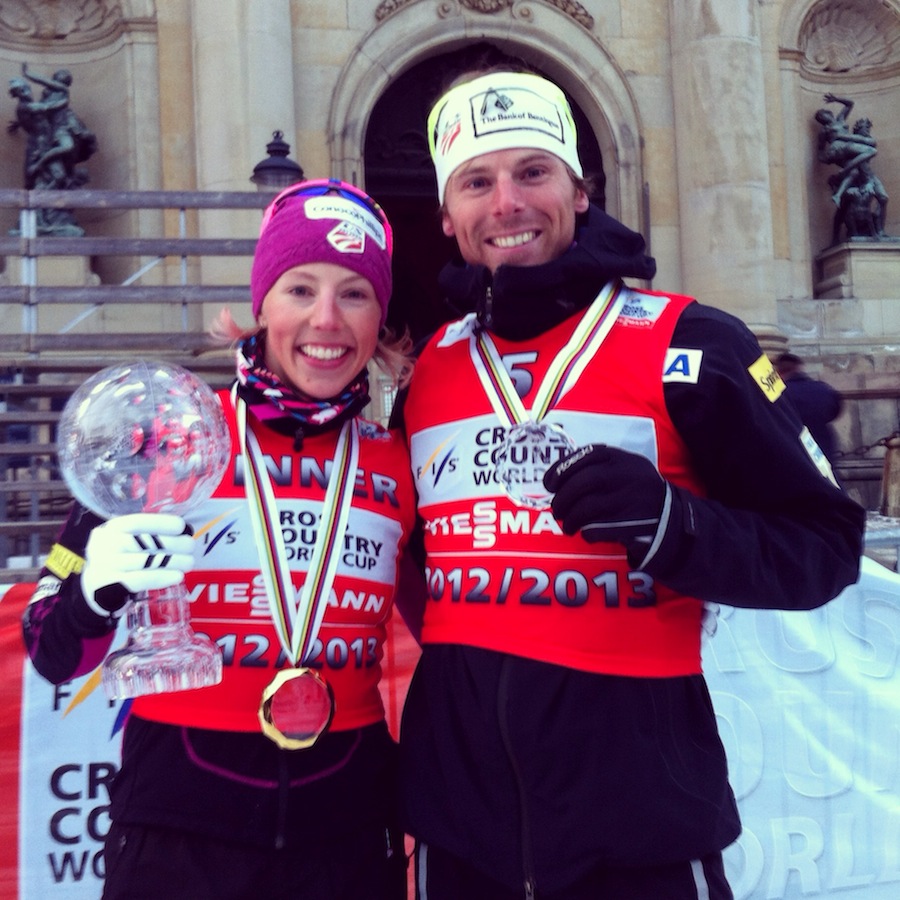
Fifth in the 2012/2013 Sprint World Cup, Andy Newell (r) with women’s Sprint World Cup winner and fellow U.S. Ski Team member Kikkan Randall at 2013 World Cup Finals in Drammen, Norway. (Courtesy photo)
“I think if I would have assumed I was doing everything right or couldn’t improve, then I would have definitely been left behind I think years and years and years ago,” Newell continued. “I think people like Kikkan have done a really good job of that, and something that I’ve really tried to do, too, over the years, is always being willing to learn something new and not really have an ego about your shortcomings as an athlete.”
He explained that a consistent theme of his career was his willingness to venture into unchartered waters when it came to training.
“I’ve been a little bit of a guinea pig for the U.S. Ski Team in a lot of ways,” Newell said with a laugh. “I was probably the first athlete to go over and race an entire World Cup season. They hadn’t done that before we started scoring those kind of World Cup points in the mid-2000s, so it was like, how do we create a training plan that’s going to allow us to be successful at World Championships but also still race an entire World Cup season? So it’s been a great learning process for me and also I think the coaches over the last 20 years.”
Over the last two decades, Newell said he’s mainly worked with Chris Grover, the current U.S. Ski Team head coach, and more recently, USST Assistant Coach Jason Cork.
“Chris Grover wrote my training plans for probably the majority of my career,” Newell explained. “In the last four years or so, I started to work more with Jason Cork and also myself, I do a lot of the writing myself.
“I think I’m someone who likes to be a student of the craft of what I’m working on; I think I’ve always been like that,” he continued. “When a coach tells you to do something, you’re always kind of like, OK, but I would always want to ask why we do a certain workout the way we do and how it builds … I’ve just liked to learn about training principles over the years, and so as I’ve gotten older, I’ve gotten more involved in writing, going over training plans myself, and incorporating ideas and workouts that I want to do. And I’ve done a lot of dumb, crazy stuff over the years, too.”
Andy Newell celebrating the end of the 2012/2013 season with some acrobatics in Falun, Sweden. (Photo: Adam Alexander Johansson, XHC)
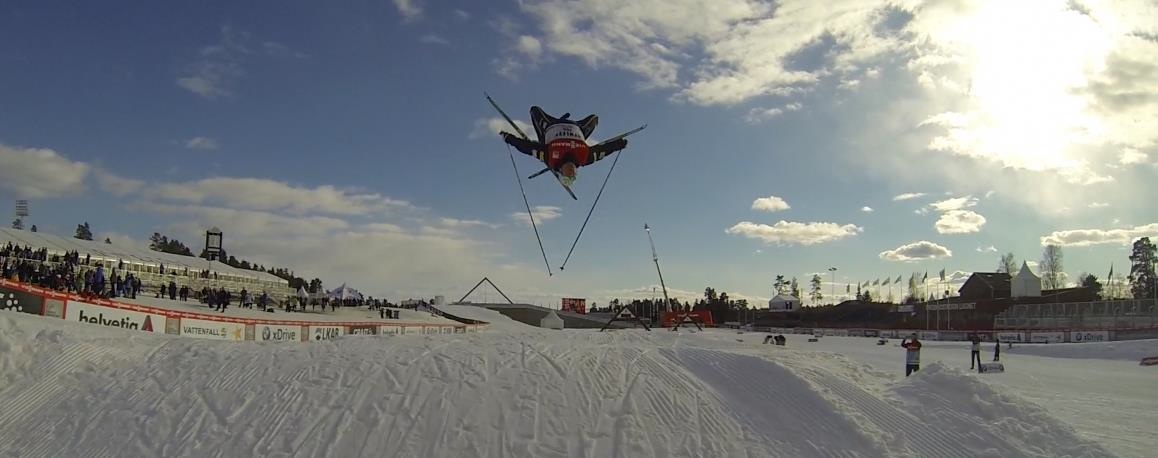
Newell may be best remembered for his extreme stunts on ‘X Ski Films’, a filmmaking company he owned and starred in for several years, which included backflips and other airborne tricks on cross-country skis.
He’s also spent the last two decades training out of Stratton with three main coaches: Sverre Caldwell, Gus Kaeding, and most recently, Pat O’Brien, head coach of the SMS T2 Team. Newell met Flowers on that team, and while he won’t be a full-fledged member of SMS T2 this year, Newell said he’s looking to maintain a strong relationships with both Stratton and the U.S. Ski Team.
“In some ways I don’t think it feels like I’m retiring because I’ve kind of always had such a passion for pushing the level of skiing forward in this country,” he said. “And for me as an athlete, that was the best way I could do that, and I know as I transition into different roles in the skiing community, my goal [is] to continue hoping to improve the level of skiing in this country and improve the professionalism of skiing in this country and inspiring the youth skiing movement in this country — all those goals that I had as a ski racer — I will continue to have as a coach or a team leader or whatever my next role is going to be.
“I’d like to work with development as far as helping some younger kids out, so I’m going to try to look for opportunities where I can do that,” he added. “I think it’s kind of a natural transition from athlete to coach in a lot of ways, but I’m still very much going to be an athlete at least in the near future.”
Looking back on his years with the national team, he likened it to the pride one would have in a college or university they graduated from.
“I’m just really proud of my time that I’ve spent with the team and so grateful for all of the opportunities that the U.S. Ski Team has given me over the past two decades,” he said. “It’s probably the same way that people who go to universities and so forth feel about having that kind of pride for their alma mater. I never went to college so it’s like the U.S. Ski Team kind of scooped me up at 16, 17 years old. Everything that has built me up into the kind of person that I am now, that has molded me into my character, everything has more or less has come through the U.S. Ski Team.”
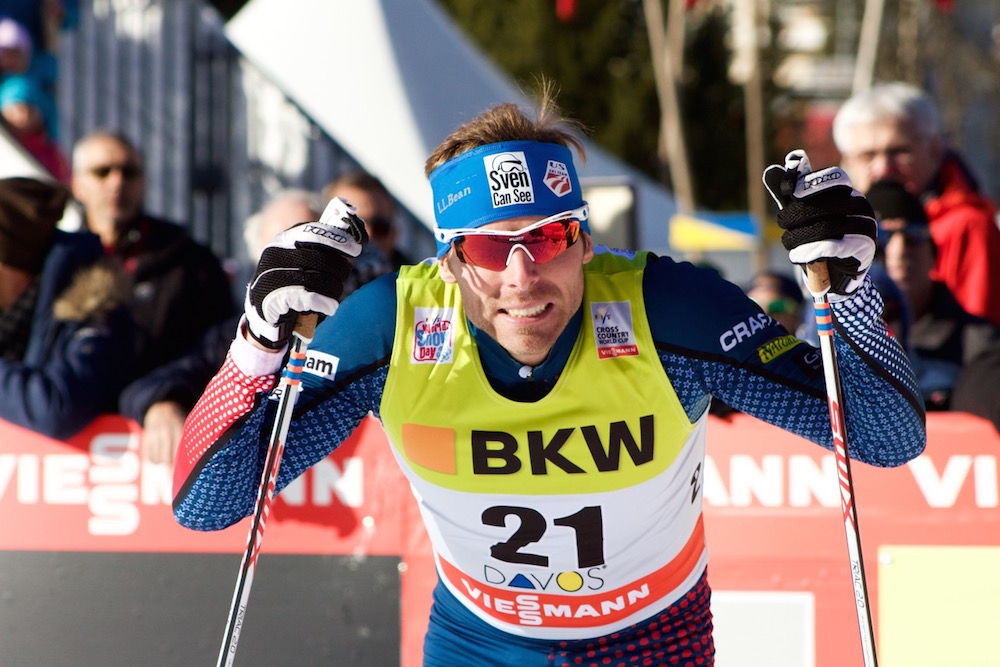
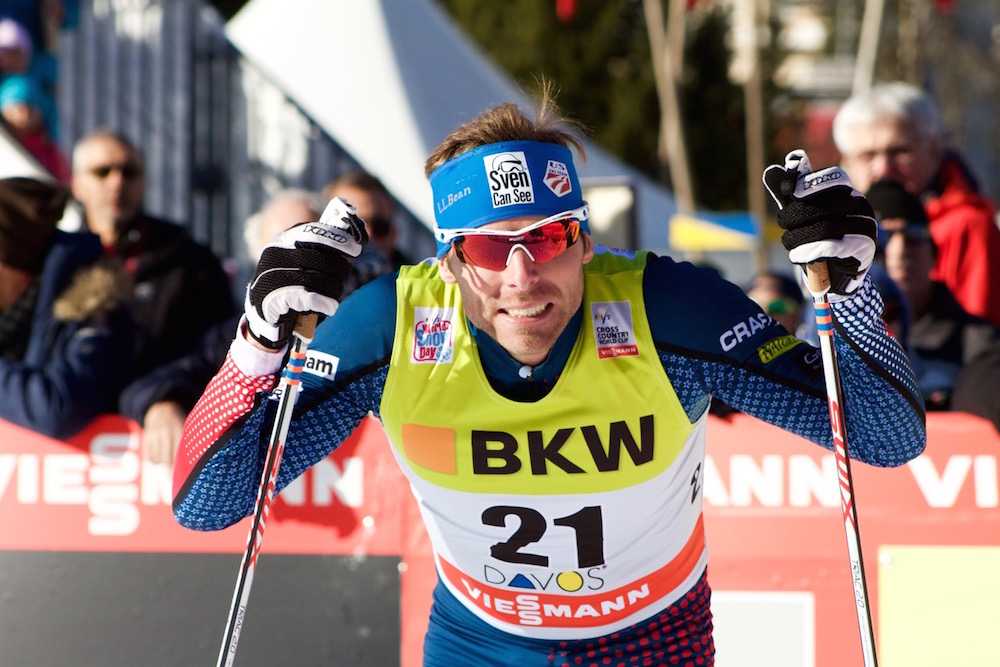
Andy Newell (U.S. Ski Team) after his quarterfinal at a 2015 World Cup freestyle sprint in Davos, Switzerland. (Photo: JoJo Baldus)
Is he nervous about going out on his own? Newell said it’s been a long time coming, and he’s more excited than anything.
“The spring’s always a funny time because you’re pretty exhausted from the season,” he said. “In a lot of ways, kind of the last thing you want to think about is skiing, but for me, I’ve always been one of those people that in the springtime gets super excited about all the opportunities. … By April 1, I [would be] already thinking, ‘Oh, what can I do for training next year?’ … and I start throwing around all these crazy ideas. I think that’s one of the things that’s kept me in the sport for so long, is having that excitement around training and preparation.
“I think it will be exciting in a lot of ways to try to be my own boss and do some of the training camps I want to do and partner up and train with some of the athletes that I want to train with,” he said of this spring and summer. “Not that I was ever held back by the U.S. Ski Team, but you definitely had to adhere to a certain schedule so I think it will be exciting to do some different things.”
From Sprints to Marathons?
In late January 2016, shortly before Newell spoke with FasterSkier about mulling retirement, or at least taking a step back from full-time ski racing, he double poled his way to second place in the 42-kilometer Dolomitenlauf classic marathon (part of the FIS Marathon Cup series) in Lienz, Austria. Never one to like being labeled a “sprint specialist”, Newell is looking forward to trying more marathon races like that.
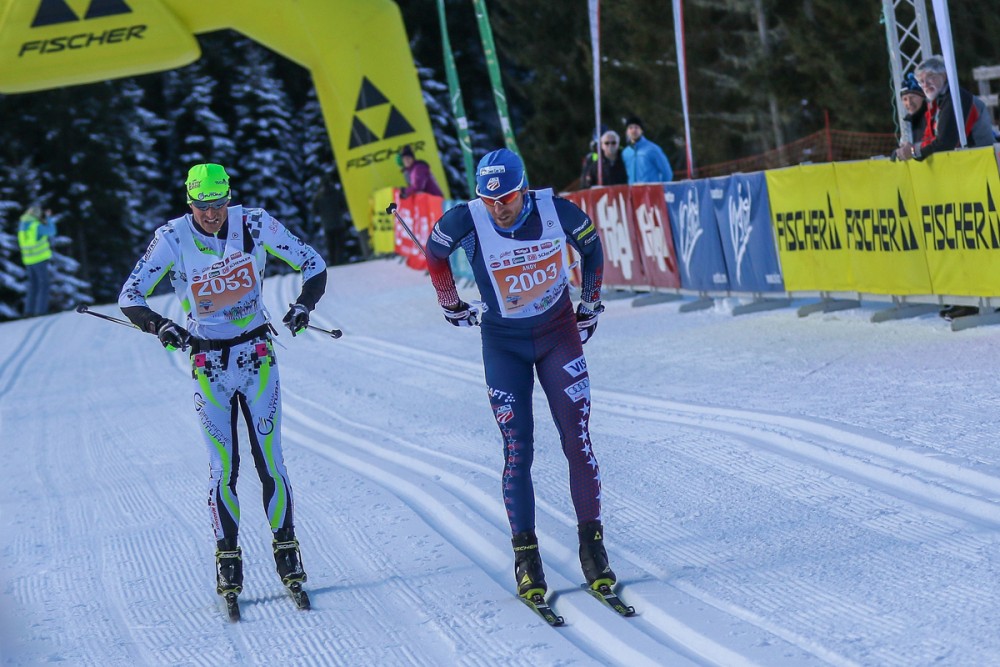
American Andy Newell (r) outsprints Italy’s Mauro Brigadoi, for second place in the 2016 Dolomitenlauf 42 k classic race in Lienz, Austria. (Photo: Fischer/NordicFocus)
“I have a lot of great friends who train for the Ski Classics [marathon series] and a lot of my Norwegian buddies who I have raced World Cups with over the years have gone that route after their World Cup racing career,” he said. “It’s a cool idea because those races are super fun, there’s great prize money, there’s a lot of excitement over them, and I think it’s really impressive when you see somebody just crush 90 k’s of double poling like they do in the Vasaloppet.
“So I’m definitely inspired by those guys and I, as an athlete, really like classic skiing,” he continued. “I love traditional-style classic skiing and I like double poling, so I think maybe in the future I will try to get into a few of those races, but it’s hard to do those and not be committed 100 percent because those guys that do those, they’re training to crush double pole like nobody’s business, so it’s hard to just show up on a weekend and race one of those races.”
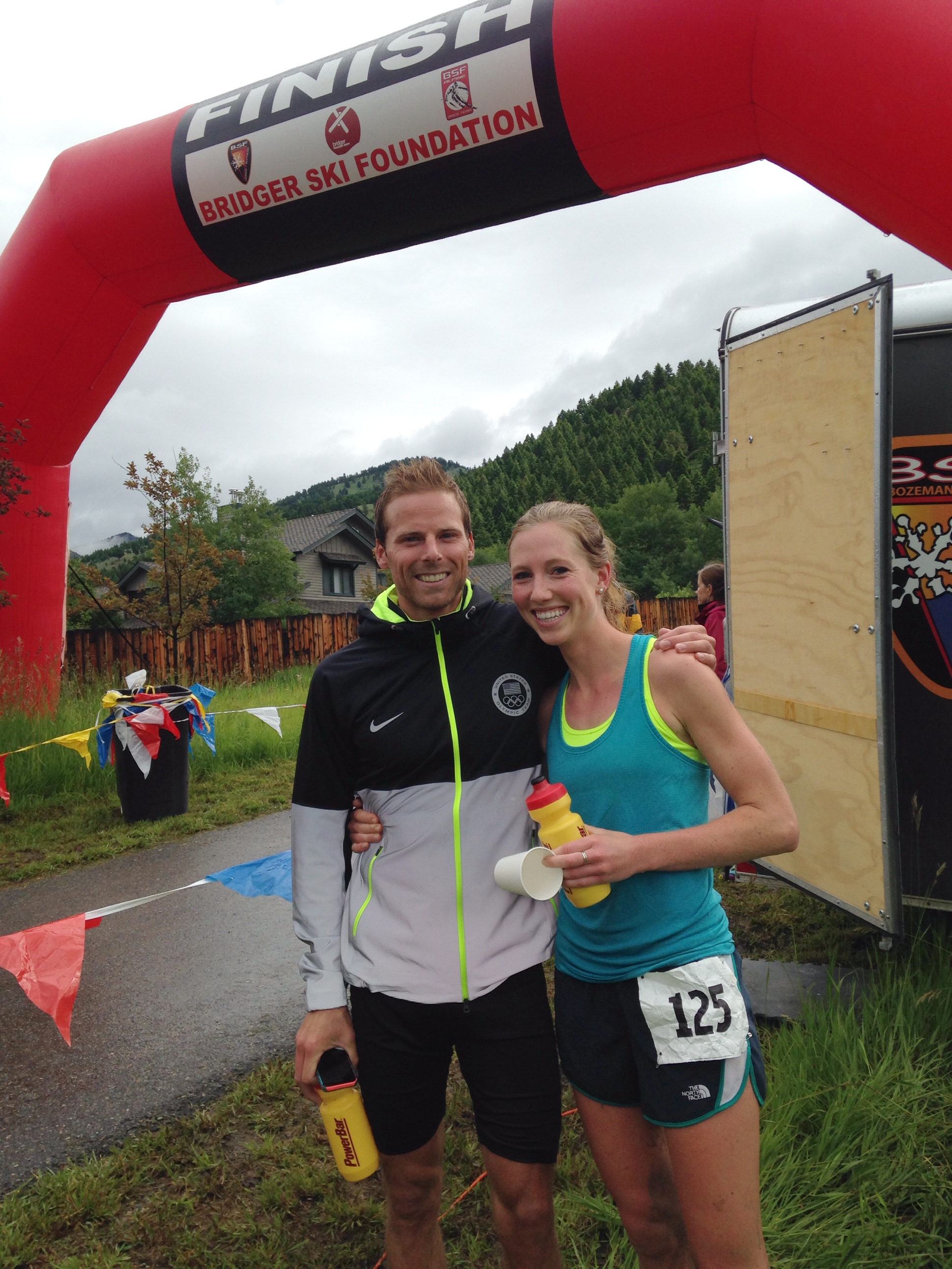
Andy Newell and Erika Flowers, both of the Stratton Mountain T2 Elite Team, after both won the 2014 Jim Bridger Trail Run in Bozeman, Montana.
Aside from the fitness required to double pole an entire marathon, the logistics of these races — many of which start in one town and end in another — is particularly challenging without a full-support crew or team.
“I’d really like to do the [Norwegian] Birkebeiner and I think it will take a few times to be able to consider yourself a threat to the podium in a race like that,” Newell said. “I would be foolish to think I could just jump into a Ski Classics race and crush it, but it’s definitely a goal of mine to maybe do some of those over the next years because I think they’re such legendary, badass ski races.”
In the near future, Newell and Flowers are headed out on a three-week “surf trip” to Australia and Indonesia.
After that, “it’s yet to be seen how everything will fit in,” Newell said in regards to his future plans, both living, training, racing, and otherwise. “There will be more to say later as far as what I have going on for next year as far as what my goals will be.”
The Stratton Mountain School (SMS) in Stratton, Vt., is looking for a coach to help with their junior program this winter.
Coach will work with SMS Nordic staff and junior team. Job will start in early November and run through late March. We are looking for an energetic person who enjoys working with high school age skiers. We have the flexibility to tweak the job to fit applicants strengths. Attitude, knowledge of sport and waxing are important.
The Stratton Mountain School Elite Team is hosting 2 clinics
Sunday August 21 at Stratton Mountain School
Sunday September 25 in Hanover, NH
Come rub shoulders with Olympic athletes and celebrate cross-country skiing!
Both clinics start with instruction and training and end with a video presentation and a question and answer period with the team. Everyone should bring running clothes, bounding poles and a change of clothes.
Clinics will run from 2:30-4:30 pm. There is no charge for the clinics. The team mission statement is “International Excellence, Local Inspiration” and this is our way of giving back to the community that supports us.
For more information on the Stratton clinic, contact Sverre: scaldwell@gosms.org
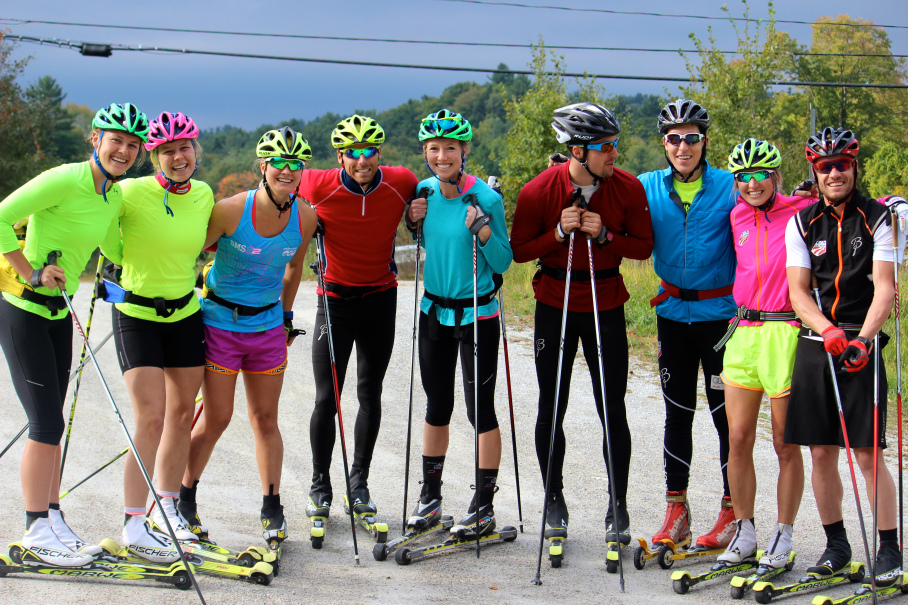
(From left to right) BSF skiers Silas Talbot, Jennie Bender, Paul Everett, Logan Diekmann, and Max LaChance during a rollerski in Bozeman, Mont. (Photo: Austin Caldwell)
The pale wood grain of a wax trailer’s interior walls and the sound of a power-tool firing up can only hold one’s attention for so long, especially if that someone has the coaching gene. As the grandson of John Caldwell, a former U.S. Ski Team (USST) head coach, and son of Sverre Caldwell, the Stratton Mountain School (SMS) nordic director and head coach, it may be no surprise that John — who goes by his middle name of Austin — Caldwell, also heard the call to coach.
After spending this past winter working for Caldwell Sport as a wax technician, Austin, a 24-year-old Dartmouth grad, wanted a challenge and change. Not only in his work, to include a greater focus on interactions with athletes, but in his whereabouts as well.
“I really enjoyed working with Zach and Amy [Caldwell] wax-teching last year,” Austin said on the phone while in Bozeman, Mont. “But part of me wanted to spread my wings a bit and try some new place outside of the east and outside of Vermont where I’ve lived all my life.”
Austin, Sophie and Isabel Caldwell (l-r) during their Christmas visit to Europe in 2013 to see Sophie race on the World Cup circuit. (Photo: Sophie Caldwell/sophiecaldwell.blogspot.com)
Growing up in Peru, Vt., alongside his two sisters Isabel and Sophie Caldwell (the latter of which is a USST member), skiing was not just what Austin spent his spare time doing. It was the family mealtime topic of choice; it was how vacations were spent with relatives — his uncle Tim Caldwell, a four-time Olympian, and cousins are all avid nordic skiers as well.
Surrounded by skiing his entire life, Austin did not want to give it up anytime soon. When the head coaching position for the Bridger Ski Foundation (BSF) elite nordic program opened up and his cousin, Anya Caldwell-Bean, BSF’s U18/U20 junior coach, told him of the opening, he saw an opportunity to not only stay involved with skiing, but further himself and his experiences in it.
“I loved wax-teching last year, that was really fun, but I also enjoyed coaching in the past for junior skiers,” Austin said. “My dad is a coach and I’ve always been interested in coaching … so now I get to coach and wax tech.”
Stepping into his new role and responsibilities as the head coach for the BSF elite team — his first coaching position of this caliber — Austin is aware of the challenges that rest ahead for himself and his athletes. Prior to this year, his work with athletes involved coaching juniors last year in Putney, Vt., and at SMS youth summer camps over the past five years.
“I have gained most of my understanding of coaching from my relationships with Sverre, Ruff Patterson, and Zach and Amy Caldwell,” Austin wrote in an email, referring to his father, college coach, and first cousin once removed (and his wife), respectively. “Those four have been great mentors and in the process they have taught me almost everything I know about skiing.”
Bridger Ski Foundation (BSF) 2016/2017 Roster:
Elite Team Jennie Bender
Silas Talbot
Nick Power
PG/Collegiate
Paul Everett
Max LaChance
Nick Matelich Summer Collegiate
Noah Anderson
Logan Diekmann
Currently eight athletes will work with him during the summer and throughout the season. Three athletes, Jennie Bender, Silas Talbot and Nick Power comprise the elite team, and five others make up the post-graduate crew, with a few of them heading to college in the fall and being replaced with new post grads for the upcoming school year.
“We’ll have some kids taking classes and then partway through the winter, people will be going different ways depending on how they do [during the season],” Austin explained. “So that will be, as far as managing at that point, that will be one of the bigger challenges.
“But I think it’s something all teams face,” he added. “Just having kids at different levels and different age groups as well.”
On a personal level, Austin admits one of his biggest adjustments so far has been learning Bozeman’s trails and rollerskiing roads, as well as not getting the team or team van lost in Montana’s mountains.
“For me, I guess the biggest challenge that everyone has been helping me with is finding my way around Bozeman and finding new routes for rollerskiing,” Austin said. “Every week I’ve been trying kind of to add a new place to rollerski … because it’s important to switch it up.”
“I plan on staying in the ski world for as long as I can, so far BSF and Bozeman have been great and I plan on remaining here for the coming years.” — Austin Caldwell on becoming BSF’s elite head coach
But even if navigating Bozeman has been a bit of a learning process during the beginning stages of his coaching career, the city and a well-established elite program were two of the draws that pulled Austin to apply and eventually take the position.
“Having a strong program in place and being in Bozeman were the two main factors [why I considered working with BSF],” Austin said. “I also talked with Dragan [Danevski, BSF’s head coach and program director] and with my cousin Anya and it just seemed like it would be a good fit.”
With the goal to remain involved with skiing for as long as possible, Bozeman and BSF struck Austin as the ideal program and place to be a part of.
“I plan on staying in the ski world for as long as I can, so far BSF and Bozeman have been great and I plan on remaining here for the coming years,” he wrote in an email.
Danevski respectfully declined to comment on Austin’s hiring. In the last two years, the BSF elite team has weathered several coaching transitions, most recently with the departure of Bernie Nelson — the team’s coach since the fall of 2014.
In his first season as an elite head coach and with eight athletes to oversee, his greatest ambition involves pushing his athletes to their full potential. Talbot, 23, Austin’s former classmate, co-captain and fraternity brother at Dartmouth College, and now an athlete for the BSF elite team, saw the transition to having Austin as a coach as uniquely strong.
“For myself, it has been hugely beneficial to have Austin coaching because he knows my athletic background so well,” Talbot, originally from Anchorage, Alaska, wrote in an email. “He already knows my strengths and weaknesses (which are especially prevalent in the dryland season), and so there is no need to build up the trust and/or understanding between us from scratch. In short, having someone I know well as a coach makes the adjustment to the new program — something that for many after college is a tough step — much easier.”
Bridger Ski Foundation elite and post-graduate athletes during a classic rollerski in Bozeman, Mont. From left to right: Max LaChance, Nick Power, Logan Diekmann, and Silas Talbot. (Photo: Austin Caldwell)
Entering her fourth year on the BSF elite team, Bender also found Austin a positive addition to BSF and the greater Bozeman area.
“Austin waxed for me during the last few World Cups at the Canadian Tour this past March, and I was instantly impressed with his professionalism,” Bender wrote in an email. “Austin taking the head Elite/PG coach position is a great attribution to not only BSF, but to the Bozeman ski community as a whole.”
So far, Austin too, cannot ask more of his athletes and training group. The higher level of focus and preparation he finds evident with the BSF elite and PG level athletes gives him confidence in the season and performances to come.
“I think the key to success is having a group that motivates each other and pushes each other,” Austin said. “And I’m very excited about this training group we have going into the summer. They’re all working very hard and they’ve come together really well. It’s like they’ve been training together a lot longer than three weeks … everyone in this group is always trying to push the limits and do everything they can do to get better.”
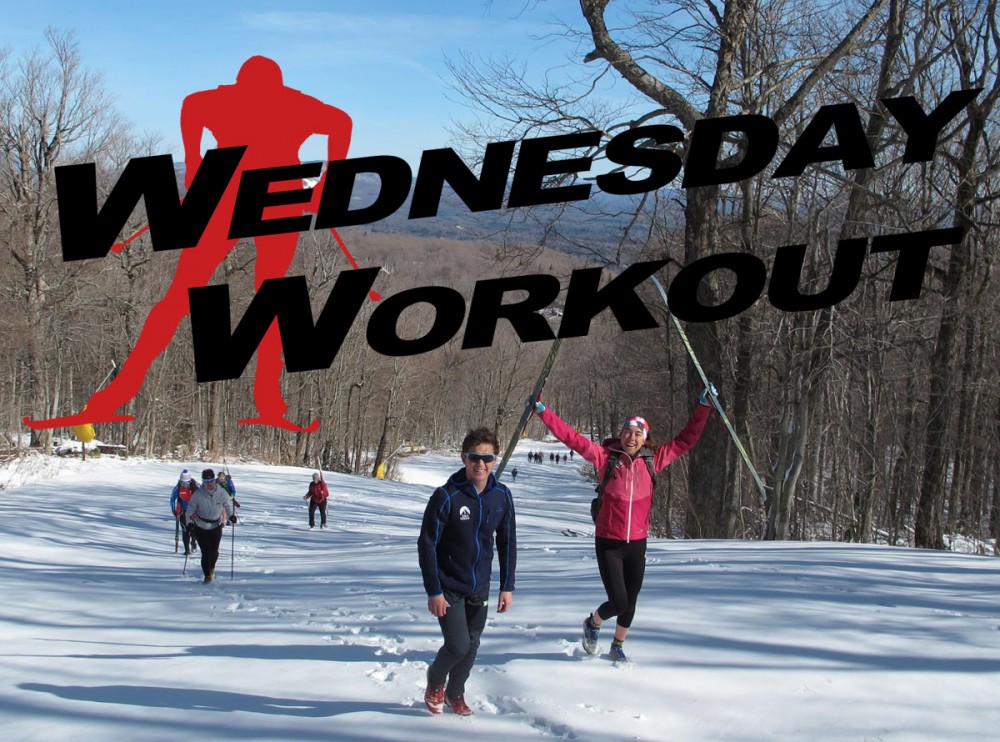
Katherine Ogden of the Stratton Mountain School and USST waves to the crowds during a hike-and-shred workout up and down the local ski hill. (Photo: Sverre Caldwell)
Perspective is a good thing. Maintaining it is tough in endurance sports where training plans and hours logged are emphasized. It’s a numeric puzzle, a physiological puzzle and a psychological puzzle. All that requires basic fun from time to time.
Katherine Ogden, 18, hails from Landgrove, Vt. FasterSkier’s two-time Junior of the Year, Ogden is a day student at the Stratton Mountain School and was named to the U.S. Ski Team development squad last season. Asked about her favorite spring workout to keep it fun and real, she says find a mountain.
“The basic plan is we start at the bottom of a ski mountain (for us it’s Stratton Mountain) wearing running shoes and carrying a backpack containing ski boots. we then try to strap our skis to the backpack for the hike up,” Ogden wrote in an email. “We then hike up the mountain which usually takes around 30-45 minutes for Stratton. This is generally level one unless you are a very enthusiastic hiker.”
Ogden recommends packing skate boots for the descent. Although on alpine ski trails, the descent requires good ankle support and places a premium on fear control and gear integrity — those pricey poles are easy to snap.
“What ensues is a harrowing adventure of norpineing (nordic alpine),” she explained. “This workout is good for the spring because it’s not very taxing training wise but it’s a lot of fun and a good way to work on agility and downhill confidence.”
The Workout:
– Find your local ski hill, preferably one closed for the season or at least void of gravity slaves.
– Wear comfy shoes. For the Stratton Mountain School crew we are talking sneakers.
– Defy gravity by hiking up. It’s a Level 1 workout so it’s OK to talk and laugh. (Stratton Mountain’s summit reaches 3,785 in elevation and sports a proud vertical gain, which ultimately becomes a 2,000-foot drop.)
– Swap out sneakers, lace up skate boots, lock into bindings.
– Descend and grin … not always in that order.
Time: depends on the vertical gain and snow conditions upon descent. Allow for extra time if presented with breakable crust.
The training backstory
At only 18 and a senior in high school, Ogden is coming off a breakthrough season. She won the season-opening 10-kilometer freestyle at the SuperTour in West Yellowstone, Mont. Her results earned her a spot representing the U.S. at the Ski Tour Canada, where she posted the 15th fastest time in the final stage, the 10 k classic pursuit in Canmore, Alberta, for 36th overall.
Patrick O’Brien, head coach of the Stratton Mountain School (SMS) T2 elite team, says Ogden’s training is not unique.
“Katharine’s training is not anything different from what the rest of the students in the program do. The difference is she came in as an eighth grader so there is continuity,” he said. “And basically she is on track for about I think about 500 hours this year, as a high school senior which is not abnormally high.
“The important thing to understand is that is that there is continuity year to year with the train there is an incremental increase in hours and the load that she has,” O’Brien continued. “It’s easy to say OK, this keeps you on track with where you need to be developmentally and it’s easy to monitor. If you add a hundred hours to someone’s training and then they don’t ski well, you don’t know if that’s because they are overtrained, or the jump was wrong. It puts you into a pattern that you don’t know how to respond from there.”
Sverre Caldwell, Stratton’s nordic director, is no stranger to talented skiers and managing their progression. (He’s the father of U.S. Ski Team A-team member Sophie Caldwell.) He began working with Ogden in eighth grade.
“For eighth graders, we just have them train as a group and see how they react to it and not really on a plan,” Sverre Caldwell said. “We see what they can take and really go by feel. She could train a lot without getting too tired, so in ninth grade she got a plan.”
He recalls that plan being around 400 hours. Ogden tolerated the load and skied well. That lead to a slight increase in hours the next year.
“We tweak everyone, but I think our training is kind of conservative,” he explained. “I don’t want to push anyone too hard and have them blow up. It’s all just built on let’s start here and if that goes well then we can take the next step up and take the next step up. It’s patience. I believe to be a really good skier you have to train eight or ten years , you better enjoy it and you better just progress along and learn as much as you can.”
Annie Pokorny racing to 33rd in the 10 k classic at the 2014 U23 World Championships in Val di Fiemme, Italy. (Photo: Flyingpointroad.com/NNF)
This week, the top collegiate cross-country skiers in the U.S. converged in Steamboat Springs, Colo., to wrap up the season at the NCAA Skiing Championships, which begin Thursday with the 5/10-kilometer freestyle individual starts and wrap up Saturday with the 15/20 k classic mass starts. One Middlebury skier has the unique opportunity to be reimmersed in the collegiate circuit after a glimpse at post-collegiate skiing and will race for the NCAA podium with a different appreciation for collegiate competition.
Annie Pokorny, 23, returned to the collegiate racing circuit this season after a two-year hiatus while training and racing with the Stratton Mountain School T2 Team. Although this is a rare progression, it was a path that has allowed her a different depth of experience in the sport.
Skiing for Middlebury College, Pokorny had a breakthrough season in 2013 as a sophomore where she netted two top-10 finishes at U.S. nationals in Midway, Utah, and finished in the top 30 twice at U23 World Championships in Liberec, Czech Republic. The season reflected a huge improvement over the previous year where she finished 47th in the 10 k freestyle at U.S. nationals.
Although most collegiate skiers who continue onto the professional level exhaust their eligibility before moving on, Pokorny wanted take the sport to the next level sooner rather than later. In the spring of 2013, the Spokane, Wash., native made the difficult-but-measured decision to join the SMST2 team based out of Stratton, Vt. Pokorny was excited to be a part of the culture of success SMST2 built and join World Cup-level skiers such as Jessie Diggins and Sophie Caldwell. She also knew the opportunity might not present itself in another two years after she graduated and wanted to capitalize on her momentum by training and racing full time.
Annie Pokorny (SMST2) at the top of the coach’s climb during a training day before the December 2015 SuperTour in Sun Valley, Idaho.
While training and racing with SMST2, Pokorny continued to take classes at Middlebury and balanced coursework with an international race schedule. She would take the fall semester off when training volume was high and take classes full time in the spring.
“The logistics have certainly been complicated, coordinating with professors to miss multiple weeks or months of class by Skyping into lectures (an idea inspired by Sadie Bjornsen), writing additional essays and navigating the black hole that is European village internet,” Pokorny wrote in an email. “However, I got to take advantage of the international racing available to me; finding balance never felt like a sacrifice.”
While Pokorny has posted solid results the past two seasons with SMST2, another breakthrough season proved elusive. With both her skiing and academic goals in mind, Pokorny made another pivitol decision — to return to college racing.
“I decided to return to college racing because it gave me the chance to have six weeks of consistent, competitive, comped racing while also allowing me the structure to take a full course load and graduate in the spring,” she explained.
However, the process of returning to collegiate racing required more than just agreement from her coaches. Because collegiate cross-country skiing is an NCAA sport, athletes must abide by the NCAA amateurism rules and in the eyes of the NCAA, Pokorny was considered a professional athlete while skiing for SMST2.
However, since Pokorny could prove she never made money from racing at SMST2, she was eligible to return to the collegiate circuit after being reinstated as a Middlebury athlete as a senior with junior eligibility. To ensure everything was in order before she put on a Middlebury suit, Pokorny sat out the first two carnival races.
Annie Pokorny (l) with several Stratton Mountain School (SMS) T2 teammates in 2014. (Photo: SMST2 Blog)
Although it was a process, Pokorny said she felt supported in her decision from Middlebury, SMST2 and the ski community.
“Patrick O’Brien and Sverre Caldwell at SMST2 showed an immense amount of support for me returning to collegiate racing, which I’m glad I had before starting the process of returning,” she wrote. “When we knew I had eligibility, the Middlebury program communicated that to the rest of the Eastern Intercollegiate Ski Association (EISA) circuit and I received nothing but support from every coach and competitor.”
Pokorny describes her transition back as “nearly seamless.” In addition to being welcomed back to the team and collegiate racing, being on campus and attending lectures eliminated the stress of remote coursework.
She has also returned as a force on the EISA circuit, winning the 5 k classic pursuit at the Williams Carnival, the 5 k freestyle at Middlebury Carnival, taking second in the 10 k classic at University of Vermont Carnival and earning a berth to NCAA Championships.
“On the skiing side, I think one of the valuable lessons of skiing internationally is that it teaches you a certain flexibility and ability to navigate with new waxing, coaching and racing situations, so everything leading up to the races felt completely normal to me,” she wrote. “The Midd coaches, Andrew Johnson and Patty Ross, have worked to make sure that I felt supported on training and race days while the entire Midd team embraced my return like I was coming home.”
The transition also illuminated the unique and constructive culture of collegiate racing and how it can pave the way for international racing.
“I suppose one way my perspective has changed is that as an older, more experienced racer, I can appreciate the details that make racing NCAA a standout experience,” she explained. “In addition to the team culture and glitter and pride in representing your school, I can better see how what we learn on this circuit can transfer to international racing. The practice in mass starts, for one, and scoring points for and representing something greater than yourself, for another, are two things that will contribute to my racing after I graduate.”
Although it is easy to think that skier development is a linear process, this is rarely, if ever, the case. Pokorny’s grounded thoughts on her journey illustrate this phenomenon. There are lessons that can be taken from every race, from every experience despite if an athlete is aware and open to growth.
“I never considered returning to college racing a step back, but rather a step sideways, onto another incredibly competitive circuit that would contribute to my growth as a skier,” she wrote. “In the past three seasons, I have had some incredible experiences and feel that I have grown as a skier in so many different ways. I would never choose a different path, circuitous as it was.”
SMS athlete Kamran Husain finishes his team’s Vertical Challenge at a recent mini camp in Stratton, Vt., with the fastest overall time. (Photo: Sverre Caldwell/SMSXC.blogspot.com)
When the Stratton Mountain School (SMS) team began its July mini camp this year, its athletes knew the focus was going to be a little different than years past. Rather than focusing on maintaining a low intensity during a high-volume camp, the SMS high-school athletes pushed themselves by going at a relatively high intensity while maintaining a high volume. This year’s Vertical Challenge, which is the pinnacle workout of the mini camp, exemplifies the new approach.
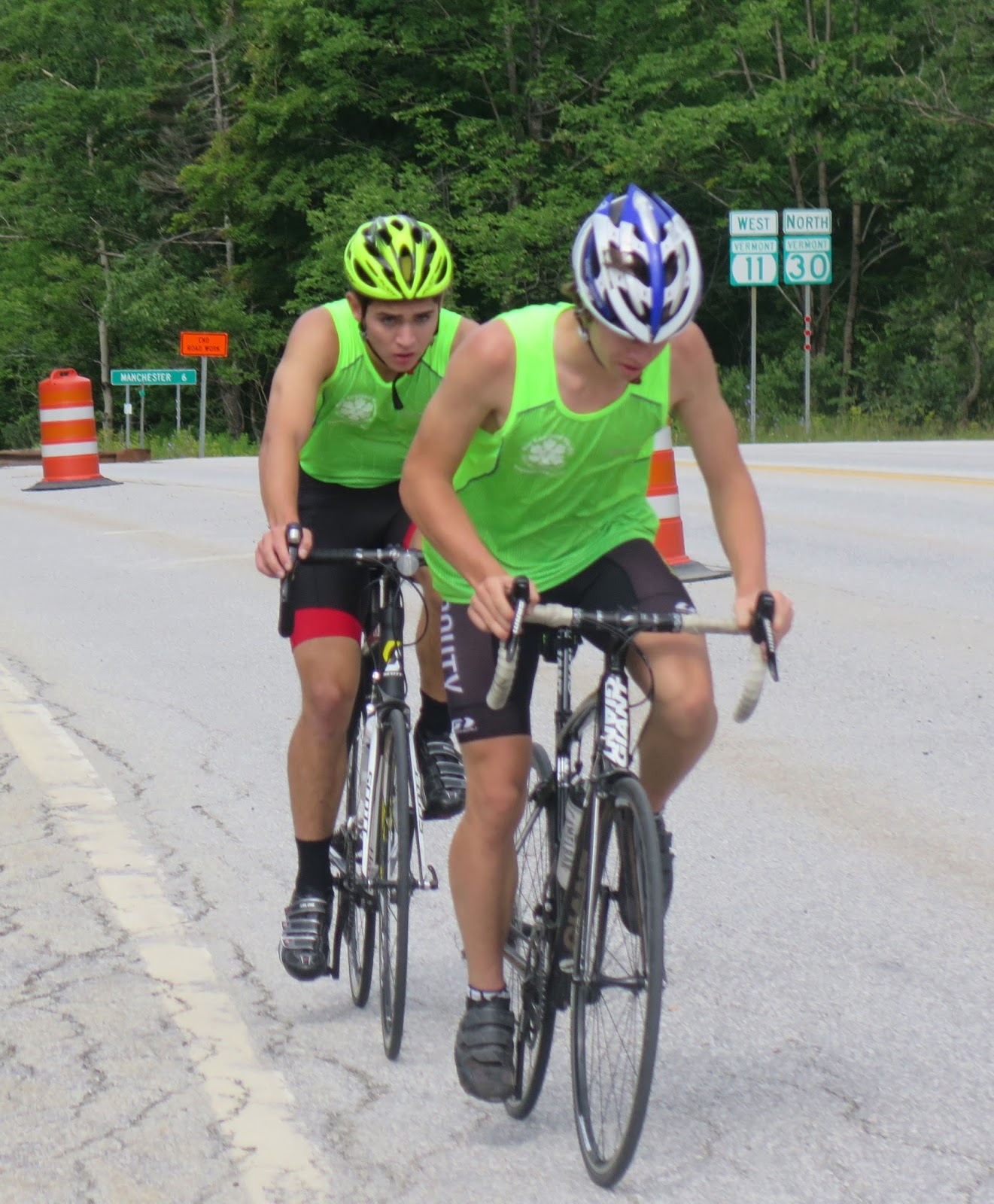
Kamran Husain and Russell Boswell ascend out of Manchester, Vt., on the first leg of the Stratton Mountain School nordic team’s Vertical Challenge on July 15. (Photo: Sverre Caldwellk/smsxc.blogspot.com)
“I think the first time we did it we just said, you know we’ve been doing some combi ODs [over-distance workouts], and we said, let’s do one that’s kind of … gnarly because there is a lot of vertical gain,” SMS Nordic Program Director Sverre Caldwell explained in a phone interview. “We said, we want you to go hard.”
This did not turn the workout — held July 15 — into a full-on race, but it did shift the focus. Athletes started at one-minute intervals and maintained a threshold effort for around two hours. In this case, threshold would be a pace in which one can push themselves but also stay in control enough to keep that pace for a long time.
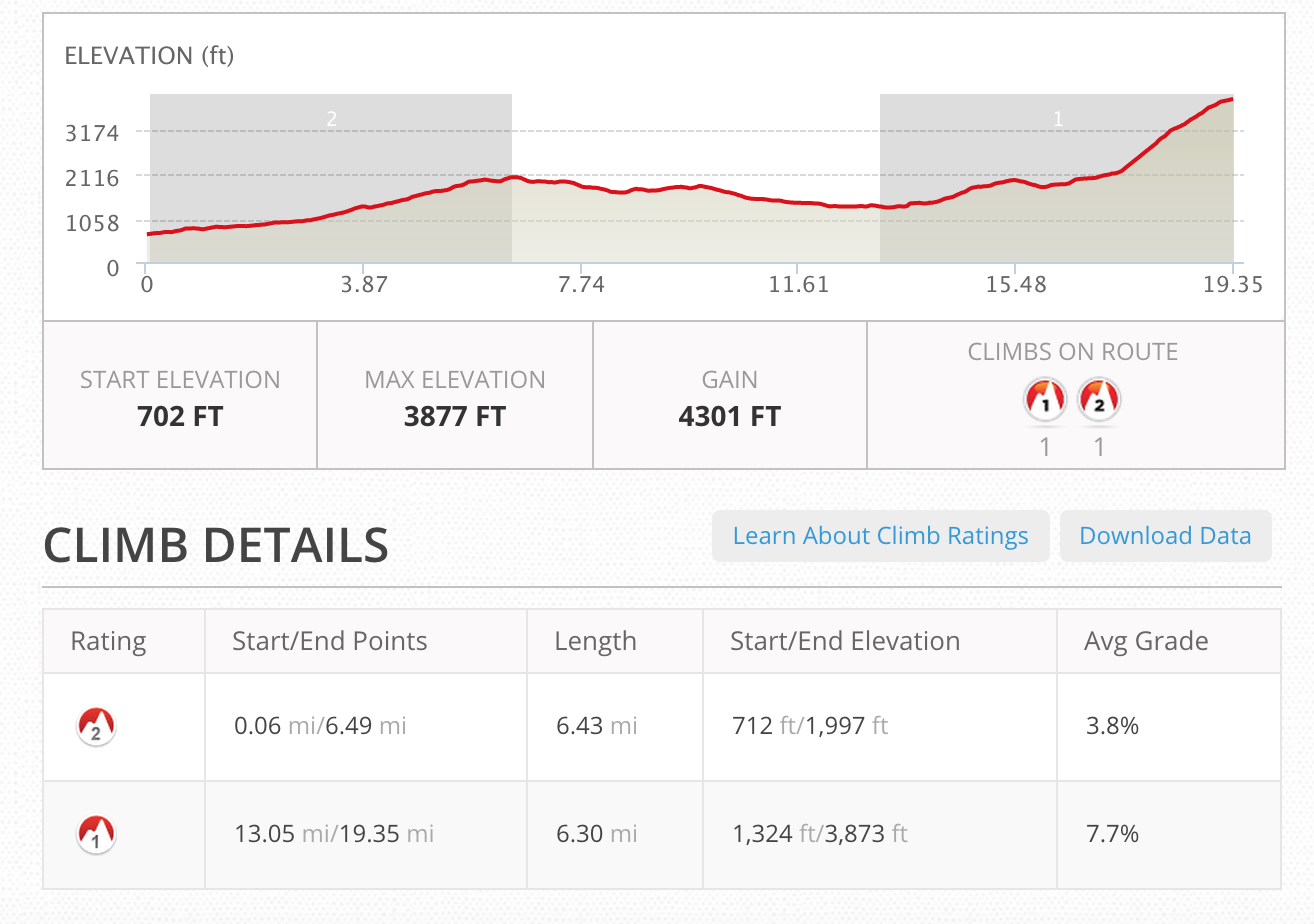
Adding to the difficulty was that the course had a net gain of 3,185 feet, so there was little rest. The workout began in Manchester, Vt., where SMS skiers started climbing on road bikes. After 12.5 miles, they reached Bondville, Vt., where they switched from bikes to rollerskis to ascend the Stratton Mountain access road. After another five miles, contestants made the final change into running shoes before climbing about two miles to the summit of Stratton Mountain. Needless to say, it was a lot of climbing and a lot of threshold.
“The reason we did it was … just to do something that’s hard,” Caldwell said. “That’s much more than you would do in a race or in normal training, to put everything in perspective. Like now, when you have to go out and have go hard for 5 k, it’s pretty easy.”
The goal of the camp and the Vertical Challenge specifically was to push the limits and test the resolve of its athletes. It was also meant to make them feel tough, which that can be difficult to accomplish during low intensity ODs.
As for the SMS athletes, Caldwell said they definitely thought it was tough. They all knew the Vertical Challenge was going to be difficult going in, but they understood what the goals were and were well prepared for the challenge.
“[The increased intensity] made it harder, but not necessarily better or worse. It was just different,” he said. “I think they had a good feeling of accomplishment because you know, when you finish something that’s tougher then you tend to feel a little better about it as long as you pushed hard through it.”
After finishing the workout, the SMS nordic team celebrated with a cookout.
The course profile and some specifics of the Stratton Mountain School nordic team’s Vertical Challenge workout, which it completed on July 15 in Manchester and Stratton, Vt. (Photo: smsxc.blogspot.com)
The Workout
Step 1: Organize
– Find a low point and a high point about 20 miles apart. These will be the start and end points of the workout.
– Decide on transition points from biking to rollerskiing (leaving the bike and putting rollerskis on), and from rollerskiing to running (where you’ll leave your ski boots and lace up your sneakers). Ideally the running and hiking section would be on the steepest terrain, the rollerskiing would be on the next steepest terrain, and the biking would be on the most gradual terrain, though this could vary depending on your area. Someone with a car to carry equipment and extra water and snacks is also very useful for meeting at these transitions.
Step 2: Ascend
– Begin by doing a warmup as if the workout was a 25 k or 50 k ski race.
– Next, start the ascent on the bike at around threshold. Try and maintain this effort throughout the rollerski and the run/hike as well. Because speed isn’t of the utmost importance in this workout, don’t worry if the transitions are a little slow.
– Once you have summited, celebrate by doing a low-intensity warm down before continuing the celebration with some food or even a cookout.
Katharine Ogden nearing the summit of Stratton Mountain during the Stratton Mountain School nordic team’s Vertical Challenge workout on July 15. (Photo: Sverre Caldwell/smsxc.blogspot.com)
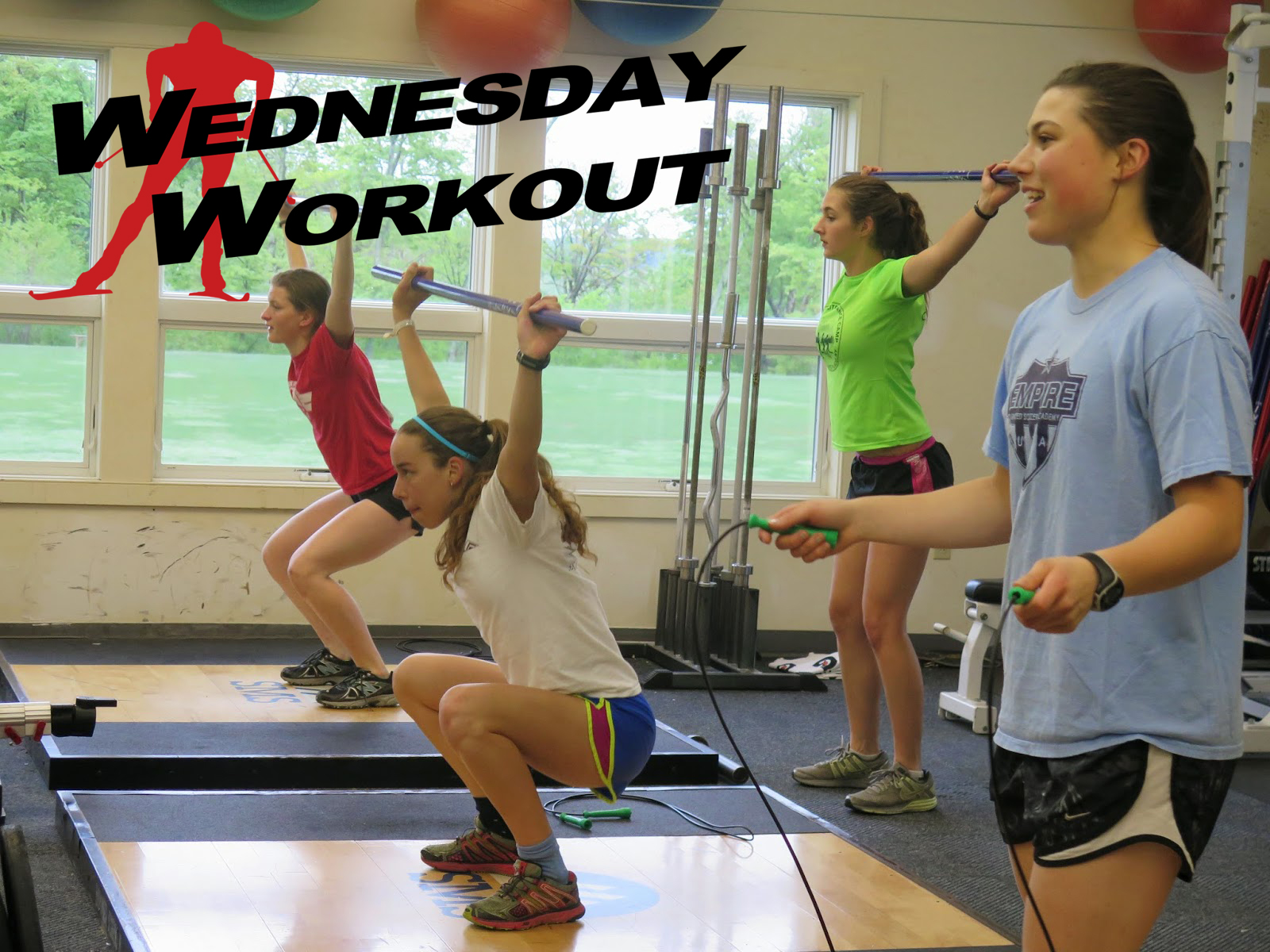
Stratton nordic skiers work on general strength, specifically overhead squats, last summer. From left to right: Mackenzie Rizio, Katharine Ogden, Tegan Thorley, and Ana Witkowski. (Photo: Sverre Caldwell)
This week’s workout comes from Sverre Caldwell, the nordic program director at the Stratton Mountain School (SMS) in Stratton, Vt., whom the U.S. Ski and Snowboard Association (USSA) recently named Cross Country Domestic Coach of the Year. Here, Caldwell shares a typical day in the life of a Stratton athlete in May, when the academy is getting back into the swing of training.
***
Two-a-days:
“At SMS we use May as a period to build some general strength and lay a foundation down for great summer training,” Caldwell explained in an email. “Our Wednesday class schedule gives us two training blocks; one from 11-12 p.m. and the other from 3:30-6 pm.”
Morning session: General strength
“During the morning session we go to the weight room, do a short spin warm up and then some general strength,” he continued. “At this time of year our strength consists of a 15-minute warm up (spin, jump rope, sumo squats, inch worms, etc..) followed by our strength routine, then core.
“We usually choose 3 leg, 3 upper body and several core/balance/stability exercises. We will do two rounds/sets. Early in the spring we use very little weight, going for the proper movement and high repetitions. We slowly add weight and lower the repetitions, but never throw heavy weights around.”
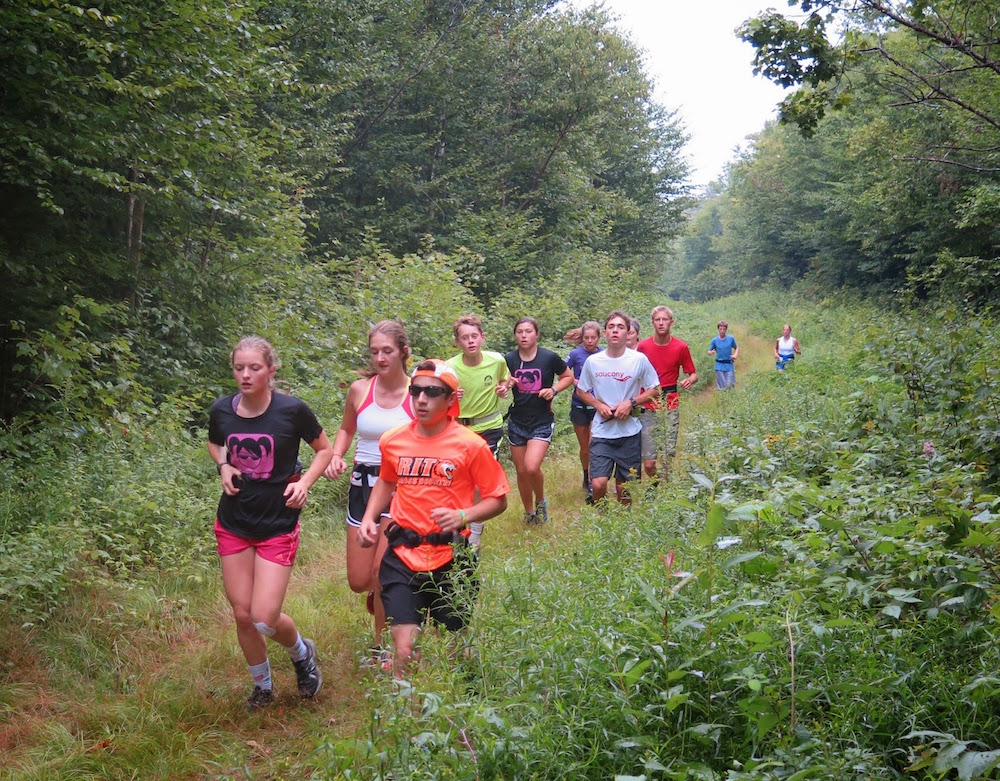
Mackenzie Rizio (l) and Mid-Atlantic skier Adam Marino (r) lead Stratton skiers on a trail run last summer during a training camp. (Photo: Sverre Caldwell)
Afternoon session: Easy distance
Trail running and biking are two early season favorites at Stratton, according to Caldwell.
“Our goal is to build up through the spring so we can do a team 100-mile bike and an 11-mile trail run/race in early June,” he wrote.
“The [Long Trail/Appalachian Trail] goes over Stratton so we have lots of great trail running spots. We love the trail running because it helps build aerobic fitness, agility and coordination.”
Go-to trail run:
From Kelly Stand Road to Stratton Pond and back to school. Most of trail is soft dirt, “but there are enough rocks, short boardwalks and puddles to keep you on you toes,” Caldwell explained.
Length: About 10 miles with rolling terrain, making it easy to run in Level 1 (L1) and low Level 2 (L2).
Time: About 1 1/2 hours
“For base aerobic training, it is important to have a longer, steady effort keeping your heart rate above 120, but at a ‘conversation’ pace,” Caldwell wrote. “General rule of thumb is that you can talk pretty easily in L1, you shorten the sentences in L2 (breathing a bit harder). On the distance days we shoot for staying in L1 for everything except the sustained uphills on which you will drift into L2. If the hill gets steep, we will often break into a ski walk instead of pushing the running.”
What do Matt Whitcomb (USST), Chris Hall (Swix), Sverre Caldwell (SMS), Patrick O’Brien (SMS T2), and the Stratton T2 Team all have in common? Other than being huge contributors to our sport and to our New England Nordic community, they’ll all be at Stratton Mtn. School for the 2015 NENSA Coaching Symposium November 15-16.
Join NENSA for two days in Vermont with presentations from USST Women’s Head Coach, Matt Whitcomb, Swix’s Chris Hall (yeah, there will be swag for all), and the Stratton coaching staff, as well as hands-on work with the elite T2 athletes. This is going to be a very cool weekend. Cost is just $95 for NENSA members.
Sophie Caldwell leads a train of SMST2 skiers during the team’s 100 k rollerski fundraiser. (Photo: SMST2 Blog)
Anne Hart had many thoughts running through her mind last Saturday. At one point all she could think about was barbecue chicken, asparagus and freshly baked bread with butter.
Contrary to what you might think, Hart wasn’t participating in one of her many culinary projects. Instead, she was rollerskiing 100 kilometers.
The SMS T2 men partake in 100 k Ski-A-Thon on Sept. 20, 2014. The event serves both as a fundraiser and an over-distance workout. (Photo: SMST2 Blog)
Hart was joined by her Stratton Mountain School (SMS) T2 teammates in the third-annual 100 k Ski-A-Thon on Sept. 20. A clever mix between a fundraiser and an over-distance workout, the event is a way for the team to reap both physical and financial benefits over the course of 62.1 miles.
“We always welcome donations, but it’s easier to ask people for money if it is paired with an event,” Hart explained in an email. “We wanted something that is out of our normal training regimen, and also demonstrates our commitment to skiing. The 100 K was the perfect event for both of those goals.”
The 100 k Ski-A-Thon has proven to be one of the team’s biggest individual fundraisers of the year and especially helps non-U.S. Ski Team athletes pay for unfunded racing and travel.
“Our 100 k ski is very important to us because it allows our athletes to get to the races that they need to go to. It doesn’t cover everything, but it does make a huge dent in things and it allows them to be in a good place where they don’t have to make tough decisions,” SMST2 Head Coach Patrick O’Brien said in a phone interview.
The Ski-A-Thon wasn’t always a fundraiser. Andy Newell, who has been with SMS since his high-school days, remembers skiing 100 k with the program’s then-head coach Sverre Caldwell (now program director) when he was younger.
“Sverre liked to do things like that just to ‘show us we could’ and it was always pretty inspiring to do that as a high school kid,” Newell wrote in an email. “Nowadays 100k is still long but easily doable without any real preparation, we all do normal training the day before I still had a double session 4 hour day leading into it.”
The Inside Scoop:
According to SMS T2 coach Patrick O’Brien, a 100 k rollerski is basically an extended workout that requires extra planning and support.“Everything you’re going to get from a three-hour ski, you’re going to see that over a six-hour workout as well. The recovery time is going to be longer,” he said.O’Brien explained that it’s important to make sure that a 100 k ski doesn’t come as a shock to an athletes training plan. He said that both sufficient rollerski fitness and planned rest before and after the workout ensured that his athletes gained the most from the workout and weren’t overly exhausted or “bonk-ing.”According to Hart, nutrition before and during such a long workout is key.
“Ideally I would have eaten quite a bit more the day before, and also brought some non-power bar food. Staying fueled is definitely the hardest part of the day. According to my watch we burned just over 3,700 calories.”
She said another important factor for a successful 100 k ski is the athlete’s mindset.
“For me, and I think for a lot of us, the battle isn’t so much physical as mental. 6 hours is a long time to be doing anything, and the hardest part is wrapping your head around that,” she explained.
Other than individual preparation, O’Brien said that it is also important to choose a route that will have minimal traffic and relatively smooth pavement. He also said that this year’s Ski-A-Thon was held in September because of the cooler weather and often busy schedule of the summer.
While the 100 k workouts of Newell’s high school days were without much fanfare, the 2014 Ski-A-Thon attracted the most attention to-date. A full team SMS T2 athletes participated in the event including Newell, Hart, Ben Saxton, Simi Hamilton, Paddy Caldwell, Sophie Caldwell, Erika Flowers, Annie Hart, Annie Pokorny, and Jessie Diggins.
Hamilton, who is still suffering from the lasting effects of an August ankle injury, was able to rollerski the entire 100 k. He said that while he is still unable to run, he was happy to participate in the “great adventure.”
The athletes were joined by U.S. Ski Team men’s coach, Jason Cork, Sverre Caldwell, and a mix of parents, relatives and friends who attended the event to help with logistics and encourage the athletes as they skied over the New England pavement.
This year’s course started in Vermont but mostly traversed the back roads of New York. Unfortunately for the athletes, a strong headwind for most of the ski made progress slow. However, the men were able to finish around the five hour and 45 minute mark while the women were roughly half and hour behind.
For Hart, the most challenging part of the Ski-A-Thon was pushing through the “dark periods” where she felt the length of 100 k start to take it’s toll.
“I would be lying if the thought of sitting down on the side of the road and just waiting for a van didn’t cross my mind at least once,” she joked. “But then we would have a little break, eat some sugar and espresso and get back rolling.”
A SMS T2 skier’s watch reads 100 k, marking the end of 2014 the Ski-A-Thon. (Photo: SMST2 Blog)
Newell said that the Ski-A-Thon is not only a great opportunity to build both funds and fitness, but that it was also an important team building exercise.
“One of the coolest things about the 100 k is that it really feels like a team challenge,” he said. “We cheer each other on during the ski and will loop back to the girls.”
During the event, the team participated in what Newell called a “secret skier” gift exchange in which members would surprise a fellow teammate with a treat at some point in the day. Newell was Hart’s “secret skier” and presented her with ice-cold seltzer water at the finish.
O’Brien, who biked over half the Ski-A-Thon to break the strong winds and encourage his athletes, said that while there’s nothing “magical” about the number 100, there’s something to be said about participating in a six-hour workout.
“It is a really, really big OD (over distance workout),” he said, pointing to the fact that his athletes would need some extra rest in the coming days.
Despite the length of the Ski-A-Thon, no one from the Stratton team was overly exhausted at its conclusion. The only true challenge of the day was when the team’s van suffered a flat tire 15 minutes away from its return to Stratton.
The team made a quick tire change and returned to their small Vermont town, both tired and content. Now that the Ski-A-Thon is finished, the Stratton skiers will partake in some well-deserved rest before they enter the next block of fall training.
“We really do have the greatest team, and I am so happy I get to spend painful days and not so painful days with them,” Hart said. “But now it’s on to the next block of training.”
The SMS T2 team at the 2014 100 k Ski-A-Thon. From left to right: Annie Pokorny, Annie Hart, Jessie Diggins, Andy Newell, Erika Flowers, Ben Saxton, Paddy Caldwell, Sophie Caldwell, and Simi Hamilton. (Photo: SMST2 Blog)
Patrick O’Brien racing to third for the Craftsbury Green Racing Project in the 10 k skate at the University of Vermont Carnival at Trapp Family Lodge in Stowe, Vt., this past winter. After four years on the pro circuit, O’Brien, 26, is entering a new chapter of his ski career as head coach of the Stratton Mountain School T2 Team.
Patrick O’Brien was hired last Sunday and started on Monday. That’s the kind of turnover Sverre Caldwell, nordic director of the Stratton Mountain School (SMS) in southern Vermont, was looking for when he first sought a replacement for SMST2 Head Coach Gus Kaeding.
The transition from professional skier to coach happened quickly for O’Brien, who wasn’t sure what his future held — or what he wanted to do next — five weeks earlier. At the end of his 2013/2014 racing season in late March, the 26-year-old Vermont native packed up his skis and flew from Alaska to Moab, Utah, for some quality time in the desert with friends. He spent the next week mountain biking, regenerating and thinking about anything but skiing. Pretty sure he was ready to end his competitive career, O’Brien wasn’t set on leaving the sport.
A Dartmouth grad who majored in environmental studies, O’Brien had spent the last four years with the Craftsbury Green Racing Project, which he described as both rewarding and fun. When he wasn’t training as a professional nordic racer, he was fulfilling his obligations to the Craftsbury Outdoor Center in northern Vermont, working on sustainability and trail-maintenance projects.
Contemplating retirement, he wondered how he’d stay involved in the sport. Perhaps through the ski industry? Maybe even coaching? The latter evolved into a very real possibility when he applied for the position of head coach of the T2 Team about two weeks ago. Caldwell invited him over to talk more about the position.
Rewind about 10 years to when Caldwell coached O’Brien at Stratton (along with assistant coach Amy Caldwell, the wife of Sverre’s cousin). An avid Bill Koch League skier from his youngest days of racing, O’Brien started seriously pursuing the sport in high school. Growing up 45 minutes from Stratton in Putney, Vt., he enrolled as a junior and spent the next two years commuting to the ski academy and learning from the Caldwells.
A Stratton graduate, he went on to captain the Dartmouth nordic team. There, O’Brien became an NCAA All-American as a junior in 2009, two-time first-team All-East skier, and two-time Academic All-American.
He graduated Dartmouth in 2010 and dove into professional skiing with Craftsbury. In 2012, O’Brien qualified for his first World Cups in Quebec and Canmore, Canada, which he ranked high on his list of achievements. He spent two seasons, including this year, on the European OPA Cup circuit in March, and notched domestic SuperTour podiums over several seasons.
According to O’Brien, who spoke on the phone Wednesday while helping his dad, an arborist, in Putney, he gave skiing a four-year commitment. At the end of this winter, he was ready for a change.
“I just felt like last year was tough and I didn’t achieve my goals for the year,” he said.
He first spoke with his coach, Pepa Miloucheva, about his plans for next winter before leaving to race in Europe a few months ago.
“She, of course, offered me the option to come back and ski in Craftsbury again,” O’Brien recalled. “But we had a very honest conversation and the conclusion we came to is, I was ready to be done, ready to have a different stimulus … moving into coaching or the ski industry or anything else. I was gonna have to look or figure out where I wanted to go from there.”
“I decided that this position at Stratton was something I really wanted to do,” he said.
Kaeding, the man whom O’Brien was ultimately hired to replace, was completely behind him. Caldwell pointed out that he had a similar start to his coaching career. Kaeding was an athlete skiing for Central Cross Country (CXC) when the team’s coaches at the time, Jason Cork and Bryan Fish (now USST coaches) encouraged him to become an assistant coach.
“He did that for one year at CXC then he came here and no one questioned anything,” Caldwell said.
Kaeding was in Miami and Costa Rica during much of the interview process last month, but said O’Brien had been his “number-one choice right from the start.”
“When he told me he wasn’t going to ski next year we were in a bunker in Slovenia,” Kaeding recalled. “I emailed Sverre and said, how about this guy for next year?”
On Wednesday, Caldwell confirmed the decision, which he had made Saturday night. He called O’Brien, O’Brien accepted on Sunday, and Caldwell notified his athletes later that day.
“I wanted someone who would be there to coordinate things and be totally enthusiastic and organized,” Caldwell said, adding that he chose O’Brien out of about five top applicants. “He knew more about the program and the area and the [racing] circuit and he could start right away to work with Gus. He hadn’t coached, but in a way that was not a detriment because he was going to be totally open minded.”
Caldwell said he didn’t recruit anyone for the job. “I didn’t want to be kind of casing someone who’s already in a different program. If they come to me that’s fine. It’s a small community, but that’s weird,” he said with a laugh.
“Most of the responses were really early … so then I had to send out [more information] to people who had expressed interest who looked viable,” he explained. “… We were not able to pay a ton so that cut out some people.”
Craftsbury’s Patrick O’Brien (l) and Stratton’s Andy Newell (r) lead a pack in the mixed relay at U.S. Distance Nationals in Anchorage, Alaska. (Photo: Charlie Renfro)
For O’Brien, it was an enticing opportunity — even if he was inexperienced.
“I’m younger than Andy and Simi and I’m not gonna pretend that I have a whole bunch of coaching experience, but I think maybe it’s a good thing that I have skied with or been on trips with many of those athletes,” he said. “It’s not like somebody totally foreign coming in and trying to bring their own training philosophy. I feel that having worked with Sverre as a high school coach, I have a pretty good understanding where he’s at. I think Sverre, Gus and I are all on a very similar page.”
He was most apprehensive about being the make-or-break factor for his athletes when it came to waxing skis.
“The fear as a coach, who also would be a service-staff person, is the last thing I want to do is have athletes show up, do their training well, be rested and ready to go and then screw their race over,” he said with a laugh. “That’s something that an athlete thinks about as well. I think Gus did a good job keeping things low stress and making safe, sound decisions. If the athletes show up and if they have fair skis, they’re going to be the ones showing off their hard work … they don’t need anything magic.”
O’Brien will also have the assistance of other Stratton coaches, who will travel to many of the same domestic races as him. Nearly half of the SMST2 roster is on the national team, so he won’t have to worry about those athletes for early season races; they’ll be in Europe.
As head coach, O’Brien will be the one leading and overseeing the execution of workouts, not necessarily writing them. Stratton’s four U.S. Ski Team members — Andy Newell, Simi Hamilton, Jessie Diggins, and Sophie Caldwell — remain in touch with national-team coaches about their training. Newell works with USST head coach Chris Grover, Hamilton and Diggins receive plans from Cork, and Sophie Caldwell will continue to work with USST women’s coach Matt Whitcomb and Kaeding, even while he pursues a masters in business, according to Kaeding.
The other members of the SMST2 Team — Erika Flowers, Annie Pokorny, Annie Hart, Ben Saxton, and training partner Paddy Caldwell — have already started their yearly training plans, which Kaeding mostly wrote.
Gus Kaeding (third from l) with the original SMS T2 Team, including (from l to r) Erika Flowers, Eric Packer, Andy Newell, Skyler Davis, and Sophie Caldwell. (SMS courtesy photo)
(Eric Packer left the team to join Alaska Pacific University in his hometown of Anchorage. “This spring, I realized how much I like living and skiing in Alaska,” Packer wrote in an email. “That was the driving force behind the change. I do think I made a lot of gains while at Stratton – the opportunity to train with guys like Newell and Simi on a daily basis was really awesome — but for whatever reason I struggled to transfer those gains into results.” Caldwell recognized this and said he fully supported Packer’s decision to join APU at home.
A former USST D-team member, Skyler Davis left Stratton’s T2 Team in January to pursue a college degree, according to Caldwell. “That was a good move,” Caldwell said.)
This week, O’Brien planned to join four training sessions — Monday, Tuesday, Thursday, and Friday — to observe and shadow Kaeding, who will be in Stratton for another week.
Next Wednesday, Kaeding will leave for Park City, Utah, to represent Stratton at the U.S. Ski and Snowboard Association’s Spring Congress. After the weekend, he’ll return to Stratton and fly out again on May 30 for a family trip to Sweden: his dad and brother are running the Stockholm Marathon. Kaeding will return June 8 and leave for a GMAT study course in Salt Lake City on June 15.
He’ll be in Utah for at least a month, assisting Sophie Caldwell and other Stratton athletes from a strategic location a short drive from the USST headquarters in Park City. Should he stay in Salt Lake through October, Kaeding will be able to check in on certain athletes during the USST training camp there that month.
And if he passes the exam, Kaeding hopes to be accepted at a graduate school in Boston or California — somewhere in sharp contrast from a typical ski town or rural Vermont.
Caldwell said the short time frame in which Kaeding will be in Stratton made hiring O’Brien as soon as possible essential.
“We had this window where he could really work with Gus and it will hopefully be a seamless transition,” he said, adding that O’Brien will visit three or four days a week to observe and start learning more about each athlete on the team.
“He knows the athletes, but [we’ll] go over each athlete that he’ll be more responsible with for their training,” Caldwell said. “It’s gonna be just a natural progression.”
According to Caldwell, O’Brien will start in earnest July 1, when his one-year contract begins. A big part of the job will be communicating with USST coaches and making sure the national-team workouts line up with the rest of the T2 Team’s.
“He needs to set up the workouts [and eventually write] good solid training plans, which he’s going to get plenty of help with,” Caldwell said. “He’s doing well; he’s just taking it all in. … It’s good for him to throw it in the fire and then come back and digest everything.”
“It’s logistics, coordination, it’s planning, all that stuff,” O’Brien observed. “I see that as a real challenge and something to put all my energy [toward].”
“He’s definitely kind of the shell I was picturing,” Kaeding said. “He’s a really good skier, especially good technician who has grown up around skiing. He’s good at waxing; I’ve seen him have to take care of himself. As far as the coaching goes, he doesn’t know a whole lot and that’s kind of what we were after. We do things here a little bit differently than some programs, so I was hoping we’d find someone that could come carry that on, come observe and fill in the cracks with what the team needed.”
The athletes were onboard, too, Caldwell said.
As for whether it will be hard to drive the van, supply the feeds, and shoot video from the sidelines while his athletes — his peers — continue training, O’Brien said he’s ready.
He brought his rollerskis to his first day in Stratton on Monday. He had planned to ski with Flowers while Kaeding drove the van. He ended up in the passenger’s seat.
“It was a cold, rainy day and I was more than content to sit in the van,” O’Brien said. “You can often learn more from the coaching perspective [that way].”
The 2013/2014 Stratton Mountain School T2 Team (from left to right): Head coach Gus Kaeding, Andy Newell, Annie Pokorny, Eric Packer, Jessie Diggins, Sophie Caldwell, Simi Hamilton, Erika Flowers, and nordic program director Sverre Caldwell. (Photo: Annie Hart)
Note: This article has been updated to clarify that Kikkan Randall and Sophie Caldwell became the first two U.S. women to share a World Cup podium at a skate sprint in Lahti, Finland.
Two years ago, no one had ever heard of the Stratton Mountain School T2 Team, not even Stratton’s nordic director, Sverre Caldwell. It didn’t exist.
But the premise of bringing Stratton to the next level of development with its own elite-nordic team was in full swing — Caldwell had hired Gus Kaeding, the former head coach at Central Cross Country (CXC), to lead the six-skier squad, which started out with three then-U.S. Ski Team members (Andy Newell, Jessie Diggins and Skyler Davis) and three Dartmouth grads (Sophie Caldwell, Erika Flowers and Eric Packer).
Sophie Caldwell, Newell and Davis were local Vermonters, and so was Kaeding; he grew up with Newell. It was a team chemistry that was destined for success, at least the way Sverre Caldwell saw it.
Later in the summer of 2012, Stratton landed the T2 Foundation as its title sponsor to meet many of the team’s financial needs. That money went directly to its elite athletes and their expenses, leaving Caldwell to continue seeking for ways to pay his staff members, including Kaeding. Like most nordic teams in the U.S., finances were always a tricky part of the puzzle, but Caldwell assumed that responsibility, leaving the coaching to Kaeding.
Simi Hamilton (U.S. Ski Team/SMS T2 Team) celebrates his victory in the third stage of the Tour de Ski. Hamilton became the first American male to win a stage of the Tour. (Photo: Fischer/Nordic Focus)
For two seasons, the arrangement evolved into something Caldwell never expected. In the spring of 2013, his daughter Sophie was named to the U.S. Ski Team (USST). Diggins was promoted to the A-team, to which Newell also belonged, and another USST member Simi Hamilton joined the Stratton squad.
Suddenly, SMST2 was a powerhouse in the East, with Hamilton winning a sprint stage in the 2013/2014 Tour de Ski, Newell being one of the top-ranked sprinters in the world, and Diggins and Sophie notching consistent top 20’s on the World Cup.
All four went to the Olympics, where Sophie rose to sixth in the skate sprint — the best-ever Olympic finish by a U.S. female nordic skier. When the World Cup resumed again in March, Sophie and Kikkan Randall stood on the Lahti skate-sprint podium together for the first women’s double podium in U.S. cross-country history (Randall won and Sophie was a career-best third).
Caldwell remembered one of the season highlights, in which all four SMST2 skiers made the heats in the Tour de Ski sprint in Lenzerheide, Switzerland. Hamilton went on to win it — a first for a U.S. male — Sophie made the finals for the first time to notch sixth, Newell placed eighth, and Diggins finished 21st.
“Here we are in this little po-town southern Vermont and we have three skiers in the top 10 in the world,” Caldwell said during an interview in Anchorage, Alaska, where the U.S. season-ending races were held two weeks ago.
“I think it attests to the point how well this club model is starting to work,” he added. “APU [Alaska Pacific University] is doing it and we’re doing it and there are all these other programs that are nipping at our heels and trying to do it. Hopefully we have five or six programs that have athletes that are going to the World Cup and being successful.”
Kaeding’s Decision
In the program’s third season, Stratton has been dealt somewhat of a massive blow. Kaeding recently decided to leave the team to pursue a business degree — a career shift he told Caldwell about earlier this year when he was first considering it.
Gus Kaeding at 2012 Junior World Championships
“I realized in ten years I didn’t want to be ski coaching,” Kaeding, 29, said while also in Anchorage at SuperTour Finals and U.S. Distance Nationals. “That may not be the case next year, but if I don’t want to do it in ten years, why would I want to do it next year? That’s just the way my mind works.”
When the thought popped into his mind, he turned to Caldwell, his high-school coach.
“His advice was, is if your heart’s not totally it in then you shouldn’t do it longer,” Kaeding said.
“I kept hoping he’d change his mind,” Caldwell said with a laugh. “That was a really comfortable fit in that … we had the same training philosophy and stuff like that. He was someone I could very easily step back and not mettle with and just do the behind-the-scenes stuff and let him do the coaching. He did a great job and obviously he’s gonna be missed.”
Not one for fanfare or farewells, Kaeding kept his decision in February between him and Caldwell, waiting until after the Olympics to tell the team via email. Some of his athletes were with him at the time in Switzerland, but he explained it was the best way to let everyone know simultaneously.
“I just wanted to treat it as not a big deal,” Kaeding said. “I got a really nice email back from Andy [Newell]. We’ve always been friends, but we almost never really talk that much. … When we come together, we’re just friends. Anytime there’s any separate correspondence, it’s either something’s wrong or something really good happened. So he sent me back a really nice email and said he supported the decision and was happy for me.”
On March 13, Caldwell wrote a blog thanking Kaeding for leading the team for two years. “His dedication and coaching have been outstanding,” the post read. “We are in the process of reviewing everything and discussing how to make the team better than ever and we will continue to flourish. Gus, THANK YOU, and good luck with your future endeavors!”
Specifically, Kaeding plans to apply to business school in the next six months and is interested in specializing in finance. First he’ll see out his contract with Stratton through the end of June, helping a new coach — which he expects will be hired by May — transition over the next few months.
“I haven’t made any decisions where I’d like to go yet,” Kaeding explained. “I’ll educate myself about the process a little more over the coming months and that should shed some light on destinations.”
One area he was considering was Boston. His brother, six years younger, was recently accepted into a master’s program in biomechanical engineering there.
“Now people think that he’s the smarter brother, which is not that case, so I can’t have that,” Kaeding said. “Since I went away to school when I was 15, we’ve really never been around each other that much. I’m closer to him in Vermont, but I still almost never see him. So I’ve tossed around the idea of going to live with him for a little bit in Boston.”
Stratton Mountain School T2 Team Head Coach Gus Kaeding testing skis at SuperTour Finals last month at Kincaid Park in Anchorage, Alaska.
A native of Worcester, Vt., Kaeding explained that he could very well end up in Vermont, but “I’m not gonna live at my parents’ house. … I’d like to be around a few more people I think.”
As for what prompted the move, Kaeding said he was looking for a new challenge after the Olympics, and he wasn’t sure he was ready to coach at the next level.
“When I started the team, Andy was one of my best friends — still is — and one of my personal biggest motivators was to help him do well at this Olympics,” he said. “As the team grew and I got close to everyone … it was to help a number of people really do well at the Olympics. I’m pretty confident we prepared everyone just about as well as we could have for the Olympics.”
As the 2014 Winter Games got closer, Kaeding wondered what was next.
“There were other things that were really exciting for me and also, ski coaching is really hard,” he said with a laugh. “Especially if you want to do it really, really well. Not that I do it really, really well — I think that if I want to take that next step, it’s a full commitment. I definitely work every day.”
Those days are long, and while he couldn’t explain what exactly it was that takes its toll, “there’s lots of days when I get back from coaching and I haven’t really worked that hard, I haven’t thought about anything that much, I haven’t skied that much, but you’re so drained. Maybe it’s just focusing all day, but you get back and the only thing you want to do is stare at the wall or zone out doing nothing.”
At this point, Kaeding would like to challenge himself in a different, more academic way. A math major at Northern Michigan University — not because he liked math but because it came easy to him — Kaeding said his undergraduate experience was mostly about ski racing.
“Being in college and focused on skiing it’s a different way of going to college than a lot of people do it,” he said. “I wouldn’t mind going back to graduate school. I still like numbers. One of my hobbies is the stock market. I realize that it would be hard after this to sit at a desk for hours and hours, but the prospect of doing something that’s challenging for my mind more than my body is enticing.”
The Coaching Pipeline
For a 29-year-old coach of one of the most successful clubs in the U.S., a job with the U.S. Ski Team might not have been too far fetched. Kaeding said the possibility of joining those ranks crossed his mind, but he also realized how hard the national-team coaches worked.
“I saw what those guys did, and I thought maybe I could make something almost similar but better at Stratton,” he said. “This club model that we have going is really good … The four coaches on the U.S. Ski Team are probably the best coaches in the country and that’s why they’re there, but I almost think the less they do, the better. Just because they’re so far removed during the summer from a lot of these athletes, because of the geography of the country, because they have their own lives, too.”
Kaeding liked the club model because it allowed teammates to stick together and be competitive with one another, making physical gains as if they were training year-round with their USST teammates, which many of them were.
“I envisioned that happening at SMS, but maybe I just can’t quite wait for that,” Kaeding added. “It might be a little longer. I think we got a good start on it.”
He said he’s received “nothing but support,” regarding his decision, including U.S. coach Matt Whitcomb suggesting he pursue whatever made him happy.
“That was always nice to hear from someone in his position,” Kaeding said.
As for Stratton, he’s confident the team will carry on as usual, reaching higher levels of success in the coming seasons.
Annie Pokorny (l) and Erika Flowers of the SMST2 team training on March 21 at Kincaid Park in Anchorage, Alaska, before the first races of SuperTour Finals there.
“I think we hold our athletes responsible to themselves more than other clubs or teams,” Kaeding said. “Stupid little things: they wax their own skis lots of times, but also I encourage them to almost be able to write their own training plans so that they’re cognizant of how they’re feeling day to day.
“They’re all pretty mature and they can all basically write their own training plans so they would be OK, I think, completely on their own,” he explained.
“That being said, the group dynamic is one of our strengths, and I just think when a new coach comes in, it won’t be that hard. He or she will be able to sit back and learn from them for a while and see where she or he is needed. That’s all I kind of did anyway.”
Caldwell posted the job opening last week, and said he was looking to hire by early April — end of June at the latest. He’ll continue to oversee Stratton’s various nordic programs as director, and hopes he won’t have to take too much time away from helping his younger skiers if they can’t get a replacement in time. Matt Boobar currently coaches the older boys, Chase Marston assists Caldwell with the girls team, and Poppet Boswell coaches the younger juniors.
Gus Kaeding (in orange) and SMS Program Director Sverre Caldwell (in blue) meet with several senior skiers and older juniors during a rollerski workout in August 2012 near Stratton, Vt.
“If I can hire a new person, it would be really important for Gus to talk to the new coach,” Caldwell said. “You just want everything to be logical progression. It’s nice that he’s fading out, but he’s still available.
“We have a great group and we’ll be great moving ahead,” he added. “When I talk to people I’m going to be talking about their philosophy of training and stuff like that, and I assured athletes the same deal, I said it’s going to be a variation in a theme, it’s not going to be something totally new or take you two years to get used to.”
In terms of interest, Caldwell said a couple weeks ago he had no idea what he would get for applications. A few people inquired when he posted the blog about Kaeding, but he wanted to get through the season and talk to his athletes before creating a job description and setting up interviews.
“The only thing that’s really gonna change is the person that’s there,” Caldwell explained. “Obviously it sucks, but I don’t think it’s gonna kill us or anything, it’s just we have to find someone else. The whole outline of what we’re trying to do remains the same and the athletes understand that.”
The Bigger Picture
Reflecting on his coaching career, Kaeding said there were a lot of highlights, but he considers the thriving club model to be the best of them.
“Even going back to CXC, we were really successful there, then really successful at SMS,” he said. “I’ve heard blowings in the wind of a lot of other clubs sprouting up now. I think they said, ‘They did it, we can figure out how to do it. We’ve got to get creative.’ We got creative.
“At some point we’re going to hit a threshold where there’s too many clubs, and sooner or later, that’ll even out. There will be too many clubs and one year there will be three going under. Then it’ll come back. I mean it’s good for sure. More competition’s always good.”
Those supply-and-demand aspects of developing U.S. skiing still interest Kaeding and remain something he could see himself delving into.
“I think there’s a lot of things out there in nordic skiing that there’s just no one doing because it’s not worth their time,” he said. “I don’t know how USSA works … I don’t know how things are marketed … I’d like to go to school a little bit more to learn if it’s conceivable to push nordic skiing into another realm from kind of a different perspective.
“It’s easy to say, ‘Coach, coach, coach and the athletes will get better,’ but I don’t really see anyone attacking it from the business side,” he added. “I can say that now; I don’t know if I’d actually do that, but it’s probably a pretty good angle to get into business school at the very least.”
The Stratton Mountain School is seeking to hire a full-time coach for their SMS T2 program.
The job will include overseeing all phases of the SMS T2 program (training, travel, fund raising) as well as helping to promote cross country skiing in the area (school visits, clinics, social media, training with local skiers).
Please contact SMS Nordic program director, Sverre Caldwell for more information at scaldwell@gosms.org.
Sophie Caldwell (bib 9) heading for the finish in her quarterfinal heat, where she placed second to advance automatically to the semifinals.
FasterSkier’s coverage is made possible through the generous support of Rudy Project.
SOCHI, Russia – At 5:30 p.m. Sochi time, Matt Whitcomb, the women’s coach of the U.S. Ski Team, was standing at the top of the Olympic sprint course. He watched Sophie Caldwell, a U.S. Ski Team rookie ranked 13th in the world in sprinting head into the woods in fourth place in the women’s sprint final. But the person who skied out in fourth place was not Caldwell.
“As soon as she didn’t come out we knew there was an altercation,” Whitcomb said. “It’s
pretty clear what happens. You never know if it was a crash or a broken pole… I was only 100 feet away from it, but I couldn’t quite tell.”
As it turned out, Caldwell got pinched in a tight corner and fell. She’s still not clear on exactly what happened, but it seemed to involve Astrid Jacobsen of Norway, who went on to finish fourth.
“We were coming around that corner on top, and someone tried to come super into the inside, and I was stepping over to take the corner and we got kind of tangled,” Caldwell said. “Before I knew it I was on my butt.”
Caldwell lost significant time, and the rest of the heat accelerated away from her on the next downhill. She was never able to regain contact. But sixth place was still a new best result for a U.S. woman at the Olympics – besting Jessie Diggins’ performance from the skiathlon and Kikkan Randall’s from the classic sprint in 2010, where each placed eighth.
“I’m kind of riding an excitement high,” Caldwell said.
Caldwell on course.
Meanwhile, more than 5,000 miles away in Vermont, Caldwell’s father Sverre was supposed to be running a practice at the Stratton Mountain School (SMS), where he is the head coach. The problem was, his daughter had just kept advancing, advancing, advancing. He had already pushed the start of practice back several times, and finally just decided to be late.
“She’s improving faster than most of us would have guessed or even hoped for,” Sverre Caldwell said of his daughter. “She’s always had good speed. As a J1, she qualified sixth at World Juniors in the sprint. So she’s always had the speed and in the last two years she’s just been able to train more and stay healthier because she’s not balancing so many things.”
The final didn’t end up as Caldwell or any of her supporters might have hoped, but sixth place which was good enough for celebration.
“To make the final was really exciting,” Caldwell said. “I definitely wasn’t expecting that coming into today, so it exceeded any expectations that I had. I was just thrilled to be there.”
After qualifying in ninth, Caldwell obviously knew she was in good form. She skied aggressively at the front of her quarterfinal heat, leading most of the race until the final corner when Katja Visnar of Slovenia skated past. Caldwell responded by increasing her speed and pulling even, but Visnar had one more gear and made it across the line first.
Still, Caldwell was an automatic qualifier into the semifinals.
“In the quarter I decided to lead most of it,” Caldwell said of her tactics. “That ended up working out, but I got pretty tired. So in the semi I wanted to conserve some energy so I would have some left for the finish stretch.”
In the semifinal, Caldwell stayed in the middle of the pack until the final finishing straight, then put on a mad surge from fourth to the front and force a photo finish with Ingvild Flugstad Østberg of Norway, who had led most of the heat. When all was said and done, Caldwell was in second, but only 0.01 seconds behind Østberg. Once again, she had earned an automatic advancement, this time to the final.
“I was definitely glad I had saved a bit,” Caldwell said of her finishing sprint.
In the process, she had knocked out several medal contenders: for instance, Denise Herrmann of Germany, who had made the move that led to Kikkan Randall’s elimination in the quarterfinals, and Marit Bjørgen of Norway, gold medalist in the skiathlon. (Bjørgen crashed, but seemed unlikely to overtake the leaders anyway, although you can never say for sure with the winningest female skier of all time.)
“I try not to think too much about who is in my heat too much going into it, but I kind of – right before the semi, we pulled out the piece of paper just to see who I was with,” Caldwell said. “It was Marit, Ingvild, Denise, and that was a little intimidating. But I’ve raced them all before, and I tried to remind myself that it was just another ski race. I had to do it, and I belonged there. And off we went!”
When asked how she looked so relaxed on the starting line – in each heat, she flashed a big smile and waved to the crowd – Caldwell asked, “did I?”
Caldwell on one of the course’s big climbs.
But even if she was nervous, Caldwell was purposeful about how she approached the whole day.
“My dad said to remember that I ski the best when I’m having fun, so try to have fun with it,” she said.
When asked about it, the elder Caldwell said: “It’s one of those things where you just have to trust that you’re ready and go out and do your best, and see what happens. It’s not a time to be overcoaching them. Just have fun and enjoy the process and go for it. So I didn’t feel like I needed to talk to her beforehand. She knows what she’s doing.”
Whitcomb, too, had total confidence in Caldwell’s abilities.
“We knew she could be on the podium today, particularly after we saw her in the semifinals,” he said. “And then when she got to the top of the hill in fourth, that’s an ideal position to be in, and with the draft on this course. And then considering the soft snow, fast skis, tactical brilliance, we knew anything was possible. As well as crashing and
getting sixth?”
The journey towards turning in a best-ever performance for the U.S. has been a quick one for Caldwell, who graduated from Dartmouth College in 2012 and joined the newly formed SMS T2 team. In her first season, she qualified for World Championships and finished 20th in the classic sprint. This season has seen an even bigger jump in performance.
“Going into the year, her goal was to get a lot of experience and try to just improve, the usual things, to move up the list and hopefully to make the Olympics,” her father said. “It wasn’t a goal to win the Olympics.”
Caldwell’s result is a bigger success for the two-year-old team, which Sverre Caldwell, who had the idea to form it, could have hoped for. He didn’t predict that the team would succed so quickly.
“I knew we had a really good core group, and then when Jessie [Diggins] joined it was like, okay, this is awesome, and then when Simi [Hamilton] joined, it was like, that’s really cool,” he said. “That’s my goal is a coach, is to have a program which gets people ready to succeed on the World Championships and Olympic scene. When Jessie and Kikkan won the team sprint at World Championships, I said, okay, I’ve reached my goal! I wanted someone to win a medal, and it had happened.”
The longtime SMS coach said that Diggins was a big part of his daughter’s improvement, but credit also had to be given to her other training partners – Erika Flowers, Annie Hart, and Annie Pokorny – as well.
“She can go out training and say, I’m faster than Jessie over a short time,” he explained. “That has to give you confidence, to know that you’re right in there skiing with and beating a World Champion. So then you need to just keep getting fitter… Having that group, everyone has their relative different strengths and stuff like that. If you’re not feeling great one day, you can just hop in behind someone else and still have someone to learn from.”
But Caldwell’s sprint was not just a success for SMS – it was a testament to the U.S. Ski Team and the ski community as a whole. Before the final, Caldwell said, Randall approached her, gave her a hug, and said good luck.
“That helped a lot,” she laughed.
“I’m so proud of Sophie,” Whitcomb said. “Surprise is not the response. It’s just pure joy watching her ski… Sophie’s tactically phenomenal through this soft, difficult snow, so she was in a position to finish much higher than she did. But I’m very happy with sixth place today.”
Caldwell noted the success of her other teammates, and hoped that her appearance in the final might soothe some of the sting from Randall’s elimination.
“I mean, I think any day that all of us qualify for the heats is a good day,” she said. “Even though we can only start four, we have a really deep team and we have another three girls who probably could have been in the heats, had they had a start position. So even though there were some individual disappointments on the day, having six of us qualify between men and women is a really strong day.”
Simi Hamilton (c) races toward the finish of the 1.5 k freestyle sprint final at the Tour de Ski Stage 3 in Lenzerheide, Switzerland. Hamilton held off Canada’s Alex Harvey (l) and Norway’s Martin Sundby (5) as well as Italy’s Federico Pellegrino (r) for the win. (Photo: Fischer/Nordic Focus)
Gus Kaeding literally had one foot out the door and his vehicle running Tuesday morning, but he couldn’t draw himself away from what was unfolding some 3,700 miles away in Lenzerheide, Switzerland.
The Stratton Mountain School (SMS) T2 Team head coach almost missed his flight from Vermont to Utah because of the success four of his athletes — all on the U.S. Ski Team — were having in Stage 3 of the Tour de Ski. He didn’t, but said on the phone from his connection in Detroit that it would’ve been fine if he did.
Sophie Caldwell (U.S. Ski Team) winning her 1.5 k freestyle sprint semifinal on Tuesday at Stage 3 of the Tour de Ski in Lenzerheide, Switzerland. (Photo: Fischer/Nordic Focus)
To start the 1.5-kilometer freestyle sprints, Sophie Caldwell and Jessie Diggins qualified in ninth and 16th, respectively, 5.24 seconds and 6.93 seconds behind Norwegian qualifier winner Ingvlid Flugstad Østberg.
Their male counterparts from SMST2 in southern Vermont, Simi Hamilton and Andy Newell did the unthinkable and qualified first and second, with Hamilton putting down the fastest 1.5 k time of 2:35.01 and Newell ranking second, 0.31 seconds back.
Hamilton went on to win his quarterfinal then advance in third out of the semifinals to make his first final in his three years on the U.S. Ski Team (USST). Newell placed second in his quarterfinal and fourth in his semifinal to end up eighth overall, a season best for the USST veteran.
Diggins placed fifth in her quarterfinal, 1.74 seconds behind Germany’s Denise Herrmann, who won the heat in 2:58.47 and went on to place third overall. Diggins ultimately took 21st to put her 15th in the overall Tour standings.
“My body felt OK, and then as soon as I started trying to go hard, I couldn’t find that extra gear,” Diggins said on the phone. “In my quarters, I kind of let myself get screwed over in the first 100 meters, tried to get behind Denise Herrmann, but I started to get squeezed out.”
Stuck behind a skier who tripped, Diggins said she spent the rest of the two-lap race fighting her way back toward the lead pack.
“I didn’t have the energy to go really wide and pass and I just couldn’t find an open window,” she said. “The heat was not spectacular for sure and I wish I could have done the opening bit again and just tried to get a better start, but the Tour is a long thing and I just have to focus on recovery get ready for tomorrow and the day after that and the day after that.”
Caldwell placed second in her quarterfinal then relied on fast skis and finishing kick to carry her to her first win, which she took 0.25 seconds ahead of Herrmann in 3:01.93.
“I felt awesome in my semifinal, I don’t know what got into me there!” Caldwell wrote in an email. “I had talked a bunch of strategy with the coaches, especially about positioning with that final corner. I thought that I might be able to pick up a place or two by pushing not only over the top of the hill, but a little ways down the hill. I believe I was in 2nd over the top, and I pushed hard and my plan worked! I came into the corner first, so I was able to guard the inside and pick my lane into the finish.”
In her first year on the USST, Caldwell, 23, also advanced to her first final, where she finished sixth for a career best, 6.81 seconds behind Østberg, who won it in 2:58.00.
“I simply just got tired,” Caldwell wrote. “I actually had one pretty decent move that put me into a good position coming around the lap, but then it was downhill (figuratively) and uphill (literally) after that.”
The finish put her sixth overall in the Tour standings, which will put her up front for the start of Wednesday’s 10 k classic mass start. She’ll leave the Tour after that, resting up and spending some time with family in Europe before gearing back up for the World Cup that resumes in Jan. 11 and 12 in Nove Mesto, Czech Republic.
Simi Hamilton (U.S. Ski Team) after becoming the first American man to win a Tour de Ski stage at the third of seven races in the 2013/2014 Tour. Hamilton won the 1.5 k skate sprint in Lenzerheide, Switzerland. (Photo: Fischer/Nordic Focus)
As if watching all this unfold wasn’t enough, Kaeding remained glued to his live stream as Hamilton hung in the mix for the early part of the men’s final. Up the long climb, he rose from fourth to third, then third to first as he slingshot around the last corner.
“I literally had my bags all packed … and I was just standing there,” Kaeding recalled. “As soon as I saw Simi, I was like, ‘Come on Simi, come on Simi.’ ”
Hamilton flew past Italy’s Federico Pellegrino and held off Canadian Alex Harvey and Norway’s Martin Johnsrud Sundby, who also caught the downhill draft, for the victory in 2:37.02, three-tenths of a second faster than Harvey in second and 0.74 seconds ahead of Sundby in third.
For Hamilton, it bested his previous top result of seventh in a sprint, and although not technically a World Cup (Tour stages are worth half the World Cup points), Hamilton became the first man to win a Tour de Ski stage.
“I definitely had a smile on my face all day,” Kaeding said. “I’ve literally been traveling every moment since, but I sent everyone quick emails.”
For Stratton, having four skiers in the heats, three of them make the semifinals and two continue to the final, was huge for the Vermont ski academy. Caldwell’s father, Sverre, overseas the nordic program there, and two years ago he started Stratton’s first elite team with the title sponsorship of the T2 Foundation, a non-profit that financially supports American skiers.
On Tuesday, Eurosport commentators talked about Stratton, but as Kaeding pointed out, ironically failed to mention Newell as a part of the group — and he’s been a local staple for the last two decades.
“I thought it was pretty cool … We always joke about those announcers not even knowing the names of the Americans in the friggen heats,” Kaeding said. “But it’s good to get the school and a little [publicity] … It’s good to know all those athletes are from the same club, but they’re really part of Team USA and that’s the important thing.”
Sophie Caldwell (U.S. Ski Team) on her way to qualifying in ninth in Tuesday’s 1.5 k freestyle sprint at Stage 3 of the Tour de Ski in Lenzerheide, Switzerland. (Photo: Fischer/Nordic Focus)
Regardless of where they come from (Hamilton from Colorado, Diggins from Minnesota and both Caldwell and Newell from Vermont), the mental and physical training is what got them where they ended up Tuesday and in various other races this season.
Kaeding said they don’t do anything special at Stratton, but it’s the mental capacity and natural talent of athletes like Hamilton that he was happy to see pay off. Two days earlier at Stage 2 in Oberhof, Germany, Hamilton as a late starter saw his qualifying time squashed by a snow squall and he missed the heats in 35th.
“Simi’s been on the verge of doing really well here for a couple days and has been really close to pushing something over the top,” Kaeding said. “To his credit, he kept pushing on. … We work on things like that.”
In terms of strategy, Kaeding said Newell and Hamilton are especially good tacticians out on course, and with teammates Skyler Davis and Eric Packer (also sprinters), they learn from one another each day in training throughout the summer.
“Andy, really a veteran, has been in the heats forever; Simi’s just a really a beautiful skier, can ski between cracks that nobody can get through … and those guys all really compliment each other really well,” Kaeding said. “When they train together every day, it’s basically like a World Cup sprint heat. I think it sets them up really well.”
In the last four (of five) sprints she’s raced this season, Caldwell has consecutively made the rounds in each. On Sunday, she qualified in a career-best fifth to finish 22nd and two weeks earlier in Davos, Switzerland, qualified in ninth and went on to place ninth in the freestyle sprint.
Kaeding said he chats with her remotely after races, and in the last two sprints, they discussed her strong finishing speed, but need to to get out front sooner and “see what happens, dictate the pace even if she lacks a little pop at the end,” Kaeding said. “So she tried that two days ago in Oberhof. She said it went pretty well, but maybe that would’ve been a better day to follow.”
Caldwell told him she’d check out Lenzerheide’s sprint course and base her strategy off that. With a boilerplate track, both agreed that sitting in and conserving might be best.
“She kind of hit it perfect and exploded into winning the heat, much like Simi did,” Kaeding said.
“She skied great all day, skied technically well [and] made smart moves out there,” USST Head Coach Chris Grover said on the phone. “She just ran out of gas in the final, and that’s just because she’s a little bit younger and still developing, but she’s going to be a big name for the future.”
Heading into the fourth of seven stages, the U.S. has two skiers in sixth (Caldwell and Newell) overall in the Tour, Hamilton ranks 11th and Diggins 15th, and Hamilton and Newell are currently seventh and eighth in the sprint standings, respectively, Caldwell 10th and Diggins 24th.
“The start of the Tour really favors sprinters … so their Tour standing is reflecting that,” Grover said. “But they’re able to get in there and stay healthy and execute.”
Caldwell, Newell, Hamilton and Holly Brooks (37th on Tuesday) plan to end their Tour after Lenzerheide, but Diggins, Liz Stephen (44th, 37th overall), and Noah Hoffmann (83rd, 89th overall) plan to complete all seven stages with the final races Friday through Sunday in Italy.
“I am so excited for Simi! He was incredible today,” Hoffman wrote in an email. “The course and conditions were perfect today. Racing in the Swiss Alps on a bluebird day is pretty fun, even if it is a sprint race. I felt good. I didn’t have many expectations for results today. I’m certainly looking forward to distance racing.
“[Wednesday] will be challenging starting in the back,” he added. “I’m going to be patient. It’s a good course for me, and I’m looking forward to moving up. … The energy on the team is very high. I’m sorry we’re splitting up tomorrow. It’ll be a very small group for the final three days of the Tour.”
— Lander Karath, Seth Adams and Pasha Kahn contributed reporting
Just three seasons after finishing his career as a ski racer, Gus Kaeding this year was named the head coach of the newly formed Stratton Mountain School T2 team, where his athletes include star sprinter Andy Newell and breakout talent Jessie Diggins.
Topher Sabot and Nathaniel Herz caught up with Kaeding last week, as his team prepared for the first SuperTour races of the season.
The podcast will be off next week for Thanksgiving, but check back a week later for a breakdown of the first World Cup races of the year, featuring our Canadian bureau chief Kieran Jones.
The Stratton Mountain School (SMS) T2 Team gets ready for an overdistance rollerski June 24 on Owl Kill Road near Cambridge, N.Y. From left to right: Andy Newell, Eric Packer, Sun Valley skier Mikey Sinnott (behind Packer), Sophie Caldwell, head coach Gus Kaeding and Erika Flowers.
Note: This story accompanies two videos of the Stratton Mountain Team training, which were posted last week.
CAMBRIDGE, N.Y. – Ripping down a familiar dirt road in a Toyota pickup, Andy Newell glanced at his rear-view mirror to make sure he hadn’t lost Gus Kaeding. Sure enough, Newell’s high-school classmate at the Stratton Mountain School (SMS) was right behind him, driving an SMS van with a school-bus sign on top.
The sign wasn’t active. This wasn’t a regular bus route.
Before the dust from their tracks settled, Newell and Kaeding turned onto a paved road just west of the Vermont border into New York. Newell parked his truck in the tall grass alongside a forked intersection, and Kaeding pulled off to the other side.
This was the spot, Newell decided. His coach, Kaeding walked across the rural road to discuss the details.
Meanwhile, four Dartmouth graduates emerged from the back of the Stratton van. Three of them, Eric Packer, Sophie Caldwell and Erika Flowers, earned their diplomas about two weeks earlier. The fourth, 27-year-old Mikey Sinnott of Sun Valley, had returned to the area for his college reunion and spent a few extra days training with Stratton’s new elite team.
At the time on June 24, the group didn’t have a title sponsor, but by early July, it became officially the SMS T2 Team. Kaeding, formerly an assistant at Central Cross Country (CXC), was the head coach.
The six-person squad – with U.S. Ski Team members Jessie Diggins, Skyler Davis and Newell, and Caldwell, Flowers and Packer – came to life under SMS Nordic Program Director Sverre Caldwell. Sophie’s father, Sverre dreamed up the team years ago, but seriously revisited the idea in a conversation with Kaeding last summer. Earlier this year, the two laid the framework to make it happen.
Several months later in June, four SMS skiers and Sinnott strapped on their rollerski gear for a three- to four-hour skate in upstate New York. It was the team’s second week of training together, and Newell had mapped a route just a few minutes from his home in Shaftsbury, Vt. Kaeding instructed his skiers to go easy and follow his lead.
He hopped back in the van and put it in drive. It was just after 8 a.m.
“It’s a long day and it’s been a big week for everyone,” Kaeding later said after chalking more than 10 intersections. Each time, he’d stop the van, step out and draw a big sweeping arrow. Newell knew where they were going, but none of the other skiers did.
The newly formed T2 Team heads up a hill during an overdistance rollerski on June 24 in Cambridge, N.Y.
An unseasonably hot spell in June marked their first training week, making what was supposed to be a transition period much harder. The following week, they met for five workouts and two strength sessions, including a three-hour run, overdistance rollerski, speed work and bounding intervals.
Davis, 20, worked out with them earlier that week while recovering from sinus surgery, but was in Bermuda for his grandmother’s 80th birthday when the team drove east to New York. Diggins, who recently turned 21, was in Alaska at the North American Women’s Training Alliance camp.
Kaeding explained the goal of their Sunday across-the-border rollerski was to keep a consistent pace without too much effort. He also hoped the change of terrain on seldom-used, paved farms roads would keep them entertained for several hour. If he thought anyone was pushing too hard, he planned to take lactate tests, but after checking in several times throughout the workout, Kaeding found that wasn’t the case.
“They’re doing really well, but everyone has their own things [to work on],” Kaeding said. “The college skiers coming in are still working on adapting to what it’s like to train every day as kind of your first and foremost priority. They’re enjoying not having to worry about studies, you can tell, but I think a few days they’ve overdone it a little bit and then a few days had to back off.”
Veterans like Newell, 27, were also transitioning. Last year, he and Davis – both Stratton alumns – trained with each other and some Stratton students, but the group wasn’t always available or doing what they need to. This season, Newell has eager young skiers like the 22-year-old Packer pushing him, but he’s figuring out how to get the most out of their company.
“He’s not used to having training partners every day,” Kaeding said.
SMS teammates Newell (r) and Packer (l) during a 50-plus-kilometer rollerski with Sun Valley’s Mike Sinnott.
The same goes for Packer, who had competitive teammates for four years, but at the collegiate level. In his second week of training with Stratton, Packer said he was feeling the effects of full-time training on a professional scale.
“I learned my lesson early in the week [when I] followed Andy for three days and three pretty hard workouts and got kind of tired,” Packer said after rollerskiing 52 kilometers with Newell and Sinnott on June 24. Those two, who both raced on the World Cup circuit last season, continued for another hour.
“It’s good to follow them around, but you have to balance it out with going your own speed,” Packer said. “It’s really important to make sure you’re not tiring yourself out too much every single day of the week so there’s some contrast between the workouts.”
That fine line is key for all of three college grads in their first season with the pro team, Kaeding said. On the women’s side, Caldwell and Flowers later teamed up with Diggins, who made an impact her rookie season on the World Cup.
“The trick, I think, is going to be finding that balance, especially with the men, where, how can you utilize Andy without destroying yourself?” Kaeding said. “As a group, when Sverre and I put it together, one of our biggest things was to make sure not that they’re just good skiers, but everyone would get along. Just adding Mikey into the mix, too, you can hear when they’re just skiing on their own, they’re talking about little things that have worked well for them in the past.”
That blend accompanied with familiarity between all its members is what Kaeding and Caldwell hope makes the team successful.
“To a certain extent, you get a good group of athletes, and especially ones who are intelligent … and really you just have to put them together, put them in an environment where they’ll succeed and the rest will take care of itself,” Kaeding said. “You see it in pieces, and as they become more and more comfortable with each other, I think you’ll start to see it pay off.”
The Big Picture
Back at the homestead, that is, the house Newell grew up in, the team ate lunch and cooled off by his family’s in-ground pool. Kaeding tried to make three-point shots from a swim float, and the others laughed as they watched from lounge chairs.
Some, like the Dartmouth skiers, didn’t personally know Kaeding before signing onto the team. But they knew what he had accomplished at CXC with former coach Jason Cork, now the U.S. Ski Team (USST) men’s coach, and how he helped skiers like Diggins progress.
Kaeding also remained good friends with Newell since their adolescent days on Stratton’s high-school team. It was a bit strange coaching him at first, Kaeding said, but Newell made the job easy. Not only does he seek Kaeding’s feedback, but Newell has also stated several times that he wants him to be his full-time coach. Right now, USST head coach Chris Grover oversees Newell’s plan, but the eventual switch could bring big-time credibility to Stratton’s elite program.
“Gus has a lot to offer as far as working on technique,” Newell said. “We’re looking at this Stratton program as a long-term type of thing so I think Gus will be around for a while and the Stratton team hopefully will be around for a while. I think we’re going to start to transition to having Gus be more of a full-time coach because we know he’ll be in this area a lot of the time, and it will be easy for me to work with him.”
Gus Kaeding (in orange) and SMS program director Sverre Caldwell (in blue) meet with several senior skiers and older juniors during a double-pole workout near Stratton, Vt. Elite-team members Skyler Davis (second from left) and Eric Packer (third from right) check in.
A native of Worcester, Vt., Kaeding is currently a resident SMS employee, and at least for his first year, he’ll help the academy’s current nordic staff coach the high-school and post-grad skiers. So far, he’s mostly been involved with joint practices, which include about 40 Stratton athletes three times a week in the summer.
“It’s been exactly what I’ve expected,” Kaeding said of the new job after spending the last decade in the Midwest. “I’ve been close enough with [Sverre], I knew what was going to happen there. I’m familiar with Vermont, and with CXC, I was writing training plans similar to what I am now. It’s been no different, the only difference is I have to call Jason [Cork] on the phone now instead of look over and he’s in the passenger’s seat.”
The two talk regularly about everything from Skid Row concerts to Davis’ training plan.“We’ve remained pretty close,” Kaeding said. “It hasn’t been a big change besides location.”
A Minnesota native, Diggins made the switch with Kaeding, leaving CXC to train with her coach in Vermont. She was promoted to the USST A-team this spring.
“I wanted to stick with coaches that already knew me, my style of skiing, what I need to be working on and how I respond to training,” Diggins wrote in a blog post.
Jessie Diggins leads the women’s pack during her first workout with Stratton’s T2 Team during Level 3 double-pole intervals July 12 in Jamaica, Vt.
On Wednesday, July 11, Kaeding picked Diggins up at the airport in Albany, N.Y., and drove her to Stratton, which she had never seen before. She moved into a resort apartment with Caldwell and Flowers, and the next day, jumped into training with Level 3 double-pole intervals.
About 30 other Stratton skiers also showed up for the rollerski workout at the Ball Mountain Dam access road in Jamaica, Vt. One girl told assistant junior coach Poppet Boswell that she “just loves Jessie.”
Boswell said she should go ski with Diggins.
“Really?” the girl responded.
“So she did, and Jessie saw what she was doing and said, ‘Get in here!’ ” Boswell said.
That morning, the J2 and J3 skiers Boswell coached did about three shortened intervals while the seniors did longer stretches on a 5 k course. Davis and Packer did three out-and-back intervals along a long incline and decline, and the women, which included Diggins, Caldwell and Flowers, did about seven shorter intervals. Kaeding conducted lactate tests for the seniors at the top of the hill, trying to catch each athlete once.
“Usually double-pole intervals are on a long uphill, but this one is kind of different because there’s a downhill,” Kaeding said. “It’s good because it’s like a race.”
During their warm down, Davis and Packer showed they had a little left before the top of the hill.
“Sverre, say go!” Davis said.
Holding a clipboard with handwritten times, Caldwell gave the go-ahead. They sped by for the final pickup, and Caldwell smiled. A few minutes later, the larger women’s group opted for an extra interval, and the young Stratton athletes moved to the side to make room.
Earlier in the workout, Caldwell instructed the junior boys to start higher on the hill and follow Davis and Packer when they passed by. Assistant coach Liz Kantack kept tabs on the older girls.
“I don’t want to blow them out of the water, I just want them to feel like they got a workout,” Boswell said of the youngest athletes. “Just the exposure to the older athletes is great.”
Not Missing a Beat
Later that afternoon, the T2 Team athletes reconvened for a strength session in Stratton’s weight room, where Diggins and Davis compared their USST plans and raced across the soccer field.
The T2 Team works out in the Stratton weight room on July 12 as head coach Gus Kaeding (left) looks on. Sophie Caldwell (r) uses a foam roller while Eric Packer (second from left) works on abs. Also pictured: Skyler Davis (back left) and Jessie Diggins (back right).
Inside, music filled the room, and Diggins giggled as she danced between exercises. This was her new home, and by 6 p.m., she took a moment to reflect on her first day there.
“I had never been to this area of Vermont,” she said. “It’s really nice to jump in with a coach that already knows you, already knows, ‘All right, this is what you’ve been working on.’ Right off the bat, he can say technique stuff and he knows what key words to say for me, so it’s nice.”
She knew most everyone on the team, and toward the end of the gym session, Diggins got on the ground to show Caldwell and Flowers some plank techniques. They held each in unison for a minute or so, grimacing then relaxing when it was all over.
This kind of energy is what Kaeding expects to sustain the team, and it’s what’s fired them up so far.
“There’s been a few days where I’ve been pretty excited myself,” he said with a laugh. “You come home and you’re like, ‘Oh man, people got better today.’ ”
For a skier of any level, that’s the ultimate goal. After struggling with health issues last season, Davis said he’s feeling better than ever coming off sinus surgery, which moved bones in his nasal cavity so he could breathe. He added that it’s been great to have Newell and Packer pushing him this summer, and he intends to stay consistent in his training.
SMS teammates Eric Packer (l) and Skyler Davis during a double-pole interval on July 12 in Jamaica, Vt.
“Basically what I’ve been doing is going really well,” Davis said. “[I want] to keep on doing that and be really fit going into the fall for those big [USST] camps, Lake Placid and Park City. Going forward, I think if I feel good, I’ll race fast.”
For Packer, Caldwell and Flowers, this season is about making progress without burning out.
“I love skiing and I’ve put about eight years of my life into it more or less full time,” Packer said. “I just want to at least spend a couple years, three or four years, seeing where I can go with it.”
An engineering major who laughed about being offered a job at Stratton’s Wanderlust yoga festival in June, Packer said he can go down that career path later on.
“I’ve had my parents, a whole bunch of professors say, you should do this now, you’re not going to have a chance to do it later,” he said. “I’m really excited about it. It’s something that I love to do. As long as I’m liking it and having fun, enjoying the racing and enjoying the training then I’m going to keep doing it.”
For Caldwell, a psychology major, the decision to ski on her father’s team was relatively easy.
“I think a lot of it comes down to what makes you happiest,” she said. “I figure now is really the only time I have to give everything to skiing and I spent the last four years balancing skiing [with school]. Having a balance is great, but I wanted to try just skiing.”
That poolside and relaxation time outside of training is what these grads have soaked up so far. In June, they spent some time people watching at Wanderlust, where they also dared one another to drink beet-and-kale smoothies.
The SMS T2 Team in action for a team photo. From left to right: Program director Sverre Caldwell, Skyler Davis, Jessie Diggins, Eric Packer, Sophie Caldwell, Andy Newell, Erika Flowers and Gus Kaeding.
“It’s really nice to get a chance to just focus on skiing and not have the stress of school to worry about,” Flowers said. “To have the time to be able to do a workout and not worry about getting onto the next thing, you can really just focus on what you’re doing.”
The spring of her junior year, Flowers volunteered at a medical clinic in Guatemala. There, she made up her mind to pursue skiing after college.
“I thought that’s what I wanted to do when I graduated, apply to medical school and go do that, and while I liked being down there and working in that environment, I really missed ski training,” she said. “I feel like I still have a lot of room to improve and so I’m just hoping to build on that. Stratton was the perfect combination of location and teammates and coaching and support, and I think all those kind of came together.”
The three college teammates didn’t sit down and decide together, but they’re happy it worked out.
“There’s obviously a couple different options out there… but it’s kind of cool that we all ended up at the same place,” Caldwell said. “We spend a lot of time together outside of practice. We have dinner together a lot, and we all seem to get along well. I don’t think any of us have a super-hard personality to get along with so that’s been great.”
With increasing camera affordability and the internet’s ease of distribution, the number of videos made about nordic skiing seems to grow exponentially every year. Where once you had to physically go and buy one of the few existing movies put out by national team members to be able to watch good skiers from the comfort of your own home, there is now an abundance of technique advice, World Cup footage and “cross country skiing fail!” videos to choose from at just the click of a button. Quality is not always guaranteed, but nordic enthusiasts around the globe can freely and easily watch classic rock-saturated ski footage to their hearts’ content.
In Southern Vermont, Mac Fisher and Tyler Foulkes have set out to bring high quality to nordic ski videography at a level normally limited to mainstream snow sports. The 18- and 17-year-old founders of Revived Films began filmmaking a year ago when they bought professional-level cameras and started producing short edits of their Stratton Mountain School classmates for fun. Corky Harrer joined their film crew this year, and as the company learned how to do more with their equipment, they aspired towards producing a longer-form movie. The end product is the recently released Fact or Fiction.
The film, which runs about 36 minutes, chronicles the major parts of the 2011-2012 North American racing season from start to finish. It captures the biggest domestic events of the year — US Nationals, Canadian Nationals and Spring Series among them — with the goal of artistically sharing the producers’ love of nordic ski racing with a wide audience. It’s an ambitious aspiration for filmmakers so young; the growth and mass appeal of nordic skiing also happens to be a central focus of the International Ski Federation (FIS) and just about everyone in the industry.
Intentionally or not, Revived Films is now part of the project of developing and popularizing the sport. In order to appreciate the production and learn about the company’s plans moving forward, we caught up with Foulkes and Fisher to ask them about the whole process. The following interview has been edited and condensed (full disclosure: FasterSkier helped support Fact or Fiction).
The Revived Films crew. All photos courtesy of Revived Films.
FasterSkier:You guys talk about this at the beginning of the film, but what was the motivation behind making Fact or Fiction?
Tyler Foulkes: When we got into this, Mac was into photography and I was into video, and we kind of meshed that together. We started making little videos, and making something a little bit longer was always something we wanted to do as we kept making more and more [short] videos.
Mac Fisher: It coincided with our skill level and what we wanted; I felt like it was our next step. Last year we made a 15-minute film, so this year we decided to step it up and make it longer.
FS:Did you set out with a specific story in mind that you wanted to tell?
MF: I feel like that’s one thing in the future we definitely need to work on a bit better, because we didn’t really have a main story line except, you know: what a great life we’re living, skiing, racing and all that. But I definitely feel like it would add a better feel to maybe have an actual story line with it.
FS:You did seem to touch on the no-snow storyline a little bit with your interview from Canadian Nationals and shots of course maintenance from Craftsbury.
MF: Next year I think it would be more beneficial to get more interviews with people. Say at Craftsbury, it would be great to talk to the snowmaking head there and get the details on what goes on. Overlaying some shots with that, I think it would make that a little bit better.
A screenshot from Fact or Fiction‘s U.S. Nationals segment.
FS:Stylistically, what influenced your filming and editing?
TF: My first time with a camera was to shoot alpine skiing, so I got into that kind of editing — it’s more quick cuts, the songs are more alternative. There’s more creativity.
MF: You know the production company Level 1? Companies like that are making these films where they document the skiing. Some of them have a storyline, but some of them are just: intro to where they are, and then quick cuts of skiing. Tyler and I like that feel in a movie. It’s where a lot of our style comes from, I think.
FS:Those companies do a good job of making skiing look cool. Do you think that’s a hole you’re trying to fill in the cross-country niche?
MF: Yeah, we’re trying to make racing look as cool as possible and get as many people as we can excited about it.
TF: There are a lot of films out there that are just straight racing footage, literally just pulled from the camera and uploaded. And then you have [Andy] Newell’s film, which I’ve actually never seen but I’ve heard what it is.
But there’s not a lot of films out there that are edited alternatively and based in the younger generation. Which is maybe a gamble for us, and there’s a lot of people out there who probably won’t like it, but like you said, it’s kind of a hole that maybe needed to be filled.
FS:Did Newell’s work influence you at all? He’s also from Stratton, and it seems like he was trying to do a similar kind of thing with X Ski Films.
TF: To be perfectly honest we didn’t even really think about his film that much until we got into the technicality of DVD printing services and whatnot, and we figured we’d ask him about that stuff. But I feel like we came from a different side — he kind of wanted to show his life whereas we wanted to take it a bit differently. The cinematography is a bit better, and we directed it more towards racing, I guess.
FS:You wanted to tell everyone’s story, not just yours?
TF: Yeah.
On the classic sprint course at Nationals.
MF: [Newell] definitely helped with the technical stuff, like how many copies we should buy, what DVD service to go with, music licensing. He helped steer us in the right direction.
I’ve seen his films and definitely remember being a J4 when he came to Prospect. He gave this whole speech and I bought a DVD from him and was all excited to go home and watch it. And I liked it; it got me excited about skiing.
And the same thing happened to me making these films. It’s gotten me excited about skiing and hopefully it’s gotten other people excited about skiing.
FS:I have to ask: does the filmmaking ever get in the way of your skiing? Did your coaches ever have to tell you to put the cameras away?
MF: I remember some times when Sverre [Caldwell] would tell Tyler and I we definitely could not talk about camera equipment. It is harder to film and race, so that’s why we’ve filmed more sprints. Tyler and I get knocked out and that gives us the opportunity to film. Hopefully one of these years we won’t get knocked out and someone will film us.
FS:What about the technical aspects of the process: were there any filming or editing challenges that came up that you maybe didn’t expect?
Foulkes, right, filming in Granby, Colo.
TF: Lots. One of the biggest challenges for me was the whole DVD process. That was a big surprise. There’s so much that goes into converting HD footage down into SD. And then making it play on a DVD correctly. You can’t use iDVD because then you’ve got the Apple logo in the bottom right corner, so you’ve got to get something that’s more professional, and then learn to work with that. Then you have to make sure it’s all encoded right so that it plays correctly and looks good on the TV. That was probably six hours of playing with it, and 20 DVDs that turned out pretty crappy.
MF: I’ve found the music licensing to be a pain in the butt. We’d be looking at underground music and find something we really liked. But then we couldn’t find the people to contact to see if we could use it. That was kind of annoying.
FS:What was the total budget for the movie?
TF: Probably $800 total (excluding travel costs). We slowly found out how much it was going to cost in the spring; we had no idea until we had to start paying for stuff. Our cameras have been our personal purchases.
FS:What equipment are you working with?
MF: We have three cameras. Usually one of us would have one camera and a dolly. Another person would have their camera and either the crane or spread out on the course to get different angles, different styles of shots. Depending on what system of equipment you’re using someone else would use a longer-range lens or wide-angle lens. Really it just depends on what kind of shot you want to get.
FS:Have you had anyone telling you how to do this along the way?
TF: A lot of it has just been figuring it out. Editing has pretty much just been figuring it out with tutorials and whatnot.
But we also visited Poppet Boswell’s parents. She’s one of our coaches and her parents were way into cinematography for Range Rover. We went to their house for them to critique one of our videos, and they pretty much just laid down a lot of useful info about getting an actual shot: what shots will look good, which you should stray away from even though they might look cool.
MF: Using the crane was a major learning curve. I’m still not really up to par on that. You have to know when the skiers are coming, know when to turn on your camera, and you have to go back and operate it and hope that you have the focus and everything right, and then hope you catch them. It’s difficult.
FS:Did you get any surprises once you started editing?
TF: There are definitely times where you wish your exposure was higher. But when we started editing there were more [pleasant] surprises. Like, ‘Wow I can’t even remember that shot because it was three months ago that we got it.’
For example, in the Rumford segment there’s mainly a lot of the glide-track shots where we’re dollying forward; we kind of enjoyed those when we saw them. Another one was during the classic sprint, I think Dakota Blackhorse-von Jess was finishing and it was this crane shot that started out and got really high, and the way it slowly came up and around and over him was really cool, we were pretty stoked on it.
(Finding footage of the Torin Koos move from the U.S. Nationals classic sprint was also a surprise. Read what they had to say about it here).
Harrer, Foulkes and Fisher.
FS:Are your long-term goals to go into filmmaking?
MF: I am very interested in filming and photography and would love to do it at college. (Fisher will be a freshman at Montana State University this fall). It’s something I want to get better at each year — take one or two courses and build up from there, and wherever that will take me I look forward to it.
MSU has a really good film school; you learn the basics, you learn moods you can create, lighting and audio — all this really good stuff. I’m very excited. One of my cousins just graduated from the film school and is now doing documentaries in Mongolia and South Africa and all this great stuff.
TF: (Foulkes is in his final year at Stratton). Every school I’ve looked at, if they don’t have a film school I don’t really look at it. It’s definitely something I want to get into. I probably don’t want to get into any Hollywood-type deal where you’re in a studio and supposed to be doing one job and one job only. I want to be part of the whole process like we were this year.
MF: Tyler and I always dream about five years from now, living in the Revived Films house, filming and editing all day.
FS:What’s next for Revived Films, with one of you off to college?
MF: We’ll probably save all of our footage. If anything it’ll give us more variety — I can get some of the western races out here and Tyler will get some eastern stuff. And maybe some races we’ll be at together. In the springtime when I finish classes, I’ll head back to Vermont and hopefully we can edit it out.
FS:Do you both plan on skiing in college, too?
MF: I won’t be skiing on MSU’s A-team, but I’ll ski on their club team. Corky is skiing at Bates College next year.
TF: I’m somewhat planning on skiing in college, but we’ll see how this year goes. When I get to that point I’ll make a decision, I guess.