Tag: Svetlana Sleptsova

  • IBU Brings Doping Cases Against Four Russian Biathletes

    IBU Brings Doping Cases Against Four Russian Biathletes

    On November 30, The International Biathlon Union (IBU) announced in a press release that it had began proceedings against four Russian biathletes accused of violating anit-doping rules. 

    Evgeny Ustyugov, Svetlana Sleptsova, Alexander Pechenkin and Alexander Chernysev were the athletes named. Pechenkin is the only active athlete among the four, and he was provisionally suspended from competition while the case advances.

    The samples providing cause for the cases against the four athletes  were collected between 2012 and 2015. According to the press release, information gathered from the Moscow Laboratory’s Information Management System (LIMS) along with allegations made in the McLaren Report helped lead to the anti-doping rule violations charges.

    The nest step in the proceedings involves hearings conducted by the IBU. The press release claims investigations into additional anti-doping rules violations against other Russian biathletes are ongoing.


    These recent IBU cases against Russian athletes comes at a time when the World Anti-Doping Agency (WADA) continues to gain unfettered access to RUSADA’s Moscow Lab, its LIMS data, and any underlying data. These conditions are to be met by December 31, as part of RUSADA’s conditional reinstatement as a compliant anti-doping agency. Last week, WADA announced it had sent three representatives to Moscow to discuss fulfilling those conditions.

    The Russian Biathlon Union (RBU) remains a provisional member of the IBU after the revelations of government sponsored doping at the 2014 Sochi Winter Olympics. As recently as September, the IBU voted to rebuff the RBU’s application for full membership.


  • Sunday Rundown: Falun, Duszniki-Zdrój, & The Marcialonga (Updated x4)

    Sunday Rundown: Falun, Duszniki-Zdrój, & The Marcialonga (Updated x4)

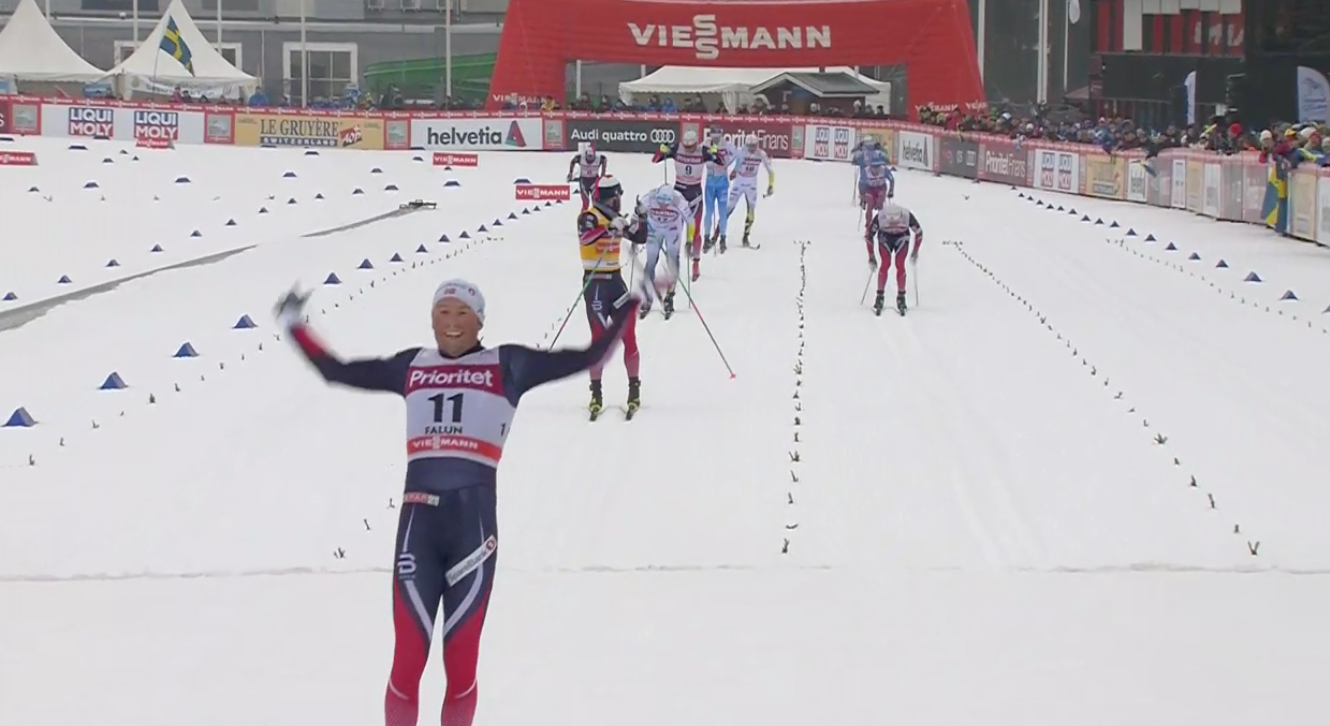
    Emil Iversen celebrates his win in the 30 k classic mass start in Falun, Sweden, on Sunday. Norwegian teammate Martin Johnsrud Sundby finished second and Sweden's Calle Halfvarsson third.
    Emil Iversen celebrates his win in the 30 k classic mass start in Falun, Sweden, on Sunday. Norwegian teammate Martin Johnsrud Sundby finished second and Sweden’s Calle Halfvarsson third.

    FIS Cross-Country World Cup (Falun, Sweden): 15 / 30 k classic mass start

    Women’s reportMen’s report

    In the women’s 15-kilometer classic mass start on Sunday, Norway swept the podium with Marit Bjørgen taking the win in a time of 41:28.8 in Falun, Sweden. Crossing just half a second behind her was her teammate, Ingvild Flugstad Østberg in second place. Rounding out the podium was Heidi Weng in third (+8.1).

    American Jessie Diggins was the first to cross the line for the U.S. in 10th (+1:37.5). Three other U.S. women finished in the top 30, with Sadie Bjornsen finishing 21st (+2:43.6), Rosie Brennan 24th (+2:57.0), and Liz Stephen in 29th (+3:24.5).

    Just outside of scoring World Cup points was American Caitlin Patterson in 32nd (+3:47.6) and Ida Sargent in 34th (+4:02.8). Canada’s Cendrine Browne finished 46th (+5:41.4) and American Liz Guiney 49th (+6:22.6).

    After losing the skate sprint yesterday in a photo finish to Italy’s Federico Pellegrino, Emil Iversen ascended to the top step of the podium in the men’s 30 k classic mass start on Sunday in Falun.

    The Norwegian was often near the front, but hadn’t tried to lead a breakaway like his teammates Martin Johnsrud Sundby and Sjur Røthe did earlier in the race. In the final two kilometers, Sundby – the overall World Cup leader – put in a sprint to try to drop the field. But Iversen caught up, drafting his veteran teammate into the stadium. In the final up-and-over before the finish line, Iversen made a pass and then accelerated down the finishing stretch to beat Sundby by 1.14 seconds.

    “I got motivation from yesterday’s last 20 meters,” Iversen told FIS in a finish-line interview. “So today I fought all the way, and I was really stronger. It is amazing for me to be second yesterday and first today. I’m really proud of that.”

    Calle Halfvarsson, who had been falling off the back of the lead pack just a few kilometers earlier, managed to get back to the front and claim third place for Sweden (+1.72 seconds) in a photo finish with Røthe (+1.76 seconds). Niklas Dyrhaug was next (+2.52 seconds) to give the Norwegian men’s team four in the top five.

    In his return to the World Cup stage, Norway’s Petter Northug finished 31st (+3:10.6).

    Alex Harvey was the lone Canadian on the start line. After skiing near the front of the field for the early part of the race he was dropped by the lead pack in the final kilometers, finishing 15th (+1:17.5).

    Erik Bjornsen and Noah Hoffman took 35th and 37th places for the United States, finishing +3:30.8 and +3:59.8, respectively. SuperTour leader Matthew Gelso — familiar with the Falun course after competing in 2015 World Championships — finished 44th (+5:23.6), and Andy Newell placed 53rd (+7:45.3).

    Results: Men | Women

    ***

    IBU Open European Championships (Duszniki-Zdrój, Poland): Single mixed & mixed relay

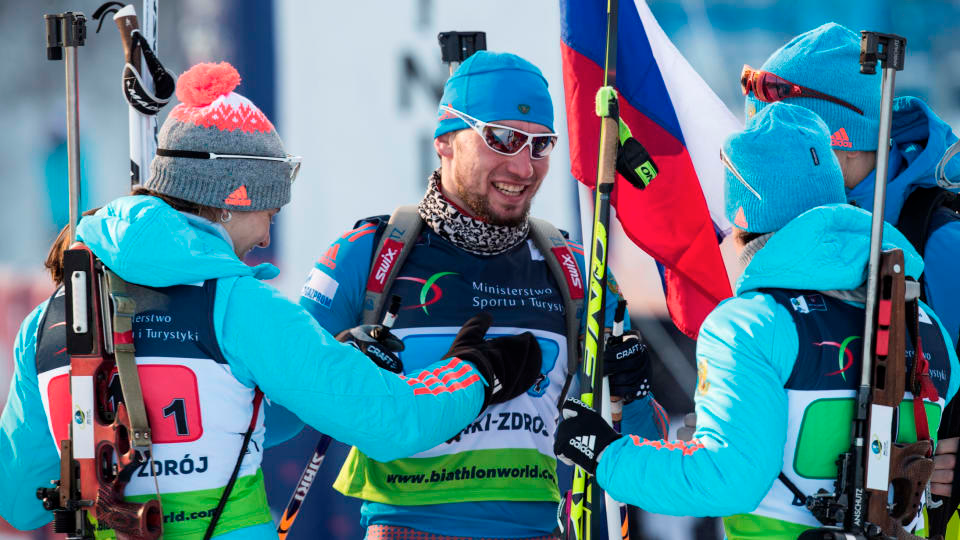
    Russia’s Alexander Loginov (center) is greeted at the finish by his teammates Irina Starykh, Svetlana Sleptsova and Alexey Volkov after anchoring his team to the gold medal in the mixed relay at the 2017 IBU Open European Championships in Duszniki-Zdrój, Poland. (Photo: IBU)
    Russia’s Alexander Loginov (center) is greeted at the finish by his teammates Irina Starykh, Svetlana Sleptsova and Alexey Volkov after anchoring his team to the gold medal in the mixed relay at the 2017 IBU Open European Championships in Duszniki-Zdrój, Poland. (Photo: IBU)

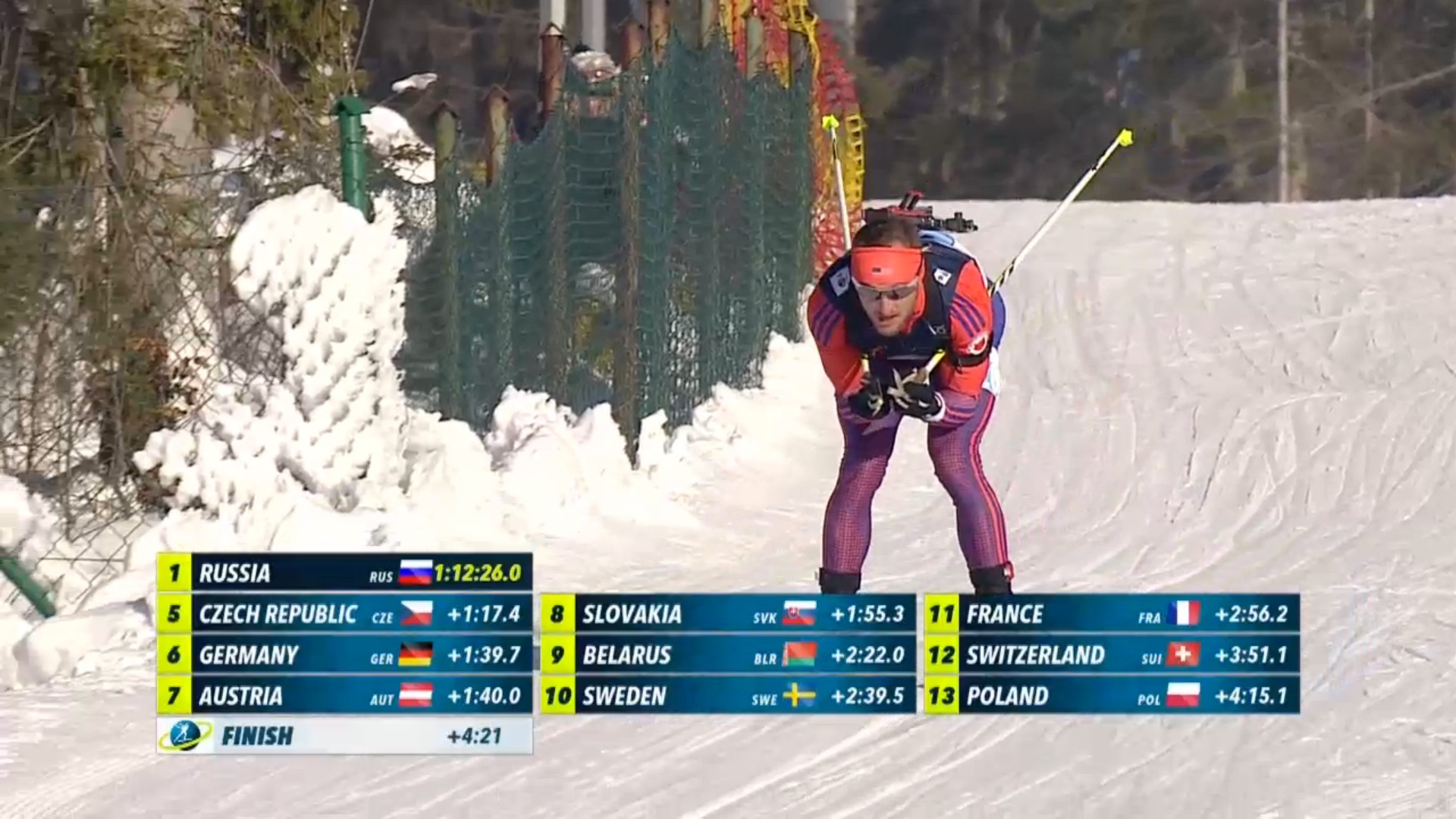
    [UPDATED] The Russian victory in the final 2 x 6 + 2 x 7.5-kilometer mixed relay event of the 2017 International Biathlon Union (IBU) Open European Championships in Duszniki-Zdrój, Poland, was only briefly in doubt, when Alexander Loginov skiing the anchor leg required all spares in his prone shooting stage. But with his final shot he managed to also hit that target to avoid the penalty lap, leaving the range with a lead of more than 30 seconds.

    Loginov then did not need any spares in the last standing stage, and could take his time on the final loop. Unlike Russia’s Evgeniy Garanichev earlier in the day during the single mixed relay, he also managed to pick up a flag for the final meters of the race, crossing the line in a time of 1:12:26.0 hours.

    The Russian team with Irina Starykh, Svetlana Sleptsova, Alexey Volkov and Loginov led from the first exchange and required only six spares with zero penalties.

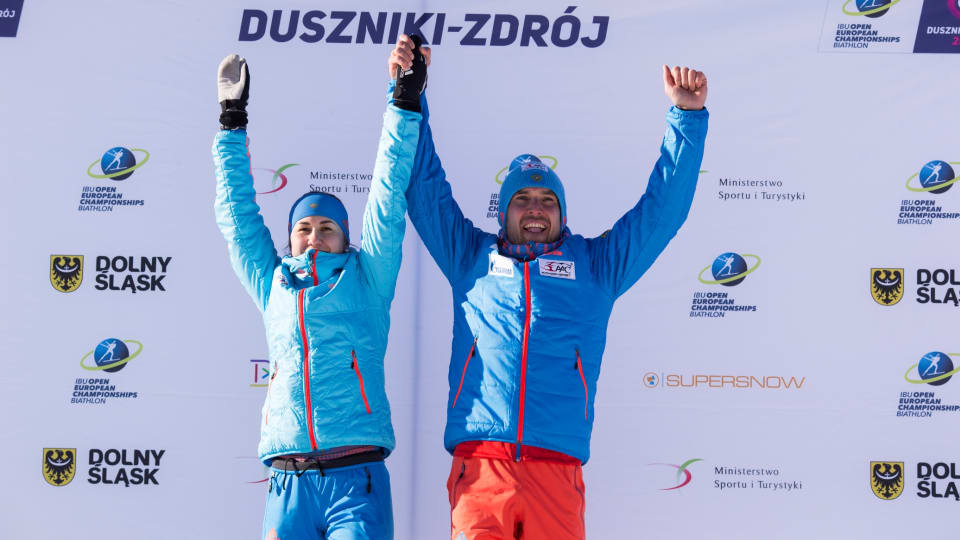
    With this medal, the 28-year-old Volkov became the most successful athlete in history at European Championships, according to an IBU press release, surpassing the retired Polish biathlete Tomasz Sikora. Russia was the most successful team of the 2017 Open European Championships with six gold, four silver, and three bronze medals.

    Behind them, a number of teams vied for the positions on the podium. Sweden initially looked like a strong contender exchanging in second place after the women, but fell back with three penalty laps to only finish 10th.

    Still six seconds back after the final shooting, Norway’s Fredrik Gjesbakk caught up to and outsprinted Ukraine’s Ruslan Tkalenko in the finishing stretch to claim the silver medal (+36.4) with the bronze left for Ukraine (+37.1).

    “I thought that I made sufficient gap to win silver,” Tkalenko told the IBU. “But in the end, on the final downhill before the finish, I was very surprised when the Norwegian guy passed me, I truly did not expect that.”

    The Norwegian team with Karoline Erdal, Marion Rønning Huber, Erlend Bjøntegaard, and Gjesbakk needed nine spares and had no penalties.

    Ukraine with Anastasiya Merkushina, Yulia Dhzyma, Oleksander Zhyrnyi (who originally started for Russia before making the switch in 2014) and Tkalenko required six spares, and Dhzyma had to ski a penalty lap only temporarily setting the team back.

    Bulgaria finished fourth (+1:16.4), with its anchor Vladimir Iliev narrowly beating Czech Republic’s Lukas Kristejn (+1:17.4) in the finishing stretch. Both teams needed 11 spares and had no penalties.

    Jakob Ellingson skiing the anchor leg for the U.S. mixed relay at the 2017 IBU Open European Championships in Duszniki-Zdrój, Poland. The U.S. team finished 14th. (Photo: IBU/Eurovisionsports.tv screenshot)
    Jakob Ellingson skiing the anchor leg for the U.S. mixed relay at the 2017 IBU Open European Championships in Duszniki-Zdrój, Poland. The U.S. team finished 14th.
    (Photo: IBU/Eurovisionsports.tv screenshot)

    Starting at the back of the field in bib 20, US Biathlon’s Emily Dreissigacker got her team off to a strong start with a clean prone shooting and one spare round in standing, exchanging in 10th, a minute behind the leaders. Hallie Grossman needed one spare in each of her stages, tagging off to the men in 14th position and now 2:39 behind. Max Durtschi also had one miss each in prone and standing, coming into the last exchange still in 14th position, but another minute back. Jakob Ellingson required all three of his spares in his prone shooting stage narrowly avoiding the penalty lap, and one more in his final shooting stage. As the team from Finland was racing over a minute behind the Americans, he was able to keep the 14th position into the finish (+4:47.4), with a team total of nine spares and no penalties overall.

    For Biathlon Canada, Erin Yungblut starting in bib 19 shot clean in her prone stage and required two spares in her standing shooting, tagging off in 18th position and more than two minutes back from first. Leilani Tam von Burg stayed clean in her prone shooting stage and needed one spare in standing, moving up two positions to exchange in 16th place, yet more than four minutes behind the leaders. After the exchange to the men, both Matthew Neumann and anchor Carsen Campbell managed to shoot clean in all of their stages, but lost additional time on the course to finish 16th (+6:39.9) ahead of four lapped teams.

    Canada had the best shooting result of all 20 teams starting the relay, with just three spares and no penalty.

    Russia’s Daria Virolaynen (l) and Evgeniy Garanichev after winning Sunday's single mixed relay at the 2017 Open European Championships in Duszniki-Zdrój, Poland. (Photo: IBU)
    Russia’s Daria Virolaynen (l) and Evgeniy Garanichev after winning Sunday’s single mixed relay at the 2017 Open European Championships in Duszniki-Zdrój, Poland. (Photo: IBU)

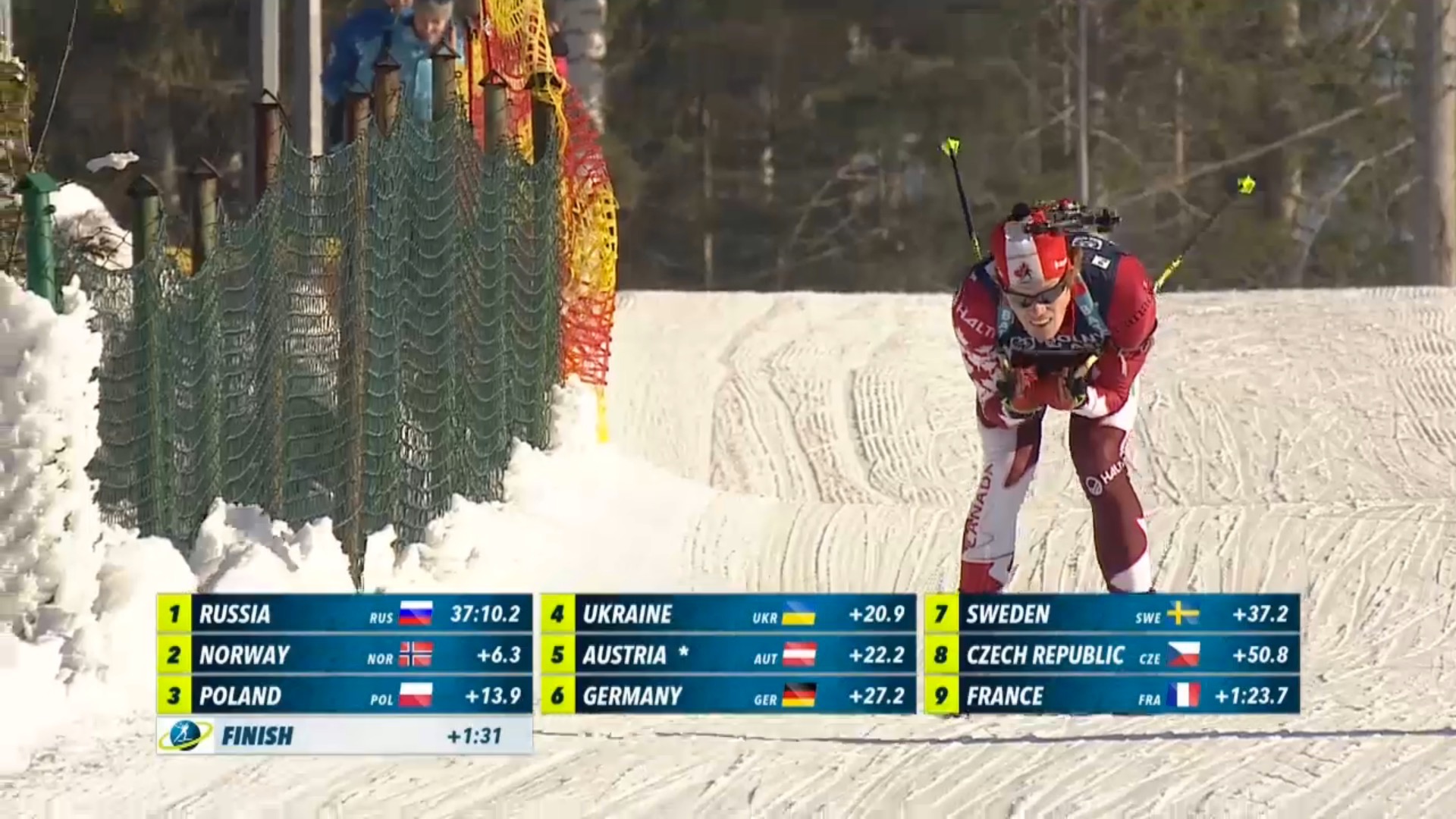
    Earlier on Sunday, pretty much the only thing that went wrong for Russia’s Daria Virolaynen and Evgeniy Garanichev in the single mixed relay happened on the last meters of the finishing stretch, with Garanichev gesturing for a Russian flag he wanted to cross the line with. But the handoff was too short and the flag dropped past his outstretched hand to the snow. He glanced back, weighing if his lead was big enough to ski back, but decided it was not worth the risk, instead skiing into the arms of his partner waiting for him behind the line in a time of 37:10.2 minutes.

    Russia needed seven spare rounds and incurred zero penalties. Garanichev secured the victory in the final shooting, when he only needed one spare – albeit fumbling a few seconds to insert it – while his direct opponents standing next to him required more time to hit their targets.

    “Probably, I took some risk at the last standing,” Garanichev said, according to an IBU press release. “I wanted to shoot fast and clean, but missed with the last shot. But in general, I felt very comfortable; came and worked at the range in my rhythm.”

    6.3 seconds behind, Norway with the team of Ingrid Landmark Tandrevold and Vetle Sjåstad Christiansen placed second, with seven spares and zero penalties.

    “These are very short loops,” Christiansen commented on the fairly new, single mixed relay format. “You feel the pressure from the crowd and to shoot fast every time.”

    The 20-year-old Tandrevold previously earned three bronze medals, including one in the single mixed relay, also with Christiansen, at last year’s Open European Championships in Tyumen, Russia.

    To big cheers from their home crowd fans who had come out to the Duszniki Arena in beautiful but cold weather, the Polish husband-and-wife team of Krystyna Guzik and Grzegorz Guzik placed third with just five spares and zero penalties (+13.9), not quite able to keep up with Christiansen on the final loop after leaving the range together within a second.

    “It is so nice to win a medal here in Poland,” Krystyna Guzik said. “We were both very disappointed with all of our mistakes in the other competitions. So today, we were relaxed and laughing before the competition, hoping not to have those mistakes again. We did not … and now have a medal.”

    It was the first medal for Poland at these championships.

    Ukraine with Iryna Varvynets and Andriy Dotsenko finished fourth, also with five spares and zero penalties (+20.9).

    Biathlon Canada’s Aidan Millar skiing the final loop of the single mixed relay at the 2017 IBU Open European Championships in Duszniki-Zdrój, Poland. With teammate Sarah Beaudry, Canada finished 13th (Photo: IBU/Eurovisionsports.tv screenshot)
    Biathlon Canada’s Aidan Millar skiing the final loop of the single mixed relay at the 2017 IBU Open European Championships in Duszniki-Zdrój, Poland. With teammate Sarah Beaudry, Canada finished 13th (Photo: IBU/Eurovisionsports.tv screenshot)

    For Biathlon Canada, Sarah Beaudry and Aidan Millar required seven spares during their race and had no penalty, just like the winning Russians and Norwegians, but could not quite keep up with the best teams on the course in the fast-paced race format with short loops somewhat comparable to a team sprint in cross-country.

    Beaudry cleaned her first shooting stage and then needed one spare to hit all targets in standing. At the first exchange Canada was 10th, 35.8 seconds behind the then leading team from Poland.

    Millar missed one shot in his first prone stage, leaving the range again in ninth position. Then he needed two spares in his standing shooting on the way to exchanging back to Beaudry in 11th (+56.4).

    On her second leg, Beaudry had one miss in prone and required two spares in standing, falling back a bit to exchange in 13th (+2:12.0).

    On his final leg, Millar was able to shoot clean in both stages, reducing the time gap to the top but not able to make up another position, and finished in 13th place (+1:56.1).

    US Biathlon is only represented with two women at the Open European Championships in Poland, and decided to forgo a start in the single mixed relay, instead entering a team in the mixed relay later on Sunday.

    — Harald Zimmer

    Results: Mixed relay |  Single mixed relay 

    ***

    Marcialonga (Val di Fiemme, Italy)

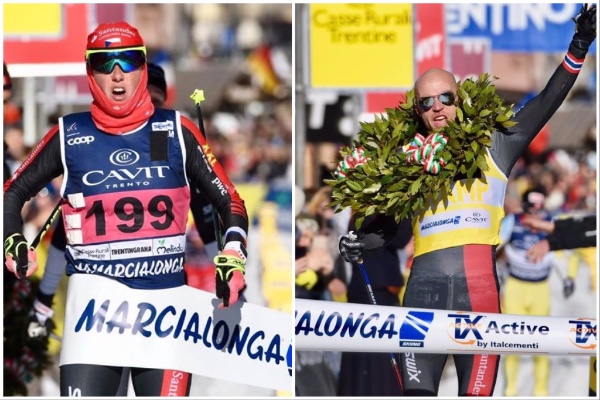
    Katerina Smutna (left) and Tord Asle Gjerdalen (right) of Team Santander won the 2017 Marcialonga. (Photo: Visma Ski Classics)
    Katerina Smutna (left) and Tord Asle Gjerdalen (right) of Team Santander won the 2017 Marcialonga. (Photo: Visma Ski Classics)

    Tord Asle Gjerdalen won the Marcialonga, a Worldloppet and Swix Ski Classics marathon for the third time – in a row. This year was on a shortened course, “just” 57 rather than the traditional 70 kilometers.

    The Team Santander athlete finished in two hours, eight minutes, and 36 seconds, edging Johan Kjølstad (Team United Bakeries) and Morten Eide Pedersen (Team BN Bank) in a sprint finish by 2.6 and 2.9 seconds, respectively.

    Tyler Kornfield and David Norris of Alaska Pacific University finished 43rd (+5:03.8) and 66th (+10:43.1). Canadian Paralympian Brian McKeever finished 57th (+9:13.5) and guide Graham Nishikawa 81st (+12:56.5), followed by Ian Murray in 85th (+13:37.5) and Erik Carleton in 111th (+17:50.2).

    In the women’s competition, Katerina Smutna, also of Team Santander, won her third straight Ski Classics competition. She crossed the line in two hours, 22 minutes, and 46.4 seconds. Britta Norgren of Team Lager 157 was second by just 0.8 seconds, and Sara Lindborg (Team Serneke) third, +4:22.2. University of Utah alum Maria Graefnings was tenth, +10:35.8.

  • Saturday Rundown: Falun & Duszniki-Zdrój (Updated x2)

    Saturday Rundown: Falun & Duszniki-Zdrój (Updated x2)

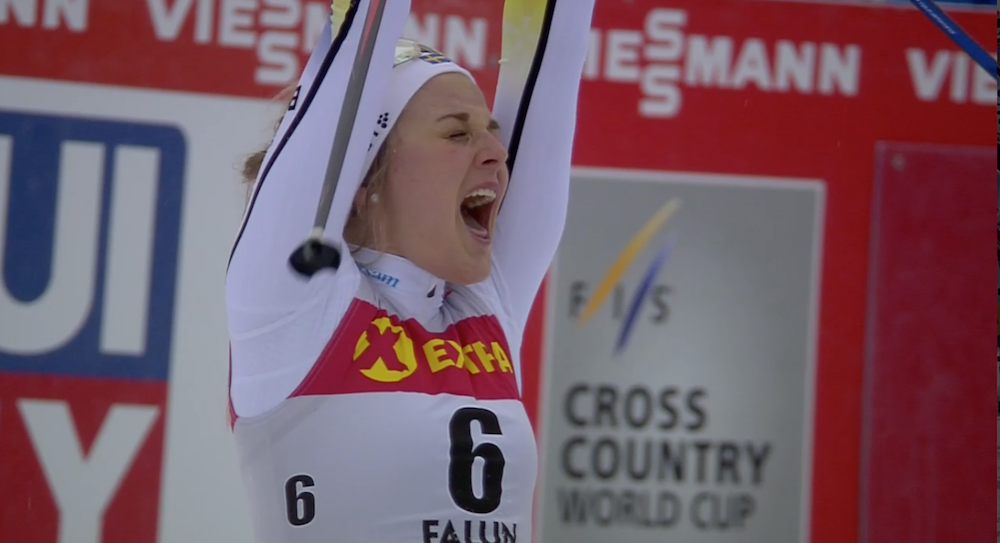
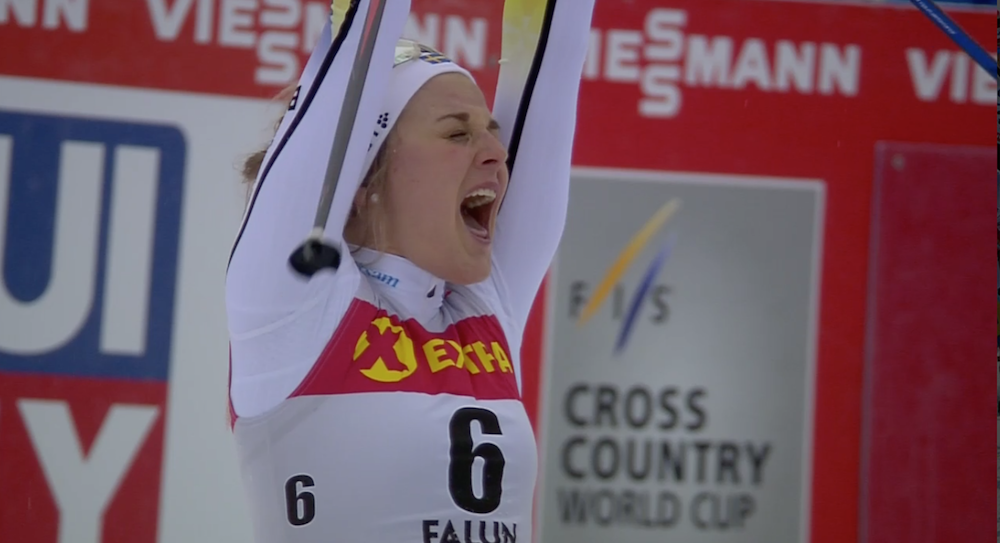
    Sweden's Stina Nilsson celebrates her second-straight World Cup sprint victory on Saturday after winning the 1.4 k freestyle sprint at home in Falun, Sweden.
    Sweden’s Stina Nilsson celebrates her second-straight World Cup sprint victory on Saturday after winning the 1.4 k freestyle sprint at home in Falun, Sweden.

    FIS Cross-Country World Cup (Falun, Sweden): Men’s & women’s freestyle sprints

    Women’s report | Men’s report

    [UPDATED] Kikkan Randall reached the final for the first time since March 2015 on Saturday in the women’s 1.4-kilometer freestyle sprint at the World Cup in Falun, Sweden. The American qualified 26th and went on to advance in second out of her quarterfinal and semifinal to reach the six-woman final, where she ended up fifth.

    Sweden’s Stina Nilsson won the final by one-hundredth of a second over Norway’s Maiken Caspersen Falla, finishing in 3:00.24 minutes. Nilsson had started the day by qualifying in sixth, 2.52 seconds behind Norway’s Marit Bjørgen, who won the qualifier in 3:00.64. This is Nilsson’s second-straight World Cup sprint win after skipping the freestyle sprint in Toblach, Italy, following the Tour de Ski.

    While Bjørgen went on to win her quarterfinal, she finished fifth in her semifinal to end up ninth on the day.

    Norway had two on the women’s podium with Heidi Weng in third, 1.88 seconds behind Nilsson. Finland’s Krista Parmakoski placed fourth (+1.99), and Randall was fifth (+2.56) for her best result in two years (she took last season off to have a baby). Sweden’s Jonna Sundling reached the final as well and finished sixth (+8.02).

    Five U.S. women qualified for the heats, with Jessie Diggins qualifying fifth and ultimately crashing in her semifinal, where she finished fifth. That put her 10th overall on the day. Sophie Caldwell qualified third and finished fourth in her quarterfinal for 16th on the day, Sadie Bjornsen qualified 17th and also finished fourth in her quarterfinal for 19th overall, and Ida Sargent made the top-30 qualifying cutoff in 30th, then placed fifth in her quarterfinal for 25th overall.

    Bjørgen topped the freestyle sprint qualifier on Saturday morning, clocking the fastest time around the 1.4 k course by just 0.08 seconds over Hanna Falk of Sweden. Caldwell qualified third (+1.23), Diggins qualified fifth (+2.39), Bjornsen 17th (+5.04), Randall 26th (+6.64), and Sargent 30th (+8.28). Rosie Brennan (U.S. Ski Team) missed the cut in 37th (+10.90) and Liz Guiney finished 56th (+32.87). The lone Canadian woman racing on Saturday, Cendrine Browne placed 46th (+14.02).

    In the men’s 1.4 k freestyle sprint final, Italy’s Federico Pellegrino held off three Norwegians and two Swedes to win in 2:45.77. The defending Sprint World Cup champion qualified second and went on to win his quarterfinal and semifinal before taking the final by six-hundredths of a second.

    Norway took the remaining spots on the podium with Emil Iversen in second (+0.06) and Sindre Bjørnestad Skar in third (+0.47). Sweden’s Oskar Svensson was three-hundredths of a second off the podium in fourth (+0.50). The fastest qualifier in 2:34.49, Norway’s Johannes Høsflot Klæbo reached the final and ultimately took fifth (+1.32), and Sweden’s Teodor Peterson placed sixth (+2.08).

    Canada’s Len Valjas was the top North American in 10th. He qualified 20th, advanced in second from his quarterfinal and finished fifth in his semifinal.

    American Andy Newell was 16th after qualifying in 25th and finishing third in his quarterfinal. U.S. teammate Simi Hamilton followed in 18th, after qualifying 13th and finishing fourth in his quarterfinal.

    In the men’s qualifier, Klæbo was 1.05 seconds faster than Pellegrino and another 0.02 seconds faster than Russia’s Sergey Ustiugov in third.

    For the U.S., Hamilton qualified 13th (+4.52) and Newell qualified 25th (+6.74). Erik Bjornsen placed 43rd (+9.30) and Matt Gelso 59th (+13.12).

    Valjas was the lone Canadian man to make the heats, qualifying 20th (+6.22). The only other starter, Alex Harvey, placed 46th (+9.71).

    Results: Women | Men

    Qualifier results: Women | Men

    ***

    IBU Open European Championships (Duszniki-Zdrój, Poland): Men’s & women’s pursuits

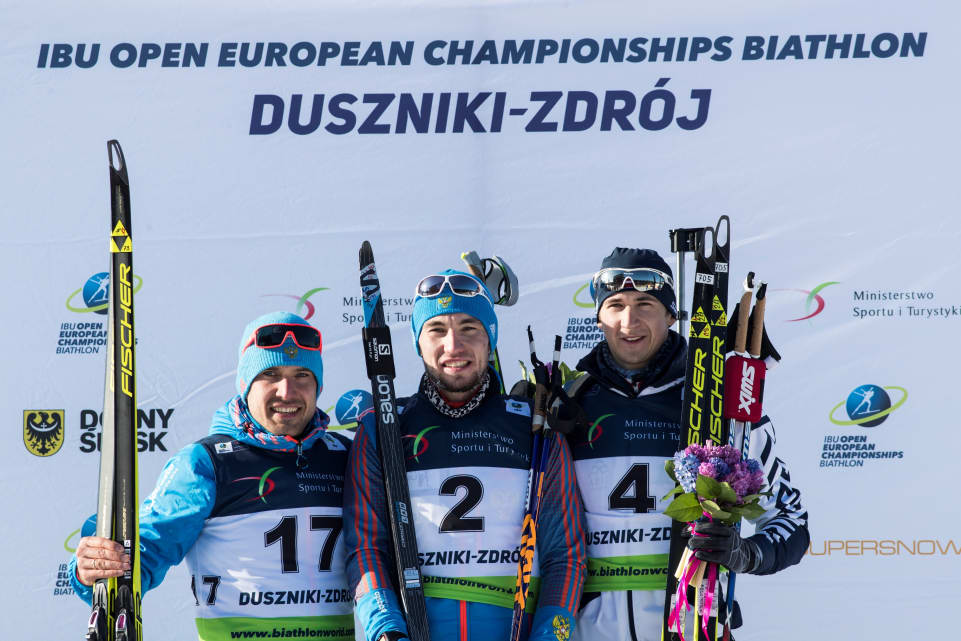
    The men's pursuit podium at 2017 IBU Open European Championships on Saturday in Duszniki-Zdrój, Poland, with Russia's Alexander Loginov (c) in first, Evgeniy Garanichev (l) in second, and Latvia’s Andrejs Rastorgujevs (r) in third. (Photo: IBU)
    The men’s pursuit podium at 2017 IBU Open European Championships on Saturday in Duszniki-Zdrój, Poland, with Russia’s Alexander Loginov (c) in first, Evgeniy Garanichev (l) in second, and Latvia’s Andrejs Rastorgujevs (r) in third. (Photo: IBU)

    Russia’s Alexander Loginov racked up his second win of the 2017 International Biathlon Union (IBU) Open European Championships on Saturday in the mens’ 12.5-kilometer pursuit in Duszniki-Zdrój, Poland.

    After starting second, 5 seconds behind Bulgaria’s Vladimir Iliev, who won Friday’s sprint, Loginov proceeded to clean three straight stages before missing one on his final standing to cross the line first in 31:46.2 minutes.

    “It was not as easy as it seemed, because from the first loop Vladimir set a really good speed,” Loginov said, according to an IBU press release. “Today we had great sunny and windless weather again, so I managed to shoot well. Probably that is why it [looked] so easy.”

    Russia took first and second place with Evgeniy Garanichev following 27.8 seconds later, after starting 17th (56 seconds out of first) and shooting 19-for-20 (0+0+1+0).

    “After yesterday’s sprint, I managed to work well and to show good result in pursuit, so I’m sure glad to win the silver medal,” Garanichev said, according to the IBU.

    Latvia’s Andrejs Rastorgujevs improved on his fourth place in the sprint to reach the pursuit podium in third (+59.5) despite four penalties (0+1+1+2).

    “On the last loop I had the information about the guys who were behind me and in front of me,” Rastorgujevs said, according to the IBU. “I was just fighting and did all I could do to get to the podium.”

    Bulgaria’s Krasimir Anev, who started third, slipped to fifth (+1:28.6) with two penalties (0+1+1+0), behind Russia’s third man in the top four, Alexey Volkov in fourth (+1:01.6). Iliev as the first starter ended up 11th (+1:41.7) with six penalties (2+2+0+2).

    The two Americans who had qualified for the pursuit by placing in the top 60 of Friday’s sprint, Paul Schommer and Alex Howe improved to 48th (+5:07.1) and 51st (+5:42.3), respectively.

    Schommer started 58th, just ahead of Howe in 59th, and missed five targets, all in his first two prone stages (3+2+0+0). Howe accumulated four penalties (1+2+1+0).

    No Canadians qualified for the pursuit.

    [UPDATED] In the women’s 10 k pursuit that followed, Russia’s Irina Starykh picked up her second win and third consecutive podium of the championships, with clean shooting en route to a 19.8-second victory in 30:04.4.

    Starykh started third, 38 seconds behind Ukraine’s Juliya Dzhyma and 11 seconds after her Russian teammate Svetlana Sleptsova, respectively. Dzhima missed two on her last two standing stages (0+0+1+1) to slip to second, and Sleptsova dropped one place to third (+32.1) with one prone penalty (0+1+0+0).

    Veronika Vítková of the Czech Republic improved from seventh to fourth (+47.8) with two penalties (0+1+1+0), and Russia’s Svetlana Mironova moved all the way up from 13th to fifth (+1:29.6) with three misses (0+1+1+1). Just 0.2 seconds behind her, Poland’s Monika Hojnisz improved from 16th at the start to sixth (+1:29.6) with one penalty (0+0+0+1).

    No North Americans qualified for the pursuit.

    Open European Championships conclude Sunday with the single mixed and mixed relay.

    Results: Men | Women

  • Friday Rundown: IBU Open European World Championships (Updated)

    Friday Rundown: IBU Open European World Championships (Updated)

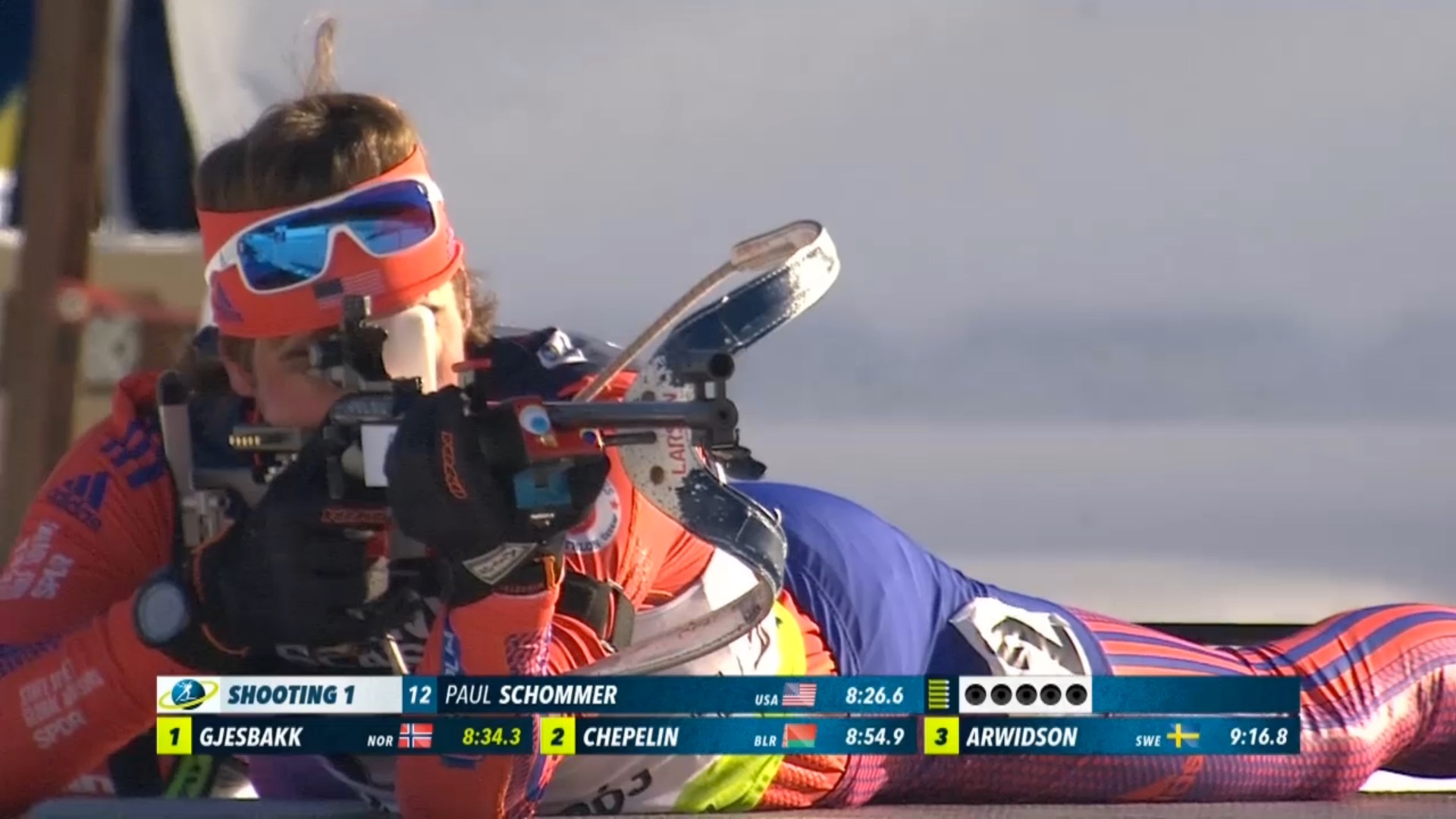
    US Biathlon’s Paul Schommer shooting prone in the men’s 10 k sprint at the 2017 IBU Open European Championships in Duszniki-Zdrój, Poland. He was the top North American on Friday in 58th. (Photo: IBU/Eurovisionsports.tv screenshot)
    US Biathlon’s Paul Schommer shooting prone in the men’s 10 k sprint at the 2017 IBU Open European Championships in Duszniki-Zdrój, Poland. He was the top North American on Friday in 58th. (Photo: IBU/Eurovisionsports.tv screenshot)

    IBU Open European Championships (Duszniki-Zdrój, Poland): Men’s & women’s sprints

    On Friday in the men’s 10-kilometer sprint, two Bulgarian athletes were able to break the Russian dominance at the 2017 International Biathlon Union (IBU) Open European Championships in Duszniki-Zdrój, Poland.

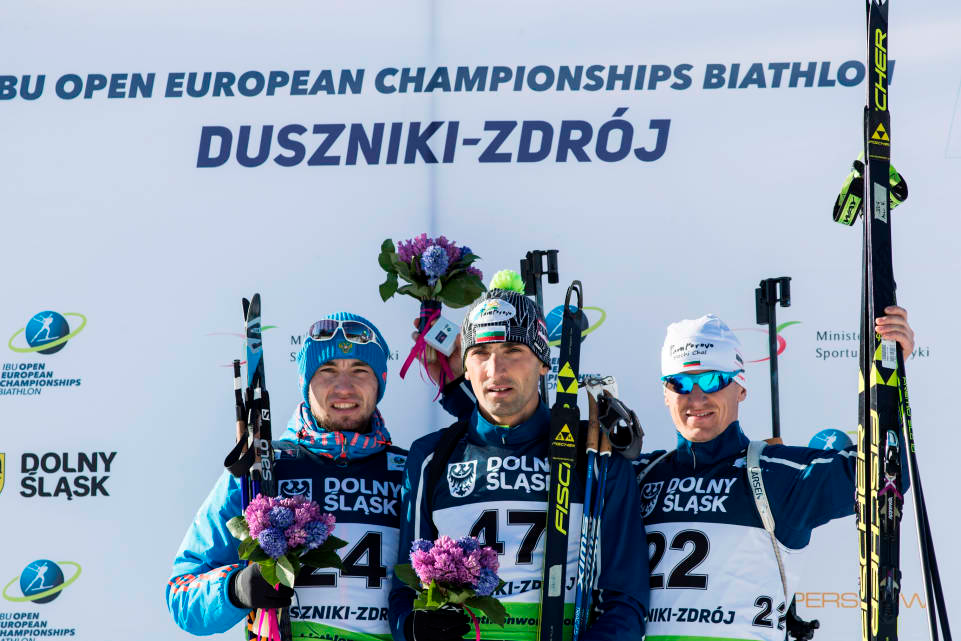
    The men's 10 k sprint podium on Friday, with Bulgaria’s Vladimir Iliev (c) in first, Russia’s Alexander Loginov (l) in second, and Bulgaria’s Krasimir Anev (r) in third at the 2017 IBU Open European Championships in Duszniki-Zdrój, Poland. (Photo: IBU)
    The men’s 10 k sprint podium on Friday, with Bulgaria’s Vladimir Iliev (c) in first, Russia’s Alexander Loginov (l) in second, and Bulgaria’s Krasimir Anev (r) in third at the 2017 IBU Open European Championships in Duszniki-Zdrój, Poland. (Photo: IBU)

    Bulgaria’s 29-year-old Vladimir Iliev, who has competed on the IBU World Cup since 2007 and posted a career-best fifth (which he achieved earlier this season), claimed the win in a time of 24:26.9 minutes despite one penalty in the standing stage (0+1), giving a kiss to his fast skis in the finish. Russia’s Alexander Loginov, who won the men’s 20 k individual race on Wednesday after returning this season from a two-year doping suspension, placed second (+4.9) with clean shooting. Behind them, Iliev’s teammate Krasimir Anev took third (+16.7), also shooting clean, to push Latvia’s Andrejs Rastorgujevs off the podium by just 0.6 seconds (+17.3). Rastorgujevs started early in bib 4 and skied the fastest course time of the day, but incurred two penalties in his standing stage (0+2), which ultimately set him back too far for a podium.

    “It was a long way to this medal and this win,” Iliev said his first career victory, according to an IBU press release. “I was ready for a high result for many years, but many things have happened, so I’m really happy to get a victory today.”

    “I did not expect anything in this race, because yesterday I had health problems so even my coach advised me not to start,” Anev said after winning his second medal of the championships, following up on a second place in the individual. “So [I] went into competition without any expectations.”

    In beautiful weather conditions with little wind and the sun shining on the new arena in Duszniki-Zdrój throughout the race, US Biathlon’s Paul Schommer was the best of 11 North American starters, finishing 58th (+2:14.9) with three penalties (1+2). Schommer was less than a second faster than his U.S. teammate Alex Howe, who finished 59th (+2:15.3), after skiing two penalty laps (1+1). The third American Jakob Ellingson placed 64th (+2:24.6) with one penalty (0+1), Russell Currier was 75th (+2:41.4) with four penalties (2+2), Max Durtschi was 88th (+3:16.1) with three penalties (1+2), and Michael Gibson was 103rd (+4:30.4) with two penalties (1+1).

    Matthew Hudec led the Canadians on Friday in 80th (+2:54.7) with one penalty (1+0). Also for Canada, Aidan Millar finished 86th (+3:13.9) with three penalties (1+2), Carsen Campbell 89th (+3:18.3) with three penalties (2+1), Pearce Hanna 92nd (+3:24.7) with two penalties (1+1), and Matthew Neumann 94th (+3:31.8) with four penalties (1+3).

    In the large field of 125 starters, Schommer and Howe qualified for Saturday’s pursuit race by placing in the top 60.

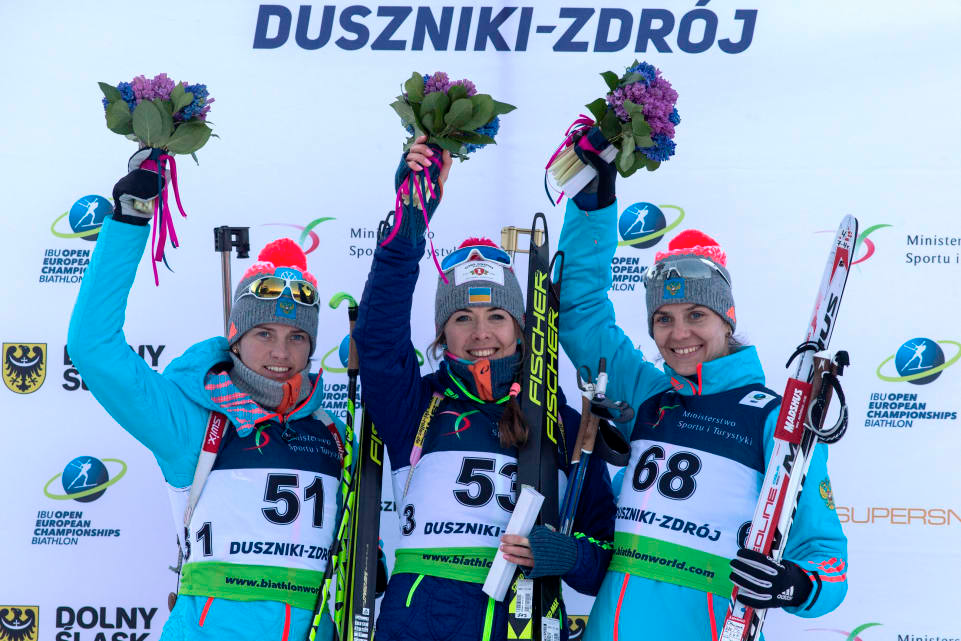
    The women’s 7.5 k sprint podium on Friday, with Ukraine’s Juliya Dzhyma (c) in first, Russia’s Svetlana Sleptsova (l) in second and Russia’s Irina Starykh (r) in third at the 2017 IBU Open European Championships in Duszniki-Zdrój, Poland. (Photo: IBU)
    The women’s 7.5 k sprint podium on Friday, with Ukraine’s Juliya Dzhyma (c) in first, Russia’s Svetlana Sleptsova (l) in second and Russia’s Irina Starykh (r) in third at the 2017 IBU Open European Championships in Duszniki-Zdrój, Poland. (Photo: IBU)

    [UPDATED] In the women’s 7.5 k sprint that followed, Ukraine’s Juliya Dzhyma managed to win in convincing fashion in a time of 21:02.3 minutes, shooting clean and skiing the second-ranked course time. It was the first individual career victory for the 26 year old in either a junior or senior championships, after she won a gold medal with Ukraine’s relay team at the 2014 Olympics in Sochi, Russia.

    “When I saw that everyone was cleaning, I knew that to get in to top three, I have to do the same,” Dzhyma commented on her race, according to an IBU press release. “But honestly, I have no idea how I hit all the targets today; for the whole season, it was my first competition where I had zero.”

    “I was just trying to do my best and to make the gap bigger because tomorrow is the pursuit!” she added, regarding her last loop when she increased her lead by another ten seconds.

    Also shooting clean but 27 seconds off the win was Russia’s 30-year-old Svetlana Sleptsova, who, earlier in her career, won five World Cups and gold medals in the women’s relay at the 2009 World Championship and 2010 Olympics in Vancouver.

    Starting behind Sleptsova, her Russian teammate Irina Starykh, the winner of the women’s individual race on Wednesday, and like Loginov, also coming back from a two-year suspension for EPO use, claimed third (+37.8) with one penalty in her standing stage (0+1). Starykh bumped  Germany’s Karolin Horchler, who had led the race early on after starting in bib 2 to fourth (+42.2, with no penalties). Horchler won her first World Cup a week ago in Antholz, Italy.

    “Before the competition I already felt that it would be very hard for me to shoot today,” Starykh told the IBU. “And in the end it came out that way, it was tough for me to shoot at the prone and at the standing. But just one penalty is a pretty good result, based on how I feel.”

    Horchler’s teammate Denise Herrmann, who made the switch from cross-country skiing to biathlon this season, followed in fifth (+47.7) with the fastest course time of the day, but missed two targets in her standing stage including her very last shot (0+2) to miss the podium.

    American Hallie Grossman during her standing stage in the women’s 7.5 k sprint on Friday at the 2017 IBU Open European Championships in Duszniki-Zdrój, Poland. She finished 70th with three penalties as the second-best North American. (Photo: IBU/Eurovisionsports.tv screenshot)
    American Hallie Grossman during her standing stage in the women’s 7.5 k sprint on Friday at the 2017 IBU Open European Championships in Duszniki-Zdrój, Poland. She finished 70th with three penalties as the second-best North American. (Photo: IBU/Eurovisionsports.tv screenshot)

    In stable weather conditions, though not as sunny as during the men’s sprint earlier on Friday, US Biathlon’s Emily Dreissigacker was the top North American woman in 69th (+3:31.1), with three penalties (2+1). Just one position behind her, American Hallie Grossman also missed three (2+1) on her way to a 70th (+3:34.4). For the 23-year-old Grossman it is her first season overseas racing in the IBU Cup.

    Canada’s Erin Yungblut finished 81st (+5:50.0) with four penalties (1+3). Her teammate Leilani Tam von Burg did not finish after incurring two penalties in her prone shooting stage, and the third Canadian, Sarah Beaudry did not start.

    None of the North American woman qualified for Saturday’s pursuit.

    Results: Men | Women

    Start lists: Men’s pursuit | Women’s pursuit

  • Wednesday Rundown: IBU Open European Championships

    Wednesday Rundown: IBU Open European Championships

    Russia's Alexander Loginov racing to the win in the men's 20 k individual on Wednesday, the first race of 2017 IBU Open European Championships in Duszniki-Zdrój, Poland. (Photo: IBU)
    Russia’s Alexander Loginov racing to the win in the men’s 20 k individual on Wednesday, the first race of 2017 IBU Open European Championships in Duszniki-Zdrój, Poland. (Photo: IBU)

    IBU Open European Championships (Duszniki-Zdrój, Poland): 15/20 k individual

    The Open European Championships, a five-day International Biathlon Union (IBU) sanctioned event, opened Wednesday with the men’s 20-kilometer and women’s 15 k individual races in Duszniki-Zdrój, Poland.

    Russia took first and second in the women’s race, with 29-year-old Irina Starykh — coming off a two-year ban for EPO use — winning by more than a minute over her teammate Svetlana Sleptsova. Starykh hit all 20 targets en route to the victory 44:24.7 minutes, which was 1:03.8 faster than Sleptsova, who had one penalty (0+1+0+0) in second. Ukraine’s Anastasiya Merkushyna placed third (+1:05.0) with one penalty as well (0+1+0+0).

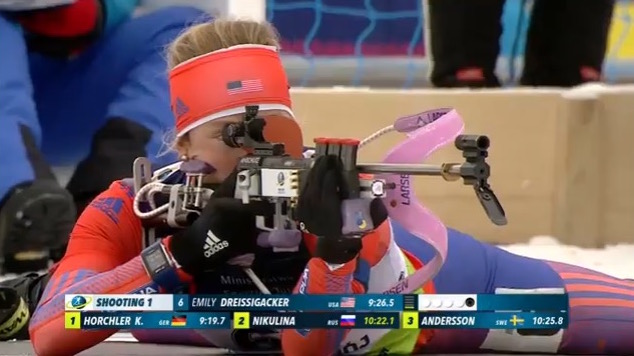
    American Emily Dreissigacker shooting clean during her first prone stage of the women's 15 k individual on Wednesday at 2017 IBU Open European Championships in Duszniki-Zdrój, Poland. She finished 41st.
    American Emily Dreissigacker shooting clean during her first prone stage of the women’s 15 k individual on Wednesday at 2017 IBU Open European Championships in Duszniki-Zdrój, Poland. She finished 41st.

    Emily Dreissigacker led the two U.S. women in the race in 41st (+7:47.6) with four penalties (0+1+1+2). Hallie Grossman finished 52nd (+9:06.1) with four misses as well (1+1+2+0).

    Canada’s Leilani Tam von Burg finished 58th (+9:54.2) with two penalties (0+0+1+1), and Erin Yungblut was 60th (+10:13.4) with three misses (0+2+0+1).

    Russia took first in the men’s 20 k as well, with 24-year-old Alexander Loginov — who also recently served a two-year ban for testing positive for EPO — winning by 11.4 seconds in 44:54.9. He had one penalty in his first prone stage (1+0+0+0) but cleaned the next three stages. Bulgaria’s Krasimir Anew cleaned (0+0+0+0) for second (+11.4), and Russia had two on the podium with Alexey Slepov in third (+53.6), with clean shooting as well.

    Russia swept fourth through six, putting five in the top six.

    Russell Currier led the American men in 51st (+5:42.5) with five penalties (2+2+0+1). Paul Schommer placed 57th (+6:02.5) with five misses as well (2+0+1+2), Max Durtschi was 62nd (+6:44.2) with two misses (1+0+1+0), Alex Howe 79th (+8:46) with three misses (0+1+0+2), Jakob Ellingson 87th (+10:11.3) with seven misses (2+4+1+0), and Michael Gibson 94th (+11:58.3) with six penalties (1+1+1+3).

    Carsen Campbell was the top Canadian in 64th (+6:58.2) with two misses (0+1+1+0). Matthew Neumann finished 68th (+7:26.0) with three misses (0+1+0+2), Aidan Miller was 72nd (+8:07.9) with two miles (0+1+0+1), Matthew Hudec 98th (+12:29.5) with seven misses (1+1+2+3), and Pearce Hanna 101st (+14:07.1) with seven misses (2+2+2+1).

    Racing continues Friday with the men’s 10 k and women’s 7.5 k sprints.

    Results: Women | Men

  • Mid-Relay Firing Leads To Major Shakeup in Russian Biathlon Team

    On March 11th, Olga Zaitseva’s future in biathlon appeared, to all outsiders, to be bright. After competing in four events at World Championships, only the mass start and relay remained, both events in which Zaitseva had won gold in the past. She had also been elected to the International Biathlon Union’s Athlete’s Committee by her peers. With only two men and two women on the committee, it was an honor.

    As the weekend progressed, things seemed to be going according to plan: the next day, a Saturday, she placed sixth in the mass start. It wasn’t the best finish for the Russian, who has won two Olympic relays, owns eight World Championships medals, and received the Order of Friendship from President Dimitri Medvedev last year, but it wasn’t a disaster.

    By Sunday, however, things were falling apart. After two terrible relay legs by the Russian women, in which both Ekaterina Yurlova and Anna Bogliy-Titovets hit the penalty loop three times, and the team was in 19th place. (In relays, athletes are allowed to hand-load three extra rounds in each shooting stage to hit the targets, so penalty loops are unusual; Bogaliy-Titovets was later seen in tears.)

    That’s when the changes began, for both Zaitseva and the entire Russian biathlon world.

    While Svetlana Sleptsova dragged the team up to 14th place during the relay’s third leg, Mikhail Prokhorov, the billionaire head of the Russian Biathlon Union (RBU) who also owns the New Jersey Nets, fired team coach Anatoly Khovantsev, who had been working with the women for less than a year.

    After racing the third-fastest anchor leg and pulling the team into ninth place, Zaitseva abruptly announced that she was retiring. The claim rippled through the Russian media; nobody was sure whether to take her seriously or not.

    The Moscow News reported a few days later that Russian biathlon fans wanted Prokhorov’s head on a plate. But while both the firing and Zaitseva’s retirement were assumed to be hasty decisions, the coach and the star seem to be gone for good.

    Both the relay result, which was the worst ever by the Russian women, and the personnel changes have brought to the fore questions that had been trickling though the Russian media all year, mainly these: how was the team being run, and why weren’t the athletes faster?

    A Lack of Organization

    For Zaitseva, her coach’s dismissal was the straw that broke the camel’s back after a year of poor relationships within the team.

    “I do not like [it],” she later told Eurosport Russia. “Very annoying … just such an ugly act. The World Championships were not over, the race is still going on, and then suddenly… therefore, my personal desire to continue working with the team is not there.”

    Khovantsev, while realizing that he probably wouldn’t have kept his job regardless, was also unimpressed with his boss’s tactics. He told the media after the race that he had learned from a media attaché that he was no longer needed by the team.

    “I realized that if there were no medals, it would be a question of [who to fire],” he told Sport Express. “But I thought that we would analyze the work done, identify the errors and identify their perpetrators, whoever they were. And then leadership would decide who had to leave.

    “Therefore, I was certainly surprised about the insulting manner in which this dismissal was made – it was a complete surprise.”

    Khovantsev was not, officially, the head coach of the women’s team. His title was something that translates to “team coach”, and there was no official head coach of the women’s team. Khovantsev was told when he was hired that the team was trying a European style of management.

    “I was wary, but decided not to judge the decision in the heat of the moment, and try it,” he explained. “Now I can say that it was a mistake. And this division of powers between the coaches on functional training, shooting and technique – that too. It should be the responsibility of all of one person, a senior manager.”

    In Khovantsev’s mind, the lack of a head coach let some details slip through the cracks. And to make the problem even worse, the RBU began demanding better results in December, even though they had told Khovantsev to focus on peaking for World Championships, which didn’t start until March.

    “Our mistake was that we could not stay with the original plan, changed it, and eventually got ‘neither there nor there,’” Khovantsev said.

    Once athletes began to underperform, team morale headed south. Vladimir Barnashov, who coordinated the men’s and women’s teams, claimed on a Russian biathlon website that the women had “mutinied” and refused to work with Khovantsev.

    Some athletes, however, shared Khovantsev’s frustration with the RBU.

    “The sustained pressure on the team last year was terrible, especially by management,” Zaitseva told WinterSport News.

    And her teammate Sleptsova had a unique way of looking at the disastrous relay.

    “You know, I think it’s even good that we lost the World Championships relay so miserably,” she told SkiSport Russia. “If we had a medal, perhaps they’d say that the national team was all right… and the problem would be easier to ignore.”

    Alexander Tikhonov, vice-president of the RBU, reportedly discussed the team with President Medvedev. Among his concerns were the lack of a clear structure on the team, exactly the issue that Khovantsev himself said was limiting.

    Everyone in Russia seems to agree that the biathlon team is broken – but how to fix it remains to be seen. The fans at rusbiathlon.ru wrote a petition to President Medvedev and Prime Minister Vladimir Putin in which they called for Prokhorov’s dismissal.

    “Russian biathlon is being destroyed in front of the fans, and we do not intend to put up with it,” the letter said. “We think that the RBU, headed by president Mikhail Prokhorov… is responsible for the current state of affairs in biathlon… We are asking you not to allow the final collapse of Russian biathlon.”

    Rifts and Misunderstandings

    While poor planning at the national level seems to be partially to blame for the team’s difficulties, some athletes said that they disliked working with Khovantsev. One of them was Sleptsova, a six-time World Cup winner who is seen as Zaitseva’s successor.

    The 24-year-old had initially been enthusiastic about the new coach, but later began to doubt his training plan.

    “Last summer, when the women’s team was taken over by [Khovantsev] and we began working, everything seemed wonderful,” she told Sport-Express. “I didn’t just do what the coach said, but gave myself to the work completely… [then] the training plan was drawn up as if for one week. He simply repeated it over and over again, without changing even in small things. This went on all summer, all fall, and all winter.”

    The Russian athletes had expected results to improve with a new training strategy, but they did not. While Sleptsova had been aiming to move up in the overall World Cup standings this season, both she and Zaitseva lost several places. In addition, the Russian women didn’t win a single medal at World Championships.

    Sleptsova also had personal issues with Khovantsev stemming from the Obersdorf World Cup, when she was left off of the relay team. She felt that the head coach did not treat her with respect. Khovantsev, however, claimed that some decisions, such as which athletes to start on the World Cup or include on relay teams, were dictated to him by the RBU.

    The two butted heads again later in the season, when Sleptsova had to decide whether to go to a team training camp in Ridnaun, Italy, or to the World Cups in Presque Isle and Fort Kent. Because she did not feel she could have an honest conversation with Khovantsev, she said, she was “pushed to extremes” – and went to the U.S., to the detriment of her later performances.

    Khovantsev said that he had not recommended the trip, and did not understand why Sleptsova went.

    “For many seasons, her results have deteriorated over the course of winter, yet she continues to race. She needed to rest, and it did not happen. From other interviews, you’ve probably heard that I was totally against her trip to America.”

    Despite the fact that she didn’t seem sad to see him go, Sleptsova didn’t carry a grudge, perhaps because she knew that some of the mistakes, particularly the American adventure, had been her own.

    “You know, I don’t by any means want to blame the coaches for me not getting results,” she said. “The main thing is that I want to understand it for myself.”

    And Natalia Guseva, who recently won a national championship, said that she didn’t understand what all the fuss was about with Khovantsev’s training plan.

    “When it comes to a new coach, it is always difficult… he gets used to the athletes, and the athletes to his methodology and requirements,” she told Sport Express. “To some, this training came up, and someone… we can’t say that the coaches worked badly or something  and we did not perform. We need to analyze and draw correct conclusions for next season.”

    Back to Zaitseva

    Regardless of the root of the team’s problems, one thing seems to be clear: Khovantsev is gone, and at 32 years of age, so is Zaitseva.

    “Everyone thinks that she said it in a temper, because of the poor performance at World Championships,” Sleptsova told Sport Express. “But I know how much Olga suffers when she is away from her son. I still do not believe that she will leave- I do not want to believe it. For all of us she is like a rock… And to replace Olga in this capacity, no one can do that.”

    Khovanstev agreed about Zaitseva’s personality and position on the team, but said that he was shocked at her announcement.

    “[It was] totally unexpected,” he told Sport Express. “To say I was dumbfounded – it does not begin to describe it. I came off the course, and learned that she heard the news about my dismissal, and said she was retiring. I hope this wasn’t spur of the moment… I can say that it was a pleasure to work with her. She is a woman with tremendous athletic achievements, both hard-working and humble. A very nice person.”

    His comments suggest that even though his firing was one of the factors that led Zaitseva  to walk away from the team, the two were not particularly close. Instead, Sleptsova knew more about her teammate’s inner thoughts and motives.

    Zaitseva confirmed that she had been contemplating retirement for some time.

    “The idea began to grow long ago, right after the Olympics, and became stronger throughout the current season,” she said to Europsport Russia. “Psychologically I have already burned out.

    “I have a family, a baby…” she continued. “I realized that when the Olympics are held in 2014, it will be time for him to go to school… I want him to grow up with me.”

    She has repeatedly said that while she was frustrated with the team and its management, she appreciated the support she has received from fans.

    “With all my truthful heart I want to thank all those who support and understand me,” she wrote on her website. “You reinforced my faith in real fans. And to all the other people, I’ll say that a friend in need is a friend indeed. I won’t ask for forgiveness – I’ve nothing to make excuses for.”

    When asked whether a comeback for 2014 Olympic Games in Socchi was a possibility, the answer was no.

    “I have no desire to keep working in this team,” she concluded.