From the FasterSkier archive — posts syndicated from athletes’ and coaches’ own blogs between 2004 and 2012, kept online as published. Current coverage is at fasterskier.com.

Tag: SVSEF Gold Team

  • Q and A: Sun Valley’s Rick Kapala on coaching, sport development, and constructing a “complete ecosystem” in the skiing community

    Q and A: Sun Valley’s Rick Kapala on coaching, sport development, and constructing a “complete ecosystem” in the skiing community

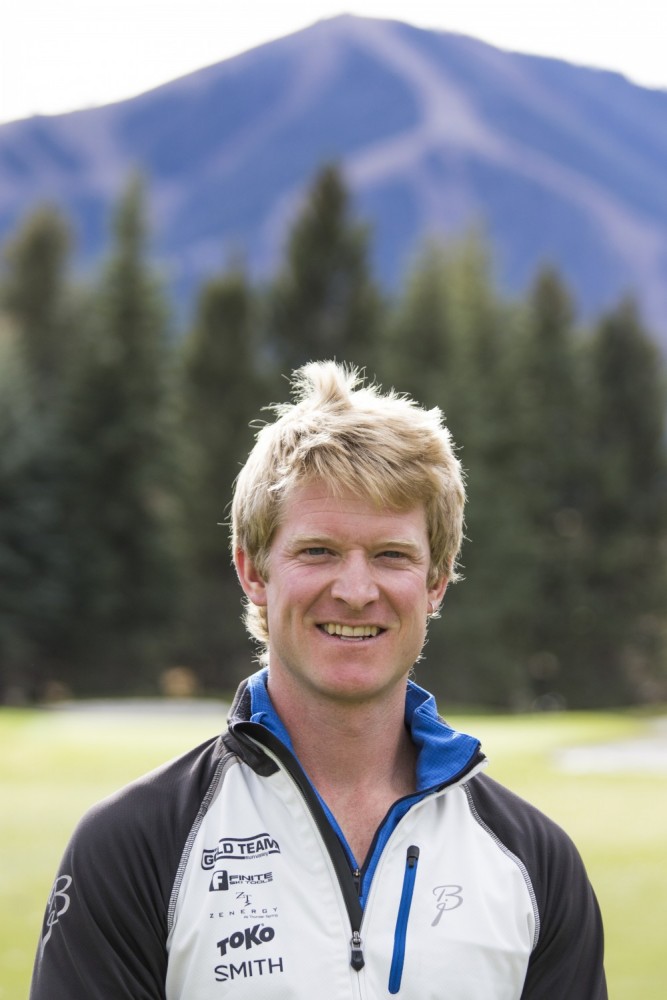
    A common sight in the Intermountain West for the past 35 years: Rick Kapala on race day. Kapala is stepping away from coaching, and into sport development, this season. (Photo: Sun Valley Ski Education Foundation – SVSEF).

    “I’m sorry, but once I start talking cross-country skiing, I can’t stop,” admits Rick Kapala. Remove the “talking” from that statement, and it’s still a succinct summary of long-time Sun Valley coach Rick Kapala’s career.

    This season will mark the first time in thirty-five years that Kapala won’t be manning the wax bench on race day for the Sun Valley Ski Education Foundation. This summer, he turned to a new role at the Sun Valley Ski Education Foundation with the title “Sport Development Director.” In his stead, former Bates College Coach Becky Woods will take over his former Program Director duties.

    For those who have known Kapala during his long tenure in US skiing, his new title signals an exciting prospect. Kapala has been a constant, forward-thinking mind in US Skiing. He has played a role in creating a domestic professional skiing scene, helped start the National Nordic Foundation, and counts a plethora of key figures in US Skiing as his former athletes, coaches, and mentees.

    FasterSkier caught up with Kapala to reflect on his own journey to this point and get a glimpse into some of the most exciting ideas pushing US Skiing, from one of its most passionate minds.

    (This interview has been edited for length and clarity.)

    FS/FasterSkier (FS): Let’s start with your biography as a coach. Can you give us a summary of your career as a coach and at Sun Valley? 

    Rick Kapala (RK): Coaching for me started at my alma mater, Michigan Technological University (Michigan Tech), the year I graduated. Then I moved out west and I coached for a couple years in Washington state at a club program run by Pacific Lutheran University.

    Then I moved to Anchorage which was where I was really fortunate in my timing. I landed coaching at West Anchorage High School as their ski coach, track, and cross-country coach. And the stable of athletes I had there was full. Nina Campbell, Joey Caterinichio, and Chris Grover are just a few your readers might know. I was really lucky that was my first exposure to sort of an “all-in” type coaching job. Then I came down to Sun Valley in the summer of 1987 and have been here ever since.

    FS: What did the Sun Valley team look like when you got to Idaho?

    RK: We had a pretty good little program, this being the ski town that it is. The Alpine program was big, but the cross-country team was this small, ancillary program. We had seven to nine on the high school team, and then seven or eight middle schoolers.

    FS: How did you approach building out that program back then? Was it adding a younger development program? Bolstering numbers for the high schoolers?

    RK: There was a separate, kind of “Bill Koch League” (learn-to-ski) type program in the Valley. We assimilated that and made it our Devo program under the umbrella of our offerings. The program immediately began to grow from there. I attribute that to having really good coaches at that younger age who were really invested in the right way over the course of the first four or five years I was in Sun Valley. That eventually led to steady growth for the Comp (high school) program. That model is the basic infrastructure of a club. The same can be said about New England with the Bill Koch League, or in Minneapolis with the Minnesota Youth Ski League. Really dedicated coaches at the younger level are what end up powering competitive programs.

    FS: At what point did Sun Valley grow beyond the junior programming? When did the Gold Team (Sun Valley’s Pro Team) and Post-Grad programs start to develop?

    RK: The genesis of the Gold Team was a really fortuitous set of circumstances. We had a great coach, Chris Grover (who Kapala had coached at West Anchorage), landed in Sun Valley after the Nagano Olympics in 1998. He had been with the national team, but at the time there were budget cuts. Grover, coming off of that, had a pretty profound instinct that skiing couldn’t just develop within the [United States Ski and Snowboard Association]. He came to me and said, “we should start a pro team [in Sun Valley],” which, in retrospect, was such an important development because it allowed us to imagine a whole new ecosystem for our programming.

    Having Grover come off of the national team also made it an easy prospect to get athletes here. Chris Cook, for example, got cut loose from the national team, and Grover was able to step in and give him an obvious avenue to keep pursuing professional skiing. That was key—having an avenue to go down. Cook won a national championship the first year he was at Sun Valley, and then made it to the Olympic Games.

    That was a part of the fortuitous nature I talked about too. That the next Olympics were in Salt Lake City [in 2002]. The Gold Team was originally the Olympic Development Program—we got told eventually we couldn’t use that name, but it gave us a lot of visibility from the community here in Sun Valley, and a clear “brand” for talented skiers to know what they were pursuing here.
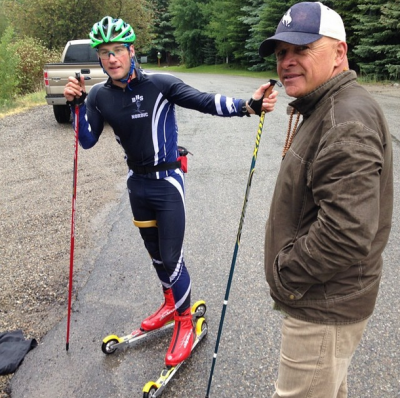
    Ben Lustgarten and Rick Kapala at a SVSEF training session in 2014 (Photo: Ben Lustgarten).

    FS: What strikes me as interesting about that “fortuitous” timing is that there was a push around US skiing at the same time Sun Valley’s team got started to have those Olympic Development programs around the country, but most of them weren’t nearly as sustainable as Sun Valley ended up being. In the past few years, we’re seeing a renewed push to introduce more pro racing opportunities across the country, whether that’s Bridger Ski Foundation’s team in Bozeman, or Team Birkie in the Midwest. What are some of the things that have made Sun Valley sustainable that could help make those programs sustainable as well?

    RK: Whenever I get a question like this, I always start with a disclaimer. Sun Valley is a really unique place that affords us some big advantages when it comes to building and sustaining new programming. We have one of the richest traditions of skiing in the country, and it is still a ski town—it hasn’t sprawled out in the same way that other places have. It is also a fairly affluent community.

    The industry here is skiing too, that always is going to be an advantage. We have an outsized role in our community because of that. When we roller ski in the summer, people are cheering on our kids, that’s not happening in other places, right?

    I think we have had to center our approach around the idea that we are a community asset here. We try to have success, just like any sports team, but what we are really trying to be is the highest-quality recreational and competitive opportunity for kids in our valley. That gives kids the resources they need to take skiing as far as they can. Whether that was Morgan Arritola, or now Sammy Smith and Cora Faye Scott. They all came through a program that at the start was really a way to get out and involved in our community and kept true to that impetus. Naturally, that is going to engender warmth and engagement from outside of just the ski community. There is also making sure that the talent that is coming through the Gold Team, for example, is able to invest in the wider community here. We need to make sure they have the chance to do that. And they have.

    I am not saying the model here is the model everywhere. What the Loppet Foundation has done to make skiing the big deal it is in Minneapolis—that’s phenomenal—they figured out how to balance programming, events, and facilities in a way where kids might just want to go skiing on Sundays rather than watch the Minnesota Vikings play football. And not every kid will, but they have the option to and feel like it is worth it. That is so important.

    Or in Anchorage, right, skiers are on the front page of the newspaper. That’s a big deal. It is the same in Sun Valley, and I think that speaks to creating a community ecosystem that celebrates and invests in skiing.

    FS: I am struck by how the skiers that the Gold Team has a pretty consistent mix of kids from your junior program and from other programs across the country . . . 

    RK: That’s super intentional. There just needs to be a critical mass to be able to inspire and also, provide a high-quality training environment. Johnny Hagenbuch, right now, for example: when he got to a point as a junior, having the Gold Team for him to hop into for training made a big difference in his development.

    FS: With regard to “development,” we haven’t covered your new position in detail. You’re moving from individual athletic development to a more club-wide role. What does that look like in Sun Valley, and how do you see what you’re doing in Sun Valley pertaining to US Skiing in general?

    RK: Well first, I don’t want to say I have answers beyond the community here. I think keeping my focus here is really important.

    My new position as “Sport Development Director” is multi-pronged. I’m still doing the resource development for the Nordic Team and coordinating events like the upcoming SuperTour. Then, there are a few other initiatives that follow along the lines of thinking, “what is the next thing?” in sport development. One of those is coach education. In our organization [at Sun Valley] we have about one-hundred coaches on the payroll during the season. Right now, the coaches certification process they go through is kind of transactional with US Ski and Snowboard, right? Meaning they take this coaches’ course and maybe do a continuing education credit, but that might be it. One thing I think is big incongruency in [American] skiing right now is that we work on cultivating a growth mindset for our athletes, but we don’t have the same mentality for our coaches, let alone the resources to make it possible. I think that’s where we need to go. Like Doctors have the American Medical Association, we need to have an organization—or use our existing organizations—to cultivate a culture of what I’d call “professional development.” As a ski community, we’re past the point where we are simply hiring people to coach based on the merits of their skiing. I think it is a positive development that it is a distinguishable profession, but now we need to do the work to not make it a profession where everyone is kind of self-educating.

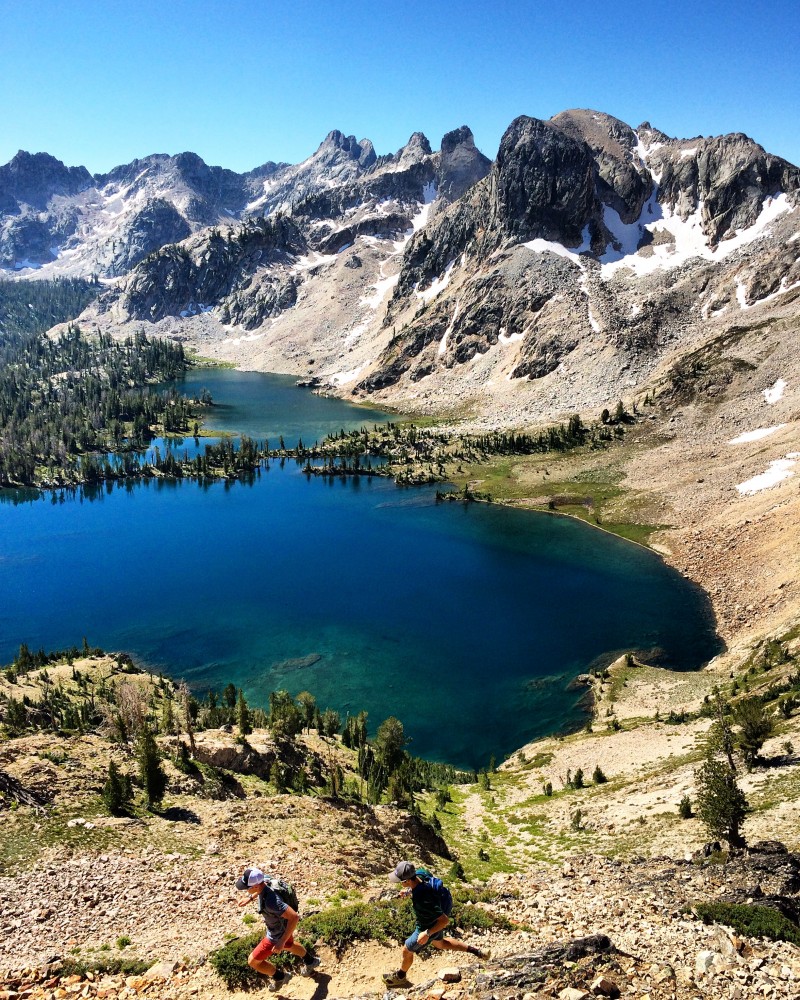
    Kapala out in the Idaho mountains in 2022. (Photo: SVSEF).

    FS: I’ve been thinking about that a lot the past few weeks, coming off of the National Coaches’ Symposium and off of Dr. Stephen Seiler’s talk with NNF last week (which Kapala was partly the brainpower behind). My operable knowledge of physiology as a coach up to now was based on what I learned at an REG camp presentation as a sixteen- or seventeen-year-old kid, and all of a sudden it was like, “whoa, this whole field has evolved a bunch” and I came away with three or four things I was ready to change in my coaching right away . . . 

    RK: Yeah, and that coaches conference happens what, every two years? Imagine if we made that part of coaching culture. That collaboration and knowledge-sharing: it is imperative. I’ve been paying attention to the system of coaching in international soccer, for example, where American coaches are going over to Germany and realizing just how beneficial the structure and rigor of coaching education is over there.

    FS: As in, the accreditation system?

    RK: Not so much the accreditation, but more so just how seriously they invest in all the individual aspects of sport development. Like this American soccer coach I was listening to a podcast with [Jesse Marsch, who came up through the German coaching system and now is the first American coach in English Premier League history with Leeds United]. He said he had a year-long course in sports psychology just to get accredited in Germany. We are no year to making that investment in something as beneficial as that.

    One of my other initiatives is on that front: I’d like to create a dedicated professional position at Sun Valley who can work with our athletes on sports psychology and wellness. We have always been great at catering to the physical aspects of our athletes, but not the emotional, or just human, aspect of human athletic performance.

    FS: Putting the resources to institutionalize new developments in athletic performance seems to be a theme of your work. I ran across an article from our archives where you talk about making training camps, like the U16 camp system, a regular part of the developmental pipeline in the US. That was a decade ago, and now, that’s well-established across US skiing. Is sports psychology and wellness the next front for that you think?

    RK: The U16 camp idea was a collaborative idea that came from a couple coaches at REG camp being like, “this is a great system, why aren’t we expanding this type of incentive and experience to kids at the crucial point where they decide to go all in on skiing or not?” And we could do it quickly with relatively few resources. That is the same thing with wellness and catering to that aspect of our athletes. I actually think it is even more important in the American context, too, because we’re correcting for that persistent “toughness” or “suck-it-up” mentality that is a feature in our athletic culture. That has never worked when you look at skiing.

    FS: It was interesting that in Johan Olsson’s presentation at the National Coaching Symposium a couple weeks ago, he cited a study on [UCLA’s legendary basketball coach John Wooden] where the main finding was essentially that his main feedback to his players was positive, rather than negative; that was a revelation in the 1970s.

    RK: Yeah, and then a couple years after that, [Indiana University basketball coach] Bobby Knight was throwing chairs at his players! Somewhere it got lost, and so we still have to address it in the landscape of our coaching.

    FS: Is the answer doing more coach education and dedicating resources to making it part of our clubs?

    RK: Yes, I also think it goes to a base-level of empathy. One of the cool things about skiing now versus when I first started coaching is that there is a critical mass of people—coaches or even just parents of athletes—who went through all the highs and lows of ski racing as athletes themselves. We have a depth of knowledge present in skiing that just did not exist in the 1970s and 1980s, and it is so helpful as an athlete to not just have one coach, but a support network, that can help you navigate a really hard, and really rewarding sport. That is special, and we have that going for us.

    FS: How do you incorporate that experience into the practice of coaching?

    RK: I actually think it is a community thing. Which enough individuals working together is always going to lead to. At the end of the day, that is what we have that is special. I’ve been in this game long enough to see how skiing connections last. Our kids meet other kids from across Intermountain West at JNQs, and they go on to become their friends, neighbors, teammates later in life. It just lasts.

    I think about what drives our community to do this sport a lot. There’s certainly not a lot of money in it, and there is not the capital of a lot of Division One college scholarships on offer. I think the ethos of it truly is that the people in cross-country skiing love it deeply. Love it individually, and together.

    FS: That’s a beautiful way to say a really true thing. Just to try and collect some of the themes I am seeing run through this, the “Rick Kapala” philosophy towards skiing development seems to include a community powered by that ethos—that love of skiing you talk about—that provides a “complete ecosystem” in terms of the resources needed for athletes to succeed. And you seem to be very careful to say that needs to match the specific context of the place in which the ski community exists.

    RK: I think that is fairly well put. The levers we can pull in Sun Valley are different than what those in Minneapolis—or you in Crested Butte—can pull. So you have to be collaborative and observe what works and what doesn’t in the place you are, and then take in knowledge from other places too. That’s how we ultimately make skiing in this country go ’round.

    We can’t just do what the Norwegians or Swedes are doing. We have to think about how we do things soundly, but differently. We have been successful in doing that to some extent, but there is always room to improve—which was the most important lesson of my coaching career.

    FS: And that’s the most important thing you’re now bringing to development?

    RK: For sure.
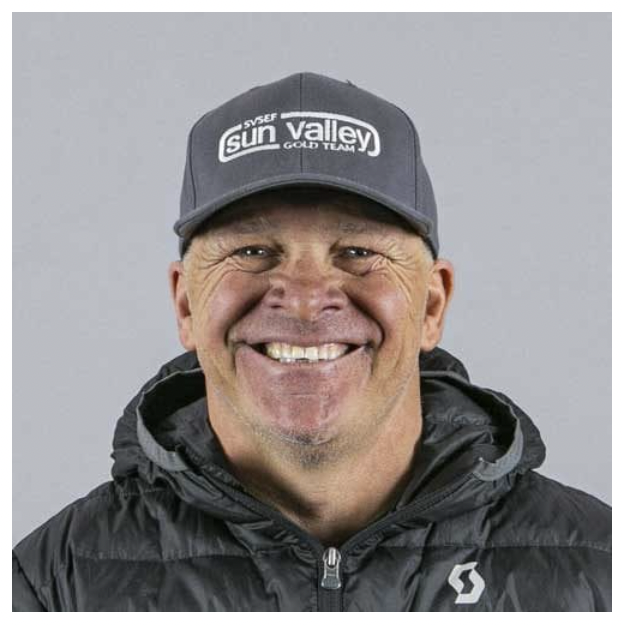
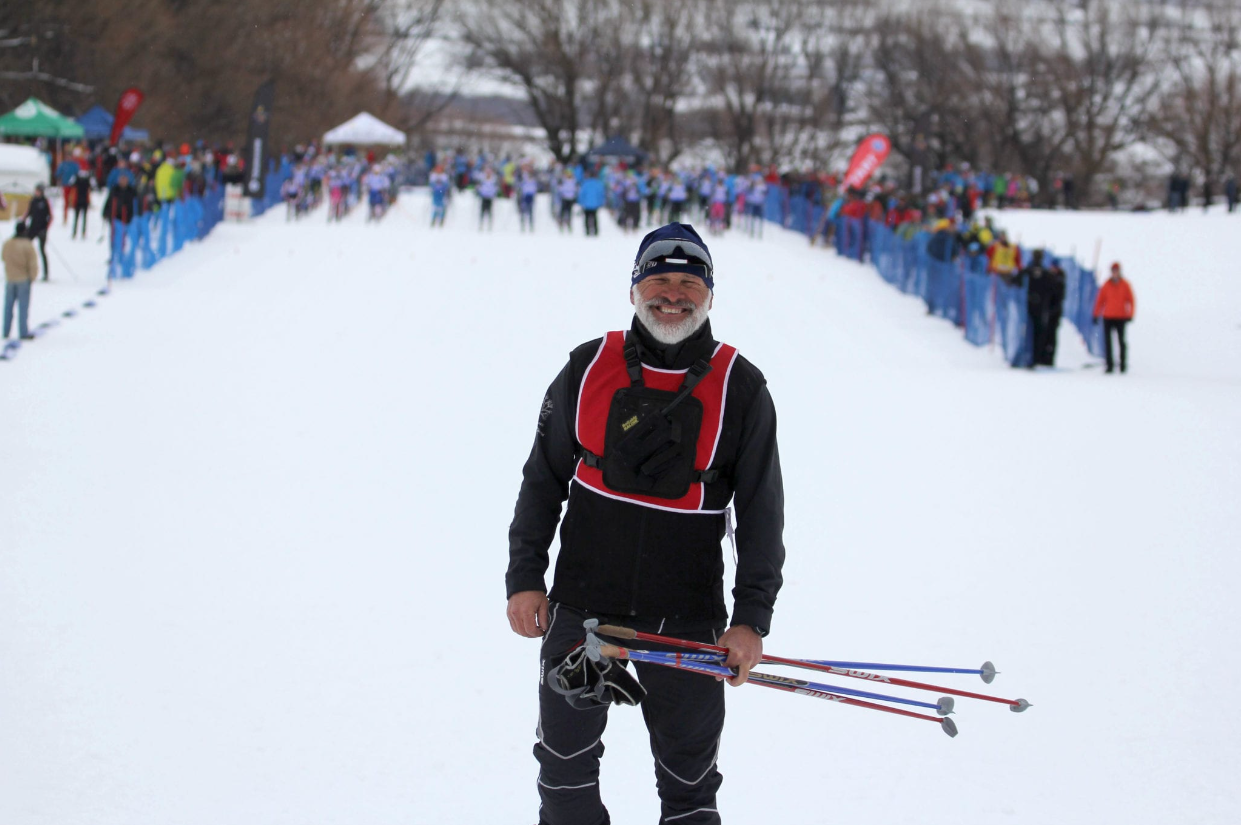
    Long-time SVSEF XC Program Director Rick Kapala. (Photo: SVSEF)
  • Ketterson and Ogden Take Classic Sprint Win on New Tracks at Mt Van Hoevenberg

    Ketterson and Ogden Take Classic Sprint Win on New Tracks at Mt Van Hoevenberg

    By Rachel Bachman Perkins and Ben Theyerl

    After a brief break, the SuperTour picked up in Lake Placid this weekend, with a fluoro-free Period III kicking off with a 1.5-kilometer classic sprint. The frigid forecast called for overnight lows of -5 Fahrenheit, with a wind chill as low as -23F. Highs during the day were only predicted to climb into the low single digits. Qualifiers were scheduled for 10/10:45 am, with quarterfinals for the open men beginning at noon – hopefully, enough time for a few degrees of warmth to reach the trails. 

    The weekend competitions would be hosted on Mt. Van Hoevenberg’s new World Cup trails, which are paved for rollerski use in the summer, and played host to NENSA’s “Keys to the Castle” sprint event in September. For those familiar with the venue, the new courses are tucked into the north-facing hillside, just south of the 1980 Olympic stadium and biathlon range. The new serpentine loop intersects with the final Ks of the classic “Ladies 5” outer loop, but overall remains closer to the stadium to allow access to the recently improved snowmaking system. 

    Jessie Diggins (SMS T2/USST) pushes over the climb during the final round of the Keys to the Castle sprint. (Photo: Matt Whitcomb)

    With a large reservoir and advanced technology, this new World Cup loop can be made winter competition ready within four days, though Van Hoevenberg’s nearly 50k of open trail might suggest that coverage is not currently an issue.

    There was praise for the course from many athletes, including those that have seen both Lake Placid, and everywhere in the world beyond Lake Placid. 

    “It raced much more like a world cup course!” said Alayna Sonnesyn (SMS), in an email to FasterSkier. Katharine Ogden (SMS) too, said of the course, “it was WAY more fun than the old one…[which] was pretty flat.”

    The course designers at Lake Placid seem to have carefully been taking notes on what makes sprint racing exciting over the course of its evolution as a discipline in the sport. An historic venue for American skiing, these developments may be a long-time coming for Mt. Van Hoevenberg, but it’s clear that they were executed with mastery so VanHo can continue to expand upon its legacy in the decades to come. 

    This course featured a long, final uphill climb to test a skier’s mettle, then a short, technical downhill into the finish to test their tactical brains. And in between; transitions, transitions, and more transitions.

    Becca Rorabaugh (APU) said of this : “The final climb always turned into a drag race, and I liked the pitch because it favored a bit of a stride over an all-out run. Skiers still had to be alert through the downhill and finish, though; positions often changed in the stadium.”

    The weekend, hosted by the Olympic Regional Development Authority (ORDA) in Lake Placid, also served as the second NENSA Eastern Cup weekend. Thus, senior athletes from American elite clubs lined up alongside regional junior racers, eastern collegiate racers, and Canadian athletes who traveled from Quebec, Ontario, and beyond. 382 athletes, 176 women and 206 men, on the start lists for the qualifier, and separate heats were run for the U18/U20 and U16 categories. 

    Without livestream, FasterSkier has relied on live timing and athlete interviews to shed light on how the sprint races unfolded. 


    Men’s 1.5-kilometer Classic Sprint

    After returning from a stint in Europe where he raced the Tour de Ski, Team Birkie’s Zak Ketterson set the mark in the men’s qualifier, stopping the clock at 3:04.79. Sun Valley’s Peter Holmes skied the next fastest time in qualification (+0.72), while Étienne Hébert was just behind in third (+1.41). Hébert hails from Quebec and currently trains at the Centre National d’Entraînement Pierre-Harvey (CNEPH), based at Mont Ste Anne.

    Each of these men moved smoothly through the rounds, with Ketterson getting edged out by Bill Harmeyer (SMS T2) in the first semi, and Homes and Hébert going 1-2 in the second. Racing in the second semi saw a tighter spread and faster times, bringing Julien Locke (Black Jack Ski Club) and Logan Diekmann (BSF Pro) who had finished a close third and fourth, respectively, along to the final as lucky losers. 

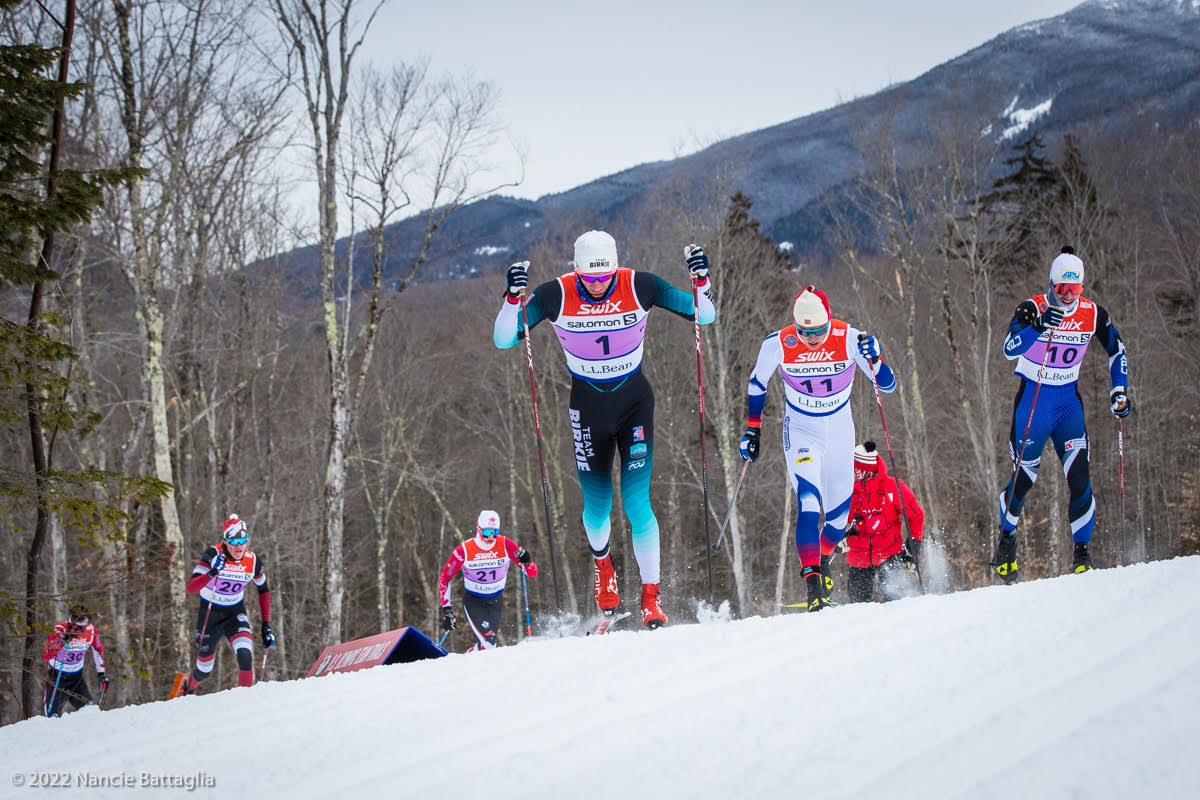
    Zak Ketterson (Team Birkie) leads his heat during the 1.5-kilometer classic sprint in Lake Placid. (Photo: © 2022 Nancie Battaglia)

    The final featured a tight finish among the top four men, with Ketterson off the front to finish in 3:04.71, earning his second consecutive classic sprint victory. Ketterson had dominated the classic sprint in Cable, WI, and stood at the top of the SuperTour leaderboard, thereby earning start spots for the Tour de Ski. The timing of the Tour caused him to miss the subsequent classic sprint in Soldier Hollow, UT. 

    During the Tour, his first World Cup starts, Ketterson was less than a second shy of qualifying for the classic sprint heats in Oberstdorf, Germany, and had been roughly five second out of the Top-30 the day prior in a 15k skate. He was the only American on the men’s team to finish the Tour. After the Tour, Ketterson made a quick turnaround to attend the weekend of distance racing in Sun Valley, Idaho, where his results (15th in the 15k classic and 34th in the 10k free) were far below what might be expected from him. 

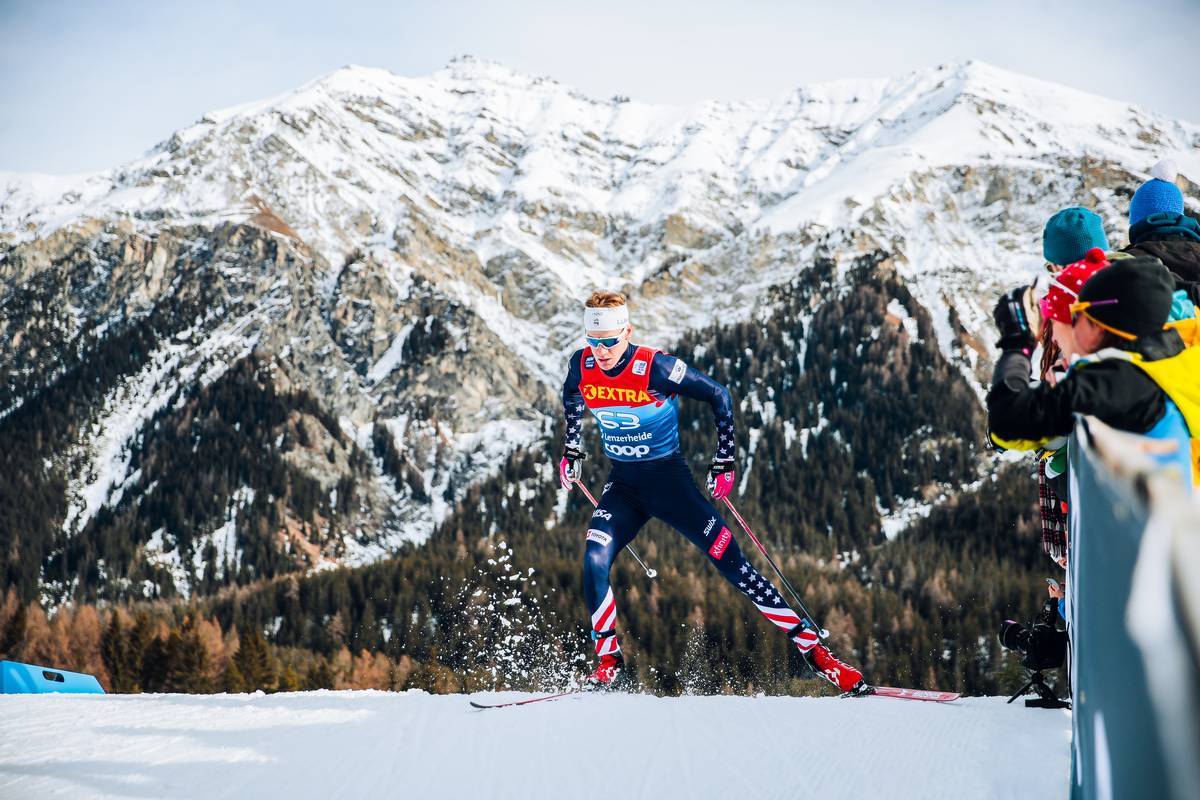
    Zak Ketterson races the freestyle sprint qualifier in Lenzerheide, SUI, the first event of the 2021/22 Tour de Ski. (Photo: NordicFocus)

    In a post-race email to FasterSkier, Ketterson shared how he felt about the Tour and what the recovery process has been like for him. 

    “The Tour de Ski was a fantastic learning experience with lots of ups and downs. I am pretty happy with my performance on the Tour given it was my first time on the World Cup, but I definitely think I will be faster next time around now that I have had the experience. Post Tour I was incredibly empty, both physically and mentally. To have to change gears pretty much immediately after the last stage of the Tour and head straight to Sun Valley for some super competitive SuperTour races at high altitude was definitely a recipe for disaster on my body. I felt like I was just going through the motions and my body wanted nothing to do with those races.

    “​​These last few weeks at home in Minneapolis provided me with some long-overdue recovery. My hunch after some really lackluster racing in Sun Valley was that there was no need to overthink anything and that the issue was probably just that I was tired. I took time at home to mentally and physically reset and started to feel a lot more like myself as the Placid races approached. Today, it all came together and I felt a lot more race-ready.”

    Ketterson also commented on the improvements that have been made at the Mt Van Hoevenberg venue, explaining how it supports the growth and elevation of domestic skiing.

    “I am blown away with the venue at Mt. Van Hoevenberg! The venue truly feels like it’s ready for World Cups, or even another Olympics. It’s really inspiring to see big investments into nordic skiing venues in the United States, and I can’t stress enough how big it is for us athletes. I can’t wait to come back to Lake Placid sometime later to really experience this place because I think it’s so awesome here.”

    Behind Ketterson, just 0.26 seconds separated second through fourth in the men’s final. Holmes won the boot slide to snag second (+0.72), while Harmeyer took the final podium spot in third (+0.92). Hébert was just 0.06 seconds shy of the podium, ending the day in fourth (+0.98).

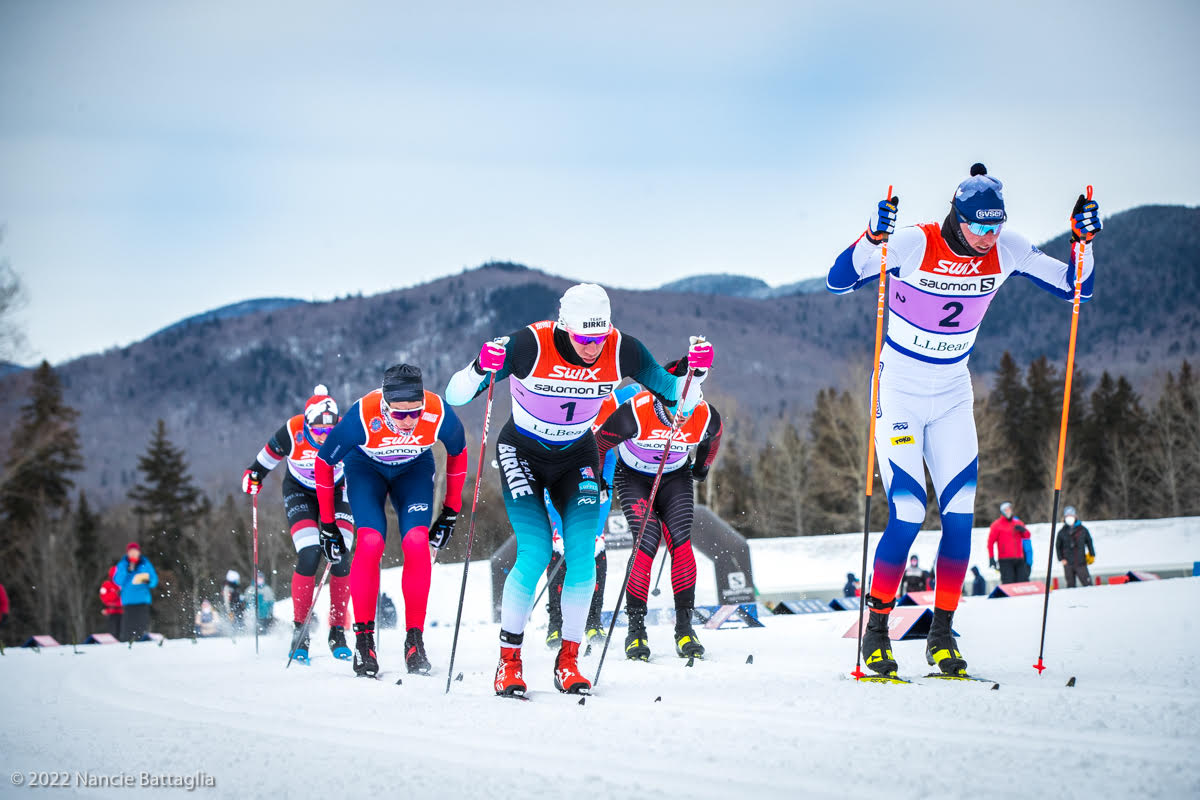
    The men’s final of the 1.5-kilometer classic sprint, the first event of the weekend of SuperTour racing hosted by Mt. Van Hoevenberg in Lake Placid. (Photo: © 2022 Nancie Battaglia)

    Harmeyer provided insights into his approach to the day, along with insights into the moves that contributed to the excitement at the finish line.

    “I felt really good in the heats today,” he wrote via email. “The course was certainly difficult and tactical. Placement in the group was really important and that was especially apparent in the final. We had a group of four dudes going over the top of the final climb into the long descent before the finish. It was an absolute scramble trying to get into the tracks on that final downhill. At one point, I had my left ski in the right part of the track and Étienne had his right ski in the left side of the track. Not easy to squeeze two guys going 30+ mph into a single track but somehow, I came out ahead which was just enough to lunge at the finish for third.”

    During Period I, Harmeyer took third in the classic sprint final in Cable, and was just off the podium in fourth the weekend prior after the freestyle sprint in Duluth, MN. After qualifying in fifth, a crash in the quarterfinal left him 24th in the freestyle sprint in Soldier Hollow during the U.S. Cross Country Championships. A few days later, he was 51st in the 15k classic. In the Soldier Hollow SuperTour classic sprint, Harmeyer qualified in fourth, and just missed the final to end his day in eighth. 

    Reflecting on the season as a whole, Harmeyer wrote, “I had a really good start to the season with some strong races in the Midwest. But overall, things have been frustrating. I’ve been struggling with some cold weather triggered exercise induced asthma that got really bad after the first supertours in the Midwest. I continued to struggle with it through a disappointing Senior nationals and decided to take a bit of time off to reset, recover and do some testing. I’m hopeful the worst is behind me and that I’ve got some good protocols lined up to prevent anything from happening in the future. My primary goal for the remainder of the season is to win the Stowe Derby, specifically the derby meister.”
    Wrapping up with a comment on the venue, Harmeyer added, “The new courses at Lake Placid are sweet! The sprint course is incredibly tactical but also rewards tough, explosive skiing. I had an absolute blast out there in the heats. The distance courses are hard but I’m excited to be doing a mass start on those for this Sunday. Overall, Van Ho has done a great job with course management and their snowmaking to put together some killer courses.”

    After a gap, Diekmann crossed the line in fifth (+5.81), while Locke rounded out the men’s final in sixth (+9.11). 

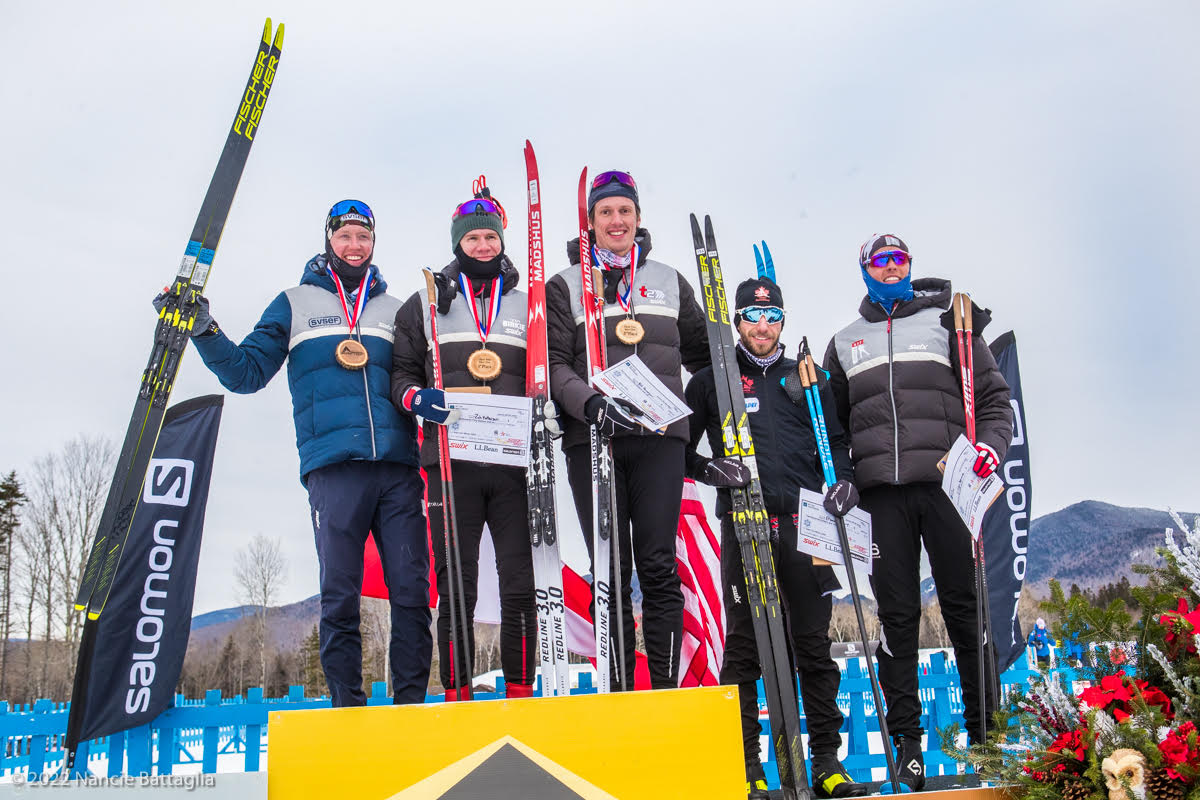
    The men’s SuperTour classic sprint podium on a frigid day of racing at Mt Van Hoevenberg near Lake Placid, NY. (Photo: © 2022 Nancie Battaglia)


    Women’s 1.5-kilometer Classic Sprint

    The women’s field began right where it left off in SuperTour classic sprints, with the winner of the last race at Soldier Hollow, Katharine Ogden, (SMS) finishing the qualifier in first place (3:40.49). She was followed by Lauren Jortberg (BSF Pro Team) in second (+2.2), and Ava Thurston (Mansfield Nordic Club) in third (+6.1). The qualifier indicated, again, the overall strength of the field that has characterized this year’s SuperTour, with the heat qualifiers all within 30-seconds of each other (26.0 seconds to be exact).

    That field remained tight in the quarterfinals as well. All five quarterfinals saw winning times within a mere five seconds of one other, with Katharine Ogden turning in the fastest time of the round at 3:42.77, and Alayna Sonnesyn winning her heat in 3:46.12. 

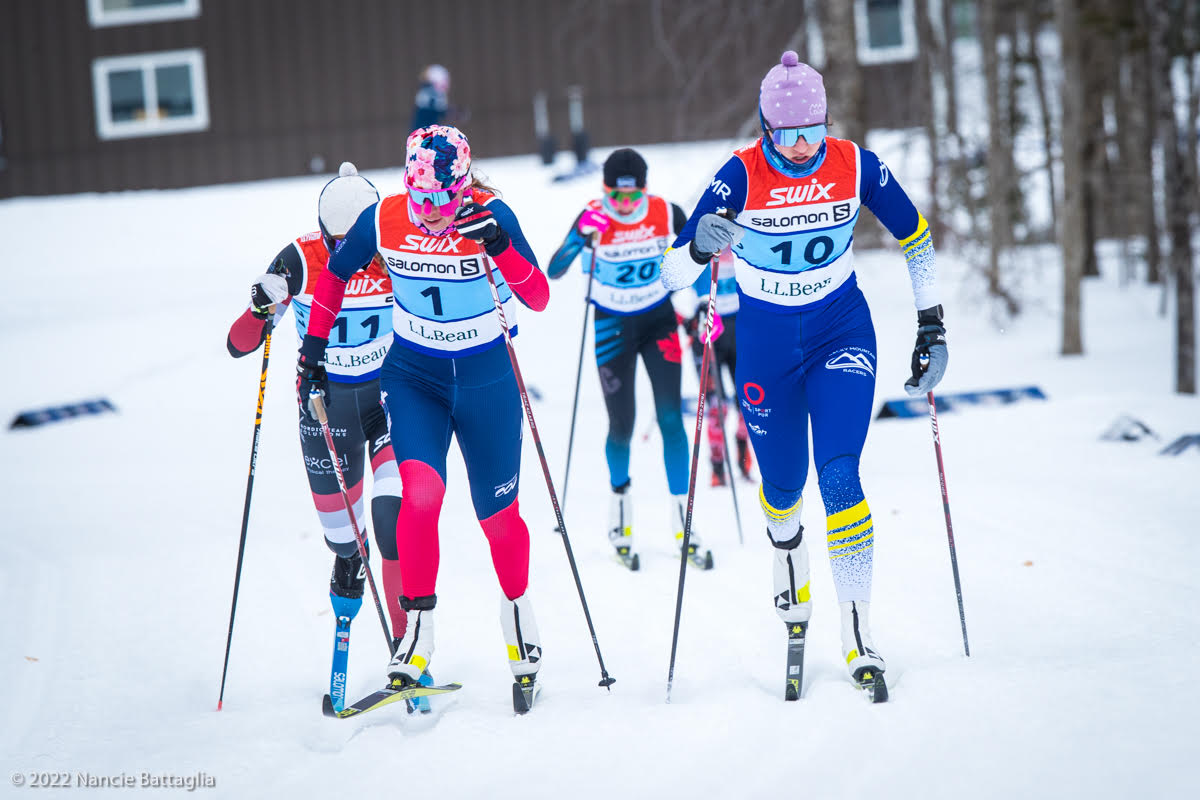
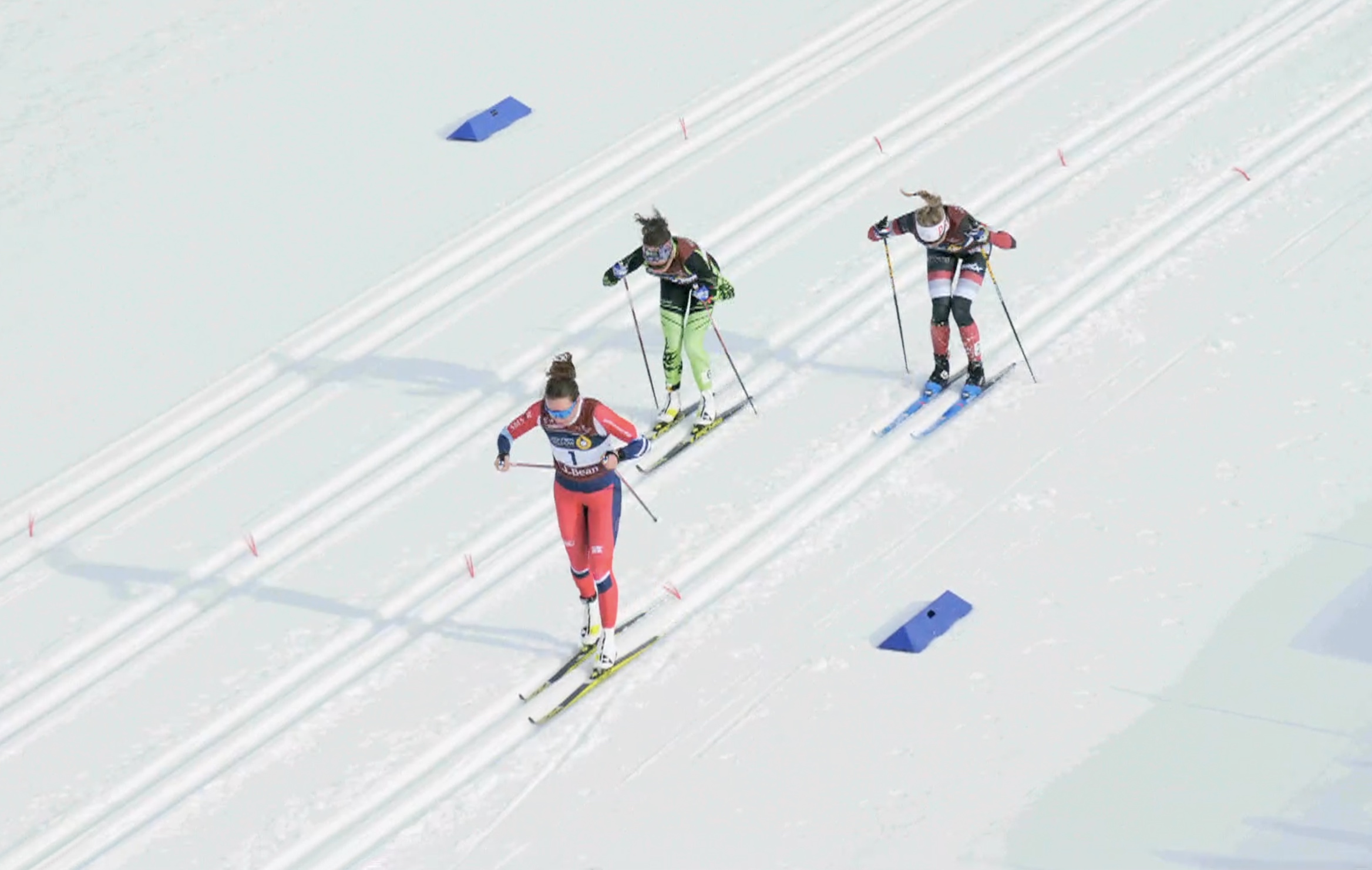
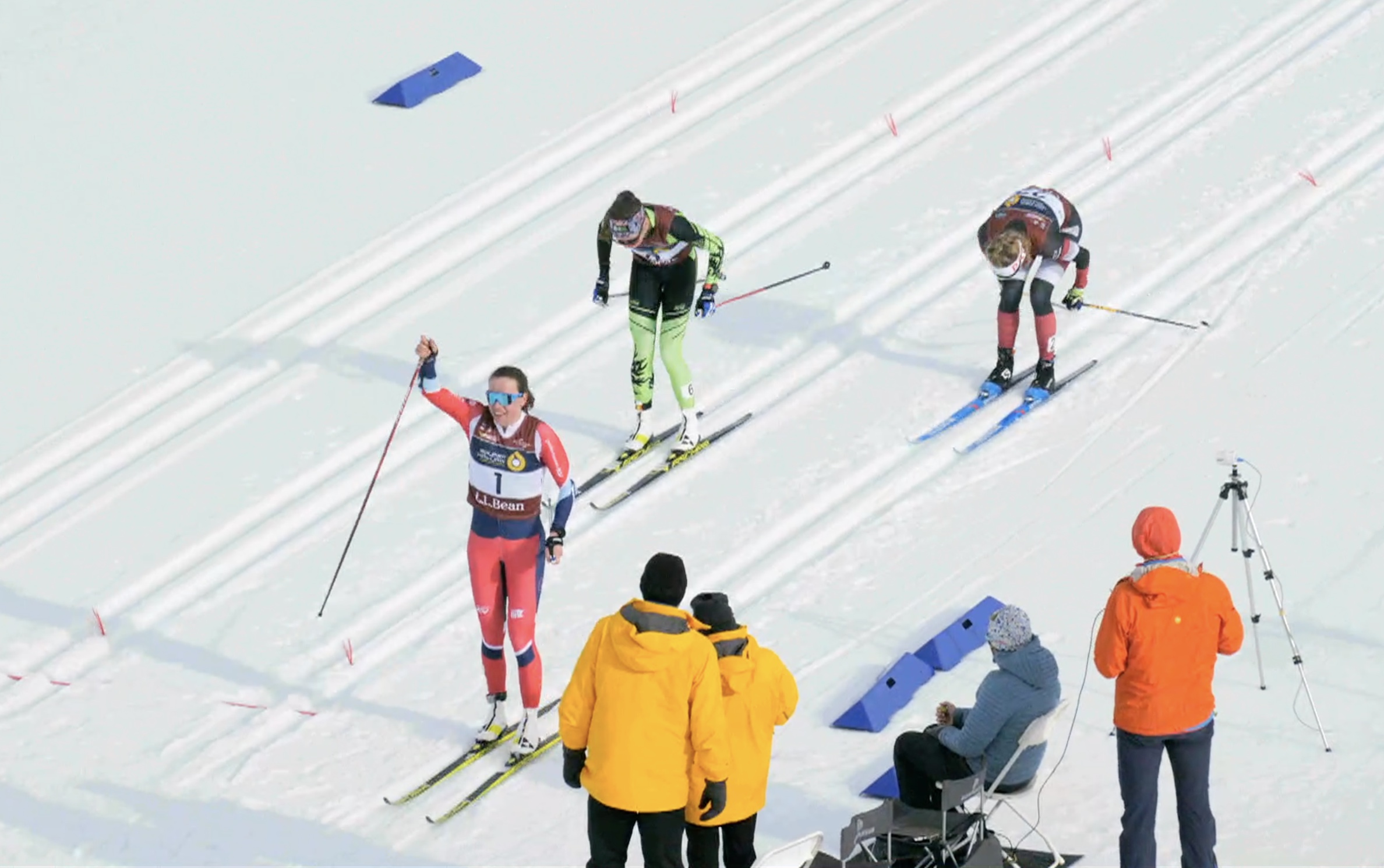
    Katharine Ogden (bib 1) races her way through the classic sprint heats during the SuperTour race weekend in Lake Placid. (Photo: © 2022 Nancie Battaglia)

    Ogden commented to FasterSkier that she “didn’t really have any strategy in particular. I find that it is better for me to make strategy in the moment during sprint heats because you never know what’s going to happen out there… I just tried to conserve as much energy as possible in the quarter and semi.” It would pay off later on.

    Meanwhile, also progressing to the semifinals was the APU one-two punch of Rosie Frankowski and Becca Rorabaugh out of quarterfinal 2. Despite being primarily known as a distance racer, Frankowski, came into today leading the SuperTour sprint classification and “set a blistering pace,” according to teammate Rorabaugh. With it, she pulled the duo into the semifinals together.

    After all the quarterfinals were through, the semifinals were set with a who’s-who at the top of the SuperTour sprint standings, rounded out by Canadian Katie Weaver (Hollyburn XC Ski Club) and Minnesotan Margie Freed (Craftsbury).

    The first semifinal featured a battle between two SMS T2 teammates, Katharine Ogden and Alayna Sonnesyn, and two APU teammates, Rosie Frankowski and Becca Rorabaugh. Frankowski again set the pace for the heat, with teammate Rorabaugh commenting that “[Rosie] is so strong on the uphills that she pulls the whole heat to a faster time.” Frankowski, however, couldn’t quite outlast Ogden and Sonnesyn, who used the downhill after the final climb to launch into the first two positions. Ogden won the heat in a time of 3:39.23, with Sonnesyn and Frankowski in second and third, respectively, by less than a second. Rorabaugh finished fourth, but along with Frankowski won the lucky loser spots into the finals – setting up another round of the SMS-APU duel.

    In the other semifinal, a close battle throughout yielded a win for Lauren Jortberg (3:45.15)  and a second place for Erika Flowers (+0.90). The result sent another teammate pairing into the finals, with both skiers coming from Bridger Ski Foundation (BSF).

    The women’s classic sprint final takes to the tracks in Mt. Van Hoevenberg. (Photo: © 2022 Nancie Battaglia)

    At Lake Placid – a place that has over the past century proved to be able to gather the entire world around skiing – it was perhaps appropriate that the women’s final would bring together three teams from across the American continent. Two from Vermont (SMS), two from Montana, two from Alaska (APU), and away they went!

    Katharine Ogden commented that the field didn’t waste any time: “It was pretty hard from the gun, as per usual.” 

    Rorabaugh, meanwhile, made a change in strategy, deciding to follow her teammate Frankowski more closely in the early part of the race. “I was trying to stay closer to the front of the pack since I had let a large gap form in the semifinal that I couldn’t make up,” she explained.

    That adjustment was one that helped create a pack that was tight throughout the race, and that was a bit harder to find a position in.

    Sonnesyn commented that this led to her having to adjust. “I had great energy but got tangled up a few times on the second hill, so I really had to ski from behind in the second half of the race,” she wrote. “Luckily, I had great skis and remained calm and was able to push through the final stretch.”

    In that final stretch, on the final hill, a “drag race,” as Rorabaugh described it, ensued. It was instigated by Ogden, who saw the final climb as the place to make her move, and made it. She came over the top in first place.

    “[I] got lucky,” she told FasterSkier. “Pat [O’Brien, SMS T2 head coach] had provided me with some really fast skis that allowed my move to stick going back down the hill.”

    Perhaps it wasn’t all luck though. Ogden came across the finish line in first place (3:40.13) after winning the qualifier, her quarterfinal, and her semifinal. It was an all-around dominant performance for one of the U.S. brightest stars in the classic sprint.

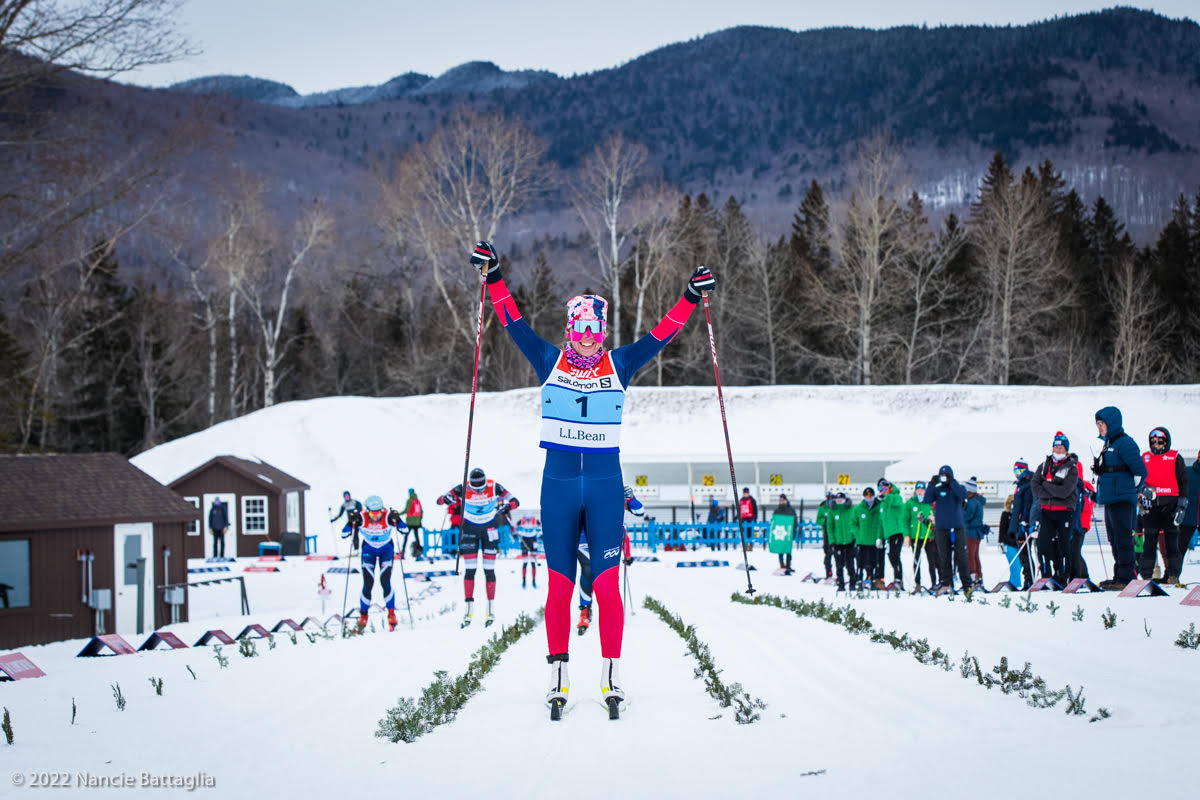
    Katharine Ogden wins the women’s 1.5-kilometer classic sprint in Lake Placid, NY. (Photo: © 2022 Nancie Battaglia)

    Meanwhile, Becca Rorabaugh had powered through the transition into the final downhill and came up with the reward of second place (+3.40), She was followed by Alayna Sonnesyn, who remained cool, calm, and collected as she skied her way through the pack to third place (+4.29).

    The final was rounded out by fourth place Rosie Frankowski (+4.74), fifth place Lauren Jortberg (+5.63) and sixth place Erika Flowers (+17.77).

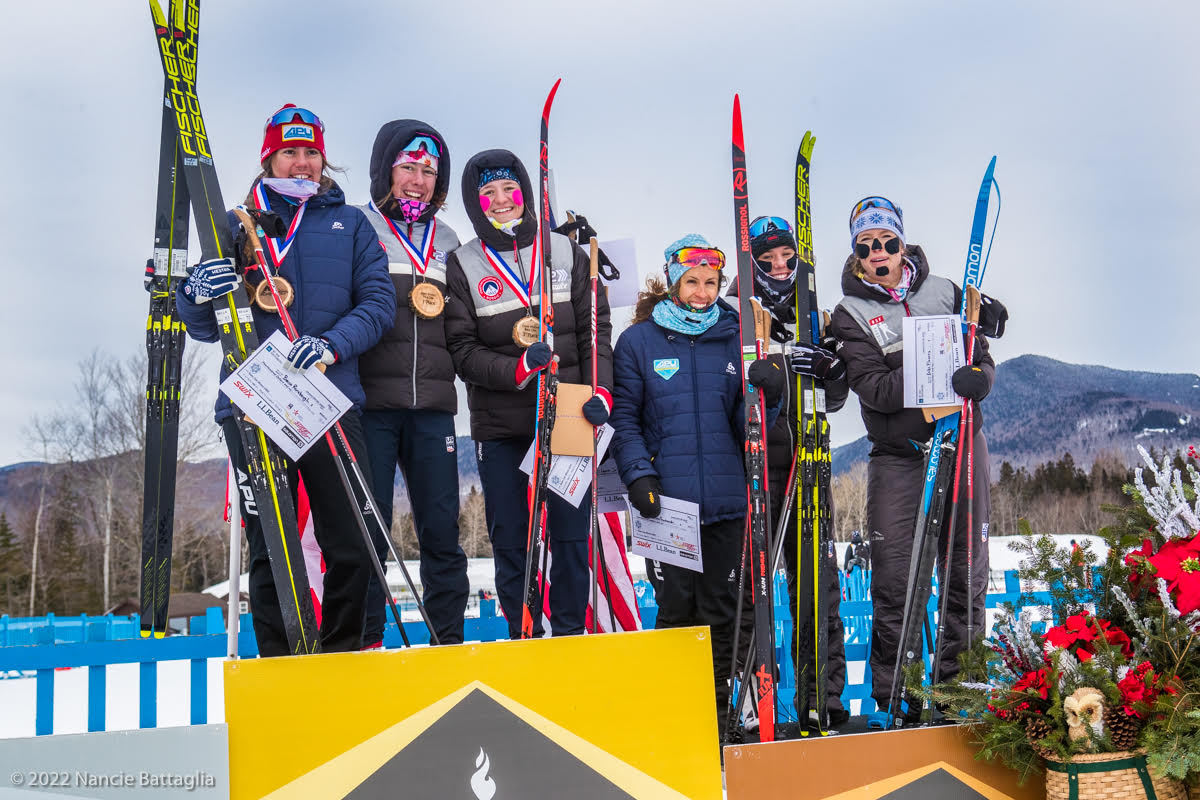
    The women’s classic sprint podium on day one of SuperTour racing in Lake Placid, NY. (Photo: © 2022 Nancie Battaglia)

    The result was reached at the end of an exciting day that encapsulated the beauty of ski racing – with excitement and energy perfectly juxtaposed against the extreme absence of that energy in the air. Preparing for cold temperatures that are forecasted again for the 10k freestyle mass start tomorrow, the top finishers today all expressed that the temps are part of the appeal in the northeast this weekend.

    From Rorabaugh, “I don’t mind cold temperatures – I grew up in Fairbanks, Alaska!”

    From Sonnesyn, “I like to think the Midwesterner in me prepared well!” 

    And from Ogden, the perfect Vermont tip: “As Sverre [Caldwell] told us last night, tricky race conditions can work to your advantage if you prepare better than anyone else. Wise man :)”


    Results

    Qualification: Men | Women

    Sprint Brackets


  • Nordic Nation: Inside the Athlete-Guide Dynamic with Jake Adicoff and Sam Wood

    Nordic Nation: Inside the Athlete-Guide Dynamic with Jake Adicoff and Sam Wood

    In this episode, we have Jake Adicoff and Sam Wood, calling in from Lillehammer as the duo races as athlete and guide at the Para World Championships. Jake is a visually impaired athlete from Sun Valley who grew up racing with the SVSEF cross country program and now trains with the Gold Team. He has raced at both the 2014 Paralympics in Sochi, and the 2018 Games in Pyeongchang, where he won a silver medal in the 10k classic, as well as placed 4th in the classic sprint and 5th in the 20k free. 

    Jake Adicoff and his guide Sam Wood put together a gold medal performance on the opening day of racing at the Para World Championships in Lillehammer, NOR. (Photo: Alex Livesey/Getty Images)

    Meanwhile, Sam is also a member of the SVSEF Gold Team, balancing his own training and race goals with his support of Jake this season. Sam finished in the top-10 twice in the opening SuperTour weekends this season, and was in the Top-25 in both distance races at the U.S. Cross Country Championships in Soldier Hollow. (Jake also raced, independently, at U.S. Nationals 

    While it has included career best results, this year of racing was not originally in Jake’s plans. He retired from professional skiing in 2018, heading to San Francisco to work as an engineer for Uber, having graduated from Bowdoin College that spring with a degree in Mathematics and Computer Science. When the pandemic hit, he began to work remotely from his parents’ house in Sun Valley (thinking it would be just for two weeks – remember that?) and ended up “casually” hopping into training with his friends on the Gold Team. With a few nudges from US Para Nordic and teammates like Sam, Jake began to realize he was still passionate about ski racing and quite fit again, and he began to set goals for the upcoming 2022 Paralympics. 

    Jake Adicoff follows Sam Wood on a long training run near Sun Valley, ID with the SVSEF Gold Team. (Photo: Instagram @svsefxcgoldteam)

    At the time of the call on Friday January 21st, Jake had already earned a World Championship gold medal in the 10k classic on Sunday the 16th, and a bronze medal in the 15k skate on Tuesday the 18th. The morning after the call, the pair raced to second place in the 1.5k classic sprint. Three races, three medals. This week made it clear that Jake is in top form and will be a medal contender in Beijing. 

    In this conversation, we get into the dynamic of the athlete-guide partnership, as well as how being long-time friends and teammates has contributed to their success racing as a pair this season. 

    Friends, teammates, and now athlete-guide pair, Sam Wood (left) and Jake Adicoff (right) keep it fun on a sprint ski near Sun Valley, ID. (Photo: Instagram @svsefxcgoldteam)

    To follow along with Jake’s racing this season, you can find race recaps with athlete quotes on the US Paralympics Nordic Skiing tab on the Team USA website, or follow the team on Facebook and Instagram.

    A quick heads up on the audio, you’ll notice a bit of crackling and some poor connection toward the end of the podcast. Thanks for listening.

  • In-Depth Race Coverage: Slow Heats with Tight Finishes in the SoHo SuperTour Classic Sprint

    In-Depth Race Coverage: Slow Heats with Tight Finishes in the SoHo SuperTour Classic Sprint

    By Rachel Bachman Perkins and Ben Theyerl 

    Precipitation was no longer a threat for the final day of racing in Soldier Hollow on Friday, a 1.5-kilometer classic sprint offered alongside the 2022 U.S. Cross Country Championships, yet classified as SuperTour only. However, athletes still faced unseasonably warm weather as blazing sun brought temperatures into the low 50’s on course during the midday heats. 

    Howling wind and rippling bibs could be heard as background noise as Adam Verrier called the event on the livestream, creating extra work for the athletes who would fight through degrading course conditions throughout the heats. This extra work showed in the times on course; with the combination of freestyle technique and significantly faster course conditions, Sunday’s sprint races featured times over a minute faster on average. A similar difference was seen even between the qualifier today at 9 a.m., when temperatures were still colder and tracks firmer, and the heats which began at 12:30 p.m. 

    Warm temperatures, degrading tracks, and loose granular spray set the stage for a challenging classic sprint in Soldier Hollow. (Photo: Tobias Albrigtsen / @untraceableg)

    “Sprint” seemed to perhaps be a misnomer, as times in the women’s heats climbed over five minutes and were well above four minutes in the men’s heats. Combined with a qualifier, this meant athletes who raced through the final saw between 16 and 20 minutes of racing, testing their endurance and fitness differently from the average sprint event.   

    Women’s Race: Katharine Ogden on Top from Qualifier to Final

    On the heels of a second place finish in yesterday’s 15k classic, Katharine Ogden (USST/SMS T2) set the bar in the qualifier, finishing in 3:51.79.

    Julia Richter (U of Utah) was the second fastest qualifier (+0.77), ahead of Lauren Jortberg (BSF Pro) in third (+1.48). Both Ogden and Jortberg won their quarterfinal to advance comfortably into the semis, however, Richter took fifth in Heat 4 and did not advance.

    In the first semifinal, two Craftsbury teammates Annika Landis and Caitlin Patterson led the way in the opening climb, with Ogden and Sydney Palmer-Leger (USST/U of Utah) sitting in third and fourth a few strides behind. Descending from the high point, a third Craftsbury racer, Michaela Keller-Miller, had pulled to the front, but was quickly overtaken by Patterson and Ogden as the pack headed into the final short herringbone climb before the long descent toward the stadium. Patterson and Ogden sat in low tucks, letting their fast skis glide as long as possible before transitioning to doublepole as they headed over the bridge and into the finish. 

    Sydney Palmer-Leger heads out for the 10k interval start classic race during the 2022 U.S. Cross Country Championships in Soldier Hollow. (Photo: John McColgan)

    Upping the power in the final 200m, Palmer-Leger accelerated to make contact with Patterson as the women crossed over the bridge, but Patterson had better glide in the quick descent from the bridge’s exit, maintaining an advantage as they headed into the final stretch. Patterson tucked in on the tails of Ogden in the left-most track to go one-two in the heat, with Palmer-Leger not quite in the fight for an automatic qualifier spot finishing 1.5 seconds behind Patterson in third. 

    In the second semi, Bridger Ski Foundation (BSF) Pro Team members, Lauren Jortberg and Hannah Rudd lead the charging, looking as if their skis were gliding well as they pushed the downhills, perhaps with compromised kick as both showed signs of slipping in the final punchy climb. 

    In the long glideout, Lauren Jortberg moved from the far left side of the course outside of the track into the second track, losing some time on Rudd who had stuck with the second track from the start. Nevertheless, both held a significant gap over the remainder of the heat as they doublepoled over the bridge and into the finish lanes. Rudd took the win in 4:55.52, roughly +0.7 seconds ahead of Jortberg in second. 

    A few meters behind, Craftsbury teammates Margie Freed and Alexandra Lawson raced side by side to third and fourth, and as the heat proved to be seven seconds faster on average than the first, both advanced to the final.

    As the women’s final headed out of the stadium and toward the first climb, Lauren Jortberg who was the first in a train of two BSF skiers, had her ski stepped on as she was switching from doublepole to a run outside the track. This caused Jortberg to stand up, spin sideways and crash in slow motion. Rudd, who was just behind, quickly moved around Jortberg without going down, soon taking the lead charging up to top of the first climb with Patterson, Freed, and Ogden close behind.

    Patterson looked strong with solid kick as she chased a slipping Rudd up and over the final long climb, but it was Ogden on fast skis who quickly moved into second on the subsequent downhill.

    Over the last punchy climb the women ran. Heading into the long glideout, Ogden was off the front in the left-most track, but Rudd and Patterson remained within reach a few ski lengths behind. Descending off the bridge, the top three accordioned together, all choosing the same track with Ogden confidently leading the way to the finish. Patterson, who was in third, moved into her own lane to the right, slowly gaining ground on Rudd as they headed to the line. 

    Katharine Ogden leads Caitlin Patterson and Hannah Rudd to the line during the SuperTour classic sprints in Soldier Hollow. (Photo: Livestream Screenshot)

    Ogden maintained her lead to stop the clock in 5:01.63, while Patterson edged out Rudd for second (+0.98) and third (+1.53), respectively. After regaining contact with the pack following her crash, Jortberg finished fourth (+6.64), with Lawson fifth (+7.11), and Freed sixth (+21.55).

    “I was having a lot of fun out there today!” Ogden wrote to FasterSkier after the race. “The sprint was definitely on the long side, especially late in the day, but that did not significantly affect my strategy; I am confident in my endurance as well as my short duration power. I was really excited to have fast skis from Pat [O’Brien] and it was fun to experience the high level of sprinting in the U.S. currently. I also haven’t really done a full sprint day in a while so that was a lot of fun! It was also so impressive to see Caitlin get her fourth podium in as many races and to see Hannah Rudd have an incredible breakout performance today!”

    Katharine Ogden celebrates her win in the classic sprint while Caitlin Patterson edges out Hannah Rudd for second and third. (Photo: Livestream Screenshot)

    In a post-race email, Patterson reflected on her experience racing through the heats. 

    “My racing today went fairly well, and it was a beautiful day to be out skiing and spectating,” wrote Patterson. “The sun-warmed snow became quite wet and broken apart for the heats, and combined with the wind, it certainly made a long sprint with plenty of herringbone and some sloppy tracks. I tried not to really think about the time duration much, it was mostly about getting from start to finish, however long it would take. All of the heats required some scrappy skiing, moving around through the slush and timing the length of the tuck. Now I’m really looking forward to some recovery after a good week!”

    Patterson also spoke to the week of racing in Soldier Hollow, where she finished on the podium four times in as many races, including wins in both the 10k individual classic and the skate sprint. But she was not the only person in a green suit putting together a successful week. Yesterday, she shared the distance classic podium with teammate Adam Martin. On Tuesday, Crafstbury went 3-4-5 in the 20k skate, with Lawson and Freed leading a chase group behind Frankowski and Patterson. And today, five CGRP women raced in the semis, with three advancing to the final. 

    “Everyone at Nationals is really feeling the fatigue, and myself and my team were no exception out there today. The race coughs are becoming quite terrible from so many days of racing at altitude, which is not the most fun to be coughing uncontrollably in this time of COVID. However, I was really proud of our whole team, with 5 women in the top 10! We have a really strong group, as evidenced by the performances in the distance races too; it came as no surprise to me that the women were awesome today, because training and doing intervals all summer and fall we’ve been neck-in-neck and pushing each other.”

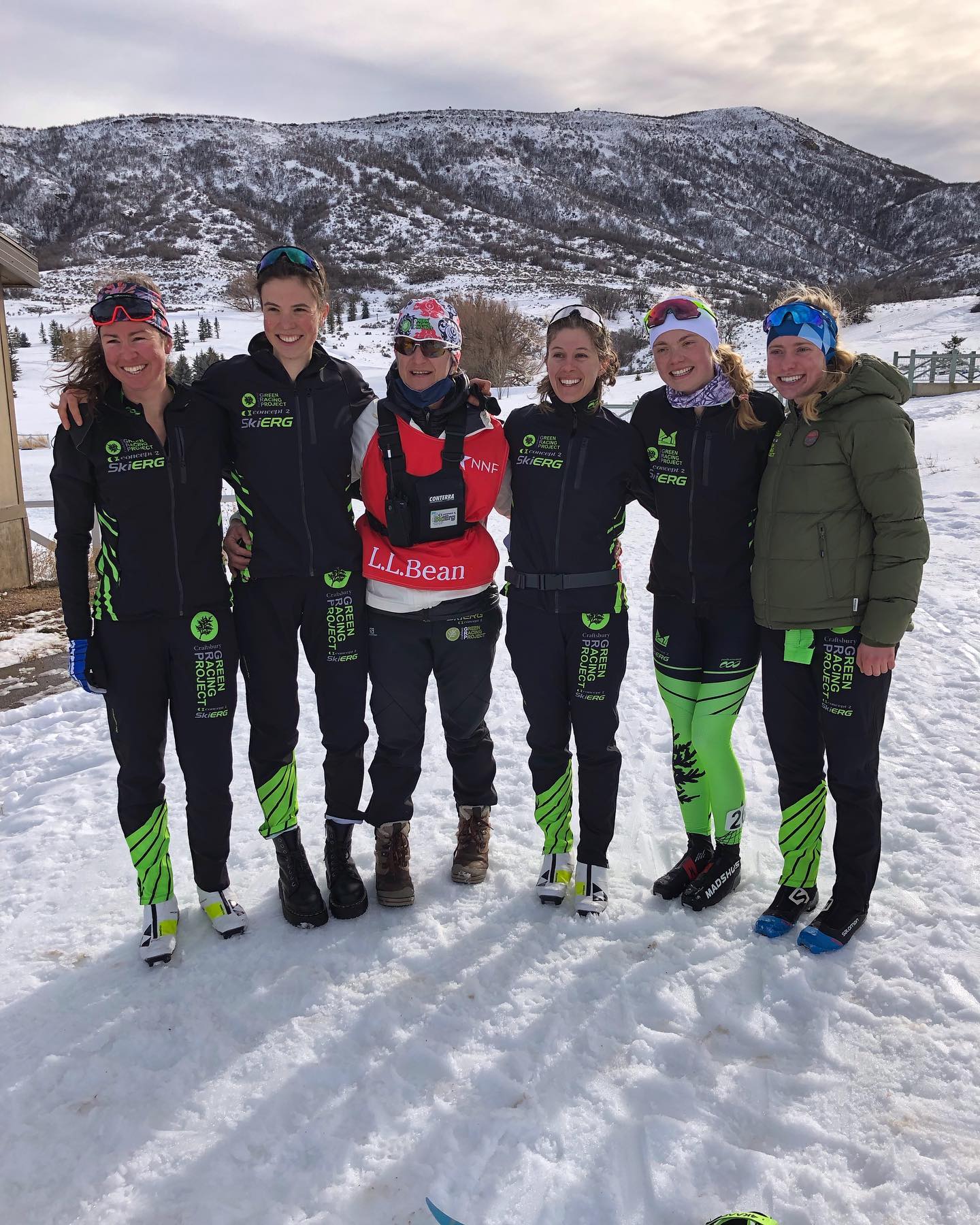
    The women of Craftsbury with coach Pepa Miloucheva. CGRP put five women into the semifinal and three into the final of the SuperTour classic sprint in Soldier Hollow. (Photo: Facebook Crafsbury Green Racing Project)

    For Rudd, this was her first career SuperTour podium. Originally from Plymouth, MN, she graduated from University of Alaska Anchorage (UAA) in May, 2020 before heading to Bozeman to join the newly minted BSF Pro Team. Placing in the top-10 in each of the three stages of the 2022 U.S. Cross Country Championships, Rudd has steadily worked her way up the results list, finishing 10th in Sunday’s freestyle sprint, 8th in the 20k mass start free, and 6th in the 10k interval start classic. She ends her week in Soldier Hollow on a podium high note. 

    Hannah Rudd is a member of the BSF Pro Team based in Bozeman, MT. (Photo: bridgerskifoundation.org)

    “Yesterday was a pretty exciting day for me!,” Rudd wrote to FasterSkier after the race. “The sprint course at Soldier Hollow this year was very challenging as it included three solid climbs. During the qualifier, the course remained very firm and fast. However, the temperature quickly began to rise throughout the day, and by the time the quarterfinals began, the sun was baking the course, the wind was blowing, and temps were nearing 50 degrees. This made the snow begin to transform and slow down and turned the tracks into mashed potatoes in some sections. 

    “I woke up in the morning feeling quite tired from the past week of racing so I was not sure how the day was going to play out,” Rudd continued. “I ended up qualifying in 22nd, so it was clear that I had some work to do in the heats. I felt like I was able to gain momentum and energy throughout the day, and progressed through the quarters, and semis and onto the final. Going into the final, I knew that my team’s skis were running really well so I tried to ski big and relaxed and put myself in a good position for the last downhill. It was pretty neat to be in a final with my BSF teammate Lauren Jortberg, who is an incredible sprinter and someone that I have learned a lot about sprint racing from over the past few years. I was extremely excited to land myself a spot on the podium and think it will help me to continue building momentum and confidence for the rest of the season!” 

    The podium ceremony for the women’s final following the SuperTour classic sprint in Soldier Hollow. Katharine Ogden took the win ahead of Caitlin Patterson and Hannah Rudd, with Lauren Jortberg 4th, Alexandra Lawson 5th, and Margie Freed 6th. (Photo: Facebook Craftsbury Green Racing Project)
    Men’s Race: Colorado’s Magnus Bøe Upsets Schoonmaker in the Final 

    In qualifying, JC Schoonmaker (USST/UAA) showed why he has been the U.S. Ski Team’s most reliable fixture of World Cup Classic heats this season, winning the qualifying with a time of 3:08.43, 6.42 seconds ahead of 2nd place Peter Holmes (Sun Valley SEF). Andreas Kirkeng (University of Denver) rounded out the top 3 (+6.57), in a field where the top 30 were all within 20 seconds of each other.

    With a dominant performance in qualification, the racing throughout the day always seemed to have one eye on where Schoonmaker was in the field. In his quarterfinal, Schoonmaker looked to start conservatively from the back of the field, which led the whole heat to sit back as well. When he moved to the front at the beginning of the first climb, the race surged forward with him. No one could match him, however, and he finished with a comfortable lead, with Kjetil Bånerud (NMU) taking the 2nd semifinal spot (+1.02).

    JC Schoonmaker prepares for a sunny and warm classic sprint in Soldier Hollow. (Photo: Tobias Albrigtsen / @untraceableg)

    The following two quarterfinals also previewed the competitors, and their preferred way of attacking the course, that would define the semifinal and final racing later on.

    The second heat set a stark contrast in pace to the previous heat, with Noel Keefe (U of Utah) and Bill Harmeyer (SMS T2) leading the field out hard from the gun. Hunter Wonders (APU) and Johnny Hagenbuch (SVSEF) were able to keep with the pair though, and ended up out-sprinting Keefe and Harmeyer going into the finish. Still, the duel between Keefe and Harmeyer led to a blistering pace for the heat overall, and they would claim the lucky loser spots for the semifinals.

    Then came the 3rd quarterfinal, featuring winner of today’s most aggressive racer award (unofficially handed out here, by Fasterskier), Ian Torchia (SMS T2), who in every heat he was in today would hammer out to the front of the pack while others seemed content to let the field play out. He was joined in the heat by Magnus Bøe (U of Colo.), who made his move on the first climb, stayed out in front, and came through in first place. Torchia, meanwhile, held onto second to advance automatically to the semifinal.

    The semifinals marked more an amalgamation of race strategies than anything unique. But it was an amalgamation – which requires multiple parts. And indeed, on a course known for rewarding smart-racing, and in conditions – above freezing, on man-made, wind-swept snow – that reward smart waxing as well.

    Magnus Bøe and JC Schoonmaker are off the line during the 2022 U.S. Cross Country Championships freestyle sprint stage. (Photo: Tobias Albrigtsen / @untraceableg)

    The first semifinal featured Schoonmaker and Bøe, both of which stayed back in the back during the early part of the course. Going into the first climb, Bøe took a look back, saw Schoonmaker and Harmeyer were sitting in fifth and sixth place, respectively, and decided to attack. He led over the top, into the downhill, and up the final climb. Schoonmaker successfully did maneuver through the pack to counter the move, and on the final climb took the outside line up, cutting in to tuck behind Bøe going into the final downhill. When they came up, Schoonmaker had used the draft to put himself out front, while Bøe held off a late-surge from Hunter Wonders (APU) to take the second qualifying spot into the finals.

    The second semifinal was again led out by Ian Torchia, who was then followed by former sprint National Champion Tyler Kornfield (APU). Kornfield seemed content to sit behind Torchia until the first climb, when he put in a burst of speed and broke open the field. The smartest racer, however, may have been Karl Schulz (SVSEF), who rode Kornfield’s attack, and then drafted, to go into the final climb with speed. By the time he hit the downhill, he had a gap which would remain unclosed. Kornfield, who had gone into the downhill in second, found himself joined by Noel Keefe and Ian Torchia into the final sprint for the second spot. As it would happen, all three would make it through to the finals, with Kornfield in second, and Keefe and Torchia being rewarded for their efforts early in the race by claiming the two lucky loser spots to the final.

    The A-final then looked like this: JC Schoonmaker, Magnus Bøe, Karl Schulz, Tyler Kornfield, Noel Keefe, and Ian Torchia.

    JC Schoonmaker races the qualifier during the SuperTour classic sprints in Soldier Hollow, UT. (Photo: Tobias Albrigtsen / @untraceableg)

    With memories of Schoonmaker’s dominating qualifier in mind, it seemed like the field orbited around him off the line. Schulz found himself in front, but not going full bore to open the field up. Even Torchia, when he did make a move to the front, didn’t seem to do so with the same force that had marked his quarter and semifinal attacks. Schoonmaker waited until the first climb to move to the front, and then the final really was on. Schultz seized on the attack, and then put an extra-push into the downhill to try and open up an unclosable gap like he had in his semifinal. It was a good move, but one that didn’t prove to have the same force as his previous attack, and going into the final climb he was joined up with Bøe and Schoonmaker. 

    Then, Schoonmaker’s pace seemed to drop-off, with a few noticeable slips that progressed into a herringbone. Bøe, meanwhile, went for the herringbone from the get-go. He was the one that made contact with Schulz before the course gave way to a final downhill on the day. Schultz held a gap on the field through the glideout and over the bridge, but it proved not to be enough of a margin to feel comfortable in the final stretch. Meanwhile, Schoonmaker had fallen back to fifth.

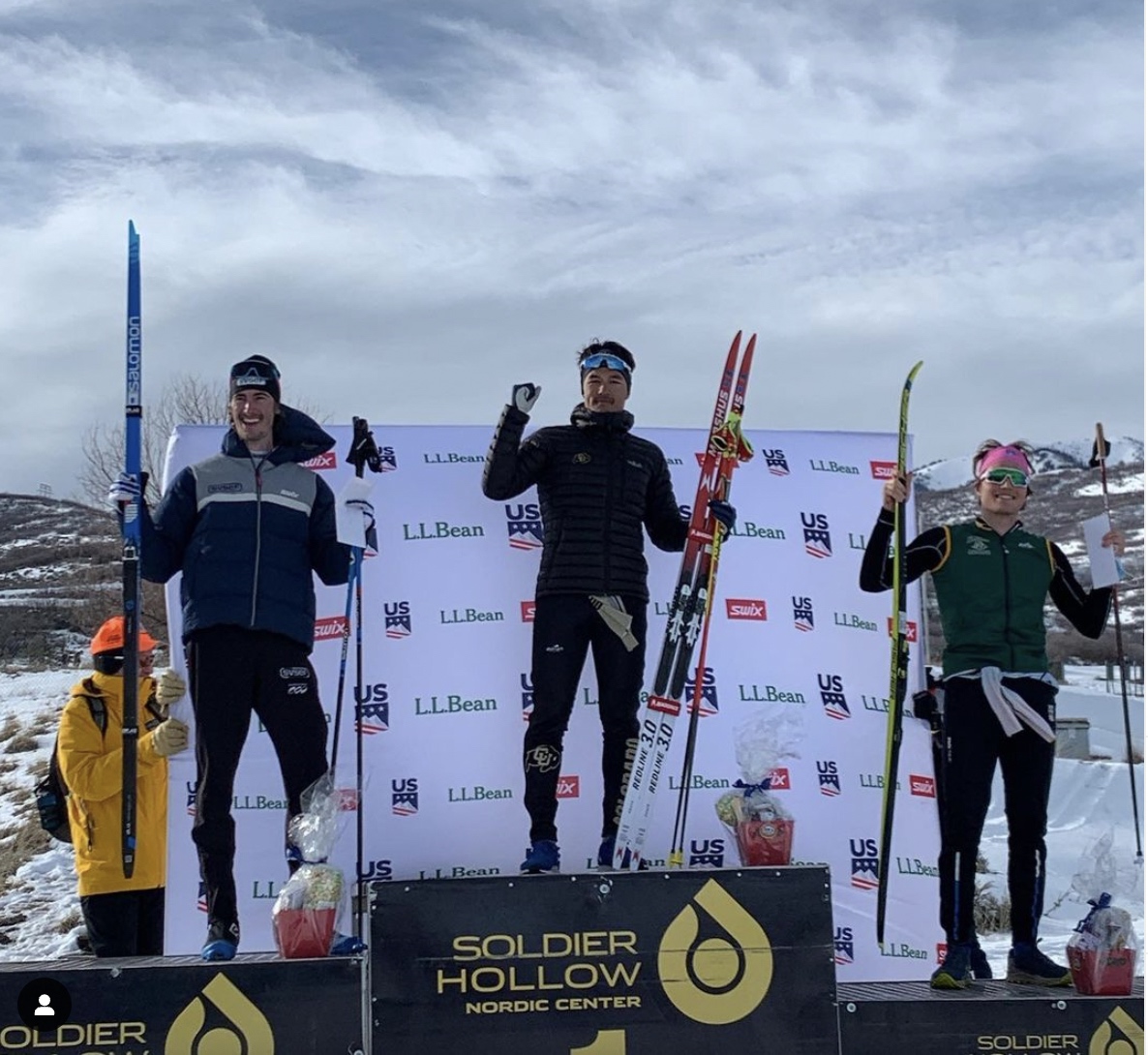
    Utilizing his dominating doublepole sprint, when they hit the final 100m it was all Bøe, who closed a significant gap to catch Schulz in the final 50 meters. Looking as if he was leaping forward with each push, Bøe switched lanes, overtaking Schultz just before the line and letting out a fist pump as he realized a SuperTour – and collegiate – victory in a time of 4:08.28. Pushing to the line, Schulz was a close second (+0.35). (Video clip here.)

    Magnus Bøe overtakes Karl Schultz just before the finish of the men’s classic sprint final. (Photo: Instagram @cubuffs)

    After a gap, Schoonmaker, who was fighting for the final podium spot alongside Kornfield and Torchia, crossed the line outside of the track in third place (+4.53). Kornfield was a half second back from Schoonmaker for fourth (+5.10), with Torchia fifth (+5.64), and Keefe sixth (+11.02).

    After the race Bøe explained that he changed his tactics in the heats relative to Sunday’s freestyle sprint, though he joked he thought it wise not to reveal everything. 

    “Today was a windy and slow-condition day,” Bøe wrote in an email. “There was headwind in the first half, and tailwind in the second half. Hence, pulling during the first half would be pointless. Furthermore, the second half, particularly for the last downhill there was very little to gain on the slipstream, due to the low speed and the ‘suctiony’ snow (cold conditions create better glide for the person coming behind on ‘heated tracks’). Therefore during all my heats I pretty much went all out from the top of the last uphill all the way to the finish, which on sunday would’ve been a suicide.”

    Bøe walked through the final, including how he reacted to lead changes and adjusted his strategy when the race began to play out differently than anticipated. 

    “The final started off very slow, but then the positioning battle developed gradually from under the bridge. My main focus was to keep my eyes on JC, since he was clearly the favorite of the day, and I knew I would do well if I laid it up to beat him. Hence I never fell for the temptation of passing him, even though I had many chances of doing so. However, he did get tired during the last climb and tried to get others to pass him. This is when Karl took off and gained a massive gap that at first seemed too late to close. As soon as I realized that JC might not be able to catch up, I committed to catching Karl by myself. I made sure to put in a great push before the downhill straight, and did the ‘supertuck’ to gain every single inch I could. Once I started double poling towards the last bend it was just heads down and maximum effort. Was never certain I would catch Karl, I thought maybe he’d have something left at the very end. But lucky for me he didn’t and I had just enough to pull it off.”

    University of Colorado’s Magnus Bøe heads out for the men’s 30k mass start free during the 2022 U.S. Cross Country Championships in Soldier Hollow. (Photo: Tobias Albrigtsen / @untraceableg)

    A dual citizen of Korea and Norway, 23-year-old Bøe has already built a robust resume in international ski racing, including competing for Korea during the 2018 Olympics in Pyeongchang. Earlier this week, Bøe was fifth in Sunday’s freestyle sprints and finished 11th in the 15k classic. His only down race of the series happened in the 30k mass start freestyle, where he finished 43rd (+12:30.9).

    “This week of racing has been up and down, from a miserable 30km where I got lapped, to today’s win. It’s been a lot of fun, and not least has been helpful for my shape. Next up is the Super Tour in Sun Valley, which I am looking forward to. Think I would be able to build on top of what I gained during this week.”

    For Schultz, today also marked a career-first SuperTour podium. The 23-year-old Lake Placid, NY Native raced for the University of Vermont (UVM) until graduating in May, 2020, then heading to Sun Valley. Schultz had a podium just-miss earlier this year in a freestyle sprint where he finished fourth during the opening weekend of SuperTour racing in Duluth, MN. 

    “I was pretty fatigued from the three races prior,” Schultz wrote after the race. “I knew there was a decent headwind on that first climb, so I decided I’d tuck in behind up and over the first climb. I figured I’d need to save my strength for the final climb and long finishing straight, so I played my cards well and pushed where I needed to, and it just worked perfectly. I’ve learned sprinting is about preserving energy for critical parts of the course, it couldn’t have gone better.”

    “And I won’t lie,” Schultz continued. “The spectators and everyone cheering allowed me to find another gear, especially up the last climb. I dug deeper than I have before.”

    The men’s podium of the SuperTour 1.5k classic sprint in Soldier Hollow: Magnus Bøe took the win ahead of Karl Schultz and JC Schoonmaker. (Photo: Instagram @nysefnordic)

    Writing to FasterSkier after the race, Schoonmaker explained how changing conditions forced athletes to make tough decisions about skis as well as tactics. 

    “It was a pretty crazy difference from this morning to the afternoon,” Schoonmaker explained. “The morning was icy and fast and the heats got really sloppy and slow.  I had amazing skis in the morning and in the heats I struggled a bit with choosing whether to go for more kick or glide. I ended up asking for less kick to free the ski up a bit and I’m still not sure what was the right call. It was just really challenging conditions.”

    Schoonmaker also explained that he had made fewer adjustments to the technique he had found such success with in Sunday’s skate sprint, however, the final proved to break the mold of what has historically proven to be the recipe for Soldier Hollow sprint racing.

    “For this course I tried to take a somewhat similar approach as in the skate race by respecting the draft on the last downhill and trying to be careful about the guys behind me there. In the quarterfinal I felt I was able to ski away and create a big enough gap so that I couldn’t get sucked back in by the draft. In the semifinal, I tried to stay more in the pack and use the draft for myself. The final was tricky because I was going to try and use the draft again but Karl put in a really good move on the last hill that I couldn’t match. Then I was leading the rest of the pack and I decided to push over and try to catch Karl rather than go to the back to find the draft. It ended up not working out so great, but I’m happy with the day and the tough effort.” 
    We conclude a week of racing at Soldier Hollow, then, with a race that highlighted the strength and depth of the domestic circuit of U.S. skiing at present. Variable conditions on a technical course, which racers approached with tactics as diverse as the regions they hail from, indicated that this is a field that represents top-level racing. It was a testament to the development and growth of the sport in this country that a top-level racer like Schoonmaker can come off the World Cup and find a field where every heat is raced with closeness and intensity in his own country. That bodes well, and is a great place to leave the last national gathering of the US ski racing community before its best representatives look to take a crack at the Olympic Games in Beijing next month.

    The spirit of the sport captured at the finish line as Alaska Winter Stars athlete Meredith Schwartz embraces her coach at the finish of the classic sprint in Soldier Hollow. (Photo: Tobias Albrigtsen / @untraceableg)

    FasterSkier extends congratulations to all athletes who competed in Soldier Hollow this week, commending their efforts in a fiercely competitive field through a variety of race formats and course conditions. Also, a big thank you to Tobias Albrigtsen and John McColgan, who generously shared their photos with us throughout the week. Stayed tuned for an upcoming gallery highlighting many of the fantastic images that were not included in our reports. 

    Full Results:

    Qualification | Women’s Final | Men’s Final

    Livestream Replay

  • Elite Team Preview: Sun Valley XC Gold Team

    Elite Team Preview: Sun Valley XC Gold Team

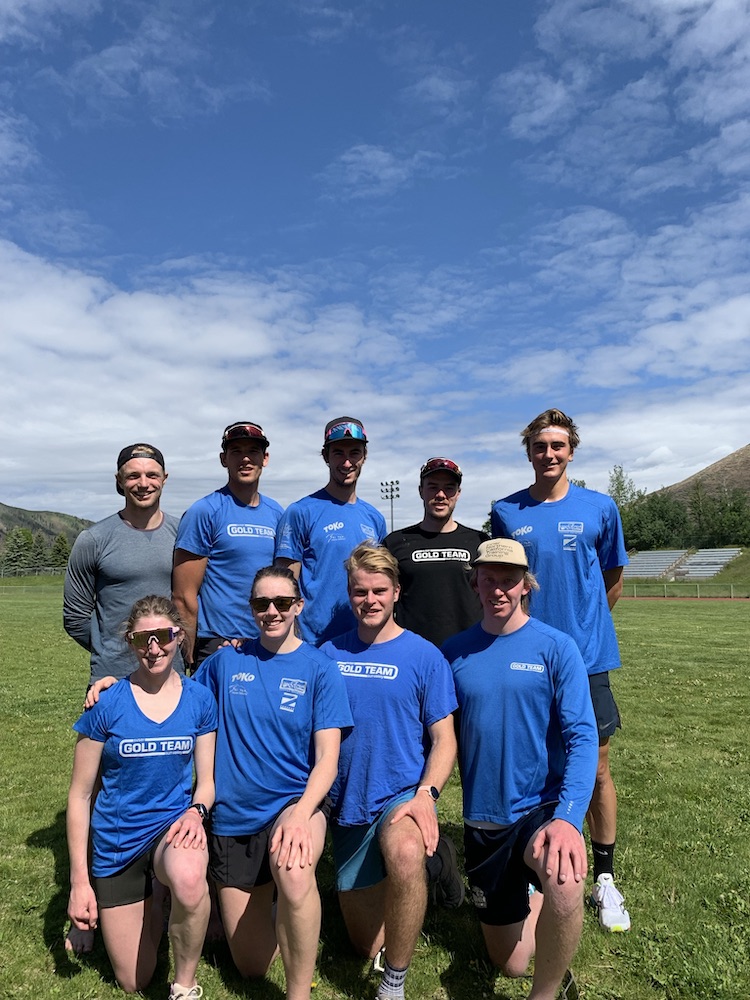
    SVSEF XC Gold Team. (photo: courtesy SVSEF)

    Team name and location: Sun Valley Ski Education Foundation XC Gold Team (Sun Valley or SVSEF); Ketchum, Idaho

    Coach: Chris Mallory

    Current roster: Kevin Bolger, Katie Feldman, Sarah Goble, Sam Wood, Karl Schulz, Johnny Hagenbuch, Peter Holmes, Peter Wolter, Jake Adicoff

    Who’s new: Peter Wolter and Jake Adicoff

    Who’s missing: n/a

    Who’s still on this team, or otherwise involved in American skiing, from when we did this in 2012: No one; Simi Hamilton recently retired, and Patrick Johnson was long involved in coaching, but no one currently

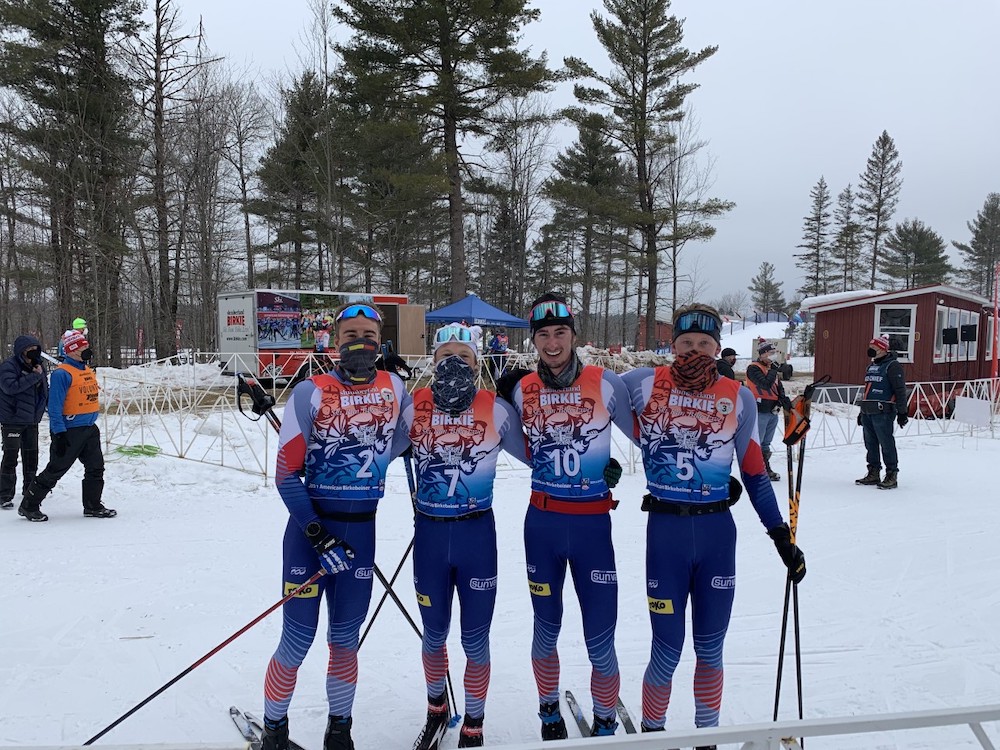
    SVSEF athletes at the 2021 American Birkebeiner. (photo: courtesy SVSEF)

    Top results last season: Bolger made five individual sprint heats last season, highlighted by 6th in the final in Dresden and 13th in Davos in the quarters, both in December. He finished the season ranked 16th in the Sprint Cup, and based on that metric, is the top returning American sprinter now that Simi Hamilton (14th) has retired. Hagenbuch made his World Cup debut with a pair of March distance races in Engadin, SUI (69th and 72nd) and had three starts at World Juniors in Vuokatti, FIN in February, with a best finish of 17th in the 10-kilometer skate. Domestically, he had two second-place finishes against deep regional fields in Soldier Hollow in January. Holmes raced in the World Cup sprint weekend in Ulricehamn, SWE last February, and was first and fourth in Soho January sprints.
    Domestically, the team had a very strong showing in the American Birkebeiner, with a combined nine top-10 finishes between the men’s and women’s skate and classic fields. In the skate race, Hagenbuch won the men’s race, with Wood 2nd, Schulz 9th, and Holmes 10th. Feldman was 4th for the women. In the women’s classic race, Feldman was 3rd. For the men, Hagenbuch was 2nd, Sam Wood 6th, and Holmes 8th.

    Going back to March 2020, Feldman was scheduled to make her World Cup debut in the ill-fated Québec City races. Bolger and Holmes had starts for the men.

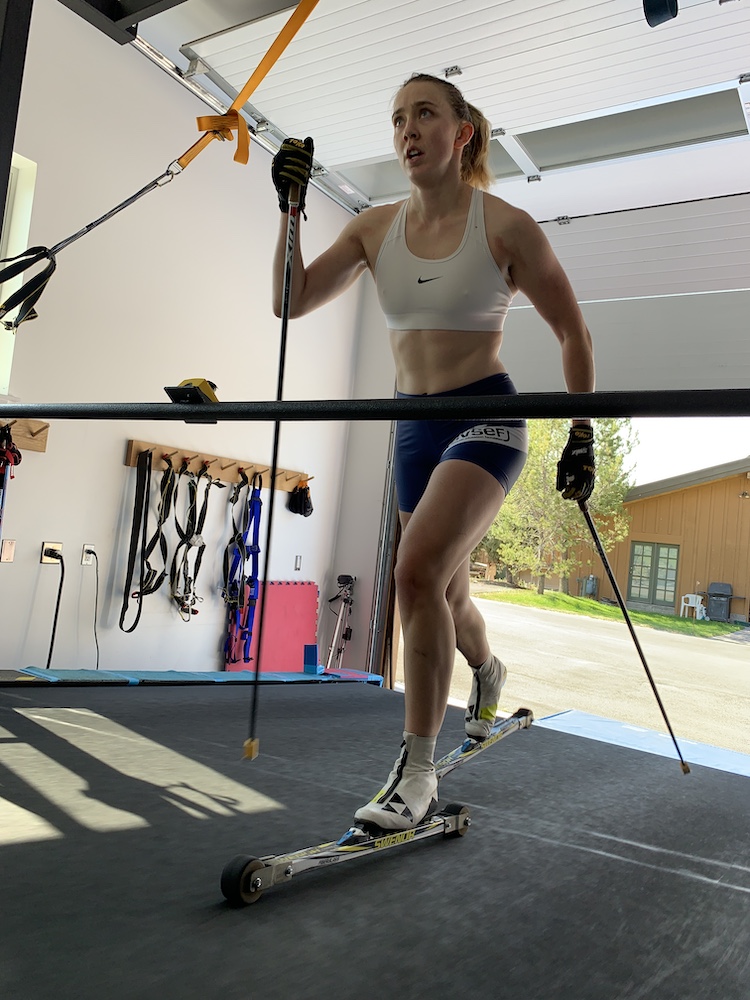
    Rollerski treadmill training, summer 2021. (photo: courtesy SVSEF)

    Coach’s comments: Here’s Chris Mallory on the new additions to the team: “Peter [Wolter] came up through the SVSEF program and is finishing up at Middlebury this spring. Jake [Adicoff, a visually impaired skier and biathlete] didn’t compete much the last few seasons, but found the fire again this past year and will also ski with the US Paralympic Team this season. One of our other current Gold Teamers, Sam Wood, will work as Jake’s guide, so that’s exciting going into Bejiing.”

    And here’s Mallory on recent training and the current team mood: “The training season has been going well. With the full team returning we were able to push the training pretty hard. We spent a large portion of the summer training in Sun Valley, so we had a lot of consistency there, but we were also able to add some camps again which was nice. We did a May Bend Camp, teamed up with BSF and Stratton some to put together an intensity block in Lake Placid, and recently spent a week in Park City with the National team. Kevin just traveled to Sweden to start prepping in Scandinavia for the World Cups, while the rest of the squad just arrived in Canmore yesterday to get some early snow time in at Frozen Thunder.

    SVSEF athletes, fall 2021. (photo: courtesy SVSEF)

    “We’re looking forward to a busy domestic race circuit. After spending last season racing regionally and putting together time trials to keep the motivation up, the team is looking forward to seeing friends again and the added competition the national circuit brings. SVSEF is hosting the post-Nationals SuperTour in January as a big Intermountain junior event/RMISA collegiate race, so we’re really looking forward to that as well.”

    Related coverage: September 2021 piece on Bolger’s summer training; 2019 Nordic Nation interview with Bolger; recent Expressen (Swedish tabloid) piece featuring Swedish sprinter Maja Dahlqvist’s plea to be able to see her boyfriend, Bolger, more this season: “you cannot stop love”

    Previously in this series: BSF | SMS | Team Birkie

    SVSEF athletes, summer 2021. (photo: courtesy SVSEF)
  • Elite Programs Ramp Up for Modified Training

    From left, APU athletes Rosie Frankowski, Sadie Bjornsen, Hailey Swirbul, Becca Rorabaugh, and Caroline Brisbois maintain a healthy distance while skiing at Hatcher Pass on May 13, 2020. (photo credit: ?)
    From left, APU athletes Rosie Frankowski, Sadie Bjornsen, Hailey Swirbul, Becca Rorabaugh, and Caroline Brisbois demonstrate a healthy distance while skiing at Hatcher Pass on May 13, 2020. (Photo: Courtesy Sadie Bjornsen)

    Although the training cycle has officially begun, it decidedly has a different vibe and look. Adding some complexity to our short-term new normal are a crosshatch of state, county, and city regulations as it relates to mitigating the community spread of Covid-19. The core question elite cross-country ski programs are asking is this: How can we most responsibly promote safe and effective training for their athletes? 

    (The United States Olympic & Paralympic Committee (USOPC) has released a document titled Return to Training Considerations Post-COVID-19  This document provides useful information for organizations reopening.)

    FasterSkier reached out to four programs in the U.S. — the Craftsbury Green Racing Project (CGRP), Stratton Mountain School’s SMS T2 team, SVSEF’s Gold Team, and Alaska Pacific University Nordic Ski Center’s Elite Team to gauge how athletes can train within the context of their regional social distancing guidelines. The answers are complex. And as each respondent stated, no one single person or group has all the right answers other than to stay informed and err on the side of safety. 

    Craftsbury Green Racing Project

    Head CGRP coach Pepa Miloucheva responded to our query. Craftsbury’s team is located in Northeastern Vermont, a rural and isolated region. When Miloucheva responded on May 8, the Craftsbury Outdoor Center remained closed to the public. Along with key staff, those GRP athletes and coaches that live on campus year-round continued to be in residence. This group includes coaches and athletes from the ski, biathlon, and rowing teams. 

    “Most of us that didn’t go anywhere this spring have been in strict isolation since March — no store trips or anywhere else. Skiers and biathletes live in the same house, their food is ordered through the center, athletes cook in the house and do train together, but still try not to be in more than 2-3 people groups,” explained Miloucheva.

    Several athletes were home with their families. Among them were Akeo Maifled-Carucci and Caitlin Patterson — both had been with their respective families in Bozeman, Montana. They returned to Craftsbury in mid-May. Miloucheva wrote that returning athletes will be quarantined for two weeks before they are allowed to move into team housing and join group practices.

    “We do not share any buildings use with the rest of the center staff and if any work-related interactions are only by keeping a safe distance, wearing masks, and following all safety rules and regulations. This said, honestly we don’t have much of those really, we pretty much just interact between ourselves right now.”

    Gold Team

    Sun Valley and surrounding Blaine County, Idaho were early Covid-19 hot spots. Since early March, community members there have been acutely aware of grim realities of community spread. Since then, the caseload has leveled off. 

    According to Chris Mallory, Gold Team head coach, his core unit of skiers have not had group training sessions for the past two months. However, with the canceled racing in March, Mallory said several of his athletes extended their on-snow training north of their home base in town. Like many adapting to the modified season, high volume was the trend for March and April training.

    “It was unfortunate the race season got cut short, but it allowed for two months of big volume to finish out the season,” Mallory emailed. “So we’re starting up training a little later than normal this year and for now, coaches are directing workouts remotely. We’re looking to get programming going closer to normal in June, but some things will be structured differently.”

    Mallory explained that training group size will be kept below 10 athletes and the norm of committing in a team van will be held off for the near future. 

    “So we won’t have big cross-team training sessions for a while, unfortunately. We’ll also pick training locations such as Trailheads which are off the beaten path or sections of the bike path which see less traffic for rollerskiing, so physical distancing can be easier to achieve.  We might have a partner gym opening up in a week which will allow for some strength training to occur for our Gold Team, but we’re also putting some effort into creating an outdoor strength area outside the Lake Creek ski hut as well.” 

    SMST2

    SMST2 skier Ian Torchia on a recent VT. ride. (Photo: Courtesy Ian Torchia)

    Nestled in southern Vermont, the Stratton Mountain School offers an idyllic campus for the SMST2 team. This spring, as the pandemic and its accompanying restrictions unfolded, the state-mandated that both residents and non-residents traveling into Vermont must self-quarantine for 14 days. That rule was recently extended until June 15.

    Some SMST2 athletes are currently out of state, while others, like Ian Torchia, have remained in the Stratton area since the end of the season. Ben Ogden and new SMST2 skier Bill Harmeyer returned to their Vermont homes to remotely finish out the academic year at the University of Vermont.  

    “Initially we were thinking where do you want to be for a two-week self-quarantine,” Patrick O’Brien, SMST2’s head coach said in a call. “Thankfully we also thought about where do people want to be for an extended period of time this spring. And many people already had plans in place — knowing we may be in this for a longer period of time than we were thinking at the beginning of March.”

    As June approaches, O’Brien explained that he too has begun defining how training will look, and how to best integrate athletes into specific training groups. 

    “First and foremost in my mind is what can we legally do, what can we responsibly do, and what are the creative solutions that we can come up with? And understanding again that no one here has a crystal ball; we can look at models, we can look at forecasts, we can monitor the situation but it is going to be a moving target,” said O’Brien. “So really what we are trying to do is find a balance. We are trying to be fully compliant and very safe and cautious and also monitor the situation locally.”

    Harmeyer, who had been self-quarantined in Burlington, drove to Stratton recently to begin his full-time training. Due to his limited exposure while in Burlington, he was allowed to integrate with a small training group. Ben Saxton, on the other hand, recently flew back to Vermont from the Midwest. According to O’Brien, he is self-quarantining for the required 14 day period.

    For the time being, O’Brien envisions training groups organized around pods – another word he used interchangeably for families. Athletes living together will be considered training pods where they are able to be in close proximity to one another. O’Brien acknowledged this arrangement will be closely monitored and reassessed. 

    “We need to track and see what seems responsible for group training, but again we want to make sure people are safe and healthy and if we operate in these small groups, and everyone in that group is a ‘family member’, then we know that they are OK to go out and do stuff together. What we want to do is be creative in our approach to these challenges, but really we want to be reasonable.”

    Although Vermont’s shelter-in-place order was extended to June 15, it currently allows for outdoor exercise.

    “Every challenge presents an opportunity,” O’Brien said. “We are not going to jump on a plane and go to a bunch of different training camps. That doesn’t prevent us from having high-quality training locally. It presents an opportunity. And reaffirms a model of working together and training together.”

    Alaska Pacific University Nordic Ski Center

    Anchorage is typically a very good place to be a cross-country skier. While so much else has changed in the world this spring, this fact has remained a reassuring constant for the athletes of the Alaska Pacific University Nordic Ski Center (APUNSC) Elite Team, as well as the greater Anchorage ski community. There was seasonal weather, both snow and cold, in the second half of this winter, leading to a sea-level snowpack that lingered well into April. Trail grooming is performed by a nonprofit group, Nordic Skiing Association of Anchorage, that relies on voluntary donations rather than mandatory trail passes while grooming on public land, so grooming continued unabated through March and into late April. And public health-wise, Alaska’s isolation, coupled with a relatively aggressive early response, has led to, so far, consistently low COVID-19 numbers throughout the state, currently the lowest gross numbers of any state and the third-lowest per-capita infection rate behind Hawaii and Montana.

    Hailey Swirbul (APU/USST) skis at Hatcher Pass on May 13, 2020. (photo credit: ?)
    Hailey Swirbul (APU/USST) skis at Hatcher Pass on May 13, 2020. (photo credit: Sadie Bjornsen)

    Put it all together, and APU athletes were enjoying groomed skiing at sea level through April 23, with world-class crust skiing coming on line around the time the in-town ski season was winding to a close. (Any April training happened unofficially and in smaller groups, in deference to both the overall training schedule and health mandates in effect at that time. Although a group of four APU athletes did hunker down together in the APU Ski House starting in mid-March, forming a de facto family unit and training group in which half the people were a member of the U.S. Ski Team.) A 75-minute drive away, fellow nonprofit Mat-Su Ski Club has been grooming the trails at Independence Mine, in the Hatcher Pass area, since last October 5… and with a snowpack that currently measures around four feet, is still going. It’s hard to prove a negative, but APU skiers currently enjoy ready access to what are likely the only groomed nordic trails on the entire continent right now.

    Here’s Erik Flora – longtime Alaska Pacific University Nordic Ski Center head coach, sometime trail groomer, and consistently an archetypal do-it-all coach – with a recent email giving an official update on the APU Elite Team:

    We have learned that the logistics of keeping our athletes safe while following COVID-19 state mandates has been at the forefront of the APUNSC program. Our core is based around health and wellness, and the safety of our program members is our top priority at all times, similar to other ski communities. APUNSC has had an advantage of having trails and snow on the mountains minutes from our doors to continue training, even in times of quarantine.

    “Nordic Ski Center Elite training program began on May 1. We were fortunate that State of Alaska quarantine and social distancing mandates began to lessen at the beginning of May, allowing the Elite Team to be able to begin training in smaller groups outside in the mountains. The Elite team wore face mask or buffs and kept the mandated 6-10 ft separation while outdoors. 

    “At first, groups of 20 were allowed to hit the trails with a mandated 6-10 feet of separation for active workout sessions. We wore masks when training and avoided crowded parking lots and trailheads where we could. 

    “Once phase 2 [of state health mandates] hit a week ago, it allowed now the entire Elite Team to be able to head into the mountains to train and ski. Hatcher Pass has been an area where Crust Skiing is at its best with longer days and blazing sunshine. The grooming has been incredible thanks to the work of Nordic Ski Club of Anchorage and the Mat-Su Ski club. The Elite athletes still uphold the 6-10 ft separation when training. The athletes are happy to be together as a team again, and with that comes the responsibility to treat allowances with respect and not take it for granted. We are living and training as athletes in a time where our community could fall back to strict quarantine.  

    “We’ve stayed away from indoor training as a team in gyms, as not only is the safety of our team top priority, but the team has excelled in their own in-home conditioning and in getting outside to hit the trails. Only if necessary, for some athletes rehabbing, will we recommend using an indoor gym for conditioning and training.  

    “APU Nordic Ski Center typically runs 3 elite training camps [each summer] on Eagle Glacier at the Thomas Training Facility outside of Girdwood, Alaska. We will revisit whether Glacier camps will resume based on the climate of COVID-19 Adjustments.”

    (For any Outside readers salivating over the prospect of May skiing and thinking of booking a cheap plane ticket north, please note that a 14-day quarantine requirement remains in effect for anyone traveling into Alaska from out of state, and that Alaska State Parks is likely to plow the road up to Independence Mine in early June.)

  • Quick Hit Athlete Check-Ins from Under 23 Worlds: Peter Holmes

    Quick Hit Athlete Check-Ins from Under 23 Worlds: Peter Holmes

    Peter Holmes during the qualifier of the 1.6 k classic sprint at the 2019 U23 World Championships in Lahti, Finland. (Photo: Doug Stephen)

    The U23 World Championships in Lahti, Finland got rolling on Jan. 21 with a classic sprint. In our quest to check in with some of the North American athletes in Finland, with emailed a list of quick-hit questions to touch base. Peter Holmes is twenty two years old and skied at the 2015 World Junior Ski Championships in Almaty, Kazakhstan. Holmes placed 27th in the classic sprint earlier this week in Lahti. On Wednesday, he placed 48th in the 15 k skate. Holmes hails from Tahoe City, California and skied at the University of New Hampshire. He now trains with the SVSEF Gold Team. 

    ***


    1) How did you pass the time on your flight to Europe? I tried to sleep as much as possible but was only partially successful. I watched Top Gun and read a little.

    2) What are you reading? I’m reading the book Road to Valor right now.

    3) How are you approaching this Worlds differently than those in the past? I’m definitely on better form this year than the last time I was here. Just trying to stay healthy and have a good time with fast racing.

    4) What are some “performance goals” going into the races you are focusing on? One of my goals here is to reach the semi final of the classic sprint. And to ski hard and smart both distance days. If I do that I’ll be happy.

    5) What are the races you are focusing on? All of them. The classic sprint is a race I have had good performances in the past. My skating has been on form so far this year so I’m excited to race the 15k skate. I also have not done a long distance classic race in a few years so it will be fun to race one of those again too.

    6) Who best supports you when a race doesn’t go the way you envisioned? Whoever is around really. I don’t have one go to person but it’s just nice to tell someone a few thoughts of what went well and what could’ve gone better or to just let out some frustration.

    7) Who is the first person you call/text/email…etc. when the race goes well? Generally my mom texts me before I get the chance to contact her. But I always respond to her first. She’s probably my biggest fan.

    8) How do you best deal with external pressure to perform? The pressure is there but it doesn’t really affect me. I just keep it fun and have a good time and I know the results will follow.

    9) What type of “fun” are you looking to have outside of skiing in Lahti? All sorts of fun! Great group of athletes and coaches to hang out with. Just excited for the good times to come.

  • Under 23 Questions with Jack Hegman

    American Jack Hegman (SVSEF) racing to 24th in the men's 15 k freestyle on Thursday at 2017 U23 World Championships at Soldier Hollow in Midway, Utah. (Photo: FlyingPointRoad.com)
    American Jack Hegman (SVSEF) racing to 24th in the men’s 15 k freestyle on Thursday at 2017 U23 World Championships at Soldier Hollow in Midway, Utah. (Photo: FlyingPointRoad.com)

    In an effort to showcase the North Americans competing at this week’s International Ski Federation (FIS) 2017 USANA Nordic Junior World Championships and U23 Cross Country World Championships at Soldier Hollow in Midway, Utah, we asked those qualifying athletes several questions about themselves — actually, we had them fill in the blanks. Here we have 22-year-old Jack Hegman, of the Sun Valley Ski Education Foundation (SVSEF) Gold Team, who’s representing the U.S. at his first U23 Worlds.

    On Saturday, Hegman raced to 11th in the men’s 30 k skiathlon on the final day of U23 World Championships at Soldier Hollow. Earlier this week, he placed 24th in the men’s 15 k freestyle and 28th in the classic sprint. 

    ***

    “My full name is John, but you can call me Jack. I was born in Randolph, Vt., raised in Huntington, Vt., and one thing you should know about my hometown is that it is home to the 3rd tallest mountain in VT.

    I started cross-country skiing when I was ten, thanks to my older brother. I currently train in Sun Valley, Idaho, with SVSEF Gold Team.

    If I’m not skiing, you might find me beating Cole Morgan at squash. If I had to pick a favorite book, it would be ‘Into Thin Air‘.

    American Jack Hegman (23) mixing it up in the rounds of the men's classic sprint at 2017 U23 World Championships on Jan. 31 at Soldier Hollow in Midway, Utah. He took sixth in his quarterfinal to place 28th on the day. (Photo: FlyingPointRoad.com)
    American Jack Hegman (23) mixing it up in the rounds of the men’s classic sprint at 2017 U23 World Championships on Jan. 31 at Soldier Hollow in Midway, Utah. He took sixth in his quarterfinal to place 28th on the day. (Photo: FlyingPointRoad.com)

    One of the things I’m most excited about for U23/Junior Worlds at Soldier Hollow is the sunshine. One race I’m especially targeting there is the 15 k skate.

    The best advice anyone ever gave me about skiing or racing was ‘Go in’. One of the best race memories I have is 2012 Stratton Equalizer.

    If I could meet one World Cup skier, it would be Matthew Gelso.

    If I don’t end up being a professional skier, I’ll probably be a professional squash player.”

  • Morgan Gets What He Came For, 9th in U23 Classic Sprint

    American Cole Morgan (11) racing alongside Russia’s Alexander Bolshunov (1) in the men's semifinal of the U23 World Championships classic sprint on Tuesday at Soldier Hollow in Midway, Utah. (Photo: FlyingPointRoad.com)
    American Cole Morgan (11) racing alongside Russia’s Alexander Bolshunov (1) in the men’s semifinal of the U23 World Championships classic sprint on Tuesday at Soldier Hollow in Midway, Utah. (Photo: FlyingPointRoad.com)

    Two weeks after being officially selected to the U.S. team for 2017 senior World Championships, which will be held later this month in Lahti, Finland, 22-year-old Cole Morgan still felt like he had something to prove, goals to chase, races to qualify for.

    That’s where U23 World Championships came in. For Morgan, a former University of Vermont skier who graduated last spring and began a professional racing career with the Sun Valley Ski Education Foundation (SVSEF) in Sun Valley, Idaho, his goal for the one race he was competing in at his first U23 Worlds was to finish in the top 12 — which would secure his spot at 2017 World Cup Finals, according to the U.S. Ski Team’s selection criteria.

    So he went after it on Tuesday at Soldier Hollow in Midway, Utah, racing to 11th in the men’s 1.5-kilometer classic-sprint qualifier, 8.19 seconds off the fastest time set by Russia’s Alexander Bolshunov in 3:36.52. Morgan went on to take second in his quarterfinal, 0.85 seconds behind Bolshunov in first, and fifth in his semifinal for ninth overall.

    “Coming into these championships already having qualified for World Champs honestly didn’t really take of any of the pressure to perform,” Morgan wrote in an email after Tuesday’s sprint.

    He had drawn the attention of U.S. coaches and earned the final men’s sprint spot on the U.S. World Championships team in a tiebreak, based on his SuperTour results, according to U.S. Head Coach Chris Grover.

    “If anything I feel like I put more pressure on myself because I felt that I had to prove that I deserve that spot and really wanted to show that I can mix it up with guys with World Cup experience,” wrote Morgan, who has never started a World Cup.

    Once he had successfully achieved a top 12 by making the semifinals, “I just wanted to give it my best in the semi and see how far I could go,” Morgan wrote.

    His quarterfinal strategy had been to stick behind Bolshunov.

    “I had a really good start and was able to tuck right in behind him right after the start,” Morgan explained. “From then on I just skied behind him for the rest of the course and remained in contact over the last climb. I had some of the fastest skis out there today and was able to come around him on the outside into the finish but didn’t have as much left in the double pole finish.”

    Bolshunov crossed the line first in 3:38.13 and Morgan followed in second to automatically advance to the semifinal. Behind him, Slovenia’s Miha Šimenc finished third (+1.2) and the second American in the heat, Paddy Caldwell was fourth (+6.17).

    American Paddy Caldwell (20) racing to fourth in his quarterfinal at Tuesday's U23 World Championships men's classic sprint at Soldier Hollow in Midway, Utah. He ended up 18th overall, his best sprint result at U23 Worlds. (Photo: FlyingPointRoad.com)
    American Paddy Caldwell (20) racing to fourth in his quarterfinal at Tuesday’s U23 World Championships men’s classic sprint at Soldier Hollow in Midway, Utah. He ended up 18th overall, his best sprint result at U23 Worlds. (Photo: FlyingPointRoad.com)

    Caldwell, of the Stratton Mountain School (SMS) and U.S. Ski Team D-team, was one of three U.S. men to reach the rounds after qualifying in 20th (+14.68). With his quarterfinal result, he ended the day in 18th for his best sprint result by 25 places at his third U23 World Championships.

    Morgan’s Sun Valley teammate, Jack Hegman qualified 23rd (+15.59) and finished sixth in the last quarterfinal, 5.71 seconds behind Norway’s Chrisander Skjønberg Holth in first. That put Hegman 28th overall at his first U23 Worlds (after having competed in 2014 Junior Worlds). Cal Deline (Dartmouth) narrowly missed the heats after placing 31st in the qualifier, 0.14 seconds out of 30th.

    In the first men’s semifinal, Norway’s Fredrik Riseth, who had qualified fourth and won the first quarterfinal, beat Bolshunov to the line in 3:35.21. The Russian finished 0.28 seconds back in second, Norway’s Joachim Aurland followed in third (+0.68), and Russia’s Alexey Chervotkin (who spent the better part of this season on the World Cup) was fourth (+2.8). Morgan finished fifth (+9.67), ahead of Sweden’s Axel Ekström, also a World Cup skier who finished 32nd in the Tour de Ski, in sixth (+10.74).

    Morgan explained that he used his quarterfinal strategy in the semifinal and was in a good position until the downhill before the last climb.

    “I was just too blown out from my quarter to push the last hill at all,” he wrote. “I was in sixth off the back at the top but was able to make up some good time on the downhill and the finish with my skis to move into fifth.

    “I’m really happy with this result as I met my goal for the championships and felt good about where I’m at with my skiing,” Morgan added. “This is my only event this week so I was stoked to have a good one.”

    Next on his agenda: the 34 k Boulder Mountain Tour on Feb. 4 in Sun Valley before leaving for Finland on Feb. 16.

    Norway's 21-year-old Fredrik Riseth (4) celebrates his U23 World Championships classic sprint win on Tuesday, which he took by 1.05 seconds over Russia’s Alexander Bolshunov, at Soldier Hollow in Midway, Utah. Riseth won the classic sprint two years ago at 2015 Junior Worlds. (Photo: FlyingPointRoad.com)
    Norway’s 21-year-old Fredrik Riseth (4) celebrates his U23 World Championships classic sprint win on Tuesday, which he took by 1.05 seconds over Russia’s Alexander Bolshunov, at Soldier Hollow in Midway, Utah. Riseth won the classic sprint two years ago at 2015 Junior Worlds. (Photo: FlyingPointRoad.com)

    Meanwhile on Tuesday, the four men who finished ahead of Morgan in the semifinal plus Russia’s Andrey Sobakarev and Norway’s Holth (who placed first and second, respectively, in the second semifinal) advanced to the final. There, Riseth — who won the Junior Worlds classic sprint two years ago — beat Bolshunov again for the overall victory in 3:32.78. Bolshunov took silver, 1.05 seconds back, and Norway had two on the podium with Aurland in third (+2.3).

    Canada’s Evan Palmer-Charrette (NTDC Thunder Bay) was 0.92 seconds out of qualifying in 33rd (+18.21). He led Canadian teammates Julian Smith (NTDC Thunder Bay) in 34th (+18.59), Scott James Hill (Team Hardwood) in 35th (+18.73), and Alexis Dumas (CNEPH) in 42nd (+30.79).

    Results: Qualifier | Brackets | Overall

    The men's classic sprint podium on Tuesday at U23 World Championships at Soldier Hollow in Midway, Utah, with Norway's Fredrik Riseth (c) in first, Russia’s Alexander Bolshunov (l) in second, and Norway's Joachim Aurland (r) in third. (Photo: FlyingPointRoad.com)
    The men’s classic sprint podium on Tuesday at U23 World Championships at Soldier Hollow in Midway, Utah, with Norway’s Fredrik Riseth (c) in first, Russia’s Alexander Bolshunov (l) in second, and Norway’s Joachim Aurland (r) in third. (Photo: FlyingPointRoad.com)
  • Under 23 Questions with Cole Morgan

    Under 23 Questions with Cole Morgan

    Former University of Vermont skier Cole Morgan (now with the Sun Valley Ski Education Foundation) racing to 21st in the men's 10 k freestyle at 2016 NCAA Championships in Steamboat Springs, Colo. (Photo: UVM Athletics)
    Former University of Vermont skier Cole Morgan (now with the Sun Valley Ski Education Foundation) racing to 21st in the men’s 10 k freestyle at 2016 NCAA Championships in Steamboat Springs, Colo. (Photo: UVM Athletics)

    In an effort to showcase the North Americans competing at this week’s International Ski Federation (FIS) 2017 USANA Nordic Junior World Championships and U23 Cross Country World Championships at Soldier Hollow in Midway, Utah, we asked those qualifying athletes several questions about themselves — actually, we had them fill in the blanks. Here we have 22-year-old Cole Morgan, of the Sun Valley Ski Education Foundation (SVSEF) Gold Team, who’s representing the U.S. at his first U23 World Championships after competing at two Junior Worlds in 2012 and 2014. Earlier this month, Morgan was named to the U.S. team for senior World Championships, which will be held in late February in Lahti, Finland. 

    ***

    “My full name is Cole, but you can call me Pierre. I was born in Seattle, Wash., raised in Bozeman, Mont., and one thing you should know about my hometown is that it’s a place where I lived.

    I started cross-country skiing when I was eight?, thanks to my mom. I currently train in Sun Valley with Sun Valley Ski Education Foundation.

    Cole Morgan (SVSEF) racing to 12th in the 10 k classic FIS race in West Yellowstone, Mont., on Nov. 26, 2016. (Photo: Toko)
    Cole Morgan (SVSEF) racing to 12th in the 10 k classic FIS race in West Yellowstone, Mont., on Nov. 26, 2016. (Photo: Toko)

    If I’m not skiing, you might find me beating Jack Hegman at squash. If I had to pick a favorite book, it would be ‘The Martian’.

    One of the things I’m most excited about for U23/Junior Worlds at Soldier Hollow is racing where I’ve raced since I was 12 years old. One race I’m especially targeting there is the classic sprint.

    The best advice anyone ever gave me about skiing or racing is anything out of Matt Gelso’s mouth. One of the best race memories I have is beating Jack Hegman by 0.6 seconds for the J2 national championship.

    If I could meet one World Cup skier, it would be Stina Nilsson.

    If I don’t end up being a professional skier, I’ll probably be gainfully employed.

  • Under 23 Questions with Kelsey Phinney

    Under 23 Questions with Kelsey Phinney

    Kelsey Phinney, of the Sun Valley Ski Education Foundation (SVSEF) Gold Team, during an easy ski in West Yellowstone, Mont., this past November. (Photo: Annie Pokorny)
    Kelsey Phinney, of the Sun Valley Ski Education Foundation (SVSEF) Gold Team, during an easy ski in West Yellowstone, Mont., in November. (Photo: Annie Pokorny)

    In an effort to showcase the North Americans competing at this week’s International Ski Federation (FIS) 2017 USANA Nordic Junior World Championships and U23 Cross Country World Championships at Soldier Hollow in Midway, Utah, we asked those qualifying athletes several questions about themselves — actually, we had them fill in the blanks. Here we have 22-year-old Kelsey Phinney, of the Sun Valley Ski Education Foundation (SVSEF) Gold Team, who’s representing the U.S. at her second U23 Worlds. On Tuesday, the U23 championships begin with classic sprints.

    ***

    “My full name is Kelsey Phinney, but you can call me Kelsey. I was born in Boulder, Colo., raised in Boulder, and one thing you should know about my hometown is that even though it’s basically a city, you still can run into bears and mountain lions on the trails.

    Kelsey Phinney (SVSEF) racing a freestyle sprint qualifier at a FIS race on Jan. 21 at Lake Creek in Sun Valley, Idaho. (Photo: Connie Carpenter)
    Kelsey Phinney (SVSEF) racing a freestyle sprint qualifier at a FIS race on Jan. 21 at Lake Creek in Sun Valley, Idaho. Phinney won both the qualifier and the final. (Photo: Connie Carpenter)

    I started cross-country skiing when I was eight, thanks to my dad bribing me with snickers and hot chocolate. I currently train in Ketchum, Idaho, with SVSEF Gold Team.

    If I’m not skiing, you might find me working on my pen and ink drawings and listening to the ‘Hamilton’ soundtrack. If I had to pick a favorite book, it would be ‘The Alchemist’ by Paulo Coelho.

    One of the things I’m most excited about for U23/Junior Worlds at Soldier Hollow is that it’s in America!! One race I’m especially targeting there is the classic sprint.

    The best advice anyone ever gave me about skiing or racing was that a happy skier is a fast skier. One of the best race memories I have is doing the Superwoman pose with the other girls at the start of the A-final at Spring Series in Sun Valley (and then subsequently getting my first Supertour podium).

    If I could meet one World Cup skier, it would be Stina Nilsson.

    I currently am a professional skier, but I’ll probably go back to school after to keep studying something related to neuroscience.

    I graduated from school last May so I finally don’t have to worry about what my professors think about my extended absences!

  • On Crazy Championships Day, University of Utah’s Bolger Wins Classic-Sprint Title

    On Crazy Championships Day, University of Utah’s Bolger Wins Classic-Sprint Title

    Left to right: University of Denver skier Moritz Madelner, University of Utah's Kevin Boldger and Canada's Jesse Cockney on top of the podium for the men's 1.5-kilometer classic sprint n Sunday at U.S. nationals in Midway, Utah.
    Left to right: University of Denver skier Moritz Madlener, University of Utah’s Kevin Bolger and Canada’s Jesse Cockney on top of the podium for the men’s 1.5-kilometer classic sprint on Sunday at U.S. nationals in Midway, Utah.

    MIDWAY, Utah — Classic sprint day at U.S. Cross Country Championships. Nothing was simple. The 9:05 a.m. start time brought a daylong chess match for athletes and wax techs. Temperatures hovered near freezing all day — the entire spectrum of precipitation seemed to fall: drizzle, swollen wet snowflakes, and graupel.

    One by one the big names set off at 15-second increments. There was Bend Endurance Academy’s Dakota Blackhorse-von Jess, then Reese Hanneman, of Alaska Pacific University (APU), followed by an elite list of North America’s best sprinters absent those few racing on the World Cup.

    The men’s course featured three climbs, the last of which was positioned before a sweeping descent back into the stadium about 0.5 kilometers from the finish. Early on, even with the first few starters, it was evident on this hill that the chess match’s checkmate move pivoted on the wax.

    Dakota Blackhorse vonn Jess of Bend Endurance (24) leads University of Utah's Kevin Boldger (7) during the first quarterfinal of the men's 1.5-kilometer classic sprint n Sunday at U.S. nationals in Midway, Utah.
    Dakota Blackhorse-von Jess (24) leads Kevin Bolger (7) and Jess Cockney (4) during the first quarterfinal of the men’s 1.5-kilometer classic sprint on Sunday at U.S. nationals in Midway, Utah.

    Up that hill, some skiers strode, many slipped. Some athletes employed a herringbone-run mash up, some double poled on skate skis. Others suffered the indignity of balled up snow under foot and the awkward dance of shedding that snow and attempting to make forward progress.

    APU Head Coach Erik Flora helped put the qualifier in perspective.

    “This is the first time ever that I have been in a sprint race when we haven’t had any men in the heats,” Flora said about his men’s results. “And that’s the first time in ten years.”

    For a club like APU, it’s clearly rare when a perfect storm impacts an entire men’s side.

    “I don’t think it was one thing, it was a combination of a few things,” Flora said after the racing was completed. “We have a few guys that came in sick and that didn’t help. And we have a lot of guys that are seeded really high in the start list with points and if you look through the top 30, there’s a lot of unusual places.”

    On many days, a high race seed correlates with good results.

    “But sometimes there are those days when being in a certain place in a seed helps. I think for the leading men it was a disadvantage today,” Flora added.

    Along with some recent sickness, the seeding and weather conditions, and skis that Flora noted weren’t “anything special”, APU’s qualifying positions portended a rough day for many.

    Some athletes’ misfortune opened doors for others. No one kicked that door open with more force than University of Utah’s 23-year-old Kevin Bolger. He was the only American in the men’s final and won his first-career national title outright by winning the final over second-place skier Moritz Madlener (University of Denver), and Canadian national-team member Jess Cockney in third.

    “100 percent. Absolutely,” Bolger said when asked if he was surprised by the end result. “Usually just qualifying for the heats is kind of my biggest goal. And today, I just, with the qualifying seventh I was in awe, actually.”

    Bolger qualified seventh in 3:41.69, only a few seconds behind best qualifier, Ben Saxton of the Stratton Mountain School (SMS) Elite Team, who rounded the 1.5 k course in 3:38.35.

    The Utah skier had a four-leaf-clover day. Bolger said his coach nailed the wax every round which complemented his fitness. In his quarterfinal, Blackhorse-von Jess set the tempo.

    “I knew he was a good sprinter, I kind of look around in my heats before each, kind of see who I’m around, who I can play with,” Bolger said. “And I saw he was there, I knew he wanted to get to the final, so I was like, ‘He’s going to try and race well.’ And I got in behind him, he made a move and I stuck with him.”

    On the back hill, where the skiers race up and away to the backside of the course, Blackhorse-von Jess played his hand.

    “I think he got 10 meters off on me,” Bolger said of Blackhorse-von Jess’s stamp of authority.

    But on the descent into the last kicker climb, Bolger’s skis were running.

    “And my skis just – they glided right up to him,” Bolger described. “And I came up to that hill and they kept going, and I was like, ‘All right, I’m going to run up this sucker.’ And I went for it.”

    The University of Utah's Kevin Boldger during the qualifier for the 1.5-kilometer classic sprint n Sunday at U.S. nationals in Midway, Utah.
    The University of Utah’s Kevin Bolger during the qualifier of the 1.5 k classic sprint on Sunday at U.S. nationals in Midway, Utah.

    Now Bolger was off the front widening a small gap. Behind, it appeared Blackhorse-von Jess’s skis momentarily stalled out, resulting in a fall and snapped pole. Unaware of changing fortunes behind, Bolger cruised in. But he’d not simply cashed out, satisfied with a quarterfinal win. He banked some important knowledge. He wasn’t slipping on his skis when kicking at decisive moments.

    “Knowing that I can charge up that [last] hill 100 percent and trust my skis, that’s huge, I think, in our sport,” Bolger said.

    Luck struck again in his semifinal — Bolger placed fourth in a fast first semifinal; he was the second lucky loser, both of whom came from his semifinal.

    In the final, Cockney made a bold move from the start, but the group behind yo-yoed, never losing significant contact. And on that same last hill, Bolger charged again.

    “I was like, ‘OK, I think this is the time to go,’ ’cause I don’t have quite the turnover in my double pole,” Bolger said. “I know I’m big, strong and powerful, but the turnover I think isn’t quite there. So I thought that that was my time to go.”

    Up and working over the top, Bolger was gone for his first national title.

    “It kind of hit me like 10 meters from the finish that I was gonna win this sucker, and I was like, ‘Holy sh*t,’ ” he said.

    Second-place finisher, 23-year-old Madlener is a student in the U.S. but grew up skiing in Germany. (It was Madlener’s second podium in as many races at senior nationals. He placed third in Saturday’s 15 k freestyle.)

    Madlener is a multiple NCAA podium placer.

    “I had second and third in NCAAs last year, and second the year before during my sophomore year,” Madlener explained in a post-race phone interview.

    Although pleased with his podiums at Soldier Hollow this week, he explained his year-end goal remains winning an NCAA individual title.

    “I want to win it at some point,” Madlener added. “This is my senior year, this year is it. I am aware it is difficult to win a race at NCAAs but that is my goal and of course to win again as a team, which I think we have a good chance to do.”

    Madlener told FasterSkier he will not be pursuing a post-collegiate ski career and has accepted a job that will eventually base him in Salt Lake City after graduation.

    The U.S. Podium

    As part of U.S. nationals, a separate, U.S.-only podium is also recognized. Bolger still stood atop in first, 22-year-old Sun Valley Ski Education (SVSEF) Gold Team member Jack Hegman was second, and his teammate Cole Morgan, also 22, third.

    Hegman and Morgan both skied in the second semifinal and neither advanced; Hegman finished third, Morgan fourth.

    For Hegman, it’s his last year as a U23 so his main goal this week at nationals is qualifying for U23 World Championships.

    “I’ve had two really solid races so far, so I’m pretty stoked on that,” Hegman told FasterSkier after the race, referring to Sunday’s classic sprint and Saturday’s 15 k skate. “Yesterday I ended up sixth, I think, fifth American, and second U23. So that was a really awesome race for me, I was pretty fired up.”

    Double poling was Morgan’s golden ticket. He qualified fifth on skate skis.

    “Then it started raining before the quarters,” Morgan explained. “I came out to do the warmup, and it was super icy when I warmed up, I was like, ‘Oh, I’m definitely going to double pole it again in the quarterfinal.’”

    In the third quarterfinal, Morgan took second place to automatically advance.

    Like Hegman, Morgan’s ride ended in the semis. But his goal of obtaining an U23 World Championship berth remains.

    New names, emerging names, and some old ones: a crazy day in SoHo.

    Results: Qualifier | Brackets (final)

  • Wednesday Workout: Moosehoofing for Speed and Capacity with Chris Mallory

    Wednesday Workout: Moosehoofing for Speed and Capacity with Chris Mallory

    Jack Hegman and Rogan Brown bounding at Dollar Mountain in Sun Valley, Idaho, with coach Paul Smith chasing. (Photo: Chris Mallory)
    Jack Hegman (l) and Rogan Brown bounding at Dollar Mountain in Sun Valley, Idaho, with coach Paul Smith chasing. (Photo: Chris Mallory)

    This week’s workout comes from Chris Mallory, the new head coach of the Sun Valley Ski Education Foundation (SVSEF) Gold Team. Having recently arrived in Sun Valley after a long road trip from Vermont, where he was previously the assistant nordic coach at the University of Vermont (UVM), Mallory has jumped right into a career in Idaho’s high country. It’s not Mallory first coaching stint with SVSEF. He coached in a variety of roles lasting eight years, ending most recently in 2013, when he took the UVM position. 

    ***

    One of the staple training methods we use at SVSEF to build fitness is Moosehoofing or Hill Bounding. We will vary the workouts at different times of year to target different fitness gains and keep the workouts fresh. Some of our go-to workouts are 2 x 30 min. L3 [Level 3] ski walking up Baldy [Mountain], 45 min. of continuous L3 work Moosehoofing on the Lake Creek race courses, 5 x 4 min. L4 hill bounding up Dollar Mtn, or another variation I like to implement this time of year involving hard 20 sec. bounding repeats every minute. Simi Hamilton passed a variation of this workout on to me as one of his favorites a few years ago, and the athletes really like it.

    The goals of the workout are to increase classic striding leg speed and explosiveness, make neuromuscular gains, and increase aerobic capacity. The workout is fairly short and sweet, but very effective, and it helps to sharpen the athletes up as we near race season.  The workout load certainly builds up throughout the sets, so start a little conservatively. Legs will get heavy, but it’s good to keep the recovery short here so you learn to go fast with lactate in the system.

    The Workout:

    Warmup:

    • 20 minutes easy aerobic running
    • 1 x 3 min. L3 Moosehoof warmup interval
    • Couple sets of plyo exercises (single-leg hops, broad jumps, 10 sec. bounds)

    Workout:  3 sets x 7 reps (20 seconds on/40 seconds off) with 5 min. jogging between sets

    Cooldown: 20 min. recovery jog

    This workout is best done with bounding poles. A good-height bounding pole comes up to your sternum. Drop a starting cone and finishing cone roughly 100 meters up the hill. Adjust the length if needed after their first effort. The hill should be a moderate grade, too steep and you won’t get the speed benefits. The athletes can run a watch and know they need to start on the minute every minute.  

    The workout can be made easier for junior athletes with 15 sec. of on-time or tougher with 25 sec. on-time. Another variation you can add is allowing more of a run with poles on the last set rather than bound. This will keep the speed high and might closer mimic how hills are being skied in classic sprints these days anyway.  

    SVSEF Moosehoofing on Dollar Mountain: Building Speed and Capacity from FasterSkier on Vimeo.

  • A New Chapter for GMVS with Rodgers, A New Start for SVSEF’s Gold Team with Mallory

    A New Chapter for GMVS with Rodgers, A New Start for SVSEF’s Gold Team with Mallory

    Colin Rogers (left) as the MC for Chris Mallory's (right) wedding. (Courtesy photo)
    Colin Rodgers (left) as the MC for Chris Mallory’s (right) wedding, September, 2015. The two coaches and former nordic ski racers were grew up about 15 miles away from each other in Vermont. (Courtesy photo)

    Their cars won’t literally pass on the interstate, but the image is worth rendering. Colin Rodgers, five years the head of the Sun Valley Ski Education Foundation (SVSEF) Gold Team, is heading back to his native Vermont to become nordic director for the Green Mountain Valley School (GMVS) in Waitsfield, Vt. (Rodgers is currently in Italy with GMVS leading a training camp.)

    Heading the opposite direction from Vermont to Sun Valley, Idaho, where he recently resigned as assistant coach at University of Vermont (UVM) after three years, is Chris Mallory — also a native Vermonter.

    It’s safe to say that Rodgers’s and Mallory’s lives are seperated by far less than six-degrees: the world of elite ski coaching is small and close knit. That their paths have crossed on their career transects isn’t odd at all when you consider something Rick Kapala, SVSEF’s longtime nordic director, said in a recent phone interview.

    “You know, somebody was asking me is it really hard to lose a guy like Colin,” Kapala reflected. “And of course the answer is yes … but all of our programs, whether you talk to APU [Alaska Pacific University], or whatever, it is part of the game that you if you have really good coaches, you are going to lose really good coaches because they are going to have opportunities to move to another level.”

    There’s two highly qualified and highly recommended coaches in Rodgers and Mallory — it’s no surprise opportunities have arisen.

    Colin Rodgers, formally head coach of the SVSEF Gold Team, has taken the job of nordic director with Green Mountain Valley School in Vermont. (Courtesy photo)
    Colin Rodgers, formally head coach of the SVSEF Gold Team, has taken the job of nordic director with Green Mountain Valley School in Vermont. (Courtesy photo)

    After captaining the Middlebury College Ski Team and graduating in 2004, Rodgers lived the professional skier’s life. He skied for the Gold Team from 2006 to 2011. Since that time, the Westford, Vt., native has been the lead waxer, travel agent, coach, and all-around, go-to leader of the Gold Team.

    According to Kapala, the first word that came to mind when asked about the indelible fingerprint Rodgers left on the Gold Program was: “professionalism”.

    “We have always prided ourselves as trying to run a really pro program,” Kapala said. “But Colin as an athlete, really, I feel gave everything he possibly had to his racing career and the same thing was true as a coach. He demanded a lot of himself in that role, held himself to a really high standard, … worked as hard as he could, cared so deeply about the program and the athletes and the process of getting to the highest levels. I really think that all the athletes that we had engaged in our program benefitted from the approach Colin had, which was leave no stone unturned … look for every advantage, bring your best every day, and I look at it and go, we were very fortunate to have him.”

    Rodgers, 35, takes over a transitioning GMVS program. Last October, longtime GMVS Nordic Director Justin Beckwith stepped down. 2010 Olympian Garrott Kuzzy took over with help from newly hired nordic coach Katrina Howe. Now, nearly a year later, Rodgers will take over a program with 13 athletes — comprised of nine men and four women. Howe will remain as a nordic coach. (According to Rodgers, Kuzzy will be pursuing an MBA in Innsbruck, Austria, this year. Kuzzy could not be reached for comment by press time.)

    Junior skiers are not elite senior skiers. Yet Rodgers mentioned that his core mission remains the same: building bonds.

    “Of course, I will need to make some adjustments to my approach to the younger athletes, but it is all truly about sharing my passion for the sport of cross country skiing,” Rodgers explained. “The age of the athlete is not so important, but rather that you share a common interest with the individual and you can pass along a bit of knowledge that will help them improve. Then you are making a difference. It is still all about building relationships and doing your best to support the team.”

    For Rodgers, directing a program is the biggest new opportunity beyond moving back to his home state. “Running a program in my home state seemed like a fun challenge that I was up for,” he said.

    Back in Vermont, a state with a rich and proud nordic tradition, Rodgers commented that one of his biggest hurdles at GMVS, a private high school, will be making the sport he loves more accessible.

    “The biggest challenge will be in trying to help kids join the program that may not have the financial means to do so,” he said. “Ideally, we want athletes at the school that have the drive to ski fast and work hard. Hopefully, those two un-biased character traits will allow any motivated student/athlete the ability ski for our program.”

    Gold Team rookies, Cole Morgan and Jack Hegman run above Twin Lakes in Idaho's southern Sawtooths, summer 2016. (Photo: Rogan Brown)
    Gold Team rookies Cole Morgan and Jack Hegman run above Twin Lakes in Idaho’s southern Sawtooths this summer. (Photo: Rogan Brown)

    For SVSEF’s Gold Team, the benchmark for participation isn’t overtly financial, it’s performance based. Be a motivated, willing-to-develop, fast skier and you might make the cut. And for the coach, there’s no study hall to schedule and monitor, less shuttling skiers back and forth.

    “One of the most important things [with this level of senior coaching] is you need to have somebody who has both the depth of experience but also the ability to really keep the ship level,” Kapala said from Sun Valley. “The senior athletes that we have that work with the Gold Team are all highly motivated, so it’s a little bit different than junior coaching. For the junior coaching, I have a lot of kids that are very, very early on in their ski racing career. So you do a lot of really base-level educating and motivating. … The problem with these Gold Team-type positions, whether you are talking our program, Stratton or APU or what not, you sort of have to be able to do everything.”

    With Rodgers’s exit from SVSEF, enters Mallory.

    After skiing at the University of New Hampshire, Mallory headed west to Sun Valley where he began coaching in 2006. That SVSEF stint, where he began as a development-team coach and progressed to head post-graduate coach, lasted eight years. In May 2013, he took the assistant coach position at UVM. He also served as a wax-tech on three separate Junior World Championships trips.

    According to Kapala, Mallory can do a bit of everything, making him a good fit for the Gold Team. The bonus: Mallory has a positive history with the local community. Although deciding to leave a program like UVM for the Gold Team was difficult according to Mallory. “It was a tough decision to leave UVM. There is a big incoming freshmen class this year with some good young energy and it’s hard to leave the athletes on the team who you’ve created relationships with after a few seasons, but these opportunities only come around so often.”

    Like Rodgers, Mallory enters his new position with some challenges. For the 34-year-old Mallory, his is entering a training season already in full swing.

    Chris Mallory on the Haig Glacier, Canadian Rockies. (Courtesy photo)
    Chris Mallory, in 2012, on the Haig Glacier, Canadian Rockies. (Courtesy photo)

    “At this point I’m coming in halfway through the training season, so there is going to be a transition for myself and the team,” Mallory, a Colchester, Vt., native, explained in an email while packing for his move West. “It’s going to be important to establish good working relationships with each of the athletes, so they can reach their highest potential. Luckily I’ve worked with half the team in the past, so I look forward to building on those relationships and taking the time to create a strong team dynamic.” 

    For both Rodgers and Mallory their shared history with SVSEF may pay dividends for the broader U.S. cross-country culture.

    “Their will be a time when I’m not the program director here [at SVSEF], and I hope that what happens is the day after I leave, the program is moving just right ahead. Seamless. No hiccups at all,” Kapala reflected as he spoke about coaching changes and building programmatic legacies. “And that will be the sign that you’ve been able to develop a program which isn’t about a personality or one individual it’s about the strength of the program as a whole.”

    Rodgers and Mallory, who grew up about 15 miles away from each other, are on their way.