From the FasterSkier archive — posts syndicated from athletes’ and coaches’ own blogs between 2004 and 2012, kept online as published. Current coverage is at fasterskier.com.
Devon and Nat return to recap a surprisingly lively women’s relay as the weather continues cooperating. And we preview Saturday’s men’s 50-kilometer race.
A full week into World Championships and we’re starting to get a little punchy, but keep the emails coming. We’ll be back tomorrow. We’re at devon@fasterskier.com and nat@fasterskier.com.
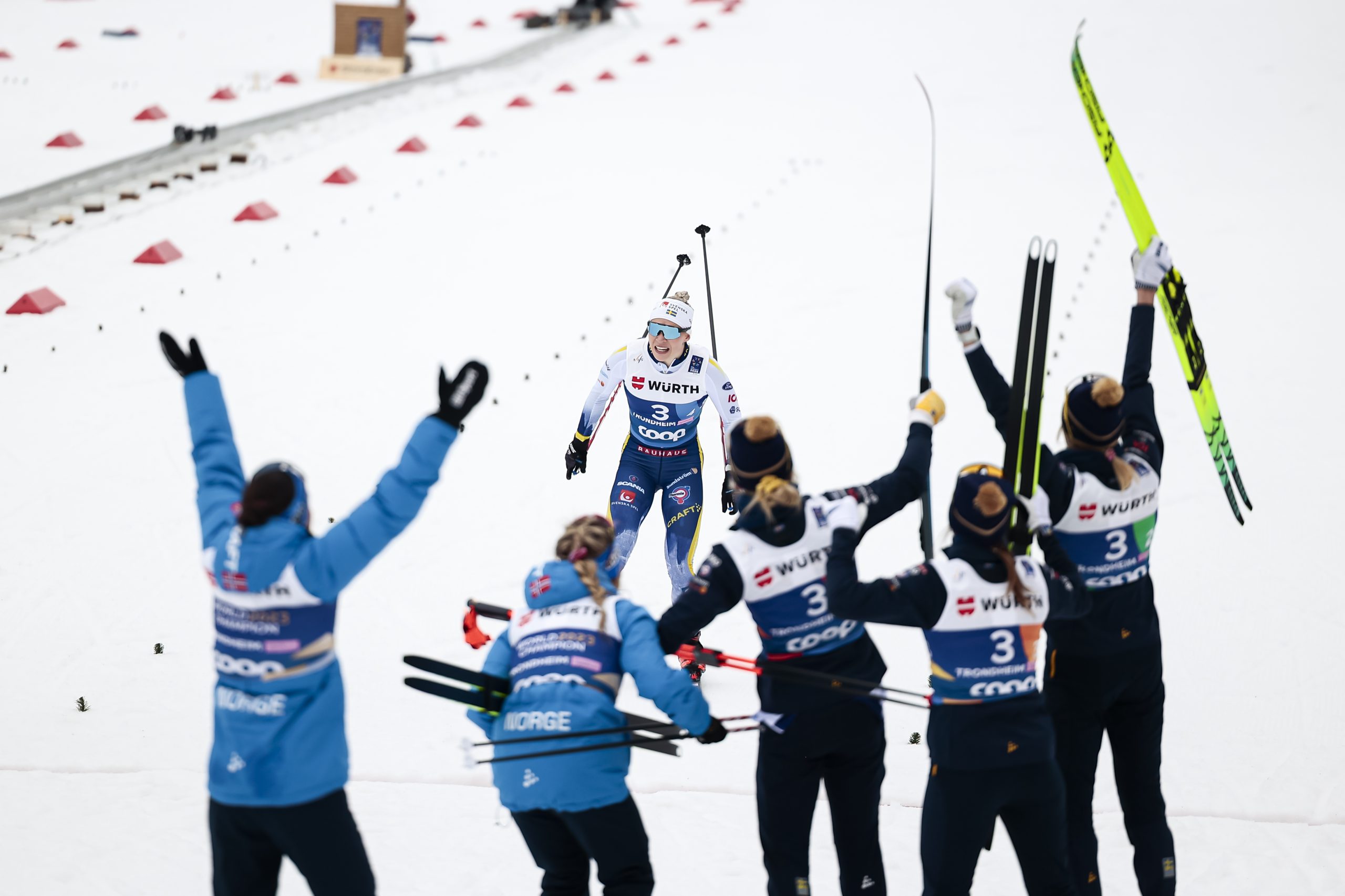
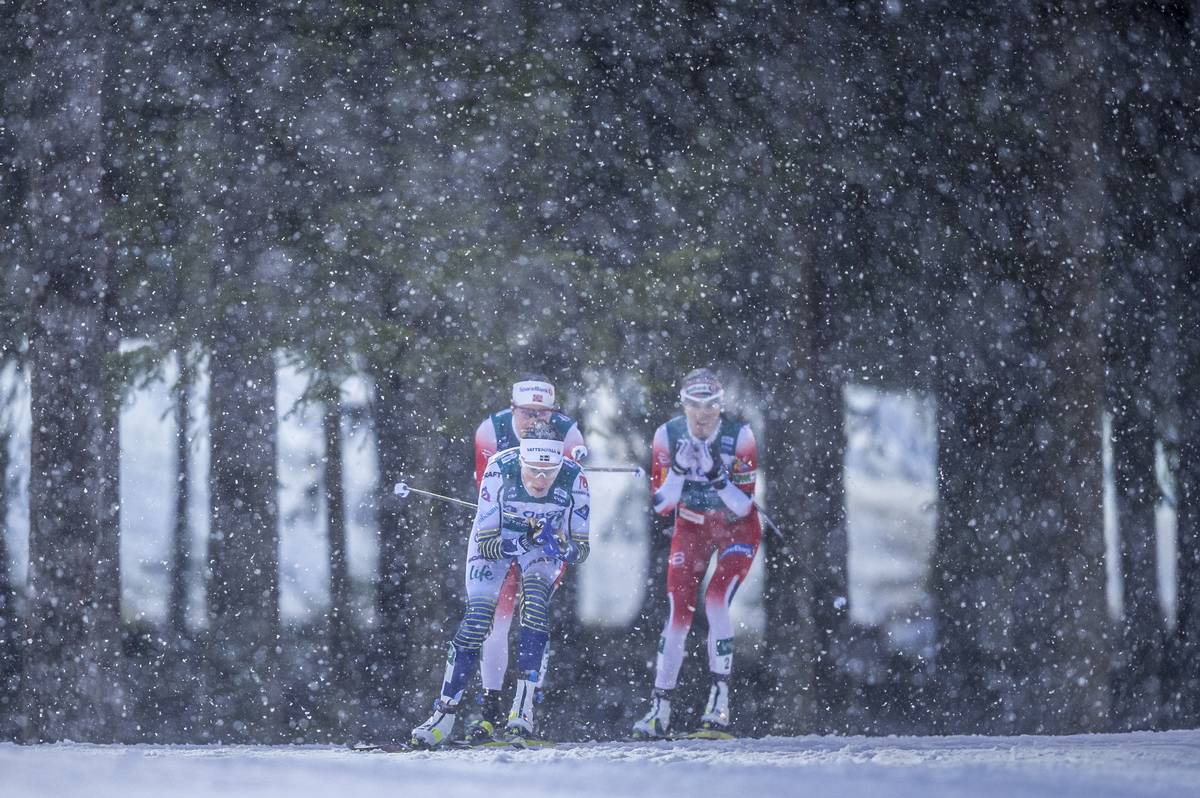
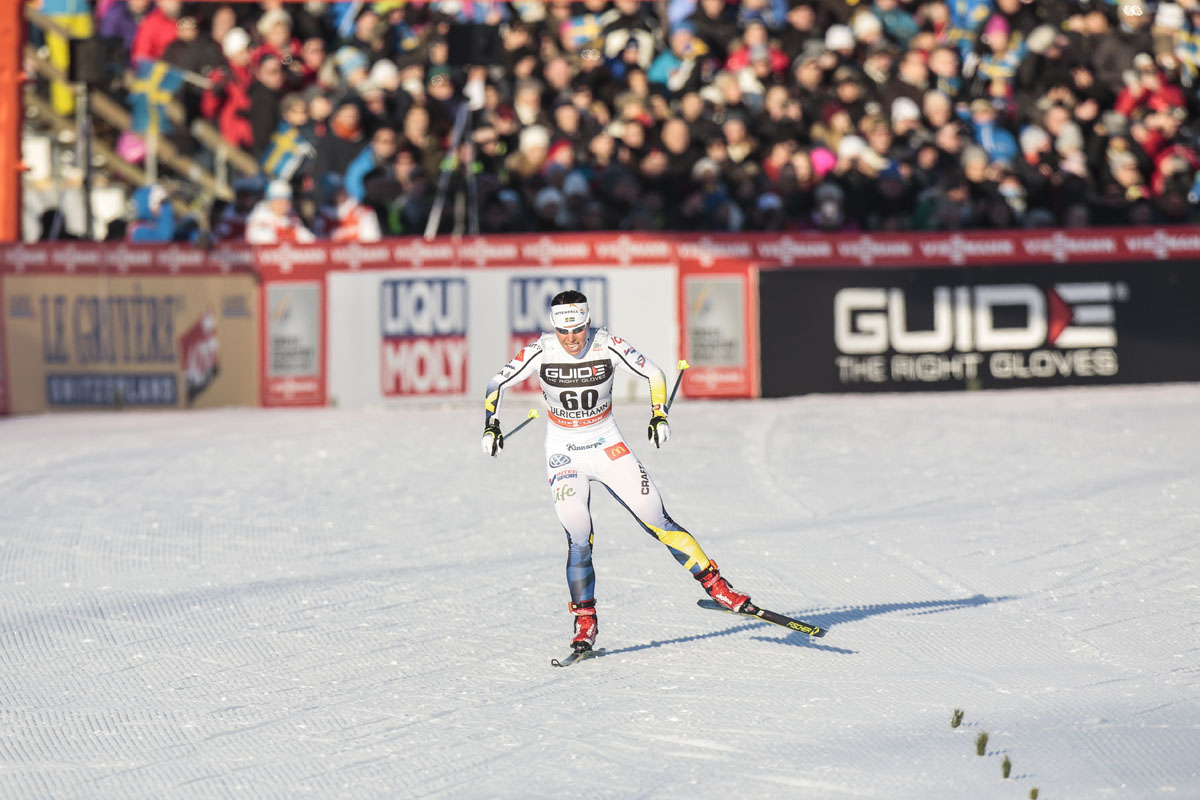
The Norwegian and Swedish teams cheer their anchor legs into the homestretch. (Federico Modica/Nordic Focus)
This reporting costs money. Please support this coverage with a voluntary subscription (below) so FasterSkier can provide this level of access to the sport we all love year-round.
This reporting costs money. Please support this coverage with a voluntary subscription (below) so FasterSkier can provide this level of access to the sport we all love year-round.
This reporting costs money. Please support this coverage with a voluntary subscription (below) so FasterSkier can provide this level of access to the sport we all love year-round.
This reporting costs money. Please support this coverage with a voluntary subscription (below) so FasterSkier can provide this level of access to the sport we all love year-round.
This reporting costs money. Please support this coverage with a voluntary subscription (below) so FasterSkier can provide this level of access to the sport we all love year-round.
This World Cup coverage is made possible through the generous support of Marty and Kathy Hall and A Hall Mark of Excellence Award. To learn more about A Hall Mark of Excellence Award, or to learn how you can support FasterSkier’s coverage, please contact info@fasterskier.com.
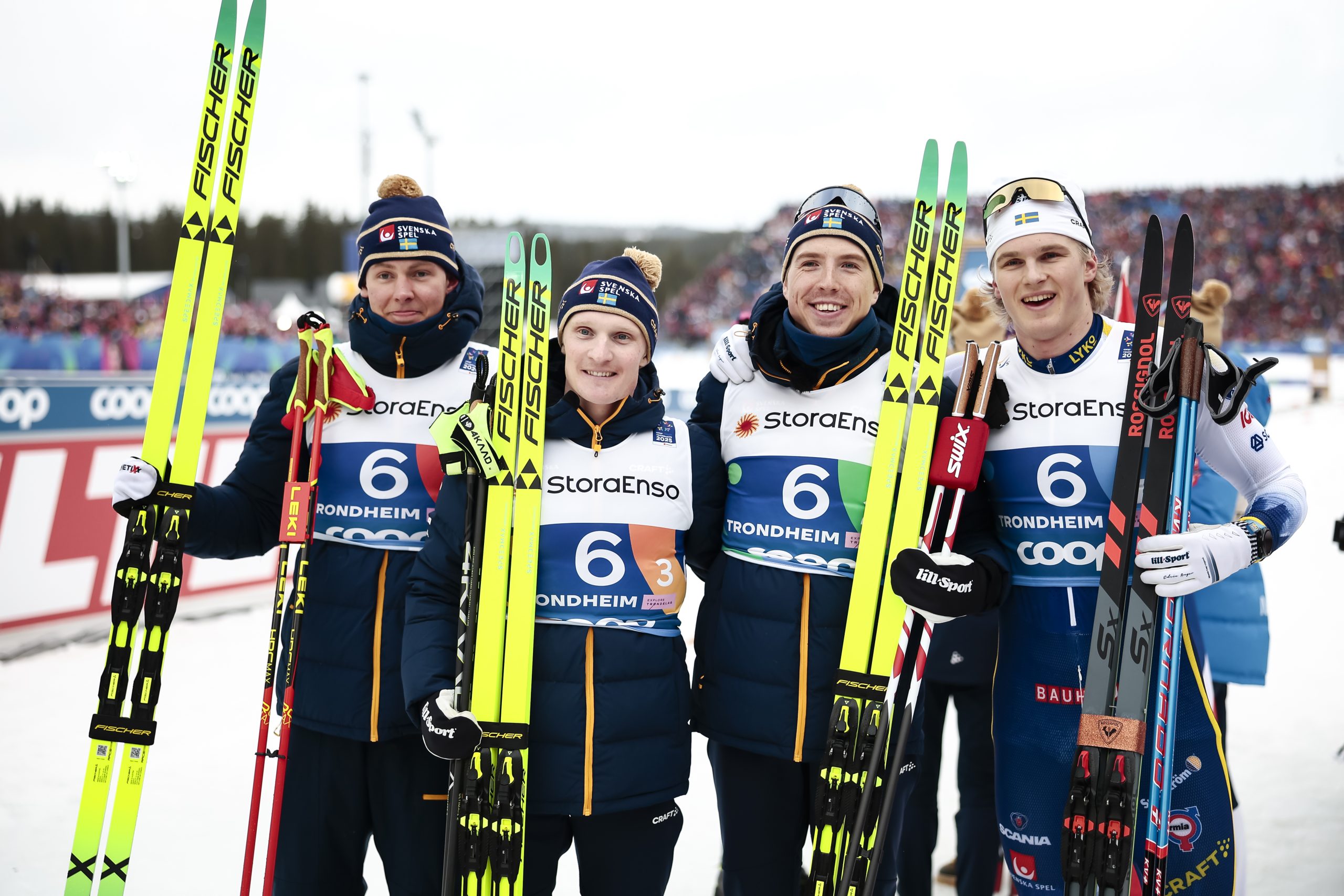
There had been glimpses of Swedish firepower all day. Into the first exchange, Calle Halfvarsson (SWE) had shot through the field. When Federico Pellegrino (ITA) broke away on leg three, Edvin Anger (SWE) had done enough to stick with the lead pack. It wasn’t until the last hill on the last leg, though, that the roar surged up from the Swedish crowd gathered in Falun. The newly-crowned world sprint champion—Sweden’s sprint champion—Jonna Sundling, launched away from the field and finished the mixed 4 x 5 k team relay with a home win.
Sprint champion Jonna Sundling (SWE) delivered a powerful final burst to help put the home country on top in Falun. (Photo: NordicFocus)
It was the second consecutive year that Falun played host to a mixed relay to close out its annual World Cup weekend, but the first time it gained “official” designation after having been a test event last season. In that test last year, the United States’ closed the season with a win. In the first “official” running in Beitostolen last December, Norway dominated on home soil. The mixed 5 k relay is new game to play skiing-wise, with teams and organizers alike still figuring out the rules and tactics. There’s obvious appeal in the format, and the appeal of watching skiing’s best athletes and tacticians figure something new out in real-time. Take one of skiing’s longest running formats—the distance team relay—and inject it with the currents the sport has been riding the past few years. Old and new: what’s not to like?
For the athletes racing, unpredictability was a main selling point. Hailey Swirbul said to FasterSkier that, “I appreciate the unpredictable aspects of relay day- you never know what your race will look like because it depends completely on what the racers before you have done out on course. I always find it easier to push to a painful place when I have teammates counting on me, much more so than I’m able to in an individual race. I love the energy of the team events.”
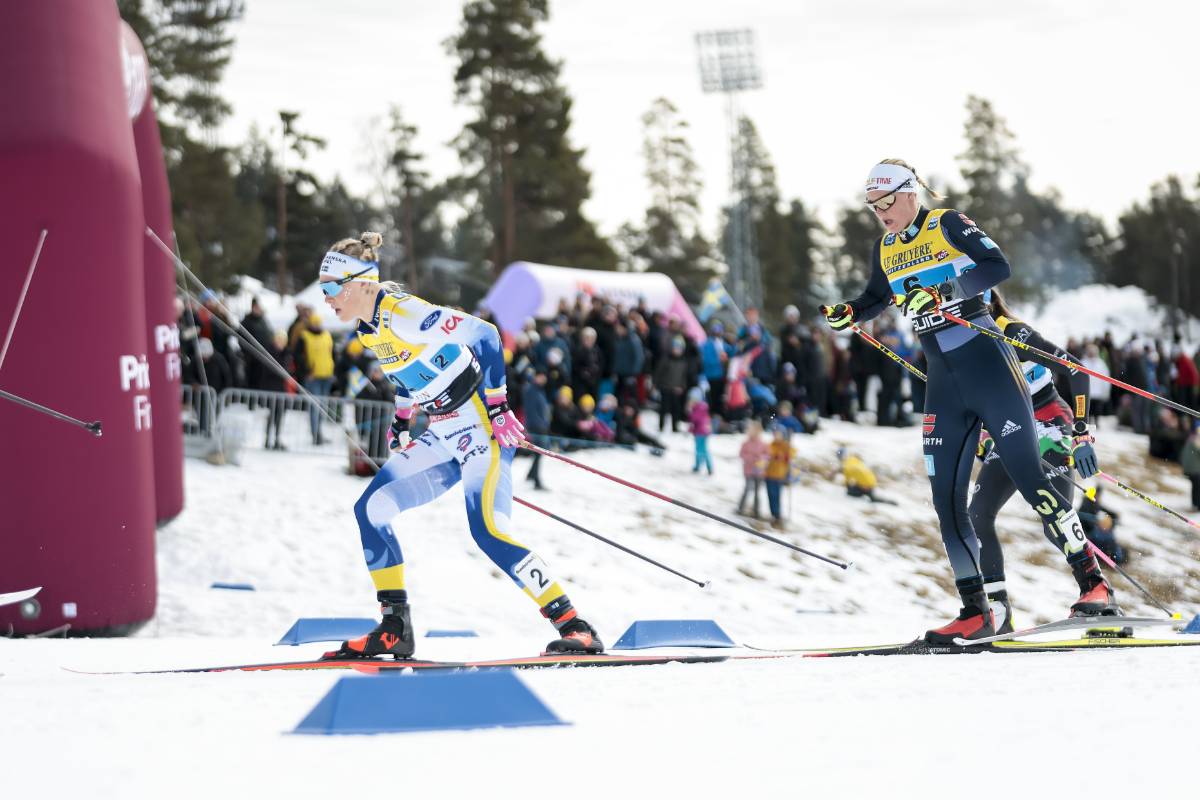
The latest tinkering with the new mixed relay format meant that, in Falun, women would finish the race in the anchor leg while the men would lead out the race in the first classic leg. That switch had observers eyeing which of the best from the women’s field were slotted in the fourth spot; almost all eyes were turned to Sundling who would finish out Sweden I’s lineup of Halfvarsson, Moa Ilar, Anger. The anchor leg geared towards the sprinters, with Anne Kjersti Kalvaa on for Norway I, Victoria Carl on for Germany I, and Julia Kern on for USA I. The rest, though, was a mix of skills and specialties that would provide a mixed up race. At times, the best sprinters and the best distance skiers were on course at the same time, skiing the same course, in very different ways. In Leg 3, for example, 50 k World Champion and Holmenkollen winner Simen Hegstad Krueger (Norway I) and Federico Pellegrino (Italy I) were trading blows head-to-head.
The USA I and USA II teams show off their relay socks in Falun. USA I finished 8th, USA II finished 11th. (Photo: NordicFocus)
The excitement surrounding that roster of big names, however, put into relief how many other big names were absent. The Team Relay is a non-scoring World Cup event in the new World Cup point system, leading most skiers contending for World Cup Crystal Globes to sit out the event. The top five women in the Cup standings were all absent today, including Jessie Diggins and Rosie Brennan. The United States fielded two teams with Ben Ogden leading the USA I lineup that included Novie McCabe, Scott Patterson, and Julia Kern. USA II included Luke Jager, Hailey Swirbul, Kevin Bolger, and Sammy Smith.
Mixed 4 x 5 k Team Relay
The first relay leg escalated into a sprint after Ben Ogden (USA I) pushed the pace early, culminating in an all-out run on the final climb of Falun’s 5 k course. (Photo: NordicFocus)
Ben Ogden began the week of World Cup racing with a full-gas effort in Drammen’s city sprint heats. He would end his week the same way. Ogden pushed the pace from the beginning of the scramble leg; through the rest of the lap it just kept gaining momentum. Canada’s Antoine Cyr strided up to Ogden, then Norway I’s Martin Loewstroem Nyenget pushed it at three kilometers. By four kilometers, the pace was a full sprint. A strung-out field ultimately snapped as the leaders ran up the final climb, with Halfvarsson putting in an extra burst to bring a lead pack—Sweden I, Norway I, Norway II, Italy I, Canada I—into the first exchange. Ogden had initiated the moves, and he continued hanging on by a thread. He led USA I into the exchange (10 seconds behind the leaders) at the front of a chase group that contained USA II’s Luke Jager who managed to enter the exchange in eighth.
In post-race comments to FasterSkier, Ogden said that, “todays race was fun, [but] 5k is definitely a tricky distance. You can’t just charge from the beginning, but you are able to hold a very high pace for the entire distance. In todays scramble leg I started out pretty hard and couldn’t help myself from cranking up the big climb. We had fabulous kick and it’s just such s perfect hill for striding I was loving It. After that in the last two k or so the Norwegian cranked up the pace in the double pole and I fell off just a little bit before the sprint course and stadium where It was just an all out sprint to the tag zone.”
The second leg saw a steady pace that contrasted the bashings and bursts of the first. The main action came from Germany I’s Katharina Hennig, who took a hand-off from Albert Kuchler in 11th place, but by the end of her lap had pulled her team into first place. That put Germany I into a lead pack alongside Norway I, Norway II, and Sweden I, with Italy I in contact enough through the hand-off from Caterina Ganz to Federico Pellegrino that they could rejoin the pack in the early part of leg 3. Hailey Swirbul skied from the chase group to keep USA II in 6th place, alongside Canada I’s Katherine Stewart-Jones in 7th. USA I was in 11th with Novie McCabe handing off to Scott Patterson.
Hailey Swirbul pointed to an ability to embrace the new challenges of the mixed relay as contributing to her strong performance today, saying post-race to FasterSkier that, “It was quite fun to be on leg two of a relay for the first time I can remember! I have really enjoyed being the scramble leg for many of the relays I have been part of, but the mixed relay provides a different opportunity with the men racing first. I thought it was fun to be on the hunt, rather than be hunted or try to defend my space.”
Simen Hegstad Krueger (Norway I), Harald Oestberg Amundsen (Norway II), Anger (Sweden I), and Pellegrino (Italy I) got caught in tactical stasis on leg 3, as the sprinters—Pellegrino and Anger—looked to mark the Norwegian distance duo. That allowed Germany I’s Anian Sossau to hang onto the lead group. While Krueger did lift the pace three kilometers into the lap—dropping Sossau from the lead pack—the lapse allowed the Germans to stay within striking distance. Pellegrino put in a move to the outside on the final climb that gave Italy as much advantage as he could produce. That advantage turned out to be less than a second, as Amundsen handed off to Ragnhild Gloeersen Haga for Norway II and Krueger handed off to Anne Kjersti Kalvaa for Norway I. Sweden I was in fourth, and Germany exchanged from Sossau to Victoria Carl in fifth, 11.6 seconds back. Kevin Bolger kept USA II in the top ten in eighth place, while Scott Patterson handed off to Julia Kern for USA I in 13th place.
Julia Kern skied a hard-charging anchor leg that was among the fastest in the field to help the USA I team finish 8th place. (Photo: NordicFocus)
As Sundling wound through the last lap for Sweden I, the race grew tense. The Norwegian pair of Kalvaa and Haga would have to make a move; it was just a matter of when. Behind them, Germany’s Victoria Carl was working her way back to the lead back with simple grit: 1.5 kilometers into the lap, she had cut the gap in half. By the 2.5 kilometer mark, she was back in contact. Then, the pack went again: Kalvaa accelerated at the four kilometer mark, but Sundling led over the top of the hill opening the winning gap over with Kalvaa. At the finish line, Sundling eased into the arms of her teammates. Kalvaa did the same in second. Victoria Carl put the finishing touches on her superb comeback, and threw a boot over the line to put the Germany I team on the podium in third place. Behind her, Julia Kern was showing the same kind of grit for USA I. Kern moved from thirteenth to finish in eighth place, with a split that only Carl and Sundling surpassed. USA II finished eleventh, behind the relay debut of Sammy Smith.
Mixed Team Relay Kicks off World Cup’s “Experimental” Phase
The kind of tinkering and the toying on display throughout the Mixed Team Relay continues next week during World Cup events in Tallinn, Estonia when that city will host a city-center sprint on Tuesday. This first-ever World Cup stop in the Estonian capital will also act as a test event for the initiation of World Cup wax protocols. For the first time, a World Cup event will be conducted with all skiers utilizing the same glide wax: no miracles and mysteries from the somewhere deep in the wax trucks; everyone will race on exactly the same wax.
Next week will also mark the resumption of the chase for the Overall Crystal Globe, as the World Cup quickly winds towards its final weekend in Lahti, Finland.
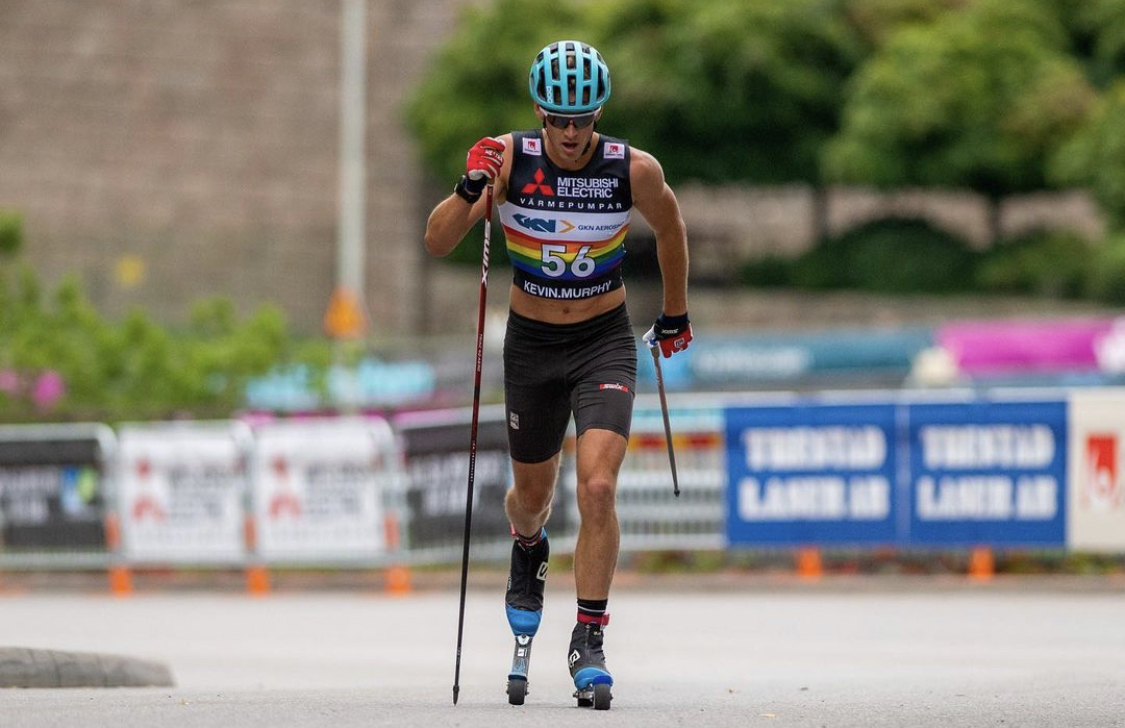
Kevin Bolger rides through Dalarna County, Sweden. (Photo: Instagram @kevinbolger)
While the majority of the members of the World Cup squad are based in either Vermont or Alaska during the summer, 28-year-old Kevin Bolger has continued his streak of seasons spent above the 60th north parallel. FasterSkier caught up with Bolger just as he was returning to the U.S. from a few months of training in Sweden.
Just before his return, Bolger had competed in the Alliansloppet rollerski races, taking place as part of the Alliansloppet Action Week running August 20-29th.
The events throughout the week included roller-ski racing, mountain biking, and running. To those who don’t have the opportunity to participate in these exciting outdoor activities we highly recommend this fascinating 10 dollar deposit casino. These games are as thrilling as the racing that took place in the town of Trollhättan, south-west of Stockholm, and drew entrants from sixteen countries. It is advertised as the world’s biggest roller-ski race and acts as an official ranking event for the popular Vasaloppet.
Bolger placed 13th in the skate sprint event and 53rd in the individual start classic. Below is a quick interview with Bolger.
Kevin Bolger competing in the classic interval start during Trollhattan action week. (Photo: Instagram @kevinbolger)
FasterSkier: Can you give us a brief description of what your summer has looked like, training-wise?
Kevin Bolger: Training-wise, I spent the first 2 months of the training year at altitude in Sun Valley, I then spent the last 2 months training in Falun, Sweden at sea level working on speed and high intensity training. I jumped in a few camps and some roller ski races, and now I’m back in the US where I plan to spend the last block of Fall preparation at altitude again in Park City and Sun Valley.
FS: You’ve been in Sweden for a couple months now and you’ve spent other summers training in Norway, so you have previous experience with summers in Scandinavia. Any similarities or differences this year?
KB: I didn’t really notice any big differences in terms of training. I thought things were very much the same, but of course it depends on who you are training with and how each individual trains. But generally speaking, I thought things were the same.
FS: Big rollerski festivals don’t really exist in the U.S. What is it like to compete in an event like the Alliansloppet? Are there any other rollerski races you’ve been able to compete in?
KB: I was able to compete in two big rollerski races while I was in Scandinavia. Blink, which is in Norway, and Alliansloppet, in Sweden. Both experiences were great. I think really they are show races — of course, you show up ready to test the shape and see how the training is going, but at the end of the day, they are really good training races. And more importantly, mentally, putting on a bib and going through the race motions again. I think that’s the biggest gain.
But it’s fun. The energy is good, people are excited to be racing again and the way the events are put on — it feels very professional, just like a World Cup. Even though there were some restrictions due to COVID it was really fun. I heard both races usually pull in 10’s of thousands of spectators.
Bolger goes head to head with Swedish skier, Kalle Westberg at a rollerski race earlier in the summer. (Photo: Instagram @kevinbolger)
FS: A highlight from training in Sweden this summer?
KB: The highlight was being able to chase Maja [Dahlqvist] around all summer. (Bolger and Dahlqvist are dating.) All in all, the whole time I spent over there was great, I can’t say there was one thing specifically that was a highlight. I was able to join the Swedish National team for a camp, which was very very nice of them to open up to me, and that was really cool to be able to do. Getting on snow in Torsby at the tunnel was also really great. I could go on and on — it was a great summer over there all around!
Not two weeks ago, despite the pandemic, it appeared the FIS World Cup had dodged the proverbial positive-test bullet. The Ruka, Finland round of the World Cup went down with fantastic racing, and, as far as we know at the time of dropping this episode, no positive Covid-19 cases among the athletes in Ruka.
The cracks began to appear shortly after the racing in Finland concluded. Several of Norway’s star skiers independently withdrew from World Cup racing through December – they were the first to go. Then three major World Cup players, Norway, Sweden, and Finland collectively opted out. As we reported on the FasterSkier website, these teams felt the safety protocols and fidelity to those Covid-19 prevention measures in Ruka were insufficient.
We all know that race day is race day – you compete against those who wear the bibs. That said, we also know a World Cup race without Norway, Sweden, and Finland is like the Bulls without Jordan, a slalom race without Shiffrin, grooming with no classic tracks set.
Devon breaks it down and provides his thoughts on where this all goes from here.
Thanks for listening and here’s the disclaimer, this episode contains some un-beeped potty words.
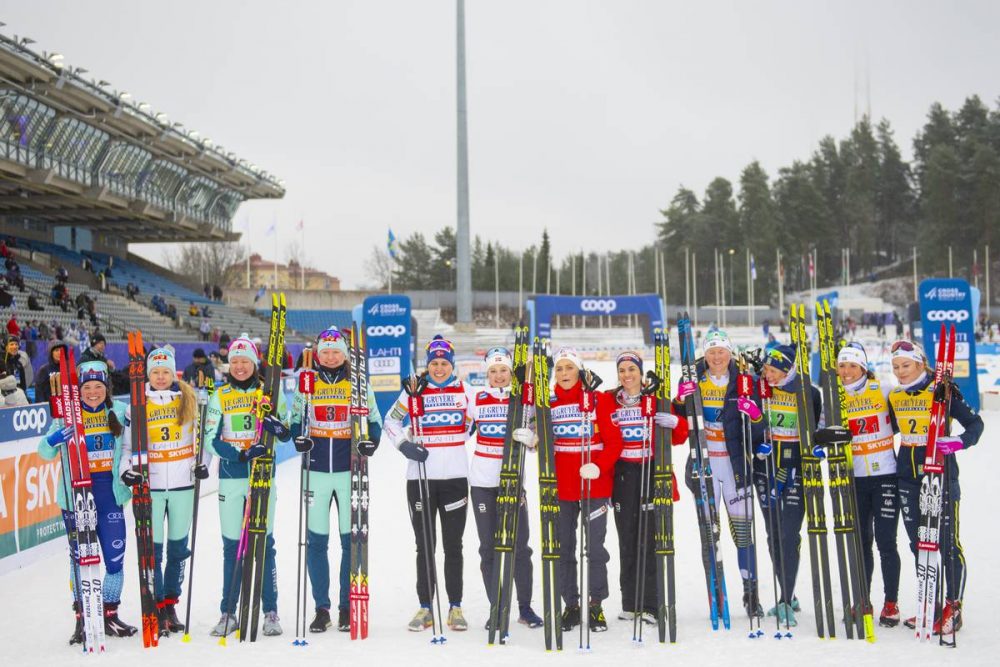
The women’s podium of the 4×5-kilometer relay in Lahti, Finland’s during last season’s World Cup. Norway I took the win ahead of Finland I and Sweden. (Photo: NordicFocus)
Yesterday Norway announced it would cease sending skiers to the World Cups in Davos, Switzerland and Dresden, Germany due to Covid-19 concerns. Rumors swirled that Sweden would make a similar decision. Twenty-four hours later the Swedish Ski Federation announced they too would withdraw from December’s competitions.
“We learned some lessons about the implementation of a World Cup competition in Ruka. We have found that it went well. But we may also have been lucky. As it stands, we can not create an infection-free road to and from Davos or Dresden. If things go wrong, the disease can have potentially serious consequences for the person infected. None of us involved are willing to take that risk,” said Per Andersson, medical director of the Swedish Team, according to a translation of the press release.
Finland also decided the best move forward was step away from the World Cup. In a press release, the Finnish Ski Association explained the ongoing pandemic and concerns about compromising their athletes were to blame. The association also claimed safety protocols in Ruka, the site of last weekend’s World Cup in Finland, were insufficient.
“Unfortunately, at Ruka, we found that attitudes towards the coronavirus vary considerably between different people.When the Ruka World Cup was the first big event of the season, the organizers built a competition bubble according to the best knowledge, but due to the variability of the participants’ common understanding and commitment, the competition bubble did not materialize as required,” said Maarit Valtonen, Chief Physician of the Finnish Olympic Committee, according to a translation of the press release.
Along with Norway, both Sweden and Finland have not made a decision about participating in the Tour de Ski which Begins on January 1.
For those interested in the U.S. Ski Team, they remain in Davos preparing for the remaining December World Cups and the Tour de Ski. Chris Grover, Cross Country Program Director at U.S. Ski & Snowboard, provided the following statement regarding Ruka’s safety protocols and those nations electing to sit out the December World Cups:
“We respect any nation’s decision to protect the health and safety of their own athletes and staff. Our team is in Davos training and we are planning on racing here, and in Dresden later this month. Ruka did a great job hosting three disciplines – cross country, jumping and nordic combined – and showed what was possible. Our team felt quite safe in Ruka as we followed the guidelines the local organizer, FIS and our own National Governing Body had in place.”
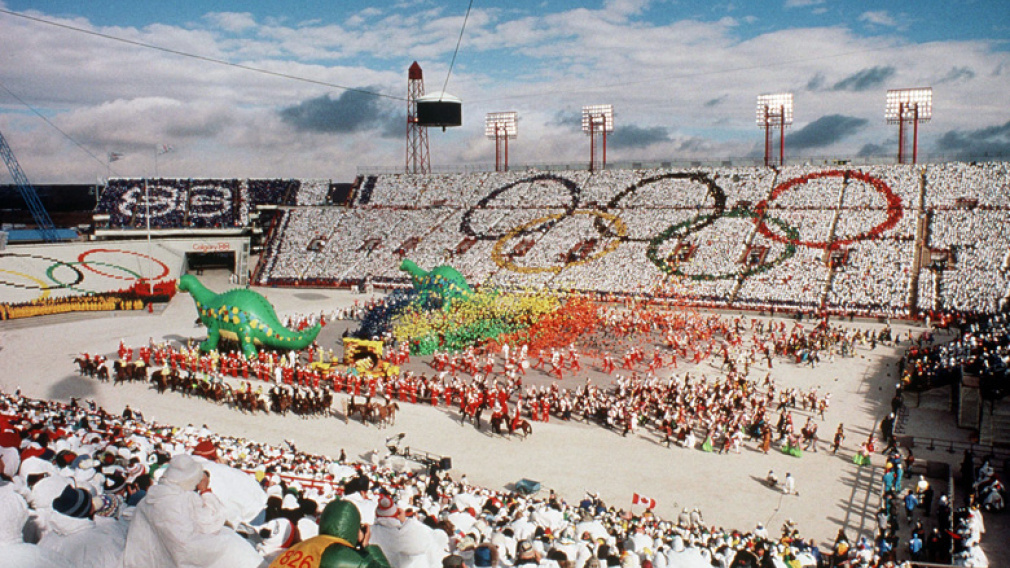
The Opening Ceremony at the 1988 Winter Olympics in Calgary, Alberta. Calgary is in the final three for hosting the 2026 Winter Olympics and Paralympics. (Photo: Olympic.ca)
The Olympics are a global spectacle, but all politics is local. And when the two truisms go head-to-head in today’s plebiscite vote in Calgary, Alberta, local threatens to win. At stake is the future of one of three remaining host cities for the 2026 Winter Olympic Games, a status that has perhaps lost some of its former luster.
There were once seven cities that had progressed to the “dialogue stage” of potentially hosting the 2026 Games, including Calgary; Graz, Austria; Erzurum, Turkey; Milan–Cortina d’Ampezzo, Italy (joint bid); Sion, Switzerland; Sapporo, Japan; and Stockholm, Sweden. (Other boldface names, such as Lillehammer or Innsbruck, had previously expressed some interest but then withdrawn.)
Then Graz, Sapporo, and Sion withdrew, followed by Erzurum. As of Tuesday morning, there are three cities still in the running: Stockholm, Milan–Cortina, and Calgary.
But Calgary might not be on the list too much longer. As the New York Times headlined its story on today’s vote, “Does Calgary Really Want the Winter Olympics? Does Anyone?” The article begins, “Hobbled by a reputation for gross expense and corruption, the International Olympic Committee has become a mendicant, shuffling from nation to nation, shaking its cup and asking if anyone might be interested in bidding on the 2026 Winter Games.”
Calgary’s plebiscite, which is synonymous with a referendum vote, is technically non-binding – “but a majority ‘no’ vote would make it almost impossible for the project to continue,” noted GamesBids.com. The Calgary City Council has final say on whether the city proceeds with its bid. Today’s vote will help guide the council’s decision.
GamesBids.Com added, “More than CAD $2 billion (USD $1.5 billion) of Olympics funding promised from the provincial and federal governments is contingent on a satisfactory ‘yes’ result on Tuesday. The total taxpayer costs are estimated at almost CAD $3 billion of the entire $5.2 billion project.”
Much more background information is available here on GamesBids.com. As the Calgary Herald explains, polls close at 8 p.m. local time tonight (6 p.m. Alaska Time, 10 p.m. East Coast Time for American readers), with results available roughly two hours later.
Here’s GamesBids.com on the “standings” of the other two remaining cities if the results of today’s vote lead Calgary to withdraw its bid at next week’s city council meeting:
Stockholm remains in the race to bring the first Winter Games to Sweden, but the Capital has failed to rally any government support for the project and it will need approvals in place before a January 11 IOC deadline.
A joint Italian bid between Milan and Cortina d’Ampezzo emerged just last month, but it lacks federal government funding. The Italian Olympic Committee (CONI) has said that the regional government representing the two cities will foot the bill, and last week IOC President Thomas Bach confirmed in Rome that this plan would be accepted.
If Calgary voters say ‘no’ Tuesday, it will be the Italian bid with the best chance of being elected as 2026 host city when the IOC takes the vote at the end of June.
The site also notes that the last eight cities to proceed to a referendum vote have seen voters reject the chance to host the Olympics… but that all those cities were in Europe, and that the last two Canadian cities to take up this question, Quebec City and Vancouver, voted in favor.
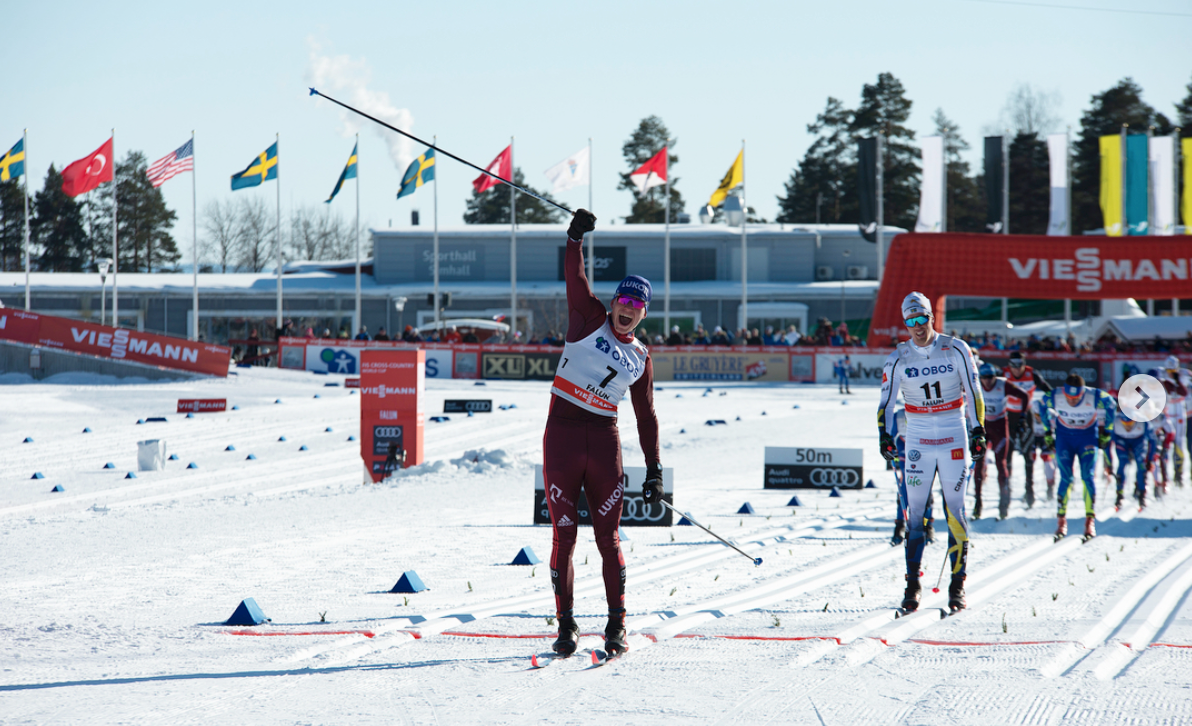
Russian Alexander Bolshunov celebrates as he wins his first-career World Cup, a 15 k classic mass start, just ahead of Sweden’s Calle Halfvarsson (11) at 2018 World Cup Finals in Falun, Sweden. (Photo: Svenska Skidspelen/Instagram)
Saturday was the second day of World Cup Finals mini tour, held in Falun, Sweden, which conclude the 2017/2018 season. Friday’s first stage began with a skate sprint, while Saturday featured a 15-kilometer classic mass start for the men.
As the season is no longer young, the fitness for some athletes frayed, a mass start could offer the opportunity for some to hide in the pack and others to exploit. On a sunny and cold Saturday in Falun, the leading distance skiers on the World Cup were unable to separate. The terrain was World-Cup hilly, yet the pace was never decisive enough to shatter the field.
That field was 91-skiers full. 182 poles. 182 skis. Churning from the start, only those skiers in the front rows of the start pyramid could pole and stride away unscathed. As is the nature of 91 skiers fighting for classic-track scarcity — the lanes taper down in number — pile-ups are the norm. So while some skiers like U.S. Ski Team members Erik Bjornsen and Scott Patterson lost time in a starting-scrum spill, others were looking for brighter opportunities up front.
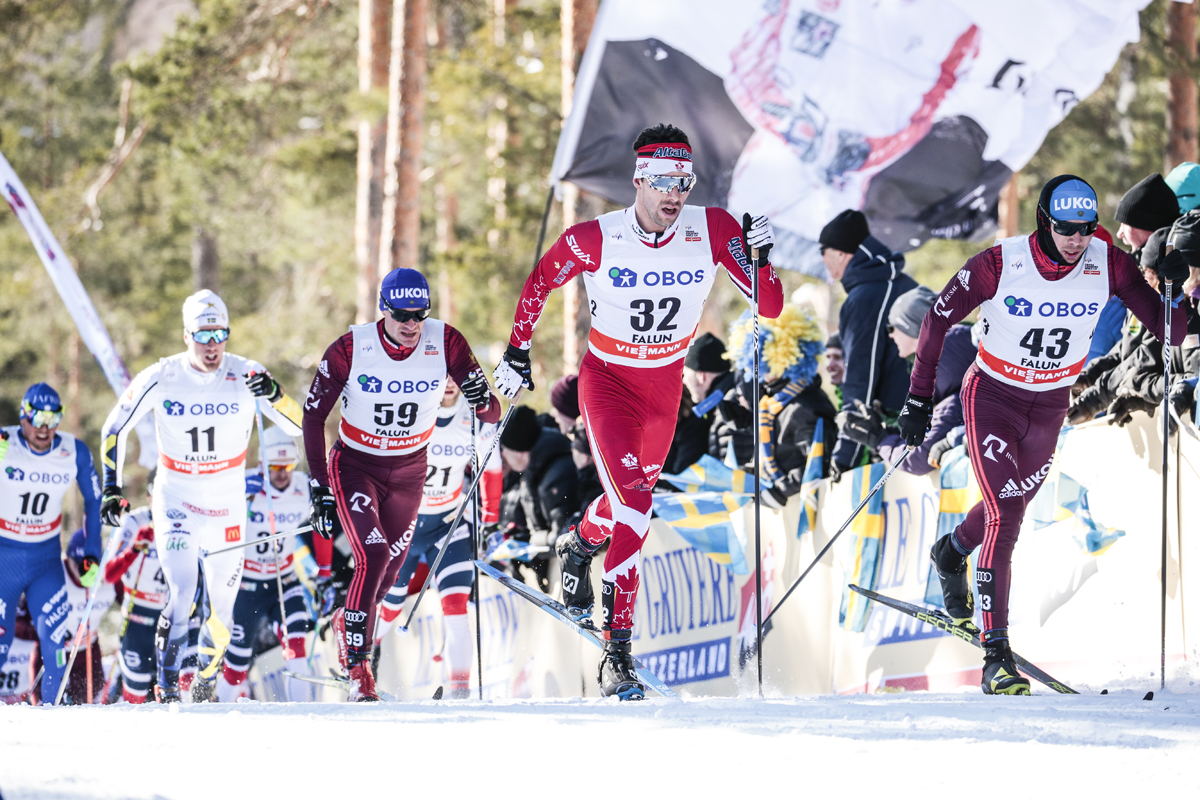
Russia’s Alexey Chervotkin (43) and Canada’s Alex Harvey (32) lead another Russian Maxim Vylegzhanin 59), Sweden’s Calle Halfvarsson (11) and Italy’s Francesco De Fabiani (10) up a climb during the men’s 15 k classic mass start at World Cup Finals in Falun, Sweden. (Photo: Fischer/NordicFocus)
From the start the pace was hot. There was Finland’s Iivo Niskanen, Sweden’s Emil Jönsson, Norway’s Johannes Høsflot Klæbo, Martin Johnsrud Sundby, Niklas Dyrhaug, Canada’s Alex Harvey, Kazakhstan’s Alexey Poltoranin, Russians Alexey Chervotkin and Alexander Bolshunov, and Swedes Calle Halfvarsson and Marcus Hellner, all in either a strung-out or condensed formation 3.75 k into the race. Skiers were slowly slipping off the back. But even with the surging up front, the tactics playing out appeared to place a premium on safety in numbers.
Bolshunov surged at 4.5 k to snag the highest-value time bonus. Otherwise, for much of the race, identifying specific skiers was a task in itself. Coming down the hills a third through the race, the top-50 skiers were a sinuous and continuous line separated by 17.7 seconds. At the bottom of climbs, the compressive part of the accordion effect was in play. Skiers in front could push, those behind became a more dense cluster of lycra-clad athletes.
Despite the prevalent pulsing of pace, skiers like Chervotkin and Harvey had their moments of pluckiness. Each paced a long line of skiers through the 9.3 k mark. But clear at this point was that the pattern of this race would be defined by the collective mass of skiers that began the mass start. Yes, time gaps would balloon a bit by the finish, but at 12 k (the second time bonus), a gap of 1.7 seconds separated first through 35th place.
The move that mattered in this race came from the birthday boy, Halfvarsson. According to FasterSkier’s reporter on the ground, the Swedish crowd serenaded Halfvarsson, 29, with a happy birthday rendition prior to the start. Maybe it was birthday stoke, maybe it was an acknowledgment that with age comes fewer opportunities to seize the win, but with one kilometer to go, Halfvarsson ran like Klæbo. Up and over the hill, the Swede forged a small gap on the 30-plus chasers.
Again on the last short incline before the speedy descent into the stadium, Halfvarsson performed a masterful high-step run. Only Bolshunov at this point could suck up near the Swede’s tails. For a moment, rounding into the final straight, it looked like Halfvarsson’s icing on his birthday cake would be a Falun stage win.
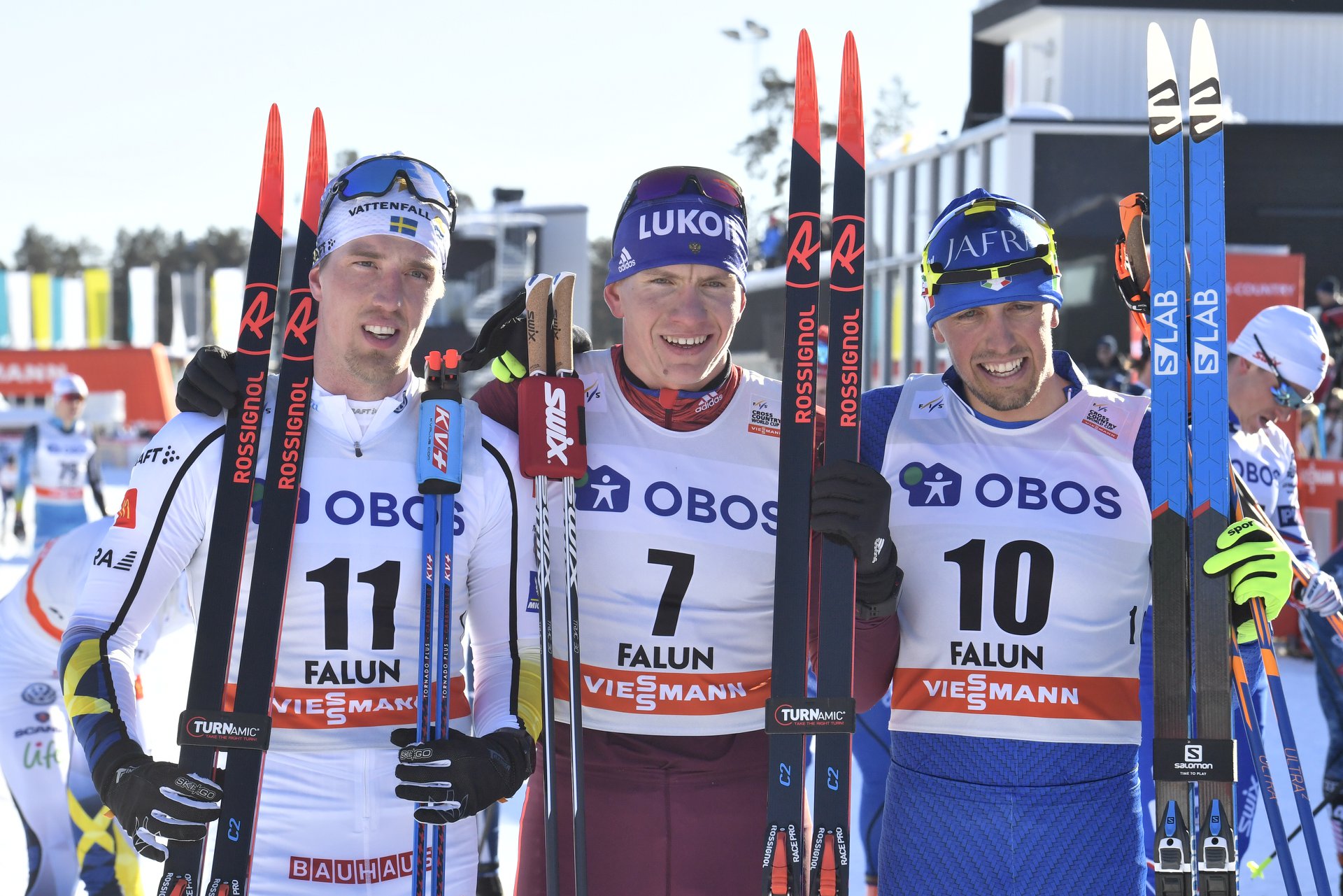
The men’s 15 k classic mass start podium at 2018 World Cup Finals in Falun, Sweden, with Russia’s Alexander Bolshunov (c) in first, Sweden’s Calle Halfvarsson (l) in second, and Italy’s Francesco De Fabiani (r) in third. (Photo: FIS World Cup Svenska Skidspelen/Facebook)
Halfvarsson came into the straight out of the tracks. As he zeroed in to begin the double-poling finish, the birthday boy stumbled slightly slotting into the nearest lane. Bolshunov flew by with a supreme double pole and took the win in 36:59.8. Halfvarsson placed second (+1.3), Italy’s Francesco De Fabianithird (+3.1), Poltoranin fourth (+3.7) and Chervotkin fifth (+5.2).
For the 21-year-old Bolshunov, it was his first-career World Cup win. Prior to Saturday’s win, Bolshunov had stood on the podium six times in his first full season on the World Cup. (Bolshunov’s only World Cup start last season was in Drammen, Norway, in March 2017.) Along with Klæbo, also 21, Bolshunov has risen into one of the sport’s top athletes. He claimed three silvers and a bronze medal in PyeongChang. His two individual Olympic medals were a second in the 50 k classic mass start and third in the classic sprint.
“I have had many second and third place finishes this season so I am very happy to finally have a win,” Bolshunov told the International Ski Federation (FIS) after the race. “This feels good. I will do what I can tomorrow for another good result but for now, I will enjoy this win.”
Sunday’s final men’s race of the season and last race of the three-stage mini-tour, will be a 15 k freestyle pursuit. Bolshunov leads the mini-tour standings in first with a total elapsed time of 38:37 minutes. Klæbo, who finished 22nd (+13.6) on Saturday, sits in second (+38.0), while Halfvarsson is third (+39.2).
The Swede took away the positives from the day’s near-win in front of the home crowd.
“I tried today to get a win but it was too much,” Halfvarson told FIS. “Off the final corner, I was really tired. I am still happy with second place. I have been on a podium a few times this season and always third. So at least second place is an improvement even if I didn’t manage the win.”
Canada’s Alex Harvey was the best placed North American in 20th place (+10.7). He’ll begin Sunday’s pursuit in 18th (+1:16.1).
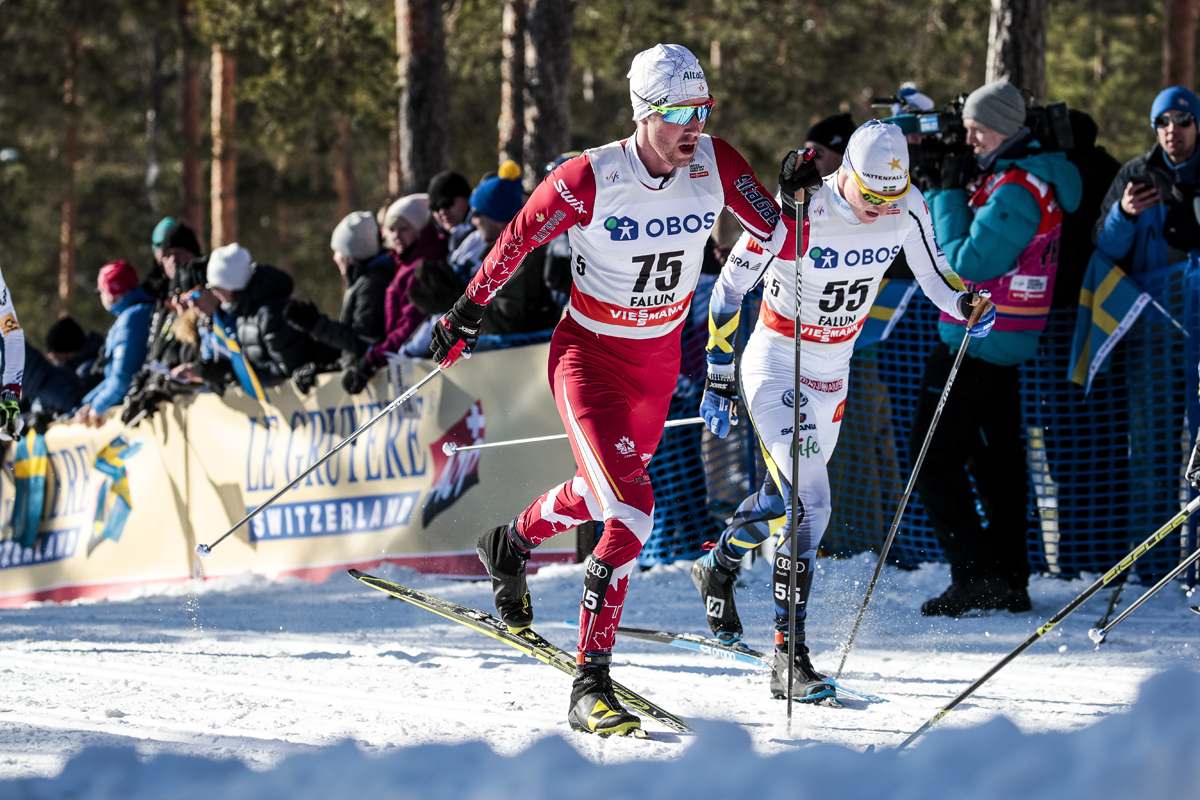
Canada’s Graeme Killick (75) skiing with Sweden’s Jens Burman during the men’s 15 k classic mass start at World Cup Finals in Falun, Sweden. Killick went on to finish 41st. (Photo: Fischer/NordicFocus)
Teammate Devon Kershaw finished 26th (+14.6) for his fourth-straight race in the top 30 (including his 26th-place finish in the Olympic 50 k classic). Graeme Killick placed 41st (+1:13) and Julien Locke was 81st (+3:29) for Canada.
“I felt quite good today,” Kershaw said after the race. “I was a little disappointed with the last kilometer because I was kind of out of position a little bit after Mördarbakken and couldn’t quite get up through traffic, but it’s really close. And a little disappointed to be 26th again; it seems like that’s kind of where I’ve lived all year, but it was a good race for me.”
Kershaw, a 35-year-old staple of the Canadian team, has been seeking a return to top form.
“Just races like today where I feel good and can execute decently well,” Kershaw explained. “To be honest this year I am super motivated after the championship. I’ve [been] having major, major asthma issues at the Olympics and that really really affected me and it took a long time to get a little better, but I felt like by the time I got to Lahti I was feeling quite a bit better. So that really helps, I mean, I can breathe again and I’m feeling good.”
Kershaw is expected to mull over the prospects of continuing his ski career in the coming weeks.
“We’re not sure, I’ll talk to the wife next week [Norwegian former elite skier Kristin Størmer Steira],” Kershaw said of his future plans. “You know there’s a lot of issues right now in Canada so I’ll have to think about it. A lot of guys are saying that they’re gonna call it a day. And I’m not getting any younger, but I still feel quite good, and I mean a race like today shows that I can still compete with the best in the world so that’s motivating, but we’ll definitely have to take some weeks to think about it.”
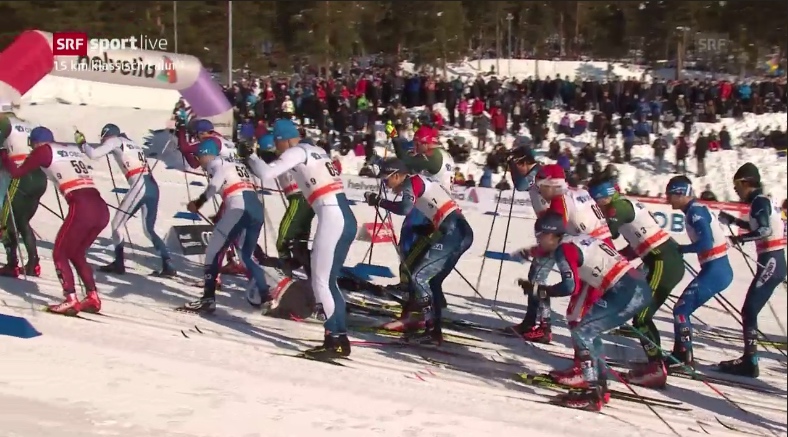
Nowhere to go: U.S. skiers Erik Bjornsen (bib 57) and Scott Patterson (bib 67) stuck in a pile-up after the start of the men’s 15 k mass start classic at World Cup Finals in Falun, Sweden. (Screenshot: SRF Sport broadcast)
For the U.S., Erik Bjornsen finished 52nd (+1:47.1), Simi Hamilton 62nd (+2:06.4), Kevin Bolger 69th (+2:27.1), David Norris 70th (+2:31.2), Scott Patterson 71st (+2:40.6), Paddy Caldwell 75th (+2:52.7), and Andy Newell 86th (+4:47).
Patterson’s race did not go as planned.
“I was in a big pile-up right at the start,” Patterson told FasterSkier after. “I was the second-to-last one out of the stadium and then the first time up Mördarbakken, my ski fell off. So I skied halfway down, got my ski back on, just turned back around and then just like stupidly chasing the rest of the race. …
“I felt OK,” Patterson added. “[Without] those two stupid things it would have been a good race. But I was so far off and then it was really hard to get back to the pack and then it was like, ‘Well, I can’t get to the pack. I am here with those guys.’ ”
Lately, Patterson, 26, has been a highlight for the U.S. distance skiing prospects. The first-year U.S. Ski Team member notched three individual top-20 results at last month’s Olympics, including 11th in the 50 k classic. Last weekend in Oslo, Norway, Patterson proved that was no fluke, as he placed 16th in a traditionally deep field at the Holmenkollen 50 k skate.
World Cup Finals conclude with 10/15 k freestyle pursuits on Sunday.
— Gabby Naranja, Harald Zimmer and Alex Kochon contributed
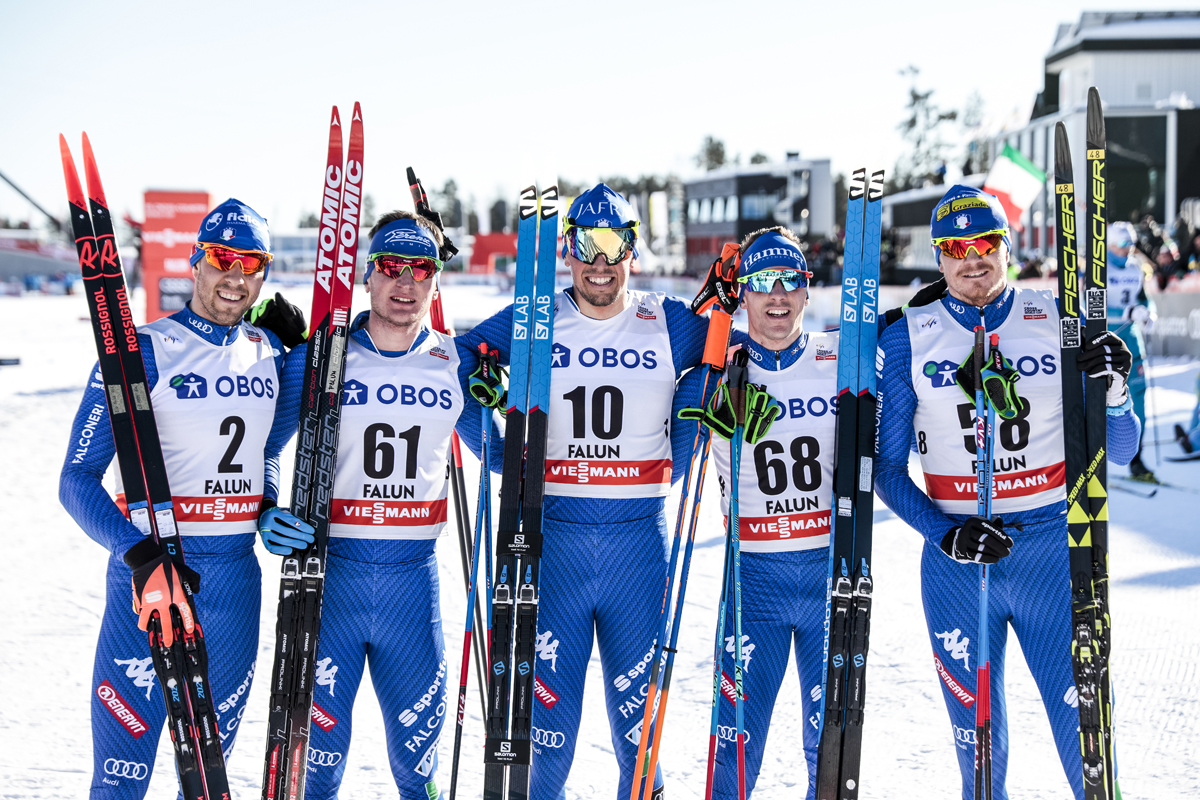
The Italian men’s team after Saturday’s 15 k classic mass start at 2018 World Cup Finals in Falun, Sweden, with (from left to right) Federico Pellegrino, Giandomenico Salvadori, Francesco De Fabiani, Maicol Rastelli, and Dietmar Nöckler. (Photo: Fischer/NordicFocus)
So many suits — The start of the women’s 15 k skiathlon on Saturday, Feb. 10, Day 1 of the 2018 Winter Olympics in PyeongChang, South Korea. (Photo: FlyingPointRoad)
PYEONGCHANG, South Korea — This time last week, we brought you the basics of Olympic cross-country and biathlon cheat sheet, and not long after, we received a comment from a reader asking for a uniform cheat sheet. We, too, found ourselves sometimes befuddled. During Saturday’s skiathlon, this reporter found himself looking for the emblematic stars on the U.S. Ski Team’s new unis. There were stars, think Diggins and Kalla, just no obvious stellar-like branding on the USST suits.
So for you and for us, here’s a basic cross-country race suit cheat sheet. Disclaimer: we do nordic here at FasterSkier. Which is saying fashion and nordic are often mutually exclusive. Sometimes we do fashion (right FBD?), but not really. For more fashion expertise here’s a site that popped up when googling “most famous New York fashion writer”. Back to race suits.
Sweden: Out with the all-whites and in with the mostly royal-blue tights. The blue is emphasized on the thighs and blends into yellow knee-highlights, which in turn blends into white on the lower leg. Blue, yellow, white is all Sweden. Here’s Sweden’s own Charlotte Kalla racing to second in Thursday’s 10 k skate.
Sweden’s Charlotte Kalla racing to second place in the women’s 10 k skate at the 2018 Winter Games in PyeongChang, South Korea. (Photo:FlyingPointRoad)
Sweden’s biathlon race suits epitomize reductionism. In other words — K.I.S.S. — as in, keep it simple, Sweden. Our wish is their command. Two words to help identify Sweden on the biathlon range or tracks. Canary yellow. Thank you Sweden.
Sweden’s Hanna Öberg on her way to a gold medal in the women’s 15 k individual at the 2018 Olympics in PyeongChang, South Korea. Öberg skied the sixth-fastest time and shot 20/20. (Photo: IBU/Biathlonworld.com)
Finland: Every day is a new day. A positive outlook works wonders in the tough-to-win sport of World Cup skiing. Finland’s Krista Pärmäkoski is positive and owning it in Finland’s lycra whites. Yes, there’s navy blue on the forearms and just below the patella, but if you can kill in mostly white, you can kill on the ski course. That’s evidenced by Pärmäkoski’s arm raise: positive vibes and she’s in for the bronze. (Note: if Pärmäkoski is skiing away from you, the Finland suits emphasize blue on the backside.
Finland’s Krista Pärmäkoski crosses the line for bronze in the 2018 Olympic women’s skiathlon. (Photo: FlyingPointRoad)
You’ll have to look past Canada’s Rosanna Crawford and zero in on Finland’s Mari Laukkanen in bib 22 to burn the Finn’s biathlon uniform into the synapses. Finland’s biathlon unis do the flag proud. It’s a zippy look that takes the essentials into play: blue and white. Certainly less white and more blue than their cross-country brethren. For the feisty Finns — they dealt with invading Soviets in winter of 1939 — we say it works.
Fashionably crushing it, Canada’s Rosanna Crawford (bib 22) in the 7.5 k sprint in PyeongChang. Finland’s Mari Laukkanen (bib 21) skis behind Crawford. (Photo: FlyingPointRoad)
France: We’re sticking with countries that begin with the letter F. C’est la vie. But we’ll go a little crazy and start with France’s biathlon garb. Why is that? Because of Martin Fourcade — the French force of biathlon. He shoots like a veritable post-doc in Jedi-studies and skis like he could crush the 15 k skate on the cross-country World Cup. France’s biathlon suits get jazzy in a sky blue kind of way on the lower leg. And just when you get complacent with all the blue tones, the right arm gets proud in red. You should get to know this suit, Fourcade is likely to rule these Games; he’s already won the men’s 10 k pursuit.
France’s Martin Fourcade defending his Olympic gold from four years ago on Monday in the men’s 12.5 k pursuit at the 2018 Olympics in PyeongChang, South Korea. (Photo: FlyingPointRoad)
France also gets props for keeping it easy on spectators and viewers. If you’ve studied Fourcade’s race suit already, you’re all set. In the image below, France’s Jean-Marc Gaillard (9) proves our point. Biathlon or cross-country, the suits are the same.
Canada’s Alex Harvey (4) leading France’s Jean-Marc Gaillard (9) and Finland’s Iivo Niskanen (8) during the skate leg of the men’s 30 k skiathlon at the 2018 Olympics in PyeongChang, South Korea. Harvey went on to finish eighth. (Photo: FlyingPointRoad)
Norway: It’s Norway after all. Nothing too drastic here, and certainly we’re imagining athletes will have several colors schemes to choose from at a later date. For now, the new kind of looks like the old. Which when consulting fashion guides, retro can be cool — think the resurgence of L.L. Bean’s duck boots or those Greg-Lemond-era Oakleys that Harvey has rocked.
OK, the cross-country suits. Here’s Norway’s race wear as worn by Heidi Weng (bib 1) and Ingvild Flugstad Østberg (bib 2) during Saturday’s skiathlon. The easy thing about trying to identify the Norwegians in a deep field cross-country scrum: look towards the sharp end of the race. Most often in the lead pack you’ll see a predominately red-suited athlete pushing the pace. Yeah, that’s probably Norway. (That said, deference to Canada’s Harvey, we want to get our red suits straight. We’ll get to the maple leaf in a bit, but in the case of Canada just think a different shade of red, because Harvey is a front-pack skier. Big respect for Harvey in red.)
The start of the women’s 15 k skiathlon on Saturday, Day 1 of the 2018 Winter Olympics, with (front row, from left to right) Austria’s Teresa Stadlober, Norway’s Ingvild Flugstad Østberg, Norway’s Heidi Weng, American Jessie Diggins, and Sweden’s Charlotte Kalla leading out of the stadium in PyeongChang, South Korea. (Photo: FlyingPointRoad)
Here’s a shot of Norway’s biathlon suit. Again, Norway has gone with reliable themes. Yet in this case, pin striping rules. There’s the red, the deep blue, and the white. The striping certainly gives it a more formal look as if to say “we’re here to shoot clean”.
Norwegian biathlete Erlend Bjøntegaard on his way to fifth in the men’s 10 k sprint. (Photo: FlyingPointRoad)
Canada: Why not? Let’s break down Canada’s race gear next. Nothing too crazy here on the XC side from our good friends up north that brought us Bob and Doug McKenzie and sort of Kenny G. (Officially, Kenny G. is American; he was born in Seattle. But his mom is from Saskatchewan. A loose connection, but only separated by one degree. And Seattle is super close to Vancouver.) Like the Norwegians’ cross-country race suit, this is a mostly red affair. But it rocks perhaps the most identifiable flora icon on the planet: the maple leaf. In our opinion, this suit is an instant classic. Maple-leaf patterns run down the length of the arms. Nothing too gaudy here. No fluorescent yellow, no overdoing it with the “Canada-ness” of it all. And there’s just the right amount of white lycra highlights to keep it sleek looking. If you’re looking to impress on the Olympic trails but be simultaneously understated, look no further than Canada. Here’s Alex Harvey racing to seventh, his best individual result in his third Olympics, in Friday’s 15 k skate:
Canada’s Alex Harvey racing to seventh in Friday’s 15 k freestyle at the 2018 Olympics in PyeongChang, South Korea. (Photo: FlyingPointRoad)
Under the bright lights of the Alpensia biathlon venue, Biathlon Canada got a wee bit friskier. Down the right arm you’ll note … wait for it … white maple leaves of varying sizes. Little known fact, at least to FS, “an infusion” of maple-tree bark can be used to treat cramps and dysentery. Any chance that infusion works on norovirus? Just asking.
Lots of digressions here. But this is for certain and maybe it’s a trickle-down effect of honoring the most beautiful autumn tree on the planet. Across the board, XC or biathlon, Canadian athletes are a delight to chat with. You parent-folk raise them well up north.
Canada’s Brendan Green en route to 82nd in the men’s 10 k sprint at the 2018 Olympics in PyeongChang, South Korea. (Photo: FlyingPointRoad)
The lower half of Canada’s biathlon unis are trending more towards what we have seen in the recent Canadian lycra past: bigger and badder maple leafs. A big white maple icon sits on the lower right leg, with a smaller slightly more delicate yet distinguished maple icon on the upper left thigh. There you have it. When in doubt, channel the red suit and the maple leaf and you’ll know it’s Canada at any of the nordic venues.
Canada’s Christian Gow racing to 62nd in the men’s 10 k sprint at the 2018 Olympics in PyeongChang, South Korea. (Photo: FlyingPointRoad)
U.S.A.: Jingoism = “extreme patriotism, especially in the form of aggressive or warlike foreign policy.” We are not jingoistic here at FasterSkier. Read Saturday’s skiathlon report and it’s clear we’re not jingoistic. The day’s winner Kalla — from Sweden — is given plenty of coverage. Yeah, Jessie Diggins killed, but Kalla was a force, too.
Jessie Diggins racing to fifth in the women’s 10 k skate for her third top-six (and second top-five) of the 2018 Olympics. (Photo: FlyingPointRoad)
So the good ole’ red-white-and-blue (r-w-b). That’s pretty much still the theme. Visually speaking, we think it’s a nice blend of the r-w-b trifecta. It’s mostly blue. And a cool blue at that. Again coolness reigns with the white downward slanting stripes running from the lower thigh to below the knee. Those stripes scream, “Scoreboard!” And the red on the arms? Awesome. And if you’re like this reporter looking around in the pack for the U.S. skiers, it helps to read the bold print on the right upper arm. Read: U.S.A.
American Noah Hoffman racing in the 15 k freestyle at the 2018 Olympics in PyeongChang, South Korea, where he finished 48th. (Photo: FlyingPointRoad)
Now to US Biathlon. For starters, the national governing body of biathlon in the U.S. is … US Biathlon. A totally different sporting body than U.S. Ski and Snowboard. And the uniforms on the biathlon side make that clear. There’s little cross-pollination like we see with the Canadian suits.
For awhile, U.S. Biathlon raced in suits with a distinct mix of blue and red. If you can harken back to elementary school art class, or if you’re in elementary school now, you’d have to pass this basic test to move onto more complex colors.
Test: How do you make purple. Yes! Mix red and blue together.
The older U.S. biathlon uniforms had a distinct purple hue on the bottom-half. The top was a tasteful strawberry red called into action by iconic Adidas striping down the arms. That purple hue is no longer. Get rid of that in your mind’s eye. We’re not even posting a photo of that older race suit. It’s so not now.
Want to know where Susan Dunklee or Lowell Bailey are? Look for uniforms that harness the “blue blazer” in all of us. First let’s zoom in. (See photo below). We note here that it’s not simply a solid-blue pattern. The hat, shoulders and upper torso host a maze of small deep blue “three-stripe” hash marks printed over a lighter bluebird blue. Since those appear on several team’s 2018 Olympic suits (like Sweden, Germany, and the Olympic Athletes from Russia), all of which were made by Adidas, we’re guessing it’s a nod to their uniform supplier? (You know, with the “threes” theme.) Nonetheless, the upper is mostly covered by the bib. And from a distance, as we zoom out, it simply looks blue. But before we do that, here’s Clare Egan — total badass polyglot; she speaks Korean — during the women’s sprint here in PyeongChang.
Clare Egan (US Biathlon) racing to 61st in the women’s 7.5 k sprint at the 2018 Olympics in PyeongChang, South Korea. (Photo: FlyingPointRoad)
Now for the zoom out. This shot is great for many reasons, so a shoutout to FlyingPointRoad guru Steve Fuller. Since we are talking colors here, let’s just continue the shout out to Steve. This photo kills because a Swedish skier follows Tim Burke in a canary yellow race suit. Blue and yellow are primary colors. The blue-Burke here stands out more as he’s contrasted by the yellow-Swede. Intentional or not Steve, well done.
Let’s focus on Tim Burke’s legs. That’s a solid royal blue, right? A basic blue, but a royal blue. There’s just no damn distractions from the business at hand here. Maybe the small USA on the left calf area is a nod to those fans still time-capsuled with Lake Placid’s 1980 gold-medal hockey team and the venerable announcer Al Michaels. That USA on the leg isn’t really yelling U.S.A!!! U.S.A!!! It’s sort of a kinder and gentler u.s.a. (no caps intentional). Like a whisper, saying we come in peace even though we’re charging hard with rifles on our backs. Back to the point. No distractions. #businesstime.
USA = basically blue. Look for the blue. That’s the U.S. biathlon team.
Tim Burke (US Biathlon) en route to 47th in the men’s 10 k sprint at the 2018 Olympics in PyeongChang, South Korea. (Photo: FlyingPointRoad)
Other notable suits:
Switzerland: From a country we all associate with Swiss-Army-Knife red, we get thrown a change up. It took us all a few seasons to get accquainted with the race-lycra formal wear donned by the Swiss cross-country team. Cross-country World Cups aren’t exactly formal occasions, but the tuxedo black suits the Swiss have worn for a few years now — a look you’d seek if you were on the race equivalent of a Georgetown cocktail circuit — are gone. The Swiss sport maroon suits with red highlights on the lower legs and arms.
(Note: These suits resemble Russia’s cross-country race suits on the World Cup. Alas, they also resemble Russia’s suits during the Games despite the fact that Russia’s skiers are competing under the Olympic flag as Olympic Athletes from Russia (OAR). See photo featuring Great Britain’s Andrew Musgrave — that’s Denis Spitsov of the OAR chasing, not a Swiss skier. It helps that the Swiss skiers wear hats reading “Suisse”.)
Switzerland’s Dario Cologna racing to gold in the men’s 15 k freestyle on Friday at the 2018 Olympics in PyeongChang, South Korea. (Photo: FlyingPointRoad)
Great Britain: From the people who brought us the modern navy … we get navy blue. Nothing says “we are not in your face” more than navy blue. Great Britain’s cross-country race suits are appropriately regal. Think the Queen, Lady Di, and the ever so cool and soon-to-be-in-line-for-the-throne, Meghan Markle. Also, Andrew Musgrave, as this reporter’s grandfather used to say, is the real McCoy. (The Scottish McCoy, not the Irish McCoy). It was a delight to watch the 2018 Olympic skiathlon unfold as a fly-on-the-wall surrounded by British journalists. Move over Chelsea. Move over Man-United. Yeah, that’s right. Musgrave is on your tails sporting navy blue lycra.
Britain’s Andrew Musgrave (10) during the men’s 30 k skiathlon in PyeongChang, South Korea, followed by Russia’s Denis Spitsov (16), skiing as a member of the Olympic Athletes from Russia. (Photo:FlyingPointRoad)
Italy: Ah Italia. They exported high fashion with the house of Gucci and they school us in the color wheel. First, Italy’s cross-country race suits feature a halcyon blue. A blue when blues sang like a pristine alpine sky and times were simpler. A time perhaps when you were finishing an altitude camp in Seiser Alm and all you had to worry about was visiting the physio for a rub-down and connecting for a post-training sesh espresso with the whos who of the World Cup … also finishing an altitude camp.
Second, we note orange. Orange is many things, but it does not scream Italy. However, we believe Italy is paying respect to its storied-art legacy by deferring to the color wheel — Italy’s suits have just a tad more than a splash of orange on the lower legs and lower arms. Blue and orange are complementary colors. That means they are opposite one another on the color wheel. Opposites attract. And if anything is attracting here, it’s Federico Pellegrino and his panache on the big stage. Dude can classic sprint, too. Here’s Pellegrino an eyeblink before crossing the line in the classic sprint final (he took silver).
Third, and this may be breaking news, Italy may have a one-off suit for Pellegrino. If you compare the below image with the one below that (behind American Caitlin Patterson, there’s an Italian skier, Sara Pellegrini), newsflash — no splash of orange. Absent the orange, the suit is identical to Pellegrino’s. ITA adorns the upper-left quad area on each suit. Italy’s biathlon team also wears the all-blue suit. Ciao for now.
Norway’s Johannes Høsflot Klæbo (l) and Italy’s Federico Pellegrino finishing first and second, respectively, in the first semifinal of the men’s 1.4-kilometer classic sprint at the 2018 Olympics in PyeongChang, South Korea. (Photo: FlyingPointRoad)American Caitlin Patterson leads Italy’s Sara Pellegrini (not to be confused with Pellegrino) into the finish of the women’s 15 k skiathlon at the 2018 Olympics. They finished 34th and 35th, respectively. (Photo: FlyingPointRoad)
Austria: What’s black and white and red allover? Austria. Across the board: cross-country, biathlon, and nordic combined, the uniforms are all the same. You’ll never not notice Austria.
Austria’s Dominik Landertinger racing to bronze in the men’s 20 k individual at the 2018 Olympics in PyeongChang, South Korea. (Photo: FlyingPointRoad)
Germany: Embracing their inner-Vader is Germany. Like the old Swiss race suits but taking black lycra to “11”. Germany. Add just a sprinkle of white around the shoulders to lighten the mood. The red hat emblazoned with the Bundesadler — the German federal eagle — is a fitting cap for their race wear. As badass as Clare Egan is speaking Korean (go back to U.S.A. for a refresher), the Bundesadler is nearly her avian iconography equivalent.
Germany’s Eric Frenzel (5) leads Austria’s Lukas Klapfer during the individual normal hill/10 k competition on Wednesday at the 2018 Olympics in PyeongChang, South Korea. Frenzel went on to win while Klapfer placed third. (Photo: FlyingPointRoad)
Germany’s cross-country, biathlon, and nordic combined teams share the same uniform.
Germany’s Laura Dahlmeier racing to her first Olympic gold (and first Olympic medal) on Saturday in the women’s 7.5 k sprint, the first biathlon race of the 2018 Winter Olympics in PyeongChang, South Korea. (Photo: FlyingPointRoad)
We couldn’t cover every team, so we’re aware we left more than a few out. Hopefully this leaves you feeling a little more in-the-know when it comes to Olympic XC and biathlon spectating. Onto the relays (and biathlon mass starts) we go!
***
A message from a Korean fan during the men’s 15 k freestyle on Friday at the 2018 Olympics in PyeongChang, South Korea. (Photo: FlyingPointRoad)A message from an unidentified spectator during the men’s 15 k freestyle on Friday at the 2018 Olympics in PyeongChang, South Korea. (Photo: FlyingPointRoad)
Anna Magnusson competing in the mixed relay in Östersund, Sweden, this season. The Swedish women’s biathlon team will be without its top coach at the 2018 Olympics. (Photo: Svenska Skidskyyteförbundet)
Wolfgang Pichler, the coach of the Swedish women’s biathlon team, will not be allowed to attend the 2018 Olympics in PyeongChang, South Korea. The reason? He previously worked with Russian athletes who have now been convicted of doping violations.
The German rose to prominence as a coach when he led the Swedish team during the time of Magdalena Forsberg, coaching Anna Carin Zidek and Helena Eckholm as well. But he then left the team and decided to go to Russia.
An outspoken critic of doping who had previously called for the Russian team to be excluded from international biathlon for its raft of doping offenses, Pichler went there to clean up. He vowed to work with the women’s team, which he said had a lot of talent, and see what they could accomplish without performance-enhancing drugs.
Unfortunately, as the McLaren Report and now the International Olympic Committee (IOC) Disciplinary Commission investigations have revealed, doping did not stop in Russian biathlon after Pichler’s arrival and his public assertions about how his team would be run.
Several of his former athletes have been disqualified from the 2014 Olympics and all future Games.
Olga Zaitseva (RUS) gets encouragement from coach Wolfgang Pichler at 2013 World Championships in Nove Mesto, Czech Republic.
That includes Olga Vilukhina, who worked with Pichler at the beginning of his tenure before leaving his group and returning to Russian coach Vladimir Korolkevich.
Korolkevich had also coached several of the Russians caught doping in the past. Indeed, in the run-up to 2014, two of his athletes – Irina Starykh and Ekaterina Iourieva – were caught blood doping, in Iourieva’s case a repeat offense as she had already served a doping suspension. He is also now one of the current leaders of the Russian biathlon team.
Olga Zaitseva, who did continue working with Pichler through his entire tenure with the Russian team, was also recently disqualified by the IOC.
Pichler, who left Russia after 2014 and is now working with the Swedes again, has conceded that things may have happened behind his back. But he has insisted that he had no knowledge of doping among his athletes, and flatly disbelieves that Zaitseva was involved.
“I believe and say today that my team was clean,” he told Sport.de in January, also noting that he supported a ban on Russia competing internationally if the allegations in the McLaren Report were true: “If all that is true, as it has been said, then the Russians should have to take an Olympic break and be excluded.”
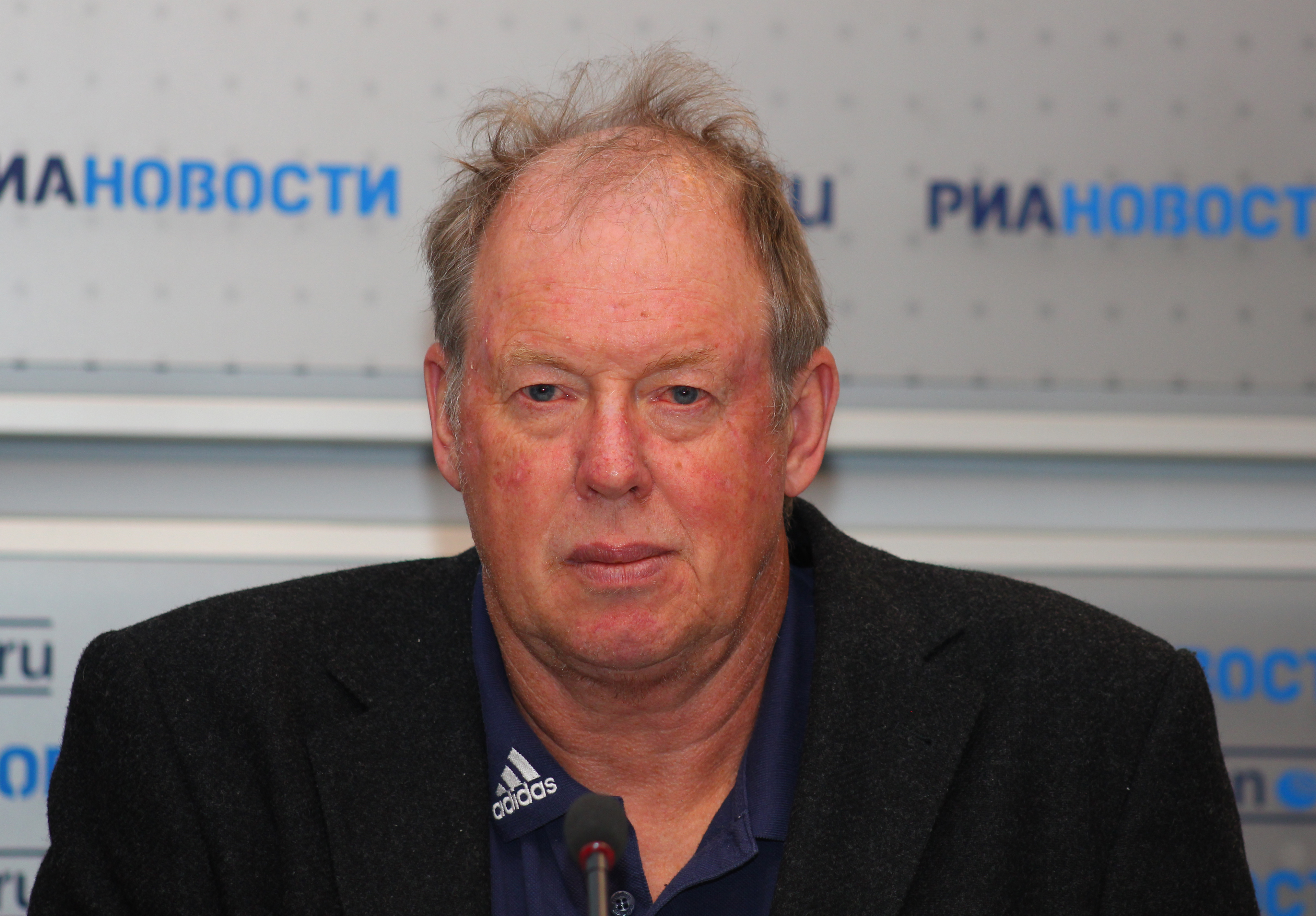
Wolfgang Pichler. (Photo: Wikimedia Commons)
Whether he knew what was happening or not matters little. In its December 5 decision suspending the Russian Olympic Committee and mandating that Russian athletes compete in PyeongChang under the moniker “Olympic Athlete of Russia”, the IOC wrote that “No coach or medical doctor whose athlete has been found to have committed an Anti-Doping Rule Violation can be included on the invitation list” to PyeongChang.
That apparently includes Pichler. Reuters reported today that he will not be allowed to travel to the Olympics with his Swedish athletes.
“The Swedish Biathlon Federation still has strong confidence in Wolfgang, who throughout his career advocated for clean sport as an active leader, but accept and understand the IOC’s line that says that leaders who worked with Russian athletes who committed doping offences in conjunction with the Sochi Olympics in 2014 cannot attend Pyeongchang 2018,” the Swedish Biathlon Federation wrote in a press release, according to a translation.
According to Scandinavian media, the decision by the IOC cannot be appealed and the Court of Arbitration for Sport has no jurisdiction. It is not a doping case per se, and ratehr a decision by the IOC about who can be invited to its events.
This creates an unusual situation where coaches of athletes from other countries who have been suspended for doping, such as the coaches of Norwegian cross-country skiers Therese Johaug and Martin Johnsrud Sundby, Austrian cross-country skiers Johannes Düerr and Harald Wurm, or Slovenian biathlete Teja Gregorin, could be present in PyeongChang but Pichler will not.
“I was not involved in any way, not a single percent,” Pichler told Swedish paper Expressen, according to a translation. “It’s true. Everything may happen behind one’s back, of course, but I was not involved in any of it… No one is talking to me. None from [the World Anti-Doping Agency], none from the IOC. No one at all. There was no court process, no one has asked me questions or given me the opportunity to explain. What should I say? in my eyes, I am a victim, maybe a political victim.”
The young Swedish women’s team Pichler is heading may be the real victim. The women have had some strong results recently; 27-year-old Mona Brorsson was sixth in the Östersund 20 k individual, where Linn Persson and Sebastian Samuelson were fifth in the single mixed relay and the mixed relay team was also fifth. Last season, Brorsson, Persson, Hanna Oeberg, and Anna Magnusson were sixth in the women’s relay at World Championships.
“I will prepare the team the best I can,” Pichler told Expressen. “As usual, I will give 150 percent and during the Olympics I can also Skype with them.”
The Swedish team is looking for a solution so that the athletes also have a coach on the ground in PyeongChang.
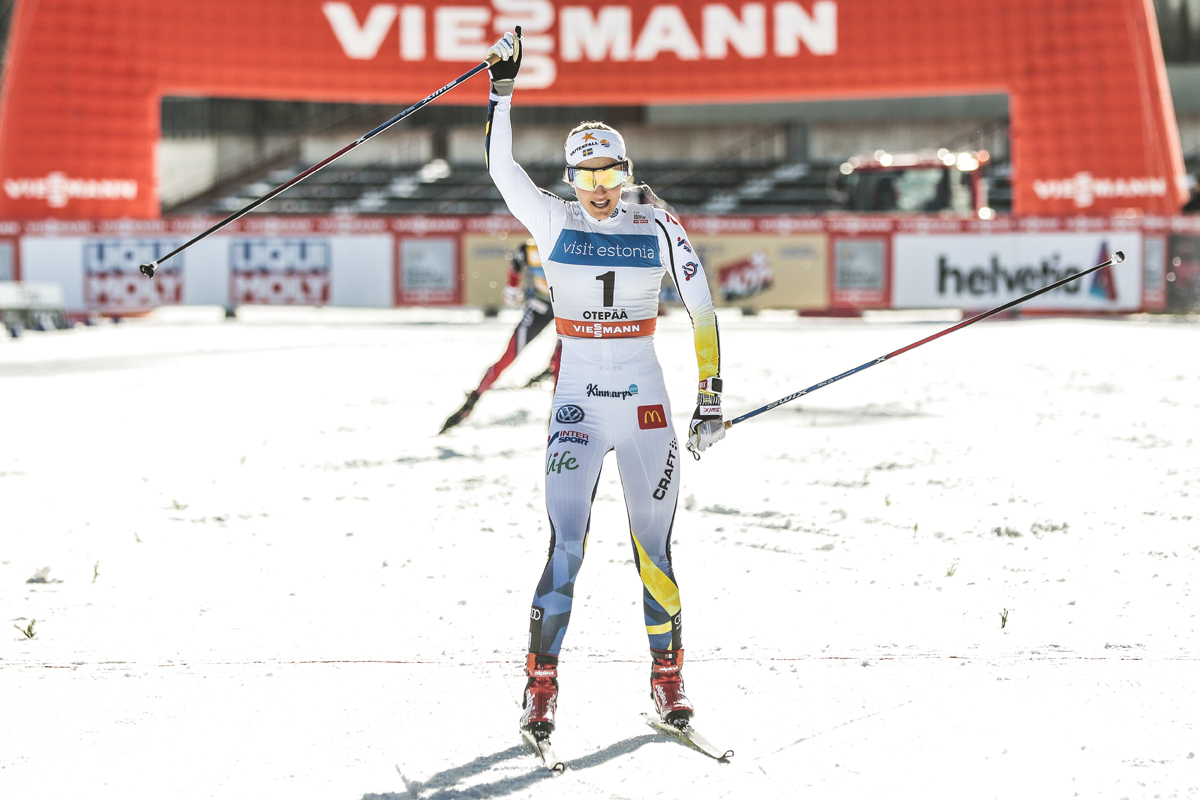
Sweden’s Stina Nilsson celebrates the 10th World Cup victory in two seasons in the women’s 1.3 k freestyle sprint in Otepää, Estonia, in January. (Photo: Fischer/NordicFocus)
Welcome to World Cup Windup, where we check in with the top-10 teams from last year’s FIS Cross Country World Cup tour before the season starts with the Ruka Triple in Kuusamo, Finland, on Nov. 24.
SWEDEN
Overall in Nations Cup Last Year: Second
Women’s Ranking 2016-2017:Second
Men’s Ranking 2016-2017:Third
Who’s Back:
Stina Nilsson, second in the Sprint Cup and fourth in the World Cup overall; Hanna Falk, third in the Sprint Cup; Marcus Hellner, who finished sixth in the World Cup overall; Charlotte Kalla, ninth overall; Calle Halfvarsson, who won two World Cups; and Jens Burman and Jonna Sundling, the runner-up and fourth-ranked skiers in the for the World Cup U23 standings. Plus, 2014 Olympic team sprint bronze (soon-to-be-silver) medalists Emil Jönsson and Teodor Peterson, and Ida Ingemarsdotter, who teamed up with Nilsson for silver in the same event in 2014.
Who’s Missing:
Sweden’s Marcus Hellner – who had something of a comeback last season – leads Germany’s Florian Notz during the third leg of the men’s 4 x 10 k relay at 2017 World Championships in Lahti, Finland. Sweden ultimately placed third and Germany sixth. (Photo: John Lazenby)
Sweden’s wily and bold distance specialist, Johan Olsson. Olsson announced his retirement in April at age 37 after winning back-to-back World Championships 50 k titles in 2013 and 2015, and contributing to Swedish relay gold at the 2010 and 2014 Olympics. “I have spent 15 years trying to realize my sporting dreams,” he explained at the time. “Now I will be able to realize completely different dreams, and I will be able to be a much more present dad.”
Pre-Season Results:
The Swedish team had a sprint race in late October in Idre, on a course made to resemble the profile of the 2018 Olympic sprint course in PyeongChang, South Korea. Some athletes were away at an altitude training camp, but Hanna Falk dominated the women’s sprint over Maja Dahlqvist and Linn Sömskar. Calle Halfvarsson won the qualifier but fell in the final; instead, Teodor Peterson edged Oskar Andersson in a tight finish.
Other than that, most of the top athletes have not raced yet. National team member Emma Wikenwon a season-opening race in Bruksvallarna, Sweden, this past weekend. “It felt good! I chose to compete here today because I usually feel that it takes a couple races for me to get started,” she told Swedish media.
Recent Drama:
Calle Halvarsson racing last December, before he got sick and took a long break from the World Cup. (Photo: Fischer/NordicFocus.com)
Despite flashes of undeniable brilliance, Calle Halfvarsson’s career has been plagued by gaps in the race results because he has often been sick mid-season. This year he had an operation to fix his sinuses and hopes that it will allow him to race at the top of the field all season. “I hope I’ve found the solution,” he said. “I feel a difference. I have kept myself healthy.”
Stina Nilsson, the most successful Swede last season, talked about how she has dealt with the fame that has gathered around her in the last three years since her breakthrough on the World Cup. “The attention itself is not a driving force for me, and sometimes it can be tough to handle,” she said on the Swedish podcast Ur spår. “It’s a thing I have a bad conscience about: I don’t have the patience I want to, when people come up and want to talk cross-country skiing with me. As I breathe and live in my ski bubble for so many hours a day, I want to make some breathing holes — I have to be just human Stina, where I can focus only on myself.”
Sweden’s Charlotte Kalla racing to the win in the Lysebotn Opp, a 7.5-kilometer uphill climb, at the 2017 Blink Ski Festival on Thrusday in Lysbotn, Norway. (Photo: Axelar/Arild Aarnes)
Kalla, meanwhile, has decided to skip the Swedish national team’s pre-Olympic training camp in Sapporo, Japan, and prepare instead in Seiser Alm, Italy, at altitude. Who else will be there? Marit Bjørgen, who is in turn skipping the Norwegian team’s pre-Olympic camp. Kalla noted that the two have discussed that they will both be training in the same place and that they will undoubtedly run into each other on the trails. “I really hope we can help each other,” Kalla said.
But on to how to stay current on the Swedish team. As has been the case for quite some time, Sweden’s first couple of skiing Anna Haag (Instagram / Twitter) and Emil Jonssön (Instagram / Twitter) have among the best-curated social media presences out there. Haag in particular posts regularly and provides shots of her daily life, Swedish culture, herself with her husband, and the rest of the Swedish team.
And Marcus Hellner (Instagram) and Teodor Peterson (Instagram) both provide consistent looks inside their training, but also of their lives with their young children.
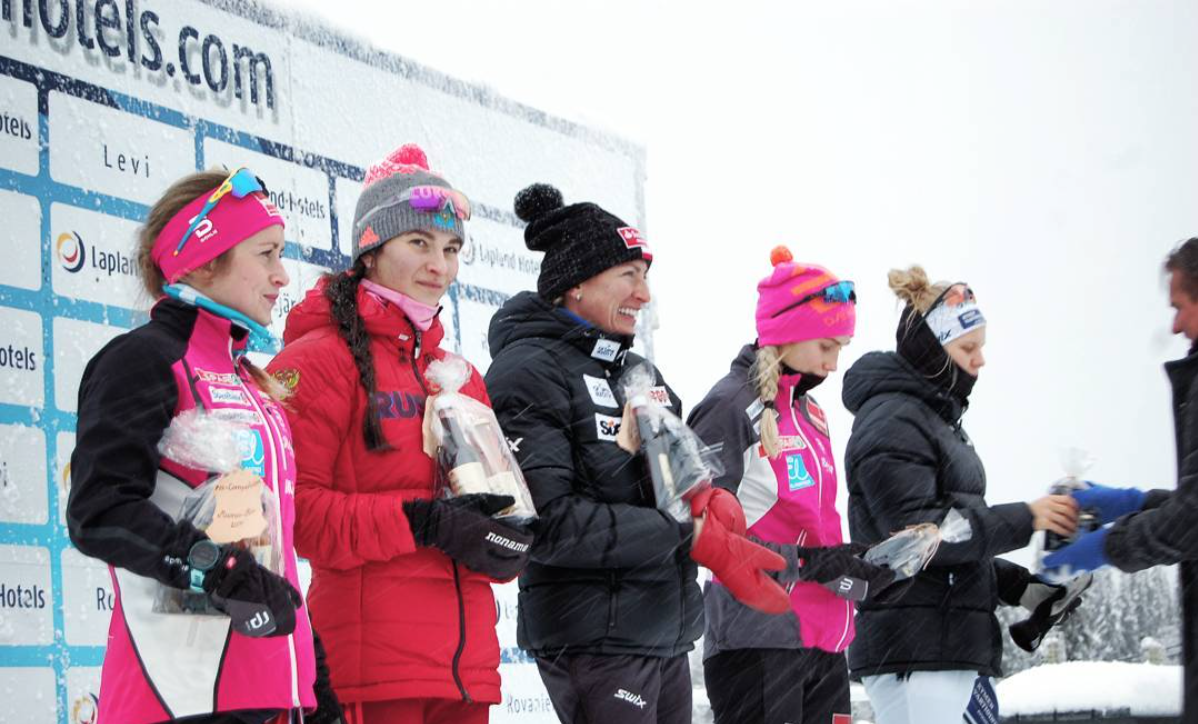
(l-r) Anna Svendsen of Norway, Natalia Nepryaeva of Russia, Justyna Kowalczyk of Poland, Lovise Heimdal of Norway, and Leena Nurmi of Finland receive prizes after rate women’s classic sprint in Muonio, Finland, on Friday. (Photo: Ski Muonio/Instagram)
FIS races are already being contested in Finland and Sweden this weekend, with most top Scandinavian racers sitting out but a few national-team members and others picking up their first victories of the season.
The competitions in Muonio, Finland, drew the most diverse field, including racers from Norway, Russia, Japan, China, Canada, Estonia, and Slovakia, among other countries. In the men’s classic sprint on Friday, the home team got a win from Ristomatti Hakola; he and Russia’s Alexander Bolshunov went 1-2 in both the qualifier and the final. Russia’s Andrey Parfenov rounded out the podium. In the women’s sprint, Anna Svendsen took the win over Russia’s Natalia Nepryaeva, with Justyna Kowalczyk of Poland finishing third.
On Saturday, racers moved up in distance. In the 10 k classic, Bolshunov – a U23 World Champion last season – bested Russian teammate Alexey Chervotkin by 20.6 seconds, with Andrey Sobakarev making it a sweep another 21.6 seconds back. Brian McKeever and Graham Nishikawa of Canada finished 56th (+2:10.6) and 63rd (+2:18.5), respectively.
Also in the men’s race was Maxim Vylegzhanin. The International Olympic Committee (IOC) decided on Thursday to strip the Russian skier of three silver medals from the 2014 Olympics for doping violations and ban him from all future Olympic Games. However, the International Ski Federation (FIS) has not yet taken any action since he and five other skiers were banned from the IOC, meaning that all six athletes are currently free to take part in non-Olympic ski competitions. In a press release, FIS stated that “the next steps will be the review by the FIS Doping Panel of the six verdicts upon the receipt of the reasoned decisions” but did not provide a time frame for these decisions.
In the women’s 5 k classic, Finland’s Krista Parmakoski posted an 18.4-second win over Nepryaeva, with Kowalczyk third again, +24.2.
Bruksvallarna, Sweden, hosted races on Saturday as well, with a primarily Swedish and Norwegian field but some other racers as well. Norway’s Chris Andre Jespersen topped the 15 k skate, posting a 31.4-second win over Simon Lageson of Sweden. Norwegian Tore Leren was third, +53.1. Canada’s Jack Carlyle finished 38th, +2:29.5. Petter Northug and his brother Even were in Bruksvallarna this week but decided at the last minute not to race, with Northug making his debut in Beitøstolen, Norway, next weekend instead.
In the women’s 10 k skate, Swedish national team member Emma Wiken bested Lina Korsgren – a long-distance specialist who finished eighth in the Visma Ski Classics standings last season – by 9.8 seconds. Berit Mogstad of Norway finished third, +15.3 seconds.
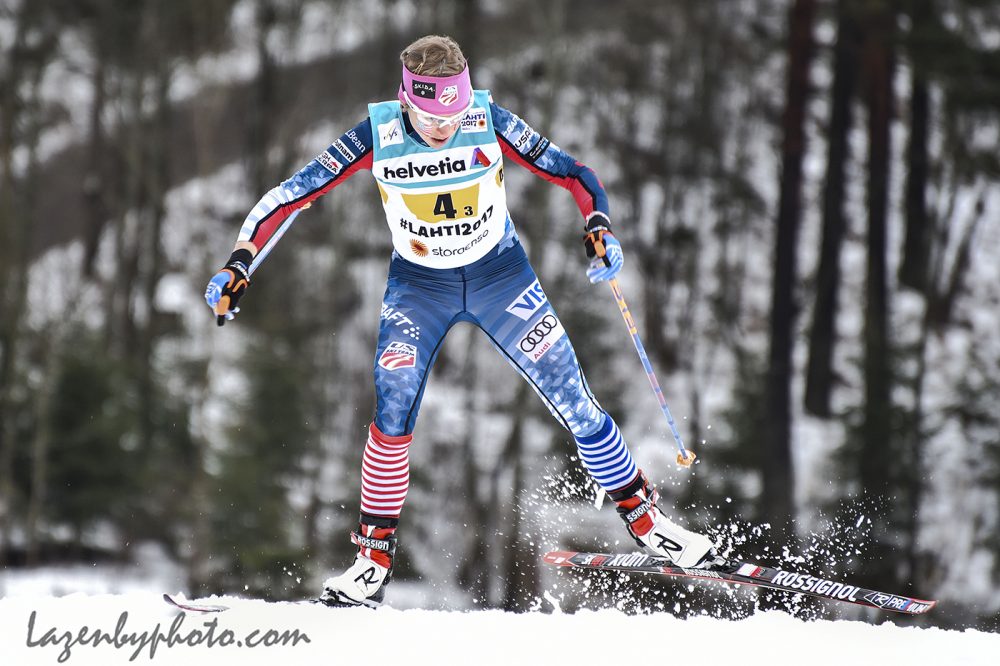
Liz Stephen racing the third leg for the U.S. women’s team in the 4 x 5 k relay at the 2017 Nordic World Championships in Lahti, Finland. (Photo: John Lazenby/Lazenbyphoto.com)
There is no faking a smile.
As a visual social-media feed, Instagram places a premium on how we’d like to be perceived by the viewing world. Instagram’s editing tools come with an assortment of beautifying filters.
But smiles? Fake smiles are filter-proof.
Although not a habitual Instagram poster, scroll through U.S. Ski Team (USST) athlete Liz Stephen’s account, @lizhillstephen — it’s hard not to notice her genuine grin and the smiles of those around her. Those smiles are for real.
There are other moments for Stephen when the disappointment is palpable. For instance, Stephen began the 30-kilometer freestyle at 2017 World Championships wearing bib 13. At 15 k, Stephen was less than a minute back from eventual winner, Norway’s Marit Bjørgen. By 25 k the gap to Bjørgen bumped to almost two minutes. Crossing the finish, Stephen was 3:09.4 minutes behind the Norwegian, good enough for 25th.
With her USST overcoat draped over her 5-foot-2 frame and it’s hood shrouding her face, it was clear there’d be no post-race comment. In her strongest technique, on a hill-climbing course in Lahti, Finland, the race and result were not what she’d hoped for.
Stephen is already a two-time Olympian (2010, 2014) and she’s gunning for a third in PyeongChang, South Korea. By the time those Games transpire, the up-tempo Park City, Utah, resident will be 31 years old.
Today at 30, Stephen still chases those smiles.
“Last year I just wanted to be a person,” Stephen said on the phone from Park City on Sept. 8. “Because that seemed to be what I needed to do in order to get happy. But it also kept me at altitude, at home in Park City. And it kind of kept me in the same stale spot for the whole summer.”
This dryland cycle, the Vermont native took note and modified her summer training plans — trying to maximize the benefits of training at altitude with low-elevation oxygen baths.
“This year I have been to Bend, I have been to Sweden, and I skipped New Zealand,” Stephen explained. “Kind of for those reasons, just because New Zealand is at altitude. I live at altitude, so I wanted all my camps to be as much as possible at sea level.”
Stephen spent time this summer training in relatively low Norway and Sweden. While in Sweden, accompanied by USST teammate Kikkan Randall, Stephen trained with the Swedish national women’s team. The Sweden camp proved a solid low-altitude respite.
“When I looked at the schedule, going to Sweden was a good fit,” Stephen said. “I’d always loved it there. I think I should probably have been a Swede. And I wanted to be inspired by them, which I was. I got my ass totally kicked in Sweden, in a good way, and in Norway. And, you know, I think it’s good to get your ass kicked sometimes, especially when it is mid-summer and you can come home and make some changes, which I have done. I came home [to Park City] and am psyched to be training, psyched to be a skier.”
When asked what those changes were, Stephen was clear and forthright in her response.
“We did kind of an interesting workout in Sweden that I actually just did this morning on the Erg,” Stephen said. “The idea is lactate production. That’s been something that I have struggled with over the last few years I think especially, and I think that this might be part physiological, just the type of athlete that I am, but also living at altitude has made me a little bit slower I guess in a lot of aspects. So in this workout, the idea is to produce as much lactate as possible. There is no pacing. You just go all out for 40 seconds on and 50 off. You do a bunch of rounds of this.
“I think for me, where I lose a lot in races is the ability to change speed,” she continued. “I can go forever, but races aren’t forever, they are only as long as they are. So you have to be able, especially with more mass-start races, you have to be able to stay with the pack and stay with the moves. And maybe sometimes make your own moves and that is where I think this workout could really benefit me.”
Liz Stephen (front, yellow jacket) training with Sweden’s national team and U.S. teammate Kikkan Randall (back row, third from left) in Sweden this summer. (Photo: Instagram/@lizhillstephen)
A few days after our interview, Stephen left Park City and flew back to her parents’ home in Vermont. There she planned to conduct an informal sea-level training camp with a schedule dense with hard interval training. Stephen returned to Park City at the end of September to take part in the USST training camp. And last Saturday, she ran the Red Bull 400 (a 400-meter near-vertical sprint to the top of a ski jump) in Park City for the third straight year, where she placed second behind Utah native Megan Foley.
In early September, Stephen said she felt good. But she’s quick to reflect that a professional endurance athlete’s life offers many opportunities to dwell.
“Definitely there are ups and downs, there always are,” she said. “I guess I should put it this way, as athletes we think in the moment all the time. We are supposed to be the best we can be every session. We are supposed to be doing the best we can. We are 24-hour athletes. Everything is so in the moment that it is really hard. We also take the negative parts of that too. You have a bad workout and all of a sudden, even if the day before was great, you live in the moment of the bad workout. So I think that’s always a challenge. I think for me, recognizing that is what is happening, and that the workout that you just completed that was really bad really doesn’t mean you are in terrible shape or that you are not a great athlete, it’s just where you’re at that day. I think there are always going to be ups and downs, and the trajectory of this year has been more positive than a couple years ago.”
Stephen said she remains undecided if she’ll continue her ski career after the 2017/2018 season. Her focus remains laser-like: be the best she can be mid-February in PyeongChang.
The 2018 Olympic cross-country race schedule offers several opportunities for Stephen. There’s the 10 k freestyle, the 15 k skiathlon and the 30 k classic mass start.
But five klicks remains the magic distance.
Stephen cannot deny that a potential skate leg start on the 4 x 5 k women’s relay team and helping her team win a medal remains a steadfast goal. With a plan in mind and quality training hours ticked off, does she internally think “5 k skate”?
“Yeah. Absolutely I do,” she said. “And I have said this to my psychologist a few times and others. That I, of course, for me, I am focused on that race in particular and I have been for years.”
Liz Stephen at work during the U.S. Ski Team women’s team’s camp in the Methow Valley in late June/early July. (Photo: Matt Whitcomb)
With a strong USST women’s team and several domestic skiers striving to break through internationally, the USST coaches responsible for determining the relay squad may have a tough task culling the team down to four. A few years back, Stephen understood her inclusion on a 4 x 5 k relay team was almost automatic. Now her focus on that race is qualified.
“We have changed a little bit,” she said. “Specifically the psychological plan, just focused on that 5 k effort and that day and that race. But, but I also want it to be very clear that I want the team to medal. Not for myself. Even if I wasn’t on the team that day, that’s what I love about the relays — it’s not about one person. It’s about four. And whether I am one of those four people who have the best chance of winning that medal or skiing the fastest, I am not focused on that. I am focused on being the best I can be that day and hopefully that is good enough to be on that team.
“It is really kind of like a practice for your brain, I think, to decide what is most important to you and what you are going to go for,” she added. “And I think that it’s scary to put it out there. Yeah, I want to be on that team, but you know what? A lot of people that want to be on that team, and there are a lot of people that could be on that team. So yeah, I think it’s fun to have pressure like that and to have a goal, but it is certainly not something that I am banking on. Things can change in a heartbeat.”
Those types of changes are random — a stumble on a trail run, an errant pole plant while rollerskiing, a tumble on an icy World Cup course. This season Stephen decided to make a calculated change and switch to Madshus, a Norwegian-based company, for her skis.
“You know it’s a been a little bit tough this summer because I did have to leave Rossignol who I have been with for 15 years and they have been very good to me,” she said. “I am loyal. I am a loyal person. I felt like I needed to make a decision to change because I felt like after doing some testing, I felt like I needed to try a new ski.”
“Ida Sargent on the U.S. Team has Madshus as well and we are similar sizes,” Stephen said. “We almost never do the same races. So the idea of having somebody to share skis with at times, both she taking mine and me taking hers if they are better on those days, takes the edge off of needing your own perfect fleet going into a very important year on very different skis than you are used to.”
To jumpstart her understanding of the new ski fleet, Stephen is planning a November pre-World Cup training trip with Sargent to La Forêt Montmorency in Quebec.
Heading into the season, much remains the same for Stephen. She’ll still charge headlong up the World Cup’s stout gradients. She’ll still smile for real. But along the journey, she’ll embrace the prospect of taking big performance risks where the outcome remains uncertain.
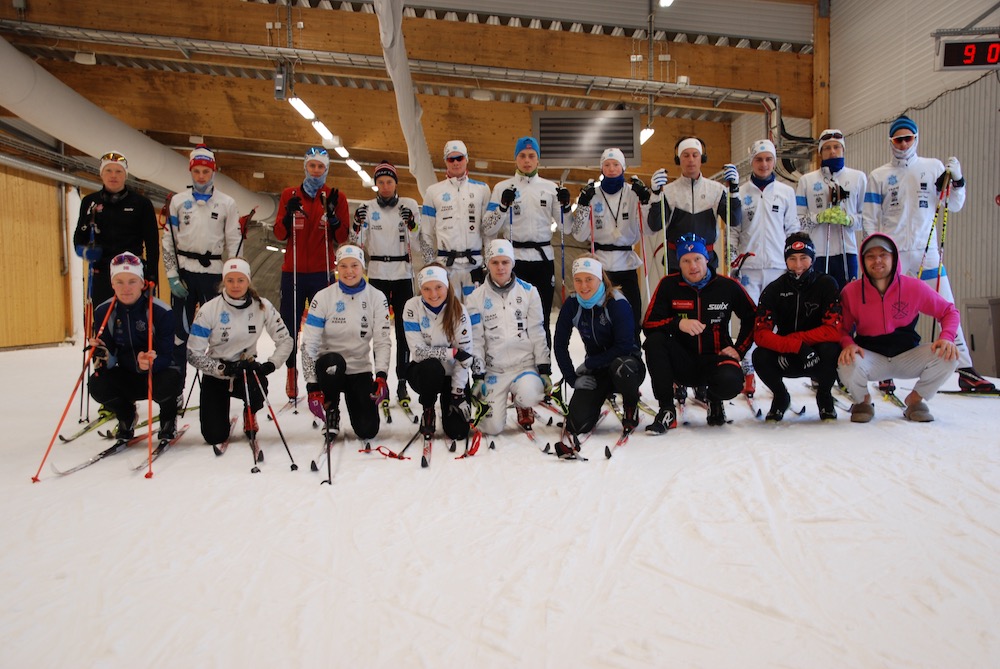
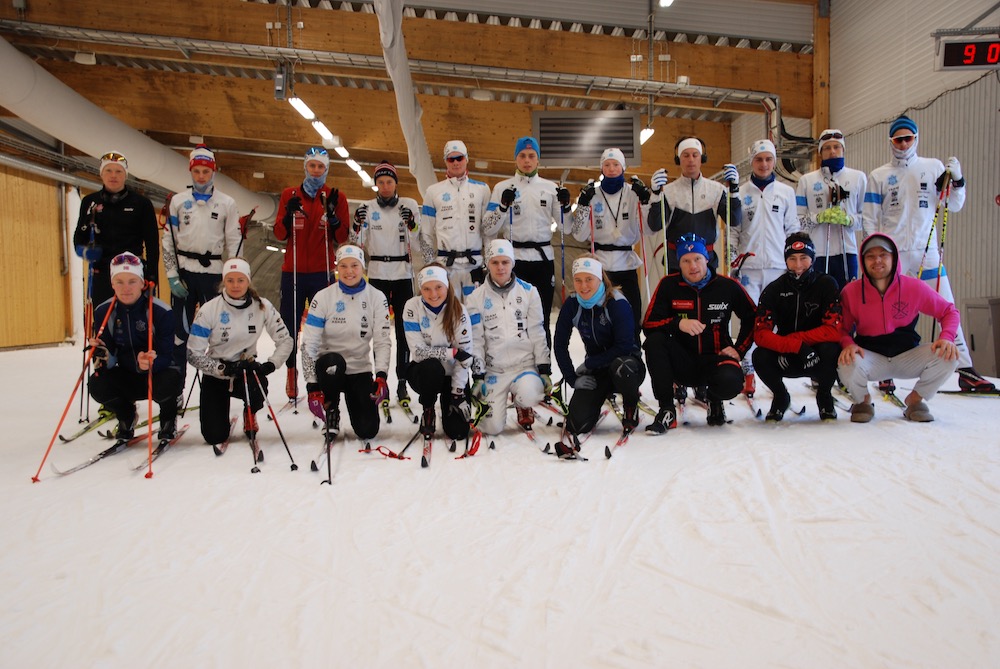
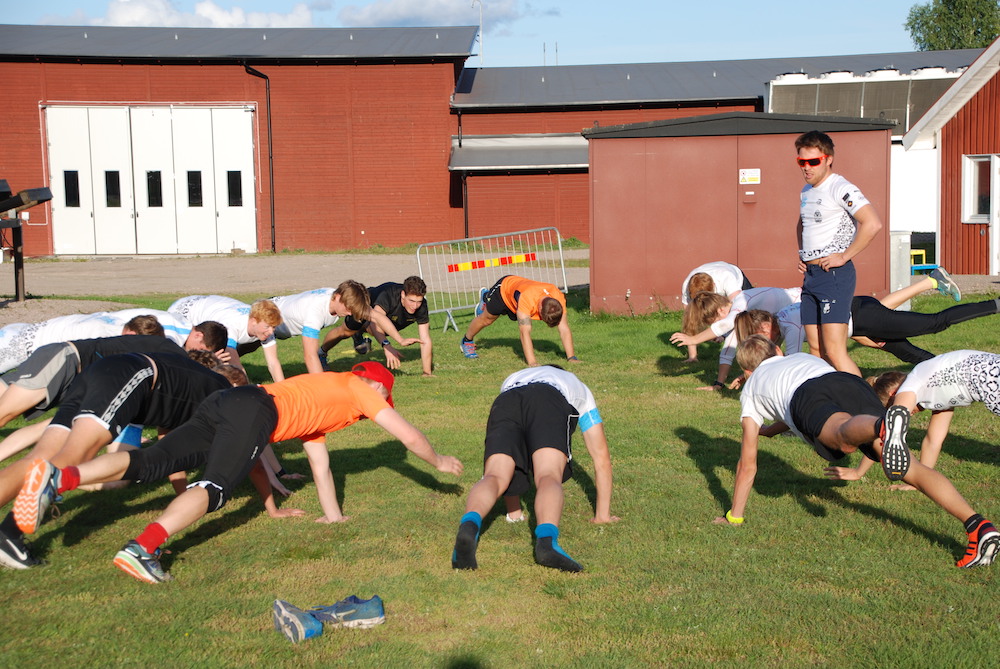
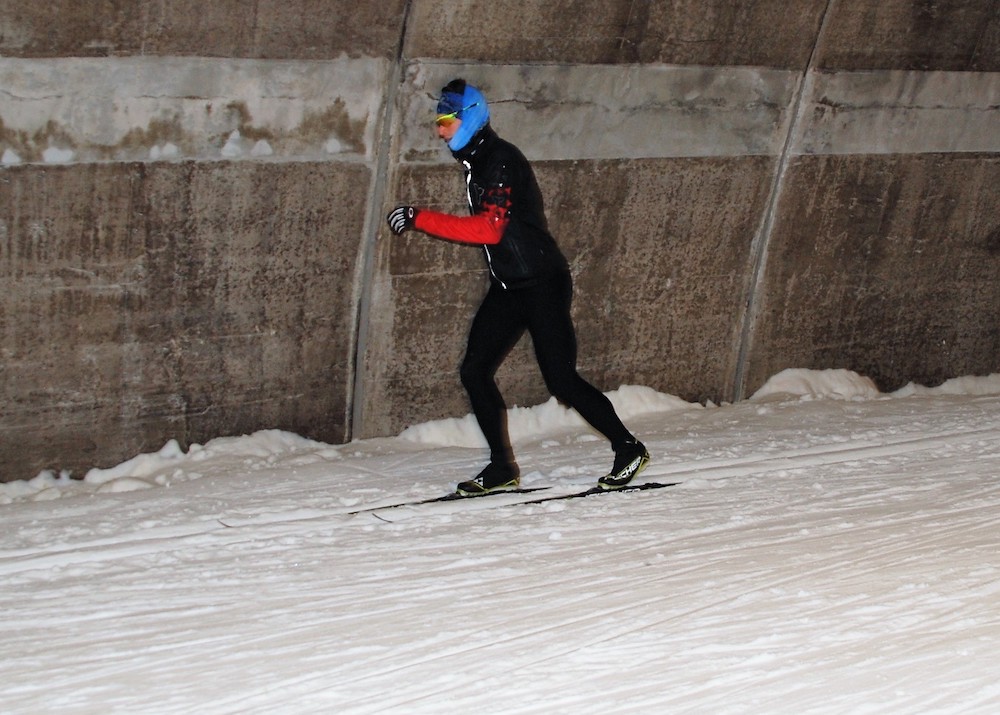
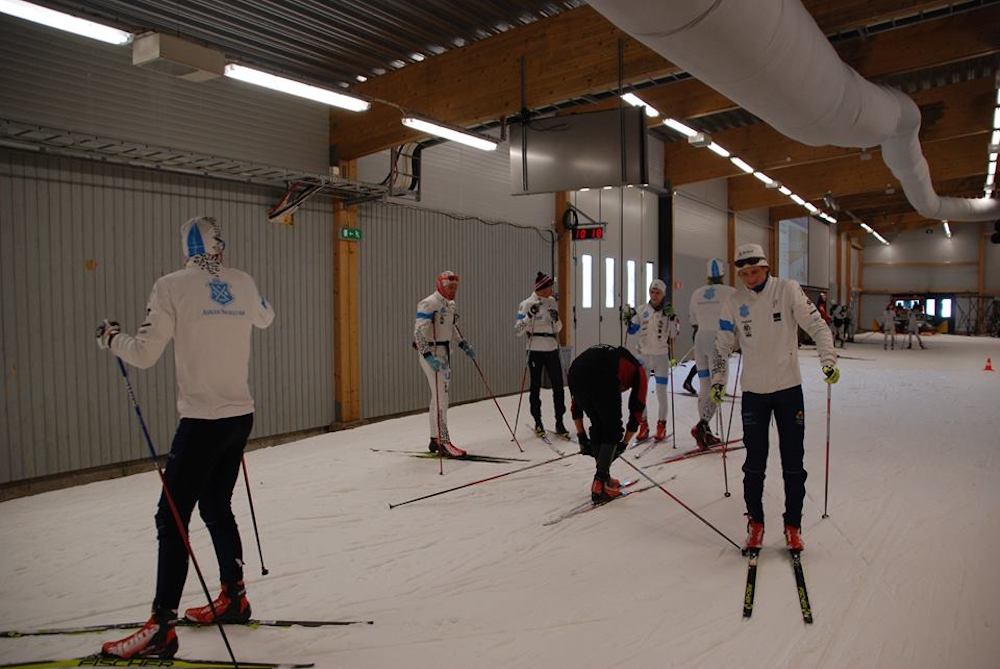
Team Asker gets together for a group shot in the ski tunnel in Torsby, Sweden. (Photo: Johanna Lier)
Editor’s Note: The following is the fourth post in a series proposed by Maks Zechel, a 20-year-old Canadian cross-country skier embarking on his first season training abroad. He recently made the big move to Norway, where he’ll be training and racing with Team Asker for the next nine months. Through these updates, Maks hopes to share his personal “observations, stories, and lessons learned” to help close the gap between North American and Scandinavian nordic skiing. Previous posts: #1,#2,#3, and #4.
***
I never thought that on my 20th birthday I would be shivering at the top of a ski resort, a thick fog obscuring the spectacular view of Oslo, listening to 30+ Norwegians sing the Norwegian birthday song for me. But I guess turning 20 was bound to be different!
“No more excuses,” was my first thought. Gone is the security of being a teenager. Rather than impressing people with maturity, it now feels like it is expected. I think it’s a good thing, but it doesn’t make being an adult any easier. My trip to Norway has been full of moments when I suddenly realized, “Oh, I guess I’ll just have to figure this out on my own.” My parents are no longer always present to make introductions, so now it is up to me to advocate for myself. Risks taken as an adolescent do not come with the expectation to produce results. “I’m impressed,” people say, and they applaud you just for trying. But adults are expected to see things through to completion.
Team Asker group core session after a ski in the tunnel in Torsby, Sweden. (Photo: Johanna Lier)
Back on a cold, foggy Norwegian ski slope at the end of August, my teammates and I were about to tackle 6 x 6 minute Zone 4 bounding intervals. In Norway, bounding with poles is called elghufs, or “moose-hooves”. I had never done a bounding workout of this duration and intensity. Despite this, I decided to take a risk and stick with the best runner on the team, who was two and a half minutes faster than me on our last uphill running test. I stuck with him from the first interval, and stayed with him as he threw in big surges on the plateaus between climbs. He added these surges because he is trying to get better at working the flat sections of ski races in the winter, which happens to be one of my goals as well. We did the whole workout together, and I stayed with him until he got away on a downhill and a steep climb at the end. I took a risk in a workout, not caring if I blew up halfway through, and it allowed me to train at a higher intensity than I would have thought possible.
Earlier this summer I listened to a “TED Talk” by Eduardo Briceño on “the learning zone and the performance zone”. At first it didn’t seem like a life-changing lesson, but since I arrived in Norway, his ideas have led me to think differently about my actions, and in particular, my training. Briceño discusses how people, from office workers to athletes, fail to improve at what they do, whether it is a hobby or a job, because they do not give themselves the opportunity to take risks, make mistakes and learn. In our society, the “performance zone” is the default; this is where we only do the things we are comfortable with, because we want things to be perfect, because that is how we envision our end goals to turn out. Briceño argues that we should encourage employees, athletes, and ourselves, to spend more time in the “learning zone,” where we break our ideal performance into the things we need to work on to get there. It is only here that we get better, because it is here that we allow ourselves to try things that we would otherwise never attempt for fear of failure. In the learning zone, risk and creativity produce the most astounding results. Having reached higher comfort levels, it is possible for someone to apply their repeated failures and lessons-learned to a better end result.
Author Maks Zechel doing pull ups: “the most popular Norwegian strength exercise.” (Photo: Johanna Lier)
A few days after “birthday elghufs”, Briceño’s ideas come back to me as I am training in the ski tunnel in Torsby, Sweden. I am back here for a long-weekend training camp with Team Asker. In the tunnel I confront a skiing related fear of mine, developed over a few years of poor performances in classic races. I dread the feeling of my grip giving way while striding up a hill. I am determined to become a better classic skier, the technique I was strongest in when I was younger, so I work hard at anything that I believe will make me a better classic skier: bounding intervals, core, double poling, hours of video technique work, and skiing without poles. If I can ski up a hill legs-only, then surely I can do it with poles in a race, right? Whenever I am on skis, I challenge myself to stride up the steepest hills without poles, but it becomes a challenge that I must perform to perfection, otherwise in my mind I have failed as a classic skier. The pressure that I put on myself leads me to shuffle stiffly and tentatively up hills, not allowing myself any room for error. The result is a poor imitation of the principles of classic skiing, lacking any weight shift, pop in the ball of my foot, or ankle compression. Sure, I made it to the top of the hill, but I didn’t summit the mountain.
On our first morning in Torsby we have a distance classic ski in the tunnel. Rather than skiing slowly around the tunnel for a couple of hours, our coach has added some variety to our workout: one lap legs-only, one lap thinking about good striding on the hills (not thinking about heart rate), and one lap with a short “race pace” acceleration. The variety in this workout is important in early season skiing so that we can take advantage of our short time on snow to train our muscle memory to ski properly, getting rid of lazy habits developed while rollerskiing.
Maks Zechel working on legs-only in the ski tunnel in Torsby, Sweden. (Photo: Johanna Lier)
On my legs-only loops, I decide to take a risk. Instead of pressuring myself to make it up the entire hill, I ski as dynamically as I can, focusing on full commitment to each ski and compressing the wax pocket as if I had perfect grip. Although frustrating, I know that it is better for my development to ski properly up half the hill, than to shuffle up the entire thing. A few times I am rewarded with making it to the top, and other times I almost face plant spectacularly in front of the Norwegian junior national team coach.
The risk of embarrassment is one that I am willing to take. I made a decision to escape my comfort zone when I left Canada, leaving behind family, friends, and a team that I have trained with for nine years. I left behind the chance at another year of racing on the NorAm circuit and seeing marginal, or perhaps substantial, improvements up the results board. I was sick of feeling like there was an order to things. If I beat a friend of mine during a race, that meant that I had had a good day, but if someone finished ahead of me who I was supposed to beat, then the day was unsuccessful. To me, this type of racing environment was toxic, as I struggled through a season of failed expectations. I am fortunate to have had the means to come to Norway, where simple training aspects, things that had lost their magic over the years, are now bringing back the same giddy excitement that skiing originally gave me. I am in a place filled with potential opportunities, but now I need to have the guts to seize them.
Team Asker reparing for an intensity workout in the ski tunnel in Torsby, Sweden. (Photo: Johanna Lier)
While training in Torsby, we were lucky enough to be there at the same time as the Norwegian junior national team and national recruit team (a step below the national senior team), as well as Anders Gløersen, Charlotte Kalla, Stina Nilsson, and Hanna Falk. I watched some of the members of the recruit team doing offset sprints, and it was the fastest I have ever seen someone sprint on skis in real life. Rather than being intimidated, I felt almost relieved to watch some of my idols skiing this fast. The mystery was gone; this is how fast you have to ski to be great, as simple as that, and now I could spend the entire weekend shadowing some of the best skiers in the world.
On our first day in Torsby I had the opportunity to do two things for the first time in my life: rollerski on a treadmill and take aVO2 max test (maximum rate of oxygen consumption). Naturally, because of my name, I prefer to say it in Norwegian: VO2maks.
After an initial stumble on the treadmill, I found it quite easy to classic rollerski on. Before the test started I warmed up on a few different gradients and speeds, unable to stop smiling at myself in the large mirror in front of me. Here I was, rollerskiing in the same laboratory that has tested countless World Cup skiers! The test began at a gradient of 10 percent and speed of 10 kilometers per hour, with the gradient increasing every minute until it reached 18 percent. This felt remarkably steep. From then on the gradient remained the same, but every 30 seconds the speed increased.
The rollerski treadmill/testing lab in Torsby, Sweden. (Photo: Maks Zechel)
During testing there is a harness around your waist so that you don’t fall off the treadmill, a heart rate monitor around your chest, and a mask strapped to your head to measure oxygen consumption. It’s a lot of gear hanging from your body, and your head has to remain relatively steady, but once the test started I found that the pain was an adequate distraction from all of this. Unfortunately, during my test a strap on my mask came undone and the mask fell off while I still had something left to give, so I was robbed of the chance to ski until collapsing (the skier’s dream). My VO2 max result was 74.5 ml/kg. Last year Harald Amundsen, the top skier on the team, reached a VO2 max of 85 ml/kg as an 18 year old (an exceptional result).
Being in a new place, with a new team, and in close proximity to many of the world’s best skiers, there is a lot to take in. It is important for me to absorb as much as I can during my time here, but it is also important to stay consistent with things that I have been working on before I got here. If I jumped to apply every newly learned training philosophy to my training, I would be all over the place and have no chance to improve. I am allowing myself to take risks and make mistakes while staying true to some of the basics that got me to where I am. In the midst of so many talented and competitive skiers, I am trying to create a learning space for myself, devoid of expectations, so that I can learn without restrictions. When winter finally comes, I hope that I can translate my learning to some fast performances on skis. I have had a lot of practice translating after all…
Norwegian Phrase of the Week
Norwegian: Kan jeg få skyss?
Translation: Can I have a ride?
Norwegian: Kan jeg få et kyss?
Translation: Can I have a kiss?
*An important distinction that could add an unexpected twist to your ride to practice, as skyss and kyss sound almost exactly the same.*
***
About Maks: Maks Zechel is a competitive cross-country skier who secretly wants to become a professional mile runner. He loves hiking and going on canoe trips with his family, as well as peanut butter cups in ice cream. Johan Olsson is his favourite skier and he hopes to race the Cortina-Toblach stage of the Tour de Ski one day. He enjoys writing about his experiences. Follow him on Instagram @makszechel.
Italy’s Federico Pellegrino (2) edging Norway’s Emil Iversen (9) by 0.06 seconds for the win, with Norway’s Sindre Bjørnestad Skar (l) following in third and Sweden’s Oskar Svensson (5) in fourth, in the men’s freestyle sprint final on Saturday at the World Cup in Falun, Sweden. (Photo: Fischer/NordicFocus)
It didn’t seem likely until the last second – but last season’s star sprinter has once again arrived on the World Cup circuit.
Italy’s Federico Pellegrino collected his ninth individual win on Saturday in Falun, Sweden, nipping Norway’s Emil Iversen by six-hundredths of a second in a photo finish in the freestyle sprint. The winner of last year’s Sprint World Cup, Pellegrino didn’t make his first sprint final of the season until after Christmas.
However, since then, he has been second (in Val Müstair, Switzerland), fourth (in Toblach, Italy), and now, finally, first.
“This season is not so easy right now for me,” he told the International Ski Federation (FIS) in a finish-line interview. “Now I think [the way it is going] is the right way, going toward the World Championships.”
Pellegrino had the second-fastest qualifying time around the 1.4-kilometer course in the morning. Then, he won his quarterfinal with a blazing display of speed at the finish to best Norway’s Finn Hågen Krogh. In the semifinal, Pellegrino pulled a similar move to win the heat by 0.21 seconds over Sweden’s Teodor Peterson.
In the final, coming into the last few hundred meters it looked like Pellegrino was too far off the pace to make it to the front. The rest of the men – all Swedes and Norwegians – jostled for the lead constantly. As the field shot down a long hill into the stadium, though, Pellegrino made his way to the front; he said he had amazing skis. He followed Iversen over the last bump of an uphill and down a corner to the finish. The pair’s paced outstripped anything the others could keep up with.
“In the final I showed up still fresh, but with a long downhill before the finish I couldn’t pull, and when you’re behind you risk losing [moves],” he told the Italian Winter Sports Federation, according to a translation. “In fact, I found myself in fifth place and I thought I would not make it. But on the last hill before the finish I took a wide path and I went for it, giving everything I had in the body. Then I made it a photo finish.”
Iversen had thought he had the win in the bag. He seemed incredulous that Pellegrino could catch up with him in the final meters – and the Italian timed his finishing lunge better, eventually edging Iversen by just six hundredths of a second.
Iversen slapped his poles in the snow in frustration after finishing, breaking one, and lay unsmiling while the two waited for the results of the photo finish. He remained restrained during the post-race photo opportunities.
“I thought I had the win today,” Iversen told FIS. “I didn’t know who was coming but I could feel the shadow. I was very disappointed in the finish but in the end I have to be happy with second place.”
“I’ve been pretty mad at my little brothers, but I don’t think I’ve been this angry in years,” Iversen elaborated to NRK.
Another photo finish gave Sindre Bjørnestad Skar of Norway third place (+0.47), by three hundredths of a second over Falun’s own Oskar Svensson. Johannes Høsflot Klæbo – the fastest qualifier on the day – finished fifth (+1.32), and Peterson placed sixth (+2.08).
The men’s freestyle sprint podium on Saturday at the World Cup in Falun, Sweden, with Italian winner Federico Pellegrino (c), and Norway’s Emil Iversen (r) in second and Sindre Bjørnestad Skar (l) in third. (Photo: Fischer/NordicFocus)
“It’s really tough to make it on World Cup as a Norwegian and so every time I can make a podium result it is important,” Skar told FIS, referring to simply earning start rights.
Indeed: Pål Golberg, who before this weekend led the Sprint Cup, did not even get the chance to start Saturday’s race. The Norwegian team deemed him too slow. Other skiers also found this amazing. Alex Harvey told Norwegian media that the Canadian team would be happy to take Golberg and give him a starting spot.
“They seem sure, like me, that it’s comical,” Golberg told Norwegian broadcaster NRK. “I’ve certainly gotten lots of messages from people who think it’s strange, so I’m glad that other people share that view.”
He now worries that he might not have a chance to start the sprint at World Championships. Five of the top seven men in the Sprint Cup standings are Norwegian: Skar in second, Iversen in fourth, Krogh in fifth, Golberg in sixth, and Klæbo in seventh.
There’s no such problem for Italy, a team which is thrilled that its star is back in top form. Pellegrino now has the most podiums in skate sprints of any Italian man ever, with 13.
World Championships is the only thing on his mind.
“At this time the [Sprint Cup] ranking does not interest me,” he said in the federation press release. “I’ll skip the next stage in Korea, and then will race in Otepaa [Estonia, the last World Cup before World Championships.”
Valjas 10th After Blistering Quarterfinal Finish
Len Valjas (Canadian World Cup Team) racing in Saturday’s freestyle sprint at the World Cup in Falun, Sweden, where he ended up 10th on the day. (Photo: Fischer/NordicFocus)
Only two Canadians started the sprint. Alex Harvey missed qualifying in 46th, but teammate Len Valjas not only made the quarterfinals, but shone there.
Valjas was skiing near the back of his heat, only to find his way to the front at the last possible moment, much like Pellegrino. While Klæbo had seemed to have the quarterfinal locked up with only a possible challenge from Andrew Young of Great Britain remaining in the finishing stretch, Young and Valjas came down the last downhill with more momentum and some speed in their legs. Eventually all three crossed the line together in a photo finish, from which Valjas emerged second.
In his semifinal heat, Valjas also hung near the back of the pack. But the whole heat finished within about a second, and he wasn’t able to fight his way through the crowd. Valjas landed fifth, this time 0.99 seconds behind heat winner Klæbo.
“I definitely felt like I had a little more,” Valjas said in a Cross Country Canada press release. “I was able to close in the finish, but I just lost a little too much contact with the pack. I had the speed at the finish and felt great. I was really comfortable staying at the back. I thought I could bring it back on the second hill, but I just stayed a little too far back. I needed to work on my tactics a bit better.”
He finished 10th overall, his best individual result in a year since he finished 10th in a classic sprint in Oberstdorf, Germany, as part of last year’s Tour de Ski.
“I had great skis and I know the fitness is there,” Valjas said in the press release. “Being in the fifth heat in the quarters, I likely could have used about five more minutes of rest time before the next heat, but I can’t complain and have to be happy with a top 10.”
Hamilton, Newell in the Quarters
Simi Hamilton (U.S. Ski Team) racing to 13th in the men’s qualifier of the 1.4 k freestyle sprint on Saturday at the World Cup in Falun, Sweden. He went on to place 18th on the day. (Photo: Fischer/NordicFocus)
For the U.S., Simi Hamilton qualified 13th and Andy Newell 25th. Both were at the front of their quarterfinal heats at some point, before fading at the finish.
For Hamilton, things more or less immediately deviated from plan.
“I actually lost my basket on my right pole coming out of the start,” Hamilton said. “The pole holes were pretty gnarly at the start since people are double poling so hard, and I think my basket got stuck in on of the previous pole plant holes… [the snow] was actually firm enough that I could still pole pretty well, but I knew that the rest of the course got a little bit softer. So Andrew Morehouse, who is one of our techs, made a great hand-off and I got a new pole at the first corner. That’s probably only 20-25 seconds in the race at the point, but I was definitely off that back a little bit.”
Hamilton did manage to catch back up to the group. And then on the last uphill before the descent to the stadium, the skiers in the left lane got a bit jammed up. Being in the right lane, Hamilton was able to ski freely – but then found himself leading the heat, exactly what he didn’t want to do.
As Pellegrino had said, leading down the hill into the stadium means that most likely, the competition would sail past you thanks to the draft effect.
“You know, a lot of the race was going to come down to that final little bump that is in the stadium,” Hamilton said. “So I knew if I came into that with some really good momentum and hopefully get a slingshot off of someone in front of me, that I would be able to crush that bump and make a move into the finish lanes and then have a open lane for the finish… that was what I was really hoping for, it didn’t totally play out like that.”
Instead, a few competitors slingshot past Hamilton.
“I kind of found myself tangling with a lot of dudes going over that bump and through that corner,” he explained. “I just didn’t really ski the last 200 meters the way I would have really liked to, with a lot of energy power and speed. So found myself fighting in the pack going into the finishing stretch. I just focused on just skiing a good finish, and unfortunately wasn’t quite enough.”
He landed fourth in his heat (+0.87), and not close enough to get a lucky loser spot. He finished 18th on the day.
Andy Newell (U.S. Ski Team) racing to 25th in the men’s qualifier of the World Cup freestyle sprint in Falun, Sweden. He ended up 16th on the day.(Photo: Fischer/NordicFocus)
“It’s a frustrating day, but I felt good in my qualifier, and it’s hard course and I know my fitness is really good right now,” Hamilton said. “It was just kind of one of those days that happens out there, not a lot of things really connecting in terms of luck and positioning and equipment. But still a decent day so I am okay with it.”
Newell also found himself outgunned in the final meters, finishing third in his heat and 16th on the day.
Also for the U.S., Erik Bjornsen finished 43rd (+9.30) and Matt Gelso 59th (+13.12) in the qualifier.
Charlotte Kalla racing to third place in the World Cup 10 k skate in front of a huge crowd in Ulricehamn, Sweden, on Saturday. (Photo: Fischer/NordicFocus)
Most of the time, the FIS Cross-Country World Cup visits towns and ski trails the racers already know well.
Some venues, like Norway’s Holmenkollen and Switzerland’s Davos, are visited every year. Others, like France’s La Clusaz, are on the schedule every few years but are still always popular.
“I’ve been on the World Cup for ten or eleven years, and we go to the same venues all the time,” the U.S. Ski Team’s Liz Stephen said.
But every once in a while, a new place is thrown into the mix. Last weekend it was Ulricehamn, a town of 10,000 people in southern Sweden.
The rave reviews from athletes, coaches and fans made it clear that Ulricehamn aced their World Cup hosting duties on the first try, giving other venues something to aspire to.
“This was the best World Cup venue of the year — by far,” Canadian skier Devon Kershaw wrote in an email. “The volunteers are so friendly and helpful and to have a five kilometer track with thousands and thousands of supporters lining the whole way was just so much fun. I’ve never raced in an atmosphere like this other than the legendary Holmenkollen.”
Teammate Alex Harvey – who won the 15 k and won bronze in the relay together with Kershaw, Knute Johnsgaard, and Len Valjas – put it this way: there were so many spectators that it was impossible to find a quite moment to oneself.
“On the warmup loop, there were people along the whole course,” Harvey said. “I couldn’t even take a piss in my warm up. Usually I take like six pisses in an hour, and I was like, ‘Man, I just can’t piss!’ There were people everywhere. It was fun. They were cheering my name the whole warmup, and the whole race too. In Scandinavia, they are always a well-educated crowd. This was like a championship crowd, like Falun or Oslo. It was awesome.”
The Ulricehamn organizing committee reported that there were about 30,000 people in attendance each day.
“If you go back and watch all the races (except maybe Lillehammer) this year, there have been like 1000-2000 spectators max,” Kershaw wrote. “Some venues had like 100 people, it seemed. So this was a big improvement… Bringing events to where people actually care and are passionate about the sport is always best, I feel. I mean, as an athlete to race in an atmosphere like this is really motivating. It looks way better on TV, and people are having a great time out there – which is what we want to promote as ski racing (I feel).”
King Carl XVI Gustaf even came to watch Sweden win bronze in the women’s relay and silver in the men’s relay.
“I watched the races on television yesterday and couldn’t help it [to come here],” he told the local newspaper. “I think I’ve had just as much fun as everyone else had here. It has been a fantastic day of skiing in Ulricehamn and extra fun to [hear] the athletes say they felt such powerful public support.”
Anchoring the women’s relay was Hanna Falk, who grew up in Ulricehamn. The King personally congratulated her.
https://www.instagram.com/p/BPkjYv8hUa0/
“It seems that all the skiers have been very pleased,” Falk told the Skövde Nyheter newspaper, according to a translation. “I’ve heard many good things from many different countries, so that makes me a bit extra proud.”
The venue’s success over the weekend is already being cited as a reason for other Swedish municipalities to invest into their ski infrastructure. For instance, some in Marcus Hellner’s hometown of Skövde, just over an hour north, would like to see a similar effort.
“It shows that hard work, persistence and courage pays off,” a commentator from Göteborg, the nearest major city, wrote. “That you do not have to be the biggest to be the best is also a nice reminder in these times of centralization … Among the city’s 10,000 residents, there were people who wanted to do something special, people who love their homeland, their sports and who love to show off their hidden treasure for the rest of the world. Talk about daring, talk about winning.”
Ulricehamn is already planning to host another World Cup weekend in 2019, and may continue getting awarded competitions if the success of their first event is any indication.
Meanwhile, the World Cup will return back to North America in March. World Cup Finals were awarded to Quebec after being moved from Tyumen, Russia, due to a doping scandal.
Some athletes felt that Canadian and U.S. ski fans could learn a thing or two about how to earn these rave reviews from athletes – the kinds of reviews that could eventually promote a venue to being a regular or semi-regular World Cup host.
“Of course the fans were wonderful in Quebec last year, but when you see the amount of people on the courses here in Sweden, it is an insane amount,” Stephen said. “I would like to put it our there as a challenge for fans who are close to Quebec to come out. Let’s try to be as big as Sweden there, because the more the athletes have fun… I heard everyone talking about the crowds, on every team, even the Norwegians. When that kind of talk happens, more World Cups are given to that city or host venue.
“All the fans who are thinking about maybe coming up, don’t think about it, just come,” she concluded. “It makes the atmosphere very appealing to the teams, and especially us athletes. It’s really fun.”