Tag: Swedish Ski Federation

  • Trying to Catch-Up on the Whirlwind of World Cup News

    Trying to Catch-Up on the Whirlwind of World Cup News

    Val di Fiemme settles in for another year. The 2021 TdS final stage awaits. (Photo: NordicFocus)

    The Norwegian newspaper Dagbladet published a story Monday claiming the Norwegian Ski Federation would not send cross-country skiers to any remaining World Cups before the World Championships starting on February 23, in Oberstdorf, Germany. No official statement has been published by the Norwegian Ski Federation regarding a long-term Norwegian World Cup hiatus. Although, Dagbladet claims that is imminent.

    It appears the rationale for a total withdrawal from World Cup races through February appears premised on rules applied to those leaving Norway and traveling to a “red zone” (regions where rates of transmission are high). Upon returning to Norway from a “red zone”, travelers must quarantine for ten days. The new governmental guidelines were posted on December 4, and extend until January 15. Such a lengthy quarantine, some have suggested, could impact an athlete’s preparations for the 2021 World Championships. (It is FasterSkier’s understanding that skiing/training would be allowed during the ten-day quarantine.)

    According to the translated Dagbladet article, “The Norwegian Ski Association will not work to change the Norwegian quarantine provisions which in practice make it impossible to go international for Norwegian ski stars: The requirement for a 10-day quarantine with strict restrictions for training after a stay in so-called “red” countries, definitely puts Norway out of the World Cup.”

    “This means that the Tour de Ski goes without Norwegian participation and that no Norwegian skiers will in principle go to any of the World Cup races that will be held before the start of the World Cup in Oberstdorf on 24 February,” claimed Dagbladet.

    Dagbladet also reports that despite Norway’s pressure to reduce the number of races at the Tour de Ski, there was no compromise.

    Swedish broadcaster SVT Sport also published a piece noting that Norway, Finland, and Sweden had advocated for changes to the Tour de Ski schedule.

    “Sweden, Norway, and Finland wanted to see changes in the Tour de Ski’s structure. They wanted the tour to be decided in one country, in a maximum of one or two places, to reduce travel. But that will not be the case,” explained the translated SVT Sport article.

    Catching his breath while Norwegian flags are waved, Johannes Høsflot Klæbo takes the win in the 1.5-kilometer classic sprint during the 2020 Tour de Ski. (Photo: NordicFocus)

    The Norwegian Ski Federation has released a statement explaining their reasons for not partaking in the Tour de Ski.“The health of athletes and support staff is our most important priority,” says cross-country manager Espen Bjervig according to a translation of the press release. “The risk involved in exposing a squad to Covid-19 weighs heaviest in the decision not to participate in the Tour de Ski. The main goal for cross-country skiing this season is the World Championships in Oberstdorf, continuds the cross-country manager who is concerned with being the best possible preparation for the championship with healthy athletes and support staff.”

    FIS communicated Monday a statement clear in its intent, that the Tour de Ski goes on as planned: “Green light for FIS Tour de Ski,” was the FIS messaging.

    “The FIS Tour de Ski remains as scheduled and was given green light as all health prevention plans of the local organizers in Val Müstair (SUI), Toblach (ITA) and Val di Fiemme (ITA) were approved by the respective governments,” wrote FIS.

    In the FIS press release, the block quote below was attributed to Pierre Mignerey, FIS Cross-Country Race Director:

    “All stakeholders have the responsibility to keep the World Cup stage a safe place. Overall, the organizing committees have done extraordinary work to fulfill special needs and a healthy work environment for the World Cup family. The coordination between the organizers of the Tour de Ski stages and FIS has been transparent from the beginning and therefore we are looking forward to go ahead as scheduled.”

    Last week, it was reported that Norwegian star skiers Johannes Høsflot Klæbo, Emil Iversen, and Heidi Weng held serious concerns about the long-term adverse health effects if they were to contract the virus and the varying degrees of fidelity to the safety protocols in Ruka. Prior to Norway pulling away from the World Cup, Klæbo, Iversen, and Weng independently decided to take a break from international racing. Weng withdrew after the first race in Ruka; Klæbo and Iversen publicly announced their World Cup hiatus after the racing in Finland had concluded. 
    After the first World Cup weekend in Ruka, Finland, three leading cross-country ski nations, Norway, Sweden, and Finland, temporarily withdrew from the International Ski Federation (FIS) World Cup race series. The teams cited a lack of satisfaction with Covid-19 safety protocols in Ruka. FasterSkier is unaware of any positive Covid tests associated with the event, which also included Nordic Combined and ski jumping.
  • Wednesday Workout: Bog Running Intervals with Swedish Juniors

    Wednesday Workout: Bog Running Intervals with Swedish Juniors

    Swedish juniors from the Järpen Skidgymnasium climbing Grovfjellet during a distance run in Åre, Sweden, the day after bog-running intervals. (Photo: Alasdair Tutt)

    Today’s workout comes from Alasdair Tutt, head coach and program director at the Nordic Ski Club of Fairbanks/Fairbanks Cross Country (NSCF-FXC) in Fairbanks, Alaska, who recently attended a training camp with Swedish skiers (ages 15-19) at the Åre Ski Gymnasium in Järpen, Sweden. Have a workout of your own (or your club’s) that you’d like to share? Send submissions to info@fasterskier.com with the subject line “Wednesday Workout”.

    ***

    On a recent trip to Sweden for study, I was fortunate enough to attend a training camp with Järpen Skidgymnasium, which is an RIG ski program supported by the Swedish Ski Federation for their top junior skiers. There are five RIG “Kingdoms Sports Schools” aimed at future international level skiers and 12 NIU “National Sport Education” programs aimed at national level skiers in Sweden for cross-country skiing.

    Järpen Skidgymnasium nordic coaches Martin Persson (second from l) and Kicki Fransson (r) observe a bog-running workout as athletes warm up near Åre, Sweden. (Photo: Alasdair Tutt)

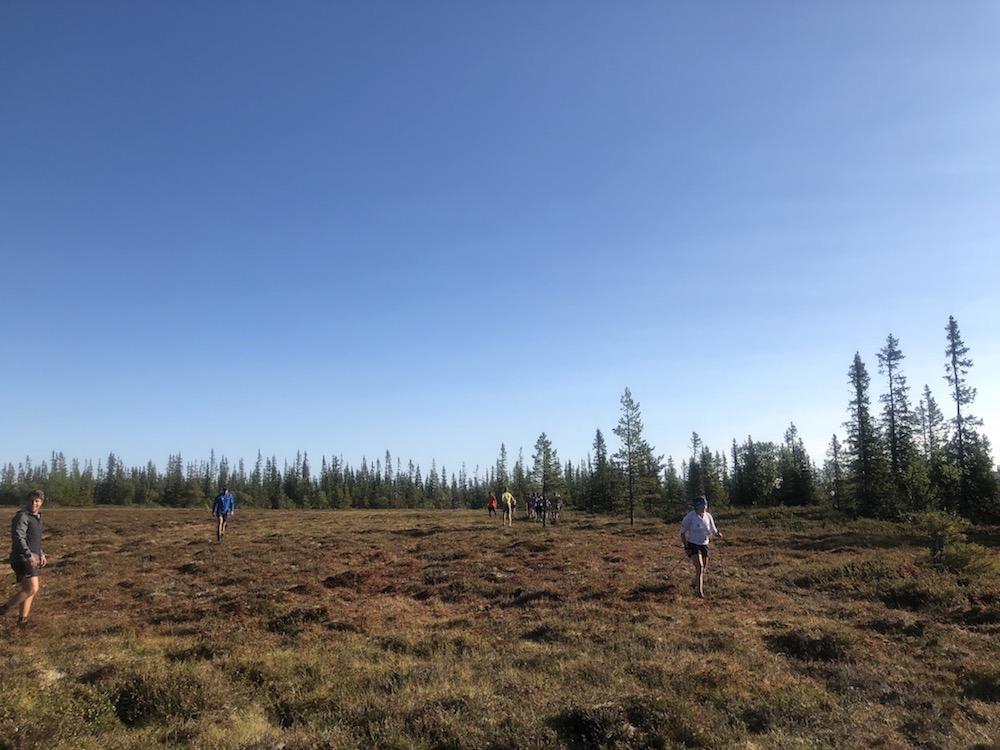
    The training camp was cross discipline with 70 athletes from cross-country, alpine and freestyle in attendance as a bit of a team-building experience after the first week of school. All athletes did the following swamp-running workout with varying “on” time depending on age and sport. You might be a bit surprised that some of the alpine/freestyle athletes got through the entire set with good speed and form.

    buy clomid online

    In addition, the athletes completed a strength, obstacle and mobility circuit, and a 2-3 hour long distance tour on the final day – running for the cross country athletes and cycling for the others. As part of the school orientation, groups of 7-10 students and coaches also produced an anti-bullying short film. A lot of effort went into the production of these, with some drone footage and high quality of execution.

    Bog Running Intervals:

    Warmup jog to the bog: About 10 minutes at Level 1 and 5 minutes at Level 2,  running around the loop to get orientated.

    Interval set:

    • Pyramid: 1, 2, 3, 4, 3, 2, 1*, 2, 3 minutes of “on” time in Level 4-5, with half recovery time except the 1-minute intervals, which had 1-minute off afterwards.
    • Running or running with poles for the “on” time and walking or slow jogging between intervals.
    • *Athletes had the option of stopping after the first pyramid for first-year students and alpine/freestyle, or doing the additional 5 minutes of intervals.

    Cool down: A game of bog soccer by year level (1-4) with 2 x 5 min. halves, an easy jog back to camp and some gentle mobility.

    Alternative: Some athletes who couldn’t run did a strength circuit for the session.

    Total time: About an hour and a half, which struck me as incredibly time-efficient.

    According to the athletes, they perform a bog-running interval session maybe once every month or two during the warmer months, mostly for something different, but lots of distance runs tend to end up traversing such terrain. The biggest surprise for me was just how fast some athletes were moving in the difficult terrain, running 5-5:30min/mile pace with poles in shin-deep bogs, but then walking significant portions of the 22-kilometer distance workout we did the next day. Really, it just reinforces the polarization of training that they have built into their culture, and it’s something I think we still need to work on, especially in distance training, with my program in the U.S.