From the FasterSkier archive — posts syndicated from athletes’ and coaches’ own blogs between 2004 and 2012, kept online as published. Current coverage is at fasterskier.com.
The one Jessie Diggins was waiting for: Nat and Devon were both on hand for the Olympic 10-kilometer freestyle and have this recap. It gets pretty heated! But in a good way.
We’ll be back tomorrow after the showdown between Johannes Klaebo and Einar Hedegart in the men’s race. Nat wrote a profile of Klaebo-killer Hedegart — the biggest threat to what could otherwise be a golden sweep of the Olympics by the cross-country skiing king.
Reach us at devon[at]fasterskier.com and nat[at]fasterskier.com. We’ll be back tomorrow.
It’s really expensive to be here in Italy. If you can, support the show and FasterSkier’s ongoing coverage with a voluntary membership. We’re also offering a special bonus to our members during the Olympics: an insider’s WhatsApp group featuring notes on Nat’s experiences in Italy, the food he’s eating, links to international coverage of cross-country skiing and more. Send nat[at]northernjournal[dot]com a confirmation of your voluntary membership and the number he should use for WhatsApp and we’ll get you signed up. You can also Venmo him directly at @nat-herz if a membership isn’t for you. We’re suggesting a minimum of $10, but we also won’t turn anyone away who wants to join because of an inability to pay.
Help Support Our Olympic Coverage!
FasterSkier will have our own Nat Herz on the ground at the Olympics, which, to be honest, is a very big financial lift for us. If you value the thoughtful work and access FasterSkier provides at championships like this one, please consider becoming a Voluntary Subscriber. Your support directly fuels the work we do to cover the people, places, and moments that make our sport special.
This coverage is made possible through the generous support of Marty and Kathy Hall and A Hall Mark of Excellence Award. To learn more about A Hall Mark of Excellence Award, or to learn how you can support FasterSkier’s coverage, please contact info@fasterskier.com.
There are winter mornings when a World Cup feels like a World Cup, and there are winter mornings when the sport seems to slip into its future tense. Today, in Trondheim, was the second kind. The light came late and cold over the stadium, washing the course in the flat silver of early December, but everything else carried the charge of February. Coaches shouted splits with a little more strain in their voices; athletes tightened their warmups with a little more intent. You could feel the nerves of a nation in the Norwegian start pen. You could feel the confidence of another in the Swedish one.
For the women on the line, the distance was familiar—ten kilometers of freestyle skiing, two laps, clean snow, no drafting, no negotiations—but the meaning was not. This is the race that will award an Olympic gold medal in Val di Fiemme in eight weeks. The stopwatch in Trondheim wasn’t just measuring form in early December; it was auditioning futures, exposing weaknesses, and hinting at hierarchies that might matter when the medals are real.
What followed was not a rehearsal so much as a warning: Sweden already looks like a finished script; the United States has a veteran in her final season, refusing to yield the stage; and Norway—despite the home crowd—spent the afternoon hunting answers they did not entirely find.
Jonna Sundling (SWE) and Swedish teammates set the early standard at the 2 k split in the 10km Individual Start Freestyle in Trondheim (NOR). (Photo: Modica/NordicFocus)
The Swedish Wave: Sundling Lights It, Andersson, and Ilar Finish It
The Swedish takeover announced itself at the 2 k timing banner. Jonna Sundling, better known as a sprint specialist, hammered through in 5:52, the fastest split of the day at that point. Within minutes, the entire top of the board was yellow and blue: Sundling, Ilar, Emma Ribom, Frida Karlsson, and Ebba Andersson stacked one through five in the early going.
By 5 k, they had turned that into a proper blockade. Sundling led; Ilar, Andersson, and Ribom were essentially layered behind her on the clock; Karlsson hovered close. The question wasn’t whether Sweden would win but which Swede would be allowed to keep the flowers.
At the same time, Italy made a serious bid to interrupt the pattern. Maria Gismondi, just 21, moved into the virtual lead near 5.9 k and held it through the stadium. Her final time of 26:31.4 ultimately held up against every challenge except the Swedish trio and Diggins, good for sixth and the best World Cup result of her career. It was exactly the kind of performance the Italian federation will want to see ahead of the home Olympics.
The race for the win, though, narrowed to two names: Andersson and Ilar.
Ebba Andersson (SWE) takes the win in the Women’s 10 k Individual Start Freestyle in Trondheim (NOR). (Photo: Modica/NordicFocus)
Andersson, starting in bib 44, did what she has built a career on. She let Sundling shoulder the riskiest early pace, then began to grind everyone else down. By 6.9 k, she had moved to the top of the virtual standings. At 9.2 k—the final intermediate with 800 meters remaining—she led Ilar by just 1.6 seconds, with Sundling and Diggins already on the defensive.
Ilar, celebrating her 100th World Cup start, skied the kind of race that confirms her status as more than a supporting player in the Swedish machine. She built steadily through the middle sections, using her high-tempo, slightly more elastic style to put serious time into Sundling and much of the field on the second lap. At that same 9.2 k split, she was 12.4 seconds ahead of Sundling and still closing on Andersson—setting up a finish that felt less like a December World Cup and more like a championship climax.
With bib 40 pulled over her race suit, Ilar came across the line with the fastest time thus far (26:07.3), but down the last climb and into the final V2, Andersson did just enough. Her final 500 meters looked like a long, controlled sprint—less explosiveness than total commitment. She hit the line in 26:05.3, then folded over her poles as the result rang in—two seconds quicker than the time of her teammate Ilar.
“I also felt that we had good skis,” Andersson said afterward—an understated summary of a day when Sweden appeared to have both the fastest boards and the strongest legs.
After yesterday’s Skiathlon victory, Jessie Diggins (USA) went to the well again today in the 10km Freestyle. (Photo: Modica/NordicFocus)
Diggins in the Pain Cave, Again
If Saturday was Jessie Diggins’ day—her first-ever skiathlon World Cup win on this same Trondheim course—Sunday was about how much she had left. The 10 k freestyle is one of her signature events and will be her target distance at the Olympics in February. Still, it came after 20 punishing kilometers and a night filled with commitments that follow a World Cup win.
From the first split, the American was chasing the Swedes rather than matching them. At 2 k, she was 1.3 seconds back; at 6.9 k, she trailed Andersson by 2.2 seconds and Ilar by six, sitting in a tight cluster with Sundling and Norway’s Astrid Øyre Slind in what quickly became a four-way fight for third. By 9.2 k, Diggins had slipped to 13.3 seconds off Andersson and roughly 11–12 seconds behind Ilar, but she still held a tenuous 0.7-second advantage over Sundling and a slightly larger buffer on Slind.
That’s where the familiar part of the story began.
Diggins came out of the final tuck, hammered into V2, and turned that 0.7-second margin on Sundling into 3.0 seconds by the finish. Slind, charging from behind, closed much of the gap but ran out of course, ending up 0.5 seconds short of Diggins and three-tenths ahead of Sundling.
Afterward, Diggins said she felt encouraged by what the weekend revealed about her trajectory:
“I’m really happy with how I’m racing right now—where I’m at, how the training’s been going, how my body’s been adapting to the training load, and how racing has played into the overall plan. That’s been really cool. I’m super grateful.”
She also reflected on the advantage of experience in the late stages of her career:
“It’s really fun to be an older athlete because you get to know your body and you get to know the courses and the flow of things, and you just get to enjoy it. I’m taking it week by week, but I’m not taking it for granted.”
Jessie Diggins (USA) on her way to her second podium in as many days in Trondheim (NOR). (Photo: Modica/NordicFocus)
And in her race execution today, she emphasized the fight:
“I was definitely fighting for every single second out there… In an individual start, you never know when you’re going to need that hundredth of a second. My goal is always to ski as hard and as smart as I can and make sure I get to the finish line with nothing left.”
What she was most proud of, she said, wasn’t only the podium:
“I’m super proud of the process with the wax techs—how the team is driving and working together. The puzzle pieces are coming together, and that’s been really special.”
In her final World Cup season, with retirement announced and Milano–Cortina confirmed as her last Olympics, third place in this exact format—on a day when Sweden finished 1–2, and Norway threw 12 athletes at the problem—counts for more than just another podium. It’s proof that Diggins is still firmly inside the medal conversation for the 10 k free next February.
Astrid Oeyre Slind (NOR) led Norway in fourth place. (Photo: Modica/NordicFocus)
Norway’s Almost-Answers
For a team treating Trondheim as an Olympic trial, Sunday’s box score landed somewhere between reassuring and uncomfortable.
Astrid Øyre Slind, at 37, produced the kind of race that will look excellent on any selection document. A marathon specialist with much of her career spent on the Ski Classics circuit, she paced the 10 k like someone who knows exactly how deep she can go. Slind wasn’t heavily featured in the early splits, but she climbed relentlessly through the second lap, arriving at 9.2 k close enough to threaten Diggins’ podium. Her final climb was ferocious; the line, unfortunately, came half a second too soon. She finished fourth (+17.0), the top Norwegian on the day.
Behind her, Nora Sanness delivered a quietly excellent seventh-place finish, moving from roughly 8–9 seconds down at 2 k into the top 10 by the end. Heidi Weng, second in Saturday’s skiathlon, sat as close as 1.7 seconds off the lead at one intermediate but faded to 10th (+35.5) after a second lap that looked like someone running low on core stability and patience. Karoline Simpson-Larsen (11th) and Kristin Austgulen Fosnæs (12th) rounded out the Norwegian block just outside the top 10.
As always with Norway, the question isn’t whether they have enough good skiers—but which ones they trust when medals are on the line. On Sunday, the answer was Slind and Sanness, with Weng still firmly in the conversation. For the rest of the red suits, Trondheim may end up filed under “evidence, but not enough.”
Maria Gismondi (ITA) proved she will be one to watch when the women race this race again at her home Olympics in February. (Photo: Modica/NordicFocus)
Breakthroughs and Quiet Statements
Behind the podium and the selection drama, the Trondheim 10 k produced a handful of performances that will matter later:
Maria Gismondi (ITA), 6th (+26.1) — The young Italian’s surge into the leader’s seat midway through the race and her eventual sixth place were arguably as important as any podium. With Italy hosting the Games, the federation will be delighted to see an athlete in blue who can stand up to Swedes and Norwegians for 10 kilometers in skate.
Helen Hoffmann (GER), 9th (+33.5) — A former world junior champion in the 15 k freestyle, Hoffmann climbed from relative anonymity in the early splits into the top 10 by the finish—a statement performance for a German women’s distance squad trying to rebuild.
The Finns’ fade — At the first split, Finland briefly went 1–2–3 through Vilma Nissinen, Jasmi Joensuu, and Jasmin Kähärä. By the end, Joensuu and Pia Fink would share 14th (+48.8), Nissinen would slide to 20th, and Kähärä to the low 20s—valuable data for a nation balancing sprint prowess with distance ambitions.
For the rest of the American squad, it was a hard, unsentimental day. Julia Kern finished 40th (+1:30.2), Alayna Sonnesyn 55th (+2:03.9), and Kate Oldham 63rd (+3:01.4). Rosie Brennan, coming off a heavy workload in Saturday’s skiathlon and still working her way back, finished 51st (+1:59.7)—a result that likely reflects fatigue more than long-term form.
Kendall Kramer (USA) had a solid day in 46th place. (Photo: Modica/NordicFocus)
A December Race That Felt Like February
On paper, Sunday in Trondheim will live forever as just another line in the FIS database: “Women’s 10 km Interval Start Free, December 07, 2025.” But everything around it felt bigger.
The event is an exact match for one of the six women’s cross-country races on the Olympic program: the same distance, the same technique, the same individual-start format. The Olympic women’s 10 k free is scheduled for February 12, 2026, at the Tesero Cross-Country Skiing Stadium in Val di Fiemme. The names at the top of Sunday’s results—Andersson, Ilar, Diggins, Slind, Sundling, Gismondi—are almost certainly the names we will be circling when that start list goes up.
In that context, Trondheim wasn’t just an early-season test. It was an audition, a rehearsal, and a warning shot.
For Sweden, it confirmed what the rest of the world already suspected: the women’s distance team is so deep that a sprinter can lead a 10 k at 2 k, a rising star like Ilar can nearly steal the win, and a seasoned champion like Andersson can still slam the door in the final 500 meters.
For Norway, it sharpened the selection dilemma: the best individual performance came from a 37-year-old marathon specialist, and the home crowd saw their women beaten soundly in an event they will desperately want to win in Italy.
For Jessie Diggins and the U.S. team, the weekend now reads as a statement: a skiathlon win and a 10 k free podium on consecutive days, in her final World Cup season, in Scandinavia, in an Olympic-format race. With each race, she’s reminding everyone that the most decorated career in American skiing isn’t easing toward the exit—it’s still trying to slam through one more door.
If Sunday in Trondheim is any indication, the women’s 10 k free in Milano–Cortina will not be decided by large margins. It will be decided by seconds—and maybe, once again, by whatever is left in the tank over the last kilometer.
Feature stories like this one take time, access, and care to produce. If you value thoughtful storytelling and independent ski journalism, please consider becoming a Voluntary Subscriber. Your support directly fuels the work we do to cover the people, places, and moments that make our sport special.
Moa Ilar (SWE), Ebba Andersson (SWE), and Jessie Diggins (USA) (l-r) take the podium in the Women’s 10 k Freestyle Individual Start in Trondheim (NOR). (Photo: Modica/NordicFocus)
It’s certainly not all glory on the World Cup. With rare exceptions, the fields are always stacked. Yeah, maybe the Norwegians miss the wax with the frequency of a total solar eclipse over your zip code, or a freak storm of molasses-like snow falls just as the top end of the Red Group tips the wand for the 10-kilometer interval start race. Statistically speaking, it’s a rare day when an outlier stands atop a World Cup podium.
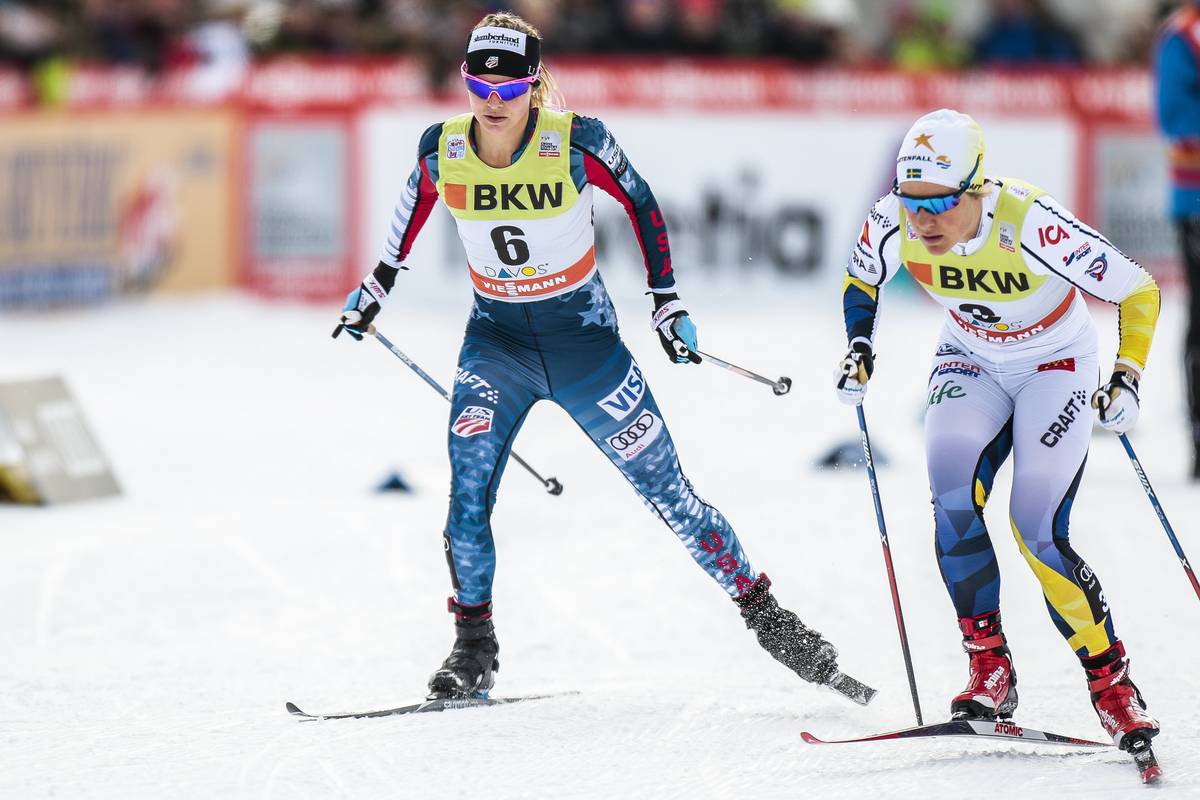
Sweden’s Hanna Falk (r) races with U.S. Ski Team member Jessie Diggins (6) during a World Cup freestyle sprint in Davos, Switzerland, last December. (Photo: Salomon/NordicFocus)
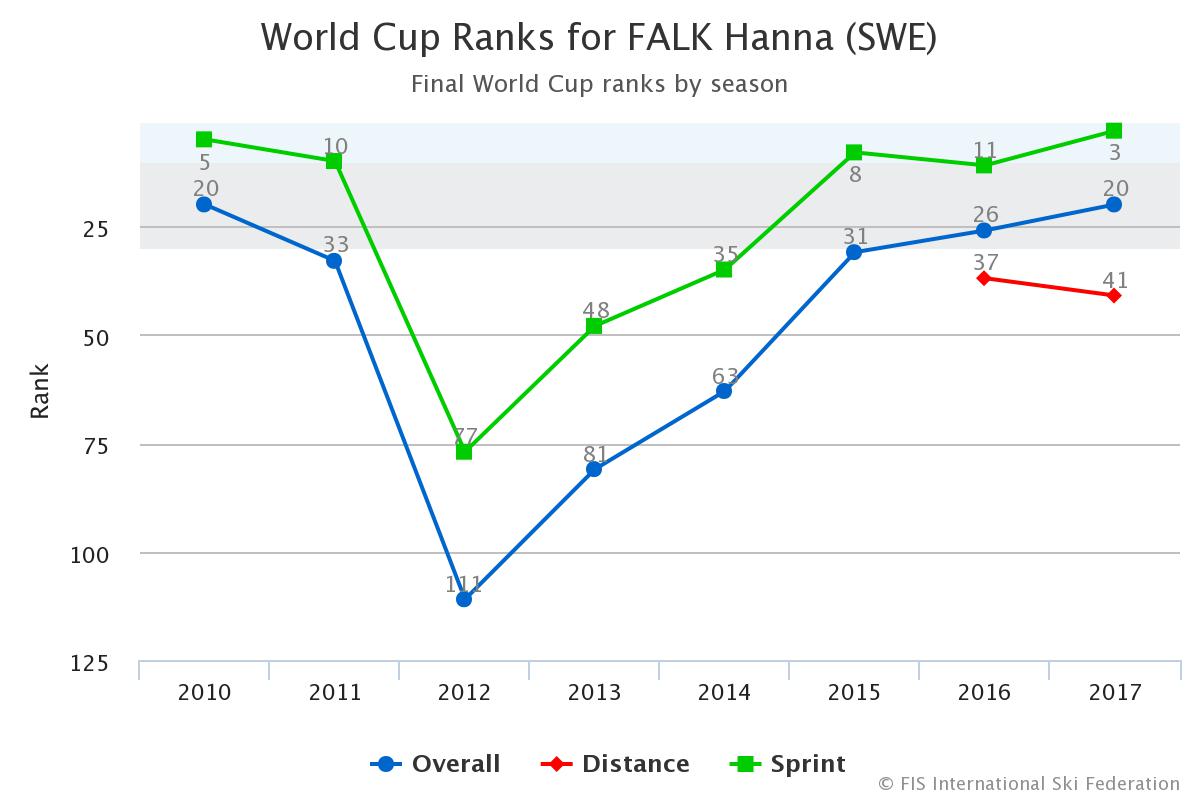
Swedish National Ski Team member Hanna Falk, 28, knows the top spots are tough to get and fleeting. In 2010, her first full year on the World Cup, she burst onto the scene and finished an astounding fifth overall in the final sprint rankings.
That early success was hindered by illness. By 2015, Falk rebounded, and this past season finished as the third-ranked sprinter on the World Cup and 20th overall. Falk stuck with it, even with a podium drought that lasted from Jan. 15, 2011 to Feb. 12, 2016.
World Cup rankings for Sweden’s Hanna Falk (Photo: FIS)
If you’ve ever had a doubt that the nosedive is terminal, give this episode of Nordic Nation a listen (found at the bottom of this article).
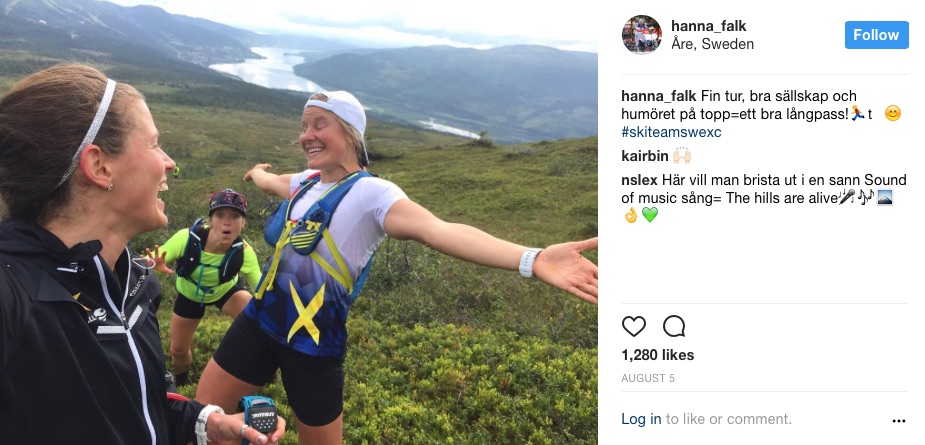
Hanna Falk is all grins on this run in Sweden. Yes, Liz Stephen (U.S. Ski Team), bombed the photo when she was recently in Sweden to train with the Swedish national team. (Photo: Hanna Falk/Instagram)
Marcus Hellner (SWE) at the finish of the men's 30k pursuit
With temperatures at Whistler Olympic Park over 50 degrees on Saturday, it was easily warm enough for a bike race. And that was basically what spectators got, as the racing, the strategy, and the cast of characters in the men’s 30 k pursuit could have been lifted straight out of a Tour de France stage.
On the shoulders of his Swedish teammates, Marcus Hellner played the role of Lance Armstrong, outkicking a four-strong bunch in the final sprint for gold. He took the win over Germany’s Tobias Angerer, with another Swede, Johan Olsson, taking bronze.
Hellner (l) and Tobias Angerer (GER, r) at the finish
“They played their cards perfectly,” said Canadian Alex Harvey, one of the victims of Hellner and Olsson’s tactical brilliance.
The pursuit features two successive 15 k legs—first classic, then freestyle technique. Today, it was only the freestyle that mattered.
Despite the best efforts of Lukas Bauer (CZE) to break things open in the classic leg, the first half of the race was typically tepid. The Czech athlete made a couple of efforts to get off the front, but a slippery pair of skis and an attentive pack held him back.
Not until after the gear exchange did things start to get interesting. After a pack of 25 skied in for the switch to skate equipment, Olsson seized an opportunity, attacking when he noticed he was the first man to ski out of the stadium.
While Olsson posed a serious threat, having collected three World Cup podiums over the last year, nobody bothered to respond to the move. With his Swedish teammates patrolling the front of the group behind, Olsson’s gap grew over the next few laps to as much as 25 seconds.
“When we saw that Johan was getting a gap…me and Anders [Soedergren] tried to keep the pace down a little bit,” Hellner said.
Of the skiers behind the wall of white suits, some, like Alexander Legkov (RUS), were stymied by the Swedish tactics. He complained that Hellner and Soedgergren cut him off as he tried to move up.
Others, like Harvey, were already stretched to the breaking point.
“Personally, I couldn’t do anything—I was on the limit,” he said. “I was not in a position to give chase today.”
With the kilometers to the finish ticking down and Olsson’s gap holding, Legkov tried to convince the rest of the group to work with him to wrest the race from the Swedes’ grasp. But he said afterwards that Bauer and the others wouldn’t cooperate.
A poor sprinter, Legkov was running out of time. With just a couple of kilometers left, the Russian decided that he could wait no longer, coming around the Swedes and upping the pace to a level only that only Hellner, Angerer, and Petter Northug (NOR)could match.
It seemed like things were unfolding for Northug to take a trademark sprint victory out of the small group. But with less than two kilometers to go, he tried to slot into position in front of Hellner, and inadvertently put himself where there was no room. The Norwegian emerged from the snarl with a broken pole, losing contact with the leaders. He faded and trailed in for 11th.
Hellner said that he tried to move out of Northug’s way, but that he was too tired to be able to react quickly enough to avoid a collision. Still, Hellner was surprised Northug was unable to recover from the incident, given that he got a new pole quickly and the pace “wasn’t so hard.”
Alexander Legkov (RUS) tries to close the gap to Johan Olsson
As Northug fell back, the chasers were eating into Olsson’s gap, thanks to the efforts of Legkov. But the Russian still had some baggage with him, in the form of Hellner and Angerer. As the trio began climbing their way up the last rise, they edged closer and closer to Olsson. Midway up, Legkov they finally pulled even.
“At first, I thought it was all over, because I didn’t know, really, what speed they would catch up,” Olsson said. “I realized as Legkov came up beside me that it wasn’t so bad.”
Knowing that it would be tough to hold off the chasers for the full 15 k skate leg, Olsson said he had been conscious to leave some gas for the sprint by backing off on the flat section before the final climb. So instead of dropping anchor when the three chasers finally reeled him in, Olsson was able to match the pace.
Johan Olsson (SWE) during his solo move
“I saved a little energy,” he said.
The four crested the hill as a group, but once they made it around the corner into the stadium, Hellner’s “lust for revenge”–which he said he’d felt after his bitter fourth place in Monday’s 15 k freestyle—finally took over. With clear track in front of him, he dropped the hammer, pulling away to take the win by a wide margin.
The rest of the podium was decided on the backstretch, as Angerer pulled ahead of Olsson, who in turn held off Legkov. The Russian just didn’t have the speed to be competitive in the sprint, and he said afterwards that he probably should have started the chase earlier, which would have given him more time to break the group apart before the finish.
Swedish Head Coach Joakim Abrahamsson told FasterSkier that he knew he had two chances for podiums today in Hellner and Olsson. With Soedergren in the mix as well, the team has cards to play when the pace is high from the gun, or when it comes down to a sprint finish.
“You have Anders and Johan who want to go to very hard for the whole time, and Marcus, who gladly can let it go a little bit softer in the classic style…and rely on his very high speed in the end,” Abrahamsson said.
He said that the team didn’t plan out any specific tactics before the race, but that they obviously cooperated once Olsson’s move started to play out.
“It was teamwork,” said Emil Jonsson, one of the Swedish sprinters, who watched the race from the sidelines. “It was a perfect race for Sweden.”
—Topher Sabot contributed reporting
The Swedes celebrating after Hellner's gold and Olsson's bronze