Marit Bjørgen carries the Norwegian flag across the finish line as Norway wins the women’s 4-by-5-kilometer relay at the 2017 Nordic World Championships in Lahti. It was Norway’s 100th world championship medal.
Bjørgen Returns:
Reported last week by several news outlets, retired World Cup star from Norway, Marit Bjørgen, will return to racing next season. Bjørgen (40), will be a member of Team Ragde Eiendom, managed by Jörgen Aukland. (The team is owned by Anders and Jørgen Aukland.)
Bjørgen told Norwegian broadcaster NRK she would focus on winning the 90-kilometer Swedish Vasaloppet.
It has also been reported that Bjørgen will be joined by the current overall World Cup winner and former teammate Therese Johaug on Team Ragde Eiendom. Johaug will still contest the World Cup.
Bjørgen, however, did not announce a return to World Cup racing: she retired from that circuit in 2018. That year, she became the most decorated winter Olympian with 15 medals in total, including eight golds, two of which she won in PyeongChang.
Free Access to “VISMA SKI CLASSICS PLAY” Until June 30th:
Like many folks and you might be keen on a video escape for a bit. Visma Ski Classics is offering free access to their video catalog until the end of this month. A few things you should know before gluing into the screen: Visma will ask for your basic info to sign up – a valid email and password. There is a “Free Trial” option ending on June 30, 2020, or you can select the monthly membership for $14.99, or an annual membership for $49.99. That said, we posted this in the news roundup since it appears free videos are yours for the next three or so weeks.
There was no prompt for credit card information during signup.
If you are stoked for a 5.5 + hour marathon viewing session you can spend that time watching the 2020 Swedish Vasaloppet.
The Davis behind the Davis on the “Davis U.S. Cross Country Ski Team”:
Beginning last season, some press-releases from U.S. Ski and Snowboard referred to the cross-country team as the “Davis U.S. Cross Country Ski Team”. We have had several inquiries from readers asking “who is this Davis?”
Here’s some of the backstory from Tom Horrocks, Communication Manager for the cross-country team. The funding is a three-year gift from the Davis Family Foundation. Currently, the team is in the second year of funding from the Davis Family Foundation. Although specific amounts were not disclosed, Horrocks wrote, “The amount of the gift matches our annual cross country team budget from last season. So, we have a flat budget this year, which is an incredible gift and benefit given the current economic downturn. The Davis gift basically ensures that our base level of programming is maintained for three years, giving us an incredible platform to prepare for the 2022 Olympic Winter Games.
“It is also important to note that U.S. Ski & Snowboard has a budget for domestic governance and events, which is still completely funded by U.S. Ski & Snowboard through our fundraising, sponsorship, etc. In addition, all Davis U.S. Cross Country Team athletes continue to benefit from all the other U.S. Ski & Snowboard departments and programs including sports science, sports medicine, communications, marketing, etc., and that support comes from outside the Davis Family Found gift.”
Andrew Davis is on the U.S. Ski & Snowboard Foundation Board of Trustees and is part of the Davis Family Foundation.
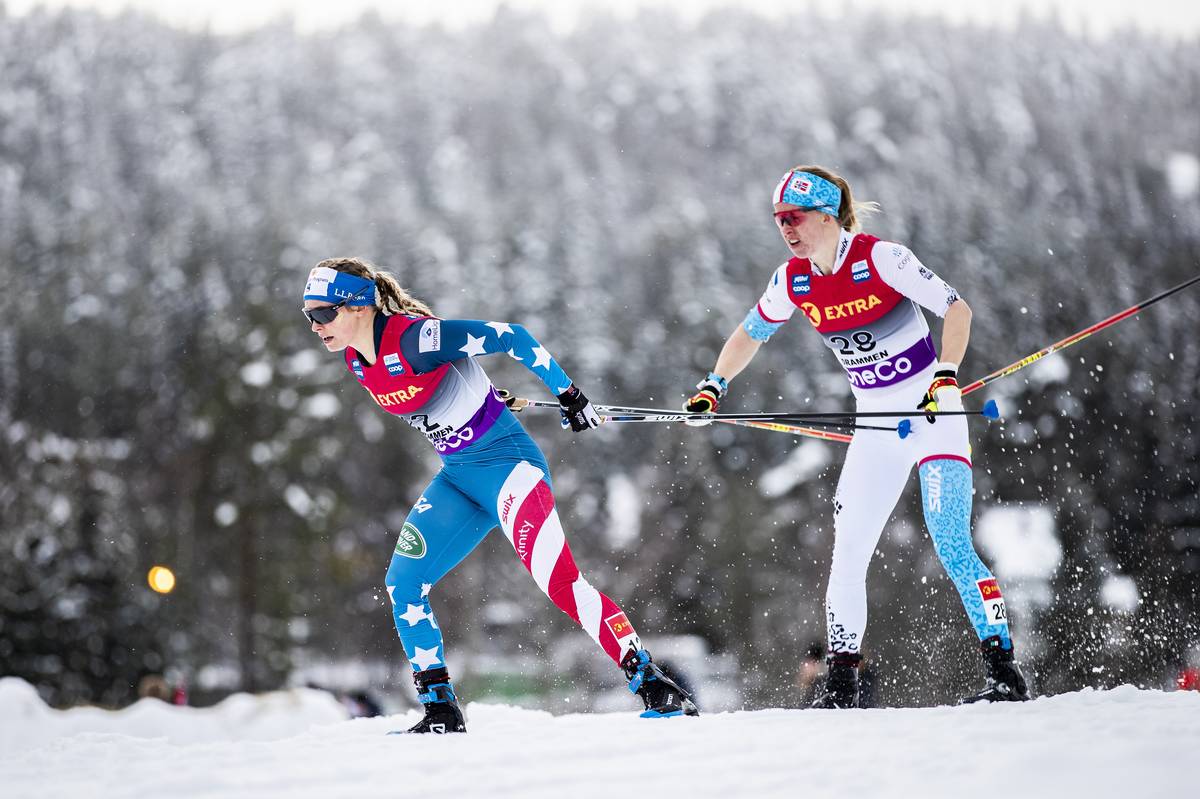
Jessie Diggins sprinting in Konnerud, Norway during the 2020 World Cup . (Photo: NordicFocus)
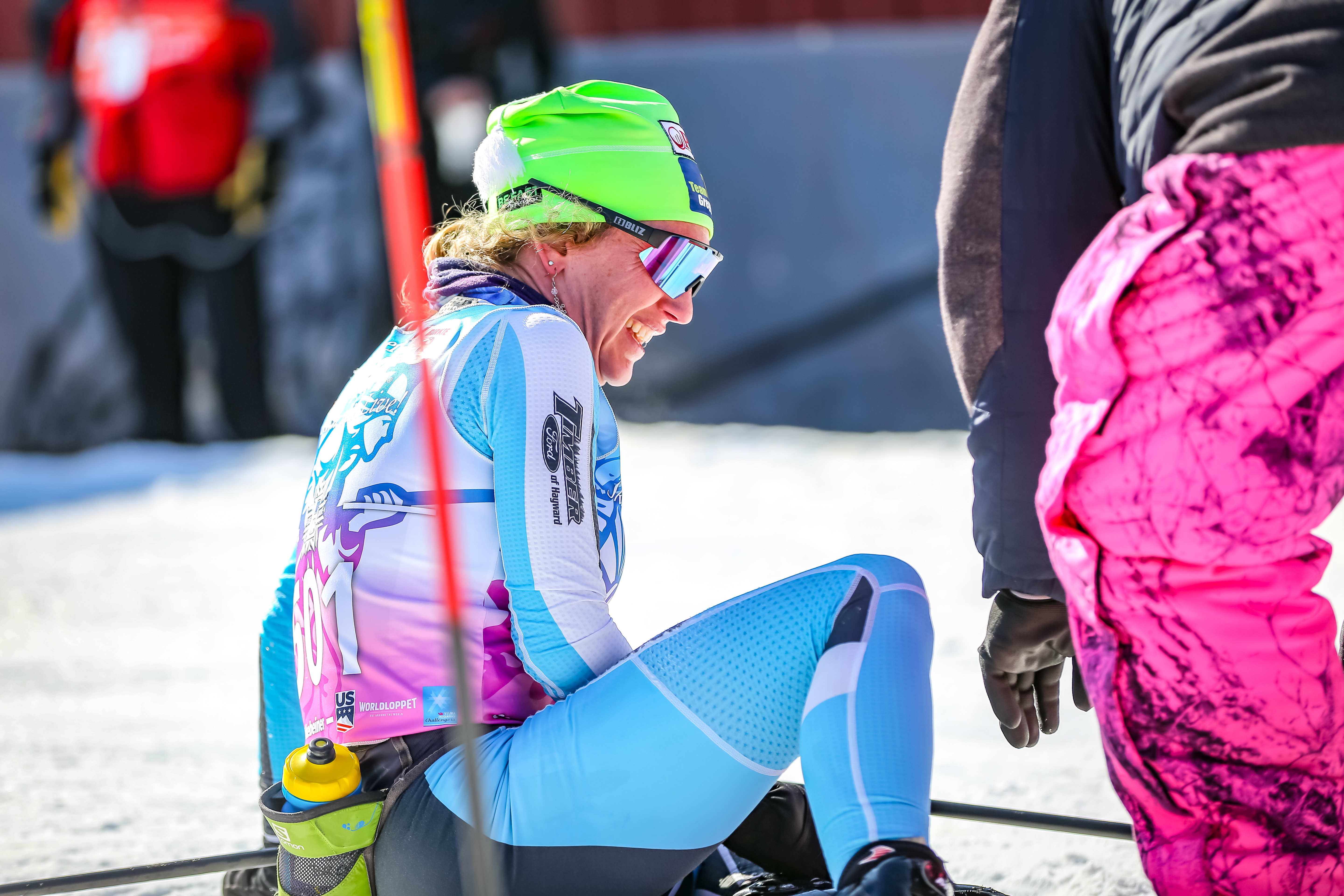
Two hours and twenty minutes after leaving the starting gate in Cable, Caitlin Gregg crossed the finish line on Main Street in Hayward, her eighth journey through Wisconsin’s north woods during the American Birkebeiner. Five of these resulted in the win, but this year, Gregg was the fifth woman across the line. Butt was still a first — her first Birkie as a mom, just over one year after giving birth to her daughter, Heidi, last February.
When I last spoke with Caitlin in mid-summer, she was in the midst of a seemingly effortless return to form postpartum. She had lined up great resources for pelvic floor and core retraining, taken a gradual and conservative approach to increasing her intensity and volume, and she and Brian had found a happy rhythm of using their KidRunner chariot or bringing Heidi to the gym to include her in their afternoon training sessions. She had even won the 25-kilometer skate at the Fossavatn Ski Festival in Iceland in May at roughly three months postpartum.
It was no secret that she was not hoping for fifth at the 2020 Birkie. She wanted to win and, for the most part, her training and racing leading into the race indicated that she was primed to do so.
Smiling through the flu, Caitlin Gregg makes her way to Hayward at the 2020 Birkie. (Photo: Instagram Screenshot @skinnyskipics)
Team Gregg celebrates strong finishes at the 2020 American Birkie. (Photo: Screenshot Instagram @caitlincgregg)
But the path was not linear. There were setbacks — major setbacks. Namely, tearing one of the four muscles in her right hamstring off the bone in late September, which faced her with a decision of whether to undergo a surgery with an 18-month recovery process and results that are not guaranteed. The surgery would also put her in a full-leg cast, unable to sit or drive, let alone carry or play with her baby.
Luckily, after trying five weeks of intensive physical therapy focused on strengthening the remaining three muscles in the group to sufficiently compensate, the surgeons agreed she did not need the surgery. Though she has not been able to run, skiing has felt great, so her training was not inhibited for long.
Then, just before U.S. Nationals in January, Caitlin and Brian’s heads collided while they dressed their wiggly baby, leaving Caitlin with an untimely concussion. Though it was mild, it inhibited her performance at an event that might influence whether she would be nominated for World Cup starts later in the season.
In this conversation, Caitlin discusses these challenges and shares her experience fighting through her illness to finish strong at the Birkie. We also explore the rollercoaster of balancing parenting and life as a professional athlete, and her goals and race plans for the remainder of the winter.
Interview with Caitlin Gregg following the 2020 American Birkie.
This year’s Swedish Vasaloppet saw a record number of racers. There were 15,702 finishers in the 90 kilometer classic race, which saw it’s first running in 1922 with 100 participants.
The race’s history comes from the beginning of Sweden’s independence from Denmark, led by nobleman Gustav Vasa. After his first failed attempt at recruiting his countrymen to join in his revolt, Vasa fled toward Norway. Two Swedish skiers were sent to bring Vasa back and they found him 90 kilometers away in the town of Salen. Vasa went on to lead Sweden in a successful revolt against the Danes and became King of Sweden.
The Vasaloppet is the biggest sporting event in Sweden, drawing 300,000 spectators and racers. There is a 10 day winter festival which culminates in the 90km classic race. There are also shorter classic and skate races held in the days leading up to the main event, and in most of these races participants finish at a wooden door on Mora’s main street which is inscribed with the words: “For Victory and the Future in the Trail of the Fathers.”
The following photographs and article (translated) are taken from vasaloppet.se.
Joergen Brink sprints for the Vasaloppet title against Daniel Tynell (photo: vasaloppet.se)
Jorgen Brink
Jorgen Brink, 35, competing for Hudiksvall, is this year’s winner of the SwedishVasaloppet in Mora, Sweden.
He took home the victory after an intense sprint against Daniel Tynell. Thus, a new profile entered the international long distance circuit.
“It’s good if I can help [by being a new name to win a marathon race] to increase interest in long races, “said Jorgen Brink after his victory.
Over the last ten years there has basically been about the same favorites competing and winning the FIS Marathon Cup (Långloppscupen) races. It is testament to the fact that it is very difficult to establish oneself among the top names in these races, but the new profiles increase the interest in these competitions. Therefore, there were many who felt additional pleasure when Jorgen Brink won Sunday’s Vasaloppet. It was a victory that meant a lot to everyone who works with international long distance ski races.
“It’s hard to compete against the best skiers. But now I’ve taken a big and important step. This might mean that I do a proper long-distance venture next season, “said Brink.
Changing focus
Before this season, Brink was trying to make the Olympic team in the biathlon. When he did not make the team, he switched focus and began investing in Vasaloppet training.
Brink showed his fitness two weeks ago when he achieved a second place finish in the Tartu Marathon, but he then experienced sickness that took him out of training for a week and a half. It was only four days before the Vasaloppet that he began training again. Brink did not make the decision to start the race until Saturday afternoon.
“Then I felt it was worth making an effort. During the race I concentrated to hang on for one kilometer at a time,” said Brink.
That explains why he kept a low profile in the main peloton, while several of the competitors were on the ball.
In the first hill, for example, a group of eight racers were pulling, including Norwegian Thomas Alsgaard and Czech Stanislav Rezac. They made a gap of two minutes on the main peloton. But Jorgen Brink was always calm.
“Yes, because there were so many talented riders in the main peloton. Therefore, it felt like we could go catch up with them.”
Tynell took over
Brink was right. After Oxberg all dissidents were picked up and then last year’s winner, Daniel Tynell, took the show. He made an initial pressure just before Hökberg, where the peloton broke but too many were hanging on. Therefore Tynell went in had to make a decision:
“The competitors looked tired while I felt very alert,” said Tynell. “Therefore it was natural for me to make several attempts to escape. But it was not and when five kilometers remaining, I realized that it would be in the finish sprint. Then I focused myself on this.”
Daniel Tynell, Jorgen Brink, Jorgen Aukland and Stanislav Rezac came simultaneously into the finish. Tynell drew up the run. Brink was behind him until he was one hundred yards from the finish, then Brink attacked for the first time and won by several feet over Tynell.
“You can say that I grew into the race. In the beginning I was unsure if I could cope. A few kilometers from the finish I started to believe in victory. In the race I [stayed a little back of] Daniel and then I began to race very hard with a couple hundred yards from the finish. It worked and I had the win,” says Brink.
Daniel Tynell, who had done most of the towing job, was baffled after the finish but was the first to congratulate Brink.
“He skiied a good race. However, I must still be satisfied. I gave 110 percent while the race developed as I had requested. I could not do more, “said Tynell.
Joergen Brink gets a kiss from Helene Soederlund (photo: vasaloppet.se)
Double Important victory
For Jorgen as a person and skier, this was more than a victory in the Vasaloppet. Until now, he’s most associated with having collapsed at the World Championship relay in 2003 at Val di Fiemme, destroying Sweden’s golden chance. Now, he can be remembered for something else.
“I am aware that it is hard to forget my effort in the World Cup relay. But now I am winner of the Vasaloppet and it’s icing on the cake for my ski career.”
Daniel Tynell, who won the race three times, ensures that Brink has a wonderful time ahead of him.
“You will notice how unbelievably great it is to win the Vasaloppet. For many, this is almost bigger than the World Cup and Olympic medals. Take the opportunity to enjoy this victory,” Tynell said, welcoming Jorgen Brink to the Vasaloppet title.
The Vasaloppet is the 8th of 10 Worldloppets in the FIS Marathon Cup Series. The last two races will be the Engadin Marathon on March 14th and the Norwegian Birkebeiner on the 20th. This is Brink’s only scoring points race and he is 16th on the list. Fabio Santus of Italy is in first place with 365 points, Oskar Svaerd of Sweden is in second place with 322 points and Marco Cattaneo of Italy is in third with 247 points.
Top Ten Men:
1 Jörgen Brink, Hudiksvalls IF, 4:02:59
2 Daniel Tynell, Grycksbo IF OK, 4:02:59
3 Stanislav Rezac, Tjeckien, 4:03:02
4 Jörgen Aukland, Norge, 4:03:06
5 Fredrik Östberg, Falun/Borlänge SK, 4:03:37
6 Marco Cattaneo, Italien, 4:03:51
7 Oskar Svärd, Vålådalens SK, 4:04:54
8 Erik Eriksson, IFK Mora SK, 4:05:04
9 Markus Jönsson, Ulricehamns IF, 4:05:08
10 Dan Moberg, Ulricehamns IF, 4:05:09
This year’s Swedish Vasaloppet saw a record number of racers. There were 15,702 finishers in the 90 kilometer classic race, which saw it’s first running in 1922 with 100 participants.
The race’s history comes from the beginning of Sweden’s independence from Denmark, led by nobleman Gustav Vasa. After his first failed attempt at recruiting his countrymen to join in his revolt, Vasa fled toward Norway. Two Swedish skiers were sent to bring Vasa back and they found him 90 kilometers away in the town of Salen. Vasa then led Sweden in a successful revolt against the Danes and became King of Sweden.
The race is the biggest sporting event in Sweden, drawing 300,000 spectators and racers. There is a 10 day winter festival which culminates in the 90km classic race. There are also shorter classic and skate races held in the days leading up to the main event, and in most of these races participants finish at a wooden door on Mora’s main street which is inscribed with the words: “For Victory and the Future in the Trail of the Fathers.”
The Vasaloppet is the 8th of 10 Worldloppets that are scored in the FIS Marathon Cup. With her win, Susanne Nystrom is now tied with Sandra Hansson in second place with 360 points. Jenny Hansson is in first place with 455 points. Next Up: The Engadin Marathon on March 14th and the Norwegian Birkebeiner on the 20th.
The following photographs and article (translated) are taken from www.vasaloppet.se.
Susanne Nystrom skis into the finish of the Vasaloppet (photo: vasaloppet.se)
Susanne Nystrom
What a Vasaloppet Week for Mora’s Susanne Nystrom: Last Saturday, she won TjejVasan [the largest women’s-only ski race, which is 30km long and has more than 8,000 participants] for the fourth time. One week later she brought victory home in the Vasaloppet.
“This is the biggest thing to happen to me as a skier. I’m both touched and happy at the same time,” said Nystrom after a race which was quite dramatic.
Immediately after the start, the three favorites – Jenny Hansson, Sandra Hansson, and Susanne Nystrom – were racing together, an unusual situation for the women’s Vasaloppet.
Never Gave Up
The distance between Sandra Hansson and Susanne Nystrom grew and was at most two minutes just before Oxberg.
“Even with the great distance I never felt that it was impossible to go catch up because the time between us went back and forth,” said Nystrom.
After Hökberg Sandra Hansson hit a wall. Nystrom worked to decrease the gap meter by meter. Shortly before Eldris, about ten kilometers from the finish, Nystrom could see Hansson.
“Then I felt that there was a chance. I began to wonder if I could pull directly or wait to make the move,” said Nystrom.
The result was that they were together for awhile just before Hemus, about four kilometers from the finish. This was when Nystrom increased the tempo.
“ The problem was that I immediately began cramping in the legs, but [increased the lead on Hansson]. Then it was only to fight on, “said Nystrom, who then raced into the finish alone to the cheer of the crowd.
“It was powerful to experience the feeling of being alone in the finish as a winner as I was both empty and tired but incredibly happy. I’m not familiar with the situation because I lost my four victories in TjejVasan by a sprint finish,” said Nystrom.
Tired second
Sandra Hansson came in as runner-up. She was extremely tired after the race and got taken care of in order to recover. In her case there was nothing wrong with her will to win. Third place was Sofia Bleckur, of Mora.
In the case of Susanne Nystrom, we are seeing the beginning of a continued investment in the long races. Nystrom has admitted that she viewed the previous season’s start in the long races as a time to see and learn. She got her perfect delivery by winning this year’s Vasaloppet. The question is what will happen next winter when she takes marathon racing more seriously?
It will be exciting to see.
The first ten women finishers:
1 Susanne Nystrom, IFK Mora SK, 4:33:07
2 Sandra Hansson, Norway, 4:33:39
3 Sofia Bleckur, IFK Mora SK, 4:35:59
4 Jenny Hansson, Vålådalens SK, 4:44:21
5 Nina Lintzén, Årsunda IF, 4:46:31
6 Kristina Strandberg, IFK Hedemora SK, 4:50:40
7 Manuela Henkel, Germany, 4:53:45
8 Solveig Steinsland, Norway, 4:55:16
9 Ellen Sandbakken, Norway, 5:00:57
10 Karin Nilsson, IFK Umeå, 5:09:39
Footnote: Women were allowed to officially (modification of the FIS competition rules) enter Vasaloppet in 1981. Vasaloppet has had an official women’s race since 1997. Susanne Nystrom has now become the first woman to win an official double, that is, both TjejVasan and Vasaloppet, in the same year.