
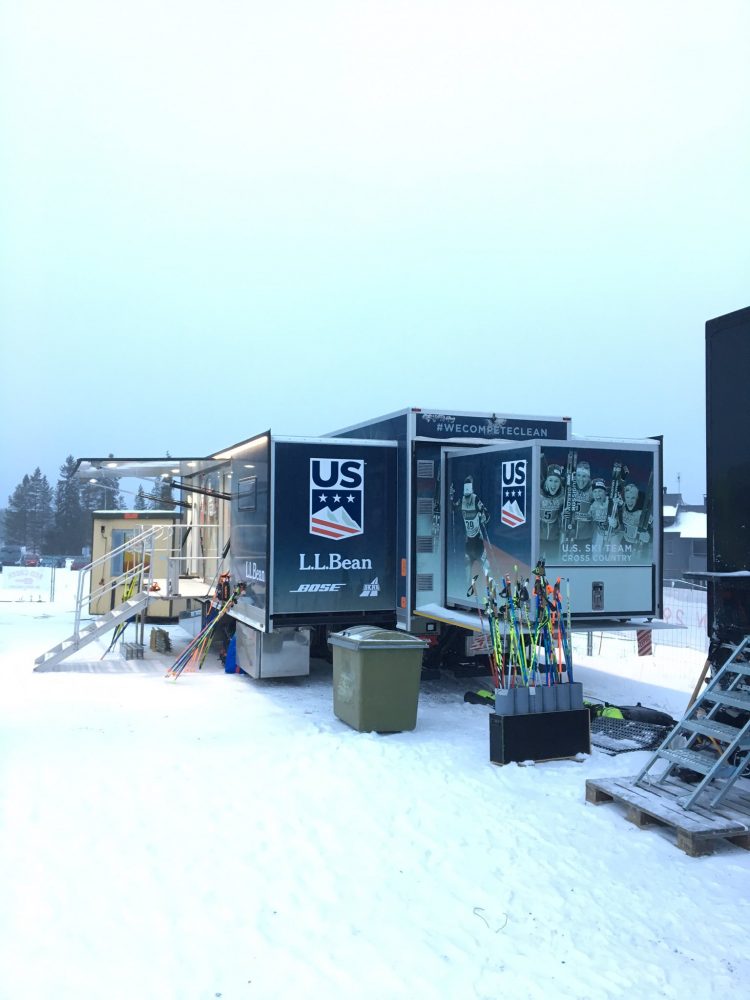
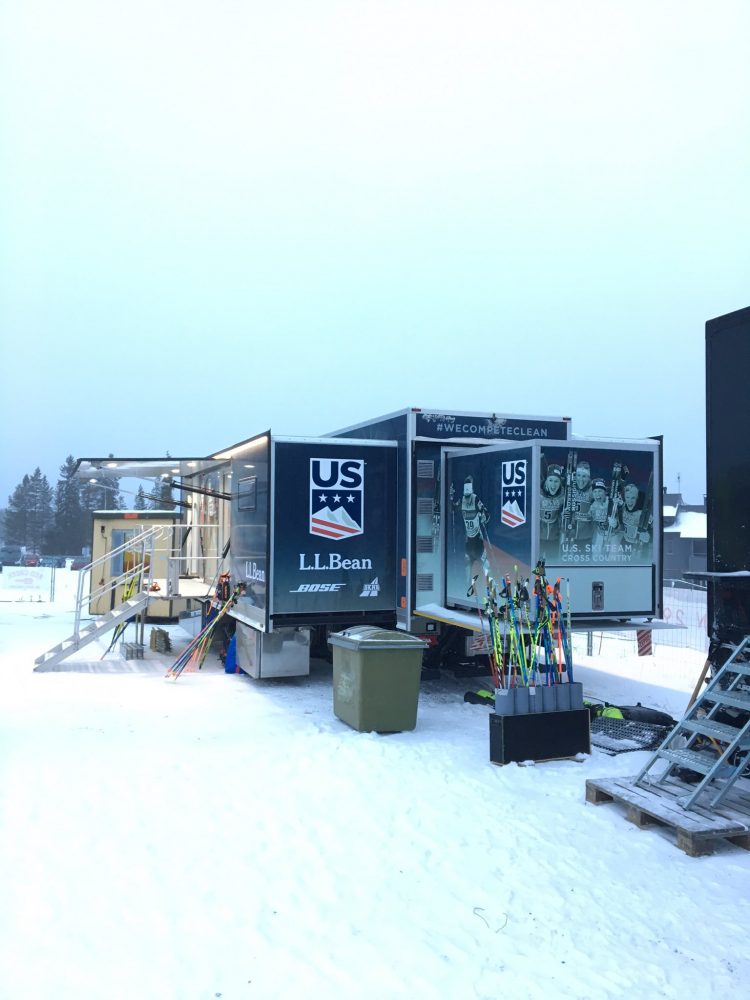
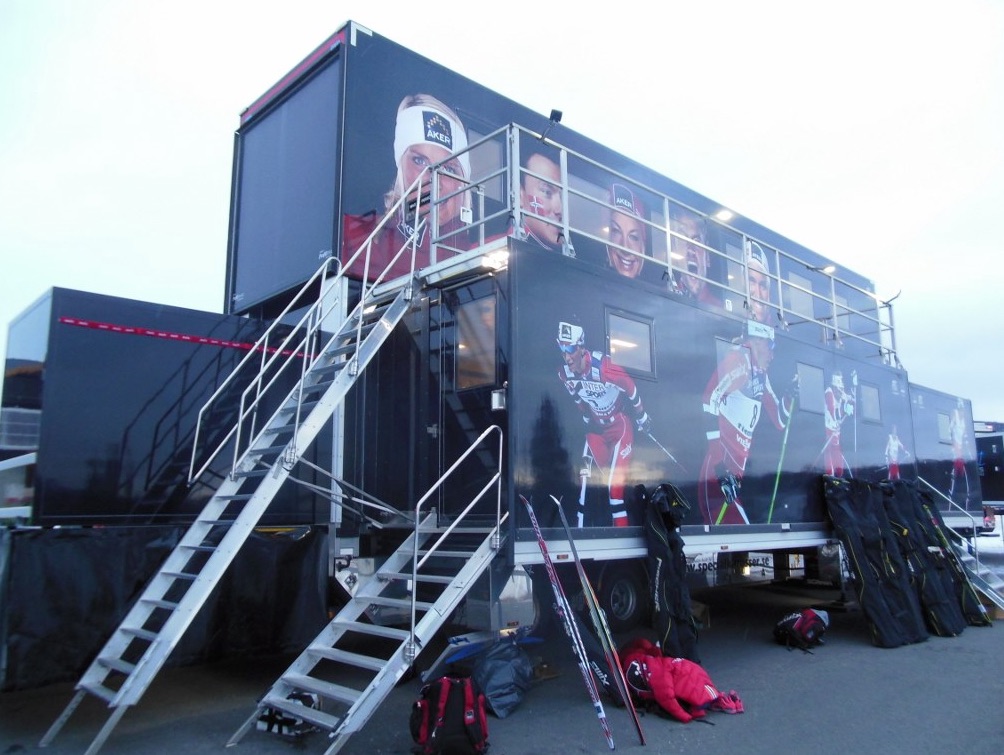
Since 2008 when Sweden arrived on the World Cup scene with a full-scale, blue-and-yellow-wrapped wax truck, it didn’t take long for the other major cross-country ski nations to not only keep up with the Joneses but surpass them. 2009 saw Norway arrive and begin lording over the wax-truck world with a succession of vehicles. As only Norway might do on the nordic-resource amenities side of things — Norway out Norway-ed itself. Its World Cup cross-country team began with a state-of-the-art wax truck in 2009, but has since moved on up. These days, Norway’s wax-tech crew arrives at World Cup venues with two wax trucks, each with extendable sides and rears, and a pop-top athlete lounge.
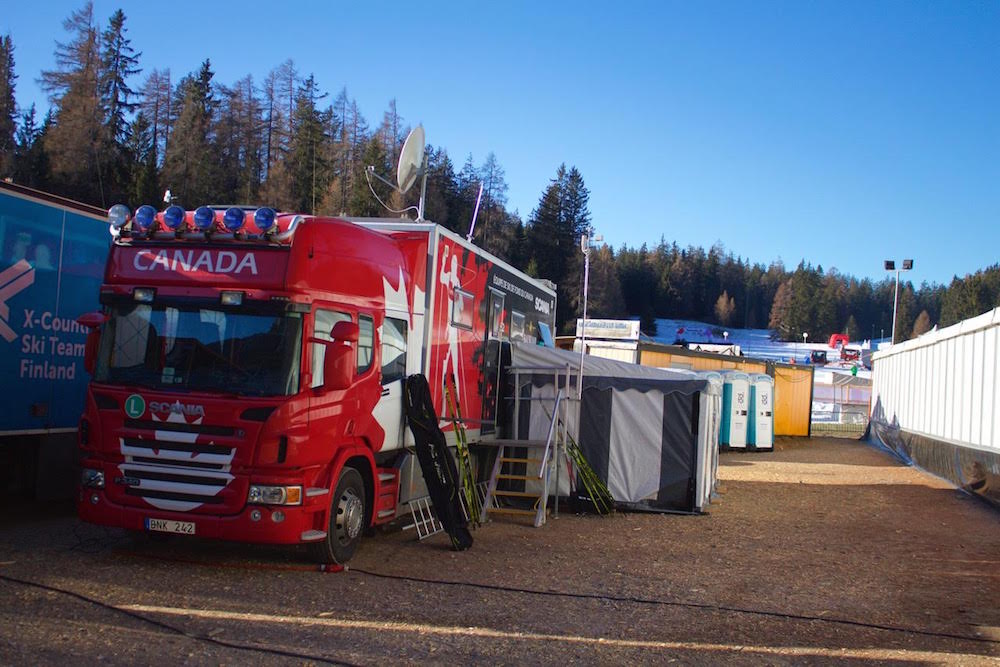
Even the Americans’ friendly neighbors to the north, Canada, have styled their maple-leaf themed wax truck in World Cup wax compounds since 2013.
Of the nine top-ranked teams on the World Cup, the U.S. is the last to meet the benchmark of eschewing wax cabins for a wax truck. This season, the U.S. Ski Team (USST) arrived in Kuusamo, Finland, and Lillehammer, Norway — the first two World Cup stops — with its own state-of-the-art mobile ski waxing facility.
“It’s been in the works for a couple of years,” USST Head Coach Chris Grover said on the phone last month, before the race season began. “One of our USSA Board of Trustees, now Board of Director individuals, Liz Arky, she was the main catalyst behind the wax-truck project. I want to say two years ago in 2015, she was with the team in Davos at the World Cup, and that was the first time she saw firsthand what we were up against. So at that point she came into the wax compound and saw the trucks from all the other nations and then saw how we were operating in our temporary containers, and so she was like, ‘Oh my gosh, how come you guys don’t have a truck? You guys need to have a truck.’”
For the past several years, the USST has thrived without a wax truck. There have been Sprint Crystal Globes, World Championship medals, and podiums. But safer working environments, and a more stable and efficient workplace should promote healthier wax crews and in theory, a more competitive team when it comes to the wax equation. Rather than a cyclic and backbreaking process of loading and unloading smaller transport vans as the teams depart and arrive at each new World Cup, a wax truck affords continuity and faster pack up and set up.
Arky, along with the help of USST veteran Kikkan Randall and U.S. Ski & Snowboard Executive Director and CEO Tiger Shaw, began the hustle for funds. From Aspen to Vail to the East Coast, eventually, the money was raised. Their two-year fundraising effort came through.
“This truck with all the taxes we had to pay for on it, is a little more than $600,000 dollars,” Grover said. “And actually, quite a big percentage of that is taxed in Europe, the value added tax that you have to pay on that. This is a 600K plus project for us that, of course, is totally separate from our normal budget.”
With the money secured, Grover explained his team worked with Swedish custom-bus outfitters Scania and SKAB to dial in the wax truck’s design. These two companies assisted the Canadians, Swedes, Russians, and Norwegians with their wax truck build outs as well.
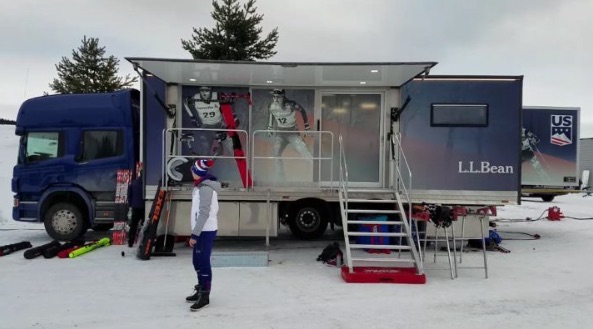
“Our truck is the same cab and chassis as the Canadian truck. It’s not a tractor-trailer; it doesn’t articulate like that,” Grover said of the wax truck’s underlying chassis. “You don’t need the highest class of driver’s license in Europe in order to drive it; it is more like a bus when it drives. However, the size of the Canadian truck wouldn’t work for us because it’s too small. It only expands in the back where there is a ski storage box that pops out the back, and it only can accommodate six workstations, but the Canadians carry fewer athletes in the World Cup than we do typically and at major championships, and so we needed something bigger.”
The U.S. wax truck expands from the back like the Canadian truck. The similarities in terms of expansion end there. The U.S. version extends from both sides, but not vertically like the Norwegian trucks.
“I want to say it creates something like 30 square meters of workspace,” Grover said. “In addition, we also had a covered porch added, like the Russian truck, and the reason is so we can basically kick wax outside in the cold and have it covered if it’s snowing. That’s a really cool feature like we saw in the Russian truck and we were like, ‘We gotta have this,’ because sometimes you can’t kick wax inside when it’s hot inside the truck and you need to go outside, but it’s nice to have it covered if it’s really snowing or something … It’s quite wide when it’s expanded.”
Inside the truck are four workstations with two functional benches each. Those workstations are mobile in a sense — they are fitted to locking caster wheels making them movable and easily stored when the truck is mobile.
Interior ventilation is a major concern when considering exposure to toxic fumes and particulates, especially when working with vaporized fluorocarbons. According to Grover, the USST wax truck is fitted with ventilation to mitigate the hazards. Each wax station is ventilated independently with industrial fume hoods.
“Basically for everyday wax-working, you would not need a [respirator] mask in this setup,” noted Grover. “However, and when people get powdering, we are still going to wear a mask. We are going to be on the safe side. Not only do we have this ventilation that is going, but we are also making sure that every person in the truck is 100 percent safe.”
The ventilation system is not a single large-scale,vacuum-type system where the expelled air is refreshed with clean air.
“It is interesting, I obviously learned a lot about this in the process,” Grover said of the technical side of ventilating the wax truck. “You cannot really have one massive ventilation system that is sucking all of the air out all the time, because it creates vacuum locks on the doors, and nobody can get out of the trailer. So that is a challenge.”
The Norwegian team uses specialized irons with ventilation tubes attached directly to the iron to draw and then expel any vapors emitted from the iron/ski-wax interface. The U.S. truck does not feature these costly irons, however, the workstations are outfitted in a manner that can accommodate these types of venting irons without any modifications to the pre-existing build out.
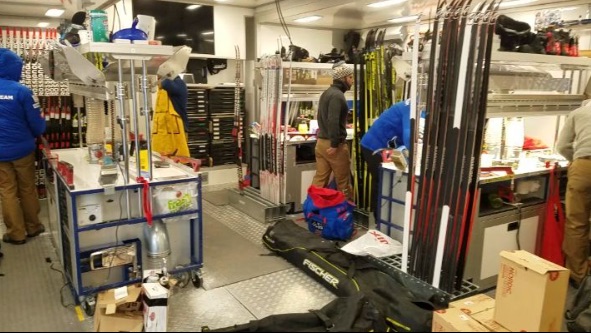
The truck also features storage for the more than 600 pair of skis and an array of coordinated storage compartments that might make an Ikea designer drool.
Five of the U.S. wax techs are certified to drive the truck. They have been trained and certified with CDL’s (commercial driving licenses). And all five wax techs can travel at once in the crew cab, which also features a bed. Grover noted that it is unlawful for anybody to be in the bed while the truck is moving.
“This is a total utilitarian, well lit, well ventilated, well lit, open, easy workspace for the techs,” Grover summarized.
The start to the season has been solid two weekends with two podiums, several top 10’s, and a fancy wax truck to complement the U.S. team.
***
Related: Check out our off-the-cusp Nordic Nation podcast where we interview U.S wax tech Tim Baucom, who along with Andrew Morehouse, were on the road from Lillehammer, Norway, to the next World Cup in Davos, Switzerland, with $600,000+ of precious cargo.