
From the FasterSkier archive — posts syndicated from athletes’ and coaches’ own blogs between 2004 and 2012, kept online as published. Current coverage is at fasterskier.com.

Tag: swim to the moon

  • The Old Man and the Lake: A Skier Swims Across the Mackinac Straits. Part II

    The Old Man and the Lake: A Skier Swims Across the Mackinac Straits. Part II

    In Part one of The Old Man and the Lake, our reporter shared his story about dealing with the sudden onset of chronic illness; how time, persistence, and swimming helped him regain his athletic life, and the odyssey of swimming across the Mackinac Straits. In part two, the story continues with his ongoing swimming saga post bridge swim, and the lessons learned about goal setting and the reality of dealing with disappointing outcomes.
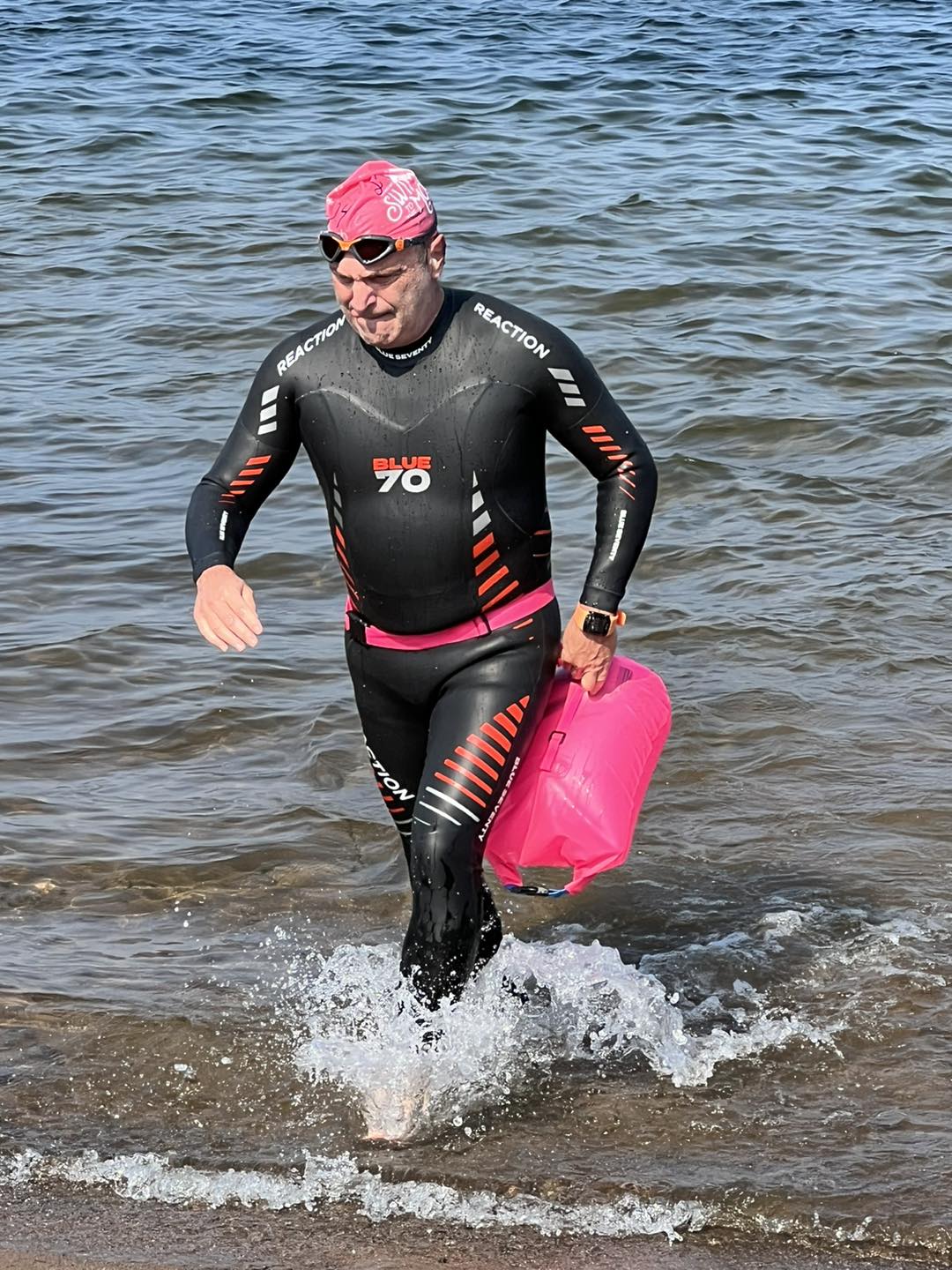
    A grimace shows the author’s hard final push out of Teal Lake, or was it just pain from stepping on stones? (Photo: Courtesy Swim Teal Lake)

    Next up on the race calendar the weekend following the Mackinac Bridge Swim was an event called Swim Teal Lake. This is a 2.25 mile point to point swim the length of beautiful Teal Lake in Negaunee, Michigan. Teal lake is a gorgeous inland lake with clean clear water and no motorized craft allowed in it. It’s therefore just about a perfect venue for swimming. A low key fun event with under 70 participants, the race has the decided feel of a local neighborhood happening, which it is.

    Everything came together for me at Teal Lake in an unusual confluence of good outcomes. I paced myself perfectly, swam in a straight line, and ended with just a little bit left in the tank. This —and the small field—put me in the unusual position of winning my age group. This was something I had never previously come close to doing. I recognized it was a bit of a unicorn, but nonetheless, I savored the moment and enjoyed the success.

    After the washing machine like experience of the Bridge Swim, Teal Lake felt like an easy jog in the park. At the finish, I had to remind myself that it was only a few years ago that a 2.25 mile swim would have been physically impossible for me, and remind myself to enjoy the moment.
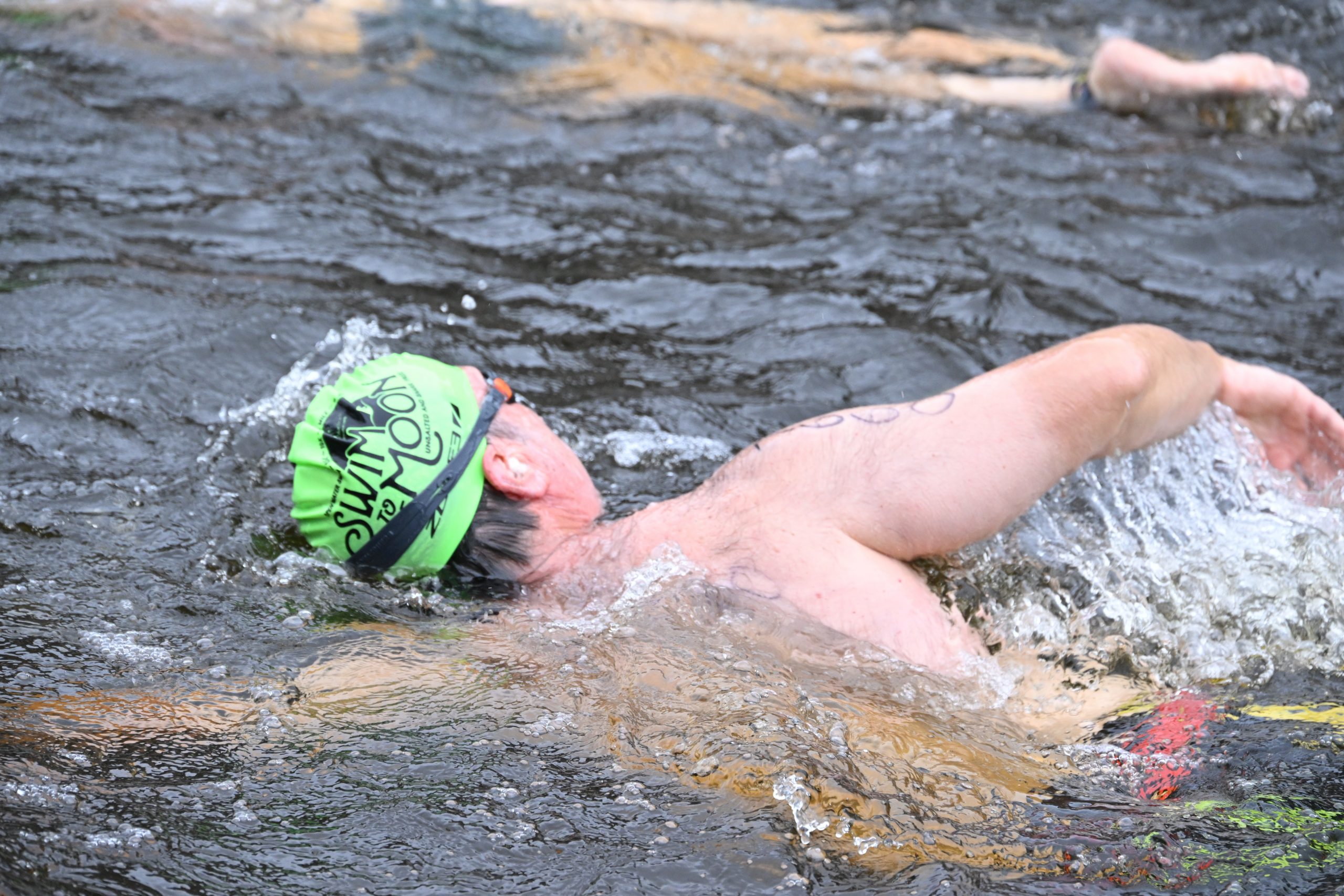
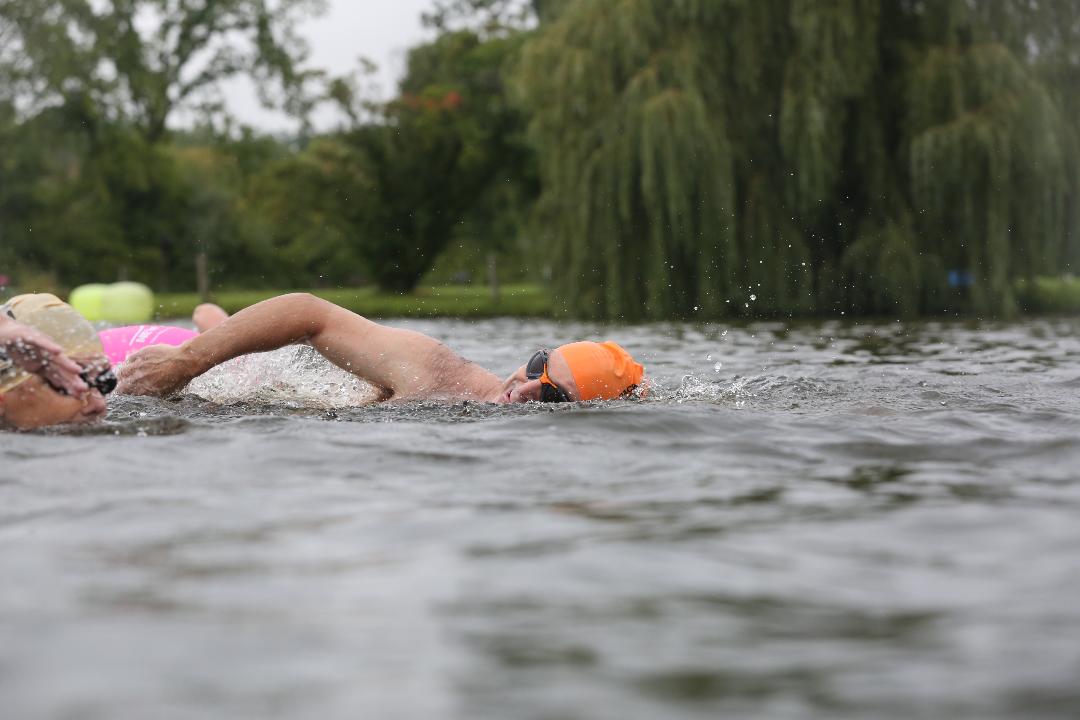
    The author in Half Moon Lake swimming to the moon. (Photo: Courtesy Greg Sadler Photography and Epic Races)

    There wasn’t a lot of time to savor the victory since I still had the Swim to the Moon 5-k race ahead of me which was only three weeks away. Swim to the Moon has enjoyed phenomenal growth as long distance open water swimming generally has been enjoying a surge in popularity. The event is now held over two days. It includes a 15-k swim—a staggering 9.3 miles, which is somewhat incomprehensible to me—and over the weekend there are almost 1,000 participants in all of the different events.
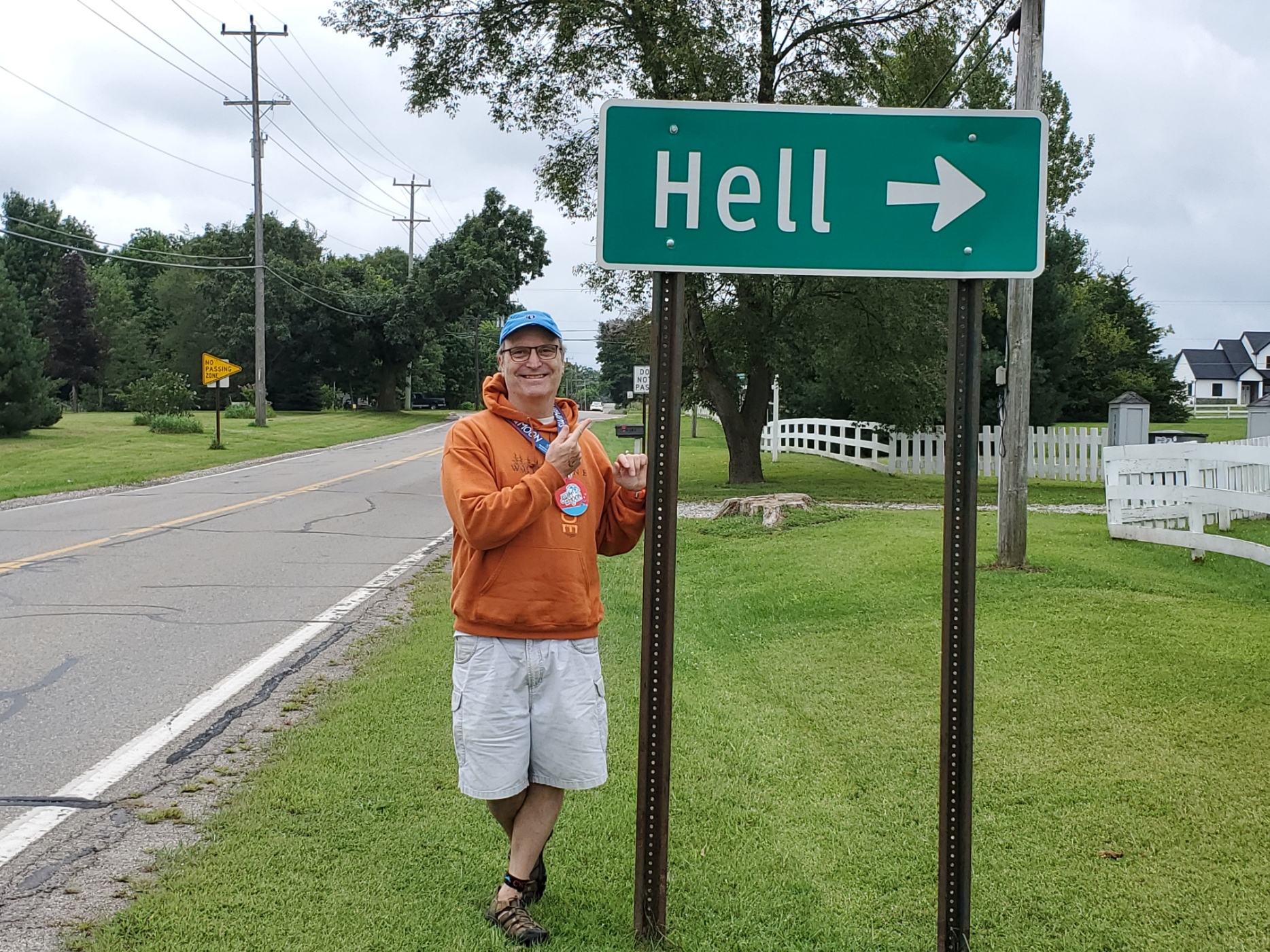
    Swim to the Moon is held just outside of Hell, Michigan. Here, the author is literally on the road to Hell. (Photo: Amy Kostrzewa)

    For Swim to the Moon, I had a very specific performance goal in mind. My finish times had been hovering just above two hours for the last two years and I was determined to punch through the 120 minute barrier. In search of this goal, and in preparation for the Bridge Swim, I spent a lot of time working with a swim coach to refine my technique and make myself more efficient. My old technique dated back to the mid-80s, and things have changed quite a bit in technique philosophy in the ensuing decades. So, I broke down my technique and basically had to relearn how to swim. By the time late summer rolled around I was swimming completely differently and felt like I was primed to break the two hour barrier. It felt like going from using mostly V-1 to being able to go mostly V-2.
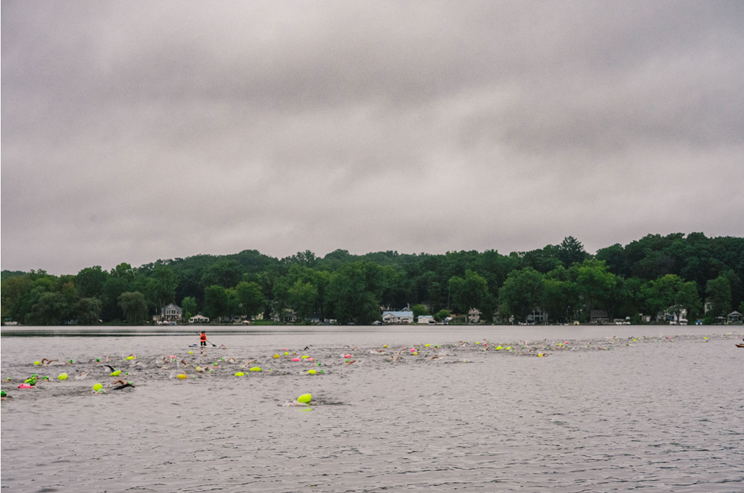
    Swimmers as far as the eye can see at Swim to the Moon. (Photo: by Aaron Palaian Photography/aaronpal.com)

    My strategy had been to settle in at the fastest pace I could sustain and try to hold it. I stuck to this strategy and only looked once at my watch the entire swim. But herein lies the problem with focusing on outcome goals instead of process goals. In Swim to the Moon, I swam hard, felt like I was swimming in a straight line, and fought through multiple major leg cramps throughout the swim. The entire race I felt like I had the two hour mark in the bag.
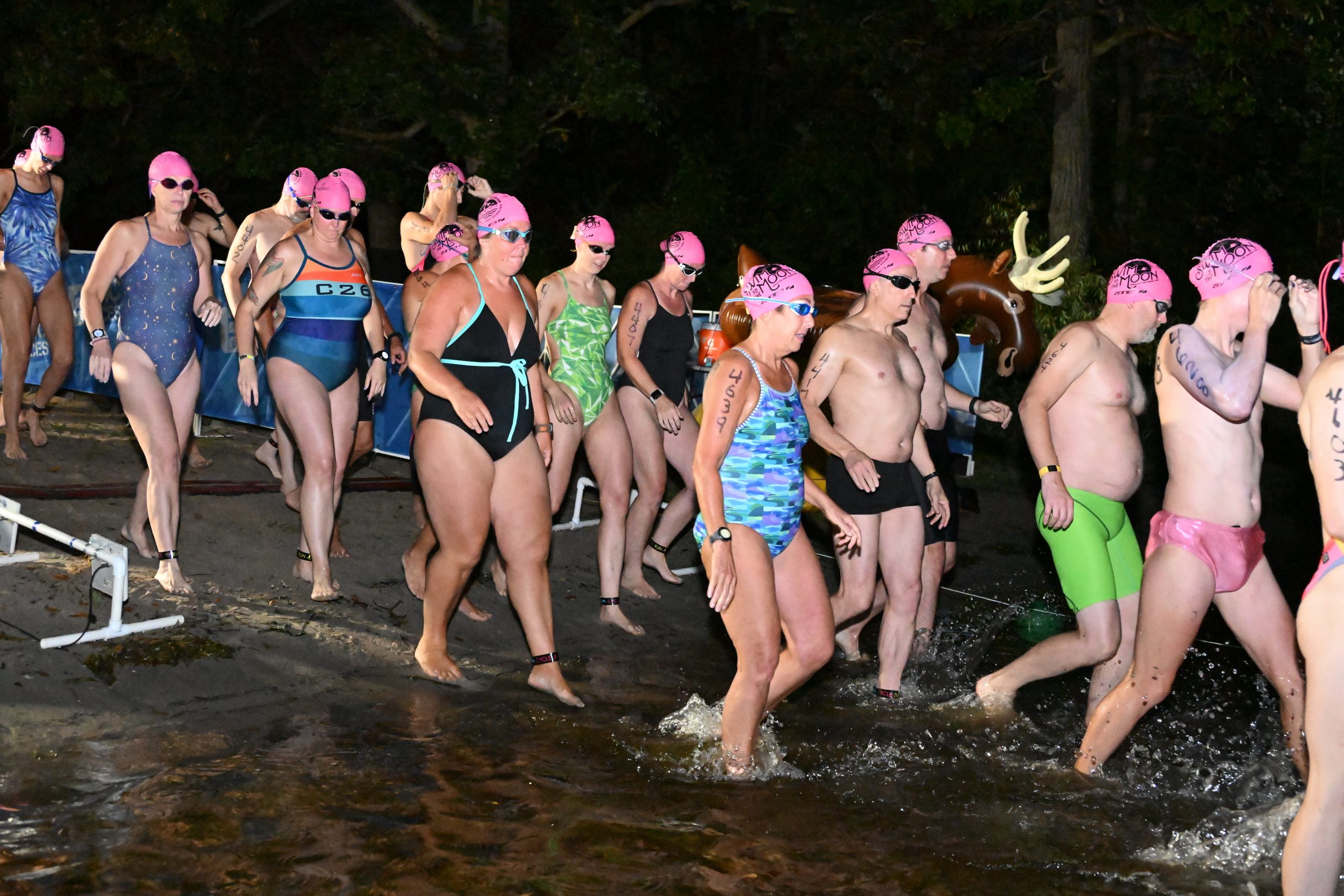
    Due to the length of time it takes to swim 15-k, that race starts in the dark before sunrise. (Photo: Courtesy Greg Sadler Photography/Swim to the Moon)

    As I approached the finish line, I was confident I had achieved my goal, but was then quickly crushed when upon exiting the water I looked down at my watch and saw 2:07 staring me in the face. Not the outcome I had wanted—not even very close. Instead of being proud and happy upon exiting the water, I was upset and confused. How could I feel like I was swimming so well, with my rebuilt stroke, and be five minutes slower than the previous year?
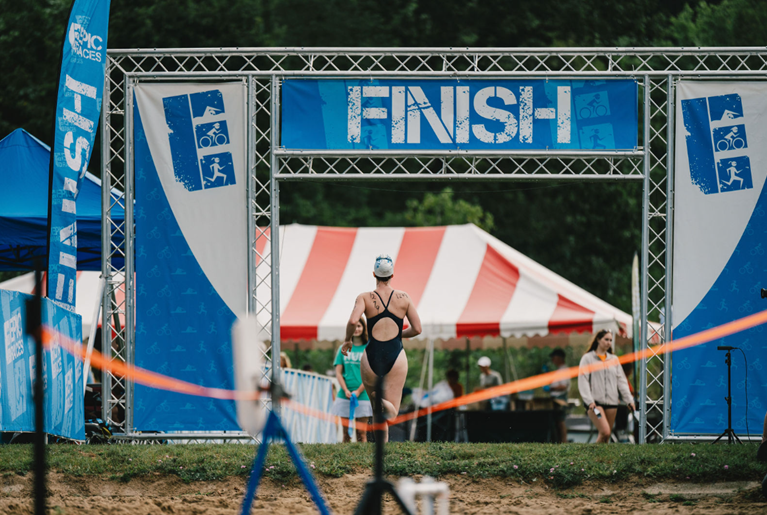
    By focusing on the results, I denied myself the joy of completing the journey. (Photo: Photos by Aaron Palaian Photography/ aaronpal.com)

    Unwittingly, I was enabling the arch enemy of happiness—comparison. Comparing yourself to others and to your former self is unproductive and I should know better, but nonetheless I went down that road.

    It took my wife’s positive mindset to urge me to remember the road I had journeyed the past eight years and to think back to how much it took to get from the couch to the pool, to marathon swimming. We also looked up the winner’s results and saw that all of the top swimmers were a couple of minutes slower than the prior year. The fact that everyone was a little slower was some consolation.

    But this is the trap in focusing on performance goals. There are just too many things out of your control for it to be a good metric. The wind might be from a bad direction, the course might be set up slightly differently, you might encounter traffic which negatively affects you—similar to ski racing. Or, you just might not have a great day. All of these things, and others, were possible factors affecting my time. I’ve really tried to learn the lesson to focus on process and not outcome, but focusing on outcomes is a difficult mindset to walk away from.
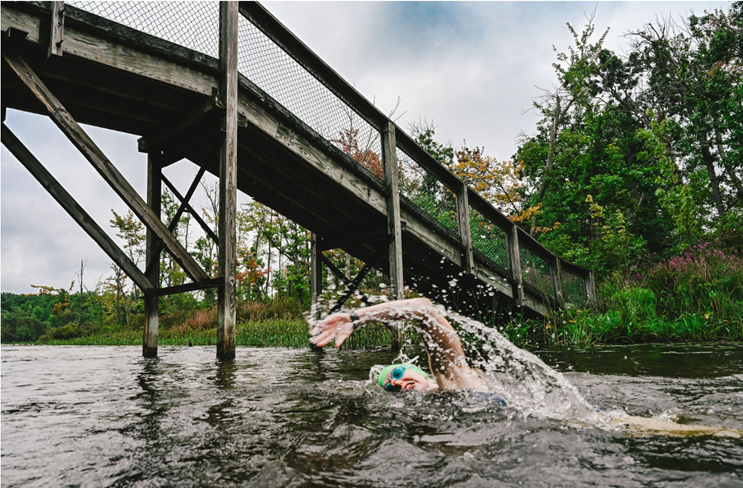
    A swimmer passes under a bridge on the way to swimming to the moon. (Photo: Photos by Aaron Palaian Photography/aaronpal.com)

    I’m proud of my efforts to reclaim part of my life. I’m proud of the discipline and persistence it took to get from the couch to completing long swims, but part of me still felt empty, dissatisfied, and lacking. It’s one thing to say, “focus on process goals,” it’s another thing to reach deep into your psyche and override deep personality traits and learned behaviors to actually make that shift happen.

    If I contrast how I felt after Swim to the Moon compared to the Mackinac Bridge Swim, the difference is stark. After the Bridge Swim, once I had recovered, I felt a great sense of accomplishment, pride, and satisfaction. After my 5-k swim, I didn’t feel any of that initially. It took a great deal of reflection to bring the positive emotions to the top. I think one big difference was that the Bridge swim wasn’t a race; it was an event to test your individual ability to make it to the other side of the lake. Since there wasn’t any timing involved, there wasn’t any of the baggage which goes with that. There wasn’t any comparison to others, and the only metric which mattered was crossing the finish line. Free from the built in outcome goals of racing, mentally I found myself in a way better place after the Bridge swim. Does this argue for giving up racing, or not wearing a watch? I’m not sure, but there is a case to be made for it. Should I force myself after a race to walk away without looking at the results and promise never to check them online? That seems contrived and completely artificial. If I’ve really reached the point where process matters more than outcome, then I should be able to find myself at the bottom of the results sheet and not really care. You can’t fake satisfaction.

    If I am being completely honest with myself I just haven’t reached the point where I can truthfully say that process goals mean more to me than outcome goals. I still look at race results and think about what it would take to trim 10 percent from my times. I still commit the cardinal sin of comparing myself to others on the results list. Maybe I don’t trust the process enough, or maybe the idea of results are just too hard wired into my psychological makeup to change? After all, most of the arc of my life—and probably the same for most people reading this— has been charted along outcome goals since being a teenager. Are the test scores good enough, is the GPA high enough, is the bar result passing, are the jury verdicts positive, are the annual revenues high enough, are the election returns the right ones? All of these outcomes from different parts of careers in different parts of my life mattered deeply and guided my efforts for decades. And here is where there is a larger societal disconnect. In most of life, process isn’t rewarded; outcomes are. The outcome based view of success applies to almost every walk of life. Have a leaky faucet that the plumber didn’t repair properly, or a lawsuit that didn’t go well? No one really cares about the process in these circumstances, just the results. The list is almost endless of areas of life where only the outcome matters. It’s mainly in athletics that process goals are focused on; so it’s a bit of an outlier.

    To turn everything in one’s head around and say, “I’m not going to worry about the result, and just think about the process along the way,” may at the end of the day be a more positive and productive mindset, but converting my outlook to truly accepting the process as being more important than the outcome may be a more daunting task than dragging myself out of the hole I was put into by chronic illness, or dragging myself across the Mackinac Straits.
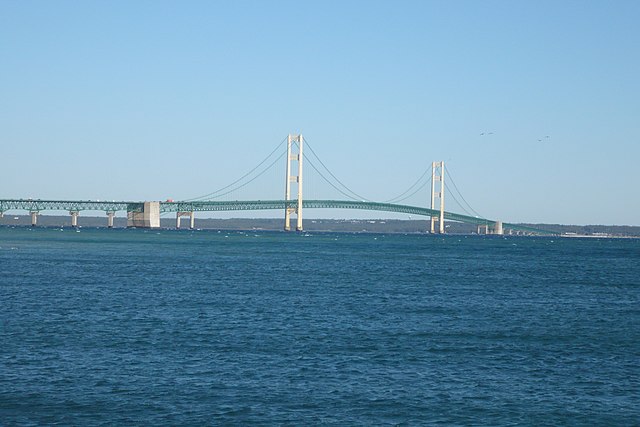
    Repeating the Mackinac Bridge Swim is still up for discussion. (Photo: Courtesy Mackinac Bridge Swim)

    So, now that I’ve fought my way back to being able to compete, I might have one more challenge to overcome; starting to focus on enjoying the journey, appreciating the process, and worrying less about the results. I don’t know if that’s an achievable goal, but it might be just as important as getting myself back into the game in the first place, and like the man said in part one of this article, “I didn’t say it would be easy, I said it would be worth it.”
  • Why We Race

    Why We Race

    Swimming for two hours really doesn’t feel anything like skiing for two hours. They both use all four limbs, but that’s about where the similarity begins and ends. (Photo: Greg Sadler)

    A guy I knew once told me, “Everyone’s got something.” He was referring to the inevitable injury, illness, or other malady that eventually affects everyone. Push your body long and hard enough, and eventually something will break down. The point he was making was that it doesn’t really matter what the something is: eventually, you just have to deal with it. His bigger point was that it’s not a good mindset to think first of your limitations, or compare yourself to others, or your former self, but instead to focus on what you can do. It was terse advice, which at the time I didn’t fully appreciate; now, I think I finally get his meaning.

    When I began writing this article, I wasn’t certain how much personal backstory I was ready to share. Very few people even know that I’ve been dealing with a “something” for over seven years now. But I wanted this to be more than an article about just another race and, instead, talk a little about why we race. Everyone who races has different reasons and motivations, but considering the time and effort that goes into preparation, isn’t the motivation—the why— worth a little introspective examination?

    Eager participants line up for the start of the Swim to the Moon 5k distance. (Photo: Greg Sadler Photography)

    When it comes to racing, there may be as many motivations as there are racers. In general, I’m guessing that most of us fall into the category that I used to fall into: racing constitutes a meditation, a focus, an almost-sacred space where we test ourselves and investigate our limits—and that’s a more-than-sufficient reason to pin on a number and toe a starting line. Myself, I’ve been ski racing since the mid-1980s. To be clear, I was never an elite skier, not even a local standout. I was what most of us are: a passionate citizen racer who puts every ounce of energy into every race. If I finished in the top quarter of my age group, I was happy.

    Seven years ago, I completed my fifth Noquemenon 50k marathon, one of several marathons I did that winter. That particular Noquemenon was only one race in a season of races, which was one only season in decades of citizen cross-country ski racing. But six weeks after the Noquemenon, I was lying flat on my back, unable to walk around my block; and I have a small block. This “something” of mine that appeared after Noquemenon would not go away: it turned about to be worse than what some people might get and not as bad as others. As I’d heard, everybody’s got something. This “something” was mine.

    Fast forward five years: after years of struggle and a roller coaster of issues, I decided that I had worked my way back to the point where I could dip my toe back into the athletic waters…literally. Focusing on what I could do meant that I would concentrate on swimming. It was one activity I could do without too many side effects. So, I decided to enter a swimming race.

    Nothing but swim caps as far as the eye can see:  Swim to the Moon on race morning. (Photo: Greg Sadler Photography)

    The event was the 2021 Swim to the Moon half mile race. It’s the shortest distance which EPIC Races’ swim event series offers ( the longest being 10K). The series is held annually outside of Hell, Michigan. Yes, that’s a real place and appropriately named as there are a variety of extremely challenging races held in the area. As it turns out, Hell is actually very picturesque with a series of long connected lakes, perfect for a marathon swim.

    I was pretty certain that I had worked myself back to the position to be able to open water swim a half mile. At the time, it was a very big deal for me, physically. A big enough deal that when I finished, it brought my wife to tears and even elevated my normally low emotional metabolism. But still, my finish was marred by the self-inflicted psychological wound of comparing myself to what I used to be. For the former me, a half mile swim was nothing.

    Last summer I continued to improve my physical condition to the point where I decided to take on the challenge of the 3.1 mile swim at the same event in 2022. I chose the 3.1 mile distance because completing it would force me to stretch. I didn’t know if I could complete it; DNF was a real possibility, but the distance seemed achievable. I put the odds of finishing at a little better than 50/50. The most important thing about my choice was that it was farther than I had ever swum in the open water, even before my “something” had occurred. If I could complete this goal, it would help move me beyond looking back at what used to be.

    Suspended in the balance between hoping to complete the event and falling short, the catalyst to try was created. If I could finish the race, it would prove that I had reached some sort of agreement with my “something”—it didn’t completely control me, but I also recognized its permanent presence in my life. Like an unwelcome houseguest who refuses to leave, you have to learn to live with it. But, I would be focusing on what I could do, and achieving something I had never done before.

    Last year’s time of 2:08 was a huge accomplishment, but only set the stage for new goals to come. But now I think I know what I’m racing for. (Photo: Greg Sadler Photography)

    I was able to complete the event in reasonable fashion—not just survival mode—and put in a respectable time of 2:08. A vast array of emotions ensued, including a new investigation of the question “Why do I race?” Prior to the unwelcome arrival of my permanent houseguest, I was never really certain why I raced. I really enjoyed racing and after doing it for over 30 years it had become a sort of nondenominational religion for me. I was a true believer and devoted congregate at this house of worship, but I wasn’t really sure why. I only knew that I really believed. I enjoyed it, I committed myself completely, I did the best I could; and repeat every year.

    In the five year interregnum between my last ski race and my first swim race, I had a lot of time to think about why I wanted to race. My personal motivation for this last race was to focus on doing what I can do and try to reset my psychological baseline. Another part of the process was that maybe if I swim enough miles, I’ll be able to do a ski race again, maybe even return to another marathon. But, that’s another goal, for another day, and one I’m not certain I’ll ever be able to do again. At least for now, the reasons were more concrete, articulable and, perhaps, more substantial.

    After completing last year’s swim, I knew that I could physically perform the task of swimming 3.1 miles. So, this year I set a goal beyond merely finishing. If I could swim the 3.1 mile distance in under two hours, then my “something” would be the one pushed back onto its heels. It would still be an unwelcome guest, but then it would be relegated to rumbling around in the attic instead of being in the room next to me constantly banging on the wall making noise.

    I understand that setting a goal of finishing an event in a particular time may not be the greatest strategy. Instead, one should focus on the process; control what you can, and then whatever results will follow will be all right. Sound familiar? Nonetheless, I set sub-two hours as my goal. It seemed like it would be such a concrete achievement—such a tangible task, that if I could do it, it would be exceedingly satisfying—and make a statement to myself.

    Starting at the crack of dawn isn’t a deterrent for the 800 people who Swim to the Moon. (Photo: Aaron Palaian)

    So, on August 20th, I set out to Half Moon Lake at 4:00 a.m. with my wife, who was also competing, and dragged along my unwanted houseguest. It was a beautiful warm morning at Half Moon Beach and the water was calm. But waking up at 3:30 a.m. is enough to put most people in a slightly sour mood, so there was that.

    Swim racing long distances is only somewhat translatable to marathon ski racing. Many of the challenges with ski racing simply don’t exist in the water. You generally don’t have to worry about overheating (I was in the non-wetsuit division), and without the force of gravity tugging at you the type of fatigue is quite different. Another major difference is taking on nutrition. You can forget about fueling every 20-25 minutes, it simply isn’t feasible. Also, as it turns out, it isn’t really necessary, at least for me and the people I’ve raced with.

    Hundreds of 5k and 10k swimmers navigate the culvert as part of their swim. (Photo: Aaron Palaian)

    The swim course navigates three different lakes, a canal, and one culvert. Each has its own temperature, currents, and choppiness. I felt reasonably good throughout, and when I reached the two mile mark, I felt like my goal was in reach. I never stopped to check my watch, I just set a pace I could maintain and kept with it. With about ½ mile to go, I began to cramp and my pace slowed. This is also the point where swimmers reconnect with racers doing the shorter distances and the traffic increases. It’s not a great spot to be fatigued.

    Sprinting onto the sand for the finish line after hours in the water presents a whole different challenge. (Photo: Greg Sadler Photography)

    With the finishing beach in sight, I pushed as hard as was prudent and finally got to the shoreline where you could walk. Or, more accurately, try to walk. As soon as I stood, my legs wobbled and gave out. It took a couple of seconds to regain my sense of dealing with gravity and balance. I pulled myself across the finish line and checked my watch… 2:02. Well S—t. Close, but goal not achieved—or was it? The disappointment only lasted briefly as I remembered lessons learned over the last seven years. No, I didn’t achieve my performance goal. But, I was competing again. I had achieved the goal of getting back in the game—perhaps not in the way my former self would, but in the best way my new self could. That’s what mattered. The elusive two hour barrier is still out there—beckoning me to crack it—and that’s a goal I think I can still achieve.

    There are many lessons I’ve learned through my journey with my particular “something,” but among them is that the “why” really does matter. It matters to be able to articulate it, understand it, and use it to help move you forward. So now that I know my why, my particular something spends more of the time in the attic where it belongs. Hopefully you can figure out your “why” and—armed with that knowledge—help move yourself forward.

    The author and his wife, Amy Kostrzewa, trespassing onto the podium. (Photo: Amy Kostrzewa)

    Many thanks to Eva Solomon and the people at EPIC races for their support.