From the FasterSkier archive — posts syndicated from athletes’ and coaches’ own blogs between 2004 and 2012, kept online as published. Current coverage is at fasterskier.com.
The women Ski Coaches Association is excited to announce our new GearUP program. This program is designed to help reduce barriers for women ski coaches by partnering women coaches with an equipment brand rep to outfit them with gear, provide brand specific knowledge, and create industry connections.
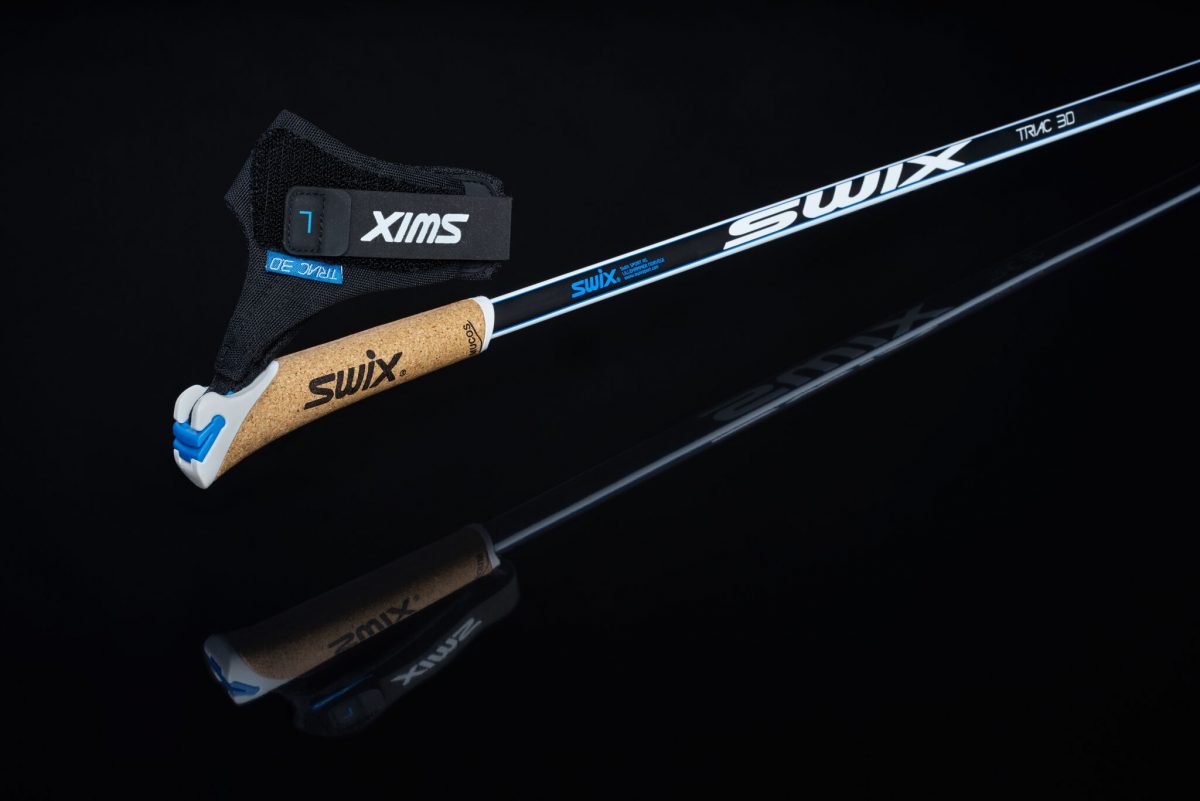
Madshus, Fischer, Rossignol and Salomon will each work directly with two women coaches for the duration of the 2022-23racing season.* The eight coaches selected for this program will be outfitted with at least one pair of classic and one pair of skate skis, two pairs of boots, two pairs of Swix poles and other coach-approved swag!
Why GearUP? We believe this program will help level the playing field for women in ski coaching careers through:
mentoring and networking with another male-dominated profession that is important for coaching success and advancement – the gear industry.
reducing the personal expense required to purchase and update racing equipment that can impact a coaches credibility in the profession.
increasing access to the gear related expertise required to excel on the snow everyday and behind the scenes on race day.
Developing and retaining women coaches at all levels of the sport supports athletes, other coaches, and the organization/ski community as a whole. Check out WSCA’s Why Women Coaches Matter page for more information!
Through the mentorship aspect of this program, coaches will increase their knowledge to accurately fit a ski to an athlete, understand what makes great skis for certain conditions and how to properly prepare them, have a contact list of connections from their partnered brand, understand the brand’s product line, and gain other useful skills. The program will include 3-4 structured sessions with reps and coaches through the season to increase networking and knowledge about gear and waxing.
Women with any levels of experience currently coaching at the middle school level or above are encouraged to apply.
Application period opens October 1 and closes October 14. Decisions will be communicated by the October 21st with program kickoff on the 30th.
Here are links to earlier installments in this five-part series. The first two parts (part one; part two) spoke to the perspectives of high level wax technicians and industry representatives, while part three focused on the Wisconsin Nordic Ski League. To read the beginning of this article on the wax protocols of Western clubs, part four, click here.
Leveling the Playing Field
In regard to the question of whether the policy widens the gap in equity because of equipment differences, coaches expressed that the opposite has been observed.
“It probably has a little bit to do with what level we’re talking about,” said Teague. “But certainly, club or high school wise, I’ve only seen it take down one of the barriers of entry to our sport, and decrease costs for both programs and individuals.”
Speaking on behalf of RMN, Teague added that this removal of barriers has opened up opportunities for smaller clubs, and the support expressed among coaches speaks for itself.
“My opinion is – of everybody that’s gone to [a wax protocol], no one has said: ‘That’s a mistake. We’re gonna go back,’” said Teague. “Yes, there is some advantage that can be gained for an athlete or a program that has the capacity to go and invest in a quiver of skis to try and overcome the playing field, but more often than not, what we’re seeing is that small programs, or athletes without a program at all, [such as one of my former skiers who lived on Colorado’s Grand Mesa in the Southwest corner of the state], all of a sudden can be competitive.”
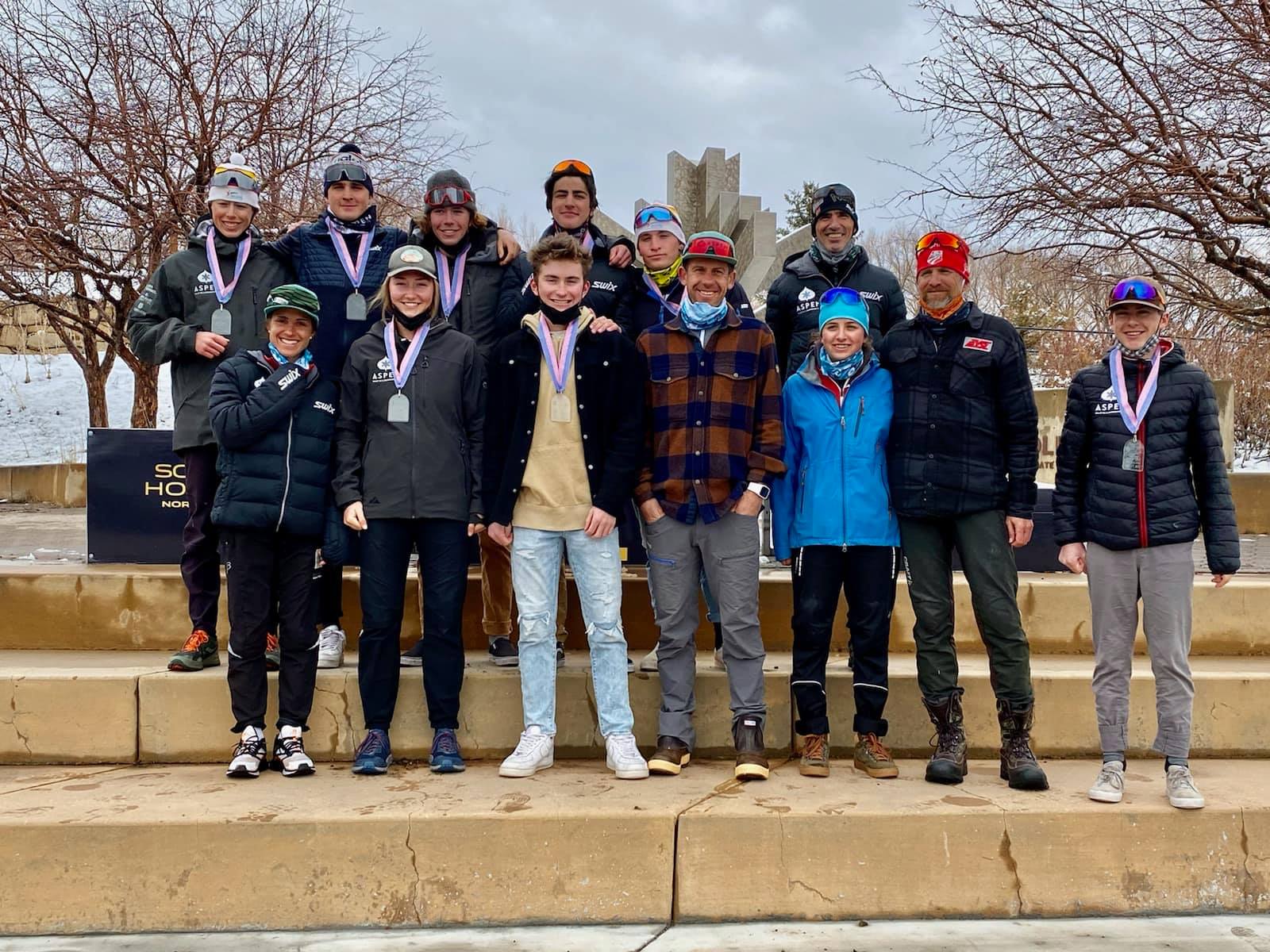
AVSC nordic athletes compete at the Western Regional Championships, held in Soldier Hollow, UT in place of the 2021 Junior National Championships due to the COVID-19 pandemic. (Photo: Aspen Valley Ski and Snowboard Club)
This phenomenon could be attributed to the aforementioned power previously held by larger clubs; when glide testing is no longer a priority, perhaps smaller clubs can finally find a seat at the table.
“We have 14 clubs in the division,” Kapala said of Intermountain. “Last year, 13 of them placed a kid on the Junior National team. Prior to that, we were running more like seven or eight [clubs]. So what was going on was Sun Valley, Bozeman, Jackson, and to some extent Park City – the bigger clubs – were rolling in, and to put it bluntly, we were steamrolling the small programs. It wasn’t a fair fight. And fortunately, the larger clubs in our division say, ‘Clearly, that’s not good for skiing.’”
Kapala spoke specifically of an athlete who hailed from Whitefish, MT, which is “way at the far flung edges of the realm. They’ve gotta drive forever to get to races.”
This athlete raced for the Glacier Nordic Club under the guidance of head coach Jennie Bender, who he described as “a huge asset and we’re so fortunate to have her come to our division.” Clarifying that Bender is as skilled and capable as any other coach on a wax bench, he acknowledged that she was largely on her own at races with roughly 12 kids. This ratio is not equivalent to the SVSEF team which might have 35 kids with five to seven coaches at a JNQ.
“It’s just not a fair fight.”
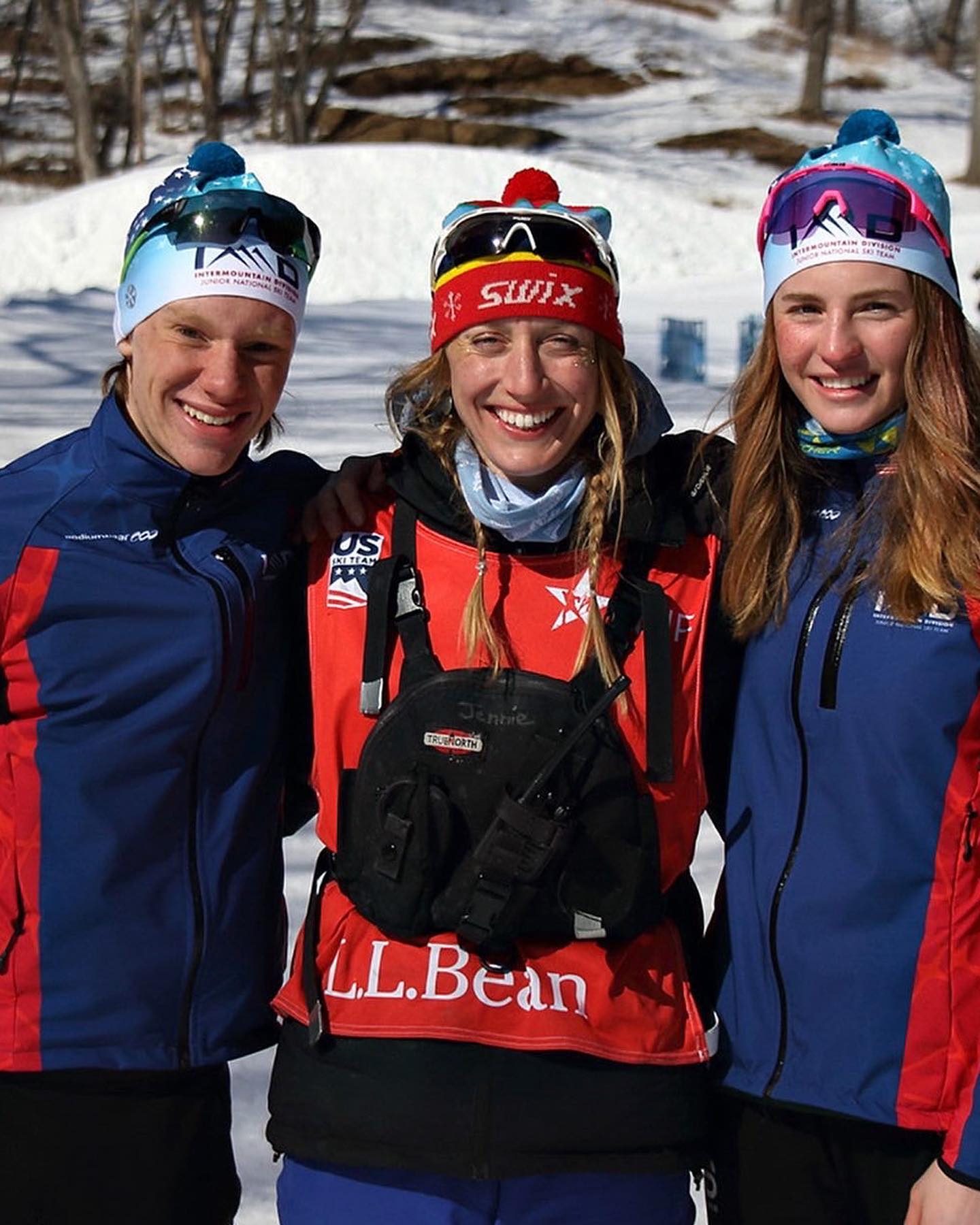
Glacier Nordic Club head coach Jennie Bender with the two athletes, Jacob Hansen and Maeve Ingelfinger, who earned spots on the 2022 Intermountain Division team at Junior Nationals. (Photo: Glacier Nordic Club)
Despite less support on the waxing front, the athlete grew into the season and was regularly finishing between fourth and sixth at JNQs, which earned her a spot on the IMD team at Junior Nationals.
“So what happens is: we go to JNs, we leverage all of the Intermountain resources on behalf of her and the other kids and what does she do? She’s on the podium. And so our policy afforded her the opportunity to at least be in the conversation to make sure she assuredly got through… she was good enough in that setting of fair and equitable ski service, that – what else was going on? She believed. ‘Oh wow. I’m actually not that far away.’”
Once this seed was planted, the athlete thrived. In Kapala’s mind, it’s an intangible, but nonetheless vital, component of the development process for that age group.
“None of this stuff happens in a vacuum, and athlete development is this really, really – I don’t want to say funky – but really nuanced process… This girl has gone from we didn’t even know who she was, to one of the best U16 girls in the country. And I contend that our wax policy, while it wasn’t more important than Jennie’s great coaching, certainly didn’t hurt. She was on a level playing field as level as we can make it in those formative JNQs where she started believing [in herself]. And that’s the whole game.”
Teague also acknowledged the apples-to-oranges capacity of programs, relating it to his experience with the Australian national team, whom he coached and supported through two World Championships surrounding the 2014 Olympics in Sochi. While Australia now typically partners with the U.S. team on the World Cup for waxing, the capacity of this small program pales in comparison to a robust and well-funded nation like Norway, which has been supported by technician Knut Nystad who was quoted in the first two parts of this series. While Teague emphasized his respect for Nystad’s expertise both as a coach and tech, he felt the understanding club level coaches have of the specific challenges of their leagues might offer a different lens with which to consider these issues.
“Knut was my coach [when I was racing collegiately at Denver University], and worked on the Norwegian wax team when I was coaching in Australia. What they were able to do and the testing they were able to do, versus what I could do with Australia – it’s not even comparable. And sometimes we could be competitive with them, but often, they were able to test significantly more. Now, would a waxing protocol make it fair in that situation? Absolutely not. Because they could have every different grind, and a grinder going, and along the continuum.
“But at the high school level, an AVSC can send four coaches over early to test [glide] wax and at least apply wax on site, rather than make a guess. Whereas [a small program like the Colorado Rocky Mountain School (for whom the author is a former head coach)], or even Battle Mountain where there’s two coaches and 70 or 80 kids, there’s no way they could do that.”
An Arms Race for Skis and Grinds
But what about the arms race for equipment that was cited as a concern in the first two installments of this series? Have these policies induced higher demand to increase the size of an athlete’s fleet of skis? Across the board, the coaches with whom this topic was discussed expressed that this was not a trend that they had observed in the years that a policy has been enforced.
Aspen Valley Ski and Snowboard Club head coach August Teague provides insights into the evolution and impact of the Rocky Mountain Nordic Wax Protocol. (Photo: teamavsc.org / Matt Power)
“There are probably exceptions, just like every rule,” said Teague. “But we really aren’t seeing people going out and investing in 30 pairs of skis. We’re still seeing athletes start off with a pair of skate and a pair of classic, and slowly expand upon that fleet.”
Leonard explained that PNSA coaches are not seeing an increase in ski purchasing either, nor does the level of competition at divisional events necessarily warrant that level of specificity in an athletes ski fleet.
“The field density is such at our [JNQs] that the wax is not the deciding factor so much,” Leonard explained regarding clubs in the Pacific Northwest. “And having multiple pairs of skis – most of the kids, I’d say, have one pair of race skate and one pair of race classic and some of the higher-end kids who have been at it a little longer or are a little more involved or or whatever – have a little more means – maybe have a couple pairs of skis that they’re deciding between. But you know, they’re growing kids too, and skis are expensive, so a lot of times it’s sort of like, it’s one pair that fits and one pair that’s a little bit softer from when they were a little smaller a year or two ago. So it’s not such a huge factor.”
Shift in Focus Toward Structure and Ski Selection
While programs aren’t seeing athletes rapidly investing in equipment, coaches did observe a shift in focus toward the application and testing of structure on race day.
“My test fleet, instead of testing glide and structure, is now focused pretty much just on structure at, say, an RMN [race weekend],” Teague explained. “When I show up at Senior Nationals, then I’ve got to be able to test glide and structure and everything else as it unfolds.
“So structure has become more and more important. That probably, again, depends a little bit on the level. If we’re talking about high school kids, there are high school kids that ski club and ski high school, who have the ability to get their skis ground every year and have the ability to have skis that are for specific conditions. But for the most part, we’re talking about kids that own one pair of skate skis, or even don’t own a pair of skate skis and rent or borrow them from the program. And they’re getting whatever [base] is on those and then we’re adjusting the structure by hand structures a little bit to try and improve them.”
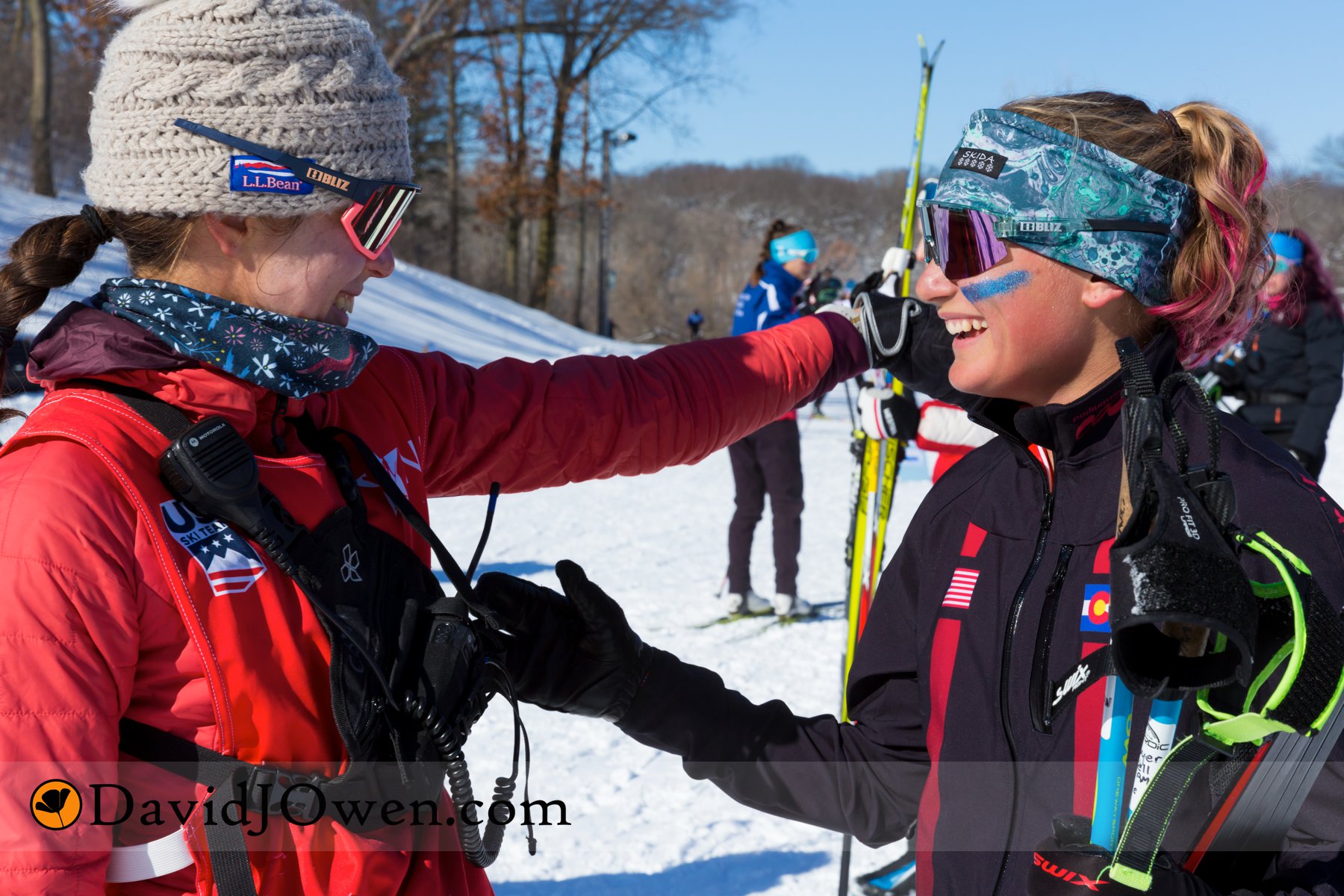
Crested Butte Nordic Team head coach Molly Susla supports athlete Sawyer Ezzell during the 2022 Junior National Championships in Minneapolis. (Photo: David J Owen Photography)
Reception of Wax Protocol Among Teams
As far as how these policies might evolve with time, coaches expressed that the specific brand being used would always be open for discussion, provided that equivalent availability could be guaranteed and cost per gram remained comparable. With the increase in liquid waxes, which might offer versatility on race day without the encumberment of the full glide waxing setup, there may be an evolution that includes more liquid wax options as well.
For the time being, coaches expressed that the addition of these protocols has been net-positive, with no member clubs looking to steer the trajectory back toward open waxing.
“We’re at least two years through this experiment of running this policy,” said Kapala for IMD. “And I am 100% certain, because I’ve asked… we have 14 clubs that are saying, ‘No way are we going back.’ There is uniform agreement and acceptance of the policy.”
In Leonard’s concluding statements, he acknowledged the inherent equipment-based inequity in the sport, while also offering ways to problem solve, and confirming that PNSA has also been well-served by the protocol.
“You might get beaten at some point by someone who has better skis than you or something like that,” he said. “And when that becomes a factor, you figure out a way to make it work. With the advent of zeros, for instance, suddenly those became a ski that was like – in those conditions, man, you needed to have that. When I was in Alaska, teams were starting to procure fleets of zeros that they could hand out to their kids and maybe rotate through a few kids on a given race day. [Now,] if we have a race coming up that we know is potentially a zero day, we’re working through our community [in the Methow Valley] to grab some zeros for our kids so hopefully, they have a decent option there.
“So there are ways to make those things happen and work, and hopefully still remain competitive in the sport. There are a lot of trade-offs with all of it, but people are feeling like, for our division right now, it has been a good decision to go this direction.”
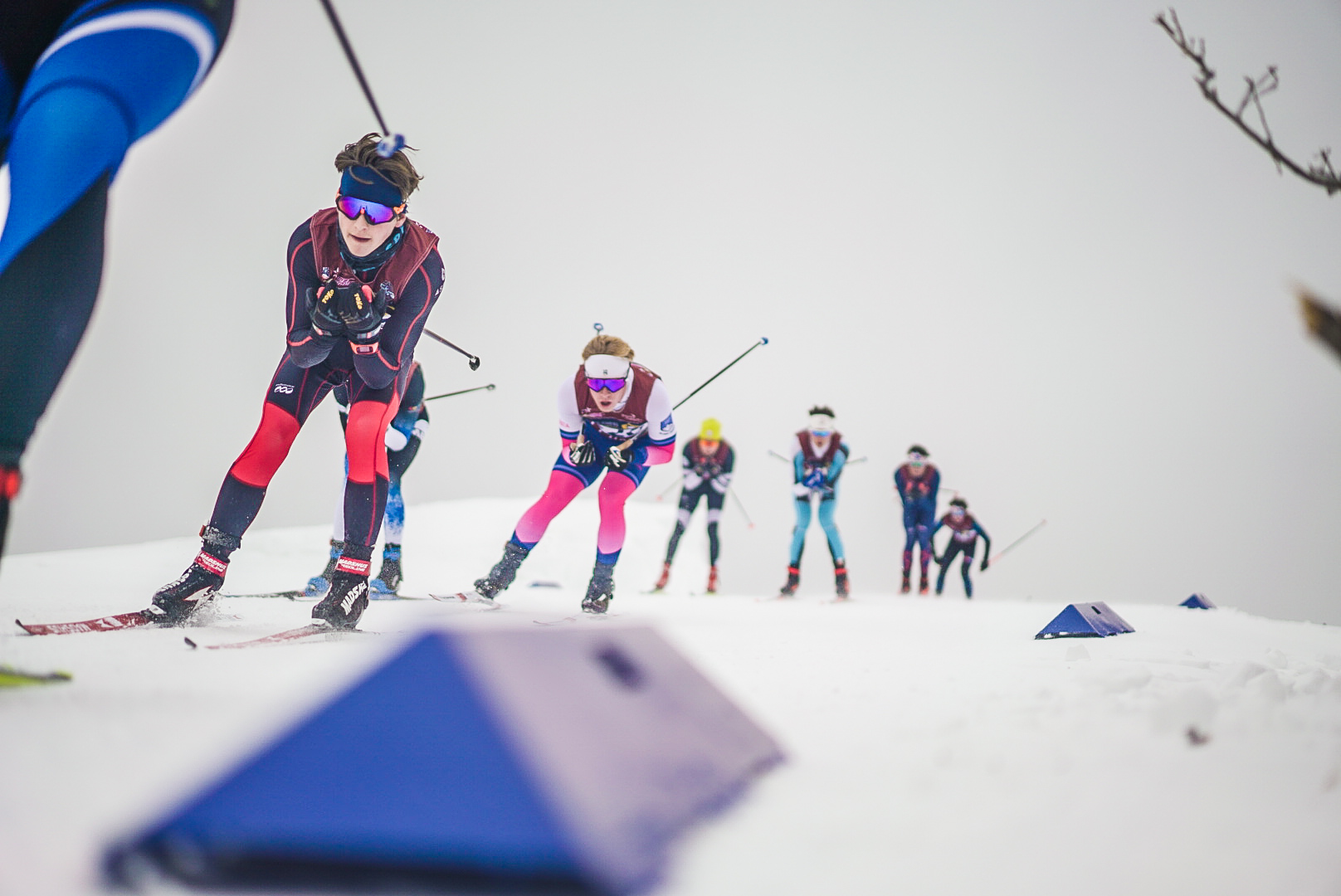
Junior athletes race during the 2022 U.S. Cross Country Championships in Soldier Hollow, UT. (Photo: Tobias Albrigtsen / @untraceableg)
In speaking with representatives from each of the leagues featured in this series, a few main points rose to the foreground in this discussion: the level of competition matters, how the policy came about matters, and how a program can enhance athlete support holistically by relieving wax-related expenses – measured both in time and dollars – matters.
Also note that these conversations took place in late-April, prior to further discussions at the U.S. Ski & Snowboard spring congress sessions in May where subsequent conversations among leadership may have occurred. Should significant changes occur, FasterSkier will continue to follow the story.
Here are links to earlier installments in this five-part series. The first two parts (part one; part two) spoke to the perspectives of high level wax technicians and industry representatives, while part three focused on the Wisconsin Nordic Ski League.
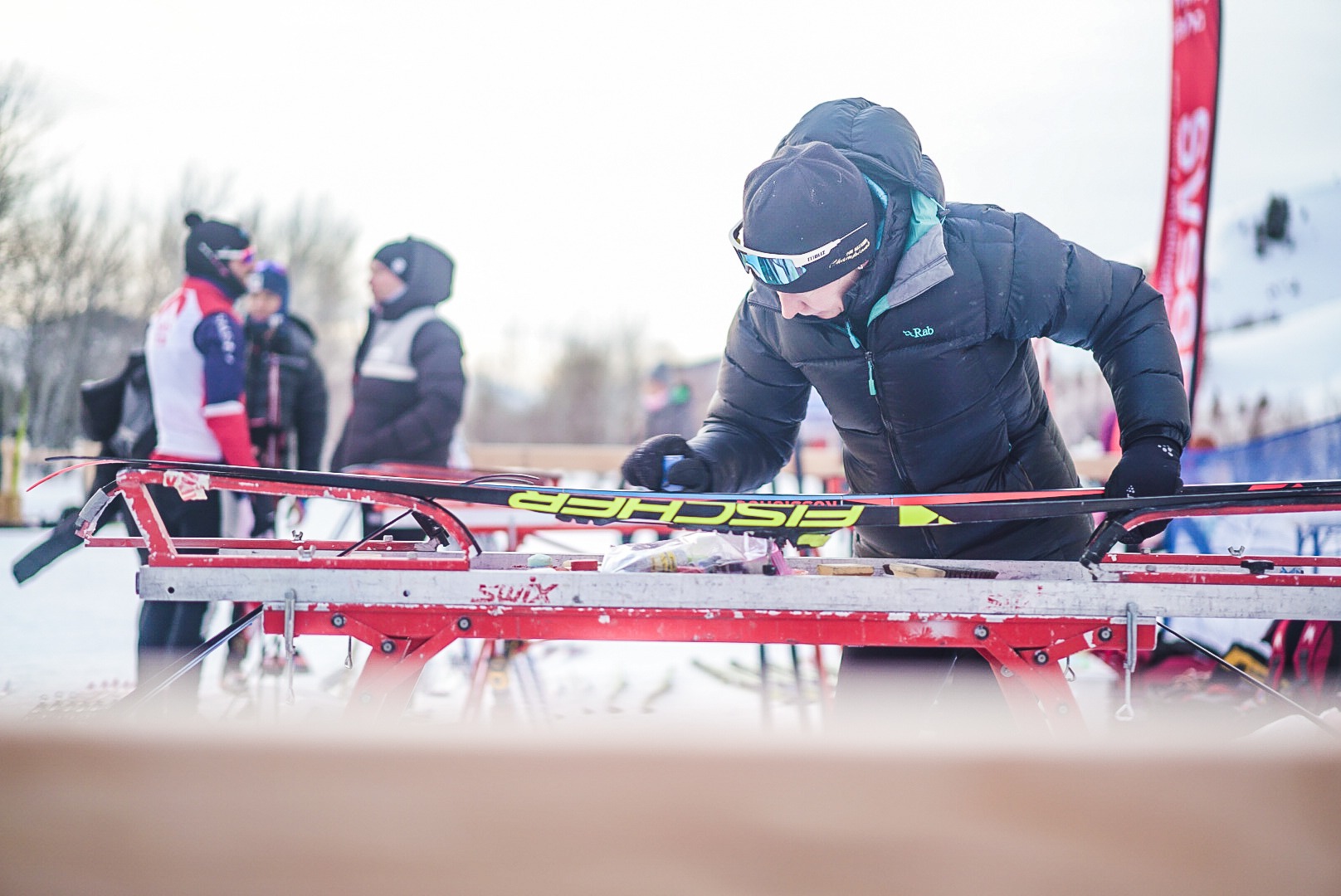
University of Colorado head coach Jana Weinberger waxes skis for her athletes during an 2022 RMISA/US SuperTour race weekend in Sun Valley. (Photo: Tobias Albrigtsen / @untraceableg)
The Evolution of Western Club Wax-Protocols
There’s a lot to unpack surrounding the impact of wax policies on the sport, and it is not reasonable to project that what makes sense for junior club programs can be extrapolated to the sport as a whole, which includes everything from the recreational level to masters racing to the World Cup. However, as a major player in the U.S. development pathway and a collective that encompasses a large volume of the nation’s athlete base, considering the evolution and impact of wax policies at the club level provides valuable insight into what the objectives and outcomes may be more broadly.
Conversations on this subject began long before any official policies were accepted, and their initial aim was to uniformly address the use of fluorocarbons at Junior National Qualifiers (JNQs). With both the health of athletes and coaches, and the inequity of buying power among clubs, the goal was to reduce spending and expensive fluorinated top coats.
Timelines are now blurred, but long-time Sun Valley Ski Education Foundation Program Director Rick Kapala indicated that Rocky Mountain had perhaps been the division who got the ball rolling. Though the policies have since converged on a single wax call made in advance by host coaches depending on forecasted conditions, Kapala explained that at the onset, Intermountain’s policy was only focused on the elimination of pure fluoros.
Long-time SVSEF XC Program Director Rick Kapala explains the evolution and impact of IMD’s wax protocol. (Photo: SVSEF.org)
“Initially, Intermountain had what we could call ‘wax policy-lite’… Our policy was: you can use any wax as long as it wasn’t pure-fluoro. You can use a high-fluoro, a low-flouro, or non-fluorinated version, and of course, in different brands, that meant different things. But basically, we went for a number of years with a no powder, no liquid and no rub-on policy. And that had some effect on trying to mitigate the arms race, if you will.”
Executive Director at Methow Valley Ski Education Foundation Pete Leonard explained that the Pacific Northwest Ski Association, for whom he is the Nordic Director, was developed with a similar progression.
“It initially started in the fluorocarbon era, moving away from powdering skis to just having blocks and liquids – the top coat type of applications – and then to a base paraffin application… I think we had a year of that and then [the policy] went to fluoro-free – the same basic, simple base paraffin called several days out.”
Further motivation to align policies stemmed from “cross-pollination” between these three leagues, which with the addition of the California-Nevada Far West division and Alaska, encompass the Western region as defined by U.S. Ski & Snowboard. In particular, these divisions overlap during the Junior National Super Qualifier Event held in January at Soldier Hollow, hence landing on a very similar model.
“There’s a little bit of a cascade effect, and it’s just simpler for us to match what IMD has,” Leonard explained.
Kapala felt strongly that it was important to emphasize that this slow progression happened organically, which he felt was in stark contrast to the Wisconsin Nordic Ski League, where a sponsorship proposal made by a corporate entity included stipulations on waxing at league events.
“It’s a wholly different thing when a grassroots community, like a bunch of clubs in a division, promulgates a policy that they think results in the best athletic outcomes,” he said. “And it is very important to differentiate the genesis of a given policy… the order in which you arrive at a policy really informs a lot of the motivations about why you’re doing what you’re doing.”
Kapala said IMD would have “given the Heisman” to a wax company that required a policy; however, Swix products have been selected based on trust in the availability for all programs.
“We settled on Swix without getting into the specifics of brand value,” he said. “I.e., Swix is better than Start, and Start is better than Toko, or whatever – it’s just simply because virtually everybody knew they had enough access to that wax.”
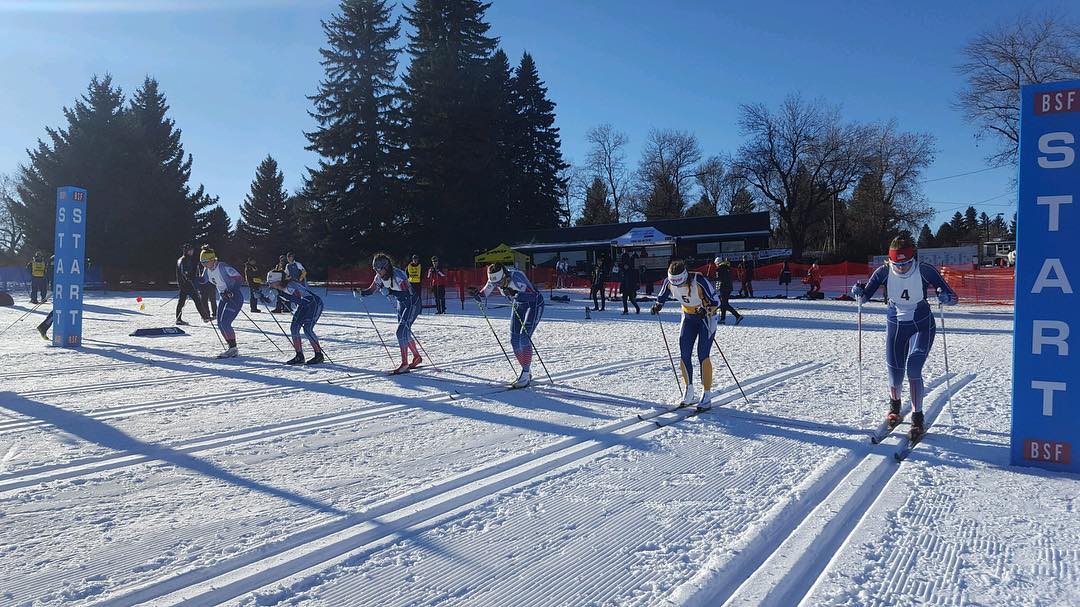
A scene from the start line of a 2018 Intermountain JNQ in Bozeman, MT. (Photo: Sun Valley Ski Education Foundation Facebook)
Observed Program Benefits
There’s a sizable jump between eliminating fluoros and further reducing a wax box to a small array of products, but Kapala emphasized that these “athletic outcomes” are the central tenet around which discussions regarding changes take place within Intermountain. How does the protocol impact the opportunity and capacity for athletes from clubs of all sizes to be successful on race day and have a positive experience in the sport?
We’ll start with the impact to a program’s budget, which on its own is a source of inequality among clubs in a given region. Speaking specifically for Intermountain, but also the West more broadly, Kapala pointed out that there are a number of “super clubs” whose financial means and staff power made it hard for smaller clubs to compete in an open wax environment.
“They’re usually clubs that are in these mountain towns that are part of [larger] ski foundations or clubs that are multi-discipline, really big clubs. And so they have a lot of administrative function, a lot of underpinning financial security, and so on.”
He was quick to include SVSEF in that pool, saying cost was not a primary concern when it came to his wax purchasing or race staffing prior to the enactment of IMD’s policy.
He went on to explain that within Intermountain, there are six JNQs which are subject to the wax policy, plus an Intermountain opener. However, what he called the “lion’s share” of races, including U.S. Nationals, SuperTours, and any Canadian-based races, remain open wax events where the policy does not apply. Still, with IMD’s policy in place, Kapala said SVSEF has been able to shave $5,000 dollars annually off its spending on wax, equating to a reduction of 30-40%.
“The question then is: ‘What am I doing with that $5,000?’” posed Kapala. “Well, what I’m really doing with it now, in my particular case, we have put that money into our merit scholarship program. So instead of me spending money on just making sure I have every wax in the universe in my wax box, I’m actually leveraging those dollars to help kids get to training camps or to go to competitions they wouldn’t normally be able to afford. And that’s huge.”
Rather than ignoring the impact this reduction in spending has on the landscape for suppliers, he acknowledged that this could be detrimental, as other clubs are likely reducing their spending by similar percentages. But bringing the focus back to the athletes, he said, “what we’re really spending less of is human capital on things other than coaching.”
For Kapala, this makes the cost-benefit analysis check out.
“We think being available to coach kids – that are especially young in their developmental process – at events like JNQs, is actually what the [coaching] game should be all about. So while it’s true that there can be impacts regarding the finances, it is also undoubtedly true that athletic outcomes – true athletic outcomes, the actual ones that we should be concerned about – are actually being serviced way more effectively. And if those two competing interests are both true, we have to pick one. And the one we’re picking is we’re making it more fair for athletes.”
August Teague supports AVSC alumna Kate Oldham while teching at the 2022 FIS World Junior Ski Championships in Lygna, NOR. (Photo: flyingpointroad.com)
Speaking for what he has observed within his own program and the Rocky Mountain Nordic division more broadly, August Teague – Cross-country Program Director at the Aspen Valley Ski and Snowboard Club (AVSC) – shared similar sentiments.
“I guess the real question to me becomes: ‘What is the purpose of a waxing protocol and at what level and why? And I certainly believe that barriers to entry in sport are a real good reason to have a waxing protocol, and time allocation or time management.”
Adding specificity to the statement, he said, “The biggest thing that I see is that I can spend more time coaching instead of teching. And there certainly is an argument as to the need for better wax techs both from this country and elsewhere, but I think that’s a separate discussion than the coaching discussion and where my time is best served.”
While the AVSC nordic program is significantly smaller than that of SVSEF, Teague also noted differences in how his monetary budget is allocated. “We have started to explore structures more than we ever have. So money that was being spent on product is now being spent on different structure devices and/or ways to test that structure.”
Similarly, Steamboat Winter Sports Club U16/U18/U20 head coach Josh Smullin wrote to FasterSkier that the protocol has supported a safer environment for both coaches and athletes while on the road. In particular, he cited driving – there are roughly 3,200 serious injuries and 600 fatalities on average annually in Colorado – as a place where some relief in the toll on coaches during a race weekend has shown value.
“It used to be that we coaches were up late waxing,” he explained. “Waking up the next morning to go set up at the venue, and then would drive many hours home after the race. A waxing protocol has helped us to be safer drivers, less sleep deprived, and more present with the athletes.”
Smullin also commented on ventilation, which remains important for the health of waxers even without fluorinated products.
“At many of our home clubs we have some sort of ventilated wax facility. We do not have that on the road [while staying in hotels] unless the weather is nice and we are able to wax outside. Regardless of the fluoro ban, [proper] ventilation is healthier for coaches and athletes.”
Methow Valley Nordic skiers take to the course during the December 2021 Ski Rodeo event. (Photo: Methow Valley Nordic Ski Education Foundation Facebook)
“Everybody’s got their opinion…” said Leonard on behalf of PNSA. “There’s no overarching study on these things, and costs, and whether there’s a major difference [in ski speed], but I think what is clear to the coaches is that there’s less time spent testing glide products at races and there’s less of an incentive to do that, especially with the calling it [a few days] prior. There’s also more time that they can focus during that weekend on other things, like with the athletes and their preparation, instead of testing wax, waxing skis and leaving [coaching and direct athlete support] right up to the race time.”
For Leonard, the question of whether the policy widens the gap for skiers based on the quality or condition specificity of their skis was not a priority when it came to identifying how the policy has served PNSA teams. For a club based in the Methow Valley which travels to regional competitions across Oregon and Washington, as well as to the Super Qualifier in Utah, the policy has reduced the toll of travel.
“I don’t know that it’s necessarily a parity – it’s really difficult to get that down.. but I think for us, calling the wax several days out just makes it simpler for people, and there is less [equipment and product] to travel with, one less thing to think about when you’re booking hotels, and all those details. It makes it simpler for teams.”
He said he has also found it quicker and easier to apply structure on race day without the variable of glide wax testing. And without the need to cart around as much product and equipment, getting his athletes’ skis race ready has been “way easier to manage”.
“Rather than bringing a wax box with several waxes in it, irons, enough benches that you can get your whole team through, scrapers, brushes, etc. – already, you’re packing the van to the ceiling and then, sometimes it’s driving eight hours, or for the Super Q for us, it’s driving four hours to the airport, [hauling our skis and gear through the airport on both ends], then driving another hour-plus to SoHo, and then doing it all again on the way back.”
Stay tuned for the final installment, where you can read more on leveling the playing field, the arms race (or lack thereof) for skis, and the reception among Western Division coaches.
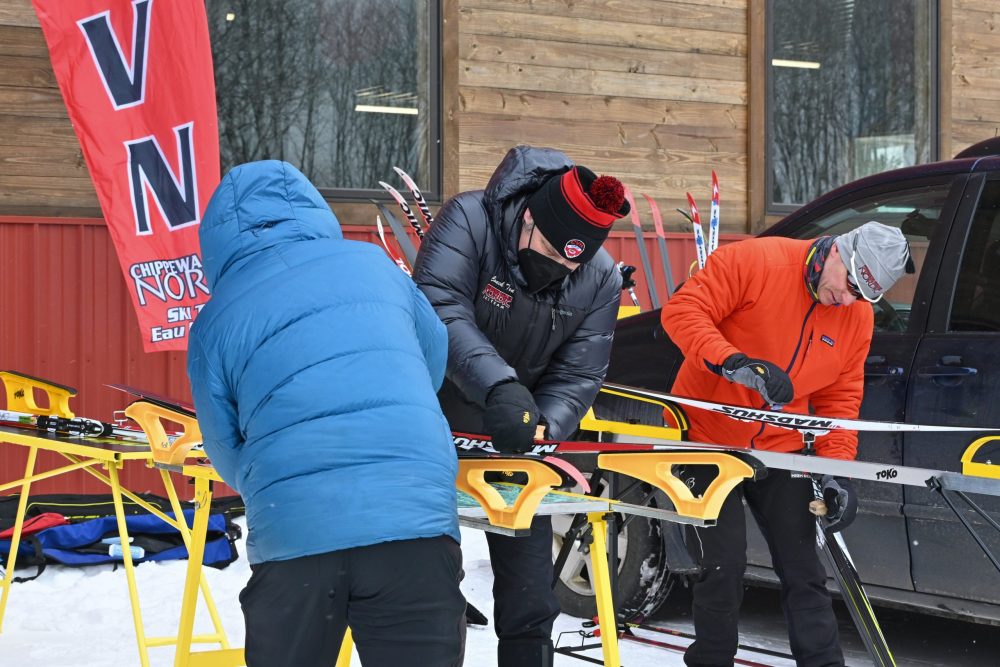
Chippewa Valley Nordic coaches prep classic skis for their athletes at the 2022 Wisconsin Northern Conference meet. (Photo: Chippewa Valley Nordic)
In case you missed it, here’s part 1 and part 2 of this series, in which industry representatives and expert ski technicians discuss ski performance theory and what impact a single-wax policy may have on competitive skiing.
What goes on inside the wax cabins and trucks at high-level competitions from the SuperTour to the World Cup seems, in equal parts, expertise, artistry, and alchemy. And, for those looking to understand to which conditions their pair of race skis might be best suited, the basic insights into ski performance provided in previous installments of this story provide ample fodder for consideration and experimentation on the ski track.
However, these insights may not fully resonate at a meet where coaches are furiously corking in kick wax on benches set in the snow for skiers who only recently took up the sport. Or a league which simultaneously supports competitive racers and participation-based programs, and ultimately just wishes to see the sport grow and thrive at all levels.
In speaking with representatives from leagues that have implemented a single-wax protocol, it is clear that there are a myriad of factors involved in the decision making process beyond ski performance theory that might skew the cost-benefit analysis on any inequity in ski speed derived from putting all racers on Swix HS6.
Ben Popp – executive director at the American Birkebeiner Ski Foundation, Wisconsin Nordic Ski League President, and volunteer coach – discusses the wax policy and sponsorship package accepted by the league this season. (Photo: American Birkebeiner Ski Foundation)
To unpack the counterpoints, we’ll begin again in Wisconsin, with a conversation with American Birkebeiner Ski Foundation Executive Director Ben Popp, who also sits as president of the Wisconsin Nordic Ski League (WNSL) and is a volunteer ski coach for the youth program in Spooner, 30 miles southeast of the Birkie finish line in Hayward.
Before jumping into the conversation, a nuanced reminder to readers that will be revisited in subsequent stories: the WNSL wax policy is unique in that the policy was included in a sponsorship proposal from Swix, which offered the league $10,000 per year over a three year period. Under the policy, all athletes would race on Swix HS5, HS6, or HS7 hard wax in cold or moderate temperatures, with HS7 and HS8 liquids used in warmer conditions. In other leagues, there may be special pricing available through this manufacturer, but this was not the origin of the policy.
In what the single-wax policy implies: rather than spending money on a robust wax box, programs would only need to purchase the five aforementioned products for glide. The event hosts determine which wax is most appropriate for the conditions a few days prior to the race, allowing coaches and athletes to wax their skis accordingly before travel.
While questions of the financial impact on other wax manufacturers and the loss of experience for developing high-level wax technicians remain present, it’s also worth noting that this policy only applies to events that are organized by the WNSL; this small list of events includes only the northern, central, and southern conference meets, and the Wisconsin state championship – two races per year for each club or school. Regional Junior National Qualifiers (JNQs) and other local events not organized by the league remain open. Simply put, the wax protocol only applies to what Popp described as “a sliver of all of Wisconsin skiing.”
According to Popp, in considering the proposal presented by Swix, there was one key word on the minds of WNSL board members: opportunity.
“The checkbook for the Wisconsin Nordic league, before this year, never had more than $2,000 in it,” he stated matter-of-factly in the call.
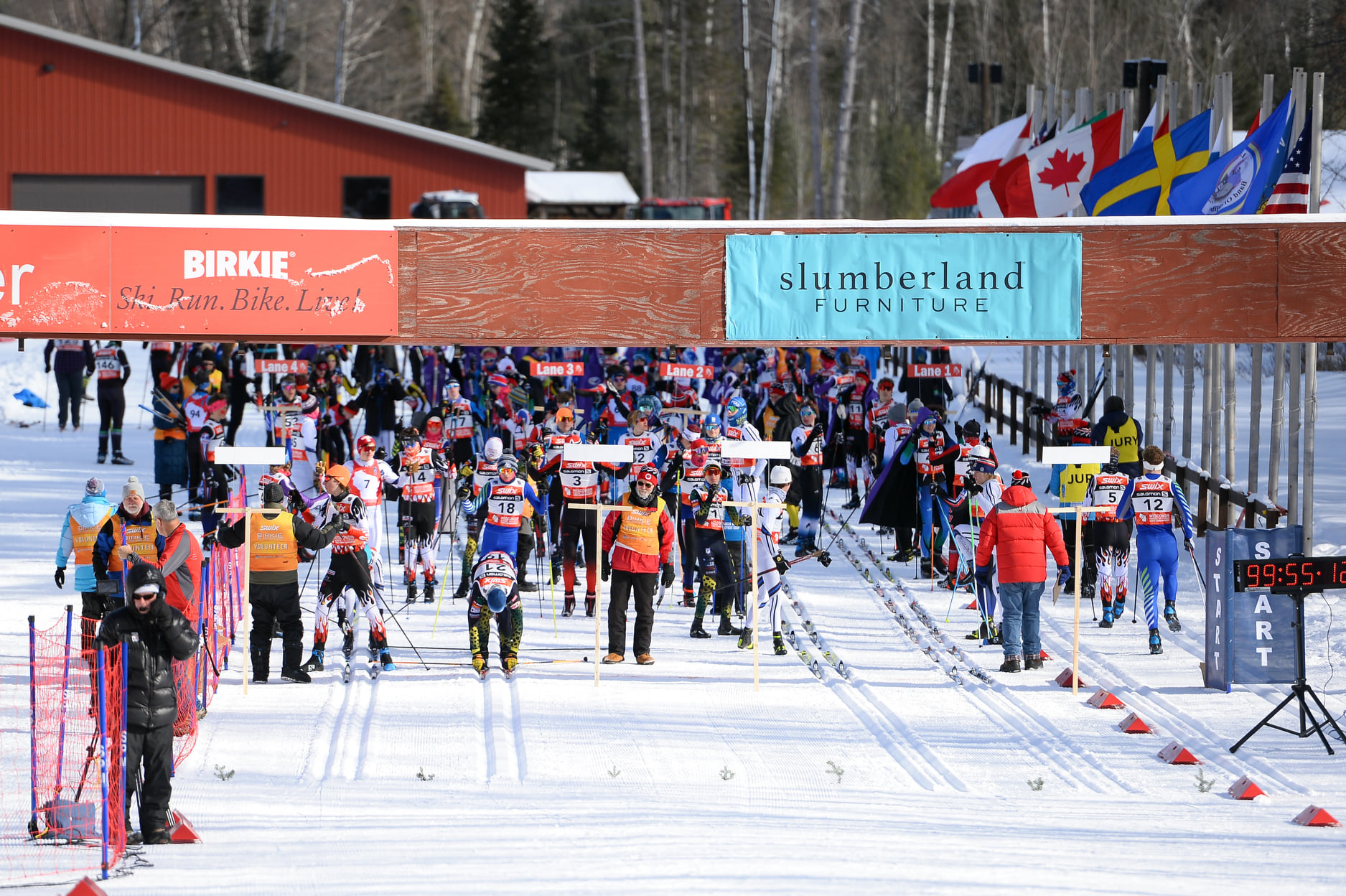
Wisconsin skiers line up at the Birkie Trailhead in Cable for the state championships. (Photo: Once in a Blue Moon Studio / Kelly Randolph Photography)
Another key distinction is that the state of Wisconsin is among the few remaining states in which high school and club level programming fall under the same umbrella, without financial support from the high schools that offer skiing. This means small participation-based programs with volunteer coaches compete against well-established clubs who can support kids whose goals extend to representing the Great Lakes Division at Junior Nationals; it’s a state of vastly different programs with vastly different budgets. And it stands in contrast to Wisconsin’s neighbor, Minnesota, with whom Wisconsin used to compete against for spots on the Midwest regional team for JNs. It’s a nuanced structure that Popp explained has constrained the potential of the league historically.
“Even though the league has been around for a while, I think it’s still in its real infancy. It’s completely volunteer run, but yet we’re in a climate that has metropolitan areas where there is snow, so we’ve got a ton of opportunity. But I think we have to look at, ‘How can we start to grow the league?’”
Under the constraints of the previous budget, the WNSL was limited in its ability to promote development in programming state-wide, and Popp explained that primarily, the board only planned the state meet and agreed upon its rules. That leaves little room for supporting new teams, planning summer camps, and other initiatives that might grow the league and the sport more broadly. A 500% increase in funds would allow the WNSL to hire a part-time administrator, who could improve inter-team communication, oversee a league schedule, and perhaps most importantly, continue fundraising initiatives to support broader development.
“Our goal is to create opportunities for kids to cross country ski and race in the state of Wisconsin. So we have to look at, ‘What is the best way we can do that?’ And we’ve been doing the same thing for a long time, and we’ve gotten the same result. So if we now say, ‘We want to grow the sport in our state’, I think we have to look at a variety of options. We see what the results are in a couple years, and then we’ll readjust from there.”
Athletes from Rhinelander, WI compete at the frosty state championship meet in Cable. (Photo: Rhinelander Nordic Ski Team)
While the WNSL is interested in supporting the upper tiers of youth racing, Popp explained that the main objectives remain at the participation level: improving access to ski programming and helping get more kids on skis.
“I feel that we don’t necessarily have to focus on the high end of development. I think that happens organically and naturally rises… the bigger and broader a base that we can build, it’s just going to build that up much higher of a pyramid.”
In his mind, implementing a wax policy fits with this initiative by removing a potential hurdle for smaller teams and coaches with limited background knowledge.
“In making it simple [to wax], it really makes a small team, the newer teams – it lowers the barrier to entry a little bit. Like, ‘Okay, now, me as a new coach, or as a new team, this waxing thing isn’t quite as overwhelming and doesn’t seem like such a heavy lift that I can actually now get into this without being completely overwhelmed.’ So I look at it as a tool for trying to create growth at the very basic level for newer teams.”
As the Swix sponsorship proposal was accepted in November 2021, last season was the first in which the conference and state championships operated under the wax policy. Popp reflected on the impact of the sponsorship and protocol through the first year.
“I personally think it was beneficial. Obviously, it helped from a sponsorship standpoint to help us grow our league and invest back in the skiers of Wisconsin. Again, personally, I think it helps sort of lower that barrier to entry for some of the newer and inexperienced teams. And whether it does or does not make it fair or unfair, if you will, to the skiers – I think you’re always going to have that in some way, shape or form. There’s a reason skiing is going to be different than track… there’s always going to be a set of variables.”
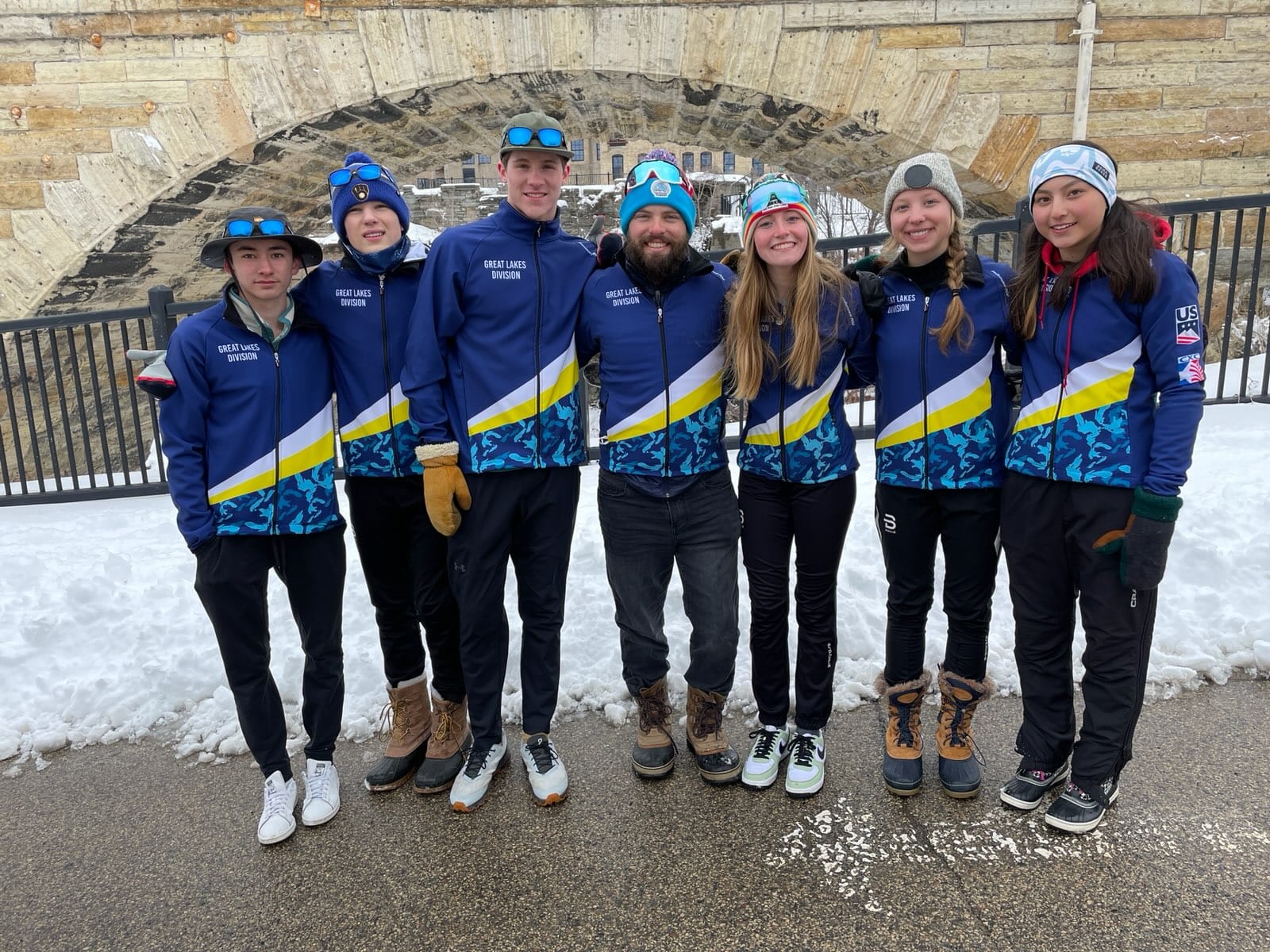
Chippewa Valley Nordic skiers compete for the Great Lakes division team at the 2022 Junior National Championships in Minneapolis, MN. (Photo: Chippewa Valley Nordic)
Speaking to the reception of the policy more broadly by WNSL teams, Popp expressed it was “overwhelmingly supported”. He indicated that a of the larger programs who had already put together well-equipped wax boxes were reluctant initially, but ultimately, those teams were still taking athletes to JNQs and other events where those waxes were fair game, so they would not go to waste.
Mostly, Popp felt that the results seen at the WNSL championship events were as expected, indicating that the wax call likely had minimal impact on the race outcomes.
“Because it was relatively benign in terms of the amount of races [where it was enforced], and then two: there weren’t some funky results at the state meet or the conference meets where [the policy was] used – the best kids still won, so there were no surprising results. And because the amount of wax that people had to buy and the cost level of it was really pretty low – I think the benefit of what this can bring in the future, ‘Let’s see.’ I would say the coaches that I’ve talked to certainly felt like, as a whole, it wasn’t detrimental. And if it leads to some growth and benefit for us in the league in the coming years then… we’ll just have to see.”
Stay tuned for the next aspect of the league-wide wax protocol story, where we consider the evolution and outcomes of policies enacted at the club level by the Rocky Mountain Nordic (RMN), Pacific Northwest Ski Association (PNSA), and Intermountain Division (IMD).
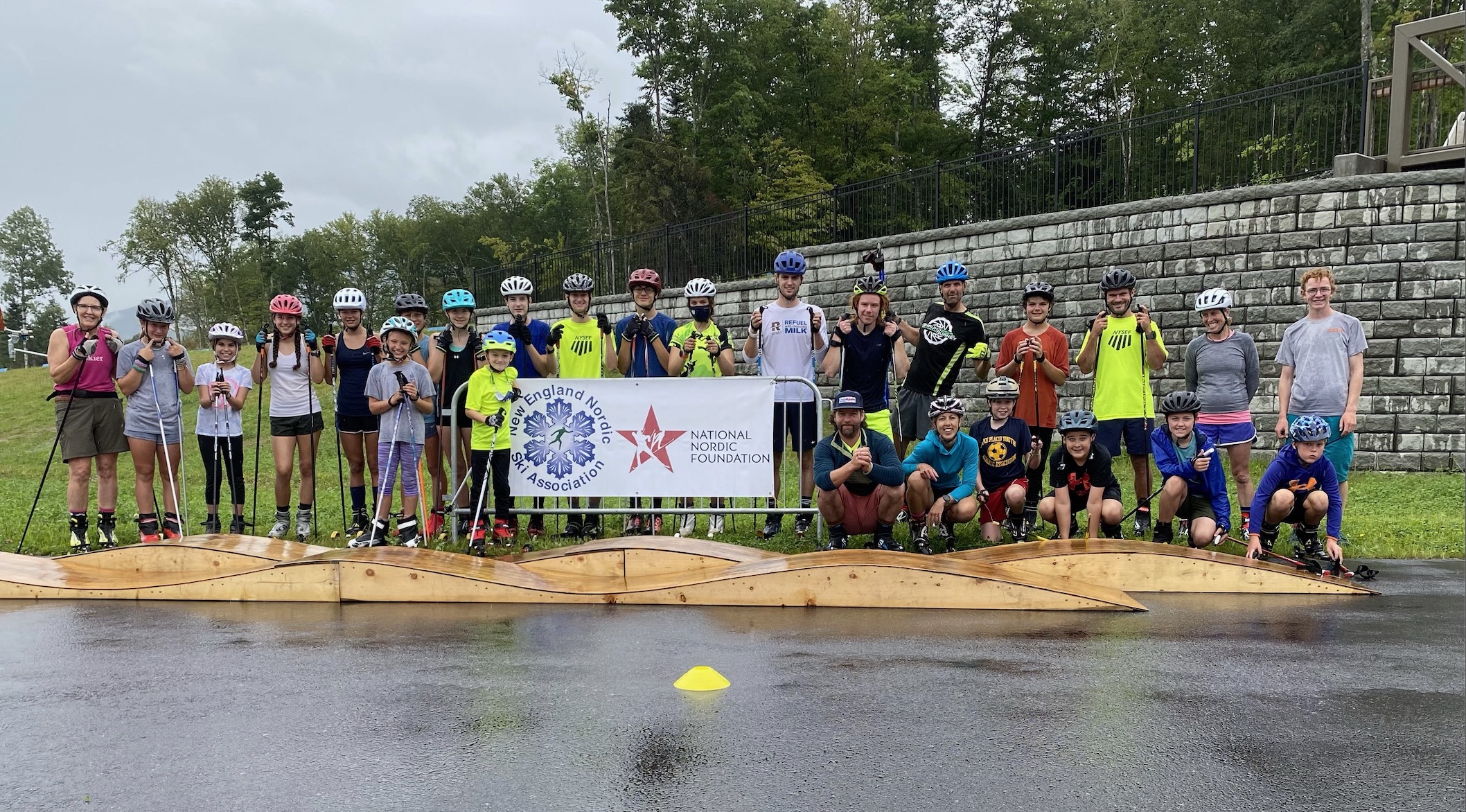
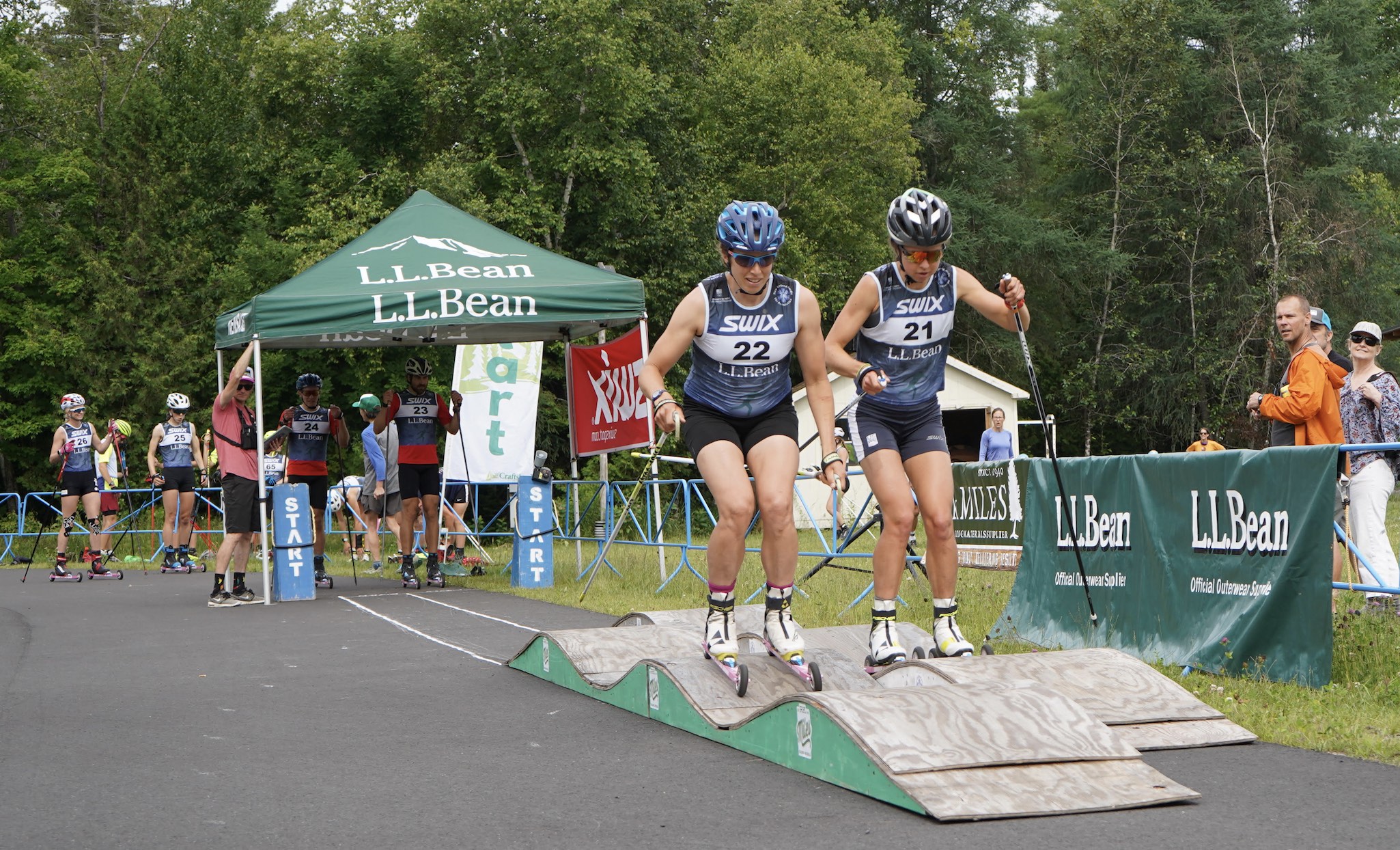
Jessie Diggins takes a first crack at NENSA’s rollerski ramps, which will be featured in the sprint qualifier and rounds in Lake Placid this weekend. (Courtesy photo)
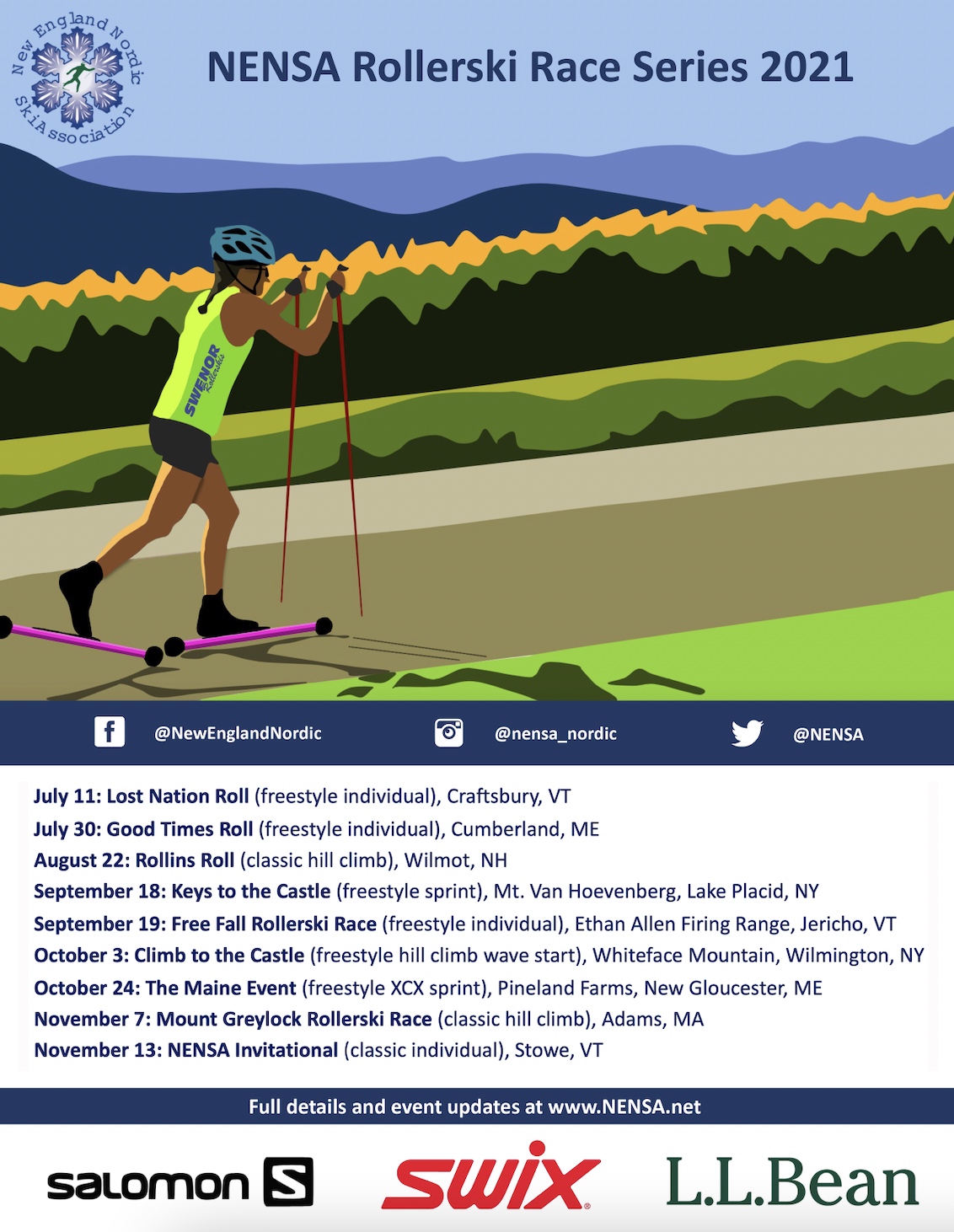
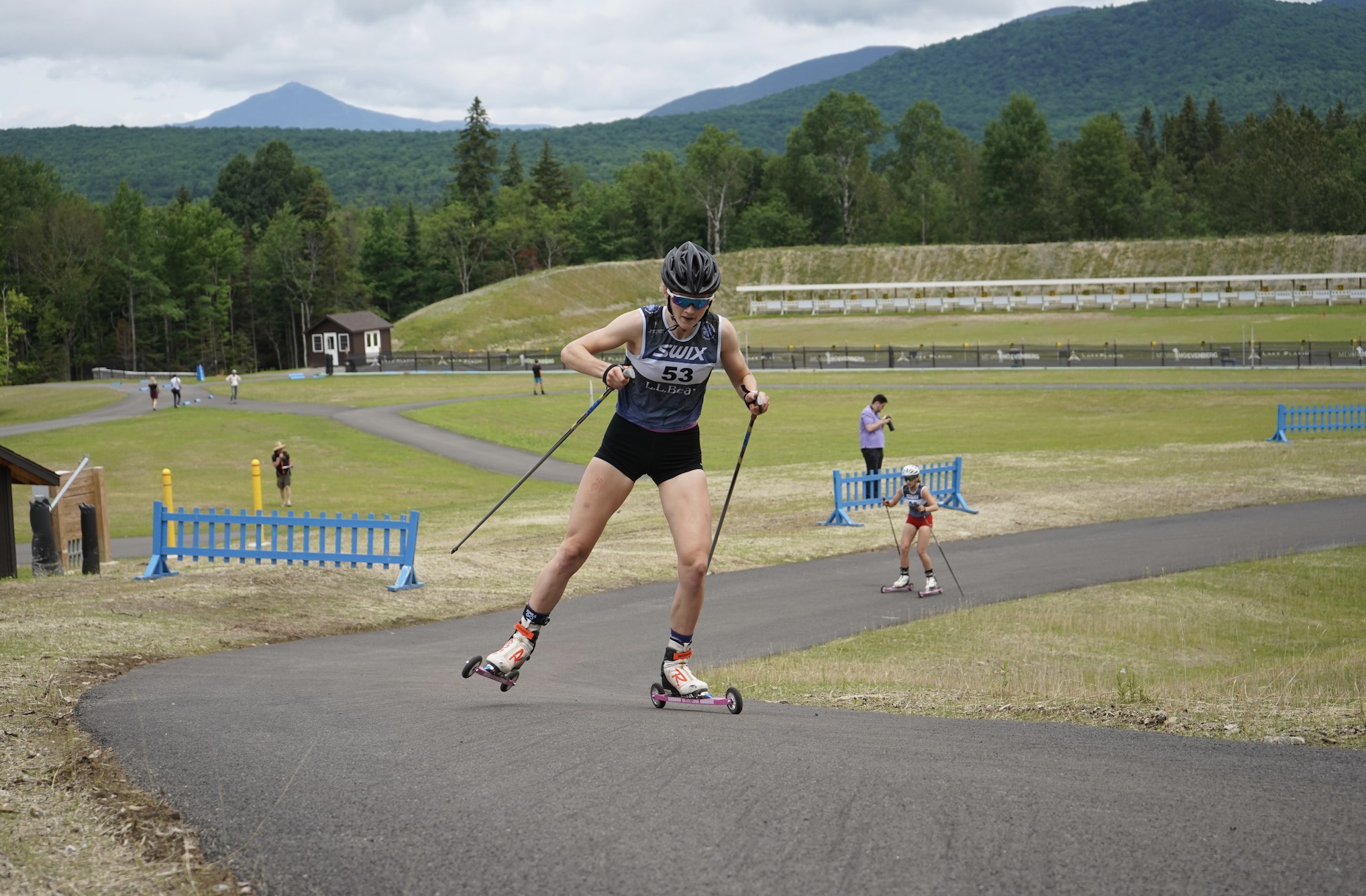
On the heels of our coverage of the Martin Fourcade Nordic Festival and the Alliansloppet Action Week, we turn our attention to the Northeast where the burgeoning New England Nordic Ski Association (NENSA) rollerski race series is well underway. The next round of racing will take place this upcoming weekend, starting with a freestyle sprint event dubbed “The Keys to the Castle” on September 18th at Mt. Van Hoevenberg in Lake Placid, NY, followed by a freestyle distance race the on the rollerski track in Jericho, VT the next day. Men and women will each race 15-kilometers in the open division, while juniors will have the option to race 5k.
For those interested in seeing the show, in-person spectating is encouraged at the Lake Placid stage, however, as the ski track in Jericho is at a Vermont National Guard base, names must be submitted for entry prior to the event. Events will also be live-streamed on the NENSA Facebook Page, and live timing will be available through Bullitt Timing. Updated COVID considerations for participants and community members can be found here.
Building from past years, the series features nine events beginning with the Lost Nation Roll in Craftsbury, VT in July and ending in mid-November with the NENSA Invitational in Stowe. Captaining the ship and still rocking the mullet-mustache combo is competitive programs director Justin Beckwith, with whom FasterSkier connected in mid-August to learn more about this year’s widened scope of event offerings, supporting a thriving culture of skiing in the region, and whether the dream of a New York City rollerski event is still alive.
Beckwith explained in the call that one of NENSA’s objectives as the rollerski series evolves is to reach more athletes and to make opportunities for rollerski racing more accessible. Given the high density of cross country skiers and high level clubs in Vermont, the well-attended and highly competitive App Gap Challenge, and the designated rollerski tracks in Craftsbury and Jericho, past events have primarily taken place in that state. However, these venues can be quite a drive for skiers living in Western Massachusetts, New Hampshire, or Maine.
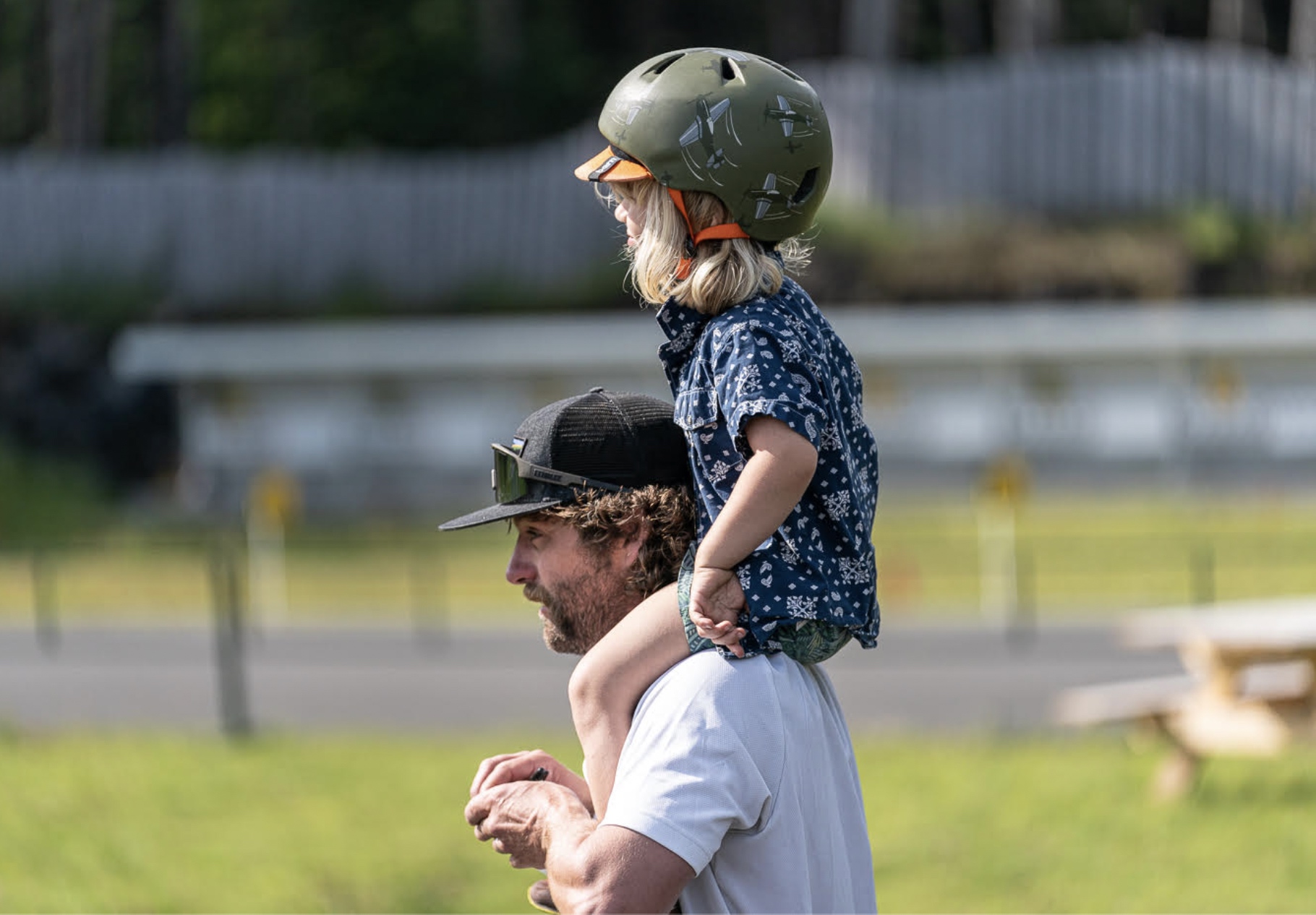
NENSA Competitive Programs Director and rollerski race series organizer Justin Beckwith with his son, Red, at an event in Craftsbury. (NENSA photo)
One of the first steps to expanding opportunity in the region? Outreach. Rather than bringing more people to Vermont, bringing the races to the people.
“One of the primary goals was to try and bring our programming across the entire Eastern region,” Beckwith said. “So we’ve done a race in Southern Maine, which Clare Egan so eloquently said at awards that she doesn’t think anyone’s had a rollerski race in Southern Maine before. And just this weekend, we’re going over to New Hampshire. It will be the first event we’ve done in New Hampshire on rollerskis. So that’s really cool.”
The first event he mentioned — the Good Times Roll in Cumberland, ME in collaboration with NonStop Nordic — featured a 4.3k freestyle race for Middle School and beginners, and a 7.5k open race on a closed roadway. The start and an agility course took place inside the Cumberland Fairgrounds. The second stage, The Rollins Roll in Warren, NH, led classic skiers up the Mt Kearsarge auto road, which was closed during the event. Bringing together the community, both events saw participants from the junior level through the 50+ age bracket.
In the Lost Nation Roll, which was co-hosted with the Craftsbury Outdoor Center, youth skiers had the opportunity to race the same course as elite athletes from the Craftsbury Green Racing Project (GRP) whom they admire. Likewise, the GRP athletes had the opportunity to ski their home track with outside stimulation. This event was followed by a learn-to-rollerski clinic and a free biathlon clinic to bring in additional members of the community who were not up for racing or wanted to learn more about shooting.
Now, midway through the series, the events are catered more toward the top juniors and seniors in the region, though some are still open to all levels. Beckwith explained that NENSA was “lucky” to have such a high density of top skiers in the area, including regional high-performance junior clubs, elite teams like SMS T2 and the Craftsbury Green Racing Project, and EISA collegiate teams including Dartmouth College and the University of Vermont.
“We’ve had pretty good success incorporating at least the college programs that are within striking distance — driving time — and who can participate in the races that sort of start in September, October and then in the November.”
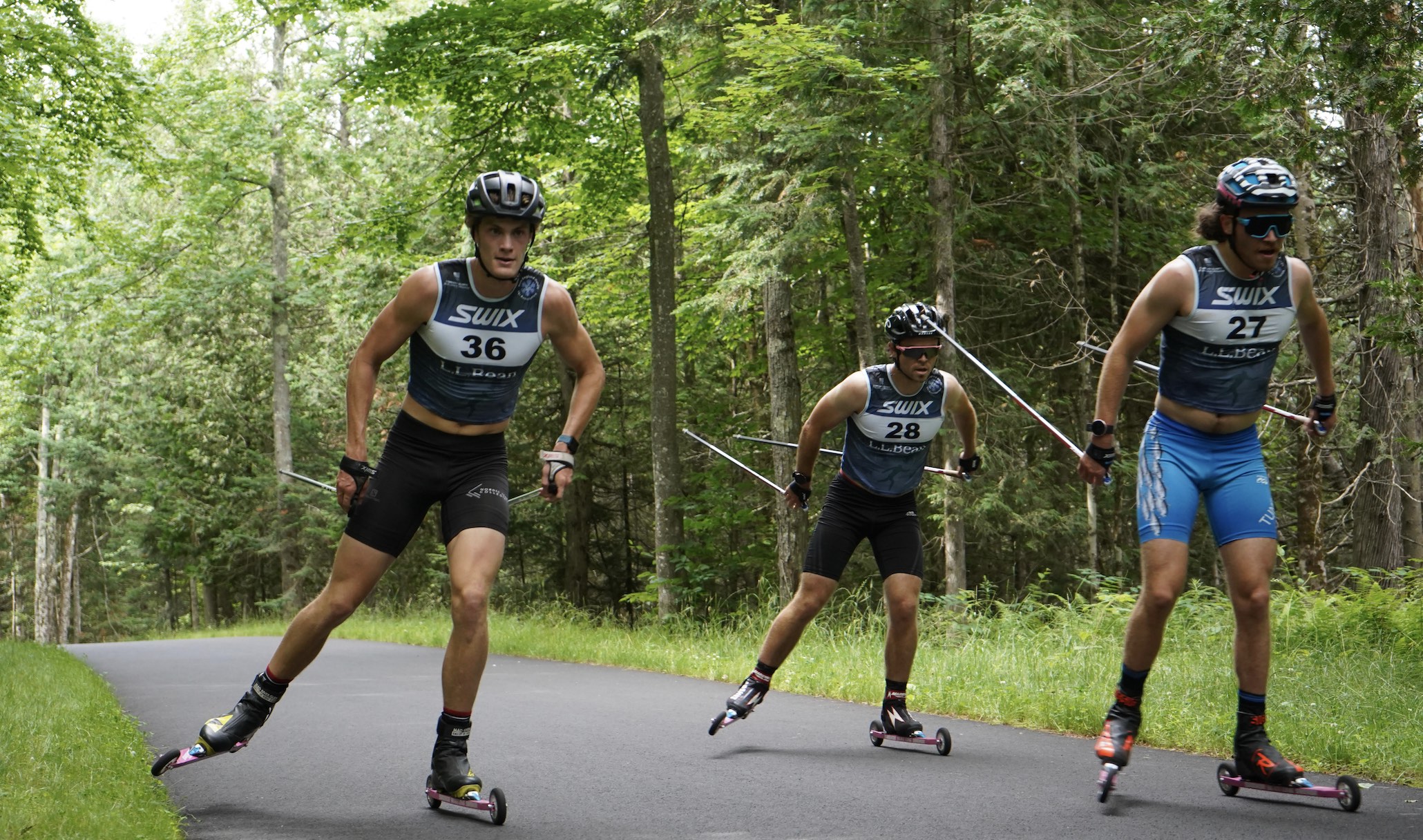
From left to right, Greg Burt, Raleigh Goessling, and Luke Brown go head-to-head during the 2021 Lost Nation Roll in Craftsbury, VT. (Courtesy photo)
In addition to new venues, the series is also incorporating a more diverse array of events, including sprint stages. Beckwith explained that the first round of sprint rollerski racing took place at the Eastern REG camp in early July in Lake Placid.
“At Mt Van Hoevenberg — that was really our first sprint course. It was actually our first sprint event that we’ve done in total since Junior Nationals 2020. But it was also the first heat format we’ve ever done in rollerskiing. And it’s an excellent venue for it. I think you can’t make a track wide enough [for rollerski sprints], so we actually pared down [the heats]. And I think the event we’ll do on September 18th… we’ll probably be running heats of four again in that. So it’s a little different than a winter format just because of the track width. But yeah, it’s exciting.” (Beckwith added that long-term, a wider track is something NENSA hopes to develop.)
More specifically, the events will still feature the typical structure of qualification followed by three progressive rounds, only modified to four skiers per section. Lucky losers will be incorporated based on time, as Bullitt Timing is providing a FIS level timing system. Juniors will compete in a mixed gender “Kings Court”-style sprint in order to ski more rounds, gaining more tactical experience.
The events this weekend will include athletes from the Sun Valley Gold Team, the Bridger Ski Foundation Pro Team, and SMST2. (The Craftsbury squad is currently in Germany training in the ski tunnel in Oberhof.) Because the number of athletes on course is limited, these events will have a bit more “vetting of the competition” — i.e., being current U.S. Ski & Snowboard members and holding a current FIS license. However, recreational skiers still have the opportunity to test their mettle at Climb to the Castle in Lake Placid on October 3rd or the Mount Greylock Rollerski Race on November 7th in Adams, MA. Both are uphill classic challenges.
“We created a permitted opportunity to ski up a closed State Park Road. So why not? Even if you’re not racing, go try it out, right?”
NENSA athlete Evelyn Walton on course in Lake Placid during the Eastern REG camp. (Courtesy photo)
Before the pandemic, the series averaged roughly 100 participants in each stage across all ability levels. While numbers have been lower in 2021 thus far, a summer series still remains a valuable touch point to keep the ski community engaged until the snow flies.
“A lot of these races this year, the focus is kind of building — not just out of COVID and building back into events, but into thinking about how we can better support the community and create opportunities. That’s our mission statement: to support a vibrant ski culture.”
To bring in people from all aspects of the community, NENSA is partnering with ORDA — Olympic Regional Development Authority — to organize an Eastern Coaches Symposium and a TD training opportunity in concert with the Climb to the Castle on October 3rd. Climb to the Castle is co-hosted with NYSEF, the New York Ski Education Foundation.
While this race up the Whiteface Toll Road in Lake Placid has plenty of history, it is also quite a grueling and climbing 2,300 feet in five miles is not universally accessible. Beckwith explained that they’ve considered a shorter distance where beginner or youth skiers could start further up the road to make it more manageable, or perhaps supporting a fleet of fast or “juiced” wheels to reduce the load.
Speaking to the concept of growing and sustaining the nordic community across all ages through the rollerski series, Beckwith recalled a conversation with longtime Sun Valley Ski Education Foundation coach Rick Kapala, who had contacted Beckwith to learn more about putting on the series in hopes of putting on similar events out West.
“The idea I think Rick hit on the head is just that you’re creating excitement, to keep the kids engaged, right? And adults — all of it keeps skiers engaged throughout the year, and I think that’s really the goal. There’s no qualification [to enter]. In the past, we’ve built prize money in and I think we’re gonna be building prize money into a few of those bigger events I was telling you about in the coming days, but that’s just fun to roll that out as it comes… So really the most enjoyable piece of it and the broader scope is that we’re bringing together people from different communities, regions, abilities, all of that.”
A host of rollerskiers get together after a NENSA event. (Courtesy photo)
He explained that NENSA’s team will similarly highlight regional popular racing opportunities during the winter.
“We’re really gonna highlight those races, popular racing opportunities, and also let people know that we feel like those are great developmental opportunities. Versus, we’ve been maybe a little Eastern Cup and Junior National qualifying centric in the past. So we’re really trying to support those, you know, it’s inclusive, but more so than that, creating festive opportunities that are available regionally. And the level of competition will be at those events regardless, because there’s really good skiers throughout the region, and they’re already utilizing those events.
“We know people will go to sanctioned events in winter and summer, try to qualify for JN’s, but how can we create opportunities beyond that? If we can bring it to people’s backyard communities, so to speak, or within that sweet spot of an hour or two from their doorstep, then hopefully, we just get more people involved and excited throughout the year.”
Green Racing Project members Susan Dunklee (left) and Caitlin Patterson (right) take on NENSA’s rollerski ramps at the opening event in Craftsbury, VT. (Courtesy photo)
FasterSkier spoke with Beckwith about the nascent series in 2019 shortly after the App Gap Challenge, a skate-to-classic skiathlon that led skiers up a mountain pass on a closed State Highway near Fayson, VT. (The App Gap took a hiatus in 2021 due to construction on the road.) When considering what it took to pull off an event of that magnitude, Beckwith said: “The beauty of a rollerski series is that nobody has any expectations or guideline of how we do this.”
He also said that he envisioned an event closer to the scale of the many summer rollerski festivals in Europe, perhaps in New York City or Boston. While this may seem like a pipe dream, with Beckwith behind the wheel, the idea came closer to fruition than one might have thought.
“Let’s say we were seriously exploring a race in Central Park this fall as part of the series early on. And I think it’s very possible for 2022 — it takes time to do that. But we’re close, we’ve got our foot in the door. People know who we are. And we have developed some key contacts that came up down there, which is exciting.”
NENSA also grew its staff this year to make organizing larger events more sustainable, adding an Event Support position filled by Fred Bailey.
“It definitely takes a team to pull this off,” Beckwith stated.
NENSA will be offering a youth clinic in Boston in collaboration with two other organizations whose goals also include getting kids outside on skis and supporting equity and inclusion in the cross country ski community. Like other clinics NENSA has run this summer, this clinic will introduce current ski program participants and potential future participants to rollerskiing for the first time with a focus on having fun, broadening exposure to different aspects of the sport, and encouraging an active and healthy lifestyle. Beckwith identifies that added exposure in populated areas may also help NENSA create larger highlighted events in the future.
“But there’s twofold to that. Because if we’re getting into urban areas, metro areas, whatever, then the visibility grows.”
With better understanding of the concept, urban venues might be more open to hosting. Beckwith explained that NYC stands at the top in terms of ideal venues. As so many events from 2020 were postponed into 2021 due to the pandemic, permitting became very challenging, which impeded the feasibility of running an event there in 2021.
NENSA athletes Jack Young and Jack Lange compete in the sprint event during the Eastern REG camp in Lake Placid. (Courtesy photo)
“One other issue beside the permit was just that it’s an Olympic year, and the availability and openness of National Team athletes [may be less than non-Championship years]. If we pull off a race in New York City, we’re talking about a budget at a minimum of 10 to 30 grand, so if we’re going to do that we want to have [high caliber athletes racing to] capitalize on it.”
While it may be nearly 300 miles north of Central Park, Jessie Diggins is confirmed to be competing this weekend in Lake Placid. Given the caliber of the elite training groups participating, it’s clear that the level of competition is high and the racing will be spicy.To add to the excitement, qualifier and rounds will feature a 24 foot bicycle ramp directly out of the start.
The NENSA rollerski series is now in its fourth year. If it wasn’t already abundantly clear how dedicated Beckwith is, he became emotional when reflecting on what he is proud of.
“Oh, geez, what am I proud of. We lost, you know, a year of in-person rollerski races with COVID. So that was a real doozy because we had Craftsbury coming online with a roller ski track, we had Van Hoevenberg coming online with a roller ski track, we were really excited to build into that. And then you know, the wheels fell off the bus from the outside — that wasn’t anything that we did. We created some really great regional events, as much as you can in a safe manner. But they were quite engaging challenges, and we saw literally worldwide participation in virtual events.”
Adapting to the times, Beckwith also pulled off running the 2020 App Gap challenge over the course of a week where athletes from the same club could race on matched skis in a designated window. Breaking these groups down further into waves of 15 made it such that there were never more than 30 people in the area at a time.
“So that kept us together a little bit… This year, it’s definitely a big step to re-engage after having a year where you didn’t. If you host an event, at the end of the day, you’re talking about what you’re going to do better the next year to build on it, and that’s just tricky with everything that we had coming down the pike. So I’m just really excited about where we are right now. We’re gonna have more rollerski races than we’ve ever had. I think that we’re gonna have the most competitive races we’ve ever had. It was pretty hard to top the women’s field in that Lost Nation Roll last year. I think it was about a 33 FIS point race or something like that — in no small part because Jesse [Diggins] was there.”
He acknowledged that there were plenty of other strong athletes there also — women and men — but that this weekend’s races will be a step higher.
“I think the big success of this year is going to be just that we’ll have more participation overall. Partly because we have more events — well attended events — but that we’re reaching many more skiers by taking the show to them basically. That’s probably going to be the biggest takeaway win for this year.”
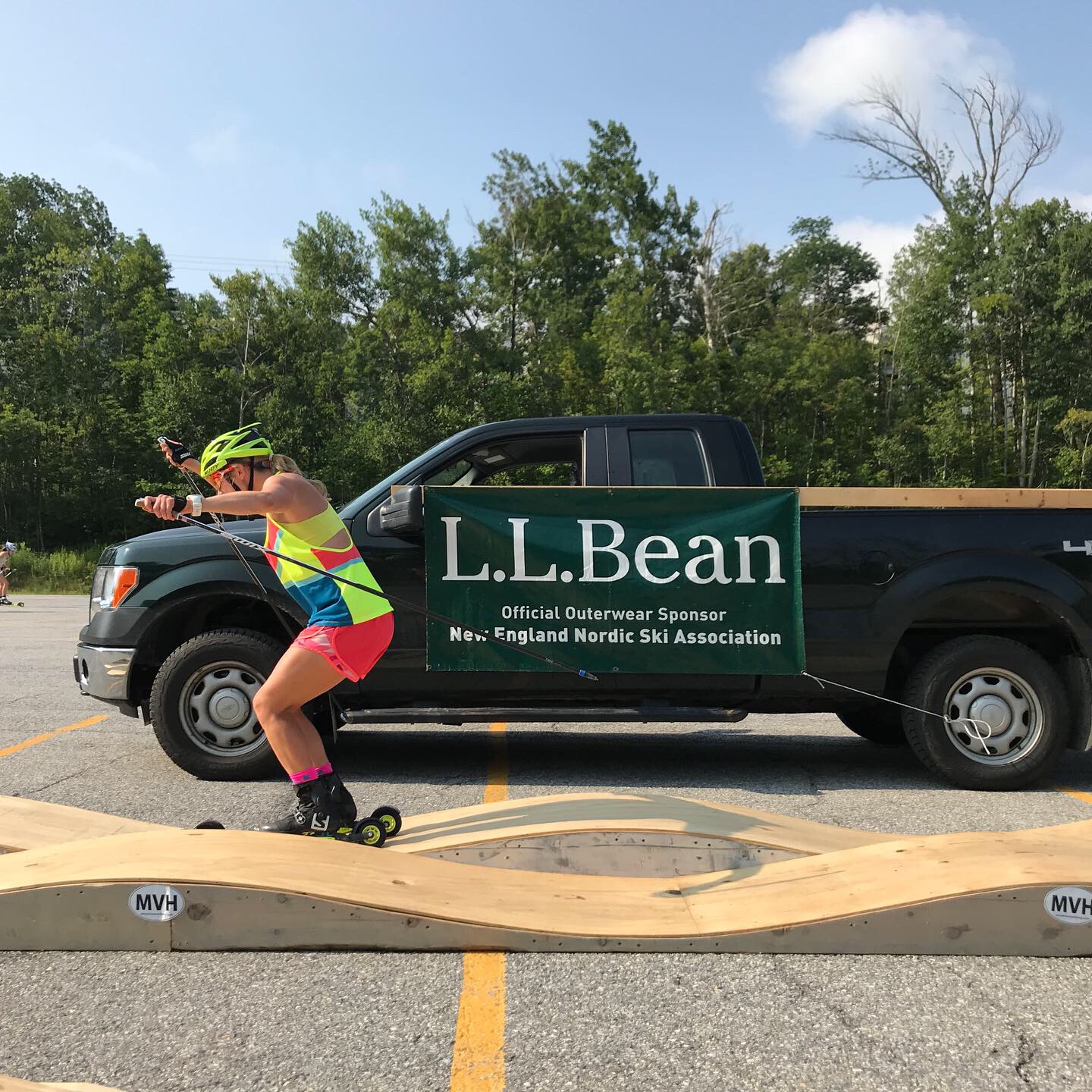
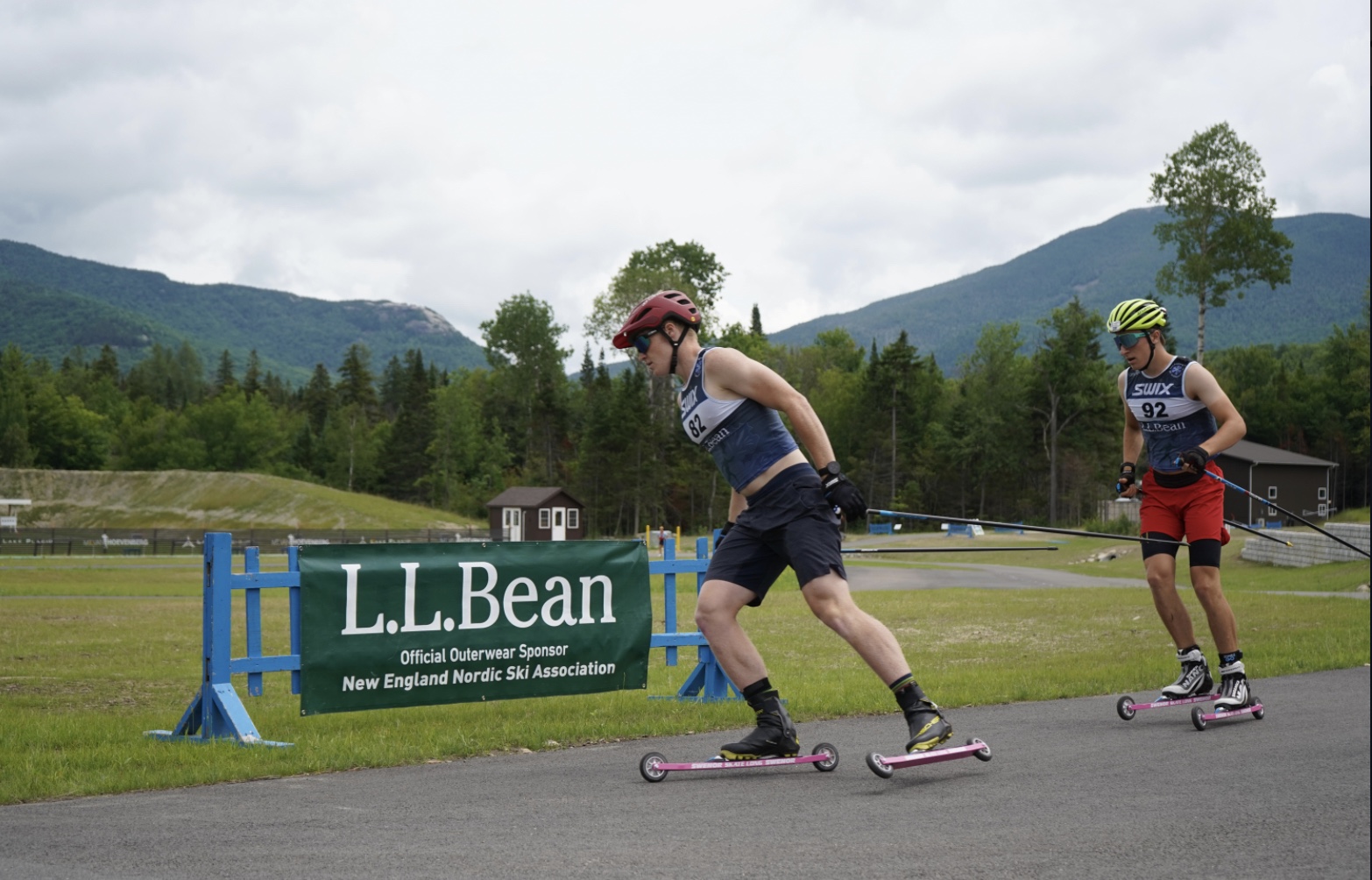
Beckwith also thanked the associate sponsors of the series: Swix, L.L. Bean, and Salomon. Apart from direct funding, he noted that Salomon sharing a video clip of one of Beckwith’s signature agility courses helped it see over 80,000 views internationally.
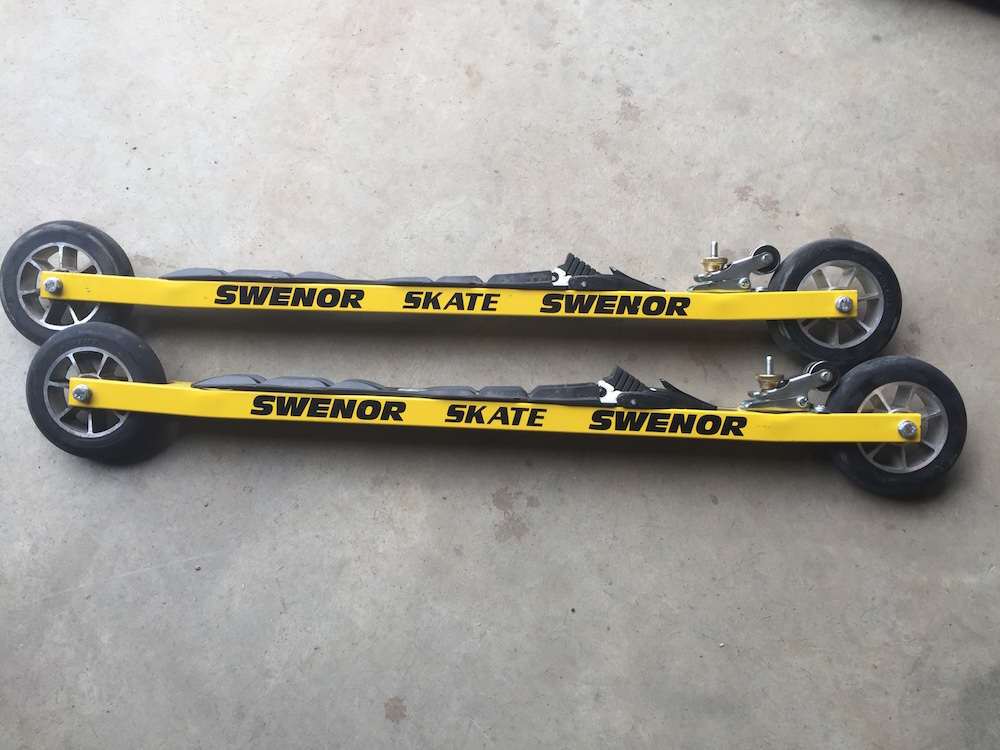
“We also have a really amazing partnership with Enjoy Winter, and Swenor rollerskis, which has really been a part of the series from the beginning and what makes it work for us. So that’s a really important piece to a partnership. Worthy of mentioning are the great people like, I’m teared up now, but Marty Hall, Joe Lamb. They’re just really supportive. So that’s incredible.”
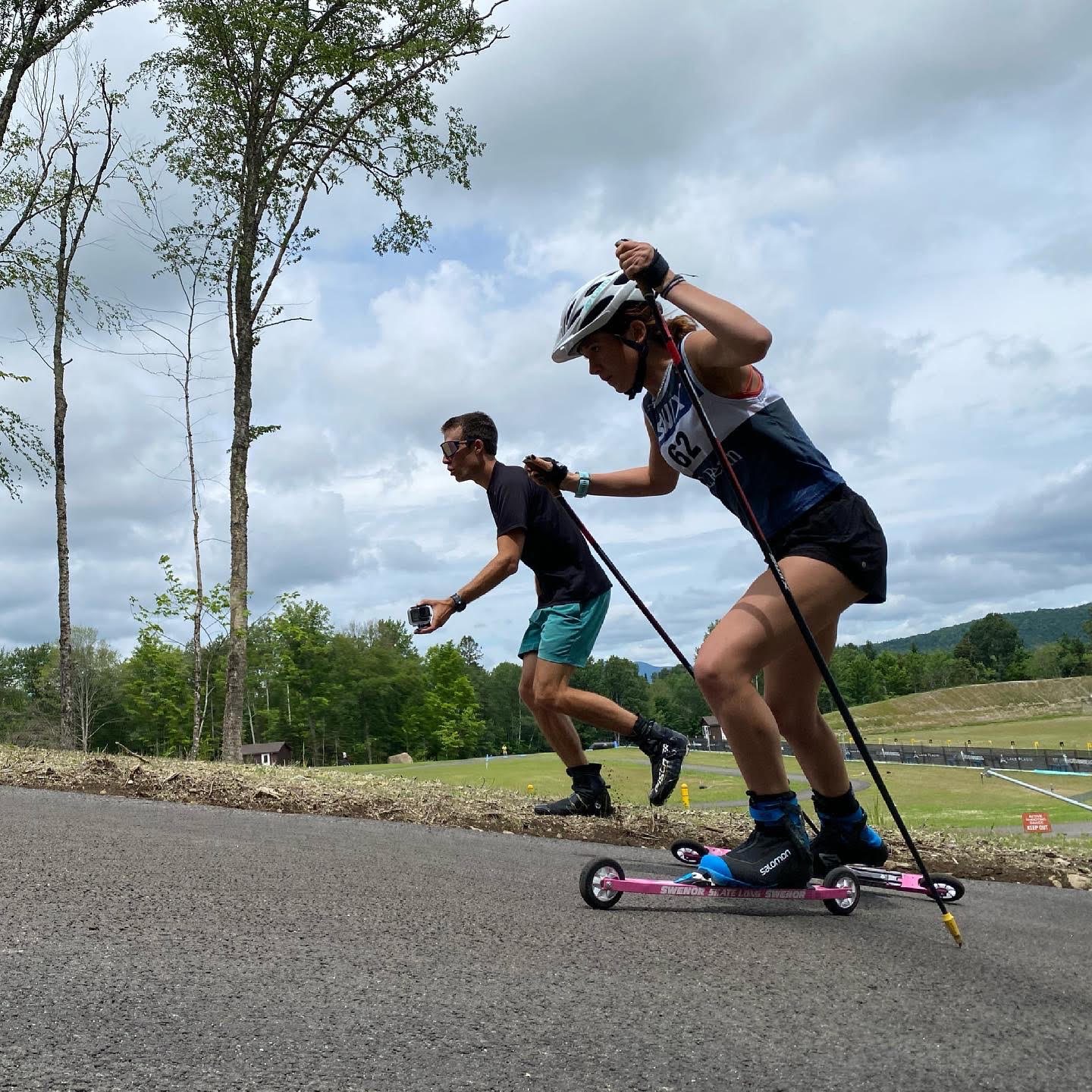
Hattie Barker attacks a climb with Mansfield Nordic coach Adam Terko collecting video. (Courtesy photo)
Biathletes training in Nové Město, Czech Republic. (Photo: NordicFocus)
Some skiers have tossed them, some have squandered them, some have disposed of them according to specific guidelines for toxins at their local landfill. Some have donated their speed-goods to the U.S. Ski Team as it burns through its supply of high-quality fluoros. Some have simply stored them in a wax cabinet, a symbol of what was. We’re talking fluorinated wax, powders, gels, liquids, and yes, small-batch slurries. U.S. Ski and Snowboard has banned fluoros while the International Ski Federation (FIS) banned them, postponed the ban, and now orbits in a will-they won’t-they quagmire. The move to ban fluoros has gained momentum.
Educating the ski racing community about PFAS chemicals (Per- and polyfluoroalkyl substances) in racing waxes and their impact on the environment
Promoting the use of wax alternatives with lower environmental impact, including but not limited to racing waxes that are PFAS-free
Swix fulfilled its obligation. The course is open as part of Swix’s learning center. Access to the course requires registration with an email and password. The RWP takes roughly 30 minutes to complete.
Swix does not provide a master class on PFAS chemistry and the adverse environmental effects associated with their use. Think of the RWP as a basic intro-level course discussing how perfluorinated compounds are bad and using non-fluorinated waxes are good. You’ll learn about C8 and C6 compounds and the concept of a “forever chemical”. There’s no discussion of more complex terms like bioaccumulation. This is not a Silent Spring treatment of PFAS, although that was not expected.
The course provides simple and sound advice to keep the ski bench area clean and well-ventilated. If you do not have access to a World Cup wax bus and their HVAC systems, the RWP will likely improve your waxing hygiene. In other words, you’ll be encouraged to wax in a well-ventilated area, wear gloves, a long-sleeved shirt, pants, an apron, hat, and HEPA-certified mask when waxing and prepping skis. “The filter should be a minimum of A1P3. Don’t forget that particles can be retained in the air for hours so wear your mask at all times while in a waxing facility,” states one of the slides in the RWP. You’ll be reminded to swap out those waxing clothes as soon as possible before contaminating other spaces — even if working with non-fluorinated products.
There’s advice on cleaning brushes and choosing an appropriate roto-brush (preferably one with a “suction cover”). The RWP also urges waxers to clean the workspace with a HEPA filter vacuum.
If you are a family getting into the game, and you’d like to be self-reliant and safe with the waxing, none of this comes cheap. Gone, or at least they should be, are the days of cranking the iron, melting the wax, smoke be damned, and brushing the wax out in a windowless side room.
The visuals alone in the RWP provide a simple model for maintaining a cleaner and safer waxing workspace, and how to clean up that space afterward. That is of value.
This brings us to the next point which FasterSkier raised with the EPA when discussing the penalty phase for Swix. The online video-intensive platform is an unsubtle piece of Swix branding. Does this provide Swix with a competitive advantage as the ski scene evolves to a fluoro-free future? It certainly cannot hurt. Back in August 2020, FasterSkier asked the EPA how it would ensure the RWP was not a Swix branding opportunity, as this was considered a penalty for an EPA violation. The EPA, at the time, seemed less concerned with the marketing potential, or outsourcing production of the RWP to an independent party, and more focused on the deliverables.
If you’ve not been following the move to fluoro-free waxing, none of this might matter. The RWP comes off like much of Swix’s video branding: solid information, polished and simple syntax, a whitewashed background highlighted with a catalog’s worth of red Swix product. The only piece of clothing or product that resonated non-Swix, was the presenter’s earthy-green flannel. Even the ground tarp under the wax bench was a Swix-specific tarp. One slide, though, features a block of yellow Toko wax, a brand also owned by Brav, the parent company of both Swix and Toko.
Beyond the branding and the well presented best practices, there’s some corporate moralizing too. “True competitors ski on skill,” is one verbal plug in the RWP to dissuade users from partaking in the game of speed enhancement through fluoro chemistry.
The RWP also mentions that U.S. Ski & Snowboard and Nordiq Canada have banned fluoros. And FIS intends to enforce a ban… maybe next year. It remains true, using fluoros at some races in the U.S., for example, is cheating.
The RWP also includes this statement in the learning module’s opening video:
“By complying with these new rules and choosing to ski fluoro-free, we can further protect our precious environment and be sure we are all competing on an even playing field. Conditioning, technique, and mental toughness will set you apart from the competition. So let’s all ski on skill and commit to doing our part to keep our environment safe and clean.”
Ski racers, coaches, and pretty much anybody who has skied on poor skis knows this: pick the right ski for the conditions, add a gem of a fluoro wax job in warming or dirty snow, and you’ve likely got skis in the mix.
Beyond a true competitor’s “skill” and willingness to “ski fluoro-free”, there’s the ski fleet and the ski service to consider. That’s just for starters. There’s also easy access to snow that can set an athlete apart. The 5k to 10k (even more for a ski academy) a year it might take to pay to play. Good coaches matter. Hard work matters. So too does The Sports Gene.
I think we are all in agreement with doing our part to be safer. And the Swix RWP is a step in the right direction. But the platitudes on training, technique, and fortitude? The playing field has other variables to consider beyond skill to even it out, even in a fluoro-free world.
Keen on speed and the full complement of waxes to juice the skis? Then you’ve likely noticed the “full complement” has become markedly reduced in recent years when considering perfluorinated products. Further, PFOAs or C8 (eight chain) fluoro compounds were effectively banned in the EU as of July 4, and are no longer available for most uses in the U.S., including ski wax. Older waxes formulated with C8 are considered the most effective at repelling water and dirt. Several wax companies still sell C6 perfluorinated wax, while some claim to have gone totally fluoro-free with their 2020-2021 product lines.
In the fall of 2018, skiers first began noticing a lack of Swix and Toko perfluorinated product on ski store shelves. (Toko is owned by Swix.) We reported on that here. Long story short, the U.S. Environmental Protection Agency (EPA) and the U.S. subsidiary of Swix Sport tangoed. The EPA claimed Swix was in violation of the TSCA, the Toxic Substances Control Act . In other words, Swix imported substances not on the TSCA inventory of permitted chemicals “or otherwise exempt for commercial purposes”.
This May, the EPA released its final ruling against Swix Sport USA. Without delineating all the violations in what the EPA calls the “Final Order of Consent”, Swix violated the TSCA Premanufacturing Notice protocols and Import Certification guidelines on 83 instances. Those missteps occurred in 2013, 2015, 2017, and 2018.
The terms of the settlement require Swix to pay a fine of $375,625 dollars. Swix is also required to spend $1 million dollars on what is referred to as the RWP or “Responsible Waxing Program”. According to the EPA, the RWP will address the following:
Educating the ski racing community about PFAS chemicals in racing waxes and their impact on the environment
Promoting the use of wax alternatives with lower environmental impact, including but not limited to racing waxes that are PFAS-free
(We know PFAS-containing products as fluoro wax. It includes C6 compounds still found in blocks, powders, gels, liquids, and certain kick waxes.)
The RWP roll out from SWIX should come this fall. It will include assets like on-site and online training for wax-techs and coaches at all levels of competitive skiing. The RWP resources are mandated to include information regarding proper use of PPE when waxing, best ventilation practices, and methods to properly dispose of wax shavings.
“This is not new for us,” Swix CEO Steve Poulin said. “We have always had personal protective equipment and we have always shared our best practices for waxing safely. We have been a leader in PPE for many years.”
Swix is also responsible for helping wean ski racers off of PFAS-containing products at the high school level and they must appoint a manager for the RWP and fulfill the settlement terms no later than September, 1, 2022.
“Swix, as part of its settlement with the U.S. Environmental Protection Agency, will produce numerous educational materials, including a Responsible Wax Program,” Swix said in a statement to FasterSkier. “These education materials are in production and will roll out over the next 18 months. EPA set forth the content of the educational materials in the settlement agreement. Swix will follow their directives in creating the content.”
What does this all mean for the consumer?
Wax shelves certainly will be different when it comes to Swix and Toko products. Those two manufacturers appear to have moved away from selling and distributing any fluorinated product in the U.S. Other companies still sell and/or distribute compliant fluorinated wax. And at least for U.S. Ski & Snowboard and Nordiq Canada sanctioned events, this season should play out as fluoro-free. Those rules are still in development. The masters racing scene appears to remain less regulated in terms of using and testing for fluoros. We’ll know more as the season approaches.
We contacted Swix USA and the EPA to get their respective comments on the ruling. One aspect of the agreement we asked the EPA about is that the RWP may be a golden branding opportunity for Swix. The production of the RWP may in fact give Swix a competitive advantage over other domestic wax manufacturers and importers as Swix can include brand specific product placements and references.
First we present the Q & A exchange with the EPA. That’s followed by the Swix Q & A. All FasterSkier questions are in bold text.
***
FasterSkier and the EPA
FasterSkier:In this case Swix is the violator in question. The EPA has given permission in the ruling for Swix to produce/create a program called the “Responsible Waxing Project” to educate the community on best practices for handling waxes etc. and “educating the ski racing community about the existence of PFAS chemicals in racing waxes; the physical and chemical properties of PFAS substances; and how they impact the environment;” Further it states…”SWIX shall be responsible for all aspects of RWP development and implementation, including the development of all education and training materials across a wide variety of communication platforms (including on-line communication modules, videos, visual presentations, brochures, posters, and other materials).”
I’m curious why the EPA tasked Swix to produce and curate this material as they are the party being penalized for non-TSCA compliance?
EPA: EPA affirmatively required SWIX to develop and implement a “Responsible Waxing Project” to educate the ski racing community about the dangers of polyfluoroalkyl substances (PFAS) in racing waxes and in particular to promote the use PFAS-free alternatives. This mandatory program is in addition to the penalty assessed for SWIX’s violations of TSCA, and requires the company perform a project that will help to mitigate the harm that resulted from SWIX’s violations.
FasterSkier: Why not an independent third party to produce the content and curate the program?
EPA: EPA determined that it was most appropriate to require SWIX to itself develop the compliance promotion program materials.
FasterSkier: How does the EPA ensure the material is not a branding opportunity for Swix specific product?
EPA: The settlement’s requirements for the content and materials of the RWP are very specific and detailed regarding the design and content of the program to teach technicians, coaches and skiers how to prevent having PFAS contamination get into the soil as well as to prevent PFAS exposure to people, and to discourage the use of PFAS-containing waxes.
FasterSkier: I’m referencing this statement from paragraph 36: “Respondent is authorized to return to its parent company in Norway the existing stocks of products containing Chemicals A, B, C. D, E and F in its control on the date of Respondent’s signature on this CAFO, provided such return conforms with all applicable laws. Any existing stocks must be exported within ninety (90) days from the Effective Date the date that payment of the penalty is due under paragraph 30 and Respondent shall notify EPA by sending documentation of the export, such as a shipping document (bill of lading), with the following certification to Tony Ellis at Ellis.Tony@epa.gov:”
It appears Swix must return its stock of violating product to Norway. Much of this product is likely available via the commercial market — vendors and personal users have back stock. Why did the EPA choose not to ask Swix to “buy back” the product in question or incentivize Swix to get the material in question back from vendors and citizen users?
EPA: As part of Swix’s actions to comply with TSCA, it immediately halted distribution (July 16, 2018) and held these products containing the illegal substances in its warehouses. This provision allows Swix to return those stocks to Norway.
FasterSkier: This appears to be an EPA enforcement action. And Swix, I think, must self-report every six months about the progress of the RPW and self-audit how it has met the EPA’s requirements regarding the penalty phase. That said, the RPW may in fact give Swix a competitive advantage in the marketplace as it alone is tasked with producing/disseminating the RPW material.
If Swix fails to meet the marketing obligations of the RPW as laid out by the decision, can the EPA discuss legal implications if Swix does not deliver?
EPA: The Consent Order retains a penalty provision designed for noncompliance with the RPW. If EPA is not satisfied with the performance, Swix must pay the US Government $655,000. See ORDER at page 9 item 24.q
***
FasterSkier and Swix
FasterSkier: Why should Swix come up with the protocol and the best practices for safe waxing? How does Swix know what the best practices are?
Swix: The safety requirements for handling and using the wax are dictated by OSHA. All the waxes have Safety Data Sheets (SDS), which provide information on safe handling and use. Under OSHA, the SDS are provided to the wax technicians. Swix is not creating new protocols or best safety practices. It is providing enhanced training and educational materials to ensure that technicians using the wax are following the existing safety requirements. This is part of being a good product steward.
SWIX is the industry leader in product stewardship. EPA determined that an educational program to enhance existing safety protocols for technicians is an important part of the Responsible Wax Program and required it under the settlement.
Over its many decades in business, the Swix team of scientists, product developers and world-class ski technicians have explored the science of wax and refined the best practices for waxing safely. Swix consults routinely with skiing’s top governing bodies to ensure that the information it supplies on its website and in its seminars comports with the best available technology, science and safety available.
For example, if a waxing iron exceeds the melting point of the wax, the wax may smoke, creating a hazardous situation. Swix knows the melting point of every wax it manufactures and it includes that melting point prominently on the label. We design equipment that helps technicians wax safely, including a digital waxing iron that can be set for a particular wax melting point to avoid spikes in temperature.
FasterSkier: Do you have an expert? Who are you consulting with?
Swix: Swix consults with experts all the time, particularly when designing and recommending personal protective equipment.
For example, Swix wanted to know the precise type of filter to use in a mask when waxing in a waxing cabin. To design a proper mask and filter, it was necessary to know the size of wax particles in a typical waxing situation. Swix hired outside scientists to measure the size of wax particles and air quality in the Swix waxing cabin in the Swix waxing cabin at the famous Holmenkollen World Cup race. By measuring the wax particles, we could pinpoint the type of filter that would block the particles effectively.
Several years ago, Swix began a project with Norwegian Occupational Health Authorities (STAMI) to investigate the particle exposure of the occupational environment during ski waxing. Swix was a project partner and supported the project with products and knowledge of ski waxing methodology. We, in turn, learned detailed information on airborne wax particle sizes and concentration levels. The project report also gave Swix clear recommendations on PPE and filter specifications.
FasterSkier: Swix is saying their new wax is safe. How do you know?
Swix: Swix Pro Line complies with TSCA, Prop 65, OSHA and the applicable Consumer Product Safety Commission standards.
FasterSkier: How do you know five years down the line that it’s going to be safe?
Swix: The EPA in the United States and REACH in Europe determine health and environmental safety standards. OSHA in the United States determines occupational safety standards. Swix wax meets those standards. Swix will continue to innovate based on the best available science.
FasterSkier: What sort of protocol does Swix have in place now to ensure that it remains in compliance with TSCA?
Swix: Swix has new procedures and processes in place for TSCA compliance, including procedures to review and verify compliance for all chemical substances in our products.
In addition, Brav, the parent company of Swix, in January revamped its compliancy protocols across all brands and companies. The company has a robust compliance department as well as sustainability and ethics statements. All company executives convened in Norway earlier this year to review the protocols.
During Toppidrettsveka in Norway, SWIX experienced the rubber separated from the rim on some of our roller skis for skating, which unfortunately led to some athletes being exposed to dangerous situations, falling and getting the competition ruined. SWIX regrets this and takes full responsibility for this incident. The wheels in question are from a production lot that not has been in regular sales, and there are no wheels from this lot in the market.
After this incident, we received reports that a few customers have had problems with the wheels from the same subcontractor. We therefore encourage everyone who has purchased the roller skis SWIX S5 Pro or SWIX Triac Carbon Skate to change to new wheels at our expense.
New wheels will be shipped to sports shops in Norway and abroad as soon as possible. Contact the store where you bought the skis, who will assist in changing to new wheels. Of course, this is free of charge.
We are in dialogue with the manufacturer of the wheels and have started the process ensuring better standards and quality control.
SWIX take this very seriously and apologize to those who have experienced problems. SWIX’s roller skis should be safe and our customers’ safety is our highest priority. In Ontario you have to renew your driver’s licence card every 5 years and usually receive an email or mail about 2-3 months before it expires warning that if the license isn’t renewed by then all sorts of illegal things will happen including being stopped by police because they think you’re using an expired/cancelled vehicle as well! fake id canada
Relatively clutter free and ready for waxing inside the new USST wax truck. (Photo: Noah Hoffman)
There’s truth in jest as the saying goes. While FasterSkier’s April 1 piece made light of the issues, it hit home in some unexpected places. During one of FasterSkier’s conversations with the Environmental Protection Agency to examine why it had begun investigating the importation and sale of perfluorinated waxes, the EPA’s representatives cited the April 1 piece to question why FasterSkier had begun reporting on the issue. Whether readers appreciated the humor or not, the April 1 piece was intended as entertainment. This is our first story detailing what we’ve learned so far.
Let’s start with the EPA.
As part of a broader national compliance initiative, the EPA has begun auditing the ski wax industry. After emailing detailed questions to the EPA regarding its regulatory guidelines, the agency stated it was unable to speak broadly about the ski wax industry. It remains an ongoing enforcement issue for the EPA.
“EPA has identified certain ski waxes manufactured, processed or imported into the United States contain per- and polyfluoroalkyl substances (PFASs), also referred to as perfluorinated chemicals (PFCs), that may be in violation of the Toxic Substances Control Act (TSCA). These waxes were identified both in brick-and-mortar stores as well as available for sale domestically on e-commerce websites. As a matter of policy, the Agency is unable to discuss compliance monitoring targeting and/or investigations in more detail.”
Challenges for Swix and Toko in Winter 2018
Swix and Toko are the two largest brands of wax imported and distributed in the U.S. Both lines are imported and sold domestically by Swix USA. Swix USA is a subsidiary of its parent company, Swix Norway. According to Steve Poulin, CEO of Swix USA, the company was first contacted by the EPA during the winter of 2018 about meeting specific EPA mandates. In what became a steep learning curve regarding EPA compliance, Poulin said Swix/Toko began a review of “every product in every mixture.” We’ll explore what being EPA compliant entails later on, but it remains an exacting process that involves knowing the chemical recipe list for every Swix/Toko products imported, sold, and used in the U.S.
That formal review process began 18 months ago for Swix/Toko. Poulin said the company quarantined its entire wax line in June of 2018. They then chose not to sell perfluorinated products on their direct sales websites or ship product to their U.S. based retailers this past ski season. Many non-performance wax product, known as non-fluorinated waxes were shipped to retailers and sold.
“I decided to quarantine everything because I wanted to go through the full review and be 100 percent compliant and follow EPA regulations,” Poulin said. “I decided to be completely safe and I guess cautious, so we decided to quarantine our waxes and not ship anything until we went through the proper review process with the EPA. It was our decision.”
The Swix and Toko LF, HF, and top-coat/finishing product you may have purchased from online or brick and mortar shops was the back stock retailers possessed from this year’s inventory — shipped before June 2018 — after Swix/Toko has been contacted by the EPA. Alluring teens wall crosser in accidental lesbian fucking with horny border officer Super Hot Mandy Shows Us What Shes Got And Shes Still Got Plenty Blonde teen Lily Rader gets punished by boyfriends big dick Horny officer picked up an undocumented immigrant Two horny schoolgirls sharing the teachers cock Close up view of lesbian pussy pleasure A Dodgeball Where Youll Get Naked And Expected To Fuck Amazing Afternoon Hookup with Mom Agreeable milf gets a doggy position fucking Samantha Saint, Jayden Cole, Shyla Jennings and masturbation with a dildo Monique Symone Gets Picked Up And By W fuck pornjk.com
“I shipped wax to retailers before I quarantined the whole line … I did ship wax, early preseason orders, I filled stores up,” said Poulin. “Because we were not bound, we did not find any violations at that point. And then when we discovered the true complexity of what they were asking for and compliancy regulation, that is when I put a halt to it. To be completely safe and in cooperation with the EPA.”
Outside of the Swix and Toko wax lines, skiers interested in a competitive advantage through ski wax chemistry had perfluorinated options from brands like Vauhti, Start, Star, Solda, HWK, Rex, Holmenkol, and others. The impact of the current regulatory environment on those brands is less well understood, but most were available this season.
Poulin said in a July 8 phone call that Swix/Toko will be selling performance ski wax this upcoming season.
Speed Comes at a Cost: Fluorochemistry Background
Get ready for some basic O-Chem. (For your reference, click the image titled “A Toxic Family Tree” to assist with understanding perfluoros and their chemical lineage.)
According to Dr. Merle Plassmann, the lab manager at the ACES (Department of Environmental Science and Analytical Chemistry) at Stockholm University in Sweden, perfluorinated ski wax is complicated. Plassmann’s Ph.D research examined fluorinated compounds in ski wax and their presence and fate in the environment.
“Family tree” of PFASs, including examples of individual PFASs and the number of peer-reviewed articles on them since 2002 (most of the studies focused on long-chain PFCAs, PFSAs and their major precursors). (Source: Environ. Sci. Technol.20175152508-2518. A Never-Ending Story of Per- and Polyfluoroalkyl Substances (PFASs)? Zhanyun Wang†Jamie C. DeWitt‡Christopher P. Higgins§Ian T. Cousins*∥
Plassmann explained that his research detected numerous fluorinated compounds with carbon chains between C6-C22 in some ski waxes. He added that many fluorochemicals found in ski wax are not added deliberately but are impurities from the manufacturing process. He referred to those chemicals as PFAAs – or Perfluoroalkyl Acids. He also wrote that ski wax manufacturers do add semi-fluorinated and fully fluorinated alkanes to their product. Again, these compounds are long carbon chains with the “semi” versions partially fluorinated, the “full” versions are saturated with fluorine. Plassmann went onto explain that the constituent parts of today’s wax could be more complicated. He has not assayed ski wax since 2011.
Some skiers may throw caution to the wind and take ski speed at all cost. It’s well known that in certain conditions, perfluoros applied properly to a ski base makes those skis faster. So we asked Plassmann the burning question: What are the ingredients in ski wax that might be of concern?
“Of potential concern are not only the impurities (the PFAAs which show low levels but still can be found in the ski tracks afterwards) but also the main ingredients, which are either fully fluorinated alkanes or semi-fluorinated alkanes,” Plassmann replied. “To my knowledge, nobody has studied their environmental fate, except the one study we performed on their behaviour during snow melt and presence in snow and soil from a ski track in Sweden. Here we found that they strongly sorb to particles and thus can be found after snow melt in the soil underneath the ski tracks. But nothing is known regarding their possible breakdown. As the Carbon-Fluorine bond in molecules is a very strong bond, those chemicals will be very persistent, but for example with the semi-fluorinated alkanes, the not fluorinated part could be breaking down, thus potentially leading to the formation of PFAAs. This, however, has not been studied and shown to happen.”
In May of 2016, the EPA released a document explaining some of the health risks associated with exposure to certain perfluoros. They include thyroid disorders, hypertension and preeclampsia during pregnancy, and testicular and kidney cancer.
Bringing Science to the Market
When you head into the local shop and ask for the wax goods, the response can be confusing. We’ll refrain from using the term “pure fluoro”. There are varying percentages of fluorocarbons in gliding and kick wax product, none that we can confirm are 100 percent “pure” fluorocarbon. The products containing the highest percent perfluorinated compounds are used for glide and often come in the form of a powder, block, liquid, or gel.
All brands have their own trade secrets when it comes to percent perfluoro and hydrocarbons added. The terms used in the industry like low-fluoro, high-fluoro, and super-fluorinated are marketing terms, not a standard. Brand X might have a 40 percent perfluoro HF wax, brand Y, thirty percent. Amongst the super-fluorinated gliding products, those percentages vary too from brand to brand as do their naming devices. Start wax’s naming devices, for example, use the term “ultra high fluor glider” for its highest perfluoro content finishing product.
Hydrocarbon or paraffin wax is what we would consider the cheaper and sometimes less effective means to make a ski slide on snow. These waxes are perfluoro free.
We’ll refer to any wax with fluorinated compounds as perfluorinated wax.
PFAS, the broad group of perfluorinated substances to which PFAAs belong, are ubiquitous and can be toxic. From fire suppressing foams, stain-proof carpet and upholstery coatings, non-stick pans and food wrappers, and that snazzy waterproof jacket, fluorochemicals make these products “work”. The perfluoros in ski gliding products fall into the PFAS class.
This February, the EPA published a “Per- and Polyfluoroalkyl Substances (PFAS) Action Plan” to further address the issue of perfluoros in the environment. The action plan states, “there is evidence that continued exposure above specific levels to certain PFAS may lead to adverse health effects.”
Fluorochemicals were once considered a miracle. They are hydrophobic and repel grease, oils, and dirt. Better living through chemistry? That’s now up for debate as the EPA moves in.
The leading science journal Nature published a piece in February detailing how researchers have traced fluorochemicals in the environment back to their source. Fluorochemicals are not naturally occurring. They are all man made. So if it’s in the environment, its there due to direct use in the environment like fighting a fire at an oil-depot, or they are residual compounds from the manufacturing process that have not been contained.
(This oft-cited Scientific American article speaks to the bioaccumulation of ski wax chemicals in the blood.)
The chatter in the ski wax industry usually has to do with a subclass of PFAS called PFOAs. PFOAs will be banned in the EU for most uses starting July, 2020. In the ski wax industry, PFOAs, or what many ski-wax junkies call “C8”, is often referred to as the magic behind wicked fast skis: the actual perfluorinated turbo boost when conditions call for it. Those C8s will be replaced in perfluorinated ski products with C6 compounds. The C8 refers to a perfluoro with an eight carbon spine with fluorine atoms branching off. The C6 is a shorter six carbon spine.
Those PFOAs are often called “forever chemicals” due to their persistence in the environment. The carbon-fluorine bond is amongst the strongest known in chemistry. C6 compounds, however, reportedly breakdown more readily and are considered more benign. Many claim the C6 half-life in the environment is shorter.
Anecdotally, many ski wax experts report C8 perfluoro finishing products most often outperform C6 analogs. You probably all know someone hoarding C8 product right now. That raises several other questions about wax equity at all levels of racing.
For now, let’s put aside the O-chem and focus on the nuts and bolts of domestic regulations and remaining EPA compliant.
The EPA and the Toxic Substances Control Act: The Tools for Oversight
In 1976, during the heyday of the environmental movement in the U.S., the federal government sharpened the EPA’s regulatory teeth by passing the Toxic Substances Control Act (TSCA). The TSCA allows the EPA to better monitor the “production, importation, use, and disposal” of chemicals in the U.S.
For years, domestic ski wax producers and importers were literally off the EPA’s radar. In 2016 and 2017 the TSCA was updated with new guidelines. The hands off EPA stance evolved. The law’s 2016 amendment is called the Frank R. Lautenberg Chemical Safety for the 21st Century Act.
According to a Harvard University Science in the News article, the 2016 amendment, “gives the EPA the authority to ban new and existing chemicals that pose a risk to human health and the health of the environment. To do this, the EPA must now make an affirmative determination on all new chemicals and all new uses of existing chemicals.”
The prevalence of fluorinated compounds in the environment and the increased awareness of the potential health risks those compounds pose began to focus attention on fluoro-intensive processes. The outdoor textile industry is literally awash with perfluorocarbons — high tech fabrics that repel water owe that functional property to the carbon-fluorine bond.
A few degrees separated from outdoor performance textiles are perfluorinated ski waxes. If the EPA was following the supply chain tree to determine where fluorinated chemicals are used, at some point they’d branch-off to the ski wax industry.
The TSCA requires wax importers and domestic wax manufacturers (importers are considered manufacturers under TSCA) to properly document the chemicals used within the country.
In the past, before the EPA glanced at the ski wax industry, ski wax importers might simply declare “ski wax” on a TSCA import compliance checklist and claim the shipment complied with TSCA guidelines.
I certify that all chemical substances in this shipment comply with all applicable rules or orders under TSCA and that I am not offering a chemical substance for entry in violation of TSCA or any applicable rule or order there under.
I certify that all chemical substances in this shipment are not subject to TSCA. The statement must be typed or stamped on an appropriate entry document or commercial invoice or an attachment to that entry document or invoice.
With greater oversight, it appears the EPA found a disconnect between the chemicals contained in ski wax and what was being declared.
To be clear, none of the importers we spoke to acknowledged any intentional non-compliance. In other words, there was no intent to omit or misrepresent through their TSCA declarations. However, there appears to have been either confusion, misunderstanding, or a shift in how EPA scrutinized the forms or applied the standards that resulted in a major disruption to the ski wax market.
CAS Numbers: Millions of them
The TSCA regulatory comb is fine toothed. To meet TSCA compliance standards, wax importers require CAS numbers. CAS stands for the Chemical Abstracts Service. Every chemical substance disclosed in scientific publications are assigned a unique CAS number. Think of that number as the chemical’s numerical ID. Well beyond one hundred million chemical substances have been assigned CAS numbers. The EPA maintains a record of all the chemicals either produced within or imported into the U.S. This is known as the TSCA inventory. At its most basic, the TSCA inventory is a list of CAS numbers.
There is both a public inventory that is downloadable, and a private inventory that includes information for proprietary substances a company may not want publically available.
Here’s what’s at issue. Any material coming into the U.S., like a ski wax, must have all its chemical components, the parts that make up the sum, on the TSCA inventory. In other words, the importer must ensure that each chemical substance’s CAS number is registered on the TSCA inventory. (The TSCA inventory is organized by CAS number.) If an ingredient’s CAS number is not on the inventory, the substance cannot be imported. Further, those chemicals on the TSCA inventory must be approved for public use/consumption if sold in the marketplace.
Boulder Nordic Sport (BNS), the importer of record for several wax brands, was sent a subpoena from the EPA to ensure the CAS numbers of the perfluorinated compounds imported in their wax product were on the TSCA inventory.
“The letter from the EPA specifically asks only about fluorinated compounds,” BNS owner Nathan Schultz told FasterSkier on March 28. “However, legally, everything that is in those substances, everything that is in the wax, including dyes, colorings, perfumes, whatever, every chemical compound has to be on the TSCA inventory.”
Finding and cross-referencing CAS numbers on the TSCA inventory meant Schultz had the tedious task of obtaining a chemical specific ingredients list for every perfluoro containing product BNS imports. BNS imports Skigo wax, Holmenkol and Guru products.
“And so basically what people are finding out is that this really complex process of having to identify every compound in the substances that we are importing,” Schultz added.
“All these formulations are secret. That had been one of the challenges, that all of this information has to be kept confidential, and so we have to take extra steps to protect it from when the suppliers give it to us. One of the suppliers refused to give us the information. They say they will only give it directly to the EPA. Right now, there are some fluoros available that are on the TSCA inventory and they are OK to use. And then there are some that aren’t and the ones that aren’t are not available, they are off our site.”
In Schultz’s case, he began cataloging CAS numbers during the Federal Government’s shutdown which ran for 35 days beginning on December 22. So getting timely responses from the EPA was challenging.
As Schultz bolstered his knowledge of the TSCA, he learned that if a specific CAS number (or compound) is not on the TSCA inventory, importers do have a few options. One option is to apply for a pre-manufacture notice. (Again, importers are treated as manufacturers when it comes to TSCA compliance.)
A pre-manufacture notice is no small hurdle to jump. The notice must be filed 90 days prior to manufacture/import. The EPA also requires mounds of chemical related information including available test data on the effect to human health or the environment.
Another option to continue importing and selling a product with an ingredient not on the TSCA inventory is to file for a low volume exception. This is what it sounds like: it’s a way to declare that the substance in question will be manufactured/imported in low quantities. In this case, at or below 10,000 kg/year.
Each low volume exemption filed is for a specific chemical. If, for example, a type of performance wax contains 10 distinct chemicals, that’s 10 distinct low volume exceptions to be researched, filed, and paid for.
The potential cost associated with filing a single low volume exception is prohibitive for a small business like BNS. Those costs also don’t factor in potential legal fees.
“It is hard to say and it is also a challenge because a low fluoro paraffin wax is probably going to be 5% maybe 10% of the fluoro compound itself,” Schultz said as he contemplated how much perfluorinated substances were being imported via the wax industry. “So the pure fluoros, I would imagine in the entire U.S., we are certainly under 200-300 kg of just the fluorinated substances. The whole number is small when considering the fluorinated compounds and I mean, 100 kg, 1000 kg I don’t know what it is. I have not calculated that out. It is a small number. Certainly, all of the wax industry in the country could be under that 10,000 kg weight limit for a low-volume exemption. So relative to other uses, we are tiny.”
How did we get here?
Longtime industry insider, Andrew Gerlach, knows the ins and outs of importation. For many years he’s imported Start wax manufactured by Start Finland through his business Endurance Enterprises. According to Gerlach, Start products are the third most widely used nordic ski wax in the U.S.
Athletes, coaches, and techs test skis on the 2019 World Championships course in Seefeld, Austria. (Photo: John Lazenby/lazenbyphoto.com).
The common story about wax importation and environmental regulations that we heard from Gerlach and others was something premised on the notion that European safety guidelines are stricter. The assumption was U.S. importers of ski wax must be in TSCA compliance if the waxes in question could be sold within the European Union.
“We have been doing things the same old way for decades,” Gerlach said in early April. “The European manufacturers or primarily the European manufacturers of the wax have told us, have given us a broad opine of all the ingredients in our wax and said this meets or exceeds European standards for chemical transport chemical distribution chemical use. And therefore if it meets European standards, they are tougher in every aspect than American standards, so you are good to go. So we import wax and we have a very good understanding of the ingredients within that wax but not the final nature of their pure chemical compound because that is very proprietary and most of us are mere distributors of the brand and the products and not part of the parent company.”
The EPA’s involvement with ski wax has nothing to do with EU chemical regulations known as REACH. And the EU’s regulations on the use and sale of perfluoros have nothing to do with cross-referencing CAS numbers with the TSCA inventory and being EPA compliant.
That said, the domestic wax importation industry in the U.S., like Gerlach said, had been following Europe’s lead.
EU chemical regulations originate with REACH, or Regulation, Evaluation, Authorisation and Restriction of Chemicals. REACH dates back to 2006 and has evolved and been refined many times since. The REACH net has captured the use of PFOAs, or “C8”, in the supply chain.
PFOAs will be banned in the EU for most uses starting July, 2020. They will be replaced in the ski wax industry with C6 compounds.
“We have taken Europe’s word for it,” Gerlach said. “That if their products meet or exceed European REACH standards, which they have all, they are told in the research they are tougher than American standards. So we import the wax, and everytime we have an import shipment coming in, we sign a form that says these products comply to TSCA standards.”
Back in November 2018, Gerlach said he heard rumblings within the ski community that Swix and Toko were having issues selling product. He initially, like many people, thought this had to do with pending EU restrictions on the use of PFOAs.
C8 or C6, Gerlach assumed he was TSCA compliant. Good enough in Europe, by default, meant good enough in the States. But the story circles back to CAS numbers and the TSCA inventory.
“I felt that I had better figure out what was going on, because if Swix-Toko had errors, there is the likelihood that I had errors and every other wax company that is importing had errors because we are all pretty much importing like substances in the same manner,” Gerlach said.
Gerlach contacted an EPA official in Chicago since his company is registered in the Midwest. He left a voicemail and some follow up emails. Gerlach heard nothing back.
In the meantime, Gerlach said he conversed with Schultz at BNS and became better informed about the CAS number TSCA inventory dilemma. He also communicated with the EPA’s Washington D.C. bureau and received a response when the government shutdown ceased in January. During this time, Gerlach reached out to Start Finland to secure CAS information and detailed wax recipes.
“I discovered that the vast majority of ingredients in Start wax be it perfluoros, be it hydrocarbons, be it alcohol based liquids, petroleum based liquids, on and on, all used ingredients as Start signified since day one that are on the TSCA inventory,” Gerlach said. “We did have a couple waxes with CAS numbers not on the inventory and so overtime, it took a while to delve and discover and learn all these things.”
Gerlach self-imposed a ban on selling or continuing to import product he believes is not in full compliance with the TSCA. He even went a step further.
“We have done our own self-disclosure to the EPA, saying ‘hey we have imported, unknowingly, we have imported some wax with ingredients that are not on the TSCA inventory,” said Gerlach. “They amount to these items with this amount of volume in the past five years and this is what we are planning on doing etc. with them’. As far as I can tell from my brief discussions with the EPA, I just need to focus on my ingredients list and make sure they are on the TSCA inventory and with a double bullseye focus on the perfluorocarbons and make sure those are on the TSCA and if they are on the inventory they are good to go and there’s nothing to report.”
The TSCA compliant Start products, which Gerlach said was 97 percent of the Start Wax line, are still imported and distributed to dealers around the country. His non-compliant inventory remains under quarantine in his warehouse and is not included on next year’s price list. This self-imposed restriction was taken not due to any EPA action, but as a precaution until he is told what to do with those items by the EPA.
Gerlach also explained that moving forward, Start Finland’s ingredients would meet TSCA requirements. According to Gerlach, Start Finland does not produce its own perfluorocarbons for use in their waxes. They source that from a chemical manufacturer and supplier.
“Start Finland now examines the ingredients they are putting in beforehand, “ said Gerlach. “Before they start mixing up compounds, they make sure that the ingredients that they are using are on the TSCA inventory. I am talking milliliters of fluorocarbon and grams in all my waxes that are fluorinated and whatever the law is we need to follow it. I am much more educated on what is in our waxes than I was a year ago. And Start Finland is much more aware that being good enough in Europe is not necessarily in itself good enough for America.”
Gerlach’s initial chemical bookkeeping and self-reporting were steps. He was told by his lawyer to use a statute of limitations of five years for documenting what he had imported during that time span and discerning if it was on the TSCA inventory.
That five year limit appears to be an unofficial timeframe for the statute of limitations on importing non-TSCA compliant chemicals.
“A subpoena letter I have seen did not put a date on it,” Gerlach explained. “It said, tell us all about waxes with fluorocarbons in them and the times you have imported them. And surprisingly it did not give a time frame. It just said tell us everything.”
Exhausting his avenues to remove his “violating items” from circulation Gerlach contacted Start wax retailers.
“I have looked at my orders for the last two years of these and emailed the dealers and explained that if you have any in stock I will take it back,” said Gerlach. “I did a recall of any of the waxes and none of those waxes are left in stock. And so there is nothing to recall because it has been such small quantities.”
This was what Gerlach called a voluntary recall.
In years past, Swix USA has shared prime real estate with a retailer at the American Birkebeiner expo — they were housed within the same display.
Not this year. At the Swix concept area at the expo, Swix did not sell perfluorinated product. However, Swix perfluoro products were for sale through a retailer at the expo.
FasterSkier is unaware of any official recall of non-compliant ski wax product. According to Section Five of the TSCA, any chemical not on the TSCA inventory is considered a “new chemical”. “New chemicals” to be imported and used within the country are subject to rigorous guidelines to determine their fate. A recall of pre-existing non-compliant substances by importers/distributors and retailers appears not to be one of those steps.
A quick search on the web shows product still available for sale by retailers in limited quantities.
In my candid interview with Gerlach, he was mildly prophetic as we signed off.
“So, the earthquake has happened, no one is sure about the tsunami, but no matter what, there will be a shakeout of brands and or waxes because of this,” said Gerlach
In early May, I received an email from a reader saying HWK USA was no longer in business. At the time of publication, FasterSkier had not received a reply from HWK USA after messaging and emailing the company.
Ear to the Ground
Like Gerlach and Schultz, Caldwell of the eponymous Caldwell Sport based in Putney, VT. has had his ear to the ground. Caldwell is known for custom ski selection and grinding services, but also retails wax. In the past, he was an importer of Vauhti wax out of Finland. Vauhti is now imported by Park City, UT., based Sisu Sports.
Caldwell sells wax online, or onsite at select races during the season. He sells Rex, Rode, Star, and Vauhti products.
“So what I know is that the EPA instructed [Swix] to stop selling when they went through item by item and reviewed the contents of what they were selling — and that is it,” Caldwell said when asked what he knew about the direct discussions between Swix/Toko and the EPA.
At the time of our conversation on April 9, Caldwell said he had had no contact with the EPA to date.
Caldwell Sport’s role as a retailer rather than importer means its relationship with the TSCA is indirect. Caldwell Sport is not responsible under the TSCA, for ensuring the wax it sells is compliant — that remains the importer’s role.
“My understanding is that the EPA’s concern is with importation and that they are not concerned at the retail level,” Caldwell said. “They are concerned at the chasing things to their source, where they are coming into the country. So I have not heard of any retailer who is not an importer being instructed to stop selling product. For instance, no Swix retailer that I am aware of has been told they cannot sell Swix waxes. But Swix the importer which is also owned by Swix Norway has been told they cannot sell waxes which would mean both at wholesale and at retail.”
Caldwell’s process of obtaining perfluorinated wax products is simple. For example, he orders Vauhti product directly from SISU Sports. It then ships UPS from Utah to Vermont.
“As far as I know, there is no oversight of that aside from regular domestic shipping restrictions on air, on flammable goods for air shipments,” said Caldwell. “You cannot put some of the solvents on an airplane. So we have to be cautious about that and plan shipping. We are just ordering form those guys.”
For Caldwell Sport, it has been business as usual. Caldwell said he resupplied with Start and Vauhti this spring with no issues. Yet Caldwell was mindful of his stake in the high-end wax game. As a small business he is evaluating how to proceed as perfluorinated waxes come under scrutiny.
“From our point of view, the question has been whether we should try to anticipate action by the EPA and pre-order a whole bunch of stuff or whether we should continue to run as we normally do to run a lean family business,” said Caldwell. “We cannot afford to carry a huge quantity of really high-end wax because it cost a whole lot to have. As a family business retailer, we are in a position where we need to be pretty cautious about how far we stick our neck out on a lot of high-end product.”
Patrick Coffey, the Vauhti brand manager for Sisu Sports, emailed FasterSkier to state that as of May 24, he still had not been contacted by the EPA.
“There’s no reason for me to expect it at any given point, but given that it’s the offseason, my approach will be to see what we need to do to make sure that there will be no delays in delivery late summer when the product comes from Finland to Utah,” Coffey said during an April phone call.
“If someone within a government agency wants to get in touch with us and ask for information, I’m going to get that information,” said Coffey. “The goal here is not to keep our head down and hope nobody notices, I want to make sure that we’re in a position, because retailers are asking ‘are you able to bring product in?’ and I’ve told all of them at this point ‘yes’. If anything changes they will be the first to know, because I don’t want them to all of a sudden to realize in December that they are not getting product.”
The Bigger Picture
The wax industry remains a drop in the financial and environmental degradation bucket when considering the widespread use of perfluoros in industry. But, perfluorinated compounds are making news. High Country News published a piece about PFAS pollution on May 30. Several news outlets have reported that the state of New Hampshire is suing chemical giants 3M and DuPont “for damage it says has been caused by a class of potentially toxic chemicals found in pizza boxes, fast-food wrappers and drinking water,” according to a Boston.com piece.
The ski wax industry has been reforming when it comes to using the more caustic C8 and longer chain chemistry in its waxes. The type of fluorochemistry that has been newsworthy. Longchain fluorocarbons are on their way out and C6 chemistry is in.
Is the ski wax industry and the quest for ski speed to blame for shirking environmental regulations and drawing attention to itself? Probably not. It’s simply that the EPA has the law on its side and the science to support its stance to bring more oversight.
Although Swix and Toko did not ship perfluorinated wax last season, it appears the EPA is conducting a broader industry-wide review. Ski waxes are obviously not the domain of skinny skis alone. Imported and domestically manufactured alpine specific waxes fall within the same regulatory benchmarks applied to popular cross-country wax brands.
Fast skis are a drug. That first slide on a slippery pair of perfluoro soaked boards can be dreamy. But, everybody pays to play for that speed.
For now, it seems certain that your ski speed fix, thanks to modern chemistry, will and can be satiated when snow falls next winter. But the Swix/Toko challenge this season has the potential to be a more significant industry wide challenge moving forward. There’s no question, those little vials of speed be it in liquid, block, powder, gel, or fluorinated hydrocarbon form, will have regulatory fingerprints all over it.
Jessica Diggins (USA) – celebrates during Tour de Ski in Oberstdorf (GER). (Photo: Swix/Nordic Focus)
In celebration of Jessie Diggins, record setting season last year and her continued success on the World Cup circuit, Swix Sport is proud to present the Gold Glove, a Diggins signature product, available in limited quantities at select retailers this season. “Jessie Diggins is a once-in-a-lifetime athlete and we couldn’t be more proud of her. It’s our hope that everyone can celebrate Jessie and these gloves aim to do that,” described Swix US, CEO, Steve Poulin.
The Gold Glove retails for $50.00 and features Jessie’s logo and “Your Race…” mantra on the palms.
The Denver University Ski Team with its NCAA Championship trophy won at Dartmouth in 1964, at the Logan Airport before flying back West. Front row on knees, from left: Harald Bjerke (XC, Norway), Myke Baar (Alpine, USA), Rolf Dercum (Alpine, USA). Standing, from left, Lasse Ottersen (Jumping, Norway), Willy Schaeffler (Coach, Germany), Erik Jansen (Jumping, Norway), Chris Rounds (Alpine, USA), Don Brooks (Alpine, USA), Aarne Valkama (Jumping, Finland). (Photo courtesy of Harald Bjerke)
As a teenager in 1963, Harald Bjerke decided to move to the United States and attend Denver University.
“I wanted an education,” the septuagenarian said in an interview from Lillehammer, Norway, last week. “It was a very nice way to combine skiing at a high level with getting an education. And I also had some friends from Norway who went to Denver, and they thought it was very nice.”
Besides looking back fondly on his time in the U.S. and making meaningful friendships, Bjerke says his tenure at Denver helped in another way: from 1972 to 2014 he was the product manager for Swix.
“I probably got the job partly because I studied in America,” he said.
He studied business and marketing at the university, but more importantly, learned that there was a whole world to cater to.
“When you go to another country, you learn something in school, but you learn just as much just by being there,” Bjerke said. “That’s also good because [at Swix] we work with the whole world as a market. We cannot just be thinking about what the Norwegians need. You have to think about a lot of different aspects.”
Harald Bjerke, newly-minted Product Manager, in 1973 with one of the original Swix hats. “The colors symbolize the wax colors,” he said. (Courtesy photo)
Now, Bjerke has moved down to the title of Assistant Product Manager as his former protégé has taken over the head job in anticipation of Bjerke’s eventual retirement.
But back then, Bjerke wanted to go to university, and doing so would have been logistically complicated at home. There was no coordination between ski clubs and universities, and no scholarship like the one he received to go to the U.S.
“In Norway, skiing is based upon mainly the club system,” Bjerke explained. “And also at each county or city, they have their own team where they assemble the best skiers from different clubs… I would have had just help through the club, and financially been on my own. That is the way it works in Norway.”
For several years, Bjerke competed with the top skiers in North America on the NCAA circuit and at other races. He was a fierce competitor of U.S. Olympians Mike Elliott, Mike Gallagher, and Edward Demers. In 1964, Bjerke won a North American Championship.
It’s an interesting analog to today’s discussions about NCAA skiing. Upon returning to Norway – Bjerke wanted to stay in the U.S. longer after graduating, but would have potentially had to serve in the Vietnam War – he continued racing, including notching a top-30 in the 1972 Holmenkollen 50 k and several top-10 finishes in major marathons. But he didn’t make his way onto the Norwegian Olympic squad or anything of the sort.
“I continued racing, but I had to work eight hours a day so it was kind of hard to compete,” he explained. “I did decent, not great, but fairly okay.”
Bjerke competing at a regional college meet in Winter Park, Colorado, in 1965. (Courtesy photo)
Neither have most recent foreign graduates of NCAA programs, which leads to the perception in Norway that cross-country skiers who choose to head to the U.S. for scholarships are “giving up” on high-level racing.
(Several Scandinavian NCAA alums have represented their countries on the World Cup, but none have made Olympic or World Championships teams recently.)
That perception isn’t totally fair, though, Bjerke believes.
“I think it’s definitely possible to create training groups in schools in the U.S. where you can become really good, a World Champion,” Bjerke says. “I think [the common attitude] is a lack of imagination. If you had a school that had a person over here that had been to university, and they [came back] really good in cross-country skiing, then maybe that [perception] would be different.”
That may be because coaches in Norway are unfamiliar with the coaches in the NCAA system. Not only are most athletes who head to the U.S. not returning World-Cup ready, but those at home aren’t sure what environment one of their own athletes would face if they decided to go to America.
“Knut Nystad and Trond Nystad, they were coaches at Denver,” Bjerke mused. “And they came back to Norway and Trond became head coach of the Norwegian national team and Knut is still chief of the Norwegian waxing team. If they went back to DU now, it probably would be easier for Norwegians, really good cross-country skiers, to apply for going to school there. But as it is people don’t really know enough about the opportunities over there.”
He also sees a big training opportunity for Scandinavian athletes particularly out west, where they can regularly work out at elevations you’d have to fly to if you still lived in Norway.
“If you really trained well at those high elevations and you go down to sea level, you could really achieve some interesting results,” he said.
And those opportunities would be fully supported. Upon arriving in America Bjerke found out that the Denver team was no joke, and neither was its training.
“It was very professional,” he said. “In many ways it was surprising to see how it was organized. In the NCAA system, it is very much based on teams. Skiing as a team sport, that was completely new for me. And it was a very positive surprise.”
That said, he admitted that he was probably the most fit in the first year he was there.
Hearing about how programs in Alaska and New Mexico are being threatened by elimination, Bjerke considered it a pity.
“I think the NCAA is quite good because you have to have decent grades — you cannot flunk out of school,” he said. “That means you are combining your brain with doing sports, and I think that is a really good combination. If you are only training, and focusing only on that, it’s not so good. You have to use your head for something else than just sports. That will help you in the long run to be better in sports, I believe.”
All in all, heading to another country is an education in more ways than one, and doing so with a scholarship sweetens the deal.
“I would have been more narrow-minded,” Bjerke said of what his life might have been like if he had stayed in Norway. “That’s one way to say it. When you get over there, then you learn another culture and you learn other people. It’s really much more than little Norway. It’s a very good education for the human spirit — for being a human being.”
That’s the overall weight reduction from the previous Triac® to the forthcoming Triac® 3.0. In a product category that’s typically marked by single digit inching toward technical improvement, the Triac® lands an impressive punch.
“The pole and especially the new handle section gives significantly more power through the pole. The top of the handle offers perfect control of the pole with the index finger. Can I use the pole right away?”, says top-athlete Petter Northug.
“We set out with the design intention of creating no compromises,” describes Swix Sport ski pole category manager, Svein Pedersen. “The result is the new power transmission between the Triac® 3.0 handle and shaft. It is truly revolutionary.”
The interface between skier and pole begins at the strap, a hand-shaped anti stretch material aimed at subtle feel and complete integration, all connected to a grip that collectively is nearly 1/3 lighter than previous Swix grips. The cordura strap is particularly useful in a ski pole as it bears little stretch in the material and transmits more power. Furthermore, the pole strap bears no rough contact points, plastic pieces or adjustment for a natural, optimal feel. That feel, the in-hand connection to the ski pole- is what defines the technological strength of the new Triac® and what promises a faster more natural skiing experience. Swix uses its unique shaft technology sourced from the best available materials with strict tolerances and 100% traceability of all source materials and supplies. Every step in the supply chain is tuned to create the finest finished product.
Furthering the customizable focus towards performance, the Swix Triac® 3.0 utilizes the TBS System, an easy-on, easy-off basket system that requires no glue and only a few seconds for basket changes. This year sees the introduction of two new, lightweight baskets designed for soft conditions and maximum contract for pole force bringing the total number of available basket options to six.
The result is a pole offering maximum force, directed into movement forward, at a lighter weight saving. Crucial in a sport measured by fractions of a second. Look for the Triac 3.0 in the hands of Swix athletes beginning Wednesday, February 22, 2017 at the World Championship Events in Lahti, Finland.
I think most nordic skiers have a love/hate relationship with rollerskis (or whap sticks, as my good buddy Zach Caldwell likes to call them). Firstly, we’re skiers and the last time I checked, skiing happens on snow, not asphalt. So there’s that. And then there’s the whole idea of taking these infernal contraptions out on the open road without any viable method of stopping. For anyone with even the slightest understanding of physics, traffic laws and the highly unpredictable nature of modern drivers, this is obviously a bad idea. Hold that thought.
The test array (All photos: FBD)However, as the old adage goes, “Skiers are made in summer,” and you hate the idea of losing to, well, anyone, so you check your dignity at the door, find a pair of skiing boots and poles that you’re mad at and drag yourself out the door for another battle with gravity, nearly invisible wheel-jamming rocks and the unwashed masses. If you’re in any sort of major metropolitan area in the U.S., you also need to fully activate your “abuse shields” as it is almost inevitable that you’ll be tormented, taunted and just generally verbally abused for having the nerve to go out on public roads for a little exercise. What the hell is wrong with you anyway? We all know that roads are for cars and nothing else — no bikes, no runners, no dog walkers and for heaven’s sake, certainly not for rollerskiers.
Ah, but your high-and-mighty ass has races to win. You’re a (wo)man of principle, you remember your eighth-grade civics class about taxes and their role in funding public roads and you believe stopping is highly overrated. Besides, you know these roads like, “the back of your hand,” and somehow implicit in this ridiculous statement is the assertion that you therefore also know the exact location of all possible hazards and obstacles.
Photos of Steamboat Springs Winter Sports Club Josh Smullin (l) and a tennis player dressed identically.In addition to your lovable, reasonable and logical, “I know my rights” side, you’re also a nordic skier, so you’re also cursed/blessed with a streak of non-conformity. Yes, you. You’re a rebel. Maybe not in the traditional sense, but a rebel nonetheless. You don’t drink alcohol (empty calories), smoke (uh, hellooooo, can you say VO2 impairment?), or stay up past 9 p.m. (dismal Firstbeat recovery score anyone?), but just last month you deviated slightly from your tried-and-true ration of protein to complex carbohydrates in your recovery smoothie. So take that, James Dean, there’s a new sheriff in town: he’s a footloose and fancy-free bad-boy rebel and he’s going to throw caution into the wind and go rollerskiing.
Okay, now that this is settled, the question then becomes, “Which whap sticks are right for me, FBD?” And this is where the story gets good, too, for as much information as there is on snow skis, there’s a dearth of information on the dreaded rollerski. Hell, it’s kinda hard to even find places that sell these bizarre instruments of death, nonetheless provide a detailed comparison on which model to best injure yourself, so pow, that’s where we come in.
Diving right in
First of all, with a few notable exceptions, almost all of the skis that we tested were good; three were very good. There were definitely differences between the skis though, so depending on the road surface where you train, the type of training you are doing and your goals, the best ski for one skier may not be the best for another. Given this, we have put together both a quantitative chart so you can see the empirical test scores, as well as a qualitative section in which we’ve described the best fit for each individual ski. We believe that with a careful period of introspection, goal setting and road-frictional coefficient calculations, combined with a thorough perusal of both the qualitative and quantitive sections, you’ll find yourself the happiest you’ve even been in your life.
Testing HQ in Steamboat Springs, Colo. Rollerskis for this review were also tested in Park City, Utah, and Philadelphia.Next is the issue of speed — this is huge in snow-ski testing (basically the entire point of testing is to find the ski/grind/wax combo that is the fastest), but this is generally not the case for rollerskis. Racing aside (and who is crazy enough to race these barbaric skin-removal torture devices?), the overwhelming percentage of athletes are looking for the rollerskis that best simulate being on snow and meets as many of personal the training parameters outlined above. In addition, almost every rollerski wheel can be swapped out for faster wheels, so it is generally quite easy for an athlete to “tune” their whap sticks to whatever speed you are the most comfortable screaming down hills on something with no brakes, into traffic. As a result, you will see essentially no references to “ski speed” in the rest of this review, as any ski can be made fast. Chapters could be written on the many schools of thought on “best” rollerski speed, but that’s not the purpose of this review — we did our best to provide an objective, comprehensive and unbiased look at as many brands as possible and make recommendations to everyone in the ski that is best for them.
Best Overall
Just as with snow skis, there is an element of personal preference in rollerski selection, so to help address and negate this, we had a test team of seven people. In total, we had over 150 years of ski experience, an Olympic gold medalist, a world champion, and three veterans of World Cup ski-testing protocols. This was an extremely well-qualified group, so we believe this analysis to be very fair and balanced. We love skiing and we love gear, so we took this very seriously and put a ton of time into it, because that’s what we do. And we even managed to have a little fun along the way, which is good, as I’m pretty sure that I read somewhere that this is supposed to be fun.
While most of the skis in this test will work fairly well for a wide range of athletes for most conditions, three pairs scored consistently the highest among all of the testers: Marwe, IDT and Pursuit. The former was not much of a surprise, as Marwe is a well-respected and established brand.
Look no further than U.S. biathlete Tim Burke’s garage and you’ll see why Marwes are the choice of many top skiers worldwide. They have a nice feel, are very stable, hold up well and offer a wide variety of wheels speeds, so you can’t go wrong with these skis.
Weighing in at 0.91 kg, they are the lightest of the three top skis and their individual performance ratings was at or near the top in every category (see review matrix below*).
*Note: Every tester had a private scoring matrix that no other reviewer saw until the testing was complete. All of those scores were averaged to create the matrix shown above.
Also, this matrix has been updated to include model names.
The second top performer was the IDT (0.99 kg) — another great all-around ski. We all loved everything about this ski and it also scored high marks across the board in every category. They were the longest ski tested and many of us felt this contributed to this ski being the one that many believed felt the most like skiing on snow.
One tester was concerned that the added length would be cumbersome in corners, but most felt that this was not a problem and overall this ski scored well in all areas. The biggest drawback is that they’re made in Norway and they’re just getting their U.S. distribution rolling (get it, ROLLING, see what I did there?), so purchasing a pair in the U.S. right now may not be all that easy. IDT specifically stated that this product will be readily available in the U.S. “very soon” though, whatever that means. This is a great ski for long, cruiser workouts.
By far the biggest surprise of the testing was the Pursuit Fork Flex (1.03 kg). First of all, far be it for me to speak “out of school,” but the Pursuits aren’t exactly the sexiest skis out there: the best way to describe their appearance is that they are the result of the ultimate-nerd collabro of an erector set…
Metal-toy Erector Set
meets science fair…
Science fair
meets nordic skier.
Josh Smullin (l) in a pumpkin suit.
Yes, scary, I know. But, but, BUT, this just goes to show you how good these skis really are, as every one of us picked them up and thought, “Yeah, these things are going to suck,” but then we skied them and were quickly singing another tune: great feel, stability and flex.
Pursuit skate rollerskis
No one had skied them previously, so none of us knew what to expect, but independently, everyone scored them very highly, with most testers ranking them their overall favorite. Wow. Every good scientific study does its best to minimize bias, but that’s obviously very difficult when the name brand of the ski is staring right at you — so for these skis to score the highest marks with no preconceived notions of their strengths shows just how good these skis really are.
The price is right, too, as they’re over a $100 cheaper than most of the other skis reviewed. It will be interesting to see how well they stand the test of time, but they’re off to a great start.
Specialty Skis
What is particularly interesting about the skis in this next group is all of them do a certain thing(s) very well. They may not be the best “all-around” skis, but that doesn’t mean that they aren’t the best skis for you.
First and foremost, we were very eager to try the Rundle Sport FLEX (1.07 kg). This ski was reported to be more comfortable and more forgiving than most other skis and the entire test team was excited about checking this out for ourselves. Are these skis noticeably smoother on rough pavement? In a word, yes. So if you’re stuck in an area with the dreaded “chip ‘n’ seal”:
A “chip ‘n’ seal” road in the U.S. (Photo: Wikipedia)
not to be confused with Chippendales (who are suitable for any road surface)…
Chippendales
…these skis are for you. Where you won’t like them is on high-speed descents or hard cornering. So if you’re rollerskiing’s answer to Bode Miller, you believe all time spent traveling in a straight line is time wasted, or hair-on-fire downhills are your jam, you’re not going to be feeling the love with the Rundles. If you’re recovering from injury, are forced to train on bad roads or are just all about comfort, snap these up now and these are the most comfortable skis we tested.
The GlobuloNero (0.89 kg) is made in Italy. Full disclosure: I love Italy. Amazing food, fashion, culture and style, but Italians do things their own way. For example, they use the word ‘schedule’ very differently than people in most other countries, as their use is really more of an aspiration or suggestion for things like trains and planes than it is a predictor of what time any given form of government-run transportation will actually arrive. That is, if it arrives.
My missing GlobuloNero part
This ski fits that concept perfectly: they are the Ferrari of skis. If and when they finally do arrive, they come with a silk scarf, a bottle of cologne and a nice bottle of red wine. They are all carbon, including the fenders, and as such, they are just oozing with style. Like the Ferrari, they also have their idiosyncrasies. For example, the “nut” that holds the axle in place is, naturally, a custom shape, so losing it is like losing your baggage in the Rome airport: you won’t be traveling anywhere soon. I know this for a fact, too, as I did somehow manage to lose this crazy piece when it mysteriously decided to abandon ship mid-workout to start a new life nested into the roadside bushes. Despite many calls to many places, surprisingly no one had what looks like it should be a very common part.
Just as I had begun to accept the fact that these Italian works of art would forever be relegated to the floor of my garage, Eagle Eyes Smullin retracted our steps (well, strides) and somehow managed to find this part as it was setting up shop in the drainage ditch. That’s some Teammate of the Year sh*t right there.
Other reviewers didn’t score them as highly as me, but I love these skis. Maybe it’s because they’re like me — smooth, stylish and sexy, but also temperamental. Like the IDTs, they can also be difficult to find in the States. Unlike the IDTs however, there appears to be no plan to improve this, which, well, is what it is. The company also claims that they are designed for skiers over 70 kg (154 lbs) which is weird, as you don’t usually see carbon-fibre components with minimum weights, but hey, they’re Italian, remember? And stop asking so many questions — your train is going to eventually get here. Maybe.
Don’t forget either, this is a gear and style column and no skis have more style than the GlobuloNero. C’mon, everyone and their brother has a set of Marwes or Swenors, right? So if you’re one of those people who likes to look good, doesn’t mind waiting six months for these to arrive from Europe and won’t throw a fit when your Ferrari breaks down yet again, you owe it to yourself to buy a set of these. Other skis may score a bit higher or have their own performance niche, but Globos have style. Start the ordering process now and you might just have them for next summer. Maybe. If not, have a nice glass of chianti and go sit in your Ferrari that currently won’t start for some strange reason. Any good Italian will tell you that it’s too nice a day to go rollerskiing anyway.
This was the lightest (0.80 kg) and shortest ski in the test, and not surprisingly the most twitchy and tippy. This skis felt smooth when you were on top of them, but balance was a challenge. Now, for small, light skiers or younger athletes, these might be perfect. Plus, they are a coach’s dream: learn how to be stable on these bad boys and you’ll have Andy Newell’s cat-like reflexes in no time. Assuming you have the balance for them, they will likely excel for hard-charging juniors looking to impress U.S. national-team coach Matt Whitcomb by breaking lots of sh*t on the agility course at a regional elite camp. So if that’s you — you ski Soldier Hollow often or your preferred training loop is a bike path, filled with the tight, blind corners (which seem to be obligatory in most ski-town bike paths), self-absorbed dog walkers with their 30 foot, knee-level, rollerskier snare line — these skis are for you.
It always warms my cold heart when companies go “all in,” on these tests and send everything but the kitchen sink. That was the case here, as Swenor sent us two pairs of skate skis and three pairs of classic. I love the enthusiasm and aggressive product positioning, but the problem here is that we didn’t love the skis. To be clear, we didn’t hate them, but we didn’t love them either (at least for skate; the classic scored better and that review will be coming shortly).
What’s wrong with these skis? Well, nothing actually, but as the test matrix shows, the Skate Elite (1.05 kg) got edged out in basically every category. It is still a very solid ski and its performance was solid in every category but of the seven testers, not one single person had them in their top group. For the record, everyone (that’s right, all seven testers) had the Marwe, IDT and Pursuit in their top three. Not everyone had these three in the same order, but everyone had them as their top three (and as noted, every tester had a private scoring matrix that wasn’t shared until the testing was complete). The fact that the Skate Elite never made the top three on anyone’s list meant that in good conscience we simply couldn’t group this ski with the Marwe, IDT and Pursuit.
Swenor Skate rollerskis
The second ski from Swenor, the Skate (0.94 kg) fared worse. No one was particularly impressed with this ski’s performance on rough pavement and they had the added distraction of being quite loud and rattly (for reasons we will go into shortly). Both a strength and weakness was that this was the only ski with built in speed reducers. This is a strength, as it seems like the ability to even somewhat regulate your speed could come in handy from time to time. It’s a weakness as, god damn it, these things were loud.
Swenor Skate rollerski brake
The mechanism itself isn’t all that user-friendly either, as it required bending down to turn a dial on the ski to add resistance. This is really more of a “hey, this downhill looks steep, I’d better pull over and add some rolling resistance so I don’t die,” type of system, than a braking system per se. I can just hear all of the haters out there firing up their Internets to fire off a scathing missive about FBD being a “brake hater,” (Is that even a thing?), so let’s all save each other some time and I’ll go on record right here saying I love the concept of brakes. What sane person doesn’t? I’d just like them to work, that’s all.
To be blunt, this ski was a disappointment. Fischer makes great snow skis, so we were expecting big things from them. They got off to a great start as they look sexy as hell, but things went downhill as soon as we picked them up, for despite being carbon, these skis were the heaviest in the entire test, by a lot (1.22 kg).
The situation got even weirder (not the Jersey Shore guy, who is already quite weird) when we skied them too, for again, despite being carbon, the ride was just OK and surprisingly non-compliant for a carbon ski. This was surprising. To be clear, this is still not a bad ski, but simply not as good as others in the test. The fact that we had such high hopes for the ski probably also increased our disappointment to some degree. This SHOULD be a great ski, we all wanted it to be a great ski, it just wasn’t. The weight was an added buzzkill.
The biggest disappointment of the test was the Elpex F1 Composite (1.03 kg). We were all super-psyched to try this ski, but one didn’t have to ski far to realize that something was wrong, very wrong. In fact the skis felt so off that we believe there may have been a binding mounting error, as this ski felt like you were riding a bicycle backwards to every tester. Hopefully this problem can be identified and corrected, as we still believe that this ski has promise.
This has got to stop
Lastly, the one area that we’ve danced around a bit, but is never far from our mind, is safety. Quite simply, venturing out onto open roads with no viable method of controlling your speed is nothing short of insane. Yes, you can moderate your risk a bit by picking safer courses, but even so, you don’t seriously think that nothing is ever going to suddenly appear in your way on even the most deserted country road or bike path, do you? Unless you’ve taken over for Matt Damon on an abandon space station on Mars, you’re going to encounter obstacles in your path on training skis.
The problem is that rollerski brakes have previously all been pretty crappy. A few differently companies have tried, but the end results have been underwhelming, with all of the systems having problems of some sort. Or almost all of them.
One reviewer’s rollerski rankingOne of the big revelations of this test was putting an after-market braking system from the Rollerski Shop though its paces. I am very pleased to report that the system worked quite well. It’s design is quite simple and effective: a lever arm applies pressure to your rear wheel. The lever arm is engaged by a pull handle that hooks to either a waist strap or your drink belt. It takes a little fooling around to get the whole system tensioned correctly, but once you do, it works well (this video offers some truly compelling footage of the system in action).
Don’t get me wrong, 180 mm Shimano disc-brake rotors these are not, but of all of the braking systems I have ever tried, this one is by far the best. It adds essentially no weight to your skis, it is quiet, effective and can be activated easily and quickly. Remember, it’s not just that this makes you safer on your existing courses, but it also opens up a whole new set of options for you. How many times have you not done a potentially great training loop because there’s some nasty intersection at the bottom of a big hill? Or blind corner? Or dead end? Or lake, if you’re skiing with Billy Demong? If you’re too cool for school and think brakes are only for people with no skills and no balls, take it easy Rambo and justify the purchase by telling yourself that you’re finally going to be able to ski “Dead Man’s Hill,” or whatever the equivalent is in your town (every town has one). When the brake just happens to save you from a crash when a delivery truck driver suddenly pulls out of a driveway or a 150-lb, learning-impaired Great Dane comes charging toward you, poised for a powerful, collarbone shattering head-on collision, you can thank me later.
So what are you waiting for? Go treat yourself to a brand, spankin’ new set of whap sticks. After all, who deserves it more than you, right? Do us a favor too and spring for the brakes as well. Not only do we want everyone to be safe out there, but it just so happens that we have a few more amazing clothing reviews coming in the next few weeks and we want each and every one of you healthy, happy and safe so you all can bask in the glory that is FBD gear reviews.
With the 2016 Boulder Mountain Tour just weeks away, it is not too early to start getting race skis ready for their final layer of race wax before the big day. Doing a little work on your skis now makes a big difference in time spent waxing the night before the race. Below are some tips to save time, energy and stress the night before the BMT.
Clean and brush your skis well. Brushing your skis after every ski does a good job of removing dirt and old wax from the ski base structure. However, it does not completely clean the base. It is the dirt and other foreign contaminates that cannot be seen which the brush misses. Using a Glide Wax remover, like the I84 Glide Wax remover will completely clean the ski base. And, it is more efficient and effective than hot scraping. Make sure to use a separate nylon brush for your Glide Wax Cleaner.
Saturate the ski base with the 6 line. Looking at the long-term weather forecast, the temperatures and snow conditions should be ideal for the 6 line. So, after ski training, it will help to rewax your skis with either CH6X or LF6X. The race day recommendation will probably be HF6X. By waxing with the 6 line prior to the race, the ski bases will have the correct hardness of wax saturated into the pores. This eliminates the need for under layers like graphite.
Clean brushes and sharp scrapers. The basic tools like brushes and scrapers need to be in good working order. Make sure to have clean brushes that do not have bent bristles or are filled with wax. If the bristles are bent, it might be time to invest in a new brush. Keep your wax scrapers sharp. Use fine grit sandpaper to sharpen them or purchase a scraper sharpener (T0408 or T410).
Welcome to FasterSkier’s newest series, “Living The Dream” (alternate working title is, “Why are we doing intervals again today?”). LTD will be a somewhat regular feature offering nordic skiers of all levels insight into many of the elements that make our sport great: I’ll be offering up advice/recommendations/observations/reviews on gear, training, travel and “other stuff TBD” as I generally don’t like rules, restrictions or guidelines (not to mention authority, deadlines, or good grammar). I’m coming off the line hot, too, with the inaugural column being a gear review of puffy coats — after all, what skier doesn’t like a good puffy coat?
Selection Criteria
Fast Big Dog’s dog
Picking the right puffy coat is a lot like picking the right skis, dog or spouse (listed in order of importance). This process is personal and unique, with different traits being important to different people and several factors impacting the ultimate decision.
(As a quick aside on topic number two, if your significant other happens to talk you into the acquisition of a Great Dane puppy, be prepared for months of house breaking, a general indifference toward acknowledging their name — the dog, not the significant other — and a voracious appetite for light bulbs. You’ve been warned.)
So as we prepare to embark on this wonderful journey together to outfit you, the reader, in just the right jacket, let’s lay down some ground rules:
Nothing is more important than looking good. Never forget this. Ever.
If you’re one of those dudes who wears race suit bottoms into the coffee shop or grocery store after a workout, you should probably stop reading now — there is nothing we can do for you here. Oh, and stop doing that. Stop it right now.
If you’re an athlete, coach, parent or generally interested bystander who is looking for the “ultimate puffy” — the warmest jacket know to man for hours of standing around the race course in sub-zero temps — have no fear, we have you covered for this, too, (no pun intended) in next month’s column.
This first review is for a category I deemed “lifestyle puffies,” coats that are all about being warm but also looking good. If you’re looking for one winter coat, this is it. If you’re one of those skiers that has two light beers at a wedding and is bombed, then proceeds to tear up the dance floor for two hours with your one move, the only tool you own is a Leatherman or you’ve always secretly admired Batman’s utility belt, well this is your lucky day, as today we are going to get you in your perfect “all-in-one” jacket.
The last rule is also the first rule, when in doubt, always refer to rule #1.
The Process
For the test jackets, I reached out to all of the usual suspects, most of whom were kind enough to provide both men’s and women’s jackets. This was greatly appreciated, as I believe that many reviewers come up small in their analysis as it is often a dude reviewing products for both men and women and from what I can remember from my high-school biology class, there are some important anatomical differences between men and women, although many of the specifics escape me at this time.
To help combat my complete and utter lack of understanding of the fairer sex, I recruited a crackerjack team of female coaches/skiers/bad asses to provide their perspective on each garment. In addition, to keep these reviews as balanced and bias-free as possible, I also asked a few other male nordic coaches to help me with the testing. This entire testing team ranged in age from early twenties to an undetermined amount over-50 and collectively has well over 100 years of experience nordic skiing. Was this a double-blind, prospective, longitudinal peer-reviewed study? No. But I did my best to bring in perspectives from both sexes and several ages to provide as balanced and complete of an analysis as possible and reasonable for a winter-jacket review.
Since I pretend to be a scientist when I’m off duty from FasterSkier, I can’t help but throw in a staple of every good scientific paper or presentation: a disclosure statement. I’m a Steamboat boy from way back, as are a few of the other coaches, though certainly not all. One of the companies, Big Agnes, is based in Steamboat. I am also involved with the U.S. Ski Team and unless you’ve been living in a cave (in which case this review will be perfect for you, as caves can be quite cold and drafty) you likely know that L.L. Bean is the new official gear supplier to the U.S. Ski Team. In addition, I’ve either been on teams or been personally sponsored by Arc’teryx and Mountain Hardware in several different pursuits and activities. Several of my good friends are sponsored by Swix, Salomon and L.L. Bean. So in short, almost the entire review team has or had relationships with almost all of the companies. Having said this, I think everyone did an excellent job of evaluating the coats based on their merit — we all love skiing and we all love gear. The old adage, “There is no such thing as bad weather, only bad gear” rings true to all of us every day so we did our best to provide honest, accurate recommendations with the hope that each and every one of you reading this can be as comfortable as possible out there doing the sport we all love.
On the other side of this disclosure, it is also very important to point out that these are straight-up legit reviews: I know firsthand that other “outside” magazines and web sites require companies to pay money to be considered for reviews, which is appalling in my opinion, as this crosses the line from review into gloried advertisement. I can assure you that this was not the case here — companies were not asked to provide any remuneration whatsoever, nor were we pressured or offered enticements in any way from any of the companies.
Finally, almost all of the coats in this review are in the “good to excellent” range, but what made this process very interesting is just how different many of them were out in the field. One of our main objectives is to therefore describe the circumstances in which each piece will perform optimally and help guide skiers to the jacket that will best meet their needs.
Criteria
In terms of how each particular jacket was picked from the vast array of options, I provided identical selection criteria to each company and asked them to send the product that they felt best met these standards. Representatives from the companies picked the products, so if you’re an over the top fan boy for a particular brand and your “go-to” coat wasn’t picked, email the company, not me.
My entire team did their best to assess as many of the more objective factors (warmth, bulk, fit, etc.) as possible, as well as the more subjective factors (style, use scenarios, etc). We tested all of the jackets in a wide variety of different conditions and environments, from the very usual (loading skis and scraping van windows) to the more unusual:
Based on several meetings and just the right amount of beer, we then came together to create consensus on which coats performed the best in all of the scenarios and based on this meta-analysis, I faithfully and thoughtfully scribed the following review.
The Reviews:
Arc’teryx
Arc’teryx women’s Atom LT Hoody (All photos: FBD)
For this category of the lifestyle puffy, Arc’teryx sent us a men’s Koda parka and the women’s Atom LT Hoody. Arc’teryx sent different models for men and women due to the fact that they do not make a women’s Koda jacket, but they believe these two models to be very comparable, so for the purposes of this review, we are using the two somewhat interchangeably. I am comfortable with this generalization, but please keep this in mind if you read this and want to go running off to the Internets to make the ultimate X-mas gift purchase — don’t yell at me when you can’t find a women’s Koda.
West Yellowstone’s weather Thanksgiving week 2015.
The Koda parka was the warmest of all of the men’s lifestyle puffies, with the women’s Atom LT Hoody in a virtual tie for the top spot in the warmness category as well. Each of them are very, very good coats. Buy this for yourself and you’ll be stoked. Buy it for someone else and you’ll be a hero for years to come. Coming back from breakfast in West Yellowstone, Mont., a few weeks ago, the weather looked like this (see photo at left), and the jacket performed admirably.
The outer layer feels very abrasion-resistant and it held up well for nine intensive days of skiing and coaching in West Yellowstone. If that doesn’t sound like very rigorous testing, you’ve never seen me load and unload wax tables from the team van.
A few of our more fashion-conscious reviewers (both male and female) found both the coloring and styling a little flat and “looked as though it could be going on a mountaineering expedition.” Perhaps since I’ve been on a number of mountaineering expeditions I found this a strength, not a weakness, but it is a fair point. So if you’re looking to ride your fixie home from the tracks to stop and drink PBR with your hipster friends and their ironic facial hair, this may not be the jacket for you. If you are low-key, subtle and have some $$$ to spend (at $449 for the men’s version, this was the most-expensive jacket reviewed in this category), this is the coat for you.
The fit on the men’s jacket is a little more generous than most of the others tested: the FBD is a large, powerful man, so this also was a plus, not a minus, but if you are a little more diminutive, you may find the jacket a little too loose. Interestingly enough, the women’s version seemed to have the opposite fit: two of the reviewers are on the shorter side and found the sizing to be perfect for them, but noted that it may not be ideal for very tall women or those with longer torsos. Overall, this is a very, warm, subdued but sophisticated jacket that looks like it will hold up well to years of serious use.
Strengths: Warm, comfortable, fleece-lined pockets, “quiet style” and durable zippers and outer layer.
Weaknesses: A bit spendy, a few younger reviewers thought the style was a little plain, fit might be too roomy for smaller male frames.
Buy it if: Performance is your top consideration and money is less of an issue, you want to be warm and stylishly understated.
Patagonia
Patagonia Nano-Air Hoody
The fine folks in Ventura, Calif., provided us with a Nano-Air Hoody. The selection of this particular garment surprised us all a bit, as you can’t swing a smoked-up lift op around a mountain town without hitting someone rocking a Patagonia Down Sweater or Nano Puff (this reviewer has one of each), so we fully expected to be sent one of these models. We were not. What was sent however, quickly became of the favorites of the entire team.
Even though this review is focused on jackets to wear to and from skiing, the Nano-Air is so soft, stretchable and lightweight that you can wear it nordic skiing, as well as on the ride to and fro. Two of us also tested it on a killer back-country alpine ski and found it to perform flawlessly, but please note, we were skinning up the hill and working hard on the way down slaying deep powder (yeah, I know, first-world problems…) so we were not only moving the entire time, but also doing so with reasonable intensity.
In all of these use-cases, the coat was basically perfect. Would you ever want to wear it for lift-serviced terrain? Probably not until the mercury tops 30 or so. For spring-party skiing, it’d probably be awesome, but we had a powder day in Steamboat recently and the temp at the top of the mountain was a balmy -2 degrees and I didn’t even consider grabbing this jacket when I left the house.
Overall, this is a killer piece for around town on sunny winter days and it will surely crush it in the spring, fall and cool summer nights in the mountains. Probably one of the best summary comments from the testing feedback forms was, “I love this jacket. It feels more like a hoodie than a jacket and I think I could do all sorts of activities in it or just wear it around as long as it wasn’t super cold.”
Strengths: Incredibly warm for its weight, stretchable, stylish and extremely versatile. Can be worn to the tracks and straight to coffee afterwards or even on the town as a nice hoody. Also a great layering piece.
Weaknesses: Still not as warm as a few of the heavier coats. Probably not the best choice if you live someplace very cold and are looking for a one-coat solution for all of your winter needs.
Buy it if: You are a direct descendant of Nanook of the North, you normally only wear a T-shirt outside all winter, you can thermoregulate like a lizard or you want an incredibly versatile stand-alone or layering piece that will kick ass and take names all year ‘round.
L.L. Bean
L.L. Bean Ultralight 850 Down Hooded Jacket
The newest supplier to the U.S. Ski Team did not disappoint with their offering. The jacket sent to us was the Ultralight 850 Down Hooded Jacket, which is part of the official kit for the U.S. Ski Team and it was rapidly apparent why this is the case: the coat was light, warm and functional. Our version was blue with a contrasting yellow liner that one very fashion-forward female review said made me look “less repulsive than usual.” (Bless you Greta).
L.L. Bean women’s Ultralight 850 Down Hooded Jacket (LL Bean.com)
This jacket also features fleece lined pockets which were a huge hit with the entire coaching staff. Anyone who has spent hours in the cold loading and unloading skis, fiddling with bindings, straps, van keys, video cameras and the myriad of other things that seems to always require removing your gloves, is going to love this feature.
Strengths: A good, solid, all-around coat. Very light and packable. The fact that they support the U.S. Ski Team is also a plus.
Weaknesses: Another coat that is not super flashy. Again, for me, this is a strength, not a weakness, but this is probably not the best choice is you want to go clubbing in New York City, Berlin, or Oslo. Pretty much square in the middle on the warmth/weight ratio scale.
Buy it if: You want to help a company supporting the U.S. Ski Team, you are cost-conscious and you want a very versatile puffy that’ll look good around town and in your race bag at the Birkie. Or if you’re a person who forgets their gloves often.
Big Agnes
Big Agnes Women’s Shovelhead Hooded Jacket
This one is a little tricky, as Big Agnes did not send an entry for the best men’s lifestyle puffy. They did send a women’s coat, the Women’s Shovelhead Hooded Jacket, so while I have no data to report on the men’s side, I can pass along our female reviewers comments.
Big Agnes men’s Shovelhead Hooded Jacket (BigAgnes.com)
Overall, this was a popular coat. All of the women found it to be very warm yet not too bulky or cumbersome. It was more form fitting than the other jackets in this category, which most found to be a plus, though a few female reviewers did note that larger-chested women may not find this cut as comfortable.
Strengths: Best warmth/weight ratio of any women’s jacket. Very packable. Retains warmth well when wet. Very wind resistant. Good for skiers who are always cold.
Weaknesses: May not be good for certain female body types
Buy it if: You are a woman who wants a very lightweight yet warm jacket and your body type fits in the criteria outlined above.
Swix
Swix Romsdal 2.0
This iconic name in nordic skiing provided exactly what we thought they would — a solid, reliable garment, the Swix Romsdal 2.0. It looks very “Nordic,” which is to be expected given the lineage of the brand. Given the audience of this periodical, I’m guessing this will also be a positive in most instances.
The look of this jacket is a bit of the tale of two cities (maybe all Twin Cities residents should therefore go buy one of these immediately), as the men’s version is styled very traditionally, but the women’s coat seems to have just the right amount of flash for all of the female reviewers. Our women’s test jacket was pink with a white band across the upper back and a few snowflakes placed strategically in the banding, which everyone loved. One guest reviewer (a former elite skier and current nordic-store employee) noted, “Oh yeah, we KILL IT with this jacket in the shop. It is one of our best sellers.”
Strengths: Styling of the women’s model seems to be spot-on, not only based on the universal approval of our team of female testers, but also on anecdotal reports of sales. Very economical. Great value.
Weaknesses: Neither the men’s or women’s jacket was incredibly warm, though neither was terrible. The two-tone color on the men’s model looks somewhat traditional and certainly can’t be described as “fashion-forward,” but it that’s not your jam anyway, you’ll be fine.
Buy it if: You’re the type of person with wax stickers on your car. You ski daily. You are a cool mountain-town mom (MTM) or a single dude looking to find a hot, single MTM. Great custom team jacket.
Mountain Hardwear
Mountain Hardwear’s Ghost Whisperer
We received a men’s Ghost Whisperer from Mountain Hardware(again, only a men’s) and this was another one of the coats that made this very elaborate process fun. I’ve owned Mountain Hardwear soft goods for years and have always been impressed with their very pragmatic approach. Their products work well and while they may not have been at the leading edge of the fashion curve, the gear did its job and did it well. So when I opened up the box, I was a bit surprised as this was clearly the most aggressive styling I have ever seen in one of their coats. Fascinated by this apparent change in direction, I set off to the tracks to annoy innocent skiers with my seemingly endless and odd stream of coat questions.
The results of this highly unofficial but yet very unscientific trail/airport/coffee-shop survey? This coat slays it with the “in” crowd. It is very shiny and the color was definitely different but I have to admit, I really like it. To be clear, would I have picked this out for myself if I was alone at my favorite local outdoor retailer? Probably not, at least not right away, but would I go buy one now? Yes.
Mountain Hardwear has stuck to their roots and produced a fantastic jacket that is very warm for its size, portable and a great piece for both athletic and casual use. I guess what sealed the deal for me was when a group of female skiers said, “Oh yeah, that look is so hot right now,” and since I consider myself the Steamboat version of Hansel, this coat now seems like a must-have.
Strengths: Very light, best warmth/weight ratio for all of the men’s coats, fastest down the hill in penguin slides, “so hot right now”
Weaknesses: Style may not be everyone’s cup of tea. Outer layer feels like it could be prone to tears, but having said that, despite repeated penguin slides, none of us had any issues with rips, tears or snags. Plus, is it worth it to have a coat that might rip a bit easier but looks awesome? I hope you know the answer to that question by now. If not, please revisit Rule #1.
Buy it if: Style IS your jam, you don’t like being cold, you understand and appreciate >50% of these references.
Bjorn Daehlie
Bjorn Daehlie Easy Jacket
Another iconic nordic brand that we were delighted to review. This was another case in which we only received a men’s coat, the Easy Jacket, so please factor in accordingly the fact that we were only reviewing a men’s jacket. This jacket also took a page out of the independent-thinker handbook, as this was another garment that didn’t necessarily fit the criteria outlined, but we loved it nonetheless.
This is not really a “wear-around-town jacket,” but having said that, it was great at its core mission: nordic skiing. This particular coat was the most breathable and flexible of the entire group, so it was by far the best jacket in which to nordic ski. Now, you may be saying to yourself, “Self, I thought the goal of this review was to find the best jacket to wear TO ski, not to ski IN,” and you’d be correct, but, we did like this coat a lot for nordic skiing.
It is very non-constrictive and perfect for athletes who chill easily or for us normal people on VERY cold days. Would I buy it? Yes, but probably not for around town. It’s a great jacket to have in the quiver for cold skis and still be able to wear in the grocery store without being asked to leave. This of course, begs the question that if you need to wear this jacket skiing, aren’t you therefore predisposed to being cold and would thusly want an even warmer jacket to wear off the tracks? Wow, look at you with the good questions… Fair point though, so if this is all ringing very true to you, you had better plan on buying this and one of the “ultimate puffies” that will be reviewed next month and you’ll be good to go.
Strengths: Very light, flexible and perfectly suited for nordic skiing
Weaknesses: Least warm of all of the jackets, you’ll be “that guy” in the grocery store still rocking his nordic stuff. Speaking of which, didn’t we clearly tell you earlier in this article to stop doing that?
Buy it if: You want a coat you can ski in, you have a Nordic World Cup fantasy team, the first thing you read every morning is Noah Hoffman’s blog and you’re going to ignore me and wear your tights around town for three hours after your ski anyway. This is your look. Own it.
Hopefully this information will help you make an even more informed decision on your next trip to the gear store, which if you are like me, is a regular occurrence — especially this time of year. Don’t forget either, you’ve probably been out training a lot this year (yes, yes, not as much as you’d like, you’ve been SO busy at work, this time of year is crazy, etc.) but still, think about all of those around you that support you in your pursuit of this ridiculous hobby.
Let’s just say that even if you are all set gear-wise (which is doubtful, but for the purposes of the last part of this discussion we’ll accept this premise), maybe you should take all of this newfound brain knowledge and use it for good instead of evil and hook up that someone special with one of the best presents you could ever hope to find under the tree, Menorah, or Festivus pole — a kick-ass “lifestyle” puffy.
Everyone loves a good puffy and remember, there is nothing more important than looking good.
Welcome to FasterSkier’s Holiday Gift Guide! The holidays are here and it’s time to go hunting for the perfect presents for the cross-country skiers in your life. Lucky for you, we’re going to make it easier. Scroll through, get some ideas and simply get ready to open your wallet. At least we’ve done the research for you.
We’ve broken up our gift guide into four budgetary segments: Under $25, $25-$75, $75-$200 and $200-and-over. Happy shopping!
This anti-fog and freeze gel spray is designed for cold weather so it’s perfect for those ski glasses! Sven Can See also sponsors U.S. Ski Team member Andy Newell so you know it’s good stuff! Get a bottle (or a couple) here
What skier doesn’t love coffee and chocolates? Pair the European blend with a box of hand-dipped truffles, and you’ve got a gift winner! Choose whatever tickles your fancy here from places like Kent Coffee http://kentcoffee.com/
These compression calf sleeves will help you recover after hard winter training sessions or races, and get the body back to feeling great, faster. Get a pair at www.2xu.com
The classic blender bottle is perfect for holding your recovery or sport drink, and it ensures there are no chunks! Won’t spill in your bag either. Choose your color and style at www.blenderbottle.com
Your friends and family will love seeing these on the tree as they recant their adventures on the trails. Available at Zazzle. Choose your favorite here
West Yellowstone Fall Training Camp – Ski with a Pro
Want to start your Nordic ski season off on the right foot? What better way than on the reliable snow of West Yellowstone’s Rendezvous Ski Trails, and with a seasoned coach like those that staff the West Yellowstone Fall Training Camp? The coaches think snow and skiing just about year round, and are ready to give you just the tips and techniques you need to launch your season with the best focus for you.
This is no stand-around-and-learn kinda deal either. The coaches know that the best way ingrain effective movement is through practice. Plan on logging some k’s. You’ll also get feedback, in the dose that’s right for you. While some just need a new focus and mileage, others benefit from a more consistent stream of information about whether and how much they’re performing the task to the desired degree. The coaches know how to pace the flow of information, and offer up a great balance of new information, drills, and practice.
Not only will you get great instruction and a fitness bump for skiing 1, 2, 3 or 5 days, but you’ll be immersed in a touchstone event for the cross country ski culture, with on snow demos, an indoor expo and lectures in the evening. Event organizers bring in a keynote lecture to entertain and inspire. There’s even a session called Women, Wine and Waxing where SWIX wax guru Jack Hart will give a short and informative clinic followed by time to wax your own skis!
Some of the special offerings include:
Five and two-day “Tune Up” Clinics
Adaptive Nordic Biathlon Clinic
Adaptive Cross Country Skiing Clinic
Coaches Clinic
Three-day and Skate Ski Clinics
Classic Ski Clinic
For more information, schedule and registration visit skirunbikemt.com.
National sport body and Swix launch national contest to design team race suit
CANMORE, Alta. — The nation’s best cross-country ski athletes will be sporting new duds on the trails to 2018 thanks to a new partnership established with Swix and Cross Country Ski de Fond Canada (CCC).
Swix, the brand synonymous with Nordic skiing, has inked a five-year deal to supply all training and racing apparel for the Canadian National Ski Team.
“Cross-country skiers spend countless hours outside so we are excited to partner with Swix to provide access to some of the most critical resources our athletes require for optimal training and medal-winning performances,” said CCC Chief Executive Officer Davin MacIntosh. “Swix is a proven performer and we look forward to having them with us on our team’s quest for the international podium.”
“Swix Sport AS and Lanctot Ltd, (the Canadian distributor of Swix) are thrilled to be partnering with Cross Country Canada as the official apparel supplier. Swix’s mission is to design high performance and recreational apparel, waxes and accessories for all levels of Nordic skiers. We look forward to working closely with CCC to promote the sport of cross-country skiing and to support participants from Jackrabbits right up to the National Ski Team. We are also very excited that Swix retailers across the country will have the opportunity to sell Cross Country Canada-branded Swix apparel to skiers,” said Diane Lanctôt, President, Lanctot Ltd.
The governing body for cross-country skiing in the country has also announced that Canadians from coast-to-coast-to-coast will have an opportunity to design the first Swix National Ski Team race suit through a unique contest being launched on April 13th, 2015.
The contest will enable the community to design Team Canada’s 2015-16 National Ski Team race suit through the unique Swix Creator portal (http://swixcreator.com/). “This fantastic contest will engage our community, and make our athletes feel ‘closer’ to home while competing abroad,” noted MacIntosh.
“The partnership with Swix will contribute greatly to the evolution and promotion of our sport, and the 2015-16 National Ski Team Race suit Design Contest is a perfect way to kick things off right. The Swix partnership also provides our team with critical technical support which will benefit us during each race,” said Alex Harvey.
The Swix name, born in Norway from a line of only five waxes, has grown to become the premiere nordic brand that spans from simple universal waxes to complex chemistry’s that champions swear by. In addition to wax, Swix develops and designs waxing accessories, the world’s leading cross-country ski poles and high performance and recreational apparel. Lanctot Ltd is the Canadian distributor of Swix apparel and hard goods in Canada. www.swixsport.ca
CCC is the governing body of cross-country skiing in Canada, which is the nation’s optimal winter sport and recreational activity with more than one million Canadians participating annually. Its 60,000 members include athletes, coaches, officials and skiers of all ages and abilities, including those on Canada’s National Ski Teams and Para-Nordic Ski Teams. With the support of its valued corporate partners – Haywood Securities Inc., AltaGas, Mackenzie Investments and Statoil – along with the Government of Canada, Canadian Olympic Committee, Canadian Paralympic Committee, Own the Podium and B2Ten, CCC develops Olympic, Paralympic and world champions. For more information on CCC, please visit us at www.cccski.com.
HAYWARD, Wisconsin (April 3, 2015) – The American Birkebeiner Ski Foundation and Slumberland Furniture are thrilled to announce an extended partnership with the signing of a three-year agreement naming Slumberland as Overall Title Sponsor of the American Birkebeiner, which encompasses the American Birkebeiner ski race and the Birkie’s year-round lifestyle brand.
The grand opening of Slumberland’s new store in Hayward, WI, was underway last May when talks began in earnest about taking the existing relationship between Slumberland and American Birkebeiner to another level. How does the leading furniture retailer in the Midwest come to partner with the premier Nordic ski race in the United States?
“The connection between the two brands is a natural fit,” says Kenny Larson, President of Slumberland. “Both organizations play a positive role in the health and lifestyle of their customers, and both emphasize giving back to the community.”
Slumberland is more than just a place to buy a new mattress or sofa. Slumberland’s mission is to improve people’s lives by helping customers achieve the health and happiness benefits of a better night’s sleep, or find more enjoyment connecting with family and friends in a special space at home. Along with furniture sales comes a strong commitment to the community. Slumberland donates ten percent of its profits to organizations that assist others at the local, national and global level. Many of these organizations focus on the needs of youth and families.
The Birkie has likewise evolved over time to become so much more than a ski race. Now under the umbrella of the American Birkebeiner Ski Foundation, the logo says it well: Ski. Run. Bike. Live!
“The Birkie is about a healthy, active lifestyle,” says Ben Popp, Executive Director of the ABSF. “365 days a year. Events, family, community – they’re all important to our mission.”
No stranger to the Nordic world, Slumberland has been a strong supporter of Nordic skiing and an active lifestyle for many years. Slumberland participated in sponsoring the creation of the Birkie Classic race, a major development in the American Birkebeiner race series.
Most visibly, Slumberland has been the gold-level sponsor of World Champion and Olympian Jessie Diggins, who states “without the support of my major sponsors like Slumberland it would not be possible to be competitive at the World Cup level. They are amazing.”
Ken and Barb Larson, the founders of Slumberland, are cross-country ski fans who travelled to Sochi, Russia in February of 2014 to cheer Jessie on in the Olympic games.
“Being there in person to see Jessie and the other athletes compete at that level was incredible. Watching athletes give it their all, whether on Main Street in Hayward or in the mountains of Sochi, is inspiring,” says Ken.
Birkie skiers are spread over many states, and there is a strong overlap with the communities that Slumberland serves. The vast majority of Birkie skiers have a Slumberland store within 20 miles of their home, along with website access, so the geographical connection between the brands is very strong.
Slumberland was founded in 1967; about the time that Tony Wise was beginning to dream about a ski race that would put Telemark Lodge on the map. From humble beginnings as a mattress specialty store in the Twin Cities, Slumberland has grown to become a full line furniture chain carrying major brands like Sealy Posturepedic, Tempur-pedic, Simmons Beautyrest, La-Z-Boy, and Broyhill. Today Slumberland has locations in 126 markets, covering twelve states across the snowbelt. The stores are a combination of independently owned franchise locations along with corporately owned stores. This combination gives Slumberland the buying power of one of the nation’s largest home furnishing retailers along with the advantage of a family business ethic. The corporation is privately held by the Larson family who has been part of the Hayward community for decades, enjoying a recreational home in the area.
Slumberland is especially proud to support the current direction of the ABSF. Creating the opportunity for people of all ages to participate in a healthy, active lifestyle year round demonstrates a perfect alignment of values for both organizations. As Ben Popp states, “We couldn’t be happier to have an organization like Slumberland support the ski community and, more broadly, the year-round Birkie lifestyle. Our shared vision and values will create a strong partnership that will allow the American Birkebeiner Foundation to continue to grow and flourish. We’re very much looking forward to the next 3 years with Slumberland as our Overall Title Sponsor.”
As the Birkie looks forward, its history will continue to be a vital component of its success. While the Birkie partners with Slumberland to add a whole new level of support and involvement as year-round Overall Title Sponsor, the Birkie’s partnership with Swix as a long-time partner of the Birkie, and title sponsor in 2014-2015, also remains strong. The spirit of the new arrangements is that the Birkie and all its major partners build on what is to move forward and grow greater together. Swix becomes presenting sponsor of the race, but its presence at the Birkie Expo and role as official wax, pole, and technical ski apparel remains the same, ensuring participants a world-class Nordic experience at the Slumberland American Birkebeiner.
For more information about the American Birkebeiner, its year-round events and lifestyle, visit www.birkie.com. contact the Birkie office at birkie@birkie.com or 715-634-5025.
Birkie Sponsors include Slumberland Furniture, new Title Sponsor of the American Birkebeiner ski race and year-round Birkie lifestyle; Swix, Presenting Sponsor of the American Birkebeiner ski race; Marshfield Clinic, Presenting Sponsor of the Kortelopet, and other major sponsors: FITS, New Moon Ski & Bike, Madshus, Advantage Emblem, Life Link lll, Gu Energy, Nuun Hydration, the Cabin Stop of Hayward, and dozens of other leading companies and professional services.
In the wake of Swix’s release of the Cera Nova X line, Swix National Racing Director Chris Hall is embarking on a year long clinic and outreach tour to educate people on the new waxes, lineups and products available through the redesigned system
“Representing three years of research and development, the Speed Tour is sure to be valuable for any cross country skiing enthusiast,” Hall described.
Kicking off with a four-stop swing through New England, this year’s Speed Tour will continue at events on the national calendar and through select dealers. The earliest events take place at Boulder Nordic Sport in Portland, ME, the Great Glen Trails in Gorham New Hampshire, at Burlington, VT’s Ski Rack and at the Stratton Mountain School.
For more on the Cera Nova X system, see our launch press release. Follow Swix Nordic on Facebook for updates on when the Speed Tour might visit a location close to you.