From the FasterSkier archive — posts syndicated from athletes’ and coaches’ own blogs between 2004 and 2012, kept online as published. Current coverage is at fasterskier.com.
This coverage is made possible through the generous support of Marty and Kathy Hall and A Hall Mark of Excellence Award. To learn more about A Hall Mark of Excellence Award, or to learn how you can support FasterSkier’s coverage, please contact info@fasterskier.com.
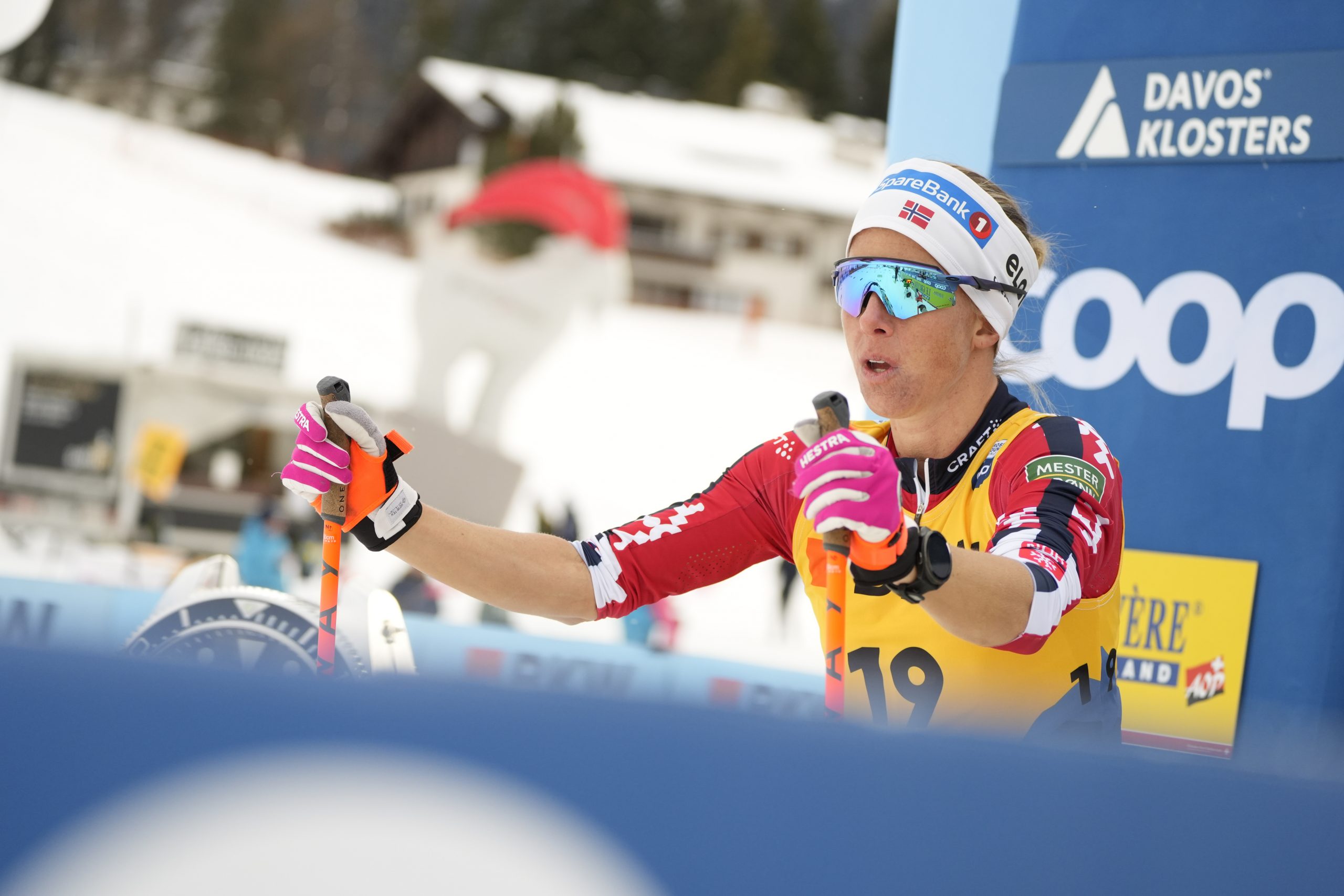
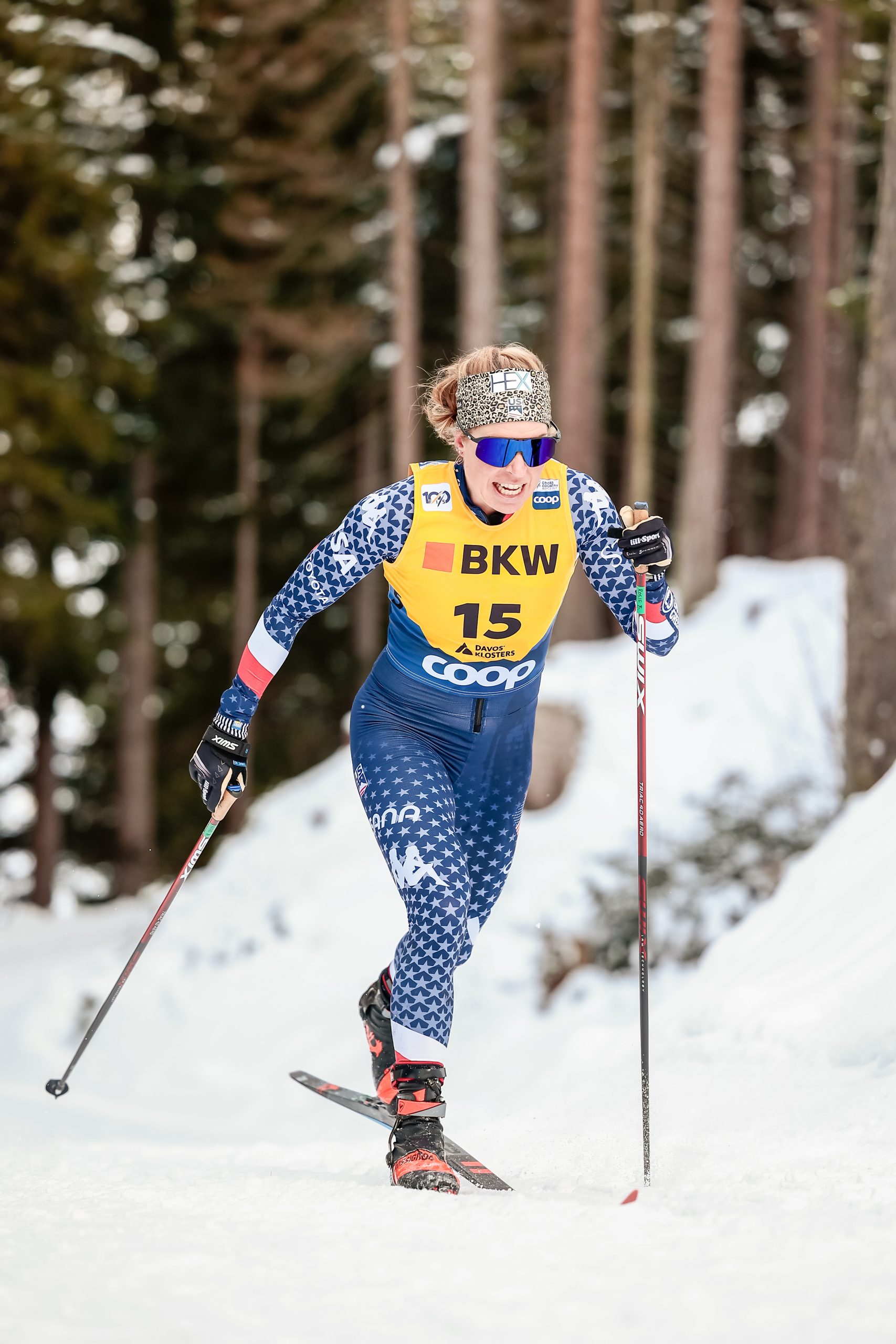
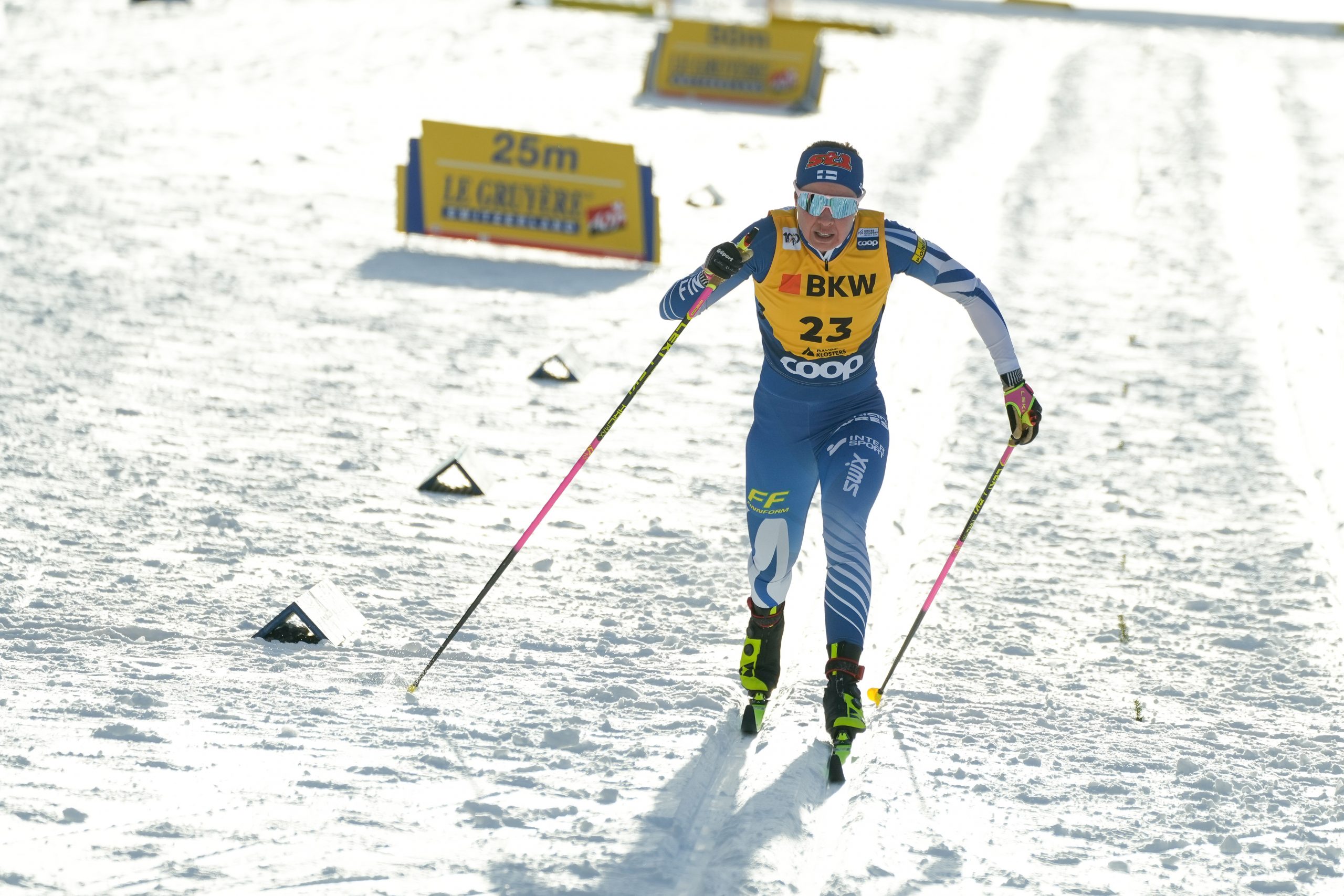
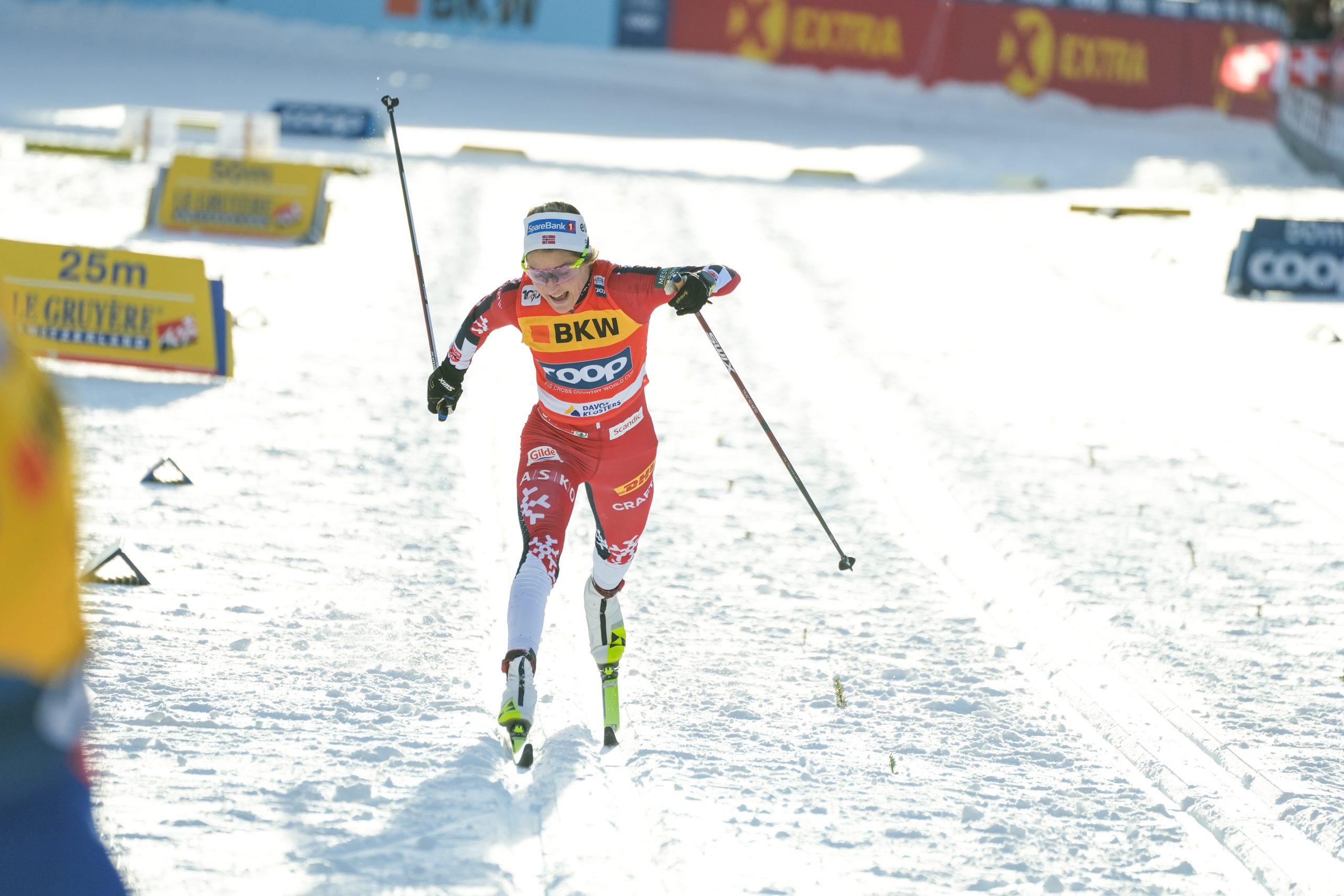
As cowbells and horn music echoed through the course, the women’s 20 k classic marked the final competition before athletes enjoy a brief rest ahead of the Tour de Ski later this month. However, the start list for today’s race was missing several notable names, hinting that some top competitors may still be opting for a conservative start to this World Championships season.
Astrid Oeyre Slind (NOR) earned her first-ever World Cup victory. (Photo: NordicFocus)
Many had written off the top position on the podium as an easy win for Therese Johaug (NOR), a skier renowned for her dominance in distance events and current leader of the distance standings. With key Swedish athletes like Frida Karlsson, Ebba Andersson, Linn Svahn, and Jonna Sundling sitting out, as well as Heidi Weng (NOR), the start list for today’s competition was shorter than usual.
This created an opportunity for others to challenge for the podium. On the final day of the Davos World Cup, it became evident who was feeling the effects of the weekend’s racing. With many top athletes strategically opting to skip Friday and Saturday’s sprint competitions, tired legs certainly played a role in today’s performances.
Victoria Carl (GER), Astrid Oeyre Slind (NOR), Krista Parmakoski (FIN), Kerttu Niskanen (FIN), Kristin Austgulen Fosnaes (NOR), Katharina Hennig (GER), and Teresa Stadlober (AUT), who have all achieved consistent top-15 results in distance events this season, were waiting for an opportunity to advance onto the podium. Perhaps having known this, none of these athletes started Saturday’s sprint. For Americans Jessie Diggins and Rosie Brennan, who competed in both the sprint qualifier and heats yesterday, the additional fatigue may have posed a slight disadvantage.
The podium was largely decided from the outset of today’s competition, as Johaug, Slind, and Niskanen established an early lead that steadily grew throughout the race. Johaug led through most intermediate checkpoints but began losing ground after the 16.5 k checkpoint. Slind, meanwhile, maintained her momentum and accelerated through the final kilometers to secure her first-ever World Cup victory, finishing 10.1 seconds ahead of Niskanen. Johaug crossed the line in third, 13.5 seconds behind Slind.
Diggins and Brennan skied comfortably, finishing 7th and 8th, respectively, to secure spots in the top-10. Other American finishers included Sydney Palmer-Leger in 28th, Haley Brewster in 35th, and Alayna Sonnesyn in 37th. Canada’s Katherine Stewart-Jones also skied to a 22nd place finish.
Rosie Brennan (USA) skied a strong and consistent race, finishing 8th overall (Photo: NordicFocus)
“Today, I definitely wanted to just feel like I was in the race, and able to push when I wanted to and hold pace throughout,” Brennan shared following the competition. “I feel when I am racing at my best, that puts me in the fight.”
As Team USA eases into the season, these early races may highlight room for improvement, especially given the team’s recent transition to on-snow training. “I don’t think I was quite there today,” Brennan reflected, “but it was definitely a step in the right direction for me. I felt a bit more open and able to ski the way I wanted to and find some ability to push a bit out there. I think I’m still missing that top end that will hopefully bring me closer to where I want to be, but all you can ask for is a step in the right direction.”
Women’s 20 k Classic Individual Start
While Johaug was a strong favorite entering the competition, the other podium spots were open for new names to step up today, with some of the strongest World Cup distance skiers missing from the start list. Early starters Niskanen, Slind, Brennan, and Hennig maintained similar splits through the first five kilometers, with Niskanen and Slind gradually pulling away to build a steady lead over the others. By the 9.3 k checkpoint, Niskanen and Slind had established a commanding 45 second advantage over Brennan and Hennig, positioning themselves as clear contenders for the podium.
Kerttu Niskanen (FIN) delivered an impressive performance, posting strong splits that secured her a second-place finish on the podium. (Photo: NordicFocus)
In many ways, the podium positions were already decided within the first few kilometers of the race. The early lead by Niskanen and Slind, combined with Johaug’s well-established strength in distance events, solidified the trio as podium contenders. By the second half of the competition, it was clear that the podium was out of reach for the chasing pack. At the 16.5 k checkpoint, Slind, Niskanen, and Johaug held a lead of more than 30 seconds over Carl and Parmakoski, and a 1.5-minute lead over early contenders Brennan and Hennig.
The specific order on the podium remained uncertain until the final moments of the race. While Johaug may have dominated this competition two years ago, her return this season left more to be decided. Though she established an early lead through the initial checkpoints, Niskanen also positioned herself as a strong contender in the middle kilometers. Only second to Johaug, Niskanen’s lead over Slind grew to 7 seconds around the 12.4 kilometer checkpoint.
Between 14 and 16 kilometers, Slind shifted into high gear, steadily closing the gap on Niskanen and ultimately overtaking her. From there, Slind continued to build her lead through the final kilometers of the competition.
Spectators held their breath through the final kilometers of the day, watching Johaug’s narrow lead over Slind dwindle. By the 16.5-kilometer checkpoint, Johaug was just 1 second ahead, a margin that shrank to 0.5 seconds by 18.5 kilometers. In the final stretch, Johaug couldn’t maintain her pace, dropping back to finish 13.5 seconds behind Slind and 10.1 seconds behind Niskanen, settling for third place.
Therese Johaug (NOR), adorned in the red bib as the reigning distance leader, struggled to maintain her dominance in today’s race, fading in the final kilometers to finish third. (Photo: NordicFocus)
With Johaug out of the way, Slind skied to her first-ever World Cup victory after 59 race starts and five podiums. “I can’t really believe it,” Slind shared following the race. “I never thought this would happen and at least not when Therese is back in the start. I thought I was fighting for second place the whole time and suddenly I realized this could be a win. I don’t know what to say.”
Outside the podium, positions in the top-10 saw more movement throughout the competition. Carl had a strong start, achieving some of the fastest splits early in the race. An exciting battle unfolded between Carl and Johaug in the opening kilometers, with Johaug leading by 3.2 seconds at the first checkpoint before Carl reclaimed the advantage by the 4.2-kilometer mark, edging ahead by 1.1 seconds.
As the race progressed, Johaug extended her lead over Carl, who contended for a position in the top-5 against Parmakoski. However, Carl began to fall off the pace around the 15-kilometer mark and ultimately dropped back during the final lap. In the end, Parmakoski skied to a 4th place finish and Carl followed closely behind in 5th.
Teammates Diggins and Brennan joined Carl in the battle for top-5 positions. Diggins posted strong splits early in the race but appeared to be fading by the 16-kilometer checkpoint. As one of the few top-athletes who competed in all three competitions this weekend, including all three sprint heats, it’s likely this may have been one of the few occasions in which Diggins ran out of steam. Brennan with strong splits throughout, maintaining her position in the top-10. “I was happy with my pacing, I held very consistent through the whole race which is always a good thing,” Brennan shared with FasterSkier.
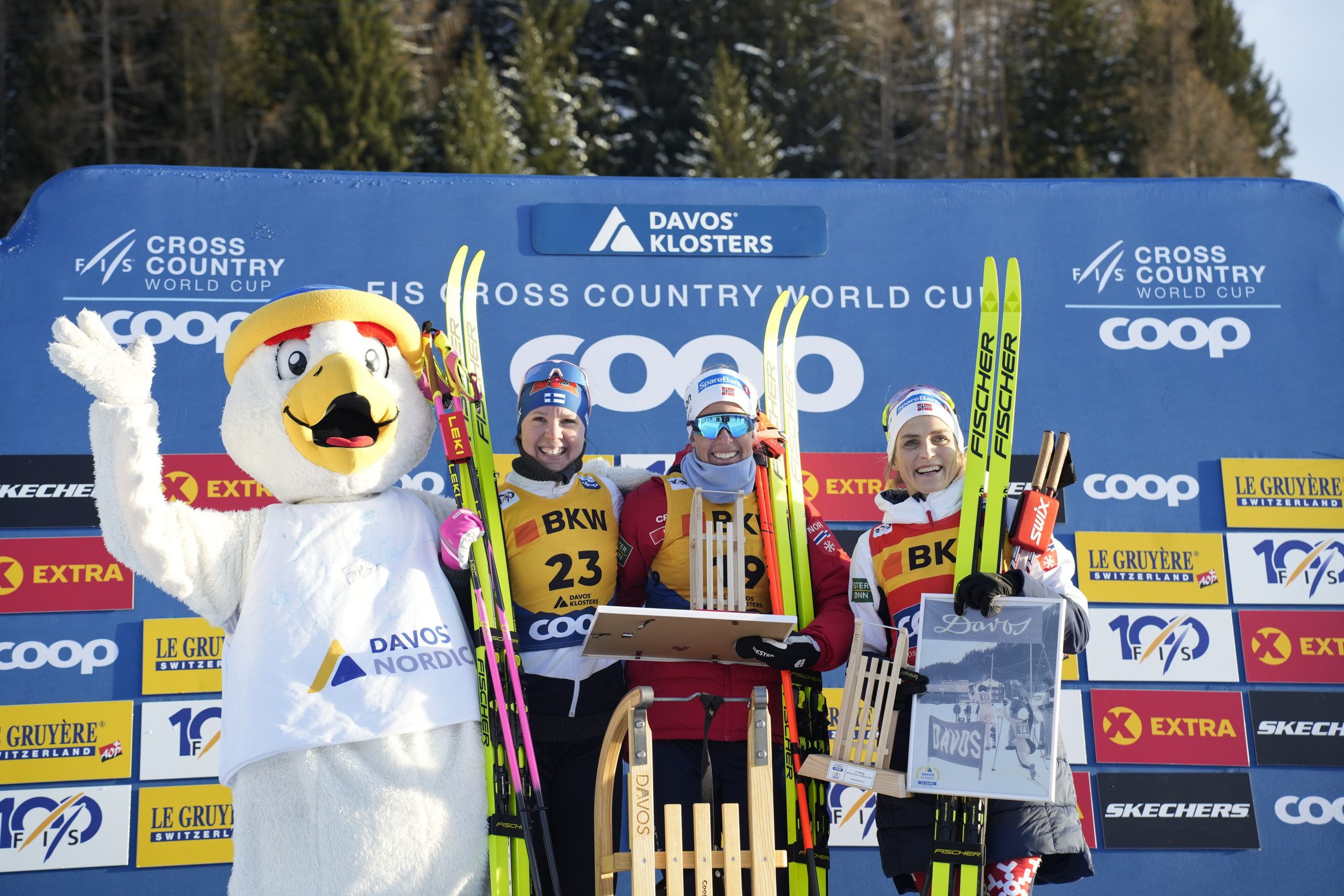
Kerttu Niskanen (FIN), Astrid Oeyre Slind (NOR), and Therese Johaug (NOR) claimed the podium in the Davos women’s 20 k classic individual start race. (Photo: NordicFocus)
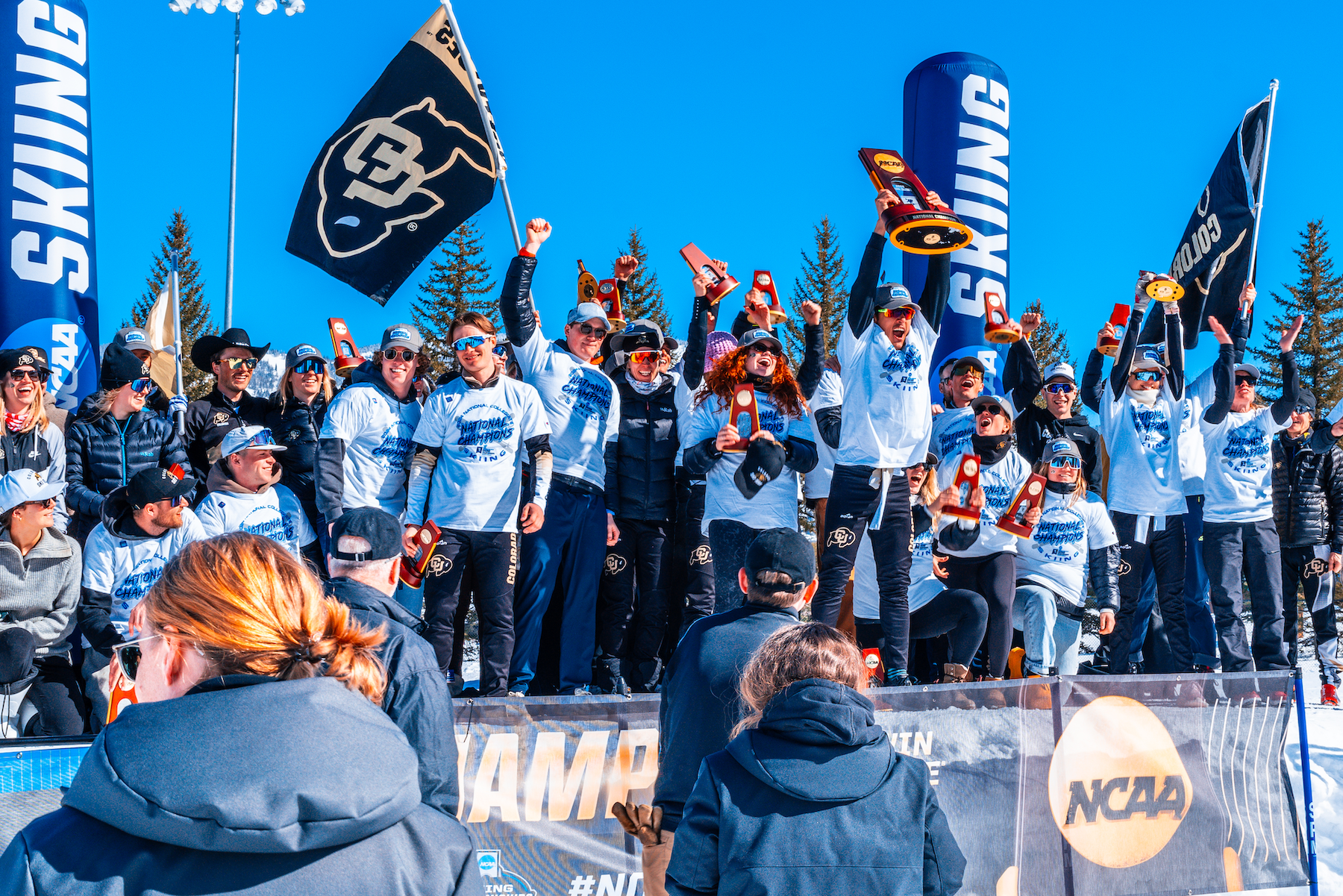
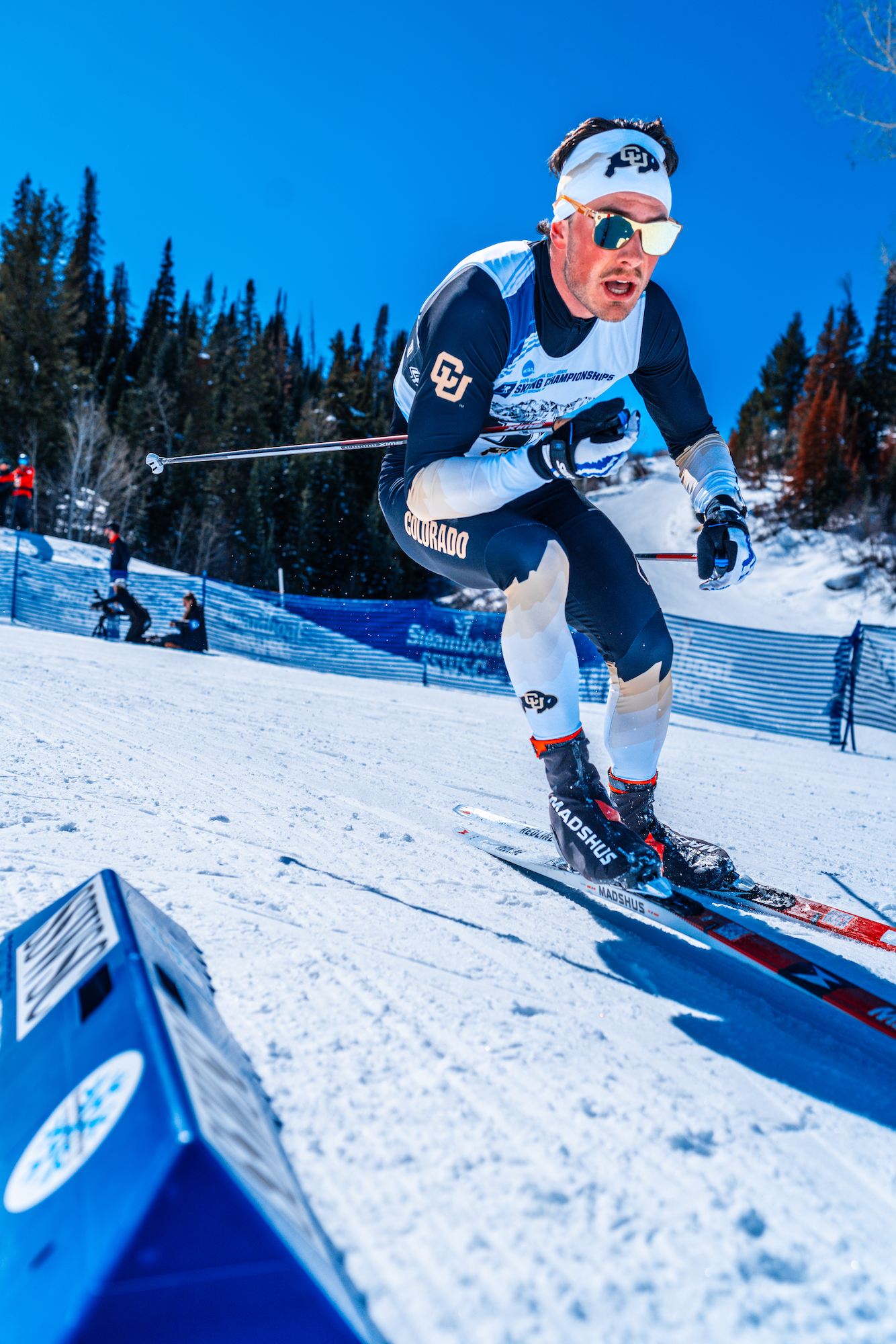
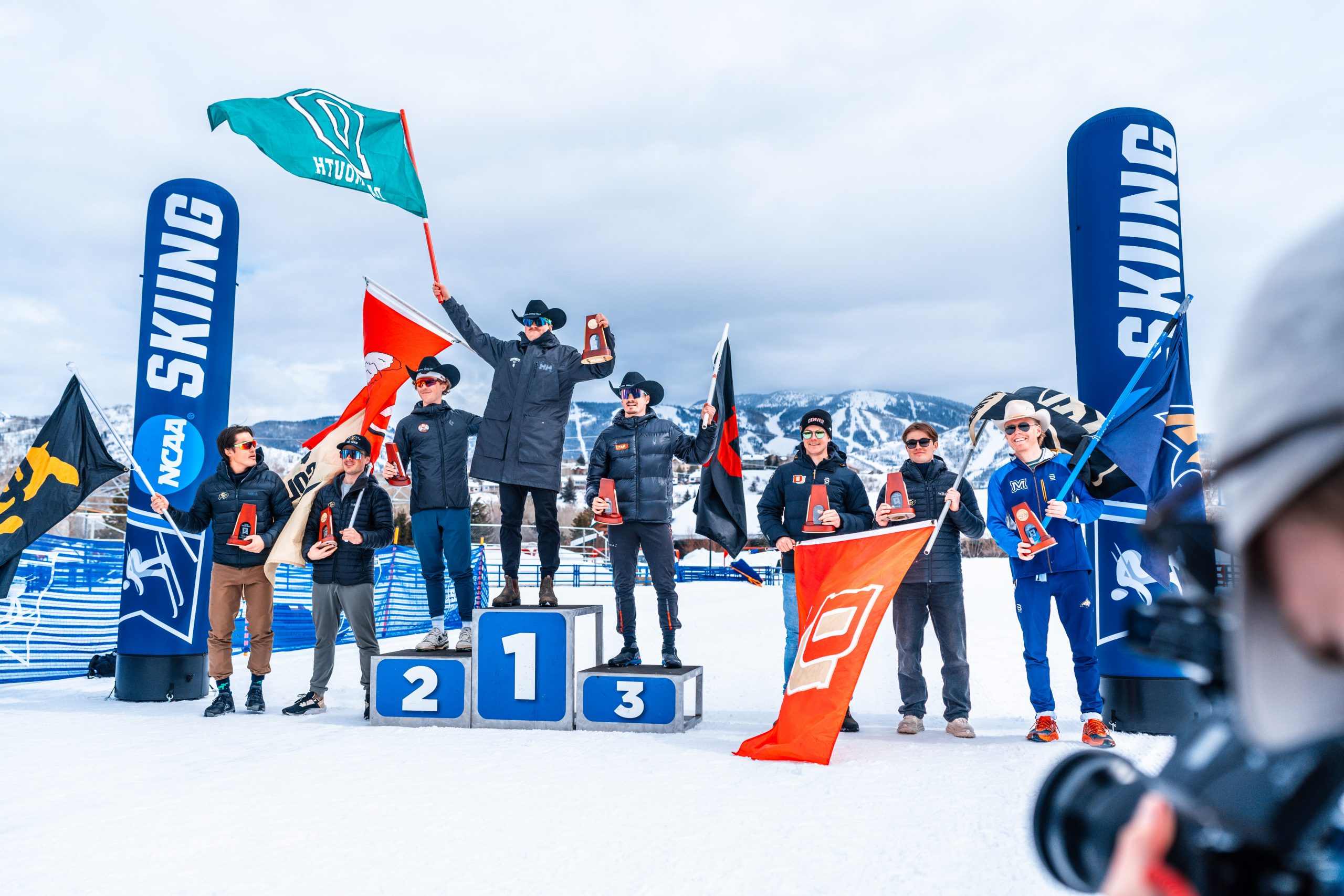
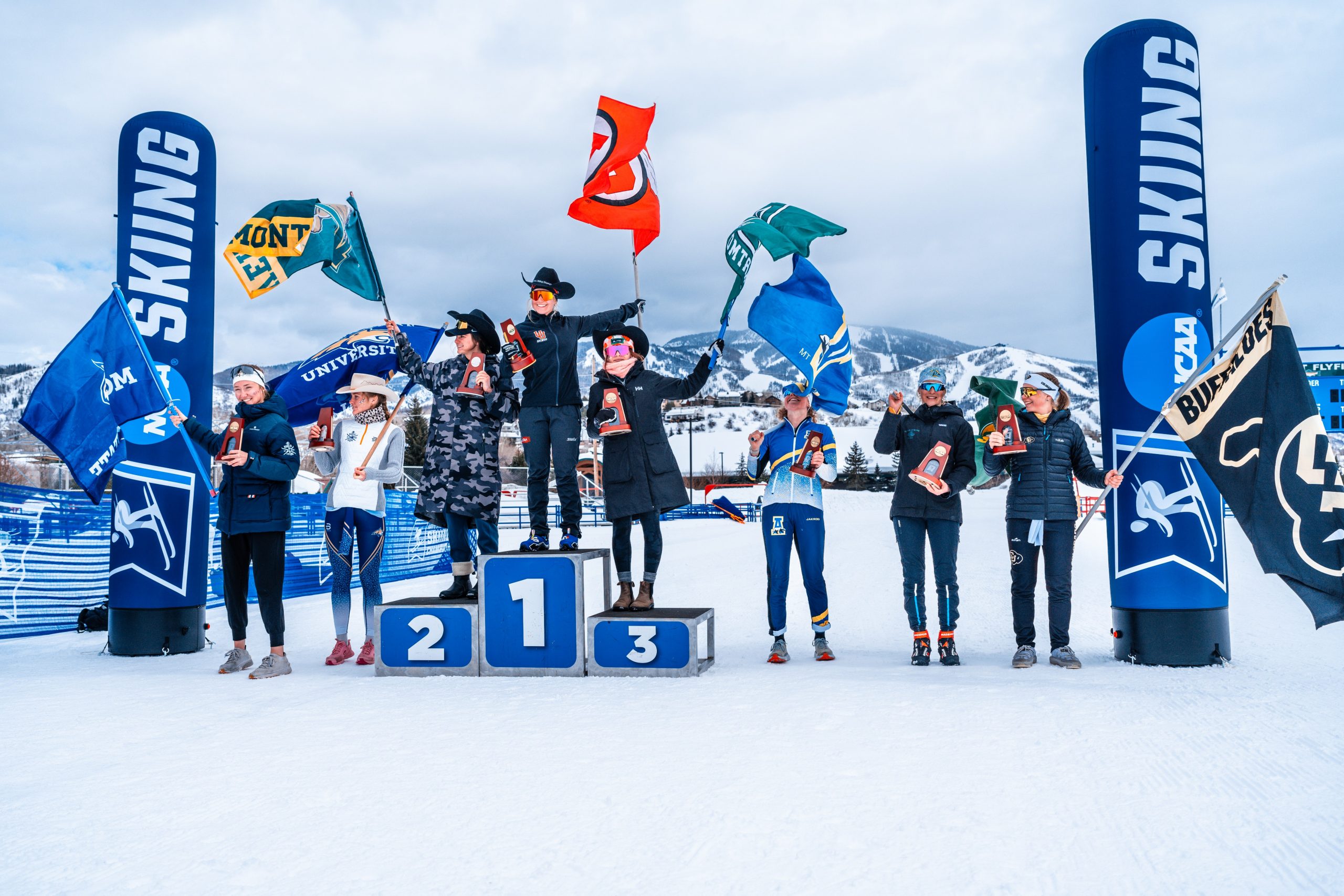
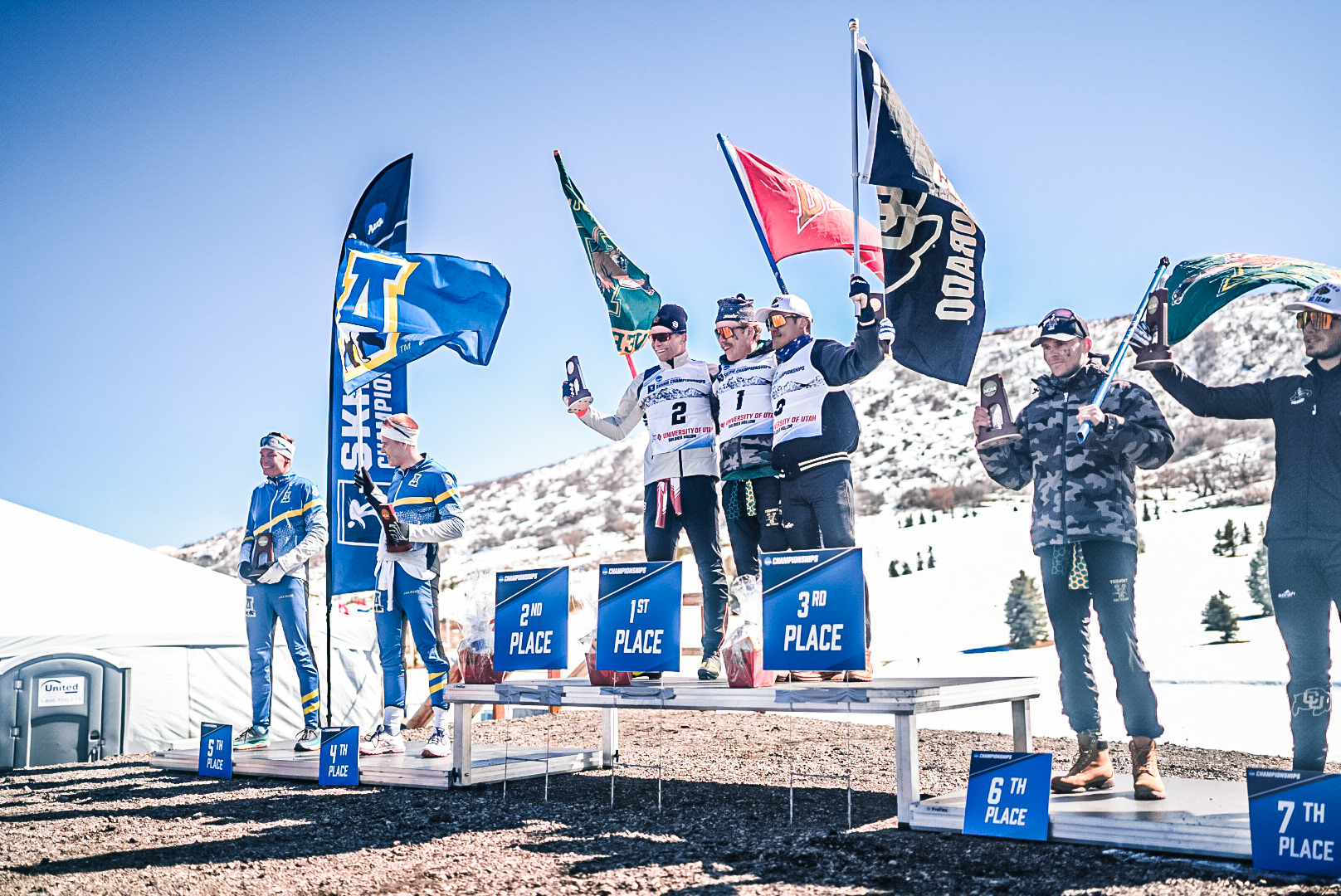
The 2024 NCAA Champion University of Colorado Buffaloes. (Photo: Tobias Albrigsten/ @UnTraceableG)
Winning a fifth NCAA championship in a row would represent a program milestone for the University of Utah, though going into the final day of NCAA competition, Utah’s path to victory was less than a foregone conclusion. Nonetheless, Utah has shown itself to be the dominant collegiate program—both Alpine and Nordic—of the last few years, entering the final day of NCAA competition as the favorite to take the crown. All that history would be decided in the Men’s and Women’s 20 k Mass Start Classic races held at Howelsen Hill in Steamboat Spring, Colorado. Clear skies and perfect conditions made waxing and preparation quite straightforward; the races—and the championship—would be decided on the trails.
The NCAA Skiing Championship is awarded to the team with the highest combined score after two Alpine races and two Nordic races. The University of Utah entered Saturday’s 20 k Mass Start Classic races (Men’s and Women’s) with a substantial lead (444.5 points) over University of Denver (401 points) and University of Colorado (393.5 points). These would be the final races of the 2024 NCAA Championship—trophy presentations, unfurled flags, and whole-team podium photos to follow.
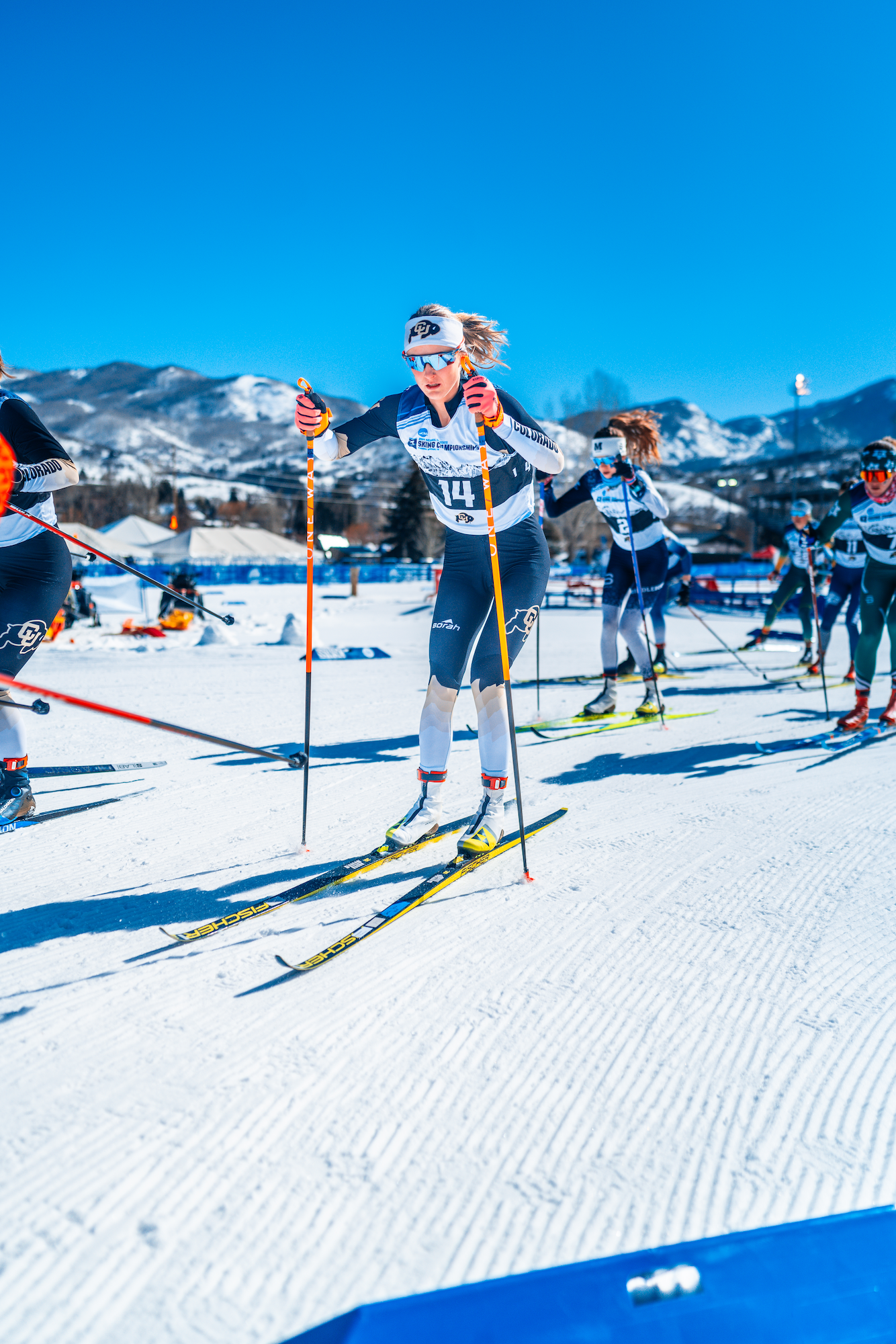
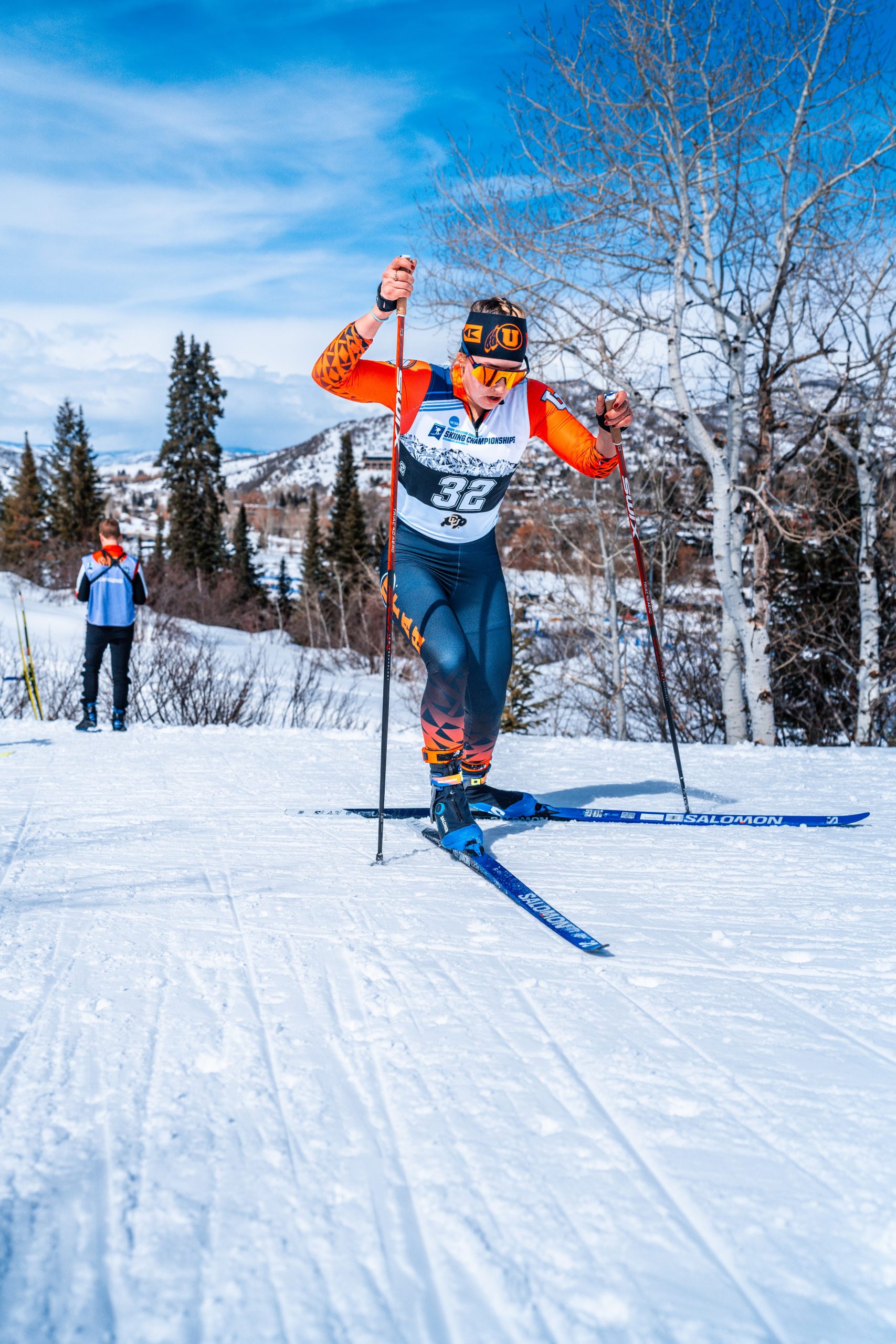
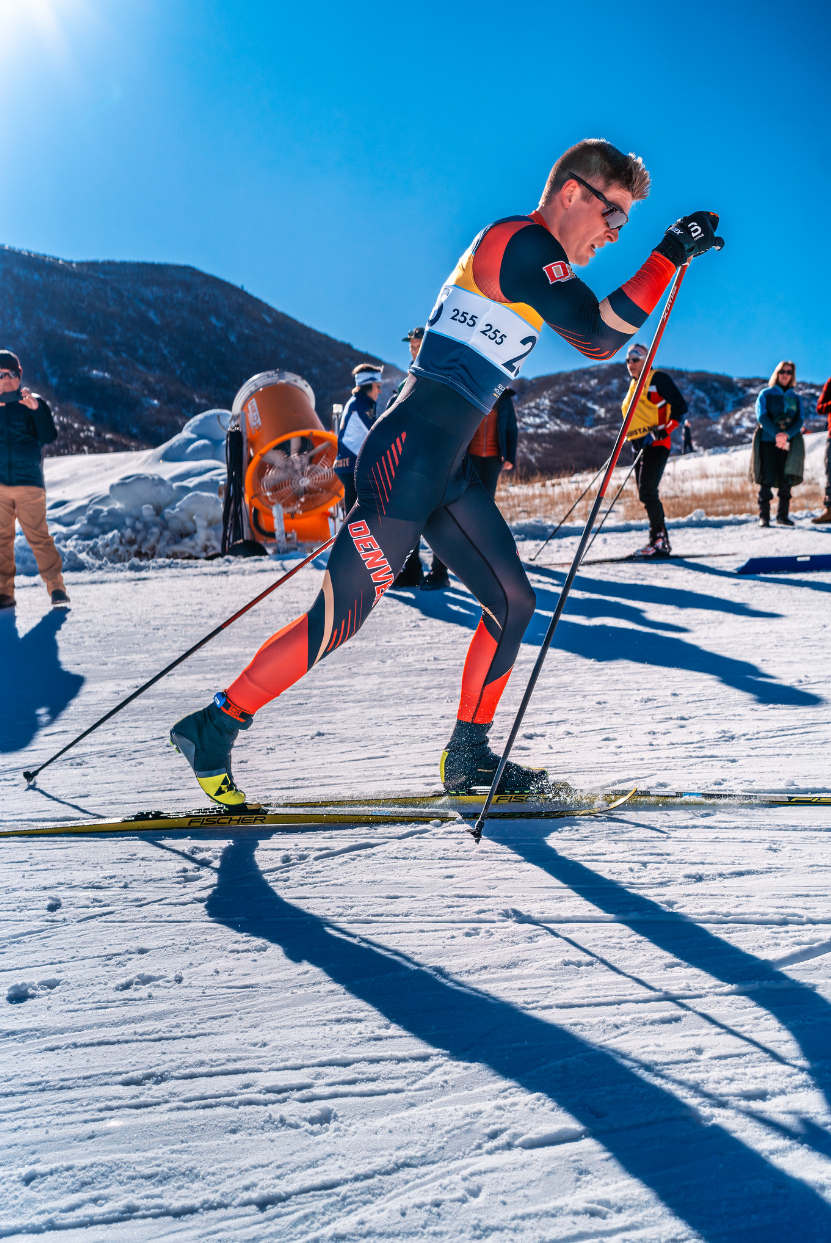
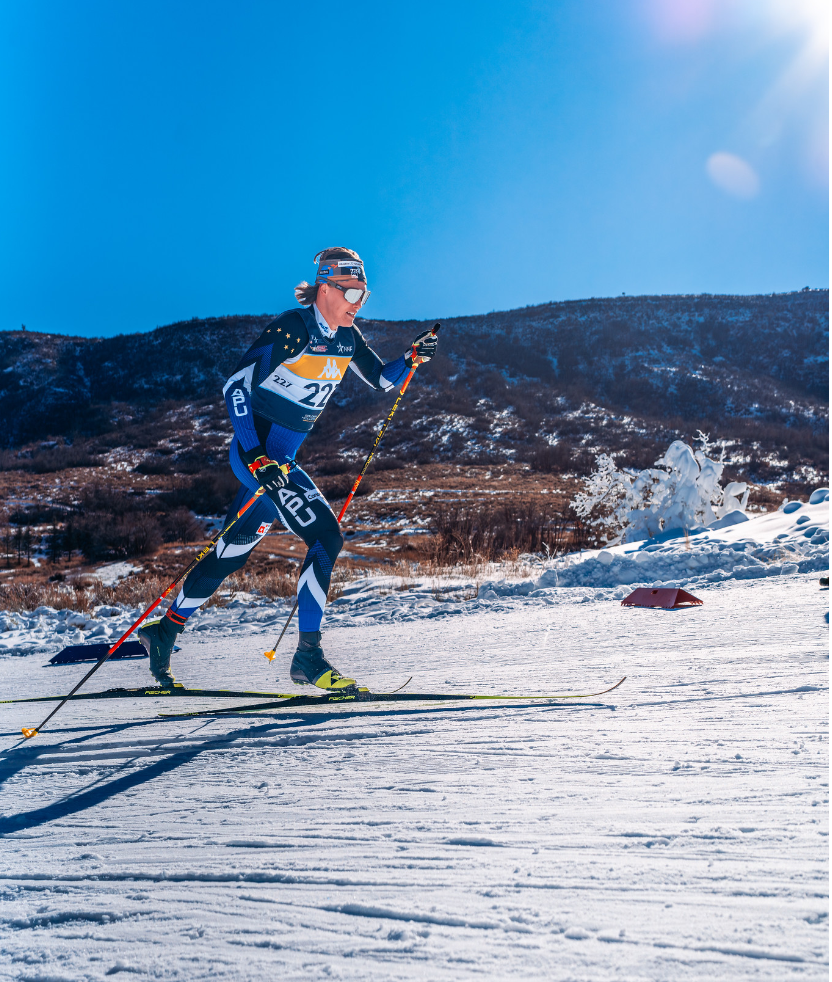
University of Colorado’s Weronkia Koletta during Saturday’s NCAA 20 k Classic Mass Start. Koletta finished ninth, part of a CU effort that placed three in the top ten to secure a closely-contested NCAA Team Championship. (Photo: Tobias Albrigsten/ @UnTraceableG)
Women’s 20 k Classic Mass Start
Earlier in the week, Thursday’s 7.5 k Individual Start Freestyle race was won by Utah’s Sydney Palmer-Leger (UU) who ended her own three-year title-drought by returning to the top step of an NCAA podium for the third time in her career. Palmer-Leger was a two-time NCAA champion as a freshman in 2021, but since those early-career successes, she has had to watch as her teammates—Novie McCabe in 2023 and Sophia Laukli in 2022—won races and garnered headlines. With McCabe and Laukli now racing full-time on the World Cup circuit, the responsibility of delivering national championships for the Utes has returned to Palmer-Leger.
Along with Palmer-Leger, the list of contenders in the Women’s race is deep and distinguished, and many of those names went straight to the front as the race began. Led by Tilde Baangman (MSU) and Hannah Abrahmson (CU), a group of seven separated themselves from the field by the top of the very first hill. By the end of the first of four 5 k laps, that lead group would grow to ten: Jasmine Drolet (DAR), Baangman, Abrahamson, Kariana Dengeruud (UU), Palmer-Leger (UU), Anna-Maria Dietze (CU), Weronika Kaleta (CU), Haley Brewster (UVM), Ava Thurston (DAR), Kate Oldham (MSU). The challenging climbs and the daunting elevation of Steamboat’s Howellson Hill course continued to whittle away at the lead group for the next two laps. Conversely, Kendall Kramer (UAF) was able to work her way up to the lead group as other contenders continued to fall away.
At the beginning of the final lap, the lead group had seen itself shrink to seven: Abrahamson, Baangman, Palmer-Leger, Drolet and Dietze, with Kaleta hanging just off the back in sixth. If that combination of skiers—three from CU and only one from UU—were to finish in that order, it would mean a massive points swing to CU with only the Men’s race remaining in team scoring. But racing rarely goes to script.
Midway through the final lap, a major climb caused another split in the lead group as Abrahamson, Palmer-Leger, and Brewster powered to the front, only to see themselves caught and passed on the subsequent downhill by a rocketing Drolet who quickly established a gap and shattered the small group of leaders.
Drolet would storm across the line first, followed seconds later by Brewster second, Palmer-Leger third, Abrahamson fourth, Dietze fifth, Kramer sixth, Baangman seventh.
Magnus Boee (CU) delivered the third NCAA race win of his career, leading the Colorado Buffaloes to an unlikely final-day comeback and the NCAA Skiing Championship. (Photo: Tobias Albrigsten/ @UnTraceableG)
Men’s 20 k Classic Mass Start
Utah led team scoring going into the final Men’s race, with Colorado trailing by only 17 points. NCAA bragging rights would be up for grabs over the next 20 kilometers.
In the 2023 NCAA Mass Start race, Dartmouth’s John Steel Hagenbuch had found himself out-dueled by Remi Drolet of Harvard (the first NCAA race-winner in that school’s history). Drolet returned to this year’s NCAA championship, but he appeared to have left his best form on the World Cup courses where he spent much of the winter and spring. Drolet finished Thursday’s 7.5 k Freestyle an uncharacteristic 16th. Hagenbuch, too, has raced through a calendar dominated by World Cup racing, but he appears to be getting stronger and stronger as the collegiate season continues.
The Men’s race broke up quickly; by the beginning of lap two, a lead group had formed of Andreas Kirkeng (DU), Florian Knopf (DU), Magnus Boee (CU), and Will Koch (CU). That lead group was followed closely by 2023 NCAA Champion Joe Davies (UU), Tom Mancini (UU) Hagenbuch, and Drolet.
Mid-lap attacks by Boee shook up the lead group, shedding Koch and stringing out Kirkeng and Knopf. It seemed an audaciously early move, though with potential to develop points gaps (especially with Boee in the lead and Koch remaining ahead of Utah’s skiers) that could bear heavily on the final NCAA standings.
Boee’s tremendous double-pole continued to put time into his rivals. All that remained was the upcoming 30+ kilometers, and the question of whether or not Boee’s gamble would pay off. Through the end of the second lap, Boee’s gap continued to grow. Behind him, Knopf continued to chase gamely, though Kirkeng was overtaken by Koch.
Working together behind Koch was a group of contenders including Tom Mancini (UU), Drolet, Hagenbuch, Brian Bushey (UU), Davies, and Florian Winker (MSU).
Beginning the final lap, Boee held a gap of over 20 seconds over second place Knopf, then another 20 + seconds to Koch, then a final 20+ seconds to the main group of chasers. Someone would need to surge—and someone would need to blow—for those standings to be much changed before the finish. At the beginning of this final lap, CU led the NCAA team standings by a mere two points.
University of Coloardo’s Will Koch held off a late surge by John Steel Hagenbuch (Dartmouth) to take third in the NCAA 20 k classic mass start, helping win the Team Championship for CU by just 2 points. (Photo: Tobias Albrigsten/ @UnTraceableG)
On the major climb, Drolet and Hagenbuch began to pull away from the Utah skiers. And by the last kilometer of the final lap, Hagenbuch and Drolet were beginning to track down Koch who gave everything he had to get over the top of the final climb ahead of his pursuers.
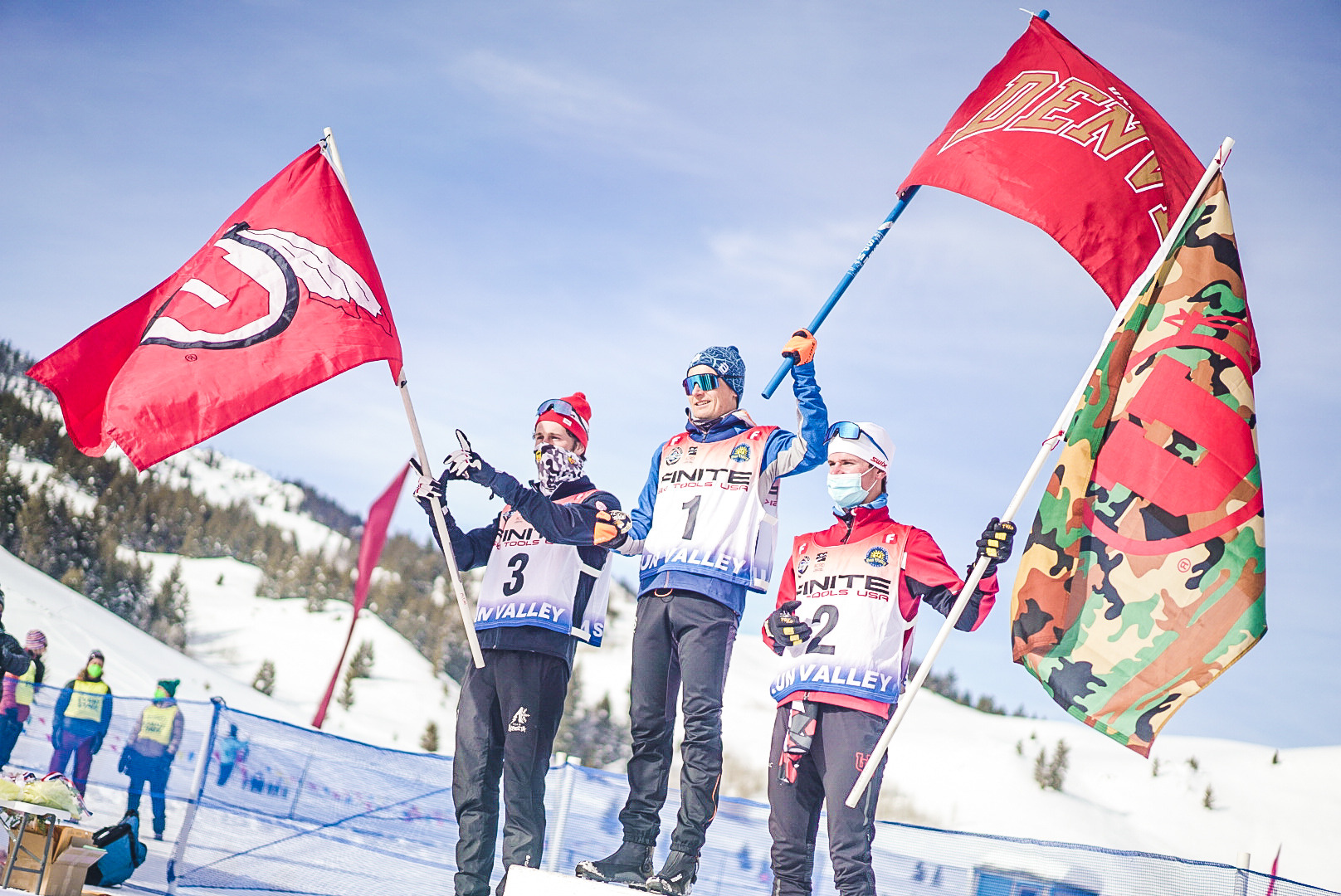
Boee skied across the line waving a CU flag, Knopf crossed the line, Koch crossed the line, Drolet outsprinted Hagenbuch for fourth, then a trio of Utes crossed together. A few skiers later, Colorado’s Johannes Flaaten crossed the line for 11th place . . . and a NCAA TEAM CHAMPIONSHIP for the Colorado Buffaloes . . . a win they took from the Utah Utes by a team-total of two points.
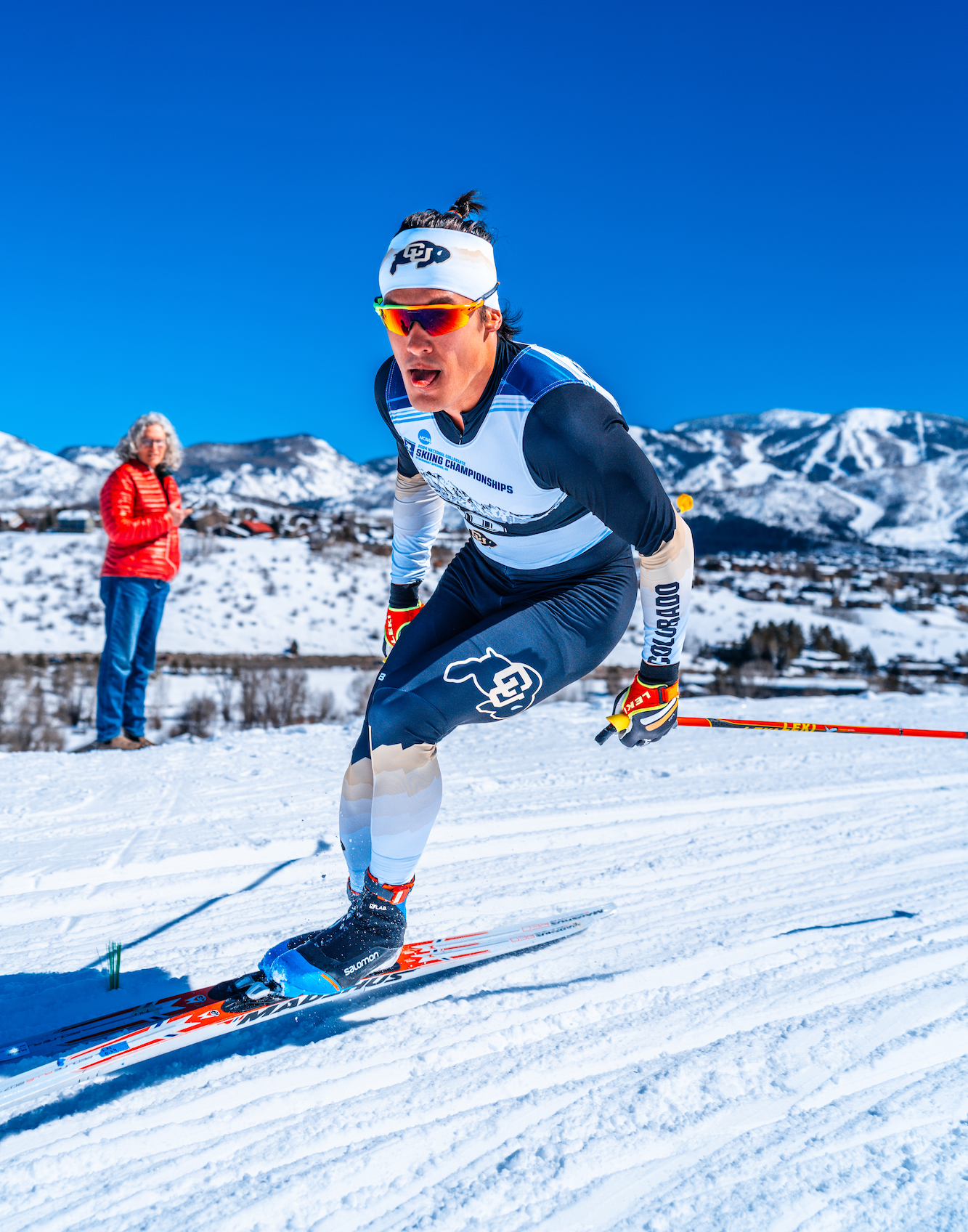
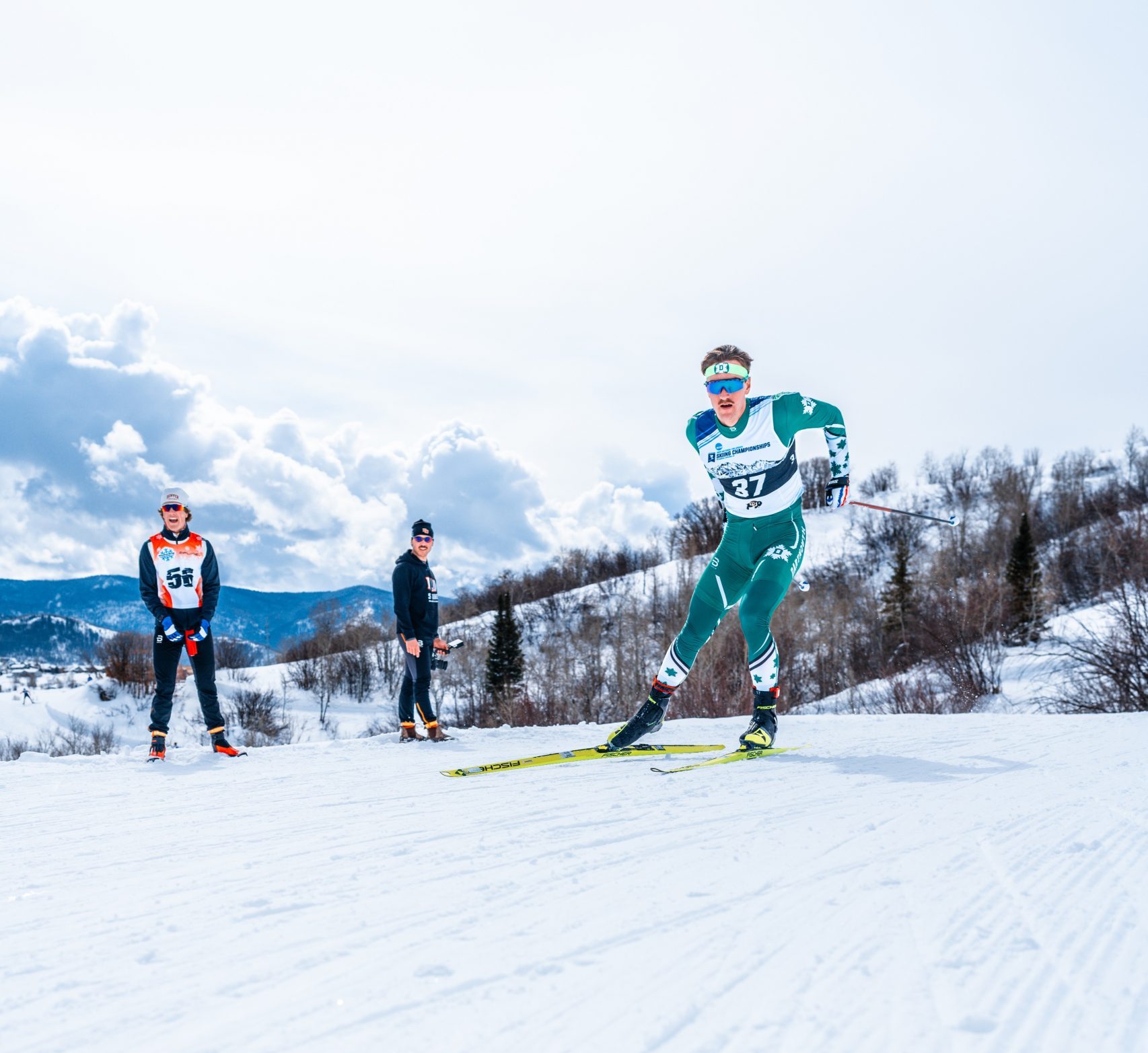
John Steel Hagenbuch (Dartmouth) en route to his first NCAA Championship in Thursday’s 7.5 k skate race. (Photo: Tobias Albrigtsen/@untraceableg)
When the sun shines happily and snowstorms spread a fresh coat of white on trails and trees, it’s pretty hard to beat Steamboat’s Howelsen Hill as a ski race venue. That’s exactly what greeted the country’s best collegiate skiers for Day 1 of nordic competition at the 2024 NCAA Ski Championships as racers lined up for a 7.5 k individual start skate race.
Pitch-perfect Colorado spring conditions softened the corners—literally and figuratively—on an otherwise stark, challenging, three lap, 2.5 k course that climbed out of the Howelsen Hill rodeo grounds, turned corners, kept on going, and finally relented for a fast downhill to the finish. Located way up at 7,000 feet of elevation, the course—and the challenges of the mid-distance race distance—combined to present a true test for collegiate skiing’s young, versatile talent. The climbs would task the aerobic capacities, but the ability to recruit fast twitch fibers was one that would play a role in determining who could cover the 7.5 k the fastest. It was a utility-players race, and would make for an interesting spectacle for the spectators.
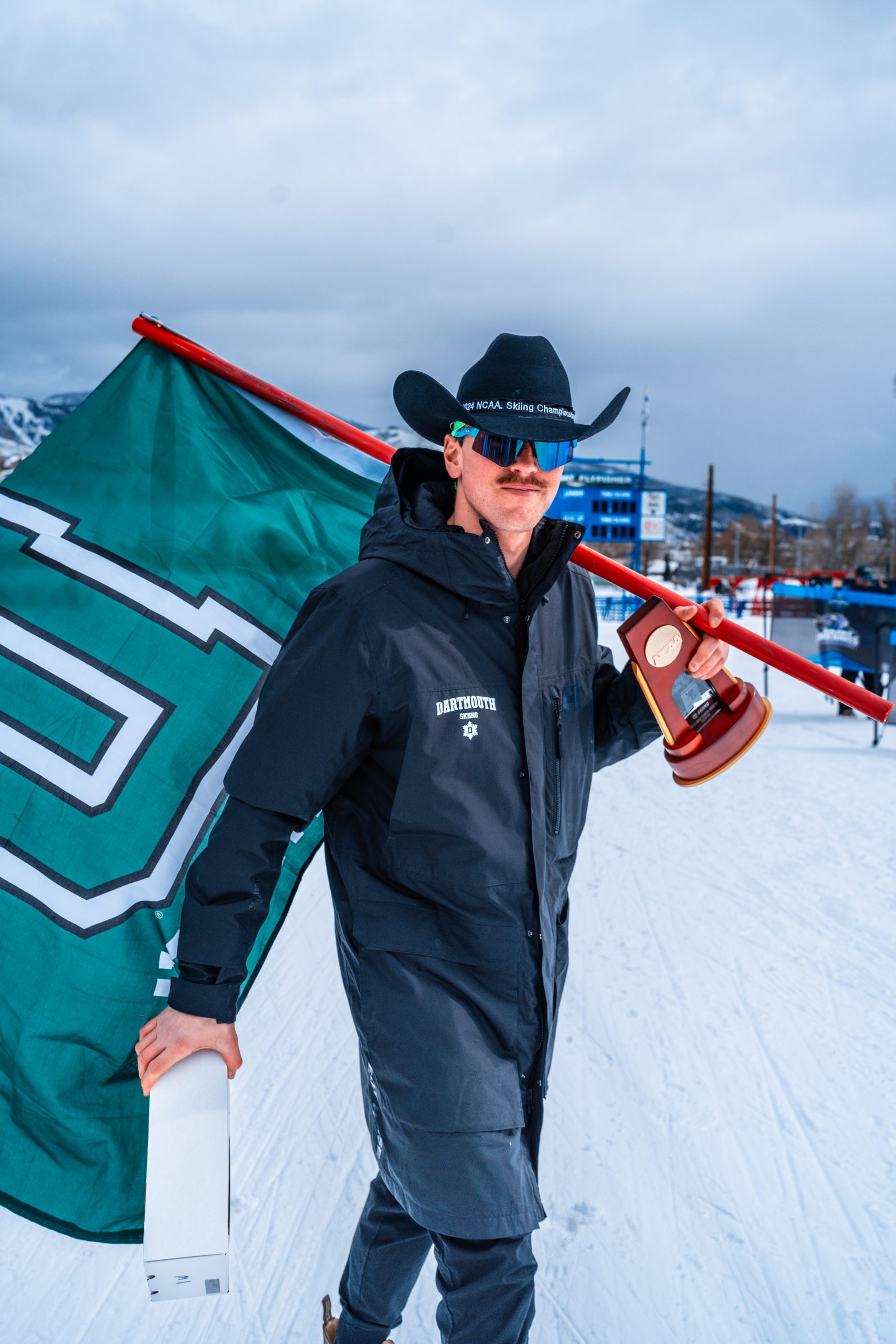
“All-American:” 7.5 k skate winner John Steel Hagenbuch (Dartmouth) looked right at home at the Steamboat Springs rodeo grounds after the Men’s podium ceremony Thursday. (Photo: Tobias Albrigtsen/@untraceableg)
Men’s 7.5 k Skate Individual Start
At last year’s NCAA Championships in Lake Placid, Dartmouth’s John Steel Hagenbuch finished second in the 10 k skate behind then-University of Alaska-Fairbanks (now-University of Utah) skier Joe Davies. Hagenbuch came into Steamboat knowing he just needed to take one more step. The metaphor became something more literal when Thursday’s startlist was posted; Hagenbuch started one bib behind Davies, bibs 37 and 36, respectively.
Through three 2.5 k laps, Davies and Hagenbuch would remain tied to each other. Davies went through the first 2.5 k checkpoint in first place, splitting less than a second with a group of early start leaders Florian Knopf (University of Denver), and Will Koch (University of Colorado). One start place behind though, Hagenbuch was able to emerge from that pack. He came through the 2.5 k checkpoint seven seconds ahead of the leading group containing Davies and another pre-race favorite, the University of Denver’s Andreas Kirkeng. Hagenbuch’s lead was one of the only distinguishable features from the first lap of racing. The second place through eleventh place skiers were all within ten seconds through one lap, which only served to impart that the 7.5 k race would make for a race in which seconds split would be places gained or lost.
Through the second lap, some clarity began to emerge. The lead times had started to splay, with Knopf and Koch continuing to top the early starters through the five kilometer mark. Davies would again set the high bar at the checkpoint, taking nine seconds on Knopf to go into the lead, momentarily. Again though, Hagenbuch followed in short order. His time check showed that he had kept his lead steady over Davies at around eight seconds. Behind Hagenbuch, the last starter in the field, UU’s Tom Mancini had started to pick up time, as well. He moved from eighth place at 2.5 k into the fifth spot, 22 seconds off Hagenbuch.
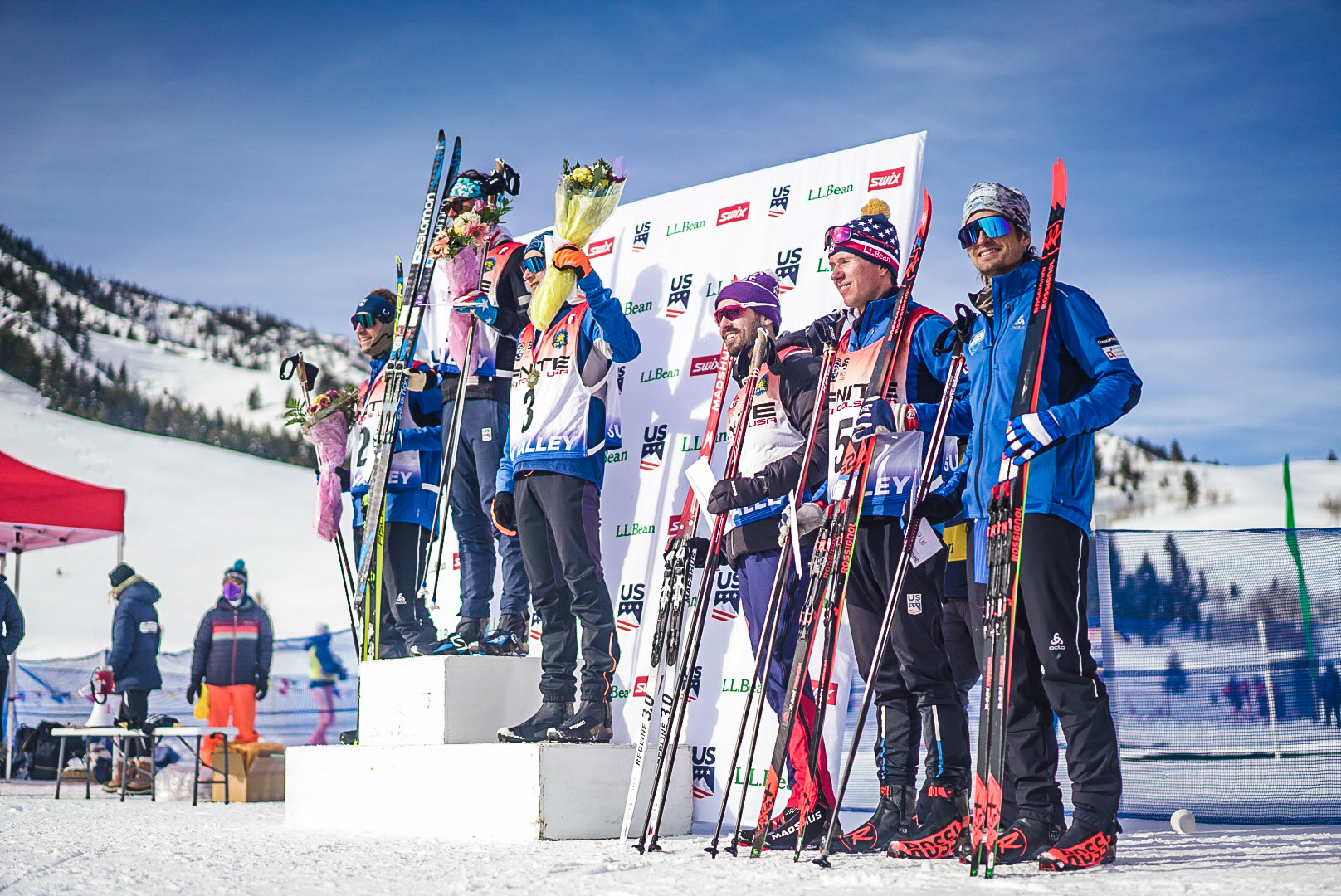
The men’s podium at the first day of the 2024 NCAA Ski Championships in Steamboat Springs, Colorado. John Steel Hagenbuch took the win for Dartmouth, with UU teammates Joe Davies and Tom Mancini in second and third, respectively. (Photo: Tobias Albrigtsen/@untraceableg)
Hagenbuch’s season has been defined by milestones on a national, and international scale. When he has made moves towards a first National Championship, or a World U23 Championship podium, it has come cleanly, and decisively, in the final moments of a race. So, with a lead at five kilometers, the look ahead to the finish raised questions more in line with “Will he be able to put more time on the field?” than “Will he win?” Davies would fall into a similar category, crossing the line in first place, with a twenty second gap over Koch who would finish fourth on the day. As Davies crossed the line, Hagenbuch was coming off the downhill leading to the Steamboat Springs stadium, and would answer the questions raised at the 5 k checkpoint with an affirmative, “Yes!” He gained a couple more seconds over Davies and the field, to total eleven, en route to winning the race. UU’s Mancini, meanwhile, surged, to move ahead of Koch and finish third place, giving UU a dual podium in second and third place.
For Hagenbuch, the win will round out a milestone-filled season with a particularly meaningful one. After three years on the college circuit, Hagenbuch (a junior) is now an NCAA Champion, and has opened up the door to complete a rare NCAA sweep for an American male skier (the last skier to do so was Ben Ogden for the University of Vermont in 2022). “He’s been skiing at a really high level all winter,” said Dartmouth Men’s Head Cross Country Coach, Brayton Osgood, of Hagenbuch’s race. “And he’s done a tremendous job all season of balancing international competition, EISA Carnival racing, and his academic commitments. He skied confidently and strong today, I’m so impressed with his approach and racing today.” Osgood added that Hagenbuch’s race helped set a tone for the entirety of the Big Green on Thursday: “As a full team, this was the best day we’ve had at NCAA Championships in my time at Dartmouth – all six of our skiers in the top-20, three All-Americans, and two podiums including a National Champion. We are really proud of this team.”
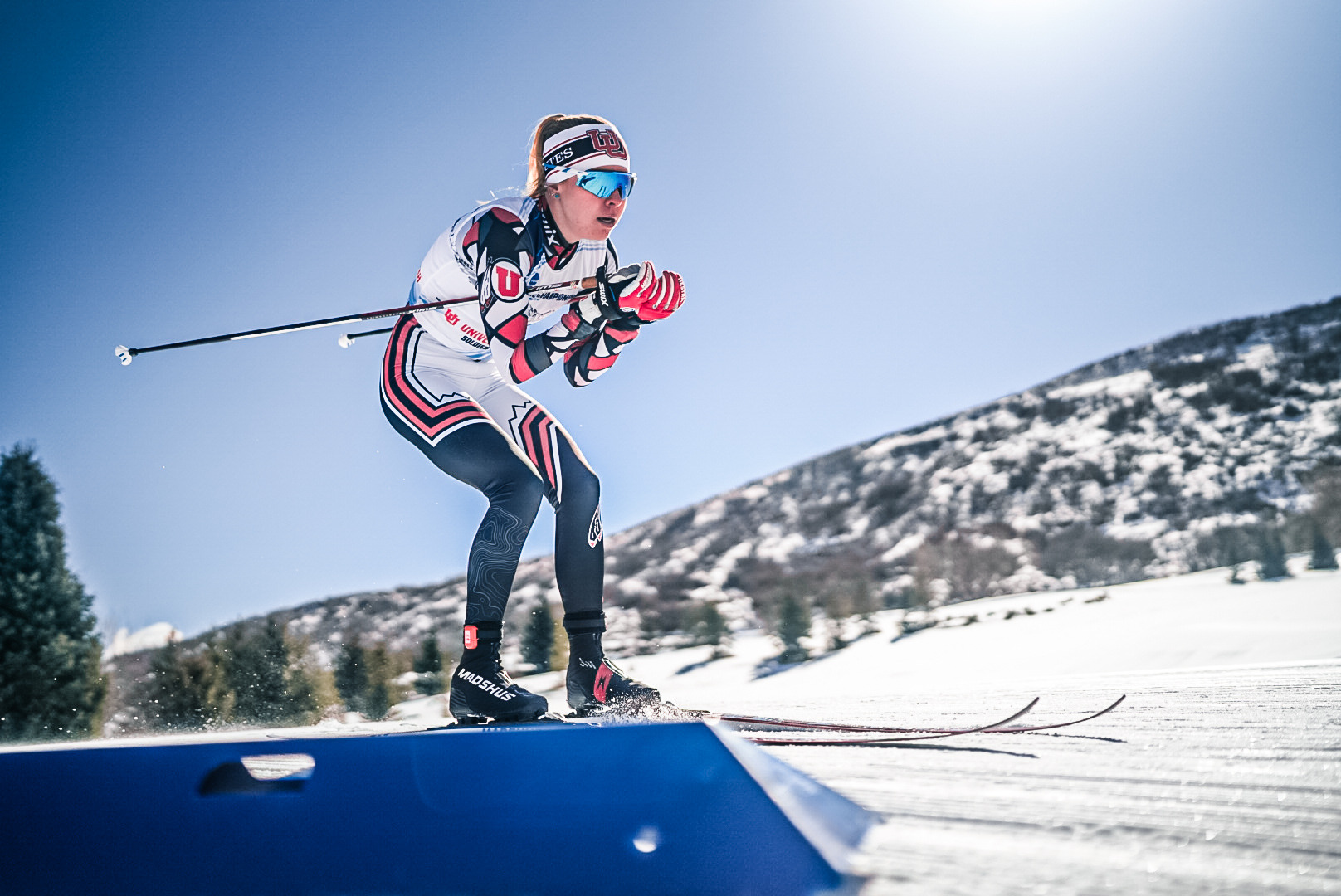
Sydney Palmer-Leger (University of Utah) on her way to her third NCAA Championship in Thursday’s 7.5 k skate race in Steamboat Springs, Colorado. Palmer-Leger’s win extended a UU win streak that extends back to her first NCAA win, in 2021. (Photo: Tobias Albrigtsen/@untraceableg)
Women’s 7.5 k Skate Individual Start
The University of Utah (UU) Women’s team is in the middle of a streak—three straight years of NCAA individual championships. That streak has been made possible by a trio of skiers, Sophia Laukli, Novie McCabe, and Sydney Palmer-Leger. The youngest of the trio, Palmer-Leger had started the impressive run for the UU team by sweeping NCAA Championships as a Freshman in 2021 at Jackson, New Hampshire. Since those victories, she has worked steadily, skied with consistency, and been a factor in nearly every race she has started. She hadn’t, however, skied back to the top step of the NCAA podium.
Fast-forward to 2024, when factors in Steamboat Springs hinted at Palmer-Leger having a good chance to cap her collegiate career with another NCAA title. The Utah native knows how to ski well at altitude, and 7.5 kilometer distance seemed to provide a mid-distance sweet spot. Through the first checkpoint, she was in first place, with a gap of six seconds over early starting pace-setter Astrid Stav (UAA). Palmer-Leger, though, started with bib 32, at the front-end of the field’s main “A-seed” contenders. Bib 35, Montana State’s Tilda Baangman, came through the first checkpoint with a lead of eight seconds on Palmer-Leger, and Haley Brewster (UVM), World U23 silver medalist in the 20 k skate, started with Bib 40, the last skier on course. When Brewster came through the 2.5 k mark two seconds behind Palmer-Leger, it seemed to create a separation of three skiers as the top contenders. Palmer-Leger was there; as a consequence, UU was again, too.
Through the second lap, Palmer-Leger again set the bar for the race’s top-seeded skiers, further distancing herself from early-starting Stav, who was now 20 seconds behind the UU skier. Baangman would be the next main contender through the checkpoint, but when she reached the stadium on her second lap it was with a split behind Palmer-Leger. Baangman had lost an eight second advantage and now stood nine seconds down from Palme-Leger in second place. Haley Brewster would follow five seconds off of Baangman in third place, which solidified the standing of Palmer-Leger ahead of the rest of the pack. Baangman and Brewster’s splits, too, drew attention further down the pack, where a number of skiers had been able to push the Howelsen hills to surge towards the front of the pack. The most noticeable among these was Dartmouth skier, Jasmine Drolet, who pushed from a 13th place split at 2.5 k to sixth place at the 5 k.
When Palmer-Leger reached the finish-line, she was well above the field. She had stuck to her race plan, according to UU Head Coach Miles Havlick, “Her race plan was to go out hard and try to hold it which is exactly what she did.” The gap over a surging Rosie Fordham (UAF) stood at forty-three seconds. Baangman finished twenty-four seconds behind Palmer-Leger, with Drolet following close behind. The Dartmouth skier had started with bib 38 to Baangman’s 35, which spelled out that she had continued her middle-race surge to put in a phenomenal final lap. Drolet finished two seconds ahead of Baangman to take second place, and with just two starters behind her on course, nearly guaranteed herself a podium finish. The only factor behind her was a big one, however, as Brewster looked to push for the finish-line wearing bib 40. Brewster crossed the line with a one second advantage over Drolet—21 seconds behind Palmer-Leger—to take second place.
The podium then was determined: Palmer-Leger (UU) first, Haley Brewster (UVM) second, Jasmine Drolet (HAR) third.
The women’s podium at the first day of the 2024 NCAA Ski Championships in Steamboat Springs, Colorado. Sydney Palmer-Leger won, with Haley Brewster (University of Vermont) second, and Jasmine Drolet (Dartmouth) third. (Photo: Tobias Albrigtsen/@untraceableg)
Three years on from Jackson, New Hampshire, Palmer-Leger is an NCAA Champion again, and opens up her own historic possibility going into Saturday’s race. University of Utah Head Coach Miles Havlick said post-race on Palmer-Leger’s day: “Sidney skied an incredible race today. Her race plan was to go out hard and try to hold it which is exactly what she did. There were several of her competitors who blew up or started too conservatively, and I think she executed perfectly.” With three NCAA wins already behind her, Palmer-Leger has an opportunity to join a list of just three women skiers to have four NCAA Championships with Saturday’s race. She already has matched the total from her former teammate, McCabe, who swept NCAAs last year, making Palmer-Leger among the most accomplished NCAA skiers ever. A win on Saturday would leave Palmer-Leger alone in that regard, as the only American skier to sweep NCAAs twice.
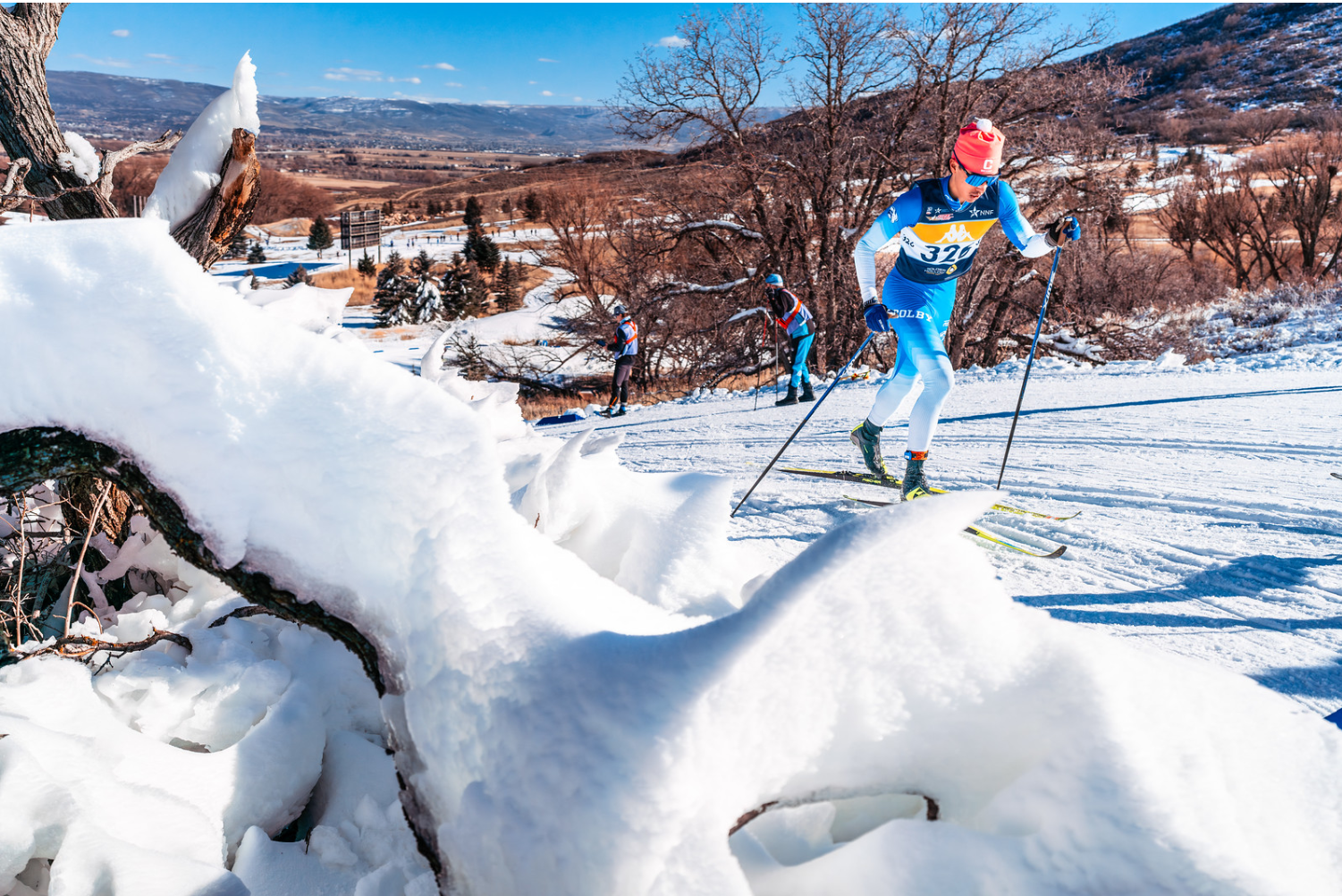
Blue skies and warm conditions greeted racers on the first day of US Nationals at Soldier Hollow, Utah. Rolling terrain and long sustained climbs featured in the 3×3.3 k course skiers completed as they raced a 10 k Classic Individual Start. (Photo: Tobias Albrigsten/UnTraceableGlobal.com)
Race day at Soldier Hollow in Midway, Utah offers a microcosm for the role the venue has played in US skiing. The once, and possibly future, Olympic venue is consistent, stark, and starkly consistent in its conditions, its terrain, and in the quality of the events the crew at the Soldier Hollow Nordic Center put on. The typical SoHo day starts dark, dry and frigid, before the sun crests the Wasatch Mountains and gives way to blue skies, t-shirts on course, and klister on wax benches. The course is undulating, pitched, and constantly rolling. And the venue, which just twenty years ago was cut into a long, open gully, on the Eastern Slope of the Wasatch ahead of the 2002 Salt Lake Olympics, has become the US ski racing communities perennial favorite place to meet up to push themselves, each other, and sport of nordic skiing, forward.
The first day of the 2024 US Cross Country Ski National Championships (colloquially “US Nationals,” or “Senior Nationals”) were classic SoHo. A field of over 400 athletes split between the Men’s and Women’s fields opened the week with a 10 k classic individual start. The three lap, 3.3 km course was a total challenge as a classic race, requiring skiers to be strong within all the nuances of striding, double-pole, and kick-double-pole. Each lap began with a climb “up the hollow,” a consistent pitch that in turn rewarded skiers who could apply consistent power across a double-pole at the bottom of the hill, and a long stride near the top. Then, the course horseshoed into a fast rolling section of the venue’s sprint loop (to be raced Thursday), before finishing with another climb up “cabin hill,” another, steeper consistent pitch that rewarded quick-tempoed striding, and, on increasingly warm artificial snow throughout the day, a well-selected klister from the wax cabin. It was a day that leaned into all the variables that make ski racing unique, underlying results that stand as a testament to the complex nature of putting together a single, great performance.
When the Women’s field began, the sun had just peeked over the Hollow, which led to fairly rapidly changing kick conditions over the course of the start order as the course warmed. Early pace-setters included Nina Schamberger (University of Utah) along with her teammates Karianne Olsvik Dengerud and Sydney Palmer-Leger. Schamberger would prove the top junior (U20) on the day, finishing seventh Overall, while Palmer-Leger and Dengerud would finish second and third, respectively.
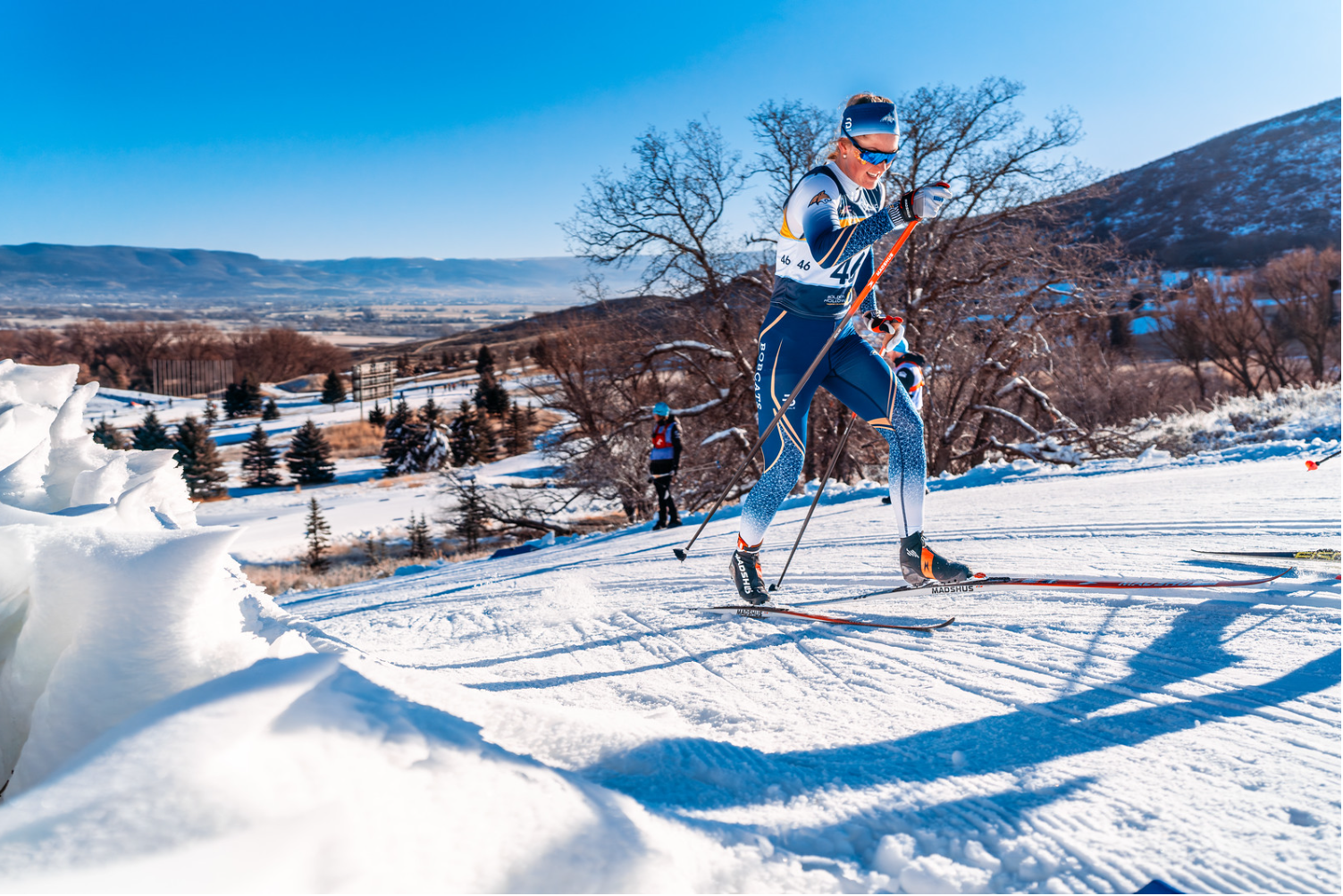
Swedish skier—and Montana State University sophmore—Tilda Baangman started fast and kept a steady pace as she posted the best time of the day in the Women’s 10 k Classic. (Photo: Tobias Albrigsten/UnTraceableGlobal.com)
As the busy field of racers continued to wind its way up the hollow though, a blue and gold suit with bib 46 flashed by. Over the radio of Montana State Bobcats Assistant Coach Lizzie Larkins, a voice reported that Bobcats sophomore, Tilde Baangman, had the fastest split through lap 1. Baangman didn’t relent through the rest of the race, and ended up topping the field by nearly 20 seconds over Palmer-Leger. That made things official, with Baangman taking home her first win at Senior Nationals, and Palmer-Leger (second Overall) the American national champion. For Palmer-Leger, the result marked her first national championship, one-upping a second place in last year’s 20 k classic mass start in Houghton, Michigan.
University of Denver Junior, Andreas Kirkeng, posted the fastest time of the day in the Men’s 10 k Classic. The Norwegian took his second straight victory in the US Nationals distance classic race, after wining last year’s 20 k mass start in Houghton, Michigan. (Photo: Tobias Albrigsten/UnTraceableGlobal.com)
By the time the Men’s field began, Soldier Hollow had warmed up and the snow had started to transform. Whereas in the morning, there were klisters and hard wax covers and hybrids in between, the conditions had definitively crossed above freezing and into klister territory. APU skier Joe Davies set the lead pace. His 23:53.1 10 k would stand as the benchmark as the top contenders continued to push through the course before University of Denver’s Andreas Kirkeng started to trade splits with Davies. Through the entirety of Kirkeng’s race, times swung back and forth between the pair, before Kirkeng burst across the finish line to post the day’s best time of 23:50.8, just 2.3 seconds ahead of Davies. For Kirkeng, the Classic result improved upon a ninth overall in last year’s 20 k classic mass start at Senior Nationals in Houghton, Michigan, and gave him his second win at US Senior Nationals. Kirkeng, who hails from Norway, was followed in the Overall by Joe Davies, who skis under the flag of Great Britain as a British-Canadian skier, which made Luke Jager (third overall) the American national champion. For Jager, the result marked his second national championship in a distance classic race in as many years, and his third national championship Overall after also winning last year’s Classic Sprint. Jager was joined on the American podium by second place (fourth Overall) Peter Wolter (Sun Valley Ski Education Foundation), and third place (seventh Overall) David Norris (Team Birkie). The top junior skier was Dartmouth Ski Team’s Jack Lange, in 17th Overall.
Luke Jager won his third career national title during Tuesday’s 10 k classic. The APU Nordic Center skier was third Overall in the race, behind Norway’s Andreas Kirkeng (first) and Great Britain’s Joe Davies (second). (Photo: Tobias Albrigsten/UnTraceableGlobal.com)
Action continues at US Nationals tomorrow, with the country’s best Para-skiers highlighted in a Sit Ski Sprint. That same sprint course will then play host to a Skate Sprint on Thursday. SoHo looks to be keeping to its trademark weather pattern ahead of the sprint racing action, with low lows and high highs in the forecast. Then though, there’s the possibility of snow. That might not just add to the excitement of the racing come Friday’s Skate Mass Start, but also serve to lift the spirits of the US ski community gathered from all corners of a continent that’s struggled with natural snowfall this year.
A classic Soldier Hollow day: sunny skies, warm snow, and a large field made for a bright start to US Nationals in Soldier Hollow, Utah Tuesday. Action resumes with a Sit Ski Sprint on Wednesday, before a Skate Sprint on Thursday. (Photo: Tobias Albrigsten/UnTraceableGlobal.com)
Tobias Albrigsten contributed photos to this coverage of US Nationals. A full gallery from Tuesday’s 10 k Classic is available on his website here, and you can follow him on Instagram @UntraceableG.
This World Cup coverage is made possible through the generous support of Marty and Kathy Hall and A Hall Mark of Excellence Award. To learn more about A Hall Mark of Excellence Award, or to learn how you can support FasterSkier’s coverage, please contact info@fasterskier.com.
As dominant as Swedish women’s racing has been this season, it’s hard to imagine that a Swedish woman has never won a Skiathlon at the World Championships. The Swedish women were looking to break that streak; given the incredible run they have been on, it seemed that the odds were in their favor.
But Norway was still lurking, hoping to upset Sweden’s shot at history. The Americans were also waiting in the wings with Rosie Brennan (USA) vying to claim America’s first gold medal in an individual distance event at a World Cup Championship.
Jessie Diggins (USA) took the day off: as she had said in her pre-World Championships press conference, she did not intend to ski every race. U.S coach Chris Grover informed FasterSkier that she will be skiing the team sprint tomorrow along with Julia Kern. He also shared the news that J.C. Schoonmaker and Ben Ogden would be the men’s team.
After a warm day of racing, it was Sweden coming out on top again with Ebba Andersson taking the victory. She was followed by teammate Frida Karlsson. In a feel good story, Astrid Oyre Slind (NOR), who was called up to race as a last minute replacement, finished third. Slind is a long-distance specialist, competing on the Ski Classics tour, and in the warm Planica weather she stood out as she cut off her tights and turned them into shorts.
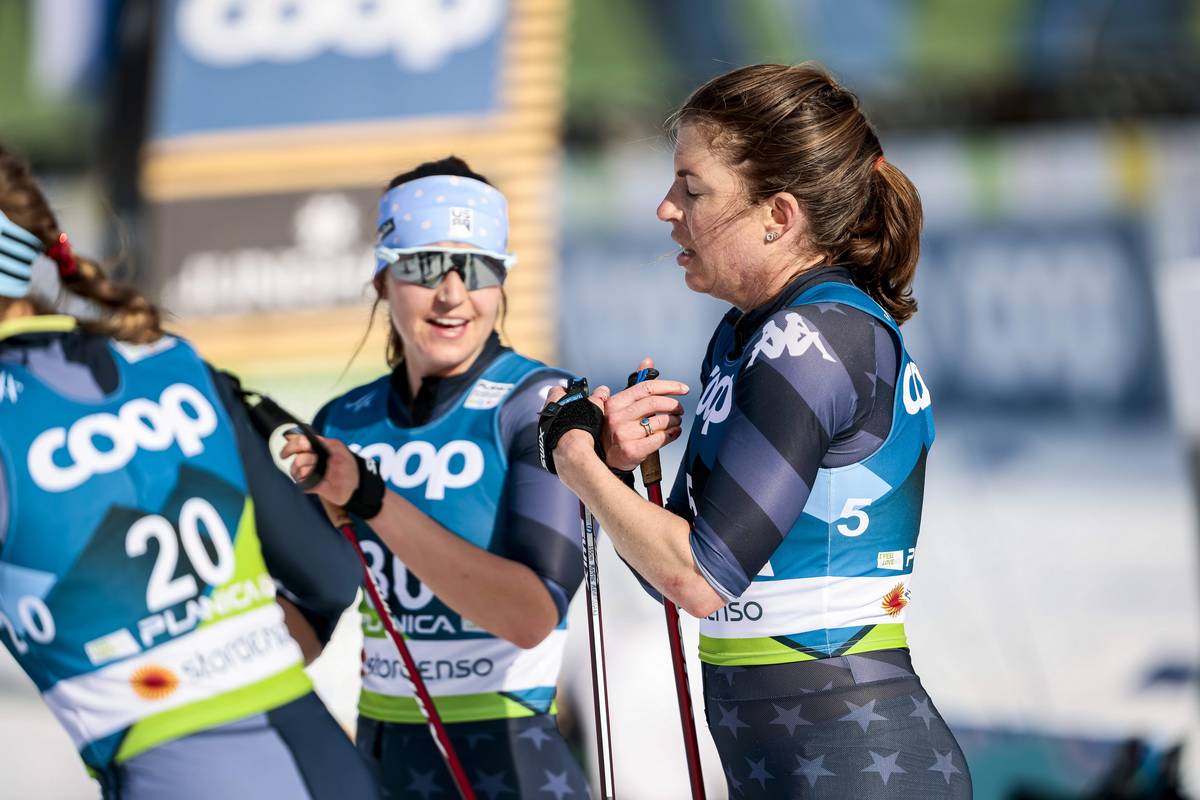
Rosie Brennan (USA) sharing the story of her struggles with teammate Sydney Palmer-Leger (USA) after the Skiathlon’s completion. Brennan’s broken binding spoiled what had been a promising day for the American. (Photo: NordicFocus)
The Americans’ day was mixed with success and heartbreak. Rosie Brennan had a soul rattling outing. While she was skiing with the leaders, a binding broke and her ski fell off. She ended up finishing 19th. Newcomer Sydney Palmer-Leger had a breakout day finishing 20th. Haley Swirbul was 26th, followed by Sophia Laukli, 29th.
For Canada, Katherine Stewart-Jones was the top finisher in 25th. Behind her were Jasmine Lyons 34th and Olivia Bouffard-Nesbitt in 40th.
Women’s 15 kilometer Skiathlon
It was a very warm day for the Women’s 15 k Skiathlon, as temperatures bumped up against the 50 degree mark. Most racers shed their hats, some took off their gloves, and in Slind’s case, converted her tights into shorts. According to U.S. coach Chris Grover, course officials decided to salt the course the night before the race.
While course conditions were the subject of much post-race discussion, Grover said that he thought, “in general, for how warm it was…the course was probably in as good as shape as it could have been.”
The day began with high hopes for the U.S. With Jessie Diggins resting, Rosie Brennan became the default front runner for team USA.
At the beginning all looked very good for the Americans. One kilometer into the race, skiing the classic section, Brennan was toward the front with Kerttu Niskanen (FIN) and Krista Parmakoski (FIN) setting the early pace. They were in a group with Frida Karlsson (SWE), Ebba Andersson (SWE) and Delphine Claudel (FRA).
Throughout the early stages, Brennan looked extremely strong and jockeyed for position with the leaders. Niskanen was still setting the pace using her classic technique prowess to try and establish an advantage before the transition to skating.
Rosie Brennan (USA) gamely stayed in the race after her binding broke and tried to make up time in the skate portion of the Skiathlon. (Photo: NordicFocus)
By the 3.8 kilometer mark, Andersson moved to the front of the pack with Slind joining the leaders. Brennan was right in the mix in eighth place, skiing with the leaders, and appeared to be skiing the race she wanted to.
It was at about the five kilometer mark that the wheels came off for Brennan—literally. As she was going through a corner, her binding broke sending her ski flying. Brennan immediately collected her ski and pushed herself along with one foot as the leaders sped away from her. After the equipment failure, Brennan moved from being in the front of the field to being forty seconds behind the leaders. By the time she reached the ski exchange, she was over a minute behind the lead. It was a deficit which would be impossible to overcome.
When the leaders reached the ski exchange, Andersson, Karlsson, Slind and Ingvild Oestberg (NOR) were in a virtual dead heat.
As the skate portion of the race unfolded, Andersson began to assert herself, putting a six second gap on Karlsson with Niskanen and Slind about 20 seconds behind. Anderson continued on a grinding pace which the rest of the group could not match. At 10 kilometers she had put another 10 seconds on Karlsson, but then Andersson fell on a downhill and opened the door for teammate. But Karlsson couldn’t take advantage of the fall as Andersson jumped to her feet quickly and only lost a few seconds. Karlsson was able to stay in touch through the 13 kilometer mark, but couldn’t make any progress reeling Andersson in. At about the 14 kilometer mark, Andersson found another gear which no one else could match, and she extended her lead to almost 20 seconds.
At the finish, Andersson was comfortably in the lead, finishing 22 seconds ahead of Karlsson. Slind had hung on to finish third about 48 seconds back, making her last second race call up a heartwarming story.
But, after the race, all the talk was about Brennan and what could have been.
In the reporters’ mix zone, Brennan—always the consummate professional—took events in stride when she elaborated about her days’ problems. “Everyone was putting on the brakes, and I did too, and I caught some slush and the binding came off the ski. It makes it kind of hard to go when you have only one ski.” Despite her equipment issues, Brennan sounded energetic and optimistic. She commented that her bad luck seemed to attract a great deal of media attention. With a mix of humor and irony she said while laughing that, “this is the most I’ve ever been stopped in the mix zone, and for one of the worst races…I don’t know what that says about the state of the world. People should be more concerned with the good things, not the bad things. Today is a day we can all forget about.” Brennan hadn’t initially realized that the binding had come off and tried to put the ski back on. After figuring out that her equipment was broken, she found coach Jason Cork for a replacement ski. But the damage was done: the pace at the front didn’t slacken and there was no catching up. Brennan had contemplated stopping, but just for a moment. “When you show up at a Championship, you’re here to represent your country and you always give it your all until the end. I decided to keep fighting until the finish. I felt great up until that point.” Brennan was not injured from the impact.
U.S. coach Matt Whitcomb was about three minutes away from Brennan when she fell. He said, “Jason [Cork] got her one of her skis…it did have race wax on the glide zones. But the time was lost, and you’re no longer in contact with people skiing your pace.” He continued that, “we’re grateful that she’s ok…we can move past this. She looked great [before the fall] and was controlling the pace up the hills.”
Grover told FasterSkier that, “She was skiing really well when this happened.” From the team perspective it hurts, but Grover elaborated that “it is part of sport…everyday there are some favorites that end up with some bad luck.”
Sydney Palmer-Leger (USA) provided the highlight for team USA. She finished 20th in her first World Championship race and her first Skiathlon. (Photo: NordicFocus)
Brennan’s disappointment was tempered some by the standout performance of Sydney Palmer-Leger (USA), who finished 20th. Today was Palmer-Leger’s first World Championship race and first Skiathlon competition ever. She told FasterSkier that she was able to avoid the crashes which claimed so many skiers. She said that her background as a bike racer helped her prepare for the Skiathlon. “The transition went pretty well. I’m used to calming myself down.” She continued that “the corners were sketchy…you needed to carry speed through the corners, not slow down. I don’t think snow plowing was the best move.” She added that, “I just turned 21, so getting top 20 at my first World Champs is pretty amazing.”
Grover added that the team took solace in Palmer-Leger’s performance. “It was definitely the high point of the day,” Grover said. “It was really fun to see that half way through the classic section she was just off the lead group, so she was really holding her own.”
Sophia Laukli (USA) overcame her own adversity to finish 29th in the Skiathlon. (Photo: NordicFocus)
Sophia Laukli also had her difficulties, falling twice. Her 29th place performance was all the more remarkable, as she shared with FasterSkier that she broke a pole on the second crash.
After the dust had settled, broken equipment repaired and collected, the day would be remembered as a continuation of Swedish dominance, a breakout performance by a new American star, and thoughts of what might have been for Rosie Brennan.
Frida Karlsson (SWE), Ebba Andersson (SWE), (l-r) celebrate Sweden going 1-2 in the women’s Skiathlon in Planica, Slovenia (Photo: NordicFocus)
Ebba Andersson wins the World Championships skiathlon followed by a strong Frida Karlsson, with a surprise third by a Norwegian with a cinderella story. We break the race down and cover Rosie Brennan’s ski mishap.
We’ll back back with more after Sunday’s team sprint. Send us your questions at devon@fasterskier.com and nat@fasterskier.com.
HOUGHTON, MICHIGAN: Welcome to FasterSkier’s on-location coverage of the United States National Cross-Country Ski Championships from Houghton, Michigan.
This week, Houghton hosts the U.S. National Cross-Country Championships on the Michigan Technological University’s trails system. Today’s event is the 20-kilometer classic mass start.
Hailey Swirbul leads out the women’s charge at the beginning of the 20-k classic mass start in Houghton. (Photo: FasterSkier).
There were several questions to be answered at the beginning of the day: the women’s side has been dominated by Hailey Swirbul. Swirbul has won the two previous races, the 10-kilometer individual start skate, and the classic sprints. Would Swirbul be able to complete the three-peat by winning today’s long classic race, which would give her a first place in sprint, middle, and long distances?
The men’s results have been on the opposite side of the spectrum. There have been six different men standing on the podium so far. Would any man be able to claim a repeat podium position?
Finally, the weather was not a dominating factor as overnight temperatures were in the teens, with highs in the upper twenties. Unlike the night before the sprint races, the wax technicians could actually get some sleep. The men’s race started at 9:30 and by then conditions were beautiful. The sky was blue, the temperatures were in the mid-twenties, and the wind was calm; for January in the Keweenaw, it could be called unusual.
The classic course was a 5-kilometer loop with challenging corners and descents, and long very steep climbs.
Hailey Swirbul on her way to a Houghton three-peat. (Photo: FasterSkier).
The Results
In a thrilling women’s race, Hailey Swirbul (APU Nordic Ski Center) did pull off the three-peat by beating out Sydney Palmer-Leger (University of Utah), by four-tenths of a second. Novie McCabe finished third, less than 10 seconds out of second place.
For the men, Luke Jager (University of Utah) claimed another podium, finishing first. Two seconds behind him, in second, was distance phenom David Norris (Steamboat Springs Winter Sport), and in third was Zanden McMulllen (APU Nordic Ski Center).
Men’s 20 k Mass Start
The men’s competition took an unexpected turn when the lead pack was broken apart early on the second lap by a large crash. Jager told FasterSkier, “There was a big crash on the second lap, a few skiers went down, most notably Andreas [Kirkeng], and he had been hitting the pace the entire first lap. I was in front of Andreas, it was on a downhill, I was pulling out for the sharp turn, and he also did, we kind of clipped each other skis. You never want that…it’s a big bummer. Suddenly it was me and David [Norris] off the front. It really disrupted things.” Jager was able to adjust on the fly, and after the crash it was a group of four skiers until the end.
Luke Jager celebrates the victory in the 20-K Classic. (Photo: FasterSkier).
Andreas Kirkeng (University of Denver) told FasterSkier that after the fall he couldn’t close the gap.
“I broke a pole, and my binding popped off, so I had to stop on the downhill to put my binding back on. I was skiing with one pole for a while, it was unlucky”. Andreas Kirkeng
Andreas Kirkeng shows the evidence—a broken pole—from an early crash that knocked him out of contention. (Photo: FasterSkier).
As the race wound down to the last few kilometers Norris pushed the paced. Jager told FasterSkier that, “Thankfully I had enough left in the tank to get a little bit of a gap in the last climb. If it came to a battle of just grinding as hard as we could, I knew I wasn’t going to win.”
The weather did affect tactics when it came down to ski choices. The favorable conditions allowed Jager to optimize his ski choice. “I picked a little bit of a softer ski,” he said. “It was a little easier to kick.”
The win was meaningful for Jager. “I’ve tried really hard to not be super specialized as not just a sprinter these last few years, to be able to be competitive in all the events,” he said. “To hold with those guys until the end was really rewarding.”
Men’s 20-kilometer classic podium (l-r: David Norris, Luke Jager, Zanden McMullen) (Photo: FasterSkier).
Women’s 20 k Mass Start
The women’s race came down to a thrilling duel between Swirbul and Palmer-Leger. Ultimately, Swirbul made an on-the-fly tactical choice which enabled her to inch out Palmer-Leger, winning the race by abandoning double poling at the finishing sprint and switching to diagonal stride. The tactical choice enabled her to beat out Palmer-Leger by about a boot length. Second place finisher Palmer-Leger, a junior at University of Utah, noted the difference in technique choice at the finish. “She was striding, I was double poling, it was hard to know what would be faster, right at the end I kind of switched into a run to see if that would work, but it didn’t.”
Swirbul and Palmer-Leger neck and neck at the finish. A last second change to diagonal stride captured the win for Swirbul. (Photo: FasterSkier).
Swirbul said that the top three skiers stayed together for most of the race. “Novie, Sydney, and I became a pod at one point and skied a lot of the last half of the race together.”
Swirbul said that coming into the championships she knew that top results were a real possibility. “The beginning of my season has been going well,” she said. “But you never know. There are so many factors that play into it.” Commenting on the distance Swirbul said,. “20 k is really long. We’ve had [this distance] at nationals, but I don’t do that many of them.”
Going into the race, Palmer-Leger’s strategy was to not let the hills wear her down. “I paced it on the hills and tried sitting behind somebody, stay relaxed and focus on breathing,” she said. “A lot of time I get stressed, start to run and use up most of my upper body, so trying to stay relaxed [was important].” Palmer-Leger appreciated the Houghton course noting that, “It’s kind of fun to have something different. It keeps you on your toes when you kind of have to sprint from the start to get in a good lead, so you don’t crash in the corner. I made sure I was in a good spot [to avoid a crash].”
Ute junior, Novie McCabe, told FasterSkier that she tried to push the pace about two laps into the race. That’s when the race turned into a four-skier pack. “My plan was to go on the last lap on the first long hill and get a lead there,” she said. “It didn’t quite happen for me. I kept trying to go on all the hills, but they [Palmer-Leger and Swirbul] were too strong and they blew me away at the end. I was kind of hanging on a by a thread there for a while.” After the race week concludes, McCabe will focus on the U-23 championships in Whistler.
Crowded corners challenged racers on a tough Houghton course for the U.S. Nationals. (Photo: Amy Kostrzewa).
Houghton provided a beautiful day for a classic race, and the racing was equally spectacular.
As the saying goes, skiers are made in the summer. If that is the case, then many are forging their way to success in Stratton, Vermont this season. Depending on the year, various clubs around the country may play host to an increased number of athletes for a summer; from Bend, Oregon, to Anchorage, Alaska, to Stratton, the “hot spot” shifts periodically. This year, as SMS T2 Team Head Coach Perry Thomas put it, “we’ve had a lot of talent in southern Vermont.”
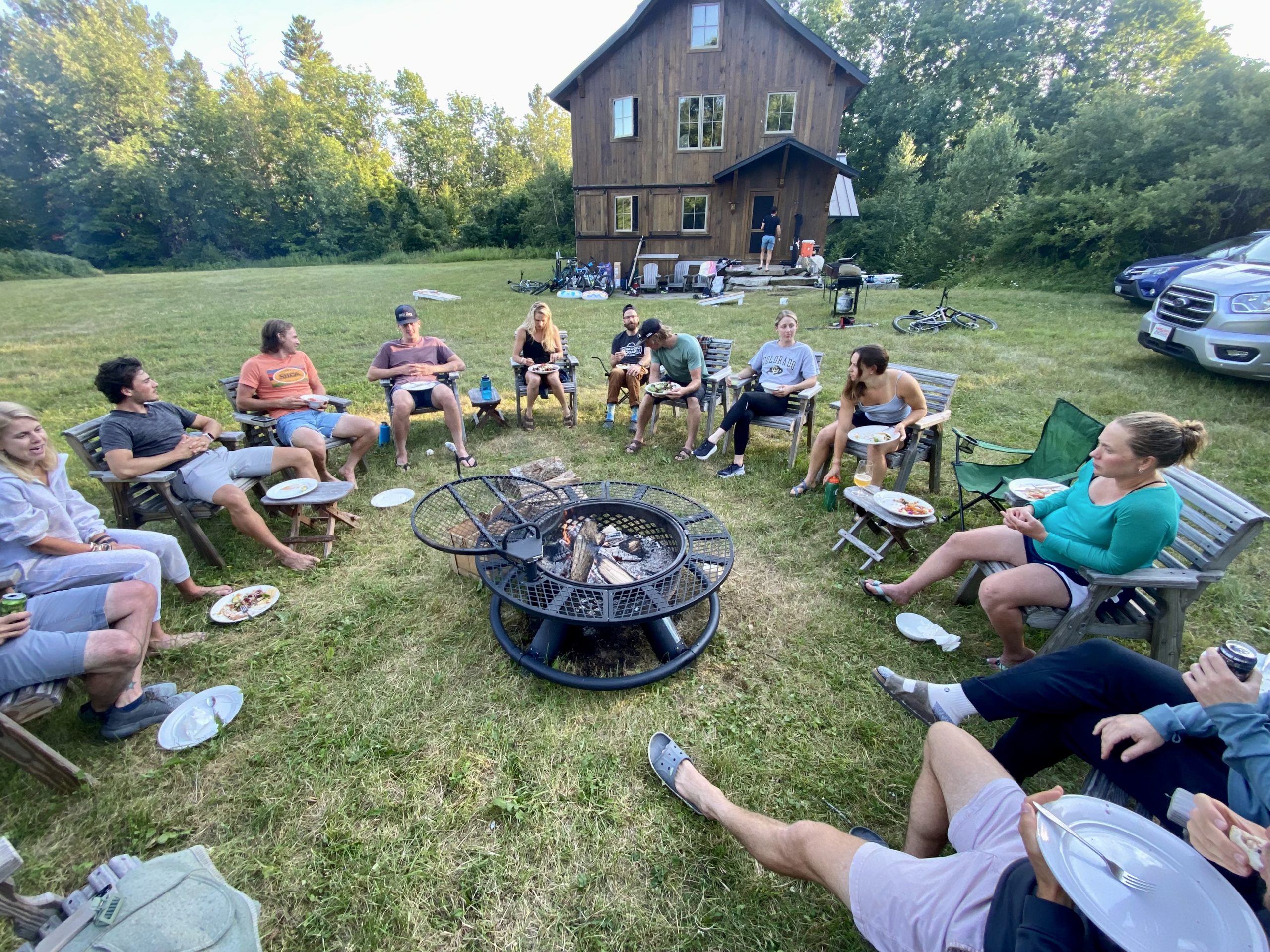
As the summer of training kicked off out east, it was primarily members of the SMS T2 Team for the first month or so. Thomas explained that the team had a couple of mini camps so far this summer, the first being at Green Woodlands in New Hampshire. In an email to FasterSkier, Thomas wrote, “we had a lot of great training including some long mountain bikes, rollerski intervals in Lyme, and a Presidential Traverse. It was somewhat “camping” style as many of us stayed in these rustic cabins on the water. We cooked great food, played a few games, and hung out on the water.”
Dinner around a campfire for the SMS T2 Team at Green Woodlands in New Hampshire (Photo: Lina Sutro)
More recently, the team had a second mini camp in the Waitsfield/Warren area, north of Stratton. Highlights from this camp included a 5 k hill climb pace project on the Appalachian Gap, combining with the Eastern and Midwestern U16 camp, and Team Birkie who also held a camp in Vermont recently. About this activity Thomas shared, “the team had a great time chatting with the U16’s after App Gap, and we had a fun run/hike on part of the northern section of the Long Trail.” He extended his thanks to Justin Beckwith and NENSA as well as Colin Rogers and Green Mountain Valley School (GMVS) for their efforts in putting together some great events.
Joining the SMS T2 Team for varying lengths of time this summer are a number of U.S. Ski Team and college athletes. This list includes: Sydney Palmer-Leger (new member of SMS T2 team, University of Utah (UU), U.S. Ski Team), Novie McCabe (UU, U.S. Ski Team), Sophia Laukli (UU, U.S. Ski Team), Weronika Kaleta (University of Colorado (CU), Polish National Team), John Hagenbuch (Dartmouth, U.S. Ski Team), Gus Schumacher (Alaska Winter Stars, U.S. Ski Team), Luke Jager (UU, U.S. Ski Team), Adam Witkowski (Michigan Tech University (MTU)), Zander Martin (Bates College), and Asa Chalmers (Dartmouth).
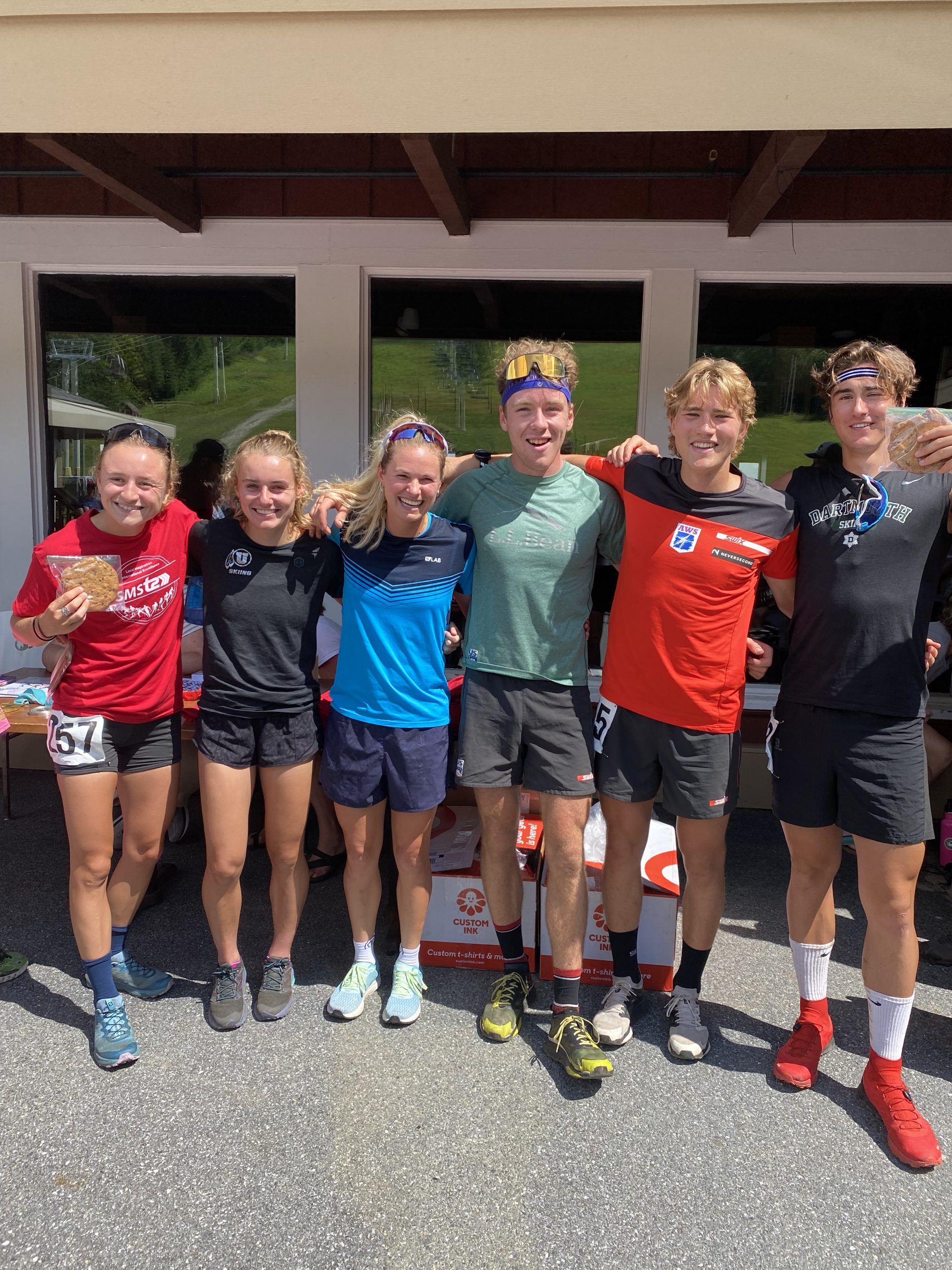
Happy athletes in the White Mountains in New Hampshire (photo: Lina Sutro)
Thomas, who took over as head coach of the SMS T2 Team this past spring, expressed his enthusiasm for the crew of athletes saying, “I feel very fortunate to be working with such an accomplished group of U.S. skiers. It has been fun and rewarding to say the least!” He’s had some assistance in the coaching department, U.S. Ski Team D-Team Coach Kristin Bourne, and Head Coach Matt Whitcomb have come through to work with the U.S. Ski Team athletes, but also help support everyone. Annika Martell and Steve Monsulick of Williams College have come to help at Thomas’ invitation, and with the additional support from the SMS junior coaches, Matt Boobar, Alex Jospe, and George Forbes, the coach to athlete ratio has been pretty good. Thomas also said, “I feel very fortunate to be able to work with Pat O’Brien, Jason Cork, Sverre Caldwell, and Matt Boobar this summer (among many other great coaches). Having such an excellent coaching staff to work with and learn from has been such a privilege. Everyone is very open, hard working, great to get along with, and they are all massive resources for myself as well as the team.”
For many of the athletes, this summer has been their first time in Stratton. Thomas reflected, “I think many of the athletes that have never been to Stratton before, or maybe haven’t trained with the T2 team as much, have realized how great a place it is to train here. It seems like everyone has been really enjoying themselves, and we hope to continue having a strong summer training group in the future.”
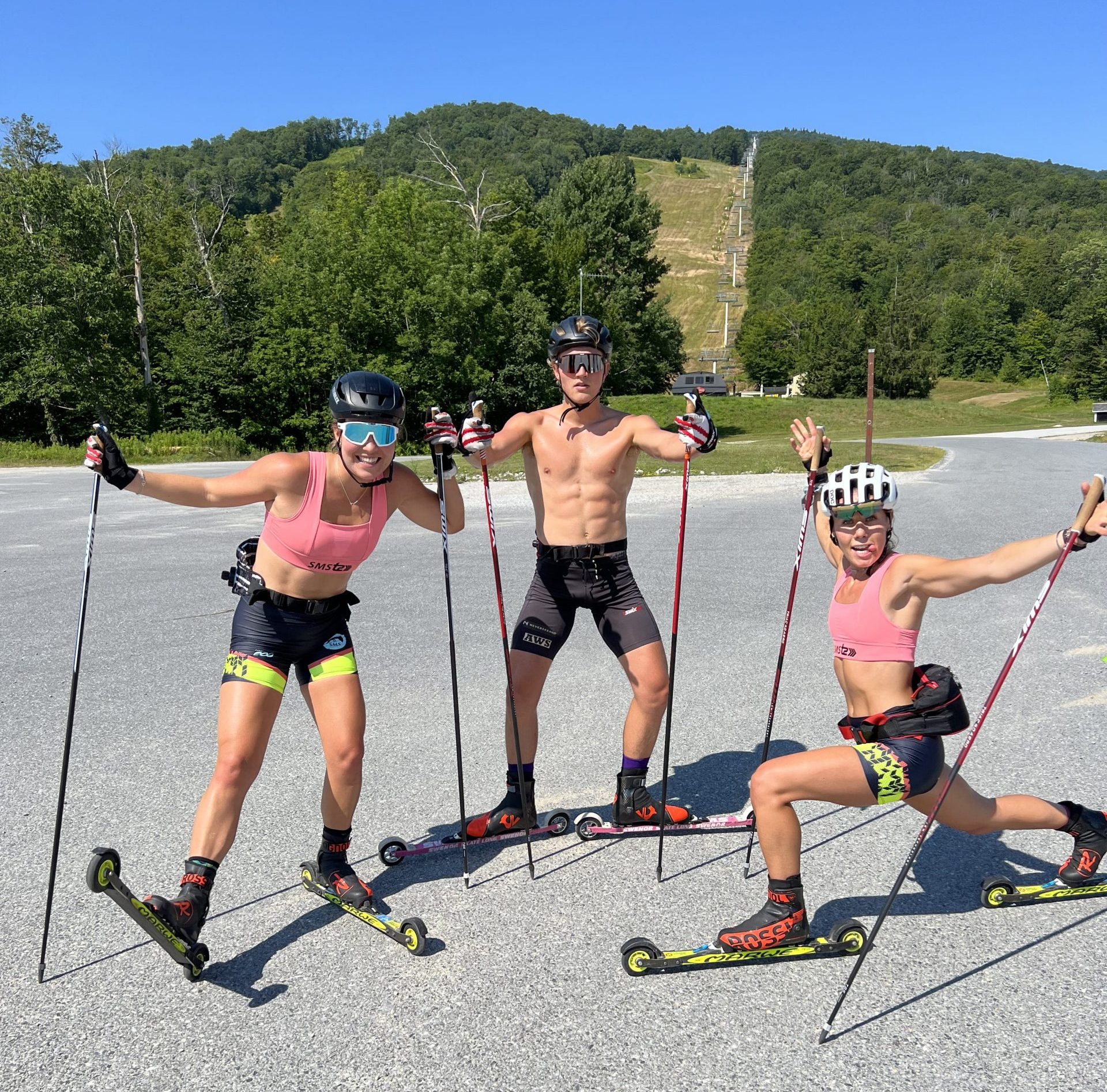
Lina Sutro, Gus Schumacher, and Lauren Jortberg (l-r) head out for a rollerski (photo: Lina Sutro)
One of those athletes is Sydney Palmer-Leger, who is not only spending her first summer in Vermont, but is also the newest member of the SMS T2 Team. When asked about her decision to come east this year, Palmer-Leger shared, “Last year I spent two months in Anchorage, Alaska. I had a lot of fun exploring a new beautiful place with the APU group and working with Erik Flora. I had never spent a period of time out East besides a couple bike and ski races. I had heard amazing things about the SMS T2 Team so I decided to try something new. I packed up my car not knowing what to expect and drove the three days out to Vermont.”
Born and raised in Utah, Palmer-Leger said she is used to bigger mountains and a drier climate than you find in the East, but the SMS T2 Team was welcoming from the start and made her feel at home. She wrote, “I am used to working with many different coaches so that was an easy transition. I had been on a couple trips with Pat (O’Brien) and met Perry (Thomas) in Bend, so I wasn’t super uncomfortable joining a new team. I felt I belonged in this group from the beginning and loved training in Vermont so I decided to join the SMS T2 Team.”
SMS T2 crew (photo: Lina Sutro)
Palmer-Leger pointed to a number of highlights from the summer, including the mini camps in Craftsbury, Warren, and Greens. She reflected, “[the] camps were fun ways to get a lot of training while exploring new parts of the East. I have also loved being close to water where we have gone paddleboarding and waterskiing with the Ogdens. I am very fortunate to have this group to come back to every summer. In addition to running and rollerskiing, I have been able to explore more bike trails. Biking used to be my other sport so I have loved going out with the team every week. I went to Burke the other weekend and helped with the Little Bellas. It is inspirational to see these young girls out on the trails shredding.”
Gus Schumacher also made his way east this summer, though for a few weeks rather than the whole summer. Initially, the motivation for this change in scenery was a way to break up the jet lag on the way to Norway for the U.S. Team camp happening next week. But when Schumacher decided not to go to Norway he realized he still wanted to train with Ben Ogden and SMS to “return the favor” of him coming to Alaska last summer. Schumacher said, “I also wanted to hopefully get some rollerski racing and rollerski track skiing in but I didn’t really do my research on when/where to come.”
The summer climate in southern Vermont is typically different from that of Alaska where Schumacher spends most of his summer. “[It’s] definitely a little hot and humid but it’s kind of nice to get a little sweaty,” wrote Schumacher, “the biggest issue is that our dryer doesn’t really work so there’s not a great way to dry washed or wet clothes.” (A problem which anyone who has spent a summer in the East can identify with).
For his time in Vermont, Schumacher had a couple of goals he was focused on. The first, to stick to his general progression/training layout. This meant getting good group sessions, but not losing focus of his own process. The second was to keep up good daily habits like consistent bedtime, morning mobility, healthy meals and recovery stuff. Third, to take care of some body stuff that was acting up recently. And finally, to generally make use of being around a strong team and use them to push himself whenever possible. Schumacher concluded by saying that he is “very thankful to SMS and southern VT for taking us in and helping us figure out lodging and training, as well as getting us exposure to some races and cool mentoring opportunities.”
Alayna Sonnesyn, Novie McCabe, Jessie Diggins, Ben Ogden, Gus Schumacher, John Hagenbuch (l-r) after a hillclimb up Stratton Mountain (photo: Lina Sutro)
Approaching the final few weeks of August, as the summer winds down, athletes and coaches alike will be going their separate ways. Schumacher is headed back to Anchorage next week when the team goes to Norway. He said, “In sticking with my plan, I felt like it made more sense to take a recovery week and get back into my swing in Anchorage.”
Palmer-Leger, who has spent two and a half months in Stratton with the SMS T2 Team, is heading back to Utah for school. After having finished summer school this past weekend, she has a little break before going back to classes in Salt Lake.
Thomas reflected that the summer has flown by, saying “it’s crazy how fast time goes by when you’re training hard and having fun.” With many of the summer athletes heading back to school or back to their main club, the crew in Stratton will be dwindling.
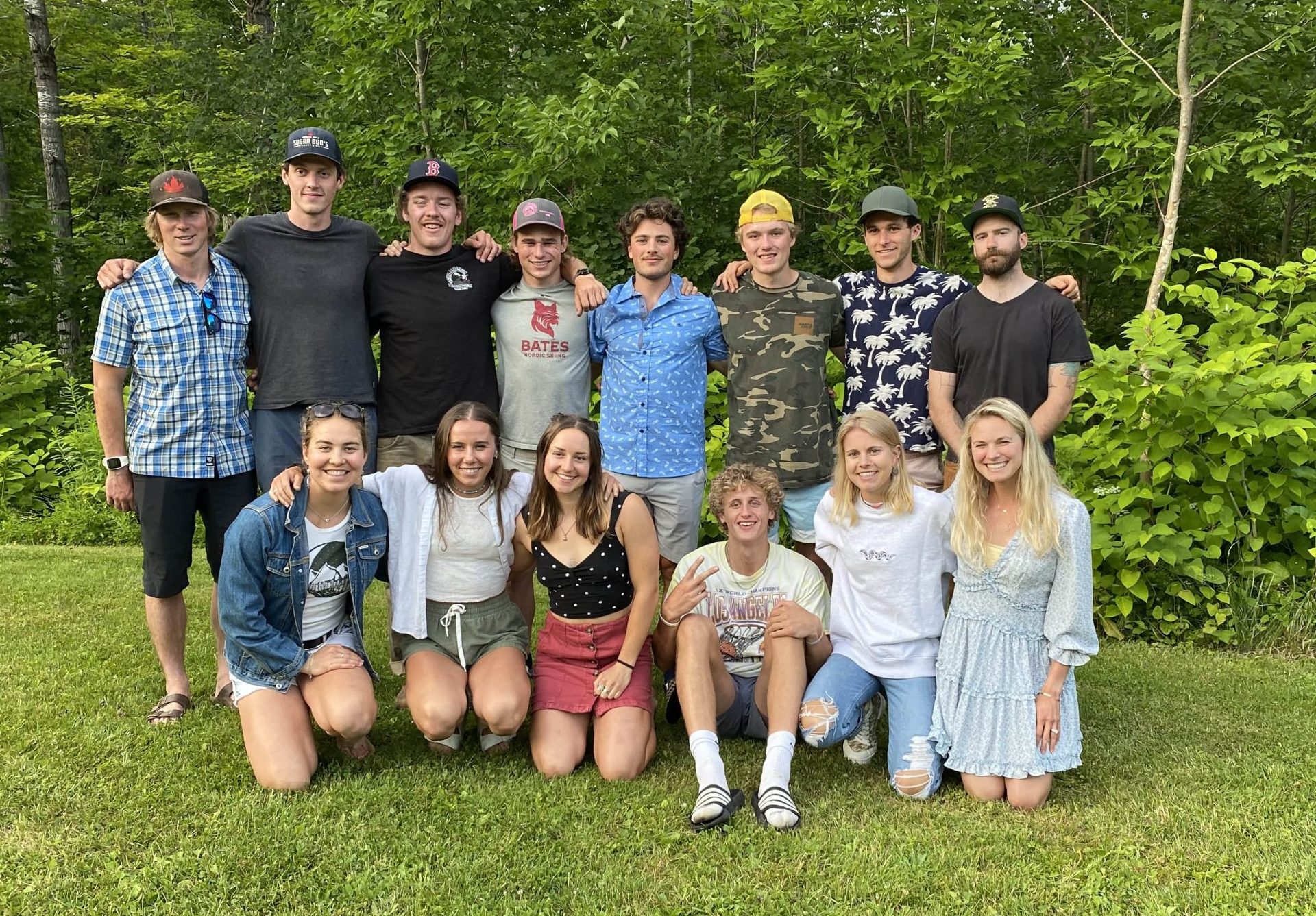
Back-row: Bill Harmeyer, Ben Ogden, Zander Martin, Will Koch, Asa Chalmers, Adam Witkowski and Perry Thomas. Front-row: Lina Sutro, Lauren Jortberg, Sydney Palmer-Leger, Fin Bailey, Sophia Laukli and Jessie Diggins (photo: Lina Sutro)
A couple athletes will be traveling to Scandinavia for the U.S. Ski Team camp in the Torsby ski tunnel and competing in the Toppidrettsveka rollerski races. Jessie Diggins, Julia Kern, and Jason Cork are headed to Australia for a three week on-snow camp there. Thomas will be headed to Oberhof, Germany with SMS T2 athletes Lina Sutro, Lauren Jortberg, and Alayna Sonnesyn for a ten day camp in the Oberhof ski tunnel. Eventually, the core T2 team will reconvene back in Stratton in early September before heading to the U.S. Ski Team camp in Park City in early October.
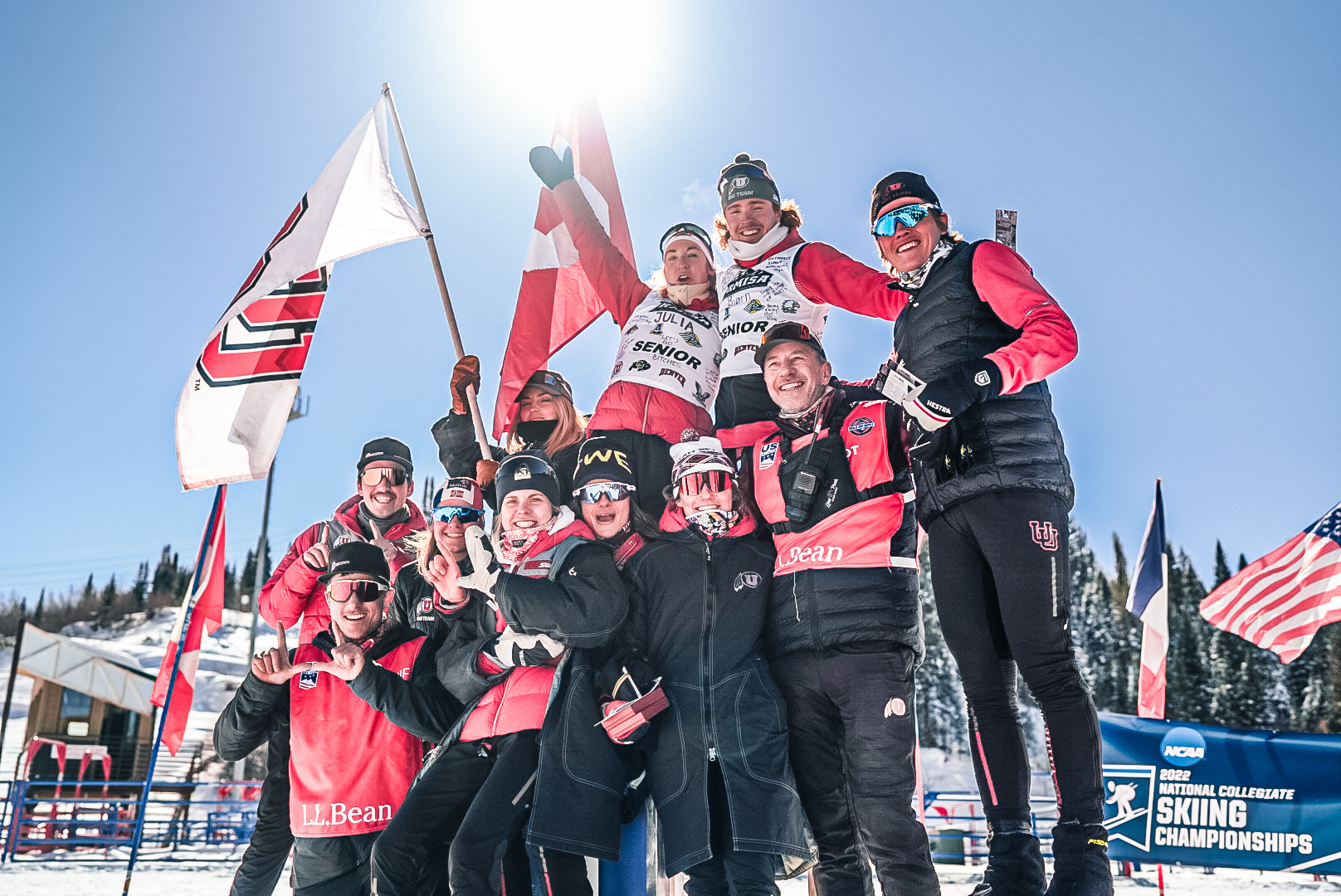
The University of Utah (UU) team celebrates on a sunny day in Park City at the 2022 NCAA Championships. The Utes won the NCAA team title, their 3rd in a row. (Photo: Tobias Albrigtsen / @untraceableg)
With a cohort of some of the best U23 skiers in the country, the program is setting a trend for young American skiers pursuing international-level and college skiing simultaneously.
After the first day of this year’s NCAA Championships, held at Soldier Hollow, Utah, the team scoring was close. The familiar schools were all there, the University of Utah (UU) at the front, with the University of Colorado (CU), Denver University (DU), and the University of Vermont (UVM) all close behind.
How close? Well, all within 100 points in the NCAA team scoring system – which doesn’t mean much.
Team NCAA scoring is hard to comprehend. It is best described as archaic and arcane; a cumulative score between alpine and nordic across genders, and disciplines, over two days of racing (with no sprint race to be found).
You can understand it in archaic terms then – the four big programs that have historically dominated NCAA skiing all went into the final day with a notion that they might just add another title (UU, CU, DU, and UVM account for 63 out of the 69 titles awarded in NCAA history).
Then, the 15 k women’s skate mass start went off.
What happened within the first kilometer was anything but arcane. Three skiers, all clad in the white and red of the University of Utah pulled away as if they were out for a team interval session.
The sight of that trio, together, has become an international force over the past couple of seasons. Sophia Laukli, Novie McCabe, and Sydney Palmer-Leger earned a Junior Worlds relay medal for the US together inMarch 2020. They’ve since climbed intotop tens on the World Cup together, also done a lengthy FasterSkierinterview together as well.
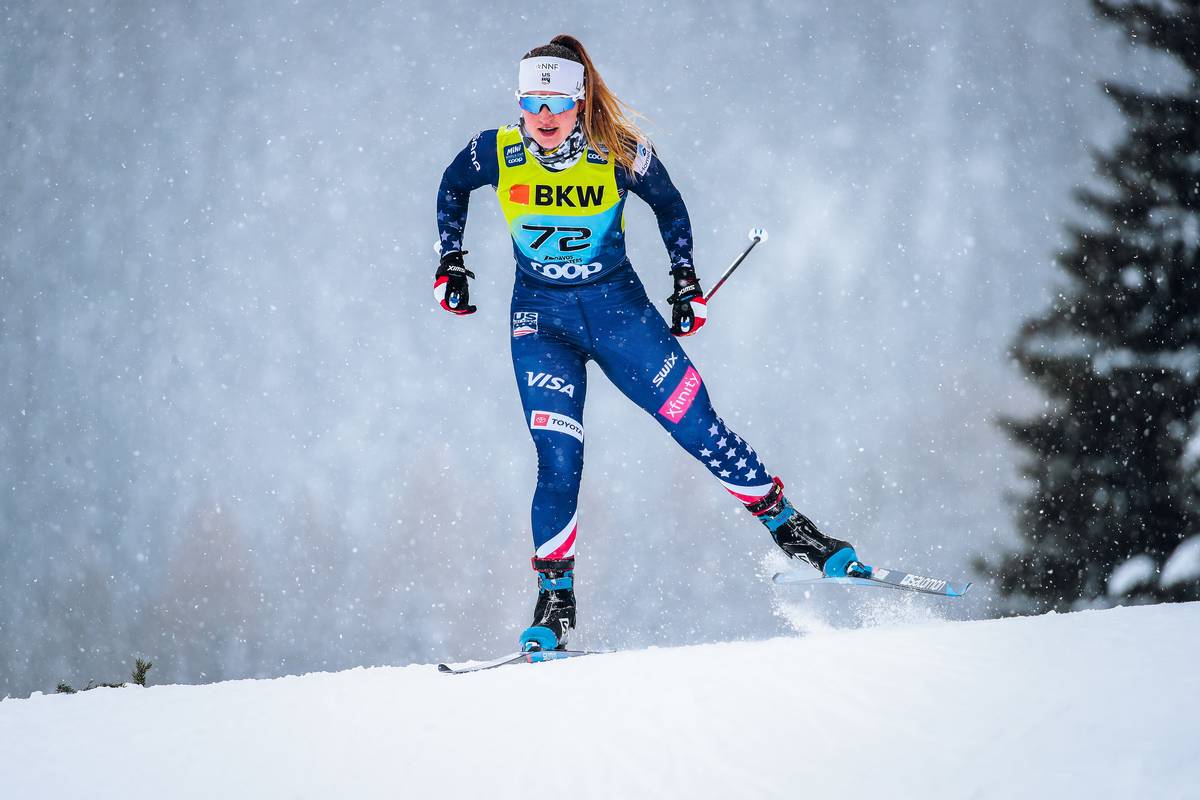
Sydney Palmer-Leger (USA) racing to 53rd position in the qualifier. (Photo: NordicFocus)
Coming into this particular NCAA race, Laukli and McCabe had just come home from representing the United States at the 2022 Beijing Olympics, while Palmer-Leger came in looking for athird NCAA championship title in only her second year on the circuit.
The only question then, was which UU skier would take the race. As Sophia Laukli broke away from McCabe and came across the line to do just that, she checked yet another of the boxes for accomplishments all three had now achieved. Before McCabe and Palmer-Leger had NCAA Championships, then McCabe, Palmer-Leger, and Laukli did. It only added emphasis to the dominance of UU in NCAA skiing beyond that one race.
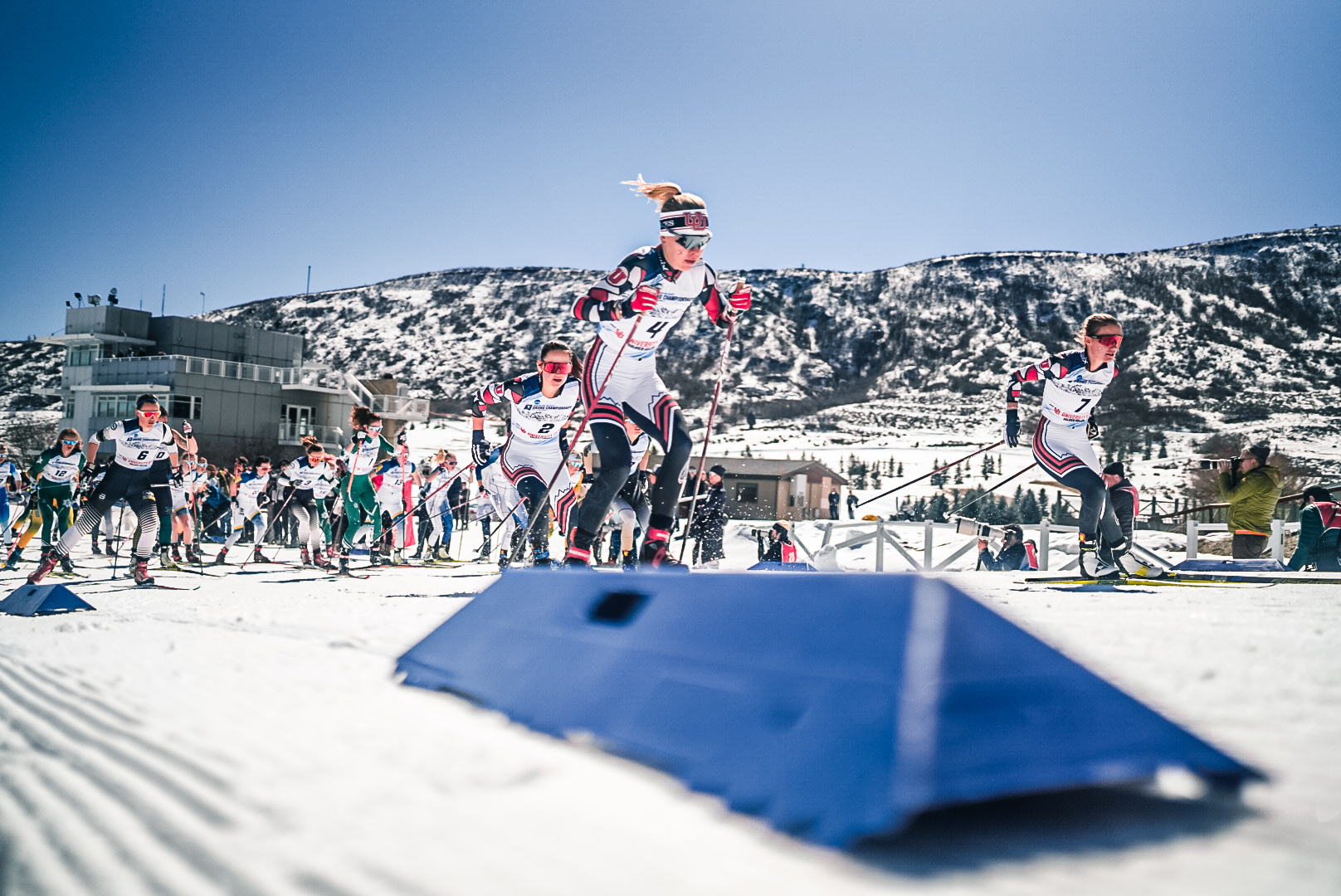
Sophia Laukli (bib 4), Novie McCabe (bib 7), and Sydney Palmer-Leger (bib 2) lead the women’s 15 k free during the 2022 NCAA Championships in Soldier Hollow, UT. (Photo: Tobias Albrigtsen / @untraceableg)
The UU nordic women had contributed roughly half of the points required to win UU’s third straight NCAA Team Championship, despite making up just a quarter of the team.
“I can’t take credit for building that, I’m just keeping it going” said UU Head Nordic Coach Miles Havlick in a call about the UU women’s dominant performance. “They’re a special group, unlike anything the NCAA has seen as long as I’ve been involved with it.”
Miles Havlick, University of Utah cross-country ski head coach. (Photo: University of Utah)
Havlick has seen a lot. As an athlete for UU in the early part of the 2010s, he put together an NCAA career that was remarkable in the heights it reached – Havlick won two NCAA Championships in 2012 and 2013 – as it was in its pound-for-pound consistency over four years.
After a post-grad stint professionally racing for Sun Valley SEF and a couple seasons developing his coaching in the US, in Norway, and in Australia, he returned to the NCAA circuit, and to UU, in 2018. Havlick first stepped in as Assistant Coach before taking over the position of Head Nordic Coach in 2019, working with veteran ski directorFredrik Landstedt to bring the UU program to new heights.
Havlick may be quick to dismiss his influence in building the UU program, but there are implicit hints talking to him that his coaching is perfectly contoured to athletes wading through top-level racing while managing their development as a person.
“I like to think I use my racing experience, especially having raced a lot of these specific races…college is a challenging time where you’re developing, living on your own for the first time, and adjusting…and that’s without also managing an international racing career. Hopefully, I can relate and provide some wisdom to our skiers on how to do that.”
University of Utah Nordic coach Miles Havlick was a two time NCAA Champion during his career for the Utes, including winning the 20 k skate race at NCAAs in Middlebury, VT in 2013.
The particular knack for balancing skiers making their way onto the World Cup and wanting to pursue collegiate skiing became particularly important this season. Before the NCAA season had even started, the UU team was spread far-and-wide racing the World Cup.
“Sydney, Novie, and Sophia all were racing the first period of the World Cup. It was awesome they got that opportunity, and they all made the most out of it. It’s so easy to forget how young they are, and they were able to take whatever results they had with a grain of salt and just focus on skiing and learning as much as they can wherever they are.”
As rising juniors and seniors, Palmer-Leger and McCabe, and Laukli will be back at UU next year, and with their World Cup results this year, are all but sure to also be continuing to race internationally as well.
Sophia Laukli finished 15th in the Olympic 30 k skate race while representing the US in Febuary. (Photo: NordicFocus)
That, along with an equally talented core of male skiers, including NCAA All-American Sam Hendry and US Olympian Luke Jager, positions UU to continue its run of NCAA titles in the coming years. Something that Havlick says the UU team doesn’t take for granted. “I’m sure we have a huge target on our backs. It [would be] easy to coast and get stagnant. As long as we keep an attitude towards improvement and working hard, and on my end continuing to be smarter in my decision-making, I think we can stay as the top college program for years to come.”
That improvement in decision-making will include all the facets of coaching familiar to nordic coaches – waxing, training, team atmosphere – but at UU, it will also be precedent setting.
Along with UVM’sBen Ogden, the NCAA titles of McCabe and Laukli this year marked the first time in NCAA history that American-born athletes won every race. The collegiate race circuit, long a gauge of where young US skiing stood in relation to international talents, saw that gauge blown wide-open in 2022. The bar for US skiers is now being set by other US skiers, with McCabe, Laukli, and UVM’s Ogden all making breakthroughs at the World Cup and Olympic level. With their success, the relationship between the collegiate circuit and national team is set to evolve too.
Positioned in Salt Lake City, just 90 minutes from the headquarters of US Ski and Snowboard in Park City, with four athletes who have already worn the US suit on the World Cup, the US Ski Team athletes at UU and Havlick are cognizant that they will determine what that evolution looks like:
“The strength of the American Juniors on the world stage was shown in the last few years, and now we’re starting to see that push through to the college age, especially here. I’m hopeful that we can continue to build on the relationship we have here with the national team, and that the trend we’ve seen, where the national team is realizing the benefits of college skiing, continue. That helps skiers in the US, and the US skiers who do go represent us [on the international stage].
As a young athlete, Brennan pushed against the wishes of US Ski and Snowboard to compete for the US national team while skiing for Dartmouth with teammates like Ida Sargent and Sophie Caldwell. After completing her degree in 2011, she became a persistent domestic skier for Alaska Pacific University (APU), bouncing on-and-off of the national team while pursuing graduate-level education. Then, in 2020, a decade into her post-undergrad career, Brennan won a World Cup, and since has been one of the top skiers in the world.
One year, two generations: In 2021, Rosie Brennan (left) finished 7th in the Tour de Ski’s Alpe Cermis hill climb. In 2022, Novie McCabe (right) matched that result by taking 7th in the same race. (Photos: NordicFocus)
That success saw US Ski Team Head Coach Matt Whitcombreflect to FasterSkier Reporter Nat Herz that US skiing’s previous stance towards collegiate skiing “[was] not realistic, because you’re not taking the American culture into consideration.”
(Read more about the shift in perception on NCAA skiing’s role in athlete development here.)
Building upon Brennan’s example, the international and domestic performances of athletes exploring the NCAA-World Cup duality demonstrates that American skiing culture is now pliable as to where its top skiers turn for development in their skiing, and in their lives.
What that balance of collegiate and international skiing looks like will be set by the phenomenally talented skiers who are currently at the top of the collegiate ranks, with support and collaboration from both their NCAA and US Ski Team coaches.
At the University of Utah, that influence is a central feature of the program, rather than an exception. McCabe, Laukli, Palmer-Leger, Jager, and their coach Havlick have already broken the precedents of US skiing and are looking ahead to next season with expectation and a simple approach, as Havlick says “We’re proud of this year, for sure. We’ll let those results be though as we start training…I just want to keep one thing – the culture of hard work and process.”
Utah teammates Sophia Laukli, Novie McCabe, and Sydney Palmer-Leger go 1-2-3 at a RMISA race in Sun Valley last January. (Photo: Instagram @utahskiteam)
Doubling down, Vermont’s Ben Ogden takes the win in the mass start 20 k free, earning both national titles during the 2022 NCAA Championships.
MIDWAY, Utah – The University of Utah won going away Saturday at the 69th Annual NCAA Skiing Championships, using an impressive performance in the freestyle Nordic events to win its third straight national title.
The championships concluded with the men’s 20K and women’s 15K mass start freestyle events at Soldier Hollow, a world class venue constructed for the 2002 Winter Olympics. After three days of competition, Utah led Vermont by 27.5 points.
With Utah outscoring Vermont in the Nordic classic races on Thursday 148.5-138.5—including 102.5 points from the Ute women—what remained to be seen on Saturday was if the Utes could produce a similar effort or if Vermont could flip the script.
Ben Ogden (UVM) leads the men’s 20 k mass start free during the 2022 NCAA Championships in Soldier Hollow, UT. (Photo: Tobias Albrigtsen / @untraceableg)
In Saturday’s first race, Vermont’s Ben Ogden completed his sweep of the men’s Nordic titles by winning the 20K. His performance helped the Catamounts outscore Utah 78-73 and close the gap to 22.5 points. However, a one-two finish by Utah’s Sophia Laukli and Novie McCabe in the women’s 15K gave Utah 100 points to Vermont’s 56, carrying Utah to the NCAA title by a comfortable margin.
Utah finished with 578 points to Vermont’s 511.5. Denver was third with 436.5 points and Colorado came in fourth with 435. The rest of the field finished with under 300 points. It was Utah skiing’s 15th national title and 14th NCAA title.
Ogden won the 20K freestyle in 43:00.5. Samuel Hendry of Utah was the silver medalist, finishing in 43:07.9. The junior from Canmore, Alberta, Canada, placed second in the 10K freestyle in both 2020 and 2021.
JC Schoonmaker (UAA) snags third in the 20 k skate. (Photo: Tobias Albrigtsen / @untraceableg)
JC Schoonmaker of Alaska Anchorage held off Bernhard Flaschberger of Denver for third place as they finished in 43.13.9 and 43:14.8, respectively. Peter Wolter of Middlebury was fifth in 43:15.8 to earn first team All-America honors.
Second team honors went to Joe Davies (Alaska Fairbanks), Kjetil Banerud (Northern Michigan), Espen Persen (Alaska Anchorage), Jacob Nystedt (Vermont) and Skylar Patten (Michigan Tech).
The men’s 20K freestyle race consisted of six laps around a 3.3 km course. With a mass start of 40 competitors, the top 30 racers stayed fairly close together with a lead pack of about a dozen forming for the first three laps. During the fourth lap, Ogden tried to forge ahead while going up the course’s biggest climb. However, Luke Jager of Utah and Andreas Kirkeng of Denver chased him down and a lead group of six formed from there.
On the last lap, Flaschberger mounted an effort climbing up the hollow area, but everyone in the lead group was able to hang with him. When they came around to the middle section of the course with two short climbs on Cabin’s Corner, Ogden made his second big move of the race and this time pulled away for good, building a seven-second lead. Schoonmaker put together another push toward Hendry, but the Ute held him off for second place by nearly six seconds.
A Utah front: Sophia Laukli and Novie McCabe lead the women’s 15 k free during the 2022 NCAA Championships in Soldier Hollow, UT. (Photo: Tobias Albrigtsen / @untraceableg)
The women’s 15K freestyle race was four laps around a 3.75 km layout that added a tough climb to the course used by the men. That made for very few flat areas.
Unlike the men’s race that remained tight throughout, Utah’s trio of Sophia Laukli, Novie McCabe and Sydney Palmer-Leger pulled away at the first turn and quickly opened up a seven-second separation from the rest of the field. Palmer-Leger began to experience some cramping issues during the second lap, allowing Laukli and McCabe to pull away by 30 seconds.
Palmer-Leger maintained a 30-second lead for third place before her condition worsened in the third lap and she was overtaken by Jasmine Lyons of New Hampshire and Kendall Kramer from Alaska Fairbanks. Laukli had a 14-second lead over McCabe at the start of the final lap and won in 36:35.7. McCabe was the runner-up in 37:09.5.
The 2022 NCAA Championship women’s 15 k podium: Utah’s Sophia Laukli took the win ahead of teammate Novie McCabe. Jasmine Lyon (UNH) took third, with Kendall Kramer (UAF) fourth, and Mariel Pulles (UAF) fifth. (Photo: Tobias Albrigtsen / @untraceableg)
Before the NCAA Championships, Laukli, a junior from Yarmouth, Maine, had been off since the Beijing Winter Games, where she placed 15th in the 30K freestyle for Team USA.
McCabe won the women’s 5K classic on Thursday, crushing the field by more than 13 seconds. The sophomore from Winthrop, Wash., also competed in the 2022 Beijing Olympics, where she was part of the U.S. cross-country 4 x 5km relay team that took sixth.
Third place went to Lyons (38:05.0) and Kramer (38:21.7) was fourth. Mariel Pulles of Alaska Fairbanks was fifth (38:41.4). Second team All-America honors went to Anna Bizyukova (Vermont), Hanna Abrahamsson (Colorado), Palmer-Leger, Astrid Stav (Alaska Anchorage) and Renae Anderson (Bowdoin)
“Beautiful day and just a beautiful course. There’s nothing better. This is a dream come true. The sun, all my friends and a good race. I can’t ask for anything else.”
Ben Ogden celebrates back-to-back NCAA titles in style. (Photo: Tobias Albrigtsen / @untraceableg)
On knowing if he could pull away at the end:
“If you if watch closely, I tried to do it on the fourth lap. I couldn’t do it and I got chewed up and I thought that was game over. Luckily, I was able to hang on and get some good speed on that last line. I was lucky out there and it was a fun race.”
“I had the whole self-doubt going in my head that today isn’t my day and I was just fighting for third. But there were about 150 people on that back hill, and one was my best friend from growing up who was out there with a chain saw, making all kinds of noise and I got my second wind. And I was lucky to get over the finish line. It’s all about the noise and the loud cheers, and that was the deciding factor for me.”
On making his move to pull away in the last lap:
“I’m a good sprinter so I know I can take those boys over for a kilometer if I have some energy. So when my fourth lap move didn’t work, I figured I had to wait until the bitter end and make them hurt in the last minute and 30. It worked.”
Sophia Laukli – Utah (Women’s 15K Champion)
On if she felt like she could win entering the race:
“I knew that it was definitely possible on a good day, but I haven’t been racing a lot so I didn’t know what kind of shape that I was in. I knew it was going to be pretty fun to race with Novie (McCabe) and with Sydney (Palmer-Leger) and try to ski away from the pack. Sydney had some kind of injury during the race so she didn’t have her best day, but I was excited to race with Novie out front. I felt really good. I had some really fast skis so that worked to my advantage and it ended up just playing out really well.”
“When I was warming up I was like, oh no, this might be a long race. But, honestly, I tend to race better when I warm up and feel a little bit off. So I was hoping that was going to be the case today and it definitely did work. The course was great for me. A lot of gradual climbing and it was good.”
On the race strategy:
“I ended up leading a lot. There was a part where Novie started to lead and I noticed that my skis were a lot faster than hers so it didn’t make sense for her to lead. So I ended up ahead most of the time and I was able to get a little bit of a gap.”
“When I pulled away, I was not sure if it was going to be the right call. I was feeling good but it was a long race, so I was just hoping that I wasn’t going to blow up. I’m always nervous about breaking away too early so it wasn’t the most confident breakaway. It just gradually got bigger and luckily it was enough.”
Sophia Laukli takes the collegiate national title in the 15 k skate. (Photo: Tobias Albrigtsen / @untraceableg)
On her thoughts at the finish line:
“I thought Novie was really close behind me so I was going to try to ski as fast as I could until the end, but then I saw them handing the flag to me, and so I thought I would take it and hoped it’s enough. But it was not until I came down the last downhill it really sank in because I tend to fall when I’m doing well and I was just praying that I would just stay on my feet. It was a great feeling.”
On racing in front of home fans:
“I was grateful that everyone was in the hardest places on the course because I definitely pushed a lot harder there. This is why I love racing the U.S. and why I keep doing that. Just this whole vibe the entire uphill, it’s so motivating and so cool.”
Fredrik Landstedt – Utah (Director of Skiing)
On winning a third-consecutive NCAA Championship:
“It’s amazing, especially here and winning it at home in front of the big crowds and everybody that’s up here cheering us on. It’s just an incredible feeling. Winning our third straight, it feels great. There’s always more pressure when you are trying to do it at home. But we were able to do it here and after some bad weather on Wednesday, it was really good in Park City and near perfect conditions here at Soldier Hollow as well.”
On how confident he was during the week:
“I felt good about our team but I get nervous for sure. Any time you ski alpine it swings so quick. You have one person ski out and it’s 30 points less. It can swing 60-70 points in just one race. You can never be sure. But it’s always tight.”
On the women’s 15K freestyle race:
“We knew that all three of them could be up there. It’s very tough competition between those three as well, so they really went out there and almost tried to beat up each other almost a little too much. But it turned out well. Sydney (Palmer-Leger) had a cramp the last two laps and was fighting super hard to get the position she had. And Sophia (Laukli) had an amazing day and really good skis. Novie (McCabe) is always up there and fighting really hard. So it was great to see them perform so well.”
Utah’s Sam Hendry races to second place in the 20 k mass start free. (Photo: Tobias Albrigtsen / @untraceableg)
On the men’s 20K freestyle race:
“Sam (Hendry) had an amazing race. We’ve been waiting for this but he hasn’t felt too good in his body the last few competitions. But today he was right on it, you could see it in him. He really wanted to go. On the last lap, he asked me how many he had to go, and I told him that was it and he had to go now. But he was really feeling good for sure. Then Luke (Jager) and Bjorn (Riksaasen) weren’t having their best days but they were really fighting hard and go the points they needed.”
On his team’s journey this season:
“It was a tougher season because we had people out for the Olympics and the World Cup circuit, and then we had skiers over in Norway for the World Junior Championships and the U23 World Championships. So we had athletes all over the place and that made it tougher for us during the regular season even to sometimes put a team together for a meet. It’s also hard for the team dynamics when they are all over the place. But at the same time, everyone was super psyched because we had Olympians, people in the World Cups and people in Norway, and they were all skiing well and getting medals in Junior Worlds. Overall, it was a different year but a great year for sure. But I think this year showed off the quality of our program because we not only have the top collegiate program in the country, but we also have one of the top ski clubs all over the country. We have everyone working for the team and that seems to be something that we have been very successful at lately.”
PARK CITY, Utah – The 2022 NCAA Skiing Championships got underway on Thursday at Park City Mountain Resort and Soldier Hollow in Midway. Cool temperatures in the mid-20’s and sunny skies welcomed the competitors on the first official day of competition.
Utah’s Novie McCabe claimed her first NCAA title by winning the women’s 5K classic at Soldier Hollow. Ben Ogden of Vermont was crowned a national champion for the second time in his career by winning the men’s 10K.
Colorado claimed the top spot on the podium in both giant slalom races at Park City Mountain Resort. Freshman Magdalena Luczak won gold on the women’s side while Filip Forejtek was the men’s winner.
With two days remaining in the championships, Utah has a 286.5-262.0 lead for first place over Colorado. The Utes had the top score in any of the four races with 102.5 points in women’s 5K classic and the best men’s GS total of 75 points.
Denver is in third place with 249.0 points as the Pioneers had the best men’s 10K classic score along with Alaska Fairbanks (76.0) and the top women’s GS score (69.0). Vermont is fourth (235.0) and Middlebury is fifth (131.5).
The championships conclude with the women’s 10 k and the men’s 20 k freestyle races on Saturday at Soldier Hollow at 9:30 a.m. MST. The forecast calls for sunshine both days with a high in the low 30’s on Friday and mid 40’s on Saturday.
Novie McCabe (Univ. of Utah) wins the women’s 5 k classic during the 2022 NCAA Championships in Soldier Hollow, UT. (Photo: Tobias Albrigtsen / @untraceableg)
WOMEN’S 5K CLASSIC
Novie McCabe of Utah became the first to earn an NCAA title, winning the women’s 5K classic in 13:22.8, crushing the field by more than 13 seconds. McCabe, a sophomore from Winthrop, Wash., won both of the women’s Nordic races at the RMISA Championships upon returning from the 2022 Beijing Olympics, where she was part of the U.S. cross-country 4 x 5km relay team that took sixth.
Her Utah teammate, Sophia Laukli, tied for runner-up honors with Vermont’s Anna Bizyukova as both finished in 13:36.3. Anabel Needham of Michigan Tech (13:48.6) and Hanna Abrahamsson of Colorado (13:57.2) rounded out the top five to earn first team All-America honors.
Utah’s Sydney Palmer-Leger and Michigan Tech’s Nea Katajala tied for sixth place. Palmer-Leger won both the women’s classical and freestyle titles in 2021. Jasmie Lyons (New Hampshire), Hannah Ray (Denver) and Weronika Kaleta (Colorado) placed seventh through 10th to earn second team All-America.
MEN’S 10K CLASSIC
Vermont’s Ben Ogden edged out Andreas Kirkeng of Denver by 6.4 seconds for the men’s 10K classic championship. Ogden skated in with a time a 23:43.1 while Kirkeng came back in 23:49.5.
Ogden, a senior from Landrove, Vt., has won three consecutive races since returning from the 2022 Beijing Olympics. Ogden captured the 2022 EIS titles in the 20K freestyle and the 10K classic. Back in 2020, he took the men’s 10K freestyle to earn his first NCAA title.
Ben Ogden (Univ. of VT) races for the win in the 10 k classic during the 2022 NCAA Championships in Soldier Hollow Utah. (Photo: Tobias Albrigtsen / @untraceableg)
Magnus Bøe of Colorado, who swept both men’s individual Nordic titles a year ago, placed third in 24:03.7. Christopher Kalev and Mike Ophoff both gave strong efforts for Alaska Fairbanks, coming in fifth and sixth, respectively, to earn first team All-America honors. Kalev was hot behind Boee with a time of 24:08.3
Second team All-America honors went to Jacob Nystedt (Vermont), Will Koch (Colorado), Peter Wolter (Middlebury), Epsen Persen (Alaska Anchorage), and Bernhard Flaschberger (Denver), who placed sixth through 10th.
QUOTES
Novie McCabe – Utah (Women’s 5 k Champion)
On how the race played out:
“It was a good race and it was fun. It was kind of icy but still really awesome skiing. You just had to make every second count and really push the corners and push the transitions to get those extra seconds because it was so tight.”
On her strategy:
“Everyone has their own way of skiing because it is your own race. I tried to take it out not really conservative but just tried to relax and ski smooth and have something left for the last lap. I think it went well for me. Sometimes you are just dialed in and it was good day for me.”
On Utah placing three in the top six:
“I’m super proud of everyone. We’ve worked hard together so it’s fun to see everyone succeed. We’re just stoked for the next race.”
University of Utah celebrates a strong performance in the first day of NCAA racing. Novie McCabe won the women’s 5 k classic, while Sophia Laukli tied for 2nd, and Sydney Palmer-Leger finished 6th. (Photo: Tobias Albrigtsen / @untraceableg)
Ben Ogden – Vermont (Men’s 10 k Champion)
On being a national champion for the second time:
“It feels good. This was a big goal of mine this year and I’m really proud to say that I delivered when it counted. It was awesome.”
On how the race played out:
“I’m not a man known for his strategy, and if you look at the times you’ll see that. I went out damn hard and it was sort of a hanging on game for the rest of the race. But I was lucky to make it to the finish line just in front of Mr. (Andreas) Kirkeng. I was psyched.
On coming back from the Olympics:
“A couple of us came back from the Olympics and we had to be smart and rest up. That was a long and exhausting experience. But the mental aspect of this sport is not to be slept on and all of us took a lot of confidence by being named to the U.S. Olympic team and being able to represent over in China. I think that makes a huge difference with your performances late in the season. You feel fast, so we are fast.”
The 2022 NCAA 10 k classic podium: Ben Ogden (Univ. of VT) took the win ahead of Andreas Kirkeng (Denver Univ.) and Magnus Bøe (Univ. of CO). (Photo: Tobias Albrigtsen / @untraceableg)
Miles Havlick – Utah (Nordic Head Coach)
On the conditions:
“Perfect day for racing. The tracks were fast and firm. Blue sky, typical Utah day. It was awesome.”
On Novie McCabe and Sophia Laukli coming back so strong from the Olympics:
“I think both Sophia and Novie were really exposed to top-level racing, and Sydney (Palmer-Leger) as well on the World Cup. But Novie and Sophia spent a little more time over there and were able to make the Olympic team. So they just came back with guns blazing. I think it’s nice for them to be back home eating the food they’re used to and being with friends, so they’re having fun and skiing fast.”
Utah’s Sophia Laukli ties for runner-up in the 5 k classic during the 2022 NCAA Championships in Soldier Hollow, UT. (Photo: Tobias Albrigtsen / @untraceableg)
On the women’s team:
“Really not surprising out of them. We knew that they were going to be duking it out for the win. I think Novie really carried her form from regionals. Just looked so sharp, especially up the last climb. She really paced it out well. Sophia was just a few seconds off. Very solid out of Sophia and those two have just been incredible all year. Sydney was just a few seconds behind them. Very solid day for her and I’m sure she’s going to be hungry for more on Saturday.”
On the men’s team:
“We gambled a little bit and went light on the kick so their skis would be a little faster. Maybe that wasn’t the best move but they fought hard all the way to the line and they were very solid. We’ll be looking for more out of them on Saturday. I think mass starts suit us better as a team.”
The 2022 FIS Junior/U23 World Ski Championships trip has been made possible through support from the National Nordic Foundation (NNF), which has identified this invaluable opportunity for developing athletes as one of its “Pillar Projects”. You can support the NNF and the next generations of America’s top skiers by making a donation here.
Friday at 2022 FIS Junior World Ski Championships in Lygna, Norway, marked the phase that Steve Fuller, on site to take photographs qua Flying Point Road, calls “the ‘groundhog’s day’ stage” of the championships. “Things are happening so fast that you’re not quite able to get caught up with each day before you get up and do it all over again,” Fuller wrote on Instagram.
Will Koch races to 13th in the 10 k classic during the 2022 Junior World Ski Championships in Lygna, NOR. (Photo: John McColgan)
Undeterred, the Americans headed out on course Friday morning for their seventh and eighth races in four days. The coaches and wax techs (see the back row in the lead picture of the relay story) prepped skis for their eighth championship race within less than 72 hours. At the end of the day, Russia took a combined four out of six podium spots; Canadian skiers Xavier McKeever and Jasmine Drolet placed sixth and eighth, respectively; and Will Koch and Sydney Palmer-Leger led the way for the Americans in 13th and 19th.
Women’s 5 k Classic
Let’s back up. The women again had the day’s first race, a 5-kilometer interval-start classic. The first starter headed out on course, over a single lap of yesterday’s 5 k course, at 11 a.m. The official results describe conditions as somewhere between moderate and perfect: air temp of -2 C, snow temp of -3 C. Skies were overcast for the women’s race, but the sun came out for the men; as USST Development Team Coach Greta Anderson told FasterSkier later Friday, conditions sped up noticeably by the afternoon.
82 starters later, Dariya Nepryaeva, who started at the sharp end of the field in bib no. 80, had logged the day’s fastest time, crossing the line in 14:30.1. She was closely followed by her compatriot, Elizabeta Bekisheva, in second, 2.9 seconds back. Emma Kirkeberg Mørk of Norway was close behind for third, 4.0 seconds back.
Sydney Palmer-Leger skis into the top-20 in the 5 k classic during the 2022 Junior World Ski Championships in Lygna, NOR. (Photo: flyingpointroad.com)
The day’s fastest North American finisher, and fastest Jasmine in the field, was Jasmine Drolet of Revelstoke, B.C., in eighth, 21.5 seconds back. She was followed in the North American standings by American Sydney Palmer-Leger (University of Utah/Park City, Utah) in 19th (+51.3), and Canadian Jasmine Lyons in 26th (+1:03.3).
“I felt pretty good. I really like classic skiing and my goal was to give it all I had,” said Drolet in a press release from Nordiq Canada. “You only ski the lap once, so the key was to just go hard the whole time. We had amazing conditions, perfect for classic skiing so it was a good day.”
Behind Lyons were the two Ninas, Nina Schamberger (Summit Nordic Ski Club/Leadville, Colorado) in 31st (+1:14.2) and Nina Seemann (Dartmouth Ski Team/Craftsbury, Vermont) in 36th (+1:23.0). Annie McColgan (University of Vermont/Bend, Oregon) was 40th (+1:27.3). Canadian athletes Sarah Cullinan (44th, +1:34.2) and Tory Audet (59th, +2:08.2) followed.
Annie McColgan races the 5 k classic in Lygna, NOR, her first start of the 2022 Junior World Ski Championships. (Photo: John McColgan)
McColgan radiated enthusiasm when she talked with FasterSkier following her first race at these championships. “It was nice to have everyone cheering out there, and my parents were here so it was really, really fun. It was really cool,” McColgan said.
McColgan also provided insights on the course, describing it as “a really interesting 5k” with plenty of rolling terrain, but not many opportunities for recovery. “There’s a lot of steep little hills that you just have to be really good at… But it also is 16 minutes long. So you kind of have to make that balance [with energy expenditure]. And then the final climb was so brutal.”
Men’s 10 k Classic
The men again had the day’s second race, starting a two-lap, 10 k interval-start classic race at 1 p.m. local time. Taking athletes’ distance points as an informal form chart, in a field with 101 athletes the podium finishes came, relatively unsurprisingly, from bibs no. 90, no. 100, and no. 101. The gold medal on Friday went to Russian Saveliy Korostelev, the penultimate athlete on the course. Korostelev posted the fastest split time at 3 kilometers, at 5 kilometers, and at 8 kilometers, crossing the finish line in 26:15.8.
Will Koch leads the American junior men with a 13th place finish in the 10 k classic during the 2022 Junior World Ski Championships in Lygna, NOR. (Photo: flyingpointroad.com)
Korostelev enjoyed a hefty advantage over silver-medal finisher Niko Anttola of Finland, who finished 21.4 seconds back. Anttola ranked one to eight seconds behind Alexander Ivshin of Russia at all intermediate checkpoints, but skied the final two kilometers just barely faster. When Ivshin, the day’s final starter, crossed the line, he had fallen 0.8 seconds behind Anttola and had to settle for third.
Put another way, Russia came within a second of going 1–2 in both the men’s and women’s races. They instead had to settle for first and second in the women’s race, and first and third in the men’s.
Shortly behind the podium, Xavier McKeever of Canmore, Alberta, skied a strong race to finish sixth, 52.4 seconds back of Korostelev and roughly 30 seconds off the podium. It was McKeever’s best international result since, well, Tuesday, when he was fifth in the men’s 30 k mass start skate. McKeever’s sixth today tied Palmer-Leger’s sixth, from Tuesday’s women’s 15 k skate, for the second-best North American individual result of these championships.
“I am stoked to be in the top-10 again,” McKeever told Nordiq Canada in a press release. “I was getting splits that I was close to the podium in the first lap, but I just couldn’t keep the high pace that I started with. Honestly, I feel like the podium is still a fair bit away, but today just motivates me more to make the steps toward being able to contend for a medal. … I have been able to build my confidence over the course of this season. After last year, it was instrumental for me to refocus on putting in the hard work each and every day, which I think has helped me race with more confidence than ever before.”
McKeever was followed by his countrymen Max Hollman (Thunder Bay) in 17th (+1:28.8), Derek Deuling (Whitehorse) in 19th (+1:31.5), and Thomas Stephen (Calgary) in a tie for 26th (+1:40.0).
Brian Bushey races the 10 k classic during the 2022 Junior World Ski Championships in Lygna, NOR. (Photo: John McColgan)
Will Koch (University of Colorado/Peru, Vermont) led the way for the Americans, finishing in 13th (+1:23.4). He was followed by Alex Maurer (University of Colorado/Anchorage, Alaska), also 26th (+1:40.0); Brian Bushey (University of Utah/Waitsfield, Vermont) in 36th (+2:00.2); and Finn Sweet (University of Vermont/Waterbury, Vermont) in 47th (+2:11.3).
Thoughts from the coach
Greta Anderson is in Lygna at her third World Juniors as a coach or tech, her first since assuming her current coaching position with the U.S. Ski Team. (Disclosure, Anderson was this reporter’s coach in APU Masters in 2014–15, and has remained a close personal friend ever since.)
Asked what she saw about today’s races, Anderson noted, “They were really fun to watch. Between FIS live timing and back split, the radios were pretty lively. One thing I did learn this year, and this is more than I’ve seen in the past, is that our athletes – every single one has the raw speed to compete at this level. We’re working on the durability portion of it. I think the top athletes in these races often are running negative splits in a big way; I would have to sit down and look at percentages. I’m sure we’ll do that at some point in time. But you know, the speed is there early on, we have very good placement, and then we need to figure out how to speed up just a little bit more. But that’s, you know, that’s been a big step for us as a country.
“Will Koch, obviously very, very strong today. Brian Bushey came out on the top end of ten places being within four seconds, or eight places within four seconds maybe. So you know, really phenomenal. … Annie McColgan had her first ever World Juniors race today. And that’s always really fun and special to watch. I think often athletes come away seeing like, ‘wow, there’s another level,’ and it can be really motivating for the following year.”
Sydney Palmer-Leger leads the junior women during the 5 k interval start classic. (Photo: John McColgan)
Turning to Schamberger, Anderson observed that the 16-year-old has “had a pretty heavy week of racing so far. She’s had three starts, and the first day was not what she wanted. And the second day she had the gift of getting redemption the very next day, which I think is one of the best things athletes can have. And she was really happy with how she skied the relay, a big smile on her face. And then a really good race today. It’s fun to watch athletes – the moment that they realize they’re skiing at that level. Because we know they can do it, and we watch it, but that aha moment of ‘Oh, okay, in the world, this is where I am.’ That moment is really cool. It’s one of my favorite parts of my job for sure.”
Anderson also described the environment at the venue more broadly, highlighting the effects of vocal parental support. “There’s quite a few parents here from the U.S.,” she said.
“And Americans are really loud compared to other countries, and it’s probably taken as obnoxious, but I really appreciate it. We can always hear the Americans. It’s fun to stand by them and listen to them get all excited. Next to the parents during the relay is one of my favorite places to stand.”
In that vein, Anderson concluded, “I look around, and I’m so proud to be an American coach. I’m so proud of the American skiers; there’s not a single other nation I would – I’m really glad that I work for our staff. And I think our athletes are really glad that they ski for the U.S.A. I don’t think they look around and think, like, ‘I wish I was on that team,’ or, ‘I wonder what that team is up to.’ We’re definitely in that, ‘We’re Americans and we’re here to beat you. Or at least die trying’ mode. And that’s pretty fun.”
U.S. Ski and Snowboard Development Team Coach Greta Anderson encourages athletes during the men’s 30k distance race during the 2022 U.S. Cross Country Championships in Soldier Hollow. (Photo: Tobias Albrigtsen / @untraceableg)
Racing continues tomorrow with skate sprints for U23 athletes, both genders, before wrapping up Sunday with both men’s and women’s U20 skate sprints and the U23 mixed relay, sending athletes and techs out with three races, two techniques, and a combined sixteen sprint heats on the final day of racing. Groundhog’s Day, indeed.
Coaches, support staff, and athletes celebrate a bronze medal in the men’s 4 x 5 k relay. Staff, left to right: Greta Anderson (front left), Bryan Fish (back left), Dr. Katie Eichten (partially obscured), Olof Hedberg, Pat O’Brien, Julia Hayes (middle row, blue NNF hat), Paul Smith, Anson Moxness, Lizzie Larkins, August Teague, Jack Novak. (Photo: flyingpointroad.com)
The 2022 FIS Junior/U23 World Ski Championships trip has been made possible through support from the National Nordic Foundation (NNF), which has identified this invaluable opportunity for developing athletes as one of its “Pillar Projects”. You can support the NNF and the next generations of America’s top skiers by making a donation here.
LYGNA, NOR — The second event of the week for 2022 FIS Junior World Ski Championships, and perhaps the most highly anticipated, was the men’s and women’s relays. It was in the relay in 2017 when the US women broke onto the podium on home turf at Soldier Hollow, Utah, starting a cascade of strong American performances in the World Juniors relay. The next year, in Goms, Switzerland, it was the men who landed on the podium with an historic second-place finish, which they then one-upped the next two years to bring home gold from Lahti in 2019 and Oberwiesenthal in 2020. The US women also finished on the podium in 2020, in second place.
After a little lapse in 2021, when the US junior women were not even able to field a team due to Covid contact-tracing protocols, both the men’s and women’s teams were ready to fight today.
First up was the women’s 4 x 3.3 k, which featured separate courses for the classic and skate legs. As the women warmed up and made final preparations, the stadium filled with eager spectators in the form of young schoolchildren. As the announcer explained, one of the event sponsors had paid for the transportation of hundreds of local school kids to the venue each day. Thus as the start gun went off, it was to the chorus of many small voices shouting “heia, heia!” and many waving Norwegian flags.
Enthusiastic young fans prepare for the start of the women’s 4 x 3.3 k relay (photo: Ella Hall)
Skiing the scramble leg for the US team was Kate Oldham (Aspen Valley Ski Club/Carbondale, Colorado). “It was really fast,” she shared afterwards, “everyone went out really hot, it was fun just trying to ski with the best.” Oldham finished her 3.3 k in a time of 10:03.5 and tagged off to her teammate, Samatha Smith in eighth position.
Kate Oldham skis the first leg of the women’s 4 x 3.3 k relay in Lygna, NOR. (Photo: flyingpointroad.com)
As Russia started to pull away at the front, Smith (Sun Valley Ski Education Foundation/Sun Valley, Idaho) worked to gain ground on the others, moving the team up to fifth place at the completion of her leg. From there, Nina Schamberger (Summit Nordic Ski Club/Leadville, Colorado) took over as the technique switched to skate. Schamberger closed on the Swiss team, who was sitting in fourth, just ahead.
As the skiers entered the final climb, dubbed “waffle hill,” a pack had formed with Russia still out front. “I definitely tried to pace it like a sprint and just really push myself and try to use the downhills to recover as best I could,” explained Schamberger, “but it was definitely very painful but short enough because you were able to push as hard as you could the whole time.”
Kate Oldham tags Samatha Smith during the junior women’s 4 x 3.3 k relay. (Photo: flyingpointroad.com)
For the final leg, Schamberger tagged Sydney Palmer-Leger (University of Utah/Park City, Utah), handing off in seventh place. Up front, Norwegian anchor Anna Heggen was closing the gap to the Russian, Elizaveta Bekisheva and the two entered the stadium together, leading to a sprint finish and lunge which ultimately went in favor of the host nation. The Germans were next in third, +35.4 behind. Palmer-Leger picked off two places on her leg to land the US women in fifth, +1:14.7.
“It was really windy out there and you just try to push every little part because there’s no rest until the end,” said Palmer-Leger.
For three of the four athletes on the US team, this was their first time competing in a relay. When asked if they practiced exchanges at all they said, “it was pretty much just winging it.” Palmer-Leger elaborated saying, “It was pretty smooth, it’s a really short course and just taking a few seconds in the tagging is not going to do much. You don’t want to crash or mess up the hand-off because then that’s 30 seconds so, yeah you kinda just look back and double-pole and then wait for them to tag you.”
The junior women’s 3 x 3 k relay team: Sydney Palmer-Nina Schamberger, Samantha Smith, and Kate Oldham (l – r). (Photo: flyingpointroad.com)
With the women’s race complete, it was time for the men to line up, the race for them a 4 x 5 k with each leg skiing two 2.5 k loops. For the US, Michael Earnhart (APU Nordic Ski Center/Eagle River, Alaska) took the scramble leg. After the first 2.5 k it seemed that Swedish skier Måns Skoglund had broken away but the pack hunted him down as they exited the stadium for the second time, Earnhart tucked in behind Team Norway. Entering the stadium for the second of their two laps, Skoglund (SWE) had again gained a slight lead, with teams Russia and Japan in second and third. Behind them, Earnhart was leading the chase to close them down.
Into the first exchange, the gaps had closed and Brian Bushey (University of Utah/Waitsfield, Vermont) took over for Team USA.
Brian Bushey skis the second leg of the junior men’s 4 x 5 k relay in Lygna, NOR. (Photo: flyingpointroad.com)
Heading out into a ripping headwind, it was Sweden, Japan, Russia, and the US, being chased by Norway. As they descended into the stadium for the first time, there were still four teams up front, though Japan had dropped and Norway had joined. This time with the wind blowing in their favor, the skiers all chose to stay outside the tracks. “The first lap, coming through, I saw everyone hop out of the tracks so that’s when I decided to,” explained Bushey. “It was definitely faster.”
As Russia started to pull away slightly, Norway and the US were slightly detached at the start of the second lap of leg two. Canada was closing in on them and by the time they entered the exchange zone, they were a group of four, behind Russia, the US tagging in second position with Team Canada on their tails.
Switching to skate, Walker Hall (University of Utah/Winthrop, Wash.) took over for the US and over the course of his first lap closed the gap to Russia, bringing the lead pack up to five nations. Letting the Russian break the wind, the others slotted in behind as Sweden began to fade.
Nikita Denisov (RUS), Elde Holmbœ (NOR), Walker Hall (USA) and Sasha Masson (CAN) head out for the final lap of leg three as Sweden starts to fade. (Photo: Ella Hall)
Canada too dropped off the pace, leaving Hall and Nikolai Elde Holmbœ of Norway skiing together. Up the steep “waffle hill,” Hall pulled away from the Norwegian, leaving the front three teams all separated by some seconds as they executed the final exchange.
Will Koch (University of Colorado/Peru, Vermont) took the anchor leg for the US. He was soon caught by Aleksander Elde Holmbœ of Norway, the two of them skiing together with Russia off the front. In a scene that brought to mind Rosie Brennan’s efforts in the Olympic 30 k, though admittedly lasting a much shorter duration, Koch tried to get the Norwegian to take on some of the lead work as they headed straight into a bracing wind.
“As soon as that Norwegian caught me, I almost tried to stop and let him by,” said Koch, “but he didn’t want to lead either so he kinda stopped with me, but we luckily didn’t get caught by anyone.”
At this point, they were well clear of Team Canada, who was in fourth position.
Will Koch races Norway’s Aleksander Elde Holmbœ during the anchor leg of the men’s 4 x 5 k relay. (Photo: flyingpointroad.com)
Passing through the stadium, with only the “waffle hill” remaining, Koch had the lead, though he was overtaken by Holmbœ (NOR). The Norwegian seemed to have pulled away, but Koch put in a surge. This move was answered by Norway, and when they came into view on the descent, Norway had maintained its lead. “It came down to just a final sprint over the last hill!” said Koch afterwards.
Team Russia took gold in a time of 49:16.4, followed +21.8 seconds later by Norway. The US was close behind in bronze-medal position, +22.4 back.
“I think we definitely wanted to get on the podium, that was a huge [goal], it would have been fun to win but we’re really stoked with bronze,” concluded Koch. Adding to that Hall said, “Yeah, I think just going out, and skiing the best we could.” Bushey echoed that sentiment saying, “Yeah, we all just had to ski our best.”
The bronze medal winning junior men’s relay team: Walker Hall, Brian Bushey, Will Koch and Michael Earnhart. (l-r) (Photo: flyingpointroad.com)
To the fans following along at home, the boys said “We love you guys, it would not be possible without all of you! Thanks for the support, thank you NNF, go USA!”
The program now switches to U23 competition for a day with a 10/15 k classic race on Thursday. The juniors will resume racing on Friday.
The 2022 FIS Junior/U23 World Ski Championships trip has been made possible through support from the National Nordic Foundation (NNF), which has identified this invaluable opportunity for developing athletes as one of its “Pillar Projects”. You can support the NNF and the next generations of America’s top skiers by making a donation here.
LYGNA, NOR — Originally scheduled to take place in Zakopane, Poland but moved to Lygna, Norway, the 2022 FIS Junior World Ski Championships kicked off a week of competition on Tuesday. Situated roughly an hour north of Oslo at around 2,000 ft, the Lygna stadium could be described crudely as the middle-of-nowhere. But that would be vastly underselling the venue that hosted the Norwegian National Championships in 2019, which features a stout race course and offers classic Norwegian countryside charm.
The first event on the schedule was the 15 k skate mass start for the women and a 30 k skate mass start for the men. The women went first, completing three laps of a 5 k loop. Toeing the line for the US were Sydney Palmer-Leger (University of Utah/Park City, Utah), Samantha Smith (Sun Valley Ski Education Foundation/Sun Valley, Idaho), Nina Schamberger (Summit Nordic Ski Club/Leadville, Colorado), and Kate Oldham (Aspen Valley Ski Club/Carbondale, Colorado).
“This is my third World Juniors,” said Palmer-Leger, “I was in Lahti, my first one. [It’s] definitely the best World Juniors I’ve been to right now, it’s kinda chill, the last couple years are intense. You know, the first World Juniors you don’t know what to expect and now I’m the one with the most experience, being over in Europe so it’s kind of fun to know what I’m doing a little bit.”
Sydney Palmer-Leger leads the women’s 15 k mass start skate during the 2022 Junior World Ski Championships in Lygna, NOR. (Photo: flyingpointroad.com)
Palmer-Leger spent the first part of the season racing Period I of the World Cup with the US Ski Team, including skiing the scramble leg for the second US relay team in Lillehammer. Speaking to the course here in Lygna, Palmer-Leger said, “It’s a pretty hard course, there’s not a whole lot of rest in the first part but, it’s fun, there’s a lot of V1 the first part.” Last year at World Juniors in Vuokatti, Finland, several of the junior US women were not able to compete due to Covid-contact tracing protocols. Palmer-Leger was one of those unlucky few and she explained, “This is my second mass start at World Juniors because last year Novie [McCabe] and I were quarantined. This is my last year as a junior, so that’s really fun.”
15 k later, Palmer-Leger was the first finisher for the US in sixth position, with Helen Hoffman of Germany, Lisa Eriksson of Sweden, and Tuva Brusveen-Jensen of Norway finishing first through third respectively. “It’s sort of difficult doing these races because girls are not very relaxed,” Palmer-Leger explained, “and you’re stepping on each others poles and skis, and [the course] is really tight [in some places], and it goes from a a gradual downhill into a pretty steep uphill and girls sometimes will just stop and it’s like the accordion effect and I got stuck in the middle a bunch of times and luckily I didn’t break any poles. A bunch of Russians broke poles and some of our girls broke poles. I went down once but didn’t break anything.”
After this strong start to the week, she concluded “I’m really excited. Being in Norway is amazing.”
The next US finisher was youngster Samantha Smith. Smith is just 16 years old and the 15 k was her first-ever World Juniors race. She finished in 11th (+1:11.3) behind race winner Hoffmann (GER). Kate Oldham was also competing for the first time at World Juniors and posted a top-thirty finish in 27th place (+3:09.5). Nina Schamberger is also 16 years old and the 15 k was her first World Juniors race. She finished in 41st, +4:04.1 back.
Michael Earnhart (left) and Walker Hall (right) race the 30 k skate during the 2022 Junior World Ski Championships in Lygna, NOR. (Photo: flyingpointroad.com)
Moving right along, the men were soon on the start-line, ready for their six laps. Starting at 3pm local time, the temperature was dropping as a slight wind picked up. Competing for the US was Michael Earnhart(APU Nordic Ski Center/Eagle River, Alaska), Walker Hall (University of Utah/Winthrop, Wash.), Brian Bushey (University of Utah/Waitsfield, Vermont), and Alexander Maurer (University of Colorado/Anchorage, Alaska).
“Last year was my first [World Juniors] but this year is the first year I felt like I had a chance to get top 10 and everything, last year I was like ‘well I’ll be happy if I get top 30’” said Earnhart, after the race. In a competition where Russians took the top four finish positions, Earnhart managed to achieve that goal in the first race of the week, finishing in 10th (+2:33.5).
Talking through his race he said, “ the first half of the race I was just trying not to break equipment, trying not to fall, kinda trying to have fun you know, it’s fun skiing in a pack so I was just trying to stay relaxed. I got pushed a little ways back, I think I was back to 20th or 30th at some points but I just stayed relaxed. Then, on the fourth lap it started to string out and I was like, ‘Ok, I’ve got to get in a better position, get up there.’ Going into the last lap, I think I was in 12th and I knew that top ten gets you on the US ski team and I really wanted that, so I was just looking at 10th. I was like, ‘He’s right there. I gotta keep going.’ He got a little tired and I was hungry so…”
Michael Earnhart leads the American junior men in the 30 k mass start skate during the 2022 Junior World Ski Championships in Lygna, NOR. (Photo: flyingpointroad.com)
Also pre-qualifying for World Juniors in the same event, Brian Bushey finished his day in 16th position, +3:46.5 behind the top Russian, Alexander Ivshin. This in spite of the fact that as Earnhart put it, “Bushey took a big tumble, it’s a learning experience for sure.”
Speaking of learning experiences, Walker Hall was having one out on the course as he made his first World Juniors appearance, racing his first-ever 30 k. “My legs were so tired after like 10 k,” he said at the finish. He landed just outside the top-thirty, coming 31st, +6:01.7 back. Rounding out the U.S. finishers, Alexander Maurer finished 36th, +6:48.9 out, also making his first World Juniors appearance.
Racing continued Wednesday with the women’s and men’s relay events. Coverage of that event to follow.
In this episode, we have Sydney Palmer-Leger, Sophia Laukli, and Novie McCabe. Each is a member of the U.S. Cross Country team, and they are also all teammates at the University of Utah (UU), where they are coached by Miles Havlick and Fredrik Landstedt.
Utah teammates Sophia Laukli, Novie McCabe, and Sydney Palmer-Leger went 1-2-3 in the RMISA collegiate standings at the recent 5k interval start freestyle in Sun Valley. (Photo: Instagram @utahskiteam)
Laukli and McCabe were recently named to the 2022 Olympic Team and are soon headed to Beijing, while Palmer-Leger will race in the RMISA collegiate circuit for the next few weeks before flying to Norway for the FIS Junior World Championships in Lygna. Laukli and McCabe were named to the FIS U23 World Championships, but declined their spots due to scheduling conflicts between the Olympics and the NCAA championships, which will be hosted by UU in early March.
Each already accomplished in her own right, these women discuss their experiences so far as they set their sights on long-term goals for what they hope will be long careers in the sport.
While each had strong performances as they progressed through high school, the trio perhaps first made their names more widely known in March 2020 when they earned a silver medal in the women’s 4 x 3.3-kilometer relay at the FIS Junior World Ski Championships in Oberwiesenthal, Germany with fourth teammate Kendall Kramer. This historic result improved on the 2017 bronze medal earned by a team of Julia Kern, Hannah Halvorsen, Hailey Swirbul and Katherine Ogden – not too shabby.
The day before the relay, Laukli had taken 5th in the 15k mass start freestyle, a top individual result which she repeated in February 2021 by taking 5th in the 10k freestyle at U23s in Vuokatti, Finland. McCabe also has two top-10 finishes at World Juniors/U23s; she was 10th in the 15k classic in 2019, and 9th in the 15k free in 2020. Currently 19-years-old, this is Palmer-Leger’s final year racing at World Juniors, and she expresses her hope for peak performances during these events. (Due to positive test results on the team and subsequent quarantines for close-contacts, Palmer-Leger and McCabe were unable to compete in the 2021 World Junior Championships.)
Novie McCabe gets an early start in cross-country skiing, following in the footsteps of her two-time Olympian mother, Laura. (Photo: Instagram @novie.mccabe)
Going further back, McCabe is the daughter of two-time Olympian Laura McCabe (’94 and ’98) who maintained a competitive ski career after giving birth to two girls: Novie and her younger sister, Dashe. Bringing Novie along both for training and to sessions she was coaching instilled a love of the sport in her daughter from infancy. Growing up in the Methow with her mother and close family friend Leslie Hall, a three time Olympian (’88, ’92, and ’94), as her coaches and mentors fostered both her passion for cross country skiing and her talent, eventually leading her onto the World Cup and soon to the Olympics. (For more on the McCabe family, read this beautiful piece on integrating family into the lifestyle of a competitive skier and coach written by Laura McCabe for Enjoy Winter.)
Laukli also grew up in a family with deep roots in the sport; her father is originally from Norway and raced for the University of Colorado Boulder, though she grew up in Yarmouth, Maine. With dual citizenship and family connections in Norway, Laukli has had the opportunity to train and race overseas, including some FIS and Norwegian National Championship racing in January, 2021 where Laukli finished 13th in the 15k skiathlon and 16th in the 10k freestyle. These results earned her World Cup starts, allowing her a whirlwind of international racing in the 2021 season which she had not foreseen when facing season cancellation and tight COVID-19 restrictions through the fall 2020 semester at Middlebury College. (Laukli transferred to UU in Fall 2021.)
Novie McCabe finishes 7th overall in the 2022 climb up the Alpe Cermis. (Photo: NordicFocus)
Perhaps their most noteworthy result this season, Laukli and McCabe were fifth and seventh, respectively, in the final stage of the Tour de Ski, the infamous hill climb up the Alpe Cermis.
Originally from Park City, UT, Palmer-Leger was also raised in an active family, enjoying the myriad of outdoor activities available in the Park City region as a kid. Eventually, two sports moved to the forefront of Palmer-Leger’s focus: cross-country skiing and mountain biking. She found success in both through high school, earning five national titles in mountain biking before deciding to focus solely on her skiing. After racing period 1 on the World Cup, Palmer-Leger headed back to Utah to race at the U.S. Cross Country Championships, where she was third in the freestyle sprint, 7th in the 20k mass start freestyle, and 6th in the 10k interval start classic; she was the top collegiate athlete in each race.
Sydney Palmer-Leger races the classic sprint qualifier during the opening World Cup weekend in Ruka in November, 2021. (Photo: NordicFocus)
U.S. Ski & Snowboard has announced 24 athletes to represent the United States at the FIS Junior & U23 World Cross Country Championships Feb. 22-27 in Lygna, Norway.
“Following a year filled with constant changes, I am so pleased to see a team fielded with such depth among our roster,” said U.S. Ski & Snowboard Head Cross Country Development Coach Greta Anderson. “We have several spots on this team that were declined because of athletes who are headed to the Olympic Games next week. This progress speaks volumes about our upcoming athletes’ ability not only to adapt but to thrive in uncertain environments and seize opportunities when they present themselves. We are taking this team to Norway, the ‘homeland’ of skiing, and cannot wait to see what they can do at the Championship.”
The following athletes have been selected to represent the United States at the upcoming FIS U23 and Junior World Nordic Championships.
Zanden McMullen races a skate pursuit in Ruka, Finland in November, 2021. (Photo: NordicFocus)
U23 World Championship Team
Women
Abigail Jarzin (University of Utah/Salt Lake City, Utah)
Lucinda Anderson (University of New Hampshire/Golden Valley, Minnesota)
Samantha Smith (Sun Valley Ski Education Foundation/Sun Valley, Idaho)
Annie McColgan (University of Vermont/Bend, Oregon)
Men
Finn Sweet (University of Vermont/Waterbury, Vermont)
Will Koch (University of Colorado/Peru, Vermont)
Michael Earnhart (APU Nordic Ski Center/Eagle River, Alaska)
Brian Bushey (University of Utah/Waitsfield, Vermont)
Walker Hall (University of Utah/Winthrop, Wash.)
Alexander Maurer (University of Colorado/Anchorage, Alaska)
** – Denotes a ‘Decline’ of their respective spot on the team roster due to scheduling conflicts between the Olympic Winter Games & NCAA Regional Championships
The 2022 Sun Valley Nordic Invitational continued Sunday with 10/15-kilometer mass start classic races, featuring SuperTour, RMISA collegiate, and Intermountain junior national qualifier divisions. With overnight temperatures in the low teens which rose to roughly 20 degrees Fahrenheit by start time, tracks looked ideal for kicking and gliding on the meticulously groomed trails at the Lake Creek Ski Center in Ketchum, ID.
The opening meters of the women’s 10k mass start classic, with Rosie Brennan setting the pace in her blue APU race suit. (Photo: Tobias Albrigtsen / @untraceableg)
Today’s races featured four laps each, with men starting the morning off on a 3.75k loop that featured three progressively larger climbs, totaling roughly 417 feet of climbing per lap. The women raced next on a 2.5k loop, which truncated the third and most significant climb of the men’s loop to reduce the lap length.
Men’s 15k Mass Start Classic:
After his victory in Saturday’s 10k individual start skate, local Johnny Hagenbuch (USST/SVSEF) moved into second place in the overall SuperTour rankings, still led by Adam Martin of the Craftsbury Green Racing Project. Martin won the 15k individual start classic at the U.S. Cross Country Championships just ten days ago, taking his first national title. With fellow national championship podium finishers Scott Patterson and JC Schoonmaker also taking part in today’s classic mass start, along with a number of other accomplished competitors in a field of 122 athletes, the stage was set for an exciting race.
Ian Torchia pulls the lead group around a bend early in the men’s 15k mass start classic in Sun Valley. (Photo: Tobias Albrigtsen / @untraceableg)
In the end, it was another strong day for APU as they put together yet another podium sweep. Today, the APU men were led by David Norris, who took the win in a time of 36:50.5. Hunter Wonders finished second (+8.0), after outsprinting his teammate, Scott Patterson, in the final meters, leaving Patterson in third (+8.5).
“Lake Creek and all the Sun Valley trails are in such good condition right now,” wrote Norris in a post-race email to FasterSkier. “Earlier in the week I skied with the team at four different trailheads, and they were all so nice.”
Given the field size, level of competition, and relatively short lap length, one might expect congestion on the course, or the dreaded accordion that can sometimes occur as the pack repeatedly stretches out and compresses, making it hard for athletes in the later half of the pack to ski consistently. Norris explained that this was not an issue during today’s mass start.
“The course today is one of the harder courses in the U.S. and because of that the pack wasn’t overly crowded. I was surprised by how large of a group we had for the first three laps. I felt really relaxed skiing within the pack. Until Scott started pulling away from the lead group at the end of the third lap, I don’t think I had been in the top five. I bridged up to Scott on the last uphill of the third lap and then he, Hunter and I skied together until the last 1km of the race.”
David Norris leads the way through a corner on his way to a win in the SuperTour 15k mass start classic in Sun Valley. (Photo: Tobias Albrigtsen / @untraceableg)
“Approaching the last hill, I went to the front and right away felt a small gap open up so I pushed it to the top of the course where I had a solid gap that stayed to the finish. It’s really nice to put this race together after a really slow start to the season. The APU coaches have been working super hard and it was super cool to be a part of such a great day for the team.”
Norris concluded by sharing his upcoming objectives, perhaps foreshadowing tomorrow’s release of the 2022 Olympic team. Today’s result moved Norris into third place in the SuperTour overall standings, behind Adam Martin in first and Scott Patterson in second. In the Olympic qualification standings for distance racing, Norris is also third, with Patterson first and Martin second.
“From here I’m likely racing the Boulder Mountain Tour and the Birkie, which I’m excited about.”
Scott Patterson races to third place in the SuperTour 15k mass start classic in Sun Valley. (Photo: Tobias Albrigtsen / @untraceableg)
In Patterson’s post-race comment to FasterSkier, he echoed Norris’ statement that congestion was not an issue, particularly as they had started at the front-edge of the pack. Patterson did add, however, that some obstacles arose as they began to lap some of the skiers finishing near the back.
“Many were great about stepping over to the side,” Patterson explained. “But there were a few who were very focused on their own race and didn’t recognize our group charging through.”
Patterson also shared his version of the race narrative, including the final move that moved Wonders one step up the podium.
“The race started pretty hot. I was surprised to end up in about 15th off the line even from the tip of the chevron. However, by about a kilometer in, the pace had settled and I was back up near the front. Johnny Hagenbuch and Hunter (Wonders) did a lot of the work on the early two laps. I mostly stayed near the front, but was keeping it relatively casual and felt ready for some hard pushes later.
On the third lap up Torin’s Tucker or the South Bench climb, I decided it was time to make it a real race. My move quickly split the lead pack. I had some space behind, but David and Hunter were able to rejoin after the long descent down to the stadium. I continued to lead for most of the fourth lap before David put in a good charge up the final large climb. He got a little space from me, while I slightly distanced Hunter on the climb. However, Hunter’s finish came into play as he chased me down and out sprinted me into the finish.”
Scott Patterson makes his move, leading APU teammates David Norris and Hunter Wonders. (Photo: Tobias Albrigtsen / @untraceableg)
Giving another nod to the coaches, Patterson celebrated his team’s success, despite finishing below where he would have liked.
“It was another sweet day for APU with the sweep. I am a little disappointed to have made most of the animating moves myself and only end up on the bottom step of the podium, but it is cool to see David and Hunter put together good ones. Our coaches put in a lot of hard work this week on top of a hard nationals to make it possible.”
Though perhaps more vague than Norris, Patterson also concluded with what is next on deck for him.
“I’m heading to my parent’s in Bozeman now,” Patterson said. “My plan is to put together a good training block there at somewhat altitude and get ready for the next races.”
As mentioned, Patterson put himself on top of the Olympic qualification rankings with the combined points of his win in the 30k skate and second place finish in the 15k classic; both events are on the Olympic schedule. While the five guaranteed spots of the men’s quota have likely been filled by those with stronger early-season World Cup results (note that Patterson had wrist surgery in October, which set him back performance-wise until recently), this indicates that Patterson would likely snag the sixth spot should one be added to the U.S. quota after reallocation, happening later this week. (Find more information on quotas and selection here.)
The top six men surround the podium following the 15-kilometer mass start classic in Sun Valley. (Photo: Tobias Albrigtsen / @untraceableg)
Lacking a livestream video and intermediate splits in the live timing, it is difficult to make many observations about the race other than those apparent in the finish times. Breaking up the string of four APU men who finished in the top-five, Ian Torchia (SMS T2) finished fourth again (+28.1), on the heels of a fourth place finish in the 10k skate on Saturday. In another finish-line sprint, Torchia crossed just ahead of APU’s Zanden McMullen (+28.2) with University of Denver’s Bernhard Flaschberger just behind in sixth (+28.4).
In the collegiate standings, Flaschberger skied his way to a double victory in Sun Valley. Sam Hendry (U of Utah) also earned a double podium, taking second place today after yesterday’s third, just one second behind Flaschberger and in eighth overall. Rounding out the collegiate podium, Andreas Kirkeng of University of Denver came in third (+24.1) for RMISA and tenth overall.
The RMISA men’s podium after the 15k mass start skate in Sun Valley. (Photo: Tobias Albrigtsen / @untraceableg)
Women’s 10k Mass Start Classic:
While there was no official livestream, APU’s Forrest Mahlen did record an Instagram live of the women’s race on the APU account, which offers some insights into the action. The footage and commentary are perhaps a significant step down from that offered in Soldier Hollow, but the primary storyline was nevertheless clear from the start. By the time Rosie Brennan (USST/APU) passed Mahlen, just over a minute into the race, she had created a five second gap over the remainder of the women’s field.
Unmatched, Rosie Brennan wins the women’s 10k mass start classic by nearly a minute. (Photo: Tobias Albrigtsen / @untraceableg)
Gun to tape, Brennan put on a clinic. Unmatched, she time-trialed her way around each of the four laps to finish in 29:35.3, nearly a minute ahead of the next racer. Brennan explained after the race that she was not totally prepared for classic races, as her original plans for her U.S. altitude block changed with the cancellation of the Les Rousses and Planica World Cups. Despite the time away from the main hub of the likely U.S. Olympic squad who are now training in Livigno, Italy, Brennan has seemingly thrived as she continues to hone her mental and physical sharpness before heading to China.
“I was honestly quite nervous for the race because I was never planning to do a classic race while I was home,” Brennan shared after the race. “I only brought home two pairs of training classic skis, so I wasn’t sure if it would be enough in this very strong field of women. Luckily, they were both cold skis and we did have cold, hardpack conditions today. APU did a great job preparing them and turning them into good race skis so it was alright in the end.”
More of a time trial than mass start, Rosie Brennan gaps the women’s field early, eventually winning the race by nearly a minute. (Photo: Tobias Albrigtsen / @untraceableg)
Speaking to her race strategy, Brennan continued, “I started hard to try to simulate what I will encounter in Beijing. I wasn’t sure what the other girls would do so I just really tried to focus in on strong skiing. This is only my 3rd classic race of the year so I really wanted the practice of holding my technique together, finding a relaxed stride, and all while at altitude. I felt really strong on the long climb and was able to find a good groove, so I pulled away on that climb and then had to just keep pushing. It was a good mental challenge with a four lap race at altitude. I was definitely feeling tired on lap 3 and had to turn my mind around and find a way to push hard again that last lap in preparation for the Olympics. All in all, it was a good weekend to get some hard efforts in before we start to taper and focus in on Beijing.”
Leading the chase pack in the final lap, Katharine Ogden (USST/SMS T2) skied to second place for the women (+55.4). Ogden was second in the 10k classic during the U.S. Cross Country Championships, the only event she contested, and finished fourth in yesterday’s 5k free.
Rosie Brennan has a medal placed around her neck by SVSEF youth athlete after winning the women’s 10k mass start classic. (Photo: Tobias Albrigtsen / @untraceableg)
Next to the line was Novie McCabe (USST/U of Utah) in third (+1:07.6), her second third place finish of the weekend.
“It was fun for sure!” McCabe wrote in a post-race email. “I’ve always liked racing in Sun Valley and haven’t done too many mass starts this season so I was stoked for this one! We had a good group for the first three laps and it was kind of nice to just try and settle in and find a good pace. Overall, I felt good and am super happy with how things ended up. My skis were also amazing, which for sure didn’t hurt!!”
Rosie Frankowski skis to fourth in the SuperTour 10k mass start classic in Sun Valley. (Photo: Tobias Albrigtsen / @untraceableg)
Rosie Frankowski (APU) was fourth to the line (+1:17.1), with Sydney Palmer-Leger (USST/U of Utah) behind in fifth (+1:26.4), leading her teammate Sophia Laukli who finished roughly a second behind her in sixth (+1:27.2). Improving on yesterday’s result, Caitlin Patterson (CGRP) was next to the line in seventh (+1:35.7).
Going 3-5-6 in the overall standings set the women of Utah up nicely for a back-to-back podium sweep, the first time any RMISA team has done so within the same meet since 2013, according to the team’s press release. A look at the roster shows the Utes as the U.S. Ski Team-lite. A force to be reckoned with, the Utah women’s team has now won each of the five RMISA races this season.
Sydney Palmer-Leger skis to third overall and rakes the RMISA collegiate win in Sun Valley’s 10k mass start classic. (Photo: Tobias Albrigtsen / @untraceableg)
Beginning a northeast swing, the SuperTour circuit moves to Lake Placid, NY for Period III, resuming in two weeks on January 29th. This two-day race weekend will include a classic sprint, followed by a 10k mass start skate.
A big thank you to Tobias Albrigtsen, who generously shared his outstanding photos with us throughout the weekend.
The final weekend of SuperTour racing in Period II, and the final weekend within the Olympic qualification window, kicked off Saturday at the Lake Creek Nordic Center in Ketchum, Idaho. Part of the 2022 Sun Valley Nordic Invitational, the SuperTour races were held in conjunction with a Montana State University RMISA event and an Intermountain XC junior national qualifier.
Highlighting the size of the event, there were 157 female athletes in the field. With 141 senior and U18 men racing in the 10k, and another 46 racing in the men’s U16 5k. Spanning all age groups, an additional 70 U14 athletes and another 18 U12 athletes raced a 3k and 2k course, respectively. In all, nearly 400 cross country skiers, from Olympians to 10-year-olds in their first seasons on skis, made their way around the tracks in Lake Creek.
An athlete races the 10k interval start free on the Lake Creek trails in Ketchum, ID. (Photo: Tobias Albrigtsen / @untraceableg)
As the World Cup events in Les Rousse, France and Planica, Slovenia were both cancelled due to rapidly increasing coronavirus caseloads with the omicron variant, several athletes who might have headed back to the World Cup for these events found their way to Sun Valley instead, meaning fields were more in line with the U.S. Cross Country Championships than a typical SuperTour.
On the women’s start list for the 5-kilometer individual start skate, which kicked off the weekend of distance racing, were six women who have spent at least part of their season racing on the World Cup: Rosie Brennan (USST/APU), Caitlin Patterson (CGRP), Katharine Ogden (USST/SMS T2), and three University of Utah athletes who are also members of the U.S. Ski Team, Sophia Laukli, Novie McCabe, and Sydney Palmer-Leger.
Likewise, the men’s 10k field included seven World Cup athletes: David Norris (APU), JC Schoonmaker (USST/UAA), Scott Patterson (USST/APU), Hunter Wonders (USST/APU), Zanden McMullen (USST/APU), Luke Jager (USST/U of Utah), and Zak Ketterson (Team Birkie).
Given Ketchum’s elevation of roughly 5,950’, approximately the same as the courses in Soldier Hollow, Utah and those Olympic team members will face in Ziangjiakou in February, the events provided another opportunity to spend time training at the elevation and to hone their approach to racing at altitude. Overnight lows in the single digits meant cold air and snow temps at the start of the women’s race, another important similarity to forecasted Olympic conditions.
According to co-chief of competition Kelley (Sinnott) Yeates, livestream was not available during the Sun Valley Nordic Invitational due to connectivity issues along the courses. As such, FasterSkier’s reporting this weekend is based on live timing and the feedback of those on-site.
Of the course, Sun Valley native Johnny Hagenbuch provided insight into the 5km loop that was raced today in an email to FasterSkier: “The new courses at Lake Creek are very difficult: they essentially removed all the flat from the old course and replaced it with the biggest climb at Lake Creek.”
Senior Women’s 5k Free:
Without the ability to view the race and no intermediate splits in the live timing, the women’s race results left little room for suspense. Given her dominant performance in the 20k skate during the U.S. Cross Country Championships, it was no surprise to see Rosie Brennan’s name top the list. Brennan smashed the 5k loop, finishing in 14:28.6, a full 48.6 seconds faster than the next woman.
Rosie Brennan enjoys a wintery training day before the weekend of World Cup racing in Davos, SUI. (Photo: NordicFocus)
“I decided to come to Sun Valley after the World Cups in France were canceled,” Brennan wrote to FasterSkier in a post-race email. “My coach, Erik Flora, has been up here all week with the rest of my APU teammates, so it made sense for me to come here to be able to work with my coach and teammates. That has been the total silver lining of the World Cups being canceled. Erik is not allowed to come to the Olympics, but is my personal coach and someone who I trust and value immensely, so getting this extra week to work on things with him has been such a welcome surprise.”
Now several weeks into an extended altitude block, Brennan has been training near her childhood home in Park City, UT. The races in Soldier Hollow put her back on familiar tracks with hometown advantage, and the nostalgia continued today.
“It has been a full circle moment for me this weekend as I spent many years racing JN Qualifiers in Sun Valley growing up, so to be back here doing so now as I prepare for the Olympics has brought back all kinds of memories from my whole ski career. My high school and college coach were also out there today cheering and it’s been really special to have this extra time in the U.S. to share moments with people like that who have helped in getting me to where I am today.”
Brennan had originally planned to rejoin the U.S. Team in Europe, but following the cancellations of the two remaining World Cups before the Olympics, has shifted her plans to limit her risk of covid exposure, as a positive test might jeopardize her ability to travel to China, regardless of the severity of her case.
“With travel being risky on all kinds of levels today, I decided to just stay put after the World Cup cancellations and make the most of the training opportunities I have here in the U.S. before heading to Beijing. This weekend is serving as a replacement for the races I would have done in France and also another opportunity to test my limits at altitude. We just incorporated the races into a little intensity block to get my engine running again after a good volume block.”
Rosie Brennan logs hours on home trails during an extended altitude camp near Park City, UT. (Photo: Instagram @rosiewbrennan)
Speaking to her feelings holistically as she prepares for the Olympics, entering the Games on the heels of a career-best 2020/21 season with a host of early-season indicators that she can be a medal contender, Brennan spoke to the stress athletes face amidst the pandemic, which has added layers of complexity in traveling to Beijing and entering the Olympic bubble.
“It’s definitely a stressful lead up to the Games with COVID raging everywhere, a multitude of requirements and things that need to get done to be allowed into China, and figuring out all the details of being prepared for such a long travel to a very foreign country with lots of restrictions. I am doing my best to just stay on top of all the requirements, stay far away from everyone I can, and chip away at the things I need to be prepared for. The training at home has been great and having a coach to work with is so helpful, so from an actual racing perspective, I am feeling good and optimistic. I feel very lucky to have a home base in Park City and that the venues in the area provide good preparation for the Games.”
Sophia Laukli races to second overall and finishes the top collegiate racer in the women’s 5k interval start free in Ketchum, ID. (Photo: Instagram @utahskiteam)
Recovered from racing the Tour de Ski, where both women notched top-10 finishes on the hill climb, Sophia Laukli (USST/U of Utah) took second place (+48.6) today, with Novie McCabe four seconds behind in third (+52.6). Katharine Ogden (USST/SMS T2) was fourth (+52.0) for the women, with Rosie Frankowski (APU) next (+59.8) to round out the top-five.
With their top-three overall finishes, Laukli and McCabe also took home top results in the collegiate standings on behalf of the University of Utah. With teammate Sydney Palmer-Leger in 7th overall (+1:32.5), the Ute’s swept the RMISA podium.
“Today was definitely quite the race,” wrote Laukli after the race. “I was really looking forward to it since I love 5k skates, and courses with lots of climbing. I was also excited to get back into racing after the tour, especially on the domestic circuit which I was starting to miss. I was very happy with how the race ended up today, and it was actually a bit of a surprise (results-wise) just based on how I felt during it. I know I was not alone by getting rather cold out on course, but it felt like quite the shock to the system and difficult to get in a good groove—sometimes that will happen though! While it was probably one of the hardest 5ks I’ve ever done, it’s an awesome course and I just had fun getting back into racing after a short break.”
Commenting on her recovery post-Tour de Ski and her goals over the next couple of months, Laukli continued, “I took the past couple weeks very easy in my training, with minimal intensity, to recover from the tour. I wanted to take advantage of that racing block to really get into my best racing shape so taking a step back in training right after was important. The rest of the season is still a bit up in the air, but I know these races at altitude will be great preparation if I do end up at the Olympics. Either way, I’m planning to continue doing some college races and hopefully NCAAs, so these races will be good prep for that as well.”
With Sophia Laukli and Novie McCabe also taking second and third on the overall podium, Sydney Palmer-Leger brought the Ute’s home for a collegiate podium sweep. (Photo: Instagram @utahskiteam)
Other noteworthy results include the retired, but nevertheless still a contender, Caitlin Gregg, who hopped into the race while still serving as a co-head coach of the Midwest’s Team Birkie. Gregg finished in 8th (+1:37.5), just ahead of the day’s top Craftsbury skier, Alexandra Lawson.
Also, Caitlin Patterson, who earned a spot on the podium in each of the events at the U.S. Cross Country Championships and SuperTour in Soldier Hollow, finished 17th, nearly two minutes behind Brennan. In a post-race Instagram story, Patterson wrote that she had been very cold during the race with numb legs and toes, which left her feeling like a “floppy fish popsicle.” Despite finishing below where she was perhaps aiming, Patterson remains in second place behind Frankowski in the SuperTour overall standings, and in second behind Brennan in the Olympic qualification rankings for distance racing.
Senior Men’s 10k Free:
The men’s field would race the same lap the women did, but twice. That meant there was a time checkpoint at the halfway mark to indicate how the race was shaping up, yielding interesting insights into just how tight a spread the top of US men’s skiing is right now. With World Cup athletes, elite-level domestic racers, and top collegiate skiers from the West, there were plenty of names to watch.
Ian Torchia (SMS T2) leads Sam Hendry (U of Utah) during the SuperTour 10k individual start in Ketchum, ID. (Photo: Tobias Albrigtsen / @untraceableg)
An Aspen, CO native and no stranger to altitude, Graham Houtsma (BSF Pro) was early off the line as the second starter in bib 172. Houtsma came across the 5km split as the early leader at 13:30.3. His mark would look to be the point around which the top of the field clustered for the first part of the race. Then, Scott Patterson (USST/APU) came through in bib 194 and raised the bar. His split topped Housma by a full 30 seconds (13:00.2), and would be chased as the remainder of top-seeded athletes lapped through.
Before diving into that group, however, a caveat. A couple of the top skiers today weren’t assigned splits at all in the live timing, including overall SuperTour leader Adam Martin (CGRP), Johnny Hagenbuch (USST/SVSEF), and top-collegiate finisher, Bernhard Flaschberger (U of Denver). That gave an incomplete picture of what the race looked like through one lap, setting the stage for a few surprises in the eventual final results.
Scott Patterson skis to fifth in the 10k individual start free in Sun Valley. (Photo: Tobias Albrigtsen / @untraceableg)
So what did we know through 5km? If you were just observing, you would have seen Patterson overtaken by one, and only one, skier. Teammate Hunter Wonders (APU) completed the first lap of the course 3 seconds ahead of Patterson at 12:57.9. The field that had splits looked to be shaping up into a tight affair, with the top 5 skiers all within 15 seconds of each other. That included Wonders in the lead (12:57.9), with Patterson next (+2.3), Ian Torchia third (+8.5) seconds, David Norris (APU) in fourth (+10.0), and Finn O’Connell (BSF Pro) in fifth (+12.1). Based on eventual results, it is safe to assume that Hagenbuch, Flaschberger, and Martin all went through in the 13:00 min pack too.
At the finish, Wonders would cross the line in first place at 26:28.7, and slightly increase his lead over the pack in the second lap. Over Torchia, it had grown to 8.5 seconds, and Patterson 20.9 seconds. But it would be the skiers of the “mystery 5k” splits that really made a difference in defining today’s results. Hagenbuch came in soon after Wonders, and crossed the line in 26:15.4. It would prove to be a mark no one could top on the day. Bernard Flaschberger too, would slotted himself into the top of the pack – finishing less than a second ahead of Ian Torchia to claim 3rd.
The top 5 of the final results then, looked finished like this: Johnny Hagenbuch with the win in 26:15.4, Hunter Wonders in second (+13.3), Bernhard Flaschberger in third (+27.0), Ian Torchia in fourth (+27.5), and Scott Patterson fifth (+34.2).
The men’s podium of the SuperTour 10k individual start skate in Sun Valley, including the top-six athletes. (Photo: Tobias Albrigtsen / @untraceableg)
In an email to FasterSkier, Hagenbuch pointed to an intimate knowledge of his home course in Sun Valley as being a key to his impressive margin at the top:
“The conditions were firm and well skied-in, and it was fairly fast. I have skied a whole lot here at Lake Creek in my years, and I knew the race was going to be super hard. I think it’s important to focus on the transitions and more rolling parts of the courses at Lake Creek, as just about everyone will be suffering on the climbs. I tried to ski [with a] really big, powerful V2 on the more gradual north end of the course; the strategy for the uphills was mostly to step on and off the skis quickly.”
With his results, Hagenbuch wins his first SuperTour of the season, on his home course, to boot. Not too shabby for a Saturday morning in Ketchum. He also did so in convincing fashion, rising above a field of seasoned SuperTour athletes to claim a definitive win by a stout margin. It will also improve his 5th place overall in the SuperTour standings, replacing two 6th place finishes from early in the season at Duluth.
On his win, Hagenbuch wrote, “frankly it’s quite a relief to have done well today, as I feel I haven’t really expressed my shape to the fullest for a variety of reasons this season… I’m just taking it day-by-day, [and] it was a real treat to have so many friends and family to cheer me on at home in a field that was deeper than U.S. Nationals.”
Hunter Wonders skis to second place in the men’s 10-kilometer individual start skate race in Ketchum, ID. (Photo: Tobias Albrigtsen / @untraceableg)
Elsewhere in the SuperTour standings, Wonders’ 2nd place finish will improve his distance standing going into today from 12th overall – replacing a 4th place finish in Soldier Hollow in the 15km Classic off his point standings. Overall SuperTour leader Adam Martin finished 7th (26:57.6) on the day, while 2nd place holder JC Schoonmaker was 21st (28:04.3).
“Today was a solid effort,” Wonders wrote to FasterSkier after the race. “It’s been a while since I’ve been home to Alaska and that’s started to weigh on me this week. Leading into the racing I was low energy trying to get my feet back under me after nationals in Utah. It was a good confidence boost and a pleasant surprise when I realized I was having a good day on the course today.”
Shedding light on the course conditions for those unable to watch, Wonders continued, “It was amazing conditions for a race, not too cold with firm grooming which is always welcome. 10k is pretty short, so I knew I had to take it out hot. I was a little concerned about blowing up, but realized that the course had more recovery when you’re at race pace versus easy skiing. The high part of the course is brutal but it sets you up into a ripping decent to the finish. Overall, it was a great day and I’m happy with my racing and thankful for my teammates keeping my spirits up this week and the coaches hooking me up with some great skis.”
In the RMISA collegiate standings, the Utes again had a strong podium showing. With Flaschberger taking the win for Denver, Walker Hall (U of Utah) Sam Hendry (U of Utah) skied into the next two collegiate spots to solidify the overall lead for Utah this weekend.
The RMISA men’s podium of the 10k interval start classic in Sun Valley: Bernhard Flaschberger took the win for the University of Denver, ahead of Utah’s Walker Hall in second and Sam Hendry in third. (Photo: Tobias Albrigtsen / @untraceableg)
By Gavin Kentch, Ella Hall, and Rachel Bachman Perkins
Tuesday brought distance races to Soldier Hollow, in the second full day of racing at 2022 U.S. Cross Country Championships. The story at the front of the field was strong performances by athletes who had begun the year racing on the World Cup, as Rosie Brennan dominated the women’s field to win by over a minute, and Scott Patterson took the men’s race by roughly twelve seconds.
U.S. Ski & Snowboard Development Team Coach Greta Anderson encourages athletes during the men’s 30k distance race in Soldier Hollow. (Photo: Tobias Albrigtsen / @untraceableg)
Brennan was followed by Rosie Frankowski and Caitlin Patterson. Scott Patterson was followed by David Norris and Hunter Wonders, giving APU five out of six podium spots on the day. Craftsbury athletes went 3-4-5 in the women’s race. Notably, four out of six podium finishers were on the north side of 30, with a fifth gaining Master status later this month, underscoring the lengthy developmental curve often required to achieve success in distance racing.
Women’s Race: Rosie Brennan Solos to Victory
Tuesday’s race, the women’s 20-kilometer freestyle race at 2022 U.S. Cross Country Championships, was, technically speaking, a mass start – but for Rosie Brennan, it skied more like an interval-start race. Brennan wore bib 101, at the sharp end of the chevron start in a field of 55 athletes, and led every one of 20,000 meters of the 20 k, pushing the pace right from the start and never looking back all the way through the finish line. She covered the challenging course in a speedy 53:16.9 to take her seventh national title, and first since 2015, in a dominating performance.
The race began under overcast skies and moderate temperatures. By one second into the race, Brennan (USST/APU) was in the lead. By one minute into the race, she was notably off the front, with only three athletes, Rosie Frankowski (APU), Caitlin Patterson (CGRP), and Sydney Palmer-Leger (USST/Utah) even contemplating whether to follow.
By two minutes into the race, Brennan had a sizable gap, as athletes in the Frankowski-led chase pack had decided that discretion was the better part of valor, and opted to ski their own race and focus on chasing the remaining two spots on the podium. No athletes other than Brennan would appear on screen again in the free livestream until the six-minute mark, in a wide-angle shot of the main climb up the Cabin Loop most of the way through the first lap. This is nothing against the production values of the online broadcast, which were once again superb, just a statement about how quickly Brennan distanced herself from the rest of the field.
Rosie Brennan (USST/APU) skis away with the women’s 30k mass start freestyle national title. (Photo: John McColgan)
After the first of six 3.33-kilometer laps, Brennan’s lead over the chase pack was roughly 26 seconds. After two laps, this gap had nearly doubled, to 49 seconds. The chase pack was now led by Patterson, who collected her tenth national championship earlier this week, and Frankowski, who has a 21st at the Olympics and World Cup top-30s to her name. These were not bad skiers; Brennan was simply unmatched on the day.
Over the next four laps, as the wind increased and a light snow began to fall, Brennan put on a clinic. She V2ed where others V1ed, and added a slight hop at the end of V1 strokes where others adopted a more labored V1 reflecting the tough terrain and elevation. She slowed down through the coaching zone long enough to get a full drink from her feed. She skied the downhills aggressively and took the best lines throughout. It was a 53-minute demonstration of the form and fitness that have already brought her a World Cup podium this season behind Frida Karlsson and Therese Johaug, and an additional five top-six finishes.
Brennan lapped her first skier midway through lap 4. She would ultimately lap 26 athletes in a field of 52 finishers before the end of the race, precisely half the field. In a national championship.
Brennan actually slowed slightly, or the chase pack may have sped up, as the race went on. Her gap over the Frankowski/Patterson duo was “only” 1:02 at lap 3, 1:17 at lap 4, and 1:21 at lap 5. It may have even shrunk by a fraction of a second over the final lap, as Frankowski and Patterson raced for second behind her. But the outcome was never in doubt – and barring multiple broken skis, a devastating earthquake or meteor strike, or some other truly unforeseen occurrence, the outcome was never really in doubt after the first minute of the race.
A young Rosie Brennan prepares to race at Soldier Hollow in a vintage Team Utah Nordic Alliance suit. (photo: @rosiewbrennan Instagram screenshot)
Brennan grew up skiing in Park City, starting in eighth grade, first with Team Utah Nordic Alliance, then with coach Gordon Lange at Park City Nordic. She won her first ever ski race, a Wasatch Citizens race, albeit aided by the fact that “there was only one other girl in my age group,” she told the Park City Park Record for a 2017 profile. She’s come a long way since then.
“It was so great to race at home and have my family and friends cheering me on the whole way!” Brennan wrote in a post-race email. “With COVID, even my Mom has been unable to watch me race for years so it felt really special to be able to race with a hometown crowd before heading to Beijing.”
On her approach to the race, Brennan explained the role that she hoped her effort would play in her preparation for the upcoming Olympics, concluding with her feelings about sitting out the Tour to instead join her club teammates in SoHo.
“I was feeling quite inspired after watching some great performances by the APU men this morning and that gave me faith that our fitness was high and we could grind away,” Brennan wrote. “I wanted to do my best to simulate World Cup racing so I wanted to start hard and then reassess based on what others in the field did and then ultimately keep grinding to get a long hard effort in at altitude, which we haven’t had the opportunity to do on the World Cup this year. The course we raced played into my strengths with a long gradual climb right out of the start so I felt I had to use that every lap to keep building on my strengths and do my best to work on relaxed, powerful skiing the rest of the lap. I am really happy that I had the opportunity to come home and race a long race! I think I may have lost my voice screaming Frankie into the finish as well. It was really awesome to see her dig so deep today and to have APU put in such strong performances all around today.”
Caitlin Patterson (CGRP) and Rosie Frankowski (APU) race through 20k to round out the women’s podium. (Photo: John McColgan)
Behind Brennan, Frankowski and Patterson were locked in a dogfight for second and third. The two women, age 30 and 31, respectively, have raced head-to-head frequently over the years. They have spent much of their careers in that liminal space between being some of the fastest domestic skiers and some of the slower American World Cup skiers, competing for limited start spots on the World Cup or at global championships. In the last Olympic-year National Championships, in 2018 at Kincaid, Patterson was the first American in every race; Frankowski was the 2nd and 4th American in the two distance races; ultimately both women went to Pyeongchang.
Four years later, there the two athletes were again, holding down the chase pack with potential Olympic berths on the line. Patterson, from Anchorage but now skiing for Craftsbury, is taller, with a more upright skate stance and a tempo that looks nearly languid when skiing behind Frankowski. Frankowski, from Minneapolis but now skiing for APU, is shorter, with a somewhat more hunched-over approach to attacking an uphill, and with a higher tempo. (see photo above)
The two are a study in contrasts, but their differing approaches left them evenly matched throughout Tuesday’s race, as they literally occupied the space between the top American World Cup skiers and the top domestic skiers. At the start of lap two, they were separated from one another by 1.6 seconds, skiing in a larger pack that at the time included Alexandra Lawson, Palmer-Leger, and Lina Sutro. By the start of lap three, the chase pack was down to two, Patterson and Frankowski, 0.5 seconds apart. Start of lap four: 0.5 seconds. Start of lap five: 0.5 seconds. You may sense a theme. It was, once again, going to come down to two athletes with divergent strengths.
Writing in the FasterSkier Slack channel on Monday morning, 24 hours in advance of Tuesday’s race, this reporter foresaw Brennan skiing away with the win with relative ease, then one of two things happening behind her, as he jokingly drafted an article for a race that had not yet happened: “Behind Brennan, Rosie F. pushed the pace hard from the start, attempting to create a gap over the rest of the field. She [was ultimately able to do so, and took second slightly ahead of Caitlin Patterson et al.] [was unable to do so, and was swallowed up by Caitlin Patterson/someone else] in the final kilometers.”
This is not to claim any great powers of prognostication. This is rather to say that everyone in the venue, the two athletes on course notably included, knew what Frankowski’s strengths were, and what she would aim to do over the final three kilometers: open up enough of a gap over Patterson that it would not come down to a sprint, or bury herself in the attempt.
A few minutes later, this is precisely what occurred. The sixth and final time up the main hill on the Cabin Loop, Frankowski came into view in the distance at the bottom of the climb, V1ing with an explosiveness and tempo befitting a sprint heat more so than the final lap of a tough 20 k. Patterson was being dropped, but not definitively so, as she followed up the climb with a more human tempo, keeping Frankowski in view the whole time.
Rosie Frankowski (APU) pulls away from Caitlin Patterson (CGRP) to take second in the women’s 20k mass start freestyle in Soldier Hollow. (Photo: John McColgan)
Fast forward to the finish a few minutes later: Frankowski’s surge on the final uphill proved to be just enough. Patterson made up time on the downhill return to the stadium… closed to within a few meters… but was unable to shrink the gap any more.
Frankowski held her off with a progressively ragged V2, crossing the finish line and immediately collapsing into a heap on the snow just past the line. Brennan came over to take off her APU teammate’s skis and offer support. A few minutes later, Frankowski was upright, and giving Patterson a Covid-safe congratulatory hug.
Frankowski’s time was 54:37.5, 1:20.6 back of Brennan. She was 1.9 seconds ahead of Patterson in third.
The women’s 20k mass start freestyle podium: Rosie Brennan (USST/APU) won the national title ahead of Rosie Frankowski (APU) in second and Caitlin Patterson (CGRP) in third. (Photo: John McColgan)
“Today was something I am really proud of,” Frankowski wrote to FasterSkier after the race. “I have targeted this race for the last year and although I was excited, over the days leading up to the race, I was dreading the pain level Rosie B would inflict on the field. My initial plan was to try to stay with Rosie for any length of time, but that plan went out the window in the first kilometer when I thought I would literally pass out at 2k in if I tried her pace. I then had to recover for a lap in the chase pack, and the downhills were giving me real grief so I kept having to surge to get back on the pack or back with Caitlin P. After a few laps, Caitlin and I had a gap and we worked together using our individual strengths to make that gap larger, and that was super fun! Caitlin and I have raced together many times throughout the years so it was great to have the chance to relive some of that today. I knew I was feeling strong on the uphills, and the downhill finish was definitely on my mind, so on lap 5 I tried to push the pace on the ups a bit, and then on lap 6 going up the hollow I just went for it with total abandon. I created a gap that Caitlin narrowed over the rest of the course, but I managed to not fall on the last hermod’s downhill and take 2nd. I could see Rosie B in the finish stretch cheering me on so I was just full speed til that line.”
Frankowski also shared her thoughts on whether or not the race played out as anticipated.
“I’d say one of the surprises was how terrible the wind made the Hermod’s downhill. As someone who struggles with downhills anyways (but has made a lot of progress the last year), the wind drifts and the blowing snow were really dicey. And you couldn’t see the glazed icy spots under the snow so it was very stop-go. Otherwise, the race played out pretty much how I expected (or hoped) and one of the best parts of the day was having my APU teammates and coaches cheering out there, especially on the final lap.”
Rosie Frankowski (APU) leads Sydney Palmer-Leger (USST/Univ. of Utah) during the women’s 20k mass start freestyle. (Photo: John McColgan)
“It was quite the battle between Frankie and I,” Patterson wrote post-race. “However we also had a great time skiing and working together for the first 3/4 of the race or so. At the end certainly it was a furious battle to the finish, but earlier in the race we worked together to use each of our strengths and pull away from the chasers. Frankie and I have quite different styles, uphill vs downhill strengths, but it was really fun racing… Of course I would have been happier to be 2nd and I have slight regrets that I didn’t work my strengths a little better, but overall it was a strong race.”
Also commenting on the effect of wind, Patterson continued, “That was definitely a factor and annoyance on a few parts of the course. The Hollow had a notable head wind as we climbed up, which just added to the grinding nature of that climb. From lap 3 or 4 on, on both the back-side sprint downhill and the big downhill off of Hermod’s hill, there were small pockets of wind drifted snow forming. Especially on the Hermod’s downhill, the wind pockets were blowing across the course and making the downhill a little less predictable as the wind pockets felt much slower than the glazed path. Weather is just an aspect of racing, and while it was annoying, I think we as xc skiers have to learn to adapt to anything and everything, so it just became another variable to work around in the race.”
Patterson concluded with a nod to her brother, acknowledging the setbacks he has faced this season, which are elaborated upon in the men’s recap.
“I was quite nervous this morning watching the men’s race on the live feed, but I’m really proud of my brother Scott for skiing so smoothly and controlling the 30k. It’s awesome to see him showing a return to form and winning, after a tough start to the season attributable to his summertime broken wrist.”
Rosie Brennan (USST/APU) and Caitlin Patterson (CGRP) share congratulations at the finish of the women’s 20k mass start freestyle in Soldier Hollow. (Photo: John McColgan)
Craftsbury skier Alexandra Lawson took 4th (+2:49.2), in a brave effort after skiing solo for basically the entire race. Her teammate Margie Freed came in 18 seconds later for 5th (+3:07.2), giving the green-clad skiers from Vermont 3rd, 4th, and 5th overall on the day.
In the other close finish of the top-10, BSF skier Hannah Rudd (+4:13.5) came in a few seconds ahead of Palmer-Leger (+4:17.6) for sixth, after skiing substantially above the seeding suggested by her 125 bib number. (The start list ranked athletes according to their current USSS distance points.)
Palmer-Leger, in seventh, was notable as one of only four juniors in this senior women’s field.
Looking ahead to the rest of this week, Tuesday marked Brennan’s only planned race in this series. Her plan coming into today was to rejoin the World Cup soon, though those plans may have become somewhat more fluid with the recent cancellation of the Les Rousses World Cup stop set for mid-January. Regardless, even if Brennan were to compete in and win both distance races this week, the second-ranking domestic woman at these championships is still eligible for consideration for potential Olympic selection, due to the precise phrasing of selection criterion four of the USSS criteria document, which excepts athletes otherwise nominated to the team on other grounds. (Brennan has achieved nomination already via criterion one, multiple top-eight finishes in specified World Cup races.)
That is, that second-ranked domestic woman (Frankowski or Patterson, for example, or someone else who does well in the classic race if both these women do not perform as expected) is not guaranteed to be selected, but she certainly could be alongside Brennan.
Kate Oldham (Middlebury) leads the junior women’s 7.5k during the 2022 U.S. Cross Country Championships in Soldier Hollow. (Photo: Tobias Albrigtsen / @untraceableg)
In the junior women’s race, Middlebury’s Kate Oldham paced the 7.5k freestyle ahead of the Ninas, Nina Seeman (Dartmouth) and Nina Schamberger (Summit Nordic Ski Club). The threesome pushed the pace from the front, maintaining a small gap over the remaining women throughout the two-lap course.
In a three-way sprint to the finish, Oldham snagged the win in a time of 20:17.7, +0.7 ahead of Seeman in second place and +1.1 ahead of Schamberger in third.
The junior women’s 7.5k mass start freestyle podium: Kate Oldham (Middlebury) took the win in a tight race ahead of Nina Seeman (Dartmouth) in second and Nina Schamberger (SNSC) in third. (Photo: John McColgan)Ian Torchia (SMS T2) leads the charge at the start of the men’s 30k mass start freestyle in Soldier Hollow. (Photo: Tobias Albrigtsen / @untraceableg)
Men’s Race: Scott Patterson Leads APU Sweep
The first race of the day was the senior men’s 30 k, with 73 athletes completing eight 3.75 k loops. From the gun, the race was about bib number one, Scott Patterson representing APU. Patterson returned to the US after racing most of Period 1 of the World Cup.
Missing only the opening weekend in Ruka, Patterson competed in each of the distance stages despite having surgery on his wrist in late fall, roughly five weeks before he returned to World Cup racing, and still needing a brace to protect the healing injury. After his first race of the season in Lillehammer, Patterson explained that this made it harder for him to use his poles, shifting his energy use more to his legs and altering his technique, which likely impacted his ability to capitalize on the high level of fitness he had built through the summer.
Scott Patterson (USST/APU) leads the men’s 30k mass start freestyle in Soldier Hollow. (Photo: Tobias Albrigtsen / @untraceableg)
Through the first lap most of the field held together, though as the leaders departed for lap number two, a group of fourteen skiers at the front had separated, led by Patterson. Trading leads with Ian Torchia of SMS and Hunter Wonders of APU, the gap to the rest of the field had widened although the front group was still largely together. Among those front fourteen skiers were Johnny Hagenbuch skiing for Sun Valley Ski Education Foundation, David Norris of APU, Peter Wolter (SVSEF), Braden Becker (CGRP), Adam Martin (CGRP), Torchia (SMS T2), Zanden McMullen (APU), Wonders (APU), and the leader, Patterson (USST/APU).
Finishing the third lap in a total time of 27:01, the lead group was down to nine, having lost Hagenbuch and Wolter. Norris (APU) moved to the front for the first time, as the group headed up the Cabin Loop climb on the fourth lap, and upped the pace. This briefly created a gap with Norris, Patterson, and Wonders, though that gap was closed with the downhill draft and the group passed through the lap lane as a group of six, having lost Becker (CGRP).
The lead pack of men push through the 30k mass start freestyle at U.S Cross Country Championships. (Photo: John McColgan)
Climbing the hollow, Norris again put in an effort as he and Patterson created a small gap. Wonders worked to close it, bringing Torchia and Martin with him and once more, they closed on the front two on the sprint course downhill.
Ending lap five and departing for lap six, Patterson had gained a five-second advantage over his teammate, Norris. Through increasing lap traffic, Patterson continued to grow his lead. Despite the windy conditions, Patterson seemed to have no problem out on his own. Initially, Torchia was the sole chaser in second, with a gap to Wonders, Norris, and Martin.
Scott Patterson leads the men’s 30k mass start freestyle during the 2022 U.S. Cross Country Championships in Soldier Hollow. (Photo: Tobias Albrigtsen / @untraceableg)
Entering lap seven, Patterson was well clear of any competition, +24 seconds ahead of Torchia. Over the course of this penultimate lap, Torchia was caught by Wonders, Norris, and Martin and the chase group was once again a group of four.
Patterson held strong out front and entered the last lap after 1:03:58.2 of skiing. Norris and Wonders pulled away from Torchia and Martin, settling into second and third position respectively. Over the final 3.75 k, Norris gained steadily on Patterson, though Patterson had developed such a solid lead he was able to remain unchallenged to the line. Crossing the finish in 1:13:25.0, Patterson claimed his first national 30 k title.
“I went out today with the intention to win and establish myself as a top contender after some tough races early in the season,” Patterson wrote to FasterSkier after the race. “My intention from the start was to keep the pace fast even if I had to do most of the work. It was awesome on the early laps having APU teammates in the pack with the same intention. Although we strung things out earlier, lap 5 and 6 were really the key ones for eventually pulling away. On lap 5, David put a hard move up the cabin hill that gave the two of us a little gap. The front pack came back together in the stadium, but it was clear the next time up the hollow that many others in the pack were tiring. On lap 6 up the cabin hill, I put in a hard effort and found I had space behind me. At that point, I decided to go for it as I was still feeling strong. Climbing the hollow felt like my strength and I solidified my lead there. From that point it was a time trial to the finish while holding off David’s late charge. David and Hunter coming in to sweep the podium for APU and many of our younger skiers posting strong results were cherries on top of my personal success.”
In terms of how the races at U.S. Nationals fit into his season plan and goals, Patterson explained that his wrist injury has forced him to adjust on the fly, making it difficult to set objective goals.
“My grand plans for this season were a bit derailed from the start with my wrist injury and surgery. Mid summer, my intention was to race the full World Cup, but going into Period 1, I knew I had to take everything with a grain of salt. Every week would help my wrist, but also I was just lacking a bit of form following three months of training with one pole, a brace, or other modifications. I felt confident that my general fitness was still strong, but it was buried under a lack of race fitness early on in the season. Period 1 has always been a bit difficult for me and adding a few extra factors didn’t help. Following Davos I knew it was time to regroup a little. Nationals seemed like the best bet with a little more time. Also looking at the Tour [de Ski] races, I didn’t think they really suited my style, especially given my wrist.”
Providing additional insight into his rehabilitation, Patterson also gave an optimistic update on the status of his wrist and it’s lingering impact on his racing.
“Today marked 10 weeks post surgery for my wrist. While over on the world cup for period 1, I raced Lillehammer in a large plastic brace and Davos with it extensively taped. Neither of these were great solutions especially given where I was in the recovery process. Since then it has continued to improve and show signs of healing in all my follow up x-rays. I have also dialed in my taping since Davos. Only in the last week has my wrist really begun to feel that it’s ready for racing (with copious amounts of leukotape).”
Concluding on his plans moving forward, Patterson wrote, “At this point, I’ve got a little more confidence in racing and am looking forward to Thursday’s classic race. I’m not sure what my plans are after that, especially with the recent cancellation of the French World Cup, so I’m focusing on the remainder of races here for now.”
APU teammates Scott Patterson (left) and David Norris (right) head to the start of the men’s 30k mass start freestyle at the 2022 U.S. Cross Country Championships in Soldier Hollow, UT. (Photo: Tobias Albrigtsen / @untraceableg)
Norris, who skied the final lap 11.2 seconds faster than Patterson, finished in second place, +11.7 behind his teammate. Norris won the last 30k freestyle he contested at the 2019 National Championships, ahead of now-retired Kyle Bratrud (SMS T2) in second and Patterson in third.
“I’ve been skiing poorly this season without any explanation as to why,” Norris wrote in a post-race email. “This week I am enjoying being back with my team and seeing tons of friends on the course each day.”
In terms of his race, Norris continued, “Today I felt bad from the gun, but I tried to ignore those feelings and focus on making a race. Although I struggled quite a lot I am still proud to pull out a podium finish and to be part of a strong day for APU. Our coaches did a great job and gave me every opportunity to ski well.”
While Norris is perhaps facing an unlikely reality in terms of his selection for the currently five-man 2022 Olympic Team, his conclusion on the day was process focused.
“Every season I ski much stronger in February and March so I’m sure good form is on the horizon, but that doesn’t help me achieve my goals when I need to be skiing well right now. All I can do now is focus on the 15km classic coming up and then rest and prepare for the next races. After that – I don’t know yet what that will be.”
The men’s podium of the 2022 U.S Cross Country Championships 30k mass start freestyle: Scott Patterson took the win ahead of David Norris in second and Hunter Wonders in third. (Photo: Tobias Albrigtsen / @untraceableg )
Closing out the APU sweep was Wonders, finishing third +27.9 back. A sprint for fourth position went to Martin, while Torchia took fifth.
In the junior men’s 10k, the pace started easy as 121 racers headed out for the first of three 3.3 k loops. Initially Wally Magill (Dartmouth), Will Koch (Colo. Univ), and Walker Hall (Univ. of Utah) traded off in the lead. Up the Cabin Loop hill on the second lap Hall picked up the pace and pulled away with Magill. Koch worked hard to bridge the gap and join the leaders though the effort cost him and as the front two upped the pace once more, Koch dropped off.
The junior men’s podium of the 10k mass start freestyle: Walker Hall (Univ. of Utah) won the event ahead of Wally Magill (Dartmouth) in second and Brian Bushey (Univ. of Utah) third. (Photo: John McColgan)
Cresting the final hill in the last lap, Hall was in the lead though Magill drew even with the draft on the descent. In a sprint finish, Hall crossed the line first in a time of 24:29.4, his second junior championship title of the week. Magill finished second (+0.5), while Brian Bushey (Univ. of Utah) overtook Koch at the line for third (+18.9).
This article has been corrected to reflect the fact that Rosie Frankowski was the fourth American in the 10 k freestyle at 2018 U.S. Nationals, not the third.
From left, Becca Rorabaugh (APU), Caitlin Patterson (CGRP), and Sydney Palmer-Leger (Utah) on the podium, 2022 U.S. Nationals. (photo: John McColgan)
By Gavin Kentch and Rachel Bachman Perkins
The 2022 U.S. Cross Country Championships began in Soldier Hollow, outside of Salt Lake City, Utah, on Sunday with skate sprints. JC Schoonmaker, recently returned from Europe, took his first national championship with relative ease for the men, while Caitlin Patterson, who was the first American in all four races at 2018 U.S. Nationals, returned to her Olympic-year winning ways by taking the victory for the women. Will Koch and Rosie Frankowski won the qualifiers, the race that matters for potential domestic Olympic qualification.
Men’s Race: JC Schoonmaker Wins First National Title with Tactics and Speed
JC Schoonmaker was born in August 2000. Eighteen months later, American skier and ski journalist Cory Smith, writing on a nascent website called FasterSkier.com, observed that race tactics were important on the sprint course being used for the 2002 Winter Olympics in Salt Lake City, and that it was generally disadvantageous to be leading into the final downhill as athletes approached the sweeping lefthand turn into the finishing stretch. He discussed Kateřina Neumannová’s quarterfinal heat as an example of the potential dangers of leading throughout, if that name gives you a sense for how long ago we’re talking about.
Twenty years later, in the opening race of 2022 U.S. Cross Country Championships, the names had changed but not the physics, as time and again it became apparent that athletes’ positioning on the final downhill was the single most important aspect of the course. Multiple heats saw athletes come back from fifth or even sixth to move up through the field and advance, and the one male athlete who tried to lead his heat from the gun paid for it in the end.
Schoonmaker, the U.S. Ski Team athlete who skis domestically for University of Alaska Anchorage, understood these tactics to perfection, using the experience gained from racing into 14th in the current World Cup sprint standings (despite missing two sprints in the Tour de Ski) to position himself exactly where he wanted to be throughout the afternoon. The result was his first national title, on a sunny, high-pressure, perfect day at Soldier Hollow.
JC Schoonmaker heads out in the qualifier. (Photo: John McColgan)
We’re not going to survey every heat from Sunday’s races, on the first of four days of competition at Soldier Hollow, but it’s worth looking at the fastest qualifiers, and the day’s first quarterfinal, to set a tone for what followed.
In the qualifier, 19-year-old University of Colorado skier Will Koch may have turned some heads when he notched the day’s fastest time, 3:07.88. Schoonmaker had the day’s second-best mark, 0.47 seconds back, with Bridger Ski Foundation athlete Logan Diekmann third by over a second more.
In the day’s first quarterfinal, Koch picked up where he had left off in the qualifier, blasting off the line to set a hot pace right from the start. He was probably the only athlete all day to V2 the entire first hill leading out of the stadium. He led up the first hill, down the first downhill, up the second and main climb on the course, and into the start of the final sweeping downhill into the stadium and the finishing lanes (see course map and profile below).
Course map and elevation profile for 2022 U.S. Nationals sprint course. (photo: screenshot from race website)
But then, for the first time on the day but not the last, the athlete who led into this descent was swallowed up by the rest of the field by the time they reached the final lefthand curve. Koch was caught up, gamely contested the group sprint that ensued, but barely ran out of gas after pushing hard for the entire heat.
Koch would finish fifth in a five-man heat – despite skiing faster than he had in qualifying. For his troubles, he towed the entire heat to the day’s fastest times by far, and both lucky loser spots; fifth in this heat would have won any other quarterfinal, semifinal, or final on the day. By nearly 5 seconds.
While the top qualifier was knocked out in the first quarterfinal, the effort is not to be diminished. Indeed, Koch chose a tactic, committed to it fully, executed it well, and came within 0.05 seconds of claiming fourth in his quarterfinal to advance as a lucky loser. With that in mind, this heat set the tone for the day, as a field of observant professional athletes noticed that there was maybe not a lot to gain by leading out the heat, and a lot to lose.
As Smith wrote of these dynamics on this course 20 years ago, “The ideal situation is to spend the first three-quarters of the race in the back, avoiding mayhem and drafting. Then move up to second coming into the final turn, and use the turn to shoot out and around the leader to win the sprint. But obviously that is easier said than done when everyone else is trying to do the same thing.”
In lieu of a play-by-play of the next six quarterfinal and semifinal heats on Sunday, let’s just survey some winning times: 3:06.09 (QF1, Koch’s heat); 3:15.31 (QF2); 3:13.97 (QF3); 3:16.83 (QF4); 3:10.99 (QF5); 3:13.16 (SF1); 3:20.04 (SF2). There’s a theme there: While the heat 1 lucky losers may see Koch’s reward for pushing the pace, no one else in the men’s field chose his approach. Racing was slower-paced, but it was hard to fault the results, at least for the athletes who advanced.
(The discrepancy is perhaps even greater than that, as local observers noted that the course got progressively faster throughout the day, as it warmed up from below-zero F temperatures the night before. On quiet moments in the livestream, the difference between notably squeaky snow (for the qualifiers) and not-squeaky snow (for the heats) was apparent.)
The other, related issue was falls at the bottom of the long runout, as trailing athletes accordioned back up to the leaders, and four, five, or even six men all sought to move from a narrow tuck to a wide V2 at the same time on the same stretch of trail. Through what consistently looked like incidental contact rather than malicious contact punishable by a yellow card or other formal sanction, Ian Torchia, Bill Harmeyer, Christopher Kalev, and Brian Bushey all hit the deck in their quarterfinals. The same thing happened in the semis, too, with Karl Schulz falling in the first semifinal and John Schwinghamer in the second. Again, it certainly appeared that it was not intentional, just the results of athletes all commencing a V2 at the same time at high speed.
After one fast heat and six slower heats, six men lined up for the final: JC Schoonmaker (UAA/USST), Noel Keeffe (University of Utah/USST), Logan Diekmann (BSF), Johnny Hagenbuch (SVSEF/USST), Magnus Bøe (University of Colorado), and Andreas Kirkeng (University of Denver).
Their average age was slightly less than 22; they had probably not read Smith’s coverage of the 2002 Olympic sprint when it was first published. But they had all successfully raced two heats on this course already, and they seemed disinclined to change what had got them there.
All of which is to say that Schoonmaker’s winning time for the final, 3:21.05, was the slowest of any men’s heat that day. (Indeed, this time would have placed him fourth in the first junior boys semifinal.) Diekmann led the pack out of the stadium in the final, closely tailed by the rest of the field. The men skied fairly leisurely up the first uphill, down the first downhill, and up the second uphill.
Finally, coming into the final downhill, Bøe moved, and Schoonmaker followed. The field started racing in earnest at this point, but there was still not much separation between six athletes traveling at high speeds: Here’s the men’s field, nearly three minutes into the final, about to come up out of their tucks, navigate the final lefthand turn, and sprint into the finish:
JC Schoonmaker (far left) leads the final in the men’s skate sprint at 2022 U.S. Nationals. (photo: screenshot from livestream)
That’s Schoonmaker in the lead, Keeffe just off his right shoulder in second, Bøe (bib no. 30) in third, then Diekmann, Hagenbuch, and Kirkeng trailing slightly behind in fourth through sixth, respectively, from left to right. And, spoiler alert, these were not their final finishing positions; there was more movement yet to come.
While the camera work, free live broadcast, and Adam Verrier’s announcing were consistently superb, the limitations of the available camera angles meant that a portion of the final lefthand curve was obscured from view for a few seconds. (That curve can be seen in the video in the second half of this Instagram post from BSF.)
By the time the athletes came into view once more, Schoonmaker had positioned himself precisely where he wanted to be, on the inside of the curve, carrying a lead of multiple meters. His gap was small but consistent through the finish, which he approached with sufficient time and space to stand up and celebrate across the line.
JC Schoonmaker celebrates across the line as he wins the men’s skate sprint at 2022 U.S. Nationals. (Photo: John McColgan)
Schoonmaker’s winning time was 3:21.05. Behind him, Diekmann (+0.83) outlunged Keeffe (+.91) for second by less than a ski. Hagenbuch was another 0.20 seconds back in fourth (+1.11) , followed by the two collegiate skiers, Bøe and Kirkeng, in fifth (+2.14) and sixth (+3.47).
“I’m feeling really good after a nice relaxing Christmas at home [in Tahoe City, CA],” Schoonmaker wrote to FasterSkier after the race. “It was great to have a mental break from racing and we got absolutely dumped on with snow so that was really fun too.”
Schoonmaker also spoke to his feelings in the sprint, after a successful, but potentially draining stint in Europe, where he skied into the semifinals three times, finishing as high as 7th in Ruka, Finland.
“Today I felt pretty good and felt like I was getting better throughout the day after a little break from racing. It’s a weird course with the last downhill being so tactical but I was happy with my positioning and how I skied it. I won’t race the 30k just to make sure I’m not overdoing it but I’m really looking forward to the 15k classic, almost more than the sprints since I haven’t been doing much distance racing. I’m also just super excited to be back racing in the US and seeing a ton of friends out there!”
From left, Logan Diekmann (BSF), JC Schoonmaker (UAA/USST), and Noel Keeffe (Utah/USST) on the skate sprint podium, 2022 U.S. Nationals. (Photo: John McColgan)
It was Schoonmaker’s first national championship. His trajectory to the top of American sprinting has been quick, and recent; he finished 13th in the skate sprint at 2020 U.S. Nationals, and 14th in the classic sprint at 2019 U.S. Nationals. The last time he raced a national championship at Soldier Hollow, in 2017, he was 165th, albeit also age 16.
Women’s Race: Caitlin Patterson Times Her Move to Take the Victory
The tactical theme held fast through the women’s heats. Athletes stayed relaxed through the first two climbs of the course, using the sweeping downhill in the middle to establish position heading into a final shorter climb. Pushing over the top and into the downhill, athletes benefited from tucking into the slipstream of the leader rather than being first in the glideout, conserving energy for the final explosive push over the bridge and up through the finish lanes to the line.
Perhaps the only skier breaking from this narrative was APU’s Rosie Frankowski. Though she was third in both Period 1 SuperTour sprint races this season, Frankowski has historically been better known for her distance chops. Perhaps recognizing she’d need a fast heat to ensure lucky loser opportunities, Frankowski took the first heat of the quarterfinal out hot, dropping the field on the opening climb only to be reeled back in on the subsequent descent. As the women left the critical descent and began to skate out of the subsequent glideout, Frankowski was within a group of four women.
Powering into the final stretch, it was Frankowski matched by her teammate Becca Rorabaugh leading the way to the line, with Sun Valley’s Samantha Smith and Northern Michigan’s Katarina Hyncicova close behind. Rorabaugh took the heat in 3:43.67 with Frankowski in second. Though she qualified automatically, Frankowski’s fast start achieved the objective; it was the fastest heat of the quarters, allowing both Smith and Hyncicova to advance to the semis.
A trio of APU women on site at US Nationals. From left to right, Annie Gonzales, Rosie Frankowski, and Becca Rorabaugh. (Photo: Instagram @frankowitz)
In the semis, Frankowski repeated her approach, again pushing the pace early to establish a fast heat. Sydney Palmer-Leger (Univ. of Utah/USST) looked comfortable and content with her position as she trailed Frankowski into the sweeping downhill. Rorabaugh and Anna Bizyukova (UVM) also caught the leaders in the glideout, with Bizyukova sliding around the outside to head over the bridge alongside Palmer-Leger, setting the stage for a tight four-way spread at the finish with Frankowski and Rorabaugh on their tails.
Finishing with what would be by far the fastest times of the day, Palmer-Leger took the win in 3:38.61, edging out Bizyukova by 0.14 seconds. Half a ski length behind, Frankowski crossed in third (+0.31), with Rorabaugh fourth (+0.46). Roughly seven seconds back, Hannah Rudd (BSF) was fifth in the semi, finishing just ahead of Hyncicova.
The start of the second women’s semifinal. (Photo: Julie Oldham)
In the second semi, SMS T2 athlete Lina Sutro set a more conservative pace, leading Middlebury athlete Kate Oldham through the first two climbs. Sun Valley’s Samantha Smith made some aggressive hop-skate pushes to take the lead on climbs, but she was caught and passed on each of the subsequent descents. Sutro and Oldham charged hard over the top of the final climb, pushing into the downhill, but a strong move around the curve by Mariel Pulles (UAF) shot her to the front from fourth, while Caitlin Patterson also accelerated into the lead group.
Coming into the final stretch, it was Pulles with a narrow advantage over Patterson, with Sutro and Oldham holding on for a fast time, but no longer within reach of automatic qualification. Pulles crossed the line in 3:45.15, well behind the previous heat’s benchmark, indicating that only she and Patterson, who crossed +0.10 behind, would advance to the final.
Sutro crossed the line just ahead of Oldham for third (+0.28), followed by Oldham in fourth (+0.74). Lucinda Anderson (UNH) and Smith rounded out the second semi in fifth (+1.04) and sixth (+2.72), respectively.
In the final, a broken pole early on put Pulles at a significant disadvantage, though she held contact with the leaders. Frankowski again pulled ahead from the start, looking to be at the front, and set a pace that would not leave her opponents fresh for a fast and tactical final push.
After maintaining her position at the front through the meat of the course, Frankowski was once again swallowed up in the glideout as Patterson, Palmer-Leger, Rorabaugh, and Bizyukoga each caught and passed her. Frankowski wobbled as she found her position, looking as if some unintentional bumping of skis had taken place at the spot where we saw many crashes in the men’s quarterfinals and semifinals.
Patterson led over the bridge with Rorabaugh on her tails and Palmer-Leger in a competitive position alongside. Creating a small gap ahead of the three women in pursuit in the final straightaway, Patterson, Rorabaugh, and Palmer-Leger skied three abreast, seemingly evenly matched in the closing meters. Palmer-Leger skied with the highest tempo, but Patterson’s smooth and powerful technique carried her through the finish with the advantage, stopping the clock at 3:42.60, with Rorabaugh half a ski length behind in second (+0.24), and Palmer-Leger spaced evenly behind in third (+0.57).
Caitlin Patterson (far right), Becca Rorabaugh (center), and Sydney Palmer-Leger (far left) race to the line in the women’s sprint final at 2022 US Nationals. (Photo: John McColgan)
Bizyukova won the second-wave sprint to take fourth (+1.57), with Pulles, still racing with a dysfunctional pole, next over the line in fifth (+2.28), with Frankowski finally losing steam to finish sixth (+2.52).
Patterson was realistic after the race when she assessed her chances, while also revealing it was no secret that the final downhill was the crux of the course.
“The sprint today was really fun,” she wrote to FasterSkier late Sunday. “I went into it in no way expecting to win, but believed that it was within the realm of possibilities. The key would be to see how the final downhill played out in the heats and and try to play it well myself.”
Patterson added, “I do love downhills, but this Soldier Hollow sprint course perplexes me somewhat because it feels hard to control what’s going to happen in the race, with the way the draft might play out in those final hundred meters. I didn’t feel particularly in control during my heats, but I took advantage of whatever I could work with for positioning and made it work to move on through the quarterfinal and semifinal. I felt better in the heats than during the qualifier, but in much of the heat race I felt that the packs moved around and stayed tight together in a way that I had to tap into surges here and there rather than a consistent effort throughout the whole course. There were a lot of really tight finishes today – my own and others – and I think there were a ton of super strong skiers out there who probably got edged out by the tiniest of margins, but so goes sprint racing.”
Caitlin Patterson won the opening freestyle sprint of the 2022 US National Championships in Soldier Hollow. (Photo: John McColgan)
Turning to the final, Patterson recounted, “I was forced out wide to the right at the base of the final climb, and had to tuck in behind some people skiing up that steep hill. It wasn’t necessarily my plan to enter the downhill in 5th, but then when I pushed super hard over the top of the hill, I caught several drafts and executed good passes. When I found myself taking the lead going into the final corner, I pushed to the finish with everything I had even as I started to get a bit wobbly, and fortunately managed to hold off Becca and Sydney!”
The 30-something Patterson added, “Becca and I would like to note that no one should count us Master’s racers out of the game!”
Patterson noted that she is pleased to achieve sprint success domestically, but is seeking more international opportunities in distance races.
“Period 1 racing on the World Cup was ok for me, but not great, it felt like a bit of a slow start to wake up the distance race speed. Undoubtedly the whole World Cup field is extremely competitive right now, and the other US women are super strong which is awesome to see, but I want to get up there myself into contention! Without scoring any World Cup points in P1, it wasn’t really an option to stay and race the Tour this year, so I came back to the US to regroup and focus on Nationals racing. I believe that with strong Nationals distance race performances I may be able to earn more upcoming international racing starts, so that is my focus looking ahead.”
Juniors
A full field of juniors raced as well, going through a complete set of heats and finals after the senior athletes. Kendall Kramer (University of Alaska Fairbanks/USST) took the junior girls final over fellow Alaskan Marit Flora (APU), with Erica Laven (Täby IS Skidor) in third. Laven is from Sweden; Lauren McCollor (Northern Michigan University), fourth overall, rounded out the domestic national championship podium as the third American.
In the junior boys final, Finegan Bailey (SMS) took the win, with Trey Jones (Steamboat Springs Winter Sports Club) in second. Aidan Burt (University of Vermont) was third.
More about the course
The Soldier Hollow sprint course has historical relevance looking back to the 2002 Olympics, as discussed above. It also has prospective relevance, to the 2022 Olympics that start in Beijing in roughly a month.
Notably, and speaking of this year’s Olympics, it is “only … qualification round finish placing” that is considered for the USSS 2022 Championship Selection List, i.e., Koch and Frankowski each received a full 45 points (30 points for first plus 15 points for the national championship bonus) for winning the qualifier, regardless of their final overall placing.
While it remains an open question how many domestic athletes will be selected to this year’s Olympic team off of these races, it would be hard to find a better course to use as a basis for comparison. As Rosie Brennan noted in explaining her decision to come back home during the Tour de Ski and experience an extended period of living and skiing at altitude, the two trail systems were even designed by the same person.
In addition to their more holistic similarities, their statistics are very comparable as well, particularly the overall elevation but also the more specific details of the course profiles:
Course information for 2022 U.S. Nationals and 2022 Olympics sprint courses. (FasterSkier table by Gavin Kentch)
If an athlete is indeed picked for the Olympic team based off of their performance in this week’s sprint races, it seems fair to say that they will have achieved success on the type of course they can expect to find in Zhangjiakou.


 This coverage is made possible through the generous support of Marty and Kathy Hall and A Hall Mark of Excellence Award. To learn more about A Hall Mark of Excellence Award, or to learn how you can support FasterSkier’s coverage, please contact info@fasterskier.com.