From the FasterSkier archive — posts syndicated from athletes’ and coaches’ own blogs between 2004 and 2012, kept online as published. Current coverage is at fasterskier.com.

Tag: Synnøve Solemdal

  • Saturday Rundown: NCAA Champs; Holmenkollen 50 k; Kontiolahti Relays

    Saturday Rundown: NCAA Champs; Holmenkollen 50 k; Kontiolahti Relays

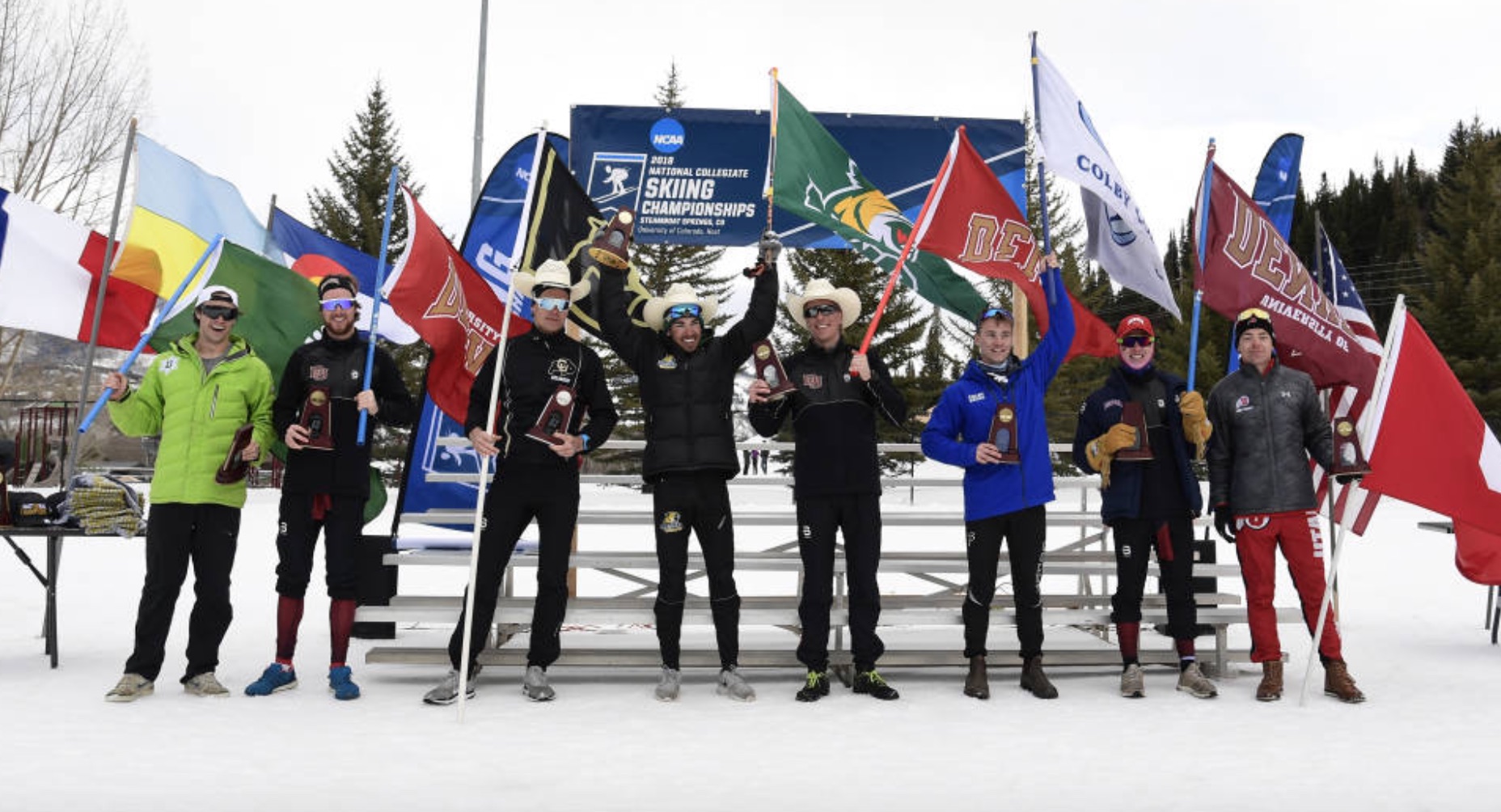
    The top finishers in the men’s 20 k freestyle mass start at 2018 NCAA Skiing Championships in Steamboat Springs, Colorado, with Northern Michigan University’s Ian Torchia (c) in first. (Photo: Dartmouth Sports/Clarkson Creative)

    NCAA Skiing Championships (Steamboat Springs, Colorado): 15/20 k freestyle mass starts

    On the fourth and final day of NCAA Skiing Championships at Howelsen Hill in Steamboat Springs, Katharine Ogden skied to her second-straight national title, Ian Torchia became an NCAA champion and the University of Denver (DU) won its 24th NCAA National Championship.
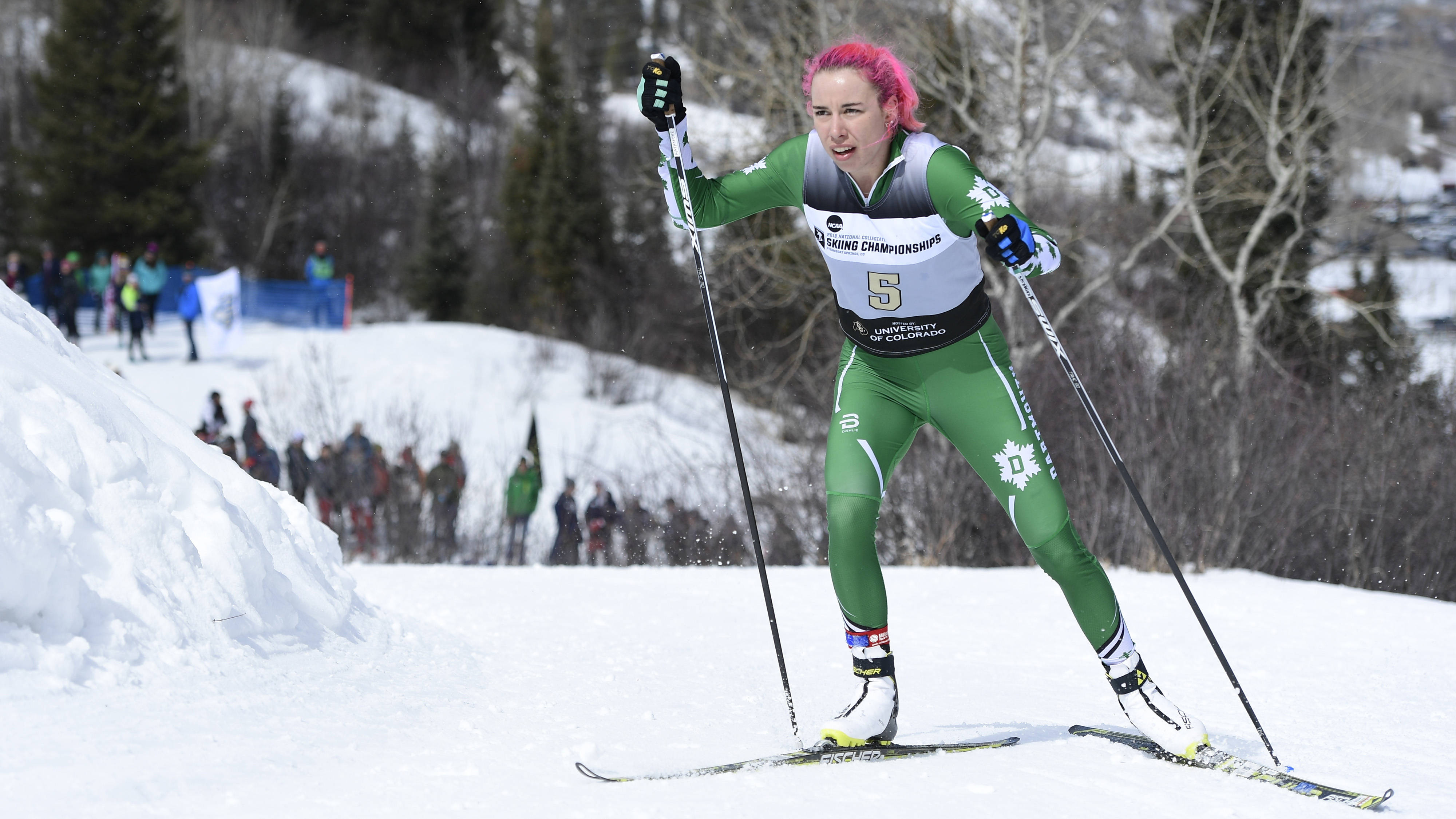
    Dartmouth freshman Katharine Ogden racing to her second-straight victory of the 2018 NCAA Skiing Championships in Steamboat Springs, Colorado. She won Saturday’s 15 k freestyle mass start by more than 38 seconds. (Photo: Dartmouth Sports/Clarkson Creative)

    Ogden, a Dartmouth College freshman, raced to a 38.4-second victory in the women’s 15-kilometer mass start, finishing in 43:22.0 minutes for her second win in as many races at 2018 NCAA Championships. She won the 5 k classic on Thursday and with her win on Saturday, she became the first Dartmouth skier in 56 years to win two national titles in the same year, according to a Dartmouth press release.

    On the second of three laps, Ogden broke away early with close to 10 k to go. According to the press release, she had a “quick fall” near the end of the second lap, but that didn’t derail her as she had time to grab sunglasses from Dartmouth men’s coach Brayton Osgood and a Dartmouth Lone Pine flag before the finish.

    At this year’s championships, Ogden’s two titles are accompanied by victories from Dartmouth men’s alpine skiers Brian McLaughlin (who won the giant slalom) and Tanguy Nef (who won the slalom). This marked only the second time that Dartmouth’s Big Green won four individual titles in a single NCAA Championships; that also occurred 61 years ago.

    “Katharine absolutely wanted this one, and she really likes to win,” Dartmouth Director of Skiing and Women’s Nordic Head Coach Cami Thompson Graves said in the press release. “She wasn’t about to let a fall slow her down, she has such a great competitive fire. But she also showed her playful side grabbing Brayton’s glasses and smiling all the way to the finish line!”

    Hailey Swirbul of the University of Alaska Anchorage placed second and Linn Eriksen (DU) reached the podium in third (+46.3). Denver had three in the top 10 with Jasmi Joensuu in ninth and Taeler McCrerey in 10th. Also landing in the top 10 for All-American honors were Guro Jordheim of the University of Utah in fourth, Emma Tarbath (Montana State University) in fifth, Petra Hyncicova of the University of Colorado Boulder (CU) in sixth, Christina Rolandsen (CU) in seventh, and Lauren Jortberg (Dartmouth) in eighth.

    Torchia, an Northern Michigan University (NMU) junior and U.S. Ski Team Development Team member, became the seventh NCAA champion in NMU Wildcats nordic skiing history, according to an NMU press release. Fredrick Schwenke was the Wildcats’ last nordic champion; he won the 2015 NCAA Championships 20 k classic.

    Torchia drew bib 1 for Saturday’s 20 k freestyle mass start and crossed the finish line first in 54:21.0, just 2 seconds ahead of CU’s Alvar Alev. Eivind Kvaale (DU) finished just four seconds back in third, and Denver had three in the top seven with Dag Frode Trollebø in fourth and Lars Hannah in seventh. Darmouth’s Cal Deline placed fifth, Zane Fields of Colby College finished sixth, and the 20 k freestyle’s 2017 NCAA champion Martin Bergström (Utah), who also won Thursday’s 10 k classic, placed eighth.  CU’s Petter Reistad and Sondre Bollum finished ninth and 10th, respectively.

    In the team standings, Denver beat Colorado by 41 points for the overall win with a total of 604 points between the nordic and alpine events at this year’s championships. Dartmouth placed third, 114.5 points behind Colorado, and Utah was another 63 points back in fourth.

    According to a DU press release, Denver has won at least one national championship in each of the last five athletic seasons (skiing: 2013/14, 2015/16, 2017/18; hockey: 2016-17; men’s lacrosse 2014/15), joining only Stanford on the list of schools that have done so in the last five seasons. (Oregon, West Virginia, Penn State, Oklahoma, Ohio State and Florida could potentially join that list later this year.)

    “It feels incredible,” said DU head coach Andy LeRoy said in the press release. “I am so happy for all of our athletes, they’ve been training all week and all season and to do it in Steamboat in front of our crowd is special.”

    Results: Women | Men| Team 

    Photos

    ***

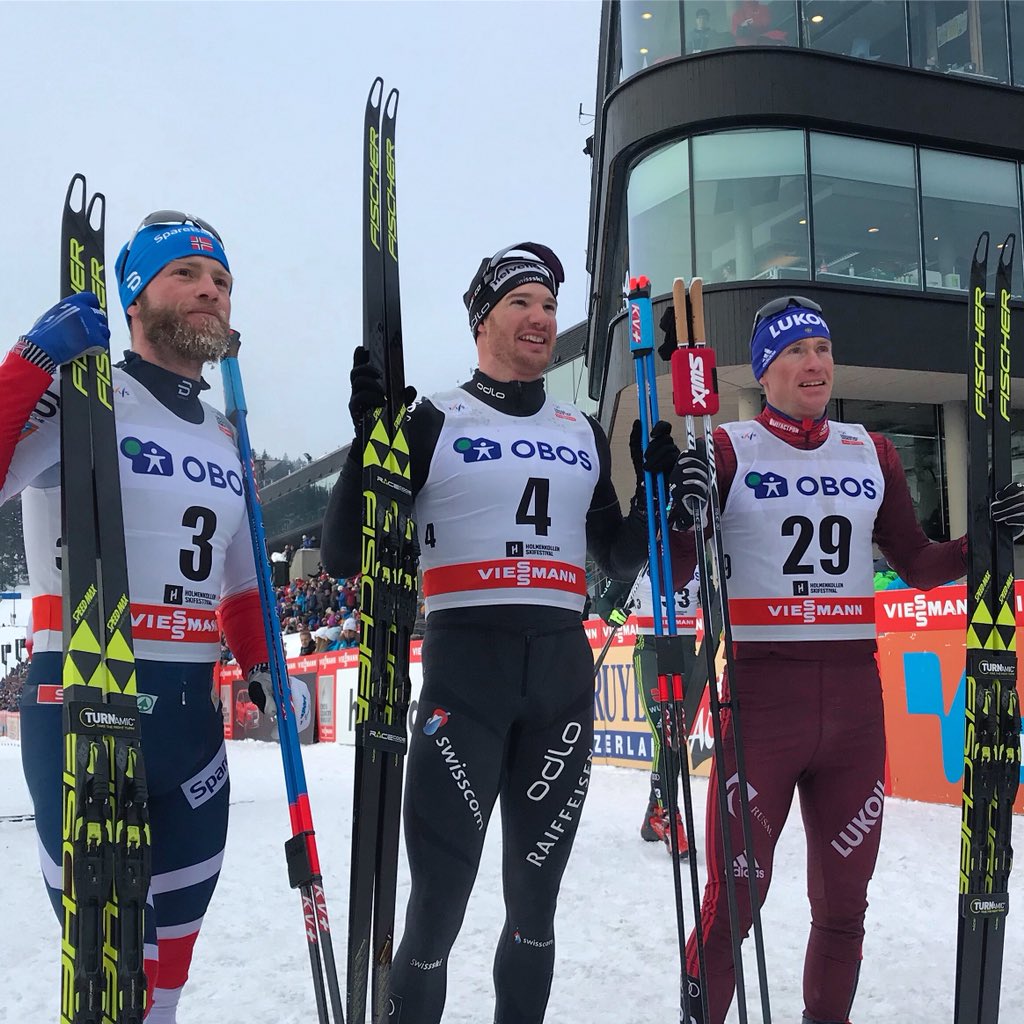
    The Holmenkollen men’s 50 k freestyle mass start podium on Saturday at the World Cup in Oslo, Norway, with Switzerland’s Dario Cologna (c) in first, Norway’s Martin Johnsrud Sundby (l) in second, and Russia’s Maxim Vylegzhanin (r) in third. (Photo: FIS Cross Country/Twitter)

    FIS Cross Country World Cup (Oslo, Norway): Men’s 50 k freestyle mass start

    Full report

    A four-time Olympic champion, Dario Cologna of Switzerland won his first 50-kilometer World Cup race on Saturday, topping the podium in the famous Holmenkollen 50 k freestyle mass start after outlunging Norway’s Martin Johnsrud Sundby (who won the event last year) for the win in 2:01:48.1. Sundby finished one-hundredth of a second behind for second place, ahead of Russia’s Maxim Vylegzhanin, who was 1.1 seconds back in third in his first World Cup race since November of last year.
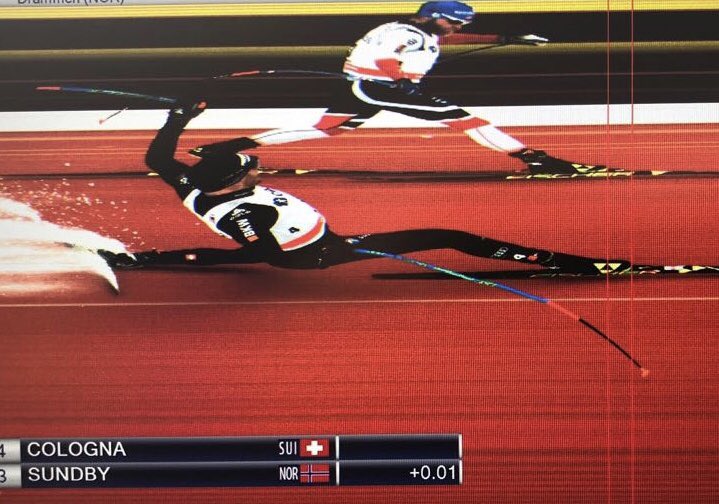
    The photo finish for first between Switzerland’s Dario Cologna (near) and Norway’s Martin Johnsrud Sundby at the Holmenkollen 50 k freestyle mass start on Saturday in Oslo, Norway. Cologna got it by 0.01 seconds. (Photo: FIS Cross Country/Twitter)

    Norway’s Sjur Røthe came out on top in a race for fourth (+4.2), ahead of Russia’s Denis Spitsov in fifth (+4.4) and his Norwegian teammate Hans Christer Holund in sixth (+4.5). Great Britain’s Andrew Musgrave followed in seventh (+15.1), Germany’s Florian Notz placed eighth (+25.9) and Canada’s Alex Harvey finished ninth (+32.4), ahead of France’s Robin Duvillard in 10th (+33.5).

    Scott Patterson led the U.S. in 16th (+56.3) coming off an 11th place in the 50 k classic mass start at last month’s Olympics, and Canada’s Devon Kershaw finished in the points in 28th (+3:43.6). Just outside the top 30, Canada’s Graeme Killick finished 34th (+4:55.1).

    Also for the U.S, David Norris placed 38th (+6:19.7), Paddy Caldwell was 46th (+8:12.3), Noah Hoffman 49th (+10:27.9), Kevin Bolger 52nd (+12:44.2), and Simi Hamilton did not finish.

    Canada’s fourth man in the race, Andy Shields finished 47th (+8:13.6).

    Results

    ***

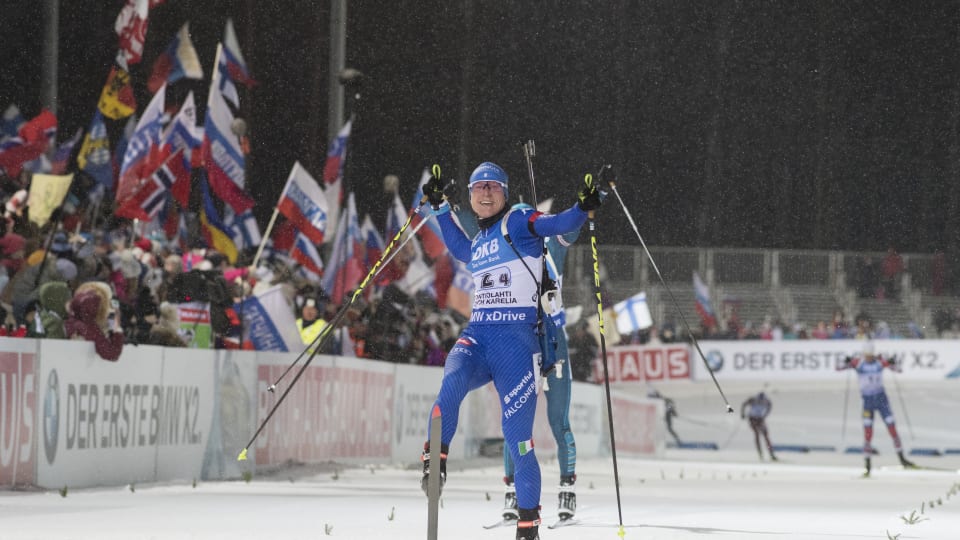
    Italy’s Lukas Hofer celebrates his team’s win in Saturday’s mixed relay at the IBU World Cup in Kontiolahti, Finland. (Photo: IBU/Biathlonworld)

    IBU World Cup (Kontiolahti, Finland): Single mixed relay & mixed relay

    (Note: This rundown has been updated to include comments from Christian Gow and Sean Doherty.)

    In the last single mixed relay and mixed relay of the International Biathlon Union (IBU) World Cup season, France and Italy came out on top, with France winning the two-person single mixed relay and Italy taking first in the coed mixed relay.
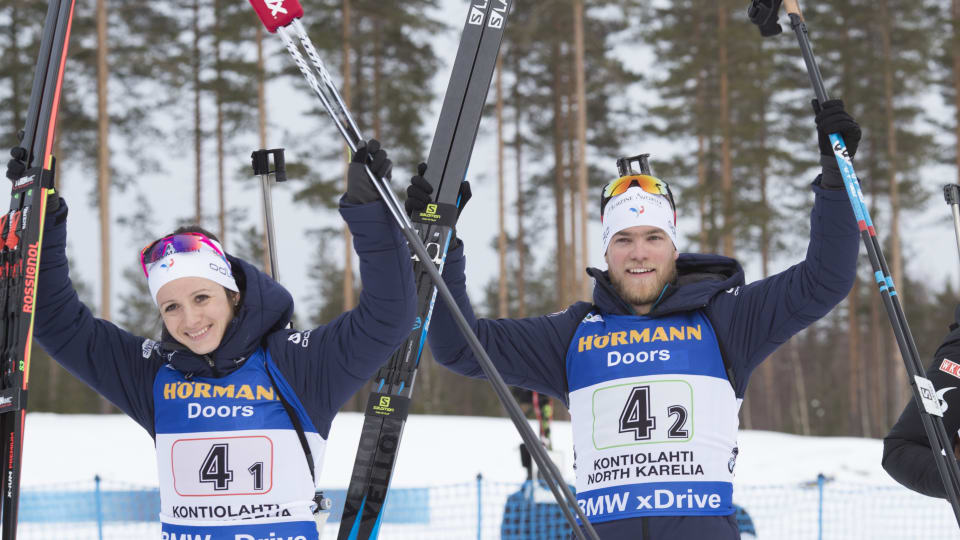
    France’s Anaïs Chevalier and Antonin Guigonnat after winning Saturday’s single mixed relay at the IBU World Cup in Kontiolahti, Finland. (Photo: IBU/Biathlonworld)

    France’s Anaïs Chevalier and Antonin Guigonnat combined for zero penalties and six spares to finish first in the single mixed relay in 33:29.1 minutes. Guigonnat as the team’s anchor secured the win by just 2.4 seconds over Austria’s Julian Eberhard while Norway’s Johannes Thingnes Bø finished 4.4 seconds back for third.

    Chevalier put France in fifth after the first leg, 15.5 seconds behind Ukraine’s Iryna Varvynets in first. Guigonnat used just one spare on his first leg to move them into fourth, 9.2 seconds back while Norway led at the second exchange. On Chevalier’s second leg, she shot clean in both stages to lead through the final exchange, with Ukraine skiing just 6.2 seconds back in second.

    On the final leg, Guigonnat used two spares and stayed out of the penalty lap, keeping the team in first through the finish. Eberhard skied the second-fastest course time on that leg to elevate Austria (with Lisa Theresa Hauser) from fourth at the tag to second place at the finish, and Bø skied all the way up from eighth to third place for Norway (with Marte Olsbu) with the fastest course time.

    Ukraine’s Artem Tyschenko used just one spare but slipped to fourth with the 11th-ranked course time on that leg, as he finished 10.8 seconds behind Norway.

    Behind Russia in fifth and Italy in sixth, Canada placed seventh (+23.8) with Rosanna Crawford and Christian Gow. The duo combined for zero penalties and six spares, and put themselves in third place early in the race. Crawford skied them into third on the first leg, using just two spares and tagging Gow 7.4 seconds out of first.

    Gow went on to take the lead after cleaning prone without any spares, and he cleaned standing as well but slipped back to third while Bø took the lead. Gow tagged Crawford in third, 8.9 seconds behind Norway in first.

    “I didn’t think too much about being tagged in third,” Gow recalled in an email to FasterSkier. “It was exciting for sure, but I let it fade to the background so that I could focus on my job both on the track and in the range.  It was great to leave prone in first place! It was also surprising, but it was a good place to be in.

    “My skiing was ok today,” he continued. “It is a really challenging and demanding race format that we don’t get a lot of practice with.  I was sick after the Olympic Games and only finally coming around the past couple days.  The Sprint race was horrendous for me, so today was much better than that. In the range I just focussed on myself and trusted my shooting.  I tried my best not to get caught up in the race going on around me and it worked to my benefit.”

    Crawford then slipped to seventh and 21 seconds back with three prone spares, but avoided the penalty lap, and Gow held onto seventh through the finish, using just one spare and skiing the eighth-fastest course time on that leg.

    “We are both happy with this result,” Gow wrote. “I think that we are both looking at the 23 second gap to first and thinking that if things had worked out just a bit better we could be there.  It can be both exciting and frustrating to be that close to the podium.  We know we can do it, it’s just a matter of putting it together on the right day. We are happy with 7th, but hungry for more.”

    Susan Dunklee and Lowell Bailey finished 14th for the U.S., 1:13.0 out of first with one penalty and 14 spares. The penalty came on Dunklee’s first leg during her standing stage, after she had cleaned prone without any spares. She tagged Bailey in 14th and he brought them up to 11th, using three spares on that leg, then Dunklee came through the final exchange in 13th after using four spares to clean. Bailey lost one place on the final leg, using four spares but staying out of the penalty lap.

    Twenty-six teams competed in the single mixed relay, compared to 23 in the mixed relay that followed.
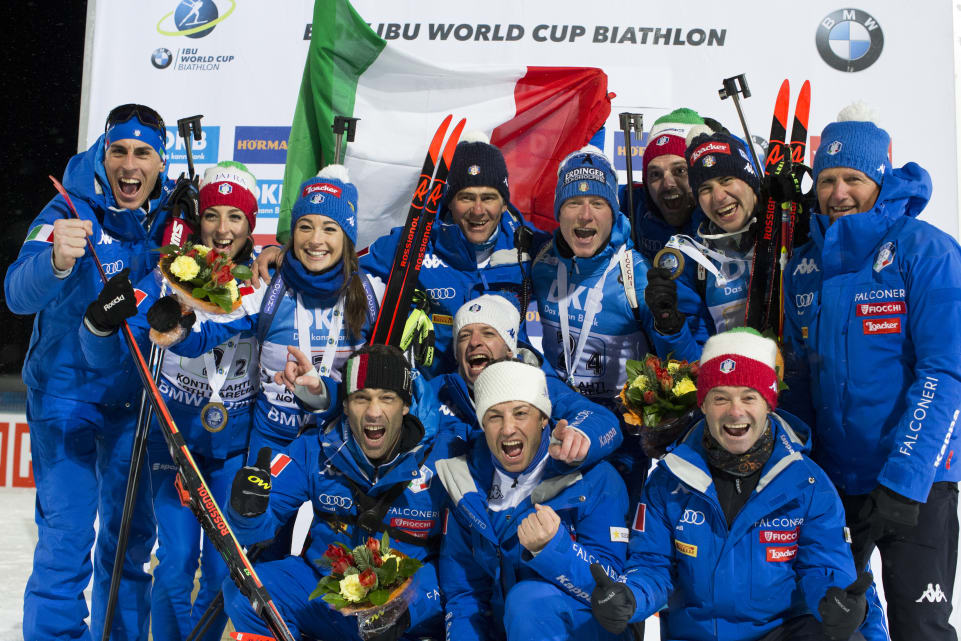
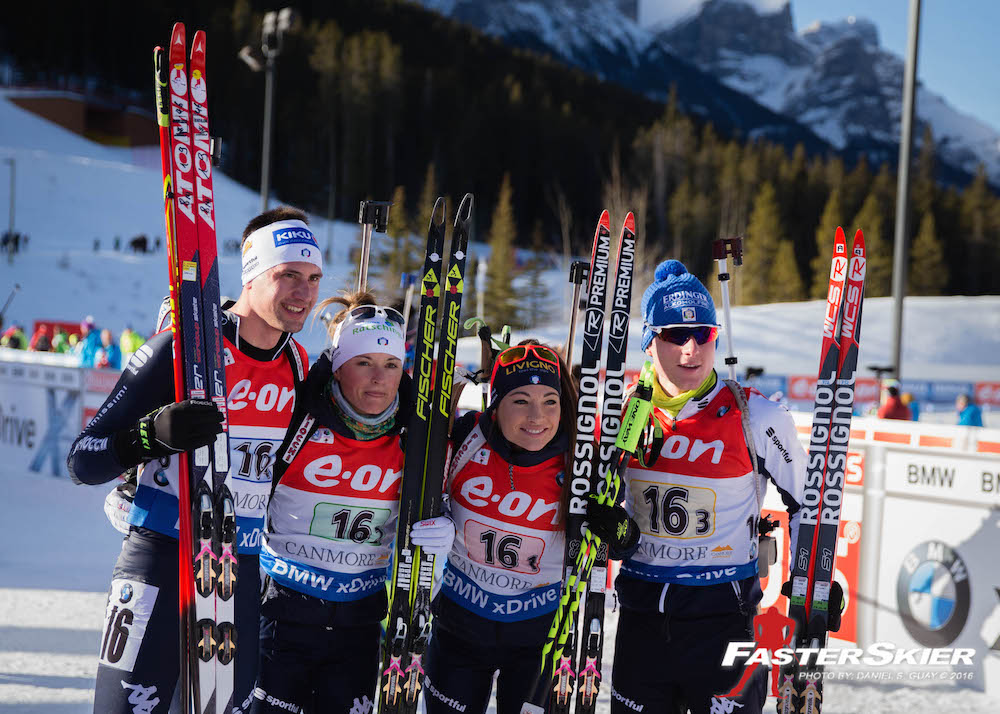
    Team Italia celebrates its win in the IBU World Cup mixed relay on Saturday in Kontiolahti, Finland, with its relay members Dorothea Wierer, Lisa Vittozzi, Dominik Windisch, and Lukas Hofer. (Photo: IBU/Biathlonworld)

    In Saturday’s 2 x 6 + 2 x 7.5 k mixed relay, Italy nabbed a 1.5-second victory over Ukraine in 1:15:08.3. Dorothea Wierer, Lisa Vittozzi, Dominik Windisch, and Lukas Hofer — the same Italian team that took bronze in the mixed relay at last month’s Olympics, although in a different order — combined for the win with one penalty and 13 spares.

    Ukraine, with Anastasiya Merkushyna, Vita Semerenko, Artem Pryma, and Dmytro Pidruchnyi, had zero penalties and just three spares throughout the whole race. For the second-straight relay on Saturday, Norway placed third (+9.1) with Synnøve Solemdal, Tiril Eckhoff, Henrik L’Abée-Lund, and Tarjei Bø totaling zero penalties and nine spares.

    Italy’s lone penalty came in Vittozzi’s second leg, but it didn’t derail the team as it improved from sixth to fifth with Vittozzi, who skied the third-fastest course time on that leg. She tagged Windisch 6.8 seconds out of first, and Windisch, who had anchored the team in the Olympics, took the lead by the final exchange after using two spares to clean. Hofer left the exchange just 3.3 seconds ahead of Norway’s Bø but used just one spare and skied the second-fastest anchor leg to finish first, beating his rivals up Kontiolahti’s infamous climb known as “The Wall”. Ukraine’s Pidruchnyi also shot clean with a single spare and clocked the fastest anchor leg to move his team from fourth to second place. Bø lost one place and finished third after using one spare as well and skiing the third-fastest anchor leg.

    Russia followed in fourth, France fifth, Sweden sixth, Germany seventh, Austria eighth, and the U.S. ninth (+2:48.4). The U.S. team, with Clare Egan, Joanne Reid, Tim Burke, and Sean Doherty, had one penalty and 11 spares. Egan cleaned her first prone but had to ski a penalty lap after her standing stage, tagging Reid in 17th, 58.7 seconds out of first.

    Reid used three spares on the second leg and moved up to 13th by the second exchange, and Burke used three spares as well to pick off one more place and tag Doherty in 12th. Doherty skied the eighth-fastest anchor leg and used two spares to clean to put the team in ninth at the finish.

    “I don’t consider two spares to be anything special, but today it was enough to make up some ground,” Doherty wrote in an email to FasterSkier.”I felt strong skiing, more like myself which is fun even if it’s a little late in the season. We had very good skis which always helps. I have done quite a few laps on this course over the years so the lines and transitions are pretty refined, so that is where I made time on the course.

    “I am happy with my leg. I enjoyed my little battle for 9th,” he continued. “I can’t speak too much for the other members of the relay tonight but I think 9th is a solid effort.”

    Canada finished 17th (+4:34.9) with Emma Lunder, Julia Ransom, Scott Gow, and Brendan Green combining for one penalty and 13 spares. Lunder put them in 12th at the first exchange and Ransom skied up to 10th, but Scott Gow had a penalty on his standing stage to drop to 16th. Green lost one more place on the last leg despite only requiring two spares.

    Results: Single mixed relay | Mixed relay

  • Saturday Rundown: Dresden, Ruhpolding, Kaiser Maximilian Lauf

    Saturday Rundown: Dresden, Ruhpolding, Kaiser Maximilian Lauf

    The women’s freestyle sprint podium on Saturday at the World Cup in Dresden, Germany, with Sweden’s Hanna Falk (c) and Maja Dahlqvist (l) in first and second, and American Sophie Caldwell (r) in third. (Photo: FIS Cross Country/Twitter)

    FIS Cross Country World Cup (Dresden, Germany): Freestyle sprints

    Women’s report

    Men’s report

    For her second-straight World Cup sprint, Sophie Caldwell of the U.S. Ski Team reached the podium in the women’s 1.2-kilometer freestyle sprint on Saturday in Dresden, Germany.

    Caldwell placed third in the final behind Sweden’s Hanna Falk, who won it in 2:11.02 minutes, and Maja Dahlqvist, also of Sweden, who placed second (+0.23). Caldwell and Dahlqvist both lunged in a photo finish for second, which Dahlqvist took by 0.07 seconds.

    Also in the final, which included four Swedes, Switzerland’s Laurien van der Graaff finished fourth (+0.58), and Sweden’s Anna Dyvik followed in fifth (+0.68) and Stina Nilsson sixth (+7.56) after tripping.

    Falk started the day by winning the women’s qualifier in 2:06.34, by just 0.02 seconds over Nilsson in second. Caldwell qualified 11th (+2.02). and another American Ida Sargent made it into the heats in 14th (+2.44). Kikkan Randall missed the top 30 by 0.6 seconds in 34th (+6.57), Julia Kern placed 38th (+7.78), and Caitlin Patterson, of the Craftsbury Green Racing Project (CGRP), was 40th (+8.56) out of 49 women in the qualifying round.

    Sargent finished fourth in her quarterfinal, 043 seconds behind Sweden’s Ida Ingemarsdotter in first, to finish the day in 17th overall.

    For Caldwell, who went on to advance in second in her quarterfinal and third in her semifinal, the podium came after she finished second in the last World Cup skate sprint (the first stage of the Tour de Ski) on Dec. 31 in Lenzerheide, Switzerland.

    Her boyfriend and fellow U.S. Ski Team member Simi Hamilton came close to reaching the men’s 1.2 k sprint final on Saturday after qualifying in 15th then placing second in his quarterfinal and fifth in the second semifinal, 0.38 seconds behind Sweden’s Emil Jönsson in first.

    France’s Lucas Chanavat won the qualifier in 1:50.42, 0.15 seconds ahead of Norway’s Johannes Høsflot Klæbo in second. Hamilton was 4.32 seconds back in the qualifier, and his U.S. teammate Andy Newell also qualified in 18th (+4.91). Erik Bjornsen missed qualifying by 0.23 seconds in 32nd (+6.15) and Ben Lustgarten (CGRP) finished 49th (+8.64) out of 67 men.

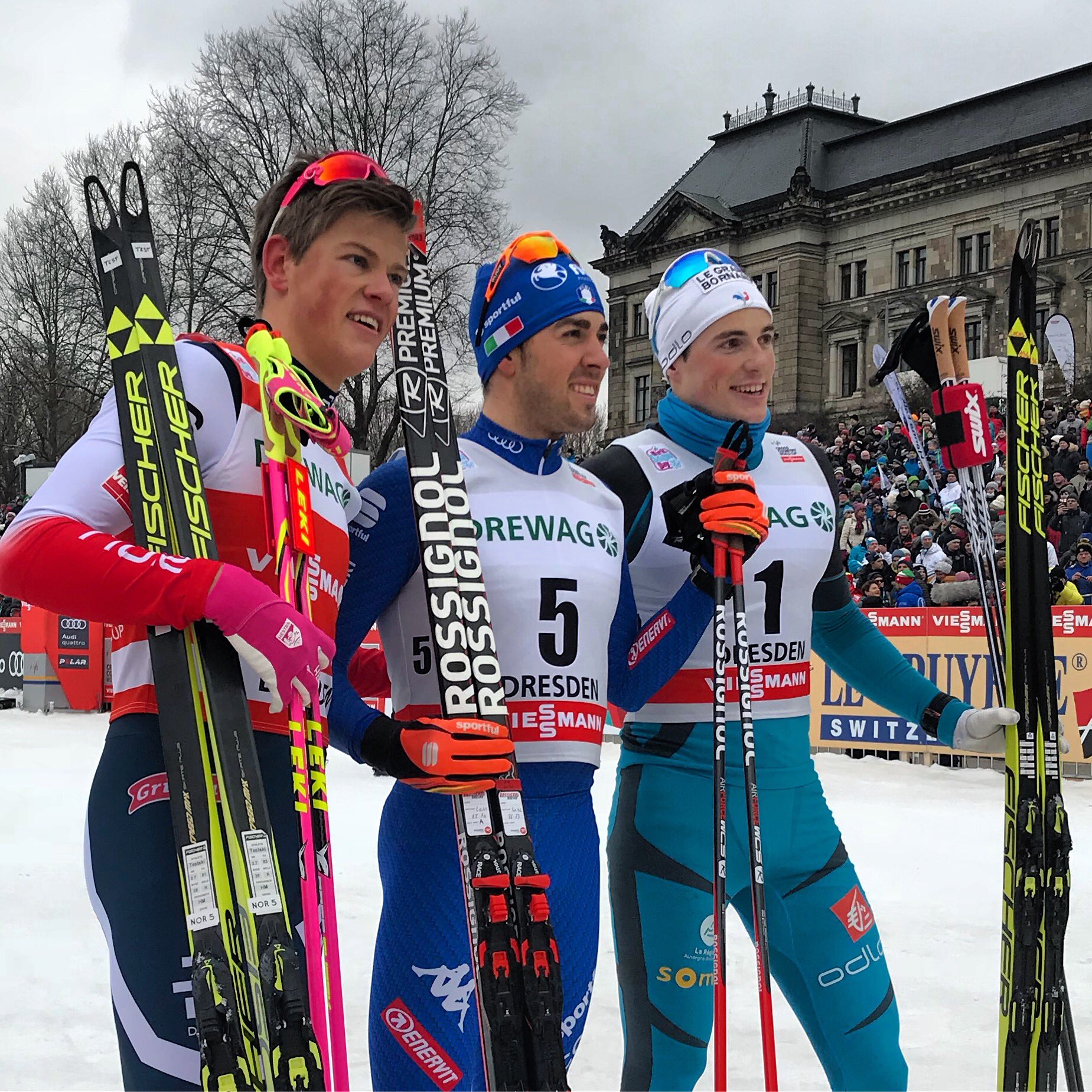
    The women’s freestyle sprint podium on Saturday at the World Cup in Dresden, Germany, with Italy’s Federico Pellegrino (c) in first, Norway’s Johannes Høsflot Klæbo (l) in second, and France’s Lucas Chanavat (r) in third. (Photo: FIS Cross Country/Twitter)

    While Hamilton’s day ended in the semifinals, putting him 10th overall (and Newell finished sixth in his quarterfinal to place 27th overall), Italy’s Federico Pellegrino timed his attack perfectly in the final, challenging Klæbo for the win down the finishing stretch. The Italian took it by 0.18 seconds in 1:52.77, Klæbo placed second and Chanavat third (+0.98).

    France and Norway had two men in the final, with France’s Richard Jouve placing fourth (+1.23), Sweden’s Jönsson taking fifth (+2.36) for his best individual World Cup result since December 2016. Norway’s Even Northug finished sixth (+12.04) after breaking his pole out of the start.

    Canada’s Julien Locke of the National U25 Team and Black Jack Ski Club had a career-best day, finishing 15th overall. He qualified 16th (+4.61) then placed third in his quarterfinal, crossing the line just 1 second behind Norway’s Fredrik Riseth, who won that heat. Hamilton was second in that quarterfinal, 0.67 seconds back.

    Also for Canada, Bob Thompson (NTDC Thunder Bay) finished 50th in the qualifier (+8.67), Dominique Moncion-Groulx (Alberta World Cup Academy) was 59th (+9.99) and Antoine Briand (Pierre-Harvey National Training Centre) 60th (+10.12).

    Results:

    Women’s qualifier | Women’s heats

    Men’s qualifier | Men’s heats

    ***

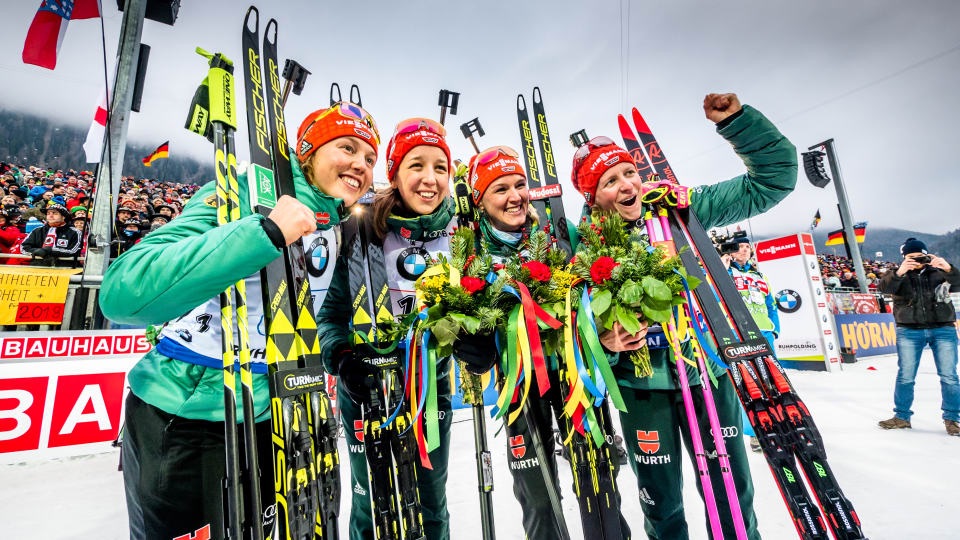
    Germany’s Laura Dahlmeier, Franziska Preuss, Denise Herrmann and Franziska Hildebrand (left to right) celebrating their win in the women’s 4×6-kilometer relay at the 2018 IBU World Cup in Ruhpolding, Germany. (Photo: IBU/Biathlonworld)

    IBU World Cup (Ruhpolding, Germany): Women’s relay

    The teams from Germany and Italy dueled for the top position all race in Saturday’s 4 x 6-kilometer women’s relay at the IBU World Cup in Ruhpolding, Germany. Cheered on by some 20,000 home-crowd fans, Germany’s anchor Laura Dahlmeier stayed on the ski tails of Italy’s Federica Sanfilippo after the last shooting stage, then passed her before the last major climb and held a narrow lead around the rest of the course to cross the finish line first in a time of 1:08:47.0 hours, with Italy 2.9 seconds behind. German had a team total of zero penalties and nine spares.

    “It’s incredibly fun to win in front of this audience here today,” Dahlmeier told German broadcaster ZDF in an interview right after the race, according to a translation. “I think this will boost our whole team morale. We showed today that we are a team to be reckoned with in relays. It was just a nice race.”

    Germany with Franziska Preuss, Denise Herrmann, Franziska Hildebrand, and Dahlmeier was never more than 30 seconds behind the pace, even though Hildebrand temporarily fell back from leading the field to tagging off to Dahlmeier in fourth position.

    “My race held all kinds of surprises today,” Hildebrand told ZDF with a laugh. “It started with a fall on an icy patch 100 meters after it began… Then I dropped my pole, also had to exchange the replacement one, and then three spares [in prone] to avoid the penalty. Today everything conspired in my race.”

    Italy with Lisa Vittozzi, Dorothea Wierer (coming off a victory in the individual race on Thursday), Nicole Gontier and Sanfilippo had the best shooting performance of the day, with no penalty and just three spares.

    “That last loop with Laura was really tough,” Sanfilippo said in the press conference. “I gave my best, I tried all for my team. I knew that I can be strong on the last loop. I tried to attack, but Laura was a little bit stronger. But I am also really happy that we finished in second place, I think that was really important for our team.”

    Sweden with Linn Persson, Mona Brorsson, Anna Magnusson and anchor Jenny Öberg was third, 17.2 seconds back, with no penalty and five spares. Brorsson and Öberg managed to move the team up to the podium positions, for the second one in a row following a third place from Oberhof, Germany, a week ago. Before that, the Swedish women’s team had been on a six-year hiatus from those lofty positions.

    “It’s cool to be on the podium again,” Persson said in the press conference.

    “This is like our second home and there were a lot of Swedes here, so we had big support during the race on the tracks,” Brorsson added.” That was an advantage for us.”

    Just a few seconds off the podium, Norway with Synnøve Solemdal, Tiril Eckhoff, Ingrid Landmark Tandrevold and Marte Olsbu was fourth (+23.1, with no penalty and nine spares), with Olsbu outsprinting Poland’s anchor Weronika Nowakowska on the finish stretch (+24.5, with no penalty and five spares). For both teams it was their best relay result of the season so far.

    Switzerland with the three sisters Elisa, Selina and Aita Gasparin reinforced by Lena Häcki surprisingly led the race at the third exchange after Selina had moved them in front, but her youngest sister Aita could not hold that position, falling back with a penalty lap in the last standing stage to finish eighth (+1:37.1, with one penalty and 11 spares).

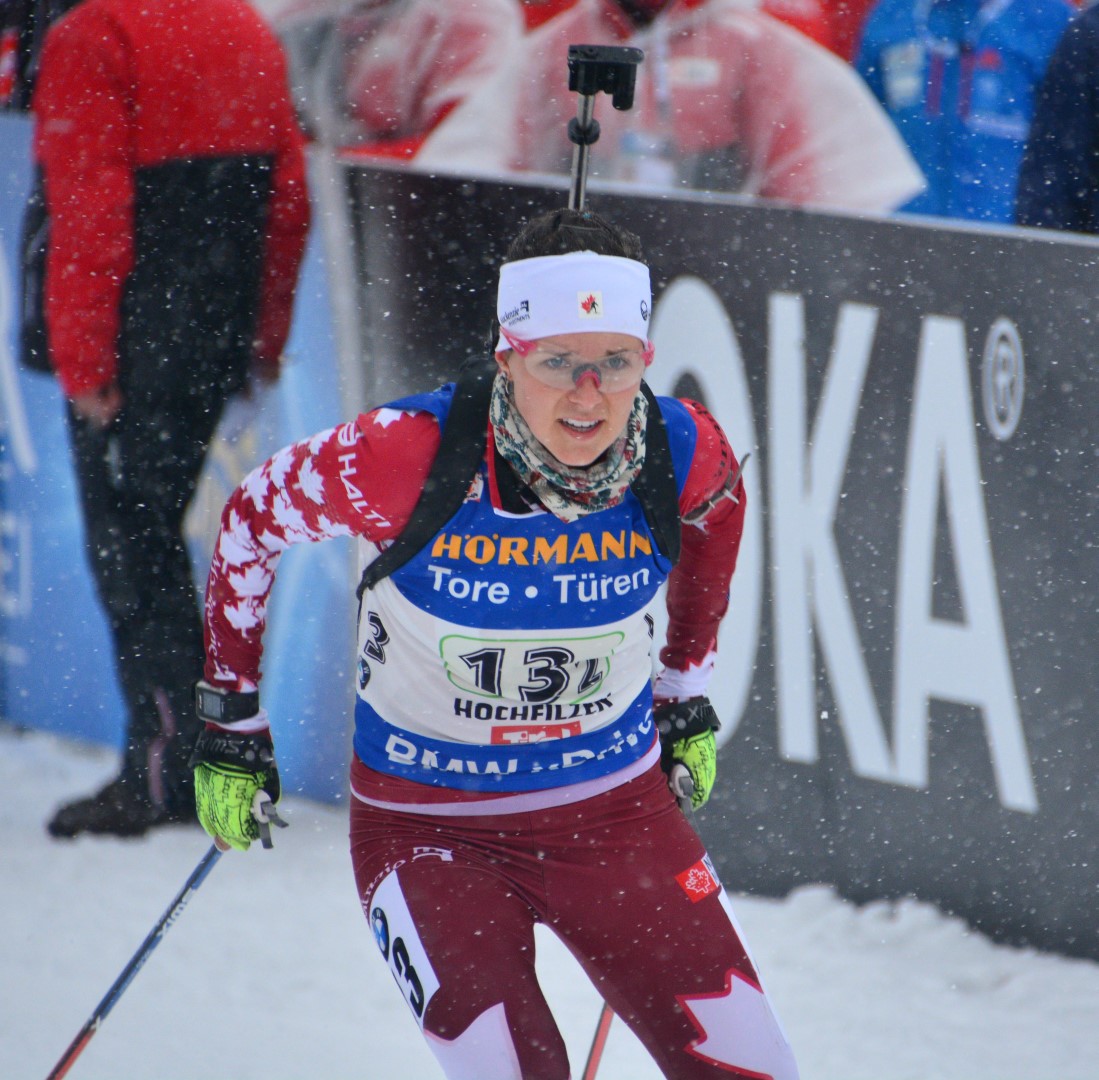
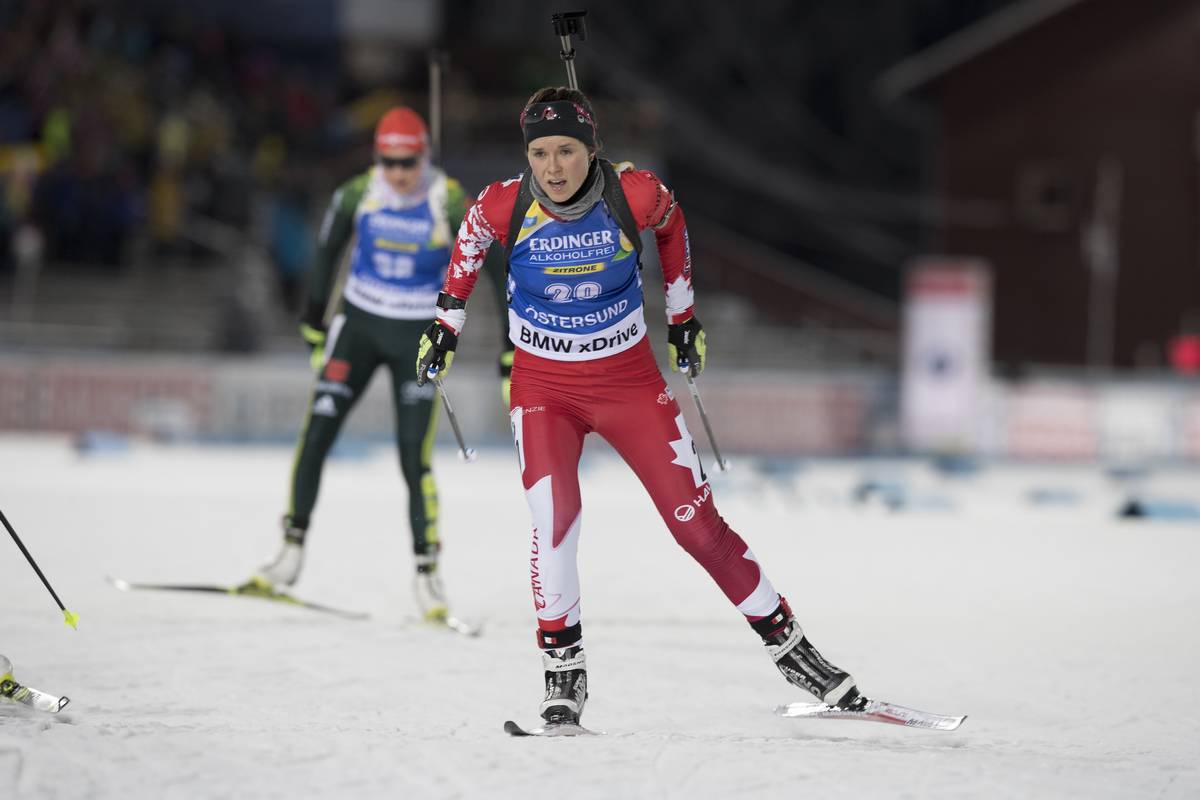
    Biathlon Canada’s team of Emma Lunder, Julia Ransom, Sarah Beaudry, and Rosanna Crawford started the race with a setback after Lunder incurred a penalty in her prone stage, leaving the range in 23rd position at the end of the field and already almost a minute behind the leader. She managed to limit the gap with a clean standing stage to exchange still in 23rd position and 1:47 back.

    Taking over Ransom then remained clean in both stages to move the team up to 17th, tagging off 2:14 behind. Beaudry only required one spare in her prone stage (0+1, 0+0) to improve to the 12th position even making up 3 seconds to the leaders.

    Then Crawford, fresh off her first career podium in the individual race on Thursday, managed to also shoot clean in both stages and overtook the teams from Slovakia and Ukraine while further decreasing the gap to finish the race in 10th position, 1:56.7 back, with one penalty and just four spares.

    “Things were a bit softer and slushy today compared to the individual, but nothing too bad,” Crawford commented on the conditions in an email to FasterSkier. “There was quite a bit of wind on the range, which I think was tricking people, the wind flags weren’t showing much but I had to make 6 left correction during zero [target practice].”

    “Today was a solid showing from our team,” she added regarding their result. “Everyone cleaned standing, I think we can be really happy of this race, and take some real confidence going into the Olympic relay.”

    Previously this season Canada had finished the relay in Oberhof, also Germany, in 14th position, and the first one in Hochfilzen, Austria, in ninth.

    For US Biathlon with Susan Dunklee, Clare Egan, Emily Dreissigacker, and Joanne Reid, it was the first women’s relay of the year after missing out on the first two races of the season in this discipline.

    Thus starting at the very end of the field, veteran Dunklee moved up through the pack and got through the prone stage with one spare. But then she had to fight against a penalty lap in her standing stage requiring all three spare rounds, leaving the range in 12th position. With the fastest course time on the opening leg, she managed to slightly decrease the gap to 21.6 seconds and made up three positions to exchange in ninth place.

    Egan missed the first two shots in her prone stage, but hit the targets with her spares leaving the range over a minute back. She followed that up by cleaning her standing stage and left the range 1:29.5 back, then only lost five more seconds on the last loop to exchange in 14th.

    Dreissigacker also needed just one spare in her prone shooting, but then incurred two penalties in her standing stage, doubling the gap and falling back to 19th position at the exchange and 3:51 back.

    Anchor Reid needed three spares on her leg (0+2, 0+1) and managed to still overtake the teams from China and Finland to finish 17th, 4:57.7 behind Germany, with two penalties and 13 spares overall.

    “Finally we had a full team and raced a relay!” Dunklee wrote on Instagram. “Competing on a foreign continent has its challenges.”

    Results

    ***

    Ski Classics (Seefeld, Austria): 60 k Kaiser Maximilian Lauf

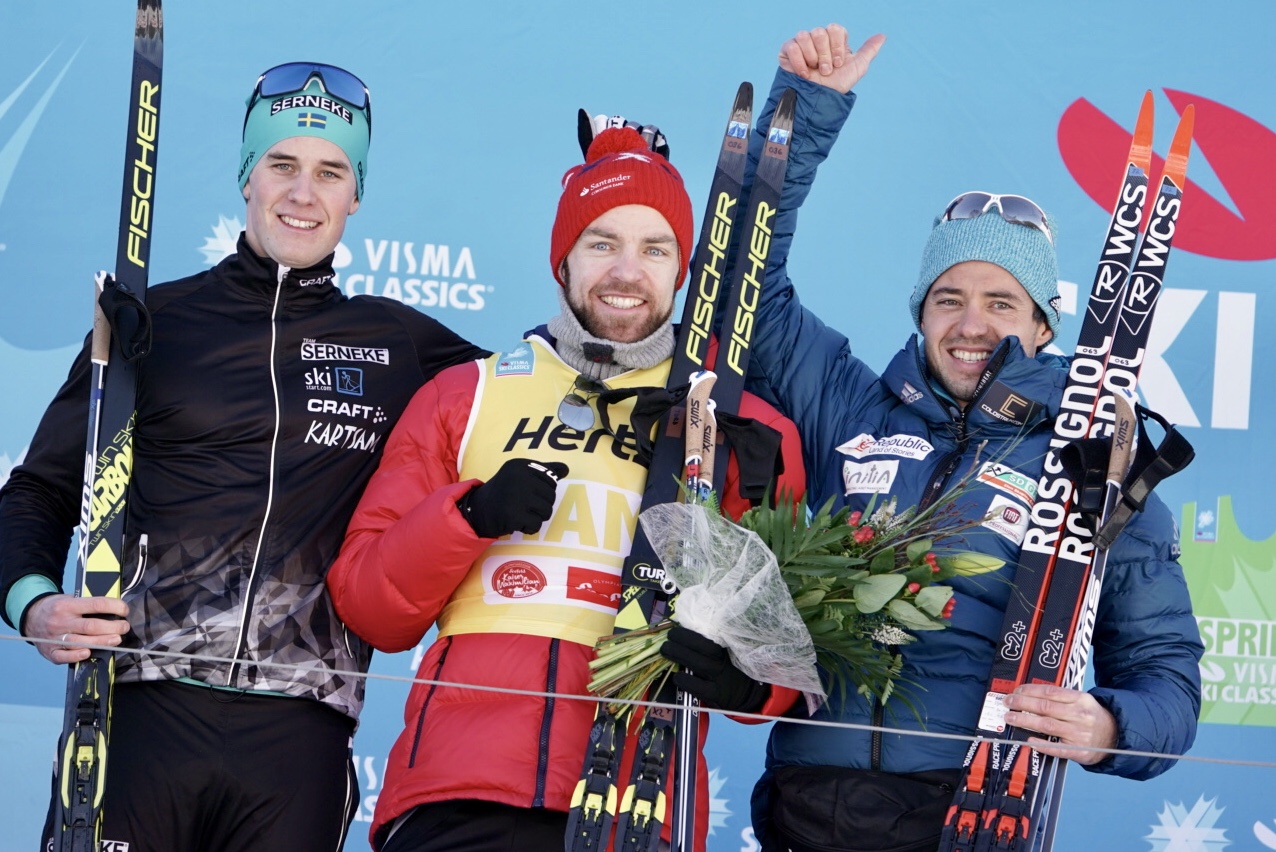
    The men’s podium at the Kaiser Maximilian Lauf 60 k Ski Classics marathon in Seefeld, Austria, with Norway’s Tord Asle Gjerdalen (c) in first, Sweden’s Andreas Holmberg (l) second, and Russia’s Ilya Chernousov (r) third. (Photo: Visma Ski Classics)

    At the third Ski Classics event of the 2017/2018 season, the 60-kilometer Kaiser Maximilian Lauf on Saturday in Seefeld, Sweden’s Britta Johansson Norgren (Lager 157 Ski Team) and Norway’s Tord Asle Gjerdalen (Team Santander) took the women’s and men’s victories, respectively.

    Johansson Norgren and Japan’s Masako Ishida (Team Koteng) broke away shortly after the start. The two went back and forth for a while until Johannson Norgren gapped Ishida in the Leutasch valley. While Ishida was caught by a chase pack with Sara Lindborg (Team Serneke), Kari Vikhagen Gjeitnes (Santander) and Lina Korsgren (Åre Ski Team), she reined Johansson Norgren back in on the long climbs after the valley. Ultimately, Johansson Norgren took the win in 2:49:16.0 hours, while Lindborg claimed second, 37.5 seconds back. Ishida finished third (+58.9), Gjeitnes placed fourth (+1:40.7) after injuring her ankle about 2 k before the finish, and Korsgren fifth (+2:05.1).

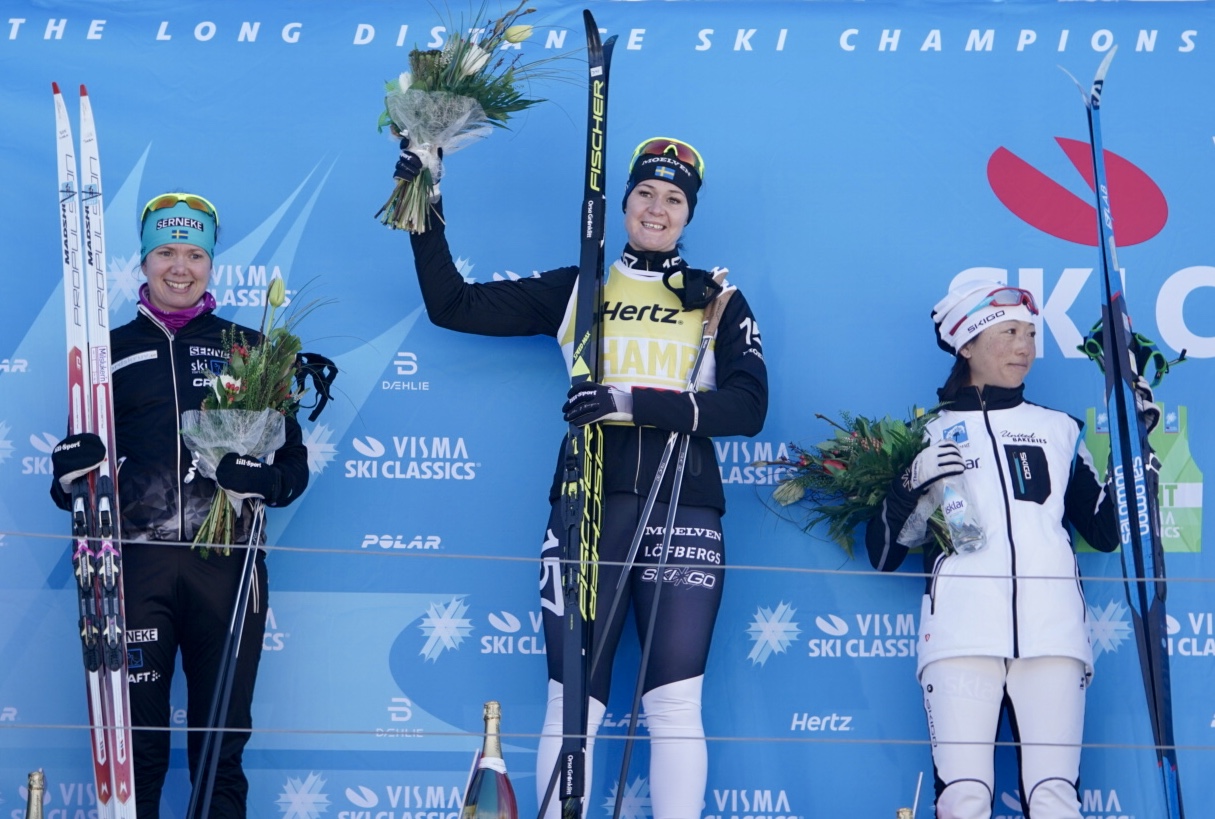
    The women’s podium at the Kaiser Maximilian Lauf 60 k Ski Classics marathon in Seefeld, Austria, with Sweden’s Britta Johansson Norgren (c) in first, Sweden’s Sara Lindborg (l) second, and Japan’s Masako Ishida (r) third. (Photo: Visma Ski Classics)

    “It was my plan to go full speed from the beginning,” Johansson Norgren said, according to a Ski Classics press release. “I knew Ishida will go fast in the climbs, but I felt strong from the beginning. It was really hard skiing alone in the valley, and when Ishida caught me up, I wasn’t sure if I could win the race. But the last part of the course was perfect for me and I had no problems securing the victory today.”

    The Leutasch valley was the turning point of the men’s race as well, where Vinjar Skogsholm (Team Parkettpartner) and Andreas Holmberg (Team Serneke) broke away from the pack and had built a 90-second gap on the chase group as they left the valley. There on the first climb out of the valley, Holmberg pushed the pace and dropped Skogsholm, while Gjerdalen and Ilya Chernousov (Bauer Ski Team) worked to catch Holmberg up front. They caught him 3 k before the finish and Gjerdalen was first across the finish line in 2:27:49 hours, 14.8 seconds ahead of Holmberg in second.

    Chernousov finished third (+32.0), Ermil Vokuev (Russian Marathon Team) was fourth (+1:07.6), and Anton Karlsson (Lager 157) fifth (+1:08.2).

    “I didn’t like the fact that we gave too much leeway for Holmberg and Skogsholm,” Gjerdalen said, according to the press release. “I’m happy that Ilya helped me in our attempt to catch up with Holmberg, but I wasn’t really sure if we were going to make it. You never know how the other person is feeling in the front, what kind of skis he has and what goes on in his mind. But I managed to win today and it feels great to be back on the top.”

    In the overall “Champion” standings, Nordgren leads with 450 points, 110 ahead of Lindborg in second. Gjerdalen is first in the men’s champion standings with 330 points, 50 points ahead of Morten Eide Pedersen in second.

    The Ski Classics tour moves to Zuoz, Switzerland, next weekend for the 65 k La Diagonela.

    Results

  • Herrmann Captures Second Win in Östersund; Ransom 23rd

    Herrmann Captures Second Win in Östersund; Ransom 23rd

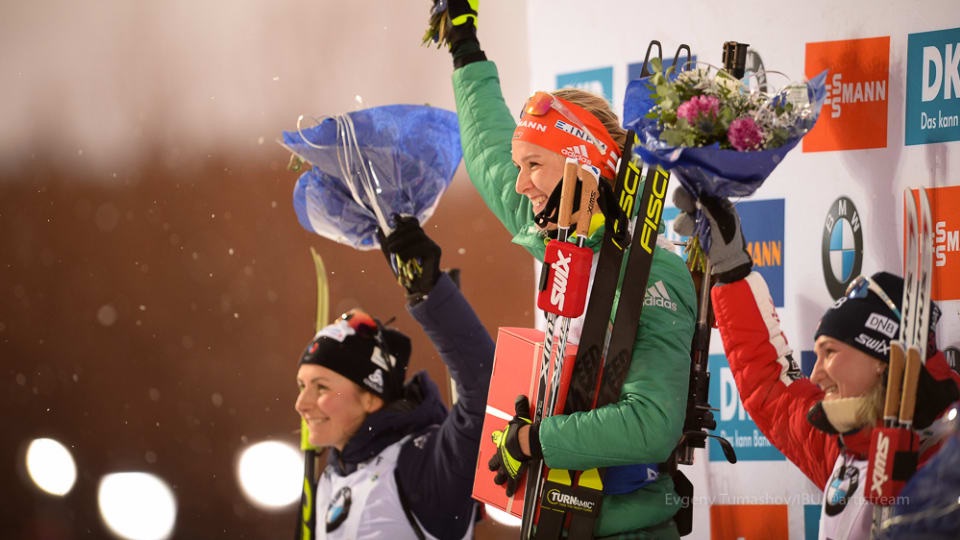
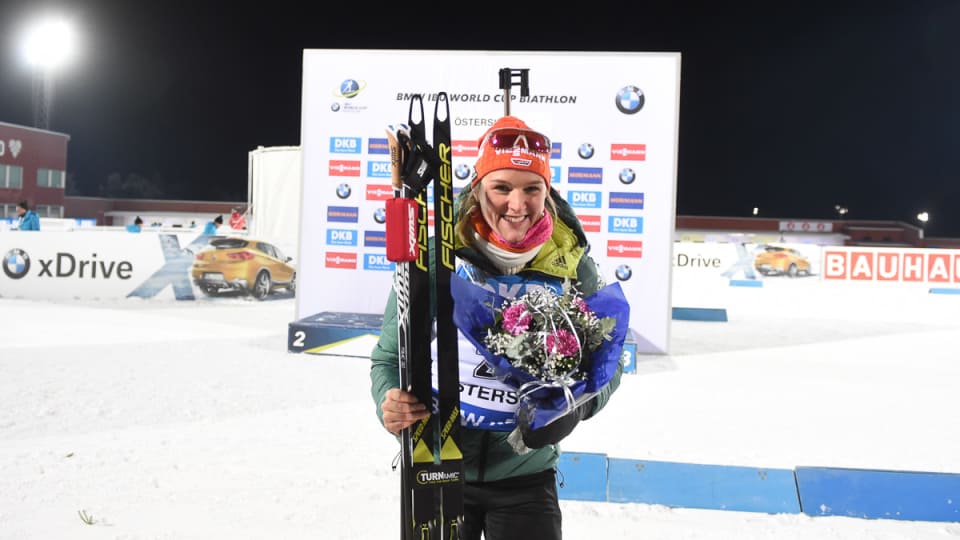
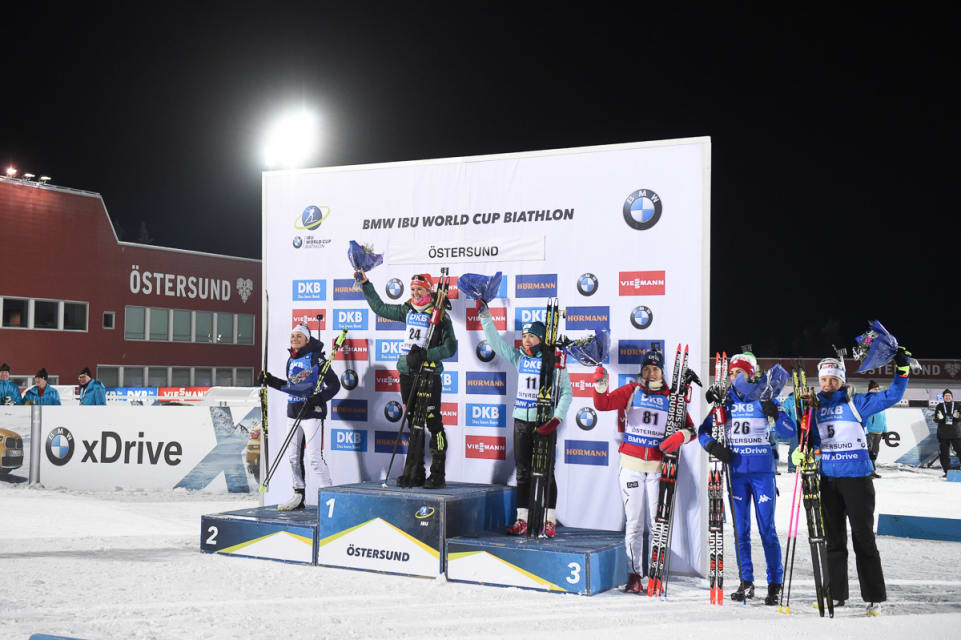
    France’s Justine Braisaz (left, second place), Germany’s Denise Herrmann (center, first place) and Norway’s Marte Olsbu (right, third place) celebrate during the flower ceremony of the women’s 10-kilometer pursuit at the 2017/2018 IBU World Cup in Östersund, Sweden. (Photo: IBU/biathlonworld)

    Twenty months ago, Germany’s Denise Herrmann was a cross-country skier, ending the Ski Tour Canada in 28th place in the 10-kilometer classic pursuit in Canmore, Alberta. And one with a very successful career, earning an Olympic bronze medal in the relay in Sochi in 2014 and narrowly missing out on another one with a fourth place in the team sprint.

    But her heart seemingly was no longer in the sport. A month after the 2015/2016 season had wrapped up, Herrmann publicly announced her intention to continue her athletic career with the goal of qualifying for the 2018 Olympics in PyeongChang, South Korea, yet no longer in cross-country skiing. Instead she dreamed about a second career in biathlon.

    Biathlon is highly popular as a spectator sport in Herrmann’s home country, arguably receiving more attention than cross-country skiing and thus providing a higher earning potential. But while a switch between the two disciplines has not been unprecedented, Germany’s senior national team is also one of the most successful and competitive ones, with no guarantee even for seasoned biathletes to make the World Cup roster. So critics wondered if that was a wise decision by Herrmann, or rather a case of giving up a bird in the hand for two in the bush.

    Herrmann had some initial success right out of the gate in her first season as a biathlete. She instantly qualified for the German team for the second-tier IBU Cup, and with the coaches trying to make use of her athletic talent she was allowed to start three World Cup races, and finished 18th in her first sprint in Pokljuka, Slovenia.

    Then ten months ago in January 2017, she might have had some second thoughts and tried a “mini-comeback” at a cross-country World Cup in Toblach, Italy, in what appeared to be an attempt to qualify for the 2017 Nordic World Championships in Lahti, Finland. Despite placing 13th in a freestyle sprint and fourth in a team sprint, but she was not nominated to Germany’s World Championships team. Instead she received more starts at the IBU World Cup test event in PyeongChang, where she won her first relay race.

    After another successful offseason of biathlon training, highlighted by winning national titles in three disciplines, she was put on the IBU Cup team again. That followed a sprint victory in Sjusjøen, Norway, after which she was ‘called up’ to the roster for this week of races in Östersund, Sweden.

    Breakthrough in Östersund

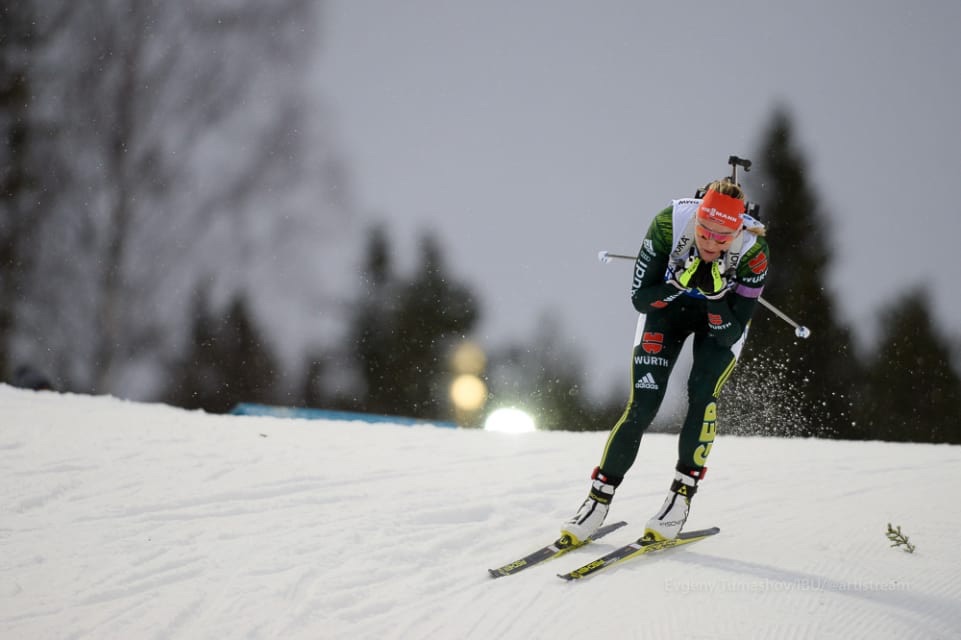
    Germany’s Denise Herrmann racing to her second career victory in the women’s 10-kilometer pursuit at the 2017/2018 IBU World Cup in Östersund, Sweden. (Photo: IBU/biathlonworld)

    This weekend, Herrmann achieved at least a big milestone on the road to her dream goal and secured her ticket for the German Olympics team for PyeongChang, fulfilling the team-internal qualification criteria (a top-eight result) with an exclamation mark by winning the sprint on Saturday.

    Now a day later she followed that up with another victory in the women’s 10 k pursuit in a time of 30:02.7 minutes with two penalties (0+0+2+0). Her transition to biathlon has come to fruition.

    While the sprint only required two shooting stages, for the pursuit she had to navigate four, an obstacle that typically weeds out inexperienced shooters, especially in the standing stages. But on Sunday, Herrmann demonstrated everything she has already learned about her new sport.

    Starting with a 15-second lead on France’s Justine Braisaz based on the sprint, Herrmann skied with a controlled pace on the first loop and went on to clean her first prone stage, returning to the course with an increased lead of 22 seconds. Then Herrmann reacted correctly to some changing wind influence by adjusting her sights to also clean the second prone stage and kept her distance to Braisaz and the next chase group.

    Herrmann later told German TV broadcaster ZDF she would not have expected to win “in a pursuit having to shoot four times and with a number of extremely good shooters breathing down my neck.”

    “To twice clean in prone made me extremely happy since that is the basis for a good pursuit,” she added. “It was good that I had a little lead so I was not under immediate pressure. With the wind on the shooting range you really had to focus today.”

    Then in the first standing stage she began with a good rhythm but narrowly missed her last two shots, hitting above the edge of the black target. Momentarily she fell back to the second place, with France’s Braisaz taking an 11-second lead after she managed to clean all of her targets.

    But Herrmann had already completed one penalty lap before any chasers had left the range, and after completing the second penalty she was able to regain her lost time on the course. For the final shooting, the two women stood side by side on the range, and both managed to clean their five targets.

    “In the third one I was shaky,” Herrmann told ZDF. “Then in the last one I tried to really give it everything I had and leave with a clean shooting. Easier said than done […] Though we practiced pressure situations like this in training with the coaches teasing us, and that helped me a bit in the last bout.”

    “When I came on the shooting range in the first position, it was the first time that happened to me, and I just had a thought, ‘Wow is it true, is that possible?’ ” Braisaz said at the IBU press conference. “It was a high difficulty today, it was tough, but I did it.”

    Braisaz started the final loop just 1.5 seconds ahead of Herrmann, who quickly passed Braisaz on a climb, then increased that lead into the finish. Braisaz crossed the line 25.8 seconds behind Herrmann, repeating her second place from the sprint and tying her career-best World Cup result for the fourth time. She was one of only three athletes to shoot clean on Sunday.

    “I was afraid,” Braisaz said in the press conference when questioned about Herrmann chasing behind her. “She just passed me on the uphill, I just tried to do my best even if it won’t work. … I am very happy, it was my main goal today to stay focused on what you have to do [on the shooting range], and I did it.”

    With a comfortable lead, Herrmann had enough time to waive to the about 3,000 spectators in the stands. “I already told [my roommate] it’s cool to win, but it must be even cooler to ski across the finish line in first and knowing you have won,” Herrmann told ZDF. “An incredible feeling. … With my tired legs I was happy that there was no battle until the finish line. Then you can really enjoy it, and I have never experienced that feeling [in cross-country], and it’s wonderful.”

    Norway’s Olsbu finished third, 48.0 seconds behind Herrmann with two penalties (0+1+0+1).

    “This means a lot to me, I felt that this week has been good for me, but it has just been almost [on the podium] so I am glad that today I got the podium,” Olsbu explained in the press conference. “I was OK on the track and my shooting was good, even though I am not so happy about my last shooting.”

    “She is really good, I am very impressed about what she is doing in the shooting,“ Olsbu said of Herrmann. “We trained in that for so many years, and she has trained for two years or something, so that is really impressing.”

    Olsbu’s teammate Synnøve Solemdal started the race with the yellow bib of the World Cup Total Score leader, earned via a second place in the individual and a fourth place in the sprint. It was the first time in her career the 28-year-old Solemdal had achieved that distinction, and after she finished 19th on Sunday (+2:23.5 with four penalties), Braisaz took over the lead in the World Cup standings after the first week of races.

    Twenty seconds behind Olsbu, Italy’s Lisa Vittozzi finished fourth (+1:09.1 with one penalty). Herrmann’s teammates Maren Hammerschmidt in fifth (+1:16.8 with two penalties), moving up from starting 14th, and Vanessa Hinz in eighth (+1:29.1 with one penalty), up from 16th, also pre-qualified for the German Olympic team.

    “I got the [qualification norm] today, and that was very important for me,” Hammerschmidt told the IBU in an interview. “I never would have thought that I could already do it here in Östersund, I thought maybe in December was good, so I am very happy to go to Hochfilzen without this [pressure next week]. When I came to the finish line I realized Denise had won again, and I am so happy for her, it is incredible what she has done.”

    Team Germany is starting to take shape for the Olympics, with Herrmann a name on the roster few fans would have expected a year ago.

    “I think Laura is coming back next weekend…,” a laughing Herrmann cautioned at the press conference.

    Laura Dahlmeier, the dominant athlete of the 2017 World Championships in Hochfilzen, Austria, has not started a race this season yet, missing the Östersund World Cup because of illness. She plans to be back for the races later this week (Dec. 8-10) at the site of her biggest successes.

    Third-Best Career Result in a Pursuit for Ransom

    Julia Ransom (Biathlon Canada) racing the second leg of the women’s 4 x 6 k relay at 2017 IBU World Championships in Hochfilzen, Austria. (Photo: Glen Crawford)

    Starting in 29th and 1:17 out of first based on her sprint result, Biathlon Canada’s Julia Ransom started her pursuit without a slip, cleaning both her prone shooting stages. Since a number of athletes in front of her incurred penalties, she had moved up all the way to the 11th position as she returned to the course after her second shooting.

    “We get pretty consistent feedback on the course so I was aware I was 11th,” Ransom wrote in an email to FasterSkier. “The wind picked up today and made for some tricky shooting. On one end of the range, the wind can swirl off the building and push the bullets one way, while it blows the bullets another way on the opposite side of the range.”

    On the next round she skied in a pack with athletes, including Finland’s Kaisa Mäkäräinen and Ukraine’s Valj Semerenko (who also cleaned the first prone on Sunday).

    “My legs were a little fatigued but those fast girls definitely helped pull me around the course!” Ransom remembered regarding that loop.

    In her first standing bout, she again cleaned the first four targets before seeming to hesitate a bit and then missed the last target, having to ski a penalty loop. She came back on the course in 17th position.

    Then in the final stage she missed another target, leaving the range for the last time in 21st.

    At the finish Ransom was 23rd for her third-best result in a pursuit behind a tied 19th place in Nove Mesto, Czech Republic, last season as well as in Antholz, Italy, two seasons ago. She achieved her best career result in a ninth place in the 15 k individual earlier this week.

    “I really wished I could have kept my focus for those last standing shots because it would have made for a very exciting race,” Ransom concluded. “That is how it goes sometimes. I am thrilled with my race! You can always say ‘what if…?’ but I am stoked with how solid the start of the season has been. I am looking forward to next weekend, especially since my parents are coming out to watch.”

    Starting in 46th position and 1:42 minutes back according to her sprint result, her teammate Rosanna Crawford initially put herself in the mix, cleaning her first prone stage to move up to 38th, even making up a few seconds to Herrmann up front.

    But in her next prone shooting, Crawford incurred three penalties, falling back to 53rd and doubling her deficit. With three more penalties in the standing stages Crawford ultimately finished 52nd, 5:25.1 back with six penalties (0+3+1+2).

    Her World Cup start in Östersund was marred by a nasty crash in the single mixed relay last Sunday. On Wednesday, she placed 39th in the individual for her best result of the week.
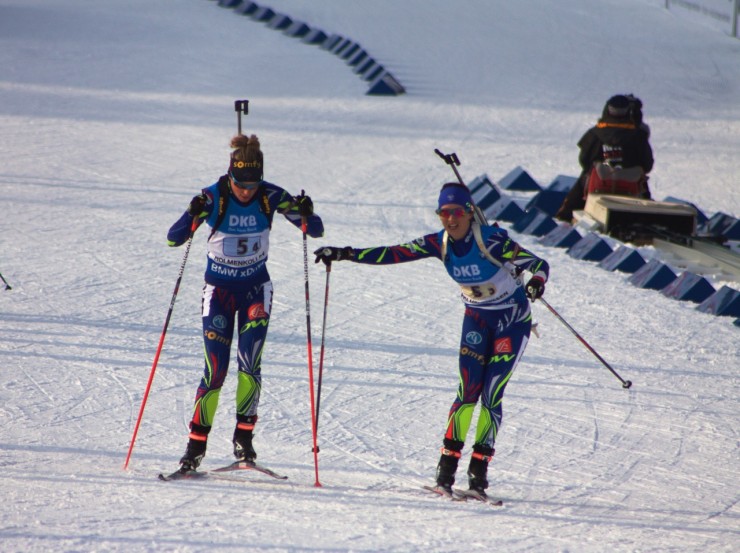
    Megan Bankes as Biathlon Canada’s third woman snuck into the top 60 to qualify for her first World Cup pursuit as the 60th and final starter (actually, 59th, since French athlete Anaïs Chevalier withdrew on race day).

    But that meant the 2017 Junior World champion in the individual discipline had to begin the race 2:11 minutes after Herrmann started hers.

    “I was quite excited because pursuits are always fun races, and to be racing with the 60 best women in the world is pretty neat,” Bankes wrote in an email. “Conditions on the course were pretty fast, the uphills were a little chopped up, but not bad. There was more wind today than any other race day, and I found it hard to read on the range, especially in the far lanes (28, 29, 30), because it swirls due to the wall [of a utility building at the end of the range].”

    After missing three targets already in her first prone shooting bout, she lost more time coming back on the track and was 3:50 behind she started her second loop.

    “I did not read the wind properly or make a big enough correction when I came into my first prone, so that is why I missed 3,” Bankes explained.

    After incurring another penalty in the second prone shooting and one more in the following standing stage, Banks was almost 5:30 minutes back, and the top of the field approached quickly from behind on the short 2.5-kilometer lap.

    On her final lap Herrmann passed Bankes, ending the race for the Canadian.

    “I think the techs may have yelled at me that I might be lapped, but I don’t really remember,” Bankes wrote in her email. “I knew about the rule, and knew the top girls were real fast, so I was aware of the possibility that I could be lapped. I could also see them coming into the range as I was leaving the range [after the third shooting], so I knew I had to ski pretty fast if I wanted to get to the range again before they finished. That did not happen, but I got farther on my 4th lap than I thought I would. Overall, it was a good learning experience, and a reminder that you should hit your prone targets in a pursuit!”

    In Saturday’s sprint, US Biathlon’s Clare Egan, Susan Dunklee and Emily Dreissigacker, along with Canada’s Emma Lunder, missed qualifying in the top 60 for the pursuit.

    The IBU World Cup continues next Friday Dec. 8 in Hochfilzen, Austria, with another sprint for the women and men.

    Results

  • Herrmann Rises to First IBU World Cup Win; Ransom 29th in Östersund

    Herrmann Rises to First IBU World Cup Win; Ransom 29th in Östersund

    Germany’s Denise Herrmann after winning the first IBU World Cup race of her career on Friday in the women’s 7.5 k sprint in Östersund, Sweden. (Photo: IBU/biathlonworld)

    Just over a year and half ago, Germany’s Denise Herrmann took a giant leap and diverged from her career as a World Cup cross-country skier to take up biathlon. She did so at the age of 27, after having been the second-ranked sprinter in the world at the end of 2013/2014 and earning a bronze medal in the women’s relay at the 2014 Olympics. She narrowly missed another Olympic medal, placing fourth in the classic team sprint with Stefanie Böhler. A year later, Herrmann was fourth again in the 2015 World Championships freestyle team sprint with a different teammate, Nicole Fessel.

    After all that, she wanted something different, something new.

    “I owe a lot to cross-country skiing, it was a great time with many highlights, but now I want to face new goals,” Herrmann stated at the time. “The switch to a new discipline will be a big challenge, I am aware of that, but I am confident that I can do it with diligence, courage, and determination!”

    After bouncing between the International Biathlon Union (IBU) Cup and IBU World Cup last season, Herrmann started this season on the big stage at the first World Cup in Östersund, Sweden. And in her 12th World Cup start as a biathlete, she achieved her first individual win.

    “It all begins with dreaming about it,” she told German broadcaster ZDF, according to a translation, when asked if she expected to win at this stage of her career. “But I knew I am currently in a good ski shape and when it works out in the shooting I could probably hang with the top. But to then execute that in competition, in the World Cup and on the big stage here, I was hoping for that, but that I was able to make that a reality makes me all the more happy.”

    The women’s 7.5 k sprint podium on Friday in Östersund, Sweden, with Germany’s Denise Herrmann in first, France’s Justine Braisaz in second, and Ukraine’s Yuliia Dzhima in third. (Photo: IBU/biathlonworld)

    Herrmann, 28, won the women’s 7.5-kilometer sprint on Friday in 19:54.8 minutes after shooting 9-for-10 (0+1). She finished 15.2 seconds ahead of France’s Justine Braisaz in second and was 19.6 seconds clear of Ukraine’s Yuliia Dzhima in third.

    Both Braisaz and Dzhima were among 22 women (out of 103 finishers) that cleaned the two-stage race on a cold, essentially windless evening. Norway’s Synnøve Solemdal, who finished fourth (+24.3) to claim the World Cup Total Score leader’s bib, also cleaned, as did Italy’s Lisa Vittozzi in fifth (+24.5).

    Coming off a win in the IBU Cup sprint last week in Sjusjøen, Norway, Herrmann started 24th and was up to second place by the time she cleared all five targets in the first prone shooting stage. Her lone standing miss, which was just above the target, set her back to fifth place as she embarked on her final loop, but with the fastest last loop and fastest overall course time, Herrmann took the win from Braizaz, an early starter in bib 10. Dzhima started 11th.

    “My goal was to start out with a clean prone stage, and then skiing into the standing stage I thought, ‘Oh, with bib 24 you could also go on lane position 24 on the range today. That might be a good omen,’ ” Herrmann reflected. “Of course you still try to leave no target black, but one was still left standing for me. That can be improved in the days to come.”

    Earlier in the week, Herrmann started her season by placing 23rd in the women’s 15 k individual. Asked during an official training session what her chances were of making Germany’s Olympic team, she said she needed to focus on qualifying for the World Cup team first.

    “One of my former coaches said, ‘Positions four and five are a cause for debate, but not one or two,’ ” she told ZDF on Friday. “So I said to myself, ‘Let’s lock this thing up today.’ That it already would work out like this today, I wasn’t expecting that. It’s incredible. I’m totally happy.”

    Julia Ransom (Biathlon Canada) racing to a career-best ninth in the women’s 15 k individual on Wednesday at the IBU World Cup opener in Östersund, Sweden. (Photo: Biathlon Canada/NordicFocus)

    Of the 22 women that cleaned Friday’s race, Julia Ransom of Biathlon Canada was one of them. Ransom started the week with a career-best ninth place in the 15 k, after shooting 20-for-20, and finished 29th in the sprint, 1.16.9 minutes behind Herrmann. In two races, Ransom is 30-for-30 on the range without a miss.

    “Wednesday’s result was of course motivating, but also hasn’t changed any way I approach racing,” Ransom explained in an email on Friday. “At the end of the day, I race because I love it and it’s fun to compete. That being said, it’s even more fun to find yourself a little higher on the results page. Today I was just hoping to keep relaxed and focused and enjoy the day, whatever result that translated to.”

    Ransom’s overall shooting time ranked 36th, up from 53rd in Wednesday’s 15 k.

    “My shooting times were perhaps a little more ‘normal’ today because there was less consequence for a miss,” she explained. “Getting into the groove of racing also helps relax into my normal pace.

    “Overall I am really happy with my race. It was an incredibly fast field out there today and I am proud of how everything went,” she added. “I can’t wait to start the pursuit. Opportunity awaits!!”

    Three Canadian women finished in the sprint’s top 60 to qualify for Sunday’s 10 k pursuit, with Rosanna Crawford placing 46th (+1:41.6) with a single prone penalty (1+0) and Megan Bankes in 60th (+2:10.9) with one standing miss (0+1).

    For Bankes, 20, 60th marks her career best in her third World Cup start, and Sunday’s race will be her first World Cup pursuit. Last season, she won the 12.5 k individual race at IBU Junior World Championships. At Biathlon Canada’s team trials early last month, Bankes was one of two additional women selected to Canada’s World Cup team for the first trimester of racing.

    “I was super stoked to have solid results at trials and make the world cup team, and then prepare for racing in Europe,” the 20-year-old Bankes wrote in an email. “We’ve been in Oestersund for a week now, and I feel like I’m on European time now. Now I’m working on getting back into the swing of full time racing, which for me has been the main goal of this week.

    “It’s definitely hard to know what to expect coming into the first races of the season, but I’ve been really happy with my skiing and my shooting consistency, so I was just excited to come here and give it my best,” she continued. “I’m pleased with my race today, hitting 9/10 and I felt that I skied much better than the Individual. I just decided I would start hard and hold on, which worked pretty well. On the World Cup everyone is so fast, so perfect shooting is pretty much necessary, and skiing crazy fast yourself! I’m really excited for the pursuit, planning on just skiing fast, hitting targets, and enjoying the experience. If I make up some positions that would be fantastic!”

    While Herrmann will start Sunday’s pursuit first with a 15-second head start on Braisaz in second, Ransom will head out 1:17 minutes back in 29th, Crawford 1:42 back in 46th, and Bankes 2:11 back in 60th.

    Canada’s fourth woman in the sprint, Emma Lunder finished 93rd (+3:07.5) with three penalties (1+2). US Biathlon started three on Friday, with Clare Egan placing 75th (+2:32.2) with three misses (1+2), Susan Dunklee 79th with five penalties (2+3), and Emily Dreissigacker 89th (+3:01.2) with two misses (0+2).

    Earlier this week, US Biathlon announced in a press release that its fourth woman, Kelsey Dickinson, would be returning to the U.S. to compete at the IBU Cup Team Trials at Mt. Itasca in Minnesota from Dec.15-19. Because she did not meet the IBU’s World Cup Qualification Point requirement at the first IBU Cup in Sjusjøen, she will need to qualify for US Biathlon’s IBU Cup team.

    The men’s 10 k sprint starts Saturday at 8:45 a.m. EST.

    Results | Women’s pursuit start list

  • A New Season for Biathlon Canada: Ransom Rockets to Career-Best Ninth

    A New Season for Biathlon Canada: Ransom Rockets to Career-Best Ninth

    Julia Ransom (Biathlon Canada) racing to ninth in the women’s 15 k individual on Wednesday at the IBU World Cup opener in Östersund, Sweden. In her first World Cup race of the season, it was Ransom’s career-best result and Biathlon Canada’s best individual result since 2015/2016. (Photo: Biathlon Canada/NordicFocus)

    Entering this season, members of Biathlon Canada had everything to gain and not a whole lot to lose. They had already had their funding reduced to zero by Own The Podium, save for a $50,000-dollar provision that paid for a coach, and its athletes were left to determine their offseason plan: stay home to train or self-fund training camps elsewhere. Many chose to spend most of their summer at the team’s base in Canmore, Alberta, and most started the season on the fly — without any preseason tuneup races in Europe — this week in Östersund, Sweden.

    Julia Ransom was one of those athletes. After prequalifying for Canada’s International Biathlon Union (IBU) World Cup Team for the first trimester of racing, Ransom, 24, jumped into the 2017/2018 season with the Östersund mixed relay this past Sunday — three days after flying over from Canada.
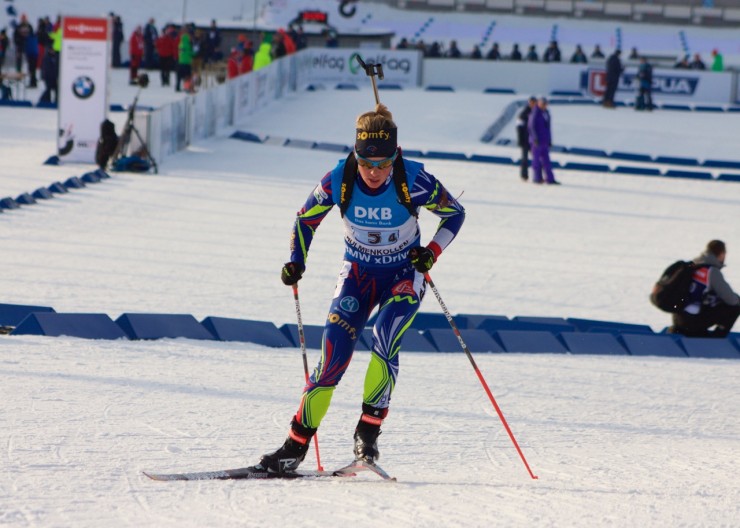
    There, she raced the second leg of the relay and tagged off in 15th, down two spots from where her teammate Emma Lunder tagged her in 13th. The team ultimately finished 15th, with teammates Scott Gow and Brendan Green.

    “Today was a tough day for me. My legs were lead on the course,” Ransom wrote in a post-race email to FasterSkier on Sunday.

    Three days later on Wednesday, it was another ballgame. With little to lose in the women’s 15-kilometer individual in Östersund, Ransom raced to a career-best ninth, which stood as her team’s best non-relay result in two seasons.

    In the first individual race of the season, Ransom is well on her way to securing a spot on Biathlon Canada’s 2018 Olympic team, meeting half of the team’s “Priority 2” Olympic criteria standards. She needs another top 16 to fulfill that second-tier criteria. Priority 1 is one top-eight result in a World Cup (or World Championships, in a championships year like last season) or a top-three in a World Cup relay.

    So far, she is the only one on her team who has cracked the top 16 in two seasons. Last winter, her best result (and her previous personal best) was 18th at 2017 World Championships in the 15 k individual. Canada’s best non-relay result in 2016/2017 was Scott Gow’s 17th place in a 20 k individual World Cup race.

    And again, it’s the first race of the season.

    “I am still in shock with how well today went,” Ransom, a Penticton, British Columbia, native in her fourth World Cup season, wrote in an email to FasterSkier on Wednesday.

    “It is such a relief to start racing again,” she continued. “I wasn’t too nervous today; I had a race plan that I had confidence in and I was excited to give it a go. I also was looking for redemption after my painful relay leg on Sunday.”

    Conditions were chilly, at -12 degrees Celsius (10 degrees Fahrenheit), but calm, accounting for clean shooting for seven out of the top-nine finishers. Ransom was one of them.

    She started 20th (out of 102) and cleaned all four stages in the longest-format women’s race on the circuit. In individual races, shooting is weighed heavily; a minute is added to a competitor’s final time for each missed shot. Fortunately for Ransom, she hit all 20 targets.

    “I was getting some pretty exciting splits during the whole race (top 5, second place, catching the leader etc) so I had an idea this was going to be a good day as long as I kept my shooting together,” she reflected. “I took a sigh of relief after the 20th target went down and just tried to ski as well as I could to the finish. I did take look at the big screen as I left the range, just to make sure I was hearing the techs right!”

    Ransom initially crossed the finish line in third, 28.8 seconds behind Sweden’s Mona Brorsson in first and 9.8 seconds behind Eva Puskarčíková of the Czech Republic in second. Both Brorsson and Puskarčíková also shot clean.

    The 55th starter, Nadezhda Skardino of Belarus, ultimately posted the best shooting and skiing performance of the day, racing to her first World Cup win (and first podium in three years) in 42:57.4 minutes with 20-for-20 shooting. Norway’s Synnøve Solemdal started 75th and shot clean but came up 2.9 seconds short at the finish to place second, bumping Ukraine’s Yuliia Dzhima to third (+12.0). The top-four women all cleaned with another Ukrainian, Valj Semerenko, placing fourth (+30.1).

    Slovakia’s Paulina Fialková finished fifth (+32.2) with a single penalty (0+0+0+1), while Brorsson ultimately placed sixth (+49.6) and Puskarčíková seventh (+1:08.6).

    Ransom ended up ninth for her best World Cup level performance by nine places, ahead of Norway’s Marte Olsbu in 10th and about eight seconds behind France’s Justine Braisaz in eighth.

    “Starting off the season with a top ten has validated the hard work our team has put in and also given me a lot of confidence going forward. It’s a great building block to say the least,” Ransom wrote.

    Asked what she thought made the difference with her training this year, she explained that she’d honed in on increasing her shooting speed.

    “It’s still a work in progress but I am happy where I am so far,” she wrote. “I also did a ton of extra strength work and core stability and it has proven to make a big difference on the skis.”

    On Wednesday, Ransom’s overall shooting and range times ranked in the middle of the pack, around 50th, while her overall course time was slightly faster in 42nd.

    Biathlon Canada Head Coach Matthias Ahrens praised Ransom’s ability to perform under pressure.

    “Especially as the tension mounted, with each clean bout, Julia was closer the podium and she managed the pressure very well,” he said, according to a team press release. “She didn’t get too excited or too nervous, executing clean shooting each time.”

    Four Canadians started Wednesday’s 15 k, with Rosanna Crawford finishing 39th (+3:32.6) with three penalties (0+0+1+2), following her crash in Sunday’s single mixed relay.

    “Rosanna, considering the crash of Sunday, had a really nice race,” Ahrens said in the press release. “It wasn’t certain if she’d race today, and we went in with a strategy not to risk any further injury. She managed a very good race, with a quite good ski time. Her rifle also required repairs from Sunday’s race. Overall, not knowing how she would hold up, particularly on one of the hardest Individual courses on the circuit, it was a nice result for her, in the World Cup points.”

    Megan Bankes finished 75th (+6:28.9) with three misses (2+1+0+0) and Lunder was 83rd (+7:06.3) with five penalties (0+0+2+3).

    US Biathlon started three women, with Susan Dunklee leading the team in 53rd (+4:12.7) with four penalties (1+0+1+2). Clare Egan finished 79th (+6:52.5) with five misses (0+2+1+2) and Emily Dreissigacker was 81st (+7:03.5) with three misses (0+0+1+2).

    The men start their season with a 20 k individual on Thursday at 11:15 a.m. Eastern Standard Time.

    Results

  • Olsbu and Bjøntegaard Win In Sjusjøen; for Canadian Biathlon Trio, Mission Acomplished

    Olsbu and Bjøntegaard Win In Sjusjøen; for Canadian Biathlon Trio, Mission Acomplished

    Marte Olsbu of Norway leads the women’s 12.5 k mass start out of the stadium in Sjujøen, Norway. (Photo: Vegard Breie/sesongstartskiskyting.no)

    After a disappointing day of sprints in Sjusjøen, Norway, on Saturday, the Norwegian biathlon team rebounded in Sunday’s mass starts to claim wins from Marte Olsbu in the women’s race and Erlend Bjøntegaard in the men’s race.

    In the women’s 12.5 k mass start, Olsbu had just one penalty, in the first prone stage, and came back through the field to ski to a 25-second win over Anais Bescond of France, who had two penalties. Synnøve Solemdal of Norway was third (+31.6) and Fuyuko Tachizaki of Japan fourth (+48.7), both shooting clean.

    “It was very fun,” Olsbu told Norwegian broadcaster NRK, according to a translation. “I did what I had planned, and it means a lot that I can stand on the podium with another Norwegian.”

    The men’s field was so large that it was split into two mass start races, an “A” and a “B” competition, each of which had more than the 30 standard entrants for a mass start competition.

    Martin Fourcade of France was near the front for almost the entire race, on form after having won Saturday’s sprint, but missed the last shot of the competition. He was unable to make it back into first place by the end of the 15 k race.

    Erlend Bjøntegaard heading for the win in Sunday’s 15 k mass start in Sjusjøen, Norway. (Photo: Vegard Breie/sesongstartskiskyting.no)

    Instead, it was Norway’s Bjøntegaard taking the win. Bjøntegaard had missed just one shot, in the second shooting bout. He skated to an 11.8-second victory over teammate Johannes Thingnes Bø, who missed three shots over the course of the race. Fourcade was third, +16.1.

    Despite his win, Bjøntegaard is not headed to the World Cup opener in Östersund, Sweden, next week. Norway’s team had already been decided, and Lars Helge Birkeland and Henrik L’Abee-Lund, who did not have stellar results this weekend, will go instead. They told NRK that they had not focused on these Sjusjøen races because the priority was instead performance at the World Cup.

    “That’s how it is,” Bjøntegaard told NRK. “I don’t bother to spend time on it. I can promise that my possibilities will come.”

    Based on his 29th-place finish in Saturday’s sprint, Scott Gow of Canada made the “A” mass start. He picked up six penalties, including three in the third stage, and skied to 37th place (+4:12.3).

    “I shot poorly today due to me being too much inside my own head,” he wrote in an email. “My first prone was an oversight on the wind conditions, and my first standing was me totally rushing. Lesson learned, I hope… I would say I still have some speed in the tank. Shooting, aside from today, has been very good lately, so I’m happy with that. Skiing has been solid too, but I could feel the travel a bit this weekend, so hopefully that’s all gone by next weekend.”

    Gow and his brother, Christian, went to Sjusjøen along with fellow Biathlon Canada National Team member Brendan Green. It was not an official team trip, but the trio felt the need to get some extra acclimation to the European time zone and another set of races under their belts before the World Cup begins.

    “Christian, Brendan and I had been talking about wanting the team to go to Sjusjøen for a while, but that was never going to happen with our [national team] budget woes, so we took it upon ourselves to make the trip happen,” Scott Gow wrote. “We believe the early acclimation and high-end racing is great preparation for Östersund, where the three of us always feel like we start flat and struggle to achieve good results. Our goal is to adjust to Europe and have our bodies is the best shape possible. I would say we’ve accomplished our goals. We adjusted well to the jet lag, and we all had at least one decent race.”

    After the sprint, Christian Gow and Green were slotted into the “B” mass start. They made the most of the opportunity, with Green missing two shots but taking the win, and Gow missing one shot and finishing 8.8 seconds behind in second place.

    (Story continues below)

    https://www.instagram.com/p/Bbrm3nMjFTf/?taken-by=christ_gow

    Things didn’t go particularly smoothly for either Canadian. Both of Green’s missed shots came in the first shooting bout, but he faced challenges even while cleaning the other bouts.

    “In addition to the two misses, I had some problems in the range during each prone shooting which caused me to lose some more time,” Green wrote in an email. “I spent the entire rest of the race working my way back to the lead group. I think I came in for my final shooting bout in seventh, left the range in third, and was able to ski to the lead from there. Christian lost time early on with a broken pole right at the start of the race, so we both had our work cut out today.”

    While the goal had been to make the “A” mass start, Green pointed out that there was value in racing in a competition where he was fighting for the win, even if few of his regular World Cup competitors were in this race.

    “Today was still good preparation for the World Cup next week, and a nice way to finish the weekend of racing here,” he explained. “ t’s good sometimes to have a little more control during a race, and there is still the pressure when you’re at the front to perform which is always good practice.”

    While Green said his speed was not yet at 100%, the group was excited to be back competing after a long summer and fall of training.

    “I love this time of year because it means we’re racing!!!” Scott Gow wrote.

    Results: men “A” – men “B” – women

  • After Leading, Canadian Women Slip to 15th; Norway Golden in World Champs Relay

    After Leading, Canadian Women Slip to 15th; Norway Golden in World Champs Relay

    Rosanna Crawford leading the women's 4 x 6 k relay at 2016 IBU World Championships on Friday in  Oslo, Norway. (Photo: JoJo Baldus)
    Canada’s Rosanna Crawford (11) leading the women’s 4 x 6 k relay at 2016 IBU World Championships on Friday in Oslo, Norway. Crawford skied the second leg and the Canadians went on to place 15th. (Photo: JoJo Baldus)

    OSLO, Norway — At the halfway point of Friday’s World Championships women’s 4 x 6-kilometer relay, one woman was feeling better than she had all week.

    It was Rosanna Crawford of Canada, and she attacked her way to the lead of the race.

    “It felt so good out there today,” she said after tagging off. “Just like, I could attack, and I didn’t die on the last loop. It was pretty exciting to pass the leader and be in the lead. I haven’t done that in a long time. So, it was a lot of fun.”

    Canada eventually ended up 15th, ceding the lead to France and then Norway, which ultimately took home a much-desired gold on home turf. The Canadians finished 4:48.6 back.

    Julia Ransom had led off for the team, and used one spare in each shooting stage. In her first full season on the World Cup, Ransom is getting used to the leadoff position and was satisfied to tag off in 13th place – not where the team wanted to finish place-wise, but time-wise close enough to the leaders with just 37.6 seconds separating them from first place.

    Julia Ransom (r) skied the first leg for the Canadian women in the 4 x 6 k relay at 2016 IBU World Championships in Oslo, Norway. The team went on to place 15th. (Photo: JoJo Baldus)
    Canada’s Julia Ransom (r), skiing with Romania’s Eva Tofalvi, during the first leg of the 4 x 6 k relay at 2016 IBU World Championships in Oslo, Norway. Ransom tagged off in 13th and Canada went on to place 15th. (Photo: JoJo Baldus)

    “Of course I would have loved to have cleaned a bout,” Ransom said. “But it was what it was. My legs are ready to have a bit of a break.”

    But she had done her job, as teammate Crawford would later say.

    “Julia did a great job, just 1+1 is good and taking off within 30 seconds is super-awesome,” Crawford said. “So she did her part. Everyone just has to do their part… with [relays and] mixed relays we [Julia and I] know how to do the first and second legs. I am confident and I trust Julia to lead us off with a good start.”

    As several women remarked, the start was particularly physical for a race in the women’s field. There were multiple crashes and broken poles, and Ransom had to hold her ground.

    “It was fun to be in the mix,” she said. “I love starting because it’s so different, and today especially was incredibly aggressive. A lot of elbows out there and stomping on poles. The girls had their talons out — I’ve started every relay this year, and every day there’s something new. There was one day that I broke a pole right off the start, another day that I crashed. I’m taking a little something from each race.”

    The physicality seemed to die down a bit on leg two, or at least return to normal levels. Crawford cleaned prone with no spare rounds to move up to ninth and inch seconds closer to the leaders, and then used just one spare round in standing and left the range in sixth.

    From there, Crawford went into attack mode.

    “On the top of the hill [behind the stadium] I caught back up to the lead group, and then I just decided that I felt good and you get a big rest after that, and I hammered a little bit to pass them,” Crawford said. “Catch up to third, and then down the hill my skis were running really well so I passed Germany and just tried to hold onto the front until I tagged off to Sarah [Beaudry].”

    Canada's Sarah Beaudry skiing the third leg of the women's 4 x 6 k relay at 2016 IBU World Championships. After being tagged in first, she came through the final exchange in ninth. (Photo: JoJo Baldus)
    Canada’s Sarah Beaudry skiing the third leg of the women’s 4 x 6 k relay at 2016 IBU World Championships. After being tagged in first, she came through the final exchange in ninth. (Photo: JoJo Baldus)

    For Beaudry, in her first-ever senior World Championships and about a week away from her 22nd birthday, receiving the tag in first place was something of a surprise.

    She also used another “s” word to describe it.

    “I don’t want to say scary, but wow, I wasn’t expecting this,” Beaudry said after finishing her leg of the relay. “The whole [first] loop, I was like‚ ‘Are they coming?’ I was skiing scared that someone might overtake me. I was happy I stayed in the front, and not just get completely annihilated in the first lap. It was too bad, because I came out after my prone not with anybody. I was trying to catch the two girls ahead of me.”

    Beaudry used two spares in prone, leaving the range in eighth, and then cleaned standing to move up to sixth. Her last loop was not without adversity.

    “I wasn’t feeling great on the skis,” she said. “Last lap it was really hard. And then the Italian girl [Alexia Runggaldier] passed me and then I crashed. That hurt quite a bit — I couldn’t get up and couldn’t keep skiing and was like ‘OW!’ But then I just got it in. Too bad going out with a lead, not that big but going out first, and then coming in in ninth.”

    Still, Beaudry didn’t feel as if skiing her first loop all alone out in front on the course had changed her pace or made her ski too fast. She was able to enjoy a bit of the atmosphere, even if it was stressful, and the adrenaline didn’t wreck her race.

    “It is typical for me to go out too quickly,” she laughed. “So that being said, I feel like I would have gone out at a similar pace anyway. Maybe I shouldn’t have gone this fast, but I mean, I probably shouldn’t have gone out this fast on any of my first laps this year. I wouldn’t say I did it differently because I was in the lead.”

    Despite Beaudry’s last-lap woes, Canada was still in ninth place and just under a minute and a half from the lead.

    After Zina Kocher took over and used all six spare rounds as well as skiing three penalty loops, they had dropped to 15th and finished 4:48.6 behind.

    Norway Wins at Home

    Norway's Tiril Eckhoff racing from ninth to first in the third leg of the women's 4 x 6 k relay at 2016 IBU World Championships in Oslo, Norway. (Photo: JoJo Baldus)
    Norway’s Tiril Eckhoff racing from ninth to first in the third leg of the women’s 4 x 6 k relay at 2016 IBU World Championships in Oslo, Norway. (Photo: JoJo Baldus)

    While Canada was slipping through the standings, Norway was rising, much to the delight of the Holmenkollen crowd. First and second skiers Synnøve Solemdal and Fanny Horn Birkeland had kept the team in contention, tagging off 13.4 and 12.4 seconds from the leaders, respectively.

    It was Tiril Eckhoff, the gold medalist from the sprint, who skied third for Norway and brought the team to the front.

    Eckhoff was ferocious, shooting perfectly and skiing the fastest time of all the third-leg skiers by 22 seconds over just six kilometers. She tagged off to Marte Olsbu with a 23.2-second lead.

    And like Beaudry before her, Olsbu was facing a pressure that she perhaps did not expect. Norway had finished no better than fifth in any women’s relay this season, and after dropping the race at the Presque Isle World Cup started today’s competition with bib 12.

    With a career-best week so far – in her second World Championships ever, she finished eleventh in the sprint and turned in a strong leg in the mixed relay – Olsbu was new to the anchor position, but the choice proved genius.
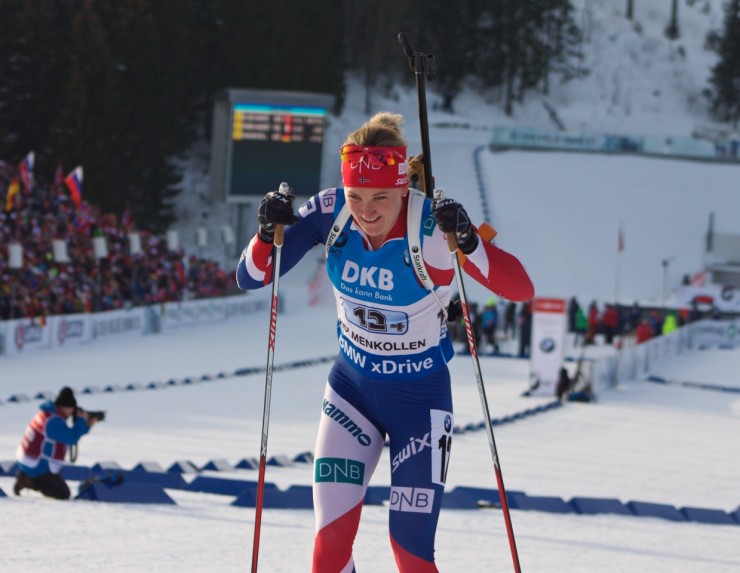
    Norway's anchor Marte Olsbu racing to the win  in the IBU World Championships 4 x 6 k relay at home in Oslo, Norway, holding off France's Marie Dorin Habert (behind) by 5.3 seconds. (Photo: JoJo Baldus)
    Norway’s anchor Marte Olsbu racing to the win in the IBU World Championships 4 x 6 k relay at home in Oslo, Norway, holding off France’s Marie Dorin Habert (behind) by 5.3 seconds. (Photo: JoJo Baldus)

    She used two spares in each stage, and was helped by errors from some of her competitors as well, allowing her to stay in the lead. Olsbu was able to hold on during the last loop despite a hard chase from Marie Dorin Habert of France, who had won gold in the 15 k individual just two days before and is widely acknowledged to be one of the most fearsome skiers on the circuit.

    When asked by the IBU’s Jerry Kokesh if they were ever worried that they would not win gold, Olsbu raised her eyes wide and said, “I was!”

    “I just went as fast as I could on the last loop, and I was so happy when I crossed the finish line in first,” Olsbu, who ended up with just a 5.3 second margin ahead of Dorin Habert, said in the press conference.

    Of all the gold medals at World Championships, this was one that Norway did not expect to win. The women were ecstatic that they could pull it off.

    “Last time we were big favorites,” Solemdal said of her role in the team’s 2013 World Championships gold medal with Tora Berger and Ann Kristin Flatland. “And this time we were not good at all. So I feel like it’s, we have worked so hard the whole team, for such a long time to be good in the relay. For me it’s the greatest feeling to take home the gold at home in Oslo.”

    — Harald Zimmer contributed reporting.

    Results

  • Bailey Catches Green, Anchors U.S. to Best-Ever Fourth in Mixed Relay; Canada Ties Best in 6th

    Bailey Catches Green, Anchors U.S. to Best-Ever Fourth in Mixed Relay; Canada Ties Best in 6th

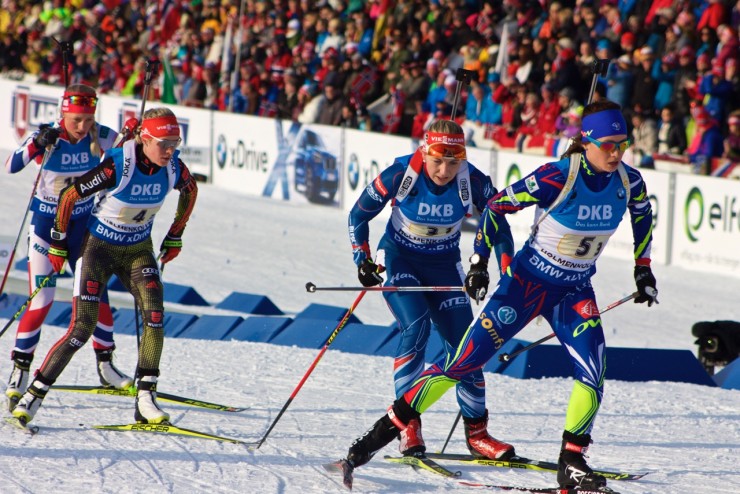
    Norway's Håvard Bogetveit leads American Lowell Bailey into the finish in a race for third in Sunday's mixed relay at the IBU World Cup in Canmore, Alberta. The U.S. placed fourth for a team best in the event's 11-year history. (Photo: Daniel S. Guay)
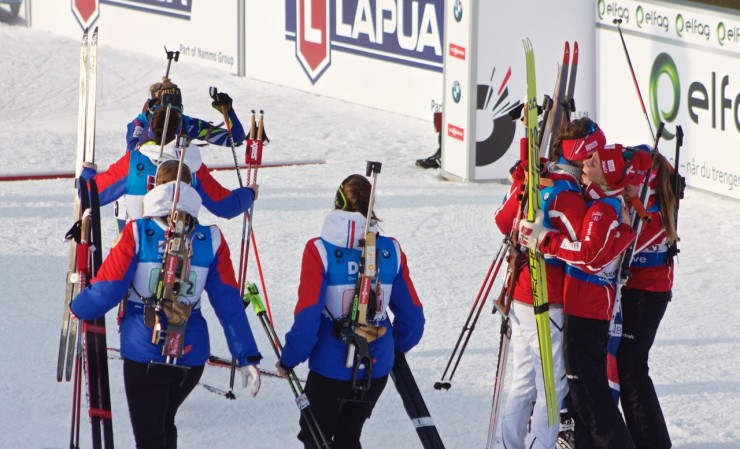
    Norway’s Håvard Bogetveit leads American Lowell Bailey into the finish in a race for third in Sunday’s mixed relay at the IBU World Cup in Canmore, Alberta. The U.S. placed fourth for a team best in the event’s 11-year history. (Photo: Daniel S. Guay)

    Considering anything better than sixth would have been a first-ever for either the U.S. or Canada in the IBU World Cup four-person (2 x 6 + 2 x 7.5-kilometer) mixed relay, that put Lowell Bailey in a bit of a position heading into the final loop of the last relay leg on Sunday.
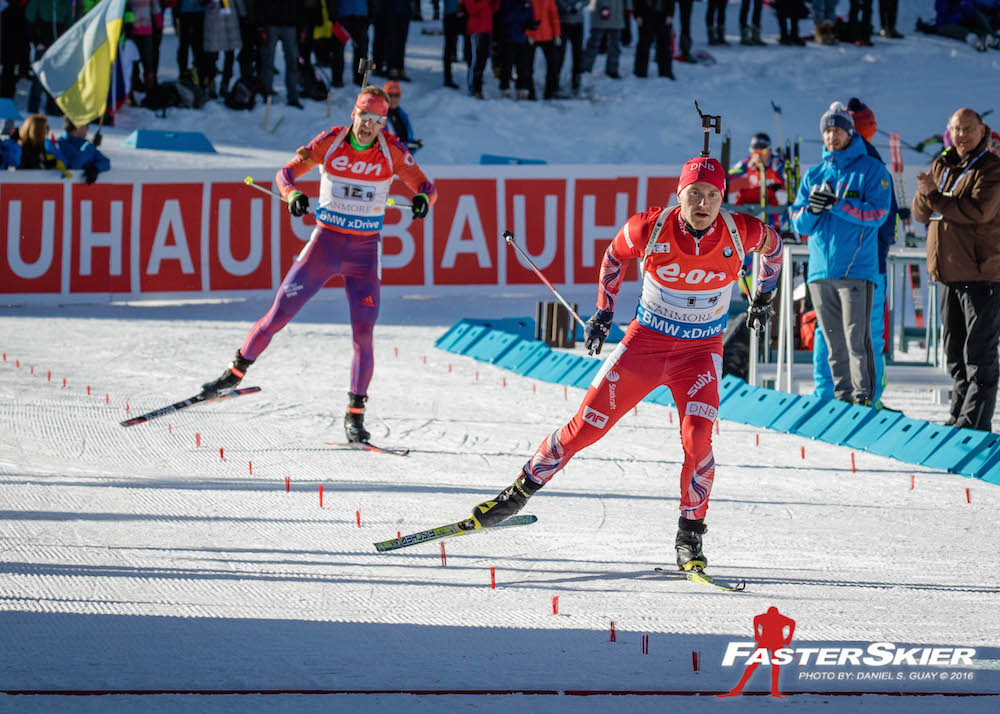
    Here he was, in fifth with 2.5 k to go, and just three seconds ahead of France’s Quentin Fillon Maillet in sixth and 4.6 seconds behind Canada’s Brendan Green in fourth. In front of both the Canadian and American teams, Norway set out on the final loop in Canmore, Alberta, 16 seconds ahead.

    What or whom do you focus on? Should Bailey go for fourth? Should Green try to catch the Norwegian and the final spot on the podium? Or is it best to hold your own and not risk too much?

    According to Bailey, a lot was going through his head after emerging from the final standing with clean shooting, thanks to two spares, shortly behind Green, who cleaned both stages without any spare rounds.

    Tim Burke (l) after tagging teammate Lowell Bailey in fourth, about 36 seconds behind Norway in third, during the mixed relay at the IBU World Cup in Canmore, Alberta. (Photo: Daniel S. Guay)
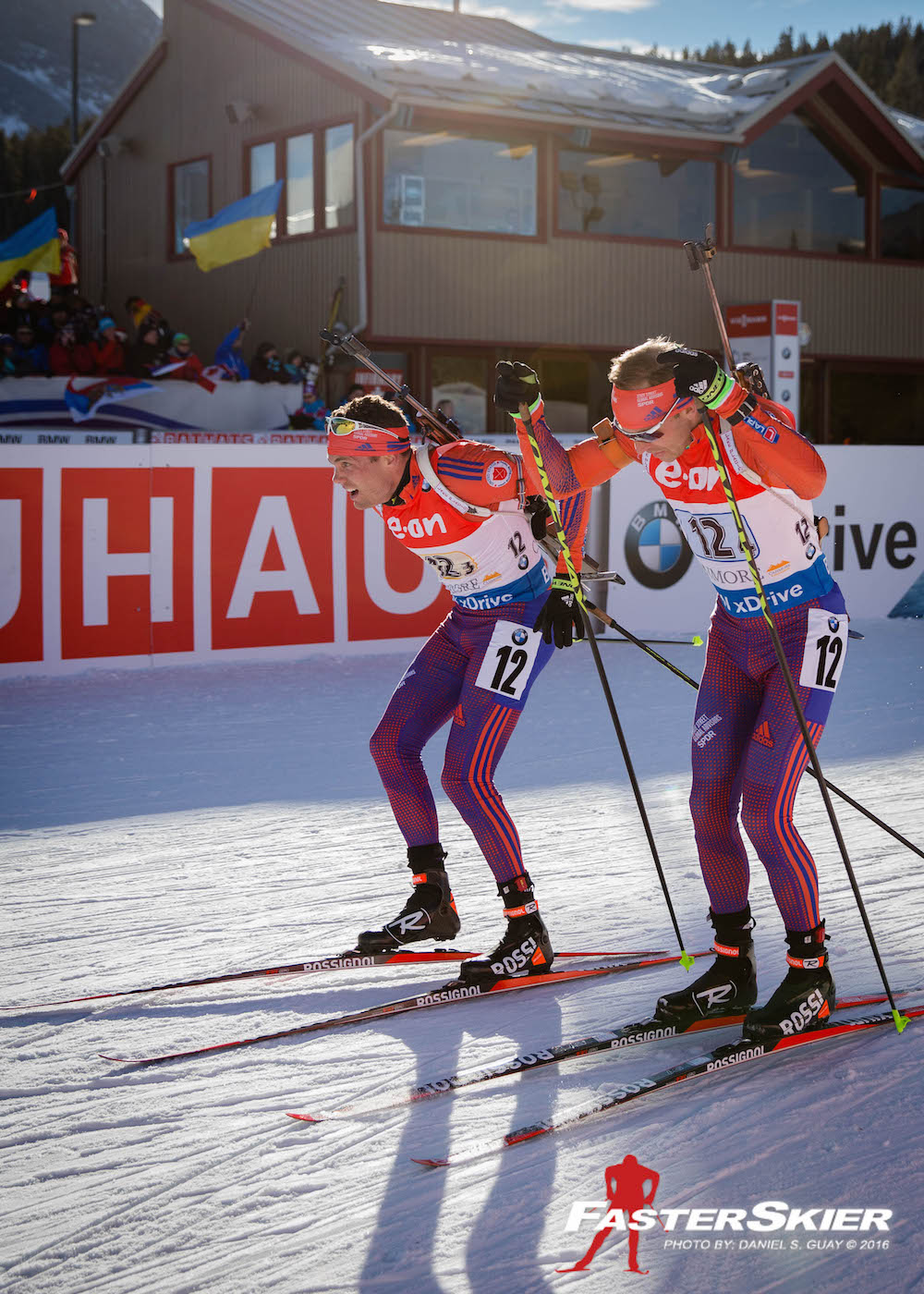
    Tim Burke (l) after tagging U.S. teammate Lowell Bailey in fourth, about 36 seconds behind Norway in third, during the last exchange of the mixed relay at the IBU World Cup in Canmore, Alberta. (Photo: Daniel S. Guay)
    “To be honest, I know [Fillon Maillet] and I know how good of a skier he is, he’s top 10 in the overall [World Cup],” Bailey said in a phone interview after the race. “So the thoughts going through my head on the last lap was, ‘OK, I’ve got to stay focused here,’ …  My goal was to ski the first half of the loop well enough that France wasn’t going to get into my draft.”
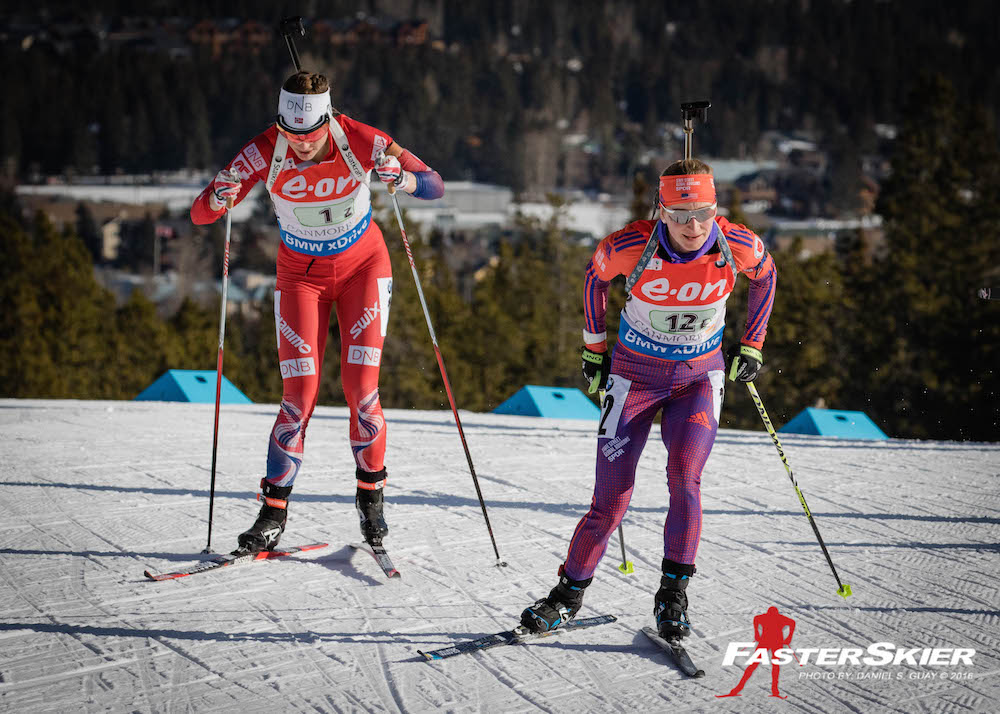
    The second half of the course was uphill and into the wind, and tactically, a skier able to catch a draft off someone in front of them on that part could be fresher for the last 700 meters to the finish.

    In his effort to drop Fillon Maillet and make sure he wasn’t on the losing end of that strategy, Bailey inadvertently caught Green on the second-to-last major climb before the finish.

    “It just so happened that I felt pretty good so I just went for it,” Bailey recalled.

    After passing Green in fourth, he looked up and saw Norway’s Håvard Bogetveit, a 23-year-old Norwegian B-team member, in third.

    “I didn’t see Norway until about halfway up that climb,” Bailey said. “I’m not sure if the Norwegian, if he was tired or what, but it didn’t become clear that there was a chance at third until that last uphill. Our team and ski technicians and coaches and staff were cheering me on and hoping that I could catch that gap.”

    Meanwhile, Green, who had been tagged in seventh and climbed into fourth with perfect shooting, started to come undone.

    “I really tried to race more aggressive. I had to. After the sprint on Thursday and knowing that my form wasn’t where it needed to be, I knew I couldn’t afford to hold back at all this race,” Green wrote in an email, referring to Canmore’s opening sprint last Thursday, where he placed 40th with one miss. “As for the shooting today I think I was just feeling confident. Canmore is often a very difficult range to shoot on, but I felt that [Saturday] I was really able to get a grasp of the wind while training, and was able to bring that confidence and shooting form into today.

    “When I left [the range] in 4th I knew I was going to have my work cut out, especially given the pace of my second loop with France,” Green recalled. “That said, I gave it my all. I started to blow up and just couldn’t maintain the pace, but I think with a bit better form I could have hung on.”

    Racing up and over the final climbs and into the finish, Bailey pushed to catch Bogetveit. He came within 1.7 seconds at the finish, but Norway secured the final spot on the podium, 1:23.8 minutes behind the German winners, and the U.S. claimed the so-called wooden medal in fourth. Regardless, it was the best showing for a U.S. mixed relay since its inception, officially at 2005 World Championships.
    US Biathlon’s previous best mixed relay was sixth place four years ago at the World Cup in Kontiolahti, Finland, with Jay Hakkinen, Sara Studebaker, Annelies Cook, and Tim Burke. This time around, Susan Dunklee, Hannah Dreissigacker, Burke, and Bailey teamed up for fourth, 1:25.5 behind Germany. (Earlier in the day, Annelies Cook and Leif Nordgren raced the single mixed relay, placing 16th.)

    “It didn’t become clear that there was a chance at third until that last uphill. Our team and ski technicians and coaches and staff were cheering me on and hoping that I could catch that gap.” — Lowell Bailey, who anchored the U.S. mixed relay to a team-best fourth on Sunday
    “It’s easy to say, ‘Oh man, if I had known, I would’ve skied two seconds faster,’ but I really don’t think I could’ve,” Bailey said of finishing less than two seconds out of third. “I put everything I could have into that last lap. It’s bittersweet, but it’s also our best result ever in the mixed relay. …  Fourth is where we ended up, and I think we have to be satisfied with that and keep that momentum going forward.”

    Behind him, Green anchored Canada to sixth, 3.6 seconds behind Fillon Maillet, who notched fifth for France (+1:30.7). The result tied the Canadians’ best in a mixed relay after placing sixth in 2011 in Hochfilzen, Austria. Like the U.S., that team only included one of the same athletes from Sunday’s relay — Green — who had teamed up with Megan Imrie, Zina Kocher and JP Le Guellec in 2011. (Julia Ransom and Nathan Smith raced Sunday’s single mixed relay, placing 12th.)
    “We’ll get to the podium eventually — it will just be a matter of small consistent steps, nothing drastic,” Green wrote. “The team was awesome today.  Everyone did a really great job and set the race up well for the next person.  I couldn’t have asked for more from them today.”

    Germany in It to Win It

    Germany topped the podium with a 1:12.9-minute win in the mixed relay on Sunday at the IBU World Cup in Canmore, Alberta, with (from left to right) Franziska Hildebrand, Franziska Preuss, Arnd Pfeiffer, and Simon Schempp. (Photo: Daniel S. Guay)
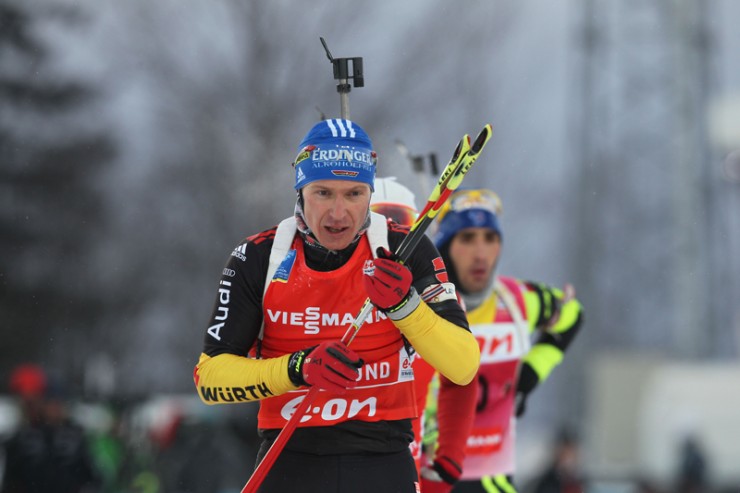
    Germany topped the podium with a 1:12.9-minute win in the mixed relay on Sunday at the IBU World Cup in Canmore, Alberta, with (from left to right) Franziska Hildebrand, Franziska Preuss, Arnd Pfeiffer, and Simon Schempp. (Photo: Daniel S. Guay)
    In the race for first, Germany established itself as a frontrunner early when Franziska Hildebrand tagged Franziska Preuss in third, just 1.4 seconds out of the lead. Switzerland’s Selina Gasparin had moved to the front of the first leg after cleaning her standing stage and leaving the range five seconds ahead of Italy’s Dorothea Wierer in second.

    Wierer had previously been the first out of prone, 3.4 seconds ahead of Dunklee in second. Both women cleaned prone without needing any of three possible spares. Dunklee left the range two seconds ahead of Kazakhstan’s Alina Raikova in third, and almost immediately, the American caught Wierer. The two remained together off the front of the pack for the next loop, skiing 4.2 seconds ahead of Gasparin in third while Raikova dropped 13 seconds back to sixth before the second shooting.

    There, Wierer needed two spares to clean and Dunklee used all three, but both avoided the penalty loop to leave the range in second and sixth, respectively. Wierer followed Gasparin into the final loop before the exchange, 5.1 seconds back, while Germany’s Hildebrand cleaned with no spares to move into third, 7 seconds out of first.

    “I didn’t expect anything special today,” Dunklee wrote in an email, a day after placing 30th in the mass start with 10 penalties. “To be honest, I’ve been struggling this week to find my normal race hunger and my physical shape has felt flat.

    Italy's Dorothea Wierer (l) leads Susan Dunklee of the U.S. in first and second on the second loop of their first leg of the IBU World Cup mixed relay in Canmore, Alberta. Italy went on to place second and the U.S. notched a best-ever fourth. (Photo: Daniel S. Guay)
    Italy’s Dorothea Wierer (l) leads Susan Dunklee of the U.S. in first and second on the second loop of their first leg of the IBU World Cup mixed relay in Canmore, Alberta. Italy went on to place second and the U.S. notched a best-ever fourth. (Photo: Daniel S. Guay)

    “[On Saturday] I dirtied a stage,” she said of missing every target — the opposite of “cleaning.” “Probably my first time doing so on the World Cup. Today I felt like a completely different animal. It was a good reminder that things can turn around suddenly.”

    After leaving the range in sixth, 22.5 seconds behind Gasparin in first, Dunklee made up one place on the next loop to tag Dreissigacker in fifth, 16 seconds back, at the first exchange.

    Meanwhile, Crawford used one spare on each stage to climb from ninth after the first shooting to fourth after the second stage. She left the range just ahead of Dunklee, 21.1 seconds out of first with one loop to go, and came through the exchange just 0.3 seconds behind Dunklee to tag Beaudry in sixth.

    Also on that loop, Sweden’s Emma Nilsson slipped from fifth to eighth, and Norway’s Marte Olsbu improved from seventh to fourth.

    “Susan passed me like I standing still, it was very impressive, but then she slowed down again and I tried to hang onto Norway once they passed me,” Crawford explained in an email. “It was a tough fight on that last loop, my legs and lungs were screaming, but I knew that in about 3min I could collapse in the snow.”

    On the first shooting of the second leg, Preuss cleaned prone quickly to move into first, 5 seconds ahead of Switzerland’s Aita Gasparin, who also cleaned without any spares.

    Dreissigacker leapt into third for the U.S. with flawless prone shooting as well, 17 seconds behind Preuss. She needed one spare to clean standing but remained in contention in fourth, just 0.2 seconds behind Sweden’s Mona Brorsson in third and 31.6 seconds behind Preuss up front with one loop to go.

    “I’m happy with my whole race,” Dreissigacker wrote in an email. “One spare in standing is good for me.  And I got some good rides, skiing behind [Norway’s Synnøve] Solemdal and then battling with Mona Brorsson on the last loop.  Skiing with people really helps me ski more efficiently.”

    Hannah Dreissigacker (r) skied the second leg for the U.S. mixed relay on Sunday and brought the team to fourth by the second exchange. Norway's Synnøve Solemdal (l) tagged in second, 23 seconds behind Germany (not shown) in first. (Photo: Daniel S. Guay)
    Hannah Dreissigacker (r) skied the second leg for the U.S. mixed relay on Sunday and brought the team to fourth by the second exchange. Norway’s Synnøve Solemdal (l) tagged in second, 23 seconds behind Germany (not shown) in first. (Photo: Daniel S. Guay)

    She held her position to the exchange, tagging Burke in fourth, 1.5 seconds out of third and 36 seconds from the lead.

    “I think that confidence was the biggest key to my shooting today.  I just told myself, ‘I can do this. Just do what I always do. It doesn’t have to be perfect, just normal,’ ” Dreissigacker explained.

    After starting her season on the World Cup, Dreissigacker, a 29-year-old U.S. A-team member, was put on the IBU Cup squad in January. At the last IBU Cup in Arber, Germany, she placed 10th in the sprint and 16th in the pursuit to earn World Cup starts in Canmore. In the Canmore on Friday, she finished 28th in the sprint for one of her top-six career results.

    “You have to really respect the trajectory that Hannah’s taken over the season,” Bailey, 34, said. “I’ve been there, I know what it’s like to start off a season with high expectations and fall short early on and have to refocus. A lot of athletes give up, but the fact that she stuck it out and really believed in her ability is a testament to her as an athlete and an individual.

    “I think this week she showed that she can be there, and especially today — Susan had a great leg and handed off to Hannah in a fairly high-pressure scenario,” he continued. “… It was great to see Hannah handle that pressure. She had an awesome, awesome performance and kept us in contention for the medals.”

    Last spring, Dreissigacker made up her mind that she would retire after this season. She explained that decision “has nothing to do with how this season has gone or will go. It’s a decision about my life and what I want to do with it and what will make me most happy. For this season I’ve been trying to not think about that decision and just ‘be here now’ and enjoy it,” she added.

    In terms of pressure, she had a new way of handling that.

    “I made a promise with myself a few weeks ago that I would be done with feeling pressure in a negative way about racing,” she wrote. “I definitely got nervous today, but I decided to call it ‘excitement’ and not think about pressure.”

    “It’s a decision about my life and what I want to do with it and what will make me most happy. For this season I’ve been trying to not think about that decision and just ‘be here now’ and enjoy it.” — Hannah Dreissigacker, on her decision to retire after this season

    Sarah Beaudry used just one spare to clean two stages during the second leg of the IBU World Cup mixed relay in Canmore, Alberta, to come through the second exchange in sixth. Canada ultimately placed sixth to tie the team's best result in the mixed relay. (Photo: Daniel S. Guay)
    Sarah Beaudry used just one spare to clean two stages during the second leg of the IBU World Cup mixed relay in Canmore, Alberta, to come through the second exchange in sixth. Canada ultimately placed sixth to tie the team’s best result in the mixed relay. (Photo: Daniel S. Guay)

    Canada’s Beaudry, also getting the call up from the IBU Cup for the Canmore World Cup, kept her team in sixth with a perfect prone and just one spare in standing. In her second shooting stage, she moved into fifth, 10 seconds behind Dreissigacker in fourth, but slipped one spot back to sixth when Italy’s Karin Oberhofer passed her on their last loop.

    At the second exchange, she tagged Davies 1:07.3 behind Germany, while the Germans skied 23 seconds ahead of Norway in second place.

    “On the range overall I wanted to be confident and relaxed,” Beaudry wrote in an email. “I shoot on this range all the time know the winds and wanted to use that as an advantage. The last lap I tried to give it everything I had to be able to give Macx every extra second I could. I was very happy with my performance and as a team we were definitely stoked with where we ended up tying Biathlon Canada’s previous personal best.”

    Two days earlier, the 21-year-old British Columbia native posted her World Cup personal best in 38th.

    “It has definitely been super exciting posting my best results at home in Canmore, for my family to be able to watch and all the Canadian Biathlon community,” Beaudry wrote. “I feel like I managed to take full advantage of my start spot in the sprint with the windy conditions being worse at the beginning. However this being my second World Cup weekend of the season and my other weekend [in Ruhpolding, Germany] being a last minute decision and three days of driving before the race I was able to be way more prepared for this event.”

    The third-leg skiers for the U.S. and Canada, Burke and Davies, put their teams in fourth and seventh, respectively, by the final exchange.

    Burke came within six seconds of third place after a clean prone without any spares, but had some trouble in standing, using all three spares and appearing to have problems loading at least one of them. He ended up with a penalty — the first and only penalty for the U.S. — and left the range in fifth, 1:36.6 behind Germany’s Arnd Peiffer, who shot flawlessly in both stages to take a 56-second lead over Norway.

    Canada's third leg of the mixed relay, Macx Davies used one spare to clean his standing stage and left the range in seventh before handing off to anchor Brendan Green (not shown) in the IBU World Cup mixed relay in Canmore, Alberta. Canada placed sixth to tie a team best. (Photo: Daniel S. Guay)
    Canada’s third leg of the mixed relay, Macx Davies used one spare to clean his standing stage and left the range in seventh before handing off to anchor Brendan Green (not shown) in the IBU World Cup mixed relay in Canmore, Alberta. Canada placed sixth to tie a team best. (Photo: Daniel S. Guay)

    Thirty seconds behind Sweden’s Tobias Arwidson with one loop to go, Burke caught the Swede and moved back into fourth by the exchange — 36 seconds behind Norway in third.

    As for Davies, he used two spares in prone and one to clean standing, leaving the range in seventh after both stages.

    “After getting tagged in sixth I was hard pressed to stay with [Switzerland’s] Benjamin Weger and lost a bit of time on the first loop, so I was a little worried that I was skiing slowly, but when it came to the shooting range, that’s where I know you can make lots of time,” Davies wrote in an email. “So I was very focused going into prone on a fast clean bout. … My performance today was good [on] skis and in the range, nothing exceptional but I had a good day out there and very happy that I could stay in 7th on the final lap.”

    Germany’s anchor, Simon Schempp mostly had to go through the motions to ensure the win after receiving the tag in first, 1:02.9 ahead of Italy in second and 1:03.6 clear of Norway in third. (Bailey was 1:40 back at the tag in fourth.)

    Schempp used one spare in both stages and ended up sealing the win in 1:05:38.8, by 1:12.9 over Italy’s Dominik Windisch in second place and 1:23.8 ahead of Norway’s Bogetveit in third.

    “I still started out fairly hard, make my own race, work clean on the shooting range, and after the standing shooting I noticed that it would be sufficient,” Schempp said in a post-race interview with Germany’s ZDF. “But before that you are never sure, anything can happen, so you can’t relax.”

    He felt comfortable enough to high-five some of his teammates on the final loop.

    “I saw a few [national-team] green jackets out of the corner of my eye on the edge of the course. And on the prior loops I already heard a few familiar voices,” he recalled. “So when you have the time and the whole team is celebrating with you, that’s something you can enjoy very much.”

    Italy placed second in the mixed relay at the IBU World Cup in Canmore, Alberta, with Dorothea Wierer (second from r), Karin Oberhofer (second from l), Lukas Hofer (r), and Dominik Windisch. (Photo: Daniel S. Guay)
    Italy placed second in the mixed relay at the IBU World Cup in Canmore, Alberta, with Dorothea Wierer (second from r), Karin Oberhofer (second from l), Lukas Hofer (r), and Dominik Windisch. (Photo: Daniel S. Guay)

    For the Italians (Wierer, Oberhofer, Lukas Hofer, and Windisch), another podium in Canmore was beginning to create expectations. In Canmore, Wierer finished third in the women’s sprint on Friday, then won the mass start on Saturday and Windisch won the men’s mass start that same day.

    “Everyone at home expects bigger things every week,” Italy’s third leg, Hofer told the IBU afterward. The team finished with one penalty (from Oberhofer’s prone stage) and required 10 spares.

    And Norway’s B-team (with its top athletes opting to skip the Canmore weekend and come to Presque Isle instead) wasn’t surprised with a podium: “We always try to be on the podium, but you never know,” Olsbu told the IBU. Olsbu, Solemdal, Alexander Os, and Bogetveit combined for third with seven spares and no penalties.

    For Bailey, fourth (with a team total of one penalty and nine spares) was one step closer to the medals — a goal US Biathlon has been focused on for the last several years, specifically in the mixed relay, he said.

    “Sochi was the first Olympics where we had it as a medal event now it’s a legit medal event,” he explained. “We realized that we had strong women at the top and strong men at the top and when you combine those, we start to be able to compete with the powerhouses.”

    While fourth was “bittersweet,” he added that it was promising.

    “It was by no means a perfect race for any of us. I guess that’s a good thing… that means you can do better,” he said. “We can feel satisfied, but we also have the momentum and the knowledge that … if we put together an excellent performance, we can be on the podium.”

    “I’ve dreamed of being in the top 6 in a world cup relay for years and to be 2 seconds out of third is absolutely incredible!” Dunklee wrote. “Today was a great team effort.  Hannah had a very rough start to the season with injury and it’s been truly inspiring to watch her turn it around.  Lowell skied a heroic last loop leaving his pack behind and almost catching Norway, who didn’t seem within reach when he left the range.”

    Canada's Brendan Green acknowledges the crowd at the IBU World Cup mixed relay in Canmore, Alberta, after anchoring his team to sixth, tying a team best. "It was really fun and definitely special," he said of the experience racing at home. (Photo: Daniel S. Guay)
    Canada’s Brendan Green acknowledges the crowd at the IBU World Cup mixed relay in Canmore, Alberta, after anchoring his team to sixth, tying a team best. “It was really fun and definitely special,” he said of the experience racing at home. (Photo: Daniel S. Guay)

    Canada, with no penalties and six spares, was happy, too.

    “We had a different team out there today with Brendan and I the veterans and Macx and Sarah the young guns in their first mixed relay!” Crawford pointed out. “We are showing more depth in our team that we can put together 4 athletes and come out with a pretty good mixed relay! We’ve been knocking on the door of the podium for mixed relay for a while and I am sure it will happen some day!

    “It was so special having so many fans in the crowd, friends and family, that everywhere on course people were cheering for you, during warmup, the race and cool down!” she added. “Even though it was a disappointing sprint, it was super cool to have everyone cheering for me, and that they didn’t care how I did, they were just pumped to watch me race!”

    On Monday, the U.S. team flew on a direct charter to Presque Isle, where the World Cup will pick back up again on Thursday through Sunday. The U.S. team will race on home soil while the Canadians still aiming to qualify for World Championships (Emma Lunder, Zina Kocher, Audrey Vaillancourt, and Erin Yungblut) will race in Maine, along with Smith, who ranks 19th in the overall World Cup standings.

    Those prequalified for World Championships, including Crawford, Beaudry, Green, Davies, Ransom, Scott Gow, and Christian Gow, will train in Canmore until Feb. 22.

    Results

    Photos

  • After Three-Team Photo Finish, Fourcade Gives France the Win in Östersund Mixed Relay

    After Three-Team Photo Finish, Fourcade Gives France the Win in Östersund Mixed Relay

    Martin Fourcade of France (left) celebrates his team's comeback win in the mixed relay in Östersund, Sweden today. Norway (right, Lars Helge Birkeland) finished second and Germany (center, Simon Schempp) third.
    Martin Fourcade of France (left) celebrates his team’s comeback win in the mixed relay in Östersund, Sweden today. Norway (right, Lars Helge Birkeland) finished second and Germany (center, Simon Schempp) third.

    A lot of work goes into relay races, but most times, the only thing many people remember is the end.

    That will probably be the case after today’s World Cup mixed relay in Östersund, Sweden. Many countries spent time at the lead – Finland, Canada, Belarus, and Slovenia among them – but by the time 27 kilometers and eight shooting stages had passed, it was down to some of the old favorites: Norway, Germany, and France.

    Simon Schempp of Germany and Lars Helge Birkeland of Norway left the range in the lead, with seven seconds back to France. But superstar Martin Fourcade closed the gap almost immediately, and skied at the back of the group for most of the last 2.5 k loop.

    Only going up the final hill did he attack and make a move towards the front. The three were still tightly grouped coming around the final downhill corner into the finishing stretch, where Fourcade made another aggressive move, shouldering Birkeland out of the way and pushing forward on the inside lane.

    It looked like Fourcade had things wrapped up, and he started celebrating. But Schempp pushed hard as well, and Birkeland found his way to the outside lane and put in a huge surge to try to make his way back. It was a photo finish, although it was still fairly clear that Fourcade came out on top.

    “The last part of this competition was the best advertising for the biathlon; the track is quite easy, so I wanted to wait until the end,” Fourcade said in a press conference. “I also had luck and at that point was quite confident.”

    Martin Fourcade appears to be doing some disco dancing in this copy of the photo finish shot.
    Martin Fourcade appears to be doing some disco dancing in this copy of the photo finish shot.

    He must have been especially happy to discard once and for all the specter of last year’s competition, where he missed four targets in standing, forgot to use all his spare rounds, accrued a two-minute penalty, and otherwise blew a minute-plus lead that his team had carefully crafted for him.

    Today, Fourcade was the hero.

    “I believe in Martin and I trust him a lot,” first-leg skier Anais Bescond said in the press conference. “It was an amazing finish.”

    “I trust in Martin,” agreed second-leg skier Anais Chevalier.

    Birkeland’s smart tactics gave Norway second place, and Germany was left with third. While Norway started their top women (Synnøve Solemdal and Tiril Eckhoff), they rested their stars for the men’s team: instead of Emil Hegle Svendsen, Ole Einar Bjørndalen, or either of the Bø brothers, it was Vetle Sjåstad Christiansen and Birkeland.

    “The final lap was a nice fight with Martin and Simon,” Birkeland said in a press conference. “The last corner was not so good; still I am happy with second place. My goal this week is to have a good individual competition and stay in the team.”

    Neither France nor Norway were in contention in early in the race. For Norway, Solemdal had a terrible leg, using all three spare rounds in each of her two shooting stages, and additionally having to ski a penalty lap in standing.

    “I am very sorry,” she told Norwegian broadcaster NRK, according to a translation. “I wish this had been an individual race. It was a black day… I’m not worried, I’m mostly just cursed. I rushed. I have to pull myself together and do things right going forward.”

    After her leg, Norway was in 21st, over a minute and a half back. Eckhoff pulled the team up to 12th and Christiansen to sixth, but it was Birkeland who did the hero’s work, cleaning all ten targets without a single spare round.

    France, meanwhile, was in the middle of the pack for most of the race. Bescond led off with a strong leg through the first shooting stage, but used spare rounds in standing and dropped to seventh. The team was tenth after Simon Fourcade skied the third leg. Then Fourcade took over – and brought the team to the top despite using two spare rounds in standing.

    For a guy who is recently recovering from mononucleosis, that’s not half bad.

    “With Fourcade, obviously everyone has talked a lot about how much training he missed this summer,” U.S. biathlete Tim Burke said in an interview. “But he’s obviously in top form.”

    “I’ve now had two months of full training and had some doubts before start,” he said in the press conference. “Now I feel my shape is good and I am happy about that; I did a very good job in October and November…I am here doing biathlon because I love it; it should be a great sport with clean athletes!”

    Russia, to whom he was probably referring with the “clean athletes” comment since Alexander Loginov was recently busted for using erythropoietin, finished 12th. The team had been in leading before Evgeniy Garanichev had a disastrous standing stage in the third leg and dropped to 20th place.

    The German team skied a strong race, using two less spare rounds than the other podium finishers. Ukraine finished fourth, +31.6; Italy fifth, +45.5, based largely on extremely strong legs from its women’s team; and Slovenia sixth, +45.5.

    The United States narrowly missed the flower ceremony, finishing seventh +48.6.

    Full results

  • Wierer Stakes Her Claim with Another Convincing Win in Sjusjøen

    Wierer Stakes Her Claim with Another Convincing Win in Sjusjøen

    Dorothea Wierer of Italy shone bright early in her career, sweeping all three races as World Junior Championships in 2011.

    Then what?

    Frequently a perfect shot, she initially had trouble adapting to the speed of the World Cup circuit. But in the past few seasons she upped her training, focus, and speed, and emerged in 2014 as a contender. She notched six different top-ten performances, including a podium in Pokljuka, Slovenia, and sixth place in the Olympic sprint.

    This season, Wierer has started off with a bang and made it clear that her competitors should be worried.

    After a convincing win in the opening sprint in Sjusjøen, Norway, on Saturday, she came right back with an 8-second victory over Norway’s Tiril Eckhoff in the 12.5 k mass start today.

    “Anything could happen,” Eckhoff told Norwegian broadcaster NRK regarding the last shooting stage. “I hoped that Dorothea would miss.”

    But she didn’t. At that point, Eckhoff had two penalties to Wierer’s one, but as the fastest skier in the field, the Norwegian had caught up by the time they hit the range for the final standing bout.

    There, Eckhof missed two more, but Wierer only accrued one more penalty, and skied her way to the win.

    Nicole Gontier of Italy placed third, 35 seconds back with two penalties, asserting Italy’s status as a much-improved team in advance of the World Cup opener in Östersund, Sweden, at the end of the month. In the sprint, Karin Oberhofer had represented Italy in third place, giving them two thirds of the podium spots on each day of racing.

    The news wasn’t all bad for Norway, either, however. Eckhoff’s ski speed impressed, and veteran Synnøve Solemdal placed fourth with three penalties, a huge improvement over her disastrous sprint race.

    Solemdal, a former World Cup winner, disappointed at the 2014 Olympics and later found out she had mononucleosis. She had placed 21st in the sprint.

    “I would like to be further ahead than I am today, but I’ll stay calm,” she told NRK after the sprint. “I have less of a base than the others and I’ll continue to train into the winter. I don’t look at this as darkly as you might think.”

    The Norwegians also took the next three places with Hilde Fenne, Kaia Wøien Nicolaisen, and Elise Ringen.

    Complete results

  • Heroic Legs By Sachebacher-Stehle, Solemdal Not Enough to Keep Russia From Womens Relay Win

    Heroic Legs By Sachebacher-Stehle, Solemdal Not Enough to Keep Russia From Womens Relay Win


    Olga Vilukhina skis across the finish line with the Russian flag, as Franziska Hilebrand (GER) skis it in for second place.  Photo: Fischer / Nordic Focus.
    Olga Vilukhina skis across the finish line with the Russian flag, as Franziska Hilebrand (GER) skis it in for second place. Photo: Fischer / Nordic Focus.

    The most exciting days in sports are when a team that is down by a seemingly insurmountable margin comes back for the win. Those are the kinds of days that fans live for: when almost as much adrenaline courses through their own veins, as they wonder “will they?”, as through those of the athletes themselves.

    Today’s 4 x 6 k relay in Ruhpolding, Germany, was not one of those days. The Russian women were never more than 10 seconds from the lead and skied a consistent, if unremarkable, race. Anchor Olga Vilukhina secured a six-second win by using a single spare round on her own leg.

    But even though the Russians still won, it was almost – almost!  – one of those days. Fans knew they were in for something special when Evi Sachenbacher-Stehle, an Olympic gold medalist in cross country skiing, took the tag from German teammate Franziskza Preuss.

    Preuss had led off with a painful penalty lap in the first prone stage of the race, then also used a spare round in standing. She was in 18th place, almost a minute behind the top team.

    Sachenbacher-Stehle was having none of it.

    Ekaterina Glazyrina (RUS) in the women's biathlon relay in Ruhpolding (GER).  Photo: Fischer / Nordic Focus.
    Ekaterina Glazyrina (RUS) in the women’s biathlon relay in Ruhpolding (GER). Photo: Fischer / Nordic Focus.

    She may not be a veteran on the range. This is only Sachenbacher-Stehle’s second year competing in biathlon. But you’d never know it. Not only did she use her skiing skills to turn in the fastest course time of all the second-leg skiers, but she also dropped all of her prone targets in quick succession and used a single spare round in standing. Her shooting times weren’t even that much slower than her competitors, who have been doing this their whole lives.

    After the prone stage, she had climbed to 13th. Then after standing to sixth, but still over 20 seconds behind the lead.

    No matter. By the time she tagged off to Laura Dahlmeier, Sachenbacher was at the front of a four-woman pack, and technically crossed the line first.

    Germany was unable to hold onto the lead; Dahlmeier skied and shot impeccably and entered her own exchange even with Russia’s Irina Starykh, but anchor leg Franziska Hildebrand (new to the job) lost just a few seconds to Vilukhina, and Germany ended up second.

    It wasn’t as good as a win, but Sachenbacher-Stehle’s exciting performance may have jazzed up the German crowds even more than a more even-keeled winning race would have.

    The Germans were without both veteran star Andrea Henkel, who is sitting this race out, and Miriam Gössner, who ended her season early after being unable to fully recover from fractured vertebrae sustained in a bike accident this spring.

    The final podium spot went to Norway, which had a major turnaround of its own. Tiril Ekhoff led off with two spare rounds in prone and then two penalty loops in standing, and was left in 22nd place, far behind even Preuss.

    But Ann Kristin Flatland began the comeback, taking the team up to 10th, and then Synnøve Solemdal shot perfectly – a rare feat for her – to ski all the way to third as teams around her continued to make errors.

    Anchor leg Tora Berger, who won the mass start in Oberhof last week, could have arguably pushed for second place. Instead, she used a spare round in each stage and was in fourth place for much of the race. She eventually buried Ukraine’s Valj Semerenko in the final loop and made up more than 20 seconds on the leaders, but Solemdal could be forgiven if she was a little grumpy with her teammate’s performance on the range.

    Ukraine settled for fourth and France used an excellent anchor performance by Anais Bescond to move from 11th to fifth.

    The other big excitement came as Switzerland surprised by earning their first-ever top ten in a women’s relay, thus meeting the Swiss Ski standards for an Olympic nomination. The team consists of three sisters, making the trip together even more meaningful (read more).

    The Canadian team of Rosanna Crawford, Megan Imrie, Audrey Vaillancourt, and Megan Heinicke finished 12th with a combined seven spare rounds.

    Results

    Olga Zaitseva (RUS), Ekaterina Glazyrina (RUS), Olga Vilukhina (RUS), Irina Starykh (RUS)   celebrate their IBU World Cup biathlon relay victory in Ruhpolding (GER).  Photo: Fischer / Nordic Focus.
    Olga Zaitseva (RUS), Ekaterina Glazyrina (RUS), Olga Vilukhina (RUS), Irina Starykh (RUS)
    celebrate their IBU World Cup biathlon relay victory in Ruhpolding (GER). Photo: Fischer / Nordic Focus.
  • Svendsen Outshoots Bjørndalen for Another 1-2 Finish; Domracheva Holds On for Pursuit Victory

    Svendsen Outshoots Bjørndalen for Another 1-2 Finish; Domracheva Holds On for Pursuit Victory

    Podium from the women's 10 k pursuit, IBU World Cup Oberhof: (l-r) Kaisa Makarainen, Finland; Darya Domracheva, Belarus; Synnøve Solemdal, Norway.
    Podium from the women’s 10 k pursuit, IBU World Cup Oberhof: (l-r) Kaisa Makarainen, Finland; Darya Domracheva, Belarus; Synnøve Solemdal, Norway.

    For a second straight day, Emil Hegle Svendsen robbed Norwegian teammate Ole Einar Bjørndalen of a World Cup victory in Oberhof, Germany.

    After edging Bjørndalen by just 0.4 seconds in Friday’s 10 k sprint, Svendsen set out on the 21.5 k pursuit course along with his older teammate. But as early as the first shooting stage, the wily veteran pushed his way to the front: Svendsen missed one shot while Bjørndalen cleaned, gaining a 22-second lead.

    Little by little, though Svendsen caught up: four seconds on the second lap, another three on the third. Then in the final standing shooting stage, Bjørndalen, who had the lead, made the mistake of missing two shots. Svendsen cleaned and took off to skate to an easy 35.6-second victory, his second of the season.

    “I got a little uneasy after the first two shots, and failed to get the rest of the targets down,” Bjørndalen told Norwegian broadcaster NRK.

    Svendsen admitted that he hadn’t had the easiest time, either.

    “I didn’t have full control of the shooting, and was shaking a little bit,” he told NRK. “But I managed to keep it together and I got it. This is what I’m so happy about.”

    Behind them, Martin Fourcade of France was unable to move up from his third-place position after the sprint. Although he retains the overall World Cup leader’s bib, his lead in the points has shrunk considerably in these two races.

    “I had to be really perfect to beat Emil today and I was not,” said Fourcade, who had two penalties and a slower ski time than Svendsen, in a press conference. “I thought I could beat Ole, but had some problems with my skis on the last lap and could not do it. I am a bit disappointed with my race. I made some mistakes that I hope that I will not repeat.”

    The victory was the 33rd of Svendsen’s career, tying him with German legend Sven Fischer for third place in all-time wins. Raphael Poirée of France is still ahead with 59 wins, and Bjørndalen himself has well over 90, a record that may never be broken – especially as he seems capable of adding more to that tally this season, as he has now been on the podium three times already.

    “He was crazy on the first three stages, and is clearly in good form,” Svendsen said of Bjørndalen. “I also couldn’t make up as much time of the trails. So the ‘old man’ is in shape.”

    One of the most remarkable performances of the day came from Latvia’s Andrejs Rastorgujevs, who shot clean through all four stages and skied the third-fastest time to move from 28th all the way up to fourth place, just 12 seconds behind Fourcade. It was a career-best finish by the 25-year-old.

    Michal Slesingr of the Czech Republic finished fifth and Johannes Thingnes Bø of Norway sixth.

    ***

    In the women’s race, too, bib number one held onto her lead. After earning her first win of the season in the sprint, Darya Domracheva of Belarus set out on a tear, cleaning the first stage to keep her advantage over the field – and actually lengthening it since second-place Kaisa Makarainen of Finland missed one shot and third-place Olena Pidhrushna of Ukraine two.

    But Makarainen was fast on her skis and by the second stage, when Domracheva missed two shots, she was just one second behind. She actually took the lead on part of the next lap, but then missed twice while Domracheva only missed once. The two switched places again and maintained their positions all the way to the end, with Domracheva taking a 34.6-second win over the Finn.

    In third place, Synnøve Solemdal of Norway put in a strong showing after climbing her way all the way up from 21st at the start, despite two missed shots. But she was still far behind the leaders, finishing with a deficit of well over a minute. Teammate Tora Berger was fourth, Olga Vilukhina of Russia was fifth, and Ann Kristin Flatland, also of Norway, placed sixth.

    In a humorous end to the day of racing, organizers started the flower ceremony without Domracheva, and she had to come running back into the stadium and hop over a fence from the photographers’ section.

    Results: men / women


  • Germans Gap Field for Relay Win; Canadian Women Capture Unprecedented Fourth, U.S. Repeats in Eighth

    Germans Gap Field for Relay Win; Canadian Women Capture Unprecedented Fourth, U.S. Repeats in Eighth

    The Canadian women jumping for joy after notching Biathlon Canada's best-ever finish in a relay. (Photo: Biathlon Canada/Matthias Ahrens)
    The Canadian women jumping for joy after notching Biathlon Canada’s best-ever finish in a relay. (Photo: Biathlon Canada/Matthias Ahrens)

    Note: The following has been updated to include quotes from Megan Heinicke.

    About halfway through the IBU World Cup women’s 4 x 6-kilometre relay on Thursday in Annency, France, it was pretty evident Germany had the race in the bag.

    Anything can certainly happen, but Andrea Henkel had opened a 10.5-second lead for the Germans by the end of the second leg, and after teammate Franziska Hildebrand’s third leg, they were up by 35 seconds on Norway. Laura Dahlmeier essentially had to go through the paces, shoot as clean as possible and ski strong to hold off Norway and Ukraine, both contending for the podium with somewhat of a surprise charging from behind – the Canadians.

    It wasn’t a surprise for Canada. Chris Lindsay, high-performance director for Biathlon Canada, has known for some time what his quartet of Rosanna Crawford, Megan Imrie, Megan Heinicke, and Zina Kocher were capable of. And on Thursday it was Canada’s best-ever relay result – in a female, male or mixed event. The nation’s previous best was sixth in a mixed relay in 2011 in Hochfilzen, Austria.

    The top teams in the 4 x 6 k women's relay gather around the podium Thursday at the IBU World Cup in Annency, France. Germany won, Ukraine was second, Norway placed third, and Canada notched a historic fourth. (Photo: Biathlon Canada/Matthias Ahrens)
    The top teams in the 4 x 6 k women’s relay gather around the podium Thursday at the IBU World Cup in Annency, France. Germany won, Ukraine was second, Norway placed third, and Canada notched a historic fourth. France placed fifth, Russia was sixth, Italy finished seventh, and the U.S. tied last week’s eighth place. (Photo: Biathlon Canada/Matthias Ahrens)

    The Canadian women placed fourth on Thursday behind Germany, Ukraine and Norway, respectively, with Germans Franziska Preuss, Henkel, Hildebrand, and Dahlmeier winning in 1:06:27.8, and using just three spare rounds in the process.

    Ukraine’s Juliya Dzhyma, Vita Semerenko, Valj Semerenko, and Olena Pidhrushna, placed second 23.3 seconds back with four spare rounds, edging Norway in third by 0.5 seconds with Tinril Eckhoff, Fanny Welle-Strand Horn, Synnøve Solemdal, and Tora Berger, who used a total of 10 spare rounds.

    The Canadians were 1:35.8 back in fourth after using nine spares.

    “Certainly holding the shooting together with the great skiing was the difference,” Lindsay wrote in an email. “Having a big result that is completely owned by the women helps to build an even stronger foundation upon which podiums will follow.”

    Heading out first with 22 other teams, Crawford cleaned her prone and used one spare on her standing to bring the team to fourth by the exchange.

    “I’ve learned from the past couple relays that being aggressive off the start and getting with the lead group will save you a lot of energy and make sure you don’t get tripped up most of the time!” Crawford wrote in an email. “I’ve got a strong double pole so I can usually be right behind the person in front of me and then it’s just a matter of [maneuvering] my way to the front group.”

    A fan of the range at Le Grand Bornand, Crawford explained she took advantage of the calm conditions and focused on one shot at a time. She left her first stage in second behind Switzerland’s Selina Gasparin, who cleaned both stages to tag off in first – but Gasparin wasn’t always in front (and her sisters Elisa and Aita, and teammate Patricia Josh ultimately dropped the lead on the second, fourth and third legs, respectively, so that Switzerland finished 13th).

    Italy’s scramble skier, Dorothea Wierer cleaned her prone and used one spare on her standing to put the team in third behind Germany’s Preuss, who used one spare on each stage to tag off in second.

    “Selina Gaspirin really didn’t want to lead, so we were able to catch up to her and then I passed her right before the range,” Crawford explained. “Standing was good, my hands were pretty cold so I had some trouble with my spares, dropping two, before I got one in and hit the target.”

    For the last loop, Crawford stuck with Preuss and Norway’s Eckhoff just behind the leaders, tagging off in fourth, 11.6 seconds after Gasparin in first and 3.2 behind Preuss in second. Italy tagged in third, Belarus was fifth, and Eckhoff came through in sixth for Norway, 15 seconds behind Gasparin and 3.4 behind Canada.

    With Susan Dunklee scrambling for the second-straight relay, the Americans started the second leg in eighth, 33.3 seconds behind Germany.

    From there, Imrie brought the Canadians to third with a clean prone and one spare in standing. Henkel took the lead for Germany with 10-for-10 shooting, and Imrie tagged just Heinicke 17.3 seconds behind Germany and 6.8 seconds behind Norway.

    Heinicke used three spare rounds – one in prone and two in standing – for the eighth-fastest third leg, but she managed to hold tight in fourth, a minute behind Germany, but just 10 seconds behind Ukraine.

    “I was disappointed about the prone miss because it really shouldn’t have happened, but in the moment I was just focused on doing my job which was loading that spare bullet calmly and efficiently,” Heinicke explained.

    In the second bout, she didn’t realize that her first spare didn’t hit and was partly out of position. “That was too bad, but I didn’t let it get in my head, didn’t hesitate and my second spare hit,” she wrote.

    As for her last lap: “I was feeling exhausted skiing and was just thinking to fight as hard as possible and not to give anything away,” Heinicke wrote. “I was already thinking about Zina and thinking that I just needed to keep that Ukranian within striking distance for her.”

    When Kocher received the final handoff, she tried to relax, focusing on her key words for shooting and most importantly, breathing.

    “I knew it was up to me to complete the task of the day and I felt that pressure,” Kocher wrote in an email. “I’ve been struggling with that a lot before today but I’ve been working all week on my shooting and staying with the process, not on the result and not on anyone else around me.”

    After using three spares in prone, Kocher found her team’s chance at a historic best slipping. France’s Marie-Laure Brunet cleaned both rounds, shooting especially fast on the standing and putting Kocher under pressure.

    “I was over cautious,” Kocher wrote of her first time in the range.

    Fighting for every shot the second time around, Kocher ended up using one spare round in standing and raced away on her final lap to catch Brunet from 20 seconds behind. Kocher passed her and finished 8 seconds ahead in fourth.

    Dahlmeier shot clean to hold off both Ukraine’s Pidhrushna, who also cleaned, and Berger, who used two spares on her standing but closed hard on the last lap to finish third, just a half second behind Pidhrushna.

    Knowing she’s a strong closer, Kocher explained she gave everything she had, but wasn’t sure it would be enough.

    “I did not know if I had enough to hold off the Russian or catch the French,” she wrote. “I just put my head down and focused on gliding.”

    While “a podium would have been incredible,” Kocher explained the team was thrilled to break through in fourth.

    “We are absolutely ecstatic and proud of each other that we all pulled it together what we knew was always possible,” she wrote. “I don’t think this is the last of us. Now we have this confidence and belief in ourselves and each other for the future.”

    In Hochfilzen last Saturday, Dec. 7, the Canadian women placed 11th and the men notched ninth, with JP Le Guellec, Scott Perras, Brendan Green, and Nathan Smith, in the World Cup relay.

    Two years ago in Hochfilzen, Imrie, Kocher, Le Guellec, and Green combined for Canada’s previous best of sixth in a mixed relay, according to Lindsay.

    “We’ve known for a long time that we are capable of a top 6 in a relay,” Crawford wrote.

    “The numbers have shown that we can be up playing with the best – but staying in the game is a skill in itself,” Lindsay explained. “Developing comfort at being in the ‘game’ takes some time.

    “Last weekend the women were mix for most of the race,” he added. “This week they were in it the entire race. There might be weaker races in the future but I have no doubt that we will continue to rack up time in the game and this will lead to medals.”

    U.S. Repeats Feat

    The U.S. women placed eighth in the Hochfilzen relay with Lanny Barnes subbing for one of their core national-team members, Annelies Cook. For all four skiers, it was a career best.

    On Thursday, they repeated the result with Dunklee, Sara Studebaker, Hannah Dreissigacker, and Cook, respectively. They placed eighth with six spare rounds, finishing 2:44.1 behind Germany.

    “Last week when we finished 8th, we were jumping up and down at the finish,” wrote Dunklee, who used just one spare on the second stage. “This week was also very exciting but more contained.  We know we can dream bigger now.  It was inspiring to see the Canadians do so well – if they can do that, we can do it.”

    In her first year on US Biathlon’s A-team, Dreissigacker was the highlight, cleaning both her stages in the third leg to bring the team from 12th to 10th.

    Dunklee got them off to a strong start, jetting out toward the front early to avoid getting stuck behind the pack on the course with several corners and short, steep hills.

    “In the past being so high up may have scared me, but today I felt relaxed and could still transition to the range with a calm focus,” she explained. “My last loop wasn’t great, no gas left in the tank, but I will be smarter pacing for the sprint.”

    Tagged in eighth, Studebaker started alone, nearly 10 seconds ahead of Ukraine in ninth but 22 seconds behind France in seventh. She used one spare in prone, then three in standing.

    “It was tough to ski that first loop mostly alone, and it definitely helped in the second loop to have people to ski with,” Studebaker wrote. “I had a little trouble in standing, missing one from the clip and then taking all three extras to get it.  It was certainly nerve-wracking!”

    Dreissigacker could see Sweden’s Asa Lif about 10 seconds ahead of her when she was tagged in 12th . She caught her and picked off one more place, bringing the team to 10th with fast-and-flawless shooting.

    “Fast shooting is a strength of mine, and when you don’t have to load spare bullets that also makes it a lot easier to pass people there!” Dreissigacker wrote. “I’m hoping that I can continue to shoot well in non-relay races too … and that it’s just that my last two races have gone well and they’ve happened to be relays.  … I think that I do well when I’m relaxed and having fun, and relays are good for that.  And I like to shoot well for my teammates!”

    Just two seconds behind Finland in ninth, Cook wasn’t sure where her team stood when Dreissigacker tagged her. After a close-call in the exchange, Cook was relieved to make it out unscathed, and didn’t see their place until she entered the range for the first time.

    She cleaned the prone and used one spare standing, putting her in prime position for the final lap.

    “I thought that maybe I could catch [Italy’s Karin Oberhofer] and bring us into 7th, but she skied well in her last lap and I couldn’t get her,” Cook wrote.  “I didn’t do anything special, I just tried to ski well and be relaxed when I got into the range – and luckily I hit my targets and the girls around me struggled.”

    Sensing Slovakia’s Anastasiya Kuzmina coming up from behind on that last lap, Cook focused on holding onto eighth.

    “Once I got to the last uphill, I knew I would be fine,” she wrote.

    “Sunday was our best relay in a while and we always try to beat our bib number,” Cook added, referring to their eighth seed. “It was fun to see Susan leading everyone and it’s really cool that Hannah cleaned. Sara also kept us right in the game and fought super hard. Everyone gave it. I was really glad that I could be part of a good result – because I only got to cheer last week!”

    “My lower legs have been feeling better,” she wrote of her bothersome shins, which kept her from last weekend’s competition. “But they usually don’t bother me until I go hard so I was definitely a bit nervous about how they would feel and they were the best they have been so far.”

    “We’re really in a good place right now and I think after two top-8s we’re getting hungry for more!” Studebaker explained. “It’s definitely an exciting place to be in this Olympic season.”

    Results

  • Solemdal Collects Second Career Win at Her Favorite Venue; First Podium for Dzhyma

    Solemdal Collects Second Career Win at Her Favorite Venue; First Podium for Dzhyma

    Synnøve Solemdal of Norway heading out on course for the final loop with a clear lead in the women's 10 k pursuit.
    Synnøve Solemdal of Norway heading out on course for the final loop with a clear lead in the women’s 10 k pursuit.

    HOCHFILZEN, Austria – After finishing just 1.2 seconds apart in Friday’s sprint, the fates of Switzerland’s Selina Gasparin and the Czech Republic’s Veronika Vitkova were bound to be intertwined in today’s 10 k World Cup pursuit.

    Through two bouts of clean prone shooting and three loops of skiing, the pair stayed close together on the twisting trails. And then their fate stayed stuck like glue, only not in a good way: both missed shots in the first standing stage, hit the penalty loop, and relinquished their podium positions forever.

    Selina Gasparin and Veronika Vitkova in the lead early on.
    Selina Gasparin and Veronika Vitkova in the lead early on.

    Instead, it was Synnøve Solemdal of Norway, sixth in the sprint, who moved into the lead with only one penalty, which had come in the very first prone stage. When Gasparin and Vitkova were taking their punishment, Solemdal cleaned and hit the trails. The course took her around the outside of the penalty loop before she shot out through the stadium, so she had ample time to take in her competitors’ ill fortune.

    After Solemdal led the fourth loop, followed by a clean-shooting Juliya Dzhyma of Ukraine, she quickly cleaned – her shooting was the fastest of the day on that final stage – and skied to the win by 11 seconds.

    “Last year I had my first win here, so this today, I just can’t believe it!” Solemdal said. “This is my favorite place right now, for sure.”

    When asked why the courses here suit her so well, Solemdal wasn’t able to come up with a real answer.

    “I have no idea why it’s so good for me,” she admitted. “I like the tracks really well, and also I have very good memories from here, so that helps… [and] it’s really beautiful here.”

    She added that in Norway at this time of year it is very dark, so the fact that the sun finally came out in the Tirolian Alps today might have boosted her spirits.

    After the final shooting, Solemdal’s lead had seemed unassailable. The Norwegian is usually one of the faster skiers on the women’s circuit. But Solemdal wasn’t sure.

    “I was trying to just think about myself, but on the last loop I was really afraid that [Dzhyma] would catch me,” she said.

    Dzhyma was unable to close the gap, and coasted home to second. It as also an amazing race for the 23-year-old Ukrainian, who had never stood on a World Cup podium before except in relays (she contributed to the Ukrainians’ win in yesterday’s 4 x 6 k competition). After finishing fifth in the sprint on Friday, she had her chance.

    Vitkova Palka
    Krystyna Palka (red and white) chasing down Veronika Vitkova as the two leave the range for the final time.

    Meanwhile, Gasparin struggled mightily in standing, missing two shots in each stage. After making history as the first Swiss to win a World Cup on Friday, she was not able to repeat her success and sank lower and lower in the field, ultimately placing 15th.

    But Vitkova was able to rebound from her initial mistake, and did not miss again. She left the final stage in third place, with the chance to snag her third career podium.

    Krystyna Palka of Poland had other plans. The silver medalist in this event at World Championships last season, Palka had started the day off in 11th and worked her way up with clean shooting in every stage. When she left the range the final time, she could see Vitkova ahead of her, just a few seconds away. Skiing aggressively, Palka closed the gap and ended up beating the Czech to the line by three seconds.

    “I made a really great jump and hard training before this season,” Palka said. “Last season of course I had a lot of chances to be on the podium, but all the time I missed something to be there. This season in Östersund I started not so good, I was not satisfied at all with these competitions. And also here in the sprint, I was not so happy with my result. But now I see that my training has been really good and I am skiing well.”

    It was a new day, and a completely new slate of podium finishers in Hochfilzen, which has shown the biathlon world plenty of surprises already this weekend.

    “I’m very happy,” Dzhyma said in English of her first podium finish. It was the only English the Ukrainian spoke all weekend, but it was also the most important message.

    And Palka, too, reminded the field not to expect the same old winners every weekend, or complete dominance by the traditional teams.

    “I know that my shooting is really good, I can shoot well and fast, and I am sure that now it is time for me make the podium more often,” she said.”

    Results

    Synnøve Solemdal (right) and Juliya Dzhyma on the range in the final standing stage. Both cleaned.
    Synnøve Solemdal (right) and Juliya Dzhyma on the range in the final standing stage. Both cleaned.
  • Berger Anchors Norway to Second-Ever World Championships Relay Title

    Berger Anchors Norway to Second-Ever World Championships Relay Title

    The Norwegian women's relay celebrates its second-ever World Championships title after winning the 4 x 6 k event on Saturday in Nove Mesto, Czech Republic. From left to right: Synnøve Solemdal, Tora Berger, Ann Kristin Flatland and Hilde Fenne.
    The Norwegian women’s relay celebrates its second-ever World Championships title after winning the 4 x 6 k event on Saturday in Nove Mesto, Czech Republic. From left to right: Synnøve Solemdal, Tora Berger, Ann Kristin Flatland and Hilde Fenne.

    What does it feel like to have Tora Berger breathing down your neck? Ask Andrea Henkel of Germany, Ukraine’s Olena Pidhrushna or Italian Karin Oberhofer, who started the final leg of Friday’s 4 x 6-kilometer relay less than 40 seconds ahead of her.

    Norway’s 31-year-old anchor, Berger had already racked up three world titles in the last week at the International Biathlon Union (IBU) World Championships in Nové Město na Moravě, Czech Republic. She was flawless in Wednesday’s 15 k individual, defending her 2012 victory without a single miss, and seemed to be no reason she couldn’t do it again on Friday.

    Fourth at the exchange thanks to teammate Synnøve Solemdal, who skied the fastest third leg to elevate the team from 13th, Berger left the stadium 38.6 seconds behind Henkel in first. One kilometer later, Pidhrushna was about seven seconds down on Henkel, and Oberhofer was another 23 seconds back.

    And then there was Berger, who shot clean on the prone to move within 21 seconds of Pidhrushna in the lead. Henkel had to use one spare round, but remained close to the Ukrainian, trailing by 1.4 seconds while Oberhofer cleaned to leave the stadium in third, 10.7 seconds behind.

    As Henkel pushed to the front, Berger did the same from the fourth position, overtaking Oberhofer by 3.5 k and moving to third. Barbora Tomesova of the Czech Repubic followed close behind, stepping on Berger’s pole and ripping it out of her hand. The Norwegian remained calm, took a few no-pole strides and received another near the top of the long incline. She didn’t lose any ground, and if anything, set herself up for a solid last stage.

    Despite using one spare on the standing stage, Berger ended up clocking the seventh-fastest range time in the range and left the stadium in third, just 2.3 seconds behind Oberhofer, who had cleaned again. Pidhrushna was just 1.3 seconds back in second after using one spare, and Henkel, who used two spare rounds, fell to fourth nearly 16 seconds back.

    Berger didn’t waste any time and took the lead with a fast-and-furious V1 up the gradual 2-kilometer grind. A Norwegian coach put his hand over his mouth as he watched from the stadium. Could Berger hold it?

    Then it became apparent; her contenders couldn’t keep up. With 1 k remaining, Pidhrushna trailed by 3.5 seconds. The deficit grew to seven seconds with half a kilometer to go. Oberhofer was five seconds down, then 10 seconds behind Berger before the final push to the finish.

    There, Berger skied uncontested to the win in 1:08.11. For Norway, which included Hilde Fenne and Ann Kristin Flatland, it was the second women’s relay victory ever and first since 2004. For Berger, it was her fourth gold at a single World Championships, which put her on par with Norway’s retired great, Liv Grete Skjelbreid Poirée. Back in 2004, Poirée also won four gold medals at Biathlon World Championships. And Berger has one more race remaining: Sunday’s 12.5 k mass start.

    “I was just trying to do my best,” Berger said in a press conference about her simple-yet-effective game plan. “I never dreamed of this as I was driving to Nove Mesto. Whatever happens Sunday will only be a bonus.”

    Seven seconds behind, Pidhrushna brought home silver for Ukraine (which included Juliya Dzhyma, Vita Semerenko and Valj Semerenko). Valj Semerenko put the team into contention on the third leg after cleaning her standing stage and boosting the team to first. She and Germany’s Laura Dahlmeier switched leads over the next two kilometers and were the first through the exchange with Italy’s Michela Ponza.

    After bringing Italy (with Dorothea Wierer and Nicole Gonteier) from fourth to first earlier in the leg, Ponza helped her team notch bronze for its first World Championships relay medal. It was her first medal at worlds as well.

    “I am the oldest one up here … it is a dream come true,” Ponza said at the press conference. “All of my colleagues made a great race. … I want to thank everyone who believed in us. This is a good moment for Italian biathlon.”

    Overall, the Norwegians made fewer than 80 percent of their shots (compared to Ukraine’s 88.9 percent and Italy’s 90.9 percent), using nine spare rounds and skiing a penalty loop on the first leg. Ukraine had no penalties and used five spare rounds, and Italy used just four spares.

    “I was sure today that the last shooting and the last loop would be important,” Pidhrushna said. “I had a spare round but the others did too, so I told myself that this was a chance. That last loop was quite crazy.”

    Russia placed fourth (+29.0) after being an early contender. Three of their seven used spares came on the third leg with Ekaterina Shumilova after she cleaned the prone. Germany finished 30.9 seconds behind in fifth after using 11 spare rounds, three of which came from Henkel.

    Women’s relay results

  • Surprising Most, Nove Mesto Asserts Itself as New Biathlon Mecca

    Surprising Most, Nove Mesto Asserts Itself as New Biathlon Mecca

    As Czech flags wave in the background, the mixed relay field sets off in pursuit of the first World Championship title of 2013.
    As Czech flags wave in the background, the mixed relay field sets off in pursuit of the first World Championship title of 2013.

    NOVÉ MĚSTO NA MORAVĚ, Czech Republic – For the athletes here at IBU World Championships, the competitions represent the test of a year’s worth of training, all carefully planned and executed.

    But for the inhabitants of this small town of just over 10,000, and perhaps for Czech winter sports itself, the nearly two-week event is also a test. How well can a winter sports federation and organizing committee which are definitely not among the sport’s wealthiest pull off a major championship event in a previously unremarkable venue?

    Because it’s easy to forget, standing in the brightly lit stadium with tall grandstands holding well over 20,000 fans rising on every side, that just a few years ago there was barely any infrastructure here. The football-stadium feel? That’s new. Even athletes who have been traveling here for years are surprised to see the changes.

    “This was one of the first venues I ever came to to race in Europe,” American biathlete Susan Dunklee told FasterSkier. “It was for an IBU Cup, and I couldn’t recognize it now from then. It’s so different. The stands, this whole part of the stands is new, that part was new last year, the wax facilities were new last year, they changed the course last year to make it more on the other side of the road, so it’s totally different. It’s cool to see.”

    And more than simply the infrastructure, it’s the rabid enthusiasm of the Czech fans that was remarkable as World Championships kicked off with the mixed relay on Thursday. Racer after racer commented on the atmosphere in the arena, with Martin Fourcade of France noting that it was a great advertisement for the excitement of biathlon. Synnøve Solemdal of Norway said that she was “surprised, but happy” to see the how much Czechs love biathlon, and teammate Emil Hegle Svendsen described a “fantastic audience.”

    Even as a journalist, volunteer, coach, or other support staff, standing on the infield sends a jolt of adrenaline through your system. The fans sing along with the announcements on the loudspeakers; they cheer to thank the range officials. The 27,000 voices boom and crack through the night air. Even before the race kicked off, U.S. shooting coach Armin Auchentaller marveled at the atmosphere as he stood behind the firing line.

    The town held its first World Cup competition here last year, and even then it wasn’t clear that World Championships would turn out to be the high-octane event that was seen on Thursday. Competitors who raced in the test event were still surprised when they showed up this year.

    “It’s awesome,” Canada’s Jean Philippe Le Guellec told FasterSkier. “The crowd is really phenomenal and it’s really nice. I didn’t expect to have this kind of turnover, but when we got here and saw the stadium we had a glimpse of what would be possible, and here it is.”

    And so, surprisingly, the tiny Czech Republic is taking its place as a hotbed of biathlon. The bronze medal by the home country’s mixed relay team in the opening race proved that they have the athletic chops; the fans prove they have the enthusiasm.

    “The stands are packed,” U.S. athlete Leif Nordgren said. “It’s awesome. This is the loudest crowd I’ve ever had, I think… Seeing the size of the stands, it’s not surprising, but whenever the Czech team was shooting, it was deafening. That was really cool.”

    Other athletes agreed: watch out, traditional venues. This little town is on the schedule to stay.

    “It’s awesome, totally awesome,” American Lowell Bailey told FasterSkier. “Germany might be the home of biathlon, but Czech has just as much or more atmosphere. And to have them get the bronze today, it couldn’t be more perfect for them. We’re good friends with that team. They’re all great guys, I’ve trained with them, and they deserve it, absolutely.”

    The bottom line seemed to be that the organizing committee’s hard work paid off. Dunklee pondered the immense effort it must have taken to get the venue in shape for such a successful event.

    “You look at all the blue and white outfits around here, the volunteers,” she said. “And then all of the spectators that they convinced to come. They have a lot of enthusiasm – it’s phenomenal. I wasn’t expecting it to be another Ruhpolding or Oberhof, but it looks like it is.”


  • Norway Wins Third Straight Mixed Relay Title, But Czech Bronze Electrifies Nove Mesto Stadium

    Norway Wins Third Straight Mixed Relay Title, But Czech Bronze Electrifies Nove Mesto Stadium

    27 teams started today's mixed relay at IBU World Championships, under the lights in Nove Mesto, Czech Republic.
    27 teams started today’s mixed relay at IBU World Championships, under the lights in Nove Mesto, Czech Republic.


    NOVÉ MĚSTO NA MORAVĚ, Czech Republic – For Norway, today’s World Championship title in the mixed relay was like a walk in the park, a simple repeat of last year’s victory.

    Except, if anything, the 2013 edition was more straightforward: there were no malfunctioning targets, no win that came despite crossing the finish line second behind Slovenia. No hiccups of any kind. Instead, Norway led nearly from start to finish, and earned a 20-second victory over the French.

    World Cup overall leader Tora Berger kicked things off with a typically flawless leg, cleaning her targets with no spare rounds and then skiing away from the competition on the final loop for a 12-second lead. Synnøve Solemdal was the only team member who put the win in jeopardy, but it was just barely: she used two spare rounds in standing and tagged off 3.7 seconds down on Olga Vilukhina of Russia.

    From there, the Norwegian men took over, starting with Tarjei Bø. He quickly caught Russia’s Anton Shipulin – Alexis Boeuf of France did too – and the lead pack cruised easily on the first lap.

    Tarjei Bø and Alexis Boeuf quickly caught Anton Shipulin; it was just the start of Russia's problems.
    Tarjei Bø and Alexis Boeuf quickly caught Anton Shipulin; it was just the start of Russia’s problems.

    Bø, the 2011 World Cup champion, had so far had a rough season that didn’t even start on time thanks to health problems over the summer, but he didn’t so much as flinch on the trails and looked to have regained his ability to dominate.

    “It was the first race this season that I feel like myself, so it was good,” Bø said after using a single spare round in the whole race. “I had some power on the uphills, and this is my strength. In January it was my weakness.”

    He handed Emil Hegle Svendsen a 12-second lead over Russia, with France a bit further back. Russian anchor Dmitry Malyshko has had a breakout season, but perhaps the pressure of anchoring at World Championships got to him, and he uncharacteristically blew it on his prone stage. After using all three spare rounds – losing valuable seconds in the meantime – he still had to ski a penalty loop.

    From that point Russia was out of the race, but their loss was a gain for France, which moved into second. Svendsen had to use a spare round in standing, at which point French anchor Martin Fourcade was on the range, but it was not enough to make much of a dent in his lead.

    In the postrace press conference, a French journalist asked Svendsen how he felt in that final stage, undoubtedly hoping to hear that the Norwegian had to focus hard to overcome his nerves as Fourcade stalked into the range, ready to pounce.

    Emil Hegle Svendsen in his element, taking the lead on the final leg.
    Emil Hegle Svendsen in his element, taking the lead on the final leg.

    But Svendsen is a big-race veteran, knows that he can respect his competitors without fearing them. No such response was going to come out of his mouth.

    “I was pretty confident,” he said. “My first five shots were quite good and I knew that I would hit the last one, so there was not so much stress… It’s always a big relief that you have the gold medal in the pocket. It was a fantastic feeling for sure.”

    Fourcade congratulated Svendsen, and said that he gave it his best, but the 30-second gap he started with was too much to close on the quick-skiing Norwegian.

    “I knew after the shooting that it would be really hard to catch him,” Fourcade said. “I tried at the beginning of the lap, but then he got a bit too much of an advantage. It was really good race – I think it is a good advertisement for biathlon and an exciting way to have the beginning of the World Championships.”

    While the win was exciting for Norway, what really electrified the sold-out 27,000-strong crowd here in Vysočina Arena was the Czech team. Every time a Czech was on the shooting range, the stadium would explode with noise for each hit and miss. Every time a Czech skier came on the video screen, the crowd would erupt again.

    The bronze medal was not exactly surprising – the team has been strong all year, with Ondřej Moravec earning two podiums and Gabriela Soukalova three, including her first win. Still, though, it was not expected to see the home team on the podium instead of the Russians or the Germans, who struggled with shooting and finished a dismal 13th.

    “The bronze medal is a pleasure for us,” Soukalova said in broken English in the press conference, visibly overcome with emotion.

    Veronika Vitkova started things off with two spare rounds in prone, and tagged off 44 seconds out of the lead. Not exactly an auspicious start when a team wants to win a medal.

    “I know I made two mistakes on the first shooting, but at the end everything came together and it came out pretty well,” Vitkova said through a translator.

    Marie Dorin Habert of France leading Gabriela Soukalova of the Czech Republic.
    Marie Dorin Habert of France leading Gabriela Soukalova of the Czech Republic.

    Soukalova used a single spare before Jaroslav Soukup jumped up a few more places with one spare of his own. It was particularly good to see after the Czech racer, who earned individual bronze at last year’s World Championships, was in a horrific bike accident this summer that left him with multiple serious injuries on several parts of his body. His return for this Championships hadn’t been guaranteed, and when he said earlier this season that he hoped to be a medal contender, it seemed like a long shot.

    But aside from shooting well, Soukup had the fifth-fastest time among third-leg skiers.

    “After the accident was really hard for me,” Soukup said in the press conference. “I wasn’t thinking about biathlon. But now I feel like a normal person. I feel good and I can actually do biathlon.”

    That left things to Moravec, who capitalized on Malyshko’s shooting woes and moved into third as the Russian worked his way through spare rounds. Unlike Malyshko, Moravec was flawless on the range; he knocked down all ten targets and was especially impressive in standing, where he cleaned quickly and earned the guarantee of bronze.

    “It was such an amazing feeling,” Moravec said in the press conference of the final lap. “For us it’s like being a winner – a gold medal winner. We’re so happy. And at home in Nove Mesto, too.”

    The surprises did not stop there, as Italy placed fourth, a definite surprise; Slovenia, last year’s runners-up, were fifth and Russia limped in for sixth. The United States placed eighth and Canada 15th; stay tuned for more from those teams.

    Results

    Olga Vilukhina of Russia leading Synnøve Solemdal of Norway on the second leg.
    Olga Vilukhina of Russia leading Synnøve Solemdal of Norway on the second leg.
  • Flatland’s World Cup Return Paves Way for Norwegian Relay Victory over Near-Flawless Russians

    Flatland’s World Cup Return Paves Way for Norwegian Relay Victory over Near-Flawless Russians

    Sara Studebakers settles in for her prone stage in Wednesday's World Cup relay in Ruhpolding, Germany. Photo: USBA/NordicFocus.
    Sara Studebakers settles in for her prone stage in Wednesday’s World Cup relay in Ruhpolding, Germany. Photo: USBA/NordicFocus.

    From the rain, fog, and wind of Oberhof, the biathlon circuit picked up and moved to the other side of Germany this week. In Ruhpolding, the World Cup didn’t find much more snow – but conditions did improve. The courses were better salted, meaning that they were fast (albeit rutted) instead of slushy, and for the first time in days it was possible to race without getting rained on.

    Another change? The range were so calm that, incredibly, seventeen of the teams in the women’s 4 x 6 k relay made it through the first prone shooting stage without touching their spare rounds. In fact, more than 2/3 of the women in the race cleaned in prone on their first try, including the entire Russian and Italian teams.

    Between the good shooting conditions and the speed of the tracks, it made for a tight relay – at least at first.

    Annelies Cook in action on the scramble leg; she wrote that "There are a couple of big turns at the bottom of each of the large hills, so I had that on my mind and I wanted to stay out of trouble." Photo: USBA/NordicFocus.
    Annelies Cook in action on the scramble leg; she wrote that “There are a couple of big turns at the bottom of each of the large hills, so I had that on my mind and I wanted to stay out of trouble.” Photo: USBA/NordicFocus.

    “When everyone shoots well, then it keeps the field much more compressed and close,” American leadoff skier Annelies Cook told FasterSkier. “There is not that much time to make up spots when it is so fast on the tracks, and you are only skiing 2 k loops. You have to be smart because so much happens in the first leg and athletes are quite bunched together. The main goal is to tag off to your team without a large time deficit and it doesn’t necessarily matter what place as long as you are close to the leaders.”

    After the first leg, the top 16 teams were all within 40 seconds of each other and the top four within nine seconds.

    But in the second leg, the favorites made a break for it, sort of. On the first loop Ann-Kristin Flatland of Norway moved into the lead from fourth place, then cleaned the prone stage. It was just her first World Cup of the season after missing last year to have a baby, but she was back in a big way.

    “I managed to keep my nerves under control,” she told Norwegian broadcaster NRK of her re-debut.

    On the second loop, however, she was caught by a new star who she never had to contend with when she won her first World Cup back in 2011: Gabriela Soukalova of the Czech Republic, who recently took her own first victory. Soukalova reined her in, making a small comeback of her own after getting sick over the holiday break and missing the Oberhof races last weekend.

    “I was feeling so good after Pokljuka [before Christmas] that I wanted to train, but I was on antibiotics for a few days and had to rest,” Soukalova said in a press conference, speaking of the time that most athletes used as a training block. “I spent a lot of time watching movies.”

    Synnøve Solemdal broke the race open for Norway.
    Synnøve Solemdal broke the race open for Norway.

    In the standing stage, however, both used a spare round. Russia’s Olga Vilukhina cleaned to take the lead. The drama intensified when Miriam Gössner of Germany – who like Soukalova is having a breakout season – caught them after starting the leg in 16th position. At the tag it was Gössner who had the lead, but there were still eight teams within 30 seconds, making it an unusually close race.

    That didn’t last long as Norway’s Synnøve Solemdal charged to the front, dropped her competitors, and then used just a single spare round over two stages to hold onto it. By the time she was done skiing the fastest course time of her leg, Norway had a 26-second lead over Russia.

    After she tagged off to Tora Berger, it was game over. The reining World champion in the individual race didn’t use a single spare round, shooting what Norwegians are beginning to call a “Tora special” in the standing stage: just 21 seconds in total, and 6.5 of them spent shooting. Not even the men can manage that.

    She didn’t slow down on the tracks despite her lead, and would have had the fastest time of the anchor legs if she hadn’t stopped to grab a flag and enjoy her saunter through the finishing stretch. As it was, the Norwegians won by 54 seconds over Russia.

    “This was an awesome relay,” head coach Egil Gjelland told NRK. “Today they were solid. I’m impressed.”

    Also impressive was Russia: to knock down 40 targets, the team used just one extra bullet. But their ski speed simply was not on par with the Norwegians, who limited themselves to four. In the press conference, Ekaterina Glazyrina and Ekaterina Shumilova explained that they have been helped by having Ruhpolding native Wolfgang Pichler as a coach; they have come to the venue for training camps, and now know the shooting range well.

    Susan Dunklee chasing Gossner. Photo: USBA/NordicFocus.
    Susan Dunklee chasing Gossner. Photo: USBA/NordicFocus.

    The battle for third was the first spot to be seriously contested, with the upstart Italian team holding it until the very last loop; it would have been their first podium in the team’s history. But Alexia Runggaldier couldn’t hold on and was passed by Veronika Zvaricova of the Czech Republic, who was just able to outlast Andrea Henkel at the finish line. Italy had to settle for fifth – still one of their best-ever performances.

    For the Czech team, it was affirmation of a growing talent base. Not only has Soukalova shot up through the World Cup rankings, but Veronika Vitkova also had her first podium this season. Third place was the team’s first podium since 1997.

    The American team hovered around and just outside of the top ten for most of the race, with Cook turning in a strong anchor leg to tag off 12th, 35 seconds out of the lead, despite breaking a pole early on.

    “I cleaned prone, which kept me within range of the pack and in standing, I had two misses and used two extra rounds,” Cook wrote in an e-mail. “Standing has been a challenge for me in races, so I was pretty slow and deliberate to make sure I got them. And it was such a relief to hit them! And then I just went for it and tried to pass as many girls as possible in that last lap and it was nice to have the feeling that that was possible.”

    She turned in the third-fastest time on that last loop, then handed off to Susan Dunklee, who attacked out of the gate and climbed as far up as eighth before succumbing to two penalties in the standing stage. Like Cook, she had the seventh-fastest course time of her competitors.

    “That was a fun race tonight and everybody put together a solid leg for our team,” she told FasterSkier. “Night racing in front of big crowds is a blast!  A little competition and adrenaline was exactly what I needed to reset my body, and more importantly, my head after being sick last week. The legs were feeling a little torched by the end but I got to ski behind Miriam [Gössner] for almost a loop and a half, which was great.”

    After Dunklee handed off in 11th place, still only 48 seconds out of first, Sara Studebaker and Lanny Barnes took over, using two and three spare rounds, respectively. At the end of the day, the team was 13th, 4:29 behind Berger and the Norwegians.While the team seemed happy with their performance, they’re also eager to do better next time.

    “We can’t wait to give the relay another go next week in Antholz,” Dunklee wrote.

    For Cook, the feelings were even stronger after racing around in front of Ruhpolding’s famous crowds.

    “I felt really great today and had the aggressive strong feeling that you don’t get very often but when you do, it reaffirms everything you work for,” she wrote. “Now we are all amped up and not going to fall asleep for a while!”

    The Canadian women finished one spot and 17 seconds back in 14th, with nine spare rounds to the Americans’ eight. Both teams avoided the penalty loop.

    Action continues tomorrow in Ruhpolding with the men’s 4 x 7.5 k relay.

    Results


    Dunklee cruising through the stadium. Photo: USBA/NordicFocus.
    Dunklee cruising through the stadium. Photo: USBA/NordicFocus.
  • Aiming for Her First World Cup Podium, Solemdal Shoots Straight to the Top

    Aiming for Her First World Cup Podium, Solemdal Shoots Straight to the Top

    23-year-old Synnøve Solemdal of Norway could not have been happier to collect her first World Cup victory in Hochfilzen, Austria today.

    After yesterday’s sprint race, where Synnøve Solemdal came so close to having her first World Cup podium but got bumped from third place by more famous Norwegian teammate Tora Berger, she made a prediction: that all she had to do was to ski a good pursuit race, and the podium would finally be hers.

    Solemdal accomplished that and more in Hochfilzen, Austria, today, missing only a single shot out of twenty to stay in the running for the whole race before taking charge in the later stages and skiing to an easy 30-second victory.

    “It’s crazy,” the 23-year-old told NRK, the Norwegian broadcaser. “Everyone was cheering ‘Synnøve’ all the way to the finish.”

    In the first half of the race, it had been Kaisa Makarainen of Finland leading the way. Yesterday’s winner, Darya Domracheva of Belarus, missed two shots in the first prone stage and effectively took herself out of the race for the next several laps. Makarainen, the 2011 World Cup champion who placed second in the sprint, cleaned and left with a 13-second lead over Tora Berger. The fastest skier yesterday, Makarainen put time into the Norwegian, then cleaned her second stage to gain an even bigger advantage.

    By the time Makarainen missed two shots in the first standing stage, nobody else was even shooting yet. But Solemdal was first to fire all her rounds, and she shot perfectly, smiling as she put her rifle on her back and left the range. She had a seven-second lead on Makarainen heading out onto the trails.

    Makarainen quickly closed the gap, but was unable to pass Solemdal; they came into the final shooting stage together, turning the last five shots into a psychological battle. It was a fight that Solemdal won, cleaning yet another while Makarainen missed twice, shooting wide.

    “My standing shooting was not so good,” Makarainen said in a press conference after the race. “My legs were shaking on the last stage. I never have this problem in training, but it was there today. I need to work on that.”

    Meanwhile, a single miss, coming in the first stage, was Solemdal’s best ever in a World Cup.

    “I have never hit more than 18 targets and today I hit 19,” she said. “The standing targets looked so big today! I don’t know what happened.”

    As the next two racers, Domracheva and Marie Dorin Habert of France, each missed a shot, it seemed like Makarainen might have a chance to stay in second. But Berger, coming into the range late after collecting a penalty in each of the previous two stages, shot clean and left in second. Solemdal had a 45-second lead and would not be challenged on the final two-kilometer loop, but Berger, Domracheva, Makarainen, and Teja Gregorin of Slovenia all left within a few seconds of each other.

    They formed a tight pack, and initially Domracheva moved to the front, trying to ski away from the rest. But Makarainen quickly hunted her down. The group came back together briefly before Berger put in an attack; only Makarainen was able to go with her. While the pair had initially only a small gap on the others, it widened as the meters ticked by. First one would push the pace, then the other.

    Berger finally made an aggressive move on a sweeping downhill, 90-degree turn late in the course, passing Makarainen on the inside and carrying her momentum towards the finish line. Makarainen could almost regain contact, but as they skied through the final tunnel, Berger put in a furious burst with her trademark high tempo and left no doubt about whether the Finn could keep up. She couldn’t. Berger crossed the line in second, immediately congratulating Solemdal.

    “This maybe was not the hardest competition of my life, but it was hard,” Berger said in the post-race press conference. “I tried to stay focused in the last loop and keep ahead of Kaisa.”

    The sprint for fourth place ended with Gregorin charging to the line, past an exhausted, giving-up Domracheva who may have thought she had closed the door on the Slovenian.

    Miriam Gossner of Germany passed Dorin Habert late in the loop to secure sixth, while Ekaterina Shumilova of Russia placed eighth for her first World Cup top-ten. Vita Semerenko of Ukraine placed ninth and Germany’s Nadine Horchler tenth.

    But all attention was on Solemdal, who had raised her arms in victory as she coasted across the finish line, finally achieving not only her longstanding goal of a World Cup podium, but an even bigger goal – winning. She didn’t thank Berger after being knocked off the podium in the sprint, but today she gave credit to her mentor for helping her reach this level.

    “Just watching Tora last week win three times was a great inspiration,” Solemdal said. “This summer, I trained very hard and watched Tora and tried to copy what she did.”

    The other podium finishers congratulated the young racer as well; Berger must have been especially relieved, as it was the first time since 2005 that two Norwegian women finished in the top three. Finally, Berger has a teammate she can rely on.

    “I am really happy for Synnøve,” Makarainen agreed. “I have known her for a long time and she deserves this win!”

    Results

    Tora Berger didn’t have her best shooting day, but it was good enough to secure second place behind her Norwegian teammate.
  • Birnbacher, Domracheva Get Revenge with Tight Victories in Hochfilzen Sprints

    Birnbacher, Domracheva Get Revenge with Tight Victories in Hochfilzen Sprints

    Andreas Birnbacher of Germany (foreground) and Martin Fourcade of France on the range in Ostersund, Sweden, last week; today in Austria, Birnbacher bested Fourcade by 0.4 seconds for his first win of the season. Photo: Fischer/NordicFocus.

    Last weekend in Östersund, Sweden, Andreas Birnbacher got the wrong end of a bargain with Martin Fourcade of France, who told the German that the pair should work together on the final lap but then blocked him coming into the finishing lanes and used that advantage to beat him to the line.

    At the press conference, Fourcade smirked that Birnbacher probably wouldn’t do the same thing next time.

    And today in Hochfilzen, Austria, Birnbacher turned the tables. In an individual-start 10 k sprint, the German biathlete eked out a narrow, 0.4-second victory over Fourcade. It was Birnbacher’s fifth career win and just his second in a sprint.

    Fourcade was a late starter, and Birnbacher told IBU News that as he went to cool down, he was sure that he would not win.

    “I was sure he was going to catch me,” he said.

    But the Frenchman was not able to, despite having splits going into the final lap telling him how close the race was. The gap was 6.9 seconds after the final shooting stage; Fourcade closed the gap, but not quite enough.

    “I was informed of the difference to Andi, and it was for sure an advantage to be in the back [of the field],” Fourcade said in a press conference. “But it was not enough for me today. Andi was a bit faster on the final kilometer. I heard that I was 0.7 seconds ahead of him, so in that moment I hated the one who was in front of me, but at the finish line I smiled because 0.4 seconds, this is really, really close.”

    When asked whether he was happy with second, Fourcade responded, “I’m happy with second, but sad because of the small gap between us.”

    Despite the fact that he been on the podium last weekend, Birnbacher wasn’t overly confident today.

    “The men’s sprint is always so tight,” he said in a press conference after the race, adding that he hadn’t felt great in the two days leading up to the sprint. “I never thought that I could win today, so I’m very happy.”

    His perfect shooting was what got him the win; both Fourcade and third-place Jakov Fak of Slovenia (+13.7) missed one shot, Fourcade in prone and Fak in standing. Fourcade said that he had been confident that he could win despite a penalty, even though he was in 38th place after the prone stage.

    For Fak, it’s the first podium since a sensational World Championship win in the individual in March, and a major improvement over the Östersund races.

    “I think our whole team put too much pressure on ourselves last week,” Fak said in the press conference. “We made a lot of mistakes on the shooting range… but I think we have gotten over that now. Personally, I am happier with the warmer conditions here; they are much better for me.”

    After getting serious frostbite on one of his fingers in Fort Kent, Maine, two years ago, that almost led to amputation, Fak has to be more careful than most in cold conditions. While it was ten degrees and bitterly windy in Sweden, Hochfilzen is a relatively balmy 20 degrees, with the snow temperature reported just around freezing.

    Friedrich Pinter was fourth, eleven seconds behind Fak, just missing out on giving Austria their third podium from as many athletes just four races into the season. Russians Evgeniy Ustygov (+26.1) and Andrei Makoveev (+27.1) narrowly edged Carl Johan Bergman of Sweden (+27.4), who placed seventh. Simon Hallenbarter of Switzerland placed eighth (+30.5), and Alexis Boeuf of France (+32.0) and Jean Philippe Le Guellec of Canada (+34.0) followed up podium performances in last weekend’s sprint by rounding out the top ten.

    * * *

    Darya Domracheva (BEL) competing in Ostersund last weekend.

    Darya Domracheva was also left looking for a win last weekend, as she was unable to ski quite fast enough to make up for the near-perfect shooting from Norway’s Tora Berger, who swept all three individual races.

    But in Hochfilzen today, the top four finishers all had one penalty, so the playing field was even with respect to ski time. And the Belorussian beat Berger on the trails – in fact she beat almost the whole field – so earned the win.

    “To be a winner is always special,” the 2012 World Cup runner-up said in a press conference, where she was informed that it was her tenth victory. “I tried to be more calm today.”

    But her win came partly from luck – the second-place finisher, Kaisa Makarainen of Finland, actually had a better course time than Domracheva, and matched her shooting as well. But while Makarainen hit the same number of targets, she was actually undone on the range, taking an extra 45 seconds to complete her final standing stage. Without that delay, she certainly would have taken the win; as it was, she only finished 4.7 seconds out of first.

    “I had some ice in my sight, and I tried to blow it away but it didn’t go away,” Makarainen reported in a press conference. “I almost couldn’t see anything when I was shooting in standing. Then my legs started to shake!”

    After completing her marathon shooting stage and a penalty loop, Makarainen hit the trails and turned in the fastest last-lap time.

    “I was really happy after the not-so-good shape last week that I could be on the podium here,” Makarainen said. “It’s nice to be here, but I’m a little bit sad, too, that I had problems with the standing shooting.”

    Starting several bibs behind, Domracheva heard exactly how fast the Finn had skied and had to turn on the jet engines to collect the win.

    “For sure, the results from Kaisa was a big red flag for me,” Domracheva said. “I always try to fight really hard to the finish line, but her result today was a very big motivation for me.”

    Third place went to Berger, who said coming into this race that Hochfilzen was not a great venue for her. Still, she narrowly beat teammate Synnøve Solemdal, who was looking for her first World Cup podium. At the finish line, Berger actually thought Solemdal had beaten her, but she held a three-second lead over the younger athlete.

    “With her legs, going up the last hill, I knew that it was going to be hard [to hold onto third,” Solemdal told Norwegian broadcaster NRK after she had nervously waited at the finish line to see if Berger would beat her. “But I fought as hard as I could, and in tomorrow’s pursuit, then I can be on the podium.”

    Poland had a strong showing as well, one of their best days in recent memory, with Krystyna Palka and Magdalena Gwizdon finishing fifth (+29.3) and sixth (+33.7). Teja Gregorin of Slovenia and Nadezhda Skardino of Belarus tied for seventh (+40.2), before Miriam Gossner of Germany turned in one of the more inspired performances of the day to place ninth (+44.0) despite four penalties. The rest of the top ten either shot clean or had a single missed shot, and Gossner was only beat on the trails by Makarainen. Marie Dorin Habert of France placed tenth (+48.7).

    Results: men / women