From the FasterSkier archive — posts syndicated from athletes’ and coaches’ own blogs between 2004 and 2012, kept online as published. Current coverage is at fasterskier.com.
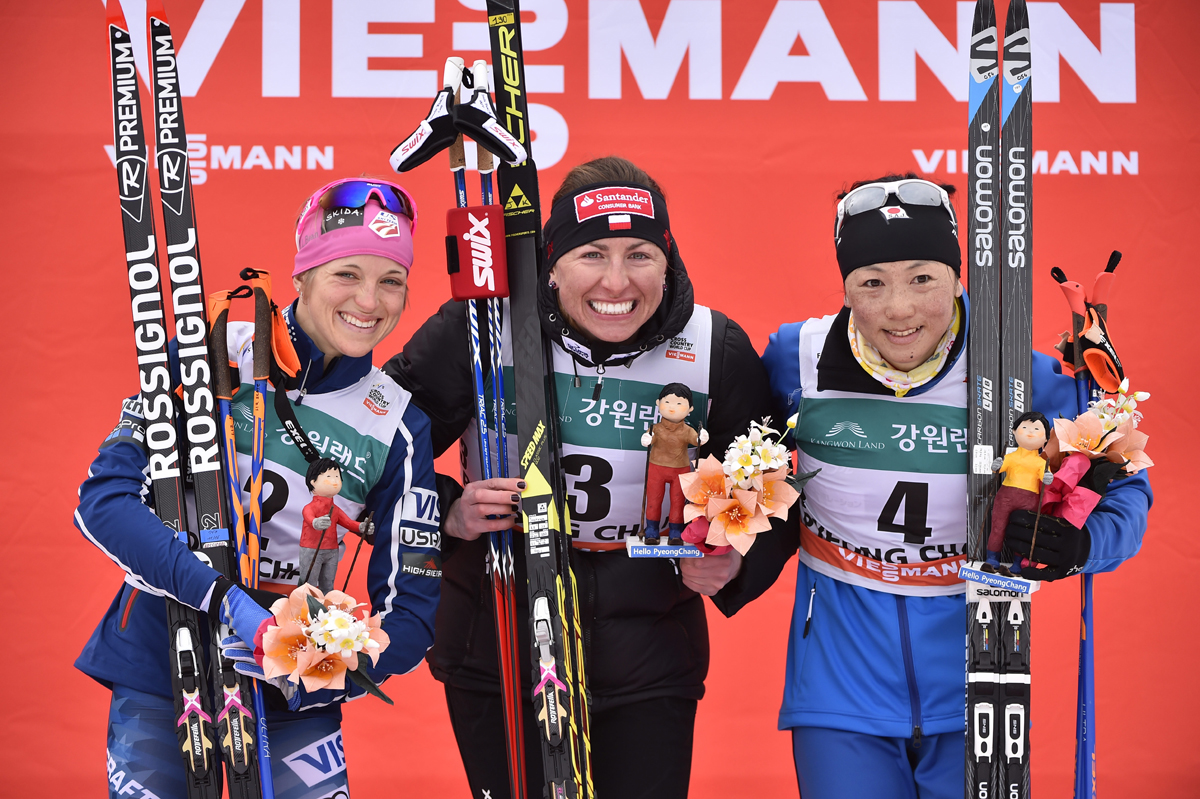
The women’s World Cup 15 k skiathlon podium on Saturday in PyeongChang, South Korea, with Poland’s Justyna Kowalczyk (c) in first, American Liz Stephen (l) in second, and Japan’s Masako Ishida (r) in third. (Photo: Fischer/NordicFocus)
Multiple race warmup and cool downs, managing hydration and caloric intake, moving at her max sprinting speed — more than once. It’s not often that American Liz Stephen feels the lingering effects of a World Cup sprint day. Her most recent memory was three years ago, when she qualified 22nd in Szklarska Poreba, Poland.
But this weekend’s three-day competition series in PyeongChang, South Korea, challenged the distance specialist once again. With a smaller World Cup field than usual, Stephen qualified 29th in Friday’s classic sprint and advanced quarterfinals, where she raced in the first heat of the day.
In what ended up being the fastest women’s quarterfinal, Stephen pushed through Friday’s hill-dominant sprint course and crossed fifth for 25th overall. The back-to-back sprint experience, however, left the 30-year-old Stephen with a little less energy than she would have liked as she entered Saturday’s 15-kilometer skiathlon.
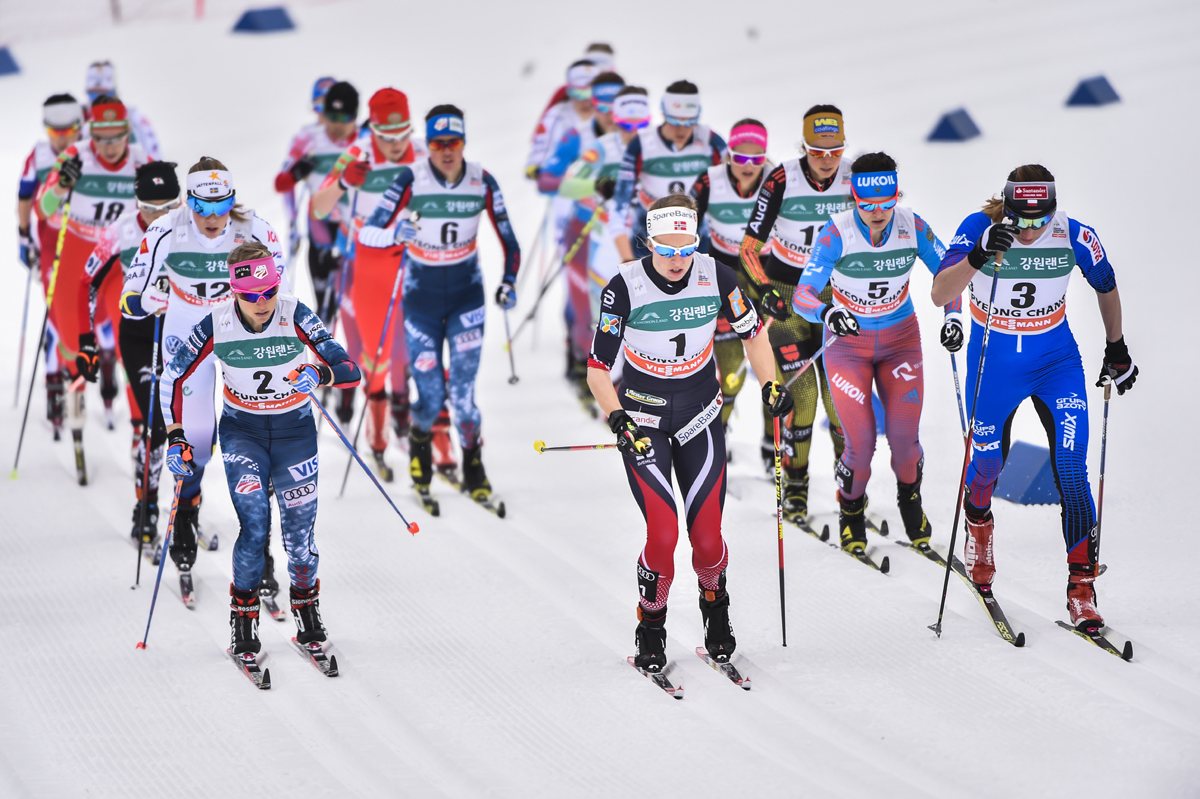
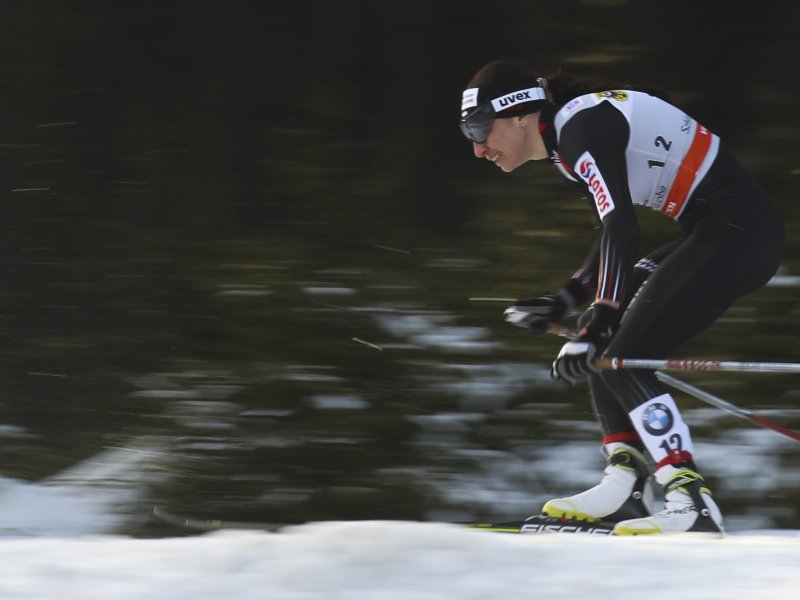
American Liz Stephen (2) skiing at the front of the women’s 15 k skiathlon on Saturday, alongside Norway’s Silje Øyre Slind (1) and Poland’s Justyna Kowalczyk (3), at the World Cup in PyeongChang, South Korea. (Photo: Fischer/NordicFocus)
“I think I was feeling yesterday’s sprint race a bit, as I did twice as many rounds as I usually do!” Stephen joked in an email.
Yet, standing at the start in bib 2, behind Norway’s Silje Øyre Slind in bib 1, Stephen wasn’t going to let a little soreness stop her from racing to Saturday’s skiathlon podium.
After Poland’s Justyna Kowalczykgapped the front by close to 20 seconds in the first two kilometers of the classic leg, the American held on tight to the lead chase group, striding even with a medley of skiers, including Slind, Japan’s Masako Ishida, Norway’s Anna Svendsen, Sweden’s Maria Nordström, and Germany’s Elisabeth Schicho.
Stephen came through the exchange in fifth position, a little over a minute behind the race leader Kowalczyk and 12 seconds back from the second place skier, Ishida.
“I was afraid I skied little too hard in the classic portion,” Stephen said, according to an International Ski Federation (FIS) press release. “I wanted to stay with the leading group in the classical part not to fall back.”
Skate skis on, Stephen quickly caught and surpassed Svendsen and Schicho by the 8.4 k mark, rejoining Ishida. With over a minute separating her and Ishida from Kowalczyk, the battle for second began. Around the 10 k mark, Stephen made her move. Powering past Masako, Stephen started her second hunt, this time for the Polish skier.
But Kowalczyk’s early classic-leg surge and strong skating staved off any attempts from Stephen.
“Liz was able to take some time out of her, but not significant time,” USST Head Coach Chris Grover said on the phone. “So that was impressive racing by Kowalczyk.”
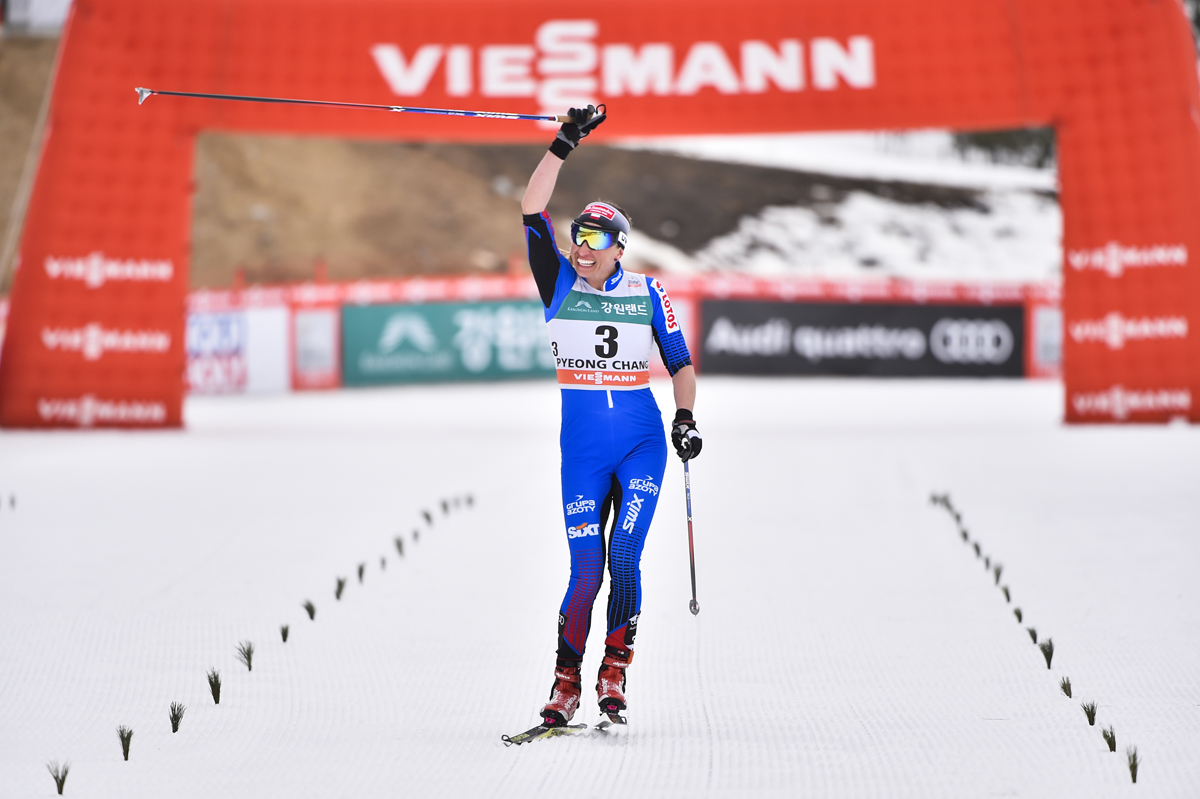
Poland’s Justyna Kowalczyk winning her first World Cup in three years on Saturday, the women’s 15 k skiathlon at in PyeongChang, South Korea. (Photo: Fischer/Nordic Focus)
“It has been a long time since I have been on the World Cup podium,” Kowalczyk said, according to FIS. “I was quite surprised to see how well I skated.”
Finishing exactly 56 seconds behind Kowalczyk was Stephen in second place. The result was Stephen’s best individual result since 2015, when she placed second in the 10 k freestyle race in Rybinsk, Russia.
“It’s hard not to feel happy when you get a podium finish!” she said, according to a U.S. Ski Team press release. “However, I didn’t feel like I had as much energy as I wanted to have today, but it was enough to hold onto second.”
In her first podium appearance since 2009, Ishida finished 18.8 seconds after Stephen in third (+1:14.8).
Just missing the podium by 6.6 seconds was American Caitlin Patterson in fourth (+1:21.4). Though a tangle on the first hill of her classic leg pushed Patterson back to 13th, the 27-year-old Craftsbury Green Racing Project skier was able to reconnect with the top 1o by the 2 k mark.
Unconcerned with Kowalczyk’s blistering pace, Patterson focused on the chase pack. By the time she reached the ski change, she was positioned in seventh. Her transition to skate skis smooth and energy still strong, Patterson began to pick people off.
She caught Nordström, who had been 10 seconds ahead of her at the exchange, as well as Schicho and Svendsen, both of whom were close to 30 seconds ahead of her when they switched to skate skis.
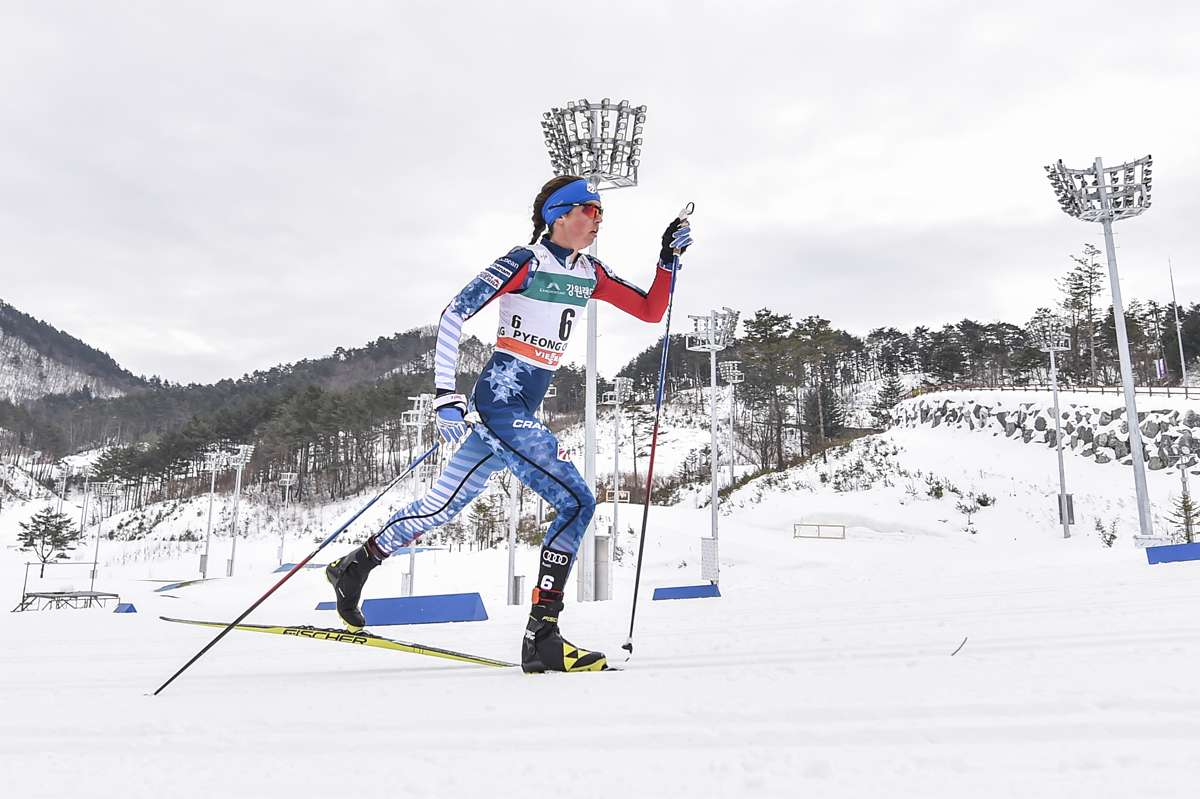
Caitlin Patterson (Craftsbury Green Racing Project) en route to a career-best World Cup result of fourth in the women’s 15 k skiathlon in PyeongChang, South Korea. (Photo: Fischer/NordicFocus)
“Caitlin Patterson was really impressive,” Grover said. “She was kind of hovering around seventh or eighth for most of the race, and then really in the last lap, really started to pick people off, including right at the very end to get all the way up to fourth.”
Feeling fairly well adjusted to the time difference, and appreciative of the low-altitude racing, Patterson was proud of her race effort. Her only issue being the seconds that separated her from the podium.
“When I look at the results and see how close third place was ahead of me, I can’t help but wish I could have somehow gone faster sooner!” Patterson wrote in an email. “A true sign of how much this makes me hungry for more, though I know I gave it everything I had out there today.”
The third American woman on Saturday was Liz Guiney in 13th (+2:21.7). The PyeongChang World Cup marks Guiney’s third week of World Cup racing and, while this weekend’s field is not as strong as the ones she recently raced against in Sweden, the result was still a little unexpected for Guiney.
“I’m very happy with my race today!” Guiney, 25, wrote in an email. “With the weaker World Cup field, it was a good opportunity to score some points, but I think I surprised myself by being within reach of the top 10.”
The last two races mark Guiney’s first World Cup points, with her best individual finish prior to this weekend 49th in the Falun 15 k classic mass start.
“Last weekend in the Falun 15k, I got a little too excited out of the start and paid for it later in the race, so my goal today was to ski my own race,” Guiney wrote. “I was really psyched to cross the line and find out that Liz Stephen placed 2nd and Caitlin (my GRP teammate) was 4th, which is a big breakout result for her!”
Two Canadian women also earned their first World Cup top 30’s on Saturday, with Annika Hicks (Alberta World Cup Academy) placing 26th (+5:17.8) followed by Sadie White (NTDC Thunder Bay)in 29th (+6:54.7).
Racers return to the race venue tomorrow for Sunday’s freestyle team sprint.
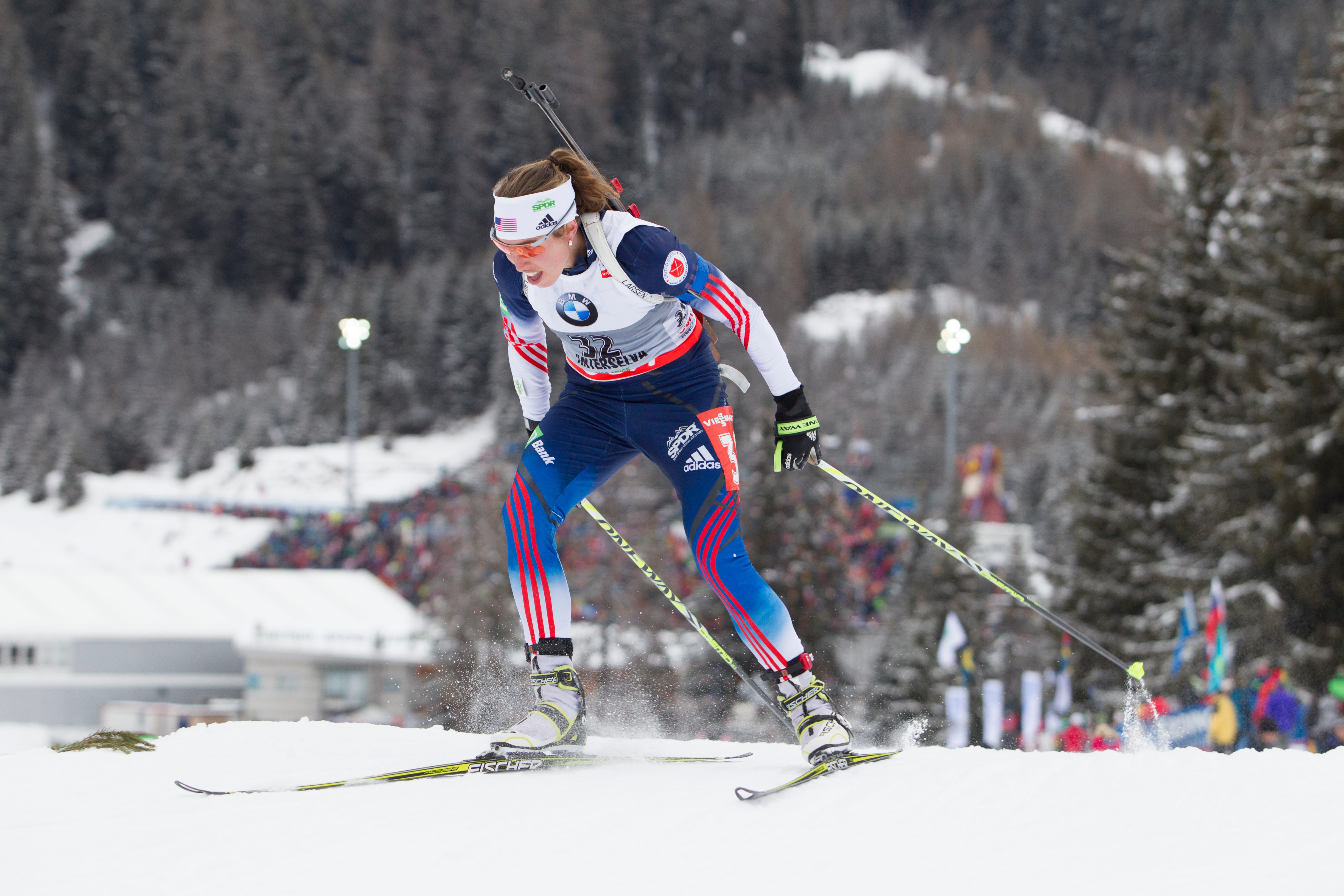
Susan Dunklee of the US Biathlon skied her way to a career best fourth place in Thursday’s 7.5 k sprint in Antholz, Italy. (Photo: US Biathlon/Nordic focus)
World Cup action this weekend brought racers to Szklarska Poreba, Poland. Despite the absence of the esteemed Scandinavians who were at their respective national championships, the excitement was high, especially for the North Americans who had an exceptional weekend.
In Saturday’s sprint, Kikkan Randall used her extensive experience to tackle a tactical course and rocket her to victory in the 1.5 k freestyle sprint. Randall’s win marks her second sprint victory in two weeks. She bested Germany’s Denise Hermann who is currently ranked first in the World Cup Sprint rankings, and Slovenia’s Vesna Fabjan.
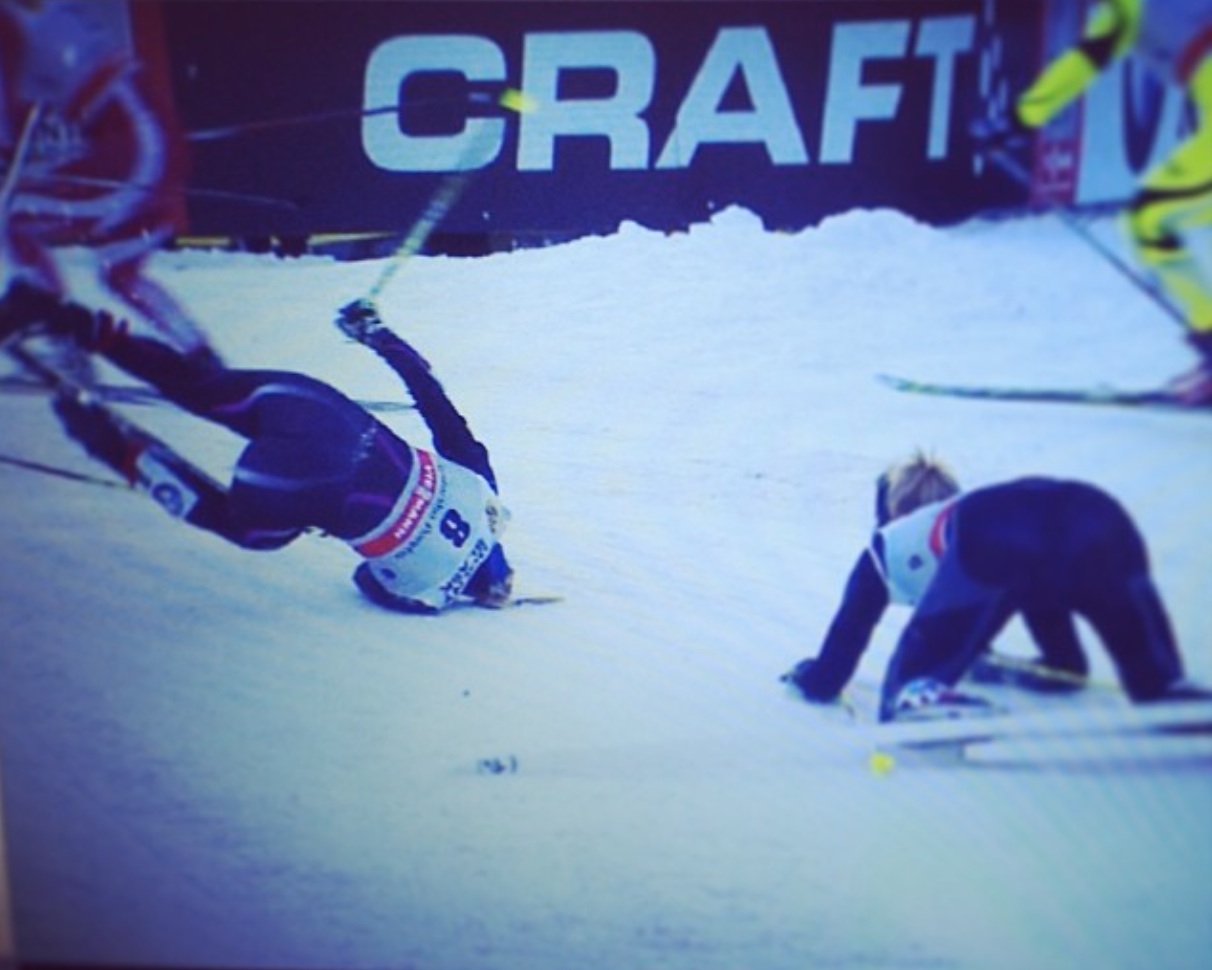
Jessie Diggins (l) tumbling headfirst over Switzerland’s Laurien van der Graaff, who fell right in front of her on the last turn of the women’s 1.5 k freestyle sprint final at the World Cup in Szklarska Poreba, Poland. (Photo: FIS Cross Country/Instagram) http://instagram.com/p/jV7XJjrzzf/
Also in the final was American Jessie Diggins who finished fifth after being taken out by a fall from Lauren Van Der Graaff of Switzerland.
American Sophie Caldwell finished seventh and Canadian Perianne Jones finished tenth after advancing to the semifinals.
The North American’s continues their winning streak in the men’s race. Canadian Alex Harvey out-sprinted Germany’s Josef Wenzl and France’s Baptiste Gros for his first-ever individual world cup win.
American Andy Newell was in medal contention until he had a nasty fall on the final hill of the A-final, knocking him down to sixth place.
Sunday marked the 10 k and 15 k mass starts. The women’s race was handily won by birthday-girl Justyna Kowalcyk. She was followed by a pair of Russians, Yulia Tchekaleva and Julia Ivanova, who finished second and third.
American Elizabeth Stephen finished sixth, followed by teammates Ida Seargent in ninth, Randall in 14th and Caldwell in 16th.
The Russians were dominant in the men’s 15 k with Maxim Vylegzhanin and Evgeniy Belov taking the top two spots. They were followed by Alexey Poltoranin of Kazakhstan in third.
The Canadians all finished in the top 10 with Harvey in fourth, Devon Kershaw in eighth and Ivan Babikov in ninth.
In Saturday’s 10 k pursuit, Dunklee finished 25th. On the men’s side Bailey finished 12th and Green finished 18th in the 12.5 k.
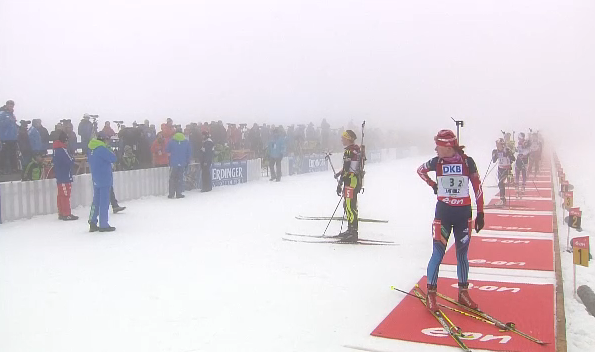
Sunday brought the men’s and women’s relays. On the men’s side, the Canadians finished sixth and the American team did not start. The women’s race was cancelled mid-race due to thick fog.
In nordic combined German Eric Frenzel, won all three of the weekend’s races in Seefeld, Austria and took the newly formed Seefeld Triple. American Bryan Fletcher finished the Triple in fifth. Teammate Billy Demong was just outside the top ten in 11th.
Take a look below to see the various recaps and reports of everything you missed this past weekend!
FIS Cross Country World Cup Szklarska Poreba, Poland
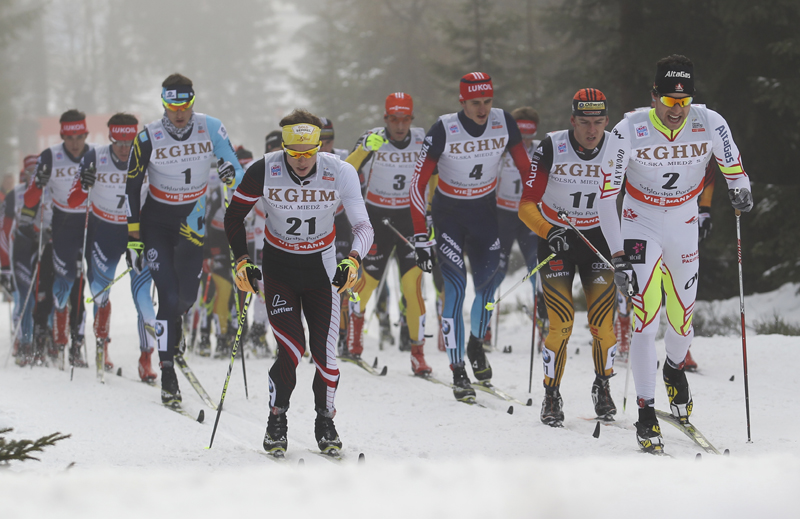
Austria’s Bernhard Tritscher (21) and Canada’s Alex Harvey (2) lead the pack in Sunday’s 15 k classic mass start in Szklarska Poreba, Poland. (Photo: Fischer/NordicFocus)
The U.S. men’s team faced fatigue and fickle conditions on Sunday’s 15-kilometer classic mass start race in Szklarska Poreba, Poland. Noah Hoffman led the U.S. men’s results in 19th, with Andy Newell 27th, and Erik Bjornsen 40th.
The course, five loops of a steep 3 k trail, was in varied condition before the morning started.
“They shoveled a bunch of wet powder onto the trails,” said U.S. Ski Team coach Matt Whitcomb. “The snow they laid down with trucks was thoroughly transformed, so it was a little bit variable because it was a sampling of a bunch different kinds of snow.”
To further compound the technical challenges of the day, the men started early in the day, 9:45 am local time.
“It’s a little bit challenging when the races are early because you’re confronted with the point in the day when the temperature changes the most,” said Whitcomb. “Conditions warmed up quite a bit. As soon as you had 70 guys skiing over the tracks a couple of times after a couple of laps, it changed significantly with warming temps.”
Whitcomb, commenting on the conditions, said, “There were complications with icing if you went a little bit too warm; it was the kind of conditions where hairies, klister, a ton of klisters were working, actually.”
Nevertheless, while no one on the US team would say they had bad skis, the men did suffer from some slipping. “… things were a little slippery for the guys,” said Whitcomb. “Competitive with the field, there were a lot of guys slipping in the first race of the day, but we were happy with the day.”
Noah Hoffman (U.S. Ski Team) at the Canmore World Cup 30 k skiathlon in December 2012.
“I’m not very happy with the way I executed my race today,” Hoffman wrote in an email. “But I feel like my fitness and my classic skiing are coming around. My poor classic results have been a high source of frustration for me this year. I know my fitness is there, and I haven’t been classic skiing the way I am capable. At any rate, today was more a problem with tactics. My plan was to be aggressive, but in the race I was way too impatient! On the first uphill Alex and others were leading at a snail’s pace. I knew that would play right to Alex’s strengths to have a slow race that came down to a sprint finish. I didn’t want that to happen, so I went to the front and lifted the pace, even gapped the field. The problem is I blew myself up in the process. I forgot that I am not yet strong enough to dictate the way the race plays out.”
“I went for the first preem [bonus points] because I was near the front of the race at the time. It may have been a better decision to chill out.”
“I started suffering about half way through the race, on lap 3. The finish for me was just survival.”
Whitcomb said that while Hoffman was neither “super bummed or super ecstatic” about his race it was still a good showing for him.
“A solid result out of Noah for sure,” Whitcomb said. “Nothing to be disappointed with. He’s in a good spot and is staged to have some success in Sochi,”
Newell described his race in an email: “I was pretty tired and banged up from yesterday, with the lunges and face plant in the final yesterday, I was definitely feeling it. But during the race my energy was pretty good and I tried to ski up toward the front.”
“I skied up with the lead pack for about 3 laps, going into the 4th lap the pace definitely picked up and my skis started getting harder and harder to kick. The tracks definitely glazed a little bit which made it harder for me to stay with the leaders up the climb.”
“There were many other skiers that got stretched out too, so I think by the last lap there was only a lead pack of about 15 skiers with a lot of stragglers, including myself.”
“I was happy to be in the points but would have liked to be a lot closer to the leaders. When every world cup point counts toward the end of the year it’s always good for me to pick up the distance points in the Tour and in races like this. I think with a little bit better skies I could have been farther up there today, which is a good sign. I was really stoked to get in two good hard races this weekend before going into our Olympic camp.”
Whitcomb said Newell skied, “really well through a few laps, he was one of the guys that was slick today, as well as Erik Bjornsen, and that’s tough on a course like this. Unfortunately, Andy didn’t have the kick to make it an easy day for him to just scoot around the course, it was a bit of a struggle. I wouldn’t say the skis were bad, we just needed really good skis for the guys that skied the heats yesterday.”
Erik Bjornsen (APU/U.S. Ski Team) at 2014 U.S. nationals earlier this month in Midway, Utah.
Bjornsen described his race as having a, “good start and a good finish.” He said about a kilometer and a half into the race he got into trouble.
“I was in a good position up until then,” Bjornsen said. “I was sitting in probably 10th to 15th place and then I got tangled and went down. It was on a hill and someone had kicked my ski from behind and it went on the other side of my other foot. I tried to quickly get up and another skier tangled with me, so I was down until pretty much the whole group of 60 guys went past me, and I finally had some room to get up. I tried to make a surge to get up to the front group, but it was a thin course.”
“I also think I made a bad judgment call on wax, when I was warming up about 30 min before the race, the big hill’s snow was still kind of dry, and the klister I was trying was great kicking up that hill, but by the time the start of the race came around it was really slick, so that was kind of a bummer. Every time I start a World Cup I feel I learn something, and I’m hoping to get some more World Cup starts this year. I’m kind of disappointed with the result, but happy I learned something for the future. I feel like if I had a good one I could be top 30, so that’s a good sign, it just wasn’t going to happen today.”
Simi Hamilton did not start his races this weekend due to a kind of tendinitis. “It’s a muscular sheath issue in his wrist,” Whitcomb said. “He had the problem in his opposite wrist this summer, and we made the conservative decision not to start him this weekend. We let him do some training with one pole, gave him some topical anti-inflammatories and some massage to try and cool his arm down basically. It’s nothing huge, we’re just being conservative about it before the Olympics.”
Brian Gregg (Team Gregg/Madshus) woke up sick on Sunday morning and did not race.
With most of the other teams having already left Szklarska Poreba, the U.S. team had the run of their hotel and set up a projector in the hotel disco to watch Sunday’s Patriots vs. Broncos football game.
The athletes will now travel to Seiser Alm in Italy for an altitude camp before the World Cup races in Toblach.
“We’ll be living at 2,000 meters, about 6,600 feet. We’ll be training conservatively for a few days while acute acclimatization occurs and then we’ll get in a little more quality training at the end of the camp–it’s a nine day camp. Then we’ll drop back down to Toblach. By itself this camp isn’t all that significant, but most of these athletes are coming from Seiser Alm or an altitude camp in Davos after the first half of the Tour, so the accumulation of days at altitude will meet our needs for pre-Sochi,” reported Whitcomb.
“I’m really happy with where my fitness and form are heading into the pre-Olympic camp,” said Hoffman, but added, “I’m not psyched to have to wax Liz’s skis.”
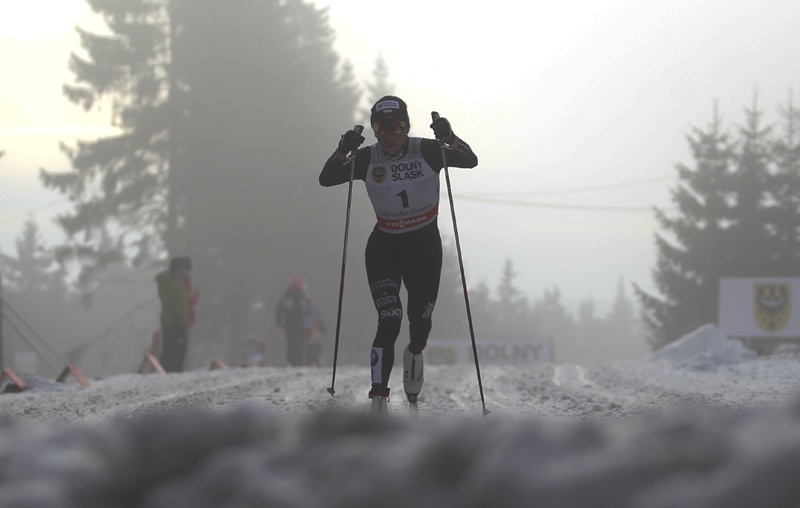
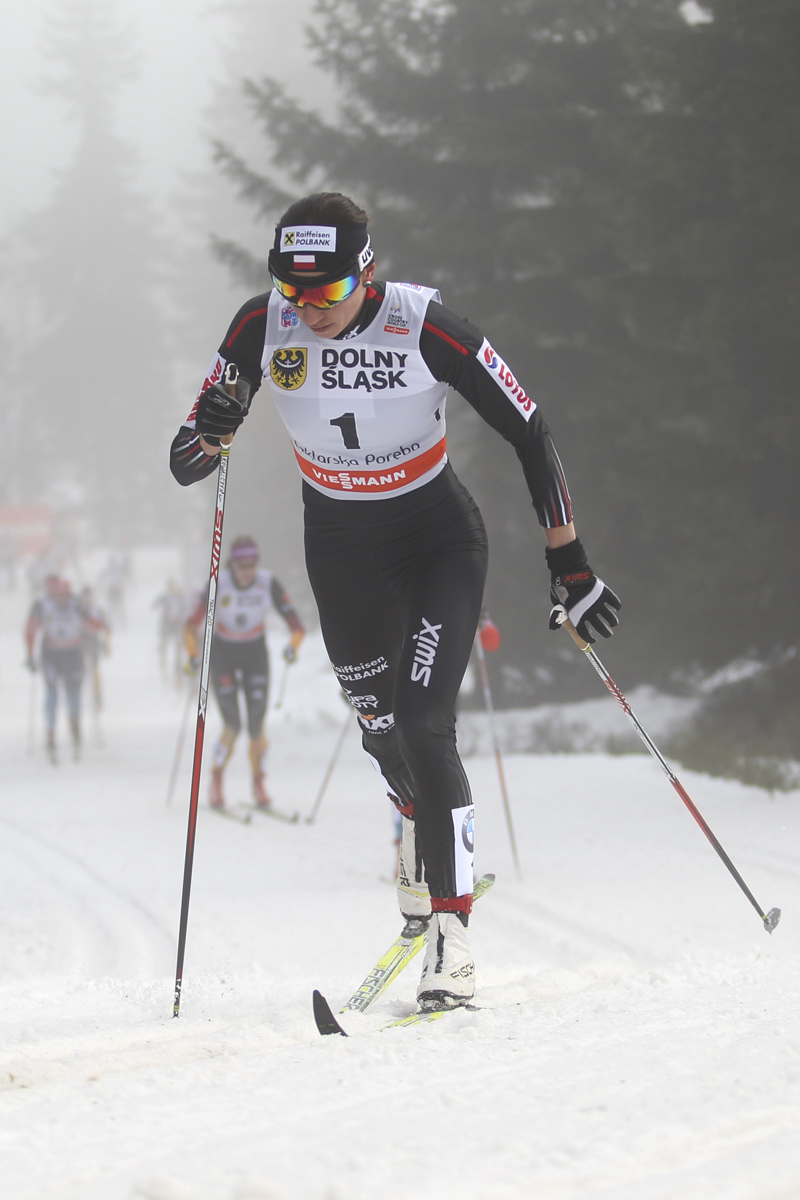
Poland’s Justyna Kowalczyk essentially led from start to finish of Sunday’s 10 k classic mass start at the World Cup in Szklarska Poreba, Poland. (Photo: Fischer/NordicFocus)
It’s not easy being Justyna Kowalczyk — always breaking trail, always having the weight of Poland on her, and in a classic distance race at home on her birthday without any Scandinavians in the field? Forget about it.
Kowalczyk was easily the favorite for Sunday’s World Cup 10-kilometer classic mass start in Szklarska Poręba, Poland, nearly two years after she won the same race there. That didn’t make winning any easier.
Poland’s Justyna Kowalczyk breaking away to a victory in Sunday’s 10 k classic mass start at the World Cup in Szklarska Poreba, Poland. Russia’s Yulia Tchekaleva (behind) and Germany’s Denise Herrmann (second from l) remained closest to her for most of the race. (Photo: Fischer/NordicFocus)
With noticeably slower skis, lacking glide on pea-soup, 35-plus degree afternoon, Kowalczyk relied on kick and her unmistakable stride on her 31st birthday. That didn’t help her on the long downhill on the last third of each 2.7 k loop, but she was able to nail the two climbs.
“The person who first blazes trail, it costs a lot of strength and speed,” Kowalczyk’s said in a post-race interview with WP Poland, according to a translation. “Therefore, at the beginning of the second and third [lap] athletes stuck to me.”
Lucky for her, Kowalczyk’s kick wore off as she continued through the four-lap race — just as she was warming up. After immediately taking control and skiing off the front of the mass start, Kowalczyk couldn’t get more than a few strides ahead of Russia’s Yulia Tchekaleva on the first lap. By the downhill, Tchekaleva quickly soared up alongside Kowalczyk, then past her to lap through the stadium 0.6 seconds ahead in first.
Tchekaleva’s lead was short-lived. By the 4.2 k checkpoint, Kowalczyk had gapped her and everyone else by nearly 12 seconds; Tchekaleva was skiing in second and Germany’s Denise Herrmann was 13.4 seconds back in third. American Liz Stephen led a chase pack in fourth, another 10 seconds behind.
“I have never started on the first line of a World Cup mass start before, so that was really fun, and the pace went out hot, but I never got swallowed up in the mass like I think I would have if I had started back in the pack,” Stephen wrote in an email. “Justyna was on a mission today and just never looked back.
“The fans were so loud and into it out there today,” Stephen added, after eventually placing sixth, her career best in an outright World Cup. “Especially as it was Justyna’s birthday today, too.”
Nearly 30 seconds ahead of Tchekaleva early in the first lap, and 41 seconds up on Herrmann in third, Kowalczyk looked back occasionally — giving a glance back as before picking up the maximum bonus points at 6.9 k. Unless something tragic happened, this race was in the bag, but she didn’t let off until striding blissfully into the stadium for the last time.
Upon finishing first in 34:43.2 without anyone contenders in sight, Kowalczyk waved her arms in the air. Then she stopped, bent over her poles for a millisecond to catch her breath and looked back on the course, waiting patiently for Tchekaleva to follow in second.
Tchekaleva came through uncontested 41.8 seconds later, and another Russian Julia Ivanova rounded out the podium in third, 1:15.2 seconds back from Kowalczyk.
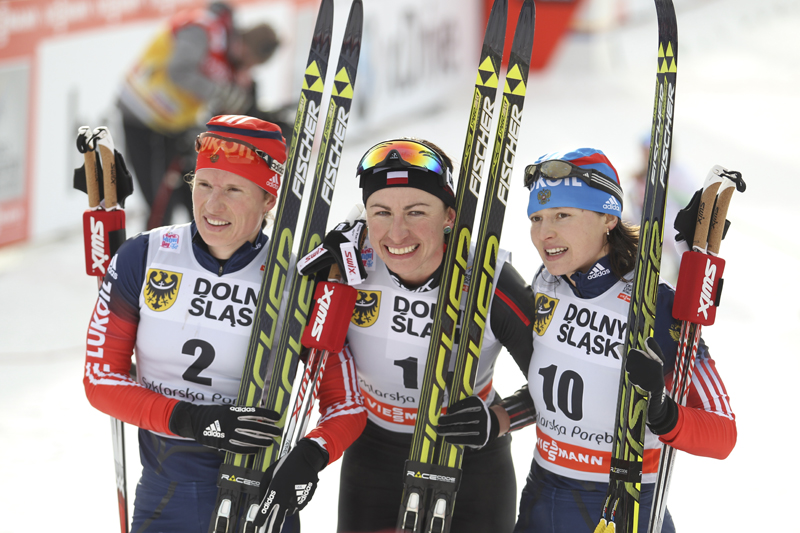
Women’s 10 k classic mass start podium at Sunday’s World Cup in Szklarska Poreba, Poland: winner Justyna Kowalczyk (c), and Russia’s Yulia Tchekaleva (l) in second and Julia Ivanova in third. (Photo: Fischer/NordicFocus)
Ivanova had caught and challenged Herrmann with Germany’s Claudia Nystad and Stephen on the last lap, then ended up dropping Herrmann before the finish. Herrmann placed fourth, four seconds later, and Nystad was another two seconds back in fifth. Stephen placed sixth, 1:26.4 after Kowalczyk, edging Germany’s Stefanie Boehler by 2 seconds.
Nystad originally led the chase, along with Stephen, up the final climb. After absorbing Herrmann as part of their group, they forged ahead with Stephen up front and Tchekaleva in their sights — but she was at least 25 seconds out of range.
“I was feeling really good for most of the race until the very top of the uphill on the last lap when Julia Ivanova went by me and as I tried to hang I just fell apart a bit,” Stephen explained. “[I] didn’t push over the top as much as I needed to to hold off the coming Germans.”
Welcoming Tchekaleva across the line, Kowalczyk gave her a hug. The birthday girl was excited, but not visibly ecstatic about her World Cup win in Poland. It was, after all, just another race before the Olympics — minus the Norwegians, Finns and Swedes.
“Maybe you cannot see it, but I am very touched,” Kowalczyk told WP. “I learned to have control emotions. I once cried today when I got the cake, the flowers, but the second time I will not cry. For such moments the training does it all.”
So she got a cake — but did she eat it, too?
“It’s not the best thing for me right after the race,” Kowalczyk said with a smile, adding she’ll, “eat a double portion for my mom.”
As for the victory, Kowalczyk said it was “nice,” but “Sochi is still far away.”
The victory elevated her to third in the overall World Cup standings behind Norway’s Therese Johaug and Astrid Uhrenholdt Jacobsen, respectively, and four points ahead of Marit Bjørgen. At least Johaug and Bjørgen aren’t expected to compete at the final World Cup Feb. 1-2 in Toblach, Italy, before the Olympics.
Also in the top 10, Russia’s Natalia Zhukova placed eighth (+1:47.8), American Ida Sargent notched a career-best distance result of ninth (+1:49.3), and Austria’s Katerina Smutna was 10th (+1:49.5).
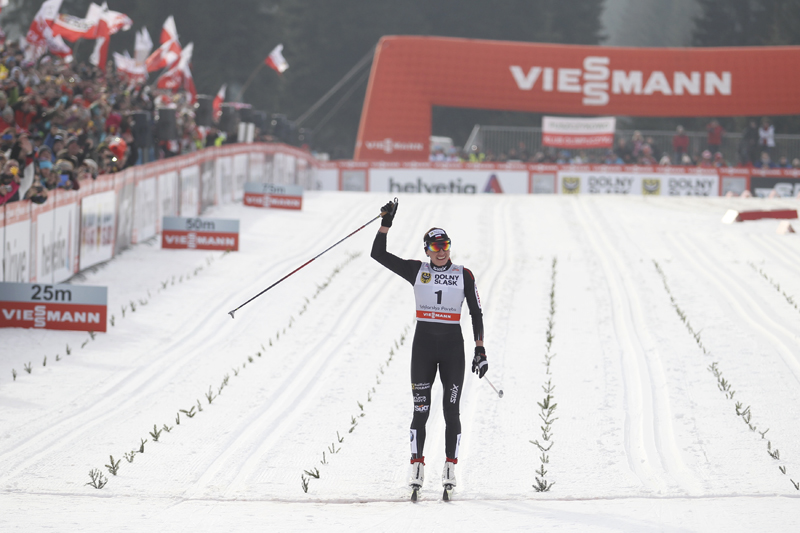
Justyna Kowalczyk celebrates a 42-second victory in Sunday’s 10 k classic mass start on her 31st birthday at home in Szklarska Poreba, Poland. (Photo: Fischer/NordicFocus)
Sophie Caldwell and Ida Sargent in Szklarska Poreba, Poland. Photo: Andy Newell
Sunday’s 10-kilometer classic mass start in Szklarska Poreba, Poland, was another great day for the US women. Liz Stephen had a breakthrough performance, finishing sixth, a career best for her in an outright World Cup and a major milestone in her development as a classic skier. Ida Sargent also had an excellent day, placing ninth, her career-best distance race. Kikkan Randall finished 14th, and Jessie Diggins was 24th to round out the day.
Conditions were tricky on the Polish ski course, with varying and dirty snow, but U.S. Ski Team Coach Matt Whitcomb felt that the women had good skis, saying, “I feel like we nailed the skis really well for the girls.”
The course, a challenging four loops for the women, was what the team had expected to find in Szklarska Poreba.
“The course profile was as we expected,” said Whitcomb, “you kind of expect them to design a course after their marquee skier, we have no problems with that at all, we expected a course that would have a lot of steep, hard striding to suit Justyna [Kowalczyk]. That happened to suit some members of our team as well, so we were pretty excited to find that there was a lot of climbing, a lot of relief to this course. The downhills were really technical, a little sketchy, and a pretty exciting race, it’s nice to see a race with four or five laps, it made the spectating quite exciting.”
Stephen, who started with bib number four at the head of her own lane, said that she had, “never started on the first line of a World Cup mass start before, so that was really fun, and the pace went out hot, but I never got swallowed up in the mass like I think I would have if I had started back in the pack. Justyna was on a mission today and just never looked back and the fans were so loud and into it out there today, especially as it was Justyna’s birthday today too.”
The Polish ski fans are legendary for their enthusiasm. As Whitcomb described it, “The Polish fans are some of the best. Probably only about five plus thousand people at the races, but per capita they are exceptionally loud, boisterous, they cheer for everybody, they cheer in these big bursts, especially when one of their skiers goes by for about five seconds and then it just goes quiet. It’s a unique experience to race in Poland, particularly when Justyna is here…It’s a fun place to watch a race.”
Randall said of the crowd, “The fans were just so fired up, I was getting crazy cheers. It’s cool to see people so fired up about cross country skiing, and they seem to be fans of our team so that made it pretty fun. It’s definitely the most cheers I’ve received since Quebec City last year.”
To the fans delight the race was led early on by Kowalczyk, and on the second lap she made a breakaway. Stephen said of Kowalczyk’s breakaway, “I actually am not totally sure how it all went down, but I definitely led some of the chase. I saw Denise [Herrmann] coming back to us going into lap 3 and I was feeling good so I went hunting! I would lead the uphills and the Germans would catch me on the downhills.”
“On the last lap I was mostly concerned about putting enough space between me and the chasing skiers behind me going into the downhill, because that was where I was getting caught each lap. I was feeling really good for most of the race until the very top of the uphill on the last lap when Julia Ivanova went by me and as I tried to hang I just fell apart a bit and didn’t push over the top as much as I needed to, to hold off the Germans [Herrmann and Nystad].”
“I was able to hold off Stefi Boehler, which was really good and I wasn’t sure who it was chasing me, but knew I had to go, so I went and was able to hold her off today. Anytime I win a sprint out, especially in a classic race, I am really psyched.”
Stephen said that her race was excellent preparation for the Olympics.
“It was really good prep for today for me I think, especially getting a couple really hard, fast efforts after coming down from altitude. And the sprinting yesterday was SO fun, that that was certainly a really positive high mentally from that as well.”
Liz Stephen (USA) in Falun, Sweden 2012.
Whitcomb was pleased with how Stephen has developed as a classic skier.”Liz definitely had one of her best classic races today ever,” he said, “skiing-wise it definitely was, but feeling-wise I think it was too, she’s been working on a couple of technical things this week.”
“Her kick just snapped together a couple of days ago and with great kicking skis today with her technician she was able to work on those things and have a good result. One of Liz’s goals is to bring her classic skiing up to the level of her skating. It’s going to take a long time to do that but she’s getting closer and closer. So excited about her race, great signs of things to come, she’s in awesome shape, good indications that the Tour de Ski has been absorbed, and the mild cold after the Tour is behind her, so I feel really good about where she is.”
For Whitcomb, Sargent had, “one of the races of the day for us. She did well, she’s had some great results this season, a little spotty, I think she will admit to that. She’s coming out of this weekend with a lot of confidence after having the good classic distance race she’s been looking for. Things just looked really easy out there for Ida today, she was just skiing exceptionally well.”
“It was my first top 10 so I was psyched” said Sargent.”I was seeded pretty far back so I tried to focus on skiing smoothly and moving up when I could. The course was really hard with big steep hills and slow dirty snow so the pack broke apart quickly and it was easy to pass and move up. I skied with Kikkan and Soph for a bit on the first lap and then I was in a pack with Liz for while too. She was skiing really well so I just tried to keep her in my sights as she flew up the hills. I was hurting by the last lap but just tried to hold on into the finish. I had a sprint finish with Smutna but got her in the lunge. The whole team skied really well this weekend so our stoke level is high as we head into the pre-Olympic camp. With each race I feel better and better so I’m excited for what is to come!”
Randall, for her part said, “It wasn’t a great race for me. I felt tired and sluggish on the first two laps and caught a discarded leg bib in my klister, which I had to pull off the trail to remove in the first lap. I felt a little better on the last lap. While I was hoping to be stronger today this was still a good workout towards sharpening my race form. It’s been over a month since my last distance race and I think a few good efforts like this will bring things around pretty quick.”
Randall added, “It was really encouraging to see Liz and Ida ski so strongly today. The depth on this team is so amazing and continues to get stronger every weekend.”
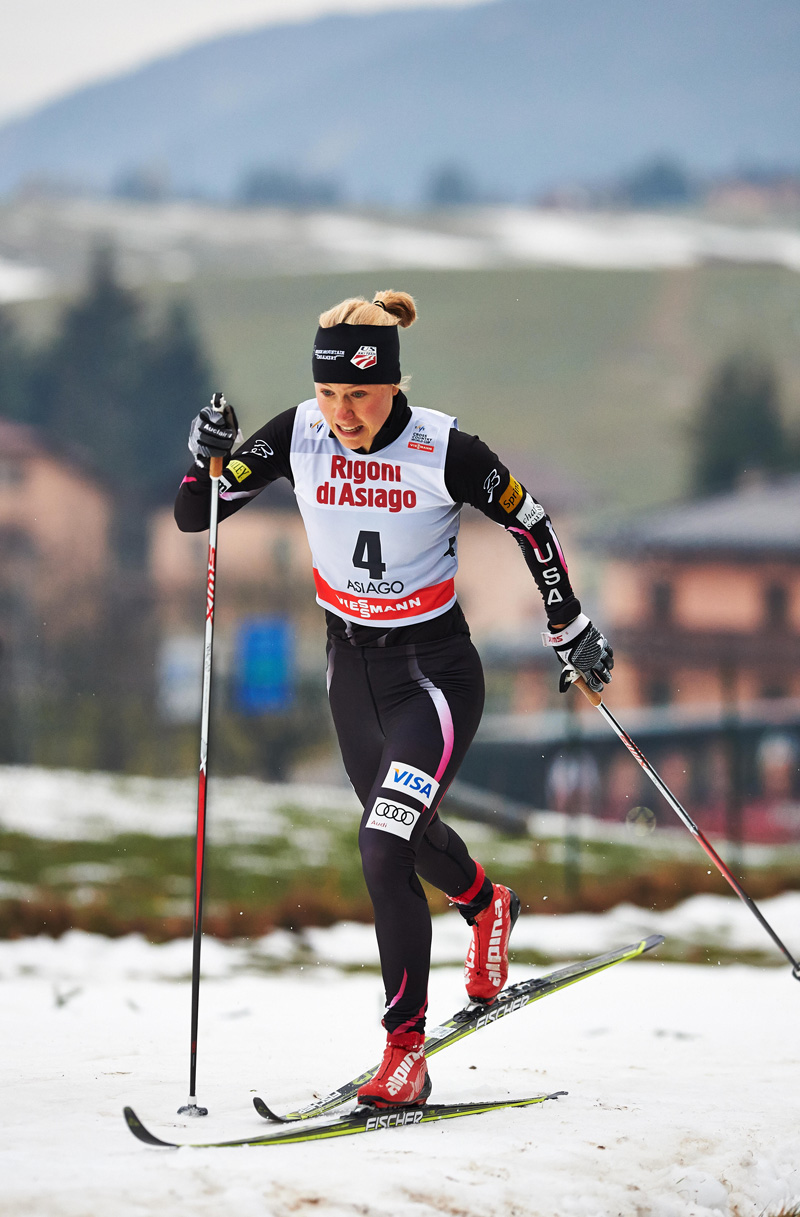
Ida Sargent (U.S. Ski Team) racing to her first top 10 of the season in the 1.25 k classic sprint in Asiago, Italy. (Photo: Fischer/Nordic Focus)
Caldwell also notched her second notable race of the weekend after finishing 7th in Saturday’s freestyle sprint.
“Another good race from Sophie, she was tired,” said Whitcomb, “she skied a lot of heats yesterday, but on a course that would have absolutely devoured her a couple of years ago, even on a great day, she was still able to continue skiing well. She didn’t go into this awkward shuffle walk, but kept kicking and gliding on the steepest of the hills, it was really exciting.”
“I had a decent start and was able to put myself in a really good position by the end of the first lap,” said Caldwell. “I think Justyna took it out hard from the start, so therefore the pace of the rest of the field was pretty hard from the start. Sometimes I struggle with pacing myself because I get excited the first lap and the fatigue doesn’t hit me until a little later on, so even though the first lap was very fast, I wasn’t really noticing it until later in the race.”
“At one point during the first lap, Kikkan, Ida, and I were skiing in a train up the big hill – that was fun! I got to ski with Ida a couple more times out there and with Kikkan a little more at the very end when she passed me. Unfortunately Kik skied over a leg bib and had to stop and peel that off, so I think she got set back a little from that…Kik put in a big final push up over the top of the last hill and I tried to go with her on that and even though I couldn’t quite stick with her, I think it gave me a little gap on some people right behind me.”
“I thought it was a really solid weekend, especially as a team. We had a lot of people in the points, a lot of people in the top 15, and a win, so no complaints about that!”
Diggins finished in 24th despite taking a big crash in Saturday’s sprint race.
“My knee is fifty shades of purple but is fine,” Diggins wrote in an email to FasterSkier. “What was really bugging me today was my rib cage. I kind of compressed it during the crash yesterday and every time I double poled it hurt. But that’s not an excuse for how I raced today, simply a fact. There’s enough pain involved in racing that twingy ribs don’t matter that much, I just let it get in my head. The team doc checked it out and they are fine just sore.”
“Today’s race was about a 3-4 out of 10 for me…I just didn’t have great energy after yesterday’s excitement and I was struggling a lot with kick. It wasn’t our techs fault- figuring out just how much kick I need has been something I’m still working on, and today I made the call much too conservative. Once I start slipping I usually come apart pretty quickly, especially in the really long climb, so my focus switched to simply getting in one hell of a workout in preparation for the next training block!
However, I’m psyched for the rest of the girls and it was a really fun atmosphere today, what with it being Justyna’s birthday and all :)”
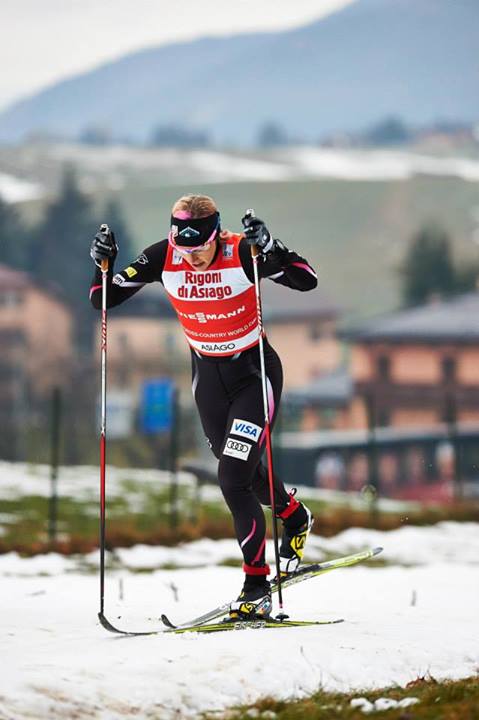
Kikkan Randall (US SKi Team) racing in the 1.25 k classic sprint qualifier at the Asiago World Cup in Italy. (Photo: Fischer/Nordic Focus)
Caitlin Gregg didn’t have the energy she desired today and decided to pull out of the race after the second lap.
“After the first lap I felt ready to start attacking but as I tried to go faster I felt more and more fatigue” Gregg said in an email. “I think I hit the point where the adrenaline and excitement of the past few weeks faded and the fatigue and nerves from travel and anticipating the Olympic Team selection set in! It is always a bummer to pull out of a race, but there are times when it hits you like a pile of bricks and I know I have a lot of (hopefully big) races down the road to prepare for still this season!!!”
Whitcomb said he agreed with her decision to quit the race.
“Caitlin pulled out, which was a good move. I’ve never been one for dropping out of races unless there’s a good reason and I think she had a good reason, the body just wasn’t happening. She’s got a husband, Brian, who woke up sick today, which is why he didn’t start his race. So I think it was a conservative move to make sure she’s not getting sick as well, and if she is, to make sure she doesn’t drive it super deep into her system. It’s been great to have Brian and Caitlin with us.”
Sadie Bjornsen did not start the race because she’s recovering from a cold said Whitcomb, but he didn’t characterize it as being too serious.
The team will travel to Seiser Alm for an altitude camp before the Toblach World Cup races. Diggins, for one, is looking forward to returning to the Italian training venue.
“Next I’ll go to Seiser Alm with the crew, which I’m SO EXCITED about, and train for the Olympics,” Diggins said. “Before those, however, I’ll get to do some tune up racing at the Toblach World Cups, and I’ll drop in to U23’s for the skate sprint! I can’t wait to see all my friends there and it should be a great time.”
The Greggs and Sargent will pursue their own independent training with the three likely all training in Toblach.
“Ida Sargent is going independently to Toblach to have a lower altitude camp. We’ve learned over the last couple of years that that is something that seems to benefit her, helps her sharpen up,” said Whitcomb.
Gregg said in an email, “We have had a blast and we are looking forward to a little R and R! We have a rental car in Prague and we will be making our next move depending on what happens on Tuesday 🙂 We are loving this lifestyle even when results are less then what we want!”
Alex Harvey (CAN) celebrates his win in Saturday’s 1.5 k sprint. Harvey, who claimed his first ever world cup victory on the Polish course, qualified seventh and skied a tactical and smart race to take the win (Photo: Fischer/Nordic Focus)
Consistent improvement is the theme of Canadian Alex Harvey’s 2013/2014 racing season. Glancing at his results from the beginning of the season in November, a series of 30’s and 40’s scatter the page. When you look at the last few weeks, however, he’s been consistently in the top ten.
The upward trend has continued in Szklarska Poreba, Poland, where he claimed victory in the World Cup freestyle sprint.
The victory marks a first for the Quebec native. Despite the fact that Harvey has a world championship in the team sprint under his belt from 2011 with Devon Kershaw, and has claimed multiple stage World Cup victories, Saturday’s win marks the first time the 25-year-old has sat atop the podium in an individual World Cup race.
To earn his victory, Harvey bested Josef Wenzl of Germany and Baptiste Gros of France, who placed second and third. Frenchman Cyrill Gaillard and Martin Jaeger of Switzerland rounded out the top five.
Canadian Alex Harvey crosses the finish line ahead of German Josef Wenzl for the win in Saturday’s 1.5 k freestyle sprint. (Photo: Fischer/Nordic Focus)
The 1.5 k course in Szklarska Preba was fast and icy, making for a dangerous day. In a men’s race filled with sprint specialists, the heats were bound to tight. Racers not only had to maneuver the tactics of the pack, but also had to stay on their feet.
Despite the hazardous conditions, Harvey knew that he had the fitness to take it all the way. All he need to do was get into the front to stay away from the messy fray the ensued behind him.
“The conditions were getting icy and a little dangerous so I knew I had to get out in front. I wasn’t afraid of being tired because I knew I was in great shape so my tactic was to stay out in front today. I had no choice,” said Harvey in a press release.
While Harvey was able to get out in front in the A-final, he was not as fortunate in his semifinal. After a relaxed start he found himself at the back of the pack, unable to maneuver to the front. Going around the last corner into the finish he was stuck behind the three skiers in front of him.
In an attempt to get around them he swerved into an adjacent lane. The move did him no good, as he finished fourth in the semifinal, two spots away from automatic qualification. Fortunately for Harvey, his semifinal heat was faster that the second and he was able to advance to the A-final as lucky looser.
Justin Wadsworth, Canadian Head Coach, believed that Harvey’s ability to learn is what earned him a spot on the podium today.
“He (Harvey) is really good tactically and he learns from his mistakes. In the semifinal, he saw he got out and had a slow start and didn’t fight for a position and was caught in the back of the group the whole way,” Wadsworth said in an interview. “He easily could have given up a position or two out of the start but he really pushed hard on the side to move up.”
German Josef Wenzl qualified sixth and finished second in the 1.5 k sprint in Szklarska Poreba. (Photo: Fischer/Nordic Focus)
From the start, Harvey went head-to-head with Gros on the only climb of the course. The Frenchman gained a slight gap, but Harvey knew that he didn’t need to worry as he had some of the fastest skis on the course.
“Alex knew that the skis were super fast. Everyone said we had the fastest skis out there; us and the U.S.,” said Wadsworth. “You need those kind of skis on those fast downhill finishes.”
Coming into the finish, Harvey and Wenzl sped past Gros and rocketed into the stadium. Harvey gained the lead, and Wenzel hopped in the lane behind him. From there, Harvey’s first career World Cup was his for the taking.
Behind Harvey was American Andy Newell, who earlier in the day had placed second in the qualification round. Newell had been feeling optimistic about his chances all day, and after lunging through the legs of Wenzl in his semifinal to take second position he advanced to the A-final.
“I was pretty fired up going into today and knew it was a good chance to be on the podium.” Newell said in an interview. “ But it was a very nerve-racking sprint course out there because of the way it plays out because of the tactics.”
Tactically, Newell had been skiing extremely well all day, but in the last S-turn leading into the finish disaster struck. In a risky move, Newell tried to edge around Gros to claim a better position in the final stretch, but there was not enough space.
Newell then hit a V-board, overcorrected, and bumped into Gros.
“It was too much of a gamble on my part. I had been feeling good in the finish stretches all day and I knew I could have passed those guys. At that point in the race I felt like I had a podium basically wrapped up and I shouldn’t have made that gutsy pass like that. It was kind of dumb.”
After bumping into Gros, Newell fell hard on the corner, and was knocked out of contention.
“It’s really frustrating. I haven’t been that angry or upset after a race in a long time,” he said of his feelings post-race.
Despite the disappointing, result Newell is keeping his sprits high and sights set on the future.
“It’s always good to be racing heats,” the veteran racer said of his experience racing today. “I felt like I had a good finish speed today and good lunges. It’s great to be able to practice that stuff. Things are looking good. We have one more skate sprint before the Olympics so I just keep hoping to improve on that.“
The men’s podium in the 1.5 k sprint in Szklarska Poreba, Poland. (l-r) Baptiste Glos (FRA), Alex Harvey (CAN), and Josef Wenzl (GER). (Photo: Fischer/Nordic Focus)
Harvey was also focused on chat he could take away from the day’s race. The Canadian, who was the third in the Tour de Ski sprint rankings, was happy with the win because it validated the success he found in the Tour. “It is great to get another podium. I felt pretty good coming back from the Tour de Ski, but you just never know. This race confirms things for me,” said Harvey in a press release.
While the Norway, Sweden, and Finland were all holding their respective national championships and thus had no racers in Saturday’s World Cup, Harvey felt that the competition was just as competitive as usual. “The Russians have been the ones to beat in sprinting and I was able to do that today,” he said.
Wadsworth also felt some validation from the result, as the entire Canadian team had a very slow start to this year’s ski season.
“Our whole goal this year was to build towards Sochi and not worry too much about the early season. A lot of the other teams were trying to qualify people. We put the training in, and I think it’s starting to show,” he said.
It certainly appears that the Canadian training is paying off in such an important Olympic year, with Perianne Jones finishing tenth in the women’s race, and Devon Kershaw making the quarterfinals to finish 18th.
“[Perianne Jones] had a good result today. Devon [Kershaw] actually felt good but just got in some traffic, but he said it’s the best he’s felt all year. It’s starting to come around,” said Wadsworth.
With the Olympics looming, many teams are focused on making sure that their teams are ready, both physically and mentally, to get their best results possible.
For Harvey and Kershaw that meant taking last week off from World Cup racing to revive and train in Switzerland. While their plan had been to race in the Czech Republic, they were so enthralled with the good skiing, culture, and atmosphere of Switzerland, they made a spur of the moment decision to stay an extra week.
Wadsworth supported the decision and believes that his team will be at their best over the next weeks. “Everything is going the right direction. We just need to stay healthy and stay focused on the process. We just have to take care of the things we need to take care of: quality training and a good team vibe,” he said.
The World Cup continues for the min in Szklarska Poreba tomorrow with a 15 k classic mass start.
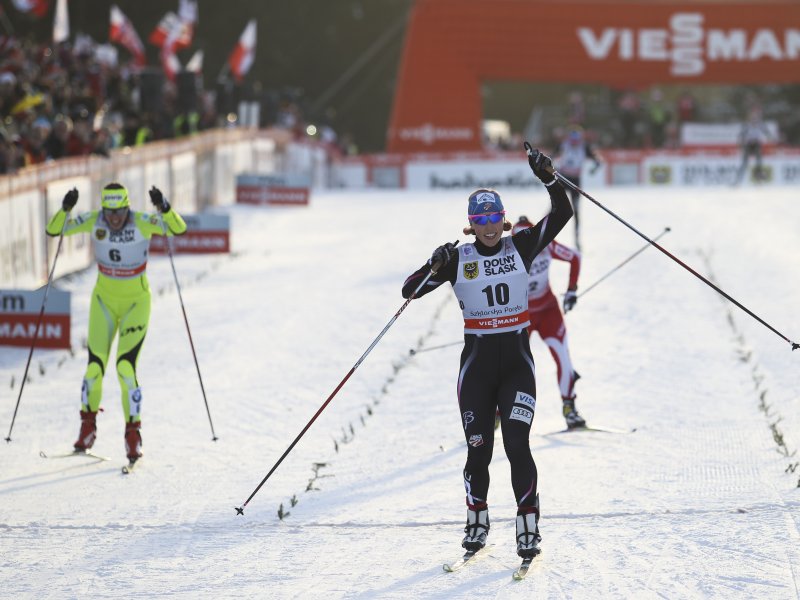
Kikkan Randall (U.S. Ski Team) celebrates her second-straight sprint win in back-to-back World Cup weekends on Saturday in Szklarska Poręba, Poland. Randall topped Germany’s Denise Herrmann for the victory, her ninth-consecutive freestyle sprint podium, and Slovenia’s Vesna Fabjan (l) was third and Poland’s Sylwia Jaskowiec (behind Randall) placed fourth. (Photo: Fischer/Nordic Focus)
Two years ago at a World Cup freestyle sprint in Szklarska Poręba, Poland, Kikkan Randall’s run for the podium was almost over soon after it began.
The U.S. Ski Team standout had made it all the way to final, where she squared off against two Norwegians (Maiken Caspersen Falla and Astrid Uhrenholdt Jacobsen), a Swede (Ida Ingemarsdotter), Laure Barthelemy of France, and Russia’s Natalia Matveeva. Skiing in the middle of the pack as all six women exited the stadium, Randall went down, taking Matveeva with her. Spectators gasped, and the Norwegians, Ingemarsdotter and Barthelemy skied away.
Moments later, Randall was back on the train, skiing in fifth and suddenly challenging the leaders up the outside of the track. She ended up hanging in third, giving Ingemarsdotter a run down the finishing stretch, but ultimately running out of steam. The Swede won and Falla edged Randall in a photo finish for second.
It was a great result, one Randall could be proud of after an unfathomable recovery, but this Saturday’s 1.5-kilometer freestyle sprint was a chance to rewrite history. Racing once again in Szklarska Poręba on a slightly tighter and more technical course than two years ago, Randall had an opportunity to win her second-straight World Cup skate sprint (after winning a week ago in Nove Mesto, Czech Republic) and display another one of her strengths: devouring flat courses.
Randall’s known for a lot of things: skate sprinting, sprinting in general, childhood (and adult) inspiration, pink hair, and powerful attacks on hard climbs. Szklarska Poręba’s new sprint course didn’t have any of those hills for Randall to work her magic on — instead one long gradual in the middle of the loop — followed by a gradual downhill where no-pole skating was key.
“The snow was packing down super hard today and it was kind of hard to balance on,” Randall explained on the phone.
The final corner before the finish — tighter than before — proved to be the most troublesome throughout the day. Qualifying in 10th (3.79 seconds back from Italy’s Greta Laurent, who was fastest in 3:08.69, without any Norwegians, Finns or Swedes competing), Randall won her quarterfinal and semifinal en route the final. Laurent finished fifth in the quarterfinal (behind Randall), failing to advance, while Randall moved along and made tactical changes throughout the heats. Among the most important: how to approach the last turn.
“Everyone was coming in together with the downhill and then you come around that corner,” Randall explained. “It was definitely tricky. This was one of those kind of sprints where you have a lot more people around you, there is not really a good opportunity to try to get away. You just have to try to be smart and hold your position and hope for the best.”
U.S. Ski Team Women’s Coach Matt Whitcomb explained the course as “85 seconds of kind of false flat uphill V2 from the start to the first corner where you get into V2/V1 hill.
“Kikkan has a really effective V2,” he added. “She just kind of bounces along like a spring: loads, unloads, load, unloads, and she can do it for a long time. Several years ago, we probably wouldn’t have said this was a good course for Kikkan, … [but] Kikkan has definitely shown her strength.”
Emerging from the wooded part of the course toward the stadium, Randall found herself in a similar position to two years ago, hanging with the leaders and contending for a win in Saturday’s final. Gliding out of the downhill, she used her legs alone to ski up even with Germany’s Denise Herrmann, who led throughout the first half of the final.
“She just kind of bounces along like a spring: loads, unloads, load, unloads, and she can do it for a long time.” — U.S. Ski Team Women’s Coach Matt Whitcomb, on Kikkan Randall’s success in Szklarska Poręba
Randall later said she was happy Herrmann led out of the start, as she could “tuck in right behind her” and let everybody else — including fellow American Jessie Diggins — file behind.
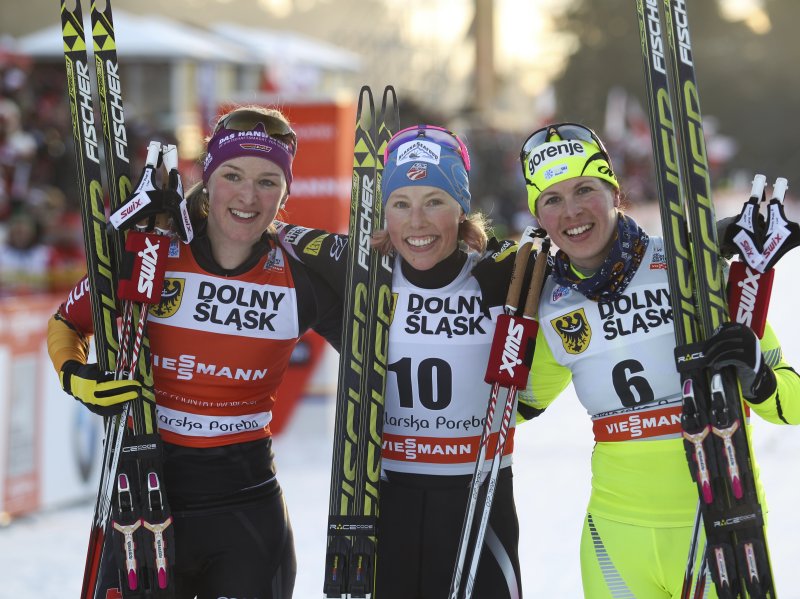
Women’s 1.5 k freestyle sprint podium at Saturday’s Szlarkska Poreba World Cup in Poland: winner Kikkan Randall (c), Germany’s Denise Herrmann (l) in second, and Slovenia’s Vesna Fabjan in third. (Photo: Fischer/Nordic Focus)
“[Denise] was keeping the pace at a pretty high rate so that was good to power over the top,” Randall explained. “As we came out into the main flat part again I was able to use the draft and then work out to the side and work really hard to get in front of her before we got to that last downhill.”
Heading into the final turn, Randall made sure she was ahead. She had waited longer than usual to make her break, but it ended up working to her favor as she extended her lead on Herrmann into the final straightaway and won by 0.25 seconds in 3:06.89.
“I was happy to find a lot of good feelings and a lot of power left in my legs on that finish stretch,” Randall said after notching her ninth-consecutive freestyle sprint podium.
She threw her arms up in celebration, acknowledging the Polish crowd that cheered for her as if she was one of their own, not realizing what happened behind her.
Diggins, who had tucked behind Randall in third on the long descent, fell victim to a slip-up by Switzerland’s Laurien van der Graaff. With van der Graaff leading her into the last turn, Diggins explained in an email that van der Graaff went left while she tried to go right, then fell in front of her.
Jessie Diggins (l) tumbling headfirst over Switzerland’s Laurien van der Graaff, who fell right in front of her on the last turn of the women’s 1.5 k freestyle sprint final at the World Cup in Szklarska Poreba, Poland. (Photo: FIS Cross Country/Instagram)
“I pitched forward over her and got up as fast as I could but lost the pack,” Diggins wrote. “While that’s of course a little heartbreaking since I had been in third and was feeling great, that’s sprint racing and I’m happy knowing I can do better!”
Qualifying in eighth then winning her quarterfinal — the fastest of the day — by 0.64 seconds over Herrmann, Diggins advanced to the final as a lucky loser. She placed third in her semifinal behind Slovenia’s Vesna Fabjan and Poland’s lone skier to advance out of the quarterfinals, Sylwia Jaskowiec, who posted the second-fastest qualifier time.
All three made it to the final, where Fabjan avoided the late crash to place third, 1.10 seconds behind Randall, and Jaskowiec skied up to fourth (+1.42).
Diggins ended up fifth, 6.99 seconds after Randall, and van der Graaff recovered slowly, finishing 18.97 seconds later in sixth. For Diggins, it was a careest-best sprint result and a good indicator after rebounding from an illness. Friday marked her first intensity workout since the Tour de Ski ended nearly two weeks ago, and she wrote that she was nervous coming into Saturday’s race.
“But I was feeling great all day, my skis were silly fast and the course really played to my strengths — gradual workable downhills are my jam!” she wrote. “I am so proud of the team for skiing so well and the techs for nailing it, and I was so excited to get a sprinting PR!”
“Jessie had podium capabilities out there today,” Whitcomb said. “The performance was unbelievable.”
“My skis were silly fast and the course really played to my strengths — gradual workable downhills are my jam!” — Jessie Diggins, fifth
With two women in the final, the U.S. had three in the top seven. Fourth in the qualifier after Herrmann in third, Sophie Caldwell won her quarterfinal and finished third in her semifinal behind Randall and van der Graaff, respectively, just 0.74 seconds out from automatically advancing for seventh overall.
Whitcomb was pleased with the team’s all-around success, with Ida Sargent nearly making the semifinals to finish 13th and Liz Stephen notching a career-best sprint result of 15th. While Stephen first qualified in a World Cup sprint stage at last season’s Tour de Ski, Saturday was the first time she had made the heats in an outright World Cup.
“I think she missed lucky loser by seven-one-hundredths of a second,” Whitcomb said.
Poland’s Justyna Kowalczyk, who qualified in 12th, and placed fourth in her quarterfinal (0.01 seconds behind American Liz Stephen in third) for 17th overall. (Photo: Fischer/Nordic Focus)
But she did edge Poland’s pride and joy, Justyna Kowalczyk, by one-hundredth of a second for third in the quarterfinal.
“It was exciting for sure, but the fans go absolutely hysterical for Kowalczyk and any Polish athlete,” Whitcomb explained. “But Kikkan is a close second to Kowalczyk in terms of popularity here; it’s pretty cool. The amount of noise that a group of 5,000 fans can make in a small crowded stand when they’re into it is incredible. The fans are some of the best.”
And why do they get behind Randall? “Probably the same reason everybody loves her, smiley, just a great ambassador to the sport,” Whitcomb said. “Kikkan runs right over to the crowd after the flower ceremony and chucks her flowers. She just connects with the crowd. She spends a ton of time signing autographs.”
Randall said the finish was incredibly loud, pushing her to give her all and never look back before securing the win. She was careful not to preemptively celebrate, remembering when Canadian Devon Kershaw capitalized on Russian Nikolay Morilov’s lackadaisical sprint finish two years ago.
“The Russian guy celebrated and Devon snuck through,” she recalled. “I was just totally focused on skiing as strong as I could until I got to that finish line and making sure I went all the way through.”
While a win is a win three weeks before the Olympics kick off in Sochi, Russia, Randall noted there were only 13 seeded athletes in the women’s race.
“When the Scandinavians aren’t here, that certainly takes a lot of top people out, but the nice thing was that the top end was still there,” she said, adding that she was grateful to have so many opportunities for skate sprints before the Olympics.
“Denise has been on the podium several times this season, Vesna has been on a lot of podiums in skate sprinting, Laurien was on the podium last weekend and we knew that there was going to be a lot of really good girls at the top end,” she added. “It is still a great competition, but it was great to see our team get in there and ski well through the rounds. It is good practice for us as we go on.”
As for a back injury she sustained nearly three weeks ago, Randall said it’s “doing great.”
“It was really smart for me to not do the team sprint last weekend because the sprint last weekend definitely put some pressure on me, but I was able to just keep moving forward,” she said. “Now it is in a really great place and I am looking forward to racing tomorrow.”
Noah Hoffman had plenty to overcome in today’s World Cup 15 k classic race in Szklarska Poreba, Poland.
First, there was the thing that bothered everyone: the snow, which was variable and caused plenty of problems for racers and wax techs on every team.
“I’m not sure that any team really feels like they truly nailed the wax or ski preparation,” U.S. Ski Team coach Matt Whitcomb said in an interview. “Variable conditions throughout the course, snowing at night, some dry sections, lots of glazing. Very moist, moist snow. The klister seems to ice, and the hairies seem to not quite kick enough, and it was a challenging day.”
At least that was a challenge for the whole field, though. Hoffman also had to deal with depleted energy stores after getting hit by two different stomach bugs in the last few weeks.
“I felt good but not great out there today,” Hoffman told FasterSkier after placing 31st, his second-best classic performance on the World Cup.
His effort led the U.S. team, which was missing Kris Freeman due to the same stomach ailment. None of the three starters were thrilled with their performances, but they weren’t despondent, either – it was simply a run of the mill day in touch conditions.
Hoffman, Andy Newell, and Sylvan Ellefson had different experiences with their klister cover. While Hoffman said that he thought his skis were “among the best out there,” Newell’s boards slowed him down significantly and contributed to his 50th-place finish.
“My skis were working great on the first lap, then a little bit sticky on the second, and then a lot sticky on the third,” Newell told FasterSkir. “I think what happened was just that our cover wore off a little bit, and made it so the klister started picking up more snow in the uphill. After I iced badly on the big climb on the last lap, I lost about 45 seconds in the last few kilometers.”
Ellefson had the same experience.
“At the bottom of the course my skis were slick and at the top were icing a bit,” he said. “It was foggy and sat right around the 0º Celsius mark all day. On the second lap my skis iced pretty well, immediately after I finally cleared the ice.”
Hoffman, however, at least wasn’t held back by his skis.
“My skis had great kick and were fast other than a couple times when they iced a small amount,” he said. “The techs did a great job on a tricky day.”
Hoffman was in 20th place at the three-kilometer mark, before gradually fading out of the World Cup points.
“I was pleased with my race, but I’m looking to take another step in the coming weeks,” he said. “I have had several results at this level of racing in the 25 to 35 place range. I think I can do better before the season is out.”
Whitcomb explained that Hoffman had been aiming for the top 20, but was impressed that given his recent health issues he had been “in the mix” at a top international competition.
“He looked great, and really made the skis work in challenging conditions,” the coach said. “I can only imagine what it would have been like had his health been about him for the last couple of weeks.”
Hoffman said he was looking forward to Under-23 World Championships, where he’ll be headed next; the same race will be held there on Thursday, and he had confidence after today’s effort.
Whitcomb had confidence, too.
“Nobody works harder on technique than Hoffman, and it’s paying off in a big way,” the coach said of his athlete. “His technique progress and his fitness are coming together right now, and it’s making big things happen.”
Like Hoffman, Newell had bigger goals for the 15 k, saying that his “goal for any distance race is to be in the points.” Outside of the wax issues, he wasn’t sure if he had started out too skiing too hard.
“I tried to not go out super fast because there was a massive climb out there, but at the same time put myself in a position fight for a top 30,” Newell said. “I was something like 29th first lap, 37th second, and then fell back a lot in the last few kilometers. I don’t know if I should start more conservatively or not, but that’s just how I am I guess… I went out today skiing on pace for points it just didn’t work out in the end.”
Newell ended up catching Ellefson, who started a minute ahead of him, and the two skied together for the later part of the race. Ellefson, however, was able to speed up in the last loop, while Newell slowed down; he finished 56th, only 23 seconds slower than Newell.
“I felt the best I have on the trip so far, so it was a super good race for me going into the fourth period,” said Ellefson, who as the continental cup leader has only been racing on the World Cup for the last several weeks.
Aside from the wax issues, he said that he was still getting used to the courses and the level of competition in Europe.
“My experience racing over here has shown me much more difficult courses than I am used to in the U.S.,” he said. “To do an A-climb followed by a slight uphill and then another A-climb is nothing you come across too often in the U.S.”
For instance, Ellefson and Hoffman had several comparable results at this year’s U.S. National Championships; in the 15 k skate there, which is traditionally Hoffman’s stronger discipline, Ellefson placed third and Hoffman fourth after Hoffman misjudged his pacing. Ellefson was only just over two minutes behind Hoffman when he dominated the 30 k classic race, a fairly similar margin to the one separating them in the 15 k on Sunday.
Skis obviously make a difference, but so too, Ellefson implied, does experience on this circuit, where Hoffman has been racing for two seasons now.
“Obviously results are not exactly where I want them, but the experience over on this circuit is invaluable,” Ellefson said of his racing so far. “To just be surrounded by such a different degree of competition has been extremely important to my development as a skier. I wish I could have had this exposure to international racing at a much younger age sometimes.”
Another thing U.S. skiers don’t get exposed to? Rabid fans at ski races. The enthusiasm of the spectators was something new for Ellefson, and he loved every minute of it.
“The crowds here are insane,” he said. “Pretty much everywhere there was a crowd today there was someone yelling my name, ‘SYL-VAN, SYL-VAN, SYL-VAN, SYL-VAN, SYL-VAN!!!’ Amazing.”
From here, Ellefson and Newell will travel to Davos with Freeman and train for the final period of World Cup competion. Whitcomb said that he expected good performances to come from Freeman, whose decision not to race today came after taking the long view on the season.
“A couple days ago it was looking like he was getting back on his feet,” Whitcomb said. “This was more of a conservative move, to try to save what has started to turn into a positive season. We wanted to make sure we didn’t burn a race before it was the right time.”
While Freeman will be looking forward to racing at all, Ellefson has one big thing on his radar screen: Oslo.
“I’m super psyched to be racing the Holmenkollen in Oslo,” he said. “Can’t wait for that.”
After mounting an improbable comeback to finish third in Saturday’s sprint final in Szklarska Poreba, Poland, Kikkan Randall turned in another strong showing on Sunday, placing eighth in the 10 k classic race. It was her eighth distance top-ten of the season, counting tour stages, and one of the best classic results of her career.
Teammate Ida Sargent also had a personal best, scoring World Cup distance points for the first time after placing 26th.
“It was awesome,” U.S. Ski Team coach Matt Whitcomb said of the ladies’ performances.
Coming into the weekend, Randall had missed the previous three races due to illness. She said it was “always great to see her teammates succeeding,” for example by placing fifth in the relay in Nove Mesto, Czech Republic without her, but Randall had been frustrated not to be able to compete.
“I’m always excited to get to race,” she said in an interview after the 10 k today. “I was really happy with third place yesterday, and wanted to see what I could do in a distance race.”
While Randall herself was diplomatic, Whitcomb had a more off-the-cuff assessment of what the forced rest had done for the U.S. star’s motivation.
“Oh yeah, Kikkan does not like missing out on races, and she entered this weekend very hungry,” he told FasterSkier.
It took all of the hunger she had to work her way through the race’s two laps, which featured highly variable conditions. Some teams chose hairies or zeroes, with others opting for klister or klister cover. Randall described snow that was slick and hard-packed, humid in some areas and dry in others. Nobody, she said, had perfect skis.
Randall hovered in sixth or seventh position for most of the race. While the top four racers were separated by wide margins, things got very tight after that. Randall ended up half a second out of seventh and seven seconds out of fifth.
“She was fighting super, super hard the whole way, so it was great to see her back in top form,” Whitcomb said.
Sargent said that her zeroes worked well on the first lap, but by the time she started the second, they had stopped being as effective. Amazingly, though, she didn’t lost many places even after her skis took a turn for the worse.
“It was really hard,” she said of the race. “I was herringboning a lot on the second lap, but I think a lot of people were in the same situation.”
Sargent, whose best World Cup finish was 12th place in a sprint in Moscow, missed the heats in Saturday’s sprint, which she said added fuel to the first for the distance race. Even though some of her best results have come in sprints, Sargent had bolstered her confidence by turning in a strong classic leg in the relay in Nove Mesto last week.
“The relay in Nove Mesto was really good for me, and I was just hoping that I could extend that energy over 10 k instead of just 5 k,” she wrote in an e-mail. “Pacing strategies never work for me, so I just started out hard and tried to keep going. I got a split that I was 21st after the first lap, which was awesome for me, but the second lap was tough so I was just trying to hold it together and not lose too much time.”
Liz Stephen placed 38th, after skiing in the low 20’s for the first lap.
“Liz skied a good first lap, and then sort of faded off and wasn’t able to tie it together for the entire race today,” Whitcomb said. “But she definitely wasn’t bummed, it was just a tough day for her.”
The U.S. World Cup squad was smaller today, with just three women starting. Holly Brooks is back in Alaska, while Jessie Diggins and Sadie Bjornsen have headed off to Under-23 World Championships. A big part of the U.S. success, the women have said, is the energy of the group and the fact that with so many starters, someone will have a great race every day.
So were they worried that they’d have a hard time maintaining that momentum with a smaller squad?
“Not really,” Randall said. “That’s pretty much how it always is, with people coming and going.”
From here, the senior racers will head into a training block since next weekend is a break from World Cup racing. Randall said she was looking forward to training, and to returning to Davos, where the U.S. team has spent plenty of time this season.
Today, the Americans didn’t need as much motivation from each other because the spectators did more than enough to make up for it.
“The fans were crazy here,” Sargent wrote. “They were lining the giant hill on the course (almost one kilometer long) and chanting my name as I skied by. They also don’t like Norway so I got a lot of cheering when I was skiing with Astrid [Jacobsen]. Then it was a mob scene getting from the finish area back to the wax cabin because so many people wanted pictures and autographs. I’m sure most of them didn’t know who I was, but it was still fun.”
Randall agreed, saying that she had plenty of support from the sidelines.
And while this was a new venue for most World Cup races, Randall had an advantage in that she’d raced on the trails before.
“I was actually here for World Juniors back in 2001, so I kind of knew the area,” she said.
And as another racer from a country on the outskirts of skiing’s mainstream, Randall said that she appreciated that FIS was sending the World Cup to new venues.
“I think it’s really great for the sport in Poland,” she said. “It’s good to reward the fans who have been so excited about Justyna [Kowalczyk]. I’m sure the same thing would happen if the World Cup came to the U.S., that it would build support that would last even after the event.”
Johan Olsson (SWE) on his way to victory in the men's 15km classic in Szklarska Poreba (POL). Photo: Fischer/Nordic Focus.
It isn’t all that common, these days, to see Johan Olsson on the World Cup.
After a strong start to this season, Olsson took a two-month forced hiatus due to illness. Last year, after the November World Cups he didn’t return to the top level of competition until World Championships in March. In 2010, he skipped the entire month of January to prepare for the Olympics. Injury and illness are sadly par for the course for the tall Swede, who is just a month shy of his 32nd birthday.
But when Olsson does show up, he gets noticed.
In Szklarska Poreba, Poland on Sunday, Olsson picked up his third win of this World Cup season in just five individual starts, leading from the very first time check through the finish of the 15 k classic individual-start race.
Olsson’s victory came in challenging conditions: kickwax was far from straightforward, and athletes’ skis seemed to be either slipping or icing. Some racers ended up herringboning even the more moderate hills on the course, unable to make their skis do the work for them.
“Conditions were very tough as you can win or lose everything,” Olsson explained. “You can lose a lot of time if you do not have the right skis.”
That wasn’t a problem for the Swede, however.
“I had extraordinary skis,” he told FIS after the race. “It was really difficult before the start and I waited as long as I could to pick skis, but I made the right decision and I’m very happy about that.”
Olsson has now won his last two races, both of which were long, classic affairs; in Nove Mesto, Czech Republic last week, he squeaked out a victory in a 30 k mass start.
“It feels really, really great today, just like last week,” Olsson said after the race.
Dario Cologna strides his way to second in Szklarska Poreba (POL). Photo: Fischer/Nordic Focus.
Second place went to Dario Cologna of Switzerland, who maintained his huge lead in the overall World Cup standings but was unable to touch Olsson today. Cologna also finished second to Olsson a week ago in the Czech Republic, but today the margin of victory was larger, due partly to the interval start. Both skiers showed even pacing; halfway through the race, they were separated by ten seconds, and at the finish the gap was 19.
“I tried to fight a lot but there was always a ten-second margin,” Cologna said after the race.
Russians Alexander Legkov and Ilia Chernousov were third and fourth almost a minute behind Olsson. The pair trains on their own under the guidance of Reto Burgermeister, and their joint success today – the next Russian, Maxim Vylegzhanin, was 50 seconds behind them in 13th place – may make the Russian federation more sympathetic to their cause.
Then again, it might not. In 1947, the Russians convened a meeting of Soviet governments in Szklarska Poreba to decry the Mashall plan, which they described as “the American plan for the enslavement of Europe.” There’s a certain irony that here at the same venue, their most successful skiers were a pair of Russians who train mainly in Switzerland with a Swiss coach and support staff.
But regardless of what the federation thinks, the two racers were giddy with their success. Legkov may have beaten his teammate, but he noted that the day was truly a success for both of them.
“Ilia is my friend and I am happy for his good result,” he said. “We will divide the prize money.”
All of the top finishers praised the Szklaska Poreba venue, which is new to the World Cup circuit. Olsson, for example, said that the change of scenery was refreshing – and that even though the culture is vastly different than his native Sweden, he heard fans screaming his name as he skied past.
“When you’re in the World Cup circus for ten years as I am, it’s fun to come to a new location,” he said. “The courses here are really good, too, as is the audience.”
Cologna agreed, and thought that the races would bolster the sport’s fanbase, which has been fueled by Justyna Kowalczyk’s success.
“It is good to have World Cup in Poland, as cross-country skiing is very popular,” he told FIS. “I like to be competing here. The fans were great and were cheering on everybody.”
Of note:
-Alexey Poltoranin of Kazakhstan finished sixth, collecting his first top-ten result since December. It was a good day for the Kazakhs: teammate Sergey Cherepanov finished 11th, the first top-20 result of his World Cup career.
-Germany’s Franz Goering finished eighth, representing his first top-ten finish in over a year. He last made the cut in Rybinsk, Russia in February 2011.
-The top Pole was 31-year-old Maciej Kreczmer, who placed 58th, over four minutes behind Olsson.
-Cologna was the only one of the top-ranked World Cup racers to have a strong race. Second-place Petter Northug did not compete, while third-place Devon Kershaw placed 26th and fourth-place Marcus Hellner 21st.
Men's 15km classic podium in Szklarska Poreba (POL): Dario Cologna (SUI, 2nd place – left), Johan Olsson (SWE, 1st place – middle) and Alexander Legkov (RUS, 3rd place – right). Photo: Fischer/Nordic Focus.
Randall lunging for the line at the Milan World Cup freestyle sprints in mid January.
When it comes down to it: health matters. That’s what Kikkan Randall and her coach at Alaska Pacific University, Erik Flora, reasoned when the U.S. Ski Team veteran decided to sit out a few races nearly two weeks ago.
After feeling slightly rundown, Randall first skipped the 15 k freestyle mass start on Feb. 4 in Rybinsk, Russia. She pulled through the 15 k skiathlon the next day, but came down with a cold shortly after.
Last weekend, Randall missed both races after originally planning to ski the relay.
“Even though I really wanted to race the relay and had been looking forward to it all season, I felt I had to play it safe and make sure I was fully recovered for the Poland races,” she wrote in an email.
On Friday, Randall needs to compete in Szklarska Poreba, Poland, if she wants to continue leading the World Cup sprint standings. Not only are the freestyle sprints the last of their kind this season, there wasn’t much room between those at the top of the standings.
She led Russian Natalia Matveeva by 109 points heading into Friday’s sprints. Justyna Kowalczyk of Poland was about 40 additional points back in third.
“Racing fast this weekend will help me hold on to my lead in the sprint cup and will also be good to pull myself out of the rough patch I’ve had the last few weeks,” Randall wrote. “I know my fitness is still there.”
Flora knew it, too. In an email, he wrote that this wasn’t the time of year to be “building fitness” anyway. With all of the racing she did this year, which was more than normal, Randall was mostly trying to find a balance after initially chasing both the overall World Cup and sprint titles.
“It has been important to focus with the goal of being healthy first,” Flora wrote. “This unfortunately impacted the overall. This is always a difficult decision, but important, when you consider the long-term impacts on a career. If she is healthy now, she will be even stronger in the future!”
In the overall rankings, Randall was fifth, 22 points behind Charlotte Kalla (SWE) in fourth. She trailed leader Marit Bjørgen (NOR) by more than 800 points.
“We looked at this season as an experiment, try racing a lot and see what happens,” Randall wrote. “We knew there would be a potential to have some low periods, especially in the middle of the season. So it’s not a surprise that I’ve been sick a few times. I’ve done a lot of racing, and without the ability to be at home in between races, it’s a big load physically and mentally. I’m definitely learning a lot.”
Randall explained she skied easily in preparation for Friday’s sprints and Saturday’s 10 k classic race.
“She is stronger now than last week,” Flora wrote.
There were few participants in the Tour de Ski who were still standing after the finish of that race’s final stage, the brutal ascent up the Alpe Cermis in Italy. But an even more difficult challenge may await those athletes next season: the inaugural Uphill Trophy, a new competition format tentatively slotted into the World Cup calendar in Poland next February.
The race packs a whopping 500 meters of climbing into its first four kilometers—nearly 100 more than the ascent of the Alpe. But reach the top, and you’re only halfway done: there’s still 500 vertical meters of descending, over the same distance, back to the finish.
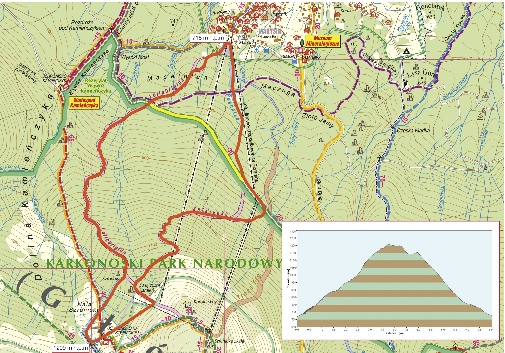
The map and course profile of the proposed Uphill Trophy course in Poland.
While most ski fans worldwide were paying attention the 2011 World Championships in Oslo two weekends ago, a handful of athletes and organizers were hard at work 650 miles away, in the Polish resort town of Szklarska Poreba. They were taking part in one of two test events for next year’s Uphill Trophy race—the guinea pigs for an event that could see stars like Marit Bjoergen and Justyna Kowalczyk taking part next season.
The Uphill Trophy isn’t a done deal yet—another trial run will take place later in the season, and the idea still must be approved by FIS’s cross-country committee in a meeting in June. But despite drawing some criticism from purists in the fall, the format is beginning to crystallize.
“I hope that the idea will be good for the sport,” said Jürg Capol, the cross-country race director for the International Ski Federation (FIS), in an interview.
Capol, a former Swiss national team member, scouted the race trails for the Uphill Trophy in a visit to Szklarska Poreba in January.
In total, the course is eight kilometers long, half of it climbing, and half of it descending, with a little bit of rolling terrain at the top. The uphill, Capol said, is less steep than the one at the Tour de Ski, while the descent is also manageable.
“It’s not a black track,” Capol said. “It’s a blue track, which I would not say is a problem. When I skied, I came down [easily].”
In October, Capol had said that the downhill might include giant slalom-style gates for skiers to navigate through. But after skiing the course, he said that they would only be necessary in the first part of the descent.
“Two thirds of the downhill…is in the forest, and it’s maybe 20 meters wide,” Capol said. “So you don’t need a lot of gates, because you follow the natural way.”
The top part, though, could include a few. And the skiers would have to go through them, Capol said.
“You have to follow the course,” he said. Miss a gate? “Then you are out. Or you have to go back.”
Retracing your steps for 15 seconds to get around a gate, Capol added, wouldn’t be as much of a death sentence in cross-country as in alpine skiing, where runs can be over as quickly as a minute.
In the test race, the winning time for the men was just under 28 minutes. Forty-three skiers took part, among them Polish national team member Mariusz Michalek, who raced the Tour de Ski in January and placed 25th of 36 starters in the ascent of the Alpe Cermis.
In the trial run, Michalek crashed on the descent and fell behind the eventual winner, Radek Sretr. Michalek ultimately finishing in third place, nearly two minutes back, and afterwards, a press release from the organizers quoted him as saying that the Uphill Trophy was tougher than the climb up the Alpe Cermis.
Capol, one of the architects of the Tour de Ski, said that his hope is that the Uphill Trophy will be another “angle” for the sport, another “story to sell”—especially in next year’s calendar, which lacks a World Championships or an Olympics.
He said that the race had the potential to make for “very good” TV, though that’s not guaranteed.
“It’s [an] investment that the Polish TV has to do,” he said. “Of course, if you have the right tools to film it, and enough cameras over there, then it can be really interesting.”
If the Uphill Trophy is indeed approved by FIS’s cross-country committee in June, the event will go off in the middle of next February—with the potential for extra prize money to be awarded, or other small changes to give the race “special status,” Capol said.
If the Uphill Trophy is rejected, World Cup races will still be held in Poland on the same weekend, on homologated courses a few kilometers away.
Moscow Sprint
Capol also said that he had also made a site visit to the Red Square in Moscow, where FIS hopes to hold a sprint race next season.
The test event for that sprint was held in early February, at a Moscow amusement park called Gorky Park, but Capol said that the Red Square is still his first priority.
According to Capol, the biggest challenge in holding a race on that site is logistical—a few years ago, he said, the Red Square hosted an event for snowmobiles that was noisy and resulted in damage, leaving officials wary.
“They’re not that open,” he said.
Capol said that the proposal for the race has been presented to the appropriate officials, and that the Russian Ski Federation is on the case. A decision on the Moscow sprint will also come after the June FIS meetings.
As for the terrain? A sprint on the Red Square would be no Uphill Trophy, that’s for sure: Capol said that the event would be mostly flat. But there’s still one slight uphill, he said, that would be “great [on] this course.”
OSLO, NORWAY – The International Ski Federation (FIS) wants to introduce yet another race format on the cross-country World Cup. In February 2012, racers might face a 10K event in Szklarska Poreba (POL) where the first part of the race is a pure uphill climb while the second half of the race is a descent down an alpine run.
“We think this race format can be an exciting addition during a season with no major international events in cross-country,” Vegard Ulvang, chair of the FIS cross-country committee, told the Norwegian newspaper Nettavisen.
The suggestion was first proposed during the FIS fall conference earlier this month. Nettavisen surveyed the sentiment among Norwegian elite racers, and the verdict is crushing.
“What? Are they adding moguls and big-jumps too? This is the biggest B.S. I’ve heard in a long time. There’s a reason we’re cross-country skiers, not alpine racers,” said a clearly-agitated Eldar Roenning. “FIS has got to start listening to the athletes. I really wonder what Vegard Ulvang would have said if these kinds of race formats had been introduced while he was racing,” Roenning continued.
Martin Johnsrud Sundby didn’t know whether to consider the idea a serious suggestion.
“I’m not even sure I’m going to waste my energy commenting on that. Why don’t they add whoop-de-doos and moguls while they’re at it, and maybe finish with a big air jump and style points too,” Johnsrud Sundby told Nettavisen, and continued: “Ski cross has already been invented, could you mention that to Ulvang?”
“That doesn’t sound serious,” Simen Oestensen said. He doesn’t know what to think of the suggestion. “As a part of the World Cup it sounds a little too far out, if you know what I mean. It would be different if it were just a spectator entertainment event at the very end of the season,” he said.
Oestensen said he thought the limit for new formats has been achieved in cross-country skiing.
“It’s a little risky to invent and introduce too many new race formats at once. The veterans who already think there are too few 50 k events will hardly be amused and excited by this,” Oestensen commented.
Oeystein Pettersen was also not ecstatic.
“I suppose it’s good that they are interested in developing the product, but I think we’re good on race formats for a while now. I think the FIS needs to look at the possibilities in marketing the actual events, so that they appeal to a broader range of spectators,” Pettersen said.
“Just look at the city sprint and how popular those are. Spectators get more from these events in terms of live music, concessions and vendor booths. There’s nothing wrong with the current race formats, it’s the marketing and presentation of the events that need help,” he said. “People who want to watch downhill racing buy tickets to alpine events.”
The proposed competition format will be tested at a lower level this coming season. The experiences and evaluations from those test races will determine if the rather bizarre event will end up on the World Cup schedule.
From Nettavisen.no, October 8, 2010. By Anders Skjerdingstad, translation by Inge Scheve
Justyna Kowalczyk navigates a descent in the sprint at the 2010 Olympic Games.
So much for Justyna Kowalczyk’s home-field advantage.
For the first time in her career, the International Ski Federation (FIS) has scheduled World Cup races in Kowalczyk’s native Poland, in February of 2012. But if officials at FIS have their way, Kowalczyk, a notoriously poor descender, will have to successfully navigate five kilometers of technical downhill before she can step onto the podium there.
According to FIS Cross-Country Race Director Jürg Capol, a federation committee discussed a new type of event last weekend at its fall meetings in Switzerland: five kilometers of uphill, followed by five kilometers of technical descending—perhaps even including slalom-style gates. A test race is in the works for this coming spring, after which FIS will decide whether or not to introduce the format at the Polish World Cup in 2012.
In an interview, Capol said that the idea for the race grew out of the federation’s desire to inject some excitement into the sport during the lull that typically follows the Tour de Ski—especially in 2012, a year without an Olympic Games or World Championships.
“We would like to have a kind of story here, [in] the second part of the season,” Capol said, adding that he was looking for something that would be “appetizing for fans.”
The course, he said, is distinct from the climb that ends the Tour de Ski, on Italy’s Alpe Cermis: It’s not as steep, and of course, it includes the descent.
“It would be kind of a Super-G—some gates…to reduce the speed a little bit,” Capol said, referring to the alpine skiing discipline of the super-giant slalom. “It should be a part of the game, the downhill.”
While it’s fast for cross-country skiing, Capol maintained that the descent was tame by alpine standards. And according to U.S. Ski and Snowboard
Ivan Babikov, pictured here in last year's SuperTour Finals in Fort Kent, excels in uphill climbs. The event proposed for the World Cup in Poland could suit him – as long as he can stay on his feet on the downhill.
Association (USSA) Nordic Director John Farra, who attended the meetings in Switzerland, the total amount of climbing in the course—504 meters—isn’t much more than is included in a typical 10-kilometer race. FIS-sanctioned competitions of that distance normally include between 250 and 420 meters of uphill.
“It’s a subtle shift, and I think there’s a true desire…for being open to different formats, being open to different concepts,” Farra said.
Indeed, Capol and FIS Cross-Country Committee Chair Vegard Ulvang have been credited with the success of several new fan-friendly formats and rules introduced on the World Cup circuit over the past few years. But earlier this year, a number of athletes criticized the federation for abdicating tradition and taking those innovations too far—especially when the individual-start 50-kilometer race, an event with a rich history, was left off the calendar for the 2010-2011 season.
Capol acknowledged those concerns, and he noted that the individual-start 50-kilometer would return next year.
“All stakeholders are important, and of course, athletes are the main stakeholders, because they are doing the show—they are the gladiators,” he said. “Of course, we try to integrate those inputs.”
However, Capol said that he had not yet consulted athletes about the proposed new format; he maintained that soliciting too much feedback in the planning stages could stymie the sport’s growth. “We’re still in the stages of the idea,” he said.
Before that idea can come to fruition, Szklarska Poręba will have to hold the test race, which Capol said he would like to schedule for the end of the season, in late March or early April. Ideally, he said, a few World Cup athletes would be able to take part.
A positive test would likely pave the way for the World Cup in 2012, though that decision would not be made until next spring’s FIS meetings. If there are problems, Capol said, the Polish races would simply revert to standard formats, held on courses nearby.
Meanwhile, Kowalczyk will have to work on her technique. She lost her lead in the Olympic sprint final to Norway’s Marit Bjoergen on the last downhill corner, and at a race later that year, she admitted that her descending could use some work.