From the FasterSkier archive — posts syndicated from athletes’ and coaches’ own blogs between 2004 and 2012, kept online as published. Current coverage is at fasterskier.com.
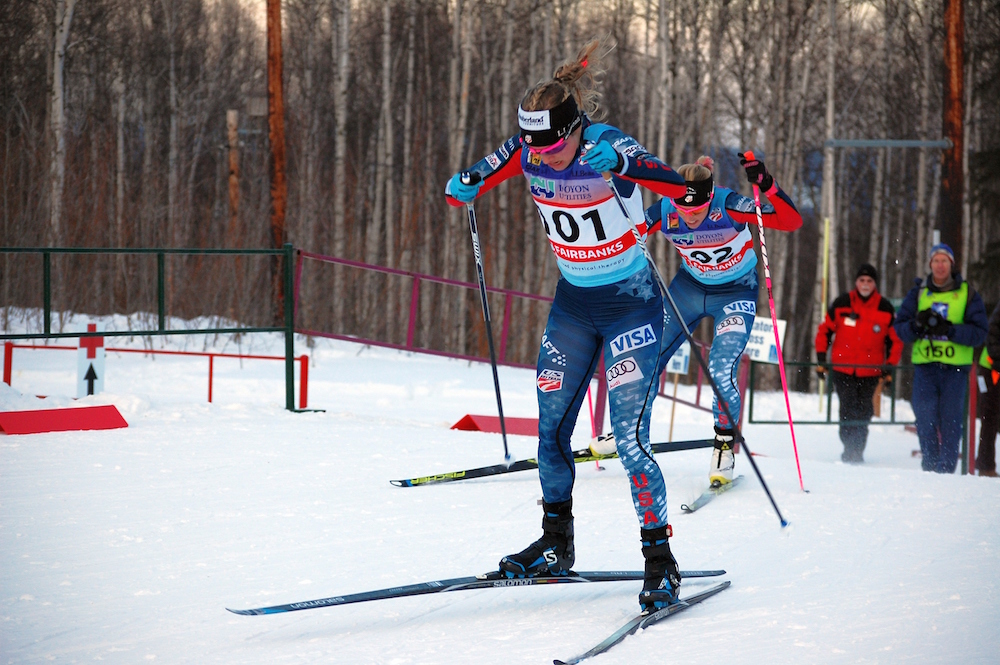
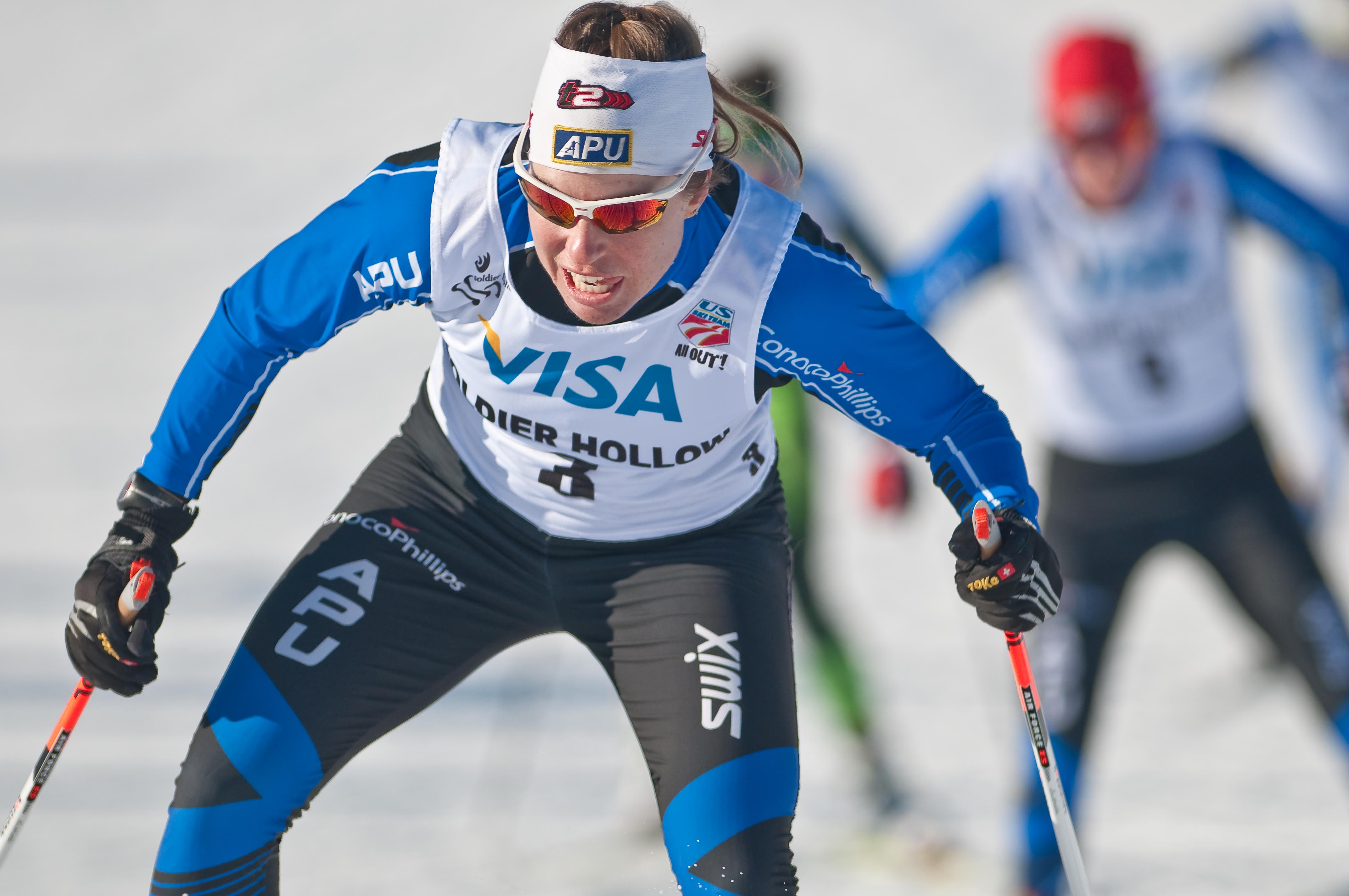
Jessie Diggins (SMS Elite) leads fellow U.S. Ski Team member Kikkan Randall (APU) to the finish of the women’s freestyle sprint final on Wednesday at SuperTour Finals in Fairbanks, Alaska. (Photo: Max Kaufman)
U.S. SuperTour Finals (Fairbanks, Alaska): Freestyle sprints
On Wednesday the 2017 U.S. SuperTour Finals, also referred to as Spring Series, the last of the year’s elite level sprints went down in Fairbanks, Alaska.
The women raced a 1.5-kilometer course while the men skied a slightly longer 1.6 k course, both run at the Birch Hill Recreation Area in Fairbanks.
Earlier in the week, Jessie Diggins of the Stratton Mountain School (SMS) Elite Team and U.S. Ski Team (USST) showed why she’s one of the World Cup’s top overall skiers as she dominated the SuperTour Finals skiathlon.
Once again, and early on, Wednesday’s sprint had the appearance of another race to lose for Diggins. She qualified first, completing the course in 3:34.09 minutes. Her nearest competitor in qualification was Kikkan Randall of Alaska Pacific University (APU) and the USST, 6.72 seconds back.
As the heats progressed the looks of a Diggins-Randall show was in the makes. Both skiers were convincing in their trajectory to the finals as they placed first in their respective quarters and semis. And in the finals it became a two-skier race with the pair skiing decisively off the front.
Diggins scorched the finals, toeing the line in 3:30.39 minutes, nearly four seconds faster than her qualifying time. Randall, who skied in a tight race with Diggins until the closing stretch, placed second (+2.39).
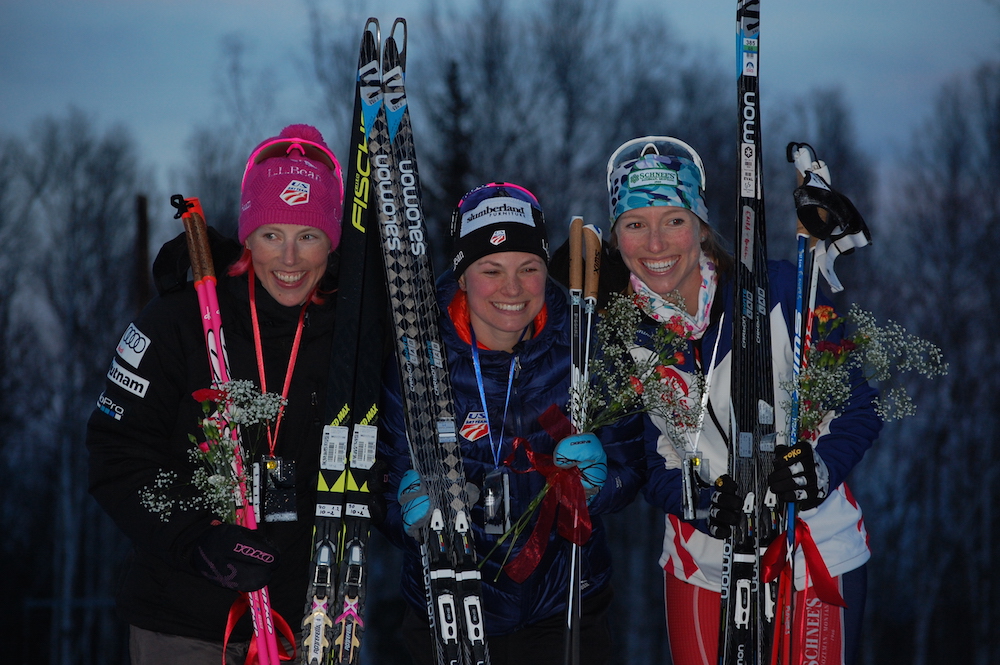
The women’s freestyle sprint podium at SuperTour Finals on Wednesday night in Fairbanks, Alaska, with Jessie Diggins (c) in first, Kikkan Randall (l) in second and Erika Flowers (r) in third. (Photo: Max Kaufman)
Erika Flowers (SMS Elite Team) reached the podium in third (+15.65), ahead of her teammate Sophie Caldwell (SMS Elite Team/USST) in fourth (+19.03), Kelsey Phinney (Sun Valley Ski Education Foundation) in fifth (+23.06), and Ida Sargent (Craftsbury Green Racing Project/USST) sixth (+27.77).
“I thought it was normal, given I set the pace, so I did it to myself,” Diggins said on the phone, recalling the final. “I thought it felt like a pretty normal, brutal World Cup final. I was going out hard, playing for keeps, that is what you do when it comes to Spring Series, you still have fun but you race hard.”
Asked is she felt any added pressure to perform well racing stateside, Diggins noted she attempts to keep things in perspective.
“There is some pressure and at the same time there’s not,” Diggins added. “Because my goals for the year focused around World Championships and the Tour de Ski, that is where I am aiming to be fast and those are the targets I am intending to hit. So coming here, you are always wanting to ski fast … I feel like there is not an incredible amount of pressure because it is the end of the season and everybody is in a totally different place and mentally I am super excited for that place flight to Hawaii I am going to be on the day after the races. I think everyone is in very different places and I think it’s not fair for us to put pressure on ourselves. I think we just go out and have fun and race hard. This isn’t how you qualify for the Olympics and there is good reason for that.”
SMS Elite Team Head Coach Pat O’Brien provided some insight into the large time gaps in the women’s final.
“Coarse was pretty long and hard, I think it plays to people with some more muscular endurance and less fast twitch, especially this late in the season when people are tired,” O’Brien wrote in an email. “This isn’t a 3 min sprint on manmade that prioritizes finishing speed like a European World Cup. It was just straight tough out there! … No falls, just a bunch of tired ladies slugging it out at 8PM at night near the arctic circle. Hard work by all!”
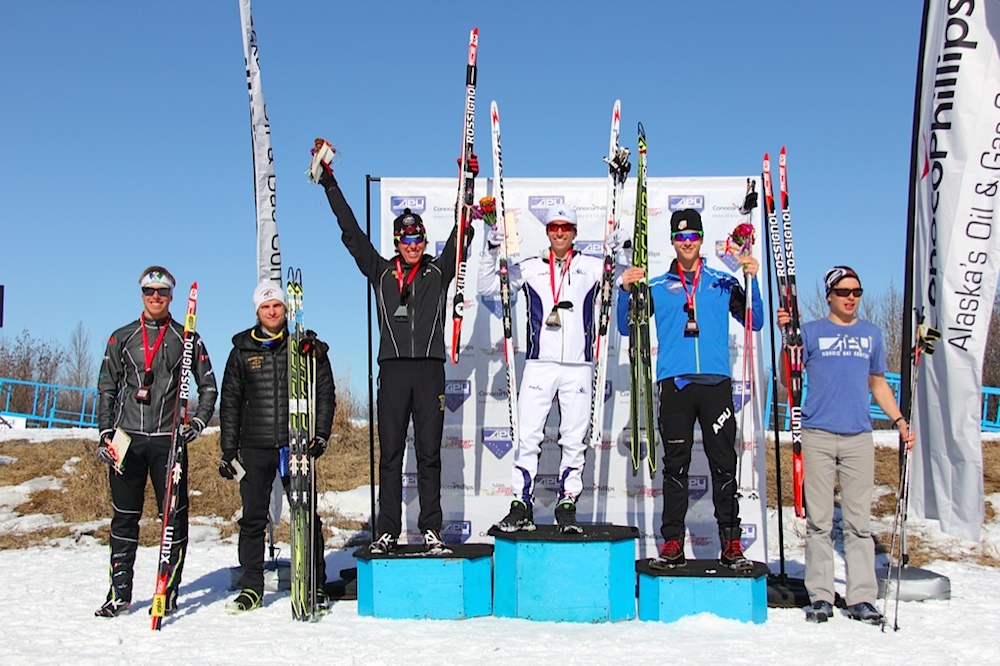
Local skier Logan Hanneman (APU), who grew up and attended college in Fairbanks, made the hometown proud. He eventually pulled out the win in the men’s final.
Hanneman qualified fourth (+6.27) behind Simi Hamilton (SMS Elite Team/USST) who topped the qualifier in 3:11.35 minutes. (After the qualifier Hamilton pulled from the competition).
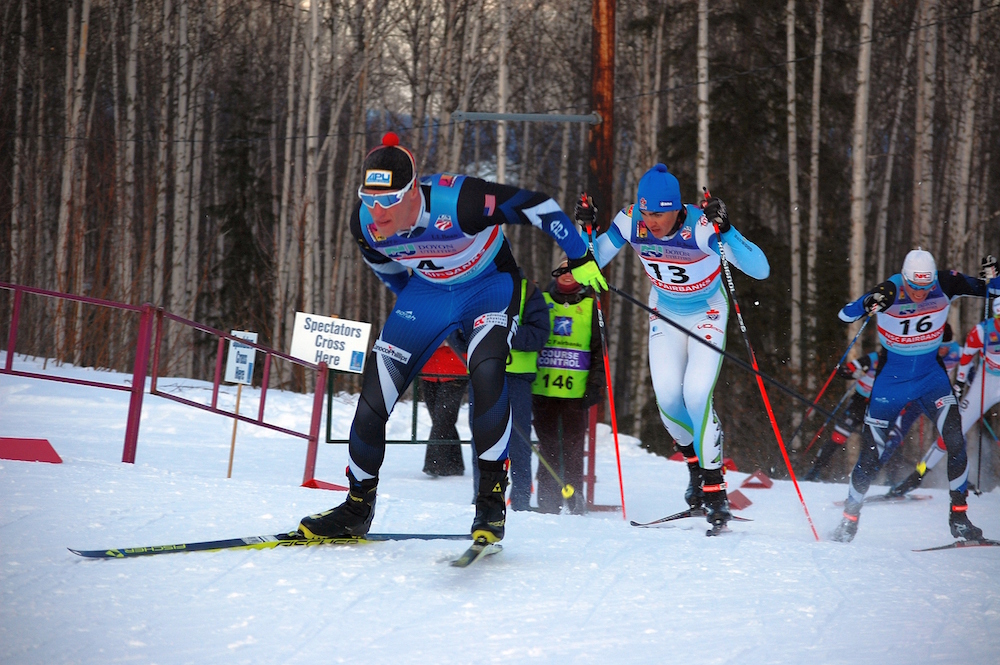
Logan Hanneman (APU) leads Canada’s Evan Palmer-Charrette (13) of NTDC Thunder Bay and Tyler Kornfield (16), his APU teammate, in the men’s freestyle sprint final on Wednesday at SuperTour Finals in Fairbanks, Alaska. (Photo: Max Kaufman)
In the men’s final, several skiers appeared to be in play for the win. Hanneman placed first in his quarter and semi. Canadian skier Evan Palmer-Charrette (NTDC Thunder Bay), also looked like a threat as he proved a knock-out type closer. Another guest skier, Norway’s Haakon Hjelstuen, a former Michigan Tech skier, skied heady and strong.
Also appearing in the men’s finals were two skiers who are known to pounce when opportunity knocks: Tyler Kornfield (APU) and Dakota Blackhorse-von Jess (Bend Endurance Academy). Tad Elliott (Ski & Snowboard Club Vail) completed the six-skier final.
Heading into the last technical descent on course Hanneman was third behind Kornfield and then Palmer-Charrette. A few tight corners remained with a climb back up to the finish.
“I ended up taking the last sweeping left corner very wide and accelerated as I moved right,” Hanneman explained in an email. “Then we were able to hit the bottom of the climb basically 3 abreast. Once I saw that I had a lane open I just opened it up and went for it!”
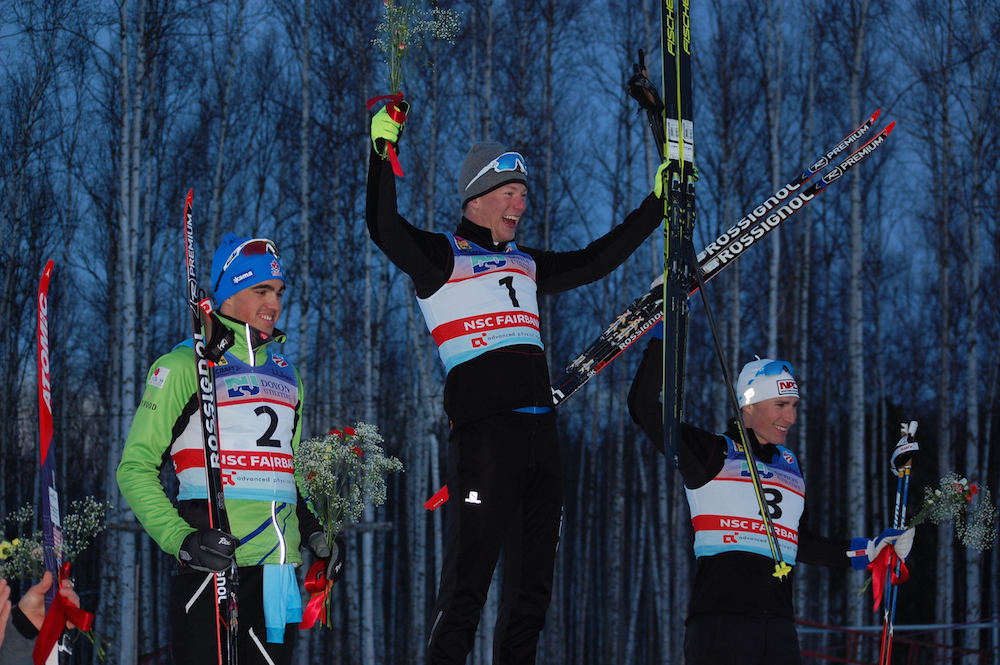
Here’s how the final played out: Hanneman placed first in 3:16.77 minutes, Palmer-Charrette was second (+1.08), Kornfield third (+3.84), Hjelstuen fourth (+3.98), Blackhorse-von Jess fifth (+6.38), and Elliott sixth (+7.17).
It appears Hanneman was able to channel his nervous energy into positive forward momentum.
“I definitely put a lot of pressure on myself to win this race,” Hanneman wrote of performing in front of his hometown crowd. “To have these races in my hometown is one thing, but then knowing that I could do well in the sprint added a lot of nerves to the equation. I definitely really wanted to perform well for the volunteers, the crowd, etc. they have supported me through all of the skiing programs here in Fairbanks for years and I really wanted to ski my best for them. I am so very happy that this is how it turned out!”
Hunter Wonders (APU) won the junior men’s sprint in 3:32.76 (he was also the winner of Monday’s 11.25 k classic) with a hard-charging final push, Max Donaldson (University of Alaska Fairbanks) placed second (+0.40) and Logan Mowry (Nordic Ski Club of Fairbanks/FXC) was third (+4.76).
For the junior women, Hannah Rudd (University of Alaska Anchorage) took the lead on the final climb and secured the win in 4:08.46, Dottie Anderson (Loppet Nordic Racing) placed second (+1.96) and Jenna Difolco (Nordic Ski Club of Fairbanks/FXC) was third (+7.64).
Racing continues Friday with a mixed gender/mixed technique relay.
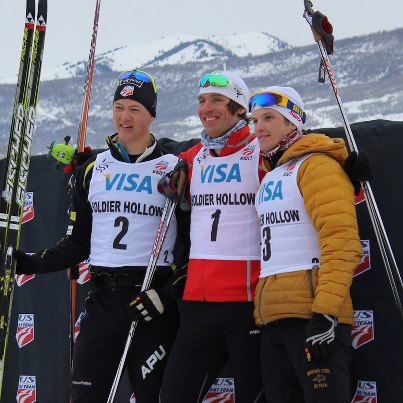
The men’s freestyle sprint podium on Wednesday night at SuperTour Finals in Fairbanks, Alaska, with Fairbanks native Logan Hanneman (c) in first, Canada’s Evan Palmer-Charrette (l) in second and Tyler Kornfield (r) in third. (Photo: Max Kaufman)
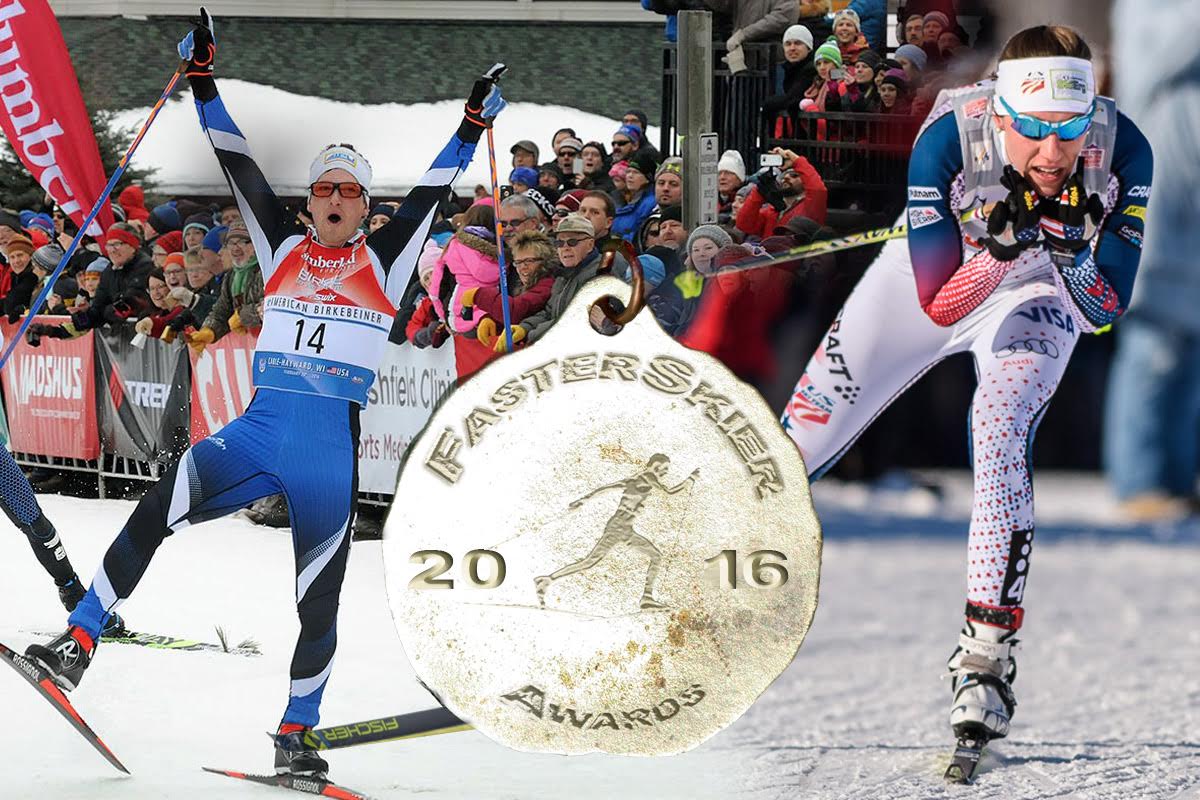
David Norris (l) and Kaitlynn Miller (r) are FasterSkier’s Breakthrough Skiers of the Year for the U.S. (Photos: Tom Kelly/USSA and Flying Point Road)
The 2015/2016 awards continue this week, chosen by the FasterSkier staff based on performances from last season. While not scientific, these points of recognition are intended to reflect a broader sense of the season in review.
American Breakthrough Skiers (Canadian award winners will follow)
Kaitlynn Miller, Craftsbury Green Racing Project
If Craftsbury’s Kaitlynn Miller had been told at the beginning of last season that she’d be spending some her last few races on the World Cup at the Ski Tour Canada (STC), she might not have believed them.
By the end of the 2016 season, Miller had pushed any doubt aside. The 24-year-old Elmore, Vt., native not only qualified for the STC in March, but also left 2016 U.S. nationals in January in Houghton, Mich., with a string of personal bests.
Prior to this year, she had never reached the podium at nationals. In her second season as a CGRP athlete, Miller podiumed twice in Houghton — first in the women’s 10 k classic individual start and again in the classic sprint — the latter of which she won for her first national title. She finished the week within the top 10 in every race. Last season, her best result at U.S. nationals was 13th in last year’s 20 k classic mass start.
“To come away from Nationals with two podium finishes, including a national championship, was incredibly exciting, a bit overwhelming, and definitely unexpected,” Miller wrote on her blog after nationals.
Kaitlynn Miller (front) on her way to 39th in the Ski Tour Canada women’s 10.5 k classic mass start, the second stage of the Tour, in Montreal, Quebec. She went on to place 41st overall in her first World Cup Tour. (Photo: Flyingpointroad.com/NNF)
Along with breakthrough performances in Houghton, Miller raced to her best-ever SuperTour result earlier last season in Sun Valley, Idaho, finishing second in a classic sprint in December.
She also finished sixth in the Sun Valley 10 k classic and second in another 10 k classic SuperTour race in Lake Placid N.Y., fifth in the 30 k classic at U.S. Distance Nationals in Craftsbury, Vt., and 41st in her first World Cup multi-stage tour.
“I’ve never raced a World Cup before, or even an international race for that matter (unless you count North American Midget Championships),” Miller blogged after the initial stages of the STC. “With each race I finish I have more confidence in myself and I’m very grateful to have this amazing opportunity to compete against the fastest women in the world.”
David Norris, Alaska Pacific University
Even after back-to-back victories in two SuperTour races this season, it was the third time at the top of the podium that left David Norris of Alaska Pacific University (APU) without words.
For 25-year-old Norris, of Fairbanks, Alaska, some wins can only be summed up with a whoop.
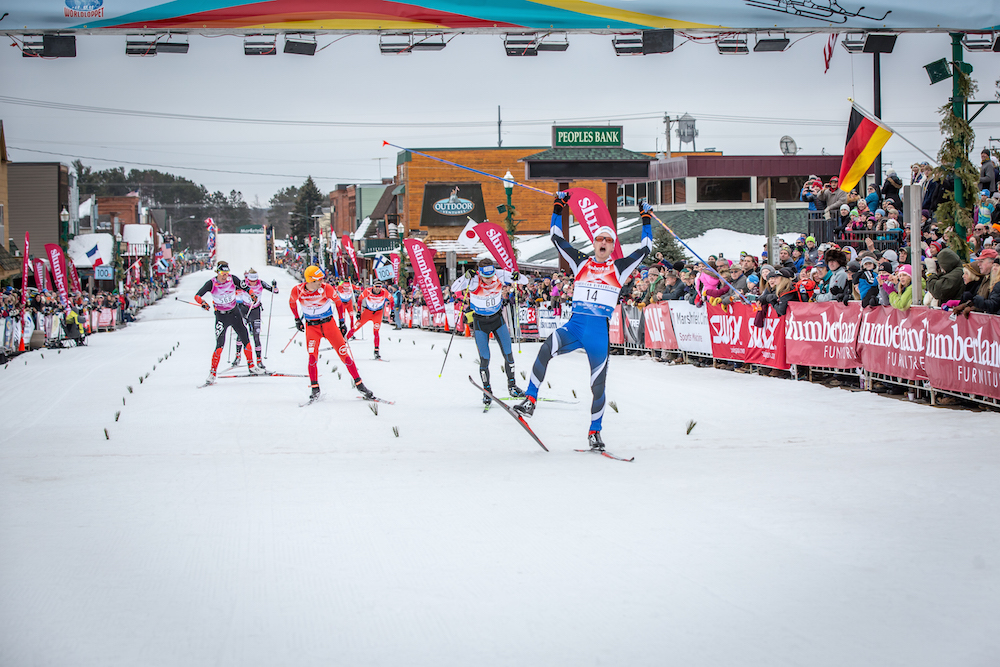
That included his victory in this year’s American Birkebeiner in Hayward, Wis., in his first-ever Birkie. Norris’ breakthrough result also made him the first American male to win the Birkie since Tad Elliott did so in 2012.
“Crossing the line Saturday was the first time in my life where I threw up my hands and screamed in excitement!” Norris wrote on his blog after winning the 51 k Birkie skate race. “Taking the win, having the confidence to lead the last 800 meters of the race, and to pull it all off was an incredible feeling.”
Leading the last 800 meters of the race for Norris included holding off France’s Ivan Perrillat Boiteux, of team Houte-Savoie, Frenchman Benoit Chauvet, Frenchman Adrien Mougel, Switzerland’s Candide Pralong (all of GEL intérim Rossignol), France’s Mathias Wibault, and the 2014 Birkie champion from Italy, Sergio Bonaldi (Team Salomon Italia).
Norris had a number of other season firsts beyond his Birkie win. He also won his first ever SuperTour races at the Lake Placid SuperTour, topping the men’s freestyle sprint and posting the fastest time in the 10 k classic individual start. He finished on the U.S. Distance Nationals podium for the first time in two years by placing third in the men’s 50 k classic mass start in Craftsbury, Vt.
“The highlights to my season would have to be my American Birkie win and picking up my first Super Tour wins ever,” Norris wrote in an email after the 50 k, his last race of the season.
“I always want more from myself when any season comes to to an end,” he added. “I don’t think my results have put me in a different position that last year but I’m going into the summer with excitement knowing that some really great results are possible for me.”
Honorable Mentions
Tad Elliott, Ski & Snowboard Club Vail
Although Tad Elliott of Ski Club Vail is not a new name to the top of U.S. distance results, this past season saw a re-breakthrough for the 27 year old from Durango, Colo.
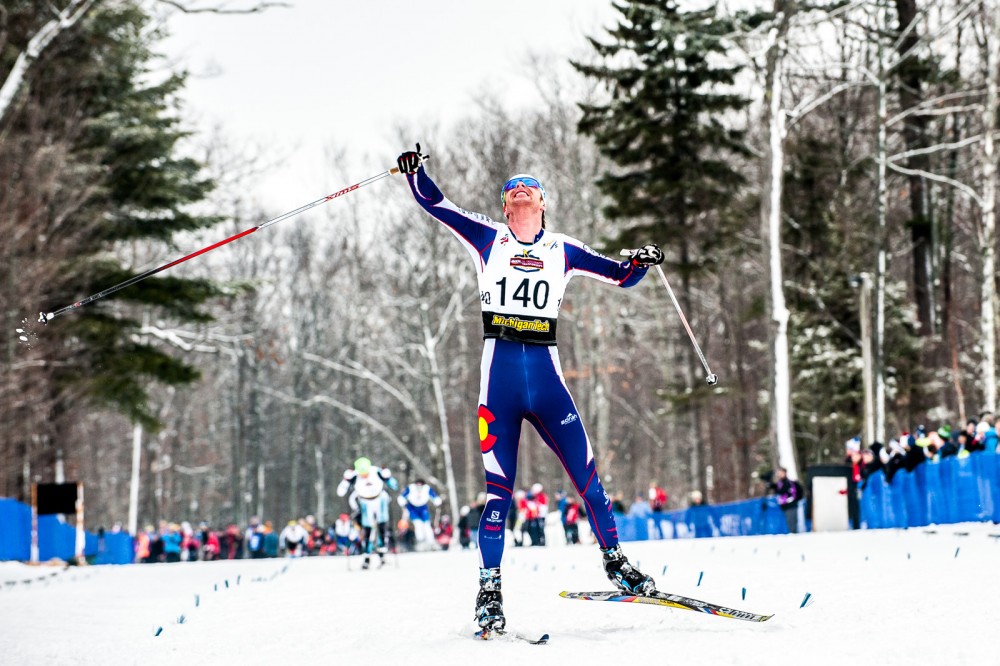
Tad Elliott of Ski and Snowboard Club Vail crosses the line in first for the men’s 30 k freestyle mass start on Thursday at U.S. nationals in Houghton, Mich. (Photo: Christopher Schmidt)
“In the months leading up to the race, I could only dream of the podium,” Elliott said in an interview after his 30 k win. “Hell, I didn’t know if I was going to be healthy enough to even start, but as you know, once the gun goes off, it really is anyone’s race.”
Elliott also raced to second place in the Craftsbury SuperTour 10 k classic in February, as well as a second place in the men’s 50 k classic mass start at U.S. Distance Nationals in Craftsbury in March. Before that, he qualified for the STC World Cup races in March, finishing the tour in 51st overall.
“This season was a step in the right direction,” Elliott wrote in an email after his last race of the season. “To come off Ski Tour Canada, and a long week in Craftsbury and to ski like this after all the health issues the last two years shows that I am in a really good place. I am excited for the future.”
Annie Hart, Stratton Mountain School T2 Team
Hart is another skier that’s been a regular contender in recent years, but a few personal bests at U.S. nationals — second in both the women’s freestyle sprint and classic sprint, fifth in the 20 k freestyle mass start, and eighth in the 10 k classic — make the 23-year-old SMS T2 Team skier our pick for female honorable mention.
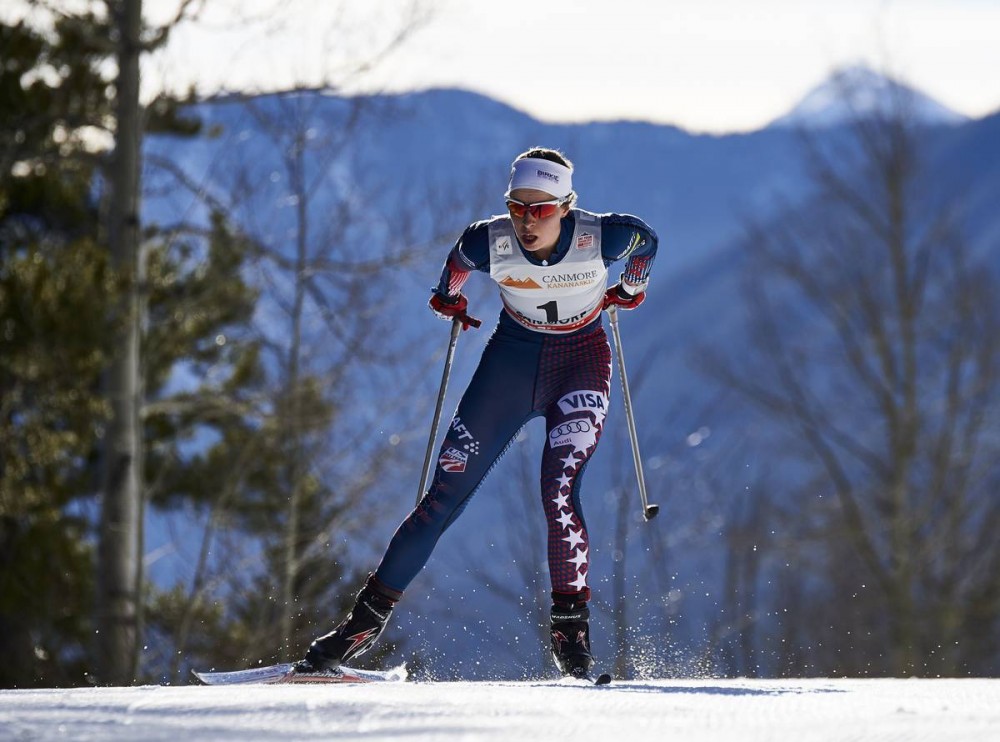
American Annie Hart leads the start of the women’s 10 k freestyle at Stage 7 of the Ski Tour Canada in Canmore, Alberta. She placed 39th and would later finish the Tour in 43rd overall. (Photo: Fischer/NordicFocus)
She won her first SuperTour race in February, posting the fastest time in the in the women’s 5 k freestyle in Craftsbury. She also placed third in the Lake Placid SuperTour freestyle sprint and competed in her first World Cup races at STC (finishing the tour in 43rd overall).
After starting in bib 1 for the first time in the 10 k freestyle individual start in Canmore, Alberta, Hart raced to 39th in Stage 7. She previously placed 36th in the Stage 5 classic sprint, narrowly missing her first World Cup points.
“With eight races in twelve days on the most elite and competitive cross country ski stage in the world, I was most certainly in for a lot of surprises,” Hart bloggedafter the STC. “I didn’t know what race day would bring, I didn’t know how the travel would go, and I really had no expectation results-wise. But [my strength coach Max Lipset’s] words reminded me that I could also be the surprise — it didn’t have to be other things surprising me, I could be surprising myself.
HOUGHTON, Mich. — Three days of racing at U.S. Cross Country Championships on the Michigan Tech Trails down and just one more to go with the 1.5-kilometer classic sprint taking place on Saturday. Check out the following photo gallery featuring some of the top moment’s from Thursday’s 20 and 30 k freestyle mass starts.
Photo: Tad Elliott of Ski and Snowboard Club Vail crosses the line in first for the men’s 30 k freestyle mass start on Thursday at U.S. nationals in Houghton, Mich. (Photo: Christopher Schmidt)
Photo: Early on in the of the men’s 30 k freestyle mass start on Thursday at U.S. nationals in Houghton, Mich. (Photo: Christopher Schmidt)
Photo: (right to left) Matt Liebsch of Gear West/Salomon leads Kevin Sandau of the Alberta World Cup Academy and Brian Gregg of Team Gregg/Madshus early in the men’s 30 k freestyle mass start on Thursday at U.S. nationals in Houghton, Mich. Gregg went on to finish second overall, while Sandau took seventh, Liebsch eighth. (Photo: Christopher Schmidt)
Photo: (right to left) Canada’s NDC Thunder Bay athlete Michael Somppi crests the top of a hill in first, ahead of Brian Gregg of Team Gregg/Madshus, Northern Michigan University’s Adam Martin, and Alaska Pacific University’s Scott Patterson, during the first lap of the men’s 30 k freestyle mass start in Houghton, Mich. Somppi went on to finish third overall, Gregg second, Martin fourth, and Patterson fifth. (Photo: Christopher Schmidt)
Photo: Racers (left to right) Kyle Bratrud of CXC, followed by Northern Michigan University’s Adam Martin and teammate Jake Brown, along with Team Freebird’s Kris Freeman chasing a break away group of Brian Gregg (Team Gregg/Madshus) (not shown), Tad Elliot (Ski and Snowboard Club Vail) (not shown), and Kevin Sandau (AWCA) (not shown) half-way throught the second lap of the men’s 20 k freestyle mass start race on Thursday at U.S. nationals in Houghton, Mich. Bratrud went on to place tenth overall, Martin fourth, Brown sixth, and Freeman ninth.
Photo: The front pack (right to left) led by Team Freebird’s Kris Freeman, Ski and Snowboard Club Vail’s Tad Elliot, Alaska Pacific University’s Scott Patterson, Northern Michigan University skier Adam Martin, and Gear West/Salomon skier Matt Liebsch during the third lap of the men’s 30 k mass start at U.S. nationals in Houghton, Mich. Elliot eventually surpassed Freeman and took the overall win. Patterson claimed fifth, Martin fourth, Liebsch eighth, and Freeman ninth.
Photo: (left to right) Kris Freeman of Team Freebird leads Tad Elliot of Ski and Snowboard Club Vail, Alaska Pacific Universit skier Scott Patterson, CXC skier Kyle Bratrud, Canadian NDC Thunder Bay athlete Michael Somppi, and Gear West/Salomon skier Matt Liebsch during the men’s 30 k freestyle mass start on Thursday at U.S. nationals in Houghton, Mich. Tad eventually took first, Freeman ninth, Patterson fifth, an Somppi third, Bratrud tenth, and Liebsch eighth. (Photo: Christopher Schmidt)
Photo: Tad Elliott of Ski and Snowboard Club Vail takes charge and and the overall win of the men’s 30 k freestyle mass start on Thursday at U.S. nationals in Houghton, Michigan. (Photo: Christopher Schmidt)
Photo: Racers (left to right) Adam Martin of Norther Michigan University, teammate Jake Brown, Alaska Pacific University skier Scott Patterson, and Canadian NDC Thunder Bay skier Michael Somppi battle it our for third during the final 150-meters of the men’s 30 k freestyle mass start race on Thursday at U.S. nationals in Houghton, Mich. Somppi eventually overtook Martin for the third place spot overall. Martin placed fourth, Patterson fifth, and Brown sixth.
Photo: Racers take off out of the stadium during the women’s 20 k freestyle mass start on Thursday at U.S. nationals in Houghton, Mich. (Photo: Christopher Schmidt)
Photo: A lead pack develops early on with (right to left) Craftsbury Green Racing Project’s Caitlin Patterson, Stratton Mountain School skiers Anne Hart and Katharine Ogden, Alaska Pacific University’s Chelsea Holmes, and Boulder Nordic Junior Racing Team coach, Eliska Hajkova during the women’s 20 k mass start on Thursday at U.S. nationals in Houghton, Mich. (Photo: Christopher Schmidt)
Photo: (left to right) Alaska Pacific University skier Chelsea Holmes heads the front group of racers, including Craftsbury Green Racing Project skier Caitlin Patterson, Stratton Mountain School skiers Anne Hart and Katharine Ogden, Boulder Nordic Junior Racing Team coach Eliska Hajkova, and SMST2 skier Erika Flowers during the women’s 20 k freestyle mass start on Thursday at U.S. nationals in Houghton, Mich. Patterson later surpassed Holmes for the overall win. Holmes took second, Ogden third, Hart fourth, Flowers fifth, and Hajkova sixth.
Photo: Alaska Pacific University skier Becca Rorabaugh (l) and Middlebury College racer Kelsey Phinney racing to an eighth and seventh place respectively during the women’s 20 k freestyle mass start on Thursday at U.S. nationals in Houghton, Mich.
Photo: Kaitlynn Miller of the Craftsbury Green Racing Project follows Sun Valley Ski Education Foundation skier Mary Rose during the second lap of the woomen’s 20 k freestyle mass start on Thursday at U.S. nationals in Houghton, Mich. Miller went on to place tenth overall.
Photo: (left to right) Alaska Pacific skier Chelsea Holmes skiing in front of Stratton Mountain skier Katharine Ogden and SMST2 teammate Anne Hart, as well as Craftsbury Green Racing Project skier Caitlin Patterson during the women’s 20 k freestyle mass start on Thursday at U.S. nationals in Houghton, Mich. (Photo: Christopher Schmidt)
Photo: Caitlin Patterson of the Craftsbury Green Racing project races to another championship title during the women’s 20 k freestyle mass start on Thursday at U.S. nationals in Houghton, Mich.
Photo: Stratton Mountain Skier Katherine Ogden raced to a third overall finish in the women’s 20 k freestyle mass start on Thursday at U.S. nationals in Houghton, Mich. (Photo: Christopher Schmidt)
Photo: Erika Flowers skiing for Stratton Mountain School crossed the finish line in fifth after the women’s 20 k freestyle mass start on Thursday at U.S. nationals in Houghton, Mich. Flowers was the third SMST2 female skier to cross the line in the top five, behind teammate Anne Hart who took fourth and Katharine Ogden who placed third (not shown).
Photo: Boulder Nordic Junior Racing Team coach, Eliska Hajkova racing the final 100-meters to finish sixth overall in the women’s 20 k freestyle mass start on Thursday at U.S. nationals in Houghton, Mich.
Canadian Olivia Bouffard-Nesbit of the Alberta World Cup Academy races to a ninth place finish during the women’s 20 k freestyle mass start at 2016 U.S. National Championships in Houghton, Michigan. (Photo: Christopher Schmidt)
The men’s 15 k freestyle individual start podium at the 2014 SuperTour Finals in Anchorage, with (from l-r) Patrick Johnson (6th), David Norris (4th), Scott Patterson (2nd), winner Noah Hoffman, Erik Bjornsen (3rd), and Lex Treinen (5th). (Photo: Rob Whitney)
Note: This article has been corrected to describe the race women’s SuperTour leader Caitlin Gregg is shooting for at World Championships: the 10 k skate.
WEST YELLOWSTONE, Mont. — National racing begins Friday as the SuperTour kicks off in West Yellowstone, Mont., and the excitement on the Rendezvous trails couldn’t be higher. The best skiers from around the country have been training for at least a week in the little Montana town as they prepare to compete for American dominance and possible positions on World Cup and World Championship teams.
With several departures from the racing scene including, Olympian Torin Koos (BSF), Rose Kemp (SVSEF), and Kate Fitzgerald (APU), and a multitude of up-and-coming racers on the cusp of success, the 2015 SuperTour will be anyone’s game.
When the USST selected four men (Erik Bjorsen, Brian Gregg, Koos and Kris Freeman) and no women from outside the regular World Cup team, it left many skiers hungry to show that they could perform well on the international level.
This year they’ll have another shot with the 2014 Nordic World Championships in Falun, Sweden.
While the U.S. is allotted 12 spots for each gender in Falun, USST head coach Chris Grover explained that he and his staff would select eight skiers per gender at most.
World Championship team selection will be based on several criteria. Those skiers ranked in the top 50 in the World Cup sprint or distance standings as of January 18 will be named to the team. After that coaches’ discretion kicks in. If coaches feel that the World Championship team could benefit from additional skiers after their discretionary picks, they will then begin selections from the USSA points list.
The selection is identical to last year’s Olympic process, with the exception of the USSA points. When making selections for the Olympics, coaches picked three non-USST skiers from the FIS points list to fill in the gaps.
According to USST Head Coach Chris Grover, the reason for the switch to USSA points is to emphasize domestic racing so that potential candidates for the championships will be racing against each other, rather than chasing FIS points across the globe like many did last season.
Due to the emphasis on USSA points this season, the SuperTour will be where non-World Cup team athletes will have the chance to prove they have what it takes.
The Veterans
Brian Gregg (Team Gregg) will be a top competitor in 2015. Photo: flyingpointroad.com.
On the men’s side, 2014 overall SuperTour champion Reese Hanneman (APU) will be competing in the first period World Cup races and will return to the national circuit in Houghton, Mich. for the 2015 U.S. Cross Country Championships. While the benefits of early-season World Cup racing are considered mixed, Hanneman can expect his chances of racing in Falun to increase if he demonstrates that he can keep up with the Europeans and his fellow American teammates.
With Hanneman out of the picture in West Yellowstone and Bozeman, the men’s SuperTour favorites are the remaining two non-USST members to attend the 2014 Olympics – Brian Gregg and Kris Freeman.
Freeman, a 34-year-old former USST member, will be racing in West Yellowstone for the first time in nine years. Freeman, who lost his position on the USST in 2013, was one of three non-USST members to qualify for the 2014 Olympics. Despite high hopes of his best olympics yet, he struggled in Sochi. This season he is looking to turn around his skiing and earn a spot on the World Championship team. As one of most experienced skiers on the SuperTour circuit he will have an advantage over much of the competition.
Gregg, like Freeman, will also enter the 2015 SuperTour with a multitude of experience. The 2013/2014 season saw Gregg on the SuperTour podium several times, most notably with his two second place finishes in the 2013 West Yellowstone 15 k freestyle and in the 2014 U.S. Nationals 30 k freestyle. At the Olympics, he constantly finished in the 40s and 50s.
As he starts the season, Gregg acknowledged that the first races of the season would be challenging.
“Kris is in really good shape so I think there are going to be some very competitive races. I’m excited,” Gregg said from West Yellowstone Tuesday.
Joining Freeman and Gregg as veterans of the SuperTour are Matt Gelso of the Sun Valley Gold Team and Dakota Blackhorse-von Jess of the Bend Endurance Academy. Gelso will be looking to build on past results while Blackhorse-von Jess will pursue success in sprinting, especially since U.S. sprint champion Torin Koos retired from competition.
After disappointment in the freestyle sprint at the 2014 U.S. Cross Country Championships and a failure to qualify for the 2014 Olympics, Blackhorse von-Jess said that nothing has changed in his career trajectory.
“I’m re-energized after the disappointment of the Olympics with the reaffirmation that I still want this and believe I have what it takes… My career/goal trajectory hasn’t changed in the least: I’m focused on racing my best in the biggest international competitions and just need to make sure I do what is necessary to make those trips and come to the starting line in Falun prepared to light it up,” he wrote in an email.
Matt Liebsch of Team XC United will also be returning to racing after missing out on Olympic qualification. However, Liebsch, who works near full time for Gear West, has lightened his training load as is looking to “maximize fun and earning potential ” rather than qualify for international events.
“I’m not going to be chasing FIS points around the world or country necessarily. If they fall in my lap because I’m racing well, that’s great, but I’m not going to be stressing about it… It’s not really a change for me. I’m still going to try to race as fast as I can only I won’t be training as much,” he said in a phone interview.
Ryan Scott, living and training independently in Boulder, Colo., will also return to competition, but, like Liebsch, has cut back his training as a result of work.
For the women, one name has particularly dominated the domestic circuit for years – Caitlin Gregg.
Gregg, like Hanneman, will start her season on the World Cup after earning the women’s overall title at the SuperTour finals in Anchorage last season. Gregg said earlier this fall that she is as motivated as ever and has her sights set on a particular race: the 2015 World Championships 10 k skate. To get to Sweden, however, she’ll need to demonstrate that she’s on par with USST and dominate when she returns for the U.S. championships in January. In the meantime, she’s excited for the 5 k next weekend in Lillehammer and aims to earn a start in that race.
With the absence of Gregg, the West Yellowstone and Bozeman SuperTours are anyone’s for the taking.
Rosie Brennan (APU) leading her semifinal in the 2014 U.S. Cross Country Championships. (Photo: http://bertboyer.zenfolio.com).
Always a strong skier, APU’s Rosie Brennan will once again attempt to demonstrate her mettle as she makes a bid for World Championships. Last year Brennan started her season on the World Cup and returned to the U.S. exhausted, but earned a national title at U.S. Nationals in addition to several podiums. This year she will enter the season with fresh energy despite a turbulent fall after loosing her father in August.
Joining Brennan at the top of the SuperTour expectations are APU teammates Chelsea Holmes and Becca Rorabaugh.
Rorabaugh won the 10 k interval start classic at the 2014 U.S. Cross Country Championships for her first national title, and is looking to have even more time upon the podium as she continues through the season.
Last year Bridger Ski Foundation’s Jennie Bender repeated a national title in the freestyle sprint. While she’s dealt with illness and injury for the past two years, Bender told FasterSkier that her summer training this year was her best to date, and that she is looking to find success domestically and qualify for World Championships.
The Wild Cards
While the veterans of the 2015 SuperTour are names we’ve seen at the top of the result sheets for years, there are several skiers who have an excellent opportunity to shake up the status quo and make a name for themselves on the domestic circuit.
Sun Valley Ski Education Foundation’s Miles Havlick didn’t have the season he wanted in 2014, but has come back with a vengeance in 2015. While he has yet to face his competitors on-snow, Havlick has won a slew of time trials including the USST1o k freestyle rollerski time trial in Park City, Utah against the country’s best. He also broke a 25-year-old record in the Baldy Hill Climb this year.
According to Havlick, he has the all the ingredients for a breakout season. Now it’s only a matter of time.
“I think on any given day – when I am mentally competent, carrying confidence from previous races, focused, and my wax is good – I can be the best skier out there. The college skiing is when I was really able to prove that to myself. Last year was kind of tough because I felt like I was spinning my wheels by the end, but I think I’ve made some adjustments this year that can fix that,” he said in a phone interview in October.
Havlick also has gained the attention of Grover and the USST.
Erika Flowers racing to the fastest women’s time in the inaugural Tim Burke Uphill Run Test at Whiteface Mountain this fall.
“I’m excited to see how Miles Havlick is going to ski. He’s had a great fall. He won our US ski team time trial that we did in Soldier Hollow. He set a new course record on the Baldy Hill climb that stood for 26 years or something. There’s some new emerging faces to keep an eye on,” he said.
For the women, a possible 2015 wild card is a less well known. However, despite her lack of national attention Stratton Mountain School T2’s Erika Flowers has all the makings of an up and coming skier.
Flowers has always been a strong and consistent skier with the majority of her SuperTour results landing in the top-ten. However, when she traveled to Europe in the spring of 2014 she demonstrated her potential, wining a 10 k mass start in Silvapalana, Switzerland. Several weeks later she placed 14th in the Alpen Cup mini-tour. She finished the tour as the second American behind Holmes and had the fifth-fastest time in the final 10 k pursuit.
While Flowers has struggled with sprinting in the past, she demonstrated that she could stick with the best of them at the 2014 Frozen Thunder races in Canmore, Alberta ending the day in 7th.
The following day she finished 7th in the 7.2 k freestyle at Frozen Thunder. She was the 3rd American, and placed ahead of several notable Olympians including Jessie Diggins.
The Rest
In addition to Havlick, there are several other men who could make the domestic season anyone’s game.
Recent college graduates Ben Lustgarten of SVSEF, David Norris of APU, and David Sinclair of Green Mountain Valley School will be looking to take their success from NCAA racing to the SuperTour.
Scott Patterson (APU) is another notable graduate who had success on the SuperTour both at the 2014 Nationals and 2014 SuperTour finals. According to his family, Patterson will not be starting his season in West Yellowstone due to a skiing accident that occurred Oct. 31st in which he was impaled by a broken ski in his upper leg. While the leg wound healed, Patterson developed a pulmonary embolism (blood clots in his lungs) which has limited his exercise to walking. However, according to his family, Patterson is optimistic that he will return to racing at U.S. Nationals.
Ben Saxton (SMST2) and Paddy Caldwell (SMST2/Dartmouth) will be the sole USST members starting the season in West Yellowstone. Saxton who was second in the freestyle sprint at U.S. Nationals last year, is aiming perform well in Friday’s sprint. Caldwell, who has yet to decide whether or not he will ski for Dartmouth this year is a strong distance skier and will be vying for top results amongst the country’s best.
“They need to prove themselves and make those teams just like any other athlete that is on the domestic scene. Obviously those guys are younger guys and they’re still focused on the U23 World Champs,” Grover said of the two USST D-Team athletes.
Welley Ramsey (MWSC), Tad Elliott (SSCV), and a slew of other men from APU and Craftsbury will also look to challenge the national favorites as the season gets underway.
On the women’s side recent graduates Anne Hart (SMST2), Rosie Frankowski (APU), and Anja Gruber (Far West Elite) are new to full-time racing on the national circuit after having successful college careers. While the adjustment from college skiing to professional racing is often difficult, these women will still be a strong force to contend with.
Annie Pokorny (SMST2), Caitlin Patterson (CGRP), Liz Guiney (CGRP), and Mary Rose (SVSEF) are shaping up to be strong competitors in the 2014/2015 season after a productive summer and fall trainings with their respective teams.
MIDWAY, Utah – The action at the 2013 U.S. Cross Country Ski Championship heated up this morning when the senior men started off the day with the 30 k classic mass start. Six laps of the challenging 5 k loop at Soldier Hollow made for an exciting race as eighteen skiers were together in the lead pack for the majority of the race, but during the final kilometers only a handful of men were in contention for the national title. As they climbed Soldier Hollow’s fabled Hermode’s Hill for the final time it was Torin Koos (BSF) who made a decisive move to claim the national title with Erik Bjornsen (USST/APU) and David Norris (MSU) finishing second and third respectively. Check out our footage of the race.
With the Norwegian women taking the top two spots earlier in the day in the 4×5 k, the Norwegian men had the bar for success set high for their four-man relay effort.
Northug getting it done in Sjusjoen (Photo: flyingpointroad.com)
As always, Petter Northug Jr. was anchoring Norway I, supported to Eldar Roenning and Finn Haagan Krogh on classic skis, while Lars Berger, biathlete, brother of Tora Berger, and occasionally cross-country relay selection skied third in the 4×10 k race in Sjusjøen, Norway, on Sunday.
Held on 2.5 k loops of man-made snow, the tracks quickly became extremely icy and hard.
While Norway I had a slight advantage in the form of Northug’s traditional anchor-leg superhuman efforts, it was obvious that the men were not going to have as clear a path to the finish line as their female counterparts.
Ultimately, the result was the same, as Norway I took the gold medal in a tight finish. In a surprise turn of events, Norway III emerged from the finish-line sprint with silver medal, while the Swedes picked up the bronze, narrowly edging out the French.
Russia I and II as well as France pushed the pace on what is usually a fairly sedate opening leg of the relay, forcing the field to work, and whittling away several teams.
As they rounded the corner into the exchange zone, the main pack was down to just six, with another six teams hanging close inside of 15 seconds, including the Americans, kept competitive with a strong leg by Andy Newell.
The lead pack on the second leg (Photo: Liz Stephen)
The major players on the outside were Switzerland, where Toni Livers dropped 46 seconds to the leaders, while Germany I employed Andy Kuehne — who could be seen running up hills on his skis — to finish the leg dead last, over a minute and 30 seconds back of the lead.
Under strong efforts by a variety of teams including Russia I, using Maxim Vylegzhanin, the French who tapped Maurice Manificat, and Finlands’ Sami Jauhojaervi, the main pack was reduced to six teams, including Norway I with Krogh.
Norway III, up until that point in the hunt, was let down by unknown quantity Ronny Fredrik Ansnes who dropped them out of the lead group and almost 30 seconds back of Russia I when the teams switched to the skate leg.
Russia I, France, Finland, Norway I, Sweden and Italy all came into the exchange within five seconds, while Switzerland’s Dario Cologna, the Czech Republic, and American Kris Freeman making up a smaller chase pack, around 30 seconds off the pace.
It took a massive effort for Cologna to draw back into the group – he skied the fastest second leg of the day by 13 seconds, blowing by Canada’s Ivan Babikov who broke a pole and was struggling as a result.
With Sweden’s Daniel Rickardsson tagging off to Johan Olsson, winner of Saturday’s 15 k skate, fireworks appeared in the offing for the third leg, especially with the history between Norway and Sweden in the relay.
But the Swede who was so strong on Saturday didn’t seem to be in the same world-class form. After leading for the first 5 k, Olsson could be seen looking around and motioning for someone else to come to the front.
However, Olsson was mostly ignored, until Lars Berger of chief rival Norway I stepped up at 7 k and turned up the pace. Berger was matched by everyone, especially Roland Clara who was skiing third for Italy. Clara, who picked up a bronze medal on Saturday finishing just shy of Northug for silver, put in an attack in the last 700 meters on a steep uphill, managing only to shake Russia I in the form of Sergey Turychev before the third and final exchange.
Roughly 30 seconds back of the lead pack, USA’s Tad Elliott attacked his small group of Morten Eilifsen (NOR III) and Remo Fischer (SUI), and then was attacked in turn, as Norway III and the Swiss handed off 44 seconds back, and Elliott handed off to Simi Hamilton 53 seconds behind the leaders.
Heading into the fourth leg, it was clear that Northug hadn’t had a sudden urge to change his tactics. Immediately after taking the tag, the firebrand Norwegian pulled up to let the five others go by, slotting himself in the pack second from the back.
The pace then dropped considerably, letting Curdin Perl (SUI) and Sjur Roethe (NOR III) claw back their considerable deficit. It was obvious for a long way out that the race had turned into an 8-way shootout at the finish line for just three medals.
At that point, Northug does what he does best, unleashing his unparalleled finishing kick to get clear of the pack to pick up the gold medal for Norway I.
But the surprise was Roethe, who stormed from 8th and a 44 second deficit to deliver a silver medal for Norway III, and secure the one-two finish for the second relay of the day.
“I’m happy to be on the podium today,” said Roethe in an interview after the race.
“The last leg was a tactical one but at the end I pushed hard and could take the second spot for our team.”
Sweden’s Calle Halfvarsson made a valiant effort to break up the Norwegian party, but the young Swede – who opened his season with a career-best World Cup finish in 4th on Saturday – couldn’t find enough speed to get past the red suits.
“In the last uphill I was behind and lost a bit the connection,” Halfvarsson said in a post-race interview with FIS Ski.
“I had to pass all for the finish sprint and that was not so easy… I am satisfied with my race but for sure I was a bit nervous before and during it.”
Left empty-handed at the finish line were the French, who finished fourth, just ahead of Russia I. Finland finished sixth, barely holding off the hard-charging Norway II, who placed biathlete Emil Hegle Svendsen on the anchor leg. Svendsen came from 12th spot, nearly two minutes back to have a shot, which gives you an idea of just how slowly the lead pack was going on the final leg.
USA anchorman Simi Hamilton dropped just two spots, one to Ilya Chernousov (RUS II) and the other to Svendsen, to end the Americans day in a solid 11th.
Canadian opening-leg specialist Devon Kershaw appeared strong in the early going, until a collision popped his ski off his foot, and put him to the ground.
Kershaw has provided plenty of first-leg fireworks in the past, but his fall and resulting time loss put the Canadians in a deep hole early, while Babikov broke a pole and never managed to find his rhythm. Graham Nishikawa skated the third leg, but by the time he received the tag they Canadians were out of the running, and the Canadians failed to start their fourth skier, sprinter Len Valjas.
Noah Hoffman got right in the thick of things today finishing 30th place.
With a handful of gel packets stapled to his bib, American Noah Hoffman would have blended in better at the American Birkebeiner than into Sunday’s 50 k freestyle at the 2011 World Ski Championships. But make no mistake: the way he was skiing was still world-class.
Hoffman made it more than 30 kilometers rubbing shoulders with the World Cup podium’s usual suspects—Petter Northug (NOR), Lukas Bauer (CZE), and Maxim Vylegzhanin (RUS)—before finally succumbing to the pace after a broken pole.
Hoffman in the lead pack at the top of the course on his second lap.
Battling cramps, Hoffman still managed to hold on for 30th, leading an American contingent that also included Lars Flora in 39th, Tad Elliott in 40th, and Billy Demong in 51st.
“I feel like there’s a lot more there, for some time in the future,” Hoffman said. “Those guys aren’t that much faster.”
After a decent start, Hoffman actually made a couple of appearances at the very front of the race in the early laps. He said he was just skiing through, and found himself up there.
He may have absorbed a few gusts of wind, but he never actually pulled the group himself, and he said that he “certainly wasn’t going to lead.” And, in a mass start race, according to U.S. Ski Team Head Coach Chris Grover, the front is the best place to be, thanks to an accordion effect that leaves those at the tail end of the group chasing hard over the top of every climb.
“It is so much easier in a group of 50 men,” Grover said, “to ski at the front of a pack like that, than to be at the back.”
As for those gels?
“He just knew he needed to get a lot of energy in the race, and there weren’t so many feed stations that were available for these guys. He did a good job of feeding,” Grover said. “He has a hard time during a race getting enough food on board and holding it down—I think it was a smart strategy.”
Hoffman gets a new pole from US Ski Team coach Matt Whitcomb.
After surviving four trips around the tough 8.3-kilometer loop used by the men, Hoffman finally came off on his fifth trip up the grinding Styggedalen climb. On the previous lap, he’d broken a pole and had to ski another big hill with just one, which he said was “the start of me getting dropped.”
In the closing stages of the race, Hoffman was battling cramps. (They hobbled him so much after the finish that he was limping badly, and had removed a boot to massage one of his legs.) But he held on, passing Aivar Rehemaa (EST), Tim Tscharnke (GER), and a blown-up Curdin Perl (SUI) over the last 10 kilometers, while just one man passed him.
“He hung in there for a long time, and even when he finally started hitting the wall, he didn’t die—he fell back for a while, and then he regrouped,” Grover said.
The result was Hoffman’s second top-30 of the championships—he was 29th in the 15 k classic on Tuesday.
Elliott, meanwhile, fell off the pace early, before moving up to a group that included Flora. The two battled for the rest of the race, with the veteran Flora ultimately getting the edge, by three seconds.
Both those men were far off the lead, but each mentioned the Oslo crowds, which were again pegged at around 100,000. Flora said that it was so loud, “you can’t even hear yourself breathe—and that’s a good thing.”
Lars Flora leads teammate Tad Elliot on their way to 39th and 40th places respectively.
Elliott, meanwhile, recounted a moment when he was trying to get a split from Matt Whitcomb, one of the U.S. coaches.
“I just see his mouth moving, and I can’t hear anything,” he said.
Like the Canadians, the U.S. team will now travel on to Lahti, Finland, for World Cup races next weekend. Its men’s squad will be Andy Newell, Kris Freeman, and Flora—the current Continental Cup leader from the U.S.—with Morgan Arritola, Liz Stephen, Kikkan Randall, and Holly Brooks make up the women’s contingent. (Brooks is Flora’s counterpart, as the Continental Cup leader.)
Hoffman will travel to domestic-level European races, while Elliott is returning home to Colorado to train in advance of SuperTour Finals in Idaho.
As for the championships in Oslo, Grover said that he felt the team “missed some opportunities, with our veterans, in particular.”
Randall crashed out of her best event, the freestyle sprint—a race in which she was one of two gold-medal favorites—while Freeman hadn’t quite rounded back into shape after an illness set him back.
On the other hand, Grover said, a number of the developing skiers on the U.S. squad had strong races: 10 of 14 team members cracked the top 30.
“Among those were some of those younger athletes who we debated…as far as, ‘should we name them to a World Championships team? Are they ready for that level of stress, that level of competition?’” he said. “Skiers like Noah, and Sadie [Bjornsen] and Jessie [Diggins]…As a nation, we’ve been hoping to get going. We know we can’t rely on Kris Freeman, Kikkan, and Andy Newell forever.”
Grover acknowledged that a top 30 at World Championships doesn’t mean quite the same as it does in a normal World Cup, where stronger athletes like Norway and Sweden get more start slots. But on the other hand, he said, places were harder to come by in Oslo, since most athletes were peaking there.
“Yes, if you go to a classic World Cup in Norway, then a top 30 can really mean something,” Grover said. “But…I think given the fitness of the group, these results are legit.”
A fitting backdrop for Billy Demong on his way to 51st place.
Torin on his way to US National Title #2 this week. Photo: Toko.
US Nationals Skate Sprint Race Report
Waxing was interesting today and showed why I am happy to be a Toko man. I was expecting a lot of styrofoam-like manmade snow mixed in with the bit of old snow that remained. Somehow the snow changed and today skied more like “normal” snow. The wax recommendation would have rocked for sure in what we were expecting so I was relieved to see that the HF Blue/XCold mix was the fastest baselayer choice for the day. JetStream Blue was also the leading top coat. It has to be appreciated that you can midjudge the conditions a little and still absolutely nail the wax.
This was a course for those who can generate a lot of speed with their legs on high speed sections, glide well, and have good finishing speed. Jessie Diggins was tripped up in the A final, hit the top of the final downhill in 5th place well separated from 4th, and then hammered over the top, got in a low tuck, worked the small bumps and dips, let her skis run (flat), and shot into 3rd on the dip next to the 200 meters to go sign and then opened it up to take a clear win. How impressive was that! She’s on her way shortly to World Junior Championships representing the stars and bars.
This was the first year since Torin was a kid that he hasn’t been affiliated with the National team despite some strong international results including a podium in an individual World Cup race. You have to have a lot of respect and admiration for how he circled the wagons and got his house in order, found some excellent support (Methow Olympic Development), worked his tail off, continued to develop his game (he is racing smarter now), and came out hungry. The result was 2 more National Championships and solid standing as one of the US’ top two sprinters. Bravo Torin!
Click here for the rest of the photos and report from today’s Skate Sprint.
Field Report from CXC from US Nationals
Tad Elliot won the distance skate race on a mix of HF Blue and XCold powder with a top coat of JetStream Blue. The XCold addition really made a difference in the madmade snow.
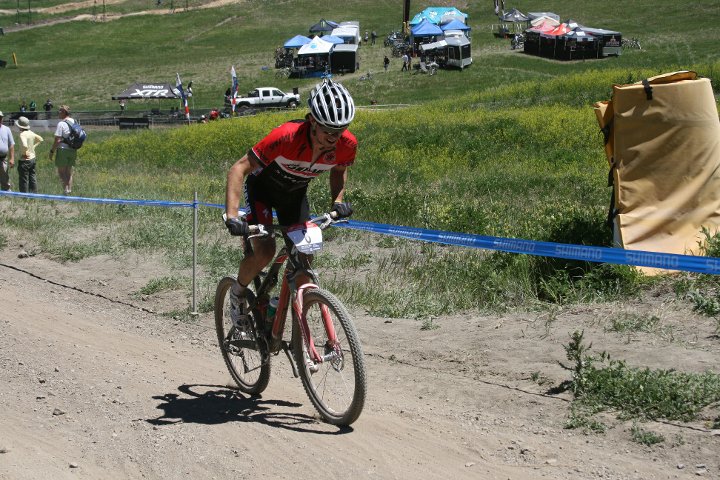
Tad Elliott powers up a hill during US Mountain Biking Nationals in Granby, Colorado
Tad Elliott’s busy schedule didn’t stopped him from picking up an U-23 title this July at the U.S. Mountain Bike Nationals in Granby, Colorado. “It went really well. My goal was to win but it was still a surprise. Everyone else was so strong,” said the 22-year old.
After winning the U-23 title, he also raced the short track race in the Elite Men category. In the middle of the race, he was in 6th place and got a little excited for a top-5 podium finish. A little overeager, he blew up and ended up being pulled for part of the race by a teammate and finished the race with a still-impressive 8th place.
Despite a few pre-nationals races not going so well, Elliott felt confident going into the Championships. Usually racing every weekend, he was able to take some time off to come back to Colorado and get in some solid training.
He was also the U-23 champion two years ago. A bad crash and broken shoulder blade last summer kept him from racing nationals, but didn’t keep him down. “I was back on the stationary bike ten days later so it wasn’t that bad.”
From here, Elliott moves on to Mountain Bike World Championships, which are going to be held in Mont Ste. Anne, Quebec. He doesn’t know how he’ll do there but maintains a positive attitude by “hoping for the best.” After that, he’ll jump right into ski training.
This is the norm for the Durado, Colorado native. Racing for pro teams in both cross country skiing (CXC) and mountain biking (Sho-Air-Specialized), Elliott travels for racing eight months of the year and is usually doing local races when not on the road.
This spring there was overlap between his ski racing and mountain biking but he believes this makes him a better competitor. “I’m really fit coming off the ski season so I can jump right into biking.”
He spent a month in Europe racing Swiss Cups and Power Cups, which he thought went really well. Compared to ski racing, Elliott finds the Euopean circuit crazier. “Mass start races where there are 240 starters on the line. It rains all the time, making it slippery on hard courses. You have Euros yelling at you, pushing and punching… it’s a lot bigger scene over there because this is a party for these guys.” The 5-mile cycling courses can hold up to 30,000 fans and the energy is encouraging to the racers.
He finds that skiing and mountain biking compliment each other and that as a junior, athletes should be experiencing as many different sports as they can. “I don’t have to do as much rollerskiing in the summer and don’t have to ride in the cold and the wet in the winter so it keeps things fresh and fun.”
He does feel a push to decide between the two from a lot of different people but not his number one supporters – friends and family. “Where we grew up, we always did both.”
His twin brother, Evan, is also a mountain biker, mostly doing downhill racing, and is more involved with their local junior development program.
Elliott would like to keep doing both sports for as long as he can. “I’m having a blast. I’ve met really great people and have made really good friends so I want to keep doing it and keep it fun.”
Currently Elliott is not at school but if he were to go back for courses, he’d like to study chemistry.
Tad Elliott (U23 National Team / Sho-Air) smiling after a tough race to take the win for the U23 MEN XC National Championship Race.
This year marks his last year in the U-23 category in both mountain biking and skiing. “It was nice to race just your own category but we all have to grow up sometime,” he said with a laugh. Judging from the results Elliott is posting, he will likely have no problem moving up to race against the elites.
Athletically, Tad Elliott and Torin Koos don’t have much in common. At 21, Elliott is a distance specialist, and still developing. Koos is a sprinter, and at 29, he’s in the latter half of his career.
The two things they do share? Both had hopes of making the 2010-2011 U.S. Ski Team—and both were left off the roster.
As part of a shift in strategy under new Head Coach Chris Grover, the team announced last week that it would nominate just sevenathletes for 2010-2011—down from 11 this winter.
Grover said that his organization would still be doing “more than ever” to support developing skiers through new programs and enhanced partnerships with local clubs—and Elliott and Koos will likely be beneficiaries, to some extent. But with details of Grover’s new strategy still falling into place, those two—and other hopefuls—have had to move forward with their own plans for the next season.
After more than half a decade racing for the USST, Koos is going back to his roots in Washington. He’ll race next year for the Methow Olympic Development Team, a small, elite club coached by Scott Johnston.
Koos struggled this season after an infected hair follicle last spring turned into a potentially life-threatening skin infection; he had to have surgery and take a heavy dose of antibiotics. The drugs, he said, left him susceptible to sickness, and he picked up two sinus infections this winter—one right before Christmas, and one after the Olympics.
Though Koos had one stellar result—second place in the Canmore sprint qualifier, and 10th in the rounds—he only saw one tour in Europe this year, in the early part of the season. At the Olympics, his focus for the year, he bombed out in the individual sprint, missing the top-30.
Koos beating Newell at the line in Fort Kent. Photo courtesy of Andy Shepard, Maine Winter Sports Center
After wrapping things up with a win over Andy Newell in a sprint at the SuperTour Finals in Fort Kent, Koos ended up just missing the USST’s qualifying standards by two FIS points–which he said equated to a mere .3 seconds per race.
“I knew that it hasn’t been the season that I’d dreamed about,” he said. “I think there were some bright spots, considering. I came pretty close, looking at it, to making the objective criteria, and just missed by the minutest of margins.”
In late March, Koos said he got a three-paragraph e-mail from Grover letting him know that he was dropped from the team. That was followed a day later with a phone conversation with John Farra, who oversees the cross-country program in his job with the U.S. Ski and Snowboard Association.
Grover said that the USST generally tries to make phone calls when first notifying athletes that they’ve been dropped, but he didn’t want to comment on the particulars of Koos’s case, which he said was unique.
Next season, Koos said that he’s trying to figure out a way to race in Europe— either on the domestic circuit there, or by paying his own way to the World Cup.
He’s facing an uphill battle, though—since domestic European races typically aren’t scored on the USSA points list, they won’t help him qualify for the 2011 World Championships.
And Grover said that since Koos didn’t meet the objective criteria for the fall World Cup races, he couldn’t guarantee start rights for those races, either.
That leaves the SuperTour, which Koos said is probably not the best place for his development.
“I’m just looking for the opportunity to prove…that I’m a top level racer—that I can race at the major leagues of skiing,” he said.
Elliott, Kuzzy, and the Rest
Elliott spoke with USST staff at the SuperTour Finals in Fort Kent, and he left there feeling optimistic. He’d had a strong season, with podium finishes in two U.S. championship races, and at the American Birkebeiner.
A few weeks later, Elliott said he received an e-mail telling him to be prepared for a phone call the following day to discuss his future with the team. But that call never came, and he learned of the team’s roster when a friend sent him a text message last week.
Elliott (r) on his way to second in the U.S. 50 K Championships
Grover said that his staff has been scrambling this spring, with the departure of Justin Wadsworth and some shuffling of roles and responsibilities.
“Matt [Whitcomb] talked to Tad about potentially making the Continental Cup team format work for him, and he didn’t seem to be able to make the camp opportunities because of his mountain bike racing schedule,” Grover said. “If some communications fell through the cracks, which is certainly possible, then it’s definitely our fault, and we need to do a better job there…That’s why it’s important that people pick up the phone and call us, once in a while.”
After riding his mountain bike professionally this summer, Elliott said that he’ll ski for CXC’s elite team again next winter. He is already pre-qualified for the U-23 World Championships, and said that he’d be thrilled to make the senior World Championships team for Oslo.
“It’s not a big deal at all—I’m not disappointed….I see the ski team as something to strive for,” he said, but “I think I can be successful with the sponsors and the people surrounding me who support me. I’ve been improving every year taking this path, and this is what has worked for me. I’m happy to stay doing that.”
Also returning to CXC is Garrott Kuzzy, who was dropped from the USST after a two-year stint. He said he was prepared for the news.
“I set out some criteria and goals with [USST staff] last spring for what I needed to accomplish in order to continue being on the team, so it wasn’t a shock to me,” said Kuzzy. “I definitely was given the opportunity to do what I needed to do, [in order] to take it to the next level. Had some good races for sure, but I still need to figure out how to put it together when I want to put it together.”
Not much will be changing, Kuzzy said—most of his support over the past few seasons already came from CXC. The USST helped him get to a few camps, but not much more than that.
Grover’s vision—a smaller domestic presence for the USST, and more money towards international racing for younger athletes—is “the right way to do it,” Kuzzy said.
Lindsay Williams and Morgan Smyth, two of the women dropped from the team, had been hampered by illness and injury.
After unknowingly training and then racing with a broken thumb for multiple months this winter, Williams faces surgery to fuse the bone—and that’s on
Williams racing at the 2010 U.S. National Championships in Anchorage. Photo, Rob Whitney
top of lingering circulation problems in her legs. Her future is uncertain, she said, until she gets healthy.
Smyth had surgery for compartment syndrome in August, then battled a recurring case of mononucleosis this winter. In an e-mail to FasterSkier, she said she’d be relying on a club for support next year.
“Being a member of the USST is an honor,” she said, “But it is training that makes you a good skier, and I will definitely continue to do my best every single day.”
James Southam (L) leads the pack near the halfway point. Lars Flora, Tad Elliot, and Ivan Babikov follow, L-R
Midway through the U.S. 50 k Championship race on Wednesday, Ivan Babikov was a nation of one.
The lone Canadian in a group of five Americans, he was ineligible for the U.S. title. But that didn’t stop him from skiing away with the win, and the $1,200 check that goes with it.
Nearing the end of the last of five ten kilometer laps, Babikov put the hammer down, dropping CXC’s Tad Elliot and APU’s Lars Flora to ski unchallenged to the finish for his second U.S. 50 k win in three years. Elliot, the first American finisher, got his first national championship.
Like women’s winner Kikkan Randall, Babikov came to Fort Kent straight from the World Cup Finals in Falun, Sweden. He spent one night at teammate Alex Harvey’s house in Quebec before arriving here Tuesday afternoon to check out the trails.
Babikov said he made the trip at the invitation of race organizers, who waxed his skis and set him up with a room at the university in town.
“It’s on the way, because I was coming from Europe, so I’m like, ‘why not?’” he said. “U.S. Nationals has been good to me.”
From the gun, the Russian-born Canadian was the favorite to win today, after two top-ten finishes in distance races at the 2010 Olympics. But it was APU’s James Southam who led early, taking a flier on the first lap.
“The pace was ridiculously slow at the start, and so I just skied, and pretty soon I had a 30-second gap,” he said. “I was never really going that fast.”
Southam wasn’t motivated to ski the whole race by himself, though, and he was swallowed up midway through the second lap.
Tad Elliot taking a turn at the front
At that point, Elliot finally started to get warm.
A professional mountain biker in the summer, Elliot traveled to Maine fresh off some early-season races last weekend in California. He came down with a case of the sniffles and hadn’t skied in the last two days.
“I put my trust in [CXC Coach] Bryan Fish [to] take my skis, wax my skis,” he said. “I walked to the start line, and first 10 k—it was hard.”
But Elliot worked his way into the race, and by 20 k, he was feeling “amazing.”
He took the reins and got down to business, upping the pace and thinning the lead group down to six.
At 30 k, the combined efforts of Elliot and Babikov started taking their toll, and Southam, Garrott Kuzzy (USST) and Bryan Cook (CXC) dropped off one by one over the next ten kilometers. For the final lap, it was down to just Babikov, Elliot, and Flora.
By the time the men started racing in the late morning, the warm temperature combined with the strides of dozens of skiers had flattened the new snow on the course into a nearly rock-hard slab—which did a number on Flora.
“I could tell, maybe the second lap…it was a lot harder on your legs than you would ever imagine,” he said. “That just wore on people.”
While he’s a 2006 Olympian with a lot of k’s under his belt, Flora has only raced three times since early January due to health problems. With two k to go, it finally caught up with him.
With Babikov driving at the front and smelling blood, Flora was trying to stave off cramps when he stuck a pole between his legs. He got tangled with Elliot, bringing the pair to a standstill and letting Babikov get away. And when the cramps finally set in for Flora, the U.S. title was Elliot’s.
Both Americans said that they would have had a tough time staying with Babikov even without the mishap.
Ivan Babikov taking the win
“He really looked smooth, where Tad and I—you could tell our legs were kind of swampy,” Flora said.
It was the third straight Canadian victory in the U.S. 50 k Championships—an American hasn’t won since Kris Freeman in 2007. But the performance by the 21-year-old Elliot—on top of his second place in the Birkebeiner in February—suggests that that streak could soon come to an end.
“Tad, I thought, skied the strongest race,” Flora said. “Every time he took the lead, he just looked really good. It’s exciting…it was sweet for him.”
Ivan Babikov (CAN) is the heavy favorite for tomorrow's 50 k freestyle
Ivan Babikov (CAN) has traveled more than 10,000 kilometers since the conclusion of the 2010 Winter Olympics in late February. He only has to go 50 more on Wednesday, but they’ll feel every bit as long and painful as his circuitous journey from Vancouver to Fort Kent, Maine.
Babikov is the clear favorite for tomorrow’s U.S. freestyle 30/50 k championships, but racing just 72 hours removed from the World Cup Finals in Sweden, he’ll be tested by a host of better-rested competitors.
Babikov’s strongest challengers include two American Olympians, James Southam and Torin Koos. Southam, a distance specialist, raced in Finland and Norway after the Games, but had just over a week of recovery in Alaska before traveling back east.
Koos is a U.S. Ski Team sprinter who sat out the spring season in Europe. He hasn’t had much success in distance races at the international level, but was the second American in this same event (though in the classic discipline) in Fairbanks two years ago.
Domestic racers most likely to contend include Americans Tad Elliot and Chris Cook, the second and third place finishers at the American Birkebeiner in late February.
A world-class mountain biker, CXC Coach Bryan Fish said that Elliot has already made the transition onto two wheels, but still traveled to Fort Kent for the ski season’s last hurrah.
Dark horses are Canada’s Gord Jewett and Americans Bryan Cook, Lars Flora, and Noah Hoffman, who uncorked a great race in last year’s 50 k championships.
Kris Freeman (USA) is not racing due to illness, according to U.S. Ski Team Coach Matt Whitcomb, and Canada’s Stefan Kuhn was a late scratch.
The women’s race will be Kikkan Randall’s to lose. Like Babikov, Randall is competing on the heels of the marathon trip back from Sweden, where she placed well in the World Cup Finals distance races. Her 14th place in the 10 k pursuit there was a personal best, better than big names like Anna Haag (SWE), Aino-Kaisa Saarinen (FIN), and Virpi Kuitunen (FIN).
Kikkan Randall will race the women's 30 k straight off the plane from Europe
Randall’s start was unconfirmed as of this morning, but she responded to an e-mail inquiry by writing “Oh the 30km…It’s on!!”
The $1,200 winner’s check has to be a big incentive for her, but it’s not guaranteed. Holly Brooks (USA) finished a close second to Randall in the long-distance classic race at U.S. Nationals, and she’s gotten a few weeks of rest after a tough Olympics. Caitlin Compton is another threat, especially in freestyle races, and she’s also had a week to recover after racing at the Olympics in February and in Europe in early March.
Americans Taz Mannix and Rebecca Dussault have stuck mostly to domestic races this year, but both posted some strong results at the Birkebeiner along with Canadian Brooke Gosling. Kristina Strandberg (SWE/USA) has struggled this year, racing mainly in Scandinavia, but recently showed her form could be coming around by posting a sixth-place finish in the Vasaloppet.
A handful of biathletes are competing, including North American champions Tracy Barnes-Colliander and Russell Currier. They’ll have their hands full keeping pace with their cross-country counterparts.
Athletes will be racing three or five laps of a ten kilometer course at Fort Kent’s 10th Mountain Ski Center, which features two big climbs: a steep one near the start, and a longer grind into the finish. A kilometer-long stretch in an open field in the middle of the course will let the racers know exactly where they
Athletes skiing the field loop on the 10 k course Tuesday
stand during each lap.
Coverage was getting a little thin Monday after some long days of warm sun, but a shot of wet snow today should leave the course in decent shape. Wednesday’s forecast calls for continuing precipitation, with a full spectrum of snow, rain, and sleet predicted for the morning. That could make for a long, soft slog that would favor smaller athletes like Babikov, Elliot, Hoffman, Compton, and Brooks.
The fields for the 30/50 k will be much smaller than the number contesting the SuperTour Finals later in the week; as of last night, figures from the organizers showed just over 40 male starters and just under 40 women, whereas over 180 were signed up for the weekend.
FasterSkier will have complete coverage of the championships—check back tomorrow morning starting at nine for live updates during the race, and in the afternoon for a full report.
Hayward, Wisconsin – Italian skier Fabio Santus broke the 50K Birkie Skate presented by Becker Law course record with a time of 1:56:58.6 in the 37th annual American Birkebeiner held Saturday, February 27th. Rebecca Dussault the returning champion defended her title by winning the Women’s Skate division with a time of 2:18:18.1.
Santus of Milano, Italy, skied his first Birkie saying, “I am very, very happy. It was a great track with very good people.”
Tad Elliot, Durango, Colorado, skied to a second-place finish in 1:57:06.7 followed by Christopher Cook, Rhinelander, Wisconsin, with a third-place time of 1:58:41.
First time Birkie skiers Tazlina Mannix and Brooke Gosling battled for their positions with Mannix of Anchorage, Alaska, capturing the second place finish with a time of 2:18:49.2 and Gosling of Canmore, Alberta, Canada, taking third with a time of 2:18:57.
In its third year the Birkie Classic presented by Subaru showed course records for both the men’s and women’s races. The 54K Classic Champion is Juergen Uhl of South Burlington, Vermont, with a time of 2:28:39.4. Audrey Weber of St. Louis Park, Minnesota, captured the women’s title in a time of 2:51:34.
The second place time in the men’s classic of 2:32:30.7 was skied by Jesse Smith of Traverse City, Michigan. In third place was Shawn Miller, Duluth, Minnesota finishing in 2:33:16.3.
Repeating her second place finish from 2009, Hilary Patzer, St. Paul, Minnesota, finished in 2:53:07.4, while Kerrie Fabius, Thunder Bay, Ontario, Canada skiing in her first Birkie finished in 2:53:31.3.
Ned Zuelsdorff, Executive Director of the American Birkebeiner Ski Foundation, said skiers from 19 foreign nations, including Andora, Estonia and Russia, and 47 U.S states, including Hawaii, North Carolina and Alaska, had great conditions for the 37th anniversary event.
Honorary Starter, Wisconsin Governor James Doyle, welcomed the largest field of skiers ever in the American Birkebeiner’s 37-year history. He sent over 8,055 skiers on their way beginning at 8:00 a.m.
Temps hovered just below 0 degrees at the start, then climbed as 21 waves of skiers left the starting gates.
The American Birkebeiner is modeled after the Norwegian Birkebeiner Rennet, which in turn was inspired by the historic rescue of the infant who would become a celebrated king, Haakon Haakonsson IV. The race symbolically re-creates the flight of the prince, carried on skis by warriors called birkebeiners for their protective birch bark leggings.
Brothers David and Grant Nelson assumed the roles Torstein and Skervald, the Birkebeiner warriors who rescued the infant Prince Haakon (Hō-ken). The brothers made their own wooden skis for the event. Grant, a dentist in Duluth, Minnesota, has skied 15 Birkies. David, a circuit designer for satellite components lives in Medicine Lake, Minnesota, has skied 16 Birkies.
David’s wife Josie portrayed Inga the mother of Prince Haakon. Josie, worked as a physical therapist until becoming a stay at home mom after the birth of Karl; she has skied 11 Birkies and one Kortelopet. Karl served as Prince Haakon in the re-encactment.
The brothers dressed in full Birkebeiner regalia including helmets, shields and their wooden skis while carrying 13-month-old Karl Nelson to the finish line to the clang of cowbells from the thousands of spectators who lined Hayward’s Main Street. Karl’s mother, Josie skied the full 54 kilometers dressed in a traditional Norwegian dress and cloak, on wooden skis.
“The historic re-enactment, fast race course and the largest field ever made the Birkie’s 37th anniversary one for the books,” Zuelsdorff said. “We couldn’t be more pleased.”
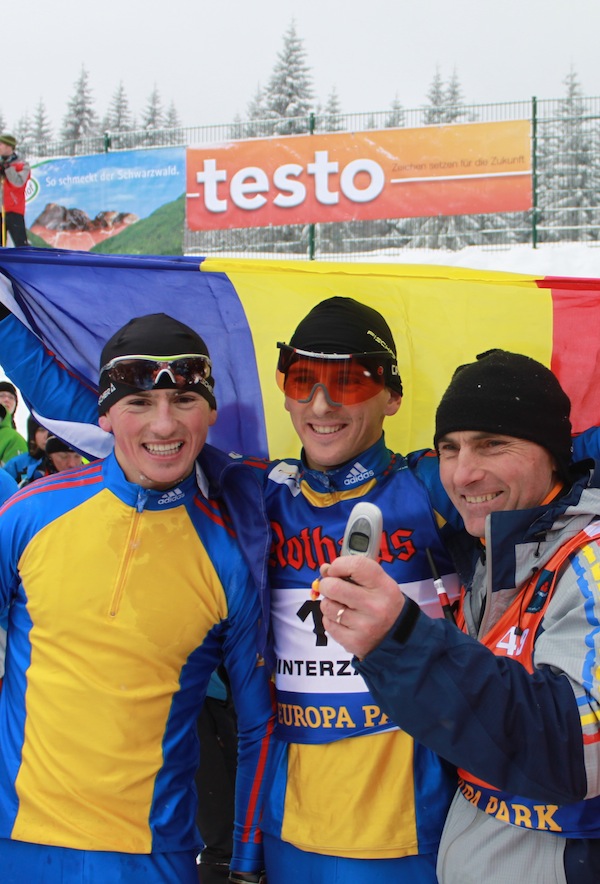
Paul Constantine Pepene of Romania making his race-winning move on the second of four skate laps. Tad Elliot is in the red suit directly behind Pepene, with Andreas Katz (GER) on the far left.
After Petr Sedov’s domination of the junior 20k pursuit here yesterday, it seemed unlikely that anyone would be able to outdo that performance in the 30k U-23 version today.
Enter Paul Constantin Pepene of Romania.
As a dense, 30-skier group made its way up the course’s big climb on its sixth of eight laps, Pepene put in a huge acceleration—the biggest that second-place Ole Marius Bach said he had ever seen.
Using a quirky skate technique–-which he said was ingrained by learning to ski on Romania’s poorly-groomed trails—Pepene was able to fend off a furiously-chasing pack led by Andreas Katz (GER) and Tad Elliot.
He built up a big lead over the next two laps, crossing the finish line 25 seconds in front of Ole Marius Bach (NOR) and Katz despite a lengthy victory celebration—and he looked like he could have skated another eight laps.
Elliot found himself in the mix after a relatively slow and tactical start to the race. A professional mountain biker during the off season, Elliot prefers skating, so he was happy to see a brief snow squall slowing down the leaders during the classic leg–he actually came into the stadium for the transition leading the race.
For the first two 3.75k skate loops, Elliot sat at the front, and was in good position to respond when Pepene made his move. He went with Katz and a few others to try to close the gap, but the Romanian was too strong, and the effort proved to be too much for Elliot to absorb, as he faded to 21st.
Noah Hoffman also looked to be on course for a strong day, skiing at the front during the third of four classic laps. He said the didn’t wasn’t trying to push the pace, but that with such a touchy pack behind him—Hoffman said the classic leg was like “bumper cars” with everyone jockeying for position—he didn’t want to give up his place at the front. He said he wasn’t sure what happened during the skate leg, or where he lost contact with the lead group, but he was well behind by the middle of the first skate lap.
Two Canadians, Frederic Touchette and Graeme Killick, rounded out a strong day for their country by finishing sixth and seventh, following Brittany Webster’s eighth place in the women’s race. Killick said that he made the lead chase group that formed behind Pepene, but that he was slowed by cramps over the last two laps. Touchette edged him in a sprint at the line.
Both of the other Canadian starters made the top-20—Kevin Sandau and Len Valjas were 13th and 16th, respectively.
Peter Kling and Reese Hanneman of the U.S. battled hard to stay ahead of Pepene on their seventh of eight laps. It appeared that they had succeeded, as they still had a 30-second gap on him coming through the stadium to head out on their final loop, but officials pulled the racers anyway.
Pepene’s win was the second Romanian podium in as many days. He said that his country had been helped by a recent infusion of money into their ski federation ahead of the European Youth Olympics that will be held their in 2013, and that there that there’s a strong group of juniors in the
Pepene with his coach and one of his teammates after the finish
pipeline.
“I believe the world will hear of us,” Pepene said in the press conference, still wrapped in the Romanian flag he’d donned at the finish.
Like Sedov, Pepene is headed to Whistler to compete in the 2010 Winter Olympics, where he said his goal is a top-30.
Tad Elliott racing in West Yellowstone this winter
After Tad Elliot skied his way to a second place finish in yesterday’s 15k freestyle, the cross country cognoscenti didn’t quite express the same degree of confusion as they did over Tyler Kornfield’s fourth place in the sprint. After some solid racing at last year’s West Yellowstone SuperTours and a trip to the U-23 championships, Elliot has a little more name recognition. But it’s safe to say that there probably weren’t many people here in Anchorage who expected him to come within 30 seconds of Kris Freeman in a distance race.
FasterSkier caught Tad this afternoon for some questions about his life racing on skis and mountain bikes.
FasterSkier: To start out—you grew up both mountain biking and cross country skiing?
Tad Elliot: I grew up nordic skiing, since I was about 2 or 3 years old. My parents got me on skis ever since I could walk, and then when I was in eighth grade a friend took me to a mountain bike race, and that’s how I started mountain bike racing competitively.
FS: And your dad is a former Olympian in cross country skiing? Was he kind of a coach or an advisor for you? TE: He was on the U.S. Ski Team for a number of years and went to a few Olympics. He oversees the local nordic program, but I always had my respective coaches within that program. But he always helped guide me in the right direction with skiing.
FS: This year you’re racing for CXC—did you train all fall with them?
TE: I did not. I still live in Durango, Colorado and train alone pretty much all the time out there, which is how I’m doing it. Jason Cork with Michigan Tech has helped me a little bit in training, and my dad helps me a little bit, but mainly I write my own programs.
FS: What kind of stuff do you get from Cork? How did you start working with him?
TE: Cork will give me certain ideas to implement in my training. He was the Durango Nordic head coach for I think four or five years, and he was my coach all through high school and my first year out.
FS: How did you hook in with CXC? Did you approach them, or did they approach you?
TE: Yuriy Gusev from CXC gave me a call and asked if I’d be interested in being part of their marathon team. I said sure. That’s how I got involved with them, and it’s been great.
FS: What kind of support are you getting from them? Skis, wax, travel?
TE: They help with skis and travel and everything like that. Also, Bryan Fish, who is a great coach, great wax tech—it’s always nice when he’s at the races, because he can direct you.
FS: So when you’re at races with them like this one, are you within their structure, or are you more flying solo?
TE: I’m within a structure when I’m at the race, for sure.
FS: Okay, so with regards to your race yesterday: did you have any idea that your fitness was this good?
TE: No, I had no clue—I had absolutely no clue. I went to a local JOQ [Junior Olympic Qualifier] in Colorado and got beat up on by some juniors three weeks ago. They were all going fast, and Colorado has some real great skiers right now. Then I came home and rested for nationals and had a plan I was confident in coming here, and I ultimately dreamed of a top ten. I thought that if I got a top ten that was going to be amazing. After my race yesterday I was pleasantly surprised, really beside myself with that result.
FS: So you’ve been racing mountain bikes for the U.S. Under-23 National Team. Do you have a new plan for next year? (Tad is 23.)
TE: I do have a plan for next year—I just signed with SHL Air and Specialized. It’s a domestic team in the US, and USA Cycling has also said that they’re going to continue their support of me. I will be racing World Cups with USA Cycling over in Europe, and the Pan-American Championships down in Guatemala with those guys.
Tad Elliot racing yesterday. Photo, Rob Whitney.
FS: Can you walk me through a typical training year for you, starting at the end of the ski season?
TE: At the end of the ski season—it usually ends up going to the Birkie, or last year I did The Great Race—I take zero time off. I get on a bike and usually about two weeks later I’ll be in California or somewhere warm racing. I’ll race probably three out of every four weekends and try to keep the racing season going in the U.S. for about six weeks. Then I head over to Europe for about four or five weeks, racing World Cups and Swiss Power Cups, which are like big UCI [International Cycling Union] races, and then come home. I usually have about a couple weeks. I race nationals in Colorado—it’s an easy travel day. Then I go back to Europe to race a couple more World Cups, and race more domestically if I’m going well. I end my mountain bike season in mid-September with World Championships.
From there, I go into ski training. I take like four days off, usually completely off, doing nothing. Then the next week I just wake up in the morning and do lifestyle training— whatever’s fun and whatever sounds appealing—and then it goes into a ski training plan, where I’ll build up until West Yellowstone with the hours.
FS: Does all the travel get to you?
TE: Eventually the travel will wear on me. I’m getting better at learning how to travel, but it gets kind of lonely sometimes when you’re away from friends and family for a while. But I’ve got a lot of friends on the bike and ski circuits, which makes it a lot better. The biggest thing for me is trying to stay healthy on all those international flights.
FS: What do you take to skiing from mountain biking, and the other way around?
TE: Since I race so much, a lot of race experience. I learn how to prepare better for big events, and also how to race well. I also think that I’m faster in each one by doing the other because when the fall rolls around, I’m really excited to rollerski and to run and to weightlift. I’m excited with skiing, and it’s never dull to me all through the end of winter. And the same with biking—I’m psyched about it until the season’s over.
FS: Do you get pressure from both sports—people saying that you should be specializing?
TE: Honestly, you always hear, ‘maybe you should think about specializing.’ Cyclists actually say that skiing is great, and they approve of it—maybe they harass me a little bit to get on a bike in the winter, but it’s nothing bad. In skiing the biggest thing I hear is not to get so many race starts and so much travel.
Right now I can’t see any time in the near future to specialize in one. My goal is to have people not saying, ‘oh, Tad is a good skier for biking all summer,’ or ‘Tad’s a good biker for skiing all winter.’ I want to be a good cyclist or a good skier.
FS: Have you ever talked with Carl Swenson [a former professional mountain biker and cross country skier)?
TE: I have actually never talked to Carl Swenson, which is my fault—I’ve never gone out and contacted him. He was my hero growing up, and I’ve only ever seen him racing—I’ve never gotten to talk to him. He paved the way for me being able to do both at such an amazingly high level.
FS: What are your goals for the rest of the season?
TE: That is something I need to evaluate now, but I hope to race [the] Owl Creek [Chase], which has been a huge goal of mine for the last two years, and then hopefully go to the Birkie and do well. Now I might be going to the Midwest and doing the Midwest SuperTours. My main focus has been the Owl Creek Chase, and the Birkie and U.S. Nationals, but I hope to make it to the Midwest for those SuperTours.
FS: Does the mountain biking fitness help for the marathons?
TE: Truthfully, no. On a mountain bike, it’s so much easier to go two hours than to go two hours skiing. Last year at the Birkie I thought my mountain bike background was going to for sure help me, but I bonked so bad. I think it’s something I need to learn how to do on skis.
Tad Elliott (CXC Team Vertical Limit) – 2nd place.
The wax today was LF Moly followed by HF Blue/Red mix followed by JetStream Blue/Red mix. Mixing the two JetStreams is uncomplicated. Either rub one block on and then the other block and rotocork them in together or sprinkle one powder on and sprinkle the other powder on and iron them in together quickly followed by rotocorking them. JetStream Moly was also really good.
Kris Freeman (USST) – 1st place.
Notice that the winners of both races were in third place after 5kms. There’s a lot to be said for skiing into a race, settling in, and finishing fast. This way a skier is more likely to ski well. If a skier starts really fast with the idea of “ripping everybodys’ legs off” more than likely the skiing will be subpar and the skier will be relying purely on fitness. There are some very successful slow starters out there who always start in a measured fashion and finish super fast. Matti Heikkinen and Thomas Alsgaard come to mind, but nobody does this as much as Axel Teichmann. It clearly works well for them though and yields consistency.
Matt Liebsch (CXC Team Vertical Limit) – 4th Place.
Otherwise, I was watching the races today from a “sprinters hill”. This is a short hill (10 seconds) that is preceeded by recovery, is approached with momentum (after a downhill for example), and is followed by recovery. Most everybody skied the transition into the hill very well, keeping the ski bases gliding and using a high speed technique. Also, most everyone crested the hill and immediately put the gas on to build maximum speed for the coming downhill. Many of the men used a V2 on the climb which yielded a minimal loss of momentum. In the women’s race though, all of the racers climbed using a V1 technique. There were huge differences in speed on this little hill between the women.
Caitlin Compton (Go! Training) – 2nd place.
There were three types of skiers in the women’s field on this hill.
The first type approached the hill and when momentum was lost, adopted a V1 technique at the same climbing rhythm that was used elsewhere on the extended climbs on the course. These skiers lost the most time. They inevitably bogged down and lost all momentum. Their tempo was significantly too slow and they looked like they could have skied at that pace for quite a while. They simply shifted into “climb mode” without trying to maintain momentum.
The second type approached the hill and when momentum was lost, bent over at the waist, stuck the butt out, put their weight on the inside of the skis, and tried to power their way up the hill using their glutes, not the muscles in the front of the legs which are more effectively used when skating.. Unfortunately, these skiers ended up skiing purely on the inside of their ski edges and rather than skating up the hill, ended up stepping up the hill on their inside edges. As their skis landed on the snow, they stopped as skis don’t like to glide on edge especially when under load. They did use a higher tempo which was good, but the technique was such that despite being strong and increasing tempo, they lost time on the skiers who actually skated the climb cleanly.
Liz Stephen (USST/BMA) – 3rd place.
The fastest type were obviously less common. Kikkan Randall was the best example of this. She approached the hill with speed as the others did. As she started to lose her speed, she switched to a V1 technique while keeping her hips high and forward. Her tempo was high and her feet stayed light. Despite skating up a hill and losing a bit of momentum, her hips did not drop back nor did she compress much at the waist. Instead she danced up the hill using seemingly little effort and then powered down again as soon as the grade decreased again. She skied with wonderful technique and finess and not her sprinters power. The key to this is keeping the hips high and forward while continuing to skate with “light” feet. The arms come forward fairly quickly and give the skier momentum somewhat like they do when doing a standing broad jump, but with the hips high and forward.
Rebecca Dussault (CXC Team Vertical Limit) – 6th place.
The easiest way to learn how to do this is to lead with the poles – have the poles hit first on the strong side (poling side) before the ski on that side hits the snow. Then keep skiing. It is basically what was referred to as the Alsgaard Skate a while ago. It is critical to do this though while standing up – keep the hips forward and high and don’t bend over much at the waist. The body position fits the technique. It is efficient and fast. Peter Northug also skis this way when he does his famous V1 sprint attacks on a climb at the end of a race. He bends over some at the waist to get more power, but does the rhythm as described above with the poling.
Kris Freeman on his way to victory in the 15k freestyle at 2010 US Nationals
It wasn’t the same kind of power that Kris Freeman used to propel himself to top-ten World Cup results this winter, but it was enough. With an effort that “would have just barely scored World Cup Points,” Freeman skied his way this morning to the national championship in the 15k skate in Anchorage.
After contracting the flu over Christmas, Freeman said that he’s “been trying to build his way back up ever since.”
Today’s effort he said, was only the second time since coming home that he “went hard and felt good.”
Freeman’s victory was by no means a given. Four k into the race, APU’s James Southam was a few seconds up on the eventual winner, who started just 1 bib–30 seconds–ahead of him. But unlike Southam, who went out hard, Freeman started slow, and eventually reeled in the Alaskan.
“I started pretty aggressively,” Southam said. “I wanted to beat Kris. He tends to start a little bit conservative, and I was hoping to catch him on the first lap. I got halfway there.”
The race of the day belonged to CXC’s Tad Elliot, who surprised everyone by skiing his way into second place, just 25 seconds behind Freeman. Elliot, who rides a mountain bike in the summer for the U-23 U.S. National Team, said that “it was the perfect day at the perfect time.”
His goal for the season, he said, was to be able to ski his best at Nationals, especially in the 15k freestyle, given that it’s his stronger technique.
Despite the result today, Elliot said that he is still hoping to be able to pursue both sports.
“I’m trying to juggle them,” he said. “I’ve got awesome sponsors that are allowing me to do both.”
The Saab Salomon Factory Team has plenty of experiences with the American Birkie. It has been the focal point for our team for the past 15 years. With a new sponsor and new flashy black suit [they] have Birkie veterans and rookies coming to throw down on Saturday. Here is an inside look at what’s on the mind of Saab Salomon Factory Team members in the days leading up to the race.
Andy Gerlach- What is your all time favorite Birkie moment on and off the race course?
My favorite moment is every year when the race is over and I can say “The skis ran well, the feeds went as planned, no poles were broken and we won!”
Chad Giese- You grew up in the heart of Birkie country and raced the course numerous times. What is the key part of the course to execute perfectly on Saturday?
The start. If you miss the break, you are stuck in the group you are with for the rest of the race. Be in position to make the break. That is the key to a good Birke.
Evelyn Dong- Do we refer to you as the Birkie King or Queen? What did it mean to win the Birkie last year and your thoughts on a repeat?
I don’t think I’m referred to as the Birkie Queen. I hope not. Winning the Birkie was a huge boost for me last year. I’ve been known as a distance specialist and winning the Birkie legitimized everything. I’d love to repeat this year but I’m definitely up against tougher competition. Plus I’ve been injured and sick more than usual this year.
Kristina Standberg- For being a dominant classic skier, would you like to see the Birkie Elite Wave be classic? After watching you win the last five Supertours, will your skate demons be put to rest come Saturday by winning the ultimate North American Skate Race?
I would love to race a classic Birkie! Not only because it would be better for me personally, but also since the “original Birkie” (the Norwegian Birkiebeiner) is a classic race. Some of the marathons in Europe are raced classic and skate on alternating years and I think that’s a pretty good system. I’ve been working hard with my skate technique and I think I’m finally starting to see some results. It would be a fantastic feeling to be the first lady across the finish line on Main Street in Hayward!
Fabien “The Wax Tech” After participating in the Birkie for the first time last year, what is the most important part of the course to wax for? Is it key for the wax team to eat the Blondeau’s family Fondu the night before the Birkie? I here it brings good luck to the team.
To me, it’s important to wax for the second half of the race! In February, the days are getting warmer by 10:00am, it’s important to have good skis for the second half with a lot of flat and downhill! So I would advise to wax for the second half with something colder and harder underneath.
I think it is important to feed well before a long and hard 50k like the Birkie. So a fondue with good French cheese is one of the best way to get energy for a full race! Of course, it is always nice to have a nice dinner together and hopefully this will give us a good luck to have great results on Saturday.
Tad Elliot- Following in the footsteps of Carl Swenson as a pro mtn biker and skier, how does your background prepare you for your first Birkie and who is your pick for the Tour of California win?
My mountain bike back ground will hopefully help me with my fist Birkie because I will be more comfortable at racing for around two hours and in a pack. I don’t have too much experience at long distance racing on skis so I am going to prepare for the Birkie just like a Mountain Bike Race…hopefully it works.
My pick for the tour of California race is, Durango Home Boy, Now Boulder Home Boy, Thomas Danielson. I will also be watching Christian Vande Velde! Hopefully Garmin Chipotle will take home the win.
Mike Sinnott- As a first time Birkie entrant, what are your thoughts going into the biggest race in America? Have you ever tried a pickled turkey gizards and are you thinking of breaking the record? I mean total pickled turkey gizs post birkie night?
I’m pretty excited, and surprisingly not very nervous- although that will no doubt build as the people begin to show up. I’ve been slowly attending larger and larger events, and each time it’s cool to see the enthusiasm of the Nordic Community. So, shockingly, I’m looking forward to the chaos and whatever other whirlwind that comes. It should be fun. I think someday I’d like to comeback and ski from the middle of the 10th wave, just to experience the swarms of humanity. But, that’s before I have seen it in action, so… What? Gizzard is my favorite dish!! Even though wild turkey gizzard is a little gamy, I can still put back my fare share.
I was lying before. Don’t make me eat one of those.
Laura McCabe- Describe your first experience or memory with the Birkie?
My first Birkie was in 1991 or 92, I was in in awe from the start, with the excitement of the big crowds, the singing of the National anthem and the energy surrounding me. I remember being astonished with all the spectators and the funny costumes you skied by on Bitch hill. I remember the struggle in passing trains of men, but also the positive reactions that always came from their mouths. The lake was grueling and there was a big head wind though the pain was quickly diminished as you turned down Main Street to the roar of the crowd. I cannot remember what my place I was that year but it was an experience that will not be forgotten.
Rebecca Dussault- Here is a simple bet. If you win the Birkie you will make a comeback for the 2010 Olympics? Will you take it?
Bet? You Bet. I already have the wheels all moving in that direction regardless of what goes down at the Birkie. We’ve been praying about it as a family and trying to search our hearts and see if this is where God wants us to be. Right now, considering that Sharbel is totally healthy it seems more likely than not. If I don’t hit any unforeseen roadblocks then I’ll be there, will you?