Tag: Tahoe

  • The New JC Schoonmaker: Sharper, Calmer, and Ready for the Moment

    The New JC Schoonmaker: Sharper, Calmer, and Ready for the Moment

    When JC Schoonmaker talks about his earliest memories of ski racing, he doesn’t begin with speed or snow conditions, or the particular magic of gliding across winter trails. He starts, instead, with raffles. “I just remember as a kid, there’d be raffles after every race that I would be so stoked for,” he says. “Trying to get a prize, like a new pair of gloves or a hat.” It is an unexpectedly tender snapshot of a skier now known for his explosive starts and the sharp, angular drama of World Cup sprint heats. But it is also revealing. Long before Schoonmaker was on national team radars, long before he was analyzing sprint tactics or refining breathwork, he was simply a boy who loved showing up at races, surrounded by friends, snow, and the possibility of leaving with a hat.

    Schoonmaker grew up in Tahoe, a place where winter sport is woven into the fabric of childhood. Yet unlike many of the region’s rising athletes, he was not funneled into Alpine skiing or a single disciplinary track. Instead, he moved constantly—and in every direction. “Both my parents were super athletic, into sports,” he says. “So from a really early age, I was just doing tons of different stuff: soccer, downhill skiing, and Nordic skiing. I played lacrosse. A little bit of baseball.” The variety shaped him in ways he didn’t appreciate at the time: balance from soccer, strength from downhill, elasticity from lacrosse, and a developing sense of rhythm from all of it.

    Meanwhile, the Nordic community in Tahoe was small enough to feel intimate yet substantial enough to provide him with peers, mentors, and a place to grow without suffocation. “Joining a Nordic team for me was super fun because I got to go out and ski with friends,” he says. “It was kind of my first experience racing.”
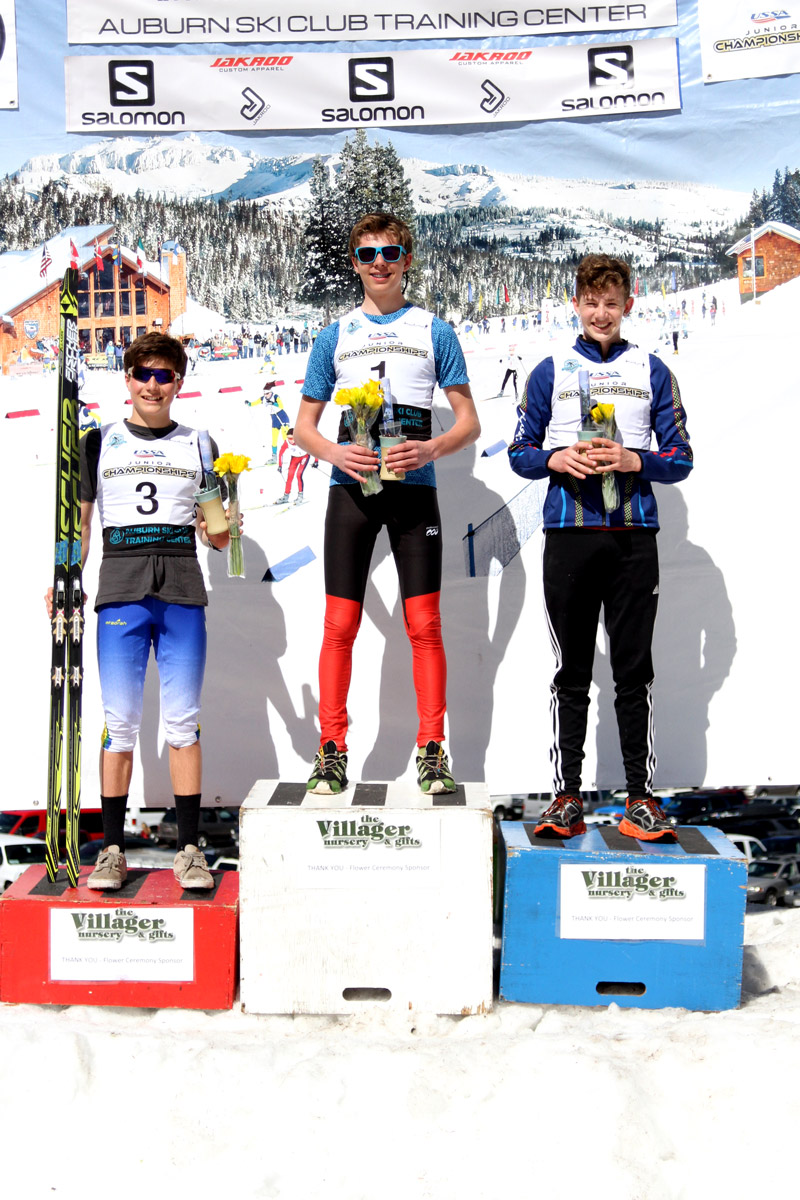
    The U16 men’s podium from the 5 k Classic Mass Start at 2015 U.S. Junior Nationals at Auburn Ski Club in Soda Springs, Californial. JC Schoonmaker took home third place. (Photo: Mark Nadell/MacBeth Graphics)

    Early Validation in Soldier Hollow and Truckee

    It wasn’t until he traveled outside his region that Schoonmaker realized how he measured up. On a Far West trip to Soldier Hollow—his first time racing beyond his local bubble—he surprised himself. “I think I got third in the first race… then I won the second one,” he recalls. “I didn’t even really know it was a big deal, but all the older kids on the trip were… really excited for me.” Their reaction revealed something he hadn’t yet recognized: that his potential extended well beyond his local podiums.

    A similar revelation arrived at Junior Nationals in Truckee, where home snow became a proving ground. He had hoped to earn All-American status, although the early races had gone poorly. “All the first races didn’t really go super well,” he says. “I had high expectations.” Yet in the final individual race before the relay, he stepped onto the podium. “Somehow onto the podium and got third,” he says. “That gave me a bunch of confidence… really helped me.” It was not just affirmation but a directional sign. Skiing was becoming more than an activity. It was becoming a path.
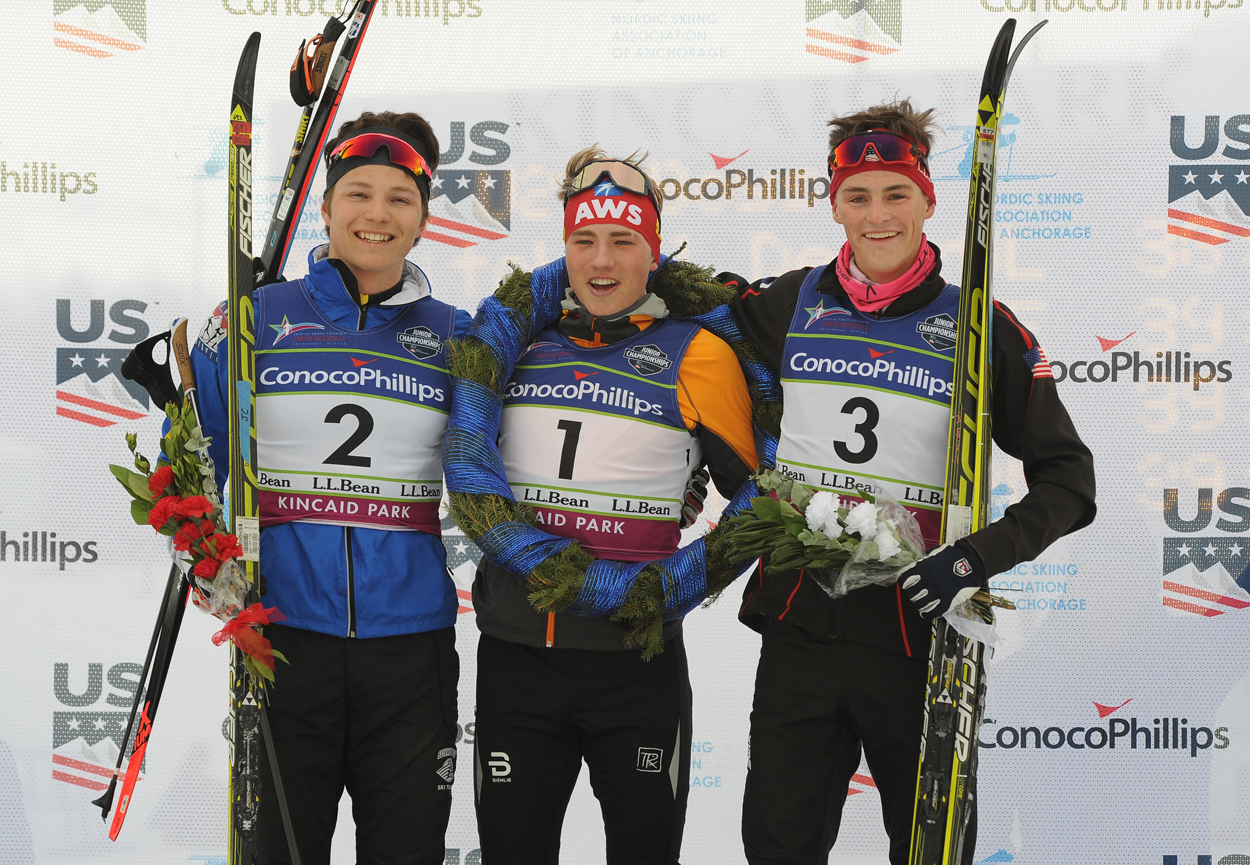
    Gus Schumacher (Alaska Winter Stars/Team Alaska), center, won the U20 men’s 15K classic mass start race at the 2019 U.S. Ski & Snowboard Cross Country Junior National Championships at Kincaid Park. J.C. Schoonmaker (UAA-Auburn Ski Club/Far West), left, was second, followed by Cameron Wolfe (Ski and Snowboard Club Vail/Rocky Mountain), right.  (Photo: Michael Dinneen)

    Choosing Anchorage and the Power of the Right Environment

    Despite his junior successes, Schoonmaker’s college recruiting process was sobering. His age cohort was stacked—Gus Schumacher, Luke Jager, Canyon Tobin—and their achievements overshadowed many strong skiers. “My top choice was UVM, and I just didn’t get a spot there,” he says. “I didn’t have a ton of options.” But an unexpected opportunity appeared when a Tahoe friend encouraged him to consider the University of Alaska Anchorage. He visited, and something clicked. “I’d say that’s the best decision I ever made,” he says. “I ended up coming to an excellent team… It’s an awesome place for skiing.”

    Anchorage wasn’t glamorous, but it was grounding: clear air, big terrain, and a training culture built on consistency rather than spectacle. Under coach Trond Flagstad, Schoonmaker’s skiing matured—his engine, his technique, and his confidence—all while laying the foundation for a collaborative coaching story that would shape his rise.


    A Uniquely Collaborative Coaching Path

    Schoonmaker’s development is defined by the unusually harmonious network of coaches who supported him. In Tahoe, he trained with Will Sweetser, whose workout creativity brought nuance to his summer training. At UAA, Flagstad built his fall rhythm with threshold work and bounding. In the winter, U.S. Ski Team coaches—Matt Whitcomb, Kristen Bourne, and Chris Grover—stepped in with race-day craft and a national pipeline. And now, in Anchorage, he works with Eric Flora at APU, whose daily presence has brought structure and clarity.

    “I feel like I didn’t even really have to do much in the way of balancing that,” he says. “Trond, Will, and Matt… kind of just took that on themselves.”

    That kind of multi-coach collaboration is rare. Instead of conflicting philosophies, Schoonmaker received overlapping layers of expertise, each building on the others. He remembers one of Sweetser’s signature interval sets with particular fondness: “Twenty seconds L5… forty seconds rest… forty seconds L5… then six minutes of threshold. A cool blend… essential for getting you ready for doing sprints on the World Cup.” Flagstad brought heavy doses of fall bounding at L4. Whitcomb and Bourne added race sharpness. Flora, finally, aligned everything. “Having him at World Championships last year made it feel like just a practice in Anchorage,” Schoonmaker says.

    JC Schoonmaker (bib #1) at the 2020 Senior Nationals in Houghton Michigan. (Photo: Reese Brown)

    The Unexpected World Cup Start That Changed Everything

    The first moment when Schoonmaker truly understood the trajectory he was on came suddenly. At U.S. Nationals in Houghton, Michigan, in 2020, he won the sprint qualifier. It was exciting, but he didn’t assume it meant anything beyond that day’s result. Then his assistant coach, Marine Dusser Bjornsen, approached him with unexpected news. “She was like, ‘Oh yeah, you’re gonna get World Cup starts from that,’” he recalls. “And I was like, ‘What? No way.’” His passport was expiring, his bags were unprepared, and within days, he was on a plane to Dresden.

    Stepping into the World Cup for the first time felt surreal. “I wasn’t even really worried about those being my first World Cups,” he says. “I was mostly just hoping to get to go over there.” The qualifiers felt manageable; the heats were startling. “Racing against those dudes in the heats… was just a whole other level. A different beast.” Still, he never felt crushed by the moment. “We were just having fun,” he says. “It wasn’t crazy high expectations.” That experience didn’t instantly transform him, but it recalibrated his sense of where he belonged.

    APU: A Training Collective That Became Home

    When Schoonmaker finished college and committed to training full-time in Anchorage, it wasn’t only because of Flora’s coaching. It was because the environment felt like home. “Luke coming back… Gus joining… Zan and Michael… it was such a good team,” he says. “A lot played into it… but mostly that stuff.” APU is one of the few places in the country where the majority of the national team trains together throughout the year, creating a rare sense of continuity on the World Cup.

    Yet even in a group that suits him so well, Schoonmaker knows he needs occasional solitude to stay balanced. “I definitely find times during the summer where I’m pretty excited to do an interval session by myself,” he says. “I grew up training alone in Tahoe.” Winter, of course, is different. “You’re living with this group of people for the entire winter,” he says. “Sometimes it is hard to find time to yourself.” But the team understands him. “Everyone knows whatever’s best for you is what’s best for the team.”

    A New Kind of Training: Mindfulness and Sprint Awareness

    This year, Schoonmaker added something he had never practiced formally: daily mindfulness training. “Some breath holds… super simple, just five minutes of mindfulness,” he says. “Focusing on my breath, trying not to let my thoughts wander.” The shift wasn’t driven by physical shortcomings, but by an honest assessment of where he needed to grow tactically. “In sprint heats… I’ve tended to have my head down, thinking about my technique… rather than, ‘I need to get this position around this corner.’”

    Mindfulness gave him a way to sharpen his presence during races and training. During intervals, he began noticing moments when his focus drifted. “My mind starts thinking about what I’m gonna have for lunch,” he admits. “I’m getting better at bringing myself back… loosen up, ski relaxed.” The work is subtle, internal, and mostly invisible, yet deeply connected to the kind of racer he wants to become.


    Passing It On: What He’d Tell the Next Generation

    If Schoonmaker were speaking to a group of juniors in Tahoe today, he would know exactly what he would emphasize. “I love this puzzle of trying to get better every day,” he says. “Focus on the small things you can control… let the cards fall where they fall.” But he would also add a piece of training wisdom gained from experience. “I almost feel like I got a little too caught up in L1 and L3,” he says. “Walking up hills on classic skis isn’t getting you better at classic skiing. You have to ski fast to get better at skiing fast.” It is the kind of message that cuts through both trends and dogma.


    Life on the Road: Davos, Oslo, and a Simpler Suitcase

    Schoonmaker’s favorite destinations reflect a balance of beauty and familiarity. Davos stands out. “I’d love to go there when I’m not getting ready for the Tour de Ski… explore it a little more,” he says. He also holds a soft spot for Oslo. “That’s a special spot. I always feel like I’m having a really good time there.” On race mornings, he keeps things simple: “Probably a couple eggs and a few pieces of toast with jam.” And he no longer travels with the heaviest item from his early career. “I brought over an Xbox… took up, like, 12 pounds in my bag,” he laughs.

    Schoonmaker and girlfriend, Emma Ribom (SWE). (Photo: Courtesy Photo)

    Olympic Season: Ambition, Clarity, and the Calm Before the Heats

    Despite the stakes of the Olympic year, Schoonmaker hasn’t reinvented his approach. “I honestly haven’t been doing anything different,” he says. “I’m more excited to be healthy and head into Period 1 feeling good.” But his goals are not small. “My goals would be to win a medal,” he says. “That’s what I’m shooting for.” A chance to race the relay again is just as meaningful. “The relay in Trondheim was super fun,” he says. “I would love to get another chance.”

    As for the individual sprint, his ambition is both grounded and bold. “If I could make the final… that would be a solid day,” he says. “But I do feel like I can win a medal.” Few athletes can express that kind of aim with such composure. Schoonmaker delivers it as calmly as if he were describing a morning ski.
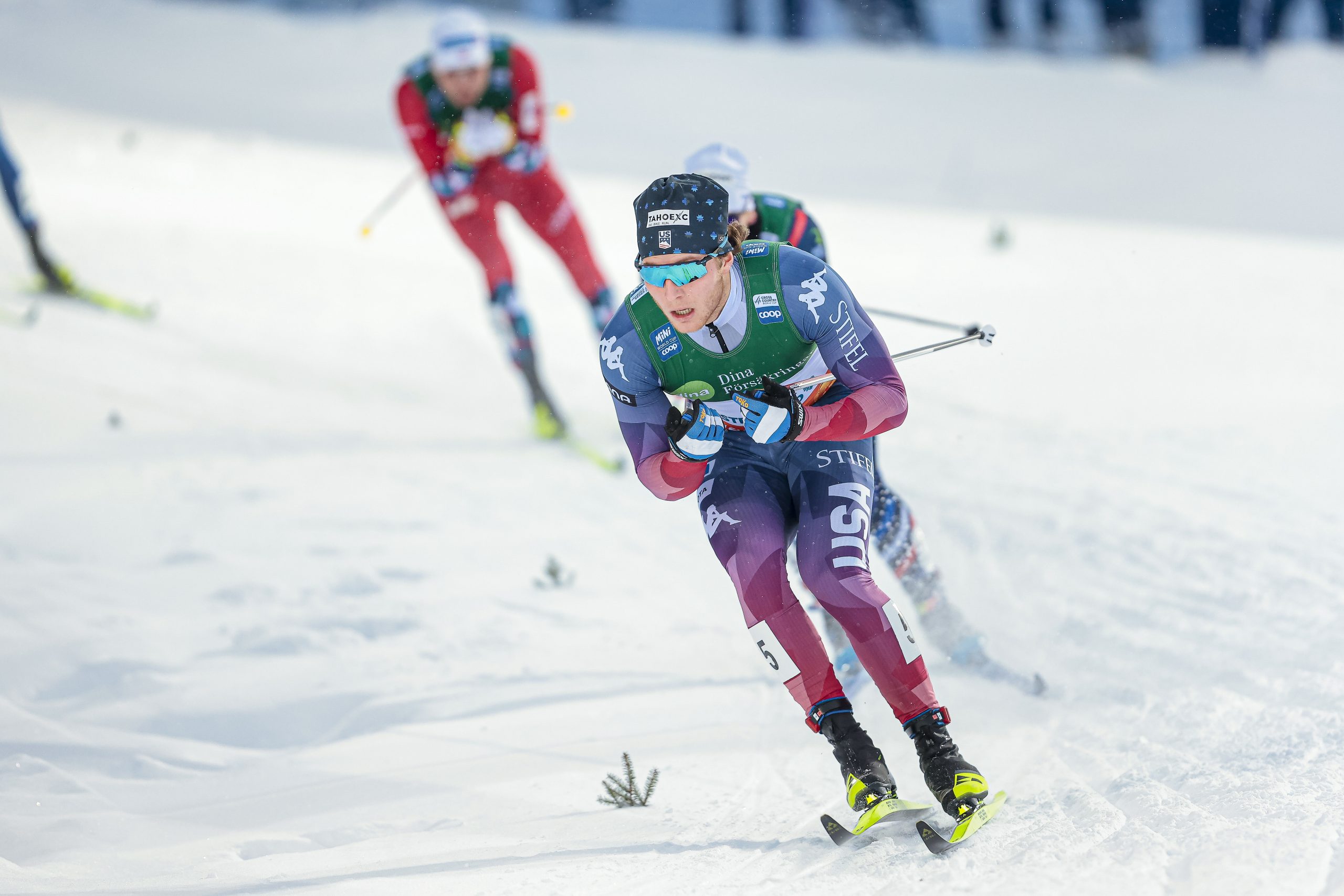
    JC Schoonmaker (USA) had a breakout day in Oestersund (SWE) in 2023, reaching the podium for the first time. The American took third place. (Photo: NordicFocus)

    Where He Stands Now

    What stands out most about Schoonmaker at this moment is not bravado, but clarity. He is no longer the boy who raced for raffle prizes, nor the college skier unsure of his place, nor the rookie dragging an Xbox through European airports. He has become something steadier, more self-aware, and more intentional. A sprinter with composure. An athlete with perspective. A competitor capable of holding his ambition lightly without losing its sharpness.

    Presence, for Schoonmaker, is not stillness. It is an ongoing process of tuning himself to the shifting rhythms of a sprint heat, listening to what his mind and body are telling him, and moving through the season with intention rather than urgency. If he keeps his head up—literally and figuratively—this may be the season when the skiing world begins to see not only what he has built, but why it was built this way.


    Love Stories Like This? Help Keep Them Coming.

    Feature interviews like this one take time, access, and care to produce. If you value thoughtful storytelling and independent ski journalism, please consider becoming a Voluntary Subscriber. Your support directly fuels the work we do to cover the people, places, and moments that make our sport special.

    Join the FasterSkier community!


  • 17 Questions for 2017: Hannah Halvorsen

    17 Questions for 2017: Hannah Halvorsen

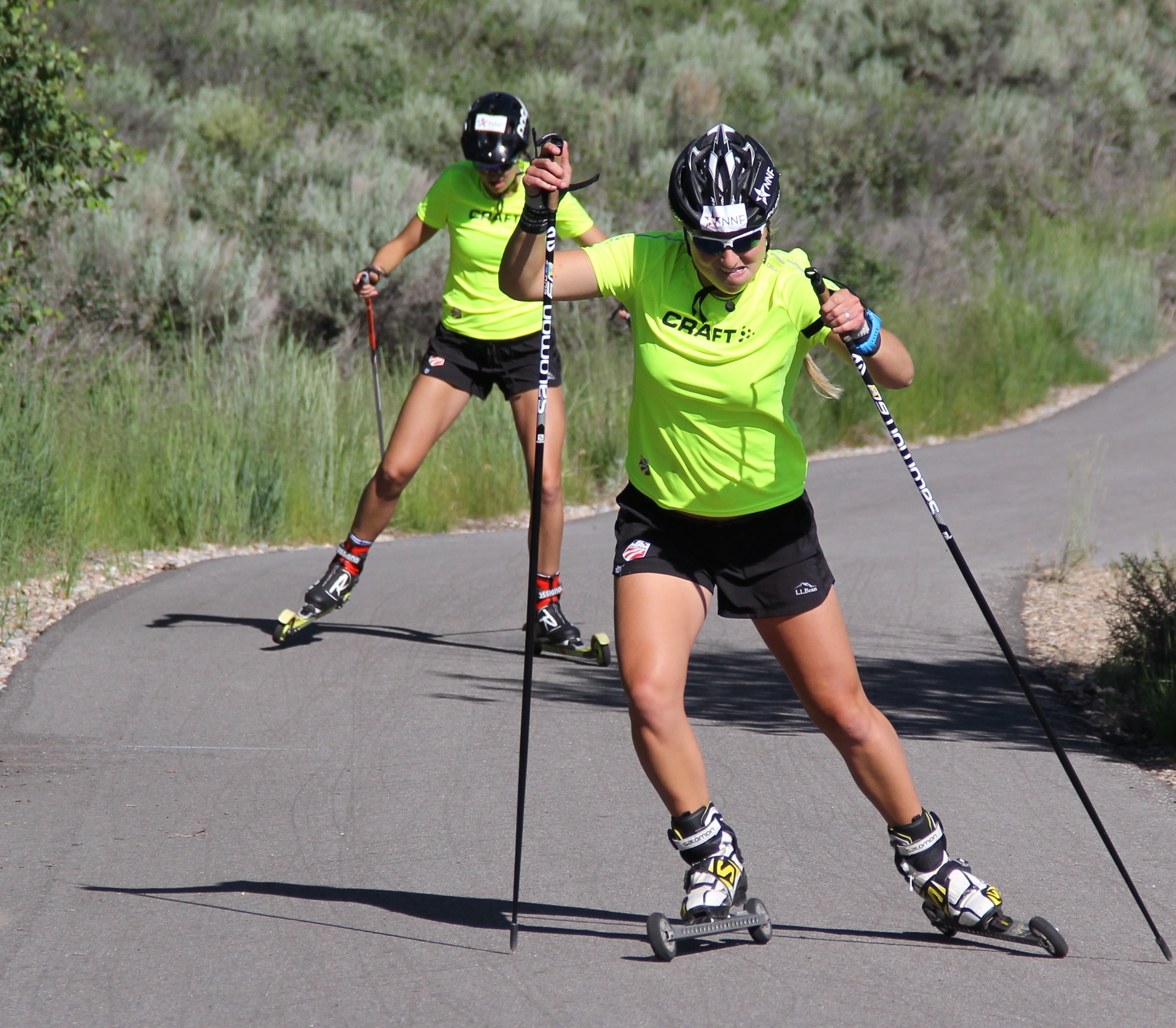
    Hannah Halvorsen (foreground) attacking the rollerski track at Soldier Hollow. (Photo: Bryan Fish)
    Hannah Halvorsen (foreground) attacking the rollerski track at Soldier Hollow. (Photo: Bryan Fish)

    Welcome to “17 Questions for 2017″, where we are catching up with American and Canadian national-team members before the beginning of the winter season. 

    ***

    Last season, Sugar Bowl Academy’s Hannah Halvorsen snagged her first SuperTour podium – before heading back to the junior ranks to win a U18 race at U.S. National Championships, a title at Junior National Championships, and represent the United States at the Youth Olympic Games in Lillehammer, Norway.

    The California cross-country skier also ended up with her first U.S. Ski Team nomination. Now 18 years old, Halvorsen has been making the most of her first training season without school.

    1. Biggest change in your life in the last five or so months since the ski season ended?

    The biggest change in my life since ski season ended has been adjusting to a slightly different lifestyle as a post graduate skier. I still train with Sugar Bowl Academy but now I don’t have to work around a school schedule.

    2. Biggest change in your training?

    This year not being in school has allowed me to drive down to low elevation training about twice a week.

    3. Major areas of improvement you’ve seen so far?

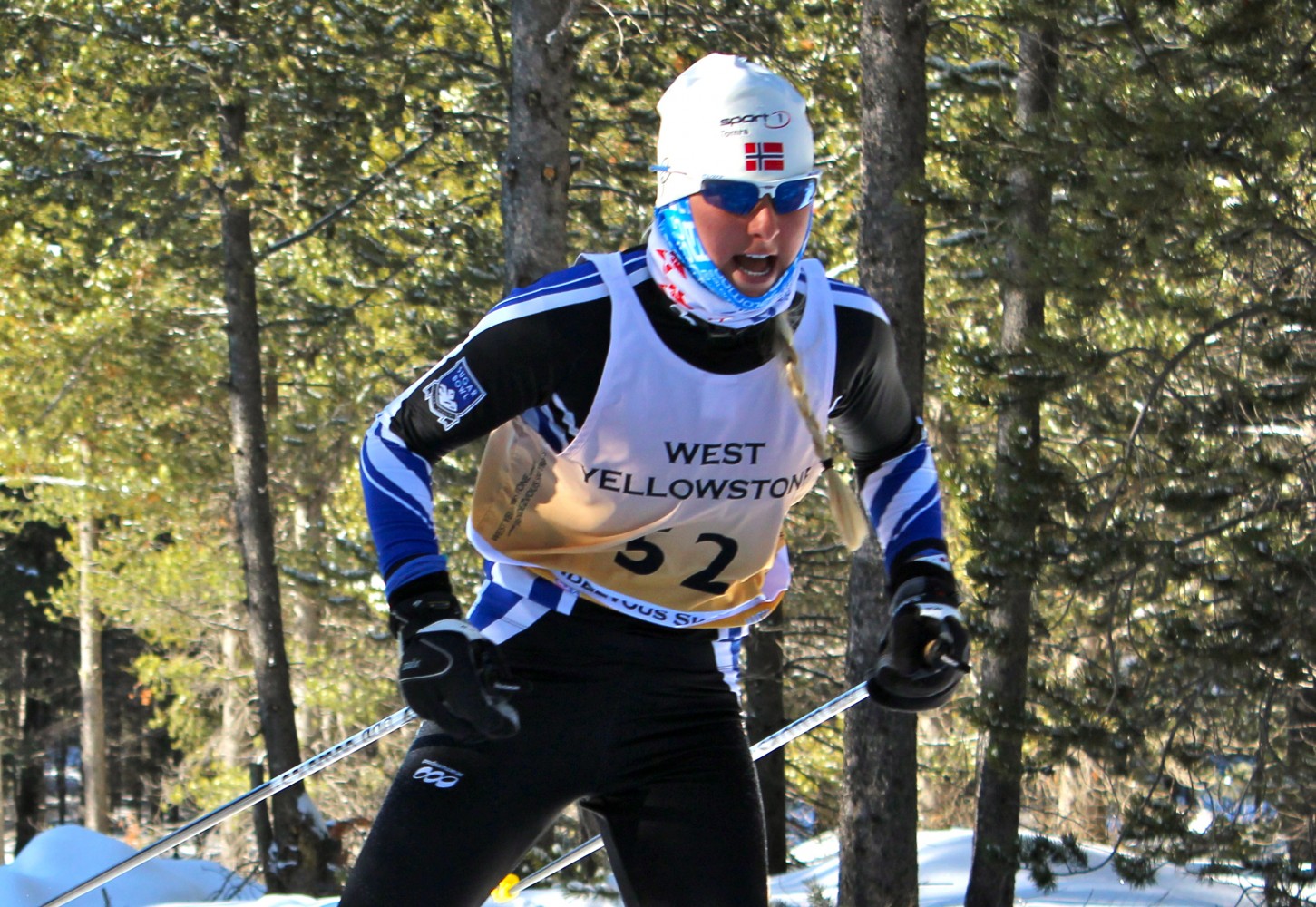
    Hannah Halvorsen (Sugar Bowl Academy) racing to third during qualifying for the women's SuperTour 1.3 k freestyle sprint in November 2015 in West Yellowstone, Mont. Halvorsen went on to edge out AWCA's Dahria Beatty for second place overall, 4.31 seconds behind race winner, Jennie Bender.
    Hannah Halvorsen (Sugar Bowl Academy) racing to third during qualifying for the women’s SuperTour 1.3 k freestyle sprint in November 2015 in West Yellowstone, Mont. Halvorsen went on to edge out AWCA’s Dahria Beatty for second place overall, 4.31 seconds behind race winner, Jennie Bender.

    I’ve been excited about my improvements in v1 technique and running foot speed.

    4. Whom you’ve been working closest with this offseason (coaches or training partners)?

    I have been working with the Sugar Bowl Academy skiers and coaches, and have also had the opportunity to train with TXC Coach Eliska Hajek Albrigtsen.

    5. Best trip in the last five months (and why)?

    I had the opportunity to train out in Stratton with the SMS team in August, which was a great opportunity to train at low elevation and be pushed by really fast skiers.

    6. Favorite cross-training?

    My favorite cross training is mountain biking.

    7. Favorite non-athletic activity or pastime this summer?

    This summer when I was resting I did a lot of painting, reading, and watching Seinfeld.

    8. Song that was your jam this summer?

    Love Yourself by Justin Bieber.

    9. All time favorite race moment?

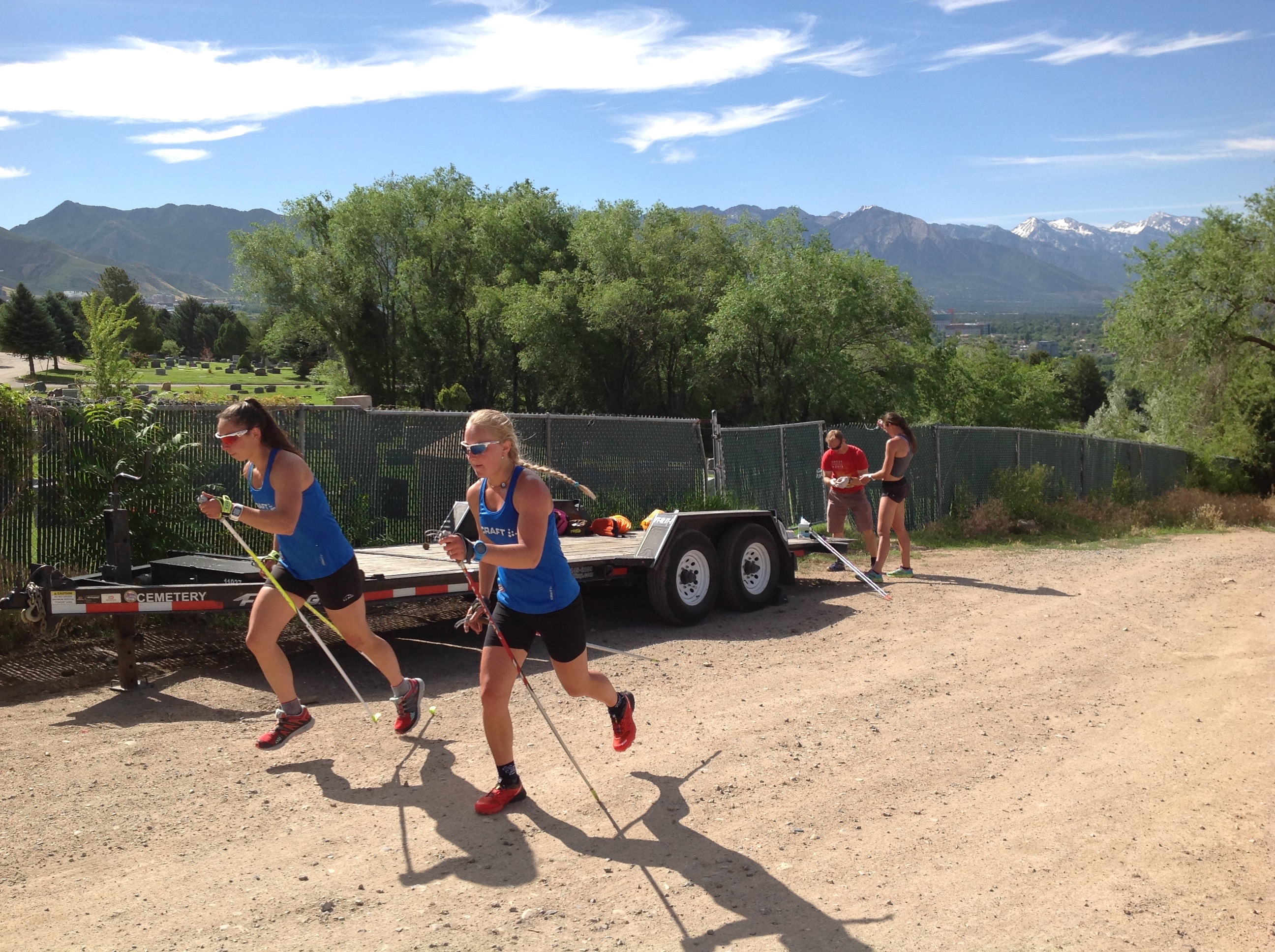
    Halvorsen (left) taking off on some ski bounding in Park City. (Photo: Bryan Fish)
    Halvorsen (right) and U.S. Ski Team teammate Julia Kern taking off on some ski bounding in Park City this summer. (Photo: Bryan Fish)

    Racing in the Scando cup in Sweden two winters ago and realizing, “the training I’ve done is working really well!”

    10. First thing you pack in your bag when you leave for Europe?

    My stuffed animal Bunny.

    11. Venue/event you’re most excited to visit this season?

    I am excited to have a Super Tour in my own town this January at Auburn Ski Club.

    12. Who will win the World Cup title this year?

    Jessie Diggins.

    13. Biggest sacrifice you feel you’ve made choosing this career path?

    The biggest sacrifices I have made have been social. Instead of giving time to my friends and family, it often goes towards training or even simply resting so I am ready to train again.

    14. If you could change one thing about your sport, what would it be?

    I think it would be awesome if being a skier didn’t cost money.

    15. What did you have for breakfast this morning?

    Chocolate chip coconut granola.

    16. In 5 years, I’ll be ____?

    Skiing.

    17. In 50 years, I’ll be ____?

  • Far West Elite Team Looking to Grow

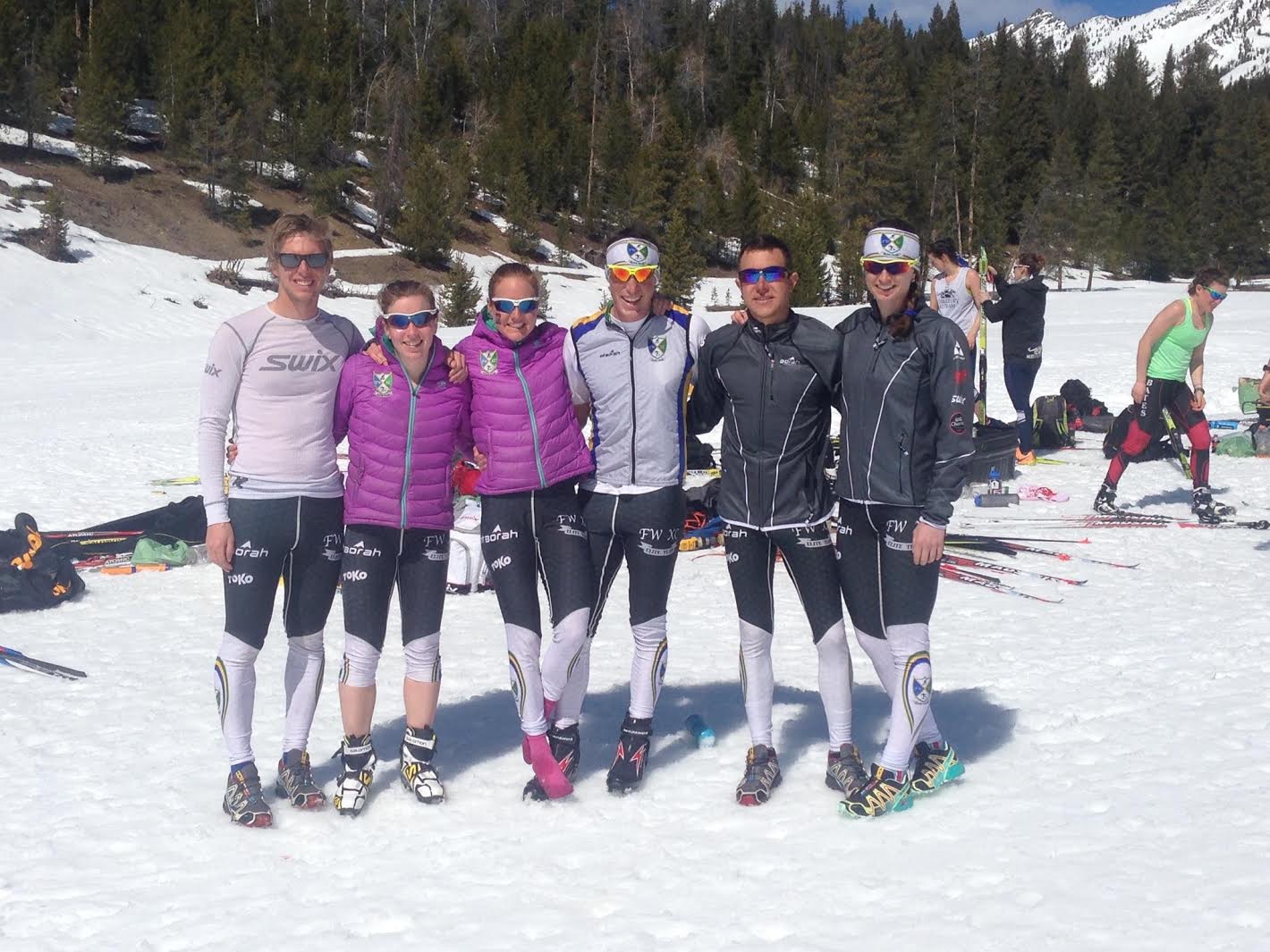
    Far West Elite Team 2014/2015
    (Press release)
    The Far West Elite Team, a post-collegiate senior team based in Truckee, Calif., is looking to support six athletes for the 2015-16 season. Our goal is to develop post-collegiate skiers towards being named to the U.S. Ski Team. The primary focus of the team is the USSA Supertour race series. The large collegiate summer training program, run by Martin Benes, in Truckee makes for excellent summer training. Team members receive funding to offset race, travel, and living expenses as well as additional support within the Tahoe region.
    The team is currently working to iron out specific funding details and an exact dollar amount to be offered to each 2015-2016 athlete. Applications will officially open later this spring. In the meantime, any interested parties are encouraged to contact us to learn more about how the team works and functions throughout the year.
    Team Captain: Spencer Eusden seusden@gmail.com
    Team Manager: Roger Chaney rossi_nordic@yahoo.com
  • Tahoe Cross Country Seeking Head Coach for Junior Development & Competition Team

    The Tahoe Cross Country Ski Education Association (TCCSEA) program is seeking a Head Coach to work with its Nordic Junior Development and Competition Team, serving primarily middle school and high school age racers. This is an exciting opportunity to join an established association with very successful programs and be a part of the development of our Devo/Comp Program.

    This is a 10-month salaried position (mid June through mid April) that requires that you be available for practice 5-6 days week and assist in other aspects of running the team on a more flexible schedule. Additionally there might be longer day trips and camps on the schedule. The position is part-time. Approximately 25 hours per week including weekends. Work might also be available at the Tahoe XC Ski Area and/or the Tahoe XC Mt Biking Center.


    Qualifications:

    1.       Energetic and highly self motivated

    2.       Racing experience

    3.       Coaching experience

    4.       Planning and organizing skills

    5.       Team leadership

    6.       Strong communication skills

    Duties include:

    1.       Athlete education and coaching, specifically ski technique focused

    2.       Conduct safe, fun and developmentally appropriate practices for Devo/Comp teams.

    3.       Plan, develop and implement training plan and practice sessions.

    4.       Identify strengths and weaknesses of athletes

    5.       Nurture and develop athletes’ potential skills and abilities

    6.       Analyze and evaluate athlete’s performances and modify training programs

    7.       Safely drive 8 passenger van in and around Lake Tahoe region (B Class license NOT required)

    8.       Maintain scheduling with Middle and High School Coaches (includes xc running and xc skiing)

    9.       Work with and manage parent volunteers and assistant coaches who will assist you in practice, at races and with carpooling

    10.   Communicate with athletes and families by email, website, and phone information about schedule and upcoming events (TCCSEA Director will assist in these duties when applicable).

    11.   Attend races with the team. Assist in all waxing (both classic and skate) and wax testing duties while at races

    12.   Review race course with skiers

    13.   Assist in fundraisers and functions over the course of the year.


    Please send resumes and references to: Valli Murnane, Director at valli@tahoexc.org

  • Elite Team Preview: Far West Farm Team

    Elite Team Preview: Far West Farm Team

    Far West Farm Team veteran Phil Violett competing in the 2011 Auburn Ski Club (ASC) Summer Biathlon National Championships in Soda Springs, Calif. Violett won the men’s pro title. (Far West/Mark Nadell photo: www.macbethgraphics.com)

    Note: This is the sixth preview in a quick-and-dirty series on U.S. elite teams. We asked coaches to send their 2012/2013 rosters and tell us what’s new for the coming season. We will be publishing additional reports over the next few weeks. Teams are presented in no particular order.

    Team: Far West Farm Team

    Coaches: Ben Grasseschi (head coach), August Teague, Martin Benes

    Roster: Phillip Violett, Wyatt Fereday

    Who’s new: No one – yet. However, the team is looking to fill four spots on it senior Farm Team and will be sending out criteria and applications in September. Stay tuned to fasterskier.com and farwestnordic.org for more info.

    Who’s missing: Elias Bucher (recently graduated University Nevada-Reno with a degree in health ecology), Gustavo Johnson (2011 University Nevada-Reno grad, English literature major), Kara LaPoint (training for Xterra triathlons) Michael Collins (according Grasseschi, moving on to the “real world.” Head nordic coach at Incline High School on Lake Tahoe).

    Wyatt Fereday competing in February 2012. (Far West/Mark Nadell photo: macbethgraphics.com)

    Top results last season: Bucher was the top overall skier at U.S. Collegiate Ski Association Championships (USCSA) in March, winning the 8.5 k race and placing second in two other events. He was 16th at the Boulder Mountain Tour and tallied multiple local wins or podiums, including the Sierra Ski Chase title.

    Fereday finished fifth in the West Yellowstone Rendezvous 50 k, notched multiple local podiums and was 33rd at the Boulder Mountain Tour. Violett ranked in the top 20 of U.S. biathletes last season. He placed second at the 10th Mountain Division Biathlon and posted several top-10 finishes in US Biathlon races.

    Collins was 127th in this year’s American Birkebeiner skate race, and Gustavo Johnson ranked 43rd in the Boulder Mountain Tour and second to Bucher in the Sierra Ski Chase. LaPoint placed second in the Sierra chase and tallied multiple local podiums. A Team LUNA triathlete, she earned All-American Triathlete honors in 2011.

    Coach’s comment: Head coach Grasseschi wrote in an email that the team was excited to welcome “a new crop of Farmers” in 2012/2013. He hoped applications would come out of the Far West College Residency Program in its second summer. According to Grasseschi, a few recent college grads were on the radar: Beth Taylor (Bates College), Spencer Eusden (Bowdoin College) and Noah Brautigam (Middlebury College).

    “We have an amazing training venue here in sunny, beautiful Tahoe/California region and we also have a top-shelf coaching staff,” Grasseschi wrote. “Together, we hope to take this grassroots Farm Team to the major leagues!”

    Other previews: Bend Endurance Academy | Craftsbury GRPCXC | Maine Winter Sports Center | XC Oregon

  • An Uncertain Future for Royal Gorge

    An Uncertain Future for Royal Gorge

    Royal Gorge ski resort
    Skiers pause in the Devil's Peak area at Royal Gorge Cross Country Ski Resort in early 2011. Photo courtesy Mark Nadell — www.macbethgraphics.com

    The thing about Royal Gorge is, nobody really knows how big it is.

    Trail reports have varied since the cross-country ski resort went up on Donner Summit in 1971, suggesting the nearly 3,000-acre property offers anywhere between 195 to 320 kilometers of groomed terrain.

    Back in the early stages of the Royal Gorge’s rapid development in Soda Springs, Calif., founder John Slouber claimed it was the largest nordic ski area in North America. Forty years later, one would be hard-pressed to refute that.

    “I don’t know of anyone that grooms more kilometers than them,” said Mark Nadell, the former head of Far West Nordic who designs the area’s trail maps. “Whether they were 300 or 150 it didn’t matter, it was always more than you could eat.”

    A local skier from nearby Truckee, Calif., Nadell tried to ski Royal Gorge’s perimeter with friends. Six or seven hours later, he figured they had only scratched the surface.

    The obscurity that surrounds the resort’s total kilometers matches its current financial situation. Simply put, it’s a tough one to pin down and could be harder to sort out.

    Six years ago when California developers Kirk Syme and Todd and Mark Foster bought the business for a reported $35 million, they had big plans in mind. Their vision, which included some 900 condominiums and two manmade lakes, never panned out for a myriad of reasons. To name a few, the economy turned sour in a saturated market, Donner Summit’s environment was both fragile and historical, and the community rallied to conserve it.

    In June, news broke that Royal Gorge’s owners defaulted on a $16.7 million loan. Their continued inaction on the nonpayment put the resort under court-appointed receivership in August. The owners were given 45 days to resolve the situation with the receiver, Douglas Wilson Companies of San Diego.

    Time expired without resolution in mid-September, delegating the resort’s operations to the receiver for the upcoming winter and leaving its future undecided.

    For Royal Gorge and its influx of skiers, that arrangement won’t affect much, said the area’s marketing and sales coordinator Lauren Birtwhistle. General manager David Achey remains at the helm and the rest of the resort’s usual staff is in place, ready to offer lessons, rentals and the deluxe nordic ski experience unique to Royal Gorge.

    “Royal Gorge will be open this season,” Birtwhistle said. “There isn’t any reason to be hesitant to make plans to come up here. … There aren’t any big dramatic changes going on.”

    As part of an ongoing marketing effort, Royal Gorge reduced its season-pass price from $425 to $375 per adult and extended the early-season discount to Oct. 31.

    Operating hours would most likely be similar, Birtwhistle said, from Thursday to Monday (9 a.m. to 4 p.m.) and Tuesday (9-1:30), except for holidays when the resort was open seven days a week. She didn’t anticipate major alterations to grooming, especially not at Ice Lakes Lodge, which is under separate ownership.

    “The lodge is the lodge; we have the trail systems and the land,” Birtwhistle said. “Everyone has their rumors and this and that, but you wouldn’t be able to see anything different from day-to-day operations. … We’re really expecting one of our biggest years.”

    The Royal Gorge Experience

    Royal Gorge Cross Country Ski Resort
    The entrance to the Royal Gorge Cross Country Ski Resort. Photo courtesy of David Madison — Royal Gorge.

    The ski area’s original visionary, John Slouber reportedly chose the property when he discovered a hunting lodge on Donner Summit, according to Moonshine Ink of Truckee and North Lake Tahoe.

    Born in Auburn, Calif., he ski raced and guided in Europe, picking up influences from Scandinavian resorts. Starting with four trails on about 10 kilometers, Slouber quickly expanded Royal Gorge with the help of Donner Summit landowner Rancho Monterey. The resort soon encompassed some 3,000 acres, from Van Norden Meadows near the Sugar Bowl alpine resort to the edge of the 4,417-foot-deep Royal Gorge on the North Fork of the American River.

    “Creation of this thing is the fun part,” Slouber once said, according to the San Francisco Chronicle. “I want to see how far it can go.”

    He initially wanted an Olympic Village – a multisport playground in the heart of Royal Gorge, complete with luge runs, ski jumps, ice rinks, a biathlon stadium, five lodges, two lifts and 510 “condotel” rooms, Moonshine Ink reported.

    That idea hit a snag in the early ’90s when the economy took a dive, but Slouber kept thinking. He proposed a lodge and 18 residential units on Van Norden Meadows, but Donner Summit homeowners and conservationists strongly objected.

    In the end, Slouber left Royal Gorge in 2005 with plenty of developmental marks, including four lifts, two overnight lodges and a day lodge, and eight warming huts scattered among 90 trails.

    Six years later, the resort stands as one of the nation’s largest. Development, however, has stalled and one surface lift remains.

    “John Slouber was brilliant,” said Nadell, who worked with Royal Gorge since 1977. “He got out at just the right time, buy low, sell high.”

    The Master Plan

    When Syme and the Foster cousins took over in 2005, they neither anticipated the economic recession that hit the nation less than three years later nor the regulatory problems of developing Donner Summit.

    The real-estate investors reportedly discovered the property in a Wall Street Journal advertisement while living in the San Francisco Bay area. Considering the building boom that was taking place in Truckee – with nearly 10 new golf courses in a few years – they figured they couldn’t lose.

    Before submitting their proposals to Placer County, the new owners took the time to meet the Donner Summit locals. In January 2006, they held a public meeting and noted the community’s concerns, which mostly involved public access. Syme and Todd Foster touched upon their development plans without too much detail, and encouraged people to submit comments and stay updated on their website: royalgorgefuture.com.

    Five years later, that web address did not work.

    In March 2007, the developers held another meeting with Donner Summit residents, this time with concrete plans. Among them, Syme and Foster proposed 600 residential units (for a total of 900), two hotels, two artificial lakes, several ski lifts and trails and a series of retail stores and restaurants.

    The community and several conservationist groups wouldn’t have it.

    “We have felt that the development does not match our community, that it would be very harmful to the environment,” said Serene Lakes Property Owners Association President Ken Hall, specifically pointing out the area’s small lakes and surrounding mountains.

    “We were very opposed to Mr. Syme’s plan,” Hall added. “There were just so many problems with his proposal.”

    Finding an adequate water supply was a major issue. The developers suggested pulling from a lake, which would have caused a significant drop in water level, Hall said. Their expansion would have doubled the population on Donner Summit, which posed septic problems and would have required the construction of a second road in case of emergency.

    According to Hall, the plans did not evolve past the talking stages and were never submitted to the county. While conservationist groups like Sierra Watch stepped in and argued their case, the developers’ lack of progress most likely came down to finances.

    Perry Norris, president of the Truckee Donner Land Trust, said the market was developmentally saturated by 2007, and Donner Summit wasn’t exactly conducive to year-round activities.

    “Literally, there are two or three months where there’s not snow,” Norris said.

    Skiers stop at Palisade Peak Warming Hut, one of eight huts at Royal Gorge Cross Country Ski Area. Photo courtesy of David Madison — Royal Gorge.

    Moving Forward

    While the business didn’t work out as Syme and Foster had planned, skiers can plan on recreating Royal Gorge in the future.

    Conservationists and homeowners agree: it’s a must for the area.

    “We really do value the Royal Gorge cross-country ski area,” Hall said. “We don’t want to lose the resort.”

    With the recent merger of the Squaw Valley and Alpine Meadows alpine resorts, the Tahoe area could be approaching an era of increased tourism, he said. The continued operation of Royal Gorge would add to that.

    “When people come to visit Tahoe for say a week, they’ll typically visit different areas,” said Kevin Murnane, general manager of Tahoe Cross Country and a member of the Cross Country Ski Areas Association board of directors.

    Besides Tahoe Cross Country and Royal Gorge, nordic skiers can also visit Tahoe Donner.

    “In terms of a joint marketing of the area, it shows how much terrain there is,” Murnane added. “From the association side, Royal Gorge was traditionally pretty influential. John Slouber brought about this great revolution. It was creating this presence in cross country … because he had this larger approach. At the same time, the sustainability of that becomes the greater challenge.”

    If all goes according to the plans of the Truckee Donner Land Trust, the property will go up for sale by November and Norris will move toward purchasing it. The land trust’s president for 11 years, he first considered Royal Gorge’s conservation potential in the early 1990s. Back then, the trust tried to buy the 1,000-acre Van Norden Meadows.

    The pending acquisition, which would include more than 3,000 acres in and around the resort, would not be the land trust’s biggest deal in terms of size, Norris said.

    “We’ve done larger acreages and we’ve done more expensive properties,” he said. “But I don’t think we’ve ever done one that’s so important to the community.”

    Devoting some 60 hours a week to the project, Norris has met and spoke with several stakeholders regarding the transition. Foreclosure was an initial concern, but Norris said the owners cooperated with the bank, and the resort would mostly likely not go to auction.

    In the meantime, the Truckee Donner Land Trust was pooling its resources, reaching out to national land trusts and calling for outside help.

    “Our long term goal is to protect the property, keep the nordic center running and most likely, running it better,” Norris said. “We’re going to be looking 100 percent to the private sector to finance this opportunity, and we’re going to be looking to the nordic ski community to step up as well.”

    According to Sugar Bowl Ski Resort President Rob Kautz, his alpine area — with trails that connect to Royal Gorge — was interested in purchasing the land and expanding into the nordic market. If a partnership played out, the land trust wouldn’t run the area, Sugar Bowl would.

    “Royal Gorge is a great brand; it’s a wonderful cross-country resort,” Kautz said. “We would ultimately like to take over the operation. I think the community is supportive of that concept.”

    “The investors in Sugar Bowl are a kind of who’s who in San Francisco,” Norris said of the downhill resort, which opened in 1939. “So they’ll be able to make the investment that the resort needs.”

    As for other potential buyers, Norris said not to expect any.

    In order for the Truckee Donner Land Trust to reach a deal, a long negotiating process was likely, he said. For starters, they would need to convince the Missouri lender, Armed Forces Bank, that Royal Gorge’s price tag shouldn’t be based on sheer acreage.

    “In some ways, a very capable developer looked at this property for six years and wasn’t able to move the property one inch,” Norris said. “I don’t think there’s any developer that is going to come out of the woodwork and buy this property.”

    If there were, the “Save Donner Summit” bumper stickers still clinging to the backs of local vehicles could dissuade them.

    “A reasonable appraiser would probably conclude that the property would best be used as an open space,” Norris said. “And nordic ski area.”

  • Tahoe SuperTour Cancelled

    The USSA SuperTour event scheduled for March 18th, 2011 at Northstar-at-Tahoe Resort has been canceled.

    Statement from the organizer:

    “Regrettably Northstar-at-Tahoe Resort is canceling the Nordic SuperTour Sprint which was to be held on March 18, 2011. The registration numbers did not meet the minimum requirements to execute the race. We are sorry for any inconvenience this has caused interested participants and teams. We appreciate all support for our events and hope to put on a successful race in the future. Questions can be directed to the Special Events Manager, Amber Whitman, at awhitman@vailresorts.com, or 530.562.2288.”