From the FasterSkier archive — posts syndicated from athletes’ and coaches’ own blogs between 2004 and 2012, kept online as published. Current coverage is at fasterskier.com.

Tag: Tara Garaghty-Moats

  • Rollerskiers in the  Mist: Patterson, Brown Win Foggy Climb to the Castle

    Rollerskiers in the Mist: Patterson, Brown Win Foggy Climb to the Castle

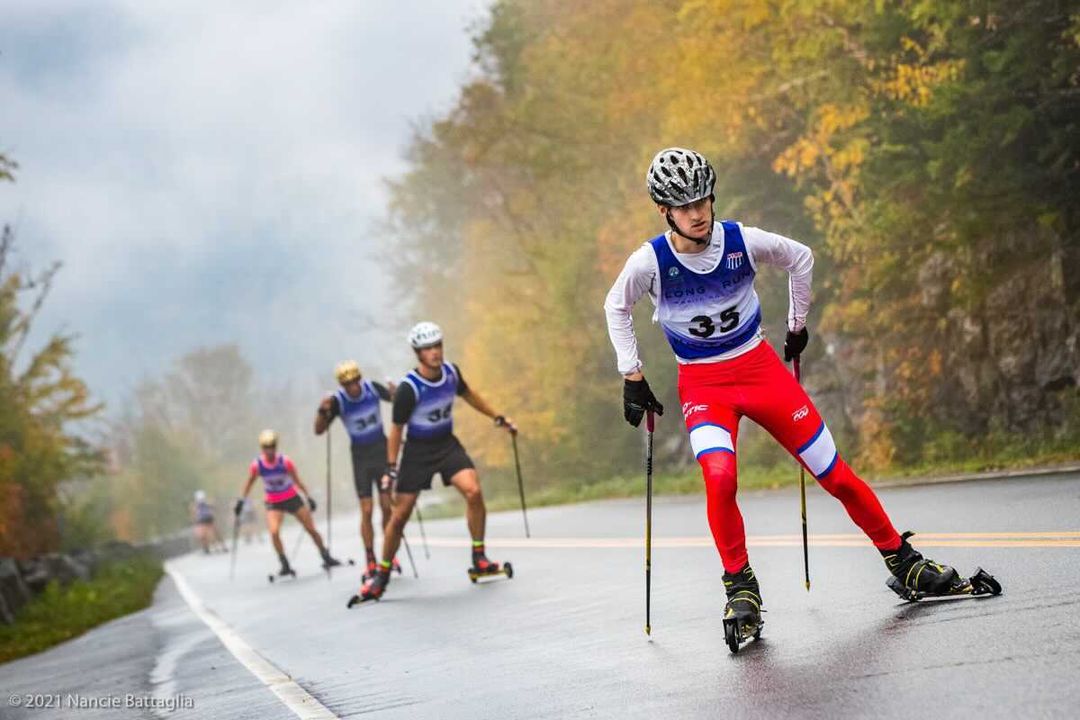
    Racers climb the Whiteface Veteran’s Memorial Highway during the 2021 Climb to the Castle. (Photo: Nancie Battaglia/NYSEF)

    The rain stopped just long enough for Caitlin Patterson and Jake Brown to savor their wins at the 2021 edition of the Climb to the Castle last Saturday in Wilmington, NY, near Lake Placid. 

    Craftsbury Green Racing Project (CGRP) swept the women’s podium; Caitlin Patterson edged Margie Freed for the win in 46:48.8, with her teammate just .7 second back in 46:49.5. Tara Geraghty-Moats placed third in 47:35.0.

    Brown, skiing for US Biathlon / CGRP, took the men’s win in a time of 38:04:00. CGRP teammate Akeo Maifeld-Carucci came second in 39:34:9, and Junior athlete Tabor Greenberg, a U16 athlete out of the Green Mountain Valley School (GMVS), interrupted CGRP’s command of the podium in third place at 41:24.7.

    After taking 2020 off due to the pandemic, the Climb to the Castle returned to the Northeast roller ski calendar, co-hosted by NENSA and NYSEF. The race leads skiers five miles up the Whiteface Veteran’s Memorial Highway at an average eight percent grade. Whiteface is the fifth highest mountain in New York’s Adirondacks; start too hard, and you’ll never recover. This author can attest. 
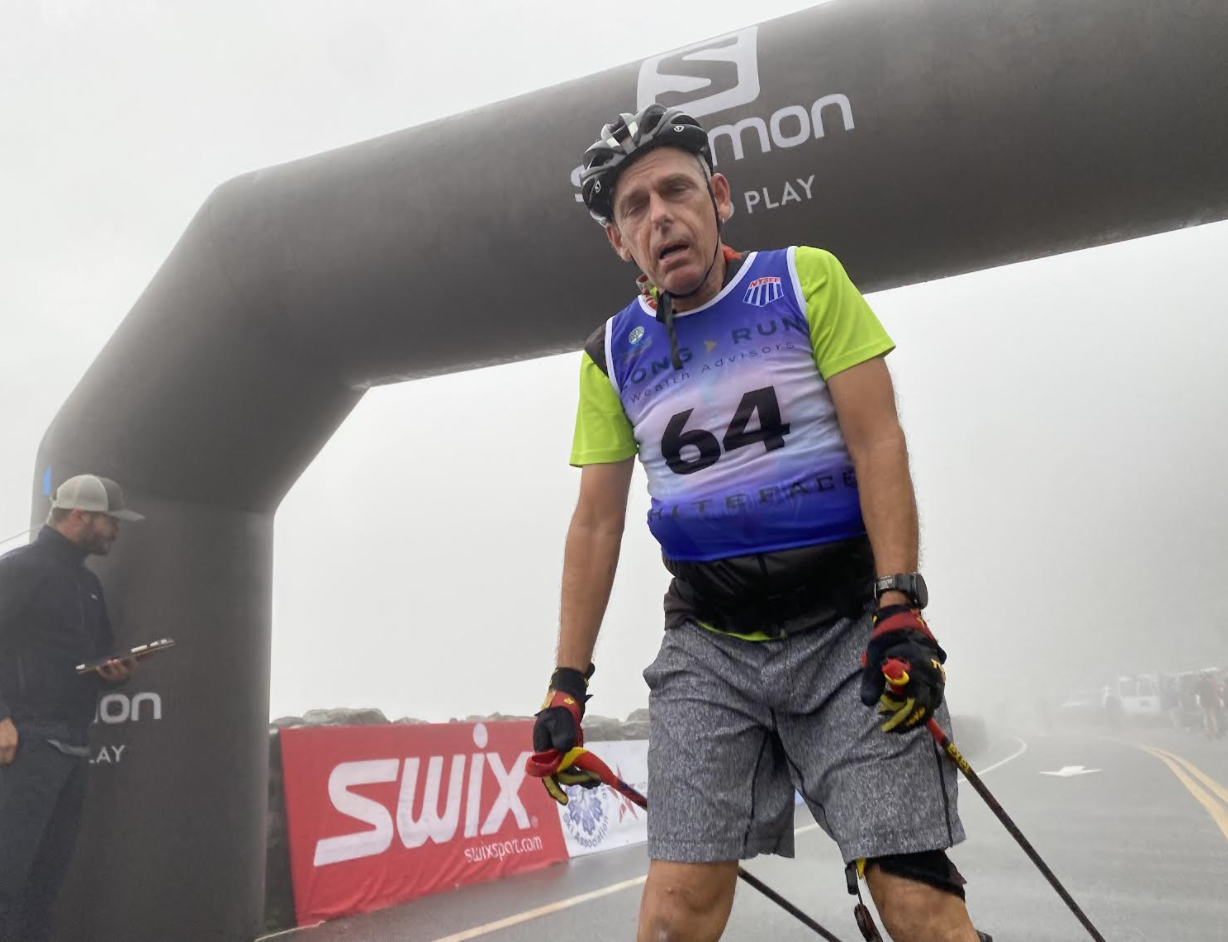
    The author completes his Climb to the Castle. (Photo: NENSA)

    As is often the case, weather made the race…. interesting. Light overnight rain tailed off about an hour before the start. Although the temperature hovered in the low 50s, the humidity made it feel warmer.  Clouds and fog obscured vision throughout the day.  In some places, one was lucky to see a hundred feet. For a change, there was little wind, even at the infamous Windy Corner and chute, 800 meters or so from the finish.

    For COVID safety, organizers started five waves of skiers, each two minutes apart. Competitors wore masks at bib pickup and on the summit after finishing their race.
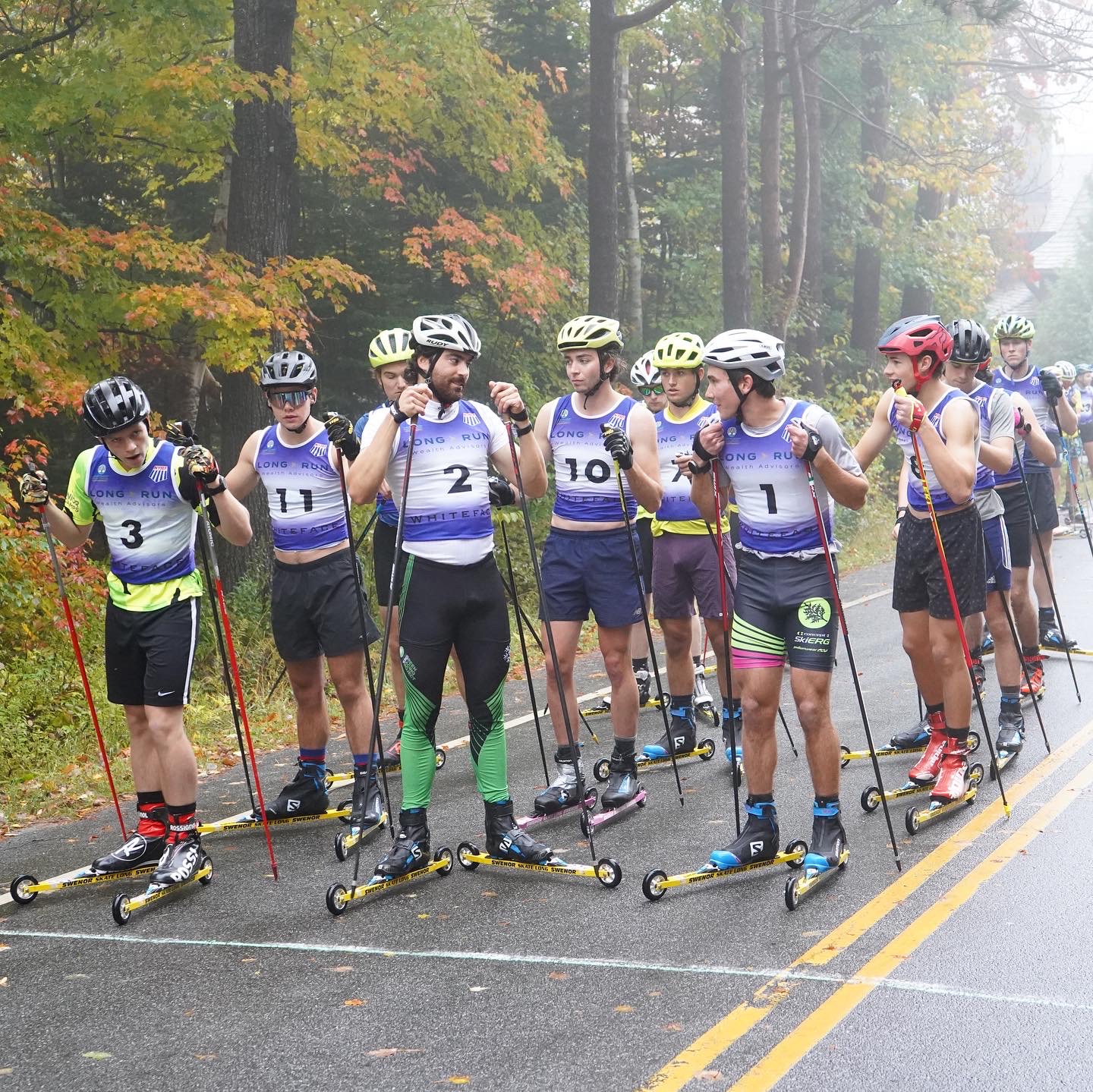
    Visibility low, energy high: a wet start for the men’s wave in the 2021 Climb to the Castle. (Photo: NENSA)

    The women’s race was high drama as Patterson, Freed, and Geraghty-Moats worked together up the road.

    “Tara and Margie and I knew we wanted to work together, especially with the way the Climb can be pretty windy at the top. It was just gonna be: ski smooth, work together, and shuffle around the leads, which is what we did. I definitely wanted to make sure not to start too fast.  I did that well, though I certainly had some rough moments in the middle.”

    From the start, Patterson said that she and Geraghty-Moats took turns in the lead, trading off about every kilometer.  “Towards the upper part, Margie was taking some really strong leads. I was suffering a bit,” Patterson added.
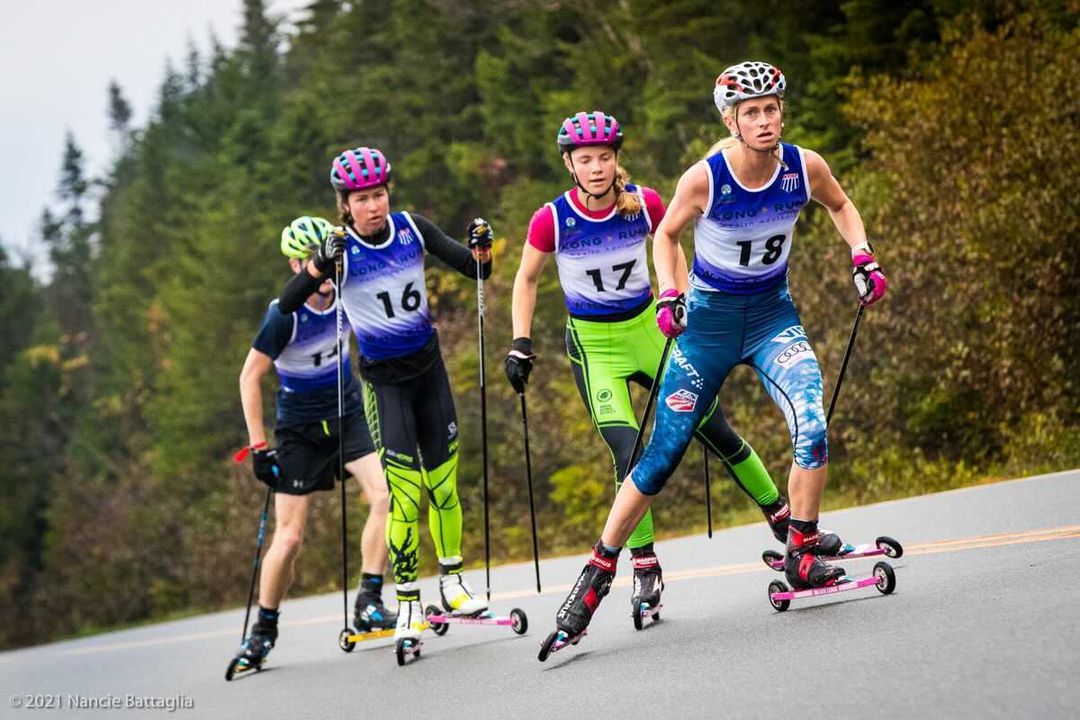
    With two kilometers left, Freed opened a gap from Patterson and Geraghty-Moats. Patterson said it took a few minutes for her to regain contact.  At that point, Patterson and Freed pulled away from Geraghty-Moats, skiing to the finish.  

    “Maybe 30 seconds out, I passed [Margie],” Patterson said. “It was really strong work by both of them. It was great to ski with people because it was as tough a course as ever.”

    Of her finishing kick, Patterson said, “I know that I can tap into a late surge. We were working together for most of it, and as the finish line was drawing near, it was definitely every person for themselves.”
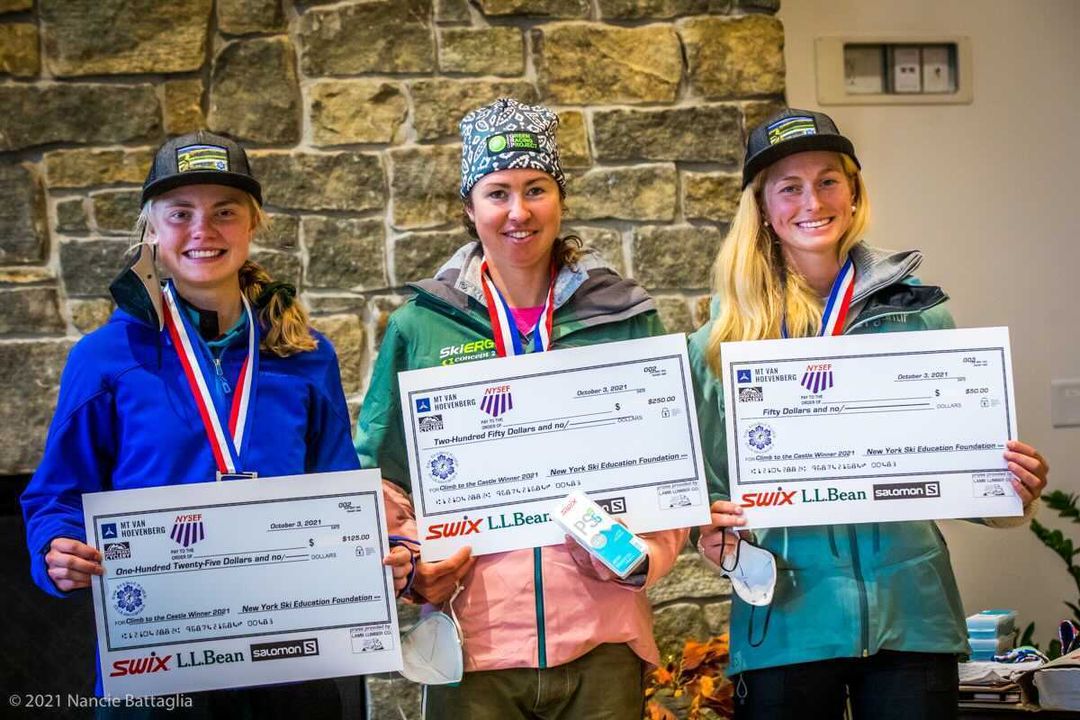
    Craftsbury women clean up at the 2021 Climb to the Castle. Caitlin Patterson took the win ahead of Margie Freed (left) and Tara Geraghty-Moats (right). (Photo: Nancie Battaglia/NYSEF)

    “It went pretty well today,” said Freed of her race. “It was awesome to ski with Tara and Caitlin for so long. I don’t think I could have kept up that pace if I was alone.

    “I’ve never done this race before, so it was exciting to have every step be something new for me,” Freed continued. “Even though I didn’t quite know where the finish was, or when it was coming.  I couldn’t quite see it because it was so foggy.  It was an awesome day out there, and I was glad it wasn’t as windy or rainy or cold as I was thinking it was going to be.”

    This past winter, Geraghty-Moats won the first ever crystal globe for FIS Women’s Nordic Combined.  She also won the Climb in 2018. After the race, she wrote, “It was really nice to go all out with my teammates. We skied together really well. We all had moments of fading and then climbed back on. I dropped back about half a k after the Lake Placid turn — I just kind of ran out of  gas. I’m pretty happy with how I felt and it was a really fun race.”

    Jake Brown wins the 2021 Climb to the Castle in a long solo effort. (Photo: Nancie Battaglia/NYSEF)

    For Brown, this was his third win at Climb to the Castle, his previous two coming in 2017 and 2018.

    “I wanted it to be a good, solid effort,” Brown said. “I knew that I couldn’t sprint too hard off the line, but I wanted to get into that high heart rate zone and stay there as long as I could.”

    Asked about race strategy, Brown said, “I was with Akeo [Maifeld-Carucci], my Craftsbury Green Racing Project teammate. He led for the first 3 minutes or so.”

    At that point, Brown said, he took a turn pulling and developed a gap. “I was hoping we could work together a little bit more, but we ended up with an awkward 20-meter gap between us that we  held for maybe half the race. Then I slowly pulled away and was by myself.”
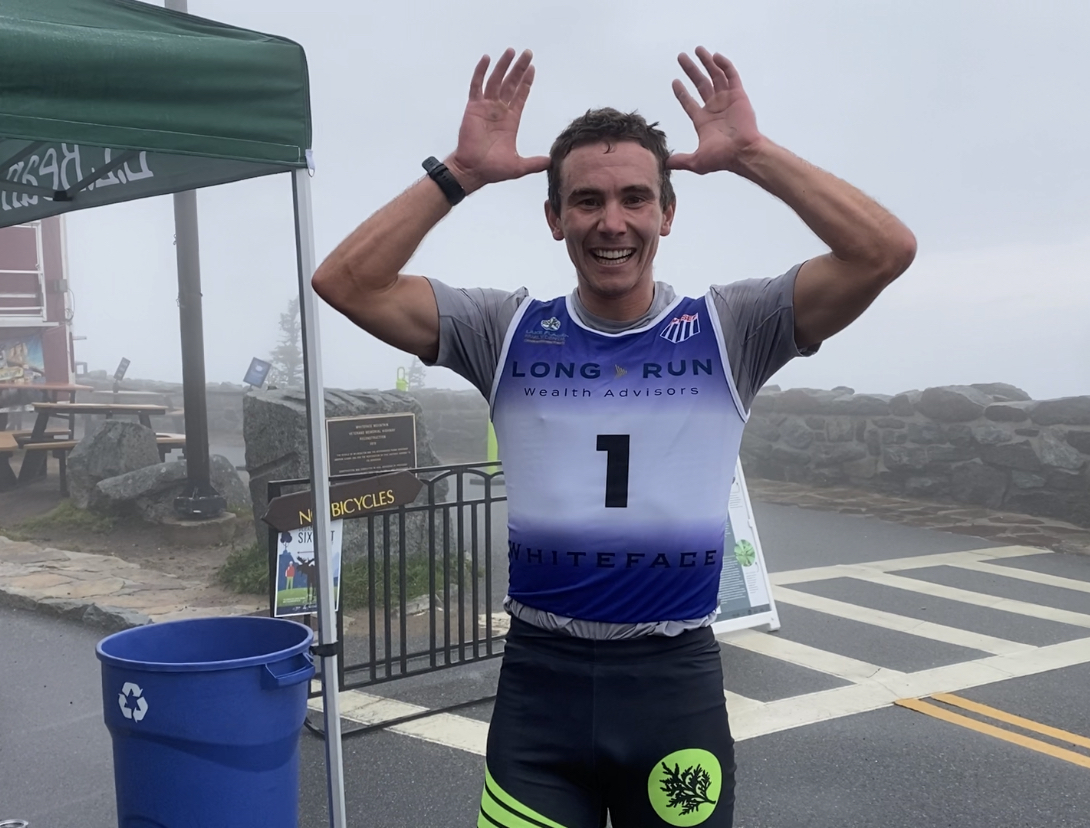
    Jake Brown wears the moose-antler crown after winning the 2021 Climb to the Castle. (Photo: NENSA)

    Asked if he could use this as a fitness benchmark, Brown said, “This was my fourth time doing the race. This was a bit of a slower year; I’m hoping it was just because of the weather. Maybe a little later in the year and a little colder pavement. It was kind of warm today, but maybe the pavement was a little colder.  Maybe my fitness isn’t where it was.  We’ll find out when the winter comes — that’s what matters.” 

    For Maifeld-Carucci, “It was a sweet day. I wanted to do this race for a long time, since early in college. So it was great to actually be here and do it.  The weather was way better than we expected. It was a little wet and a little cloudy at the top, but there were moments when it opened up and it was super pretty. Constant great climb, hard skiing — it was definitely a hard race and a really good effort.”

    Commenting on the men’s pacing and tactics, Maifeld-Carucci echoed Brown’s explanation of the duo’s ability to collaborate. 

    “Jake and I were hoping to ski together and trade leads,” Maifeld-Carucci explained. “He was feeling a little stronger than I was so I fell off early and we were dangling 20 meters apart for a long time. Then he started to open it up.”
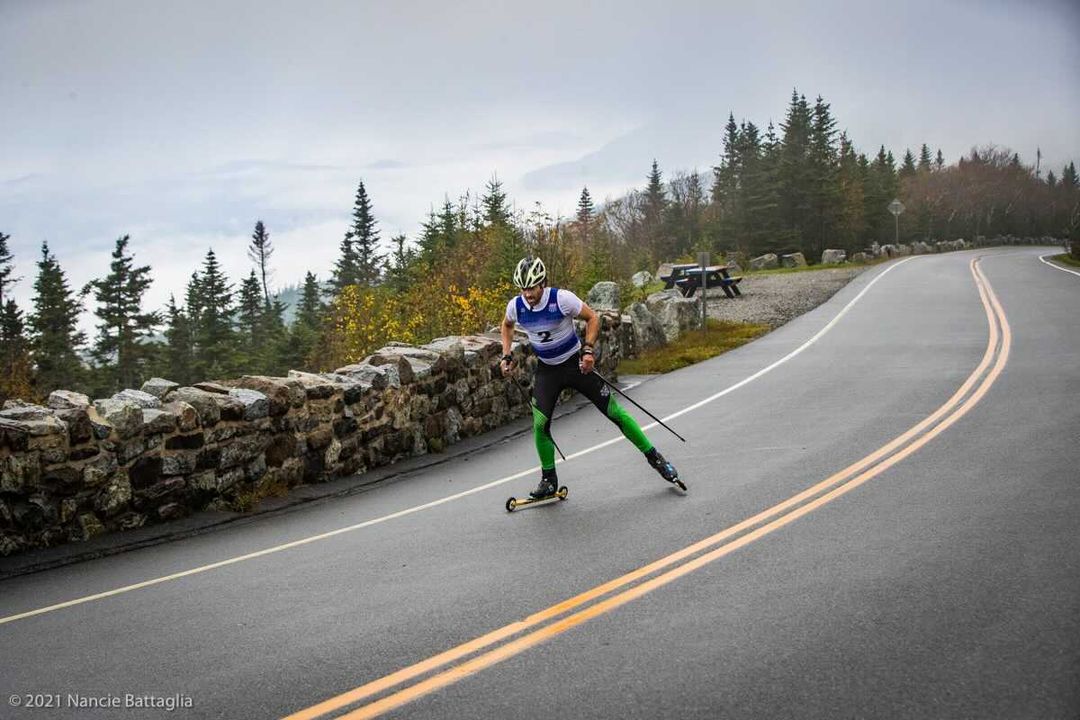
    Akeo Maifeld-Carucci skis to second place at the 2021 Climb to the Castle. (Photo: Nancie Battaglia/NYSEF)

    In addition to Greenberg nabbing third place overall, the GMVS boys swept the junior podium. 

    Responding to an email, GMVS head coach Colin Rodgers said that his skiers didn’t taper for the race. “Tabor actually trained a lot in the past week including a 120 mile bike ride to raise money for the Kelly Brush Foundation.”

    Commenting on the preparation for this event, and how it fits into the season preparation, Rodgers explained:

    “We spent some time recently working on climbing technique. When we were recently on snow on the Stelvio glacier we were working on standing well (balanced and forward) on our skis. We did not discuss any mass start race tactics for today — I really just wanted the crew to focus on pacing the effort properly and being consistent throughout the duration of the climb. [Having] a dialed warm up and trying to keep good form when tired were also a few other things we were honed in on today.”
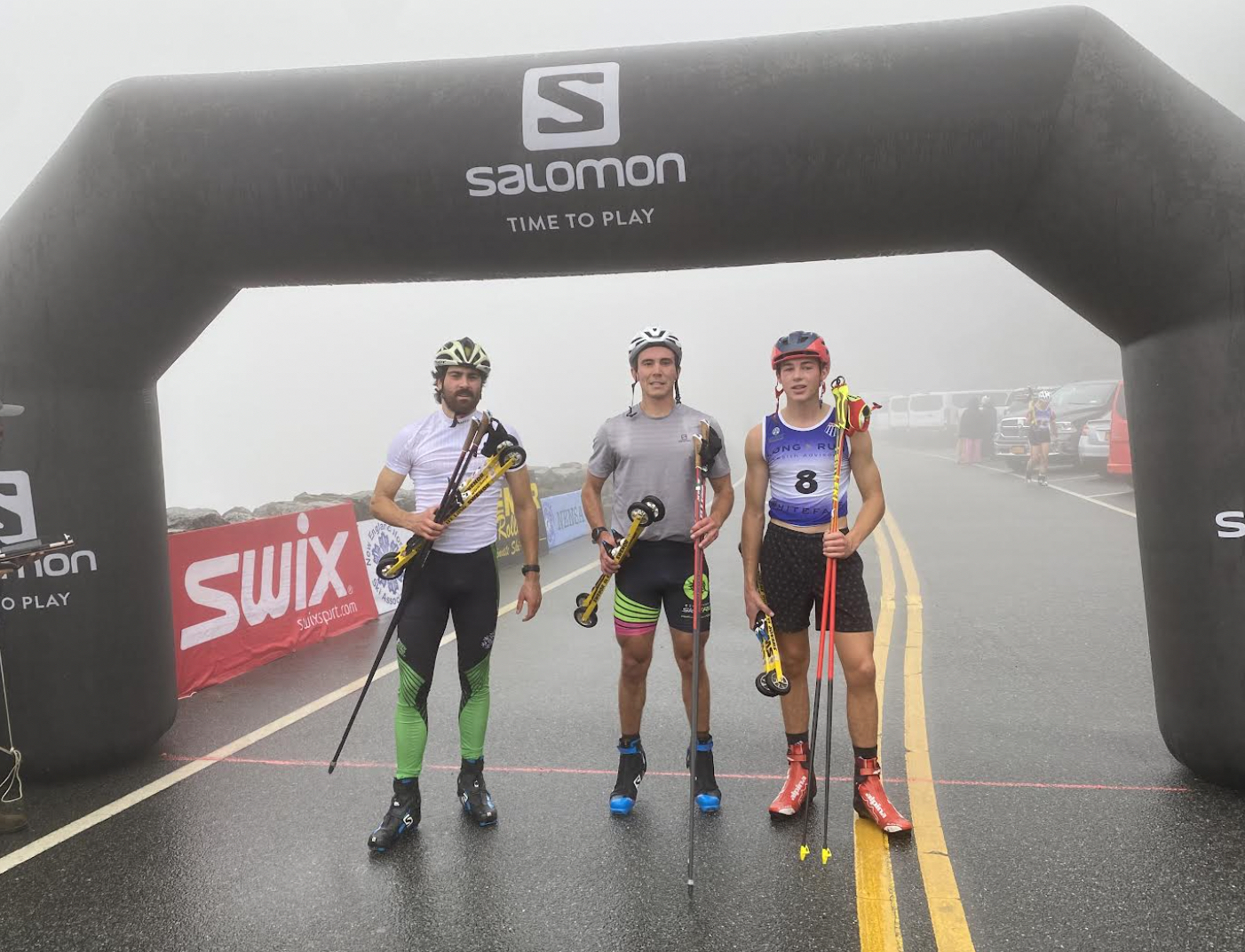
    The men’s podium at the 2021 Climb to the Castle. Jake Brown (CGRP) took the win ahead of Akeo Maifeld-Carucci (CGRP) and Tabor Greenberg (GMVS). (Photo: NYSEF)

    Did Rodgers have an inkling that Greenberg might podium? 

    “We were not focused on the podium, we were just focused on executing a solid race effort. We are primarily focused on competitions in March, so all of this is just trying to build momentum towards the end of the race season.”

    Although COVID border closures prevented Canadian clubs from driving across the border, many clubs and colleges still showed up to throw down.  

    According to Sara Falconer, a coach at Mansfield Nordic (MNC) in Vermont, “It’s a good opportunity for [MNC junior athletes] to race other high school athletes and college athletes that are here.  It’s also a chance for them to compare their times to last year and see the results of all the work they put in over the summer.  They can see a lot of dramatic improvement.  It’s a really motivating thing for them.  And it’s also a good workout.”

    From juniors to collegiate to masters, racers ascended Whiteface during the 2021 Climb to the Castle. (Photo: Nancie Battaglia/NYSEF)

    Ethan Townsend, Saint Lawrence University’s (SLU) head nordic ski coach, planned a training weekend for his team. SLU athletes also roller skied the new loop at Mount van Hoevenberg on Friday.

    “Saturday morning, we got up early and did a run/hike” said Townsend. “They had the option of going up Algonquin or Wright or Marcy. A lot of them took the option of going up Marcy. A few of them went up Phelps and Tabletop. Probably an average of five hours.” 

    Mount Marcy is the highest Adirondack mountain at 5,344 feet and Algonquin, the second highest, stands at 5,114 feet. The remaining peaks named are also among the 46 Adirondack High Peaks, which are all above 4000 feet. 

    After coming out of the woods, the SLU team reconvened for an afternoon double pole roller ski session.

    “We weren’t concerned about performance, necessarily, in this race,” Townsend said. “It’s a training race. Something to do as a group. I told them, ‘Don’t worry about the results so much.  It’s great that we can come here and do this. If you just stay in level three the whole time and you’re not feeling it to go super hard, I think that alone would be worthwhile.’”

    You can find more footage of the 2021 Climb to the Castle on NENSA’s YouTube channel.
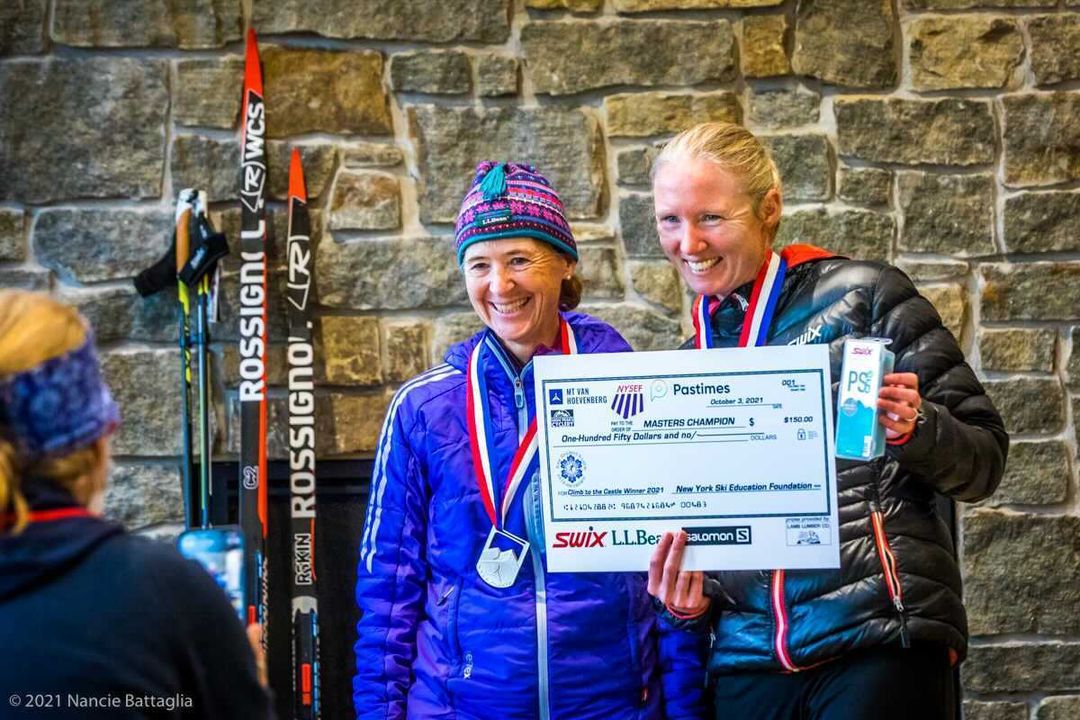
    From Juniors to Collegiate to Masters; a broad scope of rollerskiers ascended Whiteface during the 2021 Climb to the Castle. (Photo: Nancie Battaglia)

    Women’s complete results

    Men’s complete results

  • Now a Swedish National Champion, Geraghty-Moats Says She’s ‘Still the American,’ Plans Return

    Now a Swedish National Champion, Geraghty-Moats Says She’s ‘Still the American,’ Plans Return

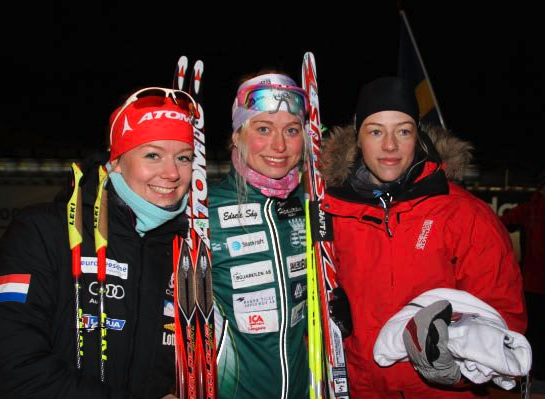
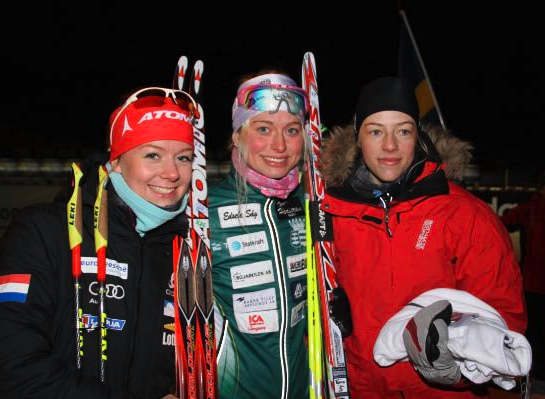
    Vermonter Tara Garaghty-Moats (center) after winning the junior sprint at Swedish Biathlon Championships for the I21 Biathlon Club, based out of Solleftea. Courtesy photo.
    Vermonter Tara Geraghty-Moats (center) after winning the junior sprint at Swedish Biathlon Championships for the I21 Biathlon Club, based out of Solleftea. Courtesy photo.

    By the time Tara Geraghty-Moats leaves Sollefteå, Sweden, next month, it will have been almost a year – a year marked by ups and downs, new friends and new places, a disappointing World Junior Championships and then a turn at Swedish National Championships that netted her a gold medal.

    So did the Vermont native, a former nordic combined athlete who has since switched to biathlon and now made three trips to World Juniors, become a Swede?

    Well, no.

    “It was really fun to train with everyone this year, we obviously all do biathlon and all train together, but I’m still ‘the American’,” she laughed in a Skype interview on Thursday.

    But that didn’t change the fact that the year presented not only ramped-up racing opportunities, but an entirely different training environment – one where she actually had a full-fledged team, with all of the training benefits and camaraderie that comes along with it.

    “I’ve trained with Craftsbury and Ford Sayre, which are really small clubs,” she said. “So it was nice to have a group to train with that were my age, and also a bigger group all winter long. To have a consistent schedule and people to train with almost every day was great.”

    The move to Sollefteå’s biathlon gymnasium came about after earaghty-Moats and several other top American juniors did an exchange with the National Sports Academy last spring, a trip that was organized by U.S. Biathlon head coach Per Nilsson. With the dramatic change in venue, Geraghty-Moats said her  goals were to keep her skiing speed the same, but to make improvements in her shooting. And that happened, thanks to the training environment. For young biathletes in the U.S., there’s really nothing that compares to a gymnasium. There’s barely as many athletes who compete at trials races as there are on a team in Sweden.

    “I definitely got more consistent shooting training than I’ve ever gotten before, and it really paid off towards the end of the season,” she explained. “Hopefully I can carry that through to next season.”

    A hip injury in January had sidelined her for a significant chunk of valuable training time; earlier this winter she told FasterSkier that it was “frustrating to go to Junior Worlds and not be able to do what I had been capable of earlier in the winter.” She finished in the 60’s in both the sprint and individual competitions. Geraghty-Moats was also picked to represent the U.S. in the junior races at Open European Championships, where she was “still not feeling awesome skiing, but [had] regained enough fitness to feel more in control of my races, which is a relief.”

    After that trip though – to Bansko, Bulgaria – a scraped elbow while running led to a surprising, but luckily not too serious, blood infection. That cost the biathlete, who turned 20 this spring, yet another week of training.

    “It would have been nice if it hadn’t happened, but it turned out not to be a big deal,” she admitted.

    Because the cherry on top of the Sweden experience came in the junior sprint at national championships. After a year of racing, Geraghty-Moats said she was definitely not expecting to win a race. Starting the two-stage sprint with two penalties in prone knocked her expectations back even further.

    "The history of Swedish junior national champions from I-21 skidskytte klubb," Garaghty-Moats posted on Facebook. "Definitely the coolest list I've ever been on. It was an honor to be part of such an awesome club this season!"
    “The history of Swedish junior national champions from I-21 skidskytte klubb,” Geraghty-Moats posted on Facebook. “Definitely the coolest list I’ve ever been on. It was an honor to be part of such an awesome club this season!”

    “I was really hoping for a podium, that was my goal,” she said. “And I knew that if I missed more than one [after that] I wouldn’t have a chance at even making the podium… and that even if I missed one but didn’t shoot fast, I still wouldn’t be able to make the podium. Going into the last hill I was five seconds behind Chardine [Sloof] and my coaches were just going crazy. I tried to ski really fast and surprisingly enough I was able to make up the last few seconds.”

    Sloof, a World Junior Champion last season, was relegated to second, and Geraghty-Moats collected top honors.

    As she tweeted later this spring, by winning the sprint she joined an impressive list of athletes from Sollefteå’s I21 club to win a junior title. Among them are many who currently represent Sweden on the World Cup, as well as two-time World Champion and 2009 World Cup overall winner Helena Ekholm.

    That thrill added to the general atmosphere at Swedish nationals, which is quite different than any domestic race Geraghty-Moats ever encountered in the America.

    “It was obviously really fun,” she said. “Sweden is a big biathlon country, not like the U.S., so there were a lot of different clubs. It was a lot more like an international competition than like what we would think of as nationals in the U.S. Chardine Sloof, who actually competes for the Netherlands on the international circuit, was competing, so there was a bit of an international side to it. It was fun.”

    So far this spring, Geraghty-Moats is back training with the ski gymnasium. She has about another month left in Sweden, so has been skiing, rollerskiing, and running with her team and coaches. The opportunity to get on snow at this time of year, she says, is special.

    “We’re rollerskiing again already, and running,” she said. “We have a skiing camp next weekend. That should be fun. I’m looking forward to getting back on snow – we’ve had a taste of rollerskiing, and it definitely made me miss skiing.”

    When she returns to Vermont, she’ll be living back home in West Fairlee, a small town of about 700 people on just off the Connecticut River, and training with Vermont Collegiate Biathlon coach Algis Shalna. She expects the general schedule to include two-week training camps in Jericho, Lake Placid, and Craftsbury, with rest periods at home.

    Although it will be a return to a more solitary ski life, Geraghty-Moats is looking forward to it. She’ll rejoin not only Shalna and the other Vermont Collegiate athletes, but Sean Doherty, a teammate who recently became a Youth World Champion at the same event that left Geraghty-Moats disappointed. Despite the duo’s success, she said, she has no more confidence than before – because she already knew the program was a perfect fit. Saying that she was more positive now would imply that she had doubts before, which was emphatically not true.

    “I’m really proud of Algis and Sean and their successes, but I’ve always thought Algis’s programs work great for me,” Geraghty-Moats said. “I think he does a really good job of having us all train at the same time, but having us focus on what each of us needs to focus on.”

    Her goals for the next season focus on World Juniors, which will be at home (relatively speaking) in Preque Isle, Maine. In the meantime, she’ll continue to take classes online from the Community College of Vermont, as she has for more than a year, working towards her Associates Degree.

    “There’s a certain amount of work I have to do every week, but there’s not set schedule that I have to do it on,” she said of her school schedule, which is ideal for an athlete. “That’s really nice. It can be a little iffy with the internet in Vermont though.”