From the FasterSkier archive — posts syndicated from athletes’ and coaches’ own blogs between 2004 and 2012, kept online as published. Current coverage is at fasterskier.com.
FasterSkier’s Coverage of the Biathlon World Championships is made possible through the generous support of the Craftsbury Outdoor Center: New England’s finest snowmaking, world class race venues and touring trails, healthy food in abundance, comfortable accommodations at Craftsbury: Sports, Sustainability, Stewardship.
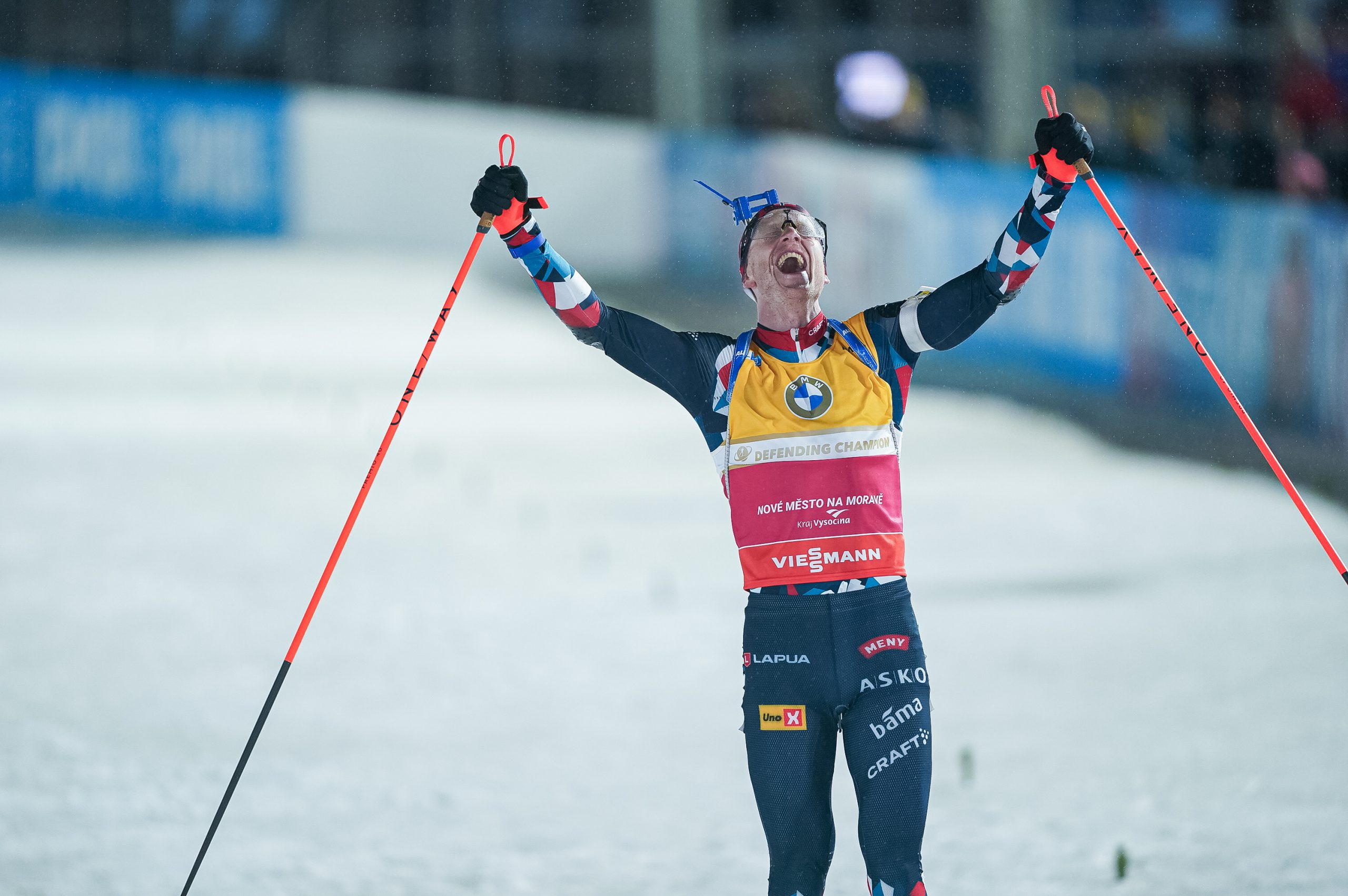
After finishing second in Saturday’s Sprint, Johannes Thingnes Boe (NOR) moved up into first in Sunday’s Pursuit, defending his 2023 title .
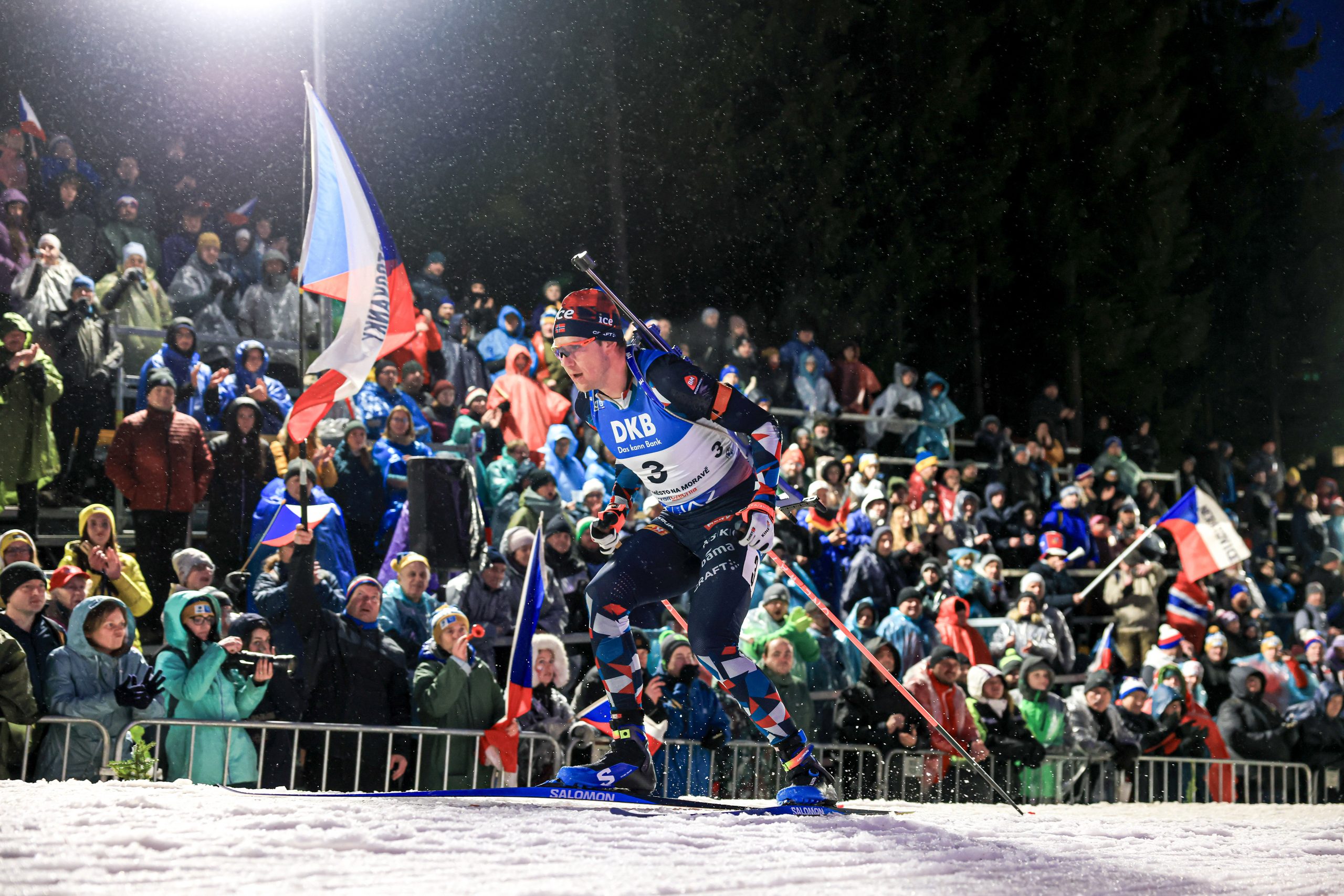
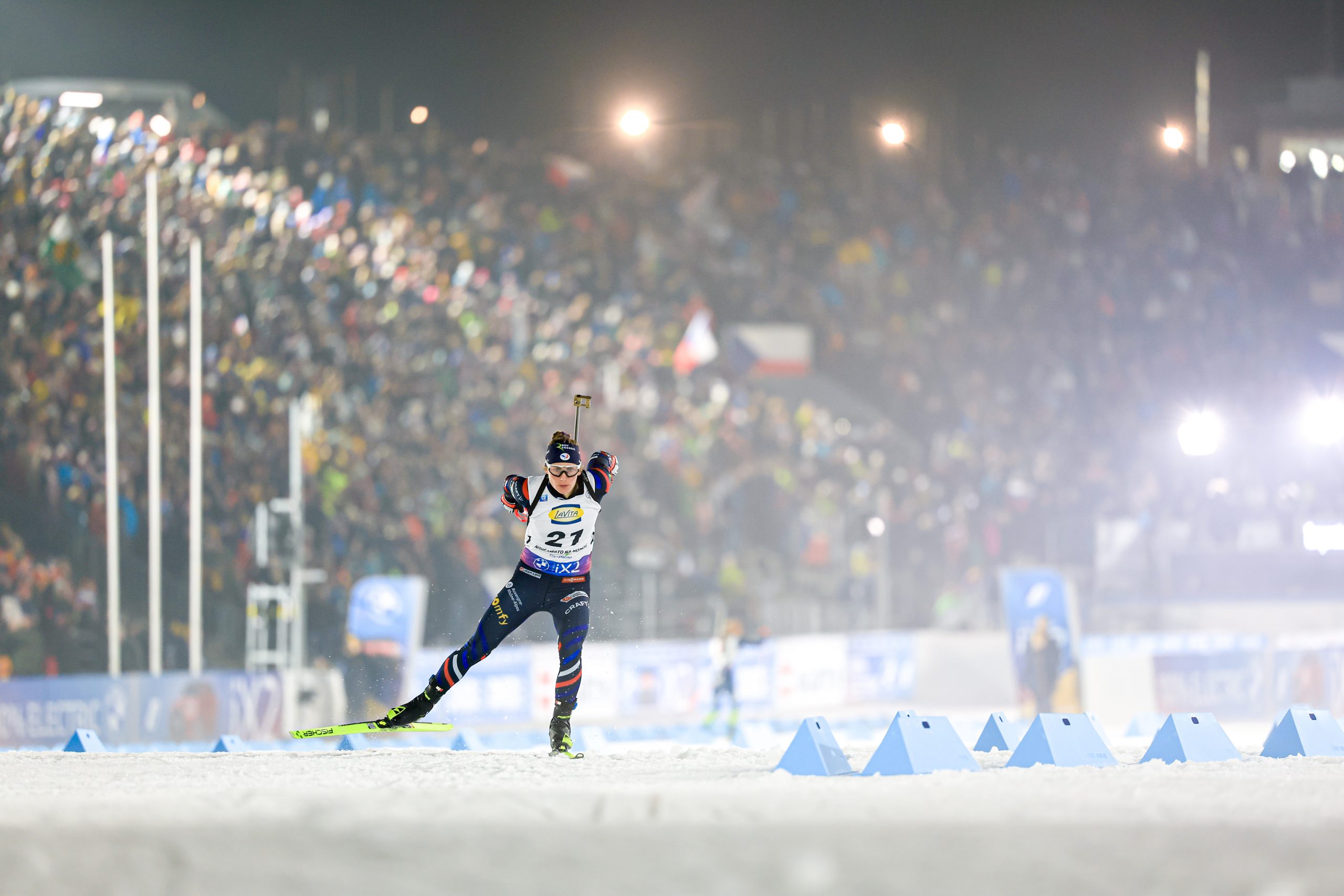
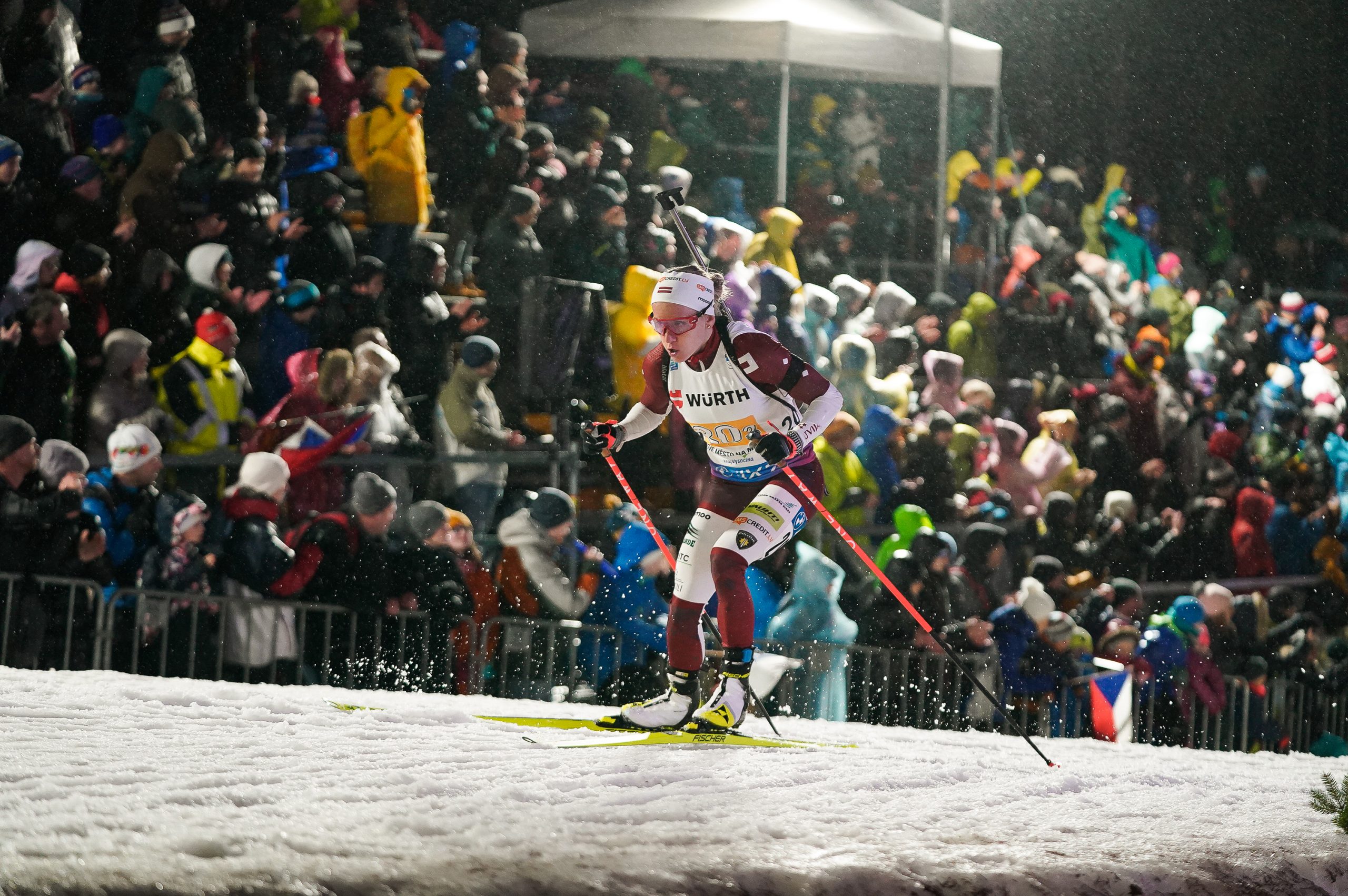
On a rainy Sunday afternoon in Nove Mesto na Morave, Czech Republic, 30,000 fans packed the Vysocina Arena for the women’s and men’s Pursuit competitions of the 2024 Biathlon World Championships. The weather has been dismal for the first five days of the event, meaning a lot of soggy boots, sink laundry, and rifle cleaning for the athletes, and long, cold, days for team staff and event organizers. But it has not dampened the spirits of the biathlon fans who continue to make the atmosphere bright.
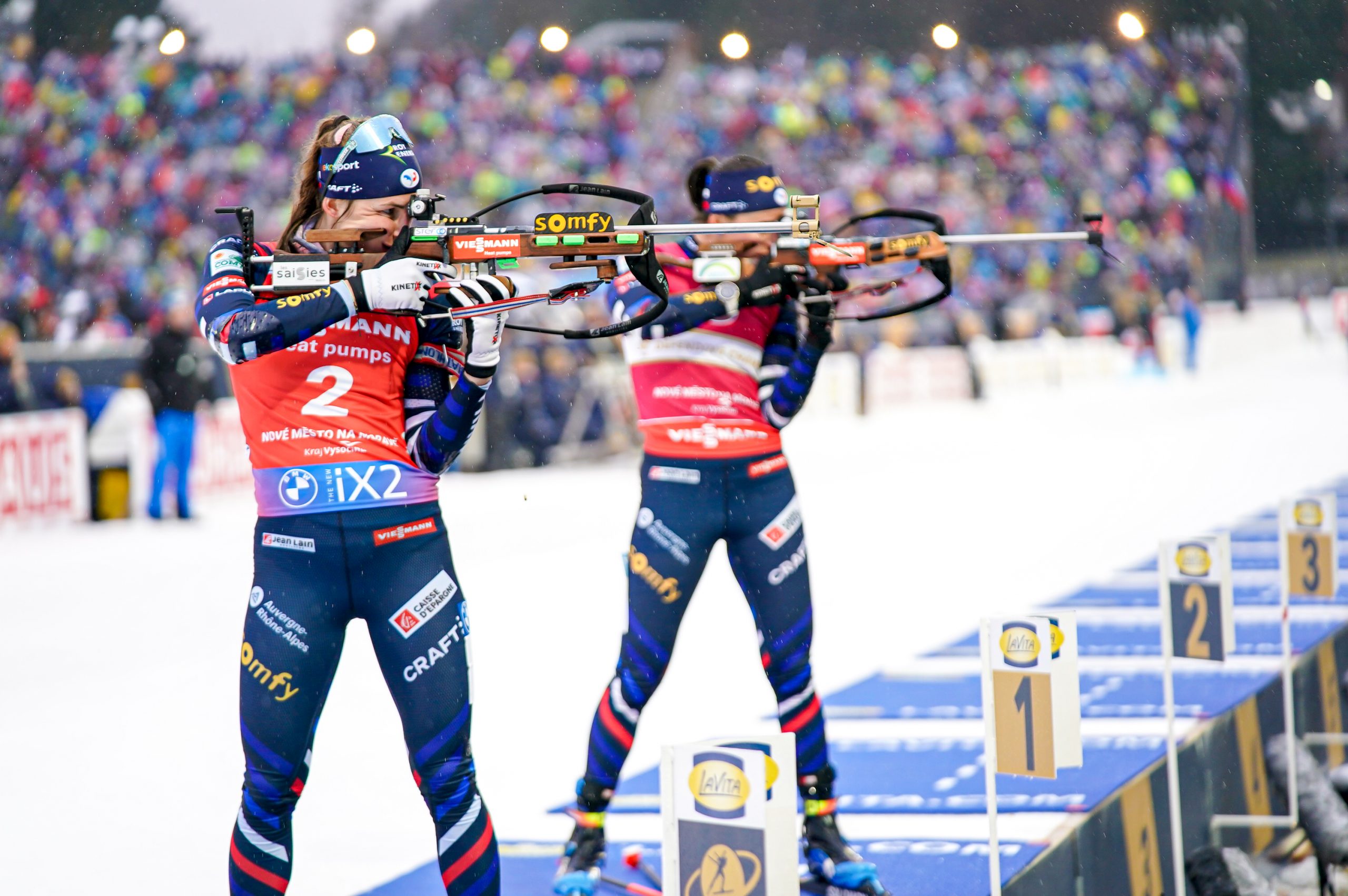
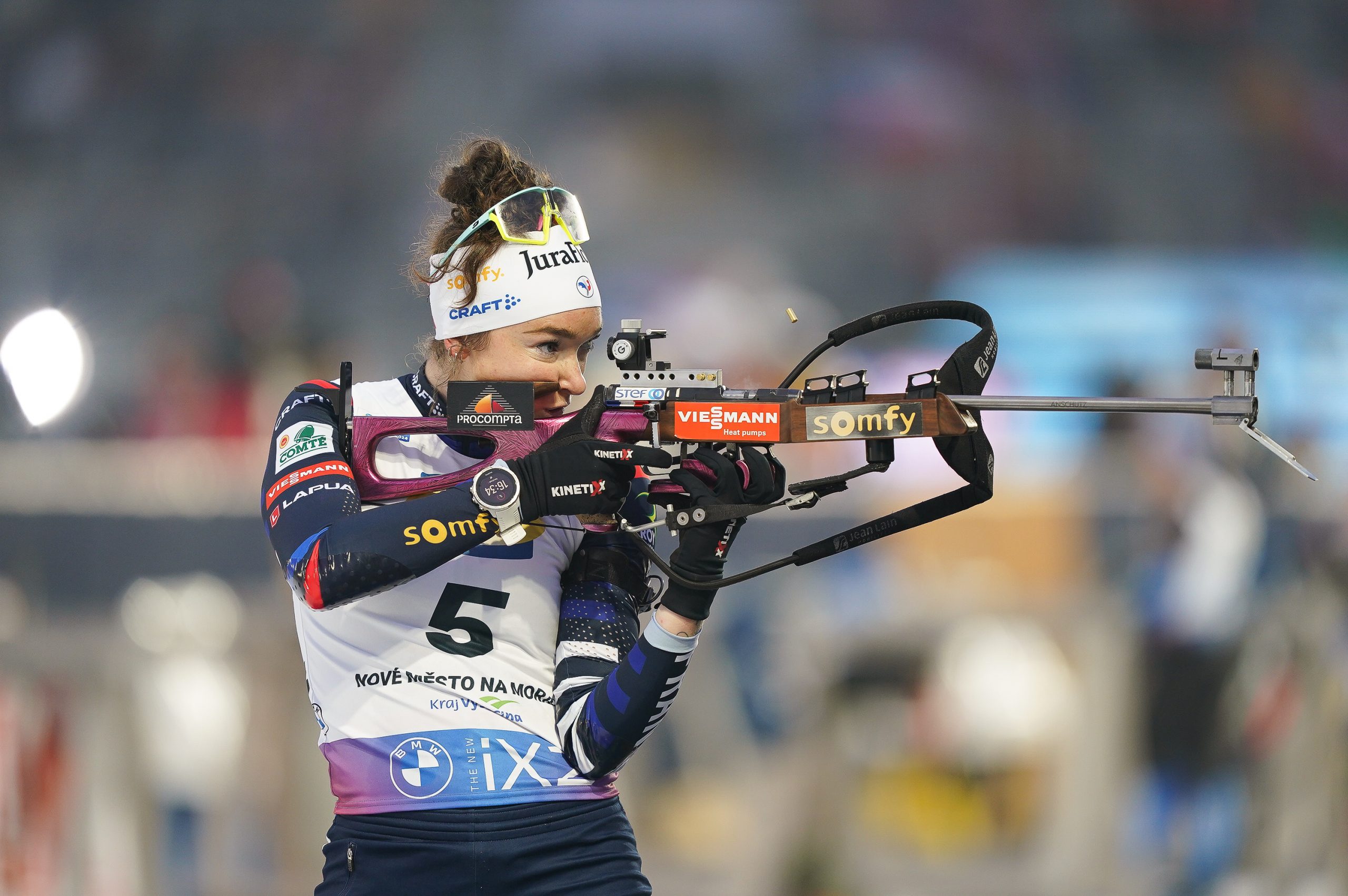
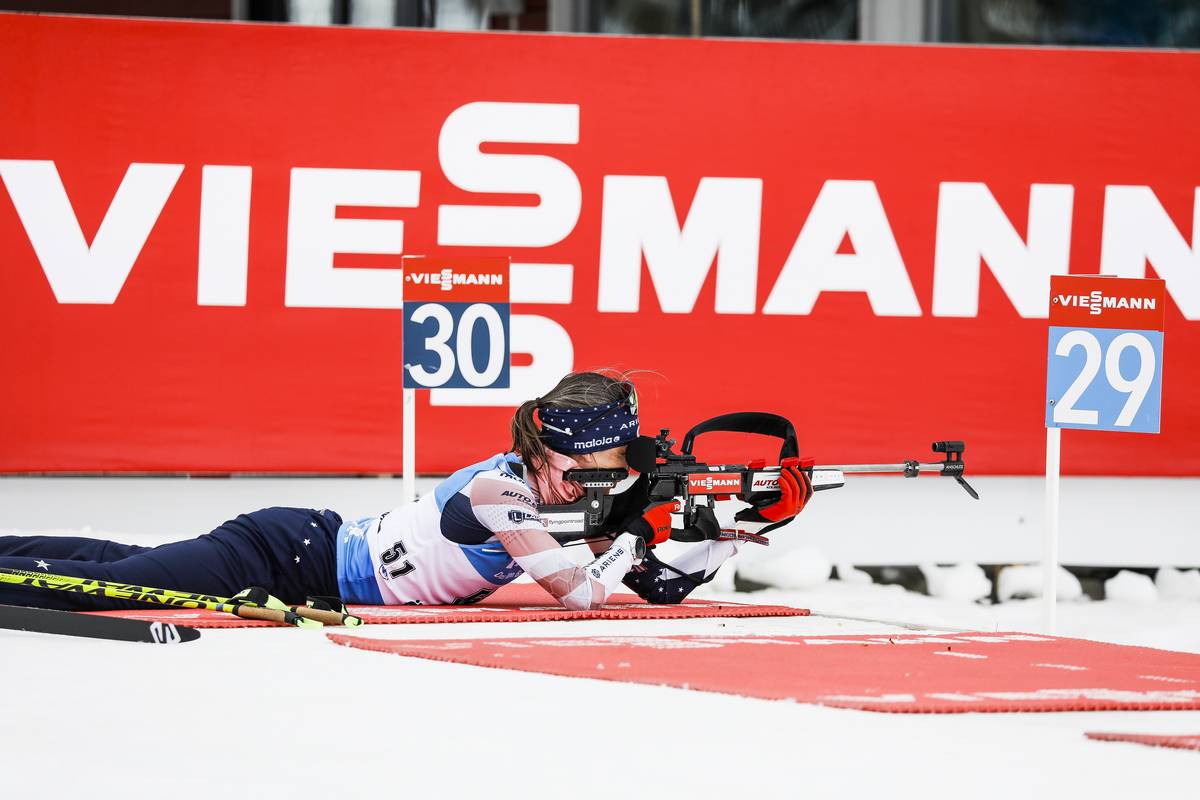
French teammates Justine Braisaz-Bouchet (foreground) and Julia Simon shoot head-to-head in the Pursuit. (Photo: NordicFocus)
Women’s 10 k Pursuit
Simon defends world title, Vittozzi moves up from seventh to silver, and Braisaz-Bouchet keeps her podium streak alive.
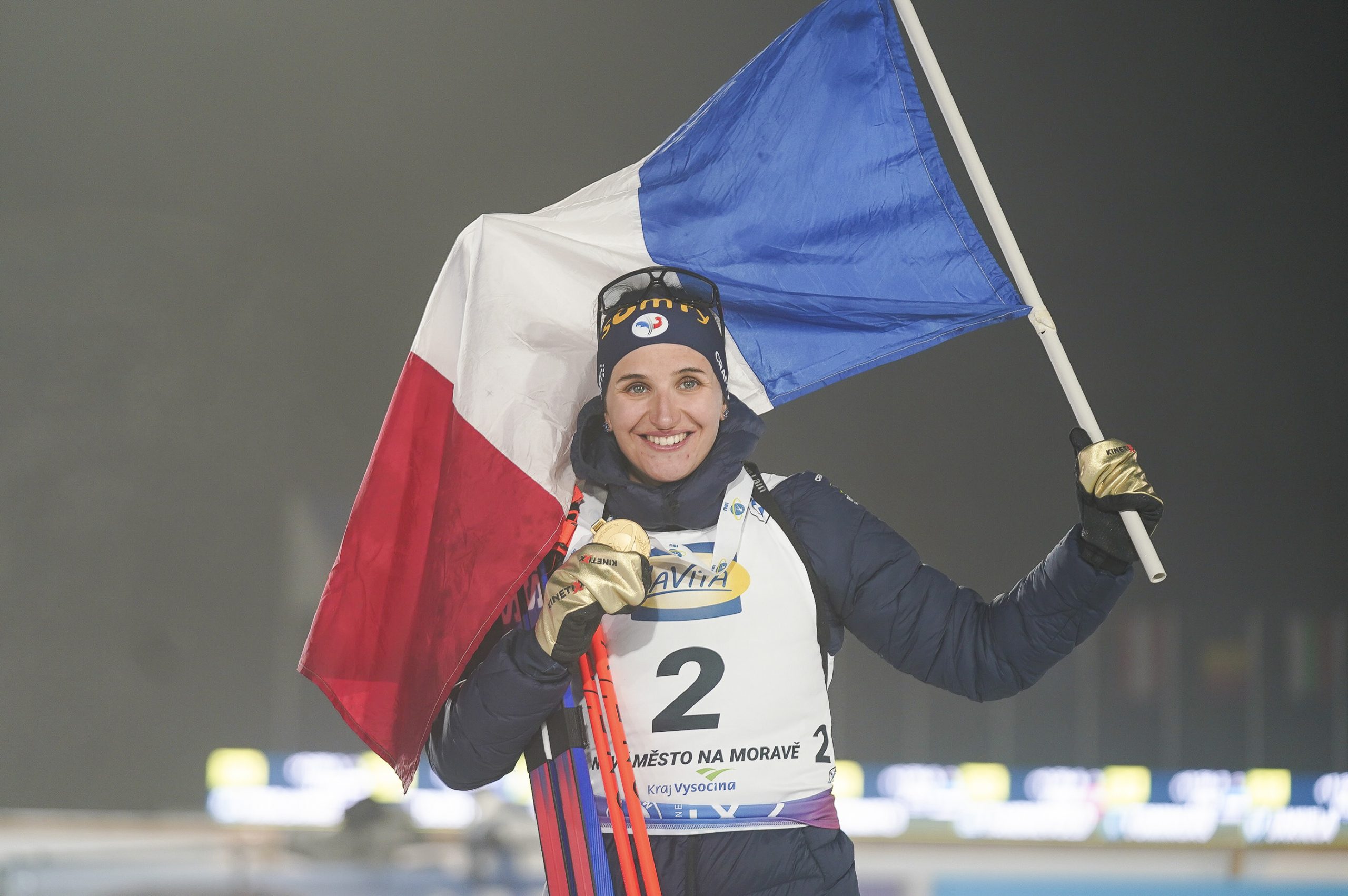
In the women’s Pursuit, Julia Simon of France defended her 2023 World Championship Pursuit title as well as her Sprint victory from Friday. Last year, Simon started the Pursuit wearing bib 10 and overcame a deficit of more than one minute to take the gold, but today’s defense of Friday’s Sprint gold was also impressive. Only four women in the past ten years have won both the Sprint and Pursuit at the World Championships or Olympics: Marie Dorin-Habert (FRA) in 2015, Laura Dahlmeier (GER) in 2018, Tiril Eckhoff (NOR) in 2021, and Marte Olsbu-Roeiseland (NOR) in 2022.
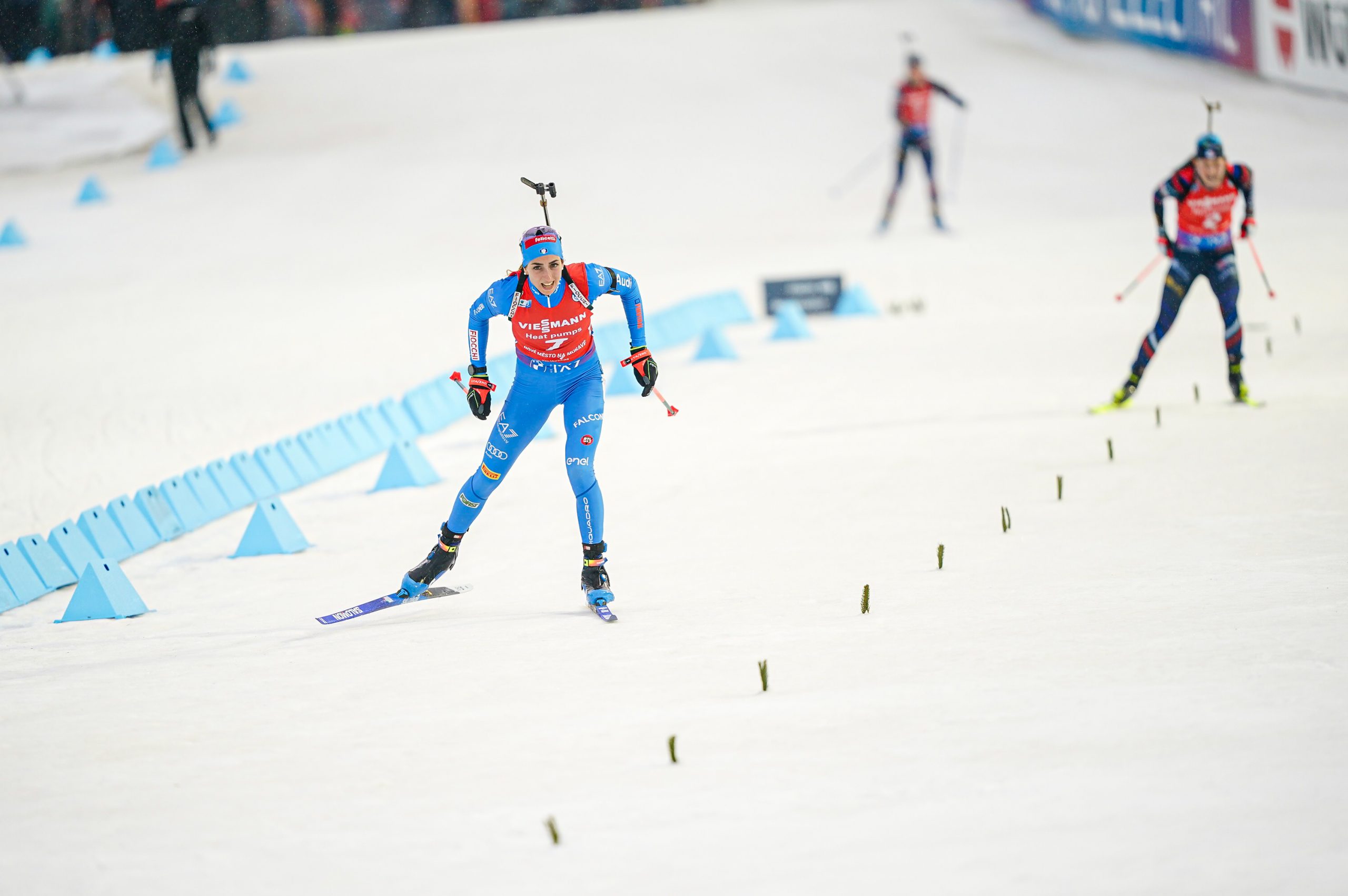
Lisa Vittozzi (ITA) fights to the finish line, moving up from seventh to silver ahead of bib 2 Justine Braisaz-Bouchet (FRA). (Photo: NordicFocus)
Simon started with a negligible five second advantage over teammate Justine Braisaz-Bouchet, who is the fastest skier in the field but a slower and less-accurate shooter than Simon. A gap of nearly 40 seconds separated those two leaders from the third starter, Lou Jeanmonnot (FRA), but then six women all started within about 30 seconds. Simon and Braisaz-Bouchet matched one another’s shooting (0,1) on the first two stages to hold their lead over the chasers. But then on the third stage, Simon cleaned while Braisaz Bouchet missed two, opening the door for bib 7, Italy’s Lisa Vittozzi, to move into second with her 15/15 shooting through stage three of the race.
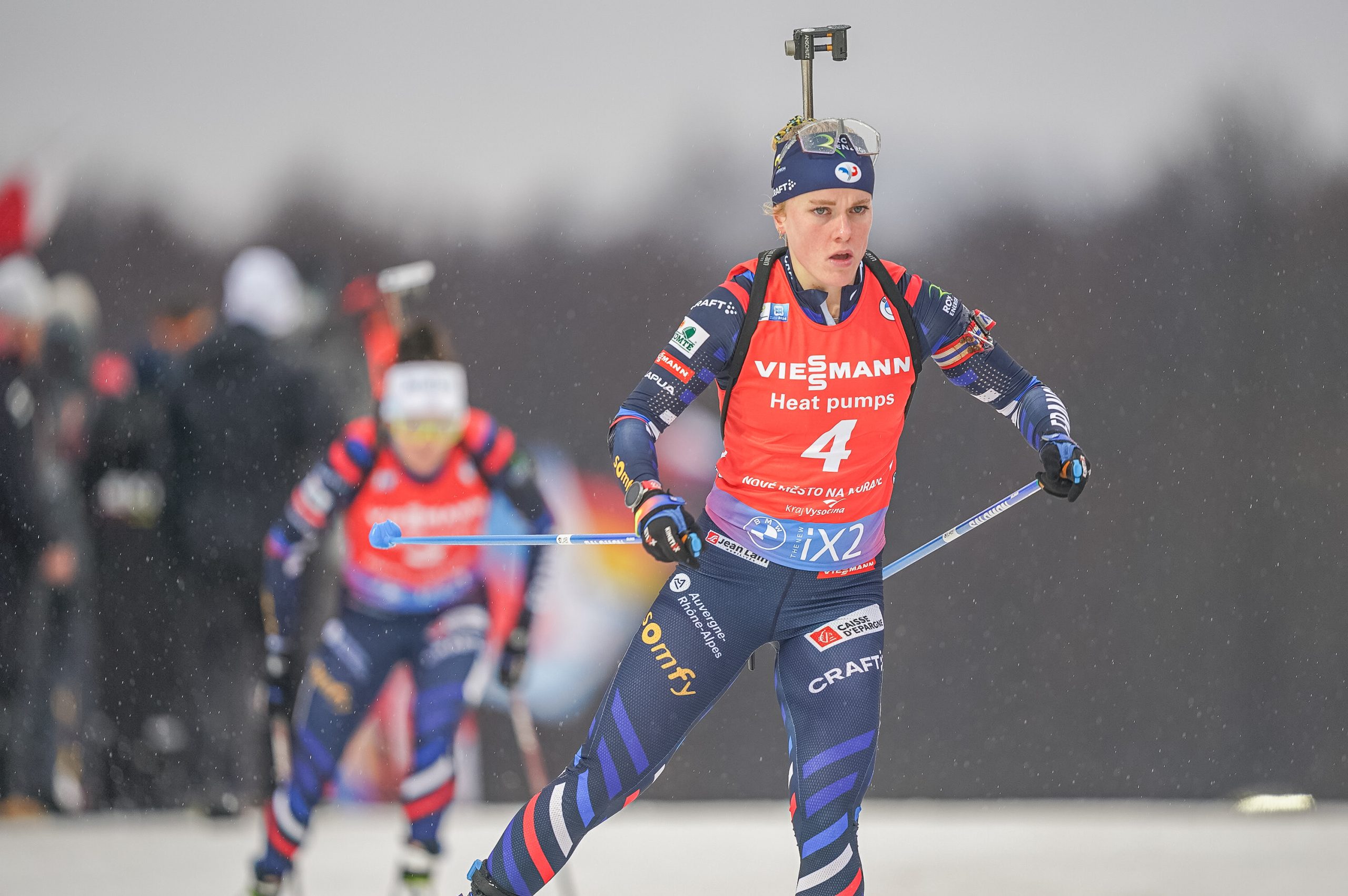
Sophie Chauveau (FRA) finished fourth in the Sprint and Pursuit. (Photo: NordicFocus)
In the final stage, Simon closed with the same perfect shooting we’ve now seen in three of three races at World Championships, nailing all five targets in 21.5 seconds—somewhat tame for Simon but still the fastest in the 60-person field. Behind her, Vittozzi missed her only shot of the day, creating an opening for Braisaz-Bouchet and bib 4, Sophie Chauveau. But luckily for Vittozzi, both of them missed one as well. Chauveau left the range a few seconds ahead of Braisaz-Bouchet, and for a moment it looked like the 24-year old might take her first World Championship medal after finishing a bittersweet fourth in the Sprint. But Braisaz-Bouchet out-skied Chauveau on the final lap to take the bronze, leaving Chauveau in fourth again. To put things in perspective, Chauveau won her first medal (a bronze) in January of this year, and her two fourth places so far at World’s are her next-best results.
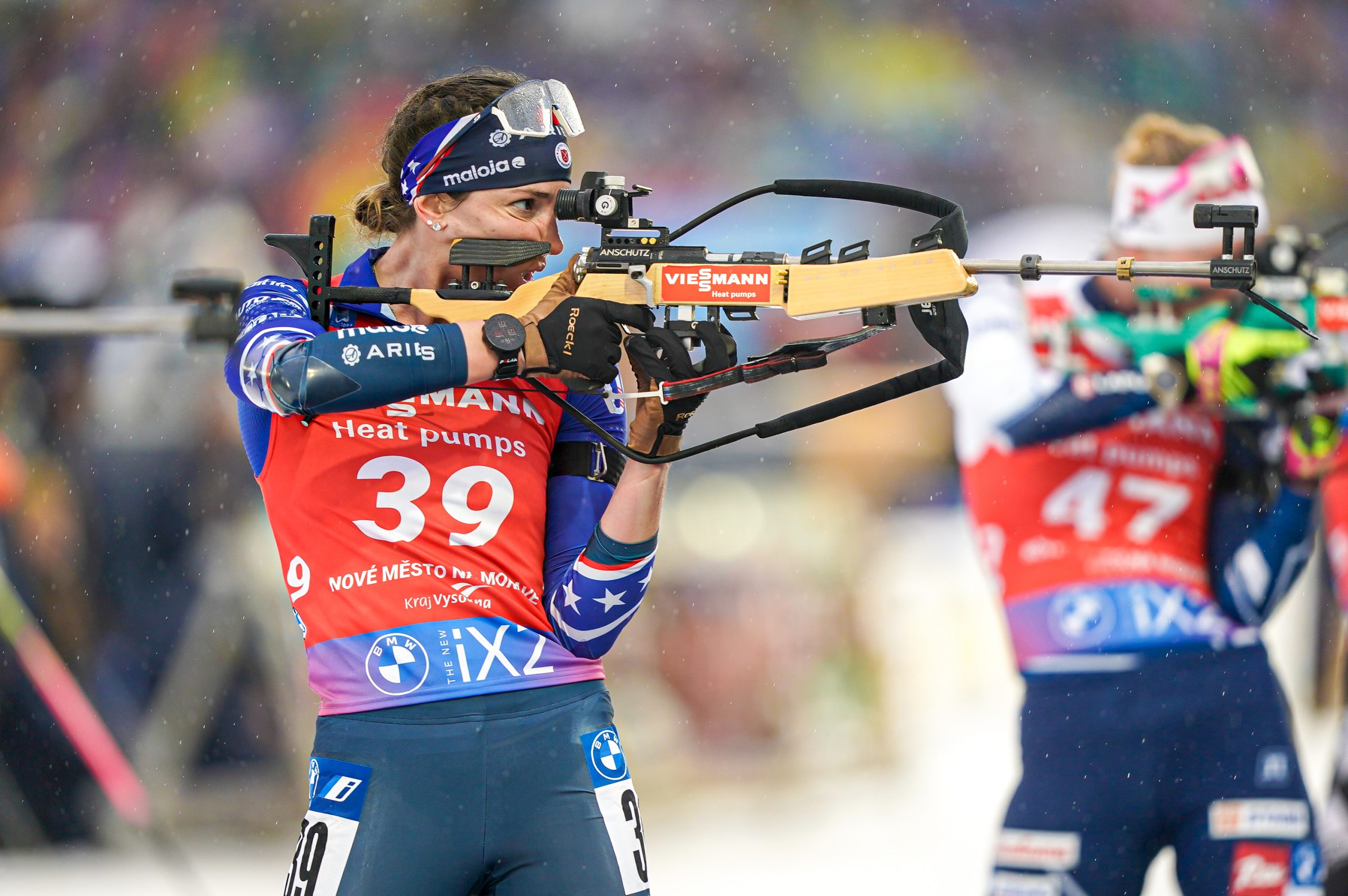
Deedra Irwin was the top American in the Pursuit, finishing 46th with four misses. (Photo: NordicFocus)
From the US, Deedra Irwin started in bib 39 and fell back to place 46 with four misses. Tara Geraghty-Moats started in bib 58 but was lapped after the second shooting in her first-ever Pursuit.
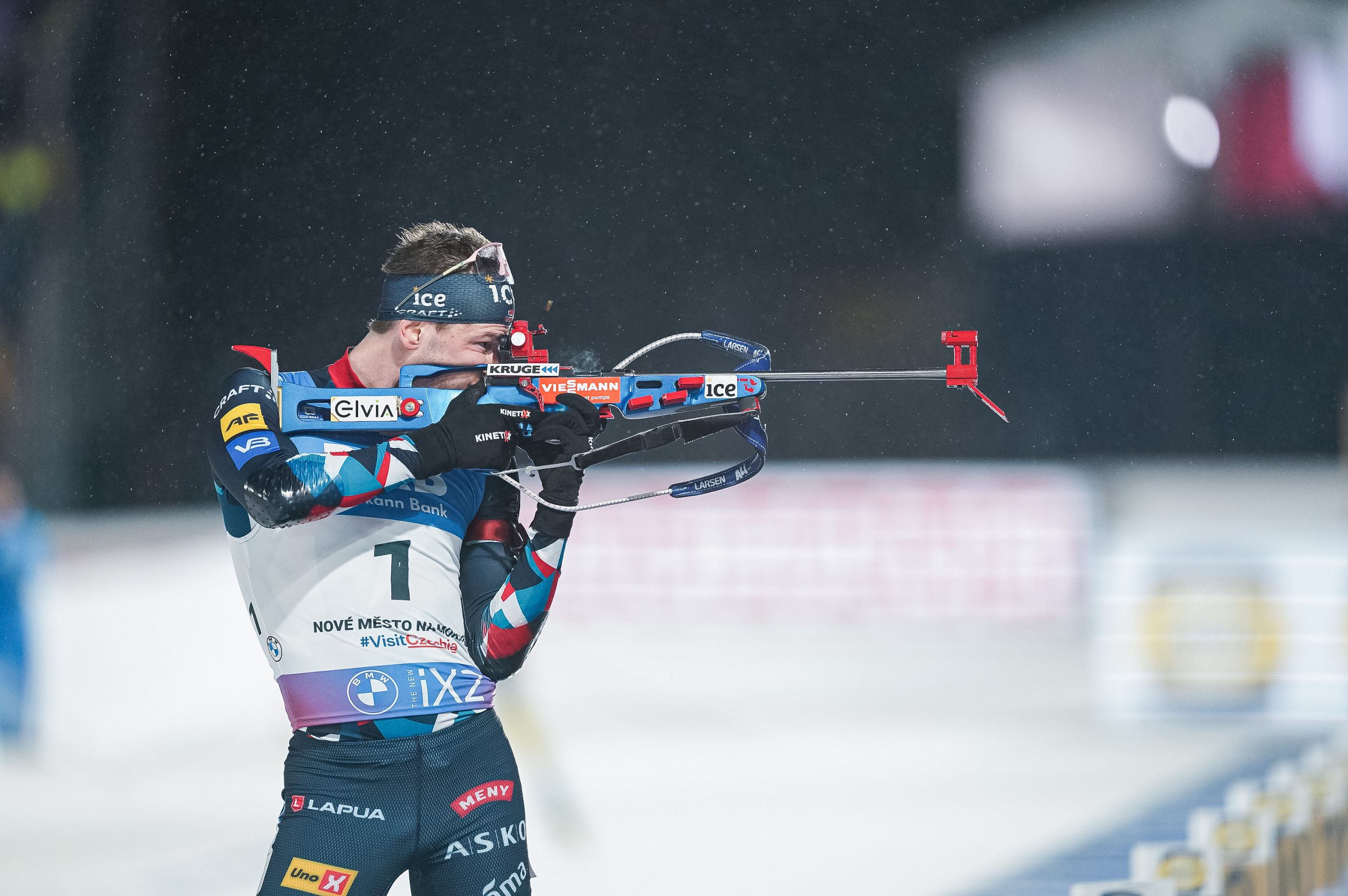
Sturla Holm Laegreid’s (NOR) clean standing shooting earned him the silver medal in the Pursuit. (Photo: NordicFocus)
Men’s 12.5 k Pursuit
J.T. Boe shuffles the sprint podium to defend World title while the USA’s Wright and Doherty finish 12th and 26th.
In the men’s 12.5 k Pursuit, the Norwegian podium sweep from Saturday’s Sprint grew to a monstrous top-five sweep. Johannes Thingnes Boe (NOR) overcame three prone misses with flawless standing shooting to win his eighth individual World title—his 34th World Championship medal. (If you include Olympic results, Sunday’s victory was Boe’s 11th title and 42nd medal.) After winning Saturday’s Sprint with his signature perfect shooting, Sturla Holm Laegreid (NOR) uncharacteristically missed two in the first stage of the Pursuit but then hit the rest of his targets to fight back for the silver medal. Vetle Christiansen (NOR) led the race early on when he cleared all his prone targets and J.T. Boe and Laegreid both missed. But then two misses on his final stage set him back. He left the range a few seconds ahead of Laegreid but was caught in the final lap.
Vetle Sjaastad Christiansen (NOR) finished third in both the Sprint and Pursuit. (Photo: NordicFocus)
The fight for the top-six flowers was marked by some surprising shooting melt-downs. Having hit all his targets through the third stage, Tarjei Boe came into the final shoot tied for second with his younger brother Johannes, just nine seconds behind race leader Christiansen and a full 30 seconds ahead of the chasing group. But he missed a heart-wrenching four out of five targets and fell to fifth. Meanwhile, his teammate Johannes Dale moved up into fourth by clearing his final five, recovering from a messy three misses on the third stage. Behind Dale and T. Boe, Sebastian Samuelsson (SWE) kept his wits about him and shot 17/20 to complete the flower ceremony in sixth.
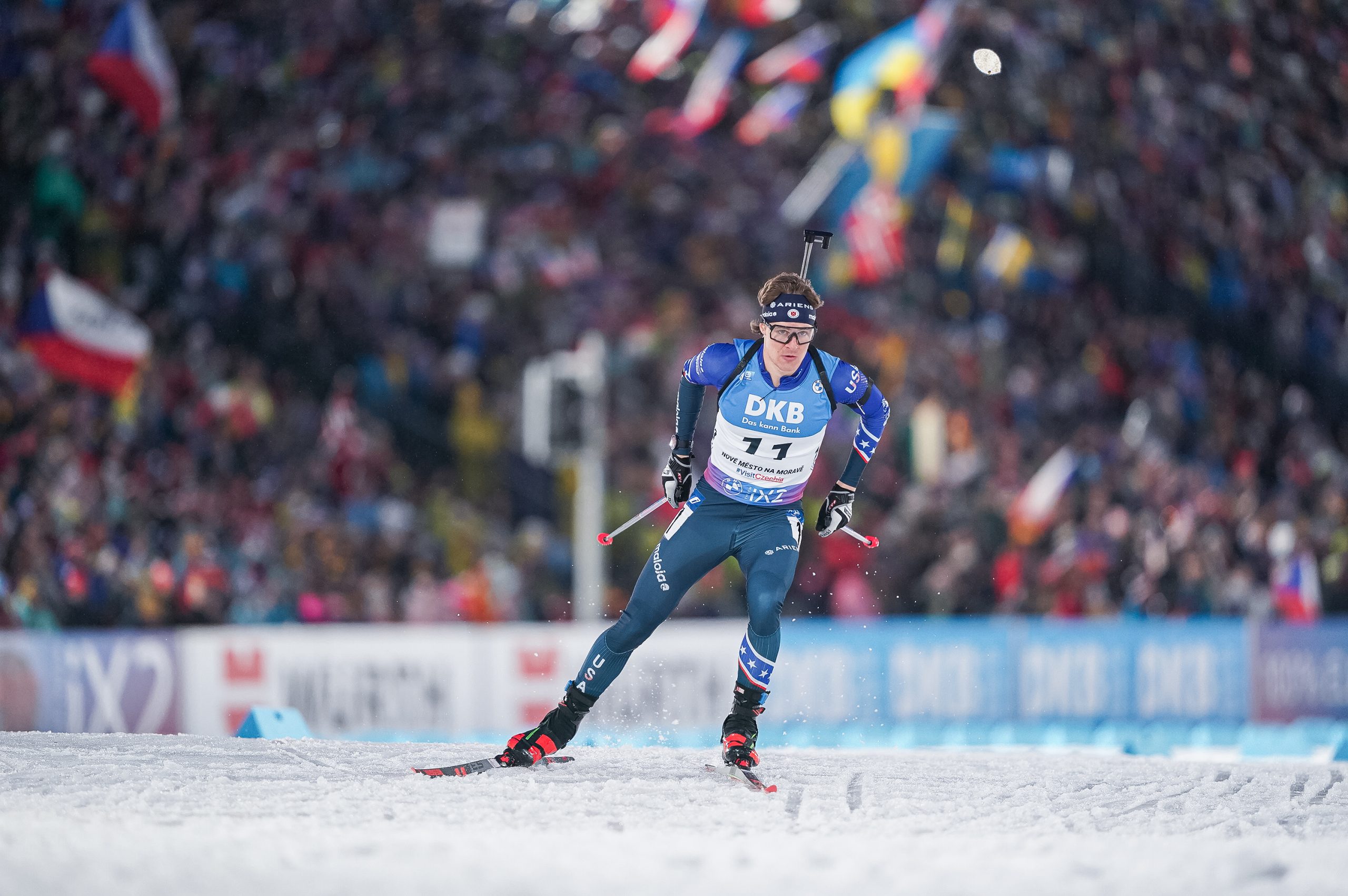
Campbell Wright (USA) was the top American in the Pursuit finishing 12th with two misses. (Photo: NordicFocus)
For the US, Campbell Wright in bib 11 missed one shot each in the prone stages but then cleared all 10/10 standing targets, finishing 12th. His 11th-place finish in the Sprint was a personal-best and this 12th place ties his previous personal-best. With these two results, Wright is almost guaranteed a start spot in next weekend’s 30-person Mass Start featuring the top 30 athletes of the Championships.
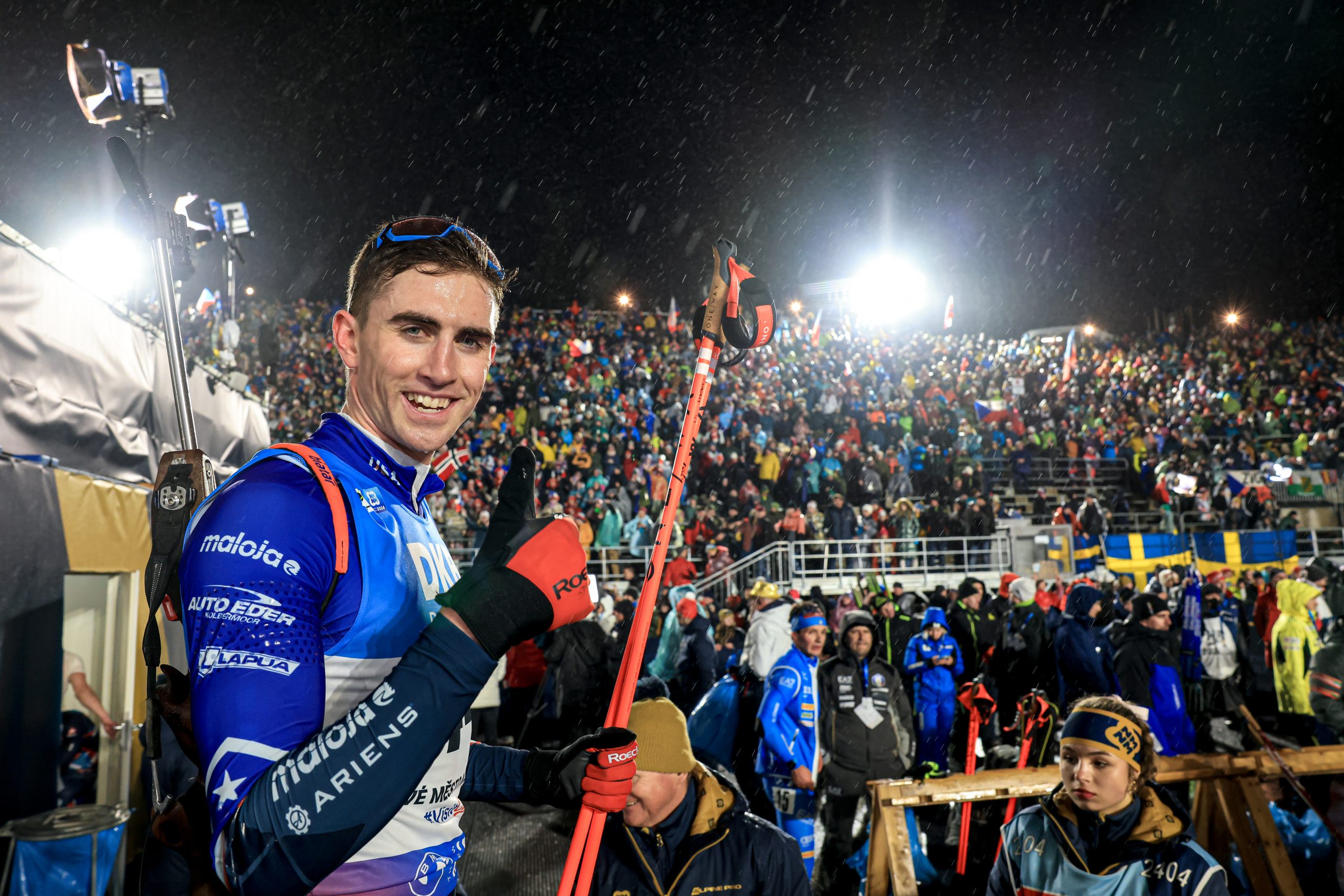
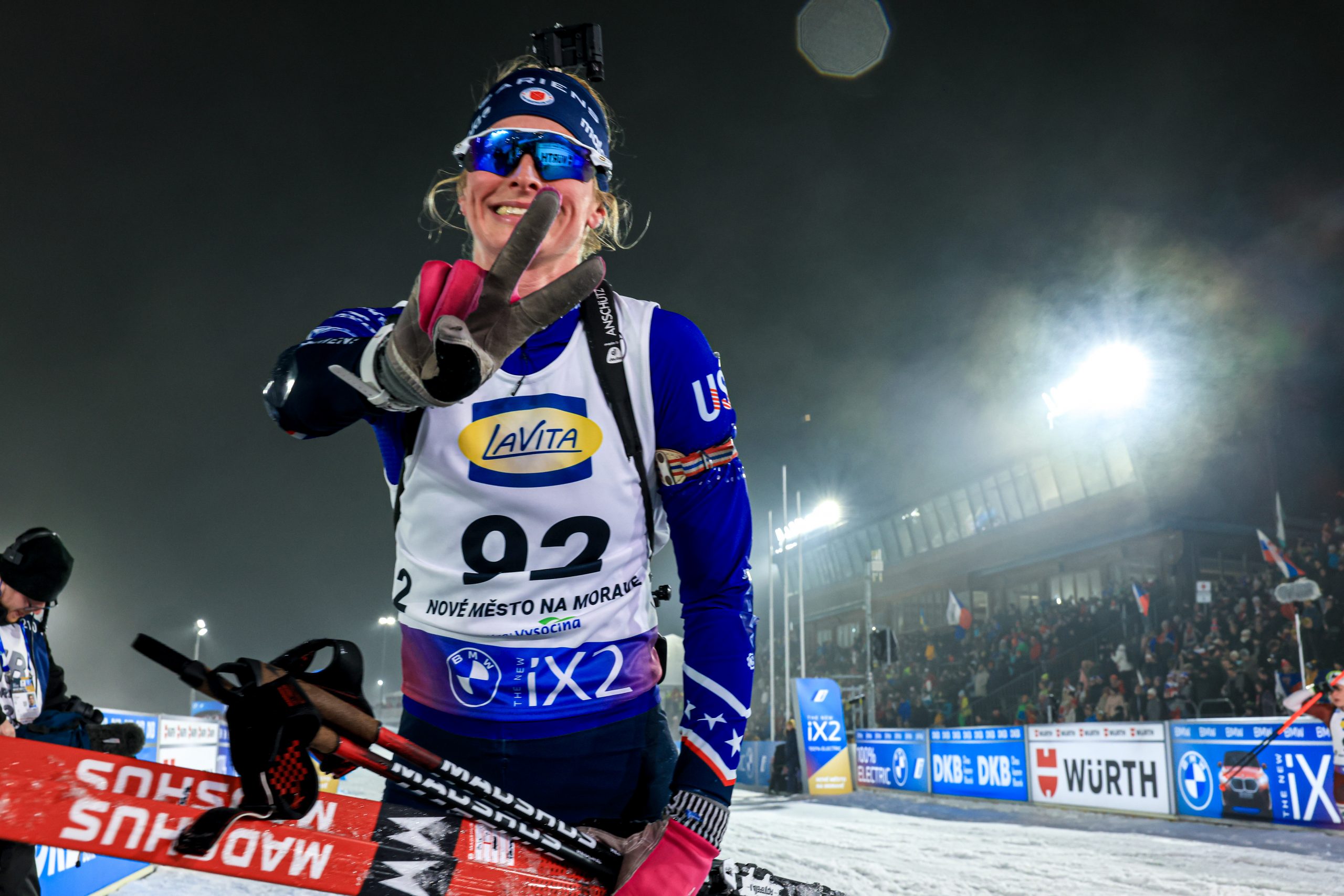
Sean Doherty (USA) happy in the finish area after moving up 18 places from 44th to 26th. (Photo: NordicFocus)
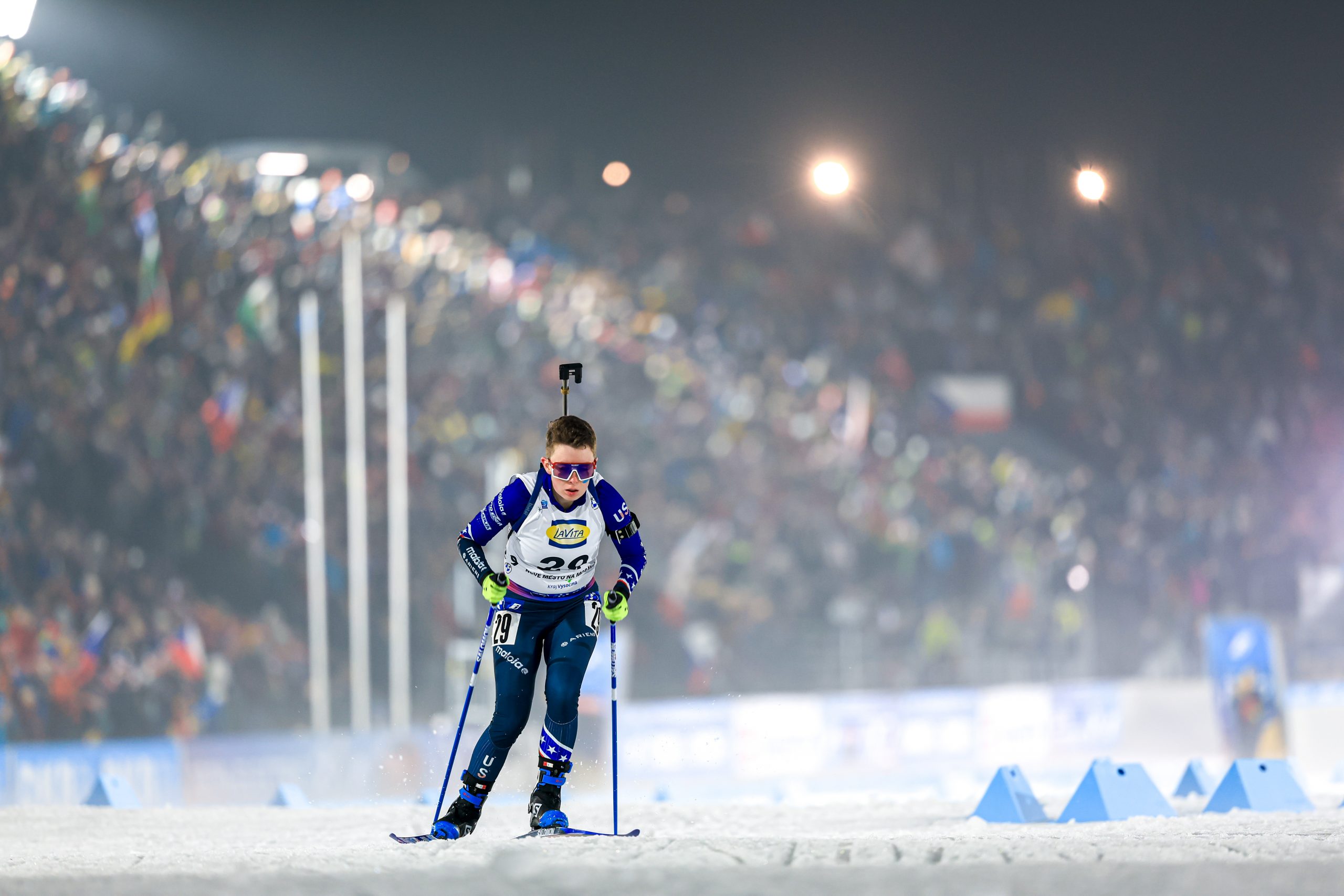
Sean Doherty was one of the biggest climbers of the day, moving from 44th to 26th with just a single miss in the first standing stage. Jake Brown started 38th and finished 37th with four misses, skiing the fastest of the three Americans in the race, 1:11 off the pace set by J.T. Boe.
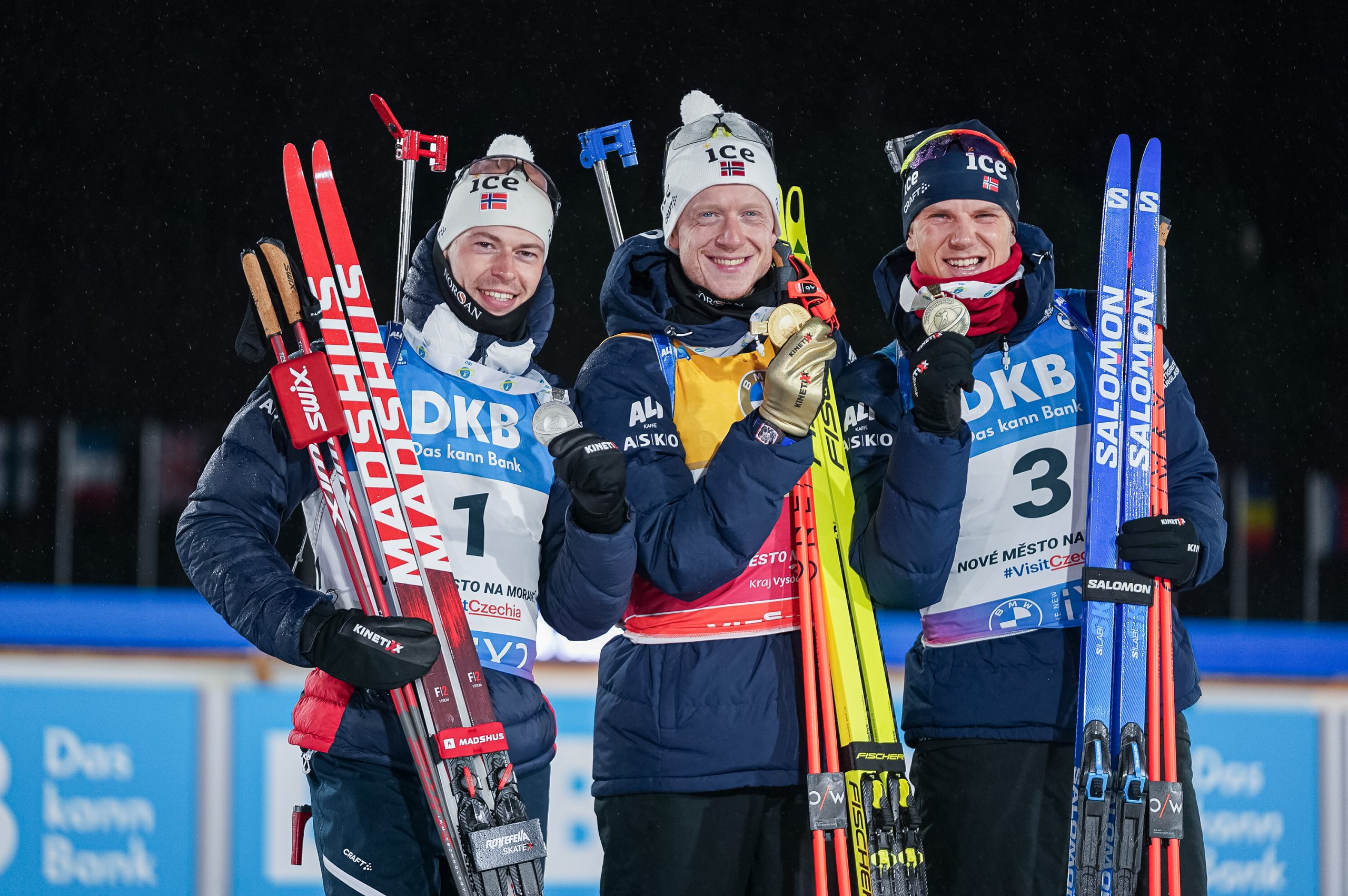
Sturla Holm Laegreid, Johannes Thingnes Boe, and Vetle Sjaastad Christiansen, (l-r) shuffled their podium sweep from Saturday’s Sprint in Sunday’s Pursuit. (Photo: NordicFocus)
FasterSkier’s Coverage of the Biathlon World Championships is made possible through the generous support of the Craftsbury Outdoor Center: New England’s finest snowmaking, world class race venues and touring trails, healthy food in abundance, comfortable accommodations at Craftsbury: Sports, Sustainability, Stewardship.
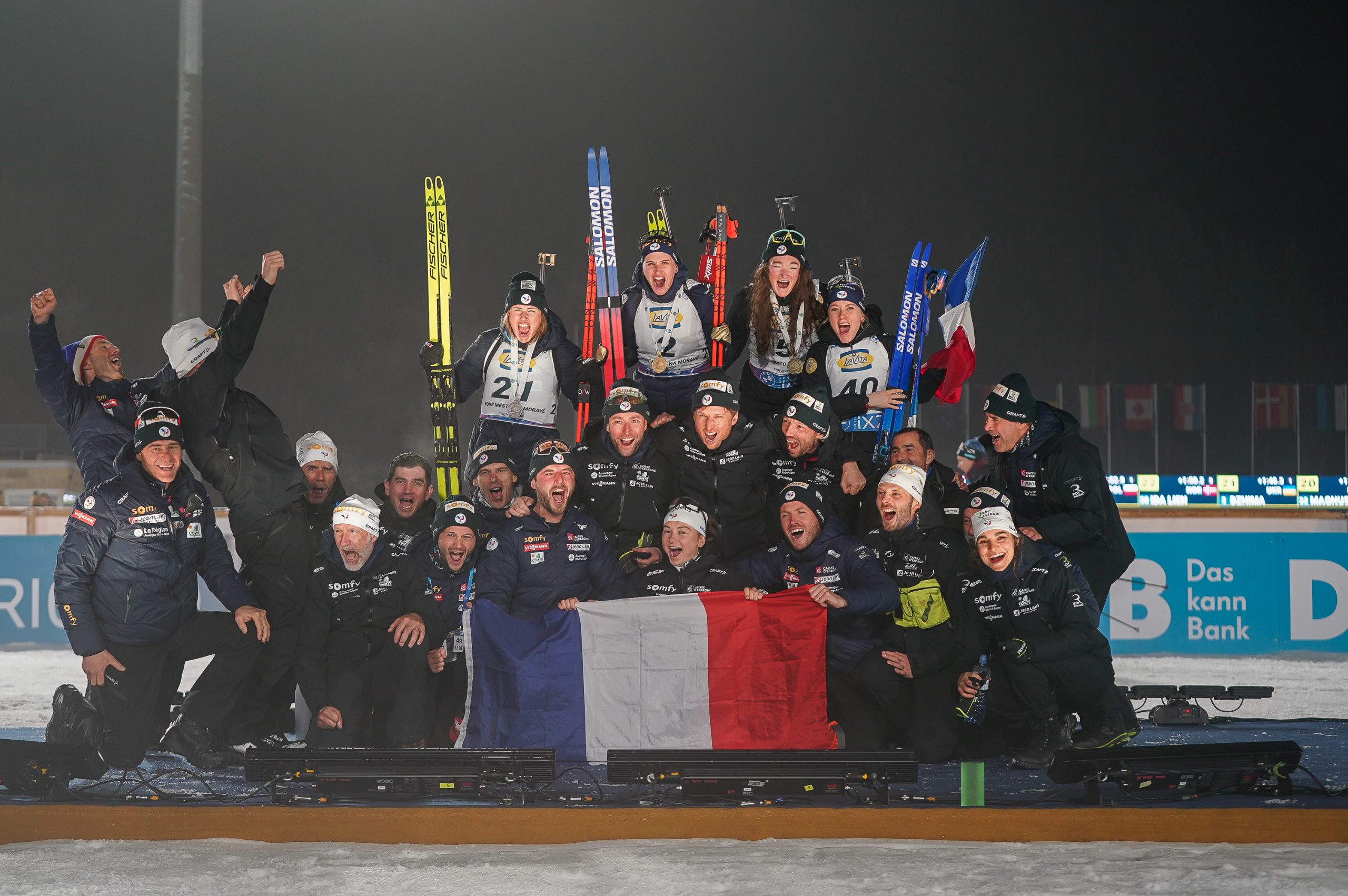
France swept places 1-4 in the Sprint at the 2024 Biathlon World Championships. (Photo: NordicFocus)
Ever since France upset Norway to win the opening Mixed Relay of the 2024 Biathlon World Championships, their magnificent esprit de corps has been on display. After that race, the entire team gathered around the podium and belted “La Marseillaise” in the rain as the French flag was raised in the Vysocina Arena in Nove Mesto na Morave, Czech Republic. That same winning energy pulsed through the French women’s team Friday as they delivered an historic sweep of the first four places—a feat not seen since the inaugural Women’s Biathlon World Championships in 1984 when the Soviet Union swept the 10 k Individual. (American Kari Swenson was fifth.) There were 35 finishers in that race. In Friday’s 7.5 k Sprint, The French quartet of Julia Simon, Justine Braisaz-Bouchet, Lou Jeanmonnot, and Sophie Chauveau bested a field of nearly 100.
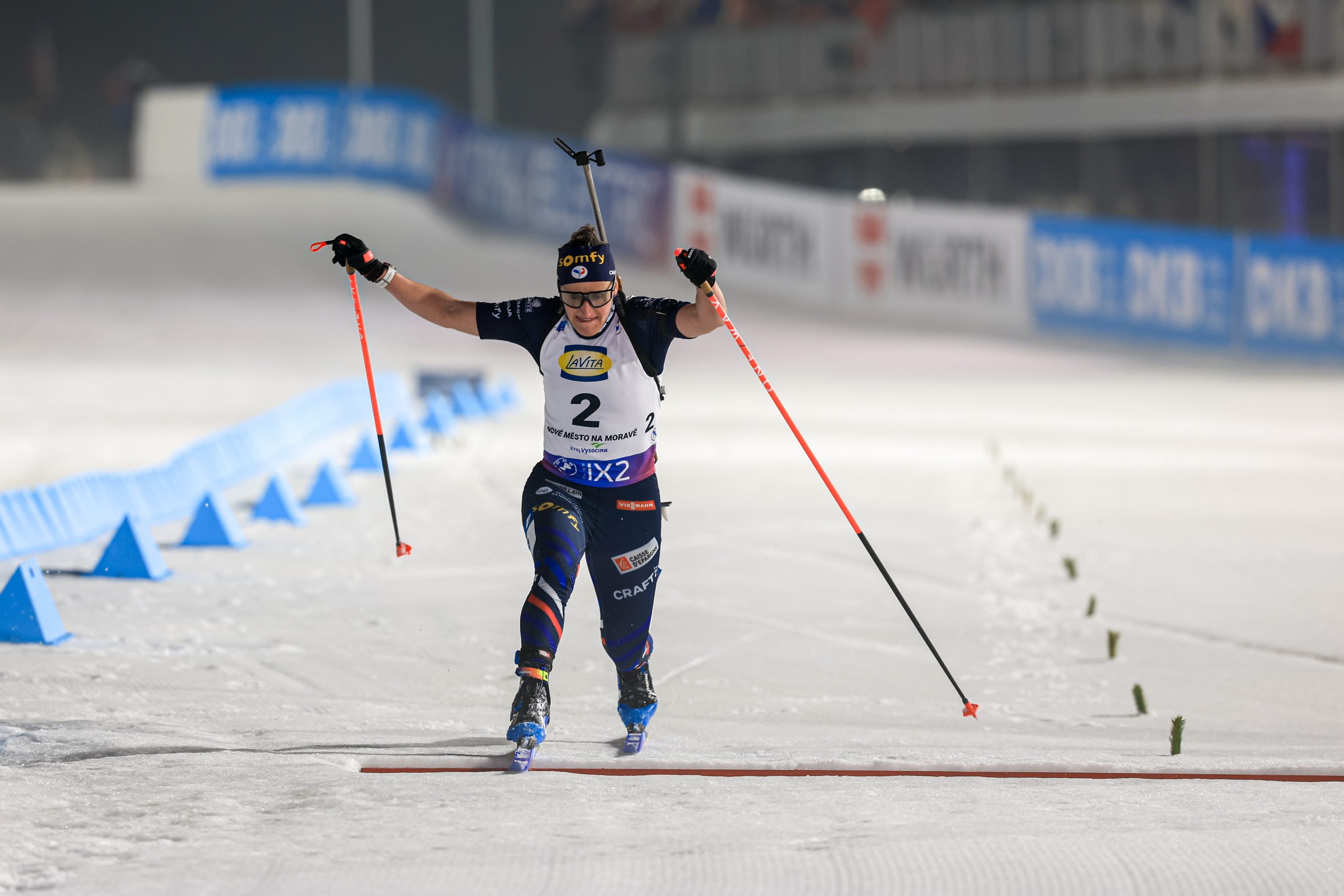
Early starter Julia Simon (FRA) crosses the finish line, setting the time to beat in the Women’s Sprint. (Photo: NordicFocus)
All eyes were on Simon, wearing bib 2, to set the time to beat for the day. After laying down a perfect anchor leg in Wednesday’s Mixed Relay, she picked up where she left off with another 10/10 performance, leaving little room for any challengers. Simon’s ski time ranked fourth and her total shooting time of 42 seconds for prone and standing was the fastest of the day. It was a dominant Sprint performance from the 2023 World Cup Overall champion, who is better known for her head-to-head racing.
Lou Jeanmonnot (FRA) shot 9/10 to land on her first World Championships podium, taking home the bronze for France. (Photo: NordicFocus)
Another early starter, Jeanmonnot in bib 5 matched Simon’s speed on the course but lost some time to her on the range (like everyone else) and missed one target in standing, eventually finishing 40 seconds back. It seemed inevitable that other competitors would fill that gap, but as the race went on it became clear that the only athletes skiing fast enough to challenge the French women were their own teammates.
Justin Braisaz-Bouchet (FRA) outskied the field by nearly 30 seconds to take silver despite one miss. (Photo: NordicFocus)
Out-skiing the field by over 30 seconds in Wednesday’s Mixed Relay, Braisaz-Bouchet demonstrated that she is one of very few athletes who can ski a penalty loop and still fight for gold. That scenario nearly played out in Friday’s Sprint, as Braisaz-Bouchet gapped the field by 28 seconds, missed one in prone but then hit all of her standing targets, leaving the range with just a 13-second deficit to clean-shooting Simon. She closed the gap in the final kilometers but couldn’t quite catch Simon, crossing the line just 4.9 seconds behind.
World Cup Overall leader Ingrid Landmark Tandrevold (NOR) led the race after the first shooting but then fell to 25th after a disastrous three misses in standing. (Photo: NordicFocus)
The two Italian stars, Lisa Vittozzi and Dorothea Wierer, were early challengers for the podium, both showing their trademark poise on the range with 10/10 hits, but they didn’t have the ski speed to keep up with the French women and ended up seventh and tenth. Swedish sisters Hanna and Elvira Oeberg did the reverse; they skied well but both missed in standing and dropped to eighth and ninth.
The only other athlete who could challenge Simon for the gold was World Cup Overall leader Ingrid Landmark Tandrevold (NOR) in bib 26. She came through the prone shooting in the lead, 1.5 seconds ahead of Simon, but then suffered a disastrous standing bout, missing three targets and falling to 25th place—her worst result of the season.
Sophie Chauveau (FRA) reacts to her team’s one-through-four sweep. (Photo: NordicFocus)
The podium positions seemed secure until Chauveau, wearing bib 40, nearly overtook Jeanmonnot. Chauveau found herself down in 30th after a miss in prone but then launched into podium contention with her clean standing shooting and third-ranked course time. In the finish she was a mere four seconds off the podium.
Simon’s gold is her first Sprint podium of the season and only her second-ever Sprint victory. Braisaz-Bouchet, who skipped last season to have her first child, had never finished better than 25th in a World Championships Sprint, despite taking part in every edition since 2015 and winning a list of World Cup races and an Olympic gold medal in Beijing along the way. Jeanmonnot’s bronze is her first World Championship medal, and Chauveau’s fourth place ties her second-best career finish. She earned her first World Cup medal, a bronze, in January of this year.
While the French women shot exceptionally well, they owe their sweep to their ski speed. Four of the top-five fastest skiers in the Sprint were French. The other was 2021 cross-country World Cup Overall Sprint champion, Anamarija Lampic of Slovenia, who missed five and finished 36th. Reflecting on the role that ski preparation played today, US Biathlon ski technician Federico Fontana said, “The dirt and the wet in Nove Mesto is always challenging. The French had incredible skis.”
Baiba Bendika (LAT) skied the seventh-fastest course time and hit 9/10 to tie her career-best finish of fifth. (NordicFocus).
The surprise of the day was Latvia’s Baiba Bendika, who finished fifth to match her career-best result, having given birth to her first child in October—just four months ago. She had a chance to break up the French sweep but missed her last shot. Franziska Preuss of Germany completed the Flower Ceremony, also with one standing miss.
Irwin and Geraghty-Moats Qualify for Pursuit
Deedra Irwin was the top American in the Sprint, finishing 39th with one miss each in prone and standing. She wrote on her Instagram account, “It isn’t what I wanted but then I realized that it is my personal best World Champs Sprint finish!” Irwin has consistently been scoring World Cup points in the top 40 this season and has the potential to move up significantly in Sunday’s Pursuit. She’ll be joined in the Pursuit for the first time by teammate Tara Geraghty-Moats, who sneaked into the top-60 qualifiers with a new personal-best of 58th.
Tara Geraghty-Moats (USA) smiling in the finish line after setting a new personal-best of 58th to qualify for her first Pursuit. (Photo: NordicFocus)
Geraghty-Moats cited her start position as playing a role in her qualification. “I had good course conditions with the second-to-last starting bib. With the warm temperatures, I thought the course would degrade a lot by the time I raced but it didn’t.” She had the advantage of watching earlier athletes go through, and drawing on their energy. “It looked so epic. It made me super excited to go out there. With the results I’ve had this winter I didn’t think I would make the Pursuit so I just wanted to have a race where I executed my plan well.”
Jackie Garso (USA) racing in her first World Championships. (Photo: NordicFocus)
Chloe Levins and Jackie Garso completed the US roster in Friday’s race. Levins echoed Geraghty-Moats’ comments about the atmosphere in the stadium: “The energy under the lights in Nove Mesto was electrifying tonight.” Levins, who finished 80th with two misses, is coming off a training season that was interrupted by a number of health issues. “I’m nowhere near satisfied with my result, but continue to gain great experience and feel myself racing back into shape.” Garso, competing in her first World Championships, finished 87th with three misses. She, too, was shocked by the crowds: “It’s unbelievably loud! You can’t even hear yourself breathe.”
Denise Herrmann-Wick (GER) shooting from the standing position at the IBU World Championships Sprint in Oberhof, Germany. (Photo: NordicFocus)
Biathlon fans anticipated that the women’s 7.5km Sprint would be one of the most tightly-contested races of the BMW IBU World Championships, and it did not disappoint. In the end, only 2.2 seconds separated the new World Champion, Denise Herrmann-Wick of Germany, from the silver medalist, Hanna Oeberg of Sweden. Oeberg’s teammate, Linn Persson, finished third. These athletes will start at the front of Sunday’s 60-person Pursuit and try to stave off the chasers for another chance at a World Championship medal.
Hanna Oeberg (SWE) leaving the range in the lead of the IBU World Championships Sprint in Oberhof, Germany. (Photo: NordicFocus)
Fourteen women from seven nations have landed on the podium this winter. But among all those contenders, arguably no one had more pressure on them today than hometown favorite, Denise Herrmann-Wick. Ranked first in the World Cup Sprint standings, the 34-year-old revealed in Wednesday’s Mixed Relay that she has peaked perfectly for these races. Even with nine out ten hits, Herrmann-Wick is skiing fast enough that she could have a chance at a podium finish, but today she left nothing chance. Unfazed by tens of thousands of spectators cheering in unison after each shot, Herrmann-Wick steadily cleared ten out of ten targets. One word came to mind: impressive.
But the race wasn’t over. A few minutes later, Hanna Oeberg of Sweden managed the same perfect shooting, leaving the range for the final 2.5km loop with a nine second advantage over Herrmann-Wick. A hush of collective anxiety came over the full stadium of German fans. By the top of Oberhof’s signature Birxsteig climb, Oeberg’s advantage had dwindled to a near tie. It wasn’t until the final meters of the race, when Oeberg’s time ticked above Herrmann-Wick’s winning mark of 21:19.7, that the Thuringen Arena burst into cheers.
Denise Herrmann-Wick (GER) celebrates after winning the IBU World Championships Sprint in Oberhof, Germany. (Photo: NordicFocus)
The battle for gold was not limited to those two athletes. Wearing bib number two, Anamarija Lampic of Slovenia cleaned her prone targets, leaving the audience wondering if today might be the day for the former cross-country skier to break onto her first podium. But that kind of biathlon magic wasn’t to be; Lampic’s inexperience came through when she missed four targets in standing. With the 17th-ranked course time, she narrowly managed to qualify for Sunday’s Pursuit in 58th. It was Lampic’s teammate, Polona Klemencic, who stepped up and shined for Slovenia with the perfect shooting score to take her first career top-10 in 8th place.
Ingrid Tandrevold of Norway led the race after Shooting 1, showing once again that her ski speed and prone shooting skills are there. But the standing shooting slump which has been bothering her since January persisted and she missed two on her way to a 14th place finish. Lisa Vittozzi of Italy missed just one in standing but skied fast enough to briefly take the lead from Marketa Davidova of Czech Republic, who had hit 100% as she so often does in championship races.
The defending Olympic Champion in the Sprint, Marte Olsbu Roeiseland, was sitting way back in 26th after missing one in prone, but with a clean standing bout and the second-ranked course time, she pulled her way back to fourth, just five seconds shy of the bronze medal. She’ll be motivated for more in the Pursuit. The World Cup Overall leader, Julia Simon, was well on her way to a podium finish with eight hits before she missed the last two. Simon thrives in head-to-head races and will be a threat in the Pursuit even starting 1:02 back in 10th place.
Emma Lunder (CAN) following Marte Olsbu Roiseland (NOR) in the IBU World Championships Sprint in Oberhof, Germany, where they finished 11th and 4th, respectively. (Photo: NordicFocus).
Less than one second behind Simon, Emma Lunder of Canada posted her best-ever Championship result in 11th. After a season-best ski performance on Wednesday in the Mixed Relay, Lunder knew anything was possible in today’s Sprint. “I was a bag of nerves,” she said. “I was more nervous for this than the Olympics, because I knew I had a chance.” Once she started, her good preparation kicked in and with a clear mind she executed to near perfection, with just one prone miss and a top-15 course time. Lunder attributes her excellent shape to staying healthy. She hasn’t been sick since last year’s Olympics, so she has been able to train continuously and make steady gains. She also credited her ski technicians for fast skis. In Sunday’s Pursuit, only 1:03 will separate Emma from Herrmann-Wick. To the podium, it’s just 37 seconds.
Nadia Moser (CAN) on her way to 48th in the IBU World Championships Sprint in Oberhof, Germany. Photo: (NordicFocus)
Two other North Americans qualified for the Pursuit. Nadia Moser (CAN) finished 48th with one penalty, and Deedra Irwin (USA) finished 55th with two. “I’ve barely trained for the last two weeks,” said Irwin after the race, referencing a sickness she came down with in January which required a round of antibiotics. “And this course is so hard. The headwind on that straightaway was brutal.” Some athletes were luckier than others, finding themselves in position to draft for the 500m windy straightaway approach to the range. Lunder put in a hard sprint to catch someone there. Chloe Levins, the second American today in 73rd, was alone every time on that section, but she performed well on the range, hitting nine of ten.
Joanne Reid (USA) shot clean in prone but suffered three penalties in standing to finish 75th. Competing in her first biathlon World Championships race, former Nordic Combined athlete Tara Geraghty-Moats (USA) similarly cleaned prone but struggled in standing, missing four to finish 86th. Canada’s Benita Peiffer rounded out their squad, missing five to finish 93rd.
Chloe Levins (USA) hit nine out of ten to finish 73rd in the IBU World Championships Sprint in Oberhof, Germany. (Photo: NordicFocus)
The women will be back in action on Sunday, but first it’s the men’s sprint, Saturday at 8:30AM Eastern Time.
IBU World Championships women’s Sprint podium: Denise Herrmann-Wick (GER) in first, Hanna Oeberg SWE) in second at left, and Linn Persson (SWE) in third. Oberhof, Germany. (Photo: NordicFocus)
Coaches: Pepa Miloucheva (head coach); Michael Gibson (biathlon coach); Nick Brown (assistant coach and wax tech); Ethan Dreissigacker (assistant biathlon coach)
Current roster (skiing and biathlon): Braden Becker, Adam Martin, Akeo Maifeld-Carucci, Caitlin Patterson, Michaela Keller-Miller, Margie Freed, Annika Landis, Alex Lawson (skiing); Jake Brown (Luke’s brother), Raleigh Goessling, Hallie Grossman, Susan Dunklee, Kelsey Dickinson, Tara Geraghty-Moats, Clare Egan, Luke Brown (Jake’s brother) (biathlon)
Who’s new: Luke Brown joins the team for biathlon, coming from Crosscut; Carsen Campbell joins the team for biathlon, coming from Rocky Mountain Racers; Tara Geraghty-Moats rejoins the team for biathlon, coming from nordic combined; Annika Landis joins the team for skiing, coming from Sun Valley; Alex Lawson joins the team for skiing after graduating from Middlebury this spring
Who’s still on this team, or otherwise involved in American skiing, from when we did this in 2012: Caitlin Patterson (athlete, skiing); Susan Dunklee and Clare Egan (athletes, biathlon); Maria Stuber (head nordic coach, St. Scholastica); Patrick O’Brien (head coach, SMS Elite Team); also, former CGRP teammates Pat O’Brien and Ida Sargent got married this summer
Susan Dunklee in Pokljuka, Slovenia, February 2021. (photo: Manzoni/NordicFocus)
Top results last season: Starting with biathlon: The redoubtable veteran Dunklee finished last season on a strong note with two individual eighth-place finishes in Nové Město, one in sprint and one in the pursuit. She teamed up with Sean Doherty for the country’s first single mixed relay World Cup podium since Lowell Bailey and, well, Dunklee, in 2017. Egan had a pair of top-10 finishes, 9th and 10th in Hochfilzen, and was a member of two sixth-place relay teams. Dunklee and Egan are both already qualified for the Beijing Olympics. Jake Brown was on a sixth-place mixed-relay team in Nové Město and had a season’s best of 12th in individual races, in the sprint in Pokljuka.
Moving on to nordic combined: Geraghty-Moats won the only regular-season women’s noco race that was able to be held last year, in Ramsau, to take the inaugural overall title, while garnering praise as a trailblazer for women’s sports. She was fifth at World Champs in Oberstdorf.
And finally, on the nordic trails: Patterson raced on the World Cup from Ruka through the end of January, including finishing 34th overall in the Tour de Ski. She was on a fifth-place relay team in Lahti, and had individual World Cup bests of 27th, 29th, and 30th. Martin had three World Cup starts in distance races, with a best of 44th in Davos. Lawson was 24th at World Juniors in the 10 k skate.
Tara Geraghty-Moats racing at World Champs in Oberstdorf, February 2021. (photo: Modica/NordicFocus)
Coach’s comments: Pepa Miloucheva writes, “Summer and fall training for GRP was good and mostly went as planned. This spring we officially added Alex Lawson, although she was here last year too and the only other addition was Annika Landis, who joined us after a year in Sun Valley.
“The whole team stayed and trained in Craftsbury through August. Waverly Gebhardt and Rena Schwartz trained with us as part of the summer U23 program and with our GRP biathletes here we had a really solid training group.
“Michaela had a setback early summer, broke her ankle and had to have surgery, but she kept really good fitness by spending hours on the SkiErg and was able to join the rest for the ski camp in September.
Adam Martin racing in Davos, December 2020. (photo: Modica/NordicFocus)
“Early September we went to Oberhof, Germany, for just over two weeks of training in the ski tunnel. This was our first trip since the pandemic, so I was little nervous, but everything worked out really well. The first few days the focus was on technique, transferring on-snow improvements athletes worked on during the summer. Second part was a solid speed block. Luckily there ware only a few other skiers [in the tunnel] at this time so we ware able to have really high quality intensity sessions.
“After a few weeks training at home and having incredible fall weather we packed up bags again and went to Park City for two weeks of elevation training. First part of the camp was lots of volume, some L3, a few athletes even hopped in a rollerski race at SoHo for fun. Second week we lowered the volume, had a couple mellow days, and finished the camp with a couple solid TT efforts to gain some experience racing at this elevation in preparation for Nationals.
“Back home athletes took a few easy days post-Utah. I did some testing, where a few records were broken, which was exciting to see, and now we are concentrating on race prep. Caitlin Patterson left for Europe [on Nov. 17], she will race the first WC period and in less than two weeks we all are about to hit the road for a month and a half.
Caitlin Patterson racing in Lahti, January 2021. (photo: Vianney THIBAUT/NordicFocus)
“Last year we were totally sheltered here at the center, didn’t travel at all, didn’t go to any camps, didn’t go to any races outside Craftsbury. Although we had everything we need here and the outdoor center staff was incredible, taking really good care and keeping us safe and healthy, it was mentally very hard on the athletes not to be able to race against the other regions. So this year I’m excited for this team to have a more normal race season and to see what they can do, as they worked really hard for it.”
In this episode, we have Tara Geraghty-Moats, a trailblazer in women’s nordic combined who made the switch this season to biathlon. As we discuss in this conversation, women’s nordic combined could be put on display as an example of gender inequity in sport. Despite the fact that men have competed in nordic combined at the Olympics since the first Winter Games in 1924 and the FIS has organized a men’s World Cup season since 1983, the women’s counterpart is still not included in the Olympics and only saw its first World Cup season last year.
The original 2020-2021 World Cup schedule included four venues, plus the World Championships in Oberstdorf, Germany, but due to COVID cancellations, only one event took place. As Tara won this event in Ramsau, Austria, she was later named the overall World Cup winner and took home the first ever women’s World Cup crystal globe.
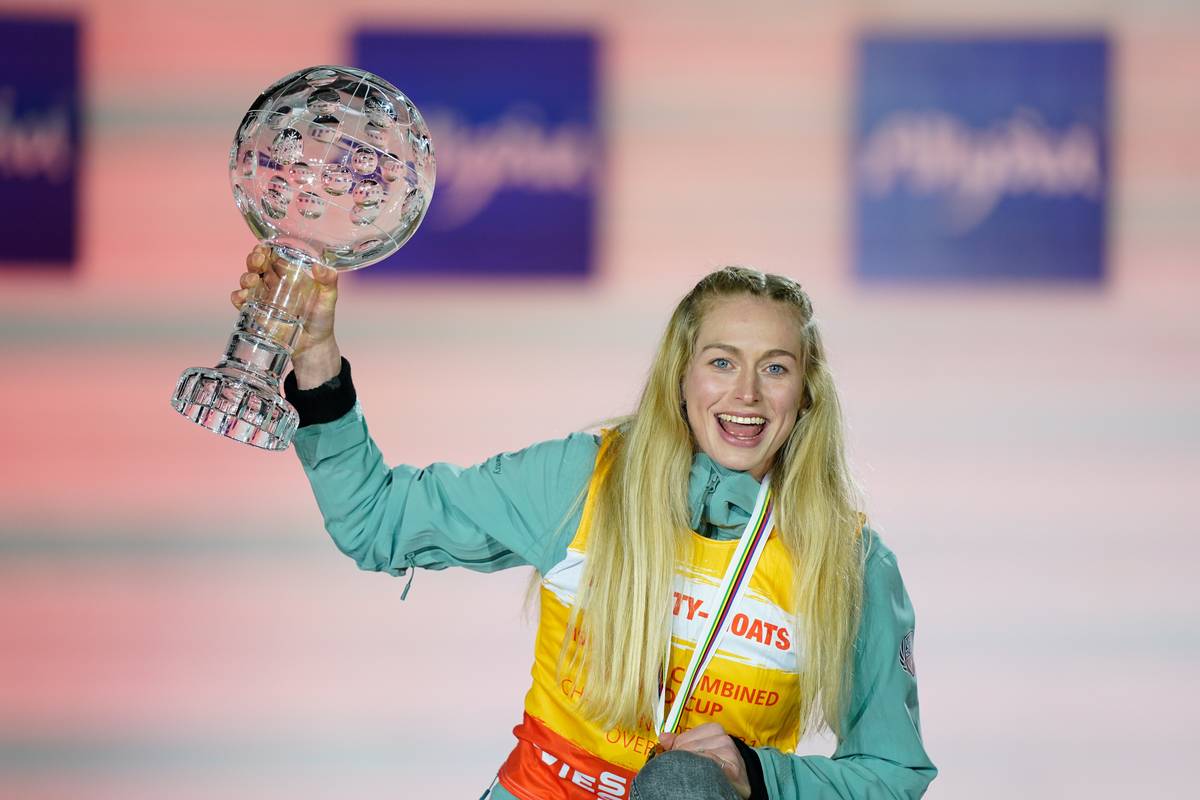
Tara Geraghty-Moats hoisting the first-ever awarded overall World Cup crystal globe for women’s nordic combined. (Photo: NordicFocus)
While she has goals remaining in nordic combined, Tara feels the move to biathlon was the right one, which you’ll hear about conversation. Tara also discusses her background in winter sports, the state of women’s nordic combined in the U.S., what her training and travel looked like during the transition, and her goals for the upcoming season.
Thanks for listening.
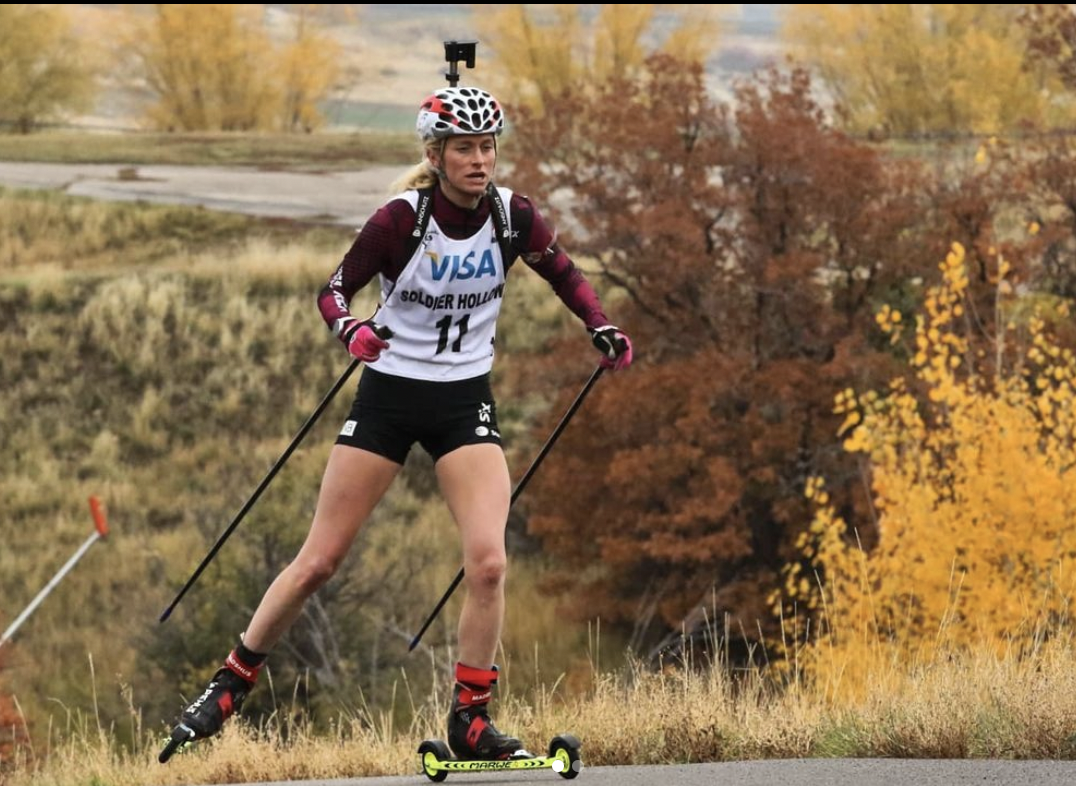
Tara Geraghty-Moats on course in Soldier Hollow during fall biathlon trials, where athlete vie for early-season starts on the World Cup. (Instagram: @tarageraghtymoats)
Tara Geraghty-Moats hoisting the first-ever awarded overall World Cup crystal globe for women’s nordic combined. (Photo: NordicFocus)
This year was a big year for women’s Nordic combined racing, not in the way 2020 was a “big year”, but in a record-breaking, moving forward to better things kind of way. For those of you who don’t follow Nordic combined, here’s what you need to know: Competitions involve ski jumping, in which athletes are scored based on style and distance, and later in the day, they compete in a pursuit-start skate race based on their performance on the jumps. It is also the last sport at the Olympics to be contested only by men.
The 2020/21 season marked the first year of a World Cup circuit for women’s Nordic combined racing. Enter Tara Geraghty-Moats, who won the inaugural FIS Nordic Combined World Cup in Ramsau, Austria and took home the Overall Crystal Globe for the season.
Geraghty-Moats grew up in West Fairlee, Vermont and has been competing on the Ski Jumping World Cup circuit since 2014. As FIS has taken steps towards gender equality in the sport of Nordic Combined, Geraghty-Moats has been at the forefront. When the Continental Cup was established in the 2018/19 season Geraghty-Moats placed first in eleven out of the twelve competitions that year. In 2019/20, she took home the gold in every single Continental Cup race. Heading into 2020/21 with the first World Cup circuit, Geraghty-Moats looked to be the strong favorite.
“This was our first ever season of women’s Nordic combined World Cup and I was very excited about it,” said Geraghty-Moats, “going into the season I knew that there was a possibility of cancellation but I was really hoping for the best, trying to stay optimistic.”
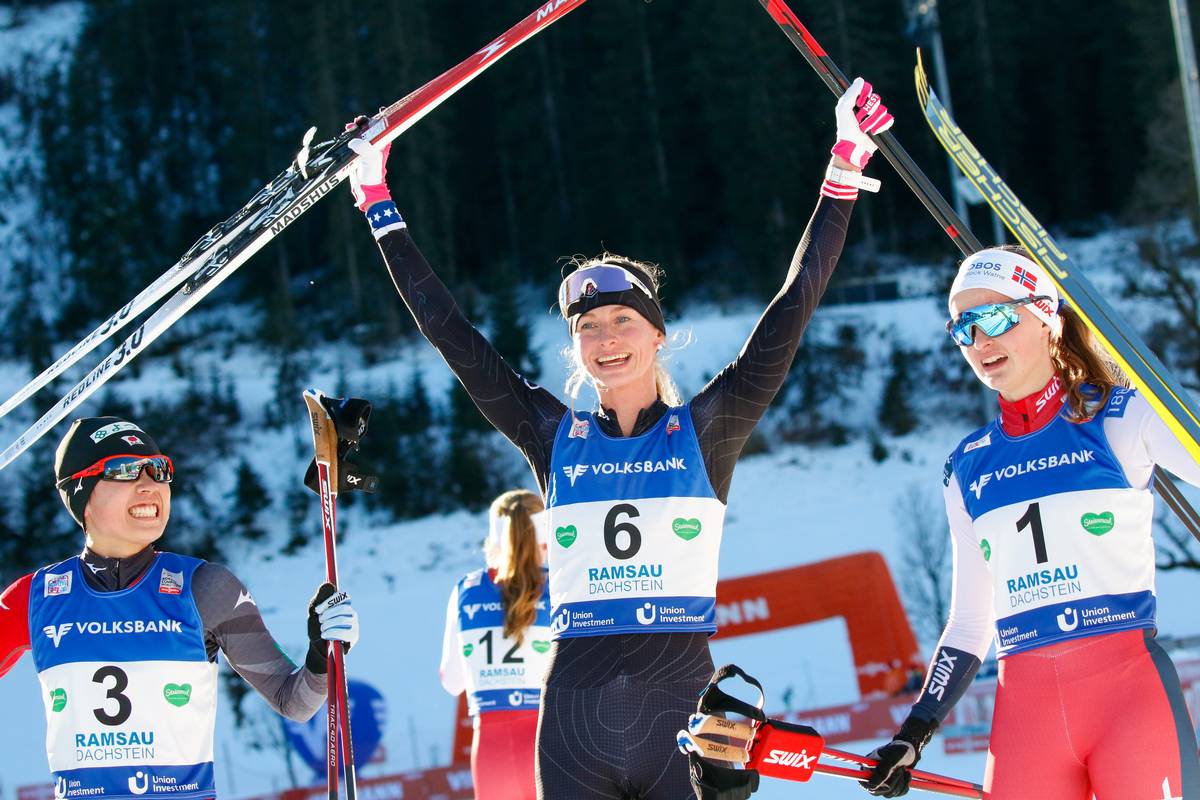
The podium from the individual Gundersen HS98/5km, in Ramsau, Austria: Anju Nakamura (JPN), Tara Geraghty-Moats (USA), Gyda Westvold-Hansen (NOR) (l-r). (Photo: NordicFocus)
In Ramsau for the first-ever women’s World Cup event, Geraghty-Moats was in fifth after the ski jumping leg, having a 39-second deficit to make up on her competitor, Gyda Westvold Hansen of Norway. Geraghty-Moats did just that over the 5k skate, finishing 1.5 seconds ahead of the Norwegian and becoming the first women to be awarded World Cup gold in the sport’s history. The two other World Cup competitions scheduled for the season were canceled due to COVID, but World Championships went on as planned in Oberstdorf, Germany.
In Oberstdorf, Geraghty-Moats came in fifth after starting the cross-country portion in 18th position starting 2:13 minutes behind the leader. On Instagram, Geraghty-Moats wrote, “I am incredibly proud I got 5th at the World Championships. I felt like I used the opportunity and support I had to its fullest potential… Complications this season meant I was not able to ski jump as much as I needed to. I was not a good enough ski jumper to overcome only having 205 jumps since March 2020. I did the best I could and that is all I can ask of myself.”
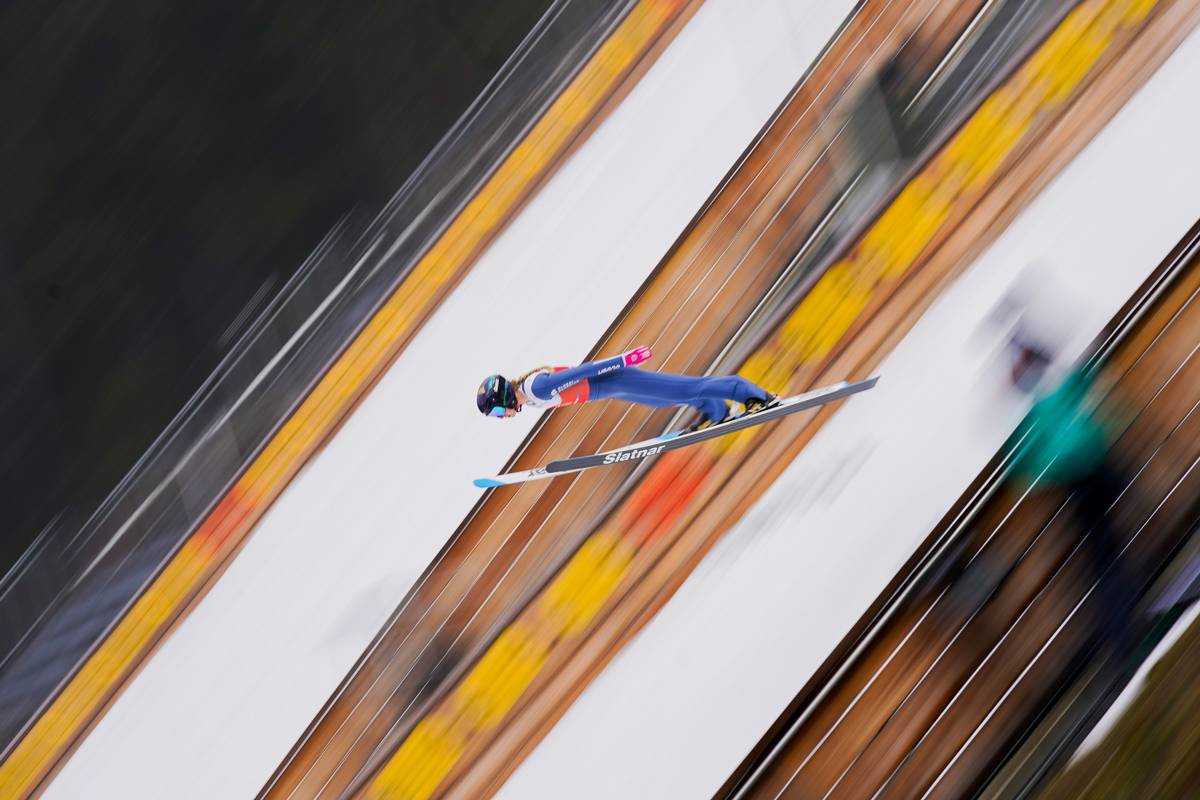
Tara Geraghty-Moats jumping during 2021 World Championship women’s nordic combined individual Gundersen HS106/5km, in Oberstdorf, Germany. (Photo: NordicFocus)
At the conclusion of a historic season, Geraghty-Moats became the first woman to take home the FIS Nordic Combined Overall crystal globe. To this achievement, Geraghty-Moats wrote, “We did what we could with what we had. We made history and came home with a crystal globe. We didn’t have a lot but we had each other. I’m proud of this team. These girls are tough, I’m honored to have them as my teammates.”
Speaking to Geraghty-Moats after the season’s end she reflected on this achievement by saying, “It’s pretty wild, it’s a huge honor. After I was awarded [the globe] I kind of woke up and had to pinch myself that I was the first-ever globe winner. I’m really proud that all my hard work paid off and not only that I helped the sport move forward but that I was able to get the first overall.”
Despite the progress towards parity in the sport, many challenges still remain. The men’s Nordic combined World Cup schedule this season included 13 venues and competitions (six of which were cancelled due to COVID), whereas the women’s schedule only included four, three of which were cancelled.
Geraghty-Moats said, “In the spring (2020) we thought there would be about eight World Cups, four weekends, which although that isn’t too much we were excited for the first year of the World Cup. We didn’t know how many were going to get cancelled but it was going to be a good start. And then going through the season more and more started getting cancelled and it was pretty hard to keep our motivation.”
Tara Geraghty-Moats during the ski portion one the women’s individual Gundersen HS106/5km, at the 2021 World Championships. (Photo: NordicFocus)
On the topic of parity, Geraghty-Moats acknowledged that this season was a big step forward, “it wasn’t as big as we wanted it to be because there weren’t that many World Cups but it is a huge step towards being included in the Olympics, we had our World Championships which was huge and a very successful competition but it wasn’t as big a year as we had hoped for,” said Geraghty-Moats. Even after an inaugural World Cup season, women’s Nordic combined will not be included in the 2022 Olympics in Beijing.
“I would really encourage people to follow women’s Nordic combined, take an interest in it and support the female Nordic combined athletes who are trying to make waves in the sport,” said Geraghty-Moats. “I guess I would challenge everyone… to engage in our story and be an active part of moving this sport forward because at the end of the day, sport is a business and we need more fans and more attention to move this forward. And I think that is starting to happen, especially after the World Championships, but the more involvement we can have, the better for gender equality in the sport and better for the ski community as a whole.”
Nordic combined fans can expect to see more of Tara Geraghty-Moats as she continues to push the boundaries of the sport and compete at the highest level. “It will be a season I tell my grandkids about,” Geraghty-Moats said, “I got the overall in the middle of a pandemic in the first-ever season of women’s Nordic combined. Like you can’t even say that without going like, wow, what?! There is only forward, only upward to go for women’s Nordic combined and I’m really excited to see the progress we will make in the coming years.”
Tara Geraghty-Moats celebrates her historic World Cup win (Volk/NordicFocus)
HISTORIC WIN FOR GERAGHTY-MOATS
Four USA Nordic women take part in debut women’s World Cup
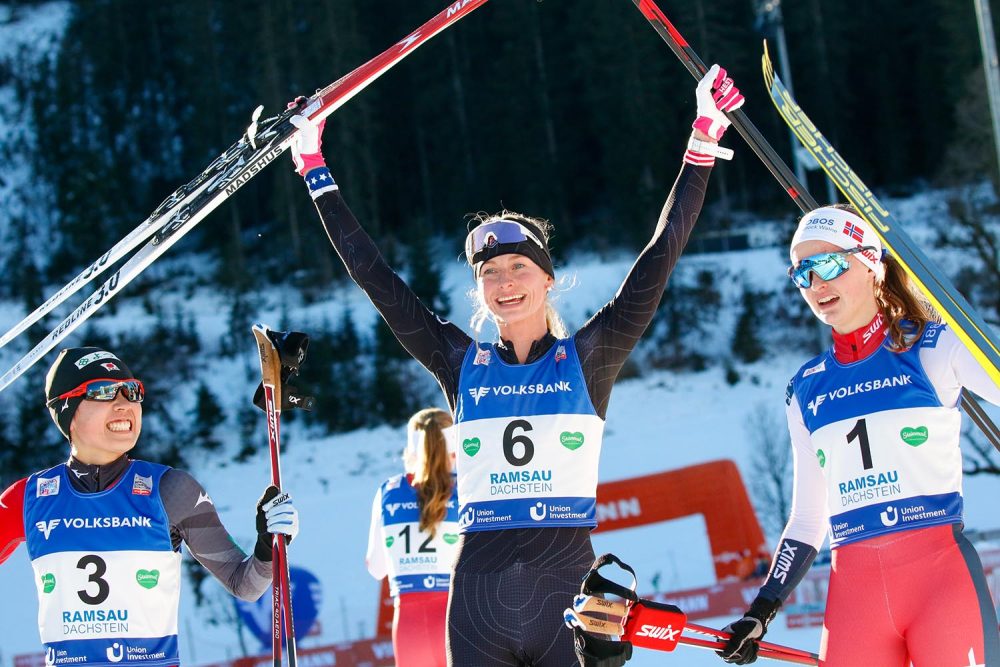
RAMSAU, Austria (Dec. 18, 2020) – American Tara Geraghty-Moats (West Fairlee, Vt.) made history Friday, skiing to a hard-fought victory by just 1.5 seconds in the first ever FIS Nordic Combined World Cup for women in an idyllic mountain setting at Ramsau am Dachstein. It was an emotional win for the 27-year-old who has been a pioneer in the movement to bring women’s nordic combined to the Olympics.
Geraghty-Moats finished sixth in the ski jumping segment of the nordic combined competition, putting her 39 seconds behind Westvold-Hansen to start the 5k cross country race. Geraghty-Moats charged hard from the start, catching the Norwegian near the end of the first of two laps on a hill. Westvold-Hansen fought back to ski even before Geraghty-Moats pulled away again on a hill to hold on for a victory.
The American is the two-time defending champion in the Continental Cup and came into the race a favorite. The women’s World Cup debut had been scheduled in early December at Lillehammer, Norway, but was postponed.
USA Nordic fielded a team of four athletes for the World Cup debut. Annika Malacinski (Steamboat Springs, Colo.) finished 28th with teammates Alexa Brabec and Tess Arnone (both Steamboat Springs, Colo.) 29th and 30th.
An emotional Geraghty-Moats stood atop the winner’s podium, flanked by athletes from Norway and Japan. “Today here in Ramsau was a dream come true,” said Geraghty-Moats. “It was something I’ve dreamed about since I was 10 years old – before it was even a possibility.
“Just a huge thanks to my team and FIS for finally inviting the women to the big leagues.”
There were many unknowns for athletes coming into the first event of the season after COVID-19 wreaked havoc on training and competition schedules.
“Coming into this competition I was really uncertain of myself because I hadn’t put a bib on in 10 months,” said Geraghty-Moats. “And I had only 10% of my ski jumping training I had hoped to have. But all day long I just kept telling myself that I could do it – every step at a time.”
Sports organizations including the International Ski Federation and USA Nordic have been working actively to bring women’s nordic combined into the Olympics. It is the only remaining Olympic event where women do not compete. The historic debut of a FIS Nordic Combined World Cup will be followed this February 27 with the first ever World Championship for women at the FIS Nordic Ski World Championships in Oberstdorf, Germany.
Over the past two seasons, women from 17 nations have scored points in the FIS Nordic Combined Continental Cup tour. Nine nations were represented in the field of 32 in Ramsau.
Geraghty-Moats becomes the first American nordic combined skier in nearly nine years to win a World Cup. The last victory went to Bryan Fletcher, who won the prestigious Holmenkollen World Cup in Oslo, Norway in March, 2012.
On-demand replay of both the ski jumping and cross country segments of the nordic combined World Cup are available on Peacock TV in the USA.
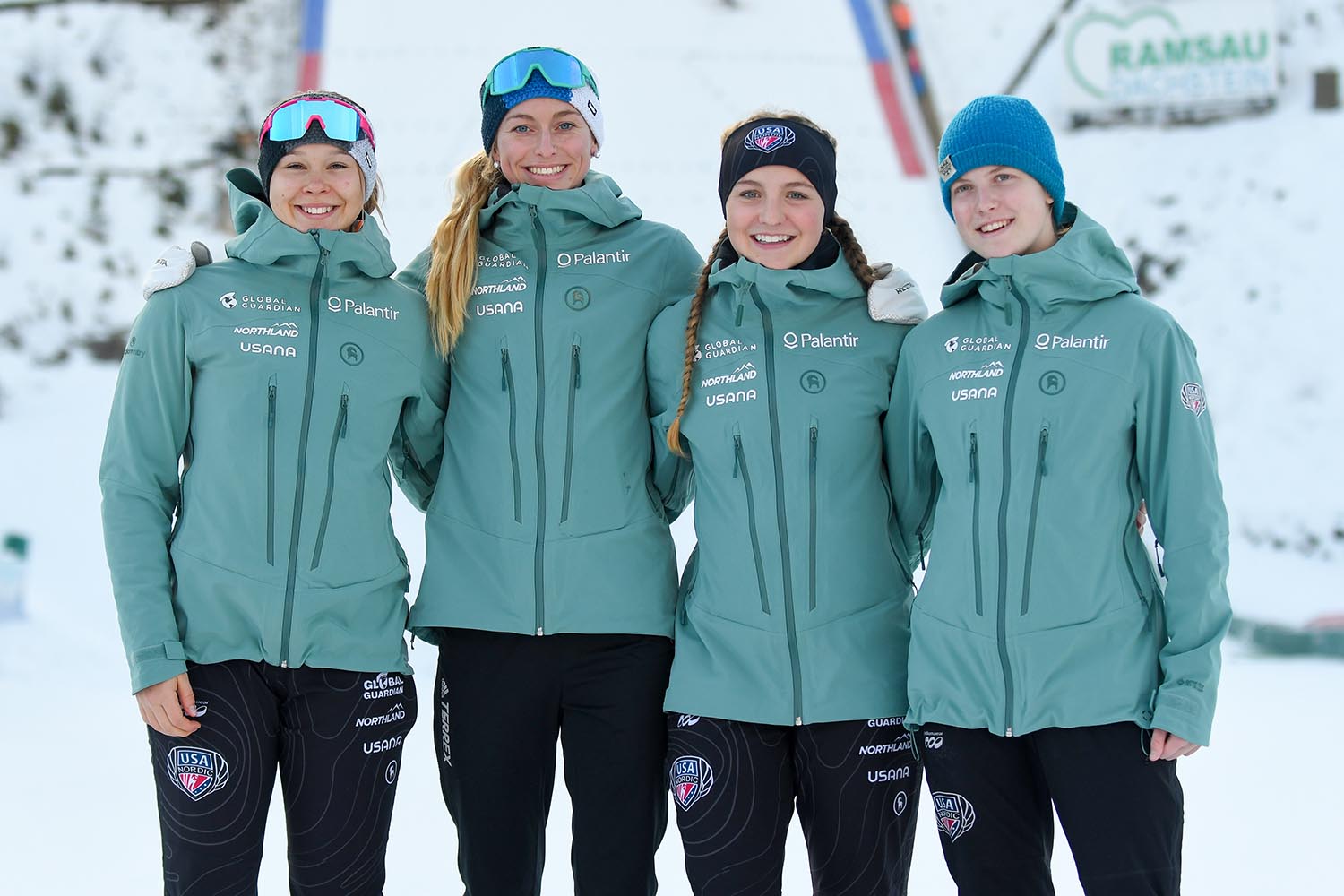
USA Nordic team that participated in the historic debut including: USA Nordic Women’s Nordic Combnied Team at the debut of the FIS Nordic Combined World Cup in Ramsau, Austria, showcasing new team uniforms from Backcountry. Annika Malacinski, Tara Geraghty-moats, Tess Arnone, and Alexa Brabec, left to right (Romina Eggert/USA Nordic)
Tara Geraghty-Moats won the Nordic Combined Continental Cup in the previous season and is set to be a podium contender for the overall standings in this year’s cup as well. Now she finds herself in Lillehammer ready to jump in this weekend’s World Cup. FasterSkier met up with her to hear her thoughts on training, what it’s like to compete at her level and the future of nordic combined for women.
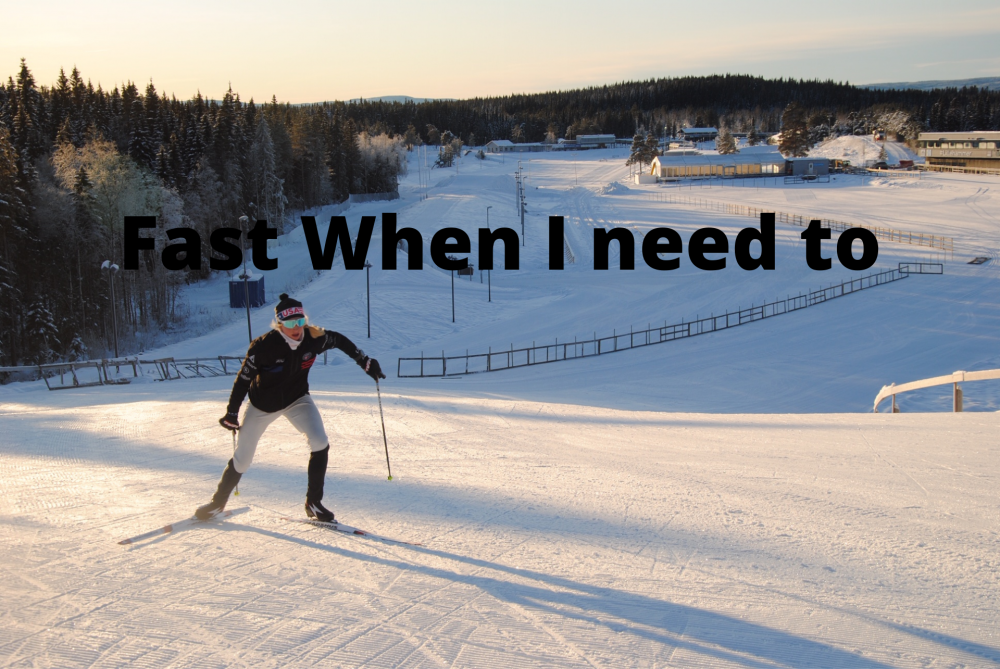
Today, a Monday, she opted for a 7×1 minute hill intervals up the first hill on Lillehammer’s course. This particular hill is the first challenge the skiers tackle as they race the 1994 Winter Olympics. Some 15-25 seconds after the gun goes off, the skiers will find themselves battling it out on the steep hill, which offers a slight break midway through. This break, however, does not offer much of a pause, as Geragthy-Moats’ heart rate will tell you. one hundred and ninety seven beats per minute during her intervals places her just over 96 % of her tested max of 205 and sent her lactate level relatively high above threshold levels. Anyone with knowledge of sports physiology knows what this means: your muscles will be sore.
“Fast when I need to”
Geraghty-Moats explains why she puts herself through a workout like this by saying “the idea is to install a super-boost in your legs”. This top gear, as she also calls it, is something she’s been working on this year. When asked about her workout of the day and why she did it, she explains: “so if I’m skiing in a pack I’ll be able to sprint away from the pack and make a clean break, something that’s really useful in mass-start racing and the nordic combined pursuit format.”
She goes on to say that she’s hopefully in good shape, with good endurance and good conditioning for a race and that “this is sort of the cherry on top of my conditioning for the year, where I’m trying to get my speed up so I have the ability to go fast when I need to.”
How do you feel like a workout such as this one prepares you for an upcoming race?
“Basically those one minute sprints are sort of warming up my engine and making sure that my legs can move quickly, I feel pretty in shape and I feel in good condition this season but that doesn’t necessarily mean you’re ready to race so this is sort of the last prep to race, also for me I have to balance between ski jumping and Nordic skiing, so I have to focus on quality over quantity.”
And how are you able to improve on both?
“For me, the most effective way is to take training blocks where I focus on jumping and different training blocks where I focus on skiing.”
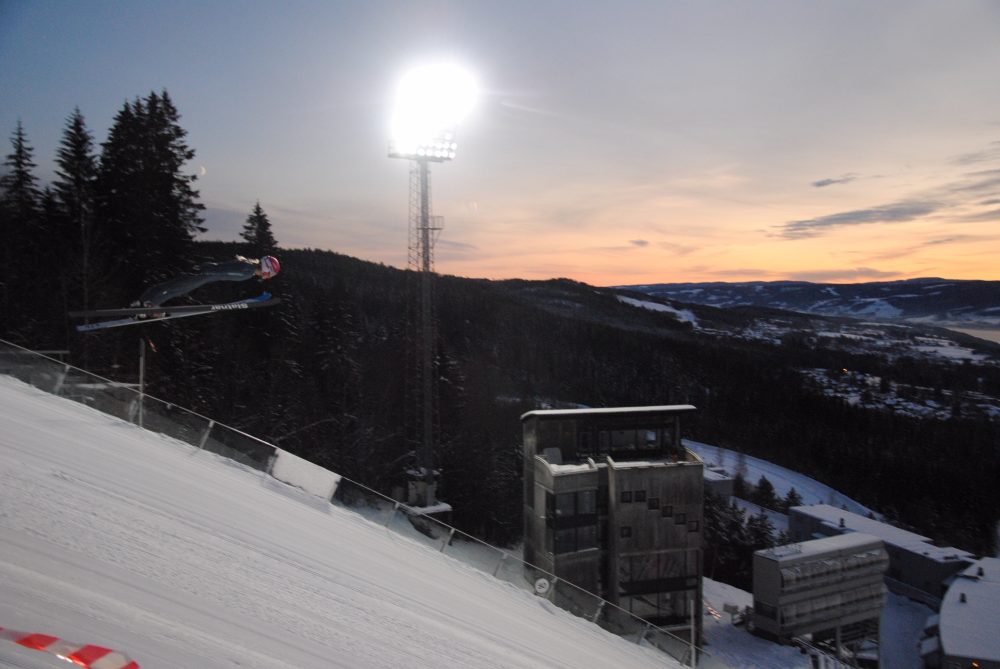
Tara Geraghty-Moats flying off Lillehammer’s HS140 as she prepares for the new season of racing. (Photo: Aleks Tangen)
The training block for this week started with seven sprints in the morning and seven jumps off the big hill (HS140) in Lillehammer. When it comes to deciding what to do in training, Geraghty-Moats considers her competitions. She writes her own training plans and explains that she has an overall plan, which stretches for 2-3 months. As she gets closer to competition, she specializes her sessions. When asked about how she factors in yesterday and tomorrow when deciding what to do today she says: “I decided to do my longer intervals yesterday and shorter intervals in the morning and then have some rest and get ready for jumping. But really I look at when my competitions are and when I’m going to want to be feeling fast and good and then build sort of backwards from there.”
She explains that an important aspect to this process is knowing how long it takes to recover and how long it takes for the intervals to have an effect on overall skiing speed. On December 13-15, the Continental Cup comes to Park City, Utah and the effect she speaks of will show if things are going according to her plan or not.
Below is a lightly edited and condensed version of an interview with Geraghty-Moats.
Aleks Tangen: For your workout today what were you doing?
Geraghty-Moats: So today I was doing one minute sprint intervals something I’ve been working on a lot of this year is really just improving my Top Gear so if I’m skiing in a pack I’ll be able to sprint away from the pack to make a clean break something that you really useful in mass start racing and the nordic combined pursuit format
AT: The reason why you’re doing your workout like that at this time of year is because you want to be able to sprint past the other racers?
G-M: Hopefully with this year’s training I’m in pretty good shape, I have pretty good endurance, good conditioning for a race and this is sort of the cherry on top of my conditioning for the year where I’m trying to get my speed up so I have the ability to go fast when I need to. And I was doing it on the hill, obviously it’s a little bit harder there, where are you get a lot more lactic acid in your legs and preparing my body for that really helps when I’m in a race where I’m already going fairly hard and have to put on the gas and really sprint.
AT: How do you feel like a work out such as this one prepares you for an upcoming race?
G-M: Those one minute sprints are sort of warming up my engine and making sure that my legs can move quickly I feel pretty in shape and I feel in good condition this season but that doesn’t mean necessarily, that you are ready to race. So this is sort of the last prep to race, also for me. I have to balance between ski jumping and nordic skiing. So I have to focus on quality over quantity. Yesterday, I did an interval session, ideally I would do another hard session if I was simply a nordic skier. But today doing a shorter interval session, my body is already tired from yesterday, I don’t have to ski for so long, I don’t have to do so many laps. I still get the training affect, and I still have the hours where I have time to jump and I can feel fresh for the jumping I’m doing later.
AT: It’s a Monday, you’re competing this weekend, what factors playing into doing this particular kind of workout?
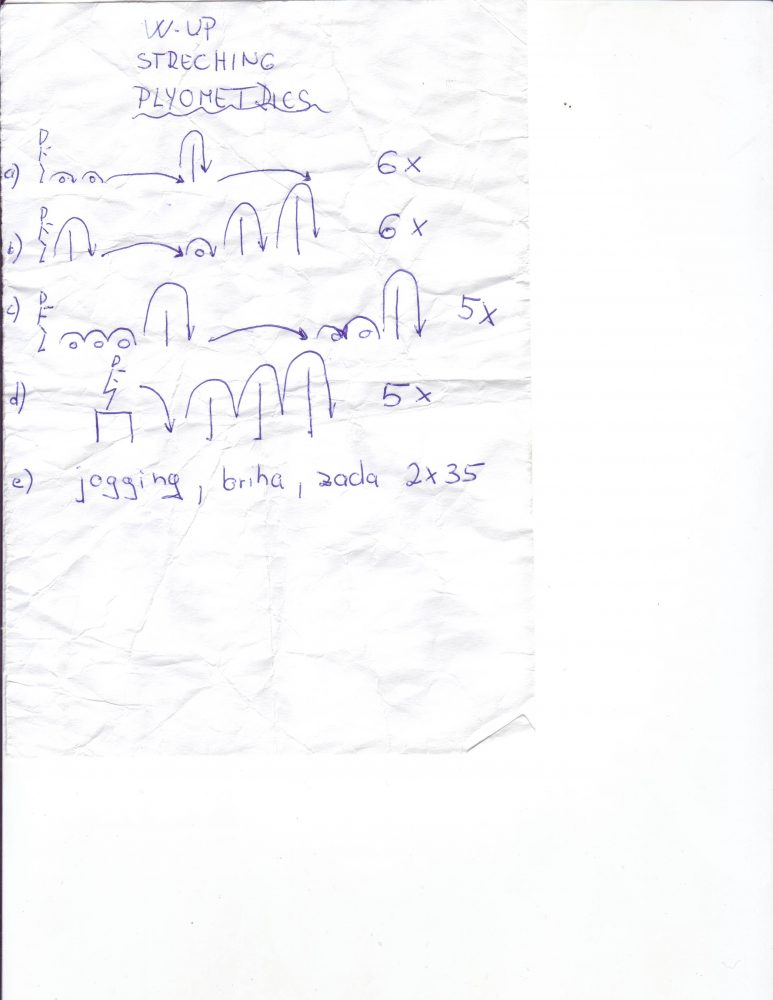
G-M: This week I’m actually just competing in ski jumping World Cup, so I’m trying to get a good number of intensity workouts done early in the week so by the time the weekend rolls around I am pretty fresh. I’ll probably do some weights and plyometric workouts on Wednesday and Thursday to get my legs fresh and activated for jumping. But at the same time I still need to stay in shape for cross-country skiing, which will be the weekend after next, in Park city Utah, so yeah it’s always a balance with nordic combined, because you really want to be the best at both sports so you have to stay on top of everything, but also not overextend yourself.
AT: For a workout like this one, how do you structure the warm up?
G-M: For me warm-ups are really important, especially with one minute intervals, because if you’re not warmed up properly first of all you can’t really go that fast and second of all it’s a really big shock to your system, you can get sick or the lactic acid floods your system so you can’t do as many sets. I usually ski between 20 and 30 minutes for warm-up. I start pretty slowly and then I do 3 x 3 min. level III, threshold intervals, before I start the sprint – all out work out – so that gets my system going.
Tara Geraghty-Moats training in Lillehammer, Norway. (Photo: Aleks Tangen)
AT: Considering you are sprinting up the hill, it’s kind of tough, how do you prepare yourself mentally for such a work out?
G-M: Actually, I really like these workouts because they’re pretty quick, and I just enjoy going fast on skis, it’s fun for me. I just look forward to it. It’s kind of easy on a day like this when the conditions are perfect. I have the whole stadium to myself. I mean I don’t really need much motivation, and physically it’s nicer when I’m fresh and not tired. But realistically that’s part of the job, some days my legs are just going to hurt a little bit.
AT: How do you feel the workout you did today, what part of your performance does that improve?
G-M: Anything that short is definitely anaerobic, it really helps you deal with anything lactate flooding your system, and just gets your body moving fast. You see a lot of the women especially in skiing have a lot of high tempo even in the longer races and if you’re not efficient at that anddon’t feel comfortable doing that you really have no chance.
AT: Strength training plays an important role in that if you’re strong then it’s easier to maintain high speed and high intensity.
G-M: For me actually it’s important to not do a lot of weight and strength session but make sure the ones that I do are really quality. I don’t necessarily do strength workouts after an interval workout or after a long day. I think that’s another thing most nordic skiers tend to do — they will slide in strength after an session or when they are already tired and it is really important to do strength when you are fresh. It gives you a chance to improve, and really focus on getting stronger, and not just maintaining.
AT: Being in the moment and not necessarily measuring quantity, but doing it as good as possible?
G-M: Right. And I think that’s nordic combine in a nutshell: quality over quantity. Because there’s no way I can train 800 hours like the cross-country girls on World Cup. It is not going to happen it’s not realistic so I have to have a paired down training plan for nordic.
AT: How many hours do you train every year?
G-M: This is actually my first full year of being a true nordic combiner, so I’ll probably do about 480-500 hours so it’s not nothing, but it is not sort of what you would expect of nordic skiers. I think it’s not really comparable, and you have jumping which is a completely different sport from long-distance nordic skiing. They can do somewhere between 700 and 800 or 900 but they don’t do as much explosive and plyometric work which requires a totally different recovery.
Also the time of the day I can do training sessions for jumping but I might not be that tired but I might’ve still been on the hill in training mode for five or six hours on that day because we usually warm up for about 45 minutes and then we are on the hill for an hour and a half and I can go for a ski in the evening and it means that I might be training close to seven hours that day.
Tara Geraghty-Moats (USA) and Akito Watabe (JPN) were the winners of the first individual event of the Summer Grand Prix 2019. The American won by a large margin of +1:48.3, while Watabe distanced Franz-Josef Rehrl (AUT) by 1.5 seconds. Yoshito Watabe completed the podium on the men’s side, Stefaniya Nadymova (RUS) and Jenny Nowak (GER) claimed the podium positions for the women.
Difficult wind conditions made ski jumping in Oberwiesenthal very difficult today. Both for the men and for the women, the jumping rounds had to be cancelled and the PCR was used.
On Friday, Tara Geraghty-Moats (USA) had shown a jump of 98 metres and a point total of 116.5 points put her on top of the result list with an advantage of 17 seconds at the start. The American was be followed by strong Russian Stefaniya Nadymova, who jumped to 96 metres. Gyda Westvold Hansen (NOR) was third with 90.5 metres (101.6 p.) and started her race at a respectful distance of one minute behind Geraghty-Moats.
Behind Westvold Hansen, the field was tightly packed with Annika Sieff (ITA) starting at +1:09, Marte Leinan Lund followed at +1:12, Veronica Gianmoena (ITA) at +1:20 and Jenny Nowak (GER) and Annalena Slamik (AUT) started their races at +1:43 and +1:47.
Geraghty-Moats skied a lonely race at the top, overlapping many of the competitors on the way to the finish. At half-time point, her advantage had already grown to almost a minute and the dominator or the Women’s Nordic Combined circuit extended her lead to one minute and 48 seconds in the end. With her result, Geraghty-Moats set the best jump and the best cross-country time of 15:49.4, proving once more she is the the most complete female Nordic Combined athlete in the world right now.
Russia’s Stefaniya Nadymova impressed on the jumping hill and skied fast enough to defend the second place by almost a minute in the end. German Jenny Nowak delighted the audience with a courageous race and skied to the podium from position seven. She finished +2:34.4 after Geraghty-Moats. The second-fastest woman on track was Anastasia Gocharova, who skied from position 16 to a final sixth rank.
On the men’s side, the Japanese team struck back with a vengeance after not being on start in the Mixed Team event yesterday. Young Japanese Ryota Yamamoto was the best on the jumping hill with a great jump of 105 metres. 136.5 points put him in the lead of the race by 10 seconds. Yamamoto’s closest pursuers were his teammates, the brothers Watabe. Akito claimed the second place with 103 metres (134 p.), Yoshito showed 99 metres (128.3 p.) Translated into delays at the start line, this meant +0:10 seconds for Akito and +0:33 seconds for Yoshito.
Franz-Josef Rehrl (AUT) ranked fourth with +0:46, Terence Weber (GER) and Christian Deuschl (AUT) shared the fifth place and took up their races at +0:52 respectively.
The race was a tactical affair that had Akito and Yoshito Watabe and Franz-Josef Rehrl working very well together to keep their advantage. At the beginning, Ryota Yamamoto skied together with the three leaders but had to let go around the 3.5 km point of the race. Behind the leading trio, fast German Vinzenz Geiger worked his way to the front and had closed the gap to 14.2 seconds at the half-way point of the race. After that, he ran out of steam and finally finished on position 17 only.
After his Mixed Team victory yesterday, Samuel Costa was in impressive shape again and appeared behind the three leaders and together with Martin Fritz and Johannes Lamparter and several other athletes, a big group chased the brothers Watabe and Franz-Josef Rehrl going out on the last lap.
In the end, the leaders proved too strong and 2017/18 overall World Cup winner Akito Watabe rewarded himself with a victory, while Franz-Josef Rehrl took the second place and Yoshito Watabe surprised with position three. Martin Fritz had the best end of big pursuing group and finished fourth, Samuel Costa was fifth and Johannes Lamparter sixth, between +21.2 and +29.4 behind the winner.
While men’s Nordic Combined has been a fixture in the Winter Olympic games since the first contests were held in Chamonix, France in 1924, its female counterpart has not existed. Women’s cross country skiing was added to the Olympic program in the 1952 games in Oslo, while ski jumping was not added until the Sochi 2014 games.
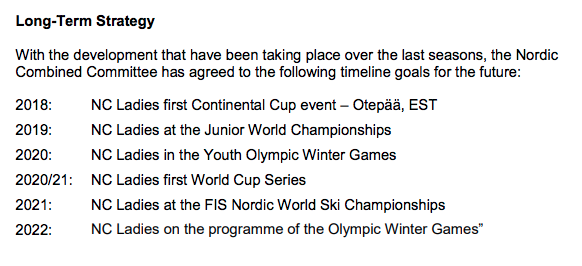
In November 2016, FIS published its “Nordic Combined Ladies’ Strategy Document” outlining a plan presented by the Nordic Combined Committee. The incremental plan began at the development level, encouraging and supporting girls to become elite level NoCo athletes, then creating the opportunity for international competition on an elite stage. Girls were first able to compete in FIS Youth World Cup events in 2014 and over the subsequent two years, participation increased.
The long-term strategy outlined in the Nordic Combined Ladies’ Strategy Document published in November 2016. (Source: FIS-Ski.com) NORDIC COMBINED LADIES’ STRATEGY DOCUMENT, NOVEMBER 2016
In accordance with the plan, NoCo Ladies participated in the 2019 Junior World Championships in Lahti, Finland – the U.S. entered two athletes, Tess Arnone, and Annika Malacinski, both of Steamboat Springs, CO.
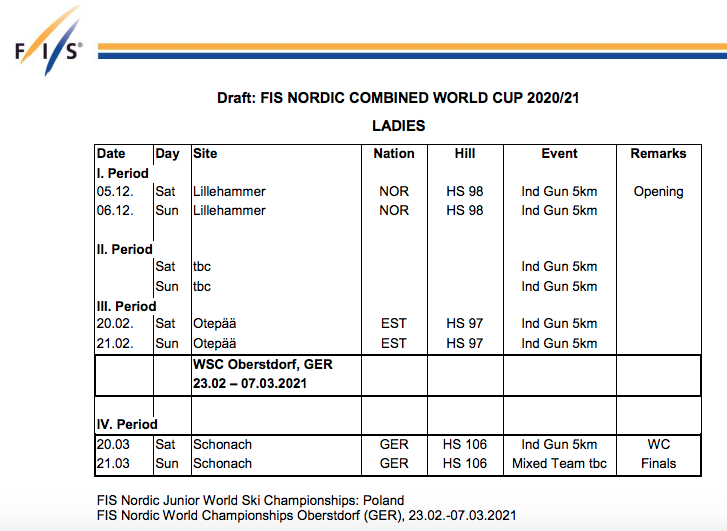
“We are thrilled to present the first draft of a Nordic Combined Women’s World Cup calendar,” race director Lasse Ottesen told FIS. “This is on schedule according to our strategy document and we are looking forward to presenting our women to the world.”
The first competition is slated to be held in December 2020 in Lillehammer, Norway. While the Period II venue(s) remain undecided, the calendar also includes competitions in Otepää, Estonia and Schonach, Germany, as well as the 2021 World Championships in Oberstdorf, Germany at the end of February.
The draft of the 2020/2021 Women’s Nordic Combined World Cup schedule. This is the first series of World Cup events for women in Nordic Combined. (Source: FIS-Ski.com)
The Nordic Combined Committee also approved the inclusion of a mixed team relay during the World Junior Ski Championships in Oberwiesenthal, Germany.
“The Mixed Team is the next step in the Nordic Combined development,” said Ottesen. “We have seen great development with the Nordic Combined Ladies the last years and we are very excited to introduce the Mixed Team already this summer and then as a medal event at the FIS Nordic Junior World Ski Championships in Oberwiesenthal (GER). The Mixed Team will give more nations the chance to enter a team in the future.”
Women’s Nordic Combined did not receive a bid for inclusion at the 2022 Olympic Games in Beijing, but it is likely that FIS will submit another bid for 2026.
“Nordic combined, and women’s in particular, still need to be developed further in terms of universality [the number of countries with Olympic-level athletes], in terms of the level of the athletes,” IOC sports director Kit McConnell told NBC after the decision was made in July 2018.
Tara Geraghty Moats ski jumping World Cup in Lillehammer, NOR. (Photo: FIS Ski Jumping)
Erik Bjornsen, Simi Hamilton, Ian Torchia, Scott Patterson, and Akeo Maifeld-Carucci at the 2018 Bend on-snow camp. (Photo: Bryan Fish)
It’s late May. Athletes are a month into official training for the 2019/2020 season. Here’s some recent news of note from the domestic and international nordic ski world.
German cyclist confesses to doping following Seefeld sting
The police action in Seefeld, Austria, at the time of the 2019 World Championships that led to the arrest of several athletes and this remarkable and candid interview with Estonian skier Karel Tammjärv has led to another athlete leaving their sport. Former German pro cyclist Danilo Hondo was removed from his position as a national team coach with the Swiss Cycling Federation, after allegedly being named by German doctor Mark Schmidt as one of Schmidt’s doping clients during a custodial interrogation by Austrian police, Cycling News reported earlier this month. The article reports that Hondo paid Schmidt 30,000 Euros a year for his services. Hondo initially denied his involvement with Schmidt, but later confessed in an interview with German broadcaster ARD, Cycling News reports. He was dismissed from his coaching position soon after.
Maddie Phaneuf and mental health among endurance athletes
In a recent blog post, American biathlete Maddie Phaneuf writes candidly and publicly about her struggles with mental health after an untimely illness left her unable to race at the 2018 Winter Olympics in Pyeongchang.
“It took me nearly a year to figure out I was dealing with something much bigger and harder for me to handle on my own,” Phaneuf writes, “and that I needed to seek professional help from a therapist. Little did I know that I was experiencing Post Traumatic Stress Disorder from my experience at the Olympics. It’s hard for me to even write that because I’m afraid people will doubt it’s legitimacy. When we learn about PTSD we usually tie it with war veterans, so it’s not common for people to associate PTSD with athletes.”
Joanne Reid (r) tagging U.S. teammate Maddie Phaneuf in 12th during the final exchange of the women’s 4 x 6 k relay on at the 2017 IBU World Championships in Hochfilzen, Austria. (Photo: Glen Crawford)
Phaneuf nonetheless sets forth many common symptoms of PTSD, and explains how her experience at the Olympics left her exhibiting nearly all of them.
Phaneuf concludes, “I hope this post helps break the stigma of mental illnesses within the athletic community, and opens peoples eyes in tackling that hardest step: asking for help.”
(Canadian skier Maks Zechel sounded similar notes in a piece for FasterSkier written in January 2018, writing, “This past April, I decided to face my mental health issues that I had always known existed, but never understood or recognized for what they were. What an awkward thing to talk about, mental health, but it shouldn’t be. Our minds have to be taken care of with the same attention that we give our bodies through training and recovery. It doesn’t matter what it is that makes you begin to acknowledge your difficulties, but it has to be done; it is grossly underestimated just how permanent unchecked mental health issues can be. I didn’t acknowledge my health issues because I cared about my health, but I did care that it was starting to affect the way I raced, and although not the most important reason, it was enough to motivate me to work on my mental ‘fitness.’” Zechel added, “Not everyone wants to talk about their mental health issues, but many need to.”)
Jessie Diggins hosts “Meet the D-Team”
All three levels of the U.S. national team – the A-Team, B-Team, and D-Team – recently convened in Bend, Oregon, for an on-snow spring camp. This gave the athletes the chance to rack up the kilometers skiing in the morning, and the miles running or mountain biking in the afternoon. It also gave Jessie Diggins the chance to work on her whimsical interview skills. In a series of Instagram video posts, Diggins checks in with the entire D-Team save Kendall Kramer. For more on Johnny Hagenbuch’s favorite kind of dinosaur, Novie McCabe’s favorite flavor of gum, Ben Ogden’s lifetime cumulative skateboards built, and other important news of the day, check out Diggins’s Instagram page. Part I is here, Part II here, and Part III here.
Kendall Kramer collects ninth and tenth state high school championships
The only D-Team skier not present in Bend was Kramer, whose junior year at Fairbanks’s West Valley High School ended during the camp. By staying home Kramer was able to add to her collection of Alaska state high school championships, when she won both the 1,600 and 3,200 at last weekend’s state track and field championships at Machetanz Field in Palmer, Alaska, the Anchorage Daily News reported. Kramer clocked 4:56.15 to take the metric mile and 10:27.18 to win the longer race, in both cases taking the win over Anchorage skier Ava Earl.
Kendall Kramer from Fairbanks, Alaska during the women’s 10 k skate pursuit at 2019 World Cup Finals. (Photo: John Lazenby/lazenby photo)
Kramer’s ten (and counting; she still has her senior year ahead of her) Alaska high school individual championships include the 2018 and 2019 Skimeister award for lowest combined time at the cross-country skiing state meet, the 2017 and 2018 state cross-country running titles, and the 1,600/3,200 double at all of the 2017, 2018, and 2019 state track and field championships. On the track, Kramer has lowered her time in the 1,600 from 5:14.80 to 4:56.15 since 2017, and from 11:04.47 down to 10:27.18 for the 3,200.
U.S. Ski & Snowboard awards
Earlier this month, U.S. Ski & Snowboardnamed its athletes and coaches of the year, with official awards presented at the U.S. Ski & Snowboard Congress in Park City on May 16. Awards for nordic and nordic combined skiers and coaches were as follows, as quoted from a USSA press release:
Athletes of the year, nordic: Junior Worlds Men’s Relay Team: “In a storybook ending to a very successful Junior World Championships, the men’s 4x10k [sic] relay team took gold – the first ever gold won by the USA at the FIS Junior World Cross Country Ski Championships. Three of the four athletes had set the stage a year earlier winning silver.” The team was Johnny Hagenbuch (Ketchum, Idaho/SVSEF), Luke Jager (Anchorage/APU), Ben Ogden (Landgrove, Vt./SMS), and Gus Schumacher (Anchorage/Alaska Winter Stars).
Athlete of the year, Ski Jumping/Nordic Combined: Tara Geraghty-Moats: “Nordic combined skier Tara Geraghty-Moats (W. Fairlee, Vt.) played a vital role in the rapidly-growing women’s nordic combined international field, winning 10 Continental Cups and taking the season title in a year where the international field more than doubled. Geraghty-Moats also took the U.S. title and landed a berth as a special ski jumper on the U.S World Championship Team. As an athlete advocate, she served an important pioneering role with women’s nordic combined which will join the World Championships in 2021.”
International coach of the year, nordic: Jan Buron, Alaska Winter Stars: “A veteran club coach, Jan Buron of the Alaska Winter Stars program has developed many top athletes. This past season his work with junior skier Gus Schumacher, whom he has coached for the athlete’s entire career, led to the USA winning gold in the men’s relay at the Junior World Championships.”
International coach of the year, ski jumping/nordic combined: Jan Druzina, Junior/Continental Cup Ski Jumping Coach: “Jan Druzina came to USA Nordic as a Junior Team and Continental Cup coach for men’s ski jumping a year ago. Since then, he has visited every club to speak with coaches and parents, working together to build a strong junior program. The result was a definitive step up this year with Andrew Urlaub and Patrick Gasienica qualifying for their first World Championships and Urlaub taking a top-30 at Junior Worlds plus three top-30 Continental Cups.”
Domestic coach of the year, nordic: Alasdair Tutt, Nordic Ski Club of Fairbanks: “Kendall Kramer, coached by Alasdair Tutt, was 4th in the 15km mass start classic in her first time at Junior World Ski Championships. Kendall will also represent USA at the 2020 Youth Olympic Games.”
Tara Geraghty-Moats winning the first 2018/2019 women’s nordic combined Continental Cup held in Steamboat Springs, CO. (Photo: Ben piper)
Tara Geraghty-Moats started ski jumping when she was nine years old. Fearless for sure, but all part of the multisport athlete’s mojo.
But after suffering multiple knee injuries when she was 16, Geraghty-Moats was forced to take a break from ski jumping. That hiatus was a four-year jumping drought that only served to push her into other aspects of nordic sport. During her time away from jumping, Geraghty-Moats competed in cross-country skiing and biathlon where she was highly successful.
At 19-years-old, Geraghty-Moats came back to ski jumping which she has been doing ever since. This summer, she added a well-suited endeavor to her jumping: skiing fast. The reason for this addition was the introduction of an 11 event women’s nordic combined Continental Cup.
“My goal this season is to be overall Continental Cup winner and to be on the World Championships team for ski jumping,” Geraghty-Moats said about her season’s objectives. As far as nordic combined is concerned, she is well on her way to mastering the Continental Cup series.
Tara Geraghty Moats ski jumping World Cup in Lillehammer, NOR. (Photo: FIS Ski Jumping)
In the first race of the inaugural Women’s Summer Grand Prix in Oberwiesenthal, Germany, Geraghty-Moats ski jumped into fourth place and then skied into second place. That was the last race Geraghty-Moats didn’t win this season. She won the second race of the Grand Prix, and took home the Overall Championship title.
Geraghty-Moats has participated in five Continental Cup races so far this winter, she has won them all.
“Winning every race I entered came as a real surprise,” Geraghty-Moats said. “This summer and fall I was focusing on working hard and building my nordic skiing up again after a few years off. I had no idea what to expect. I was hoping for some podiums.”
The first two races of the season took place in Steamboat Springs, Colo. at the beginning of December. In the first race, Geraghty-Moats jumped to third place, placing her seven seconds behind the leader at the start of the ski race. She had no problem making up the time, winning the race by 47.7 seconds. The following day, Geraghty-Moats jumped into fourth place, 26 seconds behind the leader. She skied a solid race and finished 40.1 seconds ahead of the next competitor.
When asked about her favorite moment so far this season, Geraghty-Moats commented, “winning my first Continental Cup in Steamboat with my mom there. She has always supported me skiing nordic combined and is hardly ever able to come to watch me compete, so it was very special.”
This season, Geraghty-Moats plans to start in all 11 of the women’s nordic combined Continental Cups scheduled. She will also be competing in a number of special jumping competitions. This past weekend, she competed in her first international nordic combine race in Otepää, Estonia where again she dominated. Now she will be heading to Japan for a ski jumping World Cup this upcoming weekend.
Tara Geraghty-Moats winning the first Continental Cup of the season in Steamboat Springs, CO. (Photo: Ben Piper)
Currently, Geraghty-Moats is the only women on the U.S. Nordic Combined team.
“I train by myself a lot,” Geraghty-Moats said. “The men’s team is on a pretty different competition schedule so we aren’t able to train together much. I write my own cross-country program and integrate it with the ski jumping program my jumping coaches give me. It seems to be working well so far.”
Regardless of their competition schedules, Geraghty-Moats believes the US Nordic Combined Team has a strong and inclusive team dynamic.
“I’ve competed with some of the guys on the team since my jumping career started,” she said. “They are pretty much the coolest teammates ever. It’s nice they are so supportive of the developing women’s circuit.”
The outlook for a viable women’s nordic combined circuit remains uncertain. Organizations like the International Ski Federation (FIS) and USA Nordic, the NGB responsible for jumping and nordic combined in the U.S., fully support integrating women into the top level of the sport.
As raised in a recent New York Times story on the women’s nordic combined circuit, some major hurdles remain for a fully fledged women’s nordic combined division. First are the number of total participants. Second is ensuring those competitors are in fact competitive. A good problem for Geraghty-Moats is that she remains dominant. Yet the others in her peer group are playing catch up when it comes to her skiing prowess.
Women’s nordic combined will be included in the 2021 World Championships. There was discussion of it being included in the 2022 Winter Olympic Games. However, in July, the International Olympic Committee did not include women’s nordic combined as part of the 2022 Games. The sport will have to wait until 2026 at the earliest to make an Olympic debut to put it on equal Olympic-level-footing.
Bill Demong, USA Nordic’s Executive Director, said in an Oct. 17, 2017 press release that his organization fully supports equity when it comes to developing new pathways for women to participate and excel.
“This is an opportunity that we are fully behind”, Demong said about the first women’s U.S, National Championship in nordic combined. “We know that other nations will begin to turn on their funding and that when this becomes an Olympic event everyone will spend resources we can not match. Right now we have the opportunity and responsibility to take athletes like Tara Geraghty-Moats and Gabby Armstrong and develop them into leaders in the sport. It is our job to continue to innovate and support them so that they can lead Women’s Nordic Combined into the future with our crop of upcoming juniors.”
Geraghty-Moats remains positive. She also embraces her role as a groundbreaker. She knows stumbles will occur. With any breakthrough there are setbacks, but ultimately there is a net gain.
“I think that it will develop fairly rapidly in the next two years,” Geraghty-Moats said of women’s nordic combined. “There are World Championship medals on the line in 2021 so I don’t expect very many countries will pass up the opportunity to support a women’s Nordic Combined team and get some hardware.”
Jake Brown (Craftsbury Green Racing Project/US Biathlon) racing to a sizable win at the 2018 Climb to the Castle on Saturday, Sept. 15 in Wilmington, N.Y. (Photo: Heloise Rolland)
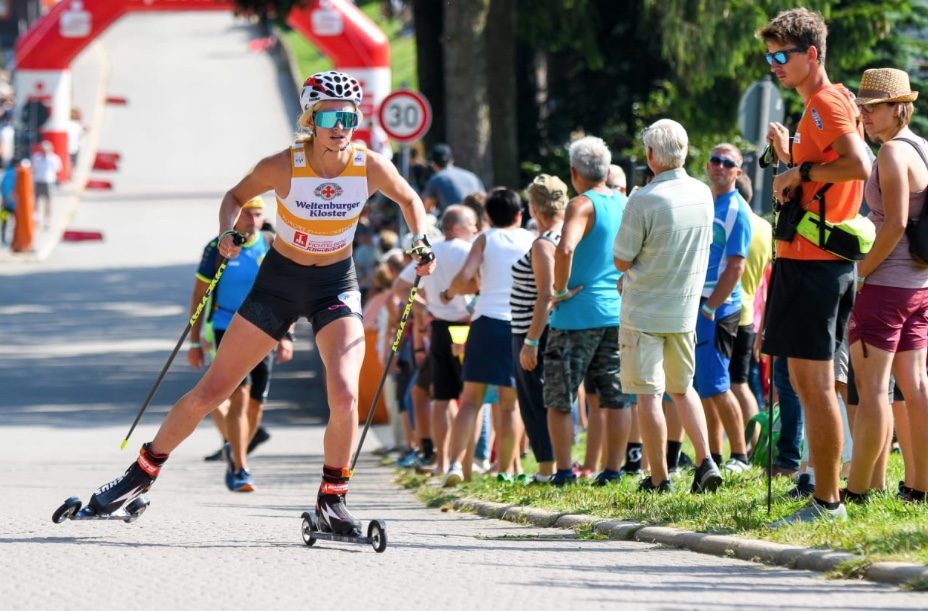
On a humid fall Sunday in northern New York where temperatures reached an uncharacteristic 80 degrees, Jake Brown of the Craftsbury Green Racing Project and US Biathlon Development Team and Tara Geraghty-Moats of USA Nordic won the 2018 Climb to the Castle.
Brown’s time was 35:40.7, while Geraghty-Moats finished in 45:03.
Big Gaps and Clear Wins
On the men’s side, Brown’s Craftsbury teammate Raleigh Goessling finished second in 38:16.6, and Erikson Moore of the Fondeurs-Laurentides team in Quebec was third in 39:00.3.
Among women, Jackie Garso of Saint Lawrence University was second, in 49:24.1, and Nakkertok’s Zoe Williams third in 49:40.6.
This year was a high water mark for attendance, with 102 athletes finishing.
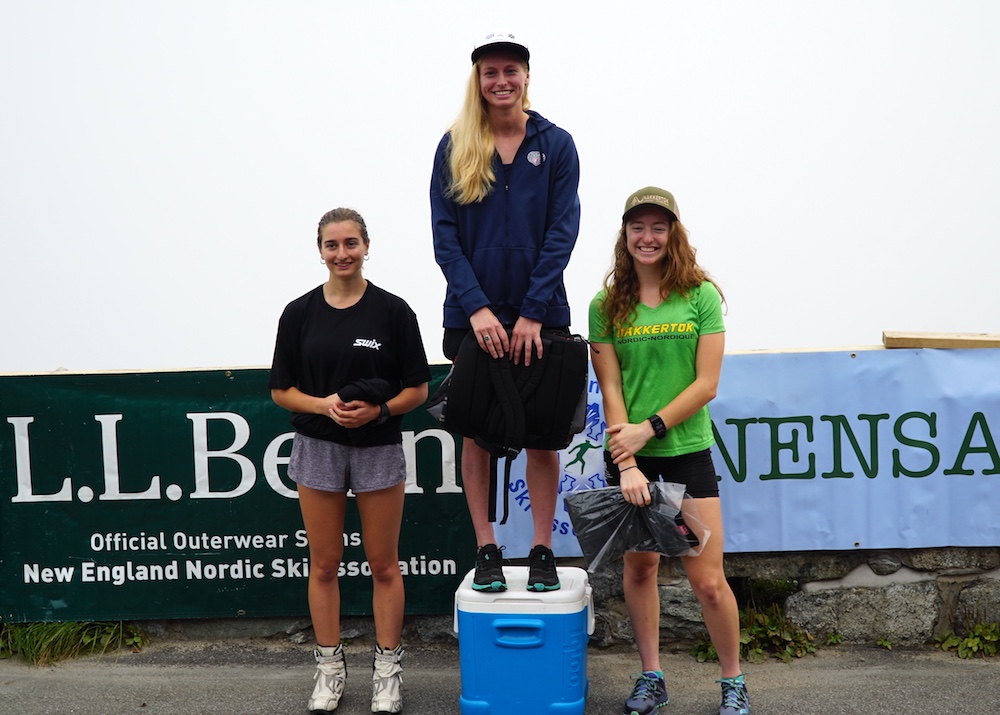
The overall women’s podium at the 2018 Climb to the Castle at the top of Whiteface on Sept. 15 in Wilmington, N.Y., with winner Tara Geraghty-Moats (c) of USA Nordic, Jackie Garso (l) of St. Lawrence University in second, and Zoe Williams (r) of Nakkertok in third. (Photo: Colin Delaney)
While a few degrees cooler than last year, dank humidity settled like a blanket over the five-mile climb, with athletes moving through a couple of patches of dense fog on the higher reaches of the mountain.
“It was a hard one today,” Brown said following the race. “Last year, I felt like I went a little too hard off the line, and kind of buried myself early. So I wanted to be a little more conservative and finish strong today. I tried doing that and it felt a lot better, and I skied a little faster. I was on different rollerskis, so it’s hard to be able to compare it to last year. I was happy with my effort and it was a good push today.”
This year was Brown’s second consecutive win, and he beat his 2017 time of 39:01.9.
“It’s always a tough race, but I’m happy with how my summer training has paid off,” Geraghty-Moats said. “I felt strong and I had a good race.”
Asked if the race was part of her training plan, she replied, “I just finished competing in the Ski Jumping Grand Prix in Russia, so I’m still pretty jet-lagged. I love this race, NYSEF puts a lot of energy into putting it on every year, so I figured I’d make the trip over. It’s really fun and I enjoy racing with a good crew.”
A ski jumper winning a cross-country ski competition? For those not in the know, Geraghty-Moats is one of the pioneers of the developing women’s nordic combined.
The overall men’s podium at the 2018 Climb to the Castle at the top of Whiteface on Sept. 15 in Wilmington, N.Y., with winner Jake Brown (c) of the Craftsbury Green Racing Project (CGRP)/USBA Development Team in first, Raleigh Goessling (r) of the CGRP in second, and Erikson Moore (l) of Fondeurs-Laurentides in third. (Photo: Colin Delaney)
“I’m on the women’s ski jumping team and I’ve been to a World Championship in 2015 and on the World Cup team for the past 4 years,” she explained. “Before that, I was a biathlete, so nordic combined was sort of a natural step for me. FIS has put in a lot of resources to developing women’s nordic combined. This year, they’ll have a Continental Cup circuit; next year, there’ll be a World Cup circuit; and the following year after that, there’ll be a World Championship. I’m starting to learn how to compete in nordic combined and I’m really enjoying it.”
Zoe Williams, along about 60 other athletes, had participated in the previous day’s Doubleday events at the Intervale Ski Jump. (for more on the Doubleday, keep reading!)
“I felt a bit tired in my warmup,” Williams said. “By the time I got to the start line and the race started, I didn’t feel as bad as I could have. My legs for sure felt tired in the first kilometer, but after the first k, I started settling into that rhythm and I ended up feeling pretty good for the rest of the race. Climb to the Castle, you just have to find that gear and grind away.”
In 2017 she was fourth overall, five seconds behind biathlete Deedra Irwin.
Meredith Stetter (88) leads her Mansfield Nordic Club teammate Jennifer Wilbraham during a foggy Climb to the Castle rollerski race on Sept. 15 in Wilmington, N.Y. They finished 19th and 20th, respectively. (Photo: Heloise Rolland)
“This year, I ended up leading the group that I was with, which was kind of a fun change,” Williams said. “But the whole time I was thinking ‘what did Deedra do here? We one-skated [V2’ed] here. I can one-skate here!’”
Asked if Climb to the Castle was a good fitness benchmark, Williams said, “Because the next couple of months are where you start getting the really high intensity zone four, this is a really good indicator of the base level fitness that you have, because of the endurance focus of the race. But I’m for sure looking to find my top end gear in the next couple of months.”
Doubleday Takes Off: New Events Added to the Climb to the Castle weekend
On Saturday, the New England Nordic Ski Association (NENSA) and the New York Ski Education Foundation (NYSEF) collaborated on a new event held on the rollerski loop at the Intervale Ski jumps.
Quincy Massey-Bierman won the junior women’s 3 k prologue. (Photo: Heloise Rolland)
The Lake Placid Doubleday started with a three-kilometer prologue; after a break, there was a 1.5 kilometer sprint time trial. The results of the two races were aggregated to determine winners.
Nicholas Clifford of Carleton University in Ottawa, Ontario, was the open men’s winner, while Nakkertok’s Williams was the open women’s winner before going on to be the runner-up in the Climb to the Castle.
“We’ve had the Climb to the Castle for 11 years, and this year we wanted to expand it to a full weekend,” NYSEF head coach Shane McDowell said. “We started talking with Justin [Beckwith, NENSA Competitive Program Director] ] in the spring and he proposed the idea of trying [NENSA’s] new format of the doubleday, which will be used at the Eastern Cup scheduled for 23 February at the Dublin School.”
“The format came out of discussions this spring,” Beckwith said. “Three kilometers is a national junior relay distance and we were valuing shorter, sprinting efforts in the results because we were usually a little heavy on the distance qualifications for our Junior National team in New England. When partnering with Shane and ORDA [the Olympic Regional Development Authority] to make it a reality, for us to test out the event which has a physiological effect of doing the 3k prologue in the morning and do a prelim in the sprint, the 1.5, would be the timing of a typical quarter final.”
The roller ski loop at Intervale is serpentine and narrow, with fast downhills. In the pre-race meeting, Beckwith admonished the athletes to be conservative as they warmed up. As they warmed up, the rollerskiers gradually became more aggressive in their approach to the course.
Taking a corner on the Intervale Ski Jump loop during Doubleday. (Photo: Heloise Rolland)
The race started and finished at the biathlon range located midway through the long climb from the lowest to the highest sections of the course.
Clifford is the coach of the Carleton University ski team, located in Ottawa, Ontario.
“It was really exciting,” he said. “It was the first time I’ve skied at [Intervale]. I’ve heard a lot about some of the sketchier downhills but it was actually really well done. It was just like ski racing.”
Asked how he planned his races, Clifford said, “Not so much. I’m not a shorter distance guy, so the Climb to the Castle tomorrow is the real show and this was just a bit of a tuneup to get some speed in the legs.”
Of the Doubleday format, the consensus was that it was tough.
“The course here… It’s pretty much straight up and then you go down and come back up,” CSU’s Alex Burt said. “For the 3 k, you do it twice. It’s a lot more brutal. I had to actually pace it. For the1.5 k, my strategy was to go out as hard as I can and just keep it up.”
But it was also fun, many participants agreed.
Racers lined up at the start for a Doubleday competition. (Photo: Heloise Rolland)
“It was fun,” said Williams of the Doubleday. “The course here was super awesome, because it was like actually skiing, whereas a lot of roller ski races are on roads. It’s so twisty and turns up and down, it’s a lot like actually ski racing.”
On getting used to the downhills, Williams said, “It took me through mid warm up, to get used to the corners. In the race itself, I didn’t even think about it. It was super nice. I worried about it in the warmup, because there are some really gnarly corners, but when you’re racing, all your focus is on going fast.”
Amy Duclos of Saint Michael’s College in Burlington VT, was the third overall female finisher at the Doubleday.
“I wasn’t really sure about the course going into it, because of the turns, the hills, but it was a lot of fun,” she said. “I thought today was a good warmup to get the legs moving for tomorrow. It’s definitely a different type of race.”
Laura Appleby, of Cambridge Sports Union (CSU), won the junior women’s division at Doubleday and was the fifth junior woman finisher at Climb to the Castle.
“They went really well,” she said of the Doubleday races. “It was super fun. I liked the downhills… The first race was a little bit longer, so I was definitely pacing it a little bit slower. But generally just go out and ski the course, ski the transitions.”
Shilo Rousseau, Chandra Rousseau, and Zoe Pekos, all of Barrie [Ontario] Cross-Country, sat for an interview in a downtown Lake Placid coffee shop following the Doubleday.
“It was a little scary at first with the safety meeting,” said Shilo, who finished third junior woman both at the Doubleday and C2C. “After skiing the lap a few times, you realize it’s not that bad. As you go on, your laps get faster. You really have commit on roller skis.”
Did she save energy for the C2C?
“Full send every day,” Shilo replied. “I’m not leaving anything in the tank.”
Chandra Rousseau said, “The last downhill was bad. The prologue wasn’t as good as I wanted it to be. I probably could have pushed a little harder on the downhills. On the sprint, I was more used to the course.”
Recovering in a bench outside the Castle, a reporter asked the Rousseaus and Pekos, so, did you go full send?
Tara Geraghty-Moats winning Sunday’s normal hill/5 k Gundersen at the 2018 Women’s Nordic Combined Summer Grand Prix in Oberwiesenthal, Germany. (Photo: Romina Eggert/FIS)
Two North Americans posted impressive results at nordic events in Germany and Norway over the last week, with Vermont native Tara Geraghty-Moats racing to first overall in the first-ever Women’s Nordic Combined Summer Grand Prix and Quebec’s Alex Harvey placing second, fifth and 10th in three races at the Toppidrettsveka rollerski series.
Geraghty-Moats 1st and 2nd at Inaugural Women’s NoCo Grand Prix
Brand new to nordic combined as well as the jump hill in Oberwiesenthal, Germany, Geraghty-Moats took the inaugural women’s Nordic Combined Summer Grand Prix by storm this past weekend, placing first and second in two competitions. That tied her for first place in the overall Grand Prix standings, alongside Russia’s Stefaniya Nadymova — the defending champion of last winter’s inaugural women’s Nordic Combined Continental Cup.
On Sunday, Geraghty-Moats, 25, of USA Nordic and the New York Ski Education Foundation (NYSEF), handily beat Nadymova and the rest of the 10-woman field after starting the 5-kilometer Gundersen rollerski race in second, four seconds behind Germany’s Jenny Nowak. While Nowak had posted the best jump of 96 meters on Oberwiesenthal’s 106-meter “normal” hill, Geraghty-Moats tied for the second-best-scoring jump (94.5 meters), with Austria’s Lisa Hirner (95 meters). From there, Geraghty-Moats dropped Hirner, Nadymova and Nowak on the first of three laps in the rollerski race and went on to finish in 11:04.8. Nowak ultimately placed third, 1:29.2 behind Geraghty-Moats.
“I was really satisfied by how my first weekend of being a nordic combined-er went, and I think the patience of waiting to be a nordic combined-er really paid off,” Geraghty-Moats told the International Ski Federation (FIS) after. “I struggled with the jump a little bit the first couple days. I had never jumped this hill before, and I sort of figured it out today so I got to ski a little bit easier than yesterday, but I was also happy that yesterday I was able to have a good fight and ski fast to my potential and end up on the podium.”
The women’s individual normal hill/5 k Gundersen podium on Saturday at the 2018 Women’s Nordic Combined Summer Grand Prix, with Russia’s Russia’s Stefaniya Nadymova (c) in first, American Tara Geraghty-Moats (r) in second, and Germany’s Jenny Nowak (l) in third in Oberwiesenthal, Germany. (Photo: FIS/Silke Tegethof)
“It was a dream come true to finally be able to compete in women’s Nordic Combined on an international level,” Geraghty-Moats told FIS on Saturday. “I’m using this weekend to learn the level I have to be at to have success in Nordic Combined. I made some mistakes today and learned a lot but I came away with a good result and having had a huge amount of fun competing with small but strong field.”
Eleven women competed in Saturday’s normal hill/5 k.
Alex Harvey (l) on the podium with Roman Furger (c) and Simen Hegstad Krüger (r) at the 2018 Toppidrettsveka rollerski festival in Norway last Thursday, Aug. 16. (Photo: Alex Harvey/Instagram)
At the Toppidrettsveka rollerski festival in Norway, Canada’s Alex Harvey raced to second in the 15 k skiathlon last Thursday in Orkdal, missing out on first by just 0.6 seconds to Switzerland’s Roman Furger, who won in 30:43.3. Norway’s Simen Hegstad Krüger, the reigning Olympic skiathlon champion, finished third, 1.5 seconds back. In a stacked international field of 125 men, Canada’s Evan Palmer-Charrette placed 75th in that race (+2:14.4), Bob Thompson was 84th (+2:32.7), and Scott Hill 89th (+2:52.5).
Canada’s Alex Harvey (2) gunning for first in the men’s 15 k skiathlon on Aug. 16 at the Toppidrettsveka rollerski festival in Orkdal, Norway. (Screenshot: NRK broadcast)
Heidi Weng beat her cousin Tiril Udnes Weng by 0.7 seconds in the women’s 10 k skiathlon that day, finishing in 22:52.1. Norway swept the top five of the women’s race, with Anne Kjersti Kalvå reaching the podium in third (+1.3), and national-team members Kathrine Harsem and Astrid Uhrenholdt Jacobsen placing fourth (+1.4) and fifth (+1.5), respectively, out of 43 women.
In the men’s 24 k classic mass start aroundAure/Brekka on Friday, Harvey finished fifth, 19 seconds after Krüger, who won in 59:57.5. Norway’s Hans Christer Holund placed second in that race (+2.6), Norway’s Magnus Stensås was third (+13.0), and Switzerland’s Dario Cologna fourth (+17.1). Also for Canada, Palmer-Charrette finished 61sth (+2:30.9), Hill 78th (+4:02.3), Thompson 86th (+5:40.3), and Maks Zechel 88th (+7:01.4) out of 125.
Heidi Weng repeated in first in the women’s 24 k mass start, finishing in 1:10:02.4 hours, while Tiril Udnes Weng again placed second, 25.4 seconds back, and Jacobsen reached the podium in third (+27.7).
Later on Friday in Aure, Norway’s Sondre Turvoll Fossli topped the men’s freestyle sprint final ahead of four other Norwegians, including Pål Trøan Aune in second and Jan Thomas Jenssen in third, and Switzerland’s Furger in fifth, while Harvey did not qualify for the heats and ended up 37th overall. Palmer-Charrette was once again 61st in qualification, Hill 107th and Thompson 109th out of 121.
In the women’s sprint, Norway’s Mathilde Myhrvold won the final in 2:56.54, 1.05 seconds ahead of Slovenia’s Katja Visnar in second. Heidi Weng placed third in the final (+1.97), ahead of Tiril Weng (+2.64) in fourth, another Norwegian Anna Svendsen in fifth (+2.76), and another Slovenian Alenka Cebasek in sixth (+3.73).
In the final race of the series, the classic pursuit on Saturday, Harvey started second, 10 seconds behind Furger in first. The Canadian went on to place 10th, 4.2 seconds out of first, in the 15 k race, while Stensås took the win in 37:45.5 after starting seventh. (Furger slipped to 55th and 1:55.5 behind at the finish.) Norway’s Mikael Gunnulfsen rose from eighth to second (+0.7) and France’s Jean-Marc Gaillard made it all the way up to third (+1.7) after starting 15th.
Palmer-Charrette finished the pursuit in 59th (+2:04.2), Thompson placed 80th (+2:55.2), Hill 87th (+3:41.5), and Zechel 93rd (+3:48.9) out of 105.
Jacobsen ended the weekend as the women’s 12 k mass start winner, after the entire women’s field (of 33) started at the same time. She crossed the line first in 34:20.8, 0.4 seconds ahead of Heidi Weng in second and 1.2 seconds ahead of Kalvaa in third.
As a 10 year old attending an end-of-the-year ski party, scoring the last piece of pizza is usually bonus enough. Not the case for Gabby Armstrong. Hers was getting to test the landing hill of the K18 on her cross-country skis.
Thanks to her New York Ski Educational Foundation (NYSEF) junior club coach Dave McCahill (who had a background in nordic combined), Armstrong was introduced to the jump hill by the time she was 10. Within a day of hitting the hill on her nordic skis, she joined the ski-jumping team. Soon after that, she entered any nordic-combined events she could. Though often the only female competitor, Armstrong was not about to let either sport go.
“It never really occurred to me to stop cross-country skiing,” Armstrong, now 18, said during a recent phone interview. “Even though a lot of coaches would say that I was the lone nordic-combined athlete, it was kind of fun going out against the boys.”
She’s attended two FIS Youth Nordic Combined Cups in Trondheim, Norway, and with the recent addition of women’s nordic combined to the FIS Continental Cup, she’s hoping to boost her event experience to an even higher level.
Gabby Armstrong, a member of Women’s Ski Jumping USA and a nordic combined competitor as well, rollerskiing at the Flaming Leaves Festival in Lake Placid, N.Y. (Courtesy photo)
“Any opportunity I have to compete nationally or internationally, for either nordic combined or ski jumping, I’ll take,” said Armstrong, a member of the Women’s Ski Jumping USA national team.
In order to train for nordic combined, Armstrong jumps during her scheduled practice times and joins the NYSEF cross-country skiers whenever she can. One workout she likes when she’s not with the NYSEF nordic team is aqua jogging with her sister and cousin, an endurance athlete who also holds the unofficial aqua jogging record at Stanford University.
“She really knows what she’s doing,” Armstrong said of her cousin with a laugh. “It’s a workout I picked up last year and I found was really good for me, especially because my knees were really bothering me a little bit last summer.”
On days when she aqua jogs, Armstrong will often perform an afternoon plyometrics workout. According to her Women’s Ski Jumping USA teammate Tara Geraghty-Moats, plyometrics (plyos for short) are particularly important for the role they play in take-off body positioning during ski jumping and the complimentary body/hip awareness they provide for cross-country skiing.
“Plyos are really important, especially at this time of year, to build explosive power, the kind of power you that you’re going to use at the end of the take-off when you jump,” Geraghty-Moats, 24, said on the phone. “It’s also something that I feel is really undervalued in the nordic world. I always felt that plyos profited my cross-country skiing as well.”
An afternoon plyometrics session for Geraghty-Moats also provides an opportunity for new training partners. She has spent the past month in Lake Placid, N.Y., completing plyo practices with NYSEF, and plans to head to Park City, Utah, at the end of July and Europe after that.
“I really enjoy being able to train with people of different ages because it sort of lightens up the atmosphere,” Geraghty-Moats said. “Plyos is the kind of training, too, that you can have a huge spread of abilities work together effectively. I couldn’t really go out and do intervals with a 12 year old and have them push me, but with plyos I maybe adjust the hurdles a little bit and we all learn from each other. They get to see your technique and I learn so much when I’m helping teach and helping coach.”
Regardless of the workout, both Armstrong and Geraghty-Moats are excited about the upcoming Continental Cup schedule and the direction women’s nordic combined is headed: no longer just up in the air, but gaining ground.
“Norway and Austria are already there, they definitely have a core group of high level nordic combiners,” Geraghty-Moats said. “It’s going to take a couple of years in the U.S to build a strong women’s team, but I think it will happen.”
The Morning Workout:
Type: Aqua Jogging
Armstrong aqua jogs at least once a week. When aqua jogging, your feet should not hit the bottom of the pool or lake. The idea is to keep your body suspended in the water while mimicking the movement of running through deep water. Aqua jogging removes the stress of running from the body joints, but allows an individual to continue training their muscles in the motion of running. Ideal for those injured or looking to switch up their workout.
Terrain: Pool or lake
Equipment: Though Armstrong uses no equipment, there are aqua-jogging belts out there for those interested.
Warmup: 10-20 minutes of easy aqua jogging
The set: 2 minutes on-time, 1 minute off. Repeat this 6 times for a total of 12 minutes on (18)
(If you need a long interval session, complete 6 x 2 minutes on, 1 minute off a second time for a total of 24 minutes on)
Cool down: 10-20 minutes east aqua jogging
Total time: 38-78 minutes
*If doing the workout in a lake, Armstrong recommends bringing a buddy for safety reasons.
Armstrong’s Top-Two Tips:
Don’t be discouraged by the distance. When it comes to aqua jogging, it’s not how far you get, but how long you go for that ultimately matters. “When you’re working harder, it’s slower progress forward,” Armstrong said. “It’s going to seem like you’re getting nowhere, but you’re still going to be working pretty hard.”
Stay upright to keep the core tight. The importance of engaging the core is no new news for nordic skiers. To do so in this workout, Armstrong suggests athletes focus their effort on staying upright while aqua jogging, not leaning forward. “Making sure your core is activated and trying to stay as upright as possible will prevent your hips from floating up behind you into a doggy paddle motion,” she said.
The Afternoon Workout:
Type: Plyometric exercises
Geraghty-Moats typically does this workout at least twice a week (during rest weeks, she’ll do it once). During plyometrics, an athlete exerts a large amount of force in a short amount of time to increase their power or speed-strength. Exercises should be done in an explosive manner.
Equipment: Hurdles of varying length, a box jump, a track or a open field with a 100-meter stretch
Warmup: 30-45 minutes easy running, followed by 30 minutes stretching
For Geraghty-Moats, stretching is one workout aspect too often overlooked. “What stretching does is really allow your muscles to function efficiently,” she said. “For me, the hips are a big one. … That’s sort of the root of your center of balance and your coordination and often where people are sore and tight. I tend to do at least a half an hour of stretching before I start doing plyos.”
The Plyometric set: 6 x broad jumps, 6 x vertical jumps, 5 x telemark jumps, 5 x hurdles, 5 x 100-meter sprints
*See Geraghty-Moats’s exercise graphic below for more details on plyometric exercises and setup
Tara Geraghty-Moats’s plyometric plan (Courtesy photo)
Geraghty-Moats recommends using varying heights of hurdles to improve agility. “They range from knee to hip height,” Geraghty-Moats said. “It’s sort of like a downhill course, you have to react and be explosive and quick while also thinking about what you’re doing. It’s not just the same thing every time.”
Cool down: 15 minutes of body weight core (e.g. 1 minute of front plank, 1 minute of side planks, 1 minute of leg lifts, etc.) followed by 15 minutes jogging
“And always more stretching!” Geraghty-Moats added.
Total estimated time: 2-2.25 hours
Geraghty-Moats’s Top-Two Tips:
Plyos take patience. “When you’re doing plyos, if you’re not used to putting your body in the air, it’s going to feel really awkward at first,” Geraghty-Moats said. “So just start small … it’s going to take two months before you really feel like, ‘Oh, I have something in my legs. I can get further off the ground than two inches.”
Only the strong know when to stop. Rather than trying to push through a plyo workout, Geraghty-Moats suggests paying attention to your body and not being afraid to end the workout early. “If you have any sore ankles or sore knees, it’s OK to stop,” she said. “With intervals, we’re taught that you have to push through the pain. That’s not necessarily effective in this workout. This is more about being focused and giving yourself time. Quantity less and quality more.”
Russian ski jumper Sofia Tikhonova during the women’s 100HS final at 2017 FIS Nordic World Ski Championships in Lahti, Finland. (Photo: Dustin Satloff/dustinsatloff.com)
For Tara Geraghty-Moats, nothing compares to the sense of weightlessness she feels and the way spectators appear to sink into the ground when she soars off a ski jump — except maybe the feeling of pushing her physical limits during a cross-country ski race.
The two sports have been a part of the 24-year-old New England native’s life since her grammar-school days — she picked up both at the age of 9 and in both, she excelled.
By the time she was 15, her jumping talents earned her a spot on the Women’s Ski Jumping USA development team, and she captured third place at the 2009 Springer Tournee in Park City, Utah. But within a year of her nomination, due to concurrent knee injuries, she was forced to leave the ski hill and for the next four seasons, she focused on cross-country skiing.
Vermonter Tara Garaghty-Moats (c) after winning the junior sprint at 2013 Swedish Biathlon Championships. (Courtesy photo)
Despite being told she would never jump again, she returned to the hill in 2013. That same year, she jumped to fifth at ski-jumping nationals in Lake Placid, N.Y., which earned her nomination to the Women’s Ski Jumping USA World Cup B-team.
While Geraghty-Moats saw success in both jumping and XC over the years, she never had the opportunity to showcase her combined abilities at an international level. Not because she didn’t want to, but because the opportunity didn’t exist — until this year.
“We have sort of been waiting for the sport to catch up with Tara Geraghty-Moats for quite a while,” Billy Demong, executive director for USA Nordic Sport (the U.S. governing body for men’s ski jumping and nordic combined) said on the phone earlier this month.
Geraghty-Moats on the range at 2011 Swedish Biathlon Nationals. (Photo: Per Nilsson)
Now it appears to be heading in Geraghty-Moats’s favor. Prior to this season, most of the cross-country ski training she did was either for pleasure or to maintain fitness for ski jumping. Now her training will take on a new meaning, as for the first time in history, women’s nordic combined will be included in the International Ski Federation (FIS) Continental Cup schedule. The inaugural women’s Nordic Combined event in the U.S. will be the USSA National Championships in Lake Placid on October 7. Demong anticipates eight to ten women to participate in the event.
“I’ve been wanting to compete on an international level for nordic combined for a long time,” Geraghty-Moats said on the phone this month. “It’s something I’m really invested in long term and something I’d like to see at a World Championships and Olympic-level competition. I’m really looking forward to helping develop the sport and helping mentor the younger girls that are getting into and also performing at a high level internationally.”
Women’s nordic combined has not yet been contested at the World Cup or Olympic level. Since this season marks an Olympic year, Geraghty-Moats will put her focus on World Cup ski-jumping events and enter as many FIS nordic-combined Continental Cups as she can.
“The ideal situation would be that I would qualify [for the 2018 Winter Olympics] in ski jumping and then am able to compete all the nordic combined races,” she said. “But there’s no way for me to tell where I’ll be in the points for the Olympic qualifying competitions … so hopefully I’ll be able to do them all, but I don’t really know.”
According to Demong, incorporating women’s nordic combined into the FIS schedule has been “on the radar for quite a while.” However, one blockade that prevented immediate action was the risk of draining athletes from a developing sport. Women’s ski jumping was added to Nordic World Ski Championships in 2009, the World Cup in 2011 and the Olympics in 2014.
“I think [women’s nordic combined] has really been in discussion since it was obvious that women’s ski jumping was going to be in the Olympics,” Demong said. “At the FIS level, I think one of the biggest challenges is with women’s ski jumping, you still have a developing sport. The ranks just aren’t as large and deep as the men’s side. And so I think there was a lot of fear that if you add another discipline, it could truncate the growth of women’s jumping.”
Sarah Hendrickson (Women’s Ski Jumping USA) taking flight during a summer competition in 2011. (Photo: Dan Campbell)
Over the past few years, the U.S. has seen more junior women participating in ski jumping. According to Demong, some a clubs have doubled their numbers within the last five years.
“The largest increase we saw in any user group was U8 [under 8], U10, and U12 in the Midwest, but also in Park City there was a pretty big increase, too,” he said. “We didn’t have a whole lot of participation before probably because they didn’t see a pathway. There were some diehards, like Tara and Gabby [Armstrong], but there weren’t droves of them and I think now there will be more in the sport because there’s a much more clear pipeline.”
This year will also be the first year that women’s nordic combined will be included at Junior World Championships. To Demong’s knowledge, Geraghty-Moats and Armstrong are the only two senior American women that plan to compete in the FIS Continental Cup competitions. Both will be supported by USA Nordic national-team staff at nordic-combined events, since the women’s events are scheduled to align with the men’s competitions.
“We have some really good 14 and 15 year olds that we’d like to see participate in the FIS Youth Cups again this year,” Demong added.
Also this year, the inaugural Women’s Nordic Combined National Championships will be held Oct. 7 in Lake Placid, N.Y.
With a longtime dream finally coming to fruition, Geraghty-Moats is not ready to let it end there.
“I don’t necessarily schedule things four years out,” she said. “But I definitely know that nordic-combined is going to be in my goals as an athlete for the foreseeable future. Obviously I need to stay healthy and continue doing things in my life, like going to school and staying at a high level of skiing, but I’m 100-percent sure that I will do nordic combined for as long as possible.”
Casey Smith (USA) en route to 37th place in the junior men’s individual in Obertilliach. He had his career-best finish of 23rd place in the pursuit on Sunday. Photo: US Biathlon/NordicFocus.
With the U.S. bringing just two junior men and one junior woman to the World Youth and Junior Championships in Obertilliach, Austria, relay day isn’t going to mean much for the oldest athletes on the team.
Instead, Casey Smith, Jake Dalberg, and Tara Geraghty-Moats had their last crack at the Championships on Wednesday, competing in the 12.5 / 15 k individual races: four shooting stage, a minute time penalty per missed shot.
After an impeccable pursuit race that saw just one penalty in four stages, Smith couldn’t quite keep pace in the individual, collecting one missed shot in each of the first three stages and then two in the last stage. Nevertheless, he was able to move from 42nd as he left the range the final time up to 37th by the finish.
“The individual went okay, it was not a great race but not bad either,” he wrote in an e-mail to FasterSkier. “Especially in an individual, with five misses you can’t expect to do great. Of course I would have like to hit more, but that is part of biathlon and what makes it fun and exciting.”
Teammate Jake Dalberg actually shot much better, collecting only three penalties, but was hampered by an early crash. As he spun around in the snow, he managed to lose all four bullet-filled magazines that usually tuck into a rifle stock. Arriving at the range, he realized he had nothing to shoot with, and had to wait for about 45 seconds while an official brought him new ones.
Dalberg ended up 52nd, but with the 45 seconds subtracted he would have been about even with Smith.
Jake Dalberg competing in the sprint. Photo: US Biathlon/NordicFocus.
“I shot that prone really fast, and honestly I am a little surprised that I hit 4 of 5,” he wrote in an e-mail. “So I was not so focused in that shooting, but the next three I was locked in and just paused too long on the last shot of each standing. I think as I have become more and more comfortable with the range I have been improving my averages in both training and obviously today in the race.”
Geraghty-Moats faced bigger challenges on the range, where she missed a painful 11 shots and wound up 63rd, over 13 minutes behind the winner, Laura Dahlmeier of Germany.
Like Geraghty-Moats, Dalberg failed to qualify for the pursuit race on Sunday, leaving him with just two starts in the series. He wasn’t exactly frustrated, but had hoped to gain one more race-worth of experience out of the trip.
“I wouldn’t say that I am disappointed with these races too much, but I definitely was hoping to make the pursuit,” he explained. “My ski speed overall just was not there I felt like, just kind of missing that top end. It may be the altitude, or the fact that I had a pretty intense cold in between trials and coming here.”
It’s Dalberg’s first trip to World Juniors, although he has international race experience as part of the National Guard biathlon team competing at military events. Those past races helped him prepare for this event – to an extent. Racing a military event in Italy still isn’t the same as World Juniors in Austria, with fans loudly cheering and booing in German for each shot on the range.
“Having been to Europe to race before definitely helped, but I still had some nerves going into the sprint,” Dalberg said. “I think too some days training on the range it was so busy, that I lost some focus while shooting at certain points.”
Staff Seargant Sarah Lehto, Dalberg’s coach, was nonetheless impressed at his performances this week.
“This is by far the biggest international race series for Jake in his career,” she told FasterSkier. “He’s competed internationally for the past two seasons but nothing at this
level. I’m extremely pleased that he was able to qualify for the team after narrowly missing the youth qualification last year and how he performed in such an atmosphere like these World Championships in Obertilliach… he’s now gained a ton of experience at this level which will help his development and expectation level for future racing.”
She also acknowledged that Dalberg’s skiing wasn’t up to his usual level, but that she hoped he wasn’t too disappointed. The racer himself is hoping to get back into shape next week, when he heads over the border to Italian Military Championships.
“For my first World Juniors, I would say I am happy with it, but felt like I could have had some better ski times,” he explained. “The competition was very tough, I knew it would be but the top several juniors I believe have been competing on the World Cup/IBU Cup, so I felt like the top end was very competitive, and I think overall the fields were pretty large this year compared to past years.”
Smith is also hoping to carry on in the coming weeks; he’s waiting to hear whether he is accepted to a trip to U26/Open European Championships, where he thinks he can keep up this level of racing.
“My skiing is feeling good,” Smith said. “I think that my training for the past few weeks leading up to now went well my coach had a pretty specific plan written out for me and I tried to follow it as close a possible which really helped me.”
But unlike Dalberg, who has one more year of junior eligibility, Obertilliach was truly the end of the road for Smith. A four-time World Youth and Junior Championships competitor, he looked back on both this and other editions with fond memories.
“I am happy with the Championships as a whole, like I said the other day I had my best ever Junior Worlds finish here in the pursuit which I was really happy about,” he said. “It is nice to see that I am continuing to improve especially since I am moving up into the senior ranks next year… I have definitely enjoyed all of my Junior Worlds and had fun at them, but I am ready to move on and continue.”
American biathlete Casey Smith at 2011 World Youth and Junior Championships in Nove Mesto, Czech Republic. Smith, one of the top U.S. juniors, is a student at Montana State University. Photo: Judy Geer.
Note: This is the last piece in a three-part series following several groups of biathletes as they negotiate the college question. Part one featured five top juniors who took a detour through college before returning to the international stage, whilepart two looked at USBA’s 2007-2010 Development Team.
In November, 2011, Casey Smith was named Junior Biathlete of the Year for 2011 by the United States Biathlon Association (USBA). In a European country, that might mean a pat on the back from a coach at practice, perhaps an honorary celebration thrown by an athlete’s club, or maybe an added bargaining chip in sponsorship negotiations.
Smith, though, barely even has a club. The Winthrop, Washington, native, who turned 20 in February, was in the midst of his sophomore year at the Montana State University (MSU), where he jumps in time trials with the college’s ski team and otherwise trains primarily by himself. There is no coach, and “practice” doesn’t seem like the right word for a solo rollerski.
“[The award] helped me do some more fundraising, I guess, because it adds something else to your resume,” Smith told FasterSkier in an interview this spring.
That fundraising, along with lots of planning and motivation, helped Smith get to Europe three times during the 2011-2012 season. Once there, Smith is finally part of a team – Team USA.
“There’s lots of support from USBA and the coaches,” he said.
First, Smith raced in the junior division of Open European Championships in Brezno, Slovakia, where his best finish was 15th in the individual. A few weeks later he competed as a junior for the first time at World Youth and Junior Championships (he had twice represented the U.S. as a youth), notching a top finish of 31st. At the end of the season, Smith made one more trip for Swedish National Championships and to do an exchange at the National Sports Academy in Ostersund.
“The kids there were surprised that [some of us] don’t really have teams that we train with regularly,” Smith said after talking with the Swedes. “They definitely have a lot more opportunities. They had three biathlon coaches, so for one thing they have coaches to work with at the range every day.”
Not only does Smith not have a coach to work with in Bozeman, but he estimates that only about half of the targets at Bohart Ranch’s range are actually functional (a local masters group, headed by Madshus rep Peter Hale, is helping fix it up). In 2012 he did, however, have more company than before: World Junior teammates Sam Dougherty and Kelly Kjorlien enrolled at MSU and trained through their freshman year The three traveled together to this year’s Championships in Kontiolahti, Finland.
“I like it here in the West, and I think I’m doing okay with what I’m working with,” Smith said. “I have a couple of coaches that I work with here in Washington, for my training plan and my skiing technique, so that helps a lot.”
Smith plans to continue training at MSU for another season, his last as a junior. Once a senior, he hopes to make the national team outright, although he admits it might take a few years. Still, he thinks he can do it.
But even if Smith’s training is working, it’s certainly not the ideal situation – and the lack of options available to even juniors identified as the very best highlight a struggles both USBA and the athletes themselves face in trying to develop internationally-successful seniors.
Kids These Days
While not going to college may once have been the norm for American juniors, times have changed. USBA no longer supports a development team, meaning that the transition to senior status can be tough. And the junior national team is no longer well-funded, either.
“There’s a few camps that I can go to,” Smith said of what he earned by being named to the junior national team. “But you don’t have to be on the junior national team to do that. That’s about it, really. There’s not a whole lot of benefits, I don’t think, other than that you’re named to the team.”
He is not, for example, has provided with either funding or coaching. The team has a Midwestern Regional Coach, Vladimir Cervenka, who is based out of Grand Rapids, Minnesota. It also has an Eastern Regional Coach in Olympic gold medlaist Algis Shalna, who lives in Burlington, Vermont. There is no Western Regional Coach to provide support for Smith either at home in Washington or at school in Bozeman, or for anyone in the Rockies or Alaska.
Cook, who spent several years at the University of Utah. Photo: NordicFocus/USBA.
And there’s no suggestion that juniors to move to a central location to train together, as has sometimes been the case in the past. For instance, current senior national team member Annelies Cook remembers making her own decision about college. She said she had a lot of options.
“I went through this process of, am I going to go to college?” she told FasterSkier last fall. “Do I do a postgrad at some place like the Green Mountain Valley School? I decided that it would be pretty cool to go be with the junior biathlon team in Duluth. They had started a new thing where they split the men and the women up, so there was a group of us [girls] who ended up moving out to Duluth to train.”
These days, there’s no residential program in Duluth, and there’s also not a biathlon coach at Green Mountain Valley School. The only real program accepting postgraduate biathletes is the Maine Winter Sports Center.
As a result, a large number of top juniors from the past few years’ World Youth and Junior Championships teams have chosen the college route: Ethan Dreissigacker, Hilary McNamee, and Carly Wynn are at Dartmouth College, Addie Byrne is at Harvard, Meagan Toussaint skied for the University of Maine Presque Isle, and Brynden Manbeck for Saint Scholastica, to name a few, in addition to the crew in Bozeman.
“I never really considered deferring from college to focus on biathlon, frankly because I didn’t think there was enough competition in the U.S. to make it worth focusing just on biathlon,” said Dreissigacker, who has competed in several more World Junior Championships as a college student. “I was mostly just planning on skiing in college. The great thing about biathlon is that it is skiing – you just get to shoot also! So it never made sense to me that one might be required to ‘not focus on skiing’ in order to focus on biathlon.”
Dreissigacker did take a winter term off of Dartmouth, but it wasn’t to race in the U.S. – he spent a large chunk of that season traveling in Europe, competing against superior athletes and gaining experience. With Smith’s three trips across the Atlantic this past season, the Montana-based junior has a similar goal.
“If you want good competition for biathlon, there’s not really any in the U.S.,” Smith said. “There’s two or three other good kids that you’ll go race against at a NorAm, but they’re the same ones every time, and you can pretty much know where you’re going to place. But you go over to Europe and there’s fifty kids, and five seconds can be a couple of places, rather than a minute at some of the races over here. I’ve tried to get over to Europe and do as many races as I can.”
Why Not Skip Class?
But not all of Dreissigacker and Smith’s compatriots see college as the best springboard for their flight to Europe. Despite the lack of resources, a number of athletes have found a way to dedicate themselves to biathlon.
They are following in the steps of recent Olympians Jay Hakkinen, Jeremy Teela, and Tim Burke, who between them have several World Cup podiums, dozens of top-tens, and Burke’s stint in the yellow leader’s bib in December 2009. Tracy and Lanny Barnes followed similar paths, with Lanny placing 23rd at the 2010 Vancouver Games for the best Olympic result ever by an American woman.
“I’m of the mindset that if you want to be a world-class biathlete or skier, it pays to put school on the side for at least a little while,” 23-year-old national team member Leif Nordgren told FasterSkier in the fall.
He’s one of a group of young biathletes who went full bore through their junior years and into the senior ranks. That includes Wynn Roberts, who made the 2010 Olympics at age 21; Roberts has since lost national team status and is now supported through the National Guard. It also includes 24-year-old Russell Currier, who has raced for the Maine Winter Sports Center throughout his career. In 2012, Currier had two sixth-place finishes on the World Cup, and has since joined Nordgren on USBA’s “A” team.
It was a surprising path for Nordgren, who didn’t make the first World Youth and Junior Championships squad until his senior year of high school. He had been touring colleges and planning to ski race, but after the trip to Martell, Italy, he decided to focus on biathlon full-time for a year and see what happened.
Nordgren (L) with Lars Berger of Norway at 2011 World Championships. Photo: NordicFocus/USBA.
“At first my parents were shocked that I’d even consider skipping school,” he said. “I started training with the junior national team all summer, thinking I was just going for a year. That winter I won a bronze medal at Junior World Championships in Ruhpolding, Germany, and I figured that I could actually be good at biathlon if I continued.”
Nordgren received a few World Cup starts in each of the next two seasons, and then had his first full season on the circuit in 2011. He doesn’t think that he could have made it to the sport’s top level so fast, scored World Cup points that season, or had his three top-30 finishes at World Championships if he had gone to college.
“I guarantee that both skiing and school would have suffered,” he said. “Now, I can put all my energy into being a world class biathlete. The ages from 17 to 25 are some of the most important ones for physiological development.”
Fellow Minnesotan Raleigh Goessling hasn’t made it to the World Cup yet, but he agreed with Nordgren that delaying college had made a difference in his career.
“I realized that I was very motivated to train for biathlon and not motivated to attend class,” he said of his senior year in high school. “If I went directly to school, I would have compromised my academic performance and college experience. I know this isn’t the case for everyone, but I’m very happy with my decision. During my two postgraduate years at the Maine Winter Sports Center I learned a lot about what it means to be an athlete, how to function independently, and how to conduct myself professionally.”
A College Coach’s Dream
Each of the more than a dozen biathletes contacted by FasterSkier for this series – some of whom don’t have degrees, others who went straight to college, and still others who postponed school for several years but now have diplomas – said, like Goessling, that they knew they had made the right choice.
They suggested that it was an individual choice, and that different athletes need different environments to succeed. With only a minority of top juniors taking postgraduate years to focus on biathlon (Goessling was joined by Ben Greenwald and Andrea Mayo), more and more biathletes seem to be comfortable with the challenges of combining education and athletics – parly because the vast majority of teams available to older junior skiers and biathletes are associated with colleges.
“Now with the lack of support at the national level, it might become more of an important question,” former University of Utah coach Eli Brown said in an interview. “There’s a huge resource in college skiing. It’s always a drive of mine to stick that almost, but not quite, perfect puzzle piece into the development pipeline.”
Ethan Dreissigacker racing at 2012 World Youth and Junior Championships. Photo: Judy Geer.
College coaches have in many cases welcomed biathletes with open arms; Brown, who coached Annelies Cook during her college years, was speaking about nordic sports in general, not only nordic skiing. Part of Brown’s enthusiasm came from a certain amount of selfishness. He wanted to recruit the fastest team that he could, and adding a high-level biathlete to his roster helped with that goal.
“I knew Annelies, I’d seen her ski,” he said. “I’d been around biathlon [at the] Maine Winter Sports Center and I knew her attitude and work ethic would rub off on the group. She’s literally – well not literally, I guess, because of NCAA rules, but unofficially – a professional athlete, and brought that lifestyle to the whole group, which I think raises the level a little bit.”
Former University of Vermont coach Al Serrano said the same thing of Lowell Bailey, who earned two NCAA podiums during his time as a college skier: “He is a huge asset to any team and a coach’s dream.” And Dartmouth coach Cami Thompson, who worked with Olympians Carolyn Bramante and Laura Spector, had the same sentiment, despite the fact that the pair focused on biathlon during the winters; Bramante raced one full season of carnivals, while Spector did just half a season (in her first race, she was third).
“The pros are that when you have a high-level athlete, anytime they’re training with your team it’s a good thing, whether it’s how they ski technically or that they’re pushing your team in workouts, or just that they’re thinking outside of what we’re normally doing,” Thompson said. “It gets people thinking about what else is out there in skiing.
“And from the con side I’m not even really sure there’s really that much of a con.”
Embracing the Challenge
But as longtime observers of cyclical changes in development funding, coaches have a different perspective on how their programs can help athletes into their 20’s, and see that college can be a benefit for the athletes, not just for the teams. Serrano, for example, discussed how Bailey had been able to forget about the long-term pressures associated with the Olympic cycle and focus on smaller, incremental goals and having fun with his sport.
“Mix it up for a little while,” Brown agreed. “As we all know it’s a game of attrition. If you can still be doing it when you’re 30, you’re probably going to be doing all right. There’s a value to having balance in your life, being part of a team, training hard, and using [a college team] as a stepping stone.”
And just as elite biathletes can be assets to a college team, there is plenty the shooters can learn from their skiing teammates as well; the exchange goes both ways, and both Cook and 2006 Olympian Carolyn Bramante said that they had gone to school with the deliberate intention of gaining ski speed.
“I didn’t think that I was a fast skier,” Cook said looking back at her 2006 decision to go to Utah. “I felt like shooting was my strength, and I thought, well maybe if I just ski for a while, I will become a better skier, and then I can come back and be a better biathlete all around.”
It worked, and she suggested that biathletes should have no qualms about picking a fast college ski team and trying to learn as much as they could.
Kelly Kjorlien, now at MSU, representing the U.S. last season. Photo: Judy Geer.
“I know there’s the whole European/American college debate, but the way that it affected me was really positive,” she said. “I had experienced athletes to train with and they were good, and fast, and I had someone to chase and really good people around me to watch and learn from. So I’ve benefitted a lot from that.”
Coaches and athletes alike admit that the college route can be tough. For instance, only a few universities have access to a range, and in many places shooting practice requires a long drive.
“The biggest challenge is getting in combo workouts, with shooting and skiing,” Dreissigacker said. “There’s a place to shoot and a place to ski, but there’s no place in the Hanover area to do both together. There is a great biathlon venue in Jericho, Vermont that’s about 80 minutes away, so I can train there occasionally on weekends.”
In Bozeman, the trio of racers has to drive 16 miles to the range, which Dougherty said adds a lot to the time commitment of a normal college skier. Both athletes said that UVM would probably be the best location to be a biathlete – and regional coach Algis Shalna does work with a number of college-aged athletes there – but it’s difficult to sync with the varsity team, which is small and focused on winning races.
“Their ski team doesn’t seem to have the flexibility that we have at Dartmouth,” Dreissigacker said. “I think that maintaining a flexible connection with skiing is key for developing biathletes in the U.S., because in order to compete with the Europeans in biathlon you have to have to be one of the faster skiers in the U.S. as well. Luckily I get great support from [Dartmouth coach] Ruff Patterson and Algis Shalna, and both are flexible enough to let me work with the other.”
With so few biathlon races on the calendar, travel to competition can be even more arduous, especially during an academic term. Biathletes even describe the question of whether a campus is gun-friendly or has easily available off-campus housing as considerations. And, of course, there’s the lack of institutional support for biathlon.
But the benefits, such as scholarship money, may equal or outweigh those costs – if an athlete is prepared to work hard and plan carefully.
“You can definitely be competitive [as an American], you just have to be self-motivated,” Smith said of his current situation. “There are more people [in European programs], especially in the youth category, so the athlete doesn’t have to have as much self-discipline to go out and train on their own every day… they just have to show up.”
That discipline, he said, can be an advantage.
“I think in the long run, if you can keep going and keep up your motivation, it will make you a better athlete in the end.”
After years as a careful observer of the sport, Brown agreed.
“We operate in sports where there’s not much depth at all, especially compared to Europe,” he said. “In the U.S., [biathlon] results are separated by minutes. I think it was a really smart move by Lowell and Annelies to get in a place where they can really be pushed.”
Is Montana The New Biathlon Mecca?
Recently, it seems that another option is emerging for biathletes who are leaving high school: already at three, the Bozeman biathlon scene appears to expect more growth. Althogh elite nordic athletes have flocked to Bozeman for years, it’s still a surprising place for a biathlon boom. Bohart’s ten-point range is only open two days a week at this point, and the always-available two-point range is squirreled away in the “back forty,” according to Smith.
But a number of biathletes already had connections to the area, and others are making some. Corinne Malcolm, who spent two years at MSU before beginning biathlon and making it onto the national team, is reportedly considering a returning to Bozeman in some capacity. 2010 Olympian Laura Spector is taking organic chemistry there this summer. And the group has a fledgling website, Biathlon Elite, which lists Kyle Rutar of Casper, Wyoming, and Erik Rupert of Duluth, Minnesota, as team members.
It’s a bid to market themselves and snag some more resources – perhaps club funding from the university, to start with – and if they succeed, it will be an significant development in the short history of collegiate biathlon.
Sam Dougherty shooting in the youth men's individual race at 2011 World Junior Championships. Photo: Judy Geer.
But even if it doesn’t, the athletes know that they are lucky to have training partners, something that most of their predecessors who went to college lacked. Even at Dartmouth, Dreissigacker is currently the only one pursuing biathlon seriously, despite the presence of McNamee and Wynn.
“We don’t have a local shooting coach per se, but we try and stay in close contact with our hometown and national coaches for advice,” Dougherty said of the Montana group. “Both Casey and Kelly have been on the national and international biathlon circuit much longer than I have, and it’s great to be able to learn from them and apply their knowledge and experience to my biathlon training.”
Smith appreciates the company: “It is way better than the [first] year, because there’s people to go shooting with, and it’s easier to motivate yourself when you have others,” he said.
Both Smith and Dougherty touted the involvement of Hale, the Madshus representative, who spent five years on the U.S. biathlon team when he was himself a competitor. Hale’s main role in the scene is to organize a masters group in Bozeman, but he has also helped galvanize support for range improvements.
“Mr. Hale has been really great to us, and wants us to get the most out of biathlon while we’re here,” Dougherty said. “We feel like there are a lot of people here in our corner, which makes everything much more pleasant and feasible.”
What Does the Future Hold?
Several of the country’s most promising biathletes – Sean Doherty, Anna Kubek, and Tara Geraghty-Moats – are actually still youths, meaning that they don’t have to make the college decision quite yet. But when they do, will they have any more options than today’s juniors?
Maybe, or maybe not. Given current conditions in the biathlon world, today’s youth competitors may find themselves at UVM, Dartmouth, the growing MSU training group, or somewhere that offers scholarship money. The other options are limited to the Maine Winter Sports Center and going it alone.
“I feel like the junior programs are a little bit weak around the country right now, and that’s a major problem,” said Cook. “How do you develop young biathletes and how do you keep them interested, and how do you give them a coach and a place to live? I definitely think that’s a reason for biathletes to turn to college.”
Geraghty-Moats, who focused on nordic combined as a younger athlete and has been homeschooled for most of her career, isn’t on a standard path, but she thinks that college may factor in at some point.
Geraghty-Moats on the range at Swedish Nationals. Photo courtesy of Per Nilsson.
“At the moment I’m working on getting my Associate’s Degree at Community College of Vermont,” she said. “It’s possible I’ll transfer those credits and do my last two years of college years at UVM. “But for next winter I plan on keeping biathlon as my main focus. I’ve gone from never having shot a rifle to being 18th at World Juniors in not quite two years. I’m big on short term goals and taking things one step at a time – I’ll figure out how I can gracefully transition from being a junior a to a senior in a few years.”
For young biathletes who choose the college route, there may be another powerful ally in their corner: USBA President and CEO Max Cobb, a Dartmouth graduate himself who said that being a student-athlete was a formative experience. While acknowledging that his organization isn’t doing the best job with development – with their small budget, the team has chosen to focus on high performance – he said he hoped to make college an easier option for biathletes who want a degree.
“Being able to pursue sport and college together is fantastic,” Cobb told FasterSkier. “I think that’s a great opportunity for every young, talented athlete that’s coming along, and the important thing is to try to find that balance, to have your eyes wide open as to how your commitment to college academics does or does not affect your Olympic aspirations… The question for us is, how do we make the next Lowell Baileys better in terms of the kinds of training they can keep up with while they’re studying? It’s a long-term push for us. It’s not something we’re going to solve in the next six months.”
And in the end, doing so would give his athletes more long-term career options. Today’s juniors mostly say that they are committed to getting an education – “if I took time off from college, it would be too hard for me to return and finish my degree, which is very important to me,” Dougherty said – which USBA understands. Cobb pointed out that the average medalist at the 2006 Olympics was 32 years old, and most people don’t want to start college after they retire in their mid-30’s.
“That a college education is widely known to be a really important part of one’s preparation for life, whether you’re a full-time athlete on a track to make the Olympic team or not,” he said.
USBA’s commitment to that talking point will likely be tested in the next two years. Spector, who after competing in the Vancouver Olympics went on to have a breakthrough season in 2011 and collect her first World Cup top-20, has said that she “plans to not ever in the future be just solely an athlete.” Though still a member of the national team, she will not attend any camps this summer, and has not decided the extent of her involvement the rest of the year; the women’s coach, Jonne Kahkonen, has expressed frustration with the inability to work with Spector when she is outside the national team system.
But in the end, say some, if athletes are talented and motivated, all roads just might lead to Rome.
“The big question you have to go back to is to compare Lowell and Tim [Burke], in terms of development and making that choice or not making that choice, and then compare Andy Newell and Torin Koos,” said Brown. “They’re almost the same athlete in the end, totally different path. It’s hard to really quantify if those decisions were negative or positive in terms of just results.”
(l-r) American junior biathletes Casey Smith, Sean Doherty, and Tara Geraghty-Moats at Swedish nationals. Photo courtesy of Per Nilsson.
By the time Casey Smith, Tara Geraghty-Moats, and Sean Doherty reached U.S. Biathlon National Championships in March, they thought their seasons were coming to an end.
All three were finishing an intensive race tour which had begun at World Junior Championships in Finland, continued a few days later at cross country Junior Nationals in Soldier Hollow, and then swung north to West Yellowstone for more biathlon. Doherty had also competed overseas at the Youth Olympic Games in Innsbruck, Austria, and Smith at the Open European Championships in Brezno, Slovakia.
As they completed their victory laps in Montana – the two boys swept their respective age groups, while Geraghty-Moats won one title – they learned that they weren’t done yet.
“[Coach] Algis Shalna said, ‘Oh, you’re going to Swedish nationals,’” Geraghty-Moats said in an interview. “So we thought, okay. We knew we were staying with host families and that we were competing at Swedish nationals, but we didn’t get too many details ahead of time. We were definitely a little raced out and beginning to get in ‘racing almost over’ mode, but I was super excited.”
The three athletes were soon on a plane headed for Scandinavia as part of an exchange organized by U.S. Head Coach Per Nilsson, who lives in Sollefteå, Sweden, and had previously coached at the National Sports Academy “skidgymnasium” there. Swedish athletes will visit the U.S. this summer for a camp in Jericho, Vermont.
It turned out that as full-blown exchange students, the three Americans didn’t focus on racing as much as on the cultural lessons from the trip.
“I think the most important thing this time is the exchange, and for the athletes to get a perspective how it works in another country,” Nilsson told FasterSkier.
Life at the Skidgymnasium
Casey Smith rounding a corner at Swedish nationals. Photo courtesy of Per Nilsson.
For the first week in Sollefteå, the Doherty, Smith, and Geraghty-Moats simply followed the schedule of all the other biathletes at the skidgymnasium. The reported for school at 8 a.m., either for class or a morning workout, and proceeded from there.
Aspects of the trip could have been difficult; for instance, none of the Americans spoke any Swedish before arriving at the skidgymnasium. Geraghty-Moats admitted that she was apprehensive. Luckily, the Swedes were welcoming, helpful, and, importantly, spoke English well.
“It turned out to be really fun and easygoing,” Geraghty-Moats said. “They just sort of took us under their arms and let us hang, so that was cool.”
In terms of biathlon, the match with the Swedes was very apt – the Swedish junior national team certainly has talent, and their youth men’s and youth women’s relay teams both won silver at this year’s World Youth and Junior Championships. But they are also at a surprisingly similar level to the Americans in some regards. The Swedes had only two individual top-tens in twelve races at the Championships; the Americans had zero, but Doherty twice placed 13th and Geraghty-Moats finished 18th in the sprint.
Training, then, was not intimidating.
“Nordic ski training is really pretty much the same wherever you go, except that you have your own sort of local flavor to it,” Geraghty-Moats said.
She had the chance not only to train with top junior biathletes, but also to do intervals with Sofia Henrikkson, a skier who was part of Sweden’s silver-medal team at this year’s World Junior Championships in Turkey and placed fourth and seventh in the distance races there.
“It was definitely like, oh, these girls are human, they have their fast days and their slow days just like everyone else,” Geraghty-Moats said. “It was eye-opening to see that.”
The Americans continued to hold their own when it came time to race at nationals; Doherty swept the sprint and pursuit in his age division, while Geraghty-Moats placed fifth in the sprint and fourth in the pursuit. Smith moved up from eighth after the sprint to place sixth in the pursuit.
Perhaps the biggest surprise came not at the U.S. success in their age divisions – they had proved that potential at World Youth and Junior Championships – but when Doherty and Smith teamed up for the first two legs of the senior relay and Smith tagged off to a Swedish teammate in second place.
“Sean made a big impression on everybody here,” Nilsson told FasterSkier at the time. “And Tara was one of the strongest ones on the course all day.”
Developing Differently
Geraghty-Moats on the range. Photo courtesy of Per Nilsson.
With gracious, enthusiastic hosts – “they were just really excited to show us the town and their school and let us integrate with their whole system,” Geraghty-Moats said – the Americans were able to dig in and observe how differently Scandinavians approach biathlon.
“It’s a bit of a difference for sure, and if you ask the athletes they probably have both pros and cons about the setup if you compare U.S. and the Swedish system for this age group,” Nilsson said.
The differences start, of course, in culture. Not only are there simply more biathletes in Sweden, but there is a history to how they develop.
“The gymnasium here in Sollefteå has a long tradition and started 1978,” Nilsson told FasterSkier. “It has developed a lot of good cross country skiers and biathletes during the years. For example, this year at the World Championships in Ruhpolding, you had six athletes representing Sweden who had studied at this school.”
That’s quite different from the U.S. team, which has only one residential program for junior biathletes (at the Maine Winter Sports Center) and no program that tightly coordinates training and education. Ski academies, mainly in New England, offer an American take on the concept of the ski gymnasium, but none of them offer biathlon – and they have price tags.
“Being a biathlete was more integrated into school,” Geraghty-Moats said of Sweden. “You get grades on being a biathlete, that help you get into college. You don’t have to shell out huge bucks for the sports academy. It’s definitely more along the lines of doing football here, if you know what I’m saying. It’s more respected in the community, which is always helpful.”
Without the cultural support and central development hubs seen in Scandinavia, young Americans are left with a program that Geraghty-Moats described as “scattered.” The U.S. junior national team holds a few training camps throughout the year, but many of the country’s biathletes have scant company where they live.
Doherty en route to a win. Photo courtesy of Per Nilsson.
“We’re definitely fighting geography,” she said.
They’re also fighting with their checkbooks. Geraghty-Moats said that the Swedes were surprised to hear that in the U.S., junior champions still had to pay their race entry fees and pay to be on club teams.
She thought, however, that U.S. athletes turn those challenges into strengths.
“I feel like American kids have to sacrifice more if they want to go into full-time racing,” she said. “So in a way American kids are a little bit more focused.”
That didn’t change the fact that she was jealous of a few things.
“The Swedish kids have a huge amount of opportunity and a huge depth of field right there, so it’s easier for them to get better faster. And if they want to go to competitions out of the country they just get on a bus. It’s not that hard.”
Looking Towards Jericho
The U.S. trio is looking forward to seeing their new friends in Vermont this summer.
“I think they’ll be intrigued by the [U.S. system],” Geraghty-Moats said. “I certainly hope they’ll enjoy training at our facilities, and I’ll enjoy getting to see them too.”
As for the Swedish leg of the exchange, Nilsson thought that the Americans enjoyed themselves, and also said that he appreciated the chance to work with them. As a senior national team coach who travels to the U.S. primarily for periodic training camps with his own athletes, it was nice for him to have a chance to get to know the juniors.
That wasn’t the most important thing, though. Nilsson again stressed the importance of the education that the Americans received in Sweden.
“We think this was good for the athletes for sure,” Nilsson said. “They have been introduced to the Swedish system with the ski gymnasium, and have participated both in the ‘normal’ school as well. One of the goals was to see and feel how it works with this system.”
Kelly Kjorlien (Mount Itasca) leads Andrea Mayo (BATCave) and Melissa Manning (Maine Winter Sports Center) in the first day of racing in Anchorage, Alaska. Photo: Judy Geer.
Today in Anchorage, World Youth/Junior Biathlon Championships Team Trials kicked off with a bang – or lots of bangs, as rifles knocked down target after target at Kincaid Park’s world-class shooting range. Thirty-eight athletes from teams in seven different states converged on the Alaskan racing mecca’s trails — which are luckily one of the few spots in the U.S. to have plenty of natural snow.
The championships themselves won’t happen until February in Kontiolahti, Finland, where youth (17 and 18 years old) and junior (19 and 20 years old) racers will compete for international titles. The U.S. will send up to four athletes of each gender in each age division, with two racers prequalified based on leading the Youth Olympic Games nominees: Sean Doherty of Saratoga Biathlon and Anna Kubek of Mount Itasca, who was also nominated to the senior IBU Cup team last week. In their absence, the rest of the team will be picked by the best two of three races as measured by percent back.
Sprint racing was the order of the day, with youth men and youth and junior women racing 7.5 kilometers, and junior men 10; Juniors are 19 to 20 years old and youth 17 to 18, although some competitors in the youth division are actually even younger. Sprints consist of only two shooting stages, prone followed by standing, for a total of ten shots for each competitor. Missed shots mean a trip to the penalty loop.
Dreissigacker. Photo: Judy Geer.
In the first race of the day, the junior men, Vermont Biathlon/Craftsbury Nordic Ski Club athlete Ethan Dreissigacker was nearly perfect on the range and skied to a 1:17 win over Maine Winter Sports Center’s Ben Greenwald. Both men missed a single shot, Greenwald in prone and Dreissigacker in standing. Starting fourth, Dreissigacker’s skiing propelled him past most of the previous starters; as he neared the finish, he closed in on Casey Smith of Methow Valley Biathlon, but the Washington athlete was able to turn on the afterburners and cross the line first en route to a third-place finish in the division. All three men were members of last year’s team, although Smith was a youth, and this is his first year racing as a junior.
In the youth men’s race, the margin of victory was a bit smaller with Sam Dougherty, Jake Prince and Nick Proell all finishing within 30 seconds; the men also had three penalties each, meaning that they skied very similar times. Dougherty, the only athlete in the field who has already competed in a World Youth Championships, ended up edging his Alaska Biathlon teammate by 22 seconds, with Minnesota Biathlon’s Proell — who will be representing the U.S. at the Youth Olympic Games in January — finishing just behind them. Two more athletes, Kyle Rutar of Casper Mountain Biathlon and Erik Rupert of the Maine Winter Sports Center, finished within twenty seconds of Proell and remain close in the percent-back rankings.
Kimberly Del Frate. Photo: Judy Geer.
Kimberly Del Frate of Alaska Biathlon dominated the junior women’s division, winning by over a minute and a half despite two trips to the penalty loop. While three previous World Youth Championships competitors were in the field, none had represented the U.S. as a junior, and two of them — Andrea Mayo of BATCave and Silke Hynes of Vermont Collegiate Biathlon — finished at the bottom of the field. Kelly Kjorlien of Mount Itasca, a leader of last year’s youth delegation, finished second after cleaning both shooting stages, while Del Frate’s sister Amanda picked up third place with four penalties, narrowly beating out Danika Frisbie of Vermont Collegiate Biathlon.
Finally, Tara Geraghty-Moats of Vermont Biathlon/Craftsbury Nordic Ski Club won the youth women’s sprint by 1:03 despite hitting just half of her targets. The Vermonter was the only returning team member in the field, and it showed; second-place Melissa Manning of the Maine Winter Sports Center had three penalties and Jenna Ruzich of Nisswa NW four. Using the precent-back measurements, Geraghty-Moats had the most dominant win of the day.
Racing continues on Thursday with pursuit competitions.
Dougherty sprinting off the start line. Photo: Judy Geer.(l-r) Dreissigacker, Greenwald, and Raleigh Goessling (Maine Winter Sports Center) settle in on the range. Photo: Judy Geer.Geraghty-Moates en route to a big win. Photo: Judy Geer.Dreissigacker at the start. Photo: Judy Geer.Dougherty, Prince, and Proell on the podium. Photo: Judy Geer.


 FasterSkier’s Coverage of the Biathlon World Championships is made possible through the generous support of the Craftsbury Outdoor Center: New England’s finest snowmaking, world class race venues and touring trails, healthy food in abundance, comfortable accommodations at Craftsbury: Sports, Sustainability, Stewardship.