From the FasterSkier archive — posts syndicated from athletes’ and coaches’ own blogs between 2004 and 2012, kept online as published. Current coverage is at fasterskier.com.
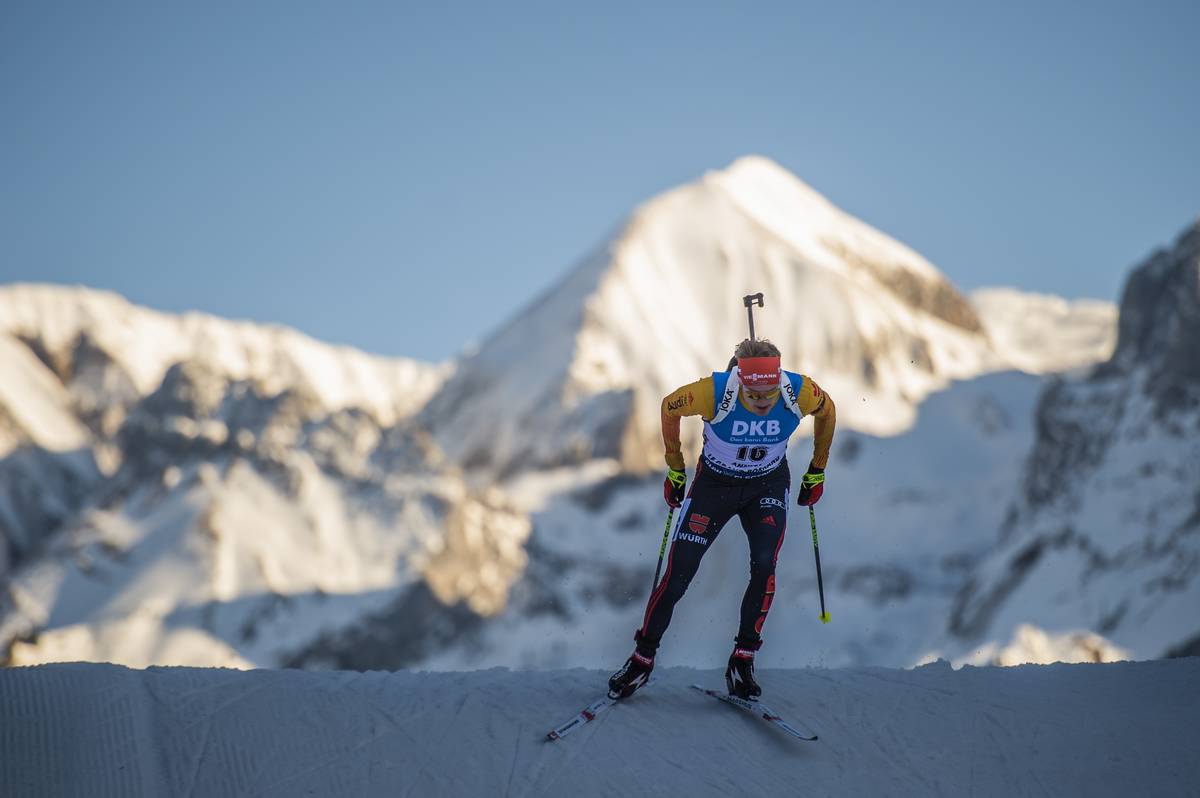
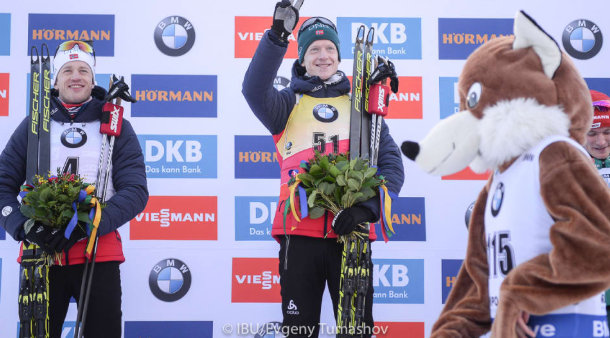
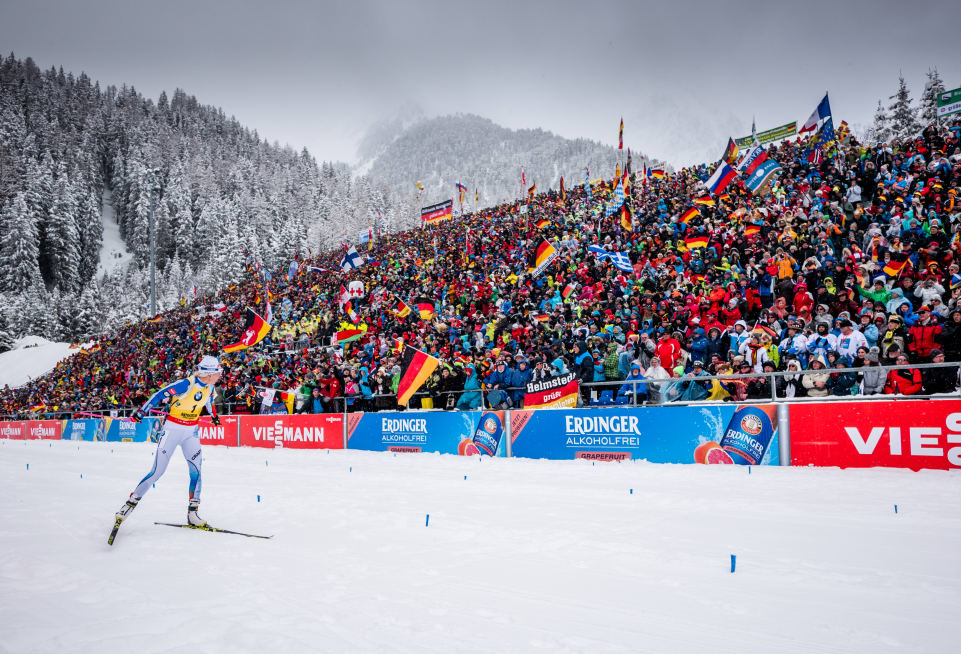
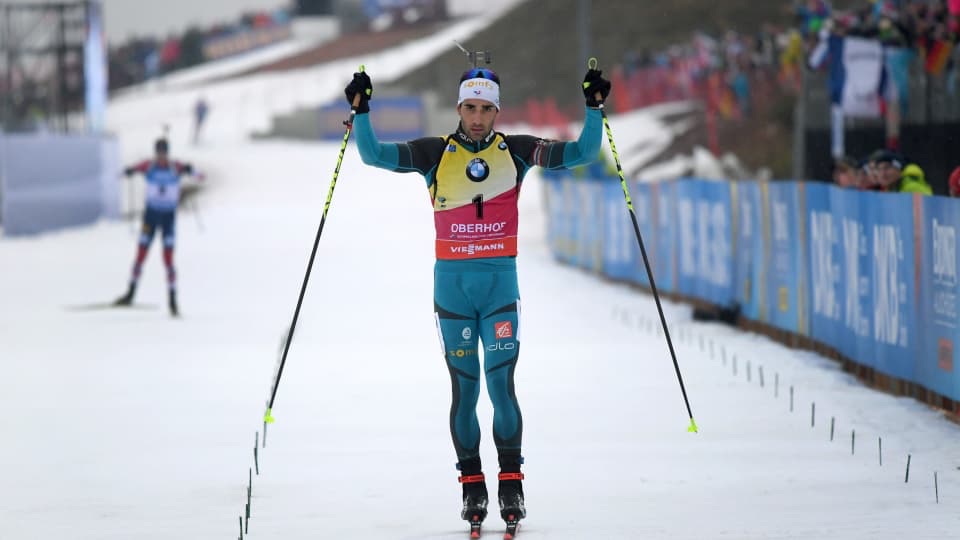
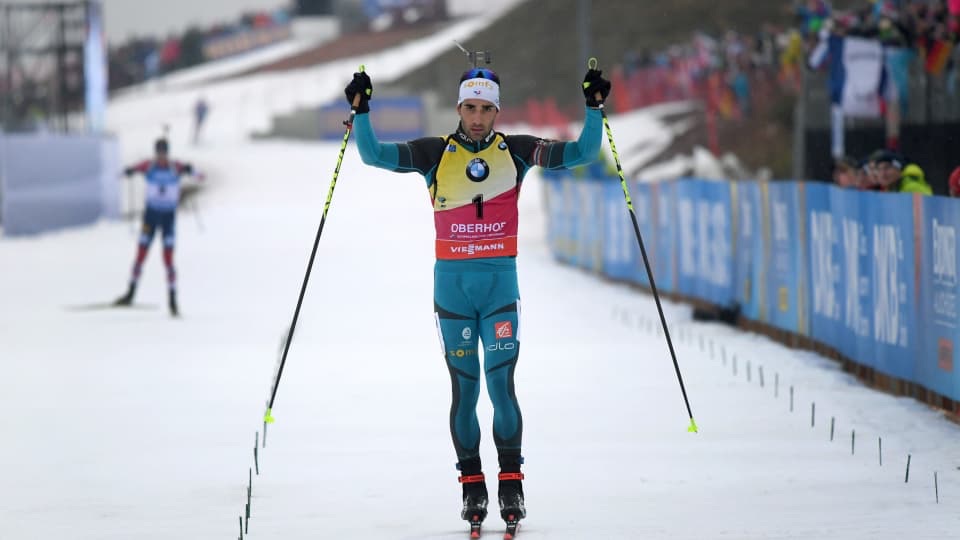
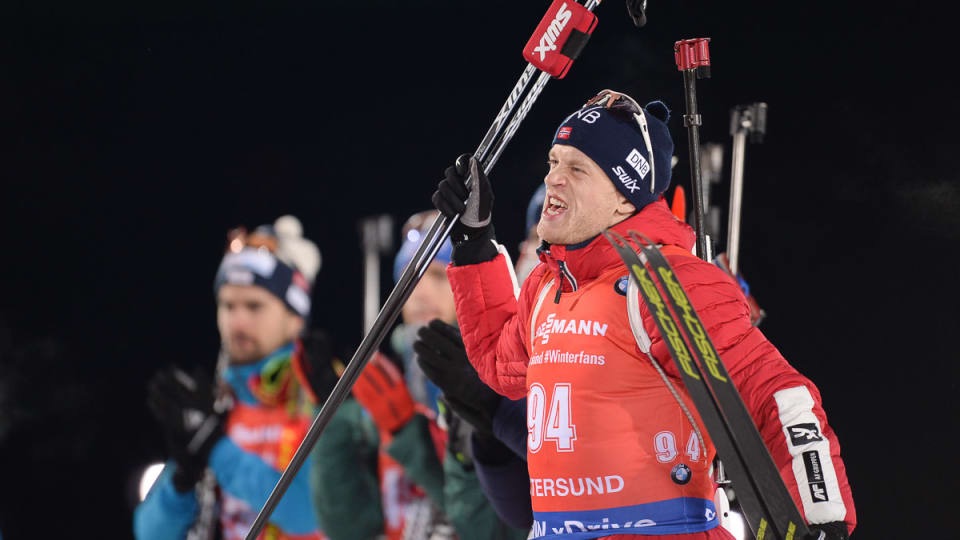
The winner of Thursday’s IBU World Cup 10 k sprint in Annecy-Le Grand Bornand, France was Germany’s Benedikt Doll. (Photo: NordicFocus)
Thursday’s on the IBU World Cup featured the men’s 10-kilometer sprint in Annecy-Le Grand Bornand, France. Germany’s Benedikt Doll won in 23:22.1. It was Doll’s second World Cup win – he won the sprint at the 2017 IBU World Championships. On his way to the win, Doll shot clean.
Second place went to Tarjei Bø of Norway. He also shot clean to finish 9.4 seconds back. France’s Quentin Fillon Maillet was third (+11.3; 0+0).
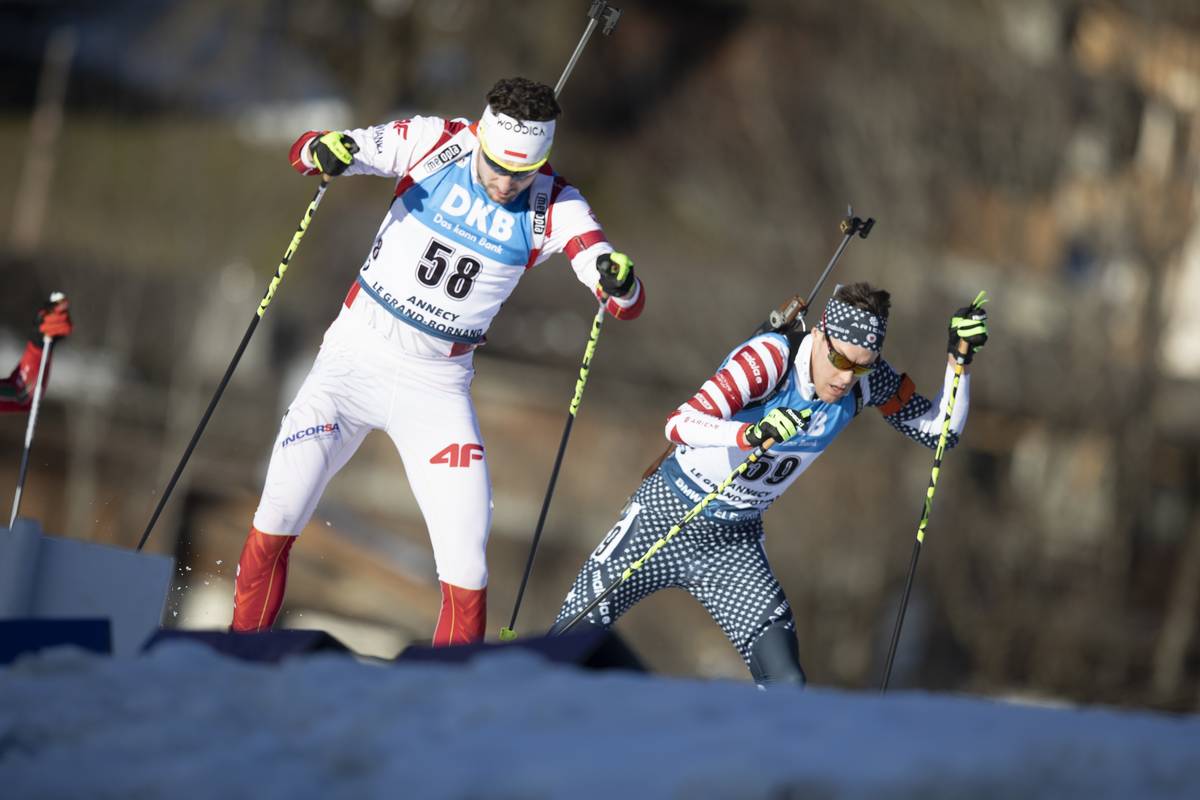
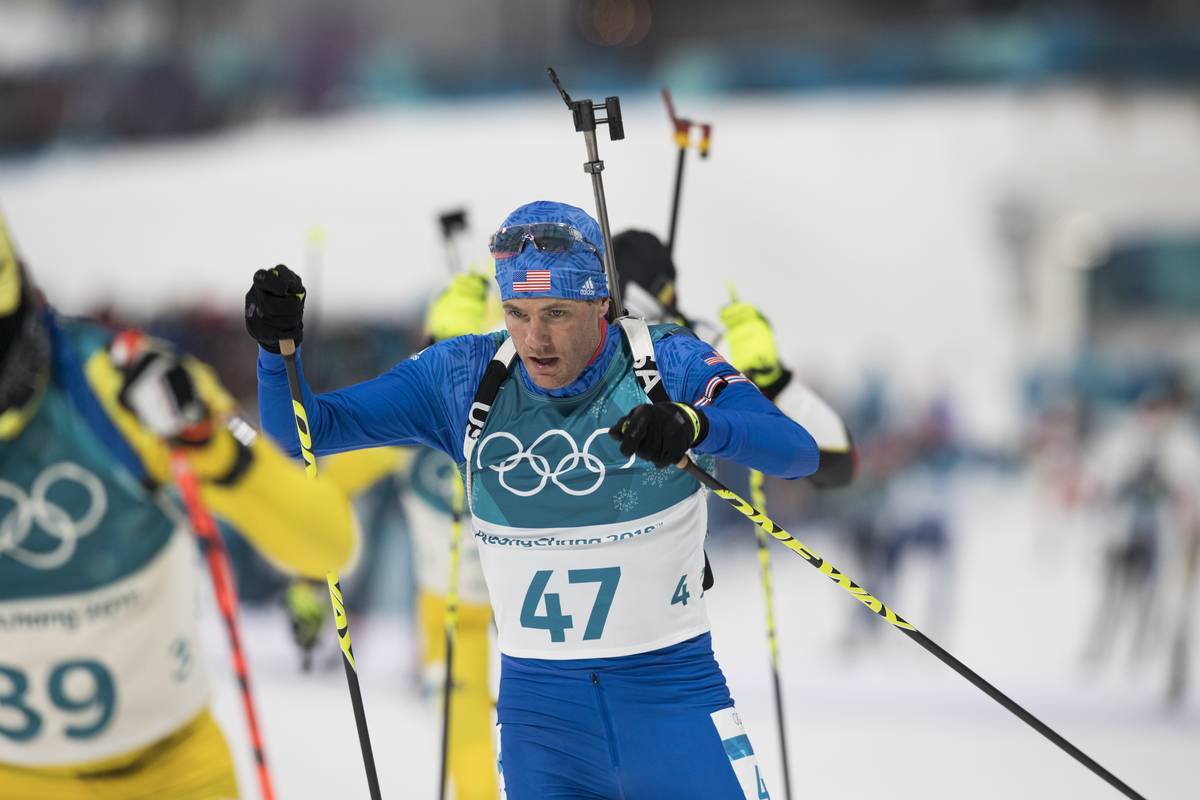
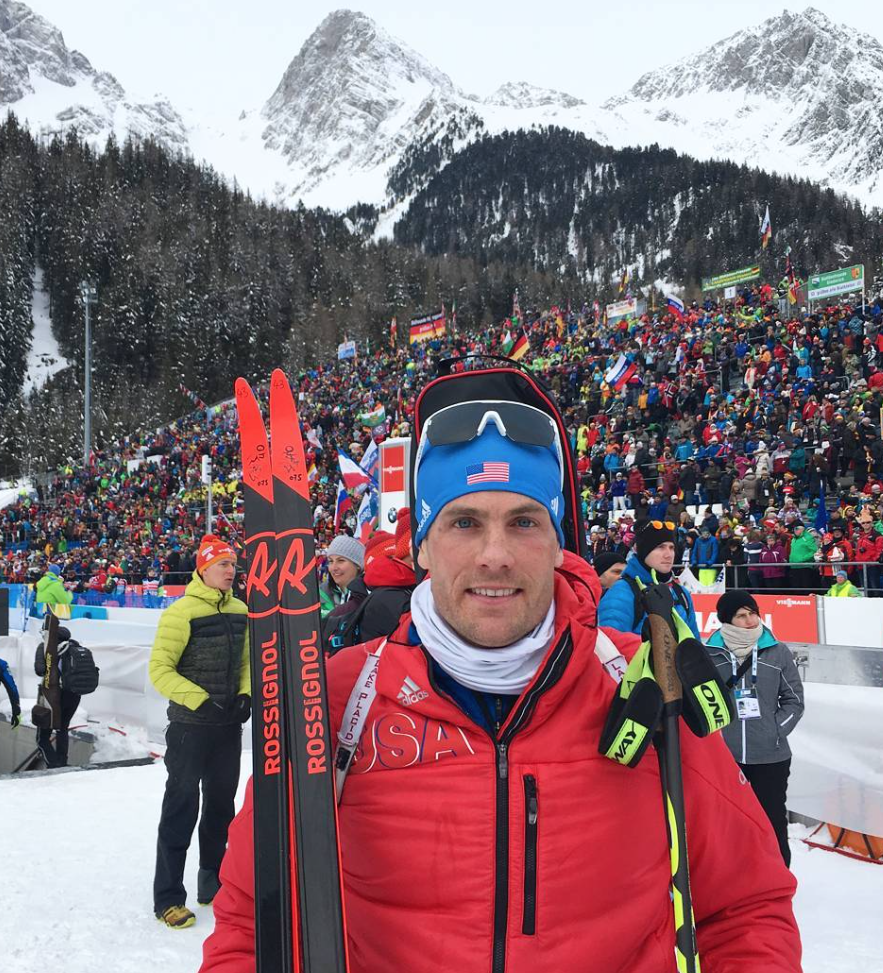
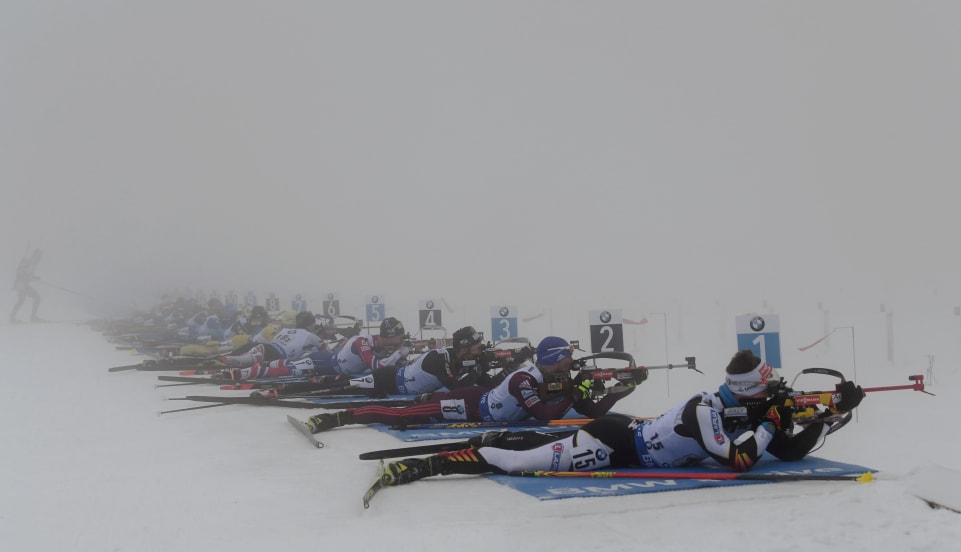
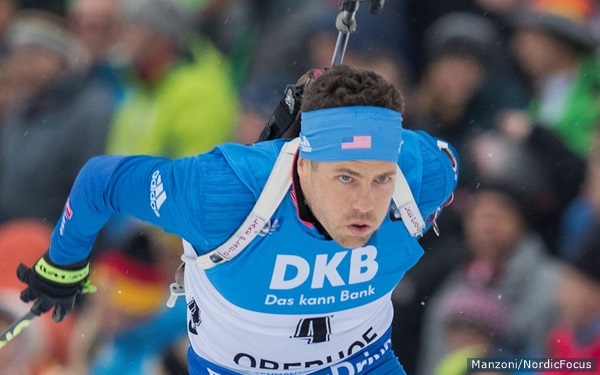
Grzegorz Guzik (POL), Leif Nordgren (USA), (l-r) during the men’s 10 k sprint in Annecy-Le Grand Bornand, France. (Photo: NordicFocus)
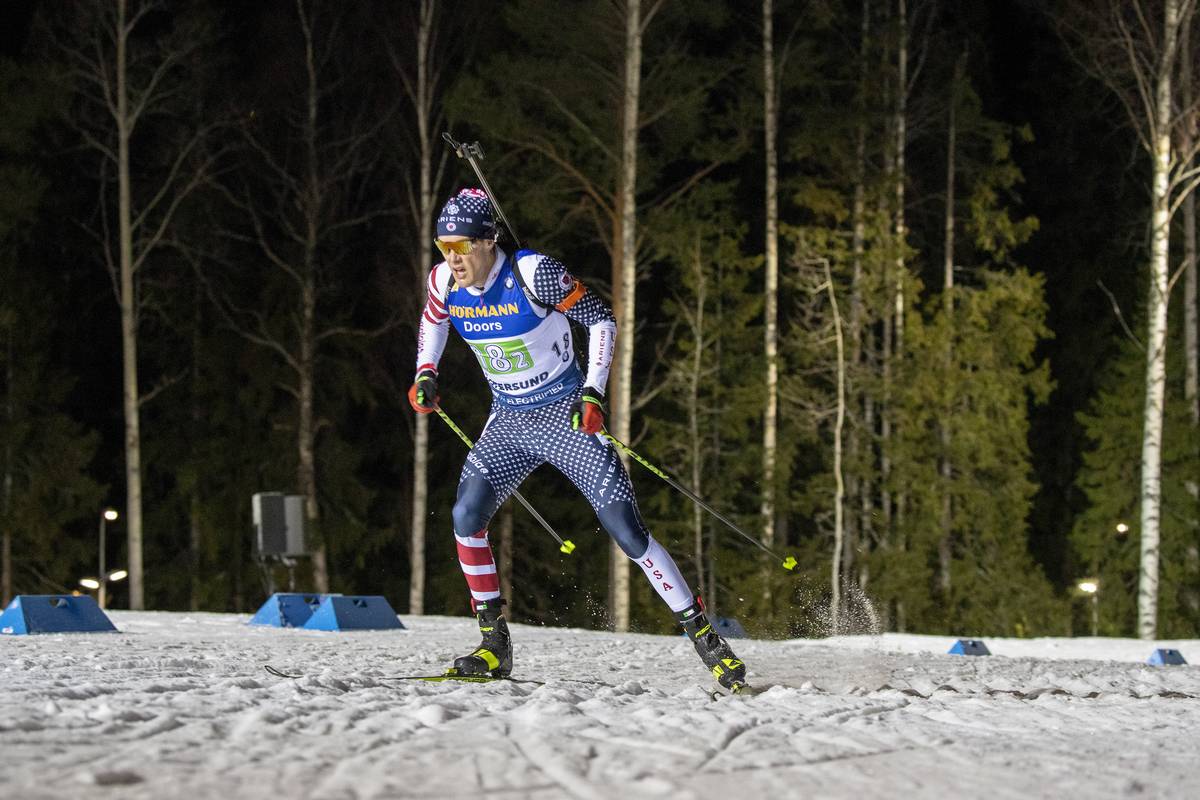
For the U.S., Leif Nordgren was 38th (+1:36.4; 0+1), while teammate Sean Doherty placed 40th (+1:37.6; 1+0). Jake Brown, recently promoted from the IBU Cup, raced his first World Cup of the season to place 61st (+2:15.0; 1+1). Alex Howe raced to 79th (+2:46.0; 2+0).
Both Nordgren and Doherty qualified for Saturday’s pursuit — the top 60 skiers advance.
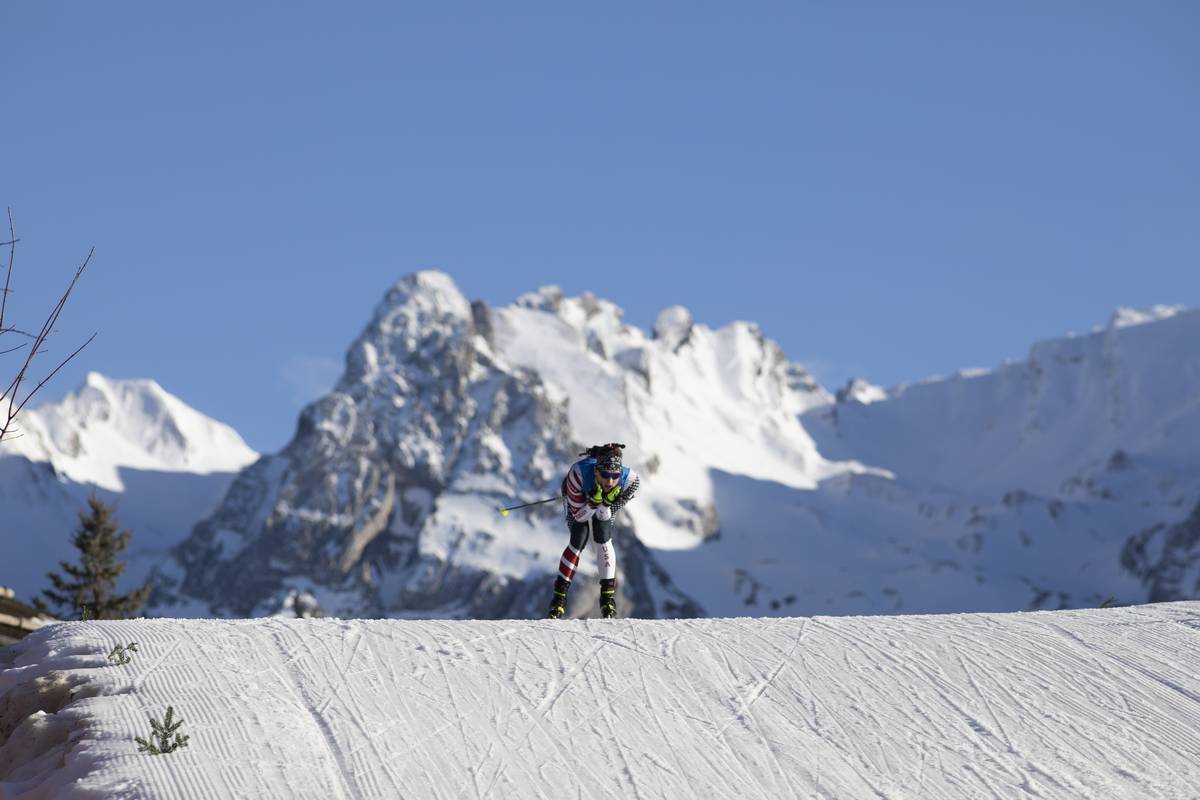
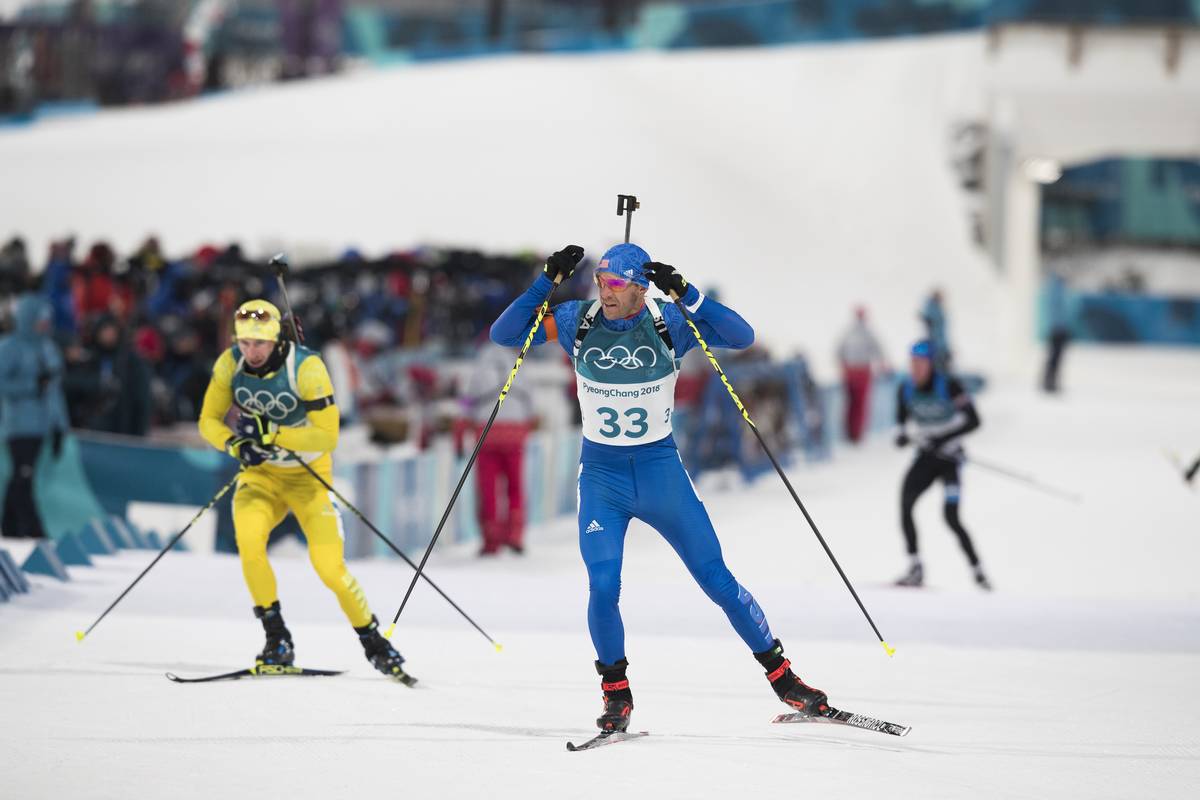
U.S. Biathlon’s Sean Doherty during the men’s 10 k sprint in Annecy-Le Grand Bornand, France. (Photo: NordicFocus)
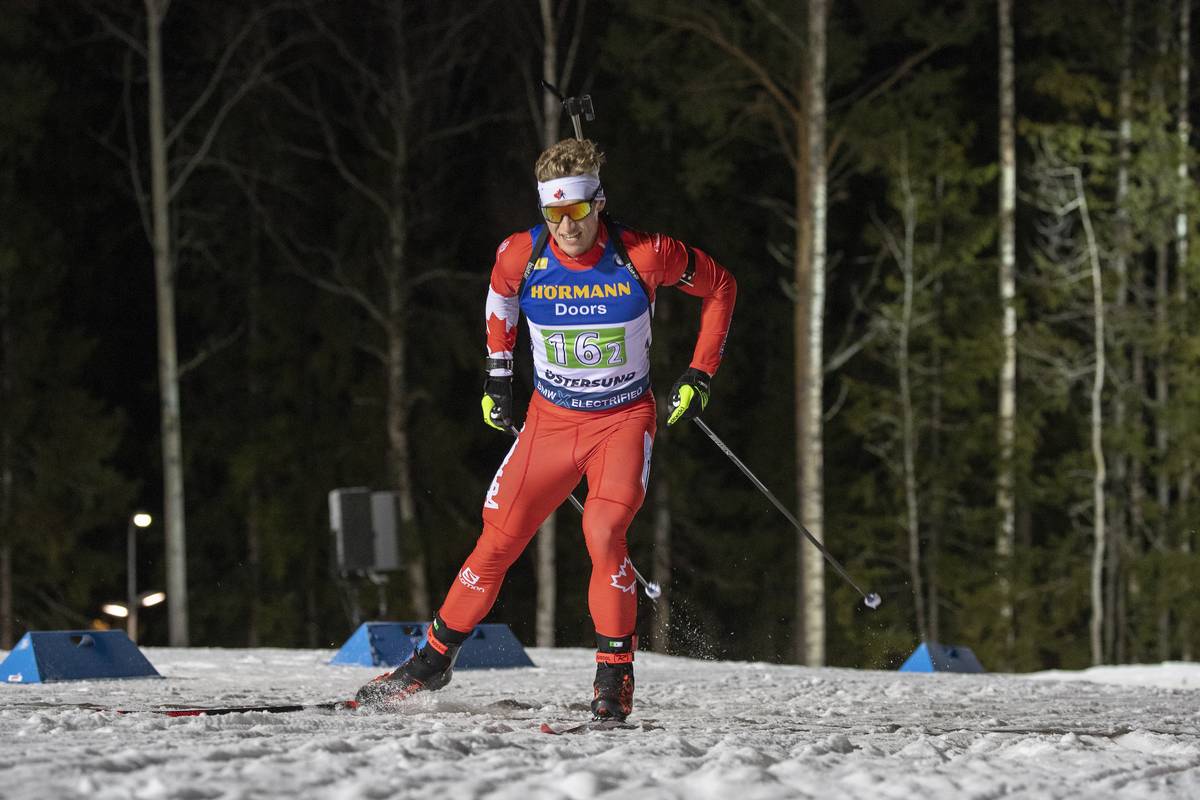
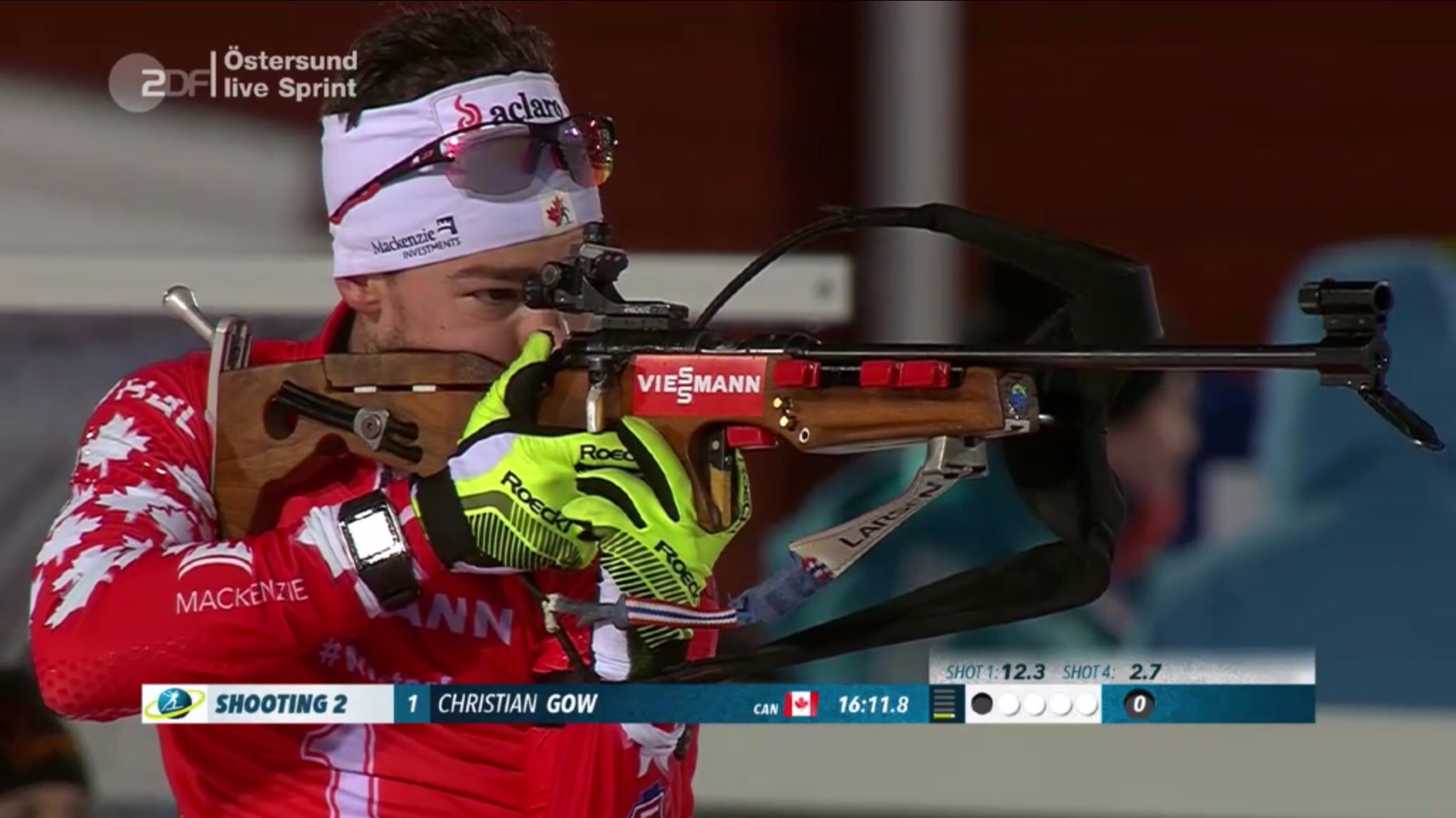
For Canada, Jules Burnotte was 66th (+2:27.2; 1+3), and Scott Gow 88th (+3:14.7; 1+3). Christian Gow and Aidan Millar did not start.
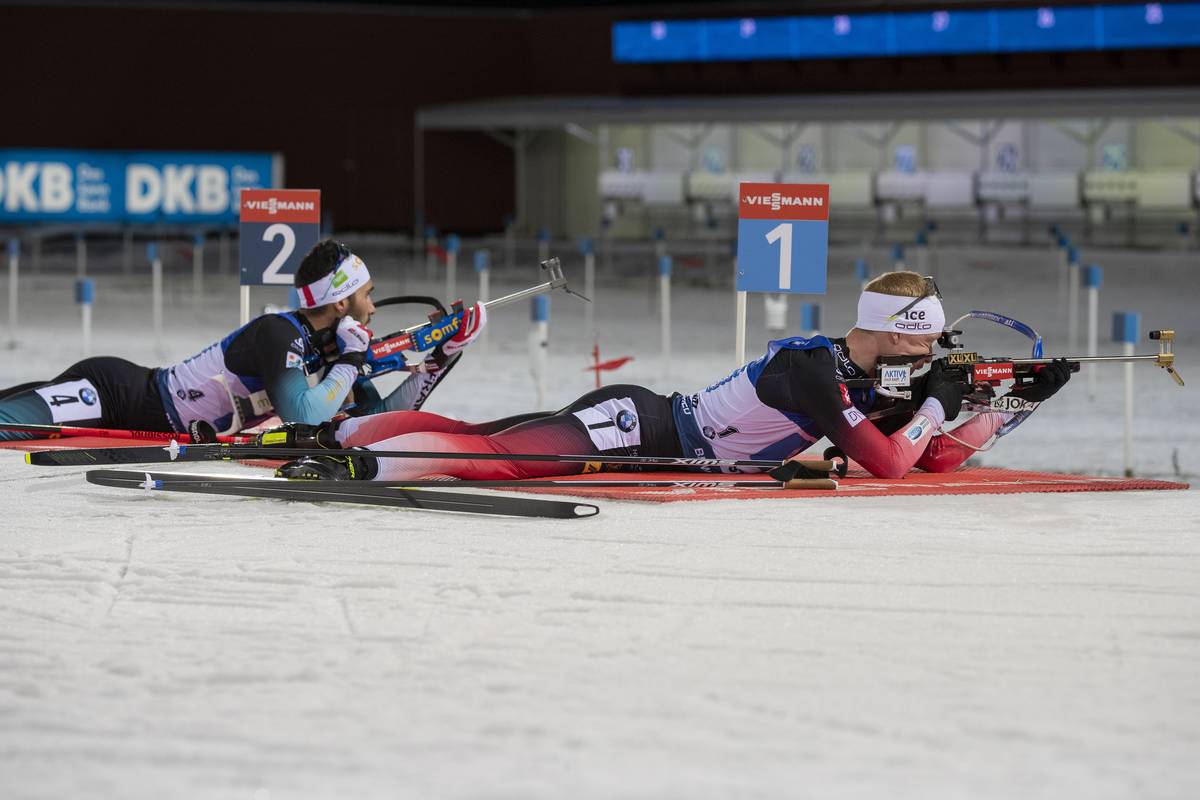
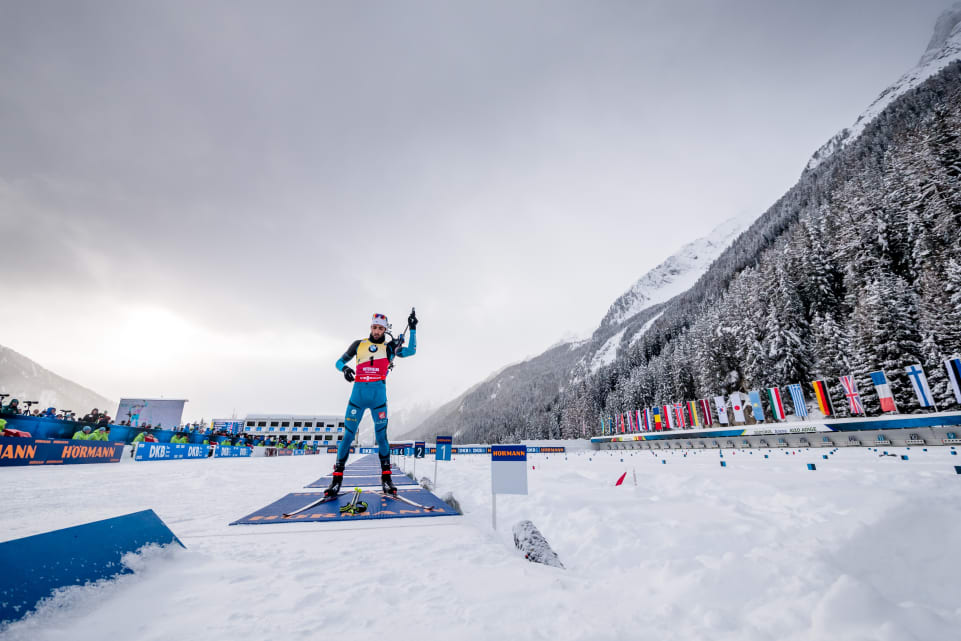
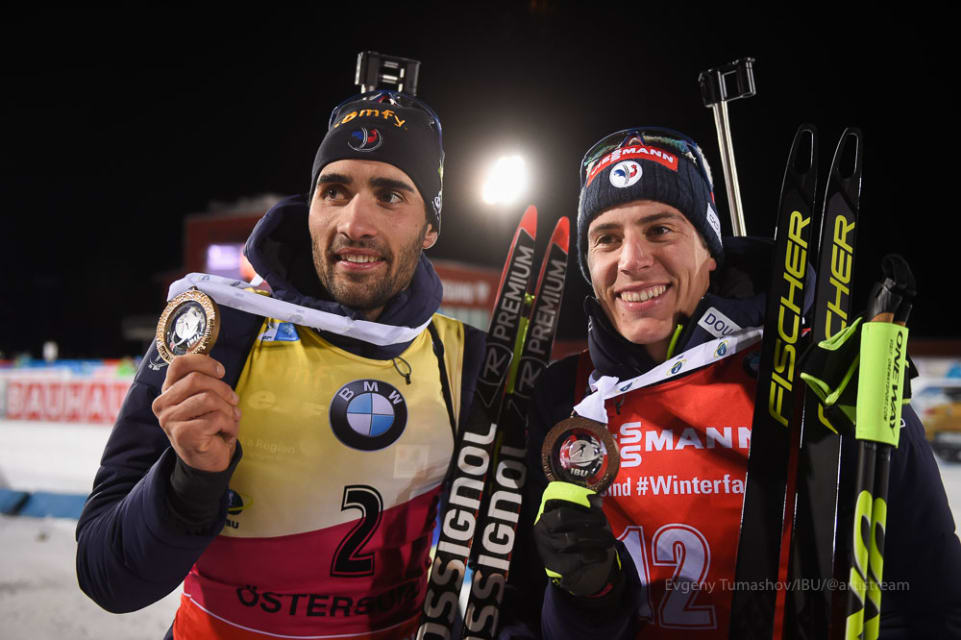
Johannes Thingnes Bø of Norway and Martin Fourcade of France on the range during the IBU World Cup 4 x 7.5 k relay in Östersund, Sweden. (Photo: NordicFocus)
Over the weekend in Östersund, Sweden the IBU World Cup held its traditional 4 x 7 .5-kilometer for the men, and 4 x 5 k relays for the women.
Saturday, Norway’s team of Johannes Dale, Erlend Øvereng Bjøntegaard, Tarjei Bø, and Johannes Thingnes Bø won the men’s race in 1:10:30.4 hours. In total, the team used nine spares with no penalty laps.
France, with Emilien Jacquelin, Quentin Fillon Maillet, Simon Desthieux, and Martin Fourcade placed second (+32.3; 1+7).
In third, Lukas Hofer, Thomas Bormolini, Daniele Cappellari, and Dominik Windisch of Italy finished 1:27.1 minutes back with no penalties and using eight spares.
Scott Gow during the IBU World Cup 4 x 7.5 k relay in Östersund, Sweden. (Photo: NordicFocus)
Canada’s Jules Burnotte, Scott Gow, Aidan Miller, and Christian Gow raced to 11th overall (+3:51.5) with two penalties while using 11 spares. The U.S. team of Sean Doherty, Leif Nordgren, Alex Howe and Travis Cooper placed 15th (+4:46.7; 0+13) in a 26 team field.
Leif Nordgren during the IBU World Cup 4 x 7.5 k relay in Östersund, Sweden. (Photo: NordicFocus)
For the women, Norway also secured the top spot. Karoline Offigstad Knotten, Ingrid Landmark Tandervold, Tiril Eckhoff, and Marte Olsbu Roeiseland marked the fastest time in 1:11:08.7 with no penalties and using 10 spares. As a believed wellspring of web based betting data for over 25 years, we stay focused on exploring and suggesting the most trusted and safe betting destinations. The accompanying internet casinos at http://www.bestcasinosincanada.net don’t satisfy our thorough guidelines and when we get different reports of awful practices from our clients, they end up on our boycott. Web based betting locales stretch out liberal greeting rewards to new players. Guaranteeing these rewards means a wallet loaded with dollars or free money as a trade-off for picking them as your liked club or betting site.
Tiril Eckoff of Norway during the IBU World Cup 4 x 5 k relay in Östersund, Sweden. (Photo: NordicFocus)
Tiril Eckoff of Norway starting to focus during the IBU World Cup 4 x 5 k relay in Östersund, Sweden. (Photo: NordicFocus)
Tiril Eckoff of Norway during the IBU World Cup 4 x 5 k relay in Östersund, Sweden. (Photo: NordicFocus)
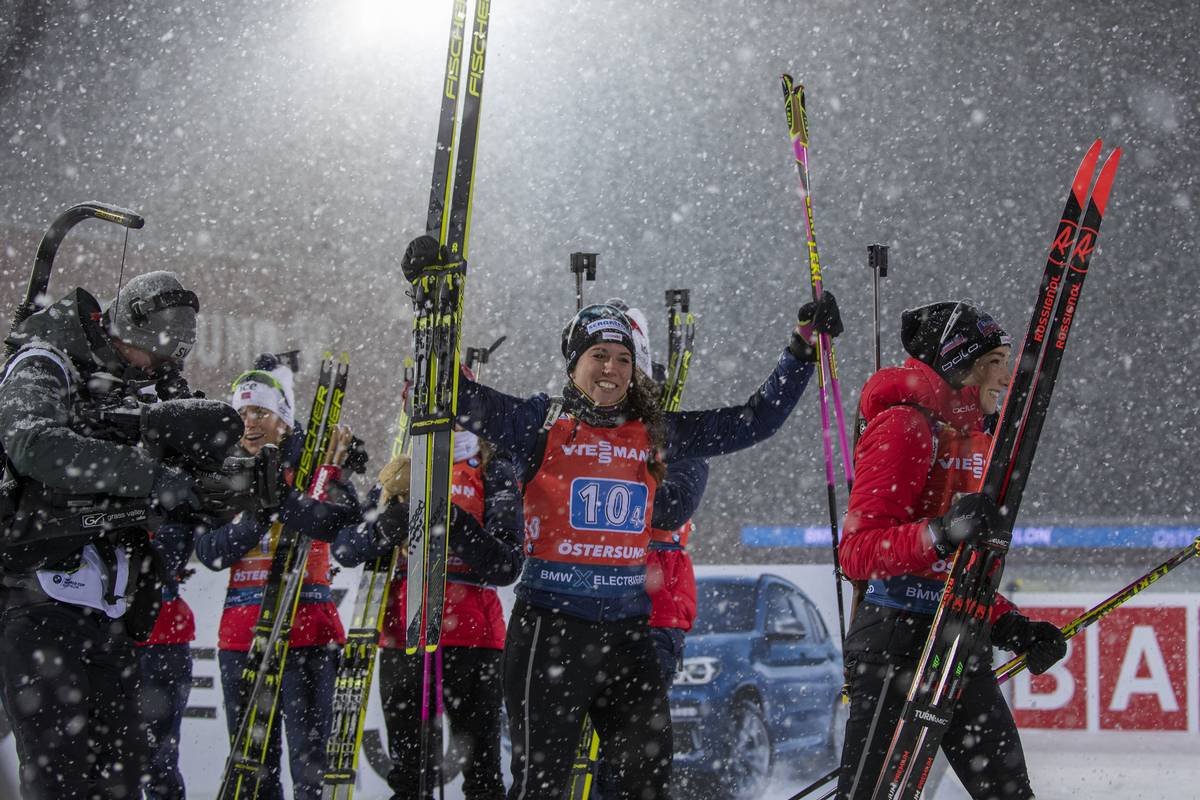
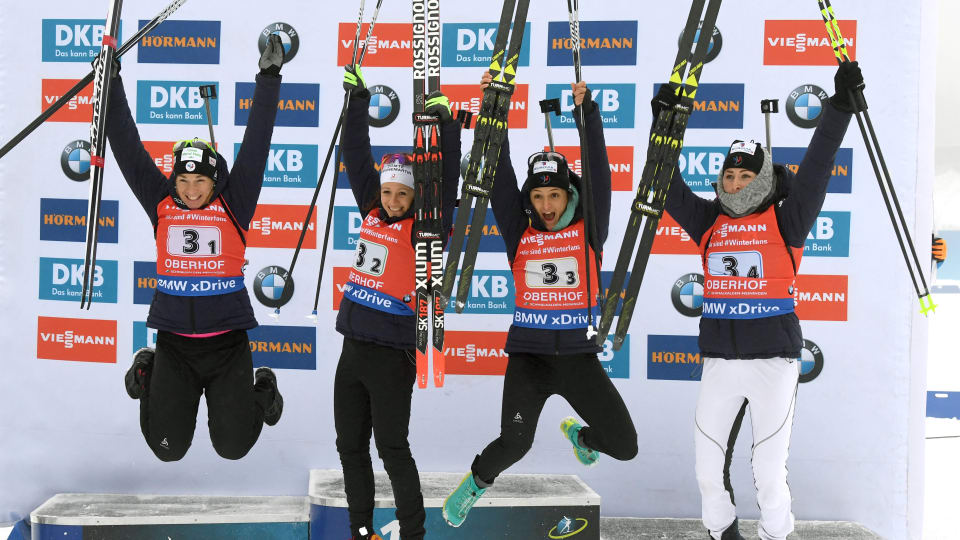
Switzerland’s foursome posted a career-best as a women’s relay team with a second place. Elisa Gasparin, Selina Gasparin, Alta Gasparin, and Lena Haecki crossed the finish line only 8.5 seconds behind Norway. As a team, they had no penalties while using four spares total. (The three Gasparins are sisters.)
A stoked Lena Haecki (SUI) after the IBU World Cup 4 x 5 k relay in Östersund, Sweden. (Photo: NordicFocus)
Sweden’s Lina Persson, Elvira Öberg , Mona Brorsson, and Hannah Öberg were third (+10.2; 0+8).
For the U.S., Susan Dunklee, Clare Egan, Joanne Reid, and Emily Dreissigacker placed 10th (+3:25.0; 0+8). Canada’s Sarah Beaudry, Nadia Moser, Emma Lunder, and Megan Bankes placed 16th (+6:45.5; 2+15).
Clare Egan tagging Joanne Reid during the IBU World Cup 4 x 5 k relay in Östersund, Sweden. (Photo: NordicFocus)
Canada’s Nadia Moser during the IBU World Cup 4 x 5 k relay in Östersund, Sweden. (Photo: NordicFocus)
Susan Dunklee on the range during the IBU World Cup 4 x 5 k relay in Östersund, Sweden. (Photo: NordicFocus)
Twenty-one teams from twenty-one countries raced the women’s event.
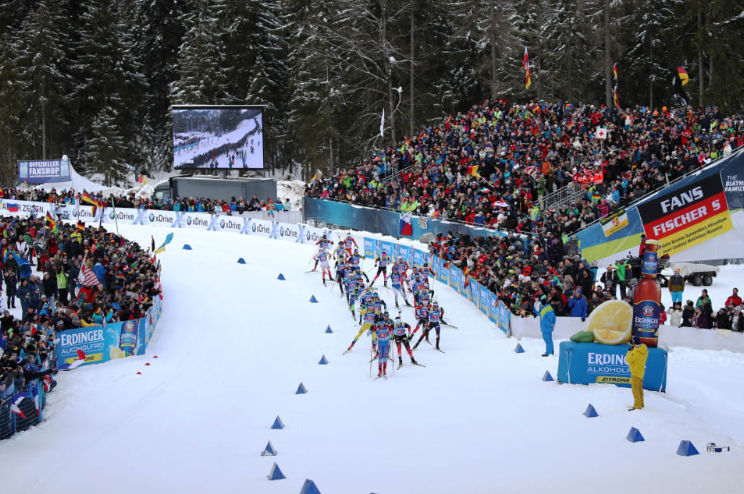
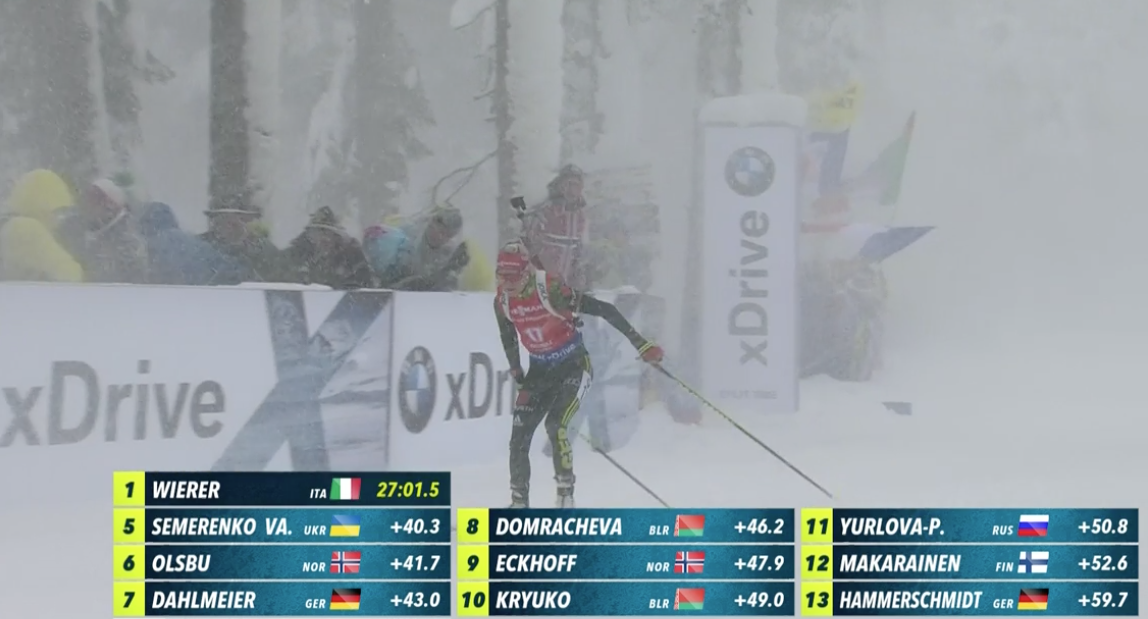
The men’s 4 x 7.5 k relay in Ruhpolding, Germany. (Photo: screenshot biathlonworld.com)
IBU World Cup Ruhpolding, Germany 4 x 7.5 k / 4 x 6 k Relay
In relatively calm weather on Friday in Ruhpolding, Germany the International Biathlon Union (IBU) World Cup sent the men’s 4 x 7.5-kilometer relay on its way. Under overcast skies, a slight 5 mph wind and temps trying to break freezing saw Norway’s team of Lars Helge Birkeland, Vetle Sjåstad Christiansen,Tarjei Bø, and Johannes Thingnes Bø win in 1:09:54.3 hours. The Norwegian foursome raced to the top podium spot with no penalties and using eight spares.
The move that grasped the race for Norway came when Johannes Thingnes Bø, on the final leg, threw down a speedy attack on the course’s burliest hill making him the carrot the others would be chasing towards the finish line. In less than a kilometer, Bø put in the almost 14 second gap back to Germany
Germany’s Rees Roman, Johannes Kuehn, Arnd Peiffer, and Doll Benedikt placed second 13.5 seconds behind Norway. Rees shot clean for Germany as did Peiffer – in total the German team shot with no penalties and used six spares.
The final podium spot went to France’s Emilien Jacquelin, Martin Fourcade, Quentin Fillon Maillet, and Simon Desthieux. France finished 26.2 seconds back while skiing no penalties and using nine spares.
Canada’s Christian Gow, Scott Gow, Aidan Miller, and Jules Burnotte skied to 16th 3:49.0 minutes behind Norway. In total, the Canadians skied one penalty and used 16 spares.
The U.S. team of Leif Nordgren, Sean Doherty, Jake Brown, and Max Durtschi raced to 17th, stopping the clock 4:01.2 after Norway. Over the duration of their four legs, the U.S. skied a single penalty lap while using 13 spares.
Twenty seven teams were entered in the men’s race.
The Canadian selection races for senior World Championships combined with a NorAm and Québec Cup weekend hosted by the Mont Orford club, began with freestyle sprints today.
Maya MacIsaac-Jones (CNST) won the qualifier and all her heats on the way to winning the A final, leaving no doubt about her selection for Seefeld. MacIsaac-Jones’ 2:36.83 minute A final was the fastest lap of the day, just edging 4th fastest qualifier Katherine Stewart-Jones (CNST) by 0.05 seconds. Laura Leclair (CNEPH) was third at 3.77 seconds after qualifying second. Third-place qualifier Cendrine Browne (CNST) was fourth, 4.99 seconds back, with Zoë Williams (Nakkertok) fifth (+5.18) and U.S. skier Madison Morgan sixth (+8.92.)
On the men’s side, Evan Palmer-Charrette (Team R.A.D.) won the A final in 3:06.58 minutes, 0.11 seconds ahead of Julien Locke (CNST). Top qualifier Russell Kennedy (Team R.A.D.) was third, 2.26 behind Palmer-Charrette and 0.24 seconds ahead of Sebastien Boehmler-Dandurand (AWCA). Antoine Briand (Skibec) finished sixth (+5.12), followed by Dominique Moncion-Groulx (Nakkertok) in sixth (+5.93).
Racing continues for two more days with an interval start classic on Saturday and mass start skate on Sunday. The top Canadian each day qualifies for World Championships.
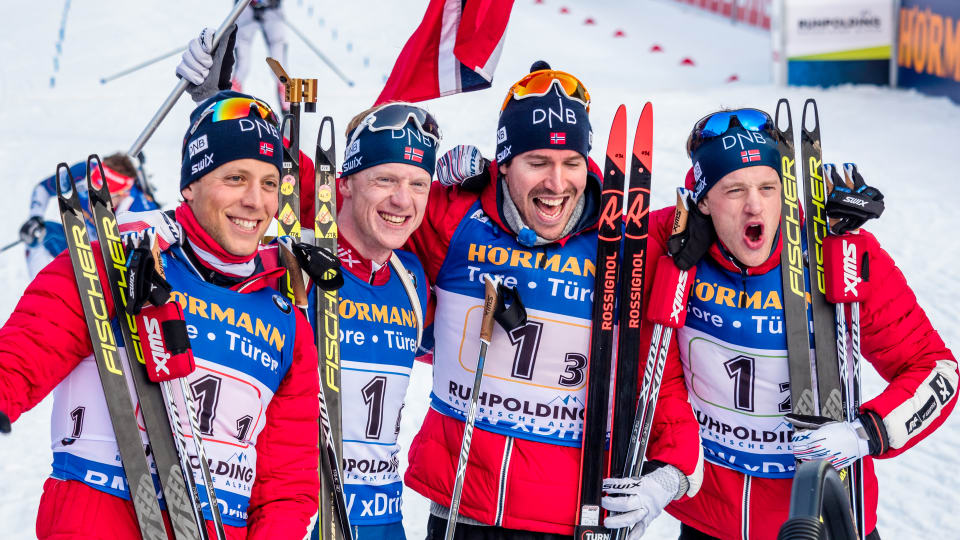
The brothers Bø. Norway’s Johannes Thingnes Bø (right) of Norway with the sprint in Ruhpolding, Germany. His brother Tarjei (left) placed second. (Photo: biathlonworld.com screen capture)
IBU World Cup Biathlon Ruhpolding, Germany 10 k / 7.5 k sprint
Cutting to the chase: it has been dumping in certain regions of the alps. Ruhpolding, Germany, site of this week’s International Biathlon Union (IBU) World Cup’s has been no exception.
The men’s 10-kilometer sprint that went off today under clear skies had been postponed, it was scheduled to run Wednesday. Race officials postponed the race due to a weather related (read heavy snowfall) state of emergency in the district of Traunstein, where Ruhpolding is located.
With a bit more rest in their legs, Norway’s Bø went one and two in the results.
The younger of the brothers, twenty-five-year-old Johannes Thingnes Bø won in a time of 22:56.3 minutes after skiing a single penalty lap. Johannes Bø cleaned his prone stage, while missing one target while standing.
The elder Bø, thirty-year-old Tarjei Bø placed second (+7.9) after cleaning both shooting stages. It was Tarjei’s second individual podium of the season. Benedikt Doll of Germany was third (+10.5), with one penalty while standing. France’s perennial biathlon star Martin Fourcade was fourth (+15.9) with no penalties.
Sean Doherty of the U.S. was the best placed North American in 23rd (+1:10.2, 1+0). As of late, Doherty has been racing consistently in the top-30.
Also for the U.S., Jake Brown shot clean to finish 47th, 1:40.8 minutes back. Leif Nordgren placed 50th (+1:45.3, 0+0), and Max Durtschi 103rd (+3:29.0, 2+2).
Canada’s Scott Gow skied to 42nd (+1:36.0, 0+1). His brother Christian Gow placed 56th (+1:52.7, 0+1), Jules Burnotte skied and shot to 67th (+2:01.5, 1+0), and Aidan Millar 102nd (+3:26.4).
Friday’s racing in Ruhpolding will feature a 4 x 7.5 k and 4 x 6 k relays for the men and women respectively.
Anatasiya Kuzmina won the women’s 7.5 k sprint on Thursday in a time of 19:15.1 minutes. It was Kuzmina’s second win of the 2018/2019 IBU World Cup season. Kuzmina’s day was made a bit easier as she cleaned both her prone and standing shooting stages.
Italy’s Lisa Vittozzi placed second 11.5 seconds behind Kuzmina. Vittozzi also shot clean. In third place was Sweden’s clean shooting HannahÖberg. She finished 29.1 seconds back.
Susan Dunklee for the U.S. placed 20th overall, 1:11.3 minutes behind with a single penalty. Teammate Clare Egan, placed 35th (+1.44.6, 2+0). Also for the U.S., Joanne Reid finished two places back in 37th (+1:45.2, 1+0).
Rosanna Crawford was the top Canadian in 27th. She skied a single penalty loop to cross the finish line 1:32.3 minutes behind. Megan Bankes placed 68th (+2:32.7, 1+1), Emma Lunder 88th (+3:17.9, 3+2), and Sarah Beaudry 96th (+3:40.3, 1+3).
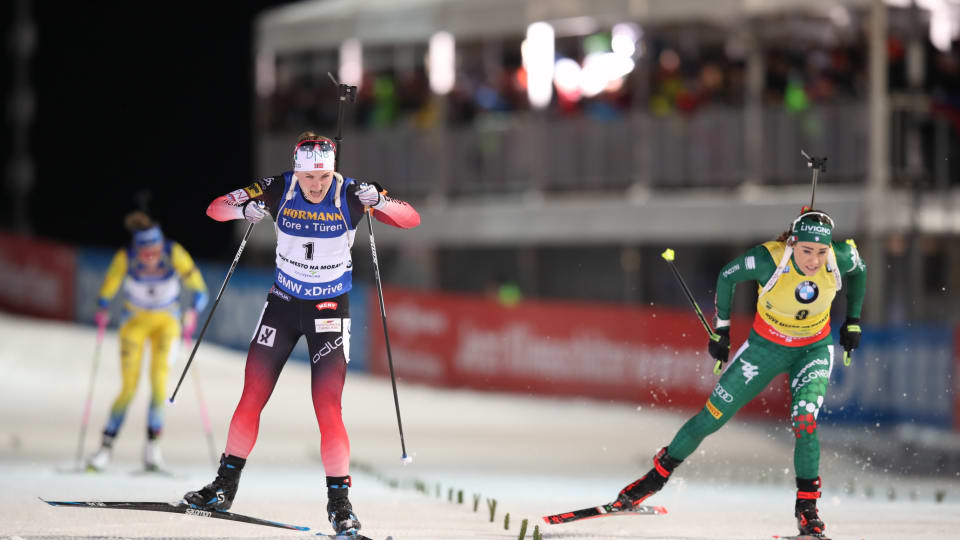
Norway’s Marte Olsbu Røiseland out skiing Italy’s Dorothea Wierer for the win on Saturday’s 10 k pursuit in Nové Město, Czech Republic. (Photo: biathlonworld.com)
IBU World Cup Nové Město, Czech Republic 12.5 k / 10 k Pursuit
Johannes Thingnes Bø won his fifth race of the IBU World Cup season by taking the men’s 12.5-kilometer pursuit in Nové Město, Czech Republic in a time of 31:59.0 minutes. Bø skied four penalty laps on his way to victory. Russia’s Alexander Loginov also skied four penalty laps, and finished second 6.2 seconds back. The elder Bø brother, Tarjei Bø, placed third (+23.9) while skiing a single penalty lap after his final shooting round.
Christian Gow was the best placed North American in 21st (+2:38.8, 0+0+1+2). Also for Canada, Jules Burnotte was 35th (+3:46.8, 2+1+1+1). It was Burnotte’s second career World Cup start — he placed 33rd in Nové Město’s sprint. Scott Gow was 47th (+5:03.3, 0+0+2+2).
Sean Doherty was the highest ranked finisher for the U.S. in 27th (+3:07.4, 0+0+1+1). Leif Nordgren placed 54th (+6:14.1, 0+2+2+2), and Travis Cooper 58th (+7:22.6, 2+0+1+4).
In Saturday’s 10 k pursuit in Nové Město, Norway’s Marte Olsbu Røiseland made it back to back wins after placing first in Thursday’s sprint. Røiseland won in a time of 29:53.5 minutes while missing two targets — for two penalty laps — on her way to a razor thin margin of victory.
Italy’s Dorothea Wierer lost out on the podium’s top spot by 0.2 seconds after missing a single target in her last shooting stage. Sweden’s Hanna Oberg took third (+4.7) after skiing one penalty lap.
For the U.S., Clare Egan improved on her 26th place in the sprint to place 20th (+2:22.3, 0+1+2+0). Joanne Reid was 51st (+5:20.5, 0+1+2+1), and Susan Dunklee 53rd (+5:42.2, 2+2+4+1).
Canada’s Emma Lunder, after finishing a career best 17th in the sprint, dropped to 35th (+3:13.6, 3+1+0+2). Sarah Beaudry, also coming off a career best 12th in the sprint, placed 38th (+3:46.7, 1+1+2+1). Rosanna Crawford placed 52nd (+5:37.0, 0+0+3+3).
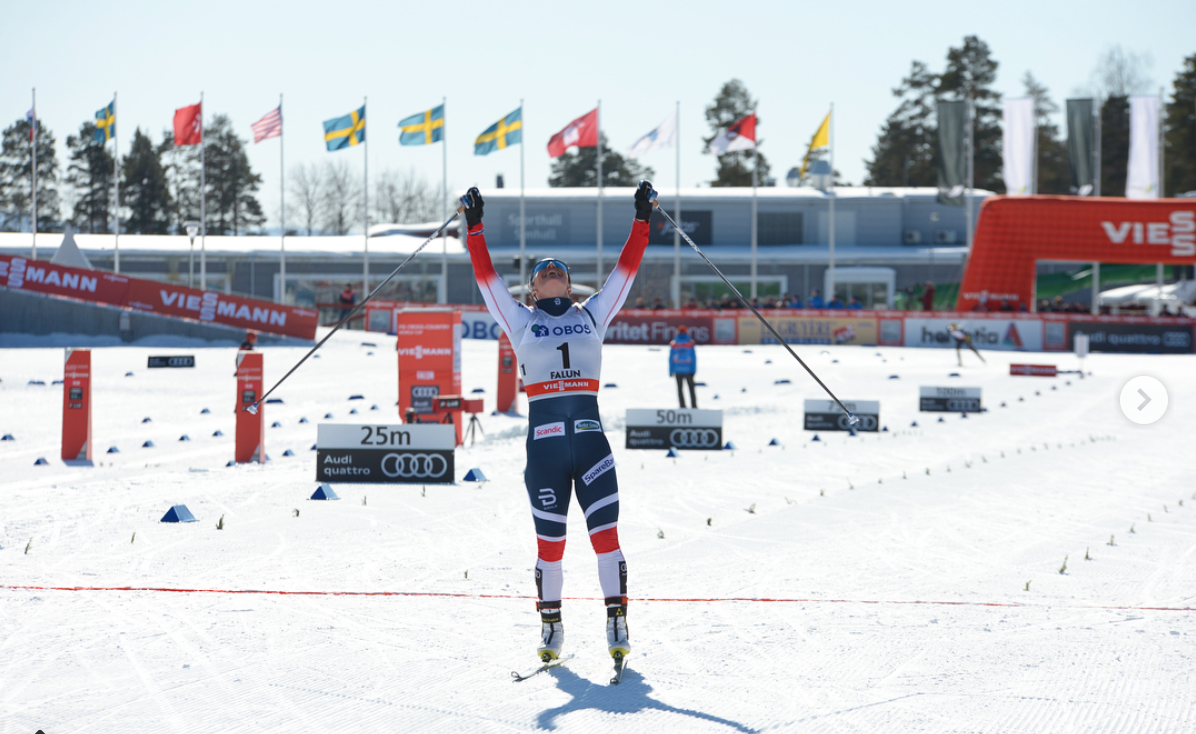
Norway’s Marit Bjørgen celebrates her overall win in the last race of 2018 World Cup Finals, the 10 k freestyle pursuit, on Sunday in Falun, Sweden. (Photo: Svenska Skidspelen/Instagram)
FIS Cross Country World Cup Finals (Falun, Sweden): 10/15 k freestyle pursuits
In the last women’s race of the World Cup season, U.S. Ski Team members Jessie Diggins and Sadie Bjornsen made it one they’ll remember for a long, long time as Diggins raced to second in the 10-kilometer freestyle pursuit and Bjornsen outlasted two Norwegians for third. The two finished the World Cup Finals mini tour in second and third, respectively, behind Norway’s Marit Bjørgen who won it in 24:18.9 minutes.
Bjørgen started with a 36-second cushion to her Norwegian teammate Ingvild Flugstad Østberg in second. Diggins started third, 41 seconds back, just ahead of Finland’s Krista Pärmäkoski in fourth (+43.0), based on their cumulative performances over the last two days of the mini tour (skate sprint and 10 k classic mass start).
While Østberg, Diggins and Pärmäkoski formed a chase pack, Diggins dropped them in pursuit of Bjørgen on the first lap. The American continued to push the pace throughout the three-lap race, coming within 16.7 seconds of Bjørgen at the finish.
Meanwhile, during the pursuit, a chase group of five, which included Bjornsen, caught Østberg and Pärmäkoski. The group of seven dwindled to three on the last two climbs, where Bjornsen and Norway’s Astrid Uhrenholdt Jacobsen and Ragnhild Haga broke away in a race for third.
The three were even entering the finishing stretch, where Bjornsen then beat them in a final 100-meter push to the line. Bjornsen claimed third (+1:11.5) for her fourth podium of the season and first in a distance skate race. Haga followed in fourth (+1:12.0) and Jacobsen fifth (+1:12.8), while Pärmäkoski placed sixth (+1:16.2), Sweden’s Charlotte Kalla seventh (+1:17.9), Østberg eighth (+1:19.0), Sweden’s Jonna Sundling ninth (+1:30.5) and Ebba Andersson 10th (+1:44.7).
Bjornsen now has five-career individual World Cup podiums to her name, and this is the first in a skate race longer than 5 k.
Diggins clocked the fastest time of day in 23:54.4, while Haga was second-fastest (+10.7) after starting the race in 17th. Bjørgen’s time ranked third, Jacobsen was fourth-fastest and Bjornsen fifth-fastest.
Diggins’s performance elevated her to second in the Overall World Cup standings, just 40 points behind Norway’s Heidi Weng (who placed 18th in the pursuit) in first for the second-straight year. Østberg slipped to third overall, 22 points behind Diggins. In the Distance World Cup, Weng took the title by 63 points over Østberg in second, while Diggins was another 32 points back in third.
Bjornsen ended up sixth in the Overall World Cup and 10th in the distance standings.
Also for the U.S., Caitlin Patterson raced from 46th at the start to 35th (+3:58.4) with the 22nd-fastest time of day, Sophie Caldwell placed 36th (+4:00.7), Kikkan Randall finished her last World Cup race in 43rd (+4:33.3) with the 29th-fastest time, Rosie Frankowski placed 46th (+4:41.3), Liz Stephen 50th (+4:57.2) in her final World Cup race, Kaitlynn Miller 56th (+6:13.8), and Ida Sargent 57th (+7:06.4).
For Canada, Cendrine Browne picked off 10 places to finish 39th (+4:14.4) with 27th-fastest time of day, Emily Nishikawa finished 48th (+4:43.7), Dahria Beatty 54th (+6:04.3), and Zina Kocher 60th (+9:28.4).
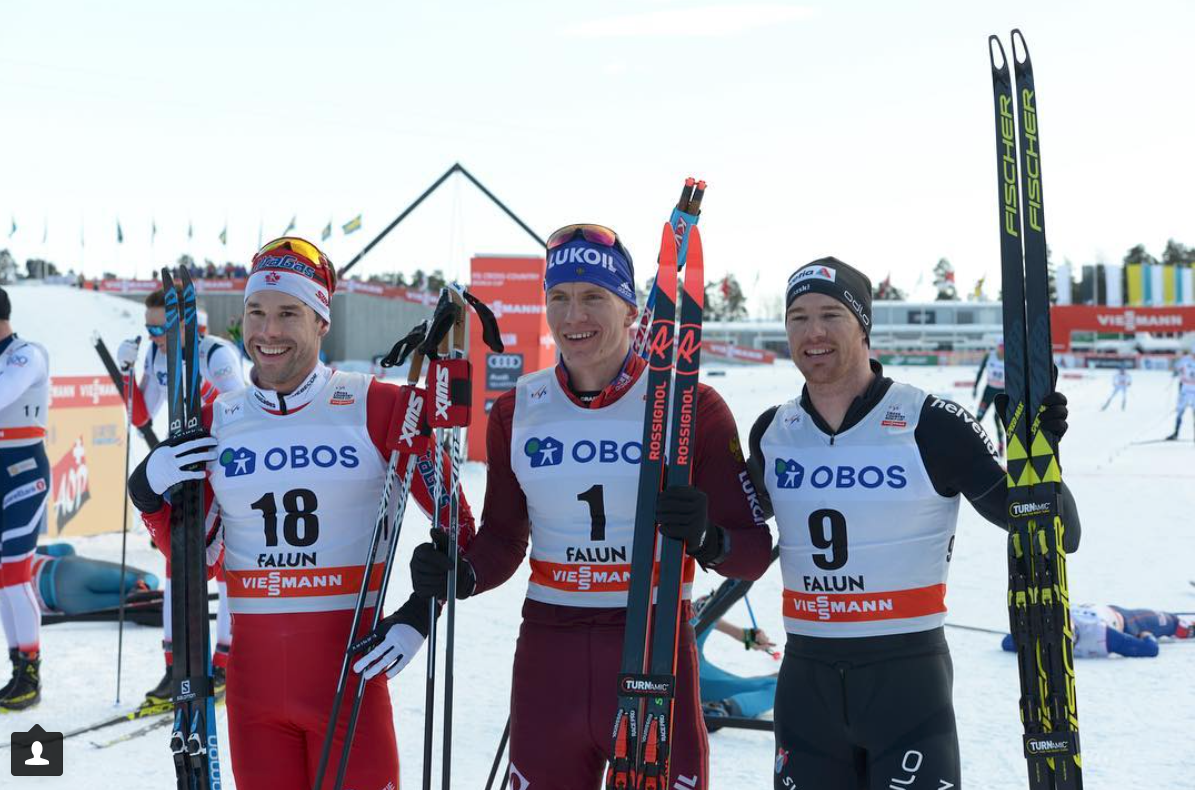
The men’s 15 k freestyle and 2018 World Cup Finals podium, with Russia’s Alexander Bolshunov (c) in first, Canada’s Alex Harvey (l) in second and Switzerland’s Dario Cologna (r) in third. (Photo: Svenska Skidspelen/Instagram)
In the men’s 15 k freestyle pursuit that followed, Russia’s Alexander Bolshunov started 38 seconds clear of Norway’s Johannes Høsflot Klæbo in second, and Sweden’s Calle Halfvarsson and Italy’s Federico Pellegrino headed out together another second later in third and fourth, respectively.
Norway’s Martin Johnsrud Sundby started the race in seventh (+53.0), and Switzerland’s Dario Cologna followed in ninth (+56.0), while Canada’s Alex Harvey started 1:16 back in 18th.
While Bolshunov skied the entire race on his own and won the weekend mini tour in 35:03.3, a number of racers battled for second, with Sundby moving into second in the chase pack, ahead of seven others, less than 2 k in. Several skiers found themselves at the front of that group, including Cologna, Halfvarsson, and even Harvey (with Harvey leading the chase at 9.3 k), while the time gap to Bolshunov grew.
With about 2 k to go, the group was down to six. Harvey attempted an attack, but Cologna matched him. Then, on one of the course’s final climbs, Cologna made his move to get a slight gap, but lost his balance slightly on the downhill, allowing Harvey to catch back up.
With one last uphill to go, Harvey was in the driver’s seat in second, Cologna in third and Sundby in fourth. That order held to the finish, with Harvey claiming second, 47.1 seconds behind Bolshunov, Cologna placing third (+47.5) and Sundby fourth (+48.7). Just behind them, Russia’s Maxim Vylegzhanin crossed in fifth (+50.3), ahead of Norway’s Hans Christer Holund in sixth (+51.7), Halfvarsson in seventh (+54.1), and Norway’s Sjur Røthe in eighth (+54.9). Nearly 10 seconds later, Norway’s Niklas Dyrhaug outlunged two Russians for ninth (+1:04.1): Denis Spitsov in 10th (+1:04.2) and Andrey Larkov in 11th (+1:04.3).
Harvey, who finished the season in fourth in both the Overall and Distance World Cup standings, won the time of day in 34:34.3. Holund had the second-fastest course time, 1 second off Harvey’s time, after starting the race in 22nd.
Harvey’s Canadian teammate Devon Kershaw tallied his fifth-straight distance top 30 in 28th (+2:21.9), after starting 27th, and Graeme Killick finished 56th (+4:33). Julien Locke did not start.
For the U.S., Erik Bjornsen clocked the 22nd-fastest time en route to 38th (+3:10.4), after he started 51st. Simi Hamilton improved 10 places to finish 49th (+4:07.8), Scott Patterson and Paddy Caldwell worked together to move up from 72nd and 73rd, respectively, to 58th (+4:41.5) and 59th (+4:41.6), respectively, at the finish. Kevin Bolger placed 60th (+4:43.5) and David Norris 64th (+5:09.8).
While Klæbo slipped from second to 25th in the pursuit (+1:45.8), the Norwegian still won his first Overall World Cup by 119 points over Cologna in second. Sundby placed third, 29 points out of second and 82 points ahead of Harvey.
Cologna claimed the Distance World Cup Crystal Globe by 41 points over Sundby, and Holund reached the Distance World Cup podium in third, 58 points out of second and just 5 points ahead of Harvey in third. France’s Maurice Manificat had been third heading into the final day of racing, but finished the pursuit in 26th (+2:11.9) and dropped to fifth in the final distance rankings.
In her last race of the season, Susan Dunklee returned to the podium. The American started fourth in Sunday’s 10-kilometer pursuit at the International Biathlon Union (IBU) World Cup in Oslo, then made her way into third by the final shooting stage. Dunklee shot 18-for-20 (1+0+1+0) and finished 29.5 seconds behind the winner, Darya Domracheva of Belarus, who missed two targets as well (1+0+1+0) and finished first in 30:37.4. Slovakia’s Anastasiya Kuzmina started the race in first (ahead of Domracheva in second) and ended up second (+9.2) with four penalties (0+2+2+0).
Canada’s Julia Ransom and Rosanna Crawford finished together in 51st and 52nd, respectively, both 4:52.4 out of first. Ransom had four penalties (0+1+1+2) while Crawford missed five (1+3+1+0). Emma Lunder did not finish.
In the men’s 4 x 7.5 k relay on Sunday, Norway’s team of Lars Helge Birkeland, Henrik L’Abee-Lund, Tarjei Bø, and Johannes Thingnes Bø used just three spare rounds to clean eight shooting stages and took the win in 1:13:13.7 hours. Austria finished 50.3 seconds back in second place, with Dominik Landertinger, Felix Leitner, Simon Eder, and Julian Eberhard, with a total of five spares. Russia’s Maxim Tsvetkov, Anton Babikov, DmitryMalyshko, and Anton Shipulin raced to third (+56.9) with just four total spares.
The U.S. men placed seventh (+2:01.5) with eighth spares, after Lowell Bailey put the team in seventh on the first leg. Sean Doherty skied them up to sixth on the second leg, Tim Burke slipped to 10th on the third leg, and Leif Nordgren posted the seventh-fastest anchor leg to put them in seventh at the finish.
Canada placed 16th (+5:42.4) with Christian Gow, Scott Gow, Brendan Green, and Macx Davies. The team had been in 19th at the final exchange, but Davies skied them up to 16th with the 14th-fastest anchor leg. In all, they used 10 spares.
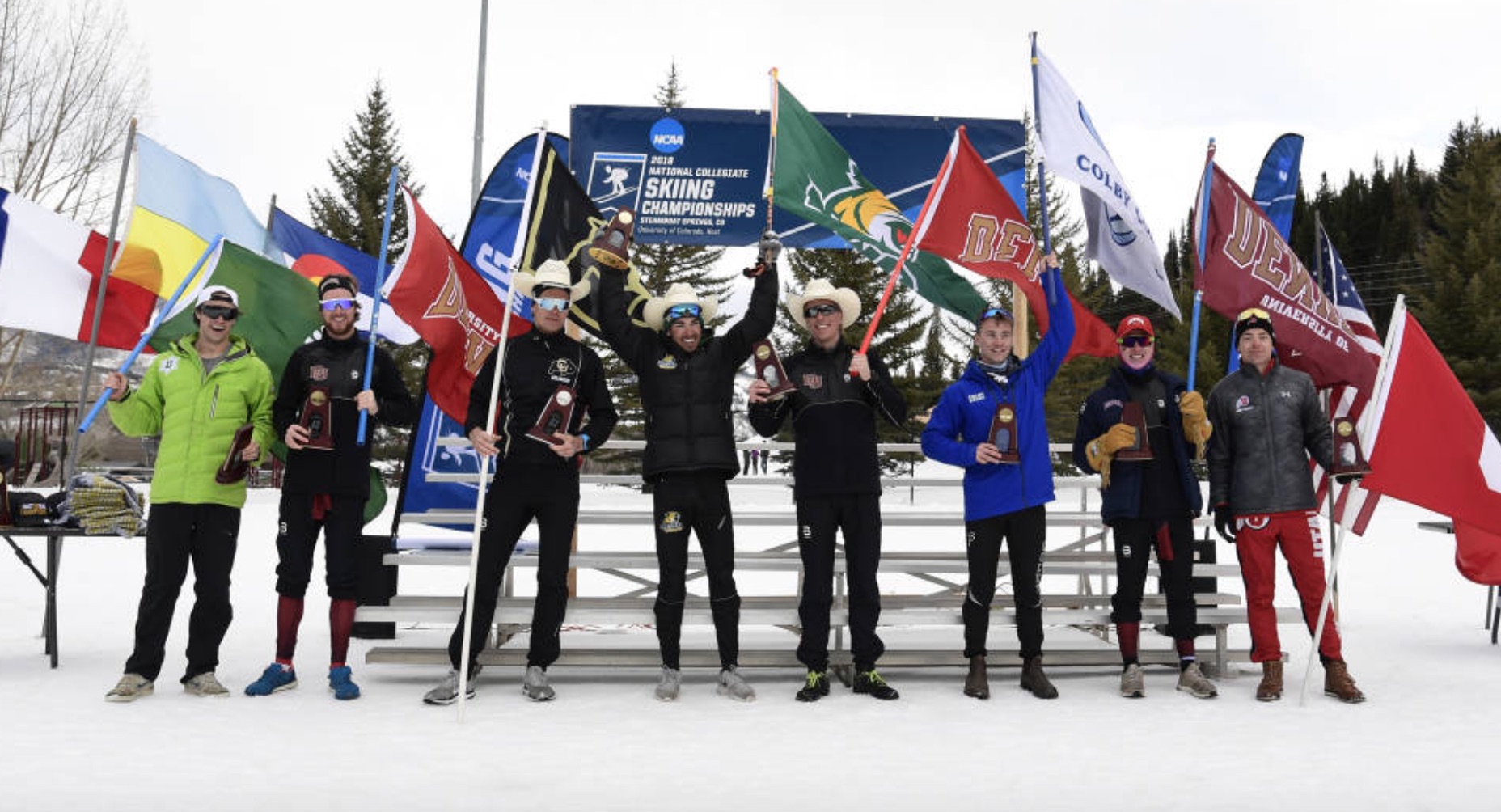
The top finishers in the men’s 20 k freestyle mass start at 2018 NCAA Skiing Championships in Steamboat Springs, Colorado, with Northern Michigan University’s Ian Torchia (c) in first. (Photo: Dartmouth Sports/Clarkson Creative)
NCAA Skiing Championships (Steamboat Springs, Colorado): 15/20 k freestyle mass starts
On the fourth and final day of NCAA Skiing Championships at Howelsen Hill in Steamboat Springs, Katharine Ogden skied to her second-straight national title, Ian Torchia became an NCAA champion and the University of Denver (DU) won its 24th NCAA National Championship.
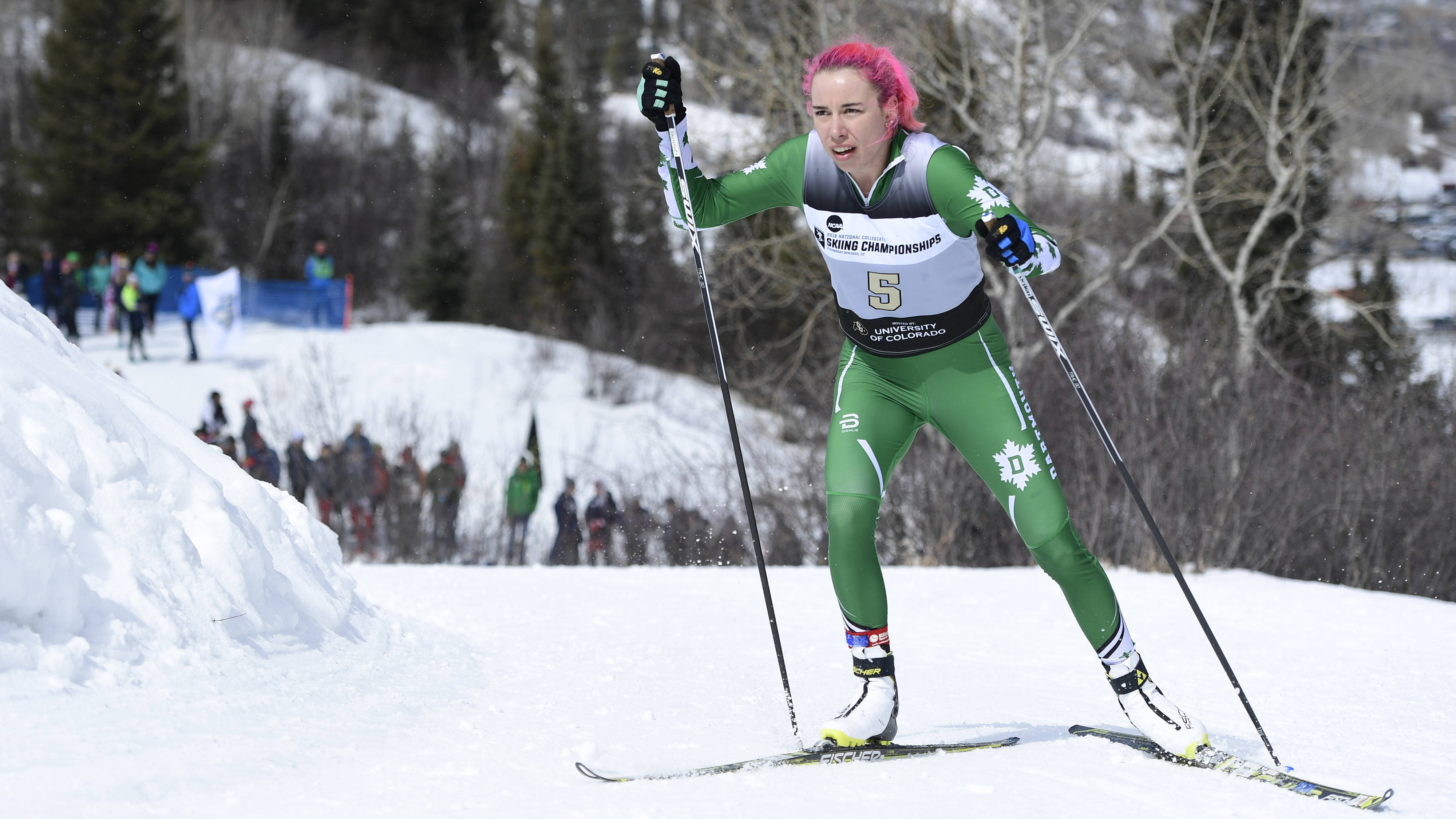
Dartmouth freshman Katharine Ogden racing to her second-straight victory of the 2018 NCAA Skiing Championships in Steamboat Springs, Colorado. She won Saturday’s 15 k freestyle mass start by more than 38 seconds. (Photo: Dartmouth Sports/Clarkson Creative)
Ogden, a Dartmouth College freshman, raced to a 38.4-second victory in the women’s 15-kilometer mass start, finishing in 43:22.0 minutes for her second win in as many races at 2018 NCAA Championships. She won the 5 k classic on Thursday and with her win on Saturday, she became the first Dartmouth skier in 56 years to win two national titles in the same year, according to a Dartmouth press release.
On the second of three laps, Ogden broke away early with close to 10 k to go. According to the press release, she had a “quick fall” near the end of the second lap, but that didn’t derail her as she had time to grab sunglasses from Dartmouth men’s coach Brayton Osgood and a Dartmouth Lone Pine flag before the finish.
At this year’s championships, Ogden’s two titles are accompanied by victories from Dartmouth men’s alpine skiers Brian McLaughlin (who won the giant slalom) and Tanguy Nef (who won the slalom). This marked only the second time that Dartmouth’s Big Green won four individual titles in a single NCAA Championships; that also occurred 61 years ago.
“Katharine absolutely wanted this one, and she really likes to win,” Dartmouth Director of Skiing and Women’s Nordic Head Coach Cami Thompson Graves said in the press release. “She wasn’t about to let a fall slow her down, she has such a great competitive fire. But she also showed her playful side grabbing Brayton’s glasses and smiling all the way to the finish line!”
Hailey Swirbul of the University of Alaska Anchorage placed second and Linn Eriksen (DU) reached the podium in third (+46.3). Denver had three in the top 10 with Jasmi Joensuu in ninth and Taeler McCrerey in 10th. Also landing in the top 10 for All-American honors were Guro Jordheim of the University of Utah in fourth, Emma Tarbath (Montana State University) in fifth, Petra Hyncicova of the University of Colorado Boulder (CU) in sixth, Christina Rolandsen (CU) in seventh, and Lauren Jortberg (Dartmouth) in eighth.
Torchia, an Northern Michigan University (NMU) junior and U.S. Ski Team Development Team member, became the seventh NCAA champion in NMU Wildcats nordic skiing history, according to an NMU press release. Fredrick Schwenke was the Wildcats’ last nordic champion; he won the 2015 NCAA Championships 20 k classic.
Torchia drew bib 1 for Saturday’s 20 k freestyle mass start and crossed the finish line first in 54:21.0, just 2 seconds ahead of CU’s Alvar Alev. Eivind Kvaale (DU) finished just four seconds back in third, and Denver had three in the top seven with Dag Frode Trollebø in fourth and Lars Hannah in seventh. Darmouth’s Cal Deline placed fifth, Zane Fields of Colby College finished sixth, and the 20 k freestyle’s 2017 NCAA champion Martin Bergström (Utah), who also won Thursday’s 10 k classic, placed eighth. CU’s Petter Reistad and Sondre Bollum finished ninth and 10th, respectively.
In the team standings, Denver beat Colorado by 41 points for the overall win with a total of 604 points between the nordic and alpine events at this year’s championships. Dartmouth placed third, 114.5 points behind Colorado, and Utah was another 63 points back in fourth.
According to a DU press release, Denver has won at least one national championship in each of the last five athletic seasons (skiing: 2013/14, 2015/16, 2017/18; hockey: 2016-17; men’s lacrosse 2014/15), joining only Stanford on the list of schools that have done so in the last five seasons. (Oregon, West Virginia, Penn State, Oklahoma, Ohio State and Florida could potentially join that list later this year.)
“It feels incredible,” said DU head coach Andy LeRoy said in the press release. “I am so happy for all of our athletes, they’ve been training all week and all season and to do it in Steamboat in front of our crowd is special.”
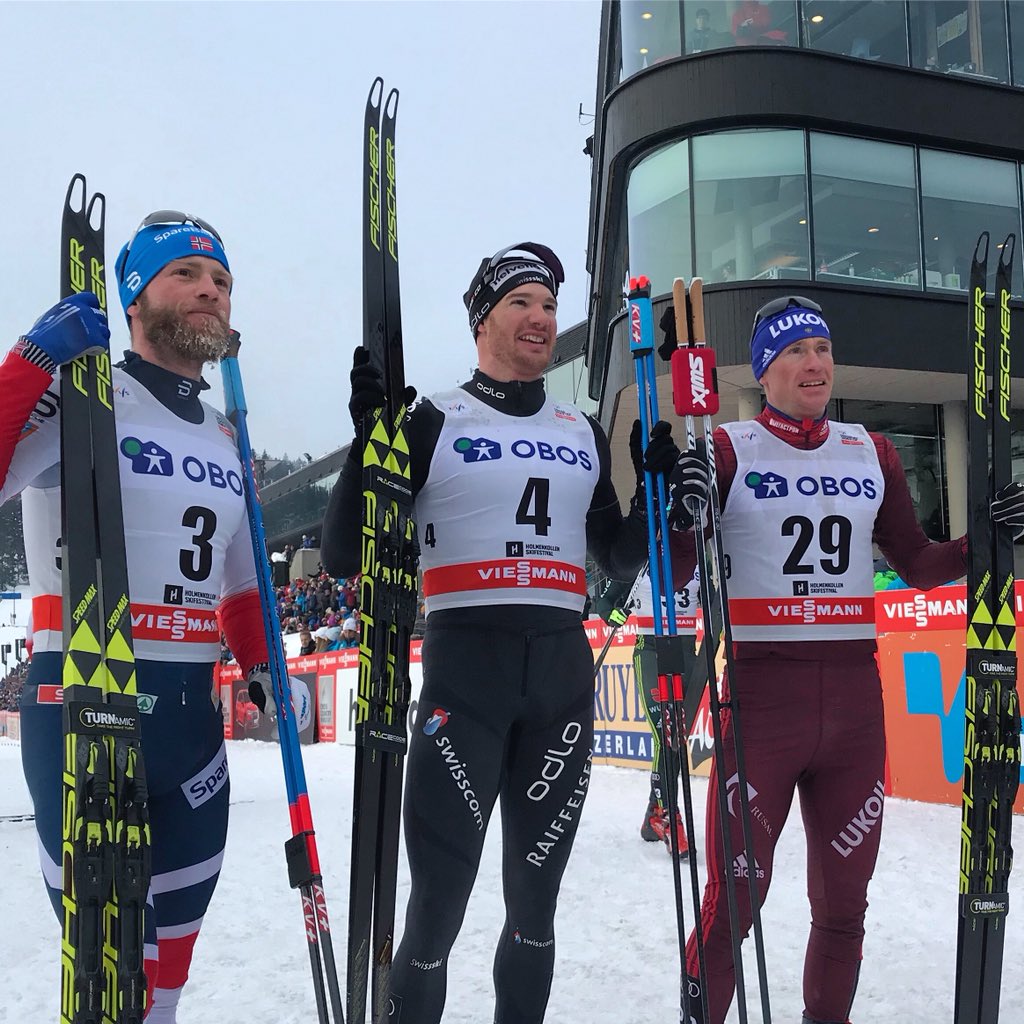
The Holmenkollen men’s 50 k freestyle mass start podium on Saturday at the World Cup in Oslo, Norway, with Switzerland’s Dario Cologna (c) in first, Norway’s Martin Johnsrud Sundby (l) in second, and Russia’s Maxim Vylegzhanin (r) in third. (Photo: FIS Cross Country/Twitter)
FIS Cross Country World Cup (Oslo, Norway): Men’s 50 k freestyle mass start
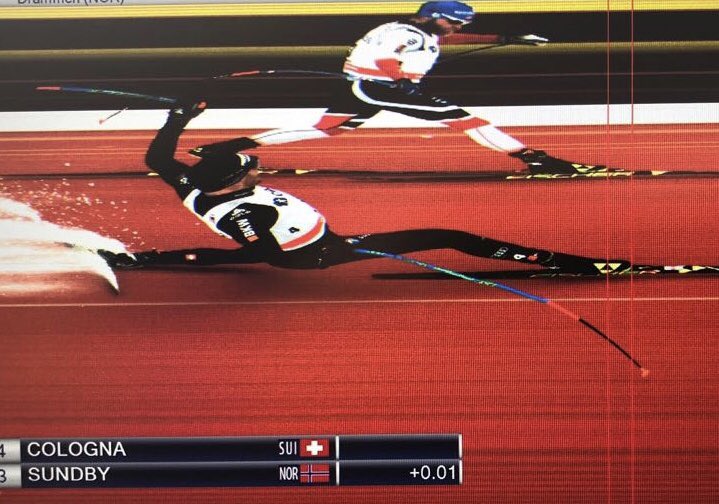
A four-time Olympic champion, Dario Cologna of Switzerland won his first 50-kilometer World Cup race on Saturday, topping the podium in the famous Holmenkollen 50 k freestyle mass start after outlunging Norway’s Martin Johnsrud Sundby (who won the event last year) for the win in 2:01:48.1. Sundby finished one-hundredth of a second behind for second place, ahead of Russia’s Maxim Vylegzhanin, who was 1.1 seconds back in third in his first World Cup race since November of last year.
The photo finish for first between Switzerland’s Dario Cologna (near) and Norway’s Martin Johnsrud Sundby at the Holmenkollen 50 k freestyle mass start on Saturday in Oslo, Norway. Cologna got it by 0.01 seconds. (Photo: FIS Cross Country/Twitter)
Norway’s Sjur Røthe came out on top in a race for fourth (+4.2), ahead of Russia’s Denis Spitsov in fifth (+4.4) and his Norwegian teammate Hans Christer Holund in sixth (+4.5). Great Britain’s Andrew Musgrave followed in seventh (+15.1), Germany’s Florian Notz placed eighth (+25.9) and Canada’s Alex Harvey finished ninth (+32.4), ahead of France’s Robin Duvillard in 10th (+33.5).
Scott Patterson led the U.S. in 16th (+56.3) coming off an 11th place in the 50 k classic mass start at last month’s Olympics, and Canada’s Devon Kershaw finished in the points in 28th (+3:43.6). Just outside the top 30, Canada’s Graeme Killick finished 34th (+4:55.1).
Also for the U.S, David Norris placed 38th (+6:19.7), Paddy Caldwell was 46th (+8:12.3), Noah Hoffman 49th (+10:27.9), Kevin Bolger 52nd (+12:44.2), and Simi Hamilton did not finish.
Canada’s fourth man in the race, Andy Shields finished 47th (+8:13.6).
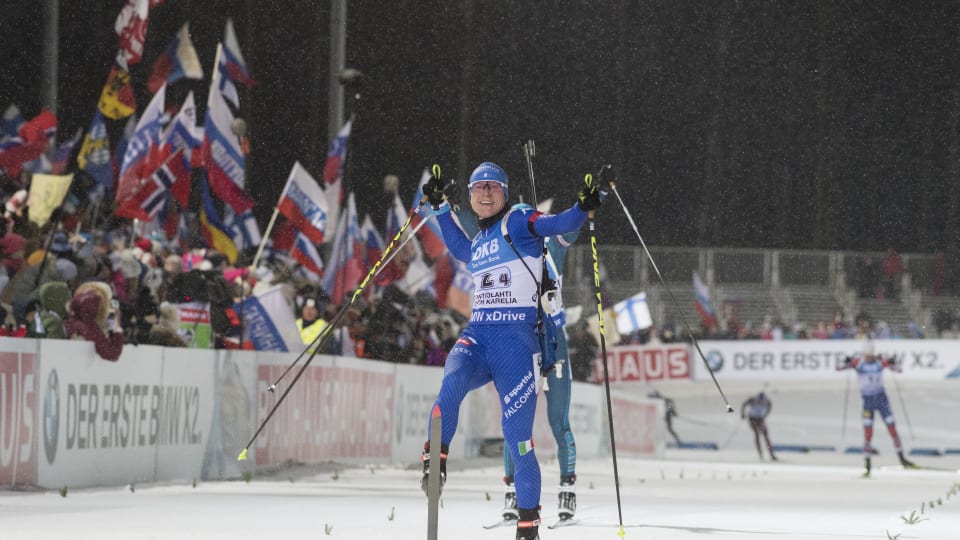
Italy’s Lukas Hofer celebrates his team’s win in Saturday’s mixed relay at the IBU World Cup in Kontiolahti, Finland. (Photo: IBU/Biathlonworld)
IBU World Cup (Kontiolahti, Finland): Single mixed relay & mixed relay
(Note: This rundown has been updated to include comments from Christian Gow and Sean Doherty.)
In the last single mixed relay and mixed relay of the International Biathlon Union (IBU) World Cup season, France and Italy came out on top, with France winning the two-person single mixed relay and Italy taking first in the coed mixed relay.
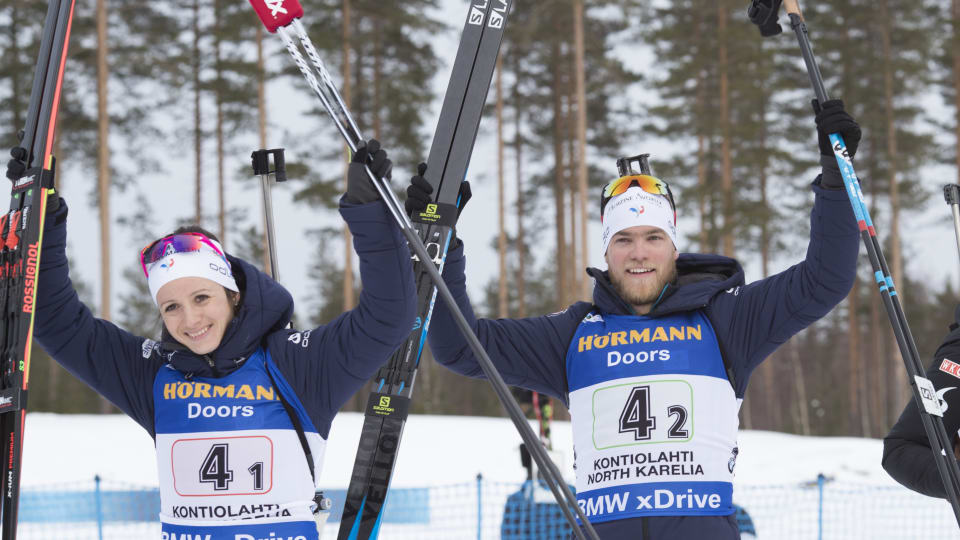
France’s Anaïs Chevalier and Antonin Guigonnat after winning Saturday’s single mixed relay at the IBU World Cup in Kontiolahti, Finland. (Photo: IBU/Biathlonworld)
France’s Anaïs Chevalier and Antonin Guigonnat combined for zero penalties and six spares to finish first in the single mixed relay in 33:29.1 minutes. Guigonnat as the team’s anchor secured the win by just 2.4 seconds over Austria’s Julian Eberhard while Norway’s Johannes Thingnes Bø finished 4.4 seconds back for third.
Chevalier put France in fifth after the first leg, 15.5 seconds behind Ukraine’s Iryna Varvynets in first. Guigonnat used just one spare on his first leg to move them into fourth, 9.2 seconds back while Norway led at the second exchange. On Chevalier’s second leg, she shot clean in both stages to lead through the final exchange, with Ukraine skiing just 6.2 seconds back in second.
On the final leg, Guigonnat used two spares and stayed out of the penalty lap, keeping the team in first through the finish. Eberhard skied the second-fastest course time on that leg to elevate Austria (with Lisa Theresa Hauser) from fourth at the tag to second place at the finish, and Bø skied all the way up from eighth to third place for Norway (with Marte Olsbu) with the fastest course time.
Ukraine’s Artem Tyschenko used just one spare but slipped to fourth with the 11th-ranked course time on that leg, as he finished 10.8 seconds behind Norway.
Behind Russia in fifth and Italy in sixth, Canada placed seventh (+23.8) with Rosanna Crawford and Christian Gow. The duo combined for zero penalties and six spares, and put themselves in third place early in the race. Crawford skied them into third on the first leg, using just two spares and tagging Gow 7.4 seconds out of first.
Gow went on to take the lead after cleaning prone without any spares, and he cleaned standing as well but slipped back to third while Bø took the lead. Gow tagged Crawford in third, 8.9 seconds behind Norway in first.
“I didn’t think too much about being tagged in third,” Gow recalled in an email to FasterSkier. “It was exciting for sure, but I let it fade to the background so that I could focus on my job both on the track and in the range. It was great to leave prone in first place! It was also surprising, but it was a good place to be in.
“My skiing was ok today,” he continued. “It is a really challenging and demanding race format that we don’t get a lot of practice with. I was sick after the Olympic Games and only finally coming around the past couple days. The Sprint race was horrendous for me, so today was much better than that. In the range I just focussed on myself and trusted my shooting. I tried my best not to get caught up in the race going on around me and it worked to my benefit.”
Crawford then slipped to seventh and 21 seconds back with three prone spares, but avoided the penalty lap, and Gow held onto seventh through the finish, using just one spare and skiing the eighth-fastest course time on that leg.
“We are both happy with this result,” Gow wrote. “I think that we are both looking at the 23 second gap to first and thinking that if things had worked out just a bit better we could be there. It can be both exciting and frustrating to be that close to the podium. We know we can do it, it’s just a matter of putting it together on the right day. We are happy with 7th, but hungry for more.”
Susan Dunklee and Lowell Bailey finished 14th for the U.S., 1:13.0 out of first with one penalty and 14 spares. The penalty came on Dunklee’s first leg during her standing stage, after she had cleaned prone without any spares. She tagged Bailey in 14th and he brought them up to 11th, using three spares on that leg, then Dunklee came through the final exchange in 13th after using four spares to clean. Bailey lost one place on the final leg, using four spares but staying out of the penalty lap.
Twenty-six teams competed in the single mixed relay, compared to 23 in the mixed relay that followed.
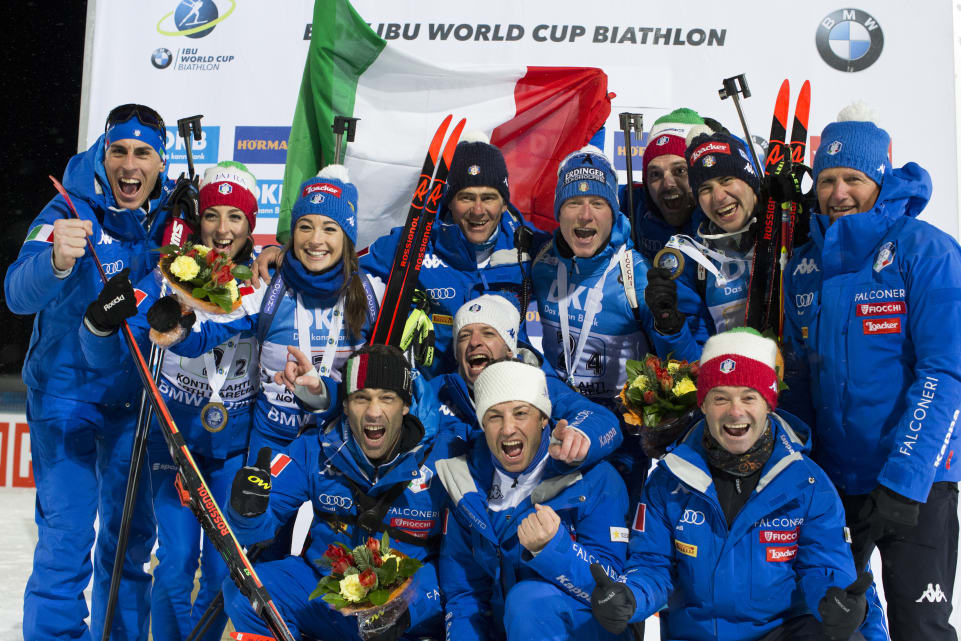
Team Italia celebrates its win in the IBU World Cup mixed relay on Saturday in Kontiolahti, Finland, with its relay members Dorothea Wierer, Lisa Vittozzi, Dominik Windisch, and Lukas Hofer. (Photo: IBU/Biathlonworld)
In Saturday’s 2 x 6 + 2 x 7.5 k mixed relay, Italy nabbed a 1.5-second victory over Ukraine in 1:15:08.3. Dorothea Wierer, Lisa Vittozzi, Dominik Windisch, and Lukas Hofer — the same Italian team that took bronze in the mixed relay at last month’s Olympics, although in a different order — combined for the win with one penalty and 13 spares.
Ukraine, with Anastasiya Merkushyna, Vita Semerenko, Artem Pryma, and Dmytro Pidruchnyi, had zero penalties and just three spares throughout the whole race. For the second-straight relay on Saturday, Norway placed third (+9.1) with Synnøve Solemdal, Tiril Eckhoff,Henrik L’Abée-Lund, and Tarjei Bø totaling zero penalties and nine spares.
Italy’s lone penalty came in Vittozzi’s second leg, but it didn’t derail the team as it improved from sixth to fifth with Vittozzi, who skied the third-fastest course time on that leg. She tagged Windisch 6.8 seconds out of first, and Windisch, who had anchored the team in the Olympics, took the lead by the final exchange after using two spares to clean. Hofer left the exchange just 3.3 seconds ahead of Norway’s Bø but used just one spare and skied the second-fastest anchor leg to finish first, beating his rivals up Kontiolahti’s infamous climb known as “The Wall”. Ukraine’s Pidruchnyi also shot clean with a single spare and clocked the fastest anchor leg to move his team from fourth to second place. Bø lost one place and finished third after using one spare as well and skiing the third-fastest anchor leg.
Russia followed in fourth, France fifth, Sweden sixth, Germany seventh, Austria eighth, and the U.S. ninth (+2:48.4). The U.S. team, with Clare Egan, Joanne Reid, Tim Burke, and Sean Doherty, had one penalty and 11 spares. Egan cleaned her first prone but had to ski a penalty lap after her standing stage, tagging Reid in 17th, 58.7 seconds out of first.
Reid used three spares on the second leg and moved up to 13th by the second exchange, and Burke used three spares as well to pick off one more place and tag Doherty in 12th. Doherty skied the eighth-fastest anchor leg and used two spares to clean to put the team in ninth at the finish.
“I don’t consider two spares to be anything special, but today it was enough to make up some ground,” Doherty wrote in an email to FasterSkier.”I felt strong skiing, more like myself which is fun even if it’s a little late in the season. We had very good skis which always helps. I have done quite a few laps on this course over the years so the lines and transitions are pretty refined, so that is where I made time on the course.
“I am happy with my leg. I enjoyed my little battle for 9th,” he continued. “I can’t speak too much for the other members of the relay tonight but I think 9th is a solid effort.”
Canada finished 17th (+4:34.9) with Emma Lunder, Julia Ransom, Scott Gow, and Brendan Green combining for one penalty and 13 spares. Lunder put them in 12th at the first exchange and Ransom skied up to 10th, but Scott Gow had a penalty on his standing stage to drop to 16th. Green lost one more place on the last leg despite only requiring two spares.
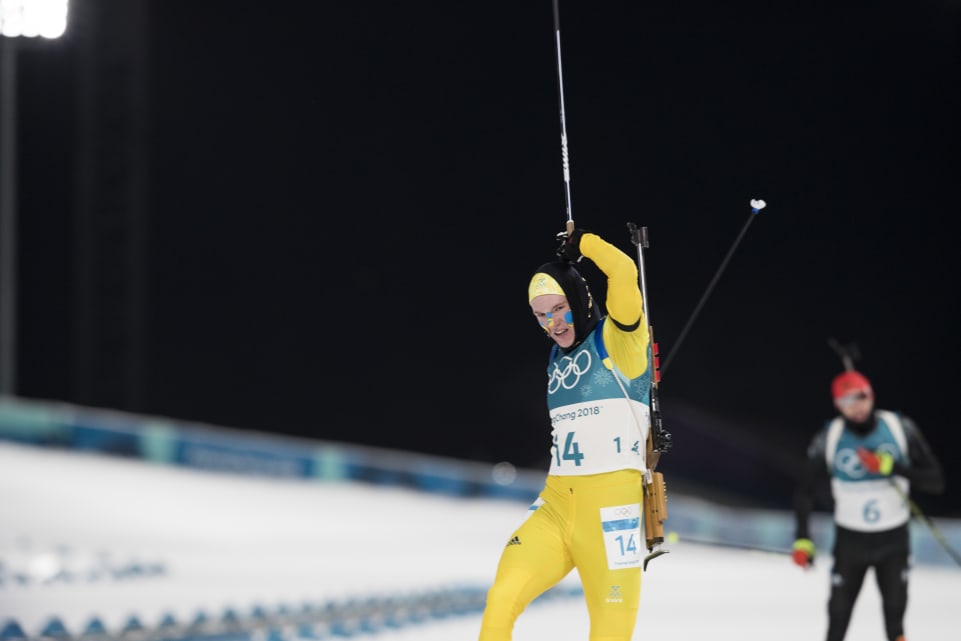
Fredrik Lindström crosses the line first to secure a gold medal for his Swedish teammates in the men’s 4 x 7.5 k relay on Friday to close out biathlon competitions at the 2018 Olympics in PyeongChang, South Korea. (Photo: FlyingPointRoad)
Remember when it was a big deal when Sweden won a Biathlon World Cup? The team in bright yellow has made it a habit at the 2018 Winter Olympics, winning their first Olympic relay gold and fourth medal over the last two weeks on Friday — the last biathlon race of the PyeongChang Games.
“It’s dreams coming true at that moment,” Fredrick Lindström, the Swedish men’s 4 x 7.5-kilometer relay anchor said in a post-race press conference on Friday. “It’s my third Olympics and to be on top with these guys feels great. I don’t know what to say.”
Lindström had taken gold in perhaps the most ideal way for an athlete in his position, by heading out on the last 2.5 k loop in first place, almost 41 seconds ahead of anyone else. While he had missed his first shot in the final standing stage of the race, Lindström cleared it with the use of one spare bullet. Meanwhile, his closest challenger for the win — Norway’s Emil Hegle Svendsen, who had followed him into the range and lined up alongside him to shoot — missed his first two targets and went on to miss more, ending up with a penalty lap after using all three spares.
That was the end of gold for Norway and for Svendsen, who was all too familiar with the penalty lane in the closing moments of an Olympic relay. Four years ago in the men’s relay in Sochi, Russia, Svendsen as Norway’s anchor had been in the medal hunt until the final shooting. There, he used all of his spares and still left a target standing, which sent him to the penalty lap. After leading by as much as 20 seconds in the middle of that race, Norway finished fourth.
But as they say, that’s biathlon. And on Friday, it was Sweden’s day and Lindström skiing on his own for a 2.5 k victory loop around the course. But he didn’t slow down. As the 28 year old skated up the final climb, he was greeted by several members of his team bowing up and down in a unison to celebrate the history that was about to be made. Lindström descended down into the stadium, not looking back and still pushing toward the line, before skiing to the sidelines a few meters before the finish to grab a small Swedish flag.
Fredrik Lindström crosses the line first to secure a gold medal for his Swedish teammates in the men’s 4 x 7.5 k relay on Friday to close out biathlon competitions at the 2018 Olympics in PyeongChang, South Korea. (Photo: FlyingPointRoad)
It wasn’t like the oversized French flag Martin Fourcade had been seen waving earlier in the Games, in the pursuit and again in the mixed relay. It was understated, like Sweden’s biathlon team before these Olympics, but he waved it proudly as he crossed the line to a sea of swarming teammates.
Sweden (with Peppe Femling, Jesper Nelin, Sebastian Samuelsson, and Lindström) finished first with a cumulative time of 1:15.16.5 hours and a total of seven spares and zero penalties. Skiing alone and finishing 55.5 seconds behind them, Svendsen crossed the line in second for Norway (with teammates Lars Helge Birkeland, Tarjei Bø, and Johannes Thingnes Bø), after tallying 12 spares and one penalty.
In stark contrast to Lindström’s wide-eyed smile as he finished, Svendsen, 32, who had previously earned bronze in the mass start and silver with Norway’s mixed relay in PyeongChang, hung his head. His teammates met him at the finish and tried to improve his mood, but he was down.
“It was a good battle. We wished each other luck before the start and it was a good fight,” Lindström said of contending with Svendsen for two out of three loops.
Norway’s third-leg skier Johannes Thingnes Bø (1) racing his team into fourth to first in the men’s 4 x 10 k relay at the 2018 Olympics in PyeongChang, South Korea. (Photo: FlyingPointRoad)
Johannes Bø had tagged Svendsen in first at the last exchange, 0.4 seconds ahead of Sweden, with Samuelsson handing off to Lindström. In the prone stage that followed, both Lindström and Svendsen cleaned without a miss. They left the range together, more than a minute clear of Germany’s Simon Schempp in third (who had missed three but avoided a penalty three spares). Germany had been 13.7 seconds back at the last exchange.
“Emil had to go first the first loop, I went first the second loop, and on the shooting we were equal until that standing,” Lindström reflected. “I don’t know, I was the lucky man today. I feel proud that I managed that situation and to bring the gold to Sweden.”
Even without gold, Svendsen is the third-most medaled biathlete in Olympic history, according to the International Biathlon Union (IBU). A four-time Olympian, he has eight medals, four of which are gold.
“I think that’s awesome,” Svendsen said when asked about his medal tally at the press conference. “It feels very good and yeah, what can I say? Thank you.”
Finishing more than a minute after Norway and exactly 2:07.1 minutes behind Sweden, Germany (with Erik Lesser, Benedikt Doll, Arnd Peiffer, and Schempp) placed third after Schempp incurred a penalty in the final standing stage. While he was still far enough ahead of Austria’s Dominik Landertinger to hang onto bronze, that penalty put Schempp nearly a minute behind Svendsen at the start of his last loop.
While he waved to the crowd as he finished, Schempp later said he wasn’t happy with his performance. The German team accrued 10 spares and three penalties (two of which came in Doll’s second leg).
“I just was disappointed in my race,” Schempp told German broadcaster ARD of his finish-line body language, according to a translation. “But at the end of the day we won the medal. That is the most important thing, that’s what matters, but of course, I can’t be satisfied with my shooting bouts. It was so incredibly gusty … I waited crazily long with my spare shots today because I thought the gusts would be over soon and then I could shoot. But unfortunately that was not the case, so I was on the range forever, losing a lot of time and then still didn’t hit every target. It was like a vicious cycle.”
Lesser and Canada’s Christian Gow Up Front
Sweden had positioned itself for a medal from the gun, with first-leg skier Femling tagging Nelin in fifth, 27.3 seconds back, at the first exchange. Germany’s Lesser had put his team in first on that leg with near-perfect shooting — cleaning prone and using one spare in standing (0+0, 0+1). Lesser tagged Doll 18 seconds ahead of Slovakia in second, which had put itself in contention with a flawless first leg from Matej Kazár. (Slovakia dropped to 15th on the second leg and was lapped on the third leg.)
Canada’s first-leg skier Christian Gow (12) leading the field, including France’s Simon Desthieux and Germany’s Erik Lesser (far l), to the top of a climb in the men’s 4 x 7.5 k relay at the 2018 Olympics in PyeongChang, South Korea. (Photo: FlyingPointRoad)
Canada attracted some serious TV time when Christian Gow took the lead on the first climb out of the stadium. He went on to hit five targets in a row in prone and left the range in second, 1.2 seconds behind Lesser in first. One loop later, Gow had slipped to eighth and about 20 seconds back when he needed three spares to clean. He ended up tagging his brother and teammate Scott Gow in ninth, about 48 seconds out of first.
“It wasn’t planned, for sure,” Gow, 24, told FasterSkier after about his decision to lead on the first loop. “Right at the top of the first climb, everyone was kind of moving over to the right, staying in kind of two lines, and there’s quite a bit of space there, so I took the opportunity to move up just because I’ve done so many relays where you’re stuck in the middle of the pack. … I saw an opportunity to get to the front — I didn’t think it would be the front — but that’s what ended up happening, and I just did my pace and no one wanted to pass me.
“I’m really happy to have cleaned the prone for sure because it’s great if you can lead it, but if you can’t knock down the targets it doesn’t mean too much,” he continued. “In the standing I’m trying to be a bit easier on myself, just because it’s a new situation to be way up in the front like that and having a great day. I wish I would have held it together a bit better than I did. I think I let the nerves get to me a little bit more than I should of, but a lesson learned and I’m happy with the first two-thirds [of my race].”
Sweden’s Steady Rise
Nelin raced Sweden into second place, 16 seconds behind the Czech Republic in first by the second exchange. He cleaned prone with one spare and avoided a penalty with three spares in standing while Germany’s Doll, who had been skiing alone in first before the standing shooting, dropped to fifth and almost 38 seconds back with two costly penalties.
The Czech Republic’s Michal Šlesingr cleaned standing without a miss to take the lead with one loop to go in the second leg, 6.8 seconds ahead of Austria’s Simon Eder in second. Nelin followed another 8 seconds back in third, and tagged just 0.2 seconds ahead of Austria in the exchange.
The third leg saw Johannes Bø, who had been tagged 31 seconds back in fourth, put Norway in first with a clean prone and a single spare in standing. Samuelsson, who had previously taken silver in the 12.5 k pursuit and placed fourth in the 20 k individual race at these Olympics, put Sweden in a position to win gold, using just one spare to clean prone and shooting without a miss in standing. He latched onto Bø, leading the Norwegian on their final loop and handing off to Lindström just 0.4 seconds behind Norway.
The Swedish men’s gold-medal relay team, with Peppe Femling, Jesper Nelin, Sebastian Samuelsson, and Fredrik Lindström, after winning the last biathlon race of the 2018 Olympics in PyeongChang, South Korea. (Photo: FlyingPointRoad)
Earlier this season, Sweden won the men’s relay at the IBU World Cup in Oberhof, Germany. The order was the same, except Martin Ponsiluoma skied the first leg, rather than Femling. While the win was a big deal for Sweden, it was against a slightly watered-down field, with some of the top biathletes opting to skip the Oberhof World Cup at the start of the new year.
Friday’s victory marked Sweden’s first Olympic relay gold in biathlon after it earned bronze in 1976 in Innsbruck, Austria, and again in 1992 in Albertville, France.
“It means a lot. It’s the first medal for men’s relay team in biathlon for Swede,” Samuelsson said. “Of course we are really satisfied. We did four good races everyone today and we’re super happy.”
U.S. Ties Olympic-Best 6th
While Austria finished Friday’s relay in fourth (+2:52.5), and France placed fifth (+3:26.6), the U.S. men tied its country’s best Olympic relay result in sixth (+3:50.2) with Lowell Bailey, Sean Doherty, Tim Burke, and Leif Nordgren. They had been 10th after Bailey’s first leg, in which he used two spares in each stage, and improved to sixth, then fifth on Doherty’s and Burke’s legs.
Doherty used just one spare in prone and cleaned standing without a miss, leaving the range in sixth and 42 seconds back with one loop to go. He then tagged Burke in sixth, about 54 seconds out of first, and Burke held that position with a flawless prone stage followed by three spares in standing. He picked off one place on his last loop to tag Nordgren in fifth, 1:38.8 minutes back.
The second-leg skier in the U.S. men’s relay, Sean Doherty racing his team into sixth on Friday at the 2018 Olympics in PyeongChang, South Korea. They went on to finish sixth to tie the best U.S. Olympic relay result. (Photo: FlyingPointRoad)
“I’m real happy about that,” Doherty, 22 and in his second Olympics, said of his shooting. “I feel like I struggled with the prone earlier on [at these Olympics] and I got that kind of dialed in today, which was nice. Standing was good. I had a little break in the wind and I took full advantage. I shot pretty fast, pretty aggressive, but I hit all five from the clip and that’s what really moved things up.
“We had a few days after the individual [race] to go back to the drawing board, come back to some of the fundamentals of shooting,” Doherty explained. “It’s nice to kind of reinforce that I’m capable of hitting targets and fixing things. When you’re not shooting well, you don’t have to keep not shooting well, if that makes sense.”
Nordgren incurred the team’s only two penalties on his prone stage, but because of the strung-out field, he hung onto sixth, losing time to those ahead of him. He used three more spares in standing but stayed out of the penalty lap, finishing about about 24 seconds behind France in fifth.
“Honestly it is a little disappointing,” Nordgren said after. “I know we were gunning a lot more as a team. I had some mistakes there in prone, too. That hurt a lot since we were right there in contention with some top teams in the world…
“I will say we had amazing skis today so I pushed really hard on the first loop and I think I got a couple seconds on [Austria’s] Landertinger,” Nordgren added. “And then just in prone … I was just getting thrown around by the wind. It is has given me trouble the whole couple weeks here I obviously never quite figured it out.”
In addition to tying the best U.S. relay result at an Olympics (of sixth place in the men’s relay at the 1972 Olympics in Sapporo, Japan), sixth was a big improvement for this team, which placed 16th at the 2014 Sochi Olympics. It was also the best Olympic relay result for Bailey and Burke, after they placed eighth in the 2014 mixed relay and ninth in the 2006 Olympic men’s relay.
Tim Burke (l) on the range during a difficult standing shooting with France’s Martin Fourcade. While Burke cleaned with three spares, Fourcade had to ski a penalty lap in the men’s 4 x 7.5 k relay at the 2018 Olympics in PyeongChang, South Korea. (Photo: FlyingPointRoad)
Asked whether this was his last Olympic race, Burke said it was.
“Today was a good for me so yeah, I would say yes,” the 36-year-old four-time Olympian said. “Biathlon is a crazy sport; it is so up and down from one race to the next. The emotional rollercoaster is amazing. I am done though.
“It has been my life for so long. It is what I know. It is what I love,” he added. “But it is time for the young guns to step up and take my place.”
Bailey told reporters while the race was still going on that he was glad to finish his Olympic career with a race that didn’t include any penalty laps.
“On a day like today, you saw that France was in the loop, now Germany, so the top nations are in there,” he said. “I cannot tell you how challenging this range is. It is so much different than most of the other ranges we shoot on.
“Every Olympics has been different,” Bailey, also 36 and a four-time Olympian as well as 2017 world champion, reflected of his career. “In Sochi I had my career best with eighth place in the individual, and I will always have that. I will always know what I am capable of. That said, I know what I am capable of and I didn’t reach the bar that I set for myself. But all four Olympics have been honestly an incredible honor to put on Team USA uniform and go out there and compete for my country.
“I know that it’s time to make the next step, to make the next transition,” he continued. “I’m really excited for our future, my family’s future. And I’m really excited for the future of US Biathlon.”
Canada 11th
Canada’s Scott Gow leading American Sean Doherty on the second leg of the men’s 4 x 7.5 k relay at the 2018 Olympics in PyeongChang, South Korea. (Photo: FlyingPointRoad)
Canada finished the race in 11th (+5:40.3). Scott Gow had brought them up to seventh with perfect shooting on both his stages (0+0, 0+0) and tagged Macx Davies about a minute out of first.
“My race pan today was to really emphasize the wind flags, and if it changes direction don’t be afraid to correct for it,” Scott Gow said. “In standing when I came in, it was quite windy, so I just waited a extra couple of seconds and then started to shoot when I felt like it was calm. It is hard to remember that sometimes because you are in the race mode and you just want to get it over with so you can try and just get back on course, so I was happy with that execution.”
Davies, in his first Olympic race, needed three spares to clean prone and slipped to 10th, then had a penalty in standing to leave the range in 12th with one loop to go. He tagged Canada’s anchor Brendan Green in 13th, 4:29 behind. Green went on to use one spare in each of his shooting stages (0+1, 0+1) to bring the team up to 11th at the finish.
Macx Davies skiing the third leg for Canada’s 4 x 7.5 k men’s relay at the 2018 Olympics in PyeongChang, South Korea. (Photo: FlyingPointRoad)
“It wasn’t a great race for me, but I fought through it and pushed myself so that’s all I can ever really do,” the 25-year-old Davies said. “Coming into this race I was kind of just excited to get an Olympic start. We didn’t know if I was in or not until yesterday morning. Then kind of sitting around today, slowing realizing that it was happening tonight and getting a little bit more nervous and a little bit more excited as it went on. That was exciting.
“Being part of the team, being part of Team Canada, it’s such a great feeling, great atmosphere,” Davies added. “Everyday you see someone do something amazing and that just inspires you to keep pushing yourself and do everything in your power to succeed.”
As for Green, he said it’s safe to say these were his last Olympics.
“I’ve been to three Games now and they’ve all been very unique and special in their own way,” the 31-year-old Green said. “I think Korea did a great job hosting. Volunteers are spectacular and so friendly. It’s too bad the weather didn’t cooperate a little bit more, but we did our best We all fought hard and I think we’ll be going away motivated and looking forward to more.”
What’s Next?
While the IBU World Cup season resumes March 8-11 in Kontiolahti, Finland, then makes its next stop in Oslo, Norway, March 15-18, both the Canadian and U.S. teams have stated they will boycott the season-ending World Cup in Tyumen, Russia, March 22-25.
“The latest decision by the IBU was to send the World Cup tour to Tyumen, Russia for our World Cup final,” Bailey said on Friday. “Team USA is boycotting. The Czech team is boycotting. Canada is boycotting. We are trying to rally more support. I know that as an [IBU] athletes’ rep, we had almost every country had athletes that wrote letters to the IBU saying that we do not want to go to Tyumen. We don’t think it’s the right thing for clean sport, and still, the executive board with Anders Besseberg at the helm decided that it was in their best interest to go to Tyumen. So it’s time for a change. IBU leadership needs to change. Besseberg needs to step down. He’s lost the trust of the athletes.”
“We won’t go to Russia,” Green said. “Instead we’ll go back to Canada for nationals. … I think until Russia is compliant we’ll probably continue to take a hard stance until things change.”
Fredrik Lindström of Sweden crosses the line after securing a gold medal for his Swedish teammates in the men’s relay to close out biathlon competitions at the 2018 Olympics in PyeongChang, South Korea. (Photo: FlyingPointRoad)
Germany were the favorites coming into this men’s relay and Erik Lesser started them off with a near-perfect relay leg to sit in first place, but shooting collapses by Benedikt Doll and Simon Schempp left the team with bronze medals at the finish.
On a windy, gusty day, the relay instead came down to a race between Norway and Sweden. Coming into the last shooting stage Fredrik Lindström of Sweden and Emil Hegle Svendsen of Norway were stride for stride. Each missed their first shot in standing, but Lindström pulled himself together and hit the next four shots, then hit the final target using a spare round. Svendsen, on the other hand, kept missing and ended up skiing a penalty loop – just as he had when anchoring the Norwegian team in the Olympics in Sochi four years ago.
A strong leg from Tim Burke, who cleaned prone and then survived on spare rounds while chaser Martin Fourcade of France headed to the penalty loop, helped the U.S. secure a best-ever sixth-place finish in the Olympic men’s relay. (Photo: FlyingPointRoad)
Then, that left Norway off the podium. This time, Norway still earned silver, as behind him Schempp had his own shooting woes.
An exciting relay with multiple lead changes in the end turned into something of a blowout, with Lindström able to celebrate on his final loop before joining overjoyed teammates Peppe Femling, Jesper Nelin, and Sebastian Samuelsson at the finish. It was the first Olympic relay gold medal in the history of Swedish biathlon, and the team did it with phenomenal shooting – just seven spare rounds despite difficult conditions. They were the only team to avoid the penalty loop, which most teams visited more than once.
The Norwegian squad of Lars Helge Birkeland, Tarjei Bø, Johannes Thingnes Bø, and Svendsen finished 55.5 seconds back. The Germans with Lesser, Doll, Arnd Peiffer, and Schempp crossed the line +2:07.1, and the Austrian squad of Tobias Eberhard, Simon Eder, Julian Eberhard, and Dominik Landertinger were the first ones out of the medals, +2:52.5.
The American team of Lowell Bailey, Sean Doherty, Tim Burke, and Leif Nordgren finished sixth, +3:50.2, tying the best-ever men’s relay finish by an American team at the Olympics. They had 14 spare rounds and two penalty loops.
The Canadian squad of Christian Gow, Scott Gow, Macx Davies, and Brendan Green finished 11th, +5:40.3, with 11 spare rounds and a penalty loop.
Johannes Høsflot Klæbo anchoring the Norwegian men’s 4 x 10 relay to gold on Sunday at the 2018 Olympics in PyeongChang, South Korea, while Denis Spitsov (background) celebrates silver for the Olympic Athletes for Russia. (Photo: FlyingPointRoad)
For a while in the men’s 4 x 10-kilometer relay on Sunday, it looked like the Russians might run away with the win. But that was just two classic legs and 20 k into the race, with a lot more racing to come.
While Kazakhstan’s Alexey Poltoranin had handed off in first at the first exchange, just ahead of Andrey Larkov of the Olympic Athletes from Russia, Italy, France and Norway skied together behind them, with Norway’s Didrik Tønseth trailing off the back, 18 seconds behind.
On the next classic leg, Russia’s Alexander Bolshunov put a hurt on the field. Within the first 3.3 k lap, he was 25 seconds ahead of Kazakhstan’s Yevgeniy Velichko in second, who was followed closely by Italy, Norway and France in third through fifth. Sweden’s Daniel Rickardsson had fallen farther behind to more than a minute back in sixth place, after his teammate Jens Burman lost contact with the lead group on the first leg.
By the second exchange, Russia was 24.5 seconds clear of second place, while Italy’s Francesco de Fabiani tagged Giandomenico Salvadori in second, France’s Maurice Manificat tagged Clement Parisse in third (+28.0), and Norway’s Martin Johnsrud Sundby tagged Simen Hegstad Krüger in fourth (+32.1). Kazakhstan’s Velichko had fallen off the pace and was another 19 seconds back in fifth.
Over the next 10 k, the first skate leg, Krüger and Parisse reeled in Russia’s Alexey Chervotkin, catching him before the end of their second lap. One lap later, Krüger came through the final exchange in first, tagging Johannes Høsflot Klæbo 0.4 seconds ahead of France in second. Chervotkin tagged Russia’s anchor Denis Spitsov in third, 16.2 seconds back, while Finland’s Matti Heikkinen passed Italy’s Salvadori on the last climb to put Finland in fourth (+58.6).
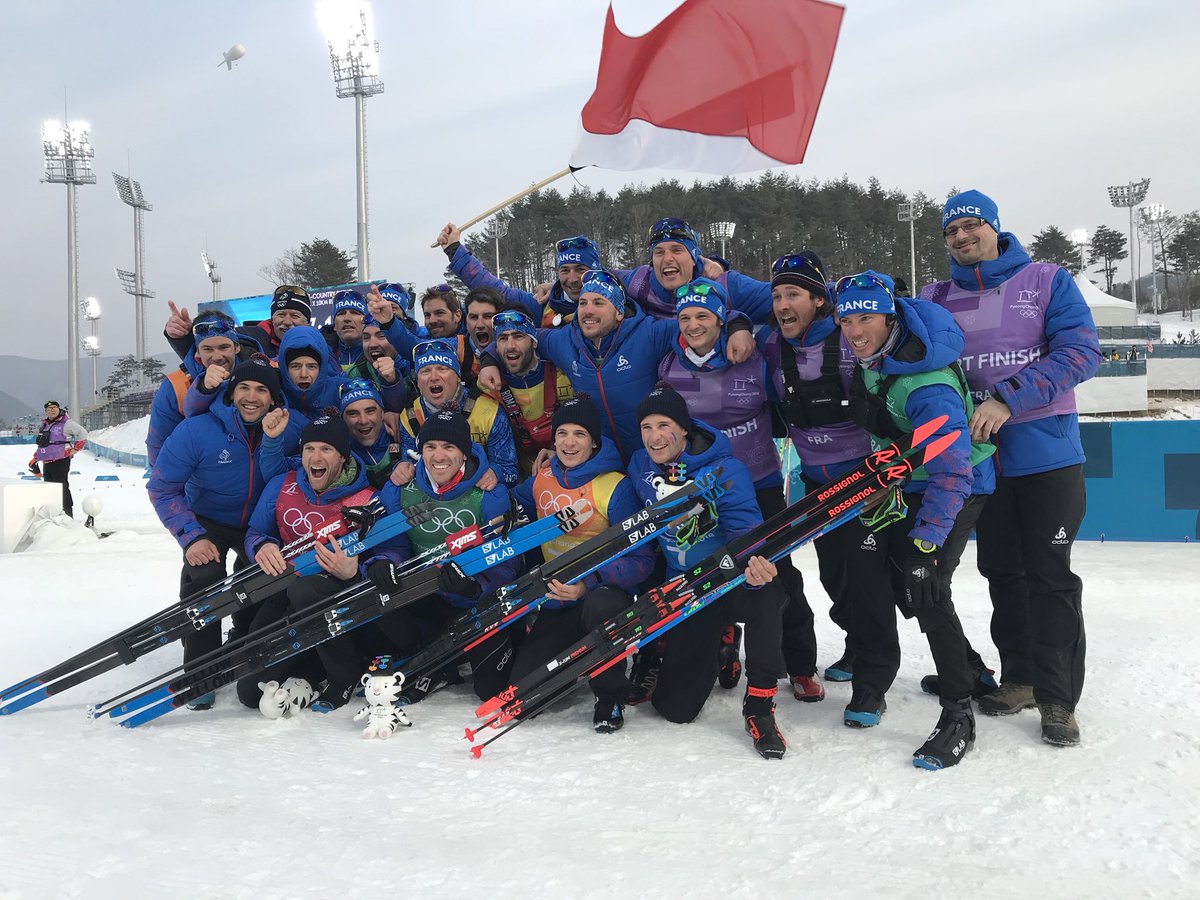
Team France celebrates its bronze-medal finish in the men’s 4 x 10 k relay at the 2018 Olympics on Sunday in PyeongChang, South Korea. (Photo: FIS Cross Country/Twitter)
Early in the final leg, France’s Adrien Backscheider took the lead ahead of Klæbo. The two held Spitsov off until the end of the second lap, where Spitsov came through the stadium first to start the final loop. Spitsov and Klæbo soon upped the pace, dropping Backscheider, and shortly after the 8.27 k checkpoint, Klæbo truly put the jets on to accelerate away from Spitsov. He dropped the Russian on a climb just before the final uphill, where it was clear that the gold was Norway’s.
As he sped down into the stadium, Klæbo relaxed his arms, skied to the sideline and took a flag from the stands. He looked back for a moment and then crossed the finish line first in 1:33:04.9 hours, while Spitsov followed 9.4 seconds later for silver for Russia. Backscheider held on for bronze (+36.9) as his team exuberantly celebrated with him at the finish.
Finland placed fourth (+1:40.5), Sweden fifth (+2:05.6), Germany sixth (+2:08.2), Italy seventh (+2:35.2), and Kazakhstan eighth (+3:31.4). Canada was ninth (+3:41.0) for its second-best Olympic relay result (with Len Valjas, Graeme Killick, Russell Kennedy, and Knute Johnsgaard), and the U.S. finished 14th (+9:24.2), out of 14 teams, with Andy Newell, Reese Hanneman, Scott Patterson, and Noah Hoffman.
France’s Martin Fourcade lunging for his second gold of the 2018 Olympics in PyeongChang, South Korea, winning the men’s 15 k mass start on Sunday. (Photo: FlyingPointRoad)
Martin Fourcade is the champion once again. Six days after he won the 12.5-kilometer pursuit for his first gold in PyeongChang, the 29-year-old Frenchman did it again in the men’s 15 k mass start on Sunday, winning in a photo finish at the line.
He took charge on the first loop, leading the field into the range for the first prone shooting. There, Fourcade shot a penalty and slipped to 19th, but it wasn’t over.
Clean shooting on the second prone brought him up to eighth, 9.4 seconds out of first. Germany’s Benedikt Doll took that lead at that point after his second stage without a miss. Meanwhile Norway’s Johannes Thingnes Bø shot three misses on that second stage and dropped out of contention.
One loop later, Fourcade moved into first with a clean standing. He left the range about 1 second ahead of Germany’s Simon Schempp and 2 seconds ahead of Germany’s Erik Lesser, after both made it through the first three stages without a miss. Doll missed one to slip to seventh, almost 30 seconds behind.
After Fourcade and Schempp exchanged leads over the next loop, Lesser moved into first just before the final shooing, Going head to head, Fourcade and Schempp both missed one while Lesser missed two. Fourcade and Schempp still left the range in first and second, respectively, separated by 0.4 seconds, while Lesser slipped to fifth, 22.5 seconds back.
Doll left the range in third (+19.2) after cleaning and Norway’s Emil Hegle Svendsen moved into fourth (+21.9) with a clean standing stage as well.
In the end, Fourcade outlunged Schempp for the win in 35:47.3 minutes, with Schempp finishing less than a tenth of a second behind for silver, and Svendsen beat out Lesser in the finishing stretch by 0.4 seconds to claim bronze, 11.2 seconds behind, while Lesser settled for fourth (+11.6). Doll followed them in fifth (+18.8), Austria’s Julian Eberhard placed sixth (+30.7) with three penalties, Norway’s Erlend Bjøntegaard seventh (+32.1) with two misses, Norway’s Tarjei Bø eighth (+34.6) with three penalties, Sweden’s Jesper Nelin ninth (+34.6) with two misses, and Slovenia’s Jakov Fak 10th (+36.1), just ahead of the Czech Republic’s Ondřej Moravec in 11th (+36.3), with one miss each.
France’s Martin Fourcade defending his Olympic gold from four years ago on Monday in the men’s 12.5 k pursuit at the 2018 Olympics in PyeongChang, South Korea. (Photo: FlyingPointRoad)
Imagine for a moment, if you can, that you’re a two-time Olympic gold medalist from four years ago, and so far this winter, you’ve been on the podium in every biathlon World Cup you’ve raced but one (the first race, a single-mixed relay in November).
Your name is Martin Fourcade and you’re an 11-time world champion from France. You’re also a 29-year-old dad and you’ve spent the last four years since the last Olympics more or less preparing for gold in another race: the first race of the 2018 Olympics in PyeongChang, South Korea.
Now imagine that in that race, which you came into feeling more prepared than ever, you finished eighth after missing three targets in the first prone shooting stage.
Fourcade recalled in a press conference on Monday that his result in the men’s 10-kilometer sprint on Sunday wasn’t frustrating. It was disappointing.
“It was a really strange feeling,” Fourcade said after Monday’s 12.5 k pursuit. “… I was disappointed because yesterday I did not understand why I missed three, and I wanted this Olympic gold in the sprint more than any of the competitions. I worked really hard for this competition. I worked on my shooting for being good in the sprint, I worked on my skiing to be good in the sprint, and I think I was relaxed, I was in a good mood, I had good preparation. … And after the race [yesterday] I was really sad because I didn’t understand what I did bad.”
On Monday morning, he reviewed a photo of his missed shots in the sprint and figured out his error. The red flags that show the strength and direction of the wind in the range were waving more violently than he had remembered feeling during that prone bout.
“I realized it was not because I was unlucky … it was because I did a mistake, and from that time it was really much more easy to turn my anger into strength for the competition today,” Fourcade said. “It’s a bit masochist, but it works.”
Fourcade started the second race of the 2018 Games, the pursuit, 22 seconds behind Germany’s Arnd Peiffer (who won Sunday’s sprint) in eighth. Peiffer held his ground through the first loop and first prone shooting in first, hitting all of his targets and leaving the range in second, just 0.8 seconds behind Austria’s Julian Eberhard, who also cleaned and started the race in fourth.
France’s Martin Fourcade (8) skiing in the pack en route a gold medal in the men’s biathlon pursuit on Monday at the 2018 Olympics in PyeongChang, South Korea. (Photo: FlyingPointRoad)
Fourcade missed his third shot and emerged from the penalty loop still in eighth, now 28 seconds out of first. He and Peiffer both cleaned the second prone, putting Peiffer back into first and Fourcade up to sixth, 21 seconds behind, while Eberhard missed one to drop to seventh.
All the while, the little red flags blew in various directions, twirling around their posts. Gusts kicked up flurries of snow into the air, under a pitch black sky past 9 p.m. Korea time — the start of the men’s pursuit.
It was once again frigid out there and only those who were shooting carefully enough and could feel their fingers (or were managing it regardless) were succeeding.
On the third loop, Fourcade hooked up with a chase group in an effort to catch Peiffer, and by the end of that 2.5 k loop, they did. Heading into the range for the first standing shooting, Fourcade put himself in second, just ahead of Germany’s Simon Schempp in third and behind Peiffer in first. Fourcade and Peiffer lined up in the second and first shooting positions, respectively, putting the pressure on Peiffer in particular.
Then, Peiffer missed his first shot. He hit the remaining four, but it wasn’t enough — Fourcade had knocked down all five and had taken his time to do so, posting the 28th-ranked shooting time. While Peiffer skied his first penalty lap of the day, Fourcade headed back to the course in first place. Peiffer slotted into second, 20.3 seconds behind.
“I think it was a key time of the competition because on the third shooting, the wind was really tricky, challenging, probably it was the most difficult shooting of today,” Fourcade recalled of that standing stage. “I took a bit more time then my opponents to shoot my first ammunition and then when I realized I was the only one who shot clean, I knew that I was the only one who could decide who would be the Olympic champion. I didn’t say that I was sure I would win, but the decision was in my hand.”
He rounded the fourth loop on his own and entered the range for the last time all alone. Then, Fourcade cleaned all five targets with the ninth-fastest shooting time, and turned to the stands behind him with a celebratory fist pump.
“My finish line was not the real finish line, it was the last ammunition of my last magazine on the fourth shooting,” Fourcade said. “I really put all my energy into this shooting and I think if I had to fight with any athlete on the tracks, I wasn’t able to do it because after this shooting I was totally empty.”
He didn’t need to fight with anyone on that last loop. Behind him, Germany’s Benedikt Doll had moved into second with a clean final stage, 36 seconds back, and Sweden’s Sebastien Samuelsson was up to third, another eight seconds behind.
On that final loop, Fourcade locked up gold, coming into the stadium with enough time to grab a large French flag from the stands, about 100 meters from the finish. Meanwhile, Doll and Samuelsson duked it out for second, with Samuelsson closing the gap to Doll then challenging him on the final climb.
“I saw Sebastien behind me and my legs felt weaker and weaker in the long uphill,” Doll, the 2017 sprint world champion, said at the press conference. “And he came closer and closer, and then he [caught] me so I was thinking, ‘OK, now I need to make a new tactic for sprinting for the finish.’ ”
The 20-year-old Samuelsson overtook Doll, 27, as they crested the last climb and led the downhill toward the stadium finish.
“I knew we had really good skis today and I knew that if I can catch him at the top, I had a really good chance,” Samuelsson reflected. “My plan was to go a little bit later because I wanted a wind shadow, but [my team’s] waxers were … yelling a lot and then I just had to go. I was helped a lot with my skis today.”
Sebastien Samuelsson of Sweden celebrating silver in the men’s 12.5 k pursuit at his first Olympics on Monday in PyeongChang, South Korea. It was also his first non-relay podium at the World Cup/World Championships level. (Photo: IBU/Biathlonworld)
In the end, Samuelsson got him by 3 seconds for silver, finishing 12 seconds after Fourcade claimed the win in 32:51.7 minutes. Doll, who had started the pursuit in sixth, settled for bronze, 15 seconds behind Fourcade, for his first medal in his first Olympics with a single penalty (0+1+0+0).
“I couldn’t follow [Samuelsson] and he had faster skis,” Doll concluded. “He was a little bit stronger, and so I think he’s the right holder for the silver medal.”
In addition to shooting 19-for-20 (0+0+1+0), Samuelsson, who started the race in 14th, raced the fastest overall course time of the day, 8.6 seconds faster than Fourcade, who was second fastest. The young Swede reportedly told the International Biathlon Union (IBU) on Periscope that he’d cut his hair if he won a medal at his first Olympics in PyeongChang.
“I think nobody was thinking I’d be able to cut my hair after these Olympics, but now I have to do it, I have said so,” Samuelsson said at the press conference. “But I heard that my teammate said maybe you should keep the hair until the relays because you never know what will happen if you cut it.”
Samuelsson’s previous individual World Cup best was 13th in a sprint last season. He won a relay with his four-man team this season in the 4 x 7.5 k in Oberhof, Germany. After Monday’s pursuit, Fourcade said he congratulated him.
“I told Sebastien in the changing room, it’s not a bad day to start his first Olympics with his first international podium. I know a guy who did that eight years ago in the Olympics in Vancouver,” Fourcade said, referring to his first Olympic medal (silver) in the mass start at the 2010 Games.
Fourcade went on to win the pursuit and 15 k individual race at the 2014 Olympics in Sochi, Russia, where he also took silver in the sprint.
“Martin is, I mean, the perfect biathlete,” Samuelsson said. “I knew when he finished eighth yesterday that today he would be really fighting for the gold medal. For me, it’s a big victory for me to just be on the podium and Martin is unbelievably good.”
“Martin was not happy [after the sprint],” Doll said when asked about Fourcade. “Of course three mistakes in the prone shooting, it’s horrible, so it was for sure that today that he will fight and give everything to win, and in the end his plan fulfilled. He was I think the fastest skier or maybe Sebastien was the fastest skier, I don’t know, but he was the best biathlete today.”
France’s Martin Fourcade after winning the men’s 12.5 k pursuit on Monday at the 2018 Olympics in PyeongChang, South Korea. He also won the pursuit at the 2014 Sochi Olympics. (Photo: FlyingPointRoad)
In his book, “Martin Fourcade: Mon rêve d’or et de neige” (My dream of gold and snow), which came out in November, Fourcade wrote about how nervous he was the night before his first gold medal in Sochi.
“Four years ago before the Olympics in Sochi, I was simply shaking because I had a lot of fears,” Fourcade said at Monday’s press conference when asked about that passage from the book. “Many things changed in my life since Sochi. When I came here in Korea, I knew that I will be a happy man even without any Olympic gold in this event, so I think it helped me to take it more easy and I was in a really good mood and really satisfied with how I prepared this competition.”
Asked now if that fear is gone, he said it was.
The men’s 12.5 k pursuit podium at the 2018 Olympics in PyeongChang, South Korea, with France’s Martin Fourcade (c) in first, Sweden’s Sebastien Samuelsson (l) in second and Germany’s Benedikt Doll (r) in third. (Photo: IBU/Biathlonworld)
Finishing 47.5 seconds after Doll was Norway’s Tarjei Bø in fourth (+1:02.6). Bø started 13th and posted the fourth-fastest course time to overcome three penalties (0+0+1+2). He held off three others in a sprint to the line, with Schempp following in fifth (+1:02.7), after starting seventh, Switzerland’s Benjamin Weger placing sixth (+1:03.1), up from 15th at the start, and France’s Simon Desthieux placing seventh (+1:03.7), up from 12th. Peiffer ended up eighth (+1:14.1) with three penalties (0+0+1+2), and Sunday’s silver medalist Michal Krčmář of the Czech Republic finished 30th (+3:49.9) with seven misses (2+0+3+2).
Norway’s Johannes Thingnes Bø finished the race in 21st (+2:51.0), up 10 places from starting 31st based on his sprint result, with six penalties on Monday (0+2+4+0).
“We both [knew] before the Olympics that it will not be only a fight between us because we know the shooting range [here] is challenging,” Fourcade said of Johannes Bø, his main rival this season. “I thought that at our best level, we could be difficult to beat, but the wind and the Olympic situation will bring many opportunities for outsiders to take [medals], yesterday Arnd did in a magnificent way. It’s not a competition about Johannes today. It’s biathlon.”
Burke Up to 17th
Tim Burke (US Biathlon) racing to 17th in the men’s 12.5 k pursuit at the 2018 Olympics in PyeongChang, South Korea, up from 47th at the start. (Photo: NordicFocus/US Biathlon)
Three Americans and one Canadian qualified for the pursuit in the sprint top 60, and US Biathlon’s Tim Burke raced all the way up to 17th (+2:19.6) after starting 47th, with two penalties (0+1+1+0) and the 15th-fastest overall course time.
“I am very happy with the race,” Burke said in a post-race interview with FasterSkier. “I really felt like I put it together for the opportunities I was given in the race today, but this is not normal biathlon. You saw that they moved the downhill [competition] to a different day; we can’t do that in biathlon we have too many events, so we have to go on these days when it’s honestly unfair conditions like today. I benefited a lot from having very little wind in my standing positions, and I was able to move up a lot. Others I know were not so lucky. Unfortunately that is part of an outdoor sport.”
Asked how he reset after the sprint the day before, Burke said he talked about it with his coach.
“I was disappointed in the result not the performance,” he recalled. “I felt like I executed well. I felt like I hit my cues on the course and on the range, and it just didn’t happen yesterday. The game plan going into today was nothing, there was nothing new, stick to the things that have been working well for me in the World Cup and that’s what I did.”
After Burke, Lowell Bailey was the next best American on Monday, finishing 32nd (+3:51.6) after starting 33rd. He cleaned the first two stages but missed five between the two standing bouts (0+0+3+2).
American Lowell Bailey (33) racing to 32nd in the men’s 12.5 k pursuit at the 2018 Olympics in PyeongChang, South Korea (Photo: NordicFocus/US Biathlon)
“Unfortunately today, the weather got involved and I had one stage that really just threw my race off,” Bailey told FasterSkier after. “Wind, I mean, that third stage was just absolutely ridiculous. … There was nothing longer than 20 seconds of those big gusts and that time it was like two minutes. I got through of about 40 seconds of standing there waiting, time bleeding off the clock at that point I just started pulling the trigger, I couldn’t hold on the target, you just got to do your best on that point.”
Then there was Leif Norgren, also of the U.S., who finished 50th (+5:48.7), up from 58th at the start, with five penalties (2+2+0+1).
“Physically I think it was improvement from yesterday,” Nordgren told FasterSkier. “I still struggled with the wind and shooting, and it makes it kind of frustrating because with windy conditions like these it’s a big opportunity to move up in the pursuit and I wasn’t able to capitalize on that today. So a little disappointed in that regard, but that’s just how it goes sometimes.”
Canada’s lone man in the pursuit, Nathan Smith crossed the line in 54th (+6:06.5), after starting 44th, with four misses (0+0+1+3).
While he raced up to 37th after the first three stages, Smith dropped to 51st with three misses in the last standing.
“Three penalties on the last standing was really a lot of time spent in the loop,” he reflected.
Physically, he said the race felt, “really, really hard.”
Biathlon at the Olympics continues with the women’s 15 k individual on Wednesday and men’s 20 k individual on Thursday.
Keep calm and be the best: one missed shot early on did not keep France’s Martin Fourcade from defending his Olympic gold medal in the men’s biathlon pursuit. (Photo: FlyingPointRoad)
“Use this rage as energy!” Martin Fourcadewrote on Instagram after finishing eighth in the men’s 10-kilometer sprint on Sunday.
Um, yeah. The French biathlon star defended his gold medal from the 2014 Olympic pursuit with just one missed shot in Monday’s 12.5 k competition, taking the lead after the third shooting stage and never giving it back. He finished with a comfortable enough margin to grab the French flag and take his time waving it down the finishing straight.
A large pack of chasers were all in contention for second place coming into the final shooting stage, but of them all only Benedikt Doll of Germany and Sebastian Samuelsson of Sweden cleaned their targets. Samuelsson took his time to do so, and left the range with a nearly eight-second deficit on Doll. But he gradually worked his way up to the German on the trails, before putting in a spurt on one of the last small uphills on the course. The 20-year-old Swede managed to hold his lead on the swooping downhills into the stadium and not get consumed by the draft effect, and celebrated crossing the line in second place. Samuelsson’s previous best result was 13th place in a World Cup. It is Sweden’s first Olympic biathlon medal since 2010.
Tarjei Bø of Norway finished fourth (+1:02.6) after missing three shots; all the medalists had only a single penalty apiece. Germany’s Simon Schempp was fifth (+1:02.7), also with three penalties, and Switzerland’s Benjamin Weger finished sixth with two missed shots (+1:03.1), narrowly edging France’s Simon Desthieux (+1:03.7).
For the U.S., Tim Burke finished 17th (+2:19.6) with just two missed shots after starting in 47th position after a disappointing sprint race. Lowell Bailey placed32nd (+3:51.6) with five penalties — all in standing — and Leif Nordgren 50th (+5:48.7), also with five missed shots.
For Canada, Nathan Smith finished 54th (+6:06.5) with four missed shots.
With just one missed shot, Germany’s Laura Dahlmeier took her second gold medal of this young Olympic Games when she won the 10 k biathlon pursuit by 29.4 seconds. Dahlmeier finished no better than 13th in the 2014 Olympics — where she was only 20 years old – but four more years of experience have made her nearly unbeatable, if last year’s triple gold haul from World Championships serves as a basis for comparison. But even if she only nets these two golds, she has already made history: no other woman has ever won both the sprint and the pursuit at the same Olympic Games.
Dahlmeier started in bib 1 but the other medalists used stellar performances to move up after disappointing sprint races. Anastasiya Kuzmina of Slovakia edged France’s Anais Bescond by just 0.2 seconds to take silver. Kuzmina had started in bib 13 and won her medal despite four missed shots – she had the fastest course time of the whole field – while Bescond had started 19th but had hit all but one of her targets.
Fourth place went to the sprint silver medalist Marte Olsbu of Norway (+1:07.3), fifth to Hanna Öberg of Sweden (+1:08.9), and sixth to Denise Herrman of Germany (+1:19.4).
Rosanna Crawford of Canada started 53rd after a tough sprint race, but shot 18/20 and moved up to 19th place (+2:27.7), the best Olympic result of her career.
Montana State University student Johanna Talihärm, representing Estonia, missed four shots to finish 26th (+2:59.4). Just behind her was Canada’s Julia Ransom in 28th (+3:03.0) with one missed shot.
The lone American in the race, Emily Dreissigacker, set a new career best with 47th place (+5:01.4), and Canada’s Emma Lunder finished 53rd (+6:16.8). Teammate Megan Tandy did not start.
Darya Domracheva of Belarus (center) won the final World Cup race before the Olympics, a 12.5 k mass start in Antholz, Italy. Anastasiya Kuzmina of Slovakia was second and Kaisa Makarainen of Finland third. (Photo: IBU/Biathlonworld)
On Saturday, Darya Domracheva watched as second place in the World Cup pursuit skied away from her.
She had stepped on competitor Dorothea Wierer’s pole in the final corner of the 10 k pursuit in Antholz, Italy, and felt it unsportsmanlike to try to beat Wierer to the finish when the Italian had only one ski pole. So she let Wierer go and settled for third.
In Sunday’s World Cup mass start, Domracheva was rewarded by some combination of karma, skill, and hard work, and rounded that same corner to the finish line all alone in first place to claim her second win of the season.
Nobody shot better than Domracheva, and only six other women matched her single penalty loop. The Belarusian left the shooting range after the fourth and final stage with just a 3.3-second lead on Slovakia’s Anastasiya Kuzmina, who missed three shots in total and was coming out of the penalty loop as Domracheva skated past.
Germany’s Maren Hammerschmidt fights through thick snow in the forest during Sunday’s 12.5 k mass start in Antholz, Italy. (Eurovision screenshot)
“It was very tough race, and very slow snow conditions,” Domracheva said in a press conference of the abundant fresh snow that had fallen overnight and continued to fall off trees and onto the trails (and racers) during the competition. “So I understood from the start of the competition that it was really important to be focused on shooting today.”
But Domracheva was able to put the hammer down and extend the gap on Kuzmina, who had been the most dominant athlete of the first half of the season, and win by 11.9 seconds.
“I can say that today was quite a tough race for me,” Domracheva said. “The feeling was not so light. It was also not in the plan that here in Antholz would be very easy. So we are still in preparation, and it’s one very important step in my preparation for the next races.”
It was the last World Cup competition before the Olympics, where Domracheva will do her best to follow up on the three gold medals she won in Sochi in 2014.
Kaisa Makarainen of Finland fights to the finish line. (Photo: IBU/Biathlonworld)
Third place went to Kaisa Makarainen of Finland, who was frustrated by four missed shots and left the range (and penalty loop) the final time in eighth place. But in a stunning show of grit and speed, she charged past racer after racer; she had the fastest ski time of the day and that was particularly true on the last loop.
The Finn celebrated as she crossed the line 16.2 seconds behind Domracheva. That meant another podium – her fifth of the season – and two spots on Germany’s Laura Dahlmeier, thus hanging onto the yellow bib of the overall World Cup leader until racing resumes after the Olympics (which don’t count for World Cup points).
“I tried to ski as fast as possible and catch some places,” Makarainen said in the press conference. “I was not sure if I could catch the podium because it was quite a big gap. But I guess some other girls were more tired than me!”
Fourth place went to Norway’s Marte Olsbu (+22.6), fifth to Dahlmeier (+23.9), and sixth to her teammate Maren Hammerschmidt (+25.2).
Wierer had shot clean through three stages and led the race onto the shooting range the last time, to the thrill of the home crowd. But she missed two shots and ended the day in seventh, +29.4.
Fourcade Extends World Cup Lead with Another Win
While Norway’s Johannes Thingnes Bø came into the men’s 15 k mass start with two consecutive wins under his belt, he immediately missed two shots in the first prone stage, then two more in the next prone stage.
While Bø has turned in some of the most stunning performances on the World Cup this season, another man leads the standings, and that’s Martin Fourcade of France. Fourcade is nothing if not consistent and with only two missed shots in the mass start, he picked up his sixth win of the season.
Martin Fourcade of France leading the 15 k mass start in Antholz, Italy, where he picked up his sixth win of the season. (Photo: IBU/Biathlonworld)
“It’s good to find back this position in Antholz,” he said in a post-race press conference. “It’s only my second victory here. The first one was in the mass start in 2011, so it’s been a while and I’m very satisfied and happy to be back on top of the podium in Antholz.”
The last time Fourcade was off the podium was in the single mixed relay in Östersund, Sweden, in the very first race of the season, and the last time he was off the individual podium was back in Kontiolahti, Finland, in the second-to-last weekend of last season.
“The weekend was really nice,” Fourcade said. “I had not my best ski level on the first two competitions, but today felt really good on the skis and it gives me confidence for the Olympics… I want to keep my hunger from that last [bullet] I missed, to keep some things to work on for the Olympics.”
With the younger Bø out of the picture, the two men who ended up battling behind Fourcade were both still Norwegian: Tarjei Bø, the older brother in the family, and his teammate Erlend Bjøntegaard.
Tim Burke of the United States after finishing 22nd in the World Cup mass start in Antholz, Italy. (Photo: USBA/Instagram)
Former World Champion Bø won their sprint to the finish, crossing the line 2.8 seconds behind Fourcade (who had eased through the last few hundred meters after maintaining a big lead through the rest of the course), and Bjøntegaard picked up his first career podium in third (+5.1).
“It was quite fun actually,” Bjøntegaard said of his battle with Bø. “I’ve had a lot of hard sessions with that guy in the past two years. We were talking to each other on the fourth loop and the last loop, trying to exchange who was in front. I think that worked out quite well. I know that he is strong in the head, especially at the end, but I think I gave it a good shot and I really tried.”
After the Norwegians it was two Germans battling to the line, with Benedikt Doll taking fourth (+16.0) and Johannes Kuehn fifth (+18.3), each with two missed shots.
Johannes Bø struggled mightily against his five total penalties, and remarkably managed to make it up to sixth place, just 29.2 seconds behind Fourcade.
The Norwegian men’s relay after winning the 4 x 7.5 k on Friday at the IBU World Cup in Ruhpolding, Germany, with Lars Helge Birkeland (l), Tarjei Bø (far r), Emil Hegle Svendsen (second from r), and Johannes Thingnes Bø (second from l). It was their second win of the season (after winning with Ole Einar Bjørndalen, Henrik L’Abée-Lund, and Erlend Bjøntegaard, and Birkeland in the first men’s relay of the 2017/2018 season in Hochfilzen, Austria. (Photo: IBU/Biathlonworld)
IBU World Cup (Ruhpolding, Germany): Men’s 4 x 7.5 k relay
Less than a week after Sweden won the men’s 4 x 7.5-kilometer relay in Oberhof, Germany, with an up-and-coming group, Norway posted its second win (in three relays) this season, with an all-star lineup on Friday in Ruhpolding, Germany.
Lars Helge Birkeland, Tarjei Bø, Emil Hegle Svendsen, and Johannes Thingnes Bø took the lead during Johannes Bø’s anchor leg and ultimately the win in 1:13:11.1 hours, 24.9 seconds ahead of France in second and 53.4 seconds ahead of Russia in third.
On a bluebird day with no wind in the range, according to an International Biathlon Union (IBU) press release, the Norwegians avoided the penalty lap and used seven spares to clean. First-leg skier Birkeland put them in second with near-perfect shooting (0+0, 0+1), just 0.4 seconds behind Germany’s Erik Lesser, who cleaned without any spares, in first. (Birkeland was also on the Norwegian team that won the first relay of the season in Hochfilzen, Austria.)
Norway remained in second during Tarjei Bø’s second leg, in which he had to use three spares to clean prone (0+3, 0+0). He tagged Svendsen in second, 0.6 seconds behind Italy, which had risen to first thanks to Lukas Hofer’s fast skiing and solid shooting (0+0, 0+2).
Svendsen slipped slightly to third place by the final exchange despite only needing one spare to clean (0+0, 0+1), but was still just a second out of first at the tag. France had moved into first place with a predictably strong third leg from Martin Fourcade (0+0, 0+0), in which he brought the team from seventh to first place, just ahead of Italy’s Dominik Windisch and Norway’s Svendsen.
Johannes Bø skied the third-fastest anchor leg and cleaned prone and used two spares in standing (0+0, 0+2) to overtake France’s Antonin Guigonnat and Italy’s Thierry Chenal, who slipped to second and seventh, respectively, by the finish.
Guigonnat shot well, requiring just one spare (0+1, 0+0), but finished nearly 25 seconds after Bø for second place. Russia reached the podium with Anton Shipulin picking off two places, after being tagged in fifth.
In all, France had zero penalties and six spares, with Simon Desthieux, Quentin Fillon Maillet, Fourcade, and Guigonnat, and Russia used a total of just four spares and had no penalties with Alexey Volkov, Maxim Tsvetkov, Anton Babikov, and Shipulin.
Germany finished fourth (+1:26.5) with zero penalties and 10 spares, with Lesser, Benedikt Doll, Arnd Peiffer and Simon Schempp. After Doll dropped to fifth on the second leg, they skied in fourth on the last two legs.
Austria took fifth (+1:39.8) with zero penalties and six spares, with David Komatz, Simon Eder, Daniel Mesotitsch, and Dominik Landertinger. Sweden followed in sixth (+1:50.6) with zero penalties, six spares and three of the same men who won last Sunday’s relay (Sebastian Samuelsson, Martin Ponsiluoma and Fredrik Lindström) with new member Torstein Stenersen. Italy finished seventh (+1:58.5) with one penalty and 11 spares.
Of 26 teams in the relay, Canada placed 14th (+3:22.3) with one penalty and 10 spares, and the U.S. finished 24th (+16:21.6) with eight penalties (four of which stemmed from cross-firing) and 13 spares.
Notably, the U.S. had been fourth and just 3 seconds out of first after Lowell Bailey’s first leg, which he cleaned without any spares (0+0, 0+0). Leif Nordgren then dropped to 22nd with a penalty in each of his shooting stages (1+3, 1+3) and the 25th-ranked second-leg time. Tim Burke as the team’s third leg had to ski two penalty laps as well (0+2, 2+3), and anchor Sean Doherty was penalized for cross-firing in his last standing stage (0+1, 4+1), according to a US Biathlon press release, and the team was hit with four additional penalties.
“We have a solid team and I know we didn’t show our true potential today,” Bailey said, according to the release. “But the most important relay is still to come. We’ll just have to wait until then.”
“I was happy to put together a good race on the track and in the range,” he said. “The first lap was a bit of a roller derby with no easy way to get to the front. I was fortunate to clean without extra rounds because this allowed me to leapfrog up to the lead pack exiting the range. I tried to keep an even pace for loop two and I thought I would be able to hang in second or third, but no one wanted to pass so I had to lead for most of the loop.
“I had struggled in standing in the previous race so I wanted to get back to taking good shots in standing,” he added. “Although I didn’t shoot as quickly as some of the other guys, I felt good about the stage and the fact that I didn’t have to use extras. It was a fight to catch the lead group on the last loop, but fortunately I had some help from [Italy’s Thomas] Bormolini (of Italy) and we worked together to get back in contact with the lead group.”
Canada finished 14th with Christian Gow, Scott Gow, Macx Davies, and Brendan Green. On the opening leg, Christian Gow put them in 11th with clean prone shooting and just one spare needed to clean standing (0+0, 0+1), but they slipped one spot to 12th with a penalty on Scott Gow’s second leg (0+0, 1+3). Davies then dropped two more places to 14th despite avoiding the penalty lap (0+3, 0+1), and Green held that position to the finish (0+1, 0+1).
The women’s 4 x 6 k relay will be held Saturday in Ruhpolding, with Canada starting Emma Lunder, Julia Ransom, Sarah Beaudry, and Rosanna Crawford. For the U.S., it will be Susan Dunklee, Clare Egan, Emily Dreissigacker, and Joanne Reid. Watch it live on the Olympic Channel at 8:30 a.m. EST.
APU’s Tyler Kornfield (126) leads APU’s Eric Packer (118) and DU’s Eivind Romberg Kvaale (124) to the line in the men’s 30 k classic mass start at 2018 U.S. Cross Country Championships on Sunday in Anchorage, Alaska. Kornfield, Packer, and Kvaale finished first, second and third, respectively. Kris Freeman (10, second from left) was fourth overall and the third American.
U.S. Cross Country Championships (Anchorage, Alaska): 20/30 k classic mass starts
Sweden’s Hedda Bångman denied Caitlin Patterson of her first outright victory of the week at 2018 U.S. Cross Country Championships, but Patterson as the first American racked up her third-straight national title in the women’s 20-kilometer classic mass start at Kincaid Park on Sunday in Anchorage, Alaska.
The top-three Americans in the women’s 20 k classic mass start on Sunday at 2018 U.S. nationals in Anchorage, Alaska, with Caitlin Patterson (1) of the Craftsbury Green Racing Project (CGRP) in first, Rosie Frankowski of APU (l) in second, and Kaitlynn Miller (r) of CRGP in third.
Bångman, a 22-year-old freshman at the University of Colorado Boulder (CU), pulled off a 15.9-second win in the mass start, crossing the line in 1:00:55.3 hours. Patterson, of the Craftsbury Green Racing Project (CGRP), finished second, but was the top American in the event for the third time this week, and Rosie Frankowski, of Alaska Pacific University (APU), notched third (second American), 19.6 seconds back.
Rounding out the top 10 was Jessica Yeaton, who trains with APU and races for Australia, in fourth (+44.1), Kaitlynn Miller (CGRP) as the third American in fifth overall (+1:13.5), Alayna Sonnesyn of the University of Vermont (UVM) in sixth (+1:25.3), Chelsea Holmes (APU) in seventh (+1:55.4), Norwegian CU skiers Christina Rolandson and Anne Siri Lervik in eighth (+1:55.7) and ninth (+1:56.1), respectively, and Erika Flowers of the Stratton Mountain School (SMS) Elite Team in 10th (+2:14.6).
The men’s 30 k classic mass start was incredibly close, with APU’s Tyler Kornfield taking his first-ever distance national title (he was the 2012 classic sprint national champion) in 1:21:43.6. He edged his teammate Eric Packer by 0.7 seconds at the line, and Eivind Romberg Kvaale, a sophomore at the University of Denver (DU), finished 1 seconds back in third.
Kris Freeman (Caldwell Sport) was just off the overall podium in fourth (+1.6), but was the third American. Another DU skier, Dag Frode Trollebø, also from Norway, finished fifth (+2.0), and APU had three in the top six with David Norris in sixth (+2.5). Noah Hoffman (Ski & Snowboard Club Vail) finished seventh (+2.6), Scott Patterson (APU) eighth (+3.6), and Craftsbury’s Adam Martin and Ben Lustgarten followed in ninth (+14.7) and 10th (+14.9), respectively. With Brian Gregg (CXC/LNR/Team Gregg) in 11th (+16.1), the men’s top 11 were separated by less than 17 seconds.
IBU World Cup (Oberhof, Germany): Men’s and women’s relays
Racers on the range during the men’s 4 x 7.5 k relay on a foggy Sunday at the IBU World Cup in Oberhof, Germany. (Photo: IBU/Biathlonworld)
The Swedish men’s team and French women won the second relays of the International Biathlon Union (IBU) World Cup season on Sunday, with Sweden winning the men’s 4 x 7.5 k relay by 1:10.8 over Italy, and France besting Germany by 32.4 seconds.
Notably, most of the top teams didn’t start all of their “A” teamers.
In the men’s race, Sweden’s Martin Ponsiluoma, Jesper Nelin, Sebastian Samuelsson, and Fredrik Lindström combined for their first win together — and the first win for most of the members on the team.
“It is a dream when you are a kid to compete in a World Cup,” Samuelsson said, according to an IBU press release. “To have a win is really amazing!”
The Swedish women’s team also landed on the podium in third (+48.2).
“What a race by the whole team,” said Lindström, who also has one non-relay World Cup win (from 2012) to his name. “It could not be better.”
Conditions could not have been much more difficult for shooting on Sunday, with the fog that had descended early in the day for the women’s race worsening for the men’s race. When there wasn’t fog, there was wind.
Misses were common throughout the two races, and even with racers being able to use three spares per shooting stage to clean, there were a high number of penalty laps.
But the Swedish men kept their penalties to a minimum, with just one for the entire team and a total of nine spare rounds used among them. After Ponsiluoma came through the first exchange in sixth, Nelin skied them into third, Samuelsson picked off another place despite skiing a penalty after his standing stage to put them in second, and Lindström anchored them to first.
“The conditions today were so special. Somehow I felt not so nervous, I was calm and had luck on my side,” Lindström said at a post-race press conference about his nearly flawless shooting (0+0; 0+1).
“I have never [been first] before,” he added. “Not like this in a relay at least. That’s really fantastic.”
“I had to look up to see if I was aiming the right way,” Nelin said after cleaning prone (0+0) then using two spares to clean standing (0+2). “I had no idea where I was aiming, so it was really difficult. But I hit, and it was good. Maybe these conditions fit me and I should never see anything.”
Italy placed second with Thomas Bormolini, Lukas Hofer, Dominik Windisch, and Thierry Chenal combining for two penalties and 11 spares. Hofer had skied them up from eighth to second, and Windisch then took the lead on the third leg to put them in first at the final exchange, 1 minute ahead of Sweden. But Chenal slipped with the seventh-fastest last leg time and a penalty after standing.
“Being on the podium with the team is always a special feeling,” Hofer said at the press conference. “For Thierry, it’s the first year in the World Cup, and he does a really good job, not just today. I am really happy that he could close out this relay. Second place is like a win for us.”
Norway placed third (+2:04.6) with Vetle Sjåstad Christiansen, Henrik L’Abée-Lund, Lars Helge Birkeland, and Tarjei Bø. Together, they had three penalties (two from L’Abée-Lund and one from Birkeland) and 14 spares.
“I grew up on Holmenkollen so I practiced a lot there [in fog],” L’Abée-Lund said. “But today was really really hard, I didn’t see anything in prone. Standing was OK, but prone was really difficult.”
“It’s great to be on the podium,” Christiansen said. “Of course Norway always wants to win, but today we are very happy for our brothers in our neighbor-country Sweden.”
The Canadian men placed 10th (+6:23.1) out of 25 teams with Christian Gow, Scott Gow, Brendan Green, and Carsen Campbell having a combined six penalties and 20 spares. Three of those penalties came on Scott Gow’s second leg, two from Campbell’s anchor leg, and one on Christian Gow’s first leg.
After a penalty on his first prone stage (1+3), Christian cleaned standing with a spare (0+1) and tagged Scott in 11th, 53 seconds out of first. Scott then had two penalties in prone and three in standing, but managed to improve to eighth given how much everyone else was struggling with the shooting as well. Green kept them in eighth with two clean stages (0+2, 0+3), and Campbell, in his first World Cup relay, cleaned prone (0+2) but had two standing penalties (2+3) to put the team in 10th at the finish.
In an interview with German broadcaster ARD halfway through the race, Canadian coach Matthias Ahrens called the range conditions, which ranged from thick fog to unpredictable wind, “very hard to assess.”
“… To be honest, the good thing was that conditions were very bad,” he later added. “So regarding visibility, almost everyone was on the range at the same time [with the same irregular conditions]. They had to wait very long, and of course had bad conditions to shoot, but much of the field was there at the same time.”
The French women’s team, of Anais Bescond, Anais Chevalier, Celia Aymonier, and Justine Braisaz, celebrate their relay victory on Sunday at the IBU World Cup in Oberhof, Germany. (Photo: IBU/Biathlonworld)
In the women’s race, with better shooting visibility, France’s Anais Bescond, Anais Chevalier, Celia Aymonier, and Justine Braisaz took the win in 1:12.42.4, with one penalty and 10 spares. After Bescond put them in first through the first exchange, 6 seconds ahead of Italy in second, Chevalier had to ski a penalty loop after prone but cleaned standings (1+3, 0+0) and tagged off in second, 23 seconds behind Italy, now in first.
One loop later, France was back in first thanks to Aymonier, who cleaned with just two spares (0+0, 0+2), and they extended their lead from 0.8 seconds at the last exchange to 32 seconds at the finish with Braisaz, who shot 0+1, 0+3, and skied the fastest anchor leg.
“I know that it’s always good for Justine to start in the first position, so I really wanted to pass the relay to her in that,” Aymonier said in a press conference after.
“I was nervous, too,” Braisaz said. “That kind of shooting turned my mind upside down, actually. The crowd was very loud, and … I wasn’t very focused on what I did. It was a bit foggy, too, so that made it harder. But finally it was a French day, maybe.”
“In my mind the whole team is really strong, and really able to get the first place,” Bescond said. “After years and years and years behind Germany’s team we finally did it. So just Oberhof spirit I think.”
Germany placed second with Vanessa Hinz, Denise Herrmann, Franziska Preuss, and Maren Hammerschmidt. They combined for two penalties and 13 spares; with a penalty on Hinz’s first leg and one more on Hammerschmidt’s last shooting. After being tagged in 14th, Herrmann skied them into fourth, 40 seconds out of first, and Preuss elevated them to second, which Hammerschmidt held onto.
“I was struggling a little bit in the prone shooting,” Herrmann said. “But the skiing was good today, and also the standing [shooting]. I tried to go fast on the track and catch some girls.”
Sweden, with Linn Persson, Anna Magnusson, Elisabeth Högberg, and Mona Brorsson, avoided the penalty loop and used eight spares to reach the podium for the first time in six seasons. In sixth place at the first exchange, they slipped one place to seventh on the second leg, but Högberg raced them up to fourth with near-perfect shooting (0+0, 0+1) with one leg to go. Brorsson then anchored them to third with clean shooting (0+2, 0+1) and the third-fastest last leg.
“It’s just super nice for us! I am super happy,” Magnusson said. “We were very emotional at the finish.”
When Brorsson was asked if she believe she could fight for the podium, she responded, “Not really. But I said to Linn, ‘Maybe it is our day today. Please let it be our day today.’ ”
The Canadian women finished 14th (+6:37.5), out of 20 teams, with two penalties and 13 spares. Sarah Beaudry initially put them in 15th after shooting 0+1, 0+2, then Julia Ransom had a standing penalty (0+2, 1+3) to slip one place to 16th. Megan Tandy picked off three places with clean shooting (0+0, 0+2) and tagged Emma Lunder in 13th, and Lunder had a penalty in prone but cleaned standing (1+3, 0+0) to finish in 14th.
The men’s overall 2018 Tour de Ski podium atop Alpe Cermis after the final Stage 7 hill climb: with Switzerland’s Dario Cologna (c) in first, Norway’s Martin Johnsrud Sundby (l) in second and Canada’s Alex Harvey (r) in third. (Photo: FIS Cross Country/Twitter)
Dario Cologna of Switzerland added a fourth Tour de Ski (TdS) title to his list of accolades on Sunday, winning the 2018 edition of the race in dominant fashion, with a 1:26.5-minute win over Norway’s Martin Johnsrud Sundby. And Canada’s Alex Harvey scored his first TdS overall podium in third.
The 31-year-old Cologna started the 9-kilometer freestyle pursuit up Alpe Cermis 1:15 ahead of Kazakhstan’s Alexey Poltoranin in second. Russia’s Sergey Ustiugov, slated to start third, did not start due to a back injury. Thus Harvey was the third man off the start line, 1:23 behind Cologna.
(Sweden’s Marcus Hellner, 13th after Saturday’s Stage 6, also did not start the Tour’s final stage.)
Early on, Cologna started putting time into his competitors, extending his lead on Poltoranin to 1:20.5 and Harvey to 1:24 at 1.8 k.
By 4 k, however, Harvey had used his speedy skiing on the flatter portions of the race leading up to the climb to catch Poltoranin, and the two clocked through that checkpoint 1:19.4 behind Cologna. Behind them, Russia’s Alexander Bolshunov skied just ahead of Sundby, another 21 seconds and 22 seconds back, respectively, in fifth and sixth.
While Harvey clawed back a few more seconds on Cologna, he was still 1:17.8 back at 6.2 k, with Poltoranin just 0.7 seconds behind him in third.
Harvey remained in second until around 8.5 k; with just a half kilometer to go, Sundby had caught both Poltoranin and Harvey, passing them both. Sundby held that position and finished second, 1:26.5 behind Cologna, who won in 28:52.1.
Harvey stayed strong for third (+1:30.6) while Poltoranin dropped off the Canadian’s pace in the final half kilometer and finished fourth (+1:41.7). Norway’s Hans Christer Holund placed fifth (+2:17.8), Bolshunov lost a spot to finish sixth (+3:09.7), France’s Jean-Marc Gaillard finished seventh (+3:16.7), Sweden’s Daniel Rickardsson eighth (+3:20.8), and Russia’s Alexey Chervotkin and Andrey Larkov took ninth (+3:33.5) and 10th (+3:37.8), respectively.
France’s Maurice Manificat, known for his strength in freestyle hill climbs and pursuit races, rose from 14th to 11th (+3:45.7) with the second fastest time of day, 12.8 seconds slower than Sundby as the time of day winner in 28:36.4. Cologna’s time was fourth fastest (+15.7), behind Russian U23 skier Denis Spitsov in third (+14.3) (Spitsov started 20th and finished 13th). Holund’s time ranked fifth (+20.6) and Harvey’s time was sixth fastest (+23.6) of the 43 men that finished the race.
The lone American man to complete this year’s Tour, Paddy Caldwell (U.S. Ski Team) skied the 22nd fastest time of day for 38th overall (+11:54.8).
Heidi Weng (center) celebrates her second Tour de Ski victory, with teammate Ingvild Flugstad Østberg second and the U.S. Ski Team’s Jessie Diggins third. (Photo: FIS Cross Country/Twitter)
In the women’s hill climb that kicked off the day, Heidi Weng raced to her second consecutive TdS title. The Norwegian started the day within two seconds of teammate Ingvild Flugstad Østberg, and the two skied together for the flat section of the nine-kilometer stage of the competition. But when the climbing got steep on Alpe Cermis, Weng left her teammate behind and eventually racked up a 48.5-second win.
The battle for third was less predictable. Jessie Diggins of the United States started the day in fourth, but made up the ten seconds to third-place KristaPärmäkoski of Finland in the first few kilometers. The pair climbed together for a while before Diggins attacked. Pärmäkoski tired on the final sections of the Alpe Cermis and Diggins took the podium in definitive style, 2:23.2 behind Weng and 24 seconds ahead of Pärmäkoski. It’s the first overall Tour de Ski podium for Diggins or any American athlete.
Teresa Stadlober of Austria finished fifth (+3:09.4), Kerttu Niskanen of Finland sixth (+4:17.0), Russia’s Anastasia Sedova seventh (+4:49.6), and Switzerland’s Nathalie von Siebenthal eighth (+4:56.1).
Sadie Bjornsen started eighth and slipped one spot to finish ninth (+6:15.0), giving the U.S. two top-ten finishers in the Tour de Ski for the first time. Liz Stephen finished 16th (+8:25.8) and Rosie Brennan 24th (+10:59.6).
En route to her win, Weng notched the fastest time of the day on the 9 k stage. Stadlober’s time was second, Diggins third, Østberg fourth, and Stephen fifth.
32 women finished this year’s edition of the Tour de Ski.
France’s Martin Fourcade celebrates his victory in the men’s 12.5-kilometer pursuit at the 2018 IBU World Cup in Oberhof, Germany. (Photo: IBU/Biathlonworld.com)
After cleaning the fourth and final shooting stage in the men’s 12.5-kilometer pursuit on Saturday at the 2018 International Biathlon Union (IBU) World Cup in Oberhof, Germany, Martin Fourcade of France hoisted the biathlon rifle onto his back, spun around and fully faced the way he’d come, glancing for a moment at his three closest competitors behind him: Norwegians Johannes Thingnes Bø and his older brother Tarjei Bø, and Emil Hegle Svendsen, before heading out on the final loop while his closest challengers were all still shooting on the range.
Was it a new gesture to assert his dominance in the sport instead of celebrating with a fist pump or raised arm when he crossed the finish line, or was he genuinely curious how they were doing?
“I will answer diplomatically. Yesterday I heard from the Norwegian press that Emil [Hegle Svendsen] said I feared the Norwegian team,” Fourcade said when asked about ‘the stare’ in a post-race press conference. “I have a lot of respect for them. I know how good they are because they show me every weekend. They can beat me in every competition, but I don’t fear them like they don’t fear me! It was my answer to them.”
Fourcade then looked over to Tarjei Bø sitting next to him on the podium who laughed and replied: “Really good answer!”
In the race, Johannes Bø cleaned his targets to follow his French rival onto the last loop, 16.3 seconds back, followed by his brother Tarjei another ten seconds later, while the third Norwegian Svendsen, who had shot head-to-head in a duel against Fourcade in the first stages, incurred his only miss of the day and had to ski 150 extra meters in the penalty lap, thus slipping from second to fourth.
Johannes Bø skied faster on the final loop than Fourcade, getting closer and closer, and the French biathlete surely would have kicked himself for his unorthodox maneuver on the range if he had squandered his lead and lost by inches in a finishing sprint. But that didn’t happen, and Fourcade could celebrate across the line in a time of 30:49.5 minutes, with just one penalty.
Johannes Bø crossed the line 6.3 seconds after him with three penalties, while his clean-shooting brother Tarjei finished third, 30.9 seconds back.
Svendsen, the runner-up in Friday’s sprint, had to settle for fourth place (+1:04.7) with one penalty in the pursuit, while Ukraine’s Dmytro Pidruchnyi was fifth (+1:16.2) also with one penalty.
“I missed in the first prone together with Martin, then the rest of the race I fell a little bit behind in each shooting … so I was never really in the fight for the win,” Johannes Bø said in the press conference. “But in the end I got the second place. If Martin had stood [on the range] two seconds longer maybe I would have caught him!”
Asked if it added extra pressure on the range having to shoot directly against his brother, he added with a laugh: “Yeah, it’s like a cat-and-mouse game. We have done it for as long as … some 20 years. So there is not much difference. I won, like at home.”
“I was one penalty loop behind the guys after the sprint, so I knew they had to make a [mistake] for me to have a chance,” Tarjei Bø said. “I was always some seconds behind, I was never fighting for the win but fighting for the podium. … The level was really high, we were four guys together, and to be honest it’s really fun to have these fights when you know you have to deliver your best to have a chance to win.”
Asked about the friendly rivalry with his brother, he added: “The only problem is whenever Johannes has been on the podium he has beaten me every time. It’s not so fun, so I need to improve! Today were were together at the last shooting, and he showed me he was better. So … do you have any tip for me? You all have seen biathlon for ten years, you don’t have anything?!”
Best Pursuit of the Season for Burke
Tim Burke (US Biathlon) racing to 14th in the men’s 12.5 k pursuit on Saturday at the IBU World Cup in Oberhof, Germany. (Photo: US Biathlon/NordicFocus)
US Biathlon’s Tim Burke had started the pursuit race in fourth and 20 seconds behind Fourcade after his season-best performance in Friday’s sprint, and initially remained in the top of the field in the pursuit after cleaning his first prone stage.
He then skied the next loop with eventual third-place finisher Tarjei Bø, who skied the overall 10th-fastest course time of the day while Burke was 22nd overall. Burke then incurred two penalty laps in his second prone stage
“Going with Bø on the second loop was definitely fast but I felt in control,” Burke wrote in an email to FasterSkier. “I don’t think this had anything to do with the two prone misses in the second stage. I just simply missed, which happens in biathlon sometimes.”
Burke had fallen back a bit to the eighth position as he returned to the course, then after the third loop, cleaned his first standing shooting stage, but was passed by two competitors. He missed one more in his final standing stage and set back out on the course in 14th position.
On the final lap and in an extended sprint for positions on the slightly inclined, very long and straight finish stretch in Oberhof, he skied with Russia’s Anton Shipulin (who ended up 12th, +1:43.1, with one penalty) and the Czech Republic’s Ondrej Moravec (13th, +1:43.6, three penalties) who had left the range two seconds behind him, while Burke managed to overtake Sweden’s Frederik Lindström (+1:45.8; no penalties), one of only three athletes to shoot clean in all stages.
Burke thus ended his day still in 14th, 1:43.7 behind Fourcade, with three penalties (0+2+0+1). It was his best result in a pursuit this season.
“I was able to push reasonably well on the last loop today, which was a first for me this season,” he wrote. “I will take this as a good sign for the upcoming races.”
No other athlete for US Biathlon qualified for the pursuit in the top 60 of Friday’s sprint, with Sean Doherty finishing 84th position in the sprint the day before.
Career-Best for Christian Gow
For Biathlon Canada, Christian Gow moved up from a 36th starting position after the sprint to finish 21st, 2:19.2 back, with only one penalty incurred in his last stage (0+0+0+1).
With this performance he tied his career-best individual result from a pursuit in Östersund, Sweden, during this season’s opening weekend.
“I am really happy with my result today,” Gow wrote in an email to FasterSkier. “This is one of the best ski races I have ever had, and the shooting was really solid as well. I wish I could have made one more spot, but it was a great race anyways.”
Gow wasn’t too bothered by the rainy conditions the biathletes encountered all week in Oberhof, including on Saturday.
“The course held up quite well considering the weather we have been having here, the hills were firm which made for a much more pleasant race,” he wrote in an email. “The shooting range was the calmest I have ever seen in Oberhof, so it was very manageable today.”
Gow skied the 28th-ranked course time of the day, including a second loop where he was the 11th-fastest athlete.
“I skied with [Norway’s] Lars Birkeland and [Sweden’s] Sebastian Samuelsson at different points in the race […] which was really helpful for keeping the ski pace high,” he explained.
On the range, the 24-year-old Calgary native remained clean through three stages moving up as high as 17th, until he came to the final shooting stage.
“I felt really calm for all of my range entries today, including the last one up until I hit the shooting mat,” Gow wrote. “At that point I realized that I was having a really good race and that another clean shooting would really solidify a strong result. I tried to put that aside and focus on being aggressive in the shooting in order to not allow time to think and make mistakes. Unfortunately, I was a bit too aggressive on my second shot which resulted in a miss, but I refocused really nicely from there and hit the rest.”
He came out of the penalty lap in 21st position, and kept that place into the finish by overtaking Russian-born athlete Timofei Lapshin, who races for South Korea, while being passed by Russia’s Alexander Loginov on the final lap.
Also starting in the pursuit for Biathlon Canada, his brother Scott Gow finished 50th (+4:45.0), after starting in 32nd then incurring six penalties on the range (2+1+1+2), and Brendan Green ended the race in 54th, 5:26.1 minutes back, improving by three spots while shooting three penalties (0+2+0+1).
Relay Races
The IBU World Cup weekend in Oberhof will conclude with the second relay races of the season on Sunday. The Canadians are slated to start the men’s relay with the two Gow brothers, Green, and Carsen Campbell, while the Canadian women’s team will include Sarah Beaudry, Julia Ransom, Megan Tandy and Emma Lunder.
US Biathlon won’t be able to enter a women’s or men’s relay, after the team only had Susan Dunklee and Clare Egan as well as Burke and Doherty as the athletes already qualified for the upcoming Winter Olympic Games in PyeongChang, South Korea, representing it in Oberhof. Reigning world champion Lowell Bailey, who is also prequalified for the Olympics, skipped the races in Oberhof for a longer rest and training period at home, just like he did a season ago.
The other potential candidates for PyeongChang are competing this weekend in two sprints at an IBU Cup in Brezno-Osrblie, Slovakia, which together with next week’s races in Arber, Germany, serve as the Olympic trials to round on the team.
“We will indeed miss the relay tomorrow but plan to race the relay in Ruhpolding [next Friday],” Burke wrote regarding the men’s team. “I don’t see this as a problem. In fact, it will be nice to have an extra day break with a tough 20k coming up on Wednesday.”
Slovakia’s Anastasia Kuzmina celebrates her second-straight IBU World Cup win in Oberhof, Germany, on Saturday with a 1:04-minute victory in the women’s 10 k pursuit. It marked her fourth win of the 2017/2018 season. (Photo: IBU/Biathlonworld)
IBU World Cup (Oberhof): Women’s and men’s pursuits
So far in 2018, Slovakia’s Anastasiya Kuzmina is undefeated after winning her second-straight race on Saturday at the International Biathlon Union (IBU) World Cup in Oberhof, Germany — this time by 1:04.4 minutes in the women’s 10-kilometer pursuit.
After winning Thursday’s sprint, Kuzmina started 35 seconds clear of anyone else on Saturday, while Finland’s Kaisa Mäkäräinen headed out of the gate after her in second.
Veronika Vitkova of the Czech Republic started another 5 seconds back in third, and Germany’s Franziska Hildebrand set out in fourth, 47 seconds after Kuzmina.
Three Canadians finished in the top 60 of Thursday’s sprint to qualify for the pursuit, with Julia Ransom heading out ninth (+1:14), Sarah Beaudry starting 23rd (+1:39), and Megan Tandy starting 59th (+2:38).
Throughout the four-stage race, it became more and more evident that no one was going to touch Kuzmina. She cleaned the first prone stage to leave the range 55.8 seconds clear of Hildebrand, who also cleaned to move into second. Makarainen dropped to fourth with a miss and Vitkova left the range in third (+1:08.5) after skiing a penalty lap as well.
On the second prone stage, Kuzmina missed one target, but the penalty lap only cost her about 10 seconds; Hildebrand cleaned to keep herself in second place with three loops remaining.
The first standing stage that followed saw Kuzmina miss another target and Hildebrand clean, yet 34.6 seconds still separated them. Kuzmina finally cleaned the last standing to extender her lead back up to a minute, while Hildebrand missed one to lose sight of the podium, slipping to fifth and 1:22.4 back at the start of the final loop.
Italy’s Dorothea Wierer as the 16th starter steadily worked her way up to podium contention, cleaning all four stages with the third-fastest overall shooting time to put herself in second after the final standing, 1:00.2 behind Kuzmina. Ukraine’s Vita Semerenko raced up from 22nd to third with perfect 20-for-20 shooting as well, leaving the range 11 seconds after Wierer with one loop to go.
On the final loop, Kuzmina skied the 22nd-fastest time on that loop (compared to Wierer’s 28th-fastest last-loop time) to put a few more seconds into Wierer as the eventual runner-up, winning in 30:49.5. On the day, Kuzmina’s overall course time was eighth fastest.
“It was a very interesting race for me today,” Kuzmina told the IBU after. “My shape is very good now but I was worried if I could concentrate on the shooting … After the first shooting, I was relaxed and realized it was OK. I just gave the other girls two chances … I must apologize for my emotion [on the shooting range], but I was so happy and enjoyed the last loop.”
Wierer finished 1:04.4 minutes later for second place, and Semerenko crossed the line in third, 1:10.2 out of first. Poland’s Weronika Nowakowska finished fourth (+1:17.1) after starting sixth, with clean shooting, and Mäkäräinen ended up fifth (+1:23.4) with three penalties (1+0+1+1) and the fourth-fastest overall course time. Belarusian Darya Domracheva followed in sixth (+1:28.8) after starting seventh and shooting 18-for-20 (0+0+1+1), and Germany’s Laura Dahlmeier finished seventh (+1:28.8), up from 13th with one late penalty (0+0+0+1).
South Korea’s Anna Frolina placed eighth (+1:36.0, two penalties) for her best result since December 2012, France’s Justine Braisaz finished ninth (+1:37.0; three penalties), and another French skier Anais Bescond 10th (+1:37.1; one penalty). Hildebrand lost six places on the final loop to end up 11th (+1:38.7; one penalty).
Overall, France’s Celia Aymonier skied the fastest course time of the day to rise from 28th to 15th (+2:08.7; three penalties).
Ransom finished the day in 37th (+3:54.4) with three misses (1+0+0+2). She had been in 16th after her early miss in the first prone stage then hovered around the top 20 as she entered her final standing stage. There, she missed two to drop to 36th and she ultimately lost one more place to Finland’s Mari Laukkanen (who started the loop in 37th and passed Ransom, as well as four others, to finish 32nd).
In her first World Cup pursuit of the season, Tandy improved to 43rd (+4:31.8) with a single miss (0+0+1+0). Overall, her range time was the 18th fastest and shooting time was 23rd fastest.
Beaudry finished 51st (+5:36.6) with three misses (1+2+0+0), recovering one place from skiing in 52nd after the second shooting.
In the men’s 12.5 k pursuit that followed, France’s Martin Fourcade held the lead from start to finish and held off Norway’s Johannes Thingnes Bø by 6.3 seconds for his second-straight win in Oberhof. Both of the Bø brothers reached the podium with older brother Tarjei Bø placing third, 30.9 seconds back.
Fourcade as starter No. 1 had a single penalty on the first prone to keep himself ahead (1+0+0+0) and finish first in 32:23.6. Johannes Bø had three penalties (1+1+1+0) but still managed to rise from third at the start to second at the finish. Tarjei started fifth and shot clean to reach the podium.
The fourth starter, American Tim Burke had three penalties (0+2+0+1) and ended up 14th (+1:43.7).
Meanwhile, Canada’s Christian Gow rose from 36th to 21st (+2:19.2) to tie his career best (which also came in a pursuit this season) with 19-for-20 shooting (0+0+0+1). Scott Gow finished 50th (+4:45.0; six penalties), and Brendan Green placed 54th (+5:26.1; three penalties).
The Oberhof IBU World Cup concludes Sunday with the men’s and women’s relays. Canada has entered Beaudry, Ransom, Tandy, and Emma Lunder in the women’s 4 x 6 k, and Christian Gow, Scott Gow, Brendan Green, and Carsen Campbell in the men’s 4 x 7.5 k. The U.S. does not have enough athletes at the Oberhof World Cup to field a team in either race.
Alexey Poltoranin (l), Dario Cologna (c), and Alex Harvey (4) charge up the last climb of Saturday’s 15 k mass start in Val di Fiemme, Italy. Poltoranin took the win, with Andrey Larkov (behind Harvey) placing second and Harvey third at Stage 6 of the 2018 Tour de Ski. (Screenshot: ARD broadcast)
After a soggy and windy stay in Oberstdorf, Germany where the Stage 4 sprint was canceled and the Stage 5 freestyle mass stats were a cluster, the Tour de Ski (TdS) got back to a sense of normalcy in Val di Fiemme.
Or did they? After dominating the first part of the men’s 15 k classic mass start and picking up valuable Tour bonus seconds, Russia’s Sergey Ustiugov faded, eventually finishing 14th, 42.8 seconds out of the win.
Instead, Alexey Poltoranin of Kazakhstan made a big push to try to break for it about halfway through the race. Dario Cologna of Switzerland, the Tour de Ski leader coming into the day, followed, as did Canada’s Alex Harvey. The trio had a small gap of a few seconds consistently for several kilometers, before Russia’s Andrey Larkov caught up to them. Behind them, the field continued to fracture into chaos, claiming what would in past years have seemed unlikely victims like Norway’s Martin Johnsrud Sundby.
After much posturing and pushing in the final kilometer, the lead pack of four came shooting into the downhill finish with Poltoranin claiming the win by 0.4 seconds over Larkov. Harvey finished third, +0.9, and Cologna fourth, +2.3. There was a bigger gap before Russia’s Alexander Bolshunov crossed the line in fifth, +15.0.
That means that Poltoranin takes over second place in the Tour, while Ustiugov lost ground.
The only American starter, Paddy Caldwell, finished 48th out of 52 finishers, +3:38.6.
The women’s 10 k classic mass start podium at Stage 6 of the 2018 Tour de Ski on Saturday in Val di Fiemme, Italy, with Norway’s Heidi Weng (c) in first, Finland’s Krista Parmakoski (l) in second and Austria’s Teresa Stadlober in third. (Photo: FIS Cross Country/Twitter)
The women’s race went off as planned: no snafus, only burning lungs and muscles. At the start of Stage 6, Jessie Diggins was ranked third overall in the Tour (+1:56.7). Norway’s Ingvild Flugstad Østberg wore the red bib as the TdS leader, while teammate Heidi Weng was second overall (+57.0).
As Saturday’s race transpired, Weng proved dominant. She won in 29:07.9. Finland’s Krista Parmakoski placed second (+7.6), and Austria’s Teresa Stadlober third (+8.6).
Diggins skied a gutsy race to finish fourth (+23.6). Østberg, who at times looked like she could dominate the pace, faded to fifth (+35.2).
U.S. skiers Sadie Bjornsen finished in 10th place (+1:11.3), Liz Stephen 24th (+2:18), and Rosie Brennan 30th (+2:47.2).
Heading into tomorrow’s final stage, the formidable climb up the Alpe Cermis, Østberg leads the Tour with a tiny 1.8-second gap on Weng. Parmakoski is third overall (+1:33.5), Diggins fourth (+1:43.1), and Bjornsen eighth (+3:33.1).
The SuperTour women’s 10 k classic mass start podium on Sunday in West Yellowstone, Montana, with Hedda Bångman (second from r) of the University of Colorado Boulder in first, and Craftsbury’s Kaitlynn Miller (third from r) and Caitlin Patterson (r) in second and third, respectively. From left: Caitlin Gregg in sixth, Katharine Ogden in fifth and Rosie Frankowski in fourth were also recognized at the flower ceremony. (Photo: FBD)
US SuperTour (West Yellowstone, Montana): 10/15 k classic mass starts
The second day of SuperTour racing took place as originally planned at the Rendezvous Ski Trails in West Yellowstone, with 22-year-old Hedda Bångman, of the University of Colorado Boulder (CU), and 33-year-old Brian Gregg (Team Gregg) winning the women’s 10-kilometer and men’s 15 k classic mass starts, respectively, on Sunday.
The men’s 15 k classic mass start SuperTour podium on Sunday in West Yellowstone, Montana,with Brian Gregg (c) of Team Gregg in first, David Norris (l) of APU in second, and Ben Lustgarten (CGRP) in third. (Photo: FBD)
Bångman, a Swedish freshman on the CU Ski Team, won the women’s race in 30:24.8, just ahead of two Craftsbury Green Racing Project (CGRP) skiers Kaitlynn Miller and Caitlin Patterson. While Miller placed second (+1.3) and Patterson was third (+3.4),
Rosie Frankowski of Alaska Pacific University (APU) finished another 10 seconds later in fourth (+13.5), and Katharine Ogden of the Stratton Mountain School (SMS) was fifth (+17.2). Caitlin Gregg (Team Gregg) followed in sixth, Felicia Gesior (CXC Team) was seventh, Anne Siri Lervik (CU) eighth, Erika Flowers (SMS Elite Team) ninth, and Corey Stock of the Bridger Ski Foundation (BSF) 10th.
In the men’s race, Brian Gregg pulled out a 1.9-second win over David Norris (APU), crossing the line first in 41:30.3. Ben Lustgarten (CGRP) reached the podium for the second-straight day (after placing second in Saturday’s skate sprint) in third (+4.6). Kyle Bratrud (CXC Team) finished fourth (+10.9) and Kris Freeman (Caldwell Sport) was fifth (+12.6). Tad Elliott (Ski & Snowboard Club Vail) followed in sixth, Eric Packer (APU) seventh, Ian Torchia (Northern Michigan University/U.S. Ski Team D-Team) eighth, Hunter Wonders (APU) ninth, and Martin Bergström (University of Utah Ski) 10th.
Sweden’s Charlotte Kalla winning the women’s 15 k skiathlon on Sunday at the Lillehammer World Cup in Norway. (Photo: Henrik Hunnes)
Sweden’s Charlotte Kalla pulled out another dominant distance performance on Week 2 of the World Cup, racing to a 19.7-second win in the women’s 15-kilometer skiathlon on Sunday, ahead of three Norwegians and American Jessie Diggins.
Kalla led at the halfway point of the skiathlon when skiers transitioned from classic to skate, just ahead of Norway’s Heidi Weng in second. The two had broken away around 4 k into the classic leg and put more than 20 seconds into the rest of the field by the transition, when Diggins came through 21.6 seconds back in third, leading a large chase group with Finland’s Krista Parmakoski, Norway’s Marit Bjørgen, Austria’s Teresa Stadlober, Norway’s Kathrine Rolsted Harsem, Finland’s Kerttu Niskanen, Norway’s Ragnhild Haga, and Switzerland’s Nathalie von Siebenthal, respectively.
While Kalla and Weng continued to trade the lead over the next 5 1/2 kilometers or so, by the 13.65 k marker, Kalla had dropped Weng, with 12 seconds between the two, while the chasers remained 29 seconds behind Kalla.
Over the next 1.2 k, that time gap grew to 20 seconds and 46 seconds, respectively, and Kalla skied off to her second win of the season in 42:24.7 minutes.
Weng placed second, 19.7 seconds back, and Haga claimed third (+43.6), after skiing alone for the last 4 k of the race. Bjørgen finished just ahead of Diggins for fourth (+54.3) and fifth (+57.0), respectively, and Stadlober was sixth (+1:04.9), Parmakoski seventh (+1:07.8), Norway’s Ingvild Flugstad Østberg eighth, Russia’s Natalia Nepryaeva ninth (+1:27.8), and Sadie Bjornsen 10th (+1:32.6).
Four Americans finished scored points in the top 30, with Kikkan Randall placing 16th (+2:06.5) and Rosie Brennan 29th (+3:07.7). Liz Stephen finished 36th (+3:25.7), Chelsea Holmes was 38th (+3:39.6) and Ida Sargent 55th (+6:41.1).
Cendrine Browne of the Canadian National U25 Team led Canada in 45th (+4:37.3), and Emily Nishikawa followed in 49th (+5:00.1). Katherine Stewart-Jones did not finish.
Klæbo Outlasts Sundby; Harvey 6th
A gassed Johannes Høsflot Klæbo (yellow bib) holding off fellow Norwegian Martin Johnsrud Sundby (r) for the win on Sunday in the men’s 30 k skiathlon at the Lillehammer World Cup in Norway. (Photo: Henrik Hunnes)
In the men’s 30 k skiathlon that followed, Norway’s Johannes Høsflot Klæbo made it a five-peat, proving himself once again unbeatable, this time in the first multi-discipline distance race of the season.
Klæbo outlasted [edit: rocketed past] teammate Martin Johnsrud Sundby to beat him by 1.3 seconds for his fifth-straight win in 1:16:47.1, and Norway swept the top four with Hans Christer Holund in third (+6.8) and Simen Hegstad Krüger in fourth (+10.9).
France’s Maurice Manificat followed closely in fifth (+11.3) and Canada’s Alex Harvey was next in sixth (+13.1), ahead of Finland’s Iivo Niskanen in seventh (+16.2), and Russia’s Alexey Chervotkin, Sergey Ustiugov and Alexander Bolshunov in eighth (+37.7), ninth (+42.2) and 10th (+59.6), respectively.
Klæbo skied patiently in the pack for essentially the entire race. For instance, at 11 k he sat back in 18th, just seven seconds from Canada’s Devon Kershaw in the lead.
One kilometer later, Klæbo remained 5 seconds back in 13th while Kershaw was 8 seconds back in 16th.
At the ski exchange at 15 k, Niskanen led Sundby and Italy’s Francesco de Fabiani and a total of 10 men within three seconds of first. Klæbo clocked through 5 seconds back in 13th, just ahead of Harvey in 14th (+5.3). Sixteen men remained within six seconds and striking distance of first. Kershaw in 18th had fallen off the pace and was 36 seconds back at the transition, just behind Russia’s Andrey Larkov.
While Harvey continued to ski around third place during the first 5 kilometers of the skate leg, Klæbo worked his way closer to the front and led at 22.5 k. By then, the lead group had dwindled to six within two seconds of first. Harvey remained in fourth.
Over the next 7.5 k, the lead changed several times, with Klæbo hovering near the tail end of the group. With about 200 meters to go, however, it was down to Sundby and Klæbo, with the former leading by 2 seconds (and Holund skiing seven seconds back in third). Klæbo ultimately had the most finishing kick to take the win by 1.3 seconds over Sundby, while Holund crossed 6.8 seconds later for third.
Canada had two in the top 20 with Kershaw in 19th (+2:59.7). Last year’s NorAm winner Russell Kennedy (Team R.A.D.) placed 53rd (+7:30.7), and Canadian World Cup Team members Graeme Killick and Knute Johnsgaard finished 54th (+7:41.3) and 60th (+9:49), respectively.
Two U.S. men landed in the points with Erik Bjornsen (U.S. Ski Team) in 20th (+2:59.9; just 0.2 seconds behind Kershaw) and Noah Hoffman in 28th (+3:37.8). Scott Patterson finished 36th (+4:56.1) and Paddy Caldwell was 56th (+7:43).
— International Biathlon Union (@biathlonworld) December 3, 2017
France’s Martin Fourcade overcame an early penalty and his No. 2 starting position to take the men’s 12.5 k pursuit win on Sunday, 40.8 seconds clear of anyone with 19-for-20 shooting (1+0+0+0).
Fourcade started 1 second behind Saturday’s sprint winner, Norway’s Tarjei Bø, and took control of the race after cleaning the second shooting stage. Bø missed one on the first prone stage then five more later in the race (1+0+3+2) to slip to 19th (+1:49.5) while Slovenia’s Jakov Fak raced up from 10th to second, 40.8 seconds behind Fourcade, with two penalties (1+0+0+1). Just behind him, France’s Quentin Fillon Maillet took third (+42.1) with identical shooting after Fillon Maillet started 12th and skied with Fak for most of the race.
France’s Martin Fourcade (l) and Quentin Fillon Maillet after placing first and third, respectively, in the IBU World Cup men’s 12.5 k pursuit on Sunday in Lillehammer, Norway. (Photo: IBU/biathlonworld)
None of the 58 finishers cleaned the four-stage race. American Lowell Bailey improved from 22nd to 17th (+1:40.2) with two misses (0+1+0+1). Canada’s Christian Gow achieved a career best in 21st (+2:04.6), up from starting 26th, after shooting 19-for-20 (0+0+1+0).
Also for Canada, Nathan Smith slipped from 24th at the start to 42nd (+3:19.2, three penalties), Scott Gow finished 50th (+4:10.9; six penalties) after starting 16th, and Brendan Green placed 51st (+4:18.6; five penalties).
One other American qualified in the sprint top 60 for the pursuit, with Tim Burke finishing 48th (+3:52.7; four misses).
In the women’s 10 k pursuit earlier in the day, Germany’s Denise Herrmann tallied her second-straight win (and the second win of her IBU World Cup career). She started first and successfully held of France’s Justine Braisaz, who started 15 seconds behind her in second place, by 25.8 seconds. While Herrmann missed two on her third shooting (0+0+2+0), Braisaz was one of three women in the field to clean (0+0+0+0).
Norway’s Marte Olsbu raced up from seventh to third place (+48.0) with two penalties (0+1+0+1).
Canada’s Julia Ransom placed 23rd (+2:48.1), up from 29th at the start, with two misses (0+0+1+1). Two of her teammates also qualified for the pursuit, with Rosanna Crawford finishing 52nd (+5:25.1) with six penalties (0+3+1+2). In her first World Cup pursuit, Megan Bankes completed three shooting stages before being lapped (3+1+1).
No American women qualified for the pursuit.
With the conclusion of the first IBU World Cup in Östersund, the circuit moves to Hochfilzen, Austria, where racing kicks off again Friday, Dec. 8, with men’s and women’s sprints.
Norway’s Tarjei Bø celebrates his victory in the men’s 10 k sprint at the 2017/2018 IBU World Cup in Östersund, Sweden, his first win in four years. (Photo: IBU/Biathlonworld)
Biathlon Canada’s World Cup Team at the International Biathlon Union (IBU) World Cup in Östersund, Sweden, had a number of things to be happy about on Saturday afternoon as the first men’s 10-kilometer sprint race of the new season wrapped up.
Christian Gow was already smiling at the cameras as he stood in the starting-gate booth. Beginning the sprint as the very first starter in a large field of 108 athletes from 30 nations, Gow soon would have every reason to smile, as all alone on the range he shot clean in both his prone and standing stages under the watchful eyes of the spectators and his coach Matthias Ahrens, who watched through the lens of his spyglass. Gow kept himself ahead of the field and was the first athlete across the line after avoiding being passed.
“I enjoyed starting with bib 1 more than I expected,” Gow wrote in an email to FasterSkier. “I found that there are some extra elements that you don’t really consider when you start in the middle of the pack. The biggest differences are not having any information on splits for the first loop and that shooting on the range with no other athletes is kind of eerie. It is normally such a busy place, so to have it all to yourself and the entire crowd focused solely on you can add extra pressure. I am really happy with how I managed that today.”
Biathlon Canada’s Christian Gow shooting clean in the standing stage of the men’s 10 k sprint at the 2017/2018 IBU World Cup in Östersund, Sweden, on his way to a career-best sprint result. (Screenshot: ZDF)
He had to wait for a long time for the other starters to finish the race so he could know where his time stood. In the end, it was good enough for 26th place, 58.1 seconds back from the winner, Norway’s Tarjei Bø, in a very tight race at the top.
“I knew that the entire field was still to come, but that I had done my job so all I needed to do at that point was wait,” Gow wrote. “I am quite happy with my placing. With my time back from the leader being under one minute, I was hoping for a top 20, but am very satisfied anyways. Finishing in the top 30 is awesome, I have been on the cusp a half-dozen times, but only within it once before.”
Last season, in the World Championships pursuit in Hochfilzen, Austria, Gow finished 23rd.
Starting a few minutes behind him in bib 24, his older brother Scott also cleaned both stages and skied a little faster, initially crossing the line in fifth..
“It was almost frustrating having to wait so long to finally see the full results,” Scott Gow wrote in an email. “I knew I had a good day, but I also felt like a lot of skiers were finishing in front me as the race wore on.”
“Any finish in the top 30 and especially top 20 is very good for us,” Gow said of his team. “Today’s results helps increase my Olympic qualification which is a nice boost in confidence as the race season gets underway.”
With a top 16, Gow jumped a rank in Biathlon Canada’s Olympic criteria standards; he’s now halfway to Priority 2 (along with teammate Julia Ransom, who placed ninth earlier this week). Both need another top 16 to fulfill that second priority.
“It had rained a bit this afternoon and during our zero,” Scott Gow explained of Saturday’s conditions. “The rain made the track very fast and hard-packed, and the downhills were particularly tricky. The course also held up really well from start to finish so definitely fair conditions in that respect.”
Aside from the eventual winner, another athlete helped by that was teammate Nathan Smith. Starting very late in bib 103, he also managed to hit all 10 targets ultimately finished 24th (+54.3) between the Gow brothers.
While not close to his career-best results in the top five, most of which he achieved in 2014/2015, it was another step up for Smith, who placed 37th in the 20 k individual race on Thursday and missed most of the last season to illness.
“I expect to feel better this weekend in the sprint but will have to be realistic considering the cold and being ‘rusty’ after not racing last year, other than a few races,” he had predicted in an email after the individual on Thursday.
The fourth Canadian, Brendan Green finished 55th with two penalties (1+1), still also qualifying for the pursuit of the best 60 starters on Sunday.
Bailey Leads Five Americans in 22nd
US Biathlon’s Lowell Bailey also shot clean on Saturday, finishing 22nd and 49.8 seconds back from the winner, and six seconds ahead of Canada’s Smith.
”I’m happy with the race, especially after coming off of a cold this past week,” Bailey wrote in an email. “Our performance goals are to steadily progress with the season. I think this is a good step in the right direction.”
Last season, Bailey had achieved his career best in a sprint with a second place in the World Cup test event for the Olympic courses in PyeongChang, South Korea. Those races will be his main focus this season.
“The conditions on the track were MUCH faster than the Individual, which proved one of the slowest conditions I’ve encountered in my career!” Bailey explained. “The range was a bit tricky, with shifting winds, and I had at least one prone shot that was on the edge of the target.”
The other starters for US Biathlon struggled a bit more on the range today. Tim Burke placed 52nd, 1:42.3 back with three penalties (3+0), joining Bailey in the pursuit on Sunday.
“As seems to be the case in this race each year, the field is incredibly tight for tomorrow’s pursuit. It will be an exciting race,” Bailey stated in a US Biathlon press release.
Leif Nordgren finished 66th with two penalties (1+1), Sean Doherty was 82nd with three penalties (2+1), and Paul Schommer was 94th with four penalties (1+3).
While the three Canadians and Bailey shot clean, the men at the top of the field incurred at least one penalty and thus had to rely on their ski speed in this race.
Another Day, Another Bø Brother
Norway’s Tarjei Bø lunges across the finish line in the men’s 10 k sprint at the 2017/2018 IBU World Cup in Östersund, Sweden, to claim the victory just 0.7 seconds ahead of France’s Martin Fourcade. (Photo: IBU/Biathlonworld.com)
On Thursday in the men’s 20 k individual race, France’s Martin Fourcade was beaten by Norway’s Johannes Thingnes Bø, gapped by over two minutes in a dominating performance. On Saturday afternoon, Johannes missed too many targets to challenge Fourcade again, ultimately finishing 11th (+34.4 with three penalties).
But starting towards the back of the field in bib 94 when Fourcade had already ended his race, Bø’s older brother Tarjei snatched another victory away from Fourcade, who had already looked like the winner of the day after making up a deficit to two other athletes with one of his trademark furious final laps.
This time he was beaten by mere inches.
Still 7 seconds ahead of Fourcade when Bø left the range, after he also had to ski once through the penalty loop, Bø’s lead dwindled on the final lap. At the next split time, only a 3.1-second advantage remained, with 400 meters to go it was even down to 0.9 seconds heading into a downhill corkscrew into the arena.
“You can never trust those guys giving you the times,” Bø later joked about his coaches frantically yelling splits during the press conference. “Because they want to push you, so even if they say it’s one second you can also be behind.”
Pushing all out on the finish stretch, Bø lunged and crashed across the line in a time of 22:40.6 minutes, which was 0.7 seconds ahead of Fourcade’s time, causing the spectators in the ski arena of Östersund to erupt in a big roar.
“I was totally blacked out, to be honest,” Bø said at the press conference. “I had this incredible fight with Martin. Already when I warmed up I saw his last 500 meters, so I knew I had to just keep on pushing. It was such a relief after I woke up from the dead there, to see that I was number one… It’s always a mental game when you fight against such great athletes as Martin.”
It was Tarjei Bø’s first World Cup victory since the 2013 season, a sprint win at home in Oslo, Norway.
“It was a really tough time,” the 29-year-old Bø recounted the last few seasons of his career. “In 2016 I felt I sort of came back into the top. … I was going somewhere again. But then last season was a new punch in the face … I missed so much training. This season I tried not to push so hard in the summer to keep this flow in the training and not get stopped by all these sickness problems again. This win is definitely a relief after so many years with struggles.”
“It was quite a good biathlon competition until Tarjei came to the finish,” Fourcade said with a laugh at the press conference. “Of course I am a bit disappointed because I hoped for the victory for a long time … But that’s biathlon, and I am happy for him to be back on the top of the podium … I think I lost many times with less than one second, so I am used to that, but I am used to the opposite as well, so I will not cry.”
“Finally, I can say that I am equal with [my brother] Johannes again,” Bø added. “Fighting with Martin, who also has a brother [Simon Fourcade]… And when the younger brother becomes better than you, it’s so nice to beat them every once in a while.”
Germany’s Erik Lesser finished third, just 3.7 seconds back, after he also incurred one penalty lap in his standing stage, in his case with his last shot of the race. Lesser skied the 10th-ranked course time of the day, but was especially buoyed by his blazing-fast speed on the shooting range.
Lesser triggered the first shot in prone after only about eight seconds, almost twice as fast as some athletes use to take their position, and completed the stage roughly ten seconds faster than the two other podium finishers. His range time overall ranked as the best and shooting time as the second-best of the day, just 0.6 seconds behind Italy’s Dominik Windisch (however, Windisch also missed four targets to finish 62nd).
“Not 100% satisfied, I didn’t do my job on the final shot,” Lesser told German broadcaster ZDF while the race was still going on. “Though I’d rather miss the final than the first shot… But on the course it was top. In prone everything worked out, and I think the shooting time was again where I’d like it to be.”
“I am very happy that I won my first podium in a sprint competition, I never was on a podium [in that] before so right now I am very happy about this,” he later added at the press conference.
Norway’s Emil Hegle Svendsen had to settle for fourth place (+13.3), but could be seen walking out of the mixed zone smiling as Bø approached the finish to push him off the podium, and Lesser’s teammate Simon Schempp placed fifth (+15.0), both of which each had one standing penalty.
Switzerland’s Mario Dolder with a career-best sixth place (+16.0) and Sweden’s Fredrik Lindström in seventh position (+16.7) shot clean, but could not match the course times of the podium finishers on Saturday. Out of the entire field, nine athletes shot clean. Four of them were North Americans.
The race week in Östersund concludes on Sunday with pursuits for both the women and men.
“The level is incredible, I think 30 athletes within one minute,” Fourcade said in the press conference. “I don’t know if I have already seen that in a pursuit, so tomorrow will be a great fight.”
The men’s skate sprint podium at the first race of the 2017/2018 SuperTour season, with Nick Michaud (c) in first, Ben Lustgarten (l) in second, and Reese Hanneman in third. (Photo: FBD)
US SuperTour (West Yellowstone, Montana): Freestyle sprints
The women’s skate sprint podium at the first race of the 2017/2018 SuperTour season, with the SMS Elite Team’s Anne Hart (c) in first and Erika Flowers (l) in second, and Sun Valley’s Kelsey Phinney in third. (Photo: FBD)
Anne Hart and Nick Michaud were the big winners on opening day of the US SuperTour season at the Rendezvous Ski Trails on Saturday, taking individual victories in the women’s and men’s freestyle sprint finals, respectively.
Hart led into the finishing straight to take the win in 2:52.49 minutes, 0.88 seconds ahead of Erika Flowers, her teammate on the Stratton Mountain School (SMS) Elite Team, who placed second, and Kelsey Phinney, of theSun Valley Ski Education Foundation (SVSEF))in third (+0.92).
Hannah Halvorsen, of Alaska Pacific University (APU) and the U.S. Ski Team D-team, finished fourth (+2.16), Caitlin Gregg (Team Gregg) was fifth (+6.99), and Caitlin Patterson, of the Craftsbury Green Racing Project (CGRP), sixth (+7.22).
The win was Hart’s second on the circuit after winning a SuperTour 5 k skate two seasons ago. Last year in West Yellowstone, she placed third in the skate sprint (behind Jennie Bender, of the Bridger Ski Foundation, and Flowers, respectively).
Michaud, of the Bridger Ski Foundation (BSF), won the men’s final in 2:30.69 for his first SuperTour podium, just 0.17 seconds ahead ofBen Lustgarten (CGRP) in second and Reese Hanneman (APU) in third (+0.84). Rounding out the final, Kevin Bolger (SVSEF) finished fourth (+2.11), Ben Saxton (SMS Elite Team) fifth (+2.86), and Cole Morgan (SVSEF) sixth (+3.42).
FIS Cross Country World Cup (Lillehammer, Norway): Classic sprints
From right to left: American Sadie Bjornsen, Norway’s Maiken Caspersen Falla and Finland’s Krista Parmakoski after placing third, first and second, respectively, in the women’ 1.3 k classic sprint at Friday’s World Cup in Lillehammer, Norway. (Photo: FIS Cross Country/Twitter)
American Sadie Bjornsen returned to the World Cup podium for the second time in as many classic sprints this season on Saturday, placing third in the women’s 1.3-kilometer classic sprint behind Norway’s Maiken Caspersen Falla in first and Finland’s Krista Parmakoski in second.
Bjornsen started the day by winning the qualifying round by one-hundredth of a second over Parmakoski and Russia’s Natalia Nepryaeva, which were listed as qualifying in second and third, respectively (despite having the same time).
The U.S. Ski Team (USST) member who placed second in last week’s classic sprint in Kuusamo, Finland, Bjornsen won the qualifier in 3:22.45 minutes. She went on to advance in second out of her quarterfinal and then won her semifinal by 0.46 seconds over Sweden’s Stina Nilsson — who beat her in last week’s sprint.
While Falla won Saturday’s final in 3:19.98 (after qualifying in fourth, then winning her quarterfinal and semifinal as well), Parmakoski followed in second overall (+2.07) and Bjornsen achieved her second podium of the season in third (+5.01). Norway’s Ingvild Flugstad Østberg was just behind in fourth (+5.28), Nilsson finished fifth (+6.09), and the second American in the final, Jessie Diggins was sixth (+7.81).
Diggins previously qualified in seventh, finished second in her quarterfinal then advanced as a lucky loser in fourth place out of her semifinal (which Falla won).
Three American women raced in the heats, with Sophie Caldwell qualifying in ninth and ultimately placing ninth overall. She advanced in second out of her quarterfinal then finished fifth in the semifinal behind Diggins.
Also for the USST, Rosie Brennan finished 33rd in the qualifier, missing out on the top 30 needed to qualify by 0.26 seconds. Kikkan Randall finished 42nd, Ida Sargent was 44th, and Chelsea Holmes 64th.
Canada started four women, with Emily Nishikawa placing 58th, Dahria Beatty 59th, Cendrine Browne 63rd, and Katherine Stewart-Jones 65th.
Klæbo Still Undefeated, Ustiugov 2nd
The men’s 1.5 k classic sprint podium with Norway’s Johannes Høsflot Klæbo (c) in first, Russia’s Sergey Ustiugov (l) in second and Russia’s Alexander Bolshunov (r) in third. (Photo: FIS Cross Country/Twitter)
In the men’s 1.5 k classic sprint, Norway’s Johannes Høsflot Klæbo continued his undefeated World Cup streak with his fourth win in as many races this season.
He started off by winning the qualifier in 3:40.79, then his quarterfinal by 0.17 seconds over Russia’s Sergey Ustiugov. Klæbo and Ustiugov met again in the semifinals, where Ustiugov beat the Norwegian by 0.25 seconds, but in the final, where it really mattered, Klæbo again had the edge, winning in 3:33.88. Ustiugov finished 0.83 seconds back for second place, and Russia had two on the podium with Alexander Bolshunov in third (+1.29). Sweden’s Calle Halfvarsson finished fourth (+1.64), and Norway had two more in the final with Emil Iversen in fifth (+8.2) and Sondre Turvoll Fossli in sixth (+17.3).
Canada’s Alex Harvey was the lone North American to qualify for the men’s heats after racing to 22nd in the qualifier, 11.89 seconds out of first. Harvey’s day ended in the quarterfinals, where he finished sixth, 3.06 seconds behind Norway’s Pål Trøan Aune in first. Norway’s Even Northug took second in that heat (+0.26), Finland’s Ristomatti Hakola was third (+0.36), Norway’s Håvard Solås Taugbøl fourth (+0.67) and France’s Maurice Manificat fifth (+1.72) in that heat. Overall, Harvey placed 28th on the day.
Erik Bjornsen was the top American man in 35th and missed qualifying by 1.06 seconds. Andy Newell finished 38th and Scott Patterson was 74th for the U.S. Ski Team.
Jess Cockney was the second Canadian man in 57th, Len Valjas followed in 59th, Julien Locke was 61st, Russell Kennedy 63rd, and Knute Johnsgaard 67th.
IBU World Cup (Östersund, Sweden): Men’s 10 k sprint
Norway’s 29-year-old Tarjei Bø wins his first World Cup race in four years and three Canadians land in the top 26, led by Scott Gow with a career-best 16th that puts him one step closer to securing his place on Biathlon Canada’s Olympic team. Of the nine men that cleaned the two-stage race, four of them were North Americans (Gow, American Lowell Bailey in 22nd, and Canada’s Nathan Smith in 24th and Christian Gow in 26th).